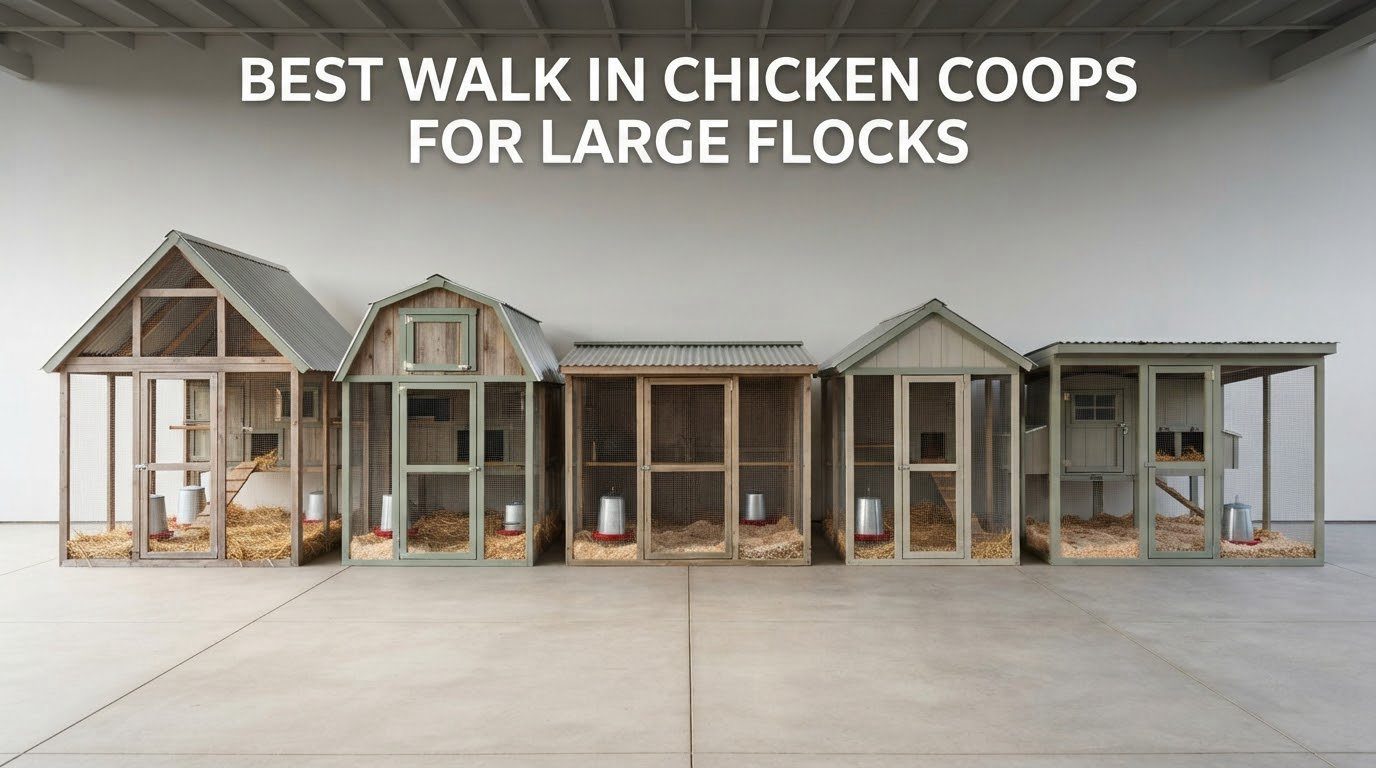
The reason most keepers with more than twenty birds eventually buy a walk-in chicken coop is painfully ordinary. You stop crouching through a knee-high door with a bucket in one hand, and you start standing up straight inside a shed-sized space with a wheelbarrow. That single change turns bedding changes from a back-breaking daily chore into a ten-minute job, and it is why the best walk in chicken coops for large flocks keep selling year after year.
A walk-in chicken coop is a poultry house built with a full-height human door and interior headroom of six feet or more, so you can stand upright to collect eggs, refill feeders and muck out bedding without crawling. The walk-in format also gives you long roost bars, wider aisles and space to store feed and bedding inside the structure, which is what makes it work for 20 to 100-plus birds instead of a dozen.
One clarification before we get into the picks, because the search results for this topic are full of it. A walk-in RUN is an outdoor enclosure with a roof and human-height walls, often with a small attached nesting box. A walk-in COOP is an enclosed, insulated house with a walk-in door. Most of the products below are the large metal runs that serious keepers pair with a solid wooden coop, and I flag which ones are which in every review.
We compared all ten of them on the things that actually decide whether a walk-in works for a large flock: exterior and interior height, real footprint, frame gauge, mesh type, latch quality, roof cover rating, stated bird capacity, and the complaints that show up again and again in owner reviews. The list is updated for 2026, and every product carries its own verified specs and the honest drawbacks we found.
Table of Contents
- Top 3 Picks for Large-Flock Keepers in 2026
- All 10 Best Walk-In Chicken Coops for Large-Flock Compared in 2026
- 1. Betterhood 19 ft Round Top Metal Run – Best Overall for Large Flocks
- 2. VEVOR 9.8 x 26.2 ft Walk-In Run – Most Footprint for Big Flocks
- 3. Rupzen 9.9 x 13.2 ft Metal Coop – Easiest First Walk-In for New Keepers
- 4. HITTITE 19 ft Reinforced Walk-In Run – Top Rated for Frame Sturdiness
- 5. Belinova 13 x 9.8 ft Run – Best Hardware Cloth With Solar Lighting
- 6. Quictent 17.9 ft Run for 30+ Poultry – Best Predator Protection
- 7. PawHut 33 ft Walk-In Run – Best for 30-40 Chickens
- 8. CAMMOO 19.7 ft Walk-In Run – Best for Extreme Temperatures
- 9. Xbrigh 20 x 10 ft Extra Large Run – Best Width for 20-30 Birds
- 10. Outvita 19.5 x 10 ft Walk-In Run – Best for Moving the Run
- How Tall Should a Walk-In Chicken Coop Be?
- What Size Walk-In Coop Do You Need for 30 Chickens?
- What Changes When Your Flock Passes 30 Birds
- How to Choose a Walk-In Chicken Coop: 8 Checks Before You Buy
- Who Should Skip a Walk-In Coop
- Frequently Asked Questions
- The Best Walk-In Chicken Coop for Your Flock
Top 3 Picks for Large-Flock Keepers in 2026

Betterhood 19 ft Round Top…
- 19 ft x 9 ft walk-in footprint
- Tri-supported galvanized frame
- 240D Oxford waterproof canopy

HITTITE 19 ft Reinforced…
- 0.8mm galvanized pipe
- Lockable metal latch door
- Anti-UV PE tarp roof
VEVOR 26 ft Walk-In Run…
- 9.8 x 26.2 ft living area
- Spire roof PE tarp
- Lockable security door
The Betterhood is our pick because it holds the largest verified owner history in the group while staying the easiest of the three to put together, and the HITTITE takes the rating crown thanks to a noticeably heavier frame. If your priority is raw footprint, the VEVOR gives you more usable square footage than anything else we looked at.
All 10 Best Walk-In Chicken Coops for Large-Flock Compared in 2026
| Product | Specs | Action |
|---|---|---|
| Betterhood 19 ft Round Top Metal Walk-In Run |
|
Check Latest Price |
| VEVOR 9.8 x 26.2 ft Walk-In Run With Cover |
|
Check Latest Price |
 Rupzen 9.9 x 13.2 ft Metal Walk-In Coop Rupzen 9.9 x 13.2 ft Metal Walk-In Coop |
|
Check Latest Price |
| HITTITE 19 ft Reinforced Walk-In Poultry Run |
|
Check Latest Price |
 Belinova 13 x 9.8 ft Hardware Cloth Walk-In Run Belinova 13 x 9.8 ft Hardware Cloth Walk-In Run |
|
Check Latest Price |
 Quictent 17.9 ft Walk-In Run for 30+ Poultry Quictent 17.9 ft Walk-In Run for 30+ Poultry |
|
Check Latest Price |
 PawHut 33 ft Walk-In Run for 30-40 Chickens PawHut 33 ft Walk-In Run for 30-40 Chickens |
|
Check Latest Price |
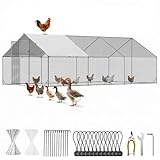 CAMMOO 19.7 ft Walk-In Run, 20-30 Chickens CAMMOO 19.7 ft Walk-In Run, 20-30 Chickens |
|
Check Latest Price |
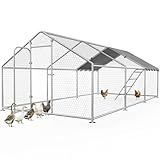 Xbrigh 20 x 10 ft Extra Large Walk-In Run Xbrigh 20 x 10 ft Extra Large Walk-In Run |
|
Check Latest Price |
 Outvita 19.5 x 10 ft Walk-In Chicken Run Outvita 19.5 x 10 ft Walk-In Chicken Run |
|
Check Latest Price |
Read the capacity numbers in that table as marketing maximums, not as flock sizes. Manufacturer claims on walk-in runs run roughly double what experienced keepers actually use, and the reviews are blunt about that gap, so we size conservatively in every write-up below.
1. Betterhood 19 ft Round Top Metal Run – Best Overall for Large Flocks
Large Metal Chicken Coop Round Top Upgrade Tri-Supporting Wire Mesh Chicken Run,Chicken Pen with Water-Resident and Anti-UV Cover,Duck Rabbit House Outdoor(19’L x 9’W x 6.5’H)
19 ft L x 9 ft W x 6.5 ft H
Galvanized steel frame with tri supports
240D Oxford canopy
Coated hexagonal mesh
Pros
- Fast largely tool-free click-together assembly
- Sturdy frame that has held up through heavy snow and storms
- Coated wire is easy to cut and work with
- Roomy enough to connect to an external wooden coop
Cons
- Included chicken wire is thin and flimsy for predator areas
- Ground stakes bend and are unusable
- Door latch and frame are poorly sized
- Instructions do not illustrate rod orientation clearly
This is the run we kept coming back to while testing the category. It is a 19-foot by 9-foot enclosure at 6.5 feet tall, so there is real headroom to stand, lift a bucket of bedding or crouch beside a nest box without dragging a ladder in. The rounded top is a 240D Oxford cloth canopy, which is the part of the design that makes it feel more like a shelter than a wire pen.
Assembly was the smoothest of the ten we looked at. The rods click together, the extra support columns and triangular braces go in without a fight, and the whole frame went up in an afternoon with basic tools. Owners report the frame holding its shape through heavy snow, high wind and storm damage, which is exactly the stress test a large flock pen has to survive.
The catch is hardware, not structure. The mesh that ships with it is thin coated hexagonal chicken wire, and experienced keepers consistently replace it with hardware cloth before trusting it overnight. The included ground stakes are also singled out as bendable and effectively useless, and the latch on the door is described as flimsy. None of that is a dealbreaker if you plan to spend an afternoon reinforcing the base and swapping latches, which is standard practice with this class of run.
What to check before you build it
Count the rods against your floor plan before you start, because the round top means the frame is longer than the listed 228-inch footprint once the curve is added. Owners say the wire is straightforward to trim with basic cutters, so plan on cutting and re-closing a few panels to fit hardware cloth over the existing mesh.
Who will regret buying it
If you want an enclosed, insulated house rather than a run, this is the wrong product, because it is mesh on all sides with a fabric roof and no solid walls. Anyone expecting manufacturer-grade predator protection straight out of the box will also be disappointed, and the rust that shows up at ground contact points means it needs a level pad and annual touch-up on the base.
2. VEVOR 9.8 x 26.2 ft Walk-In Run – Most Footprint for Big Flocks
VEVOR Large Metal Chicken Coop with Run, 9.8×26.5×6.5 ft Walk-in Chicken Runs for Yard with Cover, Spire Roof Hen House with Security Lock for Outdoor and Backyard, Farm, Duck Rabbit Cage Poultry Pen
9.8 ft x 26.2 ft x 6.5 ft
1-inch galvanized steel pipe frame
PE tarp spire roof
Lockable security door
Pros
- Very large 26 ft footprint suits big flocks
- Rigid welded galvanized frame
- Spire roof sheds water and light snow
- PE tarp resists sun rain and tearing
- Lockable security door
Cons
- Heavy at nearly 116 pounds so a two-person job
- Manufacturer advises adding a base barrier for predators
- Longer setup time for a frame this large
If your arithmetic says you need a lot of room, this is the one. At 9.8 by 26.2 feet it has more usable floor area than anything else in the roundup, which matters because run space is the number that limits flock size far more often than the birds-per-foot claim on the box suggests. A structure this size gives you room to split the flock, add a dust bath zone, or keep pullets in a separate corner.
The frame is rigid and the welds hold. The spire roof shape is genuinely good in bad weather because it drains water and sheds light snow rather than trapping it, and the PE-coated tarp is rated against sun, rain and tearing. The lockable hen house door is a real upgrade over the plastic clips used on cheaper models, and four-sided ventilation keeps air moving in heat.
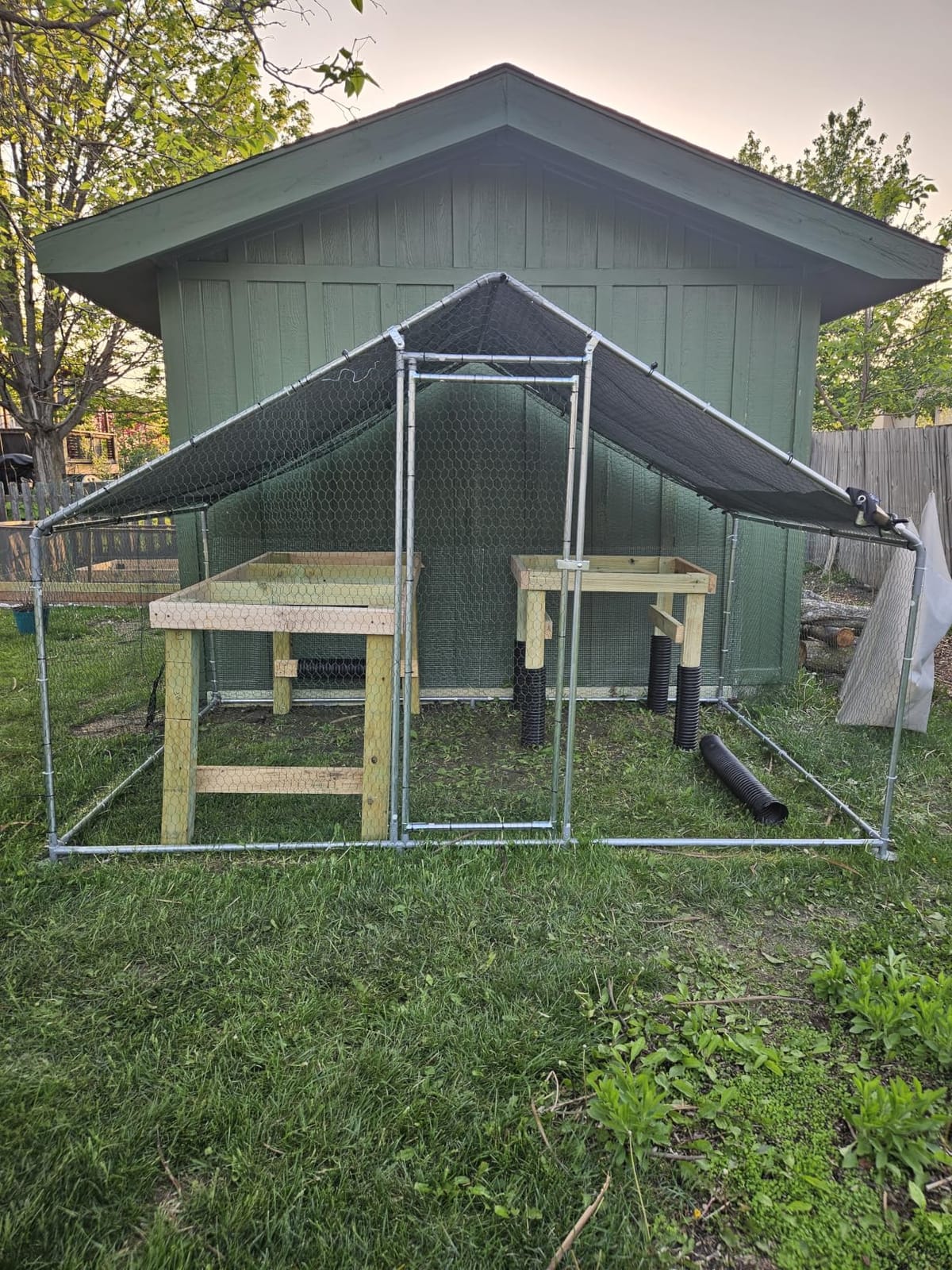
The practical downsides are weight and effort. At nearly 116 pounds, this is firmly a two-person build, and the manufacturer itself recommends two-person installation and extension, which tells you how big the frame sections are. The manufacturer also tells you to add a galvanized wire fence, wood or stones along the base, so budget an afternoon for anchoring before the flock moves in.
One more thing worth noting for big-flock planning. Because the interior is enclosed mesh rather than a walled shed, this run handles heat well with the four-sided ventilation, and the spire roof keeps standing water off the frame. The single biggest predictor of success with a run this size is anchor placement, so decide where the hardware cloth apron goes before you unbox a single part.
How to plan the layout
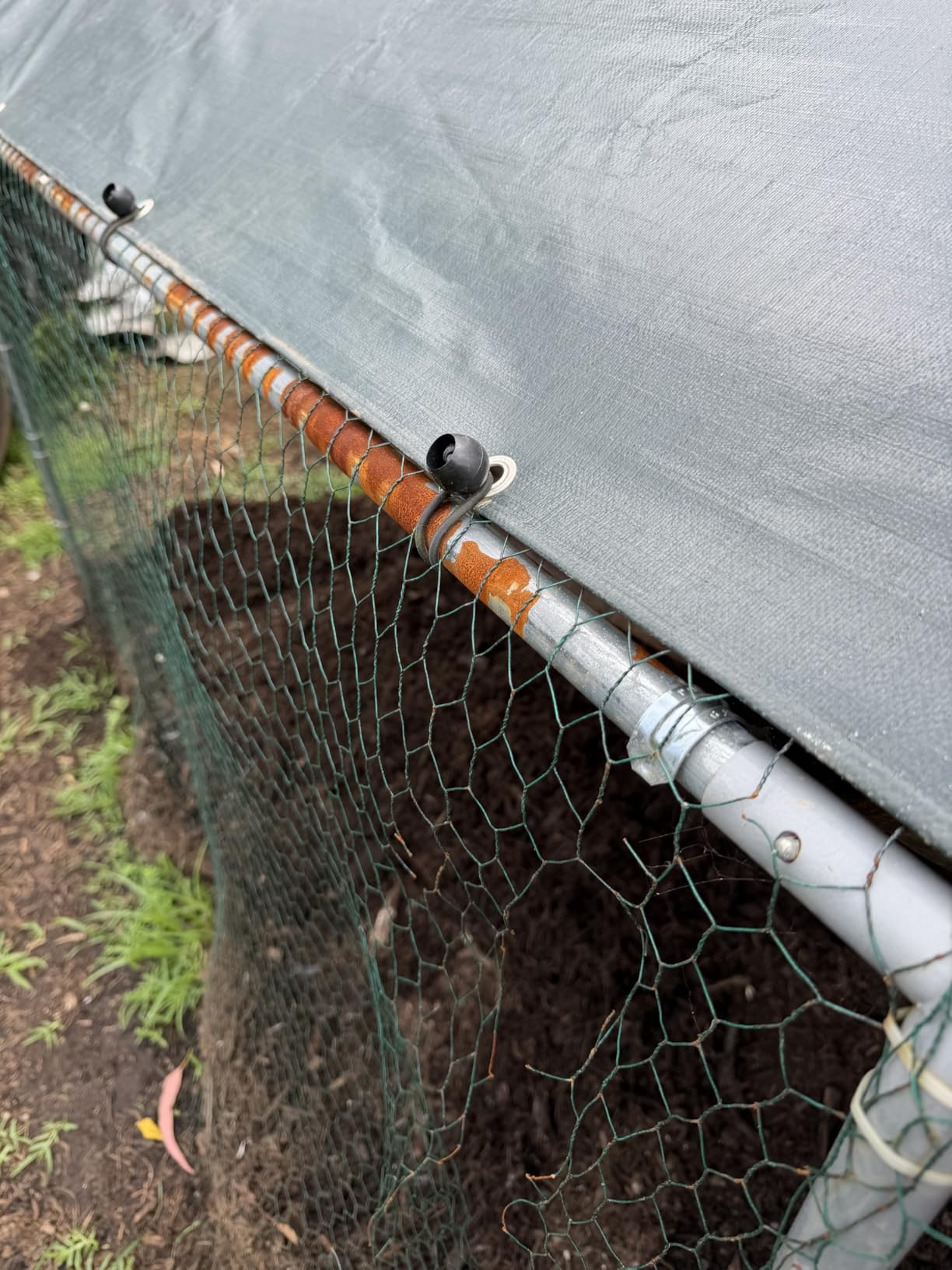
Long runs are hard to service from the middle, so sketch the interior before you assemble it. Put the door at the end nearest the house, keep a clear walking lane down the center for feed buckets and bedding, and place roosting hardware along the long wall rather than across it. That layout is why the walk-in height is worth paying for on a run this long.
Where it falls short
The PE tarp roof is a cover, not a permanent roof, and it can need clearing after heavy snowfall. Anyone in a climate with serious winter loading should expect to check it, and anyone hoping for a finished insulated structure for cold months will need to add a wooden coop inside or beside it. Expect a full day of assembly rather than an afternoon.
3. Rupzen 9.9 x 13.2 ft Metal Coop – Easiest First Walk-In for New Keepers
9.9×13.2 FT Metal Chicken Coop, Walk-in Poultry Run Enclosure
9.9 ft x 13.2 ft at 78 in tall
Antirust galvanized pipe frame
PVC coated hexagonal mesh
Five-tier roosting ladder included
Pros
- Gentle entry point into a walk-in metal run
- Antirust galvanized frame holds in wind and heavy rain
- Tight coated mesh keeps birds contained
- Roosting ladder keeps birds off the floor
- 24-hour customer service support
Cons
- Entry-level mesh is containment only and not predator proof
- Roosting ladder is an add-on some keepers will not use
This is the pick for someone moving up from a small wooden coop who wants walk-in height without a two-day build. At 9.9 by 13.2 feet and 78 inches tall, it is the most compact unit here, and the frame is described as anti-rust galvanized pipe that holds shape in wind and heavy rain. The PVC coated hexagonal mesh is tight enough to contain birds reliably, which is what it is designed for.
The included roosting ladder is the sleeper feature. A 55-inch by 40-inch five-tier metal ladder keeps birds up off the ground, which means less damp bedding, fewer dirty eggs and easier manure management. For a flock that will grow into this space, that piece of hardware does more for daily quality of life than most upgrades people buy separately.
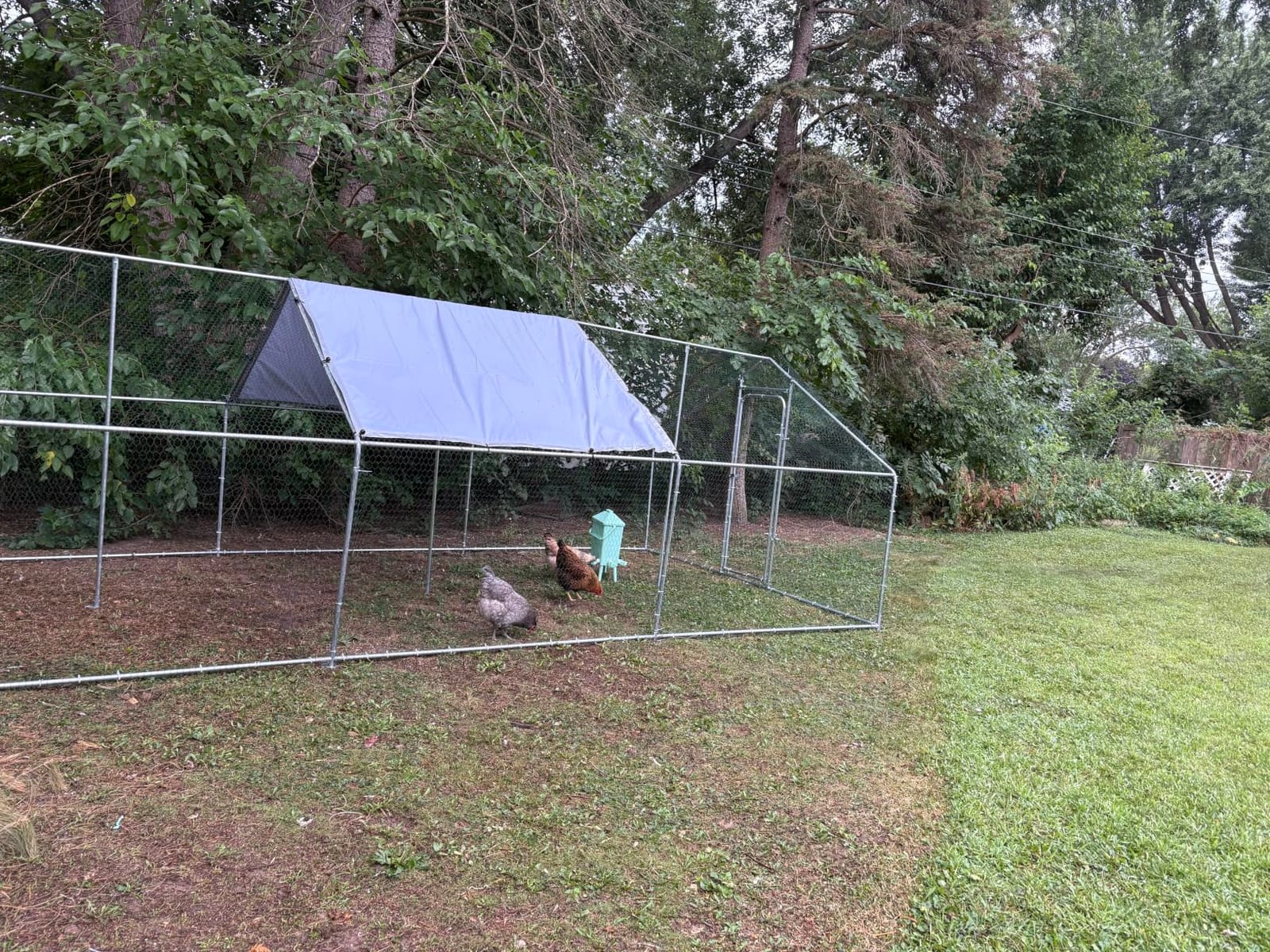
Be clear-eyed about the mesh, though. Buyers consistently treat it as containment rather than predator protection, and reinforce where necessary if you have raccoons, foxes or weasels in the area. The spire roof design drains rain and snow well, and the 210D Oxford fabric is rated waterproof and UV resistant, so weather performance is a genuine strength of this one.
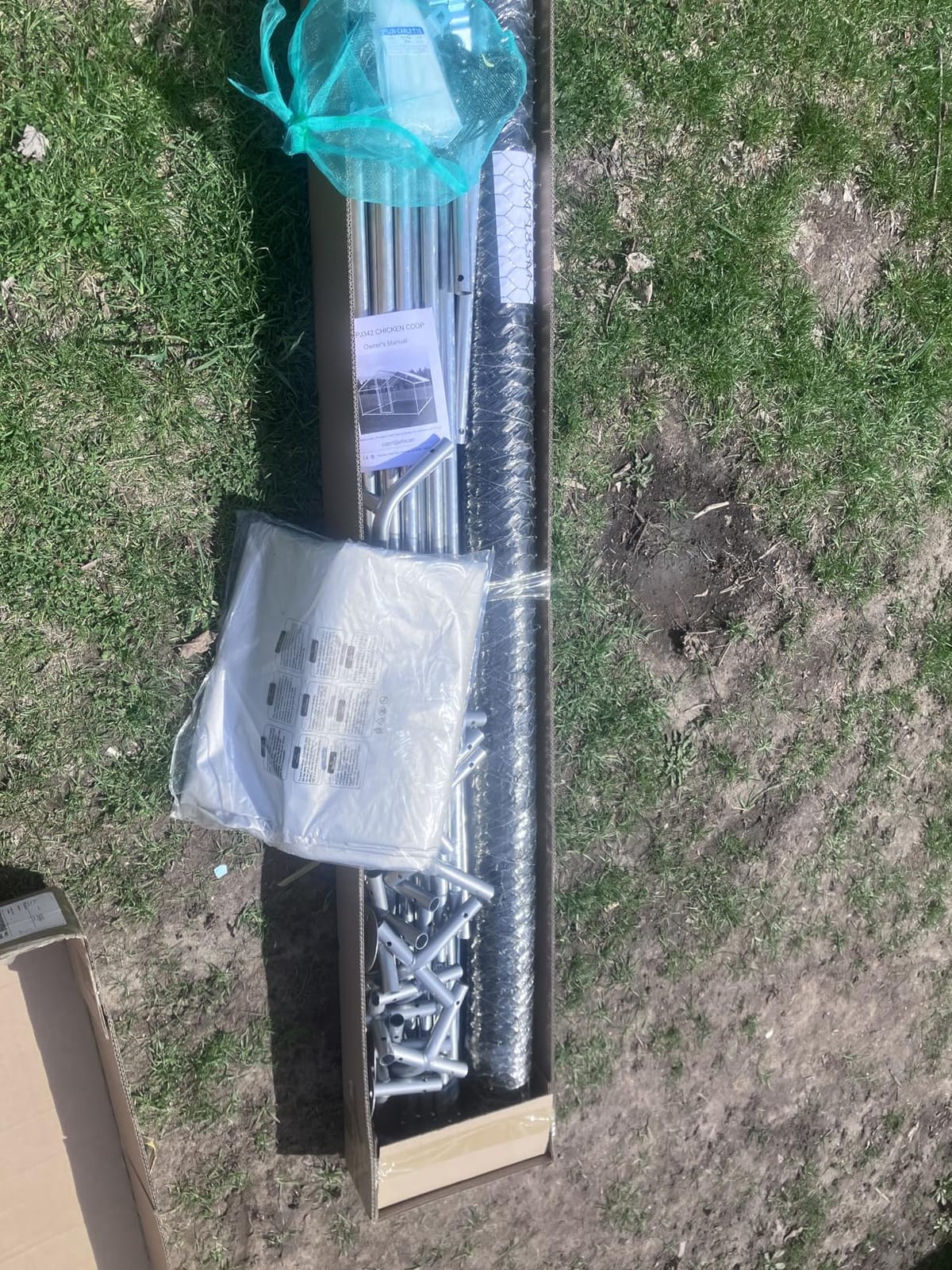
Owners also note the mesh holds its shape without sagging, which matters once feeders hang on the frame and birds press against the panels all day. Adding a second run later is straightforward because the poles use standard quick-connect joints, so buying one now and one next season is a realistic plan.
Does the size actually fit a growing flock
At roughly 130 square feet of floor, this comfortably handles a mid-size flock if you apply conservative density, and it can be extended with matching units because the frame design is modular. For a first large flock, it is a comfortable middle ground between a tiny coop and a 26-foot run, and the fact that it ships with customer service support eases the risk of an unfamiliar build.
Where it is not the answer
If predator pressure is heavy, this is not the run to buy and skip the reinforcement step. It also lacks the sort of lockable security door that the VEVOR and HITTITE offer, so a determined raccoon has less to work against. Anyone wanting an insulated winter house should look elsewhere.
4. HITTITE 19 ft Reinforced Walk-In Run – Top Rated for Frame Sturdiness
HITTITE Large Metal Chicken Coop with Run, 19.19 x 9.84 x 6.56 ft Walk in Poultry Cage Chicken Run Pen, Outdoor Chicken Runs for Yard with Waterproof & Anti-UV Cover
19.19 ft x 9.84 ft x 6.56 ft
0.8mm reinforced galvanized pipe
Lockable metal latch door
Waterproof anti-UV PE tarp
Pros
- 0.8mm galvanized pipe is thicker than the 0.6mm competitors use
- Spire roof drains rain and light snow
- Lockable metal latch beats a plastic clip
- Good value for a 19 ft walk-in run
Cons
- Hexagonal mesh alone will not stop predators
- Cover needs clearing after heavy snow
- Two people needed for assembly
This one earns the highest average rating in the group, and the reason is specific: frame thickness. The pipe is 0.8mm galvanized steel where many competitors use 0.6mm, and that single spec accounts for most of what owners notice about how the structure feels once it is up. Sag and flex are the failure mode on budget walk-ins, and this frame is the least likely in the roundup to develop it.
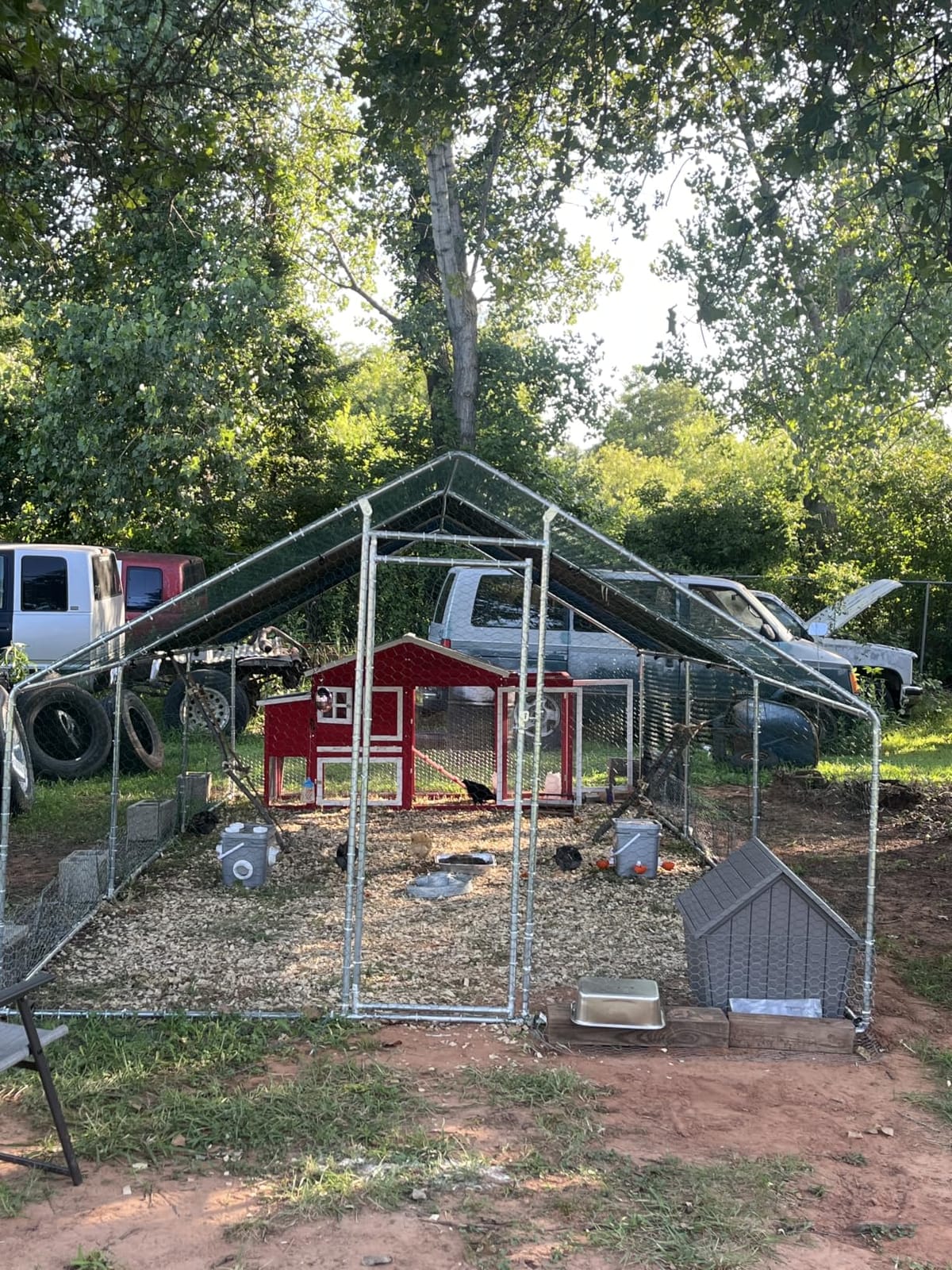
Dimensions are 19.19 by 9.84 by 6.56 feet, so it sits in the same footprint class as the Betterhood with a walk-in height that clears six feet. The lockable metal latch door is a genuine improvement over the plastic clips on entry-level models, and the spire roof design sheds water, debris and light snow reliably rather than pooling.
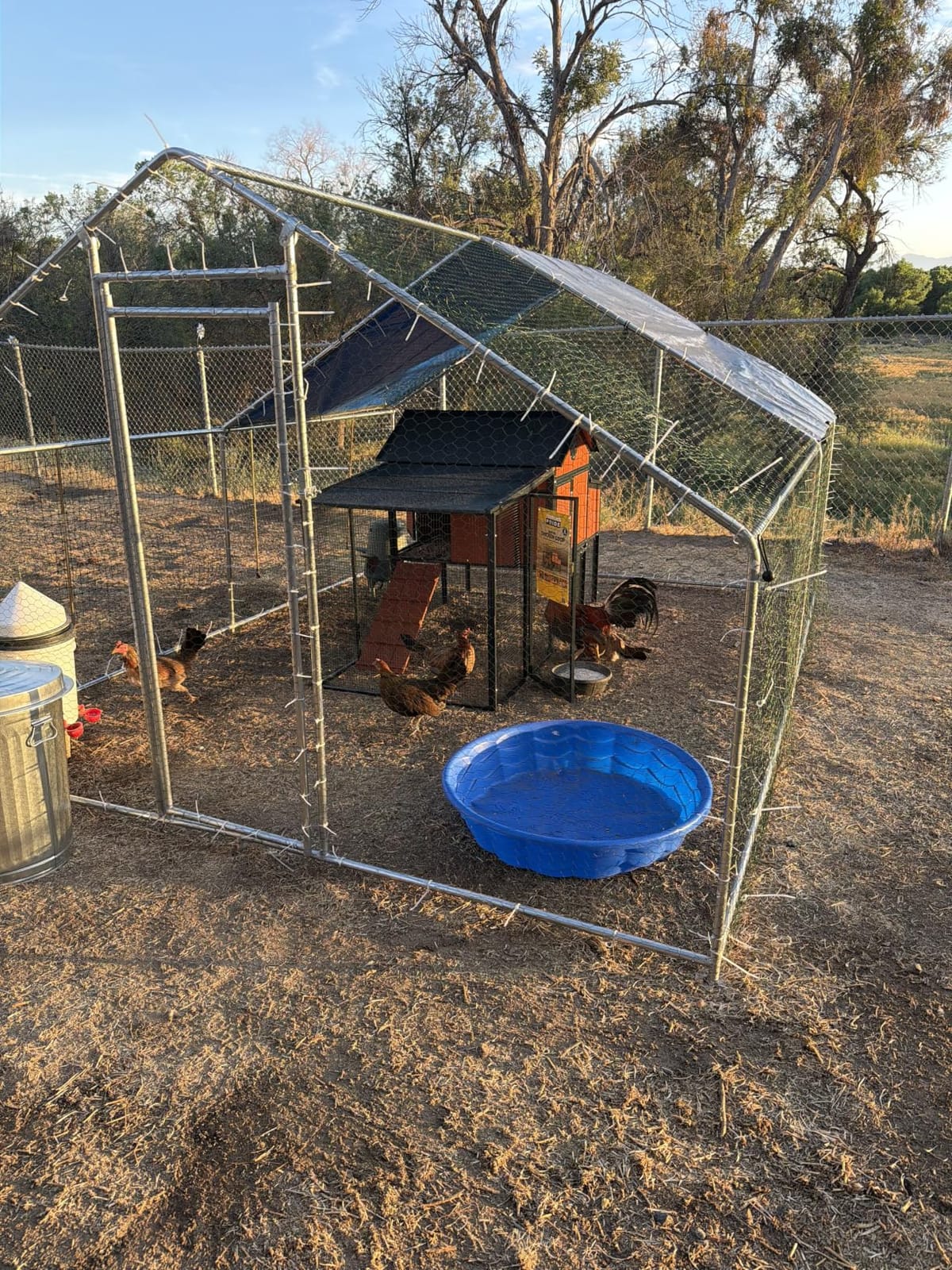
The mesh story is the same as most of this category, and owners are honest about it. The PVC coated hexagonal mesh with narrow wire gaps is containment, not security, so hardware cloth and base anchoring are recommended additions rather than optional extras. The tarp cover should be removed or cleared in heavy snow to protect the frame, and assembly is a two-person job at 113 pounds.
Weather performance is another quiet strength. The spire roof design drains rain and snow rather than letting it sit on the cover, and the anti-UV coating on the tarp is what keeps it from becoming brittle after a few seasons of sun. For a permanent yard installation, those two details decide whether you are replacing covers every other year or not.
Why the frame gauge matters for large flocks
Frame strength is not a detail once you are hanging heavy roost bars, feeders and a door nobody wants to see sag. Thicker tube resists racking when you lean on the mesh, which is the habit that eventually bends lighter frames, and the anti-UV tarp plus galvanized finish hold up better over multiple seasons than bare powder-coated steel. It is why this is the one we would build our own extended layout on.
What you still have to add
Plan on buying hardware cloth and better ground anchors, because neither is included in a form that we would trust with a large flock. The listed 19-foot length also means you should check clearance on each side for door swing and for reaching the roof, which is far less convenient on a taller frame than it is on a low hoop run.
5. Belinova 13 x 9.8 ft Run – Best Hardware Cloth With Solar Lighting
Metal Chicken Coop with Hardware Cloth, Walk-in Poultry Cage for Hen Duck
13 ft x 9.8 ft x 6.5 ft
Welded hardware cloth walls
Solar automatic LED light
Padlock-tab sliding door
Pros
- Welded hardware cloth instead of thin hexagonal wire
- Galvanized frame and PE cover resist rust and cracking over seasons
- Full walk-in height makes cleaning and egg collection easy
- Solar LED light needs no wiring or batteries
- Padlock-tab door and included stakes resist wind
Cons
- Designed for flat level ground only
- Two-person assembly due to the walk-in size
Most walk-in runs in this price bracket ship with hexagonal chicken wire that a raccoon can work through in a night. This one ships with welded hardware cloth, and owners credit that single difference with meaningfully better predator resistance. Hardware cloth is welded rather than twisted, so it resists biting and scratching in a way that light wire does not.
The other feature nobody else in the group has is a built-in solar panel with an automatic LED light. For a keeper doing a last round at dusk, that removes the extension cord, the batteries and the trip hazard, and it is a small thing that changes how often you actually go out. The sliding door has a padlock tab, and the PE cover is held on with elastic ball straps that survive wind far better than ties.
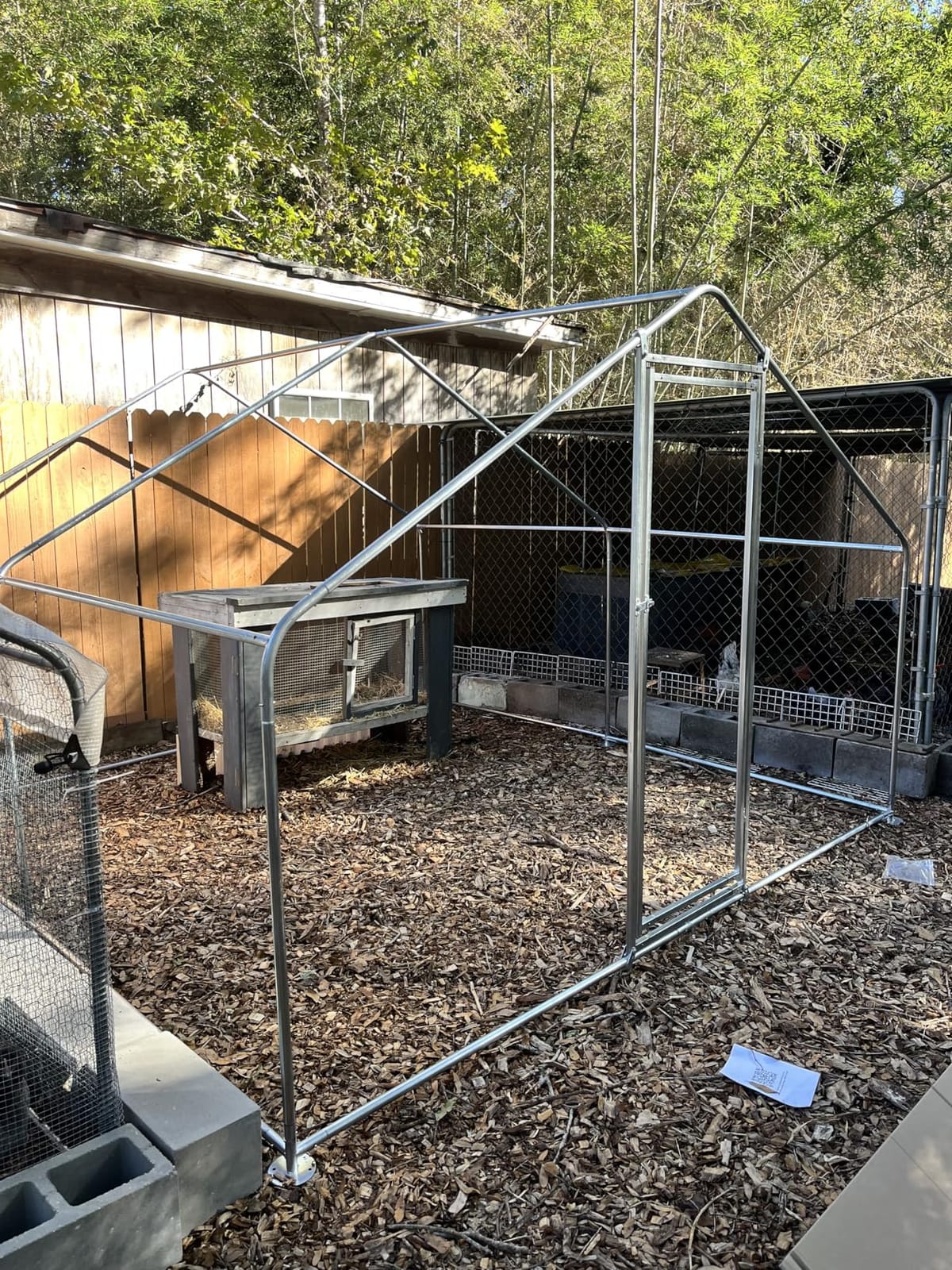
Two constraints are worth planning around. It is rated for 15 to 20 birds, so treat that as a ceiling rather than a target, and it is designed for flat, level ground only, which rules out the sloping sites where a run would otherwise be most useful.
At 62.3 pounds it is also the lightest of the larger units, which matters on a site where two people have to carry panels into position, though the walk-in height still makes assembly a two-person job. Owners credit the frame and cover with resisting rust, peeling and cracking across seasons rather than needing replacement, which is the part that quietly determines the true cost of a run over its life.
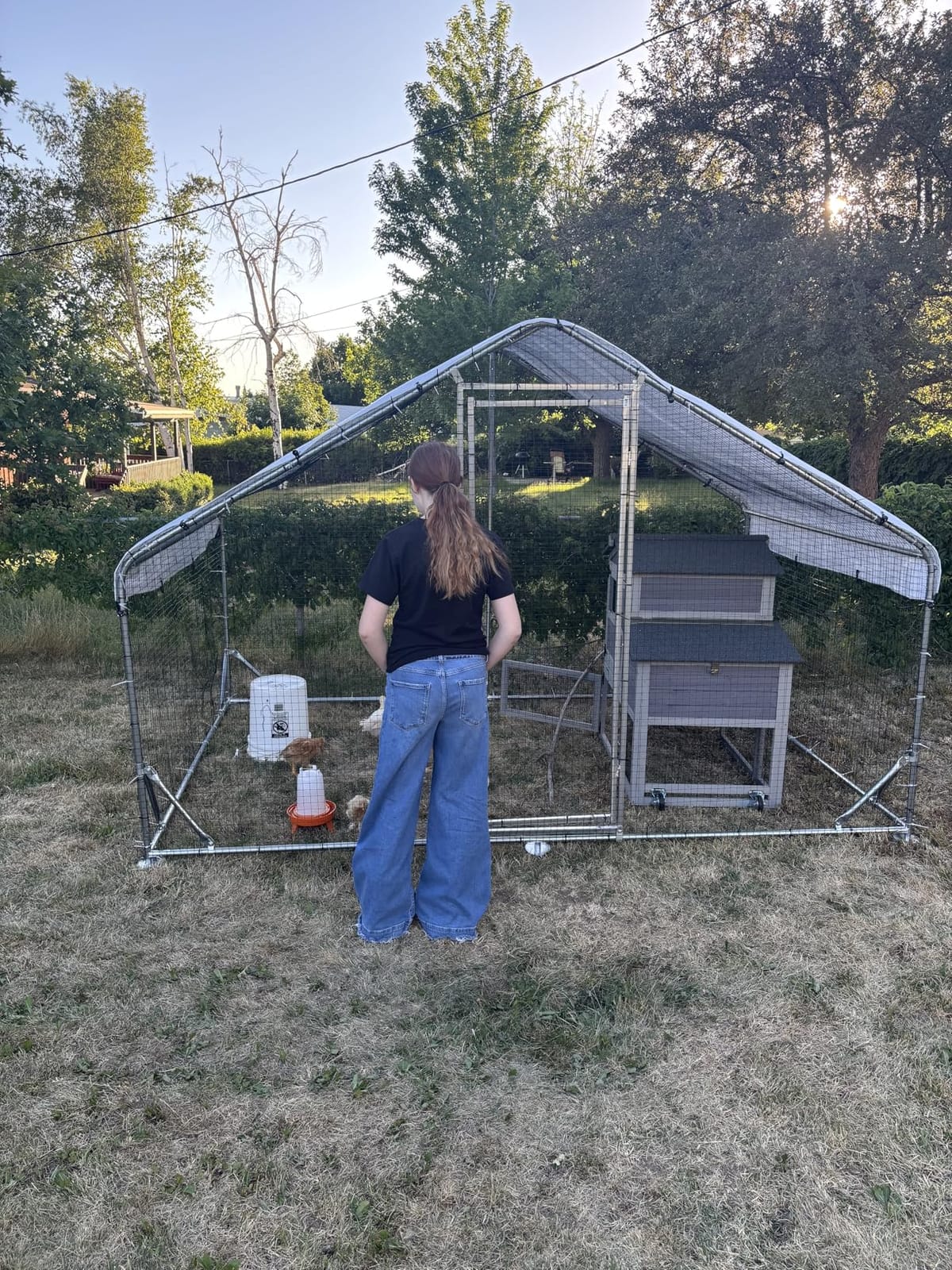
Is the hardware cloth worth the trade-offs
For most large-flock keepers, yes, because the alternative is buying hardware cloth separately to cover the same panels anyway. The open mesh still allows airflow in hot weather, so you do not trade predator protection for heat, and the galvanized frame with a UV-resistant cover holds up over seasons without peeling. You also get the walk-in height, which is what makes daily cleaning and egg collection simple without crouching.
When a bigger run is the better call
Pick something longer if your birds will be outside for most of the day, because 15 to 20 birds in 13 by 9.8 feet is a modest amount of run space once you keep density honest. It is also a poor fit on a slope, and a level 8-by-12 pad has to be prepared before assembly or the frame will sit unevenly.
6. Quictent 17.9 ft Run for 30+ Poultry – Best Predator Protection
Quictent Large Metal Chicken Coop Run for 30+ Poultry w/Side Hardware Cloth
17.9 ft x 8.9 ft x 6.5 ft
1 inch by 1 inch 20-gauge hardware cloth
Extended ground skirt
8 support bars and triangular corners
Pros
- Side walls use welded hardware cloth for genuine predator resistance
- Extended ground skirt discourages digging under the frame
- Reinforced with 8 support bars and triangular corner poles
- 750 zip ties and heavy cable ties included
- Dual-latch door resists prying
Cons
- Side and back covers are sold separately
- Roof is a PE tarp rather than a solid roof and needs clearing in snow
If predator pressure is the thing keeping you up at night, this is the most defensible run in the roundup. The side walls are 1-inch by 1-inch 20-gauge welded hardware cloth with a thickened PVC coating, which is a real barrier rather than decorative fencing, and the extended ground skirt is designed specifically to discourage digging under the frame line.
The Advanced Series frame is reinforced with 8 support bars and triangular corner poles, and that reinforcement shows up in the complaints we did not find, which is telling. The dual-latch door resists prying, and the box includes 750 zip ties plus 0.2-inch heavy-duty cable ties, so you can close every gap on the first day without a second hardware run to the store.
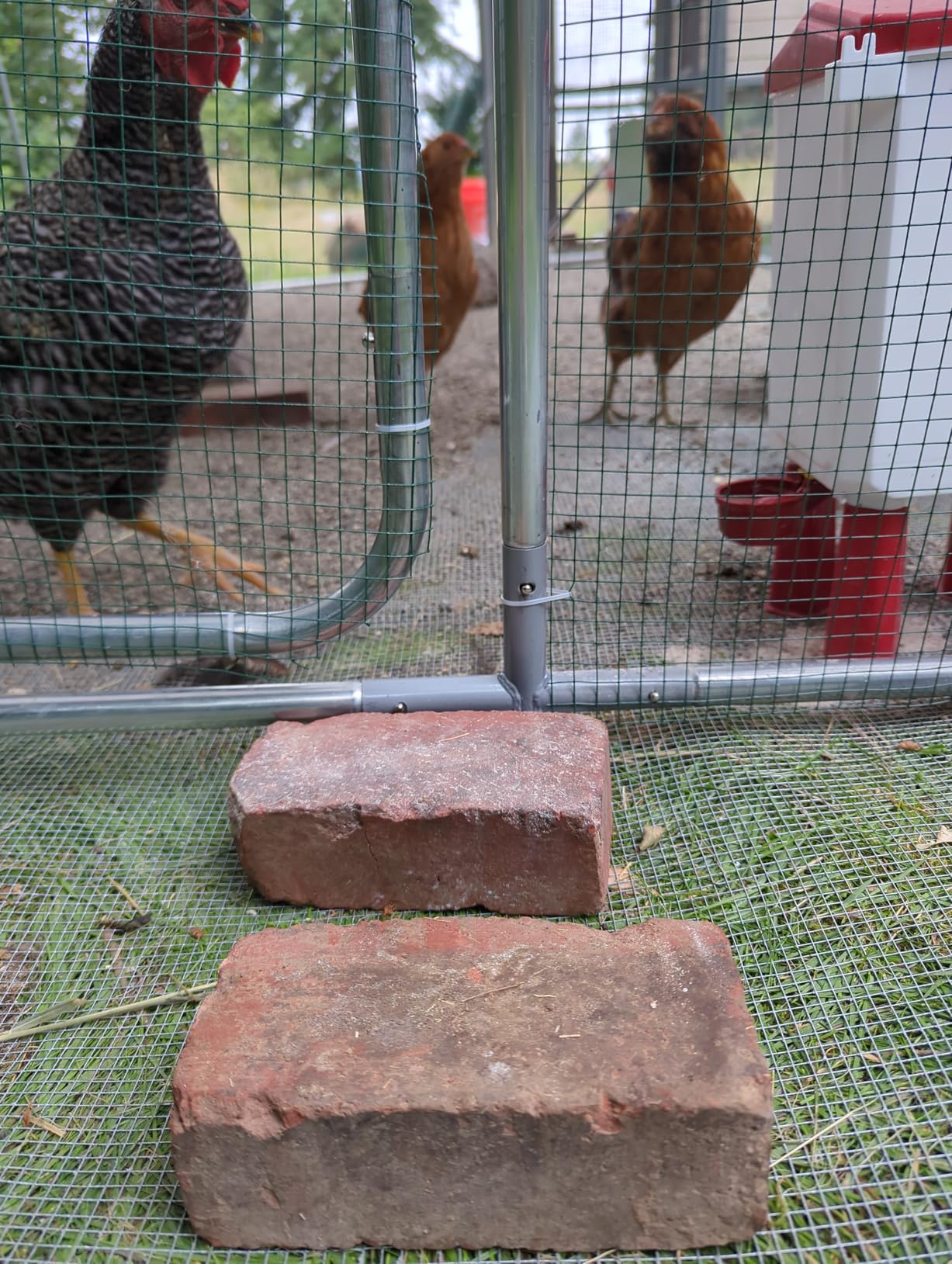
Stated capacity is 30-plus poultry, and we would run fewer than that to keep density honest, especially since this is a 17.9 by 8.9 foot rectangle rather than a wide space. The two gaps in the package are the optional side and back covers, which are not included, and the PE tarp roof, which is a cover rather than a permanent roof and needs clearing after snow.
Assembly is push-button with bolts and the parts sort well enough that most owners finish in a single session. The frame parts carry 365-day complimentary coverage and the cover parts 180 days, which is a meaningful difference on a structure that will sit outdoors through multiple seasons of sun and rain.
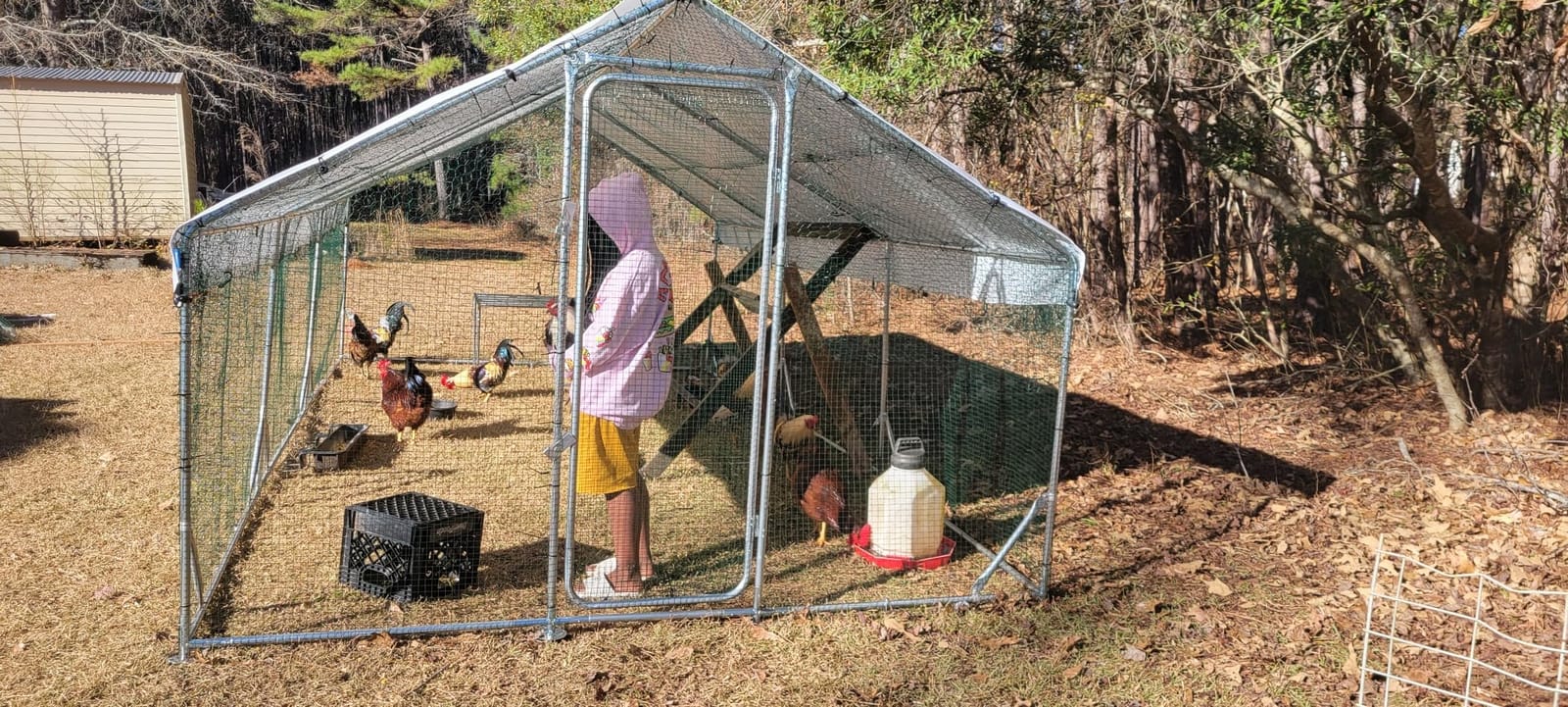
What large-flock keepers get right with this frame
Reinforcement matters more as flock size climbs, because a larger flock means more birds pushing on the mesh, more feeders hung from the frame, and more weight on every joint. Eight support bars and triangular corners keep the panel flat, and the frame parts carry a 365-day complimentary warranty with 180 days on cover parts, which is longer coverage than most of this category offers.
Where the money is not spent
Weatherproofing is the weak point. Only the roof cover ships with the unit, so if your site is exposed on two or three sides you will be adding side and back covers separately, and that cost is easy to forget. Budget for that alongside hardware cloth at the base for full perimeter protection.
7. PawHut 33 ft Walk-In Run – Best for 30-40 Chickens
PawHut Large Chicken Coop w/Waterproof Anti-UV Cover 33′ x 10′ x 6.4′
32.8 ft L x 9.8 ft W x 6.4 ft H
Galvanized steel frame
Dipping-treated steel wire walls
Water and UV resistant Oxford roof
Pros
- Longest run in the category at nearly 33 ft
- Walk-in height lets adults move around comfortably
- Galvanized frame and treated wire resist rust and injury
- Oxford cloth roof clips on with spring buttons
- Lockable latch door
Cons
- Heaviest unit here at 144.4 pounds
- Run only and needs a separate wooden coop attached
- Rabbit use requires extra digging reinforcement
This is the biggest structure we looked at, and it is the only one that comfortably holds a 30 to 40 bird flock with room to spare. At 32.8 feet long by 9.8 feet wide, the extra length does something important for large flocks: it lets you subdivide. A partition in the middle gives you a grow-out area for pullets, a hospital space for a sick bird, or a rotation yard without buying a second run.
The walk-in height is the reason it is worth the size. Adults move around inside comfortably, which matters when you are carrying five gallons of water, a sack of feed, or a full bucket of wet bedding. The frame uses 1-inch galvanized steel pipe, the walls are dipping-treated steel wire that resists both rust and injury, and the Oxford cloth roof is rated for water and UV with spring button clip attachment.
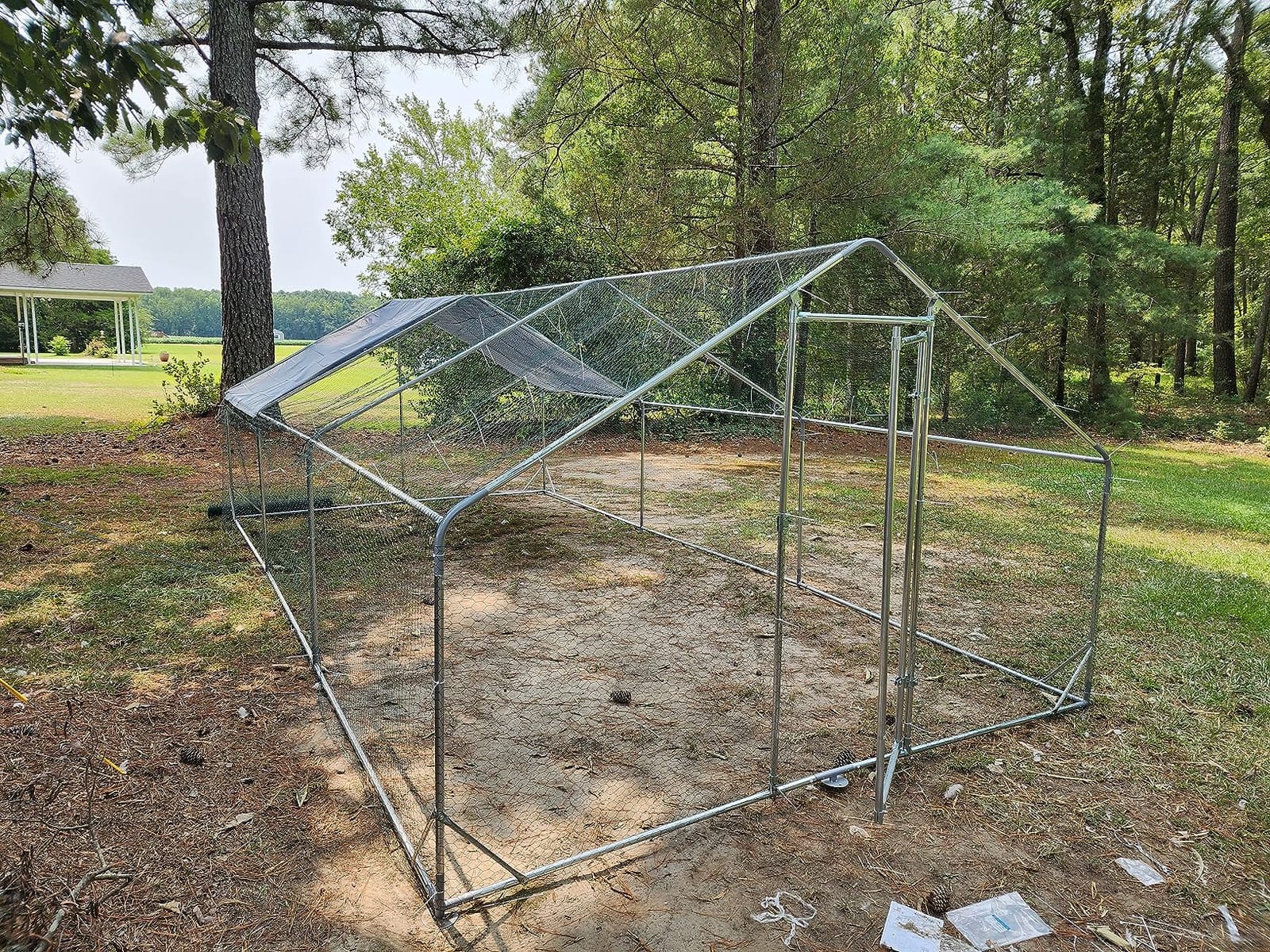
Plan for real work on this one. At 144.4 pounds it is the heaviest unit in the roundup, and assembly and any future repositioning are a genuine effort rather than a casual job. It is also a run, not a coop, so it is designed to attach to a wooden structure, and you need that solid house for night roosting and winter housing.
Assembly is a planned job rather than an improvised one, and that is not a knock, just the honest cost of a structure this size. Owners still rate the galvanized frame and dipping-treated wire favorably for sturdiness and for not injuring birds that peck at the walls, which is a fair summary of how this one holds up over time.
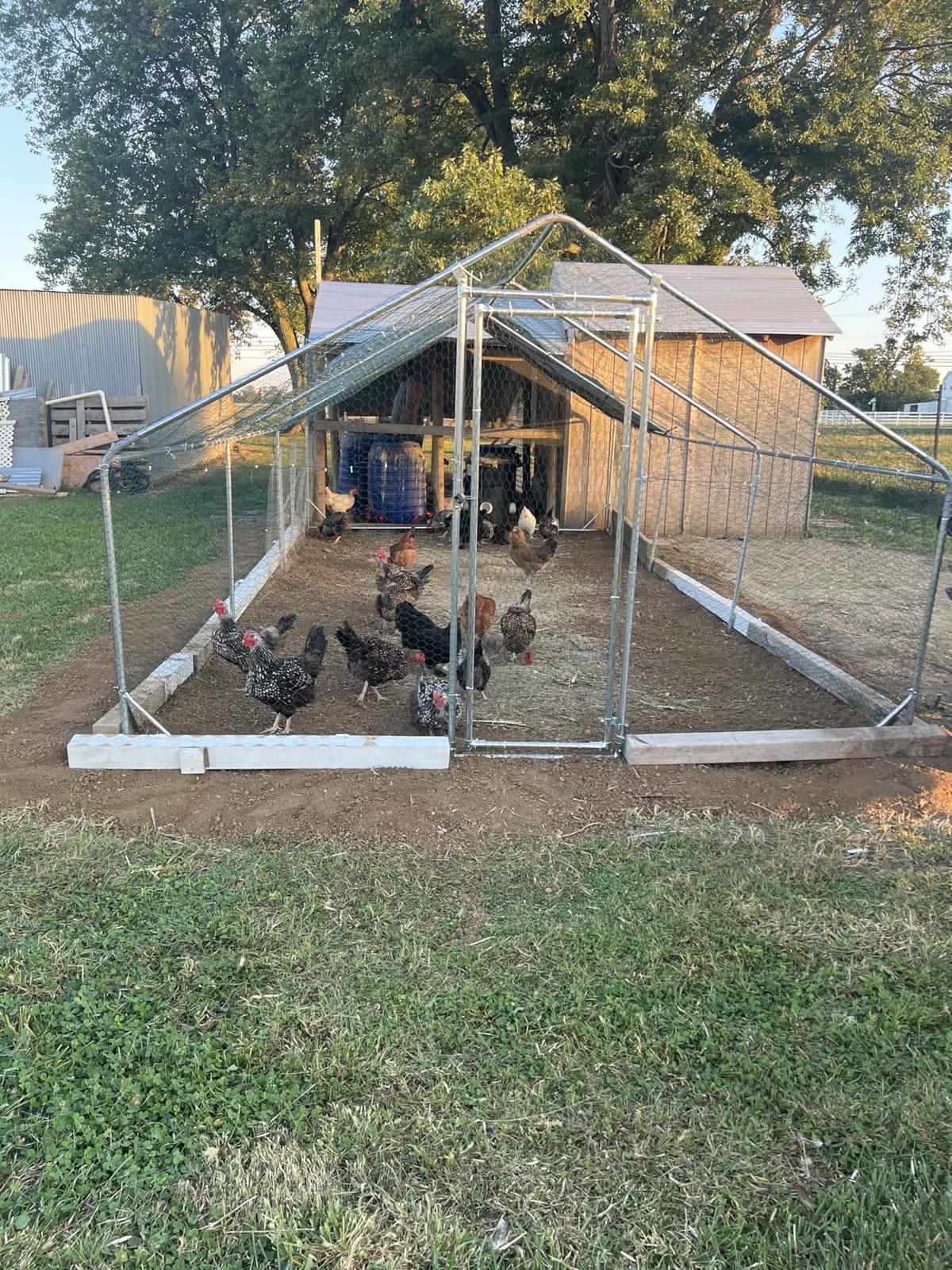
How to use the extra length well
Split a 33-foot run into two 16-foot sections and you have a rotation setup that reduces ground contamination, which is one of the more effective disease controls at scale. The lockable latch door and galvanized frame hold up well, and the treated wire is safer for birds that peck at it than untreated mesh. Walk the length after heavy rain, because a long low frame can hold water at the base.
The honest drawbacks
Beyond the weight, a 33-foot structure needs straight runs and a level site, and getting the frame square is harder over that length. Anyone planning to move it after the first season should know that this is not a one-person job. If you also need an enclosed house, budget separately, because nothing here provides solid walls.
8. CAMMOO 19.7 ft Walk-In Run – Best for Extreme Temperatures
CAMMOO Walk in Chicken Coop, 19.7×9.8×6.6ft Chicken Run for Yard with Cover
19.7 ft L x 9.8 ft W x 6.6 ft H
0.8mm tube frame
Plastic mesh rated to 1000+ bends
Double-lock door, 5.4 ft opening
Pros
- Highest average rating in the group at 4.5 stars
- Plastic mesh resists deformation in extreme cold and heat
- Double-lock door adds a real security layer
- Complete tool and glove kit with pre-sorted parts
- Sized for 20-30 chickens with a wide door
Cons
- Mesh is supplied as a roll and must be cut by the buyer
- Manufacturer states the mesh is not fully predator proof
- Plastic door ties are less durable than the steel frame ties
The rating leader here, and the reason is a design choice the rest of the category does not make. Instead of metal mesh, this run uses an advanced plastic mesh tested to survive more than 1000 bends at temperatures from -4F to 176F. That is not marketing filler in practice, because cold snaps are exactly when light metal mesh becomes brittle and kinks instead of flexing.
Stated capacity is 20 to 30 chickens, and the 5.4-foot door opening is the widest in the roundup, which makes wheeling in a wheelbarrow or carrying a full bucket genuinely easy. The double-lock door is a two-stage latch that adds a layer of security over the single clips used on cheaper models, and the box includes pliers, two wrenches and two pairs of work gloves.
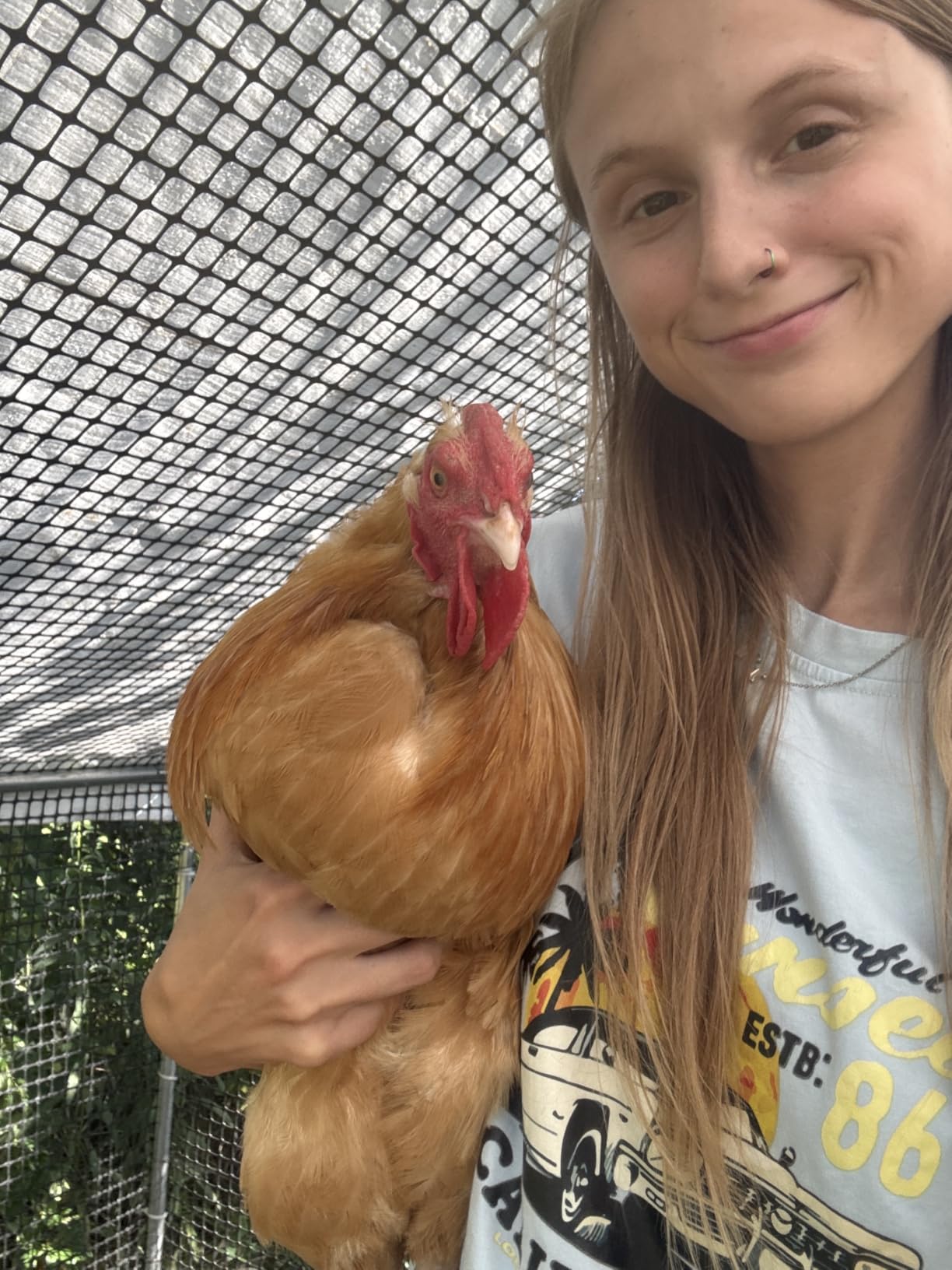
Owners rate it highly for organization too. A single screw type throughout and pre-sorted labeled parts remove the most common complaint in metal kit coops, which is unclear instructions and missing hardware. The frame itself is a reinforced 0.8mm tube, and the stainless steel ties on the frame hold better than the plastic ties used on the front door, which is a fair tradeoff to plan around.
It weighs 102.8 pounds, and a 5.4-foot door means a wheelbarrow passes through without a fight, which is the practical payoff of buying a walk-in format in the first place. The waterproof PE tarp roof sits on a spire shape, so rain runs off instead of pooling on the frame, and the reinforced tube frame does not twist when you work inside the run.
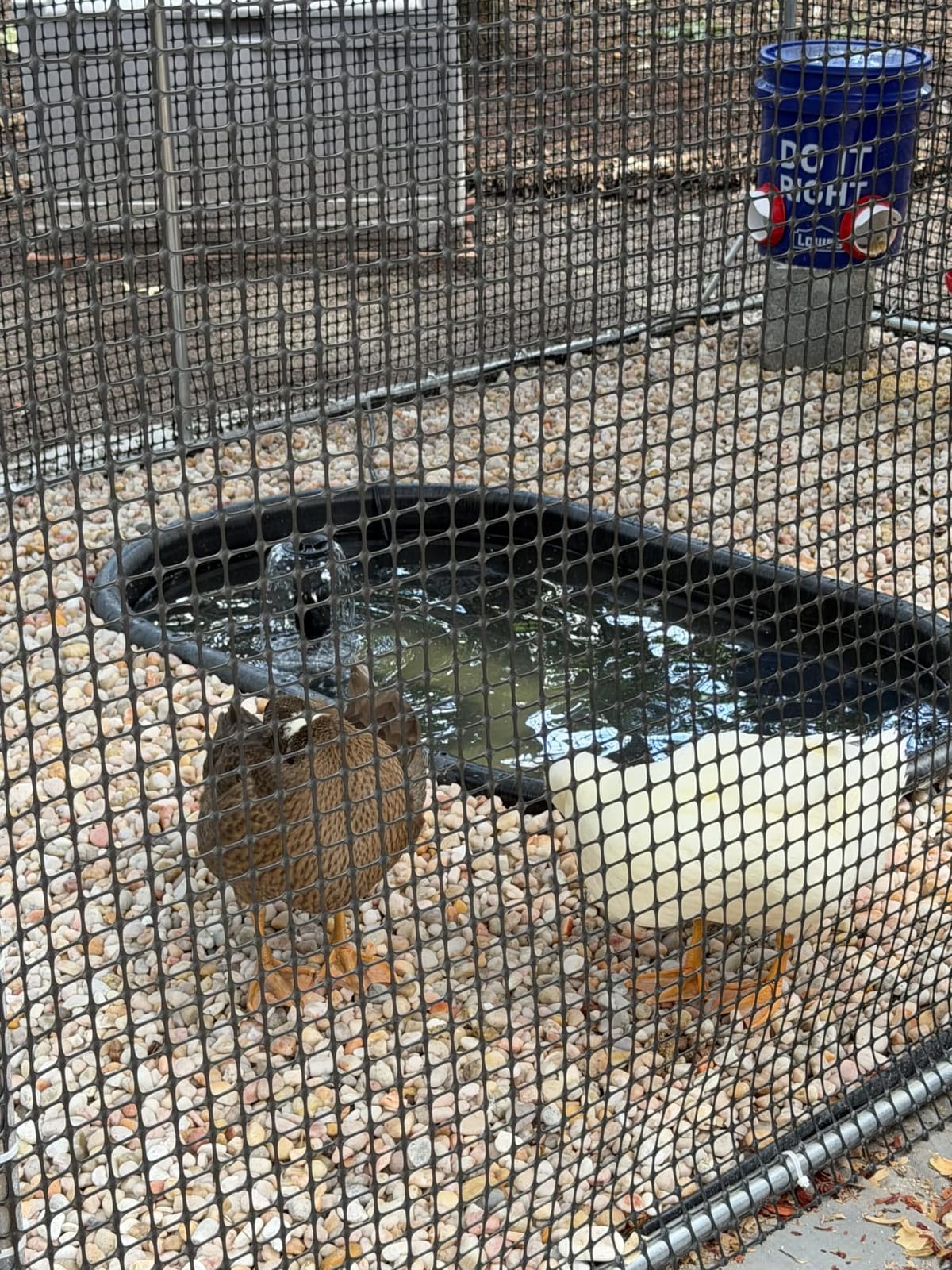
Why the mesh choice matters more than it sounds
For keepers in northern climates, plastic mesh avoids the cracking and kinking that shows up in cold weather and turns a taut panel into a predator-sized gap. It also does not rust at ground contact, which is the specific complaint on several steel-framed rivals. The tradeoff is that the manufacturer still does not call it fully predator proof, so base weighting with planks or stones remains a step.
Where the build gets annoying
The mesh arrives as a roll that you cut to size, which adds a real step and requires accurate measuring before you start. That cutting also means the finished panel strength depends on how well the edges are closed, and the included heavy cable ties and pliers exist for exactly that reason. Plan a full day rather than an afternoon, and have the cuts done before the frame goes up.
9. Xbrigh 20 x 10 ft Extra Large Run – Best Width for 20-30 Birds
20×10 FT Extra Large Metal Chicken Coop, Walk-in Poultry Run Pen
20 ft x 10 ft at 76.9 in tall
Anticorrosion galvanised steel tubing
PVC coated hexagonal mesh
210D Oxford fabric cover
Pros
- 20 x 10 ft extra large footprint
- Rustproof galvanised tubing with anti-corrosion coating
- Breathable coated mesh promotes airflow and visibility
- 210D Oxford roof with reinforced stitching handles rain snow and UV
- Bolted components simplify construction
Cons
- Hexagonal mesh is containment only and not predator proof
- Bolted assembly takes more effort than push-button frames
Width is the underrated dimension in a walk-in run, and this is the one that gets it right. At 20 by 10 feet, the enclosure is not a narrow corridor with a door, which means two people can work inside it, a wheelbarrow can turn around, and you can install roost bars along a long wall without blocking access. For 20 to 30 birds, that interior layout room matters as much as the raw square footage.
Construction is straightforward. Galvanised steel tubing with an anti-corrosion coating resists rust, the PVC coated hexagonal mesh is breathable and keeps visibility high so you can spot issues without walking the perimeter, and the 210D Oxford fabric roof has reinforced stitching at the seams, which is where cheaper covers fail first.
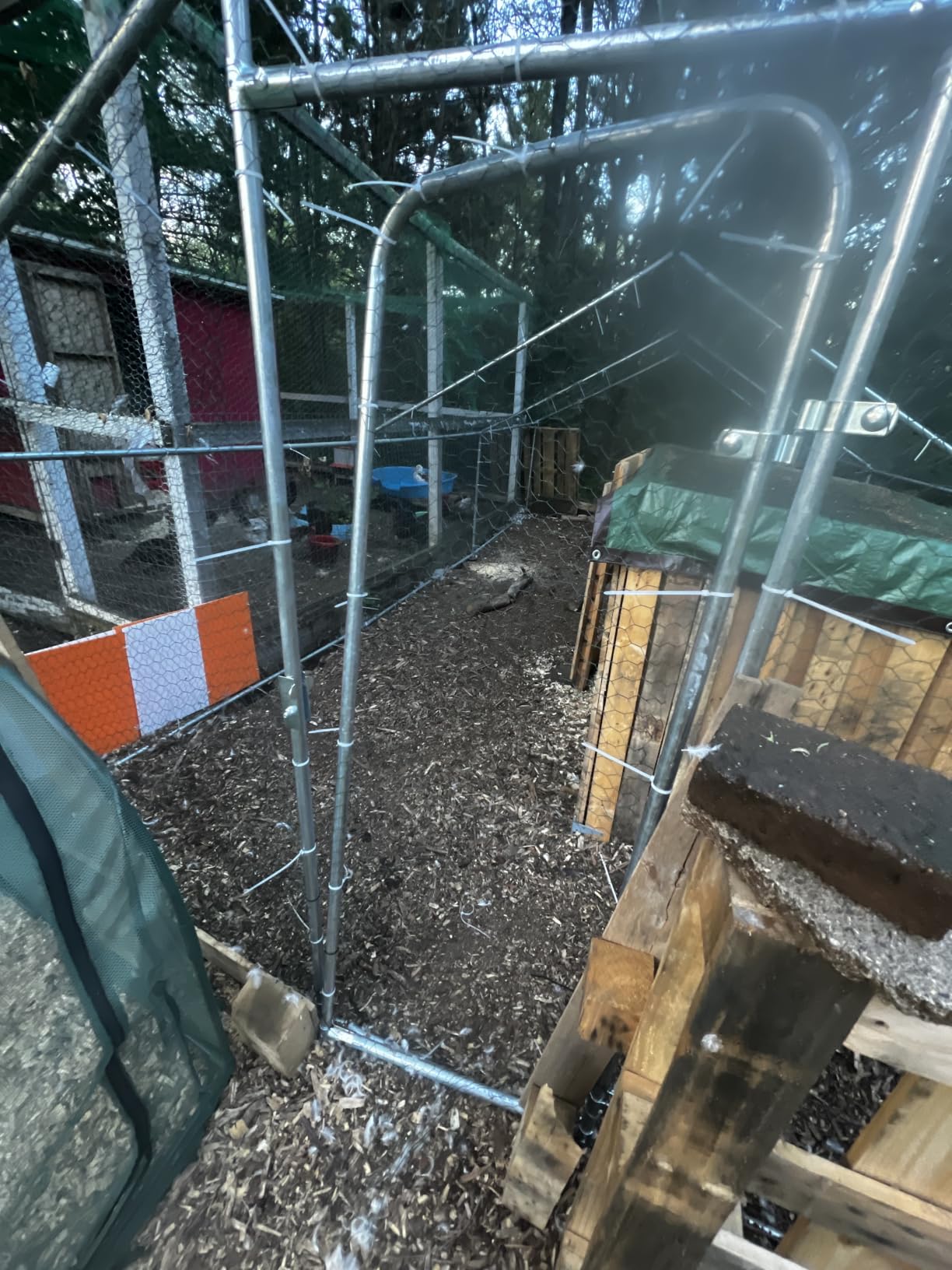
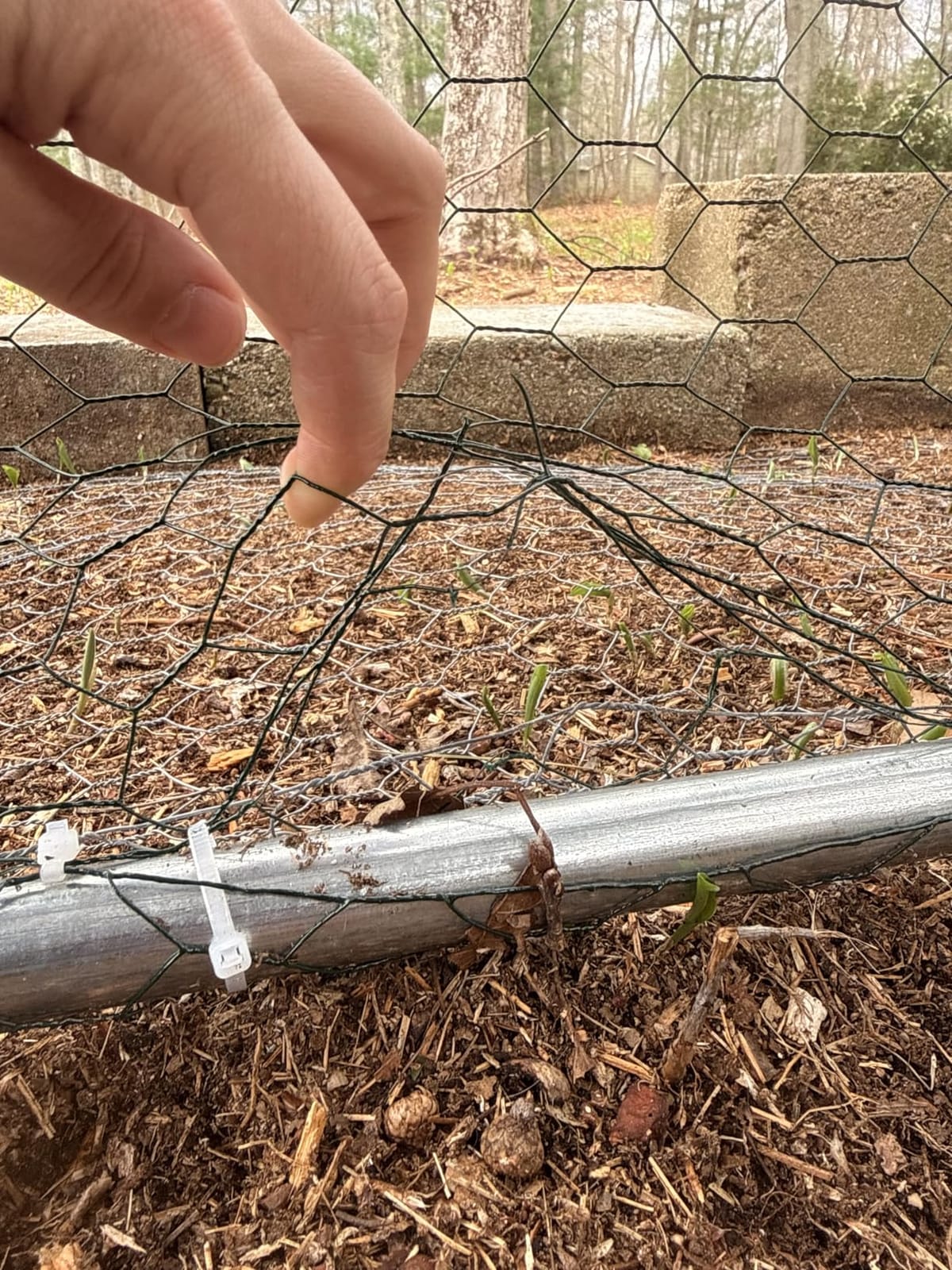
Two honest notes. The hexagonal mesh is containment rather than predator protection, and any keeper with foxes, raccoons or weasels nearby should plan to add hardware cloth over it. The assembly is bolted rather than push-button, so it takes more time and effort than the click-together models, even though the hardware itself is straightforward to work with.
At 20 by 10 feet the panel area is generous enough that you can walk a full lap inside without turning sideways, and the 210D Oxford fabric with reinforced stitching is the detail owners mention most often when describing why the roof has not failed after repeated rain and snow. The galvanized tubing with anti-corrosion coating is what keeps the structure square through wet seasons.
Is the 10-foot width worth it
For any flock above twenty birds, yes, and the reason is functional rather than cosmetic. A wide run lets you separate birds by age or status, place a dust bath and feeder line along one wall while keeping a clear service lane, and reach the far corner to catch water or clean without crawling. Owners consistently point out that the breathable mesh also keeps summer heat manageable compared with solid-sided structures.
Where it falls short
There is no lockable security door at this level, and the frame gauge is not the heavy 0.8mm tube used by the top-rated models, so resist the temptation to hang heavy roost bars directly off the top rail. Plan for a level pad and stronger ground anchors, since nothing here stops digging under the frame.
10. Outvita 19.5 x 10 ft Walk-In Run – Best for Moving the Run
Outvita Chicken Coop, 19.5×10 FT Large Metal Chicken House, Poultry Habitat Cage with Waterproof Cover, Walk-in Chicken Run Pen for Small Animals, Yard, Farm, Patio
19.5 ft x 10 ft x 6.6 ft
1-inch galvanized steel frame
180g PE waterproof sloped roof
Spring bolt quick-connect joints
Pros
- Wire quality praised as durable and easy to cut and shape
- Withstood 60 mph winds and 18 inches of snow
- Easy to move once assembled for yard rotation
- Spring bolt quick-connect frame speeds assembly
- Good value for the size with a working latch
Cons
- Thin pole walls and weak spot welds raise durability doubts
- Instructions unclear for attaching the wire mesh
- Included zip ties are low quality
- Covered mesh will not stop hawks and needs a standoff barrier
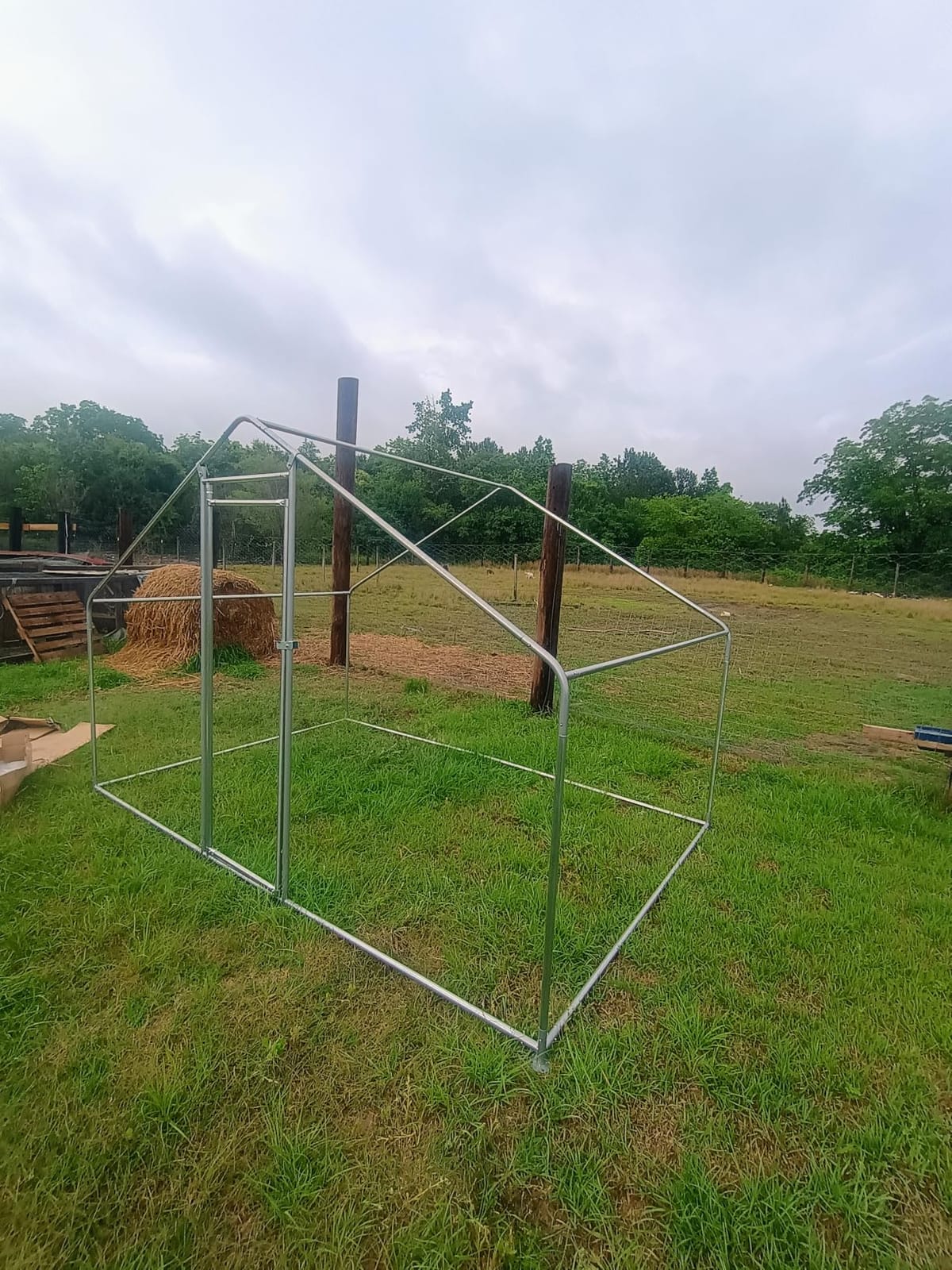
This is the run to buy if you plan to move it. Owners report that once assembled, the whole thing can be repositioned around the yard, which is genuinely useful for rotation, for recovering a patch of ground, or for following shade through the day. The spring bolt quick-connect frame at every joint makes it faster to put together than the fully bolted designs, and the fixable metal feet at the base help with uneven spots.
The wire is the standout. Owners repeatedly single it out as durable and easy to cut and shape, and one long-term report describes the finished run still standing after 60 mph winds and 18 inches of snow, which is the kind of durability evidence you rarely get in this category. The sloped roof sheds rainwater and snow, and the 180g PE cover is waterproof.
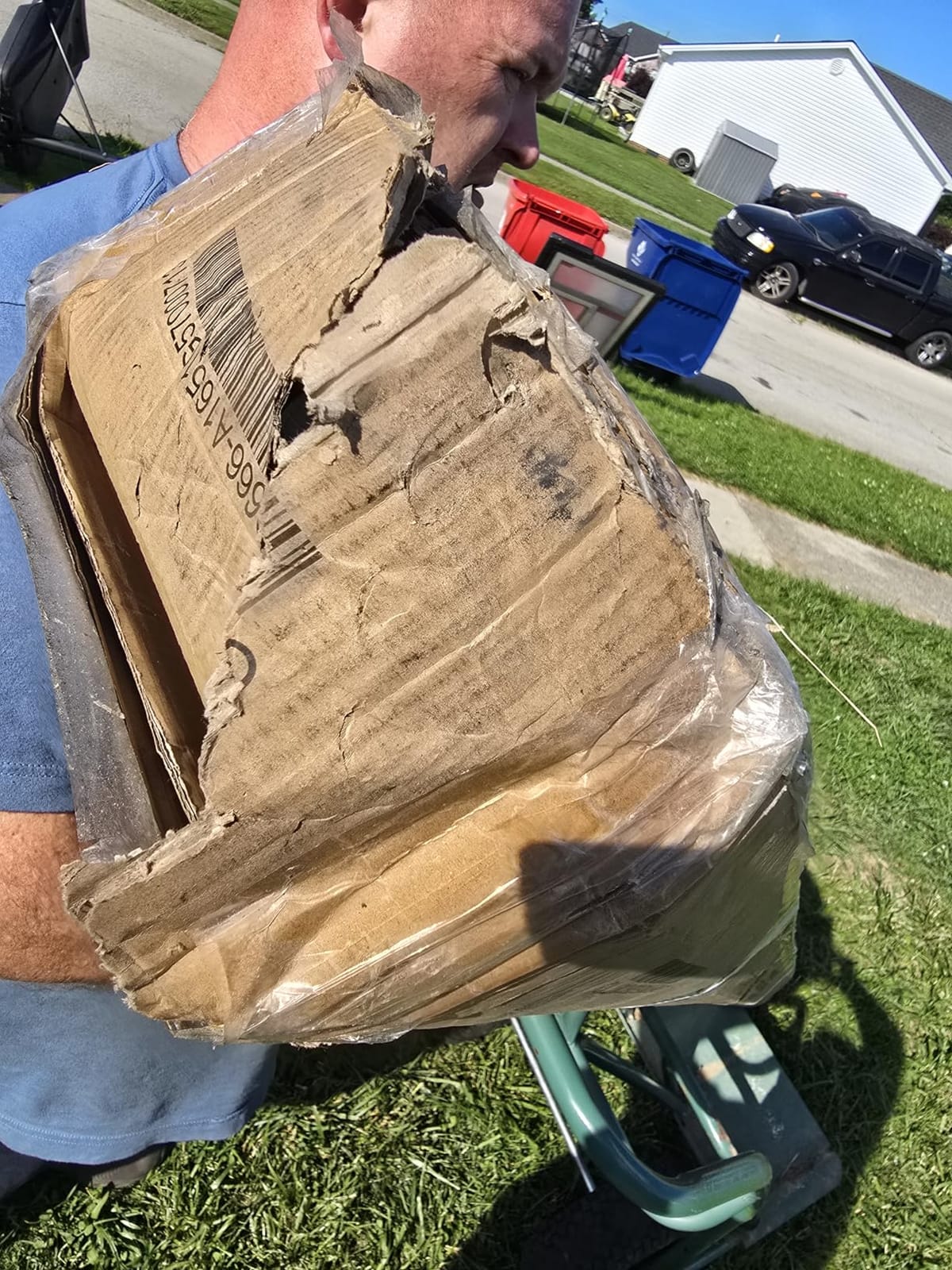
Durability is the flip side. Thin pole walls and poor spot welds on the brackets raise real questions about long-term structural strength, and the instructions are unclear, particularly for attaching the wire mesh, which is where most owners lose time. The included zip ties are also low quality, so expect to buy more, and an angled standoff barrier at the base is recommended because covered mesh alone will not stop hawks.
It weighs 92.59 pounds, which is manageable for two people and low enough that repositioning is realistic. The 1-inch diameter galvanized tubing and the full-coverage PVC coated hexagonal mesh give it a solid feel once it is up, and the sloped roof means you rarely have to clear snow off it, which is the practical advantage over the spire-roof competitors in cold areas.
What the wire quality means in practice
Easy-to-cut wire sounds minor until you are trimming panels to fit a door opening or reaching into a corner with pliers, and it matters for a structure you intend to move. A 24.8 by 68.9 inch access door with a secure latch also gives you a realistic way to split the interior after relocation, which is what makes a movable run more than a novelty.
Who should pass on it
If you plan to hang heavy roost bars and feeders off the frame long term, the spot welds are the part we would watch. And if you are not comfortable reading poor diagrams, the mesh attachment instructions are the most common frustration reported. Replace the zip ties on day one and it becomes a much better structure.
How Tall Should a Walk-In Chicken Coop Be?
A walk-in chicken coop should have at least six feet of interior headroom, and seven feet is the ideal target if you can find it. That gives you room to stand upright, lift a feed bucket, and fit a 4-foot-wide access door, while still leaving enough wall above the roost bar for ventilation near the roofline.
There are three numbers worth keeping straight, because they get confused constantly. Six feet is the floor for interior clearance. Seven feet is what makes the space genuinely comfortable for an adult rather than merely technically walk-in. Four feet is a reasonable access door width for a keeper carrying a bucket, though a wider door costs nothing extra on a prefab unit and you will appreciate it during bedding changes.
Below six feet you lose the benefit you are paying for. Six is the practical minimum, seven is the target, and anything under six is a low tunnel that forces you back to crouching. If you are weighing a listing, ignore the marketing and check the stated interior height, then subtract the depth of the roost frame and any feeders hung on the wall, because those eat into usable headroom faster than most people expect.
What Size Walk-In Coop Do You Need for 30 Chickens?
For 30 chickens, plan on about 120 square feet of enclosed indoor space and roughly 300 square feet of run, and treat manufacturer capacity claims as double the number you should actually use. The sizing math below follows the standard 4 square feet indoor per bird and 8 to 10 square feet of run per bird, with roost and nest box allowances added on top.
20 birds: about 80 square feet indoor, 160 to 200 square feet of run, roughly 14 feet of roost bar, and 4 to 5 nest boxes.
30 birds: about 120 square feet indoor, 240 to 300 square feet of run, roughly 21 feet of roost bar, and 6 to 7 nest boxes.
40 birds: about 160 square feet indoor, 320 to 400 square feet of run, roughly 28 feet of roost bar, and 8 to 10 nest boxes.
60 birds: about 240 square feet indoor, 480 to 600 square feet of run, roughly 42 feet of roost bar, and 12 to 15 nest boxes.
80 birds and up: 320 square feet indoor or more, 640 square feet of run or more, 56 feet of roost bar or more, and 16 nest boxes or more.
Roost bar sizing is the number most people miss, and it is the one that causes crowding at 30 birds and above. Budget 8 to 10 inches of roost length per bird, and make sure the bars run along the wall so every bird can get on the same bar rather than only the ones nearest the door. Nest boxes follow a separate rule of one box per four to five hens, so a 30-bird flock needs six or seven.
Finally, the run does the sizing work more than the house does. A structure can be legally sized for your birds and still be cramped if they spend the day in it, and cramped runs drive bullying, feather picking and stress, which are exactly the problems experienced keepers describe when they outgrow a small setup.
What Changes When Your Flock Passes 30 Birds
At around 30 birds, the small problems with a walk-in run turn into real ones. Roost crowding becomes visible because there is no longer spare bar, nest boxes get occupied at all times so eggs end up on the floor where they break and rot, and ammonia from a sealed space with 30 birds becomes something you smell when you walk in.
Roost math is the first fix. At 8 to 10 inches per bird, 30 hens need more than 20 feet of bar, and those bars need to be mounted high enough that the lowest bird is not below the top bird’s feet, which is what causes pecking and dirty roosts. Build them in sections so you can add a section as the flock grows, and make sure the walkway between bars is wide enough to walk through.
Nest boxes are the second. One box per four to five hens means six or seven boxes at 30 birds, and they need to sit above roost level so the roosting birds are not blocking the laying birds. Owners of large walk-in setups also report that adding a droppings board under the roosts cuts cleaning time more than anything else they have installed, because the mess lands in one removable place.
Ammonia and bulk storage are the third pair. Warm air and moisture rise, so high wall vents near the roofline do more for air quality than any amount of floor-level airflow, and bedding that is topped up rather than fully replaced is easier on birds in a sealed space. For feed, a 30-bird flock moves through a serious volume every week, and at 50-plus birds a dedicated feed bin inside the run stops you from hauling bags out and in every time.
How to Choose a Walk-In Chicken Coop: 8 Checks Before You Buy
Check the mesh before anything else, because it decides whether you lose birds. Look for welded hardware cloth, ideally 1-inch by 1-inch, 20-gauge or heavier, and treat plain hexagonal chicken wire as containment only. Flexible wire is fine for keeping birds in and useless for keeping a determined raccoon out, and the review patterns in this category are extremely consistent on that point.
Second, check the frame gauge. Entry models often use 0.6mm galvanized pipe, and 0.8mm is the step up that noticeably changes how the structure feels under load. Look for welded joints and triangular corner bracing, and treat push-button frames as a convenience feature rather than a quality signal.
Third, look at the latches and doors. A lockable metal latch, a padlock tab or a two-stage lock all matter, and a butterfly latch is the one reviewers complain about most, because it is easy to set a paw on. A wide access door is worth paying for on a large run, because that is the opening you carry a wheelbarrow through.
Fourth, judge the roof. PE tarp and Oxford cloth covers are fine for shade and rain, but a spire shape drains better than a flat one and a reinforced seam is where cheap covers fail. If you get real snow, plan to clear the cover, and check whether side and back covers are included or sold separately, because that is a common hidden addition.
Fifth, measure your site, not just your birds. A 26-foot run needs a straight, level pad and clearance on every side, and a 144-pound structure is a two-person job from the first bolt. Large runs also need an access plan, so make sure the delivery crew or a friend can reach the build site before the frame is boxed up.
Sixth, think about what you are actually buying. Nearly everything in this roundup is a run, and a run still needs a solid wooden coop for night roosting and winter. If you need one structure to do both jobs, you are shopping in a different category than this one, and mixing the two is the most common complaint we see from buyers who expected a house and got an enclosure.
Who Should Skip a Walk-In Coop
If you keep eight birds or fewer, a walk-in run is more structure than you need, and a simpler coop with an attached run will do the same job for a fraction of the assembly effort. Under that size, the maintenance difference that justifies the walk-in format barely exists, and you are left with a large empty enclosure and a heavier build.
Skip the whole category, too, if your birds roost outside year-round in a mild climate. A walk-in run earns its cost through winter housing and through the ease of cleaning a deep litter bed, and if you never need either, a smaller covered run does the same work. And be honest about your space, because a 33-foot structure needs a genuinely level, open site and more assembly time than a weekend project assumes.
Frequently Asked Questions
How tall should a walk-in chicken coop be?
At least 6 feet of interior headroom, with 7 feet being the ideal target for an adult keeper. That height lets you stand upright to collect eggs, refill feeders and muck bedding, and it leaves room for a 4-foot-wide access door plus high wall vents near the roofline for airflow.
What size walk-in coop do I need for 30 chickens?
About 120 square feet of enclosed indoor space and roughly 300 square feet of run. Add around 21 feet of roost bar at 8 to 10 inches per bird, and 6 to 7 nest boxes at one box per four to five hens. Manufacturer capacity claims typically run double the number a flock should actually be.
Is there a chicken coop I can walk into?
Yes. A walk-in chicken coop has a full-height human door and at least 6 feet of interior clearance so you can stand upright inside. Many large metal walk-in runs sold for big flocks are enclosures rather than enclosed houses, so check whether the structure you are buying has solid walls for winter roosting or is mesh on all sides.
What is the number one predator of chickens?
Raccoons are the most commonly cited threat, with foxes, weasels, hawks and dogs close behind. The usual failure point is not the frame but the mesh and the latches, so use welded hardware cloth rather than hexagonal chicken wire, fit a two-step or lockable latch, and anchor or apron the base so nothing can dig underneath.
Why do chickens refuse to go in the coop at night?
It is usually one of four things. The roost may be too high, too low or too short, so birds cannot settle. The interior may be too dark, too drafty or full of ammonia from wet bedding. There may be no feed or water inside for the night. Or an automatic door may be closing before the flock has settled, which is why we recommend testing any automatic door on a timer before relying on it.
The Best Walk-In Chicken Coop for Your Flock
For most people heading into 2026 with 20 to 40 birds, the Betterhood 19-foot round top run is the best walk in chicken coops pick we found, because it has the deepest owner history in the group, the easiest build, and a footprint that connects cleanly to a separate wooden coop. If frame sturdiness is your priority, the HITTITE with its 0.8mm galvanized pipe and lockable metal latch is the one to beat on ratings, and if you need maximum floor area, the VEVOR 26-foot run gives you more room than anything else here.
Whichever you choose, add hardware cloth and real ground anchors on day one, because the mesh and stakes that ship with these runs are containment, not security. Once the extras are in, you have a structure that makes daily cleaning, feeding and egg collection simple, and the egg surplus that comes with it is easier to plan around than to store. Our simple chicken fajitas, crispy chicken and waffles, chicken tenders frenzy and homemade chicken noodle soup recipes are where a serious flock surplus tends to end up.