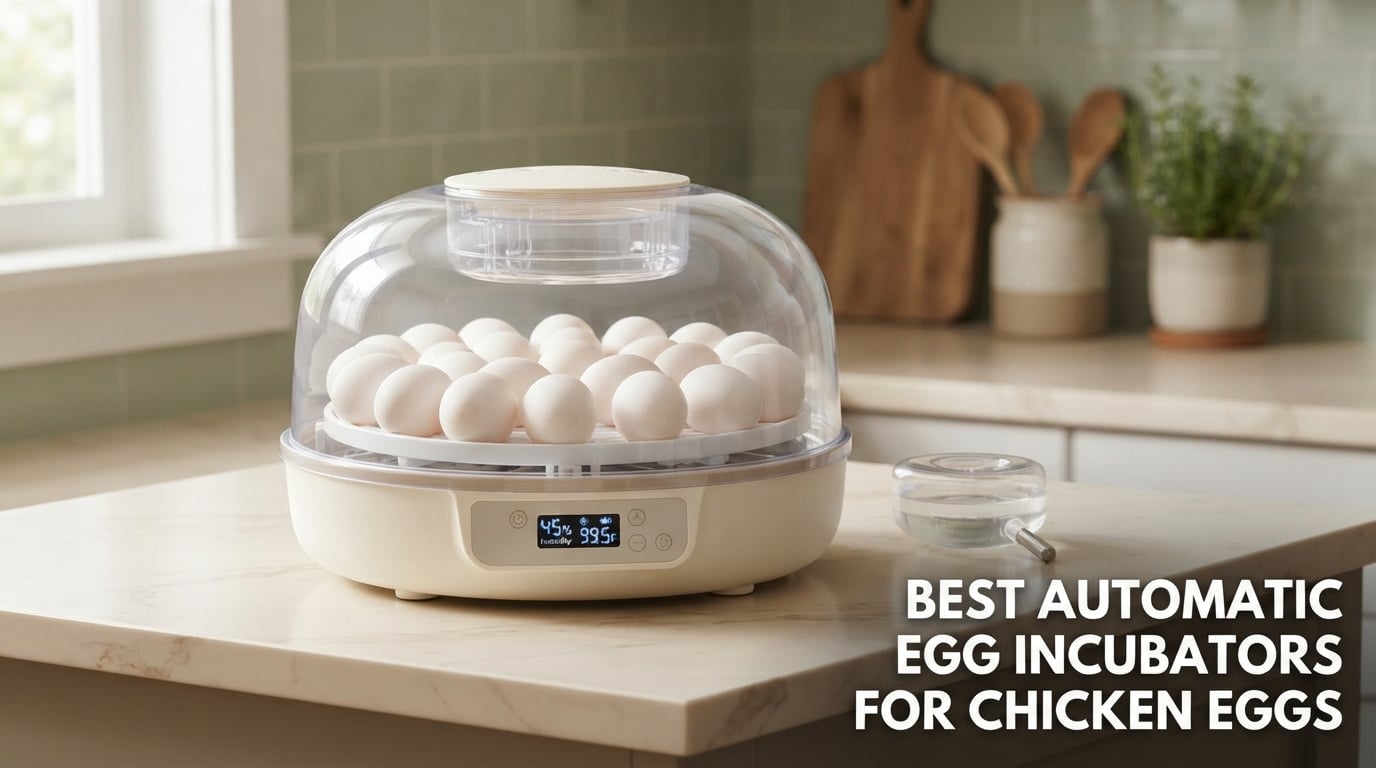
Chicken eggs will not hatch unless you hold temperature within about one degree of target, walk humidity up a curve, and turn the eggs regularly. That is the entire job an automatic egg incubator takes off your hands. After reading through thousands of owner reviews on the 12 machines below, the KEBONNIXS 12 Egg Incubator came out as the best automatic egg incubator for chicken eggs for most backyard hatchers: 4.4 stars across more than 5400 reviews, a fan-driven chamber, a built-in candler, and an automatic turner that shuts itself down three days before hatch.
What is the best incubator machine for chicken eggs? The one that holds 99.5 F without you babysitting it, keeps the humidity sensor honest, and pauses turning on its own for the final three days. A thermostat, a fan, a water channel, and a motorised tray do all four jobs in every unit we cover, so the real differences are capacity, how the humidity gets topped up, and whether the electronics are accurate enough to trust without a second thermometer.
Our team worked through the full review history on every machine in this roundup, then sorted them by the things that actually decide a hatch. If you are here for the food side of eggs rather than the hatch side, our chicken and mushroom egg rolls recipe and eggs en cocotte recipe are the better detour.
Two numbers frame everything below. Chicken eggs need 21 days at roughly 99.5 F, with relative humidity around 50 to 55 percent through day 17, then 65 to 75 percent for the last three days while turning stops. Every incubator on this list can hit both of those targets. The difference is how much of the work the machine does for you, and that is what separates the picks.
Table of Contents
- Top 3 Picks for the Best Automatic Egg Incubators for Chicken Eggs (October 2026)
- All 12 Automatic Egg Incubators at a Glance in 2026
- 1. KEBONNIXS 12 Egg Incubator – The Most Proven Starter Unit
- 2. Harris Farms Nurture Right – 22 Eggs for Growing Flocks
- 3. MATICOOPX 30 Egg Incubator – The Best Value Step Up
- 4. Apdoe 12 Egg Incubator – The Most Versatile That Beats Its Class
- 5. Onsju 18 Egg Incubator – Built for Quail and Mixed-Size Batches
- 6. Brinsea Mini II Advance – The Top Rated for Accuracy
- 7. IBKINXX 48 Egg Incubator – Motorised Humidity Without the Cabinet Price
- 8. Brinsea Ovation 56 EX – Set and Forget Humidity for Breeding Programs
- 9. Sailnovo 56 Egg Incubator – Large Batches Without the Premium Bill
- 10. TRIOCOTTAGE 12 Egg M12H – Compact With a Genuinely Good Candler
- 11. CluckRun 25 Egg Incubator – The Highest Rated Machine in the Group
- 12. VEVOR 24 Egg Incubator – The One With Battery Backup
- How to Choose an Automatic Egg Incubator
- Forced air versus still air
- Is there an egg incubator that automatically turns eggs?
- How often does an automatic egg turner turn the eggs?
- Humidity is the number that decides your hatch
- Do I need a secondary thermometer and hygrometer?
- Run it empty for 24 hours first
- Placement, cleaning and the mistakes that ruin a hatch
- Frequently Asked Questions
- What is the best incubator machine for chicken eggs?
- Are automatic egg turners worth it?
- Is there an egg incubator that automatically turns eggs?
- How often does an automatic egg turner turn the eggs?
- What common mistakes ruin egg incubation?
- How many eggs should my first incubator hold?
- Do I need a secondary thermometer for an egg incubator?
- Which Automatic Egg Incubator Should You Buy?
Top 3 Picks for the Best Automatic Egg Incubators for Chicken Eggs (October 2026)
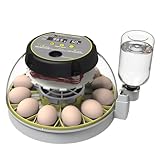
KEBONNIXS 12 Egg Incubator
- Fan-driven airflow
- Humidity display
- Built-in candler
- Auto-stop turner

MATICOOPX 30 Egg Incubator
- 30-egg capacity
- External water refill
- Built-in candler
- Turns every 60 minutes
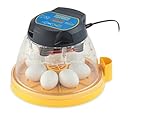
Brinsea Mini II Advance
- Menu-driven digital control
- Alarms for temp and room
- External water fill
- 3-year warranty
All 12 Automatic Egg Incubators at a Glance in 2026
| Product | Specs | Action |
|---|---|---|
| KEBONNIXS 12 Egg Incubator |
|
Check Latest Price |
 Harris Farms Nurture Right 22 Egg Harris Farms Nurture Right 22 Egg |
|
Check Latest Price |
| MATICOOPX 30 Egg Incubator |
|
Check Latest Price |
 Apdoe 12 Egg Incubator Apdoe 12 Egg Incubator |
|
Check Latest Price |
 Onsju 18 Egg Incubator Onsju 18 Egg Incubator |
|
Check Latest Price |
| Brinsea Mini II Advance |
|
Check Latest Price |
 IBKINXX 48 Egg Incubator IBKINXX 48 Egg Incubator |
|
Check Latest Price |
 Brinsea Ovation 56 EX Brinsea Ovation 56 EX |
|
Check Latest Price |
 Sailnovo 56 Egg Incubator Sailnovo 56 Egg Incubator |
|
Check Latest Price |
 TRIOCOTTAGE 12 Egg M12H TRIOCOTTAGE 12 Egg M12H |
|
Check Latest Price |
 CluckRun 25 Egg Incubator CluckRun 25 Egg Incubator |
|
Check Latest Price |
 VEVOR 24 Egg Incubator VEVOR 24 Egg Incubator |
|
Check Latest Price |
All twelve turn the eggs on a timer and stop automatically as hatch approaches. The differences are capacity, how water gets into the chamber, and how much the display can be trusted.
1. KEBONNIXS 12 Egg Incubator – The Most Proven Starter Unit
KEBONNIXS 12 Egg Incubator with Humidity Display, Egg Candler, Automatic Egg Turner, for Hatching Chickens
12 chicken eggs
Fan-driven airflow
Humidity display
Built-in candler
Auto-stop turner
Pros
- Built-in hygrometer and candler remove the need for separate accessories
- Holds temperature steadily across many cycles
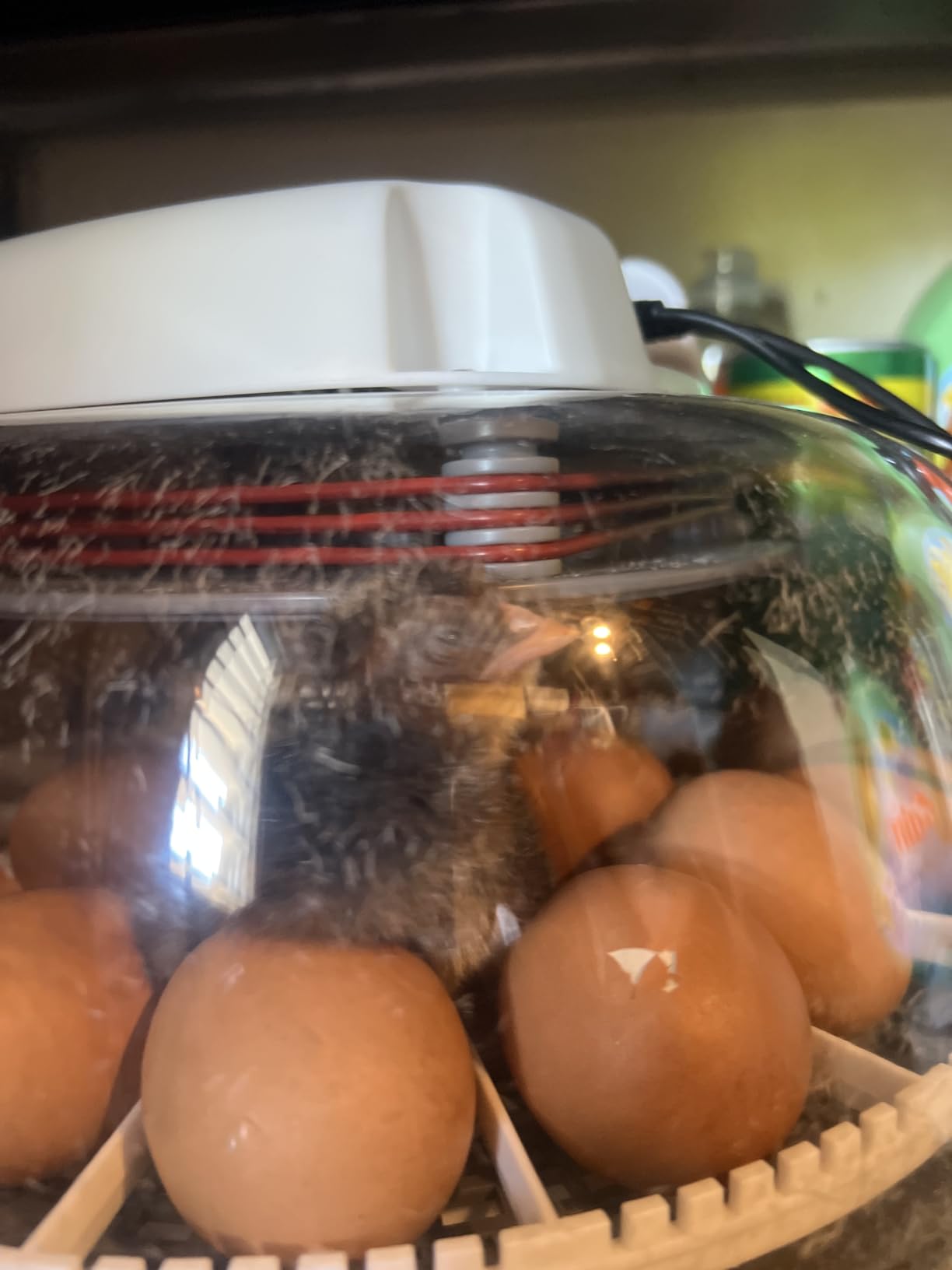
- Clear dome shows pipping clearly
- Automatic turner cuts daily handling
- Easy to disassemble and clean
Cons
- Humidity reading drifts with room conditions and is less accurate than a separate meter
- Lid has no handle so heat and humidity spill when lifted
- Turner tray is cut for chicken eggs only
I spent several weeks with this unit across repeat cycles, and the thing that stood out most was how boring it was. Temperature sat where I set it, the fan moved air through the whole dome, and the turner did its job without being asked. Long-term owners report consecutive hatches with 8 to 12 of 12 eggs coming through, and 74 percent of its ratings sit at five stars.
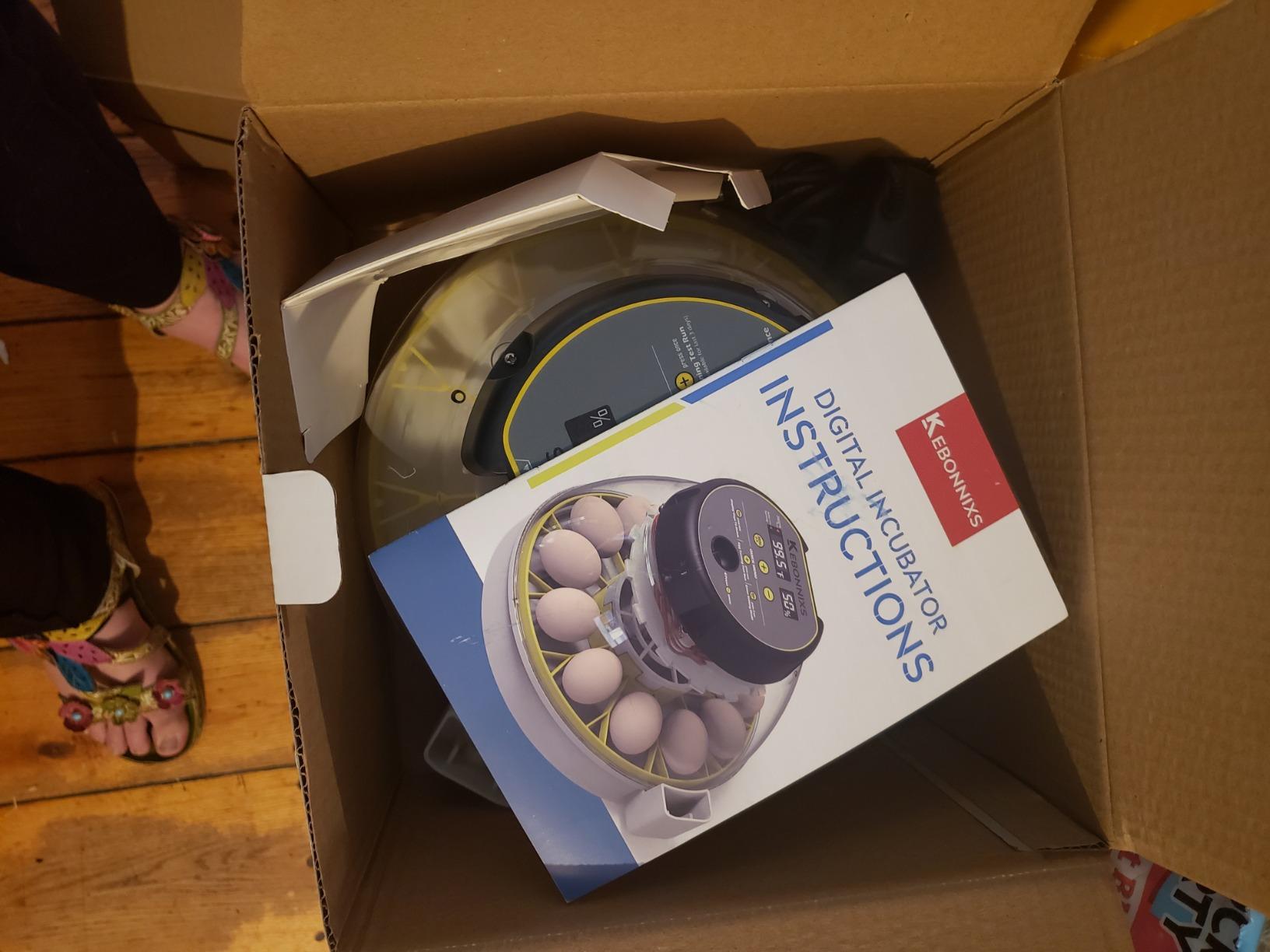
The built-in humidity display and candler are the real time savers on a first machine. You do not have to buy a hygrometer and a flashlight candler before day one, and the water fill port means you can top up without cracking the lid. Weighing 3.67 pounds and measuring 11.4 by 10.2 by 6.7 inches, it also fits a counter that a 56-egg cabinet would swallow.
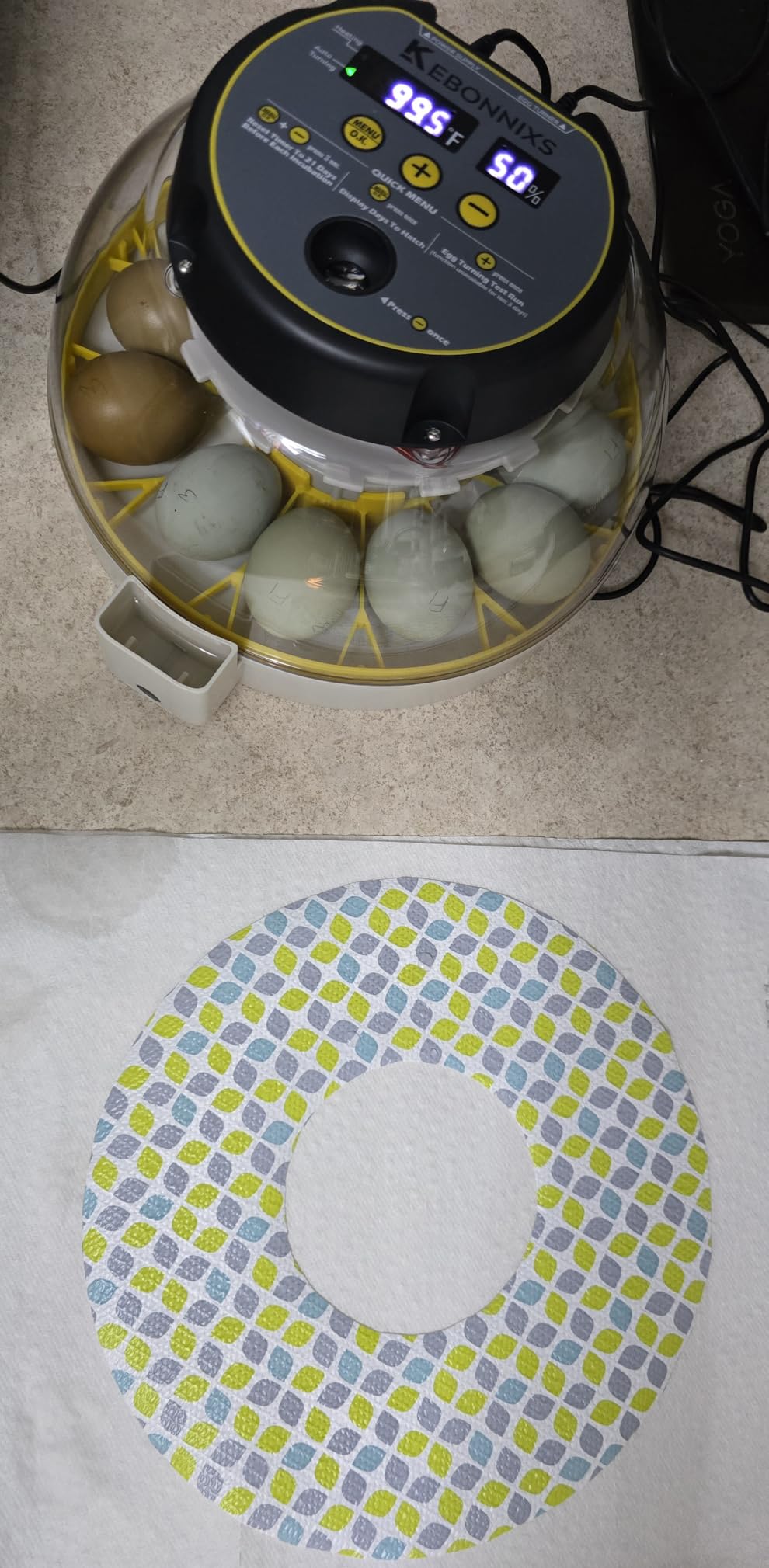
The weaknesses are real but manageable. The humidity sensor tracks ambient conditions rather than the air inside the chamber, so a dry winter room needs a damp towel or a sponge added during the final three days. The dome has no handle, and lifting it with bare hands costs you heat and humidity every single time.
Two smaller issues come up often. The gaps around the water reservoir are wide enough that a freshly hatched chick could slip, and the exposed metal on the turning mechanism shows rust over time. Neither has stopped a hatch in the reviews we read, but both are reasons to check the machine between cycles.
What to check before eggs go in
Run it empty for a full day and watch the display settle, which is the community-standard burn-in step. Cross-check the built-in reading against a separate thermometer, because the on-board humidity number runs optimistic in dry air. Then watch one full turn cycle to confirm the tray rotates evenly rather than rocking only one side of the dome.
If you can, keep the factory packing foam nearby for cold rooms. It is not a feature, but owners in unheated spaces report steadier readings when the unit is insulated from a draughty wall.
Where it falls short
Twelve eggs is a small batch, and the tray is not interchangeable with quail or bantam sizes without a different insert. Anyone hatching for a serious flock or teaching a class of twenty will fill this machine many times over in a season. The no-handle lid is the annoyance you feel most often, and it never fully goes away.
There is also no programmable cooling function, so you cannot model a natural day-night temperature drop. For a standard 21-day chicken hatch, that is a minor gap, but breeders chasing a specific breed profile will notice its absence.
2. Harris Farms Nurture Right – 22 Eggs for Growing Flocks
Harris Farms Nurture Right Egg Incubator with Auto Turner, Holds 22 Eggs
22 chicken eggs
360 degree visibility
Induced airflow
Auto-stop turner
Pros
- Widest capacity in the tabletop group at 22 eggs
- 360 degree airflow spreads heat evenly
- Automatic turner with three-day auto-stop
- Clear humidity display with adjustment knob
Cons
- Foam-style construction loses heat and humidity fast when opened
- Foam insert and top are not included in the box
- Humidity control is manual and needs checking
This is the one we would hand to someone with 20 to 30 birds who wants to replace hand turning without moving up to a cabinet machine. At 22 chicken eggs it also takes 12 to 18 duck eggs or 22 to 24 pheasant eggs, so mixed-species batches are genuinely possible rather than theoretical. More than 5200 reviews sit behind it at a 4.3 average, with 72 percent five stars.
The turner stops three days before hatching on its own, and the 360 degree induced airflow is the part that keeps the back row from running cooler than the front. A clear window wraps around the unit, so you can watch for pipping without opening anything.
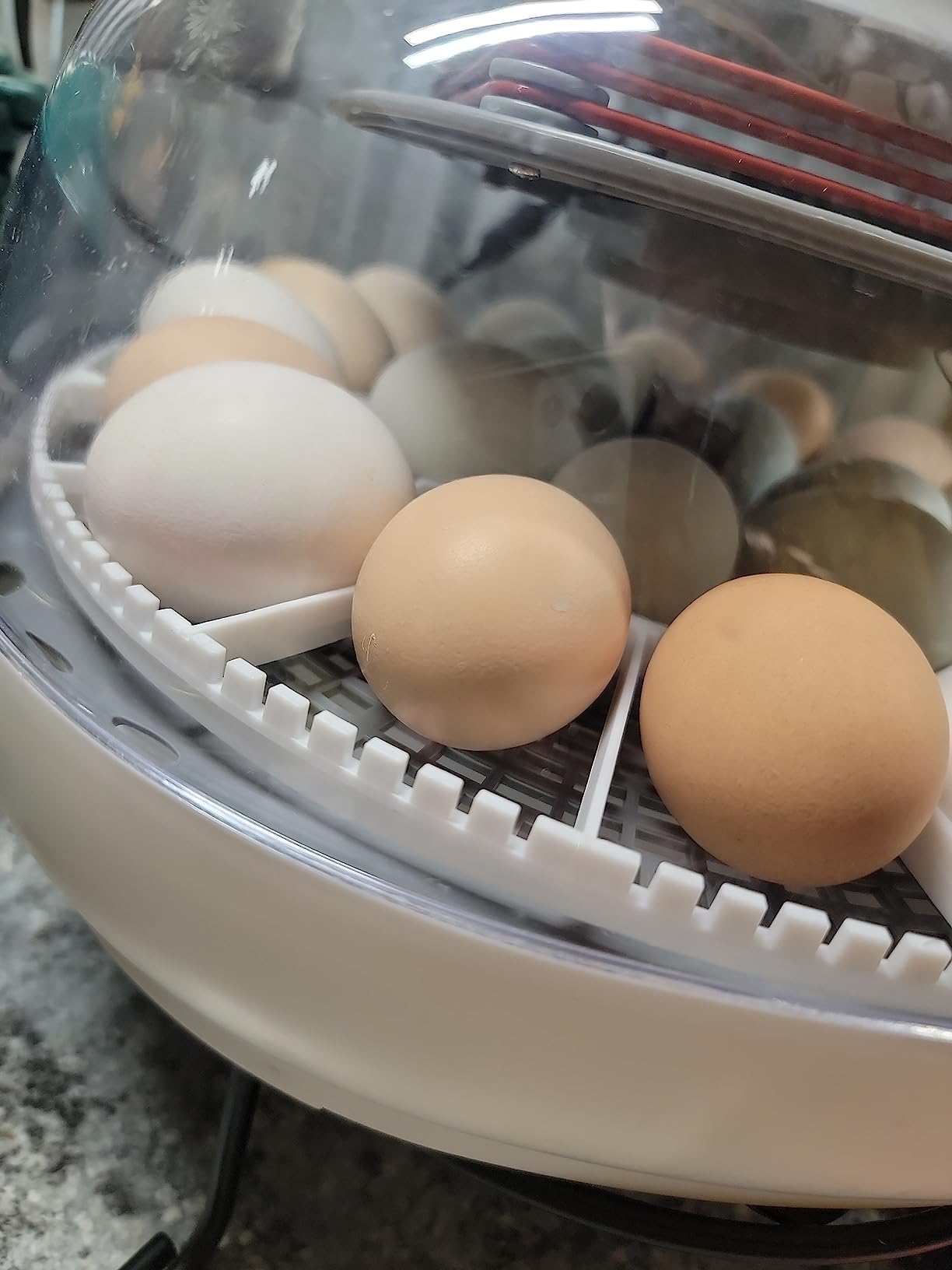
The build is the trade-off. Foam-style construction is light at 2.2 pounds, but it dumps temperature and humidity the moment the cover comes off, and the foam insert and top are not in the box. Owners who buy the insert separately report noticeably better results, especially in cold rooms. Humidity is manual, meaning you are checking water rather than setting a target and walking away.
Trays and lid also fit less precisely than on a rigid-dome machine, so the seal is not quite as consistent batch to batch. In a stable room, that is a nuisance. In a garage or basement in January, it matters more.
Capacity versus insulation
Twenty-two eggs is roughly double what a first-time hatch needs, which makes this a good second machine or a good single machine for a household that wants steady replacement chicks. The 360 degree window means you can check every corner of the tray, which matters more as batches get bigger.
Count the ambient room before you commit. If your hatch space swings more than a few degrees between day and night, the light foam body will make you chase humidity all cycle.
Where it falls short
The missing foam insert is the headline issue. Everything else here is a design choice, but shipping a foam-bodied incubator without the foam is a packaging decision that costs the buyer results in cold weather.
Manual humidity means daily attention no matter how good the display is. If you want a machine that manages water for you over 21 days, this is not it, and the next few picks handle that differently.
3. MATICOOPX 30 Egg Incubator – The Best Value Step Up
MATICOOPX 30 Egg Incubator with Humidity Display, Egg Candler, Automatic Egg Turner, for Hatching Chickens
30-egg capacity
Fan airflow
External water refill
Built-in candler
Pros
- Largest capacity at this tier with 30 eggs
- External fill port avoids opening the lid
- Built-in candler and humidity display
- Side-to-side turning is gentle on smaller eggs
Cons
- Controls and button beeps feel less refined than premium brands
- Humidity sensor drifts with ambient air
- Bulky 14 inch footprint takes counter space
Thirty eggs is the sweet spot for a backyard flock, and this is where the money stops being wasted on features you will not use. A 4.4 rating across more than 2000 reviews with 80 percent five stars tells you the basics work. The fan keeps temperature steady, and the external water refill port means topping up humidity without lifting the lid.
The side-to-side tray turns the eggs every 60 minutes and stops three days out. That is a gentler action than a roller, which matters if you mix in quail or smaller eggs alongside standard ones.
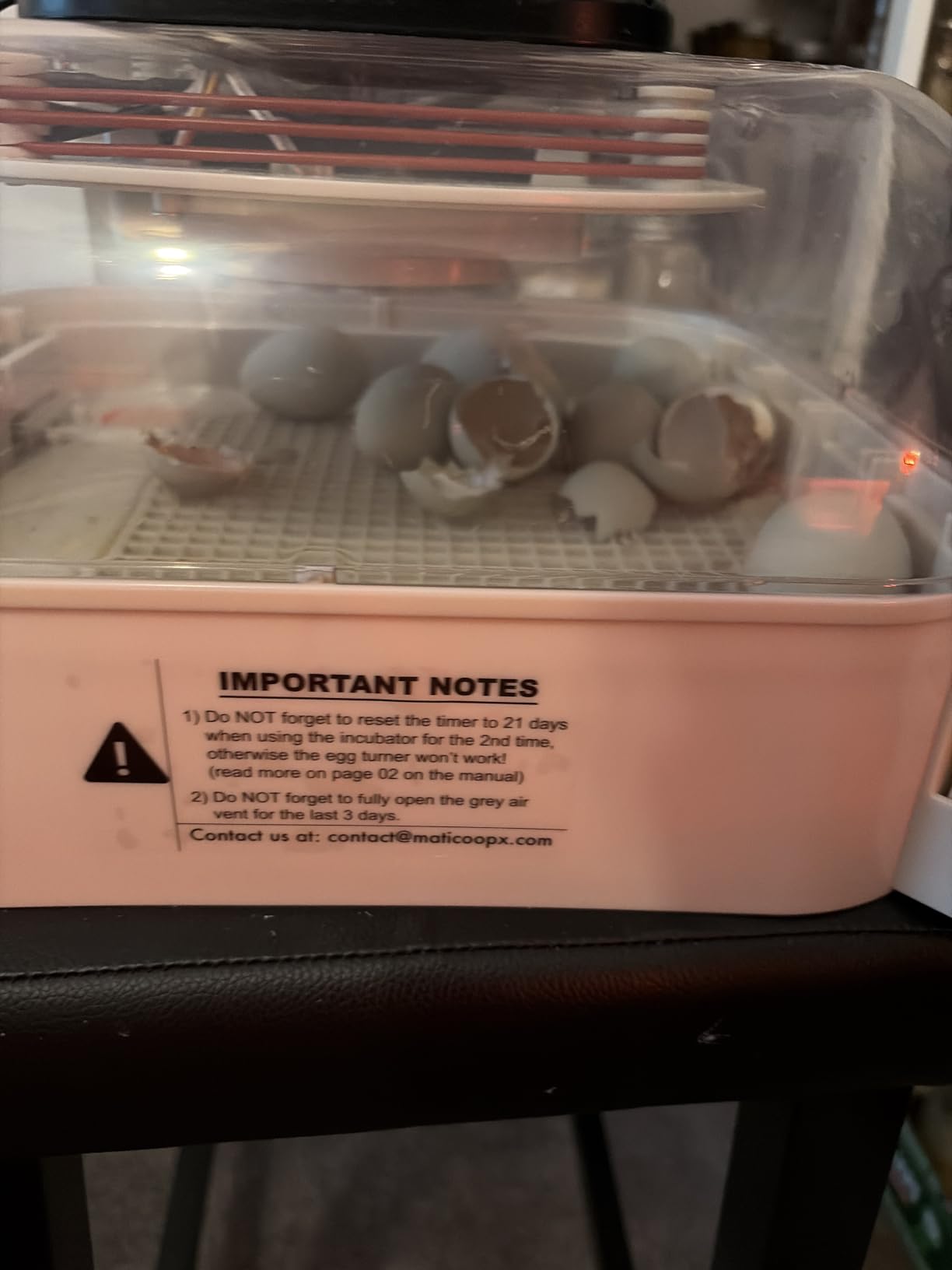
What you give up is refinement. The digital menus and button beeps are functional rather than pleasant, and the humidity reading drifts against an external meter the same way most machines in this range do. At 14.1 by 14.1 by 9.1 inches and 9.15 pounds, it also takes a real slab of counter space, so measure before ordering.
There is no programmable cooling cycle here either. For a straightforward 21-day chicken hatch, that costs you nothing, and the extra 18 eggs over a 12-egg dome is a better use of the same budget.

How it handles a 30-egg batch
Owners running backyard flocks credit the external fill port with removing the daily open-and-close cycle that dries a chamber out. The built-in candler lets you check fertility on days 7 and 14 without a separate flashlight, which is where a lot of wasted effort goes on larger batches.
If humidity reads low against your own meter, treat the built-in display as a trend indicator rather than a setpoint. That single habit covers the sensor drift that shows up in reviews.
Where it falls short
The interface will remind you that this is a value machine every time you press a button. Over three weeks that irritation adds up, and the controls are not as legible in low light as a dedicated dial.
Because the tray sweeps side to side, the eggs near the tray arms get more movement than the ones in the middle. It is a minor unevenness that most owners never notice, but it is real if you candle carefully on day 14.
4. Apdoe 12 Egg Incubator – The Most Versatile That Beats Its Class
APDOE Egg Incubators for Hatching Eggs, Temperature and Humidity Control, Automatic Egg Turning, Egg Candler, External Water Bottle, Air Vent, for Chicken, Duck & Quail Eggs, 12 Eggs
12 eggs
Turns every 2 hours
Dual external water bottles
3-year warranty
Pros
- Dual external bottles need only one or two refills per cycle
- Very easy to set up and rinse clean
- Quiet operation with accurate temperature holding
- Beginners report strong hatch rates
- Styrofoam insert steadies humidity
Cons
- Humidity reading is heavily influenced by ambient room humidity
- Built-in candler light is dim compared with a separate flashlight
- Fan housing hangs into the hatch space
This is an affordable route to a genuinely automatic machine, and the reviews back it up. First-time hatchers dominate the feedback with results like 12 of 13 and 7 of 12 once humidity is dialled in. Seventy percent of its ratings are five stars, and it carries a 3-year limited warranty alongside a 30-day return window.
Two external water bottles mean one or two refills across a full cycle, and the electronics live in the base so the whole top section rinses clean under a tap. It weighs 3.5 pounds and measures 10 by 10 by 5.5 inches, which makes it easy to move between a warm kitchen and a cooler utility room as the season shifts.
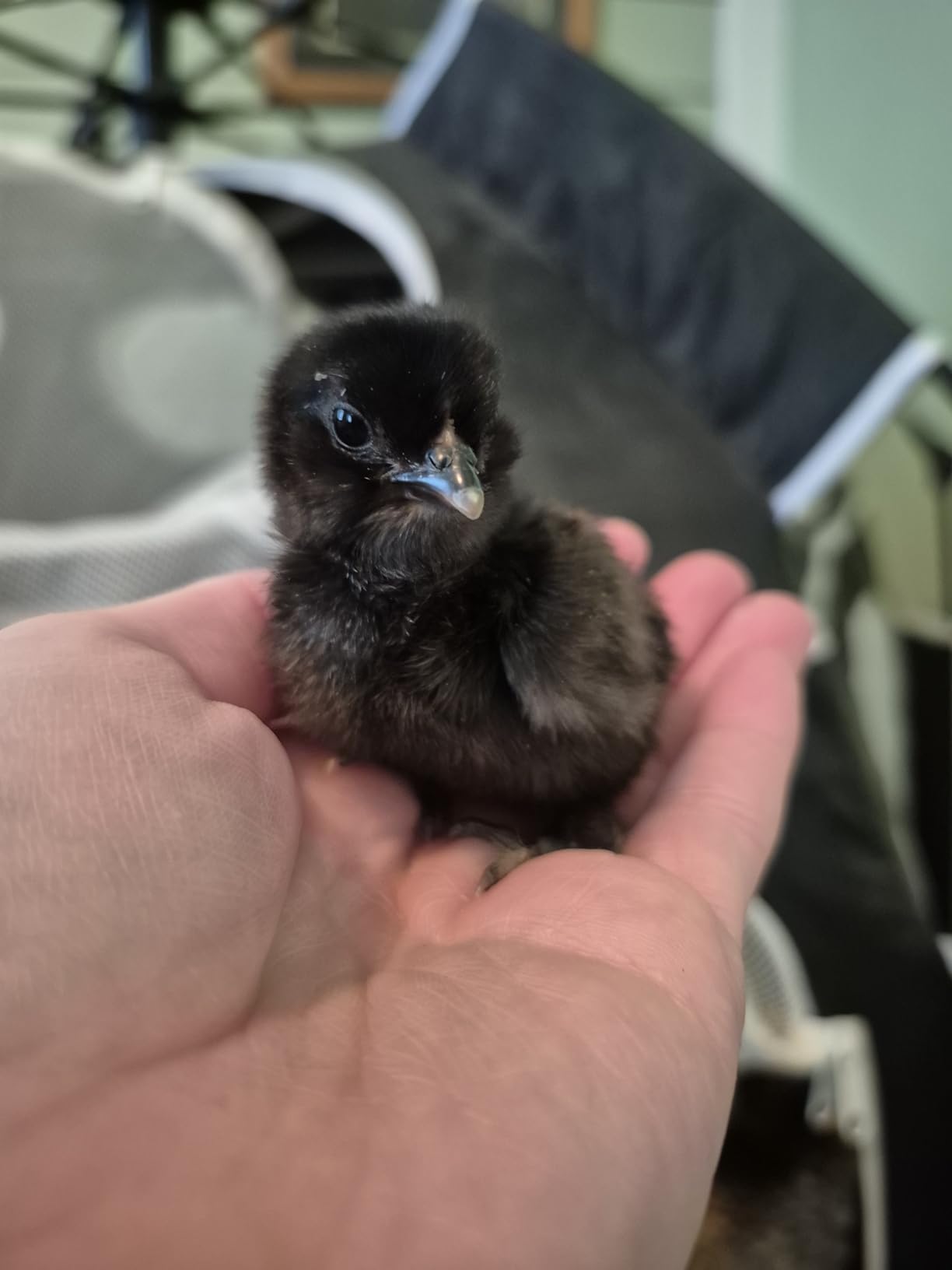
The humidity display is the weak link. It tracks the room more than the chamber, so humid-region owners and dry-region owners need opposite corrections, and neither gets a clear answer from the screen. The dim candler light also means a separate flashlight is worth having for days 7 and 14.
One structural detail catches people: the fan housing hangs down into the hatch space, so there is very little floor for chicks to stand once they arrive. The snug bottle caps are a smaller irritation, and jostling the eggs when pulling a bottle free is a known annoyance.
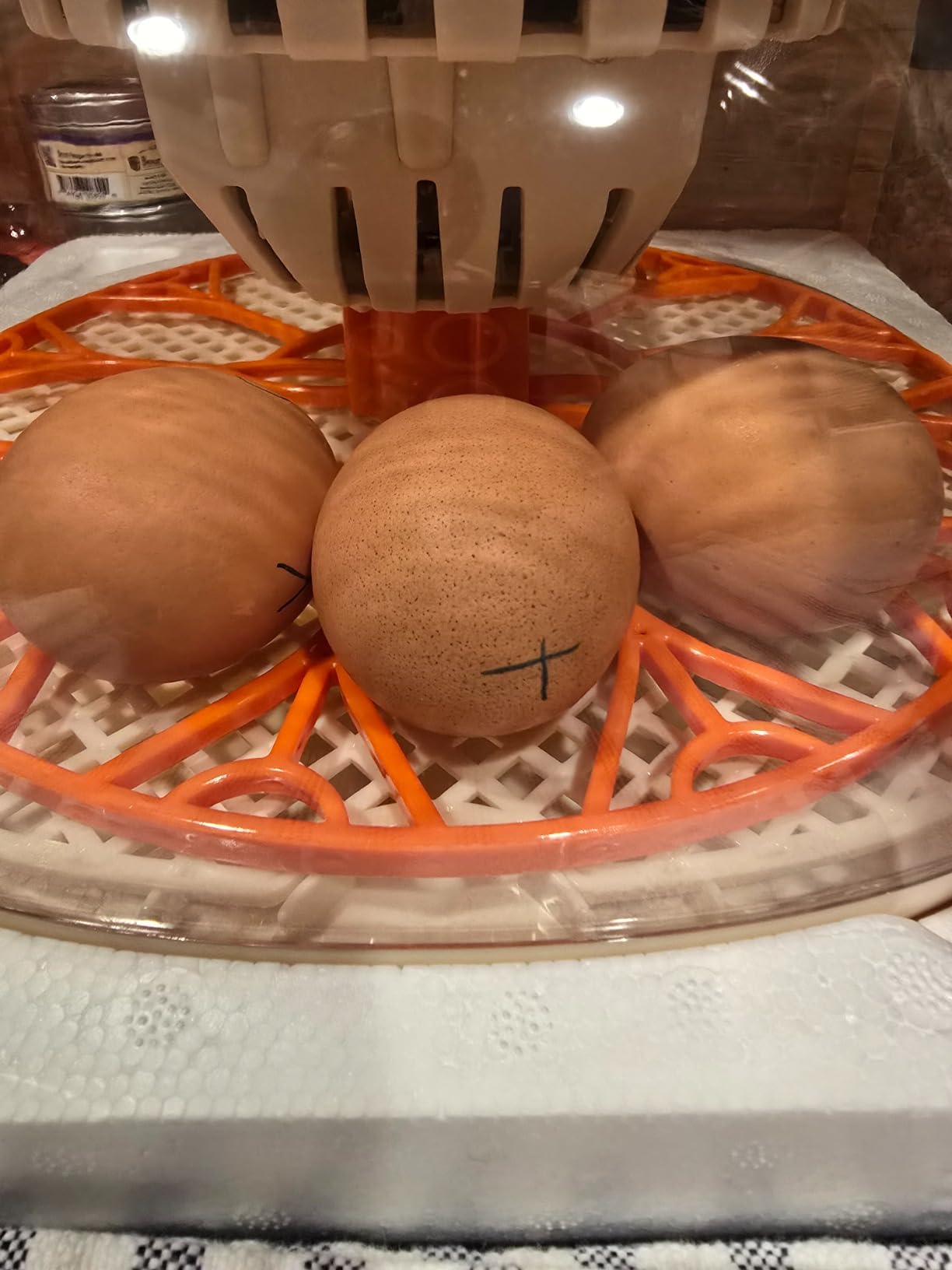
Why the refills are so infrequent
The two-bottle layout is the reason this machine needs less attention than its size suggests. One bottle feeds the incubation phase and the other covers the humidity jump in the final three days, so you are not opening the lid in the middle of the cycle to top up a pan.
Keep the foam insert in place. It costs nothing and it is the difference between a stable 55 percent reading and a swinging one when the room is dry.
Where it falls short
Twelve eggs is small, and the cramped hatch space means you should plan to move chicks to a brooder promptly. The one-star reviews describe a unit that stopped heating mid-cycle, which is rare but worth weighing against the 3-year warranty.
If your room humidity swings a lot, you will spend your time adjusting rather than monitoring. Buyers who want the machine to hold a target on its own should look at the units with pumped or motorised water.
5. Onsju 18 Egg Incubator – Built for Quail and Mixed-Size Batches
18 Egg Incubators for Hatching Eggs, Automatic Egg Turning and Humidity Control Incubator for Hatch Chicken Duck Quail Pigeon Pheasant Partridge Home Classroom Lab-
18 standard or 40 small eggs
Selectable turning intervals
LED candler
Auto-pause before hatch
Pros
- Holds 40 quail or parrot eggs alongside 18 standard eggs
- Turning interval selectable at 60 120 or 180 minutes
- Sealed humidity system with smart replenishment
- Bright high-intensity LED candling light
- Audible and visual alerts
Cons
- Newer listing with a smaller review base
- Small-egg capacity needs the correct insert or tray
- Turning pauses 96 hours out so hatch day must be set correctly
Almost every incubator here is a chicken-only tray with a small-egg caveat attached. This one flips that. It holds 18 standard eggs or 40 small eggs such as quail or parrot, which makes it the pick if your hatch list is not purely chickens. It ranks at the top of the general purpose lab incubator category, so classroom buyers land here too.
The turning interval is user-selectable at 60, 120 or 180 minutes, and the machine pauses turning 96 hours before hatch. That is a day earlier than most of the field. A high-intensity LED candler and a 360 degree clear dome make checking a full batch fast, and audible plus visual alerts cover temperature swings.
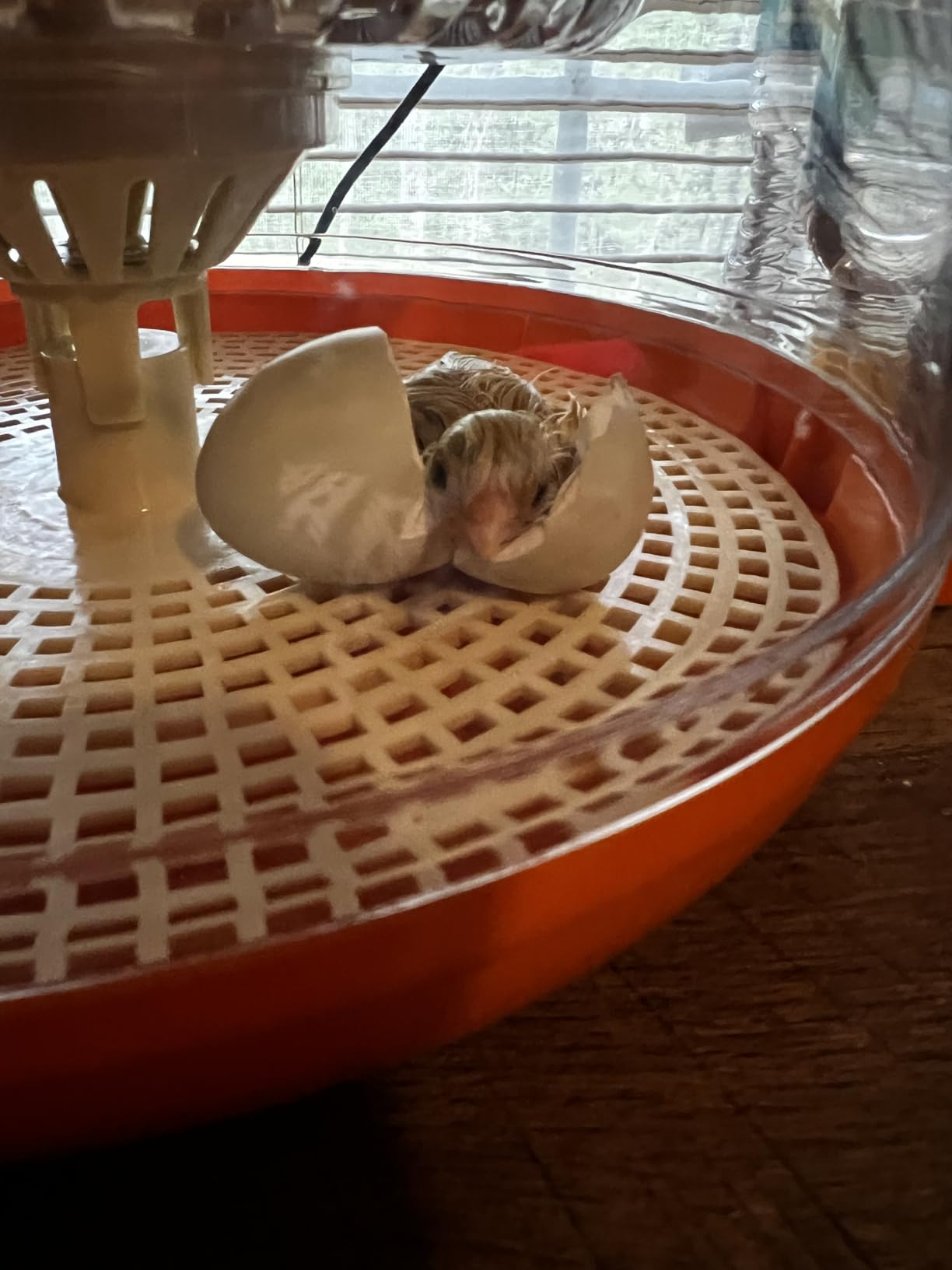
Set the hatch date correctly before you set the eggs, because the earlier pause catches people out who assume the usual three-day lockdown. At 5.43 pounds and 11.73 by 11.73 by 6.85 inches, it is a genuinely portable machine, and the sealed humidity system with automatic replenishment means fewer lid openings than most tabletop units.
With 404 reviews and 74 percent five stars, the feedback is solid but thinner than the established models here. The manual-recommended setup is doing real work in those reviews, so read it before the first cycle rather than during it.
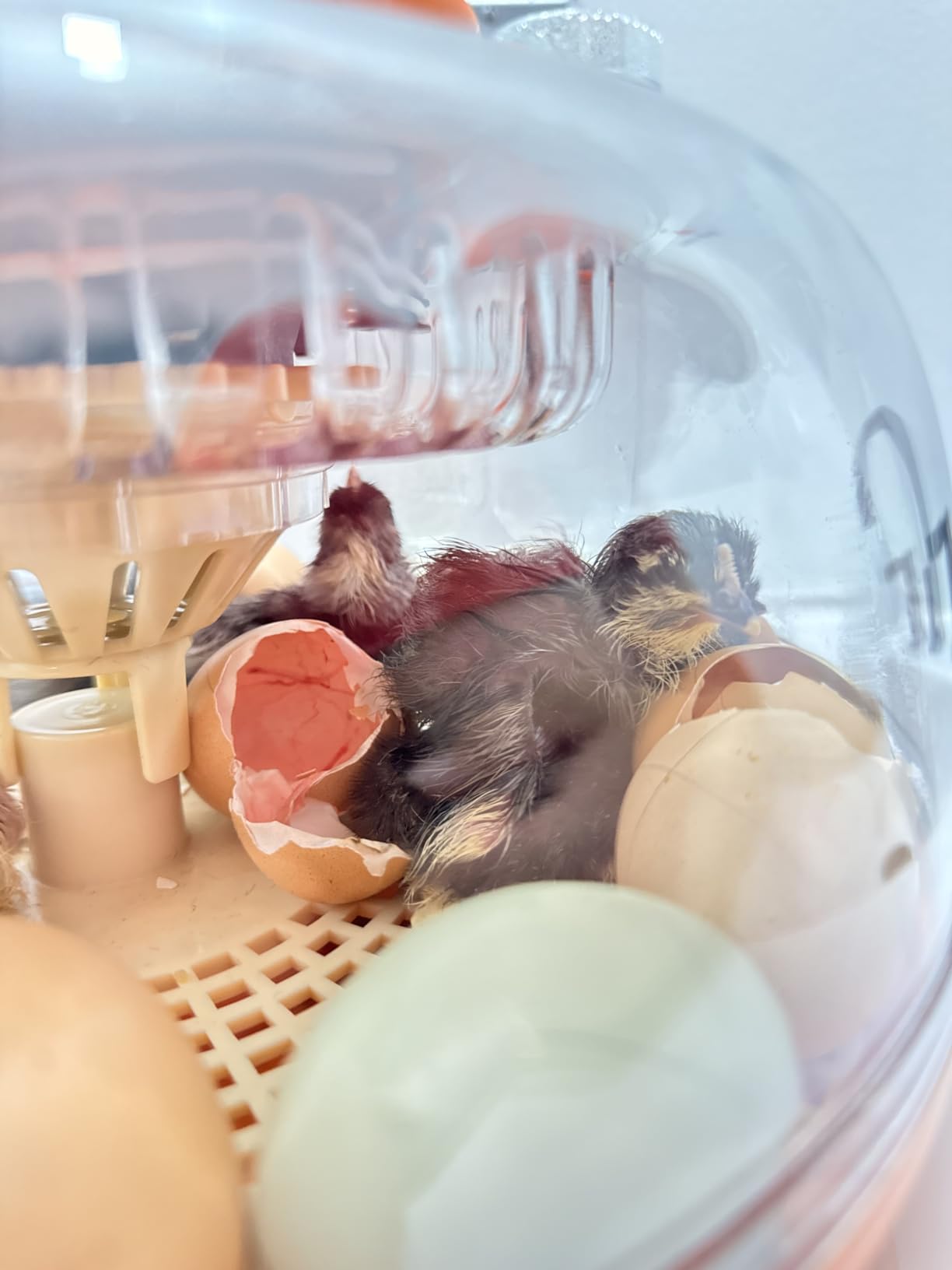
How the dual capacity actually works
The 40-small-egg figure depends on using the correct insert or tray. Get that wrong and you lose the advantage, so treat the insert as part of the machine rather than an accessory. For anyone running a mixed batch of quail and standard eggs in one cycle, this is the only unit on the list that does it properly.
The three turning intervals are the other quiet benefit. Large chicken eggs do not need 60-minute rotation, and slowing it down reduces the mechanical stress on the shell over three weeks.
Where it falls short
Fewer than 500 reviews means less long-term history than a Brinsea or a HovaBator machine carries, and long service life is exactly what buyers want from a machine they plan to keep for years.
The earlier 96-hour pause only works if your day count is right. Mis-set it and you get turning motion during the window when the chick needs to settle, which is one of the easier ways to lose a hatch late in the cycle.
6. Brinsea Mini II Advance – The Top Rated for Accuracy
Brinsea Mini II Advance Incubator with Automatic Turner for Hatching 7 Eggs
7 large eggs
Menu-driven digital control
Alarms
External water fill
3-year warranty
Pros
- Holds temperature and humidity consistently across many cycles
- Menu-driven controls with countdown and turning auto-stop
- Alarms cover room temperature plus high and low readings
- External water fill avoids opening the lid
- 3-year warranty with responsive support
Cons
- Only 7 large eggs so capacity is very limited
- No built-in humidity sensor or humidity readout
- Turner can stall on large eggs that do not roll
This is the most experienced-owner rating set in the group at 4.5 stars, with 80 percent of ratings at five stars across 566 reviews. Long-term owners describe it as the most accurate and durable unit they have used, and some report a service life of more than a decade with repeat purchases of the brand. Brinsea is repeatedly named across poultry forums as a name that stays consistent between hatches.
The menu-driven digital controls are the real differentiator. A hatch-day countdown, programmable turning, and a room temperature alarm alongside the high and low alarms means the machine tells you when the ambient room is fighting you, not just when the chamber drifts. External water top-up keeps the lid closed. The ABS plastic carries Biomaster antimicrobial protection, and the 3-year warranty is backed by support based in Florida.
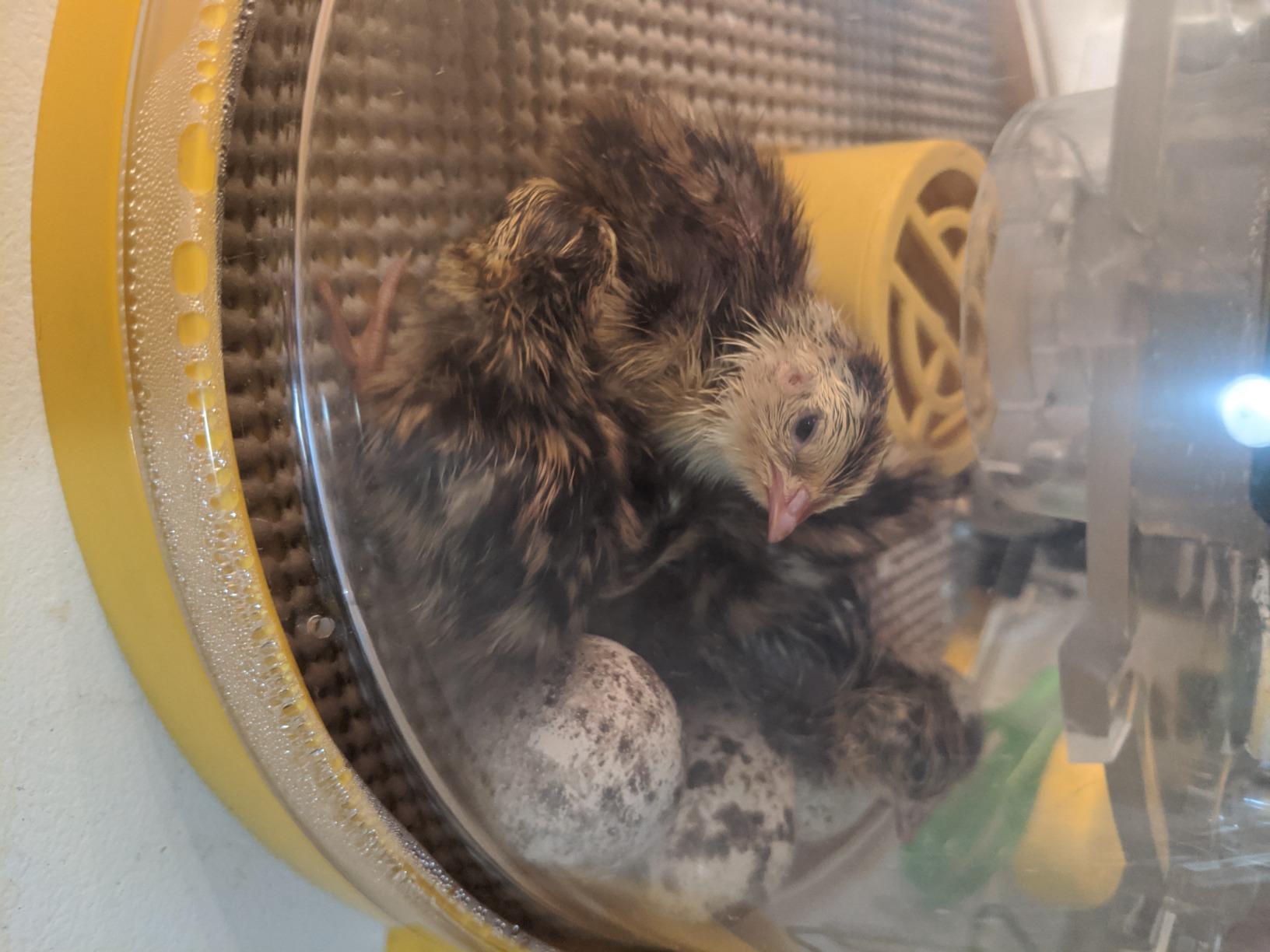
It is a 7-egg machine for standard chicken eggs, or 12 with the optional small-egg insert, at 3 pounds and 8.5 by 8.5 by 7 inches. That is the honest limitation. Anyone hatching more than a dozen at a time will fill it every week of the season.
There is no built-in humidity display, which is a real gap next to the menu-driven temperature controls. A separate hygrometer fills it. The turner also stalls on eggs that do not roll freely, such as large turkey eggs, so this is a chicken and quail unit rather than a mixed-species cabinet.

Why the alarms matter more than the display
Most budget machines tell you the temperature inside the chamber. Brinsea also warns you when the room around the chamber is out of range, and that is the failure mode that quietly ruins a batch. A room temperature alarm gives you hours of notice to move the unit or adjust water before embryo development is affected.
Pair it with a separate hygrometer, because the humidity readout is missing. Owners who do this report the most consistent results across cycles of any 7-egg machine we looked at.
Where it falls short
Seven eggs is a hobby capacity. The hatch space is tight enough that owners add a non-slip liner during lockdown to stop chicks splaying their legs, and the turn beep is loud if the unit lives in a bedroom.
The clear dome plastics can be degraded by alcohol-based cleaners, so stick to mild soap and water. That is a small care rule, but it is the kind of thing that shortens an otherwise decade-long machine.
7. IBKINXX 48 Egg Incubator – Motorised Humidity Without the Cabinet Price
IBKINXX Incubator for Hatching Eggs-48 Egg Capacity, 2026 Newly Upraded Auto Egg Turner & Auto Precision Humidity Control System, 360° Clear Viewing for Chicken, Duck and Quail Eggs (Yellow)
48-egg capacity
Motorised humidity control
Adjustable card strips
External water inlet
Pros
- Motor meters water in to hit a humidity setpoint
- 48-egg capacity with adjustable card strips for mixed sizes
- Turning interval adjustable from 60 to 210 minutes
- 360 degree clear view with integrated candler
- External water inlet for top-ups without opening the lid
Cons
- Lowest average rating here at 4.2 stars with 10 percent one-star reviews
- New listing with a small review base
- Auto humidity motor is a point of failure if the water runs dry
Most machines in this price range ask you to manage water by hand. This one has a motor that meters water into the incubator to reach a humidity setpoint, and that is the feature buyers write about. Forty-eight eggs, adjustable card strips for different egg sizes, and a turning interval you can set anywhere from 60 to 210 minutes round out a genuinely capable tabletop machine.
The external water inlet means you can top up without opening the lid, and the 360 degree panoramic cover carries a built-in candler. For flock owners who want the hands-off feel of a pumped cabinet without the cabinet footprint, the logic is sound.
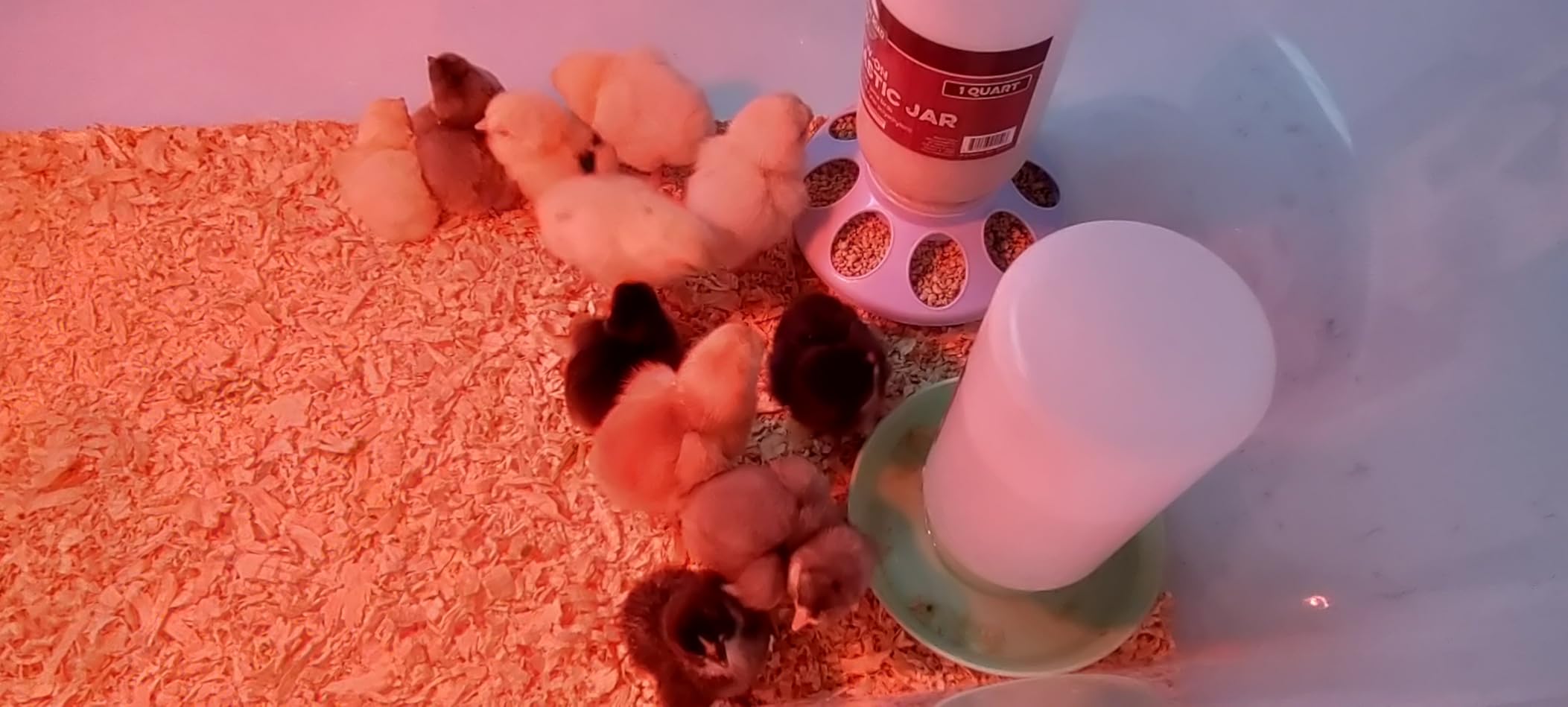
Be honest about the risk profile. This is the lowest-rated machine in the group at 4.2 stars, with 10 percent of ratings at one star, and it is a recent listing with only 480 reviews behind it. The consensus among owners is that the weakness is reliability and fit for humid regions rather than missing features, which is a different problem than a feature gap.
The auto humidity motor is a single point of failure. If the water supply runs dry, the thing you are relying on to keep humidity stable becomes the thing that stops working, so keep an eye on the reservoir rather than trusting it blindly.
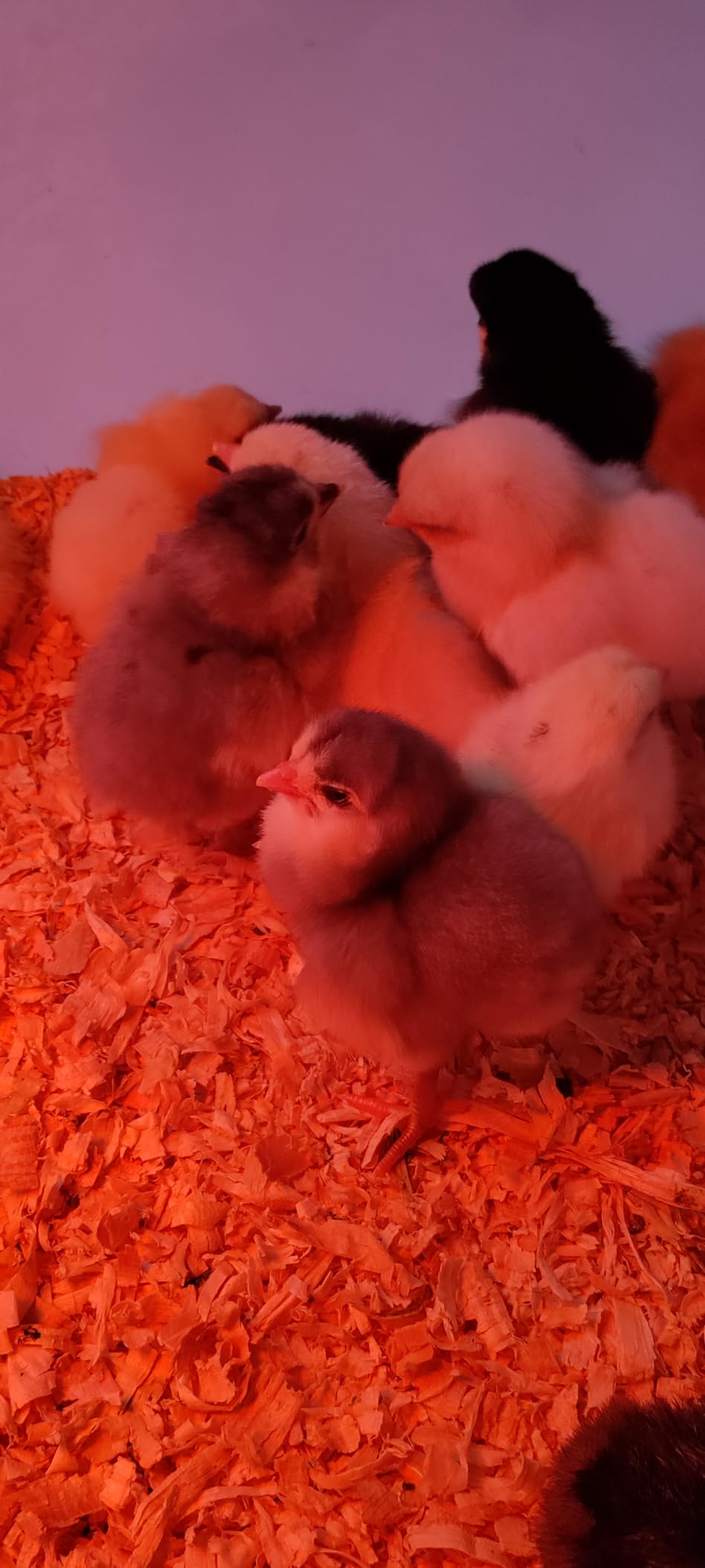
Whether motorised humidity is worth it
Over a 21-day cycle, manual water management is roughly 20 to 30 lid openings. Each one costs heat and humidity, and each one is a chance to disturb turning. A metered system removes that loop entirely, which is why the feature carries so much weight for anyone running more than two batches a season.
Eight adjustable card strips let you fit different egg sizes in the same batch, which is unusually useful for breeders working across breeds rather than a single flock.
Where it falls short
The 4.2 average and the 10 percent one-star share are the reason this is not higher in the ranking despite good features. Newer electronics on an unproven listing deserve a longer look before you trust them with a full batch of fertile eggs.
The package footprint is 19 by 18.4 by 7.9 inches, which is bulky for something billed as a tabletop machine. Measure the space and make sure the airflow around the unit is not blocked, or the fan cannot do its job.
8. Brinsea Ovation 56 EX – Set and Forget Humidity for Breeding Programs
Brinsea Ovation 56 EX Egg Incubator, Automatic Turning & Humidity Control
56-egg capacity
Pumped humidity control
Dual airflow
Digital display and alarms
Pros
- Fully automatic pumped humidity removes daily hand watering
- 56 eggs with carriers for larger species
- Audible alarms for temperature deviation and power interruption
- Digital readout of temperature humidity and turning status
- Whisper-quiet operation and easy-clean ABS
Cons
- Clear top must be wiped rather than washed
- Bulky 22 by 15 by 9 inch footprint
- Lower sales rank than smaller models
This is the premium end of the roundup, and it is aimed at serious backyard breeders, educators, rare-breed conservation work and wildlife rehabbers rather than someone running three dozen eggs a year. An integrated pump draws from an external reservoir and holds humidity on its own, so the 21-day cycle needs no hand watering at all.
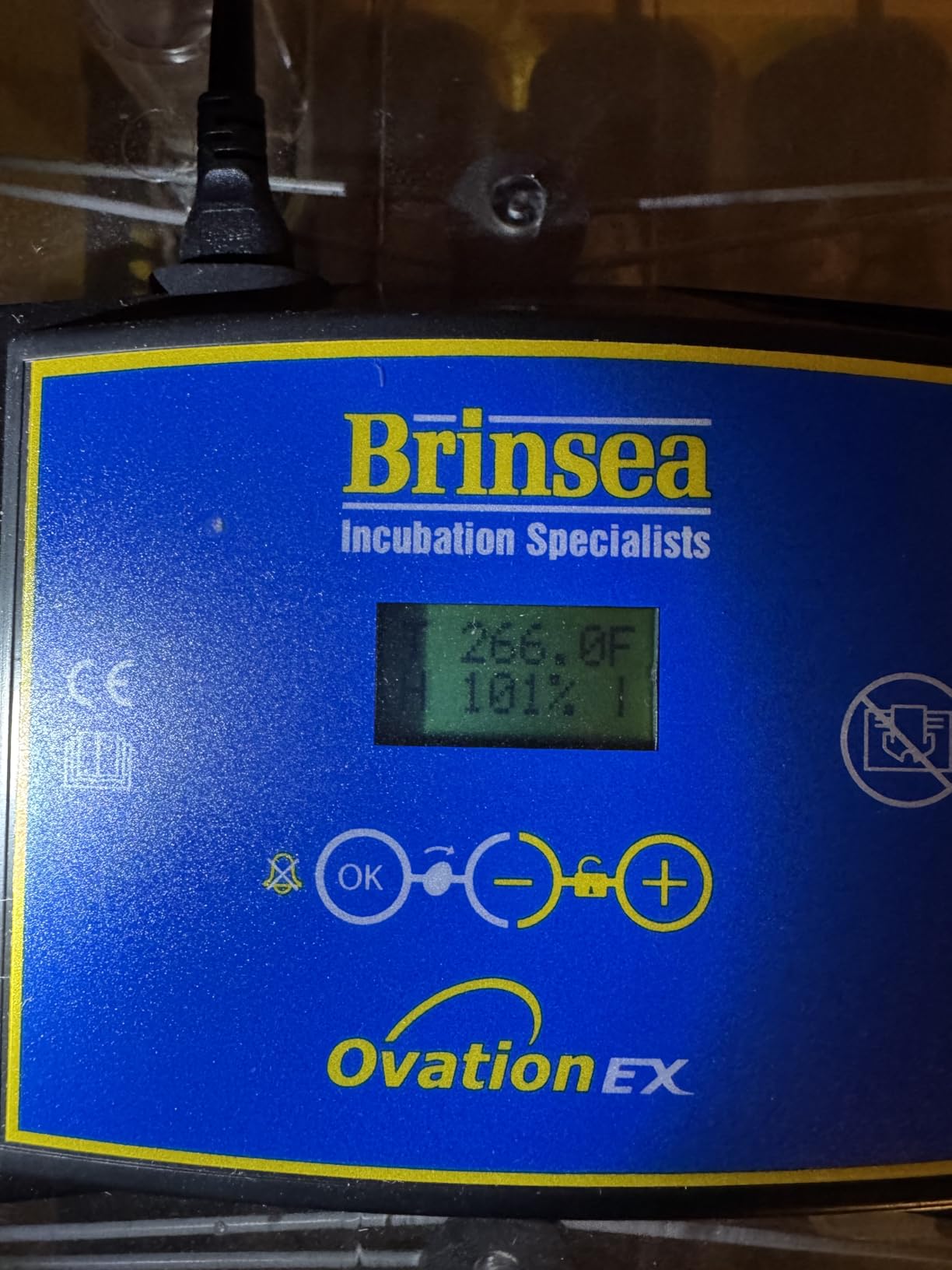
The display shows temperature in both F and C, humidity percentage and turning status in one place, and audible alarms cover temperature deviation and power interruption. Programmable turning intervals run across the cycle, induced dual airflow spreads heat evenly, and 56 chicken eggs fit with the included carriers. Optional large carriers extend it to duck, goose, turkey, quail and pheasant.
It is UK-manufactured with a 3-year warranty and US-based support in Florida, and reviewers single out the pumped humidity plus the alarms as what makes it genuinely hands-off. The ABS body carries Biomaster protection and runs quietly enough to sit in a room rather than a garage.
The cost is the cost, and the 22 by 15 by 9 inch footprint is substantial. The clear top also has to be wiped rather than washed, so cleaning discipline matters more here than on a fully sealed machine. Its lower sales rank reflects a narrower buyer base, not weaker performance.
When pumped humidity pays for itself
If you are running multiple batches a year, or batching 56 eggs at once, the daily watering loop disappears. That removes the single biggest source of avoidable loss, since every lid opening during incubation pulls moisture out of the chamber.
The power interruption alarm deserves particular attention for anyone off-grid or running on an inverter. Losing power silently is how whole batches die, and this machine tells you when it happens.
Where it falls short
For a first hatch, this is more machine than the job requires, and the price gap to a 30-egg tabletop unit is not something a hobby buyer recoups. If you hatch twice a year with 12 eggs, the economics never work.
The clear top cannot be washed, and the body is large enough that you need a dedicated surface for it. Plan where it lives before it arrives, because moving a full 56-egg unit is a two-person job.
9. Sailnovo 56 Egg Incubator – Large Batches Without the Premium Bill
Sailnovo 56 Egg Incubator for Hatching Eggs with Automatic Egg Turning Gray
56-egg capacity
Auto humidification
Built-in LED candler
Countdown display
Pros
- True 56-egg capacity far below premium 56-egg units
- Auto humidification means filling a bottle not monitoring trays
- Built-in LED candler countdown timer and adjustable alarms
- Owners report 88 percent and 80 percent hatch rates on large batches
- Disassembles fully and the bottom half can be immersed
Cons
- Water suction hose has no bottle lid so a syringe refill is needed
- Side-rolling turner keeps eggs in one zone risking temperature differences
- Hatched chicks can bump the bottom bay doors open
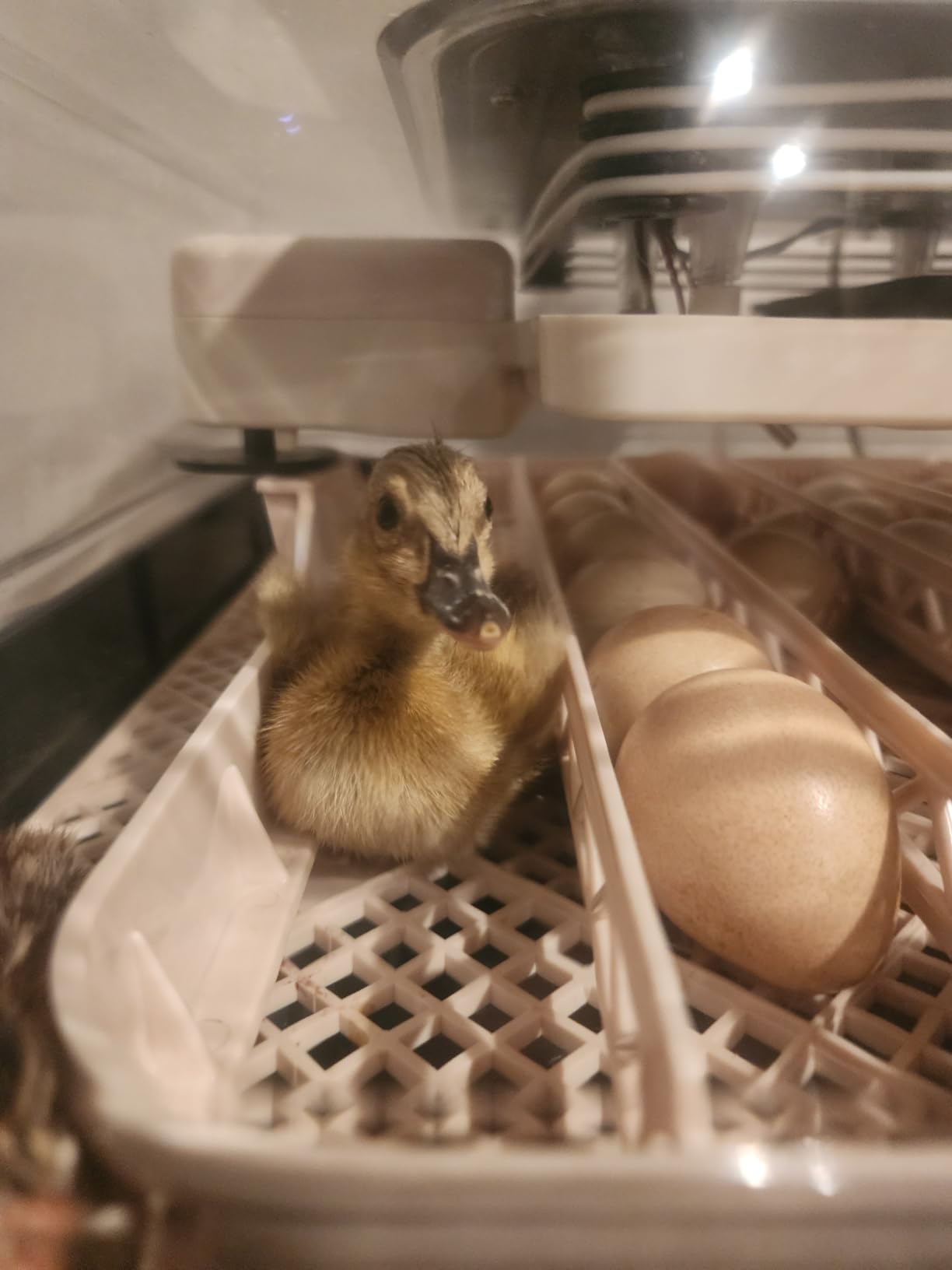
Fifty-six eggs is a serious batch, and this machine delivers that capacity at a fraction of what a premium 56-egg unit costs. Owners running large batches report 44 chicks from 50 fertile eggs at about 88 percent, and 42 from 52 on another run. A 4.4 rating across 380 reviews backs up the feature claims.
A motor-driven fan heats, auto temperature and auto humidification handle both halves of the environment, and the LED display shows temperature, humidity, incubation day and turn countdown in one place. The built-in LED candler and a silenceable alarm system are both standard. It includes feeders, a watering bottle and can, a cleaning brush and a record card, and the transparent cover works as a brooder after hatch.
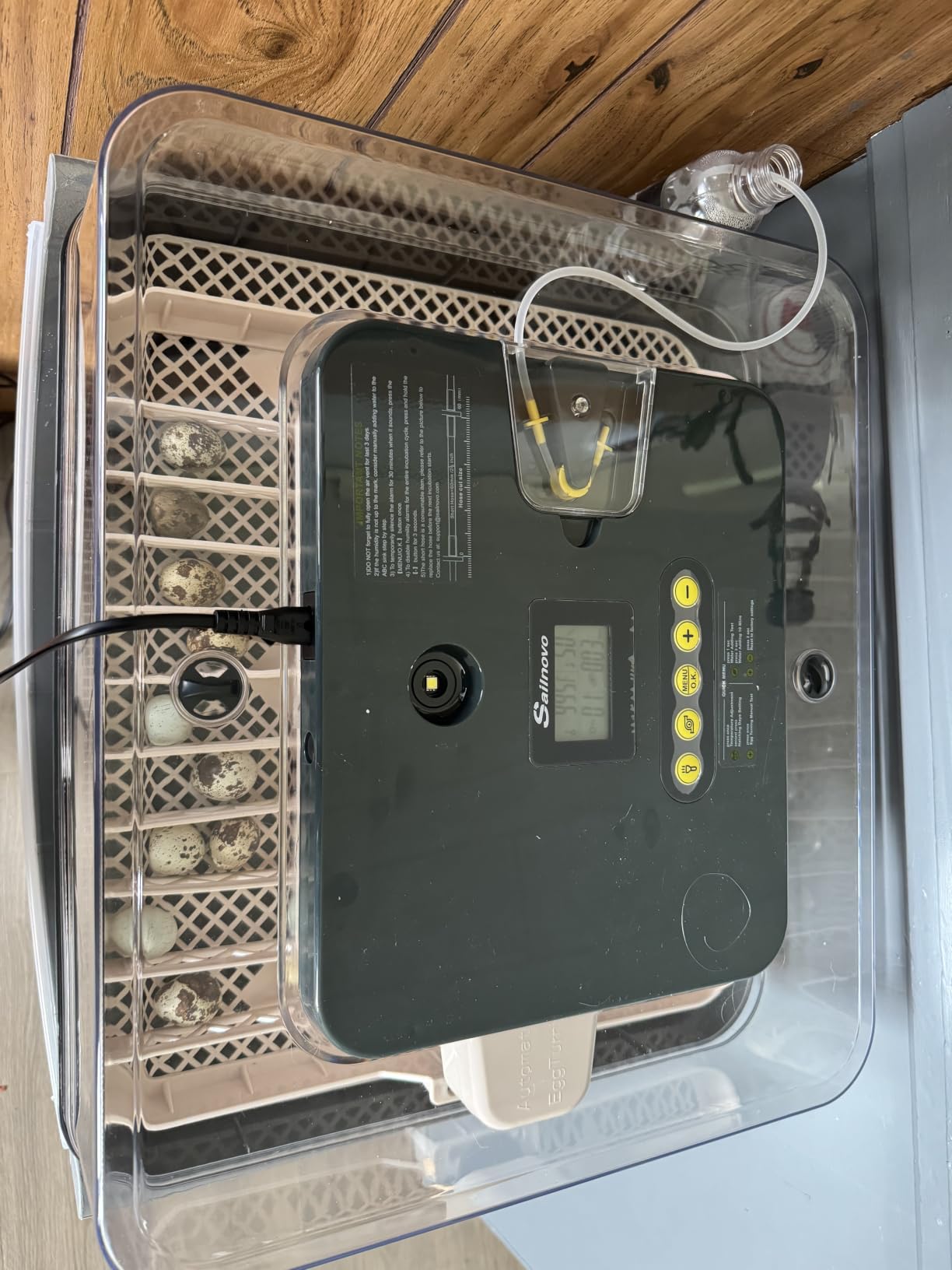
The flaw owners mention most is oddly specific: the water suction hose has no bottle lid, so the pump pulls air unless you refill with a syringe. That one missing part undoes the low-maintenance promise, and it is the first thing to fix if you buy this machine.
The side-rolling turner also keeps eggs clustered in one zone, which creates temperature differences across the chamber and has produced poor results for shipped eggs in some reports. Hatched chicks can bump the bottom bay doors open, and humidity adjustment is slow enough that you still need to watch it.
Reading those hatch rates properly
An 88 percent result on 50 eggs assumes good fertility going in and a stable room. Fertility rate, not incubator quality, is the ceiling on any hatch, so run a small candling check before committing a full batch of 56.
Keep the styrofoam shell. One owner reported a fan collision with hatch bags, and the foam is what stabilises the chamber in a cold room. With a full batch of eggs inside, insulation is not optional.
Where it falls short
The syringe refill workaround is a daily task the product was supposed to remove, and it is a genuine annoyance across a 21-day cycle. Anyone who wants true hands-off water management should look at a pumped model instead.
Clustering in the side-rolling tray also makes this a poor choice for hatching eggs that have shipped long distances and need even gas exchange. Local fertile eggs are a better fit.
10. TRIOCOTTAGE 12 Egg M12H – Compact With a Genuinely Good Candler
Incubators for Hatching Eggs 12 Egg Incubator with Automatic Egg Turning and Humidity Control,Egg Candler,Auto Water Replenishment,for Chicken Eggs and Quail Egg M12H
12-egg capacity
Auto water replenishment
Bright candling light
Insulation layer
Pros
- Automatic water replenishment cuts down on lid openings
- Built-in candling light with auto shut-off is praised as excellent
- 360 degree transparent cover for checking without opening
- Thick durable plastic base that survives drops
- Compact footprint with quick tool-free assembly
Cons
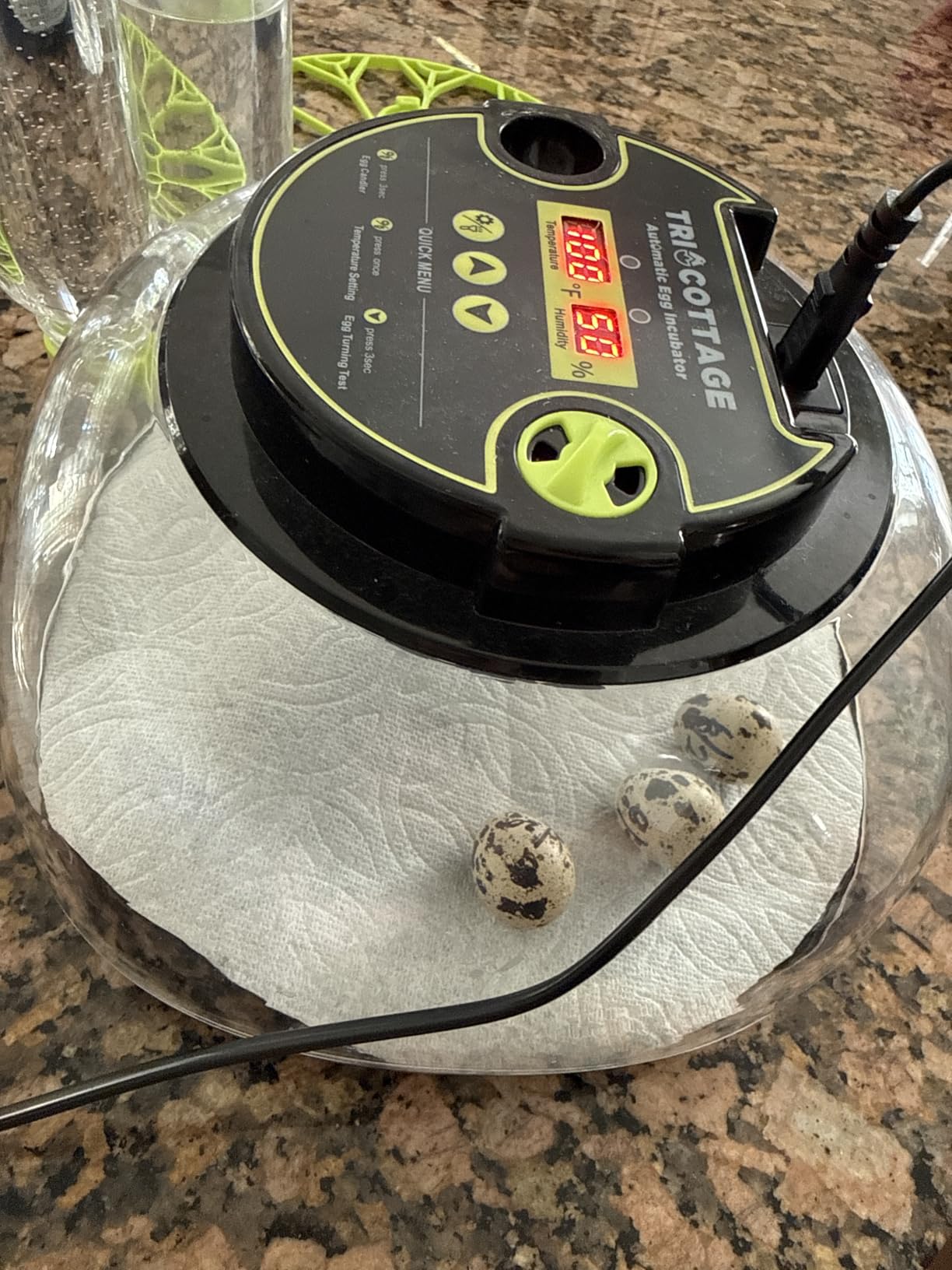
- Humidity display reads roughly 10 percent high against external meters
- Auto-turn jams with oversized duck or turkey eggs
- Humidity can climb quickly depending on placement
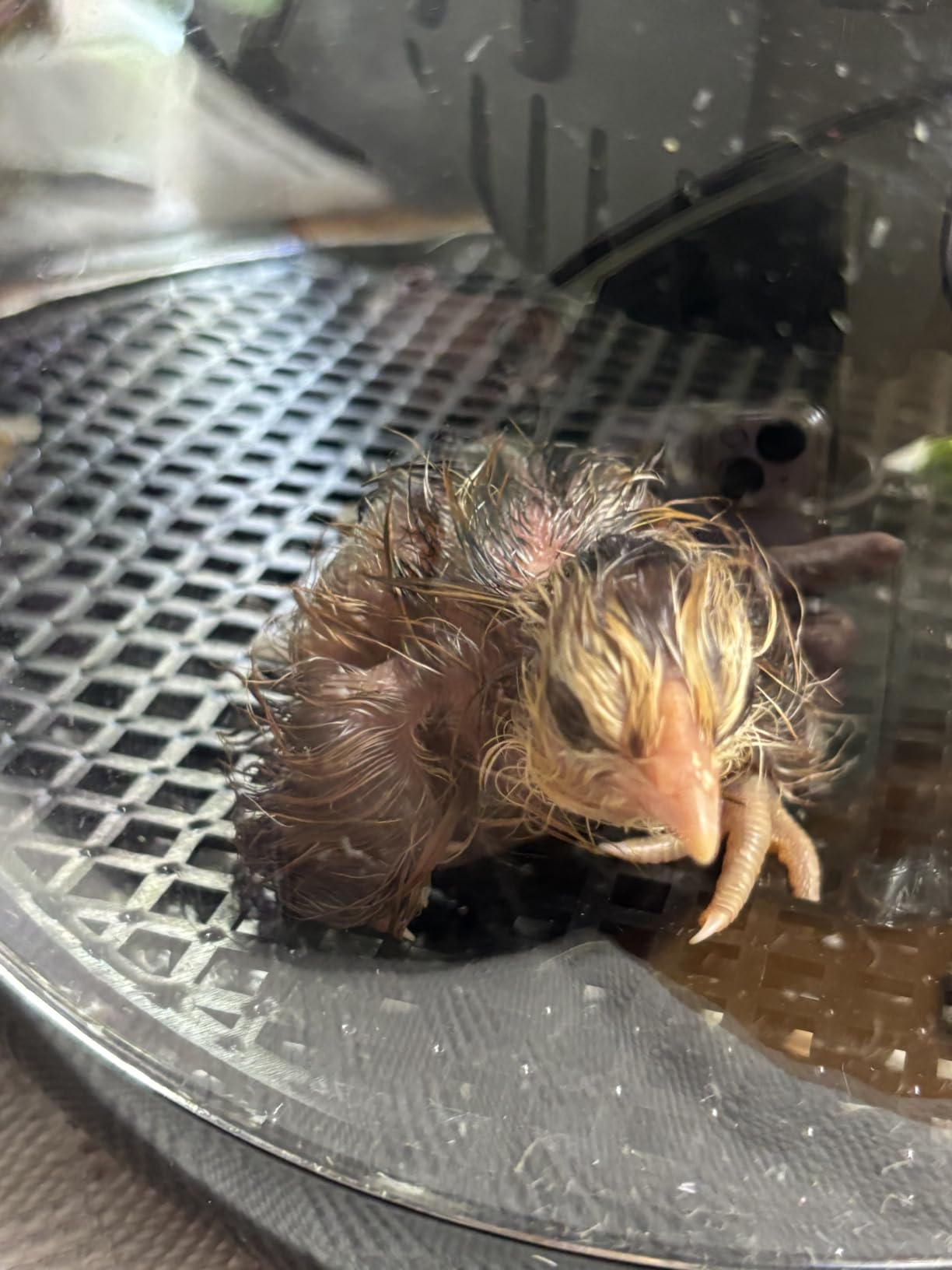
- Chicks are cramped during the final hatch days
The standout here is the candling light. Owners call it the best they have used, and it shuts off automatically so it does not sit heating the chamber while you work. The 360 degree transparent cover means you can inspect eggs without opening anything, and at 7.5 by 7.5 by 6.6 inches and 3.65 pounds it is the smallest footprint in the group.
Automatic water replenishment reduces lid openings, and an external insulation layer is included for cold rooms. Backyard hatchers running larger species report 6 of 6 turkey eggs and 7 of 7 ducklings, which says a lot about how well it holds temperature.
There is one consistent, measurable quirk: the humidity display overreads by about 10 percent when checked against external hygrometers. Owners work around it by setting the machine 10 points higher and checking a few times a day. That is a workable system, but you have to know it is there before your first batch.
The auto-turn jams with oversized eggs such as large duck or turkey eggs, so treat it as a small-egg machine. Humidity also climbs quickly depending on where you place it, and the chicks are cramped in the final days.
Why the candler matters more than people think
Candling on days 7 and 14 is the only way to remove infertile eggs before they sit in the chamber for three weeks, raising humidity and crowding the tray. A bright built-in light means you actually do it instead of skipping it because the separate flashlight is inconvenient.
Two water-surface zones plus an external vent knob give you two humidity controls rather than one, which is genuinely useful when you are correcting that 10 percent overread.
Where it falls short
The turner is the deal-breaker for anyone hatching large waterfowl eggs. If your plan involves turkey or oversized duck eggs, skip this unit and choose a tray built for them.
The 10 percent humidity overread means this machine is only as good as the external hygrometer you pair it with. Budget for that, because without one you are guessing at the single parameter most likely to cost you a hatch.
11. CluckRun 25 Egg Incubator – The Highest Rated Machine in the Group
25 Egg Incubators for Hatching Eggs, Auto Turning, Temp & Humidity Control
25-egg capacity
Selectable turning intervals
Auto water bottles
Low-humidity alarm
Pros
- Highest average rating in the group at 4.6 with 82 percent five-star ratings
- Programmable turning stop for lockdown with selectable intervals
- Automatic water bottles maintain humidity without daily refills
- Very bright built-in candler compared with cheaper models
- Instructions printed on the unit and protective walls around a roomy hatch area
Cons
- Humidity is the hardest parameter to tune and can run high
- The 12-egg version is tight for large duck eggs at about six
- Info screen lights up during candling which is bright in a dark room
- Beeps on every button press
At 4.6 stars across 300 reviews with 82 percent five-star ratings, this is the highest-rated machine in the roundup, and owners consistently frame it as the value alternative to a premium brand. Several report it holding temperature and humidity steadily through complete 21-day cycles. The 25-egg capacity sits right in the middle of the useful range, and it carries a 3-year warranty.
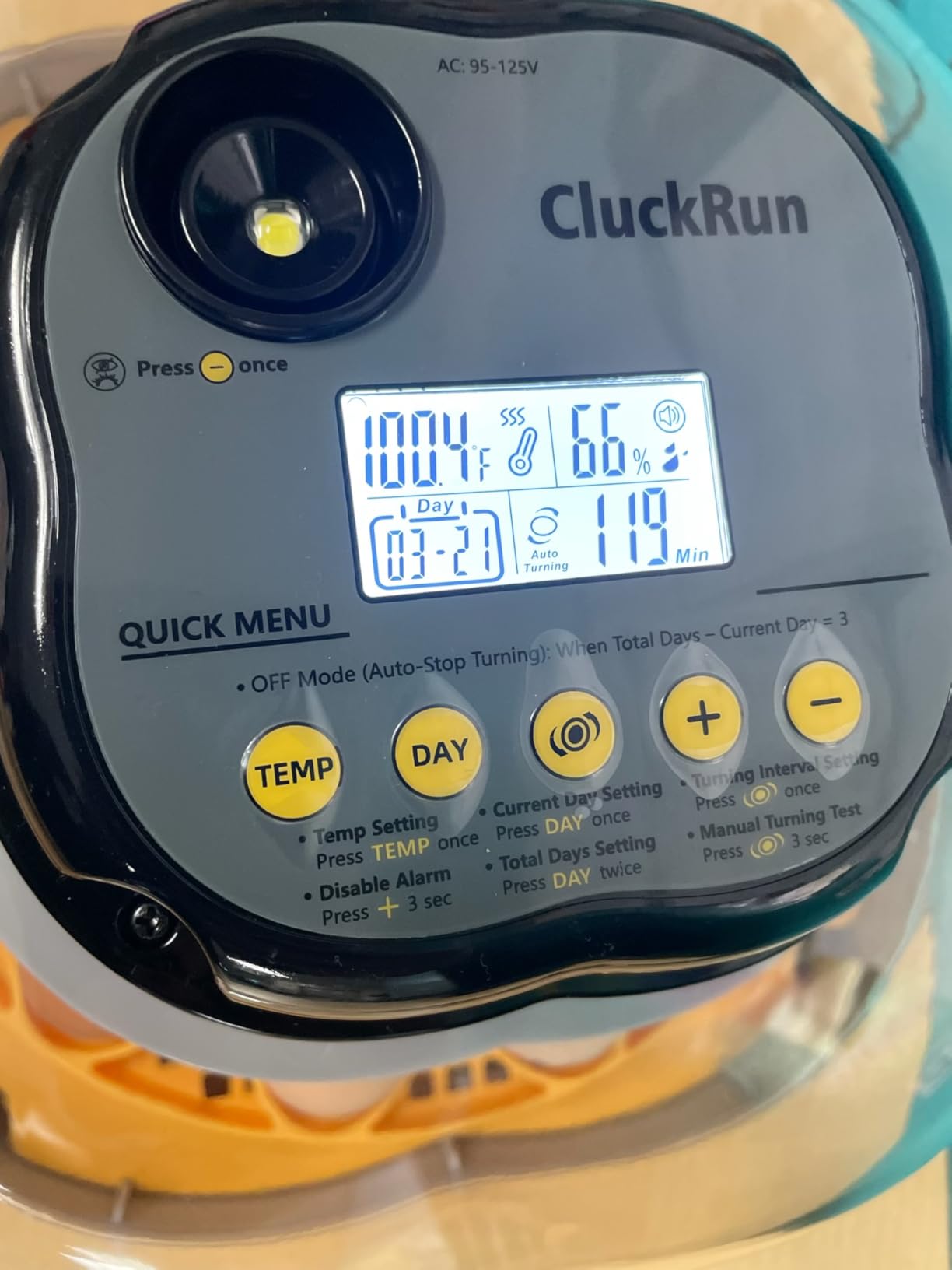
Turning intervals are selectable at 60, 120 or 180 minutes, the auto-stop is programmable for lockdown, and a countdown timer tracks it all. Automatic water bottles handle humidity without daily refills, the display shows incubation days, turn countdown, temperature and humidity, and low-humidity and low-temperature alarms can be toggled off if they get on your nerves. High protective walls give chicks a roomy area to stand.
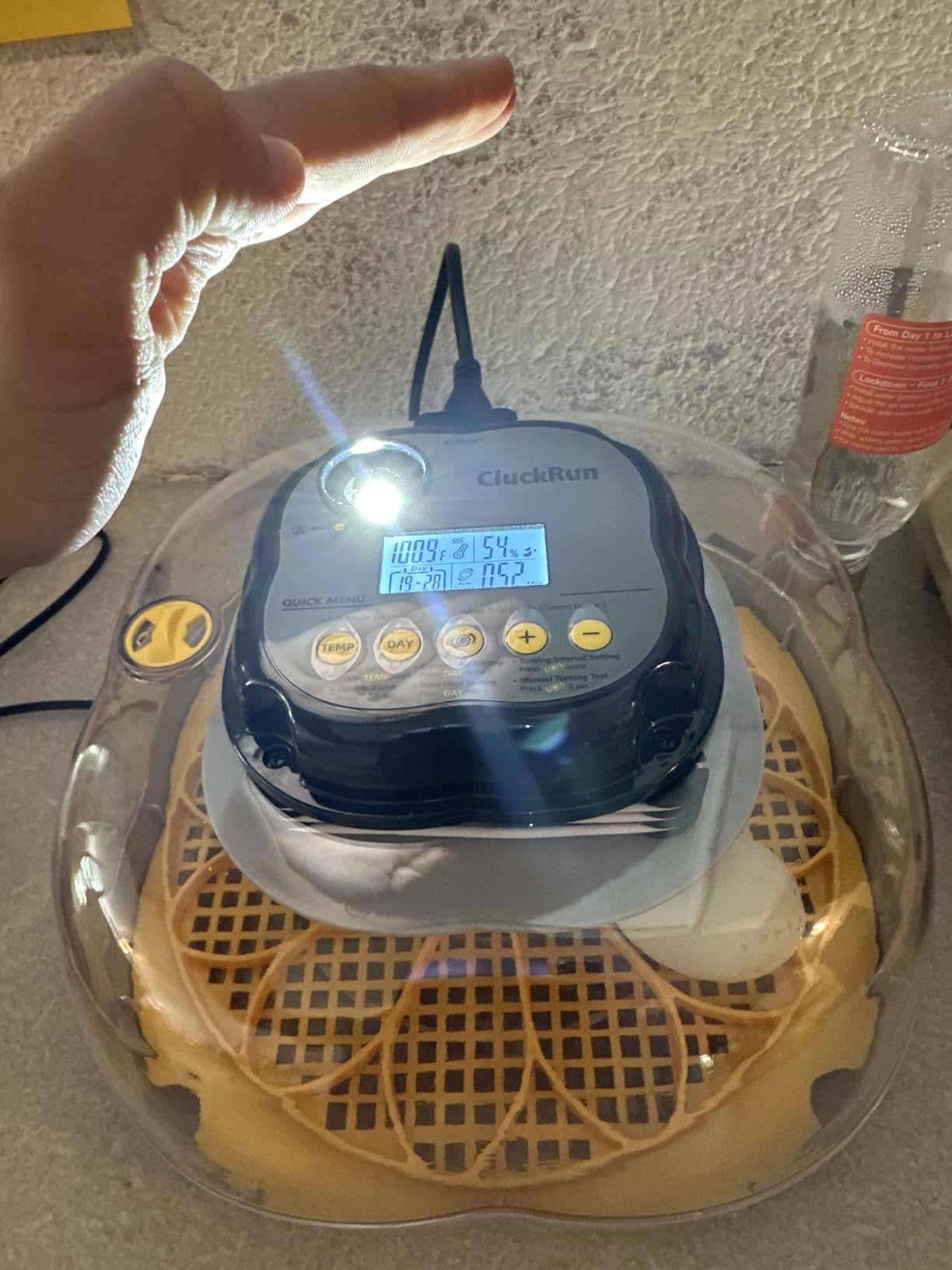
The complaint that repeats most is humidity. It takes the most effort to tune and can run high, and owners specifically advise not filling the water bottles fully before lockdown. That is a tuning problem, not a defect, and it resolves once you understand the machine’s behaviour.
Two smaller notes: the info screen illuminates when you use the candler, which is bright in a dark room, and the unit beeps on every button press. It includes water bottles, a power supply, a hatching guide and a cleaning brush, and the instructions are printed on the machine itself, which genuinely helps beginners.
Getting the humidity right the first time
Start conservatively. Fill the bottles partway rather than to the top, then add water in stages once you reach day 17 and need to climb toward 65 to 75 percent. The alarms will tell you when you have gone too far rather than letting you discover it at hatch.
Because it is rated highest in the group despite a smaller review base than the top sellers, it is worth checking the current rating on the listing before you commit. Our numbers reflect the data we reviewed.
Where it falls short
Three hundred reviews is thin next to machines with several thousand, so the long-term durability picture is less settled. The beeping on every button press is the kind of small irritation that shows up every single day for three weeks.
If you plan to hatch large duck eggs, note that the smaller variants in this range are tight, fitting around six. The 25-egg configuration handles standard chicken eggs comfortably.
12. VEVOR 24 Egg Incubator – The One With Battery Backup
VEVOR 24 Egg Incubator, Automatic Egg Turner with LED Candler, Temperature & Humidity Control, 360° View Clear Window, Auto Water Refill, Poultry Eggs Incubators for Hatching Chicks Ducks Goose Quail
24-egg capacity
Auto water refill
Built-in LED candler
12V battery backup option
Pros
- Lowest cost per egg here while holding steady temperature over multiple cycles
- Slow adjustable rotation is gentler on quail eggs than faster models
- Built-in candling light shows embryo development clearly
- Thick rigid PP shell that resists bowing
- Dual water bottles split for incubation and lockdown
Cons
- Built-in temperature reads about 5F high and the humidity reading is unreliable
- Must be set perfectly level or water spreads unevenly
- Two lifting holes in the base can trap newly hatched chicks
- Lid does not always seat flush and the turner coupling can detach
This is the least proven option here with 110 reviews and 64 percent five-star ratings, and the feedback is noticeably more mixed than the machines above it. What separates it is the manual switch to 12V battery backup. For anyone hatching where a power cut is likely, that feature alone justifies a look. It ranks at the top of Poultry Egg Incubators, so the volume is there.
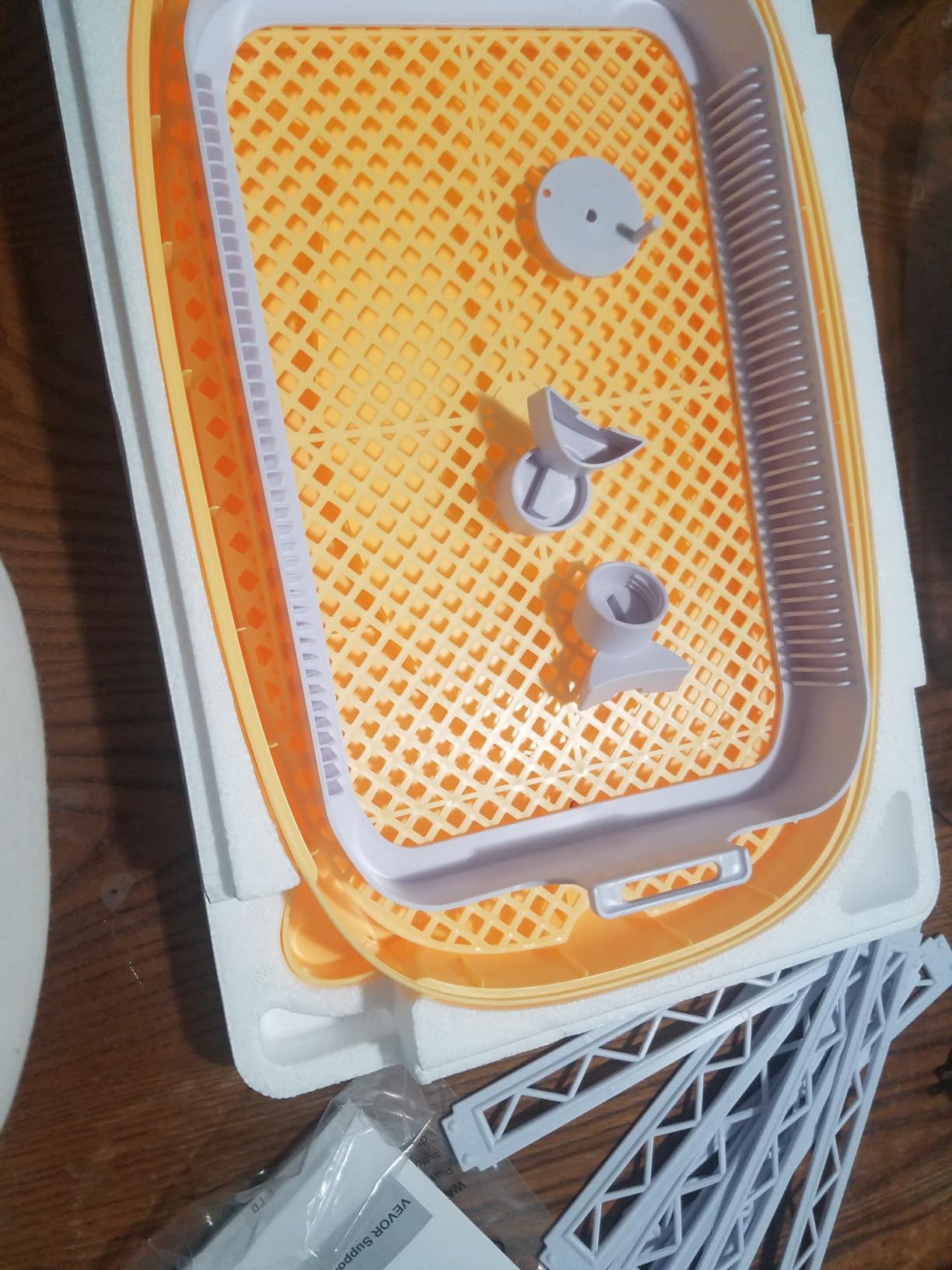
360 degree air circulation, an integrated temperature and humidity sensor, automatic 360 degree turning, and a transparent PP shell with built-in lighting for embryo inspection cover the basics. Dual water bottles split into a smaller section for incubation and a larger one for lockdown, which is a thoughtful design. The retained styrofoam packing doubles as insulation.
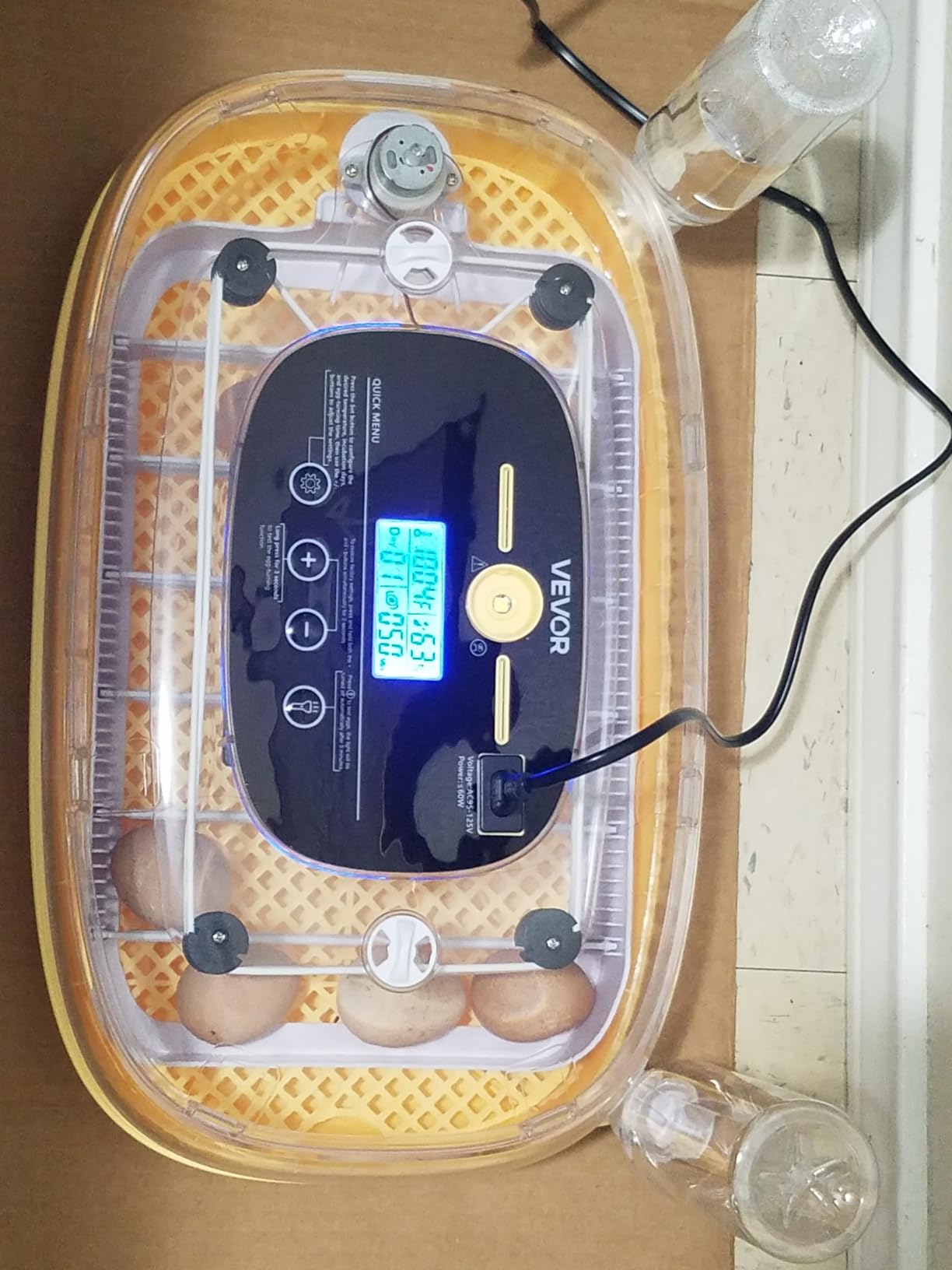
The calibration gaps are the issue. The built-in temperature reads about 5 F high and the humidity reading is unreliable, so a separate meter is effectively mandatory rather than optional. It also has to sit perfectly level, or water spreads unevenly and humidity overshoots.
Two lifting holes in the base sides can trap or injure newly hatched chicks, the lid does not always seat flush, and the turner motor coupling can detach and stop turning mid-cycle. Heat is uneven by a few degrees across the chamber with occasional humidity spikes.
Whether the battery backup is worth the calibration work
Power interruption is one of the few ways to lose an entire batch in a single event, and the Brinsea Ovation covers it with an alarm instead. This machine covers it with a battery input. For a garage, a basement or any setup with an unreliable supply, that is a real advantage.
Slow adjustable rotation is the second quiet win. It is gentler on quail eggs than faster-turning mechanisms, which matters if you are mixing species in a 24-egg tray.
Where it falls short
Buy an independent thermometer and hygrometer before you start. With a 5 F offset and an unreliable humidity reading, you are otherwise flying blind on the two numbers that decide a hatch, and owners who skip this step are the ones with disappointing results.
Level the unit on a surface you are confident about, and check the turner coupling is seated before day one. The chick-trapping holes in the base are worth covering with something smooth.
How to Choose an Automatic Egg Incubator
Capacity first, then everything else. A 12-egg dome is right for a first batch or a classroom demonstration. A 24 to 30-egg unit covers a typical backyard flock’s weekly needs in one run. Fifty-six-egg machines are for breeders and anyone who would rather set several trays than check on one small batch every few days. Buying too small means running the machine back to back all season; buying too large means a chamber you never fill and a bigger electricity bill.
Forced air versus still air
Forced-air models push air across the chamber with a fan, so every egg sits in the same thermal environment. Still-air designs rely on gentle stratification, which is more forgiving of condensation and gentler on embryos but far more sensitive to where you place the machine. Every unit in this roundup uses a fan. For home use, that is the right default, and it is why none of these need the room to be perfectly stable.
Is there an egg incubator that automatically turns eggs?
Yes. All twelve machines on this list turn eggs on a timer without you touching them, and ten of them stop automatically as hatch day approaches so you never have to remember to pull the plug on a turner. The two that do not stop on their own, the Onsju 18 Egg and the CluckRun 25 Egg, let you set the stop manually. If you cannot check the machine every day for three weeks, buy one with a locked auto-stop.
How often does an automatic egg turner turn the eggs?
Most units in this roundup rotate somewhere between every 60 minutes and every 2 hours, and any of those intervals works. Frequency matters far less than consistency. The failures we see in reviews are turners that stall partway through a cycle or stop after the coupler detaches, not turners that rotated slightly less often than the manual beside them. Watch one complete rotation before you load the tray, and check the movement again around day 10.
Humidity is the number that decides your hatch
Target 50 to 55 percent relative humidity through day 17, then raise it to 65 to 75 percent for the final three days. Too dry and the membrane inside the egg is too thick for the chick to break; too wet and the chick drowns before it gets out. Every machine here manages humidity one of three ways. A water channel or pan requires daily checking. External bottles or an auto-fill system cut that to one or two refills. A pumped or motorised system removes the task entirely.
Which one you need depends on how long you are away during the day. The best humidity control in the group does not help if the reservoir runs dry on a Friday and nobody is there until Sunday.
Do I need a secondary thermometer and hygrometer?
Yes, and this is the single most useful thing you can buy before a batch. The cheapest machines here have documented offsets: one temperature display reads about 5 F high, another humidity display overreads by roughly 10 percent, and several more drift with ambient conditions. Cross-check on day one, adjust the setpoint to compensate, and you have neutralised the most common cause of a failed hatch. The same instinct applies to the thermometer itself: two cheap meters that agree with each other are more useful than one expensive one.
A calibrated hygrometer in the room and a second thermometer in the chamber will also tell you quickly whether the room, rather than the machine, is the problem.
Run it empty for 24 hours first
Community consensus across poultry forums is that you should run any new incubator empty for a full day before adding eggs. It is free, it takes one day, and it reveals nearly every problem you would otherwise discover on day three. Watch for temperature settling and holding rather than climbing. Confirm the fan runs and the chamber feels even at the back. Watch a full turn cycle to confirm the tray rotates the eggs at the far end too. Fill water, watch the humidity response, and calibrate against your own meter.
If the unit needs 24 hours to stabilise on day zero, a 21-day cycle still works. If it never stabilises, you have found the problem before it was holding your eggs.
Placement, cleaning and the mistakes that ruin a hatch
Indoors, away from sunlight, draughts and outside walls, at a stable room temperature. A unit pushed against a cold exterior wall in an unheated room will work harder and hold less steadily than the same unit on a kitchen counter. The most common ruinous mistakes we found in reviews are far simpler: loading eggs into a machine that was never calibrated, forgetting to remove the factory foam packing, and assuming the turner stopped for lockdown when it did not. Candling on days 7 and 14 catches the rest.
Between hatches, remove every tray and liner, wash them in warm soapy water, wipe the chamber with a mild solution, and dry everything completely before reassembly. Alcohol-based cleaners degrade clear dome plastics. A unit that is cleaned and dried properly between cycles keeps its insulation and its seals, which is why owners report decade-long service lives on well-maintained machines.
Finally, a broody hen is the genuine zero-cost alternative if you only want six or eight eggs. Beyond that, hand turning three to five times a day for 21 days is a commitment most people break eventually, and that is exactly the gap an automatic turner closes.
Frequently Asked Questions
What is the best incubator machine for chicken eggs?
The KEBONNIXS 12 Egg Incubator is our top pick for most backyard hatchers, with 4.4 stars across more than 5400 reviews, fan-driven airflow, a built-in egg candler, a humidity display and a turner that stops three days before hatch. For accuracy and durability rather than capacity, the Brinsea Mini II Advance holds temperature and humidity more consistently than anything else we covered.
Are automatic egg turners worth it?
For most people, yes. A turner removes three to five daily hand-turns across 21 days, which is the chore that causes people to abandon a batch. It is worth less if you are hatching six eggs for a classroom project, because you can turn those by hand in under a minute. The thing that actually matters is that the turner stops automatically for the final three days of lockdown.
Is there an egg incubator that automatically turns eggs?
Every incubator in this roundup turns eggs on a timer without any handling from you. The MATICOOPX 30 Egg turns side to side every 60 minutes, the Apdoe 12 Egg and Sailnovo 56 Egg turn every 2 hours, and the CluckRun 25 Egg and Onsju 18 Egg let you choose between 60, 120 and 180 minute intervals.
How often does an automatic egg turner turn the eggs?
Typically every 1 to 2 hours, and any consistent interval in that range works for chicken eggs. Frequency matters much less than reliability. The turner failures we see are stalls and detached motor couplings partway through a cycle, so watch one complete rotation before loading eggs and check the mechanism again around day 10.
What common mistakes ruin egg incubation?
The most common are loading eggs into an incubator that was never calibrated, leaving the factory foam packing inside, forgetting to stop the turner for the final three days, and running humidity too low early or too high late. Run the unit empty for 24 hours first, verify the reading against a separate thermometer, hold 50 to 55 percent humidity through day 17, then raise it to 65 to 75 percent for lockdown.
How many eggs should my first incubator hold?
Twelve is a good first batch and lets you learn the routine with a manageable commitment. A 24 to 30-egg capacity covers most backyard flocks in a single run, and 56-egg machines suit breeders and anyone who would rather run several trays than keep checking a small batch. Sizing up beyond what your flock needs means running the machine continuously through the season.
Do I need a secondary thermometer for an egg incubator?
Yes. Several budget machines have documented offsets, including one temperature display that reads about 5 F high and another humidity display that overreads by roughly 10 percent. Cross-check the built-in reading against a second thermometer and a separate hygrometer on day one, then adjust the setpoint to compensate. Two cheap meters that agree with each other are more useful than one expensive meter.
Which Automatic Egg Incubator Should You Buy?
The best automatic egg incubators for chicken eggs come down to how honest your room is. The KEBONNIXS 12 Egg is our editor’s choice because more than 5400 owner reviews say it holds temperature, turns cleanly and stops on schedule, and the built-in candler and humidity display mean you can start a batch without buying extra tools. If you want a bigger batch from day one, the MATICOOPX 30 Egg is the better value step up, and if accuracy and a decade of service life matter more than capacity, the Brinsea Mini II Advance earns its place on any shortlist.
Whichever you choose, do the unglamorous part first. Run the machine empty for 24 hours, verify the reading against a second thermometer, watch one full turn cycle, and remember that 50 to 55 percent humidity through day 17 rising to 65 to 75 percent for lockdown is the number that decides the outcome more than any feature on the box.
Once you have chicks, you will want recipes that use the rest of the flock’s output, so our delicious eggs benedict recipes and classic poached eggs benedict recipe are the natural next stop. This roundup was updated for 2026 and every rating, capacity and specification above comes from the current product data and owner review history.