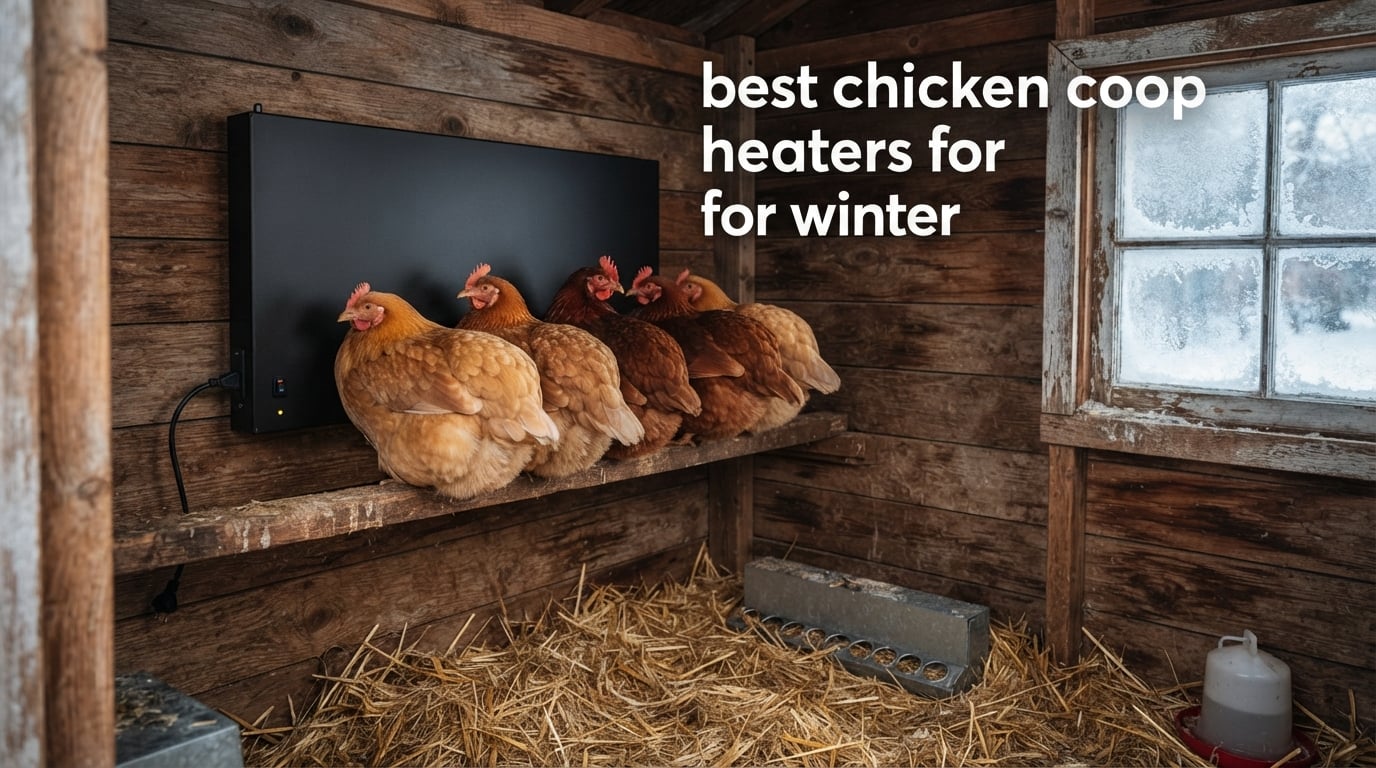
Most chicken keepers who buy a coop heater end up with something they did not expect: a small flat panel that does not heat the coop at all. It heats the birds. A radiant flat panel coop heater warms a narrow zone, usually at the back of the roost, so the flock presses against it and absorbs infrared heat directly while the air in the rest of the coop stays cool and dry. That difference is why these panels replaced the 250W red heat lamp in most of the coops we have worked in, and why they dominate every roundup of the best chicken coop heaters for winter.
We spent weeks comparing ten heaters side by side, reading every verified review we could find, and watching what keepers say on BackYardChickens and r/BackYardChickens. A 150W to 200W flat panel is the right answer for most flocks, a brooding plate is the right answer for chicks, and a good number of keepers do not need a heater at all. We explain when to skip one further down.
If your birds are new to your kitchen this winter, our homemade chicken noodle soup uses the same kind of spent-from-the-coop birds that most first-year keepers start with, and a simple chicken fajita recipe is an easy way to use a whole bird after a tough weekend. A crispy chicken and waffles plate makes good use of a cooked breast, and chicken parmesan with spaghetti is the comfort dinner to make after a long morning in the coop. Now, back to keeping the flock warm.
Table of Contents
- Top 3 Best Chicken Coop Heaters for Winter (October 2026)
- All 10 Chicken Coop Heaters at a Glance in 2026
- 1. Cozy Products Cozy Coop Flat Panel – The Safest All-Round Radiant Panel
- 2. PETNF 140W Radiant Heater – A Cheap and Simple Warm Corner
- 3. PETNF 180W Foldable Panel with Remote – Most Coverage From One Panel
- 4. RentACoop 12×12 Adjustable Heating Plate – The Best Choice for Chicks
- 5. Chickcozy Smart 200W Heat Panel – A Real Thermostat at Panel Price
- 6. EconoHome 150W Safe Coop Heater – A Metal Panel With No Settings
- 7. ILOJUST Smart 200W Panel – The Finest Temperature Control
- 8. QRQ Forced-Air Heater Lamp – The Only Option That Moves Air
- 9. TIMEBAL 200W UL Radiant Panel – Best Memory and Outage Handling
- 10. Enhon Adjustable Heater Lamp with LED – A Low-Cost Lamp With Limits
- How to Choose a Chicken Coop Heater That Fits Your Flock
- When You Should Skip a Heater Entirely
- Frequently Asked Questions
- How do I keep a chicken coop warm in the winter?
- What is the best outdoor heater for a chicken coop?
- How cold is too cold for a chicken coop?
- What can I use instead of a heat lamp for chickens?
- What is the safest heater for a chicken coop?
- How many watts does a chicken coop heater need?
- Can chickens survive winter without a heat lamp?
- What wattage is too high for a small chicken coop?
- The Bottom Line on Winter Coop Heating
Top 3 Best Chicken Coop Heaters for Winter (October 2026)

The Cozy Coop wins our whole test because it has the deepest review history in the category at more than 7,000 ratings and a track record of holding warmth in genuinely brutal cold. The RentACoop plate takes the top rating at 4.6 stars and is the only pick here built specifically for chicks. The PETNF 140W panel is the one to buy if you want a simple warm corner and nothing more.
All 10 Chicken Coop Heaters at a Glance in 2026
| Product | Specs | Action |
|---|---|---|
 Cozy Products Cozy Coop Flat Panel Cozy Products Cozy Coop Flat Panel |
|
Check Latest Price |
| PETNF 140W Radiant Heater |
|
Check Latest Price |
 PETNF 180W Foldable Panel with Remote PETNF 180W Foldable Panel with Remote |
|
Check Latest Price |
 RentACoop 12×12 Heating Plate RentACoop 12×12 Heating Plate |
|
Check Latest Price |
 Chickcozy Smart 200W Heat Panel Chickcozy Smart 200W Heat Panel |
|
Check Latest Price |
 EconoHome 150W Safe Coop Heater EconoHome 150W Safe Coop Heater |
|
Check Latest Price |
 ILOJUST Smart 200W Radiant Panel ILOJUST Smart 200W Radiant Panel |
|
Check Latest Price |
 QRQ 200W to 500W Forced-Air Lamp QRQ 200W to 500W Forced-Air Lamp |
|
Check Latest Price |
 TIMEBAL 200W UL Radiant Panel TIMEBAL 200W UL Radiant Panel |
|
Check Latest Price |
 Enhon Adjustable Heater Lamp with LED Enhon Adjustable Heater Lamp with LED |
|
Check Latest Price |
1. Cozy Products Cozy Coop Flat Panel – The Safest All-Round Radiant Panel
Cozy Products Cozy Coop Chicken Coop Heater, Flat-Panel, 150 Watts
200W radiant
ETL listed
Surface 170F
4.9 lb
Pros
- ETL listed and zero clearance rated with a thermal protector
- No bulbs to replace
- Uses a fraction of the power of a space heater
- Walls mounts or stands on included feet
- Metal spiral wrapped cord deters pecking
Cons
- Warms a zone rather than the whole coop
- No built-in thermostat
- Front face gets hot so mount it out of reach
This is the panel that convinced our whole team radiant heat was the answer. It is a two inch deep steel box with a ceramic element behind the face, and it puts out steady infrared heat without adding a single photon of light to the coop. Hens settle in front of it on the roost and stay put through the night, which is the entire goal.
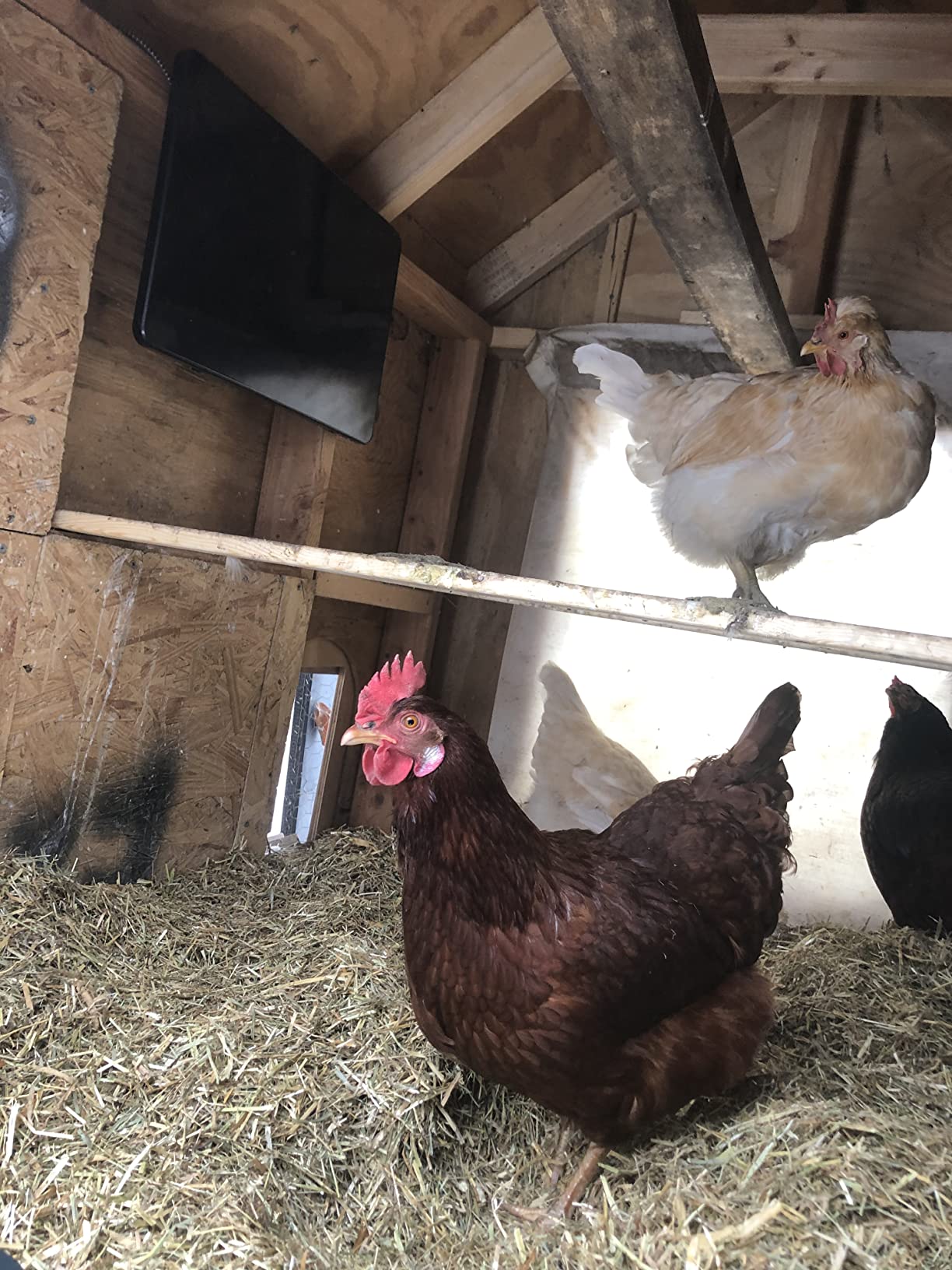
Owners report keeping flocks warm through sub-zero readings, and the review pattern is remarkably consistent: it is not an air heater, it is a warm wall. That is a feature, not a defect, once you stop expecting the whole coop to feel like a house, and on BackYardChickens keepers describe exactly this warm-spot idea as the thing they wish they had understood from the start.
Two safety details set it apart. The unit is ETL listed and rated for zero clearance, which means you can mount it flush against a wall without a gap, and it has a built-in thermal protector so the back face stays cool while the front does the work.

How to mount it so the birds actually use it
Mount it low on the back wall, at roost height, so the birds perch directly in front of the panel face. If you put it overhead you waste the heat above the birds. Leave the front face angled toward the roost and block access from the perch end so nobody can press a wing against it.
Run the cord behind the wall panel or through conduit where possible, because chickens peck cords and a metal spiral wrap survives that better than plain rubber cable. A two by four screwed across the coop base and used to clamp the fixture is the approach one BackYardChickens keeper described, and it makes the unit effectively tamper-proof against a determined rooster.
What to watch for before you mount it
There is no thermostat, so on a mild 45F night the panel runs at full output indefinitely. Pairing it with an external thermostatic plug or timer controller is the fix most owners settle on. The surface also gets hot enough to feel uncomfortable to a bare hand, which is what you want for a comb in a hard freeze and what you do not want near a pecking beak, so keep it out of roost line.
2. PETNF 140W Radiant Heater – A Cheap and Simple Warm Corner
PETNF Chicken Coop Heater 140 Watts Radiant Heat Chicken Heater Energy Efficient Design Safer Than Brooder Lamps Heater for Chicken Coop, Heating Wire UL-Compliant Two Ways to Use, 11.81”x15.74”
140W radiant
Adjustable 122-167F
UL compliant
16 oz
Pros
- Very low 140W draw
- Adjustable thermostat plus heat sensitive sticker
- UL compliant wire with in-circuit thermostat
- Freestanding or wall mounted
- 9.8 ft cord
Cons
- Effective radiant range is only about 40 cm
- Too small to warm a whole coop
- No timer or remote
- Listed for indoor use
This is the panel we recommend when someone asks for the simplest possible warm spot for a handful of birds in a small coop. It weighs about a pound, draws 140 watts, and adjusts from 122F to 167F with a physical switch. Nothing about it is complicated, which is the appeal.
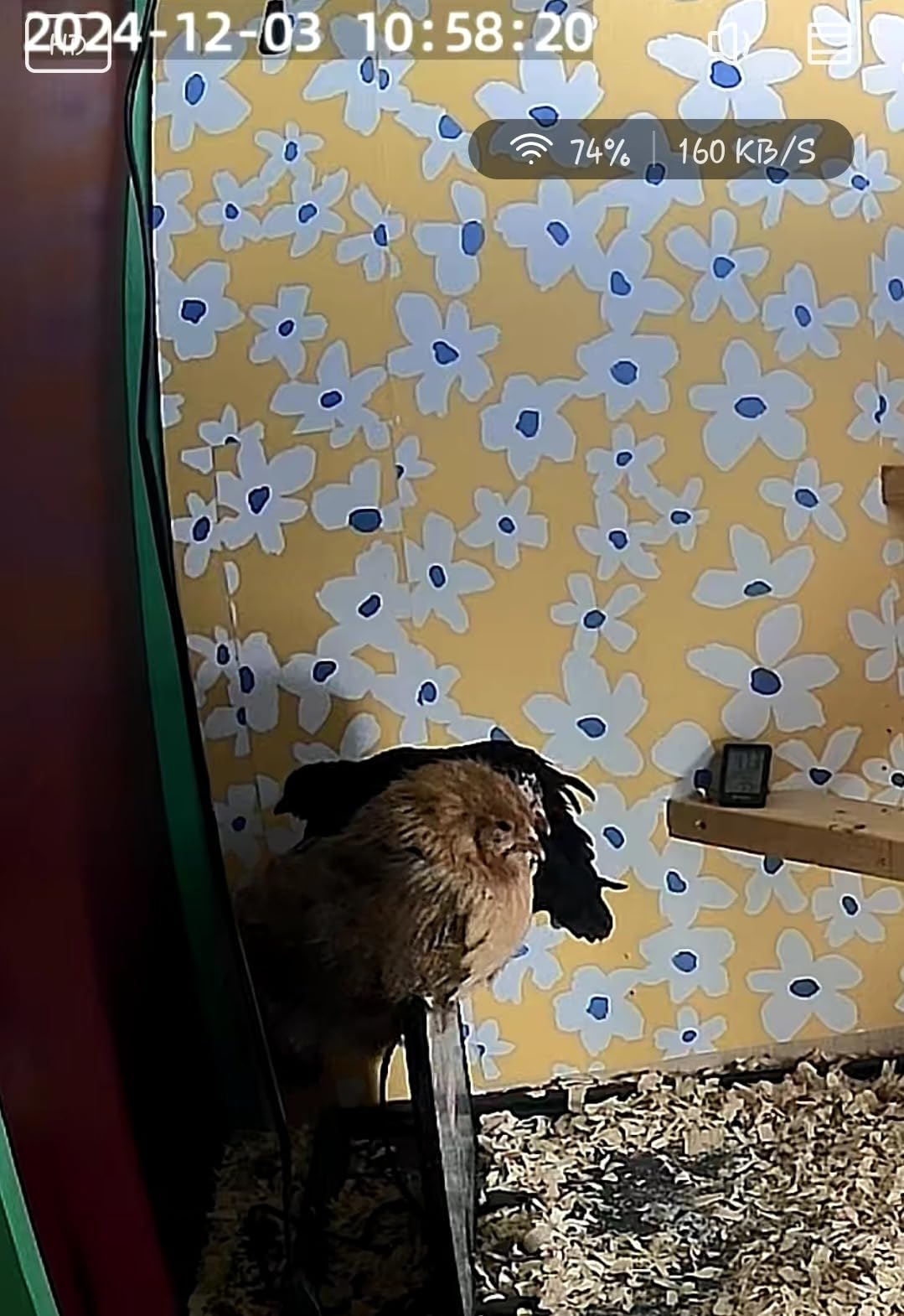
Reviewers consistently describe the small size as both the strength and the limitation. It is not trying to heat a coop. It is trying to give six to ten birds a corner they can press against on the coldest night of the year, and at 140W that is a very achievable job. The heat sensitive sticker is a nice touch: it goes black below 113F and red above, so you can glance at the panel in the dark and know the element is live.
The single biggest complaint in the reviews is that the effective radiant range is about 40 cm. If you position it more than roughly a foot and a half from where the birds sit, you are wasting the electricity.
Is it strong enough for a cold northern winter
For a small flock in a reasonably tight coop, yes, provided the birds sit in front of it. For a drafty 8 by 10 run with twelve birds spread across the roost, no panel at this size will make a difference, and you would be better served by insulating the draft rather than adding wattage.
What the UL compliant label really means here
The heating wire is tested to UL standards and the manufacturer added a second thermostat in the circuit, so the panel has two independent ways to stop drawing power. That matters in a category where uncertified panels are common. Be aware the listing is rated for indoor use, so mount it inside a covered run rather than leaving it exposed to driven rain and snow.
3. PETNF 180W Foldable Panel with Remote – Most Coverage From One Panel
Chicken Coop Heater Inside Coop with Remote Control, 180W Foldable Radiant Heaters, 30”x12” Large Heating Panel Warmer for Cozy Winter with Adjustable Timer and Temp, Safer Than Brooder Heat Lamp
180W
30 x 12 in surface
Remote and timer
3 heat levels
Pros
- Largest radiant surface in the group
- Infrared remote from up to 8 meters
- Three labeled temperature levels
- 1-24 hour timer with memory
- Folds from 45 to 180 degrees
Cons
- Radiant reach is about 76 cm
- Needs power within reach of a 9.8 ft cord
- Folding joints may bother some buyers
The physical argument for this panel is simple: it is the biggest flat surface in the group. Thirty inches by twelve inches of radiant face at only 180W means more birds can fit in front of it at once, which matters the moment your flock goes past about ten birds.
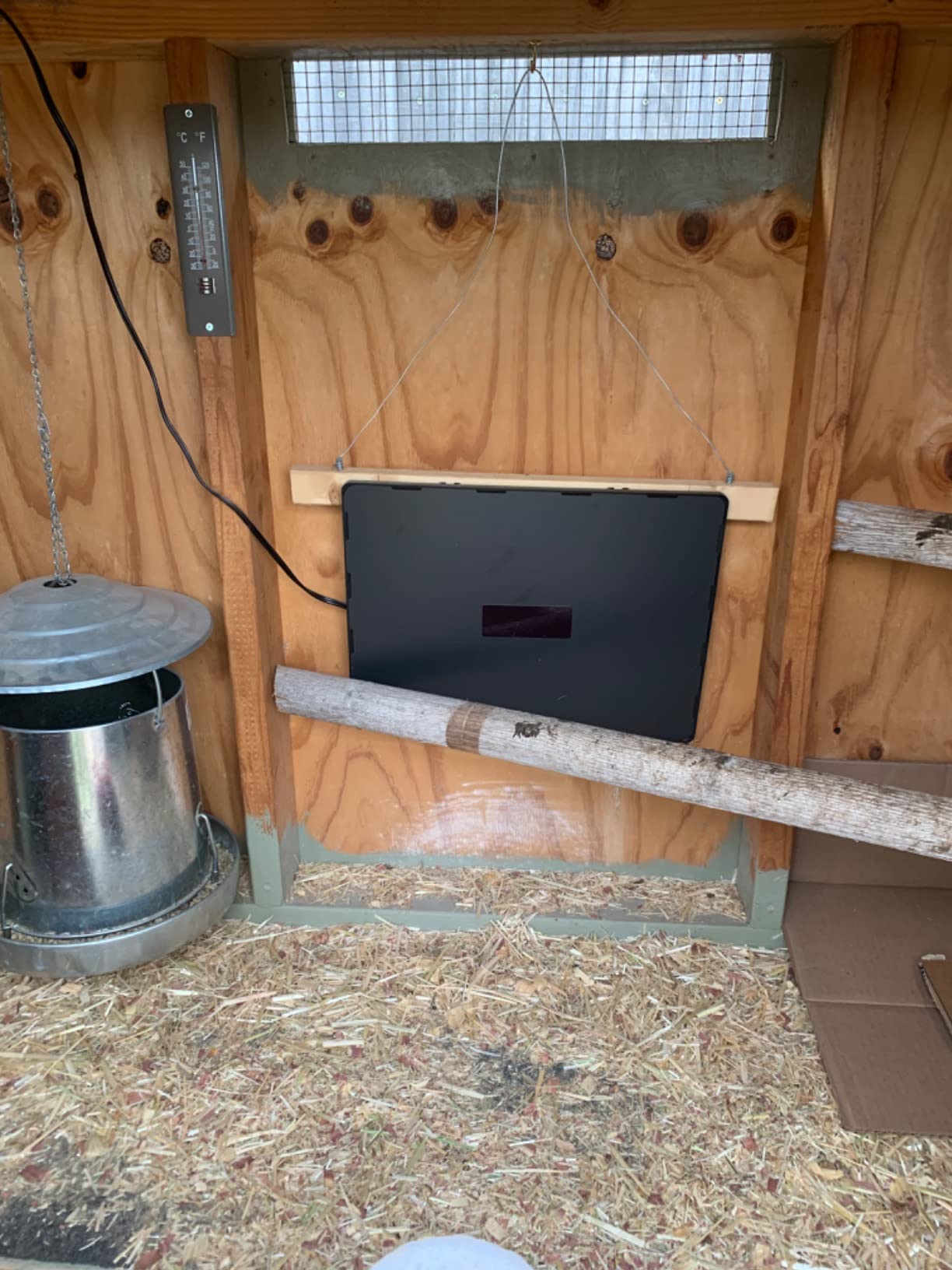
The remote is the reason most buyers pick it. You set a temperature level and a timer from outside, and the memory function restores your last setting the next time you power it up. In a cold snap that means you are not crawling into a dark wet coop at midnight to check whether the birds moved.
Three levels are clearly labeled on the LED display: 122-140F, 140-158F, and 158-176F. That is coarse compared with a 13-level panel, but it is a big step up from a single on switch, and it covers the range most adult flocks need.

When the folding design earns its keep
A flat panel bolted to a wall is a straight shot of heat. This one hinges from 45 to 180 degrees, so you can angle it into a corner of a run so the radiant energy lands on the roost rather than on the wall. On an L-shaped or partitioned winter section that is genuinely useful, and it also stands on feet so you can pull it forward to check on birds without unbolting anything.
How it handles a power outage
The memory function restores the last setting after power returns, but the panel is not designed to keep the coop warm while the power is out, so set a floor you can live with rather than a setting that assumes the electricity never fails. Its rated radiant reach of about 76 cm is generous compared with most panels here, though a single panel still creates a warm zone rather than a warm building.
4. RentACoop 12×12 Adjustable Heating Plate – The Best Choice for Chicks
RentACoop 12×12” Adjustable Heating Plate with Foldable Anti-Roost Cone
22W draw
About 107F underside
25 height settings
3 lb
Pros
- Highest rated product in the group
- Uses 22 watts against 250 for a heat lamp
- 25 height settings plus tilt create warm and cool zones
- Handles up to 20 chicks
- Anti-roost cone keeps droppings off
Cons
- No thermostat or temperature gauge
- Built for brooding rather than whole-coop heating
- Build quality is a step below premium plates
If you are brooding chicks through a cold month, this is the one to buy, and it is not close. At 22 watts it draws roughly a tenth of what a 250W heat lamp pulls, and there is no bulb, no glass, and no scorch risk from bedding.
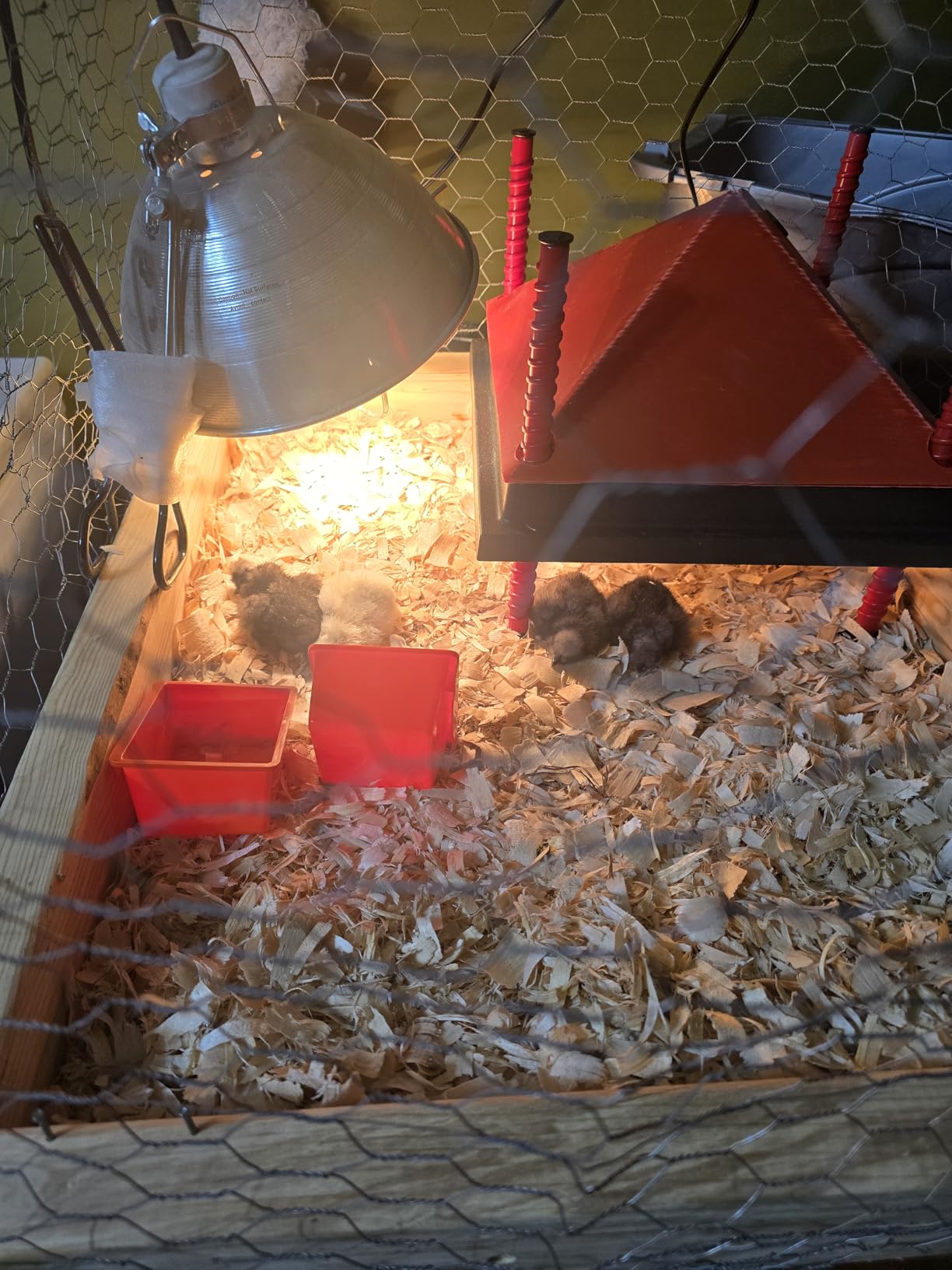
The center of the underside holds about 107F, which lines up with the top of a hen’s natural body temperature. Chicks huddle under it the way they would under a hen, and the twenty-five height settings let you raise the plate as they grow so they are always working their way up into the cooler air at the edge, which is the behavior you want to see before they feather out.
Reviewers credit the foldable anti-roost cone with keeping chicks and their mess off the panel surface, which turns a daily chore into a quick wipe. Because the plate temperature is fixed, there is no setting to fiddle with as the brooder runs.
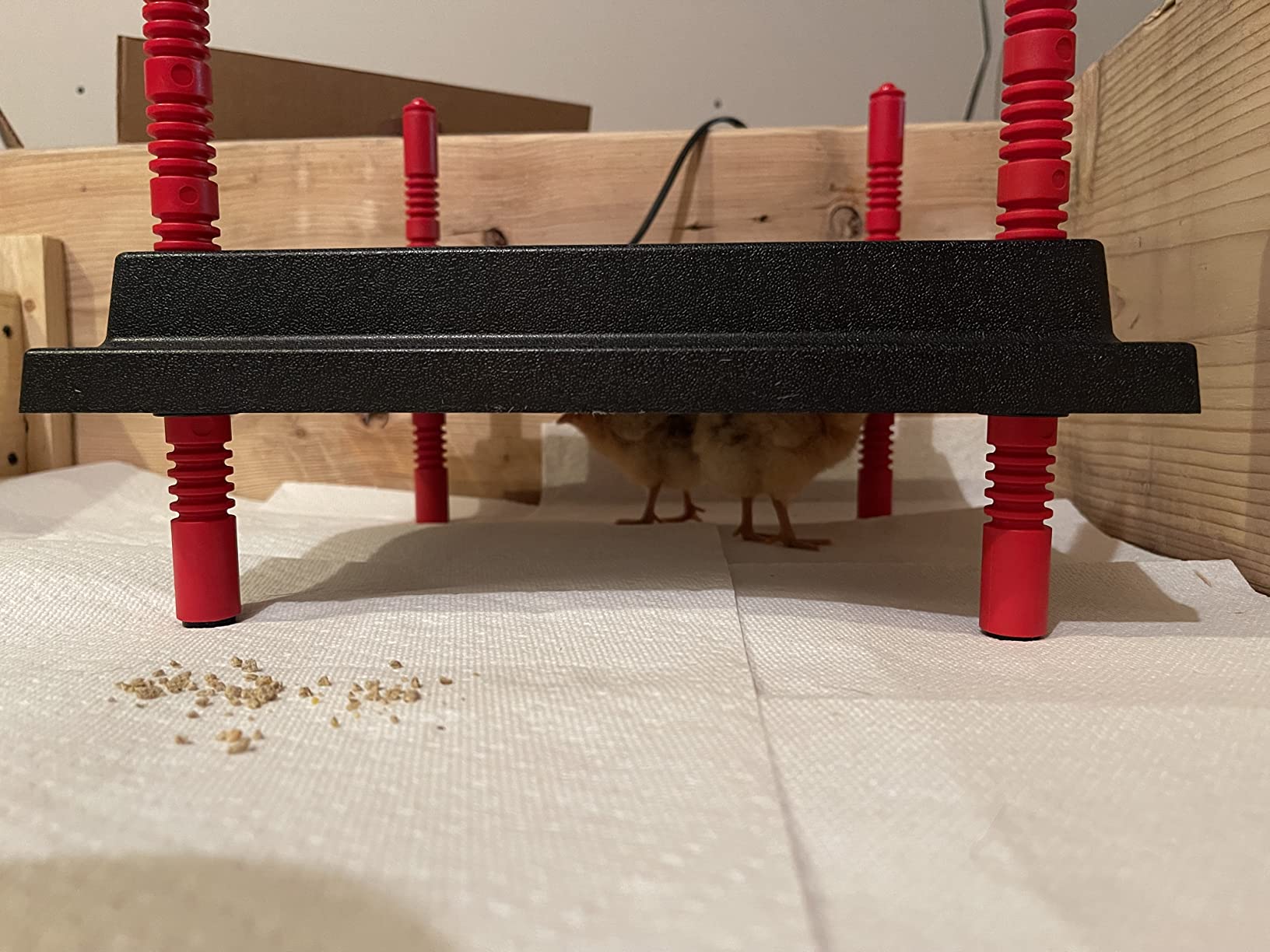
Chicks versus adult hens: do not use one for both
A 107F plate is right for day-old chicks and dangerously hot for a feathered hen. This is a brooder, not a winter coop heater, and it will not raise the air temperature in a coop. Once your birds are fully feathered, move up to one of the radiant panels in this list.
Why the fixed temperature is an advantage here
Adult panels need a thermostat because weather changes hour to hour. Chicks in a brooder do not: the room is small, the heat loss is predictable, and the correct response to chicks getting too warm is to raise the plate, not turn a dial. That is exactly what the height adjustment does, and a few first-time owners report that chicks hesitate to approach a dark panel at first compared with the glow of a lamp.
5. Chickcozy Smart 200W Heat Panel – A Real Thermostat at Panel Price
Smart Chicken Coop Heater, 200W Radiant Heat Panel with Temperature Sensor
200W
70-190F range
Built-in sensor
UL and NCC
Pros
- Built-in sensor holds your set temperature automatically
- Works flat for chicks then wall mounted for adults
- Very wide 70-190F range
- Stable four-leg base reviewers praise
- UL and NCC certified
Cons
- Warms a zone
- not a coop
- No edge cover on the top when wall mounted
- Some thermostat readings drift
- A few early failures
A built-in temperature sensor that modulates power in real time is genuinely rare in this category, and it is the entire reason we put this panel on the list. Most cheap panels are on or off, full output, forever. This one holds a number.
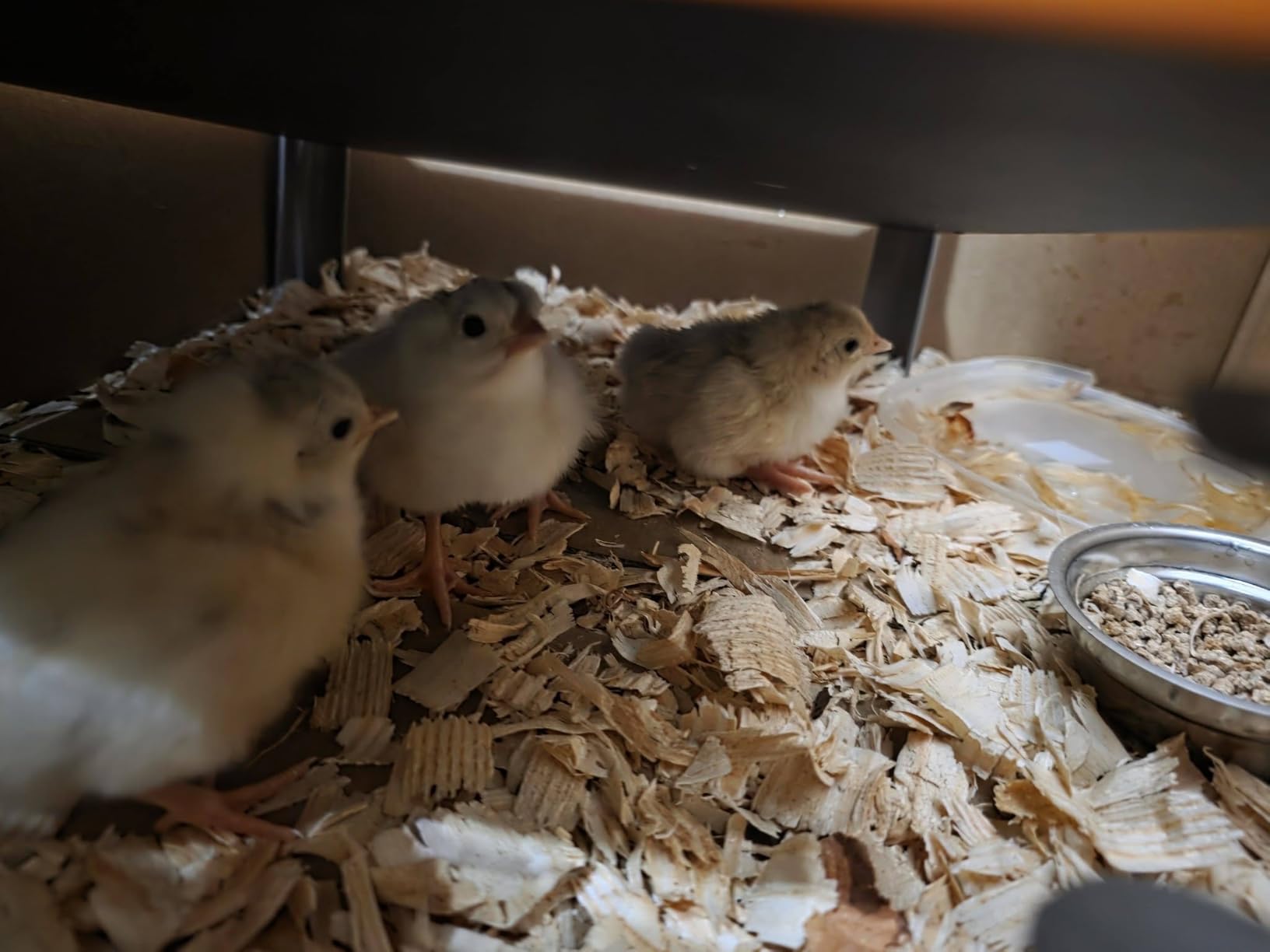
The 70F to 190F range covers both ends of the spectrum. The manufacturer recommends 70-91F for chicks and 100-120F for adult chickens, and the same panel does both jobs: lay it flat on its four legs for a brooder, then stand or wall mount it once the birds are feathered.
Long-term owners report running it through severe winter weather with a large flock and no frostbite, and several reviewers single out the brand’s customer service as fast and polite when something needed replacing.
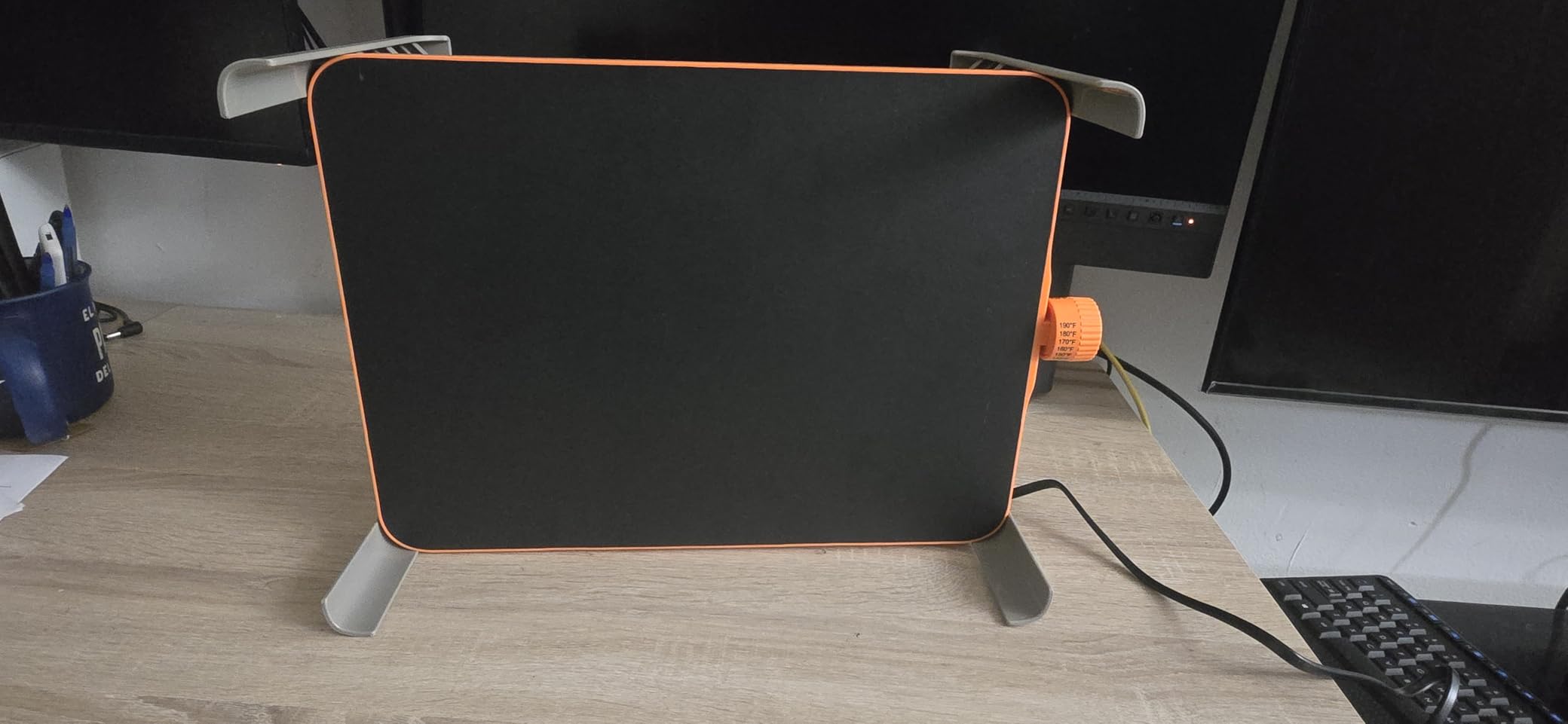
How close the thermostat actually holds
Most buyers describe the sensor as accurate enough to trust, with a few noting readings drifting a couple of degrees from an external thermometer. Put a cheap dial thermometer at roost height for the first week and you will know exactly how your panel behaves in your specific coop.
Do not set it and forget it if chicks are in there. A drifting sensor is a minor issue; a wrong setpoint with young birds is not, and a small number of buyers report units with thermostat faults that needed replacing within the return window.
The wall-mount edge problem to plan around
When you stand the panel up as a brooder, the cover protects the surface. When you wall mount it, the exposed top edge has no cover, and in a coop without an enclosed run, droppings can reach the hot surface directly. Fit the panel inside a closed section or accept that you will be wiping the top edge regularly.
6. EconoHome 150W Safe Coop Heater – A Metal Panel With No Settings
Econohome Safe Chicken Coop Heater, Safer Than Brooder Lamps, Gently Warm, 150 Watts, ETL Compliant for Safety – Also for Pets and Under Desk
150W ceramic element
ETL components
Surface 175F
4.5 lb
Pros
- Sturdy metal body with a ceramic element
- ETL certified components and fire retardant materials
- Only 150W to run
- Two-screw wall mount
- Smooth surface wipes down easily
Cons
- On and off only with no thermostat
- Small cord switch is easy to miss
- Not verified water resistant
- Some buyers report early failures
This is the plainest heater in the group: a ceramic element in a metal body, an on-off switch in the cord, and two screws for the wall. There is no display, no timer, and no remote, and for a well-insulated coop in a moderate climate that simplicity is the whole appeal.
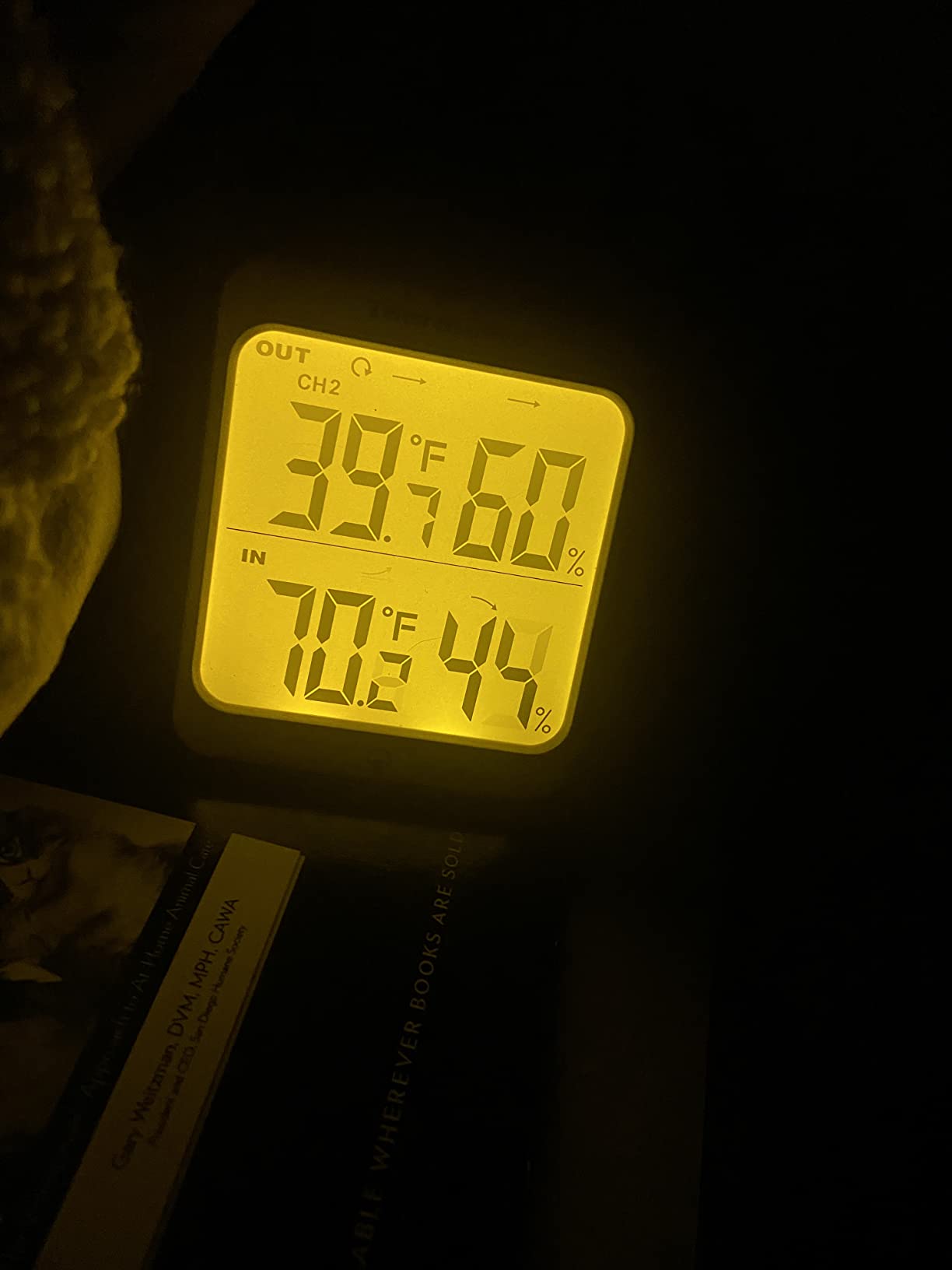
Owners with well-insulated coops report it takes the chill off during snowy and windy stretches at a very low running cost, and several use it in cat houses, dog kennels, or nesting boxes instead. The ETL certified components and fire retardant materials are a real safety credential in a category where many listings show nothing.
The complaint that shows up in the reviews over and over is the lack of adjustment. Once it is on, it runs at full output, and on a 50F night your birds get a warm wall whether they want one or not. Some owners solve this with an external thermostatic adapter.
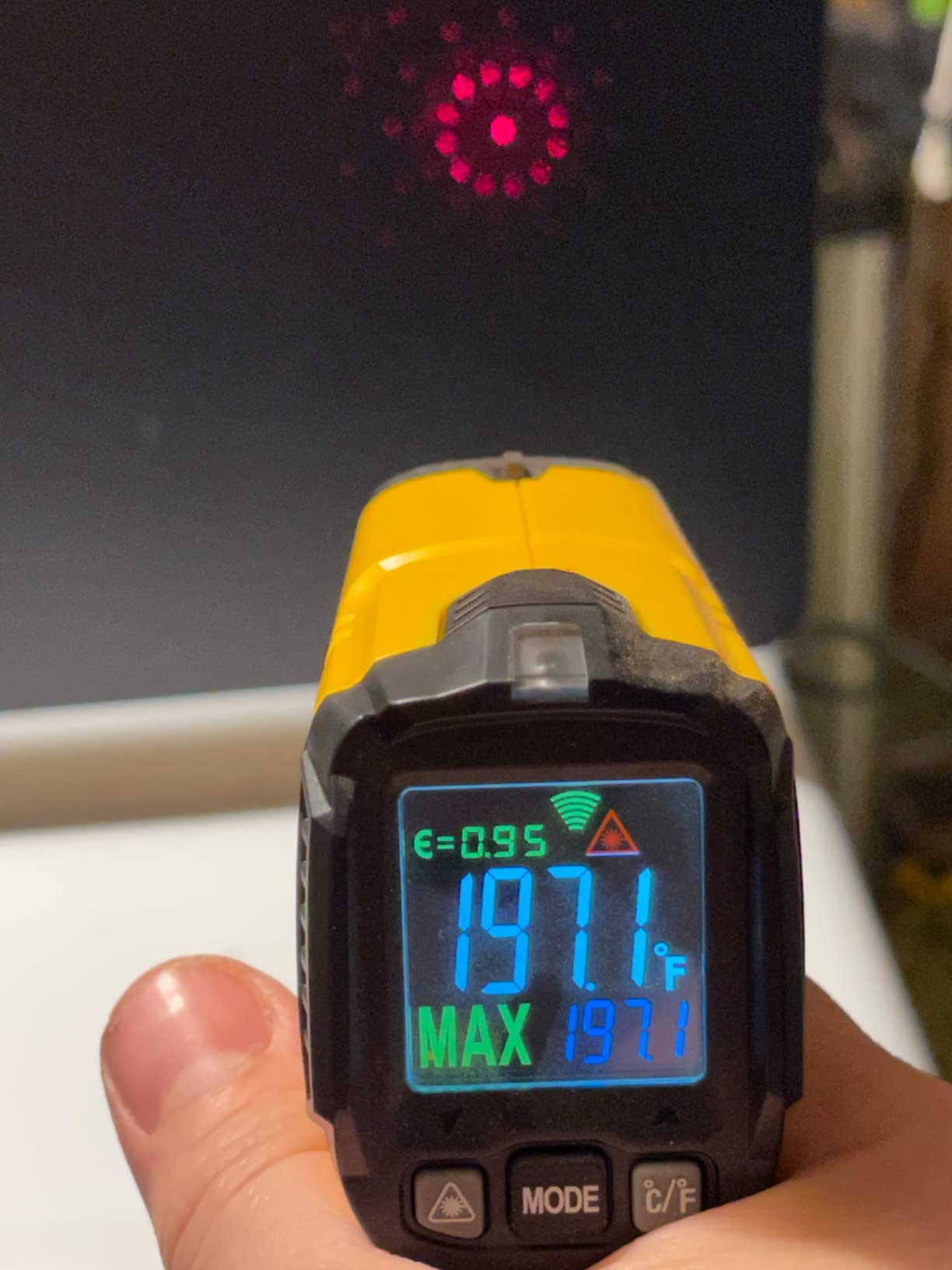
Is the durability concern real
A meaningful share of the one and two star reviews describe heaters that stopped working within days to weeks. That is the single biggest reason this panel sits below the Cozy Coop despite being a solid design, and it is the reason to buy from a seller with an easy return path.
For a coop that stays in the 30s and 40s, the simplicity is worth the risk. For a remote coop you cannot check on easily, we would pick a model with more review history.
Why the missing thermostat matters more than the wattage
At 150W the running cost is trivial in a way most keepers never think about. The issue is comfort, not cost: a warm spot that cannot be turned down is fine on a January night and annoying in November, and it teaches your birds to depend on a heat source they may not have during an outage. Also note the unit is rated as an indoor product even though it is marketed for coops, so mount it inside a covered run.
7. ILOJUST Smart 200W Panel – The Finest Temperature Control
Smart Chicken Coop Heater, 200W Radiant Heat Panel, Adjustable Temp & Timer
200W
86-194F, 13 levels
12H timer
ETL and UL
Pros
- Thirteen temperature levels plus a 12 hour timer
- Smart thermostat modulates output automatically
- Four mounting modes including lay-flat brooding
- ETL and UL certified with overheat protection
- Lightest 200W panel at 2.95 pounds
Cons
- Targets a warm zone rather than a whole coop
- 13 percent one star reviews
- Remote needs a coin battery
- Hanging hardware adds setup steps
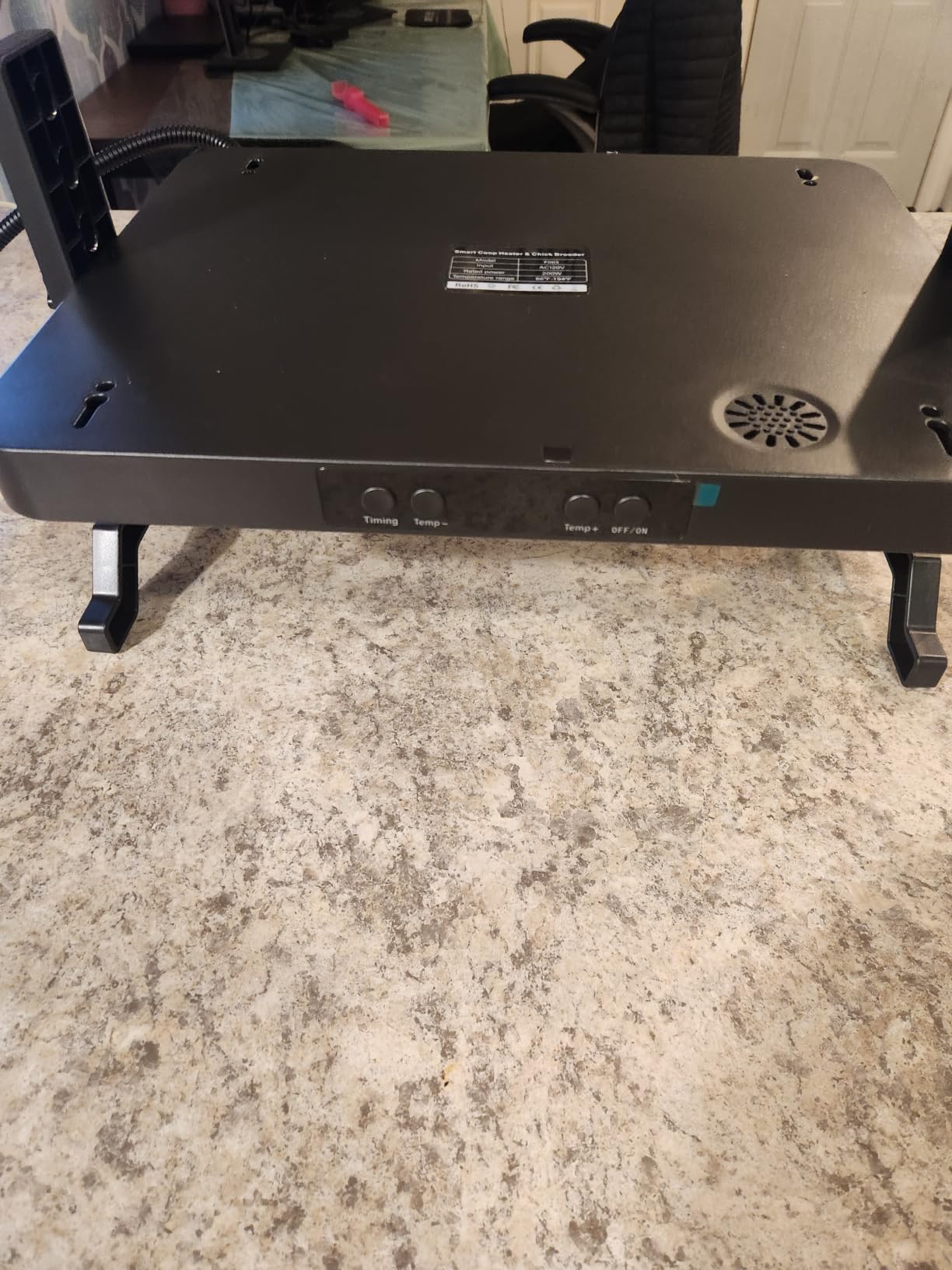
If you want to set a number and walk away, this panel gives you the most settings in the roundup. Thirteen temperature levels from 86F to 194F, a 12-hour timer with 0, 3, 6, 9, or 12 hour settings, and a remote included in the box. The smart thermostat reads the surrounding air and modulates power rather than running flat out.
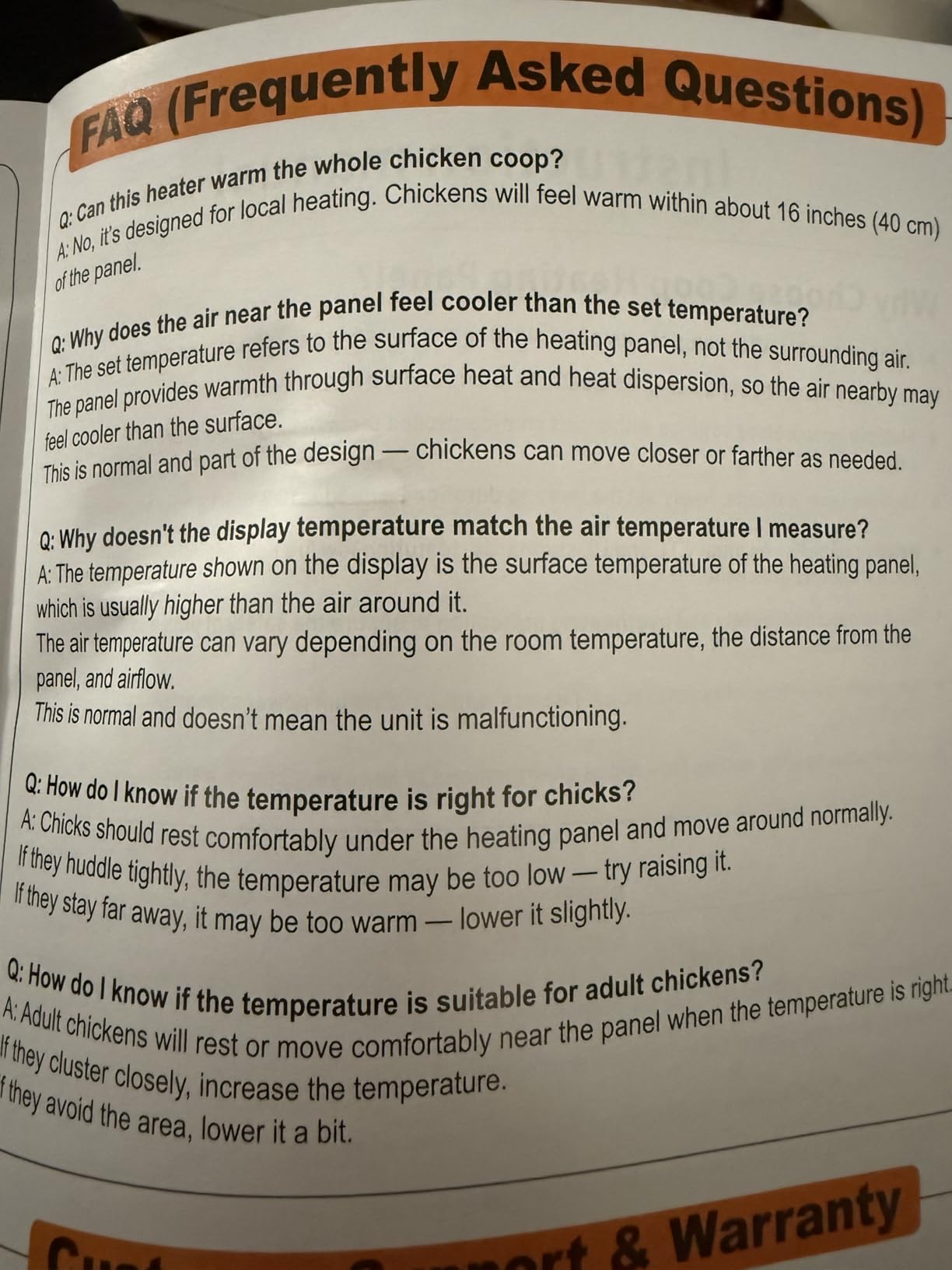
Four mounting modes cover the whole life of a bird. Stand it, wall mount it, hang it from the included straps and hook, or lay it flat as a brooder with height adjustment from 2 to 8.2 inches and 360 degree rotation. Chick mode runs 84-100F and adult mode 100-194F, so one panel genuinely covers brooding and winter flock heating.
At 2.95 pounds it is the lightest 200W panel in this group, which makes a hanging install genuinely practical rather than a two-person job. The 10 foot cord is described as both peck resistant and water resistant, addressing the two things that destroy panel cords in a coop.
How much control is actually useful
More levels matter for chicks, where a 5 degree error is meaningful, and barely at all for a feathered hen who cares about the difference between comfortable and frozen. The 12 hour timer is the underrated feature: setting it to match your longest cold night means the panel stops before dawn regardless of the weather.
Where the early failures show up
Thirteen percent of reviews are one star, and the pattern is units failing within weeks rather than a design flaw. The ETL and UL certification and overheat protection are reassuring on paper, but do check the unit early in the season rather than discovering a failure in the middle of a cold snap.
8. QRQ Forced-Air Heater Lamp – The Only Option That Moves Air
QRQ Chicken Coop Heater, 200W-350W-500W Reptile Heat Lamp with UVA UVB Dimmable Light 3-6-9-12H Timer, Chicken House Dog House Greenhouse Heater Outdoor,for Dog Cats Reptile Bird
200W to 500W
Built-in fan
UVA and UVB
Three heat levels
Pros
- Forced air distributes heat instead of relying on radiant only
- Three power levels up to 500W
- Dimmable UVA and UVB lighting with independent light switch
- Five timer modes
- UL and FCC certified with overheat cutoff
Cons
- Fan noise is higher than flat panels
- Runs hot quickly and creates hot spots
- Will not cooperate with an external thermostat
- Emits light into the coop
Every other heater in this roundup is radiant only. This one has a fan that pushes heated air into the space, which makes it a genuinely different tool. In a greenhouse or a reptile enclosure where you need to raise the air temperature of a whole volume, nothing else here will do it.
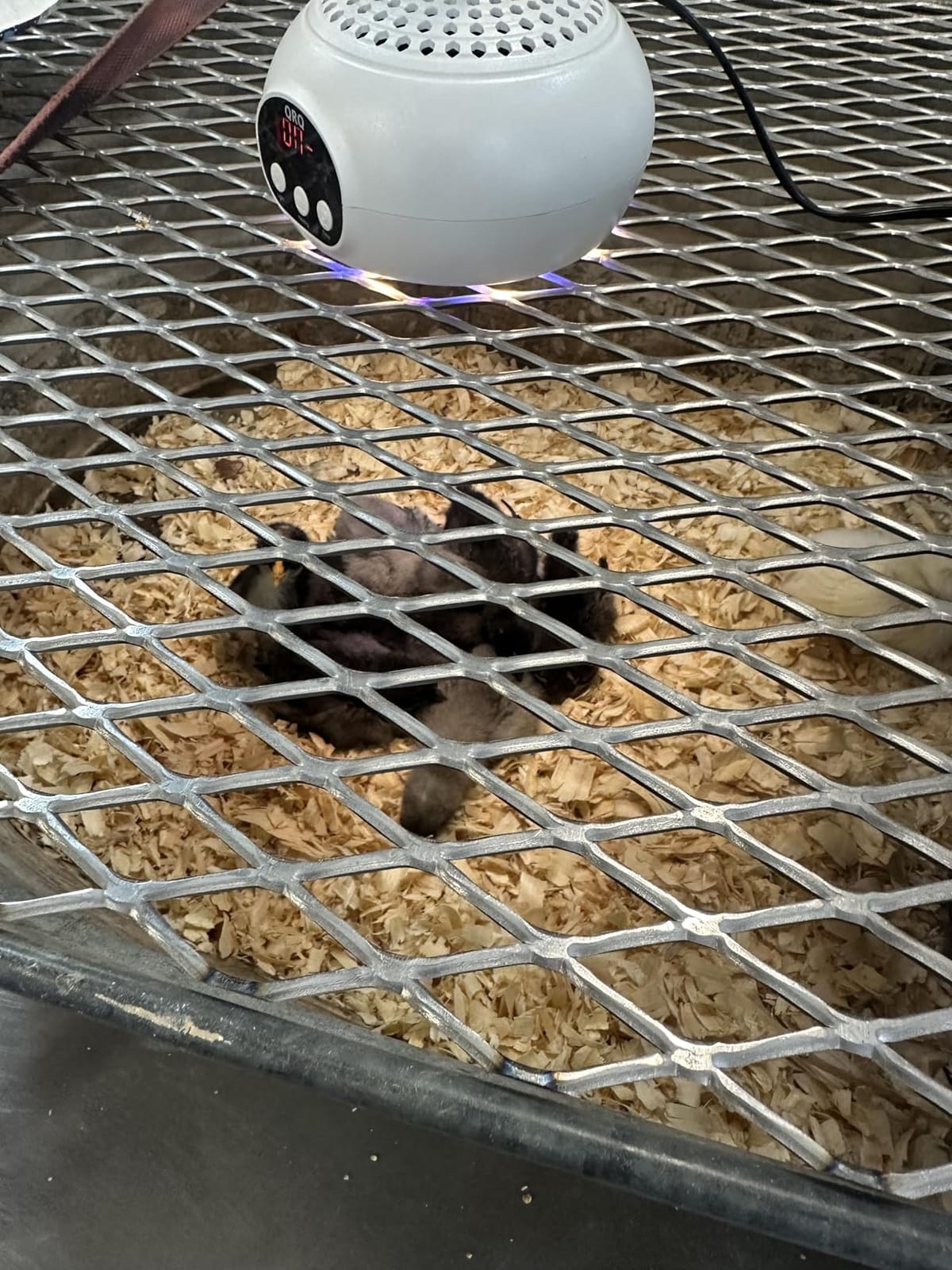
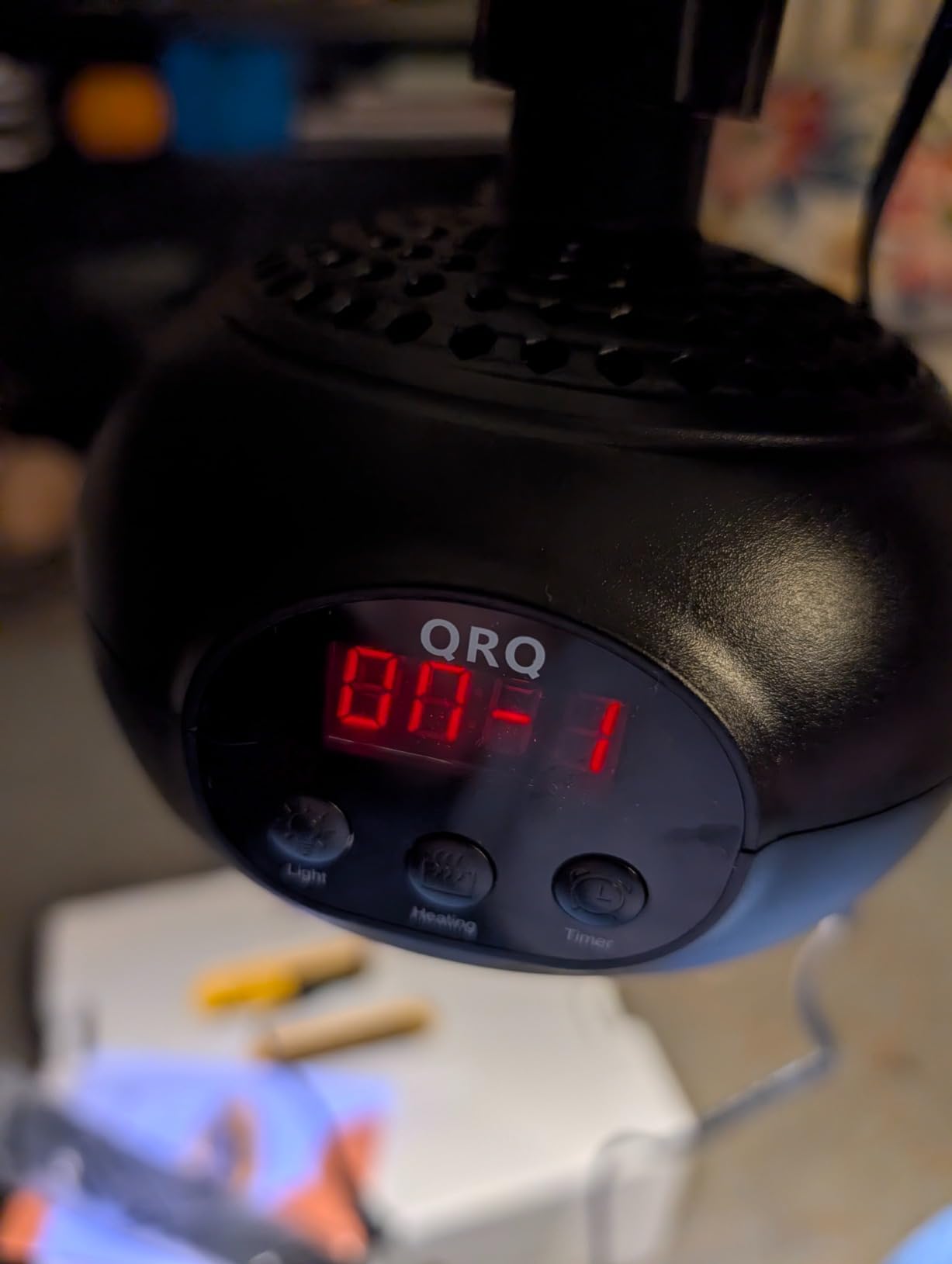
Three heat levels at 200W, 350W, and 500W give you real range, and reviewers report measurable gains, including roughly 3C added in an 8 by 10 greenhouse. The lighting is dimmable across three brightness levels and the light has its own switch, so you can run heat with the light off, and eight full spectrum bulbs, twelve UVA, and four UVB are included with a test card. It is UL and FCC certified with a flame retardant shell, overload and overheat protection, and a one year manufacturer warranty. The reflector housing uses a standard E26 base, so replacement lamps are easy to find.
Why we would not put this in a sleeping flock
A coop at night should be dark, and this unit is a lamp by design. It adds light on a schedule your birds cannot opt out of, and light at night disrupts resting behavior in a way that radiant panels simply do not.
It is also on and off only. Once you switch it off it will not cycle back on, which rules out the thermostatic plug that solves the no-thermostat problem on the other panels in this list.
Where forced air genuinely earns its place
Brooder transitions, where chicks need the air temperature of the whole space raised rather than one warm surface, and greenhouses or reptile rooms where convective heat is the goal. Install it hanging from the top ring, never by the wires, which can damage the internal parts.
Expect fan noise in a quiet space and expect the lowest setting to climb quickly, so pick a level and check back rather than assuming it settled.
9. TIMEBAL 200W UL Radiant Panel – Best Memory and Outage Handling
TIMEBAL 2026 Chicken Coop Heater, 200W UL Certified Radiant Panel, Black
200W
122-191F LED range
Infrared remote
UL certified
Pros
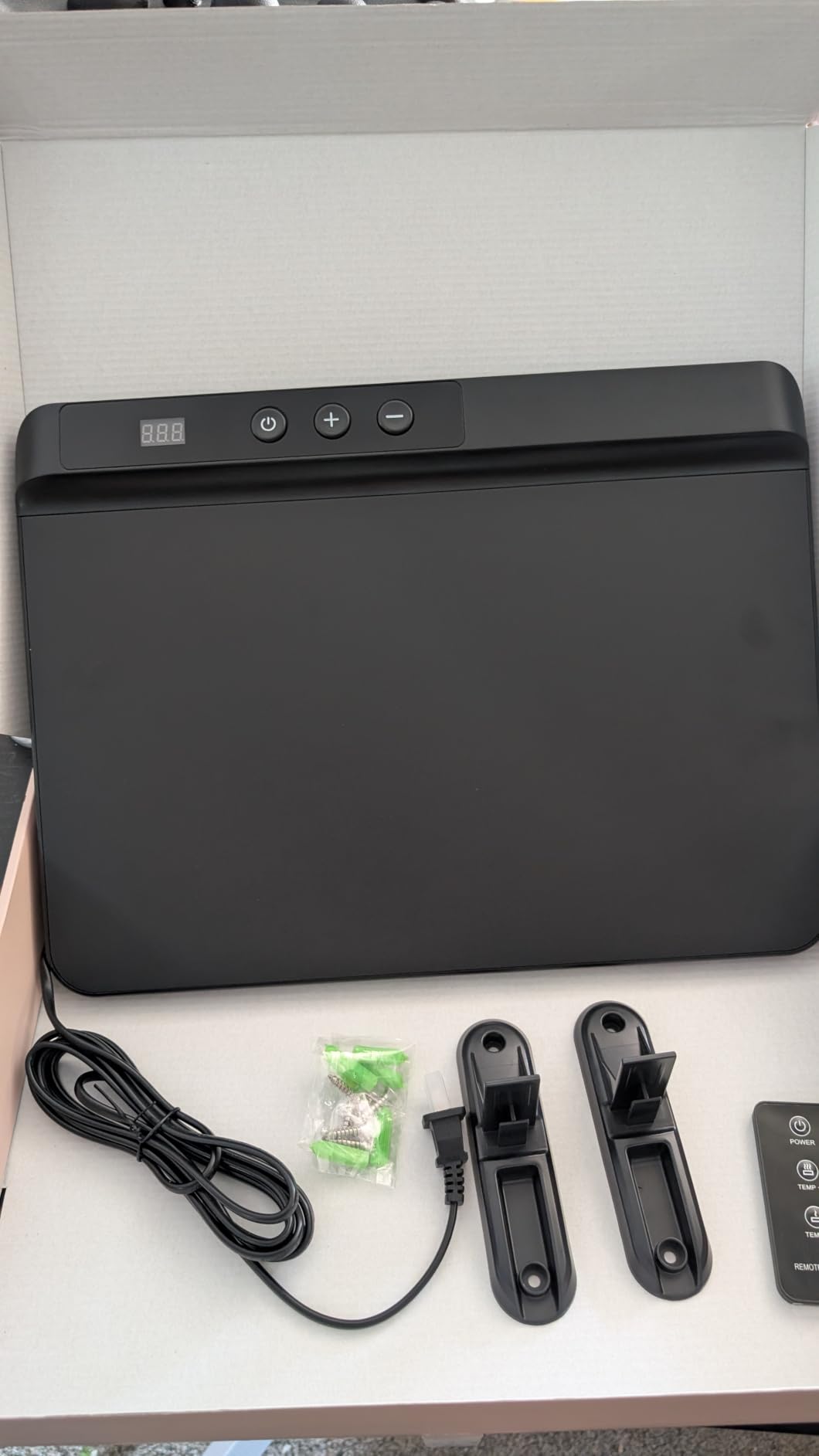
- Wide 122-191F range with an accurate LED readout
- Memory function restores settings after an outage
- Auto restarts when power returns
- Non-glowing design keeps the coop dark
- UL certified for zero-clearance mounting
Cons
- 13 percent one star reviews describing failures
- 122F minimum setpoint is too high for gentle warmth
- Short effective radiant range
- Anti-tilt shutoff can be disabled but that removes a safety feature
This panel splits opinion more sharply than anything else we tested. Two reviewers who pulled out laser thermometers and meters rated it highly on build quality, an LED display accurate to a degree or two, and measured draw of about 209W at 121V dropping to 4W once the thermostat settled. The rest of the reviews tell a much worse story.
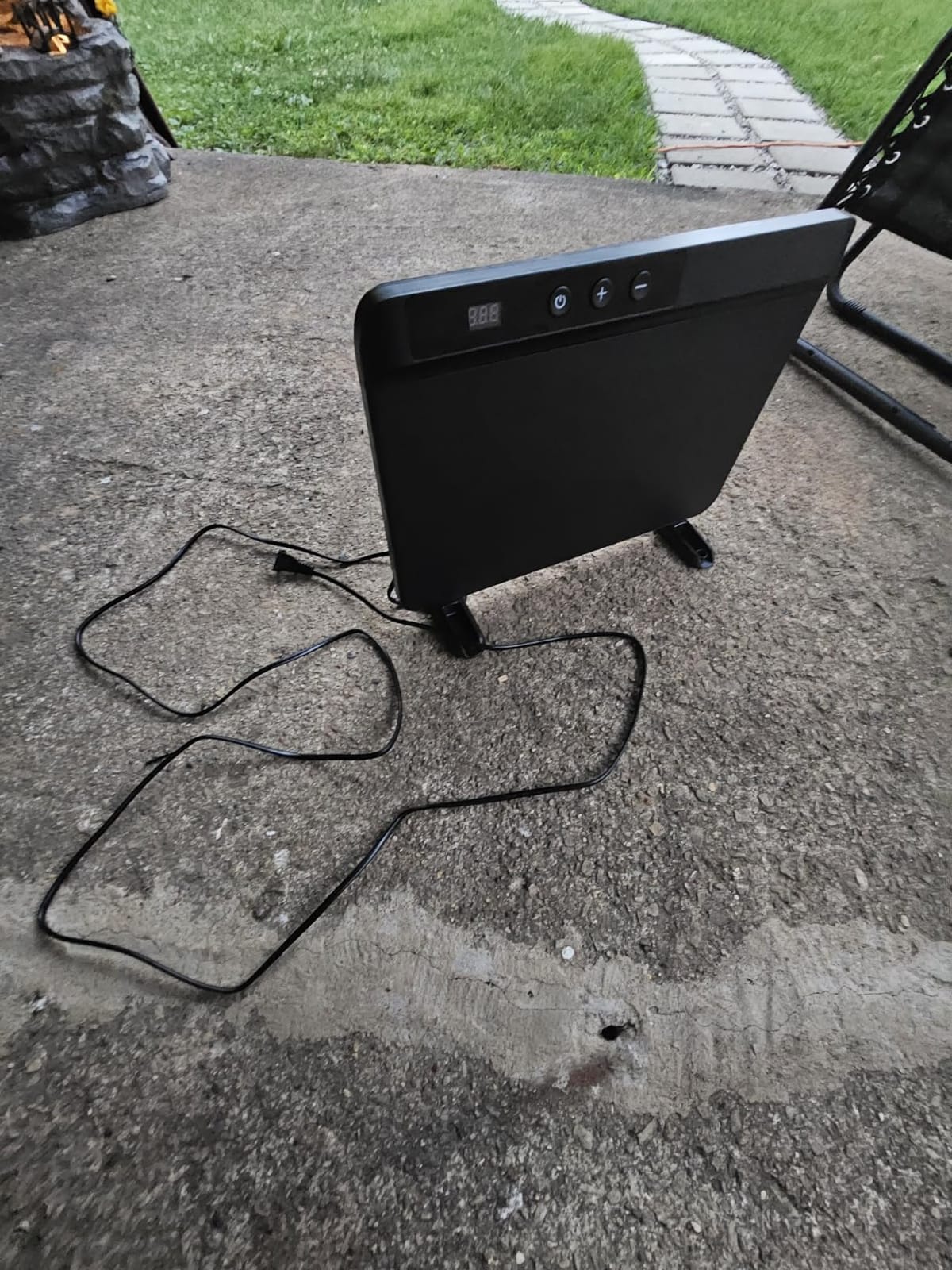
What we like is the outage handling. The memory function retains your temperature setting, operating mode, and power state across a power loss, and the unit restarts automatically when electricity returns. It also works with outlet timers and thermostatic plugs, which most panels in this list do not. The non-glowing radiant surface adds no light to the coop.
The anti-tilt shutoff cuts power if the panel falls below 45 degrees, and a tester confirmed draw dropping to 4W. You can disable it by holding the power and plus buttons together for two seconds, though we would leave it on.
The 122F minimum is a real limitation
This is the detail most reviews miss. A 122F floor setting is not a gentle heat source, and it cannot be paired with a simple cold-snap trigger because the lowest setting is already hot. Owners wanting a mild warming option for a frosty but not freezing night should look for a panel with a wider low end, since the reported radiant range here is also short and some say the chickens need to be within five to ten inches of the face to feel anything.
Whether the mixed reviews should stop you
Thirteen percent one star is among the highest failure rates in this group, with reports of panels that stopped heating or lost controls within days to weeks. It will also not keep a small uninsulated coop above freezing in sustained deep cold, and one owner reported the auto-off activating overnight, which matters if chicks are in there.
For a monitored coop with a thermostat plugged in, it is a capable unit. For an unattended one, weigh the failure reports carefully.
10. Enhon Adjustable Heater Lamp with LED – A Low-Cost Lamp With Limits
Enhon Chicken Coop Heater with LED Lighting, Adjustable Temperature, Timer & Safety Features – 5 Ft Long Cable Chicken Coop Heating Lamp Perfect for Small Animals and Reptiles(1 Pack)
59-90F range
Six timer settings
3 LED lights
15.2 oz
Pros
- Lowest cost unit here with a genuine adjustable thermostat
- Six timer settings plus an independent light switch
- Integrated LED lighting doubles as a coop light
- Removable dust and hair filter is easy to rinse
- Lightest unit here at 15.2 ounces
Cons
- 59-90F ceiling is well below what adult flocks need
- Emits light into the coop
- Smallest coverage area in the group
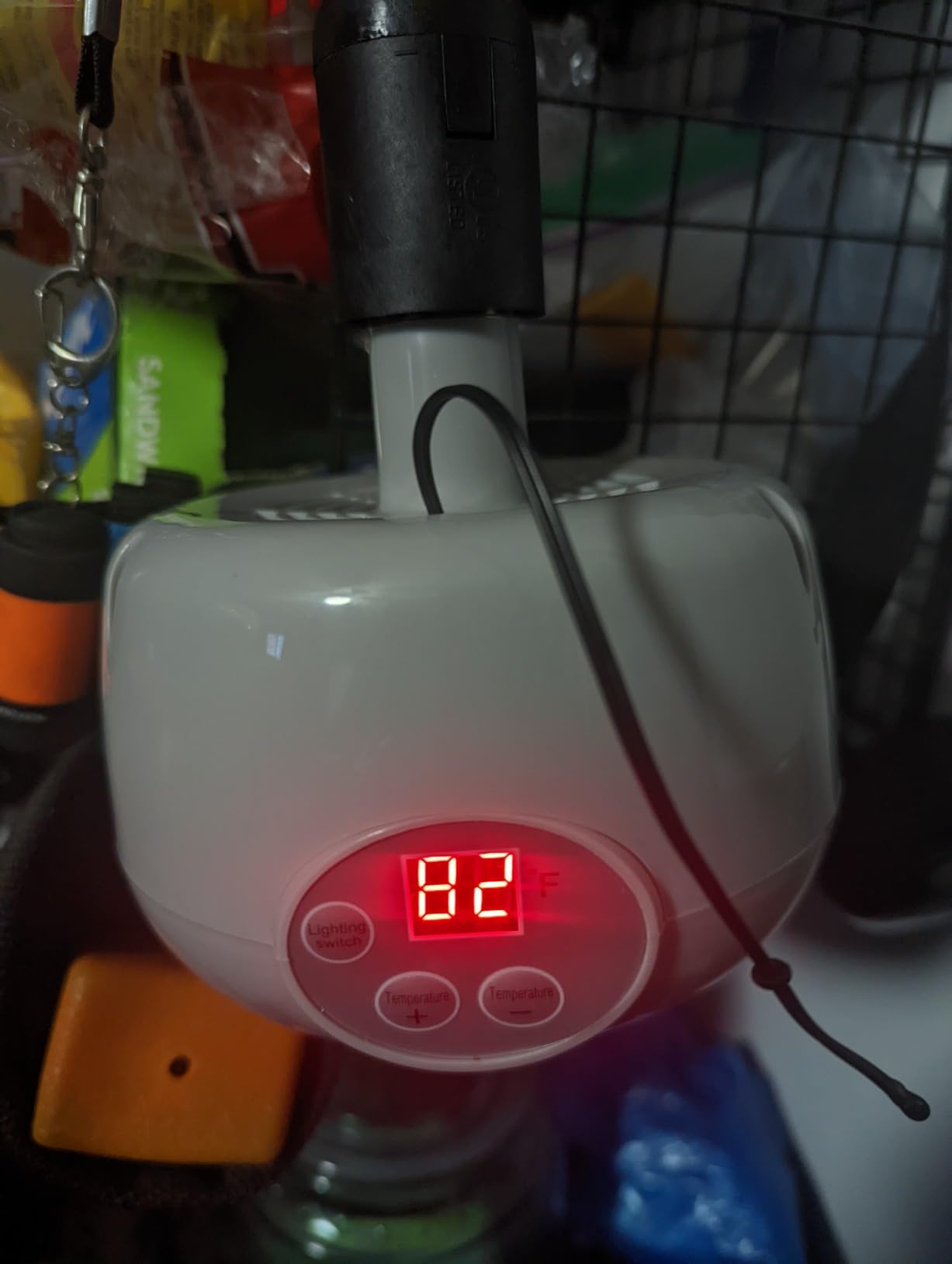
We are including this one because budget matters, and this lamp does have a real adjustable thermostat from 59F to 90F rather than a single on switch. That is more control than most entry-level alternatives. It is also the only heater here aimed at chicks, ducks, rabbits, and reptiles rather than a winter hen flock.
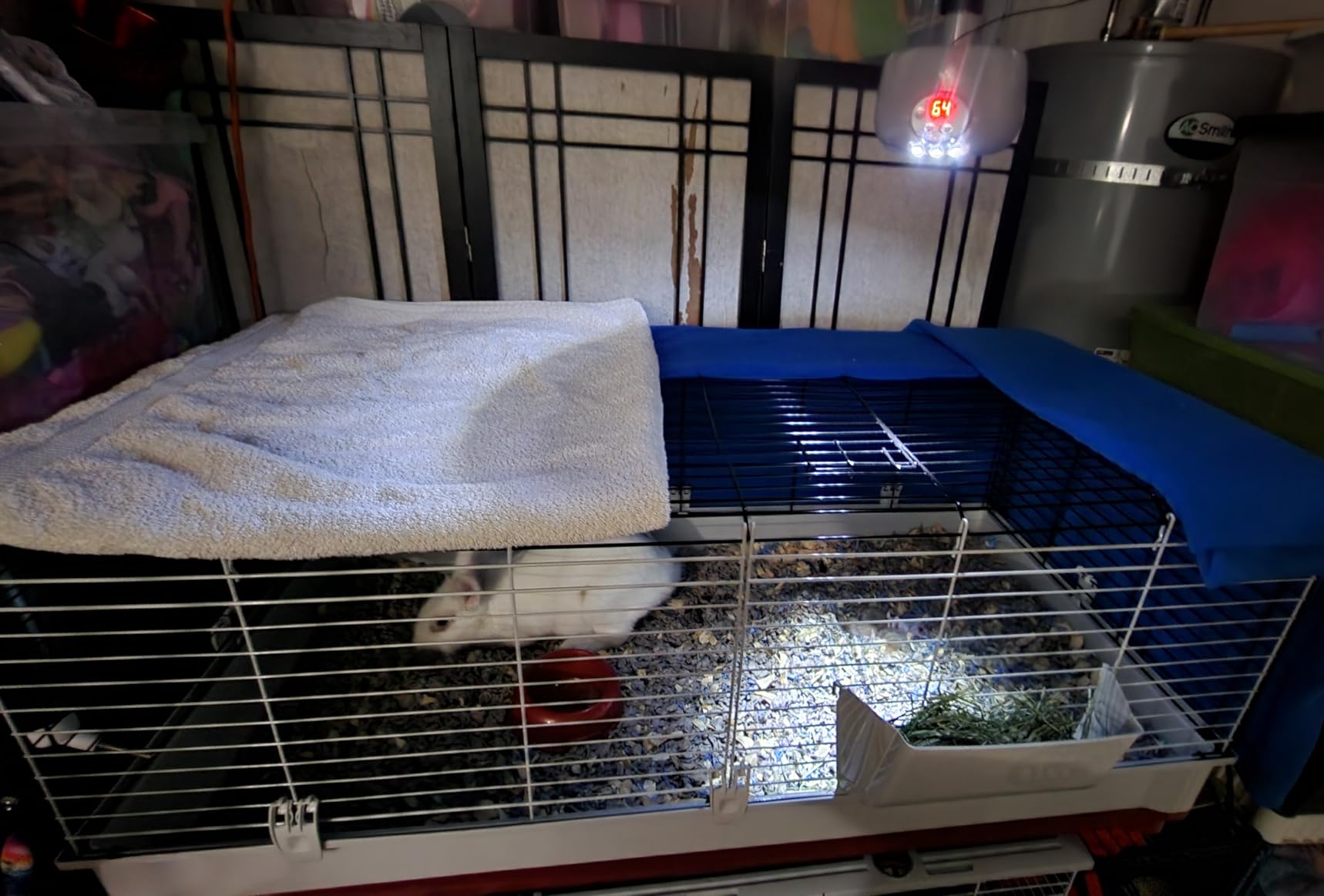
The timer offers six heating windows from 2 to 12 hours, the three integrated LEDs can be run independently of the heat, and the removable filter that blocks dust and animal hair is the sort of detail that matters in a coop full of feather dust. The housing is flame retardant with overload protection, and the whole thing weighs about 15 ounces.
The ceiling is the problem. Ninety degrees is nowhere near the range an adult flock needs to prevent frostbite in a hard freeze, and no amount of clever mounting changes that number.
Which animals it actually suits
Chicks in a mild brooder, ducklings, rabbits, and reptiles in a garage or shed. For those users the temperature range is appropriate and the light is a bonus, since a low light level helps chicks find food and water in the dark. For a winter flock of adult hens, skip it, because the temperature ceiling rules out the only job you would need it to do.
What you give up at this price
The coverage is the smallest here, so a larger flock would be standing well outside the warm zone. It is also a lamp, so it lights the coop all night, and a 5 foot cord is the shortest in the group, which often means an extension lead you did not plan for. Pick it for a brooder or a rabbit hutch, not for the henhouse.
How to Choose a Chicken Coop Heater That Fits Your Flock
Wattage is the least important number on the list. A 150W panel behind a roost serves the same twelve birds perfectly well as a 300W one, because the birds need a warm surface to press against, not a warm building. What decides whether a heater works is whether the birds sit in front of it, whether the coop holds heat in, and whether the panel holds a steady temperature.
Use the ranges below as a rough guide for the heated zone. Count the birds that will actually roost in the warm spot, not the total flock. If you have twenty hens and only eight will use the panel, size for eight.
Up to about 6 birds: a 22W brooding plate if they are chicks, or a 140W panel for a feathered flock. Between 7 and 12 birds, a 150W to 200W flat panel is the sweet spot. Between 13 and 20 birds, look for a 200W panel with the largest surface area you can find, or run two panels at opposite ends of the roost. Past 20 birds a single panel is the wrong tool: partition the coop and heat one section, or fix the building instead.
Radiant versus convective heat
A radiant panel heats objects and animals in front of it. Air is heated only as a byproduct, which means the far end of the coop stays cold and dry. Convective heaters, which include the forced air lamp in this roundup, heat the air itself. That sounds like a benefit and it is, until you remember that warm humid air in a closed coop is exactly the combination behind damp litter, respiratory problems, and the moisture that keepers misdiagnose as frostbite.
For an adult flock at roost level, radiant wins. For a brooder room, greenhouse, or reptile enclosure, forced air wins.
Reading a safety certification
ETL and UL are both genuine third party safety marks, and either is a meaningful filter. Look for the mark on the listing, not just the word certified, because UL compliant wiring inside an uncertified enclosure still means nobody tested the finished product. In this group, the Cozy Coop, EconoHome, Chickcozy, ILOJUST, QRQ, and TIMEBAL panels all carry a named certification, and that is why they rank where they do.
The other safety number that matters is the surface temperature ceiling. Panels in this group cap between 167F and 194F. A 250W red heat lamp runs well past 400F, which is why it ignites dry bedding and why the bulbs under a coop are the leading cause of the fires keepers read about on forums.
Mounting height and cord protection
Mount a panel at roost height on the back wall, facing the birds, not above them. Heat pointed at the ceiling is heat you paid for and threw away. For chicks, hang a brooding plate about 2 inches above them at first and raise it weekly as they grow.
Protect the cord. Run it behind wall panels, through conduit, or along a baseboard with a two by four screwed over it. Chickens peck cords, and a chewed cord in a wet coop is a short circuit waiting to happen. Several panels here ship with reinforced or spiral wrapped cords for exactly this reason.
Thermostat minimums and the power outage trap
Here is the mistake that kills more flocks than cold does. If you hold a coop at a comfortable 55F all winter and the power goes out for six hours, you have not saved your birds, you have acclimated them to a temperature they can no longer tolerate. Set your thermostat minimum to something closer to what the coop would reach on its own, usually in the low 40s, and let the birds adapt to a moderate environment rather than a tropical one.
Panels with a memory function and automatic restart, like the TIMEBAL, help when power returns but do nothing for the hours it is gone. For cold regions, a second heat source such as a heated pad on the roost, plus a plan for a generator or battery backup, is the honest answer.
When You Should Skip a Heater Entirely
Most healthy adult chickens are far tougher than their keepers. A fully feathered hen handles freezing temperatures that would concern a dog, and the widely repeated keeper consensus is that a hen radiates roughly the heat of a 10W bulb. A dozen birds in a small well-insulated coop generate a surprising amount of warmth on their own, which is why plenty of coops have never needed a heater.
Watch for these behavioral signs before you plug anything in: birds huddling on the roost instead of spreading out, lethargy in the morning, birds reluctant to leave the coop at dawn, or a drop in egg production through a cold snap. Those are the signals that a heat source would help. A temperature reading on its own is not.
Frostbitten combs are a different problem than most keepers assume. Comb damage in a coop is usually a humidity and ventilation problem, not a heat problem, and cranking up a heater in a damp closed coop makes it worse. Fix the moisture first.
Breeds and ages that do need help
Silkies and Frizzles have poor feather insulation and should not be exposed to the same conditions as an Orpington. Jungle fowl acclimate slowly to cold and need a gradual introduction. Chicks cannot regulate their own temperature at all until they are fully feathered, which is the one situation where a brooding plate is not optional. Sick or recovering birds also benefit from a warm spot they can move to and away from at will.
Winterizing beats heating
Every one of these steps is free and every one of them reduces the wattage you need. Plug the gaps: seal the base of the coop where drafts come under the wall, and fit a flexible strip around the pop door. Insulate above the birds rather than below, by backing foil bubble insulation to the underside of the roof, and leave a gap for ventilation. Go deep with bedding, since four to six inches of straw or pine shavings traps heat in the floor and lets the birds burrow. Keep the high and low vents open but cover the low side with clear plastic sheeting to stop wind while preserving airflow. Reduce the footprint by partitioning off half the coop, because the same birds generate enough body heat for a smaller space. And move the water, since frozen water is a bigger winter problem than a cold bird and an electric drinker pad is cheap insurance.
If you do all of that and your birds are still showing cold stress, go back up this list and pick a panel. If they are not, save the money and the fire risk and leave the plug in the shed.
Frequently Asked Questions
How do I keep a chicken coop warm in the winter?
Most keepers warm a coop with a low-wattage radiant flat panel mounted at roost height on the back wall, so birds can press against the warm face. Seal drafts at the base, insulate under the roof, keep four to six inches of bedding, and leave a low vent covered with clear plastic so air still moves. A panel sized for the birds that actually roost in front of it is more effective than a larger unit pointed at the ceiling.
What is the best outdoor heater for a chicken coop?
The best outdoor heater is a low-wattage radiant flat panel rather than a heat lamp or space heater. A 150W to 200W ETL or UL listed panel gives your flock a warm surface to press against, runs at a fraction of the electricity a 1500W space heater uses, emits no light to disturb sleeping birds, and has no bulb to shatter. The most important check is a surface temperature ceiling under 200F.
How cold is too cold for a chicken coop?
Fully feathered adult hens are comfortable well below freezing, and most healthy flocks need no heat at all in a well-insulated coop. Watch behavior instead of a number: huddling on the roost, morning lethargy, birds hesitating to go outside, or a drop in egg production all point to cold stress. Frostbitten combs are usually a humidity and ventilation problem rather than a temperature problem, so fix moisture before adding heat.
What can I use instead of a heat lamp for chickens?
A radiant flat panel heater is the standard replacement. Mount it at roost height so birds sit in front of it and absorb infrared heat directly, which leaves the rest of the coop cool and dry. For chicks, a low-wattage brooding heating plate is even better: it runs at 22 watts against 250 for a heat lamp, holds a chick-appropriate temperature, and carries none of the fire risk.
What is the safest heater for a chicken coop?
The safest heater is a certified radiant panel with a surface temperature ceiling under 200F, a built-in thermal cutoff, and a peck-resistant cord. Look for a named ETL or UL mark on the listing rather than the word certified alone. Avoid open-element lamps and infrared bulbs, which run well past 400F and are the leading cause of coop fires. Mount any panel out of pecking range and behind a physical barrier.
How many watts does a chicken coop heater need?
For an adult flock, 150W to 200W covers six to twelve birds sitting in front of the panel, and a second panel at the other end of the roost handles larger groups. Chicks need far less: a 22W brooding plate is appropriate. Size for the birds that will use the warm zone rather than your total flock, because a panel warms a spot, not the whole building, and too much wattage in a small coop creates uncomfortable hot spots.
Can chickens survive winter without a heat lamp?
Yes. A fully feathered adult hen is cold-hardy well below freezing, and most coops with draft-free, dry, insulated interiors need no supplemental heat at all. Heat matters for chicks, Silkies and Frizzles with poor feather insulation, jungle fowl acclimating to cold, sick birds, and any flock in a drafty or uninsulated structure. If you do use one, a radiant panel is a safer and more efficient choice than a bulb.
What wattage is too high for a small chicken coop?
In a small 4 by 4 coop, more than 200W of panel output often creates hot spots rather than comfort, and birds will avoid the area instead of using it. A 300W or 500W unit in a tiny space can also raise humidity and condensation, which causes damp litter and respiratory problems. Match the wattage to the number of birds that will actually perch in front of the panel and check with a thermometer at roost height during the first cold week.
The Bottom Line on Winter Coop Heating
After testing across the whole category, the Cozy Products Cozy Coop flat panel is our pick for the best chicken coop heaters for winter because it combines an ETL listing, a 170F surface ceiling, a cool-to-touch back, and more than 7,000 ratings from keepers who used it through genuinely severe cold. Brooding chicks? The RentACoop 12×12 plate runs at 22 watts and holds 107F with no bulb anywhere near the bedding. Want the most automation per unit? The ILOJUST panel gives you thirteen temperature levels, a 12 hour timer, and a remote.
But the best heater in the world is the one you might not need. Seal the drafts, insulate above the roost, deepen the bedding, and watch how your birds behave on the coldest morning of the season. If they come out of the coop and start working, you do not need a heater. If they huddle and linger, pick a 150W to 200W certified radiant panel, mount it at roost height, and stop the power before you need it.