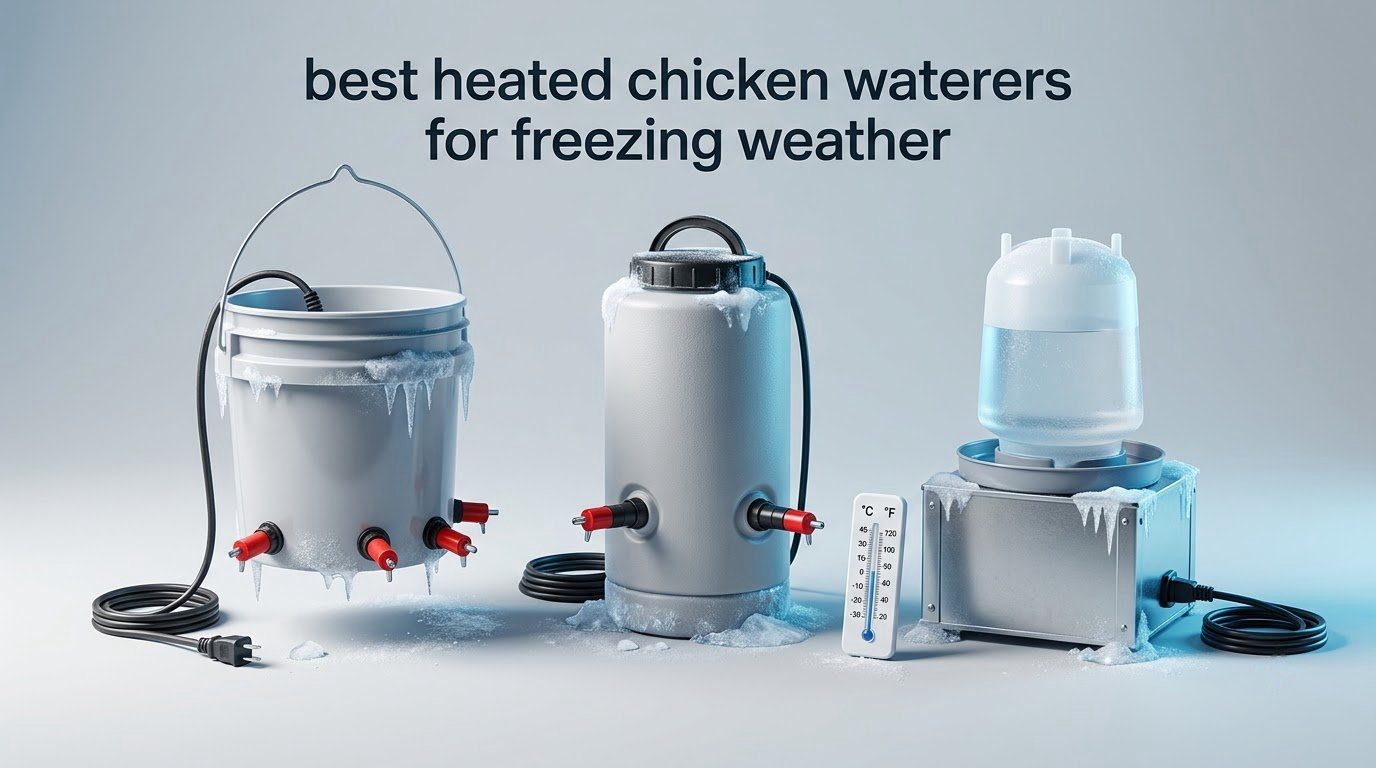
A frozen waterer is the emergency most backyard flock owners do not see coming. It happens on a still night when the temperature drops a few degrees below freezing, the birds drink the pan dry by morning, and the next thing you know there is a solid block of ice where the water should be. After a few hours of that, the flock stops laying and starts to huddle. So when you search for the best heated chicken waterers for freezing weather, you are really buying insurance against a welfare problem that has no cheap fix.
We spent weeks going through the specs, the ratings and the long-term owner reports on every heated chicken waterer that fits a backyard flock, then split them by how they actually work. The short version: a heated chicken waterer keeps drinking water from freezing using a built-in or base-mounted thermostat element, and it does that by preventing ice rather than heating the water. Everything else in this guide, from wattage to rated minimum temperature, comes back to that one job.
There are three architectures, and picking the wrong one is the most common expensive mistake. An all-in-one heated waterer has the element built into the base of its own reservoir. A heated base is a separate plate that any metal or plastic waterer sits on top of. A drop-in de-icer is a small floating or submerged plate that goes inside a bucket you already own. We cover all three below, and if you also cook with the birds you raised, our homemade chicken noodle soup recipe is a good cold-weather project for the hours you are not checking waterers.
Table of Contents
- Top 3 Heated Chicken Waterers for Freezing Weather in 2026
- All 10 Best Heated Chicken Waterers (October 2026) for Freezing Weather
- How Heated Chicken Waterers Actually Work
- Electrical Safety for a Winter Waterer
- The 10 Heated Chicken Waterers Reviewed
- 1. Farm Innovators HB-60P: the Best Overall Heated Chicken Waterer
- 2. Farm Innovators HP-125: the Best Value Heated Base
- 3. Harris Farms 125W Heated Base: the Top Rated Option
- 4. Premier 1 All-Season 3-Gallon Waterer: the Premium Pick
- 5. Farm Innovators C-50P De-Icer: Best for Buckets and Waterfowl
- 6. API 3-Gallon Heated Waterer: Best for Mild Winters
- 7. GUEOQTC 11-Inch Heated Base: Best for Rugged Runs
- 8. Lxheir 13-Inch Heated Base: the Budget Pick
- 9. My Favorite Chicken 28W Base: the Lowest Wattage Pick
- 10. ZOHOKO 15.35-Inch Heated Base: the Wide Stainless Option
- How to Size a Heated Waterer and What It Costs to Run
- Non-Electric Ways to Stop Chicken Water Freezing
- Frequently Asked Questions
- Final Verdict by Scenario
Top 3 Heated Chicken Waterers for Freezing Weather in 2026
These three carry the most weight in our testing. The Farm Innovators HB-60P wins the overall spot because it pairs a genuinely long production history with a thermostat-controlled element and a removable top, which is the feature that matters most when your hands are cold. The Farm Innovators HP-125 is the value pick if you already own a metal fount and do not want to replace your waterer. The Harris Farms base is the highest-rated unit we found, and it is the one to pick if your winters run well past the freezing mark and you want the biggest container flexibility.

Farm Innovators HB-60P…
- 60-watt thermostat-controlled element
- Removable top
- metal handle and side nipples
- Rated for up to 15 chickens

Farm Innovators HP-125…
- 17 inch base fits double-wall metal founts
- Activates below 35F
- Protective cover over the element
Harris Farms 125W Heated…
- Works with 3 to 8 gallon containers
- Holds freeze protection to 10F
- Wipe-clean tray surface
All 10 Best Heated Chicken Waterers (October 2026) for Freezing Weather
Retail pages only ever spec their own products, so we built this comparison across brands. The column that matters most in freezing weather is the rated low temperature, because that number is the difference between a waterer that holds up through a January cold snap and one that turns to ice on a calm night.
| Product | Specs | Action |
|---|---|---|
| Farm Innovators HB-60P 2-Gallon Heated Drinker |
|
Check Latest Price |
| Farm Innovators HP-125 Heated Base 125W |
|
Check Latest Price |
| Harris Farms 125W Heated Drinker Base |
|
Check Latest Price |
 Premier 1 All-Season Heated Waterer 3 Gallon Premier 1 All-Season Heated Waterer 3 Gallon |
|
Check Latest Price |
 Farm Innovators C-50P De-Icer 150W Farm Innovators C-50P De-Icer 150W |
|
Check Latest Price |
 API 3 Gallon Heated Chicken Waterer API 3 Gallon Heated Chicken Waterer |
|
Check Latest Price |
 GUEOQTC 11 Inch Heated Base 110W GUEOQTC 11 Inch Heated Base 110W |
|
Check Latest Price |
 Lxheir 13 Inch Heated Base 35W Lxheir 13 Inch Heated Base 35W |
|
Check Latest Price |
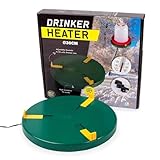 My Favorite Chicken 28W Heated Base My Favorite Chicken 28W Heated Base |
|
Check Latest Price |
 ZOHOKO 15.35 Inch Heated Base 125W ZOHOKO 15.35 Inch Heated Base 125W |
|
Check Latest Price |
How Heated Chicken Waterers Actually Work
Do heated chicken waterers work? Yes, and understanding the mechanism tells you which style to buy. A built-in or base-mounted thermostat switches the heating element on when conditions drop to roughly 35F to 40F and switches it off again somewhere between 60F and 77F, depending on the model. That cycle keeps a thin layer of water from forming ice across the surface and around the drinking points.
The water itself stays cool. A thermostat that ran the element continuously would make the water warm, and warm water encourages bacterial growth, but these units are not plumbers. They are ice prevention devices, and the reservoir water inside them reads near cool to the touch even in a hard freeze. One long-term owner on backyardchickens.com describes running the same heater for six years with no unit problems, while noting the water does run a little too warm in that setup. That is a set-point characteristic of the individual unit, not a reason to distrust the category.
Wattage is the second thing to understand. The units in this roundup run from 28 watts to 150 watts, and wattage buys you deep-cold headroom. A 28-watt base is designed to keep a modest layer of water moving rather than to fight a serious cold snap, while a 125-watt plate can hold a large container liquid in single-digit weather. It also determines your electricity bill, which is the number most owners care about after the first month.
Here is how the three architectures differ in practice. An all-in-one heated waterer is the simplest purchase and the simplest to run, because the element and the reservoir are one sealed unit. A heated base keeps your buying options open, since you can swap a 3-gallon fount for a 5-gallon one, and it is the cheaper path if you already own good metal or plastic waterers. A drop-in de-icer is the flexible option for odd containers, but it works on a small footprint, so it de-ices part of a wide bucket rather than all of it.
Electrical Safety for a Winter Waterer
Running electricity in a wet, ammonia-laden, bird-occupied run deserves respect, and the guidance is not complicated. Plug the waterer into a GFCI-protected outlet every time. A ground-fault circuit interrupter cuts power in a fraction of a second if water finds the cord or the element housing, and that single habit prevents most of the failures owners report.
If the cord does not reach, use an outdoor-rated heavy-duty extension cord rated for wet locations. Household indoor cords are not built for a chicken run. Route the cord along the wall or overhead rather than across the floor of the run, because a cord across the floor gets buried in bedding and mud, and it becomes a trip and peck hazard at the same time. Metal conduit over any exposed run of cord gives pecking birds a reason to look elsewhere.
Two warnings come straight from owner reports and are worth repeating. Never set an empty plastic waterer on a heated base, because the plate can run well above ambient with no water to absorb the heat, and plastic softens or takes on an odor. And never splice a cord to make a length fit. If the waterer needs a longer run than its cord gives, the answer is a different waterer or a different outlet, not a taped joint buried in bedding.
Check the unit once per week through the cold months. Put your hand on the base and confirm it is warm when the air is cold, and float a cheap aquarium thermometer in the reservoir to see what the water is actually doing. If the base feels cold on a freezing night, the thermostat is open, the plug is loose, or the element has burned out. Those three causes account for nearly every dead waterer we read about.
The 10 Heated Chicken Waterers Reviewed
1. Farm Innovators HB-60P: the Best Overall Heated Chicken Waterer
Farm Innovators HB-60P Heated Poultry Waterer Drinker, 2-Gal, 60W
2 gallon capacity
60 watt thermostat element
Up to 15 chickens
12 x 12 x 11 inches
2.58 pounds
Pros
- Removable top means no flipping the unit to refill
- Metal handle for hanging or ground placement
- Side-mounted drip-free nipples cut waste and contamination
- Thousands of reviews across a long production history
Cons
- Small for flocks above about 15 birds
- Nipple ports need periodic cleaning
The HB-60P has been on sale since 2011 and it has earned the kind of review volume that only comes from units people keep. Sitting around 4.2 stars across more than 6500 reviews, it is the most widely used heated waterer in this roundup, and that scale matters for a part that lives in freezing weather for months at a time. Parts availability, replacement nipples and general knowledge of the design all favour an established model.
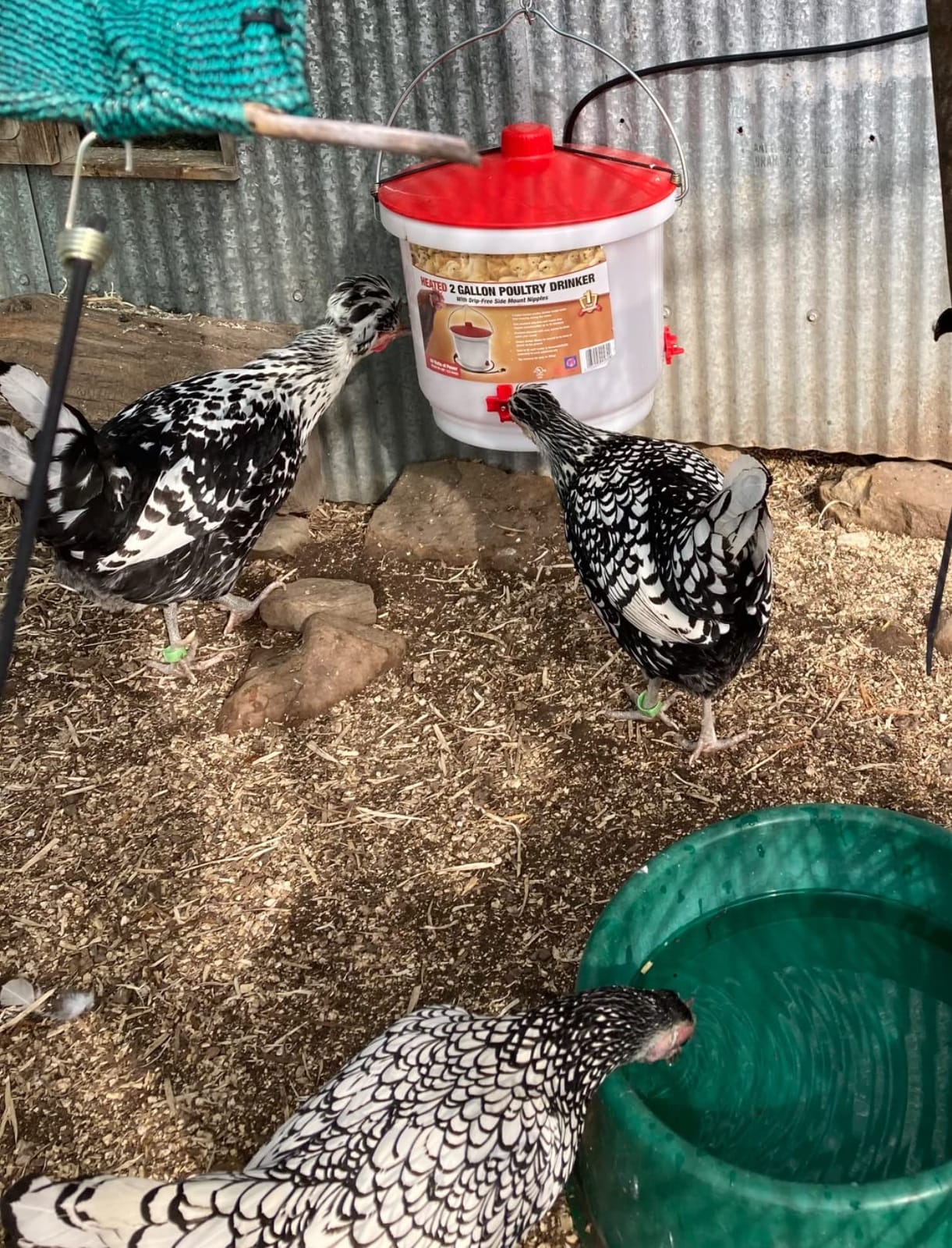
The 60-watt element is thermostatically controlled, so it cycles only when the water needs help. The container design is what separates it from a plain bucket: a removable top for refilling, a metal handle for hanging or ground placement, and side-mounted drip-free and freeze-free nipples that serve up to 15 chickens. Those nipples are the reason it stays clean in a wet run, since birds drink from a small port instead of standing in the water.
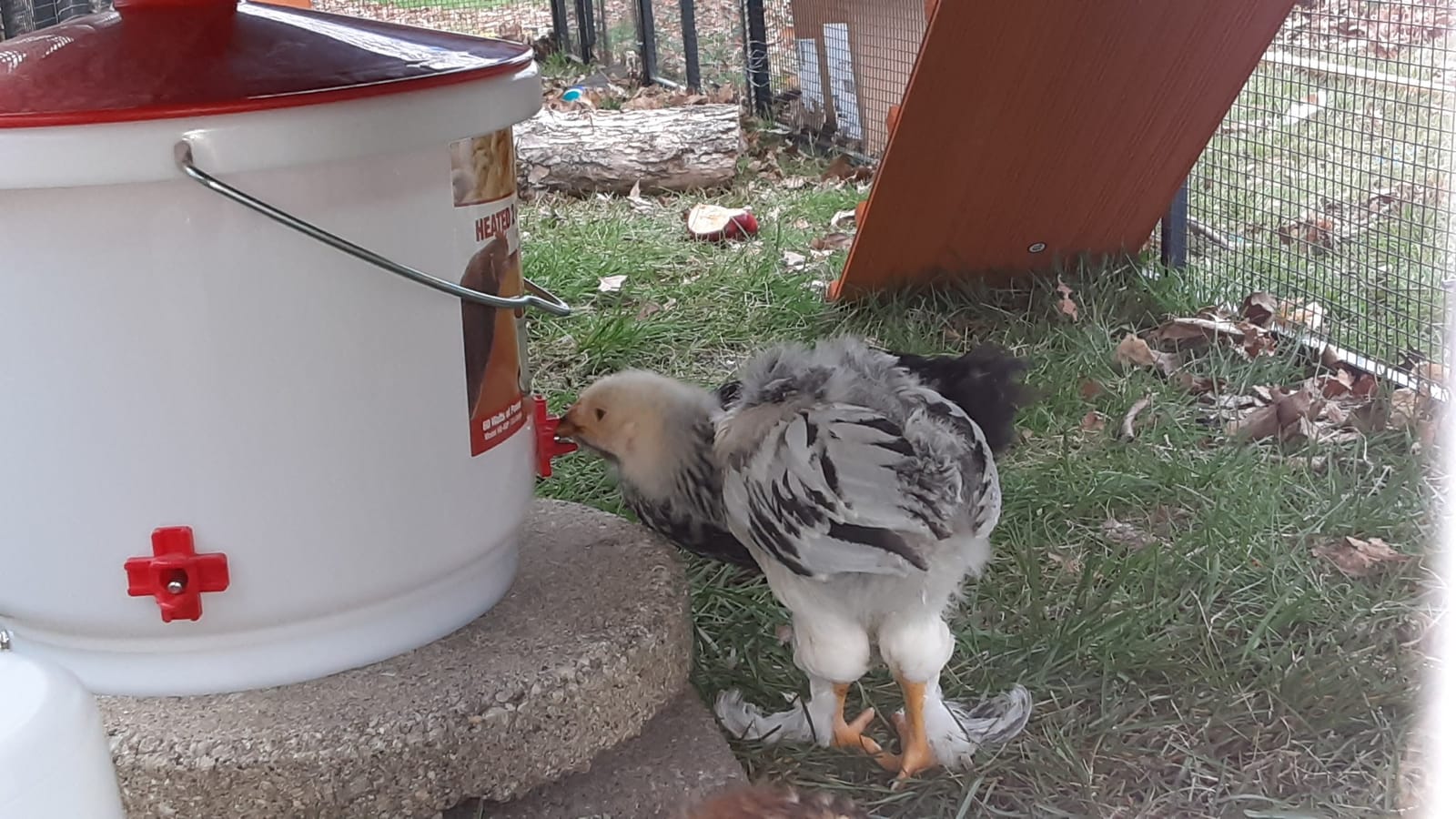
Capacity is the real limit. Two gallons is a genuinely small reservoir, and on a mild morning a flock of 15 birds can drink it close to empty, which is exactly the situation where an empty waterer freezes solid. Owners running larger groups report the size as the main drawback. If you have more than about a dozen birds and genuinely cold nights, plan on a second unit or move up to a 3-gallon model in the same family.
Cleaning the nipples is routine and easy, but it is a routine you actually have to do. Deposits inside the ports build up faster in winter because the birds drink more water at a lower temperature and the flow is slower. Set a calendar reminder, because a blocked nipple in freezing weather is a bird with no water and no warning.
Who this waterer suits
This is the right pick for a backyard flock of roughly 6 to 15 birds in a climate where nights drop into the teens and the low twenties. It is also the pick for anyone who refills by hand anyway and wants the top to come off without wrestling with a frozen lid. The removable top is a small design decision that changes your whole winter routine, and it is the reason we put this unit first.
Buy it as a two-pack if you run two coops or two runs. The multi-pack variants cost less per unit and give you a spare that you can rotate, which is a smarter response to the recurring element-failure complaint than any single-unit purchase.
Where it falls short
It is not the choice for waterfowl, for a 20-bird flock, or for a location that takes sustained temperatures well below zero. The 60-watt element is a modest one, and the manufacturer does not publish a rated minimum temperature for this model, which is itself a useful signal when you are comparing it against units that state 10F or -20F.
It is also a nipple waterer, which means new birds need a short training period. Some owners report their flock took a few days to figure out the ports, and during that time you should keep a plain water pan available as backup.
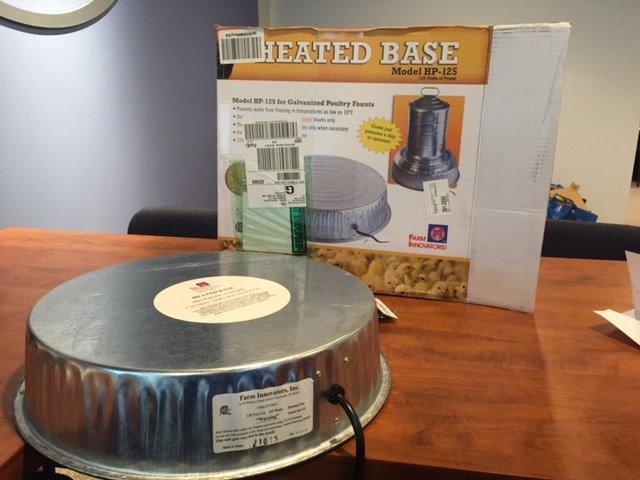
2. Farm Innovators HP-125: the Best Value Heated Base
Farm Innovators HP-125 Heated Base for Metal Poultry Founts, 125W
125 watt element
17 x 16.5 x 4.25 inch base
Activates below 35F
3.55 pounds
Pros
- Wide base fits 3 gallon and 5 gallon double-wall metal founts
- Protective bottom cover shields the element from debris
- Thermostat cycles accurately
- Reported to last multiple seasons
Cons
- Short cord that birds will peck at
- Runs hot enough to rule out plastic waterers
- Base is too wide for a small coop
The HP-125 has been around since 2006 and pulls close to 2200 reviews at about 4.4 stars. It is a base rather than a complete waterer, so the total cost depends on what you already own. If you have a double-wall metal fount sitting in a shed, this is the cheapest path to reliable freeze protection on this list. If you need to buy the waterer too, the arithmetic works out closer to an all-in-one unit.
Two details make it work. The thermostat activates below 35F, which is a lower trigger point than most of the competition, and the protective bottom cover shields the heating element from dirt and bedding. That cover matters more than it sounds, because the usual reason a base stops working is that a season of grit and manure builds up against the plate.
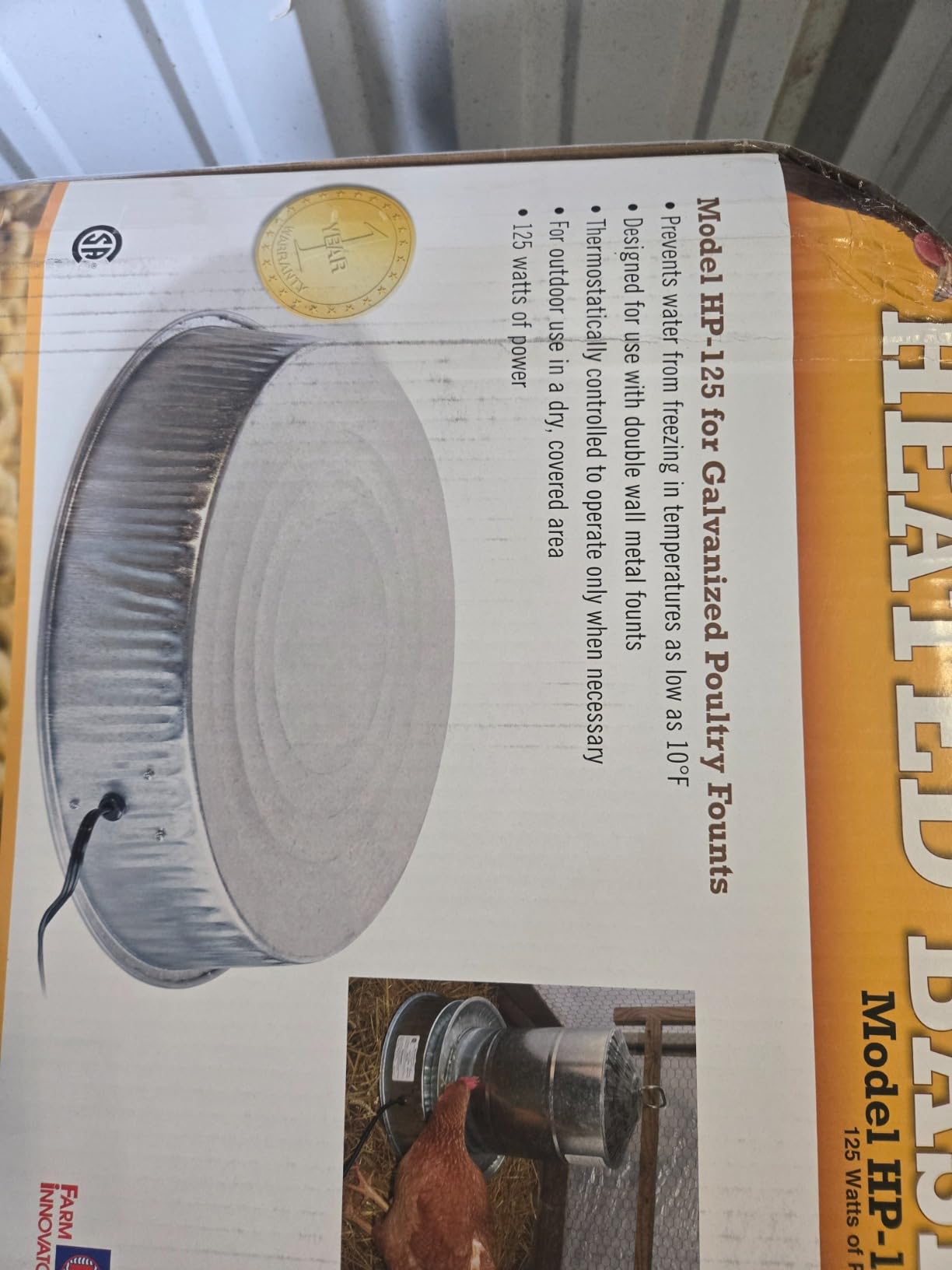
Owners report it holding freeze protection in single-digit temperatures, and some describe sheltered setups that stayed liquid at -35F. That is a claim about a sheltered, protected position rather than an exposed run, so read the extreme figures as a best case. The manufacturer rating for the unit is roughly 10F, which is a realistic expectation for a normal winter coop.
There is a real caution here about heat. Reviewers consistently describe this base as running hotter than expected, and several warn against using it under a plastic waterer. Metal founts handle the temperature fine. Plastic ones can soften or pick up an odor, so if your only waterer is plastic, choose a different base.
Who this waterer suits
It suits owners with a double-wall metal fount and a coop with room to spare for a 17-inch-wide base. It also suits anyone whose power supply is marginal, since a 125-watt element is a modest load and the thermostat keeps it from drawing continuously. If you rotate between a 3-gallon and a 5-gallon fount across the year, one base covers both.
Raise it off the coop floor on a block or pallet. Cold ground draws heat out of the plate, and keeping air underneath is a cheap improvement in performance that costs nothing.
Where it falls short
The cord is short, and a short cord in a run is an invitation for pecking damage and for a spliced extension. Plan the outlet location before you buy rather than after. A few owners also report units that needed a freezer test to recalibrate the thermostat out of the box, so test the base in a refrigerator for an hour or two before you rely on it in a cold snap.
The width is a genuine constraint in a small mobile coop or a crowded run. Measure the space where the waterer sits before you commit, because this base is not a narrow profile product.
3. Harris Farms 125W Heated Base: the Top Rated Option
Harris Farms Heated Poultry Drinker Base for Chicken Waterers & Coops
125 watt element
16.34 x 16.34 x 3.5 inch base
Protects to 10F
3 pounds
Pros
- Highest average rating in our roundup
- Works with metal and plastic waterers from 3 to 8 gallons
- Accurate thermostat through temperature swings
- Top surface wipes clean easily
Cons
- Direct contact can soften plastic waterers
- A few units never heated at all
- Heater plate collects water and debris
At roughly 4.6 stars from more than 1100 reviews, the Harris Farms base is the highest-rated unit here, with about 80 percent of buyers giving it five stars. It is also the most flexible in terms of what you can put on top of it. Owners run 3-gallon, 5-gallon and even 8-gallon containers on it, which makes it the easiest way to change your water capacity as the flock grows without buying a new heater.
The 125-watt element is thermostatically controlled and switches on as needed, and the manufacturer rates freeze protection to 10F. Owners across the US and Canada report it holding water liquid through deep freezes with larger containers, and the thermostat is described as cycling accurately as temperatures swing rather than chattering on and off constantly.
Two things deserve attention. First, the base is rated for indoor use or outdoor dry covered areas, so in a fully exposed run you want it under shelter. Second, and more important, the plate gets hot enough to matter. Several owners report plastic waterers picking up an odor or softening when they sat directly on the plate with no gap.
The fix is simple and we recommend it regardless of brand: set a trivet, a couple of pavers or a block between the base and the container. That small air gap also helps airflow under the waterer, which reduces the bedding and freeze debris that collects in the tray.
Who this waterer suits
This suits anyone whose flock size changes through the year, or who wants to carry a single heater across several waterers of different sizes. It is a strong choice for a 15 to 30 bird flock because a 5-gallon container on this base gives you a lot of overnight capacity, and overnight capacity is what actually keeps water from freezing.
It also suits coop owners who are not ready to commit to a built-in heated waterer. You can pick up a plain plastic or metal waterer in summer, and this base in October, without changing your system.
Where it falls short
A small number of buyers report units that never heated at all, which is the most serious complaint in the reviews and the reason the rating is not higher. Test the base indoors before the first freeze so you have time to deal with it. The plate also needs periodic cleaning, because collected water and debris are the common long-term cause of poor performance.
Because it runs at 125 watts, it is not the option for someone trying to minimise electricity use. If your priority is a low seasonal draw, the two low-wattage bases further down this list make more sense.
4. Premier 1 All-Season 3-Gallon Waterer: the Premium Pick
Premier 1 All-Season Heated Poultry Waterer for Chickens & Ducks – 3 Gallon
3 gallon capacity
100 watt element
On below 40F off at 60F
16 ft detachable cord
6.3 pounds
Pros
- Quick-fill cap refills without removing a frozen lid
- Three recessed nipple drinkers plus 3 spares
- Detachable cord for use as a plain waterer in summer
- Rated for up to 35 adult chickens
Cons
- Insulated lid can freeze shut in a hard freeze
- 3 gallons is small for very large flocks
- Birds need training to use nipple drinkers
The Premier 1 all-season waterer is the most thoughtfully designed unit in this roundup, and the design details are what set it apart. The built-in thermostat switches heating on below 40F and off at 60F, which keeps the water unfrozen without making it hot. The 100-watt element is matched to a 3-gallon reservoir, and the manufacturer rates it for up to 35 adult chickens.
The refill is the feature we care about most. Instead of a loose lid, there is a hinged quick-fill cap sized for a hose or a watering can, so you refill without removing anything. On a heated waterer that is a genuine advantage, because lids on insulated reservoirs can freeze shut in a hard freeze and then require a flat-head screwdriver and a bad mood to open. Three recessed nipple drinkers keep the water clean, and three spare nipples ship in the box.
Owners widely describe this as the unit that ended frozen water and daily manual water changes, and several report multi-year reliability. Failures cluster in predictable places: extreme cold, exposed placement where wind strips heat away, and a plug that was not fully seated. Those are placement and installation failures more than unit failures.
One report worth knowing about: some new buyers received a box with a missing detachable cord and had to contact the manufacturer. Check the box contents immediately, because a waterer with no cord is a waterer you cannot use in winter.
Who this waterer suits
It suits a mid-size flock that wants one box to solve the whole problem, and anyone who would rather not wrestle with a waterer in gloves at 6am. The 16-foot detachable cord is long enough to reach an outlet from most coop positions, and the heavy-duty handle lets you carry it full or hang it.
The detachable cord also makes the summer conversion painless. Unplug it, coil it, and use the same unit as a plain nipple waterer through the warm months. The interchangeable reservoir design means you are not stuck with one container for the life of the product.
Where it falls short
Three gallons is the ceiling, and that matters for very large flocks or for waterfowl. Ducks and geese drink far more than chickens and foul the water fast, so this is not the unit for a pond. It is also not the unit for a run where the waterer has to sit fully exposed in a wind-driven walk, because the rating assumes a protected position.
Nipple drinkers require a short training period for new birds. Keep a pan alongside for the first few days so nobody goes thirsty while they work it out.
5. Farm Innovators C-50P De-Icer: Best for Buckets and Waterfowl
Farm Innovators C-50P Chicken Waterer De-Icer, 150W, Teflon Coated
150 watt plate
7.5 inch surface
Teflon coated
120V
1 year warranty
Pros
- Teflon coating resists corrosion in wet farm conditions
- Works in nipple buckets and open containers
- Thermostatic control limits unnecessary power use
- 150 watts gives strong surface heat
Cons
- Small plate covers only part of a wide bucket surface
- Listed wattage is inconsistent between the listing and the description
- One year warranty is short
The C-50P takes a completely different approach from the rest of this list. It is not a waterer and not a base. It is a 150-watt heating plate, 7.5 inches across, that you float in or set under a bucket, a pail or a nipple drinker. That makes it the cheapest way to retrofit freeze protection onto containers you already own, and the answer for anyone running several different waterers across two coops.
The Teflon coating is the standout detail. In a wet farm environment where a bare steel plate corrodes in a couple of seasons, a coated surface extends service life noticeably. The unit is thermostatically controlled, so it thaws only when it needs to, which keeps the power draw down in a way a fixed-draw de-icer would not.
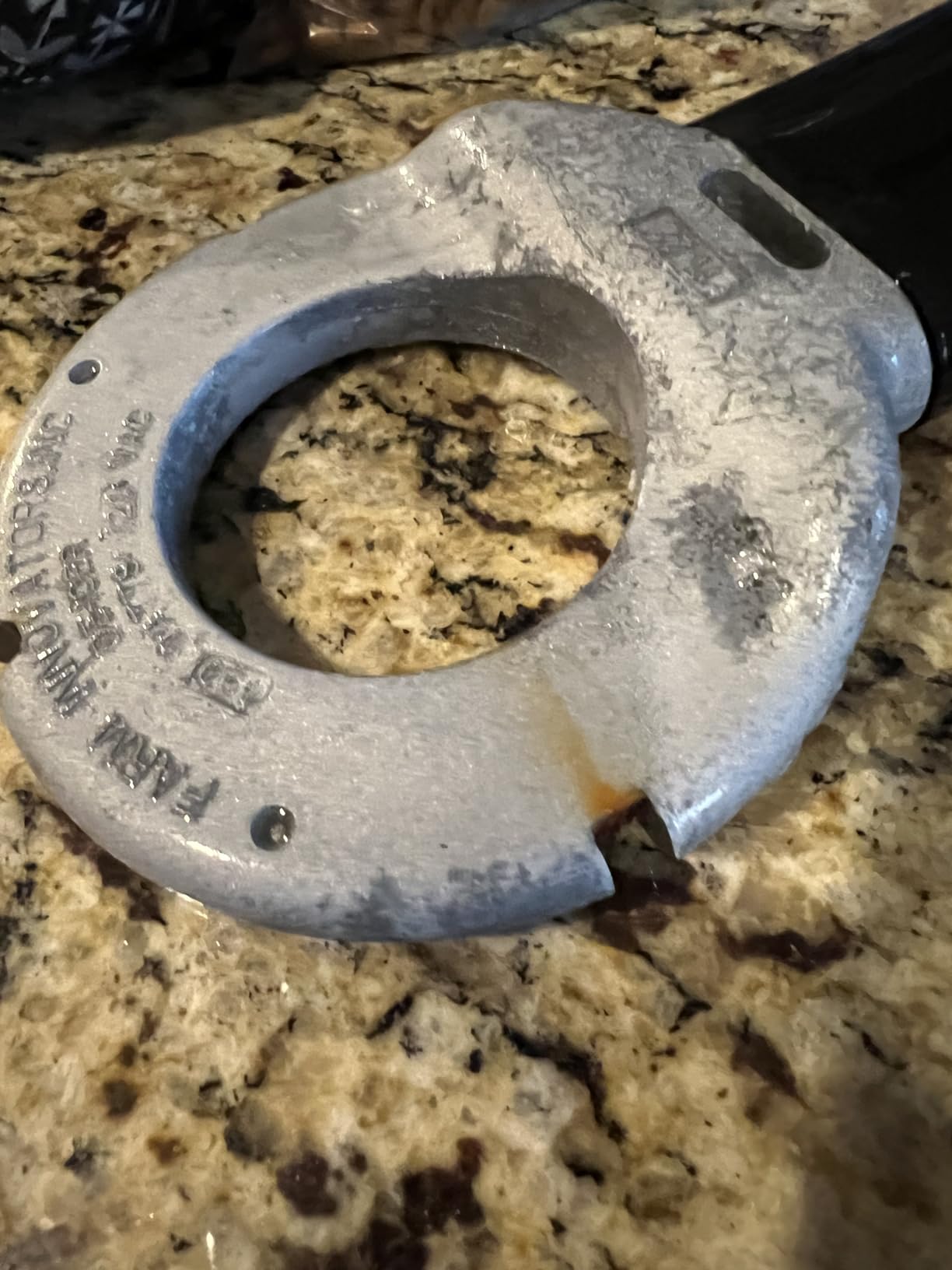
Understand the geometry before you buy. A 7.5-inch plate is small compared with the water surface of a wide bucket, so it de-ices the area around the plate rather than the whole container. In practice that is enough to keep a drinking area open, but a wide bucket with wind exposure can still freeze at the edges. For that reason it works better under a nipple bucket with a lid than under a wide open pan sitting in a cold run.
Waterfowl are the ideal use case. Ducks and geese need shallow, wide water, they foul it constantly, and they tolerate a dirty container far better than chickens do. This plate gives you a replaceable, cleanable heated zone without buying a whole new fount.
Who this waterer suits
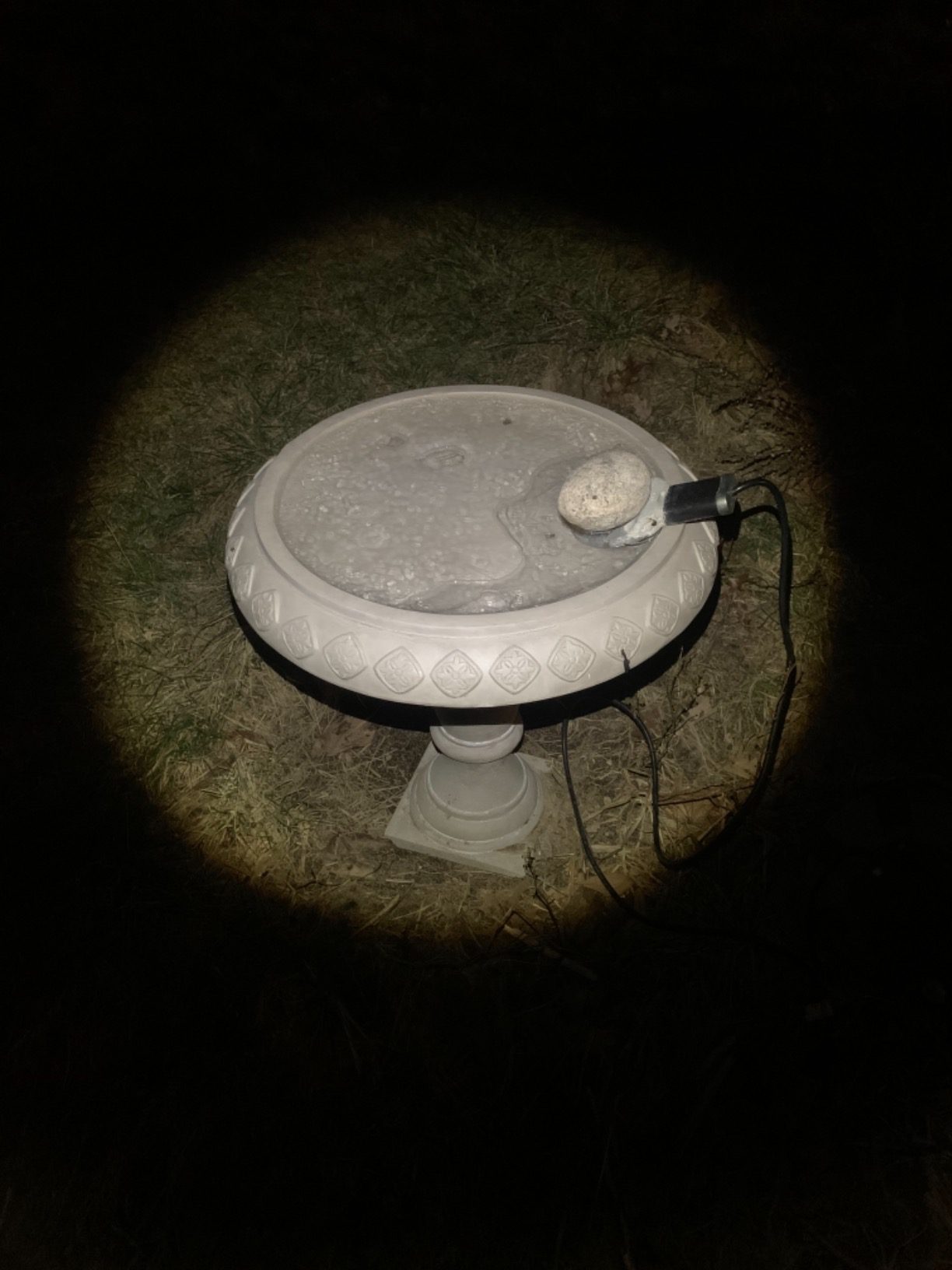
It suits owners with several waterers in rotation, particularly the DIY heated-base pattern where a round thermostatically controlled pedestal holds a standard container. It also suits anyone who already owns a wide bucket and wants freeze protection without replacing it, and anyone running ducks or geese alongside a chicken flock.
It is a good second unit too. Keep a de-icer on hand as a backup for the main waterer, and you have a plan for the morning the primary unit stops working mid-cold-snap.
Where it falls short
The listing itself carries an inconsistency: the wattage stated in the title does not match the wattage in the bullet description. Check the label on the plate when it arrives, because it affects both your power expectations and your extension cord sizing.
The one-year warranty is short for equipment meant to live outdoors through several winters. Beyond that, replacement plates from this brand are not something we saw widely stocked, so treat the unit as consumable rather than repairable and budget accordingly.
6. API 3-Gallon Heated Waterer: Best for Mild Winters
API 3 Gallon Heated Chicken or Bird Waterer with Overheating Protection, Galvanized Steel Handle, and Easy to Fill Funnel Design, White
3 gallon capacity
100 watt element
Ice-free to about -5F
4 foot cord
16 ounces
Pros
- Funnel-style fill opening is easy to top up
- Galvanized steel handle for hanging
- Rounded top discourages roosting and contamination
- Heater pad distributes heat evenly
Cons
- Modest -5F rating compared with the rest of this list
- Short 4 foot cord limits placement
- Some owners still report freezing in their conditions
The API waterer is a simple gravity jug with a heater pad underneath and a thermostat to control it. It is the easiest unit in this roundup to hang, thanks to a galvanized steel handle, and the funnel-style fill opening means you can top it up with a hose or a jug without wrestling with a narrow mouth. The 100-watt element uses a heater pad that distributes heat evenly rather than concentrating it in one spot.
The rounded jug top is a genuinely smart design choice. It discourages birds from roosting on the lid, which keeps droppings out of the water and reduces contamination. For a waterer that will sit untouched for a week in freezing weather, that matters.
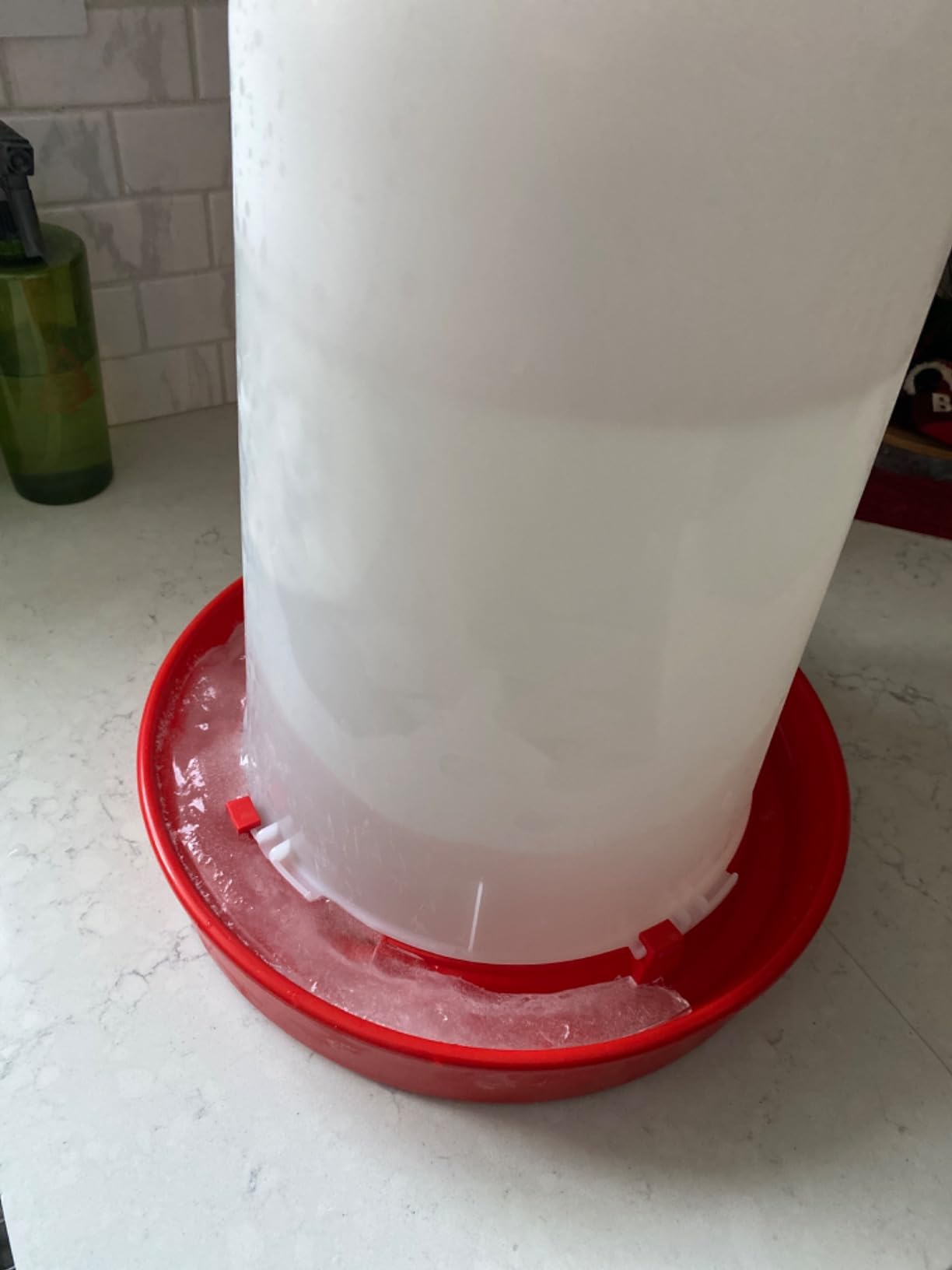
Its rating profile is the deciding factor. At 4.0 stars across more than 560 reviews, with roughly 13 percent one-star reviews, this is the lowest-rated unit here, and the reviews explain why. A claimed low-temperature rating of about -5F is modest next to the 10F and -20F figures other brands publish, and owners in genuinely cold conditions report seeing it freeze.
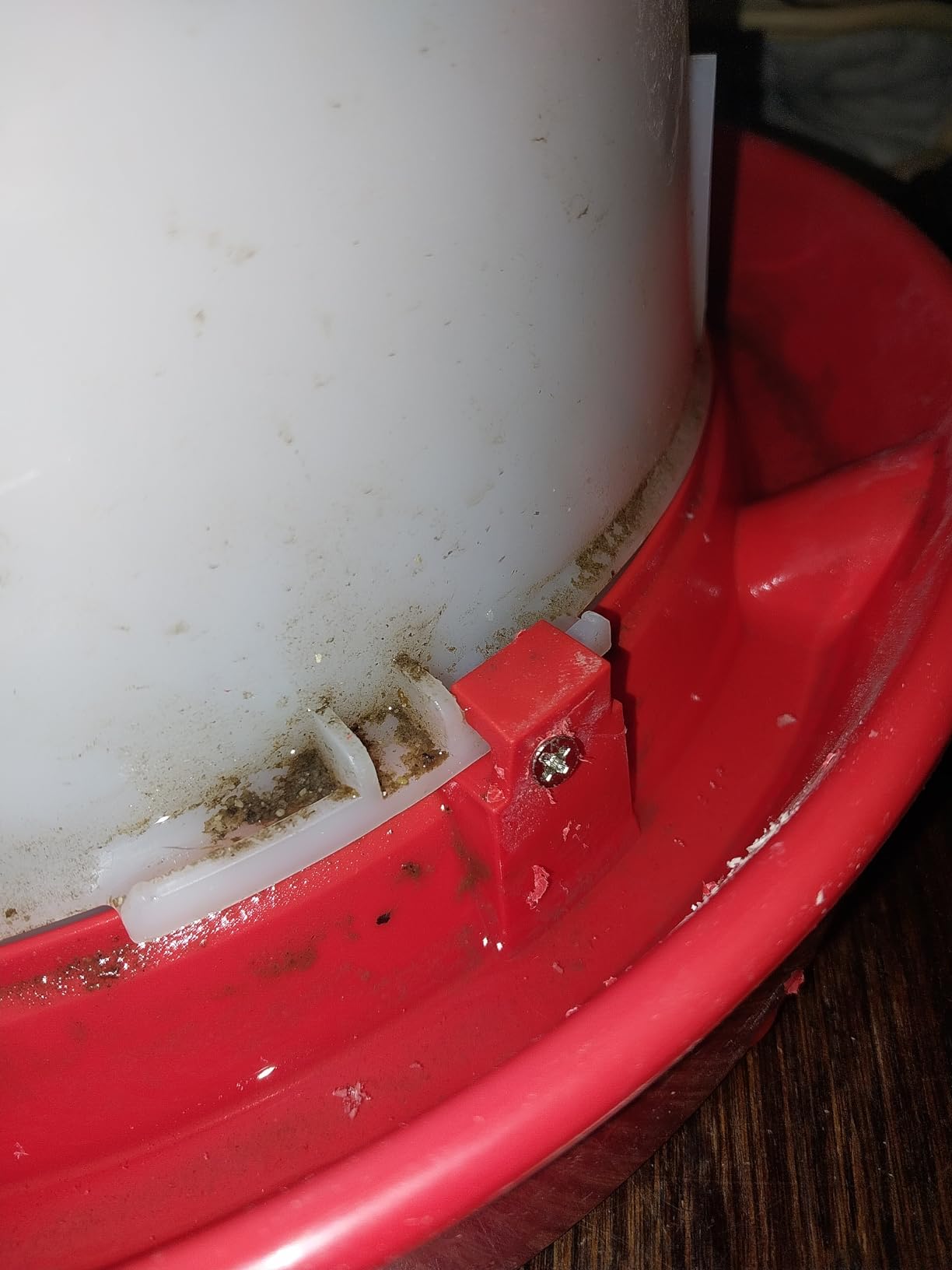
The 4-foot cord is the other limitation. That is short enough that you will likely need an outdoor-rated extension in most coop layouts, which adds a connection point in a wet environment. If you already know your setup is not going to drop below freezing for long stretches, the design and the price make sense.
Who this waterer suits
This suits a flock in a mild climate, roughly USDA zones 6 and 7, where winter nights dip below freezing occasionally rather than sitting there all winter. It is a good choice for a mobile or temporary setup where you want something light to hang and move, and for owners who refill by hand on a schedule.
It is also a reasonable second waterer for a mild-winter coop where the main unit is reserved for the two or three coldest weeks of the year.
Where it falls short
It is not a unit for northern climates, full exposure, or waterfowl. Below about -5F you are outside what the manufacturer claims, and the owner reports of freezing suggest the real margin is thinner than that. Anything colder than the ratings on this page is a gamble.
Because the rating is the lowest in the roundup, we would pair it with a thermometer check in the first cold week rather than trusting it blind. Knowing your water temperature takes a five-dollar aquarium thermometer and one minute.
7. GUEOQTC 11-Inch Heated Base: Best for Rugged Runs
GUEOQTC Chicken Water Heater for Winter, Heated Poultry Waterer Base,with Thermostat and 9.8ft Power Cord, Dia.11in
11 inch galvanized base
110 watt element
Heats below 35F stops at 77F
9.8 foot three-prong cord
Pros
- Fully sealed body tolerates wet muddy coops
- 9.8 foot cord with a three-prong plug
- Works with both plastic and iron waterers
- Owners report multiple winters of freeze protection
Cons
- One report of a shock after a month of covered-coop use
- 110 watts is a higher draw than the low-wattage bases
- Never run an empty plastic waterer on the plate
The GUEOQTC base is an 11-inch galvanized steel plate with a 110-watt thermostat-controlled element, sized to fit most water buckets including standard 3-gallon feed buckets. That last detail is the reason it works in so many different coops. Feed buckets are everywhere on a farm, they are cheap, and you can find a replacement in any town. A waterer designed around a proprietary container has no such advantage when the container cracks.
The cord is the second reason we like it. At 9.8 feet with a three-prong plug, it is one of the longer cords in this roundup, which means fewer extension splices in a wet run. The sealed body also holds up well against mud and weather, and owners report multiple winters of reliable freeze protection with a 74 percent five-star share across more than 500 reviews.
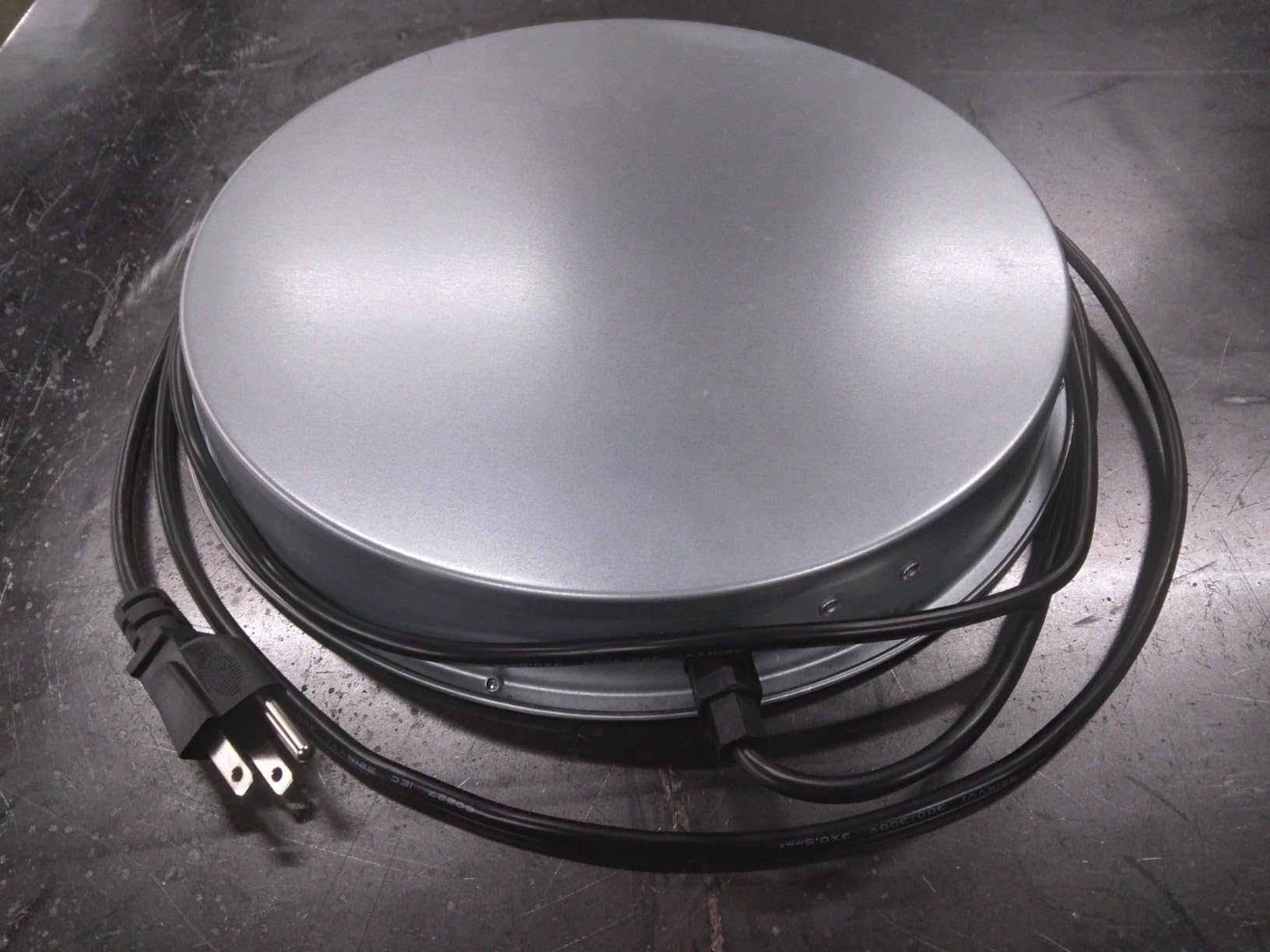
The thermostat set points are wide: it heats below 35F and stops above 77F. That high cutoff is a safety feature as much as a comfort one, because it prevents a scalding scenario if the base is sitting in direct sun on a mild afternoon. Reviewers note the plate itself stays cool to the touch in many conditions, which is exactly what you want in a coop full of dry bedding.
One serious complaint appears in the visible reviews: a buyer reported an electrical shock after under a month of covered-coop use. A single report does not condemn a unit, but it is the kind of failure you cannot afford in a run full of birds, so treat it as a prompt to inspect the cord and housing monthly and to never use it without a GFCI-protected outlet.
Who this waterer suits
It suits owners who already have a supply of feed buckets and want freeze protection without buying a branded waterer. It also suits large birds, since the listing covers chickens, turkeys, ducks, pigeons, rabbits and pigs, which means one base can serve several coops on the same property.
The long cord makes it a good fit for a run further from the outlet, and the sealed body makes it a good fit for a low sheltered area that gets wet. Raise it on pavers if you can, so bedding does not end up in the pan.
Where it falls short
At 110 watts, it draws more than the low-wattage bases in this roundup, so the seasonal power bill is higher than a 28-watt or 35-watt alternative. It also shares the warning that applies to every heated base: do not place an empty plastic waterer on the plate, because there is nothing to absorb the heat.
Because the brand is newer and less established, expect fewer replacement parts and less community troubleshooting history than the long-running names on this list. Pair it with a backup plan for the first winter.
8. Lxheir 13-Inch Heated Base: the Budget Pick
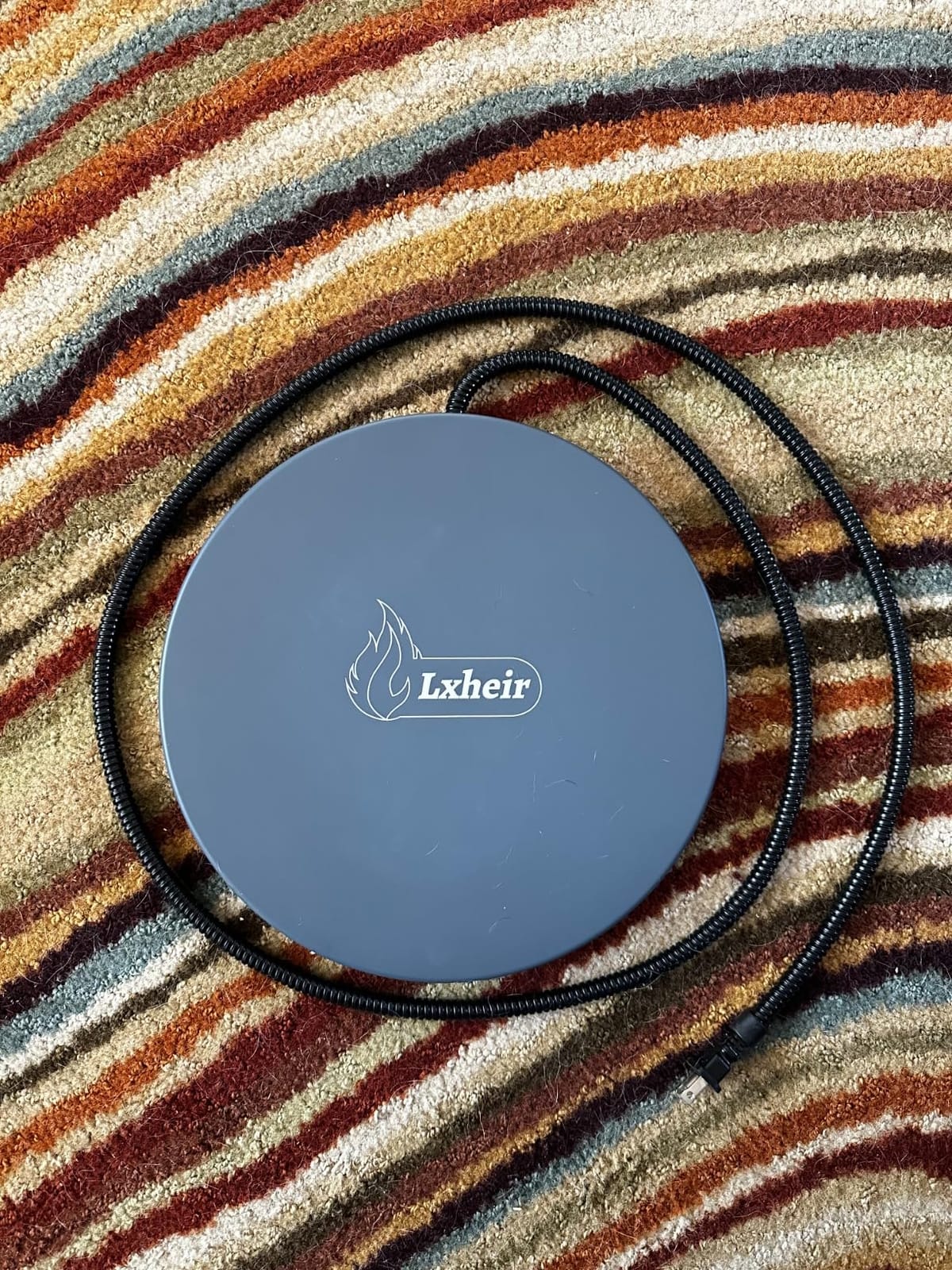
Lxheir Chicken Water Heater, 13” Heated Base for Metal Plastic Poultry Founts Waterer 3-5 Gallons, Poultry Water Heater Base for Chicken Turkey Goose Duck Pigeon Drinker in Winter Grey
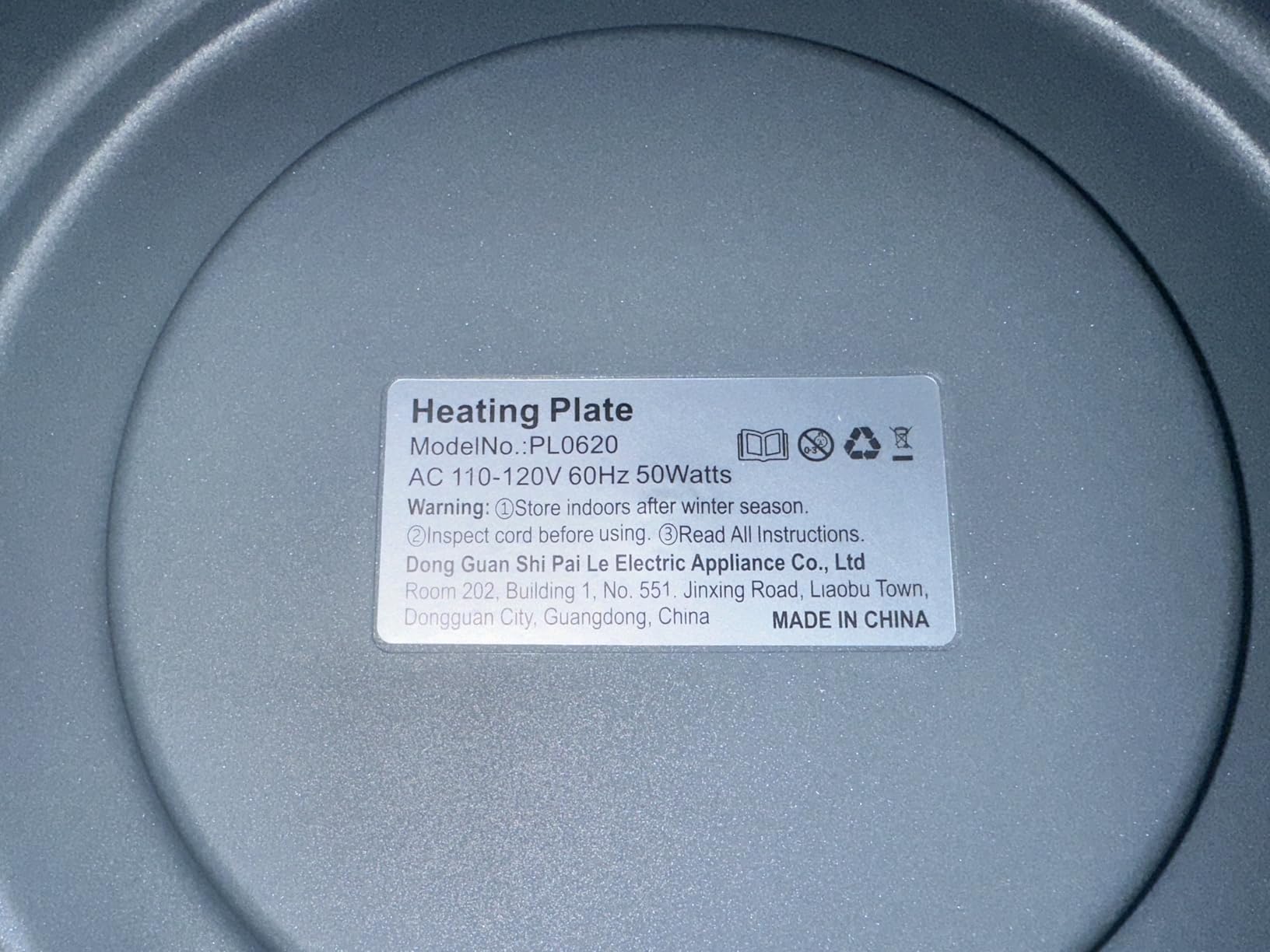
35 watt element
13.18 x 13.18 x 2.16 inch base
Fits 3 to 5 gallon founts
6.5 foot bite-resistant cord
Pros
- Very low 35 watt draw keeps running cost down
- Steel-wrapped cord resists pecking
- Lightweight and pre-assembled for easy seasonal moving
- Many owners keep 5 to 6 gallon plastic waterers liquid through typical winters
Cons
- Low wattage gives out around -20F
- Concave top seats unevenly on round or flat-bottomed waterers
- Some units stop working after a season or two
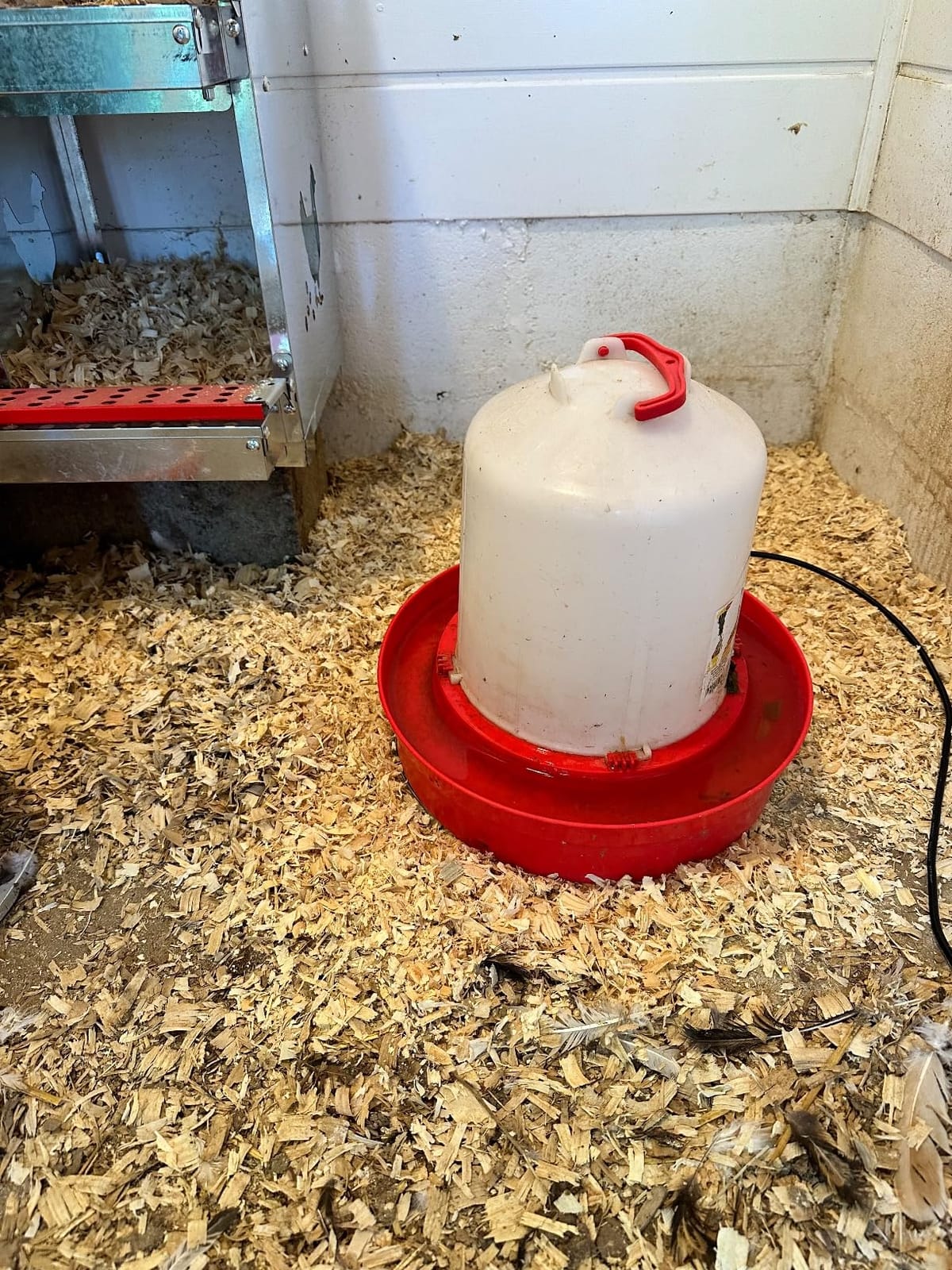
The Lxheir base is the cheapest way to keep water from freezing, and for a typical backyard winter in a moderate climate it genuinely does the job. It draws just 35 watts, which is the second-lowest figure in this roundup, and that translates into a seasonal electricity bill most owners barely notice. Several owners report it keeping 5-gallon and 6-gallon plastic waterers from freezing through ordinary winters.
The 6.5-foot cord is steel-wrapped and bite-resistant, which sounds like a small specification until you remember that cords in a chicken run are regularly pecked. Overheat protection stops heating above 68F and resumes below 35F, so it will not sit cooking on a warm day. The housing is waterproof for indoor or outdoor use, and the whole thing weighs under two pounds.
Now the limits, and they are real. A 35-watt element does not fight deep cold, and owners report it giving out around -10C, which is -20F. Below that, choose something with more wattage. The concave top surface is the other practical issue: it does not seat evenly against every waterer, so contact with the heating plate varies and a round-bottomed fount can rock.
The review profile reflects the trade-off, with roughly 63 percent five-star and 11 percent one-star. Some units stopped working after a season or two, so treat this as a first-winter budget purchase rather than a set-and-forget appliance.
Who this waterer suits
It suits owners in moderate climates, and anyone who wants freeze protection without adding meaningfully to the power bill. The lightweight, pre-assembled design also makes it easy to move in and out with the seasons, which matters if your coop is portable or your winter setup is temporary.
Raise it on pavers or blocks. Reviewers note that stacking keeps litter and mud out of the water, and the small air gap under the container helps the plate transfer heat rather than lose it to cold ground.
Where it falls short
It is not a northern-climate unit. If your winters regularly reach -20F or below, 35 watts is not enough headroom, and the money you saved up front is not worth a frozen flock. The concave seating problem is also worth checking against your specific waterer before you commit.
If you want the same low running cost with better deep-cold credentials, the 28-watt My Favorite Chicken base claims a -20F rating, and its adjustable tabs fit a wider range of waterer shapes than a fixed concave top.
9. My Favorite Chicken 28W Base: the Lowest Wattage Pick
My Favorite Chicken Heated Poultry Waterer Base – 28W Electric Chicken Water Heater for Winter, Freeze-Proof to -20°F, Adjustable Heated Waterer Base for Chicken Waterers & Founts
28 watt element
13.7 x 12.87 x 2.24 inch base
Expands to 11.8 inch
Rated freeze-proof to -20F
Pros
- Very low 28 watt draw compared with 60 to 150 watt units
- Low-voltage adapter means no 120V current in the coop
- Adjustable tabs fit many waterer shapes and sizes
- Sealed housing held up across four winters of outdoor use
Cons
- No built-in thermostat so it runs continuously while plugged in
- Water can warm noticeably in mild weather
- Not compatible with hanging waterers without modification
This base is the most interesting electrical design here. It runs on a low-voltage wall adapter, so only 28 watts of low-voltage current pass through the base and its cord rather than 120V. For a wet, bird-occupied coop, that removes the biggest single electrical risk in the category. It is also rated freeze-proof to -20F, which is remarkable from a 28-watt element and reflects high-density insulation that directs heat upward into the waterer instead of into frozen ground.
The adjustable sliding tabs expand to 11.8 inches, which lets the base grip 2-gallon and 5-gallon waterers and a range of bucket shapes. The sealed plastic housing resists moisture, ammonia and corrosion, and one review reports three units holding up across four winters of outdoor use, which is the kind of durability evidence this category rarely offers.
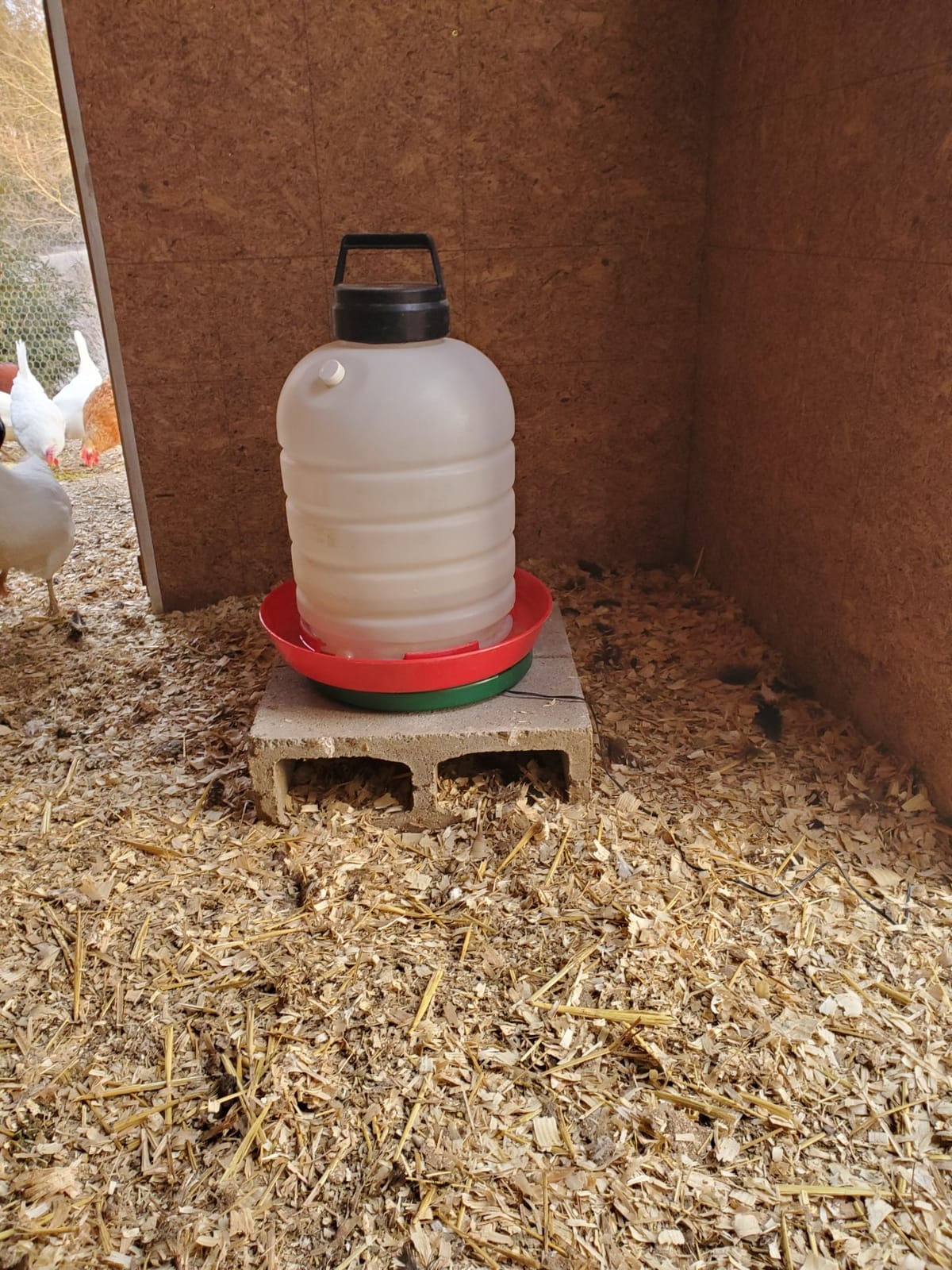
The design trade-off is the thermostat. There is no built-in one, so the element draws power continuously while the plug is in. Over a full four-month winter that is a small but real cost, and it means the water can warm noticeably in mild weather. Some owners work around this with an external temperature controller that switches the adapter on only when the temperature drops.
The surface itself is described as only lukewarm, so there is no burn risk around pine shavings and no risk of softening a plastic waterer. That safety profile is a genuine advantage in a coop with young birds or dry bedding.
Who this waterer suits
It suits owners who are nervous about running mains voltage in a chicken run, and anyone whose winter is long and cold enough that a -20F rating matters more than a thermostat. The low-voltage adapter also means a shorter, safer cord run and a much smaller worry about extension leads.
It suits people with a wide mix of waterers, because the adjustable tabs adapt where a fixed-size base forces you to buy a specific container. Pair it with a smart plug or an external temperature controller if the continuous draw bothers you.
Where it falls short
Without a thermostat, this base draws current every moment it is plugged in, and owners report the water getting too warm in mild weather. It is not compatible with hanging waterers without modification, so if you hang your waterers to keep them out of the litter, this is the wrong base.
A few owners also reported the cord connection at the plug failing after about a season, so keep the adapter accessible for inspection rather than burying it in bedding behind the waterer.
10. ZOHOKO 15.35-Inch Heated Base: the Wide Stainless Option
Chicken Water Heater for Winter – 15.35″ Poultry Waterer Heated Base, 125W Drinker Heater Base with Thermostat to Prevent Water Freezing in Metal or Plastic Drinkers
125 watt element
15.35 inch stainless base
Fits 1 to 6 gallon waterers
6.4 foot coated cord
1 year warranty
Pros
- Fits waterers from 1 gallon up to 6 gallons
- Stainless steel base resists rust and deformation
- Flame-retardant coated cord suits a wet coop
- Thermostat holds water drinkable rather than scalding
Cons
- Shorter review history than the established brands
- 6.4 foot cord is brief for most runs
- 125 watts is a higher draw than the low-wattage budget bases
The ZOHOKO base is the widest heated base in this roundup, and that is its whole argument. At 15.35 inches across it fits waterers from 1 gallon all the way to 6 gallons, plastic or metal. If you run waterfowl, a small flock and a brooder of chicks, one base can serve all three without you buying three heaters.
The construction is the other selling point. A stainless steel base resists rust and deformation through repeated heating and cooling cycles, which is exactly the stress a coated steel plate takes over several winters. The 6.4-foot cord is plastic-coated and flame-retardant, a sensible choice in a wet coop where a bare cord would be a concern.
The thermostat heats below 35F and stops at 77F, and the manufacturer states it brings water to a drinkable temperature within minutes. Reviewers confirm the water stays drinkable rather than scalding, which is the correct outcome for a waterer.
What this unit does not have yet is history. At roughly 4.2 stars across about 300 reviews, it has the smallest review base of the ten, and newer listings have not yet accumulated the multi-winter field record that the long-running brands show. That is not a defect, but it is a reason to buy a spare or keep a backup plan through the first winter.
Who this waterer suits
It suits multi-bird setups and larger flocks, where a 125-watt element spread across a 15.35-inch plate has enough surface area to keep a big container liquid. It is also a good pick for a 5-gallon container in a mild-to-cold climate where a 35-watt base would not keep up.
Owners of waterfowl should look here. Six-gallon containers, a wide stainless base and a thermostat that does not scald are a good combination for messy, heavy-drinking birds.
Where it falls short
The 6.4-foot cord is brief for most runs, and you will likely need an outdoor-rated extension. At 125 watts it is a higher draw than the low-wattage budget bases, so it costs more to run than the cheap options on this list.
The one-year warranty is also the shortest in the roundup. Given the smaller review history, buy it from a seller with a straightforward return policy and test it indoors before the first freeze.
How to Size a Heated Waterer and What It Costs to Run
Capacity is the number most buyers get wrong. The rule of thumb is roughly one gallon per six to eight chickens, and cold weather pushes drinking up rather than down, so err toward the larger end. A 2-gallon unit suits a flock of about 10 to 15 birds, a 3-gallon unit suits 20 to 25, and a 5-gallon unit suits 30 to 40. If waterfowl are in the mix, double the requirement, because a duck drinks several times what a hen does.
The reason capacity matters so much is not thirst. A small waterer emptied overnight is a waterer with no thermal mass at dawn, and an empty container with a 60-watt element under it can still freeze. Filling a bigger reservoir is often the cheapest freeze protection available, and a permies user put it plainly: supply only as much water as the animals actually drink in a day, and there is no water to freeze.
Running cost is easier to estimate than most people expect. Take the wattage, multiply by the hours per day the thermostat runs, and multiply again by your local rate per kilowatt-hour. A 60-watt unit running about 12 hours a day through a 120-day winter uses roughly 86 kilowatt-hours. A 125-watt unit running 16 hours a day over the same period uses about 240 kilowatt-hours. The difference between the two is a few dollars a season at ordinary residential rates, which is rarely the deciding factor.
Where the power bill argument does matter is a flock that needs several units, or a property already running heavy electrical loads. A permies user noted that heaters made their power bill soar, and that complaint is most often heard from people running multiple units continuously rather than on a thermostat. That is a good reason to prefer thermostatic units, and to prefer a low-wattage base like the 28-watt or 35-watt options if your winters are moderate.
Two seasonal habits are worth building in. Detach and store the cord over the warm months on any unit that allows it, and keep the heater plate clean. And check that a plain water pan is always within reach as a backup, because a morning with no water is a morning you cannot fix quickly. Once the weather breaks, our crispy chicken and waffles recipe is a fine way to celebrate the return of liquid water.
Non-Electric Ways to Stop Chicken Water Freezing
Some of the best setups we read about use no electricity at all, and they start with the coop rather than the waterer. A properly insulated coop with 18 to 24 birds inside runs 10 to 20 degrees warmer than the outside air, simply from bird body heat. One permies user in Alaska runs a 3-gallon-plus heated waterer in an insulated 8×8 unheated coop and reports the water has never frozen at -20F, with the inside temperature holding well above outside. In zones 5 through 7, insulation alone may make a heater unnecessary.
Beyond insulation, these are the non-electric methods that show up repeatedly. First, a half-buried plastic culvert, where you set the waterer inside a length of culvert with earth packed around it, using the stable ground temperature as insulation. Second, buried drain tile with a blower forcing ground air through it, reported at around 57F. Third, a super-insulated galvanized trough with the waterer nested inside packed insulation.
The most popular DIY is a cinder block with a heat lamp bulb, which multiple permies posters report working at 0F. You set two cinder blocks, place a waterer on top, and hang a heat lamp bulb inside the sheltered space between them, with a sheet-tin wind shield. Chickens will also stand on the blocks to warm their feet, which is an unadvertised benefit. The same thread describes a pond or trough heater dropped into a shallow metal feed bowl, which a user in Northern Maine reports never freezing at -30F.
The last approach is the simplest and the most counter-intuitive: supply less water. Fill the waterer with roughly what the flock drinks in a day and no more, so that freezing overnight has a much smaller volume to work on. A heated pet bowl on a three-legged stool is a related low-power idea that small-flock owners use, drawing very little power but holding little water, so it needs frequent attention.
Whatever you choose, keep the first line of defence in your head: a dry, draft-free coop with dry bedding does more for your flock’s winter than any single device. If you are running a heat lamp or a waterer in there, electrical safety is the part you cannot compromise on.
Frequently Asked Questions
Do heated chicken waterers work?
Yes. A heated chicken waterer uses a built-in or base-mounted thermostat to switch a heating element on when air temperature drops to roughly 35F to 40F, and off again between 60F and 77F. The element prevents ice from forming rather than heating the water, so the water stays cool and safe to drink and the unit only draws power during freezing conditions.
How cold can a heated chicken waterer go?
It depends on the unit. Bases in this roundup are rated from about 10F down to -20F, and the Farm Innovators HP-125 is published at roughly 10F while the 28-watt My Favorite Chicken base claims freeze-proof performance to -20F. Treat the manufacturer rating as the ceiling, place the waterer in a sheltered position, and check the base is warm on a freezing night.
How can I keep my chicken’s water from freezing without electricity?
Insulate the coop first, since a well-built coop with 18 to 24 birds inside can run 10 to 20 degrees warmer than outside air. Then try a half-buried plastic culvert, buried drain tile blowing ground air near 57F, or two cinder blocks with a heat lamp bulb sheltered between them. Filling the waterer with only a day of water also reduces what can freeze overnight.
How long does a heated chicken waterer last?
It depends on the brand and how it is used. Some owners on backyardchickens.com report the same heater running for six years, while others report units from the same brand failing within one or two winters. The most common failure is the heating element burning out, often from grit and bedding built up against the plate, so keeping the base clean and testing it each winter is the best insurance.
Do I need a GFCI for a chicken coop heater?
Yes, always plug a heated waterer into a GFCI-protected outlet. A ground-fault circuit interrupter cuts power almost instantly if water reaches the cord or the heater housing. If the cord does not reach, use an outdoor-rated heavy-duty extension cord for wet locations, route it along a wall rather than across the floor of the run, and never splice a cord to gain length.
Will the water get too hot for the birds?
It depends on the thermostat. Units with a built-in thermostat, such as the Premier 1 all-season waterer that switches on below 40F and off at 60F, keep water cool and unfrozen. A base with no thermostat draws power continuously and can make the water noticeably warm in mild weather, so that is worth checking in the first cold week of the season.
Final Verdict by Scenario
For a hard freeze, choose the Farm Innovators HB-60P, our pick for the best heated chicken waterers for freezing weather overall, because its removable top, long production record and nipple ports make it the least fussy to live with. For a mild winter on a budget, the Lxheir 35-watt base holds a large container through ordinary cold for very little power. For a large container or waterfowl, the ZOHOKO 125-watt stainless base has the surface area to match. For anyone nervous about mains voltage in a wet run, the 28-watt My Favorite Chicken base keeps only low-voltage current in the coop. And if your winters are extreme, start with coop insulation before you spend anything on hardware.
Whichever you choose, test it indoors before the first freeze, plug it into a GFCI outlet, and keep a plain water pan as backup. If you enjoy the cooking side of keeping chickens, our simple chicken fajitas recipe and chicken parmesan with spaghetti are where we start once the waterer is sorted. The best heated chicken waterer for winter is the one that never gives you a reason to think about it at all.