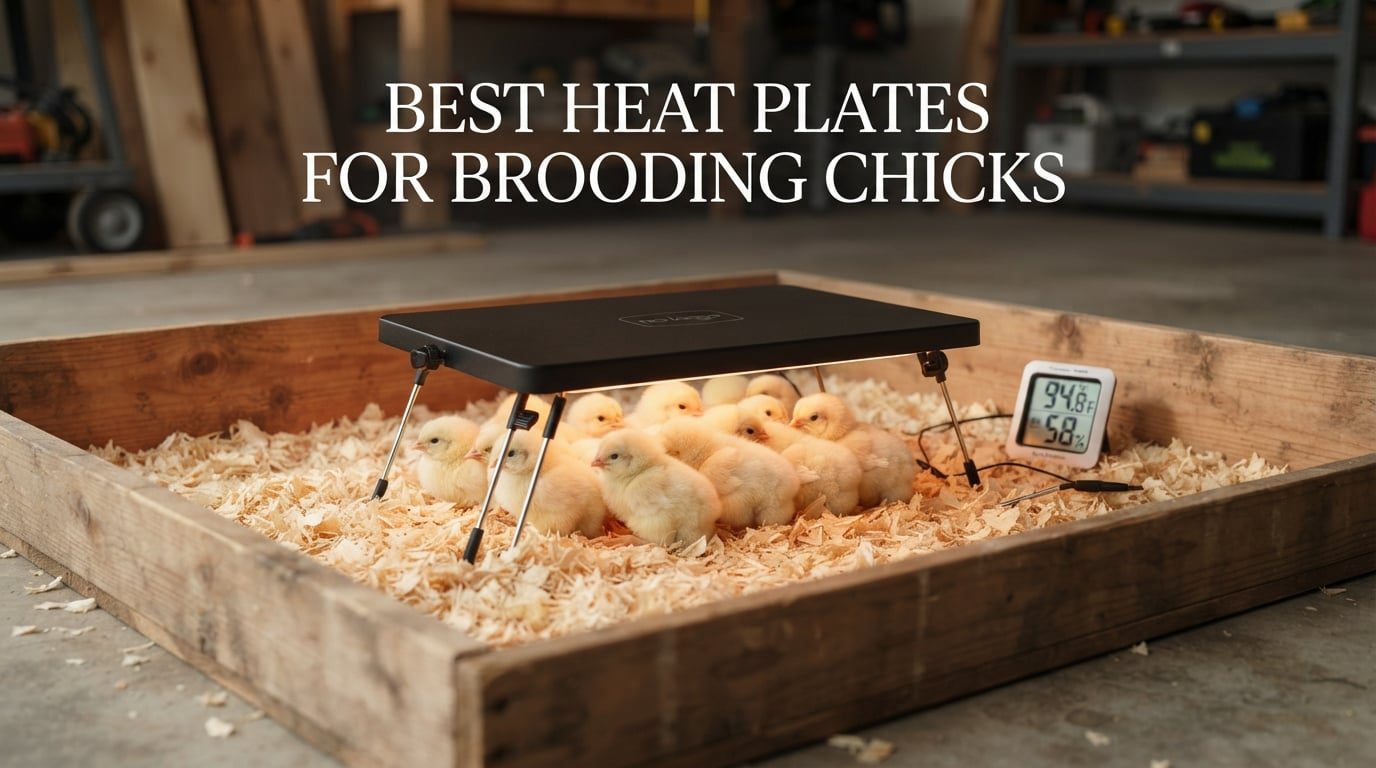
The best heat plates for brooding chicks in 2026 are the Brinsea Ecoglow for small flocks that want the lowest running cost, the RentACoop 12×12 for the widest range of height settings, and the Chickcozy 200W panel when you want a real thermostat and a plate you can reuse on adult hens. All three replace the dangling infrared bulb with a low-profile warm panel that chicks settle underneath on their own terms.
That change matters more than most product pages admit. A heat plate warms the chicks directly rather than heating the whole air space, so the fire risk that makes indoor brooding nerve-wracking basically disappears, and chicks get a dark, quiet place to sleep instead of a glaring bulb overhead.
The catch is that almost every plate is marketed with an optimistic chick capacity. Keepers consistently report that a plate advertised for 20 chicks behaves more like a 10 to 15 chick plate once your birds are freshly hatched and doubled in size weekly. We account for that in every review below by separating the rated capacity from what owners actually report holding comfortably.
We compared ten plates across wattage, plate size, height adjustment, safety cut-offs and real owner feedback to put this guide together. No prices are quoted anywhere in this article, so use the product links on each review to check the current listings for yourself.
Table of Contents
- Top 3 Picks for Best Heat Plates for Brooding Chicks in 2026
- All 10 Chick Brooder Heat Plates Compared in 2026
- Brooder Heat Plate vs. Heat Lamp: Which Is Safer?
- 1. Brinsea Ecoglow Safety 600 – Best Overall Brooder Heat Plate
- 2. RentACoop 12×12 Adjustable Heating Plate – Best Value
- 3. Chickcozy Smart 200W Heat Panel – Most Versatile
- 4. Sindarhor Enclosed Brooder House – Best for Ducklings
- 5. NUGRIART 10×10 Plate – Best Low-Power Budget Plate
- 6. ZenxyHoC 12×12 Plate with Anti-Roost Cone – Best Cone Value
- 7. TRIOCOTTAGE Digital Plate – Best Digital Controls
- 8. Shaledig 12×16 Plate – Best for Large Broods
- 9. Tetuga 12×16 Thermostat Plate – Best Built-In Thermostat
- 10. Tetuga All-In-One Brooder Box Kit – Best Starter Kit
- How to Size a Brooder Heat Plate for Your Flock
- Frequently Asked Questions
- The Verdict on Brooding Chicks in 2026
Top 3 Picks for Best Heat Plates for Brooding Chicks in 2026

Brinsea Ecoglow Safety 600
- 12 watt low-voltage panel
- Up to 20 newborn or 12 older chicks
- Adjustable screw-on legs
- 3-year warranty

RentACoop 12×12 Heating Plate
- 25 height settings with tilt
- Foldable anti-roost cone included
- 22 watts per hour
- Up to 20 chicks

Chickcozy Smart 200W Heat Panel
- Built-in thermostat
- 70 to 190F range
- Brooder plate and coop heater in one
- UL and CCC certified
All 10 Chick Brooder Heat Plates Compared in 2026
| Product | Specs | Action |
|---|---|---|
| Brinsea Ecoglow Safety 600 |
|
Check Latest Price |
| RentACoop 12×12 Heating Plate |
|
Check Latest Price |
| Chickcozy Smart 200W Panel |
|
Check Latest Price |
 Sindarhor Brooder House Sindarhor Brooder House |
|
Check Latest Price |
 NUGRIART 10×10 Plate NUGRIART 10×10 Plate |
|
Check Latest Price |
 ZenxyHoC 12×12 Plate ZenxyHoC 12×12 Plate |
|
Check Latest Price |
 TRIOCOTTAGE Digital Plate TRIOCOTTAGE Digital Plate |
|
Check Latest Price |
 Shaledig 12×16 Plate Shaledig 12×16 Plate |
|
Check Latest Price |
 Tetuga 12×16 Thermostat Plate Tetuga 12×16 Thermostat Plate |
|
Check Latest Price |
 Tetuga Brooder Box Kit Tetuga Brooder Box Kit |
|
Check Latest Price |
Brooder Heat Plate vs. Heat Lamp: Which Is Safer?
A brooder plate is safer indoors, and the reason is structural rather than marketing. A heat lamp hangs a bulb and its ceramic socket over dry bedding, so any bulb failure, spilled water or nesting material contact can start a fire. A plate sits on the floor of the brooder at chick height with a solid non-flammable housing, and the current plates in this group draw between 12 and 35 watts for brooder duty, with a single higher-powered 200W panel built for larger spaces.
Behavior is the other difference. Chicks under a plate can step out to cool off and step back under when they are chilled, which is exactly the regulation cycle they get under a hen. Under a lamp the whole air space is heated, so the brood spreads out and the cooler corners become unusable.
Keepers on BackYard Chickens and Reddit’s r/chickens still argue about where the line is, and the honest summary is this. Plates win for flocks up to about a dozen chicks where you want the flame risk gone. Above that, plates have to be doubled as birds grow, so a lamp is easier to scale. A sensible middle ground for shipped chicks is a plate plus a properly clamped lamp for the first two days, until the birds have settled.
One more advantage is running cost. A 250 watt bulb burning 24 hours a day for six weeks dwarfs what a 12 to 30 watt plate costs, and a plate that has no bulb also has no bulb to burn out in the middle of week three. The same logic separates a brooder plate from any other heated surface you might run in a shared room, including a countertop [hot plate tested and reviewed](https://cookcraftandcreate.com/best-hot-plates/), where the risk is a scorched pan rather than a bedding fire.
1. Brinsea Ecoglow Safety 600 – Best Overall Brooder Heat Plate
Brinsea Ecoglow Safety 600 Chick or Duckling Brooder, Up to 20 Chicks
12W low-voltage panel
Up to 20 newborn or 12 older chicks
12 x 8 x 9 inches, 1.5 lb
3-year warranty
Pros
- 12W draw among the lowest in the group
- Adjustable screw-on legs for height and tilt
- Clear plastic top wipes clean fast
- No light so chicks keep a natural day and night cycle
- Works for ducklings
- goslings and quail
Cons
- No thermostat or temperature readout
- Underside runs genuinely hot to the touch
- Indoor use only in practice
This is the plate I keep coming back to for a first brood. It runs at 12 watts on a low-voltage panel, which means there is no mains voltage in the element and no exposed glowing part anywhere near the bedding. For anyone brooding in a house rather than a shed, that design choice matters more than any feature list.
Temperature management is entirely mechanical. You screw the legs on or off to raise, lower or tilt the plate, and you check the result with your own thermometer. Owners report rebooting automatically after a power interruption without any manual reset, which is one detail I would want in a plate I was not able to watch.
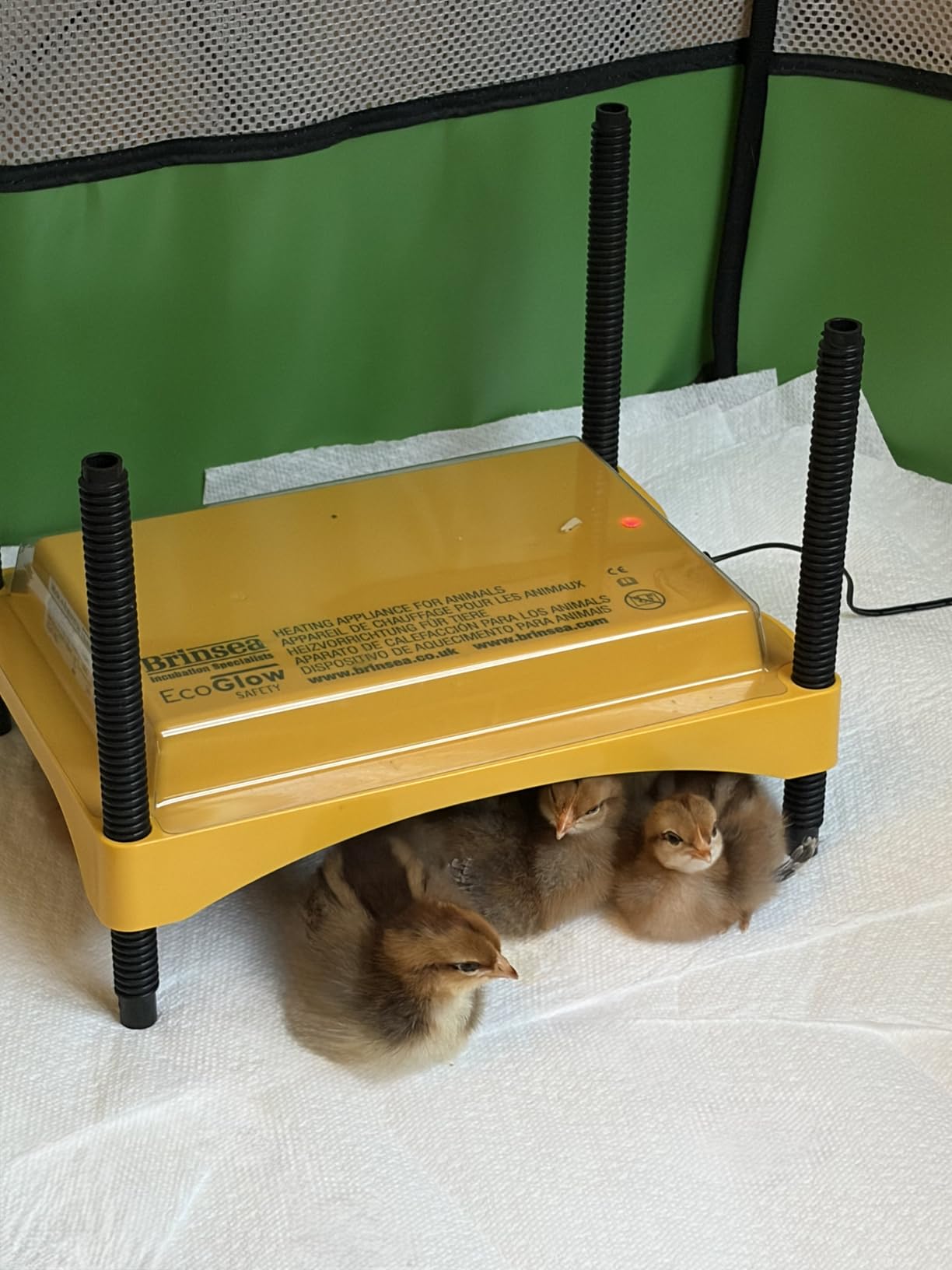
The trade-off is that there is no electronic thermostat at all, so managing a schedule of falling weekly temperatures means adjusting legs rather than turning a dial. Several owners of brand-new hatchlings report the underside is hotter to the touch than expected, and two reviews describe a unit that stopped heating after a short period. With more than 3000 reviews behind it, that failure rate is small but not imaginary.
Capacity is the real caveat. Brinsea rates it for up to 20 newborn chicks or 12 older chicks, and reviewers managing 12 to 14 birds call the results excellent. Treat the 20 figure as a ceiling for the first two days, not a number to plan a brood around.
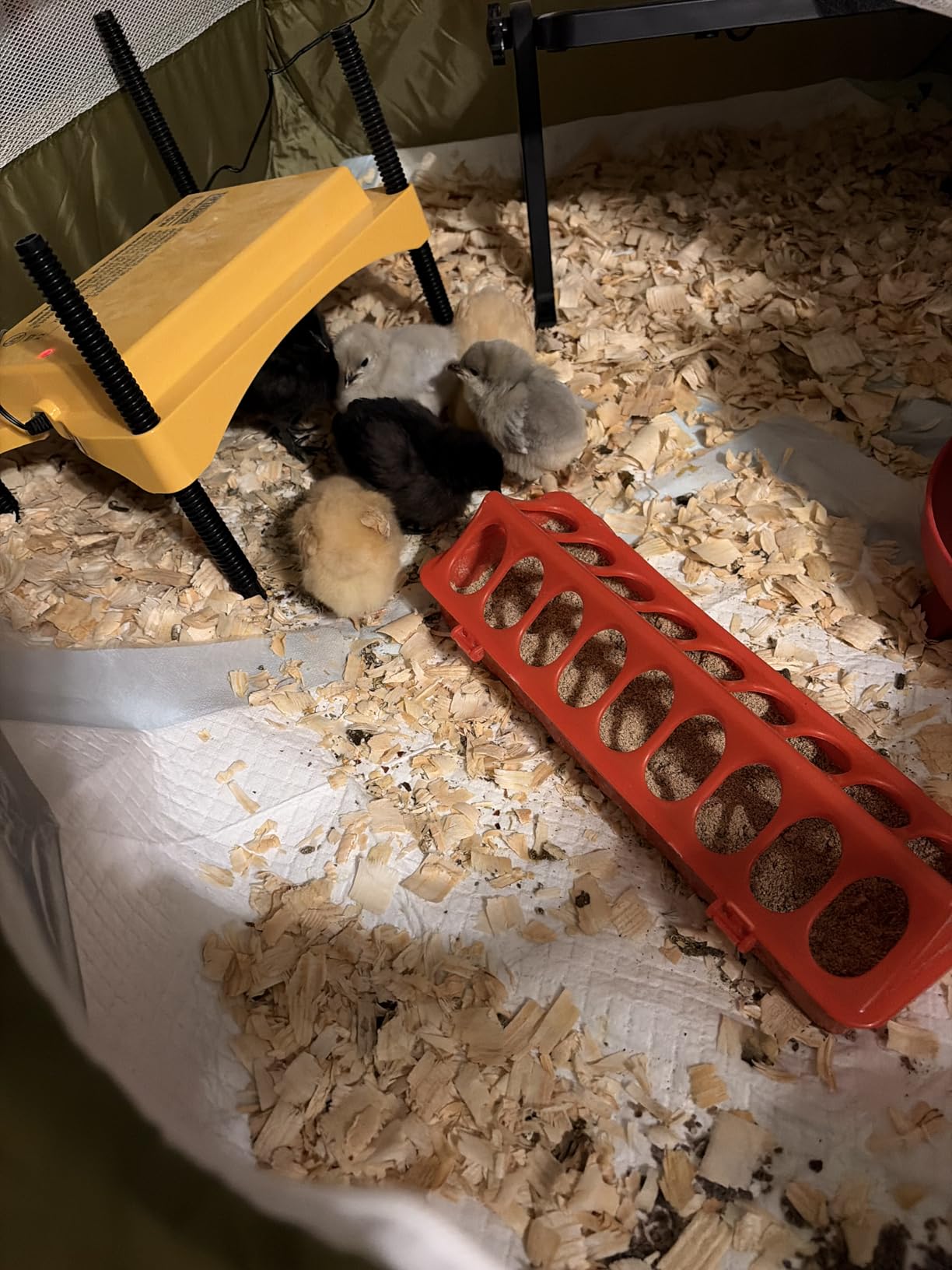
Best for first-time backyard keepers
If you are raising 10 to 12 chicks in a spare room and you want the simplest possible setup, the screw-on legs and 10 foot cord mean you can position it without tools and reach an outlet. The 1.5 pound weight also means you can move the whole thing to a different room as the brood grows.
Less suited to larger broods
By week two your chicks are roughly twice the size and the 12 by 8 inch panel is crowded. Owners who bought a second unit rather than a larger plate report that is the sensible move, so budget for two plates if you are starting with 20 chicks. There is also no cone included, so top perching and mess are your problem to manage.
2. RentACoop 12×12 Adjustable Heating Plate – Best Value
RentACoop 12×12” Adjustable Heating Plate with Foldable Anti-Roost Cone
12x12 inch plate
Underside center about 107F
25 height settings, 1-9 inches
22W draw, 6 foot cord
Pros
- Highest rated plate in the set with a large review base
- 25 height settings give the finest heat zoning available
- Foldable anti-roost cone included
- 22W draw
- Works for chicks ducklings poults and quail
Cons
- No temperature gauge or adjustable output
- Build quality a step below the premium plates
- Stated 20-chick capacity is optimistic in a cool brooder
This is the most consistently well-regarded plate in the group, and the reason is the adjustment range. Twenty-five height settings between 1 and 9 inches, with tilt, let you build a genuine gradient under the plate, warm at the center and cooler at the edges, instead of forcing every chick to share one temperature.
The center underside reaches roughly 107F, which sits at the top of the range a hen provides, so the plate never has to be dialled back. At 22 watts it costs less to run than an infrared bulb by a wide margin, and the 110V Type A plug with attached 6 foot cord means no adaptor is needed.
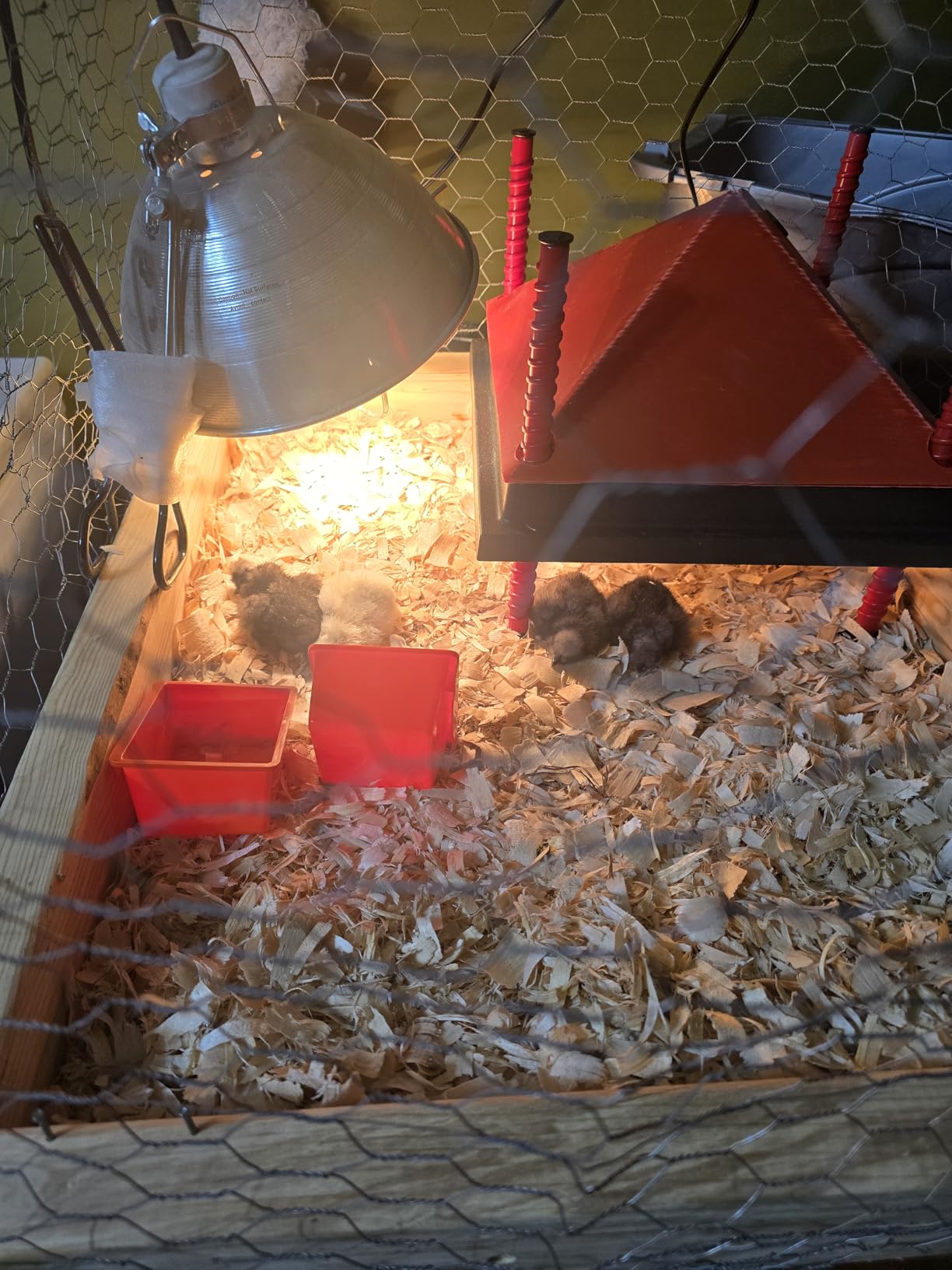
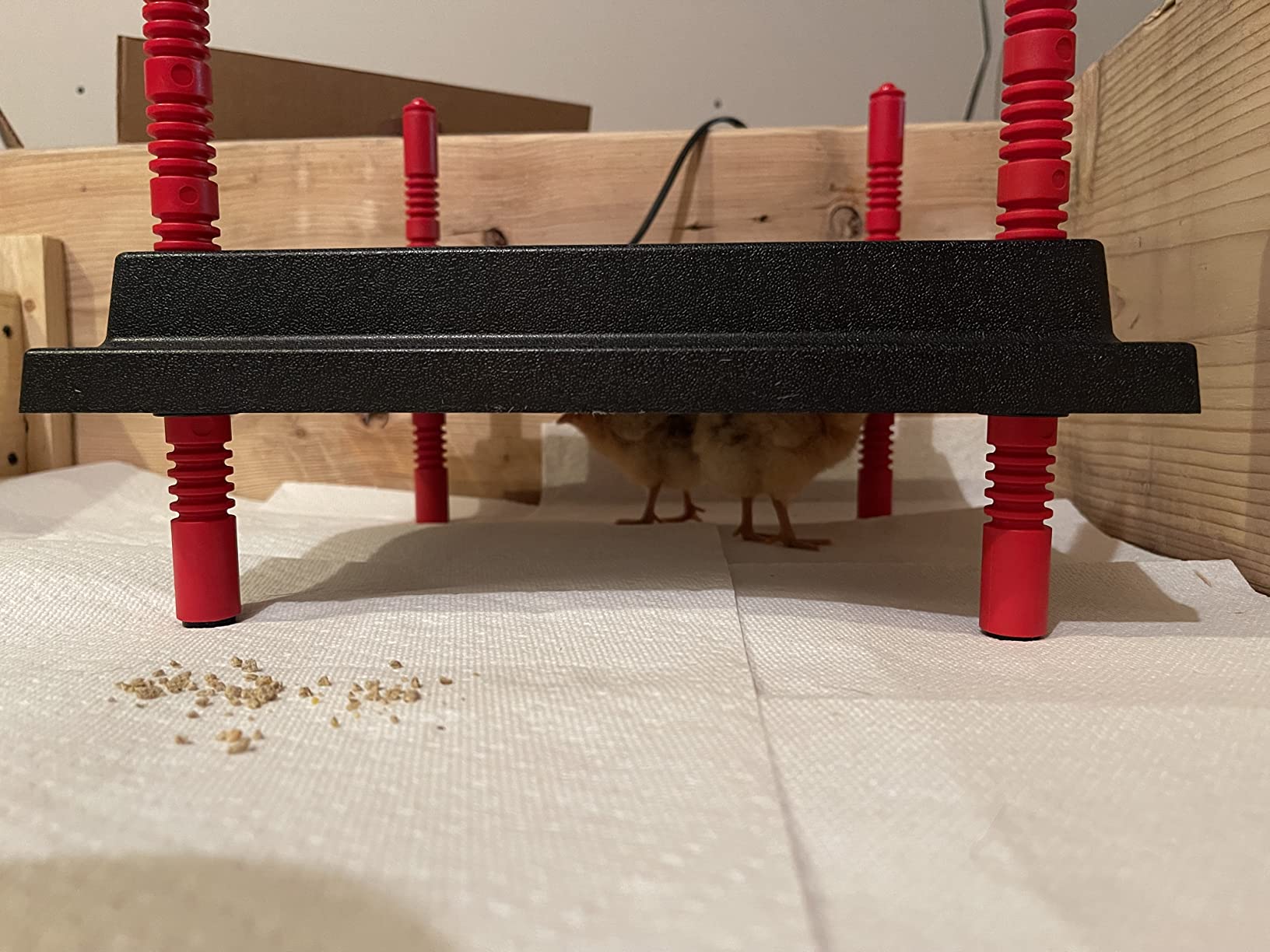
The foldable anti-roost cone is the sleeper feature. It clips above the plate, keeps chicks off the top surface and folds flat when you do not need it, which saves you from scrubbing droppings off a warm panel every morning. Owners also point out the plate stays at a fixed output, so height is your only control and a separate thermometer is still worth having.
For sizing, a few buyers found the 20-chick claim optimistic in a cool brooder, particularly once birds are past the first week. Plan on this being comfortable for 10 to 15 chicks for the first ten days, then raise it and watch them move outward.
Best heat zoning and cone value
If your main frustration with a heat lamp was uneven temperature, the 25 height settings are the feature to pay for. Chicks learn quickly to sit at the warm end when they are cold and step out to the edge, which is the same self-regulation they get under a hen.
Watch for these limits
Some owners describe the build as a step below the more expensive plates, and the fixed output means it cannot compensate for a very cold room on its own. Chicks can also dart under the corner posts when you lift the plate to check on them, so lift slowly from the side.
3. Chickcozy Smart 200W Heat Panel – Most Versatile
Smart Chicken Coop Heater, 200W Radiant Heat Panel with Temperature Sensor
200W radiant panel
Adjustable 70-190F surface
Built-in smart temperature sensor
UL and CCC certified
Pros
- The only plate here with a genuine thermostat and wide set range
- Doubles as a wall-mounted winter coop heater
- Four legs make it hard to tip
- Survived a flock of 30+ chickens pecking at it
- Timer and external controller compatible
Cons
- Highest power draw in this group
- Surface can run hotter than the dial suggests
- A spot heater for a corner rather than a whole-coop source
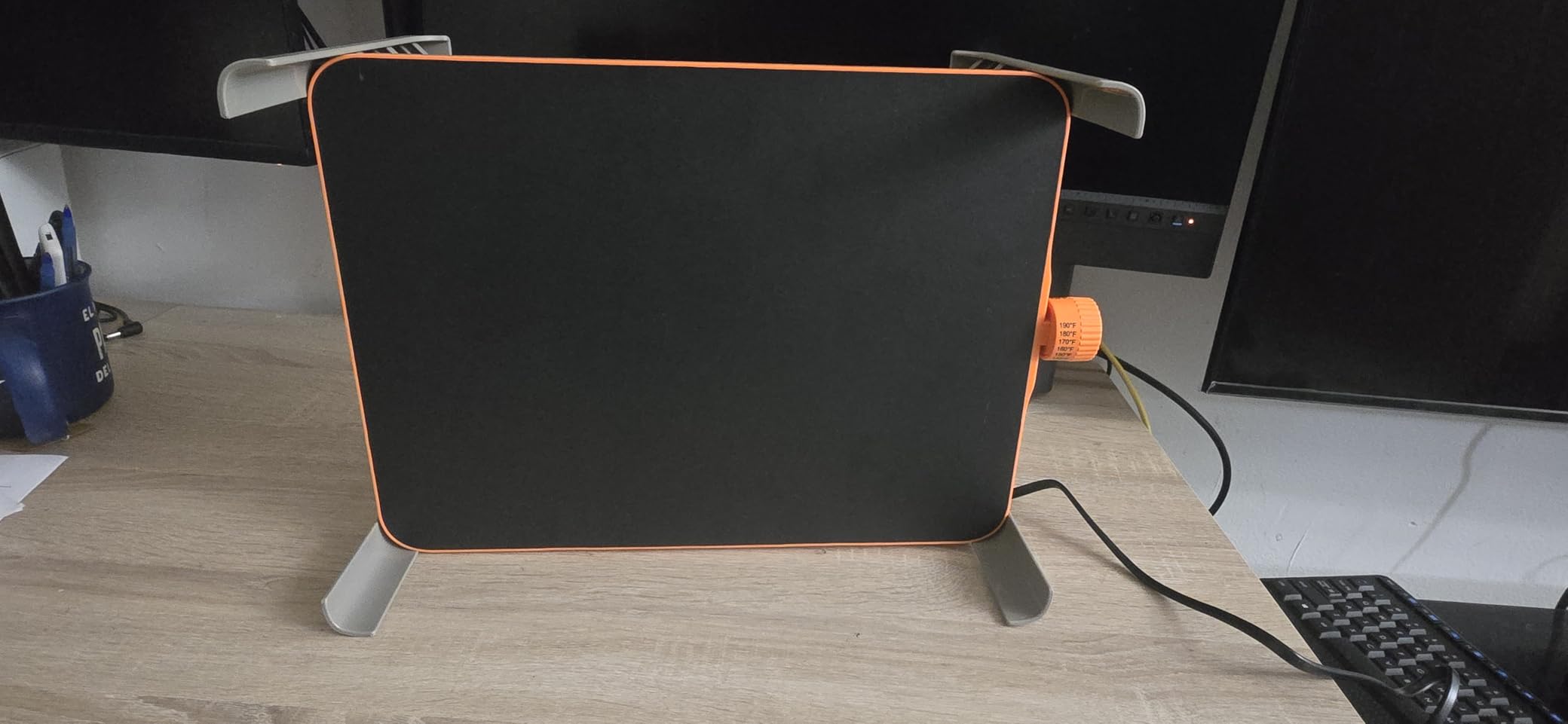
If you want a thermostat rather than a guessing game, this is the plate. The built-in sensor modulates power in real time to hold a preset surface temperature anywhere from 70F to 190F, and the manufacturer suggests 90 to 95F for chicks and 100 to 120F for adult birds. It is also the only UL and CCC certified unit in this group, which matters if you are brooding in a finished building.
The dual-use design is what justifies the extra capability. Laying it flat gives you a 16 by 11 inch brooder plate with four legs, and once the birds are grown you can mount it on a wall as a coop heat source. One owner reported that a flock of more than 30 chickens, including large breeds pecking at it, caused no damage to the panel.
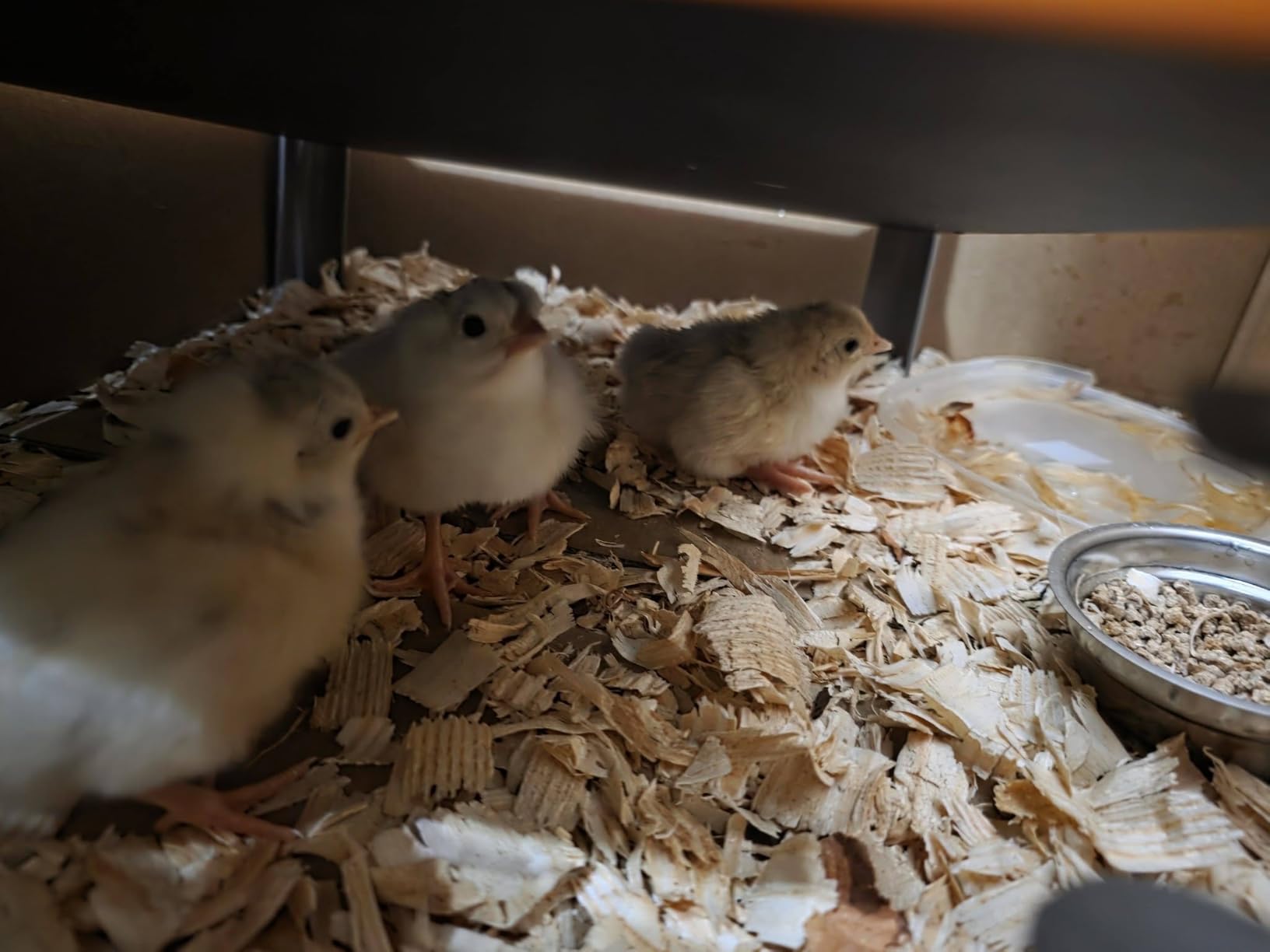
Calibration is the honest weakness. A minority of buyers report the surface running hotter than the dial suggests, with one measuring 99F while the dial read 70F, so verify with a thermometer rather than trusting the setting. At 200W it also draws more than anything else here, which matters if you are running two plates on one outbuilding circuit and watching for voltage drop.
When it is wall-mounted the upper edge is uncovered, so plan a shield if you are placing it under roost bars. A small DIY baffle solves it in a few minutes.
Best for a full flock lifecycle
Brooding spring chicks in the garage and then warming a corner of the coop in deep winter from the same unit is the argument for this plate. The legs and included anti-dirt top cover make it stable for unattended use, which is where cheaper plates tend to tip.
Watch for these limits
It heats one zone, not a whole building, so a large flock or an unheated shed will still need a second source. Confirm the actual surface temperature in week one, and be careful running several units on a single extension run.
4. Sindarhor Enclosed Brooder House – Best for Ducklings
Sindarhor Chick Brooder Heater Plate for Baby Chicks, Ducklings & Poultry
Three settings at 131/149/167F
8.67 x 10.63 inch heated panel
Waterproof ABS, 3.06 lb
Includes feather comfort attachment
Pros
- Three discrete heat settings beat fixed-output plates
- Enclosed house structure reduces burn and fire risk
- Wipes clean in seconds
- Small footprint suits a small brooder
- Feather attachment calms ducklings and goslings
Cons
- Height adjustment sags when chicks perch on top
- Runs cooler than expected in cold spaces
- Minimum height is too high for button quail
This is the only true brooder house in the group, and that enclosure is why it works so well for ducklings and goslings. A duckling will happily sit on a warm plate rather than under it, so having side panels and a roof that contain the heat makes a real difference. The three heat settings at 131F, 149F and 167F are the only stepped control on a plate this compact.
Owners also like the practical details. The waterproof ABS wipes clean in seconds and resists droppings and disinfectant, and the optional feather attachment appears to settle goslings and ducklings noticeably.
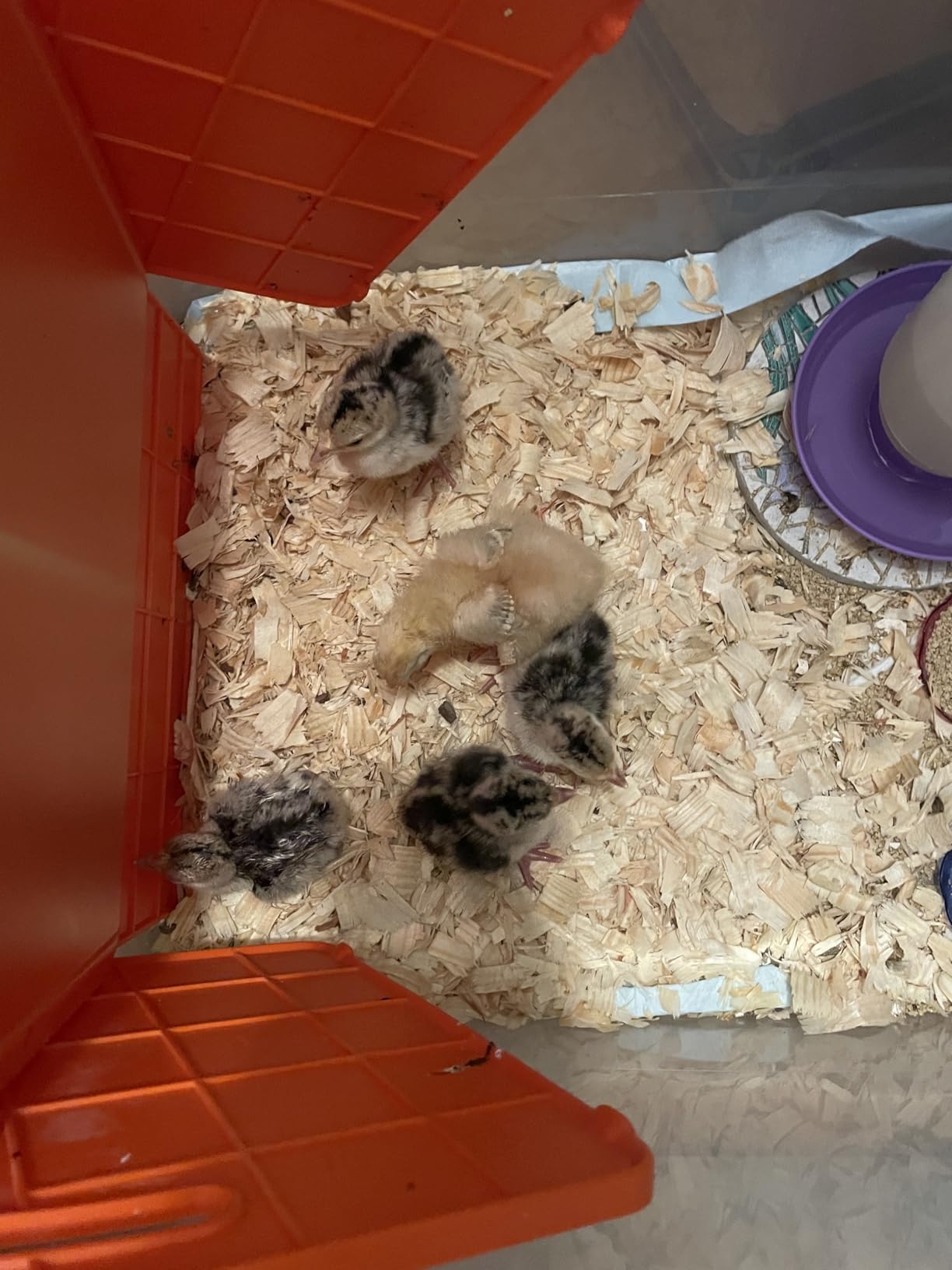
The weak point is height retention. The plate is held on silicone washers that lack friction against the plastic, so once a chick or duckling hops on top the whole unit sags, and several owners returned theirs over it. Runners are also cooler than the listed temperatures suggest, with one reviewer measuring about 85F at chick level in a cold room, and the four inch minimum height is far too tall for button quail.
Treat this as a unit that works best inside a well-insulated brooder box rather than in an open garage. It can also be assembled upside down without an obvious error, so check the panel is on the underside before you trust it.
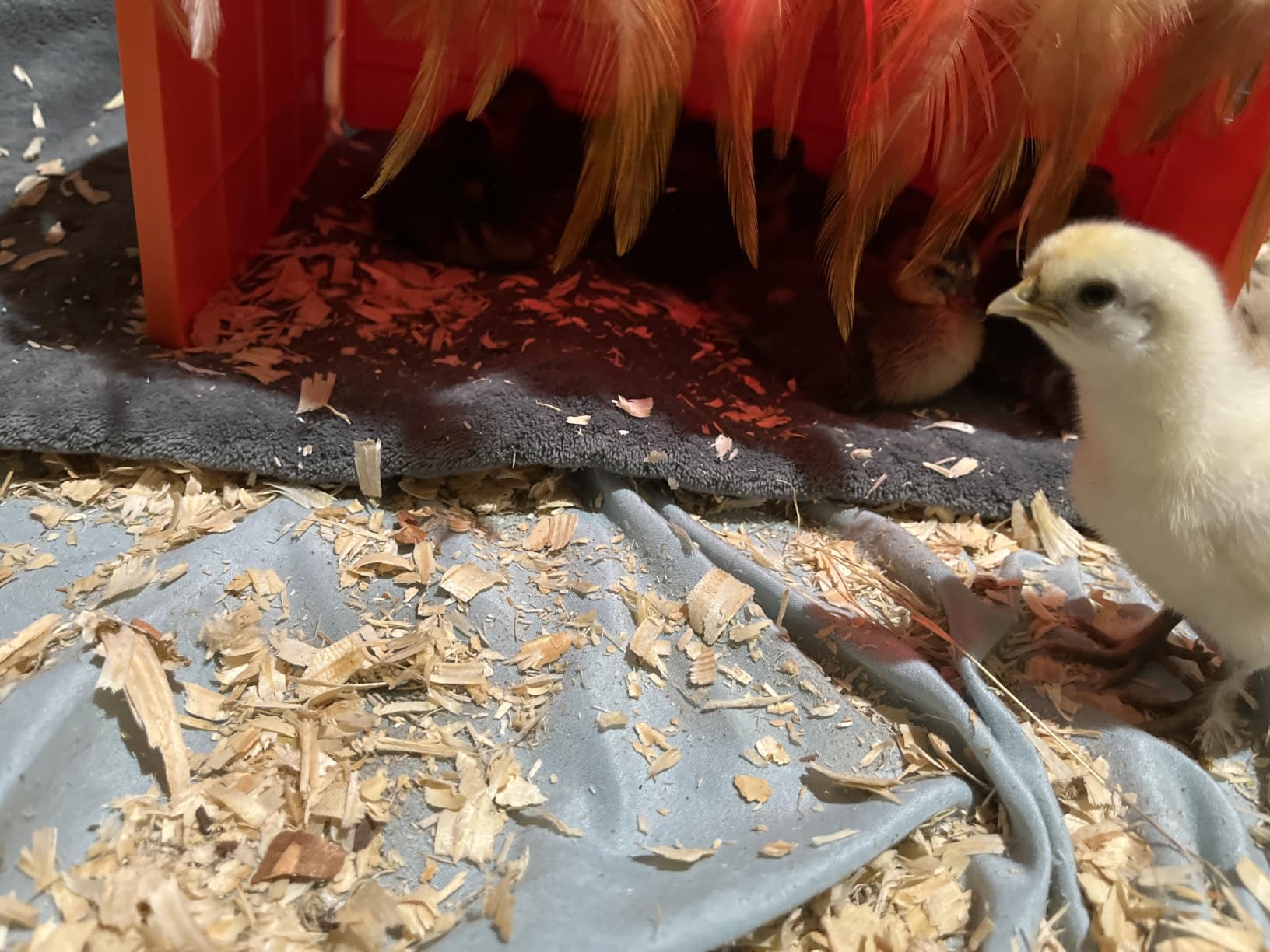
Best where chicks sit on top as well as under
Waterfowl prefer a warm surface over a warm ceiling, and the enclosed shell keeps that heat where they can reach it. The stepped settings also let you dial heat back as the birds feather out, and the wipe-clean shell survives the mess ducklings make.
Watch for these limits
Buy a bracket or taller legs if you need a rigid platform, because chicks hopping up will push the plate down. It is not a good fit for quail or for a cold unheated space, and the on and off switch on the cord is easy to bump by accident.
5. NUGRIART 10×10 Plate – Best Low-Power Budget Plate
NUGRIART Brooder Heater for Chicks, 10″ x 10″ for 15 Chicks Heating Plate with Adjustable Height and Angle 15W Chicken Brooder Warm Like Mother Hen
10x10 inch plate rated to 15 chicks
15W draw
Reaches about 115F after an hour
Dual fuse protection
Pros
- 15W draw among the lowest in the group
- Aluminum base plate spreads heat more evenly
- Dual fuse protection is a genuine safety plus
- Removable acrylic top makes cleaning painless
- Compact enough for a small brooder box
Cons
- No thermostat or temperature readout
- Runs cooler than spec in a cold brooder
- 10x10 footprint is tight for a full brood
Fifteen watts puts it among the lowest draws in this comparison, and the aluminum base plate is the reason it feels warmer than the wattage suggests. Rather than a bare plastic panel that creates hot and cold patches, the aluminum spreads the warmth evenly, which is exactly what you want under a small group of chicks.
The safety story here is unusually well thought out for the price. There is a 10 amp resistance fuse and a separate 120C thermal fuse, so an electrical fault and an overheating panel are handled independently. The removable acrylic top plate lifts off for cleaning, which reduces the single most tedious part of brooding.
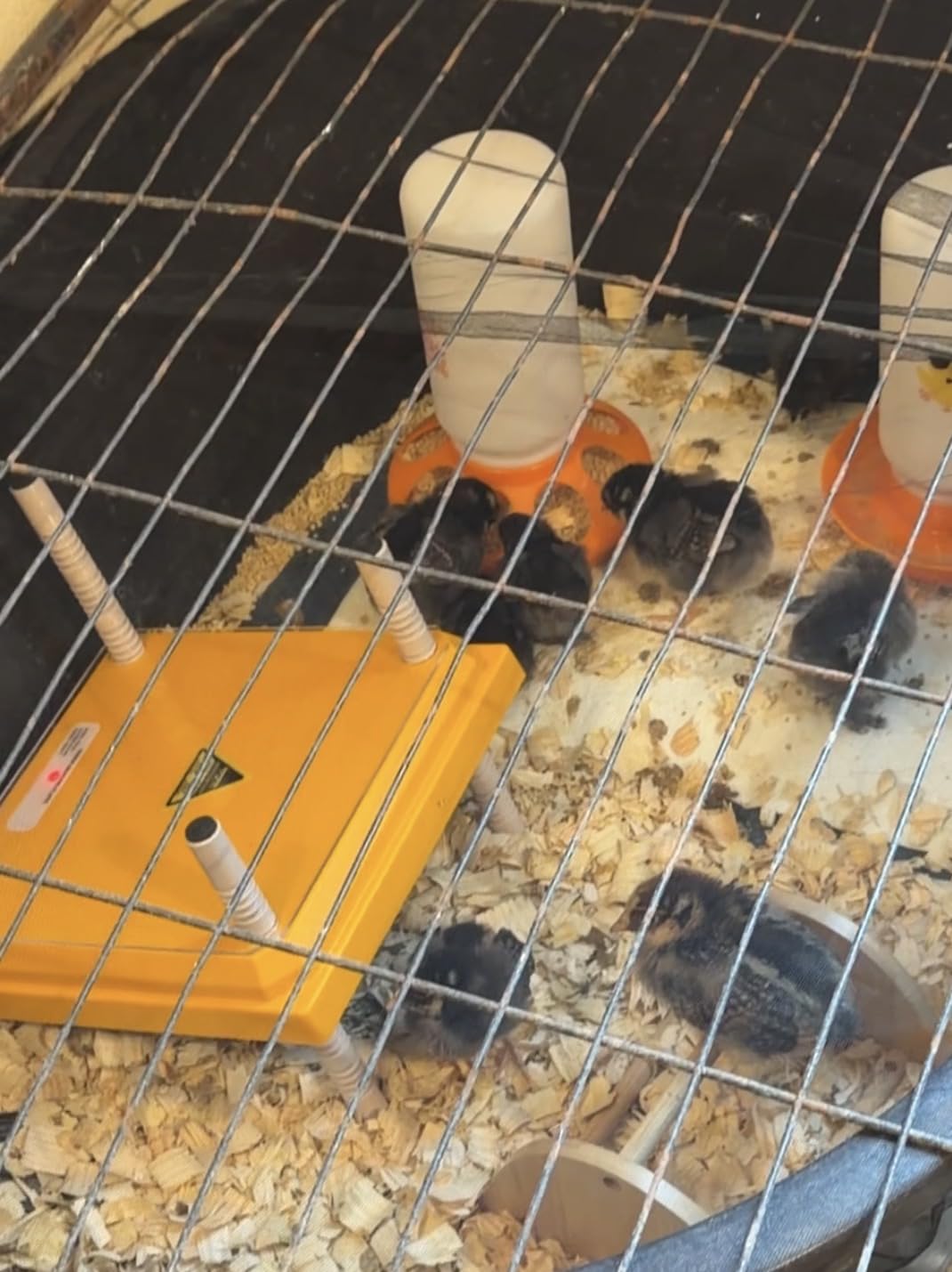
Owners switching from heat lamps are consistently happy, with several reporting no losses at all and buying more than one. The substantive reservation is heat output in a cold brooder, with one buyer measuring a surface in the upper 80s, which is short of the 95F a freshly hatched chick needs in week one.
That makes this an excellent second-week and supplemental plate rather than a first-week unit, unless your brooder box is warm. The 10 by 10 inch footprint is also smaller than most buyers expect, so measure your box before committing to a brood of 15.
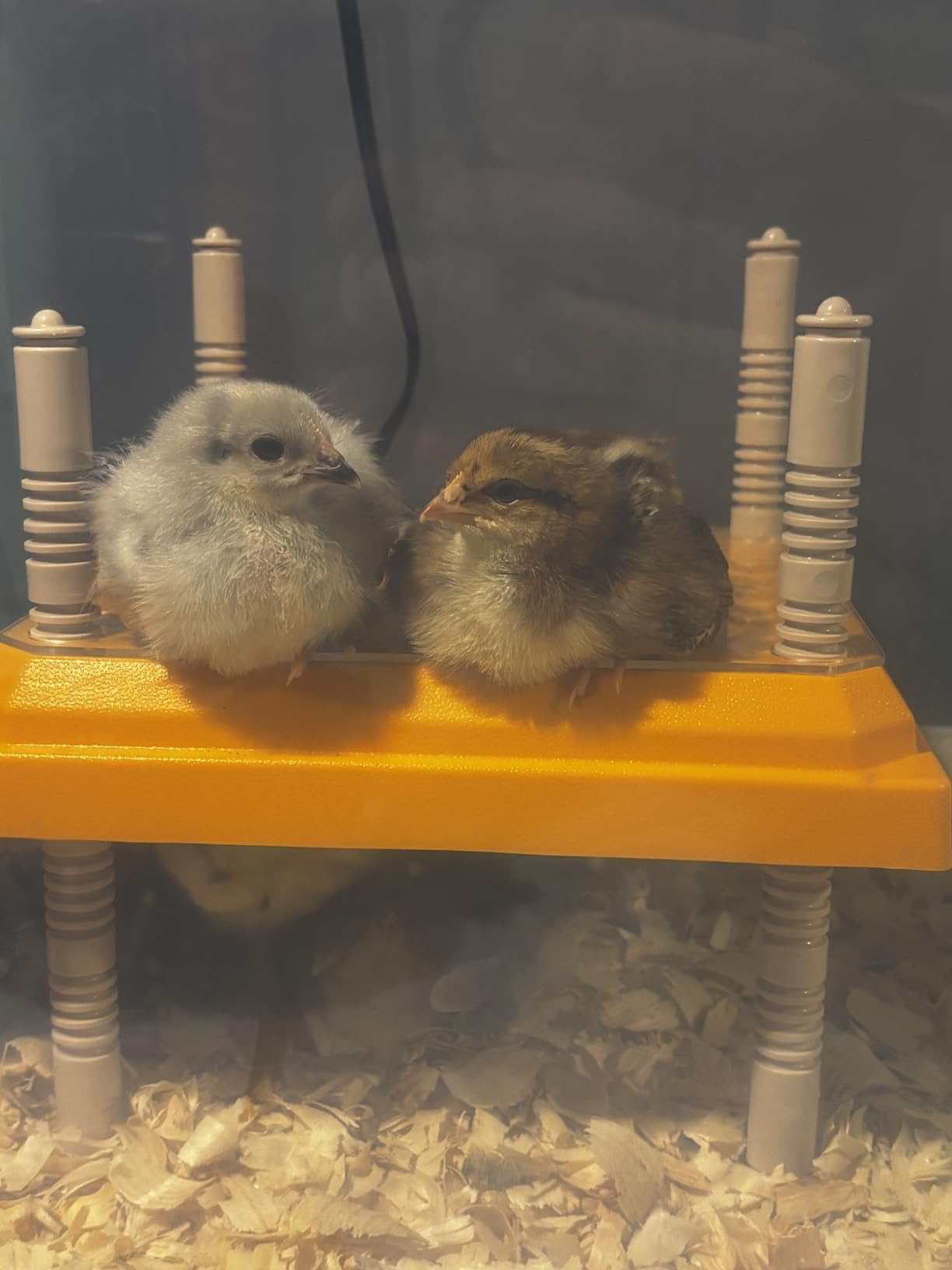
Best for a small brood in a warm room
When your brooder is indoors and the room is already at 70F or above, this plate handles 10 to 12 chicks comfortably and draws very little power over a six week cycle. The dual fuses and aluminum base give you more engineering than the price suggests.
Watch for these limits
Do not rely on it as the only heat source for day-old chicks in a cool space, and expect to check temperature with a separate thermometer every day. The snap-leg height and angle system works well but needs adjusting as birds grow.
6. ZenxyHoC 12×12 Plate with Anti-Roost Cone – Best Cone Value
Chick Brooder Heater with Anti-Roost Cone & Constant Temp Red 12″ x 12″
12x12 inch radiant plate
Marketed for 20-25 chicks
Four sturdy adjustable legs
Anti-roost cone included
Pros
- Anti-roost cone included at a budget price point
- Four-leg base resists tipping with active chicks
- Even surface temperature with no hot spots
- Multiple height settings from day one to fully feathered
- 10x10 variant also available
Cons
- Thinnest review base in the group
- No thermostat or temperature readout
- Manufacturer hedges the 20-25 chick figure
Getting a foldable anti-roost cone with a plate is normally the feature that pushes you to a premium listing, and here it is standard. The cone attaches above the plate and stops chicks perching on the warm surface, which keeps the top clean and the heat channel open. If mess on the plate has been your recurring chore, that alone justifies the choice.
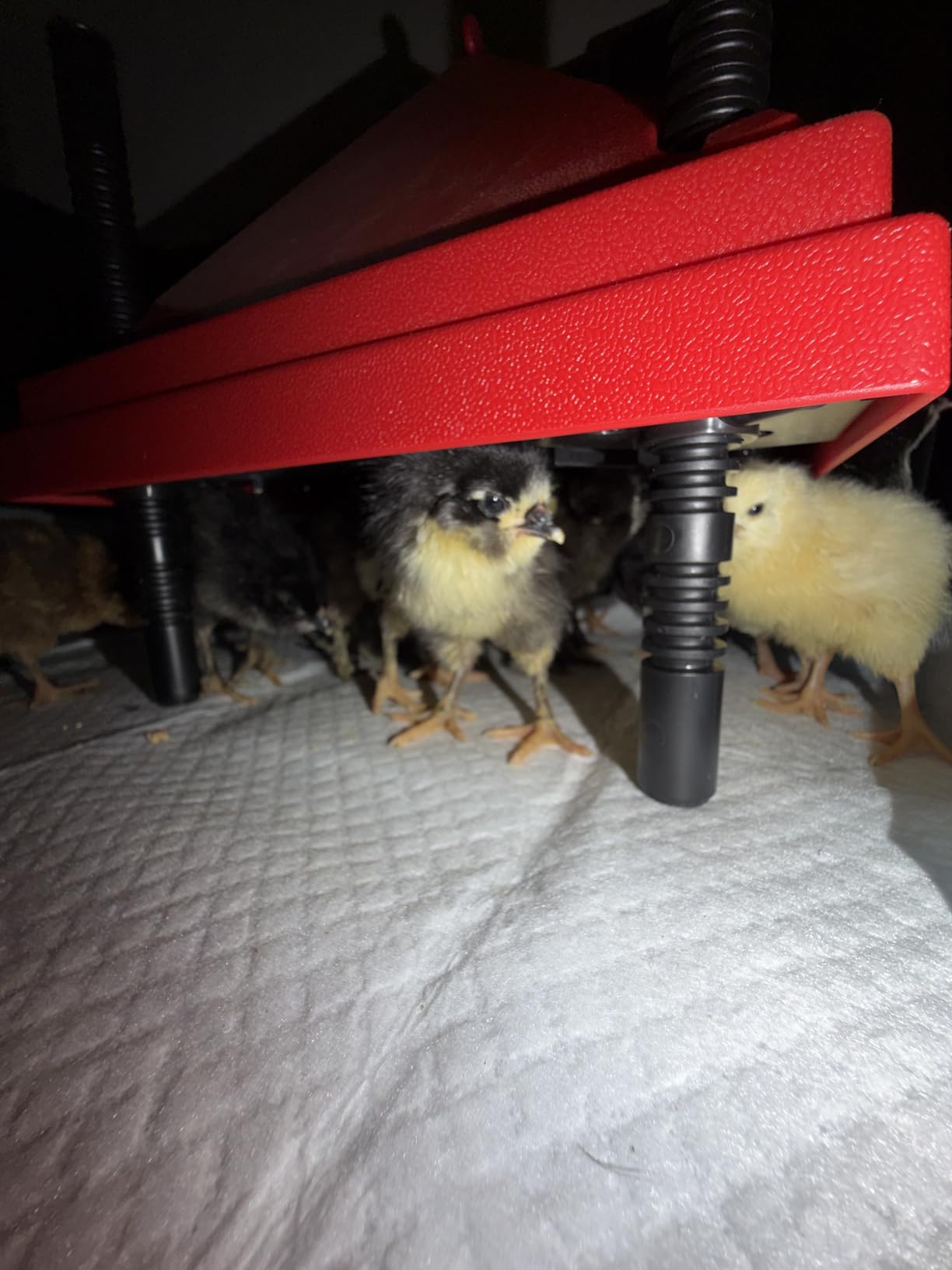
The four-leg base is the other thing I would highlight. Chicks moving constantly under a plate will shift a two-legged unit, and this one resists tipping in an active brooder. Height settings on all four legs cover the range from newborn to fully feathered without swapping hardware.
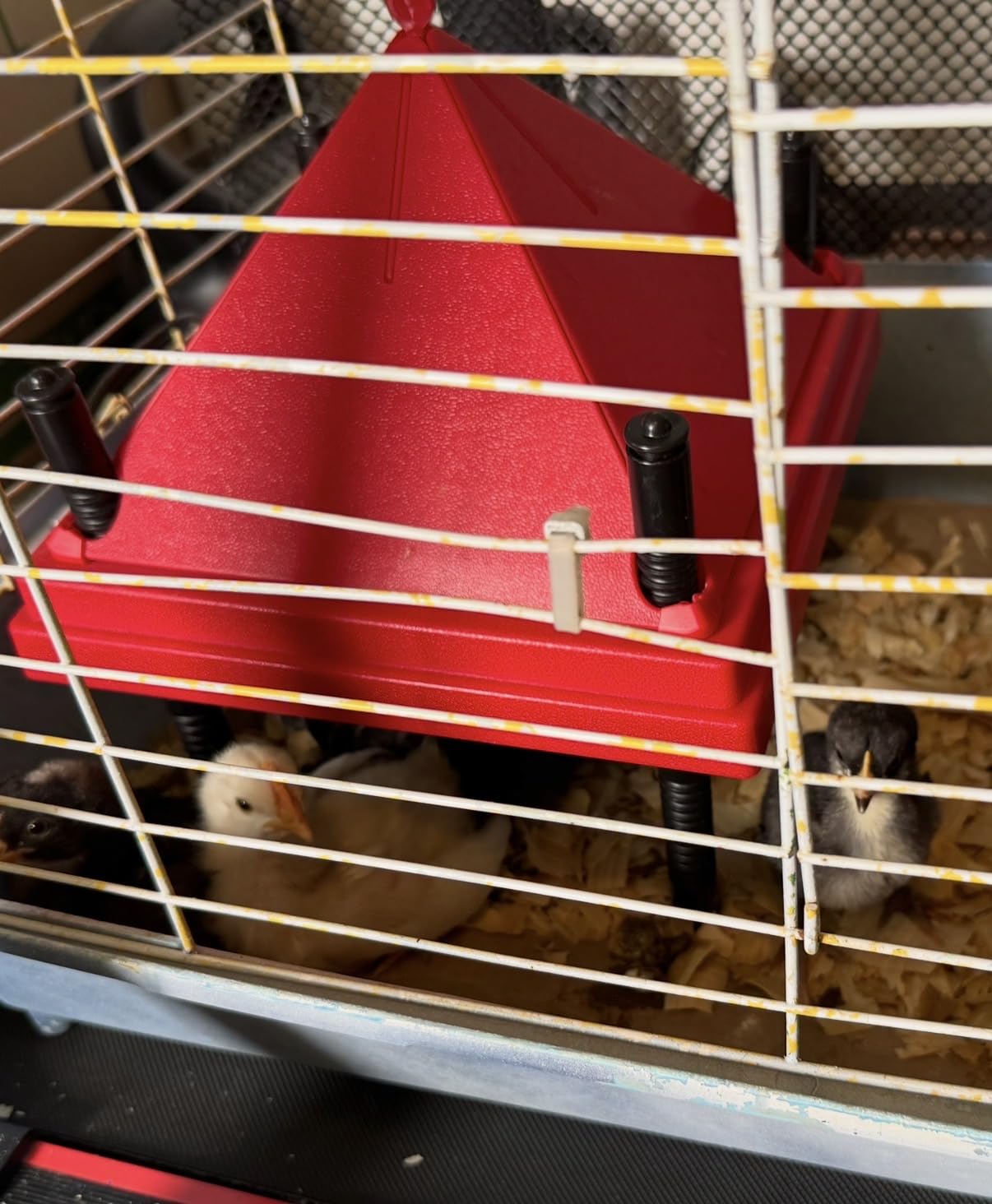
Two honest weaknesses. The review base is the thinnest in this comparison, so multi-season durability is less well documented than for the established brands, and the listing is recent enough that the feedback skews toward first impressions. The manufacturer also qualifies its own capacity claim of 20 to 25 chicks as depending on conditions, which is a good sign of honesty but leaves you to judge your own brooder.
There is no thermostat or readout, so plan on an external thermometer and weekly leg adjustments. For a first brood of 10 to 15 chicks, however, the cone and the stability are a genuinely useful package.
Best for keepers tired of cleaning the plate top
The cone does the work of a habit you would otherwise have to enforce, and the even surface temperature avoids the hot and cold patches that make chicks cluster unevenly under a lamp. It is a good match for a brooder box with a low ceiling where you cannot hang anything.
Watch for these limits
With fewer reviews behind it, budget for a possible return if the legs feel loose out of the box, and verify the surface temperature yourself in week one. Do not plan a 25 chick brood around the listed capacity without a second plate nearby.
7. TRIOCOTTAGE Digital Plate – Best Digital Controls
Chick Brooder Heater Plate with Digital Temperature Control, Chicken Coop Heater for Chicks & Ducklings, LED Display, Remote Control, Adjustable Angle, 86°F–167°F Heating Plate
86-167F adjustable surface
LED display with remote control
Four 24 hour heating cycles
35W, dual-sided heating
Pros
- Digital display and remote control let you check and change settings without reaching in
- Four programmable heating cycles repeating every 24 hours
- Usable upright tilted or hanging
- Only 35W so running cost stays low
- Plate wipes clean and stands washable
Cons
- Verified buyer feedback on the plate itself is thin
- One safety report describes the plate detaching and falling onto very young birds
- Small legs feel less robust than metal-framed models
The electronics here are the most capable in the group by a wide margin. The surface temperature adjusts from 86F to 167F, the LED display shows the current reading and cycle, and the included remote means you can change a setting without reaching into a brooder full of chicks. The four cycle options, from 6 hours on and 18 off through 12 on and 12 off, repeat every 24 hours and let you shape a day and night rhythm.
Dual-sided heating is genuinely useful too. Mount the plate upright against the side of the brooder, tilt it or hang it, and you can place warmth exactly where the flock is sleeping. At 35W it stays cheap to run.
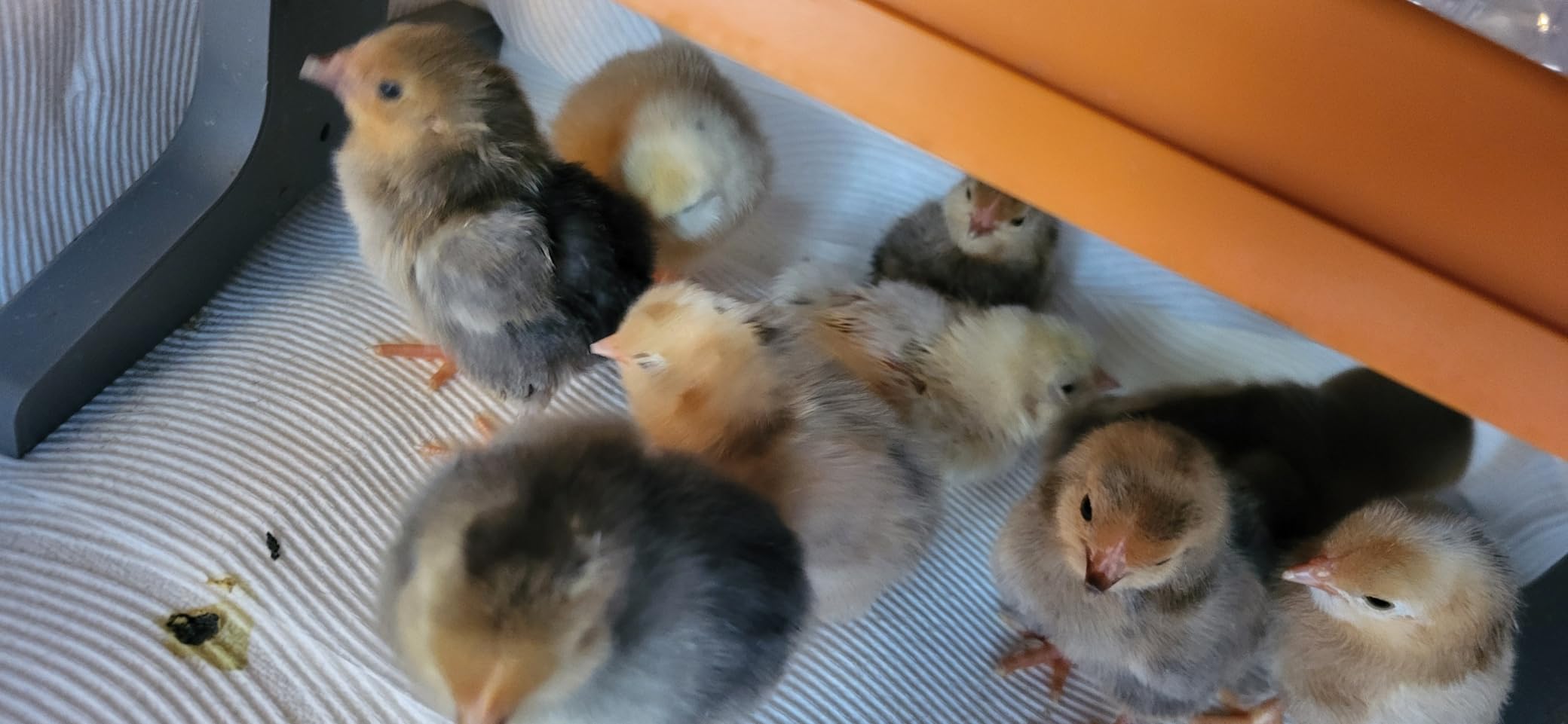
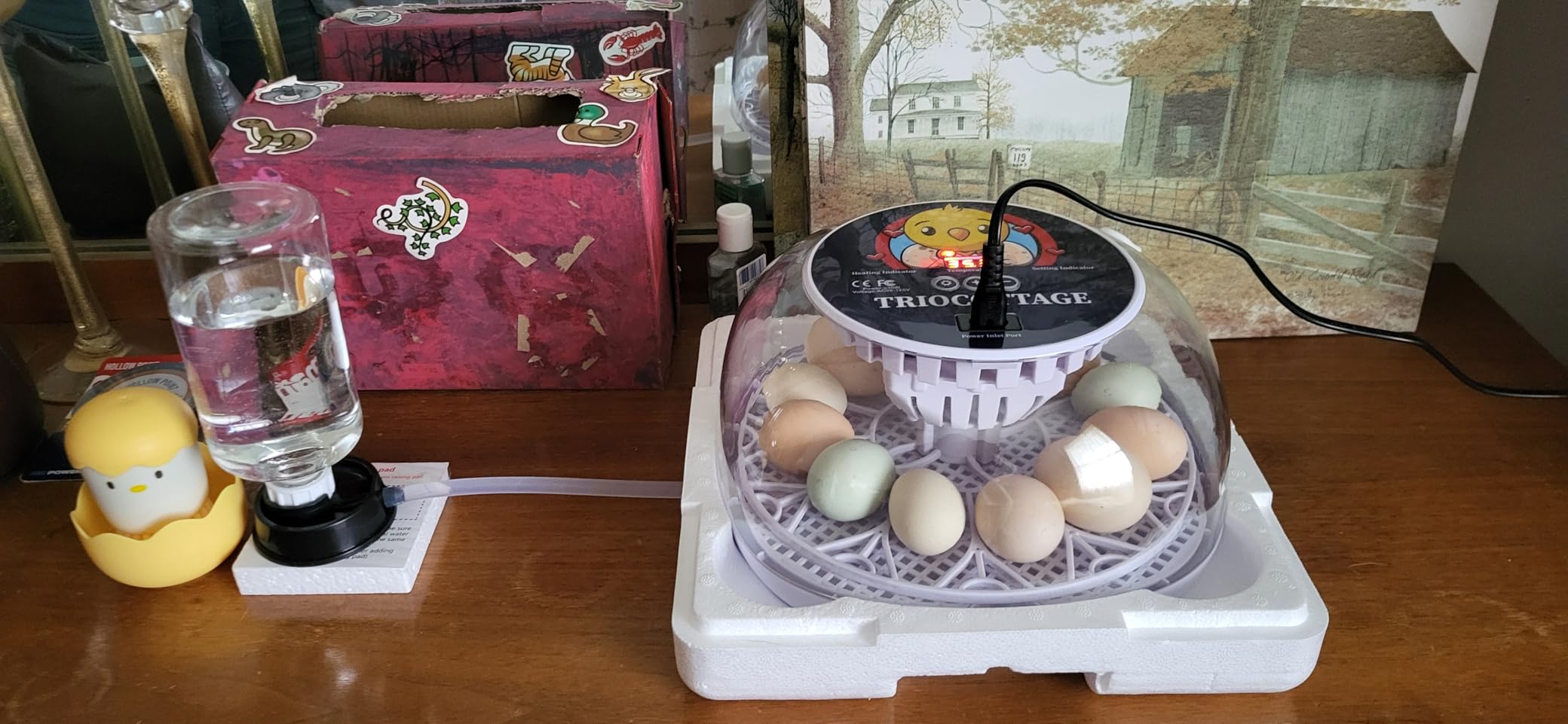
Now the honesty part. The review record attached to this listing is dominated by reviews describing an egg incubator rather than this plate, so verified feedback on the brooder plate itself is thin. Within what there is, one serious report describes the black plate detaching and falling onto very young quail with a fatality, and several buyers find the small legs less robust than the metal-framed models.
It also carries the lowest average rating in this comparison. If you want the controls and can live with a light build, it is a capable unit. If your priority is a plate that will not move, pick one of the four-legged models instead.
Best for precise scheduling and odd brooder layouts
The programmable cycles are the reason to buy it, because they let you drop overnight output without touching the dial, which supports the quieter night rest that keepers look for in plate brooded birds. A wall or side mount also solves the problem of a brooder too short to stand a plate inside.
Watch for these limits
Check that the plate is fully seated on its supports before you leave the brooder unattended, and supervise the first few days. Treat the rating spread as a signal to inspect the mounting hardware early rather than to expect trouble.
8. Shaledig 12×16 Plate – Best for Large Broods
Shaledig 12″ x 16″ Chick Brooder Heater Plate for 40 Baby Chicks Ducks
12x16 inch plate rated to 40 chicks
30W element with overheat limiter
Panel surface held at 122-149F
Height adjustable 2.56-7.09 inches
Pros
- One of the largest plates here at up to 40 chicks
- Automatic overheat cut-off and restart
- High-temperature resistant non-flammable housing
- 30W draw keeps long brooding cycles inexpensive
- Four-step assembly with no tools
Cons
- No temperature readout beyond one indicator light
- Large footprint is awkward in a small brooder box
- A larger variant costs more for bigger broods
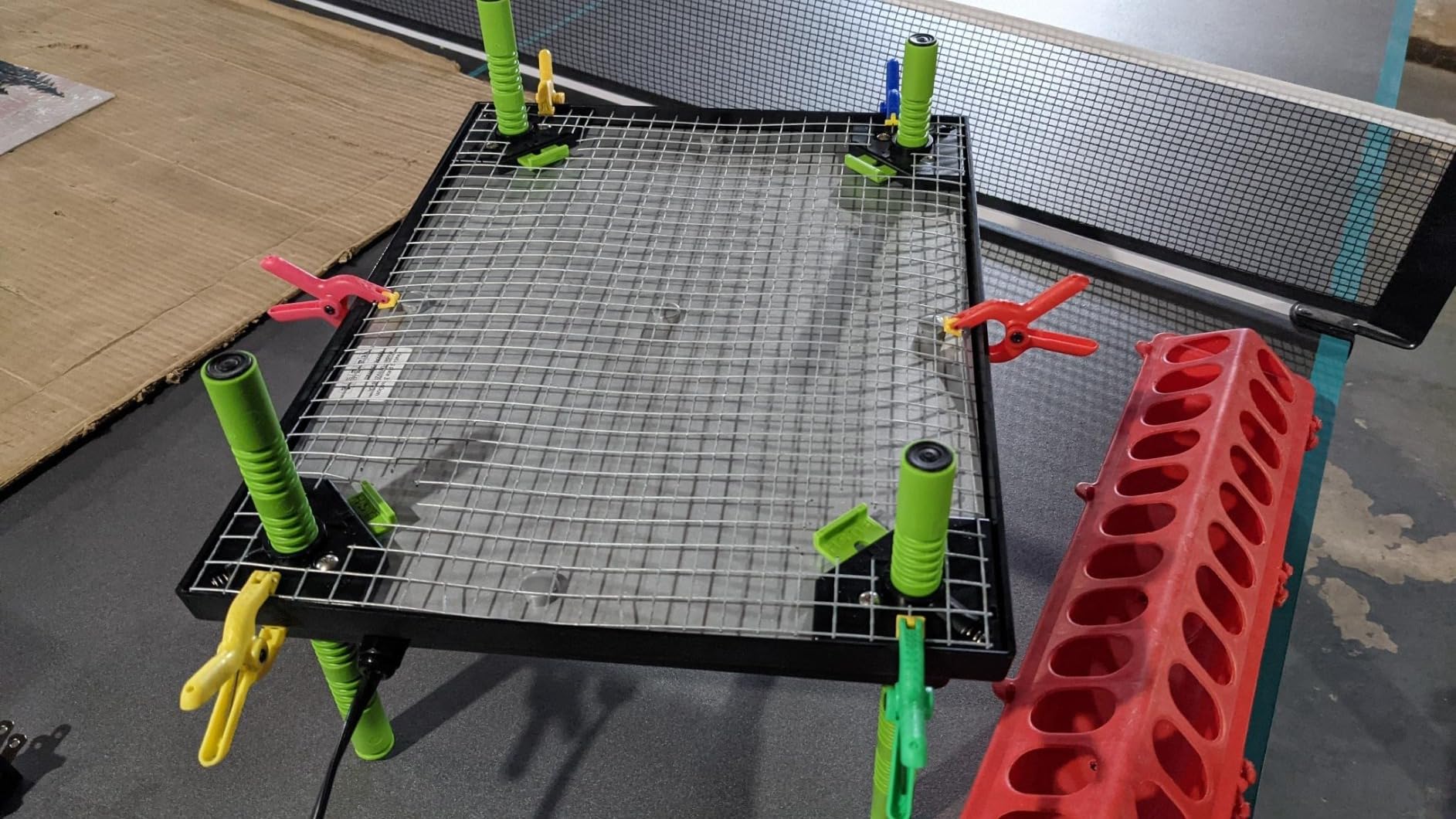
If your brood runs past 25 chicks, this is the plate that covers them in one unit rather than two. The 12 by 16 inch panel is rated for up to 40 chicks, and the automatic temperature limiter cuts heating at 167F and resumes below 131F, which is a genuine safeguard on a unit you are not sitting next to for six weeks.
The stated panel surface of 122 to 149F in a room between 50 and 86F is the number to watch. That is the surface the chicks feel, not the air under the plate, and it sits in the right band for the first two weeks of brooding.
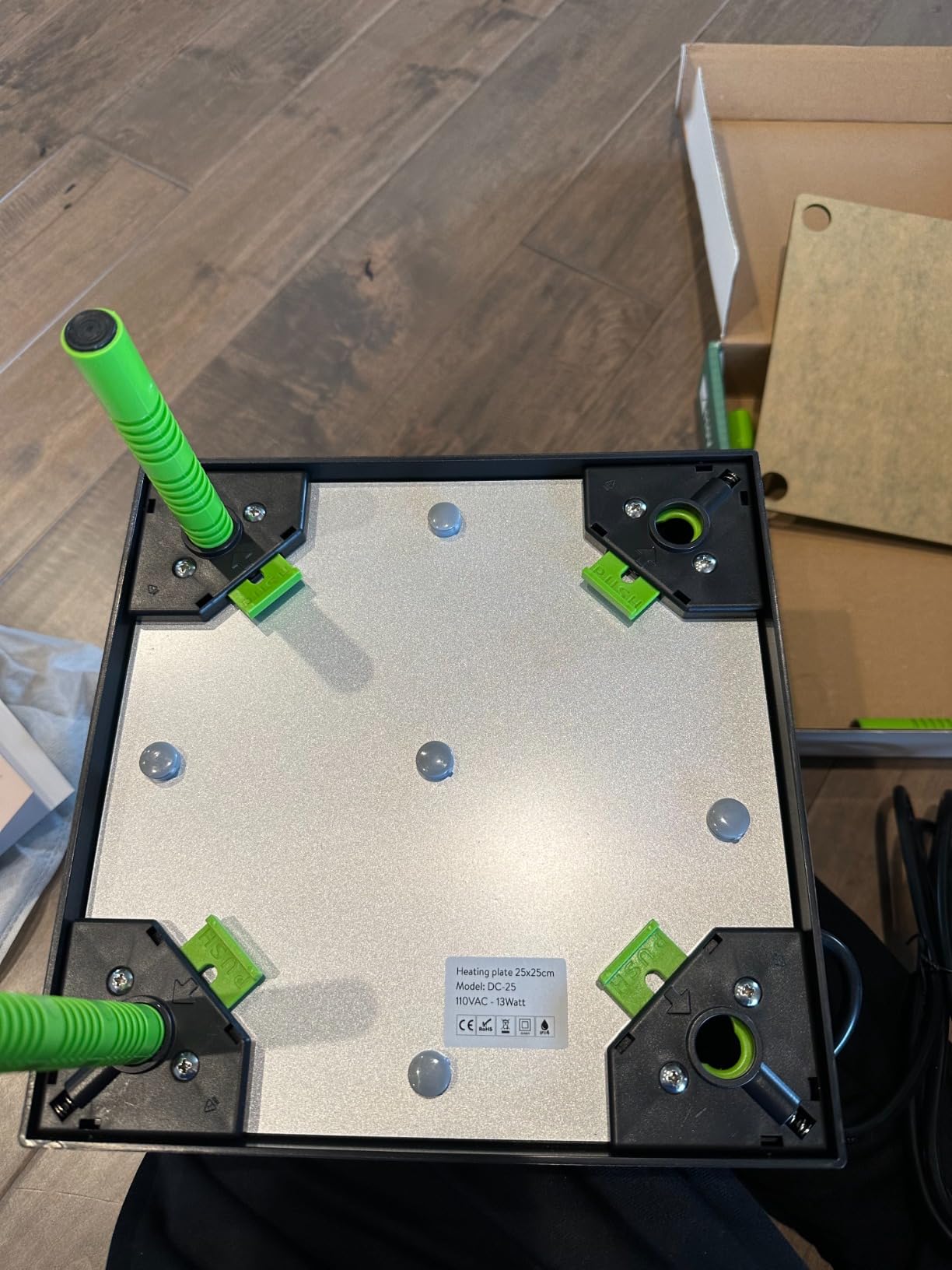
What you give up is feedback. There is a single indicator light and nothing else, so accurate temperature management depends entirely on your own thermometer. At 12 by 16 inches the plate is also large enough to crowd a small brooder box, and you should measure before ordering.
For anyone with 30 to 40 chicks, that is a trade worth making because a lamp cannot be scaled to cover a barn floor with a single bulb. A larger 22 by 16 inch variant exists for bigger broods.
Best when one plate has to cover the whole brood
Fewer units means fewer cords, fewer thermostats to check and less chance of chicks piling under one plate while another sits unused. The overheat limiter also means a power fluctuation or a bedding spill is less likely to leave you with a problem you will not hear about until morning.
Watch for these limits
Buy a quality brooder thermometer and check the surface twice a day for the first week, because the plate gives you no indication of what it is doing. A larger brooder box is effectively required for the full stated capacity.
9. Tetuga 12×16 Thermostat Plate – Best Built-In Thermostat
Tetuga Brooder Heat Plate 12 X 16” Chick Heating Plate Warm Up to 30 Chicks
12x16 inch plate for up to 40 chicks
Built-in thermostat at 122-149F
2-7 inch height, multi-angle
30W, flame-retardant casing
Pros
- Built-in thermostat holds a steady surface temperature
- Top stays cool enough to handle chicks safely
- Angling front and back creates a natural gradient
- Green top protector lifts off droppings easily
- Reported in continuous use for six weeks
Cons
- No display so the setpoint cannot be verified
- Needs a height adjustment or two each week
- One buyer reported a unit that stopped heating
This is the value pick for temperature control. A built-in thermostat holds the heating panel surface steadily between 122 and 149F, which is a meaningful upgrade over plates that simply run at a fixed output and hope the room temperature cooperates. It covers roughly 80 percent five-star reviews, the highest five-star share in this comparison.
Two details stand out in owner feedback. The top surface stays cool to the touch, so you can reach in to handle chicks without a burn scare, and angling the front and back edges creates a natural warm to cool gradient without any adjustment to the power setting.
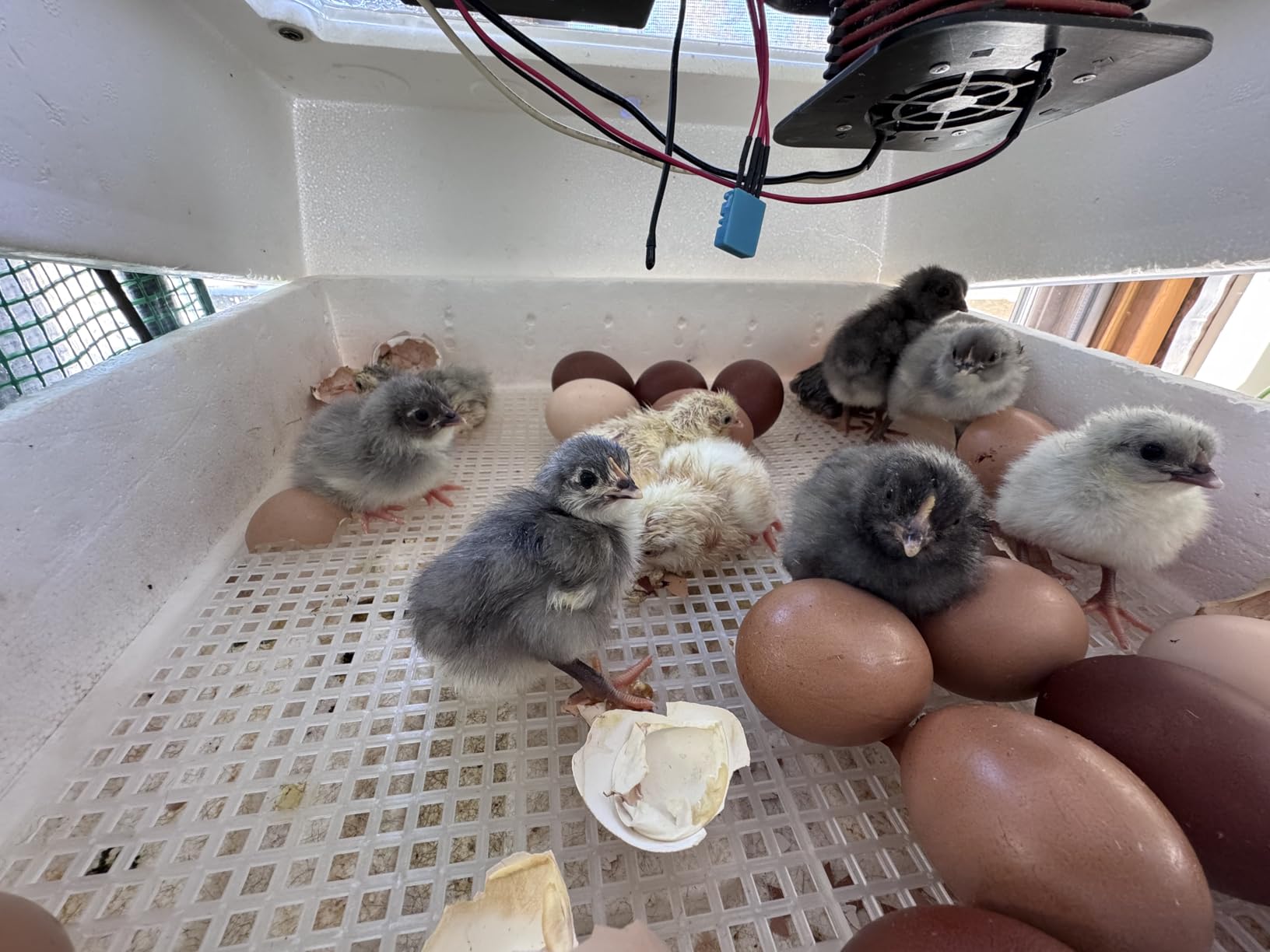
The thermostat has no display, so you cannot confirm the setpoint, and you will still adjust the snap legs once or twice a week as birds develop. Owners running a full brood describe the 12 by 16 size as right for younger chicks and snug as they grow, and suggest stepping up in size beyond 10 chicks as they approach feathered size.
One buyer reported a unit that stopped heating after two weeks. The green plastic top protector is a small but real convenience, since dried droppings lift off with a damp paper towel.
Best for hands-off temperature control on a budget
If your worry about plates is that a fixed-output unit will not react to a cold snap, the thermostat handles that. Several owners report replacing a heat lamp with this plate entirely after the first week, and one ran it for six straight weeks from day-old to nearly seven weeks old.
Watch for these limits
You are trusting a thermostat you cannot read, so keep a thermometer in the brooder anyway. Plan your chick count against the 40-chick rating only if your birds are small, and check the unit early in the brooding period.
10. Tetuga All-In-One Brooder Box Kit – Best Starter Kit
Tetuga Brooder Box for Chick Starter Kit with 10x 12” Brooder Heating Plate
Pen, 10x12 inch plate, feeder, waterer
Mat, bag and 3 ground stakes
Overheat cut-out at 167F
Pop-up washable frame
Pros
- One purchase covers pen plate feeder waterer mat and stakes
- Pop-up frame means almost no assembly
- Folds flat into the included bag between broods
- Three-sided mesh cut odour noticeably
- Washable Oxford cloth with a removable mat
Cons
- Realistically sized for about 8-10 chicks
- No hard frame so a cat on top can collapse it
- Bundled feeder and waterer need replacing early
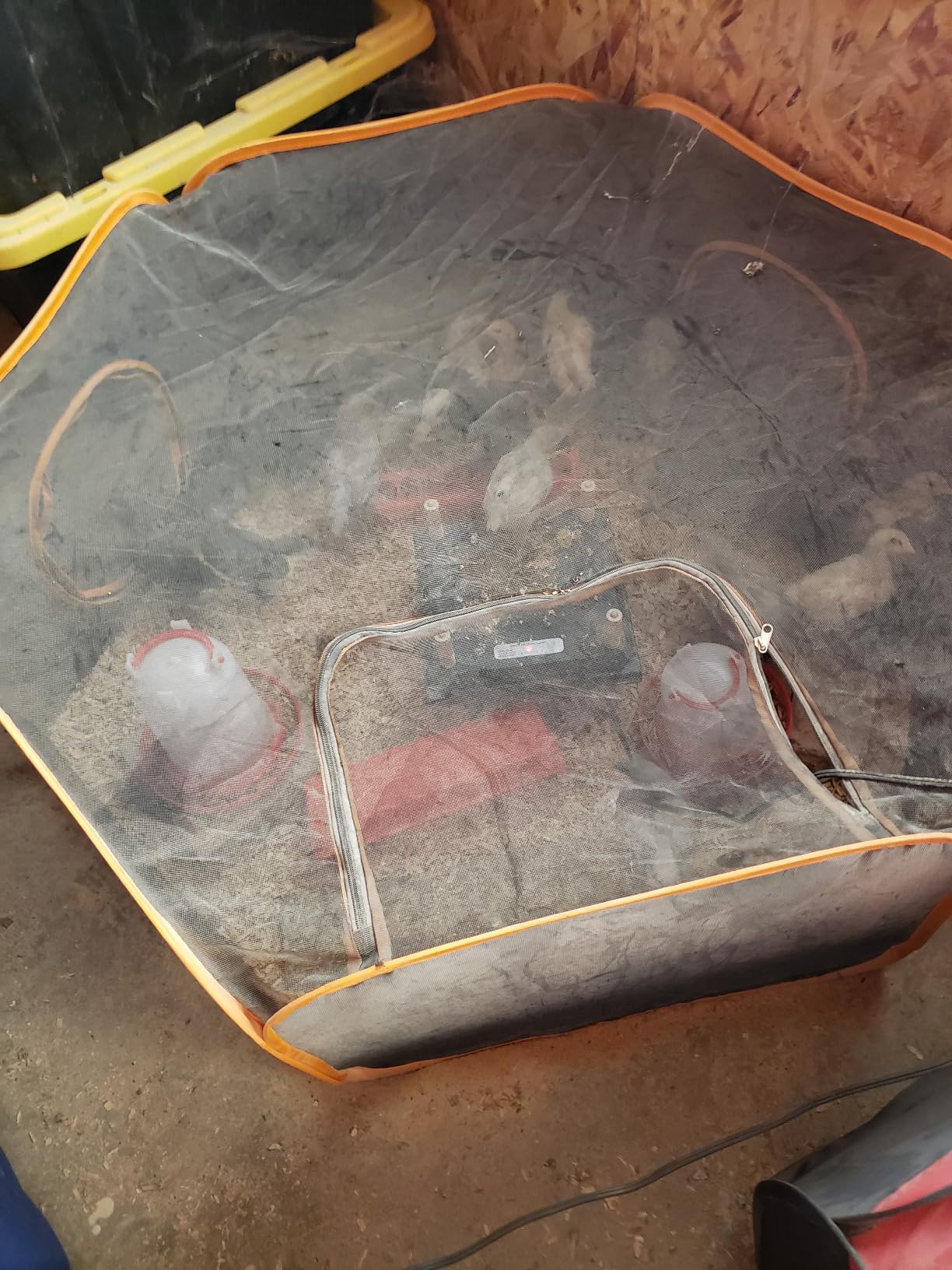
If this is your first brood, this kit removes the decision entirely. You get the pop-up brooder pen, a 10 by 12 inch adjustable heating plate, a feeder, a waterer, a floor pad, a storage bag and three ground stakes in one box. Several owners note that at their local farm feed store the whole bundle covered more ground than the heating plate sold on its own.
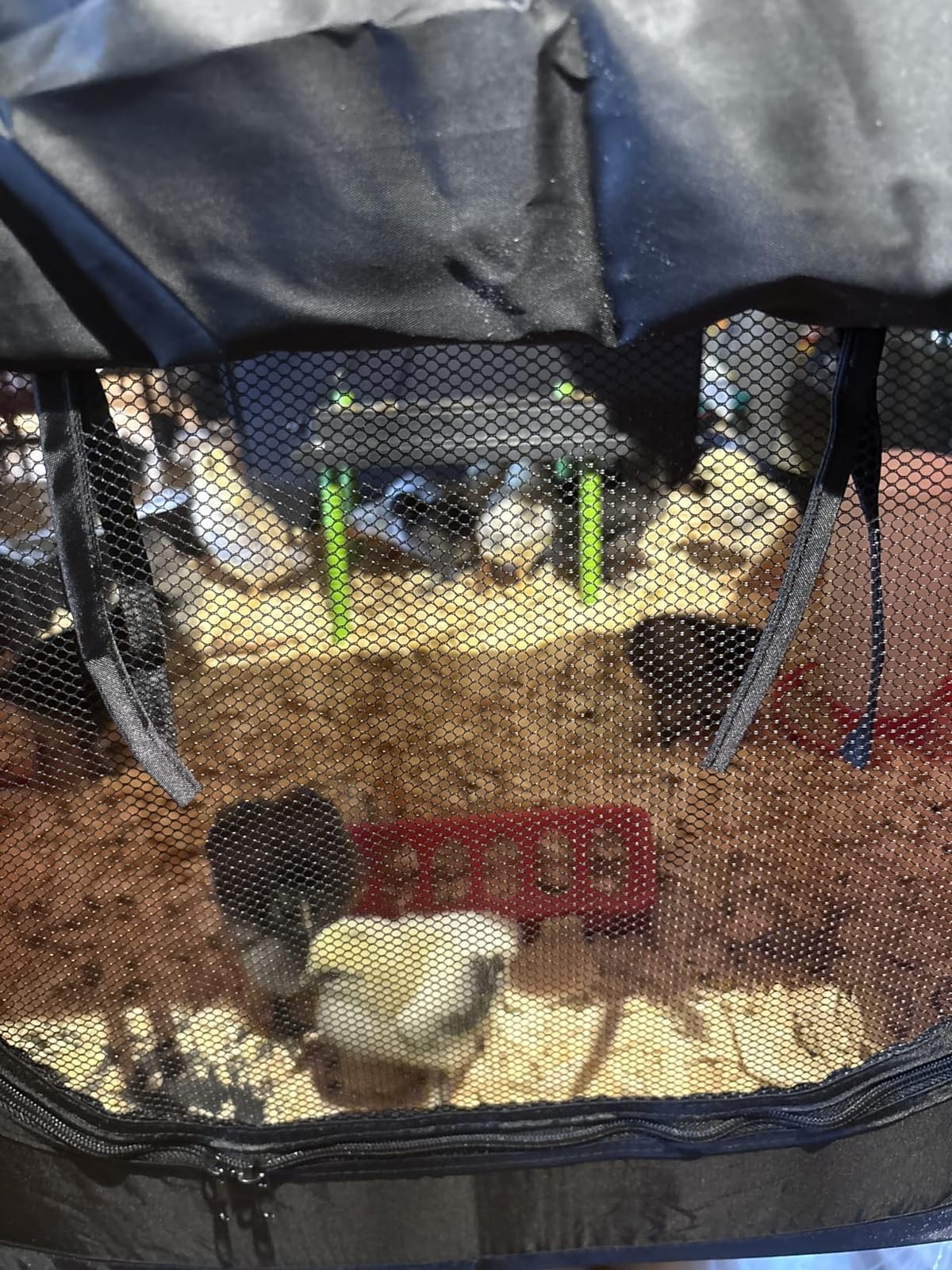
The pop-up frame is what makes it pleasant to own. It needs no assembly, folds flat for storage between batches, and the three-sided mesh with drop curtains works indoors or outdoors. Ventilation was the surprise for many owners, who found it cut odour far more than a solid-sided box would.
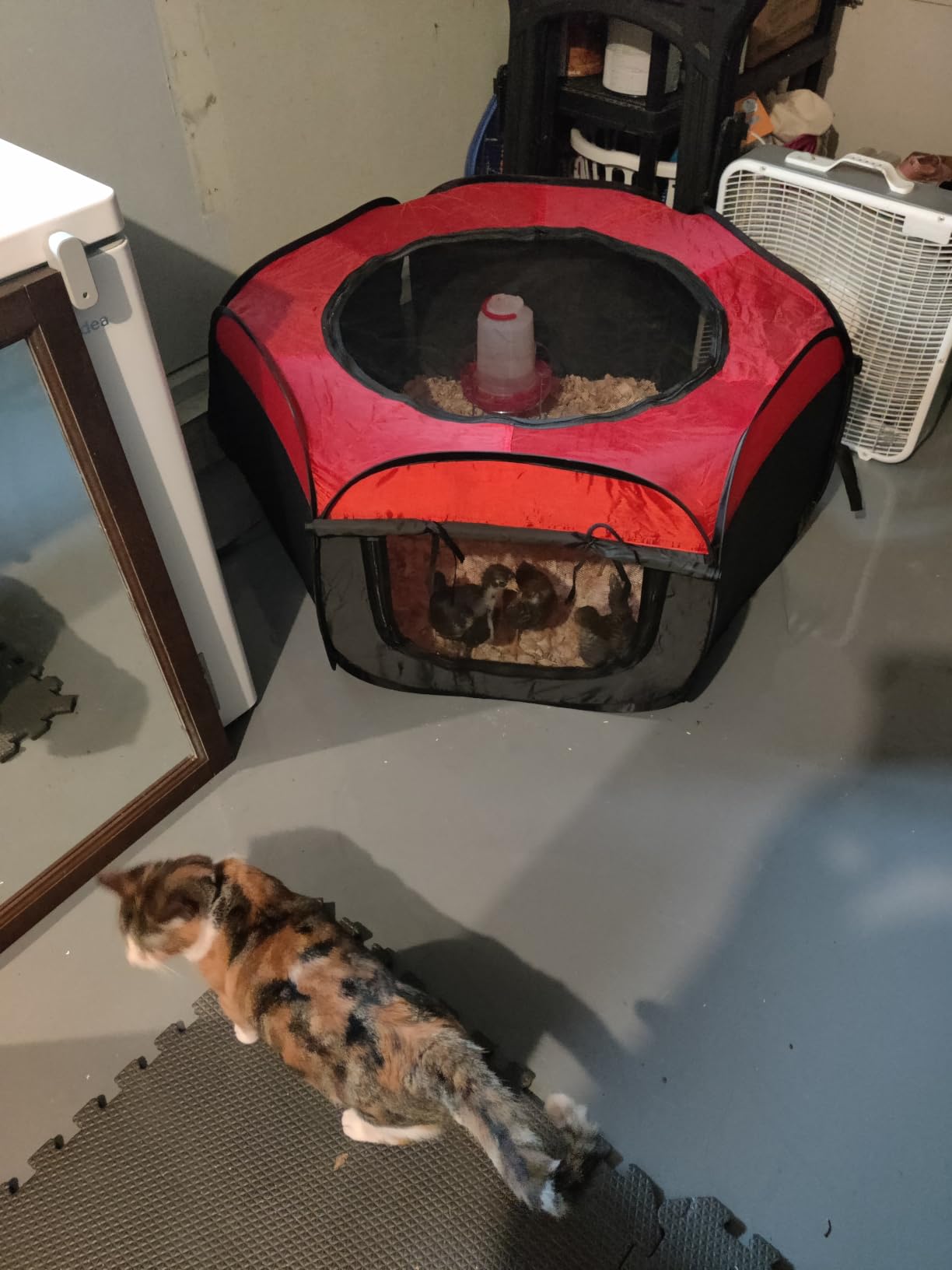
The ceiling here is flock size. Reviewers consistently cap it at about 8 to 10 chicks, and owners with 8 birds report it getting tight by the end of the brooding period. The soft-sided pen also has no rigid frame, so a cat or a large bird jumping on top can collapse the tent onto the chicks, which is the reason to keep it indoors or in a protected corner.
The included plate has no manual temperature adjustment, so a separate thermostat was needed for at least one owner, and the bundled feeder and waterer tend to need replacing after the first week or two. The side zipper for the plate cord also separates a little with daily use.
Best for a first brood of eight or ten chicks
It is a genuinely complete answer to brooding indoors, and the mesh sides plus zippered roof made the full six to eight week period workable for the owners who reported on it. Outdoor use is possible with the stakes and curtains, and the washable cloth with a removable mat makes cleanup fast.
Watch for these limits
Do not plan a brood of 20 in this pen, and keep it out of reach of cats and large birds. Expect to replace the feeder and waterer early, and add your own thermometer because the included plate has no controls.
How to Size a Brooder Heat Plate for Your Flock
The derating rule: why a 20-chick plate really holds 10 to 15
Every plate in this comparison is rated by the manufacturer at the point where chicks are newly hatched, and every one of those ratings is optimistic once the birds start growing. A plate advertised for 20 newborns behaves like a 10 to 15 chick plate in practice, and the gap widens each week as chicks roughly double in size.
A simple rule that has held up across owner reports is to take the rated number and cut it by roughly half for day-old birds, then cut it further if your brooder box is cool or your birds are a large breed. If you are planning 20 chicks, buy a plate rated for 40 or plan on two plates from the start. Measuring twice costs less than a pile of chicks.
Plate size versus wattage for your flock count
Wattage is about running cost and warm-up speed, not capacity. The plates in this group run from 12 watts to 35 watts for brooder duty, with one 200 watt panel designed for a bigger space and possible adult use. A small plate at 12 to 15 watts will keep 10 chicks perfectly warm in a roomy brooder, and a larger plate at 30 watts covers a bigger brood without any change in the electricity bill.
Size the plate by the square inches available under it, not by the number on the box. A 12 by 12 inch plate comfortably holds 10 to 15 small chicks, a 10 by 10 inch plate suits 8 to 12, and a 12 by 16 inch plate covers a brood up to about 25 to 30 once you apply the derating. If you are powering two or more plates from one outbuilding circuit, use a properly rated extension run because voltage drop is a real problem in long leads.
Week-by-week brooding temperature schedule
Keep the heat continuous through the first week at 95 to 100F under the plate, measured at chick height rather than at the panel surface. Many keepers also run a lamp alongside a plate for the first two days with shipped chicks, until the birds have stopped looking for the light.
From there step the temperature down each week, roughly 5F per week, and keep watching chick behaviour rather than the calendar alone. Plate temperature is a surface reading, so the air under the plate will always read cooler than what the chicks feel.
How to tell if your heat plate is warm enough
Check five things. First, put a thermometer at chick height under the plate, not on top of it, and read it in the middle and at the edge to confirm a gradient. Second, watch the chicks: piled on top of each other and cheeping loudly means too cold, while scattered and panting means too hot.
Third, notice where they sleep. Chicks tucked flat under the plate with their backs to the surface are comfortable, whereas chicks pressed against the panel edge are asking for more heat. Fourth, check the corners of the brooder, because a cold draft there will undo a well-heated plate. Fifth, verify that chicks can walk away from the heat, since a plate that cannot be left is a plate that will overheat them.
Safety checklist for brooding indoors
Look for a plate with a low-voltage element, a flame-retardant or non-flammable housing, and an automatic overheat cut-off, since two plates in this comparison list both a thermal fuse and a 167F cut-out.
Route the cord along a wall and away from bedding, and never run a plate through an extension lead that is not rated for the load.
Keep the plate on the brooder floor rather than hanging it above chicks, so a failure drops it onto bedding rather than onto them.
Keep waterers and damp bedding away from the element, and never clean a plate while it is plugged in.
Add a guard or cone if chicks perch on top, since droppings on a hot panel are both a hygiene problem and a smell problem.
If a plate is the only heat source, keep a clamped lamp on hand for power interruptions rather than running a cold-brooding experiment.
If the brooder shares a room with a kitchen, give it its own outlet and keep clearance from appliances; our guide to small indoor grills with removable plates covers the same clearance rules.
Teaching chicks to use the plate
Newly hatched chicks that have never seen a plate will often huddle in a corner because that is what feels safe, so plan to tuck them in by hand for the first two nights. Gently place a few chicks under the warm area, leave them still, and repeat a few times. Most broods are using the plate on their own within two or three days.
If chicks still refuse after a few days, lower the plate closer to the bedding so the warm zone is easier to find, and check that the temperature is actually high enough. Cold chicks pile into the warmest corner they can identify, which is usually not under the plate.
When chicks no longer need the plate
Chicks are fully feathered and can be moved out at around four to six weeks, depending on the breed and the time of year. The signals are behavioural rather than calendar based: birds that spend the day in the brooder and ignore the plate, roost on top of it instead of under it, or feather out completely are ready for more ambient heat.
Outdoors in mild weather they may need no added heat at all. In winter, a plate like the Chickcozy model can be repurposed as a coop heat source for adult birds rather than thrown in a cupboard.
Frequently Asked Questions
What is the best brooder heat plate for chicks?
The Brinsea Ecoglow is the best overall for small flocks because its 12 watt low-voltage panel draws so little and carries a 3-year warranty. The RentACoop 12×12 wins on adjustment with 25 height settings and a foldable anti-roost cone, and the Chickcozy 200W panel is the pick when you want a real thermostat and a plate you can reuse on adult hens. For any of them, halve the rated chick capacity for day-old birds.
Is a brooder plate better than a heat lamp?
A brooder plate is better indoors because there is no bulb, no hot socket and no radiant heat to ignite dry bedding. Plates also give chicks a warm zone they can leave and return to at will, which supports calmer behaviour and better rest than a lamp. Heat lamps still scale more easily for broods over about a dozen chicks, and many keepers run a clamped lamp alongside a plate for the first two days with shipped chicks.
What is the safest heat source for a chick brooder?
The safest option is a low-voltage heat plate with a flame-retardant or non-flammable housing and an automatic overheat cut-out, mounted on the brooder floor with the cord routed away from bedding. The Chickcozy panel in this comparison is UL and CCC certified, and the NUGRIART plate adds a separate thermal fuse to its resistance fuse. Whichever you choose, keep a properly clamped lamp on hand for outages.
How do you tell if a brooder plate is warm enough?
Put a thermometer at chick height under the plate rather than on its surface, and read both the centre and the edge to confirm a gradient. Then watch the brood: chicks piled on each other and cheeping loudly are cold, while chicks spread out and panting are too hot. Chicks sleeping flat under the centre with their backs to the panel are comfortable. Remember that the plate surface reading is warmer than the air under it.
At what age do chicks no longer need a brooder plate?
Most chicks are ready to leave the plate at four to six weeks, depending on breed and season. Look for behaviour rather than the calendar: birds that ignore the plate, roost on top of it, or are fully feathered are ready for ambient heat. In mild outdoor weather they may need none. In winter, you can move a plate like the Chickcozy model into the coop as a heat source for adult hens.
The Verdict on Brooding Chicks in 2026
For most backyard broods the best heat plates for brooding chicks in 2026 come down to three choices. The Brinsea Ecoglow is our pick overall because a 12 watt low-voltage panel, adjustable screw-on legs and a 3-year warranty make it the lowest-draw and calmest way to replace a lamp. The RentACoop 12×12 is the better buy if you want finer heat zoning and a cone in the box, and the Chickcozy panel is worth stepping up to when you want a thermostat, UL certification and one plate that works for chicks and hens.
Whatever you pick, halve the rated chick capacity for day-old birds, verify the surface temperature with your own thermometer, and tuck the brood in by hand for the first couple of nights. Use the product links on each review to check current listings and seller details.