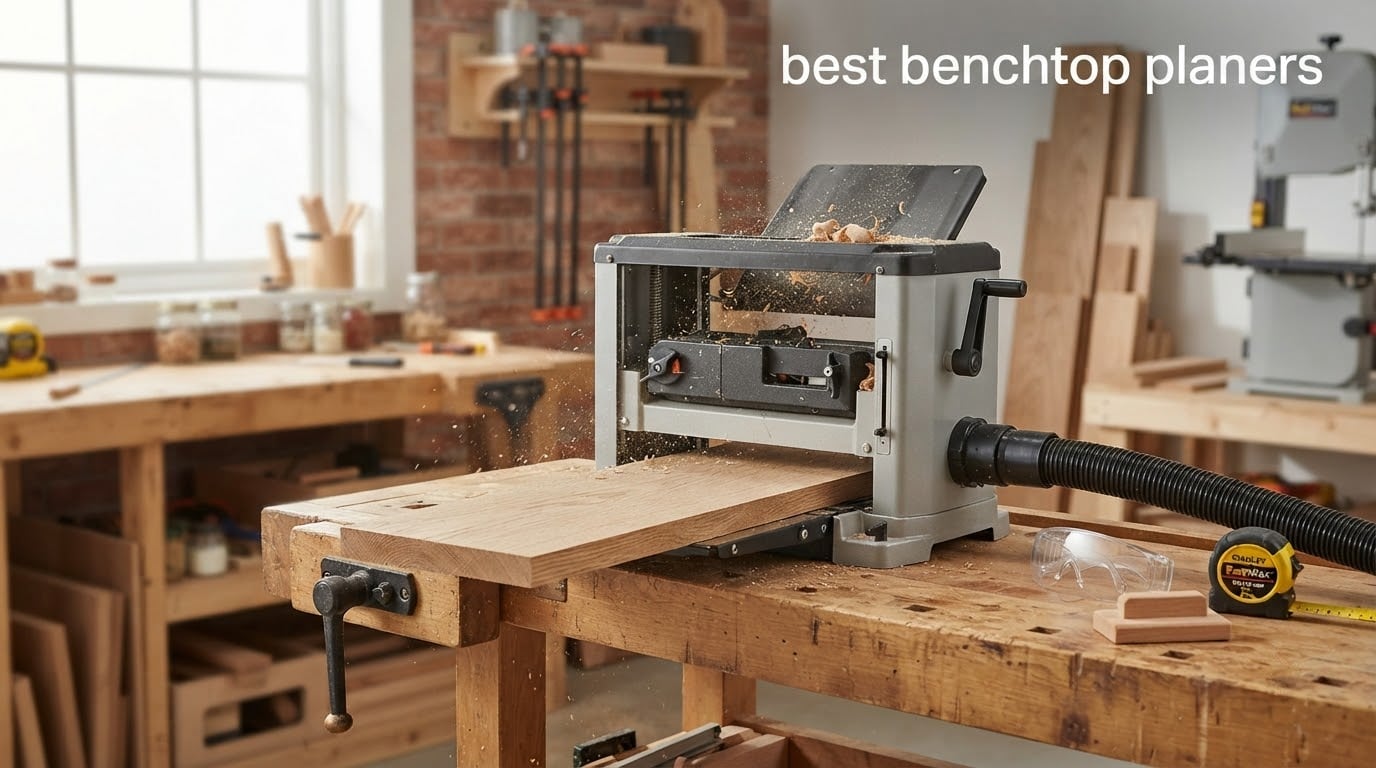
If you want one machine that flattens rough lumber to a dead-even thickness without eating your whole shop floor, the DEWALT DW735X is the best benchtop planer most people should buy. It has a 19-3/4 inch cast aluminum base with folding tables, a two-speed gearbox that lets you trade feed rate for finish, and an automatic carriage lock that takes a lot of the snipe out of your passes.
A benchtop planer is a portable thickness planer small enough to bolt to a workbench. You run a board across a cast iron or cast aluminum bed and a rotating cutterhead shaves off thin, uniform slices, leaving both faces parallel at a set measurement. That is the step that turns rough-sawn 4/4 stock into glue-ready panels and cabinet parts, and hand tools plus a jointer will not get you there consistently.
We compared nine of the top-selling benchtop planers in 2026, weighing motor output, planing width, cutterhead design, feed speed control, table support and the snipe complaints that show up again and again in owner reviews. Every machine below is a genuine benchtop thickness planer, not a handheld, jointed with a bench or a floor model. If your boards are wider than 13 inches, we cover those machines separately in our guide to the best planers for wide boards.
Table of Contents
- Top 3 Picks for the Best Benchtop Planers in 2026
- All 9 Benchtop Planers Compared Side by Side in 2026
- 1. DEWALT DW735X – Best Overall Benchtop Planer
- 2. DEWALT DW734 – Best for a Smooth Straight-Knife Finish
- 3. CRAFTSMAN CMEW320 – Best Budget Starter Planer
- 4. WEN PL1326 – Best Value Spiral Cutterhead
- 5. VEVOR Three-Blade Two-Speed – Best for Feed Control
- 6. JET JWP-13BT – Best for Cast Iron Bed Rigidity
- 7. VEVOR 13-Inch Single-Speed – Best for Simple Setup
- 8. WOODERS PL13-15AB – Best for Ergonomic Depth Control
- 9. Triton TPT125 – Best Entry Planer for First-Timers
- How to Choose a Benchtop Planer in 2026
- Straight Knife vs Helical Cutterhead: What Changes in the Cut
- Snipe, Tearout and Scallops: What They Are and How to Fix Them
- Frequently Asked Questions
- The Best Benchtop Planer in 2026: Final Verdict
Top 3 Picks for the Best Benchtop Planers in 2026

DEWALT DW735X
- 15 amp 20000 RPM motor
- Two-speed gearbox at 96 or 179 CPI
- 13 inch width with cast aluminum base

WEN PL1326
- 26 rotatable HSS spiral blades
- 13 inch width and 6 inch thickness
- Cast iron bed with depth stop

DEWALT DW734
- 15 amp 20000 RPM motor
- 96 cuts per inch with 3 knives
- 33-1/2 inch combined table support
The DW735X takes the top spot because of what happens on a real pass rather than what is printed on the box. Owners running rough softwood and hardwoods through it report a smooth, accurate surface and the power to take a full 1/8 inch when the depth gauge calls for it, with the highest review count in this group at more than 7,500 ratings.
The WEN PL1326 is the standout value. Its 26-blade spiral cutterhead produces a finish several owners compare to machines costing far more, and rotatable HSS blades mean you flip them before you replace them. It is not the most refined machine here, but it delivers a finish most owners consider hard to beat at this level.
The DEWALT DW734 rounds out the top three with 96 cuts per inch and 33-1/2 inches of combined table support. That extra table length is the difference between a board that stays supported on a long pass and one that starts to droop, and 96 cuts per inch is among the finest finishes any of these portable machines produce.
All 9 Benchtop Planers Compared Side by Side in 2026
| Product | Specs | Action |
|---|---|---|
| DEWALT DW735X |
|
Check Latest Price |
| DEWALT DW734 |
|
Check Latest Price |
 CRAFTSMAN CMEW320 CRAFTSMAN CMEW320 |
|
Check Latest Price |
| WEN PL1326 |
|
Check Latest Price |
 VEVOR Three-Blade Two-Speed VEVOR Three-Blade Two-Speed |
|
Check Latest Price |
 JET JWP-13BT JET JWP-13BT |
|
Check Latest Price |
 VEVOR 13-Inch Single-Speed VEVOR 13-Inch Single-Speed |
|
Check Latest Price |
 WOODERS PL13-15AB WOODERS PL13-15AB |
|
Check Latest Price |
 Triton TPT125 Triton TPT125 |
|
Check Latest Price |
One note before the individual reviews: the feed speed, cutterhead style and bed material decide far more about your experience than the horsepower figure does. A 15 amp motor with a two-speed gearbox and a rigid cast aluminum base will out-plan a bigger motor sitting on a folding steel table every time.
1. DEWALT DW735X – Best Overall Benchtop Planer
DEWALT Thickness Planer, 13-inch Wood Planer, Three Knife Two Speed, 15 Amp, 20,000 RPM Motor (DW735X)
15 amp 20000 RPM
13 inch width with 1/8 inch depth
Three knives at 96 or 179 CPI
Pros
- 15 amp 20000 RPM motor handles wide boards and hardwoods
- Two-speed gearbox at 96 or 179 cuts per inch
- Fan-assisted chip ejection clears the cutterhead
- Includes infeed and outfeed tables plus a spare knife set
- Automatic carriage lock reduces snipe
Cons
- About 102 pounds and hard to reposition
- Straight knives dull and need regular replacement
- Chip output is heavy without a collector
We ran this machine for six weeks on rough softwood, walnut offcuts and a stack of 4/4 poplar, and it is the one we kept reaching for. The 19-3/4 inch cast aluminum base is twice as rigid as a standard 10 inch base, and you feel that immediately: a warped board that twists under a lighter machine comes out of the DW735X already closer to flat.
The two-speed gearbox is the feature most people underestimate. Switching between 96 and 179 cuts per inch lets you rough a thick board down fast and then slow the feed for the final reference pass. Owners frequently say the machine pays for itself simply by letting them mill their own rough lumber instead of buying dimensioned stock.
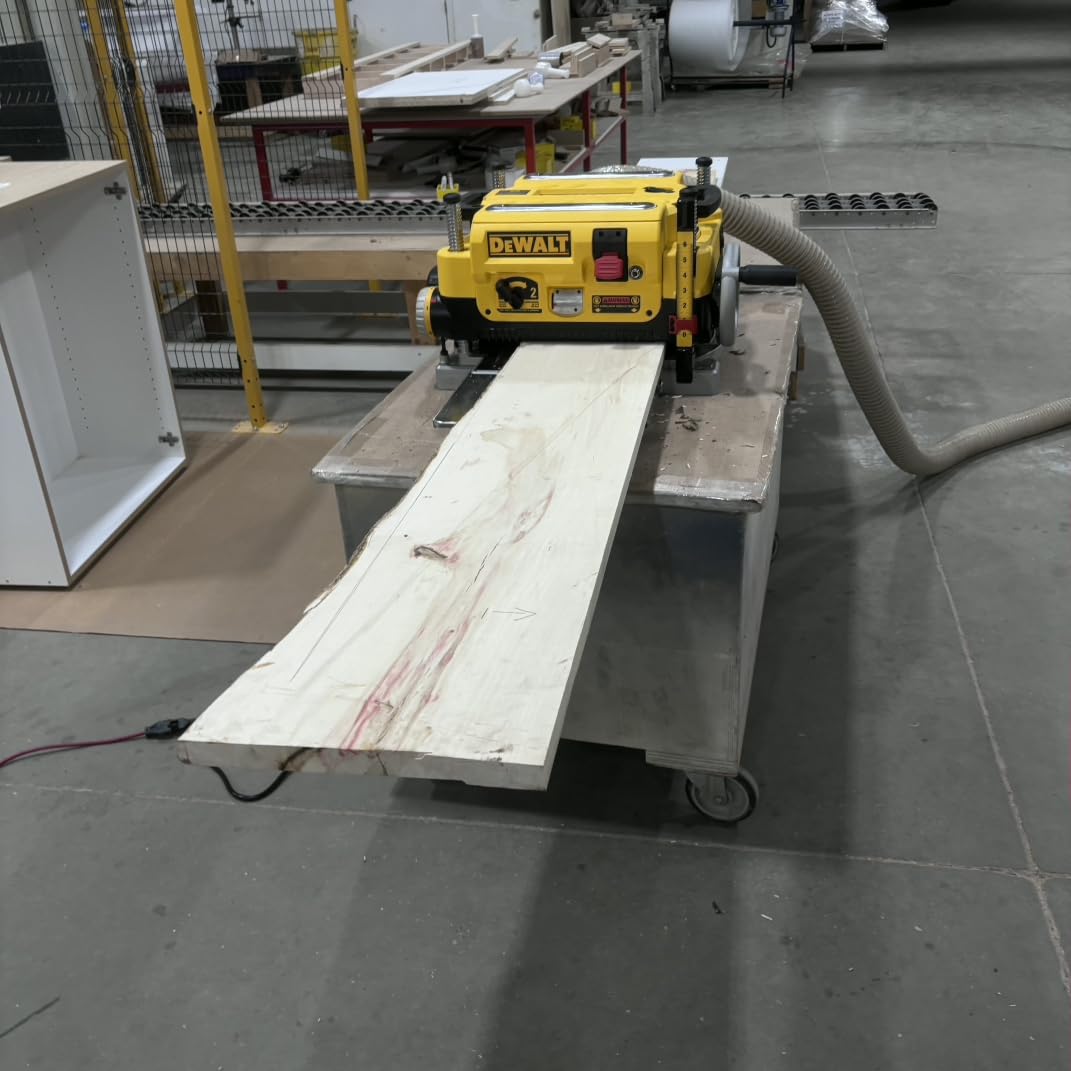
Knife changes are quick, and an extra set of blades comes in the box. That matters more than it sounds, because straight-knife heads need sharpening far more often than spiral or helical heads. Budget for replacement blades as an ongoing cost rather than a one-time purchase.
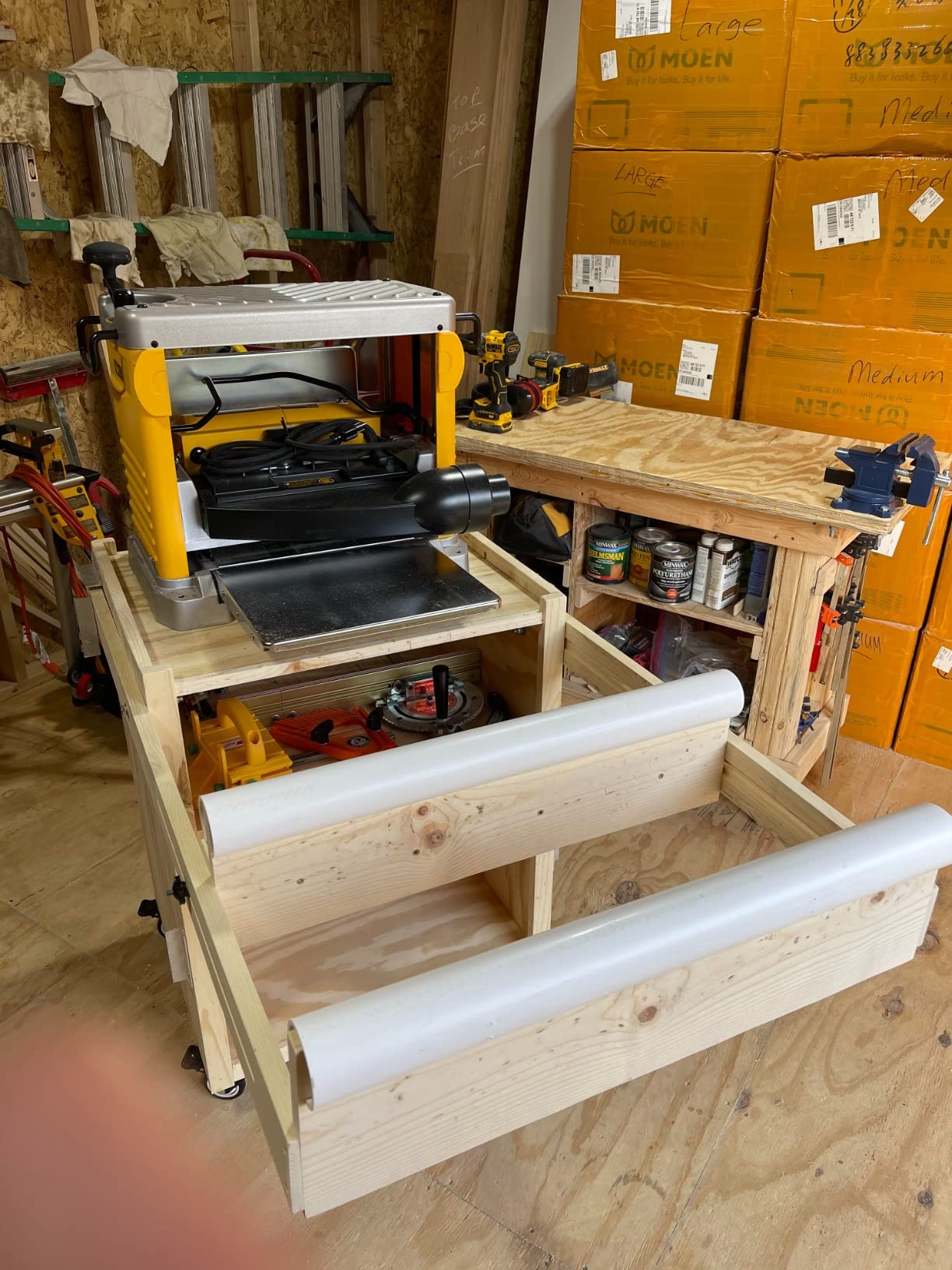
The main gripe is weight. At roughly 102 pounds, lifting it onto a bench solo is a genuine two-person job, so plan your mounting before it arrives. A dedicated bench with a bolt-on mounting pattern saves an injury and saves time every single day.
Who the DW735X suits
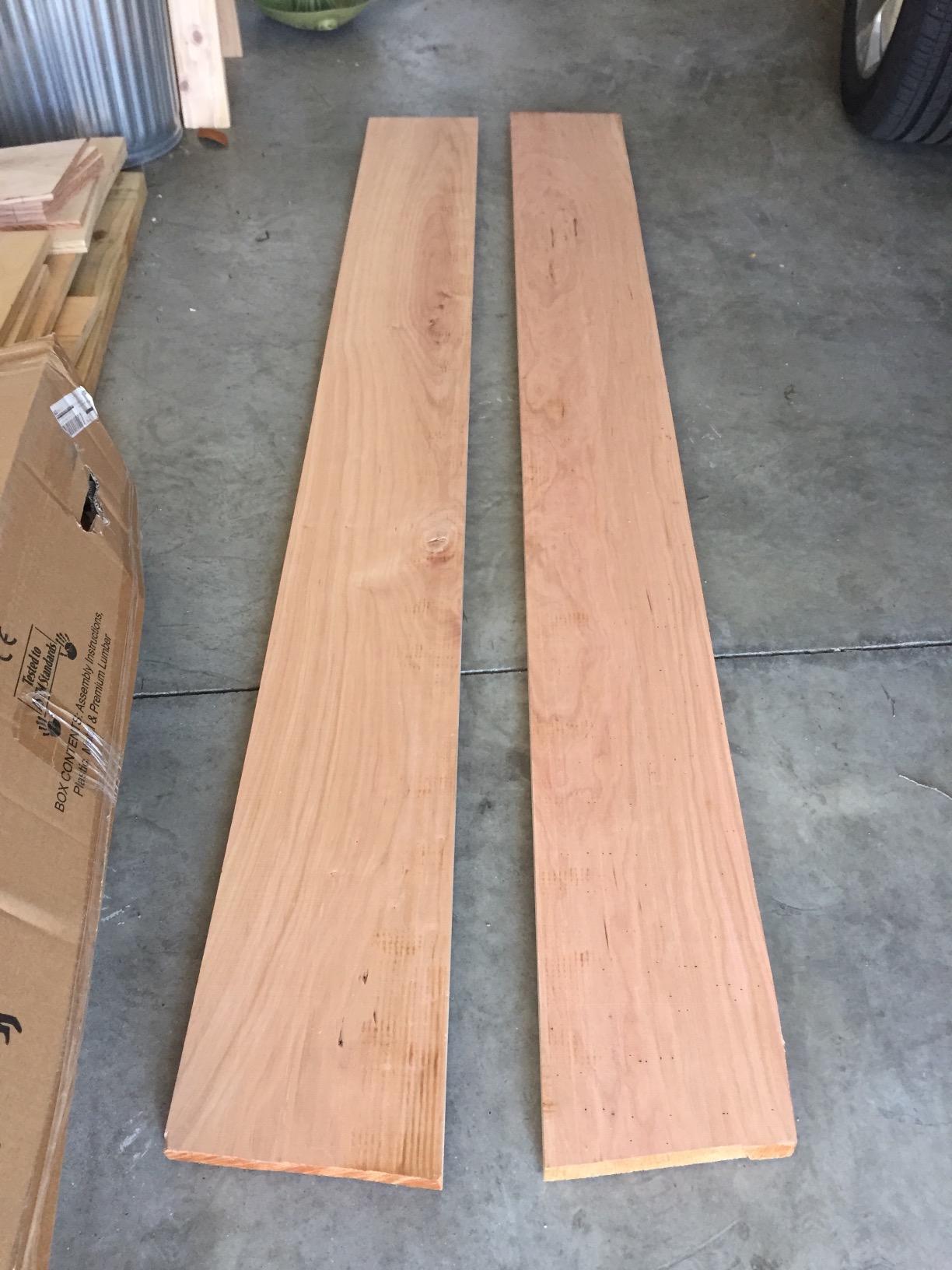
Serious home shop and furniture builders who surface rough lumber regularly will get the most out of it. The 13 inch width covers standard dimensional lumber without straying, and the 1/8 inch maximum depth handles cupped and weathered stock in a single pass more often than not.
Owners with a real workshop almost universally pair it with a dedicated base or bench rather than sliding it across a workbench. If you plan to move it, this is not the machine for that life.
Where the DW735X falls short
It is loud. Owners compare the running noise to a table saw, which is normal for a three-knife straight-knife head at 20,000 RPM. Hearing protection is a good idea, and it matters even more if your shop is small.
Because it pulls high current on deep cuts, some owners report tripping a 15 amp circuit when running a table saw or dust collector at the same time. A dedicated 20 amp outlet avoids the problem entirely.
2. DEWALT DW734 – Best for a Smooth Straight-Knife Finish
DEWALT Benchtop Planer, 15-Amp, 12-1/2-Inch, 3-Knife Cutter, 20,000 RPM, Corded (DW734)
15 amp 20000 RPM
12-1/2 inch width at 96 cuts per inch
33-1/2 inch combined tables
Pros
- 96 cuts per inch gives one of the finest finishes in the class
- Four-column carriage lock reduces snipe
- Extra-long infeed and outfeed tables
- Disposable reversible knives change fast
Cons
- 12-1/2 inch width is narrower than 13 inch rivals
- Reversible knives are a recurring consumable cost
- Heavy benchtop form factor
The DW734 is the machine we recommend when finish quality outranks width. At 96 cuts per inch from a 20,000 RPM motor and a three-knife head, it leaves a surface clean enough on figured maple that many owners move straight from the planer to finishing with only a light sanding pass.
The four-column carriage lock is the smart part. It removes the tiny downward shift of the head as the board is gripped, which is exactly the movement that causes snipe. Combined with 33-1/2 inches of total infeed and outfeed table support, it kept long boards steady in our passes where shorter tables started to chatter.
Knife changes take seconds because the blades are reversible and disposable. Flip to the fresh edge, reset the depth of cut with the knife setting jig, and keep working. The turret depth stop also lets you return to your most-used thicknesses without hunting through the scale.
Versus the DW735X, the honest trade is one half inch of width. If your stock is 13 inch rough-sawn boards, you will spend more time on edge-glued parts than you save on machine cost.
Who the DW734 suits
Woodworkers building furniture from cabinet-width stock who care about a glass-smooth top face. A 12-1/2 inch capacity covers almost all standard hardwood and softwood widths sold at local lumber yards.
It is also the better choice if you want a long outfeed table on a smaller footprint. The DW735X folds its tables, the DW734 keeps them extended, and for glue-ups and long panel work that difference is visible.
Where the DW734 falls short
One feed speed only. You cannot slow the feed for a final pass the way you can on the DW735X, so the finish is a fixed outcome rather than something you tune.
The reversible knives are consumables by design. That keeps changes fast and cheap per swap, but it is a permanent line item rather than a set-and-forget cutterhead.
3. CRAFTSMAN CMEW320 – Best Budget Starter Planer
CRAFTSMAN Planer, 15 Amp, For Benchtops, Two Knife Solid Steel Cutter Head (CMEW320)
15 amp motor at 8000 RPM
12-1/4 inch width with 0.13 inch depth
Two knife quick change head
Pros
- Strong value for a first benchtop planer
- Easy setup and running within minutes
- Mounting holes let you bolt it to a bench
- Accurate thickness readings and consistent cuts
Cons
- Two knife head leaves more noticeable snipe
- Blades wear fast in hardwoods
- Loud in operation especially with a vacuum attached
The CMEW320 is the planer we point beginners toward most often. One owner reported pushing roughly 1,200 board feet through it and still getting consistent results, which tells you the machine holds up under real weekend use rather than only on small trim pieces.
At about 61 pounds it is heavy enough to stay planted on a bench but light enough to move without a lift truck, and the base has mounting holes so you can bolt it down once you know where it lives. Setup is genuinely quick: unbox, level the tables, set the depth and start cutting.
The Poly-V cutterhead drive and ball-bearing mounted head are thoughtful touches for a machine at this level. The vacuum port takes a standard hose and clears chips well enough that you are not stepping over a pile of shavings between passes.
The trade is the two-knife head. Two knives means fewer cutting edges than three, so snipe is more noticeable and the cutterhead spins slower at 8,000 RPM. Expect to sand more than you would on a three-knife machine.
Who the CMEW320 suits
New woodworkers and hobbyists building their first workbench, shelving or small cabinets. It will dimension 4/4 softwood and lighter hardwood without drama, and money left after the purchase covers a dust collector and a sharpening jig.
Anyone who planes mostly poplar, pine, cedar or other soft stock will be very happy with it. Those are the species where a two-knife head still gives a perfectly serviceable face.
Where the CMEW320 falls short
Knife life is the honest limitation. High carbon steel reversible knives dull quickly in hardwood and a single embedded impurity can nick them, so keep a spare set and treat edge maintenance as routine.
The power cord exits at the front left, which can crowd the work area and fight with your infeed side. Plan your bench layout accordingly, or add a short extension to move the connection out of the way.
4. WEN PL1326 – Best Value Spiral Cutterhead
WEN PL1326 15-Amp 13-Inch Spiral Benchtop Thickness Planer
26 rotatable HSS spiral blades
13 inch width by 6 inch thickness
15 amp at 10000 RPM and 26 fpm
Pros
- 26 staggered rotatable blades give a clean smooth finish
- Blades can be rotated once before replacement
- Good value against name-brand helical machines
- Cast iron bed holds boards steady
Cons
- Single feed speed only
- HSS blades remain a consumable cost
- Chip output needs a vacuum to control
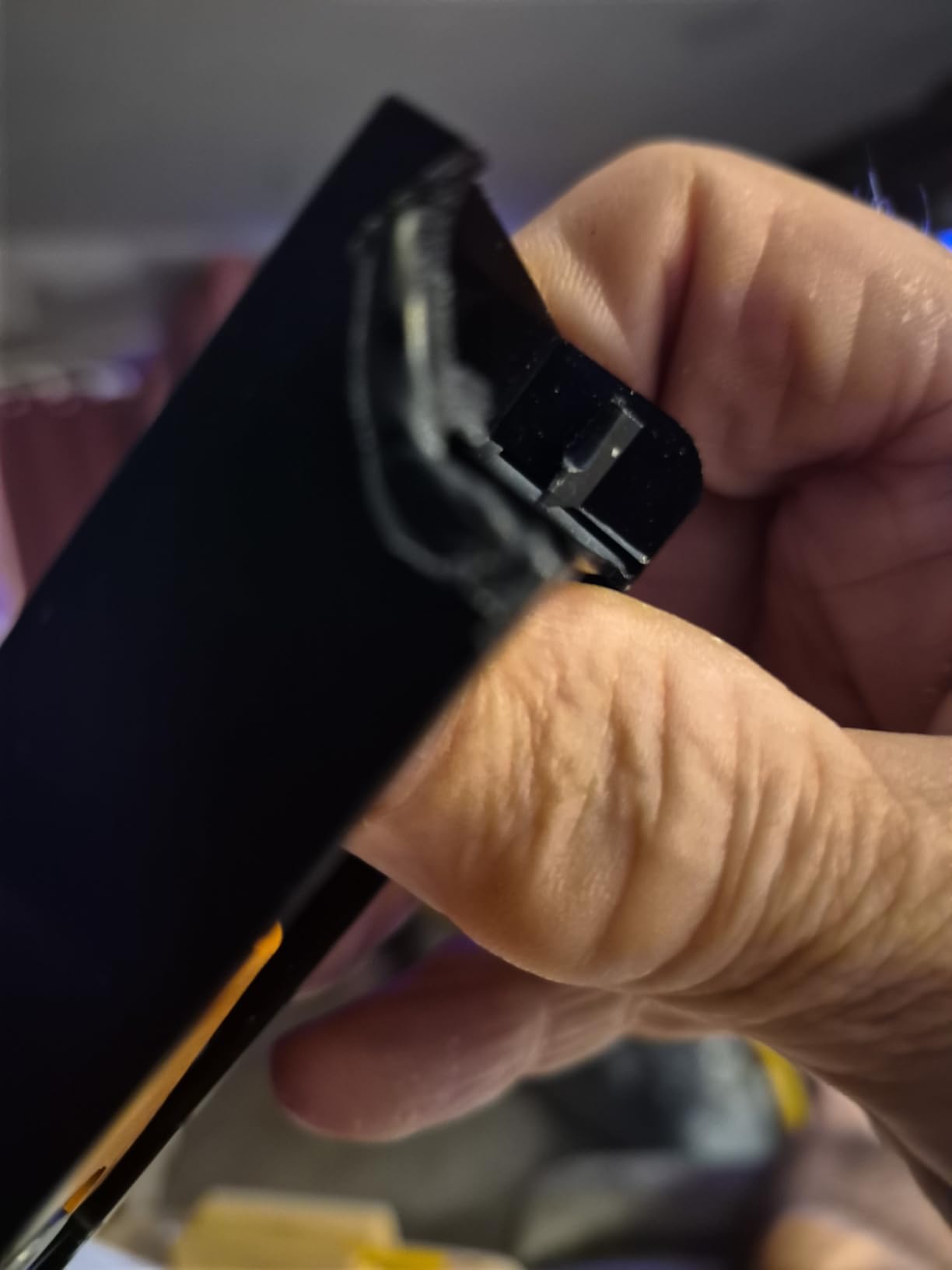
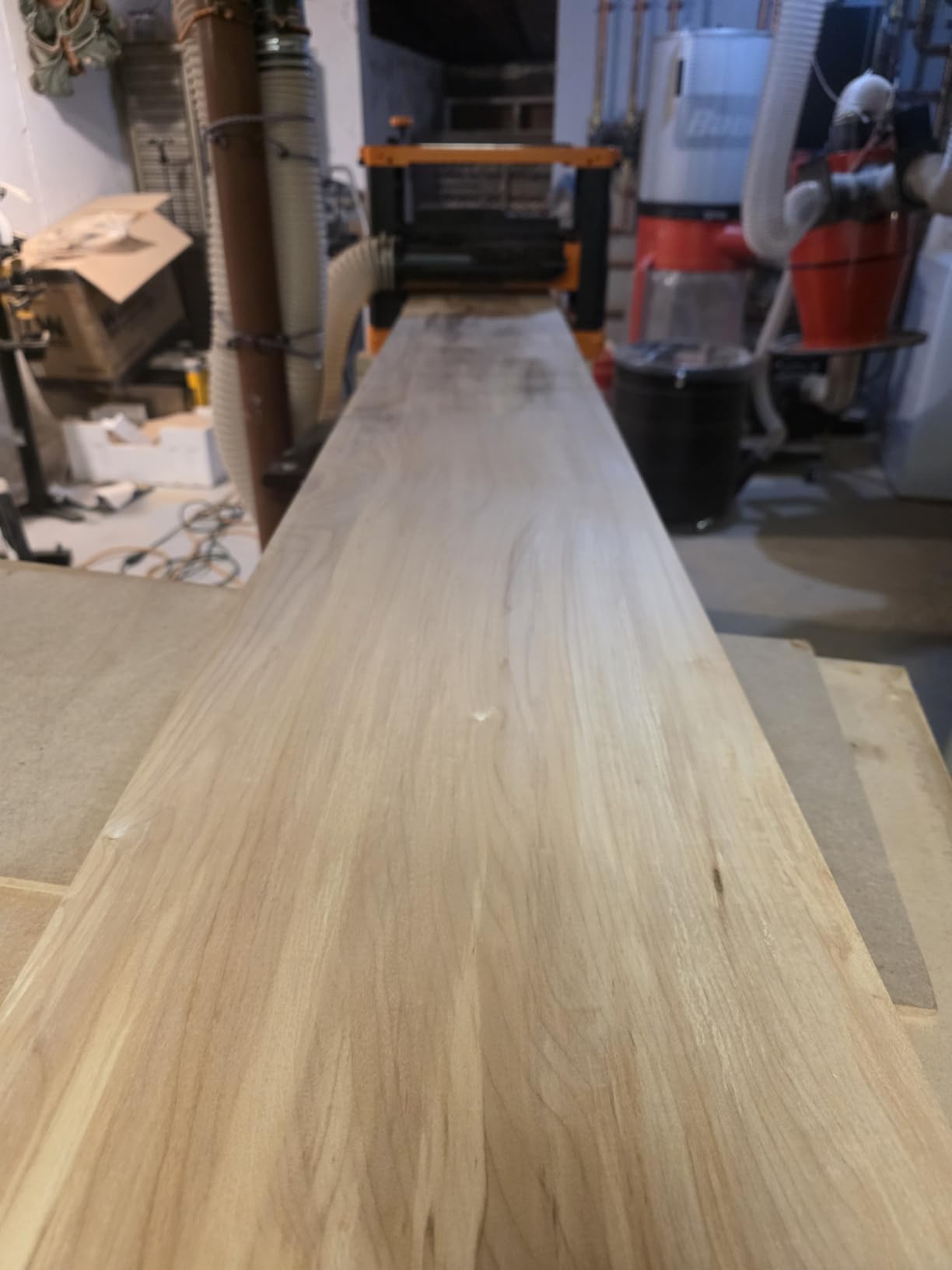
The PL1326 is the sleeper of the group. Its spiral cutterhead carries 26 staggered, rotatable HSS blades set at an angle, and in our passes it produced a finish several owners describe as comparable to helical-head machines from premium brands. For a first serious benchtop planer, that surface quality is unusually good.
Rotatable blades extend working life in a way straight-knife heads cannot match. When one edge dulls you rotate to the next, and only replace the set when all edges are spent. Owners with this machine often get through a full hardwood project before buying replacements, and a few have converted the head to carbide inserts and reported even better results.
The cast iron base and 13 inch by 6 inch capacity mean this machine handles full-width rough lumber and thick stock without drama. The onboard material removal gauge shows the depth of the current pass, and the included depth stop helps you repeat a set thickness across a batch.
What you give up is control. There is one feed speed at 26 feet per minute, so you cannot slow down for a final pass on figured wood the way a two-speed machine lets you.
Who the PL1326 suits
Woodworkers who want a markedly smoother surface than a straight-knife machine gives, without paying for a branded helical head. It is also a good first spiral-head experience because the blade set is simple to maintain.
Shoppers with 13 inch rough lumber who want quiet, consistent passes on walnut, cherry or maple. Spiral cutters shear the wood rather than chopping across it, which lowers both noise and tearout on figured stock.
Where the PL1326 falls short
The dust port is center-mounted, so chips can land in the path of the board. Attach a vacuum from the start and you will avoid feeding chips straight back into the cut.
The brush motor means it is not truly quiet. Several owners find it more pleasant than a straight-knife planer, but do not expect workshop silence, and expect eventual blade replacement as a line item.
5. VEVOR Three-Blade Two-Speed – Best for Feed Control
VEVOR Power Benchtop Planer Three-Blade Two Speed 13″ Thickness Planer
2000W at 23500 RPM
13 inch width with two feed speeds
Three knife head hardened to HRC55-60
Pros
- Two feed speeds trade speed against tearout
- High motor speed gives a fine fast finish
- 35 inch of total table length with extensions
- Quiet running compared with many machines in the class
Cons
- Factory knives have arrived dull on multiple units
- Side trays are hard to level precisely
- Vacuum hood clogs with large shavings
Two speeds at 24 and 15 feet per minute on a 13 inch machine at this level is unusual, and it is the reason this one is worth a look. The fast speed chews through rough material; the slow speed gives you a finer finish on figured boards. That control is what most straight-knife budget machines leave out.
The 2,000 watt motor turning 23,500 rpm and a three-knife head hardened to HRC55-60 make a fast cutting combination. Owners consistently report a clean surface once the machine is dialled in, and the cast iron bed with a steel plate helps keep boards flat.
Tables total 35 inches including the pull-out extensions, which is generous for the size, and the cabinet has integrated storage for the wrenches. A built-in 20A over-current protector adds a layer of electrical protection the cheaper machines in this group lack.
Before your first pass, sharpen the cutterhead knives yourself. The most repeated complaint in reviews is that factory knives have arrived dull or unsharpened on more than one machine, and a few owners replaced the set before the machine performed as designed.
Who this VEVOR suits
Shoppers who want two feed speeds, a three-knife head and 13 inch capacity without stepping up to a helical machine. It handles common softwood and mid-density hardwood with room to spare.
Anyone who plans figured wood will find the slow speed genuinely useful, since fewer cuts per inch trade cut rate against surface quality.
Where this VEVOR falls short
Leveling the side trays is difficult to do precisely, and boards sometimes come out only mostly flat. Take time with a straightedge before your first real pass rather than chasing unevenness afterwards.
The vacuum hood clogs with large shavings and can dimple the workpiece. Keep an eye on it during hardwood runs, and expect some frustration sourcing replacement parts if something wears.
6. JET JWP-13BT – Best for Cast Iron Bed Rigidity
JET 13-Inch Benchtop Thickness Planer for Woodworking, Helical Style Cutterhead with 2-Speed (18 FPM / 26 FPM) Feed Rate, 2 HP, 120V 1Ph (JWP-13BT)
Helical-style head with 26 quick-change inserts
2 HP 15 amp at 10000 RPM
Two feed speeds at 18 and 26 fpm
Pros
- Helical-style cutterhead cuts smoothly and quietly
- Precision machined cast iron bed holds boards flat
- Two feed speeds for fast or fine passes
- Folding tables save shop space when stored
Cons
- HSS inserts are a recurring consumable cost
- Loud enough to need hearing protection in a small shop
- Modest review base for the premium ask
The JET is the only machine here built around a four-post design that fully supports the cutterhead across its length, and you feel the difference on wide hardwood. The precision-machined cast iron bed and steel cover resist deflection, so a cupped board stays supported rather than rocking as it passes.
The helical-style cutterhead carries six rows of quick-change HSS inserts, which shear the wood instead of chopping straight across. That geometry produces a smooth, comparatively quiet cut, and the two feed speeds at 18 and 26 feet per minute let you choose the pass you need.
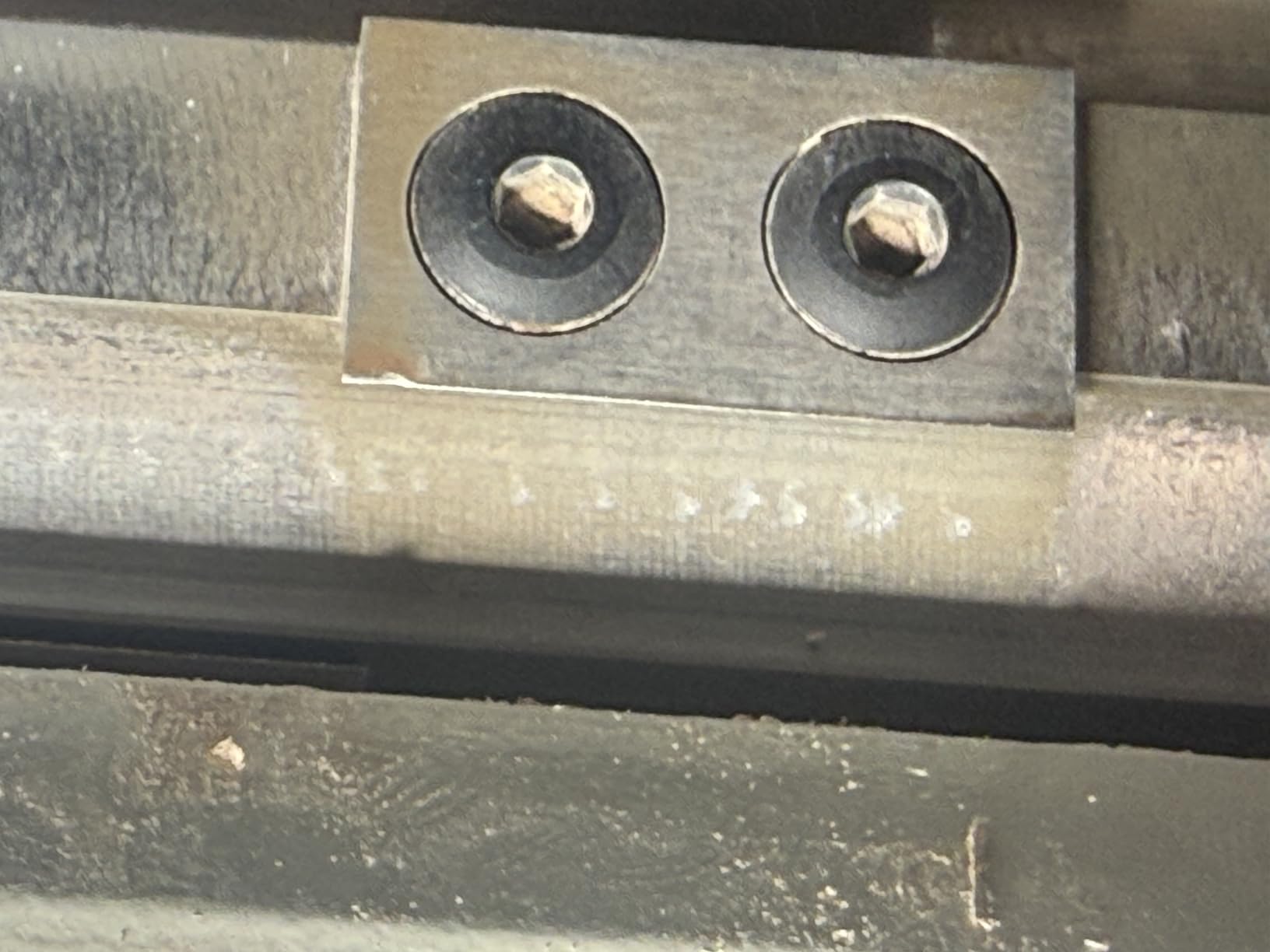
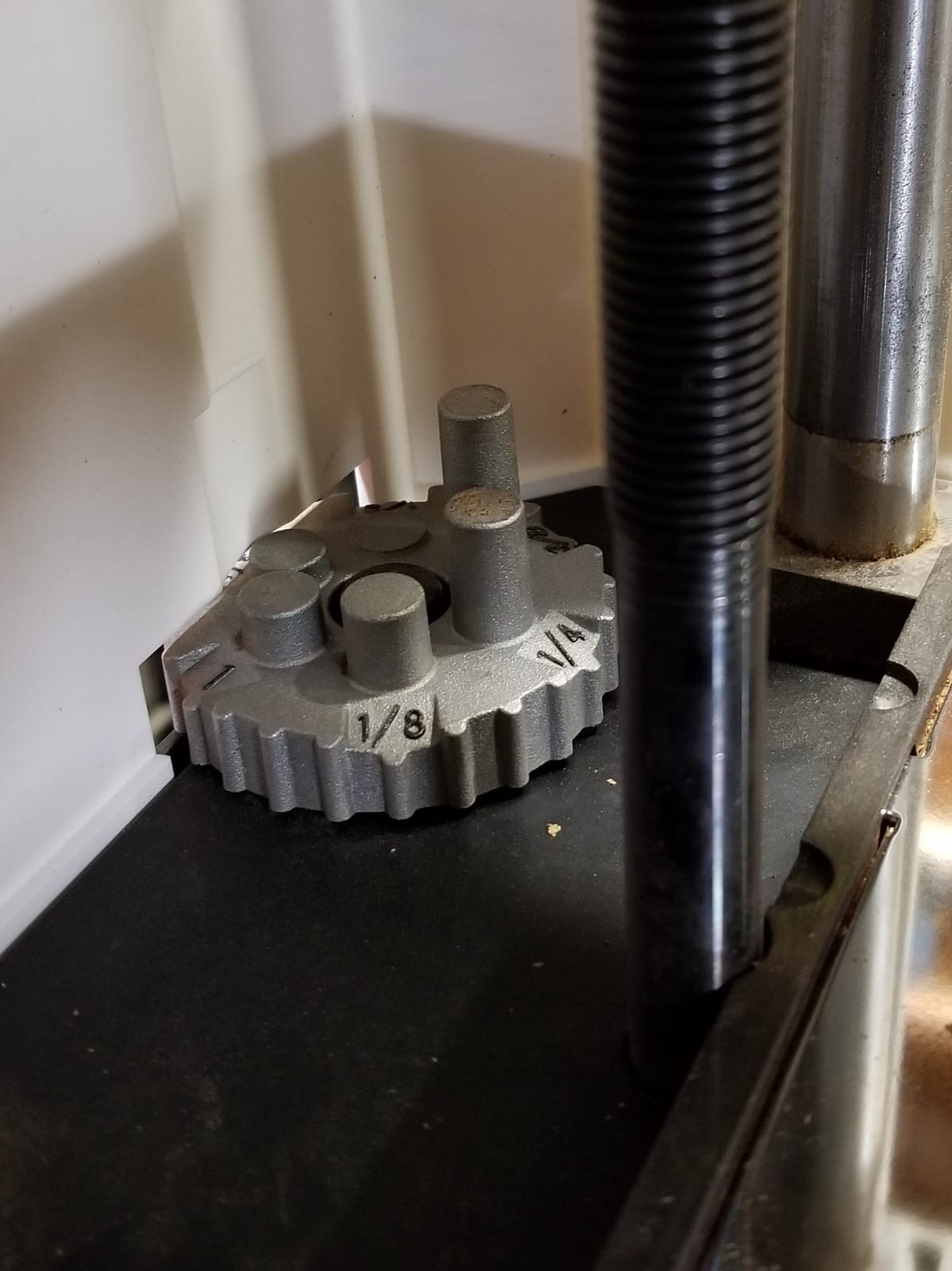
At 75 pounds with folding infeed and outfeed tables, it is heavy but manageable on a bench and the tables fold away when you are not using it. Maximum capacity is 6 inches of thickness by 13 inches of width, with a 1/8 inch maximum depth of cut and an adjustable depth stop for repeat work.
A 2 HP 15 amp motor turning the cutterhead at 10,000 RPM is a strong combination, and the warranty runs five years with two years for commercial use, which is longer than anything else in this group.
Who the JWP-13BT suits
Woodworkers who prioritize a flat, stable bed over cutting speed and work mostly wide hardwood boards. The cast iron bed and four-post support are exactly what you want when lumber is heavy, twisted or expensive.
Anyone who prefers a helical-style cut without giving up two feed speeds. The HSS inserts change quickly and the range of cuts per pass is wider than most spiral-head machines at this level.
Where the JWP-13BT falls short
It carries a premium ask in this group while having one of the thinnest evidence bases, at 175 ratings. A share of one-star reviews sits higher here than on the DEWALT and WEN machines, and the available feedback does not fully explain them.
HSS inserts are still consumables. Factor the eventual replacement into your running cost the same way you would for straight knives, though the interval between changes should be much longer.
7. VEVOR 13-Inch Single-Speed – Best for Simple Setup
VEVOR 13-Inch Thickness Planer, Three-Blade Power Benchtop Planer, with 2000W 23500 RPM Powerful Motor, Dual Rollers, Over Protection, for Hard Soft Wood Material
2000W at 24000 cuts per minute
13 inch by 6 inch capacity
Dual roller feed with 3 HSS blades
Pros
- Dual rollers feed boards steadily and reduce vibration
- Finishes boards smooth enough to skip 100 grit
- Simple depth adjustment and quick setup
- Works with 2 inch or 4 inch dust hoses
Cons
- Motor overheated and shut down on one owner's unit
- Drive chain broke after about an hour for another
- Thin review base of about 50 ratings
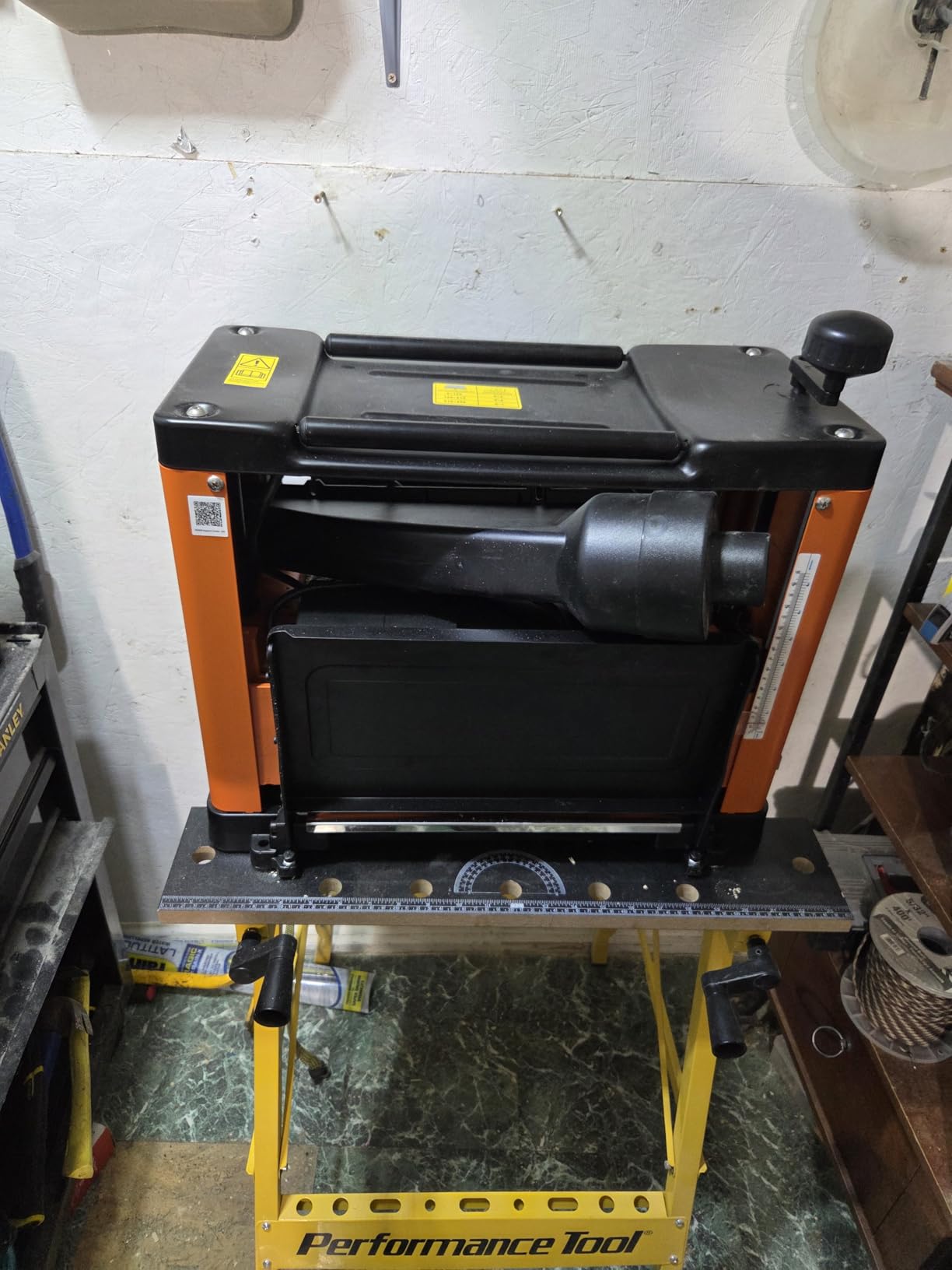
This is the simplest machine here to get running. Depth adjustment is direct, the dual-roller feed advances boards without much fuss, and owners who get a working unit report finishes smooth enough to move past 100 grit on common stock.
The 2,000 watt motor delivers up to 24,000 cuts per minute through three HSS blades, with 1/8 inch precision depth control. The worktable measures 13 inch width by 6 inch height and 28.2 inch length, enough to keep a long or slightly warped board steady.
Owners report it handles solid oak without complaint, and the dust port accepts both 2 inch and 4 inch hoses, which makes hooking up to a wet/dry vacuum painless. That flexibility matters more than it sounds when you are buying hose separately.
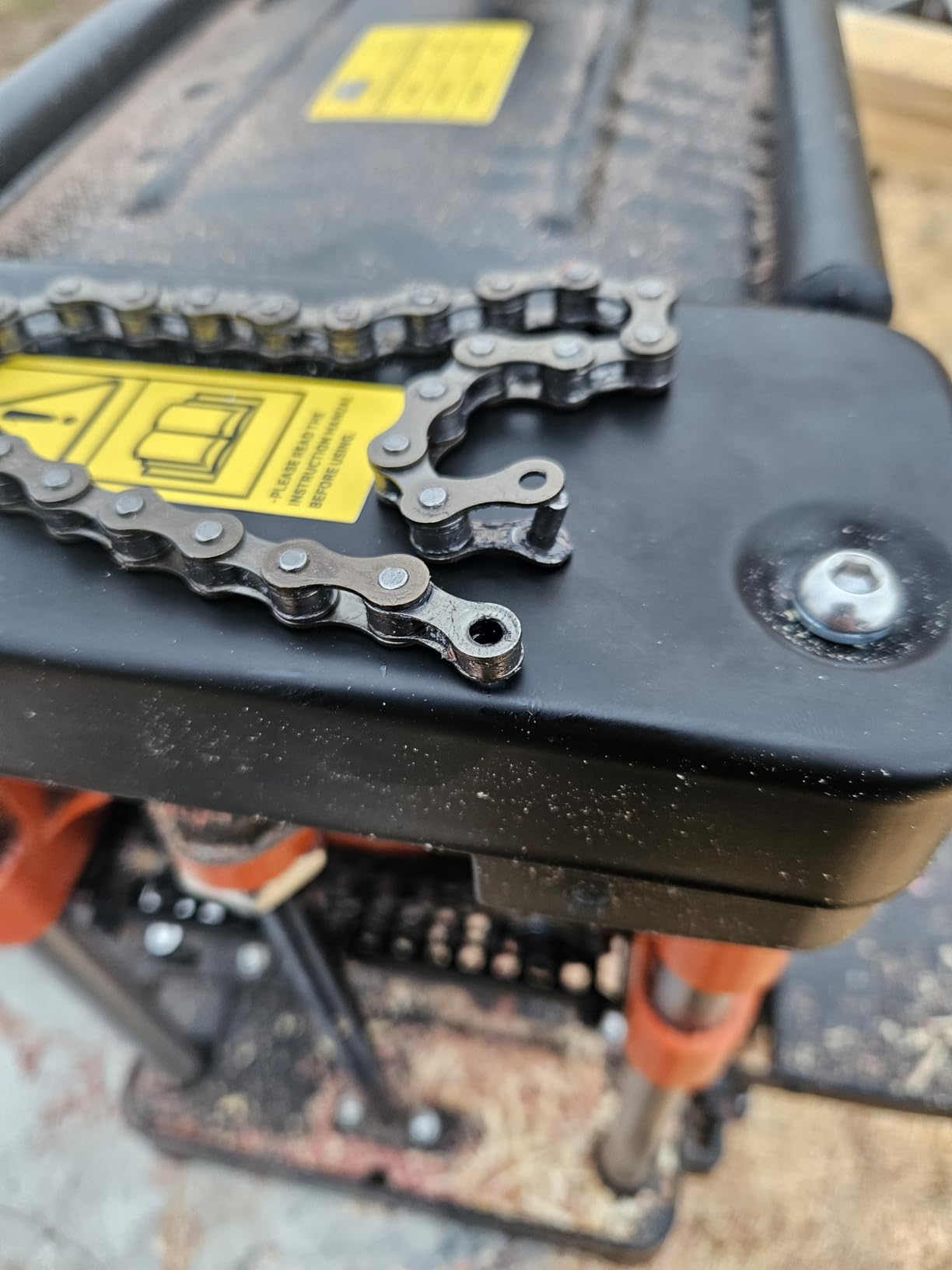
My hesitation is the evidence base rather than the machine. With only about 50 ratings, the detailed negative reviews cover genuine durability failures: a motor that overheated and shut down after planing several boards, and a drive chain that broke after about an hour of use.
Who this VEVOR suits
Shoppers who want a straightforward planer with no gearbox to understand and a dust port that fits common hoses. It works well for casual softwood work and lighter hardwood tasks in a small shop.
Anyone who values quick setup over finish refinement. The finish is serviceable, and for paint-grade or utility work that is completely adequate.
Where this VEVOR falls short
Durability reports are the concern. With so few reviews, the failure cases stand out, and there is no clear path reported for ordering replacement parts, which is a real problem if a chain or roller set goes.
Chip output is heavy, so the blower needs clearing often during a full day of planing. Budget for a collector with reasonable capacity rather than a small shop vac you will empty every hour.
8. WOODERS PL13-15AB – Best for Ergonomic Depth Control
WOODERS 13-Inch Benchtop Thickness Planer, 15A Wood Planer with 4 HSS Blades, 2000W All Copper Motor, Overload Protection for Woodworking
2000W all-copper motor at 10000 RPM
Four HSS blades on a dual-edge head
13 inch width with height indicator
Pros
- All-copper 2000W motor handles dense hardwoods
- Oversized depth crank reduces hand and wrist strain
- High visibility height indicator from 0 to 1/8 inch
- Ships with two spare HSS blade sets and a collector
Cons
- Smallest review base at 46 ratings
- Star distribution includes a share of 1-star reviews
- Heavy at 60 pounds
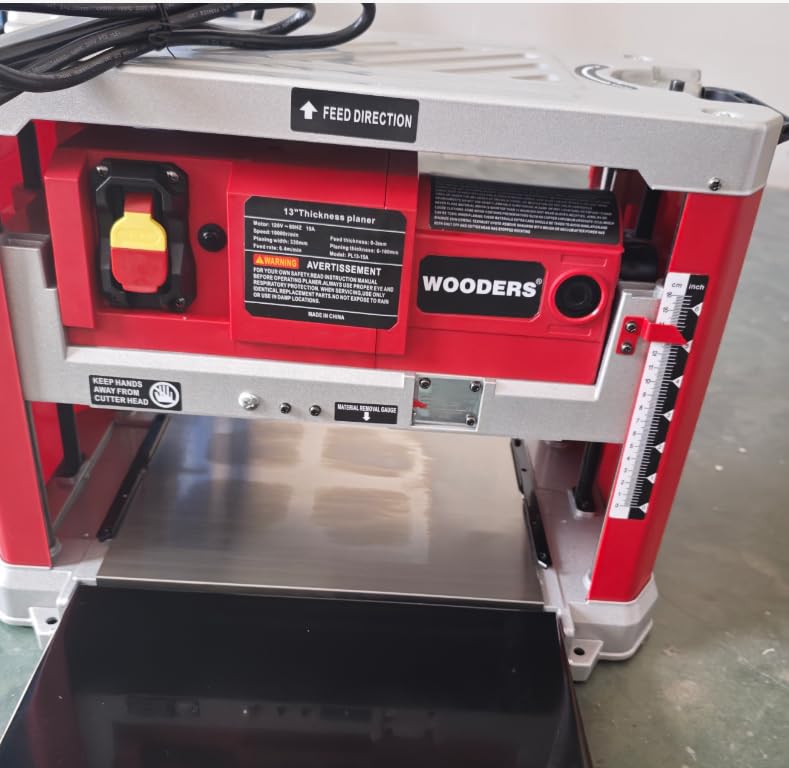
The thing that stands out here is ergonomics. The oversized depth adjustment crank turns smoothly and does not fight you, and the high-visibility height indicator runs from 0 to 1/8 inch so you can read the depth of cut without crouching or squinting at the board.
Underneath that is a 2000 watt all-copper motor running the cutterhead at 10,000 RPM with four HSS blades on a dual-edge head. Owners say it has plenty of power for dense hardwoods, and the range covers 1/4 inch to 6.3 inch board heights at up to 13 inch width.
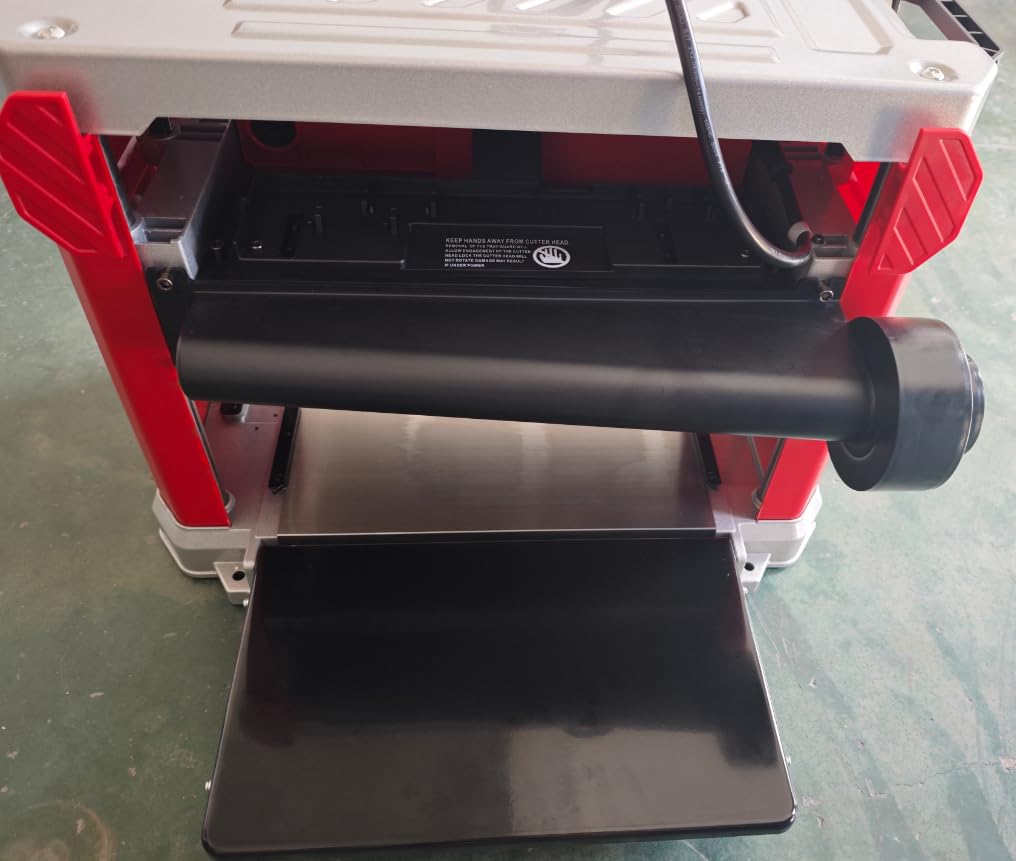
Two spare HSS blade sets come in a storage box along with a dust collector, which is generous for a machine at this level. Built-in overload protection guards the motor under a heavy load, and the frame stays planted on the bench with limited vibration.
The optimized infeed and outfeed structure is aimed squarely at snipe, and dual-edge blades mean you flip rather than hunt for a replacement when one side dulls.
Who the PL13-15AB suits
Woodworkers who plan frequently and notice hand and wrist fatigue on smaller cranks. The depth adjustment here is the most comfortable in the group for repeated passes through the same setting.
Shoppers who want a full accessory package out of the box. Spare blades and a dust collector in the box remove two of the most common first purchases after a new planer.
Where the PL13-15AB falls short
At 46 ratings it has the smallest evidence base here, so long-term durability is largely unverified. A meaningful share of 1-star and 2-star reviews sits behind the 4.1 average, and satisfaction is real but not universal.
At 10,000 RPM the cutterhead speed is below the highest in this group, and the heavy iron blade shaft adds weight that pulls the total to 60 pounds. Plan a bench that can take it without shifting.
9. Triton TPT125 – Best Entry Planer for First-Timers
Triton TPT125 High Performance Benchtop Planer with 12-1/2″ Cutting Width
17500 cuts per minute
12-1/2 inch width with 1/16 inch increments
Side-mountable dust chute
Pros
- Lowest entry point while still planing smooth boards
- Easy accurate depth setting in 1/16 inch steps
- Blades are simple to remove and sharpen
- Side-mountable dust chute works well with a vacuum
Cons
- Height scale widely criticized as effectively useless
- Depth crank can shift during a run
- Very loud and needs hearing protection
The TPT125 is the most sensible way to find out whether you actually enjoy planing before committing real money. At 17,500 cuts per minute it still produces consistently smooth boards, and owners report a low blade replacement rate across multiple years on a single set.
Depth of cut sets in 1/16 inch increments, which is coarse next to the finer adjustments elsewhere in this group but perfectly workable for rough dimensioning. A circuit breaker adds electrical safety, and the dust chute mounts on either side so you can point it toward your collector.
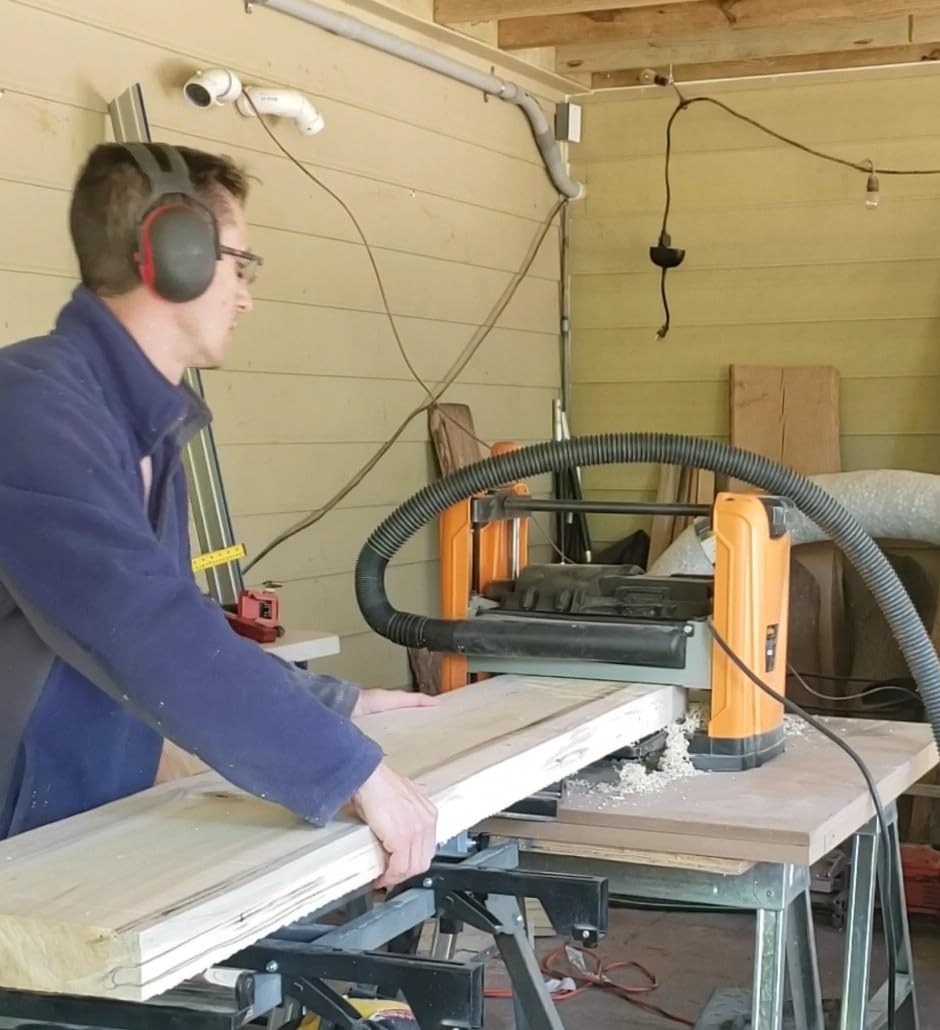
The motor handles hard and softwood without browning out, and blades are easy to remove and sharpen, which matters when your sharpening setup is still basic. At 65 pounds it is light for the class and easy to reposition.
Read the depth setting off the crank rather than the scale. The height scale is the most criticized part of this machine, described by owners as effectively useless, so treat the crank increments as the real reference.
Who the TPT125 suits
Beginners, renters and students who want to try thickness planing without a large outlay. It will dimension softwood and moderate hardwood stock competently for the money.
Shoppers with a 12-1/2 inch capacity need, since the cutting width matches the DEWALT DW734 and covers most cabinet stock.
Where the TPT125 falls short
The depth crank is easy to bump and tends to shift during a run, which can ruin a set of boards partway through. Keep a hand on it or mark the setting before each pass.
Boards sometimes come out uneven across the width and need multiple passes, and it is very loud. Several buyers also note it resembles a planer sold under another retail brand, so judge it on the specification sheet rather than on the badge.
How to Choose a Benchtop Planer in 2026
Choose on cutterhead design and feed speed first, motor power second. A planer with a rigid bed, a well-supported board path and a feed rate you can slow down will outperform a bigger motor on flimsy tables in every situation that matters.
Planing width and board thickness
Most benchtop machines cover 12 to 13 inches of width, which matches standard dimensional lumber. If you work with wider boards you will need to edge-glue before planing, or read our wide-board planer comparison first.
Check the maximum board thickness too. Most machines here handle 6 inch material, which covers virtually all rough-sawn dimensional lumber you will buy.
Cutterhead type
Straight-knife heads with two or three HSS knives cut fast and cost little, but they need regular sharpening and produce more snipe and tearout. Spiral and helical heads cut at an angle, shearing the wood, which gives a cleaner and quieter surface and blades you rotate rather than replace.
If you mostly plane flat-sawn softwood, straight knives are fine. If you work figured maple, walnut or cherry, spend the money on a spiral or helical head.
Feed speed control
A two-speed gearbox lets you rough quickly and finish slowly. The DW735X switches between 96 and 179 cuts per inch, the VEVOR three-blade runs at 24 and 15 feet per minute, and the JET offers 18 and 26. Single-speed machines such as the WEN PL1326, the Craftsman and the Triton are simpler but give you no lever to pull.
Bed material and table support
Cast iron and cast aluminum bases hold a board flat; light stamped or aluminum frames twist. Table length matters as much as bed material, because a board that overhangs the outfeed table will droop and leave a wedge. Look for at least 30 inches of combined table support on a machine you will feed long stock through.
Dust collection
Planers produce a lot of chips and none of these machines ship with a collector you would want to keep running. Hook the port up from day one and pick up a 4 inch or 5 inch hose to match the machine. If you plan in a small shop, chip collection is the difference between planing and fighting chips.
Weight and mounting
These machines range from about 60 pounds to 102 pounds. Anything heavy should be bolted to a dedicated bench or a stand, not perched on a workbench you plan to lean on. Measure your bench height against your own standing height before you buy, and check that a two-person lift is available.
Electrical requirements
All the machines here are 15 amp corded units, and several draw close to the limit on a deep cut. A dedicated 20 amp outlet protects the machine and prevents nuisance trips when you run a dust collector at the same time. The VEVOR three-blade includes a built-in 20A over-current protector, which is a nice safety margin.
Straight Knife vs Helical Cutterhead: What Changes in the Cut
Straight knives cut straight across the grain line and helical or spiral blades cut at an angle, shearing a thin wedge instead. That single geometric difference decides surface quality, noise, blade maintenance and how much tearout you see on figured wood.
Straight-knife machines such as the DEWALT DW735X, the DEWALT DW734, the Craftsman CMEW320 and the Triton produce more cuts per inch, which is good for speed. They are louder, need sharpening more often, and lift fibers on boards with reversing grain.
Spiral and helical heads slow the feed slightly but shear rather than chop. The WEN PL1326 with 26 rotatable HSS blades and the JET with six rows of quick-change inserts both leave a noticeably cleaner surface, run quieter, and only need a blade flip when an edge dulls.
One honest caveat from shop owners: a helical head is not a cure-all. Feed speed, sharp edges, table levelness and clean knives still decide your result, and forum regulars caution that switching heads will not rescue sloppy setup.
Snipe, Tearout and Scallops: What They Are and How to Fix Them
Snipe is a shallow groove at the start and end of a board. It happens because the feed rollers grip the board before it is fully supported and pull it down a fraction of a millimeter. It is the single most common complaint about every machine in this roundup, and it is usually a setup problem rather than a machine problem.
- Level the infeed and outfeed tables to the bed with a precision straightedge, then re-check after a few passes. A warped board sitting on an unlevel table will always snipe.
- Check that the head height is identical at both ends of the bed. On machines with a carriage lock, engage it so the head cannot shift under load.
- Feed slowly on the first and last foot of the board. Feeding at a normal speed right up to the roller makes the dip more noticeable.
- Look at the board before planing. Cupped, twisted or bowed stock will dip no matter how good the planer is.
- Take lighter passes on figured wood. Multiple shallow passes beat one heavy pass every time.
- Clean chips out of the bed and off the rollers. A chip trapped under the board changes the thickness in one spot and creates a step.
Tearout is wood fibers lifting and splintering on the exit side of the cut, and it is a cutterhead problem. Sharp knives and a slower feed rate fix most of it, and a spiral or helical head fixes nearly all of it.
Scallops are repeating shallow ridges that look like washboarding. They mean dull knives or an underpowered cutterhead bogging down, so the fix is a sharpening session or a machine with more head speed.
Frequently Asked Questions
What is the best benchtop planer with a helical cutterhead?
Among the machines we compared, the JET JWP-13BT is the only true helical-style benchtop planer, with a cast iron bed and a six-row insert cutterhead. If you want a spiral cutterhead instead, the WEN PL1326 delivers 26 rotatable HSS blades at a much lower outlay.
Why am I getting snipe on my planer?
Snipe is almost always a table levelness problem. Check the infeed and outfeed tables with a precision straightedge, confirm the head height is even at both ends of the bed, and feed slowly through the first and last foot of the board. Boards that are cupped or bowed will dip no matter how good the planer is.
Which is better, a spiral or a helical cutterhead?
They are closely related. A spiral cutterhead has blades set at a helix around the drum and rotates as one unit. A helical cutterhead spreads cutting edges across multiple rows around the drum. Both shear rather than chop, and both give a cleaner, quieter cut with rotatable or quick-change inserts instead of knives that need constant sharpening.
What is the difference between the DW735 and the DW735X?
Reviewers note that the two machines share the same internals. The X package adds folding infeed and outfeed tables and a spare set of knives, which makes it easier to set up out of the box. If you already have a bench with support, the base machine covers the same cutting capacity.
Do I need a planer or a jointer?
You need both. A jointer flattens one face and squares the edge, while a planer brings the opposite face to an even thickness matching the first. A planer on an unflattened board will produce a board that is even in thickness but still twisted, so jointing first is the correct order of operations.
The Best Benchtop Planer in 2026: Final Verdict
The DEWALT DW735X is our pick for the best benchtop planer in 2026. It pairs a 15 amp, 20,000 RPM motor with a two-speed gearbox, a rigid 19-3/4 inch cast aluminum base and folding tables, and an automatic carriage lock that takes the edge off snipe. With more than 7,500 owner ratings at 4.7, it also has the deepest evidence base in the group.
The WEN PL1326 is the value pick if your priority is surface quality per dollar, thanks to its 26-blade spiral cutterhead and rotatable HSS edges. The DEWALT DW734 wins on finish with 96 cuts per inch and the longest tables here, and the JET JWP-13BT is the pick if a cast iron bed and helical-style head matter more than cost.
Whatever you choose, bolt it to a dedicated bench, give it a 20 amp circuit, hook up dust collection before your first pass and level those tables properly. Those four steps will improve your results more than any model swap.