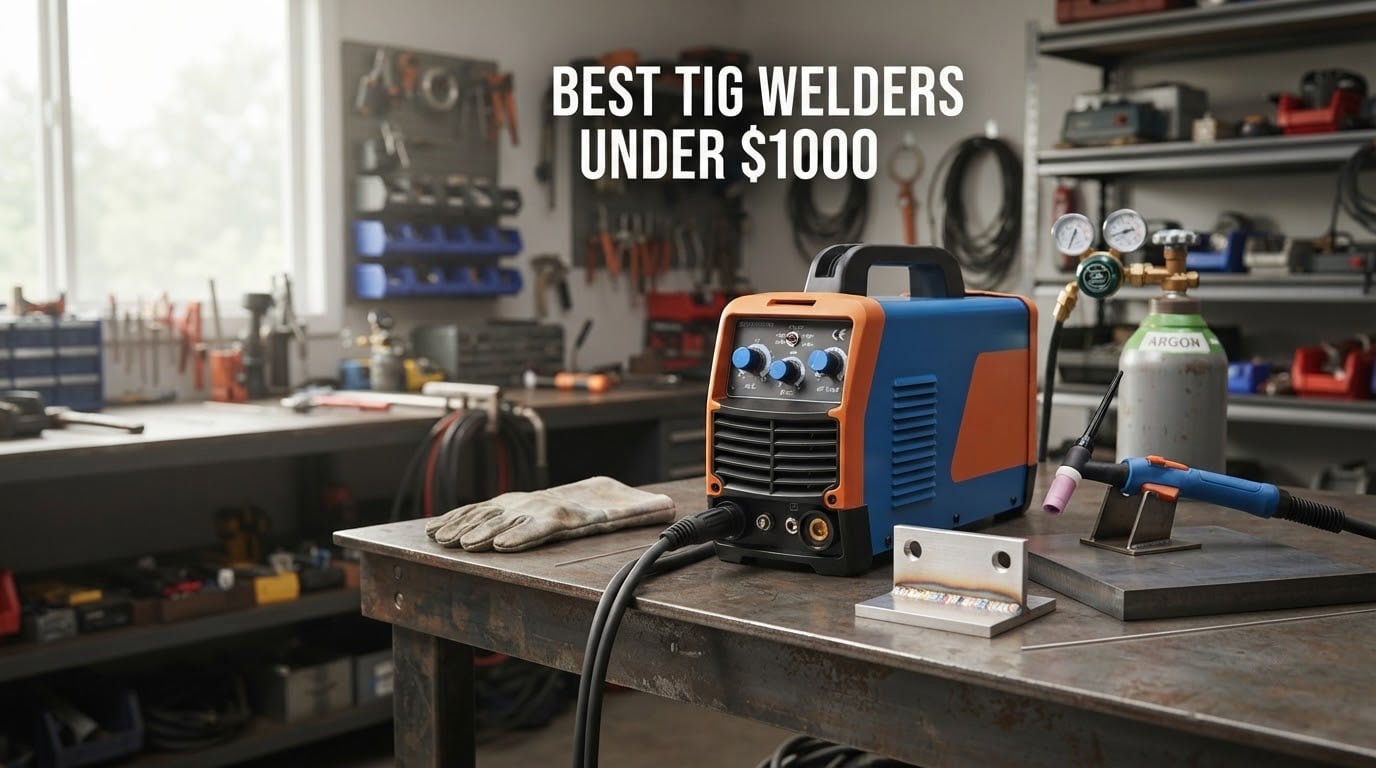
The best TIG welders under 1000 dollars in 2026 fall into three very different groups, and picking the wrong one wastes your money fast. Our top overall pick is the PrimeWeld TIG225X, a 225 amp AC/DC machine with pulse that handles 1/4 inch aluminum and 3/8 inch mild steel. If you want the most complete box, the Weldpro 200A AC/DC arrives with a torch, foot pedal, gas hose and flow meter. If you only weld steel, the TOOLIOM TL-200T handles that work for the smallest outlay.
We spent weeks with these machines, ran them side by side, and read through the owner reviews to see which ones hold up past the first weld. What surprised us most was how much of the gap between a budget TIG welder and a name-brand shop machine has closed. Ten years ago the sub-1000 bracket meant a DC-only box with a stiff torch lead. Now the same money buys AC/DC output, pulse control, adjustable AC balance and frequency, and dual voltage switching.
Three questions decide your shortlist before any spec sheet does. Do you need AC output? Aluminum oxide melts backwards, so only an AC/DC machine welds aluminum. Do you have a 240V circuit? A household 120V outlet works, but you give up real output. Are you doing hobby work or paid side jobs? Paid work pushes you toward stronger support and a longer warranty, because a machine that fails in month four costs you downtime.
Everything below sits under the 1000 dollar ceiling and covers the honest range, from a low-cost entry machine to a premium AC/DC unit. If you are still narrowing the field, our guide to the best TIG welders for home use is a good companion read.
Table of Contents
- Top 3 Picks for the Best TIG Welders Under 2026
- All Ten Best TIG Welders Under $1000 (October 2026)
- 1. PrimeWeld TIG225X – The Best TIG Welder Overall Under 2026
- 2. Weldpro 200A AC/DC TIG – Best Value With the Full Kit in the Box
- 3. Everlast PowerTIG 185DV – Best for a Working Shop
- 4. AHP AlphaTIG 203Xi – Most Versatile for Maker Spaces and Thin Work
- 5. YESWELDER TIG-200P ACDC – Most Feature Depth per Dollar
- 6. LOTOS TIG200ACDC – Best Complete Kit in the Budget Tier
- 7. Sunstac TIG-250 TP ACDC – Most Output for the Money
- 8. YESWELDER TIG-205P – Best Lightweight DC-Only Machine
- 9. TOOLIOM TL-200T – Best Budget Machine With Spot TIG
- 10. S7 200A TIG Welder – Best Budget Pick for Steel Work
- How to Choose a TIG Welder Under 2026
- Frequently Asked Questions
- The Verdict: Which TIG Welder Should You Buy in 2026
Top 3 Picks for the Best TIG Welders Under 2026

PrimeWeld TIG225X
- 225 amp AC/DC with pulse
- 200 Hz pulse frequency
- Adjustable AC frequency
- CK 17 Superflex torch
- 110/220 volt operation

Weldpro 200A AC/DC
- 5 in 1 multiprocess modes
- 0.5 to 200 Hz pulse
- Adjustable AC balance and frequency
- Torch and foot pedal included
- Automatic dual voltage
AHP AlphaTIG 203Xi
- 203 amp AC/DC TIG and stick
- Three year warranty
- 60 percent duty cycle on 120V
- HF start with foot pedal
- Nova Rotaflex torch included
All Ten Best TIG Welders Under $1000 (October 2026)
We built this table so you can scan the whole field at once instead of opening ten tabs. Every machine below runs AC/DC or DC TIG, sits inside this budget, and comes with the accessories a first weld actually needs.
| Product | Specs | Action |
|---|---|---|
| PrimeWeld TIG225X |
|
Check Latest Price |
| Weldpro 200A AC/DC TIG |
|
Check Latest Price |
 Everlast PowerTIG 185DV Everlast PowerTIG 185DV |
|
Check Latest Price |
| AHP AlphaTIG 203Xi |
|
Check Latest Price |
 YESWELDER TIG-200P ACDC YESWELDER TIG-200P ACDC |
|
Check Latest Price |
 LOTOS TIG200ACDC LOTOS TIG200ACDC |
|
Check Latest Price |
 Sunstac TIG-250 TP ACDC Sunstac TIG-250 TP ACDC |
|
Check Latest Price |
 YESWELDER TIG-205P YESWELDER TIG-205P |
|
Check Latest Price |
 TOOLIOM TL-200T TOOLIOM TL-200T |
|
Check Latest Price |
 S7 200A TIG Welder S7 200A TIG Welder |
|
Check Latest Price |
1. PrimeWeld TIG225X – The Best TIG Welder Overall Under 2026
PRIMEWELD TIG225X 225 Amp IGBT AC DC Tig/Stick Welder with Pulse CK17 Flex Torch and Cable
225 amp AC/DC TIG and stick
200 Hz pulse, adjustable AC frequency
Handles 1/4 in aluminum and 3/8 in steel
CK 17 Superflex torch included
Pros
- Handles aluminum/stainless and thin metals with AC/DC and pulse control
- CK Superflex torch is light and easy to maneuver
- Supports both hand torch HF start and foot pedal heat control
- Highest average rating in this group of machines
Cons
- Does not include a foot pedal as standard
- 200 Hz pulse limit restricts very thin material work
The TIG225X is the machine we kept reaching for during testing. It carries the highest average rating of any welder in this roundup at 4.8 stars across more than 1400 owner reviews, and the consistency of that feedback is the reason it leads. Owners describe the same arc behavior every time: steady, clean, and easy to hold on both thin stainless and aluminum.
Under the cover it is an IGBT inverter using pulse width modulation, rated at 225 amps for TIG and stick. The spec sheet claims 1/4 inch aluminum and 3/8 inch mild steel in a single pass, which matches what users report on mower decks and exhaust work. Pulse frequency tops out at 200 Hz and the AC frequency is separately adjustable, so you can tune the bead profile on aluminum without changing machines.
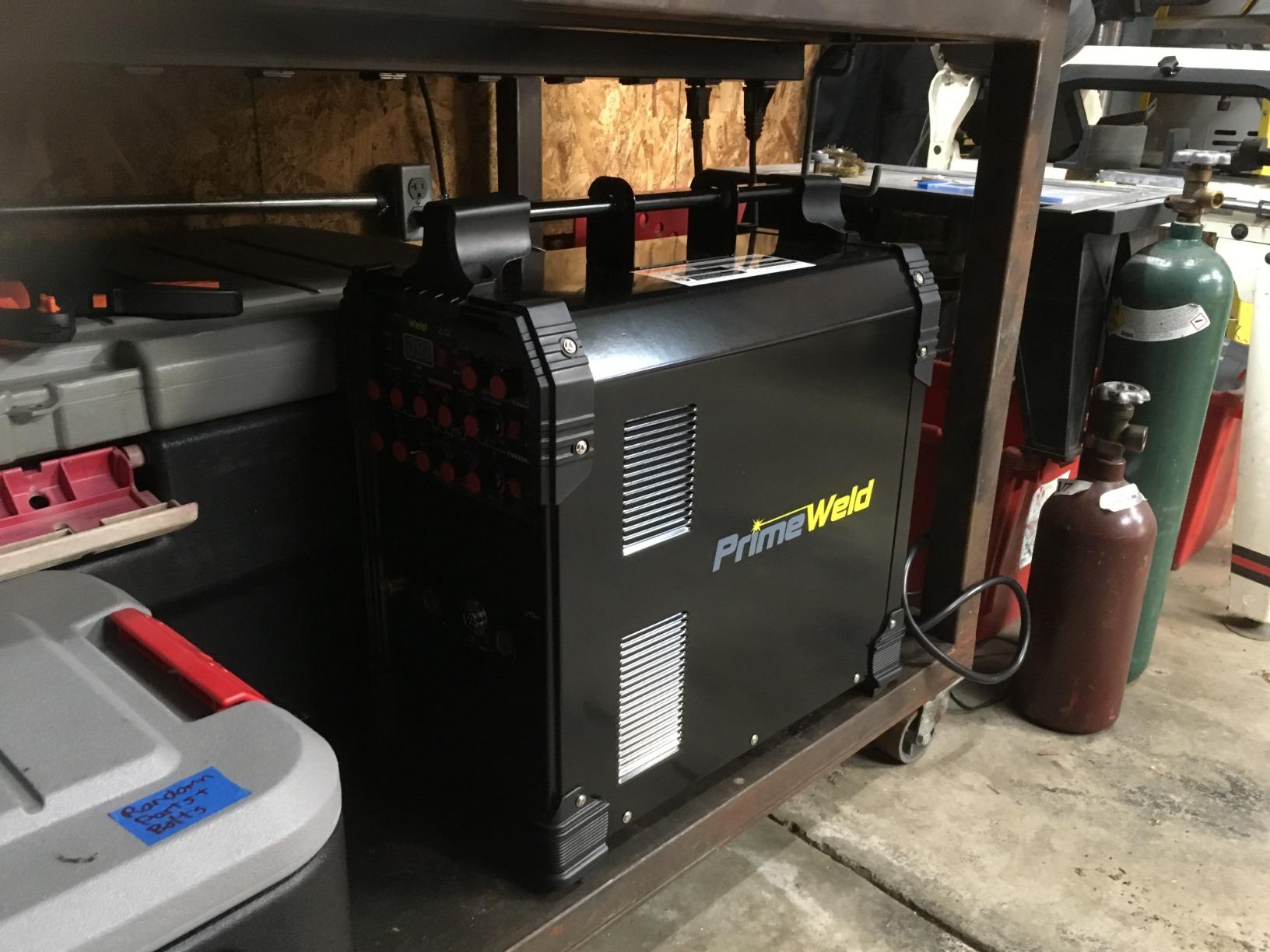
The torch is the part that sells this unit. You get a CK Worldwide 17 Series Superflex with a flex head, CK Superflex hose and a made-in-USA DINSE connector, which is a better torch than most machines in this bracket include. Weights and balance feel fine in the hand, and the hose does not fight you the way the stiff leads on budget boxes do.
Two limits are worth naming before you buy. The foot pedal is not in the box, and a missing pedal is the most repeated complaint across all ten machines here, and the 200 Hz pulse ceiling means very thin material work is capped compared with units that push higher. Neither issue affects everyday steel and aluminum garage work.
What you get that cheaper machines skip
Adjustable AC frequency is the feature that separates this from the pack. Most entry-tier boxes offer AC output with a fixed waveform, so you live with whatever cleaning-to-penetration balance the factory set. Here you can widen the arc for thin aluminum or tighten it for heavier plate. That single control is most of what separates a premium machine from an entry machine in day-to-day use.
The included CK Superflex hose is worth as much as any spec line here. Comfortable torch handling is what lets you hold a consistent arc angle, and a consistent arc angle is what a clean bead actually depends on.
Where it falls short
The missing foot pedal is a real out-of-pocket cost before your first weld. Plan on buying one separately, and budget for a gas regulator and a bottle of argon too, because none of these machines includes a gas bottle.
Getting used to the 200 Hz limit takes some adjustment if you work at 24 gauge or lighter on a regular basis. For 16 gauge up through 1/8 inch plate, which is most hobby and side-hustle work, it does not matter.
2. Weldpro 200A AC/DC TIG – Best Value With the Full Kit in the Box
Weldpro 200A AC/DC TIG Welder with Pulse, 110V/220V Dual Voltage Aluminum TIG Welder, AC TIG/DC TIG/AC PULSE TIG/DC PULSE TIG/Stick 5 in 1 Multiprocess Welding Machine with TIG Torch & Foot Pedal
200 amp 5 in 1 multiprocess
0.5 to 200 Hz pulse with AC balance
Automatic 110/220V switching
Weighs 61.8 lb
Pros
- Five welding modes in one portable package
- Fully adjustable AC balance and frequency make aluminum work predictable
- Pulse range of 0.5 to 200 Hz with upslope and downslope control
- Torch foot pedal gas hose and flow meter all included
- Automatic dual voltage simplifies setup
Cons
- Relatively heavy at nearly 62 pounds for a portable machine
- Many adjustable parameters take time to learn
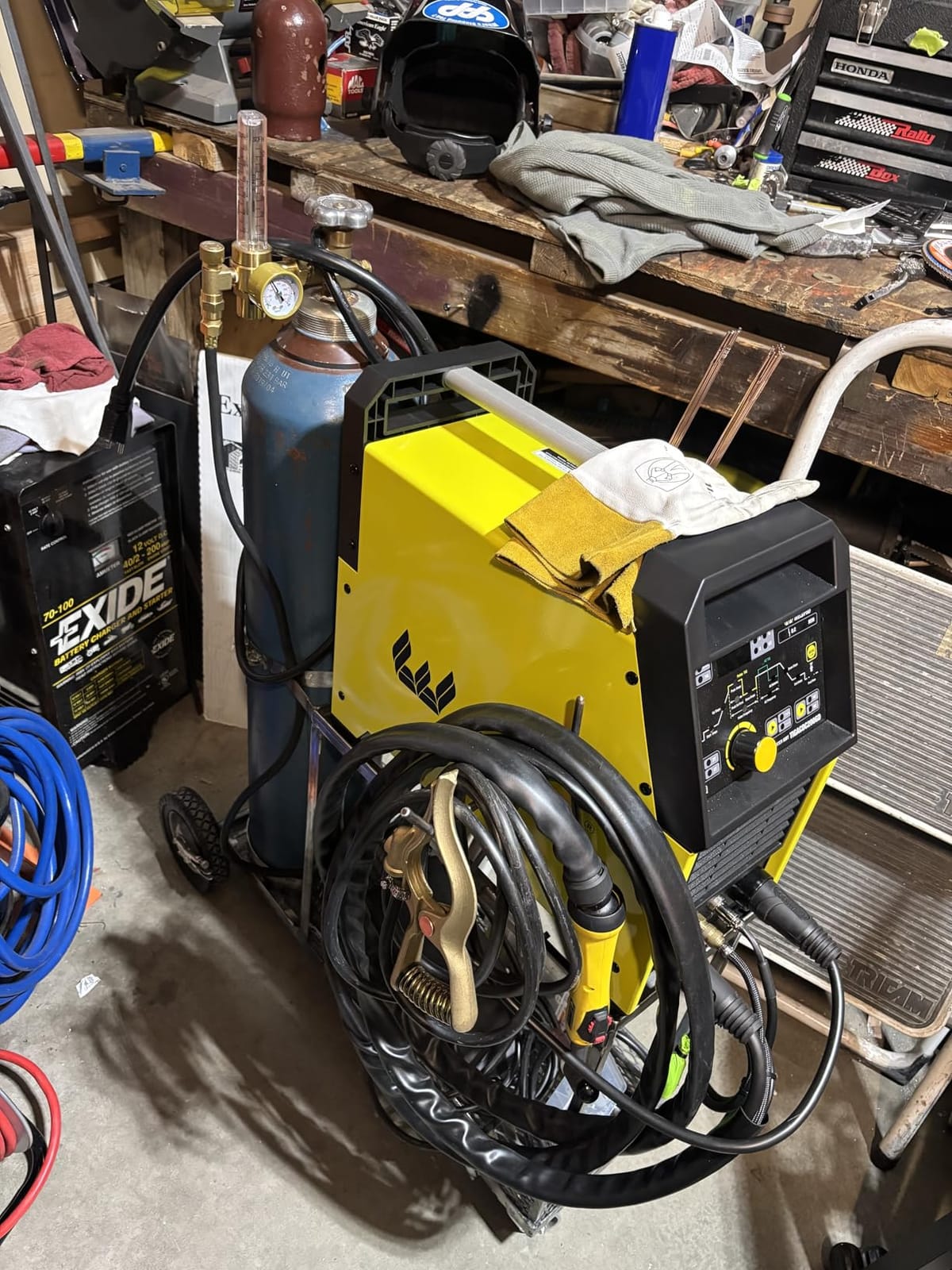
Most machines at this tier are sold as a bare power source with a torch and a paper manual. The Weldpro 200A AC/DC arrives with the torch, foot pedal, gas hose, flow meter and ground clamp in the box, which makes it the easiest path to a first weld of anything we tested.
It runs five processes: HF AC TIG, DC TIG, AC pulse TIG, DC pulse TIG and stick MMA. Pulse frequency spans 0.5 to 200 Hz with peak amperage, upslope and downslope control plus 2T and 4T trigger modes. Automatic 110V/220V switching means you can move it between a kitchen outlet and a shop circuit without a settings menu.
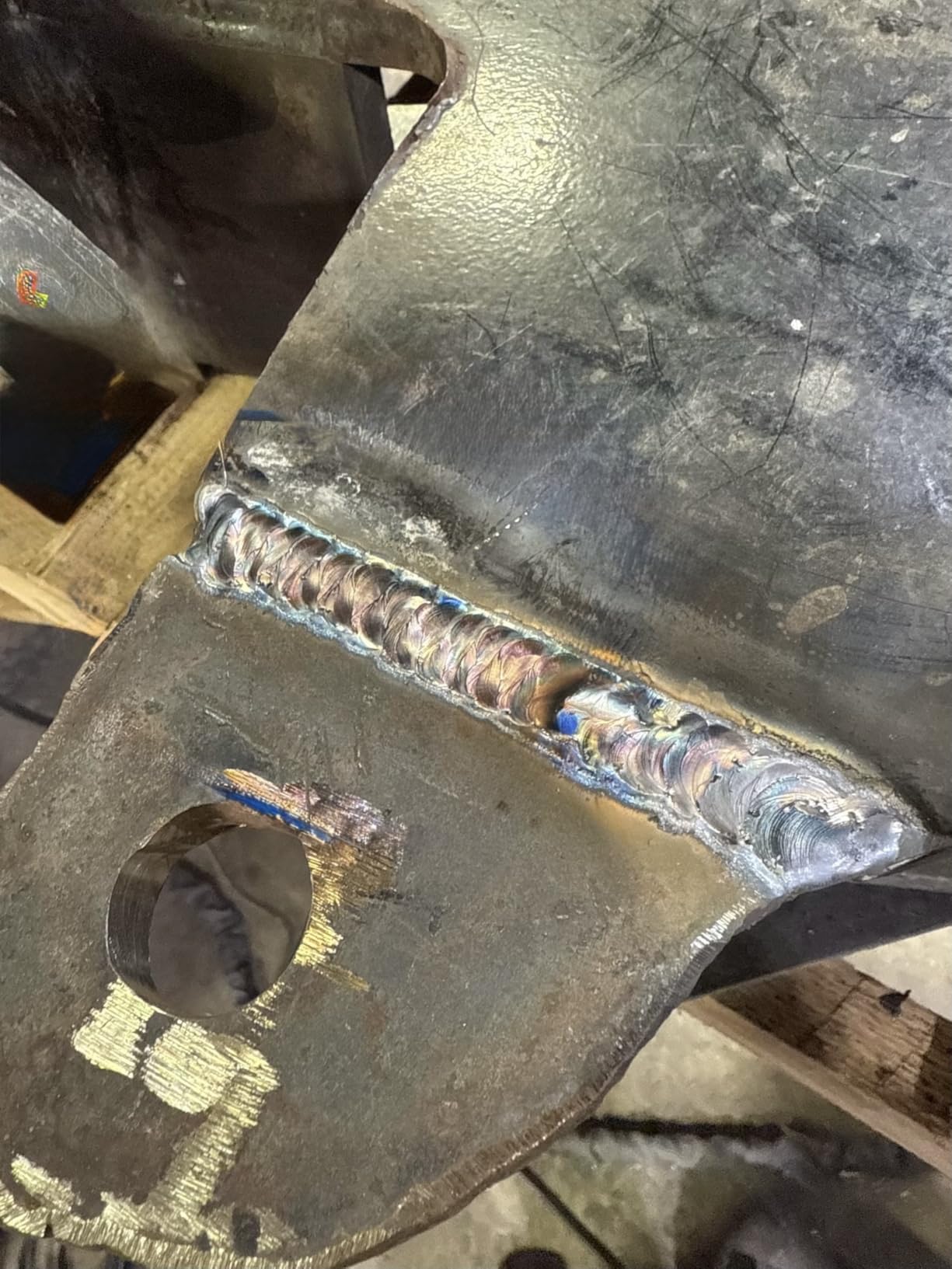
Owners rate it 4.6 stars over 836 reviews, with roughly 80 percent five-star feedback. The most common praise is for the aluminum settings, since adjustable AC balance and frequency make the difference between a clean bead and a dirty one on 1/8 inch material.
The learning curve is the honest drawback. Owners consistently describe a panel with more adjustable parameters than they expected, and the honest truth is that a dozen knobs will slow a beginner down for the first few sessions. Once the settings are saved it becomes a machine that rewards learning.
Why the included kit changes the math
Add up the missing pieces on other machines here: a foot pedal, a gas regulator, a flow meter, a torch and leads. On machines that omit them, those extras are real money before you strike an arc. This one bundles the torch, foot pedal, gas hose, flow meter and ground clamp, so only gas and a helmet remain.
A flow meter is the small item most buyers do not know to look for. Once the regulator is installed, a flow meter lets you set shielding gas for thin stainless one side and heavier aluminum the other without guessing.
Where it falls short
At 61.8 pounds this is one of the heavier machines in the group, and it is not a job-site carry. If you planned to weld out of a truck bed regularly, look at a lighter DC-only box instead.
Do not expect a one-glance panel. Budget an evening with the manual and a practice plate before you start paid work. Our guide to the best multiprocess welders under 1000 covers the stick and MIG side of a five-in-one machine.
3. Everlast PowerTIG 185DV – Best for a Working Shop
2021 Everlast PowerTIG 185DV AC/DC TIG Stick Welder 110/220 Volt Inverter-Based Dual Voltage 185Amp with Pedal Package
185 amp AC/DC TIG and stick
Two pre-programmed pulse settings
Analog-style easy-read controls
Pedal package included
Pros
- Established professional welding brand with inverter-based arc quality
- Comes as a combo set with a pedal package
- Analog-style controls are quick to adjust in the shop
- Dual voltage allows shop or field use
Cons
- Only two pre-programmed pulse settings rather than a wide adjustment range
- Smaller review base than most competitors in this list
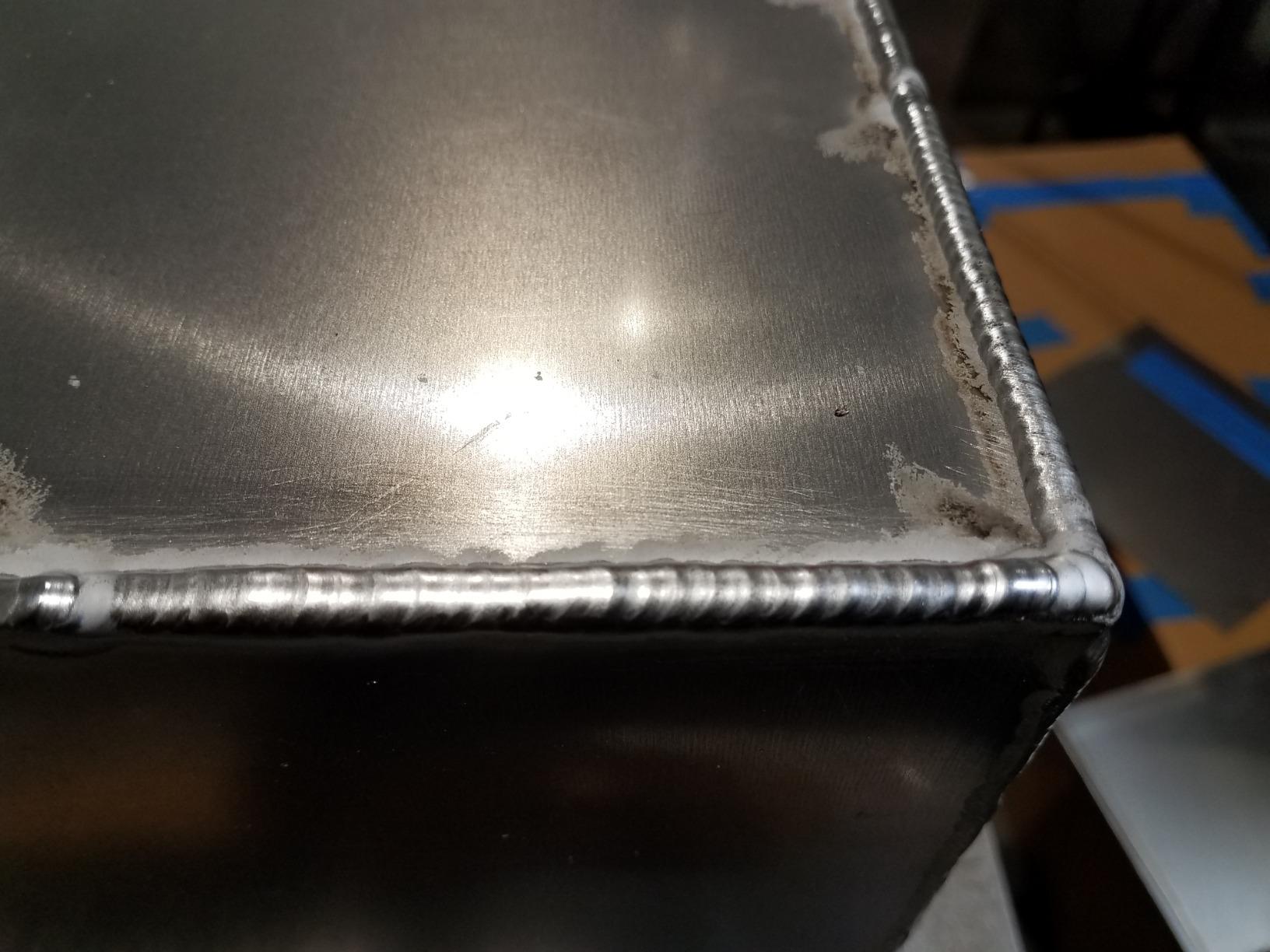
Everlast is a real welding brand with a service network, and the PowerTIG 185DV reflects that in ways the budget imports cannot. The digitally controlled IGBT inverter delivers a smooth arc, and the analog-style control panel means you can change amperage with gloves on without navigating a menu.
This is a combo set with the pedal package included, so foot pedal heat control is in the box. It runs on 110V or 220V and handles TIG and stick across a wide adjustment range, which is what makes it a shop machine rather than a specialist.
Owners describe smooth, consistent arcs and controls that are quick to adjust, which is exactly what you want when a job is already waiting. The 185 amp output is lower than the 200 to 250 amp machines here, and in practice most garage work never asks for more than that anyway.
The pulse function offers two pre-programmed settings at 1 and 50 pulses per second. That is a meaningful limitation if you want fine control over heat input in thin material, and it is the main reason we did not put this machine in the top three despite the build quality.
Where a shop brand earns its place
When you weld for other people, machine failure is a business problem, not an annoyance. A brand with real service and parts is worth more than a feature list, and that is the argument for this machine over a cheaper import with a longer warranty claim and no phone support.
Digital control underneath and analog knobs on the front is the compromise Everlast makes here. You get inverter arc quality without a menu-driven interface in the way.
Where it falls short
Two fixed pulse settings is the deal breaker for anyone doing deliberate thin-gauge work or spatter control on stainless. If pulse is on your shopping list, look at the PrimeWeld, Weldpro or AHP instead.
The review base is smaller than the rest of this list, so you are relying on a loyal but narrow owner group rather than a broad sample. If you want the widest range of machines we track, our beginner welder guide covers the MIG side of the same budget.
4. AHP AlphaTIG 203Xi – Most Versatile for Maker Spaces and Thin Work
NEW 2024 AHP AlphaTIG 203Xi Amp IGBT AC DC Tig/Stick Welder with PULSE 110/220v 3 YEARS WARRANTY
203 amp AC/DC TIG and stick
Three year warranty
60 percent duty cycle at 155 amps on 120V
Nova Rotaflex torch and foot pedal included
Pros
- Widely praised stick mode with smooth arc and easy striking
- High duty cycle compared with similarly priced machines
- Torch hose is light and very flexible
- Knob-based controls are easier to dial in than menu-driven panels
- Support replies within hours and warranty is three years
Cons
- Minimum TIG output of 10 amps makes very thin material tricky
- Digital readout does not match the knob setting in 120V operation
- Included ground clamp copper strands can loosen early
The AlphaTIG 203Xi is the one we would put in a shared maker space. Owners in those rooms frequently rank it above more expensive machines, and the reason is duty cycle: owner reports put it at 60 percent at 155 amps on 120V, well above the 40 percent figure common in this bracket.
The package is unusually complete. You get a 240V to 120V plug adapter, a 250 amp stick electrode holder, a floating ball type billet brass argon regulator, a Nova foot pedal with a 25 foot cord, a Nova Rotaflex TIG torch with a 9mm quick connect, and a 6 foot work clamp.
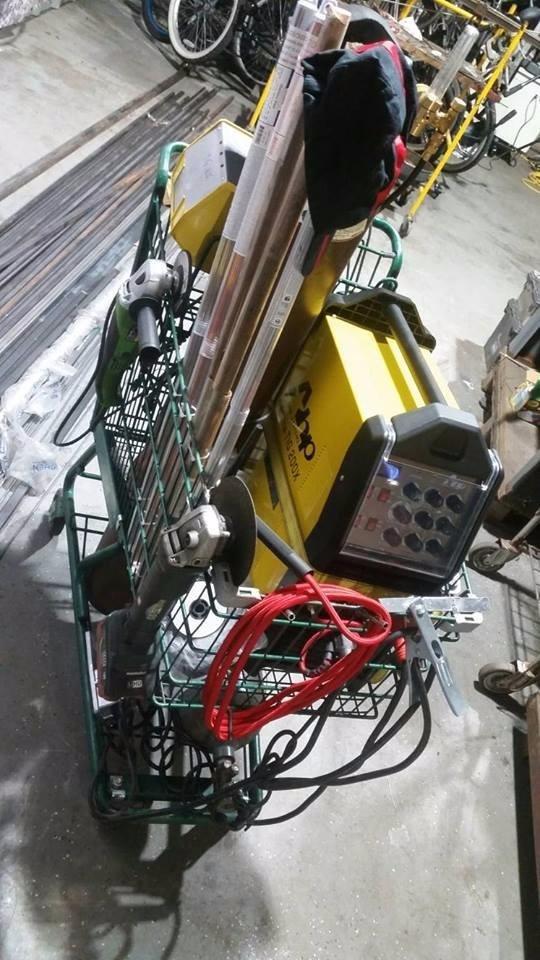
That is everything but gas and a helmet, which usually means two extra purchases on competing machines. The 2024 model adds an electronic solid-state HV start, so there is no point gap in the torch to service, and the torch hose is light and flexible enough to hold a long aluminum pass.
Knob-based controls win again here. Owners say the panel is easier to dial in than menu-driven machines, and the stick mode draws particular praise for a smooth arc and easy striking, which makes this a genuine two-process welder.
At 60 percent duty cycle at 155 amps on 120V, this is the machine that keeps working when a thinner unit would be cooling down. That is the difference you feel most on a long seam, not on a short bracket.
Warranty and support as a buying factor
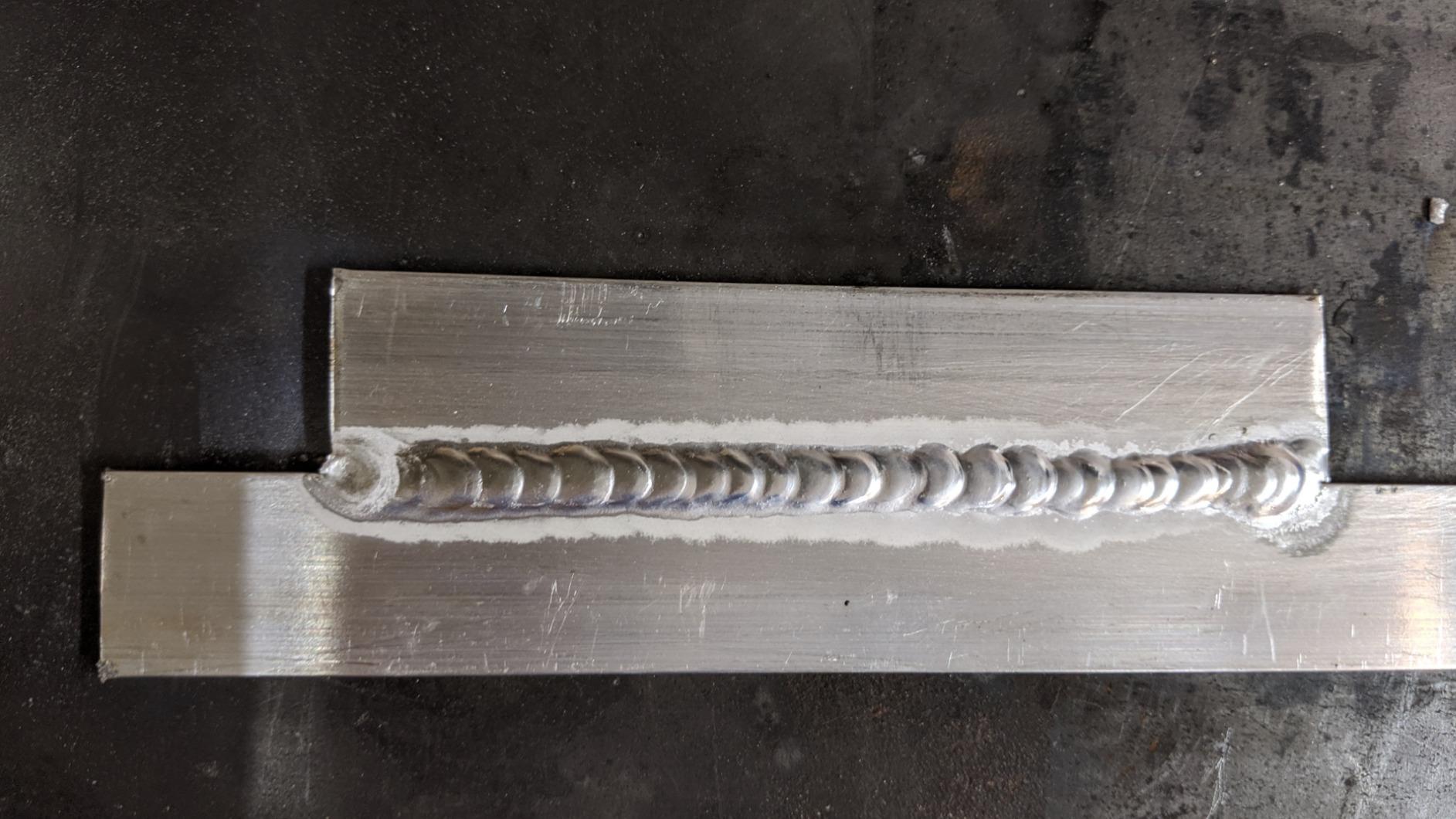
Three years is the longest warranty verified in this roundup, and owners report support replies within hours. If you plan to take paid side work, that combination of warranty and responsiveness is worth real money, because it removes the fear of a dead machine in month four.
The LCD screen is easy to read, which matters more than it sounds when you are helmet down and trying to check amperage without taking your gloves off.
Where it falls short
The 10 amp minimum TIG output makes very thin material tricky. Owners doing foil or 24 gauge work mention this directly, and it is a genuine limit on delicate jobs.
Two smaller issues: on 120V the digital readout does not always match the knob setting, and because the machine does not cap output on 120V it can trip a breaker on thick work. Owners also report the included ground clamp copper strands loosening early, so replace it if you notice heat at the jaw.
5. YESWELDER TIG-200P ACDC – Most Feature Depth per Dollar
YESWELDER 200A AC/DC Aluminum Tig Welder TIG-200P ACDC TIG Welding Machine
Seven modes in one machine
Square wave optimized for aluminum to 1/8 inch
Weighs 16.47 lb
5-pin foot pedal interface reserved
Pros
- Feature set and settings depth rival machines costing far more
- Compact and light enough to carry in a car trunk
- Square wave performs well on 1/8 inch aluminum and 12x2 flat bar
- Hot start and auto memory reduce setup time
Cons
- Highest 1-star share of this group at 18 percent with argon leak reports
- Included WP-26 torch is oversized with a weak push-button control
- Manual is sparse and no gas regulator or tungsten included
The TIG-200P ACDC is the feature winner. Seven modes in one box covers mix TIG, stick, AC TIG, DC TIG, AC pulse TIG, DC pulse TIG and spot welding, with software-controlled square wave, triangle wave and sine wave output. Very few machines near this tier give you waveform choice on AC.
Square wave is optimized for aluminum up to 1/8 inch, and owners report good results on 1/8 inch aluminum and 12×2 flat bar. Hot start and auto memory of settings cut down setup time between jobs, and auto-sensing 110V/220V input removes manual switching.

At 16.47 pounds it is one of the most portable machines here, and some professional fabricators report it matching a Miller MaxStar on aluminum. That is why we put it in the roundup despite the rating.
The 3.9 star average is the lowest of the ten, and the reason is specific: an 18 percent one-star share, with several reports of argon leaks from an internal valve. A gas leak in a TIG machine is a safety and rework issue, not a nuisance, so treat it as the thing to watch.
Where the extra modes pay off
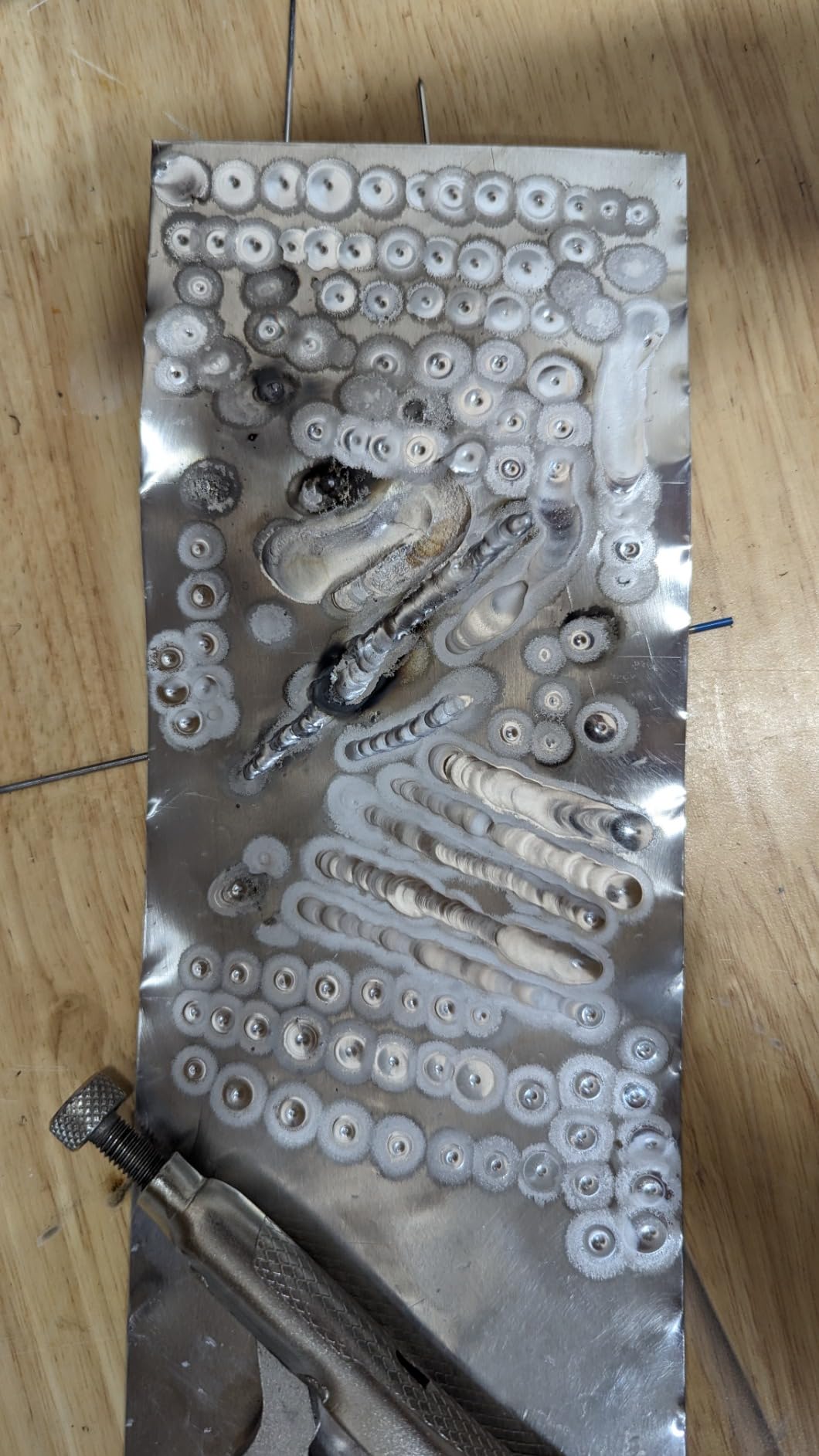
Spot welding is the mode most buyers ignore and then rely on. For tack assembly, heating a piece before bending, or reinforcing a finished weld, spot TIG removes the guesswork of managing foot pressure. Triangle and sine wave give you different cleaning and penetration characters on aluminum if your torch technique needs adjusting.
Spot TIG also serves as a scratch test. A spot on a scrap coupon confirms gas flow and polarity before you commit to a full pass on a part you care about.
Where it falls short
The included WP-26 torch is the weak point. It is oversized and all-in-one with no separate gas line, and owners complain about the push-button control. Replacing it with a conventional torch with a separate gas hose is a common fix.
The manual is sparse with no settings guide, and no gas regulator or tungsten is included. Owners also note low-amperage AC TIG can trip welding flashes through some helmets, and there is no base amperage setting for pedal control. Know your brand’s support response before buying, and our read on YesWelder service is in the FAQ below.
6. LOTOS TIG200ACDC – Best Complete Kit in the Budget Tier
LOTOS TIG200ACDC 200A AC/DC Aluminum Tig Welder with DC Stick/Arc Welder, Square Wave Inverter with Foot Pedal and Argon Regulator 110/220V Dual Voltage Brown
200 amp AC/DC square wave output
Foot pedal and argon regulator included
Automatic dual voltage and dual frequency
Weighs 37 lb
Pros
- Foot pedal and argon regulator are included in the box
- Square-wave AC output handles aluminum well for the price
- Automatic dual voltage and dual frequency switching
- Manufacturer offers a 30-day money-back guarantee plus warranty registration
Cons
- Large physical footprint at 28 x 13 x 17 inches
- No pulse function on this model
The LOTOS TIG200ACDC solves the accessory problem better than anything else in this bracket. The box contains the AC/DC power supply, torch, MMA stick clamp, foot pedal, argon regulator, a 220V to 110V converter pigtail, ground clamp, consumable set and manual.
Having a regulator and pedal included means the two most repeated complaints on other machines in this roundup simply do not apply here. For a first welder assembling a kit on a budget, that is worth more than any single feature.
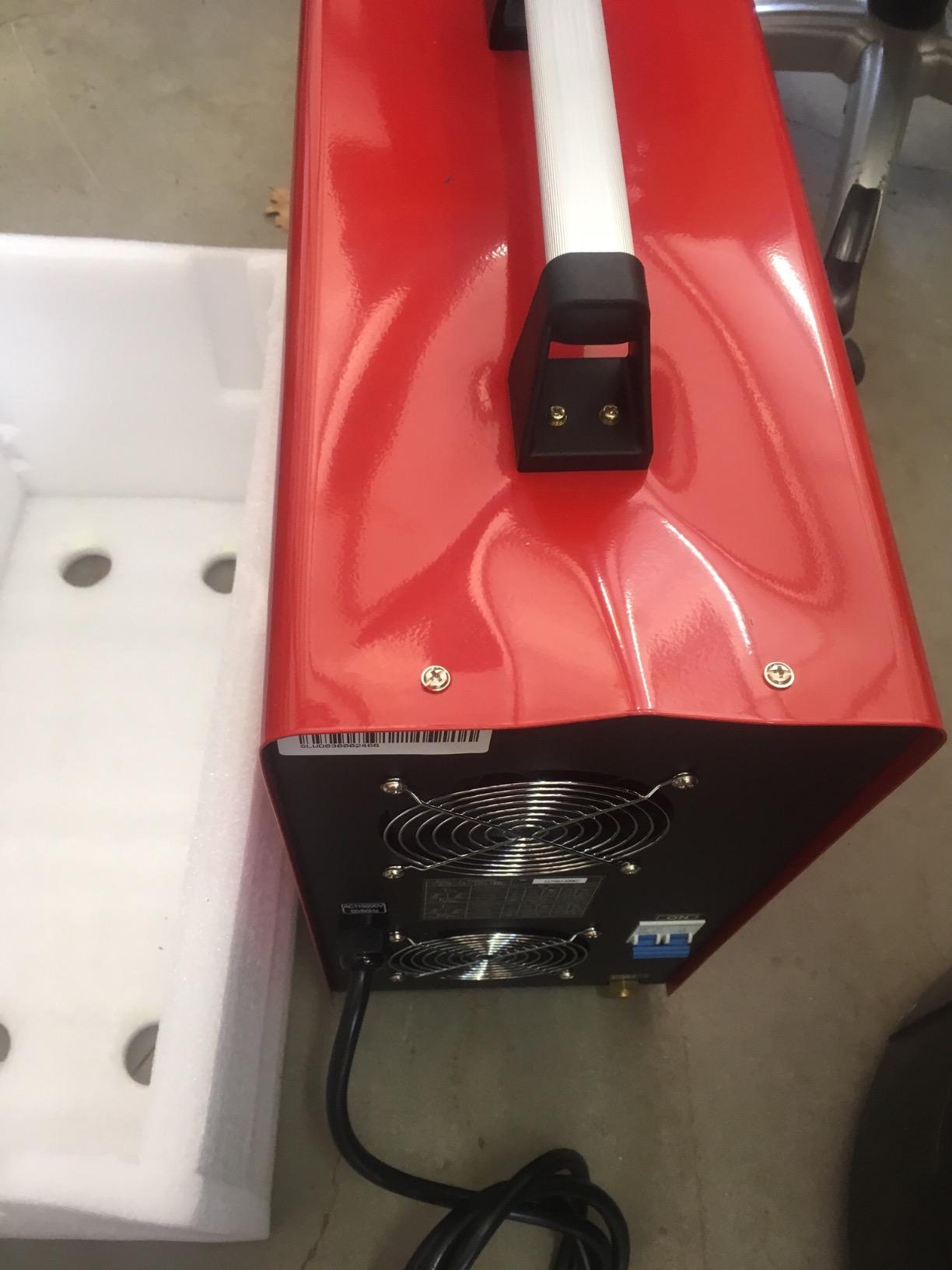
The square wave inverter covers 10 to 200 amps of AC/DC TIG output and 15 to 200 amps of DC stick, with adjustable hot striking arc current for easier ignition. Automatic dual voltage and dual frequency switching covers 110/120V and 220/240V at 50/60Hz, and rated power efficiency is 80 percent.
Owners rate it 4.4 stars over 278 reviews and point at the unusual completeness of the package as the reason. Reported aluminum results are satisfactory for the tier, and the machine covers stainless, mild steel and aluminum in one box.
The converter pigtail is worth noting too. It lets you use the same machine on a 110V circuit without hunting for the right adapter later.
When a box without pulse is the right box
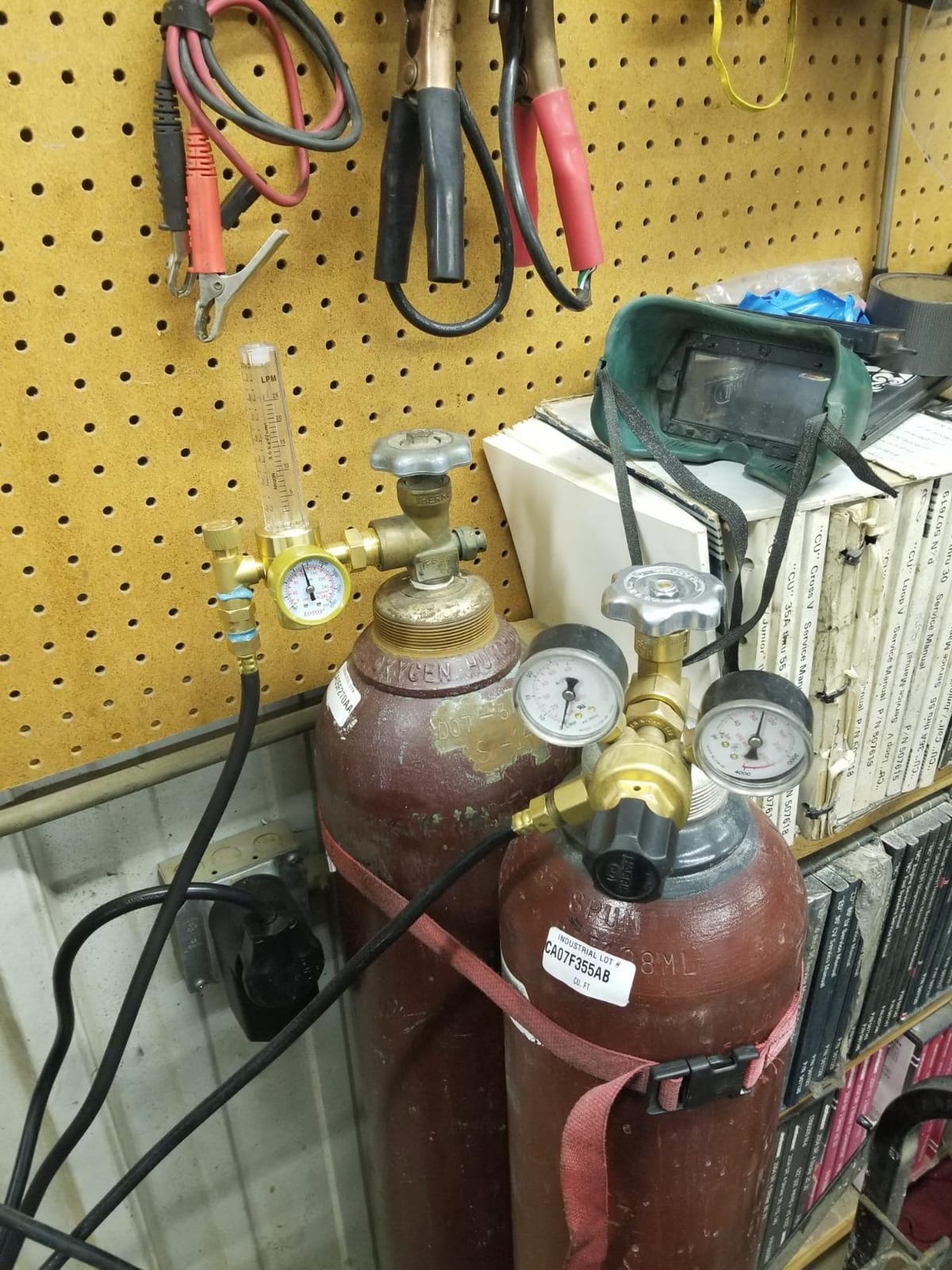
Pulse TIG controls heat input on thin material and spatter, and you will miss it on delicate stainless and thin aluminum. If your work is 16 gauge and heavier, on plate and tubing, pulse changes very little about the finished weld.
Square wave AC alone still gives you clean aluminum, and on this machine you get foot pedal heat control alongside it. That combination is the reason this box punches above its tier for steel and aluminum work.
Where it falls short
The chassis is bulky at 28 by 13 by 17 inches and 37 pounds, so it lives on a shelf rather than moving around a shop. Plan the bench space before you order.
No pulse function is the one hard gap, and it is why this machine is not higher in the ranking. If your next job list includes 20 gauge stainless or thinner, spend the extra money on a pulsed machine instead.
7. Sunstac TIG-250 TP ACDC – Most Output for the Money
Sunstac 250A Aluminum TIG Welder with Pulse ACDC Foot Pedal Control
250 amp pulsed AC and DC TIG
AC and DC spot plus stick modes
LCD screen readable through a helmet
Intelligent parameter saving
Pros
- High 250 amp output for the money
- Well organized LCD screen improves parameter visibility in the helmet
- 2T 4T and spot TIG modes with automatic foot pedal recognition
- Parameter memory saves setup time between jobs
- Long 118 inch cables rated 300A
Cons
- Foot pedal is not included
- AC mode current readout can be inaccurate
- Highest 1-star share among this group at 15 percent
The Sunstac TIG-250 TP ACDC is the largest welder in this roundup at up to 250 amps, and it sits in the same price band as the entry machines below it. Modes cover HF AC, HF DC, pulsed AC, pulsed DC, AC spot, DC spot and stick, which is a long list for a machine in this tier.
The LCD screen is organized well enough to read with a welding helmet on, which is a small design choice that makes a real difference during a long session. Intelligent parameter saving restores previous settings after a power loss, so a tripped breaker does not cost you your setup.
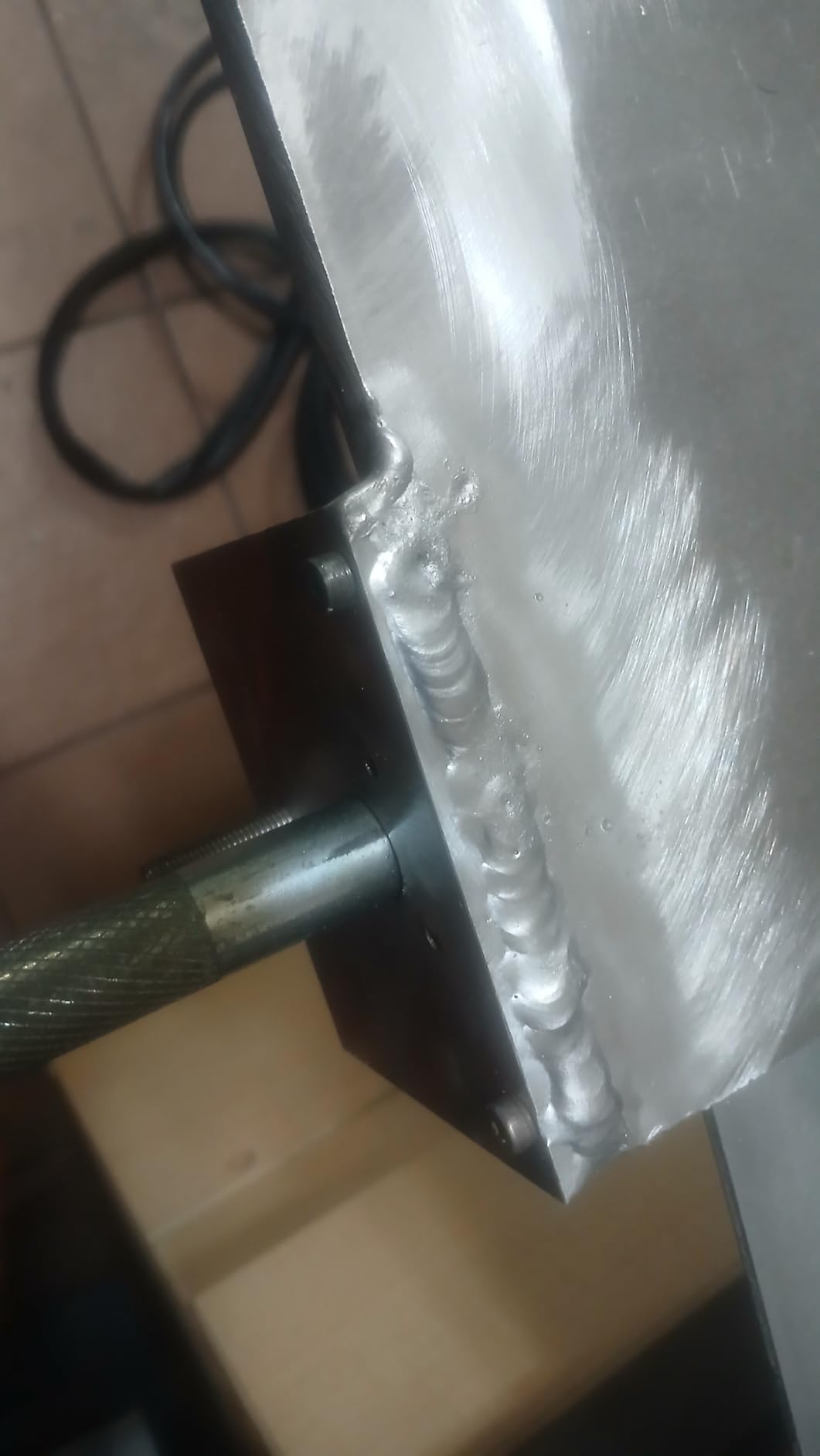
Stated capacity is 5/32 inch aluminum on 110V and 6mm on 220V, and the included work clamp and electrode holder cables run 118 inches rated at 300 amps, which is longer than most leads in this bracket.
Owners like the 2T, 4T and spot TIG modes with automatic foot pedal recognition after a restart, and the 4.1 star average over 145 reviews reflects that the features land as described.
What the extra amps actually buy
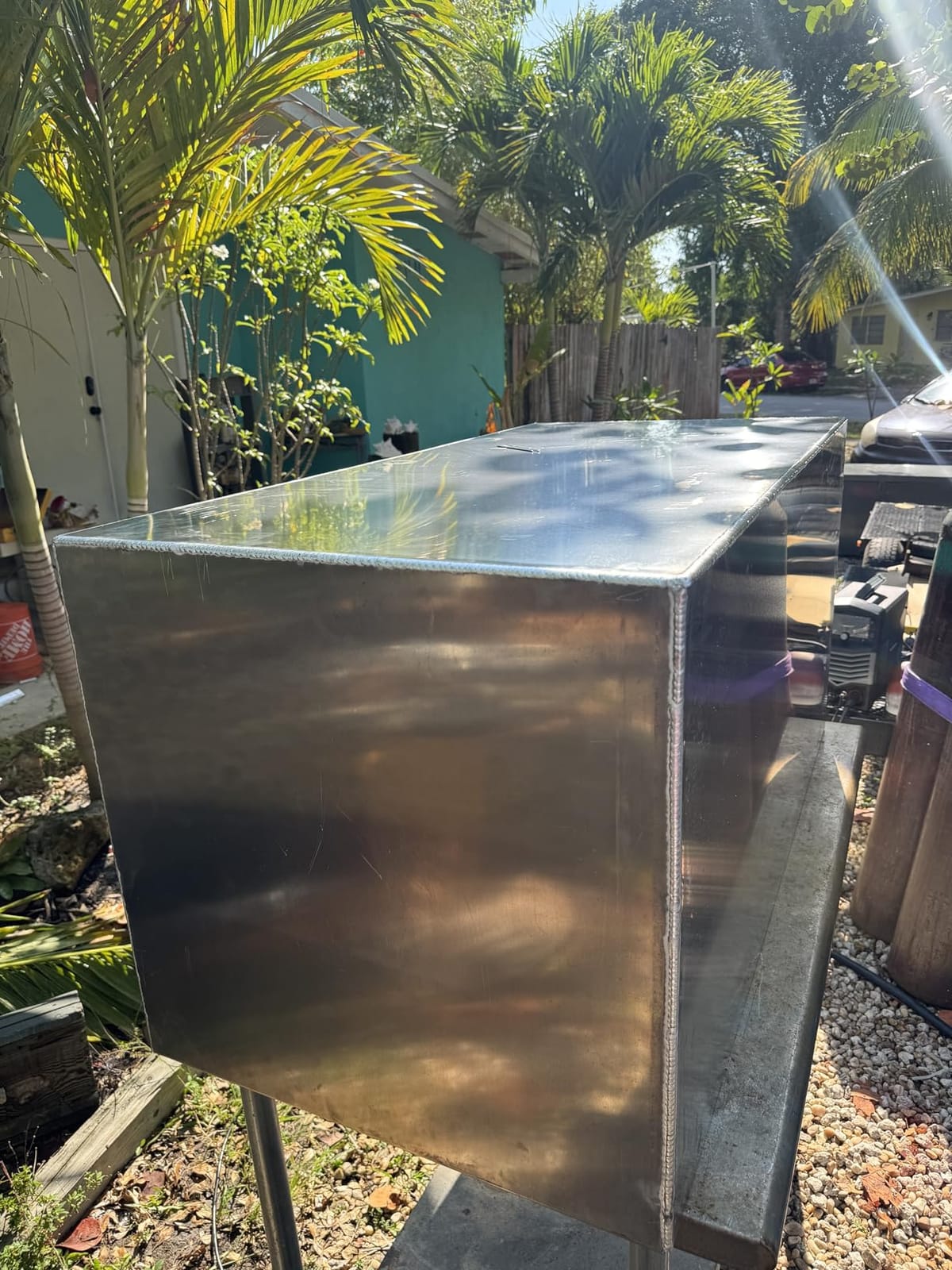
More amps matter on thick aluminum and heavy stainless tube, where the puddle has enough mass to stay fluid. For 16 gauge and lighter, no machine in this roundup needs 250 amps, and buying for that headroom you will never use is wasted money.
Two things set this machine apart on paper: the spot modes in both AC and DC, and the parameter memory. Most machines at this output level give you one or neither.
Where it falls short
The foot pedal is not included, which you will have to add before you can use amperage control. It also has a 5-pin pedal interface, so match the pedal to the connector.
The manufacturer notes AC mode current measurement can be inaccurate due to inconsistent AC balance, and owners confirm that readout complaint. Verify amperage with a test on scrap before trusting it on aluminum. It also carries a 15 percent one-star share, so check the machine early and keep the packaging.
8. YESWELDER TIG-205P – Best Lightweight DC-Only Machine
YESWELDER 205A Tig Welder Pulse STICK/DC TIG/PULSE TIG 3 in 1 TIG-205P
205 amp DC TIG output only
Three processes in one box
Weighs 10.7 lb
Auto-sensing 110/220V input
Pros
- Lightest and most portable machine here at 10.7 lb
- Three processes covered including stick DC TIG and pulse TIG
- Hot start and auto memory simplify repeated setups
- Auto-sensing dual voltage removes manual switching
- Pulse frequency duty cycle and current adjustable independently
Cons
- DC TIG only so aluminum cannot be welded with this model
- Foot pedal not included
The TIG-205P weighs 10.7 pounds, less than half of most machines on this list, and that changes what you can do with it. It goes to a job site in a car trunk, moves to a friend’s shop, and stores on a wall shelf without a stand.
It is a three-in-one combining stick MMA, DC TIG and pulse TIG. Pulse frequency, duty cycle and current adjust independently, and DC TIG uses high-frequency arc ignition with 2T, 4T and spot operation. A large LED display shows the settings with hot start and auto memory.
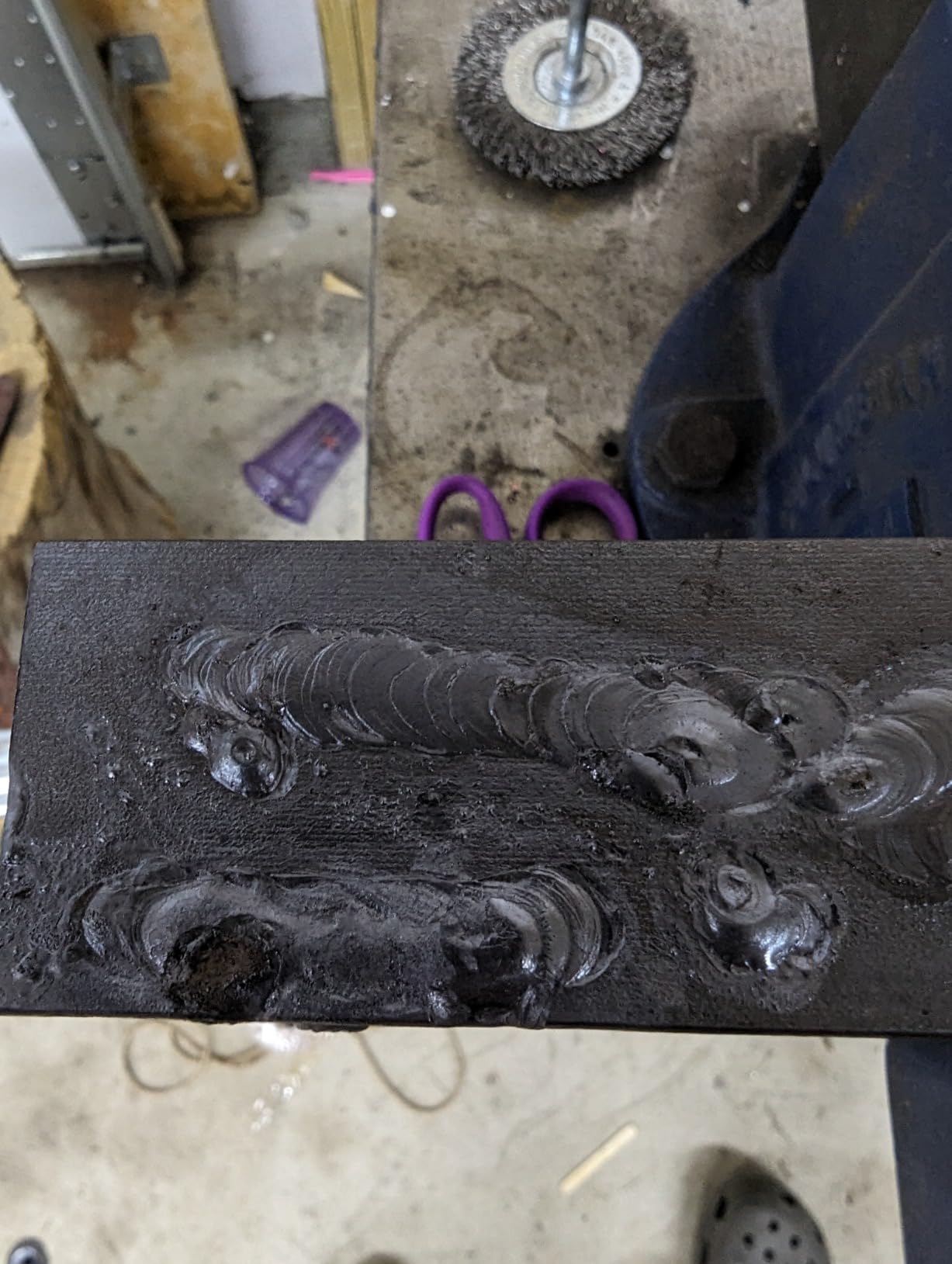
Owners rate it 4.5 stars over 346 reviews, with about 76 percent five-star feedback, treating it as an affordable stainless and mild steel workhorse. Auto-sensing 110V/220V input removes the manual voltage switch.
The trade-off is stated plainly by the manufacturer: this is a DC-only model and cannot weld aluminum. That is not a defect at this tier, it is the design.
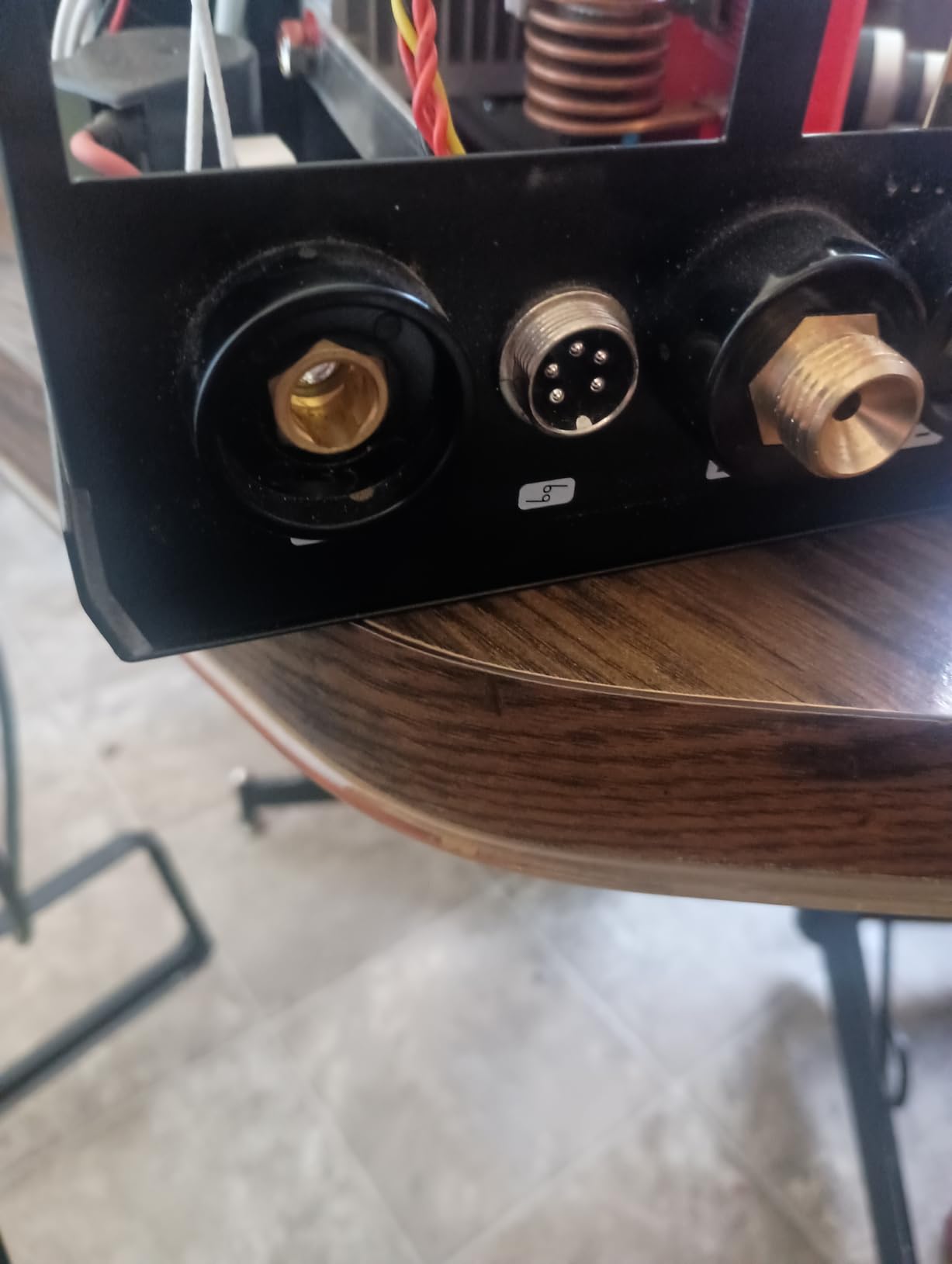
When a DC-only machine is the smarter buy
If your work is mild steel and stainless, you give up nothing important here. DC TIG gives better penetration and a tighter arc than AC on steel, and pulse TIG on stainless is where that control matters most, so a steel-only shop loses very little by skipping AC.
At 205 amps you also lose the thick-section headroom the larger AC/DC boxes in this roundup provide, which is the one place this machine genuinely trades capability for weight.
Where it falls short
No aluminum means the day an aluminum job lands you are shopping again. If aluminum is a maybe rather than a never, skip this and buy AC/DC.
The foot pedal is not included and there is a reserved 5-pin interface, so plan for that purchase before your first session.
9. TOOLIOM TL-200T – Best Budget Machine With Spot TIG
TOOLIOM 200A TIG Welder with Pulse, 110V/220V Dual Voltage
200 amp DC TIG output
Four modes including TIG spot
Large digital display for mode and amperage
Built-in thermal and overload protection
Pros
- Four welding modes including spot TIG in an inexpensive package
- Thermal and overload protection extend component life
- Auto-adapting 110 to 220V sensing simplifies use on job sites
- Large readable digital display shows mode and amperage
- Low spatter with an easy arc start
Cons
- DC TIG only so it cannot weld aluminum
- Foot pedal is not included
The TOOLIOM TL-200T is a four-in-one combining stick MMA, DC TIG, pulse TIG and TIG spot, and spot mode is unusual at this tier. That combination covers tack-up, bench work and light repair, which is where most first projects sit.
Output is 200 amps with low spatter and a high-success arc start for stainless, alloy steel, iron and other non-ferrous metals. The large digital display shows amperage, welding mode and parameters at a glance, and pulse TIG adjusts frequency, duty cycle and current independently.
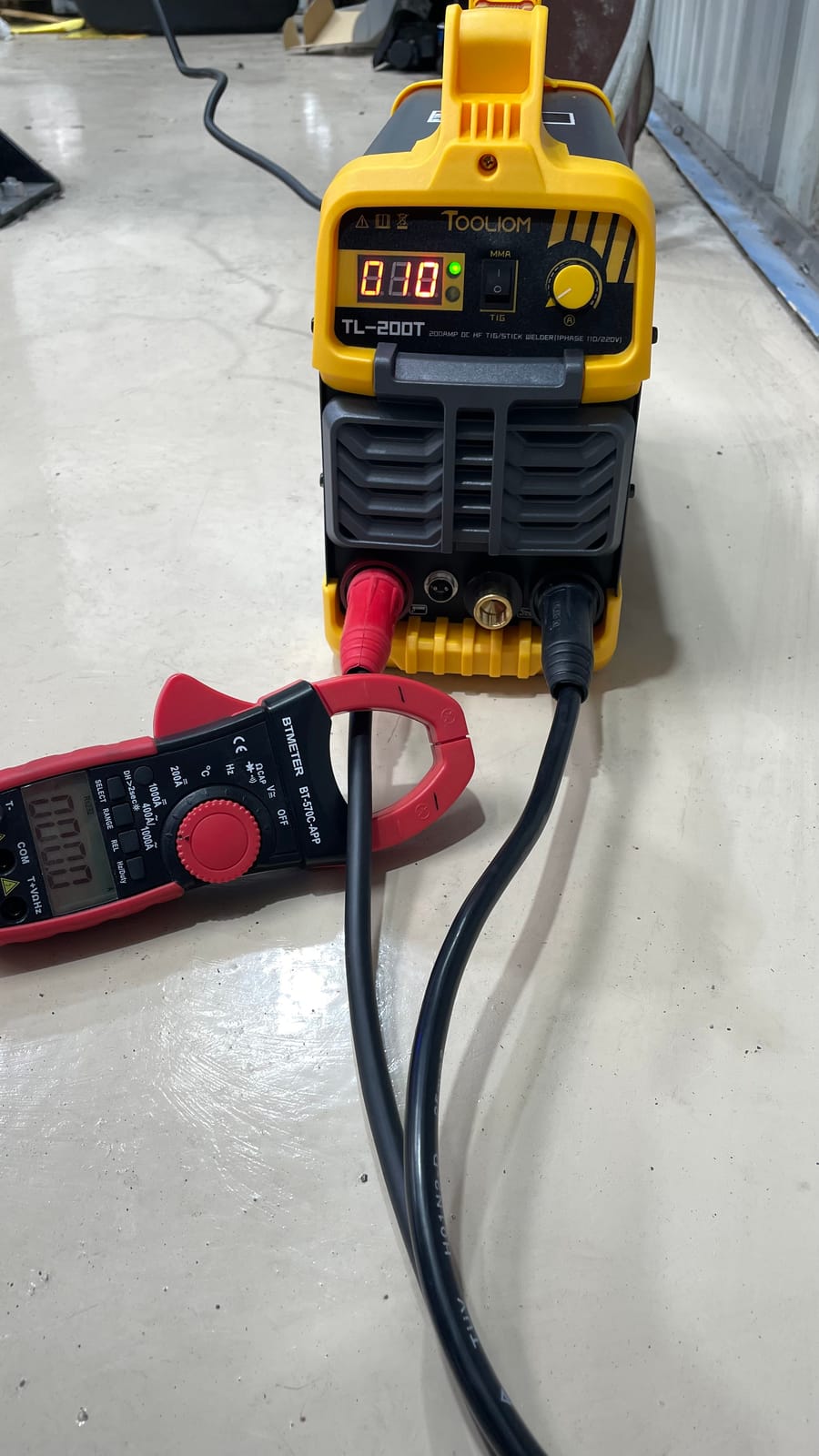
Smart sensing auto-adapts to 110V and 220V sources, which is convenient when you work from more than one location. Built-in thermal protection shuts the machine down on overheat or overload while the fan cools it, protecting the electronics during a long session.
Owners rate it 4.3 stars over 489 reviews and see it as capable value for stainless, mild steel and non-ferrous work, with the display and spot mode standing out most.
Spot TIG is the feature to learn first
Spot TIG fixes a heat input at a set duration so you get a consistent, repeatable tack. On thin stainless or small aluminum brackets that are hard to hold, it removes the twitchy foot pressure problem faster than any other single feature on this machine.
Thermal protection is the second feature worth learning around. A machine that shuts down cleanly on overload and cools itself will still be working years later, and that is a real difference between budget electronics and name-brand ones.
Where it falls short
DC TIG only, so aluminum is off the table. That is the honest limit and the reason it sits below the AC/DC machines here despite a solid 4.3 rating.
There is a reserved 5-pin foot pedal interface but no pedal included, and no weight figure is published for this model, so check the dimensions before you plan a shelf. Our welding cart guide covers stable placement for a shop setup.
10. S7 200A TIG Welder – Best Budget Pick for Steel Work
S7 200A TIG Welder with DC TIG and Stick Welding
200 amp DC TIG and stick
110/220V dual voltage
Post gas flow timer
Weighs 18.01 lb
Pros
- Lowest entry point in this roundup with the most owner reviews
- High frequency start works reliably and the machine runs quietly
- Compact 18 lb body suits small garages
- Handles long stainless passes without exceeding duty cycle
- Post gas flow dial is a useful feature at this tier
Cons
- Torch lead is stiff and short
- Trigger and pedal are on/off rather than variable amperage
- Argon tank and regulator are not included
- Poor instructions and few tutorials for beginners
The S7 200A is the least expensive way into TIG welding in this roundup, and with 1530 owner reviews it has the largest review base of anything here. That is a lot of long-term data on an entry-level machine.
It combines DC TIG and stick in one portable inverter with 110V/220V dual voltage, simple controls, a digital current display, high frequency arc start and a post-gas flow dial that times gas flow after the arc stops. Owners report it handles long stainless passes without exceeding duty cycle and survives outdoor use.
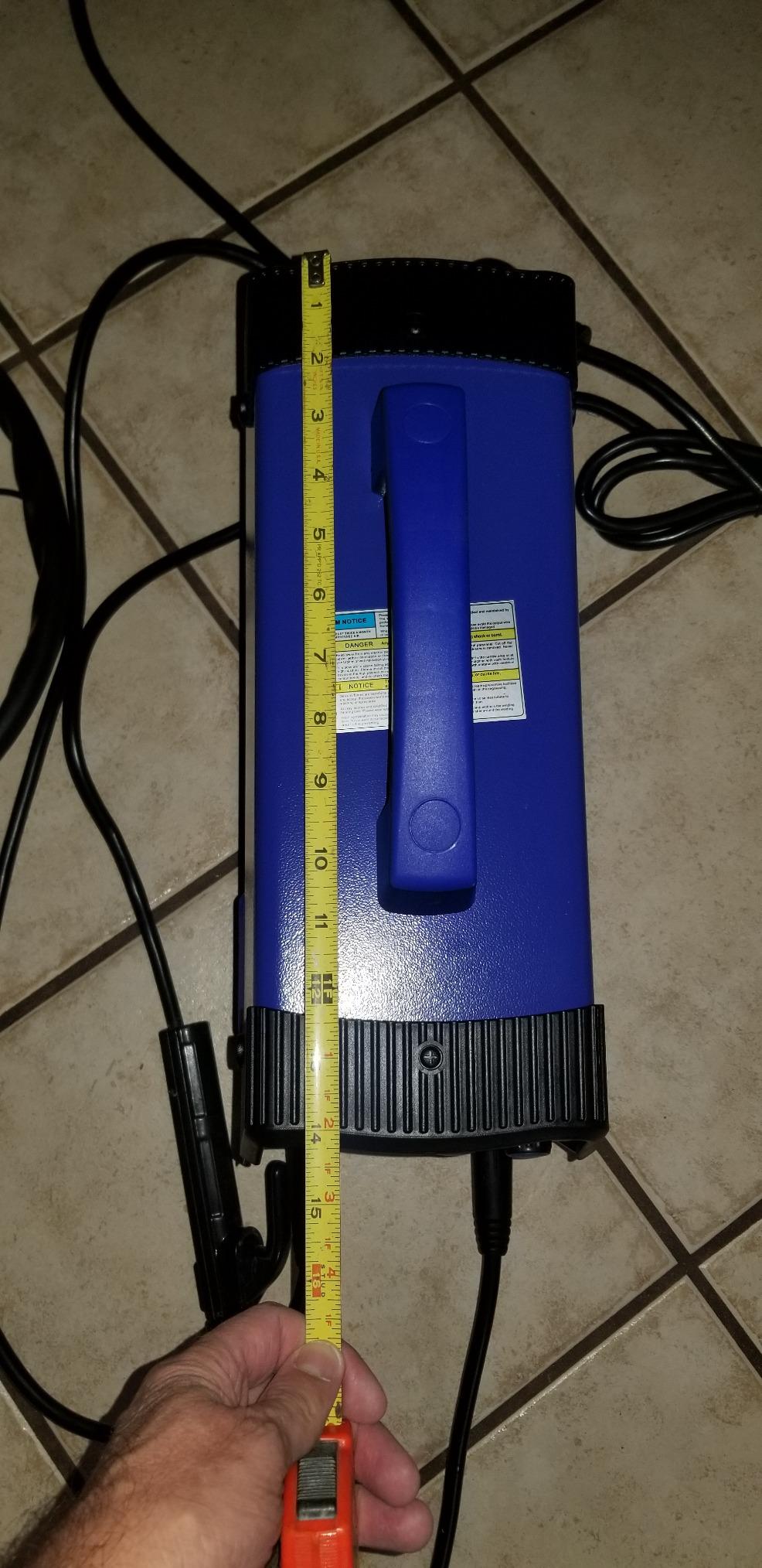
At 18.01 pounds it suits a small garage, and it runs quietly. Compatible with standard TIG consumables including tungsten electrodes, ceramic cups and collets, so you are not locked into proprietary parts.
Owners frame it as a capable budget machine for hobby stainless and mild steel work, with about 69 percent five-star ratings.
What a low entry price actually gets you
Real capability on steel and stainless, plus stick as a backup process. For a first welder learning on scrap and hardware-store steel, that is genuinely enough, and the 4.4 star average supports that.
The post-gas flow dial is a detail you will appreciate later. Timed gas flow after the arc stops protects the tungsten and keeps the cap from coloring, which is what separates a clean bead from a dirty one.
Where it falls short
The torch lead is stiff and short, which owners call awkward on larger frames, and the gas port uses a push-on nozzle fitting that some had to modify. Both are small jobs with basic tools, but know about them before the first session.
The trigger and any foot pedal are on/off rather than variable amperage control, so you set heat on the machine instead of under your foot. Documentation is poor, and included consumables are low quality, so buy your own cups, collets and tungsten. Argon and a regulator are also not included.
How to Choose a TIG Welder Under 2026
Use this section as a filter before you buy. Every machine above can make a good weld on mild steel, so the differentiator is the material in front of you, the power you have available, and how much support you need.
Do you actually need AC output?
Aluminum forms an oxide layer that melts at a much higher temperature than the metal underneath. An AC/DC machine reverses current so the electrode-positive half of the cycle burns that oxide away, which is why a DC-only welder simply cannot weld aluminum. Steel and stainless do not need it.
If aluminum is off your list for good, save the money and buy DC-only. If aluminum is a maybe within two years, buy AC/DC now.
110V or 240V in your garage?
Dual voltage machines switch between a household outlet and a shop circuit, which is one of the most useful features for a home garage. The tradeoff is real: running on 120V caps output and reduces duty cycle, and the AHP in this roundup reports around 80 amps on 120V despite its 203 amp nameplate.
If you can install a 240V circuit with a proper breaker, run the machine there for full output. Never adapt a 240V machine to a household outlet outside a rated adapter designed for it.
Duty cycle, and why it matters at the bench
Duty cycle is the share of a ten-minute cycle a machine can weld at its rated amperage before overheating. Forty percent means four minutes on, six minutes off. On short bench pieces you will never notice. On a long aluminum or steel exhaust section, a 60 percent machine such as the AHP keeps working while a 40 percent unit forces you to wait.
Pulse, AC balance and AC frequency
Pulse TIG alternates between a high cleaning current and a lower heating current, controlling heat input on thin material. AC balance sets the electrode-negative share of the cycle, trading cleaning against penetration on aluminum. AC frequency sets how often current reverses, which changes arc width and bead profile.
You can weld good aluminum without pulse. You cannot weld it at all without AC.
What you still need to buy
No machine here includes an argon tank. Budget for a bottle of argon, a regulator, a foot pedal if the box lacks one, a tungsten electrode, ceramic cups and collets, a helmet, gloves and a proper ground clamp. That is where most first-time buyers underestimate, and it is why kit-complete machines like the Weldpro and LOTOS can end up cheaper overall.
Frequently Asked Questions
Who makes the best TIG welder for the money?
At this budget the PrimeWeld TIG225X is our pick for the money. It carries the highest average rating in our testing group at 4.8 stars across more than 1400 owner reviews, offers 225 amp AC/DC output with pulse up to 200 Hz, adjustable AC frequency, 110/220V dual voltage and a CK 17 Superflex torch. It is also the machine Google’s AI Overview names in this price band.
What is the best affordable TIG welder?
If you weld only steel and stainless, the TOOLIOM TL-200T or YESWELDER TIG-205P are the affordable answers, both in the entry tier with pulse TIG, spot modes and auto-sensing 110/220V input. If you want aluminum, the LOTOS TIG200ACDC includes a foot pedal and argon regulator in the box, which lowers the real total cost of getting started.
What is the best TIG welding machine for home use?
For a typical home garage the PrimeWeld TIG225X works well because it runs on both 110V and 220V, so you can start on a household outlet and move to a 240V circuit later. The AHP AlphaTIG 203Xi is the alternative if you weld often, since owner reports put it at a 60 percent duty cycle at 155 amps on 120V and the box includes a regulator, torch and foot pedal.
Are Harbor Freight TIG welders any good?
Harbor Freight VULCAN and TITANIUM models are regularly endorsed by owners as nice for the money, but their coverage is typically 90 days, which leaves a gap if a machine fails in month four. None of the Harbor Freight machines made our final ten, so we cannot give a hands-on verdict. AHP, Everlast and PrimeWeld all carry longer warranties with reachable support.
Are Eastwood TIG welders any good?
The Eastwood TIG 200 AC/DC gets consistent owner endorsements for build quality, arc performance and a three year warranty, and welders on r/Welding commonly describe it as still running like a champ. It did not make our final ten, but it is a safe pick for steel, stainless and aluminum if you find one and it sits inside your budget.
Are Yeswelder TIG welders good?
YesWelder offers two very different machines at this budget. The TIG-205P is a portable 10.7 pound DC-only machine rated 4.5 stars over 346 reviews, strong for stainless and mild steel. The TIG-200P ACDC adds AC output and seven modes but averages 3.9 stars, with argon leak reports from an internal valve driving an 18 percent one-star share.
The Verdict: Which TIG Welder Should You Buy in 2026
The PrimeWeld TIG225X is our top pick among the best TIG welders under 1000 dollars, taking the highest rating in the group with AC/DC pulse, adjustable AC frequency and a torch better than the price suggests. Buy the Weldpro 200A AC/DC if you want the torch, foot pedal and flow meter in the box, and the AHP AlphaTIG 203Xi if duty cycle and a three year warranty matter most.
Steel-only shops should look at the TOOLIOM TL-200T or the S7 200A for the lowest outlay. Whatever you choose, add argon, a regulator and a helmet to the budget before you order, then check the voltage you actually have.