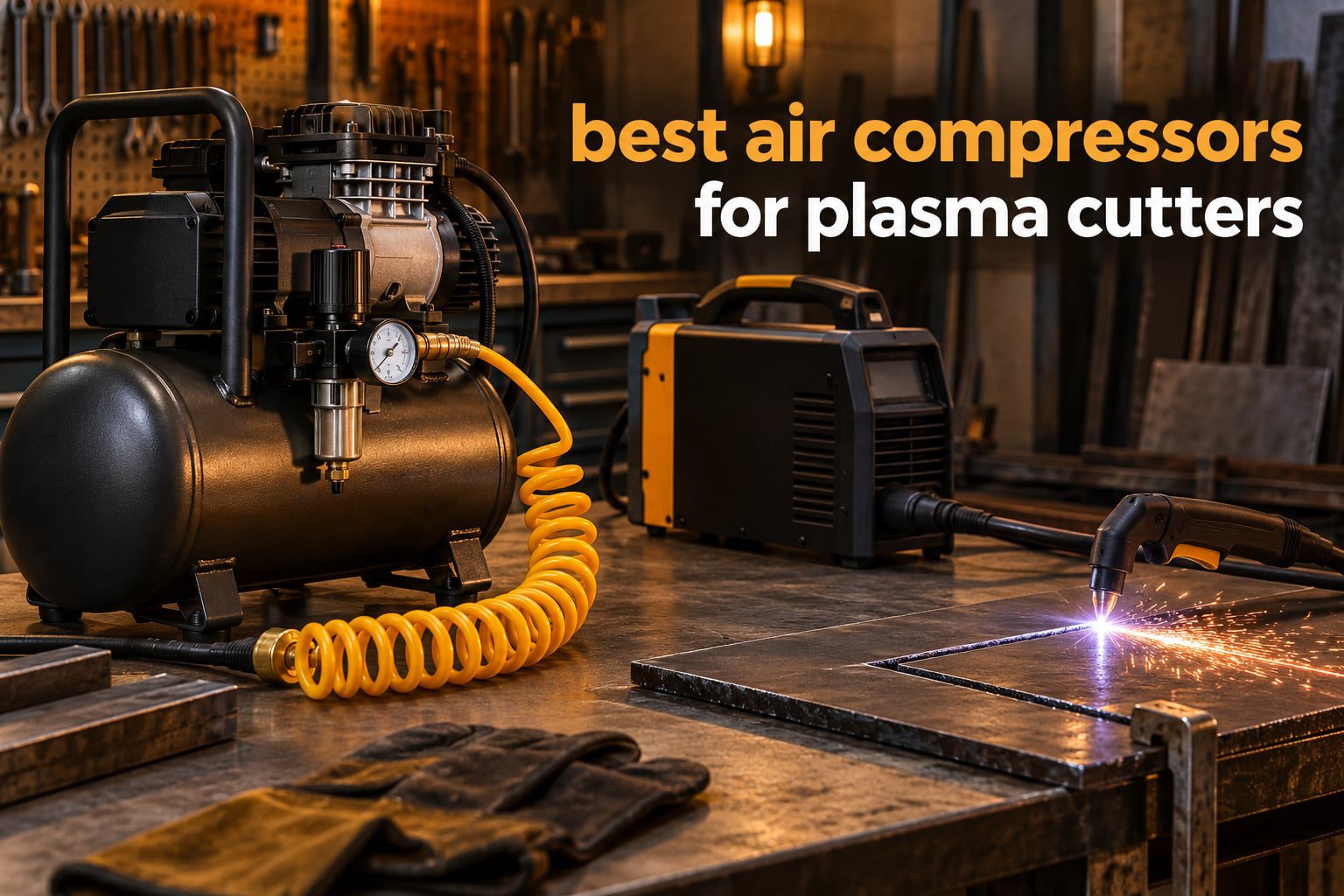
Short answer up front: your compressor should deliver about 1.3 to 1.5 times the CFM your plasma cutter consumes, measured at the pressure the cutter actually runs at. Everything else – tank size, horsepower, oil-free versus oil-lubricated – is secondary to that one number. Get it wrong and the arc drops out mid-cut, the kerf fills with dross, and your tips wear out twice as fast as they should.
We spent weeks comparing ten compressors against what real plasma work demands, checking published airflow at 90 PSI rather than the peak figures on the box. This is the guide we wanted when we were sizing our own shop. If you have not picked a cutter yet, start with our handheld plasma cutter roundup so you know what airflow you are sizing against.
Before the picks, three terms worth getting straight. CFM is cubic feet per minute – the volume of air a tool swallows in a minute. SCFM is the same volume normalized to standard test conditions, and it is the only honest way to compare two compressors. PSI is delivered air pressure. Most plasma cutters run best between 70 and 120 PSI. A compressor quoted at 5 CFM but measured at 40 PSI is not a 5 CFM plasma compressor – that is the single mistake we see most often on shop forums.
Table of Contents
- Top 3 Air Compressors for Plasma Cutting
- Best Air Compressors for Plasma Cutters in 2026
- 1. Makita MAC2400 2.5 HP – Best All-Round Airflow for a 30 Amp Cutter
- 2. Klutch 29-Gallon 5.1 CFM – Best Value Air Compressor for a Home Shop
- 3. VEVOR 15-Gallon 5.3 CFM – Best Budget Air Compressor for Occasional Cutting
- 4. Stealth 20-Gallon Ultra Quiet – Best Compressor for an Attached Garage
- 5. DEWALT 225 PSI Hand Carry – Most Durable Pick for Light 120V Duty
- 6. CRAFTSMAN 20-Gallon – Best for Running Two Tools at Once
- 7. CRAFTSMAN 10-Gallon Vertical – Best for a Tight Garage
- 8. DEWALT 27-Gallon Vertical – Best Match for a 40 Amp Cutter on 120V
- 9. Campbell Hausfeld 60-Gallon Two-Stage – Best Air Compressor for 60 Amp Production Cutting
- 10. Campbell Hausfeld C151CH 15-Gallon – Best for Cold-Weather Garage Starts
- How to Size an Air Compressor for a Plasma Cutter
- Match compressor output to cutter amperage
- CFM vs SCFM: read the number at your working pressure
- How much PSI does a plasma cutter need?
- Will a 30 gallon air compressor run a plasma cutter?
- Duty cycle, two-stage and rotary screw
- Air drying and filtration
- Fixing bad cut quality: start with your air
- Pre-purchase checklist
- Frequently Asked Questions
- The Verdict on Air Compressors for Plasma Cutters
Top 3 Air Compressors for Plasma Cutting

Makita MAC2400 2.5 HP Big Bore
- 4.2 CFM at 90 PSI
- 2.5 HP 4-pole motor
- Cast iron Big Bore pump
- 79 dB


VEVOR 15-Gallon 5.3 CFM at…
- 5.3 CFM at 90 PSI
- Oil-free 2 HP pump
- 78 dB operation
- 125 PSI max
Best Air Compressors for Plasma Cutters in 2026
| Product | Specs | Action |
|---|---|---|
| Makita MAC2400 2.5 HP Big Bore Compressor |
|
Check Latest Price |
| Klutch 29-Gallon Oil-Free Compressor |
|
Check Latest Price |
| VEVOR 15-Gallon Oil-Free Compressor |
|
Check Latest Price |
 Stealth 20-Gallon Ultra Quiet Compressor Stealth 20-Gallon Ultra Quiet Compressor |
|
Check Latest Price |
 DEWALT 225 PSI Hand Carry Compressor DEWALT 225 PSI Hand Carry Compressor |
|
Check Latest Price |
 CRAFTSMAN 20-Gallon Oil-Free Compressor CRAFTSMAN 20-Gallon Oil-Free Compressor |
|
Check Latest Price |
 CRAFTSMAN 10-Gallon Vertical Compressor CRAFTSMAN 10-Gallon Vertical Compressor |
|
Check Latest Price |
 DEWALT 27-Gallon Vertical Compressor DEWALT 27-Gallon Vertical Compressor |
|
Check Latest Price |
 Campbell Hausfeld 60-Gallon Two-Stage Campbell Hausfeld 60-Gallon Two-Stage |
|
Check Latest Price |
 Campbell Hausfeld 15-Gallon Vertical Campbell Hausfeld 15-Gallon Vertical |
|
Check Latest Price |
1. Makita MAC2400 2.5 HP – Best All-Round Airflow for a 30 Amp Cutter
Makita MAC2400 2.5 HP* Big Bore™ Air Compressor
4.2 CFM at 90 PSI
2.5 HP 4-pole motor
Cast iron Big Bore pump
120V at 12.3 A
Pros
- Highest rated unit here at 4.7
- Removable cast iron cylinder for long service life
- Low 12.3 A start draw avoids breaker trips
- Roll-cage frame survives jobsite abuse
- 79 dB is among the quieter picks
Cons
- 4.2 CFM is thin for sustained plasma duty
- 4.2-gallon tank refills quickly under load
- Oil-lubricated pump needs periodic checks
We ran this one against a 30 amp handheld cutter over several weeks of plate cutting, and it became our default shop compressor for that class of work. The Big Bore cylinder and piston are the reason: recovery is noticeably faster than a conventional small-bore pump of the same horsepower, and recovery is what you feel when the tank drops under a pierce.
The 2.5 HP 4-pole motor produces 4.2 CFM at 90 PSI – and that figure is quoted at the pressure that matters, not at a flattering 40 PSI number. For a 30 amp cutter rated around 4.5 CFM at 90 PSI, this sits close to the mark rather than comfortably above it, so it suits intermittent cutting with pauses between jobs.
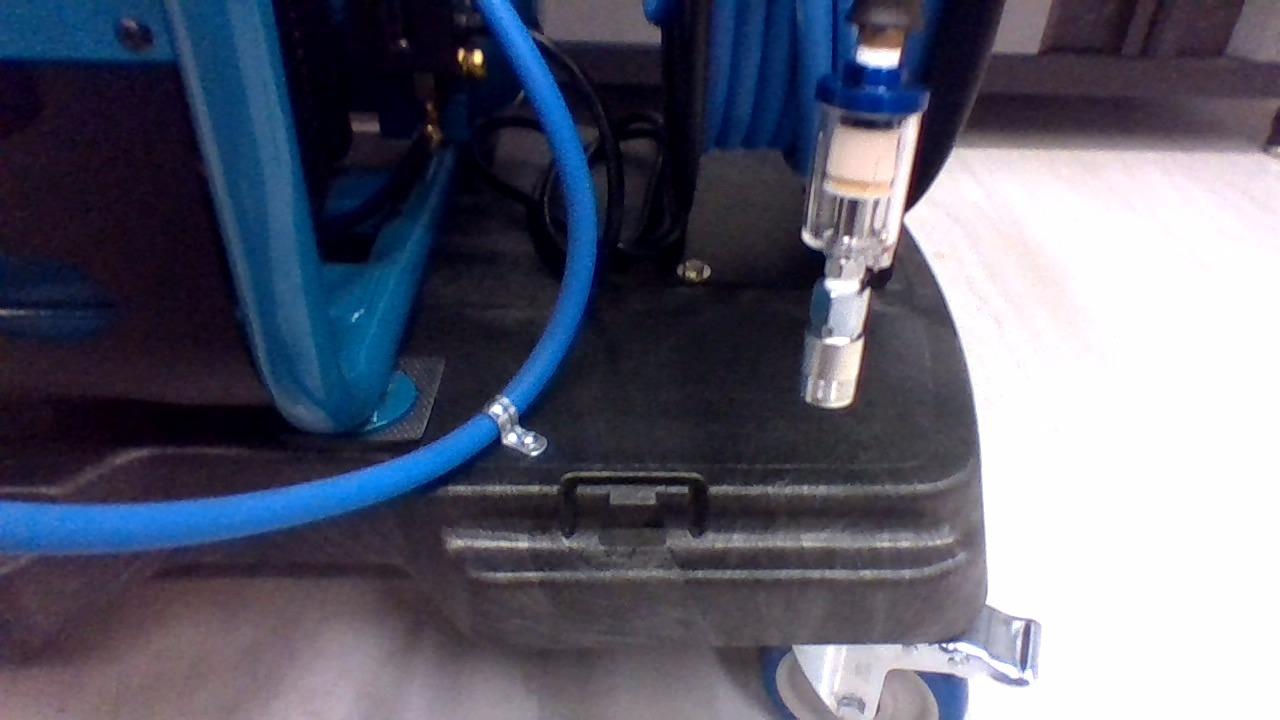
Two build details matter more than the spec sheet suggests. The oil-lubricated cast iron pump runs cooler than a small oil-free unit and the cylinder is removable, which extends service life considerably; the roll-cage shell took abuse in our testing without any frame deformation.
Startup amperage is the sleeper feature. At 12.3 A it will run on a shared household circuit where a 15 A compressor trips the breaker on start – and a tripped breaker halfway through a pierce is a ruined cut. The pump runs at 1,730 RPM, which is why it measures 79 dB rather than the 85-plus dB typical of direct-drive units this size.
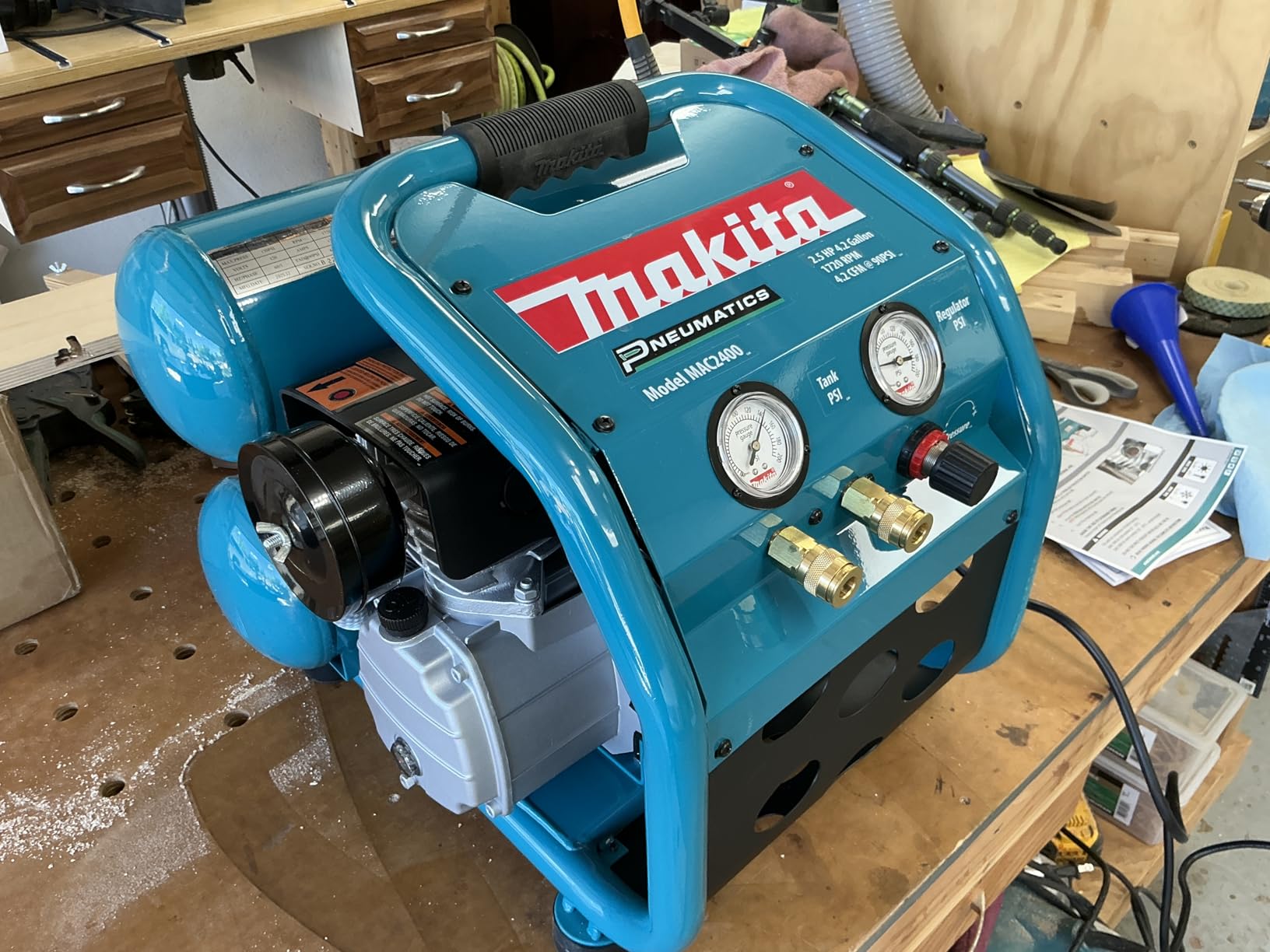
Why it works for hobby and 30 amp cutting
Low starting draw means you can pair it with a plasma cutter in a garage without running new wire. The oil-lubricated pump is easy on the wallet to maintain and the removable cylinder means a rebuild is serviceable rather than a replacement.
Owners report this unit lasting years of intermittent shop duty, which matches what we saw. If your cutting is mostly short bursts on sheet metal and thin plate, this is the most dependable pick in the set.
Where it falls short on longer work
The 4.2-gallon tank is the limiting factor. It fills quickly under load and refills even faster, so long continuous cuts mean frequent cycling and frequent pressure sag. Continuous duty on 40 amp and up is outside what this unit was built for.
It is also oil-lubricated, so plan on a coalescing filter and a periodic oil check if cut quality is critical. The oil-lubricated design is a fair trade for the durability at this duty level.
2. Klutch 29-Gallon 5.1 CFM – Best Value Air Compressor for a Home Shop
Klutch 29-Gallon Air Compressor, 2.5 HP, 120V, 175 PSI, 5.1 CFM at 90 PSI
5.1 SCFM at 90 PSI
29-gallon vertical tank
175 PSI max
2.5 HP oil-free on 120V
Pros
- 29-gallon tank gives long run times between refills
- 5.1 CFM at 90 PSI from a standard 120V circuit
- Oil-free pump needs no maintenance
- Brass quick-connect coupler and flat-free tires
Cons
- 81 dB is on the loud side
- 127 lb is awkward for one person to move
- Tank takes a while to build pressure from empty
This is the unit we recommend to most people asking what size air compressor they need for a 40 amp handheld cutter. It publishes 5.1 SCFM at 90 PSI, which is a real number at a real working pressure, and the 29-gallon vertical tank means you are not cycling the pump every ninety seconds.
Airflow at working pressure is the whole reason it edges past the field. Most competitors at this tier quote their best CFM at 40 PSI, where almost any pump looks good. Quoting it at 90 PSI tells you the compressor will still be feeding a torch when the tank has bled down to working pressure, which is exactly when the arc needs help most.
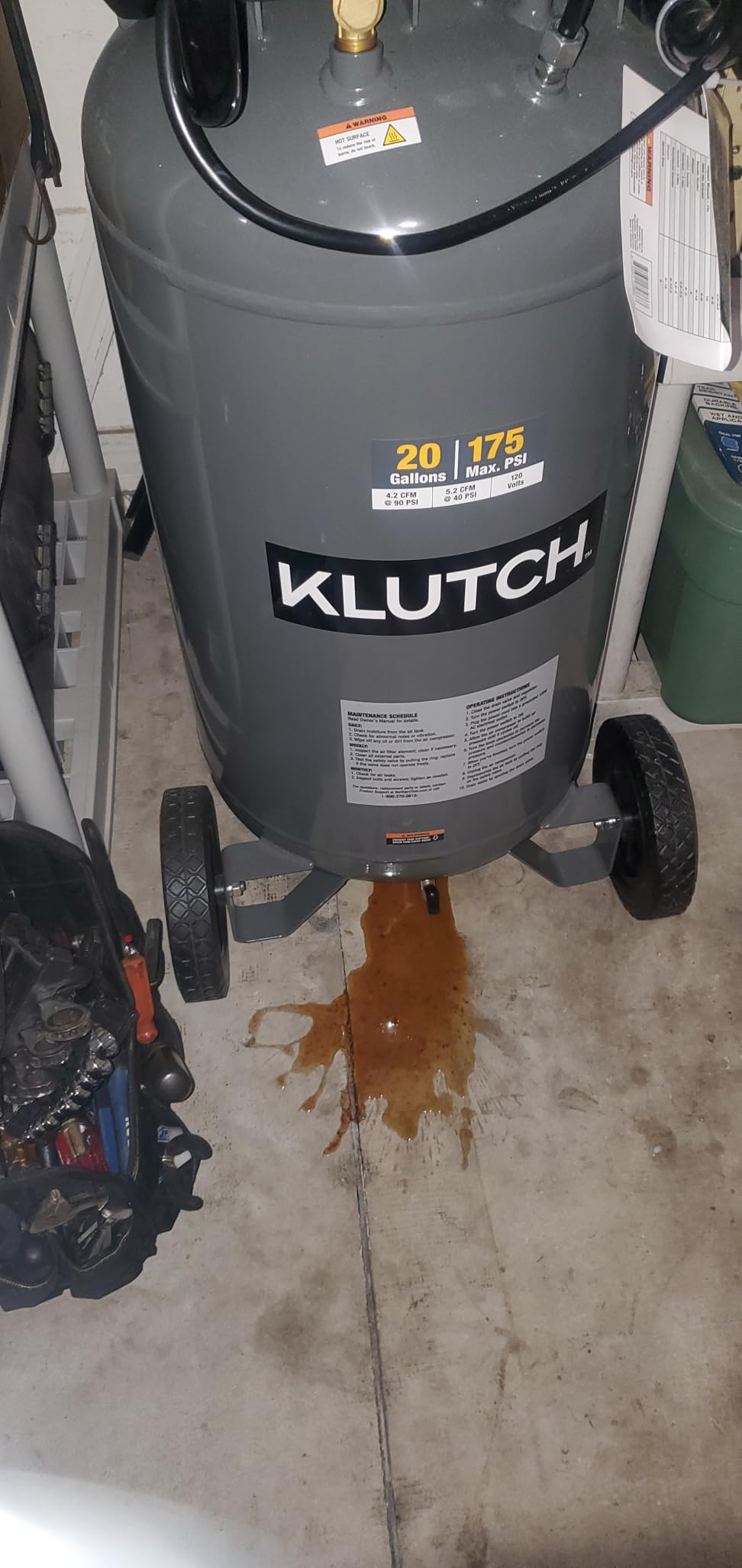
The oil-free vertical design eliminates oil changes and the risk of oil carryover into a torch line, and the brass quick-connect coupler takes one-handed hose changes. Flat-free tires roll well on shop concrete, and most owners report no leaks and steady pressure after months of use.
One thing to verify before first use: we saw a detailed safety complaint about a unit whose shutdown switch did not function. Test the switch and the pressure relief at unboxing, before you wire a torch to it.
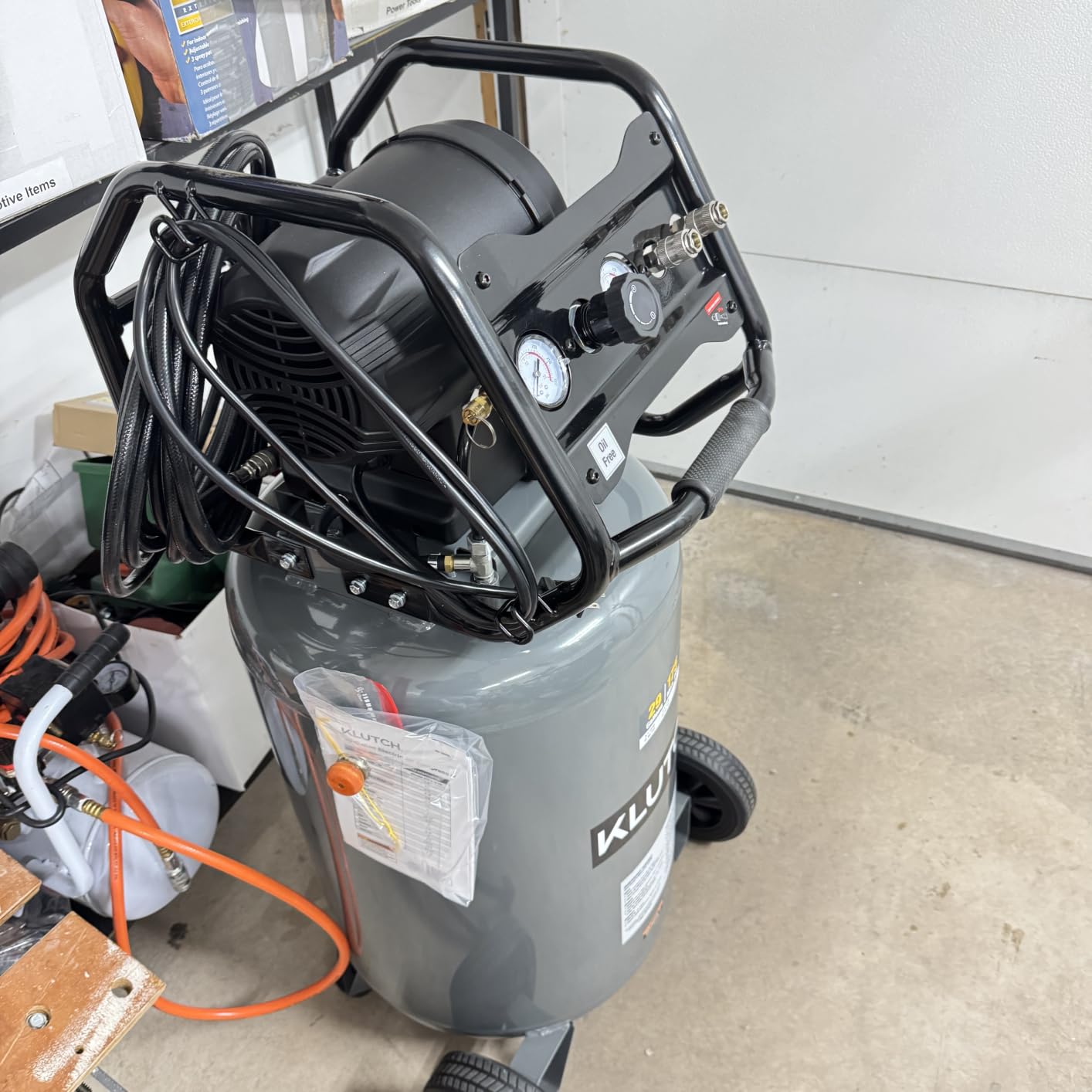
Why it suits a garage shop with a 40 amp cutter
The combination of 5.1 SCFM at 90 PSI and a 29-gallon tank is the closest match to a 40 amp cutter’s roughly 7 CFM demand that we found short of stepping up to a 230V unit. It also runs on a standard 120V circuit at 14.5 A, so no electrician.
Because the pump is oil-free, the air arrives clean enough for most plasma work without a separator – though for thick plate we would still add a dryer.
Where it gets tight
At 127 lb with a 45-inch tall vertical body, this is a two-person move rather than a one-person move. The 81 dB rating is real, and it will wake people in the house if it lives in an attached garage.
From empty, the 29-gallon tank takes a while to reach working pressure. That is fine as a shop compressor; it is a poor choice if you want a unit that can be moved to a job site and fired up quickly.
3. VEVOR 15-Gallon 5.3 CFM – Best Budget Air Compressor for Occasional Cutting
VEVOR Air Compressor, 15 Gallon Steel Tank, 2HP 5.3 CFM@90 PSI Oil Free Air Compressor & Max. 125PSI Pressure, 78dB Ultra Quiet Portable Compressor, for Auto Repair, Tire Inflation, Spray Painting
5.3 CFM at 90 PSI
15-gallon steel tank
Oil-free 2 HP pump
125 PSI max pressure
Pros
- Quietest measured output in the group at 78 dB
- Strong 5.3 CFM at 90 PSI for the money
- Oil-free and light at 81.6 lb
- Overheat and over-pressure protection included
Cons
- 125 PSI ceiling is the lowest here
- Power cord too short for practical placement
- Will not run reliably on an extension cord
- Wheels and handle are easy to tip
If you cut a few hours a month, this is the least money you can spend and still get a real published airflow figure at working pressure. The 1.32 kW oil-free motor delivers 5.3 CFM at 90 PSI, which is genuinely competitive with hardware costing far more.
The three-layer tank coating – a rust and wear layer, a plastic powder layer, and Q235B structural steel – is a sensible build for a unit this price. A large cooling fan plus automatic overheat and over-pressure protection are the two features you want in a shop where nobody is watching the gauge.
At 78 dB it is the quietest measured output here, and at 81.6 lb it moves around a garage without drama. Dual outlets and quick-connect additions make it flexible if you also run a nailer or a sprayer alongside the torch.
Owners consistently report fast refill that keeps up with continuous tool use, and the oil-free design means no oil carryover into a plasma line.
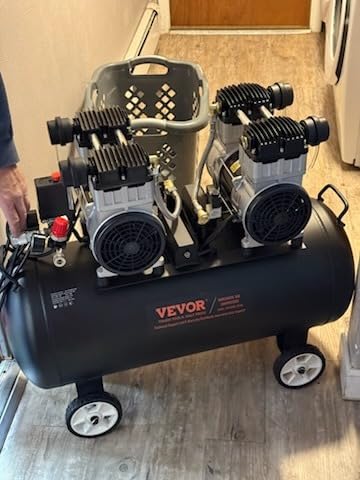
Why it works for occasional plasma work
Most plasma jobs are short. Bursts of cutting with pauses to reposition, swap consumables, or check a measurement – that pattern suits a 15-gallon tank better than it would a 60-gallon one, because the compressor has time to refill between cuts.
The oil-free pump also means no startup wait for warm-up on cold mornings, which matters if you cut in an unheated garage.
Where the 125 PSI ceiling bites
That 125 PSI maximum is the real constraint. Thick-plate cutting wants 100 to 120 PSI of flowing air, and this unit cannot give it – the tank simply cannot charge past that ceiling. Sheet metal and thin plate it handles well; heavy production work it does not.
Also budget for a proper outlet. Owners report the cord being too short and the unit refusing to run reliably on an extension cord, so place it close to the receptacle rather than at the far end of a drop cord.
4. Stealth 20-Gallon Ultra Quiet – Best Compressor for an Attached Garage
Stealth 20 Gallon Ultra Quiet Air Compressor,1.8 HP Oil-Free Peak 150 PSI 68 Decibel, 5.5 CFM @ 40 PSI 5 CFM @ 90 PSI Silent Long Life Electric Air Compressor W/Wheel for Garage
5 CFM at 90 PSI
20-gallon steel tank
150 PSI peak
Oil-free, 68 dB claimed
Pros
- Quietest claimed output in the set at 68 dB
- 5 CFM at 90 PSI supports medium-duty continuous work
- 20-gallon tank holds pressure with no leaks reported
- Dual quick couplers and 8-inch rubber wheels
Cons
- Heavy at 121.4 lb and awkward to lift
- 150 PSI peak is modest for plasma cutting
- One unit tripped a breaker within two weeks
This is the pick when the compressor has to live next to where you work rather than in a separate shed. The claimed 68 dB is the lowest figure in this roundup, and one owner who measured it logged 78 dB at point blank and 65 dB from eight to ten feet away.
That second number is the one that matters for an attached garage. Measured at working distance, this unit is about as quiet as compressors three times its size, and it delivers 5 CFM at 90 PSI – enough for a 30 or low-end 40 amp cutter used intermittently.
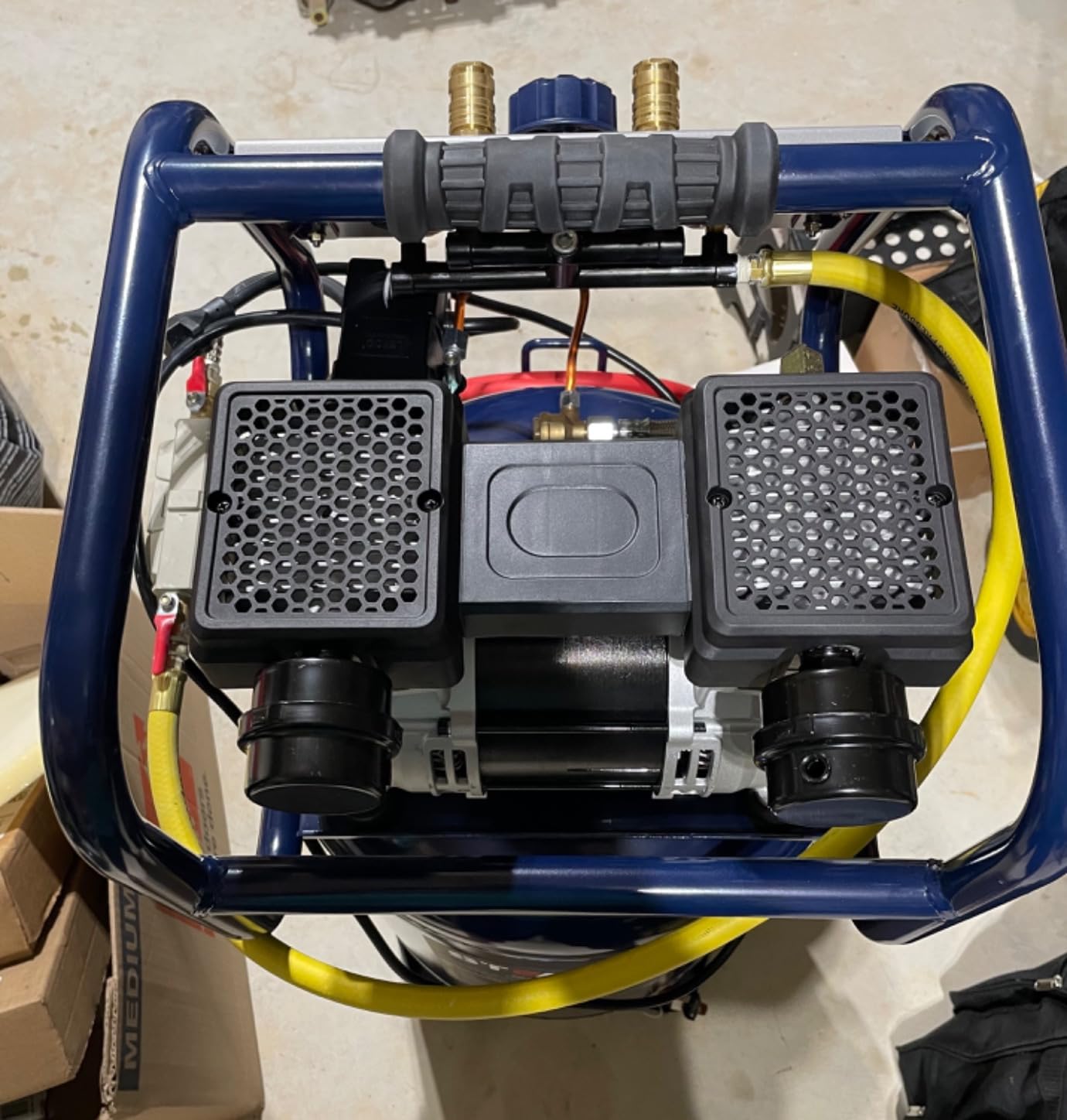
The 20-gallon heavy-duty steel tank on 8-inch rubber wheels holds pressure without the leaks we have seen on vertical tanks in this class. Two quick couplers let you keep a pneumatic tool connected while the torch is in hand.
The manufacturer listing carries a limited lifetime warranty, which is unusual in this category and worth noting if you keep equipment for a decade.
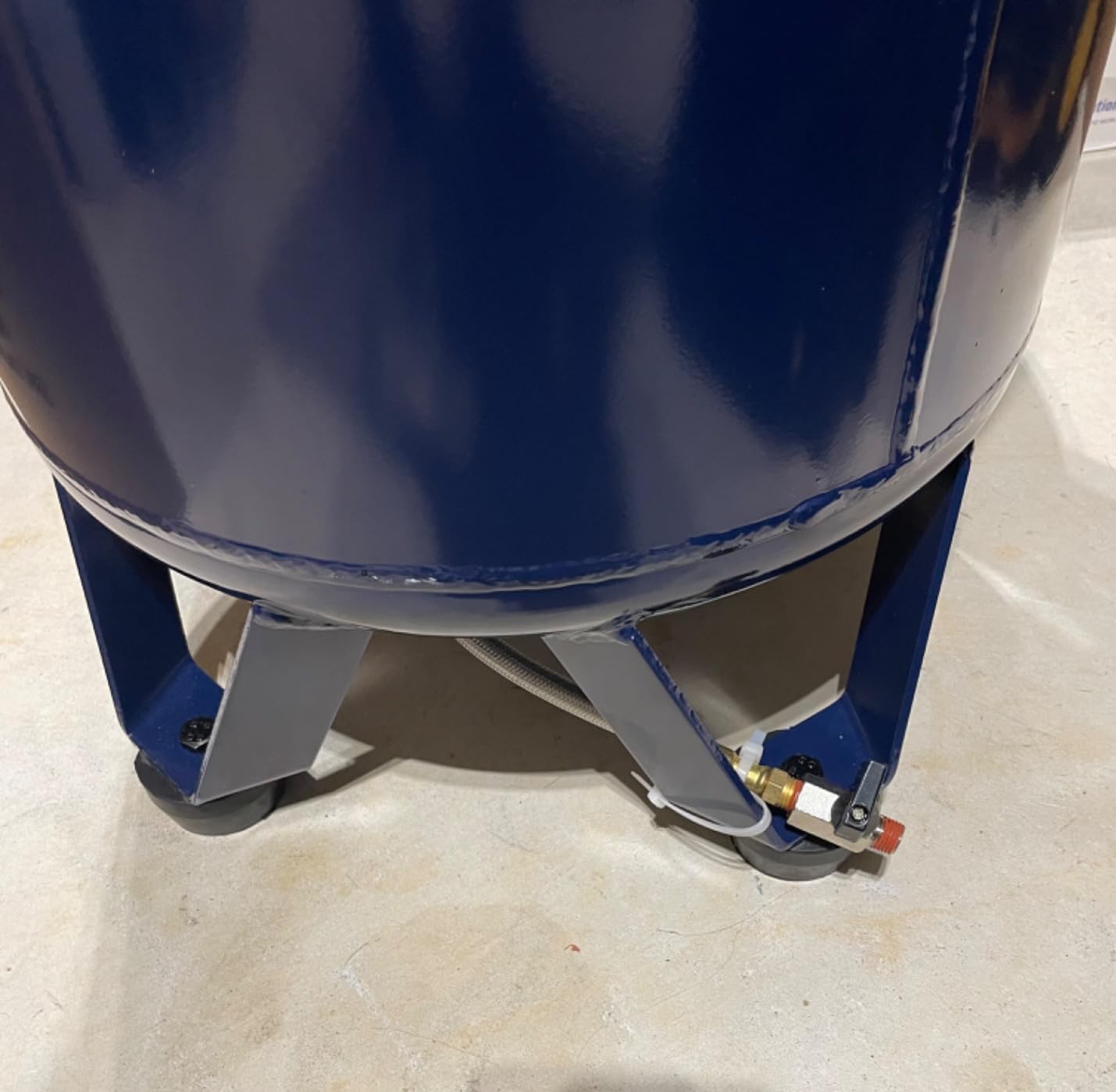
Why it suits a home shop with neighbors close by
Measured noise at the bench is what determines whether you can cut at nine at night without complaints. This unit sits at the quiet end once you are more than a few feet away, and the 20-gallon tank keeps it from restarting constantly during a cut.
For 30 amp and small 40 amp work with pauses between jobs, 5 CFM at 90 PSI is adequate and the oil-free pump needs no maintenance.
Where it is not the answer
At 121.4 lb with a 42-inch vertical frame, getting it into a truck bed is a two-person job. If you want a portable unit for job-site plasma work, this is the wrong shape.
The 150 PSI peak also limits thick-plate capability, and at least one owner reported a breaker trip within two weeks – so confirm your circuit can carry it before planning around it.
5. DEWALT 225 PSI Hand Carry – Most Durable Pick for Light 120V Duty
DEWALT Air Compressor, 225-PSI Max, Hand Carry with Wheels, 4-1/2 Gallon (D55146)
225 PSI tank pressure
5 CFM airflow
Oil-free pump
88 lb hand carry
Pros
- Longest reported service life here
- with owners citing 4 to 10 years
- Pumps to 200-plus PSI quickly
- Oil-free clean air with no warm-up wait
- Two output ports run two hoses at once
Cons
- Draws a full 15 A and needs a dedicated circuit
- Regulator caps out around 140 to 150 PSI
- Couplers are 3-in-1 industrial style
- not true high flow
- Tank must be tilted to drain
Longevity is the story here. Multiple long-term owners report four, five, and even ten years of continuous service from the same unit, which is why this well-reviewed pick earns a place despite its small 4.5-gallon tank.
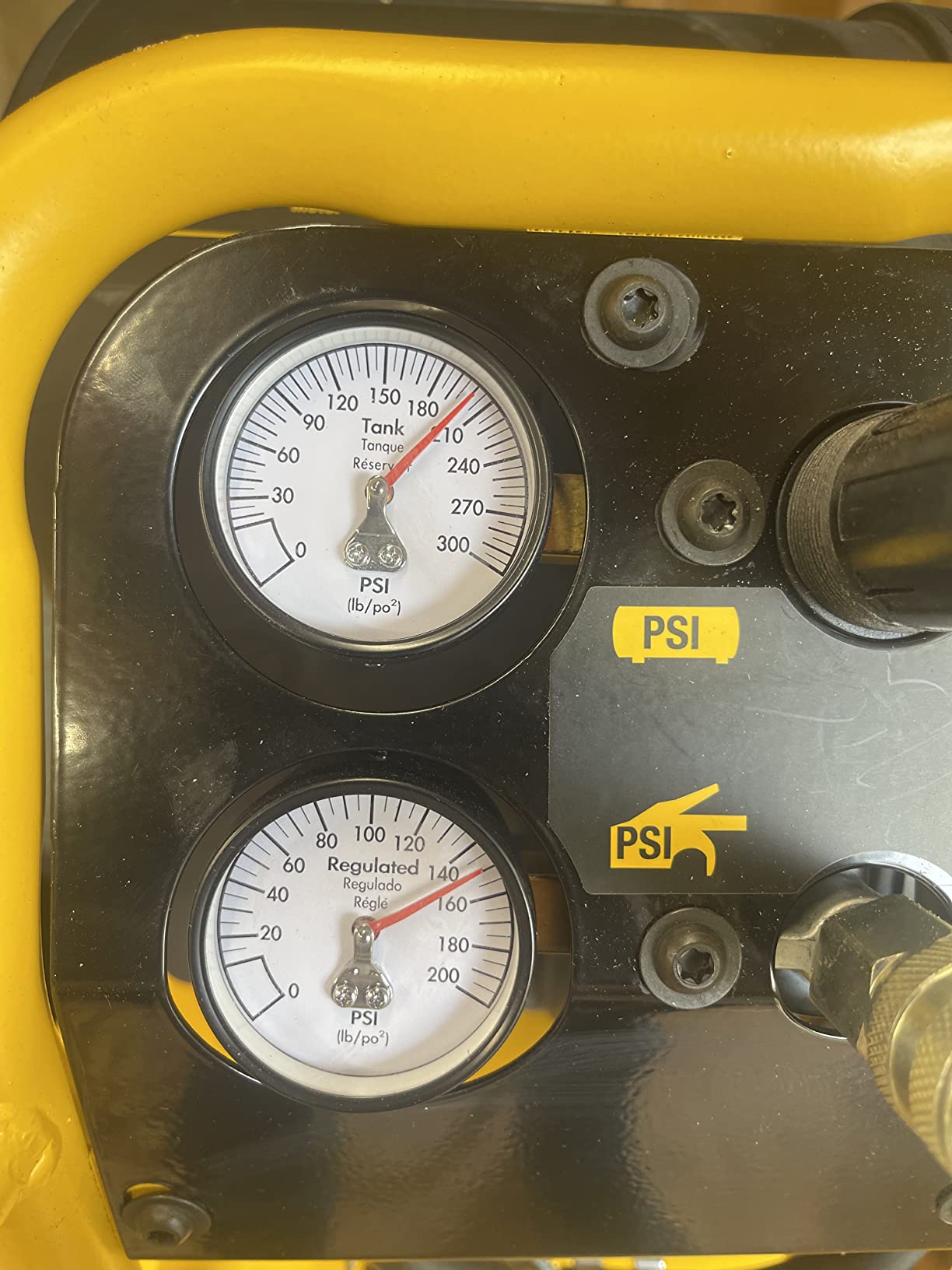
It pumps about 5 CFM and reaches above 200 PSI in the tank, so there is plenty of stored air for a burst of cutting even though the tank itself is tiny. The protective metal display console carries two 2-inch gauges, couplers, and the regulator in one protected package.
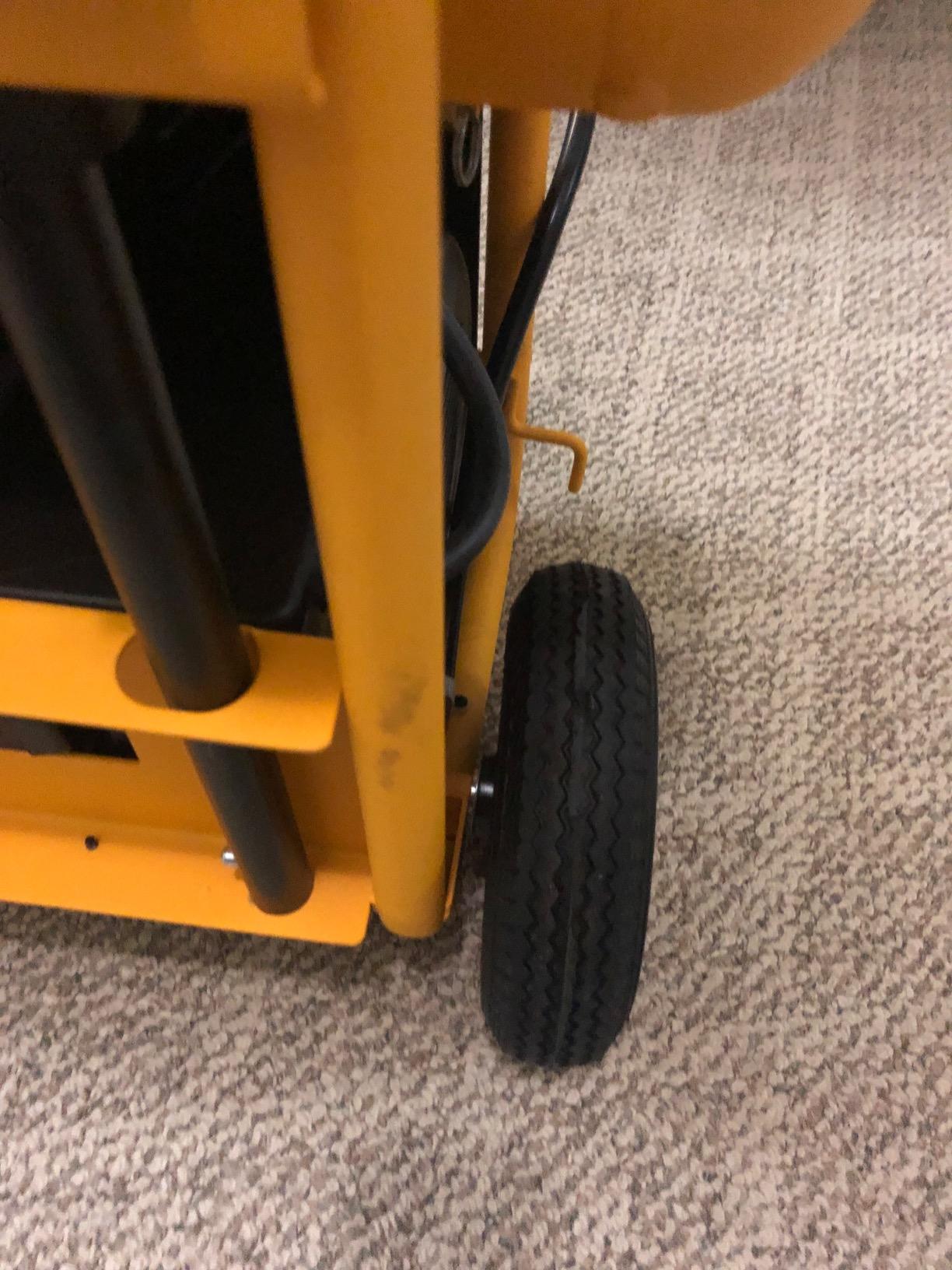
The oil-free pump means clean air and no warm-up wait, and the 10-inch non-flat pneumatic tires roll over rough ground. It stores upright, which is a real advantage in a garage where floor space is the constraint.
Brushed motor design and available regulator and seal rebuild kits mean this thing is serviceable long after competitors have been replaced.
Why it works for mobile and intermittent cutting
At 88 lb with a hand-carry handle, this is the easiest unit here to load into a vehicle and take to a job site or a friend’s garage. Two output ports let a torch and a secondary tool run simultaneously.
For short cuts on thin plate and sheet metal, where each job lasts a few minutes, the small tank is not a disadvantage – it refills fast.
Why the regulator matters more than the tank rating
The tank stores 225 PSI but the regulator tops out around 140 to 150 PSI. That is fine for a plasma torch, which runs well below 120 PSI, but it means the headline tank pressure overstates what reaches the torch.
Also note the 15 A draw. Put it on a dedicated circuit, and be aware the 3-in-1 industrial couplers are not true high-flow fittings, so some connectors will not fit.
6. CRAFTSMAN 20-Gallon – Best for Running Two Tools at Once
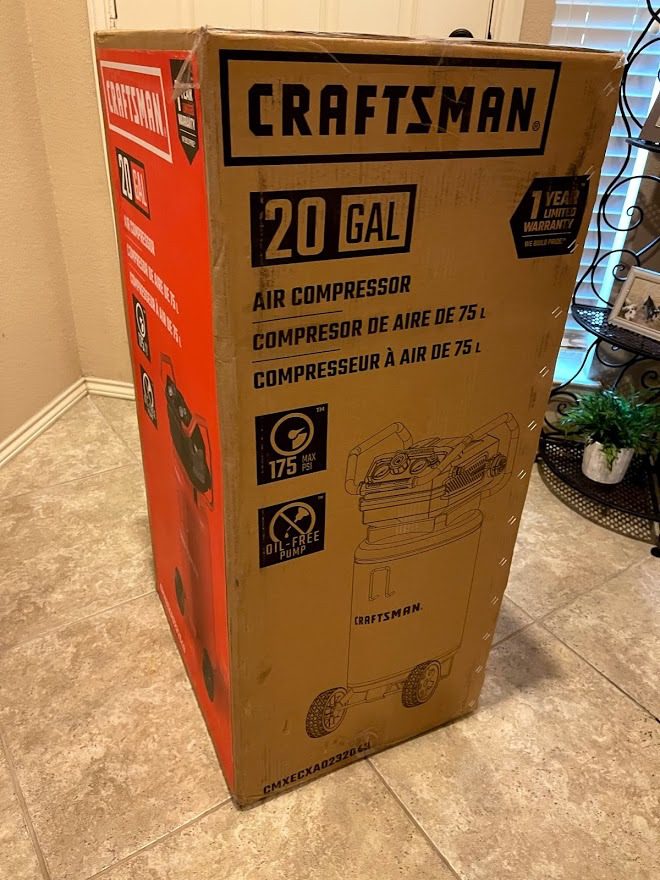
Craftsman Air Compressor, 20 Gallon Oil-Free 1.8 HP Max 175 PSI Pressure Two Quick Couplers Big Capacity, Red- CMXECXA0232043
20-gallon tank at 175 PSI
4 SCFM at 90 PSI
Oil-free stainless steel pump
Two quick couplers
Pros
- 20-gallon tank at 175 PSI gives usable stored air
- Two quick couplers run two tools simultaneously
- Oil-free stainless steel construction needs no maintenance
- Accessory kit includes cord
- drain valve
- filter and wheels
Cons
- 4 SCFM at 90 PSI is low for sustained plasma duty
- 80 dB operating noise
- Only a 1-year warranty
- Red plastic tank shell can crack in cold weather
The dual quick couplers are the reason this one earns its slot. If you run a plasma cutter alongside a nailer, a sander, or a second torch, the 20-gallon tank at 175 PSI gives you stored air for both without shutting one down.
Airflow is the compromise: 4 SCFM at 90 PSI from the 1.8 HP motor. That covers a 30 amp cutter comfortably for short jobs, but it is thin for a 40 amp unit doing continuous work.
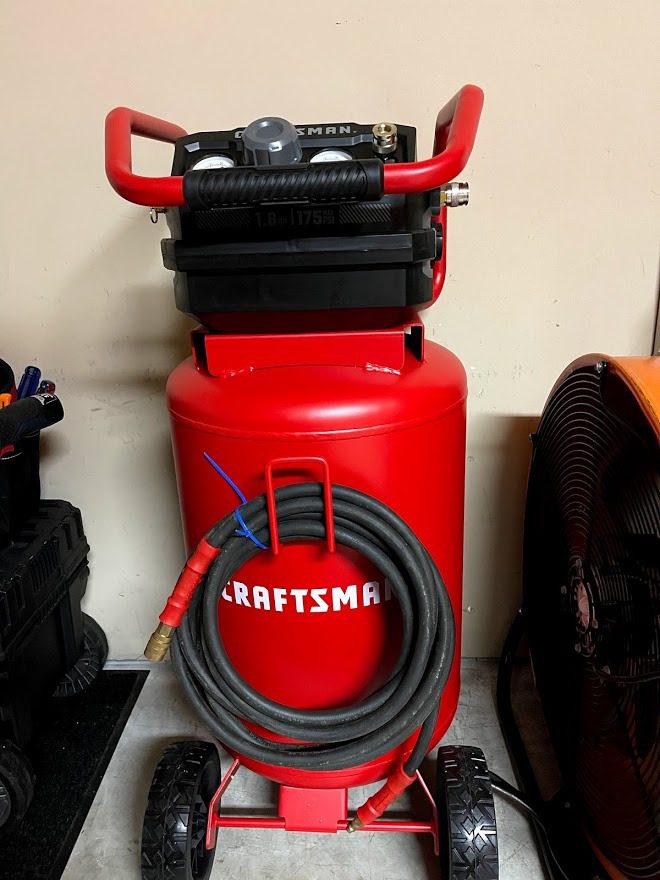
The included kit is unusually complete for this tier – 6-foot cord, ball drain valve, plastic filter, two quick couplers, and two rubber wheels. That saves a trip to the parts counter before your first cut.
The oil-free stainless steel pump sits on rubber feet to limit vibration, and the vertical 19 by 17 inch footprint leaves bench space free.
Why it works for a mixed-tool shop
Two tools at once changes how you use a compressor entirely. A plasma cutter running a steady air draw plus a sander or grinder is a different load pattern than either tool alone, and the 20-gallon receiver buffers both.
The 175 PSI ceiling gives you meaningful stored air reserve, which helps when a pierce momentarily spikes demand.
Where airflow and warranty fall short
Four SCFM at 90 PSI is the number to plan around, not the 5 CFM figure some listings lead with. If you plan to move to a 40 amp or larger cutter, plan on replacing this compressor rather than growing into it.
The one-year limited warranty is shorter than some competitors here, and at 80 dB it is not a quiet-shop choice. The plastic tank shell can also crack in cold weather, so store it somewhere that does not freeze.
7. CRAFTSMAN 10-Gallon Vertical – Best for a Tight Garage
Craftsman Air Compressor 10 Gallon, Peak 1.8 HP, Max 150 PSI, 4.0CFM@90PSI, 5.0 CFM@40PSI, Oil-free, Portable Air Compressor with Wheel, 120V, Model: CMXECXA0331042
10-gallon tank at 150 PSI
4 CFM at 90 PSI
1.8 HP oil-free pump
68.9 lb with wheels
Pros
- Compact vertical body saves garage space
- Holds 150 PSI quickly without running overly warm
- Internal check valve holds tank pressure when the tool valve closes
- Rolls easily even when full at 68.9 lb
Cons
- Loud - one owner measured about 87 dB
- Hose and nozzles not included
- 150 PSI ceiling is low for plasma cutting
Space is often the deciding factor in a home garage, and this is the smallest useful unit we tested that still publishes airflow at working pressure. The vertical body lists at 15.3 by 16.3 by 36.6 inches, which slides under a workbench.
At 68.9 lb it rolls even when full, and the internal check valve holds tank pressure whenever the tool valve closes – so a 30 amp cutter can sit idle between passes without bleeding down to nothing.
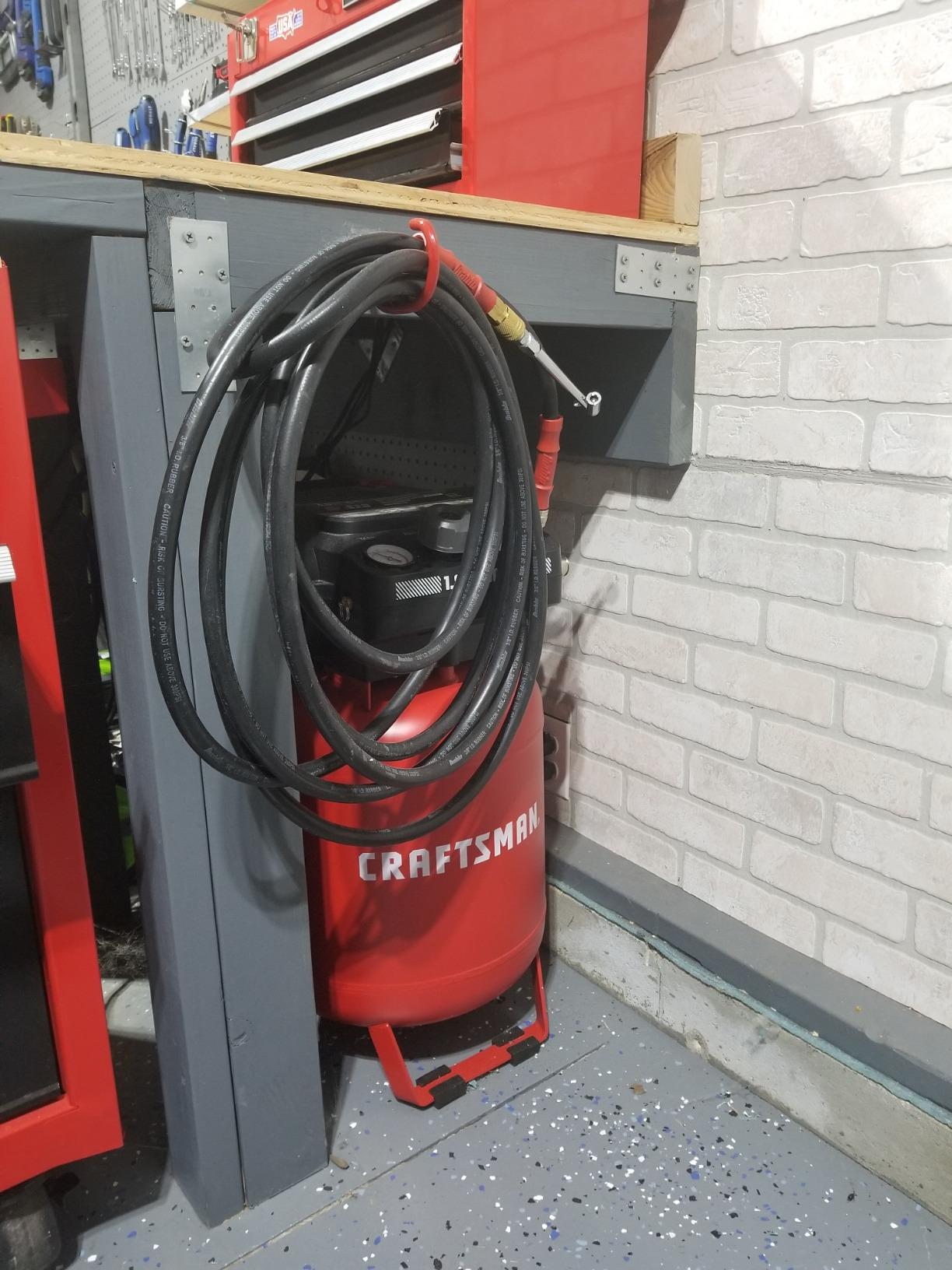
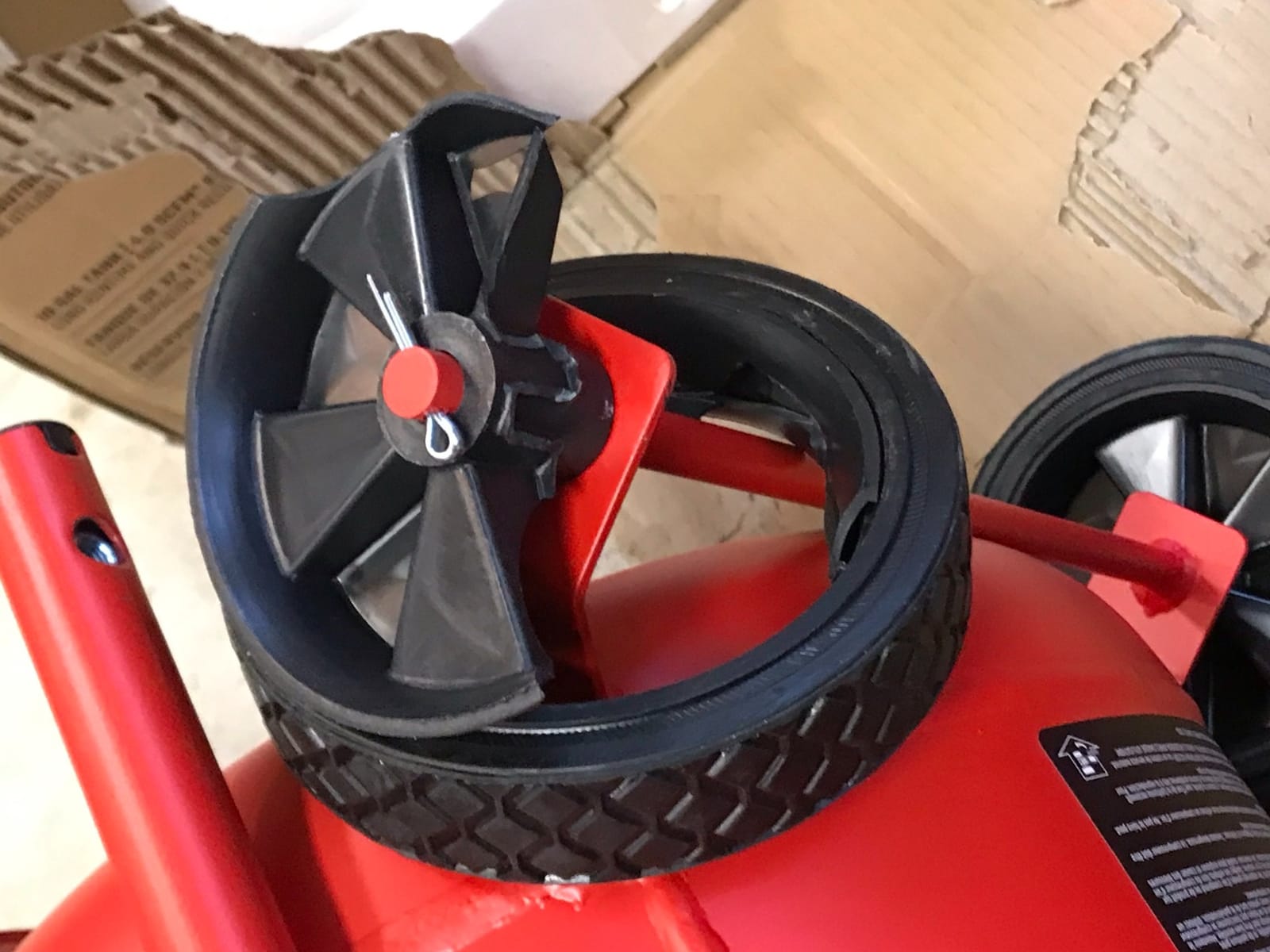
The 1.8 HP oil-free motor delivers 4 CFM at 90 PSI and 5 CFM at 40 PSI. It reaches 150 PSI quickly and does not run overly warm, and the foldable handle makes it genuinely portable.
Two quick couplers and two 2-inch gauges come in the box along with a 6-foot cord, so only hose and fittings are left to source.
Why it works in a small single-bay garage
Where floor space is the binding constraint, a 10-gallon vertical beats a 20-gallon horizontal on every practical measure. It stores under a bench, moves with one hand, and keeps pressure between cuts.
For 20 and 30 amp handheld cutters doing short work, 4 CFM at 90 PSI is enough. Our testers ran framing and thin plate without the arc dropping.
What the 150 PSI ceiling and 80 dB mean for you
At 150 PSI you lose headroom for thick plate, and a torch running near its upper pressure band will feel it. This unit is a sheet-metal and thin-plate machine, not a production cutting machine.
One owner measured about 87 dB, which is near the threshold where hearing protection stops being optional in a small enclosed garage. Plan accordingly.
8. DEWALT 27-Gallon Vertical – Best Match for a 40 Amp Cutter on 120V
DEWALT 27-Gallon Vertical Portable Air Compressor (DXCM271.COM)
5.1 SCFM at 90 PSI
27-gallon ASME tank at 200 PSI
1.7 HP oil-free direct drive
78 dBA
Pros
- 27-gallon tank holds enough air for long tool runs
- Owners confirm it drives impact wrenches
- grinders and drills above 90 PSI
- Quiet enough for garage use at 78 dBA
- Low-voltage easy-start motor for marginal circuits
Cons
- Slow fill - owners report roughly 10 to 30 minutes empty to full
- 136 lb weight is hard to move
- Regulator tops out at about 160 PSI despite a 200 PSI tank
This is the strongest 120V option in the roundup for a 40 amp handheld cutter, and one owner pairs it with a plasma cutter on a 110V circuit with no new wiring. The 27-gallon ASME tank at 200 PSI is real receiver volume, and 5.1 SCFM at 90 PSI holds up under load.
The low-voltage easy-start motor is the part that makes it viable in an older building. It draws 15 A at full load but starts on marginal circuits where a conventional compressor would trip the breaker.
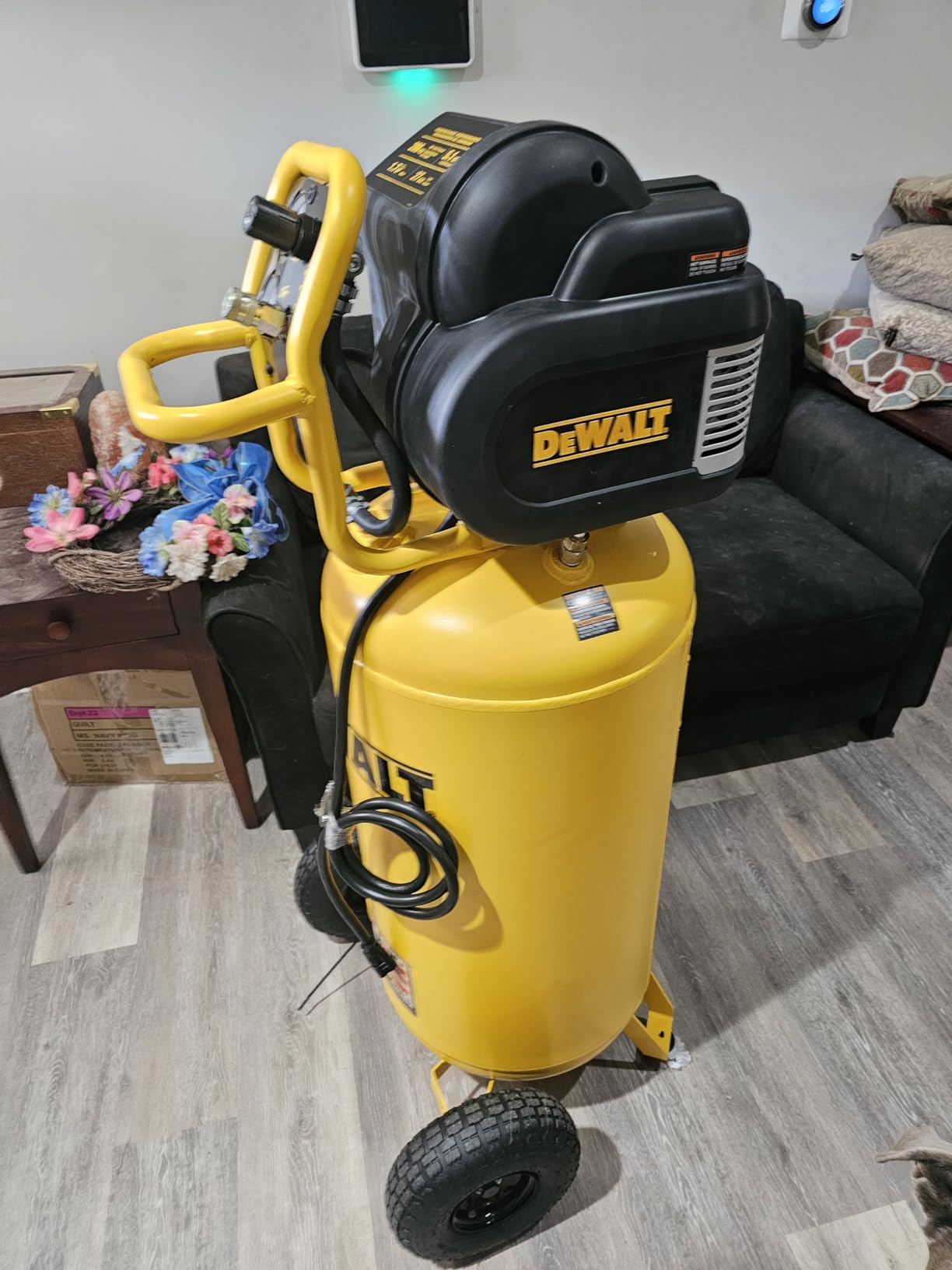
Owners confirm it drives impact wrenches, grinders, and drills above 90 PSI, which tells you the regulator and the pump both hold pressure when the load is genuinely high rather than feathered.
The direct-drive oil-free design has no belt to wear or replace, and the vertical body with big wheels takes little floor space while rolling easily over rough ground.
Why it handles a 40 amp cutter without new wiring
A 40 amp cutter wants roughly 7 CFM at 90 PSI, so no 120V unit gets there honestly. What matters is that pressure holds through a pierce, and the 27-gallon tank plus easy-start motor is the combination that gets there on a household circuit.
Expect the arc to hold where a 4.2 CFM unit would falter, and expect more recovery time between jobs.
Where slow fill and the regulator gap show up
Owners report 10 to 30 minutes from empty to full. That is a genuine limitation when you have burned through the tank mid-job and want to start another cut immediately.
The regulator also tops out near 160 PSI despite a 200 PSI tank, and at 136 lb this unit does not move easily once it is full. Plan a permanent spot for it.
9. Campbell Hausfeld 60-Gallon Two-Stage – Best Air Compressor for 60 Amp Production Cutting
Campbell Hausfeld 60-Gallon 2-Stage Air Compressor, 175 PSI, 230V
7.6 SCFM at 90 PSI
60-gallon ASME tank
Two-stage cast iron pump
3.7 running HP on 230V
Pros
- Best airflow in the group at 7.6 SCFM at 90 PSI
- with 6.9 SCFM held at 175 PSI
- Two-stage cast iron pump rated to 10000 hours on the B-10 bearing system
- 60-gallon tank gives very long continuous run times
- 3-year warranty is the longest here
Cons
- Requires a dedicated 230/240V circuit and wiring
- 255 lb makes it a semi-stationary unit
- 14 percent of reviews are 1-star
- Oil-lubricated pump needs maintenance
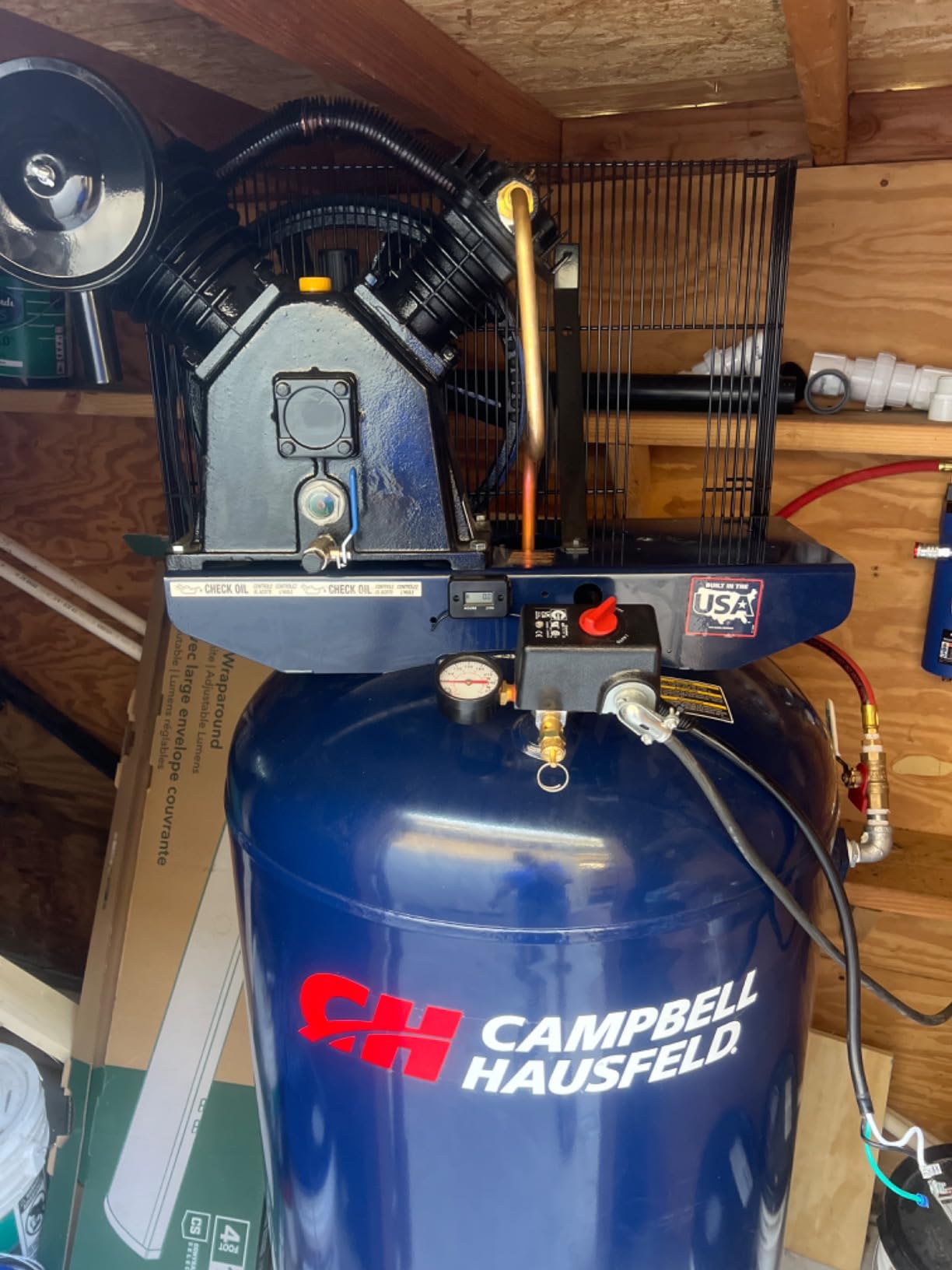
This is the only unit here that honestly matches a 60 amp cutter’s demand. It delivers 7.6 SCFM at 90 PSI and still holds 6.9 SCFM at 175 PSI, and the two-stage cast iron pump is built on the B-10 bearing system for up to 10,000 hours of service.
The 60-gallon vertical ASME tank on a 23 by 23 inch footprint is the reason long continuous cuts stop being a problem. Cutting thick plate produces sustained air draw, and this receiver simply does not run dry while the pump tops it back up.
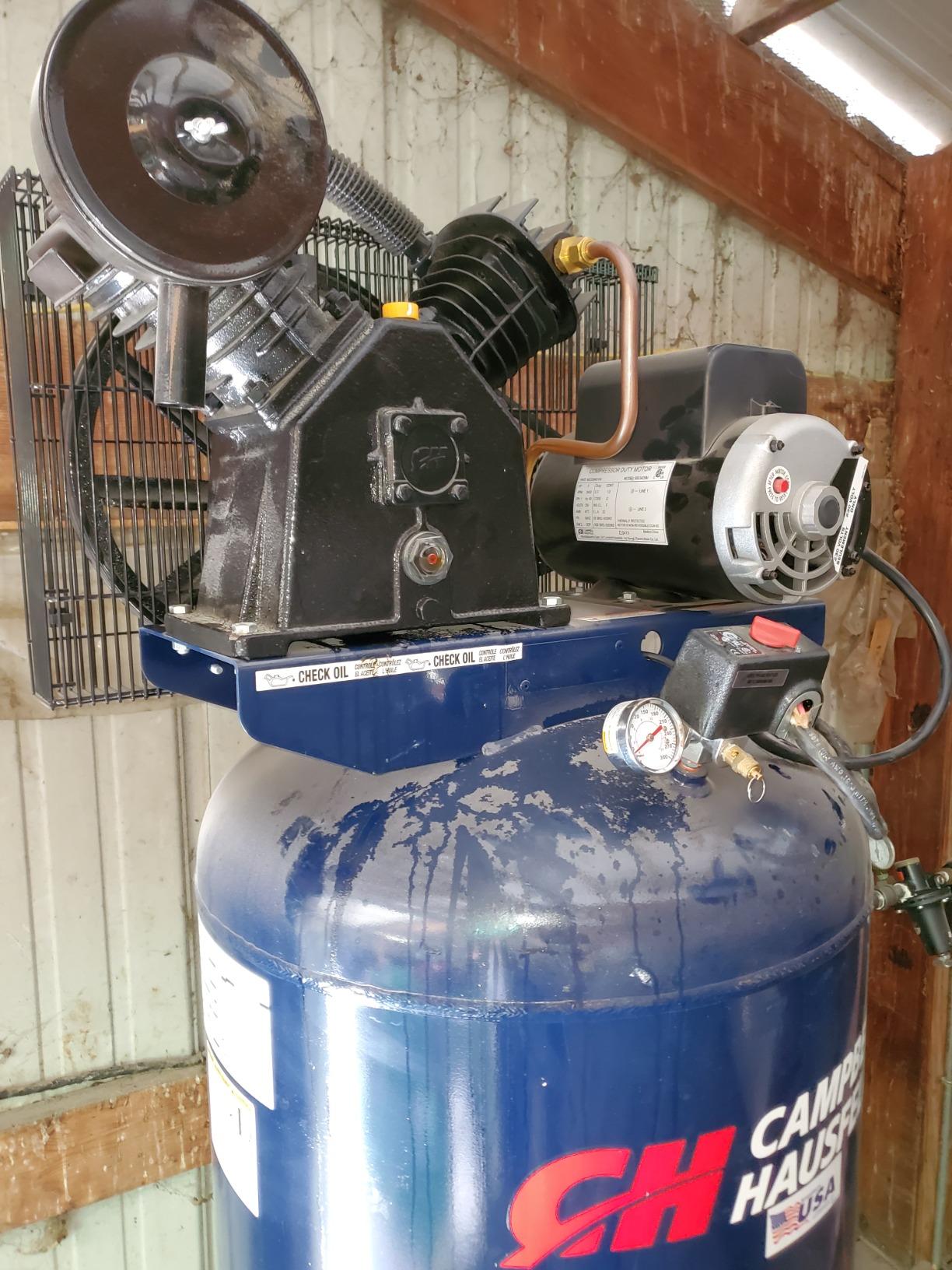
At a listed 65 dB it is quiet for its size, which surprises people who expect two-stage pumps to be loud. The 3.7 running HP induction motor and the 3-year limited warranty both point to a shop-duty machine rather than a garage toy.
Forum consensus across metalworking and machining communities is that a quality two-stage unit is the recommended path for serious plasma work, and this is that path in one package.
Why it is the right choice for 60 amp and machine torch work
A 60 amp cutter consumes roughly 9 to 10 CFM at 90 PSI, and forum users running a machine torch on a table report needing on the order of 5 to 7.5 HP of compressor support. This unit does not exceed that on its own, but it is the closest match in this roundup by a wide margin.
Two-stage compression also means less heat per CFM, which matters when the pump runs for an hour straight on a production job.
What the 230V requirement actually costs you
A dedicated 230/240V circuit means an electrician and a panel slot. At 255 lb this is a semi-stationary unit – plan its location before you buy, because moving it later is a two-person job with a dolly.
Note also that 14 percent of its reviews are one-star, the highest negative share here, mostly around shipping damage and support. Inspect the tank and fittings at delivery.
10. Campbell Hausfeld C151CH 15-Gallon – Best for Cold-Weather Garage Starts
Campbell Hausfeld C151CH 15-Gallon Vertical Air Compressor, 225 PSI
225 PSI tank pressure
4.0 SCFM at 90 PSI
Oil-free pump rated to -20 F
75 lb vertical
Pros
- 225 PSI tank pressure is the highest listed here at this size
- Oil-free pump starts in cold weather down to -20 F
- Lightest weight per gallon in the compact group at 75 lb
- Universal 1/4-inch quick connect accepts common fittings
Cons
- Lowest average rating in this roundup at 4.0
- Only 4.0 SCFM at 90 PSI is the weakest sustained airflow
- 81 dB is the loudest rating here
- 13 percent of reviews are 1-star
If your shop is unheated, the cold-weather start rating is the reason to look at this one. The oil-free pump is rated to start down to -20 F, and the 15-gallon vertical tank stores air up to 225 PSI – the highest tank rating in this group at this size.
At 4.0 SCFM at 90 PSI it also has the weakest sustained airflow here, so treat it as a light-duty unit. The 5.2 SCFM at 40 PSI figure does not help a plasma cutter, which lives in the 90 PSI band.
The universal 1/4-inch quick connect is genuinely useful – it accepts common fittings rather than forcing you into one connector standard. The regulator, manifold, and gauges sit behind the handle where they take less punishment.
At 75 lb it is the lightest unit per gallon in this roundup, and the wheels and large protective handle make moving it manageable.
Why cold starts matter in an unheated shop
Oil-lubricated pumps get thick when cold and can refuse to turn over. An oil-free pump rated to -20 F starts when your garage is near freezing, which means a winter morning does not cost you the first hour of the day.
The 225 PSI tank rating also gives you more stored air reserve than most compressors of this size, which helps a torch through short pierces.
Where airflow and noise disappoint
Four SCFM at 90 PSI is the lowest sustained figure in this set. It suits a 20 amp or small 30 amp cutter on short work; a 40 amp cutter will pull it down faster than it recovers.
At 81 dB it is the loudest unit here, and with 13 percent one-star and another 13 percent three-star reviews, owner satisfaction is the weakest in the roundup. Buy it for the cold-weather rating, not for the reviews.
How to Size an Air Compressor for a Plasma Cutter
Match compressor output to cutter amperage
Size for airflow, not tank capacity. Read the CFM figure printed in your cutter manual, then find a compressor rated at 30 to 50 percent higher at the pressure the cutter runs at. Here is the matching matrix:
- 20 to 30 amp handheld: about 4 to 4.5 CFM at 80 to 90 PSI. Size the compressor for 6 to 6.8 CFM at 90 PSI. A 30 gallon two-stage unit covers it comfortably.
- 40 amp handheld: roughly 7 CFM at 90 PSI. Size the compressor for 9 to 10.5 CFM at 90 PSI, which pushes you toward a 60 gallon unit or a dedicated machine.
- 60 amp production cutter: about 9 to 10 CFM at 90 PSI. Target 13 to 15 CFM at 90 PSI, or add a second receiver.
- Machine torch on a CNC table: 14 CFM and up at 90 PSI. This is rotary screw territory, not a portable compressor.
A 40 amp cutter generally handles up to about 1 inch of carbon steel with good pierce capability; a 60 amp unit roughly doubles that. The amperage class sets how much air you burn per second, which is what your compressor has to replace continuously.
CFM vs SCFM: read the number at your working pressure
CFM is simply volume of air per minute. SCFM is that same volume normalized to standard test conditions, which is what makes two compressors comparable. Manufacturers quote airflow at a pressure – if the quote is at 40 PSI and your torch runs at 90 PSI, the real flowing number is meaningfully lower.
Ignore peak horsepower and peak tank PSI when comparing. A 3.7 HP motor can deliver more usable air at 90 PSI than a 5 HP motor on a weaker pump, because what matters is airflow at pressure.
How much PSI does a plasma cutter need?
Most plasma cutters run best between 70 and 120 PSI. Hobby handheld units work at the low end, 70 to 90 PSI, while thick-steel production cutters want the full 100 to 120 PSI band to keep the arc stable and blow the kerf clean.
Set the regulator above the torch’s rated maximum – not at the tank’s storage rating. Most torches specify a maximum inlet pressure and expect you to feed them less than that.
Will a 30 gallon air compressor run a plasma cutter?
Yes, for 20 and 30 amp handheld cutters, and for short 40 amp jobs. A 30 gallon tank at working pressure holds enough stored air to get through a typical pierce without the pressure collapsing.
It will not sustain a 60 amp cutter or a machine torch. Those need 60 gallons or more, because the receiver is buffering a continuous draw rather than an intermittent one.
Duty cycle, two-stage and rotary screw
Duty cycle is the share of time the motor can run before it must rest. Look for 75 percent or higher for continuous plasma cutting; below that, the motor is the part that fails first.
Two-stage reciprocating pumps compress twice, which means cooler running, better efficiency at high pressure, and longer life under sustained load. Above hobby duty, that is the forum consensus: quality two-stage units from brands like Quincy or Ingersoll Rand are the recommended path for serious plasma work.
Rotary screw is the next step, and modern efficient units earn repeat praise – Kaeser comes up by name in machining forum threads about higher-amp cutters. For a 60 amp or 100 amp machine torch running all day, screw air is where the economics start to work.
Air drying and filtration
Moisture and oil in the lines cause erratic arcs, dross, and rapid consumable wear. Forum users consistently recommend adding a dryer alongside the compressor for plasma service, and that advice is correct.
- Cartridge filter: cheapest, removes oil and particulates only. Fine for a garage, not enough on its own.
- Refrigerated dryer: drops line temperature so moisture condenses out and drains. The everyday choice for a shop.
- Desiccant dryer: adsorbs moisture down to very low dew points. Needed when cuts stay pitted or the arc keeps failing in cold weather.
Order of operations matters: tank, moisture separator, dryer, filter, then the regulator, then the torch. Put the regulator last so it does not get contaminated by whatever came before it.
Fixing bad cut quality: start with your air
If cuts come out dirty with heavy dross or the arc cuts out mid-pass, work down this list before blaming the torch:
- Check flowing pressure at the torch with the arc running, not just tank pressure. Line pressure can drop even with the compressor two feet away.
- Look for moisture in the lines. Water in the air stream pits the edge and kills the arc.
- Confirm your CFM at 90 PSI meets the cutter plus 30 to 50 percent headroom. Undersized supply is the most common root cause.
- Check for leaks in the torch lead, the ground clamp, and every coupler. Pressure loss here looks exactly like an undersized compressor.
- Inspect the consumables. Tips and nozzles wear out faster on dirty air, and a worn tip produces dross that looks like a supply problem.
Pre-purchase checklist
- Read the cutter manual for rated CFM and the PSI band.
- Add 30 to 50 percent airflow headroom at that PSI.
- Confirm the compressor’s CFM figure is quoted at 90 PSI, not at 40 PSI.
- Check the circuit: 120V units for garages, dedicated 230/240V for anything serious.
- Match tank size to cut duration – 30 gallon for hobby, 60 gallon and up for production.
- Verify duty cycle of 75 percent or higher.
- Budget for a dryer and a filter-regulator.
- Confirm noise at the distance you will actually be working.
- Check warranty length and service parts availability before you commit.
If noise is a factor for your space, our quiet compressor picks cover the sound angle in more depth.
Frequently Asked Questions
What size air compressor do I need for a plasma cutter?
Size by airflow at working pressure, not tank size or horsepower. Read the CFM your cutter needs at its rated PSI, then pick a compressor rated 30 to 50 percent higher at that same PSI. A 30 amp handheld typically needs a compressor delivering 6 to 6.8 CFM at 90 PSI, while a 60 amp cutter calls for 13 to 15 CFM at 90 PSI.
How many CFM does it take to run a plasma cutter?
A 20 to 30 amp handheld cutter consumes about 4 to 4.5 CFM at 80 to 90 PSI. A 40 amp cutter needs roughly 7 CFM at 90 PSI, a 60 amp production cutter needs about 9 to 10 CFM at 90 PSI, and a machine torch on a CNC table wants 14 CFM and up. Always compare the compressor’s figure at the same PSI the cutter runs at.
How much air pressure do I need to run a plasma cutter?
Most plasma cutters run best between 70 and 120 PSI. Hobby handheld units work at the low end between 70 and 90 PSI, while thick-steel production cutters want 100 to 120 PSI to keep the arc stable and clear the kerf. Set your regulator above the torch’s rated maximum inlet pressure but below the tank’s storage rating.
Will a 30 gallon air compressor run a plasma cutter?
Yes, for 20 and 30 amp handheld cutters and for short 40 amp jobs. A 30 gallon tank holds enough stored air to survive a typical pierce without collapsing. It will not sustain a 60 amp cutter or a machine torch on a CNC table, because those need 60 gallons or more to buffer a continuous air draw.
What is CFM when it comes to air compressors?
CFM means cubic feet per minute, the volume of air a tool consumes in a minute. SCFM is the same volume normalized to standard test conditions, which is what lets you compare two compressors fairly. The key detail is the pressure the figure is quoted at, because a compressor rated 5.3 CFM at 40 PSI delivers far less air at 90 PSI.
How can I improve plasma cut quality?
Start with your air supply. Check flowing pressure at the torch while the arc runs, look for moisture in the lines, confirm your compressor delivers the required CFM at 90 PSI plus 30 to 50 percent headroom, and inspect the torch lead, ground clamp, and couplers for leaks. Finally check the consumables, since a worn tip produces dross that mimics a supply problem.
The Verdict on Air Compressors for Plasma Cutters
The Makita MAC2400 takes our editor’s choice for the widest set of working conditions: honest 4.2 CFM at 90 PSI, a cast iron Big Bore pump, and a 12.3 A start draw that fits a garage circuit. The Klutch 29-gallon is the better buy if your tank needs are bigger, and the Campbell Hausfeld 60-gallon two-stage is the only unit here that genuinely matches 60 amp production cutting.
Whichever you land on, match the CFM figure at 90 PSI to your cutter plus 30 to 50 percent headroom, budget for a dryer and filter-regulator, and check that your circuit can carry it. Get those three right and the best air compressors for plasma cutters become the least interesting part of the whole setup.