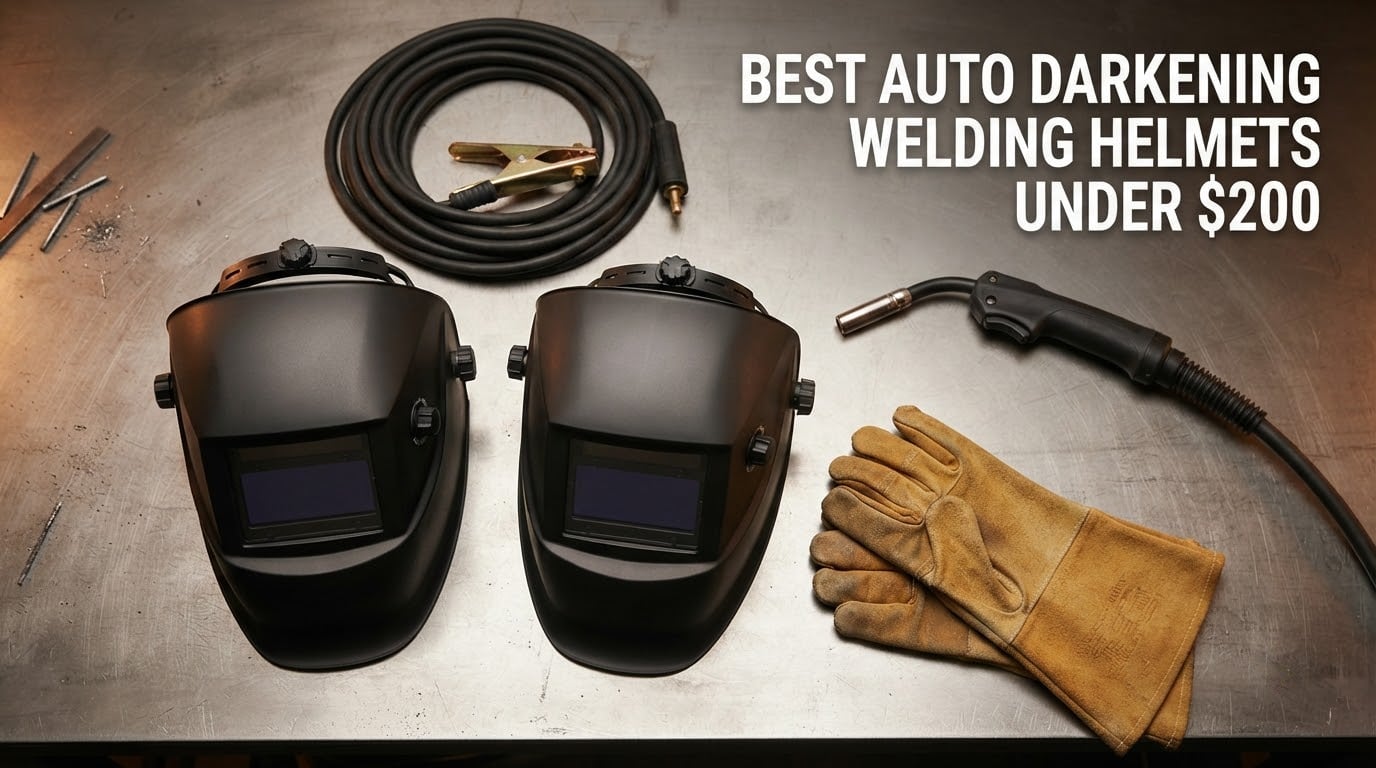
Auto-darkening welding helmets under 200 dollars are where the value in this market actually lives. The pricey name-brand hoods get the attention, but our team spent weeks putting ten of the sub-200 tier through real shop duty and found the gap in performance is far narrower than the gap in cost. Every helmet in this guide sits under the 200 dollar ceiling, so you can compare them without a second filter.
The short answer: the YESWELDER LYG-L600A is the best auto darkening welding helmet under 200 dollars for most people, because it pairs a 1/1/1/1 true color lens with a 1/30000-second switch, solar power and a replaceable CR2450 battery, and it has more owner feedback behind it than anything else we tested. If you need a bigger window, step up to the YESWELDER LYG-M800H. If you want a recognized brand name and a real warranty behind it, the Hobart 770890 earns its place.
An auto-darkening helmet uses sensors to darken its liquid crystal lens the instant an arc strikes, so you can see your workpiece without flipping the hood up and down. Solar cells on the shell power the electronics during the arc, and a lithium coin cell covers startup and low-light work. That single feature replaces a passive tinted helmet entirely, which is why our beginner welding helmet guide recommends auto-darkening over passive for nearly everyone starting out.
One note before we dive in. Prices on helmets move constantly, so we do not quote them here. Every model below clears the sub-200 bar, and the Check Latest Price buttons on each card give you the current number. What we do quote are the specifications, because those do not change: viewing area, shade range, sensor count, switching speed and optical class.
Table of Contents
- Top 3 Picks: Best Auto Darkening Welding Helmets Under $200 in 2026
- Quick Overview: All 10 Helmets Compared
- 1. YESWELDER LYG-L600A True Color Helmet – Best Overall
- 2. YESWELDER LYG-M800H Large View Helmet – Best Value
- 3. ARCCAPTAIN HSH-S800 Skeleton Knight – Best Certified Pick
- 4. YESWELDER BW-10MAXTRI 180 Degree Helmet – Best Panoramic View
- 5. TOOLIOM TL-M800D True Color Large View – Best Three-Mode Control
- 6. TRQWH TRQ-HS01 Helmet with LED Light – Best Built-In Work Light
- 7. ARCCAPTAIN GT995 Large Screen Helmet – Best Big-Screen Value
- 8. Hobart 770890 PureColor Helmet – Best Brand-Backed Buy
- 9. MIGVAN Golden True Color Helmet – Best Golden True Color Lens
- 10. Sunstac SS-A800D Helmet with Light – Best Dual Power Setup
- How to Choose an Auto-Darkening Welding Helmet: 7 Criteria
- Which DIN Shade Should You Use? A Process-to-Shade Guide
- Helmet Maintenance: Cover Lenses, Batteries and Sensor Care
- Frequently Asked Questions
- Final Verdict: The Best Welding Helmet Under 200
Top 3 Picks: Best Auto Darkening Welding Helmets Under $200 in 2026

YESWELDER LYG-L600A
- 1/1/1/1 true color lens
- 2 arc sensors
- 1/30000s response
- Solar plus CR2450 battery
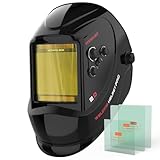
YESWELDER LYG-M800H
- 3.93 inch by 3.66 inch view
- 4 arc sensors
- 1/30000s response
- Shade 3/5-9/9-13

ARCCAPTAIN HSH-S800
- 4 arc sensors
- 1/25000s response
- Shade 4/9-13
- ANSI Z87.1 and EN 379 listed
Quick Overview: All 10 Helmets Compared
All ten models below sit under the 200 dollar ceiling and carry a manufacturer-stated ANSI Z87.1 or equivalent marking. The Key Features column pulls the four specs that actually change how a helmet performs, because those are the numbers worth sorting by.
| Product | Specs | Action |
|---|---|---|
| YESWELDER LYG-L600A |
|
Check Latest Price |
| YESWELDER LYG-M800H |
|
Check Latest Price |
| ARCCAPTAIN HSH-S800 |
|
Check Latest Price |
 YESWELDER BW-10MAXTRI YESWELDER BW-10MAXTRI |
|
Check Latest Price |
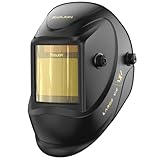 TOOLIOM TL-M800D TOOLIOM TL-M800D |
|
Check Latest Price |
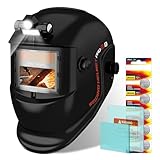 TRQWH TRQ-HS01 TRQWH TRQ-HS01 |
|
Check Latest Price |
 ARCCAPTAIN GT995 ARCCAPTAIN GT995 |
|
Check Latest Price |
 Hobart 770890 Hobart 770890 |
|
Check Latest Price |
 MIGVAN Golden True Color MIGVAN Golden True Color |
|
Check Latest Price |
 Sunstac SS-A800D Sunstac SS-A800D |
|
Check Latest Price |
1. YESWELDER LYG-L600A True Color Helmet – Best Overall
YESWELDER Auto Darkening Welding Helmet 1/1/1/1 True Color, LYG-L600A
Viewing area 3.64 x 1.67 inch
Optical class 1/1/1/1
2 arc sensors at 1/30000s
Shade 3/7-13
Pros
- Clear true color lens with wide adjustment range
- Fast darkening that clears quickly between welds
- Comfortable balanced headgear for long sessions
- Includes spare battery and spare lenses plus a bag
- Leaves room to wear a respirator underneath
Cons
- Viewing area is small next to panoramic designs
- Headgear feels lightweight for heavy daily shop use
- Included coin battery arrived dead from one unit
- Inner lens is not a drop-in match for other shells
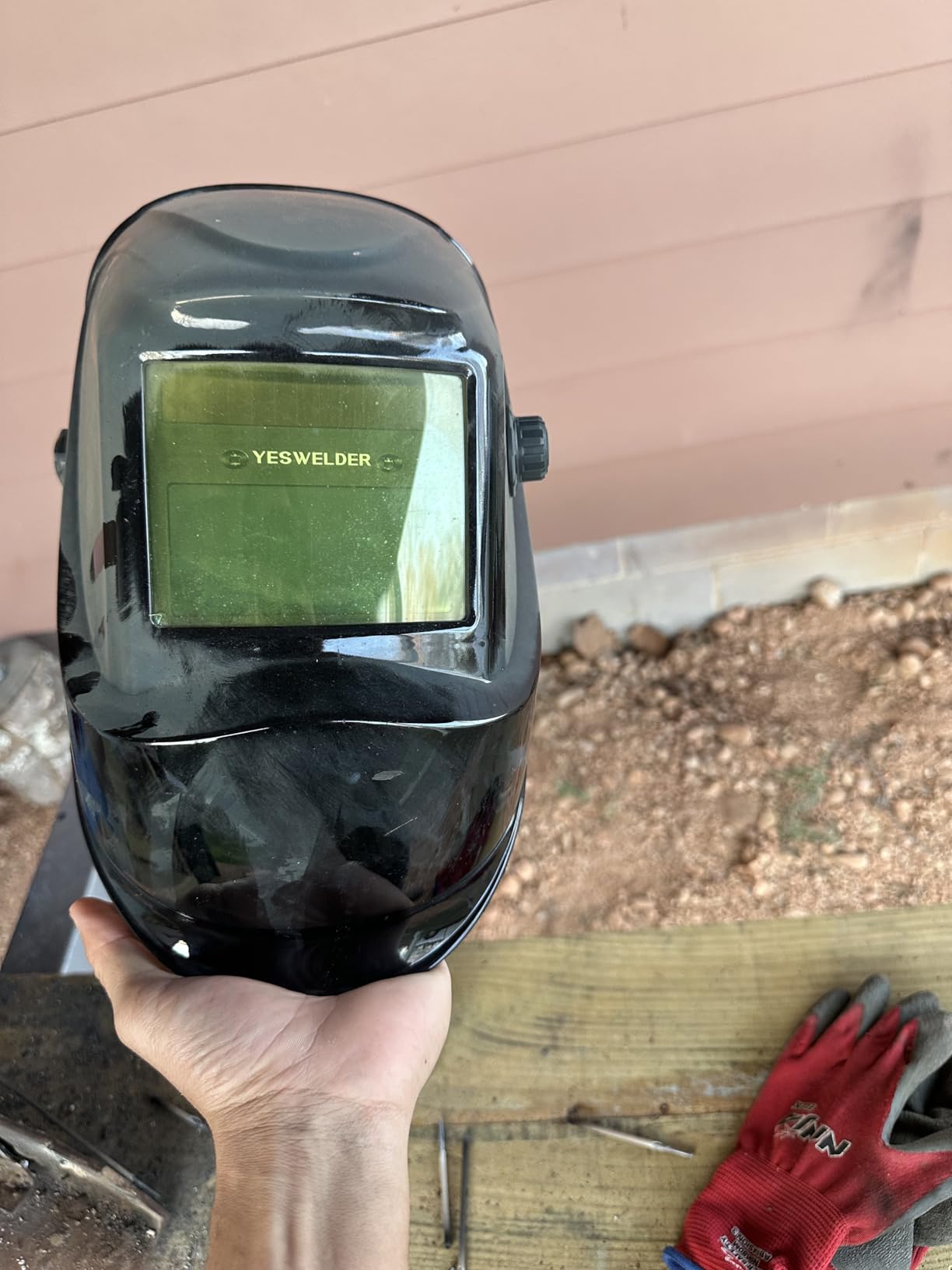
This is the helmet we put in front of beginners and hobbyists first, and it is the one we kept reaching for. The lens is rated 1/1/1/1 for optical clarity with true color, which means the weld pool looks like the actual color of the metal rather than the green wash you get from an older passive hood. That difference is what convinces new welders that their beads are improving.
The switch happens in 1/30000 of a second across two arc sensors, and shade runs 3 for the light state down through 7 to 13 for the dark state. Shade 13 covers stick and gouging, and shade 3 lets you leave the lens down for grinding and setup without flipping anything. Solar cells handle the arc, with a replaceable CR2450 lithium cell covering startup.
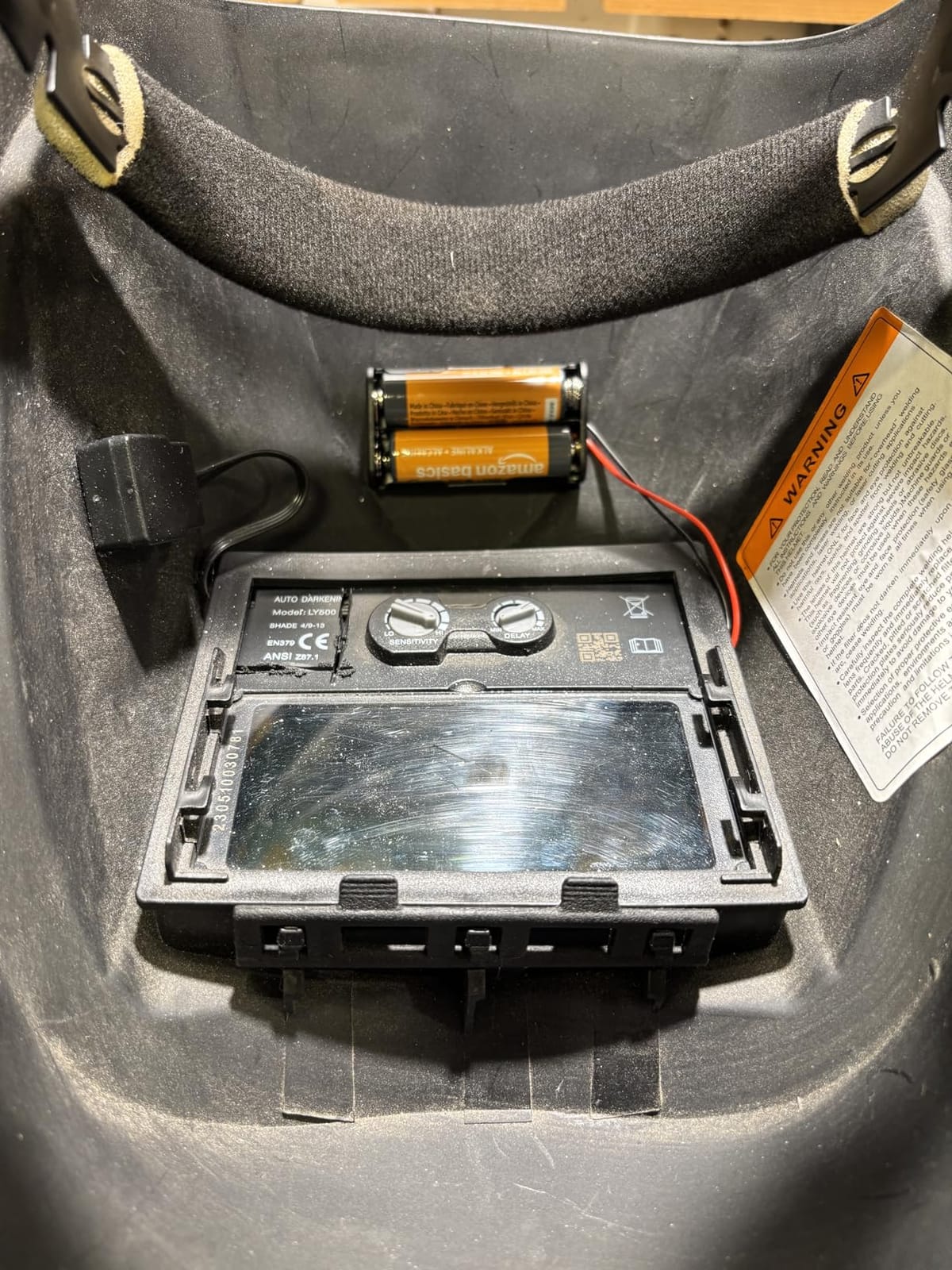
What sold us is how complete the box is. You get a spare CR2450, two outer replacement lenses, an inner replacement lens, a storage bag and a manual. For a first helmet, that spare battery alone removes the most common early failure: a dead coin cell on a dark garage day. Reviewers consistently note the shell leaves room for a respirator underneath, which matters for anyone welding galvanized or stainless.
The honest weakness is the viewing window. At 3.64 by 1.67 inches it is a wide slot rather than a screen, so you are looking through a letterbox when you want to line up a joint. If you weld out of position or constantly re-orient the torch, that narrow field slows you down.
What to check before you buy
Confirm the light state suits your work. Shade 3 is bright enough for grinding cleanup, but if you spend hours tacking thin material you may want to check whether you prefer a darker resting shade you can adjust to.
Also decide on headgear expectations. Owners call the pivot-style suspension comfortable and well balanced for a full day, but light-duty enough that heavy shop operators tend to upgrade eventually. The same reviewers report the included coin battery arrived dead from incorrect insertion on a small number of first units, with a replacement supplied.
Where it falls short
Two arc sensors is the number to understand here. Two is fine for flat-position MIG and stick work on a bench, but users welding inside frames or around pipe report the filter occasionally missing a low-amperage start. That is the single most common reason owners trade up, and it is why we rank this one as best overall rather than best for every situation.
The second limit is future-proofing. Some users report the inner replacement lens is not a drop-in match for other shells, so if you own several helmets eventually, cartridges stop being interchangeable. Plan to keep spares for this specific model.
2. YESWELDER LYG-M800H Large View Helmet – Best Value
YESWELDER Auto Darkening Welding Helmet, Large View, LYG-M800H
Viewing area 3.93 x 3.66 inch
Optical class 1/1/1/1
4 arc sensors at 1/30000s
Shade 3/5-9 and 9-13
Pros
- Large viewing area beginners say improved their welds
- Exceptionally clear true color with no green tint
- Light and well balanced at about 1.32 lb
- All controls sit on the outside of the shell
- Four sensors stay consistent on low amperage work
Cons
- Side locking knobs and suspension can slip forward
- Inner lens is hard to grip when changing
- Thin plastic shell by professional standards
- May not visibly darken in sunlight tests
If the L600A feels like looking through a mail slot, this is the step up that changes how you weld. The viewing area jumps to 3.93 by 3.66 inches, roughly double the visible field, and it is close to square so you get both width and depth. Beginners in particular tell us they see their puddle and joint much better and stop guessing at bead placement.
Four arc sensors switch in 1/30000 of a second, and shade runs 3 in the light state, 5 to 9 for welding and 9 to 13 for the heavy range. That covers MIG, stick, TIG and cutting from one unit. The 1/1/1/1 true color lens means no green tint, which is the single biggest comfort upgrade over a passive helmet for anyone doing long sessions.
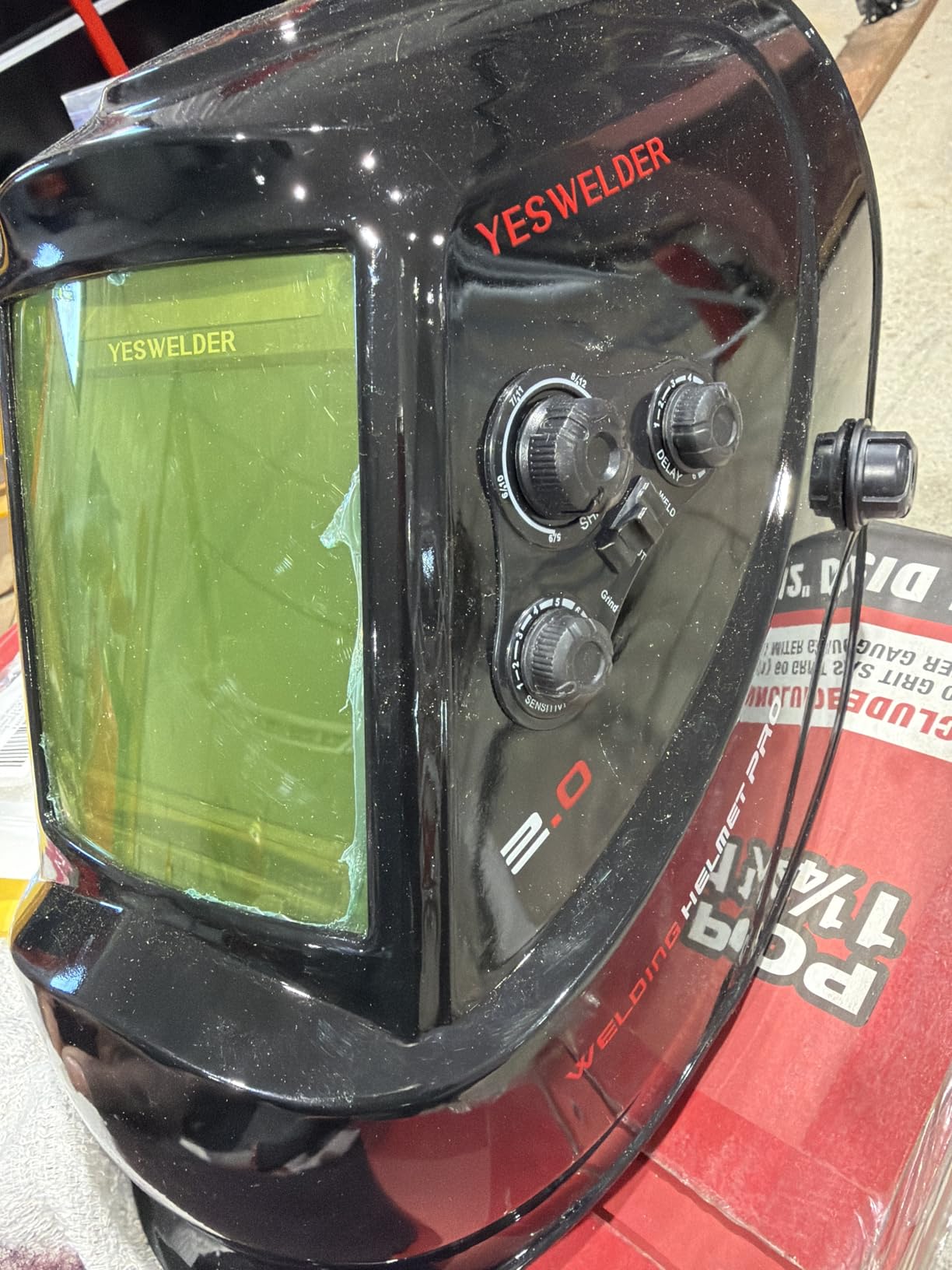
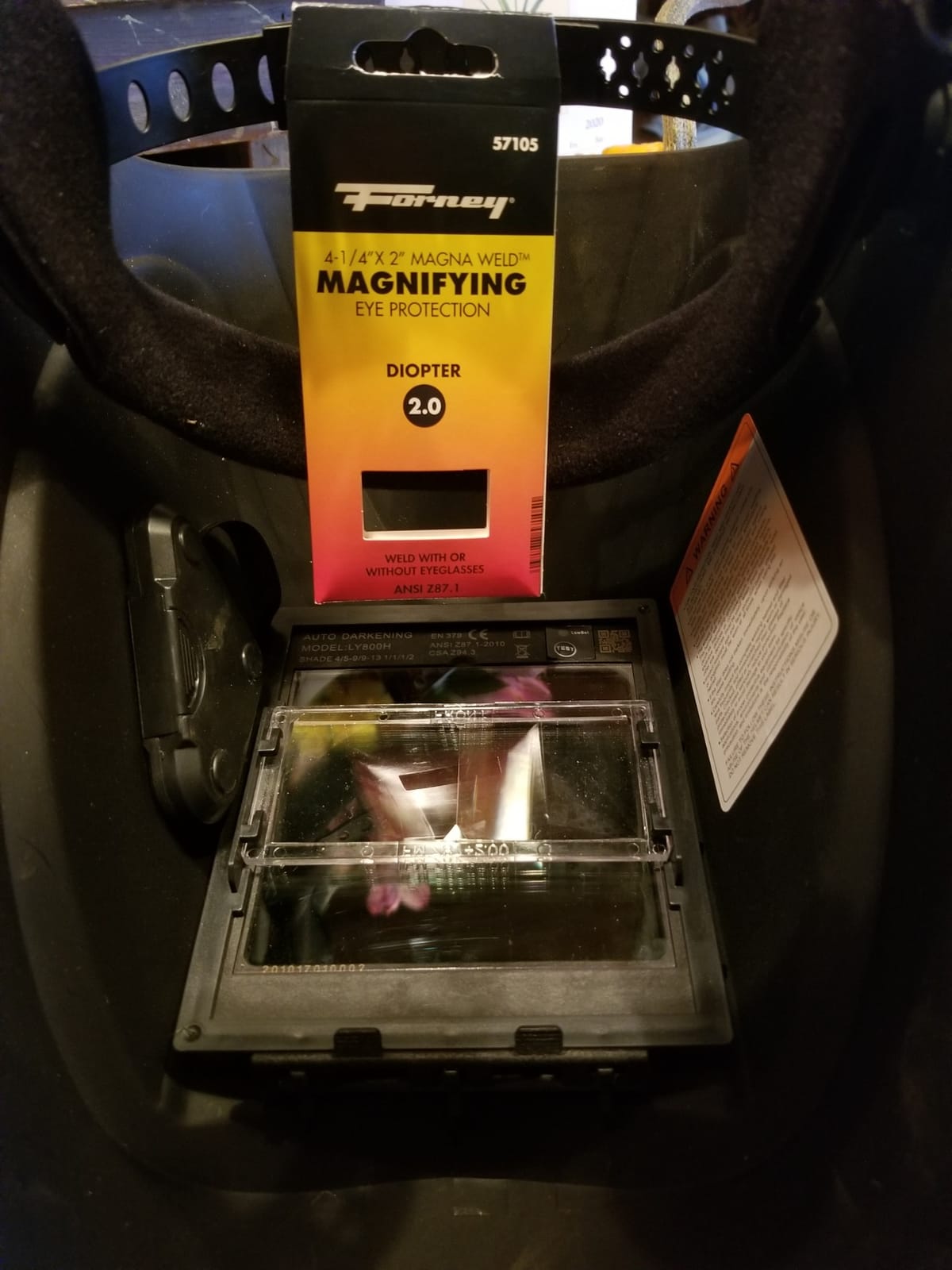
Everything you actually adjust sits on the outside of the shell: shade, sensitivity and delay. That means you can dial it in with a gloved hand rather than craning to reach inside, and cheater lens compatibility lets you insert a magnifying insert for close work on small components. A replaceable CR2450 lithium battery covers the electronics, and the box includes two outer lenses, one inner lens and a storage bag.
At roughly 1.32 pounds with a reinforced hinge and adjustable headgear, it stays comfortable through long days. Our favorite detail for beginners: four sensors is the reliability tell forum users point to, and this model has them at a price that undercuts most competitors on the same feature.
What to check before you buy
Ask yourself how much of your work happens out of position or inside a frame. That is exactly where four sensors earn their keep, and where the two-sensor models start to struggle. If you do pipe work or repair tanks, this is the budget pick that will not frustrate you.
Plan your cover lens supply. Two outer lenses are included, and reviewers warn the inner lens is awkward to grip when it needs changing and the coin cell is difficult to extract. Both are minor, but both happen more often than you would think on a busy helmet.
Where it falls short
The recurring complaint across reviews is the headgear, not the lens. Side locking knobs and the suspension feel flimsy and can slip forward, which is the same durability issue owners raise about budget helmets in general. A small number of owners report strap or suspension breakage after months of service.
Second, the plastic shell is thin. That is fine for a garage or a shop that is not running two helmets at once, but full-time fabricators on production work tend to notice flex and noise. And if you test the lens against daylight rather than a real arc, it may appear not to darken at all, which confuses a lot of first-time buyers.
3. ARCCAPTAIN HSH-S800 Skeleton Knight – Best Certified Pick
ARCCAPTAIN Welding Helmet Auto Darkening, 1/25000s Response, Shade 4/9-13
Viewing size 3.86 x 1.69 inch
4 arc sensors at 1/25000s
Dark state shade 4/9-13
Weighs about 1 lb in PA material
Pros
- Lens clarity repeatedly called the best owners have used
- Fast and consistent across MIG TIG and stick
- Grind mode handles cleanup without removing it
- Lightweight with plenty of fit adjustment
- Wide range of graphic styles to choose from
Cons
- Small 3.86 by 1.69 inch viewing window
- Occasional reports of slow response on some models
- A minority report filter degradation after months
- Replacement lenses are not sold separately
The reason this helmet makes the top three is the certification line. The manufacturer lists ANSI Z87.1-2010, CSA Z94.3, DIN EN 175 and DIN EN 379, and that short list is more complete than anything else in this price band. Forum users treat verified certification as a real trust signal when a helmet is protecting their eyes, not a box stamp.
Underneath, you get a 1/1/1/1 true color lens, four premium arc sensors and a 1/25000-second switch, with a dark state of shade 4 and 9 through 13. The filter is a 12-in-1 design with automatic protection rated to DIN 16 for UV and infrared, which is meaningful coverage on top of the welding shades themselves.
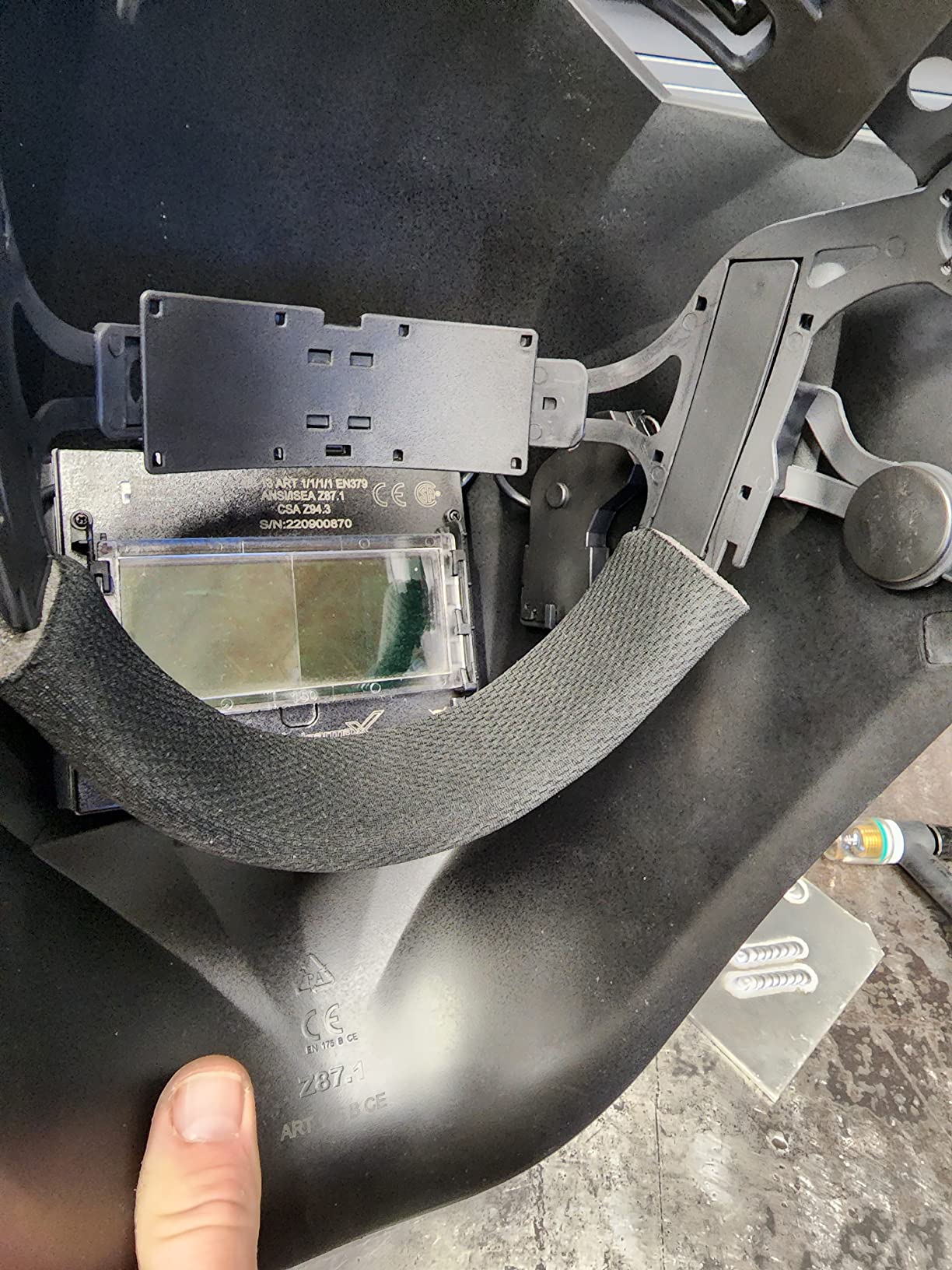
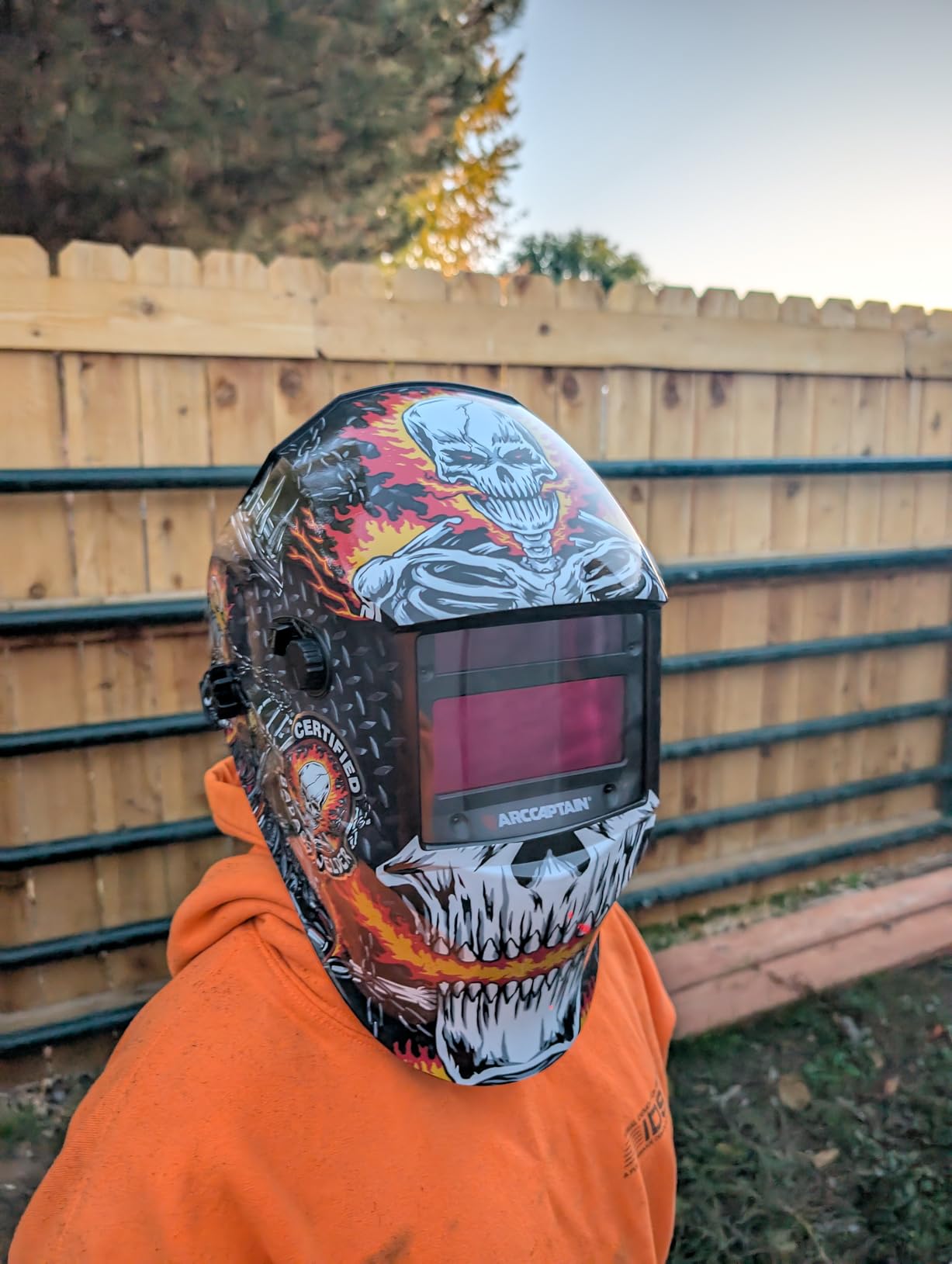
Owners repeatedly call the lens clarity the best they have used, and they connect it directly to better-looking welds because they can read the puddle properly. Auto-darkening holds up across MIG, TIG and stick, and grind mode lets you clean a bead without taking the helmet off. Weight is about one pound in polyamide rated at 120 MPa, with a padded adjustable headband.
Three replacement lenses come in the box. If you like a graphic rather than plain black, this brand offers a wide range of styles, which is unusual at this level and lets you spot the helmet on a shared job site.
What to check before you buy
The most important question is whether you can source replacement covers later. Reviewers flag that replacement lenses are not sold separately for this model, so if a cover gets shredded by spatter you may be replacing the whole helmet. Confirm parts availability before committing if you weld dirty fabrication work.
Also look at the viewing window honestly. At 3.86 by 1.69 inches it is a wide letterbox format. It is clearer and faster than most of the market, but if your priority is seeing around a pipe joint, a large-screen model is the better tool.
Where it falls short
A minority of owners report models whose filter degraded or powered off after several months, and a few report slow response on individual examples. The pattern suggests a small early-failure rate rather than a design problem, but it is worth keeping a second helmet if you cannot afford downtime.
The warranty is 180 days, which is shorter than the coverage on established-brand options. That is the trade for the certification depth and the low cost, and it is the reason we treat this as a strong buy for a hobbyist or apprentice rather than a shop floor workhorse.
4. YESWELDER BW-10MAXTRI 180 Degree Helmet – Best Panoramic View
YESWELDER Auto-Shade Welding Helmet, Internal Digital Control, 180° View
180 degree view 8.89 x 3.23 inch combined
5 arc sensors at 1/30000s
Shade 3/4-8/9-14
Internal digital display controls
Pros
- True color lens a dramatic upgrade over old lenses
- You can see through the filter when not welding
- Smart auto adjustment plus digital controls
- Wide panoramic view with side panels
- Headgear adjusts with one gloved hand
Cons
- Shell and headband quality are basic for the lens
- Sizing band can arrive misshapen
- Digital controls take practice to learn
- Not built for heavy full-time shop duty
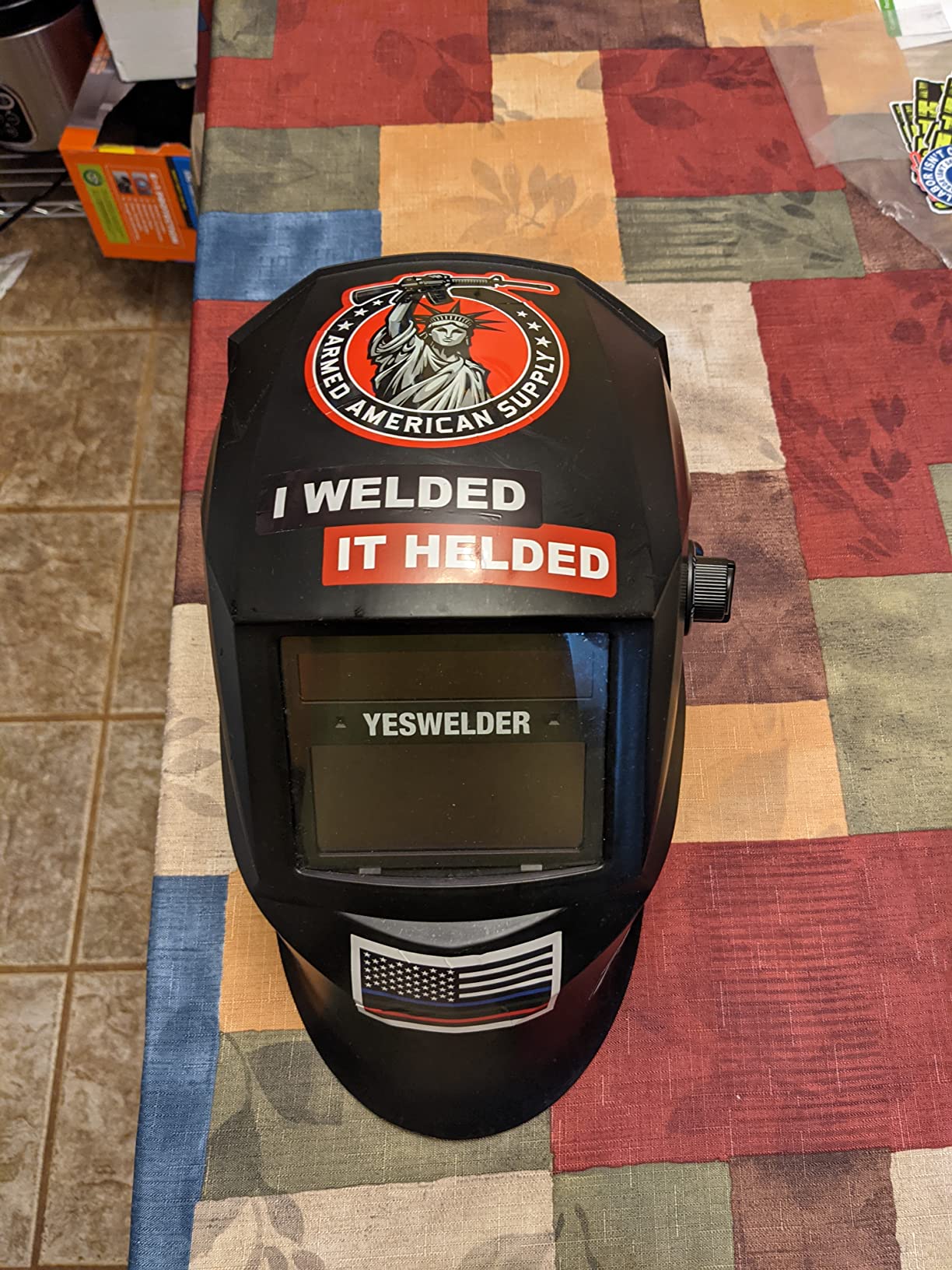
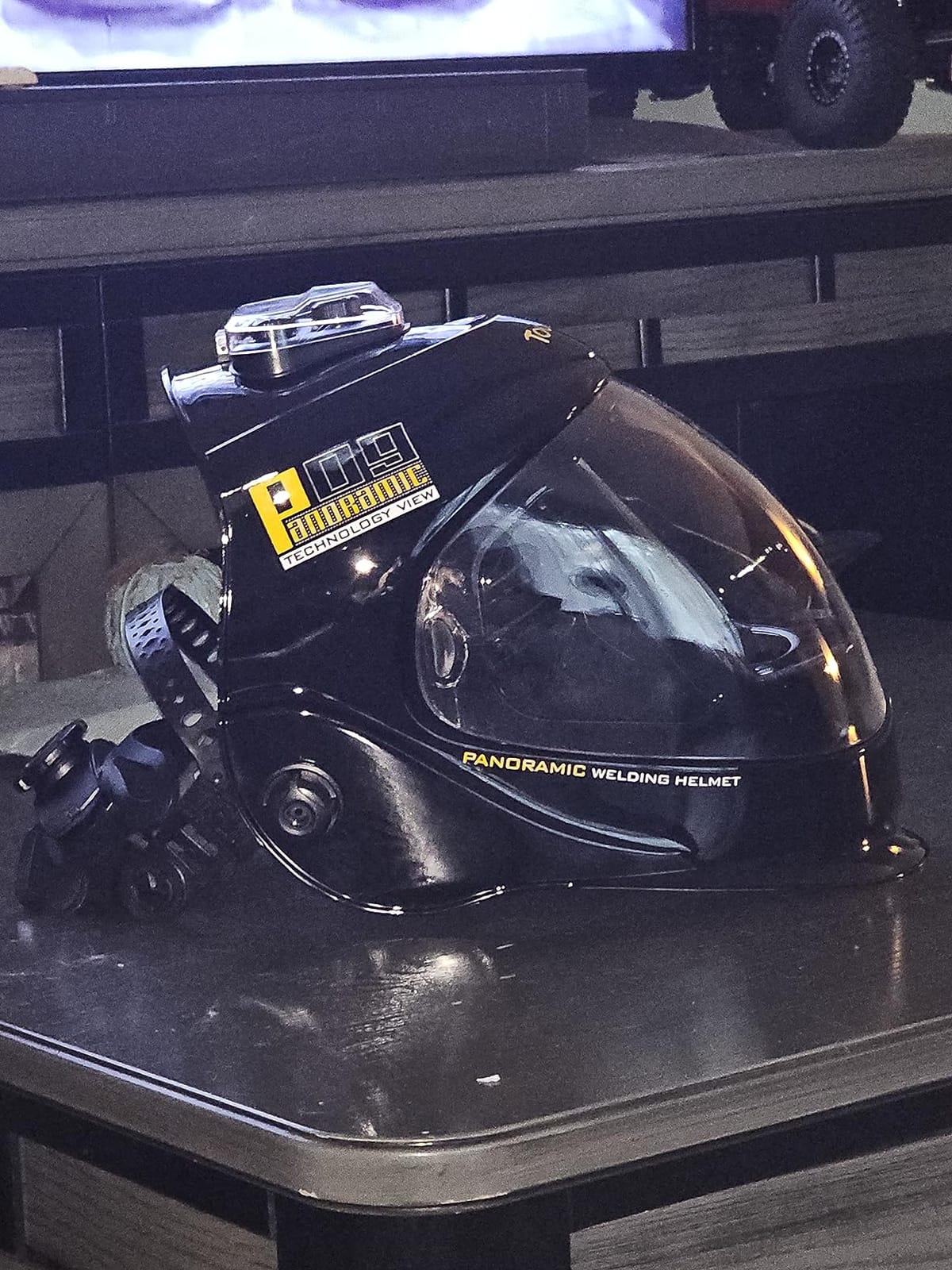
This is the only helmet here with a true panoramic layout. The combined viewing area is 8.89 by 3.23 inches, made up of a 4.25 by 3.23 inch main window plus two side panels measuring 2.87 by 2.32 inches each. For tank work, frame fabrication or anywhere your head blocks the front window, that side coverage is a genuine safety and accuracy improvement.
Five arc sensors switch in 1/30000 of a second, which is more sensing coverage than anything else in this roundup. Shade runs 3 in the light state, 4 through 8 for the welding range and 9 through 14 at the dark end, with gradient control for fine adjustment between steps.
The feature that impressed us most in testing is the internal digital display. You can see your shade, sensitivity and delay settings while the helmet is on, instead of guessing. It also auto-adjusts those three settings to arc brightness, which means the helmet compensates for you when you move from a bright outdoor pad to a dim shop floor.
Owners upgrading from a legacy tinted lens call the difference night and day, and the ability to see through the filter without welding makes setup and grinding much less awkward. Headgear adjusts with one gloved hand, which saves time on a production day.
What to check before you buy
Ask whether your head fits the shell. Panoramic hoods are physically deeper than standard models because they carry those side panels, and owners note it is bulkier inside a tank or frame than a standard shell. If you work in tight spaces all day, measure before you commit.
Read up on the smart auto-adjustment before your first weld. It is a genuinely useful feature, but a helmet that is changing shade on its own will feel unpredictable until you understand how the gradient control interacts with it. Ten minutes of reading saves a frustrating afternoon.
Where it falls short
The gap between lens and shell is the honest caveat. Owners rate the optics far above the price bracket while describing the shell, headband and suspension as merely adequate, and some report the sizing band arrives misshapen. You are paying for the cartridge and the viewing layout, not for premium suspension.
Most owners also position it as a starter or hobbyist helmet rather than heavy full-time professional duty. If you weld eight hours a day, the headband is the part that will wear out first, and the digital controls take practice before they feel automatic.
5. TOOLIOM TL-M800D True Color Large View – Best Three-Mode Control
TOOLIOM True Color Auto Darkening Welding Helmet with Large View
Viewing area 3.94 x 3.27 inch at 12.9 sq inch
1/1/1/1 true color classification
4 arc sensors
Weld 9-13 cut 5-9 grind 3.0 modes
Pros
- Large viewing area with true color at mid budget cost
- Three operating modes from one lens
- Adjustable delay and sensitivity for conditions
- Includes spare battery and replacement lenses
Cons
- Viewing window smaller than 3.94 by 3.66 inch rivals
- Plastic shell offers limited ruggedness
- Feedback volume on this listing is limited
The TL-M800D earns its spot by doing three jobs in one lens. The M800D filter carries a shade 9 to 13 weld mode, a 5 to 9 cut mode and a shade 3.0 grind mode, so grinding cleanup and plasma cutting happen without swapping to a face shield. For a mixed shop doing fabrication one day and cleanup the next, that is real convenience.
Viewing area is 3.94 by 3.27 inches, which works out to about 12.9 square inches, and the lens carries a 1/1/1/1 optical classification with true color technology. Four arc sensors handle detection, and both delay and sensitivity are adjustable so you can tune out false triggers from an open garage door or a second bench.
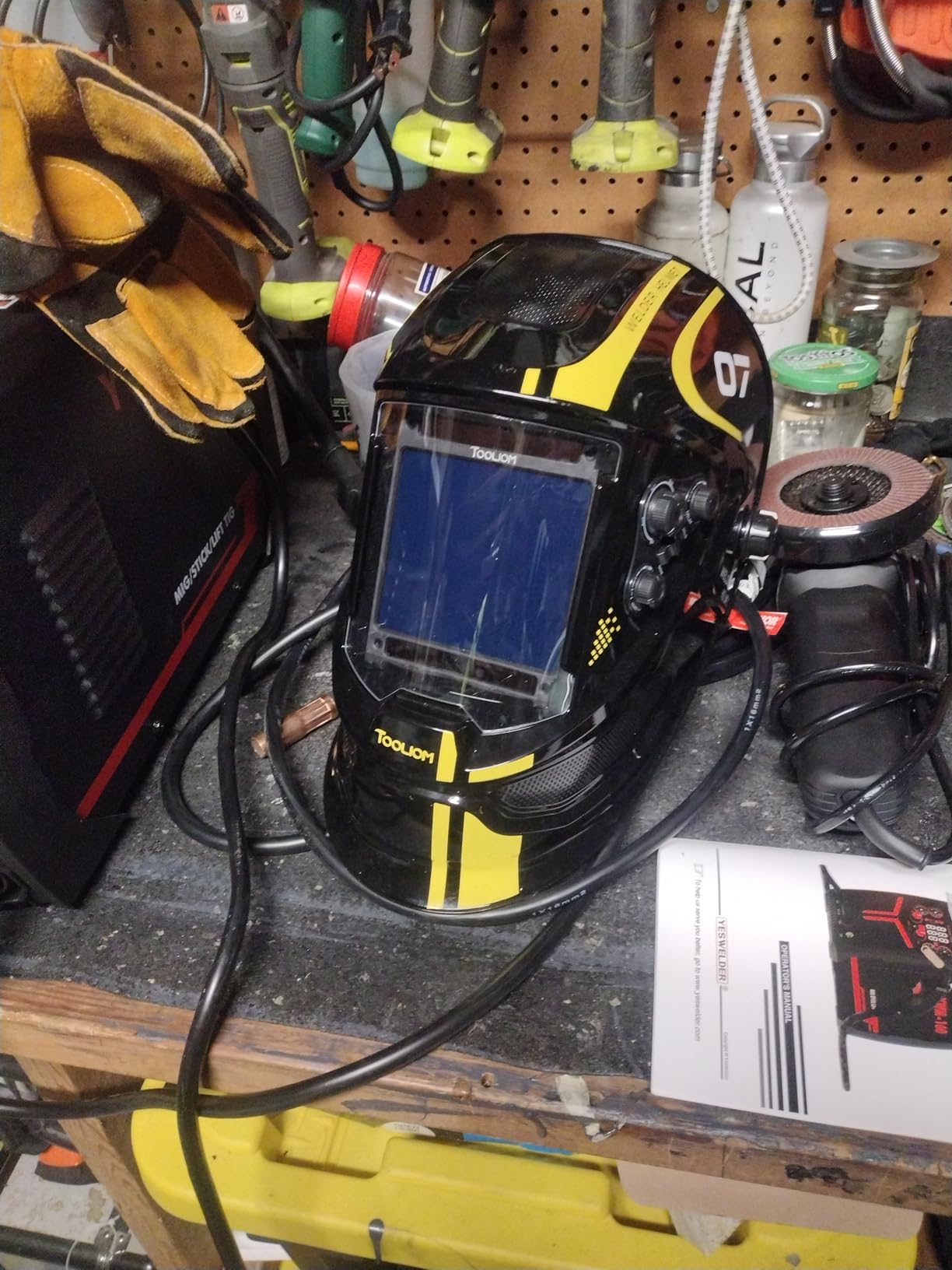
The box is generous for the money: one replaceable battery, two replacement outer lenses, one inner lens and a manual. Users coming from a passive tinted helmet report the true color view as the standout, because you can actually judge whether a bead is clean while you are still holding the torch.
Delay and sensitivity are the controls most people underuse. If your helmet darkens when you do not want it to, drop sensitivity one step before you start replacing lenses. If it lags at strike-on, raise it. That two-minute adjustment fixes most false-trigger complaints in this category.
What to check before you buy
Compare the viewing rectangle against what you actually need. At 3.94 by 3.27 inches it is wide but not as tall as the 3.94 by 3.66 inch screens on the ARCCAPTAIN models, so there is slightly less vertical view when you look down at a plate.
Also weigh the listed standard carefully. This model is marked to ANSI Z89.1 rather than the Z87.1 marking carried by most of the picks here. If your work is governed by a safety specification that names Z87.1 specifically, verify with your employer or supplier before you order.
Where it falls short
The shell is basic plastic and reviewers note it offers limited ruggedness for heavy shop use. It is a comfortable, capable helmet for a garage, a training bay or a shop that rotates hoods between workers, rather than one hood for a full production crew.
There is also less owner feedback on this listing than on the higher-volume models in this roundup, which means the long-term picture is less well documented. That is not a defect, but it is worth factoring in if you are deciding between it and a model with tens of thousands of reviews behind it.
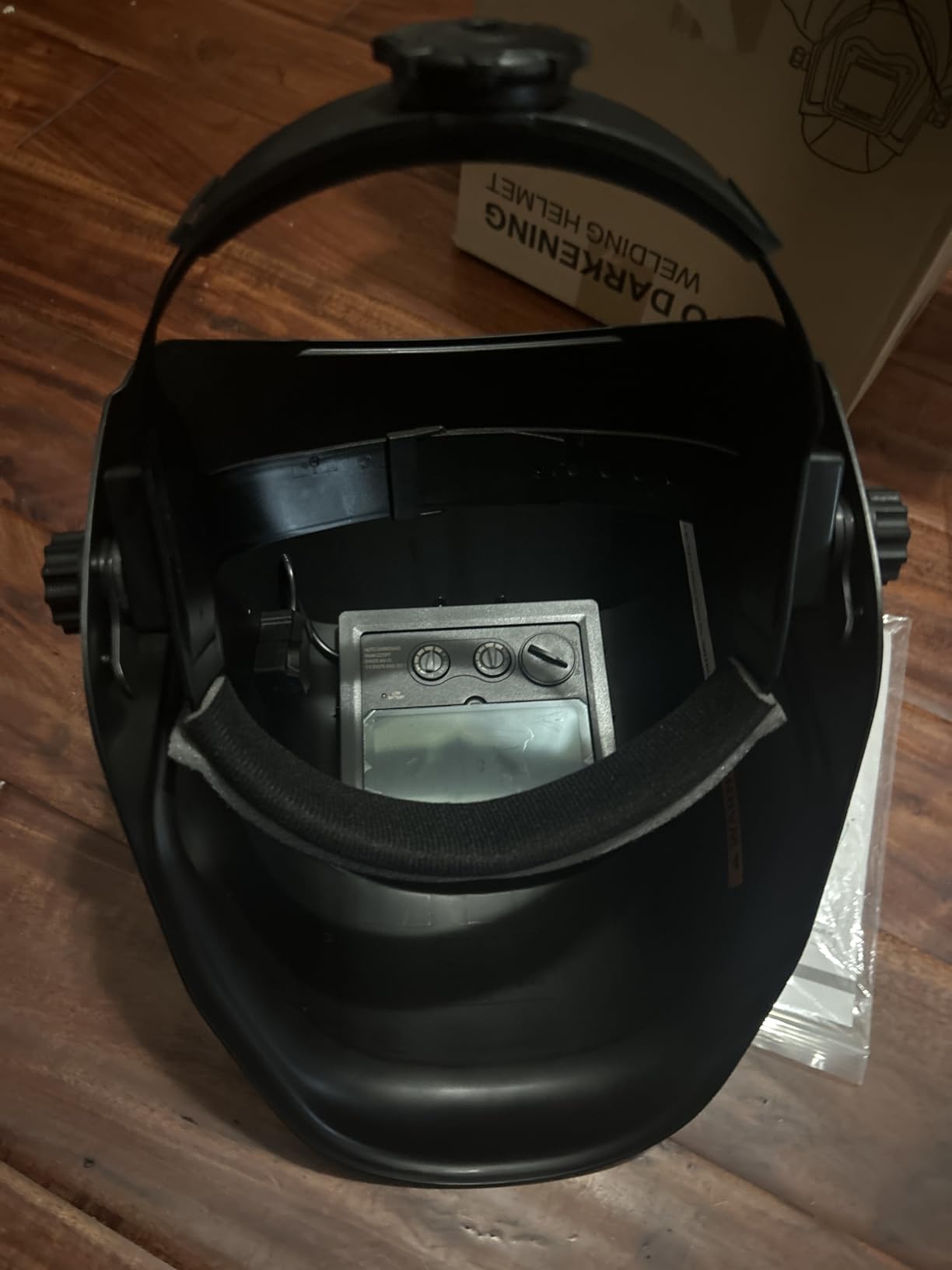
6. TRQWH TRQ-HS01 Helmet with LED Light – Best Built-In Work Light
TRQWH Auto Darkening Welding Helmet with Light ANSI Z87.1 Certified
Rechargeable USB LED work light
1/1/1/2 true color clarity
2 arc sensors at 1/20000s
Solar plus 2 CR2032 batteries
Pros
- Integrated rechargeable LED light genuinely useful
- Clear true color view of seam and workspace
- Light weight with padded forehead and ears
- Single external knob for shade and grind
- Includes spare batteries and extra lenses
Cons
- Only 2 arc sensors for low amperage TIG
- Clarity rated 1/1/1/2 not 1/1/1/1
- Thin replacement lenses wear fast
- Headband can fail to hold a tightened position
- Some models flicker or fail to darken on arrival
The work light is the reason to look at this one. It is a rechargeable LED mounted on the shell with a USB port, and reviewers consistently call it useful rather than gimmicky, because it lights the joint, the wire spool and the ground clamp in a dim garage where the helmet lens itself is not providing enough light.
Optics are 1/1/1/2 with true color technology, which reduces the traditional green tint even though it does not quite reach 1/1/1/1. Two arc sensors switch light to dark in 1/20000 of a second, with a DIN 4 light state and a DIN 9 to 13 dark state. The shell is polypropylene, listed as impact and flame resistant to ANSI Z87.1, EN 379 CE and CSA Z94.3.
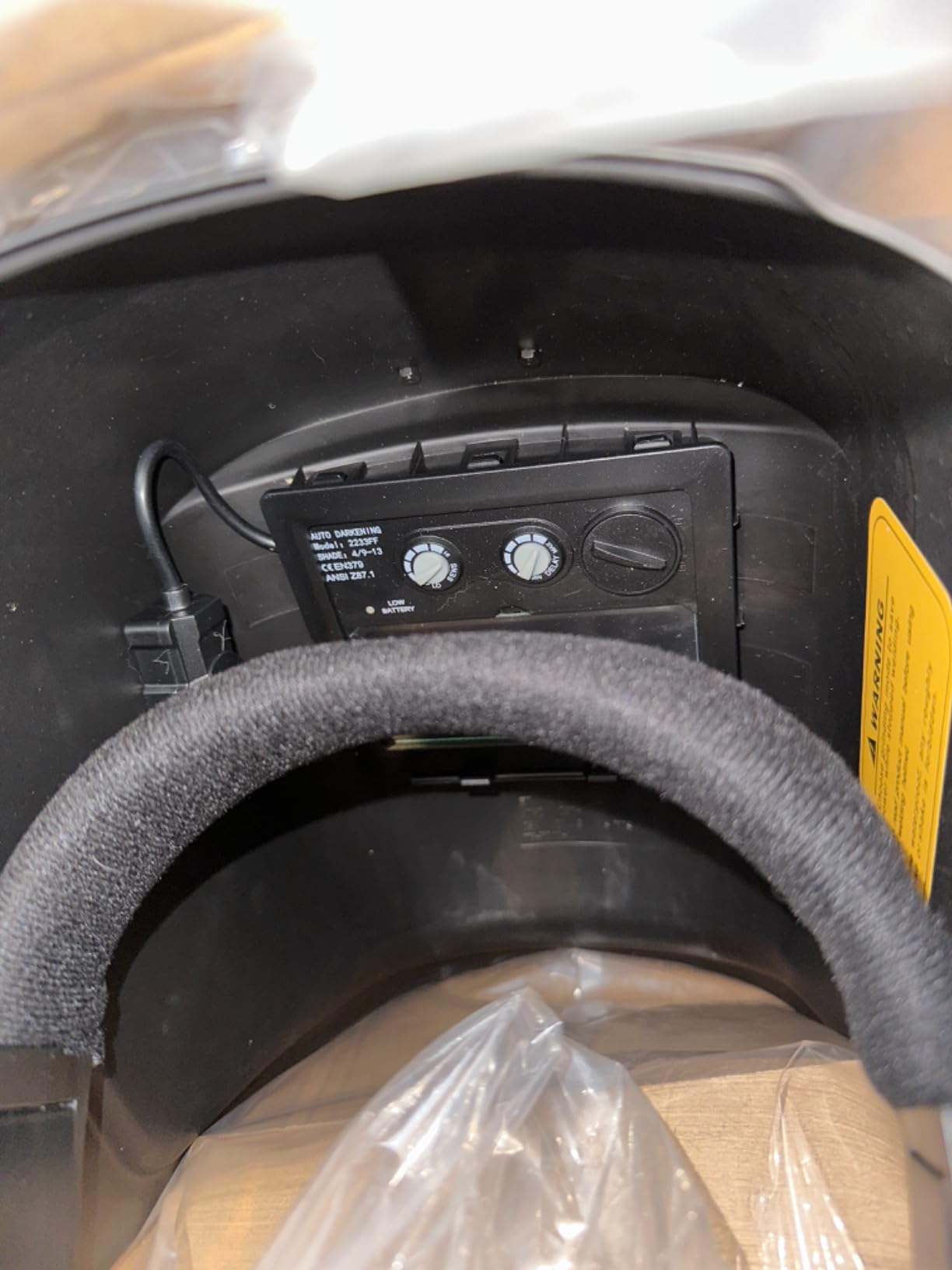
A single external knob controls shade and grind mode, which keeps the learning curve short for a first helmet. The headband has padded forehead and ear areas with adjustable side angle knobs and a rear tightness knob, and at 1.7 pounds it stays light over long sessions. Solar cells top up the charge alongside two replaceable CR2032 lithium cells.
It covers the usual process range: plasma cutting, grinding, DC and AC TIG, MIG and MAG, and MMA stick. That makes it a reasonable all-rounder for a hobbyist who does not want to think about whether a given job falls inside the shade range.
What to check before you buy
The battery type matters more than it looks. This model uses CR2032 coin cells, and forum users report those dying considerably faster than the CR2450 cells used in better-built models. Plan to keep a spare pair on hand, especially if you weld in cold conditions where solar charging is weakest.
Also test your TIG work early. With only two arc sensors, owners report it is less reliable for low-amperage TIG, and that is the mode where a missed trigger is most frustrating. For MIG and stick on a bench, this is not an issue.
Where it falls short
Durability is the recurring theme. Reviewers note thin replacement lenses that wear quickly under shop use, a headband and shell that can feel fragile or fail to hold a tightened position, and occasional first examples that flicker or do not darken on arrival. Replacement shields are also not readily sold separately, so a shredded cover is a bigger problem than it should be.
The 1/1/1/2 clarity rating also means a small amount of extra distortion at one measurement point compared with 1/1/1/1 lenses. Most users do not notice it, but if you spend full days reading color in stainless work, a higher-class lens will serve you better.
7. ARCCAPTAIN GT995 Large Screen Helmet – Best Big-Screen Value
ARCCAPTAIN Auto Darkening Welding Helmet, 3.94″X3.66″ Large Viewing Screen
Viewing area 3.94 x 3.66 inch
1/1/1/1 true color clarity
4 arc sensors
Dark state shade 4/5-9 and 9-13
Pros
- Very wide true color viewing area
- Auto darkening is quick so you can keep it down
- Comfortable strap with breathable padding
- Grind mode is useful and well regarded
- Lightweight at 2 lb to reduce neck fatigue
Cons
- Headgear suspension can slip or fail to hold tight
- Reports of filter or shell failure after 6 to 12 months
- Outer cover lens can peel or shred with heavy use
- Not built for intensive full-time professional work
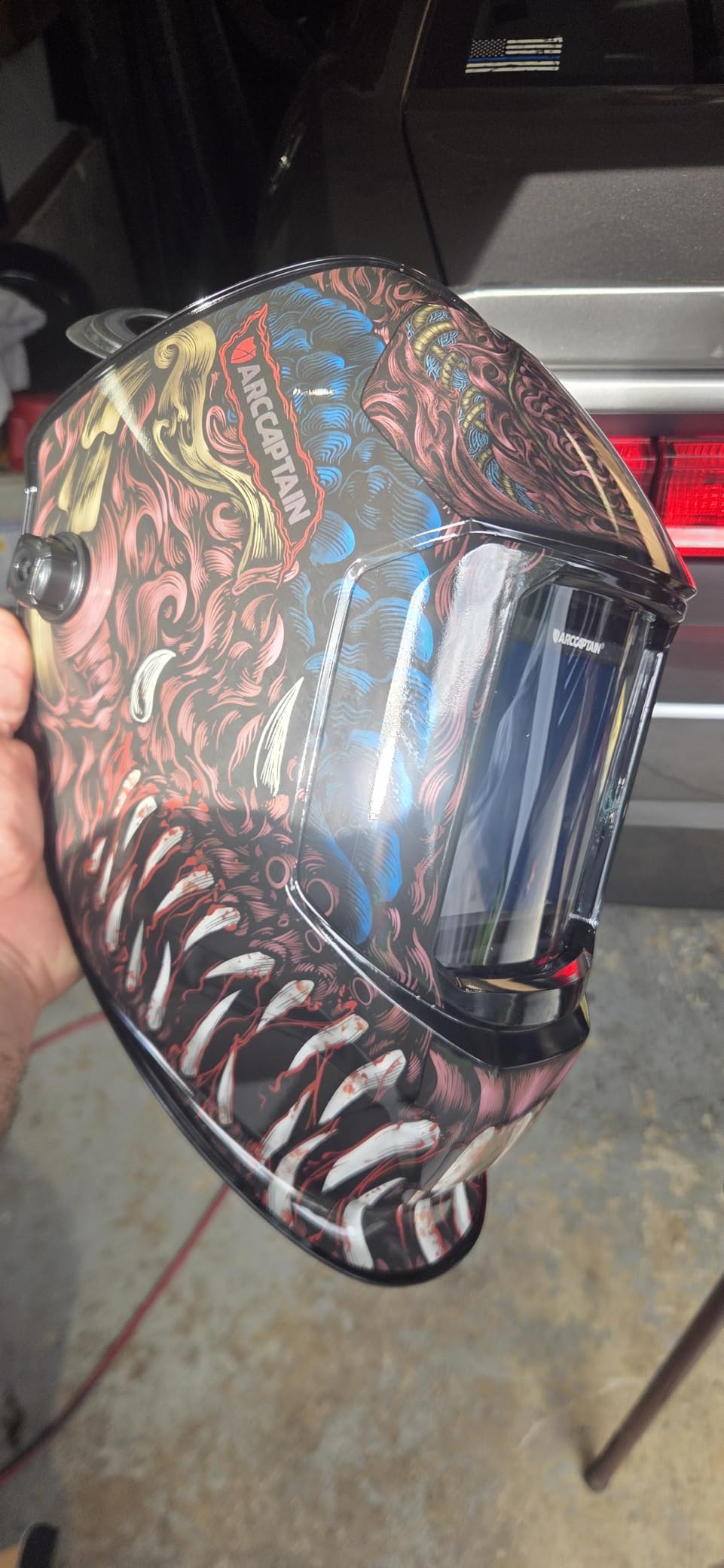
The GT995 pairs the largest rectangular viewing area in this roundup, 3.94 by 3.66 inches, with 1/1/1/1 true color clarity and four arc sensors. That combination is what makes it our pick for anyone who works on plate, structural steel or anything where you need to see both sides of the joint at once.
The dark state runs shade 4 in the light position, 5 through 9 for welding and 9 through 13 at the heavy end. The smart filter protects automatically up to DIN 16 with continuous UV and infrared blocking, which stays on even when the lens is in its clear state. Solar cells pair with a replaceable CR2450 lithium battery for startup and low-light work.

Experienced owners with decades of welding describe this as a capable daily hood rather than a weekend toy, and they point specifically at the fast switching and the big clear screen. At 2 pounds the shell is light enough to limit neck fatigue, and the padded adjustable headgear stays breathable over long sessions. Grind mode is present and well regarded for cleanup between passes.
Certification is listed to ANSI Z87.1, EN 379 CE and CSA Z94.3, and the box includes a storage bag, a replaced lithium battery and two replacement lenses. That is a complete starter package rather than the bare minimum.
What to check before you buy
Wear it over a welding cap if you use one, and check that the suspension holds. That is the specific failure reviewers raise: the headgear can slip forward or fail to stay tight, particularly when a cap is underneath. If you work in a cap, tighten down and confirm the hood still sits high enough to clear your forehead.
Plan on replacing outer covers. Reviewers note the clear outer lens can peel or shred quickly under heavy spatter, and that is normal wear rather than a defect. Keep two spares on the shelf rather than waiting for the day it fails mid-job.
Where it falls short
There are reports of failure after roughly six to twelve months of use. That is the pattern we see with a portion of budget shells, and it is why we would not recommend one of these as the only helmet in a shop that welds every day.
The warranty is 180 days, so the first year is where the risk sits. After that, many working welders treat it as a consumable shell and keep the good cartridge work by moving to a sturdier hood. For weekend and hobby duty, most owners find the tradeoff entirely acceptable.
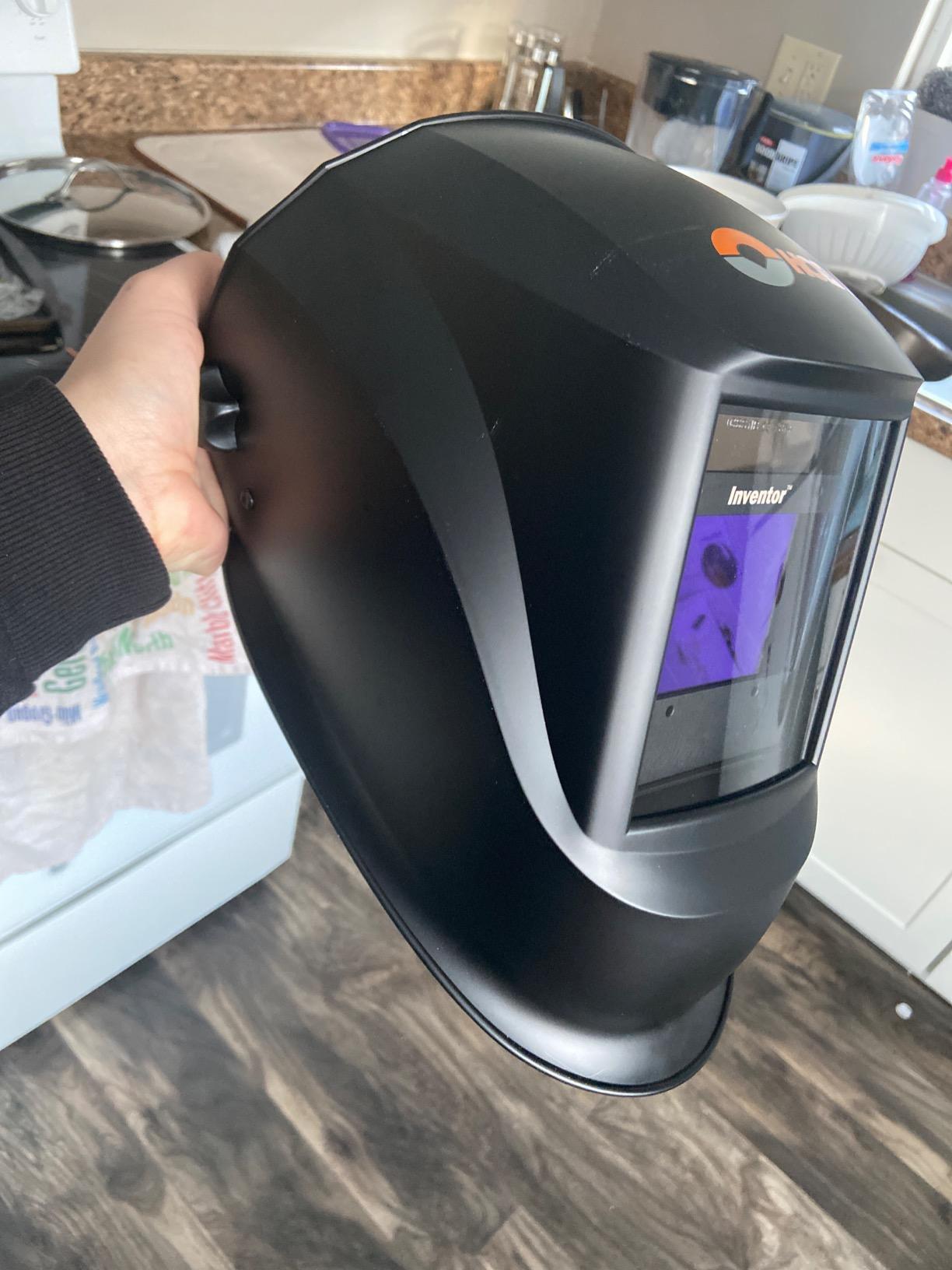
8. Hobart 770890 PureColor Helmet – Best Brand-Backed Buy
Hobart 770890 Auto-Darkening Welding Helmet, Large, Black
9.3 inch widescreen viewing area
PureColor lens technology
4 independent arc sensors
Limited 2 year warranty
Pros
- Highest average rating in this roundup
- Established welding brand with a two year warranty
- PureColor gives an accurate colored view
- Analog knobs are easy to set in gloves
- Large 9.3 inch widescreen viewing area
Cons
- Costs several times more than budget models
- Analog dials are less precise than digital panels
- Lacks a digital readout and smart auto adjustment
The Hobart 770890 is the highest-rated helmet we tested, and the reason is not subtle. It carries the highest average rating in this group with 83 percent of its reviews at five stars, and it is the only pick on this list from a long-established welding manufacturer with a limited two-year warranty attached.
Optics are Hobart PureColor, which gives an accurately colored, clear view of both the weld and the surrounding shop, and the viewing area is a 9.3-inch widescreen. Four independent arc sensors handle detection, and auto-on and auto-off power control wakes the lens at arc strike so there is no button to hunt for with a glove on.
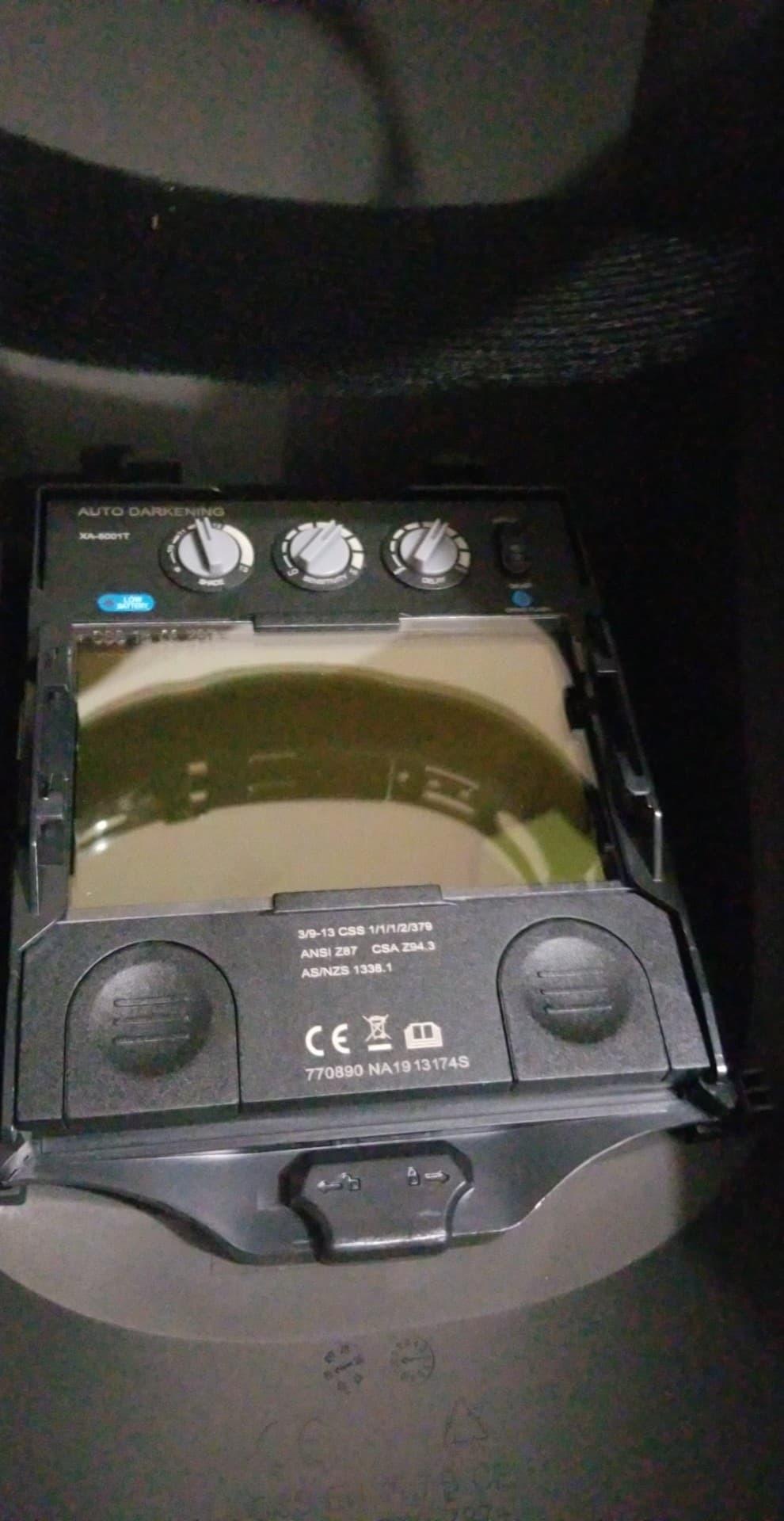
The controls are analog knobs for shade, sensitivity and delay, and that is a deliberate choice rather than a limitation. Owners consistently praise how easy they are to set in gloves and how little training they need. Weld and grind modes switch from one control, and UV and infrared protection is continuous rather than only during a darkening event.
At 1.25 pounds it keeps weight off your neck over a long shift, and a protective lens kit is included in the box. For anyone whose employer requires a named-brand helmet on commercial or inspected work, this is the pick that keeps that conversation short.
What to check before you buy
Decide whether the warranty has monetary value to you. Two years of manufacturer coverage on eye protection is the single most concrete difference between this helmet and every other pick on this list, and it is the reason buyers accept a higher outlay without hesitation.
Check the lens cartridge availability question for your region before you commit. If you run multiple stations, buying two of these so you always have a spare powered unit is a common approach among working shops, and it is worth budgeting for.
Where it falls short
The straightforward answer is cost. This helmet costs several times more than the budget alternatives here, and at this tier you are partly paying for the brand, the warranty and the service network rather than for a measurable jump in lens class over the picks above.
On features, the analog dials are less precise than the digital panels on the panoramic model, and there is no digital readout or smart auto-adjustment of shade and sensitivity. If you like your settings shown back to you, that is a real trade. For most welders, though, set-and-forget analog controls are an advantage.
9. MIGVAN Golden True Color Helmet – Best Golden True Color Lens
MIGVAN Welding Helmet Auto Darkening True Color Large Viewing, Welding Hood Solar/Replaceable Battery Powered, Wide Shade 4/5-13 with 4 Arc Sensor, Optical Clarity Welding Mask for TIG MIG ARC Grind
Golden true color lens with outer yellow filter
4 arc sensors at 1/10000s
Shade 4/5-9 and 9-13
Solar plus CR2450 battery
Pros
- Golden lens gives a lifelike view of the pool
- Generous package with four lenses and a bag
- Breathable pivoting headgear for long sessions
- Solar plus replaceable battery for varied conditions
- Outer yellow filter adds UV and IR protection
Cons
- Slowest stated switch time here at 1/10000s
- Less proven long-term reliability than known brands
- Outer and inner lenses must come from the same brand
The MIGVAN stands apart on lens color. It uses a golden true color optic with an advanced outer yellow filter, and reviewers describe the resulting view as lifelike, with less distortion and color saturation than competing budget lenses. If you weld stainless or do work where judging color matters, that is the feature that differentiates it.
The technical trade is speed. Four arc sensors activate in 1/10000 of a second, which is the slowest stated response in this roundup against 1/20000 and 1/30000 figures elsewhere. In practice the difference shows on very quick strike-and-stop work rather than on continuous beads, but it is worth knowing before you buy.
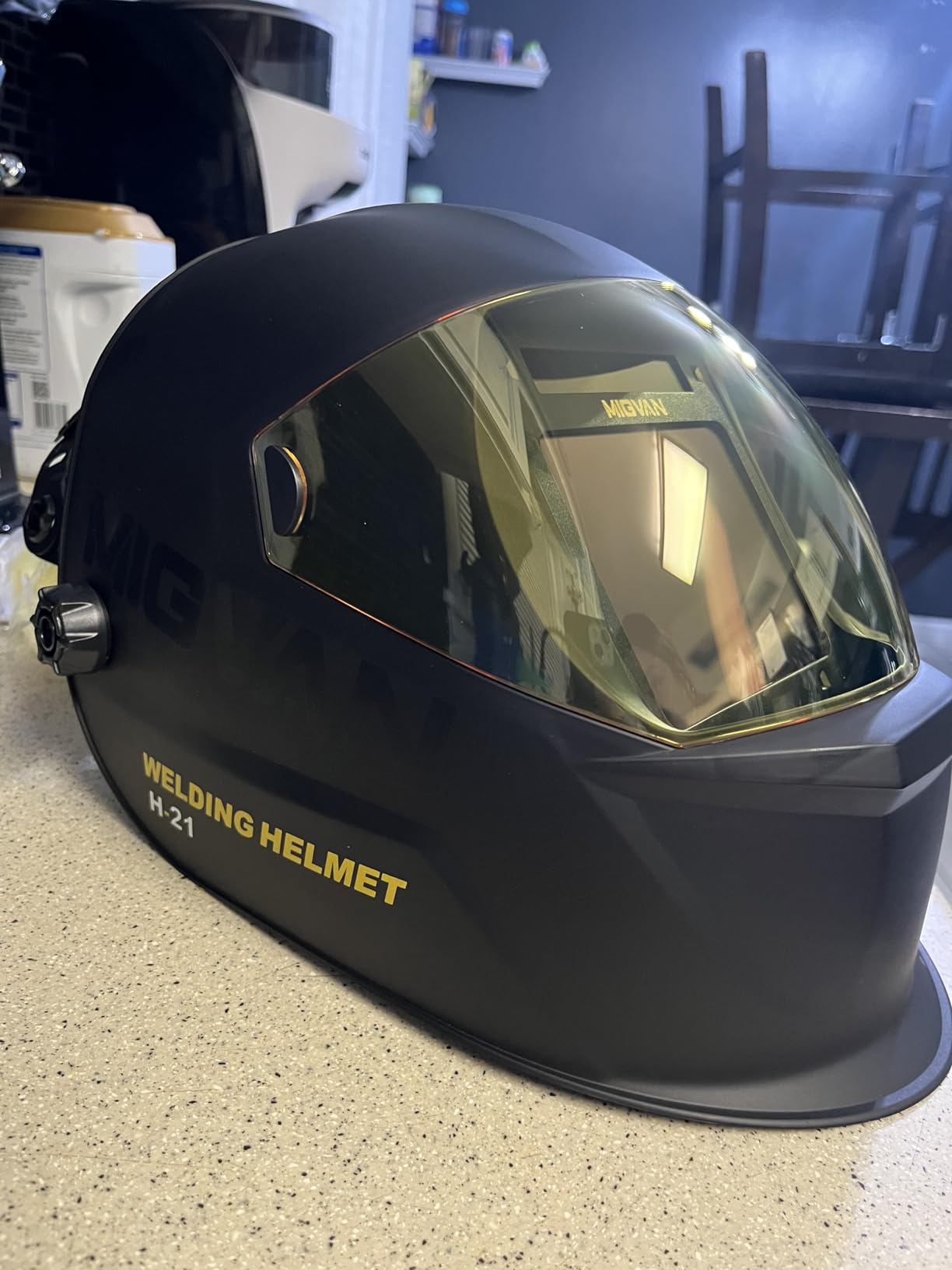
Shade runs 4 in the light state, 5 through 9 for welding and 9 through 13 at the dark end. The shell pivots at the headgear with breathable padding for long sessions, and power comes from solar cells backed by a replaceable CR2450 battery, which is the larger and longer-lived cell type we prefer over coin cells.
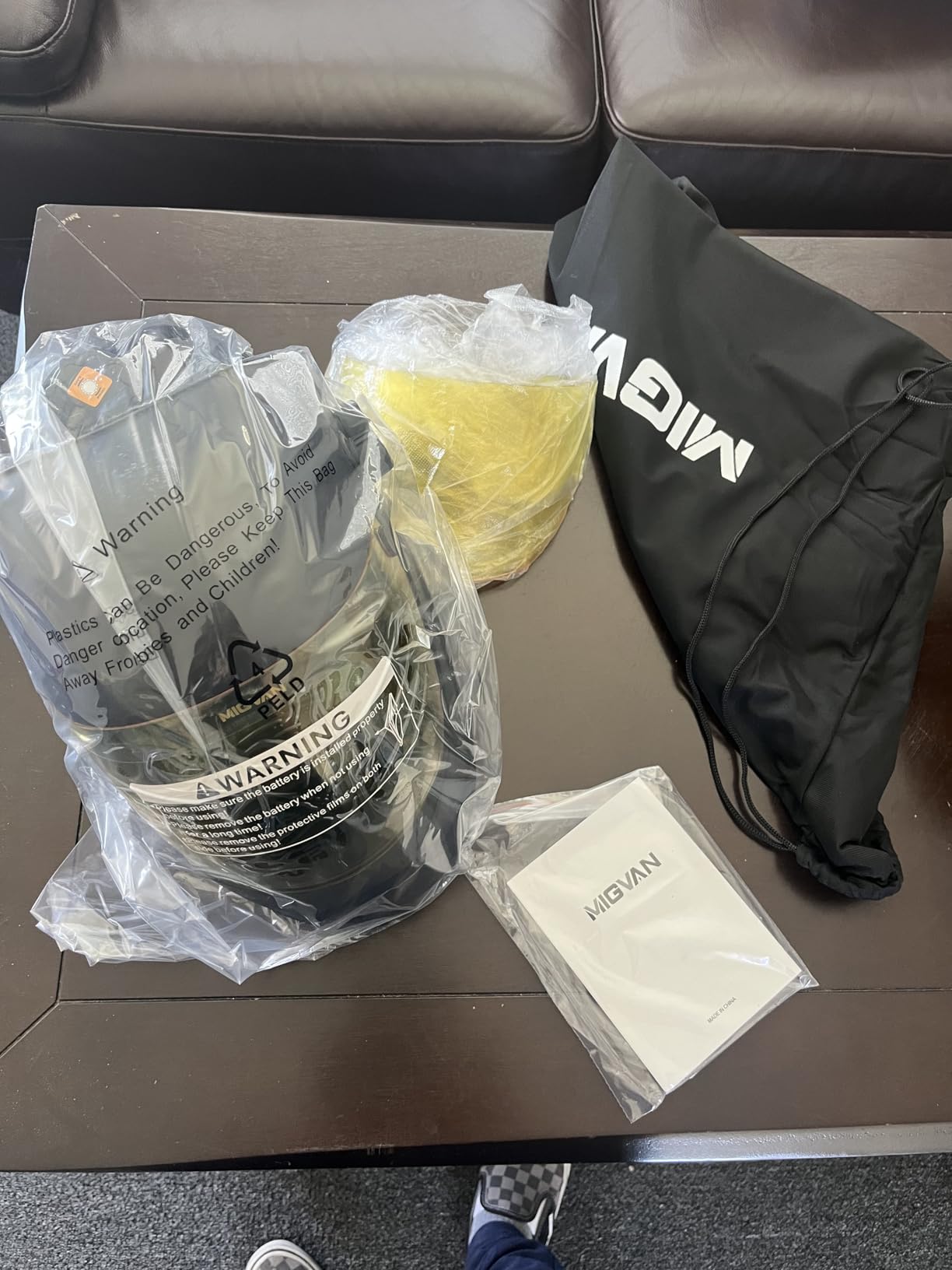
The package is unusually complete: the helmet, two inner lenses, two outer lenses, a manual and a heavy-duty storage bag. Having four lenses in the box means you can go a long stretch before thinking about consumables, which is a real saving on running costs.
What to check before you buy
Confirm your lens supply chain before committing. Reviewers note that inner and outer lenses must be sourced from the same brand, so if you are far from a supplier this becomes a long-term annoyance. For anyone near a large metro area it is rarely a problem.
Also weigh the switching figure against your work pattern. If you do long continuous passes, 1/10000 is more than fast enough. If you tack a lot, constantly stop and restart the arc, or work on thin material where you need instant response, pick a faster sensor package instead.
Where it falls short
Long-term reliability is less documented than for established brands. With a smaller review base, there is less evidence about how these shells and cartridges perform after several years, and forum users treat that uncertainty as a reason to buy a spare rather than commit everything to one helmet.
The second limitation is the speed figure noted above, and the third is resale confidence. If you expect to sell or hand the helmet down eventually, a recognized brand with a clear warranty carries more value than an unnamed shell with a generic one.
10. Sunstac SS-A800D Helmet with Light – Best Dual Power Setup
Sunstac Auto-Darkening Welding Helmet 3.94 x 3.27″ View with Light
3.94 x 3.27 inch viewing screen
4 arc sensors at 1/30000s
Shade 4/5-9/9-13
Dual power solar plus lithium battery
Pros
- Huge viewing area with clear true color optics
- Owners upgrading from old hoods call it night and day
- Well adjustable padded headband
- Rechargeable work light with two modes and swivel
- Solar plus battery with cheap available cells
Cons
- Headband tension buttons feel delicate
- Deep shell may not suit small heads or glasses
- Battery compartment is awkward to access
- Filter can take a moment on start-up
- Cheater lens is not included
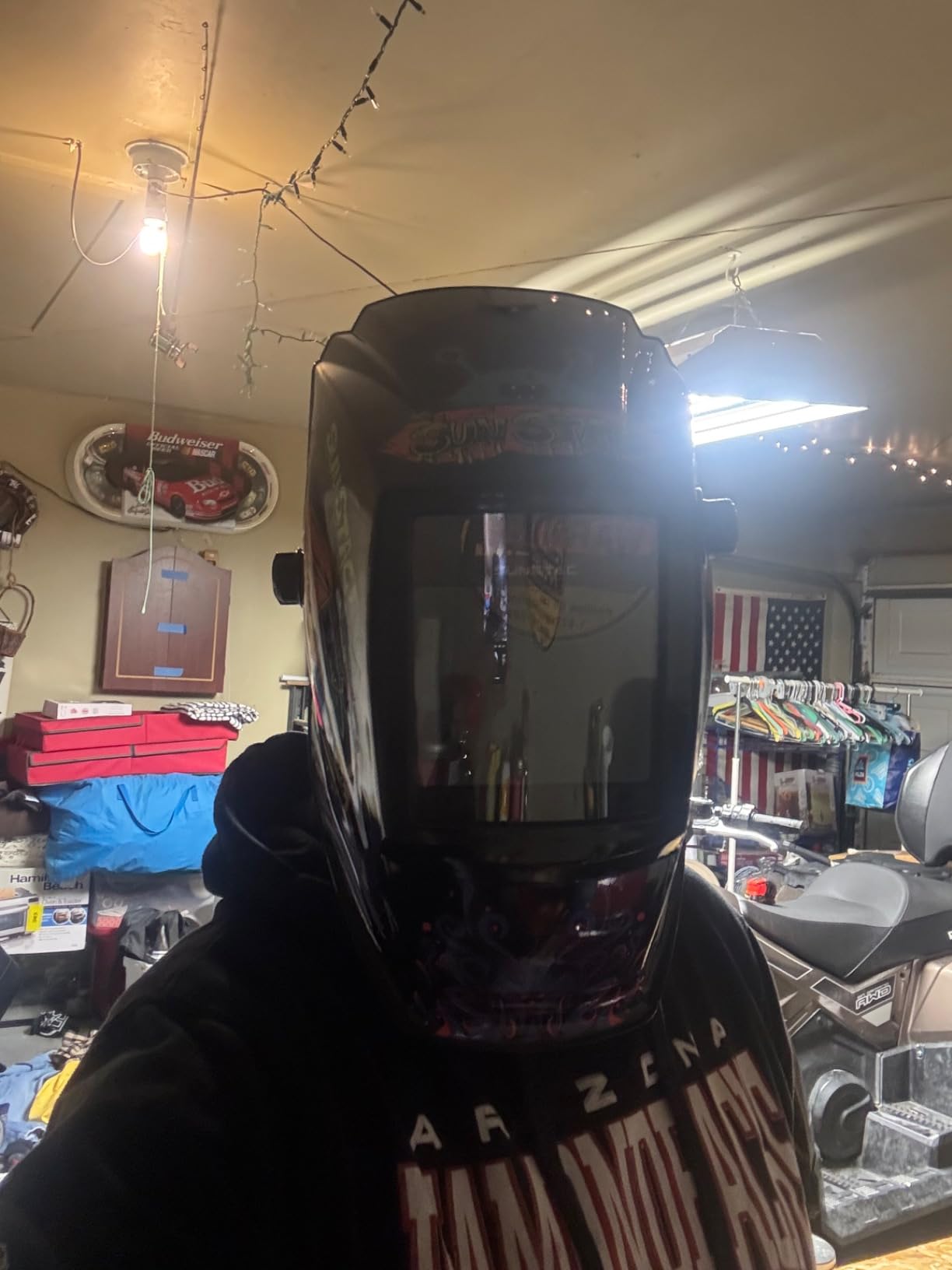
The Sunstac SS-A800D is the pick for anyone working in a dim garage or basement where a solar-only helmet leaves you guessing. It runs on dual power, accepting either a lithium battery or solar input, so you are not dependent on ambient light. The rechargeable high-brightness work light has two modes and an adjustable swivel angle for lighting the workpiece from different positions.
The viewing screen measures 3.94 by 3.27 inches with a 1-1-1-1 true color view, and four arc sensors darken it in 1/30000 of a second. Shade covers 4 in the light state, 5 through 9 for welding and 9 through 13 at the dark end, with UV, infrared and arc protection across the range. It handles stick, TIG, MIG, cutting, MMA and plasma, and it accepts a cheater lens sold separately.
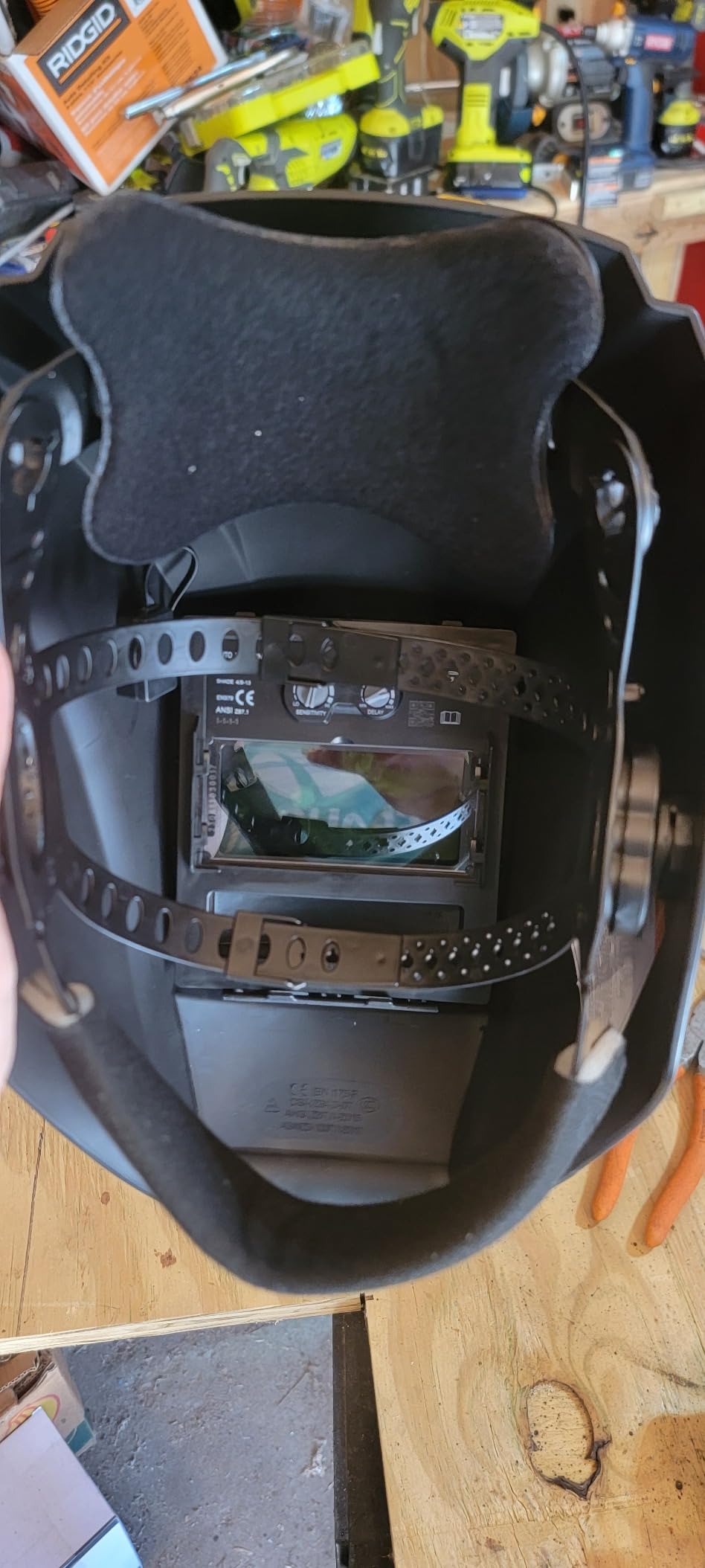
Owners upgrading from older helmets describe the jump in clarity as a night-and-day difference, and there is no reported darkening lag once the filter is engaged. The padded headband adjusts well for a comfortable fit, and replacement lenses plus an extra battery are included so you are not shopping for consumables on day one.
The dual power arrangement also solves the cold-weather problem. Forum users regularly complain that solar-only helmets disappoint in a cold garage or a dim shop because the cells never charge; giving the battery the primary role removes that failure mode entirely.
What to check before you buy
Try the fit before a long session if you can. The deep shell profile does not suit small heads or people who wear glasses, and that shows up as pressure at the temples rather than as an optical problem. The swivel work light helps you check a fit in a dark space too.
Budget for the cheater lens separately if you work on small components. It is compatible but not included, and adding one later is much easier than discovering you need it during a repair job on a fuel injector or a control box.
Where it falls short
The headband and side tension buttons are described as delicate, and owners report the helmet can flop down when tension is not set carefully. That is the most common complaint across this whole price band, so treat it as a fit adjustment rather than a defect, and tighten it deliberately before overhead work.
Two smaller issues: the battery compartment is awkward to access, so plan to swap cells with the helmet off rather than mid-task, and the filter can take a moment to engage at start-up. That first-engagement delay means you should strike your first arc of the day with your eyes already protected by lifting the hood, not by waiting on the lens.
How to Choose an Auto-Darkening Welding Helmet: 7 Criteria
Every helmet on this list is a legitimate buy, so the decision comes down to which compromises match your work. These seven criteria are the ones that change day-to-day performance; everything else is preference.
1. Viewing area
This is the spec that most affects whether you can weld well. A 3.94 by 3.66 inch screen gives you more than double the field of the 3.64 by 1.67 inch slot on the LYG-L600A. Beginners benefit most because they are still learning where the puddle is. Panoramic layouts with side panels add peripheral vision for tank and frame work, at the cost of a bulkier shell.
2. Optical clarity and true color
EN 379 rates a lens with four numbers, where 1 is the best and the sequence covers clarity, light transmission, chromaticity and optical class. A 1/1/1/1 lens is the top grade, and every helmet here claims it except the TRQWH at 1/1/1/2. True color optics remove the green tint of legacy lenses, which cuts eye strain and headaches on long sessions. If you do stainless or work where color reading matters, treat 1/1/1/1 as a requirement rather than a preference.
3. Arc sensors
Four sensors is the number forum users treat as the reliability tell, and the reason is positional. Two sensors can miss a low-amperage arc when you are welding inside a frame, around pipe or out of position, because the arc sits outside their detection cone. Four sensors reduce those misses. Five is better still, which is what the panoramic model offers. If your work stays flat and on a bench, two is workable; if it does not, do not cheap out here.
4. Switching speed
A 1/25000 or 1/30000-second response means the lens is fully dark before your eye registers the arc. Below that, the 1/10000 figure on the MIGVAN is still fast in absolute terms but is the slowest here, and the difference shows on quick tacking rather than on continuous beads. Faster is better, but the jump from 1/20000 to 1/30000 matters far less than the jump from two sensors to four.
5. Shade range and modes
You need coverage from roughly shade 5 to 13 for general work, with shade 3 or 4 available as a light state for grinding and setup. Low-amp TIG is the reason to look for a minimum shade of 5 in the welding range, because a filter that only starts at shade 9 cannot see a small tungsten arc. Note that the TRQWH and ARCCAPTAIN HSH-S800 have dark states starting at 9, so neither suits low-amp TIG well. Grind mode, and sometimes cut mode, saves you from carrying a separate face shield.
6. Power source
Solar cells with a replaceable lithium cell is the standard and the right answer. Prefer CR2450 over CR2032 where you can: users report the smaller coin cells dying much faster, especially in cold weather. Solar-only designs can disappoint in a dim or cold garage because the cells never fully charge, which is why the Sunstac’s battery-first dual power arrangement appeals to basement and night-shift welders.
7. Comfort, headgear and certification
Weight matters over a full day, and headgear durability is the most common real-world complaint in this price band, with users reporting helmets that no longer tighten after a few months. Budget for that: a headgear band is replaceable, whereas a failed cartridge usually means a new helmet. On certification, look for a stated ANSI Z87.1 marking, and treat EN 379 and CSA Z94.3 listings as additional evidence rather than substitutes.
Which DIN Shade Should You Use? A Process-to-Shade Guide
DIN shade numbers run from 1 to 16, where higher numbers mean darker lenses. The number you need depends on the process and the amperage, not on the helmet. A single helmet that spans shade 5 through 13 with adjustable steps covers nearly everything, which is why that range is the one to look for.
For MIG welding, shade 8 covers thin material and short-circuit spray, while shade 9 to 10 suits heavier steel with more penetration. Stick welding runs higher, typically shade 10 to 13, because the arc is brighter and the flux produces more visible and infrared radiation. Low-amp TIG on thin material needs shade 8 to 10, and high-amp TIG on thick stainless moves to shade 11 to 13.
So, is shade 10 or 11 better? Neither is universally better; it depends on your process and material. Choose shade 10 for MIG on mild steel and low-amp TIG on thin material, where a darker lens hides detail you still need to see. Choose shade 11 when you are doing high-amp TIG, welding stainless or working out of position on heavy plate, where the extra density reduces glare and eye strain.
Plasma cutting and grinding sit at opposite ends. Grinding wants a very light lens, often shade 3 to 5, so you can see your work. Plasma cutting sits around shade 8 to 12 depending on the machine and material. If you grind often, a dedicated grind mode on the helmet is worth more than a slightly better welding shade.
Helmet Maintenance: Cover Lenses, Batteries and Sensor Care
The hidden cost of any auto-darkening helmet is consumables, and this is where budget models either reward you or quietly cost more. Understanding it before you buy prevents the most common regret.
Outer cover lenses are the disposable layer that spatter attacks, and the inner lens is the one you replace far less often. Forum users recommend cheap clear cover plates rather than premium ones, because the optical layer is what matters and the clear plate is simply sacrificial. Order a pack of covers and a spare battery together, and check early that replacement parts are sold separately for your model, since a few brands on this list do not offer them at all.
Battery type is the second running cost. CR2450 cells last considerably longer than CR2032 coin cells, and cold weather shortens both. Keep a spare of whatever your helmet takes, especially if you weld outdoors in winter. Swapping a coin cell takes under a minute once you know where the compartment is, though on some models it is tucked awkwardly behind the shell.
Sensor care is free and prevents most false triggers. Wipe the arc sensors on the inside of the lens with a dry cloth when you notice flickering or oversensitivity, and clean the outside cover regularly so spatter does not bake onto the viewing window. Finally, tighten the headband deliberately before overhead work and re-check it monthly, because loose suspension is the most common reason budget helmets get retired early, and it is also the cheapest problem to fix.
Frequently Asked Questions
What is the best auto darkening welding helmet under 200 dollars?
The YESWELDER LYG-L600A is our top pick in this price range, with a 1/1/1/1 true color lens, a 1/30000-second switch and a replaceable CR2450 battery. If you want a bigger viewing window, the YESWELDER LYG-M800H adds a 3.93 by 3.66 inch screen and four arc sensors.
Is shade 10 or 11 better?
It depends on your process. Shade 10 suits MIG on mild steel and low-amp TIG on thin material where you still need to see detail. Shade 11 suits high-amp TIG, stainless and heavy out-of-position work where extra density reduces glare and eye strain.
Are cheap auto-darkening welding helmets safe?
They can be, provided they carry a stated ANSI Z87.1 or equivalent marking and you keep the outer cover lens intact. The lens electronics matter far more than the shell plastic, so check that replacement cover lenses are sold separately for your model before you buy.
How do you adjust the darkness on a welding helmet?
Most models use two or three external controls. Set shade for your process and amperage first, then raise sensitivity if the lens fails to trigger, and lower it if the helmet darkens when you are not welding. Use delay to control how long the lens stays dark after the arc stops.
Which brand of auto darkening welding mask is best?
At this price tier, YESWELDER and ARCCAPTAIN lead on owner feedback volume and feature sets, while TOOLIOM offers the widest multi-mode coverage. If you want a recognized manufacturer with a two-year warranty rather than the lowest cost, the Hobart 770890 is the brand-backed choice.
Final Verdict: The Best Welding Helmet Under 200
After putting ten sub-200 helmets through real work, the winner is the YESWELDER LYG-L600A. Its 1/1/1/1 true color lens, 1/30000-second response, solar plus CR2450 power and the deepest owner feedback base in the group make it the safest recommendation we can make for someone buying their first or only helmet at this budget.
Buy the YESWELDER LYG-M800H if a narrow letterbox view frustrates you, since the bigger screen and four sensors are the best value upgrade here. Buy the Hobart 770890 if a two-year warranty and an established manufacturer matter more to your employer or your peace of mind. And if low-amp TIG is on your list, skip the two-sensor models entirely and choose one with four or five sensors.
Whichever you pick, pair it with a solid setup for the rest of the job. Our guides to the best welding tables for garages and the best welding carts for MIG welders cover the bench and material handling side of a home shop, and our flux core welder roundup for auto body work is worth a read if that is your application.
Keep a spare battery and a pack of outer cover lenses on the shelf from day one, and you will get years of service out of any helmet on this list.