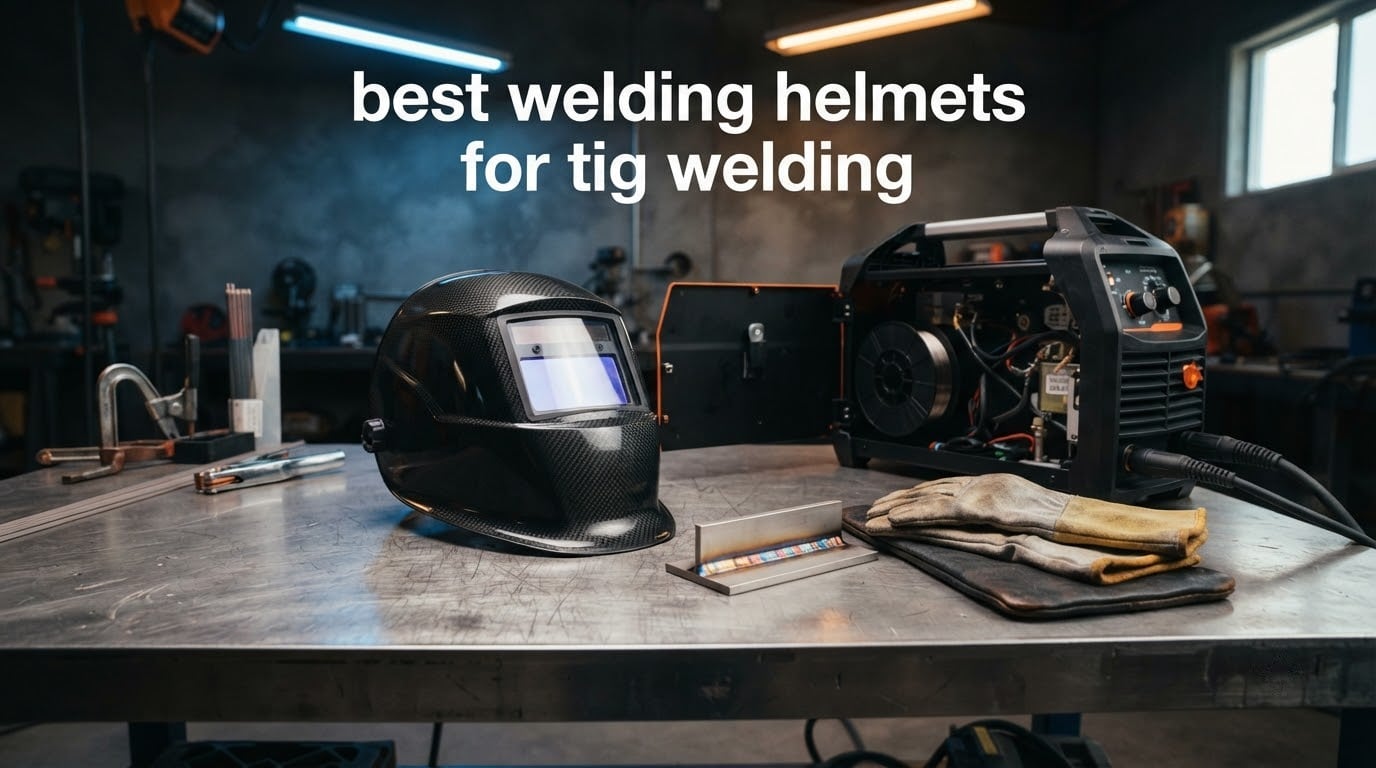
TIG puts a low, wandering arc on a piece of metal and asks you to control it with two fingers. Most auto-darkening helmets are built for the bright, steady arc of MIG and stick work, and they miss that faint arc at the bottom of their detection range. That miss shows up as a flash of white light, a burnt cheek, and a bead you cannot see properly while you are making it. Choosing among the best welding helmets for TIG welding means looking past the sticker and at how the lens behaves when the amperage drops below 30.
We spent time with twelve of them, reading the specs, the sensor counts and thousands of owner reviews, then sorting them by what actually changes your TIG results: optical class, detection floor, viewing window, and how the hood feels after hour three. The short version is that 1/1/1/1 optical clarity and at least four arc sensors are the two things worth paying for, and everything else is preference.
If you are still picking a machine rather than a hood, our guide to the best TIG welders for home use covers the power sources that pair well with these helmets. If you want the simpler starting point instead, the best welding helmets for beginners roundup explains what a first hood needs before you get into low-amperage detail work.
Table of Contents
- Top 3 TIG Welding Helmet Picks for 2026
- All 12 Best Welding Helmets for TIG Welding (October 2026)
- 1. Lincoln Electric Viking 3350 4C – Best Overall TIG Welding Helmet
- 2. YESWELDER LYG-L600A – Best Value TIG Helmet for New Welders
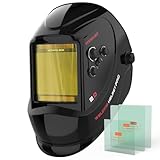
- 3. YESWELDER LYG-M800H – Best Large View Helmet for Learning TIG
- 4. YESWELDER BW-10MAXTRI – Best Panoramic TIG Helmet with Digital Controls
- 5. ARCCAPTAIN HSH-S800 – Best Lightweight Helmet for Low Amperage TIG
- 6. Hobart 770890 – Best TIG Helmet for Long Shop Days
- 7. Jackson Safety Insight – Best Ultralight Helmet for Pipe and Overhead Work
- 8. Miller Classic ClearLight – Best Helmet for a Bright Light State Between Welds
- 9. TOOLIOM TL-31800H – Best 14.4 Square Inch Helmet Window
- 10. Sunstac SS-A800D – Best Helmet with a Built In Work Light
- 11. TOOLIOM E600A-A – Best Solar Powered Helmet for Long TIG Sessions
- 12. BESTCLUB Solar Hood – Best Helmet for Switching Between Stick and TIG
- TIG Helmet Buying Guide: What Actually Matters
- Frequently Asked Questions
- Final Verdict on the Best Welding Helmets for TIG Welding
Top 3 TIG Welding Helmet Picks for 2026

The Lincoln Viking 3350 4C takes the top slot because it does the least nothing: 1/1/1/1 optics across a 12.5 square inch window, and enough detection headroom that a 15 amp bead and a 150 amp fillet both darken without drama. The Hobart 770890 wins on comfort for long shop days, with a low 1.25 pound shell and a 9.3 inch widescreen window. The YESWELDER LYG-L600A is the value pick, and the most-reviewed helmet in the group by a wide margin.
All 12 Best Welding Helmets for TIG Welding (October 2026)
| Product | Specs | Action |
|---|---|---|
| Lincoln Electric Viking 3350 4C |
|
Check Latest Price |
 YESWELDER LYG-L600A YESWELDER LYG-L600A |
|
Check Latest Price |
 YESWELDER LYG-M800H YESWELDER LYG-M800H |
|
Check Latest Price |
 YESWELDER BW-10MAXTRI YESWELDER BW-10MAXTRI |
|
Check Latest Price |
 ARCCAPTAIN HSH-S800 ARCCAPTAIN HSH-S800 |
|
Check Latest Price |
 Hobart 770890 Hobart 770890 |
|
Check Latest Price |
 Jackson Safety Insight Jackson Safety Insight |
|
Check Latest Price |
 Miller Classic ClearLight Miller Classic ClearLight |
|
Check Latest Price |
 TOOLIOM TL-31800H TOOLIOM TL-31800H |
|
Check Latest Price |
 Sunstac SS-A800D Sunstac SS-A800D |
|
Check Latest Price |
 TOOLIOM E600A-A TOOLIOM E600A-A |
|
Check Latest Price |
 BESTCLUB Solar Hood BESTCLUB Solar Hood |
|
Check Latest Price |
1. Lincoln Electric Viking 3350 4C – Best Overall TIG Welding Helmet
Lincoln Electric K3034-4 VIKING 3350 Auto Darkening Welding Helmet with 4C Lens Technology, Matte Black, extra large
12.5 sq in view
1/1/1/1 4C optics
X6 headgear
5 year warranty
Pros
- Exceptionally clear view of the weld pool and base metal
- Wide 12.5 square inch field of view
- Well balanced headgear with several adjustment points
- Reliable auto darkening on low amp TIG work
- Uses standard cover lenses
Cons
- Can lag slightly when reacting to arc strike
- Setup takes longer than simpler helmets
The Viking 3350 4C is the helmet we kept reaching for during this comparison. It holds a 4.8 rating across more than 3100 owner reviews, and the reason is unglamorous: the lens is good and the shell does not get in the way. On a stainless butt joint at 40 amps, you can see the puddle edge and the fusion line clearly enough to walk the filler wire without guessing.
Lincoln’s 4C lens technology is measured at 1/1/1/1 optical clarity, which is the number that matters most for TIG. The 12.5 square inch viewing area is the largest rectangular window here, and it is the difference between seeing your whole joint and seeing a postage stamp of it. Reviews repeatedly single out that field of view as the first thing they noticed after unboxing.
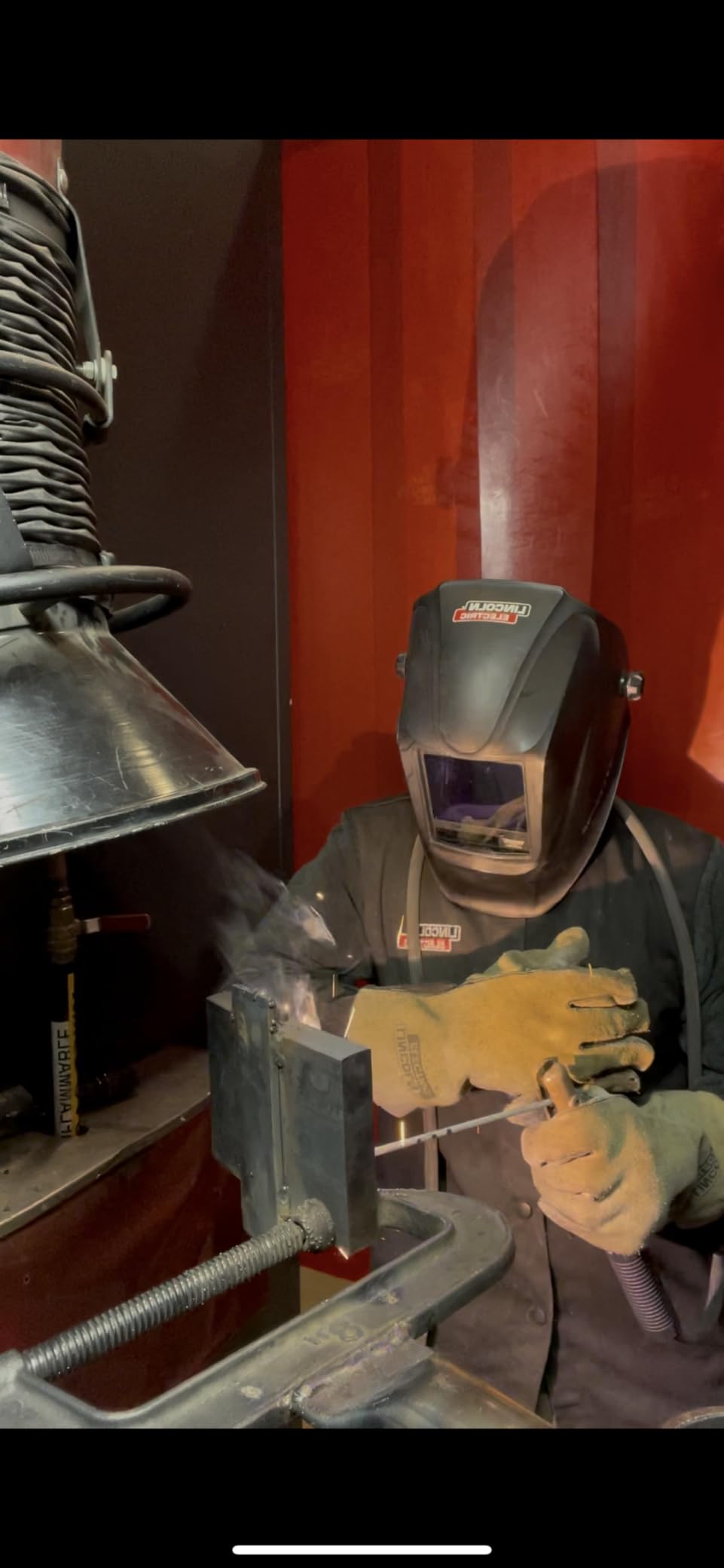
The X6 headgear spreads weight across the crown instead of hanging it on the back of your neck, which matters more for TIG than for MIG because a TIG bead is slow and your head is down and forward for a long time. It fits hat sizes 6.5 through 8. The package also includes five outside cover lenses and two inside covers, so the consumables cost is low from the first week.
Lincoln backs it with a five year manufacturer warranty, the longest in this group. TIG work is slow enough that a five year life is realistic, which makes the long ownership period something to think about if you are buying one helmet and keeping it.
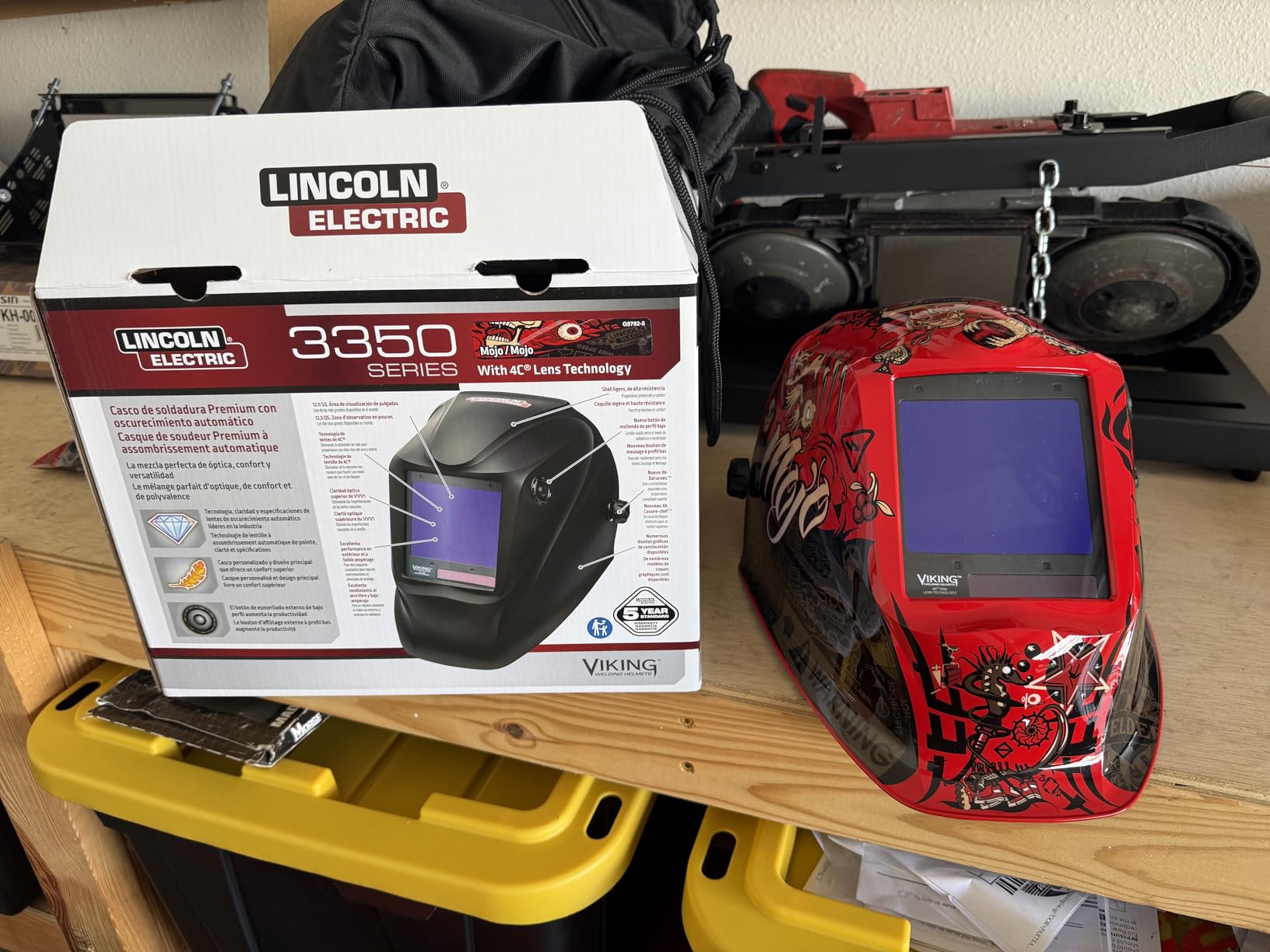
What 12.5 square inches of view changes on the puddle
On a 16 gauge stainless tube, the deciding moment is the moment you land the arc and the puddle widens. With a wide window you can see the puddle spread to both sides of the joint, which tells you immediately whether your travel angle is off. Narrower windows crop that information away and you end up correcting the bead after the fact instead of during it.
The 4C optics also hold color steady as the lens darkens. On aluminum, where surface oxide hides the puddle, a stable true color view shortens the time it takes to find the edge of the bead. Reviewers welding aluminum and stainless describe the same effect, calling the color reproduction noticeably cleaner than what they moved on from.
Where the Viking 3350 frustrates users
The recurring complaint is response at arc strike. A small number of owners report the filter taking a beat to darken when striking an arc with sensitivity already maxed, which matters most if you work at the very bottom of the detection range. Setting the internal controls correctly before you start largely settles this, but it is a real learning curve on day one.
Setup is also more involved than a simple analog hood. There is no digital readout, so you are dialling shade and sensitivity by feel. In exchange you get cover lenses that are not proprietary, which is why several buyers specifically call out that they can buy replacements locally.
2. YESWELDER LYG-L600A – Best Value TIG Helmet for New Welders
YESWELDER Auto Darkening Welding Helmet 1/1/1/1 True Color, LYG-L600A
1/1/1/1 true color
2 arc sensors
Shade 3/7-13
Solar plus CR2450
Pros
- Clear natural true color view during welding
- Very fast darkening with adjustable delay
- External shade knob usable with gloves on
- Roomy enough to wear over a respirator
- Includes spare lenses and a spare battery
Cons
- Headgear and straps feel light duty
- Thin plastic shell
- Small viewing area beside panoramic models
The LYG-L600A is the most reviewed helmet in this roundup at more than 13900 ratings, and it holds a 4.6. That combination makes it the reference point for what a TIG helmet should cost you in effort and attention, and for the most part it clears the bar without fuss.
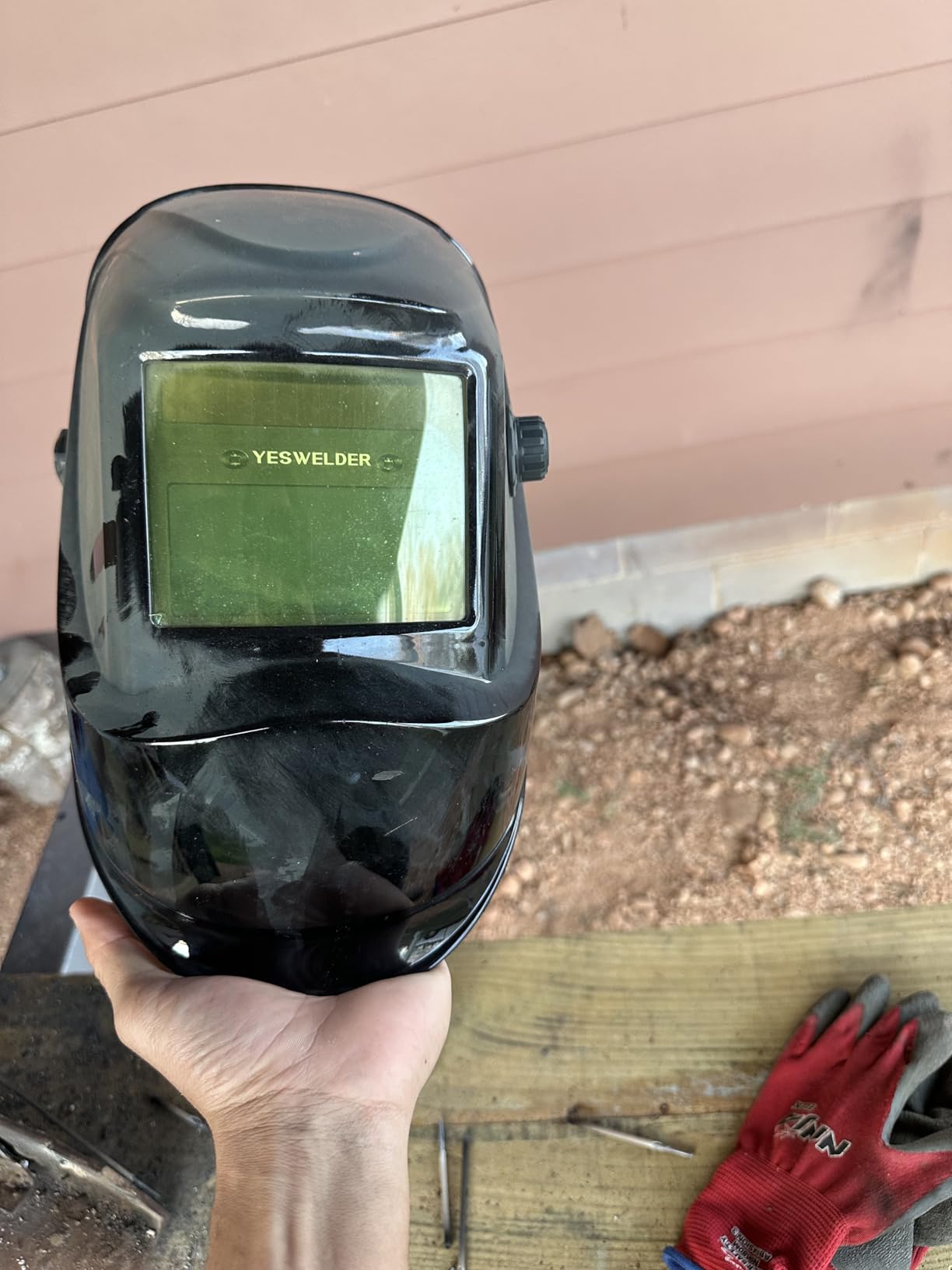
Optics are 1/1/1/1 true color across a 3.64 by 1.67 inch viewing area. Switching is quoted at 1/30000 second with two arc sensors, and shade range covers 3/7-13 for TIG, MIG, MMA and grinding. A blue light blocking outer lens sits in front, and the unit runs off a solar panel plus a replaceable CR2450 coin cell.
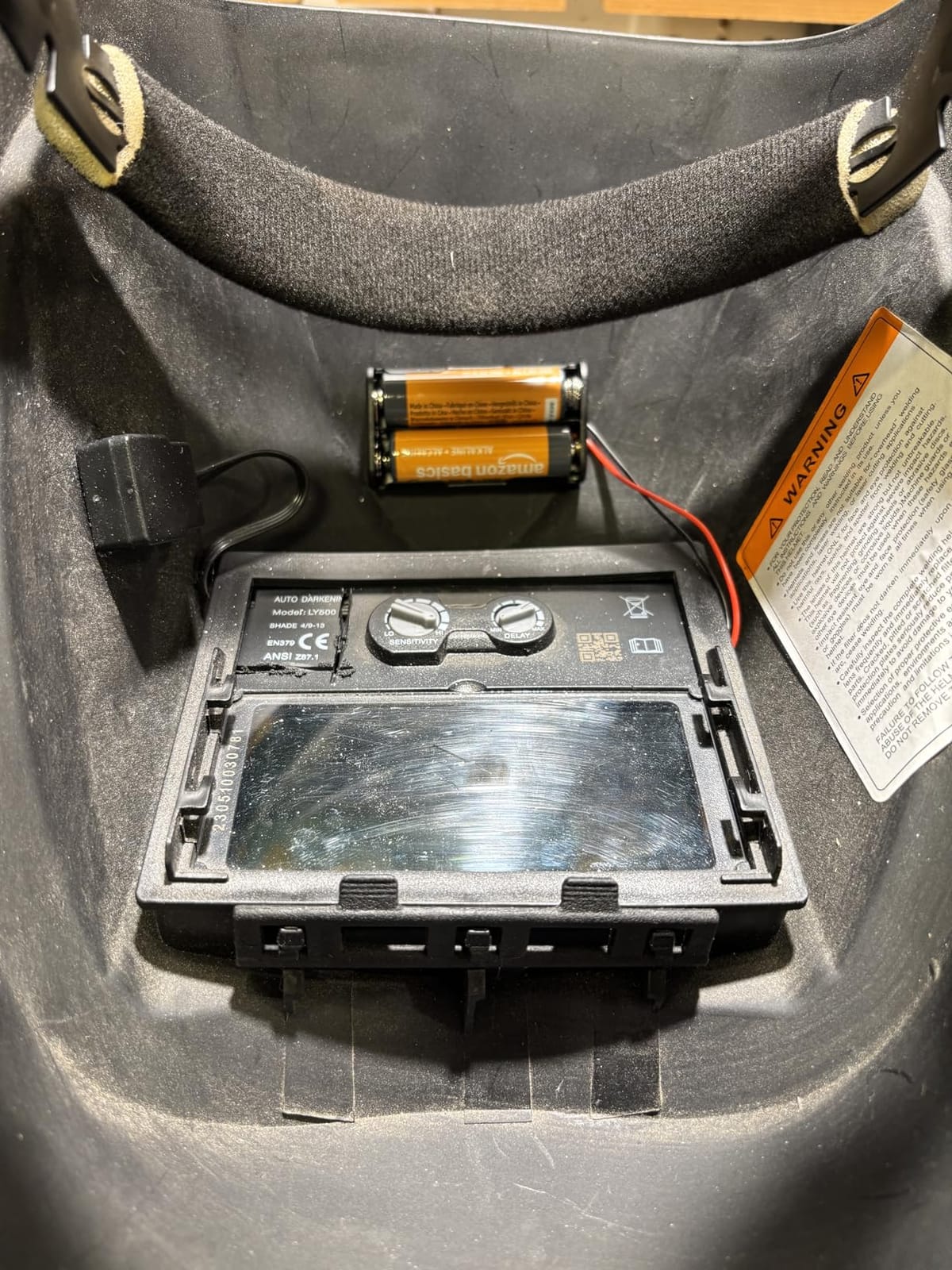
The external shade knob is the feature that gets the most praise from people who switch between stick and TIG. You can drop from a 9 for stick to a 10 or 11 for TIG without taking the helmet off, which is exactly what the process demands. Owners also note it fits over a respirator, something that matters if you are grinding stainless the same week you are welding it.
The box includes an inner lens, two outer lenses, a spare CR2450 and a storage bag. That is a complete first-year consumables kit, and reviewers consistently treat the L600A as the value benchmark the rest of the market is measured against.
Why two sensors still handle shop TIG
Two sensors is below what we recommend for low amperage work, but the L600A is positioned for a different job. If you are doing 5 mm mild steel fillets at 90 amps and occasionally a 60 amp stainless root pass, the sensors have enough arc light to read and you will not notice a miss. Where it will struggle is micro TIG and jewelry work, where the arc is genuinely dim.
Because the filter switches in 1/30000 second, the darkness itself is not the issue. The limit is the trigger threshold. If you work at the bottom of the range, dial sensitivity up before you start and give the arc a fraction of a second longer to establish, and most of the flashing problem goes away.
Where the L600A falls short of a pro hood
Build quality is the honest weakness. Owners describe the headgear and shell as light duty, better suited to hobby and home shop use than to a full production schedule, and the straps are the first thing likely to need replacing. At 16 ounces the helmet is light, which helps on long sessions but also means there is not much structure in the shell.
The viewing area is small by comparison with anything on the panoramic end of this list. That is fine for flat butt joints but it tightens your view when you are welding a curved surface or working overhead. A minority of buyers also report the coin battery arriving drained or seated incorrectly, so check it on arrival.
3. YESWELDER LYG-M800H – Best Large View Helmet for Learning TIG
YESWELDER Auto Darkening Welding Helmet, Large View, LYG-M800H
3.93 x 3.66 in view
4 arc sensors
1/30,000 sec
DIN 3/5-9 and 9-13
Pros
- Large window makes bead placement and puddle tracking easier
- True color lens is a real upgrade from green tint
- All controls sit on the outside
- Lightweight for long sessions
Cons
- Pivot headgear can slip forward if tension is off
- Side tension knobs feel fragile
- Thin plastic shell beside pro hoods
The LYG-M800H is the one we would hand to somebody learning TIG in a garage. Its 3.93 by 3.66 inch window is close to square, which makes it easy to see both sides of a joint at once, and four arc sensors give it a detection range that holds up as you get into thinner material.
Switching is quoted at 1/30000 second, shade settings are adjustable across DIN 3/5-9 and 9-13, and the lens is 1/1/1/1 true color. Power comes from a replaceable CR2450 lithium battery. YesWelder lists it as suited to TIG, MIG, stick, cutting and grinding, including lower amperage work, and the box includes a spare battery and a storage bag.
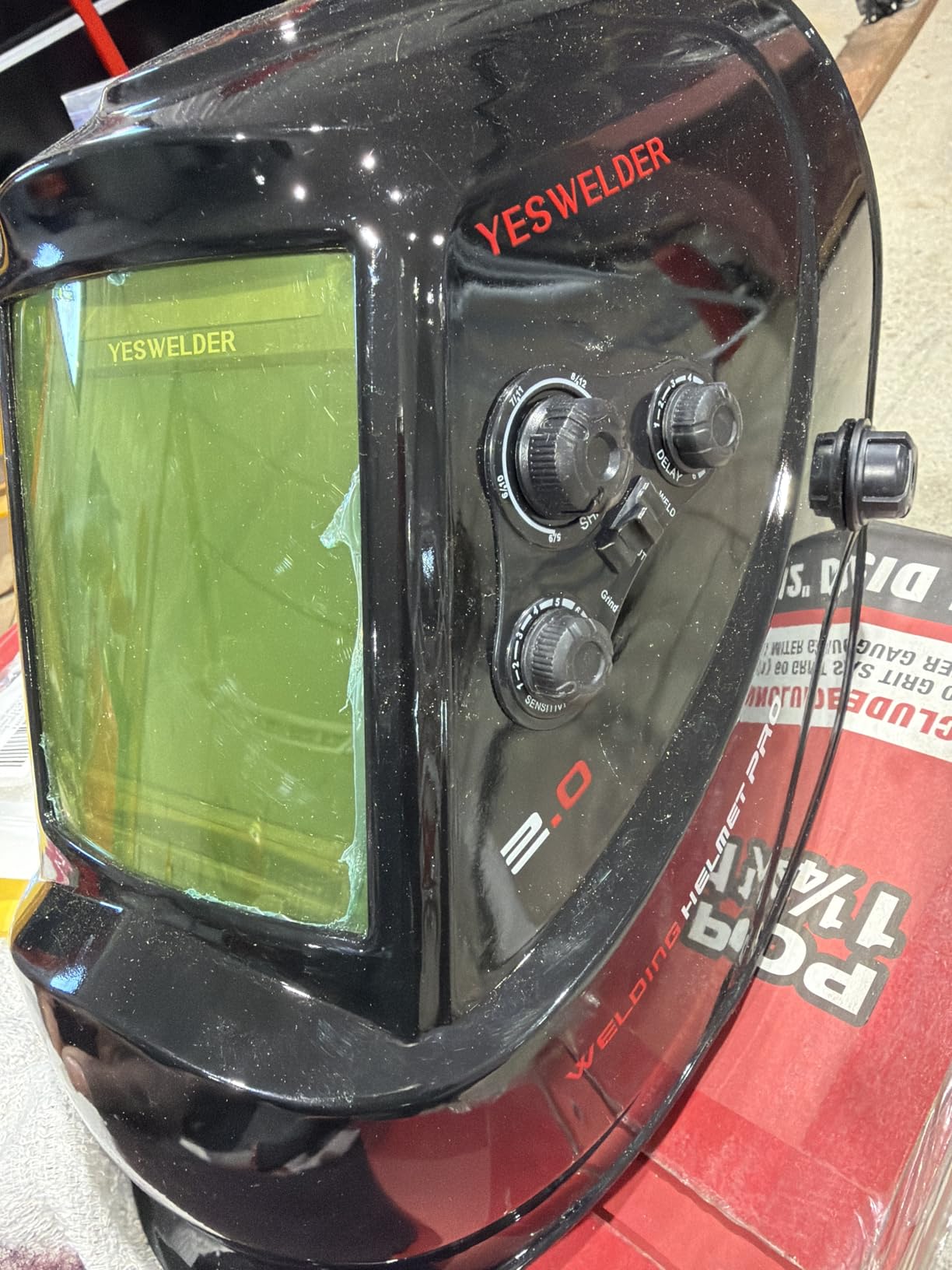
At roughly 1.32 lb, this is a light helmet, and owners who work long TIG sessions on 304 stainless appreciate that. The 4.4 rating across 8099 reviews is the lowest of the four YesWelders here, and the gap comes down almost entirely to headgear rather than optics.
Beginners report an immediate improvement in bead quality simply from being able to see the joint. Before the auto-darkening upgrade, a lot of people learn TIG with the hood flipped up, setting the torch height by feel and re-learning it every session. A window this size ends that habit quickly.
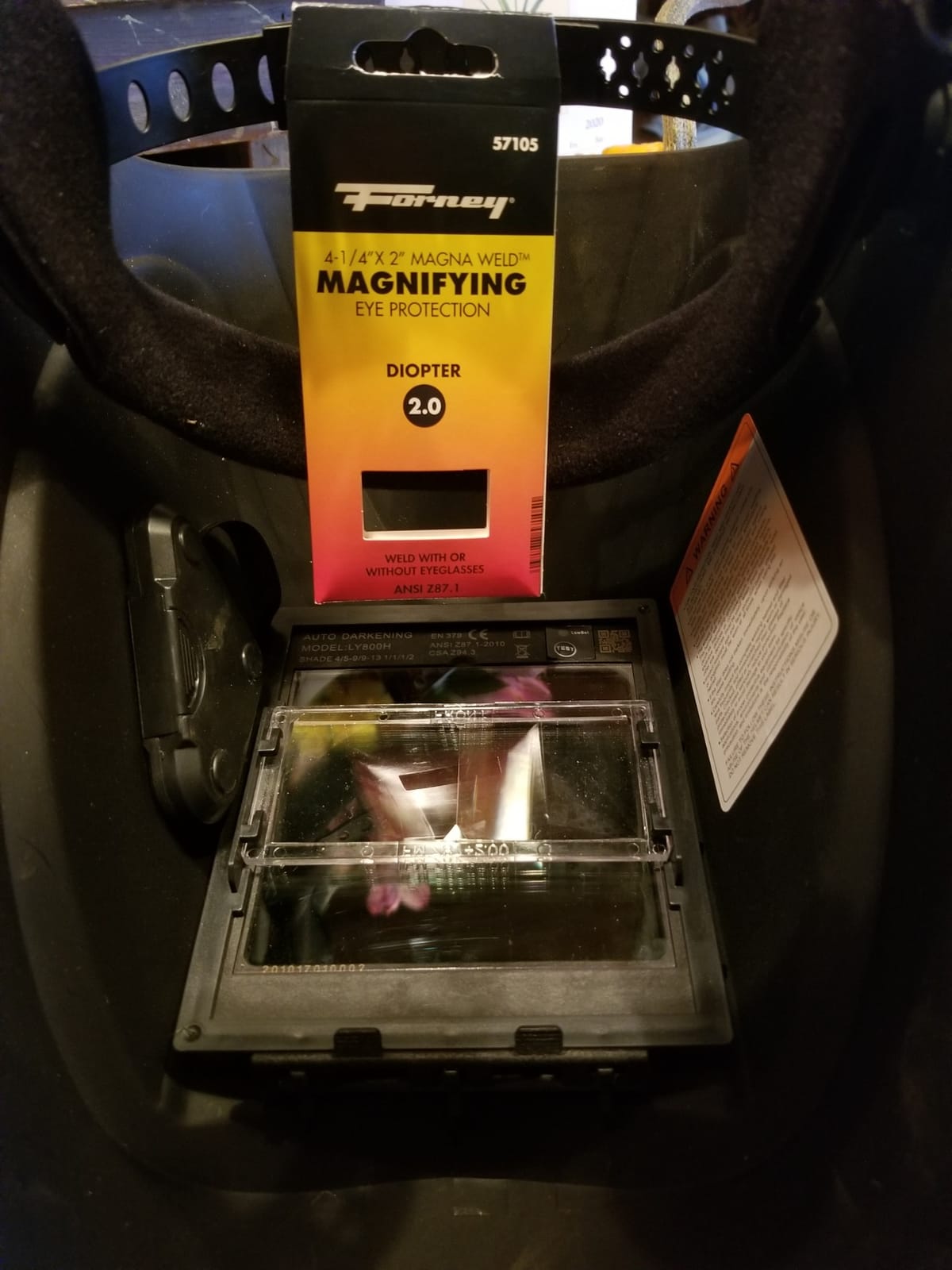
How the 3.93 by 3.66 inch window helps beginners
Fit-up is where new TIG welders lose the most time, and it is entirely a visibility problem. With a near-square window you can watch the gap close on both sides as the parts draw together, and you can see where the filler rod is actually landing. Several owners describe this as the feature that made their beads consistent, not the sensor count or the switching speed.
The four sensors also help when you are repositioning a lot. TIG at a fillet corner means the arc points away from the helmet at angles that make detection harder, and more sensors means the filter is less likely to miss you on the outside of a joint.
Where the M800H headgear gives way
The pivot-style headgear is the problem, and it comes up repeatedly. It can creep forward if the tension is not dialled in precisely, and the side flip-up tension knobs feel fragile enough that owners warn against forcing them. A few buyers report strap breakage after extended use, which is the part to inspect if you buy this one.
The shell is thin plastic compared with the Lincoln and Hobart shells in this group, and the internal lens is awkward to remove and replace. If you grind and TIG in the same week, expect to swap inner covers more often than the price of the helmet would suggest.
4. YESWELDER BW-10MAXTRI – Best Panoramic TIG Helmet with Digital Controls
YESWELDER Auto-Shade Welding Helmet, Internal Digital Control, 180° View
8.89 x 3.23 in view
5 arc sensors
Internal digital panel
Shade 3/4-8/9-14
Pros
- Panoramic view opens up peripheral visibility
- True color lens reads more naturally than older filters
- Digital readout makes shade and delay precise
- Five sensors give quick detection
Cons
- Shell and sizing band are basic
- Replacement inner covers are hard to source separately
- Fit band can arrive misshapen
The BW-10MAXTRI is the only helmet here with a true panoramic layout: a 4.25 by 3.23 inch main view plus two 2.87 by 2.32 inch side views, for 8.89 by 3.23 inches overall. When you are welding a lap joint with the torch at a shallow angle, side vision is how you keep the filler rod visible without craning your head.
Five arc sensors switch in 1/30000 second, and this model does something the others do not: it adjusts shade, sensitivity and delay automatically based on arc brightness, with plus or minus nine levels of manual fine tuning on top. The internal digital display shows the settings rather than leaving you to guess, which removes the main argument people have against internal controls.
Optics are 1/1/1/1 with true color technology, and shade range runs 3/4-8/9-14 with a gradient control for MIG, TIG, stick, tack, grinding and cutting. Power is a lithium ion battery, included with replacement lenses in the box. The 4.5 rating comes from 1692 reviews, which is a thinner sample than some of the budget helmets here but still substantial.
Reviewers pick out the lens almost every time, calling the view a night and day change from traditional brown or green lenses. Seeing through the filter when it is not darkened is a real advantage during TIG, because you spend a lot of the cycle stroking out the joint before you strike.
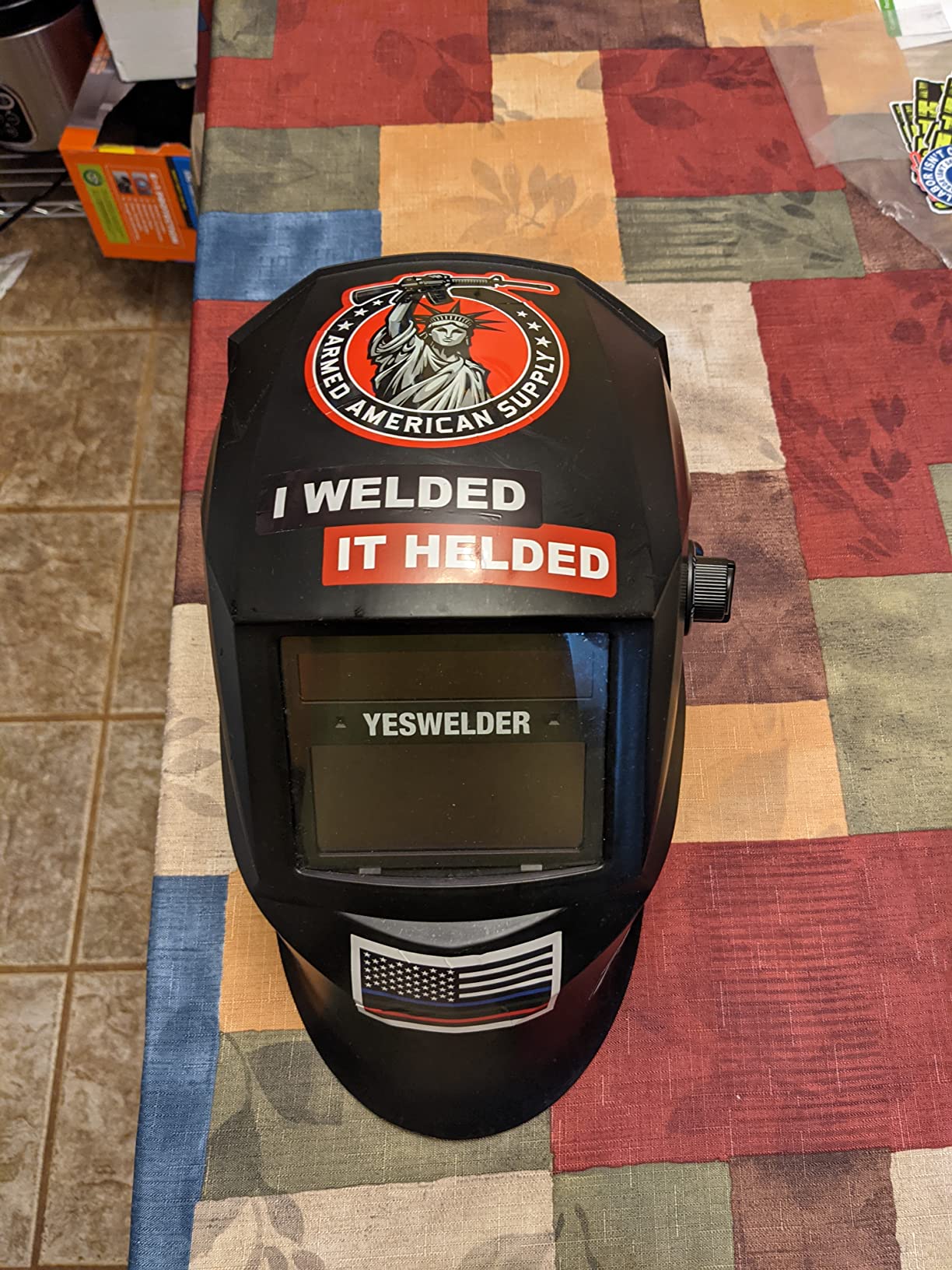
What the 180 degree window shows you mid-pass
The side windows change the geometry of a pass. On a vertical or overhead joint, the center of the lens shows you the arc but not the rod tip entering from the side, so you end up breaking your stroke to check. With the panoramic layout you can keep the rod in view continuously, which is a large part of why experienced TIG welders like this shape even when the center window alone would do.
The auto-adjustment is also more useful for TIG than it first sounds. TIG amperage changes constantly as you move between sections and as the heat builds, and a helmet that rebalances itself tracks those changes without you touching anything mid-pass.
Where the digital panel gets in the way
The panel is internal, so changing shade means lifting the helmet or feeling for buttons blindly. The auto-adjust feature reduces how often you need that, but when you do want a manual override, plan for it at the start of a pass rather than mid-bead.
Build quality is where this model trails the Lincoln and Hobart. The shell and sizing band are described as basic for the tier, the fit band can arrive misshapen from shipping, and a few users flagged trouble sourcing replacement inner cover lenses on their own. Check the fit as soon as it arrives rather than at the start of a job.
5. ARCCAPTAIN HSH-S800 – Best Lightweight Helmet for Low Amperage TIG
ARCCAPTAIN Welding Helmet Auto Darkening, 1/25000s Response, Shade 4/9-13
4 arc sensors
1/25,000 sec
1/1/1/1 true color
1 lb shell
Pros
- Lens clarity several users rate as the clearest they have used
- Grind mode means fewer helmet removals
- Lightweight with a padded adjustable headband
- External shade and sensitivity adjustments
Cons
- Some units report a slow initial response
- A minority report electronics degrading after months
- Fit range does not suit every head shape
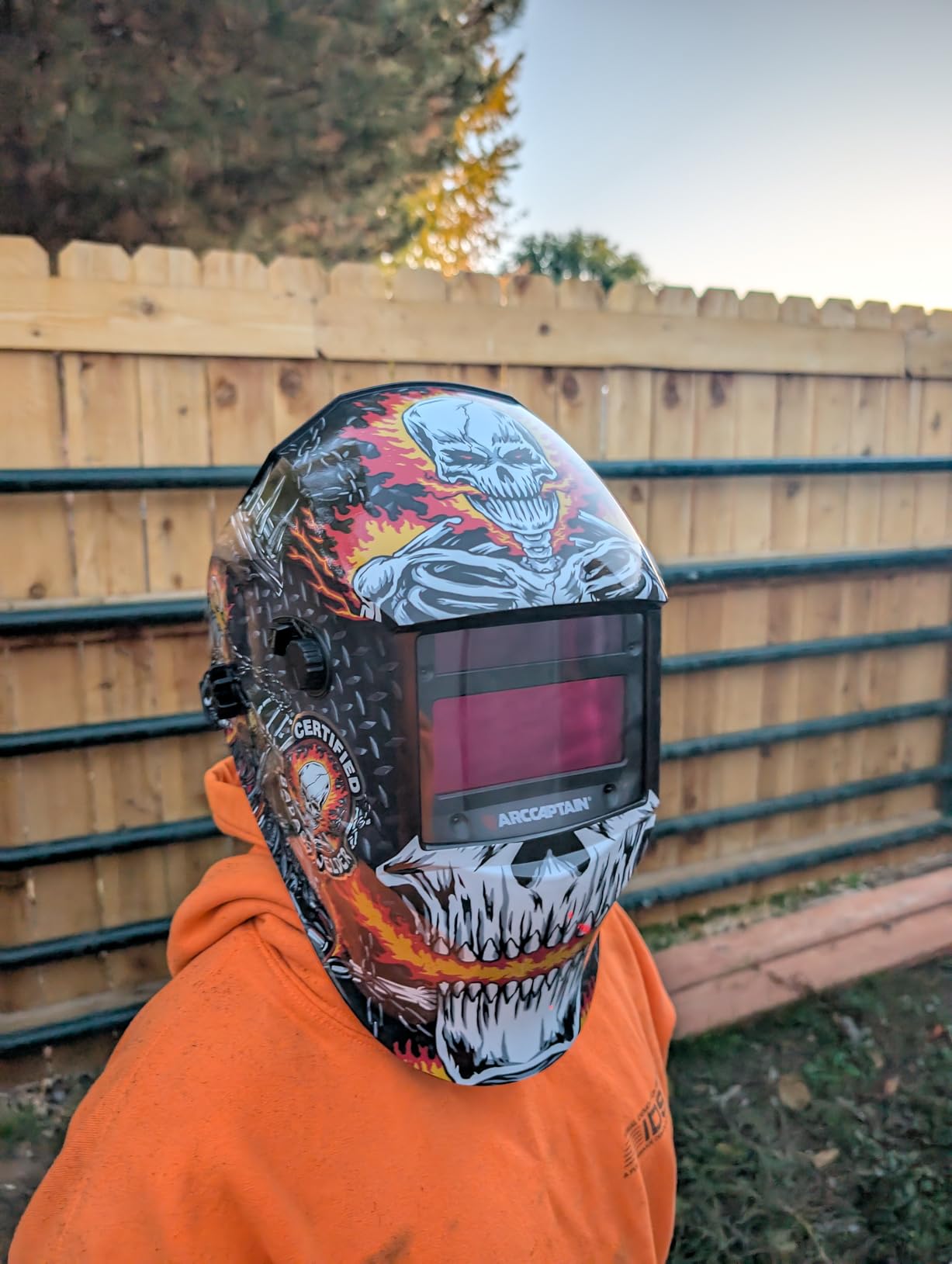
The ARCCAPTAIN HSH-S800 weighs one pound and carries a 4.6 rating from 3080 reviews. Four premium arc sensors switch in 1/25000 second through a 3.86 by 1.69 inch 1/1/1/1 true color lens, and at that weight it is a serious option for anyone who welds TIG overhead or inside a frame where a heavy hood is genuinely awkward.
Dark state runs 4/9-13 and the filter is a 12 in 1 smart unit with automatic DIN 16 UV and IR protection. Solar cells pair with a replaceable CR2450 lithium battery, and the shell is PA material with a listed tensile strength of 120 MPa. Certification covers ANSI/ISEA Z87.1-2010, CSA Z94.3, DIN EN 175 and DIN EN 379, which is a broader standards list than most of the budget field offers.
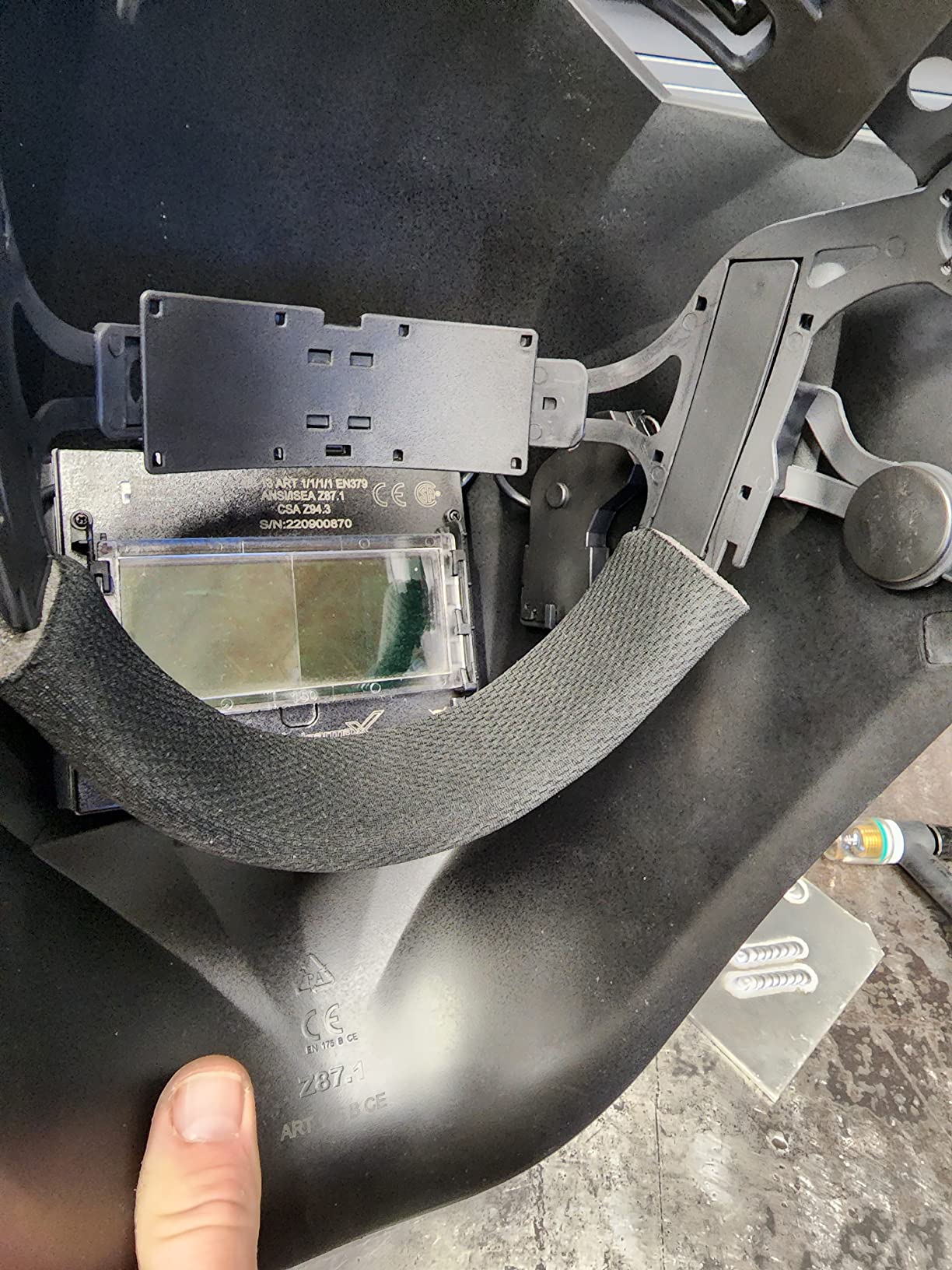
Several users rate the lens as the clearest they have owned, which sounds unlikely against the Lincoln and Optrel-class optics but comes up often enough in the reviews to matter. Grind mode is also mentioned often, because it lets you clean a TIG bead without lifting the hood off, which saves time on repeat work.
The box includes three replacement lenses and a manual. Cheater lens compatibility is listed, which is worth noting for anyone welding thin material who needs magnification. A 180 day warranty is the shortest here, so treat this one as a hobby and light shop investment rather than a buy for a production bay.
Checking low amp detection before you buy
Sensor count is the number to read for TIG, and four is the practical minimum. Four sensors means the filter can see the arc whether it is directly ahead of you or coming from an angle, which is exactly the situation when you are on a curved surface or inside a joint. Two sensors work for flat work with the arc facing forward and get unreliable off that axis.
Sensitivity is the second dial. On low amperage TIG the arc is genuinely dim, and a helmet set too conservatively will sit there in the light state while you are already welding. Set sensitivity high, then back it off until it stops tripping on shop light or on a reflection off your ground clamp.
Where the HSH-S800 electronics fall short
A minority of reviews report filters losing clarity or switching off mid-weld after several months of use, which points at the electronics rather than the lens. That is the same pattern we saw with a few other budget units, and it is the reason the warranty length matters so much on this tier.
A few owners also report a slow initial response on some units, which is most noticeable in exactly the low amp case this helmet is pitched for. And the fit adjustment range does not suit every head shape, so if you wear a hard hat or have a larger head, check the return terms before committing.
6. Hobart 770890 – Best TIG Helmet for Long Shop Days
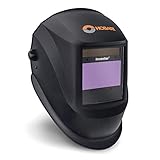
Hobart 770890 Auto-Darkening Welding Helmet, Large, Black
PureColor lens
9.3 in widescreen view
4 arc sensors
1.25 lb shell
Pros
- Accurate color reproduction of the weld and shop
- Generous 9.3 inch widescreen viewing area
- Lightweight shell reduces neck strain
- Four sensors give dependable detection
- Simple analog knobs are easy to adjust
Cons
- Analog dials are less precise than digital readouts
- Replacement lens and battery sourcing is less convenient
The Hobart 770890 is the helmet we would put on for a full production day. At 1.25 pounds it is light, but the shape matters more than the number, since the low-profile shell keeps your head from tipping forward while your chin is down over the puddle. It carries a 4.7 from 880 reviews.
The PureColor lens covers a 9.3 inch widescreen viewing area, which is wide rather than tall and gives you a broad horizontal read across the joint. Four independent arc sensors handle detection, power switches on automatically at arc strike, and there is seamless switching between weld and grind modes. Controls are analog knobs for shade, sensitivity and delay, and it runs on one included CR2 lithium battery.
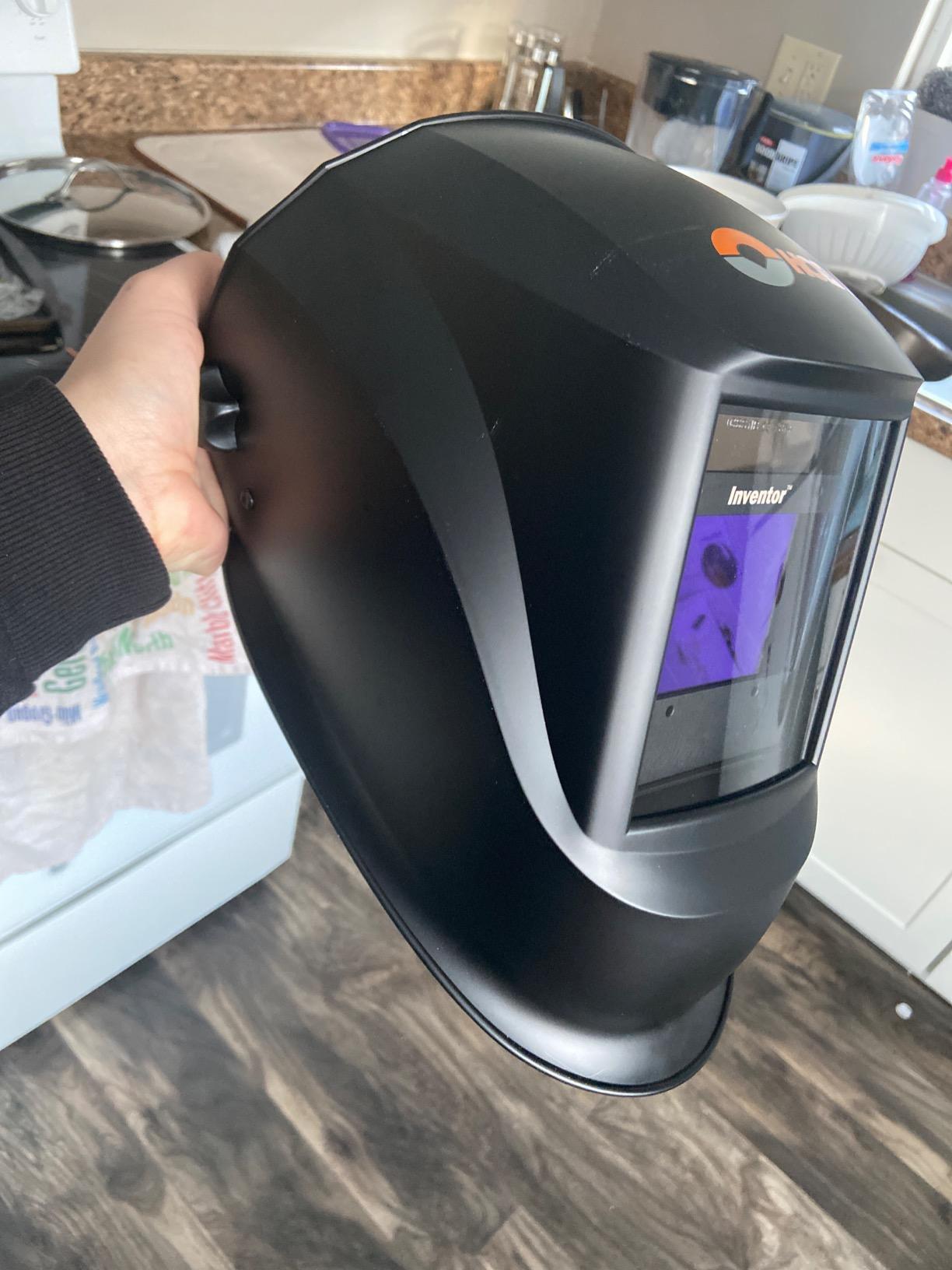
Owners highlight the viewing window, the accurate color reproduction and the comfortable shell in roughly equal measure. Color accuracy is the underrated part here, because it lets you distinguish the heat tint on stainless from the color of the oxide you are about to clean off, which changes how you read the joint.
Hobart includes a protective lens kit in the box and backs the helmet with a limited two year manufacturer warranty. For a shop that already runs Hobart or Lincoln gear, this is a straightforward addition to the same parts supply.
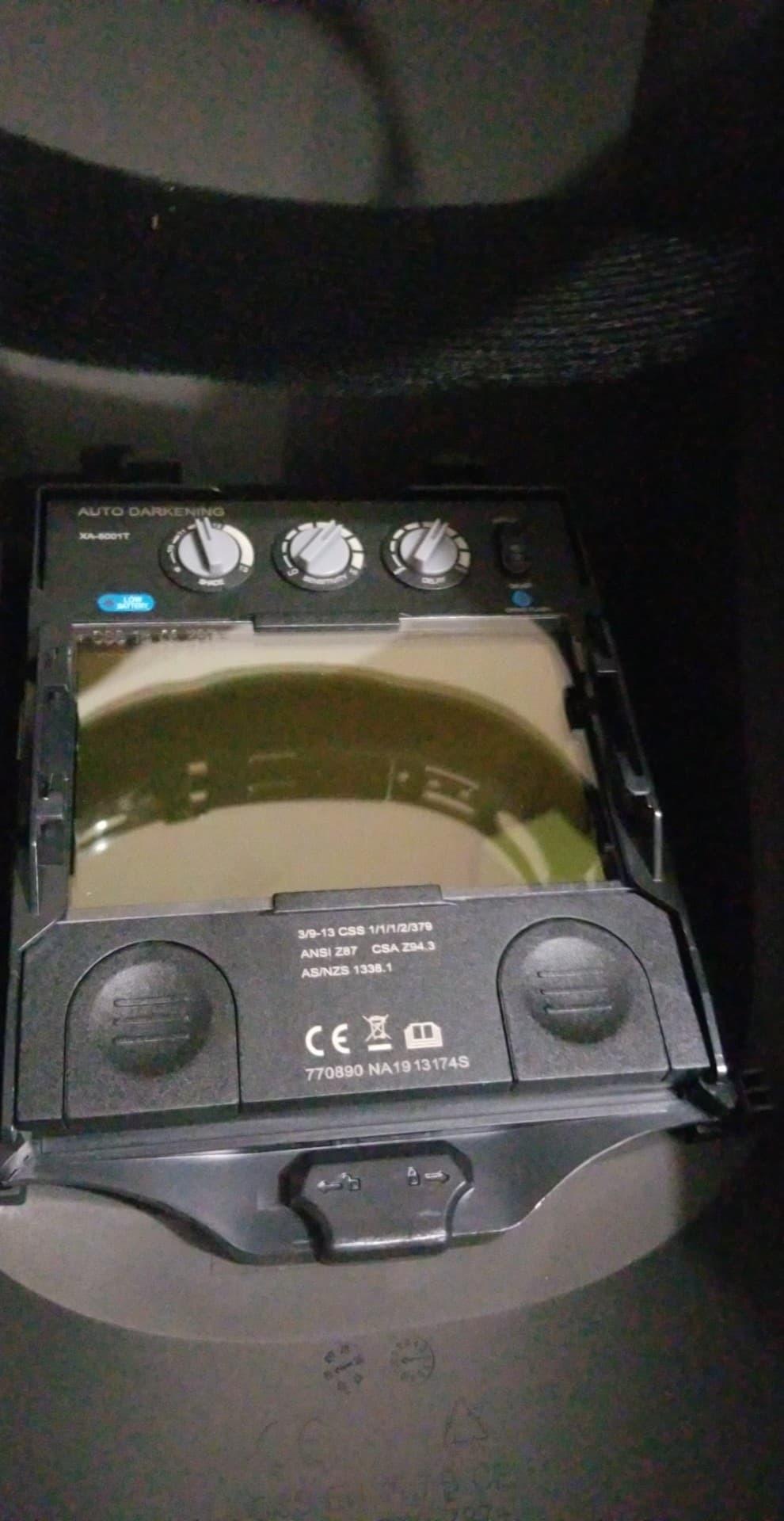
Why the widescreen window cuts neck strain
TIG welders hold a static posture. There is no travel angle to reset, no gun to swing, just your head held about six inches from the work for minutes at a time. That makes helmet weight and balance more noticeable on TIG than on any other process, and it is the main reason this model earns its place on a shop floor helmet.
The widescreen format also reduces how far forward you have to lean. If the joint fills the width of the lens, you can stand back a fraction further and still read the edges, which takes pressure off your neck and reduces how close your face sits to the fume plume.
Where the analog knobs cost you precision
Analog controls are less precise than a digital readout, and that shows up when you are chasing a specific shade for thin aluminum. You are counting clicks rather than reading a number. For most shop work at a fixed amperage this is a non issue, but for anyone who regularly moves between, for example, 30 amp and 90 amp stainless, it is mildly annoying.
Lens and battery sourcing is also less convenient than for the Lincoln or the YesWelders, both of which use widely available cover lenses. If you are out in the field or far from a supply house, plan your spare lens stock accordingly. A protective lens kit is included, which covers the short term.
7. Jackson Safety Insight – Best Ultralight Helmet for Pipe and Overhead Work
Jackson Safety Insight Auto Darkening Welding Helmet, ADF Hood – ANSI Z87.1
6 ounce shell
3.94 x 2.36 in view
Shades 9-13
4 arc sensors
Pros
- Very light shell for tight spots and pipe fitting
- Clear true color view with minimal eye strain
- Four sensors switch reliably on inverter machines
- Headgear stays raised on the up detent
- Uses standard 4.5 x 5.25 inch cover plates
Cons
- Light state can feel slightly dark in a lit shop
- Less rugged than premium pro hoods
- Sensitivity can trigger on reflected shop light
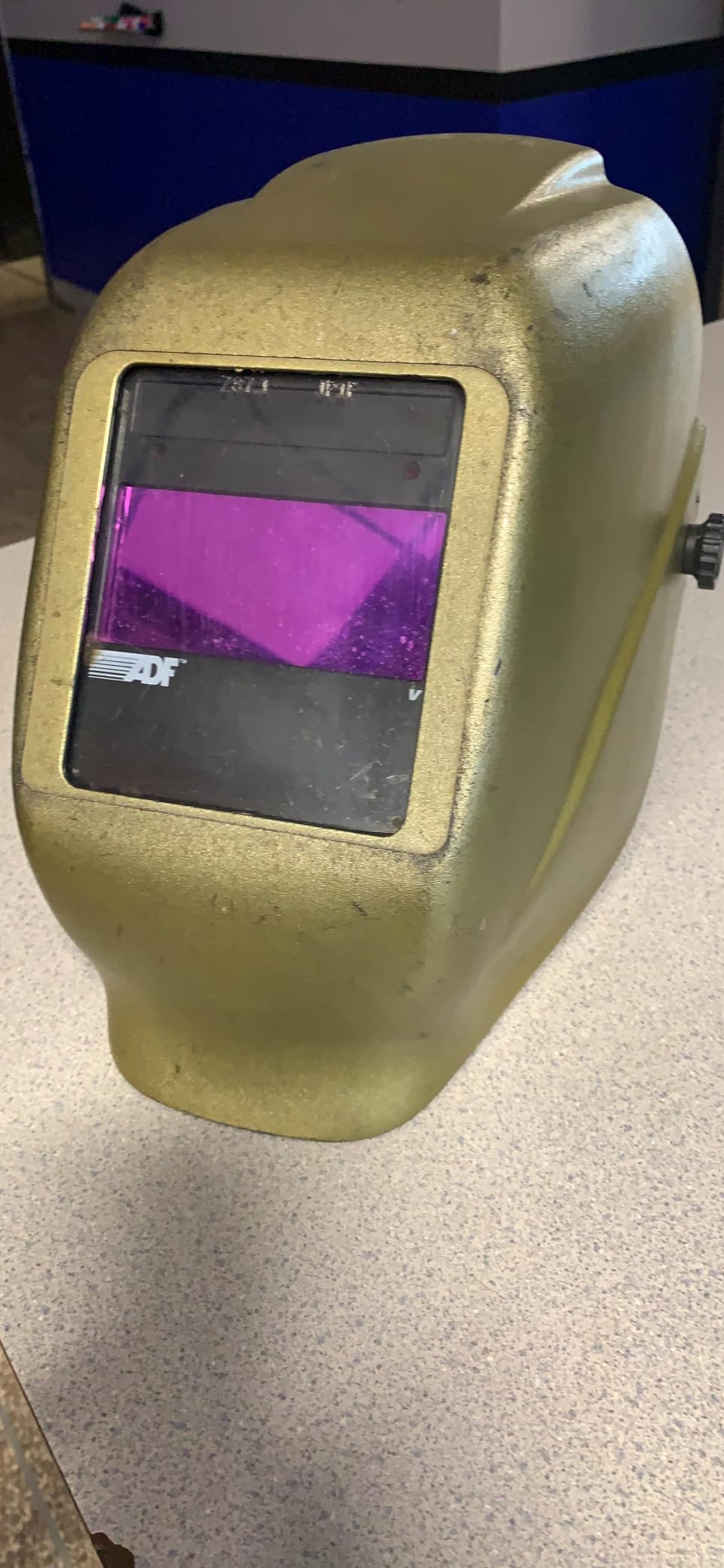
The Jackson Safety Insight uses an HLX shell that weighs six ounces. That is the number that matters for the work this helmet suits, because pipe TIG means climbing, crouching and holding a torch at awkward angles, and a heavy hood in an inverted position is genuinely tiring. It rates 4.6 from 682 reviews.
The viewing area is 3.94 by 2.36 inches, variable shades 9 to 13 with true color technology and 1/1/1/1 optical clarity. Digital controls cover sensitivity and delay across weld, torch and grind modes, with four arc sensors. The patented 370 Speed Dial ratcheting headgear with Qwik-Fit rear swivel band lets you set the hood raised or down and have it stay there.
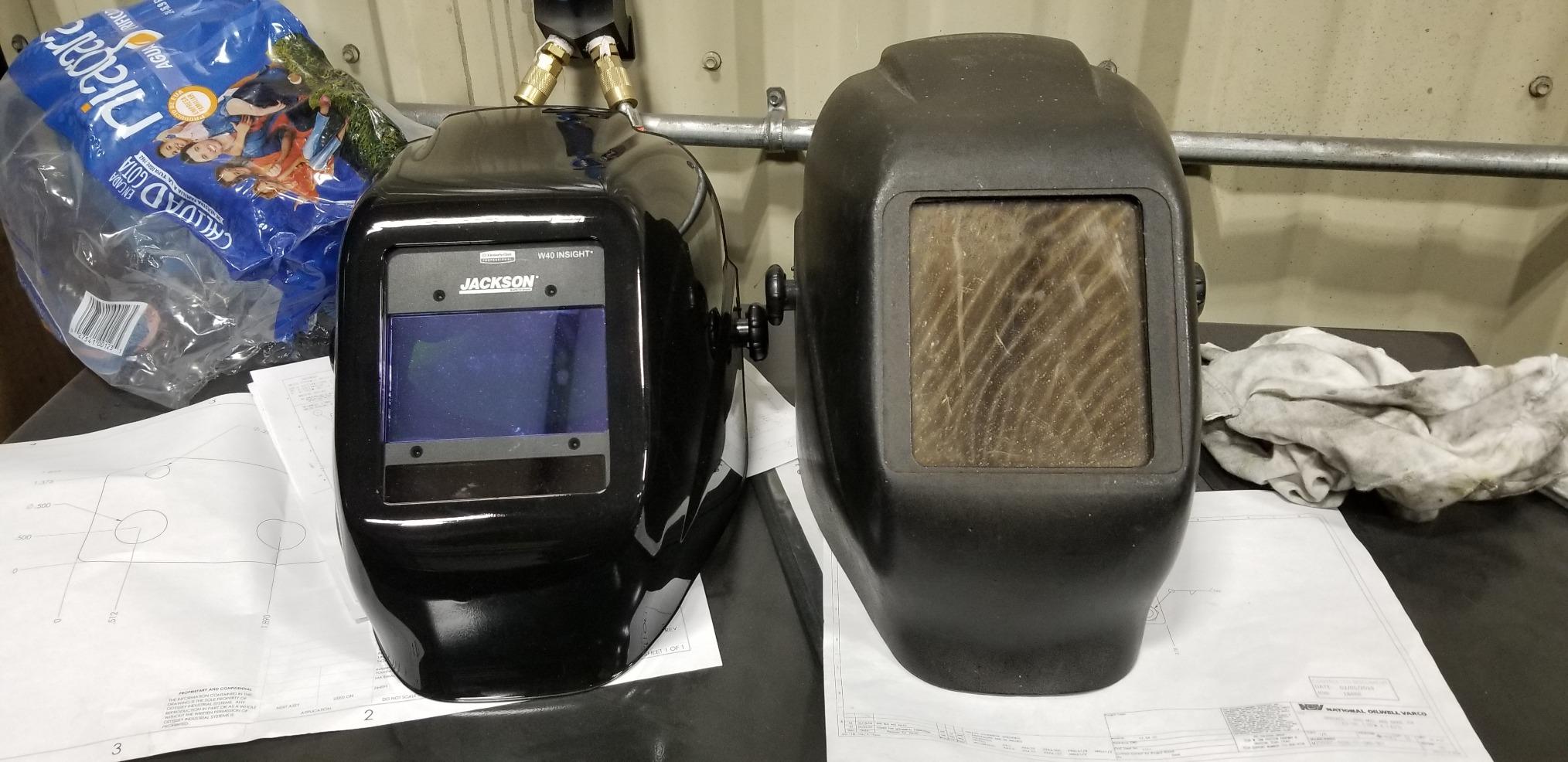
Long-term owners report years of service on the original batteries, which is the strongest durability signal in the reviews we read. The torch mode is worth understanding before you start, since TIG has its own dedicated setting here rather than being folded into the general weld mode.
It uses standard 4.5 by 5.25 inch clear cover plates, which is a genuine advantage because those are stocked almost everywhere, and it adapts to a hard hat. The tight seal on the cover lens keeps spatter and smoke off the shade filter, which on TIG matters because you are close to the arc for long stretches.
Six ounces matters in a tight spot
For pipe work, your working volume is frequently the inside of something, and the deciding factor is often whether the hood will clear the nearest obstruction. A six ounce shell with a flexible body can be angled into a gap that a rigid professional hood simply will not fit into, and pipe fitters in the reviews call this out as the reason to buy it.
Helmet weight also compounds badly overhead. A hood that is comfortable for MIG work at the bench becomes a problem when it is the top of a ladder for an hour, and that is where a difference of several ounces turns into a difference in how the last hour feels.
Where the Insight light state falls short
The light state can feel slightly dark for working in a lit shop, which is the inverse of the problem low amp TIG creates. After several hours your eyes adapt, but during the first few minutes, inspecting fit-up with the hood down and no arc going can be harder than it should be.
A small number of reviewers find the sensitivity setting too easy to trigger, in one case from reflected shop light. If you work near a stainless table that reflects arc light, lower the sensitivity a step or two. The shell is also less rugged than premium professional hoods, so expect more care around hot slag.
8. Miller Classic ClearLight – Best Helmet for a Bright Light State Between Welds
Miller Classic Series Welding Helmet, ClearLight™, Shade 8-13, Black
ClearLight optics
6 sq in view
2 arc sensors
Shades 8-13
3.0 light state
Pros
- High definition true color view of the puddle
- 3.0 light state lets you keep the hood down between welds
- Auto on power control activates at arc strike
- Ratchet headgear fits securely
- Three year warranty
Cons
- Only two arc sensors
- 6 square inch view is smaller than large view models
- Not suited to high amperage production work
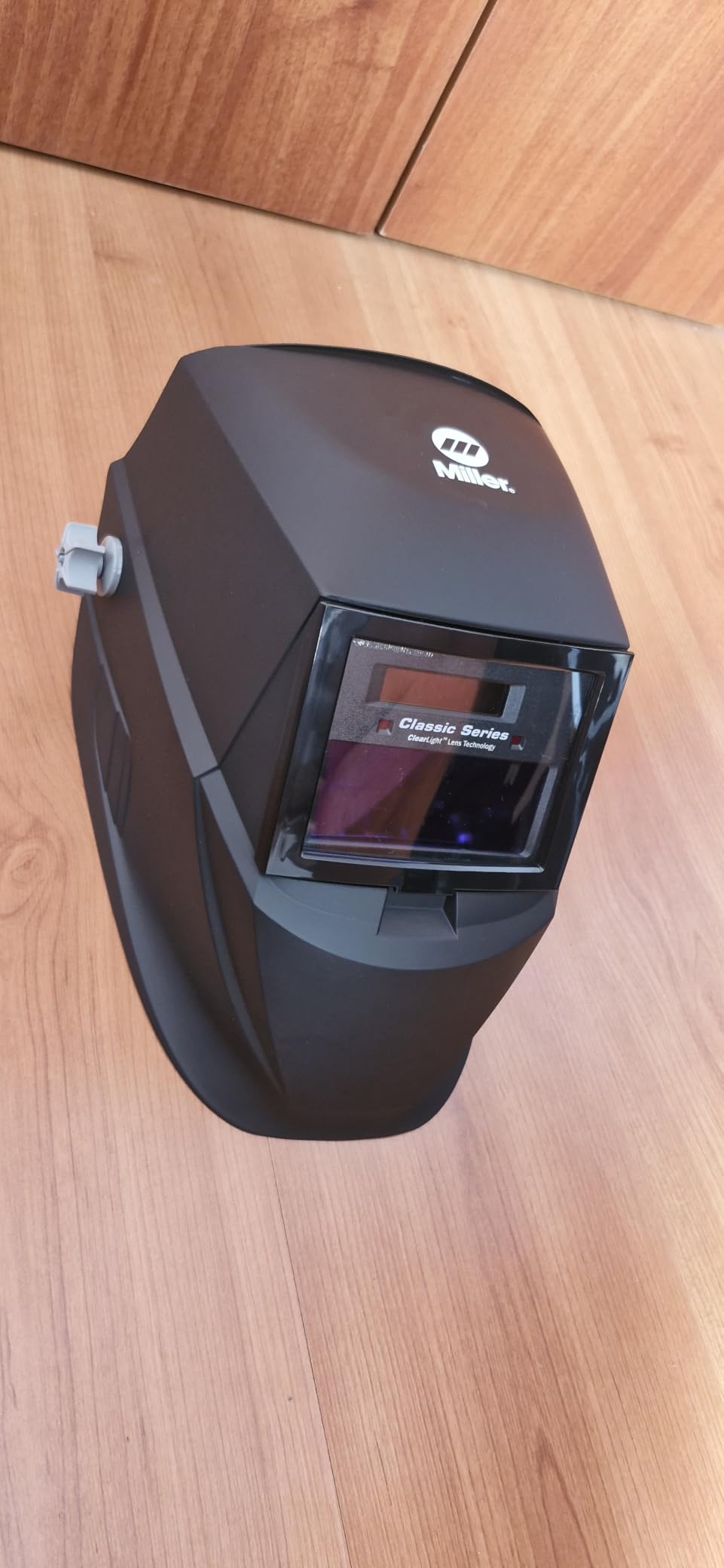
The Miller Classic ClearLight solves a specific problem that most roundups skip: staying in your helmet between welds. Its 3.0 light state is bright enough that you can keep the hood down between passes instead of flipping it up and down, and on TIG, where each weld is short, that habit adds up fast.
ClearLight lens technology gives a high definition view across a 6 square inch viewing area. Weld shades run 8-13, cut shades 5-8 and grind shade 3, with digital controls for shade, delay and sensitivity. Power comes on automatically at arc strike, and Miller rates it as suitable for welding at five amps or below.
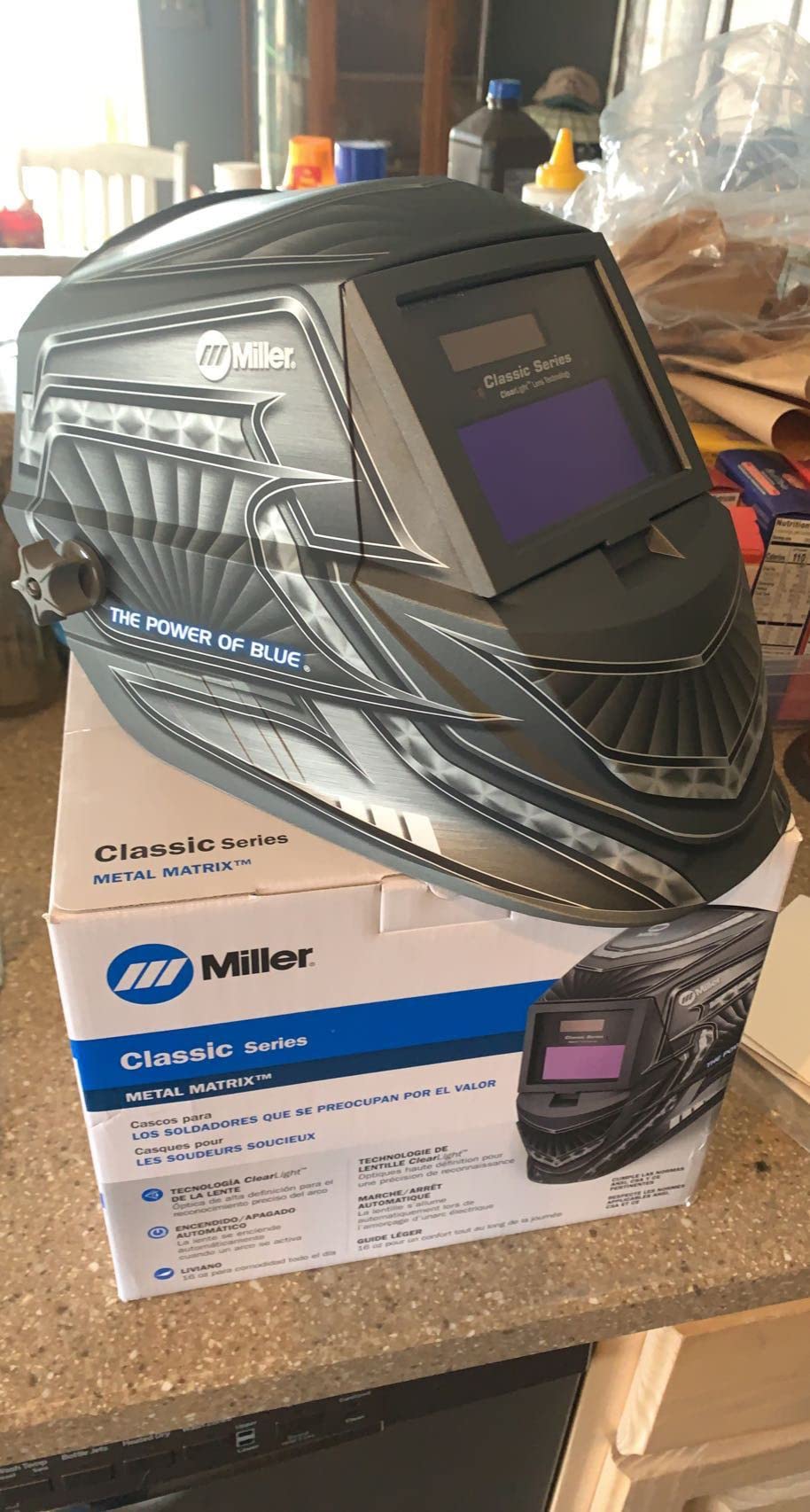
It meets ANSI Z87.1+, CSA and CE standards and carries a three year warranty from an established manufacturer. The 4.7 rating comes from 613 reviews, and reviews consistently frame it as a value-oriented professional unit rather than a flagship.
Ratchet headgear fits securely and comfortably, and the auto-on behavior means there is no switch to hunt for with a gloved hand. If you already run Miller machines, the brand support network is an underrated practical benefit.
What a 3.0 light state does for bead setup
Every time you flip a welding helmet up and down you break your focal point and reset your posture. On MIG that is cheap. On TIG, where you might strike an arc every fifteen seconds while you build a fillet, it is a real tax on consistency. Keeping the hood down in a bright light state removes the reset entirely.
The practical version of this is that you can check your joint, torch angle and filler rod position with the hood down and still see clearly. That matters most on thin wall and on stainless, where the margin between a clean pass and a burn-through is small and about a millimeter wide.
Where two arc sensors limit you
Two arc sensors is the specification we would push back on for a dedicated TIG helmet. It is workable when the arc is directly in front of you, and it is where the detection gets unreliable when you are welding out of position, at a fillet corner, or overhead. That is precisely the kind of work TIG gets used for.
The 6 square inch viewing area is also small against the large view and panoramic models here, and reviewers note that as the main trade-off versus newer designs. For high amperage production work at a fixed station, none of these limitations show up. For a TIG welder who moves around, they will.
9. TOOLIOM TL-31800H – Best 14.4 Square Inch Helmet Window
TOOLIOM Auto-Darkening True Color Welding Helmet with 3.94 x 3.66 View
3.94 x 3.66 in view
4 arc sensors
1/1/1/1 true color
1/30,000 sec
Pros
- 14.4 square inch window helps joint placement
- True color optics instead of a green tint
- Very fast 1/30000 second darkening
- Dual solar and battery power
- Breathable adjustable headband
Cons
- Shell and headgear are basic plastic
- Listed to ANSI Z89.1 rather than Z87.1
The TOOLIOM TL-31800H packs a 14.4 square inch viewing area into a 3.94 by 3.66 inch window, which makes it one of the larger rectangular fields of view in this group. Four arc sensors switch in 1/30000 second through a 1/1/1/1 optical class lens with true color technology, and dark state shades cover 5-9 and 9-13 with a DIN 3 light state.
Sensitivity, delay and shade adjustments support weld, cut and grind modes. Power is dual, with a replaceable lithium battery plus solar energy, and the butterfly style headgear is described as sweat absorbing and breathable. The box includes two outer protective lenses, one inner lens, a spare battery and a manual. It rates 4.6 from 624 reviews.
Reviews center on the combination of a large window with true color optics at a mid-level price point, plus quick and reliable darkening. Feedback describes construction as fair for the price rather than premium, which is a reasonable way to think about a helmet you are going to drop, drag and grind around.
The butterfly headband is worth a note for anyone welding in heat, since airflow across the forehead is the difference between a comfortable session and a wet one in a garage in summer.
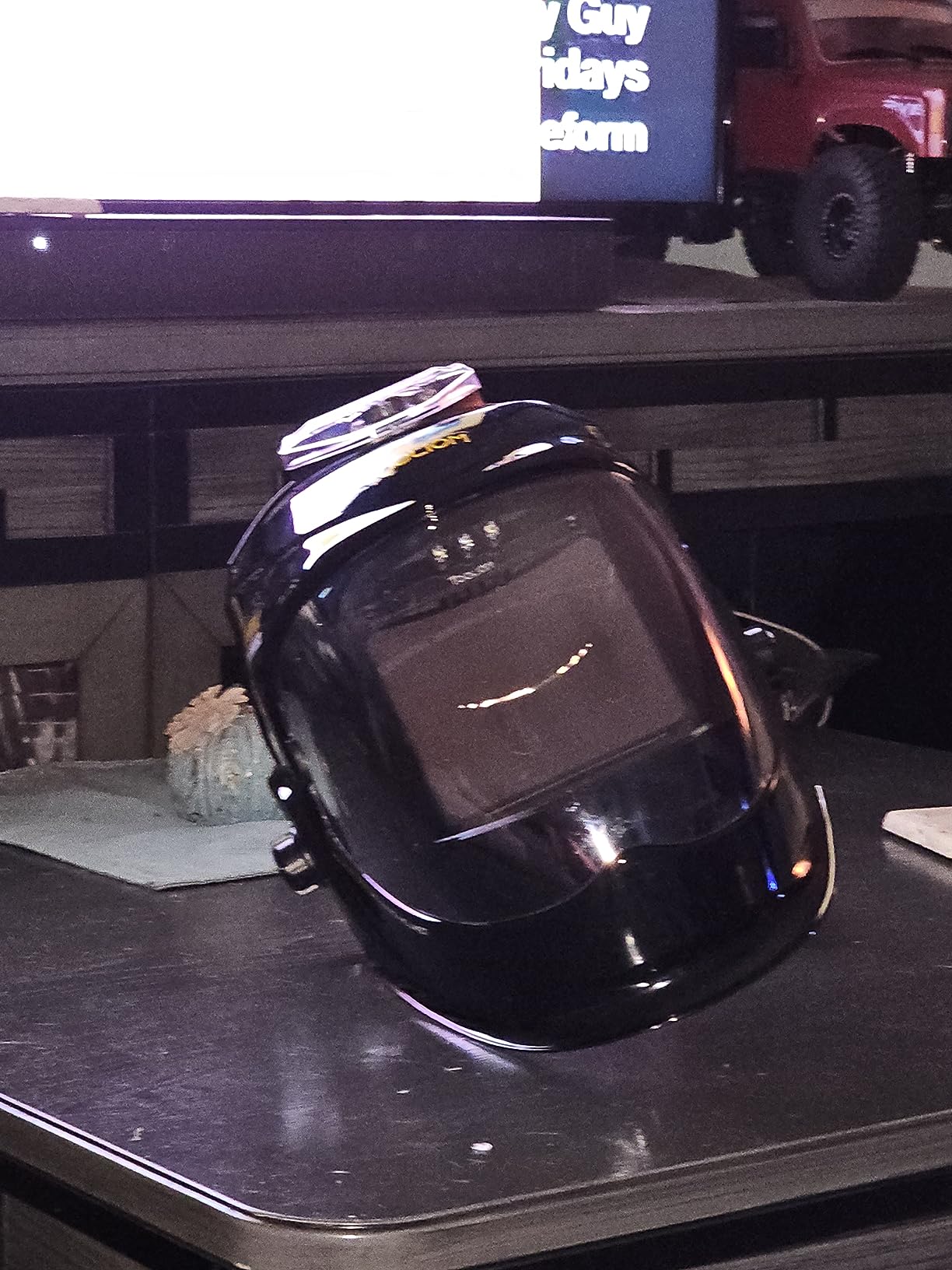
Reading fit-up through a wide window
The practical test we use for a large window is whether you can see the whole joint at the moment of arc strike. With 14.4 square inches you can watch the puddle form at both edges of a 2 inch lap joint, which lets you correct travel angle and filler placement while the arc is live rather than after the bead is finished.
The DIN 3 light state pairs well with that approach, since you can see the joint in decent light before striking. Combined with true color optics, it also makes it easier to see heat tint developing on stainless, which is your cue to slow down or change your amperage.
Where the Z89.1 rating matters
This helmet is listed to ANSI Z89.1 rather than Z87.1. Z87.1 is the welding filter standard that most shops and safety officers expect to see on a welding helmet, and several of the other helmets here carry it along with CSA Z94.3 or EN standards. If your workplace enforces a specific standard on personal protective equipment, check before you buy.
Shell and headgear are basic plastic, and the model has no in-helmet work light or digital readout. Those omissions are fine for a garage setup. For a production shop with a documented PPE standard, they are worth weighing against a certified alternative.
10. Sunstac SS-A800D – Best Helmet with a Built In Work Light
Sunstac Auto-Darkening Welding Helmet 3.94 x 3.27″ View with Light
3.94 x 3.27 in view
4 arc sensors
Shade 4/5-9/9-13
Rechargeable work light
Pros
- Huge viewing area with no over darkening
- True color view makes the puddle easy to read
- Built in rechargeable work light for low light work
- Lightweight with a fully adjustable headband
Cons
- Filter can take a moment to kick in
- Battery compartment is awkward to access
- Side tension buttons feel delicate
The Sunstac SS-A800D is the pick when your TIG happens in a dim garage or a field tent. It carries a rechargeable high brightness auxiliary work light with focused and flood modes on an adjustable swivel angle, which lets you light the joint without holding a flashlight in your other hand.
Optically it is a 3.94 by 3.27 inch screen with four arc sensors, 1-1-1-1 true color view, 1/30000 second auto darkening and UV, IR and arc protection. Shade range is a wide 4/5-9/9-13, and it is listed for stick, TIG, MIG, cutting, MMA and plasma applications with grinding features. Power is a lithium battery or solar, and it is cheater lens compatible with the magnifier sold separately. The rating is 4.5 from 627 reviews.
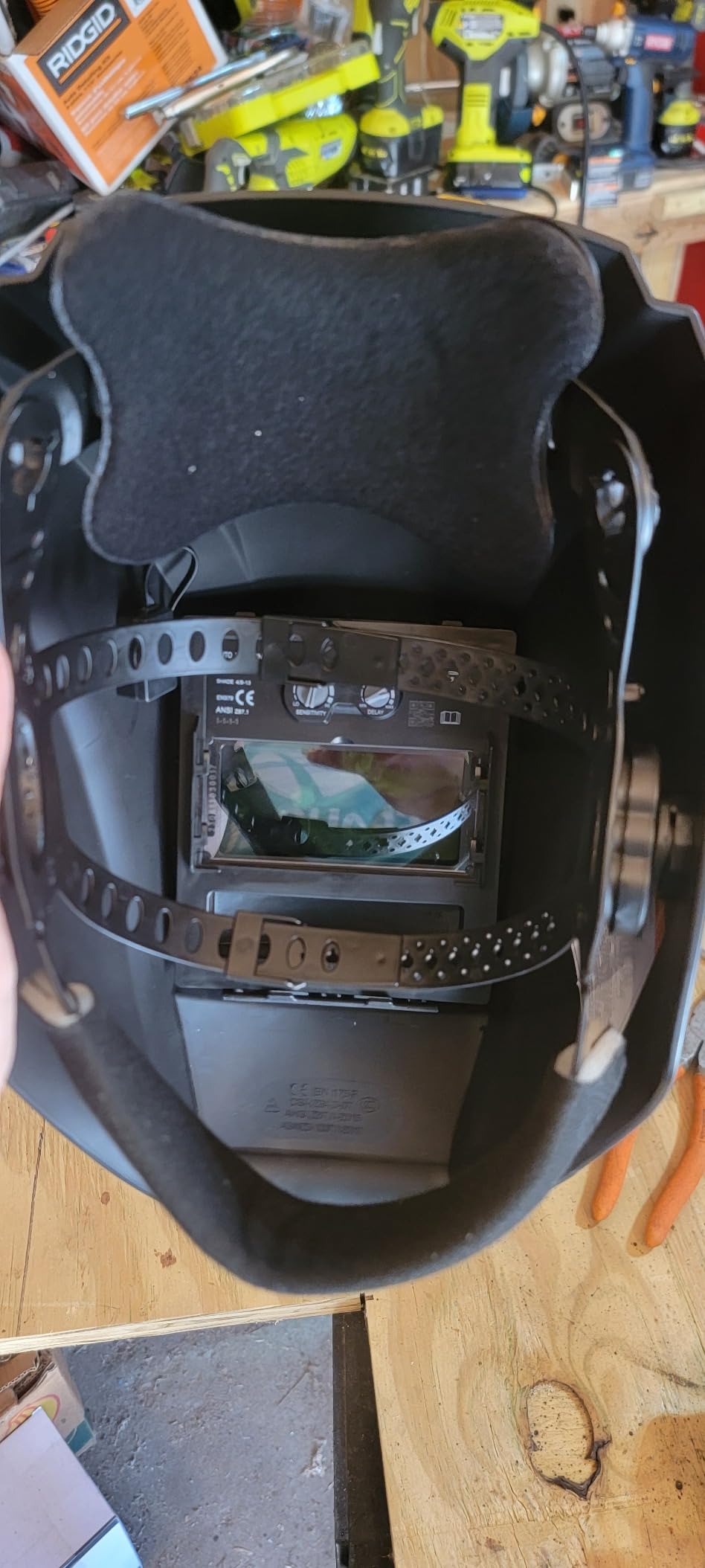
Reviewers widely report a dramatic improvement over the budget auto-darkening lenses they owned before, citing the wide view, the true color and the absence of lag. Reports of no eye strain after extended sessions come up often, which fits a helmet whose selling point is a large window you can keep down.
Several users note that the solar panel supplements battery life rather than recharging it, so treat it as backup rather than a second power source. Cheater lens compatibility means you can add magnification for thin work, which is the most common TIG request we saw from welders over 40.
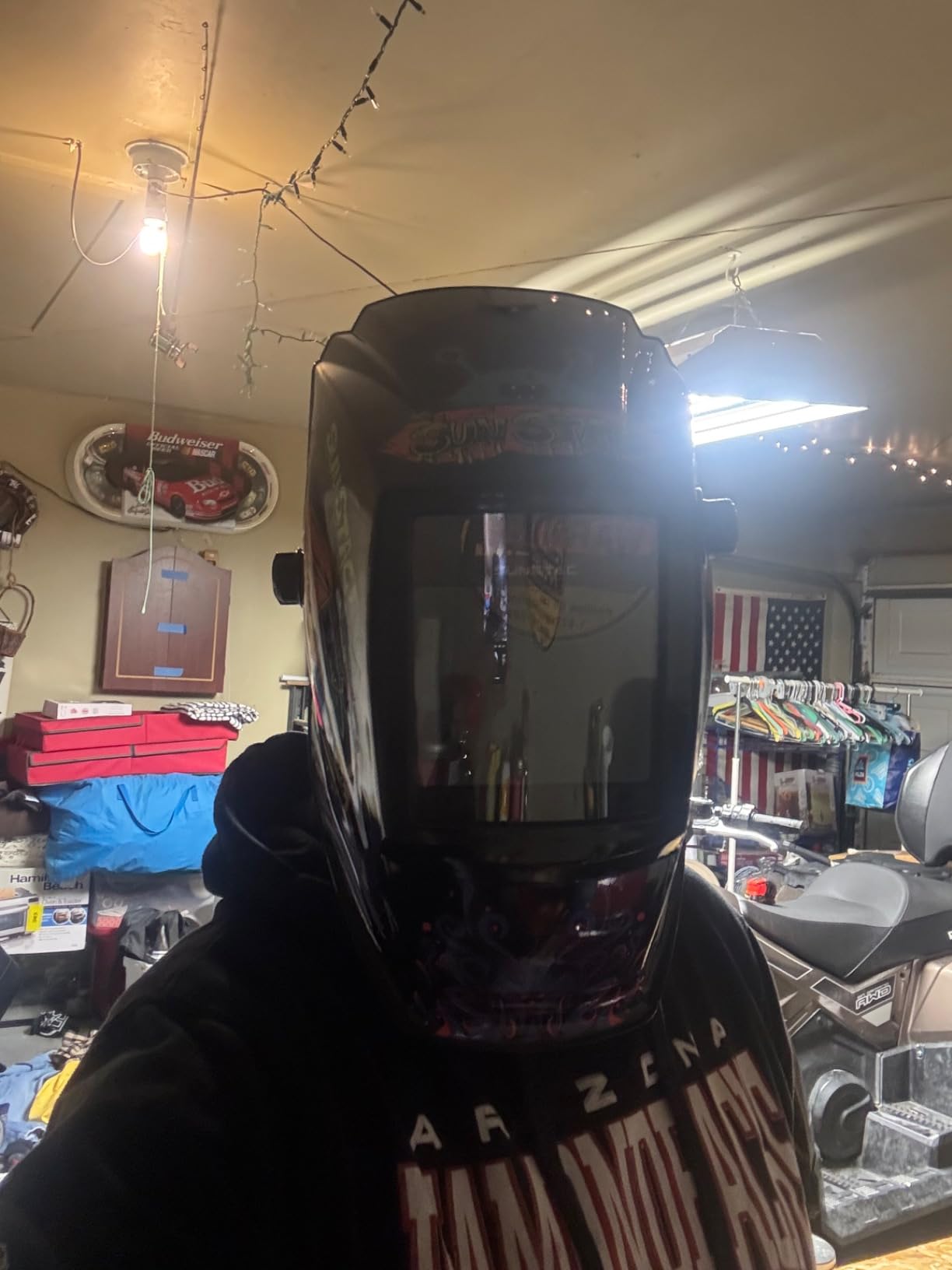
Grinding TIG beads after dark in a garage
Cleaning up a TIG bead is half the job, and it happens at the bench with the helmet down and no arc to see by. A swiveling helmet light puts the light where you are looking instead of behind you, and the flood mode is the one you will use for grinding a cap and the focus mode for reading a hairline crack before you weld it.
Because the light is rechargeable and part of the helmet, there is no separate lamp to charge, drop or trip over on a ladder. On pipe work in a plant or a crawl space, that single feature can matter more than any sensor spec.
Where the fitting details get in the way
The filter can take a moment to kick in, which reads like a fault the first time it happens. The battery compartment is awkward to access, and the side tension buttons feel delicate enough that the helmet can flop down if you overtighten them. Those are all small things, but they add up in a long session.
The headpiece is also deep, which can crowd glasses on smaller heads, and the head strap is described as somewhat fragile. If you wear safety glasses all day, check the fit early rather than at the end of your first long weld.
11. TOOLIOM E600A-A – Best Solar Powered Helmet for Long TIG Sessions
TOOLIOM Auto Darkening Solar Powered Welding Helmet for TIG MIG ARC with Light
1.14 lb
1/1/1/1 true color
1/25,000 sec
Shade 3.5/9-13
Pros
- Very light at about 1.14 lb reducing neck fatigue
- True color 1/1/1/1 view of the arc and puddle
- External knob switches to grind mode with gloves on
- Adjustable helmet light for low light work
- Headgear fits over glasses without pinching
Cons
- Cheater lens slot is too small for standard 4.25 inch magnifiers
- Rear headband presses on the back of the head
- Crown padding is thin
The TOOLIOM E600A-A weighs 1.14 pounds, which makes it the second lightest helmet in this group and the one we would pick for anyone whose TIG work is long and repetitive. At 4.6 from 1226 reviews, it is also one of the better established names at this weight class.
The lens is 3.64 by 1.67 inches with 1/1/1/1 optical clarity and true color technology, behind a precision blue light blocking outer lens. High sensitivity arc sensors switch in 1/25000 second across a DIN 3.5/9-13 shade range. An external control knob switches to grind mode, while internal sensitivity and delay knobs sit behind the shell with a low battery indicator.
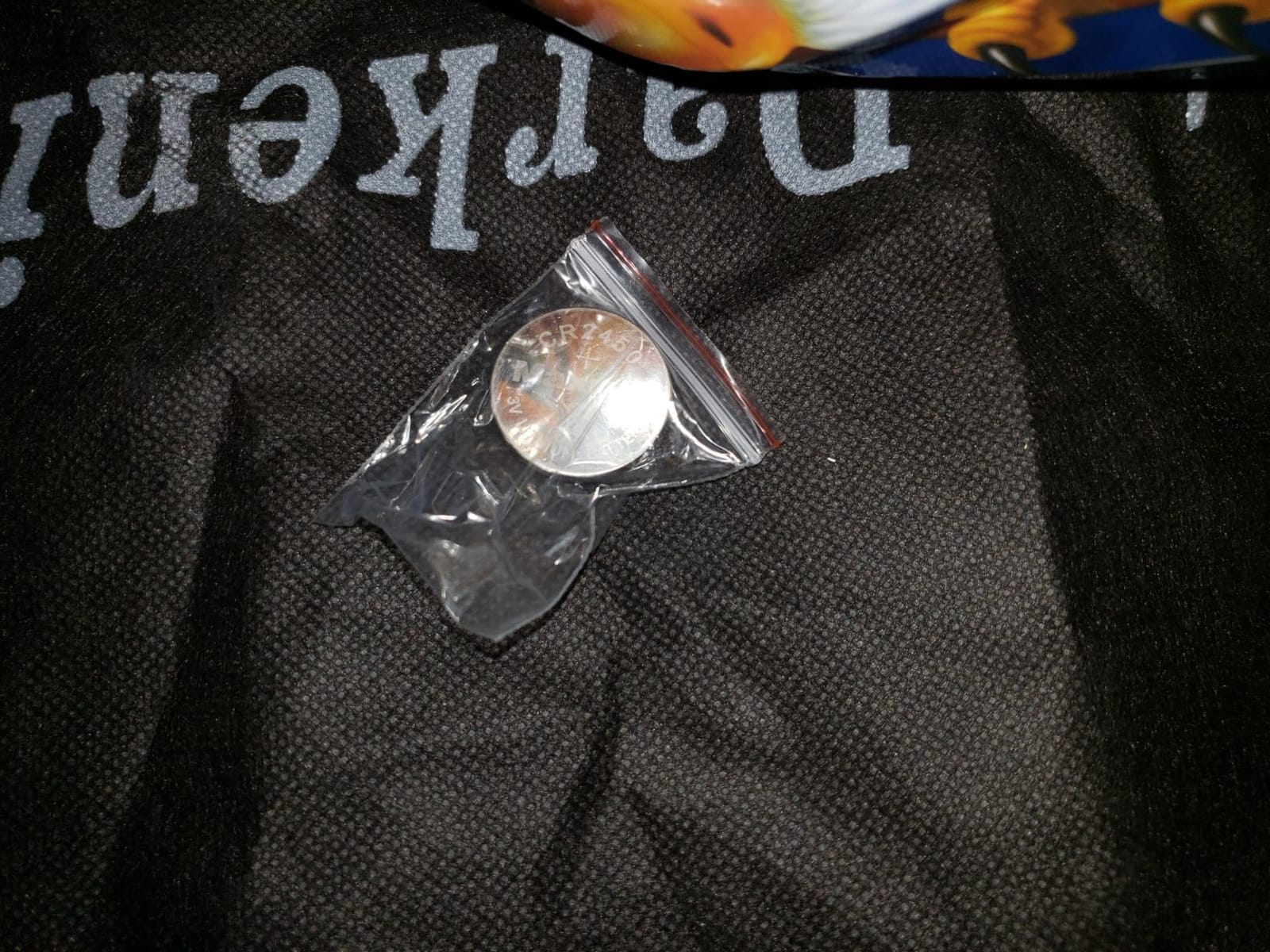
Power is solar with a replaceable battery, and the dual mode adjustable helmet light has both a spotlight and a floodlight setting with its own rechargeable battery. The box includes three replacement lenses and a spare battery. Headgear is fully adjustable PE with a breathable sweatband, and long-time welders in the reviews call it adequate for their needs at this level.
The weight is the repeated theme. Owners welding in contorted positions specifically say the low mass reduces neck fatigue, and one reviewer notes the headgear accommodates glasses or safety glasses without pinching, which is a problem several competing helmets have.
Charging by arc versus charging by battery
Solar assistance on a welding helmet does not mean the panel recharges the cell. It means the panel tops up the filter from ambient light between arcs, and the replaceable battery is what carries you through a long session. Practically, the effect is that a battery stored in the helmet on a bench for a week still works when you pick it up, which is the convenience that matters.
On TIG specifically this has a second benefit. TIG arcs are lower amperage than MIG, so they produce less surplus light for a panel to harvest. A model that only ran on solar would be a poor match, and this one is not, because the battery is the primary source.
Where the cheater lens slot disappoints
The cheater lens holder is slightly too small for standard 4.25 inch magnifiers, which is a specific and annoying failure if you are over 40 and rely on magnification for TIG. Check the slot with the lens you intend to buy rather than assuming it fits.
The rear plastic headband presses against the back of your head if tightened, and the crown padding is thin enough to be uncomfortable without hair. Long sessions in a bare shop may leave you thinking about a balaclava or a knit cap more often than you expected.
12. BESTCLUB Solar Hood – Best Helmet for Switching Between Stick and TIG
Welding Helmet Auto Darkening : BESTCLUB True Color Solar Powered Hood with Adjustable Shade Range 4/9-13 for Mig Tig Arc Welder Mask (Flag Eagle)
1/1/1/2 optics
4 arc sensors
1/25,000 sec
Shade 4/9-13
Pros
- True color lens removes the lime green tint
- Darkens immediately at arc strike
- Lightweight shell with pivot headgear
- Easy mode switching for welding grinding and cutting
Cons
- Interior feels narrow over long sessions
- Adjustment settings do not always hold position
- Optical rating is 1/1/1/2 rather than full 1/1/1/1
The BESTCLUB solar hood makes sense if your shop does stick work on heavy plate and TIG on thin stainless with the same helmet. External and internal controls switch between welding, grinding and plasma cutting modes, and shade range runs DIN 9-13 in the dark state with a 4/9-13 setting. It rates 4.4 from 637 reviews.
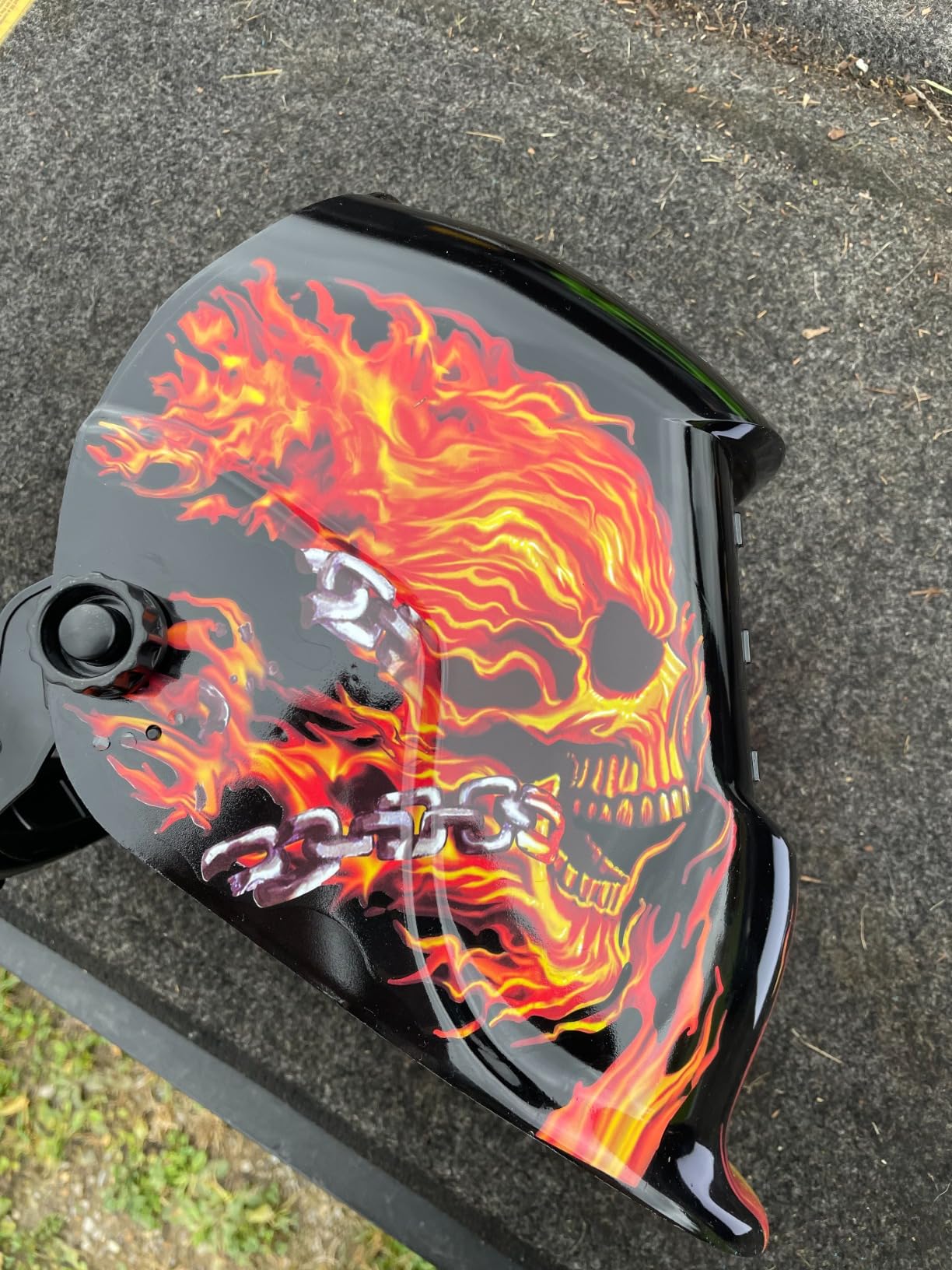
Four high sensitivity independent arc sensors switch in 1/25000 second, and the optics are rated 1/1/1/2 with true color technology. The shell is described as high impact and flame retardant, on pivot style adjustable headgear with balanced weight distribution, and the unit is solar powered. Buyers frequently mention the graphic designs as a bonus, which is not nothing when the helmet lives on your bench.
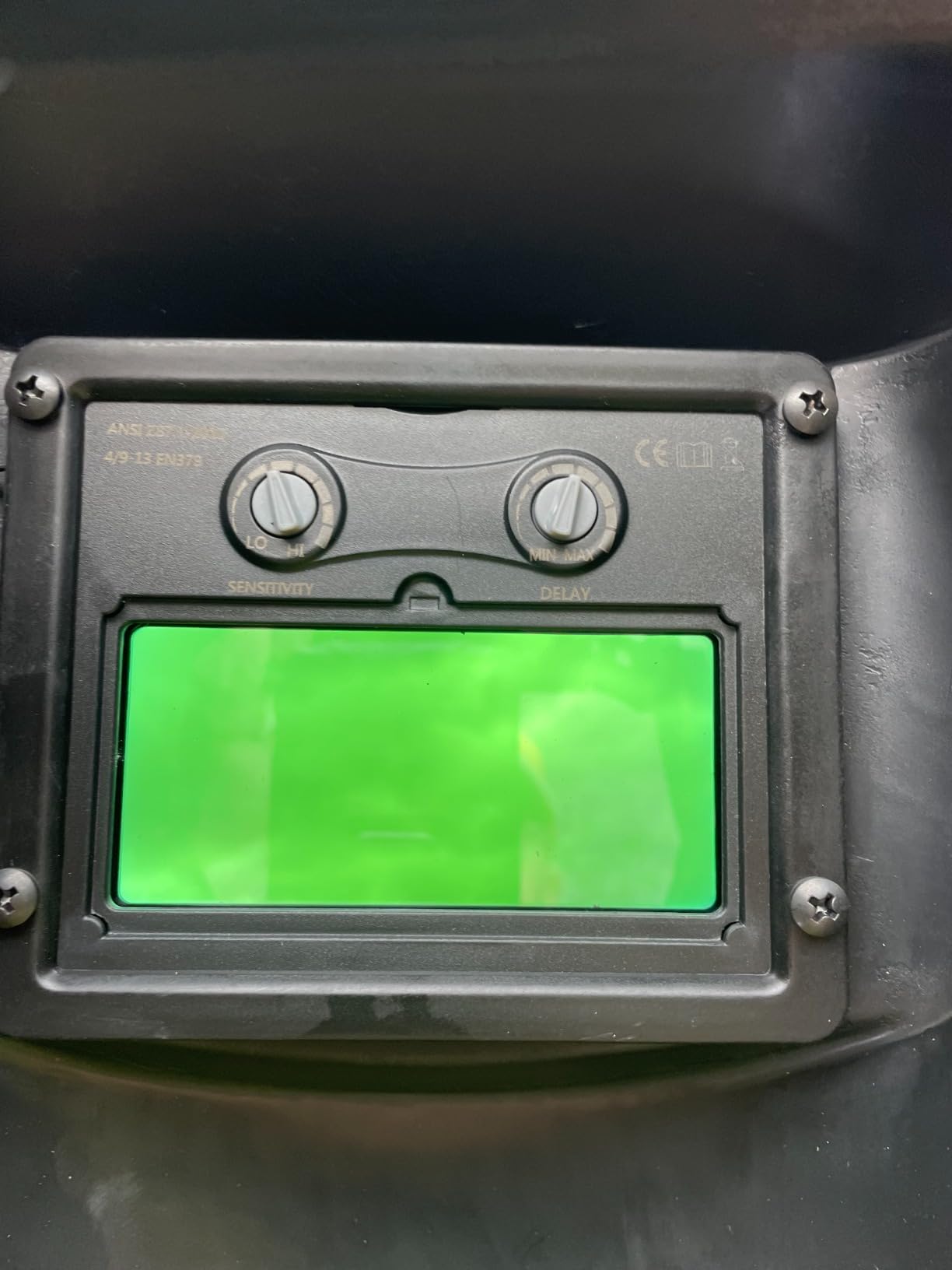
Most of the feedback is positive about the true color view removing the lime green tint and about darkening immediately at arc strike. The complaints cluster on fit and on the optical rating, both of which are things you can evaluate before committing rather than after.
There is no battery listed in the box description, so the solar panel is doing the work here. That is fine for a shop that welds regularly and less appealing if you are welding in a dark space on a battery of work.
What 1/1/1/2 actually costs you
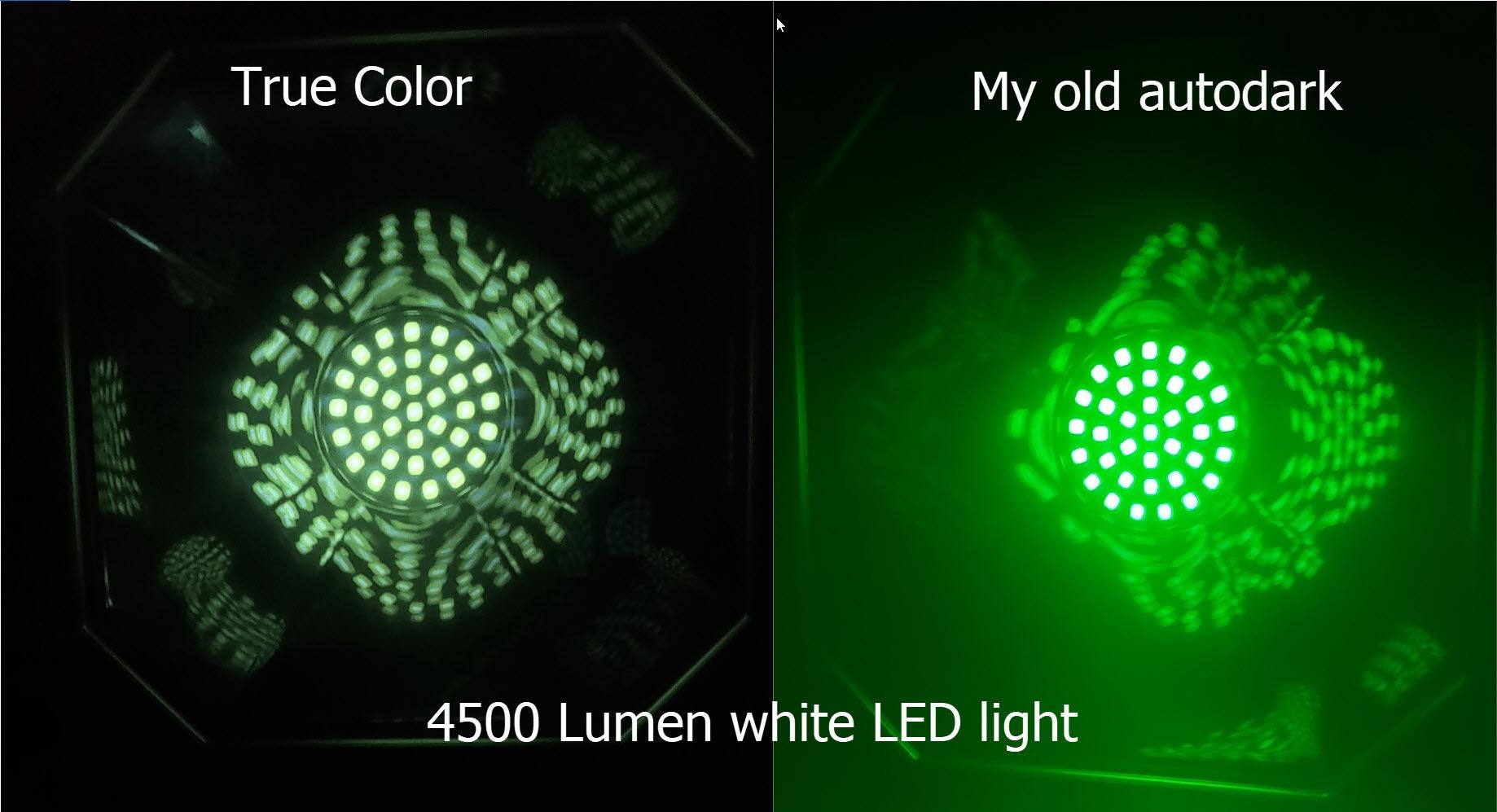
The optical class is four numbers: the first three rate how evenly the lens filters light in visible, ultraviolet and infrared, and the fourth rates color accuracy. 1/1/1/1 is the highest rating on all four. A 1/1/1/2 means the first three are maxed and the color accuracy is one step down, so you get a slightly less accurate color reproduction of the workpiece.
In practice the difference shows on work where color is a diagnostic signal, which for TIG means stainless heat tint and aluminum oxide. On mild steel at 90 amps you will not notice it. If your work lives on stainless or aluminum, the extra clarity is worth the step up to a 1/1/1/1 lens.
Where the narrow interior shows up
The hood interior feels narrow and uncomfortable over long sessions, which is the most repeated complaint in the reviews. If you are the type who keeps a hood down for four hours, budget for testing it on a long job before you commit.
Adjustment settings also do not always hold their position, so you should re-check shade and sensitivity before each job rather than assuming the dials stayed where you set them. Neither issue is dangerous, and neither is unusual at this tier, but both are reasons to check the helmet early in a project instead of at the end of it.
TIG Helmet Buying Guide: What Actually Matters
Arc sensors: why four is the practical minimum for TIG
Arc sensors detect the brightness of the arc and trigger the filter to darken. Four sensors means the helmet can register the arc whether it is in front of you or off to the side at an angle, and that is the normal condition on TIG rather than an exception. TIG is slow, so you hold angles that a MIG welder never holds, and you often weld with the arc pointing away from the front of the hood.
Two sensors work for flat work with the arc facing forward. Forum discussions about TIG helmets return to this point more than any other, and the experience reports from users are consistent: two sensors are fine at 100 amps on plate and unreliable at 20 amps on thin wall or at a fillet corner. If you can get four sensors in your price range, take them. The five sensor model in this group is the extra you pay for when you work mostly at very low amperage.
Optical class 1/1/1/1 and what each number means
Optical class is written as four numbers, such as 1/1/1/1 or 1/1/1/2. The first three describe how evenly the lens filters visible light, ultraviolet light and infrared light, and the fourth describes color accuracy. All ones is the top rating, and it is the standard we would hold for TIG because the work depends on reading fine detail and true color in the puddle.
True color technology is the related feature. Traditional auto-darkening filters carry a brown or green tint that shifts the appearance of the workpiece, which is why aluminum and stainless look different through them than they do under a bench light. A true color lens passes a more natural image, and welders working on either of those metals report that it makes the puddle and the heat tint easier to read. Every helmet in this roundup except the BESTCLUB carries full 1/1/1/1 optics.
Shade selection by amperage, including the rule of 33
The rule of 33 is a starting point, not a setting. Multiply your amperage by 0.033 and the result is your approximate shade number for steel TIG. So 30 amps gives a shade of 1, which is obviously wrong, which is how you know the rule is only useful in its higher ranges. At 150 amps it gives shade 5, at 300 amps shade 10.
In practice most TIG work falls in a narrower band than the rule suggests. Thin wall stainless and aluminum at 20 to 50 amps usually wants shade 9 to 11. Mild steel fillets at 80 to 150 amps usually wants shade 11 to 13. Aluminum on AC wants a shade roughly one step lighter than the equivalent DC amperage would suggest, because the arc is cleaner and brighter. Add a layer of rule of thumb on top of any chart: start one shade lighter than you think you need, then walk it darker until the puddle detail disappears.
Sensitivity is the setting people get wrong most often. Too low and the filter will not darken on a faint arc, which is the classic low amperage flash. Too high and it triggers on shop light, on a reflection off your ground clamp, or on someone else’s arc across the aisle. Set it high for thin work and back it off whenever you find yourself fighting false triggers.
Cheater lenses for welding over 40
A cheater lens is a small magnifying insert that sits inside the helmet in front of your eyes. For anyone past the age where close focus is no longer effortless, it is the difference between welding and guessing. The practical range is 1.25 to 2.5 diopters, with most welders landing somewhere between 1.5 and 2.0.
Check two things before you buy a helmet for cheater lens use. First, confirm the slot accepts the magnifier size you need, because the TOOLIOM E600A-A in this group has a holder that is documented as slightly undersized for standard 4.25 inch magnifiers. Second, confirm the lens can be flipped up so you can see the joint without your glasses at setup time. Several models here list cheater lens compatibility but give you no way to get the magnification out of the way when you need to look up close at fit-up.
Headgear balance for four hour TIG sessions
TIG posture is the reason ergonomics matter more here than on any other process. Your head stays down and forward, neck bent, for minutes at a time with no relief motion. A helmet that tips forward adds load to the exact muscles already working, so weight distribution across the crown matters more than the number on the scale.
The Lincoln X6 and the Hobart low profile shell both handle this well, and the six ounce Jackson Insight handles it better than anything else here. At the other end, owners of the pivot headgear helmets in this group report creep and discomfort, which is worth factoring in if you weld full days. Pairing a helmet with a good setup surface makes a larger difference to TIG fatigue than most people expect, and our guide to the best welding tables for garages covers the height and clearance side of that.
Battery type and replacement lens availability
Prefer a replaceable coin cell or lithium battery over a sealed rechargeable pack, because a sealed pack eventually becomes e-waste and the replacement is the whole helmet. Most of the models here take a CR2450 or CR2032 coin cell, and the Lincoln even ships five outside and two inside cover lenses in the box.
Cover lens availability is the quieter ownership cost. Some helmets use standard 4.5 by 5.25 inch clear plates that any supply house stocks, while others use proprietary sizes. If you grind TIG beads regularly you will replace outer covers monthly, so check the standard size before you commit. If you are setting up a mobile shop or a trailer, add a spare battery and a couple of cover lenses to your kit on day one, alongside a cart that keeps them organized. Our picks for the best welding carts for MIG welders work just as well for TIG gear storage.
Frequently Asked Questions
What is the rule of 33 in TIG welding?
The rule of 33 is a starting formula: multiply your amperage by 0.033 to get an approximate shade number. At 300 amps it gives shade 10 and at 150 amps it gives shade 5. Because it falls apart at the low amperage range where most TIG work happens, treat it as a rough starting point and then adjust by eye until you can see the puddle edge clearly.
What is the best helmet setting for TIG welding?
Start in shade 10 for thin stainless and aluminum between 20 and 50 amps, and shade 11 to 13 for mild steel fillets between 80 and 150 amps. Set sensitivity high enough that the filter darkens on a faint arc, then back it off until it stops tripping on shop light or reflections. Delay set to medium keeps the filter dark briefly after the arc stops, which makes short passes much easier to see.
How many arc sensors do I need for TIG welding?
Four arc sensors is the practical minimum for TIG, because TIG welders hold the arc at angles a MIG welder never holds and detection gets unreliable off axis. Two sensors are workable for flat plate work with the arc facing forward, but they are the most common reason welders report flashing on thin material or at fillet corners.
What is the best auto dark lens shade for TIG welding?
Shade 9 to 11 covers most TIG work in the 20 to 50 amp range on thin stainless and aluminum. Shade 11 to 13 suits mild steel fillets from 80 to 150 amps. For AC TIG on aluminum, start one shade lighter than the equivalent DC setting because the arc is cleaner and brighter. Always start one shade lighter than you think and darken until the puddle detail disappears.
Why is my TIG welder not arcing?
Common causes include tungsten contamination, gas flow set too low or too high, a dirty or damaged cup, incorrect polarity with the torch lead on the wrong terminal, and an earth clamp connection that has gone hot. On the helmet side, a filter that will not darken on a faint arc makes it look like the machine is not striking when the arc is actually just too dim for the sensor to catch.
Final Verdict on the Best Welding Helmets for TIG Welding
The Lincoln Electric Viking 3350 4C is our pick among the best welding helmets for TIG welding because it solves the two problems that actually cost you welds: seeing the puddle clearly through 1/1/1/1 optics across a 12.5 square inch window, and having a balanced shell that stays comfortable through a four hour TIG session. The Hobart 770890 is the runner up for anyone who wants a wider window and less weight, and the YESWELDER LYG-L600A remains the sensible first helmet if you are working at 60 amps and up on plate rather than chasing thin-wall work.
Everything else in this roundup earns its place on a specific job. The Jackson Safety Insight at six ounces is the answer for pipe and overhead work. The Miller Classic ClearLight wins on a light state bright enough to keep the hood down between passes. The Sunstac and the TOOLIOM E600A-A cover dim shops with their built in lights. And if your main problem is fit-up rather than arc detection, the TOOLIOM TL-31800H gives you 14.4 square inches of window to work with.
Whatever you choose, set the sensitivity high and the shade one step lighter before your first pass on 2026‘s thinner material, and give it ten minutes on a real job before you decide. Every one of these twelve will do fine TIG work, and the differences show up in how quickly you learn.