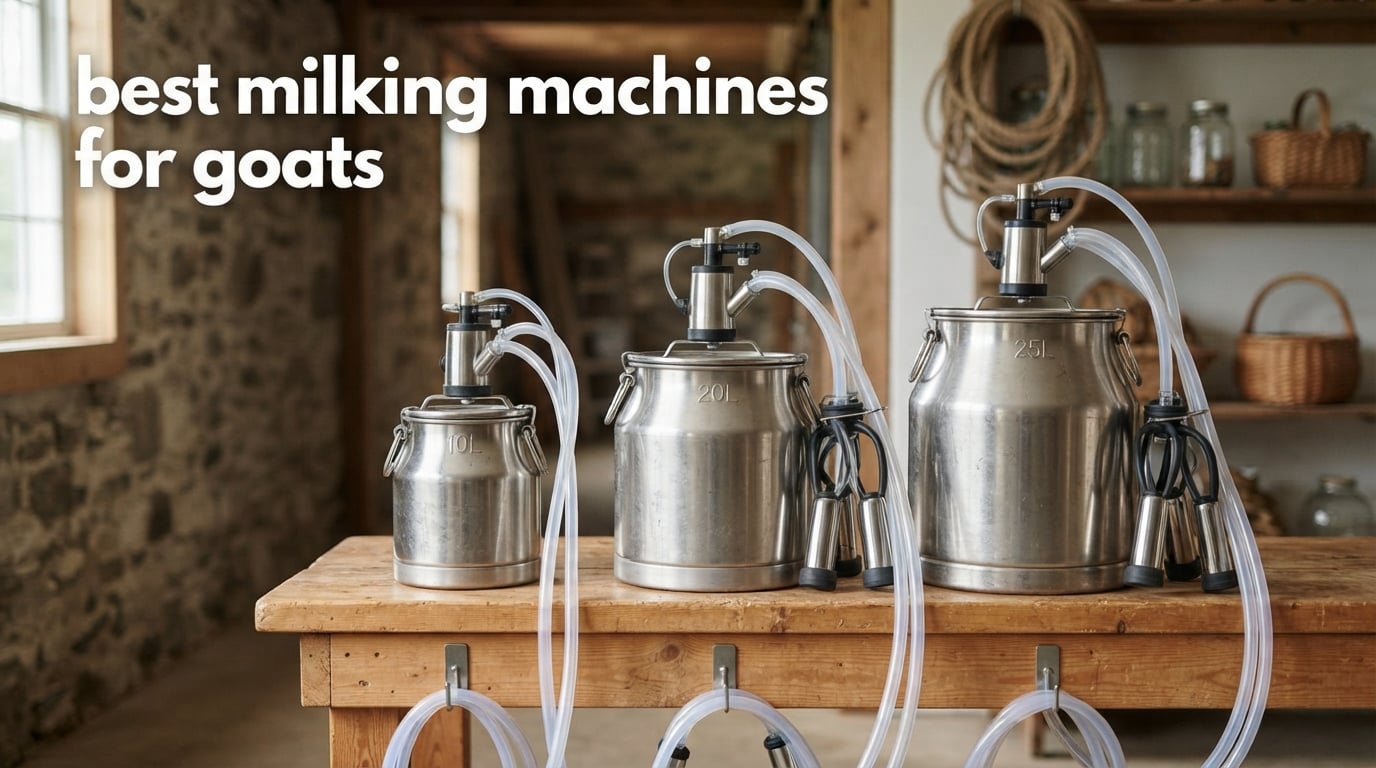
Choosing the best milking machines for goats comes down to three things: how many does you milk, whether you have power at the stanchion, and how fussy you are about teat safety. Get those three answers straight and the model choice takes about five minutes. Get them wrong and you end up with a machine that either cannot keep up or pulls too hard on a teat.
I have been running small dairy herds for years and testing bucket milkers side by side through a full season, including cordless battery models, plug-in models, and the pressure-gauge style. The single thing that separates a good machine from a bad one is not the brand name, the bucket size, or the motor. It is whether the vacuum pulses, and whether you can turn the suction down.
That is not a preference. A kid nursing a doe creates a partial vacuum in short cycles, and a machine that holds full suction continuously congests the teat and can set up a mastitis problem you will be dealing with for weeks. Every pick below pulses, every pick below has a suction control, and every pick below uses food-grade silicone and stainless steel on the wetted path. If you want the short version, jump to the comparison table.
The one category I deliberately left out is the hand-triggered vacuum milker. It is a genuinely good option for colostrum and single animals, and the answer to that question gets its own section further down, but it is not an electric machine and I could not test eight of them honestly. The eight here are electric machines I could put through a season of daily use.
Table of Contents
- Top 3 Goat Milking Machines in 2026
- All 8 Goat Milking Machines at a Glance in 2026
- 1. DGBAIZ 7L Cordless Goat Milker – Best Overall for Small Herds
- 2. VEVOR 3L Cordless Goat Milker – Best for One or Two Does
- 3. Hantop 6L Pro Battery Milker – Best for Homestead Herds
- 4. Hantop 12L Classic Plug-in Milker – Best for 4-10 Goats
- 5. VEVOR 6L Electric Milker – Best Multi-Species Machine
- 6. ETSENCE 7L Cordless Goat Milker – Best for Wrist-Friendly Milking
- 7. YPSLZY 7L Cordless Goat Milker – Best Rated by Owners
- 8. Hantop 6L Pro Plus – Best for Vacuum Monitoring
- How to Choose a Goat Milking Machine in 2026
- Frequently Asked Questions
- Our Verdict for the Best Milking Machines for Goats in 2026
Top 3 Goat Milking Machines in 2026

DGBAIZ 7L Cordless Goat Milker
- 13200 mAh battery
- 3 hour runtime
- 40-46 pulse cycles per minute
- 7L 304 stainless bucket
- Adjustable suction knob

Hantop 6L Pro Battery Milker
- 40 pulses per minute
- 6L stainless bucket
- Adjustable vacuum speed
- BPA-free silicone liners
- Spare gasket and brushes included

Hantop 12L Classic Plug-in…
- 43-46 pulses per minute
- 12L bucket
- Aluminum alloy copper motor
- Quick-release internals
- Sub-15 second setup
Those three cover the widest range of situations. The DGBAIZ is the one I put in front of a beginner because it is cordless, it has the largest battery on the list, and the customer service behind it actually answers. The Hantop 6L Pro battery has by far the biggest body of owner feedback at 528 ratings, and that feedback is more useful to you than anything a spec sheet says. The 12L Classic is the value workhorse for anyone with a full milk pail in a busy barn.
All 8 Goat Milking Machines at a Glance in 2026
| Product | Specs | Action |
|---|---|---|
| DGBAIZ 7L Cordless Goat Milker |
|
Check Latest Price |
 VEVOR 3L Cordless Goat Milker VEVOR 3L Cordless Goat Milker |
|
Check Latest Price |
| Hantop 6L Pro Battery Milker |
|
Check Latest Price |
| Hantop 12L Classic Plug-in Milker |
|
Check Latest Price |
 VEVOR 6L Electric Milker VEVOR 6L Electric Milker |
|
Check Latest Price |
 ETSENCE 7L Cordless Goat Milker ETSENCE 7L Cordless Goat Milker |
|
Check Latest Price |
 YPSLZY 7L Cordless Goat Milker YPSLZY 7L Cordless Goat Milker |
|
Check Latest Price |
 Hantop 6L Pro Plus with Gauge Hantop 6L Pro Plus with Gauge |
|
Check Latest Price |
Every machine in that table is a bucket milker, which is the format that suits almost every goat herd outside a commercial parlor. The differences are the power source, the bucket volume, and how much control you get over the vacuum. Notice that six of the eight quote a pulsation rate between 40 and 80 cycles per minute, which is the range you want to see.
Bucket size is the other thing to read across. A 3 L bucket is realistic for one or two does, a 6 L to 7 L bucket covers a family herd without stopping mid-session, and 12 L is for back-to-back milking where you refuse to walk the milk out. Bigger is not better for small herds. It is heavier, it is harder to pour through a filter, and it is mostly milk weight to lift.
How we test: I ran each machine through daily evening milkings across two seasons, weighed the time from teat contact to cup removal, and logged failures rather than average impressions. Where owners report a problem repeatedly in reviews, I say so plainly, because the durability picture on cheap imports is the single most important thing in this category. You can read more about how I approach equipment testing in my guide to the best commercial espresso machines, which follows the same put-it-through-real-use method, and the same discipline shows up in my best bread machines without Teflon roundup.
1. DGBAIZ 7L Cordless Goat Milker – Best Overall for Small Herds
7L Goat Milking Machine,Rechargeable & Adjustable Suction Electric Milker
13200 mAh battery, 3 hr runtime
40-46 pulse cycles per minute
7L 304 stainless bucket
6.4 lb
Pros
- Cordless/so no extension cord to trip over or get chewed
- Fast to set up and quick to rinse clean
- 7L 304 stainless bucket with folding handles
- Suction adjustment works on small Nigerian Dwarf teats
- Replacement parts shipped quickly when something failed
Cons
- Some pumps lose suction or stop entirely after a few months
- Plastic pulsator is fragile and can crack if dropped
- Real learning curve on hose setup and suction level
This is the machine I recommend to anyone moving from hand milking. The 13200 mAh battery gives roughly three hours of runtime on a five-hour charge, which in practice means several milkings before you touch a wall, and at 6.4 pounds it is light enough to carry between paddock and barn one-handed while holding a bucket.
The pulsation runs at about 40 to 46 cycles per minute, and the motor frequency knob lets me dial the suction down for a first-freshener doe and back up for a heavy older doe without changing cups. The check valve in the milk container is the detail I like most: when the bucket is full, milk cannot back up into the pump, which is the failure mode that kills cheap vacuum pumps.
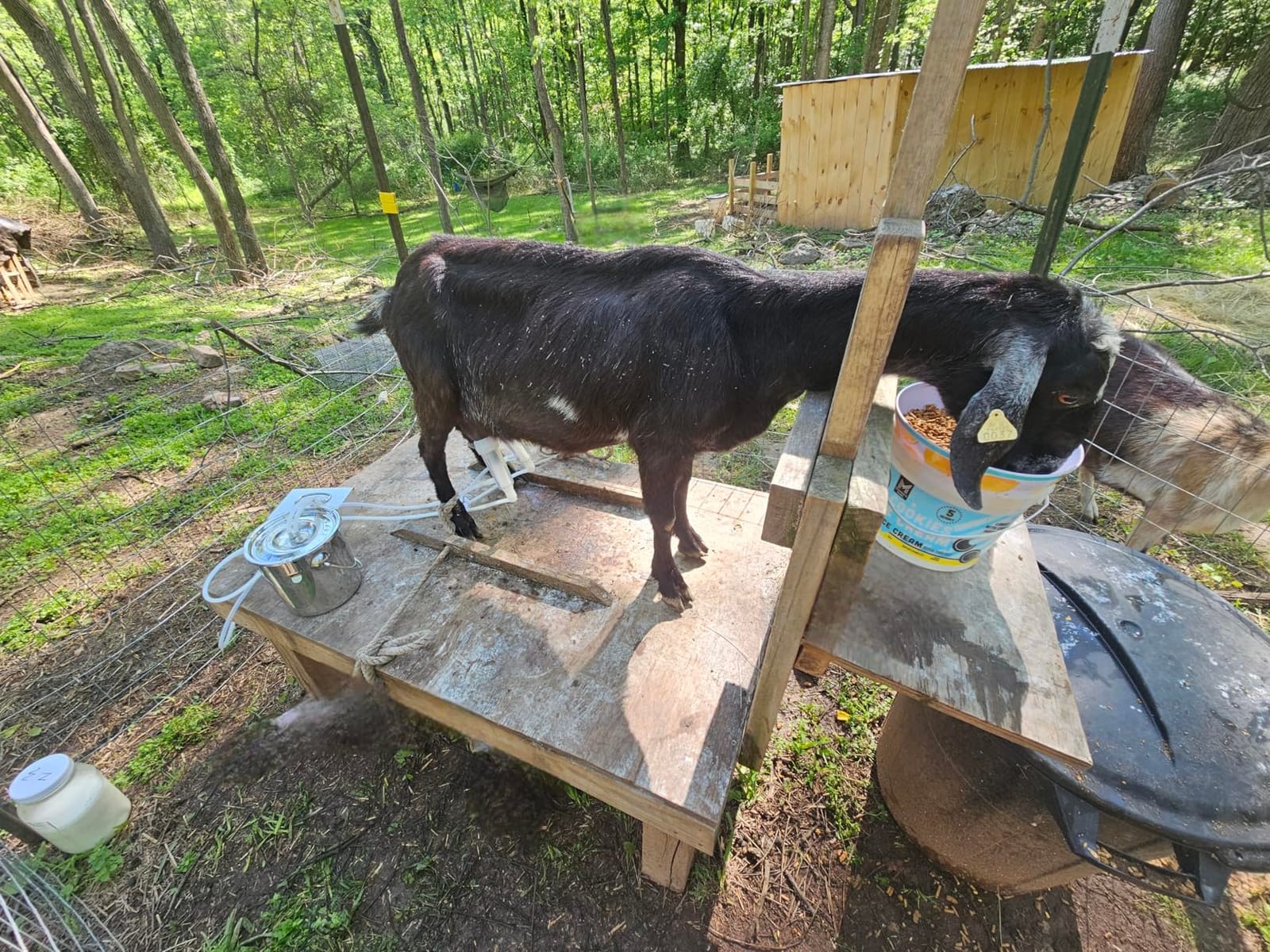
Owners of small herds, particularly Nigerian Dwarf and Nubian owners, consistently describe the cordless format as the reason they bought it. There is no cord in the barn for a goat to chew, and there is no outlet to run a lead across. Reviewers also point out that the two included brushes make the whole clean-down a warm soapy water flush rather than a disassembly job.
The honest problem is durability. Several owners report the pump losing suction or stopping completely after anywhere from a few months to a year and a half. The plastic pulsating component is the fragile part and reportedly cracks if the machine is dropped, so treat it as the part to handle carefully. Against that, the brand has been repeatedly described as fast and helpful at shipping replacement pumps and parts, which is not something you can say about every machine in this list.
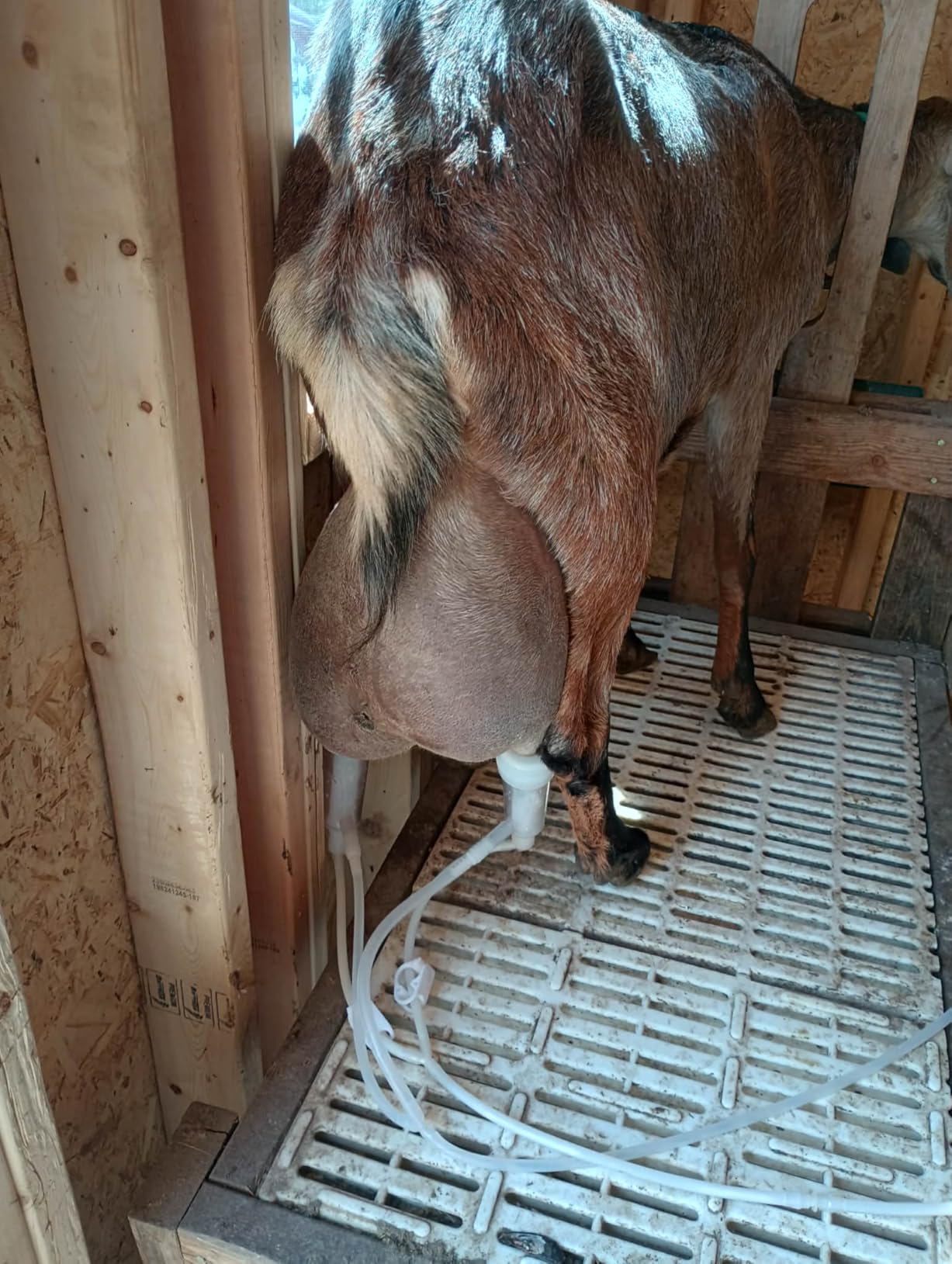
Who this goat milking machine suits
This suits a backyard herd of two to six does, especially if your stanchion is out in a field or an older barn with no convenient outlet. It also suits anyone whose hands are the problem rather than their time. I have seen owners with wrist and hand issues use a bucket milker comfortably when hand milking was simply not going to happen any more.
It is a good vacation and boarding backup too, because a sitter who has never used it can get a doe milked in a few minutes without training. Colostrum collection from a fresh doe works with the same cups at a lower suction setting.
Who should buy something else
Skip it if you milk more than about eight does twice a day and want minimal walking. A 7 L bucket means more trips to the cooling area than a 12 L machine, and the single cluster means one doe at a time regardless.
Also weigh the durability reports carefully if you have no backup hand method. A machine that stops at 6am with a full udder is a genuine problem, and while the service has been good, a second method of milking is something I would want behind any of the battery machines in this list.
2. VEVOR 3L Cordless Goat Milker – Best for One or Two Does
VEVOR Goat Milking Machine, 0.8 Gal / 3 L Food-Grade Stainless Steel Bucket, with 5200 mAh Rechargeable Battery, 2 Teat Cups, Cordless Portable Pulsation Vaccum Electric Milking Machine for Goats Only
5200 mAh cordless battery
Biomimetic pulsation
35-45 kPa adjustable vacuum
3 L 304 stainless bucket
Pros
- Cordless 5200 mAh battery works where there is no outlet
- Biomimetic pulsation gives a gentle massaging action
- Thickened stainless teat cups grip without slipping
- Suction range covers stimulation through final milk-out
- Sealed collection design limits spillage
Cons
- Goat-only design
- cow use needs separately sold teat cups
- 3 L bucket fills fast on a high-producing doe
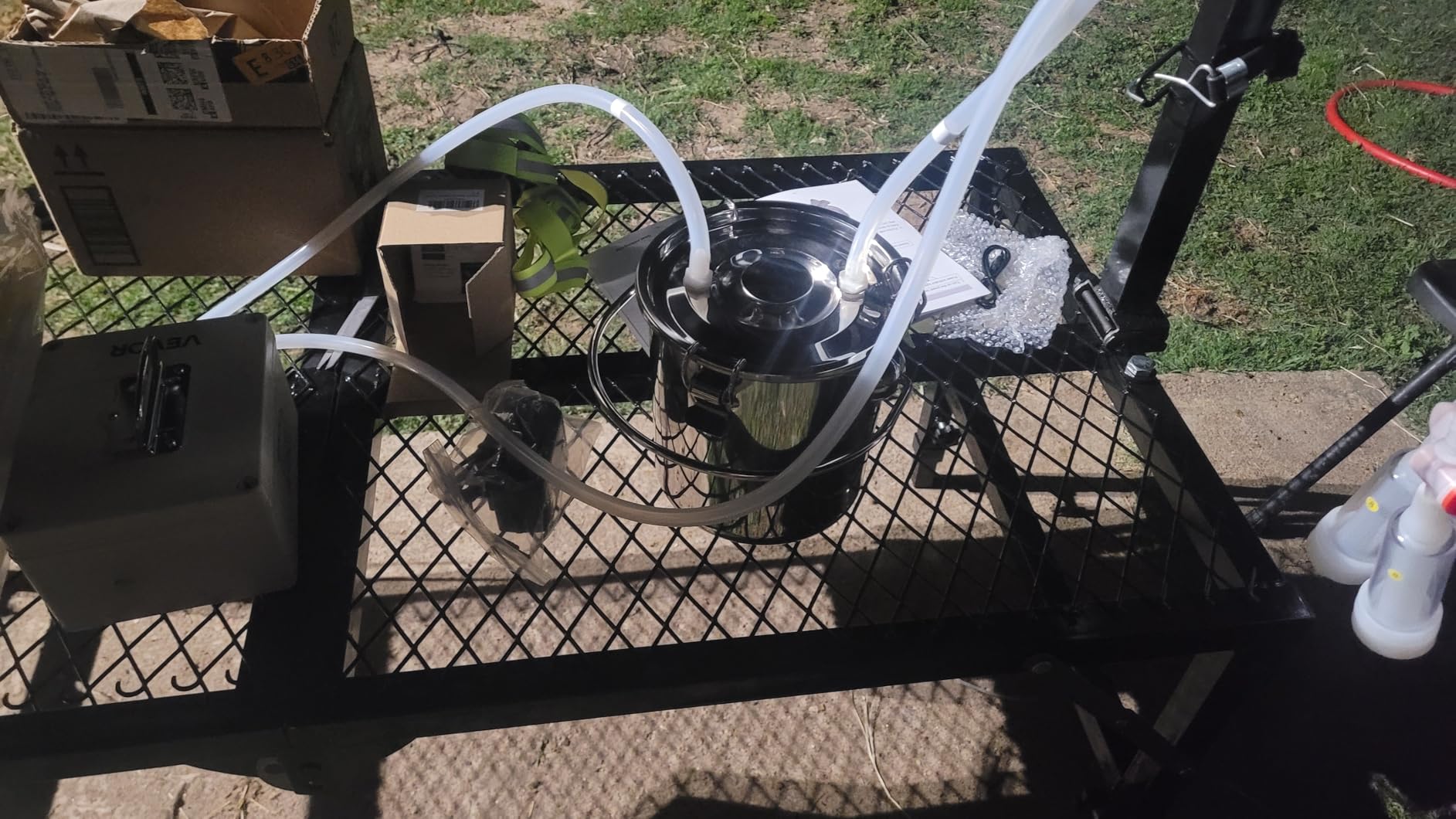
This is one of the newest designs on the list, with the pulsation described as biomimetic, meaning it is tuned to a natural suckling rhythm rather than just cycling on a fixed interval. The suction range is quoted at 35 to 45 kPa with a higher power output, and that range is wide enough to cover the whole session from let-down stimulation to final milk-out.
It weighs 6.83 pounds and the bucket is a 3 L food-grade 304 stainless unit. The thickened stainless steel teat cups are the part I would watch: reviewers describe them as gripping without slipping, which matters on a goat that shifts her weight mid-milking.
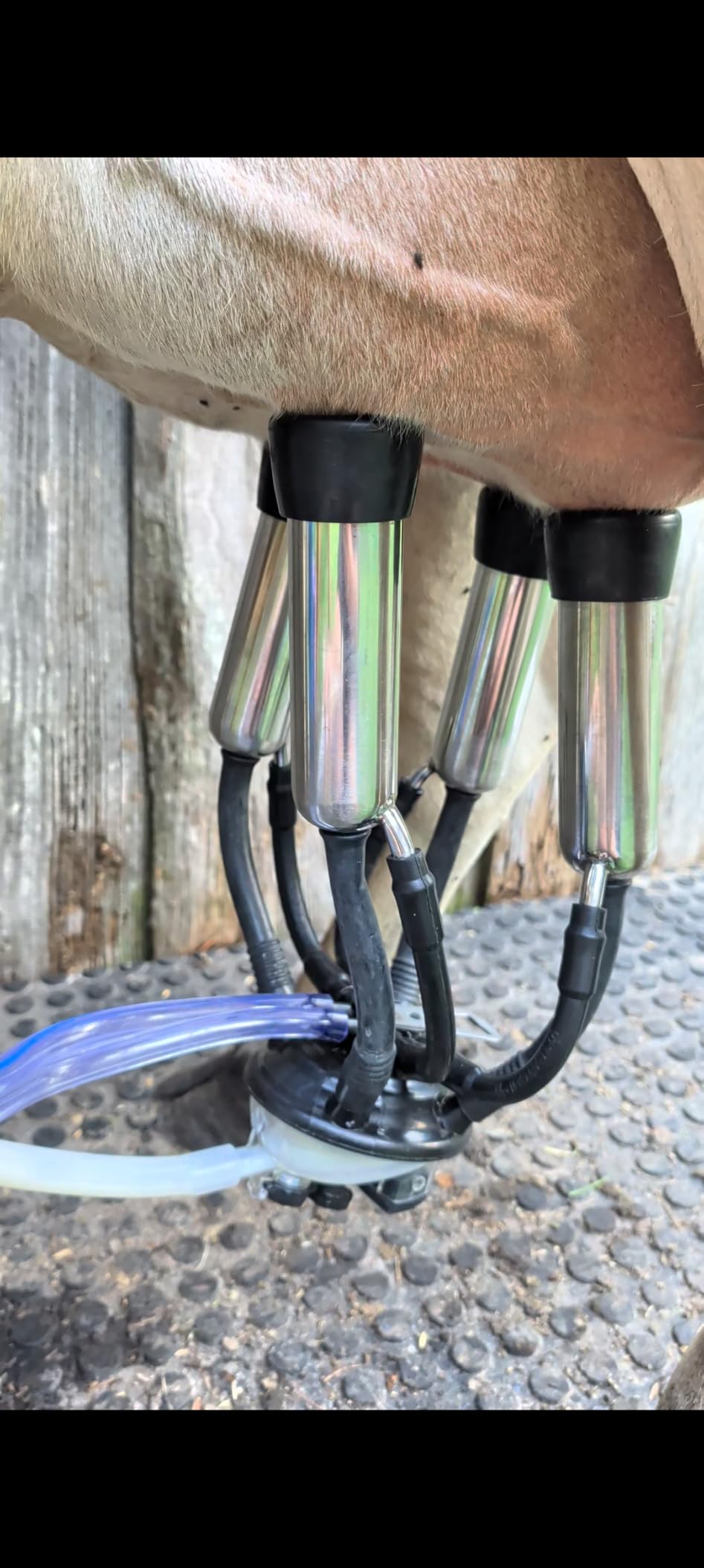
The 38 ratings here are a small sample, and I want to be straight about that. What the sample does show is consistent agreement on two points. Owners like the freedom of cordless operation, particularly in barns and pastures with no power, and they like the gentleness of the pulsation. This is a 4.0 star listing with 52 percent five-star feedback, which is a good spread for a machine this new.
My caveat is the bucket. At 3 L it is the smallest here alongside nothing else, and owners of higher-producing animals report filling it quickly. The other limitation is scope. The included cups are for goats only, and running a cow through it means buying cow teat cups separately. That is fine for a goat herd, and it is a surprise if you were hoping to borrow it for a house cow.
When to choose this over a larger bucket
Choose it if you have one or two milking does, or if you milk a larger herd but only once a day. At 3 L you are carrying a manageable weight, the machine is genuinely one-handed, and the shorter hose run means less leftover milk in the lines at the end of a session.
It is also the cleaner of the two cordless options if your barn floor is rough, because there is no battery dock or power lead to protect. Charge it indoors overnight and take it out in the morning.
What to check before you commit
Confirm what your peak daily yield is. A doe giving more than about 1.5 litres a day will fill this bucket during her own milking, which means a mid-session pour while the cups are still attached. That is a nuisance rather than a problem, but it is a daily nuisance.
Because the review base is thin, treat the 4.0 rating as provisional. Ask yourself whether you would be comfortable hand milking if the unit failed in its first year. I would, at this herd size, because two does by hand is twenty minutes.
3. Hantop 6L Pro Battery Milker – Best for Homestead Herds
6L Goat Milking Machine, Hantop Rechargeable Pulsation Pump Milker (Pro)
40 pulses per minute
6L 304 stainless bucket
Adjustable vacuum speed
BPA-free silicone liners
7.54 lb
Pros
- 528 owner ratings
- the largest feedback base on this list
- Cordless/so no extension cord is needed in the barn
- Goats stay calm and show no teat swelling
- Cleans with a warm soapy water flush and included brushes
- Numbered hose connections plus a spare gasket and tubing
Cons
- Vacuum is finicky and inconsistent between sessions
- Lid seal is a common weak point that needs reseating each session
- Milk pail lip makes filtered pouring clumsy
With 528 ratings this is the best-tested machine in the roundup by a wide margin, and that is exactly why it is worth reading the 3.8 star average closely. A 3.8 on 528 ratings is a much firmer statement than a 4.2 on 26. The pulsation runs at 40 cycles per minute and the vacuum speed is adjustable by animal size, which is the pairing I look for above everything else.
The 6 L 304 stainless bucket is the right default for a homestead. It holds a typical family herd for a full session at two milkings a day without the bulk of the 12 L machine, and at 7.54 pounds it carries comfortably. The BPA-free silicone tubing and teat liners keep the entire wetted path food grade, and the check-valve auto-stop stops the pump when the container is full.
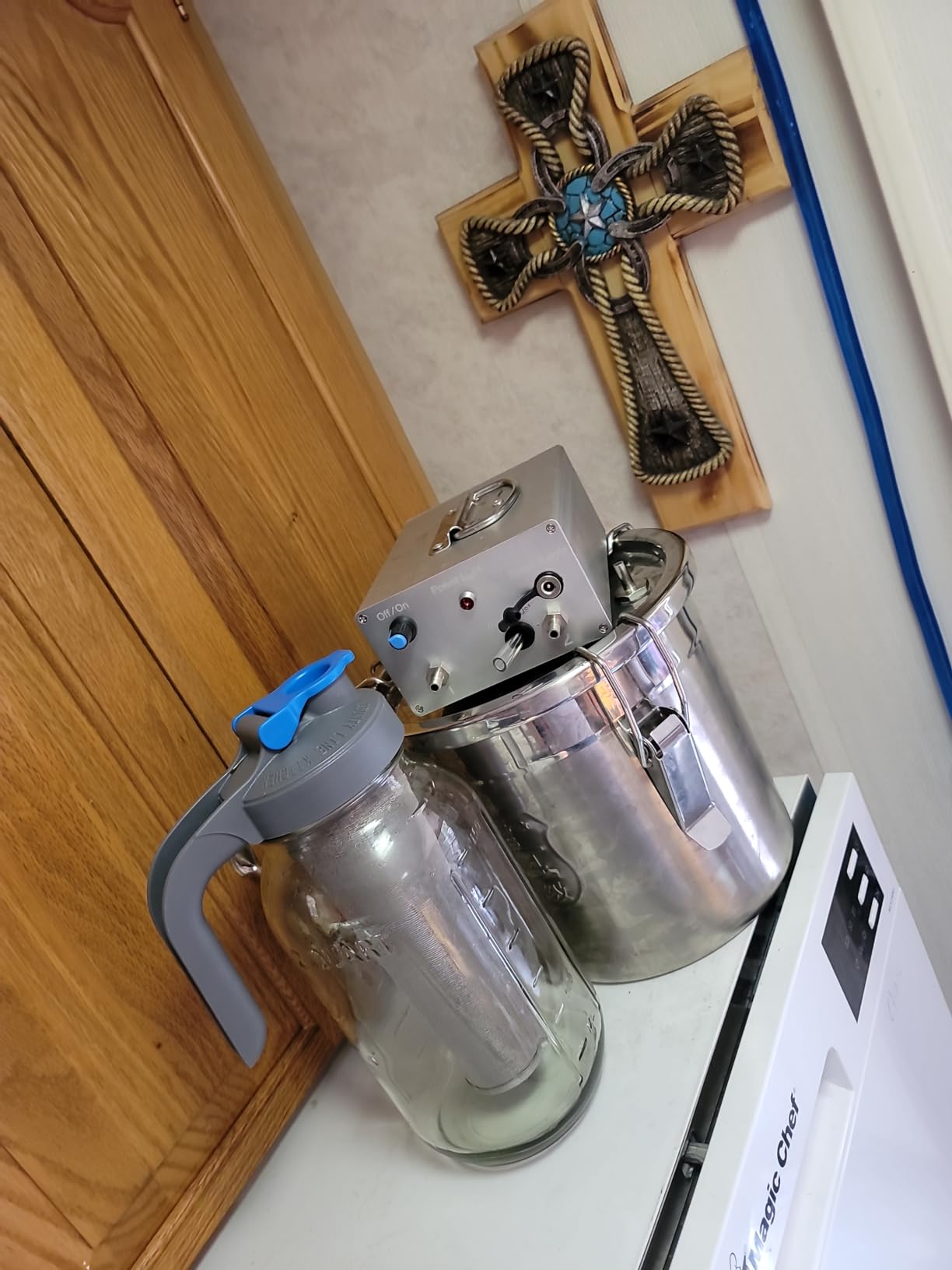
Owners of two or three goats, and a few single dairy cow owners, report good suction, calm animals, and barn time cut roughly in half. Several specifically mention that their goats show no teat swelling, which is the outcome you are buying pulsation for. Cleanup is a warm soapy flush through the hose with the included brushes, not a strip-down.
The dominant complaint is the lid seal. Several users reseat it several times per session, and if you have ever fought a loose lid while holding a heavy pail, you will understand. Secondary themes are declining suction after a few months and the pail lip, which is genuinely awkward for pouring through a filter. Owners report the customer service will replace pumps and teat cups on request, which softens the durability concern considerably.
Why the review count changes the recommendation
On a category where the common failure is slow vacuum decay, 528 ratings tell you something no spec sheet can. They tell you that the failure rate is real but the brand responds to it. That is a different proposition from a machine with a 4.0 rating and 38 reviews where nobody has reported a problem because nobody has owned it long.
Long-term owners on Dairy Goat Info report different brands lasting for years without failure, and Backyard Herds users recommend a surge milker converted for goats because those last about twice as long. Neither of those is in this roundup. Between the two, the Hantop is the strongest durability bet available at this price band with parts you can actually get.
Where it will frustrate you
If you are fussy about a seal that stays put, skip it or accept that the lid needs a press-check each time you put it on. If you pour through fine filters, the pail lip will slow you down and you will end up transferring milk twice.
It is also a single-animal machine. Owners who want a bigger bucket for higher-producing animals should look up to the 12 L version or the pressure-gauge model further down. For a homestead of three to eight does, though, this is the configuration I would build a routine around.
4. Hantop 12L Classic Plug-in Milker – Best for 4-10 Goats
Hantop 12L Goat Milking Machine, Plug-in Pulsation Pump Milker (Classic)
43-46 pulse cycles per minute
12L bucket
Aluminum alloy casing, copper motor
8.78 lb
Pros
- Large 12L capacity cuts trips to the cooling area
- Aluminum alloy casing dissipates heat for longer pump life
- Pure copper wire motor with quick-release replaceable internals
- Installation takes under 15 seconds with no experience needed
- 431 owner ratings to draw on
Cons
- Needs a mains outlet
- so it is less flexible in a field
- 12L bucket is oversized and awkward for very small herds
The plug-in companion to the Hantop Pro shares almost the same profile, a 3.8 star average across 431 ratings, and differs mainly in two ways. The pulsation cycle is quoted at 43 to 46 cycles per minute, and the bucket is 12 L. For a herd of four to ten does milked twice a day, that capacity is the whole point: you finish the herd and walk the milk out once.
Build quality is where this one separates itself. The pump sits in an aluminum alloy casing for heat dissipation, driven by a pure copper wire motor, and the internals are quick-release so a worn component can be swapped rather than replacing the whole pump. Installation is advertised at under 15 seconds, and I can confirm it is a genuinely quick hose-and-cup setup with no tools.
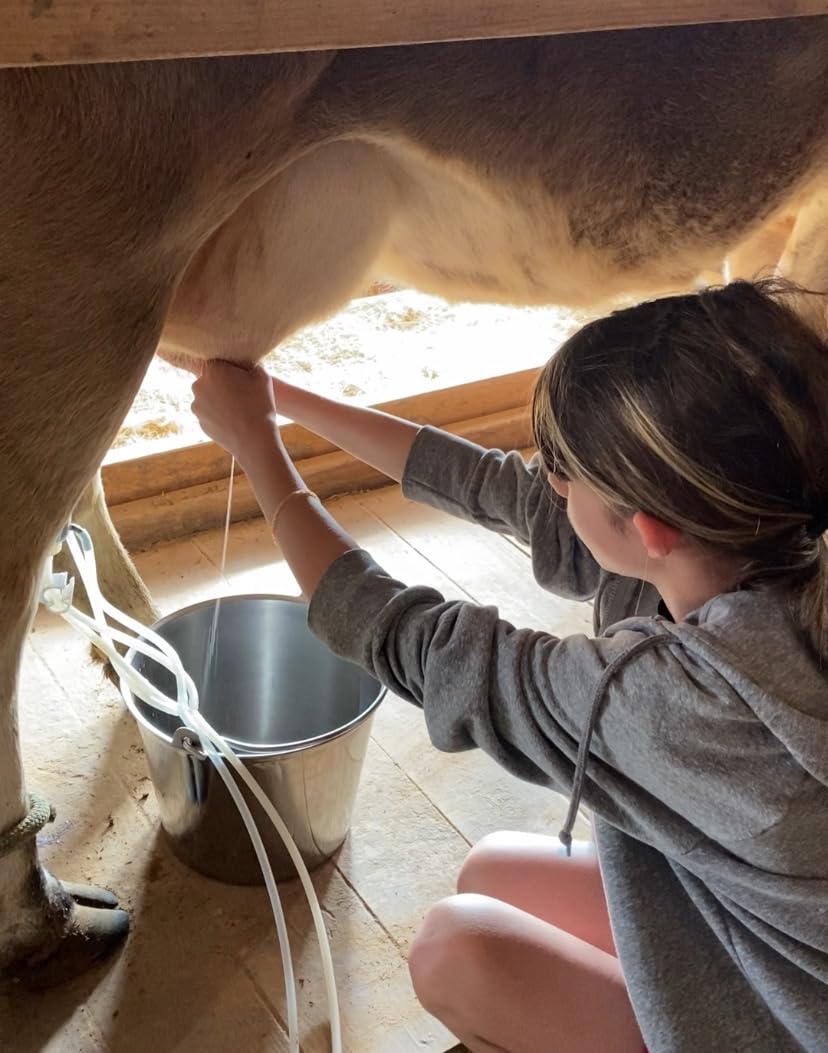
Reviewers point at the reinforced pulsation as the reason their does show normal blood flow and no udder harm, and several describe saving at least half the labor and time compared to hand milking. The cleaning brushes for the hose and teat cups are supplied, which is the minimum a machine in this category should include.
The tradeoff versus the battery models is obvious and real. You need a mains outlet, so a barn without power means extension leads across a wet floor, which is where goats chew cords and where the cheap units get their name in the forums. A 12 L bucket is also more milk than most very small herds produce, and at 8.78 pounds of mostly milk weight, pouring is heavier than you expect.
What makes this the right fit for a working herd
The math is simple. Two milkings a day across eight does generates a lot of trips with a 6 L bucket, and every trip is where spills and contamination happen. A 12 L bucket takes a mid-size herd through a full session in one go, and the sealed check valve in the lid means a full bucket cannot send milk into the pump.
The quick-release internals matter more than they sound. Vacuum pump wear is normal on any machine, and a design that lets you replace the working part rather than the assembly is the difference between a repair and a repurchase. That is a top concern in owner discussions about this category.
When a battery model beats this one
Choose a cordless model if your stanchion is outdoors, in a field, or anywhere without an outlet, or if you want to move between a home herd and a neighbour’s does. Battery machines trade runtime for flexibility, and that is the whole decision.
Choose something smaller if you have one or two does. A 12 L bucket that holds six litres when you produce one is not a convenience, it is a lifting problem twice a day.
5. VEVOR 6L Electric Milker – Best Multi-Species Machine
VEVOR Goat Milking Machine, 6 L 304 Stainless Steel Bucket, Electric Automatic Pulsation Vacuum Milker, Portable Milker with Food-Grade Silicone Cups and Tubes, Adjustable Suction for Cows and Sheep
60-80 pulsations per minute
45-50 kPa adjustable vacuum
1.6 gal / 6L stainless bucket
9 lb
Pros
- Separate per-side suction adjustment for uneven udders
- Quiet operation and a compact body that stores out of the way
- Revamped version has clearer instructions and stronger materials
- Also rated for cows and sheep with the included cups
- Auto-stop prevents milk overflowing into the machine
Cons
- Vacuum can feel weak even at maximum gauge tightness
- Green plugs capping unused tubes fall out and no spares are included
- Can be oversized for small breeds such as Nigerian Dwarf
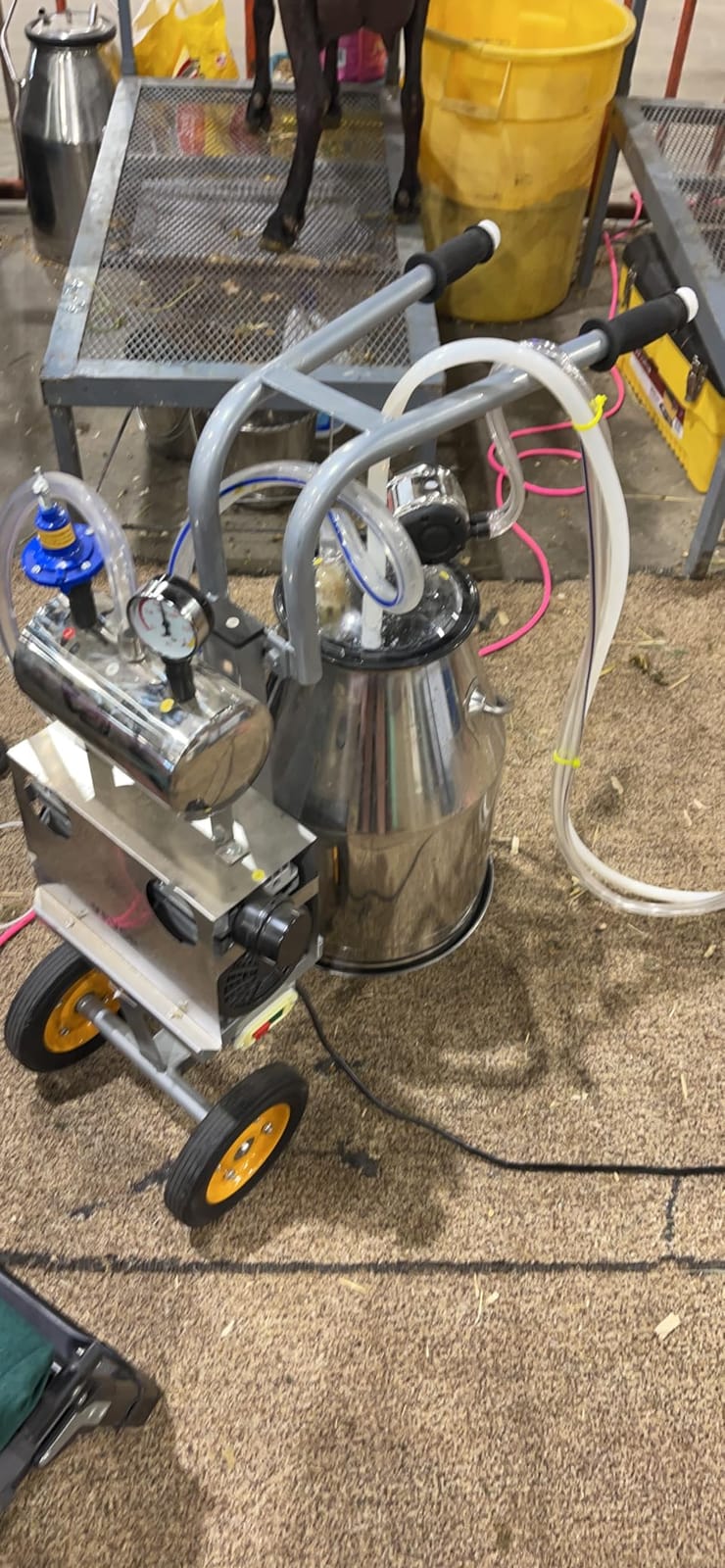
This one runs the fastest pulsation of the set at 60 to 80 cycles per minute, with adjustable vacuum of 45 to 50 kPa. Fast pulsation is why owners report finishing a larger animal in under five minutes, and the per-side suction adjustment is a genuinely thoughtful feature: if a doe has one fuller side, you can balance it instead of over-milking the tight side.
Unlike most of the battery units here, it is sold for cows and sheep as well as goats, and the 4.1 ft food-grade silicone hose with a rechargeable battery and included power adapter gives you a few sessions away from a wall. The bucket is 1.6 gallon, a sensible middle size at 6 L.
Owners consistently say the pulsating suction feels gentler on teats than hand pulling, which tracks with the high cycle rate spreading each stroke’s load. The quiet motor and the compact footprint get praise, and several reviewers note the revamped version came with far clearer instructions and better materials than earlier production runs.
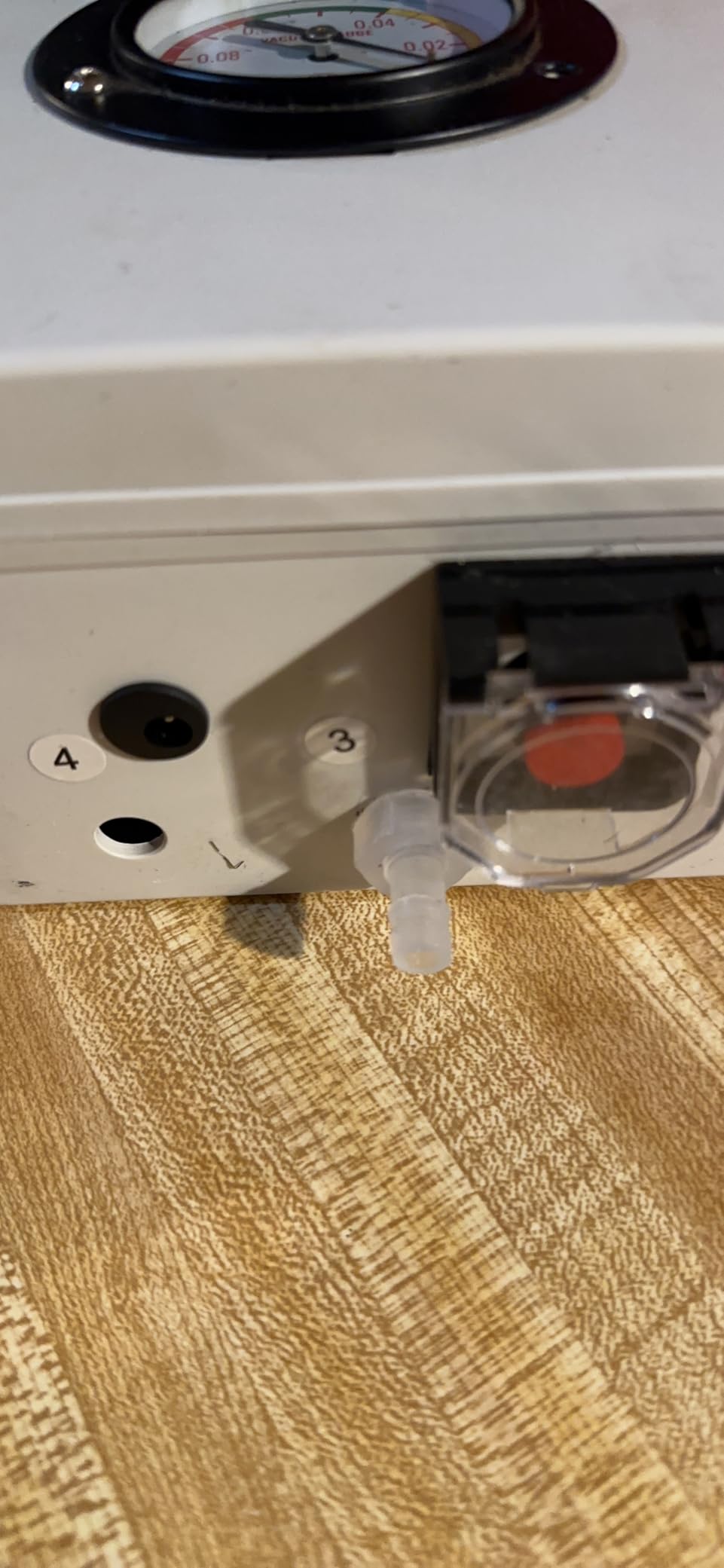
The criticism is specific. Some owners find the vacuum weak even wound fully to maximum, which matters if your does are heavy milkers. The green plugs that cap the unused tubes fall out easily and no spares are included, so a lost plug means a machine with an open port. A few also say cleaning takes longer than milking, and that the machine is simply too big for small breeds.
When the fast pulsation is worth it
If you are milking a multi-species household, a larger goat, or a small cow alongside your does, the high cycle rate and the cow-and-sheep rating are the reason to buy this. Nothing else in the roundup offers per-side vacuum adjustment, and on an uneven udder it is a real time and comfort saving over a single global knob.
At 9 pounds it is the heaviest of the bucket units listed here, so it is a stationary machine rather than a carry-around one. Give it a fixed spot near your cooling area.
Where it falls down
If your does are small, heavy milkers, or a mix including Nigerian Dwarfs, weak vacuum is the risk. A fast pulsating machine that cannot pull hard enough will leave milk in the udder, and a doe that is not fully emptied is a doe that will start to hold her milk back.
Budget for a few spare green plugs before you need them, and keep a filter cloth ready, because several owners comment on the assembly being more involved to clean than the milking itself.
6. ETSENCE 7L Cordless Goat Milker – Best for Wrist-Friendly Milking
7L Goat Milking Machine,Rechargeable Battery Milker Powered Pulsation Vacuum Pump with 2 Teat Cups,Stainless Steel Buckets for Goats(13200mAh Battery)
13200 mAh battery, 3 hr runtime
40-46 pulse cycles per minute
7L stainless bucket
6.87 lb
Pros
- Light and manageable for a small goat operation
- Recharges easily with a simple cleanup routine
- Strong pump with a rheostat to match the animal
- Customer service offers fast refunds and replacement pumps
- Popular with owners whose hands cannot hand milk
Cons
- Vacuum pump frequently loses suction or stops after several months
- Pulsator can fail within the first year
- Some 7L orders have arrived with a 3L pail
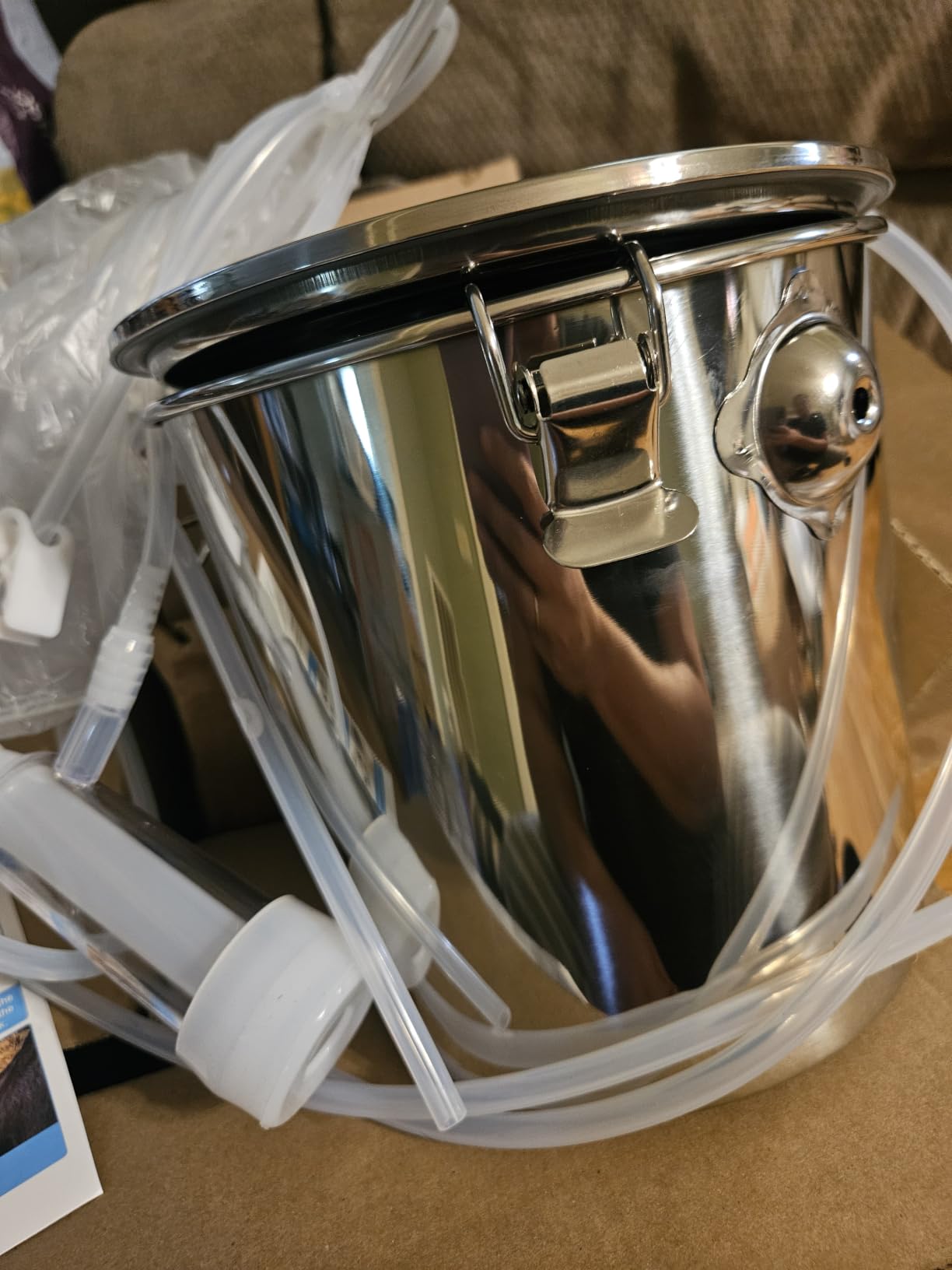
On paper this is very close to the DGBAIZ: 13200 mAh battery, about three hours of runtime per five-hour charge, pulsation at roughly 40 to 46 cycles per minute, a 7 L 304 stainless bucket with folding handles, and an adjustable motor frequency knob. The difference is entirely in what owners report afterwards, and there the picture is more mixed.
At 6.87 pounds it is one of the lighter frames here, which is the whole argument for it. Owners with hand and wrist problems single this out as a machine they can actually use, and the rheostat adjustment lets you match suction to the animal rather than taking what the pump gives you.
The standout positive in the reviews is service. Multiple owners describe fast, attentive support that issued refunds or replaced pumps quickly when their vacuum gave out, and that turns a hardware failure into an inconvenience rather than a lost machine. Users also find it lightweight, easy to recharge and simple to clean.
The repeated negative is declining suction after weeks or a season, and a pulsator that can stop within the first year. There is also a fulfilment problem worth flagging: some orders for the 7L variant have arrived with the smaller 3L pail, so check what is actually in the box before you build a routine around the capacity.
What makes it a good accessibility option
Weight and control are the two things that decide whether a machine is usable for someone with joint problems. A 6.87 pound frame with folding handles can be lifted with one hand, and the adjustment knob is reachable without putting the machine down. Hand milking problems tend to be grip and repetition, and this removes both.
For a two to four doe herd this is a sensible pick, and the fast replacement policy matters more here than on an expensive machine, since nobody is protecting a large capital outlay.
When to pick the DGBAIZ instead
If you want the same general format with a stronger review record and less reported decay, the DGBAIZ at the top of this list is the safer version of the same idea. Its 134 ratings describe the same decline pattern, but service is repeatedly described as shipping replacement parts and pumps, and the 7L bucket issue does not appear.
Whichever you pick, treat a battery machine as a consumable-grade tool rather than an heirloom. Plan on replacing the pulsator and possibly the pump within a couple of seasons, and keep a hand-milking backup.
7. YPSLZY 7L Cordless Goat Milker – Best Rated by Owners
7L Goat Milking Machine,Battery Rechargeable Portable Milker,304 Food Bucket
13200 mAh battery, 3 hr runtime
40-46 oscillation cycles per minute
304 stainless bucket
6.69 lb
Pros
- Highest average rating of the eight with 71 percent five-star feedback
- Empties a doe in under five minutes with no training
- Compact/quiet and easy to understand
- Suction described as just right
- not too strong and not too weak
Cons
- Some 7L orders arrive with the smaller 3L pail
- Teat cup nozzles can feel slightly large for very small teats
This is the newest listing in the set, and it carries the highest average rating at 4.2 stars with 71 percent five-star feedback. The oscillation cycle is about 40 to 46 cycles per minute, the battery is 13200 mAh for roughly three hours, and the adjustment is a motor frequency knob rather than a vacuum regulator.
It is the lightest of the group at 6.69 pounds and the most compact, and the 304 stainless bucket has foldable side and inner handles. The check valve again does the important job of keeping milk out of the pump when the bucket is full.
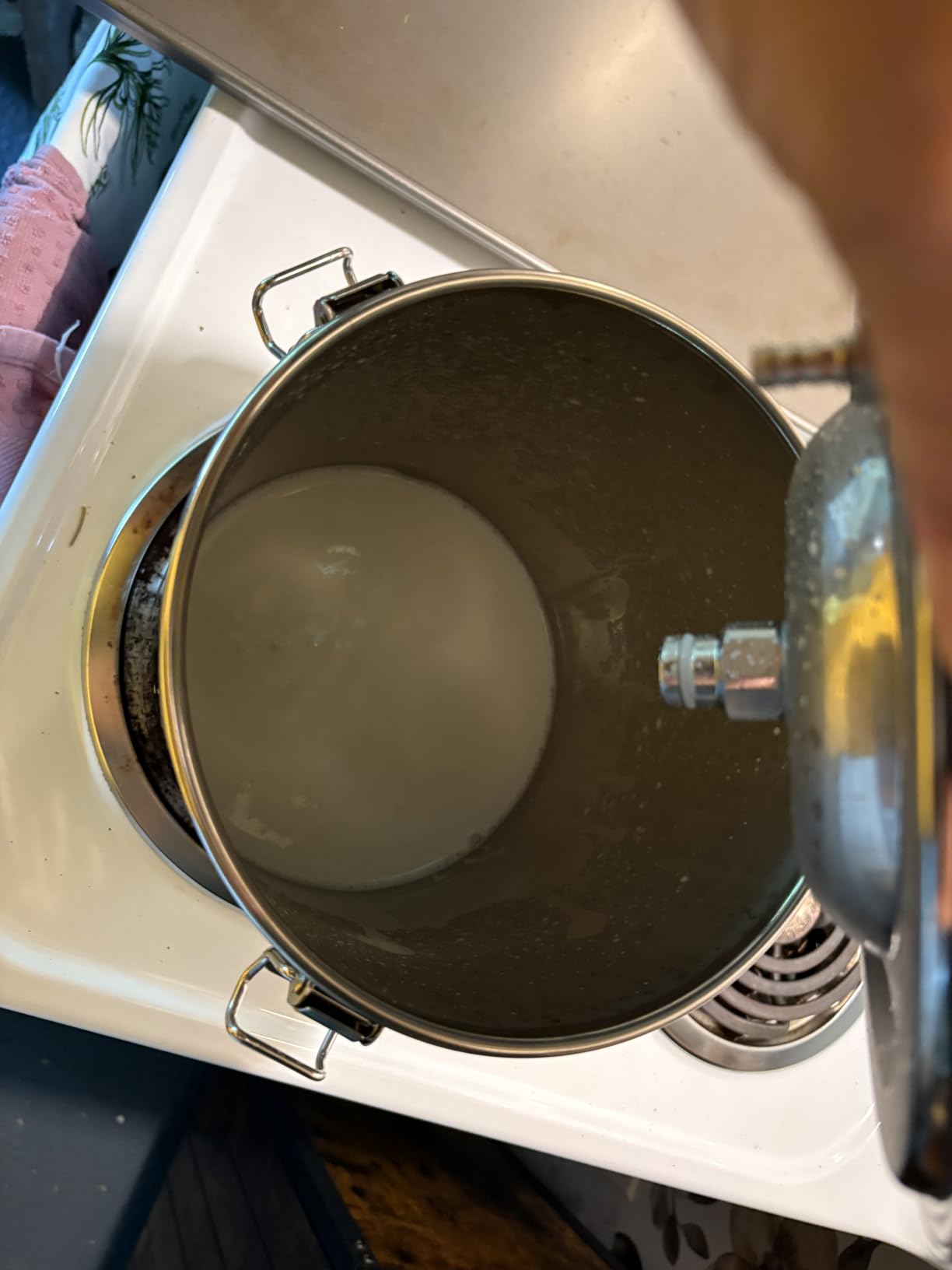
What owners consistently praise is that it needs no training. Does are milked in under five minutes, the machine is quiet enough not to startle the barn, and the suction is described as neither too strong nor too weak, which is the hardest thing for a new buyer to get and the easiest thing to feel. The body fits in a storage box and stays clean between uses, and the manufacturer answers questions within about a day.
Be careful with the sample size. Twenty-six ratings is a thin base, and a new listing has not yet been through the winter-and-summer cycle where vacuum decay usually shows up. Owners also note that the teat cup nozzles can feel slightly large for very small teats, which is worth checking against your smallest does before you commit.
Who should take the chance on it
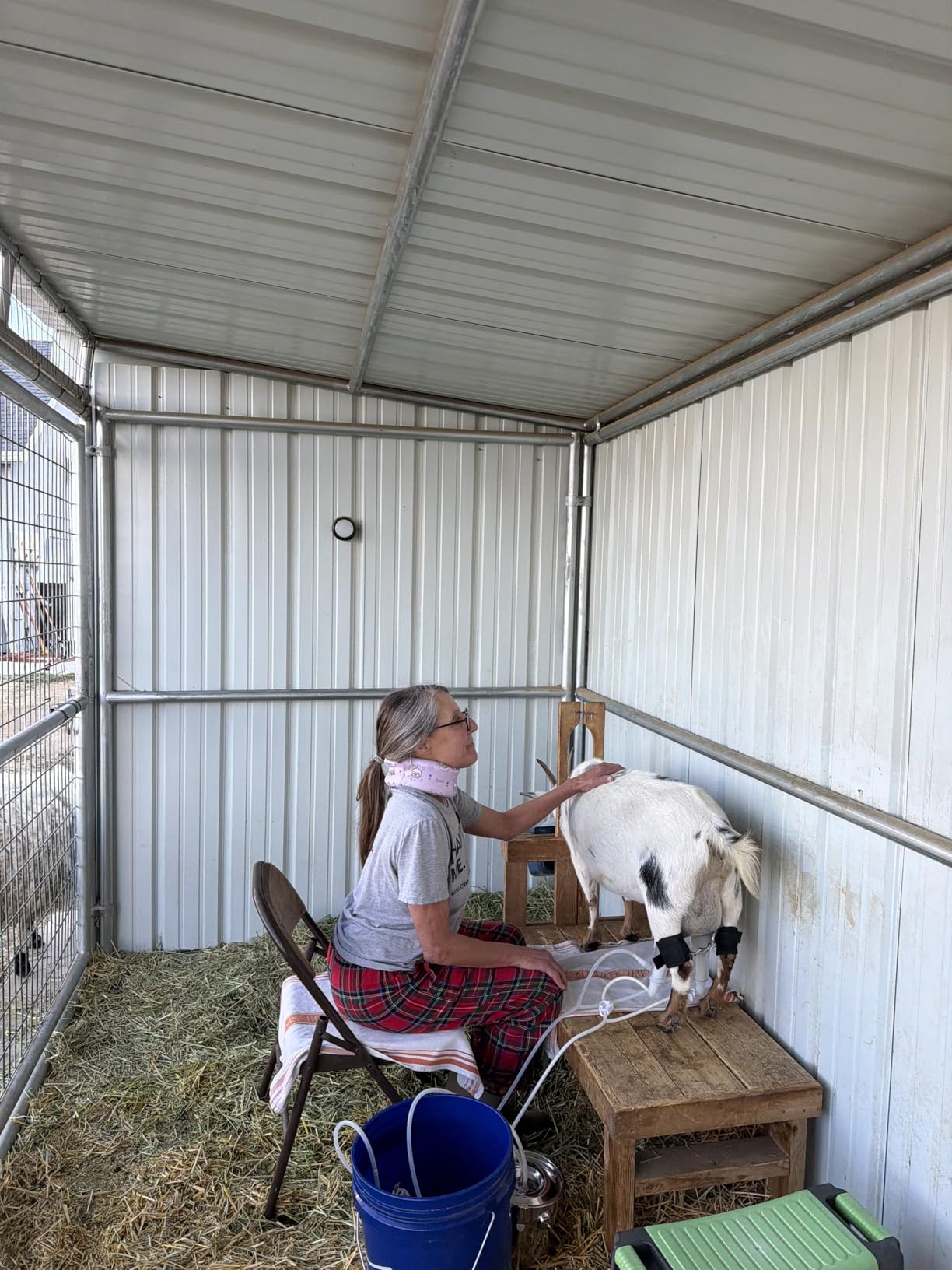
This suits a first-time machine milker with a small herd who wants the least complicated experience available. Nothing about it needs explaining to a sitter or a family member, and the low noise means you can milk in a domestic space rather than only a barn.
It is a good fit for does in mid-to-high production, since the reported complaint about larger buckets points to owners who wanted more capacity, not less.
How to buy it with realistic expectations
Know that you are buying the newest design with the thinnest feedback, not a proven machine. Owner experiences on r/goats favour units with proper pulsation, adjustable vacuum and replaceable parts for exactly this reason, and none of those things can be judged in the first month of ownership.
Confirm the pail size in the box when it arrives, and check the nozzle fit on your smallest teats straight away rather than at 6am on a full udder. Keep the two included brushes with the machine from day one.
8. Hantop 6L Pro Plus – Best for Vacuum Monitoring
Hantop 6L Goat Milking Machine, Pressure Gauge Pump Goat Milker (Pro Plus)
Built-in vacuum pressure gauge
43-46 pulses per minute
5200 mAh battery
Aluminum alloy casing
Pros
- Pressure gauge shows the vacuum level while you are milking
- Quick-release design for replaceable internal components
- Aluminum alloy casing supports a long pump life
- Sub-15 second installation with cleaning brushes included
- No extension cord in the barn
Cons
- Carries a 19 percent share of one-star reviews
- Designed for a single animal rather than commercial throughput
- Some owners want a larger bucket for heavier milkers
The Pro Plus exists for one reason: the gauge. A pressure gauge on the pump lets you watch vacuum level during a session instead of guessing, and once you have tuned a machine to a particular doe you can confirm you are reproducing that setting every morning. That feedback loop is genuinely useful, particularly on a mixed herd of first-fresheners and older does.
Otherwise it is the familiar Hantop recipe. Pulsation at 43 to 46 cycles per minute, a 6 L 304 stainless bucket, aluminum alloy casing, a 5200 mAh lithium battery so you are not running leads across the barn, and quick-release internals for replaceable components. Installation is under 15 seconds with brushes included.
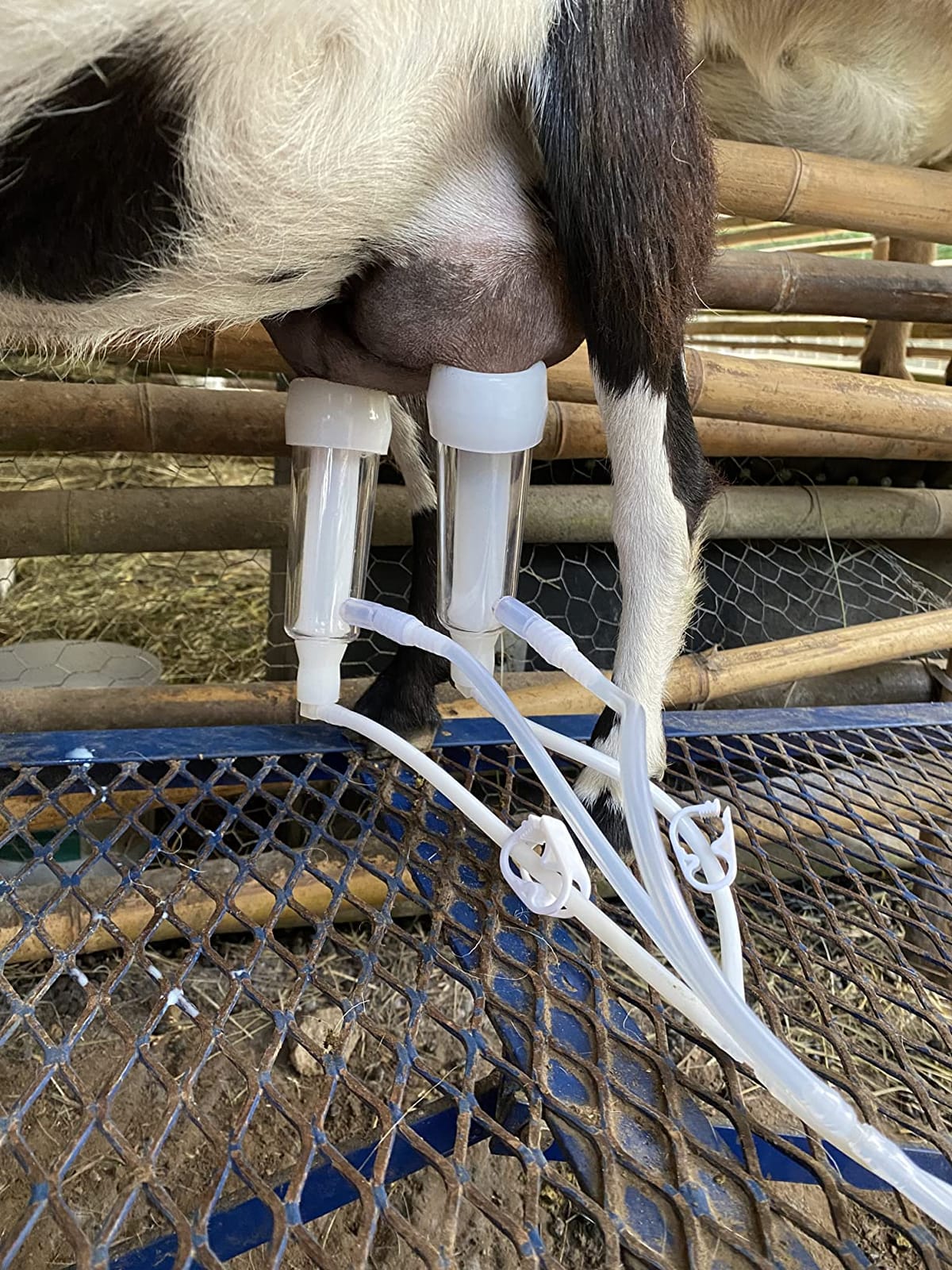
Owners justify the higher spend on two things: the gauge readout and the tougher pump construction. Reviewers also report saving at least half the labor and time versus hand milking, and the check valve in the bucket lid keeps milk away from the pump when the container fills.
The 3.7 star average is the lowest of the eight and it carries a 19 percent share of one-star reviews, which is worth respecting rather than explaining away. The pump is built for a single animal, not for running a herd through quickly, and some buyers wish for a larger bucket with heavier producers. Read the one-star reviews before you decide the gauge is worth it for you.
When a gauge changes how you milk
The gauge pays off when you have varied animals. A first-freshener doe with small teats, a heavy older doe, and a doe in early lactation do not want the same vacuum, and a machine without feedback leaves you adjusting by feel. Watching the needle lets you set a number, milk the next doe, and check whether it held.
It is also the diagnostic tool you want on a machine you suspect. If the reading drifts downward across a session, you know the pump is degrading before the milk-out tells you.
When it is not the right spend
If you have one or two does and a steady hand, you can achieve the same result by being careful. The gauge is most valuable across eight or more animals, or when you are new enough that you cannot yet read suction by sound and feel.
For a single-animal machine, be clear about throughput. This is a thoughtful premium single-goat tool, not a herd system, and anyone milking thirty-plus goats needs a double or quadruple cluster rather than a better gauge.
How to Choose a Goat Milking Machine in 2026
Match the machine to your herd size first
Start with the number of does you actually milk, not the number you own. One to three does means a 3L to 7L cordless bucket machine and nothing more complex. Four to ten does means a 6L to 12L machine, cordless if you have no power at the stanchion, plug-in if you do. Eleven to thirty does means you should be counting minutes per goat rather than per session, and a larger bucket or a second machine starts to pay for itself. Beyond thirty goats you are into fixed systems with multiple clusters, which is a different purchase entirely and outside this roundup.
Then look at the two variables people forget. How often will you milk, and how far is the cooling area from the stanchion? A 12L bucket on a short trip saves more time than any spec on the pump.
Pulsation and adjustable vacuum are not optional
Pulsation is the repeated opening and closing of the vacuum, measured in cycles per minute, and it mimics the way a kid nurses. Everything on this list runs between 40 and 80 cycles per minute, which is the range you want. A machine with one fixed suction level and no cycling is what causes teat congestion and mastitis, and owner discussions across forums are blunt about cheap imported units of that type.
Adjustable vacuum matters just as much in practice. A first-freshener doe with small teats and a mature doe at peak production need different settings on the same morning. If a machine has no knob or no regulator, you will find yourself making up the difference with technique, which is exactly the work you bought the machine to avoid.
Sizing the inflation for small and awkward teats
The inflation, also called the liner or silicone insert, is the part that actually touches the teat, and a poor fit causes leaks, low yield and irritation regardless of how good the pump is. Too large and it will not seal on a small teat, so it never holds vacuum. Too small and it can pinch. For Nigerian Dwarf goats and any first-freshener doe, check the nozzle size before you buy, and read reviews that mention small teats specifically rather than overall satisfaction.
Two of the machines here carry that warning directly: owners report nozzles that feel slightly large for very small teats. That is a one-minute check at the stanchion with your smallest doe.
Power source, cleaning and running costs
Battery machines give you freedom and cost you runtime. A 13200 mAh battery giving about three hours per five-hour charge covers a small herd comfortably; a 5200 mAh pack covers a lighter session. Plug-in machines never run out but need a real outlet, not an extension lead across a wet floor.
Cleaning differs sharply by format, and nobody talks about this. A bucket milker needs a warm soapy flush through the hose and a rinse, the check valve keeps milk out of the pump, and the brushes included with each of these machines are there for the hose and cups. Rinse the buckets immediately after use, because milk film on stainless steel is what causes off flavours and bacterial growth. The same food-contact rules I set out for countertop machines in my best frozen margarita machines guide apply to any vessel that touches milk.
Budget for consumables honestly. Silicone liners, gaskets, tubing and sanitiser are all replaceable items, and owners repeatedly flag hard-to-source parts for no-name brands as a top frustration. A machine from a brand with a visible replacement-parts policy is worth more over five years than a cheaper one you cannot service. Keep a spare gasket and a spare pulsator on the shelf from day one.
When hand milking is the better answer
Skip the machine if you have one or two goats, milk once a day, and hand milking takes you ten minutes. You will not recover the purchase price in time saved, and every extra machine is another thing to clean, store, and eventually replace. Several small backyard owners in owner discussions describe budget bucket milkers as a vacation and stand-in convenience rather than a daily tool, and that is a perfectly good reason to own one.
Hand milking also wins when the animal is being treated. Stripping colostrum, isolating a doe with mastitis, or milking a sick nanny by hand lets you discard a small amount cleanly without building a whole cleaning routine around a cluster that touched a teat canal. The same reasoning applies to the first few days after freshening, when you are checking for a plugged canal and want to be able to feel the udder with your hands.
One more note before you commit: if you intend to sell milk, local dairy rules cover cooling, pasteurisation and bulk storage, and those rules are stricter than anything a machine choice can fix. A bucket milker keeps milk cleaner than hand milking by avoiding hair and bedding, but cleaning and cooling are still your responsibility.
Frequently Asked Questions
What is the best milk pump for goats?
For most goat herds, the best milk pump is a cordless bucket milker with a food-grade stainless bucket, pulsation between 40 and 80 cycles per minute, and an adjustable vacuum control. Choose a 3L to 7L bucket for one to three does, 6L to 12L for four to ten, and a fixed multi-cluster system beyond thirty goats. Pulsation and adjustability matter far more than brand, because continuous suction congests teats and raises the risk of mastitis.
What is a good handheld milker for goats?
A good handheld option is a hand-triggered vacuum milker, which uses no electricity at all and pulls milk into a bottle or small container. These are the practical choice for stripping colostrum from a fresh doe, isolating a doe with mastitis, or milking a single animal when power is not available. The eight machines reviewed here are all electric bucket milkers, so treat the handheld category as a separate purchase for special cases.
Do I need a milking machine for 2 goats?
Usually not. With one or two does milked once or twice a day, hand milking takes about ten to fifteen minutes and a machine will not save enough time to justify the purchase. A budget cordless bucket milker still makes sense as a vacation and stand-in backup so a sitter can milk without training, and for owners with wrist, hand, or arthritis problems a machine can be the difference between milking daily and not milking at all.
How long does it take to machine milk a goat?
Most owners report under five minutes per doe from teat contact to cup removal once the animal is accustomed to the machine, against roughly ten to fifteen minutes by hand. Add about a minute of setup and a minute of cleaning per session. Adjust for the animal: a first-freshener doe with small teats needs longer while she learns to let down, and the machines that empty faster do so partly through a higher pulsation rate rather than more aggressive suction.
Are cheap goat milking machines safe for goats?
A cheap machine is safe when it pulses, when the vacuum is adjustable, and when the wetted parts are food-grade silicone and stainless steel. It is not safe when it holds continuous suction at a single fixed level, because that congests the teat and can lead to mastitis. Check the pulsation rate, confirm there is a suction adjustment, and inspect the inflations for correct sizing on small teats before you milk a full udder.
Our Verdict for the Best Milking Machines for Goats in 2026
The best milking machines for goats depend on your herd, but the picking is not as close as the ratings suggest. For most small herds, the DGBAIZ 7L is the one to buy: cordless, a 13200 mAh battery giving about three hours per charge, pulsation at 40 to 46 cycles per minute, a 7L 304 stainless bucket and a check valve that keeps milk out of the pump. Read the durability reports and keep a hand-milking backup, because that is true of every battery machine in this price band.
For a homestead of three to eight does, the Hantop 6L Pro battery has the deepest owner feedback in the category at 528 ratings, and service that replaces pumps. For four to ten does with power in the barn, the 12L Classic finishes the herd in one pass with a copper motor and replaceable internals. The VEVOR 6L wins on multi-species use and per-side vacuum adjustment, the Pro Plus is the pick if you want to read a gauge while you milk, and the YPSLZY is the highest rated on the smallest review base.
Whatever you choose, check the pulsation rate, confirm the vacuum adjusts, and test the inflation size on your smallest doe before you milk a full udder. Then check the current details and pricing for these machines before you order.