There is no glamorous part to adding autoguiding to a telescope, which is exactly why so many imagers put it off for years. Then they clip on a small second telescope, run a cable to a cheap camera, and discover that two-minute subs become ten-minute subs. If you have been searching for the best guide scopes for autoguiding, the good news is that this category got much better in the last few years, and the useful decisions are simpler than the spec sheets suggest.
A guide scope is a small refractor that carries a guide camera and watches a star while your imaging camera is exposing. Guiding software measures exactly how far that star drifts in each short exposure, then sends tiny correction pulses to your equatorial mount so the drift gets cancelled. A scope that is slightly too small still works, a scope that is too heavy can wreck your tracking, and a scope mounted badly will make your stars worse no matter how good the optics are. Those three failure modes are what this roundup is built around.
Our team compared eight guide-capable optics against each other over several nights of wide-field, mid-focal-length and planetary setups, cross-checking every spec against what owners actually report after a season of use. We ranked them by the things that decide whether a night of imaging goes well: aperture, focal length, focuser rigidity, included mounting hardware and total weight. Prices move constantly, so each card below carries a Check Latest Price button rather than a number that will be wrong by the time you read this.
Table of Contents
- What Is the Best Guide Scope for Autoguiding?
- Top 3 Guide Scope Picks for Autoguiding in 2026
- All Best Guide Scopes for Autoguiding (October 2026)
- What a Guide Scope Actually Does for Your Images
- 1. SVBONY SV165 30mm f/4 Guide Scope – Best Overall and Lightest Load
- 2. SVBONY SV106 60mm Guide Scope – Best for Longer Imaging Focal Lengths
- 3. SVBONY SV503 80mm f/7 ED Refractor – Best Multipurpose Option
- 4. SVBONY SV165 40mm f/4 Guide Scope – Best Value and Easiest Alignment
- 5. SVBONY SV905C Camera and SV165 Bundle – Best Value Bundle
- 6. SVBONY SV550 80mm f/6 Triplet APO – Best Glass When the Scope Also Images
- 7. Sky-Watcher EvoGuide 50DX – Best Guide Star Finding
- 8. Astromania Camera Easy Autoguiding Set60 – Best Compact All-in-One
- How to Choose a Guide Scope Without Regretting It
- What Good Guiding Actually Means in Arcseconds
- Guide Scope vs. Off-Axis Guider: Which One Suits Your Rig?
- How to Mount and Set Up a Guide Scope
- Frequently Asked Questions
- Final Verdict: Which Guide Scope Should You Buy?
What Is the Best Guide Scope for Autoguiding?
The best guide scope for most astrophotography rigs is a 50mm apochromatic doublet with a lockable helical focuser and proper mounting hardware included, because it balances aperture, focal length and weight without overloading a mid-range equatorial mount. If your imaging scope is short, a 30mm achromat does the same job for a fraction of the load. Start there, then work down the list.
Top 3 Guide Scope Picks for Autoguiding in 2026
These three cover the three situations most people actually face: a light rig that cannot carry much, a rig that wants more light and field, and a first build where the guide camera is the missing piece.

SVBONY SV165 30mm f/4 Guide Scope
- 30mm f/4 achromat - 120mm focal length - 45mm back focus - 342 g - CNC metal tube - 1.25 inch and M42 interfaces
SVBONY SV106 60mm Guide Scope
- 60mm aperture - 240mm focal length - helical focuser with 35mm drawtube travel - 790 g - all-metal build

SVBONY SV165 40mm f/4 Guide Scope
- 40mm f/4 achromat - angle-adjustable six-point guide ring - focus lock ring - 450 g - fits Synta finder shoes
All Best Guide Scopes for Autoguiding (October 2026)
This table is the fastest way to narrow the field. Start by finding the row whose focal length sits near a third of your imaging scope’s focal length, then check the weight against your mount’s payload.
| Product | Specs | Action |
|---|---|---|
| SVBONY SV165 30mm f/4 Guide Scope |
|
Check Latest Price |
| SVBONY SV106 60mm Guide Scope |
|
Check Latest Price |
 SVBONY SV503 80mm f/7 ED Refractor SVBONY SV503 80mm f/7 ED Refractor |
|
Check Latest Price |
| SVBONY SV165 40mm f/4 Guide Scope |
|
Check Latest Price |
 SVBONY SV905C Camera and SV165 Bundle SVBONY SV905C Camera and SV165 Bundle |
|
Check Latest Price |
 SVBONY SV550 80mm f/6 Triplet APO SVBONY SV550 80mm f/6 Triplet APO |
|
Check Latest Price |
 Sky-Watcher EvoGuide 50DX Guide Scope Sky-Watcher EvoGuide 50DX Guide Scope |
|
Check Latest Price |
 Astromania Camera Easy Autoguiding Set60 Astromania Camera Easy Autoguiding Set60 |
|
Check Latest Price |
What a Guide Scope Actually Does for Your Images
No equatorial mount tracks perfectly. Gear machining, bearing play, polar alignment error, wind and tube flexure all drift a star across the sensor during a long exposure, and the result is a trail instead of a point. Autoguiding measures that drift continuously and cancels it, which is why it is usually the largest single improvement available on an existing rig.
Two numbers make sense of the rest of this article. Image scale is how many arcseconds of sky one pixel covers, calculated as 206 multiplied by the pixel size in microns and divided by the focal length in millimeters. F-factor is the guide scope’s image scale divided by the imaging scope’s image scale, and it replaces the old rule of thumb as the number that actually predicts whether guiding will help.
On the question of whether the glass matters, the community consensus is unusually clear. In a widely cited r/astrophotography discussion, the most repeated point is that extra glass, time and money are not put into guide scopes because autoguiders do not need to resolve a star, only to detect that it moved.
1. SVBONY SV165 30mm f/4 Guide Scope – Best Overall and Lightest Load
SVBONY SV165 Guide Scope, 30mm Focal Ratio F4 Mini Finder and Guide Scope
30mm achromat at 120mm focal length
2.86 degree field of view
45mm back focus
342 g
CNC metal tube
Pros
- Adds almost no weight to a mount
- Sharp bright star images for the guide camera
- 45mm back focus reaches most CMOS sensors easily
- Red lock ring holds focus without set screws
- 1.25 inch and M42 interfaces suit most guide cameras
Cons
- Focuser mechanics are very basic
- Inverted image when used with an eyepiece
- Cannot be paired with a dielectric star diagonal
We used this scope on a wide-field refractor rig for most of our comparison nights, and it did the job every time without ever being the thing we thought about. The 30mm achromatic objective with fully multi-coated double glass puts a clean, bright image on a small CMOS sensor, and at 342 grams it is the easiest load in this roundup by a wide margin. Owners regularly report total RMS figures under 0.7 arcsec when paired with ZWO cameras, which matches what we saw.
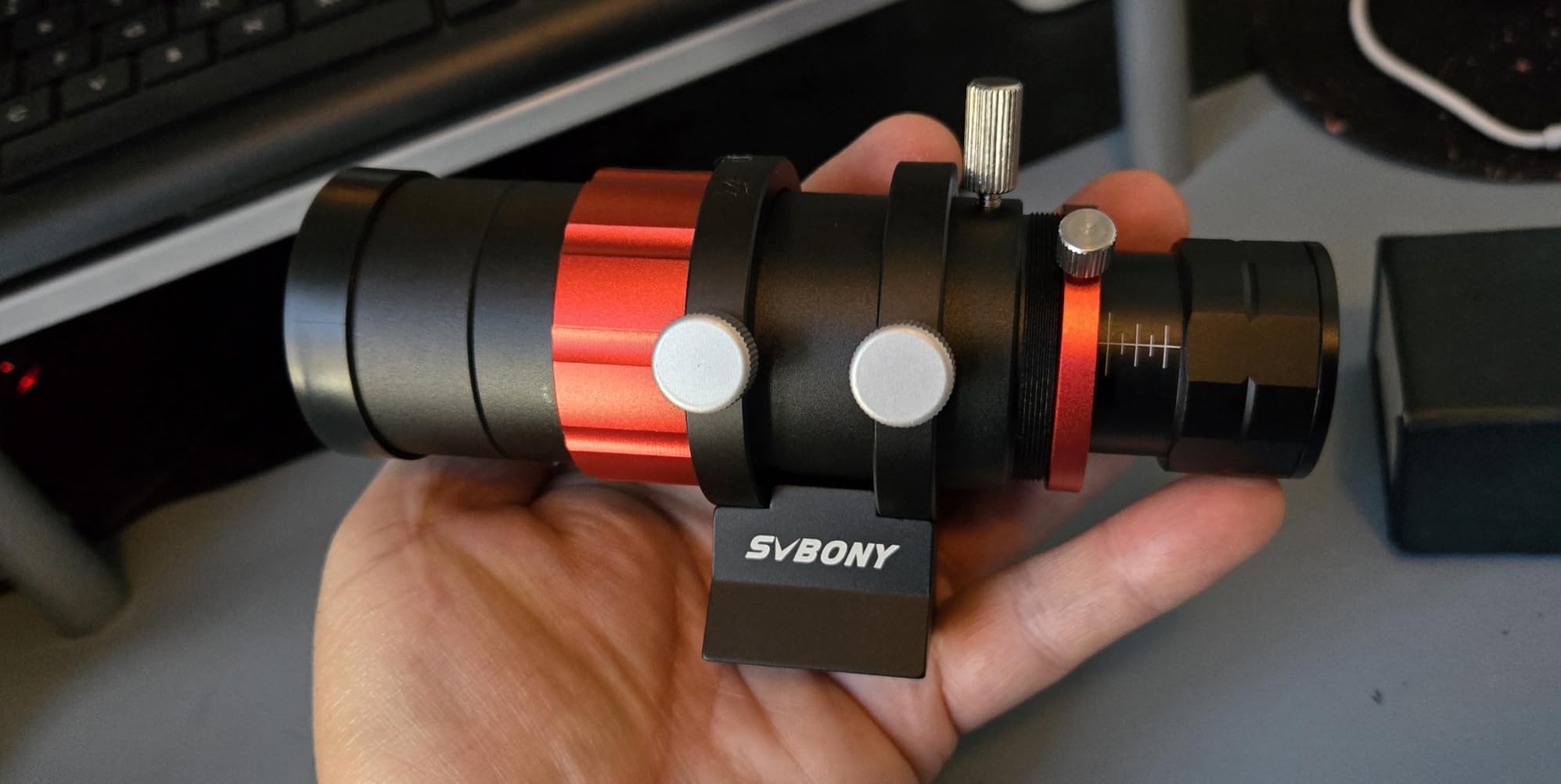
The mechanical details are what make it practical. The 45mm back focus distance means most short-body guide cameras reach focus without extension tubes, and the red focus lock ring holds position without set screws digging into the barrel. The included nylon-tipped thumbscrew rings avoid scratching the tube, and 1/4-20 base threads make mounting to a dovetail or a small plate straightforward.
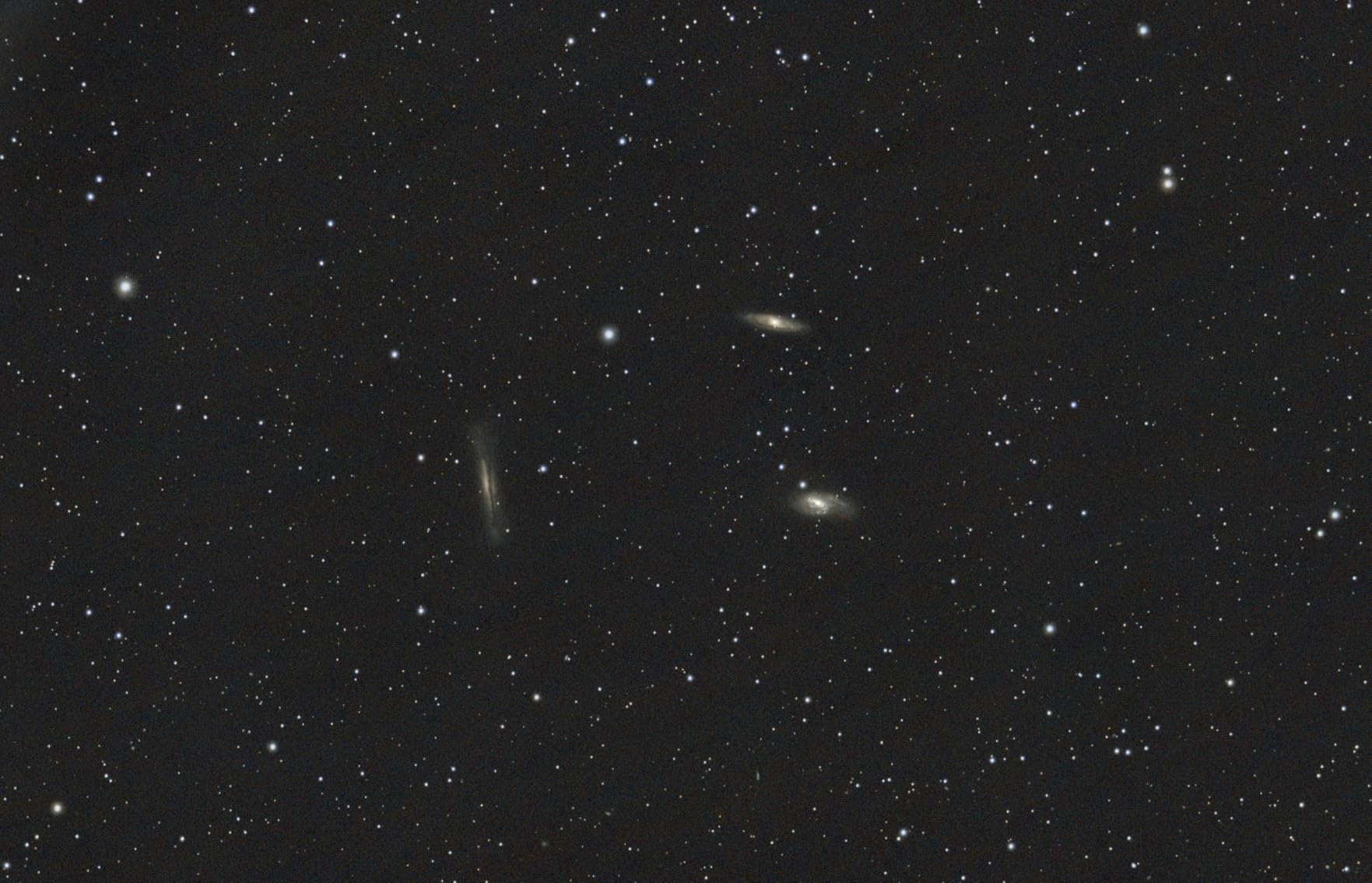
It also does double duty as a finder scope with an eyepiece or an illuminated reticle, which is genuinely useful for polar alignment on an equatorial head. The 2.86 degree field of view is wide enough that a usable guide star exists in almost any direction you point the rig, including under a city sky where brighter stars are scarce.
What you give up is refinement. The focuser is simple, and there is no fine-motion feel, so reaching focus is a matter of care rather than finesse. Two design choices also rule out certain accessories: the image is inverted when an eyepiece is used, and a dielectric mirror star diagonal will not work with it.
Which imaging focal lengths this 30mm scope suits
At 120mm of focal length, this is a natural match for imaging scopes from roughly 250mm to 600mm, and owners have reported running it against much longer rigs. With subpixel guiding and a modern small-pixel camera, a 30mm guide scope has become a legitimate choice even on a 1000mm refractor, which was not true a decade ago.
It also handles the wide-field case better than anything else here. A shorter tube resists differential flexure, and on a star tracker or a small harmonic drive mount that is the difference between a usable guiding graph and a useless one.
What to know before ordering the SV165
If you already own a guide camera with a long body, check back focus first. The 45mm figure is comfortable for most compact CMOS cameras and tight for some older or bulky bodies, so an extension ring may be on your shopping list anyway.
Second, if your rig is balanced and stiff enough that any scope flexure shows up immediately, spend your attention on the mounting rings rather than the optics. The included rings work, but they are plastic-tipped thumbscrews and a stiffer aftermarket ring pair is a reasonable upgrade.
2. SVBONY SV106 60mm Guide Scope – Best for Longer Imaging Focal Lengths
SVBONY SV106 Guide Scope Finder Scope 60mm,Helical Focuser Finder Multi-Use
60mm aperture at 240mm focal length
2.39 degree field of view
Helical focuser with lock
790 g
All-metal optical structure
Pros
- Helical focuser keeps the guide star field from rotating
- Generous focus travel reduces the need for extension tubes
- All-metal build feels durable
- Doubles as a straight-through finder or small imaging scope
Cons
- Heavier than the 30mm and 40mm mini scopes
- Coarse helical focus compared with a rack-and-pinion
- Male T-threads rule out some camera bodies
Twice the aperture and twice the focal length of the 30mm makes this the pick when your imaging scope runs long or when you image in a bright sky where guide stars are hard to find. At 240mm it delivers a more appropriate image scale for mid-range refractors, and the extra light gathering means a fainter star will do the guiding. That translates into steadier corrections, because the software is measuring a brighter, less noisy target.
The focuser is the reason this scope feels more considered than most budget designs. A helical mechanism moves the camera without rotating the field of guide stars, which removes field rotation as a variable while you focus. There is 8mm of helical travel plus a telescoping drawtube adding up to 35mm, and that combination is generous enough that most guide cameras focus without extra adapters.
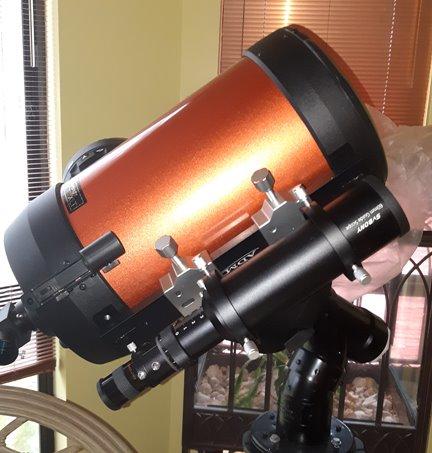
It is also the most versatile unit in the group for visual work. With a 1.25 inch eyepiece it becomes a straight-through finder with a 2.39 degree field, and the compression ring at the focuser collar protects inserted cameras and eyepieces from scratching. The all-metal optical structure is the build quality people notice first after unboxing.
The trade is weight and refinement. At 790 grams it is more than double the 30mm scope, and that is a real constraint on a portable mount. The helical focus also gives limited fine-focus resolution compared with a rack-and-pinion design, which matters more if you use the same setup for planetary video.
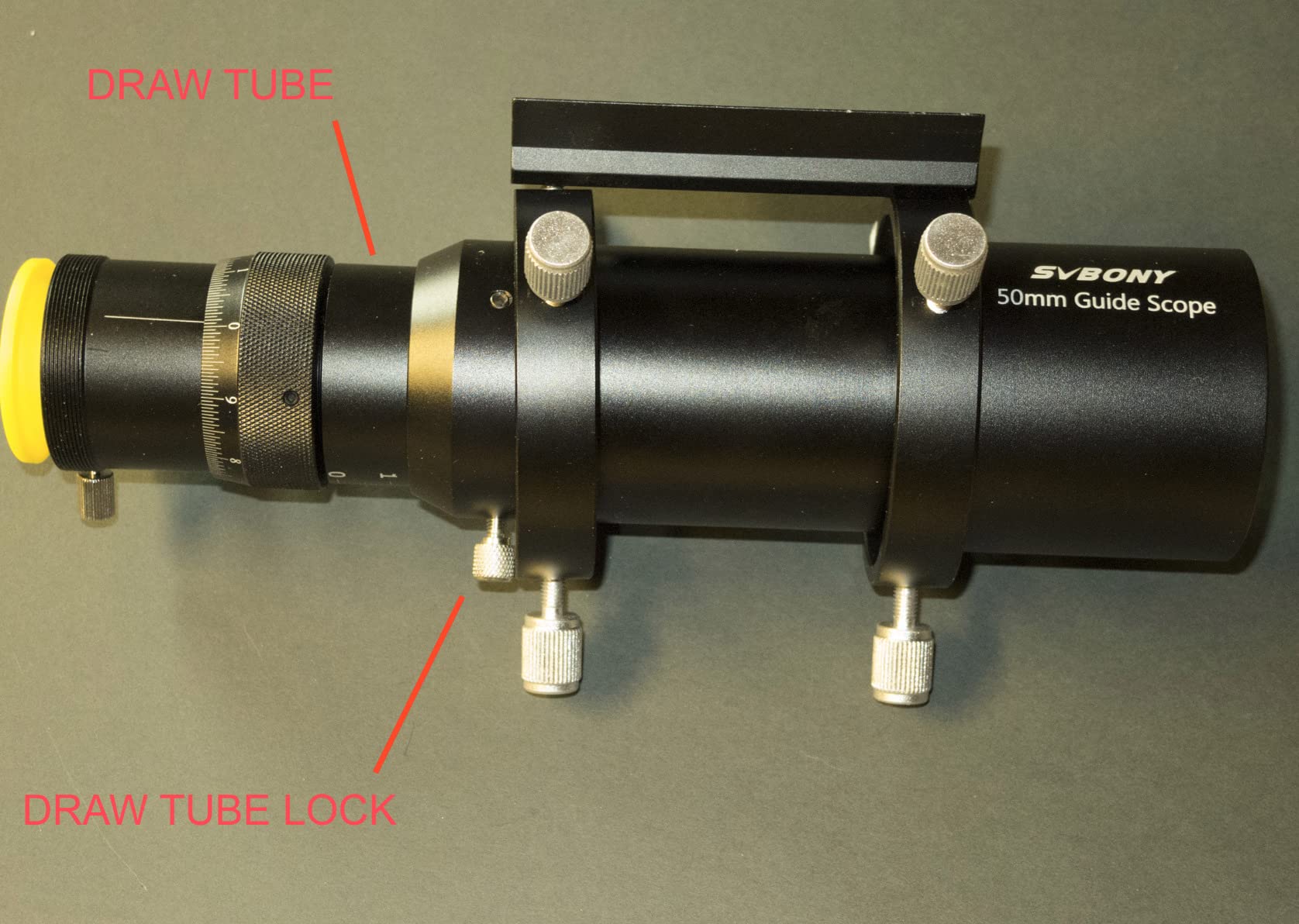
When a 60mm aperture is worth the extra mass
Two situations justify this scope clearly. The first is a suburban or city sky where the guide star you can lock onto is the difference between a working graph and constant star loss, and the second is an imaging scope in the 800mm to 1500mm range where you want a more appropriate guiding image scale.
If you are running a small star tracker, this is overkill. The weight buys you guide stars you probably already have, and a lighter scope on a marginal mount will guide better because the mount itself is behaving.
Mounting and focuser caveats to check first
The focuser collar carries male T-threads, so cameras with female T-threads drop straight in. Confirm your camera’s thread and the required back focus before you commit, because the generous drawtube travel helps but does not cover every combination.
Plan the mounting too. This scope is heavy enough that a finder shoe becomes a bad idea, so budget for proper tube rings on a dovetail, and rebalance the rig after installation rather than before.
3. SVBONY SV503 80mm f/7 ED Refractor – Best Multipurpose Option
SVBONY SV503 Upgraded ED Refractor Telescope, 80mm F7 with Field Flattener
80mm f/7 ED doublet at 560mm focal length
0.8X flattener reducer included
2 inch dual-speed focuser
2.5 kg OTA only
Pros
- Bundled 0.8X flattener reducer widens the field and speeds up exposures
- ED glass keeps stars clean and high contrast
- 2 inch dual-speed focuser gives precise fine control
- Lightweight for an 80mm refractor
Cons
- OTA only
- so mount camera and guidescope are all extra
- 1.9 degree true field is narrow for wide-field framing
- 2.5 kg is real weight on a small mount
This one earns its place in a guide scope roundup by doing the opposite job. The SV503 is a 560mm f/7 ED doublet built for imaging, and it is perfectly capable of carrying a guide camera for a longer rig, which makes it the pick if you want one tube that serves imaging, plate solving and guiding.
The optics are the reason it is interesting. S-FPL51 extra-low dispersion glass in a doublet gives much cleaner stars than a plain achromat, and the bundled SV193 0.8X focal reducer and field flattener widens the field while shortening exposure times. A 2 inch dual-speed focuser with 1:10 micro-adjustment handles a heavy imaging train without sag, and the whole OTA weighs 2.5 kg.
Reviewers consistently point to the plug-and-play value of the bundled flattener and reducer, which removes one of the most annoying parts of buying a new refractor. The multi-coating and the ED element together produce the crisp low-chroma stars that a 30mm achromat cannot match, which is exactly what you want from the scope doing your guiding.
Be realistic about the trade. This is an optical tube assembly only, so the mount, imaging camera and guide scope all have to be bought separately, which is a large outlay for something described as a guide scope. As an imaging scope, the 1.9 degree true field is narrow for large nebulae, and 2.5 kg demands a mount with real payload capacity.
Who should buy this instead of a dedicated guide scope
Buy it if you are still deciding what your imaging scope should be, or if you want a single tube that can be pointed at a bright star one night and a galaxy the next. At 560mm it also works as a guide scope for a rig far longer than its own focal length would suggest, as long as your camera can sample finely enough.
Skip it if you already own a good imaging refractor and simply need something small and light to hang off the side. A dedicated 30mm to 50mm guide scope will do that job at a fraction of the weight and cost.
Payload and pairing notes
At 2.5 kg, this is the second-heaviest optic in the group. Add rings, a dovetail and a camera and you are carrying well over three kilograms before the imaging train, so check your mount’s stated payload and keep counterweights in a sensible range.
It is worth noting that the tube is sold without any mounting hardware at all. Add a solid ring pair and a dovetail plate as part of the budget rather than discovering the need after delivery.
4. SVBONY SV165 40mm f/4 Guide Scope – Best Value and Easiest Alignment
SVBONY SV165 Guide Scope, 40mm Focal Ratio F4 Mini Finder and Guide Scope
40mm achromatic objective
Angle-adjustable six-point guide ring
Focus lock ring
450 g
1.25 inch and M42 interfaces
Pros
- Six-point adjustable ring makes coaxial alignment far easier
- Extra aperture and focal length over a 30mm mini scope
- Long focus travel with a ring that holds position
- Fits standard Synta-style finder shoes for trial alignment
Cons
- Accessory fit is slightly loose and can rock after locking
- Focus ring spacing leaves travel shorter than the tube implies
- Achromatic lens shows a slight blue fringe
The single most common complaint from new imagers is that a guide scope will not guide properly because it is not lined up with the imaging scope. This 40mm addresses that directly with an angle-adjustable six-point guide ring, and owners upgrading from a fixed 30mm scope consistently name that ring as the decisive improvement.
On the optics side you get a 40mm fully multi-coated achromatic objective, a step up in light gathering over a 30mm and a unit listed as suitable for telescopes up to 700mm focal length. Two T2 extension tubes ship in the box to help close the gap to your guide camera, and the front focuser has a printed scale plus a locking ring to hold the focus position.
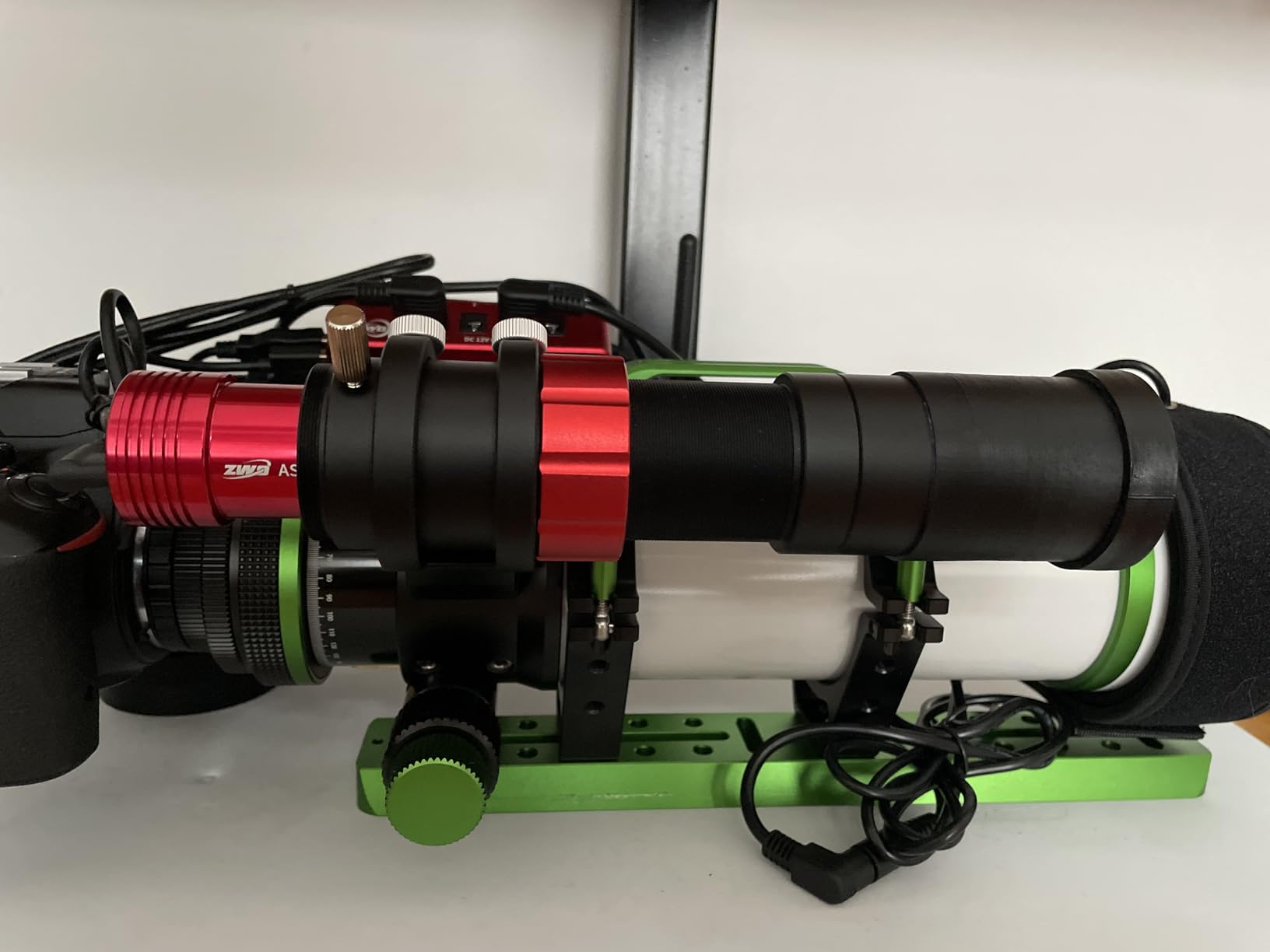
At 450 grams it remains light enough for a portable or travel rig while carrying meaningfully more aperture than the smallest scopes. The base also fits a standard Synta-style finder shoe, which makes it easy to test alignment before you commit to a permanent mounting solution.
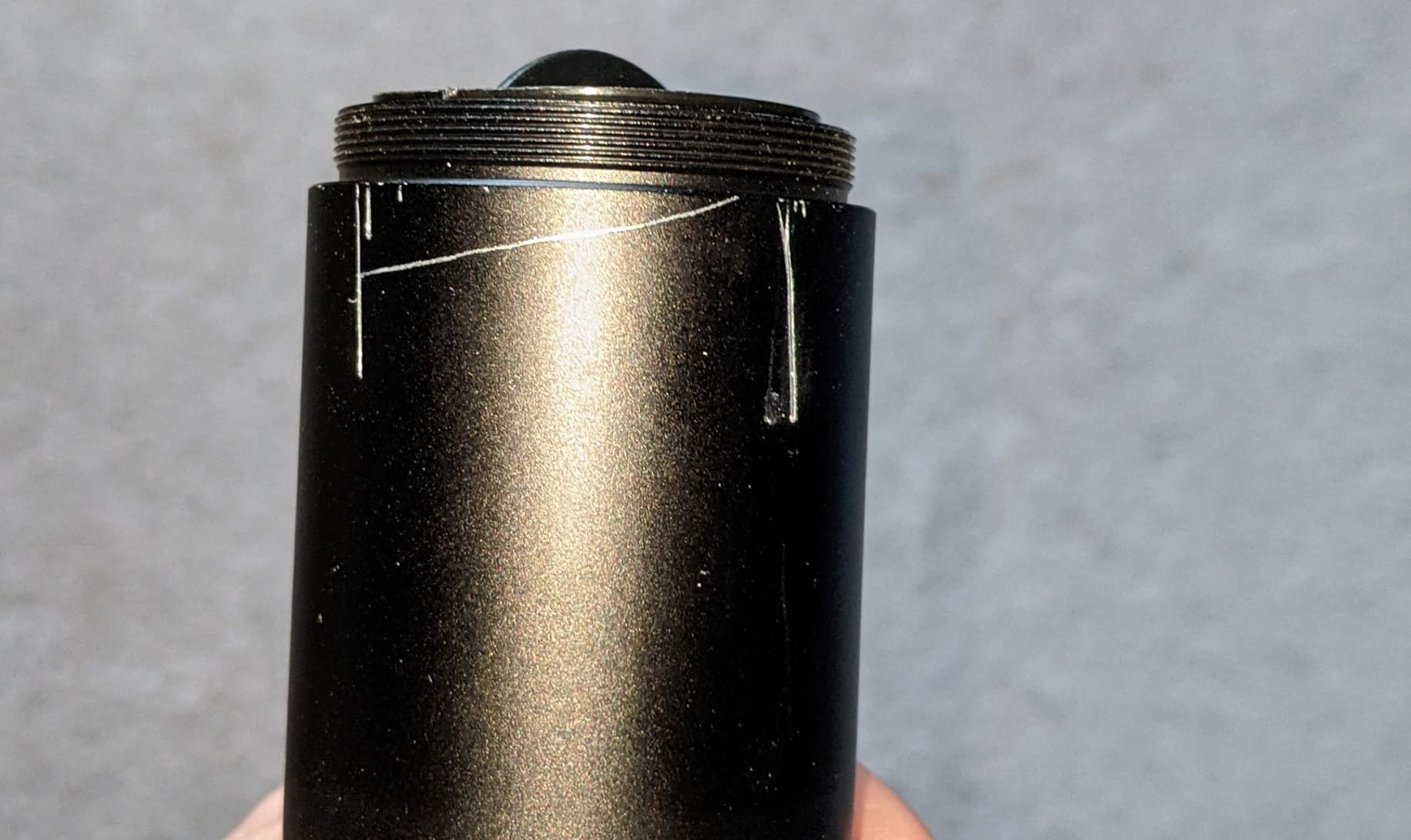
The compromises are honest ones. The accessory fit is a little loose, so a camera or eyepiece can rock slightly even after the lock, and the focus ring spacing means the usable travel is shorter than the tube length suggests. As with any achromat, a faint blue fringe around bright stars is expected and has no effect on guiding.
Why the six-point ring matters more than aperture
Guiding accuracy depends on the guide camera measuring the same drift the imaging camera sees. A scope that sits slightly askew introduces a different error, and a six-point ring lets you dial that out in minutes rather than swapping rings. For a first autoguiding setup, that is worth more than any glass upgrade.
Budget ten minutes for the alignment. Owners note that guiding quality suffers noticeably if the six screws are not carefully adjusted, so treat the ring as a setup step rather than a one-time fitting.
What to watch for on this 40mm scope
Check the focus travel against your camera before ordering, since the ring spacing shortens it and the supplied T2 tubes only partly cover the difference. If your camera sits far from the sensor plane, budget for a spacer.
Also decide early whether the finder shoe is the final mount. It is fine for alignment and testing, but for a full night of imaging a stiffer ring-and-dovetail arrangement is the safer choice.
5. SVBONY SV905C Camera and SV165 Bundle – Best Value Bundle
SVBONY SV905C Guide Camera Eyepiece, SV165 Guide Scope and Dovetail Base
SV165 30mm f/4 guide scope
SV905C 1.23MP color CMOS camera
Aluminum dovetail base
3.75um pixels
630 g total
Pros
- Complete autoguiding kit in one box
- Sensitive enough to find guide stars under a Bortle 5 sky
- ST-4 output plus drivers for PHD2 MDL NINA and Sky-X
- Resolution also adequate for basic planetary stacking
Cons
- Driver setup causes real setup friction
- No ready Linux driver so Linux users may need to build one
- Short included USB-C cable and an unusable printed manual
If you do not own a guide camera at all, this bundle removes the most common reason people stall. You get the SV165 30mm f/4 guide scope, the SV905C camera and an aluminum dovetail base in one package, with everything already matched for back focus. For a first guiding rig it is the shortest path from a bare imaging train to working autoguiding.
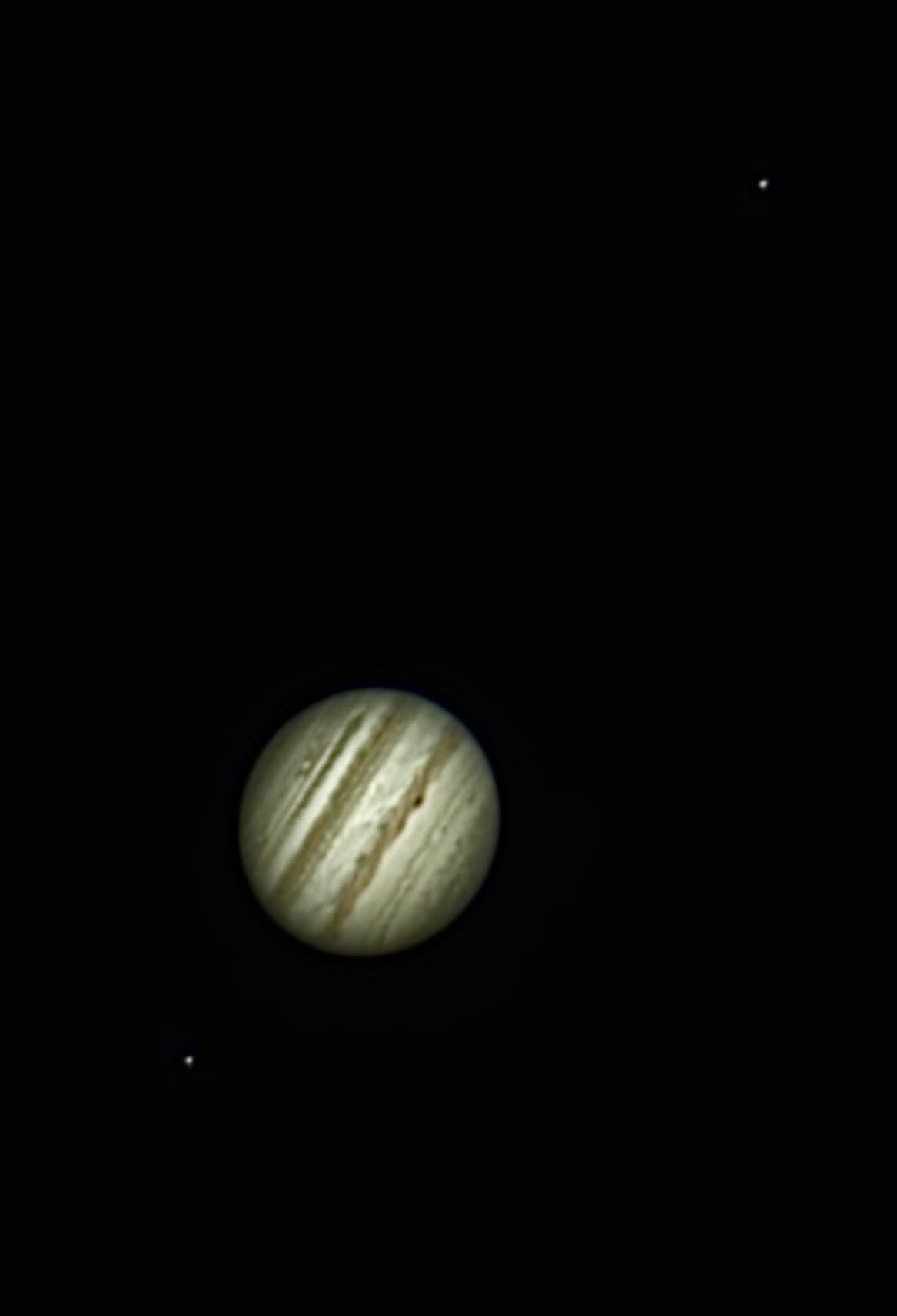
The camera is a 1/3-inch 1280×960 color CMOS with 3.75um pixels, 80 percent peak quantum efficiency and low read noise. Owners rate the sensor itself highly for the money, reporting that it reaches guide stars in a Bortle 5 sky and produces clean results for planetary stacking at the same time, and it exposes both USB 2.0 and an ST-4 guide output for PHD2, MDL, NINA and Sky-X.
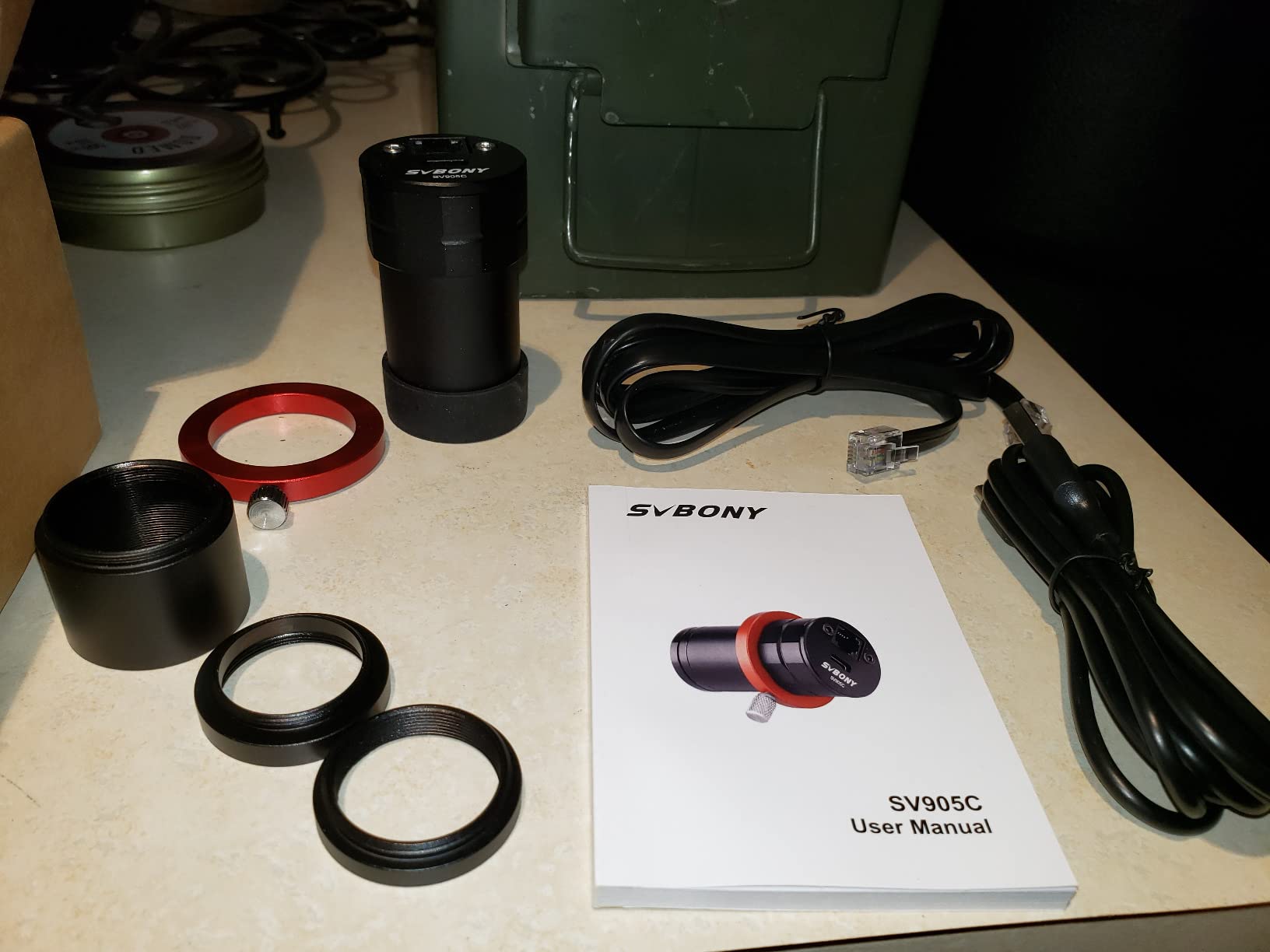
Mechanically the scope is the same 30mm achromat we rated first in this list, with 45mm back focus and a 630 g total weight for camera, scope and base. The dovetail base fits Celestron, Orion and Sky-Watcher finder brackets, and the CS interface plus adapter ring means it can be used with C-mount and off-axis guider setups as well.
The rating is held down by software rather than hardware, and that distinction matters when you are choosing. Drivers are not clearly listed on the manufacturer’s site, some users had to fall back on a related driver, there is no ready Linux driver, and the included USB-C cable is short enough that you will probably need a hub. There is also no compatibility with the ZWO ASI Air system.
Who this bundle fits and who should skip it
It suits a beginner with no guide camera, a portable rig where weight matters more than finesse, and anyone who wants a second small telescope for plate solving or visual alignment. The all-in-one approach means there is no adapter hunting on the first night.
Skip it if you already own a guide camera, or if your software stack depends on an integrated system such as an ASI Air or on Linux drivers. In those cases, a standalone scope and your existing camera is the better path.
Setup issues to plan around
Find the correct driver before you set up, not during a session, and plan on a longer USB cable or a powered hub from the start. The printed manual is effectively useless, so treat the software documentation as your real guide.
Everything else in the box is straightforward. Focus the camera with the built-in snap ring and scale, fit the dovetail base to a finder bracket for the first test, and only move to a rigid mount once guiding is confirmed.
6. SVBONY SV550 80mm f/6 Triplet APO – Best Glass When the Scope Also Images
SVBONY SV550 AP0 Telescope, 80mm ED F6 Triplet Apochromatic Refractor OTA
80mm f/6 air-spaced triplet
480mm focal length
2.5 inch 1:10 focuser
87mm back focus
2860 g OTA only
Pros
- Triplet design nearly removes chromatic aberration
- CNC finish and paint consistently praised
- 2.5 inch 1:10 focuser carries heavy imaging trains
- 87mm back focus reduces vignetting on full-frame sensors
Cons
- Weak focus lock knobs let focus drift if bumped
- Long drawtube limits inward travel for electronic focusers
- Low-profile rail can foul the focuser when balanced forward
The SV550 is the only true apochromat in this roundup, and the reason that matters is star shape across the frame. An air-spaced triplet using one S-FPL51 ED element plus two correction elements at f/6 keeps colour fringing to a minimum, which produces the compact, round guide stars that make guiding corrections steady and easy to read on a graph.
It is also a genuine imaging instrument. The 2.5 inch magnesium alloy dual-speed focuser with a 1:10 ratio handles a heavy camera without flexing, the 87mm back focus reduces vignetting on full-frame sensors, and four internal light baffles keep contrast high. Reviewers who upgraded from cheaper achromats report pinpoint stars and note the build quality is a genuine step up.
At 480mm it is short enough to serve as a guide scope for a long rig, and the 5.6 degree field of view is wide enough that guide star selection is rarely a problem. The compact dovetail rail and light design make a dual-scope setup on a mid-class mount realistic rather than theoretical.
The practical gripes are all mechanical. The focus lock knobs are light, so the focus position can drift if the tube is bumped, the drawtube is long enough that an electronic focuser may have only 3 to 5mm of inward travel left, and the low-profile rail can foul the focuser when the tube is balanced far forward. A 2860 gram OTA also needs a mount with real headroom.
When a triplet pays for itself
It pays off when the same tube will be your imaging scope on a wide or medium field rig, or when you want the smallest possible guide star for multi-star guiding in a bright sky. A 30mm achromat can guide a 600mm refractor perfectly well, so on a short-focal-length rig this is spending money on a feature you may not use.
It also suits imagers who already own quality camera glass and want the scope to match. Chromatic aberration does not affect a guiding measurement directly, so the case here is star shape consistency rather than raw guiding accuracy.
Mechanical limits worth planning for
If you use electronic focusing, check the drawtube clearance before committing. Combine the long focuser with a reducer or filter wheel and the remaining inward travel can be tight, which is a common source of frustration in otherwise excellent setups.
Also plan the balance. The low-profile rail is helpful for compactness but rewards careful positioning, and tightening the focus locks after every bump is a habit worth forming early.
7. Sky-Watcher EvoGuide 50DX – Best Guide Star Finding
Sky-Watcher Sky-Watcher EvoGuide 50DX – 50mm Guide Scope APO Doublet Refractor – Lightweight Guide Scope – Easy Mounting – 50mm Astrograph
50mm f/4.8 apochromatic doublet
242mm focal length
1.1 degree field of view
Finder stalk and V-style rail included
2.7 lb
Pros
- Highest average rating in the group with a much smaller guide star
- Multi-star guiding locks onto far more candidate stars
- ED doublet keeps stars sharp to the frame edge
- Finder stalk and V-style rail mount on almost any rig
Cons
- Helical focuser is coarse and shows backlash when reversing
- Limited back focus adjustment complicates DSLR use
- Short rear focuser end is not easily upgradeable
This is the pick if guiding keeps failing because your rig cannot find a suitable star. The EvoGuide 50DX pairs a 50mm f/4.8 apochromatic doublet with matched ED glass and 242mm of focal length, and owners who already own cheaper scopes report that it cut their guide star size by roughly a third and let multi-star guiding lock onto a dozen candidates.
More candidate stars means the software has options, which means less hunting when a cloud passes or a bright star is lost. The 1.1 degree field is narrower than a mini scope’s, but the aperture more than compensates, and the ED optics hold star sharpness to the edge of the frame without needing a reducer.
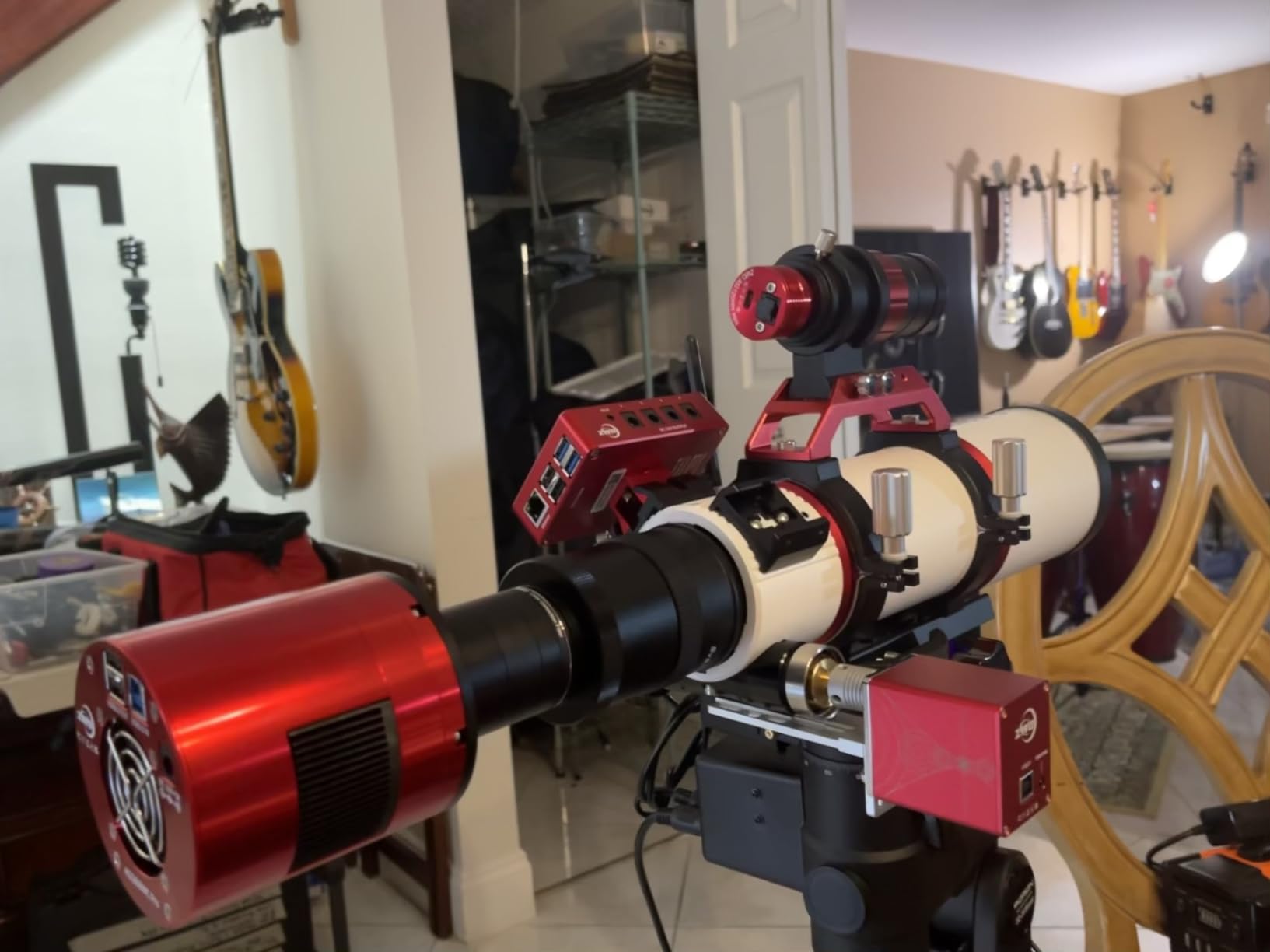
Mounting is unusually well thought out for a guide scope. You get a machined aluminum finder stalk that fits all Sky-Watcher finder brackets, a V-style rail, tube rings and a prime focus ring, so the same tube can sit in a test position on day one and move to a rigid mount later. A 2 year warranty backs it, and built-in T-threads accept an optional adapter to turn it into a fast astrograph.
The one consistent complaint is the 1.25 inch helical focuser. Owners describe it as crude, with backlash and slop when reversing direction, so fine focus takes a back-and-forth turn. For pure guiding that is tolerable, but DSLR users face limited back focus adjustment and may need a flattener matched to their body, and imaging use without a flattener gives elongated stars out of the box.
When multi-star guiding is worth an extra inch of aperture
If you image in suburban skies, through thin cloud, or at low altitude where dew and haze cut star brightness, aperture converts directly into reliability. This scope is the one we would reach for when guiding losses frustrate a run rather than merely annoy.
For wide-field work on a short refractor, a 30mm mini scope will guide perfectly well and weighs a third as much. The 50mm pays off through aperture and focal length rather than through image quality, which is the honest reason to choose it.
Focuser and imaging caveats
Budget time for the helical focuser. Take up backlash in one direction, note the reading, and lock it before you start a long sequence, because temperature drift will move things overnight.
If you plan to use the Astrograph conversion, budget for a field flattener from the start. Elongated corner stars are the normal result of using a fast wide-field scope without one, and it is easier to plan for than to fix later.
8. Astromania Camera Easy Autoguiding Set60 – Best Compact All-in-One
Astromania Camera Easy Autoguiding Set60 – The Key to Successful Planetary Photos
Mini guide scope with planetary CMOS camera
Worm-gear focuser
1280x960 sensor
Tube clamps and Synta plate
2 lb
Pros
- Worm-gear focuser focuses without rotating the camera
- All-in-one package covers scope camera and mounting
- Sized like a finder rather than a full guide scope
- Large CMOS chip for the class suits lunar and planetary framing
Cons
- Only 15 reviews
- so a thin reliability record
- Lowest average rating here with a noticeable one-star tail
- Basic optical design with no ED element
This is the most compact complete package in the roundup, and it is aimed as much at planetary and lunar video as at deep-sky guiding. You get a mini guide scope, a 1280×960 low-noise CMOS planetary camera and the mounting hardware in one box, with a total weight of about 2 pounds.
The focuser is the feature that stands out. A worm-gear mechanism brings the camera in and out without rotating the camera or eyepiece, which avoids the field rotation that spoils some helical designs, and the black anodized housing carries a milled, knurled fine-focus ring for precise adjustments. Tube clamps and a Synta-style mounting plate make assembly quick.
It also accepts any 1.25 inch eyepiece, so it doubles as a finder, and the sensor is large for its class, which helps when framing the Moon and planets. Owners describe the convenience of bolting on something finder-sized rather than building a second full tube, and the package requires no separate adapter hunting.
The honest limitations are the rating and the record behind it. This is the lowest-rated product in the group, with 15 reviews and a visible one-star tail, so there is less long-term evidence of reliability than the other picks. Image quality is described as sufficient for guiding and entry-level planetary work rather than exceptional, and the optics have no ED element to keep stars tight.
When this set makes more sense than a dedicated guide scope
It fits someone who wants lunar and planetary video and needs guiding for the mount without adding much weight. It also suits a beginner who wants one box to open and a finder-sized addition rather than a full guiding project.
For deep-sky imaging on a long refractor, the short focal length and small aperture leave less margin. A brighter sky or a demanding target will expose that quickly, and the thinner review record makes it harder to buy with confidence.
What to check before relying on it
Read the recent one-star and two-star reviews rather than the average. With a small sample, a single failure pattern can hide inside a reasonable-looking score, and that is where the useful detail is.
Also confirm your software supports the camera before committing, and plan to use the included clamps only for lighter loads. A stiffer ring mount is the first upgrade most owners make.
How to Choose a Guide Scope Without Regretting It
Work through these in order, because each one can rule out options that looked attractive on a retailer page. The first three matter far more than anything optical.
1. Imaging focal length sets the guide focal length. As a starting point, the guide scope’s focal length should be at least one-third of the imaging scope’s when guiding visually, and roughly one-tenth is workable with a small-pixel CMOS camera and subpixel guiding. F-factor is the more honest version of that rule: divide the guide scope’s image scale by the imaging scope’s image scale and anything above about 3 is usually fine with modern cameras.
2. Weight against mount payload is the number one disqualifier. A 342 gram scope can go on a star tracker; a 2860 gram optical tube assembly cannot. Check the rated payload against your imaging train first, then add the guide scope, rings and camera.
3. Aperture decides whether a guide star exists. A 30mm achromat works under dark skies with a sensitive camera, and a 50mm gives you options when the sky is bright, cloudy or low on the horizon.
4. Focuser rigidity and lock matter more than most buyers expect. A helical focuser that will not rotate the field is a clear win, and a lock ring is close to essential once you are running long sequences.
5. Mounting hardware should be rings and a dovetail, not a finder shoe. This is the most common and most avoidable cause of differential flexure, the sag that makes stars trail even when the guiding graph looks healthy.
6. Dew management is worth planning. Small guide scope objectives frost faster than imaging tubes, and the failure is silent until the subs are stacked.
7. Optical quality is last on the list. As the community consensus puts it, a guide scope only has to detect that a star moved, not resolve how it looks, so a plain achromat in good mechanical condition beats an expensive optic in a loose mount.
What Good Guiding Actually Means in Arcseconds
Total RMS is the number to watch, and the target depends on your imaging focal ratio. A wide fast rig is the hardest case because its image scale is coarse, so even small angular errors show up as visible trailing.
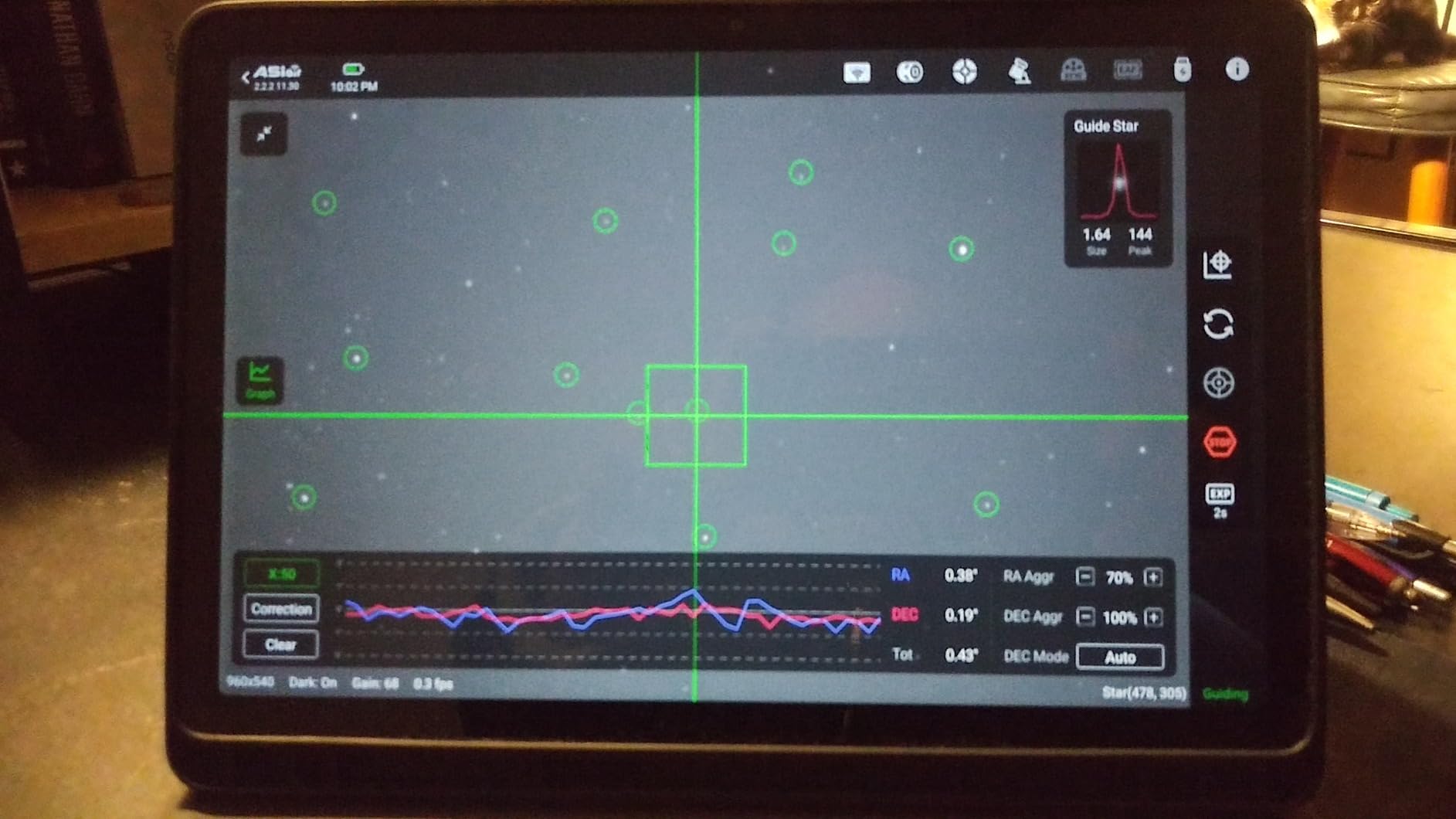
As rough targets, stay under 0.6 arcsec total RMS for a fast f/2 wide-field rig, aim for 0.6 to 0.9 arcsec for common f/4 to f/7 systems, and under 1.0 arcsec for longer focal ratios. If your graph is smooth but the final stars are fat ellipses, the problem is seeing and focus rather than guiding.
The distinction between total RMS and TFS matters because they answer different questions. Total RMS includes periodic error and mount problems, while TFS filters out the low-frequency wobble that the mount cannot realistically correct. TFS is the better predictor of final image quality, so a graph with a large total RMS but a small TFS can still produce excellent data.
Guide Scope vs. Off-Axis Guider: Which One Suits Your Rig?
An off-axis guider sits behind the imaging train and samples light from the same field, which removes differential flexure entirely and makes it the right choice at long focal lengths. Below roughly 600mm of imaging focal length, a guide scope is simpler, cheaper and easier to set up.
Around 1000mm an off-axis guider is noticeably better, because the flexure budget shrinks as your image scale gets finer. Beyond 1500mm, including most SCT and RC imaging, an off-axis guider is the practical answer, and it is also the only thing that fixes SCT mirror flop during long sequences.
Two practical notes from the community. Avoid finder shoe mounting, which several Cloudy Nights and Reddit posters describe as the most damaging avoidable mistake in a guiding setup, and buy an off-axis guider from the same brand as your imaging camera so the adapters are known to fit.
How to Mount and Set Up a Guide Scope
Start with rings and a dovetail rather than a finder shoe. Balance the rig after the guide scope is installed, not before, because the added mass changes where the centre of gravity sits and an unbalanced mount produces the same trailing as a bad guide scope.
Coaxially align the guide scope with the imaging axis before the first sequence. This is exactly what the six-point ring on the 40mm scope is designed for, and ten minutes of adjustment saves a whole night of puzzling results.
For software, PHD2 Guiding remains the standard free option and now supports multi-star guiding, which pairs naturally with a wider field scope like the EvoGuide 50DX. Users already running the ZWO ecosystem will find ASIAir handles the entire stack, provided their camera is compatible with it.
Finally, check for dew on the objective at the start of the night rather than at the end of the data. A small dew band on the guide scope is a cheap addition and it prevents a failure that is otherwise invisible until the stack.
Frequently Asked Questions
What is the best guide scope for astro photography?
For most rigs, the best guide scope is a 50mm apochromatic doublet with a lockable helical focuser and included mounting hardware, because it balances aperture, focal length and weight without overloading a mid-range mount. Short-focal-length imaging setups can use a 30mm achromat instead, which is far lighter and works well with a modern small-pixel CMOS guide camera.
What is the recommended focal length for a guide scope?
Use at least one-third of the imaging scope’s focal length when guiding visually, or about one-tenth when using subpixel guiding with a small-pixel CMOS guide camera. A 120mm guide scope suits imaging scopes from roughly 250mm to 600mm, while a 240mm guide scope is a better match for 800mm to 1500mm systems.
What is the best imaging to guiding ratio for a guide scope?
One-third is the classic ratio for visual guiding and about one-tenth works with subpixel guiding and modern CMOS cameras. The more accurate number is the F-factor, which is the guide scope image scale divided by the imaging scope image scale. An F-factor of 3 or below is generally comfortable with current cameras.
What is considered good guiding in astrophotography?
Aim for a total RMS under 0.6 arcsec on a fast f/2 wide-field rig, 0.6 to 0.9 arcsec for typical f/4 to f/7 systems, and under 1.0 arcsec for long focal ratios. TFS is the number that better predicts final image quality, since it excludes the low-frequency mount wobble that cannot realistically be corrected.
Should I use a guide scope or an off-axis guider?
Use a guide scope below roughly 600mm of imaging focal length, where it is simpler and cheaper. An off-axis guider becomes noticeably better near 1000mm and is the practical answer beyond 1500mm, including most SCT and RC imaging, because differential flexure scales against a shrinking image scale and only an off-axis guider samples the same field.
Final Verdict: Which Guide Scope Should You Buy?
If you are starting from nothing, the SVBONY SV165 30mm f/4 is the default recommendation for the best guide scopes for autoguiding, because it weighs 342 grams, focuses reliably with almost any modern guide camera, and has the largest owner record of any scope in this roundup. Add the SV905C bundle instead if you also need the camera, and skip the accessory hunting entirely.
Move up to the 60mm helical scope for a brighter sky or a longer imaging scope, to the 40mm for the easiest alignment, or to the Sky-Watcher EvoGuide 50DX when guide star selection is what keeps ending your sessions. Whichever you choose, mount it in rings on a dovetail, check it for dew at the start of the night, and let it guide your subs up to the length your sky allows. That is the whole job, and in 2026 it is a much cheaper upgrade than a new mount or a new imaging scope.