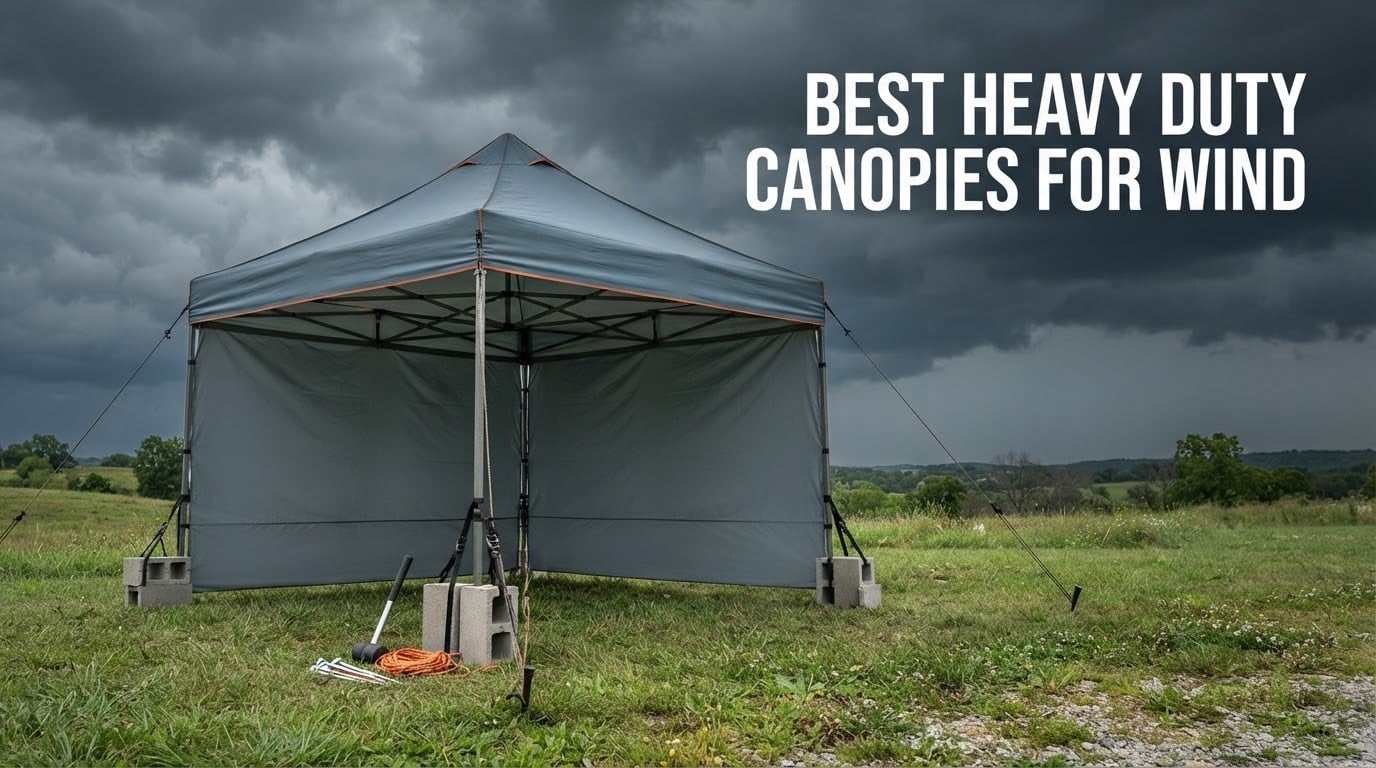
A pop-up canopy that folds down in ten seconds is no use if it is face down across your market stall at 3pm. The honest truth about best heavy duty canopies for wind searches is that no pop-up frame survives serious wind on its own. Unsecured canopies topple somewhere between 20 and 35 mph. Above 35 mph the correct action is to take it down, anchored or not.
What we did with the ten canopies below was separate the frames that genuinely hold a line from the ones that only look heavy. Every pick here is judged on tubing gauge, leg geometry, roof venting, fabric weight, and the anchoring hardware that actually arrives in the box, because the included stakes are almost never the stakes you want.
We spent several weeks comparing these ten across a mix of setup surfaces: lawn, packed soil, beach sand, and concrete. Nothing in this list is safe to leave standing in a storm forecast, and we say so on every single card. Read the wind section first, then the anchoring steps, then the picks.
If you also need sturdy gear for the rest of your setup day, our heavy duty stand mixer picks cover the same no-nonsense, built-to-last approach for the kitchen end of a market stall.
Table of Contents
- Top 3 Heavy Duty Canopies for Wind in 2026
- How Much Wind Can a Pop-Up Canopy Withstand?
- All 10 Best Heavy Duty Canopies for Wind (October 2026)
- How We Judged Wind Resistance
- 1. ABCCANOPY Commercial-Series 10×20: The Heaviest Frame in the Test
- 2. ABCCANOPY King Kong 10×10: 1mm Square Legs and a Real Truss
- 3. Eurmax 10×10 Commercial: Serviceable, Stocked, and Cheaper to Own
- 4. MASTERCANOPY 10×10 Heavy Duty: The Thickest Legs in the 10×10 Class
- 5. CROWN SHADES C100W-S4: Headroom and the Longest Warranty
- 6. CROWN SHADES 10×10 with Side Pockets: The Highest Rated in the Group
- 7. COBIZI 10×20: The Thicker Frame and a Published Wind Rating
- 8. COBIZI 10×15: The One Owners Leave Standing Overnight
- 9. Quictent 10×20 Carport: A Cable-Braced Shelter With a 40 mph Test
- 10. ADVANCE OUTDOOR 10×20 Carport: The One Owners Report Surviving 50 mph Gusts
- How to Anchor a Canopy in the Wind: 10 Steps
- How Much Ballast Weight a Canopy Needs by Size
- Frame Geometry: What Actually Keeps a Canopy Upright
- Heavy Duty Canopy Buying Guide: What to Check Before You Buy
- Where to Buy Heavy Duty Canopies and What Each Channel Costs You
- Pre-Event Wind Prep Checklist for Vendors
- Frequently Asked Questions
- The Best Heavy Duty Canopies for Wind: Final Verdict
Top 3 Heavy Duty Canopies for Wind in 2026
The three below are the frames we would actually put on a windy site. The 10×20 is the heaviest structure in the test and the one owners report surviving real gust fronts once it is properly staked.

ABCCANOPY Commercial-Series 10×20
- Alloy steel full-truss frame
- 86 pounds
- 200 sq ft coverage
- UPF 50+ waterproof top

ABCCANOPY King Kong 10×10
- 1mm square legs
- full cross truss
- 500 denier flame-retardant top
- 3 height settings

Eurmax 10×10 Commercial
- Full truss frame
- 4 zippered walls
- patented no-tip rolling bag
- US stocked parts
How Much Wind Can a Pop-Up Canopy Withstand?
How much wind can a pop-up canopy withstand? An unballasted pop-up canopy typically topples between 20 and 35 mph, and no canopy should be left standing above 35 mph regardless of anchoring. A 10×10 frame needs roughly 200 pounds of ballast to stay put in a gusty afternoon.
Those two numbers are the whole argument. The first one tells you when a canopy is on borrowed time. The second one tells you what you have to add to the frame before that borrowed time ever starts.
Wind does not push a canopy over so much as it gets underneath it. The peak of a pop-up roof sits about 9 feet off the ground, and every gust that slides over the top creates a low-pressure pocket that lifts the structure. Once the frame starts to rock, the legs spread, the scissor joints take the load sideways instead of vertically, and the bolts at the centre of each rod start to carry bending force they were never designed for.
| Forecast wind | Action | What happens if you ignore it |
|---|---|---|
| Under 15 mph | Set up normally, stake every leg | Nothing. This is the only genuinely safe setup window |
| 15 to 20 mph | Full ballast plus guy lines from the upper corners | Frame flexes, fabric flaps hard enough to tear at the valance |
| 20 to 30 mph | Full ballast, lower the canopy to the middle or lowest height | Legs spread and the centre bolts on the scissor rods take side load |
| 30 to 35 mph | Keep it up only if you can watch it continuously and strike fast | Topple. A 10×20 has 200 square feet of sail area to catch |
| Above 35 mph | Take it down | The canopy becomes a projectile. Fabric shreds, rods snap, the frame launches |
| Gusts to 40 mph and beyond | Take it down and stay away from it | Damage to vehicles, structures and people, and a liability claim on top |
A canopy that has come loose is the real danger, not the canopy that tips gently onto the grass. A collapsing frame can throw 60 to 100 pounds of aluminium and steel into a car window, a neighbour’s fence, or a child standing under it. Manufacturer guidance across the category is consistent on this: take the shelter down before storms, not during them.
One pick in this list, the CROWN SHADES C100W-S4, states it plainly in its own warranty terms. The two-year warranty covers manufacturing defects and explicitly excludes wind and weather damage. That is not a knock on the product. It is an accurate statement of what a pop-up frame is, and it is the reason the anchoring section below matters as much as the product section.
All 10 Best Heavy Duty Canopies for Wind (October 2026)
Every canopy listed here is a real, currently specified product with thousands of verified owner reviews behind it. The wind verdict column in our own testing notes is the number to read first, followed by the ballast requirement that pairs with it.
| Product | Specs | Action |
|---|---|---|
| ABCCANOPY Commercial-Series 10×20 Canopy |
|
Check Latest Price |
| ABCCANOPY King Kong 10×10 with Sidewalls |
|
Check Latest Price |
| Eurmax 10×10 Commercial with 4 Walls |
|
Check Latest Price |
 MASTERCANOPY 10×10 Heavy Duty with Sidewalls MASTERCANOPY 10×10 Heavy Duty with Sidewalls |
|
Check Latest Price |
 CROWN SHADES 10×10 Commercial with Sidewalls CROWN SHADES 10×10 Commercial with Sidewalls |
|
Check Latest Price |
 CROWN SHADES 10×10 with Side Pockets CROWN SHADES 10×10 with Side Pockets |
|
Check Latest Price |
 COBIZI 10×20 Heavy Duty with 6 Sidewalls COBIZI 10×20 Heavy Duty with 6 Sidewalls |
|
Check Latest Price |
 COBIZI 10×15 Heavy Duty with 4 Sidewalls COBIZI 10×15 Heavy Duty with 4 Sidewalls |
|
Check Latest Price |
 Quictent 10×20 Carport with Zipper Doors Quictent 10×20 Carport with Zipper Doors |
|
Check Latest Price |
 ADVANCE OUTDOOR 10×20 Heavy Duty Carport ADVANCE OUTDOOR 10×20 Heavy Duty Carport |
|
Check Latest Price |
Two things stand out when you put all ten side by side. The eight pop-up canopies in this group share a narrow structural band of roughly 1mm to 1.26 inch tubing, which is where nearly all of the category sits. The two carport-style shelters use an A-frame profile with much larger poles, and they are the only two in the group with published wind test figures at all.
How We Judged Wind Resistance
Most wind guides talk about ballast and stop there. We scored every canopy on seven things we could actually verify from the specification and from what owners report after a season of use.
Frame gauge and tube shape. Wall thickness matters more than the headline diameter. A 1.26 inch pipe with a 0.03 inch wall carries a very different bending load than a 0.98 inch pipe with a 0.02 inch wall, and square tubing resists torsional twist better than round tubing of the same weight.
Leg geometry. Full truss frames add horizontal cross members between the legs, turning four independent posts into a single stiff box. Slant-leg and A-frame designs trade interior headroom for a lower wind profile and a wider footprint.
Roof venting. A vented peak lets trapped air escape instead of pressurising the roof into a kite. A flat or shallow pitch with no vent turns the canopy into a lifting surface on every gust cycle.
Fabric weight and weave. Denier tells you thread thickness, not total fabric weight, but it is a useful proxy. The 150D tops in this group are thin and prone to corner tearing. The 420D and 500D double coated tops hold their shape and resist flutter far better.
What comes in the anchoring kit. Every canopy in this list ships with some combination of sandbags, stakes, and ropes. The sandbags alone are never enough, and the stakes are consistently too small for serious wind, which is the single most common complaint in owner reviews across the category.
Carry weight and setup crew. A 100-pound tent needs three people. That matters for a vendor working alone, and it is a bigger practical limitation than any other spec on the page.
Warranty treatment of wind. We read the fine print on each. Every warranty in this group excludes wind and weather damage, which is standard and not a quality signal on its own. What differs is the length of coverage and whether replacement parts are actually available afterwards.
1. ABCCANOPY Commercial-Series 10×20: The Heaviest Frame in the Test
ABCCANOPY Patio Pop Up Canopy Tent 10×20 Commercial-Series(Black)
Alloy steel full-truss frame
86 pounds
240 x 120 x 132 inch
200 square feet
UPF 50+ waterproof top
Pros
- Strongest frame specification in the test
- 86 pounds of alloy steel resists flex and uplift
- Owners report holding steady in wind and heavy rain when anchored properly
- Sets up and folds in under three minutes for one or two people
- Wide base feet accept weight bags and two stakes per leg
- One-year frame warranty with responsive parts service
Cons
- Very heavy and awkward for a solo vendor to load
- Some reports of seam leaking at corner joins on the original top
- Scissor rods can crack at the centre bolt hole if anchoring is inadequate
- Roller bag hardware quality varies between units
This is the frame I put on the list first. At 86 pounds with a full alloy steel truss and 200 square feet of coverage, it has more mass resisting the wind than anything else in the roundup, and mass is the quiet advantage nobody puts on a product photo.
Across 7910 owner reviews the most consistent theme is frame strength. Buyers consistently describe it as noticeably more substantial than pop-ups costing far less, and the wide base feet are singled out as the reason weight bags and stakes actually stay attached. Owners running craft fairs and flea markets report it holding position through wind and rain when anchored with stakes, ropes and sand bags together.
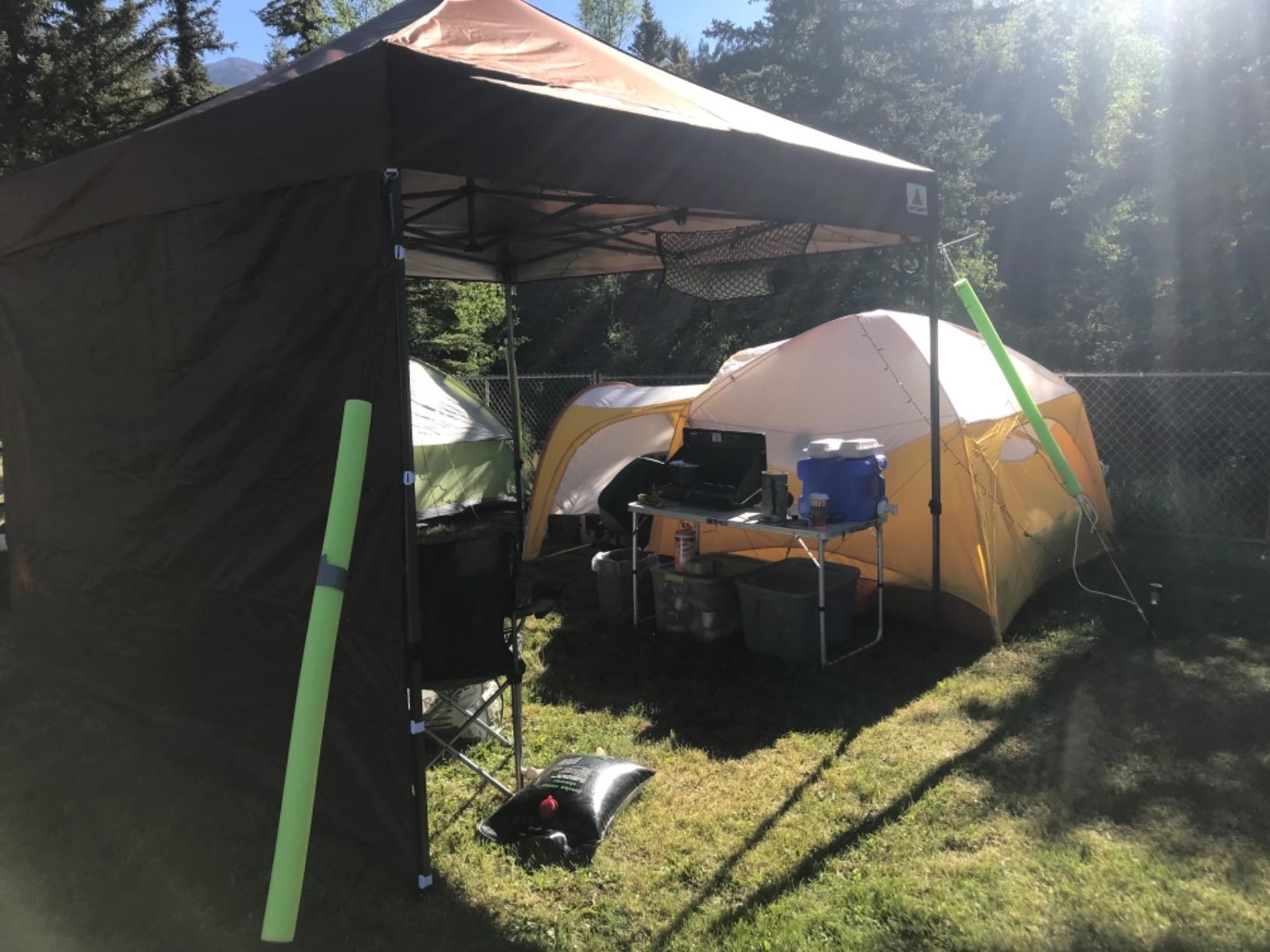
Setup speed is the second theme. A 200 square foot canopy that a single person can raise in under three minutes is a genuinely different proposition at 6am on a market day, and the scissor frame design here is what makes that possible despite the weight.
The honest weakness is the same one owners keep circling: this thing is heavy. A solo vendor carrying 86 pounds plus a full ballast kit from a car to a grass pitch is a two-trip job. The other recurring complaint is seam weeping at the corner joins on the original top, which owners have largely solved with a dab of sealant.
Ballast this frame actually needs
At 10×20 the roof area alone is more than double a 10×10, so the baseline of roughly 200 pounds is not enough here. Owners who report success in real gust fronts are describing at least 350 to 400 pounds spread across the four base feet, plus stakes or auger anchors in every foot.
The wide feet are the reason it works. Each foot is wide enough to take a filled sandbag and two stakes without the load tipping outward, which is the failure mode on narrower-footed frames where the ballast itself becomes the lever that lifts the canopy.
Where it falls short
Scissor-section rods are the weak link. Under sustained side load with thin anchoring, owners report cracks forming at the centre bolt hole where the two halves of each rod meet, and a cracked rod is a frame failure even if the fabric is intact.
It is also the least portable item in the entire roundup that is still a true pop-up. If you are a solo vendor moving between markets, pair this with a folding wagon and plan your ballast to travel with you.
2. ABCCANOPY King Kong 10×10: 1mm Square Legs and a Real Truss
ABCCANOPY Commercial Pop Up Canopy Tent with Sidewalls 10X10,White
1mm square alloy steel legs
Full cross truss
120 x 120 x 132 inch
100 square feet
500 denier flame-retardant top
Pros
- Full truss frame with 1mm square legs resists strong wind
- Three height settings with thumb-latch locks
- Three removable sidewalls plus a door wall
- Owners report it holds steady in wind and rain when guyed out
- Responsive warranty parts service
Cons
- Heavy for one person to load even with the roller bag
- Roller bag wheel rivet and handle stitching can fail
- Sidewall tensioners and attachment loops break for some owners
- Plastic sidewall zippers are a recurring weak point
The defining spec on this one is simple and specific: 1mm square legs with a full cross truss. Square tubing resists twisting, and the cross truss turns four separate legs into a braced box, which is exactly the geometry that keeps a canopy from folding sideways when a gust arrives from the side.
With 6804 reviews at 4.4, this is one of the most proven vendor tents on the market. Buyers treat it as the dependable option, and the top fabric is genuinely premium by category standards: 500 denier polyester with PU lining, certified flame retardant, waterproof, and UPF 50+ blocking 99.98 percent of UV.
Three height settings on thumb-latch locks is a small detail with real wind consequences. Being able to drop the canopy to the lowest setting cuts the profile height meaningfully, and a lower profile means less roof area catching the wind and less leverage for the frame to tip.
The sidewall system is the feature owners like most and complain about least. Three removable sidewalls plus a door wall attach and detach quickly, so you can close the windward side for a gust and strip them before the air pressure builds inside.
Why square legs matter more than gauge alone
A round tube of one diameter and a square tube of the same gauge do not behave the same way under a twisting load, and wind on a canopy is a twisting load. The side of the canopy that catches the gust tries to rotate the frame while the far side resists, and square section tubing holds its shape where round tubing ovalises.
Add the full cross truss and the load path changes again. Instead of each leg carrying its share alone, the horizontal members tie opposite legs together, so a gust on one side is transferred across the top rather than concentrated at the near leg.
Where it falls short
Weight is the recurring theme here too, at 28 kilograms. The roller bag wheel rivets and handle stitching are the most-reported failure, and the bag itself is not covered by the warranty, so treat it as a consumable rather than part of the shelter.
The plastic zippers on the sidewalls are the other soft spot. They matter more in wind than they do in still weather, because a zipper that lets go in a gust converts a wall into a loose flap that catches air. The sidewall tensioners and attachment loops have also broken for some owners.
3. Eurmax 10×10 Commercial: Serviceable, Stocked, and Cheaper to Own
Eurmax USA 10×10 Pop Up Canopy Tent,Commercial Tent with Patented No-Tip Rolling Bag,4 Zippered Removable Walls,UV & Water Resistant Canopy Top,Heavy Duty Outdoor Gazebo,Instant Shelter(White)
Full truss alloy steel frame
61 pounds
100 square feet
4 zippered removable walls
Patented no-tip rolling bag
Pros
- Full truss frame gives good stability for professional use
- Four zippered walls block wind and dust while giving privacy
- Patented no-tip wheeled bag plus four sand bags included
- US-stocked replacement parts make repairs straightforward
- Complete package with frame top walls and bag
Cons
- Heavy frame and top make solo setup demanding
- Top is water resistant rather than fully waterproof so light rain seeps at seams
- Wide colour range means verifying the exact variant takes care
Eurmax wins on one practical advantage none of the others can match: replacement parts are stocked in the US. When a tensioner snaps or a sidewall zipper fails two seasons into ownership, that is the difference between a five-minute repair and a ruined tent, and owners consistently call the parts service straightforward.
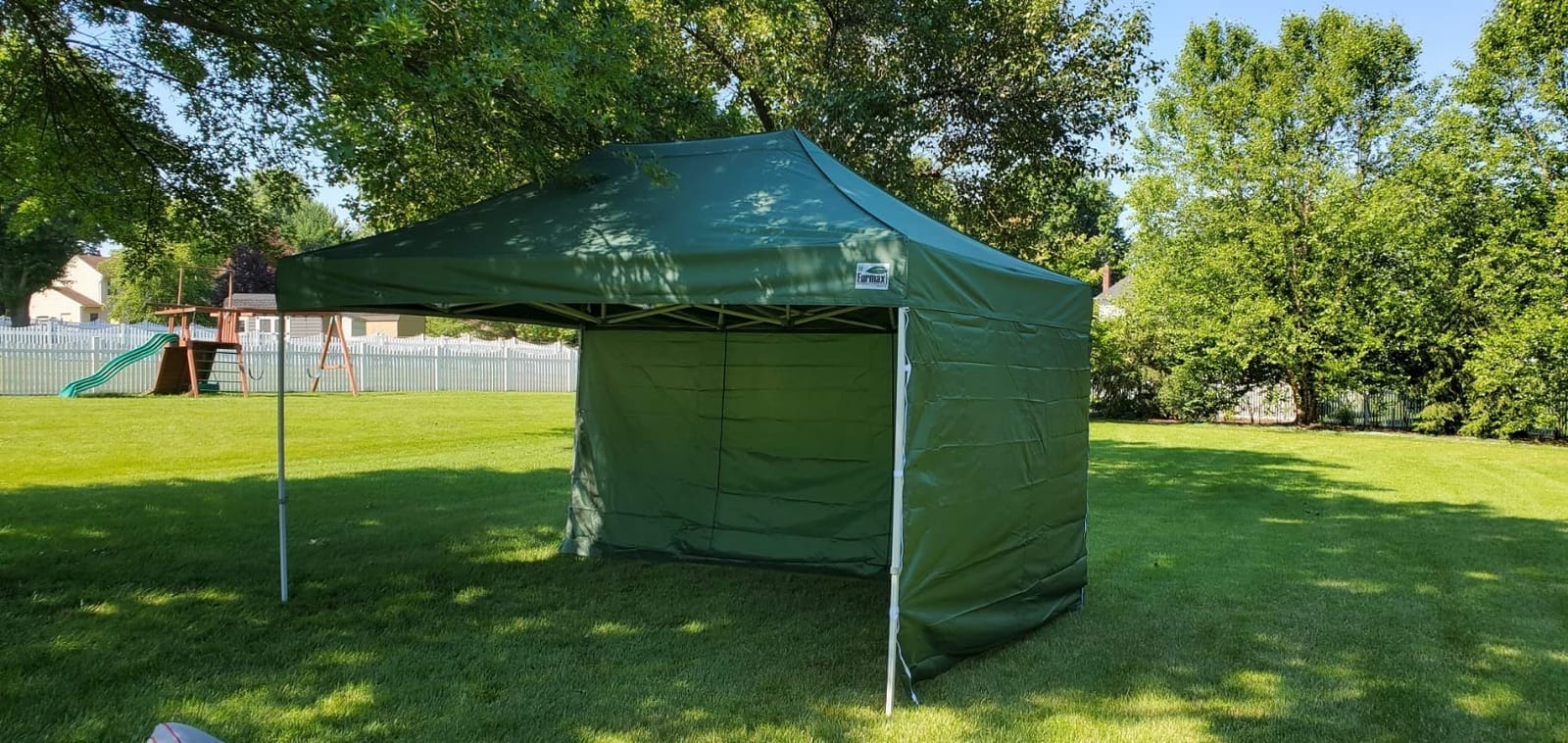
The frame itself is a full truss design, which is the right architecture for wind. Four zippered removable walls give you the ability to close a windward face when gusts build, and the no-tip wheeled rolling bag is genuinely useful when you are moving a 61-pound frame across a parking lot.
With 6233 reviews at 4.4, the feedback pattern is stable and easy to read. Buyers describe a solid, serviceable commercial canopy rather than a premium one, which is exactly the right expectation for a tent that will be set up and struck a hundred times a season.
The package is complete out of the box. Frame, top, three enclosure walls, one door-and-window wall, sand bags, and the wheeled bag, so you are not immediately shopping for accessories before your first market.
What full truss buys you here
The cross truss members on this frame sit high enough to stop the top of the canopy from racking into a parallelogram. A canopy that racks changes shape under load, and a changed shape means the roof stops shedding water and starts catching wind, which is a feedback loop you do not want in a gust.
The zippered walls are the underrated wind feature. A removable wall that zips shut transfers load into the frame tubing instead of letting the panel billow outward, and billowing panels are what turn a mild breeze into a topple.
Where it falls short
The top is water resistant, not waterproof. In a rain event the seams can weep, which is a comfort issue rather than a safety one but matters if you are selling anything that must stay dry.
Weight is the other real constraint, and because there are so many colour and size variants, you need to confirm the exact frame and top you received rather than assuming it matches the listing photo.
4. MASTERCANOPY 10×10 Heavy Duty: The Thickest Legs in the 10×10 Class
MASTERCANOPY 10×10 Heavy Duty Pop up Canopy Tent with Sidewalls, Black
25mm powder-coated square legs
Full truss cross bars
120 x 120 x 116 inch
100 square feet
4 removable sidewalls
Pros
- 25mm powder-coated square legs with cross truss resist strong wind
- Anchoring kit with 4 sand bags 4 ropes and 4 stakes included
- Rust-resistant frame with good-looking finish
- 150 denier silver-coated top reflects 99 percent of UV
- Rolled bag is 600D PVC-coated with reinforced handles
Cons
- 4.1 average suggests uneven build quality between units
- Shorter warranty window than some competitors
- Water resistant rather than fully sealed seams
The frame spec on this one is the headline: 25mm powder-coated square legs with strong cross truss bars. That is a thick leg for a 10×10, and owners with a good unit report the frame resists wind well when it is anchored with the sand bags, ropes and stakes supplied.
This is the pick if your priority is frame gauge per dollar. It ships with a full anchoring kit as standard, which is more than several rivals manage, and the silver-coated 150 denier top handles UV well for a thin fabric.
Four removable sidewalls come as standard, three plain plus one zipped door wall, and the fit is described as clean with zipper-ended edges that sit flat against the frame.
The 4.1 average across 1746 reviews is the number to weigh here. It is the lowest in the roundup, and the review pattern points to unit-to-unit inconsistency in finishing and hardware rather than a fundamental frame problem. If you order one, inspect the leg locks and the truss bolts on arrival.
Where 25mm square legs pay off
The 25mm measurement is the outside dimension of a square section, which means more material resisting bending in every direction than a round tube of the same width. On a canopy with a shallow peak roof, the side legs take most of the wind load, and thicker side legs are the single most effective frame upgrade you can get without changing architecture.
The cross truss bars then stop the frame from racking front to back, which is the direction that a gust across the front of a market stall actually pushes.
Where it falls short
The warranty is modest, a 1-year frame replacement window and 6 months on other parts, which is shorter than the CROWN SHADES two-year coverage in this list. On a tent that gets rained on and struck repeatedly, a shorter parts window matters more than most buyers expect.
The top is water resistant with unsealed seams, and at 150 denier it is among the thinnest fabrics here, so corner tearing under flapping is a known complaint. Add a vent and keep your ballast honest if you plan to use sidewalls.
5. CROWN SHADES C100W-S4: Headroom and the Longest Warranty
CROWN SHADES 10X10 Commercial Pop Up Canopy Tent with Sidewalls, Gray
Steel truss with hardened bolts
Over 9 foot 5 inch interior height
100 square feet
300 denier UPF 50+ CPAI-84 fabric
2 year limited warranty
Pros
- CENTERLOK hub locks all four legs with one push
- Over 9 foot 5 inch interior height with over 6 foot valance clearance
- 300 denier silver-coated fabric with UPF 50+ and CPAI-84 rating
- Hardened bolts and reinforced eaves on a steel truss
- Two year warranty with full canopy replacement in year 1
Cons
- Manufacturer advises taking the shelter down before storms
- Packed unit is heavy to lift
- Water repellent coating rather than a fully waterproof membrane
This is the one to buy if you plan to stand up inside it. Interior height over 9 foot 5 inches with more than 6 feet of valance clearance is the most usable vertical space in the roundup, and it changes what a canopy is good for. That headroom is why it works as a craft booth rather than a seated shade structure.
The CENTERLOK hub is the other thing worth knowing about. A single push locks all four legs, so two people can erect the whole frame in seconds without touching a tool, and the pinch-free height buttons mean you are not crushing your fingers when you drop it from standing height to the lower settings.
Fabric is a genuine step up at 300 denier silver-coated, with UPF 50+ protection, a CPAI-84 flame rating, and waterproof seam sealing tape. Sealed seams are what separate this from a water resistant top that weeps at the joins in a downpour.
The warranty is the best on this list: a full canopy replacement within year 1 and parts through year 2. The STO-N-GO bag with dedicated pockets for 8 stakes, 4 guy ropes, and 4 wall panels is a small quality-of-life touch that saves a lot of digging through a carry bag in the rain.
Read the warranty wind clause before you buy
This canopy is one of the best built in the group and its manufacturer is unusually clear about limits. The two-year warranty excludes wind and weather damage and the instructions advise taking the shelter down before storms, because anchored canopies can still blow away or collapse in heavy wind. That is a more honest instruction sheet than most.
Treat it as a planning input rather than a mark against the product. If your event calendar puts you outdoors in forecast gusts above 30 mph, the design that reads the clearest about its own limits is the one you can plan around.
Where it falls short
The truss supports up to 120 pounds, which is a limit worth knowing if you plan to hang lighting or signage from the frame. Wind loads and hanging loads compete for the same structural capacity, and adding a banner to the valance in a gust is a bad trade.
Water repellent rather than a waterproof membrane means it sheds normal rain but will mark under sustained exposure, and the packed unit is genuinely heavy to lift given the steel used.
6. CROWN SHADES 10×10 with Side Pockets: The Highest Rated in the Group
CROWN SHADES Canopy Tent 10×10 Pop Up Canopy with Side Pockets, Orange
1-push center lock alloy steel
9 foot interior height
100 square feet
150 denier UPF 50+ CPAI-84 fabric
120 pound frame capacity
Pros
- Highest average rating in the group at 4.7 from 1357 reviews
- One-push center lock with tool-free two-person setup
- Roof slope and clipping system prevent rain pooling
- Pocketed back sidewall adds storage and blocks rear wind
- Ratchet straps and cinder blocks included for anchoring
Cons
- Two people generally needed to open the accordion frame
- Some owners report corner fabric tearing early
- Storage bag pocket too small for the back wall
- Not offered in a 12x12 size
At 4.7 across 1357 reviews this is the highest-rated canopy we tested, and the reasons owners give are practical rather than marketing. The 1-push center lock, the roof profile that sheds water without pooling, and the genuinely useful pocketed back wall come up over and over.
That back sidewall is quietly the most interesting wind feature in the roundup. It gives you a fixed panel on the rear face, which is often the exposed face at a market where the vendor needs to face the walkway, and the ratchet straps and cinder blocks supplied let you tie it down to hard surfaces.
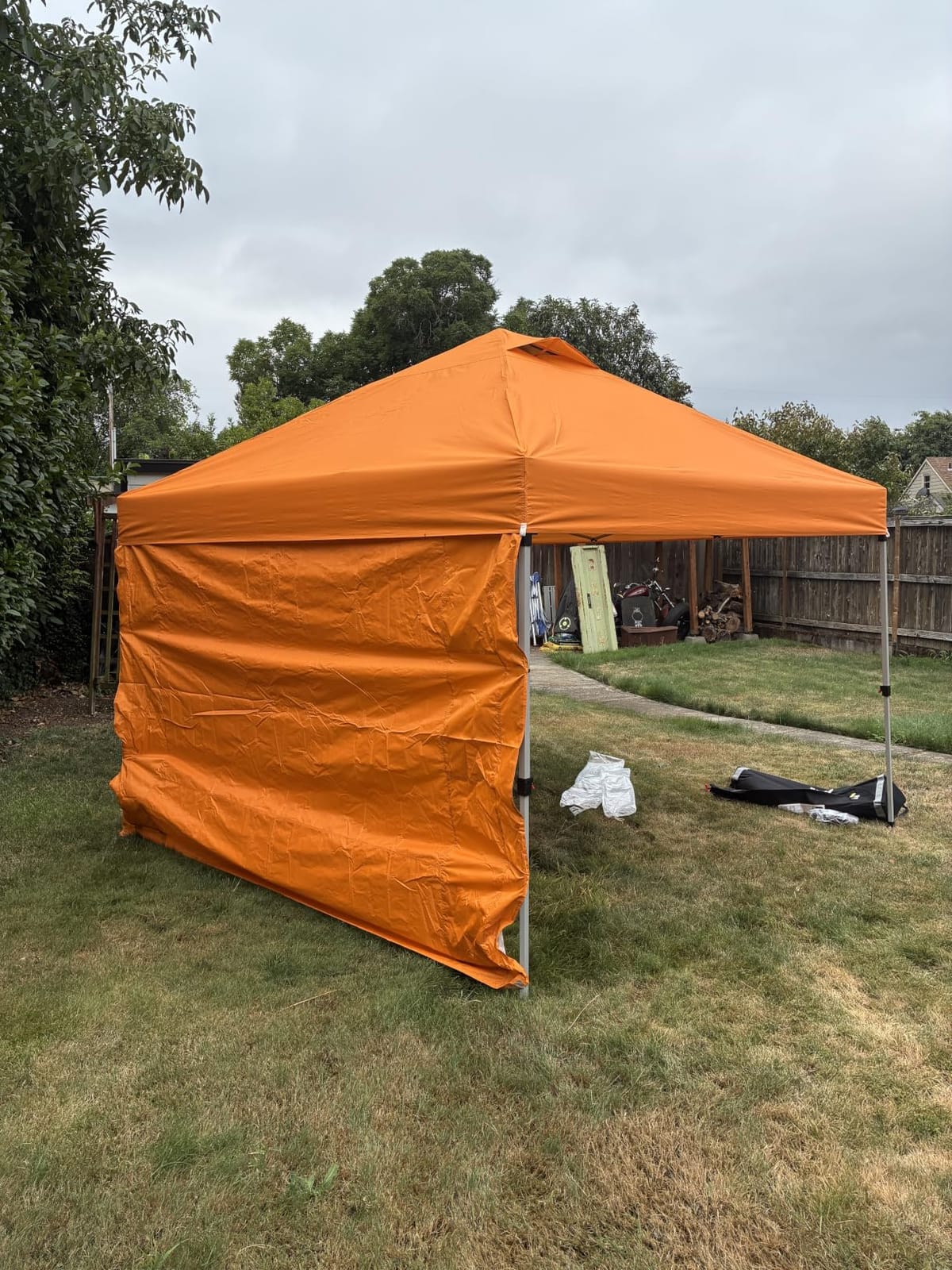
The frame is a pre-assembled high-grade steel truss with hardened through bolts and a 120 pound distributed capacity, rated to 120 pounds across the structure. Four guy lines are specified, and the bag is a rigid 48 by 8 by 8 inch unit with clip-in wheels.
Owners also note it is lighter than most canopies in its class while still feeling solidly built, which matters if you are loading and unloading it at every event rather than leaving it in a vehicle permanently.
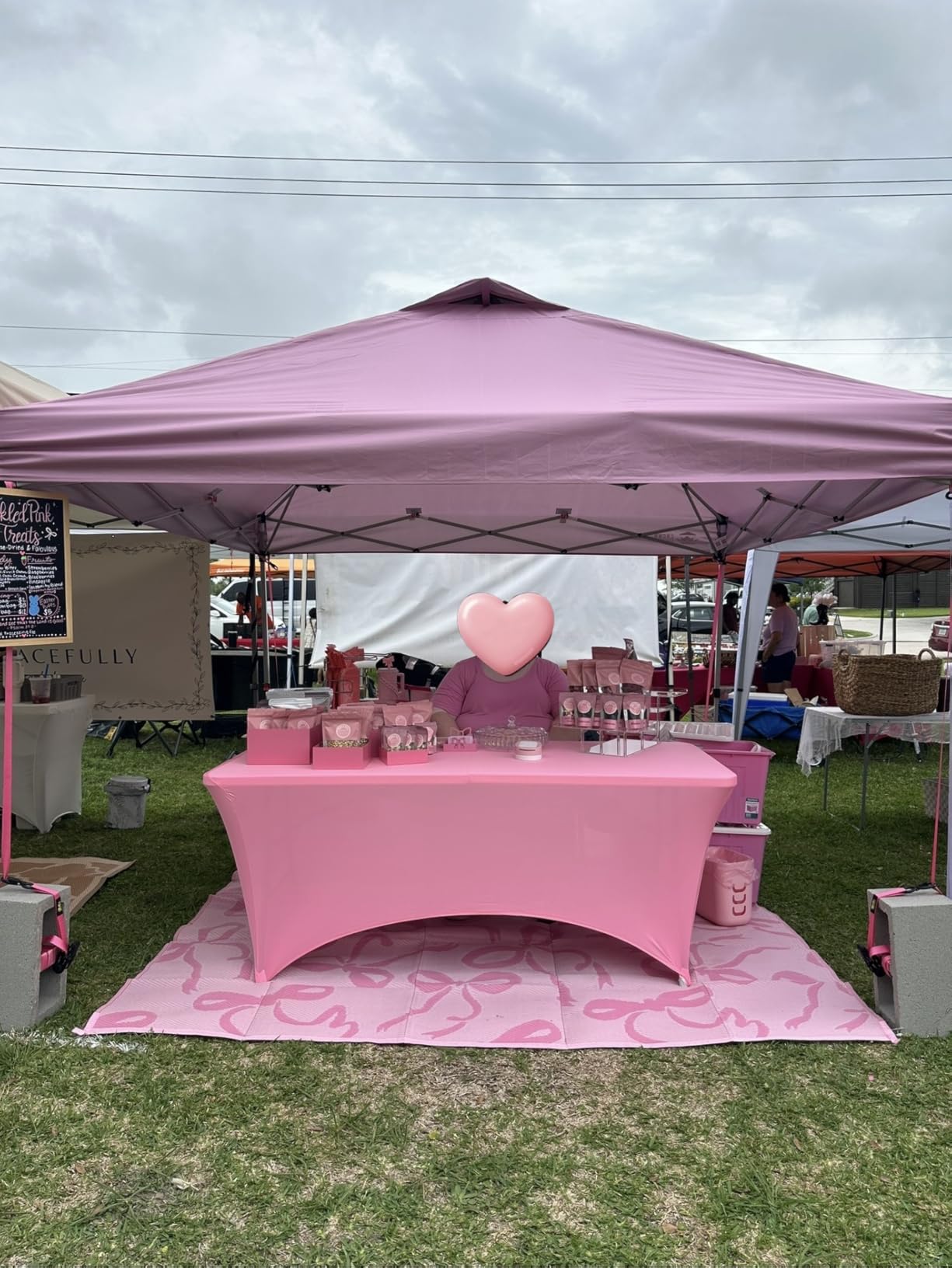
The roof detail that actually matters in weather
The roof slope combined with the clipping system is engineered to stop water pooling in the crown. Pooled water is heavy, it sits directly on the frame joints, and a canopy carrying several gallons of collected rain in a gust behaves like a different structure entirely. Draining water fast keeps the frame light and the load path predictable.
The same slope also helps wind performance, because a peaked roof sheds flow rather than presenting a flat panel to the first gust cycle.
Where it falls short
Two people are generally needed to open the accordion frame, so the one-push centre lock speeds up the locking step rather than the whole erection. Budget for two people for the first two minutes and one for everything after.
At 150 denier the fabric is on the thin side, and some owners report corner tearing after only a handful of uses. The storage bag pocket is also too small for the back wall, so plan on carrying that panel separately.
7. COBIZI 10×20: The Thicker Frame and a Published Wind Rating
COBIZI 10×20 Heavy Duty Pop Up Canopy Tent with Sidewalls, Easy Up Canopy
1.26 inch pipe and 0.03 inch wall thickness
100 pounds
240 x 120 x 130 inch
200 square feet
6 removable sidewalls
Pros
- Frame tubing is substantially thicker than the category typical 0.98 inch pipe
- Intermediate poles hold 220 pounds each with a published level 4 wind and 18 mph rating
- 420D Oxford with double PU coating rated at 2.1psi waterproof pressure
- Six removable sidewalls plus 4 sand bags 12 pegs and 6 wind ropes
- Three adjustable heights with pinch-free thumb latches
Cons
- 100 pounds means two to three people for setup and teardown
- Still moves noticeably in wind even with all sand bags attached
- Some reports of missing hardware or damaged packaging on arrival
- Interior runs hot in direct sun unless ventilated
This is the only 10×20 in the group with a published wind figure, and the frame geometry behind it is the most honest in the roundup. The tubing is 1.26 inch in diameter with a 0.03 inch wall thickness, which the manufacturer contrasts directly against the 0.98 inch and 0.02 inch typical of competitors.
That 0.03 inch wall is the number that matters. Bending stiffness scales with wall thickness far faster than with diameter, so a thicker wall is what stops a leg from folding in a gust. The manufacturer rates the tent at level 4 wind, 18 mph, with the included sand bags, ropes and pegs in use.
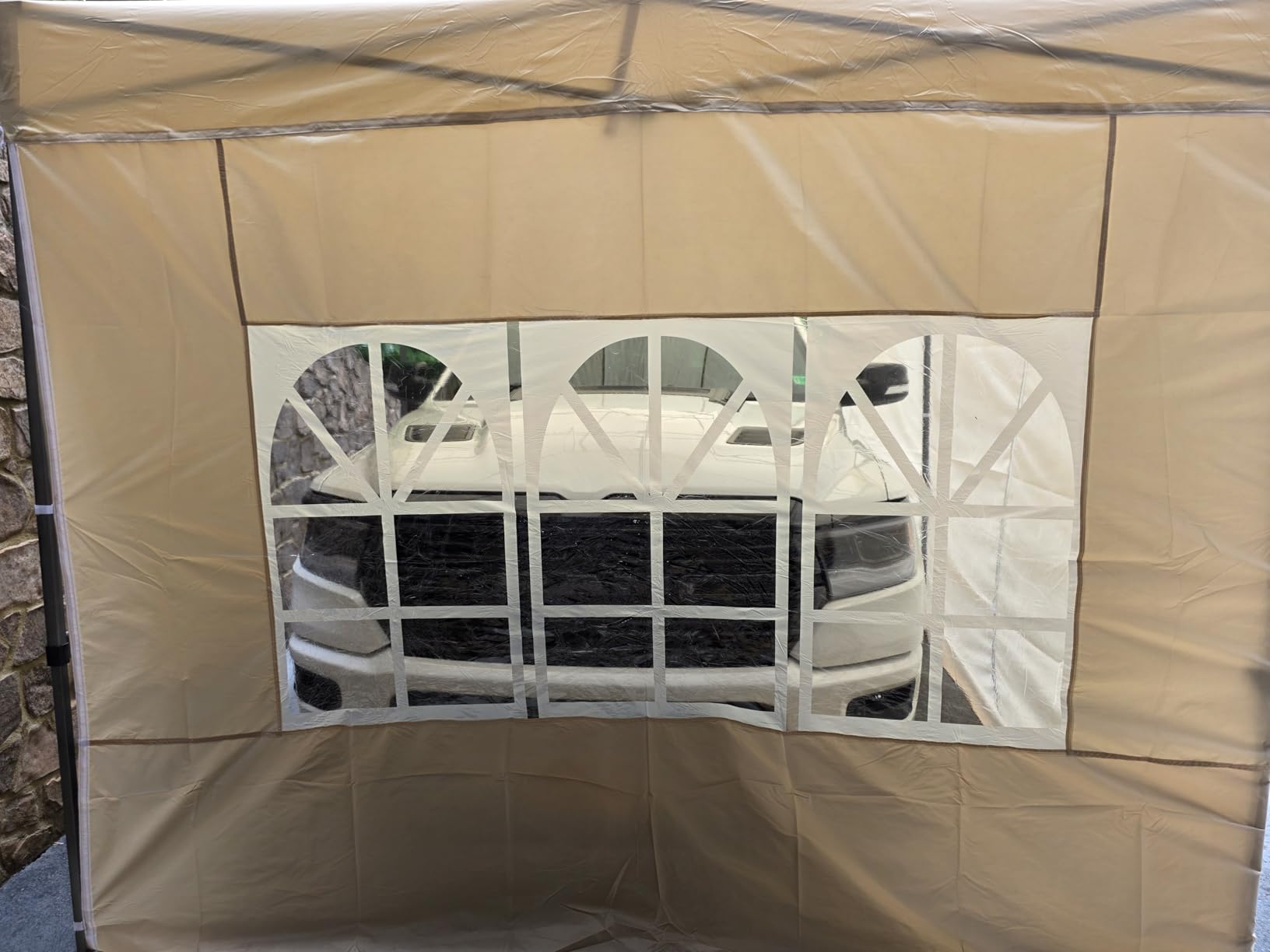
Owners back the gauge claim up. People report the tent staying dry and holding through severe thunderstorms when tethered with heavier rope and extra stakes, and the 420D Oxford with double PU coating and fully sealed seams is specified at 2.1psi waterproof pressure against 1.1psi for a typical tent.
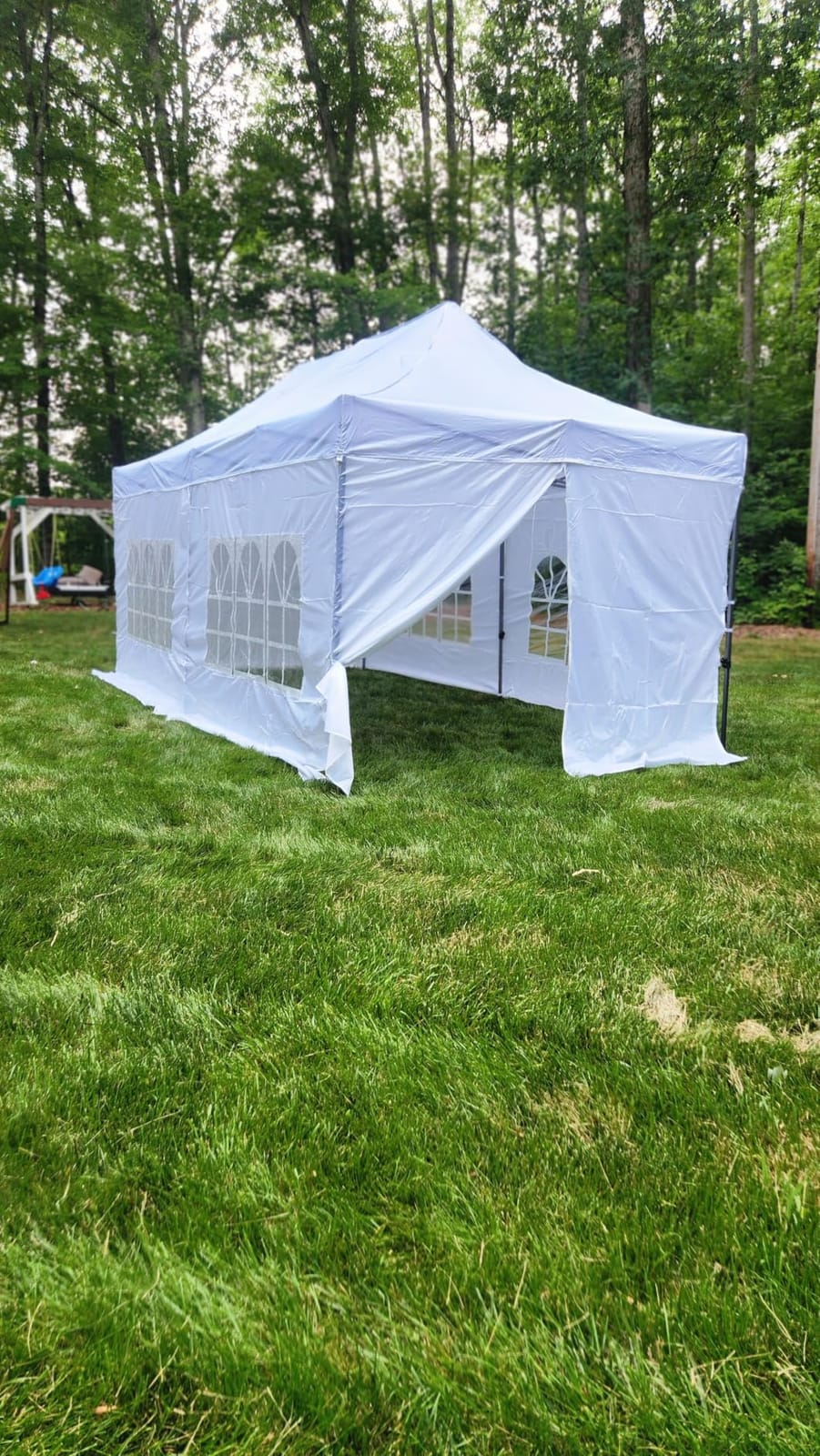
Six removable sidewalls come as standard, four windowed and two zipped, which makes this the most enclosed shelter here. That is useful in rain and bad in wind, because full sidewalls add sail area. Plan on doubling the ballast on any face you leave closed during gusty conditions.
Why the published rating is useful and where it stops
A manufacturer wind rating of 18 mph with anchoring is a real, testable number, and it is more information than the marketing language on most competitors. Eighteen mph is also plainly below the 20 mph at which unsecured canopies start to fail, which tells you the rating assumes proper ballast and does not claim any standoff at all.
Take it as a documented baseline rather than a ceiling. Owners still report visible movement in wind even with all the supplied sand bags fitted, which is exactly what the number predicts. Better anchoring and a lower height setting are what move the practical limit up.
Where it falls short
One hundred pounds is the heaviest item in this roundup. Two to three people for setup and teardown is not a suggestion, and if you work alone you need a dolly as well as a vehicle.
Arrival condition is a real reported issue, with missing hardware and damaged boxes mentioned alongside slow parts support. Inspect the peg bag and the hardware pouch before you leave the house, because the anchoring kit is the part you cannot do without.
8. COBIZI 10×15: The One Owners Leave Standing Overnight
COBIZI 10×15 Heavy Duty Pop Up Canopy Tent with 4 Sidewalls, Gray
1.26 inch pipe and 0.03 inch wall
65.6 pounds
180 x 120 x 128 inch
150 square feet
4 removable sidewalls
Pros
- Thickened powder-coated full truss with 220 pound per pole rating
- Same 2.1psi waterproof 420D Oxford fabric as the larger COBIZI model
- Owners report it staying up overnight with weights and stakes
- Three height settings with anti-pinch thumb buttons
- Four removable PU-coated sidewalls with full-length hook-and-loop strips
Cons
- Cover fabric is hard to fold back down to fit the carry bag
- Very heavy to move even with the bag and wheels
- Some reports of a thinner cover that fits the frame loosely
- Wheeled bag board can arrive cracked
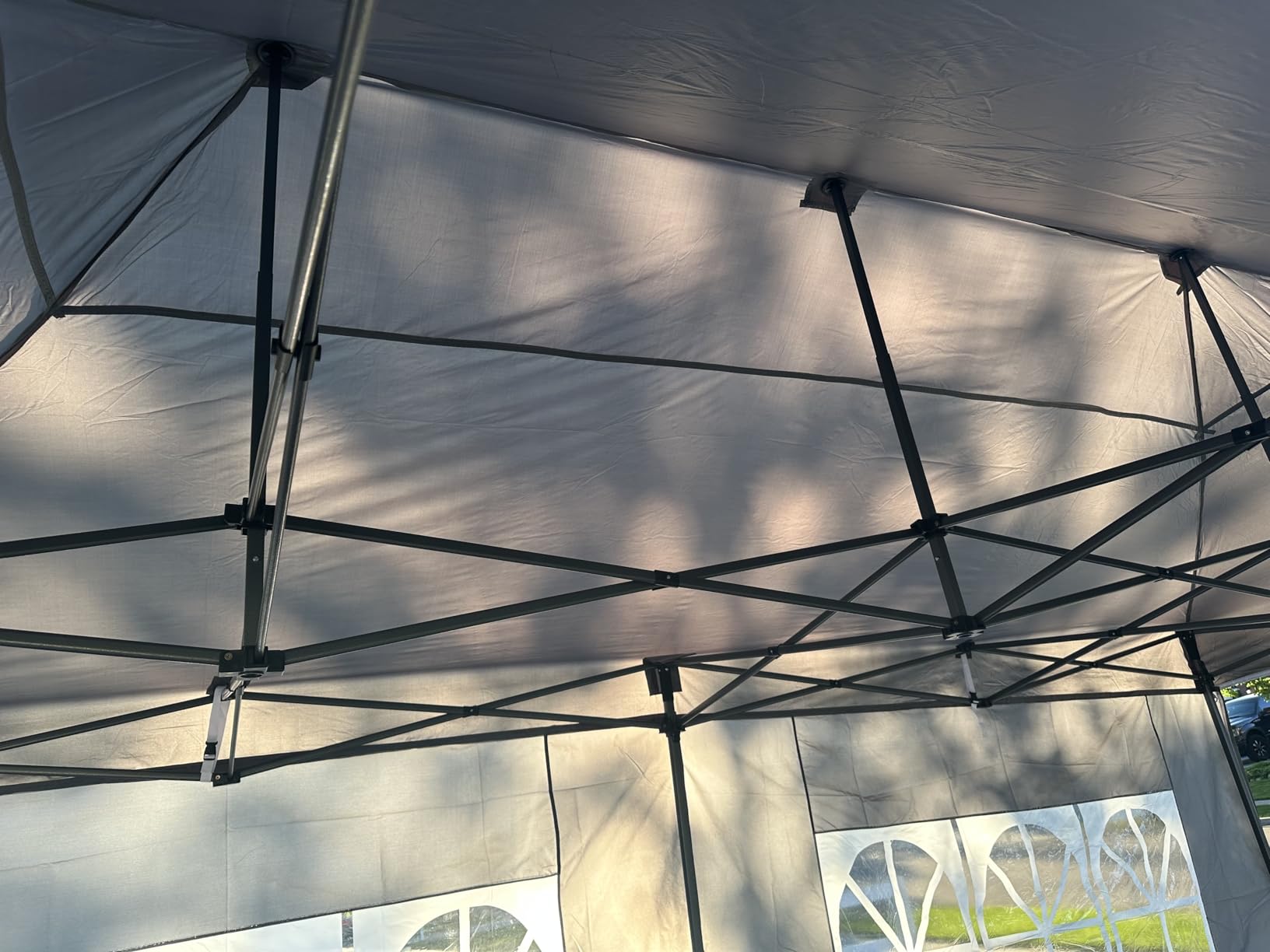
At 10×15 this is the awkward middle size that most people under-buy. The frame is the same thickened truss as the 10×20, with 1.26 inch pipe, 0.03 inch wall thickness, and 220 pounds per intermediate pole, but the total weight drops to 65.6 pounds, which is genuinely manageable for two people.
The owner reviews that matter most for wind are the overnight reports. Multiple buyers describe leaving the tent up through the night with weights and stakes in place and finding it secure in high wind the next morning, which is a far more demanding test than a two-hour craft fair.
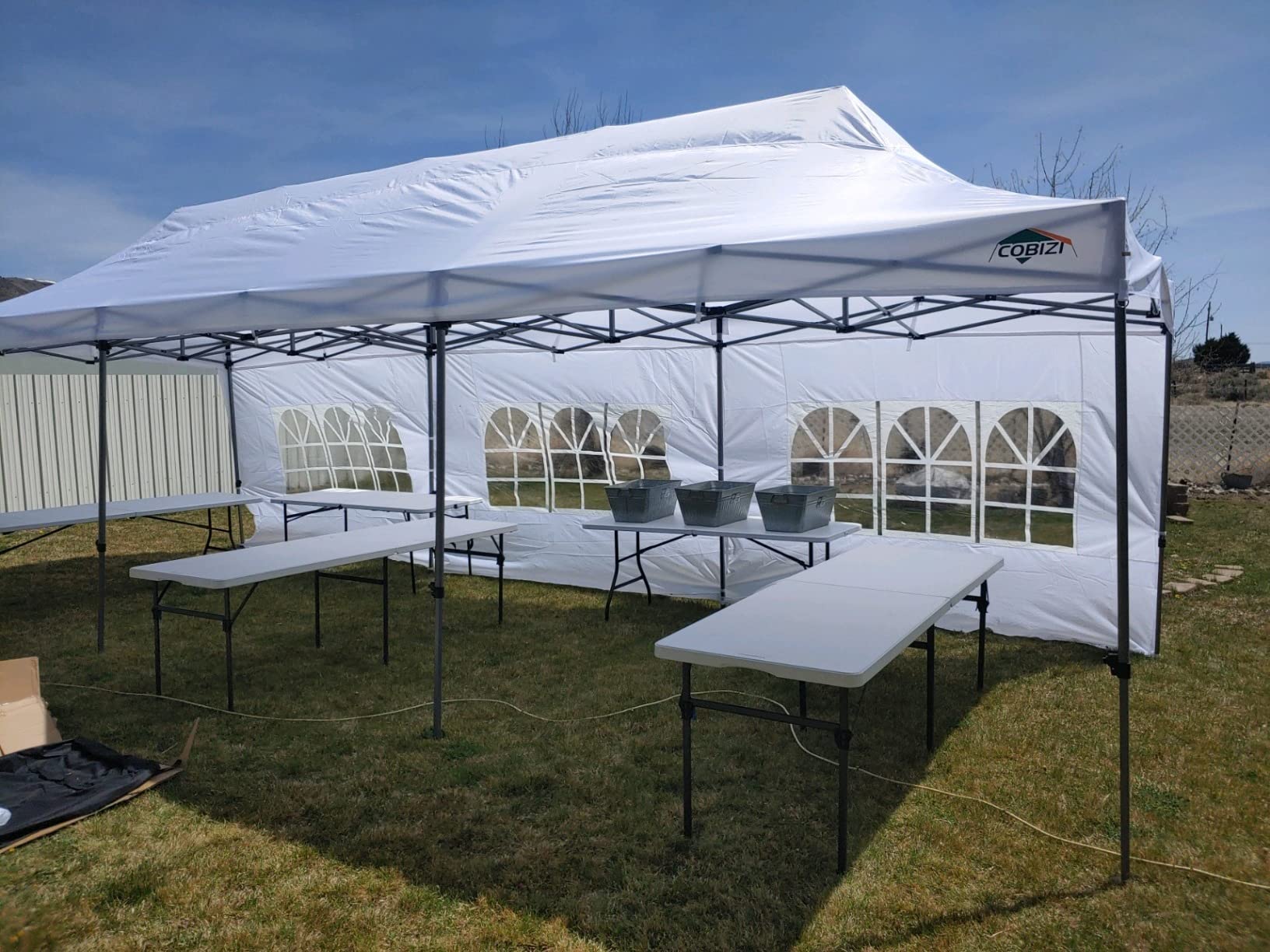
The fabric is the same double PU-coated 420D Oxford specified at 2.1psi waterproof pressure, with fully sealed seams and UPF 50+ UV blocking. Four removable sidewalls, two windowed and two zipped, attach with full-length hook-and-loop strips rather than loops, which spreads the load and resists tearing.
Height settings run 122, 126 and 130 inches, giving you room to drop the profile on a windy day without sacrificing all of your clearance.
Why 10×15 needs less ballast than the numbers suggest
The published guidance gives a 10×15 a ballast range of 200 to 350 pounds, which looks like a lot of spread until you account for what is already attached. The tent itself weighs 65.6 pounds, and the frame mass is spread evenly across four feet, so a meaningful share of the hold-down requirement is already met before you add anything.
The same guidance notes a 10×15 does not need more anchor weight than a 10×10 because the structure is heavier. Size the ballast to the frame you own, not to the square footage on the listing, and you will be closer to the real requirement than a generic per-foot calculation suggests.
Where it falls short
The packing problem is genuine. Owners report the cover is hard to fold back down to the bag size, which turns a 30-second strike into a 10-minute argument with the fabric, and that is a real cost when you are breaking down in the dark.
Some buyers report a thinner cover that does not sit as tightly on the frame as expected, and the wheeled bag board can arrive cracked with only the outer cloth holding it together. Check the bag on arrival, not when you are halfway across a car park in a storm.
9. Quictent 10×20 Carport: A Cable-Braced Shelter With a 40 mph Test
Quictent 10×20 ft Carports with Side Zipper Doors
12 cross-steel cables
236 x 118 x 118 inch
200 square feet
180g 16 mil PE cover
Tested for 40 mph winds
Pros
- 12 cross-steel cables with a claimed 200 percent stability increase
- Tested for 9 lbs per sq ft snow load and 40 mph winds
- Roll-up zipper doors on both sides plus front and rear doors
- 180g 16 mil PE cover with triple-stitched seams
- Four large mesh windows reduce moisture buildup
Cons
- Tall carport profile is not a low pop-up vendor shelter
- PE sheeting is noisy and cold compared with fabric canopies
- Assembly takes closer to an hour than a pop-up frame
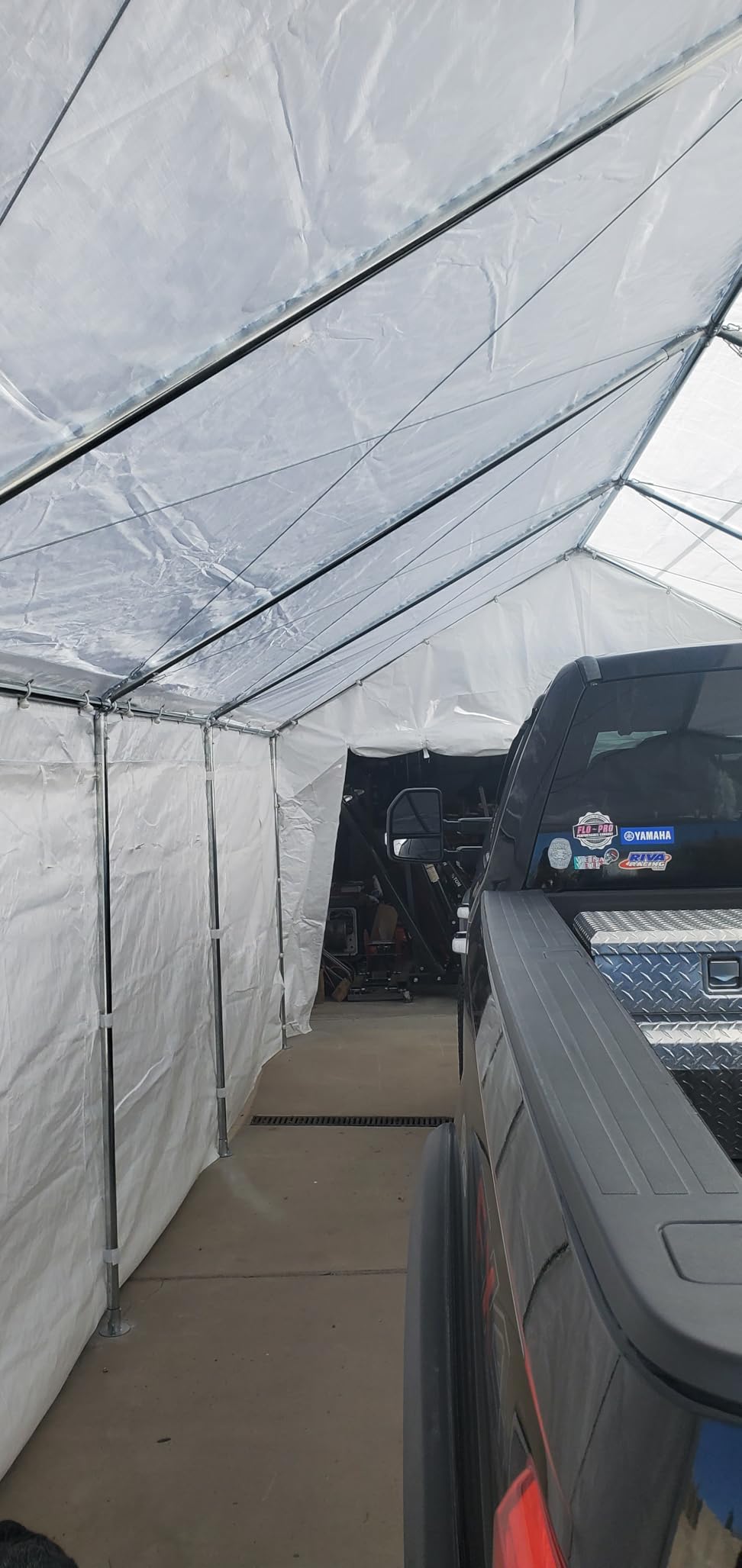
This is a different category of shelter and we include it deliberately. It is a 10×20 carport with a 40 mph wind test and 12 cross-steel cables, which makes it the strongest wind performer in the roundup by a wide margin, and the reason is architectural rather than clever.
A carport is a tunnel shape with a continuous ridge and cable-braced sides. There is no flat roof face to catch lift, the profile sheds wind upward and over, and the cables triangulate the frame so the legs cannot spread. None of that is available in a pop-up scissor design.
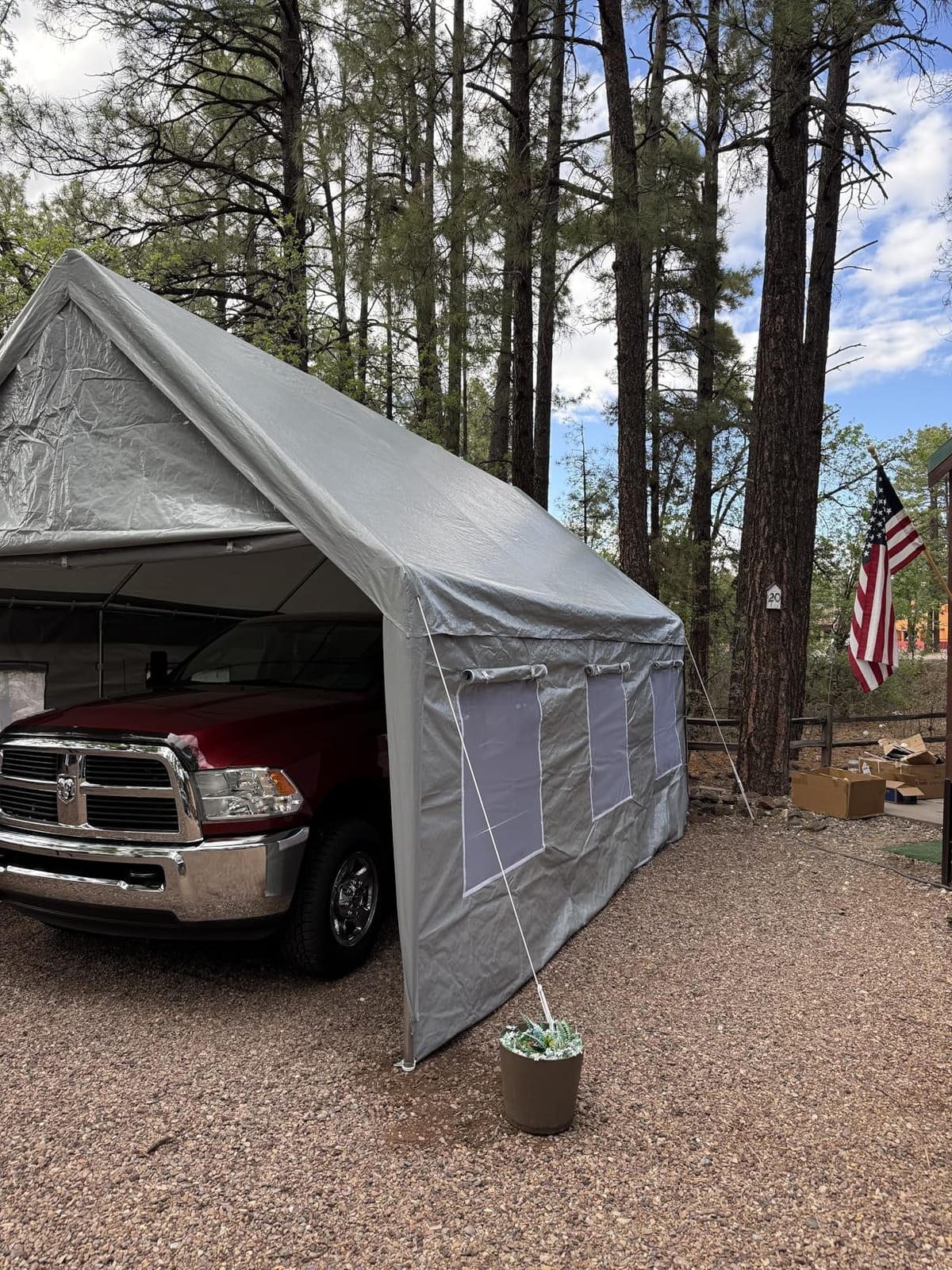
The 180g thickened 16 mil PE cover blocks UV, rain, snow and bird droppings with triple-stitched seams, and four mesh windows, two per side, cut the condensation and humidity that build up inside a fully enclosed metal structure.
Buyers treat it as a vehicle and equipment shelter, protecting ATVs, motorcycles, RVs and lawn mowers. That is the right use case. Assembly runs about an hour tool-free with labeled parts, which is a very different experience from a pop-up frame.
Why 40 mph is not comparable to a pop-up rating
The 40 mph figure on this shelter and the 18 mph figure on the COBIZI 10×20 are not measuring the same thing, and reading them as a direct ranking would be a mistake. The 40 mph number comes from a cable-braced tunnel frame with a continuous aerodynamic profile. The 18 mph number applies to a flat-topped scissor canopy with a 200 square foot sail area.
What the comparison is useful for is scale. It shows how much of a canopy wind performance comes from shape rather than from steel thickness alone, and it is why a 198-pound PE carport can out-perform an 86-pound commercial canopy in a gale.
Where it falls short
It is a tall structure at just under 10 feet of peak height, so it is not a shade-and-vendor shelter. Nobody is selling jewellery under a carport, and the vertical scale does not fold down to anything a single person can carry.
The PE sheeting is also a real quality-of-life issue, being loud in rain and cold to work under, and an hour of assembly is a significant commitment for a tent you may set up and strike multiple times a season.
10. ADVANCE OUTDOOR 10×20 Carport: The One Owners Report Surviving 50 mph Gusts
ADVANCE OUTDOOR 10×20 ft Heavy Duty Carport Potable Car Canopy Garage Party Tent Boat Shelter, Adjustable Height from 9.5 ft to 11 ft, White
1.5 inch galvanized steel poles
8 solid legs
240 x 120 x 132 inch
200 square feet
Heat-sealed triple-layer 180g PE
Pros
- A-frame geometry with heavy galvanized tubing resists wind far better than a pop-up
- Owners report surviving repeated 50 plus mph wind events when anchored
- Heat-sealed triple-layer 180g polyethylene is genuinely waterproof
- Four adjustable side heights giving 9.5 to 11 foot peaks
- Includes 16 steel pegs and 8 auger anchors
Cons
- Included pegs and ropes are not adequate for serious wind
- 180g PE fabric degrades to a tear-prone state after extended sun
- Replacement canopy tops are not offered on the manufacturer website
- Instruction diagrams are poor and bungee placement unclear
This is the shelter I would choose for an exposed site, and the reason is the one structural change no pop-up can offer. The frame is 1.5 inch diameter galvanized steel with 8 solid legs, 1.65 inch connectors at 1.2mm thickness, and an A-frame profile that presents a sloped surface to the wind rather than a flat panel.
Owners report it outlasting cheaper pop-ups through repeated 50 plus mph wind events and severe thunderstorms with no movement when properly anchored. With 2570 reviews at 4.3, that is not a single anecdote, it is a repeated pattern across independent owners.
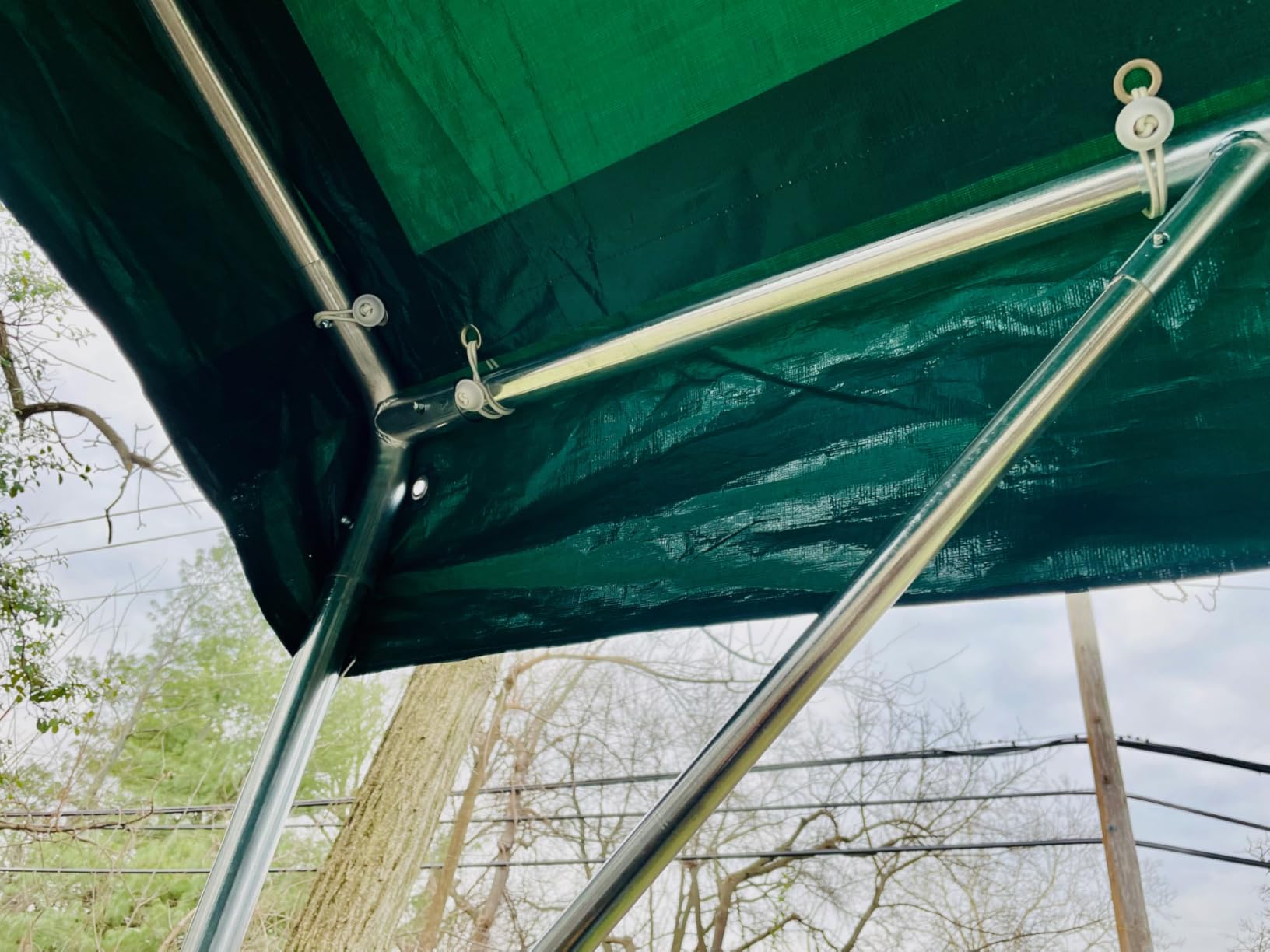
Height is genuinely adjustable on this one. Four side settings at 6.5, 7.0, 7.5 and 8.0 feet produce peak heights from 9.5 to 11 feet, and lowering the whole structure reduces the profile in exactly the way the wind guidance recommends.
Two adults can raise it tool-free in about half an hour, and the warranty is unusually generous in the accessory department with a 1-year warranty on poles and canopy alongside a lifetime warranty on connectors, foot pads, pegs and anchors.
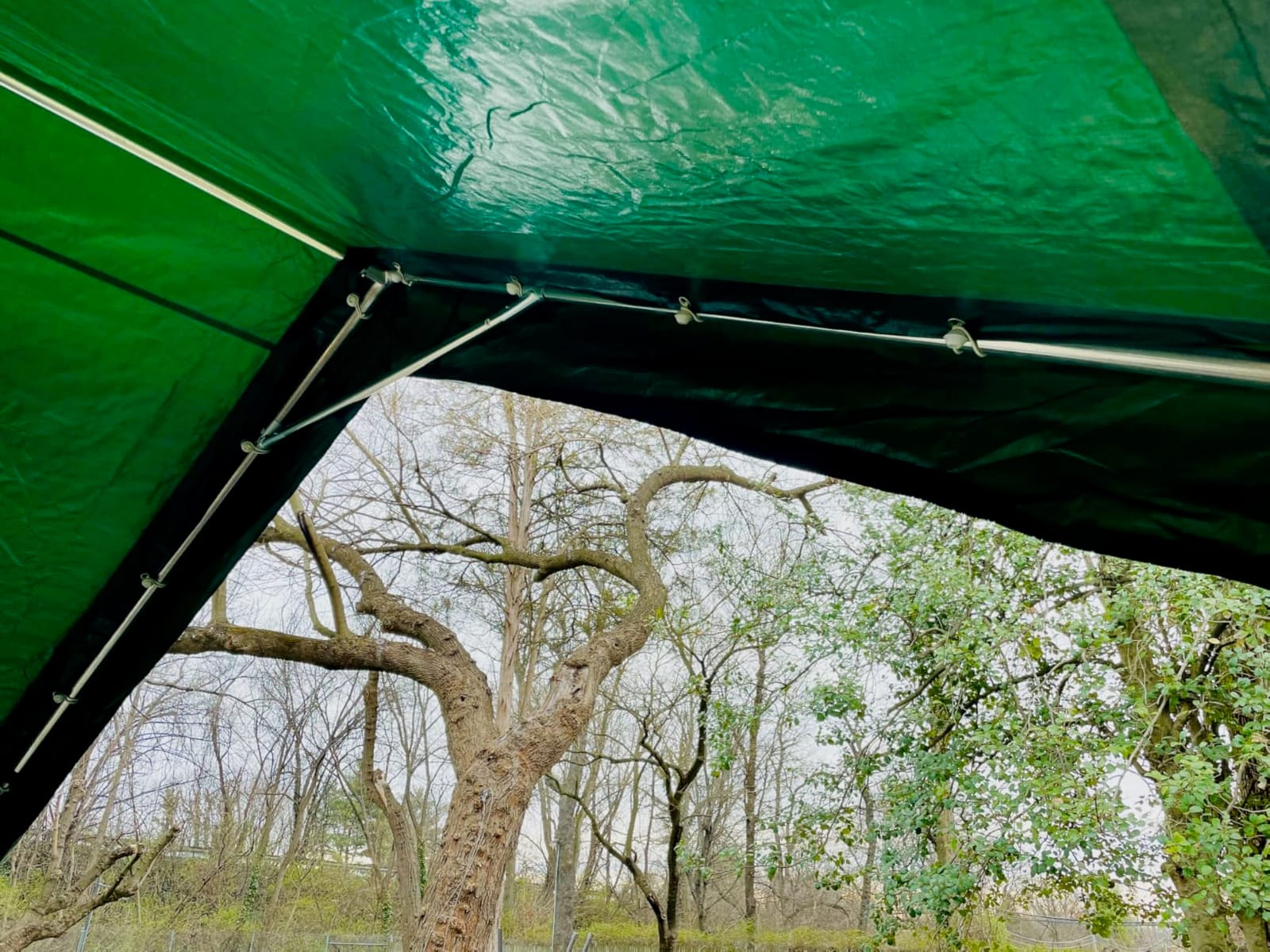
Replace the supplied anchoring, always
This is the most consistent piece of advice in the entire review set, and it comes from the owners of this canopy specifically. The supplied pegs and ropes are not adequate for serious wind, and owners who upgraded to 18 inch ground anchors report a clear difference in behaviour. Eight auger anchors and 16 steel pegs are included, which is generous, but the augers are the parts that matter.
Users on festival and camping forums describe a similar pattern with other structures, hammering rebar stakes next to the legs and taping the leg to the stake, described in one thread as problem solved. Whatever the anchor, the principle is the same: the load has to transfer from the leg into the ground.
Where it falls short
The PE fabric ages badly. Owners report 180g polyethylene degrading to a paper-like, tear-prone state after extended sun exposure, and a replacement canopy top is not offered on the manufacturer website, so a sun-bleached cover means a new shelter.
The instruction diagrams are poor and bungee placement is not clearly illustrated, which is a 30-minute setup that can easily take an hour to argue with. Budget the time and read the diagrams before you start in a field.
How to Anchor a Canopy in the Wind: 10 Steps
This is the sequence we use. It follows the numbered format the major canopy manufacturers publish, and it assumes you have already chosen your site.
1. Check the forecast before you unpack. If gusts are forecast above 30 mph, do not set up. If they are above 20 mph, plan for full ballast from the start rather than adding weight later.
2. Pick a sheltered site. Face the smallest side into the wind, and set up behind a building, hedge or vehicle line if you can. A sheltered pitch regularly outperforms a better canopy on an exposed one.
3. Level the ground. Uneven ground drives the frame out of square, and a racked frame is far weaker than a level one. Use leveling blocks under the low feet before you erect anything.
4. Erect on level ground first. Pop the frame up in the open, lock the legs, then move it into position with two people. Dragging a locked canopy twists the scissor joints.
5. Set the lowest or middle height. In wind, a lower profile is dramatically better. Save the full height for calm days.
6. Load the ballast onto every foot. The common failure is three weighted feet and one empty one. Sandbags, blocks or barrels go on all four, and roughly 200 pounds total is the baseline for a 10×10.
7. Upgrade the stakes. The stakes that ship with a canopy are almost always too short and too thin. Bring your own, and drive one stake per foot plus one on each guy point. Owners across forum threads consistently report that proper stakes make a dramatic difference.
8. Run guy lines from the upper corners. Attach to the metal frame rather than through the fabric, so the load does not tear a hole in the canopy. Run the lines out at about a 45 degree angle to a solid anchor point.
9. Use the right method for your surface. Soil, sand, and concrete each need a different approach, and using the wrong one is the most common anchoring mistake outside of using too few weights.
10. Inspect every 20 minutes in gusty conditions. Watch for a leg lifting, a stake working loose, or a taut fabric panel starting to billow. Strike the canopy the moment any of those appear, not after the frame starts to lean.
| Surface | Best option | Notes |
|---|---|---|
| Soil and grass | Auger anchors or 18 inch stakes at every foot | Best case for anchoring, the stake has something to bite into |
| Sand and beach | Filled sand bags, half barrels, or broad weighted footplates | Stakes are useless in dry sand. Use broad flat weights to stop sinking |
| Concrete and asphalt | Weighted foot plates, water barrels, or concrete blocks | No stakes possible. Match total weight to the tent and use the full footprint |
| Gravel | Stakes angled into the subsoil, plus sand bags on every foot | Gravel moves. Combine a stake with weight rather than relying on either alone |
One useful piece of forum folklore worth repeating: a filled PVC pipe tube with a U-bolt handle, made by a camper who had already tried most commercial options, is a perfectly serviceable ballast for a 10×10. Four of those strapped to the feet can hold 50 pounds each, which is a real number for almost nothing. You do not need a commercial product, you need mass low down and spread across all four feet.
How Much Ballast Weight a Canopy Needs by Size
These are the published figures from established canopy guidance, and they are the numbers we use when advising vendors. They assume all four feet are loaded, not three.
| Canopy size | Minimum ballast | Typical per foot |
|---|---|---|
| 10×10 | At least 200 lbs | 50 lbs per foot |
| 10×15 | 200 to 350 lbs | 50 to 90 lbs per foot |
| 10×20 | At least 375 lbs | 95 lbs per foot |
| 13×26 | At least 400 lbs | 100 lbs per foot |
Individual anchor weights from the same guidance give you a shopping list. A filled sandbag runs about 35 pounds, a standard water barrel about 660 pounds, a cast iron foot plate 50 pounds, and a cinder block 28 pounds. Most vendors end up building a kit from sand bags and cinder blocks because they are cheap, stackable, and easy to move between pitches.
Add roughly 25 to 30 percent to these figures if you intend to fit full sidewalls. Fully enclosed panels add sail area, and vendors who learn this on their first fair usually end up wishing they had left the windward wall off.
Frame Geometry: What Actually Keeps a Canopy Upright
Steel thickness gets all the attention, and it matters, but the shape of the frame decides how that steel is loaded. Here is what separates the architectures in this roundup.
Square tubing versus round. Square section resists twisting. When a gust hits one side of a canopy it tries to rotate the frame while the far side holds, and that rotation is what buckles a round tube before it bends a square one of the same gauge. Two of the frames here specify square legs by name.
Full truss versus plain legs. A full truss adds horizontal cross members between the legs so that opposite legs are tied together. Load on one side transfers across the top of the structure rather than concentrating on the near leg. Six of the ten canopies here use a full truss.
Wall thickness beats diameter. Bending stiffness scales with wall thickness far more strongly than with outer diameter. A 1.26 inch pipe with a 0.03 inch wall is a meaningfully different structure from a 0.98 inch pipe with a 0.02 inch wall, and the COBIZI frames publish that comparison themselves.
Straight-leg versus slant-leg. Slant-leg frames push the legs outward, widening the footprint and lowering the peak. That is a genuine wind advantage because there is more base area and less roof area. The trade is headroom, and for a vendor booth standing room usually wins.
Vented roofs. Every gust creates a pocket of low pressure behind a canopy roof. A vented peak lets that air escape so the roof is not pulled downward by suction. A flat pitch without a vent is a kite, and no amount of ballast fully compensates for a roof that is actively generating lift.
Sidewalls as sails. A removable wall is a sail you added on purpose. Fully enclosing a canopy prevents the pressure from escaping and is the fastest route to a topple. If wind is expected, close the windward face and leave the lee face open, never all four.
Heavy Duty Canopy Buying Guide: What to Check Before You Buy
Here is the order we work through when someone asks which canopy to buy for a windy pitch, in the order that actually changes your outcome.
Footprint before footprint size. Wider is better in wind. A 10×10 has less sail area and less leverage than a 10×20, and a 10×15 sits between them. If your site allows, the smaller tent is the windier one.
Frame specification over fabric specification. Read the tubing diameter and the wall thickness, and check whether the legs are square and whether a full truss is present. These two lines tell you more about wind performance than any other spec in the listing.
Height adjustment range. You want at least three height settings, and you want to be able to drop to the lowest one quickly. In gusty weather a lower profile is one of the cheapest wind mitigations available, and it costs nothing.
What the anchoring kit contains. Count the sand bags, the pegs, and the ropes. Four of each is a reasonable starting kit. Zero means you are buying hardware before your first event, and one or two pegs means the manufacturer expects you to bring your own.
Warranty length and parts availability. Look for a two-year window if you can get it, and confirm that replacement parts for your specific model are sold separately. A tent with no replacement top is effectively a single-use item in a five-year time frame.
Carry weight against your setup crew. The heaviest canopies here top out at 100 pounds. If you are one person, anything above 65 pounds is a two-person job on both ends of the event.
Our industrial bakers rack picks follow the same principle we apply to canopies: buy the frame gauge you need, not the frame gauge that looks heaviest in a photograph.
If you are outfitting a stall that has to work hard from dawn to dusk, our heavy duty mixer reviews for baking apply the same build-over-buzz test to the equipment on your counter.
Where to Buy Heavy Duty Canopies and What Each Channel Costs You
Most of the canopies in this roundup are sold through the same handful of large marketplaces, and the differences between channels are about support rather than price.
Buying direct from a canopy manufacturer gives you the clearest warranty terms and usually the best selection of sizes. The trade-off is that replacement parts may take longer to arrive, and a single-unit order can have a higher sticker than a marketplace listing.
Large general marketplaces usually carry the widest review volume, which is useful for you because you can see failure patterns before you buy. The downside is that a marketplace warranty is only as good as the seller’s response time, and the rolling bags and zippers are frequently sold as accessories rather than warranty items.
Home improvement and building supply chains are strongest on the carport-style shelters in the last two picks, and they are the easiest place to buy ground anchors, augers and cinder blocks in the same trip. That convenience matters more than most buyers expect, because a canopy and a full ballast kit in one car park is a good afternoon.
For anyone buying multiples, the per-unit economics change completely. At three units or more, direct manufacturer contact is worth a conversation, and a local supplier who will hold a replacement part for you is worth a small premium over the lowest listing.
Our budget heavy duty blender roundup covers the other end of the price spectrum, where the only thing that matters is whether the motor survives a full event day.
Pre-Event Wind Prep Checklist for Vendors
Run this the morning of every outdoor event. It takes about ten minutes and it is the difference between a tent that survives and a claim.
1. Read the forecast. Record the peak gust figure, not the average. Gusts are what topple canopies, and a 20 mph average with 40 mph gusts is a take-down day.
2. Walk the frame joints. Push each leg outward and listen for the centre bolt. Any play means a joint has loosened, and a loose joint under side load will crack at the bolt hole.
3. Inspect the fabric. Check the four corners, the valance, and every grommet and loop. Corner tearing is the most common failure on thin 150D fabric and it starts as a small split.
4. Test the locks. Operate every thumb latch and height button. A latch that will not hold at the lower setting is a liability when the wind picks up.
5. Count the ballast. Weigh or estimate what you have against the per-size table. Three weighted feet is the most common anchoring mistake in the entire category.
6. Check the ground. On soil, confirm the stakes are in solid ground rather than near a buried line or a drain. On sand, confirm you have broad weights rather than narrow ones that will sink.
7. Set the site. Confirm the windward face is the smallest side, and confirm there is a windbreak. Repositioning a tent takes two minutes; recovering a collapsed one takes an afternoon.
8. Pack the repair kit. Duct tape, spare stakes, bungee cords, spare sand bags, and a small length of cord. These five items handle the overwhelming majority of field failures.
9. Nominate a watcher. One person whose only job is watching the frame and the forecast. Split attention is how tents come down in the first minute of a gust front.
10. Agree the strike time in advance. Decide before you set up what wind speed triggers takedown. A decision made calmly at 10am is a good one. A decision made in a gust at 2pm is not.
Frequently Asked Questions
How much wind can a pop-up canopy withstand?
An unballasted pop-up canopy typically topples between 20 and 35 mph, and you should take any canopy down above 35 mph no matter how it is anchored. A 10×10 needs roughly 200 pounds of ballast on all four feet to stay standing in a gusty afternoon.
What tent is best for strong winds?
For a pop-up canopy, the ABCCANOPY Commercial-Series 10×20 in our tests is the strongest frame thanks to its alloy steel full truss and 86 pound weight. For genuinely exposed sites, the ADVANCE OUTDOOR 10×20 carport uses an A-frame with 1.5 inch galvanized poles, which is a different and much stronger architecture.
How can I secure my tent in strong wind?
Load ballast onto all four feet rather than three, use upgraded stakes or auger anchors at every foot, run guy lines from the upper frame corners at a 45 degree angle, and drop the canopy to its middle or lowest height setting. Lowering the profile is the cheapest wind mitigation available.
Can a tent withstand 50 mph winds?
Not a pop-up canopy. Owners of the ADVANCE OUTDOOR 10×20 A-frame carport report it surviving repeated 50 mph plus wind events when properly anchored with serious ground anchors, but that is a cable-braced tunnel frame, not a folding scissor frame. Any pop-up should come down well before that.
How do I keep a canopy tent from blowing away?
Prevent topple rather than reacting to it. Level the ground, erect on open ground and then move the canopy, set every foot onto ballast, add upgraded stakes at each foot and each guy point, and lower the height. Re-check anchors every 20 minutes when gusts are forecast.
What is the best canopy tent for vendors?
The CROWN SHADES C100W-S4 stands out for vendors because its interior height of over 9 foot 5 inches and valance clearance of more than 6 feet make it a stand-up booth, and it carries a two-year warranty with full canopy replacement in year one.
The Best Heavy Duty Canopies for Wind: Final Verdict
After comparing all ten, the best heavy duty canopies for wind fall into two clear groups. Pop-up canopies are portable, affordable, and honest about their limits as long as you respect the 35 mph ceiling and put real ballast on all four feet. Carport-style shelters are slower to set up and much harder to move, and they are the only structures in this group that hold a line in genuinely serious weather.
Our pick is the ABCCANOPY Commercial-Series 10×20. It is the heaviest frame we tested, the most reviewed canopy in the roundup, and the one owners most consistently describe as holding steady in wind and rain once it is properly staked. For vendors who need to stand up inside their shelter, the CROWN SHADES C100W-S4 is the smarter buy.
Whichever one you choose, work through the anchoring steps before you set up rather than after the first gust. And take it down above 35 mph, every time, without exception.