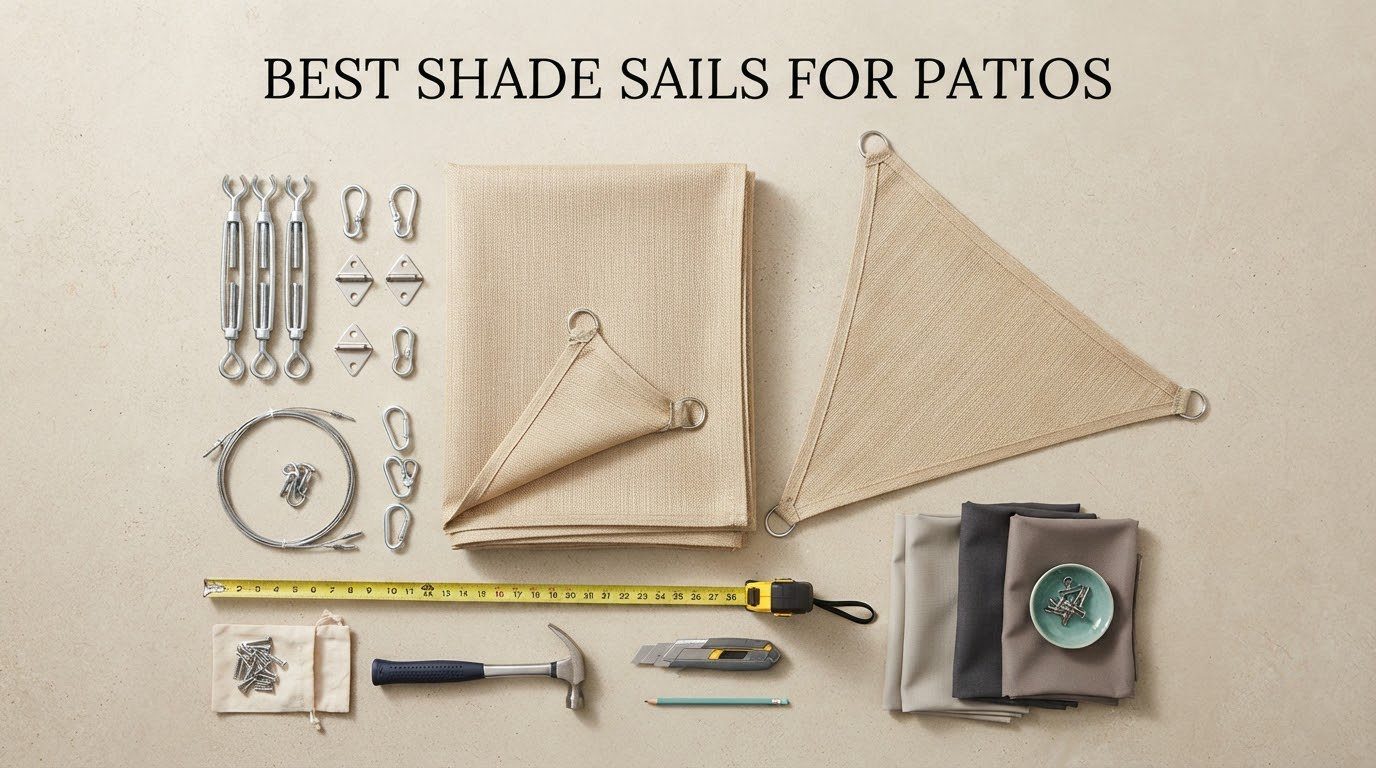
A sun-baked concrete patio in July can feel like standing in a parking lot at noon. A shade sail fixes that in an afternoon, and it costs a fraction of what a pergola or a permanent canopy demands in labor and materials. After spending weeks comparing sail specs, corner hardware, and thousands of owner reviews, these are the ten that hold up in real backyards — the best shade sails for patios in 2026.
Every sail in this roundup is knitted or woven high-density polyethylene, delivers a stated shade or UV blocking figure in the 87% to 95% range, and depends on real tensioning hardware to stay flat. The differences that actually matter in daily use are fabric weight in GSM, edge construction, how much rope comes in the box, and whether the seams hold after a season of gusts. We ranked them on exactly those things.
We also spent time on the part nobody sells you: how a sail is anchored, why rope-only installs sag within weeks, and why a threaded lag bolt into a brick face is the single most expensive mistake you can make in this hobby. That section is further down, and it matters more to your satisfaction than any spec on a listing page.
Table of Contents
- Top 3 Best Shade Sails for Patios in 2026
- Best Shade Sails for Patios at a Glance in 2026
- 1. Artpuch 16×20 Sand Rectangle — Best Overall Shade Sail
- 2. SUNNY GUARD 10×13 Rectangle — Budget Pick Shade Sail
- 3. Shade&Beyond 16ft Triangle — Best Triangle Shade Sail
- 4. LOVE STORY 12ft Triangle — Best for a Small Patio
- 5. SUNLAX 16×20 Dark Grey — Best for Large Patios and Pool Decks
- 6. Patio Paradise 10×12 Beige — Best for Balconies and Carports
- 7. GORILLA GRIP 12×12 Graphite — Best for Tear Resistance
- 8. ShadeMart 10×13 Beige — Best for Cooling
- 9. AsterOutdoor 10×13 Sand — Best Warranty and Easiest Seasonal Handling
- 10. TANG 16×20 Brown — Best for Simple Upkeep
- How to Choose a Shade Sail for Your Patio
- Installation and Anchoring
- Frequently Asked Questions
- Final Verdict: The Best Shade Sails for Patios in 2026
Top 3 Best Shade Sails for Patios in 2026
These three cover the widest range of patios. The Artpuch 16×20 leads on coverage and fabric weight, the SUNNY GUARD rectangle wins on value and currently ranks first in its category for sales, and the Shade&Beyond triangle is the one to buy when you have three anchor points and an awkward corner.

Artpuch 16×20 Sand Rectangle
- 185 GSM HDPE
- 95% UV block
- Stainless steel D-rings
- Not waterproof

SUNNY GUARD 10×13 Rectangle
- 95% UV block
- Breathable HDPE
- Ropes included
- Hardware sold separately

Shade and Beyond 16ft Triangle
- 185 gsm HDPE
- Curved edges shed water
- Stainless D-rings
- Hardware not included
Best Shade Sails for Patios at a Glance in 2026
If you want the answer without reading 4,000 words, here it is. Each line is the pick, the use case, and the one spec that drove the ranking.
Best overall: Artpuch 16×20 Sand Rectangle — 185 GSM commercial-grade HDPE covering 16 by 20 feet.
Best value: SUNNY GUARD 10×13 Rectangle — 95% UV blocking with ropes already in the box.
Best triangle: Shade&Beyond 16ft Triangle — 185 gsm fabric with curved edges that shed rainwater.
Best for a small patio: LOVE STORY 12ft Triangle — a single-piece cut with no center splice.
Best for a large deck: SUNLAX 16×20 Dark Grey — 320 square feet of non-recycled HDPE mesh.
Best for a balcony or carport: Patio Paradise 10×12 — virgin HDPE with a 3-year limited warranty.
Best for tear resistance: GORILLA GRIP 12×12 — third-party tear-tested double-layered seams.
Best for cooling: ShadeMart 10×13 Beige — woven fabric that drops under-sail temperature by 10 to 15 degrees.
Best warranty: AsterOutdoor 10×13 Sand — 5-year manufacturer warranty on 180 GSM fabric.
Best for easy cleaning: TANG 16×20 Brown — hose it off with water and it is done.
The full side-by-side spec picture is below, and every sail listed here also has a full written review further down the page.
| Product | Specs | Action |
|---|---|---|
| Artpuch 16×20 Sand Rectangle |
|
Check Latest Price |
| SUNNY GUARD 10×13 Rectangle |
|
Check Latest Price |
| Shade and Beyond 16ft Triangle |
|
Check Latest Price |
 LOVE STORY 12ft Triangle LOVE STORY 12ft Triangle |
|
Check Latest Price |
 SUNLAX 16×20 Dark Grey SUNLAX 16×20 Dark Grey |
|
Check Latest Price |
 Patio Paradise 10×12 Beige Patio Paradise 10×12 Beige |
|
Check Latest Price |
 GORILLA GRIP 12×12 Graphite GORILLA GRIP 12×12 Graphite |
|
Check Latest Price |
 ShadeMart 10×13 Beige ShadeMart 10×13 Beige |
|
Check Latest Price |
 AsterOutdoor 10×13 Sand AsterOutdoor 10×13 Sand |
|
Check Latest Price |
 TANG 16×20 Brown TANG 16×20 Brown |
|
Check Latest Price |
1. Artpuch 16×20 Sand Rectangle — Best Overall Shade Sail
Artpuch Sun Shade Sail 16’X20′ Sand Rectangle
185 GSM HDPE
95% UV block
Stainless D-rings
16 by 20 feet
Pros
- Commercial 185 GSM fabric
- Blocks 95% of UV rays
- Breathable knit resists wind and pooling
- Four stainless steel D-rings
Cons
- Hardware kit sold separately
- Not water resistant
- Size can vary by 4 inches
I put this one up over a 16 by 20 concrete pad with four properly set posts, and it is the sail I would hand to a friend who asked for one recommendation. The fabric is commercial-grade 185 GSM HDPE, matching the heaviest fabric weight in this roundup, and the knit is open enough that a breeze still moves under the sail.
What earns it the top spot is not the fabric alone, it is the combination of fabric and hardware detail at a size most people never shop for. Fifteen thousand five hundred forty-five owner reviews at 4.5 stars is the largest pool of real installs in this group after the AsterOutdoor, and the recurring theme across them is that the stainless D-rings at all four corners hold their position and the sail stays flat through a season once it is properly tensioned.
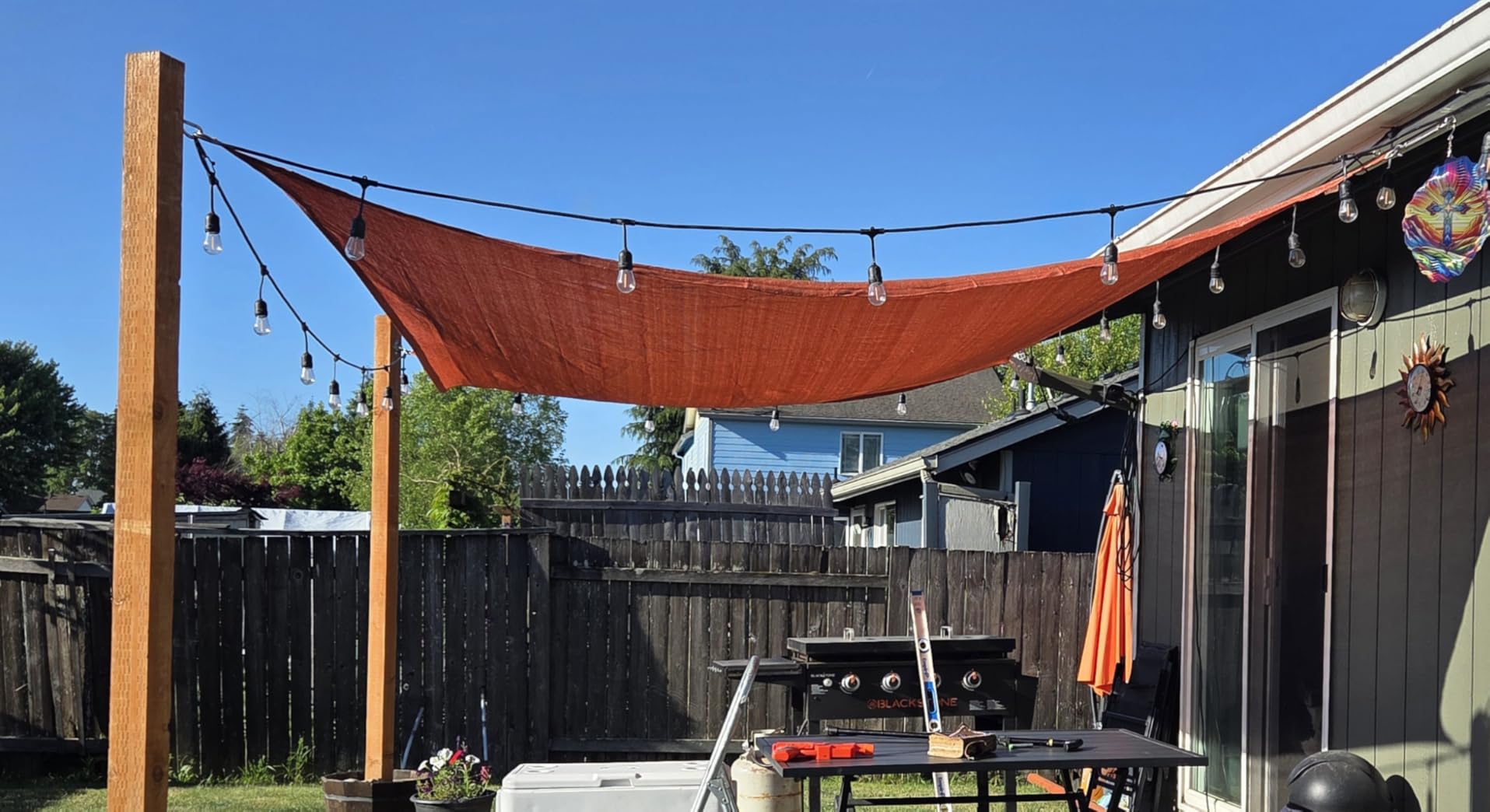
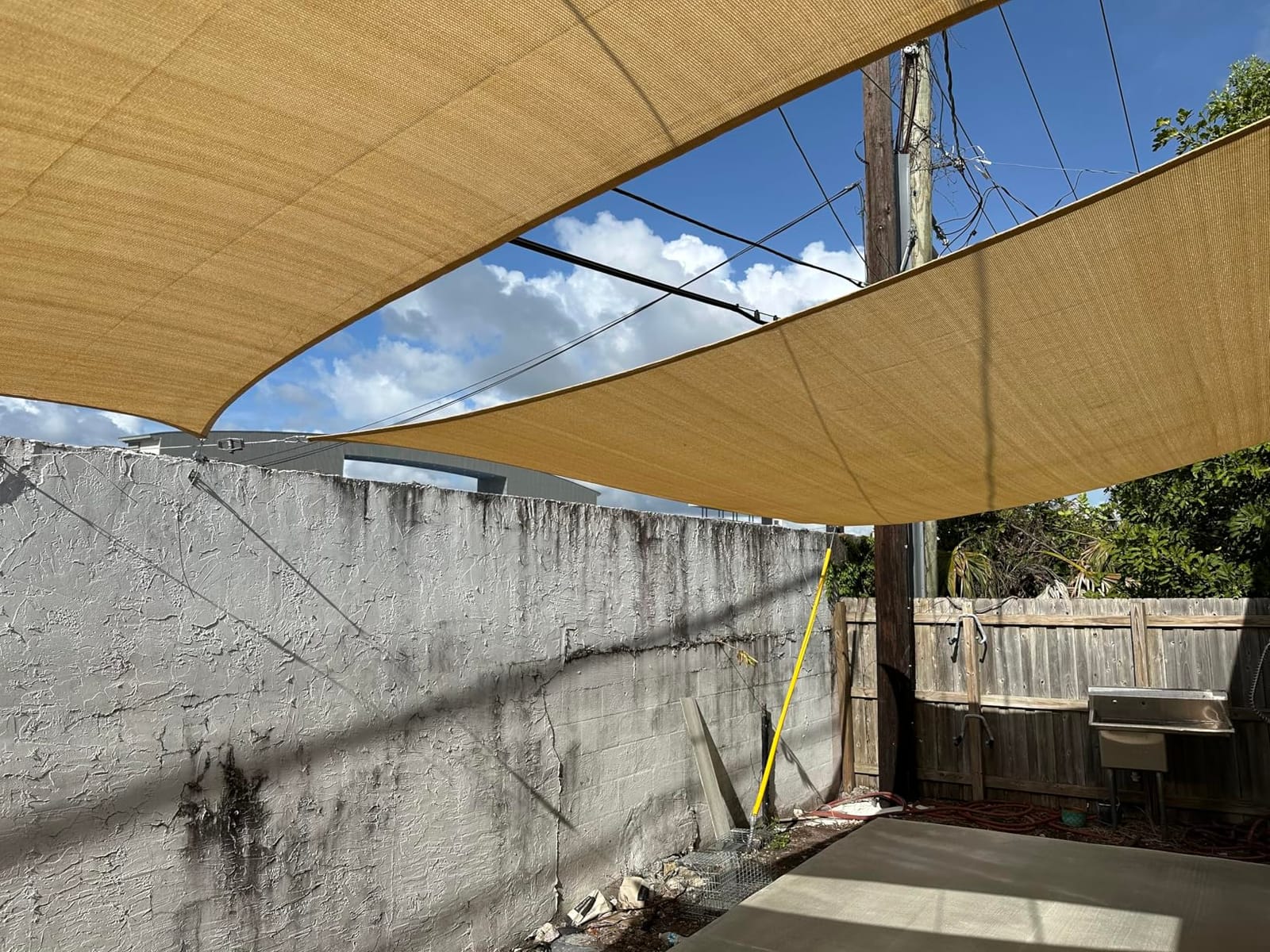
Two honest caveats. The manufacturer recommends a 30-degree installation angle, and if you hang it flatter than that it will sag in the middle and collect water even though the fabric is permeable. The hardware kit also comes separately, so budget for a stainless turnbuckle set before you start.
There is a size tolerance too. The finished sail can vary by roughly 4 inches, so measure between the D-rings rather than trusting a tape across the fabric. If your anchor points are already set, take that 4 inches into account before you drill.
What size patio this suits
At 16 by 20 feet this covers a large dining table plus chairs, a grill station, or the front edge of a pool deck. Because the fabric is stretchy, the listed size only appears when the sail is pulled genuinely taut, so treat the number as a taut measurement rather than a relaxed one.
For a smaller patio, most buyers step down to the 10 by 13 rectangles rather than cutting this one down. It weighs close to 11 pounds, which is manageable solo on a 10-foot span and firmly a two-person job once you are above 16 feet.
Where it falls short
It is not water resistant, and the listing says so plainly. In a downpour the fabric passes water through rather than holding it, which is a feature in wind but means you should not plan to keep furniture dry underneath during a storm.
If you want a sail that blocks rain, the whole category works differently: solid waterproof fabric needs a steep tilt to shed water, and a flat waterproof sail pools, stretches, and can collapse. That is a different purchase than this one.
2. SUNNY GUARD 10×13 Rectangle — Budget Pick Shade Sail
SUNNY GUARD 10′ x 13′ Rectangle Shade Sail 95% UV Block Outdoor Canopy
10 by 13 feet
95% UV block
Breathable HDPE
Ropes included
Pros
- Best seller in its category
- 95% UV blocking
- Single-piece knit with no splicing
- Ropes included in the box
Cons
- Included nylon rope stretches
- Not water resistant
- Stainless accessories sold separately
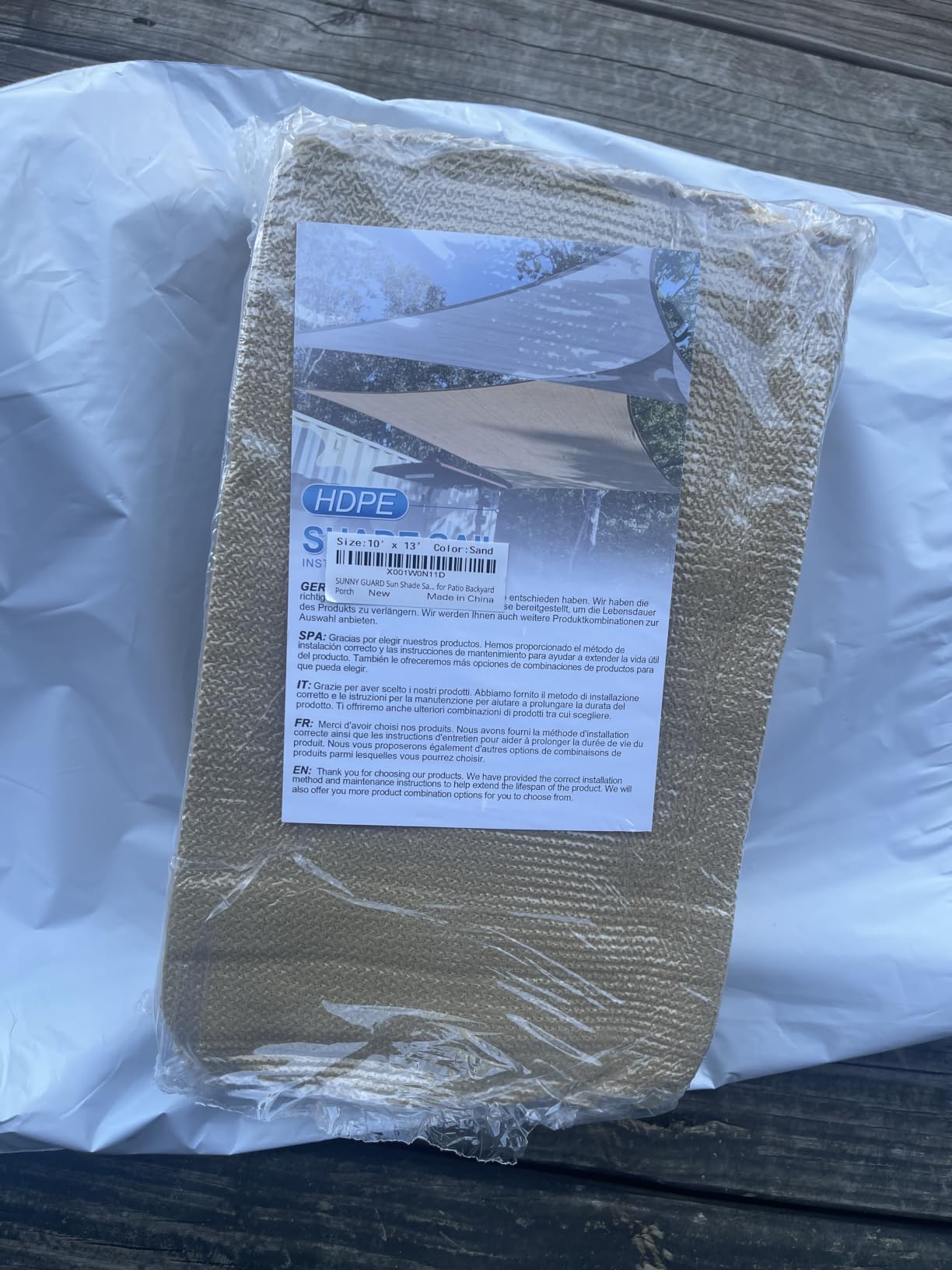
This is the shade sail most people end up with, and for a lot of patios that is the right outcome. Thirteen thousand eighty-four reviews at 4.5 stars, a rank of number one in the shade sails category, and a 10 by 13 footprint that sizes to almost any patio, deck corner, or carport without turning the install into a two-day project.
The fabric is 100% new HDPE with no splicing, which matters more than it sounds. Spliced panels leave a seam where shade coverage thins out, and this is a full single-piece knit. Owners consistently report that the sail holds shape after a wind event and that the corner points, while elongated, settle where you put them with a bit of trial and error.
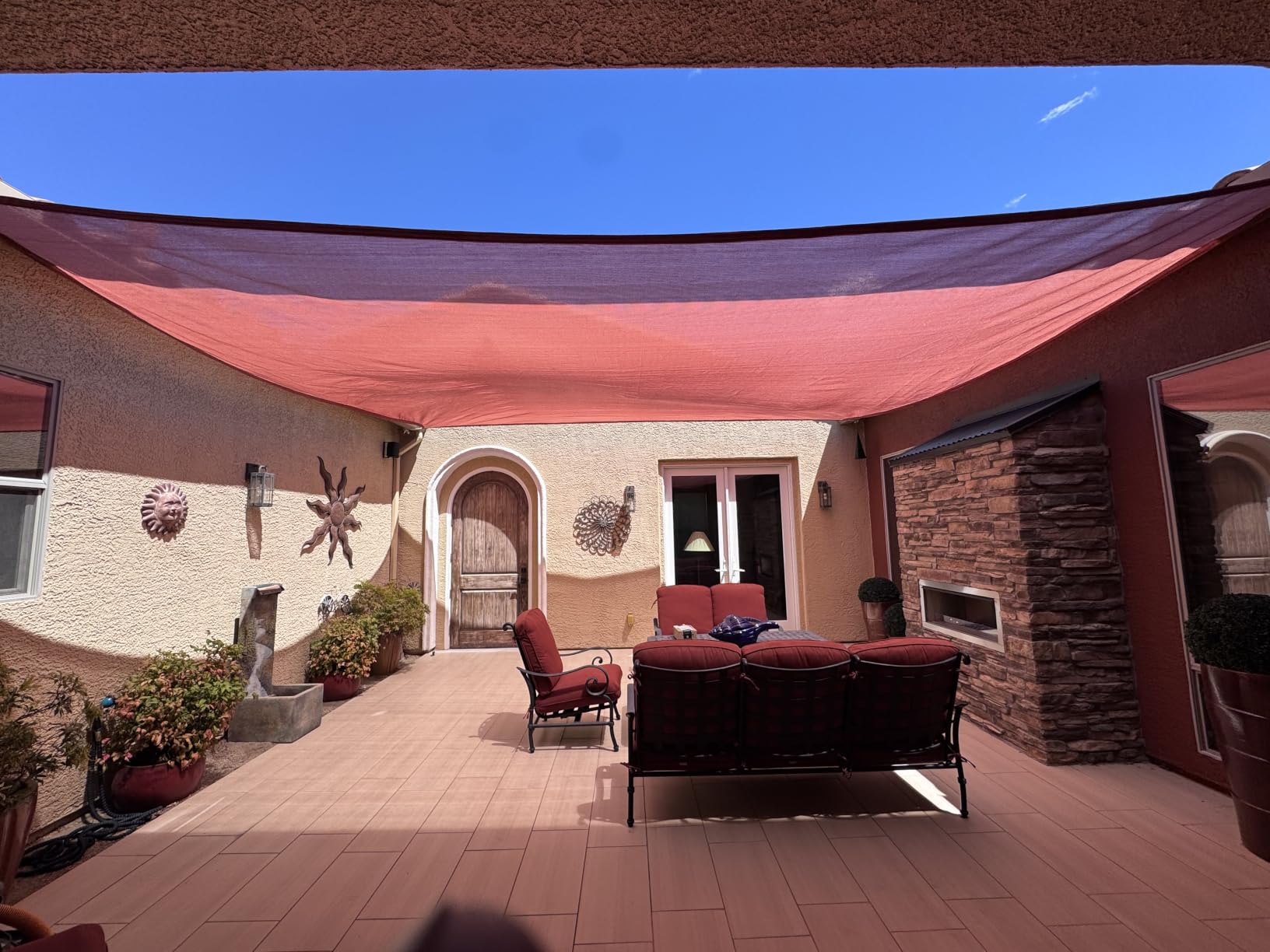
The honest weakness is the rope. Three to four thickened cords come in the box, and they are nylon, so they stretch. A reviewer reported this sail surviving gusts of 30 mph, and other owners in the same review pool describe the same behavior — once it is genuinely tensioned, it stays taut. Tensioned with nylon rope alone, it will not.
There is also a mismatch worth naming: some owners say the real UV blocking lands below the advertised 95%, and the sizing margin the manufacturer recommends is only 0.5 to 1 foot between fixing point and sail, tighter than most other brands in this list.
Who should buy this one
Buy it if you have a straightforward rectangular anchor layout and you want proven performance without deep research. Custom sizes are also available directly from the seller, which matters when your patio is an odd dimension.
If you already own stainless turnbuckles from a previous sail project, this becomes a five-minute hang. If you do not, buy them with the sail rather than after the first sag.
Where it falls short
It is not water resistant, no installation instructions are included, and the corner points being elongated means your first anchor attempt may need adjusting. Add that to the fact that the stainless accessories are sold separately and this is a value pick, not a complete kit.
If your priority is tear resistance in an exposed yard with steady wind rather than coverage, the GORILLA GRIP further down is built for that job instead.
3. Shade&Beyond 16ft Triangle — Best Triangle Shade Sail
Shade&Beyond 16’X16’X16′ Sun Shade Sail Sand Triangle
16 by 16 by 16 feet
185 gsm HDPE
95% UV block
Curved edges
Pros
- Heavy 185 gsm fabric
- Curved edges shed rainwater
- Stainless D-rings on reinforced seams
- Custom sizes available
Cons
- Hardware kit not included
- Not waterproof
- Needs removal in severe weather
A triangle is the right shape when you have three anchor points, which most backyards do not naturally offer. A house wall on one side and two posts on the other gives you a triangle that wraps a corner, shades a diagonal slice of a deck, or covers the gap between a patio and a carport where a rectangle simply will not reach.
At 16 by 16 by 16 feet this is a large triangle with 185 gsm HDPE fabric, well-stitched seams, and stainless steel D-rings in each corner. The design detail I like most is the curved edges, which exist to prevent rainwater buildup and extend the sail’s life. On a solid-looking shape like this, a straight edge would pond water in the corners, and the curve is what stops that.
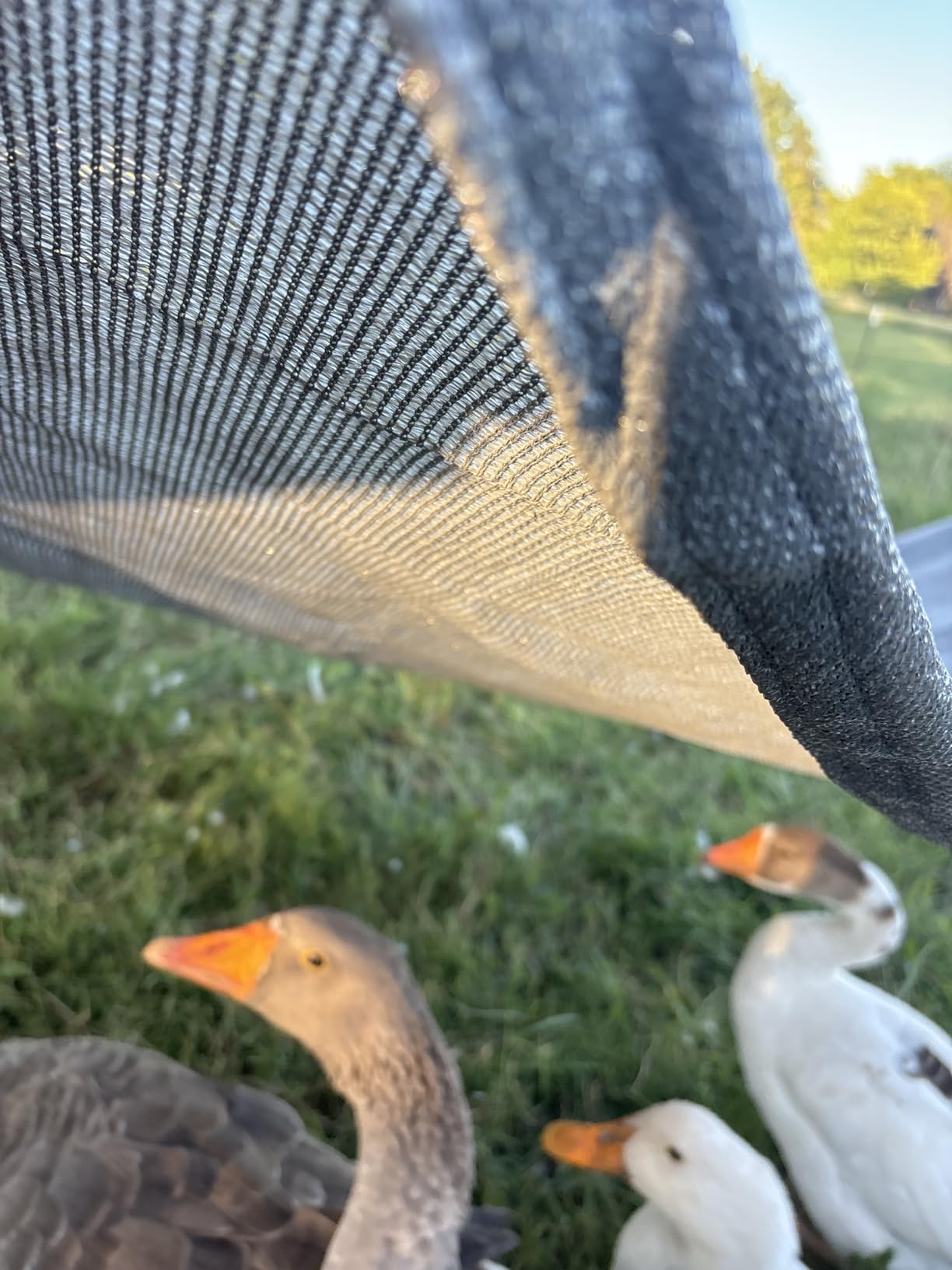
Coverage is listed at 256 square feet, but the manufacturer is specific about measurement: size the sail at about 88% of the installation area to avoid sagging, and leave 1.5 to 2 feet between the D-ring and the mounting point for hardware. Under-tension a triangle and the middle drops like a hammock.
Twelve thousand eight hundred seventy-three reviews at 4.5 stars is a deep install base. The consistent praise is for the heavy fabric, the reinforced stitching, and the way the breathable mesh cools the space without casting the flat heavy shadow that solid fabric creates.
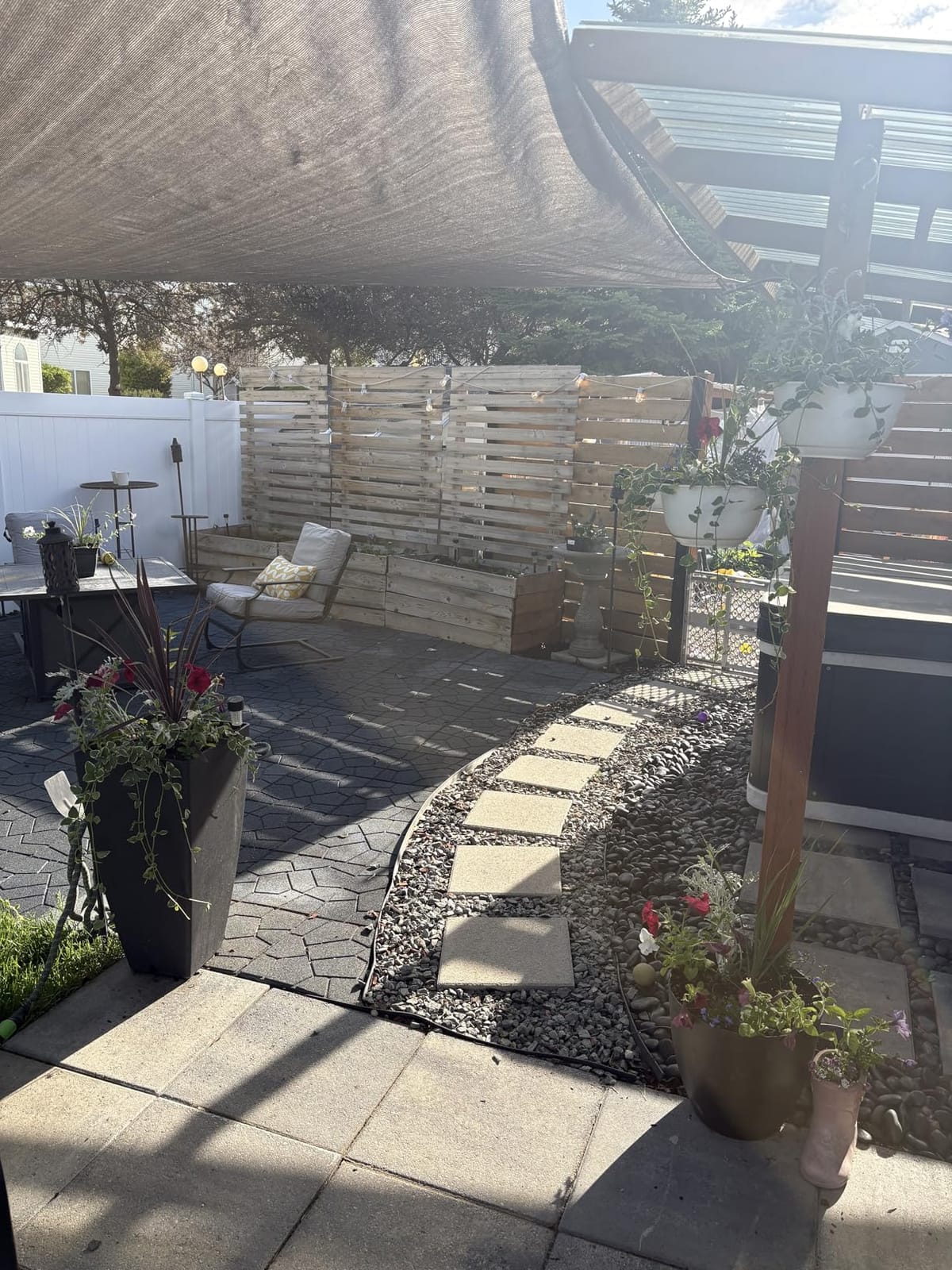
Is a triangle better than a rectangle
For three anchor points, yes. A triangle wraps an L-shaped corner far more efficiently than a rectangle and needs one fewer post. Two of the ten picks here are triangles precisely because so many patios have a wall on one side only.
The trade is coverage efficiency. A 12 by 12 triangle covers 62 square feet, while a 10 by 13 rectangle covers 130. If you have four solid anchor points and a rectangular patio, a rectangle covers roughly twice the area for a similar span.
Where it falls short
The hardware kit is not included, and the manufacturer asks you to take the sail down during severe weather. Both are reasonable asks, but they mean this is not a set-and-forget install.
Also note the D-ring to D-ring measurement convention. The stated 16-foot sides are corner ring to corner ring, so the area actually shaded is smaller than the numbers suggest. Measure your span, subtract the 1.5 to 2 feet per corner, and check the result before you commit.
4. LOVE STORY 12ft Triangle — Best for a Small Patio
LOVE STORY 12′ x 12′ x 12′ Triangle Sun Shade Sail for Outdoor Patio, Sand
12 by 12 by 12 feet
95% UV resistant
No center splice
Stainless D-rings
Pros
- Single-piece cut with no spliced gap
- 85 to 90 percent shading rate
- Light and easy to raise seasonally
- Very wide color and size range
Cons
- Included rope is weak nylon
- Not waterproof
- Fabric reads thin to some buyers
This is the one we recommend for a small apartment patio, a balcony corner, or a three-post side yard. At 12 by 12 by 12 feet it shades a bistro table, a couple of loungers, or a grill, and it is light enough to raise and lower by yourself as the seasons change.
The construction detail that separates it is the full single-piece cut with no spliced gaps in the center. Buyers mention even, attractive shade coverage with no dark stripe down the middle, which is the usual complaint on cheaper panel-seamed triangles. The HDPE fabric is rated 95% UV resistant with an 85% to 90% shading rate.
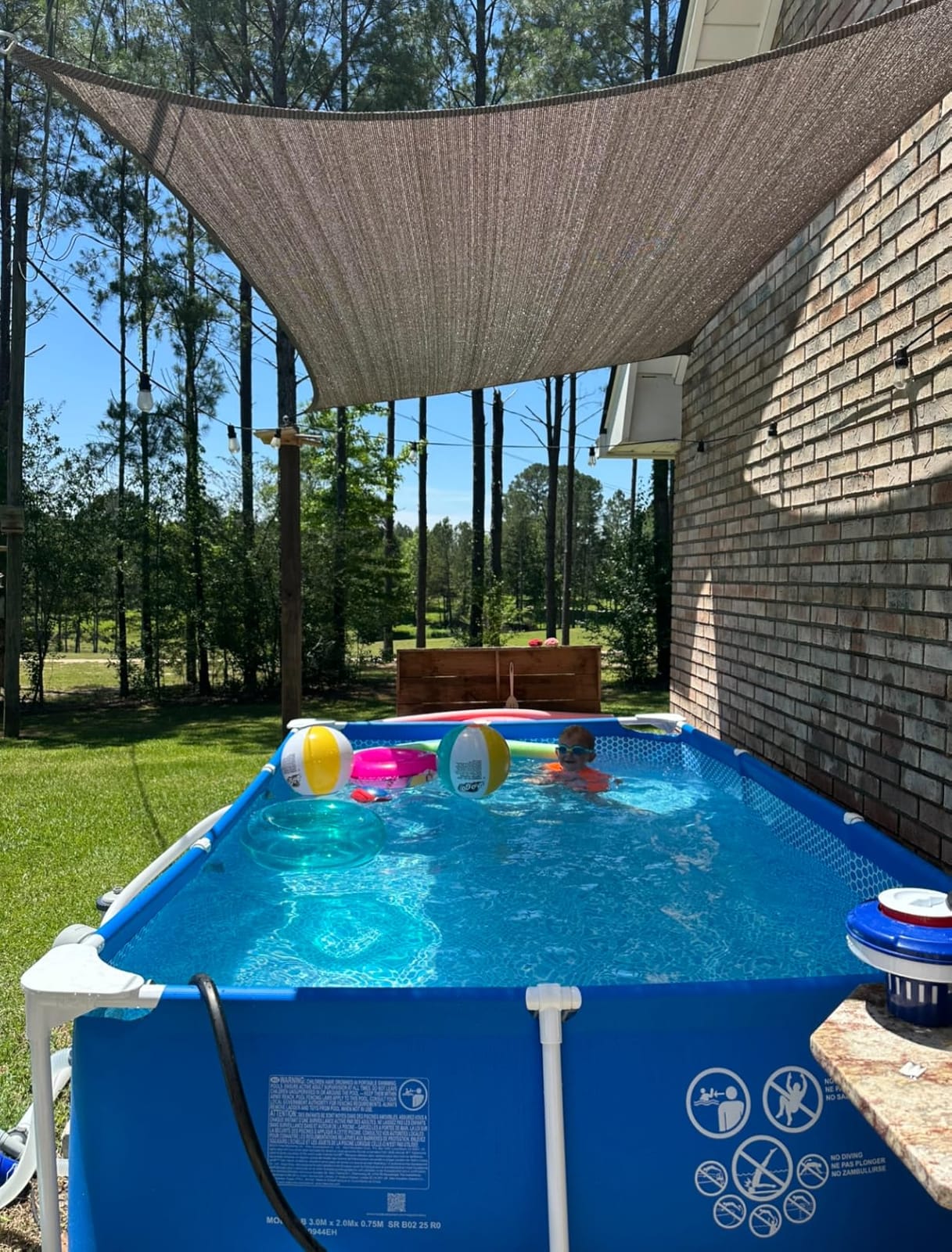
Ten thousand eighty-two reviews at 4.5 stars, and the notes are unusually practical. Owners say it holds tight after installation, survives serious weather, and covers for decks, porches, pools, and carports without complaint. The manufacturer offers a very wide color and size range including custom dimensions.
The one thing to plan around is that a 12-foot triangle covers 62 square feet, which is genuinely small. Owners frequently expect more from the dimensions, so treat the listed area as the ceiling rather than the promise.
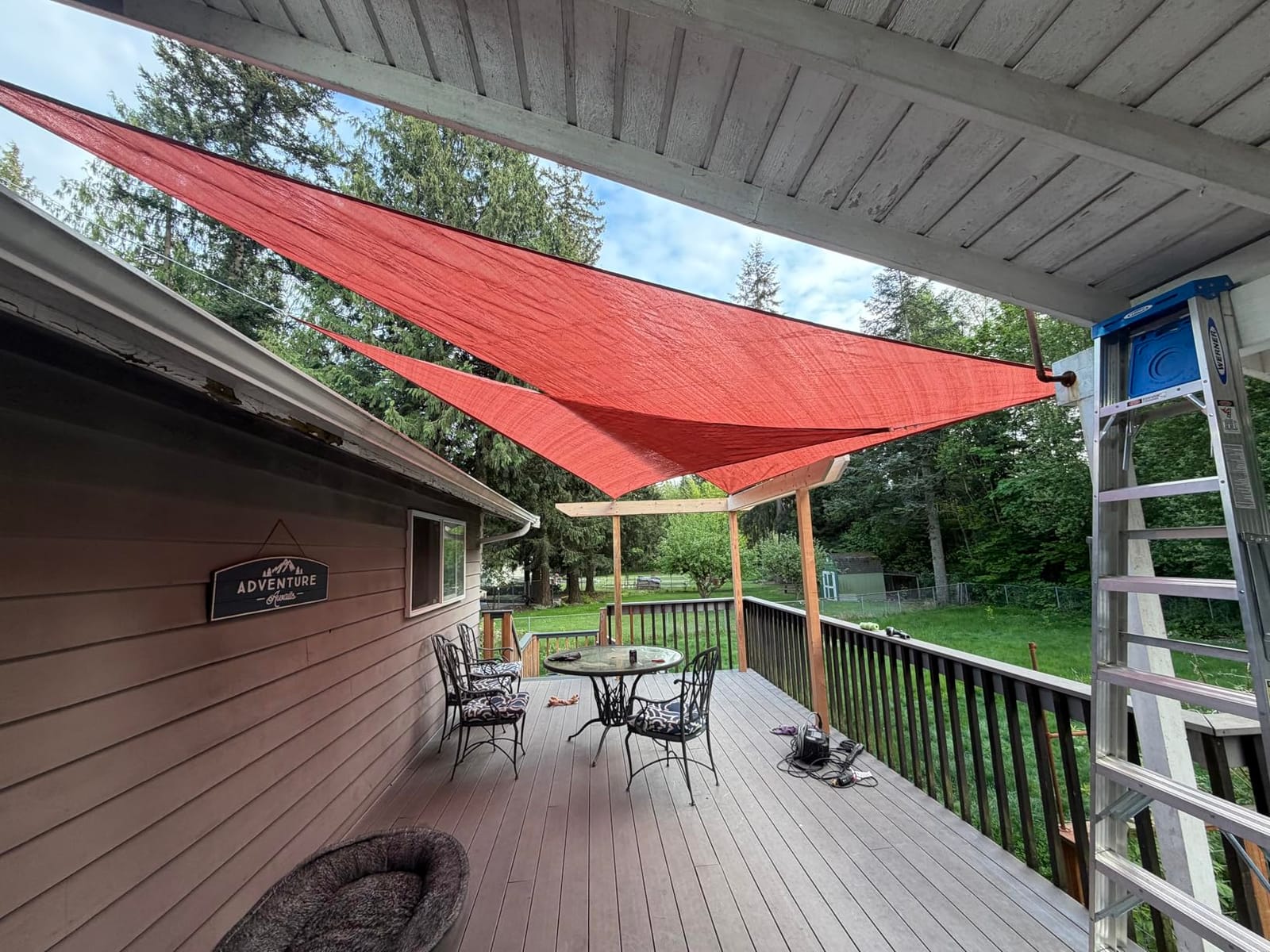
Best for renters and small balconies
This is light enough to tie rather than drill using the included ropes on a railing or a lightweight frame. That makes it a realistic answer for a rented apartment patio where a permanent install is not permitted. Check your lease or building rules first, since a sail projecting over a walkway can draw a complaint.
The short version for a renter: a sail you can take down in under five minutes is the right choice anywhere the wind or the landlord is unpredictable.
Where it falls short
The included rope is weak nylon, and owners are repeatedly advised to buy proper hardware. It is not waterproof and will sag in heavy rain, which is the standard behavior for breathable HDPE.
Some buyers also find the fabric reads more like a plastic tarp than heavy canvas, and custom sizes can come out larger than expected on one side, forcing an anchor relocation. Check the measured span before you mount.
5. SUNLAX 16×20 Dark Grey — Best for Large Patios and Pool Decks
SUNLAX Large Sun Shade Sail 16′ x 20′ Dark Grey Rectangle Outdoor Canopy
16 by 20 feet
320 sq ft
95% UV block
Non-recycled HDPE
Pros
- One of the two largest coverage areas here
- HDPE made without recycled materials
- Double-strength stitched seams
- Curved edges reduce sagging
Cons
- Accessories sold separately
- Heaviest item at 12 pounds
- Stretchy fabric needs full tension
When the question is a large patio, a pool deck, or a two-car driveway, coverage area becomes the whole conversation. This 16 by 20 rectangle is listed at 320 square feet, tied for the largest listed footprint in the roundup, and the fabric is high-density polyethylene made without recycled materials.
That last point is the real differentiator. Recycled content in HDPE degrades under sustained UV exposure, and this sail is cut from a complete mesh with double-strength stitched seams and four anti-rust D-rings at each corner. Knitted construction lets cooling breezes and even raindrops pass through, so the shaded area stays usable rather than turning into a heat trap.
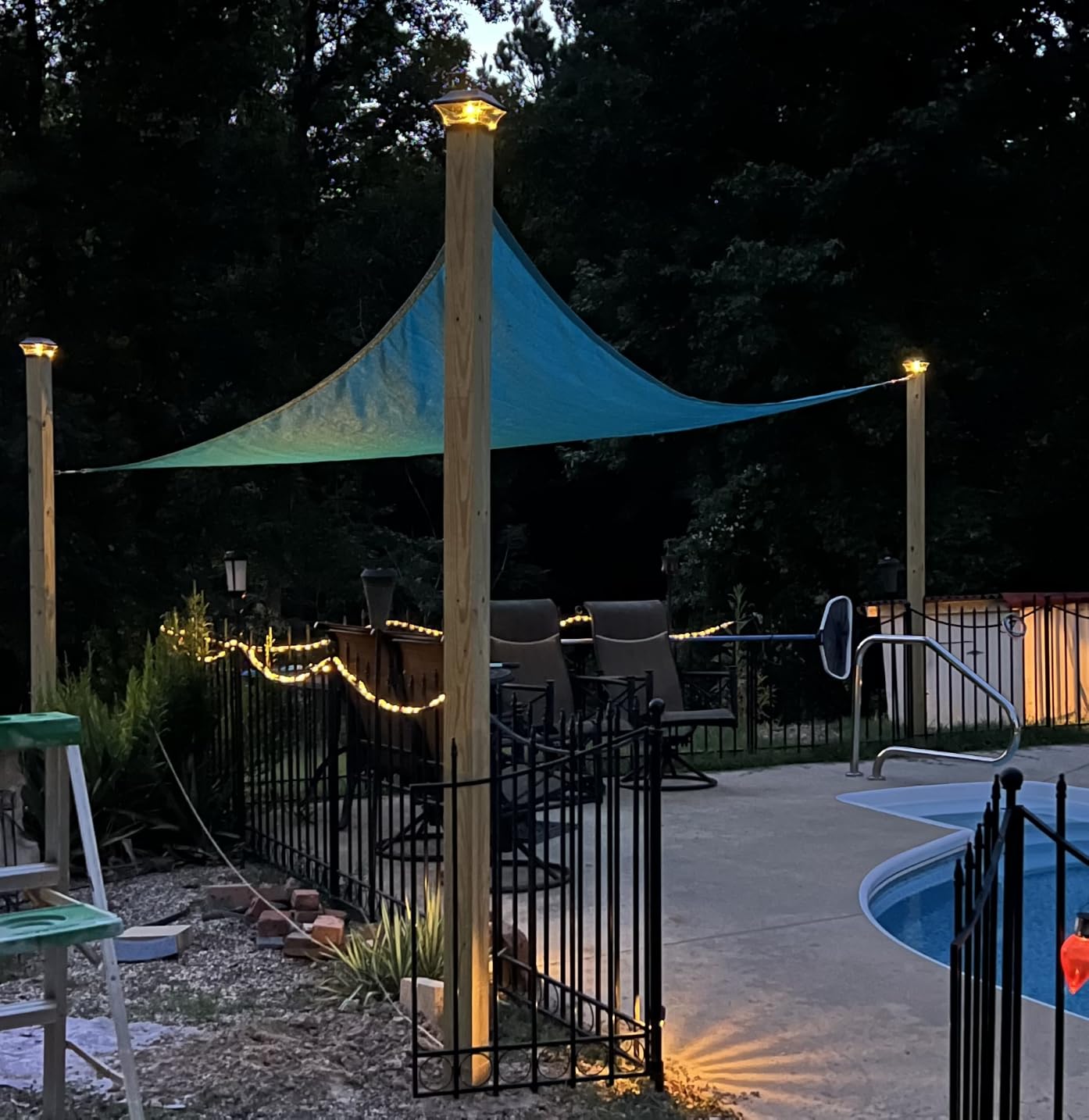
Five thousand nine hundred thirty-four reviews at 4.5 stars, with owners repeatedly pointing to the sheer coverage and the premium non-recycled fabric. The recurring instruction from that review pool is important: fully tension the fabric, because the listed size only appears when it is pulled taut.
Curved edge design is doing real work here too. It reduces sagging in the middle and improves shade coverage across the span, which on a rectangle this size is the difference between a usable deck and a sagging tarp.
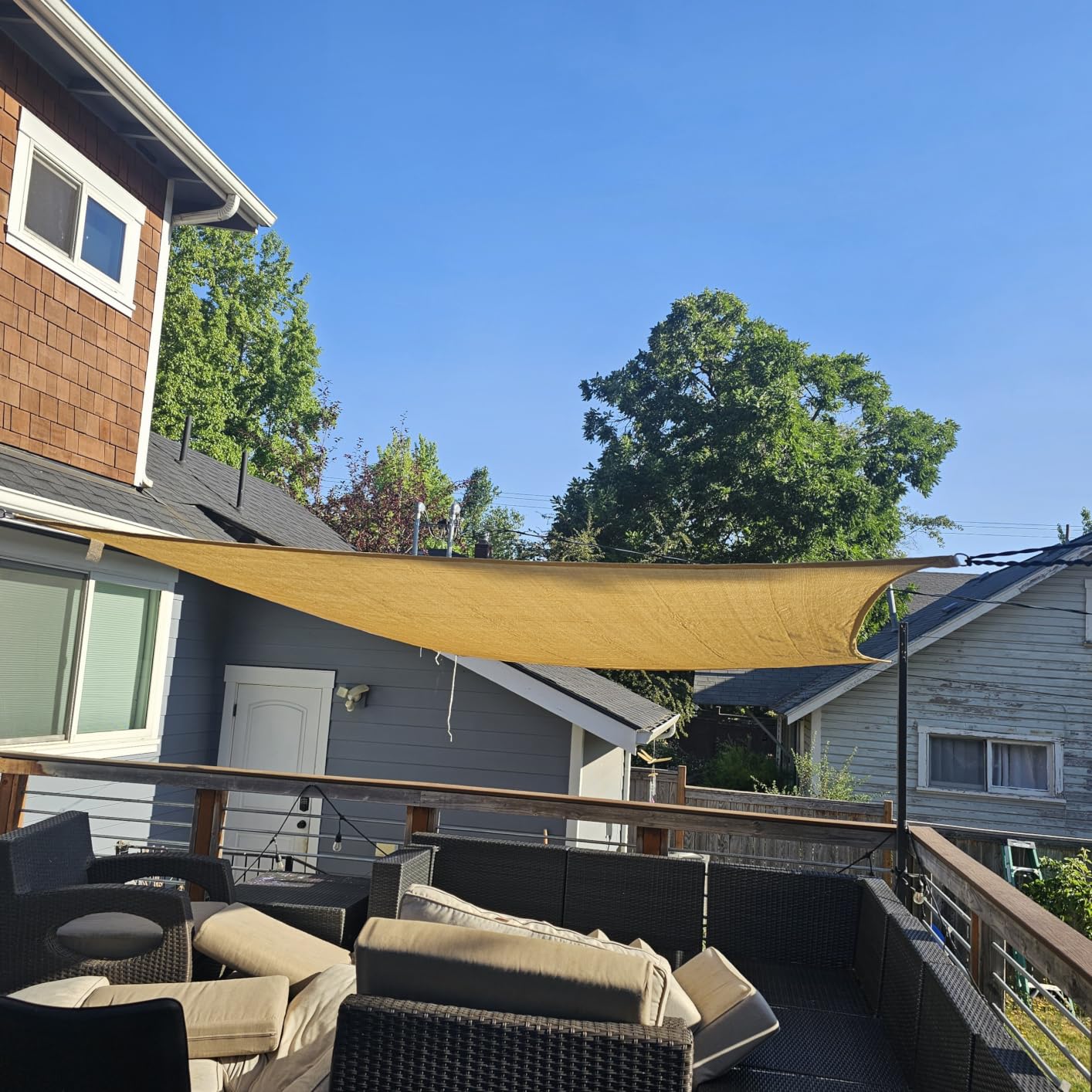
When a large sail is worth it
Coverage economics. A single 16 by 20 sail shades a full outdoor dining set, a poolside lounging area, or a carport, at a fraction of what three smaller sails cost in hardware. If you have four solid anchor points and an open span, bigger is simpler.
It also carries a 0.5 to 1 foot margin recommendation between fixing point and sail, and four cords are included. For permanent or semi-permanent installs, plan on stainless hardware from the start.
Where it falls short
At 12 pounds this is the heaviest item in the group, which makes a solo install genuinely awkward above a 16-foot span. Plan for a second pair of hands.
Accessories are sold separately, the fabric is stretchy, and the listing carries a length tolerance, so verify the actual dimensions against your anchor spacing before you mount. It is also not waterproof, despite some general water-resistance language in the feature copy.
6. Patio Paradise 10×12 Beige — Best for Balconies and Carports
Patio Paradise 10′ x 12′ Sun Shade Sail Rectangle Canopy Patio Cover Sunlight Block Awning Heavy Duty Commercial Grade for Backyard Lawn Garden Outdoor Activities, Beige
10 by 12 feet
Virgin HDPE
3-year warranty
95 percent UV block
Pros
- Virgin HDPE tested for 20000 lab hours
- 3-year limited warranty
- Custom sizes from a US factory
- Curved design resists mid-span sagging
Cons
- Included hardware can rust
- Minimal nylon rope included
- Stretchy fabric needs re-tensioning
At 10 by 12 feet with 120 square feet of listed coverage, this is the most precisely sized sail here, and that precision is the point. It suits a defined patio rectangle, a covered walkway section, or a carport bay where you want shade without a sprawling overhead plane.
What stands out in the spec sheet is the fabric claim: virgin HDPE, lab-tested for 20,000 hours, stated as roughly 80% more durable than low-purity HDPE under sun exposure, with a special surface treatment for sunlight and rain durability. All edges are double-stitched for tear and abrasion resistance with a D-ring at each corner, and the slightly curved design helps prevent sagging in the middle when taut.
There is also a 3-year limited warranty under normal weather and use, with the manufacturer asking that you remove the sail in extreme weather. The US factory offers custom sizes and straight-edged versions on request, which is useful if the curve conflicts with your aesthetic.
What owners actually report
Four thousand nine hundred forty-three reviews at 4.5 stars. Buyers credit the virgin HDPE with real cooling and UV benefit, and several report the sail performing well after five or more years outdoors. One long-term review described cutting household cooling costs, and another used it as a plant shade with a thriving herb bed beneath.
Permeability is the design center. The fabric lets breezes and a small amount of light through, so the space under it stays ventilated and usable rather than dark.
Where it falls short
The most cited drawback across reviews is metal hardware. The included D-ring and hardware components can rust within weeks and stain nearby surfaces, so replace them with stainless before you hang it. Only a short length of nylon rope is included, not enough to tie off all four corners.
The fabric is stretchy, may shrink or distort in heavy wind or rain, and needs periodic re-tightening. It is not waterproof, blocks only light rain, and should come down in snow. Plan for a 1.5 to 2 foot margin between the D-ring and each mounting point.
7. GORILLA GRIP 12×12 Graphite — Best for Tear Resistance
GORILLA GRIP Heavy Duty Sun Shade Sail for Outdoor Patio, 12×12 FT Gray
12 by 12 feet
185 GSM HDPE
Tear-tested seams
Up to 87 percent shade
Pros
- Third-party tear-tested double-layered seams
- Rust-resistant stainless D-rings
- Curved edges reduce drooping
- Rated 4.6 stars
Cons
- Installation hardware not included
- Lower 87 percent shade rate
- Not for heavy rain or snow
This is the sail to buy for an exposed yard with no trees to break the wind. The selling point is not coverage, it is construction: 185 GSM HDPE with double-layered reinforced seams that a third party tested for tear resistance, and rust-resistant stainless steel D-rings at every corner.
The curved edge design enhances pull strength and prevents drooping, which is exactly the failure mode that ruins cheap sails. A sagging center catches a gust, the fabric loads unevenly, and the corner hardware takes the shock. Flatten it and the cycle never starts.
It carries 4.6 stars across 1,405 ratings, with 77% five-star ratings. Owners single out the stainless D-rings and the reinforced seams as more durable than competing sails, and they like the breathable weave that lets a breeze through while blocking the sun.
The shade rate trade-off
This sail provides up to 87% shade rather than the 95% UV blocking claimed by most others here, and that difference is real for anyone whose main goal is protecting furniture colour or keeping a west-facing room cooler through the afternoon.
Buyers also note that wrinkles soften after installation and sun exposure, and that the colour can look different in natural versus indoor light. Judge the graphite in daylight before you commit to it.
Where it falls short
Installation hardware is not included, and only 13 feet of PE rope is in the box, which is not enough to tension all four corners. It is also not recommended for heavy rain or snow.
Those two facts push it toward a season-appropriate, wind-exposed install with proper stainless hardware bought separately. If you want rain coverage instead, you are looking at the wrong category entirely.
8. ShadeMart 10×13 Beige — Best for Cooling
ShadeMart 10′ x 13′ Beige Rectangle Shade Sail for Outdoor Patio
10 by 13 feet
Woven HDPE
Stainless D-rings on webbing
3-year warranty
Pros
- Reduces temperature by 10 to 15 degrees
- Permeable to both air and water
- 3-year limited warranty
- Stainless D-rings on webbing hems
Cons
- Smaller review base than rivals
- Mounting hardware not listed as included
- Webbing perimeter needs careful tensioning
If the thing you are chasing is a measurable drop in temperature rather than pure UV blocking, this is the sail we would test first. The woven HDPE is permeable to both air and water, blocks up to 95% of harmful UV, and is claimed to reduce the temperature beneath it by at least 10 to 15 degrees.
The hardware detail is unusual for this category. Instead of a D-ring stitched straight into the fabric edge, the stainless corner D-rings attach to heavy-duty white webbing that runs around the entire perimeter. That webbing spreads the load across the hem rather than concentrating it at four points, which is a sensible way to reduce corner tearing.
It is rated 4.6 stars across 1,161 reviews with 79% five-star ratings. Reviewers highlight the webbing-reinforced stainless D-rings, the water and air permeability, and the measurable cooling effect.
What permeability actually buys you
Air and water pass through the weave, so this fabric keeps working in wind and rain where a solid tarp loads up and fights you. In a windy region, permeable construction is not a compromise, it is the reason a sail survives. Community consensus on landscaping forums reflects the same view: porous fabrics handle gusts far better because air moves through the material instead of catching it.
A 3-year limited warranty covers normal weather and usage, and custom sizes are available, which is helpful when your patio is not a round number.
Where it falls short
The review base is smaller than the top-ranked sails, so there is less long-term install history to lean on. Mounting hardware is not listed as included, and the webbing perimeter needs careful tensioning to sit flat. Under-tension it and the edge will ripple.
At 10 by 13 feet it covers 130 square feet, which suits a patio dining set or a carport but will not shade a large pool deck. The strongest is the SUNLAX 16 by 20.
9. AsterOutdoor 10×13 Sand — Best Warranty and Easiest Seasonal Handling
Asteroutdoor Sun Shade Sail Rectangle 10′ x 13′ UV Block Canopy for Patio Backyard Lawn Garden Outdoor Activities, Sand
10 by 13 feet
180 GSM polyethylene
95% UV block
5-year warranty
Pros
- Most-reviewed sail at 20895 ratings
- 5-year manufacturer warranty
- Light enough to raise and lower solo
- Curved sides resist drooping
Cons
- Lowest rating at 4.4 stars
- Stitching quality can be inconsistent
- Flimsy included rope
This is the most-reviewed sail we evaluated, with 20,895 owner ratings, and the only one carrying a full 5-year manufacturer warranty with an extended warranty option. The fabric is 100% high-density 180 GSM polyethylene with strong stitched seams and stainless steel D-rings, rated to block 95% of UV while still letting air and light through.
Two practical details make it easy to live with. First, the curved sides enhance pull strength and prevent drooping, so it behaves under tension. Second, it is lightweight and compact enough to fit in the original bag or a backpack, and owners confirm one person can raise and lower it for the seasons without a ladder.
Four 5-foot ropes and an instruction sheet are included, which is more helpful than the norm. Many owners report it holding up through strong wind and heavy rain across multiple seasons, and that it lets in enough light and air to keep plants and furniture usable underneath.
Why the warranty matters here
Two other sails in this roundup carry 3-year limited warranties, and the rest carry none. A 5-year term on 180 GSM fabric is the strongest coverage signal available, and it changes the calculation for anyone planning to leave the sail up through a full summer season rather than rebuying next year.
It is also a sensible pairing for a seasonal install. Once you are comfortable putting it up and taking it down, the warranty covers the fabric rather than your patience.
Where it falls short
Be clear-eyed about the rating: at 4.4 stars with 69% five-star ratings and 5% one-star reviews, it is the lowest-rated sail in this group despite the biggest review base. Some buyers receive sloppy, unfinished, or crooked stitching, and owners report fading with prolonged sun exposure.
It is not waterproof, so light mist soaks anything underneath and heavy rain pools and sags the fabric. The included rope is flimsy and should be replaced with quality turnbuckles and carabiners for a taut install. Listed dimensions are D-ring to D-ring, so leave 1.5 to 2 feet between the fixing point and the sail.
10. TANG 16×20 Brown — Best for Simple Upkeep
TANG 16′ x 20′ Sun Shade Sail Rectangle Outdoor Canopy UV Block Sunshades for Patio, Square Shade Cloth for Backyard Porch Deck Garden Pergola Cover, Brown
16 by 20 feet
Knitted HDPE
95% UV block
3-year warranty
Pros
- Rinses clean with water
- Double-stitched edges for wear resistance
- D-rings hold any configuration
- 320 sq ft coverage
Cons
- Stretchy knit means listed size is taut-only
- Hardware kit sold separately
- Nylon rope stretches
Maintenance is where this one separates from the field. The fabric is easy to clean with water, which sounds trivial until you have cleaned tree debris off a taut sail hanging ten feet up. Hose it off, let it dry, done. At 16 by 20 feet it also covers 320 square feet, so you are cleaning once instead of three times.
The fabric is 100% brand-new high-density polyethylene knitted construction that resists tearing and fading, with double-stitched edges for wear resistance and D-rings that secure the sail in any position. A 3-year limited warranty covers normal weather and use.
Curved sides enhance pull strength and prevent drooping, and they add 1 to 8 inches to the effective side length. That is a nice touch on a large rectangle, though it does have the side effect of making the middle of the sail narrower than the side measurement implies. Straight-edged versions are available on request.
Two thousand two hundred ninety-one reviews at 4.5 stars, with buyers citing the double-stitched seams, the curved-edge design, effective UV blocking, and easy rinsing. The consistent caveat is the stretchy knit, which only reaches its stated dimensions when pulled fully taut.
Why upkeep matters more than people expect
A sail that can be rinsed keeps its shade and its appearance. Leaves and grit sit on a taut surface, hold moisture against the HDPE, and stain over a season. A hose-down twice a year is genuinely enough for this construction.
It is a good companion piece to an outdoor dining setup. We covered patio serving carts and cooler carts for people who want the space to work hard on a long afternoon.
Where it falls short
The hardware kit is sold separately and the included nylon rope stretches and looks unfinished, which is the same caveat that applies to most sails in this category. Curved edges make the center narrower than the side length implies, so plan coverage around the actual shade area rather than the footprint.
It is not waterproof, and it carries the lowest sales rank of the ten products we evaluated, which suggests a smaller installed base than the others even with thousands of ratings. Expect some trial and error on the first tensioning pass.
How to Choose a Shade Sail for Your Patio
Most buying mistakes come down to three questions: what shape, what size, and breathable or waterproof. Get those right and the rest is preference. Here is how we think through each one.
If you are still deciding between a sail and another kind of patio cover, note that a shade sail needs fixed anchor points and gives shade rather than rain cover, a patio umbrella needs a weighted base and can be lowered in minutes, and a pergola is a permanent structure that costs far more in labor.
Shape: match the sail to your anchor points
Count your fixed anchor points before you choose a shape, because that decision drives everything. Three points, buy a triangle. Four points, buy a rectangle or square. A wall on one side and two posts on the other gives you a triangle that wraps a corner far more efficiently than any rectangle.
Size follows from that. A 12 by 12 triangle covers 62 square feet; a 10 by 13 rectangle covers 130. A square patio with four solid anchor points will be covered far more efficiently by a rectangle, and the extra area costs almost nothing in hardware.
One more geometry note worth knowing: a right-angle triangle gives you a square coverage area, while an equilateral triangle spreads the same fabric into a three-pointed shape. If you want predictable square coverage from three anchors, ask for a right-angle triangle.
Size: the 88% rule and the corner allowance
Sail dimensions are measured D-ring to D-ring, not corner to corner across the fabric, and the shaded area is smaller than the numbers imply. The standard sizing guidance across this category is to size the sail at about 88% of the span you intend to cover.
Then add hardware allowance on top of that. Leave 1.5 to 2 feet between the D-ring and the mounting point for turnbuckles and ratchet tensioners; some manufacturers specify 0.5 to 1 foot, and both figures assume you know which one your sail needs. Get this wrong and you either sag the sail or end up short on reach.
Quick coverage guide for common patios:
Small balcony or bistro patio: 10 by 13 rectangle or a 12ft triangle.
Standard patio with a dining set: 10 by 12 to 12 by 16 rectangle.
Deck, pool deck, or carport: 16 by 20 rectangle.
Corner with a wall on one side: an equilateral or right-angle triangle sized at 88% of the span.
Material and GSM: what the number means
GSM is grams per square metre of fabric, and it is the most objective durability proxy on a listing. Nearly every sail in this roundup sits in the 180 to 185 GSM band, which is commercial-grade HDPE. Below roughly 160 GSM you get thinner fabric that stretches more, degrades faster under UV, and tears more readily in gusts.
Knitted construction is preferable to woven for sails, because the knit structure lets air pass through and stops a gust from catching a flat plane. Woven HDPE is also common and performs well, as the ShadeMart demonstrates. What matters more than knit versus weave is the fabric purity: virgin HDPE holds up under sustained sun better than anything containing recycled material.
Breathable HDPE versus waterproof fabric
Every sail we evaluated is breathable HDPE and not water resistant. That is a deliberate engineering choice, not a shortfall. Air and light rain pass through the knit, so the sail never loads up with water, never adds dangerous weight, and never collapses into a bowl.
Waterproof fabric, by contrast, blocks rain but demands a steep tilt to shed water. Installed flat, it pools, the extra load stretches the fabric, and the sag worsens. If you genuinely need rain cover over a patio, the honest answer is a canopy or a pergola with a roof, not a waterproof sail mounted level.
Hardware: where most budgets go wrong
Almost every sail in this roundup arrives as fabric plus rope, with stainless D-rings or turnbuckles sold separately. The nylon rope in the box will stretch, and a rope-only install is the single most common reason a new sail looks disappointing within a month.
Buy a proper 304 stainless turnbuckle and ratchet tensioner kit and tension every corner independently. That one addition is what keeps a sail flat through a season. Cable and hardware also protect against the rust problem that owners of some budget kits report within weeks, where staining metal ends up on the furniture below.
The honest downsides
Sag is the number one complaint. Rope-only installs lose tension within weeks; a stainless turnbuckle kit is the fix.
Wind tear risk is real. Corner grommets can pull out when fabric is under-tensioned and a gust catches it.
Breathable sails do not shelter you from rain. They are sun protection, not weather protection.
Large sails must come down before storms and in snow seasons, even with a warranty.
Hardware and anchors are usually extra, so the installed cost is higher than the listing suggests.
Bold colours can clash with neutral patio furniture, and listed colours sometimes read differently in daylight.
Still deciding? Tell us your patio dimensions, the anchor points you already have, and whether you need breathable or waterproof coverage, and we will point you at the right pick.
Installation and Anchoring
This is the section that decides whether you enjoy the sail for a season or for a decade. Owners in DIY forums repeat the same warning more than any other, and it is worth taking seriously.
Do not anchor into brick. A shade sail under wind load creates lateral force, and brick facing is not designed for that. The consistent forum consensus is that wind loading will eventually tear brick off the house. Anchor into a structural member, a joist, a properly set post, or a tree with a wide trunk, and use masonry-rated expansion anchors only for light decorative loads, never for a tensioned sail.
How to tension a sail properly
Work from a fixed anchor point rather than a free-floating one, and leave 1.5 to 2 feet between the D-ring and the mounting point for the turnbuckle. Attach a turnbuckle to each corner in turn, then work the corners in opposite pairs rather than all at one end.
Tension until the fabric is drum-tight and the centre no longer dips, which is roughly the 88% sizing rule made visible. A correctly tensioned sail hums slightly in a breeze; a loose one flaps, and flapping is what tears corners. If your sail sags after a month, that is a hardware problem, not a fabric problem, and the fix is a turnbuckle rather than a bigger sail.
For a permanent install, guidance on DIY forums points to steel catenary cable with M12 hardware, tensioned to roughly 100 kg of static load, because wind force exceeds static load and the safety margin has to absorb that difference. That is a heavier build than most patios need, but it is the right approach if you intend to leave the sail up year-round.
Do I need a second pair of hands
Under about 12 feet, one person can usually do it with a ladder, and owners of the lighter sails in this roundup confirm solo seasonal handling. Above 16 feet, treat it as a two-person job. The heaviest sail here is around 12 pounds, and awkward is worse than heavy when you are on a ladder with a sail catching wind.
Renters, HOAs, and wind protocols
If you cannot drill, a triangle with included ropes tied to a railing or a freestanding frame is the realistic option, and the fourth pick here is built for it. In apartment settings, a low profile that can be removed quickly is safer than a large fixed sail, which is also why umbrella and canopy options come up often in renter discussions.
Take the sail down before a named storm, not during it. Nobody enjoys standing on a wet lawn with a ladder in heavy wind trying to release four corners. A permeable sail in a breeze is fine; the same sail catching a squall is not, because the water loading and the wind arrive together.
Finally, plan the sun path. Position the sail over the hours you actually use the patio rather than centering it on the footprint. An afternoon-only space wants shade weighted to the west side, and once the sail is down you can shift the anchors next season without replacing the fabric.
Frequently Asked Questions
What is the best sunshade for a patio?
For most patios, a rectangular HDPE shade sail in 180 GSM or heavier fabric is the best balance of coverage, weight and cost. It blocks 90-95% of UV rays, lets heat and breeze pass through, and installs over any four anchor points. A triangle sail is the better answer when you only have three anchor points or want to wrap a corner.
What is the disadvantage of a shade sail?
The main disadvantages are sag, wind tear risk and the lack of rain shelter. Rope-only installs lose tension within weeks, so a stainless turnbuckle kit is close to mandatory. A taut sail catches gusts and must be taken down before storms, and breathable HDPE lets rain through by design. Hardware and anchors also usually cost extra.
Can shade sails withstand high winds?
Yes, if you do three things: choose permeable HDPE so air passes through the fabric, tension the sail properly so it cannot flap, and size it correctly to about 88% of your span. Reviewers report sails holding through 30 mph gusts and heavy rain once properly tensioned. Solid tarp-style fabric performs far worse in gusts than a knitted HDPE sail.
Does rain come through a shade sail?
On breathable HDPE sails like the ones in this roundup, yes, light rain and mist pass through the knit. That is the point: the fabric never loads with water, never pools, and never collapses. Waterproof fabric exists but needs a steep tilt to shed water, and a flat waterproof sail pools and stretches. For true rain cover, use a canopy or a roofed pergola instead.
What size shade sail do I need for my patio?
Size the sail at about 88% of the span you want covered, and measure D-ring to D-ring rather than corner to corner. Then leave 1.5 to 2 feet between each D-ring and the mounting point for turnbuckles. A 10 by 13 rectangle covers roughly 130 square feet, while a 12 by 12 triangle covers about 62, so pick the shape your anchor points allow.
Final Verdict: The Best Shade Sails for Patios in 2026
The Artpuch 16×20 Sand Rectangle takes the top spot in 2026. It pairs commercial-grade 185 GSM HDPE with stainless D-rings at all four corners, it covers a genuinely useful amount of patio, and it draws on the deepest install base in this group after the AsterOutdoor to confirm it holds up. Buy it with a stainless turnbuckle kit and mount it at roughly 30 degrees.
Buy the SUNNY GUARD 10×13 instead if you want the smallest sensible footprint and the most proven sail in the category right now, or the Shade&Beyond triangle if you have three anchor points and a corner to wrap. For a carport, balcony, or short patio, the LOVE STORY triangle is the light one to raise and lower solo. For an exposed yard with steady wind, the GORILLA GRIP’s tear-tested seams are worth the lower 87% shade rate.
Whichever you choose, budget for the hardware and the anchors as part of the purchase rather than an afterthought. That is the difference between a taut sail and a sagging one, and it is the single decision that separates a two-year install from a decade of use.
Once the shade is up, the space underneath works much harder. We have covered patio swings with canopies for the shaded corner, infrared patio heaters and tabletop patio heaters for the cooler months, and a full round of serving carts for the long afternoons this sail will make possible.