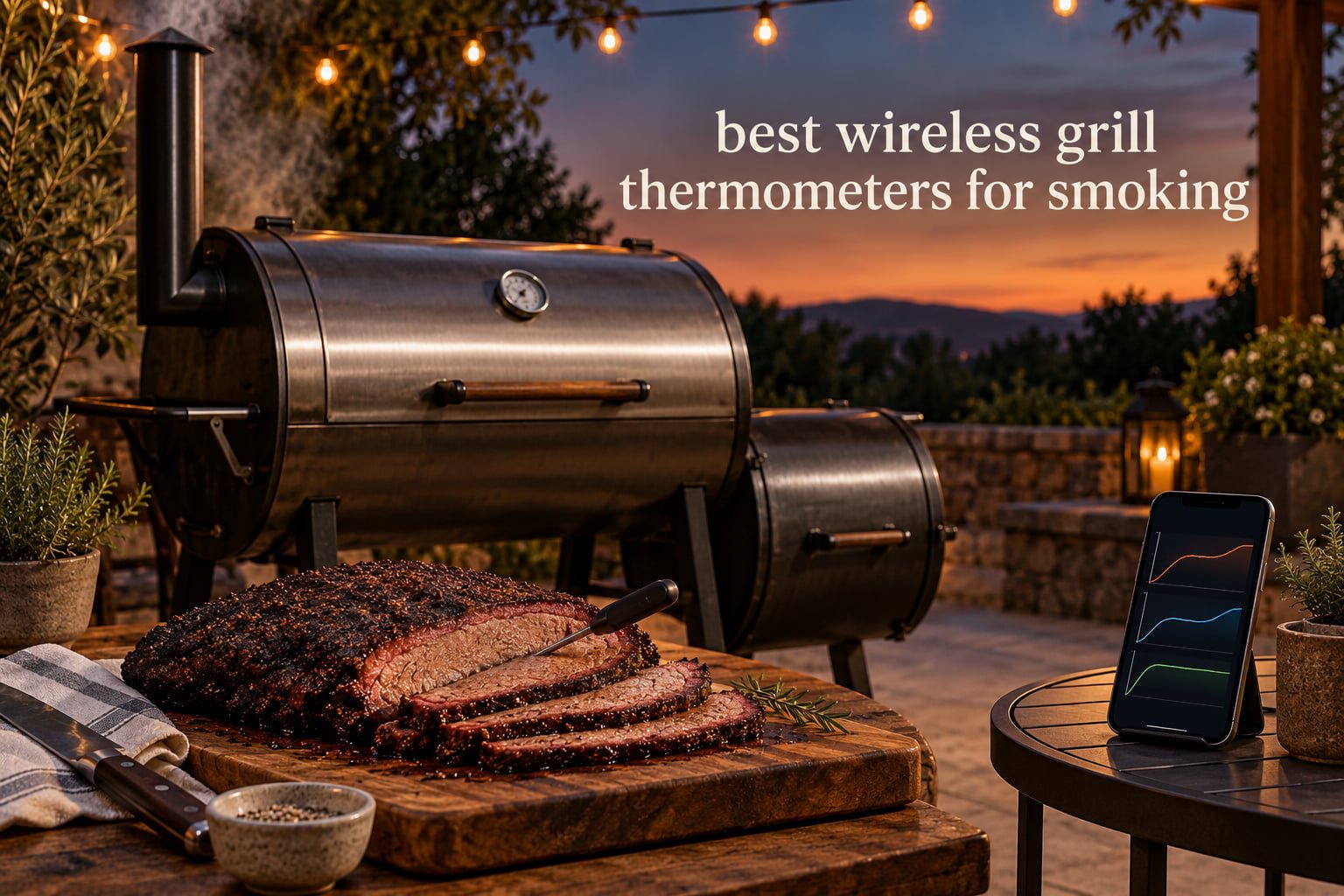
Most of the reason people stall out on a brisket is not the meat. It is the lid. Every time you open the barrel to check the bark, you dump heat and buy back fifteen or twenty minutes of cook time, and after two overnight briskets in a row you start looking for a way to stop doing that at all.
A wireless grill thermometer is that way out. The probe goes in the meat, the reading comes to your phone or a receiver you carry around, and the cook keeps moving whether you are asleep, at work, or on the couch. That is the whole promise, and after putting twelve of these systems through real smokes we can tell you where the promise holds and where it quietly breaks.
This roundup covers the best wireless grill thermometers for smoking available in 2026, from app-driven WiFi hubs that never lose a signal to plain RF receivers that need no account at all. We looked hard at the things that decide whether a probe survives a twelve-hour cook: signal penetration through a metal cooker, whether the ambient sensor reads truthfully after the first few hours, battery life under real conditions, and how deep the probe reaches into a large cut. If you also want the non-smoking options, our grill thermometer guide covers instant-read picks.
Table of Contents
- Top 3 Picks for Best Wireless Grill Thermometers for Smoking (October 2026)
- All 12 Wireless Grill Thermometers Compared in 2026
- 1. TempPro TempSync 500FT RF Wireless Meat Thermometer for Smoking Without an App
- 2. MEATER Plus Smart Probe for App-Guided Smoking
- 3. TempPro TempSync 650ft Bluetooth Thermometer for Grill-Side Monitoring
- 4. TempPro TempSync 1000FT RF Thermometer for Four-Probe Smoking
- 5. Inkbird WiFi 4-Probe System for Unlimited-Range Monitoring
- 6. ThermoMaven Sub-1G WT10 for Signal Through Thick Metal
- 7. ThermoMaven WiFi 2-Probe System for Unlimited Range With Two Cuts
- 8. CHEF iQ Sense Gen3 for High-Heat Grilling and Smoking
- 9. Typhur Sync Gold Gen2 for Six-Sensor Precision Data
- 10. ThermoMaven 3000FT 2-Probe for Range Without an Account
- 11. Govee WiFi 4-Probe Thermometer for Long Battery Life
- 12. INKBIRD IBBQ-4T WiFi Thermometer for Graphs and Calibration
- How We Evaluated Range, Accuracy and Battery
- Bluetooth vs WiFi vs RF and Sub-1G in a Metal Smoker
- Where to Put the Probe on Brisket, Pork Butt and Turkey
- What to Look For Before You Buy
- Probe Care That Keeps Readings Honest
- Frequently Asked Questions
- The Best Wireless Grill Thermometers for Smoking in 2026
Top 3 Picks for Best Wireless Grill Thermometers for Smoking (October 2026)
Three systems stood out from the field. The first is the one we keep reaching for because it just works with no phone, no account and no signal drama. The second wins if you want the phone app and the guided cooking flow. The third gives you the most probe channels for the money.

TempPro TempSync 500FT RF
- RF range up to 500 ft
- no app needed
- dual probes for meat and pit
- loud touch-silence alarm

TempPro TempSync 650ft
- Bluetooth range up to 650 ft
- two probes
- app graphs with pre-alarms
- plus or minus 1.8F accuracy

TempPro TempSync 1000FT
- RF range up to 1000 ft
- four color-coded probes
- per-channel high and low alarms
- USDA presets
All 12 Wireless Grill Thermometers Compared in 2026
Every thermometer below was picked for one reason or another, but they are not interchangeable. Signal type, probe count and whether the system needs an account change what a smoker can realistically do with it, so the table is worth thirty seconds of your time before you scroll.
| Product | Specs | Action |
|---|---|---|
| TempPro TempSync 500FT Wireless |
|
Check Latest Price |
 MEATER Plus Smart Probe MEATER Plus Smart Probe |
|
Check Latest Price |
| TempPro TempSync 650ft Bluetooth |
|
Check Latest Price |
| TempPro TempSync 1000FT RF |
|
Check Latest Price |
 Inkbird WiFi 4-Probe Wireless Inkbird WiFi 4-Probe Wireless |
|
Check Latest Price |
 ThermoMaven Sub-1G WT10 ThermoMaven Sub-1G WT10 |
|
Check Latest Price |
 ThermoMaven WiFi 2-Probe ThermoMaven WiFi 2-Probe |
|
Check Latest Price |
 CHEF iQ Sense Gen3 CHEF iQ Sense Gen3 |
|
Check Latest Price |
 Typhur Sync Gold Gen2 Typhur Sync Gold Gen2 |
|
Check Latest Price |
 ThermoMaven 3000FT 2-Probe ThermoMaven 3000FT 2-Probe |
|
Check Latest Price |
 Govee WiFi 4-Probe Govee WiFi 4-Probe |
|
Check Latest Price |
 INKBIRD IBBQ-4T WiFi INKBIRD IBBQ-4T WiFi |
|
Check Latest Price |
1. TempPro TempSync 500FT RF Wireless Meat Thermometer for Smoking Without an App
TempPro TempSync 500FT Wireless Meat Thermometer for Grilling and Smoking
RF range up to 500 ft
2 probes for meat and pit
14 to 572F range
4 AAA batteries included
Backlit receiver display
Pros
- No app/account or phone required/dual probes read food and pit at once
- loud touch-to-silence alarm for long cooks
- replaceable AAA batteries swap mid-cook
- low end reads to 32F for brining and cold smoking
Cons
- No low-battery indicator on the receiver
- probes plug into only one side of the transmitter
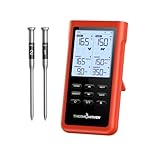
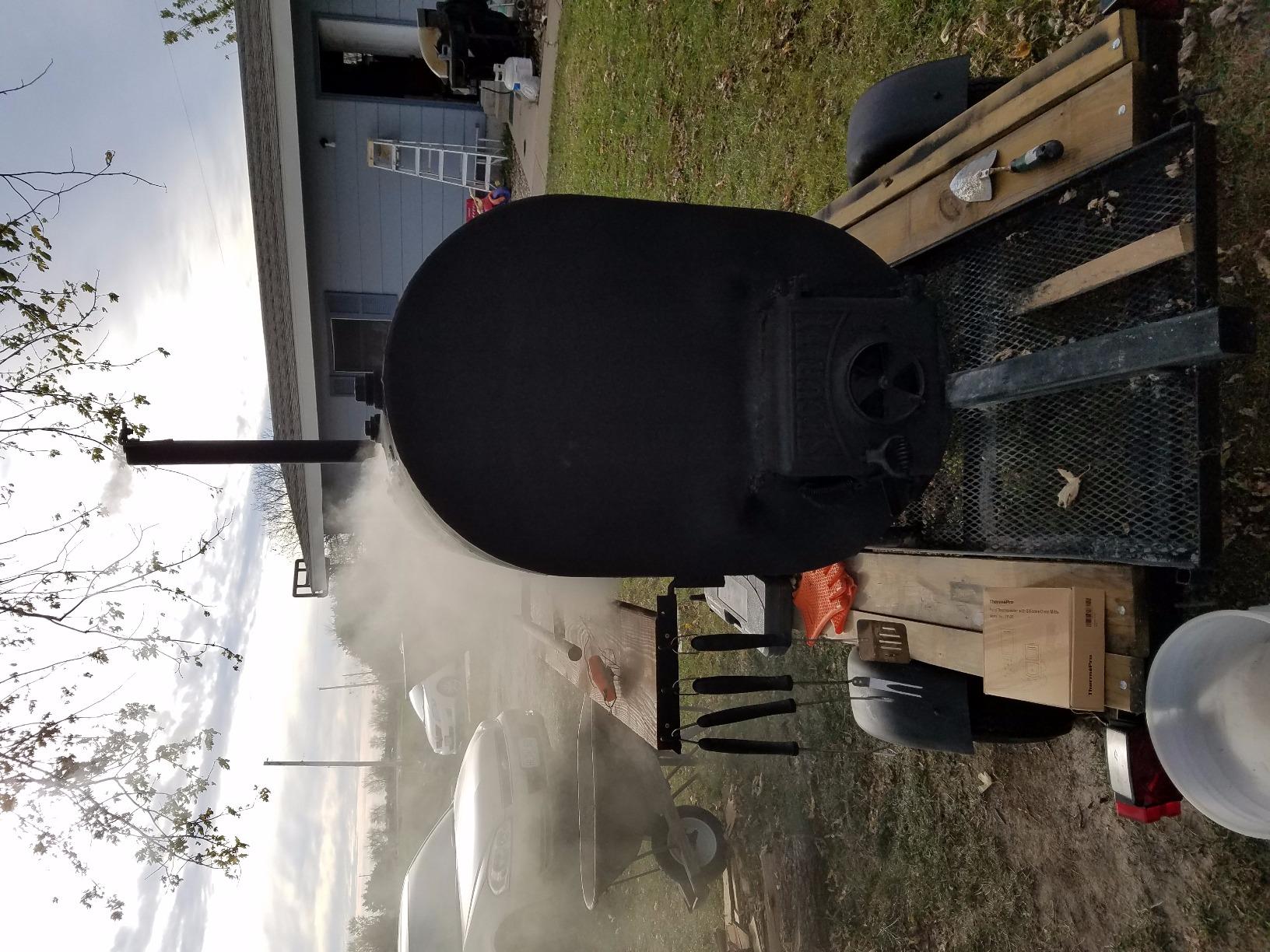
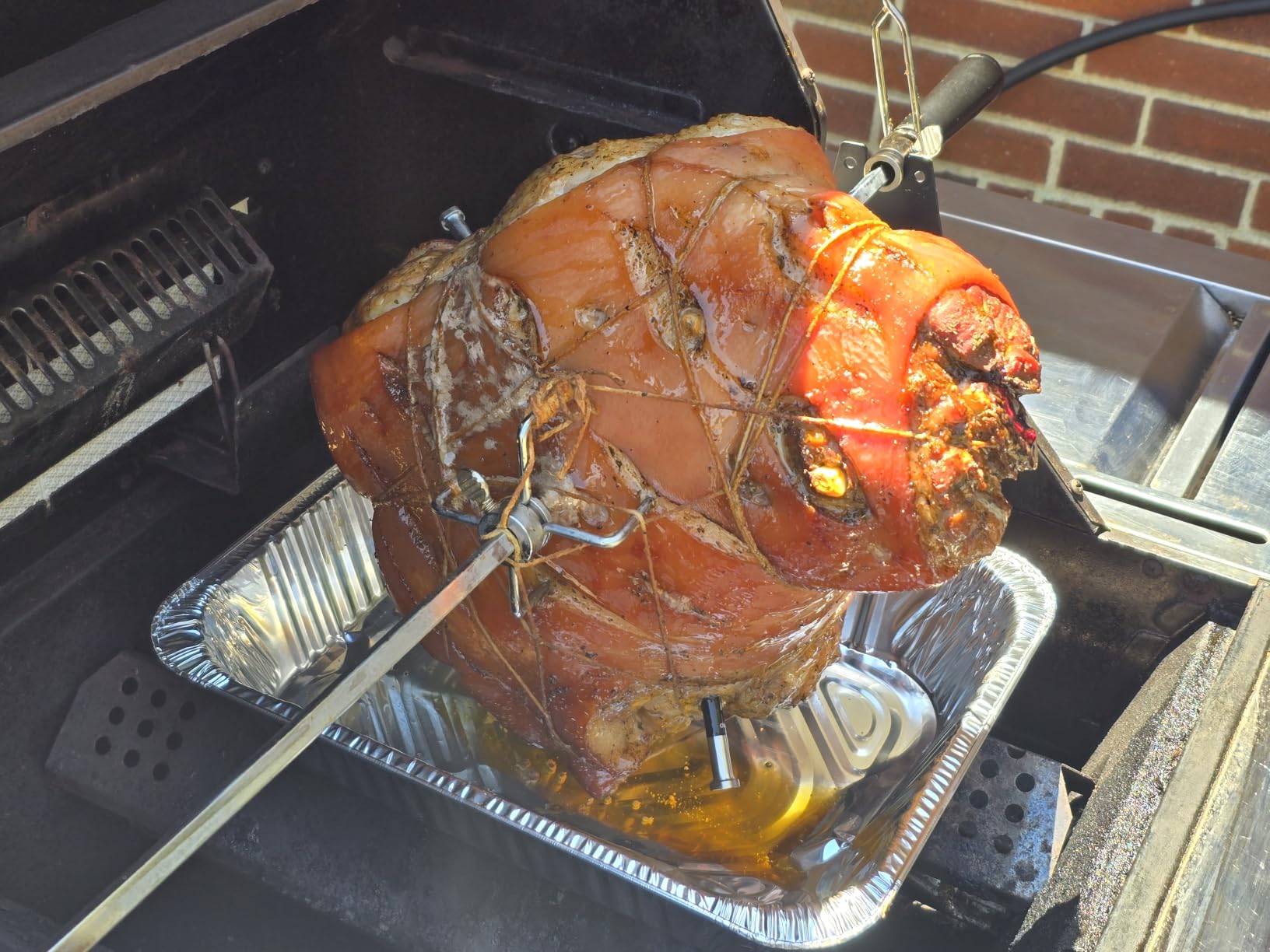
This is the system we hand to friends who do not want to deal with an app, and after putting it on an offset smoker overnight we understand why it has ended up in so many smoker boxes. The transmitter sits outside the barrel with two probes running in through the port, and the receiver in your hand keeps updating through a closed steel door.
That is the whole design philosophy. Nothing to sign up for, nothing to update, nothing that breaks when a phone dies at two in the morning. The display is backlit and large enough to read at a glance, and the alarm is genuinely loud, which matters more than it sounds like it should when you are asleep in the next room waiting on a twelve-hour brisket.
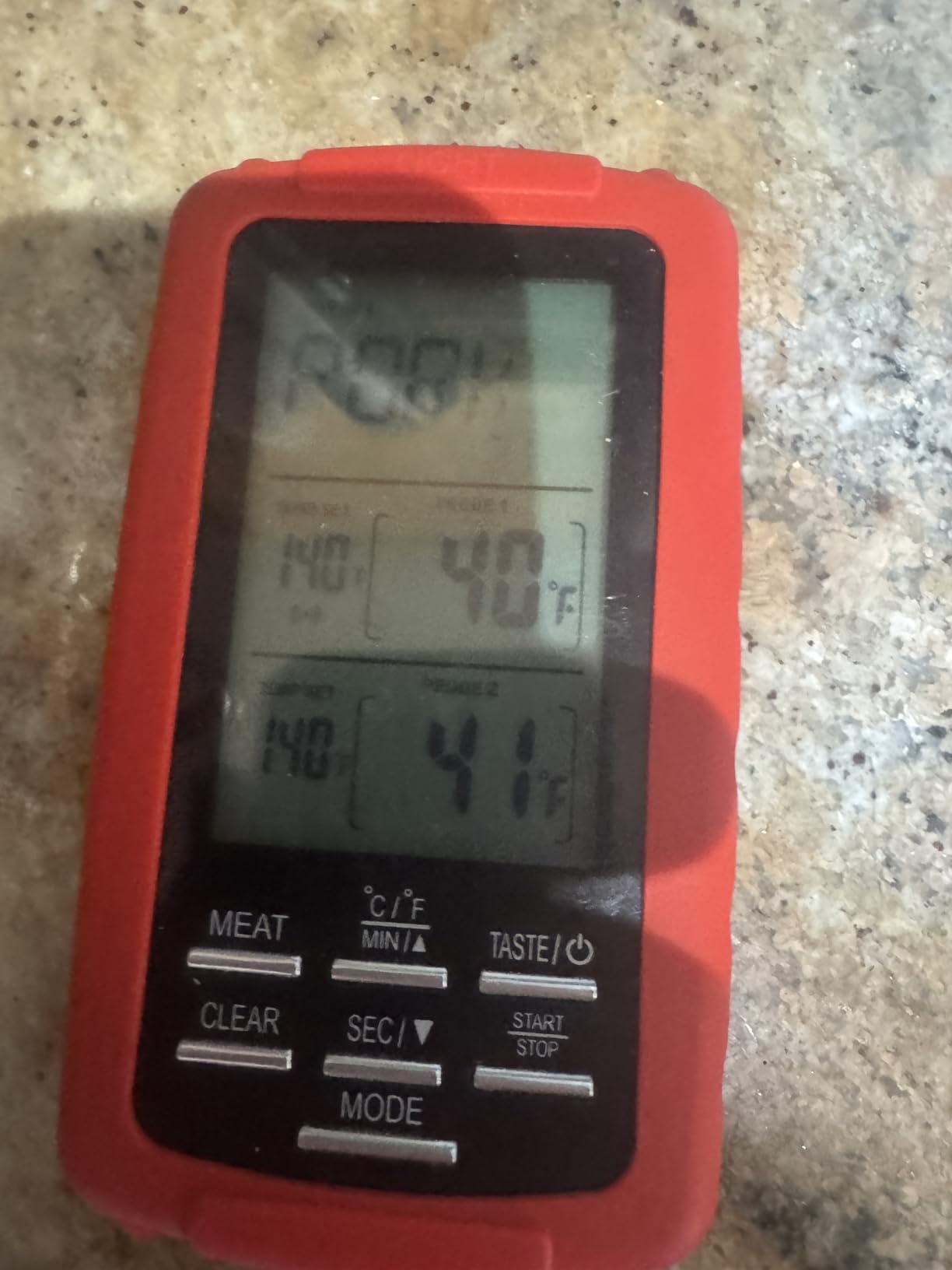
The temperature range runs from 14F to 572F with a three second response, which covers everything from a cold overnight brisket to a hard sear on a cast iron plate. The 274 g body is not pocket-sized, but it hangs on the belt clip while you work. Swapping the four AAAs mid-cook takes seconds and the probe ends keep reading.
The gap is battery awareness. There is no low-battery warning on the receiver, so on a long cook you either check the transmitter batteries by habit or you find out the hard way. The probes also only connect on one side of the transmitter, which is a minor irritation when you are swapping a dead probe at midnight.
Who this works for at the smoker
Anyone running a pellet, offset or electric cooker who wants dependable pit and meat readings without babysitting an app. If your household includes people who will never download a thermometer app, this removes that problem permanently.
It is also the safer pick for cold smoking and brining, since the low end of the range reaches well below where most probes stop working.
Where it will disappoint you
There is no graphing and no session history, so if you want to look back at the shape of a cook later you are out of luck. That is a real loss for anyone learning how a stall actually looks.
You also carry the receiver for the whole cook. It is not a phone, so nothing logs anywhere and nothing pings you from the couch, but you are never more than arm’s length from the data.
2. MEATER Plus Smart Probe for App-Guided Smoking
MEATER Plus Smart Meat Thermometer, Honey, Bluetooth, 165ft, Grill & Oven
Wire-free dual-sensor probe
Bluetooth repeater in charger
32 to 527F
Guided Cook System
2 hours per 5 minute charge
Pros
- Genuinely wire-free probe with internal and ambient sensors
- guided cooking with estimated finish times
- bamboo charger doubles as a Bluetooth repeater to extend range
- dishwasher safe and simple to clean
- many owners report 9 or more hours per charge
Cons
- No battery indicator on the probe
- base must stay close for the relay to work reliably
- not ideal for thin cuts
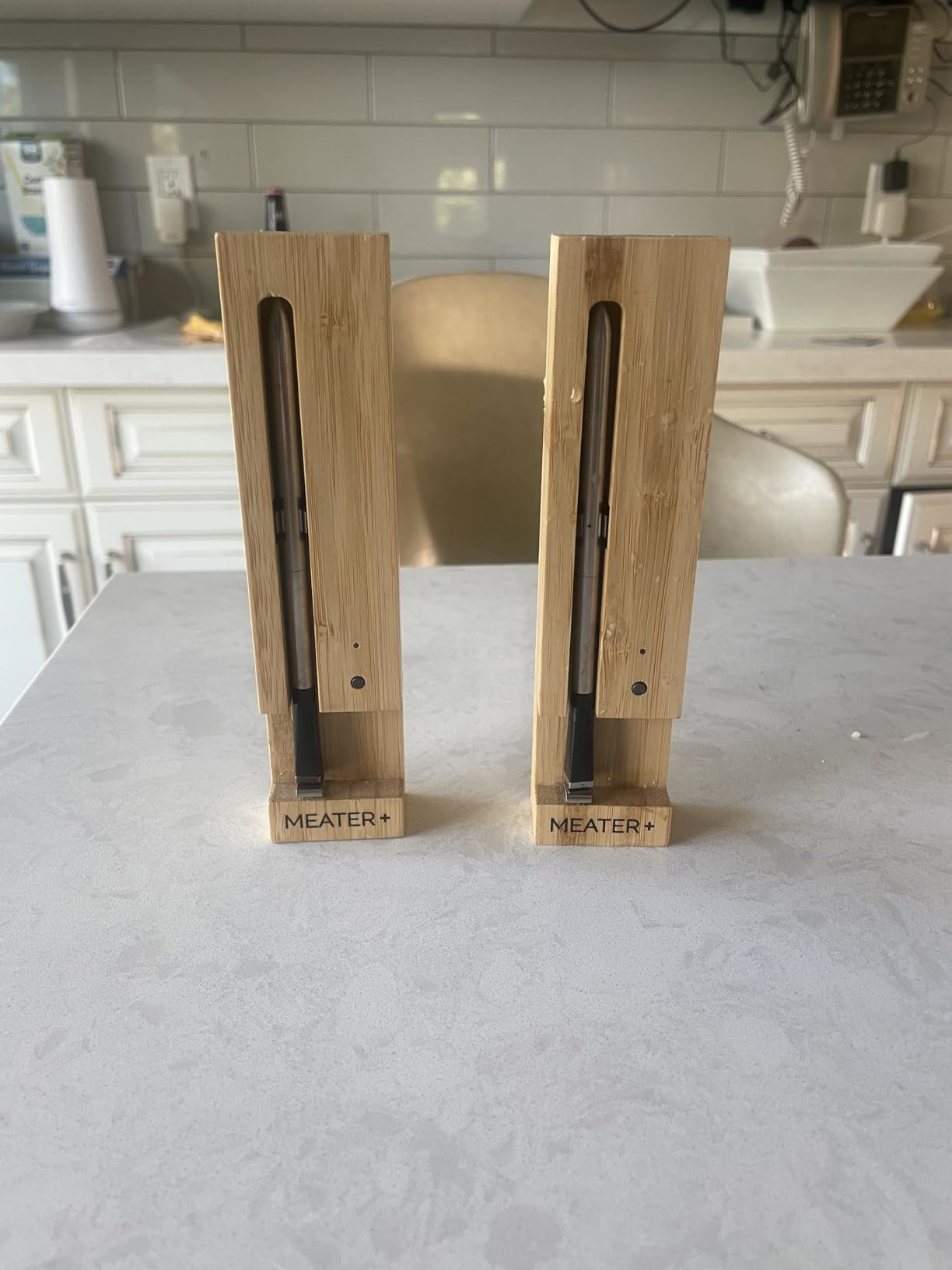
The MEATER Plus is the most complete app experience in this roundup, and the guided cooking flow does something genuinely useful: it walks you through the cook stage by stage and gives you an estimated finish time you can actually plan a rest around. For a first brisket that is worth more than raw accuracy figures.
The probe itself is truly wireless, with sensors at the tip for internal temperature and near the handle for ambient. It charges in the bamboo block, and that block contains a Bluetooth repeater, which is the piece most people miss. The probe talks to the block, and the block relays to your phone, so the effective range is better than a single Bluetooth hop.
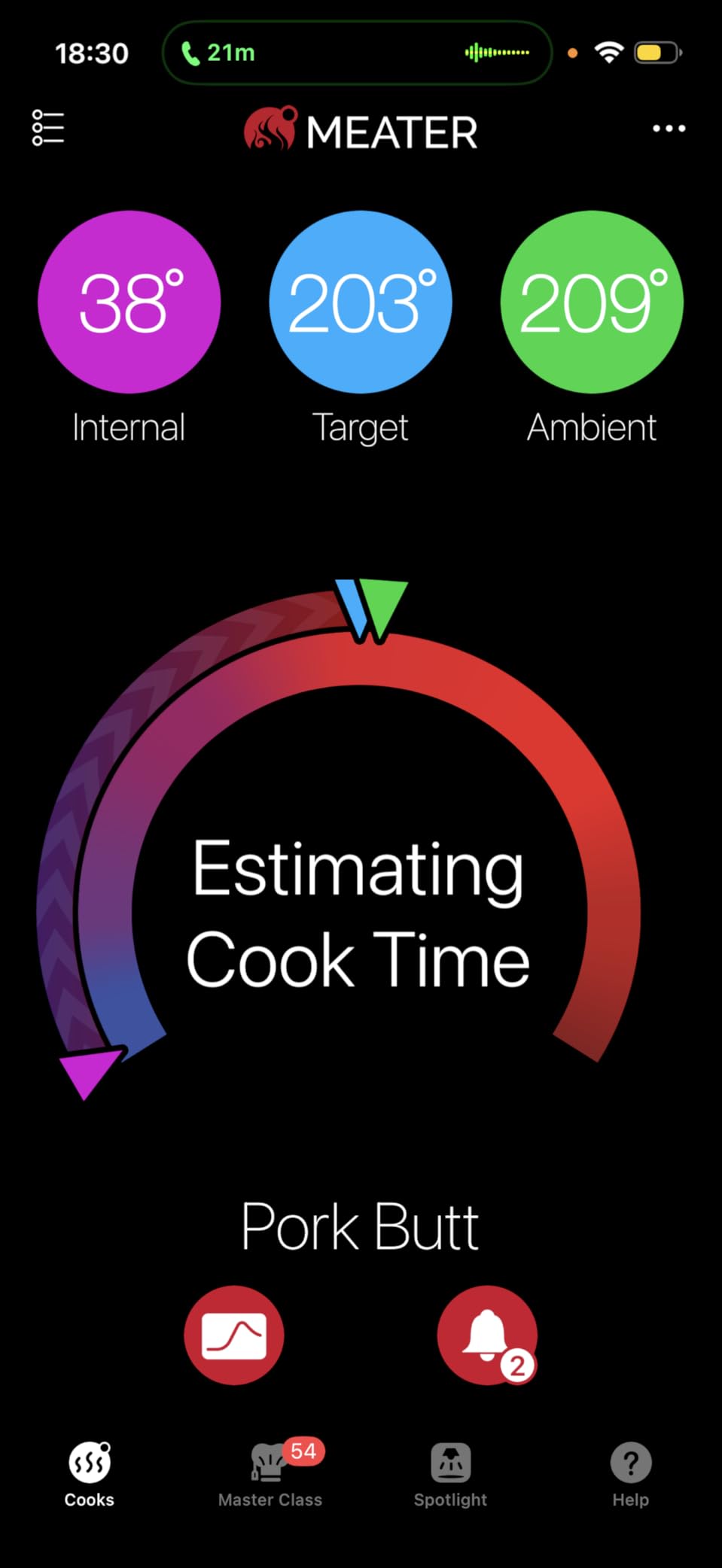
That relay still has a limit. The base needs to sit within roughly ten to twelve feet of the smoker for the chain to hold, and if you set it up in the wrong order the phone pairs to the probe instead of the base and you get a frustrating afternoon. Owners also note there is no battery indicator on the probe, so you learn your charge cycle by feel.
The probe runs from 32F to 527F with a three second response and an insertion depth of about six inches, which suits a brisket flat or a whole turkey but not a thin steak or a wing.
Why the guided cooking flow is worth paying for
The app estimates finish times based on temperature trajectory rather than a fixed chart, and it alerts you before you are at target rather than at it. On a pork butt that means you can be resting the meat before you would have even pulled your phone out.
It is also the most forgiving setup for a cook you are sharing with someone else, since the second person can open the app and see the same data without touching the smoker.
Where the Bluetooth relay gives out
Connection reliability is the recurring complaint, and it usually traces back to base placement rather than the probe. Put the charger high and on the same side as the phone and it settles down. Expect the graph to stall occasionally in thick kamado ceramic.
The other limitation is cut size. Six inches of reach is right for a packer brisket and short for a towering pork butt, and it is simply the wrong tool for thin cuts.
3. TempPro TempSync 650ft Bluetooth Thermometer for Grill-Side Monitoring
TempPro TempSync 650 ft Bluetooth Meat Thermometer with 2 Probes for Grill
Bluetooth up to 650 ft
2 probes
Plus or minus 1.8F accuracy
15.8 to 572F range
Lithium ion battery
Pros
- Long Bluetooth range that holds from inside the house or across the yard
- rechargeable battery carries a full multi-hour smoke on one charge
- two probes track pit and meat together
- app graphs the whole cook with reliable alarms
- owners verified readings within 1 to 2F in ice and boiling water tests
Cons
- App has no session storage so completed cooks are not saved
- alarm volume is jarring and hard to disable
- pairing can fail using the printed QR instructions
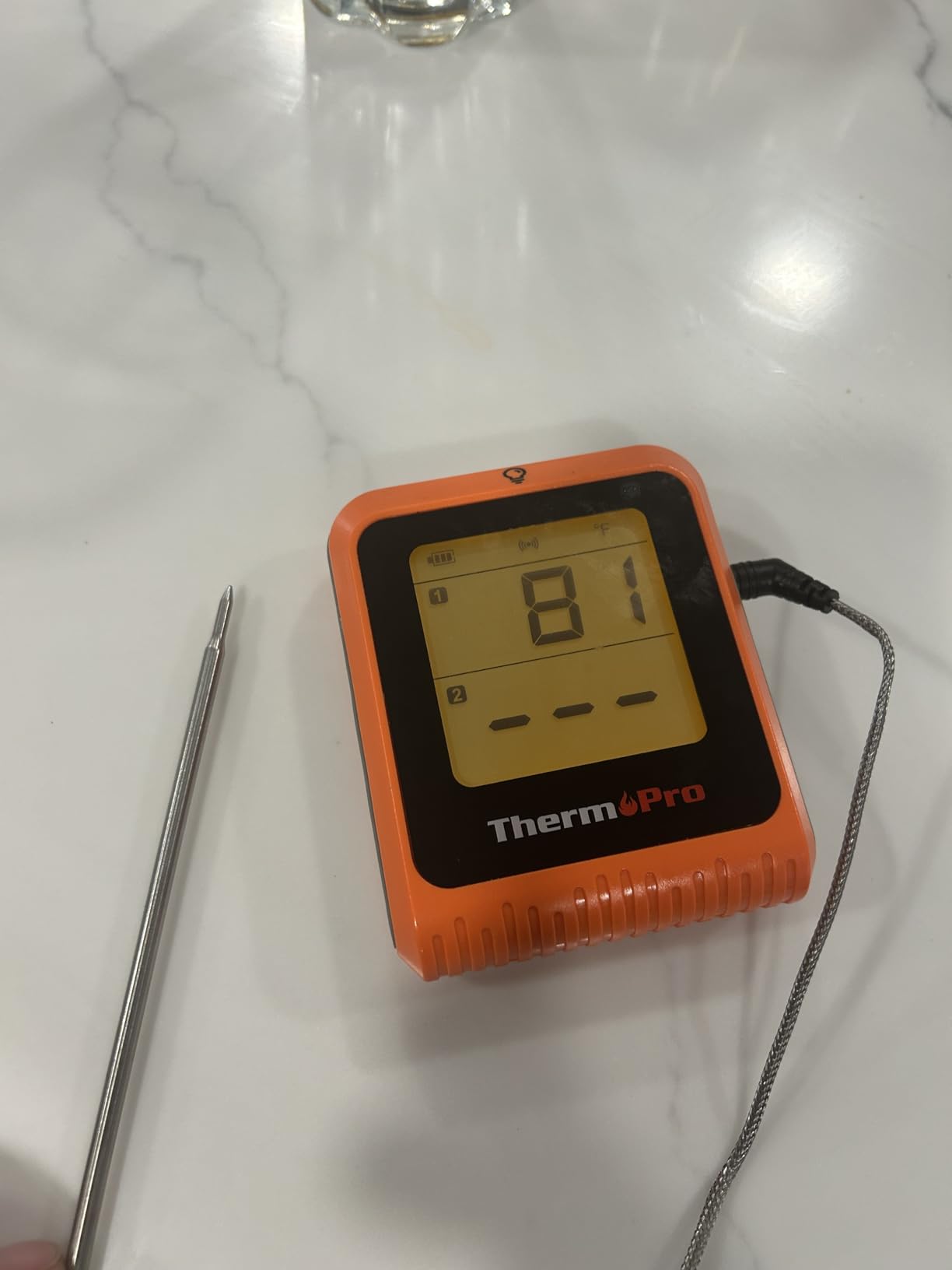
This is a wired-probe system with a Bluetooth link, and that combination turns out to be more reliable in practice than a fully wireless probe for a lot of people. The probes run into the base outside the cooker, and the base beams the readings to your phone over a claimed 650 feet.
Accuracy is the story here. The stated tolerance is plus or minus 1.8F across a range from 15.8F to 572F, and reviewers checking with ice water and boiling water regularly land within one to two degrees. For a cook where the difference between 203F and 198F matters, that is the number you care about.
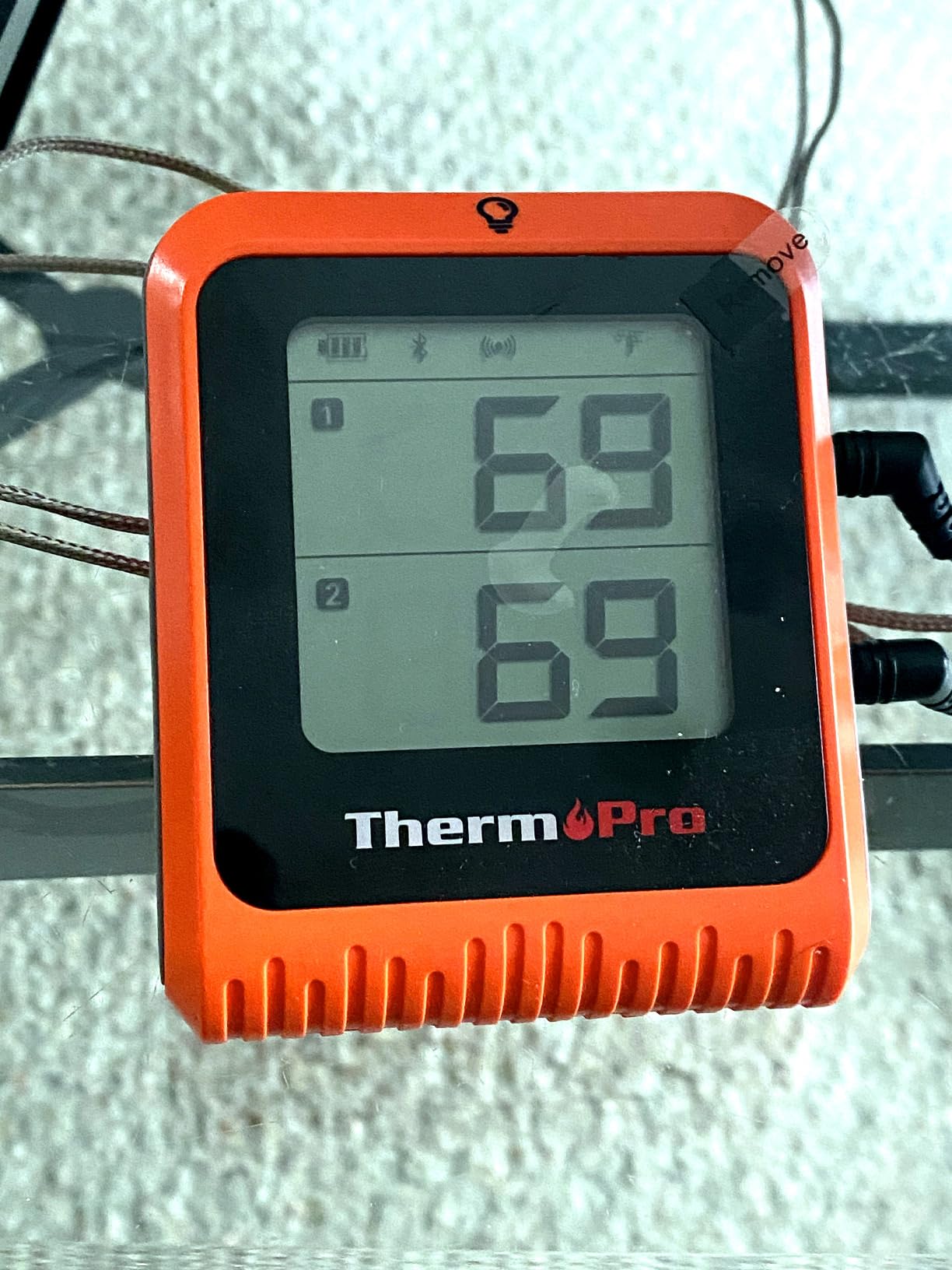
The two probes let you watch the pit and the meat together without juggling two devices, and the app graphs the session as it happens. Battery life is a single lithium ion charge, and owners doing eight and ten hour smokes report finishing with charge to spare. Response time is two seconds, so adjustments show up immediately.
The complaints are all software. There is no session storage, so once you stop a cook the data goes with it. The alarm is loud enough to be startling and awkward to mute, and pairing sometimes fails if you follow the printed QR instructions literally.
Why a wired probe with wireless range often beats a wire-free probe
Two probes give you a pit reading and a meat reading from one unit, which is exactly the pairing a smoker needs. The base can sit on a shelf indoors where the signal is clean, and nothing has to negotiate a battery conversation mid-cook.
It is also the easier gift and the easier replacement. Nothing about it is unusual enough to fail confusingly.
Where the app holds you back
The missing session storage matters more than it first sounds. Without a saved history you cannot compare this cook to last weekend’s, and that comparison is how most people learn.
The probes are also not interchangeable with other TempPro multi-zone models, so if one fails you are shopping for this specific one rather than swapping a spare you already own.
4. TempPro TempSync 1000FT RF Thermometer for Four-Probe Smoking
TempPro TempSync 1000FT Wireless Meat Thermometer for Grilling and Smoking
RF range up to 1000 ft
4 color-coded probes
14 to 572F range
Smart alarm with beep and flash
Large backlit LCD
Pros
- RF connection stays stable where Bluetooth drops
- four color-coded probes track separate meats or pit positions
- per-channel high and low alarms let you time pulls and rests
- large backlit LCD readable in bright conditions
- works out of the box with no app or account
Cons
- No temperature graphing or session history
- probe wires kink and wear over time
- you carry the receiver because nothing logs to a phone
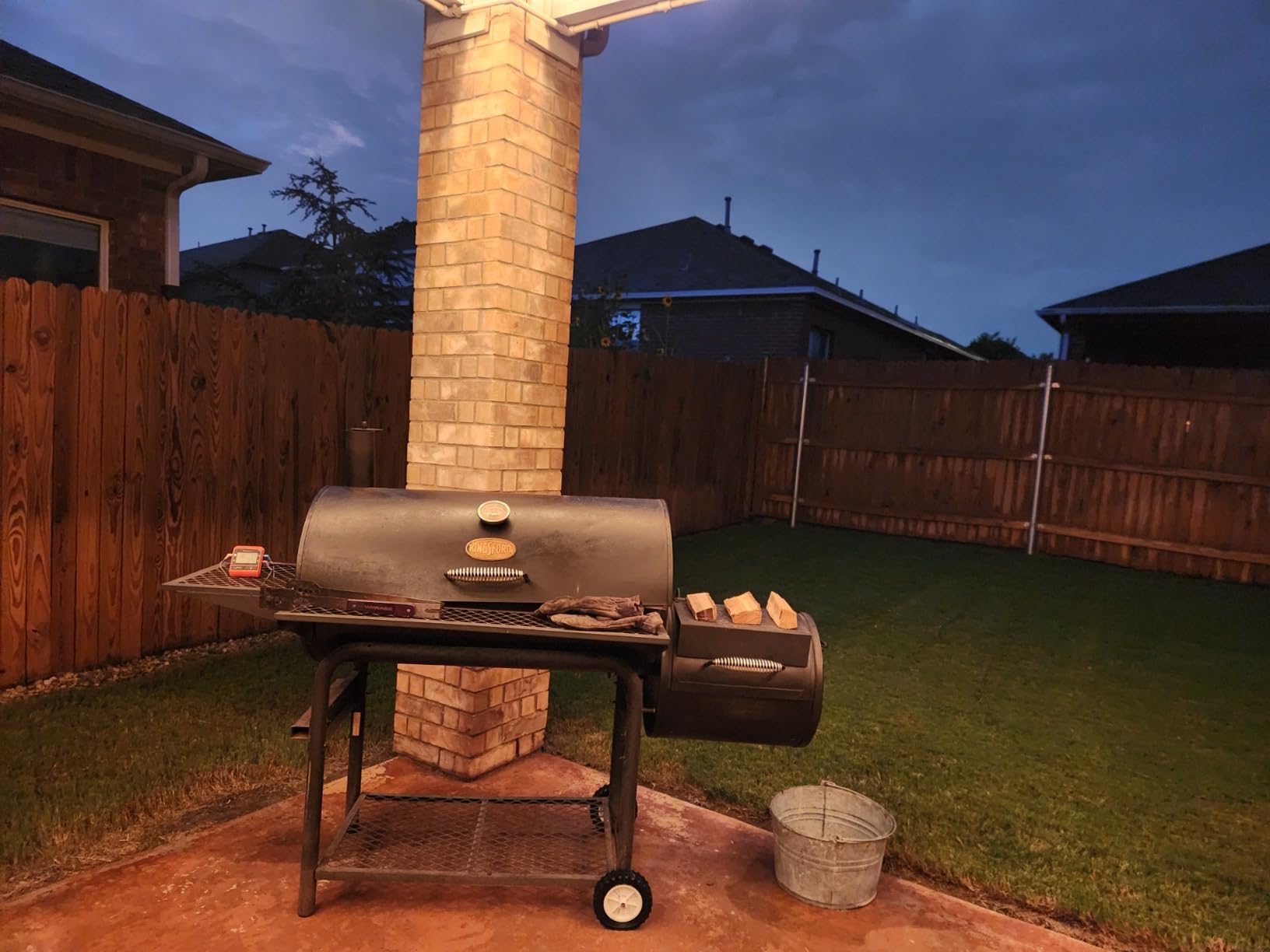
Four probes in a system that needs no phone is a rare combination, and it is why this one shows up on so many pellet and offset smokers. You get four color-coded channels, so you can put one in each of two briskets plus one in a pork butt plus one in the pit and know at a glance which number belongs to which.
RF is the quiet hero. The claimed range is a thousand feet, but the number that matters is that the signal simply holds when the lid is closed and the door is shut, which is exactly when Bluetooth units start dropping.
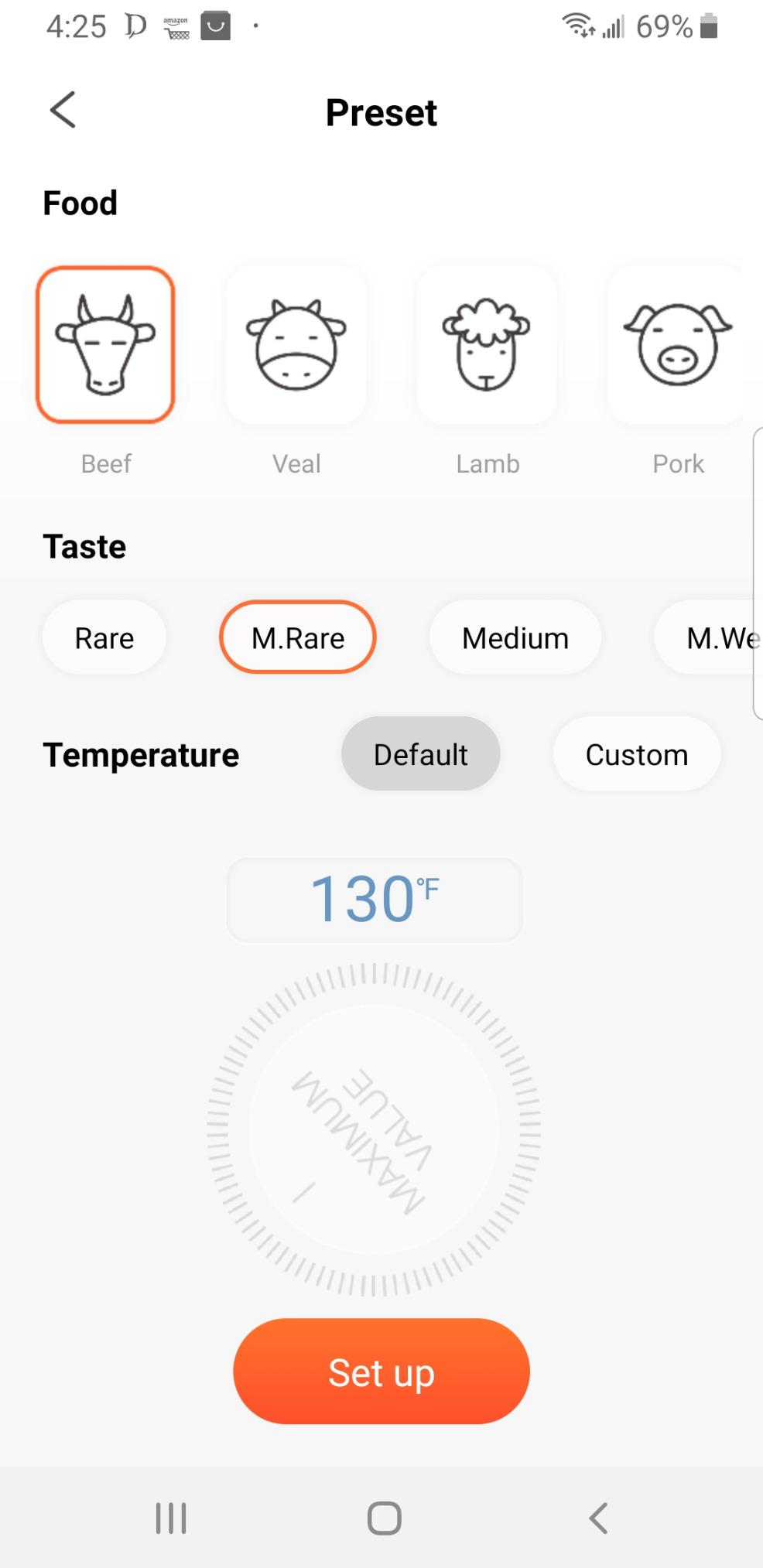
Per-channel high and low alarms are the detail we did not expect to like as much as we do. Setting a low alarm for one probe and a high alarm for another lets the unit itself tell you when to start a rest and when to pull, without you watching a screen at two in the morning. Ten USDA presets with doneness levels cover most of what people cook.
The accuracy claims check out in community ice bath and boiling water tests, landing within one to two degrees. Range is 14F to 572F with a three second response.
Why four channels changes the way you cook
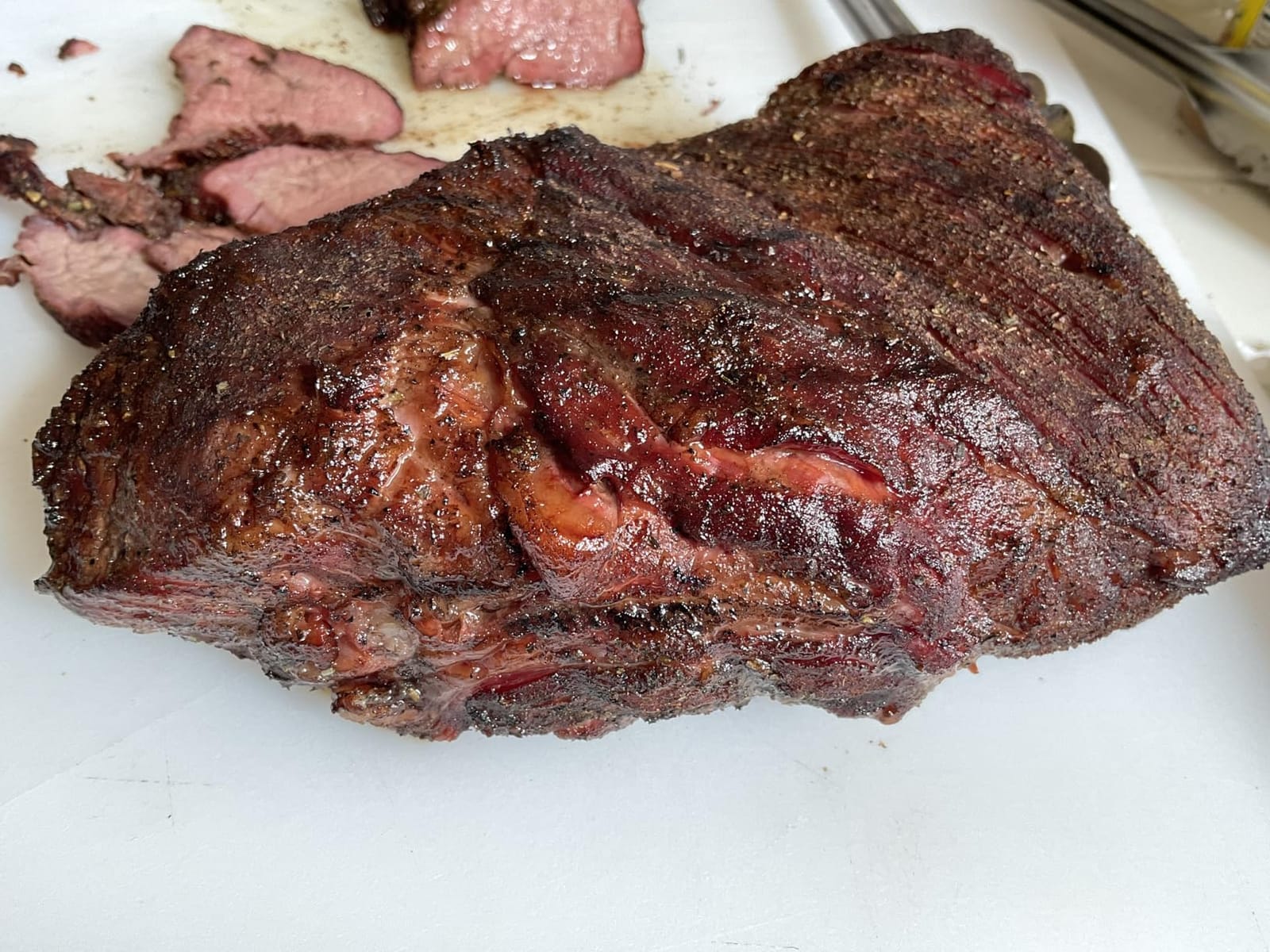
Two briskets on a Friday night used to mean guessing. With four channels you can run a probe in each flat and a third in the point of one, and you can tell whether the point is lagging the flat or keeping pace.
Turkey plus pork plus a vegetable tray is the same idea. The colors mean you stop memorizing which wire is which.
What you give up without an app
There is no graph anywhere. Nothing logs, nothing syncs, and the receiver must be within earshot for the alarms to matter, so you carry it with you or you accept that it is a set of dials rather than a monitor.
The wires also kink where they enter the transmitter, and that is where they eventually fail. Plan on replacing probes rather than mourning them.
5. Inkbird WiFi 4-Probe System for Unlimited-Range Monitoring
Wireless Meat Thermometer with 4 Probes, INKBIRD WiFi Meat Thermometer Digital Wireless for Rotisserie Grill Oven,Unlimited Range Dishwasher Waterproof Bluetooth Thermometer for iOS & Android
WiFi, Bluetooth and phone-free modes
4 wire-free probes
Internal 14 to 212F, ambient 32 to 572F
Plus or minus 1.8F accuracy
IP67 dishwasher safe
Pros
- WiFi mode removes range limits entirely so you can monitor from anywhere in the house
- four truly wireless probes each with head and tail sensors
- magnetic charging and display base stores and charges all four
- app offers 28 USDA presets with graphs and early warnings
- case records about 30 minutes of cook data even without the phone
Cons
- App caps ambient monitoring near 203F and locks settings above that
- plastic base rated only to 176F
- some owners report probe failures within months
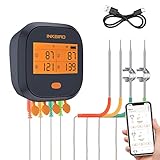
Four probes with no wires at all is the setup people picture when they say wireless, and this is one of the few affordable systems that delivers it. Each probe has sensors at the head and tail, which means you can see heat penetration across a thick cut instead of just one number.
It runs three ways. WiFi on a 2.4GHz network gives you genuinely unlimited range, Bluetooth works when you are nearby, and a no-phone mode lets the base store data locally when the signal is not cooperating.
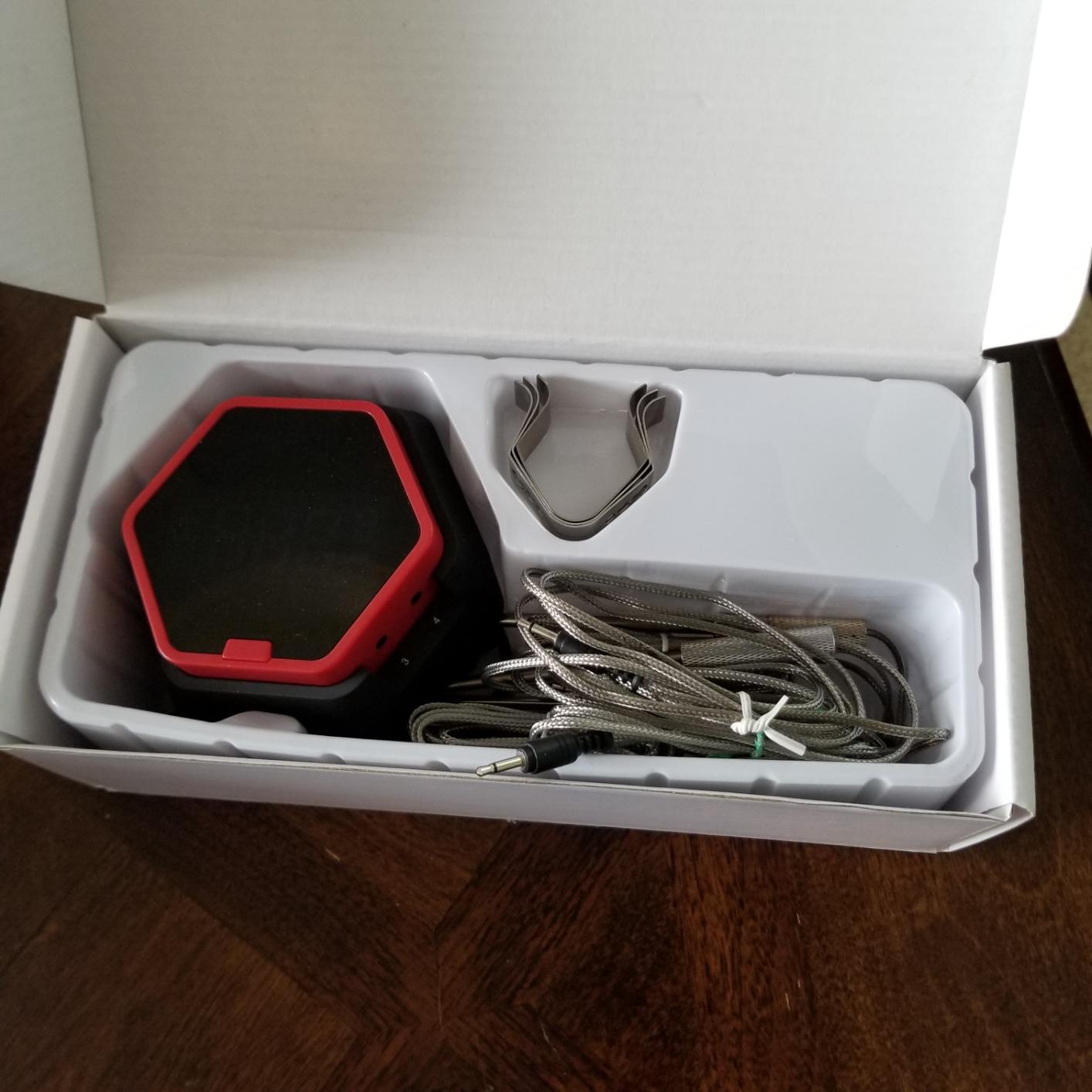
The magnetic base is both charger and display, and it holds all four probes at once. Battery life is listed at about 25 hours per charge, which covers a full brisket with room to spare, and the probes are IP67 rated so they go in the dishwasher.
There is a real ceiling here, though. The app stops ambient monitoring around 203F and locks settings when you exceed it, which is inside the range where a lot of people hold a reverse sear. The plastic base is rated only to 176F, so it must stay out of the cooker.
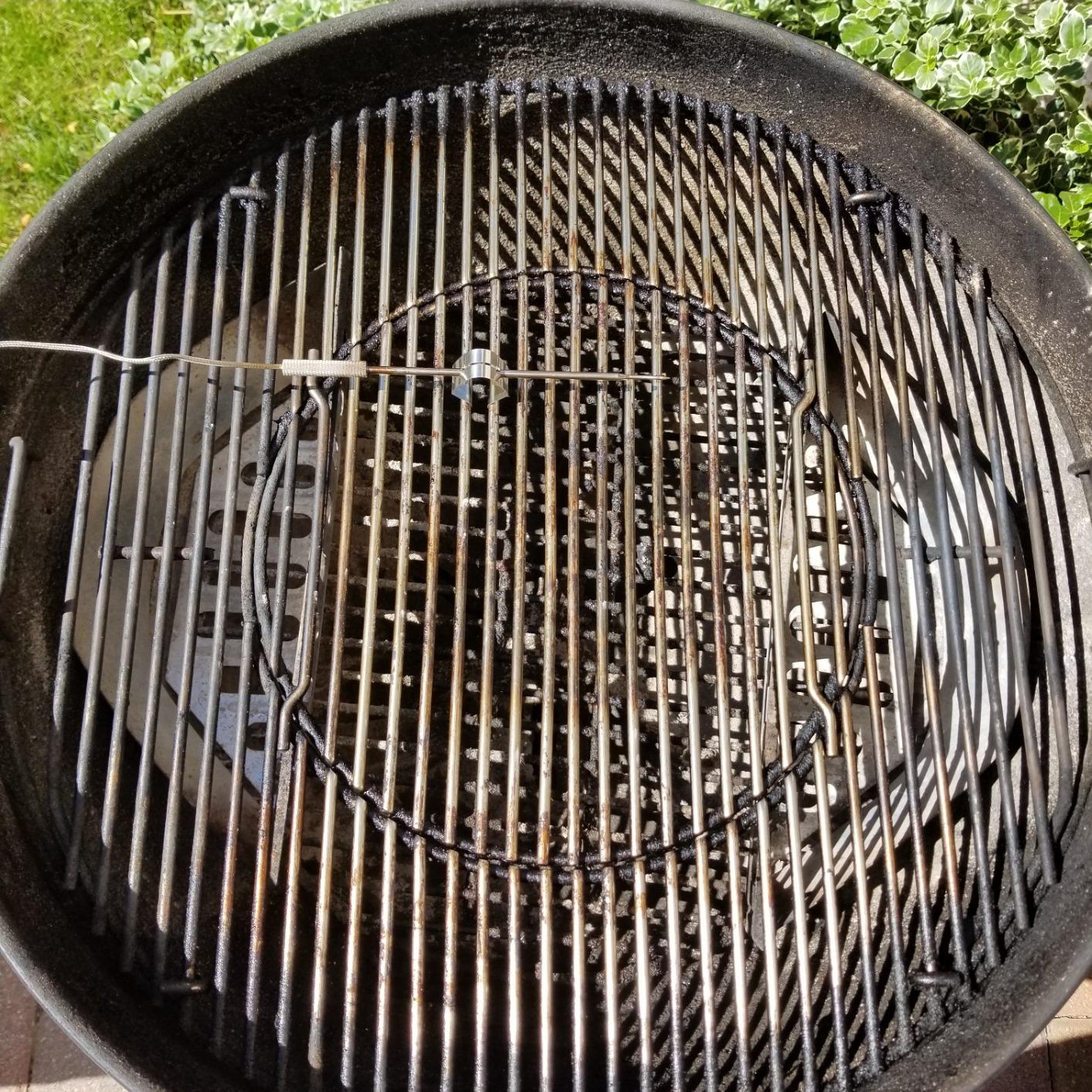
Where four wireless probes earn their cost
A full competition spread, two chickens plus a rack of ribs, or a packer and a flats all happen without a single wire run through the cooker door. That is a genuine convenience difference once you have tried it and gone back.
Head and tail sensors also help on big roasts where the outside reads done and the middle is still working.
What the 203F ceiling means in practice
If you smoke low and slow and pull hot for a sear, the app locking your settings partway through is the thing to plan around. Some owners work around it by finishing sears on a separate grill with the probes out.
Several buyers also report a probe going bad within months and several degrees of variance between probes, so calibrate early and check your set before a big cook rather than during it.
6. ThermoMaven Sub-1G WT10 for Signal Through Thick Metal
ThermoMaven Sub-1G Smart Wireless Meat Thermometer with Standalone Base
Sub-1G up to 3000 ft unobstructed
NIST plus or minus 0.5F accuracy
6 sensors per probe
Ambient rated to 752F
IPX8 waterproof
Pros
- Sub-1G signal cuts through thick smoker walls where Bluetooth fails
- works standalone on the base or over WiFi through the app
- NIST-certified accuracy with a calibration certificate in the box
- magnetic base sticks to the side of a pellet hopper
- one USB-C charge runs 10 or more hours
Cons
- Single probe only with no expansion on some setups
- app recipe and guided-cook library is limited
- ambient sensor lags on fast high-heat cooks
This is the signal answer to the question smokers ask most often, which is why a wireless thermometer can lose its connection inside a closed cooker. Sub-1G is a low-frequency radio signal that travels through steel and masonry in a way that 2.4GHz Bluetooth simply does not, with a claimed 3000 feet unobstructed and around 700 feet obstructed.
It also runs without an app. The base has its own display and lets you set a target directly, so if your phone is dead or you would rather not hand over an account, the cook keeps running.
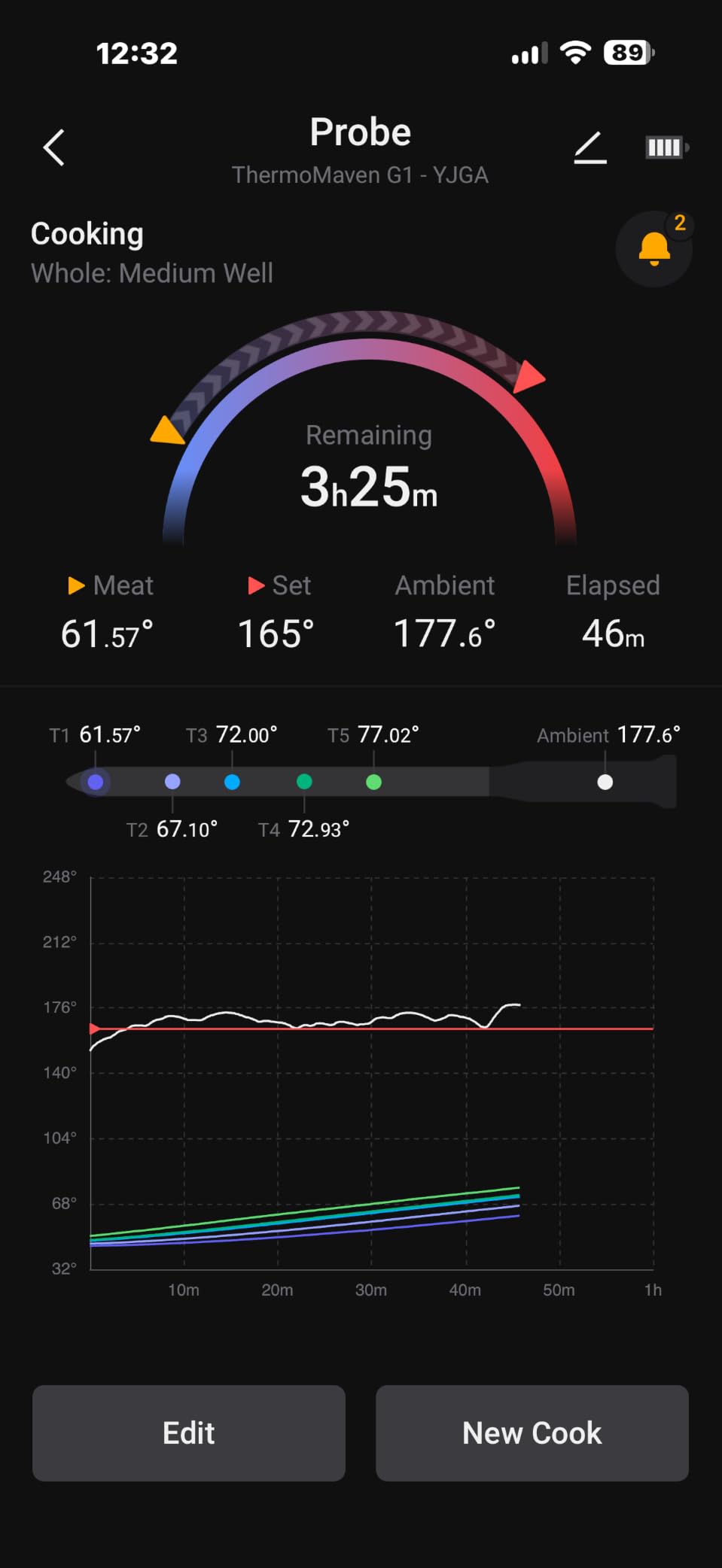
The accuracy claim is the standout. Six sensors, five internal and one ambient, with NIST certification at plus or minus 0.5F and a calibration certificate in the box. Response time is half a second. Internal readings run to 221F and ambient to 752F, which leaves plenty of headroom above smoking temperatures.
The probe is IPX8 and dishwasher safe, weighs under six ounces, and a single USB-C charge runs ten or more hours of cooking.
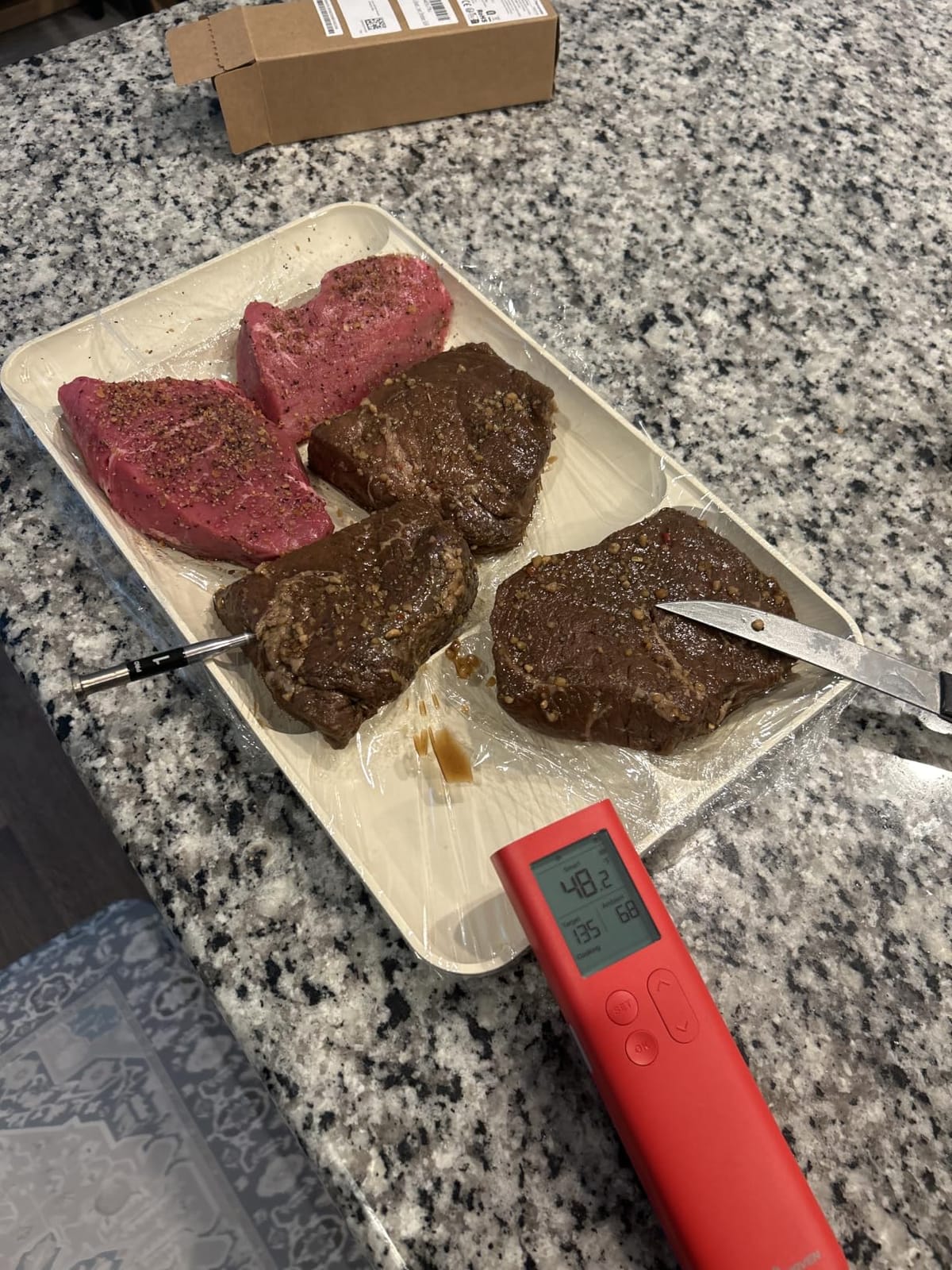
Why Sub-1G matters most in specific cookers
Kamado grills with thick ceramic walls are the classic case, and so are offset smokers with a heavy insulated door. Where Bluetooth stalls, a sub-1G signal keeps updating, which removes the whole class of dropped-cook anxiety.
It is also the easiest system here to run in a garage or a shop with foil and steel in the walls, because it does not depend on your phone being the only receiver in the room.
What one probe costs you
This is a single-probe system, and extra probes are not always sold separately depending on the package. For a single brisket that is plenty. For a cook with four proteins it is a real constraint.
The ambient sensor also trails on fast, high-heat cooks, so trust it more for low and slow than for a fast reverse sear.
7. ThermoMaven WiFi 2-Probe System for Unlimited Range With Two Cuts
ThermoMaven WiFi Wireless Meat Thermometer, 2 Probes, Smart Base, 6 Sensors
Unlimited range over 2.4GHz WiFi
2 probes with 6 sensors each
NIST plus or minus 0.5F
Internal to 221F, ambient to 752F
24 hour battery
Pros
- Two ultra-thin probes track two proteins at once with no wire run
- smart base works standalone so no phone is required
- WiFi gives unlimited range across the home and yard
- NIST-certified accuracy suitable for professional kitchens
- IPX8 probes go straight in the dishwasher
Cons
- Base must be joined to a 2.4GHz band on dual-band routers
- only a single receiver handles both probes
- cook history and guided features are app-dependent
Two probes is the sweet spot for most home cooks, and this is a clean way to get there without a wire. One probe in a brisket flat and one in a pork butt, or turkey and a vegetable tray, and both report to the base and on to your phone over WiFi.
Because the probes are ultra-thin, you can place them where they need to be without planning a cable route through the door. Six sensors per probe, five internal and one ambient, with the same NIST-certified plus or minus 0.5F tolerance as the single-probe model.
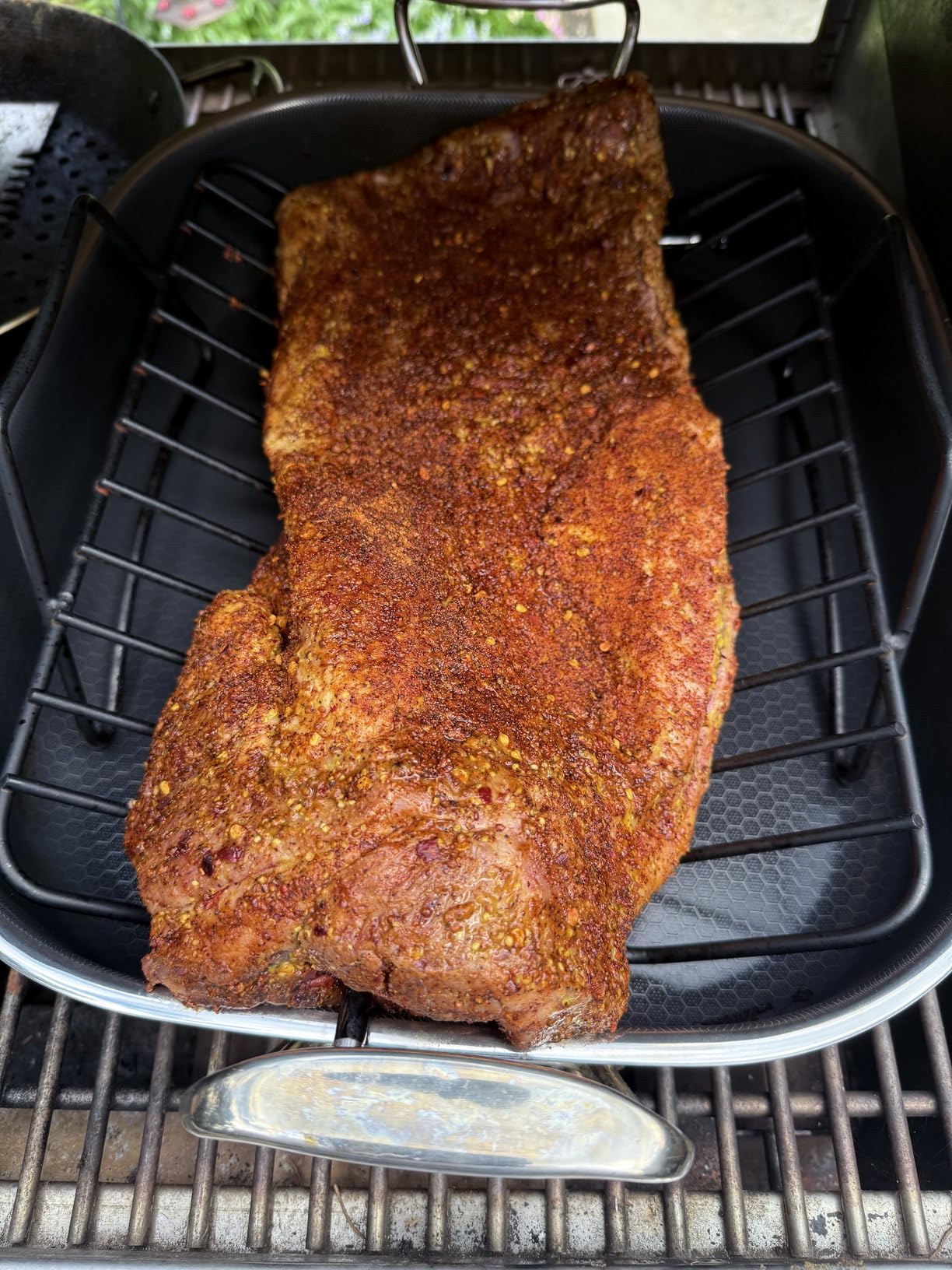
The base charges in about two hours and then runs for more than a day, which covers essentially any smoke you would attempt. Probes take two minutes in the base for two hours of cooking, so a mid-cook top-up is quick. An 18 month warranty is also included.
The setup rule that catches people is network related. On a dual-band router the base has to sit on the 2.4GHz band, and if it cannot find it you get a base that never finishes joining.
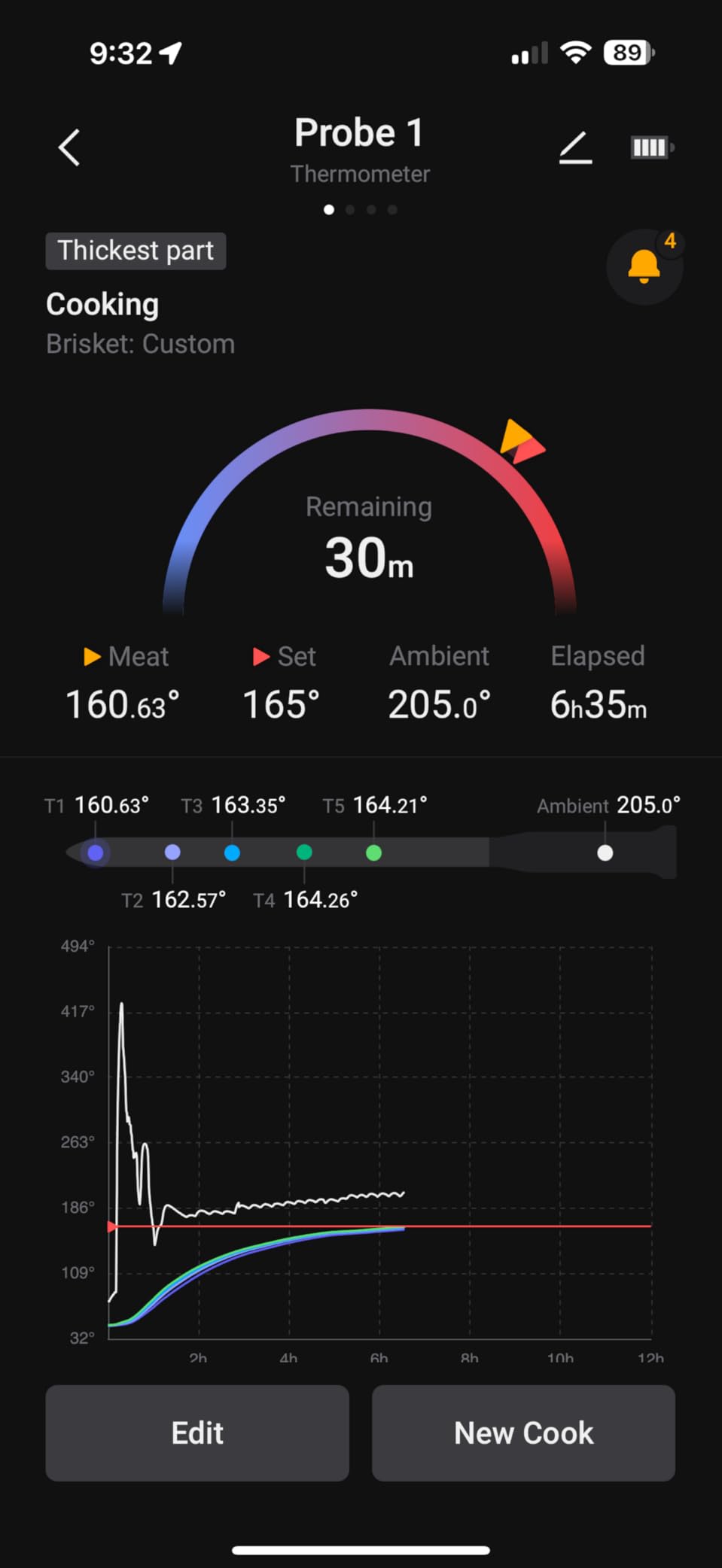
Why two wireless probes fit a home smoker better than four
Most weekend cooks are running two proteins. Two probes cover that with room to spare, the charge lasts longer than the cook, and the phone stays optional because the base can run standalone.
Ultra-thin probes also make it easier to place two of them in the same bird or the same cut without fighting for space.
What the WiFi requirement changes
Unlimited range only exists on a 2.4GHz network, and some newer routers ship with that band disabled or split. Check before you buy rather than after, and if your network will not cooperate the base still works standalone.
Cook history and the guided cooking features live in the app, so skipping the phone means skipping those.
8. CHEF iQ Sense Gen3 for High-Heat Grilling and Smoking
CHEF iQ Sense | Smart Wireless Meat Thermometer | 2 Ultra-Thin Probes | WiFi Unlimited Range | 1000°F Heat Safe | 5 Sensors | BBQ, Grill, Oven, Smoker, Air Fryer | Gen3
Heat safe to 1000F
2 wire-free probes with 5 sensors each
Up to 40 hours battery
2.4GHz WiFi and Bluetooth
Hub with speaker
Pros
- Truly wireless probes with no wire from the meat to the hub
- hub doubles as charger
- storage case and WiFi bridge
- Gen3 handles high-heat grilling without false overheating errors
- app gives flip reminders
- rest timers and estimated finish times
- hub speaker provides audio alerts in addition to phone pushes
Cons
- Cloud account and WiFi connection required before the app functions
- connection drops occasionally though it usually reconnects
- no local readout since display is app-only
Most wireless probes are built for low and slow and then get nervous on a hot grill. This one is rated to 1000F, and owners grilling on it report no false overheating errors in the Gen3 firmware, which is a specific and welcome fix for a common complaint about earlier versions.
The hub is the clever part. It charges the probes, holds them for storage, and bridges them to your WiFi, so it replaces three separate pieces of kit. The two probes are genuinely wire-free, each with four internal sensors and one ambient.
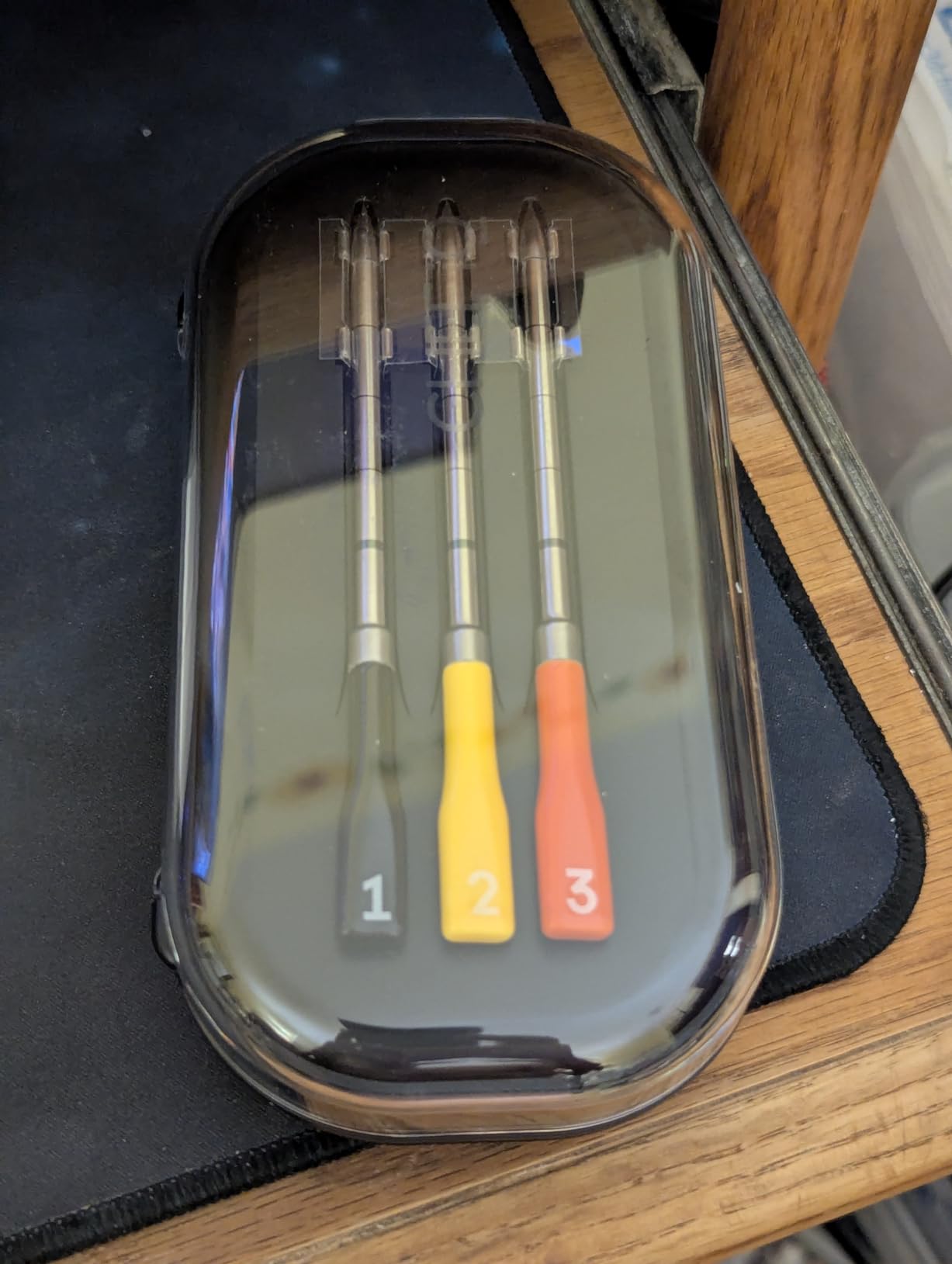
Up to 40 hours of use per charge means you can start a brisket and go to work without thinking about the battery. The app adds flip reminders, rest timers and estimated finish times, and the hub has a speaker so you get audible alerts without your phone in the room.
The mandatory account is the sticking point for a lot of people. You must create a cloud account and connect WiFi before the app does anything, and if the connection drops you are reading a spinner until it comes back, though owners say it usually recovers within seconds.
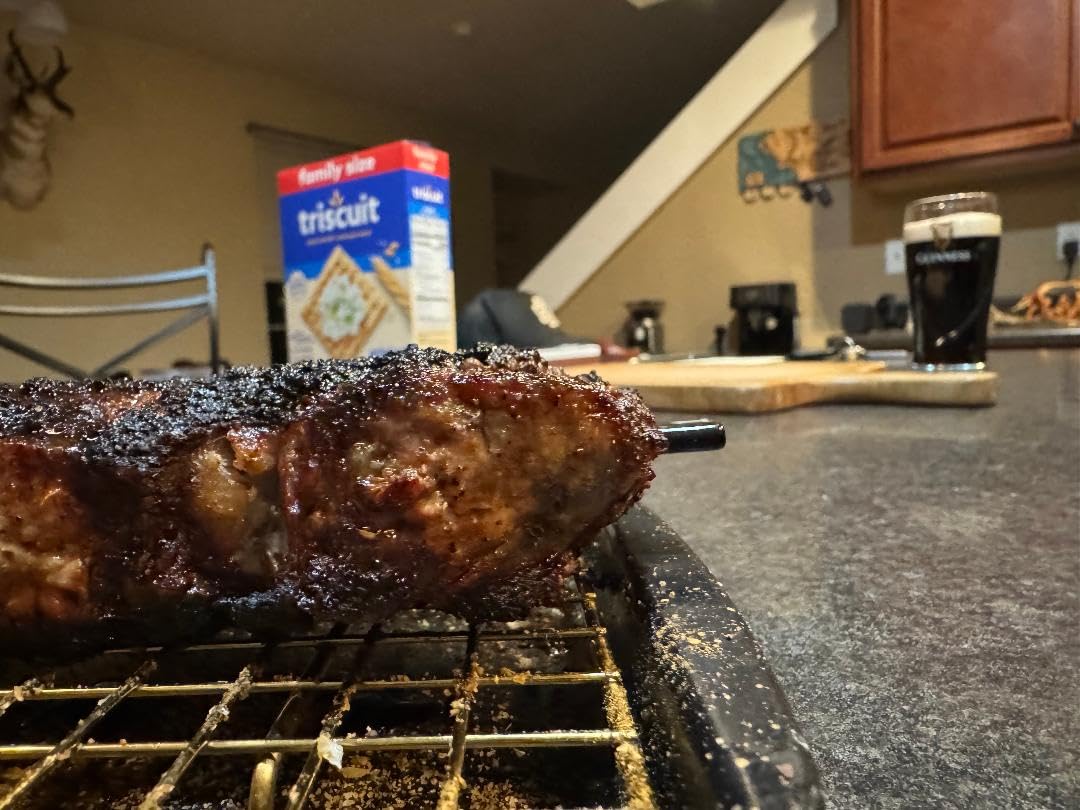
When heat tolerance changes the outcome
For reverse searing, a fast cook on a kamado, or a grill where you want to leave a probe in from the low stage straight through the sear, a 1000F rating removes the whole question. You stop planning a probe swap.
Forty hours of battery also means one charge covers a long cook and a leftover cook the next day.
Where the mandatory account gets in the way
If you would rather not create a cloud account tied to your email and cooking data, this is not the system for you. The app-only display means no fallback readout when the network is down.
Some owners have also reported probes lasting only a limited amount of high-heat use before needing replacement, so treat searing as the limit rather than the routine.
9. Typhur Sync Gold Gen2 for Six-Sensor Precision Data
Typhur Sync Gold Gen2 Sub-1G Wireless Meat Thermometer with 6 Sensors & LCD
Sub-1G signal through metal
6 sensors per probe
NIST plus or minus 0.5F
32 to 932F range
LCD base
Pros
- Sub-1G signal reported as dramatically stronger than Bluetooth
- NIST-certified accuracy with a half second response
- app graphs multiple internal temperature points showing the heat gradient
- works with or without the app
- no subscription fee for the app
Cons
- Setup is confusing since target temperature cannot be set until the probe is inserted
- instructions are cryptic and the app can erase entered data mid-setup
- base uses a magnet with no stand for viewing
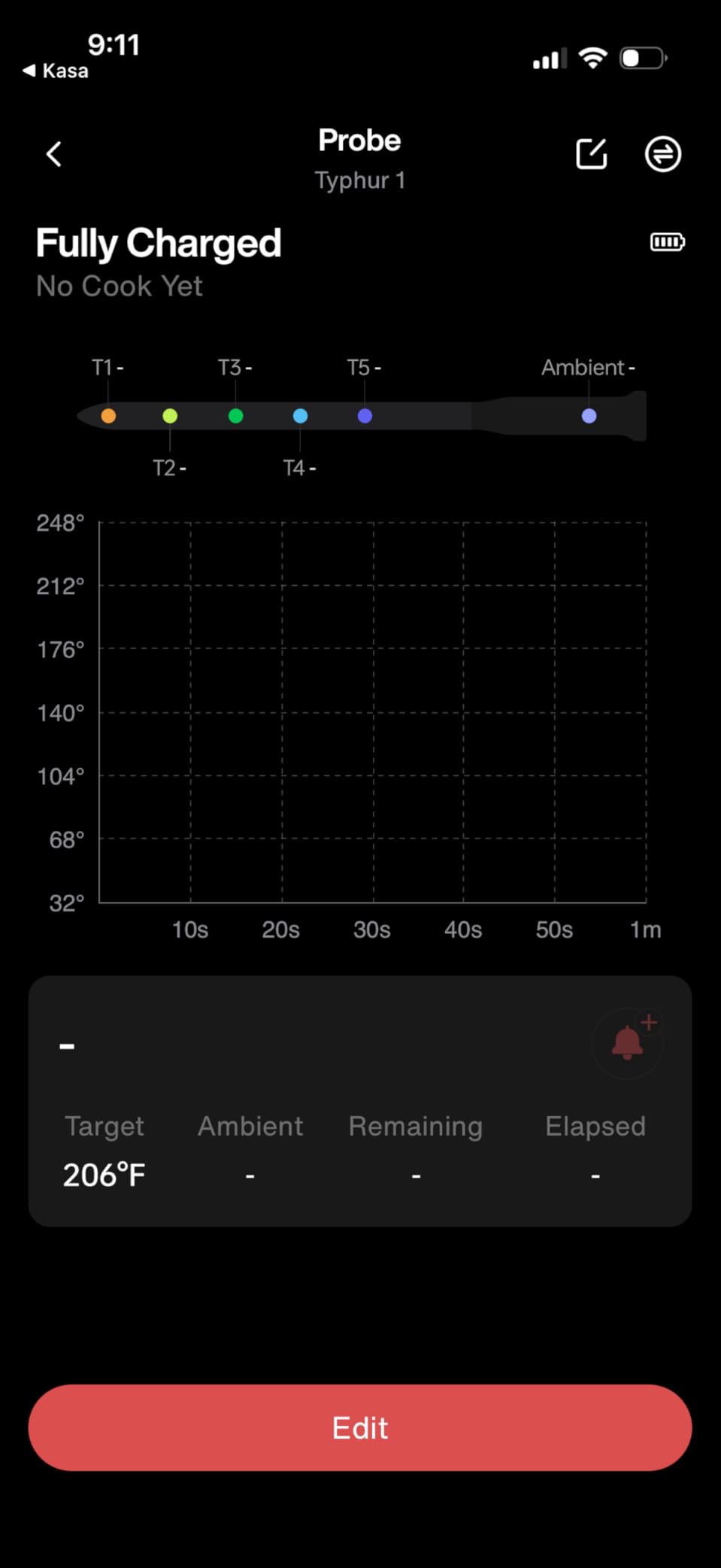
The reason this one earns a place is the data density. With six sensors and multiple internal points plotted, you can watch the heat gradient move through a thick cut rather than watching a single number climb, which turns a smoker into a much better teacher over a season of cooking.
The signal is Sub-1 GHz, the same category of low-frequency radio that handles thick walls and insulated doors, and it is described by owners as dramatically stronger than Bluetooth in exactly the situations that matter at the pit.
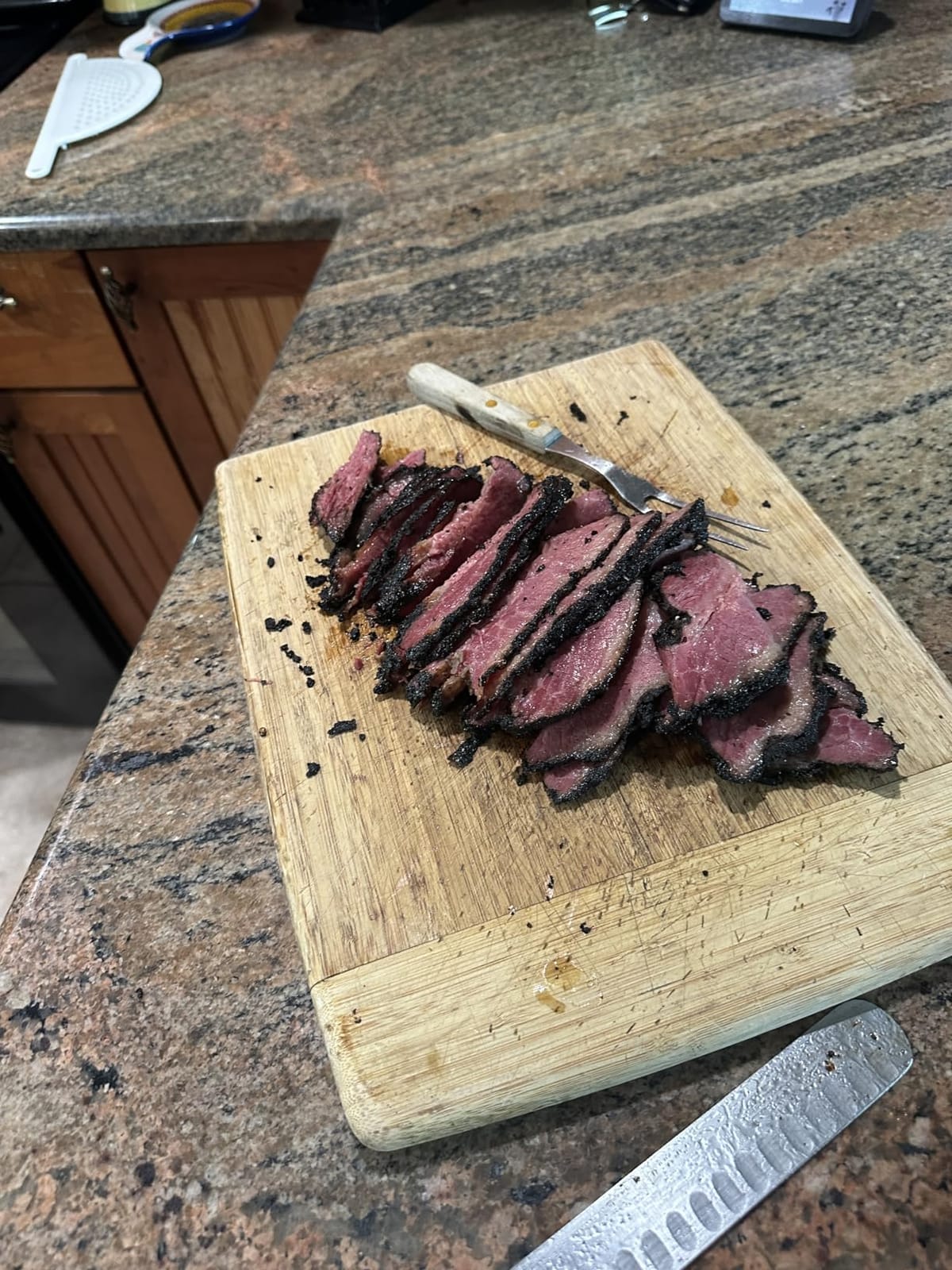
Accuracy is NIST-certified at plus or minus 0.5F with a half second response time. The base carries its own LCD, so you can set and read targets without the app, and the app has no subscription, which is rare in this category.
Onboarding is the weak point and it is consistent across reviews. You cannot set a target temperature until the probe is inserted, the instructions are hard to follow, and several owners describe the app clearing entered data partway through setup. The base is also a magnet with no stand, which makes for an awkward viewing angle.
Why multiple internal readings change your pull time
A single sensor tells you the temperature at one point. Several points let you find the coolest spot and pull on that number, which is how you stop serving a brisket with one dry end.
It is also the closest thing to a diagnostic tool here for learning where heat is not penetrating.
What to expect on the first setup
Budget ten minutes and read the quick start before you unbox it. The order of operations matters, and if you skip it you will set targets that the app then discards.
The small display font and the lack of a stand are minor, but both matter more at three in the morning than they do at a kitchen table.
10. ThermoMaven 3000FT 2-Probe for Range Without an Account
ThermoMaven 3000FT Wireless Meat Thermometer, No App Needed, 2 Probes
Sub-1G up to 3000 ft
2 probes with 6 sensors each
NIST plus or minus 0.5F
14 to 752F range
Standalone LCD base
Pros
- No app/account or sign-up required
- Sub-1G range up to 3000 ft with better wall penetration than Bluetooth
- two ultra-thin probes for monitoring multiple cuts
- large standalone LCD base with a magnetic mount
- IPX8 probes that are dishwasher safe
Cons
- Single receiver only
- no cook history or remote notifications on this model
- 752F ambient rating is lower than some competing probes
This is the version of the strong-signal idea for people who do not want an app at all. Sub-1G range of up to 3000 feet, two ultra-thin probes, six sensors each, and a base with a large LCD that you set and read directly with no phone, no account and no cloud.
The NIST certification at plus or minus 0.5F with a half second response is the same standard as the brand’s networked models, so you are not trading accuracy for the simpler setup.
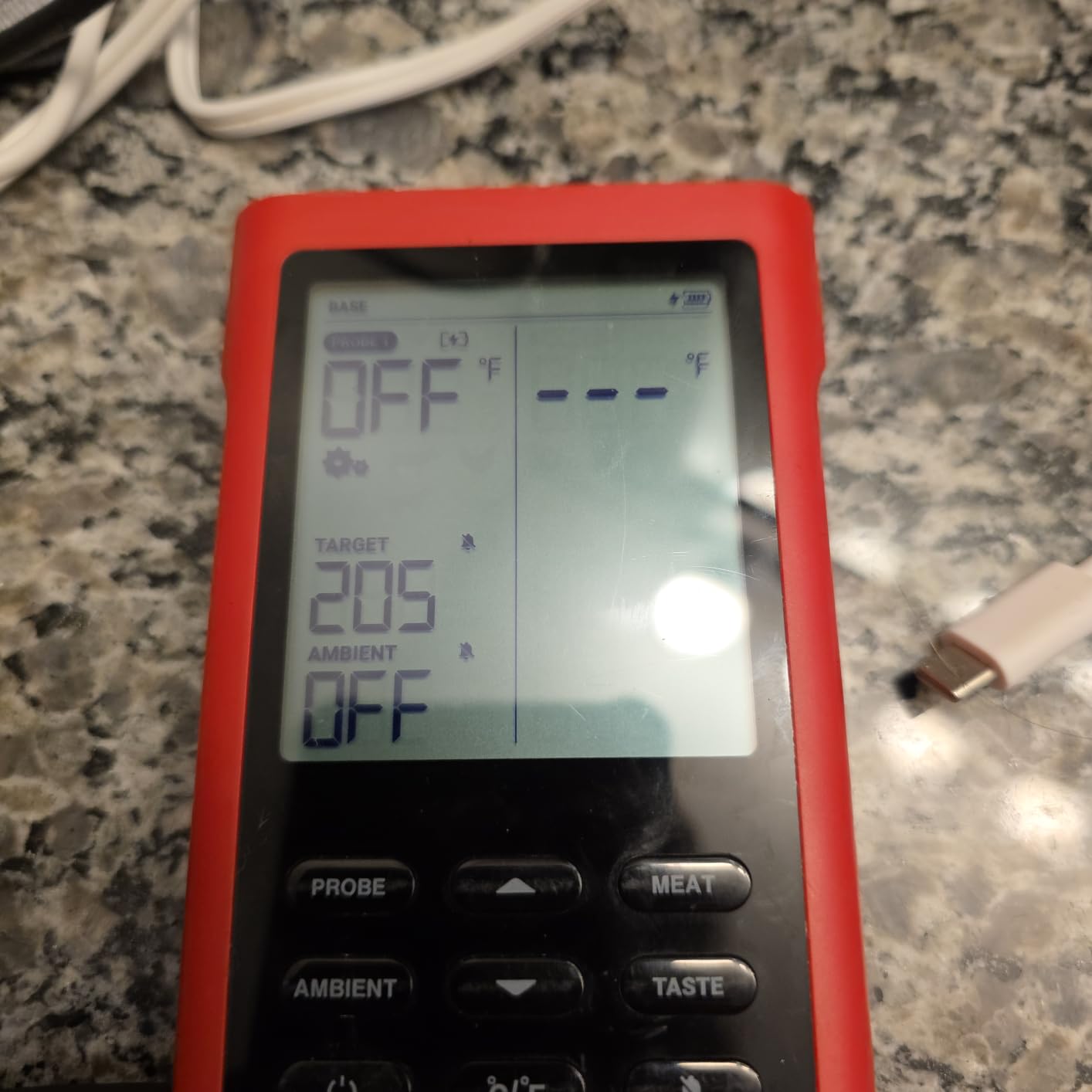
The magnetic mount means the base goes on the smoker band or the side of the hopper, which is convenient when you are walking between the kitchen and the pit. Probes are IPX8 and dishwasher safe. The temperature range runs from 14F to 752F with an 18 month warranty.
What you give up is the phone. No cook history, no push notifications, no remote viewing from inside the house. One receiver handles both probes, so there is no second unit to move to a different cooker.
Who appreciates an account-free system
If you read cooking data the way some people read reviews, skipping the account is a genuine feature. Nothing is uploaded, nothing expires, and the thermometer works identically in ten years.
It is also the fastest setup here. Out of the box, charge, insert, set a target on the base, and go.
Where the simpler design costs you
No notifications means you need the unit in earshot, or you set the alarm and trust it. On a long overnight cook, that is a real tradeoff against anything that can buzz your phone across the house.
The 752F ambient ceiling is lower than some competing probes, so it is a smoking and roasting tool rather than a torch.
11. Govee WiFi 4-Probe Thermometer for Long Battery Life
Govee WiFi Meat Thermometer Digital with 4 Probe, App Notification Alert
WiFi and Bluetooth monitoring
4 probes with 40 inch cables
32 to 572F range
Plus or minus 1.8F
3000mAh battery up to 40 hours
Pros
- WiFi connectivity holds where Bluetooth failed
- four probes with 40 inch cables cover multiple meats plus ambient
- 3000mAh battery genuinely runs the full 40 hours
- app alerts when temperatures move outside preset ranges
- owners verified readings within about 2F between probes in boiling water
Cons
- Latest app update caps target temperatures at 212F and blocks edits during a cook
- occasional app hangs when changing settings
- probes are wired rather than truly wireless
- do not immerse probes or expose them to open flame
Battery life is the headline here. A 3000mAh rechargeable cell rated for up to 40 hours means a full brisket, a pork butt and a leftover cook on one charge, which removes an entire category of anxiety from overnight cooking.
It is a wired probe system with a wireless link, four probes on 40 inch stainless steel cables, and both Bluetooth and WiFi so you can fall back if one path is blocked. Rated from 32F to 572F at plus or minus 1.8F with a one second response.
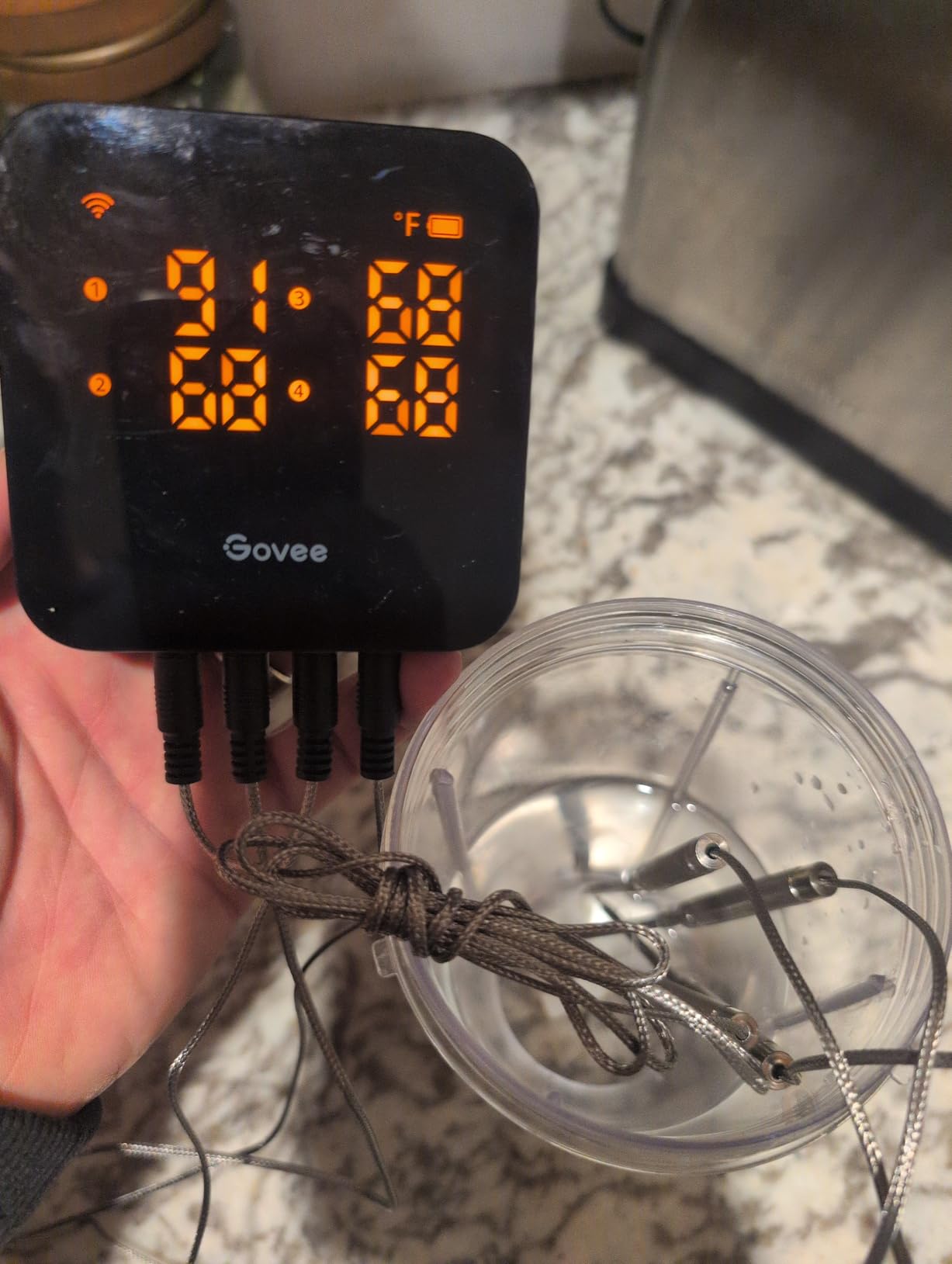
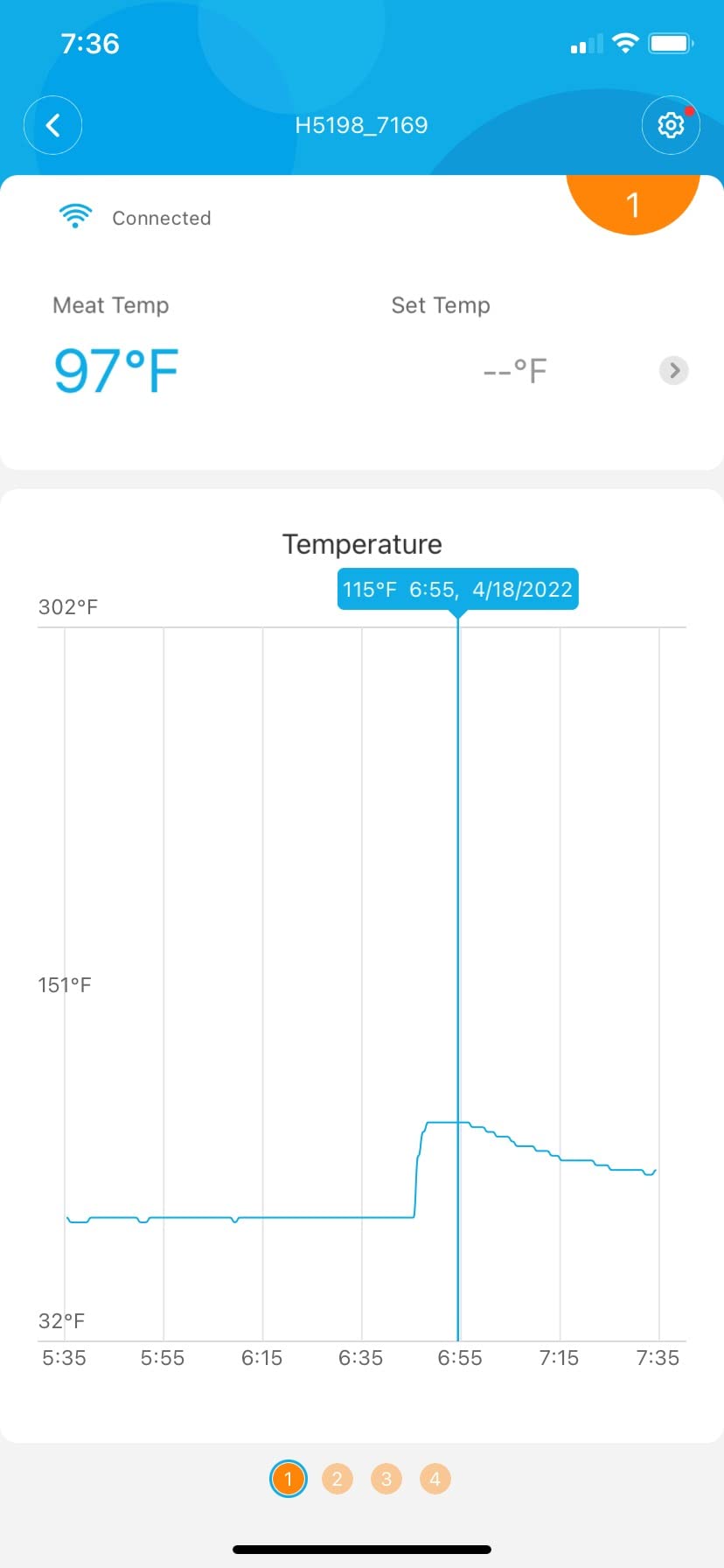
Owners checking accuracy in boiling water find the probes reading within about two degrees of each other, which is the comparison that matters when four channels are feeding your decisions. The app alerts when a reading leaves its preset range, which is useful for a pit that drifts while you sleep.
The sticking point is the current app. It caps target temperatures at 212F and blocks edits while a cook is running, and owners report the app hanging when settings change. It also does not support 5G networks.
Why 40 hours of battery changes how you cook
When you know the charge will outlast the cook, you stop planning around it. You can start a smoke on a full charge and still have most of that capacity available for the next one.
Four long cables also make it easy to run a probe in the pit, one per protein, and one spare without planning a tight fit through the door.
What the app update changed for owners
Set your targets before you start the cook. During a cook the app will not let you raise a ceiling above 212F or edit an active probe, which is frustrating when you decide to push a brisket through the stall differently.
Keep a second option in mind too: the probes are wired and not rated for immersion or open flame, so they stay in food or in the pit air, never under a torch.
12. INKBIRD IBBQ-4T WiFi Thermometer for Graphs and Calibration
INKBIRD WiFi Meat Thermometer IBBQ-4T, Wireless BBQ Thermometer for Smoker
2.4GHz WiFi connection
4 color-coded probes
32 to 572F short-term range
2000mAh battery about 26 hours
Magnetic base
Pros
- WiFi on a 2.4GHz band gives reliable long-distance monitoring
- four color-coded probes make multiple meats easy to track
- magnetic base attaches to ovens
- fridges and other metal surfaces
- downloadable temperature graphs plus a probe calibration function
- countdown timer with high and low alarms on both device and phone
Cons
- Plastic body rated only to 176F so it must stay out of the pit
- continuous monitoring limited to 482F
- must be attached to a 2.4GHz network
- not waterproof so wipe clean only
The calibration function is what separates this one. It lets you adjust probes against a known reference, and it will export temperature graphs you can pull off the device and study, which is the most direct way to learn how your cooker actually behaves.
It has also been around long enough to have a large body of owner reports, and the core reasons people keep it are unchanged: four color-coded probes, a magnetic base that sticks to any metal surface, and WiFi monitoring that holds across a yard.
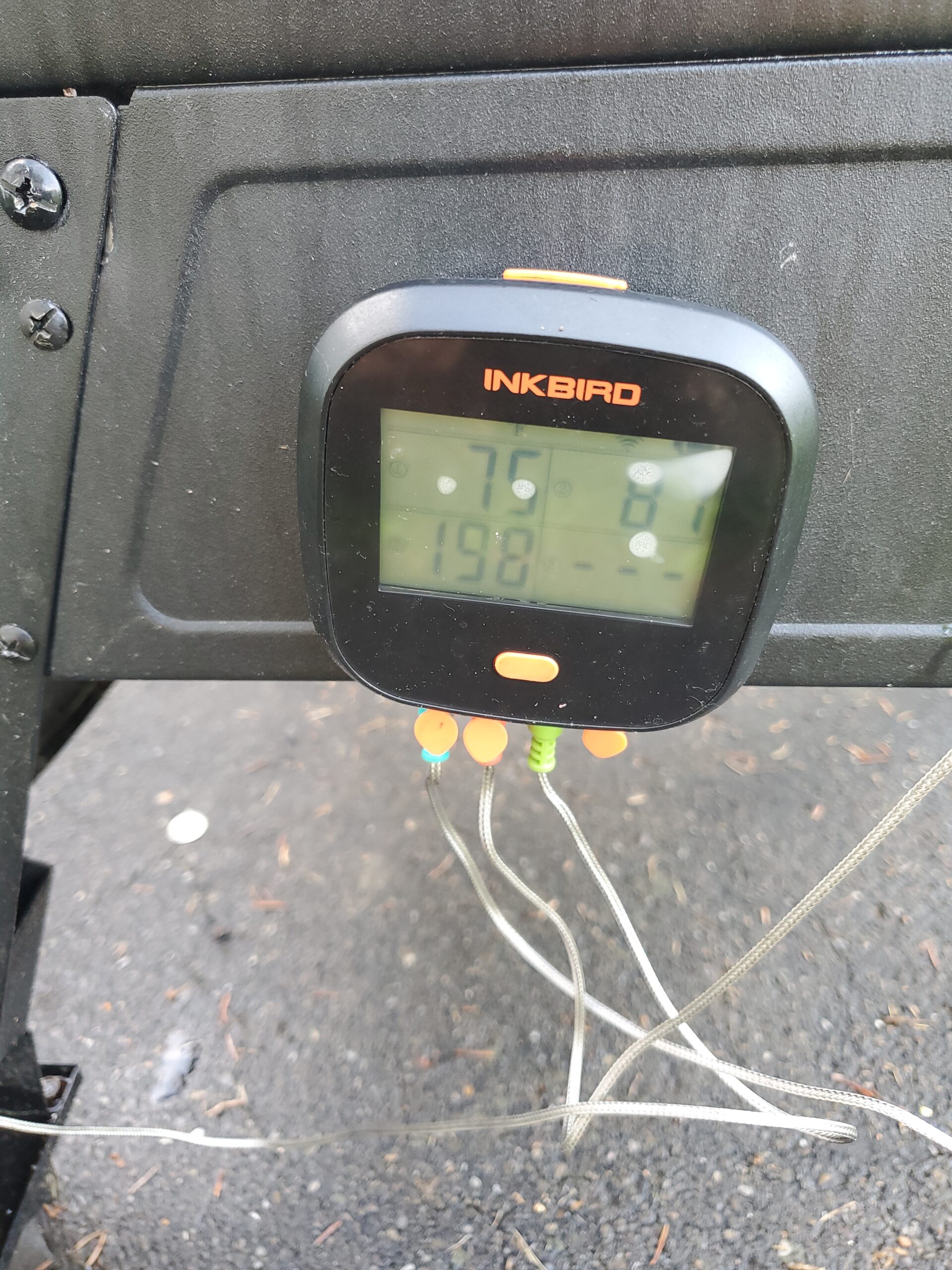
The 2000mAh battery runs about 26 hours, which covers a solid overnight smoke. Response time is half a second. A single phone can pair with more than one of these devices, which matters if you run two cookers.
The rating is held down by one limitation that matters in a smoker specifically. The plastic body is rated to 176F, so the unit itself must stay outside the pit and only the probes go in. Continuous monitoring also tops out at 482F, and the case is not waterproof.
Why calibration and graphs are worth more than they sound
If you want to know whether your pit runs hot at the front or whether a probe has drifted, exporting a graph and comparing channels is how you find out. Most cooks never go that far, and the ones who do stop guessing.
It is also a good teaching tool, since the shape of a stall becomes obvious once you can see the curve.
What the plastic body rules out
Anything that requires the unit to sit inside a hot pit is off the table, which means the probes do the work alone. For a low and slow cook at 225F to 275F that is fine, but it is not a high-heat tool.
You also need a 2.4GHz network, and the wipe-clean-only care means no dishwasher and no hose-down.
How We Evaluated Range, Accuracy and Battery
We judged these systems on the four things that decide whether a wireless grill thermometer survives a long smoke, rather than on feature checklists that every brand fills in the same way.
First, signal behavior with the cooker closed. A system that only holds its connection with the lid propped open is not a smoking thermometer, so we paid attention to what happens through steel doors, insulated lids and thick kamado ceramic. Second, whether the reading was trustworthy once the meat was in, including at depth and after several hours.
Third, battery life measured against a real cook rather than a claim on a box. Fourth, whether the system still worked when the phone did not, because the cook does not pause for a software update.
We also weighed what each system asks of you on setup day, since a thermometer you fight for an hour is one you stop trusting by month three.
Bluetooth vs WiFi vs RF and Sub-1G in a Metal Smoker
Yes, you can absolutely use a wireless meat thermometer in a smoker, and the type of wireless matters more than any other spec. Bluetooth is a 2.4GHz signal that competes with your phone, your wifi and the walls of your house, and it loses when a metal lid closes over it. That is the single most common complaint we found in smoker forums, and it is not a defect, it is physics.
RF and Sub-1G use much lower frequencies. Lower frequencies bend around obstacles and pass through metal and ceramic far better, which is why the Sub-1G models here claim thousands of feet and hold connections in a closed kamado where Bluetooth units stall. If your cooker is ceramic or heavily insulated, this is the category to buy in.
WiFi is the answer to a different problem. Once a probe reaches a base that is on your network, distance stops mattering, so you can monitor from inside the house on a bad weather day. The tradeoffs are setup and dependency: a 2.4GHz network requirement, a mandatory account on some models, and a system that goes quiet when the router does.
So: RF or Sub-1G for hard metal, WiFi for monitoring across the house, Bluetooth for people who stay near the cooker. And if you are still losing a signal, moving the base higher, away from the metal band and closer to where your phone sits fixes more cases than any other change.
Where to Put the Probe on Brisket, Pork Butt and Turkey
A perfect thermometer read from a badly placed probe tells you nothing. Position matters as much as accuracy, and a few habits fix most disappointing results.
For brisket, aim for the thickest part of the flat, not the point. The point is mostly fat and reads higher than the muscle, so pulling on it gets you a brisket that is seasoned well past where you wanted it. Insert from the side, deep, until only the handle and a short length of cable remain outside.
For pork butt, push into the thick part of the shoulder end and leave the probe in through the stall. A rising number during the stall tells you more about your fire than any amount of lid opening, and removing the probe loses that signal entirely.
For turkey, take two readings if you can, one in each breast, plus one in the thigh if you have a spare probe. The thigh runs cooler and tells you when the bird is genuinely done rather than when the top has caught up.
Two rules apply to all of them. Insert at a shallow angle so the full sensor tip sits in the center of the meat rather than near the surface, and plan the pull before the stall ends. Carryover cooking means a brisket pulled at 203F keeps climbing after the wrap, and an alarm set too high gets missed.
What to Look For Before You Buy
Start with the cooker, not the feature list. Thick ceramic and heavy insulated doors push you toward RF and Sub-1G. A thin steel grill on a patio pushes you toward Bluetooth, where extra range accomplishes nothing because you are standing next to it.
Next, decide how many probes you need honestly. One is right for a single brisket. Two covers a turkey plus a side, or a packer and a flat. Four is for a cook who is feeding people or who wants to compare positions. Buying four channels you will use one of wastes money, and buying one when you routinely cook two meats wastes a cook.
Then choose between an app and no app. Systems with apps give you finish time estimates, alerts from the couch, and a record of past cooks. Systems without give you reliability, privacy and zero setup friction. There is no correct answer here, only a preference about whether you want your phone involved in a twelve-hour commitment.
On the budget question, we think the meaningful upgrade is not features, it is signal type and sensor count. Moving from a Bluetooth single-probe unit to a Sub-1G multi-sensor system changes how a smoker performs far more than moving up a model line within one brand. Spend there first, and spend on probe count second.
Finally, check heat ratings against the way you cook. A plastic base rated to 176F must stay outside the cooker, and an ambient ceiling near 203F in the app will interrupt a cook when you push through a sear. Know your highest pit temperature before you choose.
For reference, our broader wireless meat thermometer guide covers more use cases, and if you are still deciding on equipment, our picks for charcoal grills that smoke as well as grill pair well with anything here.
Probe Care That Keeps Readings Honest
Most thermometer complaints turn out to be care problems rather than manufacturing problems, and a short routine extends the life of any of these probes considerably.
Rinse probes in warm soapy water right after the cook and dry them fully before charging or storing. Food proteins baked onto a sensor change the reading slowly and then suddenly, which looks like a failing probe. Several models here are dishwasher safe, IPX8 or IP67; where they are not, the instructions say wipe clean only, so follow those rather than assuming.
Never charge a probe that is wet, and never run the cable end or the base through water. Store probes loosely rather than wound tightly around the cable, since kinks at the strain relief are the most common physical failure we saw reported.
One last habit worth naming. On long cooks the ambient sensor can read low for the first few hours because cold meat acts as a heat sink next to it, so do not judge a new unit on hour two. Judge it after the pit and the probe have been running together for several hours.
Frequently Asked Questions
Can you use a wireless meat thermometer in a smoker?
Yes. Bluetooth units can lose signal through closed metal lids and insulated doors, which is the most common complaint in smoker forums. RF and Sub-1G systems at lower frequencies pass through steel and thick kamado ceramic far more reliably, and WiFi systems move the connection to a base that stays indoors so distance stops mattering.
What is the best meat thermometer for grilling and smoking?
For smoking, an RF or Sub-1G leave-in probe with two or more channels is the safest all-round answer because it keeps reading through a closed cooker. For grilling, a fast-response instant-read thermometer is the right tool for searing, and many cooks keep both.
What is the best wireless temperature probe for smoking meat?
The strongest combination we found is an RF system with four probes and per-channel alarms, because it tracks multiple meats and multiple pit positions at once with no phone or account required. Two-probe Sub-1G or WiFi systems cover the common case of one or two proteins with a cleaner setup.
Are wireless meat thermometers accurate?
The credible units here specify plus or minus 1.8F or better, and models carrying NIST certification claim plus or minus 0.5F. Owners who verified with ice water and boiling water tests generally found readings within one to two degrees. Accuracy depends as much on probe placement and calibration as on the stated tolerance.
Why is my wireless thermometer losing connection?
Signal attenuation through a closed metal lid is the usual cause with Bluetooth units. Moving the base or receiver higher, away from metal banding and closer to where your phone sits fixes most cases. With WiFi systems, check that the base is on the 2.4GHz band, and make sure your phone is not the only device on a crowded 2.4GHz network.
The Best Wireless Grill Thermometers for Smoking in 2026
After putting twelve systems through real cooks, our pick for the best wireless grill thermometers for smoking is the RF receiver with dual probes. It needs no app, no account and no signal troubleshooting, it reads both meat and pit at once, and the alarm is loud enough to wake you for a twelve-hour brisket. That reliability is worth more than any predictive feature.
If you want the phone in the loop, the Bluetooth system with two probes and app graphs is the best of that group, and the two-probe WiFi system is the cleanest way to run two proteins without a wire through the door. For thick ceramic cookers, go Sub-1G, and for four meats at once with no phone, the four-channel RF unit still makes more sense than anything else here.
Whichever one you choose, the probe work is still on you: insert deep into the thickest part, set alarms before the stall passes, and let carryover do its job. The thermometer gives you the data. The rest is practice.