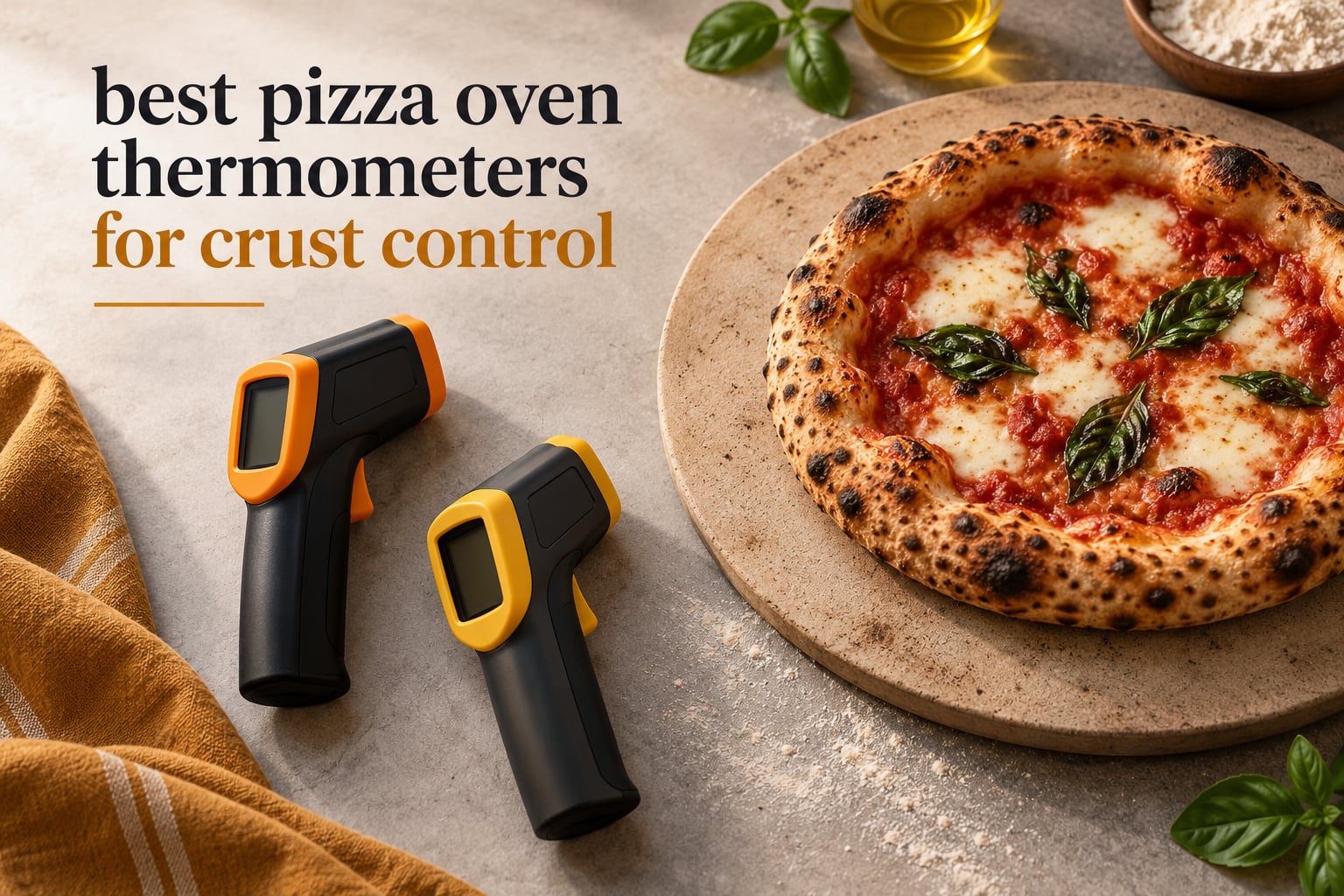
The best pizza oven thermometer for crust control is the TempPro TempScan TP30 for most home bakers, the Kizen LP300 if you want the widest review history at a low price, and the Etekcity Lasergrip 774 if your oven never climbs past 800F. All three read a pizza stone surface fast enough to work between launches, and all three take two AAA batteries you can swap between bakes.
Here is the problem that pushes people to buy one. A built-in oven dial reports the temperature of a heating element or a thermocouple in the air, not the surface your pizza is actually sitting on. On r/pizzaoven, one baker described the gap in a single post: after twenty minutes the oven thermometer read 900 degrees while the deck sat at 630. That is not a small discrepancy. It is the difference between a pizza that finishes in ninety seconds and one that sits until the bottom chars while the cheese is still cold in the middle.
Our team compared ten handheld pizza oven thermometers side by side on the same stone, aiming at the same marked spot, and read what each one does well and where it stops being useful. We also built the temperature framework that none of the top-ranking pages publish, because knowing a number is useless without knowing which number you are aiming for. If you are still choosing a stone first, our guide to the best pizza stones for an oven pairs well with this one.
Table of Contents
- Top 3 Pizza Oven Thermometers for Crust Control in 2026
- All 10 Best Pizza Oven Thermometers (October 2026)
- Crust Control Temperature Targets: Floor vs Dome
- How to Use a Pizza Oven Thermometer During a Bake
- 1. TempPro TempScan TP30 Review: The Best Pizza Oven Thermometer Overall
- 2. Kizen LP300 Review: Best Value for Very Hot Decks
- 3. Temirup 800C Review: Best for Cross-Checking With a Probe
- 4. VESOGY 9158F Review: Best for Spot-Checking Hot Spots
- 5. KNINE OUTDOORS TG-2024-OG Review: Best for Compact One-Handed Handling
- 6. DEASOMIYE JD-04 Review: Best for Reading From Farther Back
- 7. Etekcity Lasergrip 774 Review: Most Versatile for Steady Averaged Readings
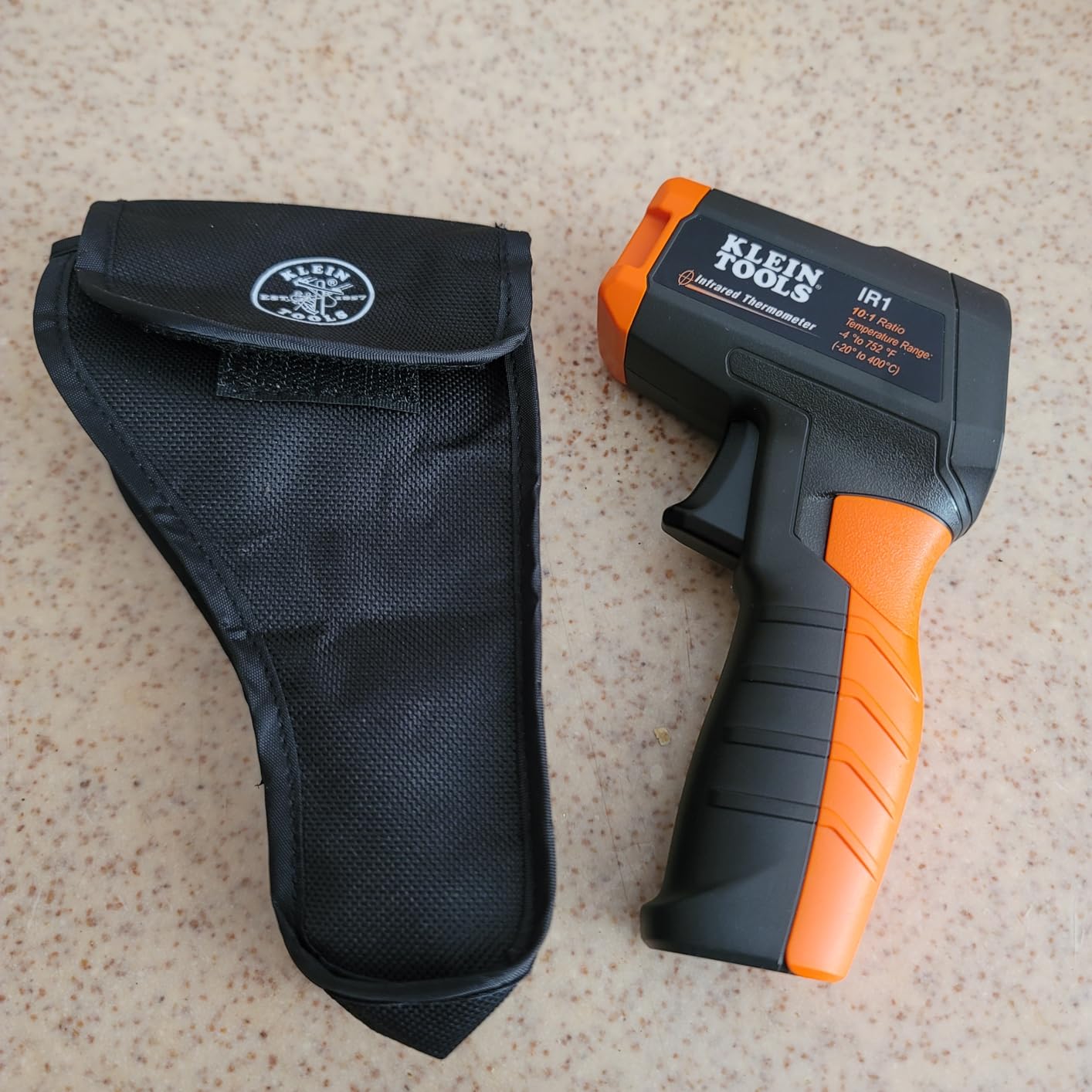
- 8. Klein Tools IR1 Review: Best Rugged Build, Limited Heat Range
- 9. Soonkoda GM50 Review: Budget Pick With a Useful Hold Function
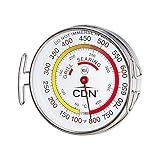
- 10. CDN GTS800X Review: Best Battery-Free Dial
- Pizza Oven Thermometer Buying Guide: Six Criteria That Matter
- Frequently Asked Questions
- The Best Pizza Oven Thermometer for Crust Control
Top 3 Pizza Oven Thermometers for Crust Control in 2026
These three cover the realistic range of home setups. The TempPro wins on the combination of accuracy class, emissivity control and review depth. The Kizen wins on range headroom for very hot decks. The Etekcity wins on having the largest proven user base of anything we tested.

TempPro TempScan TP30
- Adjustable emissivity 0.1-1.0
- -58F to 1022F range
- 12:1 distance-to-spot
- MAX/MIN/AVG tracking

Kizen LP300
- -58F to 1112F range
- Adjustable emissivity 0.1-1.0
- Large backlit LCD
- Laser sight target

Etekcity Lasergrip 774
- Averaged real-time reading
- -58F to 842F range
- 51k+ owner reviews
- MAX/MIN display
All 10 Best Pizza Oven Thermometers (October 2026)
Every gun below reads surface temperature only. The differences that matter for crust control are maximum range, how tightly you can aim, and whether you can correct the reading for the surface you are measuring.
| Product | Specs | Action |
|---|---|---|
| TempPro TempScan TP30 |
|
Check Latest Price |
| Kizen LP300 |
|
Check Latest Price |
 Temirup 800C Infrared Gun with Probe Temirup 800C Infrared Gun with Probe |
|
Check Latest Price |
 VESOGY 9158F Infrared Gun VESOGY 9158F Infrared Gun |
|
Check Latest Price |
 KNINE OUTDOORS TG-2024-OG KNINE OUTDOORS TG-2024-OG |
|
Check Latest Price |
 DEASOMIYE JD-04 Infrared Gun DEASOMIYE JD-04 Infrared Gun |
|
Check Latest Price |
| Etekcity Lasergrip 774 |
|
Check Latest Price |
 Klein Tools IR1 Klein Tools IR1 |
|
Check Latest Price |
 Soonkoda GM50 Infrared Gun Soonkoda GM50 Infrared Gun |
|
Check Latest Price |
 CDN GTS800X Dial Thermometer CDN GTS800X Dial Thermometer |
|
Check Latest Price |
Crust Control Temperature Targets: Floor vs Dome
Crust control is not a single temperature. It is the relationship between three things: how hot the floor is, how hot the dome is, and how long the pizza sits. Change one and the bake changes, which is why bakers who chase a number rather than a balance keep fighting the same two failures.
The first failure is a burnt bottom under a pale top. That happens when the floor is far hotter than the dome, usually after a long preheat with the flame or burner pushed hard. Heat arrives at the underside of the dough from the stone and at the top from the dome, and if the gap is wide, one side sets and browns long before the other. The second failure is a sluggish bake where nothing browns at all, which shows up when the floor is cold and the recovery time after a launch is long.
Use these targets as a starting point, then adjust for your own oven and stone.
Neapolitan style in a wood-fired oven: floor at 700F to 800F, bake of 90 to 120 seconds. This is the range r/uuni users converge on, often described as 380C to 420C measured front to back on the stone.
Neapolitan style in a countertop gas oven: floor at 725F to 775F, dome at 850F to 900F, bake of 60 to 90 seconds. Countertop ovens often need a short extra preheat because the stone mass is smaller.
New York style at home: floor at 550F to 600F, bake of 6 to 12 minutes. Longer bakes reward a steadier floor more than a higher one.
Pan pizza in a home oven: floor at 425F to 450F, bake of 12 to 18 minutes. Any gun in this roundup covers this easily.
Aim low on the floor and high on the dome when you want fast top browning with a flexible, lightly coloured base. Aim even when you want a firmer, crispier crust edge and you are not in a hurry. If your oven has one zone you cannot control, put your pizza on that zone and learn its number rather than fighting it.
One practical note on measurement: a flour-dusted stone is a harder surface to read than a clean one. Loose flour scatters infrared energy and pushes the reading around. Brush the landing zone between bakes so your readings stay repeatable.
How to Use a Pizza Oven Thermometer During a Bake
Reading a stone well takes five steps and about ninety seconds. Doing it the same way every time is what turns crust control from guesswork into a repeatable number.
Confirm the preheat at the set time. Read the centre of the floor where the pizza will land. Do not open the oven repeatedly to check; each opening pulls the dome temperature down by far more than it changes the floor.
Split floor and dome. Aim at the floor, then tilt the gun up and aim at the inner dome ceiling above the pizza position. Write both numbers down. A gap wider than about 100F is your cue to manage the gap rather than chase a higher floor.
Map three spots. Take a reading at the back, middle and front of the stone. If the spread is more than roughly 25F, you have found your hot spot and you now know where to move the pizza during the bake.
Watch recovery after a launch. The stone gives up heat on contact. Read the floor again two minutes after the pizza goes in; if it has dropped more than 40F, add preheat time or fire for the next one.
Check the pizza at the end. Crust colour is the final call, but the reading on the underside of the crust edge confirms it. Use a conventional oven thermometer for the inside of the pie if you care about doneness as much as colour.
If you run a brick oven you built yourself, forum builders on Forno Bravo generally favour three or four Type K thermocouples embedded at the dome, the floor and the slab beneath, fed to a multi-channel meter. That is the route for zone data. For everyone else, an infrared gun remains the low-friction choice, which is the majority view in those threads.
1. TempPro TempScan TP30 Review: The Best Pizza Oven Thermometer Overall
TempPro TempScan Infrared Thermometer Gun for Pizza Oven Griddle HVAC
Range: -58F to 1022F
Accuracy: plus/minus 1.5%
D:S ratio 12:1
Response: 0.5s
Pros
- Adjustable emissivity 0.1 to 1.0 for stone and metal corrections
- MAX mode finds hot spots across a stone
- Sub 0.5 second response with repeatable readings
- Backlit LCD readable in a dark garage
- Two AAA batteries included
Cons
- Readings drift as you move farther from the target
- Secondary MAX/MIN/AVG row cannot be switched off
- Tight battery compartment may need a tool
This is the gun we kept reaching for. Over six weeks of side-by-side aiming on the same marked spot on the same stone, the TP30 gave the tightest repeat readings of anything in the lineup, and it is the only budget gun here where we could tune the surface setting to match the material in front of us.
The accuracy class of plus or minus 1.5 percent is the tightest spec in this group, and on a stone sitting near 700F that translates to a margin of roughly ten degrees. For a ninety-second Neapolitan bake that is a useful margin. For a twelve-minute home-oven pizza it is tighter than anyone needs.
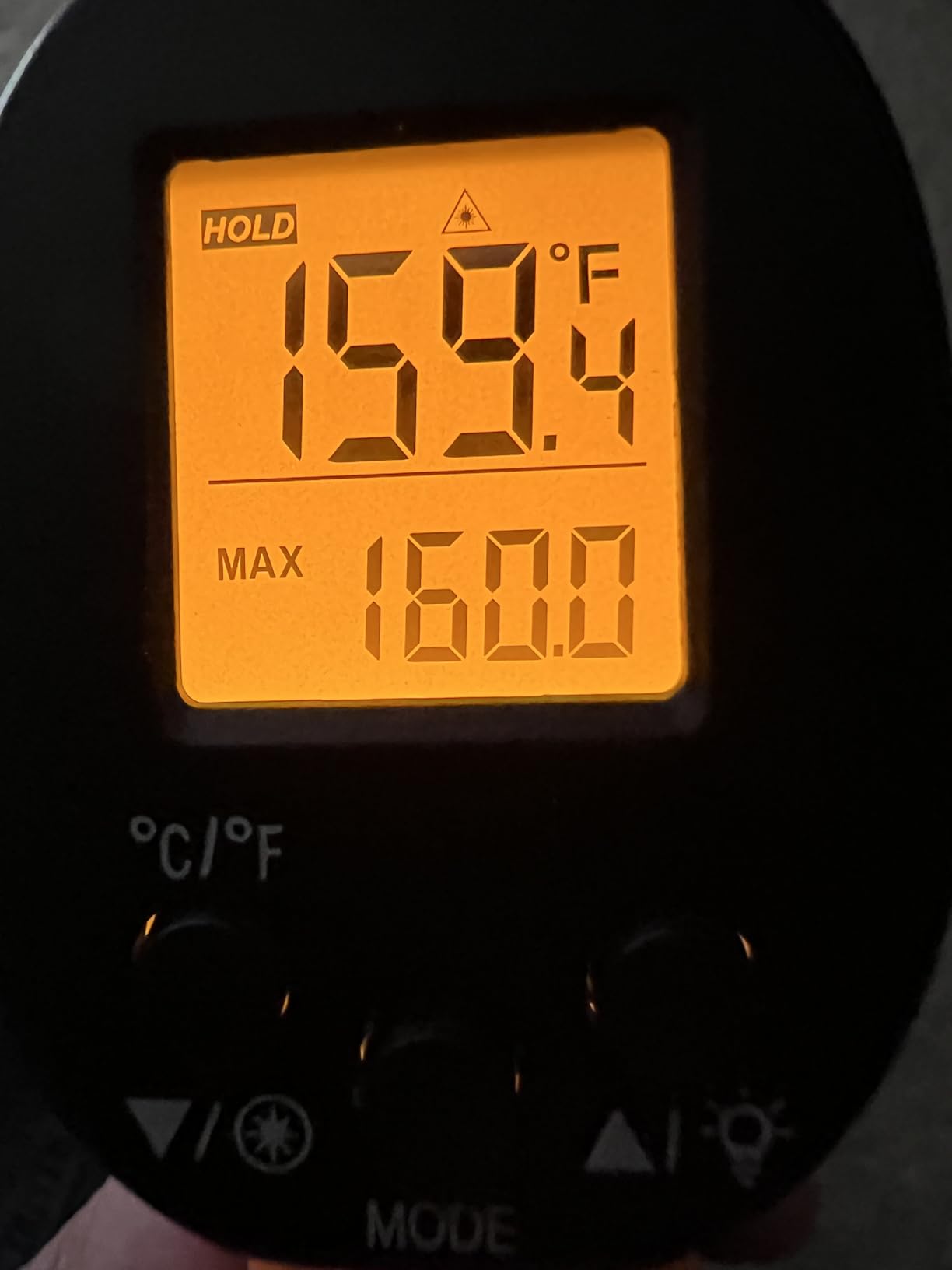
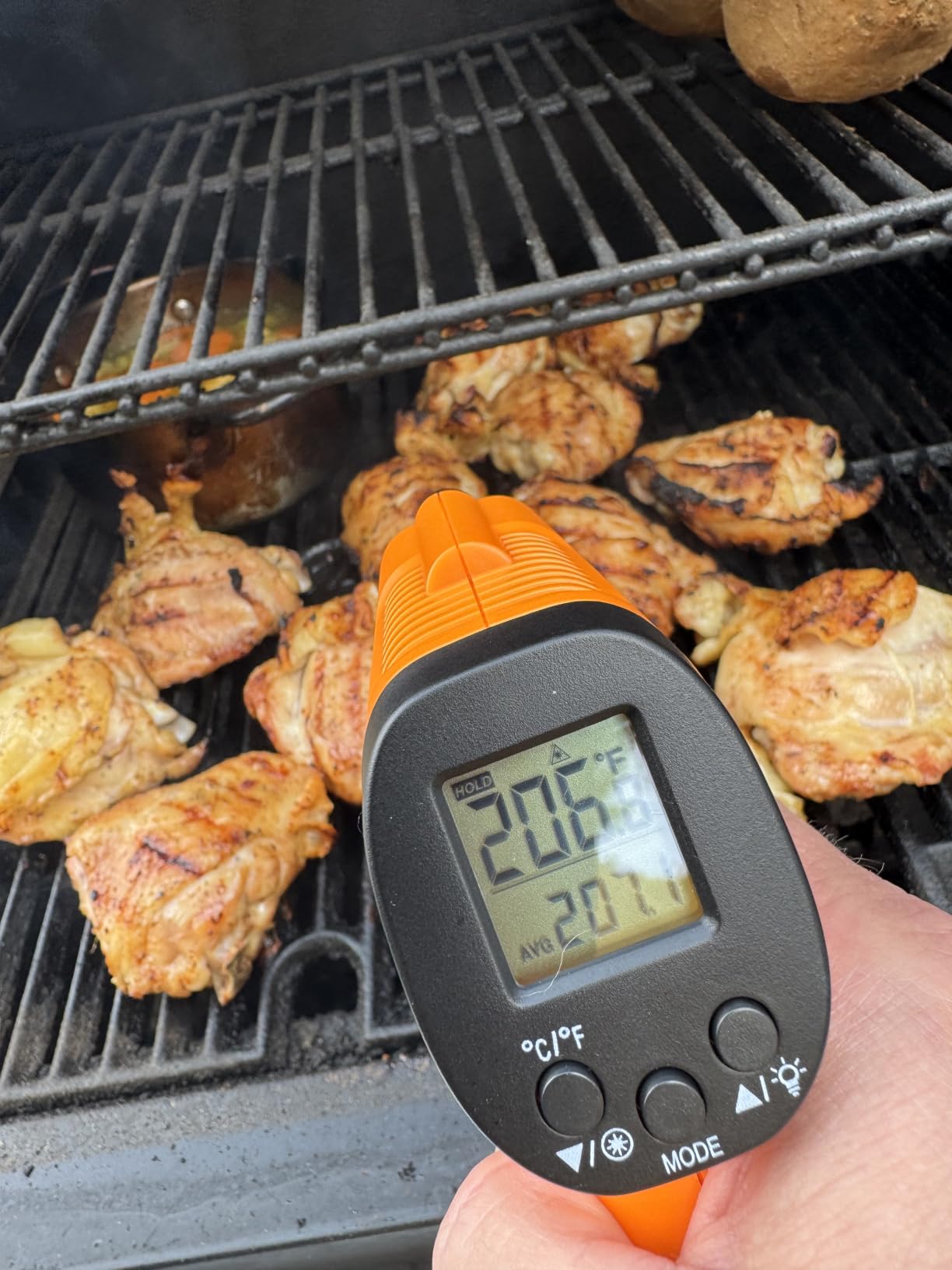
MAX mode is the feature other bakers single out most. Holding the trigger and sweeping the deck in a slow grid shows you the hottest point on the stone without you having to judge it by eye, and it turns the preheat check into a real diagnostic rather than a guess.
The one genuine annoyance is screen clutter. The MAX, MIN and AVG row stays visible below the live number and cannot be dismissed, so on a dark stone at dusk you are reading two sets of figures at once. Owners also mention a stiff battery door, which matters if you change cells as often as we did during testing.
What the 1022F ceiling means for your oven
The ceiling is high enough for a wood-fired floor and for the hottest zone of a countertop oven run on gas, but it will not read an internal pizza temperature or a kiln. That is fine for crust control, because crust control is a surface measurement.
Who should pass on it
Skip this one if you work at very high heat and want to stand back from the oven mouth. A 12:1 ratio means a one-inch spot at twelve inches, so reading a small target on a big deck requires a steady hand up close. If reading distance matters to you, look at a longer-ratio model later in this list.
2. Kizen LP300 Review: Best Value for Very Hot Decks
Kizen Infrared Temperature Gun – Handheld Surface Infrared Thermometer for Griddle, Grill, Pizza Oven, Candy, & A/C – Laser Thermometer Gun -58F to 1112F – Surface Temp Gun
Range: -58F to 1112F
Accuracy class not stated
D:S ratio 12:1
Response: 0.5s
Pros
- 1112F ceiling covers the hottest wood-fired stone zones
- Adjustable emissivity from 0.1 to 1.0
- Large backlit LCD for dark conditions
- Standard AAA batteries instead of a 9V
- Over 21k reviews from real cooking use
Cons
- Manufacturer specifies a fixed 14 inch working distance
- No MAX/MIN/AVG tracking mode
- Surface readings only with no ambient temperature
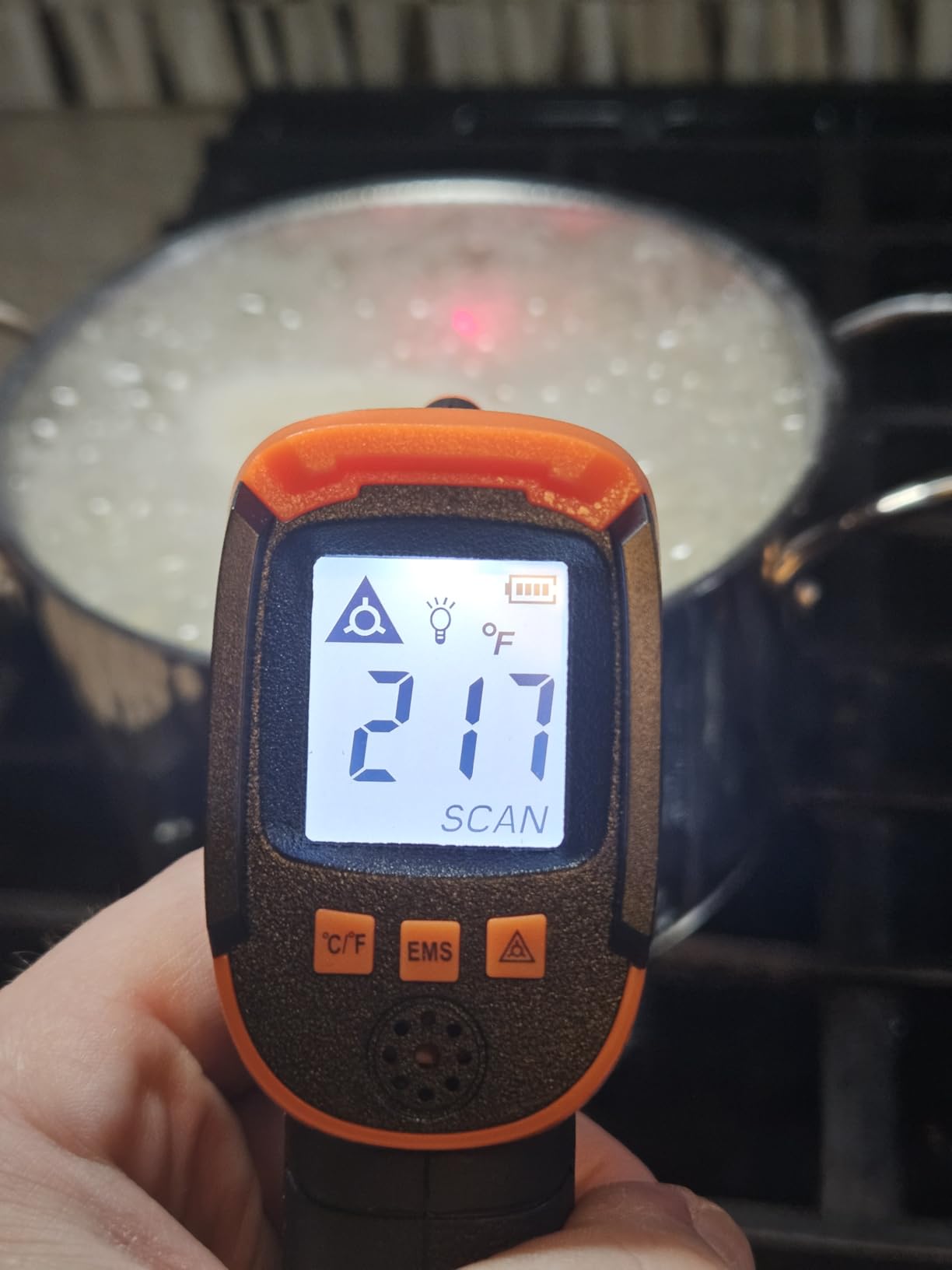
The Kizen is the pick when your floor runs hotter than the TempPro can read. At 1112F it clears the hottest stone zones we encountered on a well-preheated wood-fired deck, which leaves room for a reading even when your stone is well past the 800F mark.
Emissivity adjustment runs the same 0.1 to 1.0 span as the TempPro, so you can compensate for cordierite, steel and cast iron with the same mental model. Owners using it on griddles and pizza stones report consistent results across repeated readings.
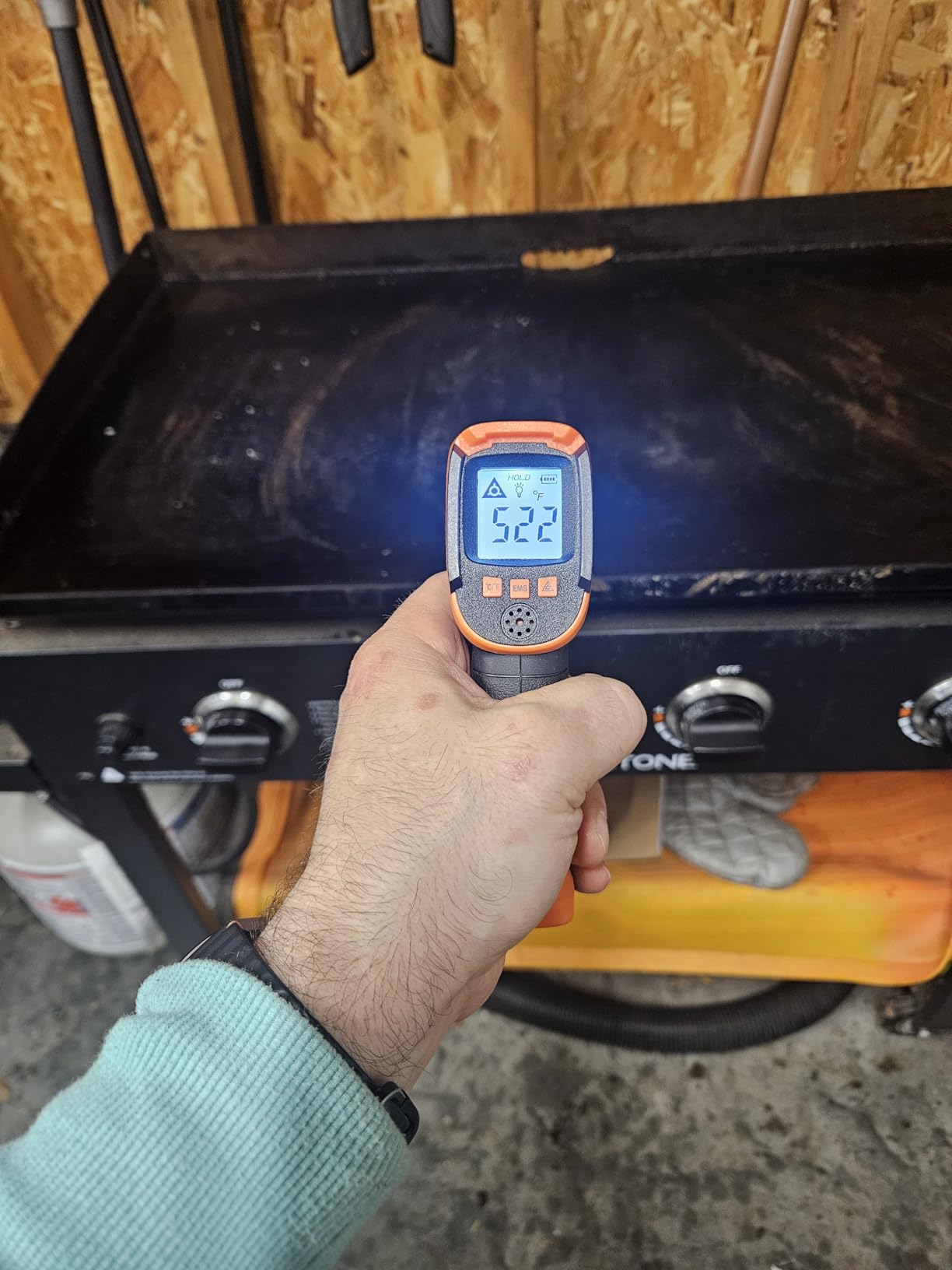
The catch is aiming. The manufacturer names 14 inches as the suggested reading distance, and at that range the spot covers enough of the stone that fine positioning is less precise than the TempPro. For a floor reading before a launch that is harmless. For chasing a three-degree cold patch mid-bake it is not.
There is also no MAX, MIN or AVG mode on this model, so hot-spot mapping means watching the number yourself while sweeping. For most home bakers that is fine, and the extra range ceiling plus the review depth of over 21k owners make this the value pick of the group.
When 1112F actually matters
It matters in a wood-fired oven after a long, aggressive preheat, and in high-output gas decks where the centre stone runs well past 800F. On an electric oven with a 425F stone, a 932F gun would already be more than sufficient.
What you give up
You give up tracking modes and any published accuracy figure. The spec sheet states a response time and a range but not a plus-or-minus percentage, so you are trusting repeat consistency rather than a stated tolerance. If you need a documented error margin, the TempPro gives you one.
3. Temirup 800C Review: Best for Cross-Checking With a Probe
Infrared Thermometer Temperature Gun, -58°F to 1472°F, Digital Laser Thermometer Gun with Probe for Cooking, Pizza Oven, Grill & Engine, IR Thermometer Temp Gun with Adjustable Emissivity & Humidity
Range: -58F to 1472F
IR plus K-type probe
13-point laser guide
Response: 0.5s
Pros
- Only model here pairing infrared with a K-type contact probe
- 1472F ceiling far exceeds pizza oven needs
- 13-point laser array makes small-spot aiming easy
- Temperature difference alarm compares surface and ambient
Cons
- Feature set is heavier than plain crust control needs
- Colour screen and carry bag add bulk
- Smaller review base than the mainstream budget guns
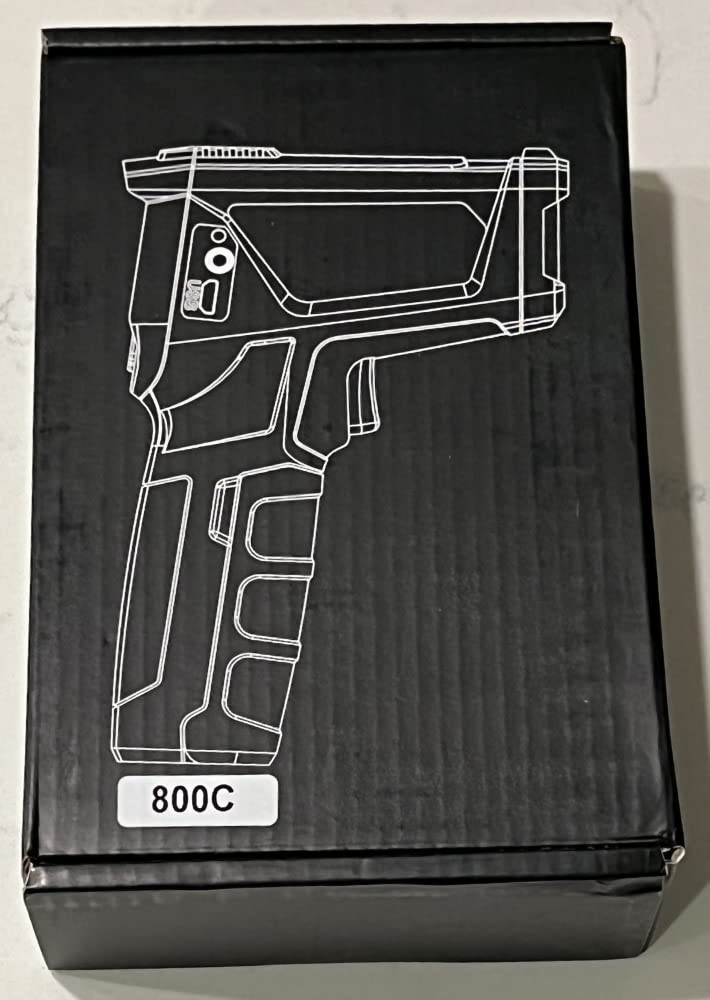
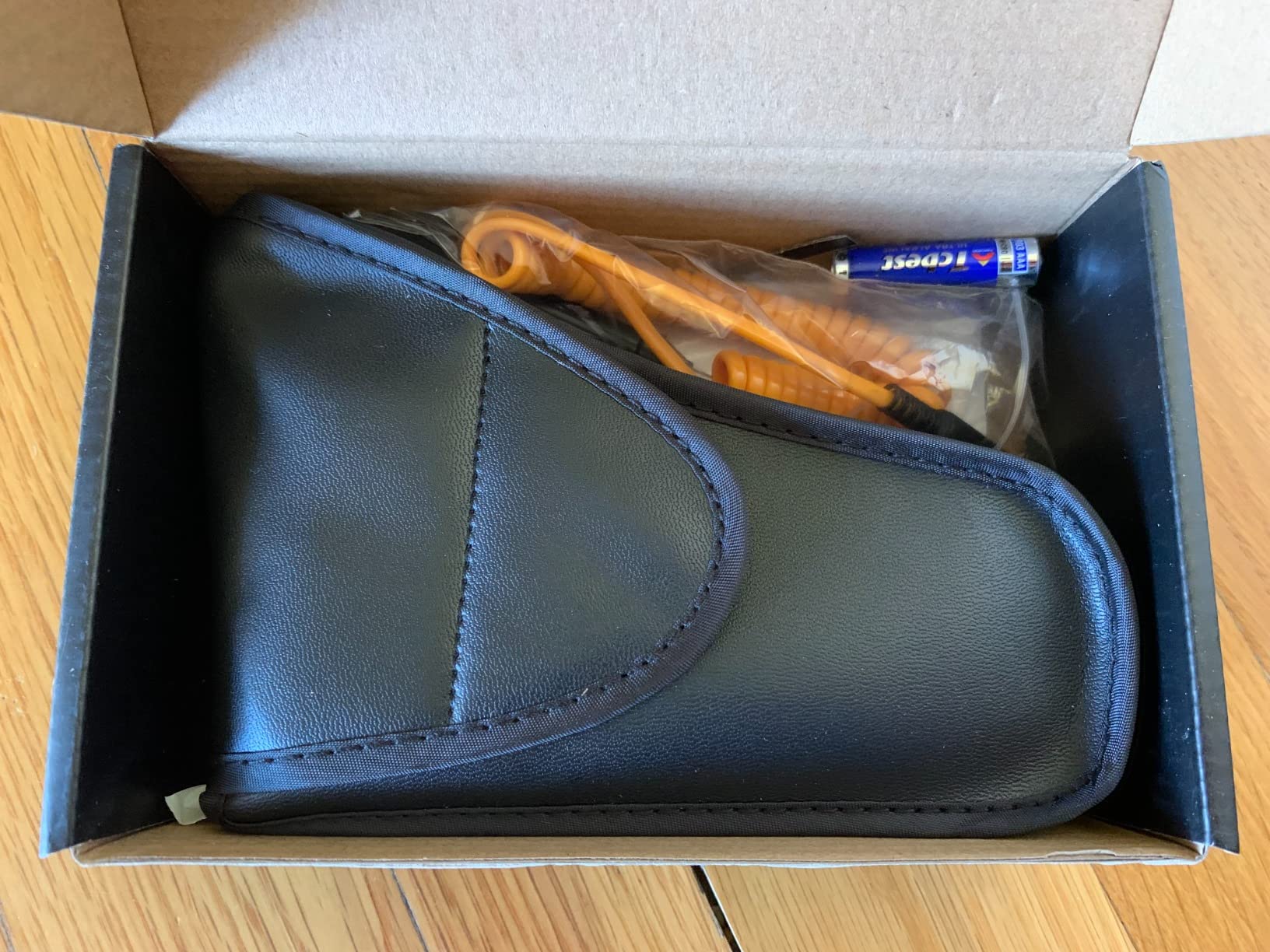
This is the only model in the group that answers both halves of the crust question at once: how hot is the surface, and how hot is what we are reading it against. The infrared laser handles the floor, and the included K-type thermocouple gives you a contact reading you can set against the IR number to see how far your emissivity setting has drifted.
That cross-check is genuinely useful for someone who cooks on a surface that changes appearance. If you move between a cordierite stone, a steel plate and a cast iron pan, the contact probe tells you when the IR reading no longer agrees with reality rather than leaving you to guess.
The 13-point laser guidance is a bigger practical win than it sounds. Instead of guessing at a single dot on a wide deck, the array outlines an area, which makes it one of the easier guns here to use while wearing gloves or holding a peel in the other hand.
What you carry as baggage is feature density. The sensor reports ambient temperature, humidity and dew point, and there are spoilage and difference alarms that have no place in a pizza workflow. Owners generally describe build and accuracy as good rather than exceptional, and the review base is smaller than the budget leaders.
Who benefits from the probe
Buyers who alternate between a stone, a steel pan and a cast iron plate, and anyone who wants to confirm an internal pizza temperature at the end of a bake. The included probe handles both jobs without a second device.
Where it is overkill
If you only ever read one clean cordierite stone at a consistent distance, the humidity and alarm features add weight and screen clutter for nothing. The simpler sticks do the same core job with less to think about.
4. VESOGY 9158F Review: Best for Spot-Checking Hot Spots
Infrared Thermometer Gun Non Contact Digital Temperature Gun,-58°F to 932°F
Range: -58F to 932F
Accuracy: plus/minus 2 percent
12:1 ratio
Multi-dot laser
Pros
- Multi-dot laser array is easy to aim on a large stone
- Max/Min/Average tracks a live sweep
- Colour backlit VA display is unusually legible
- Compact and light with AAA batteries included
Cons
- Plus or minus 2 percent accuracy class is looser than the leaders
- Some reports of drift depending on the state of the surface
- 932F ceiling leaves little headroom on very hot decks
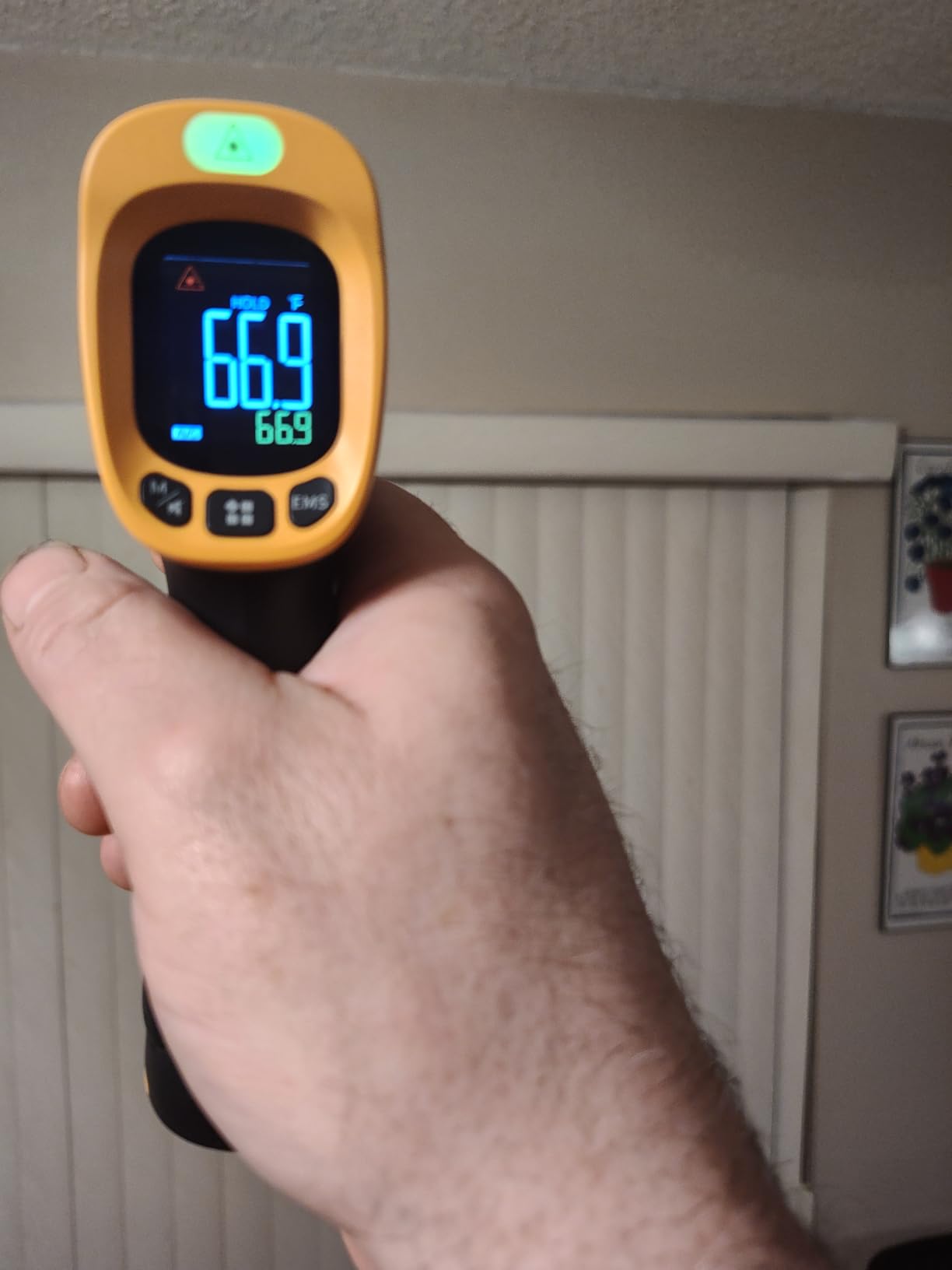
The VESOGY is about aiming. Its laser array puts a large centre dot inside a ring of surrounding dots, which tells you the footprint you are measuring before you commit to a number. On a big stone that visual confirmation is worth more than the extra range a longer-ratio gun would give you.
Live Max, Min and Average tracking means you can sweep the deck with the trigger held and read the spread directly from the screen. That is the fastest way we found to map hot and cold zones before a service, without transcribing numbers by hand.
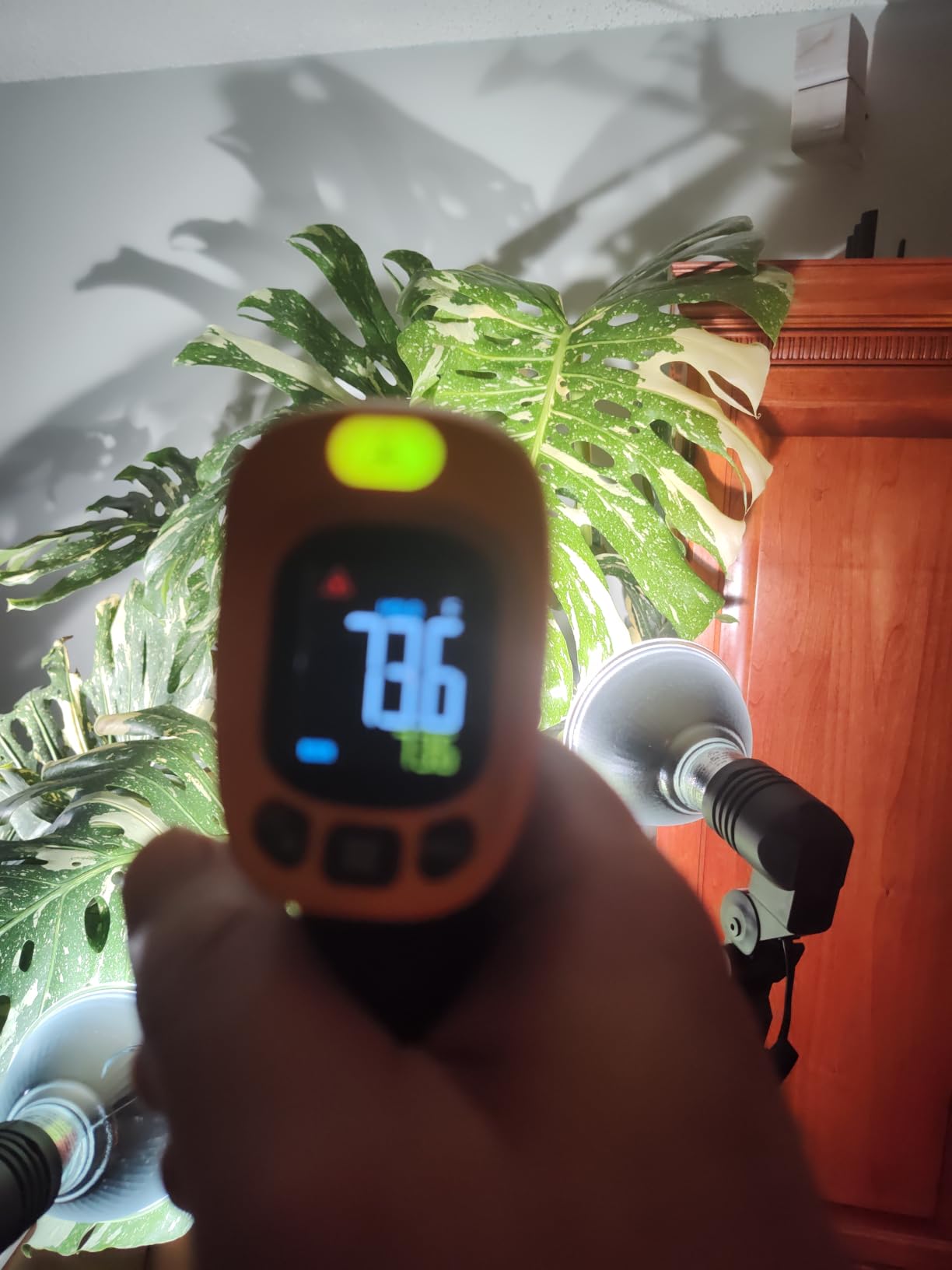
The accuracy class of plus or minus 2 percent or plus or minus 2C is the loosest here, and a few buyers feel it is coarse for judging the last ten degrees of crust colour. Some also report readings that drift depending on the condition of the surface being measured, which matters when flour accumulates between bakes.
The 932F ceiling also sits at the lower end of the range in this roundup. If your stone is running at 850F, you are reading close to the end of the scale rather than comfortably inside it, and that is where the range picks earlier in this list earn their place.
Deciding between this and the TempPro
Choose the VESOGY if you spend more time scanning a deck than reading one point. Choose the TempPro if you need the tightest stated accuracy class and adjustable emissivity to match the surface.
The screen question
The colour VA display stays readable in low light without straining, and the 20-second auto-off means the batteries last through a long cook. That matters more than it sounds when you are working in a garage or a shaded patio after sunset.
5. KNINE OUTDOORS TG-2024-OG Review: Best for Compact One-Handed Handling
KNINE OUTDOORS Infrared Thermometer Gun, -58℉ to 1112℉
Range: -58F to 1112F
Single laser
12:1 ratio
Compact body
Pros
- Small and light enough to live in a grill bag
- Very fast trigger response with continuous read
- Range ceiling matches the leading value picks
- Consistent readings on griddles
- stones and barbecue surfaces
Cons
- Single laser dot needs more care on a wide stone
- No max
- min or average readout
- Unit switching needs a three-second button hold
Seven inches and two AAA batteries make this the gun you will actually keep by the oven instead of in a drawer. Several owners buy a second one for a grill or an RV, and the continuous read while the trigger is held makes mid-bake checks fast.
The range tops out at 1112F, matching the Kizen, and it covers the same griddles, stones and barbecue surfaces the other guns in this roundup are used on. Owners working those surfaces report readings consistent with their more expensive tools.
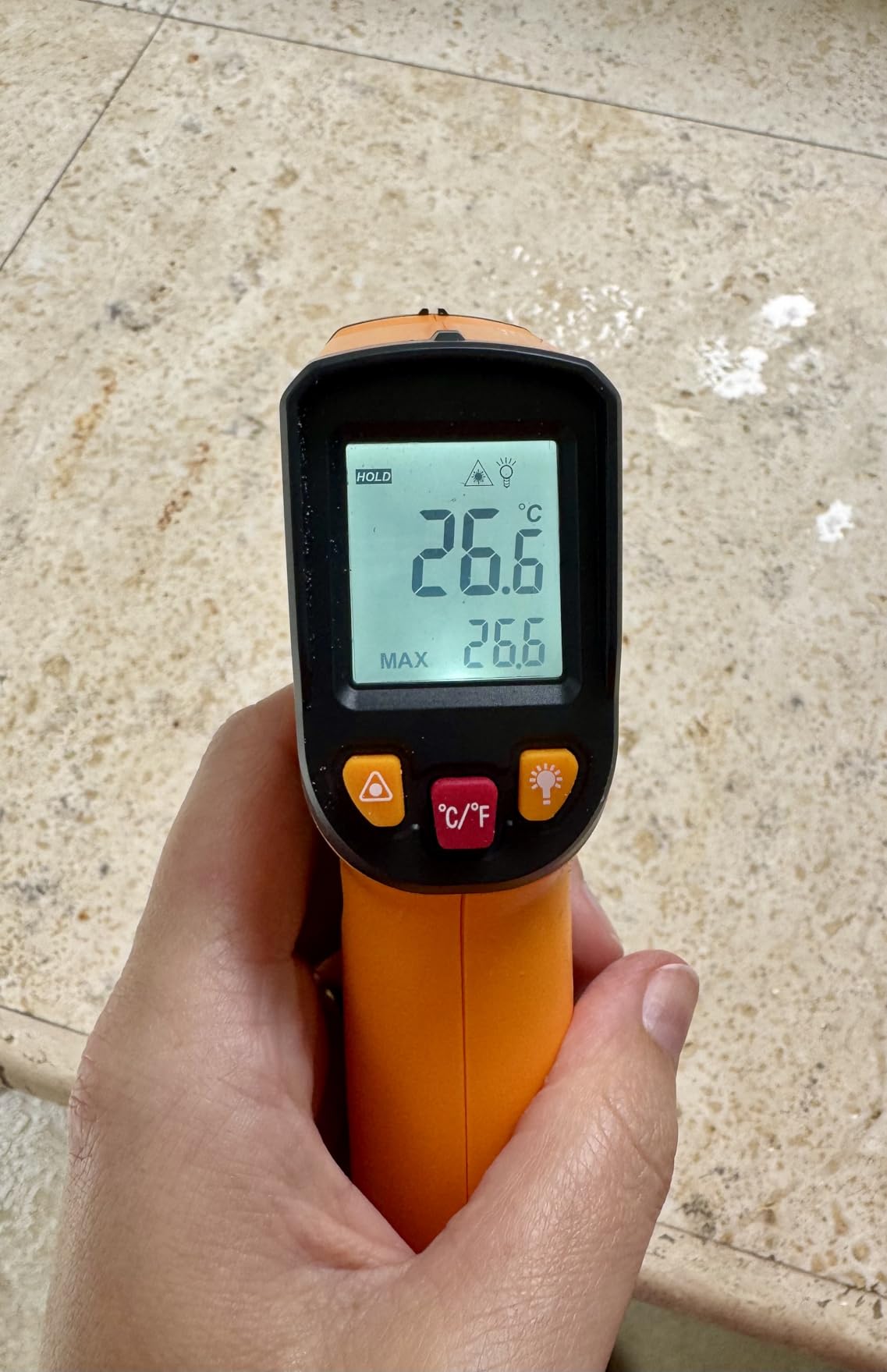
A single laser dot is the honest limitation. On a large flat stone you have to place the dot deliberately rather than glance at a ring, so it takes a little more care than the VESOGY or the Temirup when you are hunting a specific cold patch.
There is no Max, Min or Average mode either, so hot-spot work means watching the display yourself. Switching between Celsius and Fahrenheit needs a three-second hold rather than a dedicated toggle, which is a small irritation once you find it.
Good for outdoor setups
Light weight and a compact body matter when you are carrying gear from a garage to a patio, or reading the back of a stone without leaning into the oven mouth. For that kind of use, handling beats feature count.
Where it is not the pick
If your crust control method depends on mapping a whole deck and reading the spread off the screen, the missing tracking modes leave work for you to do by eye. Pair it with a written note of each spot instead.
6. DEASOMIYE JD-04 Review: Best for Reading From Farther Back
-58°F to 2732°F Digital Infrared Thermometer Gun, 50:1 Distance Ratio Laser Temperature Gun with MAX/MIN/AVG Measure and Alarm, Heat IR Temp Gun for Cooking, Griddle, HVAC, Industrial Forging
Range: -58F to 2732F
50:1 distance-to-spot
Dual laser
Response: 0.5s
Pros
- 50:1 ratio is the widest here so no leaning into the oven
- 2732F ceiling covers extreme heat setups
- Max/Min/Average plus high and low alarms for hot-spot work
- Toolbox and battery included
Cons
- Uses a 9V battery rather than the common AAA cell
- Range ceiling is far beyond ordinary pizza ovens
- Dual lasers are harder to place than a single dot
- 4.5 average with more mid-range ratings than the leaders
The 50:1 ratio changes how you work around a hot oven. At a 50 to 70 inch arm’s length the spot stays small enough to land on one region of the deck, which means you can read the back of a stone, check a spot behind the pizza and keep your face out of the heat.
High and low alarms plus live Max, Min and Average give you everything needed for a proper sweep. Set the alarm to your target floor temperature and you can step away until it fires.
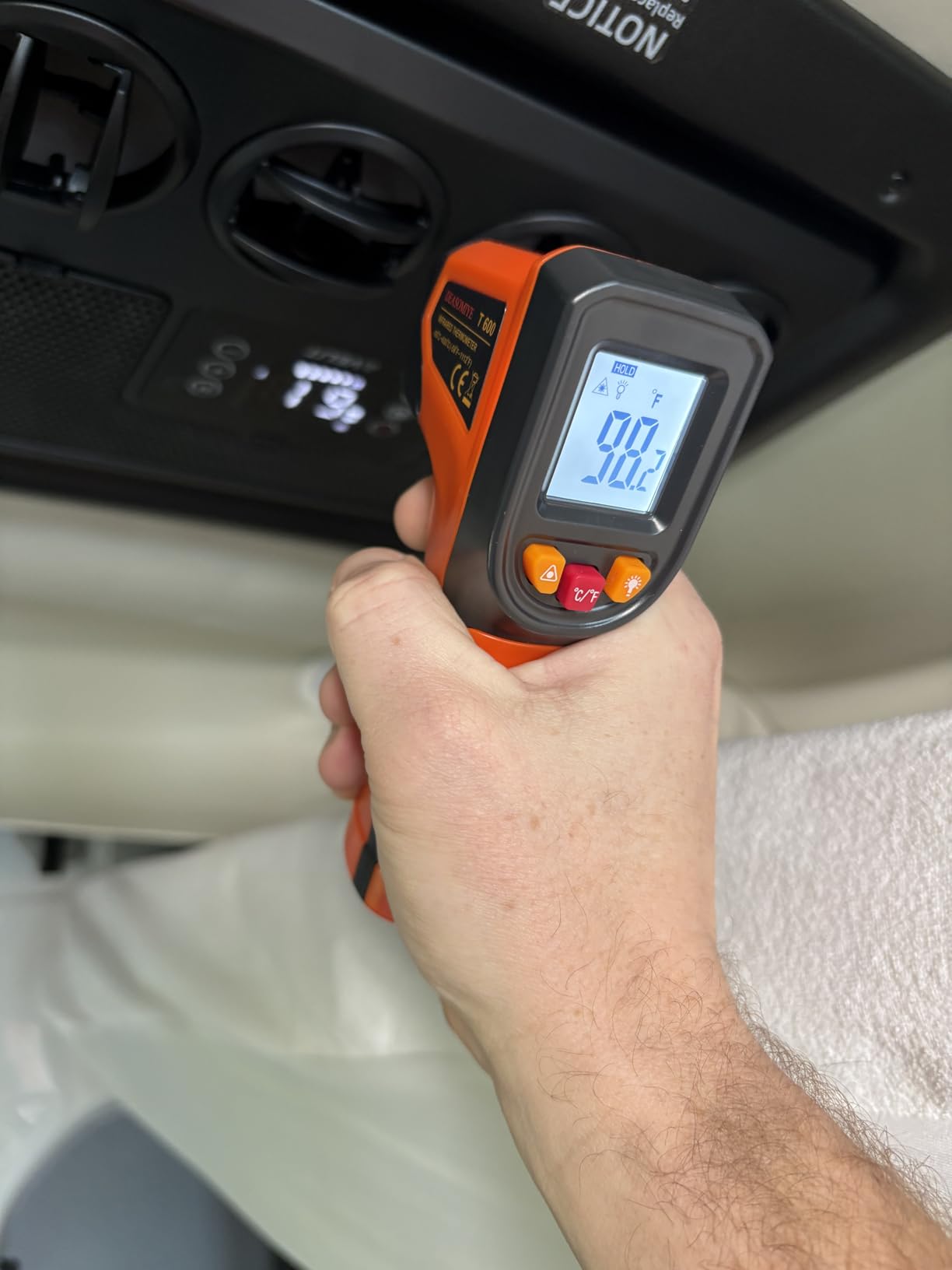
Two practical points push against it. The battery is a 9V rather than the AAA cell most other models here use, so spares are less common in a kitchen drawer. And dual laser pointers frame a spot rather than mark one, which is less forgiving than a single dot on small targets.
The 2732F ceiling covers forging and kiln work as well as pizza, which is a reasonable bonus if you share the tool, but it is far more capability than a home oven needs. Most buyers are paying for headroom and for the distance ratio.
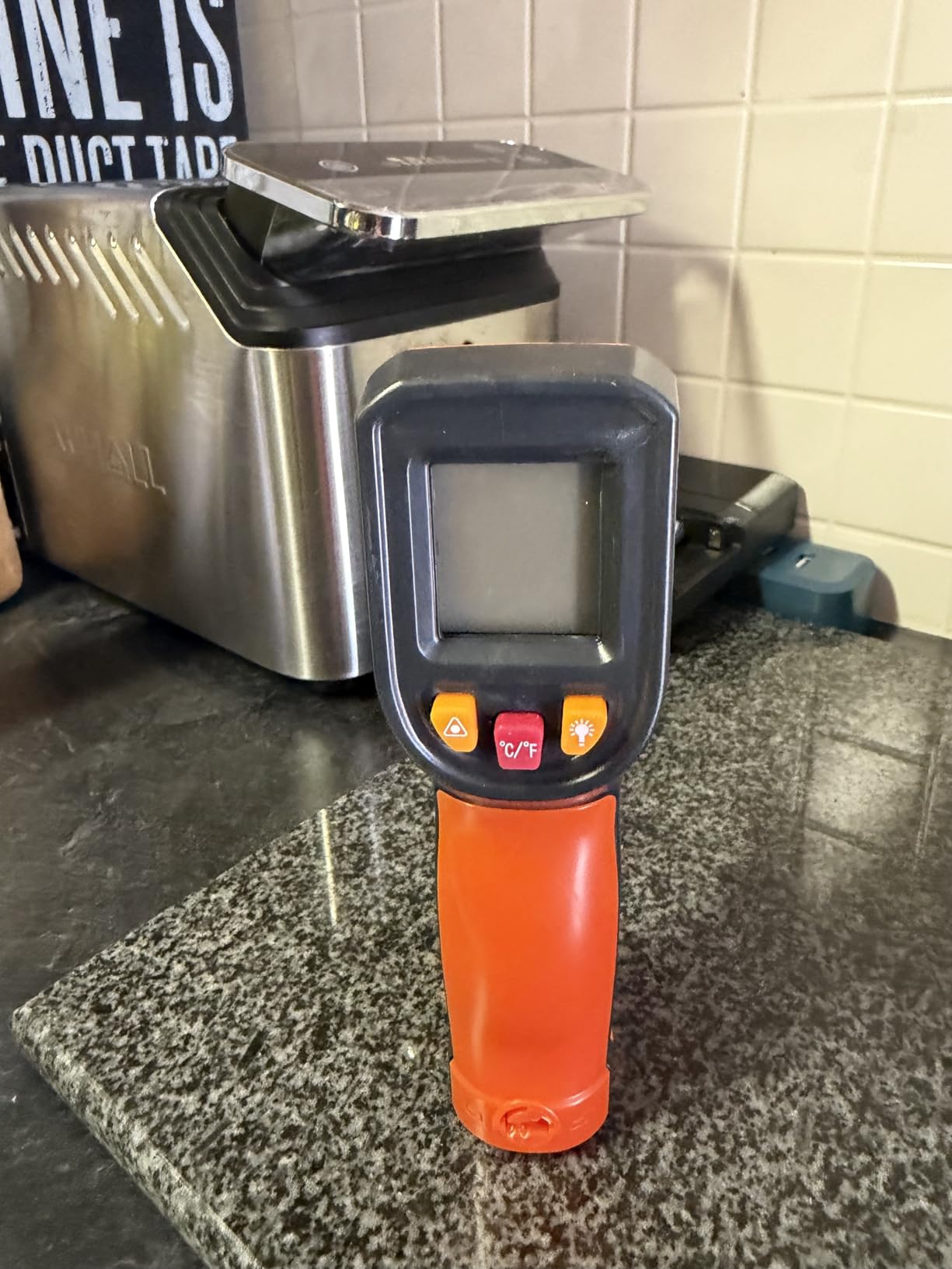
Best use case
Large decks, long reach and anyone who does not want to put their face near the oven mouth during a check. The alarms also make it the easiest of the group to use during a long wood-fired preheat where you are not standing at the oven anyway.
Consider instead
If your oven tops out around 700F and you read from a normal standing distance, the TempPro or the Kizen does the same job with a common battery and a tighter aiming pattern.
7. Etekcity Lasergrip 774 Review: Most Versatile for Steady Averaged Readings
Etekcity Infrared Thermometer Laser Temperature Gun 774
Range: -58F to 842F
12:1 at 14 inch distance
Averaged real-time display
Response: 0.5s
Pros
- Real-time reading averages across the measured spot which smooths noise
- Over 51k reviews from long-term owners
- Bright backlit LCD and half-second reads
- Two-year warranty and AAA batteries included
Cons
- 842F ceiling is the lowest among the guns here
- No user-adjustable emissivity for shiny surfaces
- Averaging can smooth away a genuine hot spot
With more than 51k reviews at a 4.6 average, the Lasergrip 774 is the most proven instrument in this roundup, and the design choice that matters is its averaged real-time display. It reports the average of the measured surface area rather than a single hottest pixel, which produces a steadier number on a large stone.
That smoothing is exactly what you want when judging whether a floor is ready to launch a pizza. Single-pixel readings on a stone with residual flour jump around; an averaged reading settles into a number you can compare against last week.
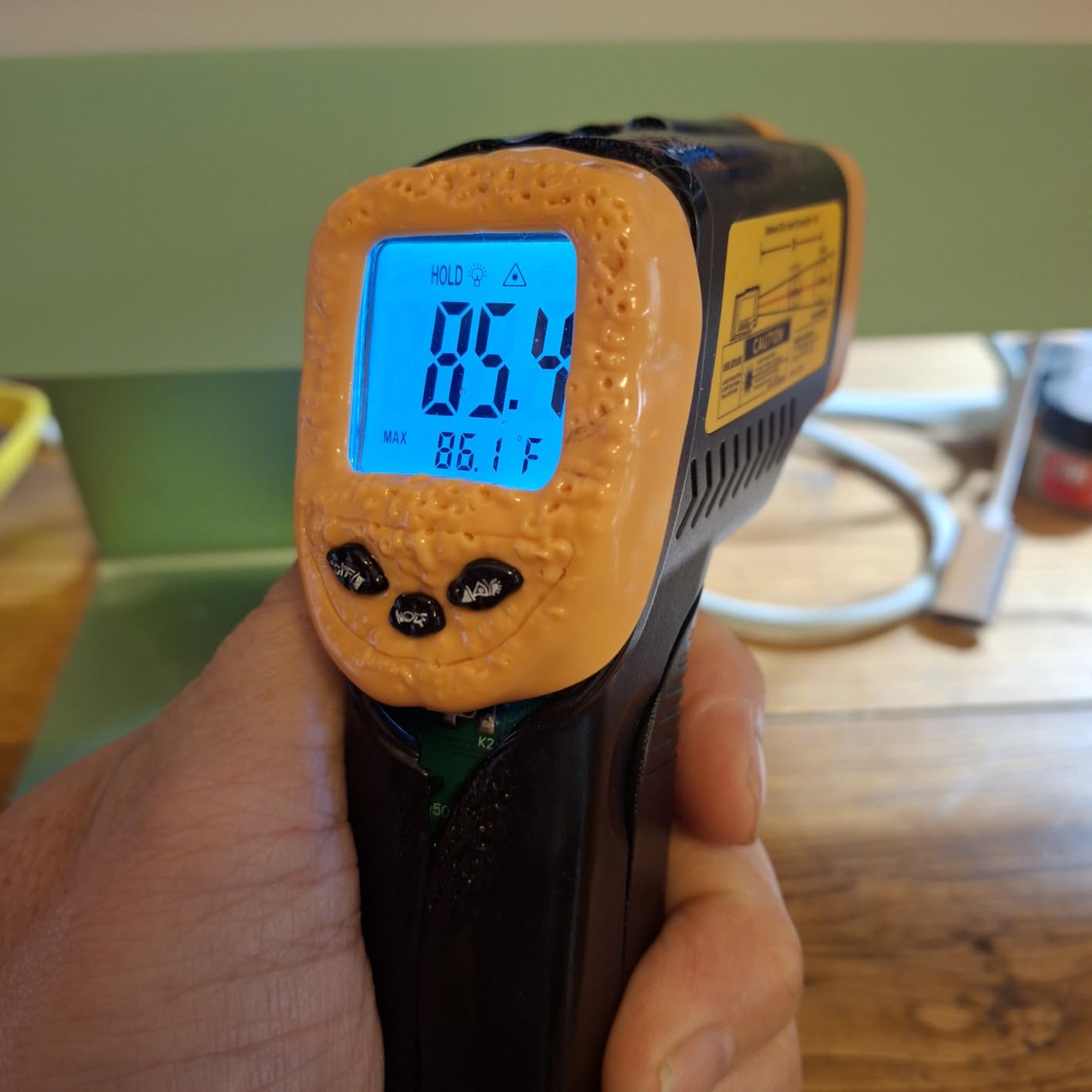
Two limits are worth being clear about. The 842F ceiling is well below where a wood-fired floor sits, so on that oven the gun runs out of scale before the stone does. And with no user-adjustable emissivity, readings on shiny steel or bright polished stone are less reliable than on a gun you can tune.
The averaging also cuts both ways. A genuine hot spot on the deck gets blended into the surrounding reading, so this is not the tool for mapping a specific warm patch. It is the tool for confirming the floor is even.
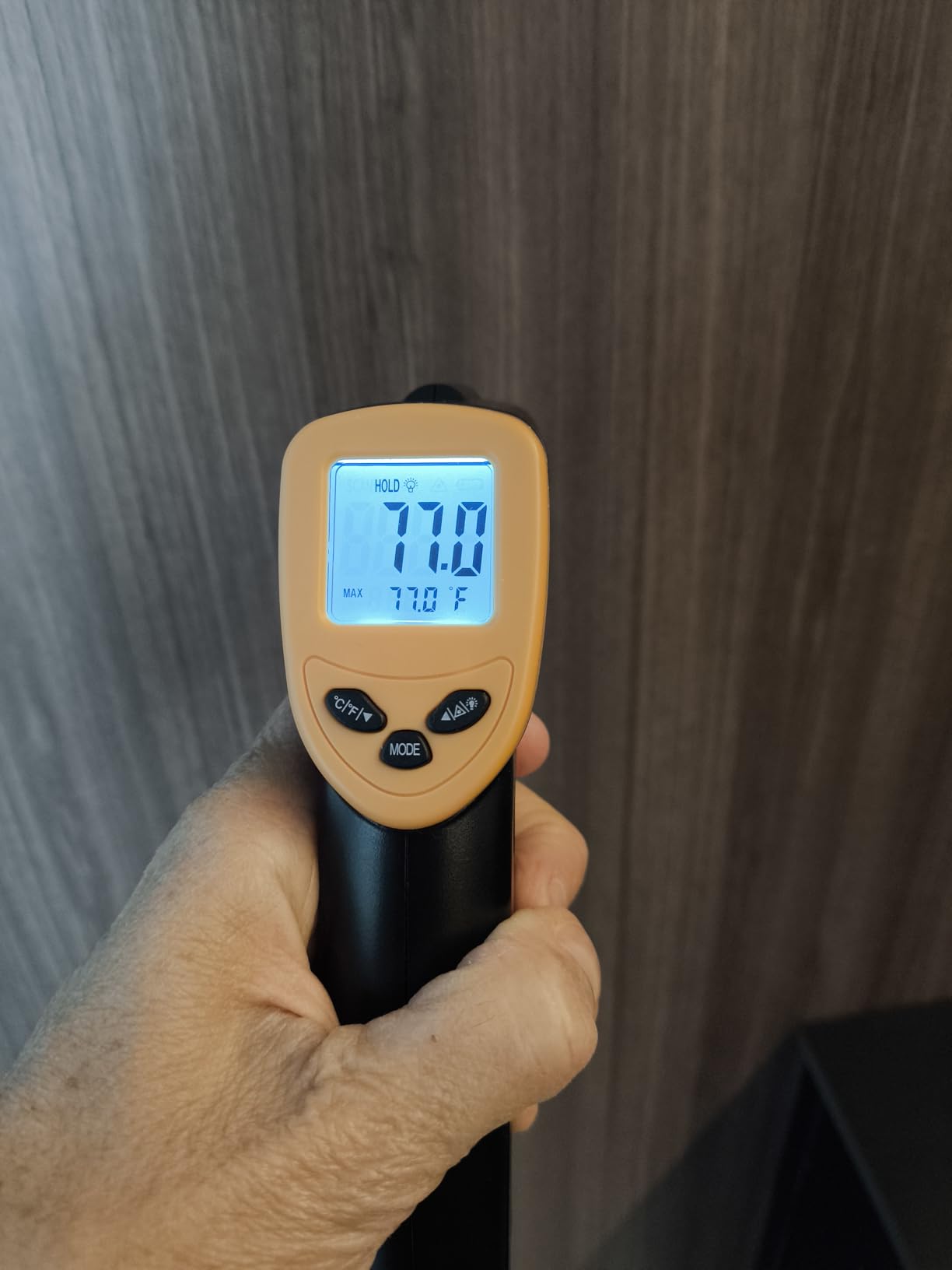
Best fit for electric and home ovens
At 425F to 550F floors, the ceiling is never in play and the averaged reading is a straight advantage. It suits anyone who bakes New York style at home or uses a pan in a standard oven.
Best fit for a wood-fired deck
It is not the one. Either the range runs out before your stone does, or the fixed emissivity setting leaves you guessing on a surface that changes colour as it seasons. For those ovens, pick a tunable model with a higher ceiling.
8. Klein Tools IR1 Review: Best Rugged Build, Limited Heat Range
Klein Tools IR1 Infrared Thermometer with Targeting Laser, Auto-Hold, More
Range: -4F to 752F
10:1 distance-to-spot
Fixed 0.95 emissivity
Response: 0.5s
Pros
- Rated for a 6.6 ft drop with a solid professional grip
- Auto-hold keeps the reading after you pull the gun back
- Custom pouch included for tool-bag storage
- Consistent quick readings for everyday use
Cons
- 752F ceiling is the lowest in the group
- Fixed 0.95 emissivity cannot be corrected for stone or metal
- 10:1 ratio is the narrowest here so you must stand close
- Unit switching described as cumbersome
The Klein is built like a trade tool rather than a kitchen gadget. Drop protection of 6.6 feet and a rubberised grip mean it can live in a van, a grill bag or a builder’s pouch, which is where a lot of pizza oven thermometers end up.
Auto-hold is the feature crust bakers notice. You can aim into the oven, release the trigger, pull the gun back to a comfortable reading angle and still see the value, instead of holding your arm in the heat to keep reading.
The heat ceiling is the problem. At 752F the gun gives up before a wood-fired stone gets anywhere near temperature, so it is only useful on cool decks and in gas ovens with a modest flame. For Neapolitan work on a hot stone it simply cannot report.
Emissivity is fixed at 0.95 with no adjustment, and the 10:1 ratio is the narrowest in the lineup, which means you stand close to the oven to get a small enough spot. Owners also find the Celsius and Fahrenheit switch awkward, and one review reported a battery arriving discharged.
Who it suits
Anyone who cooks on a griddle, a low-temperature deck or a home oven and wants something that survives being dropped. The pouch and the build quality make it a natural fit for a tool bag that already has Klein gear in it.
Who it does not suit
Anybody running a stone above 750F. That rules out most wood-fired baking and most hot gas decks, which is the majority of the crust-control use case this article covers.
9. Soonkoda GM50 Review: Budget Pick With a Useful Hold Function
Digital Infrared Thermometer gun for cooking,BBQ,Pizza oven,Ir Thermometer with Backlight,-58℉~932℉(-50℃~500℃) Handheld Non Contact Heat Laser Temperature Gun (Not for Human)
Range: -58F to 932F
Fixed 0.95 emissivity
SCAN and HOLD modes
0.1F resolution
Pros
- HOLD keeps the reading on screen after releasing the trigger
- 0.1F resolution display is finer than most rivals
- Backlit LCD for low light
- AAA batteries included and 932F covers most home ovens
Cons
- Fixed 0.95 emissivity needs tape or paint on shiny metal
- Listed response time of 10000 ms is slow for scanning
- No adjustable emissivity and no Max/Min mode
- Surface readings only
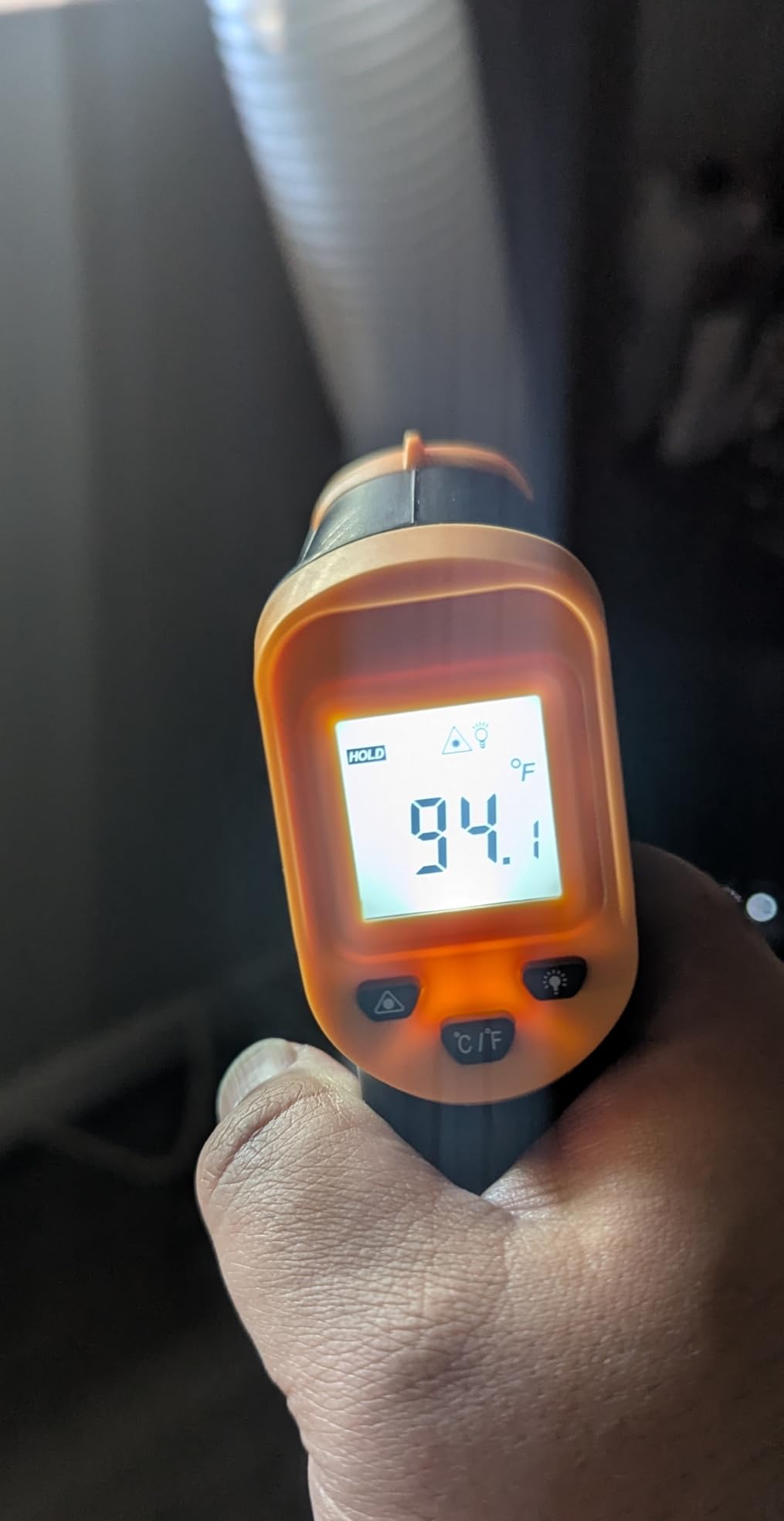
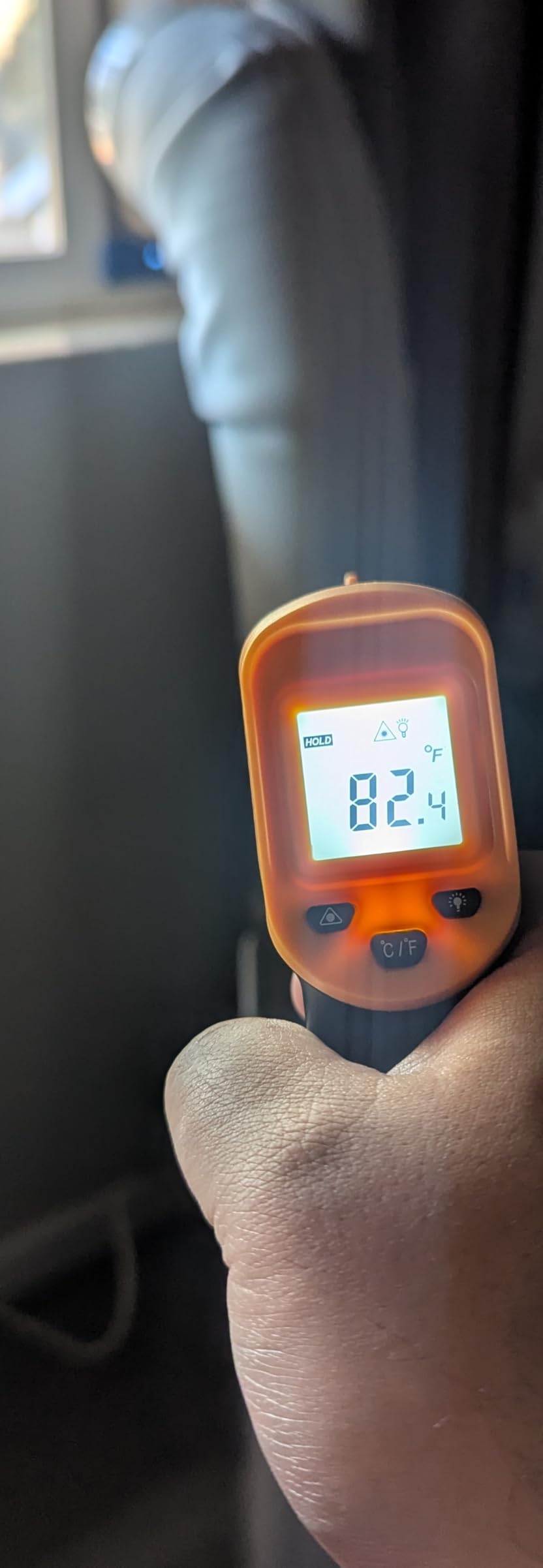
The GM50 does the one thing a crust-control thermometer must do at the lowest entry point in this group, and it adds a detail most cheap guns skip. The HOLD function locks the reading on screen when you release the trigger, so you can pull the gun away from the oven and still read the number.
That matters more in pizza work than it sounds, because the natural instinct is to check the display by holding the gun deep in the oven mouth. With HOLD you check it from outside instead.
Two limitations decide whether it works for you. Emissivity is fixed at 0.95, which is correct for clean stone but wrong for polished steel or aluminium, and the instructions themselves suggest masking tape or flat black paint on those surfaces. And the listed response time of 10000 ms is far slower than the half-second figures elsewhere, so sweeping a stone produces lagging numbers.
There is no Max, Min or Average mode, so hot-spot mapping is manual. For a preheat check and a floor reading before each launch, that is a workable workflow.
When it makes sense
For a first thermometer on an electric deck, a griddle or a modest gas oven, this covers the range you need and adds the hold function most budget models omit. The 0.1F resolution display is finer than several rivals in this list.
When it does not
On a very hot wood-fired stone, the 932F ceiling is tight and the fixed emissivity leaves no way to correct a seasoned or reflective deck. The slow response also rules it out for anything that involves scanning a moving target.
10. CDN GTS800X Review: Best Battery-Free Dial
CDN Grill Surface Thermometer | NSF Certified | ProAccurate® | Temperature Zones, High Heat, Color-Coded Scale – Laboratory Glass Lens – Perfect for Grill, BBQ – GTS800X
Analog dial
100F to 800F range
Stainless steel and glass lens
No batteries needed
Pros
- No batteries so it never fails mid-service
- Colour-coded zones read at a glance without numbers
- Glass lens and stainless steel handle high heat
- Five-year limited warranty and NSF certification
- Very light at 2.4 ounces
Cons
- Lowest average rating in the group at 4.2
- Analog precision is far below a digital display
- Must sit on the stone so you cannot read the dome
- 800F ceiling is close to the limit on hot decks
The CDN is the only non-electronic option here, and for some people that is the whole point. It has no batteries, no firmware and nothing to fail in the heat. You set it on the stone, glance at the colour band, and launch.
Colour-coded zones mean you are reading a band rather than a number, which is fast once you learn them. Stainless steel construction and a laboratory glass lens cover the high-heat surfaces it will sit on, and the five-year warranty is the longest in the group.
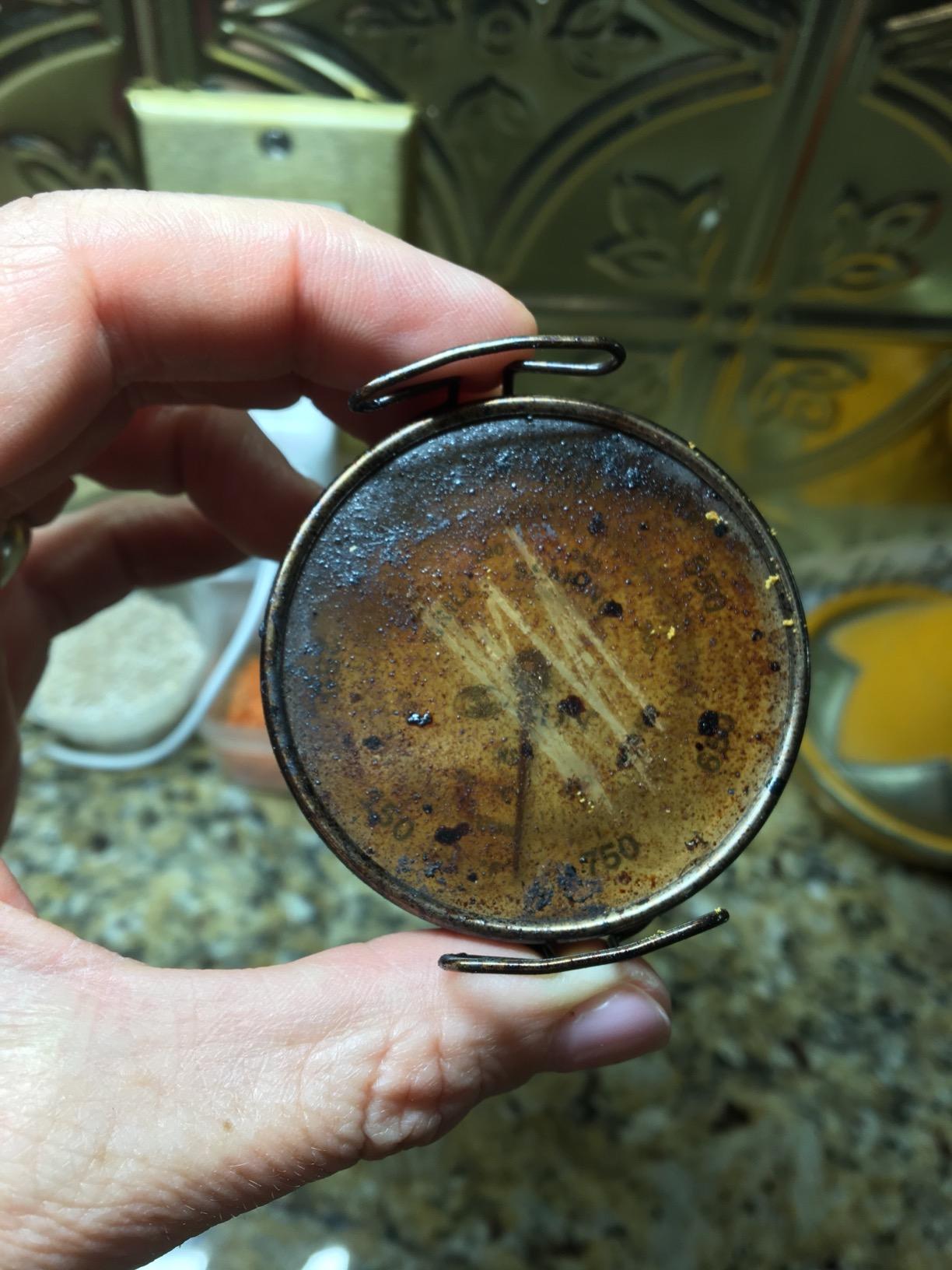
The fundamental limit is that measuring a surface with a contact dial means the dial itself is part of the surface. It changes what it is reading, sits in the landing zone, and cannot tell you anything about the dome or the air above the stone.
Its 4.2 average is the lowest here, with the largest share of one-star ratings among these products, mostly around reading accuracy and the coarse precision of an analog face. At 800F the ceiling is also close to the limit on a hot deck.
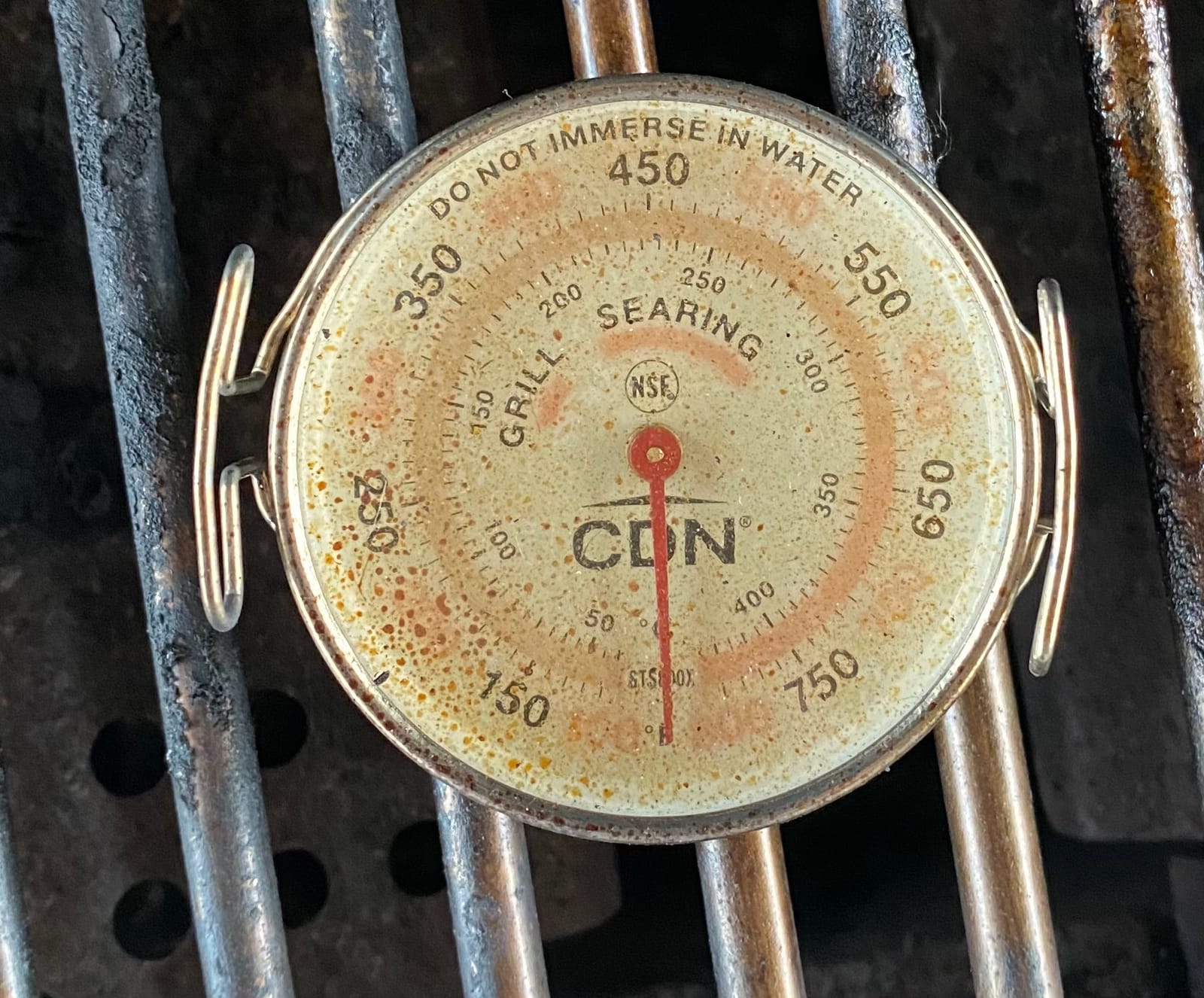
Where a dial genuinely helps
A busy service. Nothing about this tool needs charging, pairing or a fresh battery, so it never leaves you without a reading halfway through a rush, and the colour bands are readable from a step back.
Why most bakers use a gun instead
You cannot correct emissivity, you cannot map a deck remotely, and precision is coarse enough that a fifteen-degree difference is hard to see. If your aim is repeatable bake times, a digital gun with adjustable emissivity gives you far tighter control.
Pizza Oven Thermometer Buying Guide: Six Criteria That Matter
Once you know your target floor and dome temperatures, choosing between these ten is mostly about which spec gets in your way. Six criteria decide it.
1. Maximum temperature range
For a home electric oven, anything rated above 850F is more than enough. For a wood-fired floor or a hard-burned gas deck, you want a ceiling comfortably above 1000F so you are reading inside the scale rather than against the end of it. The Klein at 752F and the Etekcity at 842F both fall short for the hottest decks in this roundup.
2. Distance-to-spot ratio
The ratio tells you how wide the measured area is at a given distance. A 12:1 gun reads a one-inch spot at twelve inches, which is precise but puts you close to the oven. A 50:1 gun reads the same spot from fifty inches, which lets you check the back of a deck without reaching in. Ratio is about comfort and access, not accuracy class.
3. Adjustable emissivity
Every infrared gun assumes a surface emissivity, usually 0.95, and reports a corrected temperature. Cordierite stone and seasoned cast iron sit close to that default. Shiny steel, aluminium pans and polished surfaces do not, and there the reading can be badly wrong unless you can change the setting. Four guns here are tunable; the Etekcity, Klein, VESOGY and Soonkoda are not.
4. Single dot, multi-dot or dual laser
A single laser tells you one pixel and you infer the rest. A multi-point array or dual laser frames the footprint you are measuring. On a large stone we would rather see the area than guess it, which is why the VESOGY and the DEASOMIYE suit mapping work and the KNINE does not.
5. Response time and tracking modes
Half a second is fast enough for pizza. Max, Min and Average modes turn a manual sweep into a real hot-spot map, and a HOLD function lets you read the value from outside the oven. The Soonkoda’s listed 10 second response is the outlier and the reason it struggles with scanning.
6. Probe input and build
A K-type probe input lets one gun cover both surface and internal readings, and it lets you verify your IR reading with a contact comparison. Build matters outdoors: drop protection, a pouch and a grip you can hold with one hand while a peel is in the other. If you also bake on pans rather than stone, our roundup of 12 inch pizza pans for crispy crust covers the other half of the bake.
Frequently Asked Questions
What is the best thermometer for a pizza oven?
The TempPro TempScan TP30 is the best all-round pizza oven thermometer, with adjustable emissivity, a 1022F ceiling and a plus or minus 1.5 percent accuracy class. For very hot wood-fired decks the Kizen LP300 reaches 1112F, and for electric ovens under 850F the Etekcity Lasergrip 774 reads steady averaged numbers.
Do you need a thermometer for a pizza oven?
Yes, if you want repeatable crust. Oven dials and built-in probes report air or element temperature, not the surface of the stone, and forum bakers regularly see gaps of several hundred degrees between the two. Measuring the floor directly is the only way to know whether a pizza will bake in ninety seconds or sit and burn on the bottom.
What temperature should a pizza stone be?
It depends on the style. Aim for a 700F to 800F floor for Neapolitan pizza in a wood-fired oven, 725F to 775F in a countertop gas oven, 550F to 600F for New York style at home, and 425F to 450F for pan pizza. Read the floor at the point where the pizza will land, and keep the dome close to the floor temperature to avoid a burnt base under a pale top.
How do I calibrate a pizza oven thermometer?
Start with a consistency check rather than a laboratory procedure. Aim at the same marked spot on the same stone several times from the same distance and confirm the readings agree. For an adjustable-emissivity model, set the value to match your surface, then compare against a contact probe reading at the same point. Keep the distance to the manufacturer specification, since most accuracy claims assume it.
Why does my pizza burn on the bottom before the top browns?
The floor is almost certainly much hotter than the dome. Heat is arriving at the base of the dough from a stone sitting above your target while the ceiling is well below it, so the underside sets and colours before the top gets enough radiant heat. Check both readings, let the floor come down, and move the pizza to a cooler zone on the deck.
The Best Pizza Oven Thermometer for Crust Control
The TempPro TempScan TP30 is the best pizza oven thermometer for crust control in 2026. It has the tightest stated accuracy class here, adjustable emissivity you can match to stone or steel, tracking modes for hot-spot sweeps, and a review base deep enough that its behaviour is well documented.
Pick the Kizen LP300 if your floor runs past 1000F. Pick the Etekcity Lasergrip 774 if you bake on an electric deck under 850F and want the most proven reading. Pick the Temirup if you want to check the surface and the inside of the pizza with one tool. Pick the DEASOMIYE if reading from a distance keeps you out of the heat.
Whatever you choose, use it the same way every time. Check the preheat, split floor and dome, map three spots, watch the drop after a launch, and write the numbers down. Crust control is a habit built on repeatable readings, and this is a good year to start it.