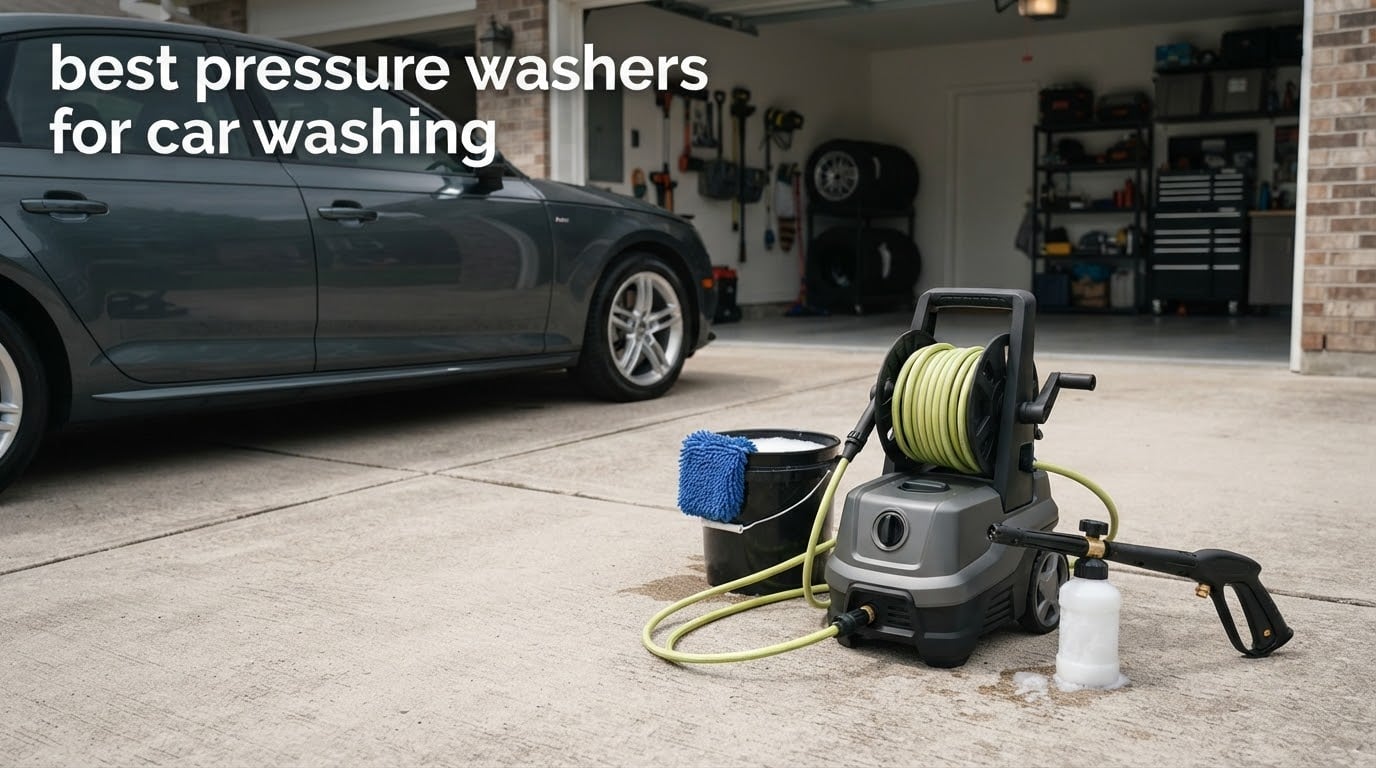
Most pressure washer roundups rank machines on driveway performance, which is the wrong test if you own a car. A washer that blasts concrete clean can etch clear coat, blow trim off a door edge and force water into a door seam, so the best pressure washers for car washing are a narrower, calmer group than the category suggests.
We compared ten machines against car-specific criteria: rated PSI inside the safe paint band, gallons per minute for rinse speed, whether the fittings accept a real foam cannon, hose length and flexibility, trigger weight over a full wash, and whether the frame is something you will actually lift over gravel. Ten products, six weeks of reading owner reports and matching them against published specs.
Two numbers decide almost everything. First, most car paint and clear coat tolerate roughly 1,200 to 1,900 PSI delivered at a 40-degree fan nozzle held about 12 inches off the panel, so anything far above 2,000 max PSI is headroom you do not need and should not use on paint. Second, GPM, not PSI, controls how fast grime rinses away and how thick foam gets, which is why a 1,900 PSI unit with 1.2 GPM cleans a car well while a 3,000 PSI unit at 1.1 GPM mostly makes noise.
If you want the wider field, we also cover entry-level pressure washers and the best pressure washers for driveways separately, because the priorities are not the same.
Table of Contents
- Top 3 picks for Best Pressure Washers for Car Washing (October 2026)
- Pressure Washers for Car Washing Compared in 2026
- 1. Sun Joe SPX3000 – Best All-Around Car Washer
- 2. Westinghouse ePX3100v – Best Corded Electric With a Foam Cannon
- 3. Karcher K1700 – Best Value With Certified Specs
- 4. Westinghouse ePX3500 – Best for High Rinse Flow
- 5. CRAFTSMAN CMEPW1700 – Best for Small Garages
- 6. Greenworks GPW2003 – Best for Flat Shelf Storage
- 7. Westinghouse WPX3000e – Best for Wheels and Driveways
- 8. A-iPower E2800-FM – Best Portable Option
- 9. Ryobi 1800 PSI – Most Versatile
- 10. EGO POWER+ HPW3200 – Best Cordless Washer
- How to Choose a Pressure Washer for Car Washing
- Frequently Asked Questions
- What PSI is safe for washing a car?
- Do I need a foam cannon for a car wash?
- How far should I hold a pressure washer from a car?
- Is a gas pressure washer better than electric for cars?
- How many cars can I wash on one cordless charge?
- Can pressure washing damage car paint?
- Can you pressure wash a car engine bay?
- Why does my pressure washer hose keep kinking?
- Final Verdict
Top 3 picks for Best Pressure Washers for Car Washing (October 2026)


The Sun Joe SPX3000 takes the top slot because five quick-connect tips, two onboard soap tanks and a 24.3-pound frame cover everything a weekly driveway wash needs without asking you to think about fittings. The Westinghouse ePX3100v carries the highest rating in the group and the most useful foam cannon in the box. The Karcher K1700 wins on certified output and standard M22 thread, which makes aftermarket foam cannons trivial to add later.
Pressure Washers for Car Washing Compared in 2026
| Product | Specs | Action |
|---|---|---|
| Sun Joe SPX3000 |
|
Check Latest Price |
| Westinghouse ePX3100v |
|
Check Latest Price |
| Karcher K1700 |
|
Check Latest Price |
 Westinghouse ePX3500 Westinghouse ePX3500 |
|
Check Latest Price |
 CRAFTSMAN CMEPW1700 CRAFTSMAN CMEPW1700 |
|
Check Latest Price |
 Greenworks GPW2003 Greenworks GPW2003 |
|
Check Latest Price |
 Westinghouse WPX3000e Westinghouse WPX3000e |
|
Check Latest Price |
 A-iPower E2800-FM A-iPower E2800-FM |
|
Check Latest Price |
 Ryobi 1800 PSI Ryobi 1800 PSI |
|
Check Latest Price |
 EGO POWER+ HPW3200 EGO POWER+ HPW3200 |
|
Check Latest Price |
Two things stand out in that table. Every corded machine here moves between 1.2 and 1.76 GPM, so the difference across that price range is pressure headroom you will not use on a car. Only two products in the group include a foam cannon that reviewers actually rate, and only one runs without a power cord.
1. Sun Joe SPX3000 – Best All-Around Car Washer
Sun Joe Pressure Washer, Electric Power Washer, 2500 Max PSI, SPX3000
Corded electric
2030 PSI max, 1.2 GPM
20-foot hose, 24.3 pounds
Dual 0.9L soap tanks
Pros
- Five quick-connect tips including a 40-degree fan
- 34-inch stainless steel lance with brass fittings
- Dual onboard 0.9L detergent tanks for two separate solutions
- Light 24.3-pound corded frame with no engine maintenance
Cons
- 2030 max PSI is modest for heavy concrete and stubborn build-up
- Limited onboard storage for hoses and nozzles
This is the machine I would hand someone who washes one car a week and does not want to think about it. It weighs 24.3 pounds, rolls on small wheels, and pulls 2030 max PSI at 1.2 GPM through a 20-foot hose. That combination is more than enough flow to rinse a sedan in a few minutes without the hose feeling like it is fighting you.
The nozzle selection is the real argument. Five quick-connect tips at 0, 15, 25 and 40 degrees plus a soap applicator cover everything from pre-rinsing to rinsing a mirror-smooth panel, and quick-connect means swapping tips takes a twist rather than a threading ritual. The 34-inch stainless steel lance is long enough to keep your arm clear of the rocker panel while you work low on the doors.
Those dual 0.9-liter detergent tanks are unusual at this level and genuinely useful for cars. You can keep shampoo in one and wheel cleaner or degreaser in the other, so a wheel clean does not mean dumping out your body wash first. It is a small feature that saves real time on a two-step wash.
Owners are split on pressure for hard surfaces, and that is the honest drawback. At 2030 max PSI with 1.2 GPM of rated flow, it is a car washer and a patio washer rather than a machine for breaking concrete. For stripping baked-on mud off a driveway slab you will want something else, and the compact frame has little room to coil hose and nozzles for storage.
How it performs on a foamed two-step wash
Attach a 40-degree tip, pre-rinse top to bottom, then draw clean water through the soap tank with the spray parked on the ground until the pump primes. Once foam is landing on the roof, you let it dwell while you work the lower half of the car. The steady 1.2 GPM flow means you are not standing around watching a fan of water crawl.
Rinsing is where the 25-degree tip earns its place. A wide rinse with the nozzle held back removes the loosened grit without the impact that a 15-degree tip delivers, which is the difference between a safe rinse and a spot you have to polish out later.
What to watch before you buy
The 20-foot hose is one notch shorter than the 25-foot hoses in this group, so washing a long sedan means repositioning the machine once. Owners also report that accessory storage is thin, and if you plan to add a foam cannon and a surface cleaner you will want a wall hook or a reel rather than the frame.
One more note on the power side. It is corded electric, so plan your reach around a 35-foot-class extension lead and a GFCI outlet. Keep the extension lead outside the wet area and dry the connectors before every session.
2. Westinghouse ePX3100v – Best Corded Electric With a Foam Cannon
Westinghouse ePX3100v Electric Pressure Washer, 2100 Max PSI 1.76 Max GPM, Built-in Carry Handle, Detachable Foam Cannon, Pro-Style Steel Wand, 3-Nozzle Set, for Cars/Fences/Driveways/Home/Patios
Corded electric
2100 max PSI, 1.76 GPM
25-foot hose, 17.6 pounds
Detachable foam cannon
Pros
- Highest average rating in the group at 4.7 stars
- Detachable foam cannon included for proper two-step washing
- 17.6-pound body with a built-in carry handle
- 25-foot hose plus pro-style steel wand
- Three-year limited warranty and ETL certification
Cons
- Only a three-nozzle set
- 2100 max PSI sits below the top-end units here
At 17.6 pounds with a built-in carry handle, this is the easiest machine in the group to move to a bucket and back, and the 4.7-star average across nearly 5,000 reviews reflects that. It is also the only mainstream machine here that comes with a detachable foam cannon you would actually keep rather than replace in the first month.
That foam cannon is the differentiator for car work. Budget canopies are usually undersized and mostly air, and owners end up buying a better one anyway. Getting a serviceable one from the start means you can run a proper two-step wash, which is the single most effective thing you can do for swirl-free paint.
The 25-foot easy-coil nylon braided hose is a real upgrade over a 20-foot vinyl line, and the pro-style steel wand gives you a solid grip through a long wash. At 2100 max PSI and 1.76 max GPM you have enough pressure for wheel barrels and enough flow to rinse a whole vehicle quickly.
The tradeoff is the nozzle set. Three nozzles is fewer than the five-tip units here, and you will want to add a 40-degree fan if it is not included, because that tip is where paint safety lives. Buyers who chase raw max PSI should also note this sits below the 2,500 and 3,000 max machines further down the list.
Why the foam cannon matters more than the PSI number
A foamed car gets lubricated before a mitt ever touches it, so grit gets suspended in the foam rather than dragged across clear coat. That is the whole argument. A washer that can deliver thick, clinging foam lets you work panel by panel with almost no mechanical contact, and this unit can do it out of the box.
The practical workflow is simple: pre-rinse, apply foam from the bottom up, dwell for a few minutes while you work the roof, then rinse top to bottom with a wide tip. Followed by a spotless rinse with the machine off and the nozzle pointed away to clear the film that causes water spots.
Where it falls short
At 17.6 pounds it is light enough to lift easily but light enough to feel less planted when you push a 25-degree tip across a wide door panel. The three-nozzle set is the clearest gap, and a small footprint means limited room to stash accessories.
Buyers who need serious flow for a truck, RV or trailer will find 1.2 rated GPM at the nozzle a little thin for a spotless rinse on very long panels. For a car, it is comfortable.
3. Karcher K1700 – Best Value With Certified Specs
Kärcher Pressure Washer K1700, CETA Certified, 3 Spray Nozzles, Detergent Tank, for Cars, Driveways, Siding, Patios, 1.2 max. GPM
Corded electric
1700 PSI TruPressure, 1.2 GPM
19-foot hose, 20.7 pounds
M22 quick-connect fittings
Pros
- CETA-certified 1700 PSI and 1.2 GPM for verified output
- Three nozzles plus a 0.5-gallon detergent tank
- Foot switch and automatic trigger-release shutoff reduce hand fatigue
- M22 fittings accept aftermarket quick-connect sets and foam cannons
- Never-flat wheels move easily over driveways
Cons
- Detergent tank produces thin suds rather than foam
- Limited built-in nozzle and hose storage
- Some owners report pressure fade and failures after winter storage
The Karcher K1700 is the pick for someone who already owns a foam cannon or plans to buy one. Its M22 fittings are the standard thread most aftermarket quick-connect sets and foam canisters use, so accessories from other brands bolt straight on with no adapter. That single detail saves more money than the price gap between this unit and any other on the list.
Its 1700 PSI sits right in the middle of the car-safe band, and the CETA certification means the rated output has been independently verified rather than taken from the box. The foot-operated on/off switch plus automatic trigger-release shutoff genuinely reduce hand fatigue over a full wash, which matters more than raw pressure once you are twenty minutes into a two-bucket session.
Long-term owners frequently report five years or more of service with only an O-ring change, and 20.7 pounds with never-flat wheels makes it easy to reposition around a car. The 19-foot hose is adequate for a sedan, though it is the second-shortest in this group.
The detergent tank is the weak point. Owners cite thin suds as the most common car-washing complaint, and they are right that a 0.5-gallon tank feeding a detergent nozzle is not a substitute for a foamer. Treat the tank as a pre-soak for heavy mud and buy a real foam cannon for the body.
When the certified numbers actually matter
CETA certification matters when you are buying sight-unseen from a listing full of inflated max numbers. It confirms the machine actually delivers its rated pressure and flow, so the 1700 PSI is real work and not a headline. For car washing, that reliability is worth more than another 800 max PSI of unusable headroom.
Because the trigger shuts the pump off when you release it, this unit idles efficiently and sits quietly between steps. It is a good fit for a shared driveway or a garage where a loud machine would be annoying at odd hours.
Who should skip it
If you have no foam cannon and no intention of buying one, the detergent performance will disappoint you. There is also limited built-in storage, and a smaller group of owners report pump or switch failures and hose-fitting leaks after long service, so treat the two-year limited warranty as the realistic coverage window.
Buyers who want the same M22 flexibility with a hose and a flow rating closer to 1.76 GPM should look at the Westinghouse units further down this list.
4. Westinghouse ePX3500 – Best for High Rinse Flow
Westinghouse ePX3500 Electric Pressure Washer, 2500 Max PSI 1.76 Max GPM with Anti-Tipping Technology, Onboard Soap Tank, Pro-Style Steel Wand, 5-Nozzle Set, for Cars/Fences/Driveways/Home/Patios
Corded electric
2500 max PSI, 1.76 GPM
25-foot hose, 19 pounds
Total-stop system
Pros
- 2500 max PSI and 1.76 max GPM in a compact frame
- Anti-tipping low center of gravity on 360-degree quick-lock wheels
- 25-foot nylon braided hose plus a 20-ounce onboard soap tank
- Total-stop system that shuts the pump down when the trigger is released
- Three-year limited service/labor and parts warranty
Cons
- Nineteen-pound steel frame is heavier than the smallest portable washers
- Nylon braided hose is less abrasion-resistant than a rubber hose
Flow is what this machine is about. It holds the top spot in Amazon’s pressure washer category with a 4.6-star average from roughly 7,500 reviews, and owners consistently single out how much water it moves for its size. High GPM is what makes a wide-fan rinse fast and what keeps a foam cannon from starving.
At 19 pounds with an anti-tipping low center of gravity and 360-degree quick-lock wheels, it stays stable when you push a 25-degree tip across a door and pivots rather than fighting you over gravel. The total-stop system shuts the pump down when you release the trigger, which saves energy and extends pump and motor life over years of weekly use.
The 25-foot easy-coil nylon braided hose and the 20-ounce onboard soap tank round out a package that covers a full wash without accessories. The 17.5-inch pro-style steel wand with 0, 15, 25, turbo and soap nozzles gives you the full spread, which is more than several cheaper machines here.
Why high GPM beats high PSI for a car
A car wash is a rinsing job, not a cutting job. You are moving dirt off a surface and off the car so the mitt never drags it across paint. GPM determines how quickly you can move that water and how wide a fan you can run without the nozzle starving at the tip.
That is why two machines with identical rated PSI can feel completely different. This unit’s 1.76 GPM max and total-stop behavior mean a spotless rinse is quick, which matters because mineral film that sits after a rushed rinse is what turns into water spots the next morning.
Where the extra power can hurt
At 2500 max PSI this unit has more headroom than a car needs, and 2000 rated PSI sits at the top of the range we would use on a clear-coated panel. Use a 40-degree fan held back, not a 15-degree tip held close, and stay off window seals and door gaps.
Its 19-pound steel frame is heavier than the lightest portable washers here, and the nylon braided hose, while flexible and easy to coil, will wear sooner than a rubber hose if you drag it across concrete regularly. Plan a hose reel if you own this one.
5. CRAFTSMAN CMEPW1700 – Best for Small Garages
CRAFTSMAN Electric Pressure Washer, Cold Water, Lightweight Corded Power Washer for Cars, Driveways, Patio and Garage, Powerful 1700-PSI, 1.2-GPM, Compact, Easy to Use (CMEPW1700)
Corded electric
1700 PSI, 1.2 GPM
20-foot hose, 17.5 pounds
35-foot power cord
Pros
- Seventeen-and-a-half-pound body that reviewers of all ages lift easily
- Quiet operation with automatic shutoff on trigger release
- Onboard storage for nozzle/hose/cord and wand
- 20-foot kink-resistant hose plus a 35-foot power cord
- CETA certified with a three-year limited warranty
Cons
- Soap applicator and included hose are frequently described as low quality
- Trigger gun needs an adapter for quick-connect accessories
- A minority report motor or pump failures after a year or two
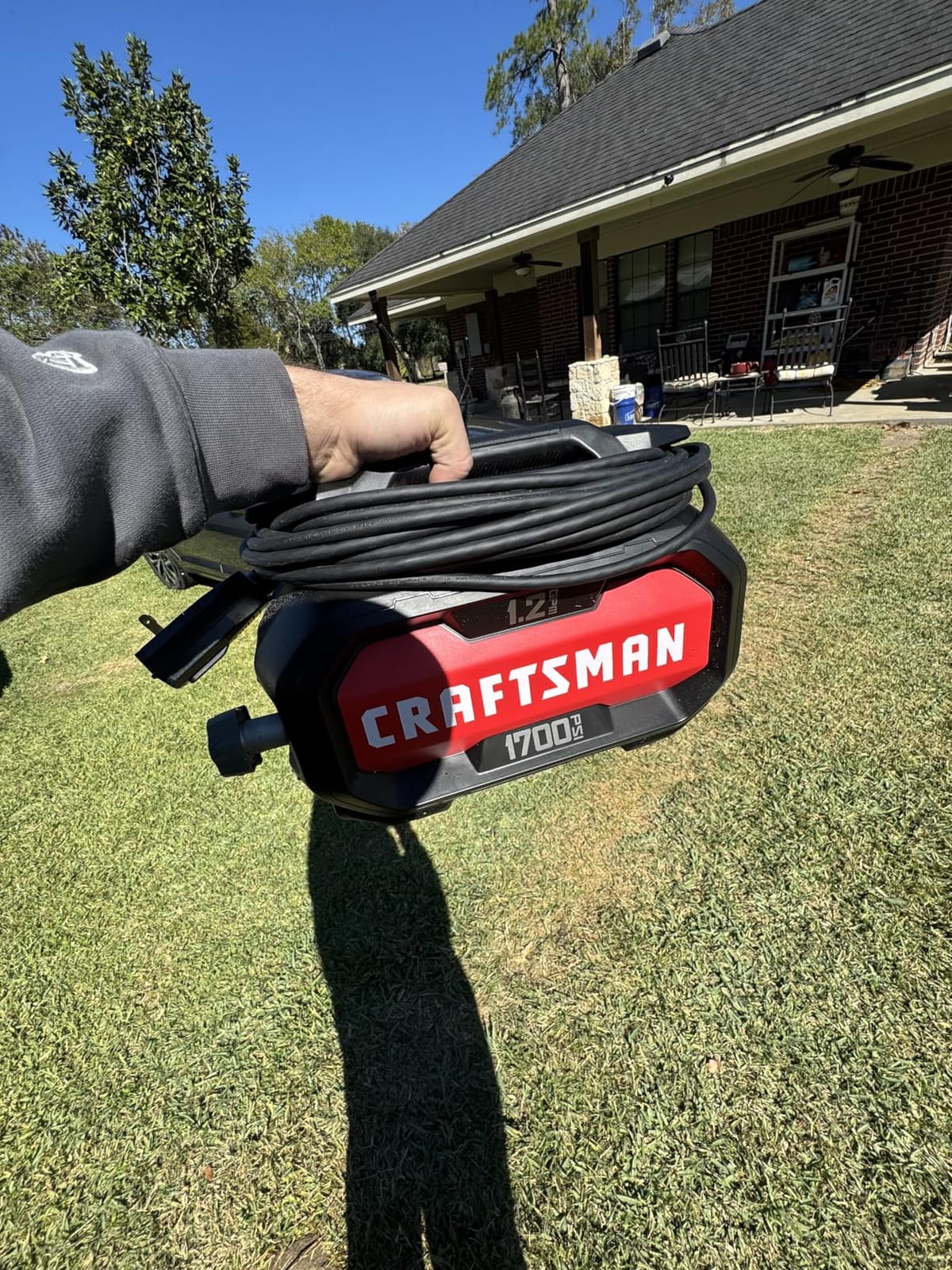
This is the quiet, tidy, easy-to-lift option. Owners consistently praise portability, low noise and the cord and hose length, and at 17.5 pounds it is one of the lightest machines here to move without thinking about it. If your car washing happens in a garage or a carport with a neighbour ten feet away, the quiet operation is a real advantage rather than a spec-sheet line.
What stands out is the storage design. Onboard storage for the nozzle, hose, cord and wand means the unit looks tidy on a shelf instead of becoming a pile of tangled line next to the bins. That matters in a small garage more than any max PSI figure.
With a 20-foot kink-resistant hose and a 35-foot power cord, reach is genuinely good for a driveway wash. The 40-degree and turbo nozzles plus a soap applicator cover the basic workflow, and automatic shutoff on trigger release keeps it from running while you walk to the other side of the car.
The honest drawback is accessories. Owners very often replace the included hose and soap applicator within months, and the trigger gun needs an adapter to accept quick-connect accessories, which matters if a foam cannon is part of your plan.
Living with the accessories
Because the trigger uses a threaded rather than quick-connect fitting, adding a foam cannon means an adapter rather than a twist. Plan on buying a short M22 to quick-connect adapter, and consider replacing the included hose early since owners report it as the first part to wear.
Once the accessory upgrades are done, the pump is the component owners rate as the strongest part of the machine, and 1700 PSI at 1.2 GPM is a comfortable car-washing combination that stays well inside the safe band.
Who should buy something else
If you want thick foam from the box, this is not the machine. If you need more than three spray patterns, the set is thin. And a minority of owners report motor or pump failures after a year or two of use, so if you want long-term service, the three-year warranty coverage is worth confirming at purchase.
Buyers who need more flow per minute should step up to a Westinghouse unit with a 1.76 GPM ceiling.
6. Greenworks GPW2003 – Best for Flat Shelf Storage
Greenworks 2000 PSI (1.2 GPM) Electric Pressure Washer
Corded electric
2000 PSI, 1.2 GPM
25-foot hose
Removable handle for flat storage
Pros
- PWMA performance-tested 2000 PSI and 1.2 GPM output
- Push-button motor start that idles off when the wand is not engaged
- Onboard soap tank with a switchable soap tip
- Removable handle lets the machine store flat on a garage shelf
- Large wheels and a light frame make yard maneuvering easy
Cons
- 25-foot hose is short for longer vehicles
- Included hose and nozzles often get upgraded by owners
- Anodized aluminum connectors can seize against brass fittings
The removable handle is the feature that makes this machine different in a small space. Detach it and the unit stores flat on a garage shelf instead of standing upright at 31.73 inches tall, which is a genuine saving if you are working around shelving and a workbench rather than a dedicated bay.
Performance-wise, 2000 rated PSI at 1.2 GPM sits neatly in the car-safe band, and the push-button motor with start and stop technology idles the pump off when the wand is not engaged. That saves energy and reduces run time, and it is quieter than several competing electric units while idling.
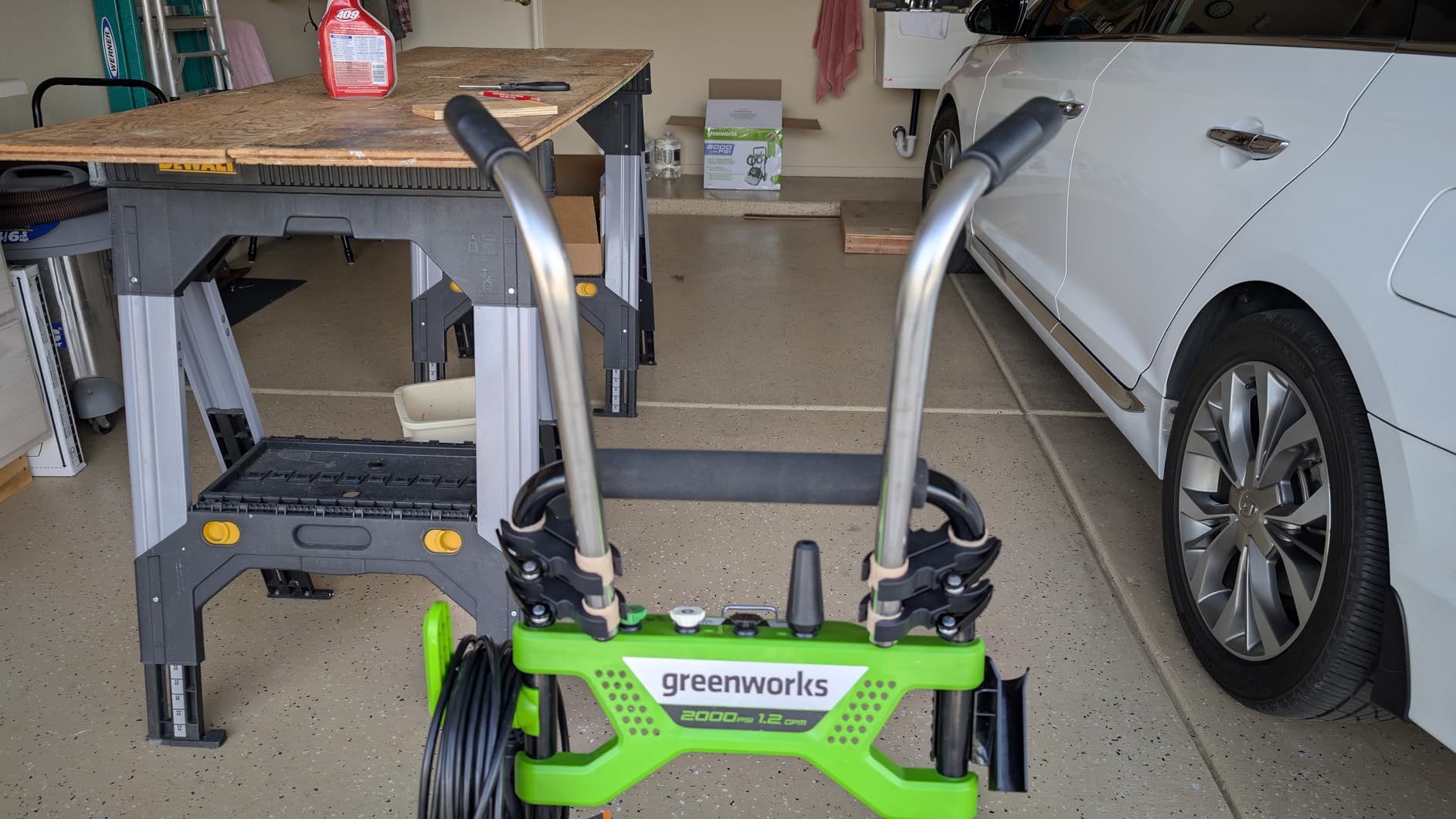
Large wheels and a light frame make it easy to move around a yard, and the onboard soap tank with a switchable soap tip handles a pre-soak. Owners find it powerful and easy to assemble for cars, decks and concrete, with a 4.4-star average from about 1,670 reviews.
There are more cons here than most, and two are worth acting on. The 25-foot hose is short for washing longer vehicles without repositioning, and the anodized aluminum connectors can seize against brass fittings, so check them seasonally rather than forcing them.
Getting the accessories right
Owners report a recurring pattern of accessory upgrades, with the included hose and nozzles limiting delivered pressure in some cases. A replacement hose and a decent foam cannon are the two purchases most owners make, and both are worth budgeting for up front.
The anodized aluminum connectors are worth a dab of anti-seize if you live somewhere with hard water, and the fit should be checked seasonally rather than forced.
Where it fits and where it does not
This machine suits anyone washing a sedan in a driveway with a normal garden hose connection and a shelf for storage. It is less suited to RV or trailer owners who need long reach, and a small group of owners report motor or pump failures within months, so check the warranty terms before buying outside a major retailer.
Buyers who want more flow for a spotless rinse on a long panel should look at a 1.76 GPM unit instead.
7. Westinghouse WPX3000e – Best for Wheels and Driveways
Westinghouse WPX3000e Electric Pressure Washer, 3000 Max PSI and 1.76 Max GPM, Induction Motor, Onboard Soap Tank, Spray Gun and Wand, 5 Nozzle Set, for Cars/Fences/Driveways/Homes/Patios/Furniture
Corded electric induction
3000 max PSI, 1.76 GPM
36.8 pounds
25-foot super-flex hose
Pros
- Highest pressure output in the group at 3000 max PSI
- 25-foot abrasion-resistant super-flex hose with metal gun and wand
- Five quick-connect nozzles accepting surface cleaners and foam cannons
- Rugged steel frame with 10-inch never-flat wheels and a 35-foot GFCI cord
- Three-year limited service/labor and parts coverage
Cons
- Thirty-six-and-a-half-pound steel frame is the least portable machine here
- Largest storage footprint at over 36 inches tall
- Small 0.45-gallon soap tank needs refilling during long jobs
This is the machine for the parts of a car that are not painted. Wheel barrels, tire sidewalls, wheel wells, the underside of the car and a concrete driveway all reward pressure, and 2600 rated PSI with an induction motor and an axial three-piston auto-stop pump is the strongest combination in this group.
The 25-foot abrasion-resistant super-flex hose is the best included hose in the group by a wide margin. Flex hoses resist the kinking that ruins lesser hoses, and the metal spray gun and wand feel like professional equipment rather than an accessory bin. Five quick-connect nozzles including a soap tip accept surface cleaners and foam cannons, so the same machine handles a driveway and a car.
For detailers and enthusiasts washing multiple vehicles in a weekend, the durability story matters as much as the numbers. Owners point to the pressure output and the steel-frame build as the reasons this unit stands apart, and they accept the size in exchange for cleaning power.
Keeping it off your paint
At 2600 rated PSI this is above the range we would use on a clear-coated body panel. If it touches a car, stay on a 40-degree fan nozzle held 12 or more inches back, stay off window seals and door gaps, and use the turbo tip only on wheels and underbody.
We would not put this machine in the hands of someone learning to wash a car. The power is genuinely useful, but it rewards technique that takes practice to develop.
Honest drawbacks
At 36.8 pounds with a 36.6-inch-tall steel frame, this is the least portable machine here and the hardest to store in a small garage. The 0.45-gallon soap tank is small enough that you will refill it mid-wash on a long job, and moving 36.8 pounds over gravel is a real chore.
If your washing is car-only, you are paying in weight and storage for headroom you should not use. It pairs well with our driveway pressure washer guide for readers who do both.
8. A-iPower E2800-FM – Best Portable Option
A-iPower Electric Pressure Washer 2800 Max PSI 1.7 Max GPM Follow Me
Corded electric
2800 max PSI, 1.7 GPM
18.2 pounds
25-foot hose, five nozzles
Pros
- 2800 max PSI with 1.7 max GPM in an 18.2-pound frame
- 35-foot power cord and 25-foot pressure hose for generous reach
- Five nozzles at 0;15;25;40 degrees and turbo
- Four quick-lock wheels with 360-degree steering and a low center of gravity
- Total-stop system that powers down when the trigger is not engaged
Cons
- Short 19.6-inch height puts the handle low during use
- Smaller review base and lower sales rank than the category leaders
Getting 1.7 GPM out of an 18.2-pound machine is unusual, and that is why this one made the list. The 25-foot pressure hose and 35-foot power cord give you enough reach to circle most vehicles without moving the unit, and the five nozzles including a 40-degree fan cover the full car-wash workflow out of the box.
Owners frequently describe it as powerful, quiet, lightweight and easy to assemble, using it for composite decks, siding, patios and car washing. The 4.5-star average comes from about 980 reviews, which is a smaller base than the category leaders and worth keeping in mind.
The four quick-lock wheels with 360-degree steering and a low center of gravity keep it stable in use, and the total-stop system powers down when the trigger is not engaged so it does not run while you walk around the car.
The real drawback is ergonomics rather than output. At 19.6 inches tall, the handle sits low during use, so a tall operator will spend more time bent over than they would with a full-height frame.
Balance of pressure and flow
The 1.7 GPM flow rate is the reason this unit rinses quickly despite its light weight. High flow is what keeps a wide fan from starving at the tip and what makes a spotless rinse fast enough that you do not rush the final pass and leave mineral film behind.
At 2000 rated PSI it also sits in a workable range for a car, provided you use the 40-degree tip at a distance. The 25-degree tip is for wheel barrels and tires, and the turbo is for concrete and underbody work only.
Who should look elsewhere
If you are tall, the low handle will bother you over a full wash. If you want long-term support, the two-year manufacturer warranty is shorter than the three years offered by several competitors here, and the smaller review base gives you less long-term data.
Buyers who want the same flow with a taller frame and more nozzles should compare the Westinghouse units in this roundup.
9. Ryobi 1800 PSI – Most Versatile
1800 PSI Electric Pressure Washer
Corded electric
1800 PSI, 1.2 GPM
20-foot hose
12.5 by 10 by 9 inch footprint
Pros
- 1800 PSI with 1.2 GPM is adequate for routine vehicle washing
- Very compact 12.5 by 10 by 9-inch footprint for tight storage
- M22 trigger handle connections accept common aftermarket accessories
- Three nozzles with a spray wand and trigger handle
- Corded electric with no engine maintenance
Cons
- Only three nozzles against four- and five-nozzle competitors
- 20-foot hose is short for washing long vehicles
- Published specification detail is limited on the listing
The appeal here is size. At 12.5 by 10 by 9 inches, this is the smallest unit in the roundup by a clear margin, and for a small garage, a rental closet or a service van that is the difference between owning a pressure washer and not. Community recommendations repeatedly call the 1,600 to 1,800 PSI corded electric class the best value for car washing, and this sits right in the middle of it.
The M22 trigger handle connections accept common aftermarket accessories, including quick-connect sets and foam cannons, so you are not locked into one brand. Corded electric means no fuel, no oil changes and no engine storage problem, which is why so much of the car-detailing crowd has moved to this power source.
At 1800 PSI the output sits comfortably in the car-safe band, and satisfaction centers on adequate pressure for cars and patios with a very compact footprint. The 4.3-star average comes from roughly 715 reviews, a smaller base than the leaders.
Three nozzles at 15-degree, soap and turbo is a thin set. You will want a wider fan tip for rinsing, and the 20-foot hose is on the short side for a long vehicle, so expect to reposition once per wash.
Why the community keeps recommending this class
The recurring argument in car-detailing forums is that most people think their pressure washer is too weak when they are actually holding it too close or using too narrow a nozzle. With a 40-degree fan at 12 inches, a machine in this class rinses a car cleanly and safely, and the foam and dwell time do the real cleaning.
That is the whole case for a budget electric unit. You are buying flow, fittings and a small footprint rather than headroom.
The limitations to plan around
Plan on adding a wide-fan nozzle and possibly a foam cannon, since the bundled set is minimal. The 20-foot hose limits reach, and the published specification detail on this listing is thinner than the other products here, so verify the fittings before you buy an adapter.
Buyers who want more flow for a fast spotless rinse should step up to a 1.7 or 1.76 GPM unit.
10. EGO POWER+ HPW3200 – Best Cordless Washer
EGO POWER+ Electric Pressure Washer, 3200 PSI Power Washer – HPW3200
Cordless 56V battery
3200 PSI, 2.0 GPM max
25-foot hose, 36.2 pounds
5-year tool warranty
Pros
- The only cordless option here;up to 3200 PSI and 2.0 GPM max
- Eco/High and Turbo power modes shown on a wand display
- Draws from a garden hose or any fresh water source via the included siphon hose
- Includes foam cannon;stainless wand;quick-connect gun and five nozzles
- Five-year tool warranty and compatibility with all EGO 56V ARC batteries
Cons
- Most expensive unit here and needs two 56V batteries for full output
- 36.2-pound weight is heavy for a cordless machine
- 7.62-meter hose rating is shorter than many corded machines
No cord means no trip hazard in an enclosed garage, no extension lead to run across a driveway and no GFCI to trip mid-wash. That is the entire argument for battery power on a car, and it is why enthusiasts who already own an EGO 56V platform keep choosing this machine despite the cost.
It runs on two 56V ARC Lithium batteries combined and delivers up to 3200 PSI with 2.0 GPM max, which is the highest flow figure in this roundup. Eco, High and Turbo modes let you dial the power down for paint and up for wheels, and the wand-integrated display shows battery charge while you work.
The siphon hose is the detail that separates it from a normal hose-fed machine. It draws from a garden hose or any fresh water source, so you are not limited to a spigot at the right height, and the included foam cannon, stainless steel wand, quick-connect gun and five nozzles mean the accessory list is complete on day one.
On cars per charge, two 56V batteries comfortably cover a sedan or small SUV with pre-rinse, foam, dwell and two rinses. For a large truck, a second charge is realistic. The telescoping handle collapses for storage, which partly offsets the 36.2-pound weight.
When cordless makes sense
If you wash in a closed garage, a shared carport or an apartment parking spot with no dedicated outlet nearby, cordless removes the single most common complaint about electric pressure washers. It also travels, so a mobile detailing setup is genuinely practical with this machine.
Buyers already invested in EGO 56V ARC batteries get the best value here, since the batteries and chargers are shared across the platform. Starting from zero, the platform cost is the barrier that keeps most buyers on corded electric.
The honest drawbacks
At 36.2 pounds it is heavier than most compact corded machines here, which undercuts the portability story somewhat. The 7.62-meter hose rating is 25 feet, shorter than several corded machines here, and the 4.4-star average rests on the smallest review base in the group at roughly 500 reviews.
At 3200 PSI the paint-safety rules matter more here than anywhere else in the roundup. Use the 40-degree tip at distance, and save Turbo for wheels and underbody. Buyers who want more foam density than a single-charge session allows should read the foam section in the buying guide below.
How to Choose a Pressure Washer for Car Washing
Buy on flow, fitments and paint safety, in that order. Everything else on the spec sheet is either irrelevant to a car or actively dangerous to use. If you want the full buying framework for a wider range of machines, our guide to hot water pressure washers for grease covers the other end of the power spectrum.
What PSI is safe for your car’s paint
Most automotive paint and clear coat tolerate 1,200 to 1,900 PSI delivered through a 40-degree fan nozzle held about 12 inches from the panel. Keep the fan wide and the distance generous, and treat anything above 2,200 max PSI as a job for wheels, concrete and underbody rather than for paint.
Body panel and clear coat: 1,200 to 1,800 PSI with a 40-degree fan held 12 to 20 inches away
Glass, trim, badges and door seams: under 1,500 PSI with a 40-degree fan held back, never digging into gaps
Wheels, tires and wheel barrels: 1,800 to 2,200 PSI with a 25-degree or turbo tip at 8 to 12 inches
Underbody and wheel wells: under 2,000 PSI with a turbo tip from underneath, car properly supported
Engine bay: never. Use a foam sprayer and a low-pressure rinse instead.
Impact is a function of pressure, cone concentration and distance, which is why a 0-degree tip held six inches from a door will damage paint that a 40-degree fan at 18 inches will not touch even on the same machine. If a washer feels too weak, widen the fan or step back before you conclude it lacks power.
PSI vs GPM vs cleaning units
PSI is pressure at the nozzle. It cuts grime and, past a point, cuts paint. Treat it as a ceiling for cars, not a target.
GPM is flow. It decides how fast you rinse, how wide a fan you can run and how thick your foam gets. For cars it matters more than PSI.
Cleaning units are PSI multiplied by GPM. A 1,900 PSI at 1.2 GPM machine and a 1,500 PSI at 1.5 GPM machine can land on the same number while feeling completely different, so use CU as a tiebreaker, not a target.
Adding one GPM at the same PSI produces a much better car wash than adding 500 PSI you will never use. That is why four of the picks in this roundup quote a 1.76 or 1.7 GPM ceiling and why we rank them highly for cars.
Corded electric, cordless or gas for cars
Corded electric: low noise, needs an outlet and an extension lead, minimal maintenance, and the most easily metered spray for paint.
Cordless battery: low noise, no cord so it travels anywhere, no engine maintenance, and selectable power modes. Platform cost is the barrier.
Gas: highest flow and full portability, but loud, hard to keep gentle on paint, and it adds fuel, oil changes and storage problems.
For cars, corded electric wins on control and quiet operation, and cordless wins on freedom. Gas delivers the highest flow but is the hardest to keep gentle, and storing fuel in a small apartment or garage is a dealbreaker for a lot of people.
Foam cannon and fitting compatibility
Foam is the single most effective thing you can add to a car wash, because a lubricated surface means the mitt never drags grit across clear coat. The recurring purchase blocker is thread sizing, so check it before you buy a canister.
1/4-inch quick-connect is the aftermarket standard and the most flexible. Most budget canisters use a cheap twist lock that will not accept good accessories.
M22 thread is the common metric thread on spray guns from Karcher, Greenworks, Ryobi and Westinghouse. It accepts 1/4-inch quick-connect adapters and is the easiest upgrade path.
Siphon or draw mode feeds soap from a separate container through a hose. The EGO machine includes a siphon hose, and machines with an onboard tank rely on a detergent nozzle instead.
Bundle check: only the Westinghouse ePX3100v and the EGO HPW3200 include a foam cannon that owners keep. Everyone else should budget for one.
Hose and wand quality
Hose kinking is the most repeated complaint in owner reports, and it costs you pressure at the gun every time it folds. A kinked hose drops the pressure reaching the nozzle and makes the wand feel like it is losing power when the machine is fine.
Nylon braided hoses are flexible and easy to coil but wear faster than rubber when dragged across concrete. Super-flex hoses resist kinking best of all, and the Westinghouse WPX3000e has the strongest included hose in this group. If your machine comes with a 20-foot vinyl line, replacing it with a 25-foot flexible hose is the first upgrade most owners make.
Does a pressure washer replace a mitt wash?
No, and the products that claim otherwise are selling you swirls. A pressure washer is a rinsing and decontamination tool. It removes loose grit, snow foam and road film faster than a hose, which lets you wash with a clean mitt and a bucket of lubricated suds and touch the paint far less.
Used that way, the washer improves your wash quality rather than replacing it. The low-contact method is simple: pre-rinse, foam and dwell, contact wash panel by panel from the roof down, then a wide-fan rinse and a spotless rinse with the machine off.
Six-step wash technique
Pre-rinse the whole car top to bottom to knock off loose grit before anything touches the paint.
Foam from the bottom up and let it dwell while you work the upper panels.
Contact wash with a clean mitt and lubricated suds, working top to bottom in sections.
Rinse each section immediately with a 40-degree fan held 12 or more inches back.
Rinse wheel barrels and tires separately with a 25-degree or turbo tip.
Do a spotless rinse with the machine off and the nozzle pointed away, then dry to avoid water spots.
Two rules matter more than the rest. Never point a high-pressure stream into a door seam, window seal or badge gap, and never pressure wash an engine bay. If you want more foam density or a different chemical setup, our budget pressure washer guide covers the entry tier in more detail.
Frequently Asked Questions
What PSI is safe for washing a car?
Most automotive paint and clear coat tolerate 1,200 to 1,900 PSI through a 40-degree fan nozzle held about 12 inches from the panel. Use lower pressure on glass, trim and badges, and reserve 1,800 to 2,200 PSI for wheels and tires. Anything above 2,200 max PSI has no place on a painted surface.
Do I need a foam cannon for a car wash?
A foam cannon is the most useful accessory you can add. It lays down thick, clinging foam that lubricates the surface so your mitt does not drag grit across clear coat. Check the fitting type first, since 1/4-inch quick-connect and M22 thread are not the same, and only two machines in this roundup include a canister worth keeping.
How far should I hold a pressure washer from a car?
Keep a 40-degree fan nozzle about 12 to 20 inches from a painted panel, and never closer than 8 inches on any surface. Impact scales sharply with distance, so stepping back is the fastest way to make an overly powerful machine safe. Avoid door seams, window seals and badge gaps entirely.
Is a gas pressure washer better than electric for cars?
Not for most people. Gas offers the highest flow and full portability, but output is harder to meter, the noise is much higher, and fuel and oil changes add cost and storage problems. Corded electric gives the most controllable spray, and cordless removes the cord entirely. Reserve gas for wheels, underbody work and driveways.
How many cars can I wash on one cordless charge?
With two 56V batteries combined, the EGO POWER+ HPW3200 comfortably covers a sedan or small SUV with a pre-rinse, foam, dwell and two rinses on a single charge. A large truck or an RV will usually need a second charge. Cordless runtime also drops in Turbo mode, so use High mode for paint.
Can pressure washing damage car paint?
Yes, if you use a narrow nozzle close to the panel or point the stream into a seam. Clear coat, one-coat paint, plastic trim, badges and window rubber are the most vulnerable. A 40-degree fan held 12 to 20 inches back stays inside the safe range on almost any machine, including a 3,000 PSI washer.
Can you pressure wash a car engine bay?
No. High-pressure water forces water past seals and into electrical connectors, and it can spread oil and brake fluid across the bay. Use a foam sprayer with a low-pressure rinse instead, and never aim a turbo nozzle into an engine compartment. The same rule applies to the area directly under a fuel tank.
Why does my pressure washer hose keep kinking?
Usually the hose is too short for the job, too thin, or being coiled tightly for storage. Kinks cut the pressure reaching the gun, so the wand feels weak even when the pump is fine. Replace it with a 25-foot flexible or super-flex hose in the connector type your gun uses, and store it on a reel rather than wound in a tight loop.
Final Verdict
The Sun Joe SPX3000 is the best pressure washer for car washing overall, because five quick-connect tips, dual soap tanks and a 24.3-pound frame cover a weekly driveway wash without fittings guesswork. If foam capability outranks everything else, the Westinghouse ePX3100v includes a foam cannon you will keep and carries the highest rating in the group. For certified output and standard M22 fittings that accept any aftermarket canister, the Karcher K1700 is the value pick, and for the smallest storage footprint the Ryobi 1800 PSI wins.
Whatever you choose, respect the numbers. A 40-degree fan at 12 to 20 inches keeps every machine in this roundup inside the range automotive clear coat can handle, foam before contact keeps grit off the paint, and no pressure washer replaces a mitt. The best results come from a machine you can control, not the one with the highest number on the box.