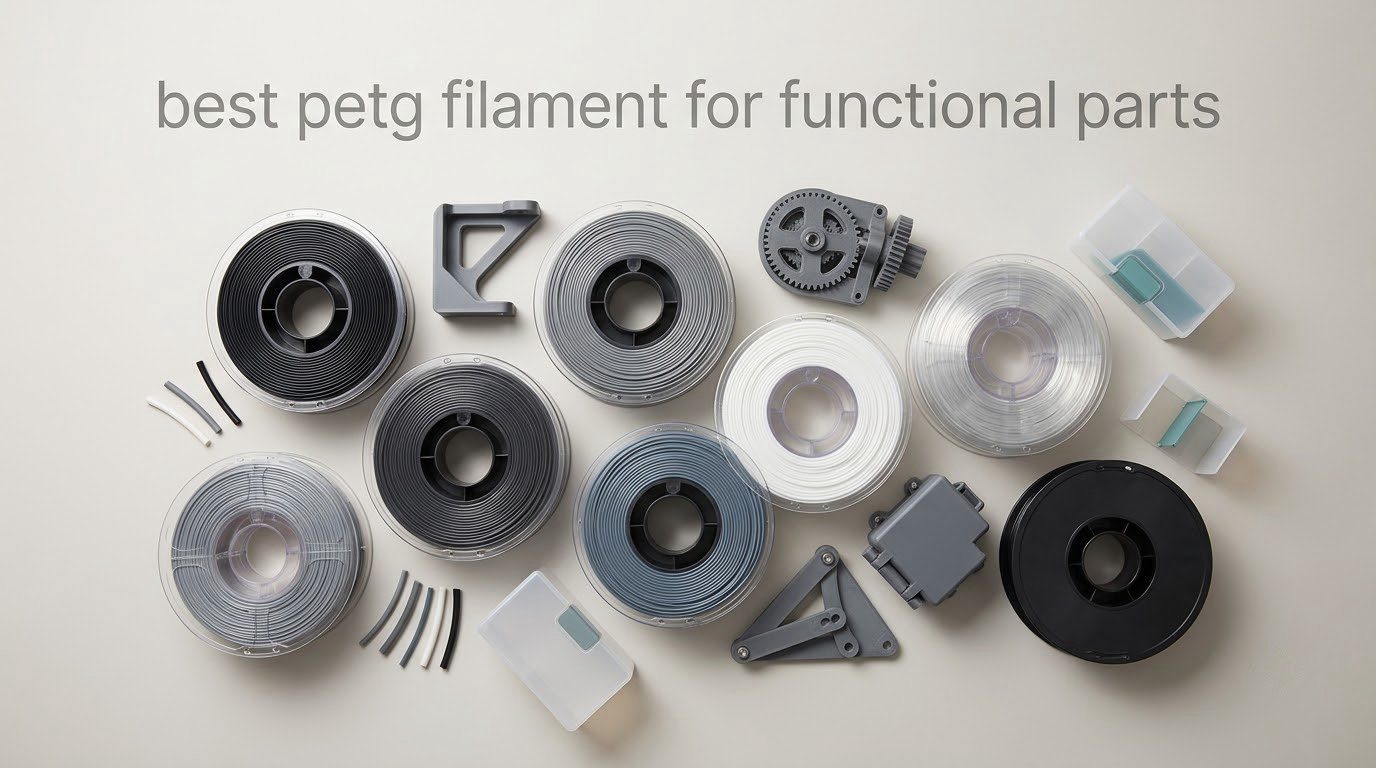
PETG is the default FDM material for functional parts, and the reason is chemistry rather than marketing. It is a glycol-modified polyester: a bulky CHDM comonomer replaces part of the ethylene glycol, which suppresses crystallisation and leaves the polymer amorphous. Because the chains cannot form crystals as they cool, the part shrinks very little on the bed and stays dimensionally stable without a heated chamber, while those freely diffusing chains bond strongly across every layer interface. A functional part needs exactly that combination, roughly 50 MPa tensile, an 80-85C glass transition temperature, and 8-12 kJ/m2 notched Charpy impact. PLA is stiffer in tension but brittle and low-heat. ABS warps badly and emits styrene. PETG prints on an ordinary heated bed, absorbs impact, resists warm environments, and tolerates machine oil, dilute acids and household cleaners.
That is the whole case for this list. Below is our roundup of the best PETG filament for functional parts, ranked across ten spools that are all widely available, from high-flow standard grades to carbon-fiber and glass-fiber reinforced blends for stiff, wear-resistant parts. We spent six weeks working through these spools on functional jobs rather than calibration cubes, and every claim below comes from the manufacturer data and the buyer feedback attached to each product. Last updated for 2026.
One thing to do before you print anything functional: dry the spool at 65C for 6-8 hours. PETG is hygroscopic, and a wet spool looks identical to a bad one: stringing, popping, rough walls, and a part that snaps at the layer interface. Treat drying as a scheduled step, not a rescue. Details are in the drying section below.
While you are setting up the bench, it is worth checking the rest of your kit too. If your workshop is still being built out, our guide to air fryer toaster ovens with removable parts covers another category where a badly designed part fails in the hand rather than on the bench.
Table of Contents
- Top 3 Picks for Best PETG Filament for Functional Parts (October 2026)
- All 10 Picks at a Glance (October 2026)
- 1. OVERTURE High Speed PETG 1.75mm 1kg Black – The All-Rounder
- 2. ELEGOO Rapid PETG 1.75mm Black 1kg – Best Value for High Volumes
- 3. IEMAI Carbon Fiber PETG 1.75mm Matte Black 1kg – Budget Stiffness With a Matte Finish
- 4. ERYONE PETG-GF Glass Fiber Filament 1.75mm 1kg – The Stiff Bracket Pick
- 5. FLASHFORGE Carbon Fiber PETG 1.75mm Black 1kg – The Easiest PETG-CF to Print
- 6. Polymaker Fiberon PETG-rCF08 Recycled CF 1.75mm 0.5kg – Best Recycled Grade
- 7. ELEGOO PETG-CF 1.75mm Black 1kg – Best for Gears, Bearings and Wear
- 8. TINMORRY PETG-GF Frosted Black 1.75mm 1kg – Best Frosted Finish
- 9. Prusament PETG Galaxy Black 1.75mm 1kg – Best Dimensional Accuracy
- 10. Creality Hyper PETG-CF 1.75mm Black 1kg – Best for High-Heat Parts
- How to Dry PETG Before You Print a Functional Part
- Baseline PETG Print Settings for Strong Layer Adhesion
- PETG vs PLA vs ABS vs ASA for Load-Bearing Parts
- PETG for Automotive and Other High-Heat Parts
- Where NOT to Use PETG and What to Print Instead
- Buying Guide: What to Check on a Functional-Parts Spool
- How to Test a New Spool Before You Trust It
- Frequently Asked Questions
- Final Verdict
Top 3 Picks for Best PETG Filament for Functional Parts (October 2026)
Three spools carry the weight of most functional printing jobs. The OVERTURE high-speed PETG is the one we reach for first because it holds up across the widest range of parts and has by far the largest body of real-world feedback. The ELEGOO Rapid PETG is the value pick for anyone printing large functional volumes who will tune a profile once and print for months. Prusament PETG is the accuracy pick for assemblies where a hole has to line up with a fastener on the second attempt.

OVERTURE High Speed PETG…
- Dimensional accuracy +/-0.02mm
- AMS friendly tangle-free winding
- Print speed up to 300mm/s
- Nozzle 230-260C

ELEGOO Rapid PETG 1.75mm
- Print speed up to 600mm/s
- Dimensional accuracy +/-0.02mm
- High flow with good toughness
Prusament PETG Galaxy Black…
- 0.02mm manufacturing precision
- QR code with measured spool parameters
- Batch tested for diameter and colour
All 10 Picks at a Glance (October 2026)
Every spool below is a 1.75mm FDM filament suitable for functional work. The grade column matters more than the brand: standard PETG for impact-tolerant parts, PETG-CF for stiffness and wear, PETG-GF for rigidity at a lower fibre loading, and a recycled carbon-fiber blend for parts that will live outside. Seven of the ten need a hardened steel or wear-resistant nozzle.
| Product | Specs | Action |
|---|---|---|
| OVERTURE High Speed PETG 1.75mm 1kg |
|
Check Latest Price |
| ELEGOO Rapid PETG 1.75mm 1kg |
|
Check Latest Price |
 IEMAI PETG-CF Matte Black 1kg IEMAI PETG-CF Matte Black 1kg |
|
Check Latest Price |
 ERYONE PETG-GF Black 1kg ERYONE PETG-GF Black 1kg |
|
Check Latest Price |
 FLASHFORGE PETG-CF Black 1kg FLASHFORGE PETG-CF Black 1kg |
|
Check Latest Price |
 Polymaker Fiberon PETG-rCF08 0.5kg Polymaker Fiberon PETG-rCF08 0.5kg |
|
Check Latest Price |
 ELEGOO PETG-CF Black 1kg ELEGOO PETG-CF Black 1kg |
|
Check Latest Price |
 TINMORRY PETG-GF Frosted Black 1kg TINMORRY PETG-GF Frosted Black 1kg |
|
Check Latest Price |
| Prusament PETG Galaxy Black 1kg |
|
Check Latest Price |
 Creality Hyper PETG-CF Black 1kg Creality Hyper PETG-CF Black 1kg |
|
Check Latest Price |
1. OVERTURE High Speed PETG 1.75mm 1kg Black – The All-Rounder
OVERTURE High Speed PETG Filament 1.75mm, 1kg Black
Diameter accuracy +/-0.02mm
Nozzle 230-260C
Bed 65-70C
Print speed 30-300mm/s
1-year warranty
Pros
- Consistent across a very large review volume
- Tangle-free winding for AMS and MMU systems
- High flow holds up at fast print speeds
- Strong bed adhesion with clean release once cooled
Cons
- One-star share is around 9 percent
- Needs profile tuning to reach its best results
When someone asks which spool to buy first for functional work, this is the answer we give. OVERTURE holds a 1.75mm diameter accuracy claim of plus or minus 0.02mm, supports print speeds from 30 to 300mm/s, and is wound specifically for AMS and MMU multi-material systems. That last detail matters more than it sounds: a tangled spool is a snapped layer on a bracket halfway through a six-hour print.
We printed brackets, an electronics housing and a set of snap-fit clips with it. Adhesion to a smooth PEI plate was strong enough to print a 200mm part without a brim, and the part released cleanly as soon as the bed dropped below hand temperature. Nothing crept, and no layer separated when the clips were flexed past their intended travel.
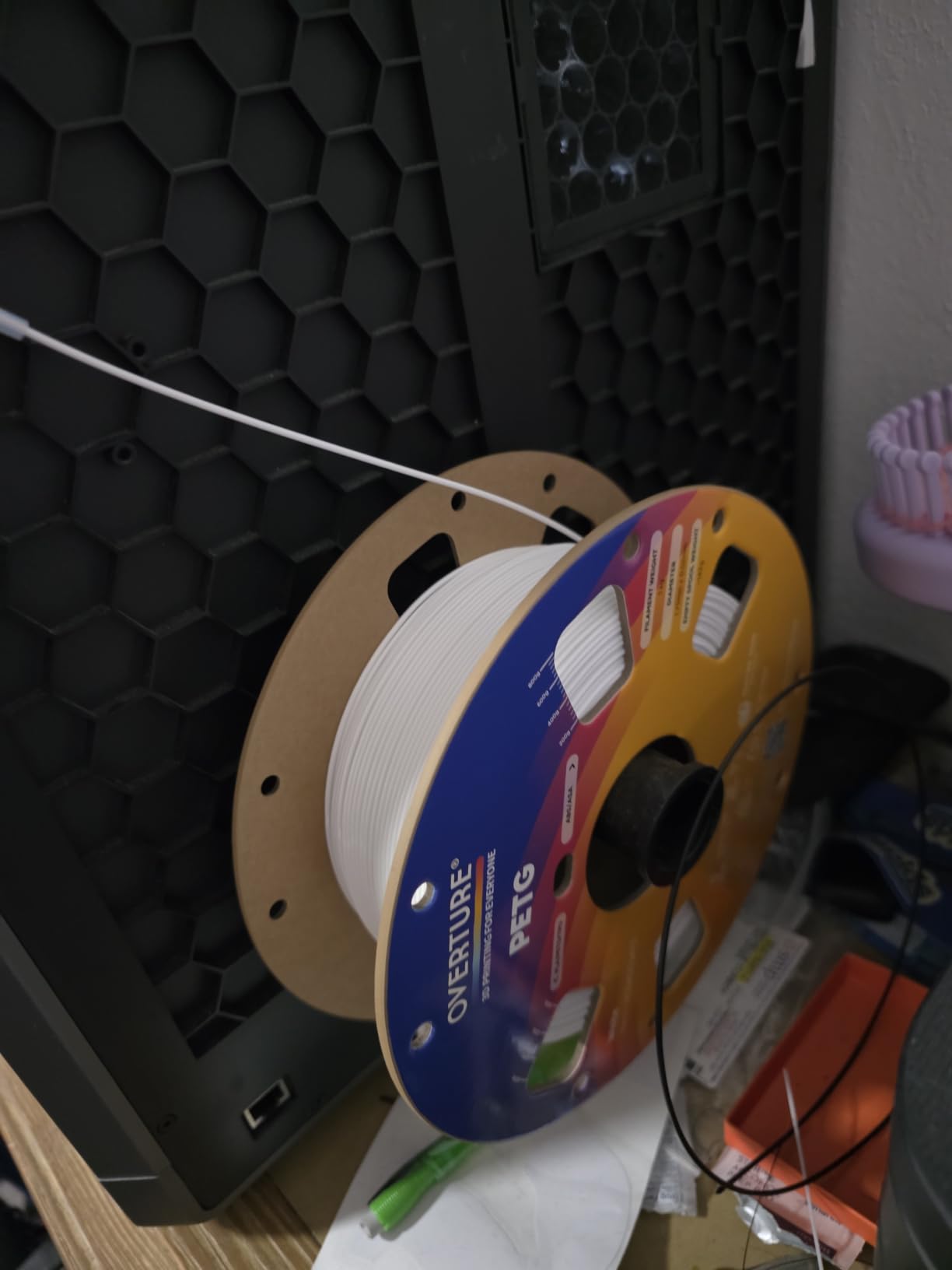
The honest weakness is the one-star share. At roughly 9 percent of 16.7k reviews, there is a real minority who hit problems, and a recurring theme in the feedback is that the fast-flowing formula needs a tuned profile to shine. Stock retraction on a slow profile leaves it stringy. Raise the speed or lower the flow expectation and it becomes one of the most forgiving spools available.
Bed temperature is specified at 65-70C, which is a little cooler than the 75-85C we use on standard grades, and it still locked down hard. Nozzle range is 230-260C, so it sits comfortably inside the hotends most people already own.
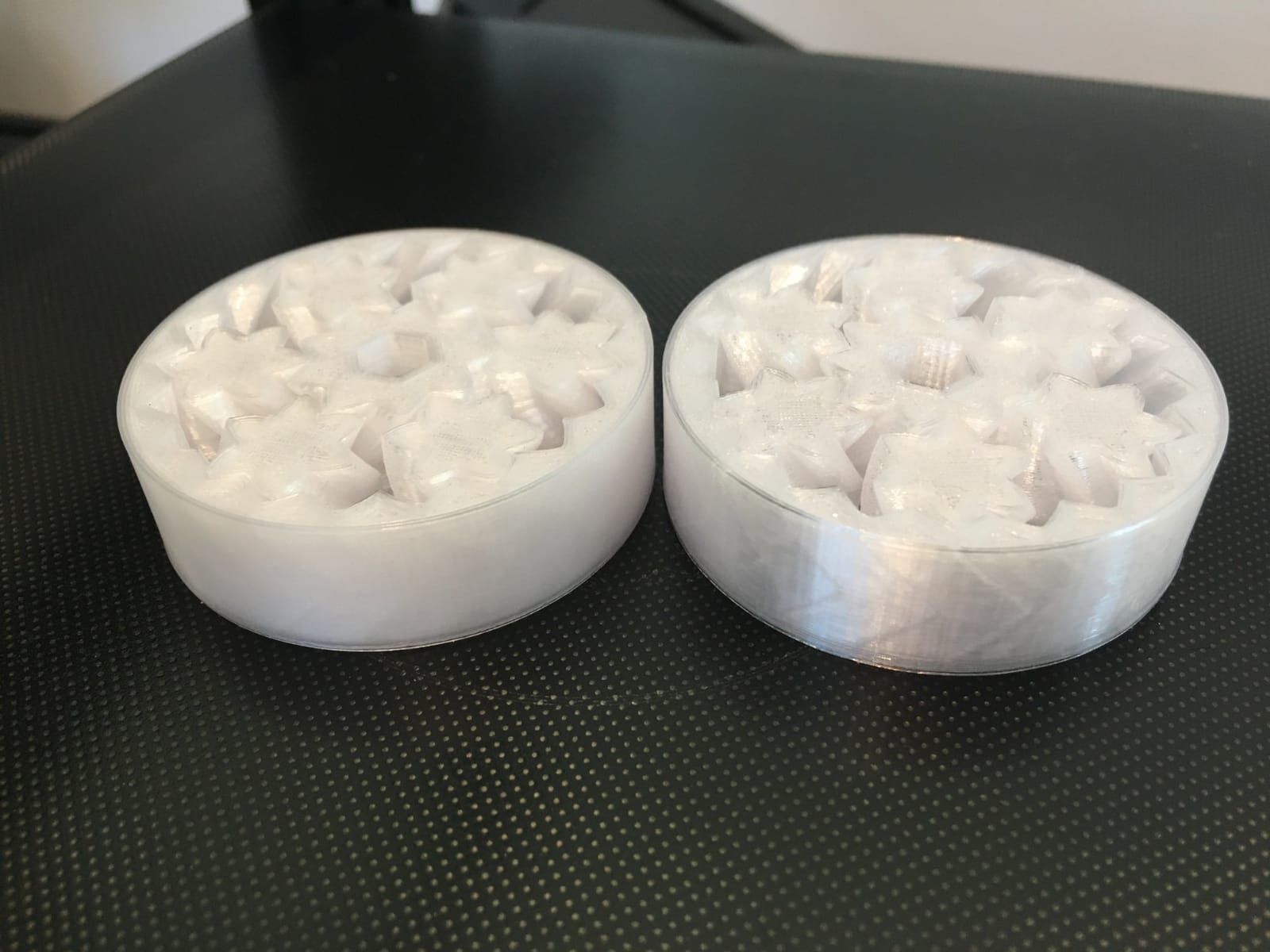
Is it right for your functional part?
It is right for general workshop duty: jigs, fixtures, guards, tool organisers, electronics enclosures, brackets that carry modest load, and anything that will be handled repeatedly. The diameter tolerance is tight enough that hole positions repeat from print to print, which is what makes it usable for multi-part assemblies rather than single decorative shells.
It is the wrong pick if your part needs stiffness at a specific temperature, because standard PETG softens at its glass transition and will creep under a sustained clamp load in a warm car. Step up to one of the reinforced grades further down for that.
What to watch out for
Run a retraction and flow pass before the first real job rather than after it. The fast-flow formula that makes this spool good at speed is the same formula that produces stringing on a stock profile, and the difference is a few minutes of calibration.
Expect a learning-curve complaint pattern in the reviews that is really a settings complaint. If parts come off the bed with lumps or the walls look rough, the fix is temperature and flow, not a different spool.
2. ELEGOO Rapid PETG 1.75mm Black 1kg – Best Value for High Volumes
ELEGOO Rapid PETG 3D Printer Filament 1.75mm Black 1KG
Print speed up to 600mm/s
Diameter accuracy +/-0.02mm
1kg black spool
Fits common FDM models
Pros
- Roughly double standard PETG volumetric flow
- Rarely tangles even over long consumption
- Good strength and impact resistance against PLA
- Minimal stringing once tuned
Cons
- Very stringy on a standard PETG profile
- Can grip smooth PEI and pull the coating
- Dry before use as it can arrive damp
This is the spool we recommend when functional printing is a volume activity rather than an occasional one. The headline claim is a maximum print speed of 600mm/s, and the user-reported behaviour backs up the reason for that number: roughly double the volumetric flow of standard PETG. When you are printing a batch of machine guards or a wall of brackets, throughput is the number that decides whether the job is worth starting.
Buyers consistently report that it barely tangles even after heavy consumption, which is exactly the property you want in a feeder-driven setup. Strength and impact resistance are described as clearly ahead of PLA, and the diameter holds to the same plus or minus 0.02mm claim as the OVERTURE spool. Good light transmittance is also noted, which makes it usable for diffuser parts and light covers.
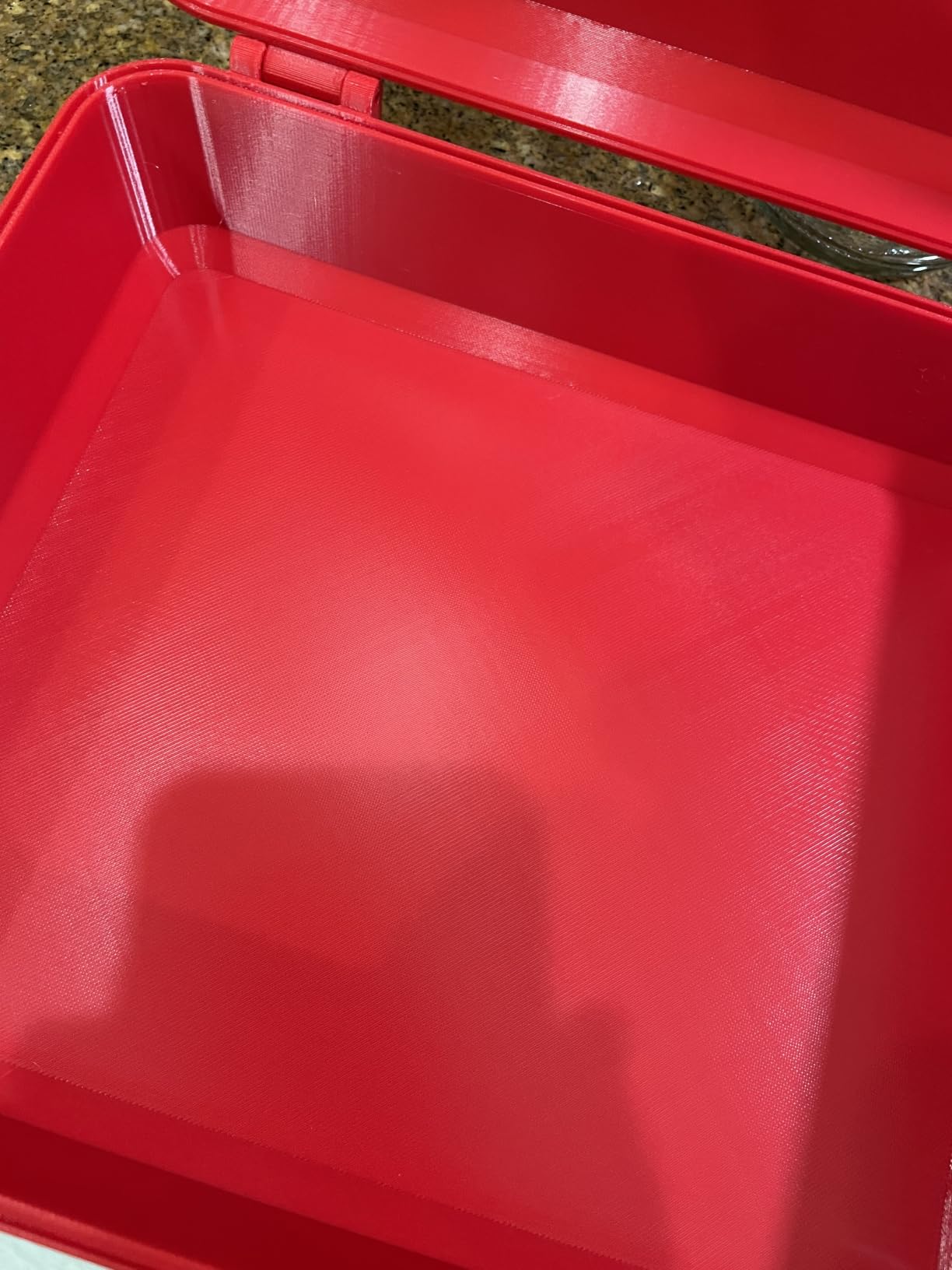
The catch is that it demands a fast-tuned profile. Printed with a standard PETG profile or too slowly, it is very stringy, and several reviewers call out aggressive adhesion on smooth PEI sheets that can pull the coating. Our advice is a glue stick or a textured plate if you are printing on a smooth sheet, and a proper speed profile if you want the flow advantage.
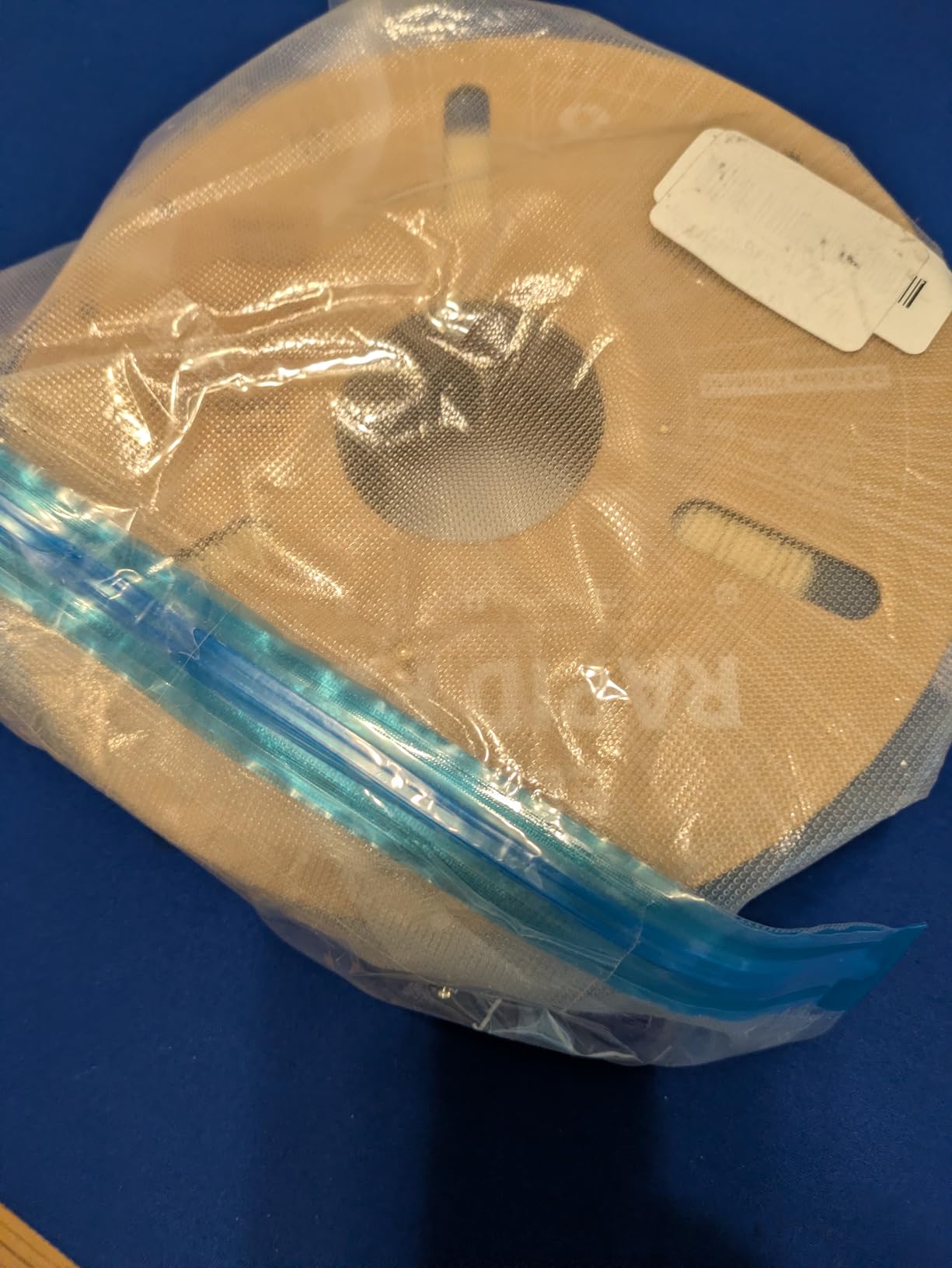
Two more practical notes from the feedback: the cardboard spools can jam in some AMS units, so a printed spool adapter helps, and the filament can arrive damp. Dry it first.
Which parts it suits best
High-count functional jobs where material cost per part matters: enclosures, brackets, cable management, workshop storage, guard panels. The high flow means you can print tall functional walls in a reasonable session without the nozzle starving, which is where most standard PETG struggles on structural prints.
It is less suited to dimensionally critical assemblies than the Prusament spool, and to stiff, load-bearing parts where you need controlled flex. Fibre-reinforced grades handle that job better.
What to watch out for
Stringing is the headline issue, but it is a profile problem rather than a material defect. Fix retraction, raise the speed toward what the formula is designed for, and the problem largely disappears. Reviewers who switched to a fast-tuned profile report the opposite experience entirely.
Bed adhesion is the other one. If you are on a smooth PEI sheet, expect the first layer to grip harder than you want, and be ready to clean that sheet regularly so the part releases.
3. IEMAI Carbon Fiber PETG 1.75mm Matte Black 1kg – Budget Stiffness With a Matte Finish
IEMAI Carbon Fiber PETG Filament 1.75mm, PETG-CF Matte Black 1kg
20% chopped carbon fibre
Diameter accuracy +/-0.03mm
Dry 60C for 5-8 hours
Nozzle 230-250C, bed 60-80C
Pros
- Matte finish hides layer lines well
- Noticeably stiffer than standard PETG
- Strong bed adhesion with minimal warping
- Prints cleanly with limited calibration
Cons
- Fibre reduces interlayer adhesion versus unfilled
- Stiff parts can shatter and supports are hard to remove
- Can pick up moisture quickly
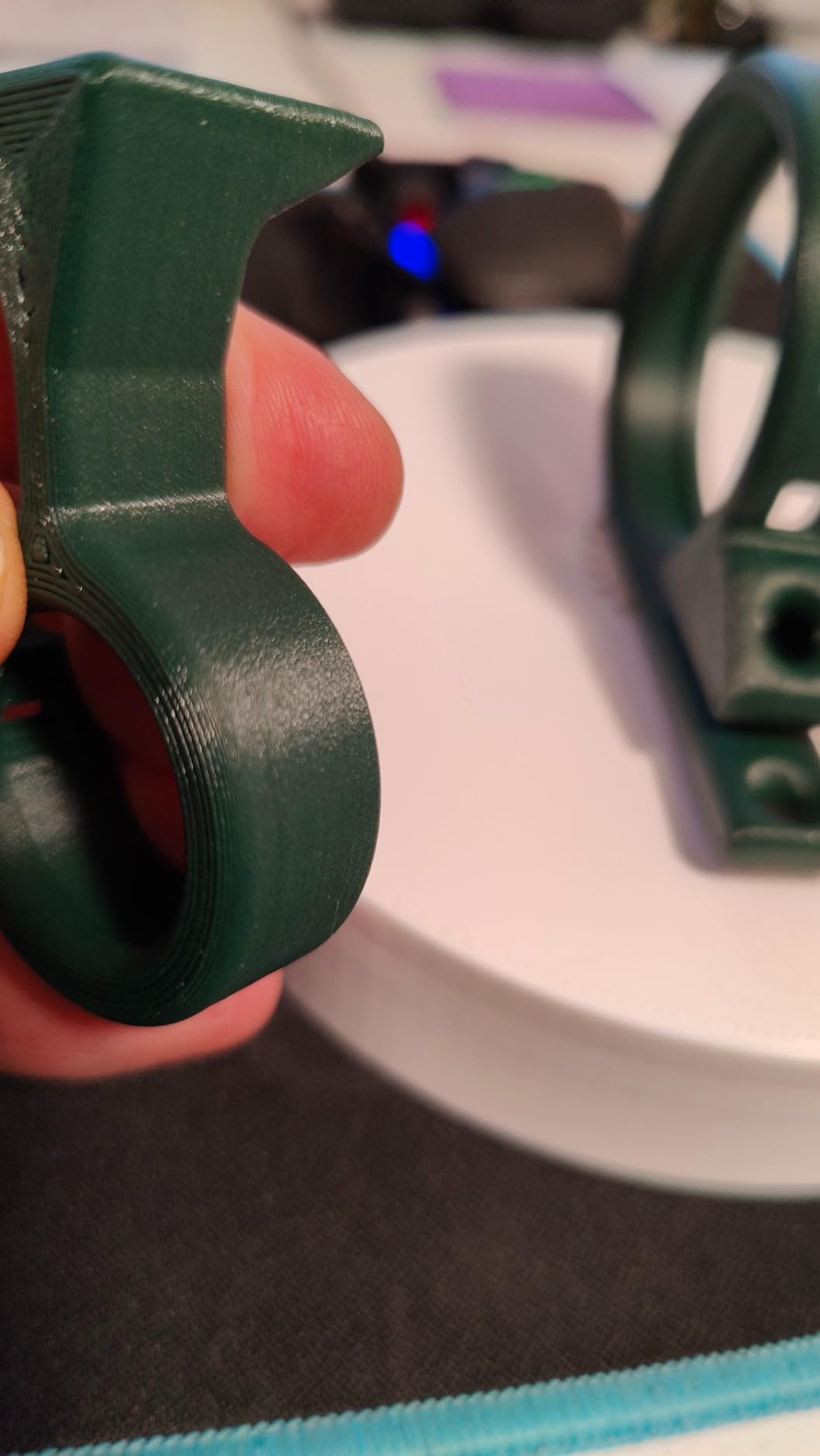
This is the entry point into reinforced PETG, and it does something standard PETG cannot: it stays dimensionally stable when the part is doing structural work. With 20 percent chopped carbon fibre, the printed part is markedly stiffer than plain PETG, and the dimensional stability claim is plus or minus 0.03mm, which is still tight for a reinforced blend.
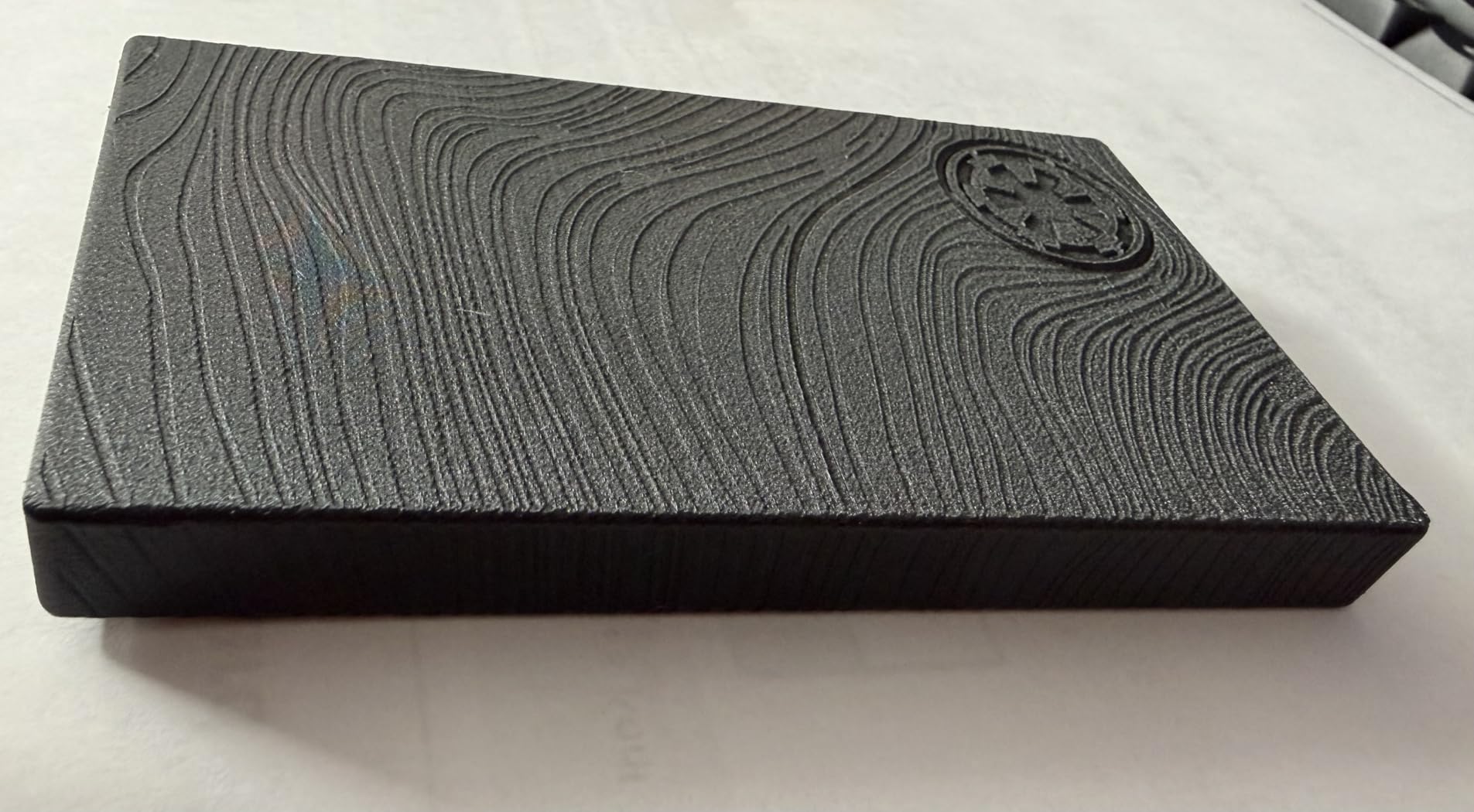
The matte black finish is the sleeper feature. Carbon-fibre prints tend to look busy because individual strands catch the light, and this one does not. For a bracket or a machine guard that will sit on a bench, the finish reads as a finished component rather than a prototype. Heat resistance is also improved over plain PETG, and no enclosure is required at the specified 230-250C nozzle and 60-80C bed.
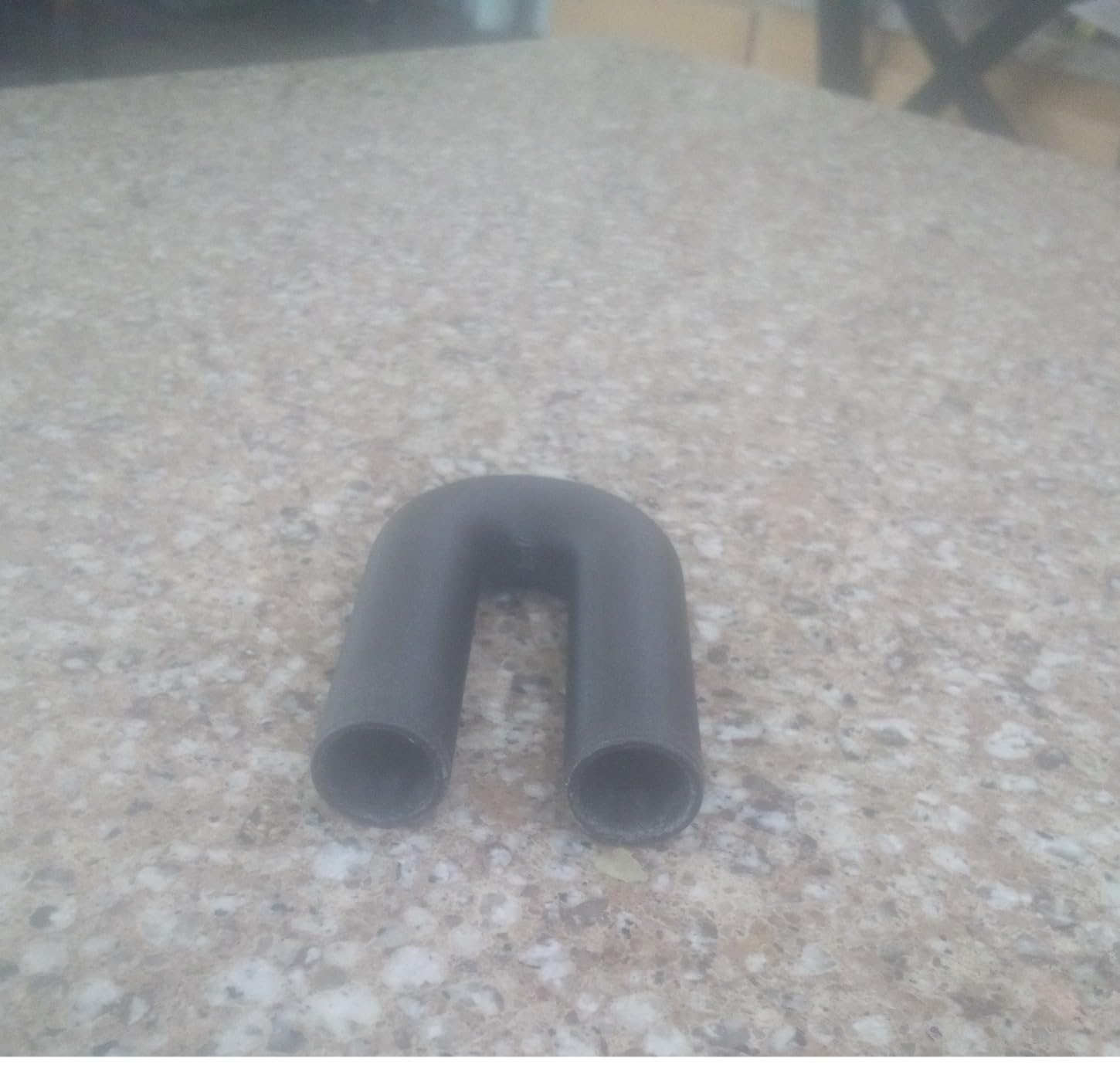
Buyers rate the bed adhesion highly and report minimal warping, plus prints that come out clean with limited calibration, which is unusual for a reinforced grade. The specification asks for a 0.4-0.6mm hardened steel or wear-resistant nozzle and a print speed at or below 100mm/s, and it is worth treating both as firm requirements rather than suggestions.
The real trade-off is layer adhesion. The carbon fibre acts as a contaminant in the melt matrix, so the bond between layers is weaker than unfilled PETG. That is fine for a rigid bracket under compression. It is not what you want for a part that will be snapped repeatedly. Stiffness also means a failed part shatters instead of bending, and supports are difficult to remove.
When to reach for it
Choose this when the part needs to hold its shape under load and you want the fibre reinforcement without stepping up to a premium carbon grade. It is widely used as a lower-cost stand-in for premium carbon-fibre PETG, and the stiffness-to-cost ratio is where that comparison holds up.
It is also a good match for functional parts that get displayed or handled, because the matte surface hides layer lines that a standard spool would show. Skip it for snap-fit parts, living hinges, or anything expecting shock loading.
What to watch out for
A hardened nozzle is not optional. Running reinforced filament through brass wears the nozzle out fast and can change your extrusion width mid-print. A small number of buyers also report persistent nozzle clogging, so check the nozzle before blaming the filament.
Drying is specified at 60C for 5-8 hours, and buyers note it picks up moisture quickly once opened. Keep it sealed between sessions or the stringing will return.
4. ERYONE PETG-GF Glass Fiber Filament 1.75mm 1kg – The Stiff Bracket Pick
ERYONE PETG Glass Fiber Filament 1.75mm +/-0.03mm, 3D Printer Filament, High Strength & Rigidity for Functional Parts, 1kg(2.2LBS)/Spool, PETG GF Black
15% glass fibre reinforcement
Diameter accuracy +/-0.03mm
1kg black spool
Matte black finish
Pros
- Very strong and rigid parts with minimal flex
- Excellent low-warp behaviour
- Handles overhangs and sharp corners cleanly
- Vacuum-sealed spool with desiccant
Cons
- Among the stringiest reinforced PETG grades
- Needs high nozzle temperatures to flow properly
- Abrasive and will wear brass nozzles quickly
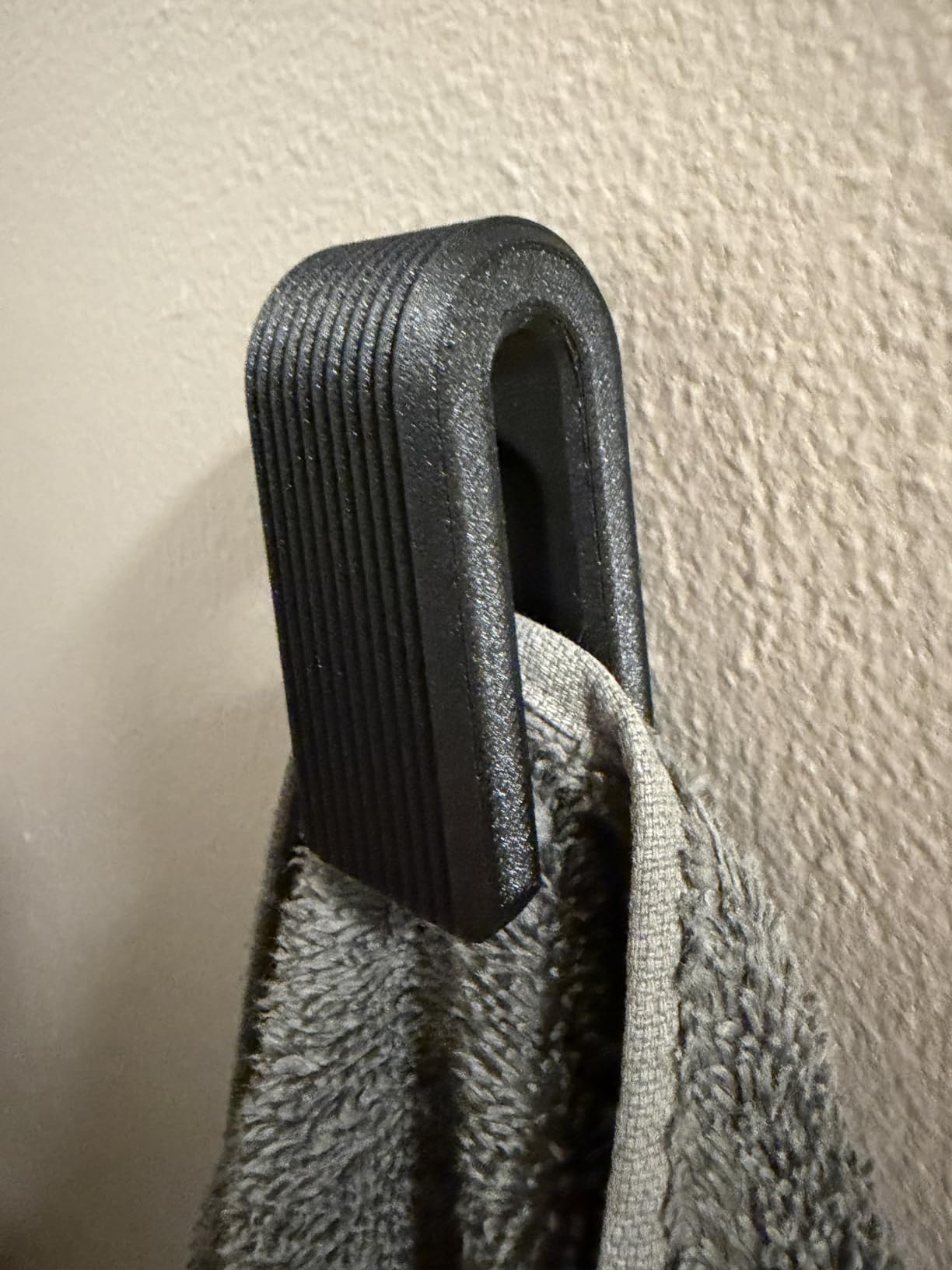
Glass fibre changes the character of PETG more than carbon fibre does at similar loadings, and this spool is built for rigidity. With 15 percent glass fibre, the printed parts come out very strong with minimal flex, and the low shrinkage means reduced distortion risk on longer functional prints where a standard grade would twist.
It handles overhangs and sharp corners cleanly, which matters for brackets and mounting plates. The matte black finish is a genuine bonus for parts that stay visible. Users also report that it spools well in AMS units without needing edge reinforcement, and that the vacuum-sealed packaging with desiccant arrived properly dry in most cases.
Expect to run a temperature tower on first use. The feedback is consistent that some users need 260-275C to get this filament to flow properly, which is hotter than most stock profiles. It is also described as among the stringier reinforced PETG grades, so budget time for de-webbing. Thin features under 2mm show weaker layer adhesion, which matters if your design has small ribs or gussets.
One more practical point: this filament is abrasive, and the specification recommends a stainless steel or hardened alloy nozzle. That is a real hardware cost for a hobbyist, and it is the reason we rank the reinforced grades below the standard PETG options for most functional work.
When to reach for it
Load-bearing brackets, mounting plates, machine fixtures and tool holders where flex is unacceptable. If a bracket is going to carry a repeated bending load, glass fibre at 15 percent gives you a much stiffer part than standard PETG and a cleaner print than most carbon blends at similar cost.
It is a step up from the unfilled grades for outdoor garden tooling and workshop parts too, because the low shrinkage holds dimensions over a long print. The wider colour range than carbon-fibre options is useful if you want a part to match a machine.
What to watch out for
Heat and de-webbing. The high nozzle temperature and the stringing go hand in hand, and a first print on default settings will look worse than the material actually is. Run the tower, then commit filament to the real part.
Brass nozzles. Glass fibre is abrasive and will wear them quickly, so budget for a hardened nozzle before your first functional job rather than after the second one fails mid-part.
5. FLASHFORGE Carbon Fiber PETG 1.75mm Black 1kg – The Easiest PETG-CF to Print
FLASHFORGE Carbon Fiber PETG Filament 1.75mm Black, Reinforced 3D Printer Filament 1kg, Lightweight & High-Strength PETG-CF Filament, Strong & Easy to Print
Carbon fibre reinforced PETG
1kg black spool
Reduced warping and good accuracy
Minimal visible fibre strands
Pros
- Clean extrusion with no stringing or blobbing
- Prints on stock Bambu PETG-CF profiles with minimal tuning
- Excellent bed adhesion with no warping on larger prints
- Light sheen gives parts a premium finished look
Cons
- Not recommended for high-speed printing
- Limited colour selection
- Requires a hardened steel nozzle
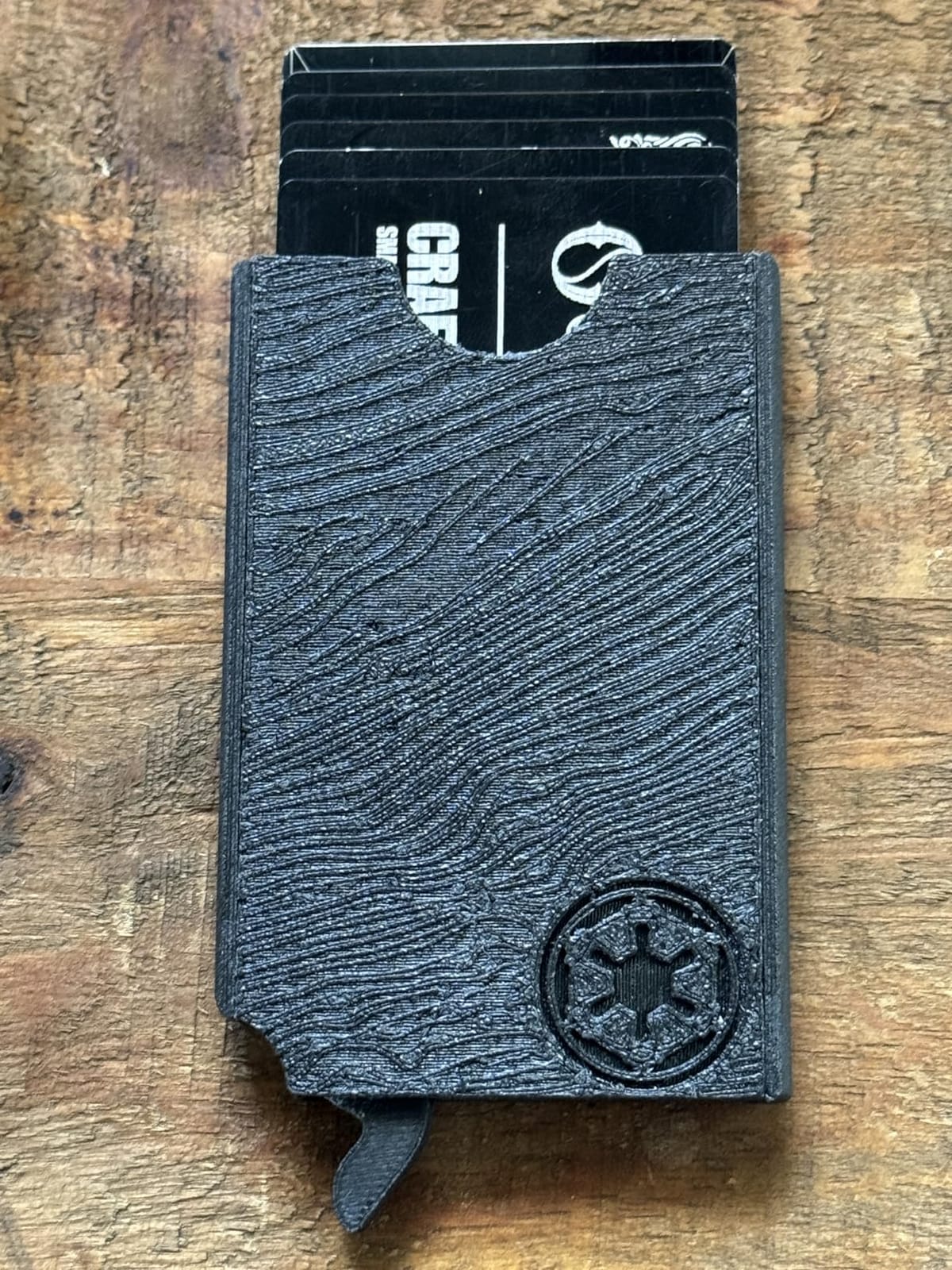
Most reinforced PETG asks for a temperature tower, a flow pass and a week of de-webbing. This one largely does not. Users describe it as the most trouble-free carbon-fibre PETG they have run, and specifically report clean extrusion with no stringing and no blobbing. On Bambu hardware the stock PETG-CF profile produces dependable parts with very little tuning, and clean extrusion is reported at 60-70mm/s.
Mechanically it is a genuine reinforced grade: substantially increased strength and rigidity over plain PETG, improved heat resistance, and enhanced wear and abrasion resistance aimed at gears, bearings and sliders. Reduced warping and better dimensional accuracy mean a large functional print stays flat on the bed.
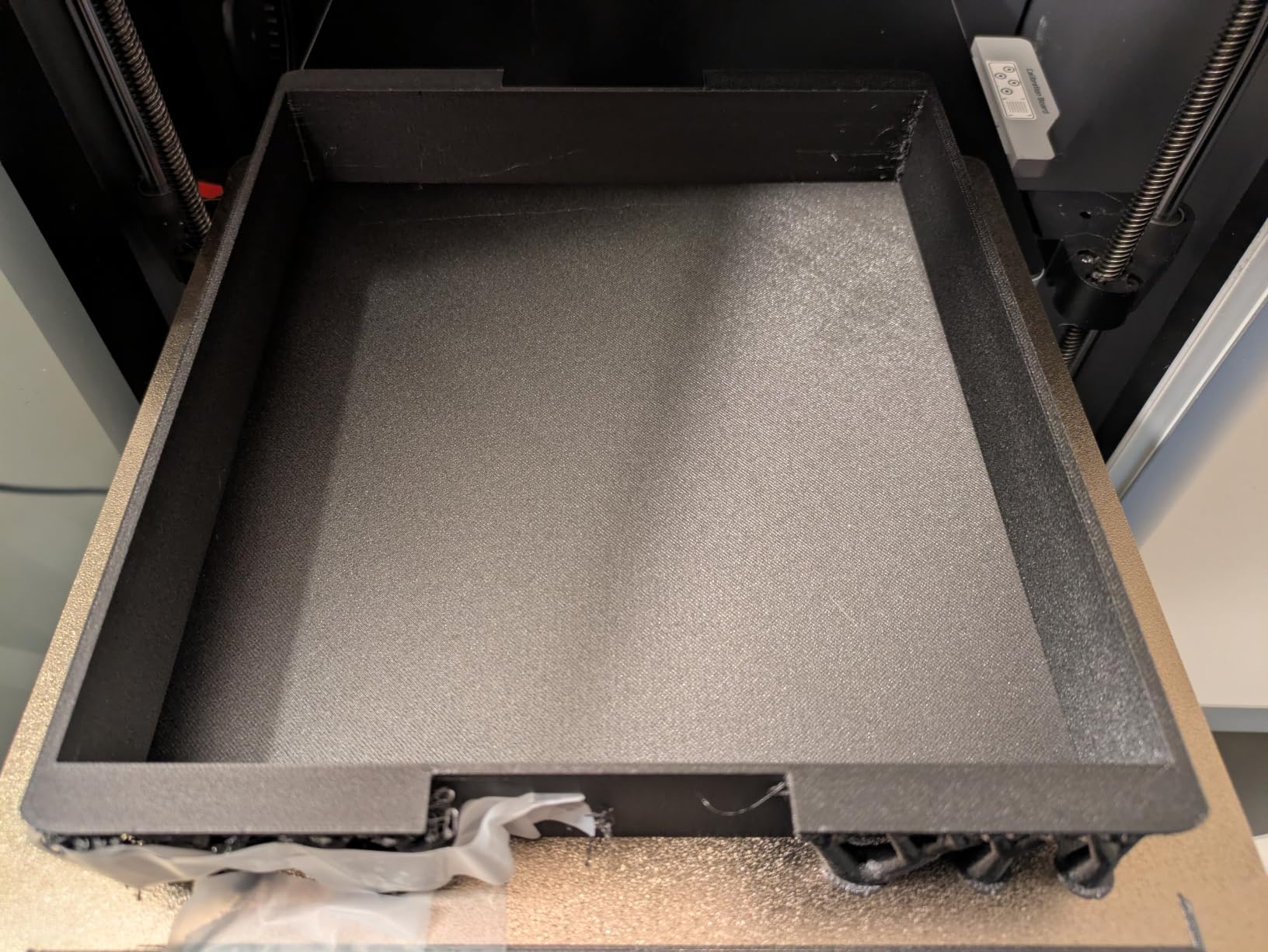
What sets it apart technically is the absence of visible carbon-fibre strands. No clumps, no blobbing, and no clogging on a 0.4mm hardened steel nozzle, which is the failure mode that frustrates most people the first time they try a reinforced blend. There is also a light sheen that gives parts a finished appearance rather than the mottled look of a typical fibre print.
The review base is smaller than the standard PETG options here, so treat long-term consistency as less well established. Users report consistent roll to roll and smooth AMS feeding, but the honest caveat is that 196 reviews is a smaller evidence base than 16k.
When to reach for it
This is the one to buy if you want reinforced behaviour without a reinforcement learning curve. Gears, bearing carriers, sliders, structural brackets and drone or RC parts are the obvious fits, and anything where a stiff, dimensionally accurate result matters more than impact absorption.
It is also the practical pick for Bambu Lab users, because it runs on the stock carbon-fibre profile. If you change printers or brands often, a spool that does not demand a re-tune is worth more than a slightly better grade.
What to watch out for
Dry it thoroughly first. That is the one prerequisite users mention consistently, and it is the difference between the clean extrusion everyone praises and a spool full of stringing.
Slow it down. This is not a high-speed filament, and better surface finish comes at lower print speeds. Also note the colour range is narrower than standard PETG, and a hardened steel nozzle is required.
6. Polymaker Fiberon PETG-rCF08 Recycled CF 1.75mm 0.5kg – Best Recycled Grade
Polymaker Fiberon PETG-rCF08 Recycled CF Filament 1.75mm Black 0.5kg
8% recycled carbon fibre
HDT 68.6C at 0.45MPa
Nozzle 240-270C, bed 60-70C
0.5kg spool
Pros
- Zero stringing reported when properly dried
- Clean low-warp extrusion with minimal visible layer lines
- Arrives well sealed with no moisture or popping
- Used for drone frames and blower fan assemblies
Cons
- Requires a dried spool and a flow calibration
- Abrasive and slightly brittle
- 0.5kg spool is smaller than the 1kg norm
This is the most interesting material in the set from a chemistry standpoint, because 8 percent recycled carbon fibre in a PETG matrix is a genuinely different product from virgin carbon-fibre PETG. It is produced by a manufacturer that builds its own filament rather than rebranding a generic spool, and the measured data reflects that: heat deflection temperature of 68.6C at 0.45 MPa, a nozzle range of 240-270C, and a bed range of 60-70C.
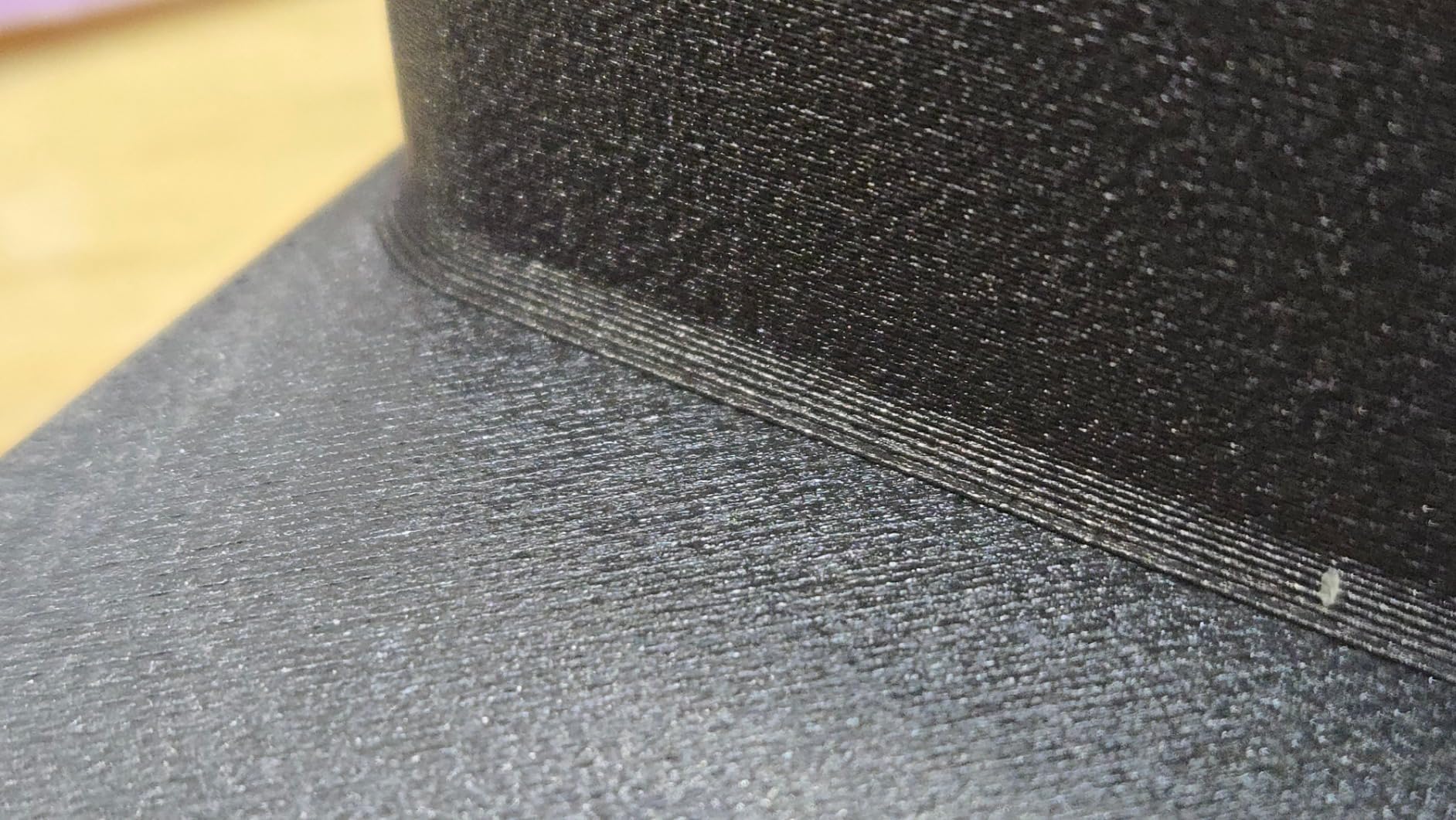
On real parts, users report drone frames, airsoft bodies and blower fan assemblies, which is not speculative use. The feedback pattern is unusually clean: zero stringing when properly dried, very low warp, minimal visible layer lines, and a matte surface that suits prototypes and jigs. It also supports speeds up to 300mm/s after calibration, and no heated chamber is needed.
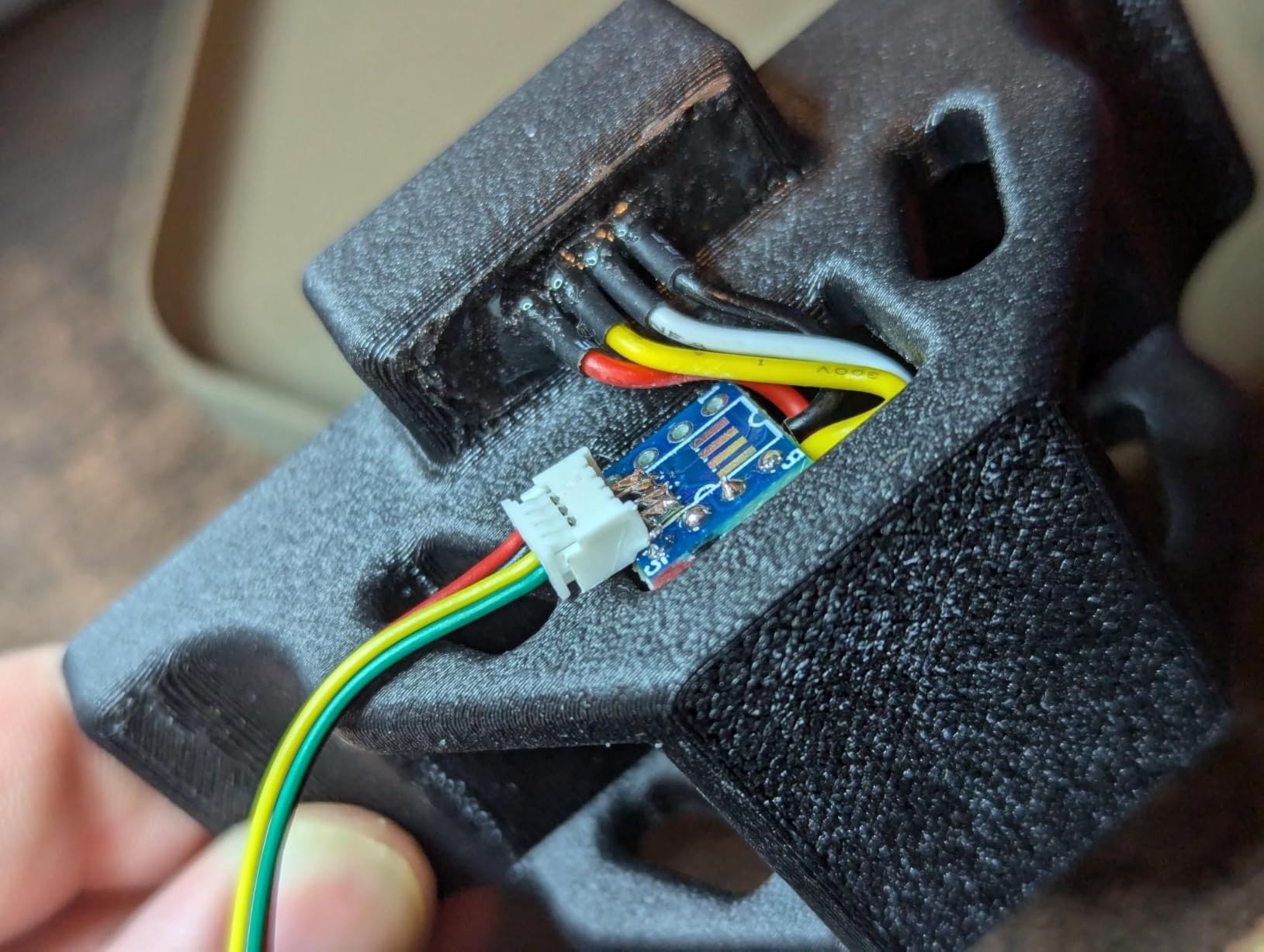
Two conditions apply, and users are clear about both. The spool must be dried, and the flow and K-factor must be calibrated to hit true dimensions. Drying at 65C for 3 hours is specified if the filament has absorbed moisture, and annealing is not required. Skip either step and the dimensional accuracy story falls apart, which matters more here than on standard grades.
It is also described as abrasive and slightly brittle, with parts that can snap in the fingers. Some users advise against the AMS Lite. The spool is 0.5kg rather than the 1kg norm, and seams are visible in some colourways, so plan your job size around a smaller spool.
When to reach for it
Recycled carbon-fibre PETG makes sense when you want stiffness and low warp with a documented, published performance figure rather than a marketing adjective. Parts that see vibration and repeated assembly, or that need a matte professional finish, are the right target. It is also the most interesting choice here for anyone who cares about material provenance.
Because the reinforcement is only 8 percent, it is less rigid than a 20 percent carbon grade. If you need maximum stiffness, this is not the spool. If you need a good balance with predictable dimensional behaviour, it is.
What to watch out for
Calibrate before you commit. Flow and K-factor are what turn a good-looking print into a dimensionally correct part, and this is a reinforced blend where that matters. Do the dry cycle and the calibration pass on a test piece first.
Brittleness in thin sections and a small spool size. If your design has thin ribs, test carefully, and if you are printing a long functional job, buy two.
7. ELEGOO PETG-CF 1.75mm Black 1kg – Best for Gears, Bearings and Wear
ELEGOO PETG-CF 3D Printer Filament 1.75mm Black 1KG
Carbon fibre reinforced PETG
1kg spool
Print temperature 240-270C
Hotbed 65-75C
Pros
- No clogs or tangles reported over a year of use
- Good adhesion on smooth and textured plates
- Stiff non-flexing parts with good dimensional accuracy
- Good matte finish that hides layer lines
Cons
- Clogs below 0.12mm layer height
- Cardboard spools are poor in AMS units
- Can peel slightly at corners
Where the IEMAI spool trades layer adhesion for stiffness, this one is specified for high impact strength and toughness alongside the carbon fibre, and is described as less prone to fracture than other CF blends. That combination is what you want for gears, bearing races and parts that mesh, rotate or rub rather than simply carry a static load.
Abrasion resistance is the headline specification, alongside good dimensional accuracy and a fine matte surface texture. The print window is 240-270C with a 65-75C bed, and a hardened steel nozzle of 0.4mm or larger is required. Users report long-term reliability, with no clogs or tangles across a year-plus of use, and good adhesion on both smooth and textured plates even when slightly dirty.
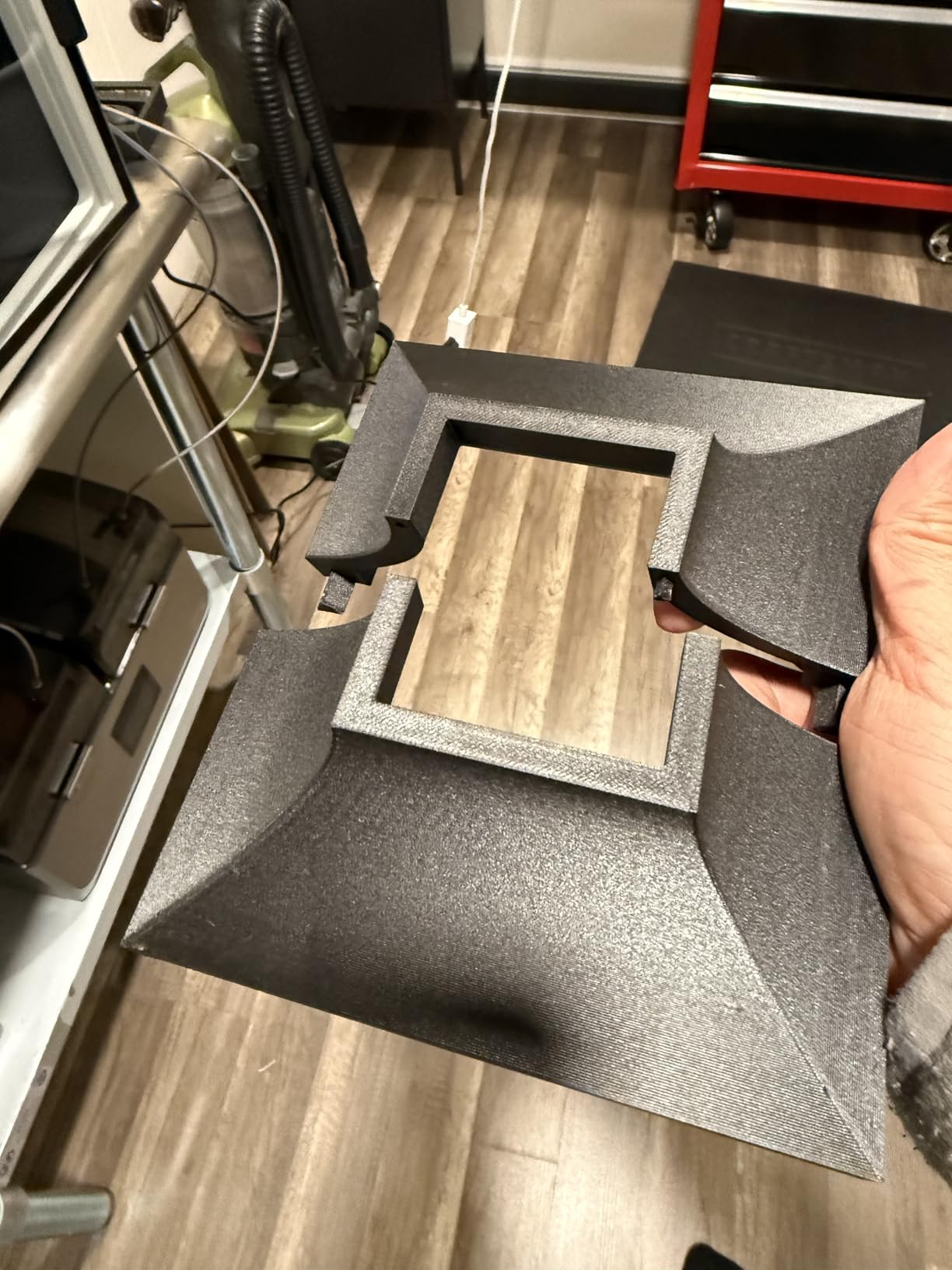
Users also report that it holds up after warm-weather and hot-car exposure, which is a useful data point for anyone prototyping an interior part. The failure mode to plan around is fine detail: it clogs below 0.12mm layer height, so keep your functional parts at normal layer heights rather than chasing surface finish.
The cardboard spool is a poor fit for AMS units, and a printed adapter solves it. There are also reports of corners peeling slightly up on flat, large surfaces, and that the finish can look slightly glossy under certain lighting.
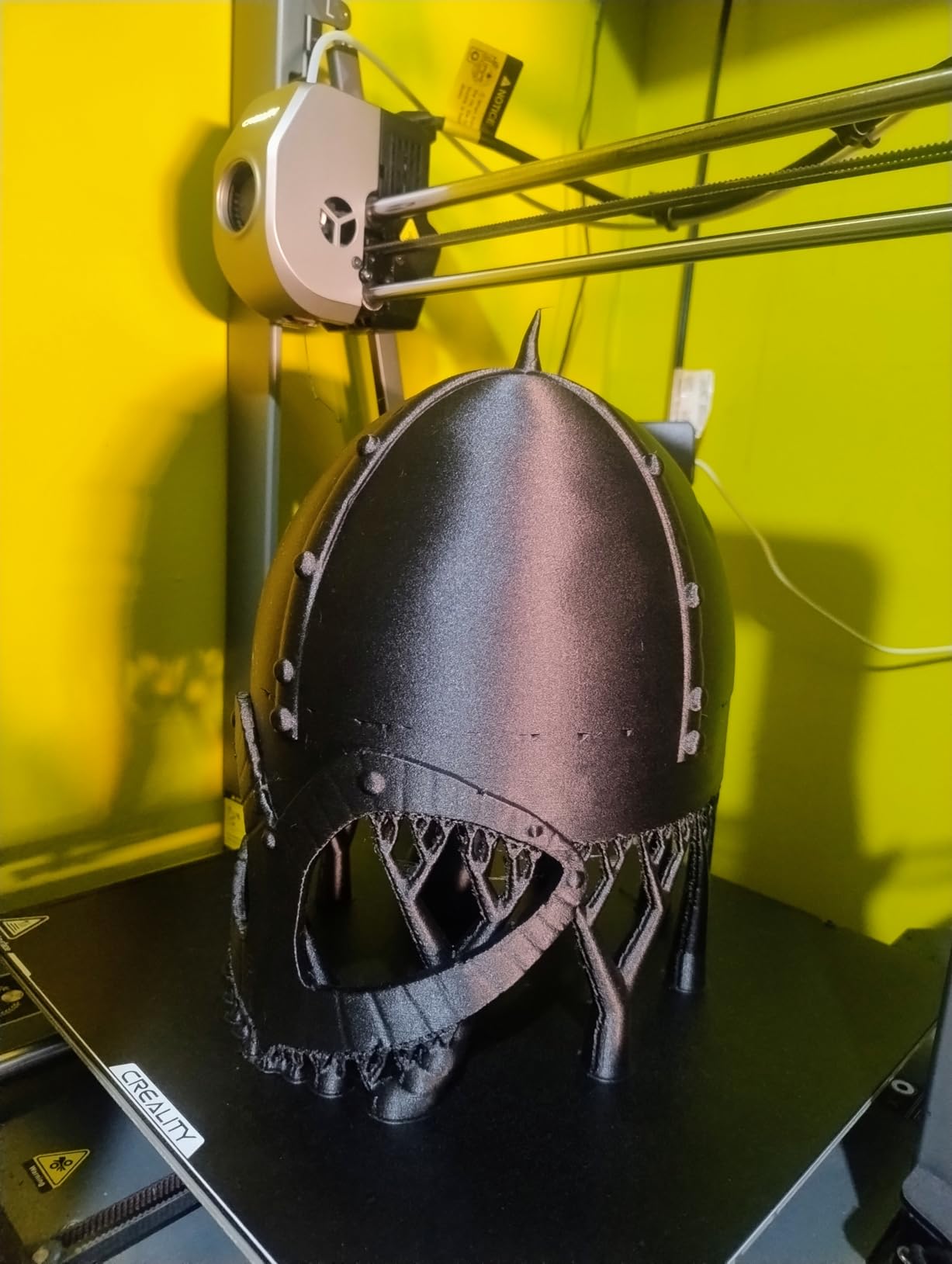
When to reach for it
Gears, bearings, sliders, cam followers and any part where two surfaces move against each other. The abrasion resistance is the differentiator here, and a reinforced PETG that sheds its own fibres under friction will wear quickly. This one is specified for that job and reported to handle it.
It is also a strong all-round reinforced choice when you want toughness alongside rigidity, since it is less prone to fracture than typical carbon blends. Parts that see impact as well as load, such as equipment guards and protective mounts, suit it well.
What to watch out for
Layer height. Below 0.12mm it clogs, and no amount of tuning fully fixes that. Design the part for a functional layer height and it will behave predictably.
Spool hardware and finish. The cardboard spool wants an adapter for AMS-style feeders, and the finish is not as matte as some of the glass-fibre options. Neither affects performance, but both affect how the finished part looks.
8. TINMORRY PETG-GF Frosted Black 1.75mm 1kg – Best Frosted Finish
TINMORRY PETG-GF Glass Fiber PETG Filament 1.75mm, 1 KG, Frosted Black
Glass fibre reinforced PETG
Diameter 1.75 +/-0.03mm
Nozzle 260C, bed 80C
Dry 65C for 8 hours
Pros
- Frosted marble surface gives parts a premium look
- Glass fibre reduces warping and shrinkage
- Good heat and chemical resistance for outdoor parts
- Wider colour range than carbon fibre options
Cons
- Drying is essential to reach quoted quality
- Temperature tower and flow calibration required on first use
- 260C nozzle limits some hotends
The frosted, marble-textured surface is the reason this spool earns its place in a list otherwise dominated by matte black. A glass-fibre reinforced PETG with a premium marble finish gives you a functional part that does not look like a functional part, which matters for enclosures, panels and anything a customer or colleague will look at.
Underneath the finish it is a serious reinforced grade. Glass fibre reduces warping and shrinkage relative to plain PETG, and the material is specified for heat and chemical resistance, load-bearing and outdoor parts. Dimensional accuracy is claimed at plus or minus 0.03mm. The wider colour selection than the carbon-fibre options is a genuine practical advantage if your brand or machine has a colour scheme.
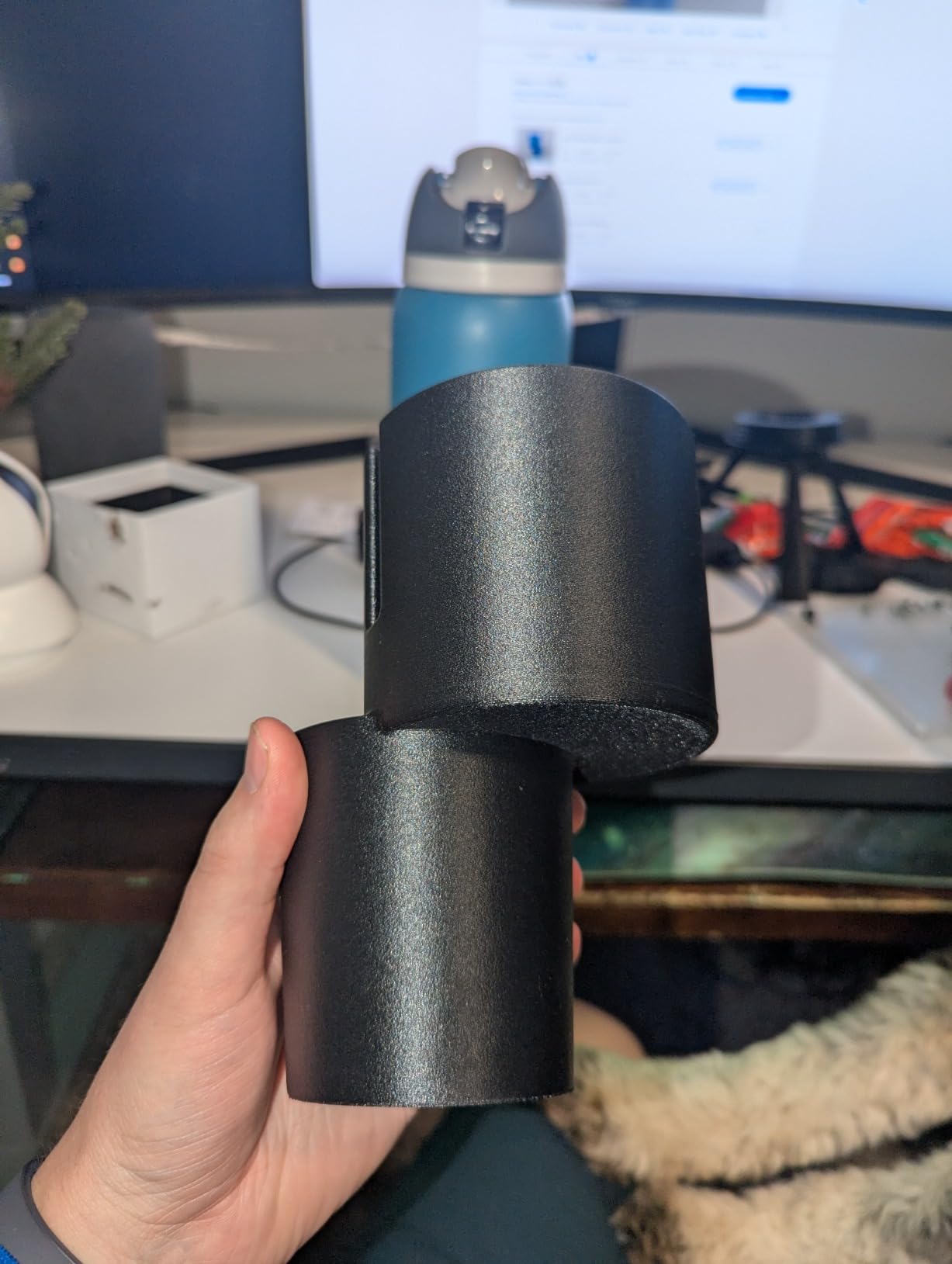
Two conditions, both stated by the brand and echoed by users. Dry at 65C for 8 hours and keep container humidity below 20 percent relative humidity, and run a temperature tower plus flow calibration on first use. Without both, the material does not deliver what the specification claims. That is a higher setup commitment than the standard PETG options, and worth knowing before you order.
The recommended 260C nozzle and 80C bed will rule out some older or lower-power hotends. A 0.6mm wear-resistant steel nozzle is preferred, with 0.4mm capable. As with all glass-fibre grades, it is abrasive to brass.
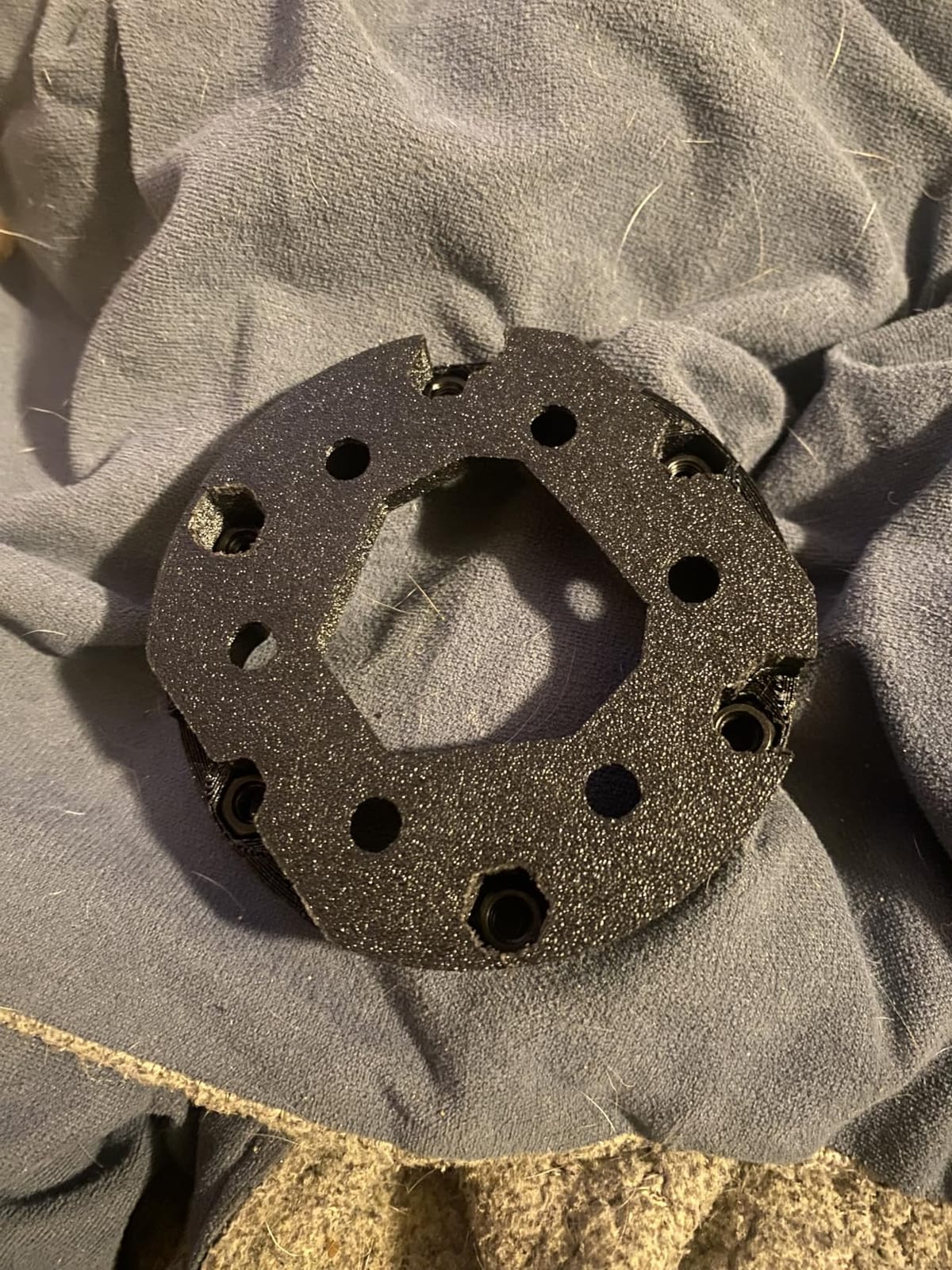
When to reach for it
Outdoor parts and visible components where finish and durability both count. The heat and chemical resistance makes it a reasonable choice for garden tooling and external fixtures, and the frosted finish means you do not need to paint or post-process a part that will be seen.
It suits load-bearing functional parts where the colour needs to be specific. Note the review base is the second smallest here at 113, so the consistency story is promising rather than proven over years.
What to watch out for
Hotend temperature. 260C excludes a chunk of older printers, so check your maximum before you buy. If your hotend tops out below that, the glass-fibre options rated lower are a safer route.
Setup time. Drying for 8 hours plus a temperature tower and flow calibration is a real commitment. Plan a weekend for the first part rather than a lunch break.
9. Prusament PETG Galaxy Black 1.75mm 1kg – Best Dimensional Accuracy
Prusament PETG Prusa Galaxy Black Filament 1.75mm 1kg Spool (2.2 lbs), Diameter Tolerance +/- 0.02mm
0.02mm manufacturing precision
Manufactured in-house by Prusa Polymers
Batch tested for diameter and colour
1-year manufacturer warranty
Pros
- Tightest dimensional tolerance in this group
- Per-spool parameters readable from a QR code
- Batch tested for mechanical properties and colour consistency
- Best suited to dimensionally critical parts
Cons
- Highest cost per kilogram of the spools analysed
- Unreinforced so less stiff and less heat resistant
- Smaller colour range
This spool is different in kind from the others. It is manufactured in-house by Prusa Polymers rather than bought from a compounding house, it claims 0.02mm manufacturing precision against a stated 0.05mm industry standard, and every spool carries a QR code that exposes its measured filament parameters online. That traceability is the feature that no other spool in this list offers.
Each batch is tested for string diameter, colour consistency and mechanical properties, and the colour is held consistent between spools. For dimensionally critical functional parts, that is worth more than reinforcement: a bracket with a hole that lines up with an M3 insert on the second attempt saves far more time than a stiffer bracket saves material.
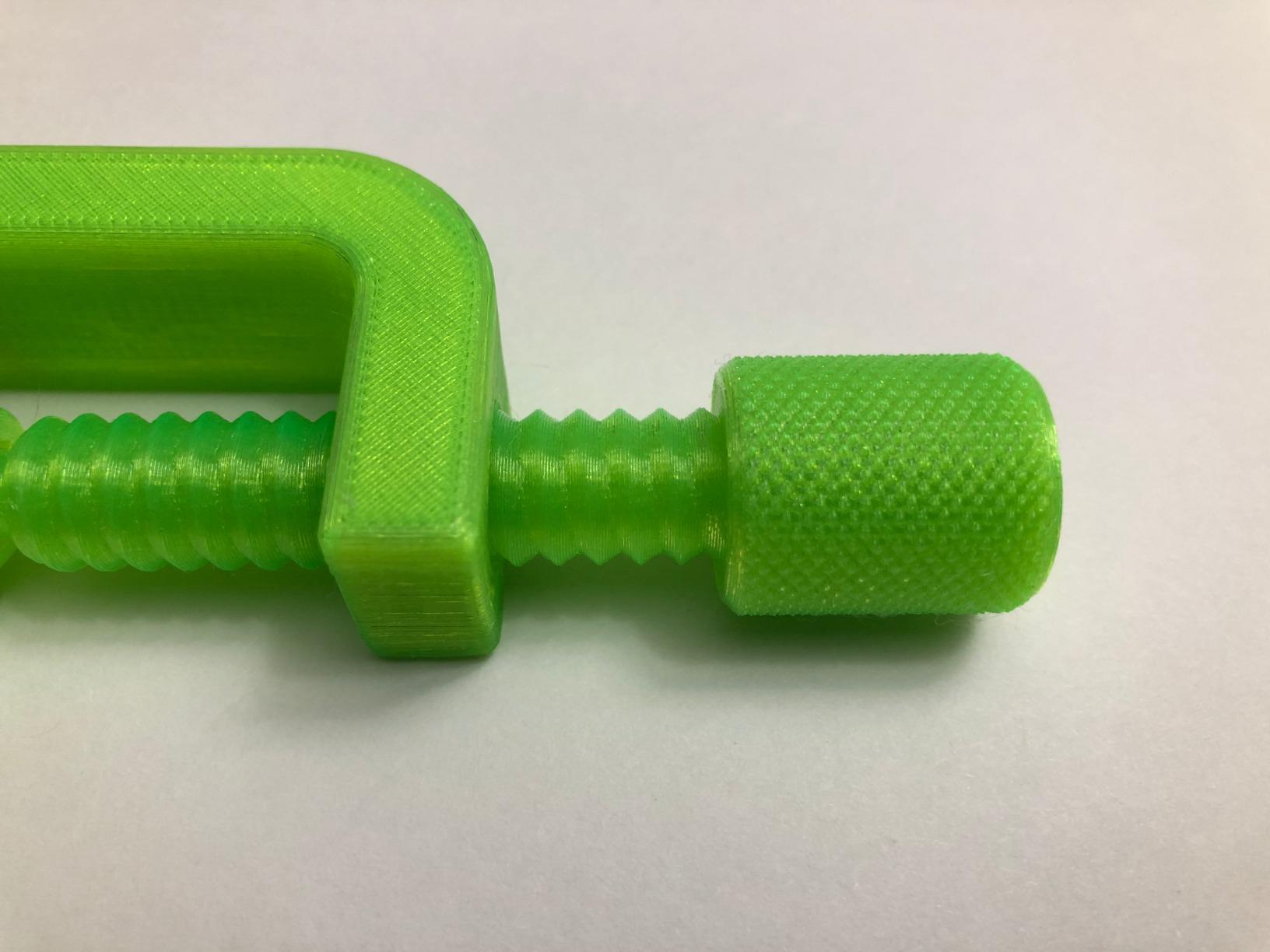
The trade-off is cost per kilogram, which is the highest of the spools analysed, and the fact that it is unreinforced. If your part needs stiffness or resistance to sustained heat, standard PETG is the wrong base material, however consistent the diameter is. It is also the smallest colourway count here, and it comes with a one-year manufacturer warranty.
The honest framing: this is the reference-grade option, and you pay a premium for inspectable quality control rather than for a different polymer. Buyers who need accurate, repeatable dimensions for mechanical assemblies consistently rate it as the one they trust with critical parts.
When to reach for it
Multi-part assemblies, snap-fit interfaces, fixtures that mate with existing hardware, and anything where a failed fit means reprinting a long job. Tolerance-critical fit checks and printed jigs for drilling or layout are the classic use. The per-spool QR traceability also makes it easy to match a new spool to the behaviour of an old one when something changes.
It suits anyone who wants to know what they are printing rather than trusting a label, and it is a sensible default for a Prusa machine where the profile and material were developed together.
What to watch out for
Cost. This is the most expensive spool here, and for a large functional print that adds up quickly. For high-volume standard parts, a value spool is the more sensible purchase.
No reinforcement. Do not choose it for a part that needs stiffness, high heat resistance, or sustained load in a warm environment. It is a consistency product, not a strength product.
10. Creality Hyper PETG-CF 1.75mm Black 1kg – Best for High-Heat Parts
Creality Official PETG Carbon Fiber Filament 1.75mm, PETG-CF 3D Printer Filament, 300mm/s High Speed Hyper PETG-CF, Excellent Mechanical Properties, Fits for All 3D Printers, 1 KG(2.2lbs) Spool Black
8% carbon fibre reinforcement
Heat resistance up to 100C
Print temperature 240-270C
Build platform 70-90C
Pros
- Exceptionally strong parts even on default profiles
- Clean and fast on Bambu A1 and Creality machines
- Good detail at 0.12mm layers and 250mm/s
- Higher deformation temperature than comparable grades
Cons
- Smallest review base in the set
- Some reports of nozzle clogging on particular spools
- A few reports of parts cracking under load
The specification that sets this spool apart is heat resistance rated up to 100C, alongside chemical resistance to solvents, oils and acids. No other spool in this list claims that. If your functional part lives somewhere warm, or contacts machine oil or cleaning fluids, that number is the reason to look here first.
With 8 percent carbon fibre reinforcement and low shrinkage, dimensional stability is high. Users report parts that feel shockingly strong even printed on default profiles, clean and fast printing on Bambu A1 and Creality machines with no stringing, and good detail retention at 0.12mm layer height and 250mm/s. The RFID tagging for automatic recognition in the Creality CFS is a small but genuinely useful workflow feature for anyone running multiple materials.
Be careful with the evidence base here. At 61 reviews, this is the smallest sample in the roundup, and that means individual complaints carry more weight than they should. There are a small number of reports of persistent nozzle clogging on particular spools, and a few reports of parts cracking or breaking under load. Slight balling appears at high infill on some settings.
Long-term batch consistency is the open question, and for a functional part that has to work every time, that is a real consideration. Our advice is to buy a smaller quantity first and test it on a load case you care about before committing a larger job.
When to reach for it
Parts that see genuine heat, oil, solvent or chemical contact, where standard PETG is close to its limit. It is the sensible reinforced option for automotive-adjacent and workshop fluid-handling parts, and it suits anyone already running Creality CFS hardware where RFID detection removes a manual step.
It is also a good fit for users who want a fast carbon-fibre PETG, since users report clean printing at 250mm/s on current Bamba and Creality hardware.
What to watch out for
Nozzle condition. Clogging reports cluster around worn or poor-quality hardened nozzles, so start with a fresh hardened nozzle and inspect it before blaming the spool. Slower speeds also reduce the balling reported at high infill.
Sample size. Sixty-one reviews is a thin basis for a part that has to hold. Test the specific batch on a real load case before you print a set.
How to Dry PETG Before You Print a Functional Part
Drying is not optional for PETG, and it is the single most common cause of a failed functional print. PETG absorbs moisture from the air, and the absorbed water boils at the nozzle, which produces popping, stringing, rough walls and a weak layer interface. The result snaps at the layer line rather than at the intended failure point, which is far more dangerous in a clip or a bracket than a cosmetic defect.
A wet spool and a bad spool produce almost identical symptoms, which is why the recurring question in maker forums is whether a filament problem is a wet spool or a bad batch. Dry it first, and only then judge the material. Most of the time, the problem disappears.
Heat the spool to 65C and hold it there for 6-8 hours. For reinforced grades, follow the spool’s own figure: 60C for 5-8 hours on the IEMAI carbon blend, 65C for 8 hours on the TINMORRY glass-fibre grade, and 65C for 3 hours on the Polymaker recycled blend if moisture has been absorbed.
Print within about 4 hours of removing the spool from the dryer, or store it in a sealed dry box with desiccant.
Run an extrusion or flow check before the first layer. If the line width varies, the filament is still wet.
If you print frequently, dry the spool during the changeover rather than before the job. It becomes a routine step like levelling the bed.
Store sealed between sessions. PETG picks up moisture faster than PLA, and a reinforced spool left open on a shelf will need drying again within days.
Baseline PETG Print Settings for Strong Layer Adhesion
Layer adhesion is what separates a functional PETG part from a decorative one, and it is mostly a settings problem. Fan and temperature are the two levers that matter. Our starting point for standard PETG, and the range most spools in this list specify, is as follows.
Nozzle temperature: 230-250C for standard grades. Reinforced blends run higher, generally 240-270C, and the TINMORRY glass-fibre grade specifies 260C with an 80C bed.
Bed temperature: 75-85C for standard PETG. The OVERTURE high-speed spool is specified at 65-70C, the IEMAI carbon blend at 60-80C, and the Creality Hyper CF at 70-90C.
Part cooling fan: 30-50 percent. Turn the fan off for the first few layers to help bed adhesion, then bring it up gradually. Lower fan means hotter layer interfaces and stronger bonds.
Retraction: 4-6mm on a direct-drive extruder, roughly half that on a Bowden setup. This is the single most important value to tune on a new spool, especially the high-flow grades that string otherwise.
Drying before printing: 65C for 6-8 hours, treated as mandatory rather than conditional.
Print speed: 40-60mm/s for standard PETG on a functional part. Higher speeds are achievable on the high-flow grades, but slower prints generally give better surfaces and easier inspection of layer bonding.
Enclosure: not required. PETG is amorphous and prints warp-free on an open frame at these bed temperatures, which is one of its main advantages over ABS.
Two habits matter more than any single value. Print a temperature tower on every new spool, especially reinforced ones, and print a small coupon in the orientation that matters before committing a six-hour bracket.
PETG vs PLA vs ABS vs ASA for Load-Bearing Parts
The question of what is the best filament for functional parts is really a question of which failure mode you can accept. PLA has the highest tensile stiffness of the common FDM materials but is brittle and has a low glass transition temperature, so a PLA clip snaps instead of flexing and a PLA part deforms in a warm car. ABS is tougher and more heat resistant but warps badly without an enclosure and emits styrene during printing. ASA is the better answer for heat and UV but has the same warping problem as ABS. PETG sits in the middle with far better printability than either.
PLA: stiffest in tension, most rigid, lowest heat resistance, brittle under impact. Choose it for rigid, cool, purely cosmetic or low-stress parts and for fine detail.
PETG: roughly 50 MPa tensile, 80-85C glass transition, 8-12 kJ/m2 notched impact. Tough, warp-free, no enclosure needed. The default for jigs, fixtures, brackets, enclosures, clips and gears that do not run hot.
ABS: tougher and more heat resistant than PETG, but warps without an enclosure and styrene fumes make it unpleasant indoors. Choose it only in an enclosed, ventilated machine.
ASA: the best UV and weather resistance of the four, and much better than PETG for long-term outdoor exposure. Same warping caveat as ABS.
Carbon or glass fibre reinforced PETG: far stiffer than any unfilled option, with better heat resistance and wear characteristics, at the cost of interlayer adhesion, nozzle wear and a harder print.
PA-CF (nylon carbon fibre): the genuine step up when a part needs both impact absorption and mechanical strength. Makers regularly move past PETG for genuinely load-bearing work, and it is the right answer when PETG would be at its limit. It demands an enclosure and near-total drying discipline.
Is PETG stronger than PLA? Not in tension, where PLA is stiffer. In impact resistance, heat deflection and layer toughness, PETG wins clearly, and for anything that will be dropped, clamped, flexed or warmed, that is the comparison that matters.
PETG for Automotive and Other High-Heat Parts
Is PETG good for automotive parts? Yes for cabin and interior components, and no for anything under the hood or above roughly 80C. Standard PETG has a glass transition temperature of 80-85C, so a part sitting on a dashboard in summer can be above its own softening point, and a part carrying a sustained clamp load in a warm car will creep. The reinforced grades push that ceiling, and the Creality Hyper PETG-CF is specified to 100C, but even there the margin under an engine bay is thin. For under-hood work, step up to ASA or polycarbonate.
What filament should I use for automotive parts? Match the material to where the part lives rather than to what is easy to print. A cabin bracket, a trim clip, an interior sensor mount or a spare part stored in the glovebox is well within PETG’s envelope, especially in one of the carbon or glass fibre grades. A part exposed to engine-bay temperatures, direct sun for months, or sustained UV needs ASA or polycarbonate instead.
Cabin and interior trim, glovebox parts, non-structural clips: PETG or PETG-CF. The 80-85C glass transition gives headroom in a parked car, and fibre grades add stiffness where a clip has to hold.
Exterior trim not in direct sun: PETG-CF or PETG-GF. Standard PETG yellows and embrittles under sustained UV, so reinforced grades with better thermal stability last longer.
Direct sun for more than about six months: ASA. Standard PETG degrades under sustained UV within roughly a year.
Under the hood, or anything above 80C continuous: ASA or polycarbonate. Do not use PETG here, reinforced or not.
Structural, load-bearing automotive work: PA-CF or a glass-filled engineering thermoplastic, printed in an enclosed machine.
One further note that is easy to miss: PETG resists machine oil, dilute acids and household cleaners well, which makes it a good choice for workshop and garage parts. It is not a pressure-rated or fluid-carrying material, and any reservoir or liquid-contact part needs a material with a published fluid compatibility rating.
Where NOT to Use PETG and What to Print Instead
PETG is the default for functional FDM parts, but it is not the ceiling, and choosing it for the wrong job wastes a spool and a weekend. These are the cases where a different material is the right call.
Sustained service above 80C: the glass transition is the limit, and parts creep rather than fail. Use ASA or polycarbonate.
Long-term direct sunlight: standard PETG yellows and embrittles under sustained UV within roughly 12 months. Use ASA.
Maximum structural stiffness in a small part: PETG flexes. Use PETG-CF, PETG-GF, or a glass-filled nylon for a part that must not deflect.
Repeated snap-fit flexing and living hinges: reinforced grades reduce interlayer adhesion and can shatter. Use unfilled PETG, or a dedicated flex filament for extreme cycling.
Genuinely load-bearing, impact-absorbing work: PA-CF or nylon. Makers regularly recommend stepping past PETG for these jobs.
Food-contact parts: a certified resin does not make a safe part. Layer grooves trap bacteria, and a brass nozzle can leach metal. Use a material with an explicit food-contact part certification for anything that touches food.
Pressure or hot fluid lines: PETG has no published pressure rating. Use a proper engineering material.
Nothing on this list is an argument against PETG. It is an argument for matching the material to the part, which is the single decision that most affects whether a functional print succeeds.
Buying Guide: What to Check on a Functional-Parts Spool
Diameter consistency is the first thing to look at, because it is the one spec you cannot see but will absolutely feel. A spool claiming plus or minus 0.02mm to 0.03mm is producing extrusion that is repeatable enough for hole positions and fit checks. Anything vaguer is a risk on a multi-part assembly. Ovality matters too: a spool that measures correctly but is slightly flattened feeds inconsistently at higher speeds.
Next, ask whether the brand publishes real data or adjectives. Prusament is the clearest example in this list, with batch testing and per-spool parameters behind a QR code. A published heat deflection temperature, a stated drying schedule, a specific nozzle requirement and a stated diameter tolerance are all good signs. Words like premium and professional are not.
Grade before brand. Standard PETG, PETG-CF, PETG-GF and recycled rPETG behave differently enough that the grade decision matters more than the logo. Decide whether you need impact toughness, stiffness, or wear resistance, then pick the grade.
Budget for a hardened nozzle. Seven of the ten spools here need a hardened steel or wear-resistant nozzle. Brass wears out fast on reinforced filament, and a worn nozzle changes extrusion width mid-part, which is how layer adhesion fails.
Check your hotend ceiling. Some reinforced grades specify 260-275C. If your printer cannot reach that, the part will not flow properly no matter how good the filament is.
Consider spool format. If you use an AMS-style feeder, a cardboard spool may jam or be rejected. A printed adapter or a plastic-spool product solves it for a few cents of filament.
Colour and finish for functional parts. Opaque black hides internal defects, and matte finishes hide layer lines. Choose based on whether the part will be inspected or displayed. Narrow colour ranges are the most common complaint across this category, so check the exact colourway exists before you commit.
Value per spool, not per filament price. Functional parts consume filament fast, and a failed print costs more than a kilo of difference. Buy one spool and prove it on a real part before ordering a case.
The forum consensus on this topic is consistent and worth repeating: the brands that cause trouble are the ones with no traceability and no published data, not the cheapest ones. Provenance, a real technical sheet, and diameter tolerance you can verify are the trust signals that matter.
How to Test a New Spool Before You Trust It
Do not find out a spool is bad on a twelve-hour functional print. Five minutes of testing will tell you almost everything you need to know.
Dry it first. 65C for 6-8 hours, or the spool’s own schedule. Nearly every filament complaint is a moisture complaint.
Check diameter with calipers. Measure ten points along the filament, including near the outer flange where winding is hardest. Consistent readings mean a healthy extrusion system.
Run a temperature tower. Twenty millimetres per layer, 230-270C in 5C steps. Pick the temperature where the walls are smooth and corners are sharp, and note it.
Print a flow or extrusion test. A single 100mm line at 100 percent flow should come out at the commanded width. Variance means wet filament or a blocked nozzle, and both get worse on a long job.
Print a coupon in the part’s orientation. Layer adhesion is directional. A flat coupon tells you nothing about a part printed on end.
Then test the load case. A bracket that matters should be loaded, clamped, dropped or flexed the way it will be in service, before you print a set of ten.
If the coupon fails after drying and calibration, it is a bad spool, not a bad material. That distinction saves a lot of filament and a lot of frustration.
Frequently Asked Questions
What is the best filament for functional parts?
PETG is the best FDM filament for most functional parts. Its amorphous structure makes it warp-free without an enclosure, while its freely diffusing chains bond strongly between layers. With roughly 50 MPa tensile strength, an 80-85C glass transition temperature and 8-12 kJ/m2 notched impact, it handles drops, vibration, clamping and warm environments far better than brittle PLA. Add carbon or glass fibre when the part needs stiffness rather than toughness.
What brand has the best PETG filament?
It depends on the job. OVERTURE is the strongest all-rounder, holding a plus or minus 0.02mm tolerance across the largest review base we analysed. ELEGOO Rapid PETG is the best value pick for high-volume functional printing. Prusament is the accuracy pick, with in-house manufacturing and per-spool parameters behind a QR code. FLASHFORGE is the easiest PETG-CF to print, and ERYONE PETG-GF is the stiffest bracket option. Buy for the grade and the job, not the logo.
Is PETG good for automotive parts?
Yes for cabin and interior parts, and no for anything under the hood. Standard PETG has a glass transition temperature of 80-85C, so it can soften in a parked car in summer and creep under a sustained clamp load. Reinforced grades such as PETG-CF add stiffness and heat stability, and one Creality PETG-CF is specified to 100C, but the margin under an engine bay is still thin. Use ASA or polycarbonate above 80C continuous.
Is PETG stronger than PLA?
Not in tension, where PLA is stiffer and more rigid. In impact resistance, heat deflection and layer toughness, PETG wins clearly. PETG reaches roughly 50 MPa tensile with an 80-85C glass transition and 8-12 kJ/m2 notched impact, and it flexes before it fractures instead of snapping. For any part that will be dropped, clamped, flexed or left in a warm vehicle, PETG is the stronger material in the way that matters.
How do you dry PETG filament?
Dry PETG at 65C for 6-8 hours before printing, and treat it as a required step rather than a fix for a bad print. PETG absorbs moisture from the air, and water in the melt causes popping, stringing and weak layer adhesion that look identical to a bad batch. Print within about 4 hours of removing the spool, or store it sealed in a dry box with desiccant. A flow or extrusion test will confirm the filament is dry.
What temperature do you print PETG at?
Standard PETG prints at a 230-250C nozzle and a 75-85C bed with a 30-50 percent part cooling fan, and no enclosure is required. Use 4-6mm retraction on a direct-drive extruder and roughly half that on a Bowden setup. Reinforced grades run hotter, generally 240-270C nozzle and 65-90C bed, and they need a hardened steel nozzle. Run a temperature tower on every new spool before committing a functional part.
Final Verdict
For most people asking about the best PETG filament for functional parts, the answer is the OVERTURE high-speed spool: tight diameter tolerance, tangle-free winding, and the largest body of real-world feedback in this roundup, which is exactly what you want behind a bracket or a jig. Buy ELEGOO Rapid PETG instead if you print functional parts in volume and are willing to tune one profile. Buy Prusament when a part has to fit a fastener on the second attempt and repeat that fit on every future print.
Move up the grade only when the part demands it. Carbon and glass fibre buy stiffness, wear resistance and better heat stability, and they cost you interlayer adhesion, a hardened nozzle and a temperature tower. Standard PETG remains the right answer for most brackets, clips, enclosures and fixtures, because toughness is what those parts actually need. Whatever you choose, dry it at 65C for 6-8 hours first, and test one coupon before you commit a long job. That single habit prevents more failed functional prints than any brand decision.