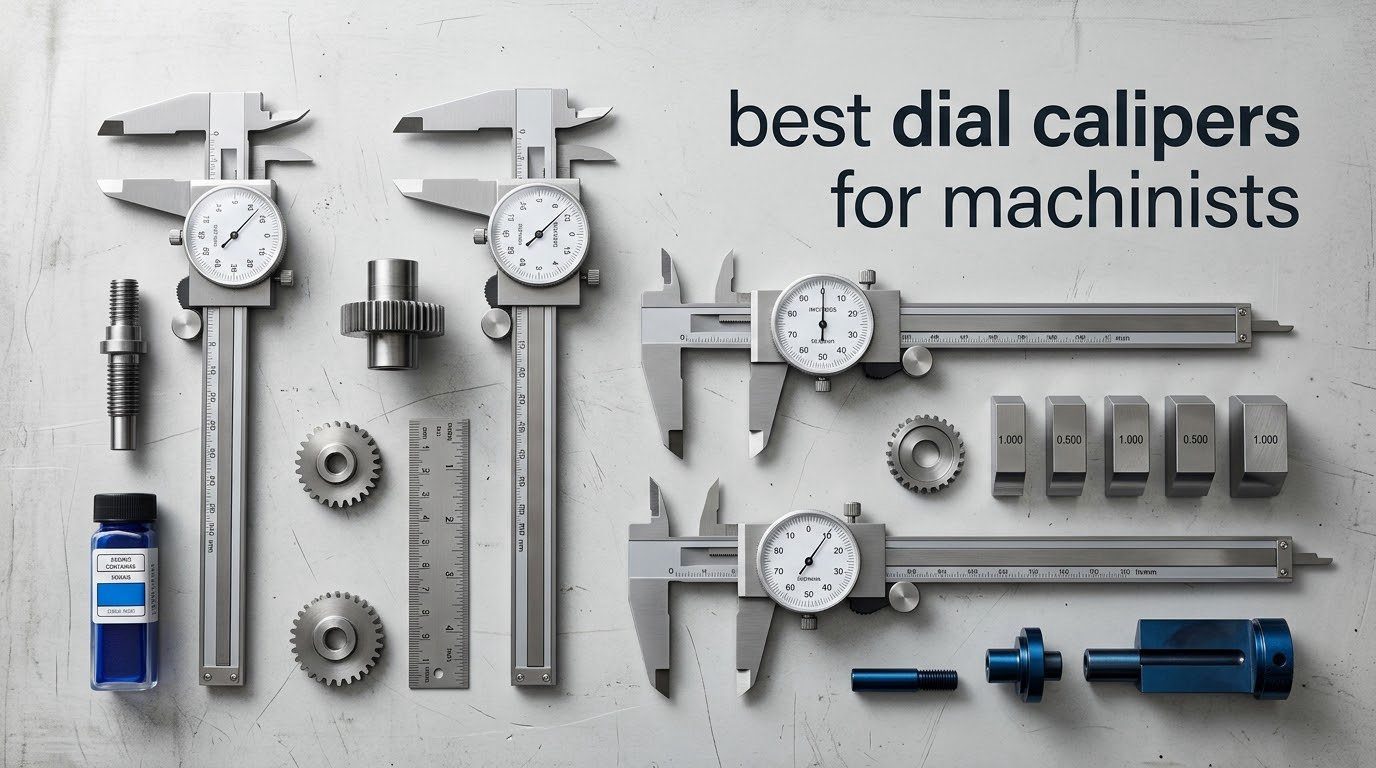
Every bore you set, every shoulder you check, every tool offset you dial in starts with a number off a measuring tool. Get the best dial calipers for machinists wrong and the error does not stay contained. It walks into your tolerance stack and shows up three parts later as a scrapped workpiece nobody can explain.
A dial caliper is the general-purpose workhorse of the shop: a hardened rack and pinion slider with a circular dial that reads to one thousandth of an inch (0.001″) or 0.02mm, covering outside jaws, inside jaws, step measurements and depth. It is not the most accurate tool you own. It is the one you reach for sixty times a shift, which is why feel, repeatability and zero stability matter as much as the printed accuracy spec.
We compared ten of the most widely used 0-6 inch and 0-12 inch dial calipers on the market right now, cross-checking the manufacturer specs against what buyers report after months of daily shop use and against the machinist forum consensus that dominates this category. We also spell out how to verify any caliper yourself before you trust it, because the biggest gap between the best dial calipers for machinists and the cheapest ones is not the printed spec. It is whether the tool is actually within that spec the day it arrives.
Table of Contents
- Top 3 Dial Caliper Picks for Machinists in 2026
- The 10 Best Dial Calipers Compared in 2026
- 1. Starrett 3202-6 Dial Caliper – the Best Overall 0-6 Inch Pick
- 2. Mitutoyo 505-742J Dial Caliper – Highest Rated 0-6 Inch Model
- 3. Fowler 52-008-706-0 Dial Caliper – Best Value 0-6 Inch Pick
- 4. iGaging 100-164 Dial Caliper – Best Budget Fractional Readout
- 5. Hardware Factory Store HFS 15809 – Best First Dial Caliper for a Home Shop
- 6. Accusize P920-B216 Black Face Dial Caliper – Best High Contrast Readout
- 7. Mitutoyo 505-746 Dial Caliper – the 0-12 Inch Long Range Pick
- 8. findmall 6 Inch Dial Caliper – Best Low-Cost Shop Cart Backup
- 9. HDLNKAK KTL001 Dial Caliper – Best Shockproof Movement Design
- 10. Accusize P920-S236 – Best Inch and Metric Dual Scale Dial
- How to Choose a Dial Caliper You Will Trust
- How to read a dial caliper in three steps
- What 0.001 inch accuracy actually means
- How to verify any caliper before you cut metal
- Dial vs digital vs vernier: the honest comparison
- The brand tier list machinists actually agree on
- How to spot a counterfeit or junk caliper
- When you should stop using a caliper and reach for a micrometer
- Maintenance habits that protect repeatability
- Frequently Asked Questions
- Are Starrett or Mitutoyo calipers better?
- Are dial calipers more accurate than digital calipers?
- Who makes the most accurate calipers?
- What is the best budget dial caliper for accurate measurements?
- Are there fake Mitutoyo calipers?
- How do I check if a dial caliper is accurate?
- Do I need a micrometer if I have a caliper?
- Which Dial Caliper Should You Buy?
Top 3 Dial Caliper Picks for Machinists in 2026

Starrett 3202-6
- 0-6 inch range
- +/-0.001 accuracy
- positive split-gear anti-backlash
- hardened stainless
- fitted case

Mitutoyo 505-742J
- 0-6 inch range
- 0.001 inch graduations
- satin chrome dial face
- bezel and jaw lock screws
Fowler 52-008-706-0
- 0-6 inch range
- +/-0.001 accuracy
- covered rack
- thumb roller
- 4-way measurement
The 10 Best Dial Calipers Compared in 2026
| Product | Specs | Action |
|---|---|---|
| Starrett 3202-6 Dial Caliper 0-6 inch |
|
Check Latest Price |
| Mitutoyo 505-742J Dial Caliper 0-6 inch |
|
Check Latest Price |
| Fowler 52-008-706-0 Dial Caliper 0-6 inch |
|
Check Latest Price |
 iGaging 100-164 Fractional Dial Caliper 0-6 inch iGaging 100-164 Fractional Dial Caliper 0-6 inch |
|
Check Latest Price |
 HFS 15809 Imperial Dial Caliper 0-6 inch HFS 15809 Imperial Dial Caliper 0-6 inch |
|
Check Latest Price |
 Accusize P920-B216 Black Face Dial Caliper Accusize P920-B216 Black Face Dial Caliper |
|
Check Latest Price |
 Mitutoyo 505-746 Dial Caliper 0-12 inch Mitutoyo 505-746 Dial Caliper 0-12 inch |
|
Check Latest Price |
 findmall 6 Inch Stainless Dial Caliper findmall 6 Inch Stainless Dial Caliper |
|
Check Latest Price |
 HDLNKAK KTL001 Shockproof Dial Caliper HDLNKAK KTL001 Shockproof Dial Caliper |
|
Check Latest Price |
 Accusize P920-S236 Inch Metric Dial Caliper Accusize P920-S236 Inch Metric Dial Caliper |
|
Check Latest Price |
1. Starrett 3202-6 Dial Caliper – the Best Overall 0-6 Inch Pick
Starrett Dial Caliper, Adjustable Bezel, 0-6″ Range, .001″ Grad
0-6 inch range
+/-0.001 inch accuracy
Hardened stainless steel
16 oz
Pros
- Runs smooth with no backlash
- does not jump while adjusting
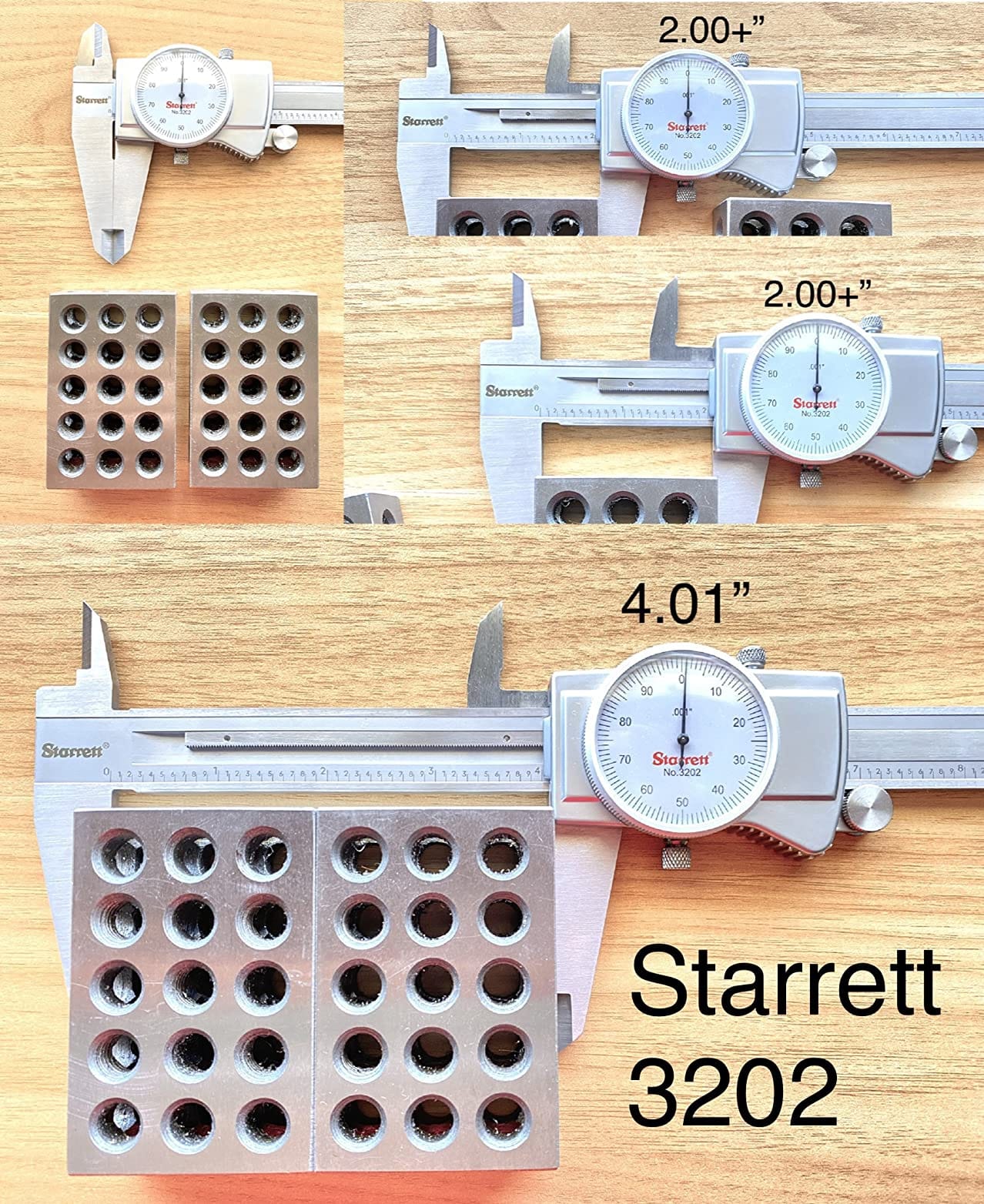
- Accurate on smaller measurements verified against gauge blocks
- Hardened jaws resist wear and scratching
- Lock screw is easy to reach
- Fitted case included
Cons
- Some readings drift slightly above zero on the dial at larger measurements
- Outside jaw depth of about 2.5 inch is short for large rod diameters
- Heavy feel with a loose clicky thumb roller
The Starrett 3202-6 is the pick we put in the hands of a machinist who wants one caliper to do everything without thinking about it. It carries a 0-6 inch range, a stated accuracy of plus or minus 0.001 inch, and a hardened stainless steel bar, rack and gear set rather than a plated mild steel frame. That construction detail is what separates a shop tool from a garage tool, and it is the reason this model sits at the top of our list of the best dial calipers for machinists.
Buyers consistently describe the action as smooth with no backlash and no jumping while adjusting, which is the single most-cited mechanical virtue in this category. The positive split-gear anti-backlash control is the engineering behind that, and it holds readings stable while you are moving the slider, an advantage over designs where the reading shifts under vibration or a sudden stop. The thumb-operated fine adjustment roll lets you close the last thousandth one-handed without pinching the slider.
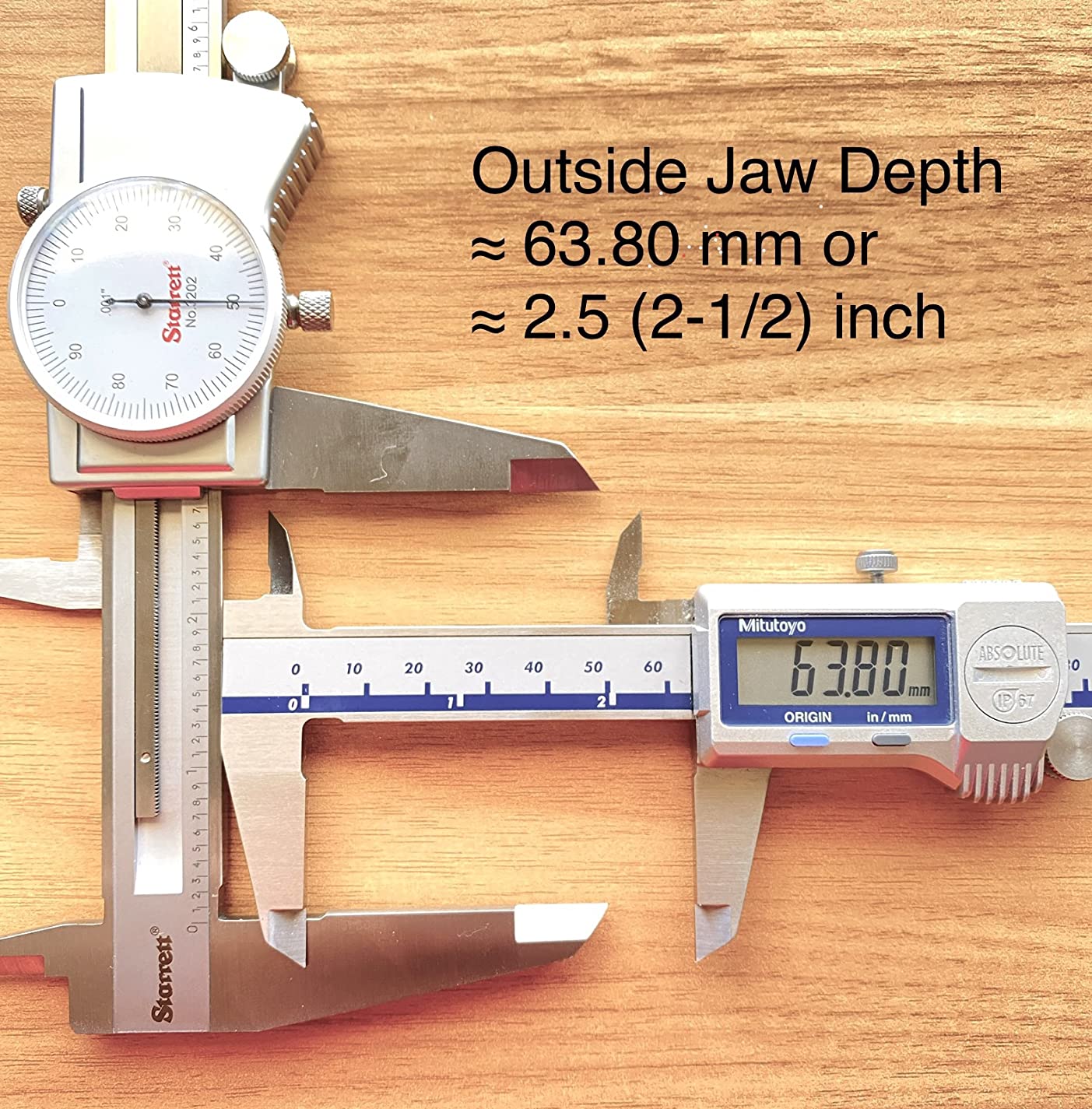
Accuracy checks against gauge blocks and micrometers come back clean on the small and mid-range measurements that make up most shop work. The one recurring complaint worth knowing about is a slight drift above zero on the dial at larger measurements, so if you are measuring a long shaft, verify against a known standard before you commit. The outside jaw depth of roughly 2.5 inches is also the limiting factor on large rod diameters, and the 16 ounce weight is on the heavy side for a full day of one-handed measuring.
Who the Starrett 3202-6 suits best
This is the caliper for the general job: someone measuring 0.3 inch to 6 inch features across a mixed workload of layout, setup and inspection. The knife-edge contacts on the inside and outside jaws handle both measurement types cleanly, and the dual lock screws, one for the dial bezel and one for the sliding jaw, let you freeze a reading and move the tool without disturbing it.
If your work is mostly under 2 inches, this is close to ideal. The hardened jaws resist wear and scratching, so it stays trustworthy on finished surfaces that a softer tool would gall.
Who should buy something else
Skip it if you routinely measure diameters above a few inches, where the jaw depth becomes the limiting factor, or if you are on a 12 inch schedule. It is also a heavy tool, and a 12 ounce class caliper feels noticeably lighter in the hand during a long inspection run.
One more thing to check before you commit: several owners note that the 3202-6 is built in China rather than in Athol, Massachusetts. That does not change the spec, but if buying domestic steel matters to your shop standards, this is not the model to point at.
2. Mitutoyo 505-742J Dial Caliper – Highest Rated 0-6 Inch Model
Mitutoyo 505-742J Dial Caliper, 0.1″ per Rev, 0-6″ Range, 0.001″ Accuracy
0-6 inch range
0.001 inch graduations
0.1 inch per revolution
Stainless steel
Pros
- Crisp easy-to-read dial marked every 0.001 inch
- Superb repeatability with no backlash after cycling to 6 inch
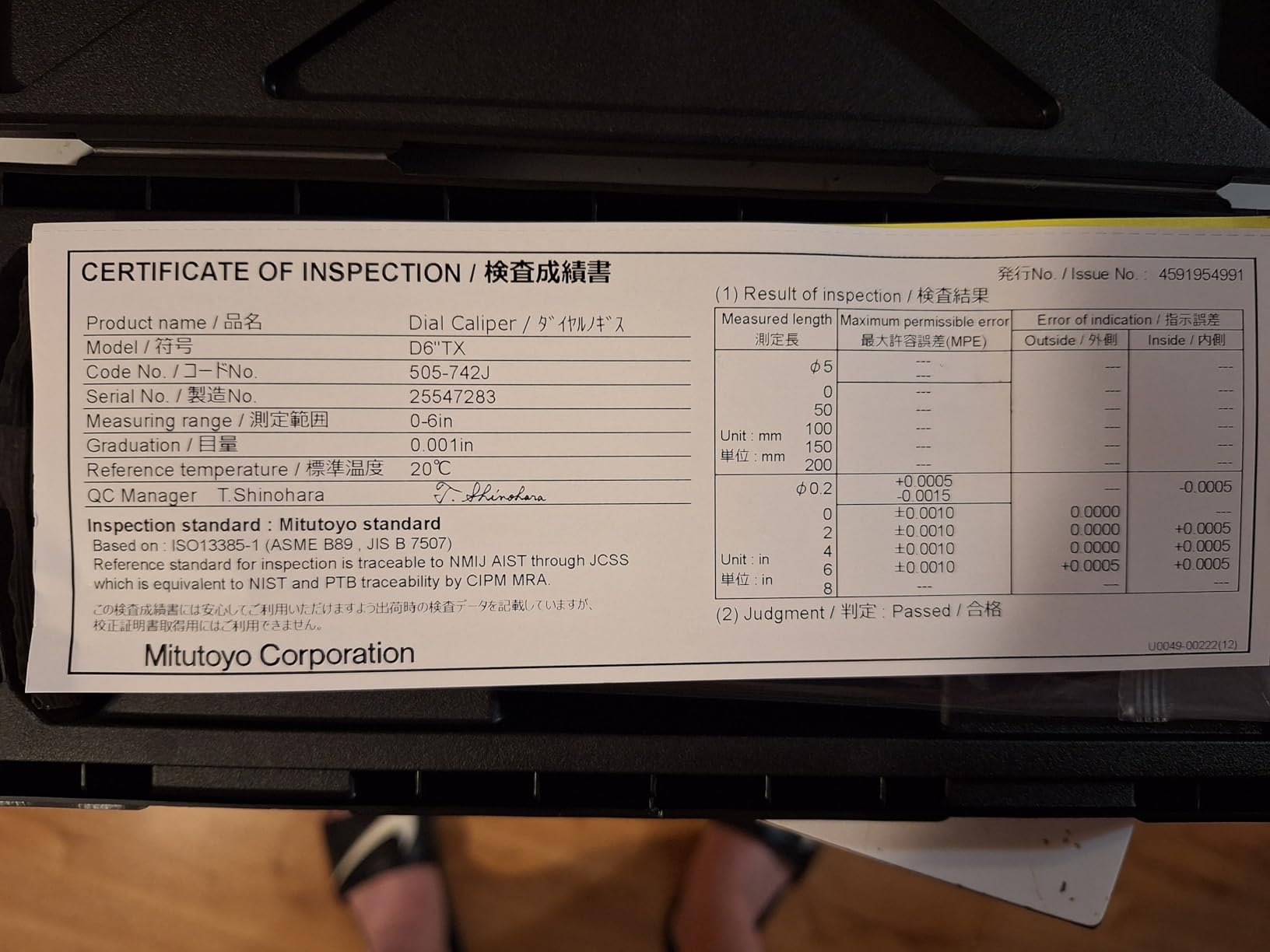
- Zeros consistently and passes shop calibration checks
- Premium fit and finish
- No batteries to fail
Cons
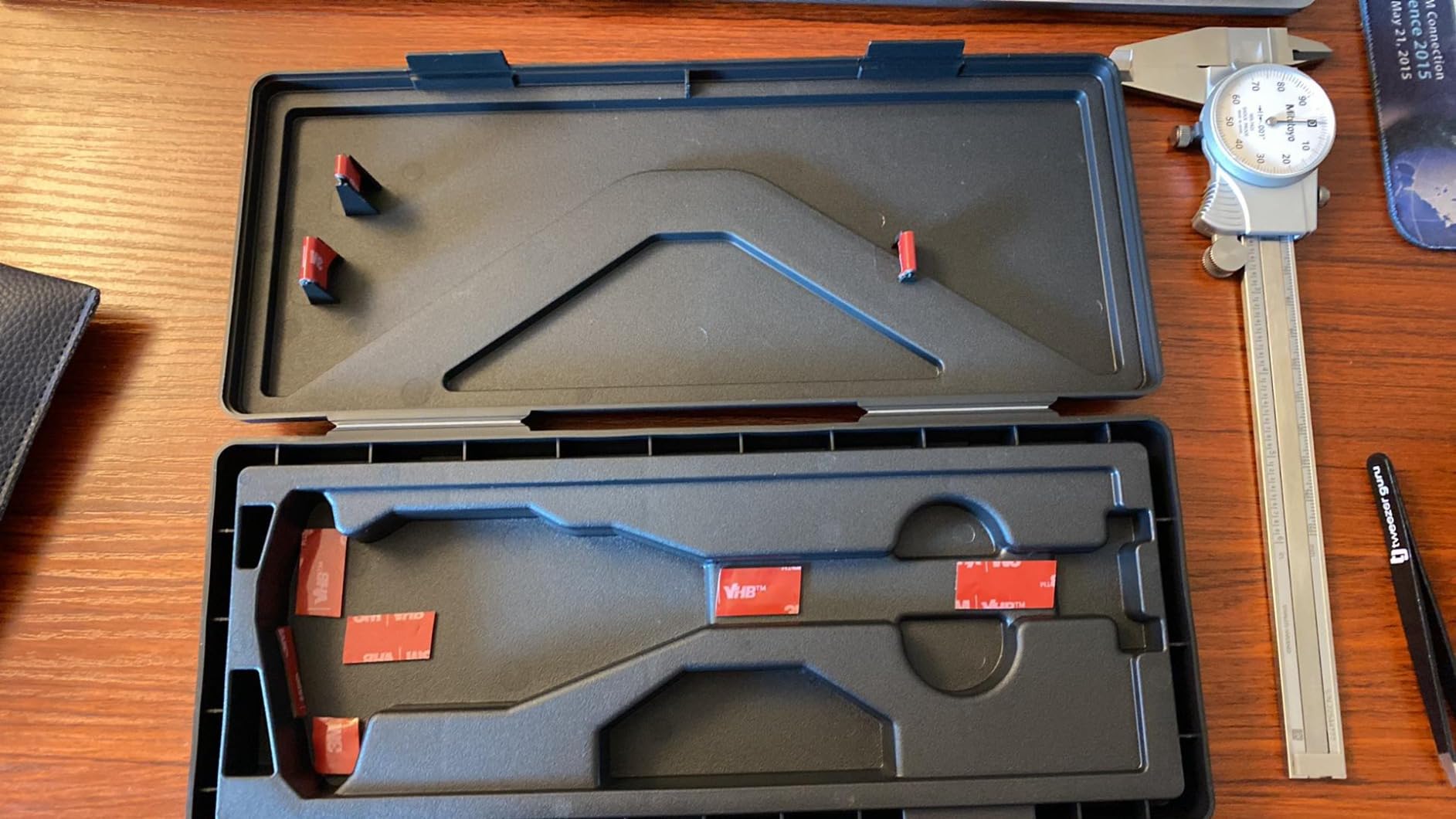
- Supplied case has no foam padding
- Case hinge is thin plastic that may work-harden
The Mitutoyo 505-742J is the highest rated model in this group, and the rating reflects something real: owners report superb repeatability with no noticeable backlash even after cycling the slider out to 6 inch repeatedly, and consistent zeroing that survives shop calibration checks. If you want the most accurate-feeling 0-6 inch dial that still uses no power source at all, this is the one.
The dial is graduated at 0.001 inch with 0.1 inch per revolution, and the satin chrome face is a deliberate readability upgrade. Glare is the enemy of dial caliper reading under fluorescent shop lighting, and a brushed face with crisp black graduations is far easier to parse at a glance than a shiny one. Lock screws for both the dial bezel and the jaw hold a reading fixed, and the 4-in-1 design covers outside, inside, depth and step in one tool.
There is a real reason so many working machinists keep an analog dial in their apron even after moving to digital: nothing to fail. No battery, no encoder, no firmware. It works when it comes out of the drawer, which on a Saturday night shop session matters more than dual-unit convenience. The forum consensus does describe some Mitutoyo dial action as feeling slightly less smooth through its travel than the Brown & Sharpe and Tesa family, so if tactile feel is your top criterion, test this one in hand before you commit.
What the 505-742J does well
It holds a reading. That is the plainest way to describe the fit, finish and movement on this model, and it is what matters when you are setting up a bore and rechecking it. The graduations are easy to interpolate between thousandths, the face stays readable, and the zero holds where you put it.
It also comes with a fitted plastic case, which matters more than it sounds. A caliper left loose in a tool drawer picks up chips, and chipped calipers lose repeatability.
What could be better
The case is the weak point. It has no foam padding, so the dial rides directly against the shell, and the hinge is a thin plastic part that can work-harden and crack with age. The tool itself is not the issue. Buy a small foam cut or a dedicated drawer slot and the tool will outlast the box it came in.
3. Fowler 52-008-706-0 Dial Caliper – Best Value 0-6 Inch Pick
Fowler 52-008-706-0, Premium Dial Caliper With 0-6″ Measuring Range (White)
0-6 inch range
+/-0.001 inch accuracy
Covered rack
Stainless steel
Pros
- Stainless steel body with a smooth positive slide feel
- Large white dial with clear 0.001 inch graduations
- Thumb roller and knurled lock allow one-handed measuring
- Storage case and manual included
Cons
- Imperial scale only on this model
- 12 ounce weight is noticeable over a long inspection run
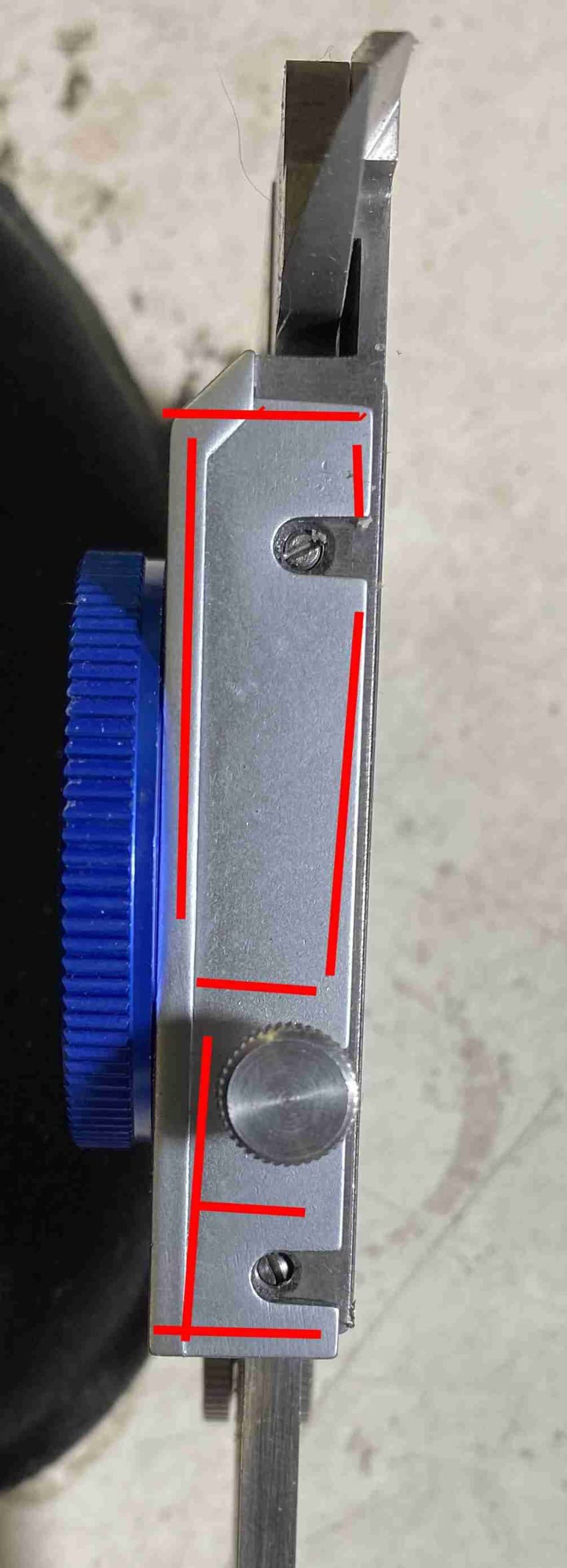
The Fowler 52-008-706-0 is the value pick in a group where the good options cost real money. It delivers a 0-6 inch range, a stated accuracy of plus or minus 0.001 inch, and a stainless steel body, which is the combination most of this list is chasing. The covered rack is a quiet but real advantage: it keeps dirt and grit out of the gear train, and in a shop with chips and grinding dust that is where budget tools tend to seize up.
The dial hand makes one revolution every 0.1 inch with 0.001 inch graduations, and the beam is engraved at 0.10 inch, so the reading method is the industry standard described later in this guide. The large white dial with clear graduations is the feature reviewers praise most, and the knurled lock screw plus thumb-operated fine adjustment roller make one-handed measuring straightforward in a way that many competing designs are not.
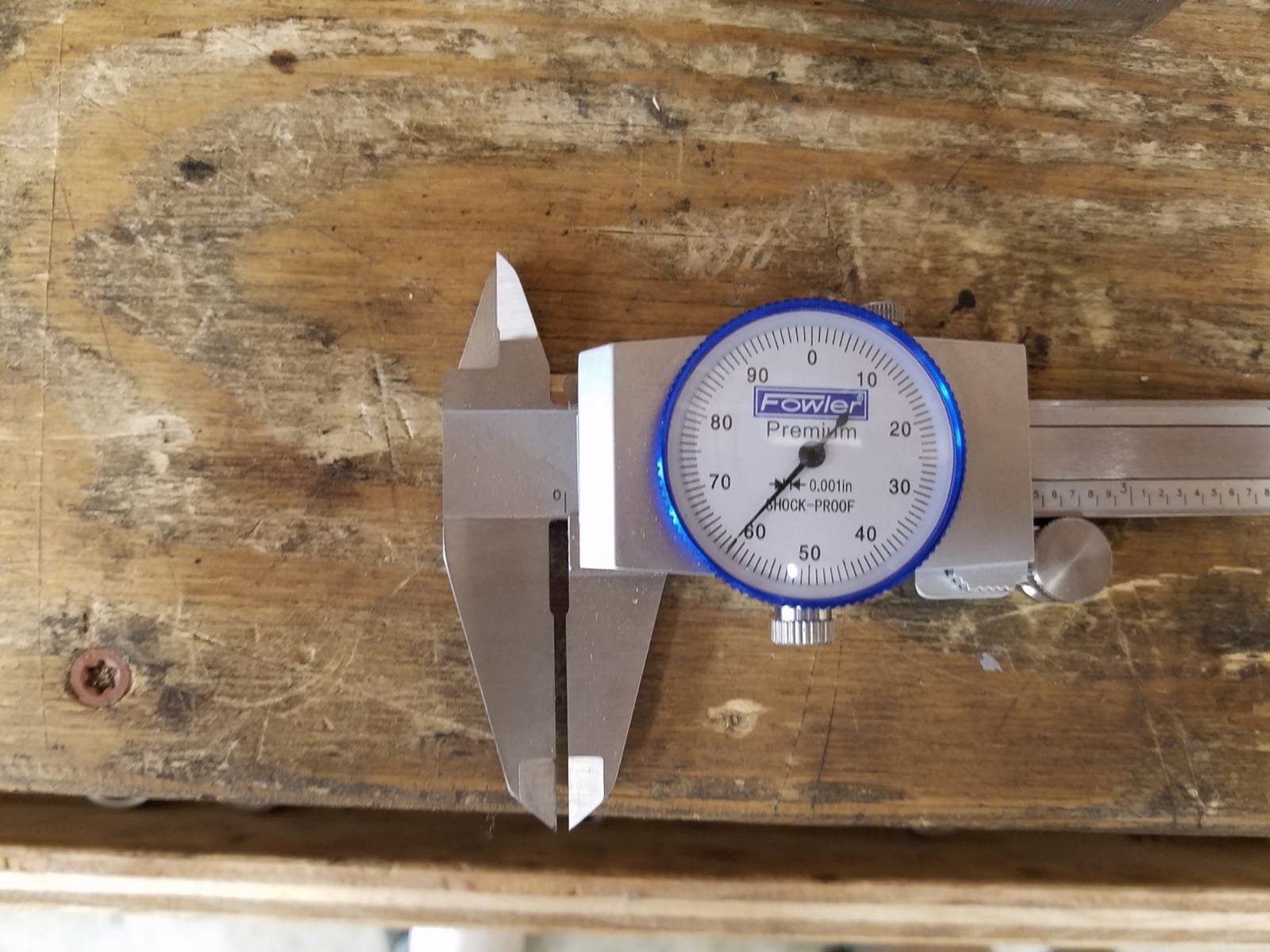
Fowler is also one of the few brands here that ships a full set: two sets of jaws and a depth rod, covering inside, outside, depth and step. On the 1 year warranty on material and workmanship, this is a brand with a long shop-standard history rather than a recent marketplace listing, which matters when you want parts and service to exist in ten years.
Where the Fowler earns its place
This is the caliper to buy when you need a reliable 0.001 inch 0-6 inch tool for a second station, a shop cart or a trainee, and you do not want to hand out a premium instrument you cannot replace. The covered rack and stainless body put it closer to the premium tools on longevity than its price suggests.
Reviewers report a smooth, positive slide with no play in the body, which is the part of the spec sheet that is hardest to fake.
Where it falls short
It is imperial only. If your shop works in metric drawings, you will be converting constantly or you will want the dual-scale option further down this list. The 12 ounce weight is also on the heavier side, and there is no fine-adjust thumb wheel beyond the standard roller.
4. iGaging 100-164 Dial Caliper – Best Budget Fractional Readout
iGaging Dial Caliper 6″ Fractional & Decimal Inch Combination Dual Scale
0-6 inch range
0.01 inch and 1/64 inch resolution
Dual scale dial
Stainless steel
Pros
- Fractional 1/64 inch readout removes decimal to fraction conversion
- Returns to zero reliably when closed
- No batteries required
- Storage case included
- Easy to zero out of the box
Cons
- Resolution is 0.01 inch
- not 0.001 inch
- Dial numerals are small and hard to read
- Storage case clips are awkward to open
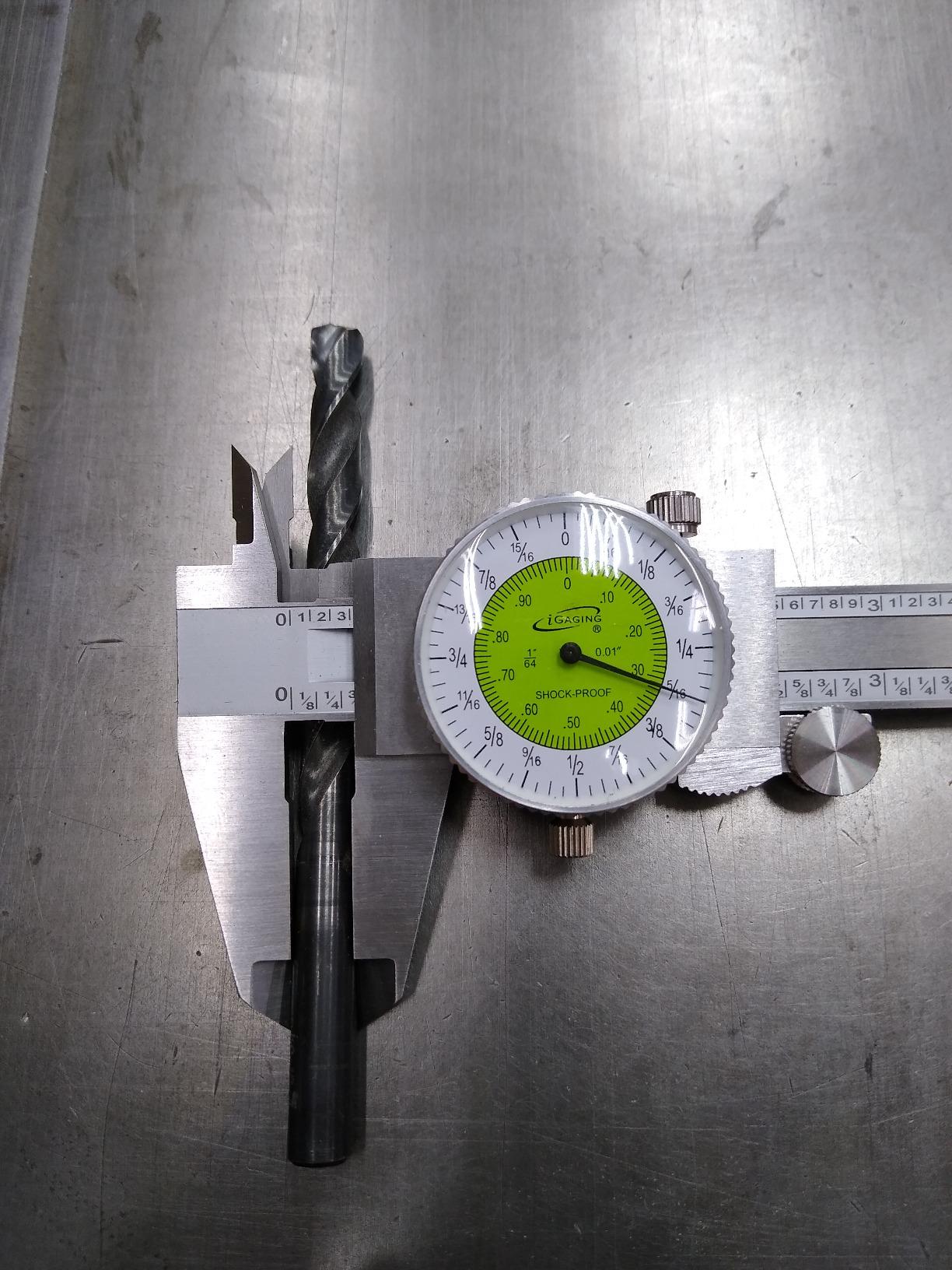
Read this one carefully before you buy it, because the iGaging 100-164 is not a thousandths caliper. Its stated accuracy is plus or minus 0.01 inch and its resolution is 0.01 inch plus 1/64 inch, with a dual-scale dial showing inches and sixteenths at the same time. That is a genuinely useful tool for layout, marking and general shop measurement. It is the wrong instrument if you are checking a .001 inch tolerance.
What you get for that trade is real. The fractional readout eliminates the mental conversion that slows down every measurement on a decimal dial, the stainless steel body has no play and returns to zero reliably when closed, and there is no battery to fail. The thumb wheel handles fine adjustment and the adjustable bezel lets you zero it out of the box without a calibration standard, which makes it a good first tool or a shop-cart backup.
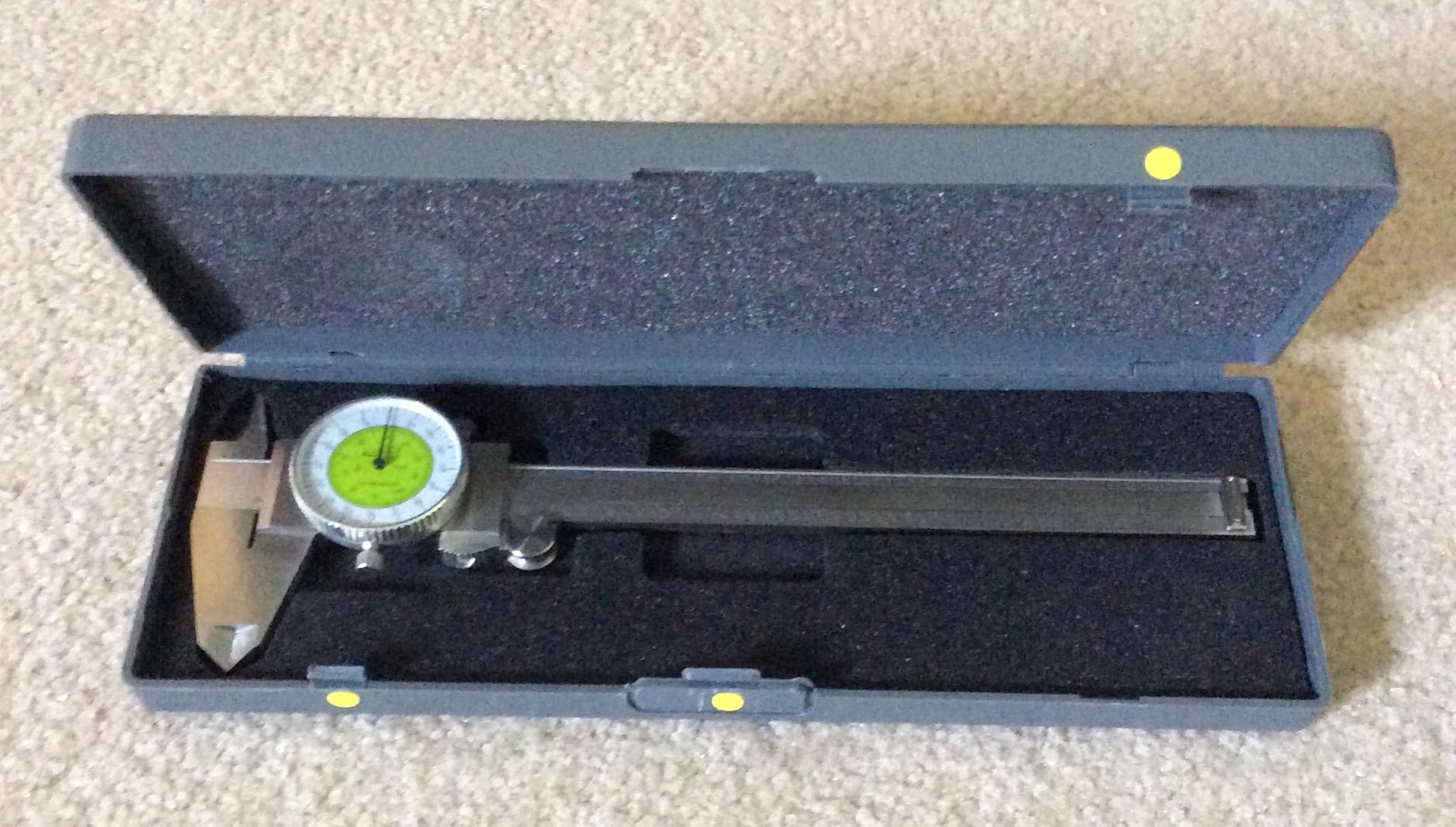
Placed against the .001 inch tools in this roundup, the honest framing is that this one covers a different job. It is faster for fractions, slower for decimals, and its accuracy spec is an order of magnitude looser. Some owners report accuracy that does not meet the printed spec, so treat it as a layout and checking tool rather than an inspection instrument.
Who should own the iGaging 100-164
Woodworkers, fabricators, hobby machinists and anyone who lives in fractions will love the dial. The dual scale means one glance gives you both 2.5 and 2 1/16 without stopping to convert, and the 11.84 ounce stainless body feels solid rather than tinny. Buyers also like that the case is included, so it can live in a toolbox instead of loose in a drawer.
It is also a reasonable second caliper to keep around, since it is a different format and will not be confused with your precision tool.
Who should skip it
If your work involves printed .001 inch tolerances, CNC offsets or bore checks, this is not the instrument. The small dial numerals are also a problem for aging eyes or anyone reading through a safety lens, and the storage case has three stiff clip points that are genuinely awkward to open.
5. Hardware Factory Store HFS 15809 – Best First Dial Caliper for a Home Shop
HFS Imperial 0-6 Inch Dial Caliper, ±0.001 Inch Accuracy, 4-Way Measuring Tool
0-6 inch range
+/-0.001 inch accuracy
Hardened carbon steel
Fitted case
Pros
- Four-way measurement in a low-cost tool
- Hardened carbon steel frame slides smoothly and feels solid
- Thumb roller and lock screw simplify reading
- Fitted protective case included
- Suitable for hobby machining and general checks
Cons
- Accuracy is budget-tool tolerance rather than shop-grade
- Finish and dial legibility trail the premium brands
- Consistency varies more between examples
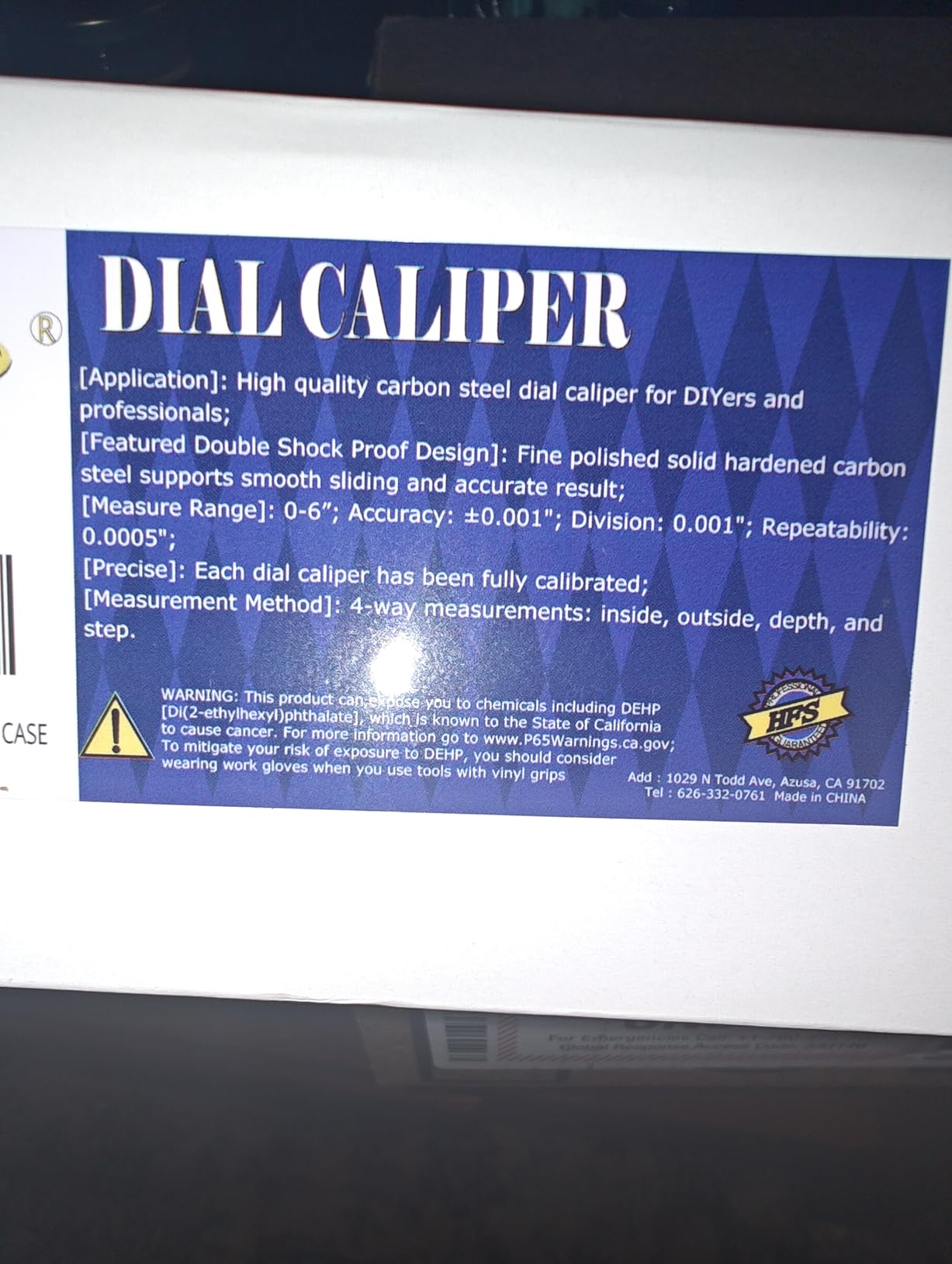
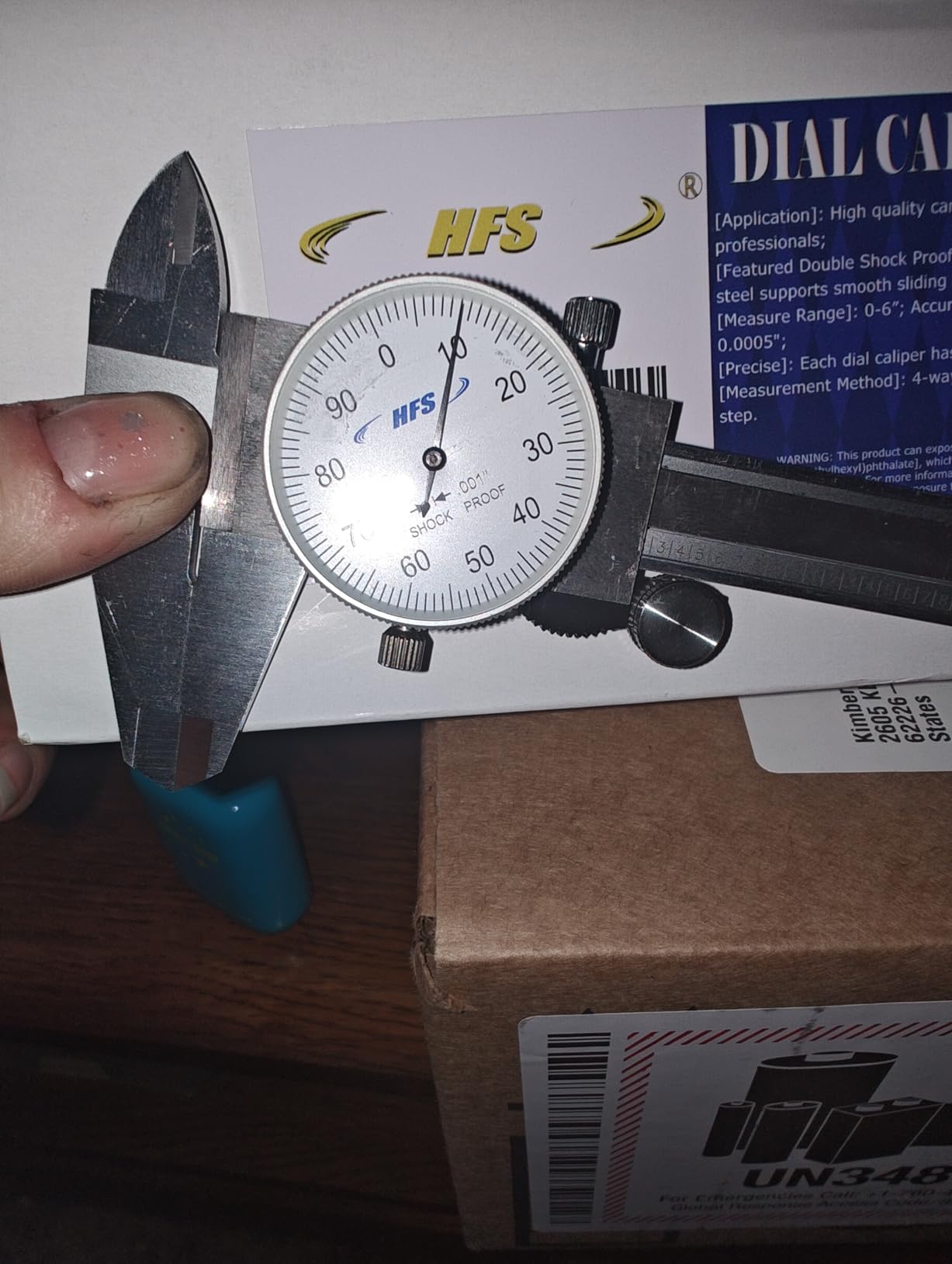
The HFS 15809 is the most reviewed product in this entire roundup, with a 4.3 star average, and that number tells you something useful: it is the entry-level four-way dial caliper a huge number of people bought first and kept. For a home garage, a garage-based small shop or a teaching setup, it covers outside, inside, depth and step measurement with a thumb-operated fine adjustment roller, a locking screw and a fitted protective case.
Two things stand out for the price class. The frame is hardened carbon steel with a precision finish rather than a thin stamping, and it slides smoothly and feels solid in the hand. The 0-6 inch range with plus or minus 0.001 inch accuracy and 0.001 inch graduations means it reads like a proper shop dial, not a layout scale.
Where it differs from the premium tools is tolerance, and you should know that going in. Buyers consistently place the accuracy closer to plus or minus 0.001 inch budget tooling than to shop-grade precision, dial legibility and overall finish trail the brands above it, and the spread between individual examples is wider than with a Starrett or a Mitutoyo. A calibration technician quoted on the Practical Machinist metrology forum reports rejecting the large majority of secondhand and discount tools that pass through the lab, and this model sits in the category that tends to get rejected.
That does not make it a bad tool. It makes it a learning tool, a shop-cart tool, or a tool for work where a few thousandths does not matter.
Why it still earns a place on the list
It is the cheapest route to learning how a dial caliper actually reads. The 0.100 inch beam plus 0.001 inch dial system is the same one used on every premium tool here, so the skill transfers directly. Once you can read it, you can read anything.
It is also perfectly adequate for woodworking, hobby machining and general shop checks, and the included case means it will not get scratched in a drawer.
When to spend more instead
If you are about to start cutting steel to a printed tolerance, buy up. The consistency between examples is the issue, and a tool that reads differently on Tuesday than it did on Monday will quietly poison your setups. Upgrade to the Starrett or the Fowler when accuracy starts to matter more than the outlay.
6. Accusize P920-B216 Black Face Dial Caliper – Best High Contrast Readout
Accusize Black Face Dial Caliper 0-6 in x 0.001 in, P920-B216
0-6 inch range
+/-0.001 inch accuracy
Black dial face
Covered rack
Pros
- Hardened stainless steel with satin chrome finish
- Black dial face gives strong contrast for reading
- Lapped jaw measuring faces support consistent readings
- Covered rack keeps the gear train clean
- Four-way measurement in a mid-priced body
Cons
- Dial markings are small relative to white-face premium dials
- Bezel is fixed rather than zeroing
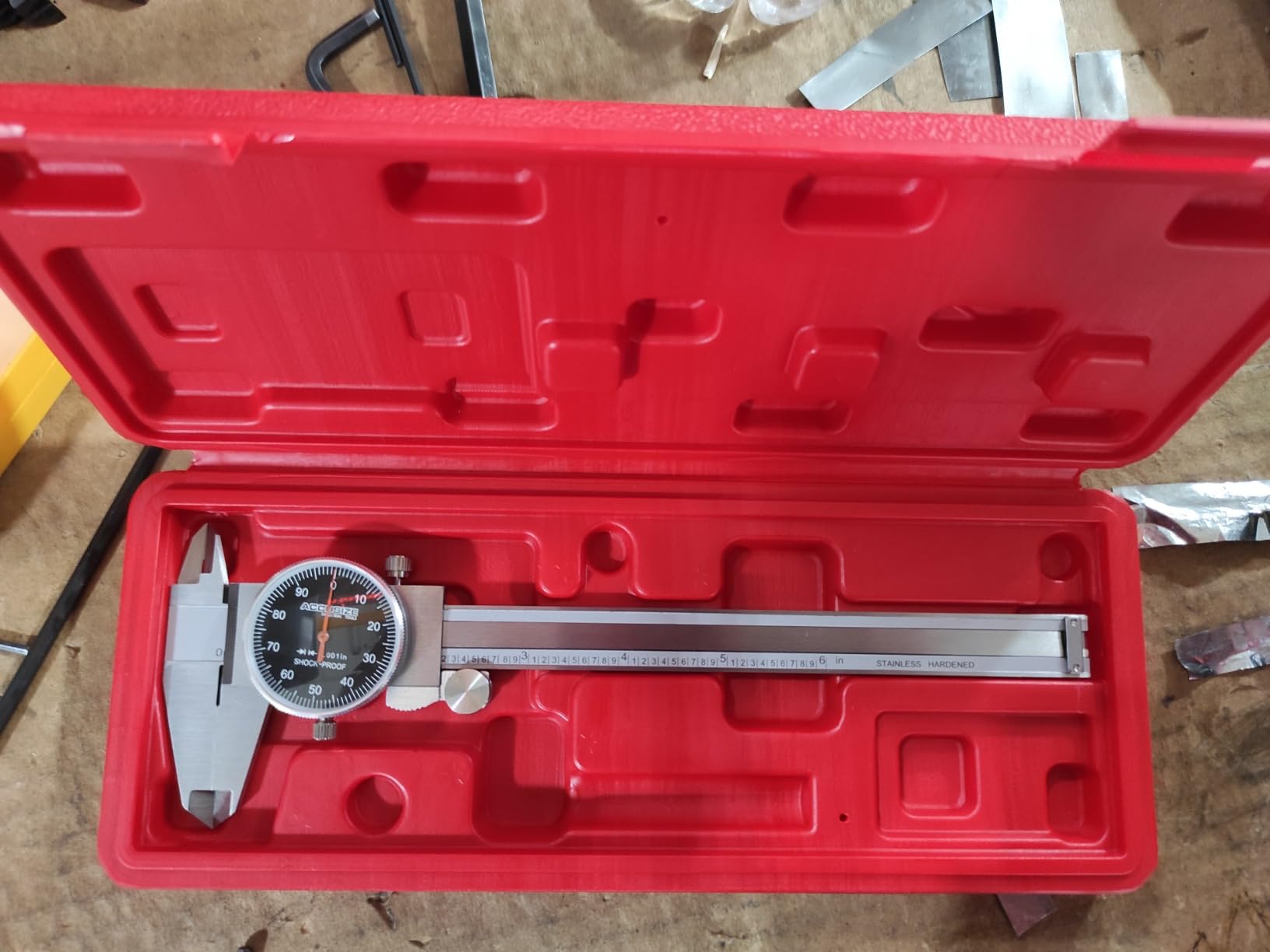
The Accusize P920-B216 sits in the middle of this list in price and near the top in build quality, and its distinguishing feature is the black dial face. The contrast against the white graduations is strong, and for anyone who has squinted at a chrome face under shop fluorescents, that is a genuinely useful difference rather than a cosmetic one.
Underneath, it is a properly made tool: hardened stainless steel, a satin chrome finish with crisp engraved graduations, and jaws with lapped measuring faces that support consistent readings. The covered rack protects the gear train from dirt, which matters if you measure parts that are still shedding chips. Range is 0-6 inch with plus or minus 0.001 inch accuracy, and it does inside, outside, depth and step measurement.
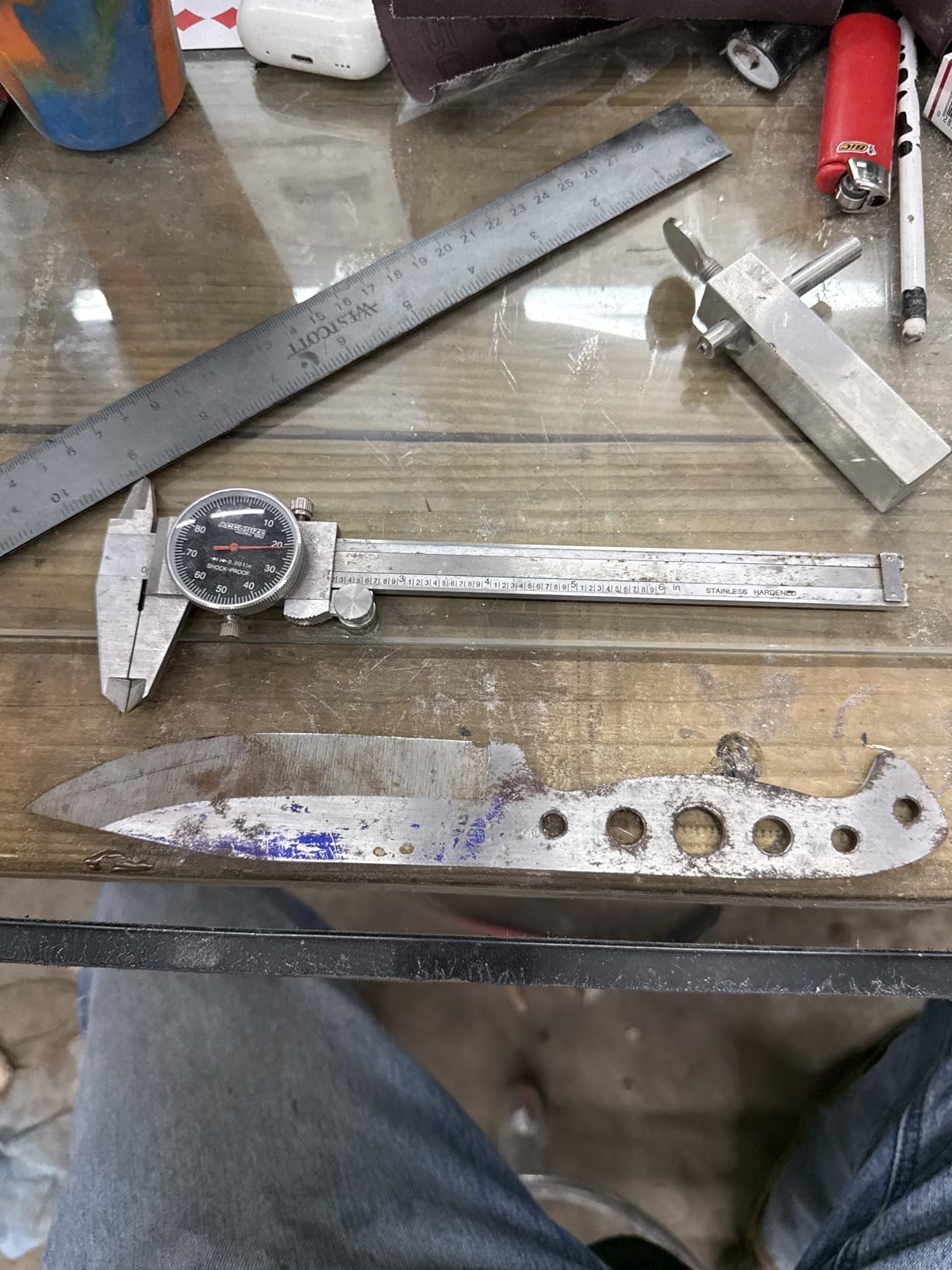
Two limitations are worth planning around. The dial markings are small relative to the big white faces on the Starrett, Fowler and Mitutoyo models, so it is a little slower to read at a glance. And the bezel is fixed rather than a zeroing bezel, which means you set your reference by closing the jaws and trusting the factory zero rather than rotating the dial to suit yourself.
One note on the listing itself: the published dimensions for this model are listed at 2 inch by 1.97 inch, which is clearly not the full 0-6 inch tool. Judge the instrument by the range and accuracy in the spec sheet, not by that figure.
Where the P920-B216 fits
This is a strong mid-tier choice for a shop that wants stainless construction and a covered rack without the premium badge. If you measure a lot of machined parts rather than layout work, the honed jaw faces and four-way capability cover the usual demands.
Readers who prefer dark dials consistently rate the contrast highly, and the satin chrome finish is easier on the eyes than a mirror polish.
Where it does not
It is not the pick for someone who needs to re-zero against a datum mid-measurement, because the fixed bezel does not allow it. The small dial print is also the most common complaint, and for older eyes the larger white faces read faster.
7. Mitutoyo 505-746 Dial Caliper – the 0-12 Inch Long Range Pick
Mitutoyo 505-746 Dial Caliper.001″ Graduation, 0.1″ per Revolution, 0-12″ Range, 0.002″ Accuracy, White Face
0-12 inch range
0.001 inch graduations
Titanium nitride coated slide
Stainless steel
Pros
- Holds zero and stays smooth after years of daily shop use
- 12 inch range covers parts smaller calipers cannot reach
- Minimal backlash keeps readings stable under vibration
- Glare-reducing satin chrome finish
- No batteries or electronics
Cons
- Considerable plastic content in the construction
- Heavier and more expensive than shorter models
- Some examples arrive with a detached dial
- Readings can run about 0.001 inch off between 2 and 6 inch
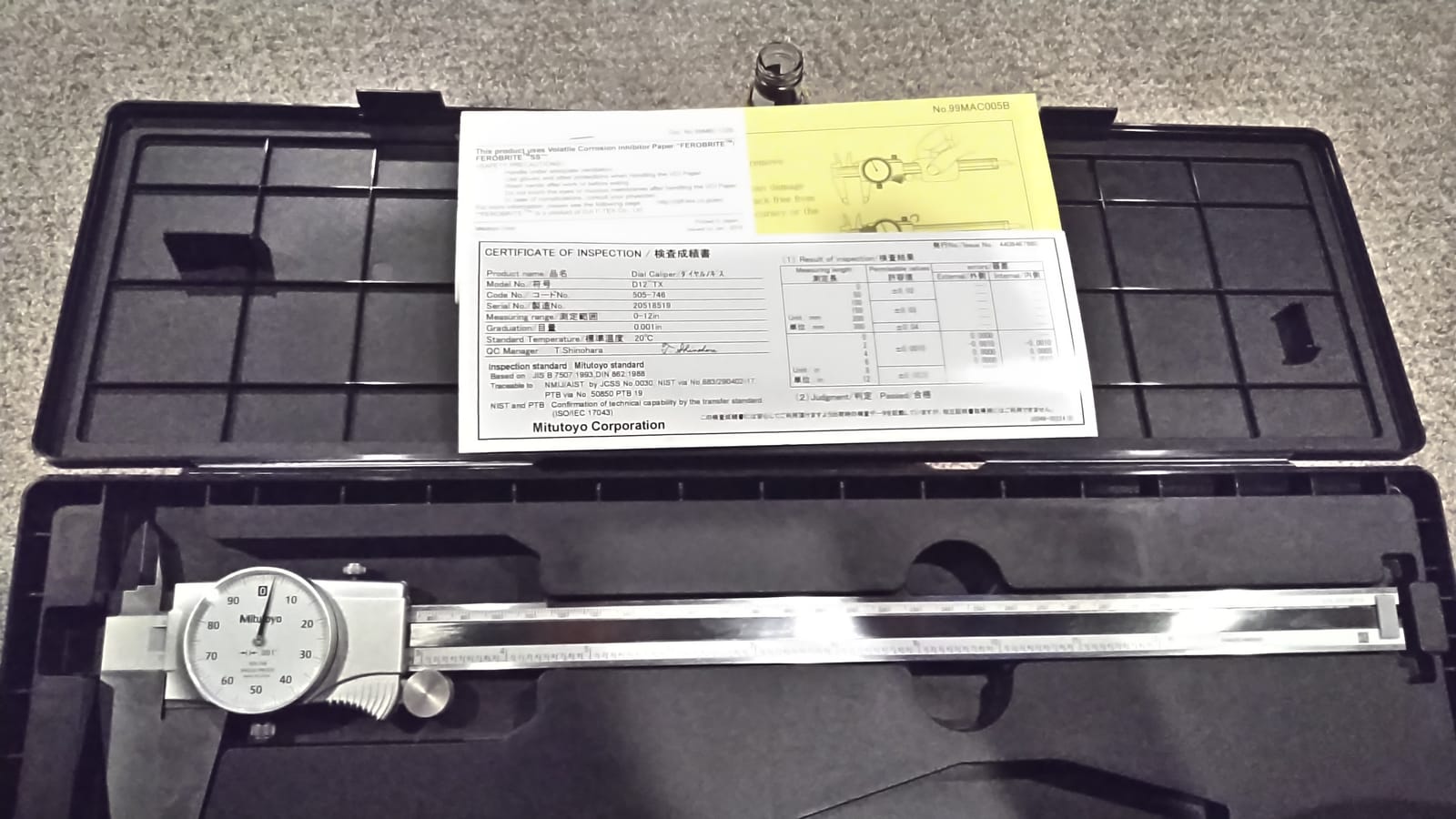
The Mitutoyo 505-746 is the answer for anyone who keeps outgrowing a 6 inch caliper. It covers 0-12 inch, which means shafts, long stock, big flanges and fabricated assemblies all become measurable in one pass instead of three. The graduations stay at 0.001 inch with 0.1 inch per revolution, and the updated dial movement is designed for ultra-smooth sliding with minimal backlash, which is exactly what you need at the long end of the scale where any wander shows up as measurement error.
The titanium nitride coating on the sliding surfaces is the quiet engineering win here. It raises wear resistance and reduces friction in a mechanism that travels twice as far as a 6 inch tool, and long-term owners report the unit still holds zero after years of daily shop use with no batteries or electronics to maintain. The satin chrome finish reduces glare, which matters more on a long tool because you are reading across more scale.
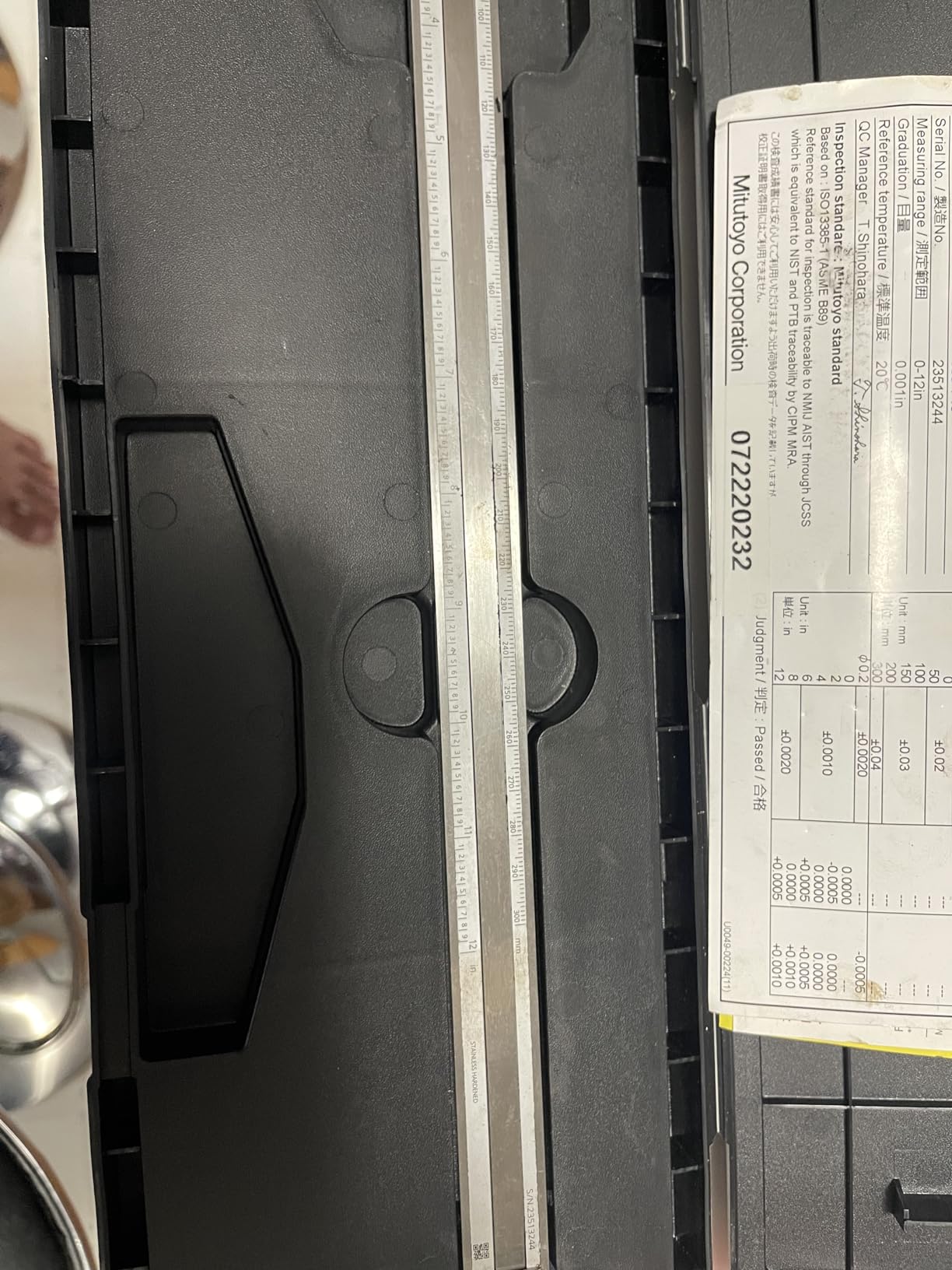
Now the part that makes forum readers cautious about long-range tools generally: a calibration professional quoted on the Practical Machinist metrology forum notes that most calipers carry plus or minus 0.001 inch per 6 inches of length, that some 8 inch tools come in at plus or minus 0.003 inch, and that a 24 inch tool was found at plus or minus 0.005 inch. Tolerance scales with length. A 12 inch caliper reading 0.001 inch on the dial is not the same accuracy claim as a 6 inch caliper doing so.
Owners of this model do report readings that can run about 0.001 inch off between roughly 2 inch and 6 inch, so verify it against a known standard when it arrives. There is also a documented share of examples arriving with a detached dial or a missing slide stop, so inspect the package before you sign for it.
Who needs the 505-746
Turners, fabricators and anyone doing shaft, frame or large assembly work. If you have ever borrowed a colleague’s 12 inch caliper because your 6 inch tool could not reach, you already know the argument. The backlash-free action also keeps readings stable during vibration and sudden movement, which is a genuine advantage in a working shop.
It also handles all four measurement types, so a single tool covers outside diameter, inside diameter, depth and step across a much larger envelope.
Who should stay at 6 inch
Anyone with a bench full of smaller work. The 175 g weight, the larger footprint and the considerably higher cost make it a specialist tool, and the extra plastic content in the construction is a fair concern for something that gets knocked around. Buy it as the second caliper, not the only one.
8. findmall 6 Inch Dial Caliper – Best Low-Cost Shop Cart Backup
findmall 6″ Dial Caliper 0.001 Stainless Steel Caliper Measuring Tool 4-Way Measurement with Plastic Case
0-6 inch range
+/-0.001 inch accuracy
0.0005 inch repeatability
Glass dial cover
Pros
- Verified accurate against a micrometer and half-inch sockets
- Preset to zero out of the box
- Clear legible dial numbers
- Heavier stainless steel construction that feels rugged
- No batteries
Cons
- Not machinist-grade precision
- Included plastic case is flimsy
- Lint can trap under the sealed dial lens
- Slide can be uneven on some examples
The findmall 6 inch dial caliper is the cheapest stainless steel option in this roundup and the one that turns up most often as a second or third caliper. It covers 0-6 inch with plus or minus 0.001 inch accuracy, and it publishes a resolution and repeatability figure of 0.0005 inch, which is a repeatability claim rather than an accuracy claim but tells you the mechanism itself is well made.
Buyers report checking it against a micrometer and half-inch sockets and finding it accurate for hobby work, laser setup and motorcycle work. The polished stainless steel frame with a knurled thumb roller and locking screw feels rugged in the hand, the dial numbers are clear and legible, and there is no battery to go dead. The rotating bezel handles zeroing and lets you set an alternate baseline, which most entry tools skip.
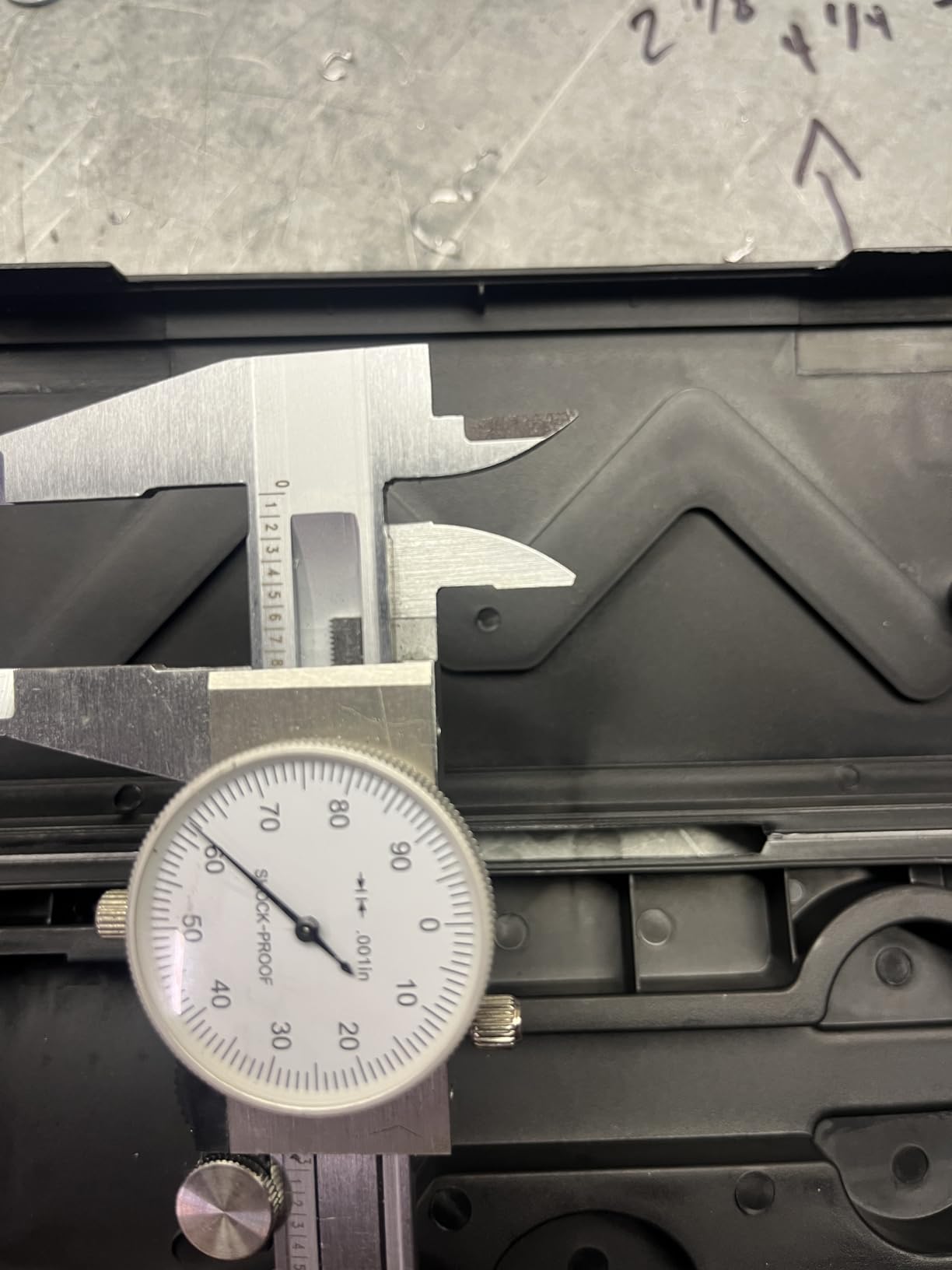
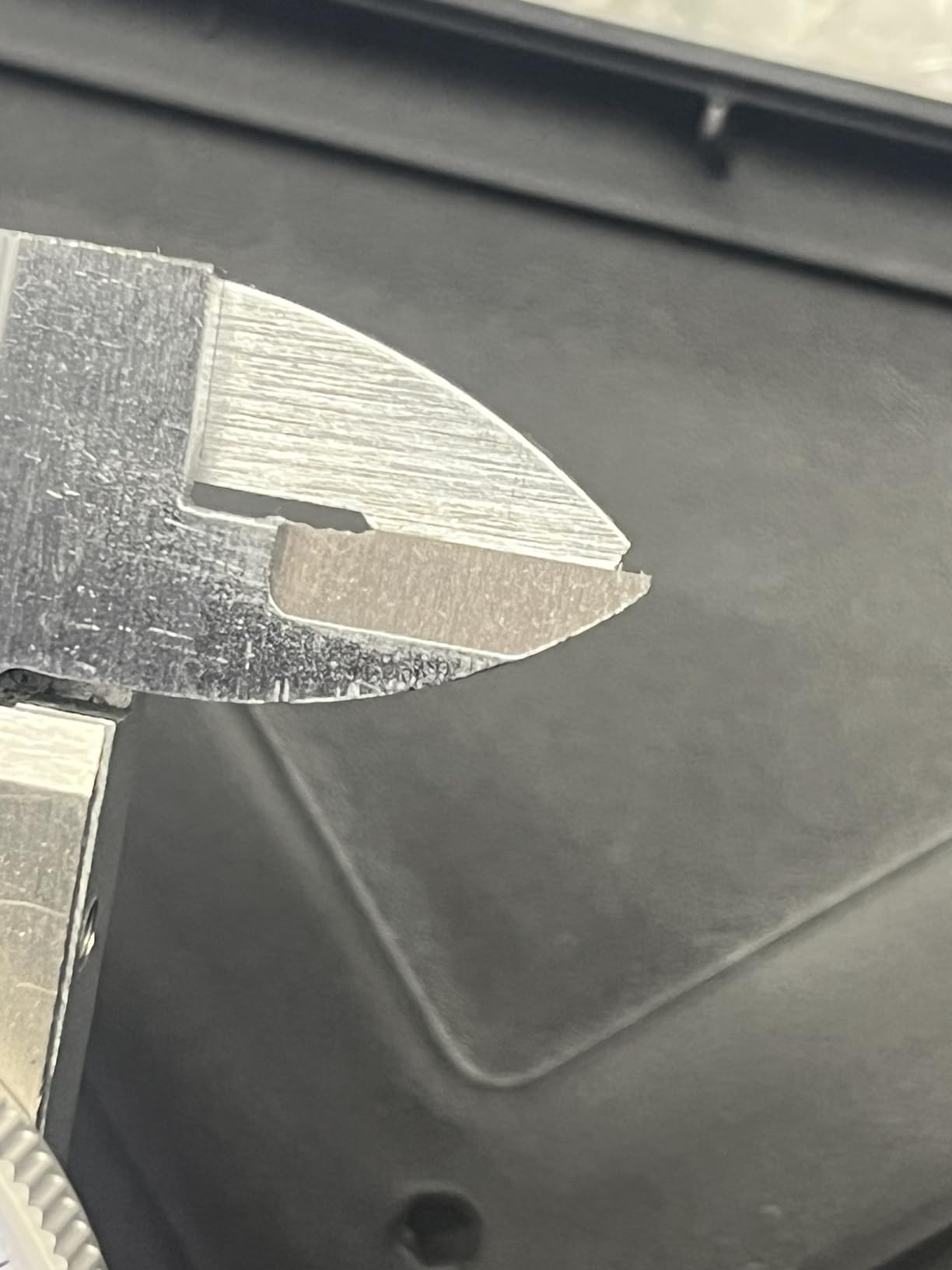
The hard glass dial cover with anti-scratch and anti-glare coating is a nice touch that also creates the most common complaint. A sealed lens traps lint that cannot be removed without opening the bezel, and a blurred dial is a safety issue in a shop. Several buyers also note examples arriving looking cosmetically used, so inspect before you trust it.
The other recurring gripes are the flimsy plastic case and slide movement that is not perfectly smooth on every example. For a shop cart or a garage tool bag, none of that is disqualifying.
Why keep one of these around
Every shop needs a sacrificial caliper. The tool that gets dropped, buried in swarf, handed to an apprentice or left on a wet bench should be this one, not the Starrett. A backup that reads a few thousandths high is still useful for rough setup, checking a cut before the part is finished, or answering the question of whether something is roughly right.
The stainless frame, the four-way jaw and probe set and the zeroing bezel make it more capable than a purely disposable shop tool.
Where it falls short
It is not machinist-grade precision and should not be treated as machinist-grade precision. If you set up a bore from this tool, the error carries into the part. Keep it in the cart, not at the machine.
9. HDLNKAK KTL001 Dial Caliper – Best Shockproof Movement Design
HDLNKAK Dial Caliper Shockproof with Watch 0-6″ Range
0-6 inch range
+/-0.001 inch accuracy
1.5 inch dial
4-way measuring
Pros
- Dual shockproof design protects the movement from knocks
- Four-way measurement for external internal depth and step
- Adjustable bezel and smooth sliding action
- Thumb roller and anti-rebound control aid repeatability
Cons
- Plasticky construction next to an all-metal professional caliper
- Dial contrast and legibility are limited on some color variants
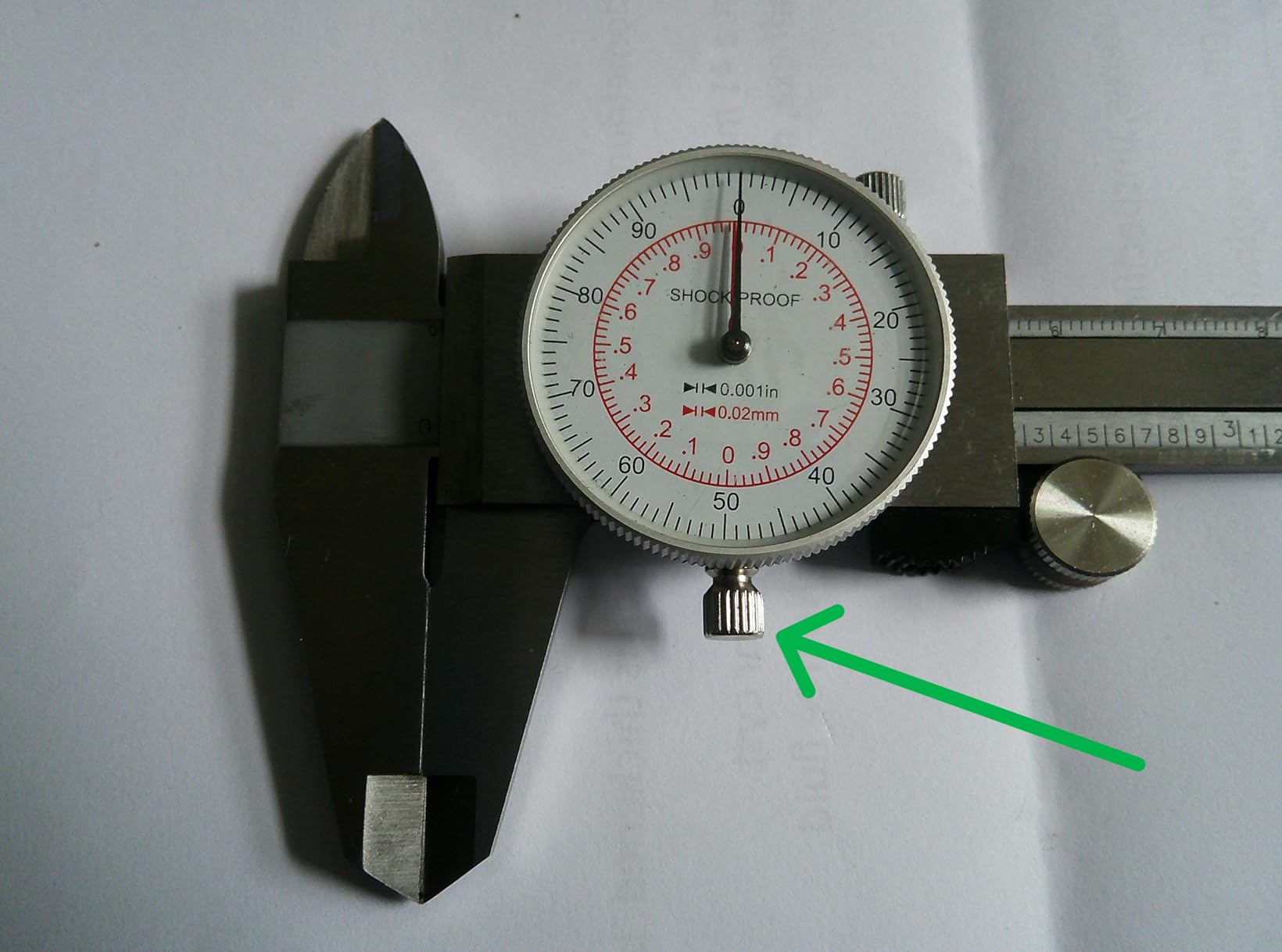
The HDLNKAK KTL001 is the only tool in this roundup built around shock resistance as its headline feature. The double shockproof design with two-way roller protection is meant to absorb the knocks that come with a caliper being dropped off a bench or dragged across a table, and the dual pinion with anti-rebound control is specifically aimed at keeping the reading consistent after an impact.
The mechanism details are sensible: a thumb-operated trimmer roller for fine adjustment, knife edge contacts with active spring loading, and an adjustable bezel for zeroing. The 1.5 inch dial diameter is generous, graduated at 0.001 inch across a 0-6 inch range, and it handles external, internal, depth and step dimensions. It is available in white, silver, red and black dial variants.
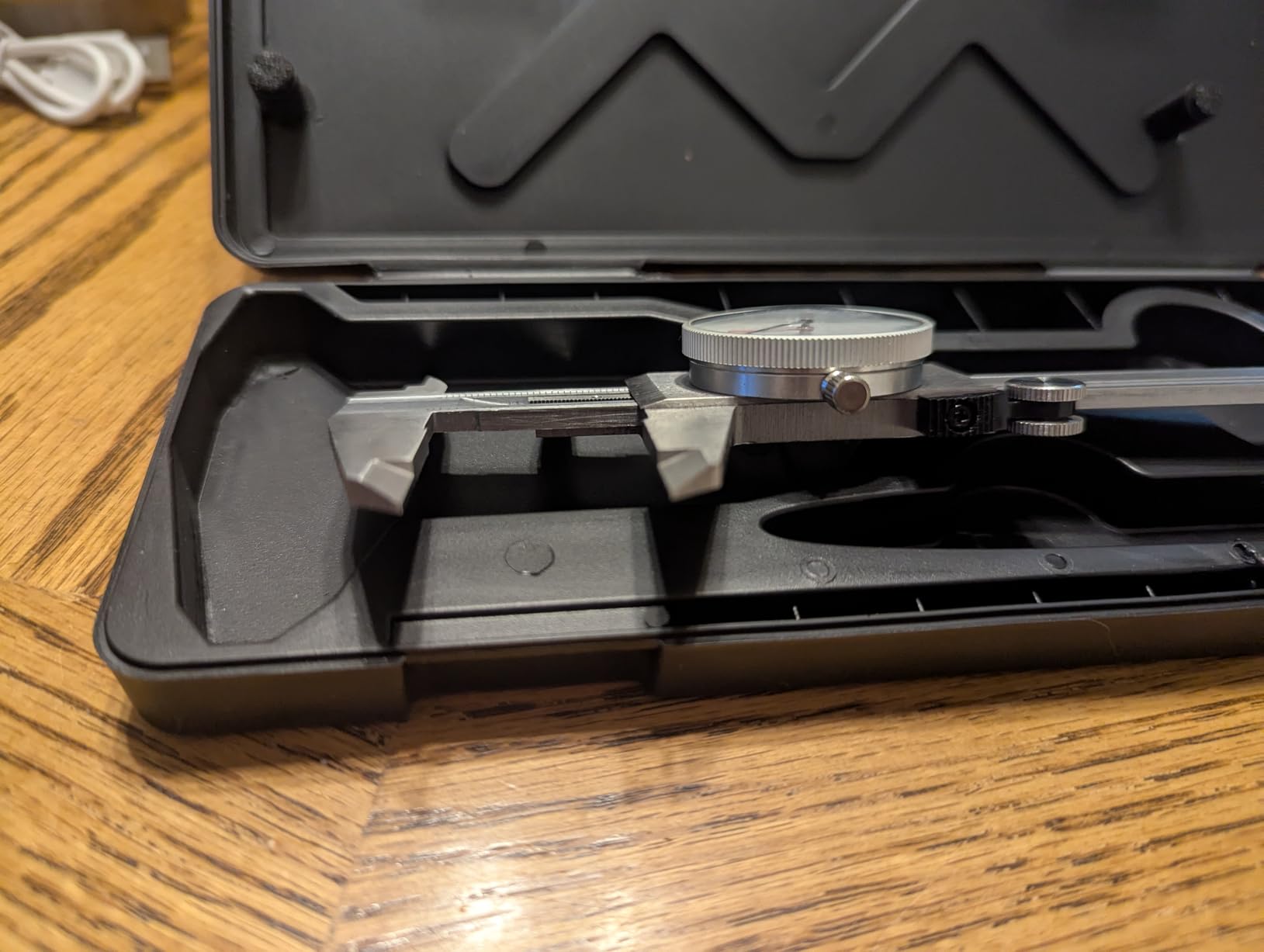
Here is the trade. Shock resistance is meaningless if the tool is not accurate, and the reviews on this model split on finish and readability rather than measurement. Dial contrast is limited on some color variants, so the red and black options are the least readable and the white one is the best bet. The plastic build is the other recurring note: it feels plasticky next to an all-metal professional caliper, and it is the main reason this model sits where it does in our ranking.
Forum readers note that a dropped Japanese-made Mitutoyo dial lost roughly 0.001 inch of repeatability but stayed usable, which is a fair benchmark for what a knock actually costs you. Shockproofing reduces the risk of that, but it is not a substitute for a metal frame.
Where the KTL001 makes sense
Shop carts, field inspection kits, apprenticeships and anyone whose caliper spends its life in a van or on a trailer. If your environment is the reason you are shopping, drop resistance and anti-rebound control are exactly the right features to pay for, and the four-way measurement covers the usual shop demands.
The adjustable bezel is also a genuine plus for anyone who measures relative to a datum rather than from zero.
Where it falls short
It is a plastic-bodied entry tool with a 4.3 star average. For production work or for setting up to a tight tolerance, an all-metal hardened stainless frame with a covered rack, like the Fowler or the Accusize, is a better bet. Pick the white dial variant if you order one.
10. Accusize P920-S236 – Best Inch and Metric Dual Scale Dial
Accusize Industrial Tools 0-6”/0-150 mm by 0.001”/0.02 mm Inch/Metric Dual Needle Precision Dial Caliper Stainless Steel, P920-S236
6 inch and 150mm range
0.001 inch and 0.02mm
dual needle dial
Hardened stainless
Pros
- Dual needles read inch and metric from one dial without conversion
- Large clear dial with crisp 0.001 inch and 0.02mm graduations
- Hardened stainless body with a micro-lapped slide
- Fitted plastic case included
Cons
- Two needles on one dial take practice to read quickly
- Accuracy can fall off toward the top of the 6 inch range
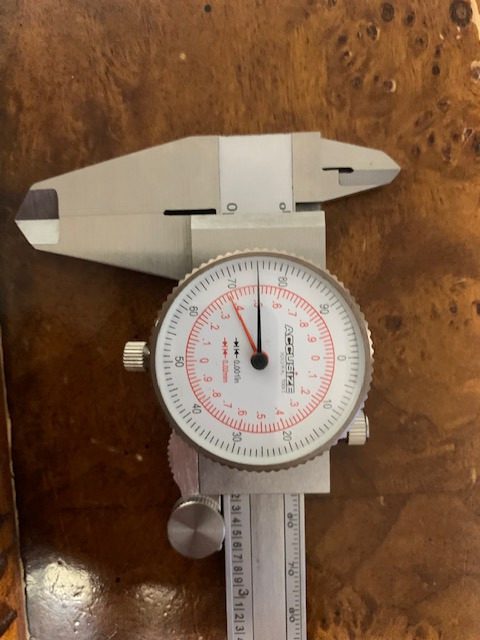
The Accusize P920-S236 solves one specific problem better than anything else in this list: reading both inches and metric without converting anything. Two separate needles on one dial, one for inch and one for metric, plus a 6 inch and 150mm range with 0.001 inch and 0.02mm resolution and a 0.100 inch single revolution. If your shop mixes imperial and metric drawings, this is the one to look at.
The build is solid for the money: hardened stainless steel, a precision ground and micro-lapped adjusting slide for smooth fine adjustment, and a large clear dial with crisp graduations for direct reading. It covers inside, outside, depth and step measurement, and it comes with a fitted plastic case for storage and transport.
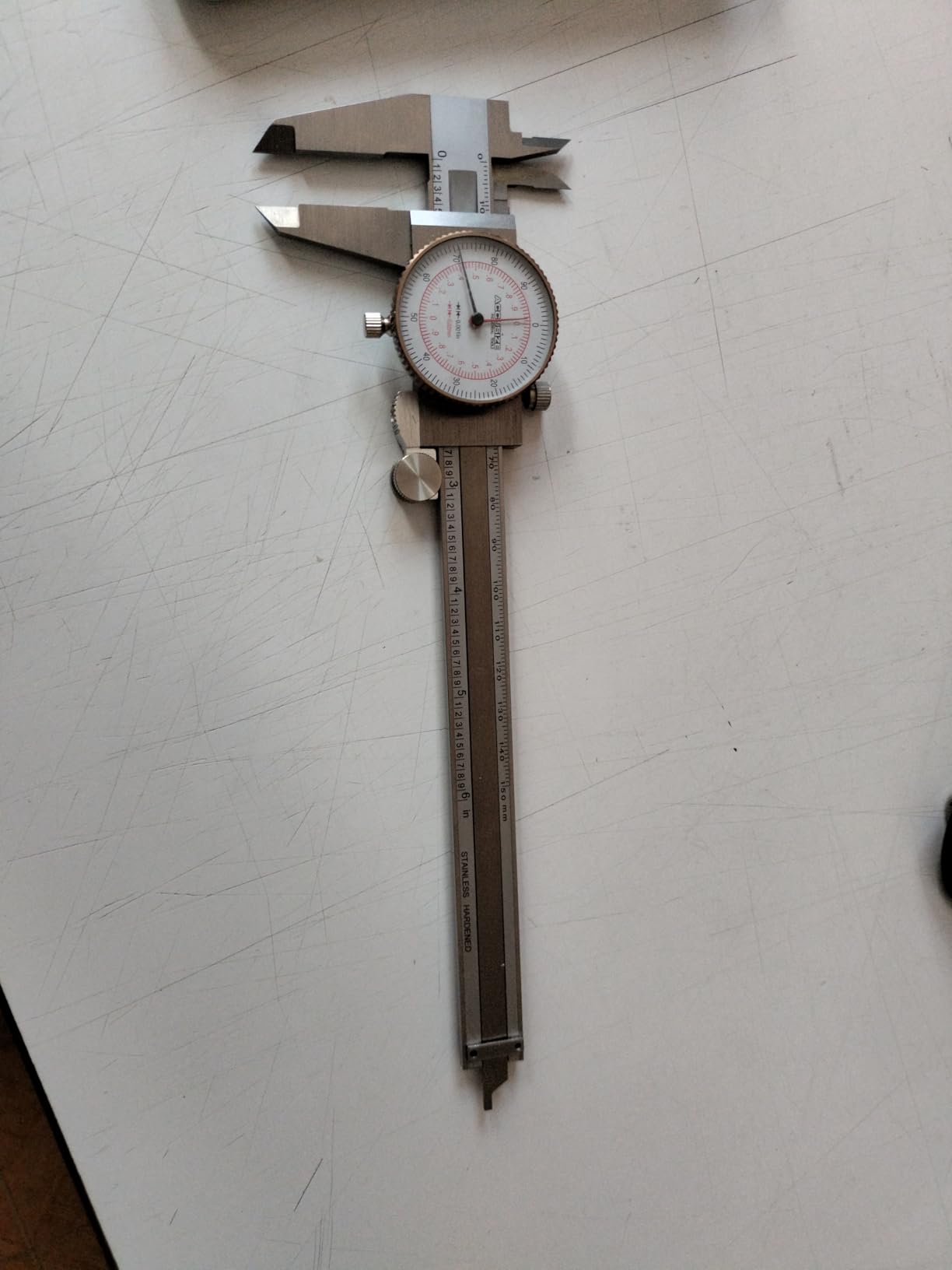
The honest downside is reading speed. Two needles on one dial take practice, and on a busy floor you will be slower with this than with a single-needle .001 inch dial for a pure inch measurement. There is also a report that accuracy falls off slightly toward the top of the 6 inch range, which matches the general tolerance pattern calibration technicians see in longer-range tools.
Against a modern digital caliper, none of the mechanical dials here win on dual-unit convenience. A machinist on the Hobby-Machinist forum described the switch in practical terms: the convenience of dual scales at the touch of a button far outweighs any attachment to the older dial styles. This model is the mechanical answer to that problem for the people who want to stay analog.
Who should buy the P920-S236
Shops that read metric drawings and inch stock in the same week. Importers, machine builders and repair shops that quote both units will get real utility from the second needle, and the 0.02mm resolution is the standard machinist expectation in metric work.
The micro-lapped slide also makes this one of the smoother-adjusting tools at this level, which matters more than most people expect.
Who should pick a single-scale dial
If your shop is imperial only, you are paying for a feature you will not use and adding a reading step to every measurement. Choose the Starrett 3202-6 or the Fowler 52-008-706-0 instead and keep the dial simple.
How to Choose a Dial Caliper You Will Trust
How to read a dial caliper in three steps
Read the number on the graduated beam, read the number the dial hand points to, and add them together. That is the whole system. The beam is marked every 0.100 inch and the dial hand makes one full revolution every 0.100 inch, so the number under the index line on the beam tells you which tenth you are in, and the dial tells you the thousandths inside that tenth.
So if the dial hand is three thousandths past the zero mark, and the beam index line sits between 1.4 and 1.5, the reading is 1.403 inch. Reverse the process for inside, step and depth measurements. The single most common beginner error is forgetting the beam and reading only the dial, which silently costs you a tenth of an inch every time.
What 0.001 inch accuracy actually means
It means the tool is accurate to within one thousandth of an inch, and it is the practical ceiling for a caliper. Nearly every reputable brand in this roundup is specified the same way, so the differences between them show up in feel, zero stability and repeatability rather than in the printed number. A calibration technician quoted on the Practical Machinist metrology forum puts it plainly: most calipers carry plus or minus 0.001 inch per 6 inches of length.
That phrase, per 6 inches, is the part people miss. Tolerance accumulates with length. Expect roughly plus or minus 0.001 inch at 6 inch, plus or minus 0.003 inch on an 8 inch tool, and up to plus or minus 0.005 inch on a 24 inch tool. A 12 inch caliper that reads 0.001 on the dial is not making a 0.001 inch claim across its full travel.
How to verify any caliper before you cut metal
Buy a small gauge block set, or borrow a known standard, and check the caliper before you trust it. The method is simple and takes minutes.
First, clean the beam and the measuring faces and close the jaws gently to check the zero. If the dial hand does not sit on zero, use the bezel lock screw to rotate the bezel and re-zero it.
Second, open the jaws to just under 0.100 inch, where the hand has completed exactly one revolution, and confirm the reading is 0.100.
Third, wring a 1 inch block onto the flat measuring face, close gently, and read. Repeat with the 2 inch, 3 inch and 4 inch blocks. Do not force the jaws against the block and do not rock them, because a cocked reading is the most common source of a false failure.
Fourth, measure at several points across the range rather than only at the ends, and record the deviation. A tool that is consistently low by 0.002 inch can often be re-zeroed and used. A tool that wanders is finished.
Fifth, close and reopen the jaws ten times and read each time. That is your repeatability figure, and repeatability is what actually matters day to day. A calibration technician on the same forum reports rejecting the large majority of secondhand and auction tools that pass through the lab, seeing one or two per month.
Sixth, wipe the faces and re-zero before you store it. Never store a caliper with the jaws closed.
Dial vs digital vs vernier: the honest comparison
Dial calipers are not more accurate than digital calipers. Accuracy is a manufacturing spec, not a format. A good dial and a good digital are both plus or minus 0.001 inch, and a member on the Hobby-Machinist forum verified both an Etalon dial and a Mitutoyo digital against a Grade 0 Cerastone gauge block set with both reading dead on at every block, including wrung 1 inch and 3 inch blocks.
Digital wins on readability, unit switching and data logging. Dial wins on being battery-free, needing no switch, and working forever. Vernier wins on nothing except low cost, which is why it survives mainly on the layout bench.
The honest trend is that working machinists are migrating to digital. Veteran users on the forums describe the switch as convenience winning out over attachment, and solar-powered models remove the battery argument entirely. The counterpoint is durability: a Mitutoyo 500-752-20 digital was reported failed after a drop, and that single failure is the most-cited reason committed analog users stay where they are.
The brand tier list machinists actually agree on
For dial calipers specifically, the recurring forum ranking puts Etalon at the top, with Brown & Sharpe and Tesa right behind, and vintage Japanese-made Mitutoyo close behind them. The often-repeated insider detail is that Etalon, Tesa and Brown & Sharpe come out of the same factory, and the Etalon differentiates with a fine adjust thumb wheel, which regulars credit for making it feel superior through its full travel.
Modern Starrett sits in the second tier, with strong availability and US-made options, though the Starrett 120 line draws real criticism from long-term users on the Practical Machinist forum. Vintage Japanese Mitutoyo holds value well, and a buyer on that forum reports a 12 inch Japanese dial bought secondhand that still worked after a drop, with about 0.001 inch of repeatability lost and nothing else. Budget imports sit at the bottom, and that is where most rejected tools come from.
None of the Etalon, Brown & Sharpe or Tesa models made our shortlist, which is worth saying plainly. For that tier, look at a used Japanese-made Mitutoyo or a Brown & Sharpe from a reputable dealer, and verify with gauge blocks before you rely on it.
How to spot a counterfeit or junk caliper
Yes, fakes exist, and the forum consensus on this is blunt: the name on the product or on its packaging may bear no relationship to the company that actually made or sold it.
Buy from an authorized distributor or an industrial supply house rather than a third-party marketplace seller with no history.
Be suspicious of any price that is dramatically below the market, because it is the single most reliable signal.
Check the printing, the graduation alignment and the fit of the dial bezel. Cheap counterfeits have soft engraving and unevenly spaced marks.
Look for a serial number, a country-of-origin marking on the frame and a calibration certificate if the seller claims one.
Verify the tool with gauge blocks before the first cut. This step catches more fakes than any amount of visual inspection.
When you should stop using a caliper and reach for a micrometer
The moment your tolerance is tighter than 0.001 inch. A caliper is an adjustable comparator with jaws that flex and a rack with backlash, and it is not rigid enough to hold a tight tolerance. Users in the r/engineering community put it directly: both formats will read to 0.001 inch fairly well, but neither is rigid enough to hold tight tolerance.
If you are measuring to 0.0005 inch or tighter, you need a micrometer. If you need better than 0.0001 inch, a micrometer is still the minimum. No amount of spending on a caliper changes that, which is why a self-aware machinist on the forums says outright that they do not rely on a caliper for true accuracy anyway.
For most other work, the caliper is faster, more flexible and always ready. Use the right instrument for the tolerance you actually hold.
Maintenance habits that protect repeatability
Wipe the beam and the rack clean before and after every job. A single chip on the rack is the most common reason a caliper suddenly reads differently every time you close it.
Drop a light machine oil on the rack, the sliding surfaces and the thumb roller every few months, then wipe the measuring faces clean so oil does not contaminate the part.
Store it open or on a rack. Closing the jaws and laying the tool in a drawer deforms the measuring faces over time, and a bend in the face is a permanent accuracy loss.
Do not use a caliper as a C-clamp, a scraper, a pry bar or a way to force two parts together. Mechanical damage to the jaws or the frame is the fastest way to turn a good tool into scrap.
Frequently Asked Questions
Are Starrett or Mitutoyo calipers better?
For dial calipers specifically, they sit in the same accuracy tier at plus or minus 0.001 inch. Starrett leads on availability and offers Made-in-USA options, while Mitutoyo leads in digital and coolant-proof design. For the dial format, the machinist forum consensus leans toward Etalon and Brown u0026amp; Sharpe or Tesa, and the Starrett 120 line in particular draws real criticism. Our top pick is the Starrett 3202-6.
Are dial calipers more accurate than digital calipers?
No. Accuracy is a manufacturing spec, not a format. A good dial and a good digital are both plus or minus 0.001 inch. Digital wins on readability, unit switching and logging. Dial wins on being battery-free and always ready. One Hobby-Machinist member verified both an Etalon dial and a Mitutoyo digital dead on at every block of a Grade 0 Cerastone gauge set.
Who makes the most accurate calipers?
For 0.001 inch dial calipers, nearly every reputable brand is essentially identical, and the differences appear at longer measuring ranges where tolerance climbs to roughly plus or minus 0.003 inch at 8 inch and up to plus or minus 0.005 inch at 24 inch. Accuracy beyond 0.001 inch requires a micrometer at plus or minus 0.0001 inch, not a better caliper.
What is the best budget dial caliper for accurate measurements?
The best budget 0.001 inch options in this roundup are the findmall 6 inch stainless caliper for basic accuracy and the HFS 15809 for a first four-way dial. For fractional reading, the iGaging 100-164 is the fastest and needs no batteries. The genuine value move is a used Japanese-made Mitutoyo or a Brown u0026amp; Sharpe, verified against gauge blocks before you rely on it.
Are there fake Mitutoyo calipers?
Yes. Forum guidance is blunt: the name on the product or its packaging may bear no relationship to the company that actually made or sold it. Buy from an authorized distributor or an industrial supply house, treat a dramatically low price as the biggest warning sign, check engraving quality and graduation alignment, and verify the tool with gauge blocks before your first cut.
How do I check if a dial caliper is accurate?
Zero it with the jaws closed, then check it against a gauge block set or a known standard at 1, 2, 3 and 4 inch. Close the jaws gently without rocking them, read the beam plus the dial, and repeat at several points across the range rather than only at the ends. Finally, close and reopen the jaws ten times to measure repeatability, which matters more day to day than a single reading.
Do I need a micrometer if I have a caliper?
If you ever hold a tolerance tighter than 0.001 inch, yes. A caliper is an adjustable comparator with jaws that flex and a rack with backlash, so it cannot hold a tight tolerance reliably. A micrometer at plus or minus 0.0001 inch is the minimum for that work. For layout, setup and general shop checks at 0.001 inch, the caliper is faster and always ready.
Which Dial Caliper Should You Buy?
The Starrett 3202-6 is the best all-around dial caliper for machinists in 2026. A 0-6 inch hardened stainless body, a stated accuracy of plus or minus 0.001 inch, anti-backlash gearing that does not jump under vibration, and the largest review base of any model we compared, all pointing the same way.
Take the Mitutoyo 505-742J instead if you want the highest rated movement in the group and the most readable dial face. Take the Fowler 52-008-706-0 if you want a second shop-grade 0.001 inch tool with a covered rack and a full spare jaw set. Take the Mitutoyo 505-746 if your work outruns 6 inches, and take one of the entry-level models in the lower half of this list only if you are still learning to read a dial or need a sacrificial shop-cart tool.
Whichever you choose, verify it against gauge blocks on the day it arrives, keep the rack clean, and never store it with the jaws closed. That habit is worth more than the difference between any two tools on this list.