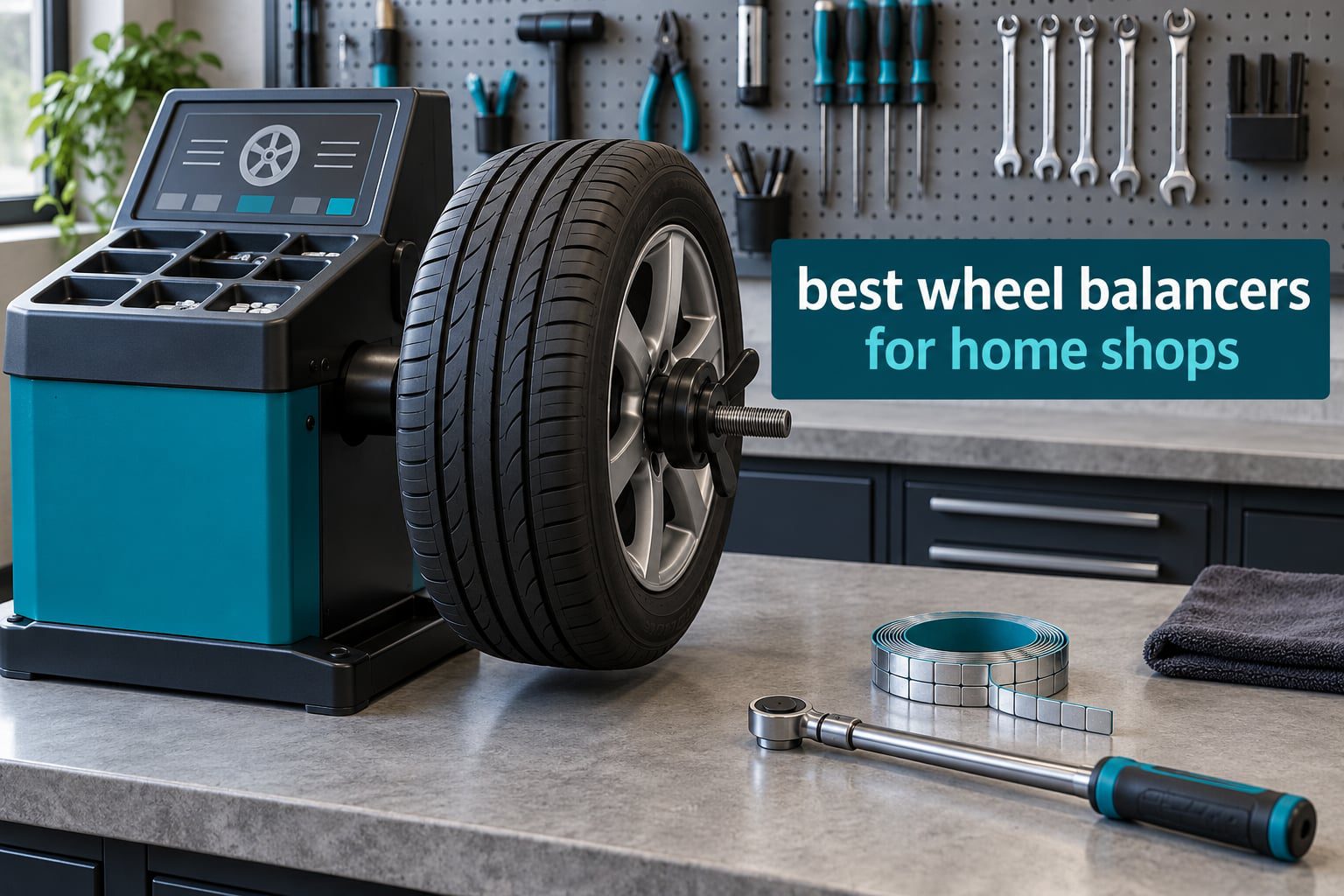
A wheel balancer is a shop machine that spins a mounted tire and wheel, finds where the weight is uneven, and tells you where to add or remove weights so the assembly rolls smoothly at highway speed. You hang the assembly on a shaft, set the rim data, spin it, and the machine calculates the weight and position needed.
An out-of-balance wheel gives you steering wheel shake, uneven tire wear, and faster wear on shocks, bushings, and wheel bearings. It can also hide a bent rim or a tire pull that needs a completely different fix, which is why balance work is the first thing to check when a tire shudders.
We spent weeks sorting through every wheel balancer format a home shop realistically runs into, from a hand-balanced bubble level to a powered changer and balancer pair. What follows is our shortlist of the best wheel balancers for home shops in 2026, plus the honest math on whether you should buy at all.
Before the picks, one thing to know: a balancer is half of a job. Mounting and dismounting the tire is the other half, and if you do that yourself too, you will also want a compressor, jack stands, a torque wrench, tire irons, a bead seating tool, and a non-marring pry bar. Our picks for multiprocess welders and plasma cutters follow the same idea: buy the tool that does the one job you cannot fake.
Table of Contents
- Top 3 wheel balancers for home shops in 2026
- All 10 Best Wheel Balancers for Home Shops (October 2026)
- 1. ATPEAM Portable Bubble Wheel Balancer: the editor’s choice for most home shops
- 2. DASBET Portable Bubble Wheel Balancer: the best-rated budget pick
- 3. XK 580 Tire Changer and 690 Wheel Balancer Combo: the all-in-one workhorse
- 4. Acymner Portable Bubble Wheel Balancer: the lightest option here
- 5. SIXIWANZI Tire Balancer: the most honest user feedback of the budget group
- 6. KATOOL KT-T830 and KT-B700 Combo: the widest clamp coverage here
- 7. KATOOL KT-T800 and KT-B700 Combo: the cleanest warranty story
- 8. BILT HARD 110V Changer and Balancer Combo: the widest balancer range
- 9. I40 PRO Portable Mini Wheel Balancer: the smallest footprint
- 10. KATOOL ME-T500 and ME-B620 Combo: the widest width coverage
- How to choose a wheel balancer for a home shop
- Manual vs 2D vs 3D vs diagnostic balancers
- Alternatives to owning a wheel balancing machine
- Space, power and floor requirements for a home shop balancer
- Used wheel balancers: what to check before you buy
- Frequently Asked Questions
- What is a wheel balancer?
- Can you do wheel balancing yourself?
- What is the best wheel balancer for home use?
- Is a 2D wheel balancer good enough for home use?
- Do balance beads in tires really work?
- Do Centramatic balancers really work?
- Why does my wheel balancer keep asking for more weight?
- How much space does a wheel balancer need in a garage?
- The bottom line on the best wheel balancers for home shops
Top 3 wheel balancers for home shops in 2026

ATPEAM Bubble Balancer
- Bubble level balancing
- Aluminum alloy base
- 11.68 lb and portable
- Handles light trucks

DASBET Bubble Balancer
- Hub range 1.5 to 4 inch
- Rust-resistant aluminum
- 12.72 lb
- Beginner friendly setup

XK 580 Changer + 690 Balancer
- 110V plug and play
- 44 inch max wheel diameter
- Dynamic static and ALU modes
- Motorcycle mode
Those three cover the realistic ends of the market. The ATPEAM is the machine most first-time owners actually need. The DASBET is the better-rated sibling with a wider hub range. The XK pair is the only pick on this list that balances and mounts in the same footprint.
All 10 Best Wheel Balancers for Home Shops (October 2026)
| Product | Specs | Action |
|---|---|---|
| ATPEAM Portable Bubble Wheel Balancer |
|
Check Latest Price |
| DASBET Portable Bubble Wheel Balancer |
|
Check Latest Price |
| XK Tire Changer and Wheel Balancer Combo |
|
Check Latest Price |
 Acymner Portable Bubble Wheel Balancer Acymner Portable Bubble Wheel Balancer |
|
Check Latest Price |
 SIXIWANZI Tire Balancer Bubble Type SIXIWANZI Tire Balancer Bubble Type |
|
Check Latest Price |
 KATOOL KT-T830 and KT-B700 Combo KATOOL KT-T830 and KT-B700 Combo |
|
Check Latest Price |
 KATOOL KT-T800 and KT-B700 Combo KATOOL KT-T800 and KT-B700 Combo |
|
Check Latest Price |
 BILT HARD 110V Changer and Balancer Combo BILT HARD 110V Changer and Balancer Combo |
|
Check Latest Price |
 I40 PRO Portable Mini Wheel Balancer I40 PRO Portable Mini Wheel Balancer |
|
Check Latest Price |
 KATOOL ME-T500 and ME-B620 Combo KATOOL ME-T500 and ME-B620 Combo |
|
Check Latest Price |
1. ATPEAM Portable Bubble Wheel Balancer: the editor’s choice for most home shops
ATPEAM Portable Bubble Wheel Balancer Heavy Duty Tire Balancing Machine
Bubble balance for cars and light trucks
24 inch H x 11.5 inch base
11.68 lb and portable
Pros
- Aluminum alloy base with anti-rust enamel finish
- Four chrome-plated rods with blackened springs
- Lightweight at 11.68 lb and easy to store
- Handles most automobiles and light trucks
- Simple nut-and-shaft assembly
Cons
- Bubble accuracy depends on careful visual centering
- Very small bubble is hard to read without magnification
- No powered spin or diagnostic readout
This is the machine we keep coming back to for a one-car or two-car garage. It weighs 11.68 lb, stands 24 inches tall on an 11.5 inch base, and assembles in about a minute with a shaft, a set of rods, and a balancing cone. There is nothing to plug in.
How it works is genuinely simple. You mount the wheel on the shaft, inflate the tire enough to hold the weight, and slide the assembly back and forth until the bull’s eye level sits in the middle of its circle. Centered is balanced, for static purposes. That is the whole technique.
The build is the surprise. The base is aluminum alloy with an anti-rust enamel polish, and the guide rods are chrome-plated and blackened with springs designed to resist rust. That matters more than it sounds, because a damp garage is where a cheap steel frame turns into a pitted mess within two winters.
Where it earns its reputation is repeatability on a car you actually drive. If your steering wheel trembles at 55 mph and the tire is seated and inflated properly, this machine will find the imbalance and fix it. It will not tell you the weight in ounces, which means you reposition by feel rather than by number.
Static balancing is the right mode here. Dynamic balancing corrects a couple-force imbalance where the front and rear of the wheel are out of balance relative to each other. On a lightly loaded commuter car with stock tires, static is nearly all you will ever feel.
One workflow trick: put the base on a flat, level section of concrete or a piece of plywood shimmed flat. A bubble balancer is only as honest as the floor under it.
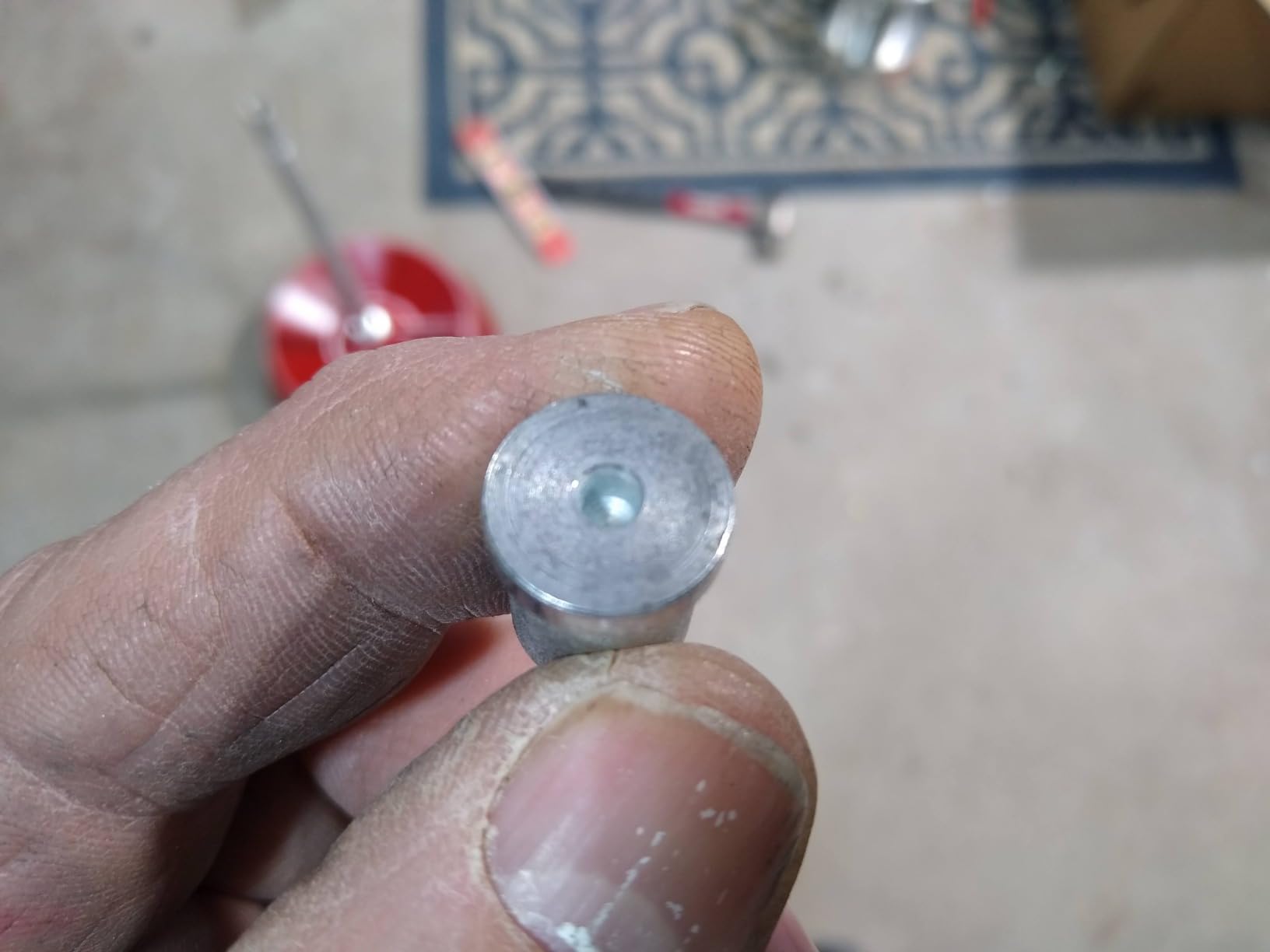
Who this bubble balancer suits
If you swap four tires twice a year, mostly on sedans, crossovers, and light trucks, this covers you. The shaft uses a 0.813 inch center rod and a 1.495 inch hub, so confirm your vehicle hub bore falls in that window before you commit.
It also suits anyone renting or sharing a shop space. At under 12 lb you can carry it to a driveway or a friends’ garage on a weekend, then park it on a shelf. Nothing about it demands a dedicated bay.
Who should skip this machine
Skip it if you run race tires, stiff sidewall low profiles, or anything where a couple-force imbalance matters at speed. A bubble level cannot measure that, and it will leave you chasing a shake that a proper dynamic balance would fix in one pass.
Skip it if your garage floor is sloped, cracked, or shared with a motorcycle and a lawnmower. There is no leveling adjustment here, so a bad floor turns every reading into a coin flip.
2. DASBET Portable Bubble Wheel Balancer: the best-rated budget pick
DASBET Portable Bubble Wheel Balancer Tire Balancer with Bubble Level
Hub capacity 1.5 to 4 inch
24 inch H x 11.5 inch base
12.72 lb rust-resistant aluminum
Pros
- High-quality aluminum with rust-resistant finish
- Wide hub capacity from 1.5 to 4 inch
- 12.72 lb and easy to store
- Simple beginner-friendly assembly
Cons
- Not suitable for large tires beyond the listed range
- Very small bubble level is hard to read precisely
- No dynamic balancing mode
Structurally this is the same idea as the ATPEAM, and honestly the two are near twins. What separates them is the stated hub range. DASBET lists hub capacity from 1-1/2 inch to 4 inch, which is a wider band than the fixed 1.495 inch hub dimension most budget bubble balancers quote.
That range matters more than it looks on paper. Larger hub bores show up on older European cars, some light trucks, and many aftermarket steel wheels. A machine whose hub only covers one bore size becomes an ornament in your garage the day you swap to a different set of wheels.
The construction is a machine steel head with plated steel guide rods and zinc support springs on an aluminum body with a rust-resistant enamel finish. At 12.72 lb it is slightly heavier than the ATPEAM but still trivially portable, and it shares the same 24 inch tall, 11.5 inch base footprint.
The 4.4 rating across 198 reviews puts this ahead of the ATPEAM on paper, and about 72 percent of those reviews are five star. Owners consistently single out build quality and the fact that a beginner can get a readable result on the first or second attempt.
The specification sheet is explicit that it is not applicable for large tires exceeding the listed size. If your daily driver is on 33 inch or 34 inch off-road tires, this is the wrong format regardless of the hub range.
Who this bubble balancer suits
Choose the DASBET over the ATPEAM if your wheel hub bores vary between vehicles, or if you have a mix of steel and alloy wheels across two cars. The wider capacity removes a common early frustration where a fixed-hub machine only fits one wheel at a time.
It also suits buyers who want the simplest possible first machine. There is no data entry, no menu, and no calibration step. You can unpack it and balance a wheel the same afternoon.
Who should skip this machine
Skip it if tire size, not hub bore, is your constraint. The listed tire ceiling is the hard limit, and exceeding it risks an unstable shaft setup that nobody should be spinning at speed.
Skip it if you plan to add clip-on weights. Bubble balancers help you locate an imbalance, but they do not give you a weight position reading, so applying stick-on tape weights by eye is guesswork. Plan to recheck with a spin balancer or a road test.
3. XK 580 Tire Changer and 690 Wheel Balancer Combo: the all-in-one workhorse
XK Tire Changers Machine and Wheel Balancer Combo,110V,580-690
580 changer plus 690 balancer
110V, 44 inch max wheel, 155 lb
Accuracy from -1g to +1g
Pros
- Balances accuracy from -1g to +1g
- Handles 44 inch wheel diameter and 155 lb weight
- Dynamic static Alu 1-3 and motorcycle modes
- 110V plug and play with about 300 to 1000 watts draw
- Includes 3 centering cones and 4 clamp protectors
- 18-month parts warranty
Cons
- Not sized for high-volume shop throughput
- Some units arrived with missing parts
- Free-standing balancer should be bolted down
This is the only pick here that solves both halves of the job. The 580 side is a dual turntable tire changer with a foot pedal, an outside clamp from 10 to 18 inch and an inside clamp from 12 to 20 inch, and a maximum tire diameter of 37 inch. The 690 side is a digital wheel balancer preset to American standard measurements.
The balancer numbers are what make it interesting for a home shop. Maximum wheel diameter of 44 inch, maximum wheel weight of 155 lb, cycle time of 6 to 9 seconds, and balancing accuracy from -1g to +1g. That accuracy figure is the whole reason to own a powered machine instead of a bubble level.
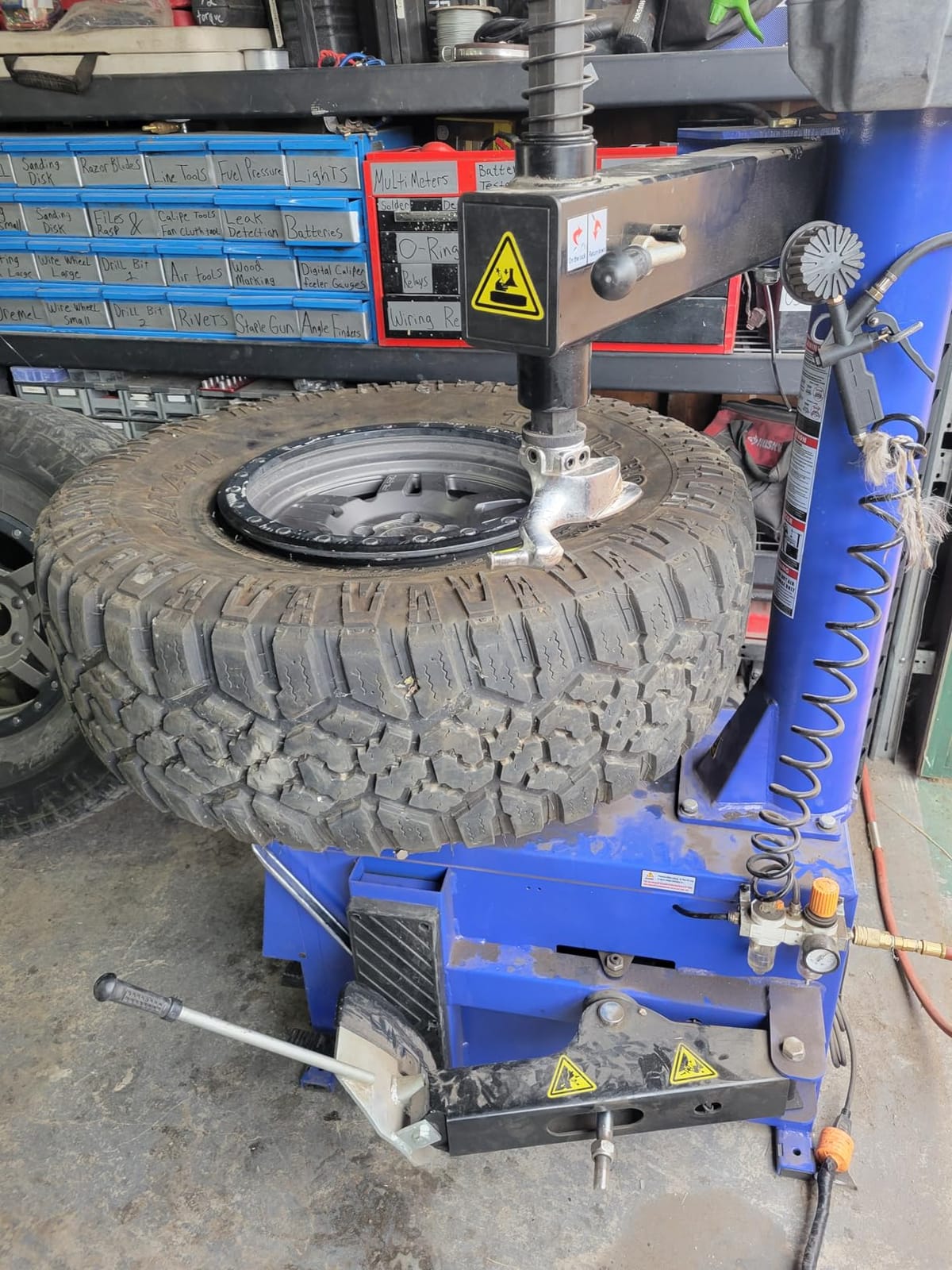
It runs on 110V. Owners with tire industry experience report a draw of roughly 300 to 1000 watts per machine, which means a normal household circuit handles both machines without a dedicated 220V line. That single fact removes the biggest electrical objection most home shops have.
Bead breaking on the changer side is rated at 5600 lbs with pneumatic pressure of 120 to 145 psi, or 8 to 10 bar. That is enough for tough low-profile tires with stiff sidewalls, which is where most budget changers give up.
Users report the machines mount and dismount tires easily and that the balancer is straightforward to operate once you have the sequence down. Owners with shop experience rate the build quality as solid for the money, and mention a responsive seller and an 18-month parts warranty.
Who this combo suits
This is the right pick if your garage has a dedicated corner and you do your own seasonal changeovers on more than one vehicle. If you have ever paid a shop to change four tires and thought about doing it yourself, this is the set that closes the loop.
It also suits anyone who wants to work on their own alloy wheels without risking them. Four clamp protectors ship in the box, and the balancer includes three centering cones to fit different hub bores.
Who should skip this combo
Skip it if floor space is tight. At 38.5 by 26 by 39.5 inches and 780 lb, it needs a real footprint and it needs to be anchored. A free-standing balancer that walks across the concrete while a 30 lb wheel spins is a genuine hazard, so bolt it down.
Skip it if you only change four tires a year. Buyers consistently place it at 20 to 50 tires a month of realistic throughput, and below that volume the money is better spent on a compressor and good tools. A pallet delivery also takes planning if your driveway is tight.
4. Acymner Portable Bubble Wheel Balancer: the lightest option here
Acymner Portable Bubble Wheel Balancer
Hub range 1.5 to 4 inch
24 inch H x 11.5 inch base
11.57 lb alloy construction
Pros
- Compact and lightweight at 11.57 lb
- Aluminum alloy base with rust-resistant enamel
- Chrome-plated rods and springs
- Works for most automobiles and light trucks
- Marketed for DIY and home use
Cons
- Bubble balance needs fine visual adjustment
- Limited to small hub bores and light truck wheels
- Best suited to static balancing only
At 11.57 lb this is the lightest machine on our list, and at a 4.6 rating with 159 reviews it has the strongest rating-to-review ratio among the bubble balancers here. Roughly 76 percent of reviews are five star, which is about as clean a rating profile as this category produces.
The mechanics match what you would expect from the format: an aluminum alloy base with rust-resistant enamel, four chrome-plated and blackened rods and springs, a bull’s eye level, and a hub range of 1-1/2 inch to 4 inch. Same 24 inch tall, 11.5 inch base footprint as its siblings.
Buyers like that it moves easily between rooms and that the parts are precision machined rather than stamped. The marketing positions it for DIY, home, and business use, and in practice that means one car, maybe two, on common wheel sizes.
The honest limitation is shared by every bubble balancer in this group: accuracy comes entirely from your eyes on a small level. Fine adjustments near the center of the circle are the hard part, and there is no readout telling you you are two grams off.
Who this bubble balancer suits
Pick this one if storage is the deciding factor. At under 12 lb and roughly 17 by 12 by 7 inches packaged, it lives on a closet shelf and comes out for one Saturday of work twice a year.
It suits beginners best, because there is no learning curve to speak of. No data entry means no rim diameter mistakes, and a mistake there is the most common reason a first spin reads wrong on a computerized machine.
Who should skip this machine
Skip it if you care about how the weights are positioned. Static-only balancing works, but if you want repeatable accuracy numbers or plan to move to a saved position for a repeat service, this format cannot deliver.
Skip it if the wheels are the expensive part of the car. A bubble balancer gets you back to even weight distribution, but it will not detect radial runout in a bent rim or a tire pull, which are the real causes of a steady vibration on high-end alloys.
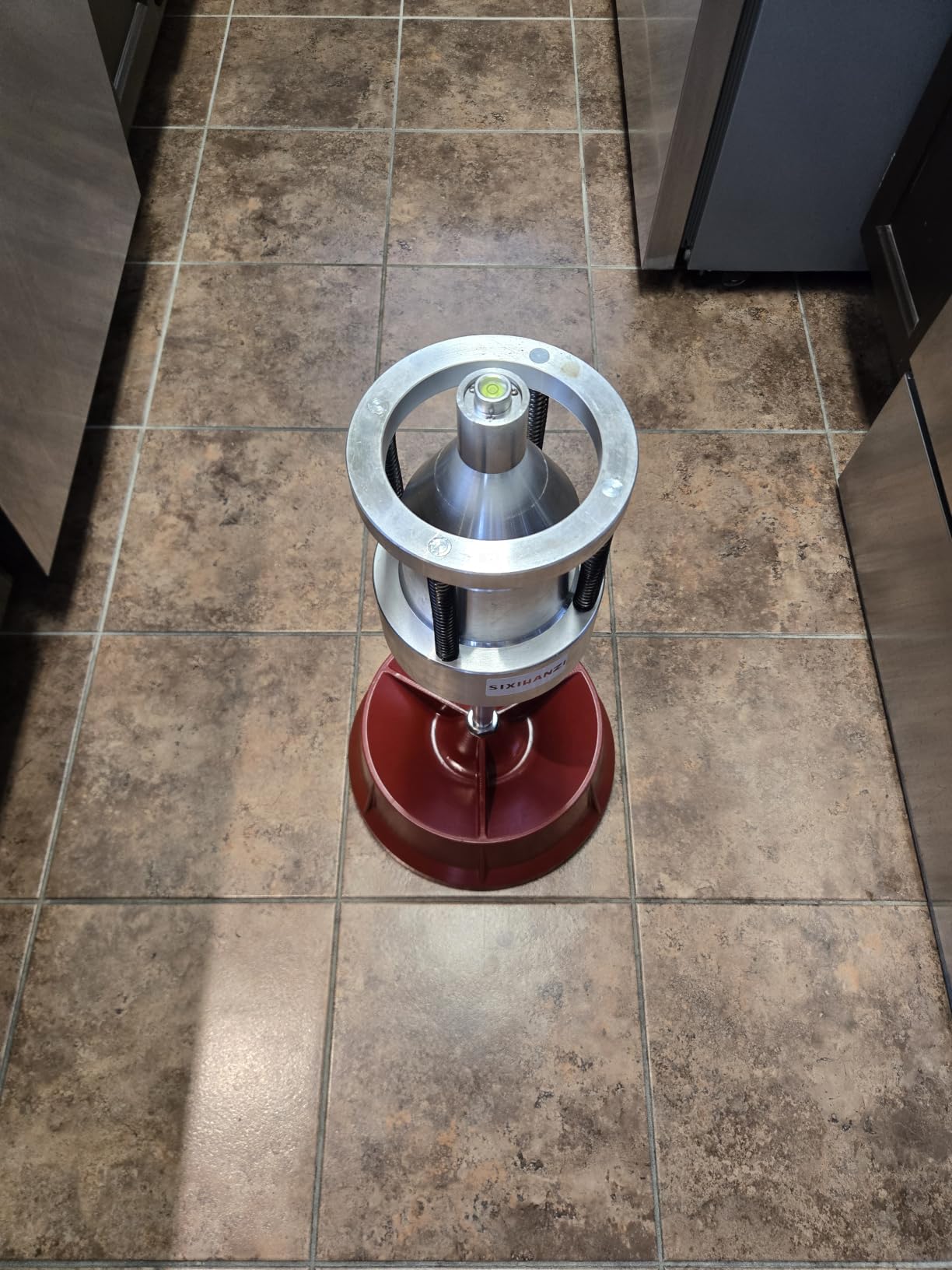
5. SIXIWANZI Tire Balancer: the most honest user feedback of the budget group
SIXIWANZI Tire Balancer, Portable Bubble Wheel Balancer for Cars Trucks
Bull's eye level for 1.5 to 4 inch hubs
24 inch H x 11.5 inch base
10.56 lb for cars and trucks
Pros
- Owners report it removes real high-speed wobble
- Straightforward to assemble and use out of the box
- Lightest and most compact at 10.56 lb
- Works alongside a separate tire changer
Cons
- Zeroing with three delicate screws is fiddly
- Bubble is very small and sometimes needs magnification
- Balance tip can flatten after several tires and lose accuracy
This one is worth reading the reviews on carefully, because they include the most useful criticism we found across the budget group. Owners start skeptical of a bubble level and end up reporting that it genuinely removes steering wheel shake once the bubble is centered.
The build is standard for the format: aluminum alloy with rust-resistant enamel, four chrome-plated and blackened rods and springs, a bull’s eye level covering hubs from 1-1/2 inch to 4 inch, and a 24 inch tall by 11.5 inch base. At 10.56 lb it is the lightest machine we reviewed.
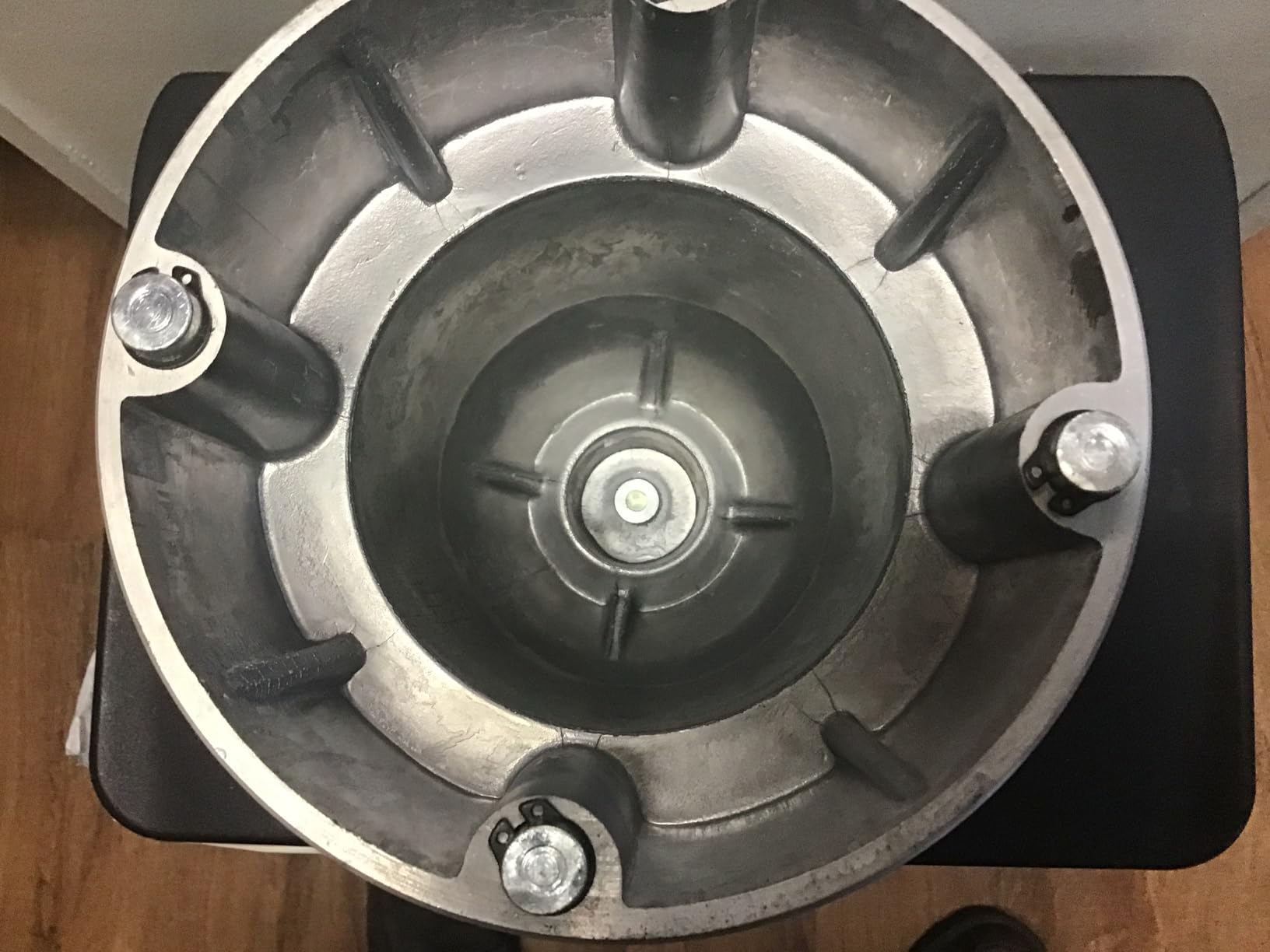
Two complaints come up repeatedly and both are worth knowing before you buy. Zeroing the unit uses three small screws, and owners describe that step as fiddly. And the balance tip can flatten after several tires, which reduces accuracy until you shim or replace it.
There is also a clever workaround mentioned in reviews: the top surface is flat enough to hold a phone running a digital bubble level app for finer visual precision. It is not a substitute for a real machine, but it beats squinting at a 3 millimeter bubble.
One buyer note worth repeating for anyone pairing this with a changer. It is sold as a standalone balancer, and owners confirm it works well alongside a separate tire changer for full DIY tire service rather than as a replacement for one.
Who this tire balancer suits
Choose it if you are new to this and want the least expensive way to confirm whether your vibration is an imbalance problem at all. For a first diagnostic run before committing to a machine, this answers that question quickly.
It also suits anyone doing one tire at a time rather than a seasonal changeover. The low mass and compact footprint make it a bench tool rather than a floor tool.
Who should skip this machine
Skip it if you balance tires often. The balance tip wear reported in reviews means accuracy fades as the season goes on, and you would be compensating by feel rather than by calibration.
Skip it if you have unusually large tires or wheels. The bull’s eye approach scales badly with mass, and a heavy wheel on a light shaft at speed is a setup you want to avoid rather than troubleshoot.
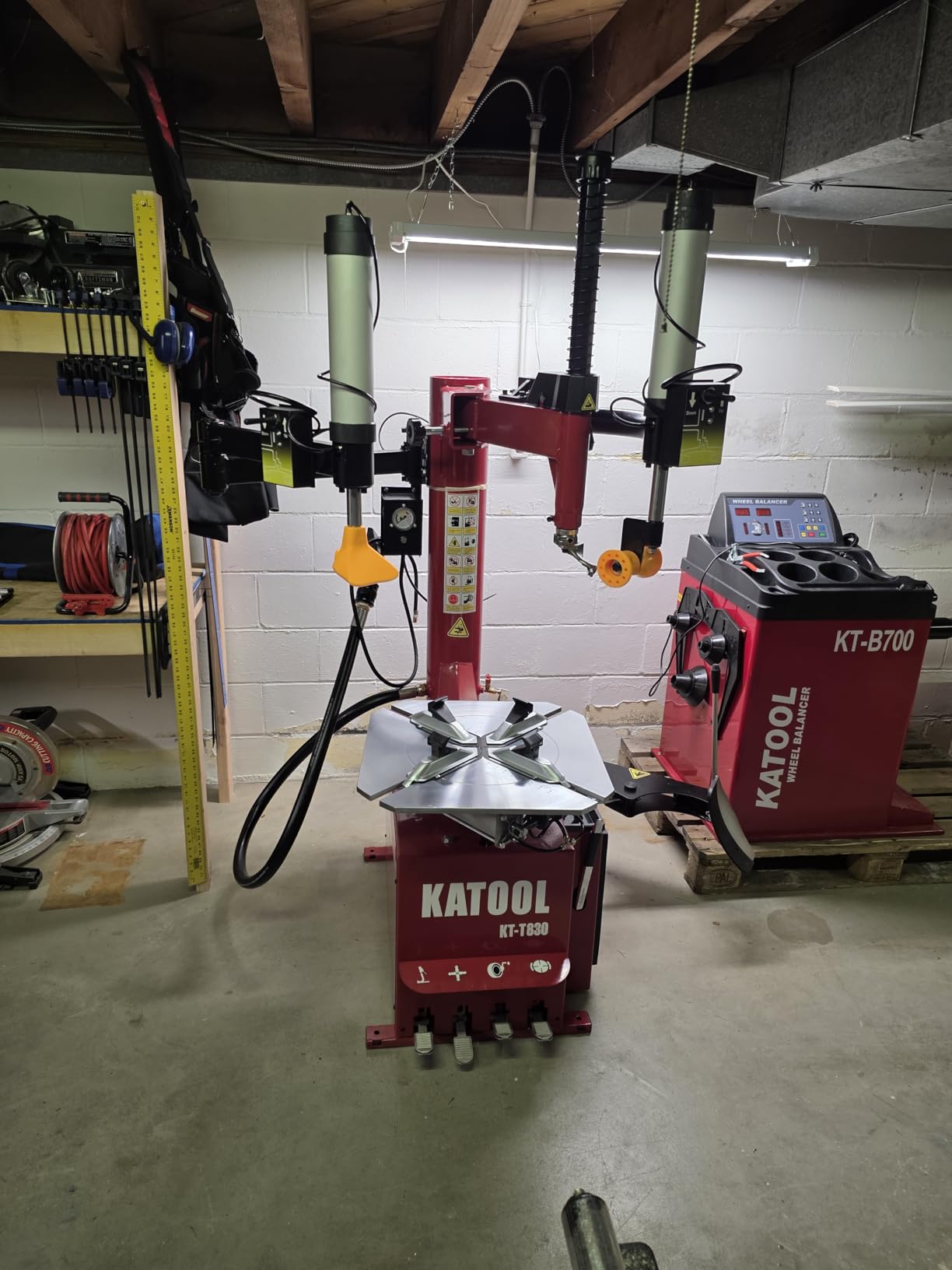
6. KATOOL KT-T830 and KT-B700 Combo: the widest clamp coverage here
KATOOL 2.0HP Tire Changer Bead Blaster Wheel Balancer Machine Combo KT-T830+KT-B700 Tire Changer Machine Tire Machine, Outside clamp 12-24″ Inside clamp14–26″ with φ8 Inch Cylinder
Outside clamp 12 to 24 inch, inside 14 to 26 inch
Integrated 8 inch bead blaster
583 lb closed stainless body
Pros
- Clamp coverage spans 12 to 26 inch across both jaws
- Integrated bead blaster with a dedicated 8 inch cylinder
- Carburized and quenched alloy steel jaws
- Soft jaw covers protect alloy and custom rims
- Closed stainless body cuts maintenance
Cons
- 583 lb unit needs serious floor space
- Limited long-term owner feedback at 46 reviews
- Some reviews in the 1 to 3 star range
This combo covers the largest clamp range of anything we looked at. The tire changer takes outside clamps from 12 to 24 inch and inside clamps from 14 to 26 inch, which means trucks, SUVs, and light commercial wheels are all in scope rather than being an afterthought.
The construction details read like a shop machine rather than a garage toy. Solution-treated stainless steel with polished interfaces, a fully closed body protecting internals from dirt and grease, and alloy steel jaws with 0.8 to 1.1 mm of interface carburization with full quenching.
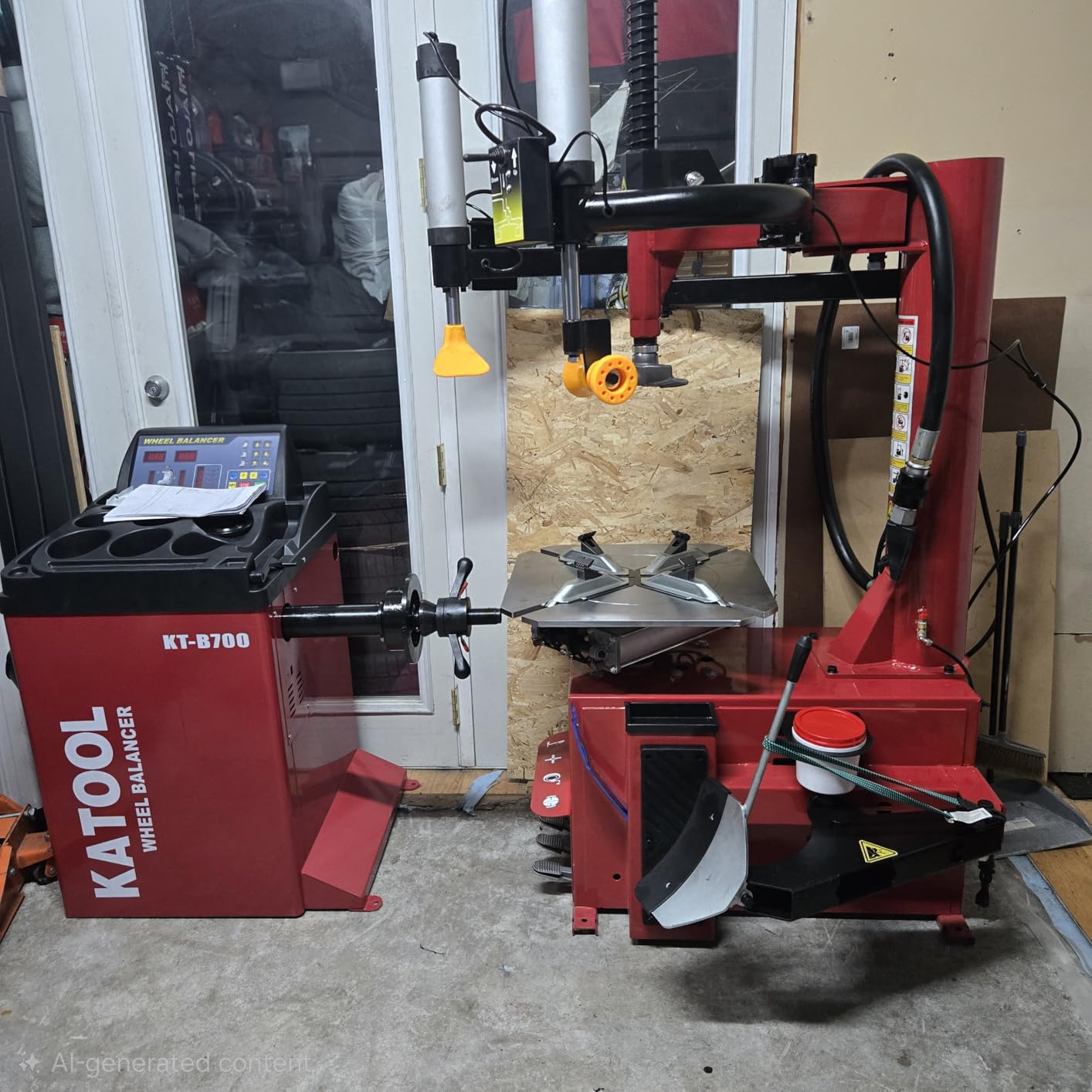
The integrated bead blaster runs its own dedicated 8 inch cylinder, and bead breaking on the changer is rated at 10 bar with a 2.0HP motor. That combination is what lets it handle tires where a small entry-level changer would stall halfway through.
Rim protection is built in with soft jaw covers on the clamp interfaces, which matters if you own alloys. For the balance side, the KT-B700 handles multiple balancing methods for different rim types, and the unit is rated at 583 lb across a 47 by 39 by 34 inch footprint.
Buyer comments focus on reduced operator strain from the assists, faster tire changes, and clean internal components thanks to the closed body. Be aware the review base is 46, so long-term durability data is thinner than the spec sheet suggests.
Who this combo suits
Pick this set if you work on trucks, SUVs, or anything running a tire larger than a typical sedan. The 26 inch inside clamp coverage is the number that matters, and almost nothing else in this price class reaches it.
It also suits anyone who cares about protecting expensive wheels. Soft jaw covers plus a spade-style protected interface is the difference between a cosmetic scuff and a repair bill after a season of use.
Who should skip this combo
Skip it for a one-car garage. At 583 lb and nearly 47 inches wide, this is a machine that assumes a dedicated bay with hard floor space around it, and the bead blaster is a feature you would use a handful of times a year.
Skip it if you want road force diagnostics. There are multiple balance modes here, but this is not a diagnostic tier machine, and nothing in the spec list reports radial runout or couple force.
7. KATOOL KT-T800 and KT-B700 Combo: the cleanest warranty story
KATOOL KT-T800/B700 Tire Changer and Wheel Balancer Combo Machine Garage Shop Equipment for Tire Repair and Wheel Balancing
KT-T800 changer plus KT-B700 balancer
Pull-type pedal control
Spade cover rim protection
Pros
- Owners describe it as a strong heavy duty machine
- Changer mounts and dismounts tires with ease
- Seller replaced a missing part promptly
- Free 12 months full parts warranty
- All-in-one pressure sensor support design
Cons
- Instructions are sparse and users rely on outside research
- Sparse documentation for the balancer
- Some low-profile tire setups need extra work
This is the smaller sibling of the KATOOL combo above, and for a home shop it is arguably the more sensible one. The 5.0 rating across 12 reviews is a perfect score, though with a sample that small it tells you more about early owner satisfaction than long-term durability.
The changer uses a high-quality spade cover to prevent rim damage, and the pull-type pedal control system covers both changing and maintenance. The balancer side, the KT-B700, handles multiple balancing methods for different rim types with various balance modes for different rim styles.
There is an all-in-one pressure sensor support design, which is a small detail that shows the machine was engineered as a set rather than assembled from unrelated parts. A free 12-month full parts warranty is also the clearest parts commitment in this group.
Buyer comments are unvarnished. Owners call it a strong, powerful machine that mounts and dismounts tires with ease, and one reports saving hundreds of dollars by servicing tires themselves. Another mentions a missing part that the seller replaced promptly.
The clear weak point is documentation. Instructions are sparse and users report relying on outside research to operate the balancer. If you have never run a computerized balancer, plan an afternoon reading before your first tire rather than during it.
Who this combo suits
Choose this if your tire sizes sit in the middle of the range: normal passenger and light truck wheels, nothing exotic. It gives you a mounted and balanced tire without the footprint of the heavier 583 lb set.
It also suits a small side business doing tire swaps on the weekend. The parts warranty gives some protection, and the pull-type pedal system is a design that tends to stay serviceable for a long time.
Who should skip this combo
Skip it if you will be doing this for the first time and want to be self-sufficient. Sparse instructions on a machine with multiple balance modes is a poor pairing for a beginner, and the setup learning curve is on you.
Skip it if you run very low profile tires on stiff sidewalls as your primary use case. Owners flag that some low-profile setups need extra work, which is exactly the tire type that makes owning a changer worthwhile.
8. BILT HARD 110V Changer and Balancer Combo: the widest balancer range
BILT Hard 110V 2.0HP Tire Changer Machine and Wheel Balancer Combo Rim Clamp, Tire Changer with Swing Arm and Tire Balancing Machine for Shop, Garage
Balancer for 10 to 28 inch rims and 1.5 to 18 inch widths
2.0HP changer motor
110V with 4 ALU modes
Pros
- Balancer covers 10 to 28 inch rims and 1.5 to 18 inch widths
- 4 ALU modes for concealed weight placement on alloys
- 2.0HP bead breaker with 10 bar force
- Both machines run on standard 110V power
- 250W balancer rated at 70dB
Cons
- Duckhead plastic inserts reported not to stay on
- Bead breaker arm is short with no extension option
- Requires practice and careful reading of instructions
This is the widest balancer in the roundup, and it is the only one here that reaches 28 inch rims and 18 inch widths on the balance side. The changer handles 12 to 24 inch rims and tires up to 39.4 inch, with a 2.0HP bead-breaking motor rated at 10 bar.
The 4 ALU modes are the feature to understand. Alloy wheels hide their weights behind the spokes, which means the balancing position is measured from a different plane than on a steel wheel. Without an ALU mode the machine tells you to put weight in a spot where the spoke is sitting.
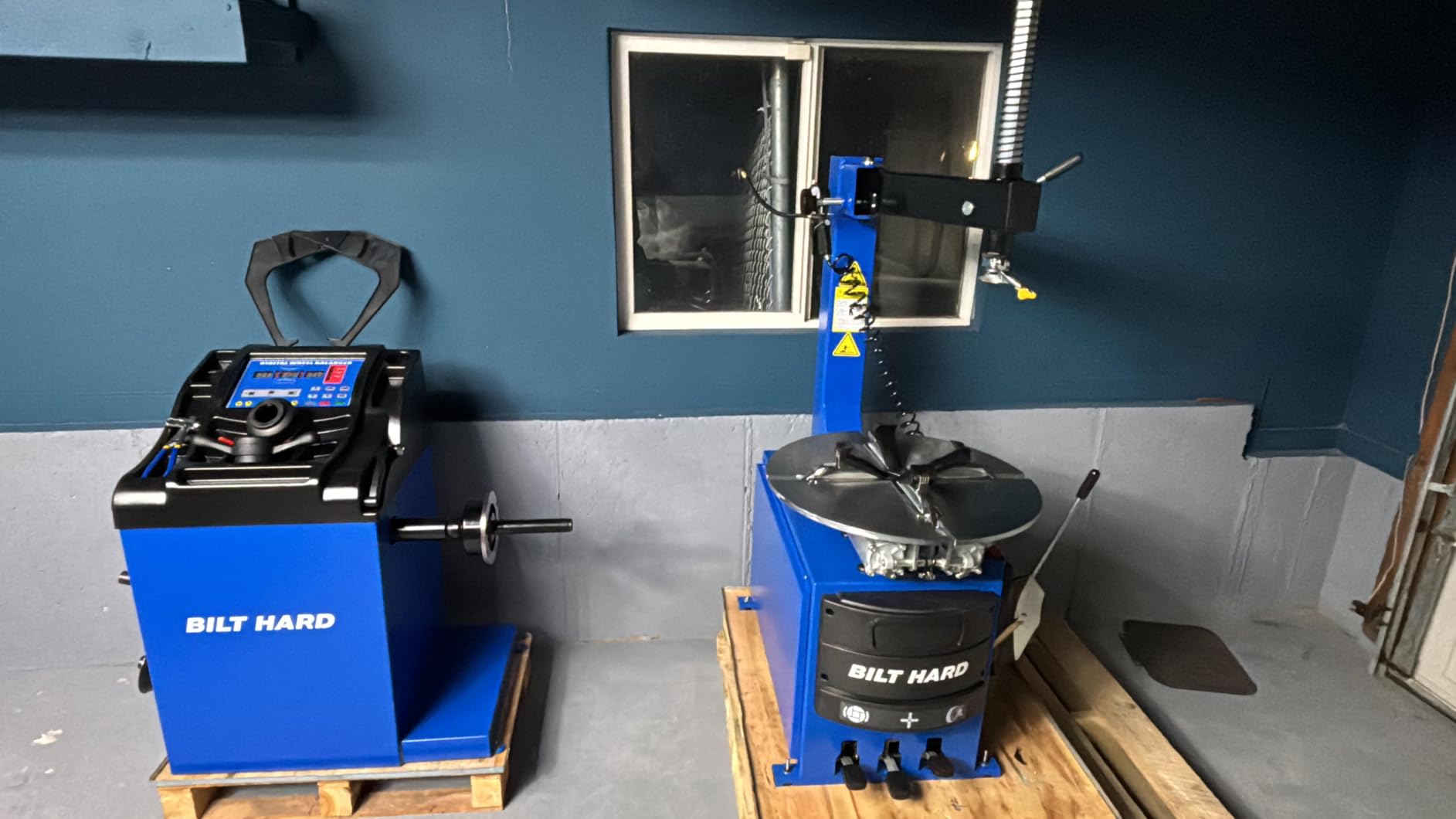
Both machines run on standard 110V/60Hz power, and the balancer is a modest 250W running at 70dB. That is quiet enough to run in a garage without conversation, and efficient enough that a normal circuit covers it.
Feedback is mostly enthusiastic early-owner comments about build quality, packaging, and vendor support, with a 85 percent five star split. There is one strongly negative review worth reading: it cites duckhead plastic inserts that do not stay on and an arm that flexes into rims on larger tires.
The other recurring complaint is the bead-breaker arm being short with no extension option for bigger tires. Both complaints concern the changer rather than the balancer, and both show up hardest on the largest tires this combo claims to handle.
Who this combo suits
This is the pick for large rims. A 28 inch maximum balancing diameter and 18 inch width coverage handles lifted trucks, large aftermarket alloys, and off-road setups that would be out of range on every other machine here.
It also suits anyone whose daily driver runs on alloys with concealed weights. Four ALU modes handle the behind-the-spoke geometry properly instead of leaving you to guess at placement.
Who should skip this combo
Skip it if you want proven long-term reliability. With 11 reviews there is not enough owner history to know how the arm hardware and duckhead inserts hold up over hundreds of tires, and one owner already reports problems there.
Skip it if your tires are smaller than a large truck. You would be carrying a large machine footprint for capacity you never use, and the short bead breaker arm adds a step you would otherwise avoid.
9. I40 PRO Portable Mini Wheel Balancer: the smallest footprint
Portable Mini Wheel Balancer Machine I40 PRO for Home Shop Garage Tire Balancer Machine Powered by USB Type C DC 5V/1A Smaller and Lighter
USB Type C DC 5V 1A power
Accuracy plus or minus 1g
Wheels up to 22 inch
44 lb main unit
Pros
- Compact 44 lb main unit that fits a workbench
- USB Type C low-voltage power needs no dedicated circuit
- Balancing accuracy of plus or minus 1g
- Wheels up to 22 inch diameter
- ALU2 and ALU3 modes with a 2D auto-arm
Cons
- Only 6 reviews so long-term reliability is unclear
- Hand-spinning the wheel takes practice to repeat
- Limited to 22 inch wheels
This is the answer for anyone whose real blocker is floor space. At 44 lb for the main unit and 30 by 7 by 9 inches, it can be mounted on a workbench or carried in a vehicle rather than parked in a corner of the garage.
The power story is unusual. It runs on DC 5V at 1A over a USB Type C interface, which means a phone charger or a small power bank. No dedicated circuit, no 110V outlet within reach, no extension cord across the garage floor.
It also runs on hand-spin drive, requiring two to three rotations of the wheel rather than a motor spin. Balancing accuracy is rated at plus or minus 0.04 oz, which is 1g, and maximum wheel diameter is 22 inch.
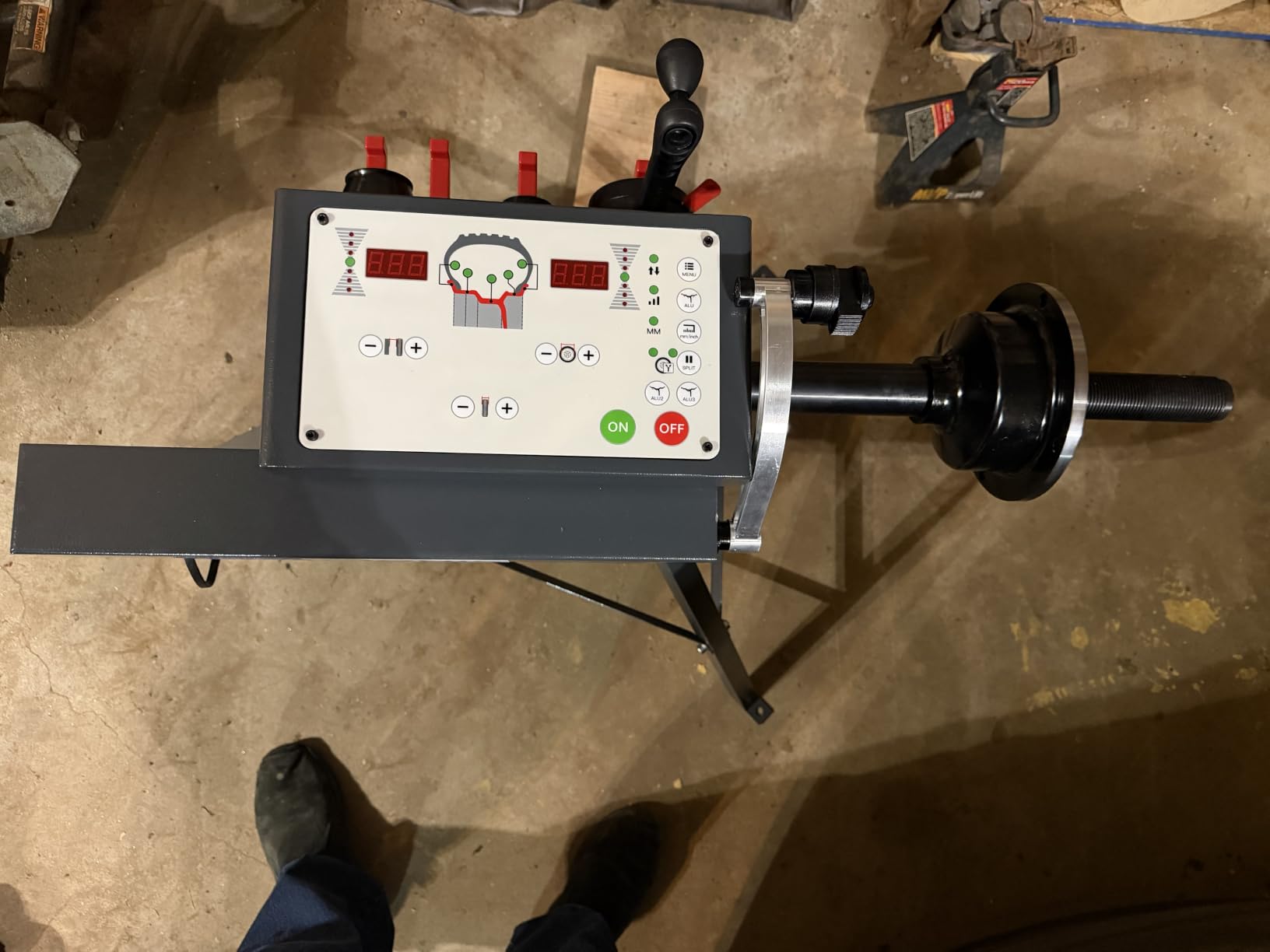
The 2D auto-arm supports ALU2 and ALU3 non-standard measurement modes, so aluminum rims get handled with the correct measurement plane. That is a real step up from a bubble level, and it puts this machine in the powered category on function even though it has no motor.
The 4.8 rating is the highest in this roundup, but it comes from 6 reviews, and about 79 percent of those are five star. We would not treat that as a durability signal. A 12-month full parts warranty is included, which helps.
The learning curve is the hand spin. Users report that spinning the wheel yourself takes practice to get consistent readings, and that is a fair summary. If you are comfortable with a slow, deliberate process, the accuracy is there.
Who this mini balancer suits
Pick it for an apartment garage, a rented space, a workshop bench, or a shared unit where you cannot claim floor. If you can work a wheel on a bench, this is the machine that makes that possible.
It also suits anyone who travels to events. At 44 lb and USB power, you can balance a spare or a freshly mounted wheel away from a home base without a generator.
Who should skip this mini balancer
Skip it if you want throughput. Hand-spinning each wheel two to three times is fine for one tire and tedious for a full set of four, especially on a set you plan to remount next season.
Skip it if you run wheels larger than 22 inch. That ceiling covers normal passenger and light truck sizes, but it excludes the large off-road and truck applications where a bigger machine earns its place.
10. KATOOL ME-T500 and ME-B620 Combo: the widest width coverage
KATOOL ME-T500 2.0HP Tire Changer Machine with 24”Turn Table and ME-B620 Wheel Balancer Machine Tire Repair Wheel Changers Combo Garage Equipment (ME-T500 & ME-B620)
Balancer for 10 to 24 inch rims and 1.5 to 20 inch widths
Self-calibration and fault diagnosis
Cast steel three-pedal changer
Pros
- Balancer covers 10 to 24 inch rims and 1.5 to 20 inch widths
- Built-in fault diagnosis and self-calibration
- Cast steel three-pedal control for durability
- Adjustable clamps adapt to many tire sizes
- Center auxiliary arm adds working clearance
Cons
- Mixed ratings show some owners were unsatisfied
- 24 inch tire work needs extra care with the auxiliary arm
- Learning curve for first-time users
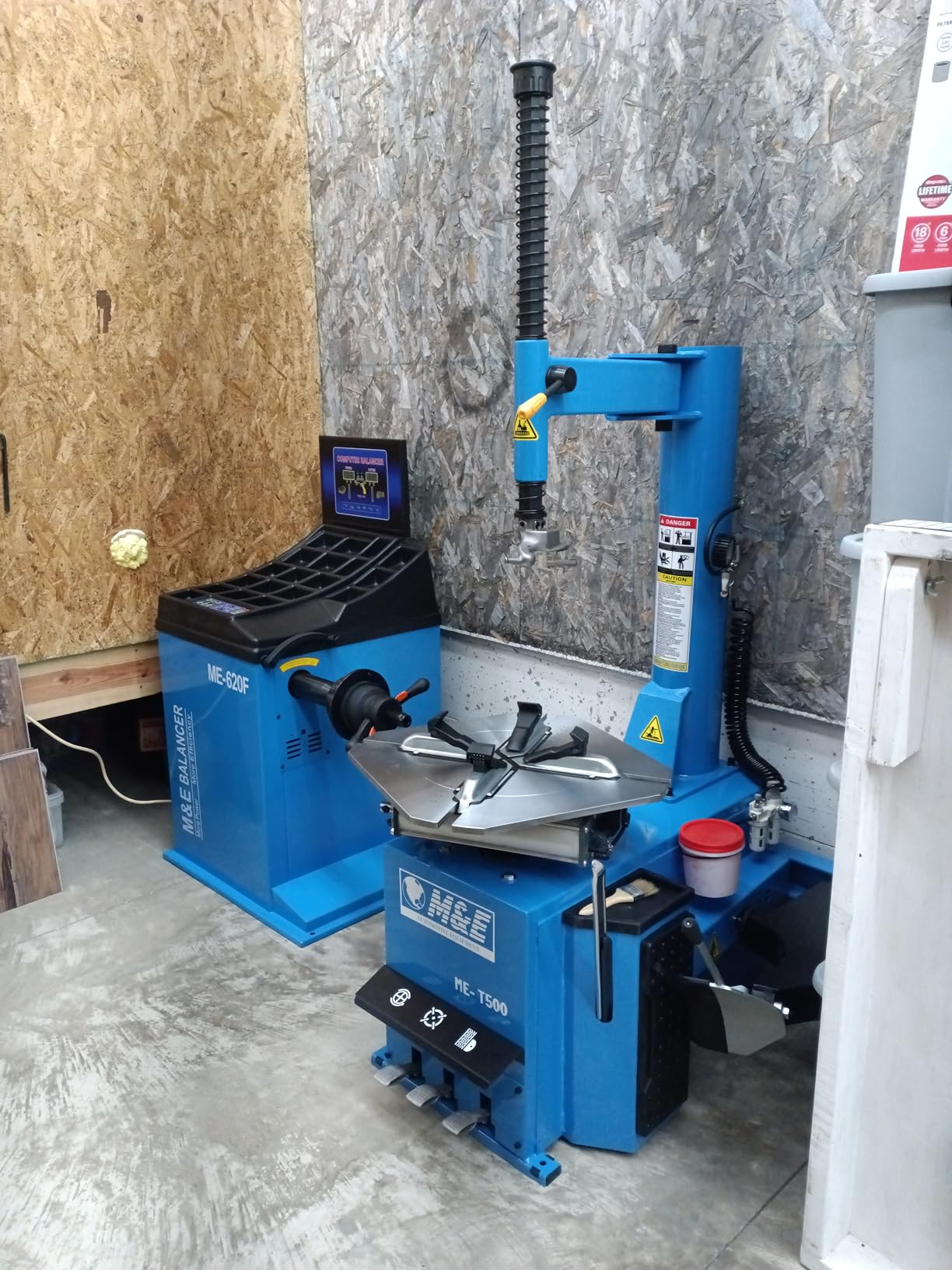
The standout number on the balance side is width. The ME-B620 takes rims from 10 to 24 inch diameter and wheel widths from 1.5 to 20 inch, which is the widest width coverage of any powered balancer in this roundup. Wide wheels and low profile tires are exactly where width coverage stops being optional.
The changer, the ME-T500, clamps from the inside at 14 to 24 inch and from the outside at 12 to 22 inch with adjustable clamps. It runs on three cast steel pedals, a design choice aimed at longevity rather than light weight.
Self-calibration with double-sided calibration and built-in fault diagnosis are both listed as standard. For a home shop that matters more than it first appears, because calibration drift is the cause of the weight chasing behavior owners complain about on lesser machines.
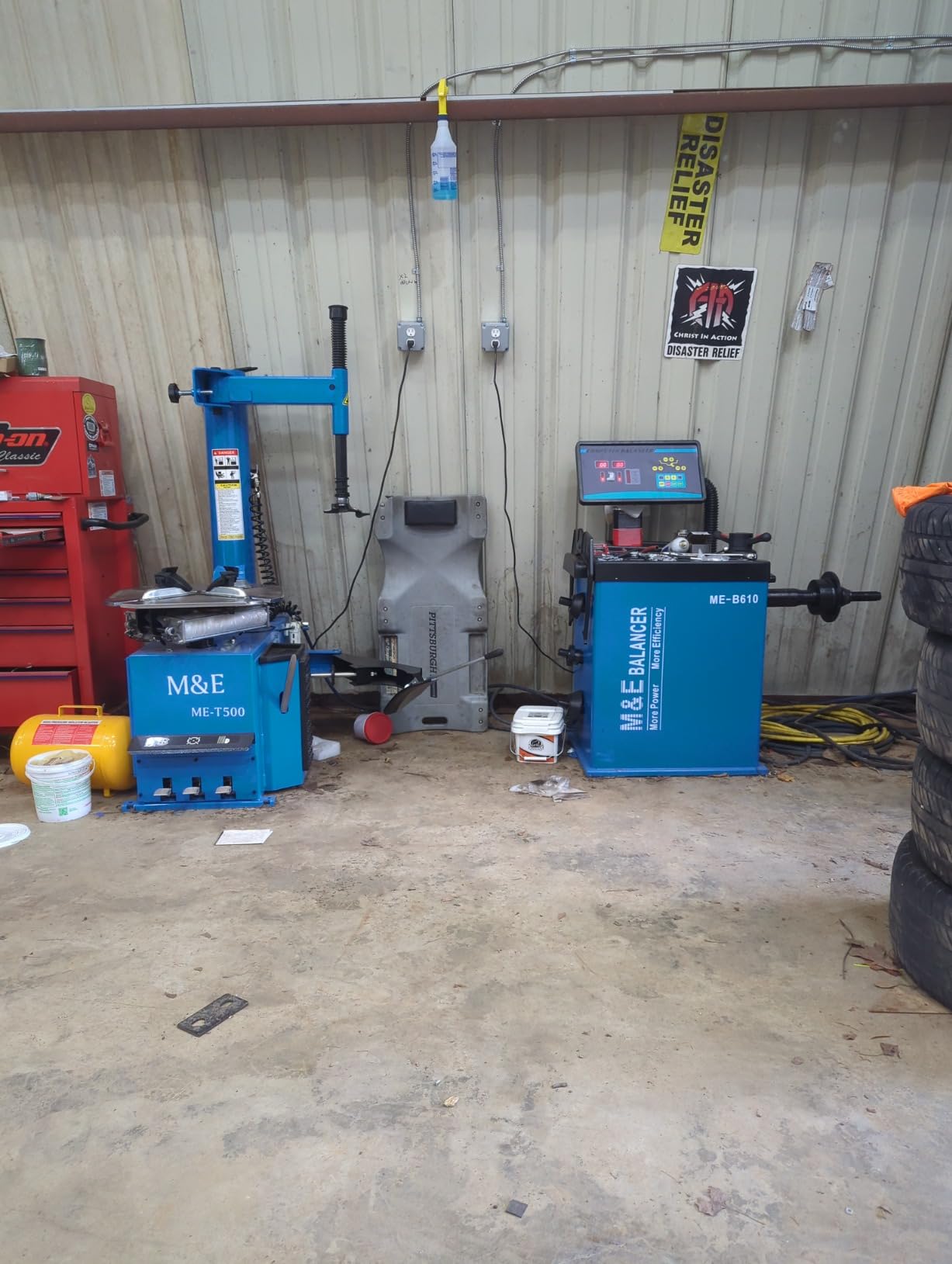
A center auxiliary arm design adds extra clearance for easier operation, which is the feature reviewers flag when working on the largest 24 inch tires. Buyers credit the adjustable clamps with handling a variety of tire sizes without swapping hardware.
The feedback is more mixed than the other KATOOL sets. Ratings sit at 4.2 across 27 reviews, with a meaningful share of lower ratings, and the pattern points at a first-time user learning curve rather than a hardware failure rate. Owners with tire experience are positive on clamp range and the self-calibration convenience.
One owner caution worth repeating: working with 24 inch tire setups requires extra care around the auxiliary arm. Budget more time per tire at that end of the range until the geometry is familiar.
Who this combo suits
Choose it if your wheels are wide. Pickups, three-rows, lowered sedans on wide rubber, and performance setups all push into the 10 to 14 inch width band where a narrower balancer stops being able to place weight on the outer plane correctly.
It also suits anyone who wants self-calibration and diagnostic fault codes. For a first computerized machine, having the machine check itself removes a whole category of frustration.
Who should skip this combo
Skip it if you are buying your first machine and want a plug-and-play experience. A 4.2 rating with a learning curve noted in reviews means you should budget time to get it right rather than assuming it will just work.
Skip it if your tires are all small. The adjustable clamp range is generous for a shop machine, but that range is why the chassis is heavy, and heavy chassis is the wrong tradeoff for a set of 15 inch wheels.
How to choose a wheel balancer for a home shop
Once you know the formats exist, the choosing gets mechanical. These eight factors decide almost everything, and checking them in order saves a return shipment.
1. Rim diameter range. Check the maximum balancing diameter, not just the clamp range on the changer. A machine that clamps a 24 inch rim but balances only to 19 inch leaves you stuck the day you fit bigger wheels. The BILT HARD combo here reaches 28 inch on the balance side, which is the broadest we saw.
2. Rim width coverage. This is the spec buyers ignore and regret. A 1.5 to 10 inch range handles normal passenger wheels, but wide performance and truck fitments need coverage out to 14 inch or beyond. The KATOOL ME-B620 goes to 20 inch.
3. Balancing mode. Static balancing corrects uneven weight distribution around the wheel. Dynamic balancing adds a second plane to correct couple force, where the front and rear of the wheel are out of balance relative to each other. Dynamic matters for performance cars, low profiles, and heavier vehicles.
4. Data entry, 2D versus 3D. A 2D machine needs rim diameter and rim width entered before each spin. A 3D machine also needs rim offset and uses a sonar or laser arm to find the plane automatically. For a home shop, 2D is entirely adequate. The extra step on 3D is not worth it unless you are doing high-volume commercial work.
5. Weight type. Adhesive or stick-on weights are standard on almost everything, including cheap machines. Clip-on weights are mechanically simpler and faster but cannot sit behind a spoke, so they are not a choice for concealed weight placements on alloy wheels. Look for ALU modes rather than clip-on capability.
6. Self-centering arm quality. This is the part that wears out first and the part most likely to cause weight chasing, where the machine keeps asking for more weight each spin. A worn arm gives you readings that shift every time you touch the wheel. Check whether the arm is self-calibrating and whether replacement arms are available for that model.
7. Power supply. Nearly everything in this roundup runs on 110V, which is what you want in a residential garage. The I40 PRO goes further and runs on USB Type C at 5V. Confirm the amperage, because two machines on one circuit is the setup most likely to trip a breaker.
8. Footprint and floor. Bubble balancers need about 24 inches of height and an 11.5 inch base. Powered combos run from 38 by 26 inches and 780 lb up to 47 by 39 inches and 583 lb. Whatever you buy needs a flat, level surface, because an unlevel floor makes every reading a guess.
Two more practical points. Warranty length matters less than parts availability, because the shaft, cones, and calibration arm are what actually fail. And for heavy floor-standing machines, anchor them. A free-standing balancer that walks while a wheel spins is a hazard in a home garage.
Manual vs 2D vs 3D vs diagnostic balancers
Manual and bubble balance is the floor tier. You roll the wheel on a shaft, inflate it, and slide it until a bull’s eye level centers. There is no measurement, so accuracy depends entirely on your eyes and a level floor. It handles static imbalance, which covers the majority of what a home shop will ever feel.
2D balancers add a motor and a digital readout. You enter rim diameter and width, the machine spins, and it calculates weight amount and position with accuracy figures like -1g to +1g. Static and dynamic modes both become available. This is the practical sweet spot for a home shop that wants repeatable results.
3D balancers add a third dimension, meaning rim offset, and typically use a sonar arm or laser spot to locate the rim plane without you measuring it. They are faster on mixed wheel inventories because there is less to enter. The tradeoff is cost and more modes to learn.
Diagnostic or road force balancers go further and measure radial runout and couple force to explain a shake that imbalance alone does not account for. They are the machines that find a bent rim or a tire pull. A home shop rarely needs this tier, and it is the first thing to skip when budget is the constraint.
One nuance from the enthusiast community that is worth knowing. On a properly calibrated quality spin balancer, dynamic balancing is often considered second only to bubble balancing for static-heavy setups, because it corrects the couple force that the bubble method naturally leaves alone. In practice, a good 2D machine in dynamic mode on a road car will beat any bubble balancer.
Alternatives to owning a wheel balancing machine
Balancing beads and Centramatic-style internal balancers come up constantly in forum threads, and they are worth understanding before you spend anything.
Internal balance beads sit inside the tire and migrate as the wheel spins, self-arranging to cancel the imbalance. Truck and overlanding users report never having an out-of-balance condition with them. They work by physics, they never need calibration, and they add nothing to the rotating mass at the rim.
Centramatic-style hub balancers balance the rim, tire, and hub together as one unit by weighing the hub assembly first. RV owners describe them as one of the best ways to balance an RV because the whole rotating assembly is handled at once. The limitation is performance applications, where a heavy internal setup fights the geometry you are trying to preserve.
Neither method corrects rim runout or assembly imbalance caused by a bent wheel. For a shop doing mostly static work on trucks and RVs, beads may genuinely be enough. For road cars where a vibration at highway speed is the complaint, a machine is the answer.
The other alternatives are simpler. Paying a shop per tire is still the best option if you change under about 20 tires a year, since machine ownership does not pay back at low volume. Mobile balancing services bring the machine to you and are worth comparing against the shop rate before you commit. Borrowing or renting equipment works for a one-time need such as a set of new winter wheels.
Space, power and floor requirements for a home shop balancer
Floor space is the number one reason people cite for not buying, and the numbers are less intimidating than they look for the manual tier. A bubble balancer is 24 inches tall on an 11.5 inch base and weighs around 11 lb, which is genuinely a shelf, not a bay.
The floor has to be level. A bubble balancer has no leveling feet with adjustment, so a sloped garage slab will produce inconsistent readings no matter how carefully you work. Plywood shims under the base are the usual fix and cost nothing.
Powered combos are a different proposition. The XK pair needs 38.5 by 26 by 39.5 inches and weighs 780 lb. The KATOOL KT-T830 set is 47 by 39 by 34 inches at 583 lb. Plan a corner where the machine can sit with the changer arm fully extended and the balancer shaft clear.
On power, everything here is 110V. The XK machines draw roughly 300 to 1000 watts each, the BILT HARD balancer is 250W, and the I40 PRO draws 5V at 1A over USB Type C. Running a changer and a balancer on one residential circuit is normal, but avoid running a welder or air compressor on the same circuit at the same time.
Plan tire storage too. Once you own a changer, you have four or eight dismounted tires to put somewhere. That is often the constraint nobody accounts for, and it is the reason to measure the whole wall before you buy.
Used wheel balancers: what to check before you buy
Used is a real option, and the enthusiast forums are full of people running machines for years. On a grassrootsmotorsports.com home shop thread, owners describe a Coates 30-30 bought at auction that has mounted and balanced many tires without issues, and a Coates 40-40 found used for a few hundred dollars two hours away. An eBay-sourced changer and balancer set there has handled several hundred tires over five years, from race tires to 34 inch mud tires.
Those reports set the tone. Used equipment works, and the risk is not the machine, it is the unknown. Here is the checklist.
1. Calibration state. Ask when it was last calibrated and by whom. A machine that has not been calibrated in a decade gives numbers that look precise and are not.
2. Centering arm condition. This is the wear item that causes weight chasing. If the arm does not hold position when you let go, budget for a replacement arm before you trust the readings.
3. Hub adapters for your wheels. Older manual machines sometimes top out around 19 inch alloy widths unless you source obsolete adapters. Check availability before you pay.
4. Shaft and cone wear. Run a finger along the shaft. Scoring or a wobble in the hub bore shows up as a vibration the machine then tries to balance away.
5. Pedals and hydraulics. On changers, pedal feel tells you most of the story. Stiff or spongy pedals mean a rebuild, and that cost erases the savings.
6. Electrical and spin motor. On a 110V machine, check the cord for cracking and confirm the spindle spins smoothly and quietly at speed.
7. Data display. A failed screen on an otherwise good machine is common, and replacement displays for older models get hard to find.
8. Parts availability in your region. Forum users list no parts or service support in the area as a deal breaker, and that reasoning applies to new machines in isolated areas too.
9. Floor space and levelness. Recheck this on a used machine. A 60 year old chassis may not have adjustable feet either.
10. Seller honesty about throughput. Ask what it did before and whether it was bolted down. A unit that has been anchored to a real shop floor for decades is usually worth more than one that has been dragged around.
Brand reputation is consistent across those threads: Hunter is top of the line but not cheap, and Coates equipment is considered solid value and a workhorse. For a home shop, a serviced used Coates class machine is frequently the better buy than a new budget imported unit.
Frequently Asked Questions
What is a wheel balancer?
A wheel balancer is a shop machine that spins a mounted tire and wheel assembly, measures where the weight is uneven, and calculates the weight and position needed to correct it. You mount the assembly on a shaft, enter the rim diameter and width, select a balancing mode, spin it, apply the weights the machine specifies, and re-spin to confirm. It fixes steering wheel shake and uneven tire wear caused by imbalance.
Can you do wheel balancing yourself?
Yes, with a machine. The realistic home shop formats run from a manual bubble balancer that costs little and needs only a level floor, up to a powered changer and balancer combo that balances to within about one gram and also mounts the tire. The deciding factor is volume: below roughly 20 tires a year, paying a shop per tire is usually cheaper than owning and storing a machine.
What is the best wheel balancer for home use?
The ATPEAM Portable Bubble Wheel Balancer is our top pick for most home shops. At under 12 lb it stores anywhere, needs no electricity, and handles most cars and light trucks. If you want measurement and repeatability instead, move up to a 2D powered balancer, which gives you weight amount and position with accuracy figures around -1g to +1g.
Is a 2D wheel balancer good enough for home use?
Yes. A 2D machine requires you to enter rim diameter and rim width before each spin, but it gives you a digital readout of weight amount and position with accuracy around one gram. The third dimension on a 3D machine only saves you the data entry step. Unless you are doing high-volume commercial work, 2D is the practical ceiling for a home shop.
Do balance beads in tires really work?
Yes, for static imbalance. Beads sit inside the tire and migrate as the wheel spins, self-arranging to cancel the imbalance, which is why truck and overlanding users report never having an out-of-balance condition. They cannot correct rim runout or a bent wheel, so a vibration that comes from the rim itself will persist. They also add rotating mass, which works against performance setups.
Do Centramatic balancers really work?
They balance the rim, tire, and hub together as one weighted unit, which is why RV owners rate them highly for those applications. The trade-off is that the hub assembly becomes part of the balancing mass. That is fine for a heavy RV or trailer wheel and undesirable on a performance car where you are trying to keep rotating mass low and geometry precise.
Why does my wheel balancer keep asking for more weight?
That behavior is called weight chasing and it almost always means calibration drift rather than a real imbalance. The usual causes are a worn self-centering arm that will not hold the wheel still, a tilted or unlevel floor, or a machine that has not been calibrated in a long time. Check the centering arm first, then have the machine recalibrated before adding more weight to the rim.
How much space does a wheel balancer need in a garage?
A manual bubble balancer needs about 24 inches of height on an 11.5 inch base and weighs around 11 lb, so a shelf works. Powered changer and balancer combos need a real corner: roughly 38 by 26 inches and 780 lb for the XK set, up to 47 by 39 inches and 583 lb for the KATOOL set. Whatever you choose needs a flat, level surface and room for the changer arm to swing fully.
The bottom line on the best wheel balancers for home shops
Start with the ATPEAM Portable Bubble Wheel Balancer if you have one car, a normal garage, and four tires twice a year. It is our editor’s choice because it needs no power, weighs under 12 lb, and the review base is the deepest of anything we covered at 258 reviews.
If you want measurement and repeatability rather than a bubble and a steady hand, the XK 580 and 690 combo is the one to buy. It balances to -1g to +1g, runs on 110V, and includes the tire changer you need to make the balancer worth owning.
For wide wheels, the KATOOL ME-B620 side reaches 20 inch widths with self-calibration. For large rims, the BILT HARD combo balances up to 28 inch and carries 4 ALU modes for concealed weights. For a bench instead of a bay, the I40 PRO does the job over USB Type C.
And if you change fewer than about 20 tires a year, buy a torque wrench and a good set of tire irons instead. The best wheel balancers for home shops are the ones you will actually keep working with, not the most capable machine on the shelf.
Whatever you choose, keep it next to one of our welding carts for the metalwork side of the same garage, or check our router table picks if the machine bay and the wood bay are sharing one room in 2026.
