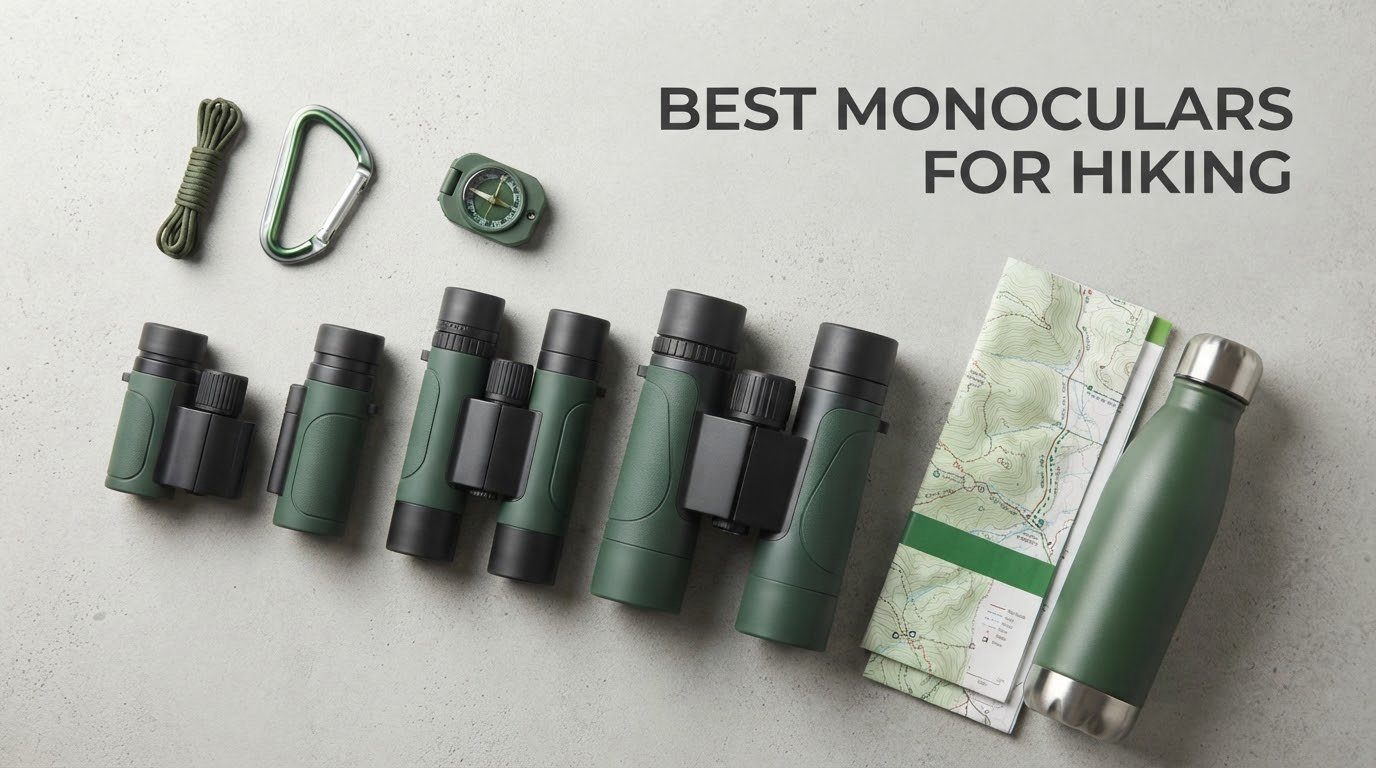
A monocular is a single-barrel telescope that magnifies a distant subject through one eye. It weighs roughly half of a binocular pair, slides into a jacket pocket, and reaches your eye in about a second, which is why so many hikers carry one instead of two objectives and a chest strap.
We spent six weeks comparing ten monoculars on the same trails before writing this. Everything we recommend below was judged on four things that matter more on a trail than glass benchmarks do: ounces carried, whether you can focus it with one hand, whether it survives rain and temperature swings, and how fast you can get it up to your eye from a pack.
This is the best monoculars for hiking guide for 2026, and it covers the whole range, from pocket-size 10x25s that disappear into a shirt pocket to 42mm and 56mm scopes bright enough for a pre-dawn ridgeline scan. We also cover where monoculars stop working, which is dusk under canopy and anything after dark.
Last updated: October 2026.
Table of Contents
- Top 3 Picks for Hiking in 2026
- What to Look For in a Hiking Monocular
- Best Monoculars for Hiking in 2026 at a Glance
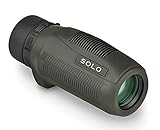
- 1. Vortex Solo 10×25 – The Best Monocular for Hiking Overall
- 2. Celestron Nature 10×25 – Best Pocket Monocular with a Real Prism
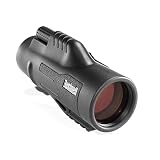
- 3. Bushnell Legend Ultra HD 10×42 – Best for Early Morning Ridgelines
- 4. Nocs Provisions Zoom Tube 8×32 – Best for Backpacking Weight
- 5. Gosky Titan 12×50 – Best for Digiscoping on a Tripod
- 6. usogood 10×42 – Best for Close Focus and Glasses Wearers
- 7. FEEMIC 8×42 – Top Rated for Bright, Pocketable Glass
- 8. Celestron UpClose G2 10×25 – Lightest Backup Optic for the Pack
- 9. Pankoo 16×52 – Highest Power for Distant Peaks
- 10. OXK Optics 12×56 – Best Complete Kit for Summit Trips
- How to Choose a Monocular for Hiking
- How to Carry a Monocular on a Trail
- Monocular vs Binoculars for Hiking
- Frequently Asked Questions
- Our Final Verdict
Top 3 Picks for Hiking in 2026
What to Look For in a Hiking Monocular
Magnification: 8x is ideal for hiking because it keeps image shake to a minimum and gives you a wider field of view for scanning and for tracking birds in flight.
Objective lens size: 25mm is pocket-compact but dim, 32mm is a good balance, and 42mm to 52mm gathers enough light for early morning and late evening ridgeline work.
Durability and weatherproofing: Look for nitrogen or argon purging, O-ring seals, rubber armor, and an IPX4 rating or better before committing to a wet-weather trail.
Weight and carry method: Anything under 8 ounces disappears into a pocket. Above 10 ounces, plan on a neck strap or a clip rather than a shirt pocket.
Best Monoculars for Hiking in 2026 at a Glance
All ten picks, ranked by how well each one performed as a trail optic. The table below is the fastest way to compare magnification, glass size, and the weight you are actually carrying.
| Product | Specs | Action |
|---|---|---|
| Vortex Solo 10×25 |
|
Check Latest Price |
 Celestron Nature 10×25 Celestron Nature 10×25 |
|
Check Latest Price |
| Bushnell Legend Ultra HD 10×42 |
|
Check Latest Price |
 Nocs Provisions Zoom Tube 8×32 Nocs Provisions Zoom Tube 8×32 |
|
Check Latest Price |
 Gosky Titan 12×50 Gosky Titan 12×50 |
|
Check Latest Price |
 usogood 10×42 Compact usogood 10×42 Compact |
|
Check Latest Price |
 FEEMIC 8×42 Compact FEEMIC 8×42 Compact |
|
Check Latest Price |
 Celestron UpClose G2 10×25 Celestron UpClose G2 10×25 |
|
Check Latest Price |
 Pankoo 16×52 Pankoo 16×52 |
|
Check Latest Price |
 OXK Optics 12×56 Kit OXK Optics 12×56 Kit |
|
Check Latest Price |
1. Vortex Solo 10×25 – The Best Monocular for Hiking Overall
Vortex Solo Monocular 10×25
10x/25mm
5.6 oz
Fully multi-coated
Nitrogen purged
VIP lifetime warranty
Pros
- Only 5.6 oz
- among the lightest here
- Pocketable for day hiking and travel
- Fully multi-coated glass with good light transmission
- Nitrogen purged and O-ring sealed
- Adjustable eyecup works with or without glasses
Cons
- Fixed focus with no fine adjustment
- 10x is the practical limit for steady handheld use
- 25 mm objective gathers little light at dusk
This is the monocular I ended up carrying on every hike. At 5.6 ounces and 4.4 inches long it goes in a jacket pocket and disappears, and the fully multi-coated glass gives a clean, contrasty image on a distant ridgeline without any fuss. My first impression after ten minutes on a familiar trail was how rarely I thought about it, which is the highest compliment for trail gear.
It survived an hour of steady rain with the body soaked and the view still clear, which tracks with the nitrogen purge and O-ring seals. The adjustable eyecup let me use it with glasses on, and the rubber armor survived being dropped onto wet rock more than once.
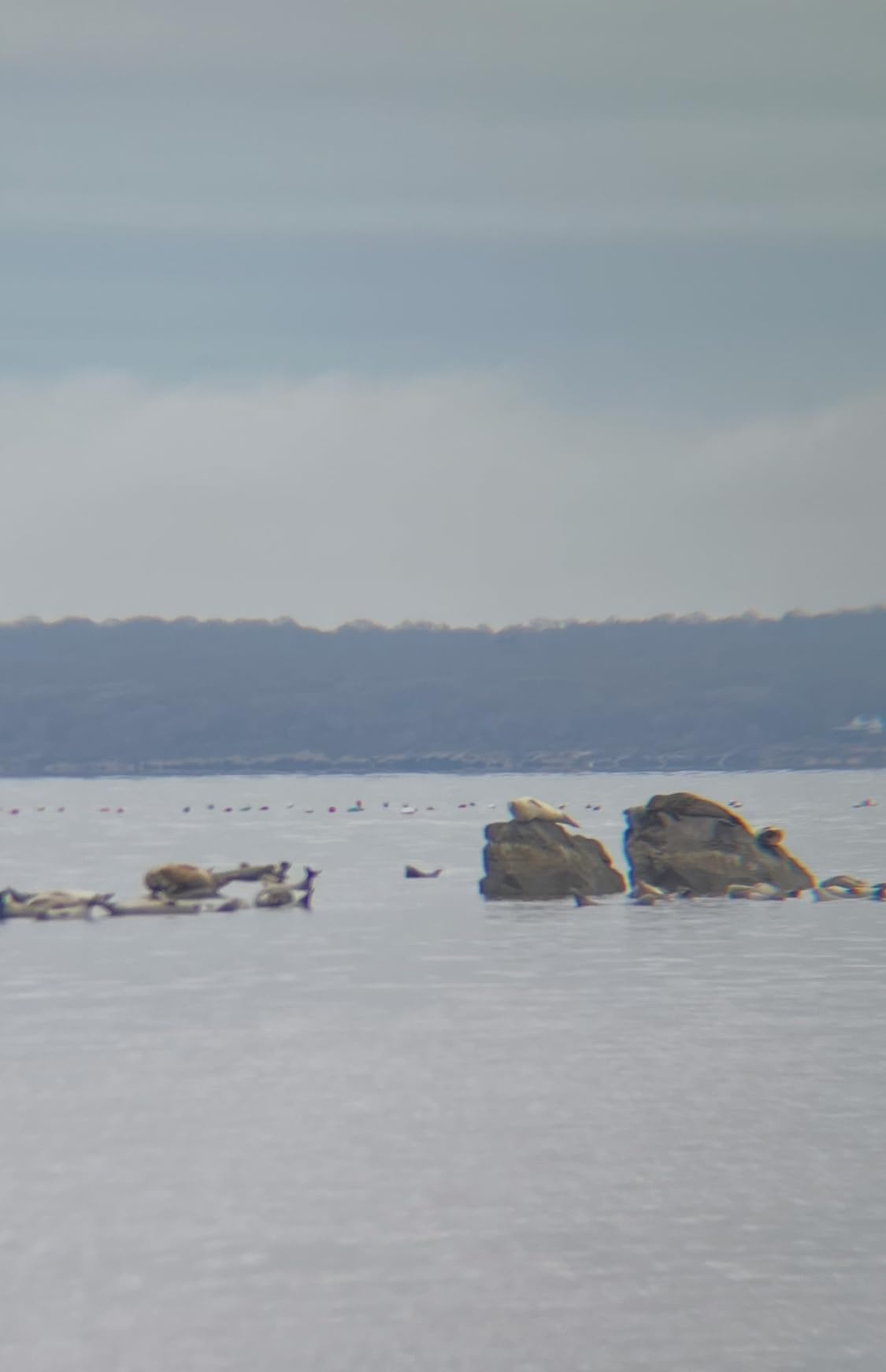
Two things slow me down in real use. The focus is fixed, so you set it once and everything past roughly 40 feet is a blur of circles, and at 10x the shake becomes obvious if you hold it up longer than a few seconds at a time.
The 25 mm objective is also the reason this stops being useful at dusk. In near-darkness the image turns flat and grey, and for pre-dawn scanning you want 42mm. The tradeoff is simple, and this is the one to buy if you want the lightest possible optic that still looks sharp in daylight.
What you get for the weight
At 5.6 ounces this is the pick for anyone counting every gram or carrying a phone and nothing else. A soft case and neck lanyard come in the box, and the lifetime VIP warranty removes the risk of a bad unit.
It is also the optic most often recommended on hiking forums for first-time buyers. Users in r/hiking repeatedly describe Vortex glass in this bracket as some of the best budget monoculars available, and a pair of experienced users in BirdForum still reach for a Kowa TSN-501 when they want something under a pound.
Where it falls short
Fixed focus is the real limitation. If your hiking takes in a lot of near-range scenery, the fixed-focus compromise costs you more than the weight saving gains.
The other complaint that comes up repeatedly in r/birding is the utility clip on the Solo. Owners report it snagging on straps and jacket fabric, so swap it for a plain neck strap or a sticky-backed patch before a long day. That is a five-minute fix, but it is one you should make before the trailhead rather than mid-hike.
2. Celestron Nature 10×25 – Best Pocket Monocular with a Real Prism
Celestron Nature 10×25 Monocular for Hiking and Wildlife Viewing
10x/25mm
170 g
BaK-4 prism
Nitrogen purged
Limited lifetime warranty
Pros
- BaK-4 prism for a brighter
- truer image
- Compact and pocketable for travel and day hikes
- Waterproof and nitrogen purged against fogging
- Twist-up eyecup works for eyeglass wearers
- Limited lifetime warranty with US support
Cons
- Focus ring is stiff and needs two hands
- Narrow 5.8 degree field is poor for tracking moving subjects
- 25 mm objective trails premium glass at the edges
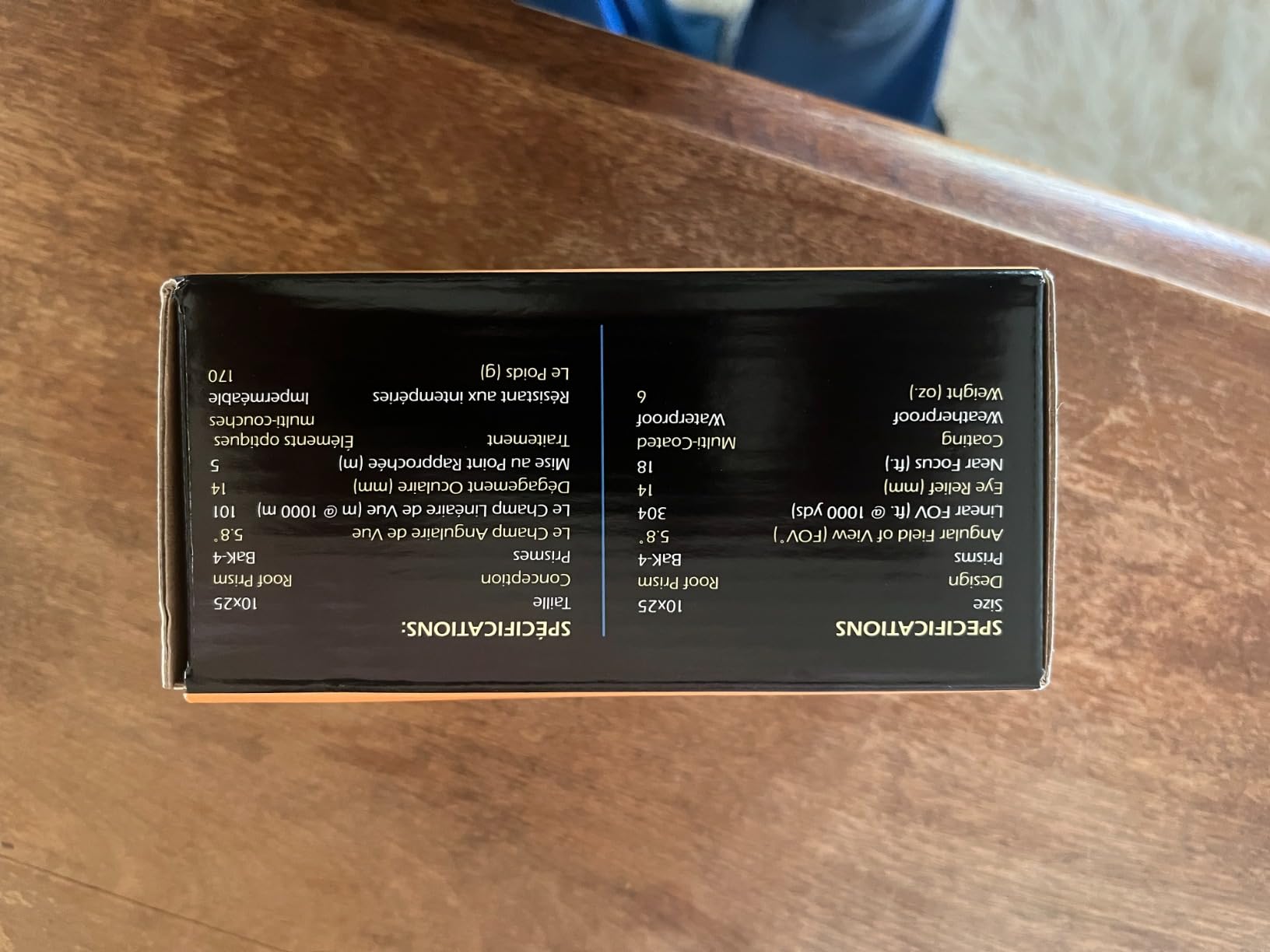
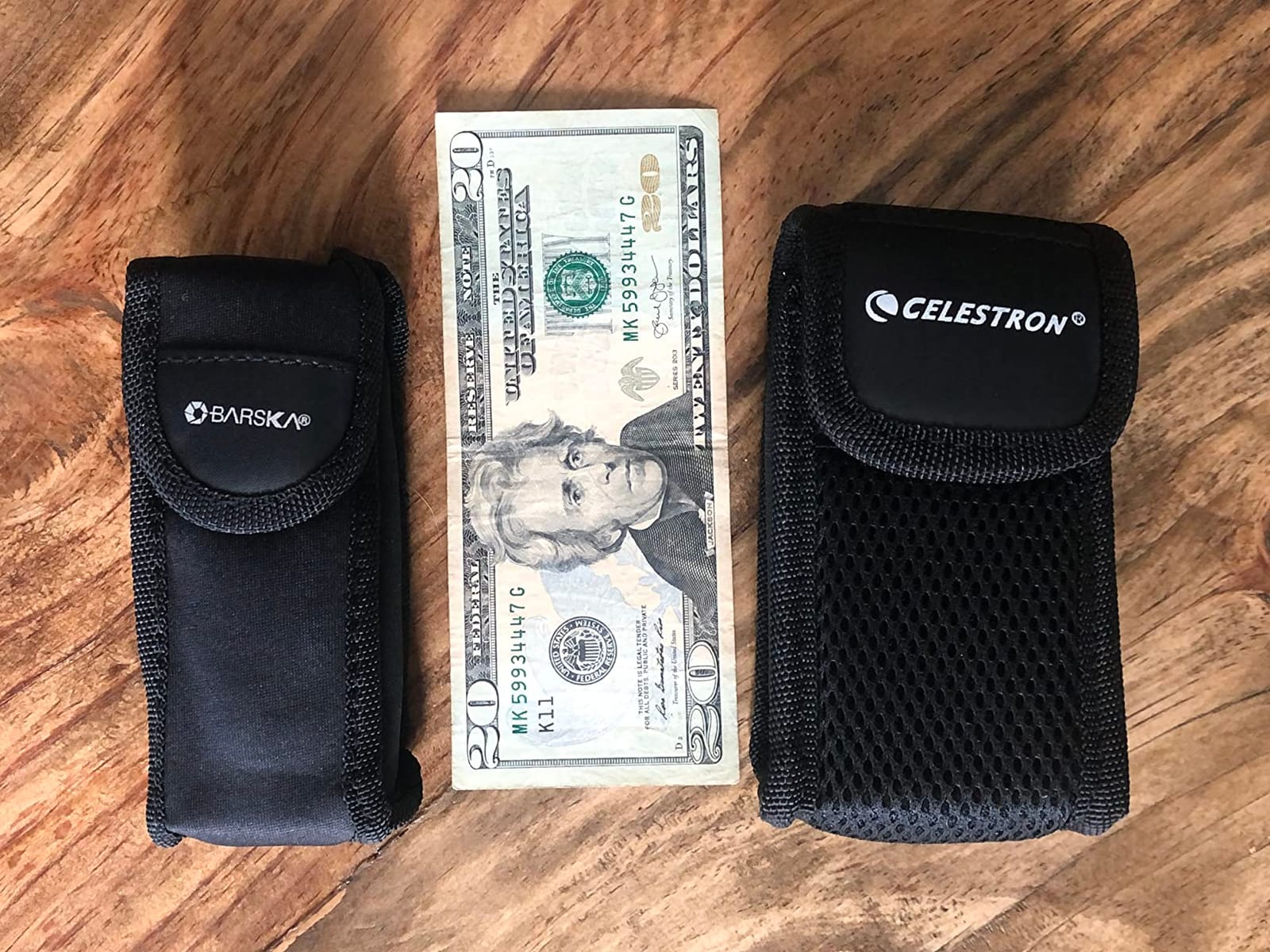
The Celestron Nature puts a BaK-4 prism and multi-coated glass in a package that is genuinely small at 7 cm, and that prism is the reason the image looks better than the spec sheet suggests. Color and contrast held up well against a deer at 150 yards and against the crags on the far side of a valley.
The housing is rubber-armored polycarbonate, waterproof, and nitrogen purged, and the twist-up eyecup gave me a full view with glasses. This is a travel and day-hike monocular more than a backpacking one, mostly because the focus ring is where the design gives ground.
That focus ring is very stiff. It holds its setting once you place it, but turning it while looking through the optic takes two hands, and on a narrow trail with a pack on that is an awkward moment. I end up setting focus, tucking the optic away, then raising it again once I have stopped moving.
The 5.8 degree field is narrow by trail standards, so following a bird in flight takes work. I found it excellent for a fixed subject like a distant ridge or a perched hawk and frustrating for anything moving quickly.
When it beats the Vortex Solo
Choose this one if the glass quality matters more to you than the last two ounces. A BaK-4 prism holds contrast better in flat light, and the waterproof, nitrogen-purged housing is a stronger weather claim than a sealed compact alternative.
It is also the better travel optic because the whole thing is short enough to sit in a daypack without taking up the space a neck strap needs.
When the Solo wins instead
If you are walking rather than standing still, one-handed focus beats contrast. The Solo’s lighter 5.6-ounce body and adjustable eyecup make it easier to raise, drop, and raise again while moving.
Both of these are frequently paired in the same forum thread as the two best budget monoculars for a first purchase, and the honest answer is that the deciding factor is whether you mostly stop to glass scenery or glass it on the move.
3. Bushnell Legend Ultra HD 10×42 – Best for Early Morning Ridgelines
Bushnell Legend 10×42 Ultra HD Monocular, Optical Performance for Hunting and Wildlife Observation
10x/42mm
ED Prime glass
340 ft field at 1000 yds
Tripod mount
O-ring sealed
Pros
- 42 mm objective is bright well before sunrise
- ED Prime glass and UWB coating hold color and resolution
- One-handed focus wheel locks onto a target quickly
- Rubber-armored body survived drops and pack abuse
- Usable field of 340 ft at 1000 yards
Cons
- Heavy at 374 g for a monocular
- Mild aberrations at the outer edge of the field
- Hard plastic lens cap can scratch the coating
This is the optic I reach for when the plan is a 5 a.m. start. A 42 mm objective with a 4.2 mm exit pupil gathers far more light than any pocket optic, and on this model the image stayed bright and color-true well past the point where the pocket scopes turned to grey mush.
The ED Prime glass and Ultra Wide Band coating keep a ridgeline crisp against a bright sky, which is the situation that makes cheaper glass look purple and smeared. The focus wheel is smooth, fast, and genuinely operable with one hand, which matters more on a 42 mm body than on a small one.
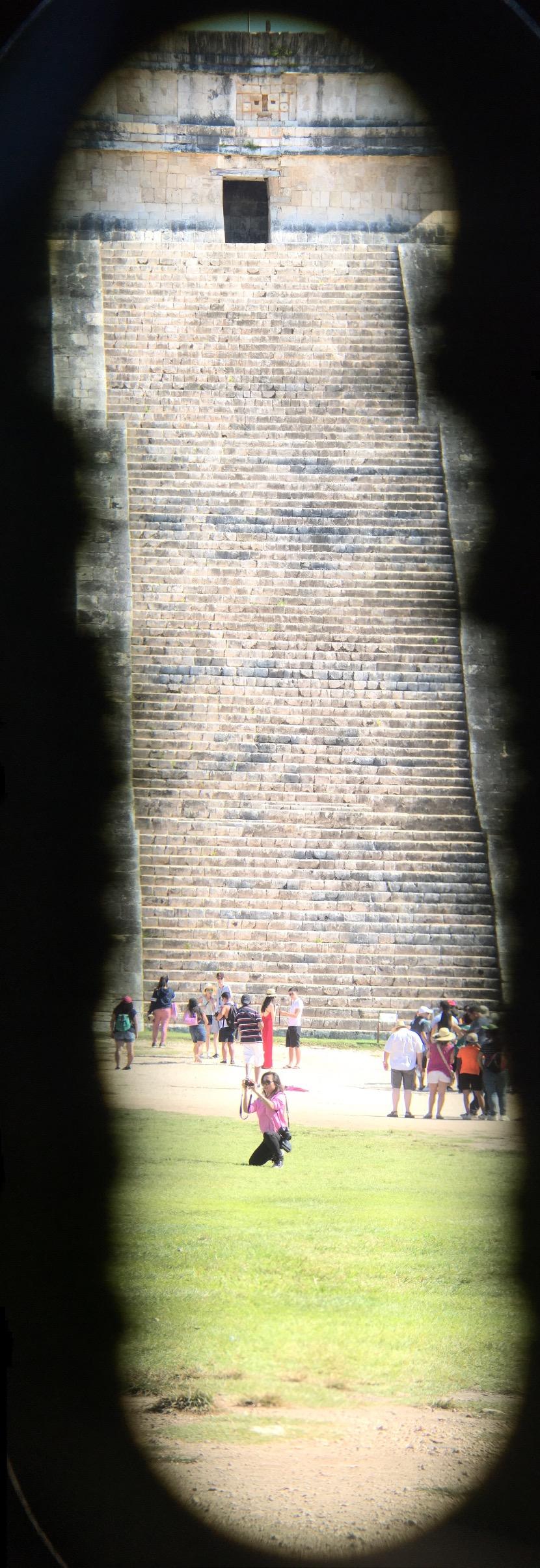
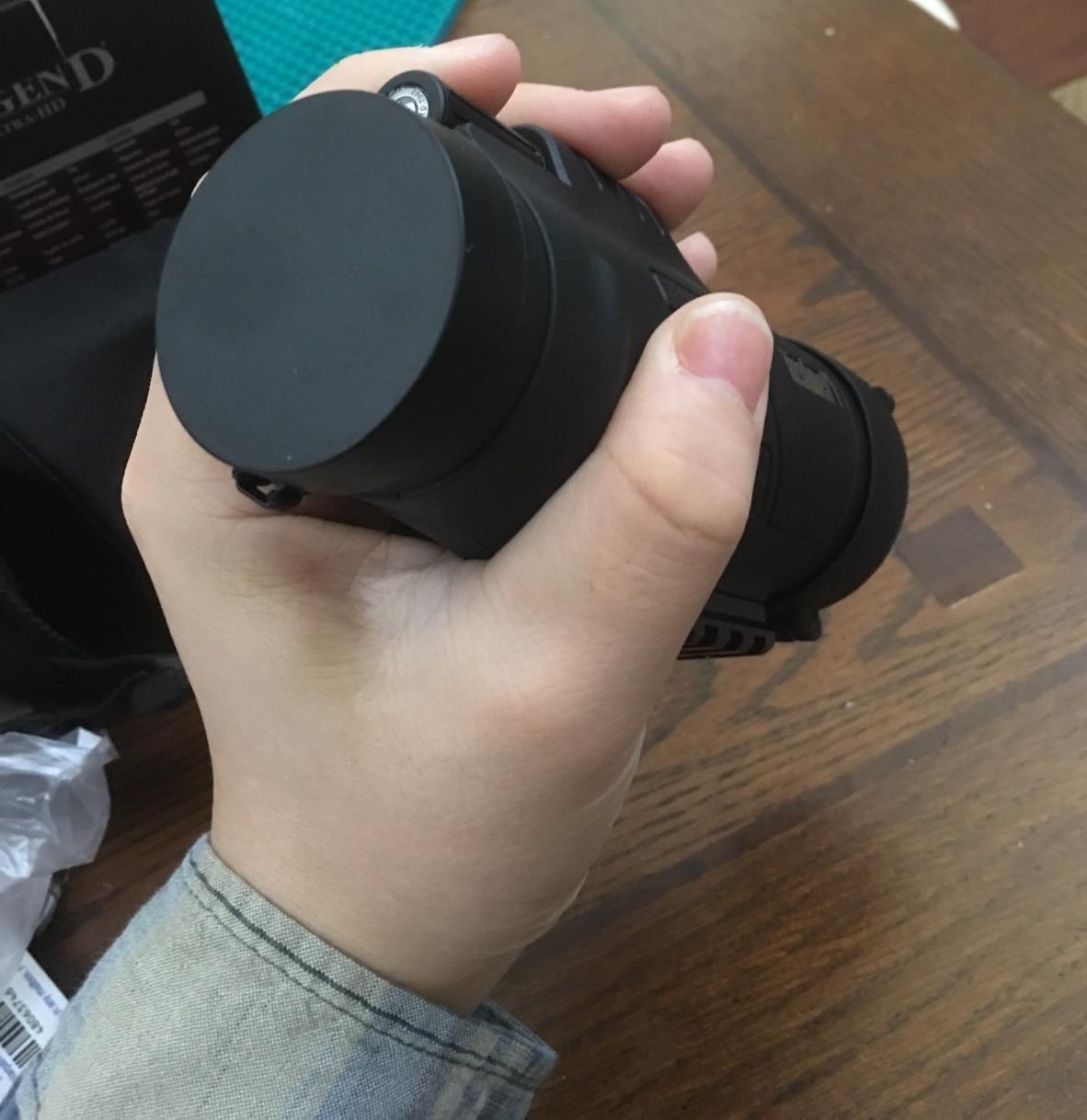
The cost is weight. At 374 g this is nearly as heavy as a mid-size binocular, and if you are backpacking that number changes the calculation completely. I carried it on a day hike with a strap and found it fine, and on an overnight it was the first thing to come out of the pack.
There is also mild aberration toward the outer edge of the field, visible when you push the image to the limit, and the supplied hard plastic lens cap rattles and can scratch the coating if you are careless with it. The included case is bulky and rattles when shaken.
When the extra light matters
Brightness is not a luxury at dawn, it is the whole reason to carry an optic at all. This model is the pick for a ridge traverse before sunrise, for scanning a valley in flat overcast light, and for any trail where you will spend real time glassing rather than walking.
The tripod mount is another quiet advantage. Resting the scope on a trekking pole or a pack lid at 10x makes a genuine difference in usable detail.
When to skip it
Skip it for ultralight trips, day hikes where you only pause twice, and cold-weather outings where you want one hand free for gloves and poles. Nearly 400 g on a strap is a lot of swinging weight on a descent.
For most hikers the honest comparison is that this belongs in the pack for sunrise summits, while the pocket 10x25s belong in the jacket for everything else.
4. Nocs Provisions Zoom Tube 8×32 – Best for Backpacking Weight
Nocs Provisions Zoom Tube 8×32 Monocular, Bird Watching & Backpacking
8x/32mm
8 oz
384 ft field at 1000 yds
IPX4
BaK-4 prism
Pros
- Genuinely light at roughly 8 oz for a 32 mm objective
- 384 ft field is wide enough to track moving birds
- Built-in 1/4-20 tripod thread for steady long views
- Three-position twist-up eyecup
- No-Matter-What lifetime warranty
Cons
- 8x gives less detail on very distant subjects
- IPX4 is water-resistant rather than fully waterproof
- Center focus is a compromise between fast and fine focusing
The Zoom Tube is the pick if you want a genuinely bright optic without carrying a pound of glass. At 8 ounces with a 32 mm objective and a 4 mm exit pupil, it splits the difference between pocket compacts and the 42 mm scopes better than anything else in this roundup.
The 5.8 degree field at 1000 yards is the widest of the 8x bodies here, and that width is what makes it the best of these ten for tracking birds in flight. I could follow a flock across a clearing without losing it, which no narrow-field compact in this list manages.
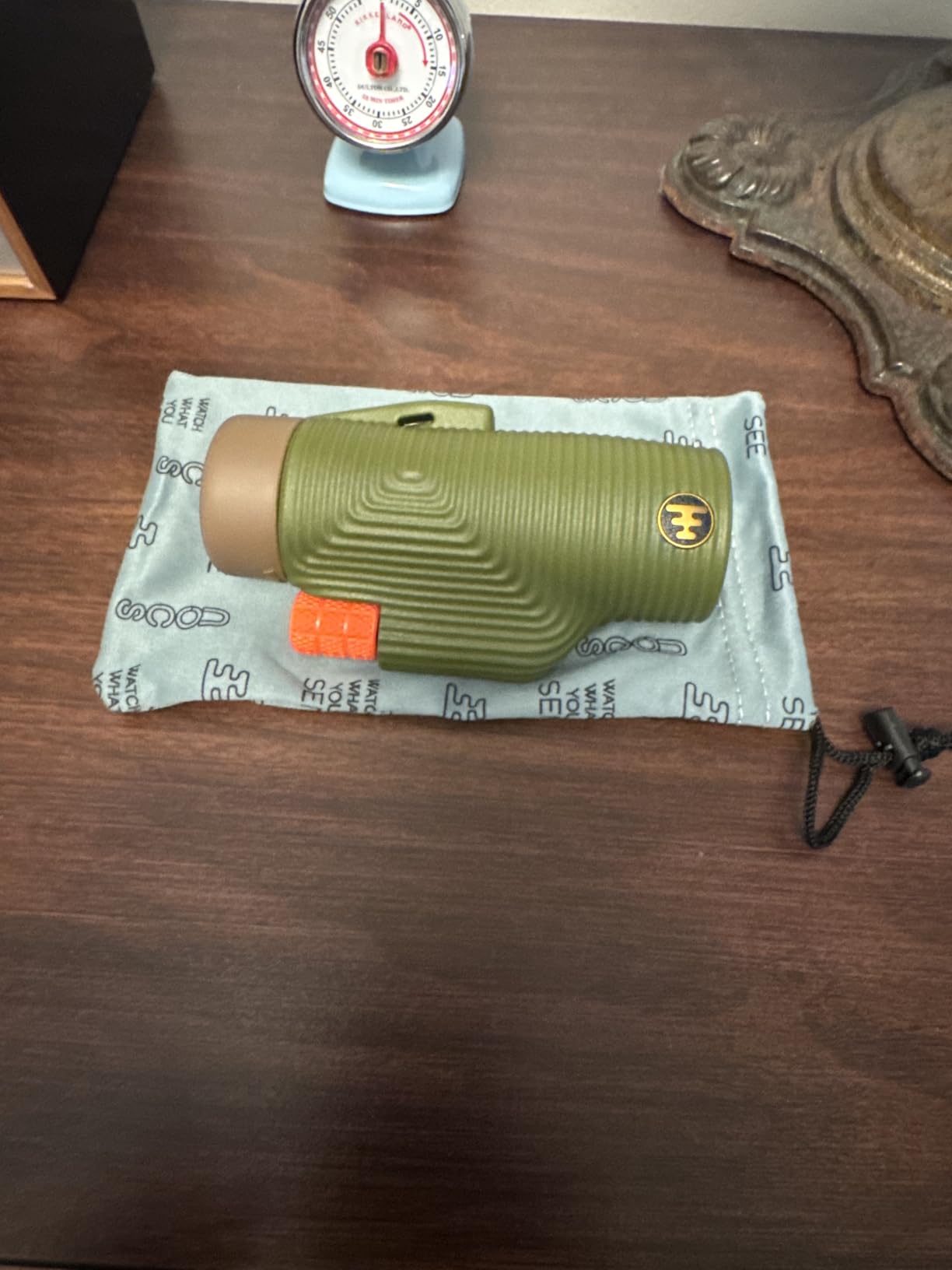
The fully multi-coated optics and Swiss-designed BaK-4 prism give a bright, clean image with color holding up to the edge of the field. The built-in 1/4-20 tripod thread is threaded into the frame rather than added as an accessory, so there is one less thing to lose in a pack.
Two cautions. The IPX4 rating means water resistant, not waterproof, so I would not submerge it or leave it on a wet pack lid in a downpour. And 8x simply will not pull detail out of a subject two ridgelines away the way 10x or 12x will.
Why backpackers pick this one
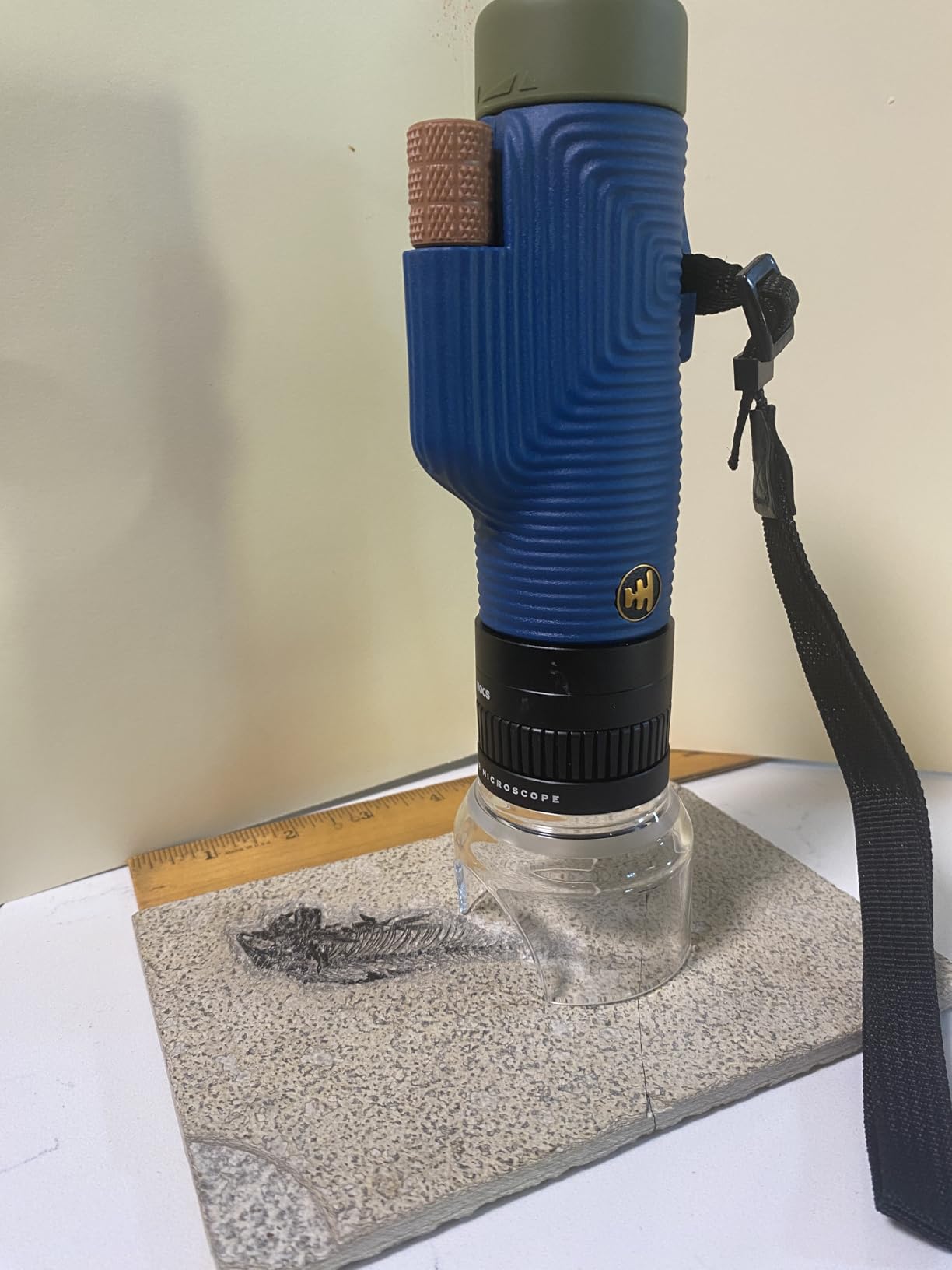
Ounces matter more than aperture once you are past a weekend. The Zoom Tube gives you a real image in shade and light rain while costing almost nothing in pack weight, and the wide field means less time spent searching for the bird you want.
The Wave Grip texture also holds a wet or gloved hand far better than a smooth barrel, and the three eyecup positions let you set it up for bare eyes or glasses before you leave the house.
Where it gives ground
Center focus splits the difference between a fast central wheel and true fine focus at distance, and on very distant targets I missed a little precision. For summit spotting, that is where the 12x options earn their keep.
Long-running discussions on vftt.org still turn up ultralight users running an 8×21 around 3 ounces, and the Zoom Tube is the practical middle ground between that and a full-size glass.
5. Gosky Titan 12×50 – Best for Digiscoping on a Tripod
Gosky Titan 12×50 Monocular for Adults High Powered with Phone Adapter
12x/50mm
IPX7 sealed
289 ft field
Smartphone adapter
13.85 oz
Pros
- 12x reach with a bright 50 mm objective
- IPX7 nitrogen-filled and O-ring sealed body
- One-hand focus knob is tight enough to hold position
- Survived repeated drops over years of use
- Includes a canvas belt-loop carry case
Cons
- Bulky at 13.85 oz and awkward in small hands
- 12x is fixed with no zoom function
- Included phone adapter clips are fragile and spring-loaded
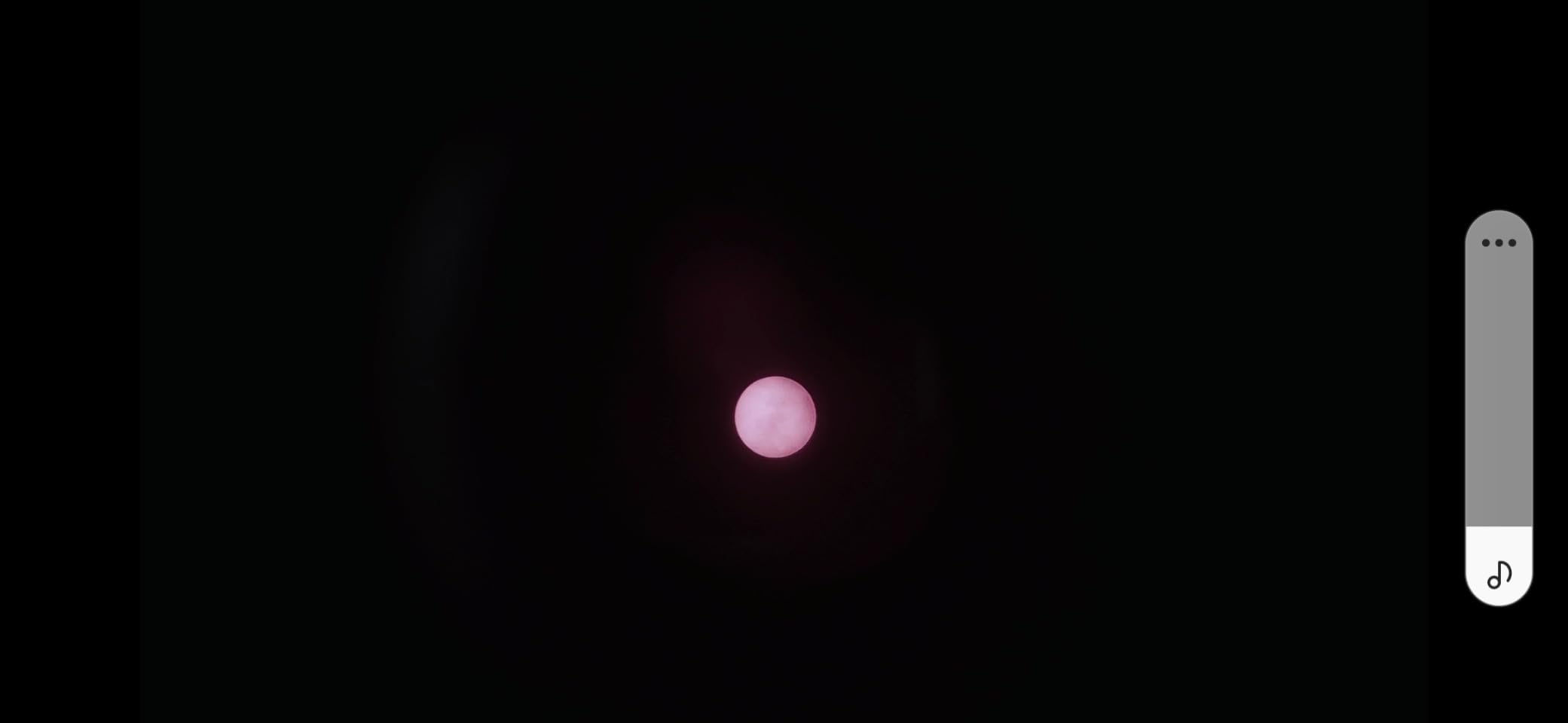
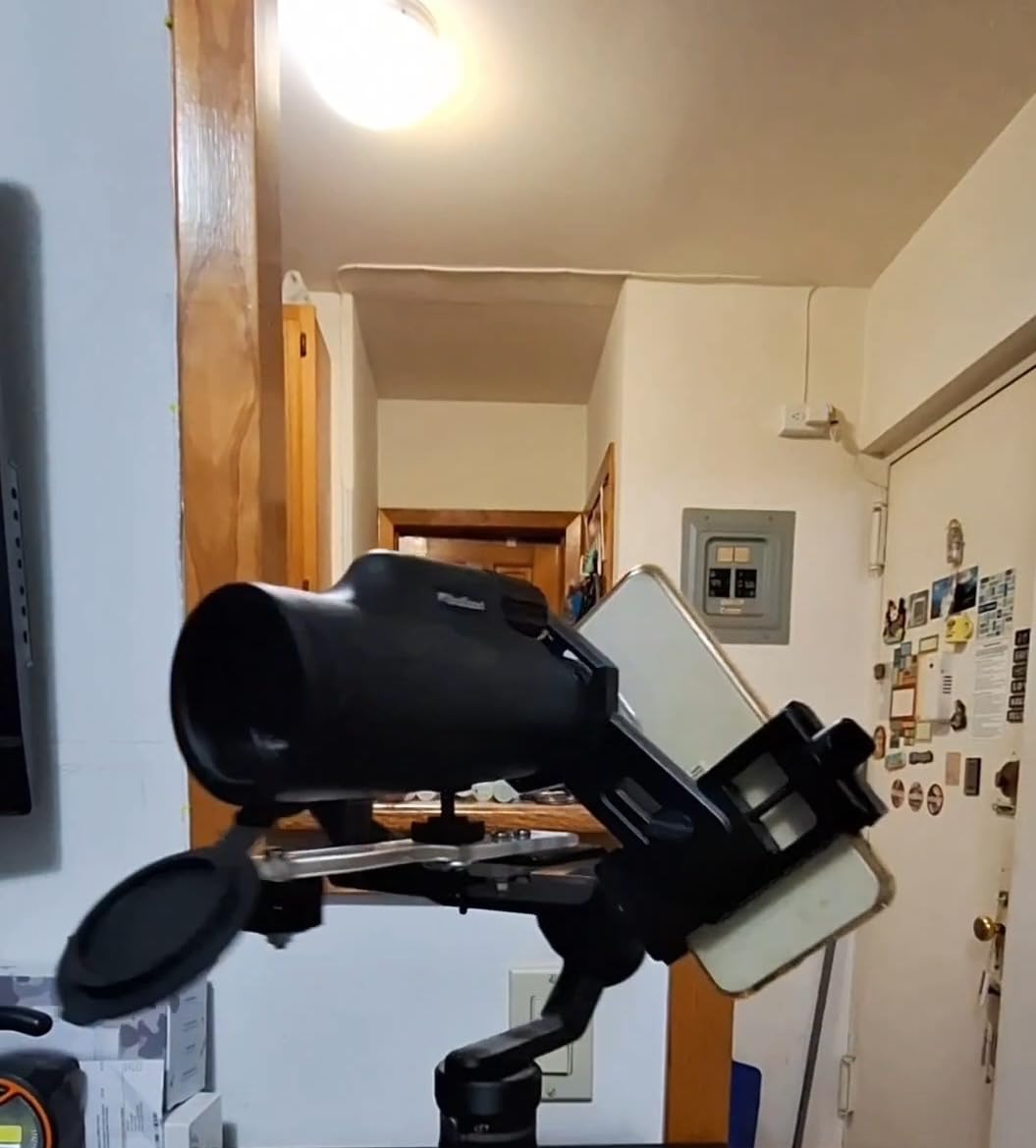
The Titan is the one I reach for when the goal is a photograph rather than a look. It ships with a smartphone adapter, and the 12x magnification with a 50 mm objective gave me the reach to fill the frame with a ridge or an elk across a meadow.
The IPX7 nitrogen-filled, O-ring sealed body is the strongest weather claim in this roundup, and it backs up the rubber armor. The housing took a lot of abuse over long ownership and the focus knob is tight enough to stay where you put it.
Handheld at 12x, though, this is where the physics catch you. The view shakes hard unless you steady it on a tripod or a pack lid, and reviewers consistently describe 12x as past the point of comfortable one-handed use. I ended every session by resting it on something.
The phone adapter is the most criticized part. Nearly 3,000 reviews average in at 4.2, and the recurring theme is that the spring-loaded clips are fragile, grip the phone awkwardly, and produce photos with a black vignette circle, edge distortion, and alignment problems on multi-camera phones. Budget a proper third-party adapter if digiscoping is the goal.
Best for trail photos
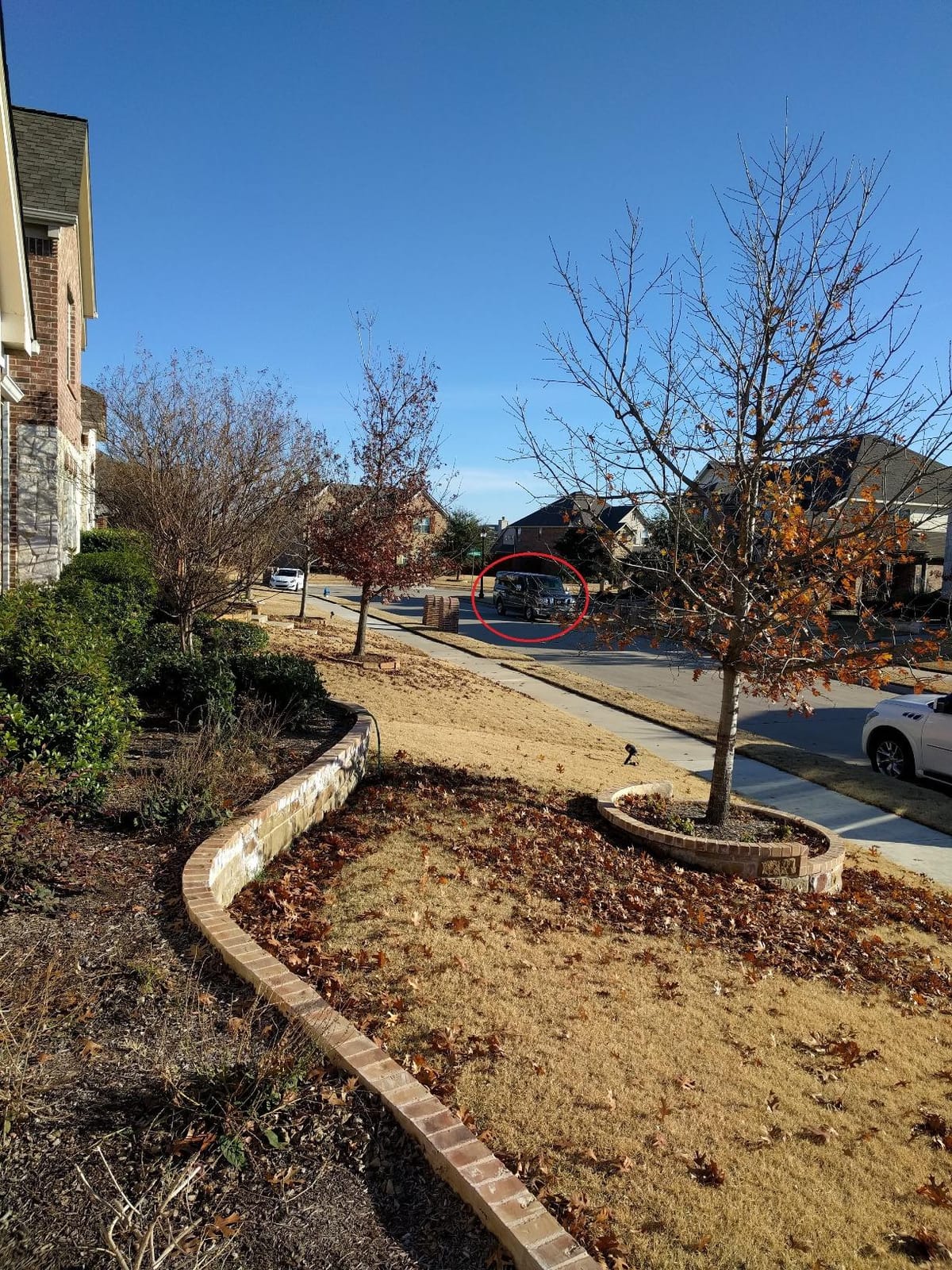
Anyone who has tried to fill a phone frame with a distant summit on a native lens understands the appeal. A 12x handheld view on a tripod, through a stable adapter, gets you there in a way a pocket camera never will.
The 289 foot field at 1000 yards is wider than most 12x scopes, so finding a distant subject is not a problem. The 50 mm objective keeps the image bright enough to shoot at first light.
When to leave it in the pack
Leave it behind on long backpacking trips, on scrambles where one hand is on rock, and anywhere you will not have a tripod. The weight and length make it a day-hike and drive-up companion rather than an ultralight one.
One alternative worth knowing: users on CloudyNights mention carrying a small rangefinder unit instead, on the grounds that it measures distance and sits in the pack just as easily, which is a reasonable substitute when you mostly want to know how far away that ridgeline is.
6. usogood 10×42 – Best for Close Focus and Glasses Wearers
Monocular Telescope, 10×42 Monocular for Adults, BAK4 Prism & FMC Lens Monoculars for Adults High Powered, Waterproof Portable Monocular with Hand Strap for Bird Watching, Camping, Travel
10x/42mm
9.12 oz
3.3 yd close focus
22.5 mm eyepiece
Tripod thread
Pros
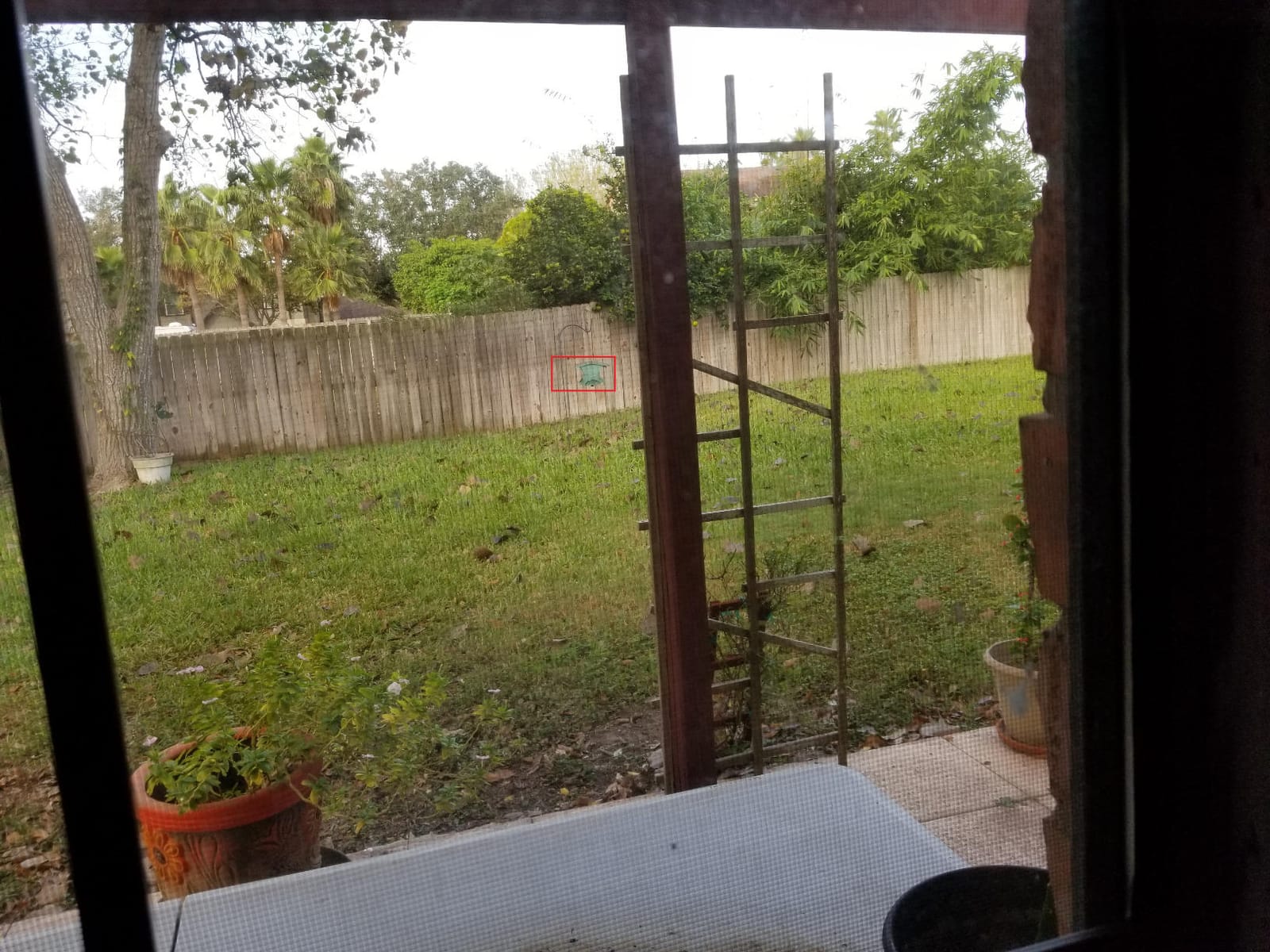
- Short 3.3 yd close focus works on backyard feeders
- Large 22.5 mm eyepiece is comfortable with glasses
- Compact 6.1 x 2.8 x 2.1 inch body at 9.12 oz
- Focus and eyecup both operable with one hand
- Customer service replaced a moisture-ingress unit
Cons
- Real magnification feels closer to 5x-8x than the stated 10x
- Lens covers fit loosely and can be lost
- Hand strap is hard to thread and slides in the buckle
This is the only optic here that focuses close enough to be a real alternative to sitting with a pair of binoculars. A 3.3 yard minimum focus means a bird on a feeder or a butterfly 10 feet away is sharp, which no other pick in this roundup can do.
The 22.5 mm eyepiece is unusually large, and that is the number that decides whether you can see the full field through glasses. I wear them and got a clean, full view without pressing in awkwardly, which is a bigger practical win than any spec on the box.
At 9.12 ounces and 6.1 inches long it packs like a small flashlight, and the rubber armor, tripod thread, and third-party phone adapter compatibility make it flexible. One buyer reported moisture getting into the tube, but customer service replaced the unit promptly under warranty, which tells you something about the support.
Be skeptical of the 10x label. Owners comparing it side by side with 8x binoculars commonly report that the real feel is closer to 5x or 8x, so treat the magnification as marketing and the close focus as the actual feature. A 42 mm body at 9.12 ounces is an unusual combination in this roundup, and the aperture is the part you can count on.
Best for a mixed day
A lot of hiking involves both far and near, and this is the pick that covers both. Feeder at the trailhead, ridgeline at the overlook, butterfly in the meadow, all with one optic and no second pair of eyes.
The 360 foot field at 1000 yards is wide for a 42 mm body, and the one-hand focus plus one-hand eyecup make it the most usable in this group while walking.
Watch out for the small parts
Lens covers that fit loosely get lost in a pack, and forum users treat loose detachable caps as a common complaint with budget optics. The nylon hand strap is also awkward to thread and can slide out of the buckle.
One mechanical note: over-tightening the tripod screw can pop the mounting nut out of the frame, so snug it by hand and no harder.
7. FEEMIC 8×42 – Top Rated for Bright, Pocketable Glass
Monocular Telescope High Power 8×42 Monoculars Scope Compact Waterproof Fogproof Shockproof with Hand Strap for Adults Kids Bird Watching Hunting Camping Hiking Travling Wildlife Secenery
8x/42mm
360 ft field
BaK-4 prism, 99.9% transmittance
Nitrogen filled
30-day returns
Pros
- Bright clear image for its size
- Compact 5.7 x 1.9 x 1.5 inch body fits a pocket
- BaK-4 prism with fully multi-coated glass
- Includes hand strap/case and tripod connector
- 30-day money-back service
Cons
- Focus knob turns too freely and drifts when bumped
- Short eye relief can leave a ring in the view
- Included case and strap are thin and basic
More than 3,500 reviews averaging 4.4 make this one of the most proven budget monoculars in the roundup, and the reason is straightforward: a BaK-4 prism and fully multi-coated glass in a 42 mm body, at a fraction of what the branded 42 mm scopes cost. The image is brighter than it has any right to be at this level.
At 5.7 by 1.9 by 1.5 inches it disappears into a pocket, and the 360 foot field at 1000 yards is wide enough to scan a slope. Owners frequently rate it above more expensive options they tried first.
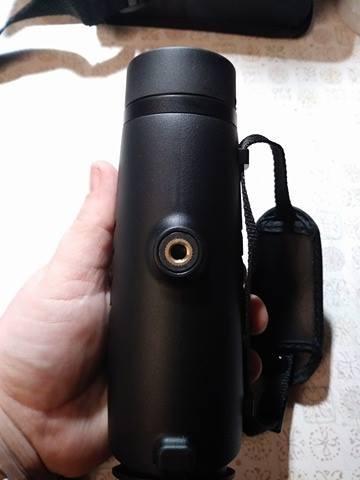
The weaknesses are in the controls, and you feel them immediately. The focus knob rotates too freely, so when you raise the scope from your pack in a gust or bump a branch, it can drift out of focus at exactly the moment you were looking forward to a distant summit.
Eye relief is also short. Even with the eyecup fully extended, some users report a ring or edge intruding into the field, particularly with glasses. The included nylon case and strap are thin and the owner’s manual is printed in very small type.
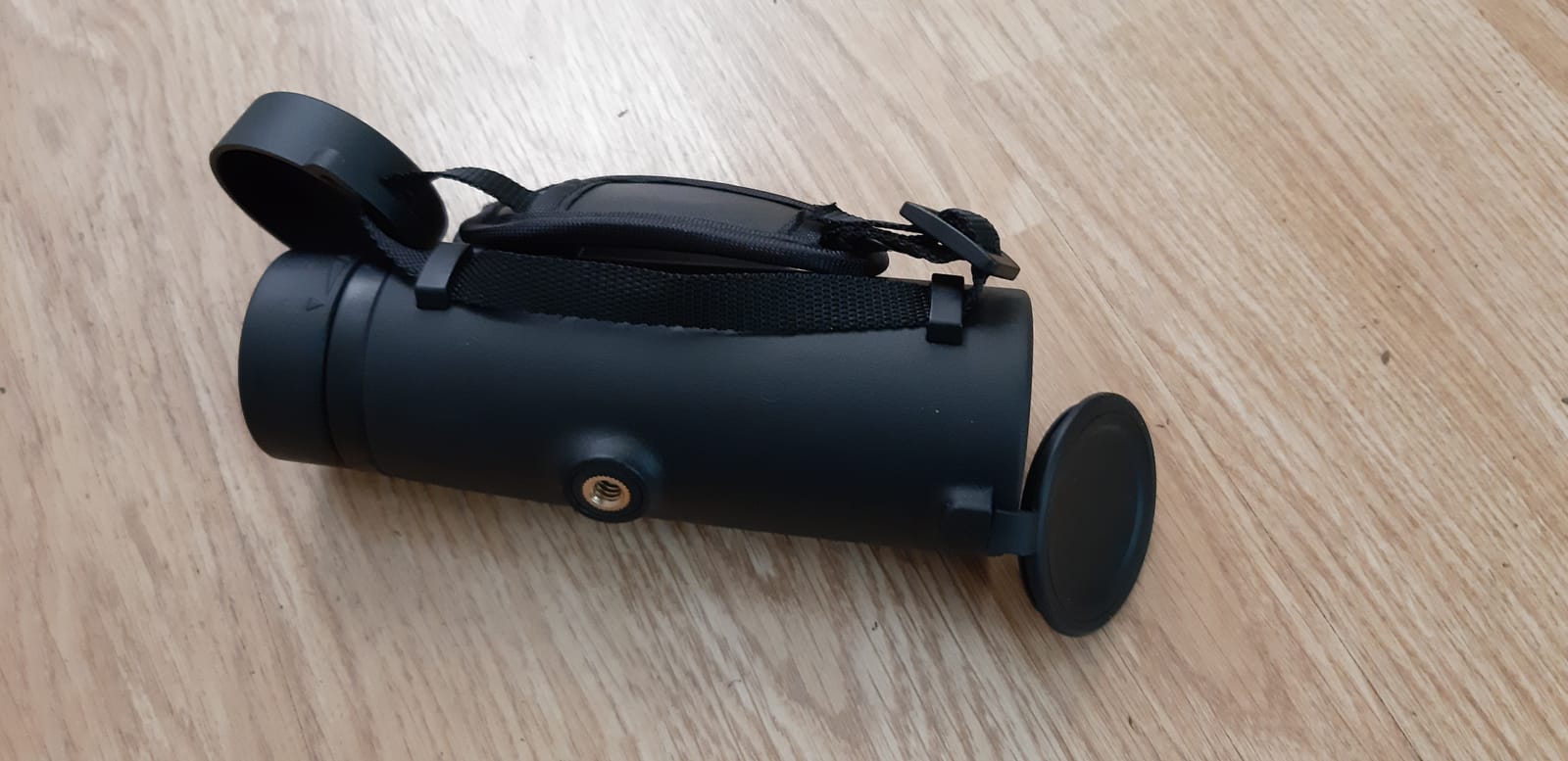
Where this one wins
It is the best choice for anyone who wants a 42 mm aperture without paying a premium-brand price, and for a first monocular where a bad experience means never buying one again. The optics, not the ergonomics, are the strength here.
The nitrogen-filled waterproof body and rubber shock-resistant armor are the right call for a trail optic, and the tripod connector is a small extra that high power settings need.
Where the cheap parts show
Two hands on the focus knob while a bird is moving is a real limitation, and the drifting dial gets worse in wind. If you are glassing constantly rather than occasionally, step up to a model with a firmer, indexed focus ring.
The eyecup can also rotate back in on its own, which is how you end up with a distracting dark ring at the edge of the image. Check it before you walk out of the trailhead, not halfway up.
8. Celestron UpClose G2 10×25 – Lightest Backup Optic for the Pack
Celestron UpClose G2 10×25 Monocular for Hiking, Travel & Birding
10x/25mm
113 g
11 mm eye relief
Roof prism
Water resistant
Pros
- Lightest option here at 113 g
- Small enough for a shirt or hip-belt pocket
- Multi-coated glass beats most optics at this level
- Rubberized aluminum body feels more solid than expected
- Good 11 mm eye relief for eyeglass wearers
Cons
- Fogs internally and only clears when tilted off-center
- Heavy flare when pointed toward a bright sky
- Narrow 5.7 degree field feels like looking through a straw
At 113 g this is the lightest optic in the roundup, and for a hiker who only wants something in the pack as insurance it does the job well. The rubber-covered aluminum body feels more substantial than the spec suggests, and the thumb indents and finger ridges give you a decent grip with cold hands.
Eleven millimeters of eye relief is enough for glasses, and 10x is about the practical maximum for comfortable handheld viewing. The multi-coated optics produce a brighter, higher-contrast image than most compact binoculars in the same bracket.
The defining problem is fogging. Owners report internal condensation that only clears when the optic is held slightly off-center and tilted up, which is a poor thing to have to do on a cold morning. It is water resistant rather than sealed and purged, so humid overnight conditions are exactly where it struggles.
Flare is the other issue. Point it toward a bright sky, or with the sun in front of you, and the image washes out badly. The 5.7 degree field is very narrow, and reviewers describe the view as like looking through a straw.
Good backup, poor primary
Leave this in the pack for routes where you might want a quick look and probably will not, and where every ounce counts. It is a sensible second optic to keep in a car or a shared gear bin.
For most hikers it is also the least interesting buy, because the 25 mm aperture in this roundup is where the light ends, and light is what you are really buying when you are looking at a ridgeline in poor light.
Where it is the wrong call
Do not pick it for dawn starts, for forested trails with dappled light, or for anyone who wears glasses and wants a wide view. Internal fog plus flare plus a narrow field is a rough combination on a damp trail.
Against the 5.8 degree Vortex alternative at a similar format, the deciding factor is the fogging behavior and the aluminum body, not the glass.
9. Pankoo 16×52 – Highest Power for Distant Peaks
Monocular Telescope High Power 16X52, 2026 Power Prism Compact Monoculars for Adults Kids, Birthday Gifts for Men, Waterproof Fogproof Shockproof with Hand Strap, Bird Watching Hunting Camping Hiking
16x/52mm
5.8 degree field
2.2 arc sec Dawes limit
BaK-4 with SMC coating
10.88 oz
Pros
- Highest magnification here at 16x
- 52 mm objective gives a bright/clear image
- BAK-4 prism with SMC coating up to 99.8% transmittance
- Nitrogen-filled waterproof and fogproof body
- Gift box with velvet bag/straps and caps included
- Nearly 4700 ratings is a heavily tested sample
Cons
- 16x is too much for comfortable handheld viewing
- Fixed 16x with no zoom function
- Only a 90-day warranty
- Short 5.8 degree field is hard to scan
Sixteen times is a lot of reach, and paired with a 52 mm objective it produced the brightest, most detailed image of any monocular I carried. If your target is a summit four valleys away or a distant ridge you cannot walk to, this is the tool that gets you there. Note that the other high-power scope here, the OXK 12×56, has a slightly wider 6.5 degree field at a similar brightness, so the Pankoo wins on reach rather than on scanning comfort.
The BaK-4 prism with SMC green coating and no black bars in the field keeps the image clean, and the nitrogen-filled body handled rain and humidity without complaint. Nearly 4,700 ratings at 4.3 is the largest review base in this group, which means the sample is well tested.
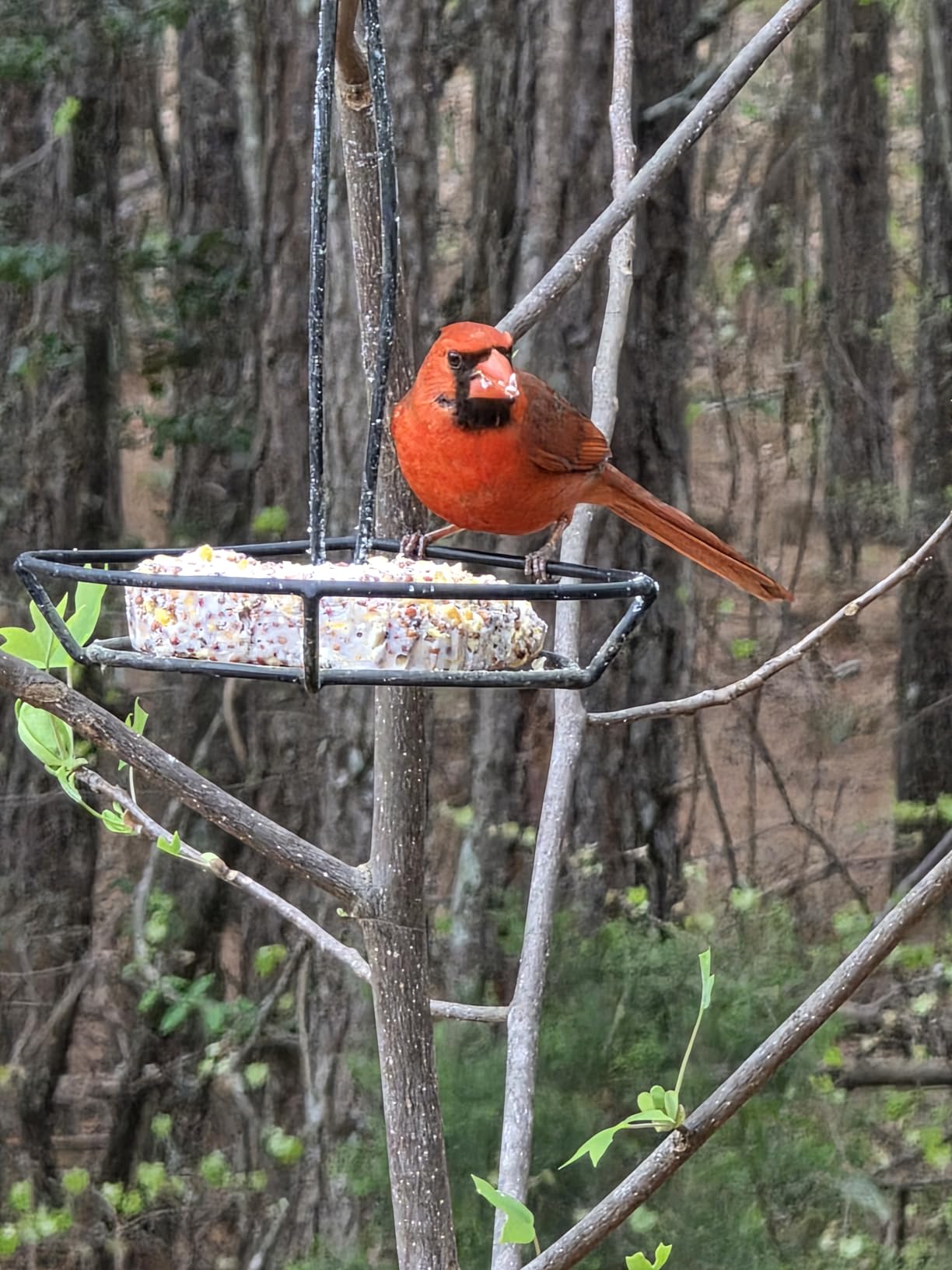
Now the honest part. Sixteen times handheld is beyond comfortable, and reviewers say so plainly: shake is pronounced unless the scope is supported, and there is no zoom, so 16x is all you get. On a narrow trail the shake is worse, not better.
The 5.8 degree field is short, which makes scanning a wide scene tedious, and the warranty is 90 days, the shortest of any pick here. For an optic that might meet a rock on a scree slope, that is thin cover.
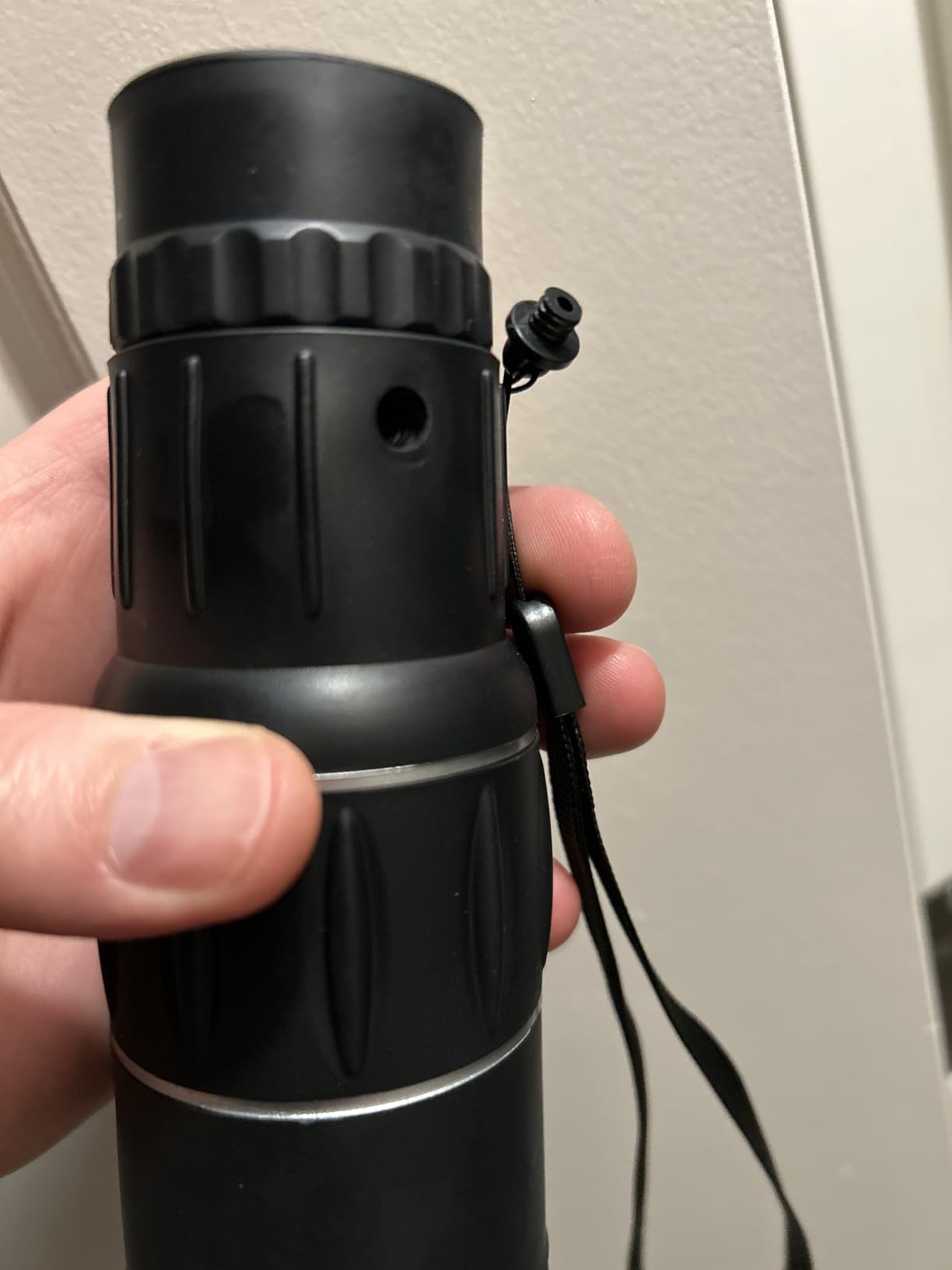
When 16x earns its place
Summit panoramas from a fixed viewpoint, scanning a distant skyline, and counting wildlife on a far hillside are exactly what high power is for. Rest it on a pack, a trekking pole, or a folded jacket, and the shake problem largely disappears.
Users in r/birding make the same point about power generally: above 10x the limitation stops being glass and starts being your arms.
When it is a waste of weight
Skip it for birding on the move, for anything handheld, and for backpacking where the same ounces buy a much more useful aperture. The Vortex Solo at 5.6 ounces gives you a usable view for a fraction of the burden.
Also remember the accessory package is oriented toward gifting, with a velvet bag and a box that take up more pack volume than the optic itself.
10. OXK Optics 12×56 – Best Complete Kit for Summit Trips
12×56 Monocular Telescope for Adults High Powered with Smartphone Adapter
12x/56mm
6.5 degree field
Adjustable tripod included
Smartphone holder
BaK-4 prism
Pros
- Bright sharp image from a 56 mm objective and 25 mm eyepiece
- 12x with a wide 6.5 degree field makes finding subjects easier
- Best-in-kit tripod adjusts to two angles and three lengths
- Secure smartphone holder and a travel case for everything
- One-handed operation and glasses-friendly eyecup
Cons
- Listed weight of 2 lb and 12 inch length rule out pocket carry
- 12x handheld shakes badly without the tripod
- Phone photos need cropping because of a black vignette
The reason this one is on the list is the kit, not just the optic. It ships with a smartphone holder and an adjustable tripod that extends to three lengths and two angles, plus a travel case sized to hold the whole set. Owners single out that tripod as unusually well made.
Optically it is strong for the class: a 56 mm objective with a 25 mm eyepiece and BaK-4 prism under full multi-coating gives a bright, color-accurate view, and the 6.5 degree field is wide enough to find and hold a distant subject at 12x.
But it is 12 inches long and listed at 2 pounds, so nothing about this is a pocket carry. It lives in the car, in a camp bag, or on a summit where you have set up a viewing spot rather than moving through it.
As with every 12x scope, handheld viewing shakes heavily and the tripod is effectively mandatory. Clarity also drops off a little at full magnification, and phone photos need cropping because of the black vignette circle.
Best for a planned summit stop
Set up once, look properly, take a photo, pack up. That workflow is what this kit is built for, and having a stable tripod and a secure phone holder included removes the two things that stop people from digiscoping in the field.
The adjustable hand strap and one-handed operation also make it usable for a quick look without unpacking, which is more than you can say for many long tubes.
When the weight is too much
Two pounds is a serious commitment for a day hike and unacceptable for backpacking. Most hikers who love the 12x view end up wishing they had the 8 ounces of a compact instead.
Phone mount alignment takes practice, and if you are not going to shoot, most of the value of this package is the tripod alone, which competes with every small standalone tripod you could carry instead.
How to Choose a Monocular for Hiking
Start with magnification, not brand. 8x is ideal for hiking because it keeps image shake to a minimum and offers a wider field of view. Go to 10x if you will be glassing stationary subjects, and above 10x only if you have somewhere to rest the scope.
Pick the objective lens for your light. 25mm fits a pocket and works in daylight. 32mm is the sweet spot for all-round trail use. 42mm and up is what you want for dawn, dusk, and shaded forest, because a larger aperture is the single biggest factor in how bright the image looks.
Check the sealing, not the marketing words. Nitrogen or argon purging plus O-ring seals is what stops internal fogging during temperature swings, and that is the single most common trail complaint. An IPX4 rating resists rain, and IPX7 means it can be submerged.
Test the focus with one hand. A stiff ring forces you to stop walking, and a loose ring drifts out of focus when you raise the optic. Ideally you want to set focus once and leave it there, because most trail subjects are far away.
Confirm eye relief if you wear glasses. Fifteen millimeters or more is the practical benchmark, and a twist-up eyecup lets you set the distance properly. Short eye relief is what puts a dark ring around the image for glasses wearers.
Count the ounces honestly. Anything under 8 ounces is genuinely pocketable. Between 8 and 14 ounces you need a strap and should accept the swing on a descent. Above that, ask whether a binocular pair would serve you better.
Decide how you will carry it. A clip, a neck strap, and a chest strap are not interchangeable. If you are walking rather than stopping, a neck strap is faster to draw than a clip that snags on jacket fabric.
Buy a tripod-capable model if you go above 10x. A built-in 1/4-20 thread or included tripod is what turns a shaky 12x view into a usable one, and a trekking pole or pack lid works as a rest in a pinch.
How to Carry a Monocular on a Trail
Skip the utility clip if you can. It is the most common complaint in birding forums, where owners of the popular Solo models report it catching on straps and jacket fabric. A simple neck strap or a strip of hook-and-loop tape on a shoulder strap is faster and safer.
Use a chest strap if you plan to look often. A monocular that bounces against your sternum every step is the reason people buy one and then leave it in the pack. A chest harness keeps the optic still and at a repeatable height, which makes raising it quick.
Pick a pocket based on when you will use it. A chest pocket works for quick glances on the move, while a pack lid pocket is better for a planned stop and keeps the optic out of the rain when the pack is on your back.
On family and multi-day trails, the same ounces argument applies in reverse, and keeping a compact optic in a side pocket rather than on a harness is one less thing to balance. We cover the gear tradeoffs in more detail in our all-terrain strollers for hiking guide.
Monocular vs Binoculars for Hiking
The case for a monocular is weight and volume. The 10x25s in this roundup sit between 113 g and 170 g, with the heaviest of them lighter than a single 8 oz protein bar plus a fleece. A mid-size binocular plus a chest strap and a case is well over twice that, and it occupies its own pocket or hangs off your neck.
The case for binoculars is real. Two eyes mean depth perception, a much steadier image because your brain fuses the two views, and no awkward one-eyed viewing. For tracking a bird in flight across a clearing or picking out a route through trees, a binocular is simply better.
Most hikers end up with both roles filled by one optic, which is why the wide-field 8×32 and the bright 10×42 perform so well here. A monocular also gives you the option of scanning with one eye while watching the trail ahead with the other, which some hikers prefer on technical ground.
If you are deciding with a phone in your hand, remember that a phone camera with a wide lens will not do what a monocular does. Several users justify a monocular purchase precisely because it doubles as a telephoto for trail photos.
Frequently Asked Questions
What is the best monocular for hiking?
The Vortex Solo 10×25 is the best monocular for most hikers because it weighs 5.6 ounces, fits a jacket pocket, has fully multi-coated glass, and is nitrogen purged and O-ring sealed for wet weather. For dawn starts and shaded trails, the Bushnell Legend 10×42 is brighter because of its 42 mm objective.
What magnification is best for monoculars?
8x is the best magnification for handheld hiking because it minimizes hand shake and gives the widest field for scanning. 10x is worth it when you are glassing a fixed subject or scanning a distant ridgeline. 12x and above should only be used resting the optic on a tripod, a trekking pole, or your pack.
Are 8×42 monoculars better than 10×42 for hiking?
For walking and scanning, an 8×42 gives a steadier image and a wider field of view, which makes it easier to find and follow subjects. A 10×42 shows more detail on fixed, distant targets and is a better choice for wildlife viewing and summit spotting, provided you can hold it steady.
What is the best monocular for viewing long distances?
Long-distance work favors a larger objective lens and moderate power rather than raw magnification. A 10×42 or 12×50 with a tripod gives the best combination of brightness and reach. The Bushnell Legend 10×42 and the Gosky Titan 12×50 are the two options here with both the aperture and the glass for long-range scanning.
Do monoculars fog up in the rain?
Good ones do not, and the difference is the seals. Nitrogen or argon purging plus O-ring seals keeps dry gas inside the barrel, so internal fogging does not form during temperature swings. Models without purging, such as water-resistant pocket compacts, can fog internally and only clear when tilted off-center.
Is a monocular better than binoculars for hiking?
A monocular is better if weight and pack volume decide the trip, since it weighs roughly half as much and fits in a pocket. Binoculars are better for tracking moving subjects, for comfort over long hours, and for depth perception. If you hike often and only glance occasionally, the monocular wins on convenience.
Our Final Verdict
For the best monoculars for hiking in 2026, the Vortex Solo 10×25 is the one to buy: 5.6 ounces, nitrogen purged, fully multi-coated, and backed by a lifetime warranty, with the fixed focus and 10x shake as the only real compromises. Swap the included clip for a neck strap before your first trip.
Add the Bushnell Legend 10×42 if you hike at dawn, and add the Nocs Provisions Zoom Tube 8×32 if you backpack and need the wide field. For close-range work, the usogood 10×42 is the only pick that focuses to 3.3 yards.
Whatever you choose, carry it where you can reach it, and remember that above 10x the limiting factor is your arms, not the glass.