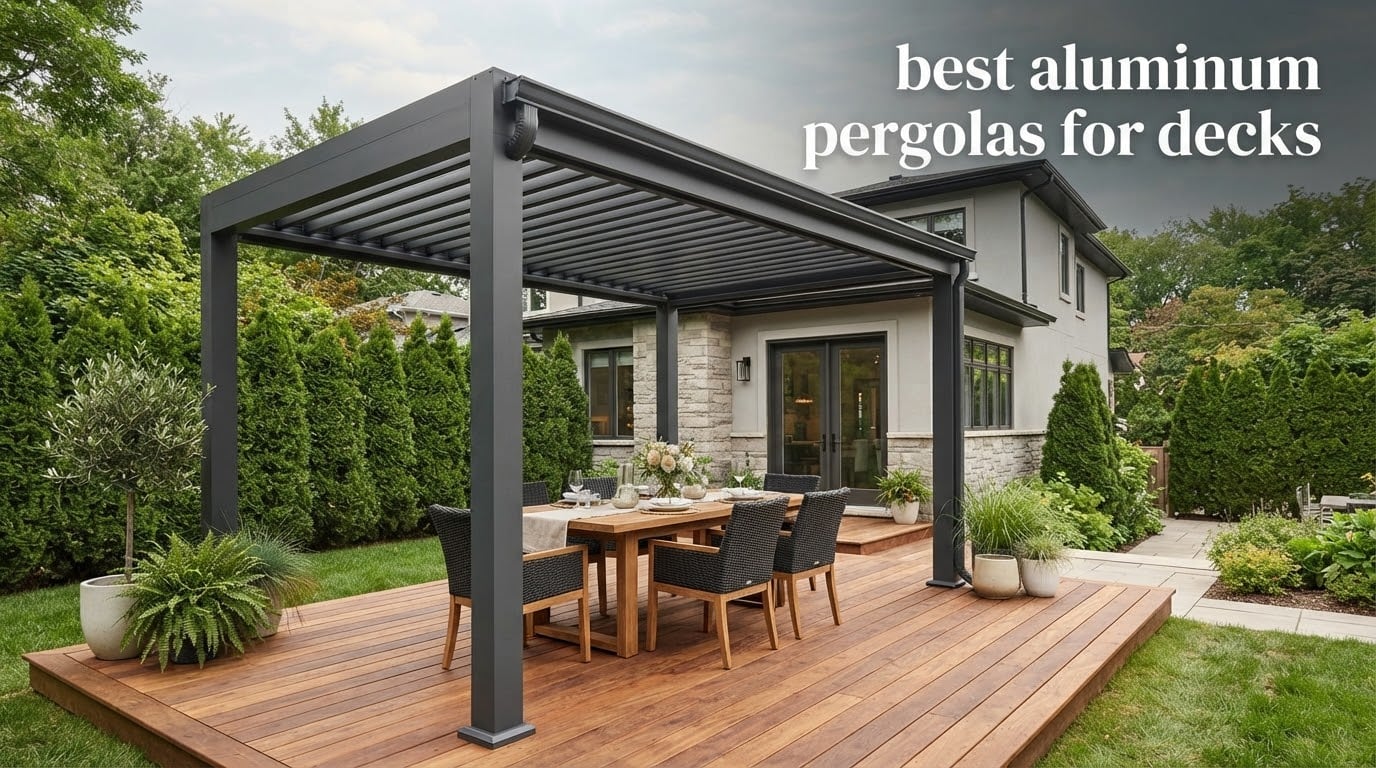
A pergola is the fastest way to turn a sun-baked deck into a room you actually use in the afternoon. It is also the fastest way to put 100 to 700 pounds of concentrated load onto a platform that was engineered for people, furniture and a grill. Almost every buyer in our research started with the roof and only later realized the deck was the real decision.
That is why this guide is different from every other aluminum pergola roundup we read. Nobody converts shipping weight into added pounds per square foot, nobody pairs a wind rating with the anchoring condition that rating assumes, and nobody explains how to get a packaged pergola up a set of deck stairs. We fixed all three gaps here.
We compared 12 aluminum pergolas against each other and against what a deck can realistically carry, covering louvered roofs, retractable canopies and wall-mounted lean-tos. The short version: if your deck was built after 2000 with 2×8 or 2×10 joists at 16 inches on center, most of these will work. If it is older, elevated, or carries a hot tub, the answer changes fast, and we tell you where.
While you read, it is worth noting that the rest of our outdoor living coverage includes a look at the best deck ovens with air fryer for the cooking side of the same deck.
Table of Contents
- Top 3 Best Aluminum Pergolas for Decks (October 2026)
- All 12 Aluminum Pergolas for Decks Compared in 2026
- How We Picked These Pergolas
- 1. PURPLE LEAF 12×16 Retractable Canopy Pergola – Best Overall for Decks
- 2. Domi 10×13 Retractable Pergola – Best Value and Lightest Deck Load
- 3. MIRADOR 10×20 Louvered Pergola with Shade Screen – Best for Wide Decks
- 4. Airwire 10×12 Louvered Pergola – Best for Manual Crank Control
- 5. Domi 10×12 Louvered Pergola with Curtains and Netting – Best for Two-Zone Shade
- 6. YOLENY 12×24 All-Aluminum Louvered Pergola – Best for Maximum Coverage
- 7. Aoxun 12×16 All-Aluminum Louvered Pergola – Best for Windy Sites
- 8. EROMMY 12×20 Louvered Pergola with Six Side Screens – Best for Full Screening
- 9. VORTEXTOVE 12×16 Reinforced Louvered Pergola – Best for Standard Decks
- 10. FansaFurn 12×16 Pergola with Curtain and Adjustable Roof – Best for Sun and Snow
- 11. Goldshire 10×20 Louvered Aluminum Hardtop Gazebo – Best for Spa Decks
- 12. SHPAI 8×12 Wall-Mounted Aluminum Lean-To Gazebo – Best for Wall Mounts
- How Much Weight Does an Aluminum Pergola Add to a Deck?
- How to Check Whether Your Deck Can Carry a Pergola
- How to Anchor a Pergola to Deck Joists
- What Are the Downsides of Aluminum Pergolas?
- Which Roof Type Fits Your Deck?
- Weather Specs That Actually Matter
- Sizing a Pergola for a Deck
- Maintenance and Winterization Checklist
- Frequently Asked Questions
- The Best Aluminum Pergolas for Decks in 2026
Top 3 Best Aluminum Pergolas for Decks (October 2026)
The three below cover the most common deck situations: a large deck that needs a broad roof, a wide footprint that pairs with a hot tub or spa, and a smaller structure that most decks can hold without extra framing work.

PURPLE LEAF 12×16 Retractable Canopy
- Retractable canopy with safety lock
- Yarn-dyed all-weather fabric
- Powder-coated aluminum frame

MIRADOR 10×20 Louvered Pergola
- Louvered roof
- 200 sq ft coverage
- 10FT shade screen included

Domi 10×13 Retractable Canopy
- 100.3 lb listed weight
- Retractable locking canopy
- Two-hour two-person build
All 12 Aluminum Pergolas for Decks Compared in 2026
Every pergola below appears here with the specs that decide whether it belongs on a deck: roof type, coverage, published weight, wind rating and headroom. Where a manufacturer does not publish a weight, the row says so rather than guessing.
| Product | Specs | Action |
|---|---|---|
| PURPLE LEAF 12×16 Retractable Canopy Pergola |
|
Check Latest Price |
| Domi 10×13 Retractable Pergola |
|
Check Latest Price |
| MIRADOR 10×20 Louvered Pergola with Shade Screen |
|
Check Latest Price |
 Airwire 10×12 Louvered Pergola with Curtains and Netting Airwire 10×12 Louvered Pergola with Curtains and Netting |
|
Check Latest Price |
 Domi 10×12 Louvered Pergola with Curtains and Netting Domi 10×12 Louvered Pergola with Curtains and Netting |
|
Check Latest Price |
 YOLENY 12×24 All-Aluminum Louvered Pergola YOLENY 12×24 All-Aluminum Louvered Pergola |
|
Check Latest Price |
 Aoxun 12×16 All-Aluminum Louvered Pergola Aoxun 12×16 All-Aluminum Louvered Pergola |
|
Check Latest Price |
 EROMMY 12×20 Louvered Pergola with Six Side Screens EROMMY 12×20 Louvered Pergola with Six Side Screens |
|
Check Latest Price |
 VORTEXTOVE 12×16 Reinforced Louvered Pergola VORTEXTOVE 12×16 Reinforced Louvered Pergola |
|
Check Latest Price |
 FansaFurn 12×16 Pergola with Curtain and Adjustable Roof FansaFurn 12×16 Pergola with Curtain and Adjustable Roof |
|
Check Latest Price |
 Goldshire 10×20 Louvered Aluminum Hardtop Gazebo Goldshire 10×20 Louvered Aluminum Hardtop Gazebo |
|
Check Latest Price |
 SHPAI 8×12 Wall-Mounted Aluminum Lean-To Gazebo SHPAI 8×12 Wall-Mounted Aluminum Lean-To Gazebo |
|
Check Latest Price |
How We Picked These Pergolas
We scored every pergola against four criteria, weighted 70 percent toward the structure and 30 percent toward the ownership experience. Structure meant published wind rating with its anchoring condition, post gauge, roof mechanics, drainage design and declared weight. Ownership experience meant the volume and consistency of customer reviews, assembly hours, and how often people report missing parts or stripped hardware.
Deck fit was a separate pass, not a score. We read the specs and asked one question: can a typical residential deck carry this, and how much work does the owner have to do first. That pass is what moved products around the order you see below.
We earn from qualifying purchases, and we did not receive any product from these manufacturers. Nobody here weathered a pergola for a full season on our own deck, so treat our durability observations as a read of published specs and thousands of owner reports rather than a lab test. We think that is the honest version of this roundup.
1. PURPLE LEAF 12×16 Retractable Canopy Pergola – Best Overall for Decks
PURPLE LEAF Outdoor Pergola 12′ X 16′ Retractable Canopy Aluminum, Gray
Aluminum and yarn-dyed fabric
12 x 16 ft, 96 in tall
Retractable canopy with safety lock
Pros
- Largest review base in this roundup at 1487 ratings
- Adjustable canopy locks in any position
- Upgraded extra beam improves load capacity
- Yarn-dyed fabric holds up in all weather
- Customer service replaces damaged parts at no cost
Cons
- Base and foot design is awkward during setup
- Included curtains are thinner than expected
- Occasional missing or damaged parts on arrival
- Some labeled screws do not match pre-drilled holes
With 1487 ratings behind it, this is the most thoroughly owner-tested pergola in the group, and that matters more than any single spec. Owners with several years of use report the powder-coated finish still looks new, and the customer service record on replacement parts is among the better ones here.
The retractable yarn-dyed canopy is the reason it wins the top slot for deck use. Instead of louvers that leave gaps and catch wind, you slide fabric along a track and lock it where you want it. There is a safety locking system so it cannot drift in a gust, and the upgraded additional beam underneath is a real structural addition rather than a marketing line.
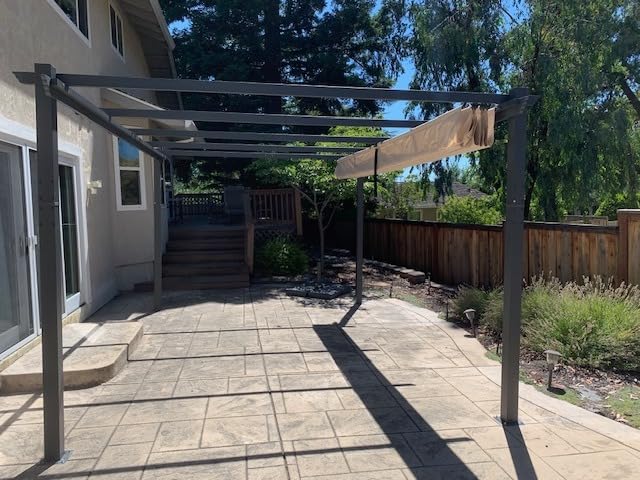
At 190.55 by 138.97 by 96.06 inches, this is a genuine full-deck footprint rather than a patio nook. At 96 inches tall it clears an 88 inch door threshold, which matters if you plan to run string lights or hang a fan underneath. Buyers converting a deck into an outdoor living room repeatedly describe this as the piece that made the space usable.
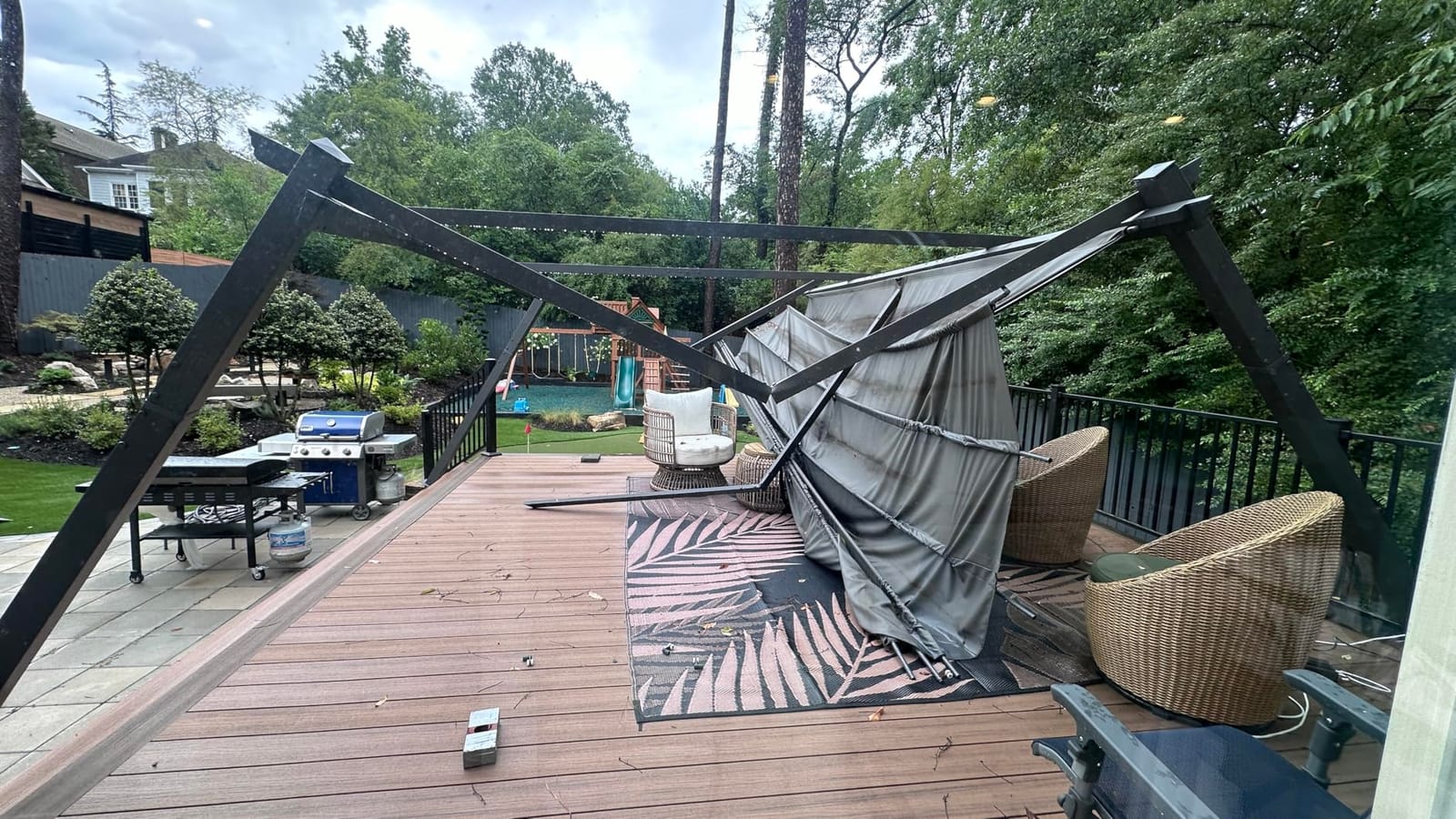
The weak points are real and worth planning around. The base and foot design frustrates people during setup, the included curtains disappoint almost everyone, and a small share of owners received missing rollers or bent beams. Instructions also contain a labeling error where a few screws marked J do not fit their holes.
When this is the right deck pergola
Choose this one if your deck is at least 12 by 16 feet of clear surface, you want shade you can dial rather than louvers you crank, and you would rather not track fabric condition season to season. It suits a dining table, a grill station, or a lounge group.
The 96-inch height also makes it the most forgiving choice for a deck with existing railings and an elevated floor, because the beam clears the rail line and gives you usable clearance underneath.
When to pass on it
Skip it if your priority is a hard seal against rain. A retractable canopy sheds water far better than a louvered roof, but it is not a roof, and owners still report wind-driven rain at the open ends when the canvas is only partly extended.
Also skip it if you are sensitive about assembly. The foot design is the most common frustration in the reviews, and buyers who finished it still rated the process as a real weekend job rather than an afternoon.
2. Domi 10×13 Retractable Pergola – Best Value and Lightest Deck Load
Domi Outdoor Living 10’ X 13’ Outdoor Retractable Pergola with Weather-Resistant Canopy Aluminum Garden Pergola Patio Grill Gazebo for Courtyard
Aluminum frame with polyester canopy
10 x 13 ft, 130 square feet
100.3 pounds listed weight
Pros
- Listed weight of 100.3 pounds is the lowest published figure in this roundup
- Retractable canopy with a safe locking system
- Polyester canopy is UV and fire resistant
- Tools and instructions included
- About two hours for two people
Cons
- Instructions are unclear and slow to follow
- Aluminum bends easily and dented in wind during setup
- Retracted canopy collects rainwater and stretches
- Polyester fabric is treated as a short-life component
At 100.3 pounds listed, this is the lightest structure in the roundup on a published figure, and that single number is much of the argument. Spread over 130 square feet, that is roughly 0.8 pounds per square foot, against roughly 2 to 3 pounds per square foot for several louvered kits of similar coverage.
Owners love how easy it is to reposition. A structure you can shift with two people on a clear day is a genuine advantage on a deck, because you can move it out of the way for sealing and stain work. The powder-coated look also reads more like stained wood than like raw metal from a distance.
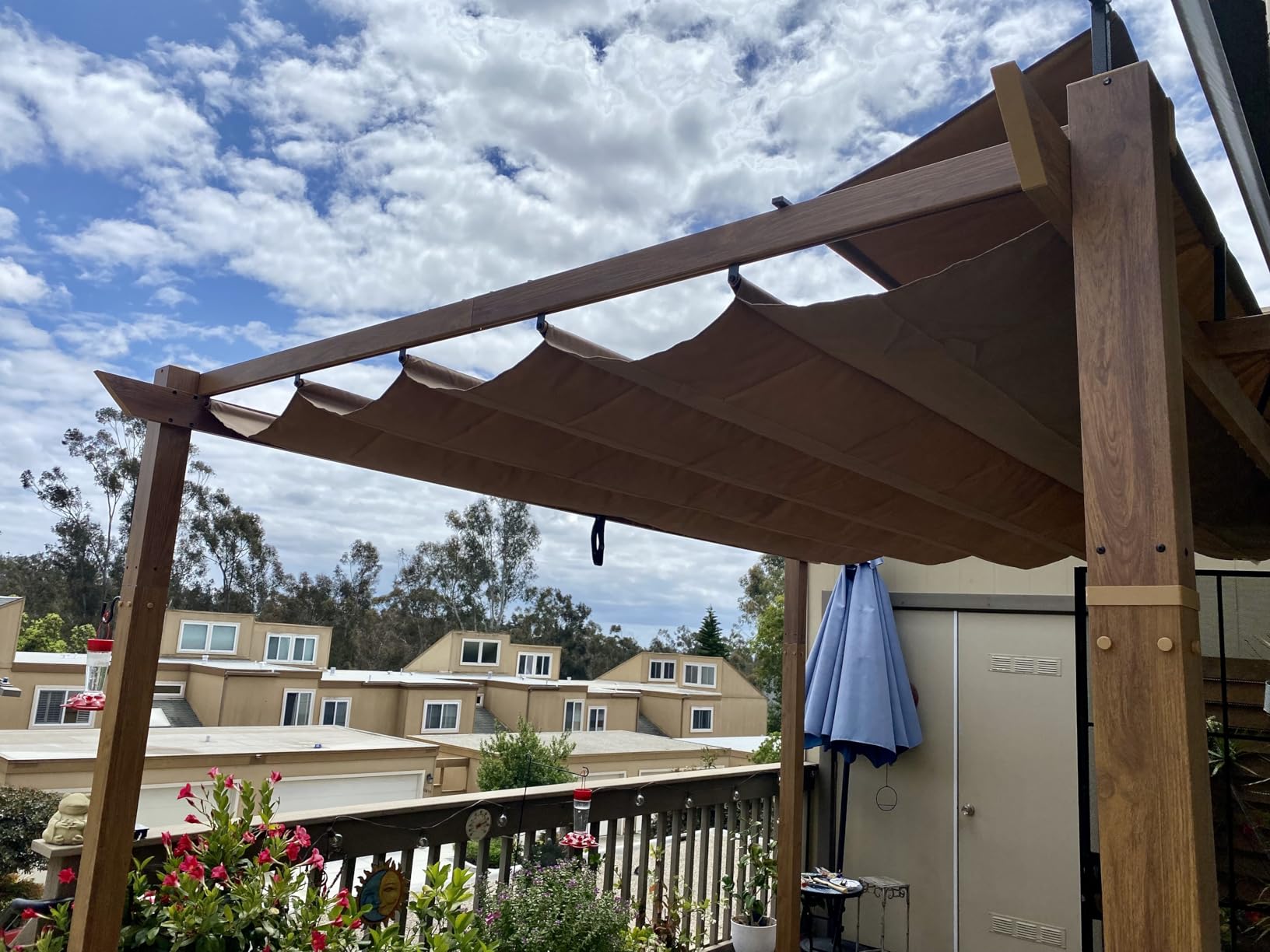
The retractable canopy runs on a sliding rail with a safe locking system, and the polyester fabric is listed as UV resistant, fire resistant and water repellent. That combination is common on budget canopies and rare on the cheapest kits, which is why this one holds up as a value pick.
Be honest about the weaknesses. Reviewers repeatedly call the instructions unclear, note that two to three people are needed rather than the advertised two, and report that the thin aluminum dents. One owner lost a unit to wind while it was partially assembled, which is a warning about building it on an exposed deck in a gust.
Who should buy the light-weight option
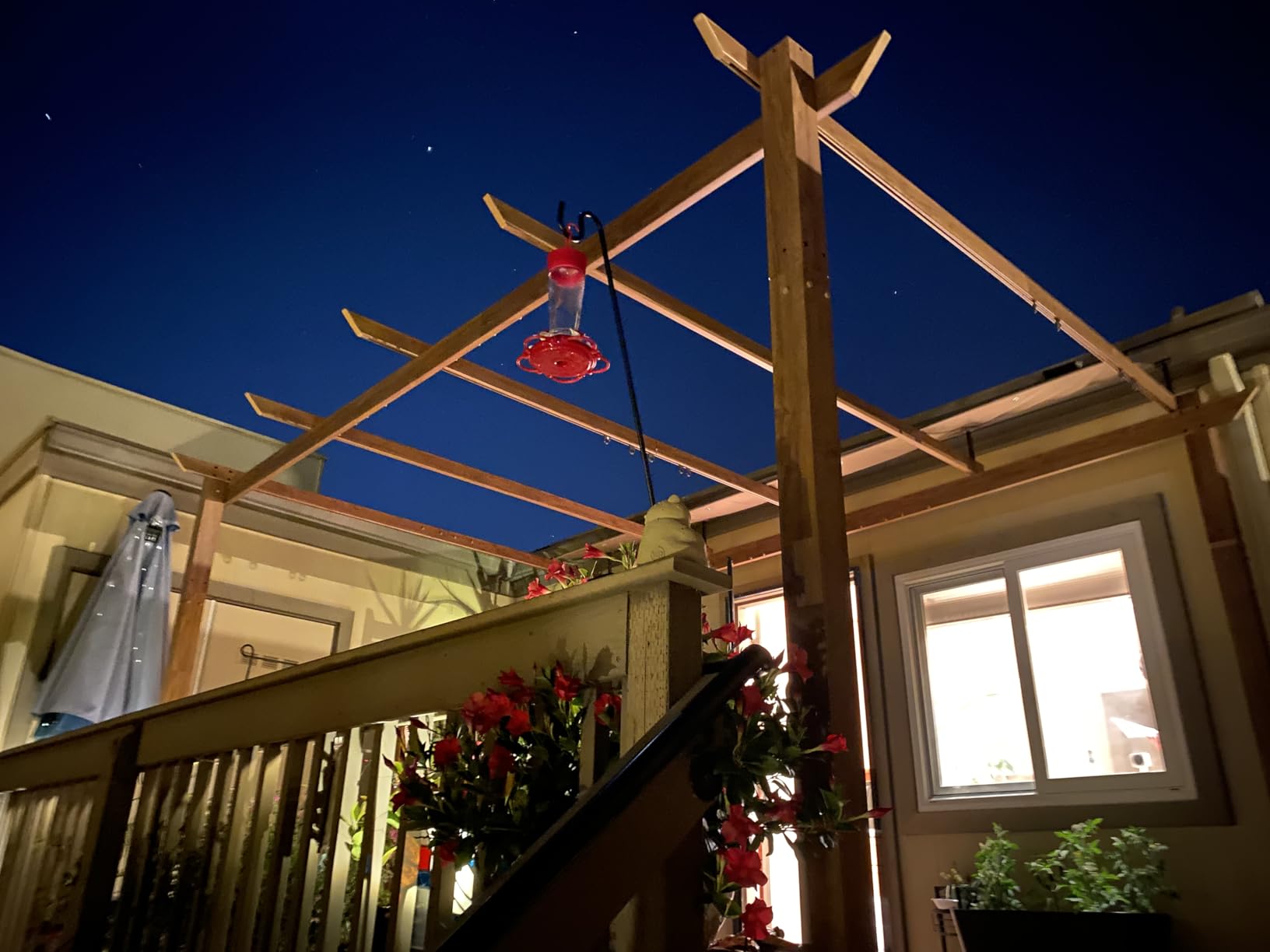
This is the pergola for older decks, apartment balconies and any platform where you genuinely do not know what the joists can carry. If your deck is small, marginal or was assembled by a previous owner, a structure at this weight is far less likely to be the reason something fails.
It also works well for a poolside or courtyard bistro nook where a 10 by 13 footprint is the right size and a 12 by 16 would crowd the deck edges.
Where it falls short
The polyester canopy is the weak link. Reviewers treat it as a consumable component, and the retracted bundle is known to trap rainwater, which stretches the fabric over time. Budget for a replacement canopy in a few seasons rather than expecting a ten-year fabric life.
Also consider the assembly reality. If you are not comfortable with vague diagrams, this is the wrong kit, and the fix is to budget an extra half day rather than to force it.
3. MIRADOR 10×20 Louvered Pergola with Shade Screen – Best for Wide Decks
MIRADOR 80S 10’x20′ Louvered Pergola with 10FT Shade Screen for Outdoor Deck Lawn Garden Backyard Patio Porch,Charcoal
Alloy steel and aluminum construction
10 x 20 ft, 200 square feet
Louvered roof plus a 10FT shade screen
Pros
- 200 square feet of coverage from a 10 by 20 footprint
- Adjustable louvered roof paired with an included shade screen
- Waterproof rated
- Charcoal and Latte finishes across multiple sizes
Cons
- Weight is not published
- so added deck load must be estimated
- Louver mechanism detail is not specified
- Assembly hours and crew size are not stated
Two hundred square feet from a 10 by 20 footprint is efficient coverage for a deck, and this is the shape that works when you want a long lounge or dining run rather than a square patio. The louvered roof opens and closes, so you get real shade control rather than a fixed canopy position.
The included 10-foot shade screen is the differentiator. Owners add it when the sun is low and want to cut glare off a table or a screen, then roll it up when the light is right. Almost nobody includes a screen at this size, and it extends the structure’s usefulness well past summer evenings.
Reviewers rate it at 4.6 across 121 ratings, with strong five-star marks for the roof control, the screen and the sheer size. The frame is listed as alloy steel and aluminum, which is worth noting because steel adds weight at the joints but also adds stiffness at the beam connections.
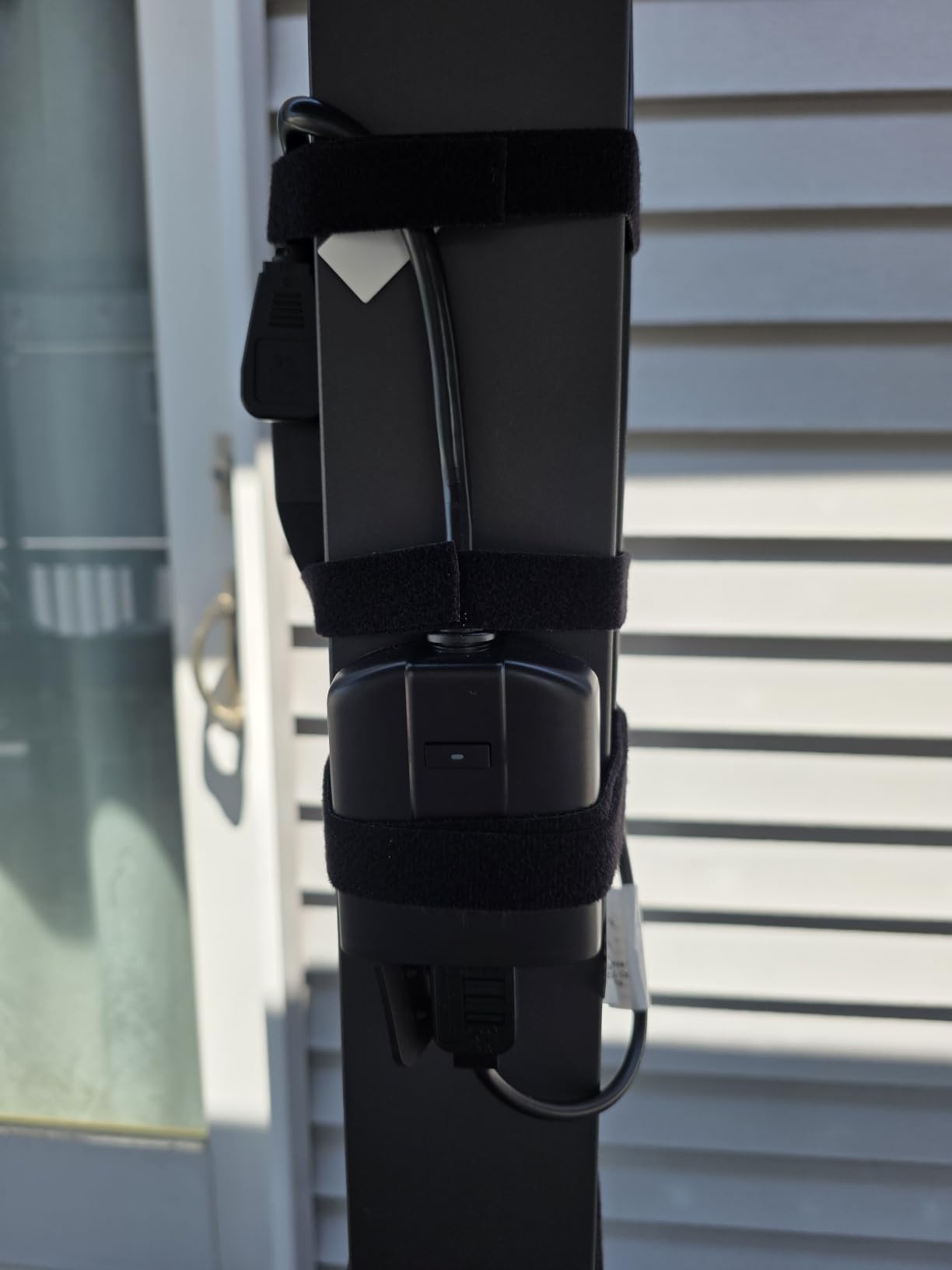
The honest caveat is missing data. No weight is published, the louver drive mechanism is not described, and the listing does not state assembly hours or crew size. Before this one goes on a deck, you should assume a louvered structure of this size and plan for a multi-person weekend build.
When a wide footprint makes sense
Pick this shape when the deck is long rather than square, for instance a 10 by 30 run along a house, or when you want a lounge group and a dining table under one roof. A 20-foot span also lets you stagger posts so each one lands on a joist rather than between framing.
The screen is the reason to choose it over another 200 square foot louvered kit. If your deck faces west or has a lot of glass reflecting light, that shade layer does more for comfort than another few inches of headroom.
What to verify before you buy
Ask for the shipping weight before you commit, because you cannot calculate added deck load without it. The louvered kits in this roundup that do publish a weight run from 330 to 441 pounds at 120 to 192 square feet, and you should plan your joist blocking from a figure like that rather than hoping.
Also confirm the base plate design. A pre-drilled plate that lands over a joist is far better than one that lands in the gap between joists, and a wide deck gives you more freedom to move posts to framing.
4. Airwire 10×12 Louvered Pergola – Best for Manual Crank Control
Airwire 10×12 FT Louvered Pergola with Curtains & Netting Gray
Aluminum frame with crank louvers
10 x 12 ft, 120 square feet
369.5 pounds listed weight
Pros
- Crank handle rated for more than 100000 rotations
- 0-90 degree louver control
- Concealed gutters drain through the pillars
- Curtains and mosquito nets included
- Installation guide with video and all hardware
Cons
- 369.5 pounds is a real load on older joists
- Single roof zone
- so no partial shading
- UPF 15 is modest UV filtering
The crank on this one is the headline. It is rated for more than 100000 rotations, which is a proxy for durability that most listings never bother with. A louver drive that survives years of daily cranking matters more on a deck than a feature nobody will ever use.
The concealed gutter system is the second thing to look at. Water runs along hidden channels and down through the pillars, so runoff leaves at the base of each post instead of dripping onto your seating. Owners who have used it through a season report the area underneath stays dry enough to keep cushions out.
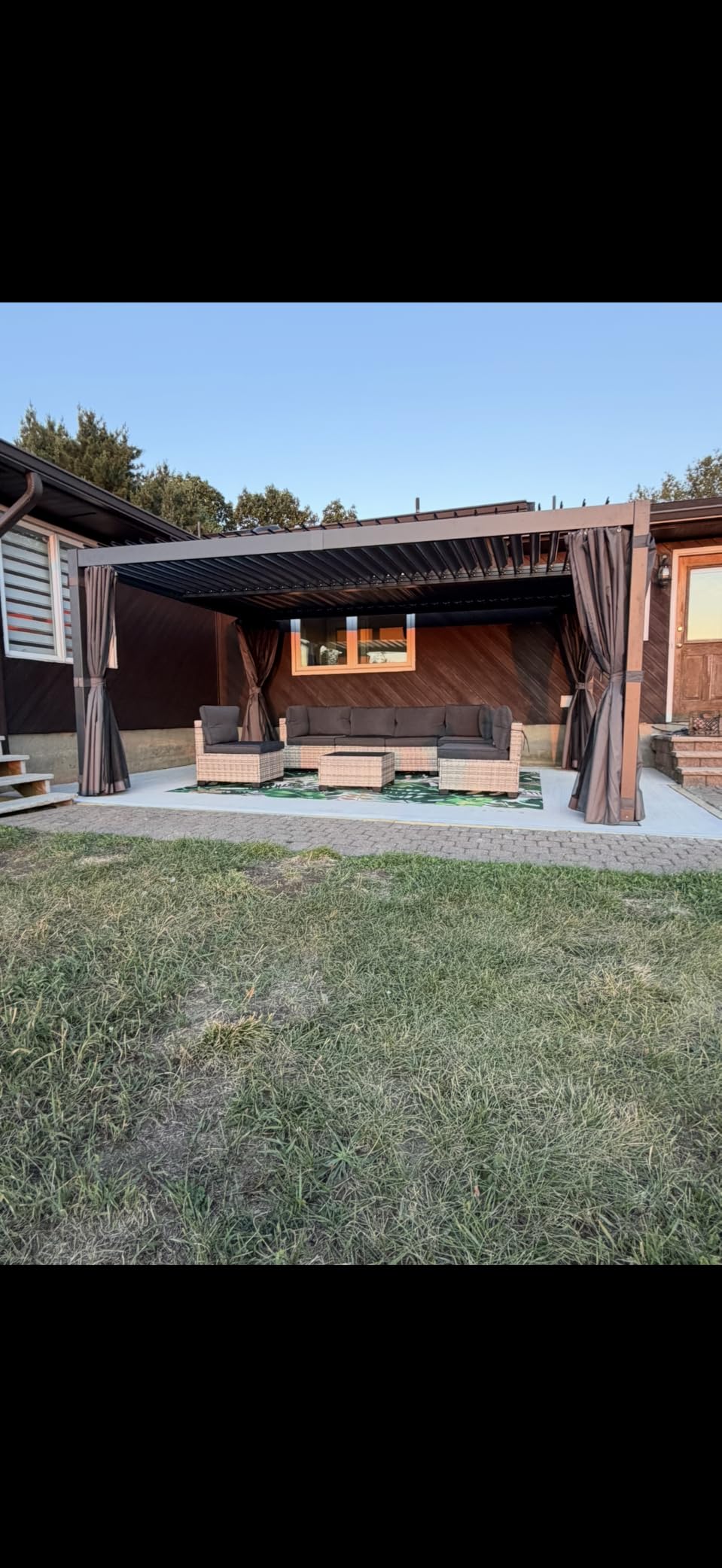
Curtains and mosquito nets come in the box, which on a 10 by 12 is a genuine saving and removes two separate purchases. The whole package lists at 369.5 pounds, and the manufacturer calls for three to four people and about two to three hours, which is a realistic number rather than an optimistic one.
Two cautions. The 369.5 pounds over 120 square feet works out near 3.1 pounds per square foot, so this is a serious concentrated load and not a good choice for a marginal deck. The UPF 15 rating is also modest, meaning the louvers shade you well but filter far less UV than the frames in this roundup claiming 99 percent blocking.
Best fit for a 10 by 12 deck
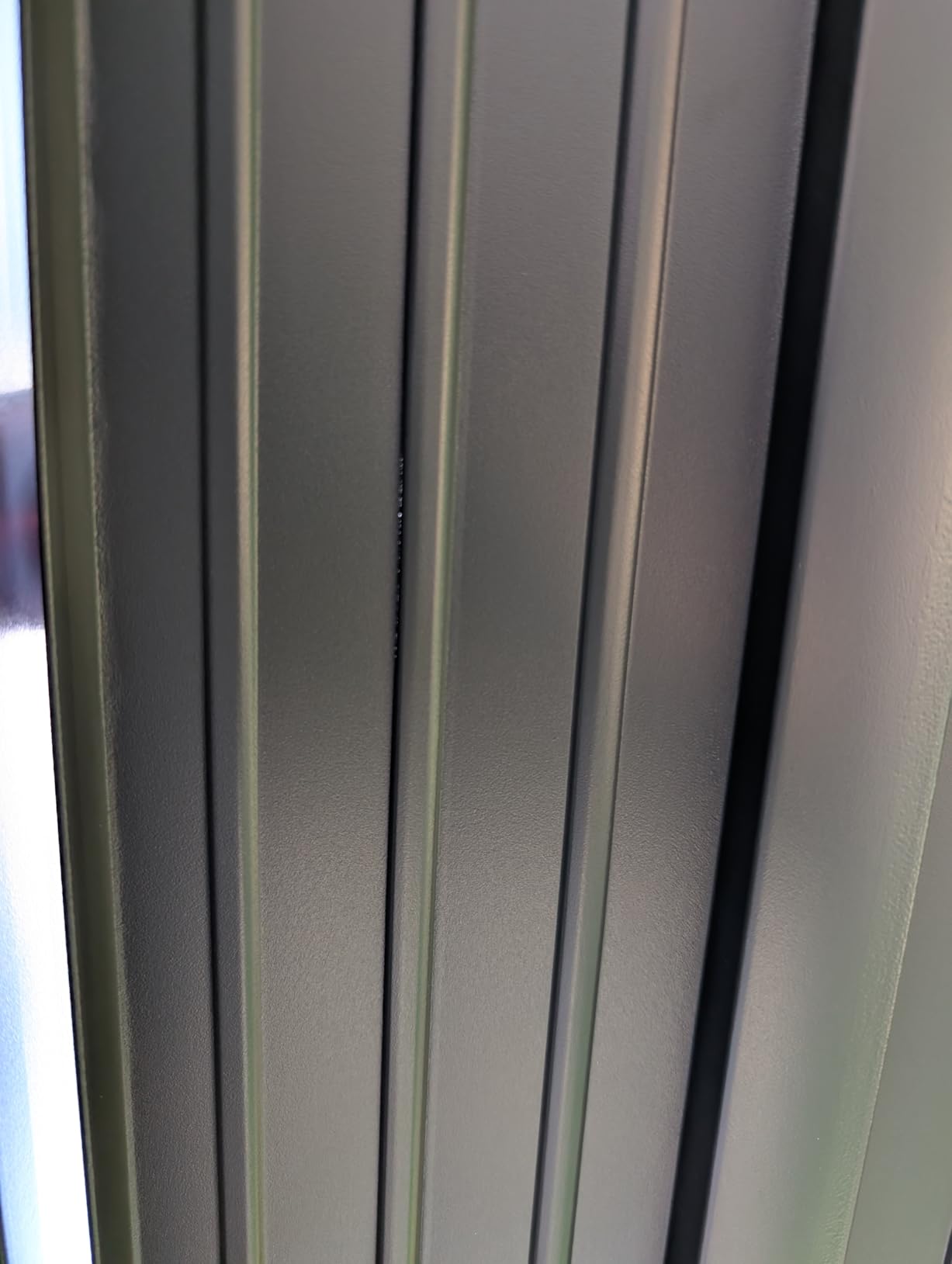
This is a well-proportioned 10 by 12, the most common small-deck footprint and the size most people can cover with a table and four chairs. The included netting means you can sit outside through mosquito season.
It also suits decks where you want a single crank rather than zones, because the mechanism is hand-driven and has no motor to fail. Nothing in this design depends on electronics.
Where it will disappoint
If your deck framing is light, the weight is the problem. A 10 by 12 footprint is small, so the pounds per post are high. Check that your joists are at least 2×8 on 16-inch centers and that each post lands over a joist with blocking behind it.
If you want to shade one half of the deck while sunning the other, this single-zone roof will not do it. You would be cranking the whole roof or adding a separate structure.
5. Domi 10×12 Louvered Pergola with Curtains and Netting – Best for Two-Zone Shade
Domi 10×12 Aluminum Outdoor Louvered Pergola with Curtains and Netting
Two independent 0-90 degree roof zones
10 x 12 ft, 120 square feet
Rated to 72 mph when anchored
Pros
- Two roof sections controlled independently
- 72 mph rating when anchored with expansion screws
- Built-in gutter drainage
- Curtains and screens included
- Multiple size and color variants
Cons
- Curtains and mesh fade or unravel within a few seasons
- Replacement parts are hard to source
- Some louvers do not close perfectly
- Drainage exits through posts and can wet decking
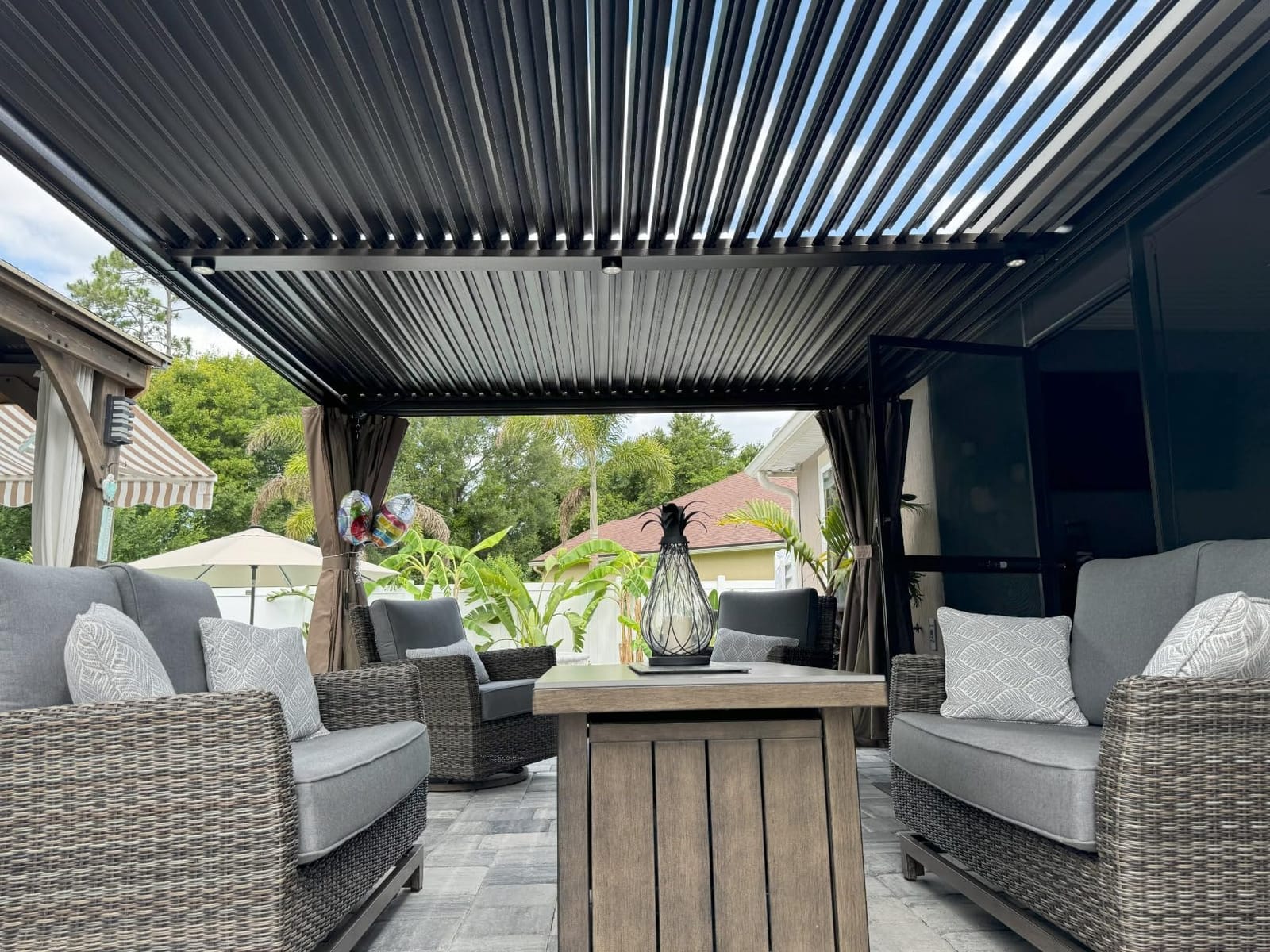
Two independently controlled roof sections is the feature that separates this from a single-zone louvered kit, and it is genuinely useful on a deck. You can close the section over the table and leave the section over the chairs open, which turns one structure into two different rooms depending on the hour.
The 72 mph wind rating is stated with its condition attached, which is exactly the practice most listings skip. It applies when the unit is anchored with the included expansion screws. Unanchored, that number means very little, and we will return to why below.
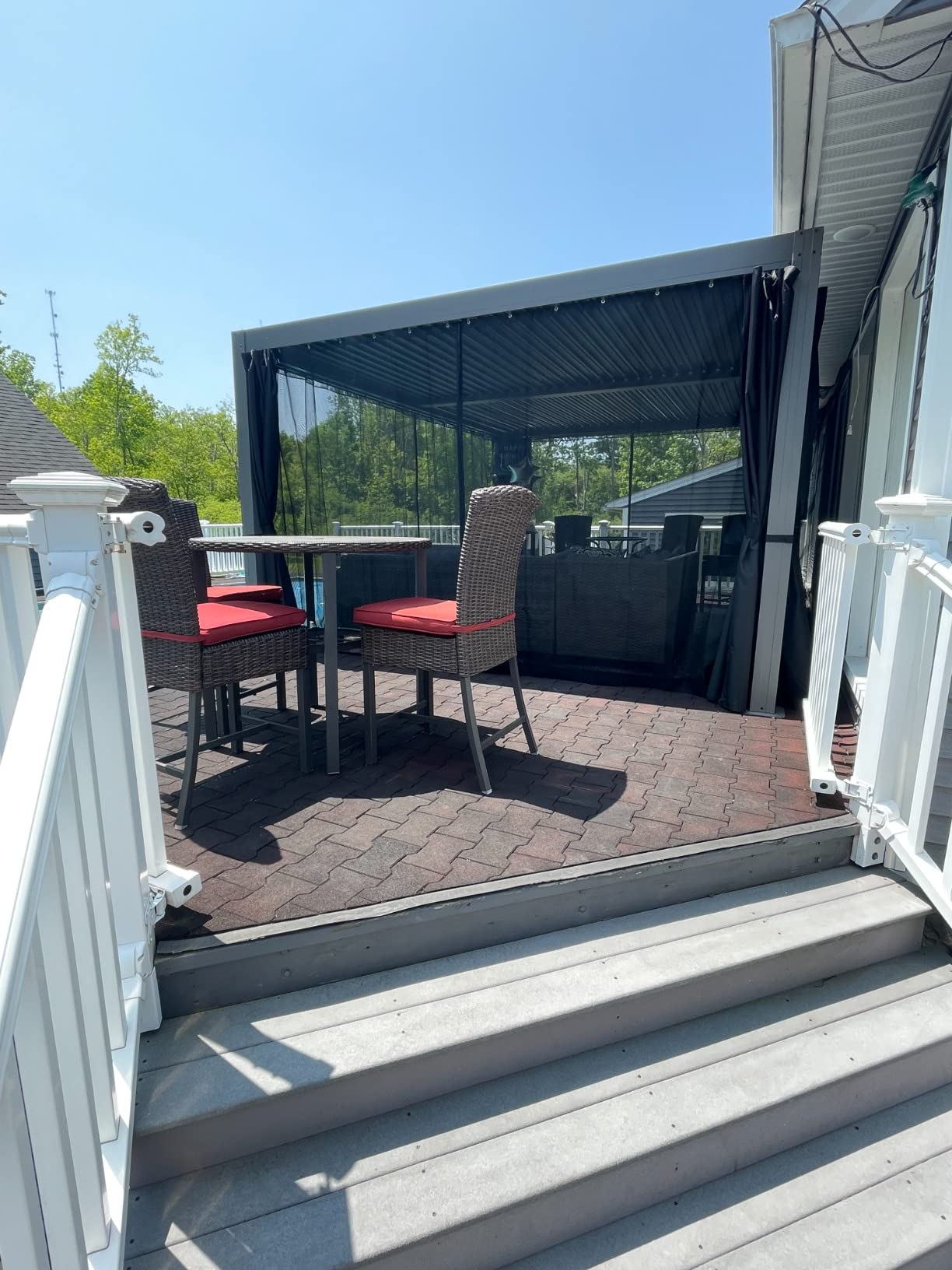
At 330 pounds over 120 square feet, the load works out near 2.75 pounds per square foot, lighter than most louvered competitors in this roundup. The frame is powder-coated and described as deformation and fade resistant, and the pre-drilled post bases save a lot of guesswork on the deck.
The recurring complaint is fabric. Owners report curtains and mesh screens fading, unraveling or tearing within a few seasons, and the brand is not clear about how to order replacements. Treat the screens as a two to three year item and budget for it.
Why two roof zones matter on a deck
A deck is usually used for two things at once, eating and cooking or eating and lounging, and those want opposite light. Independent zones let you put hard shade over the grill and keep sun on the plants, or shade the table for lunch and open the rest for an afternoon nap.
It also lowers wind loading. Opening half the roof cuts the surface area exposed to a gust, which matters on exposed decks where a fully closed louver roof acts like a wing.
What to watch out for
Louvers that do not close perfectly show up in reviews here, and that means light and light rain can still come through a fully closed roof. If your priority is staying dry during rain rather than controlling sun, a hardtop or a retractable canopy suits you better.
Drainage also exits at the base of the posts, so plan where that water lands. On a deck with a sealed surface, the runoff at each post base is a detail worth thinking about before you build.
6. YOLENY 12×24 All-Aluminum Louvered Pergola – Best for Maximum Coverage
YOLENY Louvered Pergola 12×24, All Aluminum Pergola with Adjustable Rainproof Roof, Outdoor Pergola with Curtains and Nets for Patio & Garden, White
All-aluminum frame and louvers
12 x 24 ft, 288 square feet
Four independently cranked roof sections
Pros
- 288 square feet of coverage from one footprint
- Four separately controlled louver sections
- Fully aluminum build with no rust path
- Wind resistance rated 60-80 mph
- Concealed drainage through channels and posts
Cons
- 531 pounds is a very heavy deck load
- Four crank handles multiply the hardware
- Size variants are limited compared with rivals
Nothing else here publishes 288 square feet of coverage. At 12 by 24, this is the structure you buy when the deck itself is the project, and the four independently cranked louver sections give finer light control than any two or three zone roof in this roundup.
The wind rating is quoted as a range, 60 to 80 mph, which is more honest than a single number because performance depends on how the louvers are set and how the frame is fixed. Owners of fully aluminum pergolas consistently mention the absence of rust and the quieter feel under rain compared with steel frames.
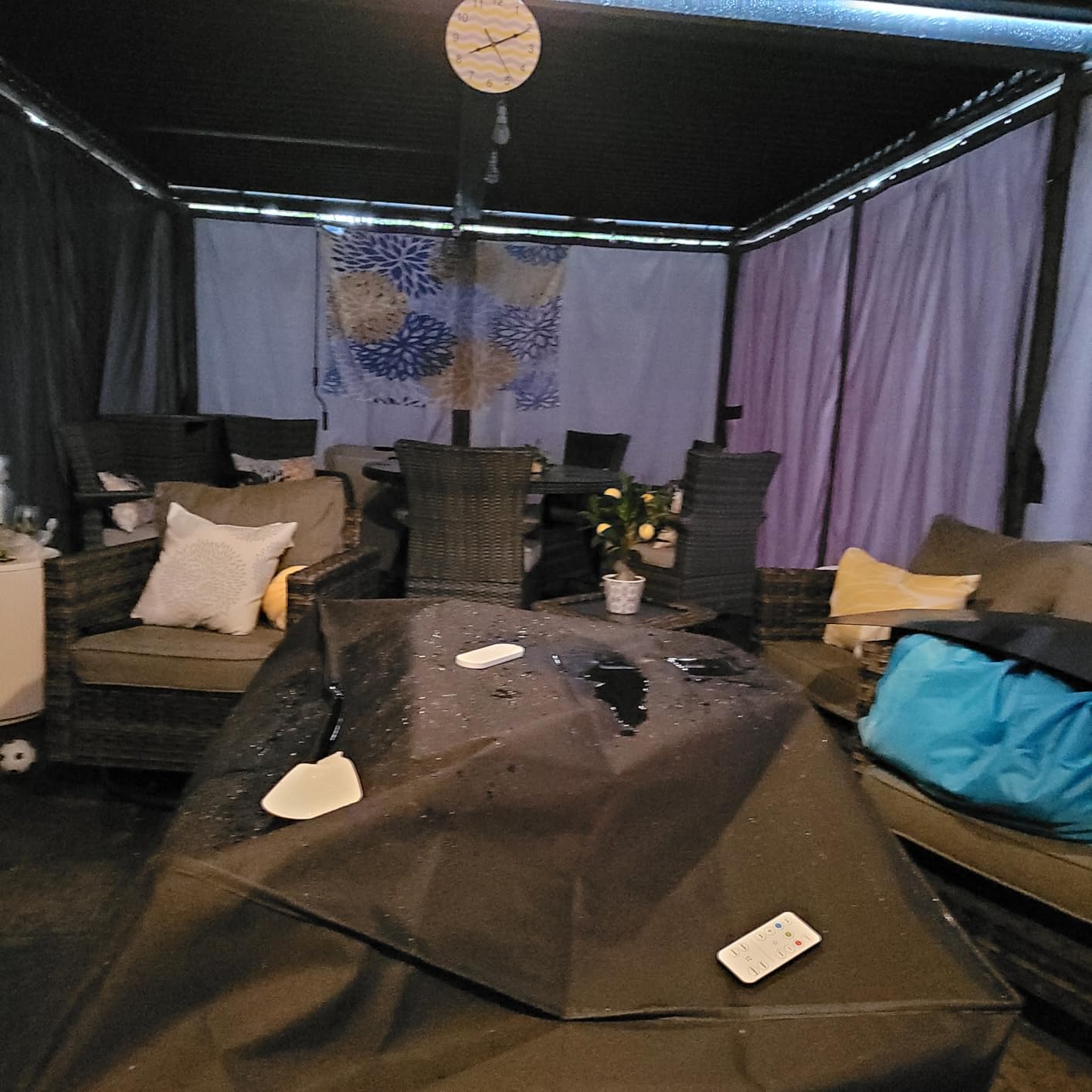
Curtains and nets are detachable and use upper, middle and lower straps, which is a better anchoring detail than single-point hanging where wind gets under the fabric and rips it. The concealed drainage routes water through horizontal channels and down the posts to the ground.
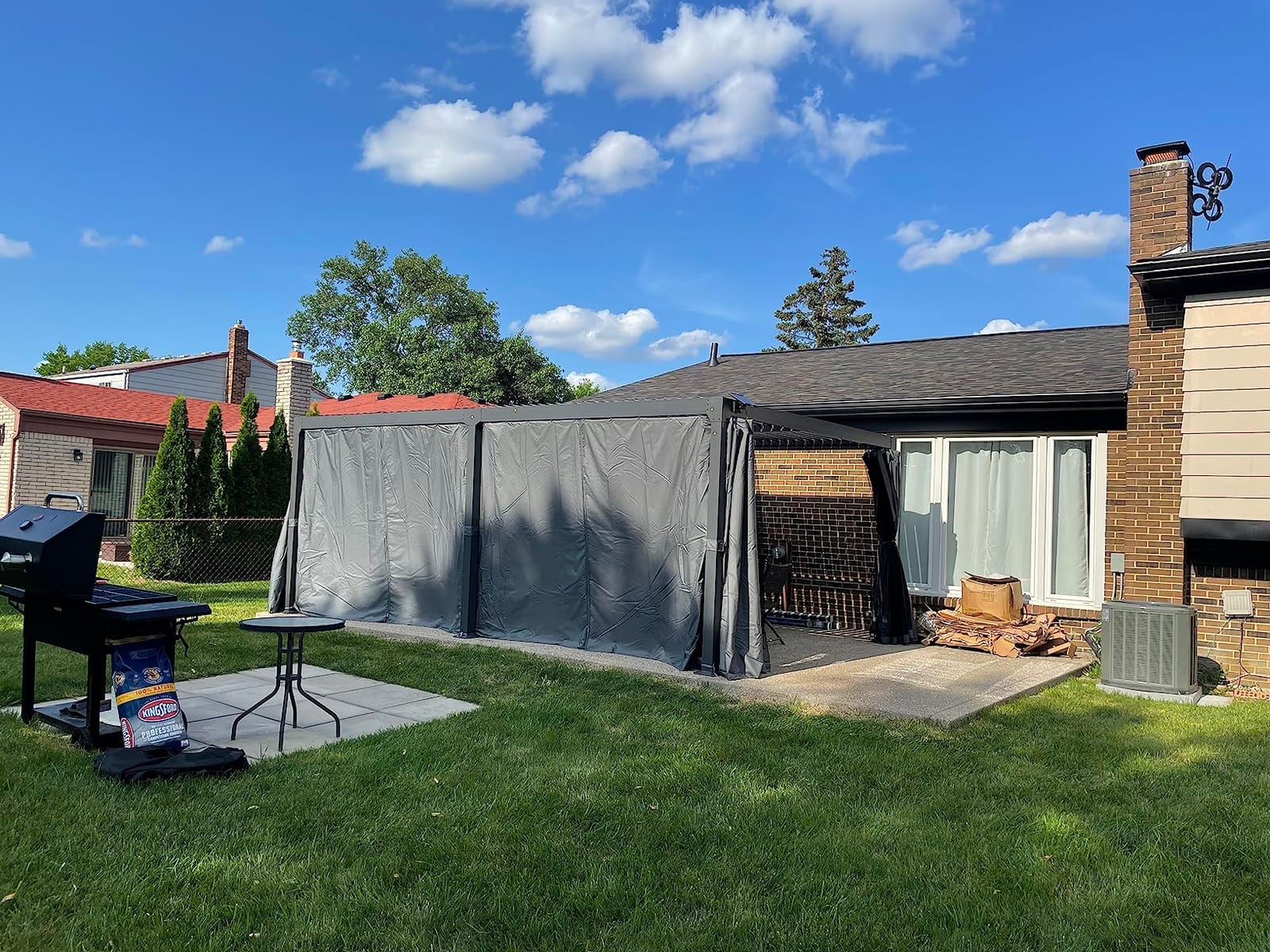
Now the honest part. At 531 pounds, this is a serious structure. Spread across 288 square feet it works out near 1.8 pounds per square foot, but the load still concentrates at six post bases, and the perimeter alone spans 72 feet of your deck. Most residential decks are not laid out to host a 12 by 24 structure without added framing.
When 288 square feet is the right call
This is the correct answer for a large deck or a pool surround where you want a full covered outdoor room rather than a shaded corner. Four zones also let you keep a section completely open over a hot tub for ventilation while shading everything else.
Owners converting a deck into a full outdoor living space tend to end up at this size, and the reports say the shade structure is what makes the conversion feel finished.
When it is the wrong size
If your deck is under 200 square feet, a 12 by 24 unit overhangs the structure it sits on, and the perimeter posts land in places you cannot reinforce. It also arrives with four crank assemblies, which means four mechanisms to align and service over time.
We would only pair this with a deck whose joist layout you have already confirmed, and never on an elevated deck without checking the footings below.
7. Aoxun 12×16 All-Aluminum Louvered Pergola – Best for Windy Sites
Aoxun Louvered Pergola 12×16 All-Aluminum, Waterproof Curtains and Netting
All-aluminum frame, roof and posts
12 x 16 ft, 192 square feet
82.5 mph when properly anchored
Pros
- Highest stated wind resistance in this roundup
- 3.8 inch posts upgraded from a 3.1 inch standard
- Two independent louvered roof sections
- Integrated gutter drains through the posts
- Curtains and mesh netting included
Cons
- Installation instructions are mostly small pictures
- Included Allen-head screws strip easily
- Aluminum dents during handling
- Listed snow capacity differs between page and manual
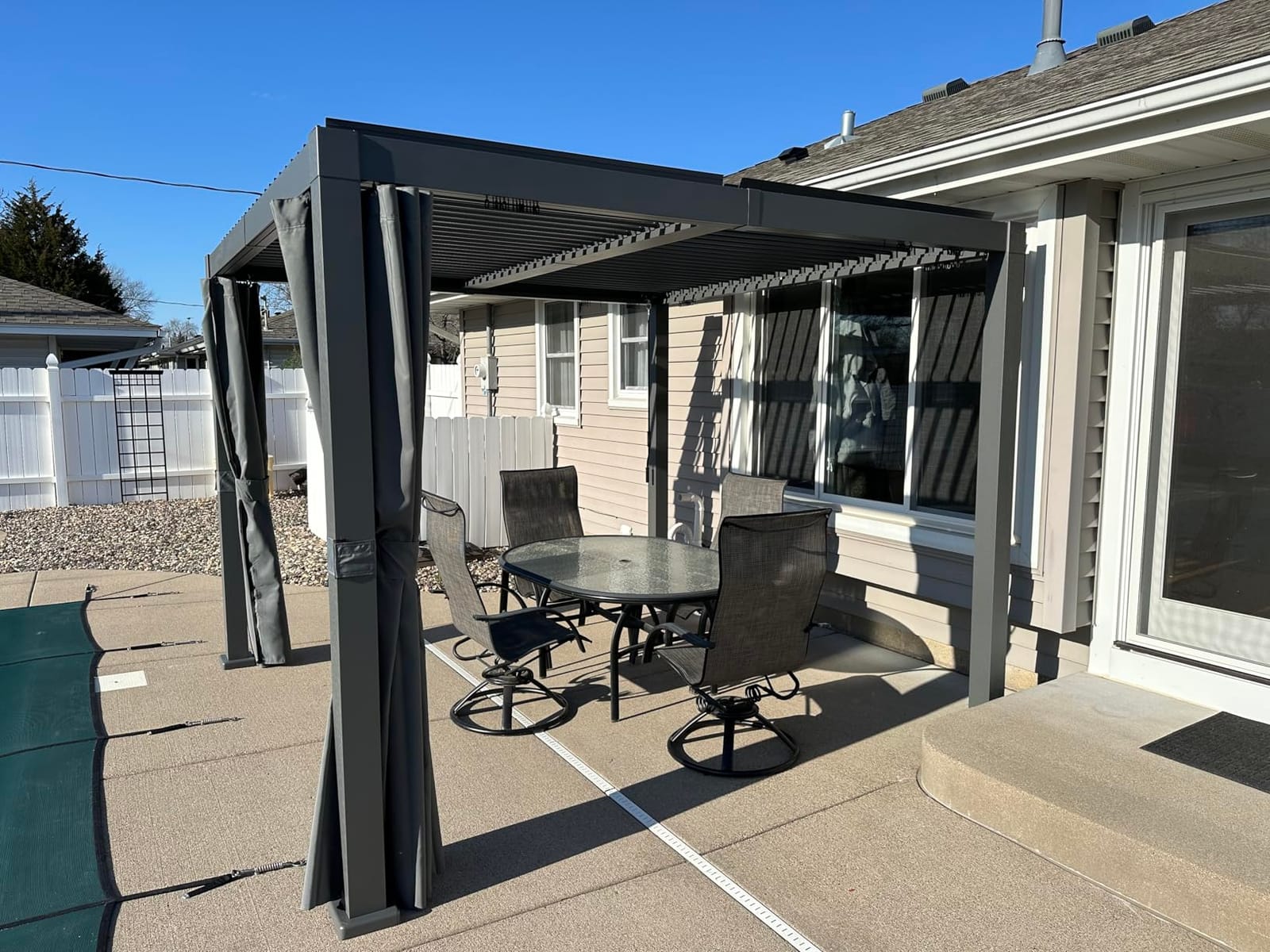
The 82.5 mph wind rating, stated with the condition that it applies when properly anchored, is the highest number any pergola here publishes. For a coastal deck or an exposed corner lot, that figure is the starting point for a shortlist, not a finish line.
The post gauge explains part of it. These are 3.8 by 3.8 inch aluminum posts, upgraded from the 3.1 by 3.1 inch standard used on most kits in this category. That extra metal is exactly what resists the bending moment when wind loads a roof plane, and it is the single most meaningful difference between otherwise similar listings.
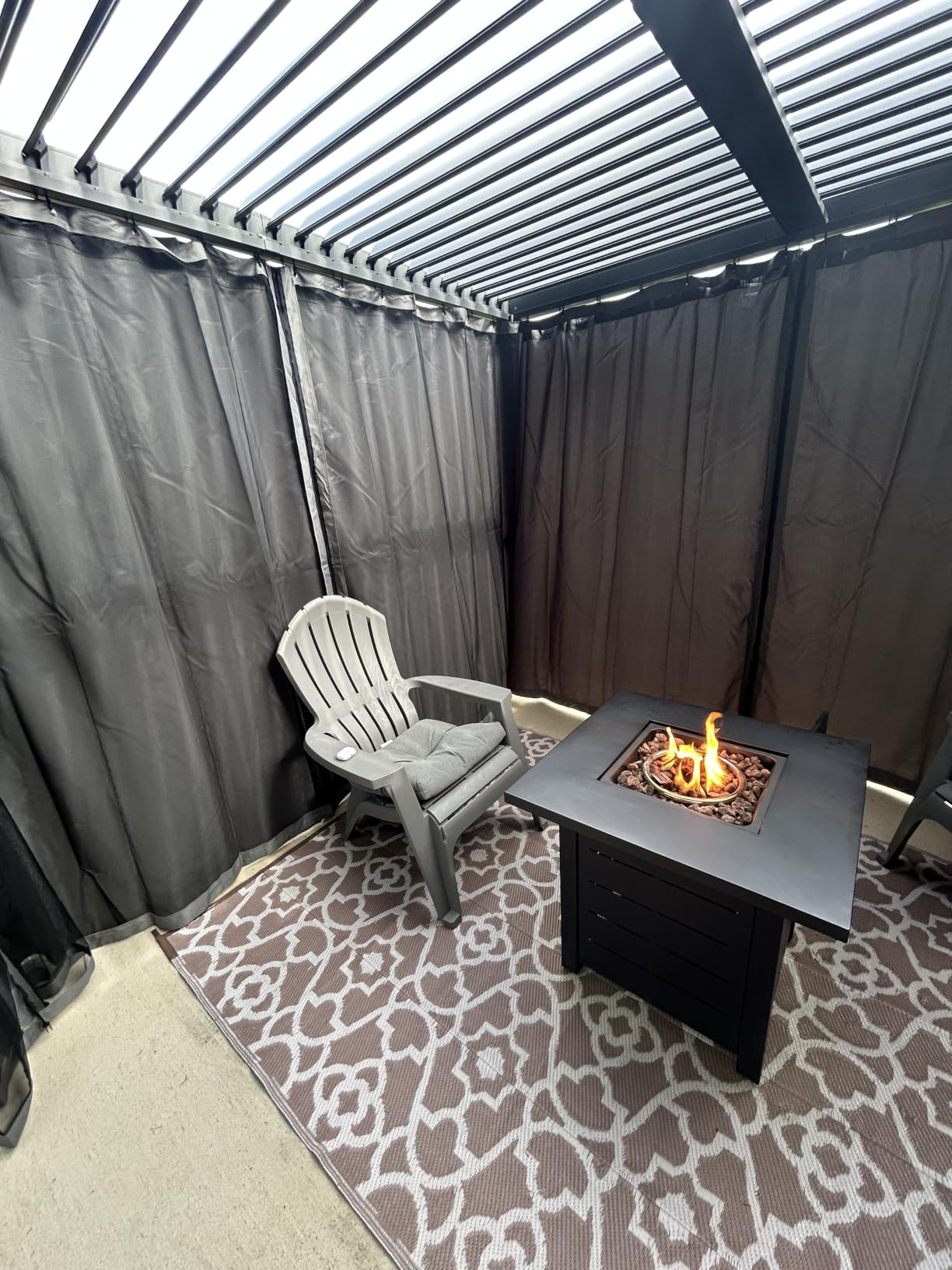
Everything above the deck is aluminum, including the roof, which removes the rust path that eventually appears at steel fasteners and welded joints. At 441 pounds over 192 square feet, that is about 2.3 pounds per square foot, heavier than the Domi louvered kit and lighter than the EROMMY.
Two independent roof sections give partial venting in a storm, and the integrated gutter carries rain down inside the posts so furniture underneath stays usable. Owners especially value the included privacy curtains, particularly in townhouse settings where neighbors are close.
Why post gauge decides windy decks
Wind does not push straight down on a pergola roof. It tries to lift and twist it, and the posts are the only thing transferring that into your deck. Thicker posts mean a larger section resisting bending, and a 3.8 inch post carries noticeably more margin than a 3.1 inch one over a long span.
Buyers on exposed sites should pair this with the discipline owners describe: set the louvers open during high wind so slats cannot act as sails. An open roof lets air pass through instead of catching it.
What could go wrong
The instruction sheet is mostly small photographs, which is a real obstacle. Budget extra time, and consider asking a neighbor who has built one to check your sequence before you get to the roof stage.
The included Allen-head screws are soft and strip if over-tightened, and the listing and the printed manual disagree on snow capacity. If you are in a snow climate, get that number in writing before you buy.
8. EROMMY 12×20 Louvered Pergola with Six Side Screens – Best for Full Screening
EROMMY 12×20 Louvered Pergola with Side Pull-Down Screen, Outdoor Aluminum Pergola with Thickened Frame and Adjustable Metal Rainproof Roof for Deck Patio Garden Yard, Black-Gray
Aluminum frame and louvers, 12 x 20 ft
Six pull-down side screens
711 pounds listed weight
Pros
- Six pull-down side screens close the structure from any side
- Owners describe the heaviest and most solidly built frame here
- Stainless steel fittings and matte powder finish
- 99 percent UV protection claimed
- Pre-drilled base plates and expansion anchors included
- Seller support sent missing parts quickly
Cons
- 711 pounds is the heaviest load in the roundup
- Replacement screens are not orderable
- One owner reported base bolt stripping and a snapped leg
- Screen fabric can billow in wind
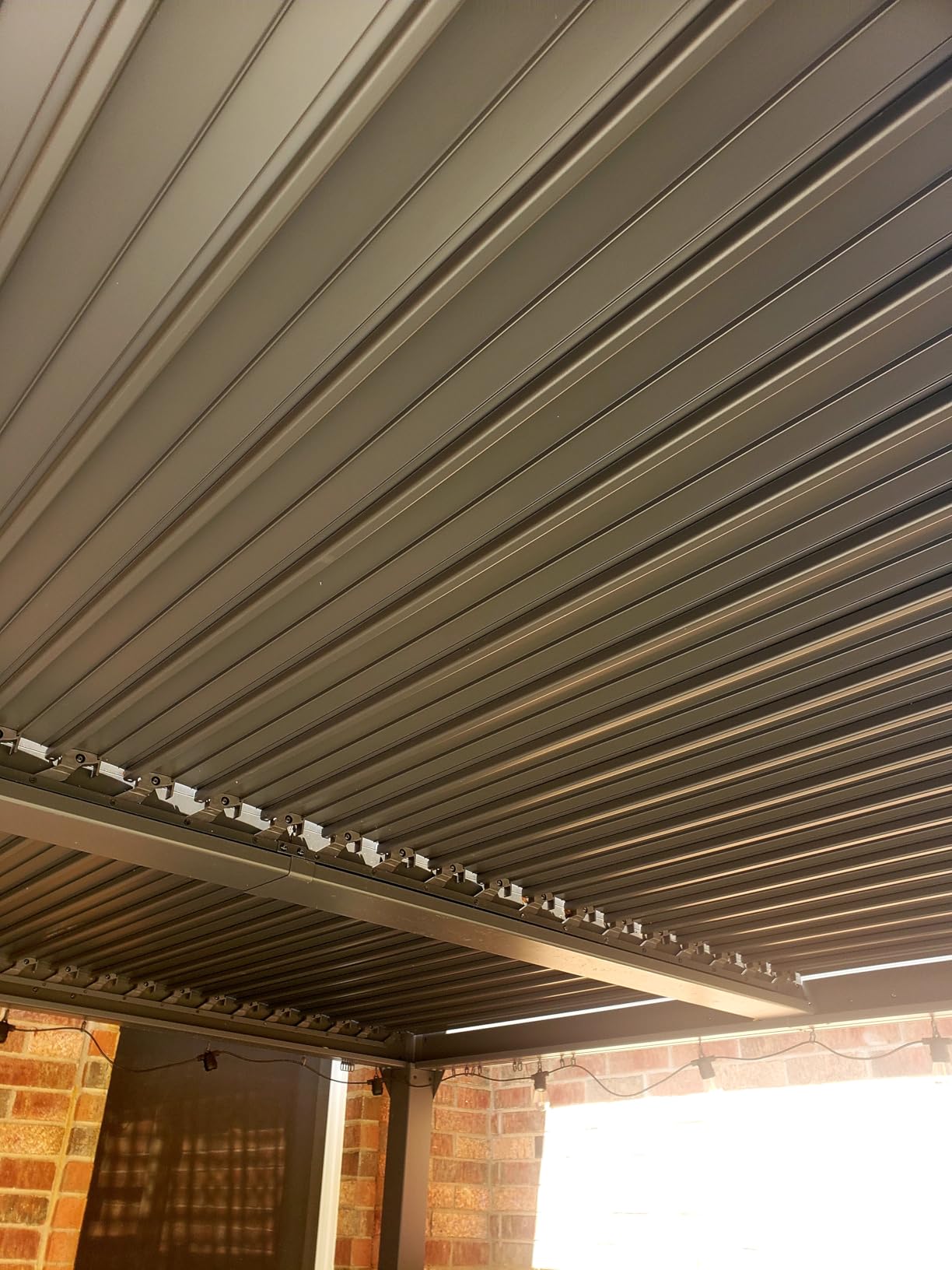
Most pergolas offer curtains on one or two sides. This one has six pull-down screens, so you can close the structure in on any face and turn a 12 by 20 deck footprint into something closer to a room. For privacy from neighbors, or for blocking low western sun, nothing else in this roundup does that.
The build is the heaviest here at 711 pounds, and owners describe it as the sturdiest pergola they have owned. The frame uses thickened aluminum with stainless steel fittings, and the claimed 99 percent UV protection is the highest figure published in this group alongside the FansaFurn.
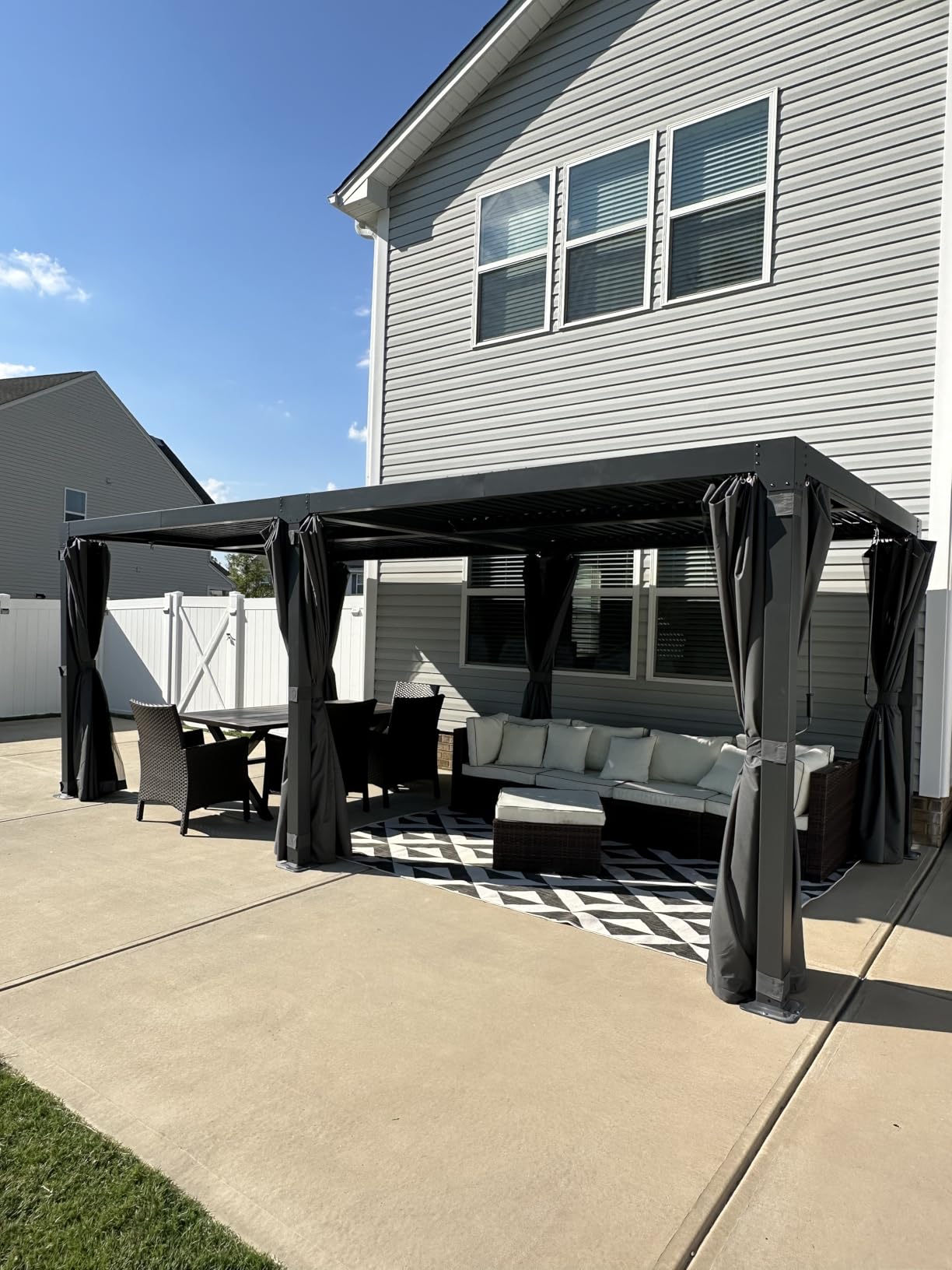
Pre-drilled base plates and expansion anchor bolts are included, which saves a sourcing trip, though on a deck you will likely substitute your own structural fasteners. Manufacturer guidance is four to six people and three to six hours, and owners report multi-day builds with a helper crew.
We are cautious here, and you should be too. One owner reported base plate bolts stripping and a leg connection snapping within months, and replacement screens do not appear to be orderable, which is a real problem for a product whose selling point is the screens.
Where six screens change the outcome
If your deck sits next to a fence line, a neighbor’s high deck, or a street with foot traffic, side screening is the difference between a public shade structure and a private outdoor room. Two owners on neighboring properties can build toward each other and still shade both decks.
It also solves the bug problem outright on a deck where mosquitoes make evenings unusable, without a separate screen door to keep track of.
The load and longevity questions
At 711 pounds, this is the heaviest published figure in the roundup, and it needs four to six people. Do not attempt it on a deck you have not inspected, and expect the assembly to run across a weekend or more.
The billowing fabric in wind and the unavailability of replacement screens are both worth weighing. Ask the seller directly whether screens can be reordered before you commit, because that answer determines how long this pergola works for you.
9. VORTEXTOVE 12×16 Reinforced Louvered Pergola – Best for Standard Decks
12′ x 16′ Louvered Pergola, Outdoor Pergola with Adjustable Louvered Roof, Reinforced Aluminum Frame, Integrated Drainage System, for Patio, Deck, Grey
Reinforced aluminum frame, 12 x 16 ft
0-90 degree hand crank louvers
393 pounds over 192 square feet
Pros
- Reinforced heavy-duty all-aluminum construction
- Hidden gutters move water through reinforced columns
- Hand cranks give smooth 0-90 degree adjustment
- Pre-drilled bases suit wood decks or concrete
- Eight size and color variants
Cons
- Listed as having no UV protection
- Shade only
- so louvers filter little sun
- Small review base of 39 ratings
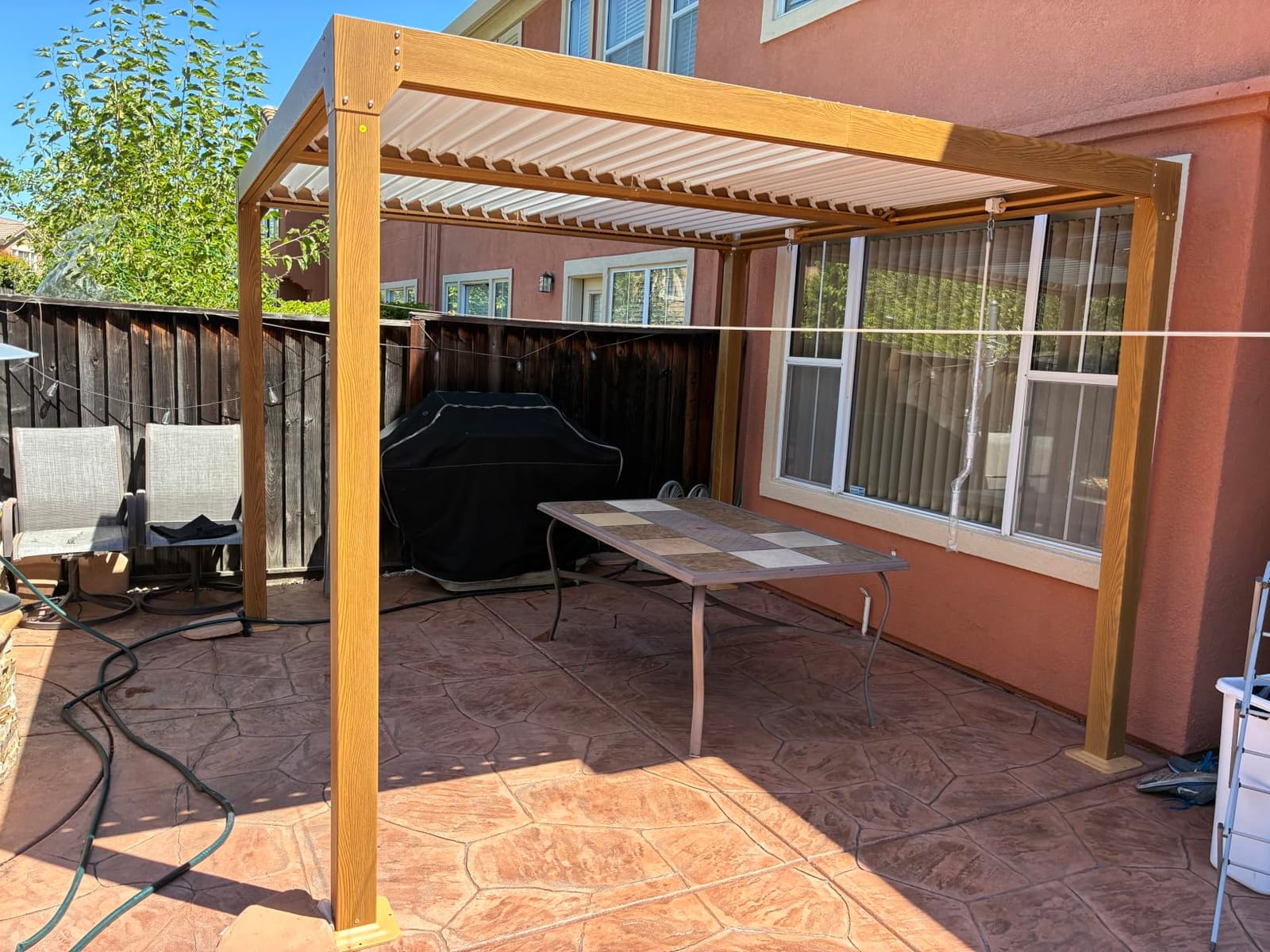
This is the straightforward 12 by 16 louvered pergola, and that is not a criticism. It has a reinforced all-aluminum frame, hand crank louvers running the full 0 to 90 degrees, and pre-drilled bases that work on wooden decks or concrete, which covers most installs without modification.
Owners rate it at 4.5 across 39 ratings, an 81 percent five-star rate, with praise concentrated on frame quality, the integrated drainage and the smoothness of the cranks. The hidden gutters channel water through the reinforced columns so it leaves at the base of each post.
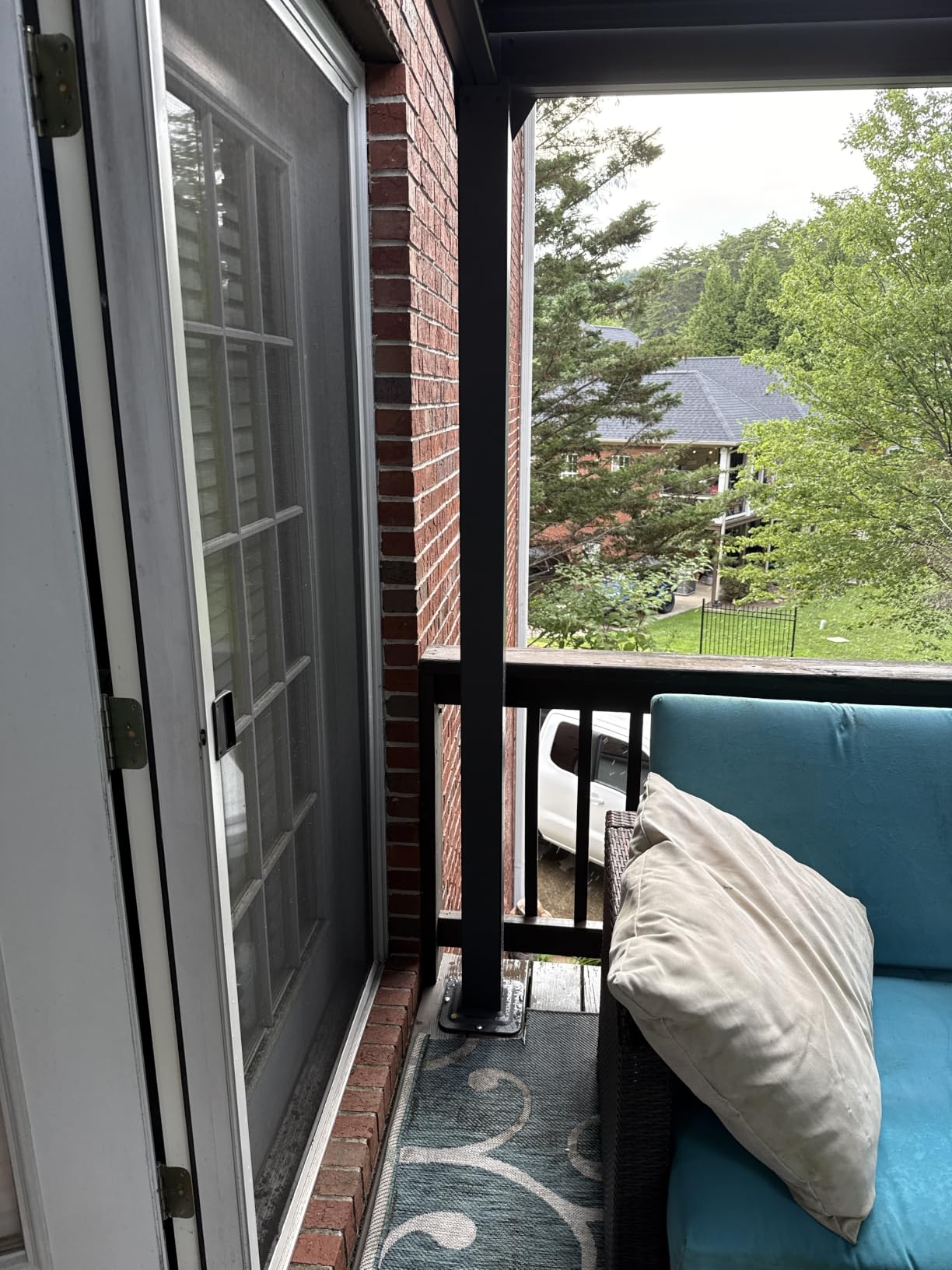
At 393 pounds over 192 square feet, the load is about 2 pounds per square foot, which sits in the middle of this roundup and works with standard modern joist spacing. A 12 by 16 footprint is also the most widely supported size in the category, with eight size and color variants listed.
One listing detail deserves attention. It is published as having no UV protection, which means it shades you without filtering much ultraviolet light. If you plan to sit underneath for hours on a bright afternoon, a model claiming 95 or 99 percent UV blocking is the better buy even if the frame is similar.
Best fit for a straightforward deck
This suits a 12 by 16 deck with no unusual constraints, a normal modern joist layout, and a household that wants shade without motorized parts. Hand cranks mean no electronics, no wiring and nothing to fail electrically, which many owners prefer.
Because the base plates are pre-drilled and work on wood or concrete, it is also a sensible pick for a ground-level patio that may later be decked over.
Where it is not the right pick
Skip it for a sun-exposed afternoon lounge, because the absence of UV filtering means the shaded area is bright rather than cool. You will get relief from direct sun but not from reflected heat.
The review base is also small. Thirty-nine ratings is a thin record for a permanent outdoor structure, so we would look for a unit with a longer track record if your budget allows it.
10. FansaFurn 12×16 Pergola with Curtain and Adjustable Roof – Best for Sun and Snow
12′ x 16′ Pergola with Curtain & Adjustable Roof & Aluminum Frame for Patio
Aluminum frame with iron canopy, 12 x 16 ft
72 mph wind, snow to 6 inches
332.9 pounds listed weight
Pros
- 4.7 star average
- the highest rated 12 by 16 in the roundup
- Snow capacity stated to 6 inches at 55 lbs per square meter
- Independently adjustable louvers block up to 99 percent UV
- Integrated drainage through hidden channels
- Curtains and breathable netting included
Cons
- Arrives in 9 separate boxes that can turn up days apart
- Iron canopy is heavier than an all-aluminum roof
- No motor option on this configuration
This is the only pergola in the roundup that publishes a snow capacity in engineering terms, 6 inches of accumulation at 55 pounds per square meter, and it pairs that with a 72 mph wind rating when anchored with expansion bolts. For a deck in a four-season climate, having both numbers stated is worth a lot.
The louvers block up to 99 percent of UV while running the full 0 to 90 degrees, so the same roof that keeps snow load off also keeps the worst afternoon glare off your table. Independent adjustment means you can shade the seating without closing off ventilation.
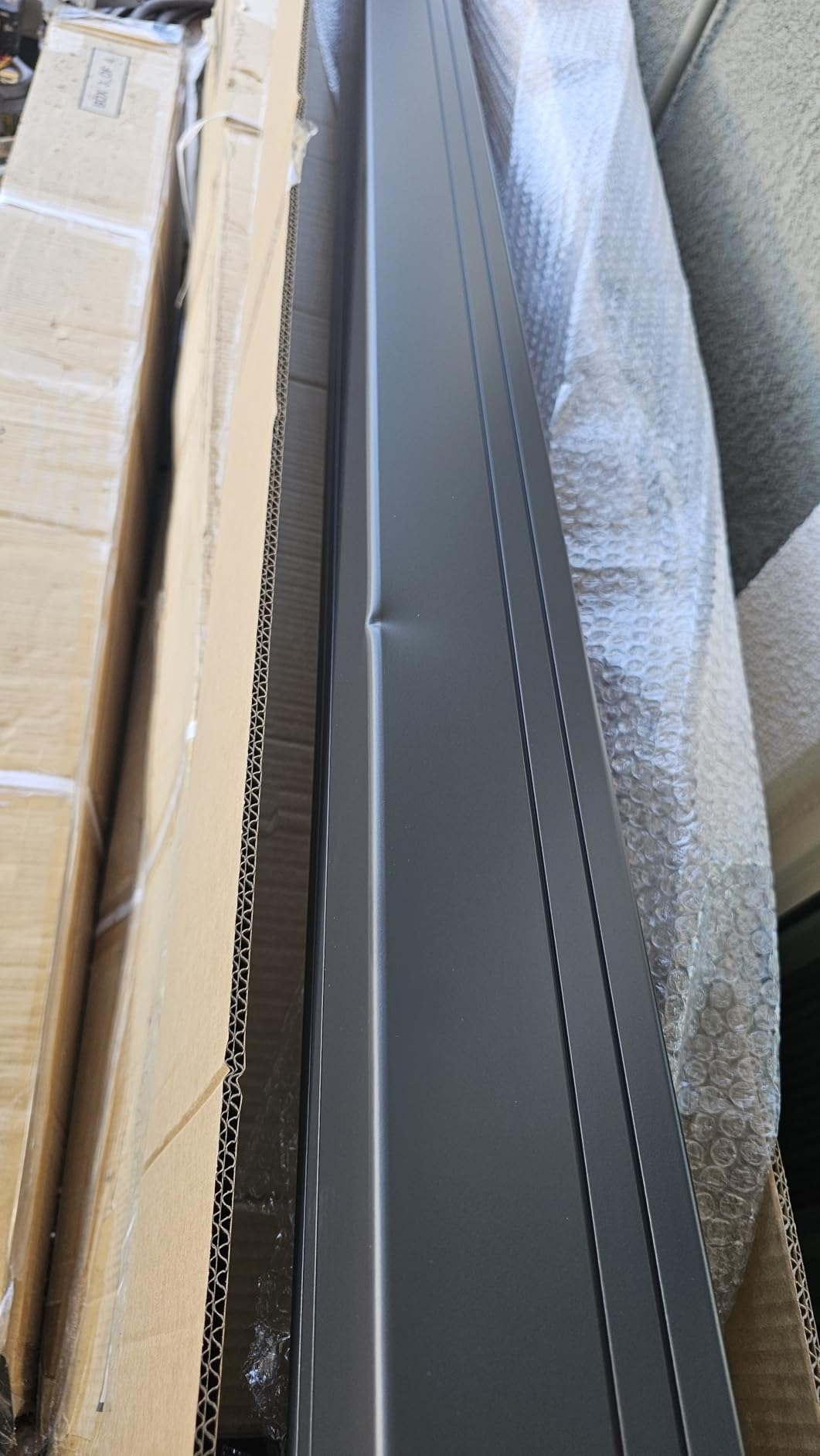
At 332.9 pounds over 192 square feet, this works out near 1.7 pounds per square foot, the lowest figure among the 12 by 16 units here. That matters on a deck because the lighter the concentrated load at each post, the more likely your existing joists are adequate without added blocking.
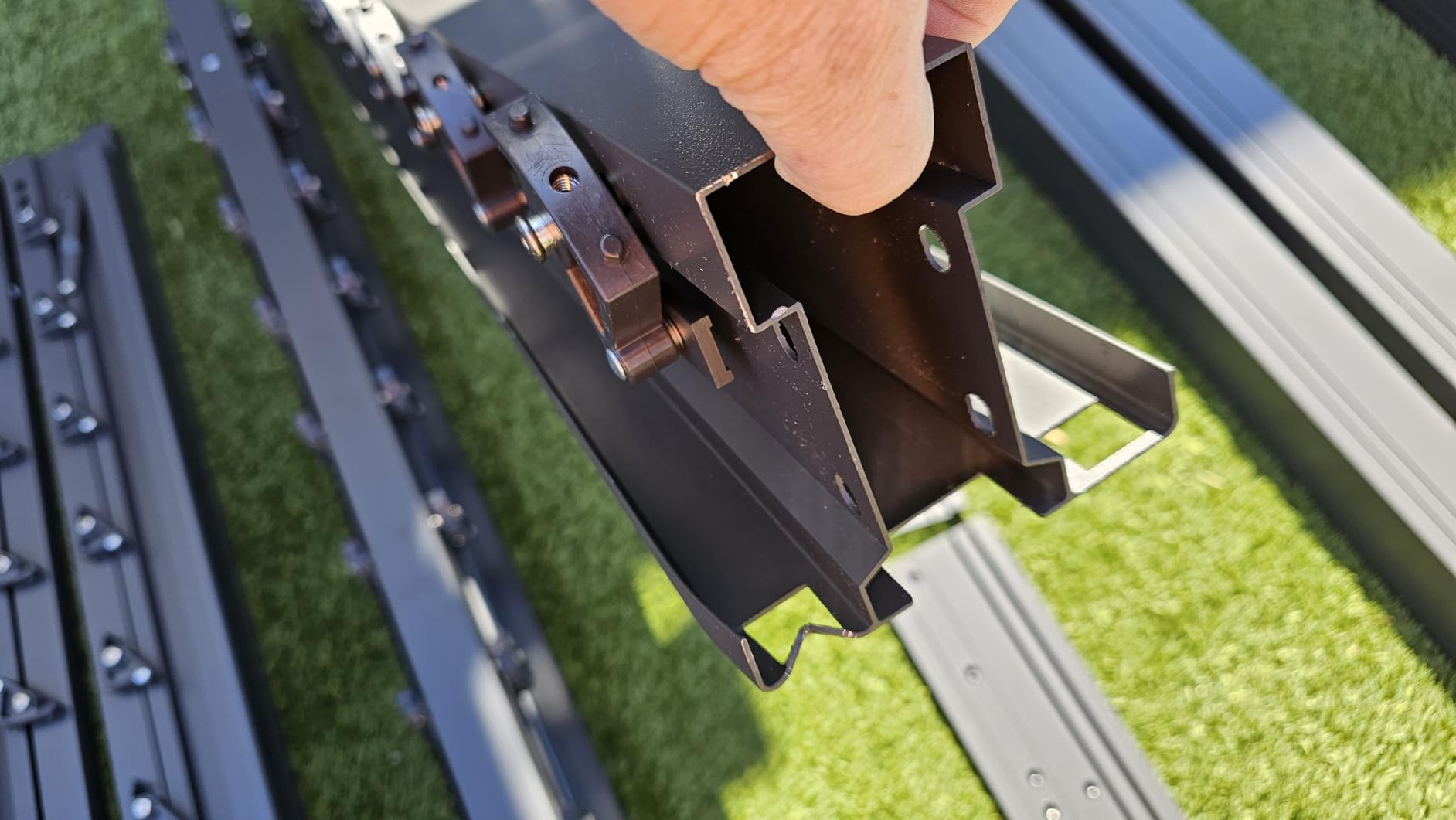
Owners describe sleek silhouettes with concealed fasteners that pair well with string lights, and the integrated drainage keeps furniture and the floor dry. Curtains and breathable mesh netting are included as standard, which is unusual at this size.
Why the snow number matters where you live
Snow load is a sustained weight sitting on the roof for weeks, unlike wind which comes in gusts. Six inches of accumulation across 192 square feet is on the order of a thousand pounds of transient load, and that is the scenario a light frame struggles with first, sagging at the beam before anything fails.
Owners in snowy climates report sagging and louver problems on lower-spec kits under heavy accumulation, so the stated capacity is not marketing here. It is the specification that separates a kit that survives February from one that does not.
Plan around the shipping
This arrives in nine separate boxes, and those boxes can arrive days apart. That is fine if you have somewhere secure to store them, and a problem if you are assembling in a rental or need the deck clear for other work in the meantime.
Also note the canopy is iron rather than all-aluminum. It adds weight and needs watching for surface rust at the finish, so check the coating on arrival and photograph any chips before assembly.
11. Goldshire 10×20 Louvered Aluminum Hardtop Gazebo – Best for Spa Decks
Goldshire 10’x 20′ Patio Louvered Pergola Aluminum Black Hardtop Gazebo
Aluminum frame and louvered hardtop roof
10 x 20 ft, 200 square feet
Two hand-pole controlled roof sections
Pros
- 4.9 star average with no one-star ratings
- Two independently adjustable roof sections
- Full aluminum frame and louvered roof
- 200 square feet suits spas
- pools and outdoor cooking
- Built-in drainage for the hardtop roof
Cons
- Weight is not published
- so load must be estimated
- No stated wind or snow figure
- No curtains or netting included
At 4.9 stars across 20 ratings with no one-star reviews, this has the highest average rating in the roundup. It is a small sample, but the consistency is notable, with owners citing the adjustable roof, the rust-resistant all-aluminum build and the drainage system as the standouts.
Two independently adjustable roof sections are driven by a simple hand pole, which removes the crank hardware and motor from the list entirely. There is nothing to jam, nothing to align and nothing to lubricate on the drive.
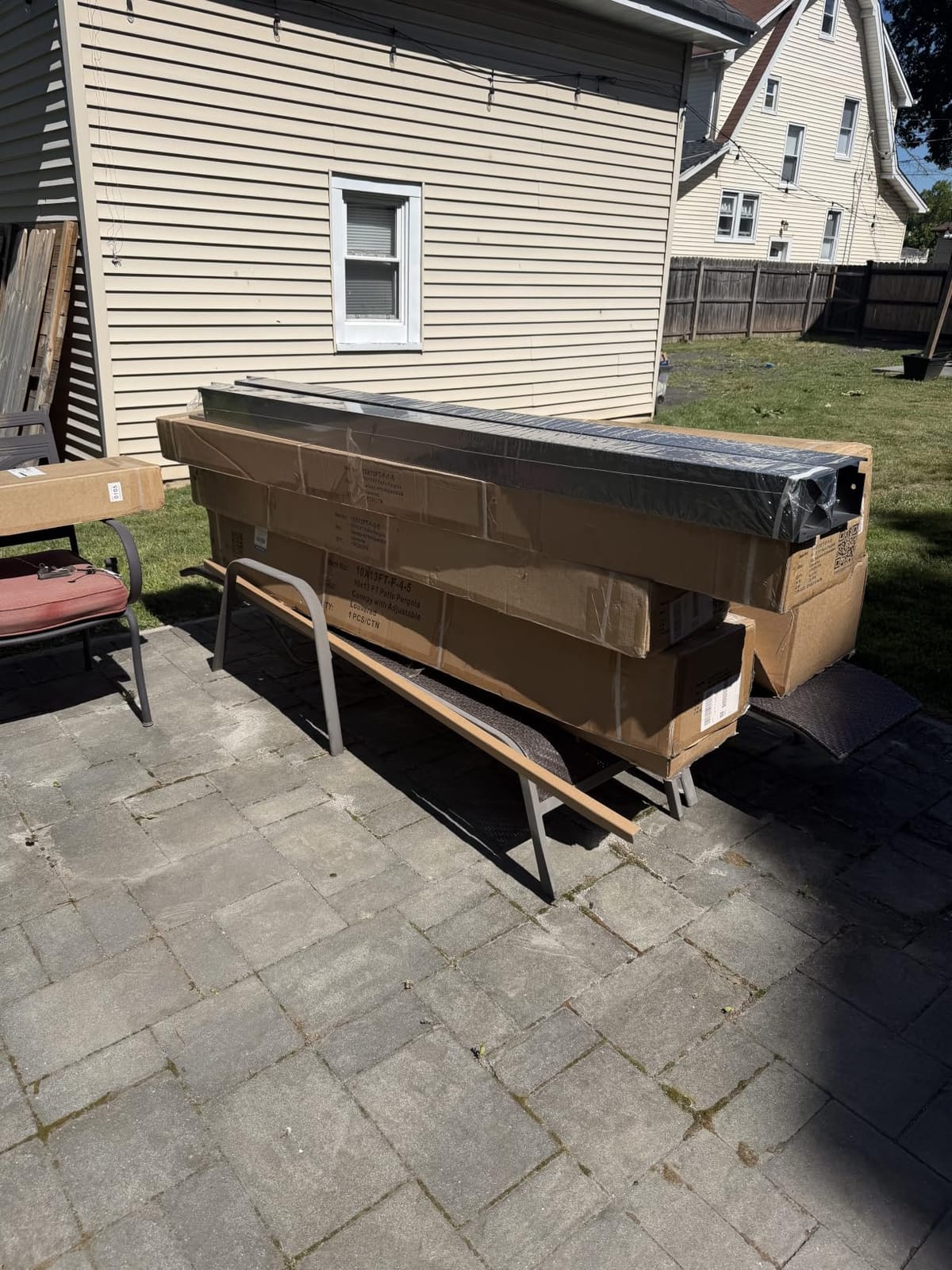
The 200 square foot footprint is the reason we placed it for spa and hot tub decks. Owners using it over a hot tub or pool lounge report the ventilation from opening one section matters more than they expected, because a closed hardtop over warm water traps heat and moisture.
The listing itself advises elevating the louvers when not in use, which matches what louvered owners report about wind. With the roof open, a flat louver plane behaves like a sail, and opening the slats lets air pass through instead of catching it.
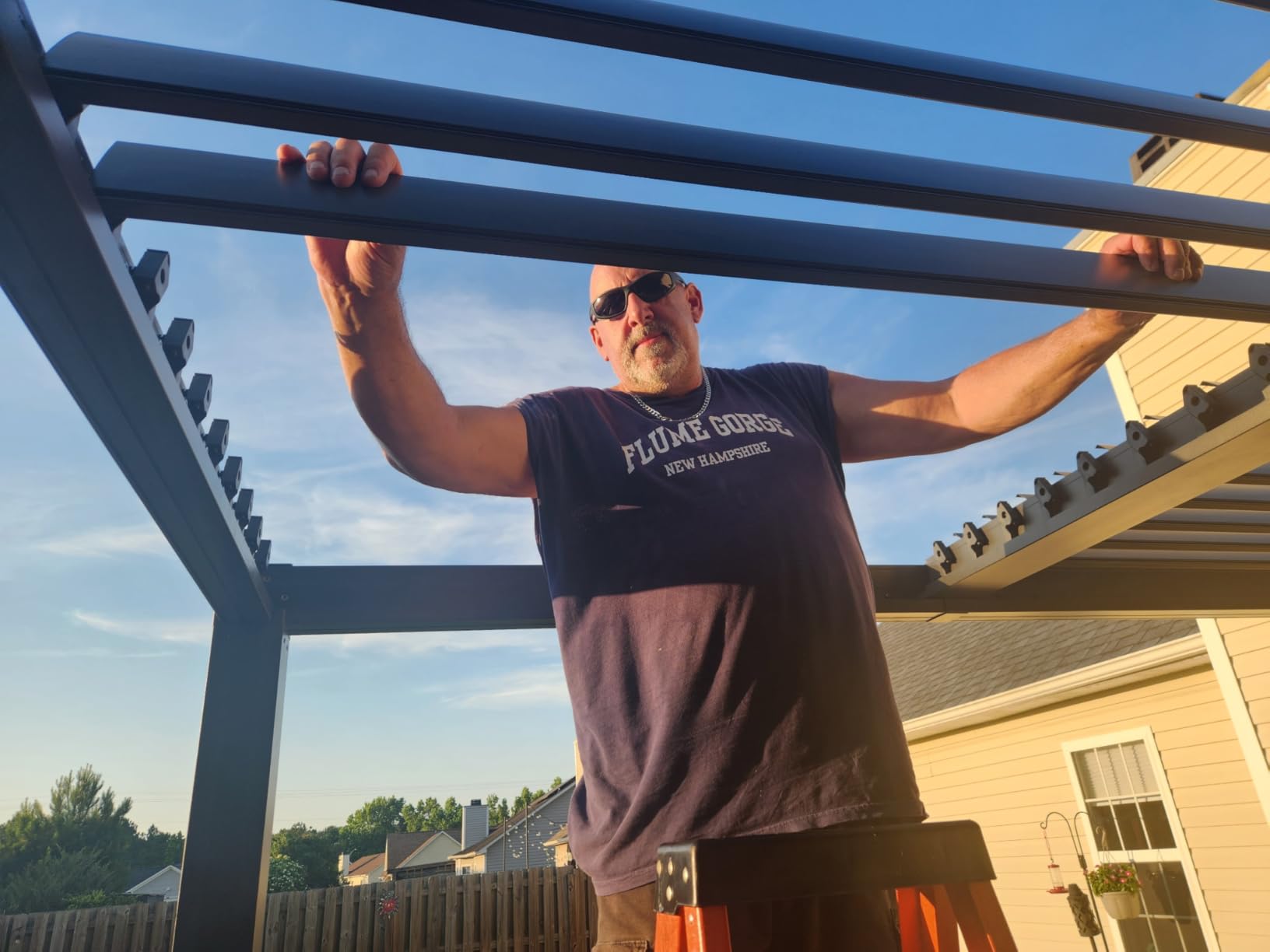
Why a louvered roof suits a hot tub
A spa deck generates its own heat and humidity, and a solid hardtop with no ventilation traps both underneath. A louvered roof lets you open the section directly over the water while shading the rest, which is the arrangement spa owners describe as the difference between usable and unbearable in summer.
The reinforced columns and the built-in drainage also matter here, because water and heavy wet weight off the spa concentrate load near the posts you would naturally want to place closest to the tub.
What the data does not tell you
No weight is published, so you cannot calculate the added load, and there is no stated wind or snow rating. Before this goes on a deck with a hot tub, you should be checking your framing with a contractor rather than a rule of thumb.
There are no curtains or netting either. If you want the space bug-free, budget for a screening add-on or plan your evenings around mosquito season.
12. SHPAI 8×12 Wall-Mounted Aluminum Lean-To Gazebo – Best for Wall Mounts
SHPAI Wall Mounted Hardtop Aluminum Lean to Gazebo Outdoor Pergloa 8x12FT
Aluminum frame with steel roof, 8 x 12 ft
Wall-mounted lean-to, 96 square feet
60 mph wind and 22 psf snow
Pros
- Wall-mounted design suits small or constrained decks
- Galvanized steel roof panels resist rust and scratching
- Polycarbonate side panels add rigidity without blocking light
- Sloped roof with hidden gutters
- Double-track curtains and netting with two-way zippers
- Detachable support pole adds snow capacity
Cons
- Steel roof is not all-aluminum like the rest of the roundup
- Needs a solid wall to attach to
- Only 96 square feet of coverage
A wall-mounted lean-to solves a problem freestanding pergolas cannot. On a small deck, or one where the guardrail line and the house wall leave no room for four posts, attaching to the building transfers the load into the framing you already have and leaves the entire deck surface clear.
At 227.5 pounds over 96 square feet, that is roughly 2.4 pounds per square foot, and it is the second-lowest published weight in the roundup. The aluminum frame carries galvanized steel roof panels, and the sloped roof with hidden gutters drains quickly through the frame and poles.
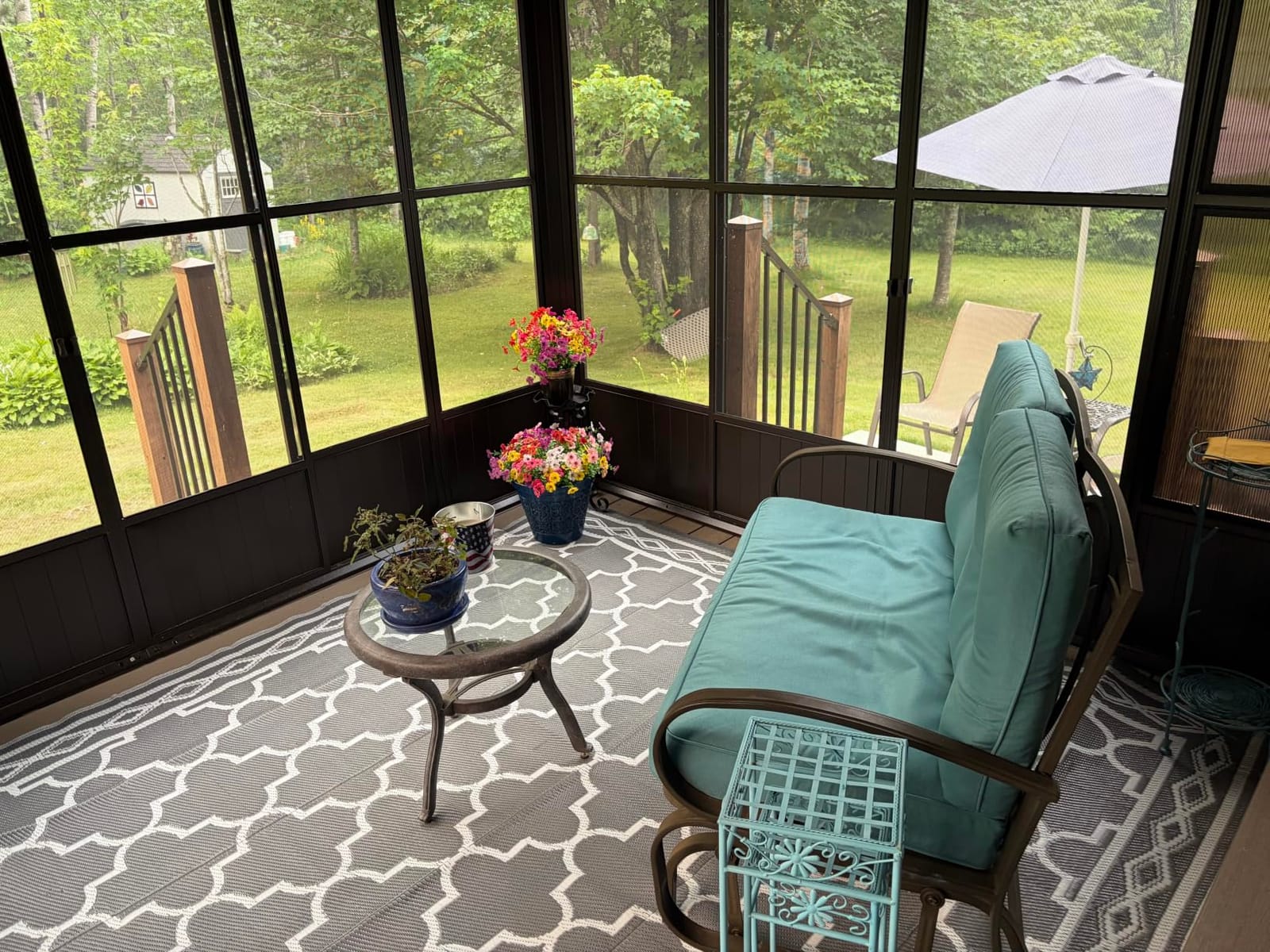
The published ratings are specific rather than vague: 60 mph winds and 22 pounds per square foot of snow, alongside UV-resistant panels and a water resistant rating. The double-track system with double-sided zippers lets curtains and mosquito netting slide independently, which is the detail that makes it usable year round.
A detachable support pole adds load-bearing capacity under snow. Leave it in place through winter and take it down for summer if the deck edge needs the clearance, which is how the design seems intended to be used.
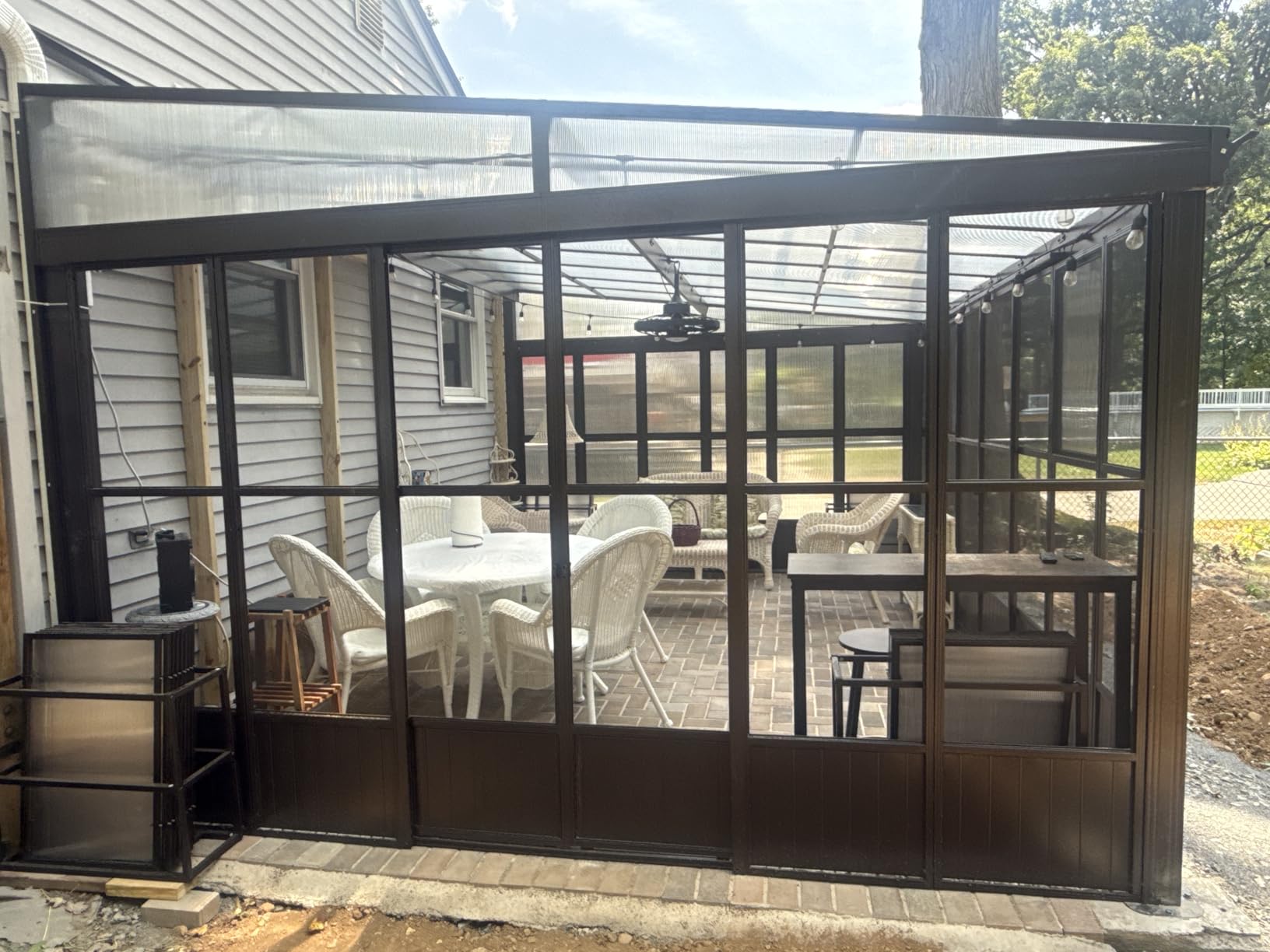
When a wall mount is the right call
This is the right answer for a deck pressed against the house, an apartment terrace with a masonry wall, a mobile home attachment or an entry landing with no room for four posts. It is also the only category in this roundup that converts an unusable edge of a deck into covered space.
Because the wall carries part of the load, the deck itself sees fewer concentrated points than a freestanding structure, which makes it a sensible option where framing capacity is the concern.
What the wall mount requires
It needs a solid, flat surface to fasten into, which means masonry, siding over framing, or a properly braced wall. Do not mount to a thin railing, a fence panel, or vinyl siding without a proper ledger board.
Also weigh the material mix honestly. The roof is galvanized steel rather than aluminum, so it needs a rinse in coastal air, and the 96 square foot footprint is genuinely small. It shades a nook, not a full room.
How Much Weight Does an Aluminum Pergola Add to a Deck?
A typical 12 by 16 aluminum pergola weighs 330 to 440 pounds, and that weight lands on your deck through four post bases rather than evenly across the surface. The useful way to think about it is pounds per post: a 393 pound pergola puts roughly 100 pounds into each of four points.
Here is what the published figures work out to when you divide each weight by its own coverage area. Domi’s 10 by 13 lists at 100.3 pounds over 130 square feet, about 0.8 pounds per square foot. FansaFurn’s 12 by 16 lists at 332.9 over 192, about 1.7. YOLENY’s 12 by 24 lists at 531 over 288, about 1.8. VORTEXTOVE’s 12 by 16 lists at 393 over 192, about 2.0. Aoxun’s 12 by 16 lists at 441 over 192, about 2.3. SHPAI’s wall-mounted 8 by 12 lists at 227.5 over 96, about 2.4.
The heavier end of the same calculation is worth noticing. Domi’s louvered 10 by 12 lists at 330 over 120, about 2.75. Airwire’s 10 by 12 lists at 369.5 over 120, about 3.1. EROMMY’s 12 by 20 lists at 711, and its listed dimensions work out near 226 square feet, so roughly 3.15. Small footprints carry proportionally more weight per square foot because the same frame has to span a smaller area.
For comparison, most residential decks are designed for 40 to 60 pounds per square foot of live load. Your pergola is a small fraction of that number spread across the whole surface, but it is a large fraction concentrated at each post, and concentrated load is what causes deflection and fastener pullout rather than the slow sag most owners notice first.
How to Check Whether Your Deck Can Carry a Pergola
Check five things before you buy, in this order. First, find out when the deck was built and who built it. A deck from the 1990s or earlier may have footings you have never seen and no permit paperwork, and that changes everything.
Look at the joist size and spacing. 2×6 joists at 16 inches on center is the bare minimum; 2×8 or 2×10 at 16 inches is comfortable. If you can only see 2×4 joists at 24 inches, do not put a heavy pergola on this deck.
Count the joists under the proposed footprint. You want at least two, and ideally three, so the posts are not all landing on the same beam.
Confirm each post can land directly over a joist. A post that lands between joists transfers its load into deck boards and screws, which will eventually work loose.
Add blocking behind any post position that is not over solid framing. 2×4 blocking screwed between joists roughly doubles the bearing at that point.
Check the footings if the deck is elevated. A ground-level deck on concrete or pavers is a much smaller question than a 10-foot-high deck on 8 inch piers.
If your deck fails any of the first three, the honest answer is to build a separate structure on its own footings beside the deck, or to use a wall-mounted lean-to, rather than forcing a heavy freestanding unit onto framing that was never sized for it.
How to Anchor a Pergola to Deck Joists
Anchor a pergola by bolting each post base through the deck surface and into the joist below, using lag screws or structural screws sized for the load, and treat the manufacturer expansion anchors as a concrete solution rather than a deck solution. The four steps below cover the version most decks need.
Mark every post position and verify each one is over a joist, not between joists. Shift the whole layout by a few inches if needed rather than accepting a post in a gap.
Drill pilot holes slightly smaller than the shank of your lag screws to prevent the deck boards from splitting, especially on older pressure-treated lumber.
Install blocking of the same depth as the joists behind any position where the screw would otherwise land in air, then fasten through the blocking.
Fit the base plate, run the fasteners into the joist, and check the frame for square before the louvers go on. Frames need to be plumb before the roof is attached, not after.
Use stainless or hot-dipped galvanized fasteners. Standard zinc-plated screws corrode inside treated lumber within a few seasons, and the head is the part that will fail first, which in wind is the part that matters most.
Also remember that wind ratings assume anchoring. Every published mph figure in this roundup is conditional on the structure being fixed to something solid, and the 82.5 mph number on the Aoxun is meaningless on an unanchored frame sitting on a deck.
What Are the Downsides of Aluminum Pergolas?
Aluminum pergolas have five real drawbacks worth knowing before you commit: they are not waterproof, they are heavy, the hardware is soft, they can heat up, and they cost more upfront than wood.
Closed louvers are not a roof. Overlap leaves a drip path, and closed-slat designs in particular shed water but do not seal, so light rain still reaches the area underneath.
Aluminum is a soft metal. It dents and scratches during assembly and cannot be repaired cleanly, so a dropped wrench leaves a permanent mark.
Included hardware is often the weak point. Soft Allen-head screws strip when over-tightened, and owners across this roundup report replacing them.
The frame can get hot. Aluminum conducts heat readily, and a dark powder coat in direct sun makes the underside noticeably warmer than a fabric canopy.
Aluminum costs more than untreated wood up front. The saving arrives later, and only if you would otherwise have been staining a wood structure every couple of years.
None of these are dealbreakers on a deck, but the first two are the reason experienced owners set the louvers open in high wind and plan for drip under a closed roof.
Which Roof Type Fits Your Deck?
Four roof types cover almost every deck pergola decision: louvered, retractable canopy, wall-mounted lean-to, and motorized louver. Louvered gives you the widest control range, retractable canopy gives you the cleanest profile, lean-to saves ground-level space, and motorized adds convenience at the cost of a failure point.
Louvered roofs dominate this roundup and suit most decks. The Airwire, Domi, VORTEXTOVE, Aoxun, YOLENY, EROMMY, Goldshire and FansaFurn all use adjustable slats, either cranked or driven by a hand pole. The tradeoff is that closed louvers are shade, not shelter, and they must be opened in high wind so the slats do not act as sails.
Retractable canopies like the PURPLE LEAF 12×16 and Domi 10×13 slide fabric along a track and lock it in place. They shed water better than louvers, are lighter to build, and look cleaner on a deck. They lose the ability to vent a hot tub or a grill station, and the fabric is a wear item.
Wall-mounted lean-tos like the SHPAI 8×12 are the answer when four posts will not fit. They leave the deck surface clear, transfer load into the house framing, and give you a genuinely sloped roof with hidden gutters. The cost is a fixed footprint, a required wall, and a steel roof rather than all-aluminum.
Motorized louvers were not represented in this roundup’s twelve products, and we would be cautious about adding one to a deck. A motor means an electrical run, a control box that can fail, and a louver array that must stay in sync. If you want motorization, budget for it deliberately rather than as an afterthought, and choose a unit with a manual override.
Weather Specs That Actually Matter
Four weather specifications deserve your attention, and they are wind with its anchoring condition, snow load in pounds rather than inches, drainage routing, and UV filtering. Everything else on a spec sheet is decoration.
On wind, the highest figure published here is 82.5 mph for the Aoxun, followed by 72 mph for both the Domi louvered and the FansaFurn, 60 mph for the SHPAI lean-to, and a 60 to 80 mph range for the YOLENY. Read the condition attached to each, and set your louvers open before a storm so air passes through the roof.
On snow, only two products here publish a figure in usable terms. The FansaFurn states 6 inches of accumulation at 55 pounds per square meter, and the SHPAI states 22 pounds per square foot. Where a listing says nothing, assume snow load is untested, and in a four-season climate that is a reason to look elsewhere.
On drainage, concealed gutters that route water down through the posts and out at the base keep furniture dry, which is the practical reason to pay for the design. The PURPLE LEAF, Domi, Aoxun, Airwire, YOLENY, VORTEXTOVE, FansaFurn, Goldshire and SHPAI all describe some form of it.
On UV, figures vary widely and are not comparable. The FansaFurn and EROMMY claim 99 percent, the Airwire lists UPF 15, and the VORTEXTOVE is published as having no UV protection at all. Higher is better, and on a west-facing deck it changes how comfortable the shaded area actually feels.
Two environment caveats apply to every one of these. In coastal air, rinse salt off powder-coated surfaces periodically, because salt is what eventually pits a coating. Near a pool or spa, chlorine off the water attacks fittings and fabric, so rinse the deck after swimming rather than letting it dry on the frame.
Sizing a Pergola for a Deck
Size the pergola by the furniture you want underneath, not by the leftover deck area. Most owners report that a 10 by 10 feels cramped the moment a dining table goes under it, and that the sweet spot for a six-person table is 10 by 12 or larger.
Allow at least 2 feet of clearance beyond the table edge so people can pull chairs out without scraping a post base. For a rectangular dining table, a footprint roughly 4 feet wider and 2 feet longer than the table itself is a reasonable target.
Check headroom before you fall for a low profile. The VORTEXTOVE stands 88 inches high, the Domi louvered kit is 92.8 inches, and the PURPLE LEAF sits at 96 inches. That extra height is what you want if you plan to run string lights, hang a ceiling fan or stand under the beam without ducking.
For hot tubs, add 2 feet of clearance on every side of the water and plan for ventilation. An open louver section above the tub is the arrangement spa owners recommend, and for that a 10 by 20 footprint like the Goldshire tends to work better than a square one.
Finally, measure twice for the build. A 12 by 16 pergola lists at 192 square feet of coverage but measures 185 to 192 inches across in practice depending on the brand, so leave a few inches of slack between the structure and your guardrail.
Maintenance and Winterization Checklist
Aluminum pergolas need little, but they are not maintenance free. A twice-yearly routine covers it: wash the frame with mild soap and water, check that drainage channels are clear of leaves, and inspect fasteners.
Before winter, open the louvers fully if you are in a snow climate. A closed louver roof presents a flat plane that holds accumulation instead of shedding it, and open slats let snow slide off before the load builds. Clear the gutters and the post channels, since ice in a concealed channel can back up and split a seam.
Remove and store any fabric curtains and netting, or at least take them down if they are stretched. Cold-weather fabric is far more likely to tear than warm-weather fabric, and a single torn panel can be replaced for less than a ruined set.
Check base plates and fasteners once a year, particularly after a windy season. Aluminum expands and contracts more than steel, so a bolt that felt snug in spring may be loose by autumn, and a loose base plate is the first thing to fail in a storm.
Salt and chlorine deserve their own note. Rinse the frame after coastal winds or heavy pool use, and touch any chips in the powder coat with the matching repair paint. A bare aluminum edge that is ignored will pit, and pitting does not stop.
Frequently Asked Questions
Who makes the best aluminum pergola?
For decks, the PURPLE LEAF 12×16 retractable canopy pergola edges ahead because it combines the largest owner review base in our roundup, a locking retractable canopy and a powder-coated frame that holds its finish. For a windy site, the Aoxun 12×16 leads on its 82.5 mph stated rating and 3.8 inch posts. For the heaviest loads, the FansaFurn 12×16 pairs a 72 mph rating with a published snow capacity.
Can you put a pergola on a deck?
Yes, on most decks built after 2000 with 2×8 or 2×10 joists at 16 inches on center. The critical requirement is that every post lands directly over a joist, with blocking added behind any position that is not. Older decks, elevated decks and decks carrying a hot tub need a closer structural look before you order.
How much weight can my pergola hold?
A pergola’s own weight is what matters for your deck, and a 12×16 aluminum unit typically weighs 330 to 440 pounds, delivered through four post bases. That is roughly 80 to 110 pounds concentrated at each post. Most modern decks handle that comfortably; older decks with 2×6 joists at 24 inches on center often do not.
Should I close or open the louvers in high wind?
Open them. Closed louver slats create a flat plane that catches wind like a sail, which is the top complaint in owner reports about damage. Opening the slats lets air pass through the roof so it cannot generate lift, and it also lets any snow that has accumulated slide off before the load builds.
How far apart should joists be on a pergola deck?
Sixteen inches on center is the standard for a deck carrying a pergola, and 2×8 or 2×10 lumber is preferable to 2×6. Joists at 24 inches on center with 2×4 lumber are not adequate for a heavy aluminum structure. If your spacing is wider, add blocking rather than relying on the deck boards to spread the post load.
What are the downsides of aluminum pergolas?
The main drawbacks are that closed louvers are not waterproof, the frame is a soft metal that dents easily, the included screws are often too soft and strip, the aluminum can get hot in direct sun, and the upfront cost is higher than untreated wood. A wall-mounted lean-to is often the answer on small decks where four posts will not fit.
The Best Aluminum Pergolas for Decks in 2026
The best aluminum pergolas for decks are not decided by the roof alone. Our pick for most decks is the PURPLE LEAF 12×16 retractable canopy pergola, because its locking fabric roof, 96 inch height and 1487-rating track record make it the safest default on a surface that was not engineered for a structure.
Go with the Aoxun 12×16 on an exposed or coastal deck, where the 3.8 inch posts and 82.5 mph stated rating are worth the extra weight. Pick the FansaFurn 12×16 where snow is a factor and you want a published load figure. Choose the Domi 10×13 when the deck framing is a question you cannot answer, and the SHPAI 8×12 when four posts will not fit at all.
Before any of them go on the deck, find the joists, confirm the post positions land on them, and upgrade the base fasteners to stainless. That afternoon of work protects the structure for its whole life, and it costs far less than the alternative.
For the cooking side of the same deck, our guide to the best deck ovens with air fryer covers what to cook once the shade is up.