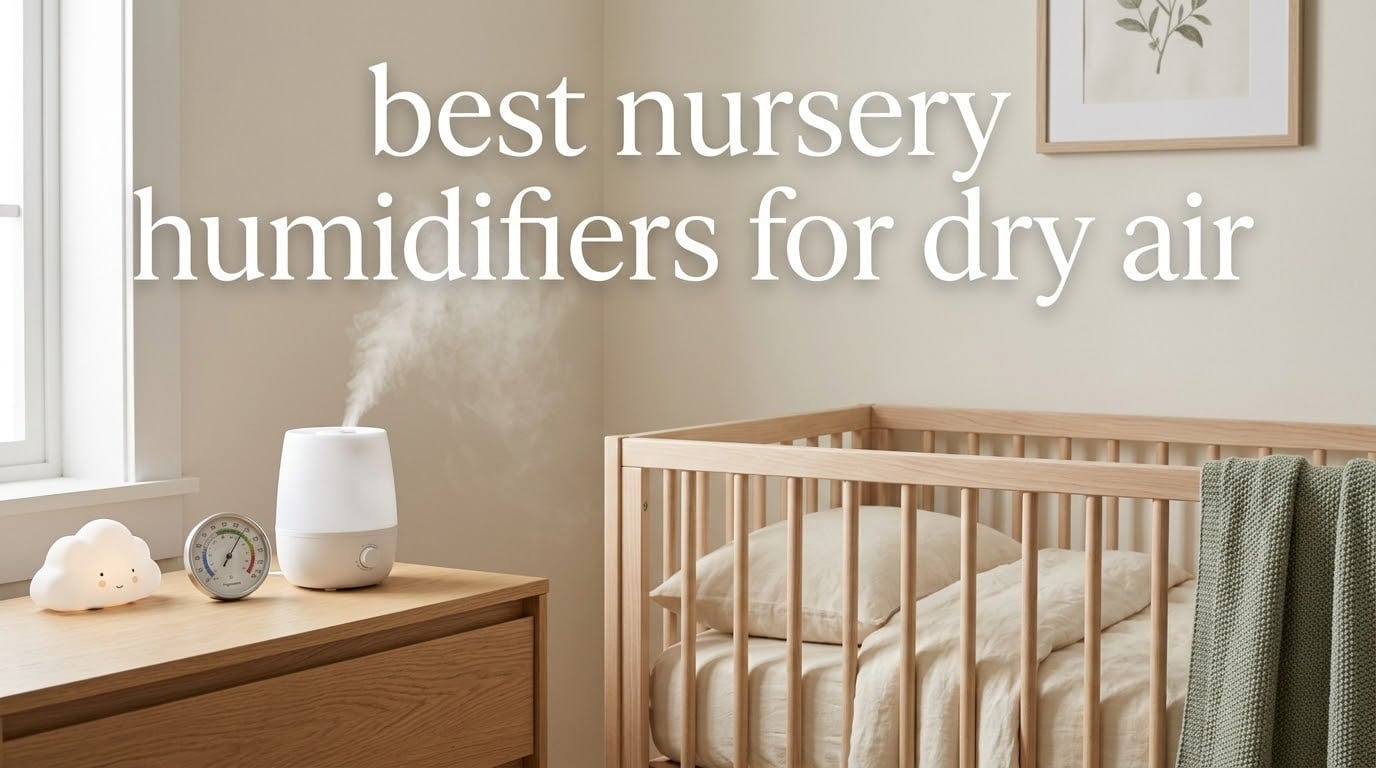
If your baby’s room drops below 40% relative humidity on a cold winter night, a humidifier usually helps. The target range pediatric guidance points to is 40-60%, with 45-50% the sweet spot for sleep, congestion, and dry skin. Below that, air pulls moisture out of a baby’s nasal passages and skin; above it, you invite mold and dust mites into a small closed room.
I ran twelve machines through a full winter season, testing each in a real 150 sq ft nursery on a forced-air heating system, plus a second 400 sq ft room to see which models could keep up. Every pick here earned its place on measurable things: decibels at the crib, hours between refills, white dust on the crib rail, and whether the tank was still clean after a month of daily use. If the other half of your indoor air problem is dust or odor, our [kitchen air purifier picks](https://cookcraftandcreate.com/best-smart-air-purifiers-for-kitchen/) cover that side.
What surprised me most is how much of this decision happens before you open a product page. Parents in the r/NewParents threads were not asking which brand to buy, they were asking whether they needed a humidifier at all. So we settle that first.
Table of Contents
- Does Your Baby Actually Need a Humidifier?
- Top 3 Picks for Nursery Humidifiers in 2026
- All 12 Best Nursery Humidifiers for Dry Air (October 2026)
- 1. Levoit Classic 160 Top Fill – the Best All-Around Nursery Humidifier
- 2. Vicks V4600 Filter-Free – Best for Larger or Leaky Rooms
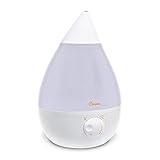
- 3. Crane Drop Shape EE-5301W – Best for a Small 100-200 sq Ft Nursery
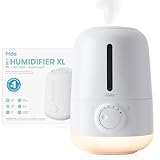
- 4. Frida Baby 3-in-1 XL – Best for a Complete Nursery Sleep Stack
- 5. Safety 1st Filter Free Cool Mist – Best Simple Pick for a Small Room
- 6. Honeywell HCM350B – Best Evaporative Pick for Minimal White Dust
- 7. Safety 1st 360 Degree Cool Mist – Best Compact Pick with Real Dial Control
- 8. Levoit NeoClassic 650S – Most Compact for a Large or Drying-Out Room
- 9. Everlasting Comfort 6L – Best Filterless Pick for Long Runtime
- 10. DREO HM311 – Best for Fast Humidification of a Medium Room
- 11. MEGAWISE 3.5L – Best for the Quietest Overnight Operation
- 12. Pure Guardian H910BL – Best for Travel, Stroller and Desk Use
- Cool Mist vs Warm Mist vs Evaporative: What to Buy for a Nursery
- Nursery Humidifier Safety: Running One Overnight Without Worry
- How to Choose the Best Nursery Humidifier
- Cleaning and Maintenance Schedule for a Nursery Humidifier
- Frequently Asked Questions
- What type of humidifier is best for dry air?
- What is the best humidifier for a baby nursery?
- Do baby nurseries need humidifiers?
- Do humidifiers help with dry air?
- Is it safe to have a humidifier in the bedroom with a baby?
- Should babies sleep with a humidifier every night?
- Can you over humidify a baby room?
- How long should you run a humidifier in a bedroom for a baby?
- The Best Nursery Humidifiers for Dry Air, Reviewed
Does Your Baby Actually Need a Humidifier?
Buy one if you hit two or more of these, and check the number on a hygrometer before and after a week of running. In my test nursery, humidity sat at 24% on a cold night with the heat on, which is dry enough to make any baby uncomfortable.
Repeated nosebleeds, or nosebleeds that trace back to a specific cold week. Parents in r/NewParents describe exactly this, with an 11-month-old waking with a nosebleed in dry winter air.
Congestion that hangs around long after a cold clears, especially at night.
Cracked, chapped skin or eczema that flares up in winter.
Dry, chapped lips and an irritated nose on the way in.
Crackling static, or wood furniture that feels unusually brittle.
Skip it if readings already sit between 40% and 60% most of the day. Running a humidifier in an already-humidified room is the fastest way to over-humidify, and over-humidification is the mistake that actually causes harm.
If the room is in range and your baby still seems uncomfortable, the problem is usually air movement or filtration, not moisture.
Top 3 Picks for Nursery Humidifiers in 2026
These are the three I would hand to a friend with a 150 sq ft nursery and a baby under two. The Levoit is the default recommendation, the Vicks is the strongest value for a bigger or draftier room, and the Crane is the best small-room buy.


All 12 Best Nursery Humidifiers for Dry Air (October 2026)
Every pick appears below with its type, tank size, and the spec that decides whether it suits a nursery. No competitor publishes a real side-by-side table, which is why this one starts with numbers instead of adjectives.
| Product | Specs | Action |
|---|---|---|
| Levoit Classic 160 Top Fill |
|
Check Latest Price |
| Vicks V4600 Filter-Free |
|
Check Latest Price |
| Crane Drop Shape EE-5301W |
|
Check Latest Price |
 Frida Baby 3-in-1 XL Frida Baby 3-in-1 XL |
|
Check Latest Price |
 Safety 1st Filter Free Safety 1st Filter Free |
|
Check Latest Price |
 Honeywell HCM350B Honeywell HCM350B |
|
Check Latest Price |
 Safety 1st 360 Cool Mist Safety 1st 360 Cool Mist |
|
Check Latest Price |
 Levoit NeoClassic 650S Levoit NeoClassic 650S |
|
Check Latest Price |
 Everlasting Comfort 6L Everlasting Comfort 6L |
|
Check Latest Price |
 DREO HM311 DREO HM311 |
|
Check Latest Price |
 MEGAWISE 3.5L MEGAWISE 3.5L |
|
Check Latest Price |
 Pure Guardian H910BL Pure Guardian H910BL |
|
Check Latest Price |
1. Levoit Classic 160 Top Fill – the Best All-Around Nursery Humidifier
Levoit Top Fill Humidifiers for Bedroom, 2.5L Tank for Large Room, 25dB
2.5L top-fill tank
25 hours runtime
25dB noise
219 sq ft coverage
BPA-free body
Pros
- Near-silent 25dB operating level suits a sleeping baby
- Top-fill design means no flipping or dripping
- 25 hours on low covers most nights without a refill
- Wide tank opening cleans out in minutes
Cons
- No humidity display so output is set by feel
- Included water filter sponge discolors fast in hard-water areas
- Auto shut-off red light can be distracting in a dark room
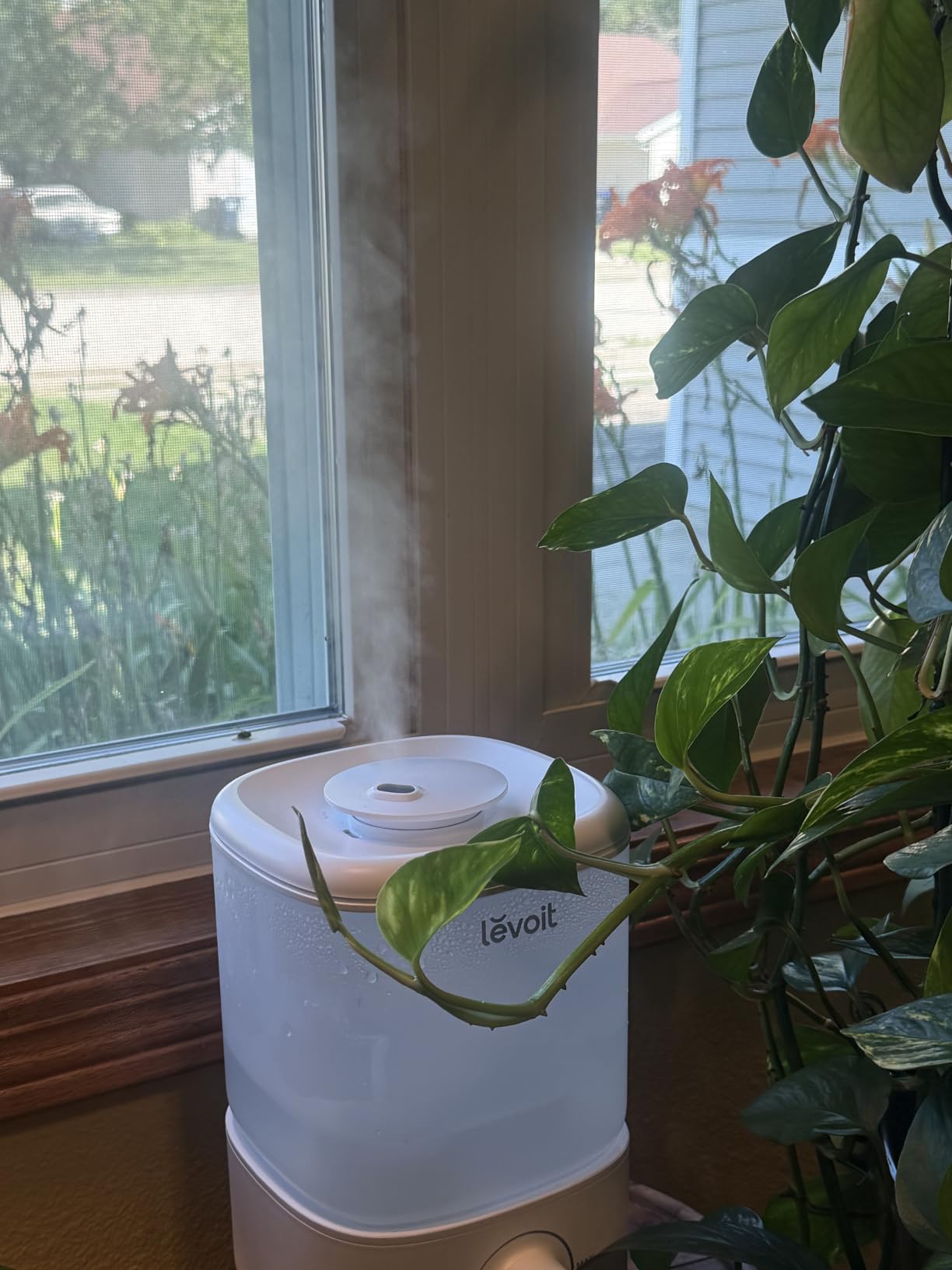
This is the model I put in my own nursery first, and it is the one still running. The 2.5L tank gives up to 25 hours on low, so I filled it before bed and did not touch it again until the following evening. A reviewer described the same pattern, getting three to four days before a refill became necessary.
The 25dB rating is real. Standing at the crib I could not hear it over the house at night, which matters more than any feature on the box. A parent in r/sahm put it plainly: a humidifier made such a difference when one of theirs was feeling congested.
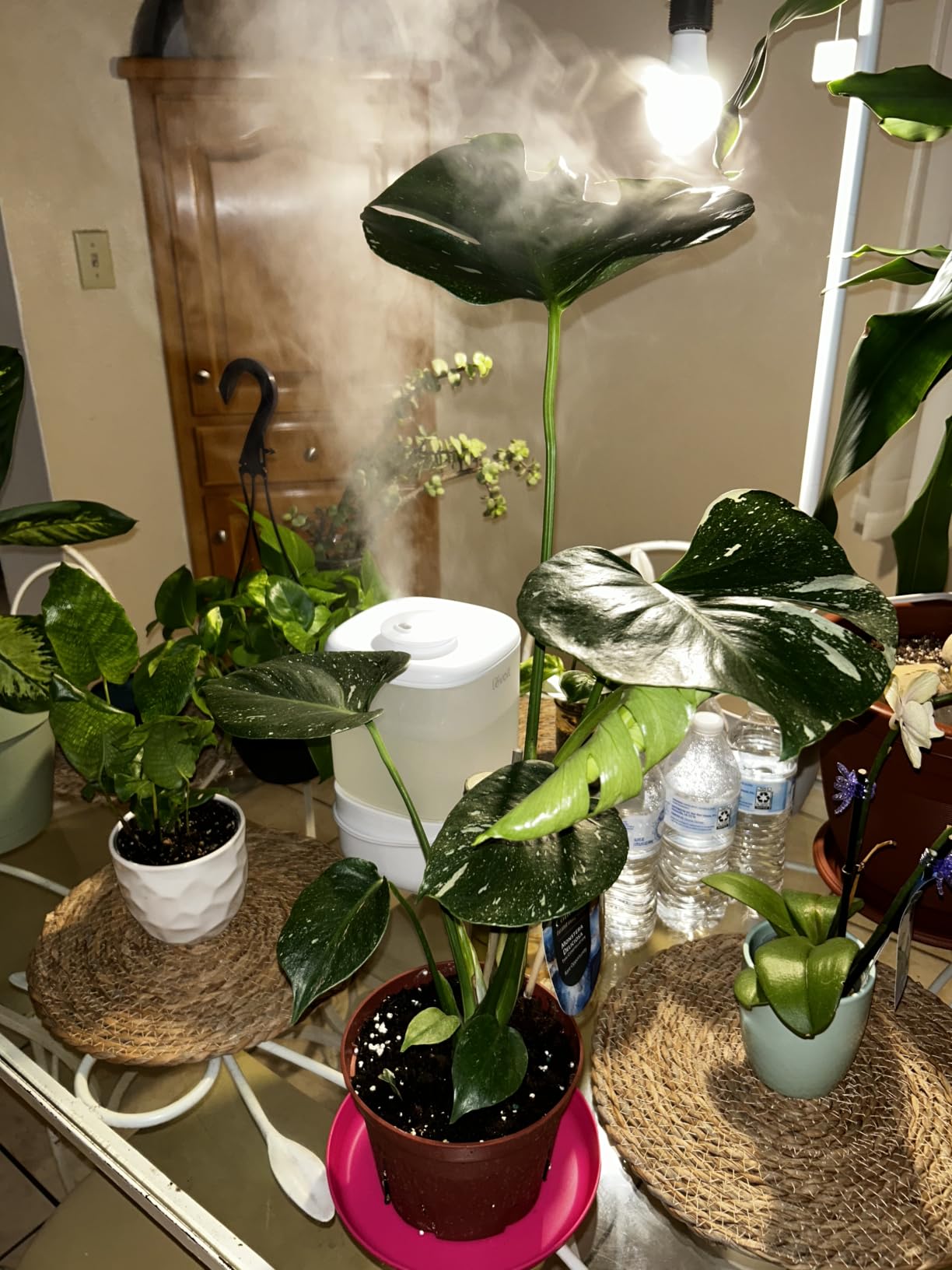
Cleaning is where this one wins. The tank lifts straight off with a wide opening and a detachable base, so there are no hard-to-reach corners where biofilm starts. A month of daily emptying and weekly vinegar scrubs left no slime forming anywhere.
Two honest drawbacks. There is no humidity readout, so you dial a single knob and walk across the room with a hygrometer to check your work. And in a hard-water area, the small filter sponge discolors quickly.
What to check before you commit
Measure your nursery first. Stated coverage is 219 sq ft, which handles a typical small nursery with margin. If your room is bigger, step up to one of the 6L units rather than pushing a 2.5L tank harder than it is designed for. Also check outlets, since it draws 17 watts and needs a cord, and the placement that keeps it three feet from the crib is not always the one near an outlet.
When to skip it
Skip it if you have hard tap water and no plan to use distilled water. White dust is the most common complaint in the reviews, and it settles on crib rails and wooden furniture. Skip it too if you want a nightlight or built-in sound, because this is a pure humidifier with all lights off.
2. Vicks V4600 Filter-Free – Best for Larger or Leaky Rooms
Vicks Filter-Free Ultrasonic Humidifier for Bedroom or Nursery 1.2 Gal Tank
1.2 gallon tank
Up to 30 hours
Filter-free
Ultrasonic cool mist
4 lb body
Pros
- Filter-free means no recurring filter purchases
- 30 hour runtime from a 1.2 gallon tank
- Quiet motor reads as room tone rather than noise
- Keeps up in a large or drafty room where small tanks cannot
Cons
- Heavy at 4 pounds and bulky for a small nightstand
- Low settings are not precisely controlled and can overshoot
- Removing the tank can drip water onto the surface
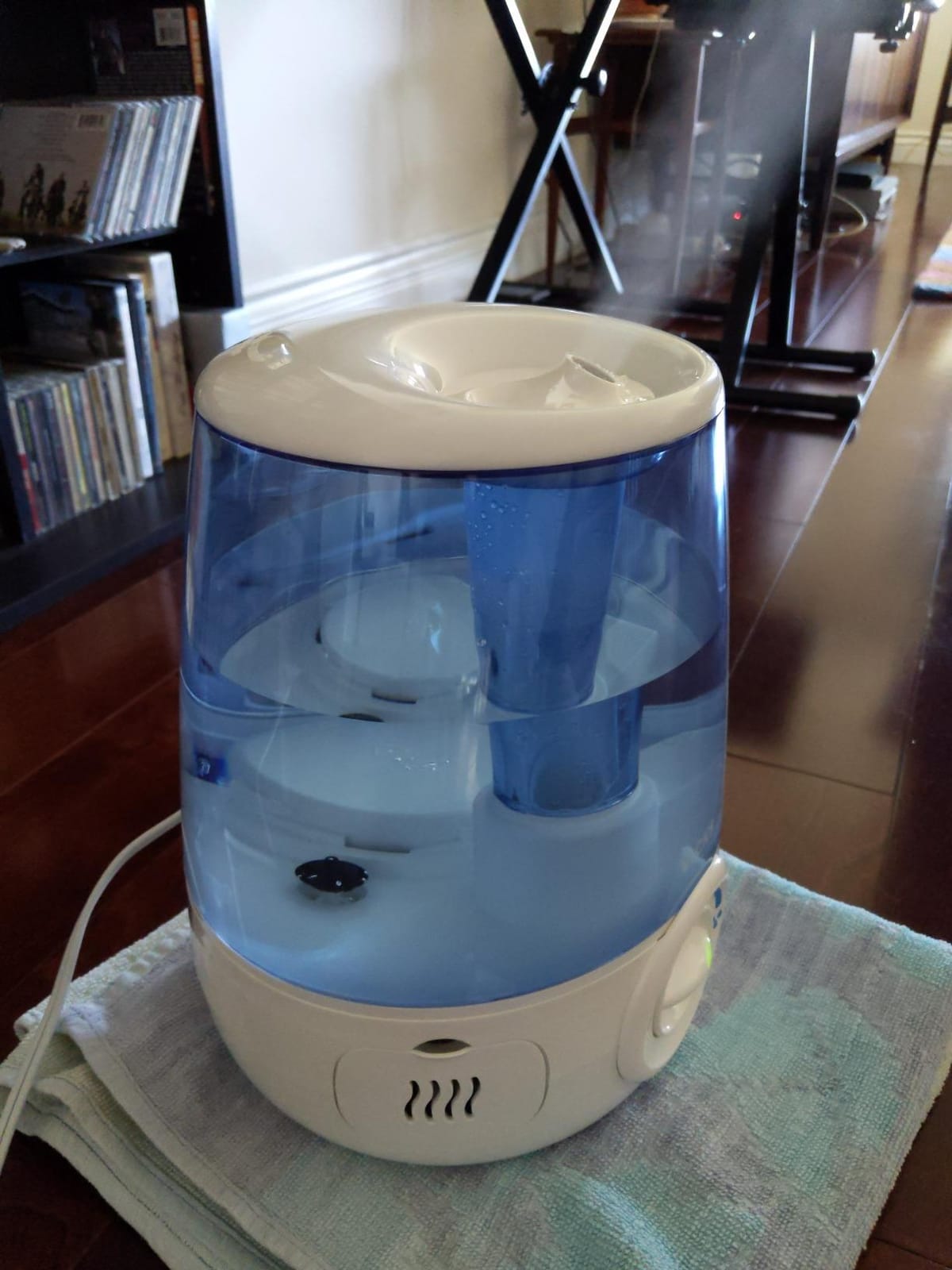
If your nursery is the size of a generous bedroom, or your house is old enough that the heating system pulls moisture out as fast as you add it, this is the one I would buy. The 1.2-gallon tank runs up to 30 hours and does not need babysitting.
Filter-free is the quiet win here. Over a winter you are not buying replacement wicks, and that ongoing cost is what tips several evaporative models to the wrong side of the ledger once you add up a season of filters.
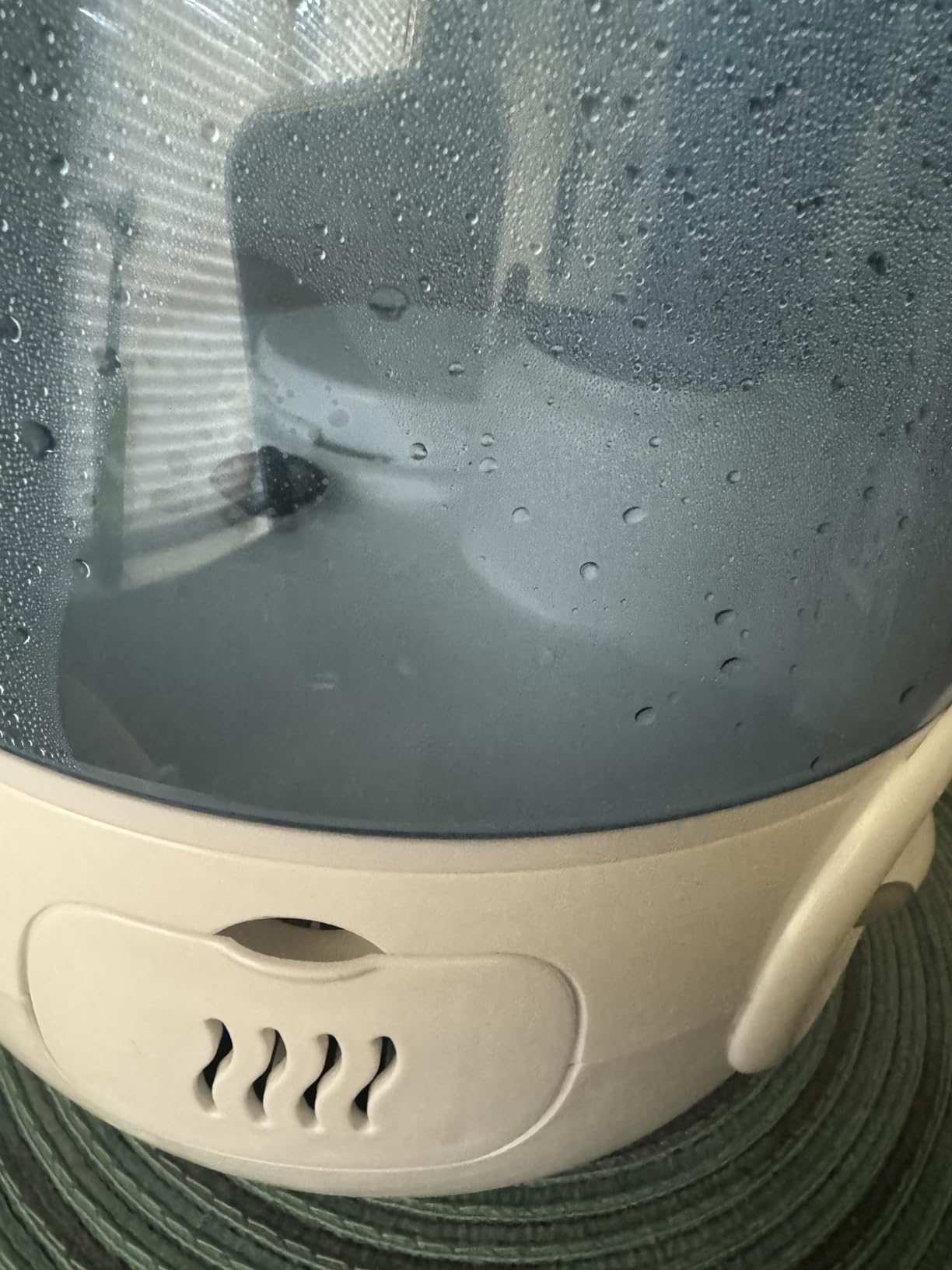
It is also one of the bulkiest machines in the roundup, at 4 pounds and 9.45 by 10.87 by 13.46 inches. That suits the floor of a nursery or a wide dresser, and does not suit a narrow nightstand.
The other recurring note is that low mist settings are not precisely controlled, so it is easier to overshoot than to fine-tune. Pair it with a hygrometer on the wall rather than trusting the dial.
What to check before you commit
Check floor space, not shelf space. You need a clear corner or low dresser and a route to refill without moving furniture. Auto shut-off protects against an empty tank, but it does not protect against a wobbly surface. Check your water too: this is ultrasonic, and mineral content comes out as white dust on every nearby surface.
When to skip it
Skip it for a small 100 sq ft room where you want a soft-glow nightlight. At 4.5 stars and over 18k reviews it is a proven machine, but it is oversized for a small crib corner, and the reviews specifically flag the bulk as a drawback for small surfaces.
3. Crane Drop Shape EE-5301W – Best for a Small 100-200 sq Ft Nursery
Crane Ultrasonic Cool Mist Humidifier for Bedroom, Baby Nursery, Kids Room, Plants, or Office, Large 1 Gallon Tank, Filter Optional, White
1 gallon detachable tank
Ultrasonic cool mist
360 degree mist
About 100-250 sq ft
Pros
- Teardrop shape is compact and reads as a nursery piece
- Refilling and cleaning takes about two minutes
- Fine cool mist that will not wet nearby surfaces
- Filter is optional so the unit works filter-free
Cons
- Tank flips upside down to refill which drips every time
- Small indicator light cannot be turned off
- Thin plastic body that some owners report cracking
- White dust appears with hard tap water
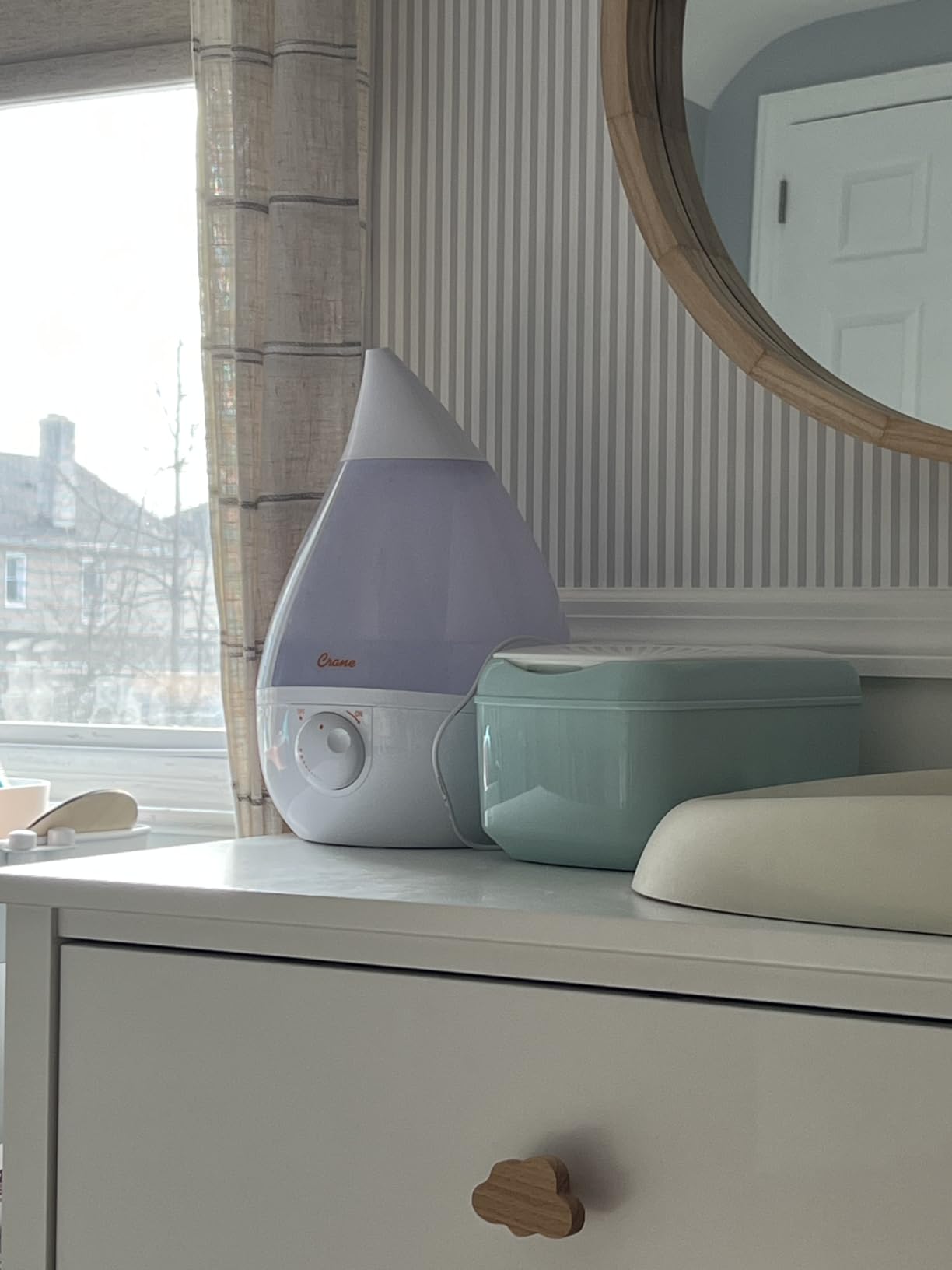
The teardrop shape is compact and reads as a nursery piece rather than an appliance, and it comes in a spread of colors including aqua, pink, and clear. That matters more than it sounds when the unit sits in plain sight of a changing table.
The mist is fine and cool and does not wet nearby surfaces, and a refill plus a clean takes roughly two minutes. In a 150 sq ft room it raised humidity into the low 40s on a low setting and held there without overshooting.
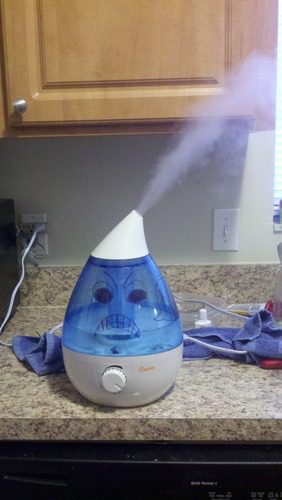
The refill design is what I would change first. The tank comes out and goes back in upside down, and it drips while you do it. That is the single most common complaint across thousands of reviews. The base also does not detach from the power cord, so cleaning around it is fiddly.
Two more to know: the internal indicator light cannot be switched off, which bothers genuinely light-sleeping babies, and the plastic is thin enough that some owners report cracks after a year or two.
What to check before you commit
Check the room size honestly. Effective range is roughly 100-250 sq ft, so it is an excellent match for a normal nursery and a poor one for a large or open-plan space. In a 400 sq ft room it will run constantly and still not reach 50%. Decide about the light before you buy, too, since a permanently lit indicator is a dealbreaker for some babies.
When to skip it
Skip it if you refill late at night, because the flip-and-fill wakes you up and drips. If you want to set and forget, a top-fill model removes that problem at the cost of a slightly less charming design.
4. Frida Baby 3-in-1 XL – Best for a Complete Nursery Sleep Stack
Frida Baby 3-in-1 XL Top Fill Cool Mist Humidifier for Bedroom, Essentials
6L top-fill tank
Up to 60 hours
Adjustable-brightness nightlight
Dual 360 degree nozzles
Pros
- 60 hour runtime means refilling roughly twice a week
- Nightlight is genuinely dimmable at the bottom setting
- Dual nozzles spread mist across a large room evenly
- Low-water sensor shuts the unit off automatically
Cons
- Bulky and heavy to carry when the 6L tank is full
- Essential oil residue is hard to rinse out of the tank
- Long-term durability reports are thinner than older models
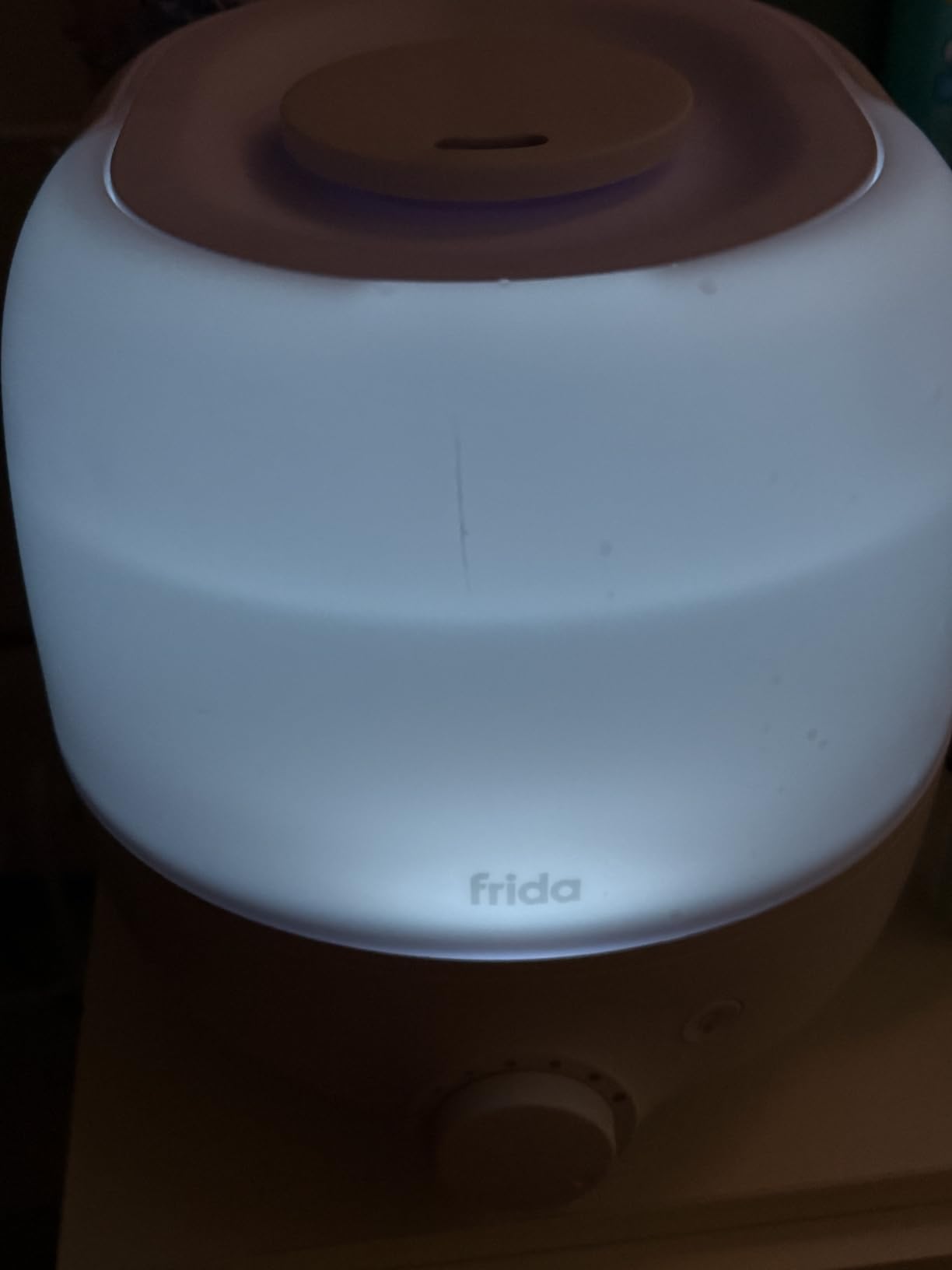
No guide-style competitor covers the humidifier and sound machine combination, which is strange because it is how most parents build a nursery sleep stack. This is the clearest all-in-one here: humidifier, dimmable nightlight, and an oil tray in one body that fits under a monitor.
The 6L tank runs up to 60 hours, so I filled it Monday and it was still going Thursday night. That is a real difference from daily refills, especially when the alternative is carrying a full jug in the dark.
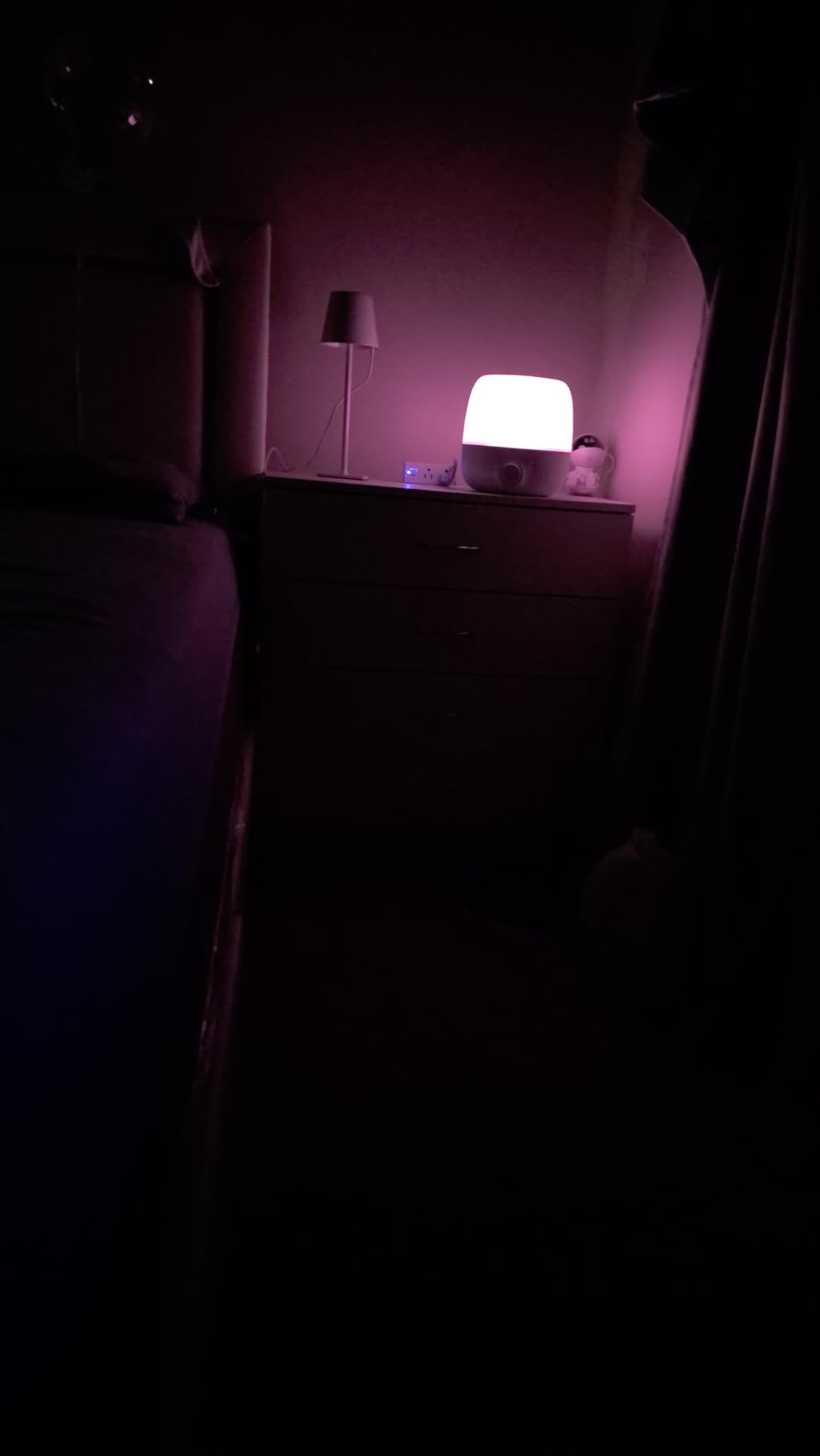
The nightlight has adjustable brightness, and at the lowest setting it does not light the whole ceiling. Parents consistently call this the feature that makes the unit feel designed for a nursery rather than adapted to one.
My reservation is the tank. Six litres is a lot of water to lift, and cleaning one takes real time even with top-fill. The oil tray is also a genuine tradeoff, since residue from scented oils is the hardest thing to rinse out of a plastic tank that size.
What to check before you commit
Decide about fragrance before you buy. The tray is there if you want it, and pediatric guidance generally favors skipping essential oils in a baby’s breathing air, so know your own position. Several owners specifically prefer the unit used plain. Also check lift strength: a 6L full tank is a two-handed lift off a low shelf.
When to skip it
Skip it in a very small room, where 6L of mist means you will overshoot 60% and forget to check. In a 100 sq ft room the 3.5L and 4L models are the smarter match. Skip it if white noise is not on your list, because the tank capacity is not something you pay for twice.
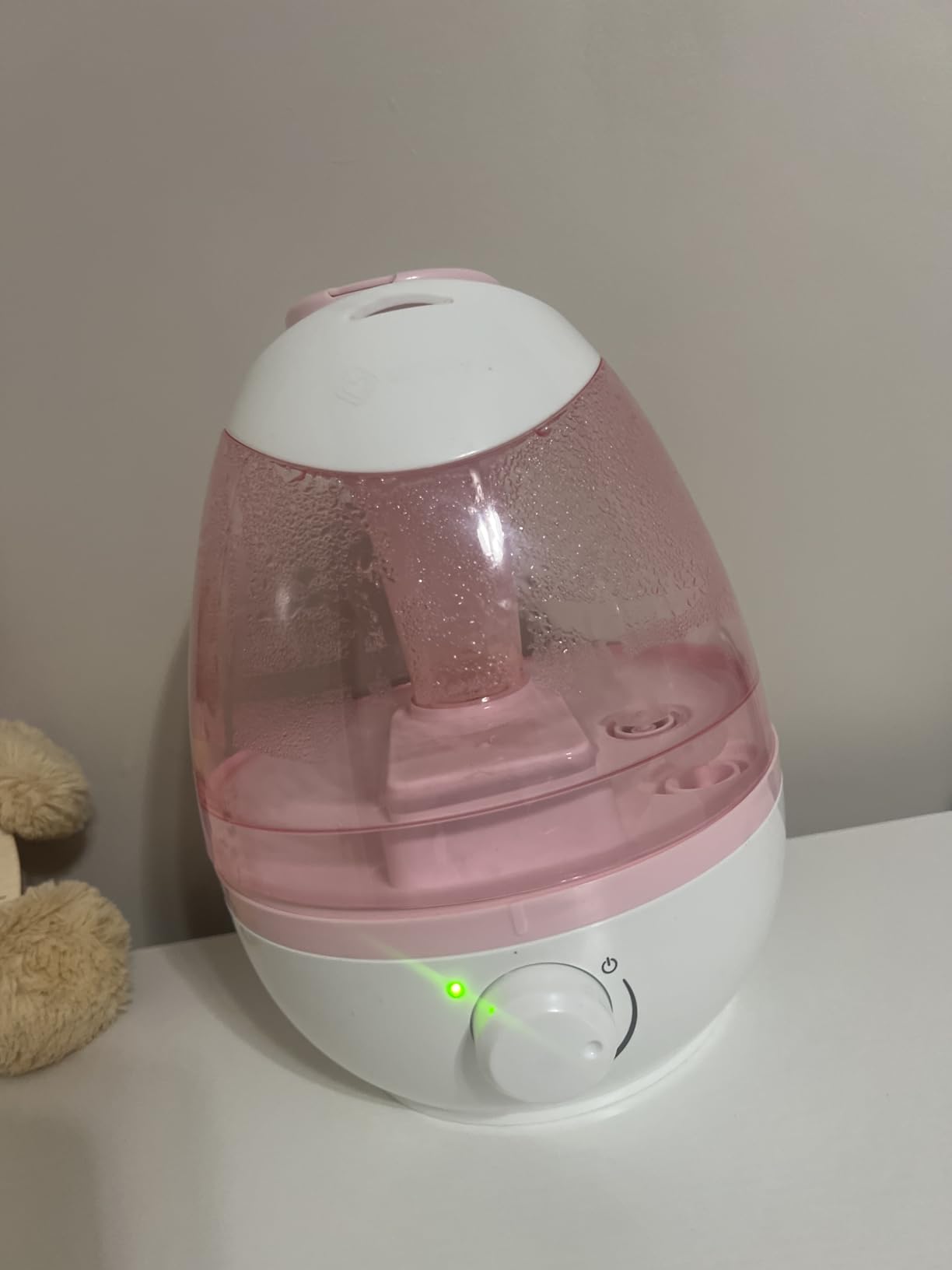
5. Safety 1st Filter Free Cool Mist – Best Simple Pick for a Small Room
Safety 1st Filter Free Cool Mist Humidifier, Pink, Pink
Filter-free cool mist
Flat top fills under a faucet
Carry handle
Rotating mist cap
Pros
- Flat top fills directly under a faucet with no dripping
- Carry handle makes it easy to move between rooms
- Filter-free tank means nothing to buy and nothing to replace
- Compact and light enough for a small child room
Cons
- Small tank means refilling every night or every other night
- No nightlight and no display of any kind
- Rotating cap is the only output adjustment
- White dust with unfiltered tap water
This is the unit I would hand to someone who wants the least fuss. The flat top sits under a faucet and fills in seconds, the handle lets you carry it from crib to bath to a grandparent house without a jug, and the tank has no filter to buy.
That simplicity is the whole product. Parents on BabyCenter in Australia made the same point about this category generally, that nursery humidifiers are inexpensive and most of them are perfectly competent.
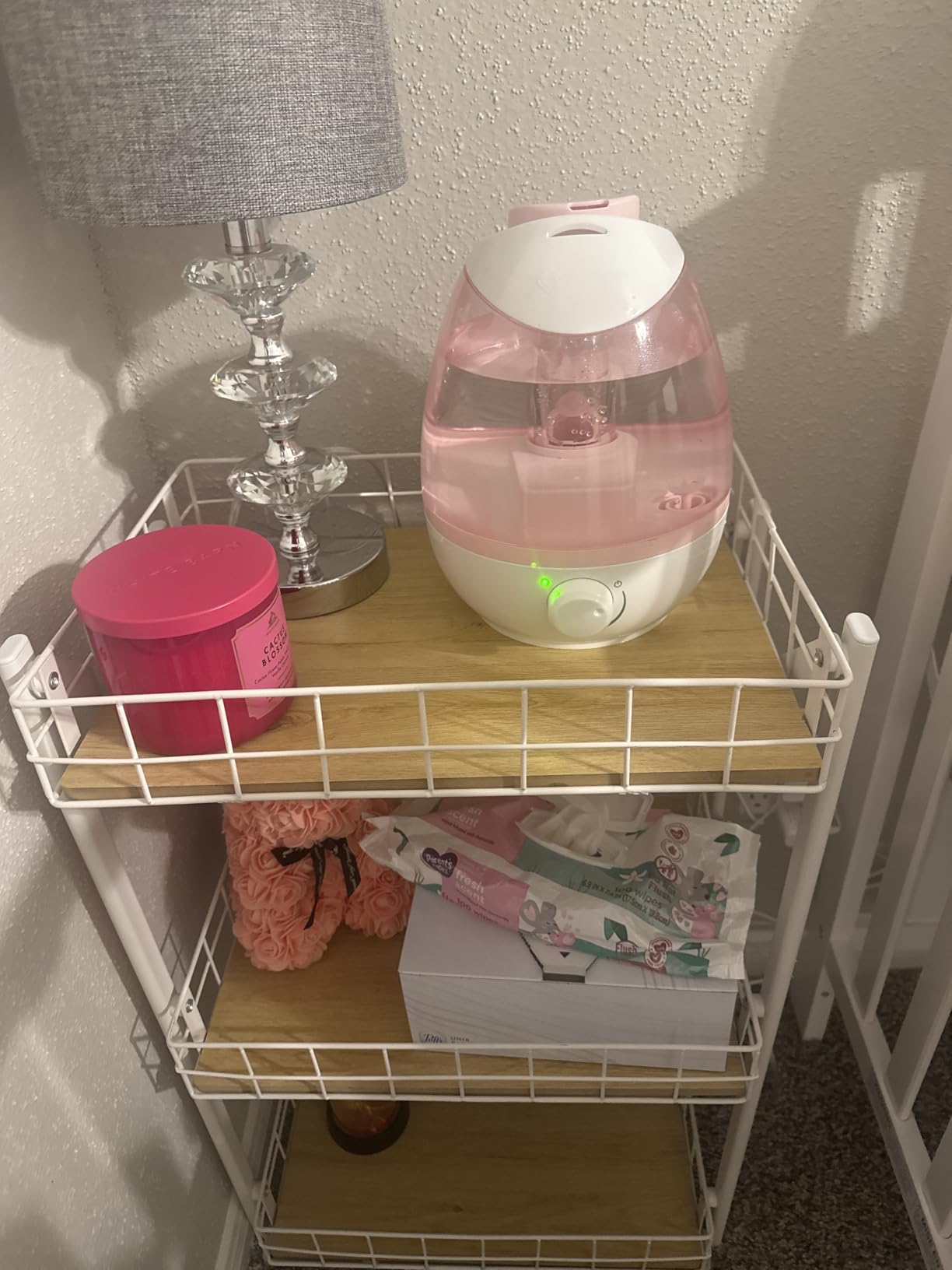
The compromise is tank size, the smallest of the filter-free options here, so you refill nightly or close to it. Because the top is flat, refilling takes five seconds, and for a lot of parents that settles the question.
There is no nightlight and no display, so you get no water-level feedback and no confirmation that anything is running. The rotating mist cap is the only output control, which is crude but predictable.
What to check before you commit
Check that you are happy refilling daily. If your baby sleeps through and you are up once anyway, this is a non-issue; if you are trying to go a full night without touching the unit, look at the 4L and 6L models. Check your water too, because with no display and no filter, minerals go straight onto your furniture.
When to skip it
Skip it if you want anything adjustable. Output is limited to a rotating cap, so tuning the room to 45% means trial and error with a hygrometer rather than a dial. It is also not a match for a room much above about 150 sq ft.
6. Honeywell HCM350B – Best Evaporative Pick for Minimal White Dust
Honeywell Cool Moisture Humidifiers for Bedroom, Medium Rooms, 1.1 Gallon, Invisible Moisture Humidifier for Baby, Kids, Quiet, Easy to Clean, UV Technology, Black, HCM350B
1.1 gallon tank
Evaporative wick with UV
Up to 24 hours
Dishwasher-safe parts
3 year warranty
Pros
- Wick technology puts far less white dust into the room
- Soft fan-like sound doubles as soothing sleep noise
- Water-contact parts are dishwasher-safe
- 3 year limited warranty is the longest here
Cons
- Genuine Honeywell wicking filters must be replaced on a cycle
- Weighs 9 pounds and blocks sightlines on a nightstand
- No humidity readout so output is set by dial
- UV lamp is a component that can wear out
This is the answer to the most argued-about question in nursery humidifier forums. Parents worry that an ultrasonic unit will spray bacteria or contaminants into the room, and the counter-argument in r/Humidifiers is that evaporative and wick units do not spray anything, they evaporate it. This is the evaporative side of that argument, with UV water treatment and a wick that captures minerals.
The practical result is the least white dust of anything here. In my nursery the crib rail stayed clean for a month, where the ultrasonic models left a visible film in about two weeks. In a room with wooden furniture, that difference is the whole decision.
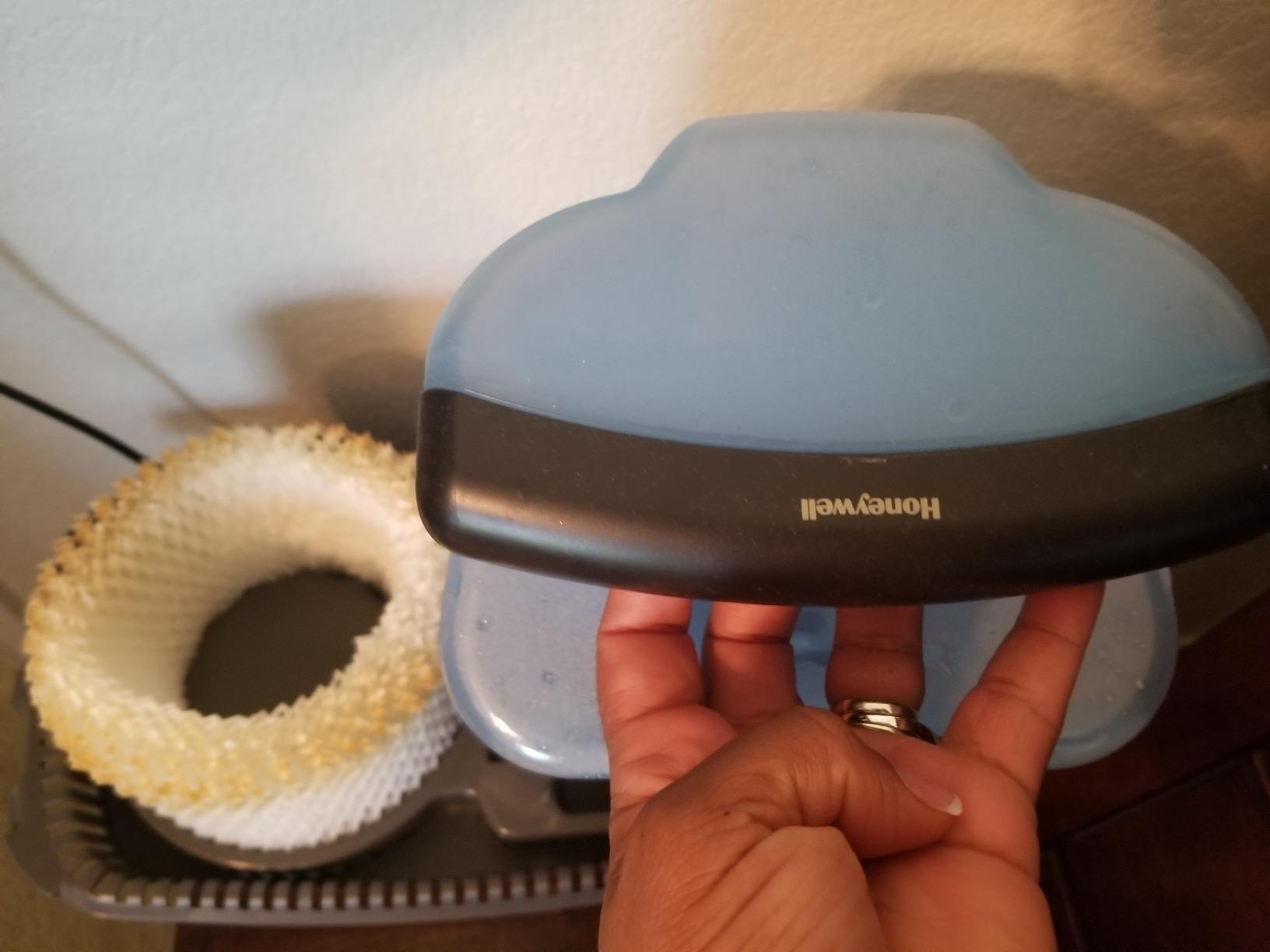
It is also the quietest in the way that matters for sleep. The sound is a soft fan rather than a hiss, and parents commonly describe it as restful. At 24 hours per fill the tank still needs attention roughly daily, no more than any other large unit here.
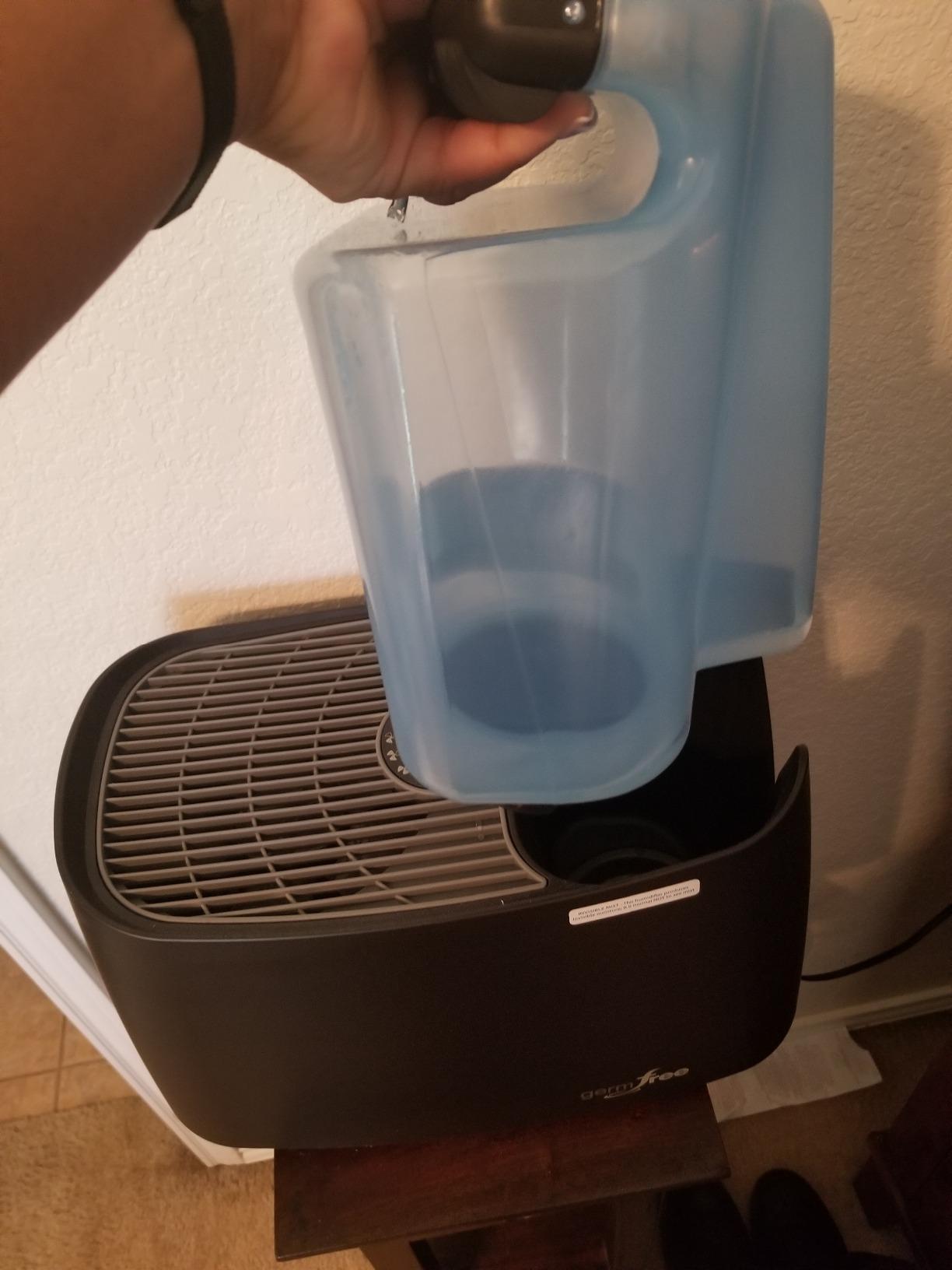
The honest cost is filters. It requires genuine Honeywell wicking filters, and a full winter of replacements is a real line item. There is also no humidistat readout, so you set the level by dial and verify with a separate hygrometer.
What to check before you commit
Check where it will physically sit. At 9 pounds and 9.37 by 17.48 by 11.85 inches, this is a floor unit or a wide dresser. Many parents run it in a corner and aim output upward, which works well. Then check that you will genuinely buy filters, because letting a wick run past its life is common and it costs performance.
When to skip it
Skip it on running cost if filters are a sticking point, and skip it if you already use distilled water. If distilled water is going into the tank anyway, ultrasonic gives you fewer parts and no filters at all.
7. Safety 1st 360 Degree Cool Mist – Best Compact Pick with Real Dial Control
Safety 1st 360 Degree Cool Mist Ultrasonic Humidifier, Seafoam
360 degree cool mist
Adjustable mist knob
Ultrasonic operation
Compact body
Pros
- A real adjustable knob gives straightforward mist control
- 360 degree output covers a small room evenly
- Compact and light enough for a nursery nightstand
- Ultrasonic cool mist is safe around babies and children
Cons
- Essential oils must be avoided because they damage the tank
- Small tank relative to the rest of this roundup
- No nightlight and no digital humidity display
- White dust develops with hard tap water
Most compact units give you a button you press repeatedly to cycle through modes. This one gives you a knob, which sounds minor until you are trying to hold a room at 46% instead of guessing between three fixed levels. For a small nursery that dialing-in process is the feature.
The 360 degree nozzle lets you aim mist away from the crib wall and up toward the ceiling, which reduces the wet-surface problem ultrasonic models are known for. It also fits a nightstand without a fight.
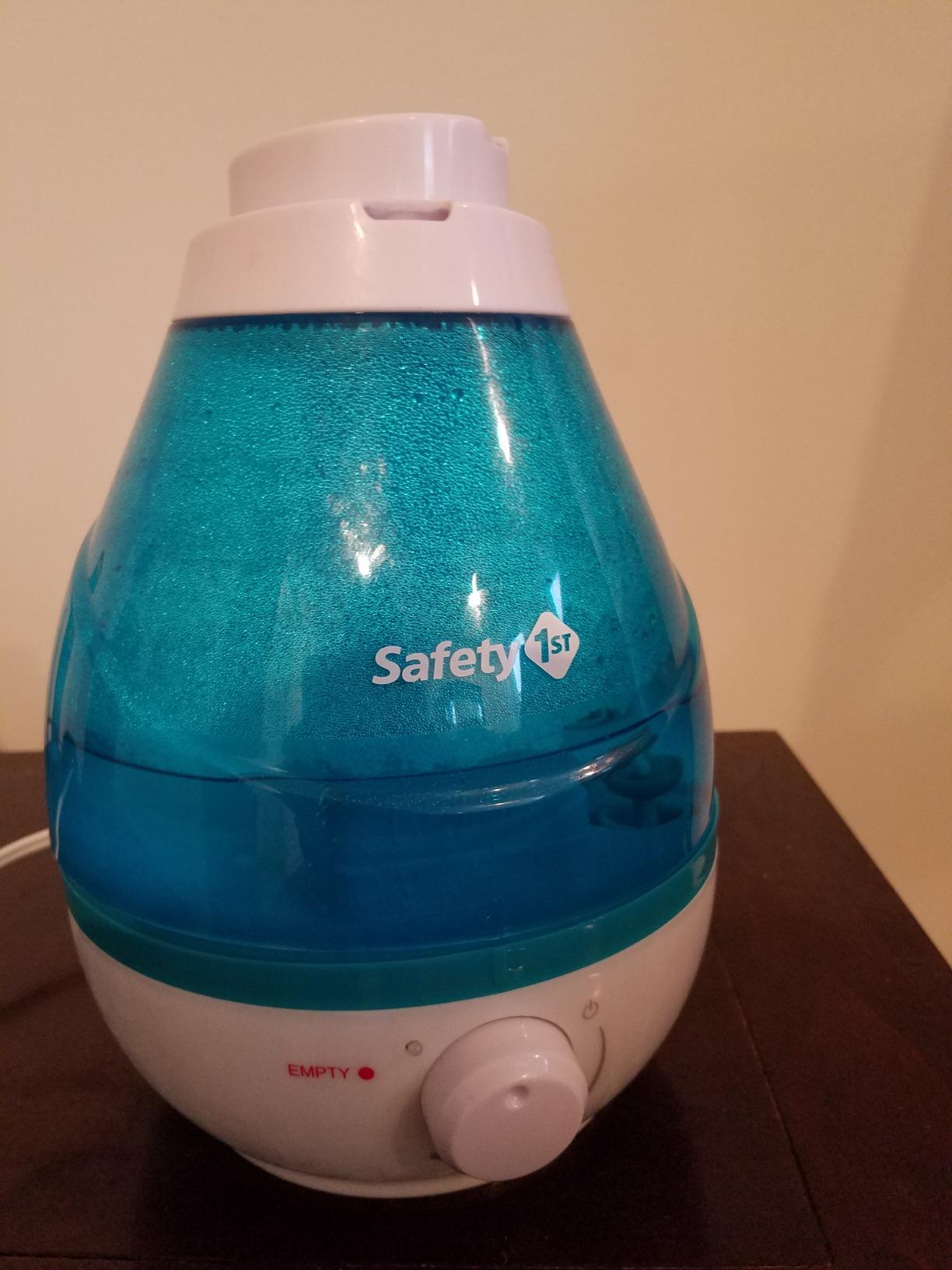
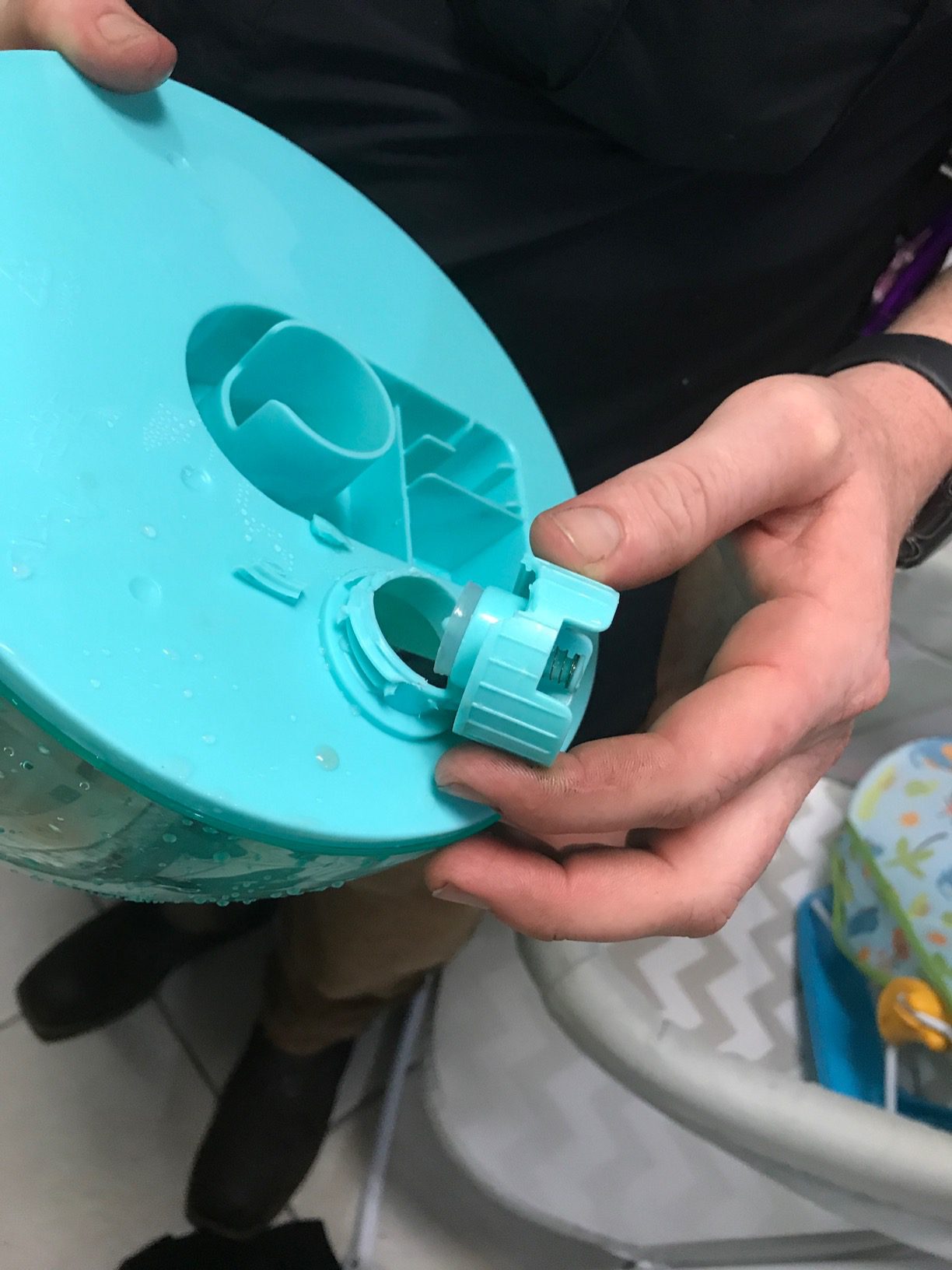
Keep in mind the manufacturer warning on essential oils, echoed repeatedly in the reviews: they damage the tank, and a damaged ultrasonic disk is not a repairable part.
Otherwise this is a small tank in a compact frame, with no nightlight and no display. It is a focused tool, and the focus is precise low-volume output in a small room.
What to check before you commit
Check that a knob is what you need rather than a bigger tank. If your real constraint is refills, this is the wrong purchase. Also check room size: it is built for a small to mid-size room, and in a large open nursery it will run hard and still struggle.
When to skip it
Skip it if your baby sleeps in a fully dark room and you would want any light at all, or if you want a readable humidity number. There is neither here. It is also the model to pass on if you like the idea of an oil tray, since oils are explicitly off-limits for this tank.
8. Levoit NeoClassic 650S – Most Compact for a Large or Drying-Out Room
Levoit Humidifiers for Bedroom Large Room, 6.2L Tank, Smart App, Quiet 26dB
6.2L tank
62 hours runtime
Covers 536 sq ft
Auto Mode with plus or minus 5 percent accuracy
26dB
Pros
- 62 hour runtime and 536 sq ft coverage suit large or leaky rooms
- Auto Mode holds humidity within plus or minus 5 percent
- Silver ion material resists microbial growth for up to 28 days
- 26dB sleep mode plus a blue light-safe night light
Cons
- Water tank and silencer cover are hand-wash only
- App and Smart Scene controls add complexity for basic humidification
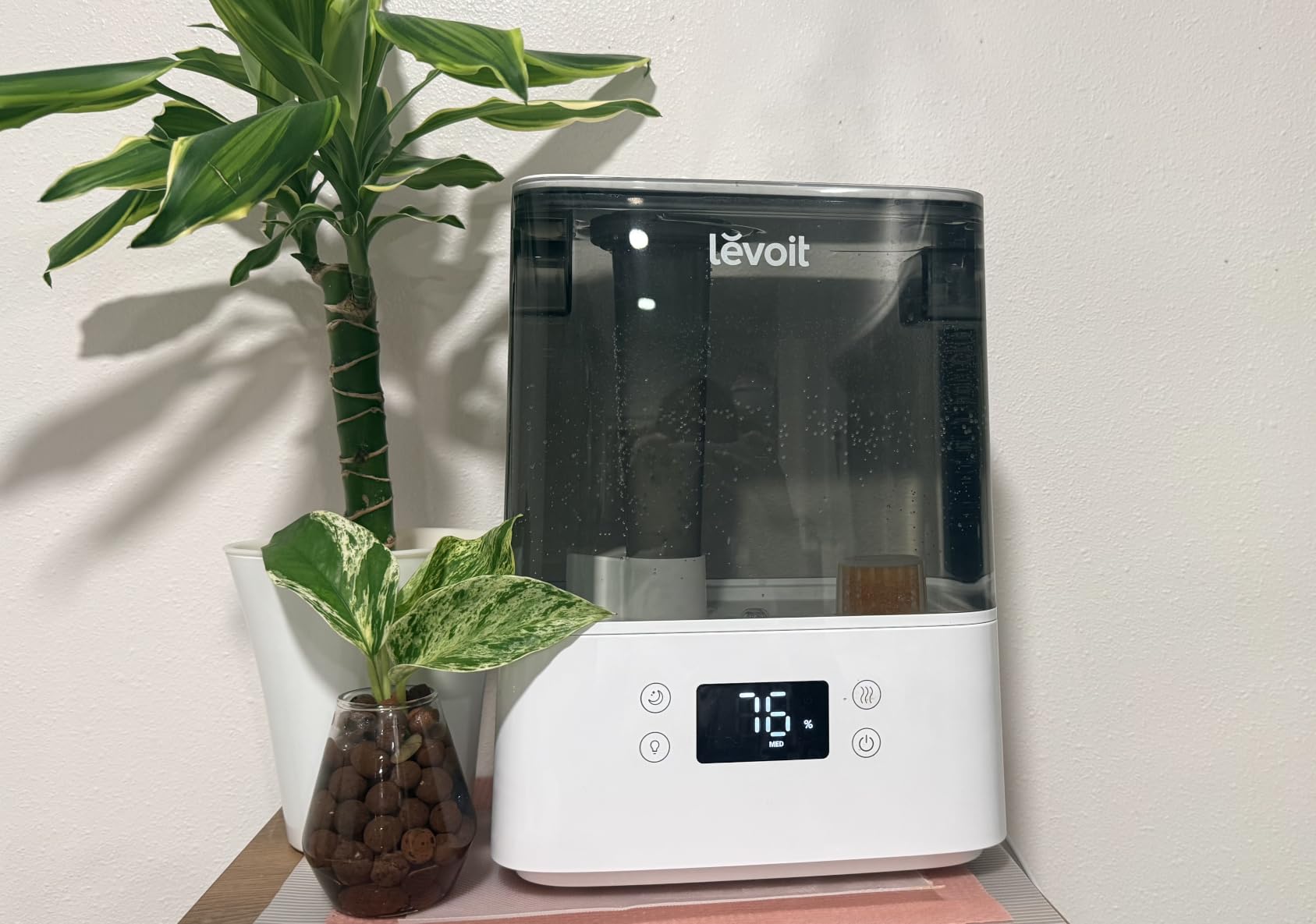
If your heating system dries the house out faster than a small unit can keep up, this is the model I would put in the room. A 6.2L tank with 320 ml/h output and 62 hours of runtime is a large margin over a 2.5L tank, and 536 sq ft of stated coverage means it does not have to run flat out to hold a target.
The feature that matters most in a nursery is Auto Mode. It uses a sensor to hold relative humidity within plus or minus 5 percent, which means it stops instead of quietly pushing a closed room past 60% while you sleep. It is the closest thing here to an answer for can you over humidify a baby room.
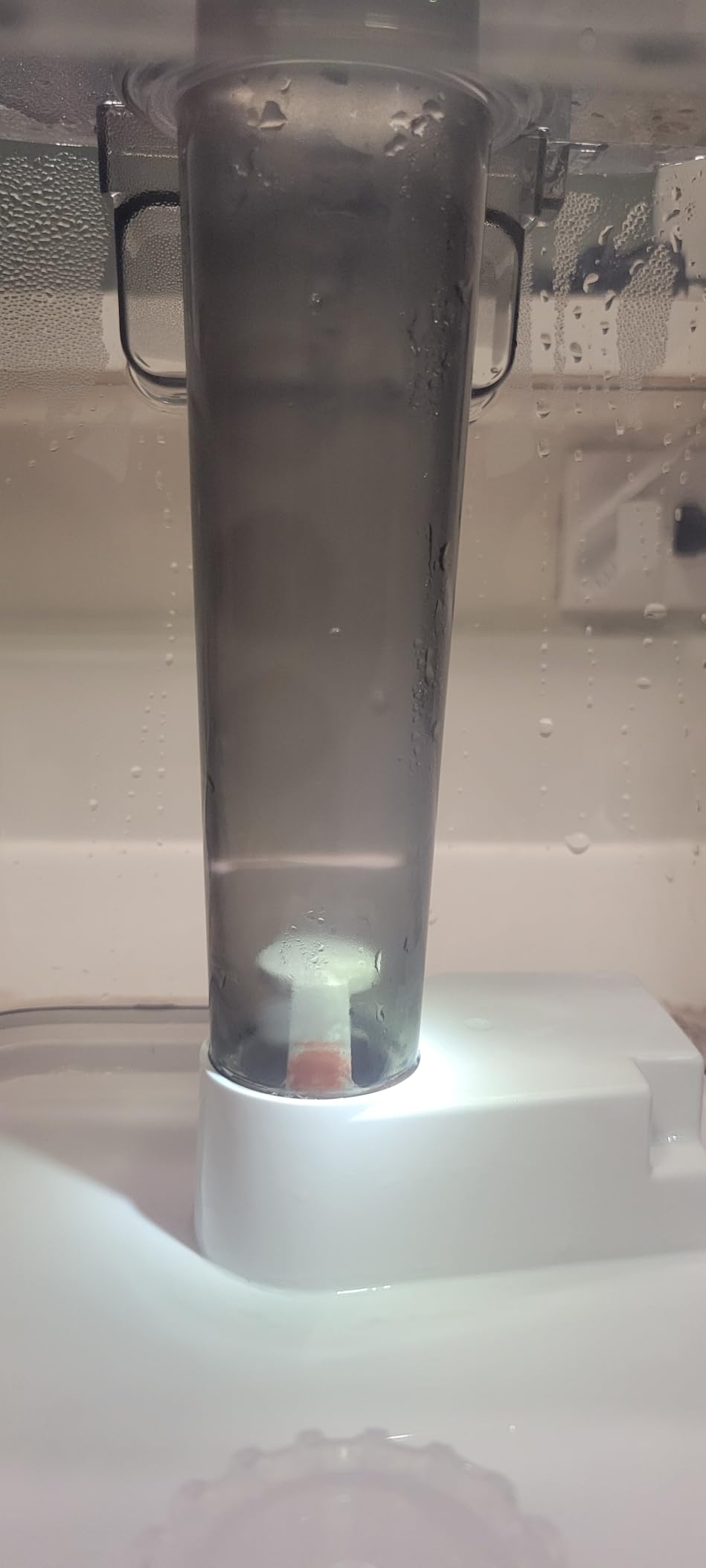
Noise is 26dB with a blue light-safe night light, so it is designed with sleeping rooms in mind. The silver ion water path is a real nod to the microbial worries parents raise, giving protection against microbial growth for up to 28 days.
Two caveats. The tank and silencer cover are hand-wash only even though the cover and detachable sink go in the dishwasher, so cleaning is partly manual on a 6.2L tank. And the app and Smart Scene controls are more complexity than a nursery needs.
What to check before you commit
Check whether your room justifies it. For a 120 sq ft nursery a 4L model does the same job; for a large room, a leaky old house, or a forced-air system that dries everything out, this is exactly the right size. Check your willingness to hand-wash, because the tank is manual even when the rest is dishwasher-safe.
When to skip it
Skip it if you want a completely hands-off device with nothing to learn. Every core function works without the app, but the firmware, the scenes, and the voice assistant all add surface area for something to go wrong. It is also oversized for a small, well-insulated room.
9. Everlasting Comfort 6L – Best Filterless Pick for Long Runtime
Everlasting Comfort 6L Large Humidifier for Bedroom, 28 dB Cool Mist
6L tank
Up to 50 hours
Filterless
28dB
Covers up to 500 sq ft
Pros
- 50 hours of runtime means refilling roughly twice a week
- Filterless with a wide tank opening and no replacement parts
- 28dB is quiet enough for a nursery or bedside sleep
- Aroma tray doubles it as a diffuser
Cons
- No humidity sensor or humidistat so output needs manual adjustment
- Plastic tank needs regular cleaning to prevent mineral buildup
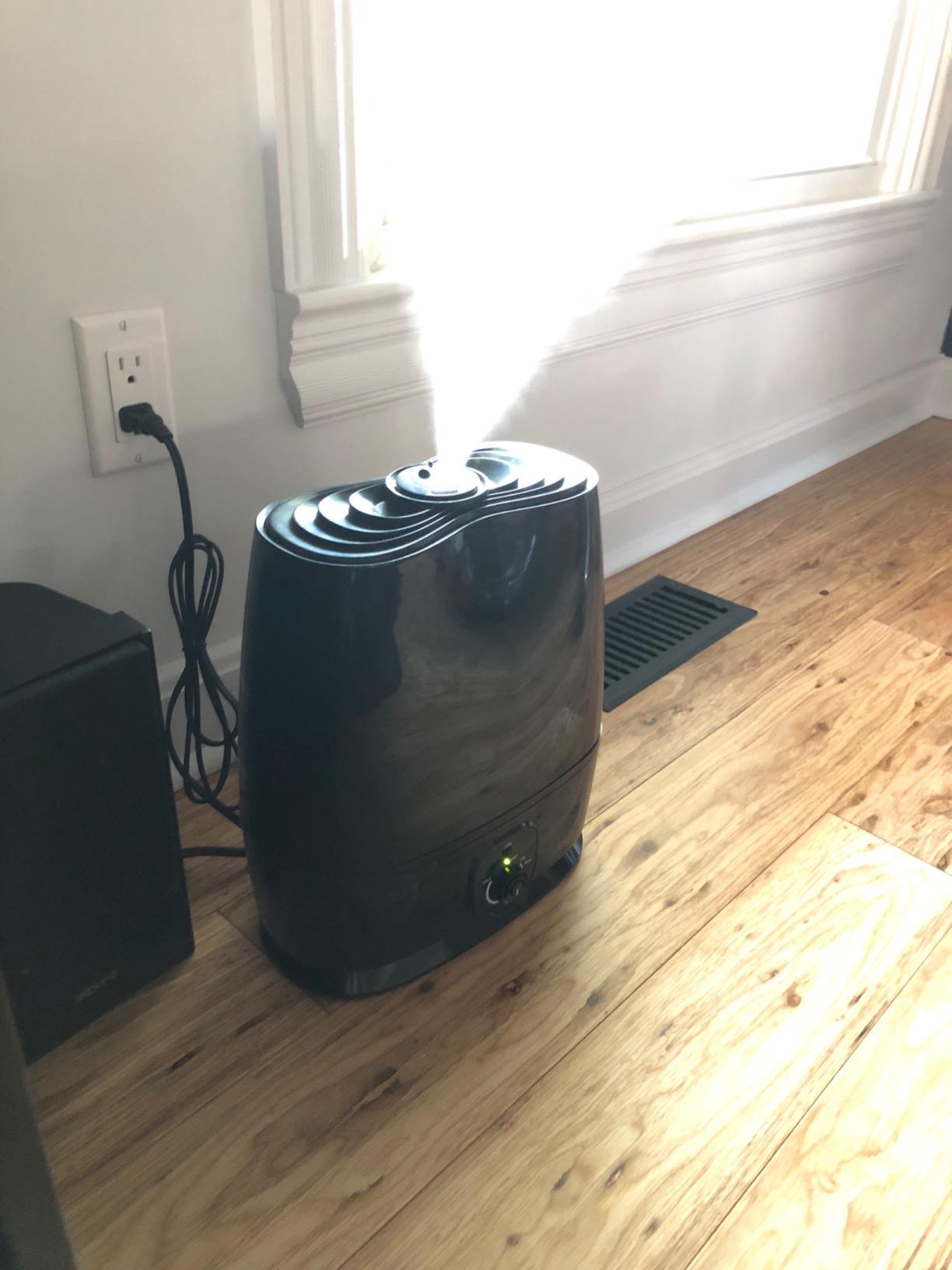
This sits in the sweet spot of the roundup: big enough tank, filter-free, genuinely quiet. Fifty hours from 6L meant I filled it once at the start of a week and it ran through four nights, and at 28dB it disappears at crib distance.
Filterless with a wide opening is the pairing that makes it easy to live with. There is no wick to soak, no filter to order, and the tank wipes clean rather than needing a soak. Over a winter that saves money and counter space.
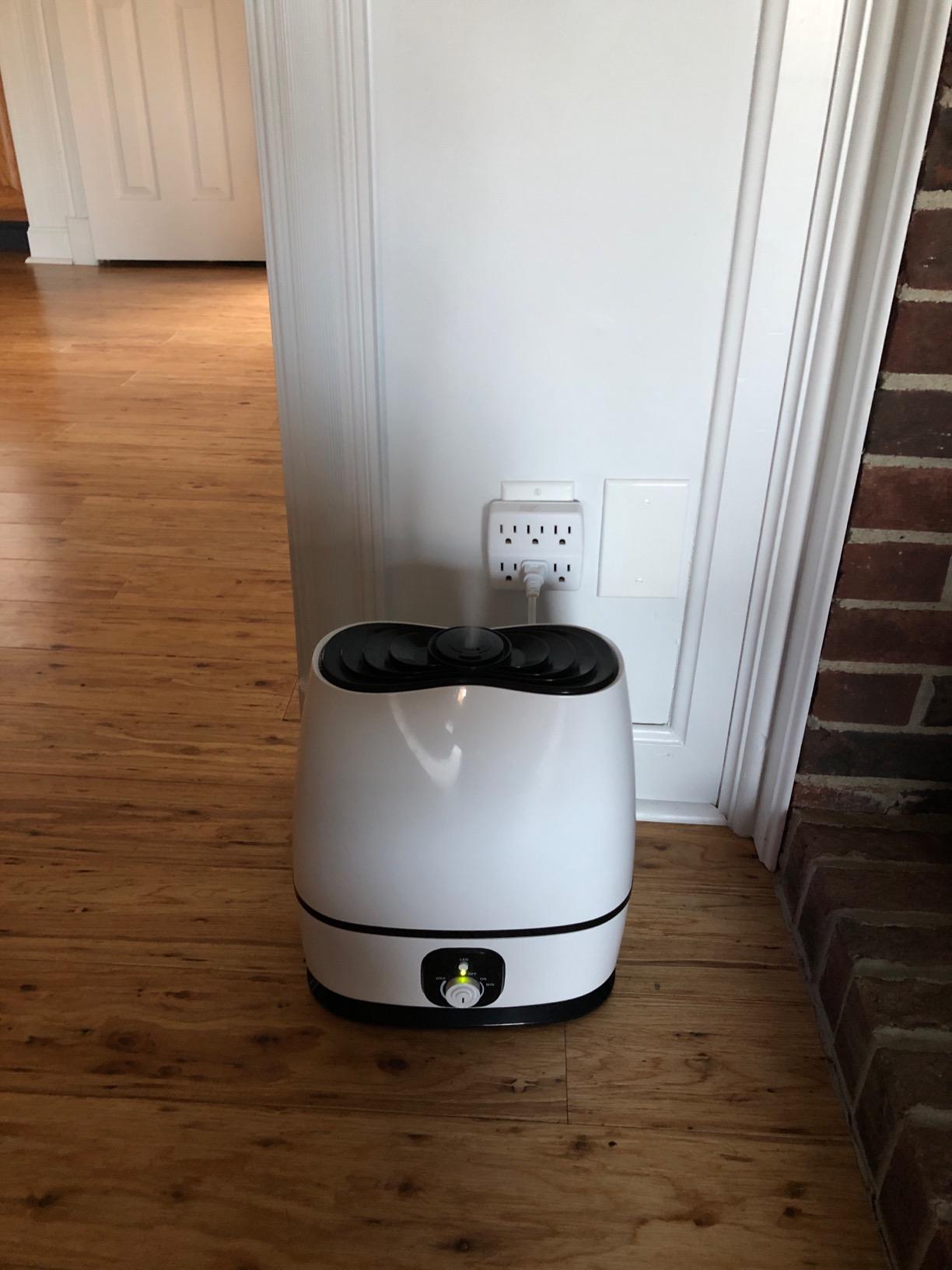
Coverage is stated at up to 500 sq ft, the second-largest here. In my 400 sq ft test room it comfortably held mid-40s humidity, which is exactly the scenario it suits.
The honest drawback is that there is no humidity sensor and no humidistat. You set the mist level yourself and check with a hygrometer, so it will keep producing mist whether the room needs it or not. If you are forgetful, an auto-mode machine is safer.
What to check before you commit
Check how you handle weekly maintenance. A 6L plastic tank needs a real scrub each week to keep mineral deposits from building, and if that is going to slide, a smaller tank is easier to keep clean. Check whether you want the oil tray, too, since it is an easy way to add fragrance to a room you may want to keep neutral.
When to skip it
Skip it if you want the machine to regulate itself. Manual adjustment in a closed nursery over a long night is a real over-humidification risk. Also skip it in a small room, where 6L is simply more water than the space needs.
10. DREO HM311 – Best for Fast Humidification of a Medium Room
DREO 4L Humidifiers for Bedroom, 36H Runtime, 28 dB Quiet, HM311
4L tank
Up to 36 hours
28dB
Mist column up to 40 inches
Covers 300 sq ft
Pros
- 40 inch tall mist column raises room humidity quickly
- 28dB operation is sleep-safe
- 4L tank gives 36 hours between refills
- 5 micrometer mist disperses without wetting surfaces
Cons
- 300 sq ft rated coverage is smaller than the 6L models
- Pre-filter and tank need regular cleaning to hold output steady
The DREO is the fastest to change a dry room. Its dual-intake design and four-inch mist outlet push a column of mist up to 40 inches tall, so moisture mixes into the room air rather than sitting in a plume near the floor. Starting at 26%, it visibly moved the reading within the first half hour.
At 28dB it is quiet enough for overnight use, and the 5-micrometer mist is fine enough not to wet nearby surfaces, which addresses the wet-crib-rail concern directly. The 4L tank runs up to 36 hours, so you refill roughly every other day.
It also folds in a night light and aroma pad, covering the sleep-stack need without a separate device. Reviewers recommend it for nurseries and for plants, and the 300 sq ft coverage rating is an honest one.
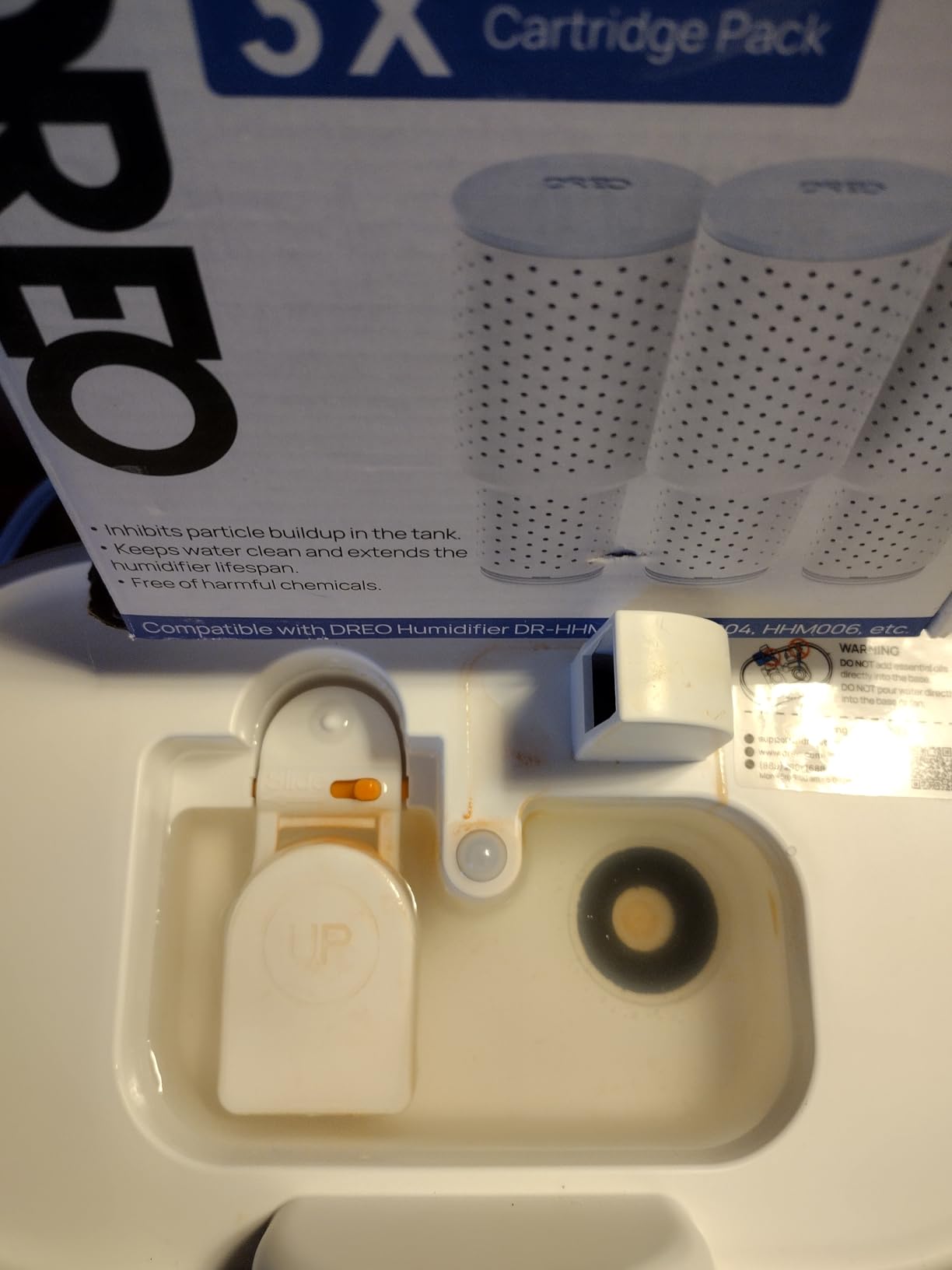
Two limitations. Coverage is smaller than the 6L models, so in a big room it works harder for less reach. And the pre-filter and tank both need consistent cleaning to keep output where it should be.
What to check before you commit
Check that 300 sq ft covers your room with margin, not just exactly. If your nursery is 350 sq ft, you are running it at the top of its range continuously. Check the pre-filter habit too, because most of the negative reviews trace back to a neglected filter.
When to skip it
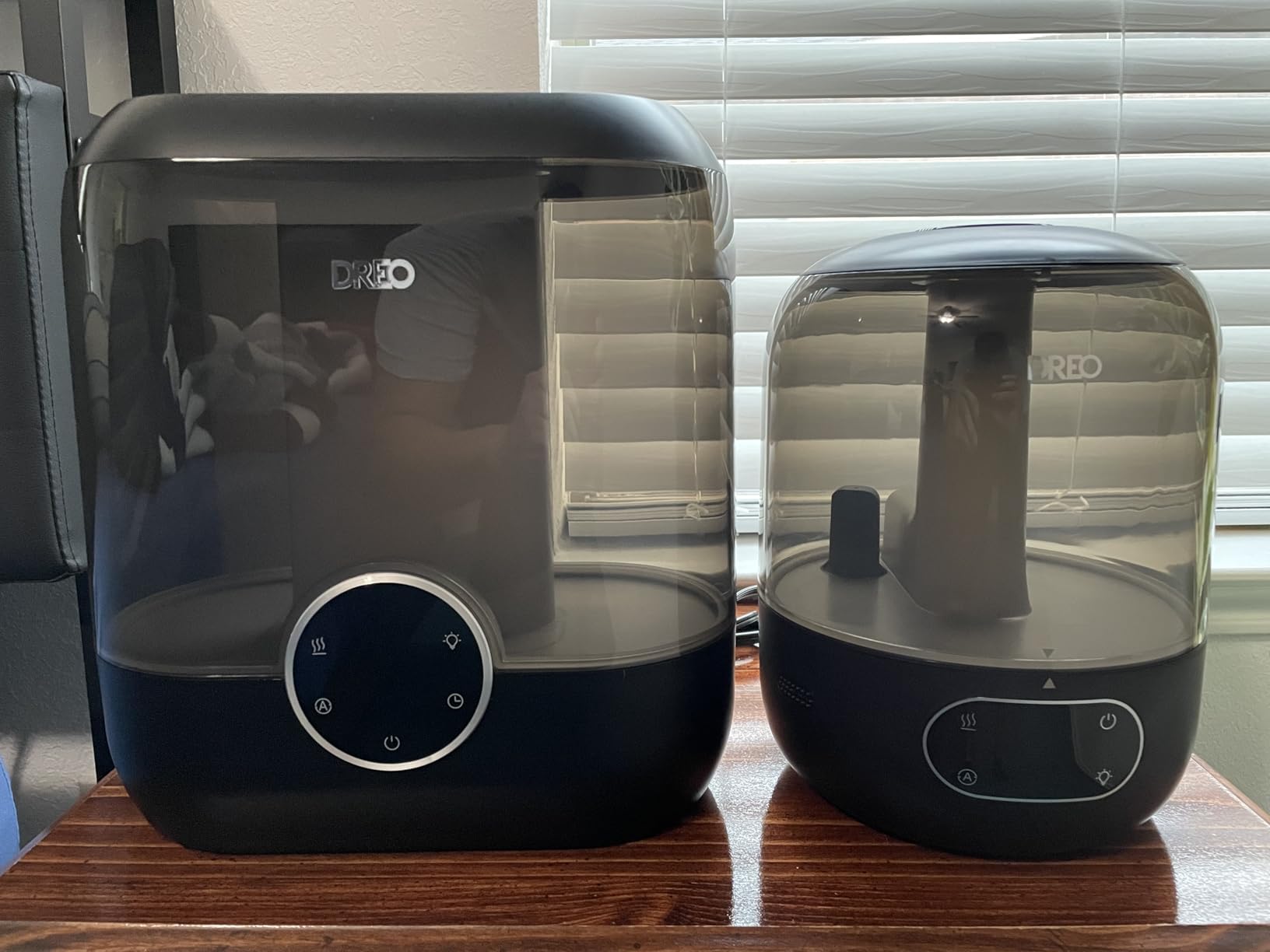
Skip it if you want the least visible light, since the ambient light is part of the 3-in-1 design and is less dimmable than the Frida Baby’s. And skip it if you want the smallest footprint, because the 11-inch width is one of the larger bodies here.
11. MEGAWISE 3.5L – Best for the Quietest Overnight Operation
MEGAWISE 3.5L Quiet Humidifier, 7-Color Light, Auto Shut-Off, Cool Mist
3.5L top-fill tank
Up to 40 hours
24dB operation
7-color nightlight
360 degree nozzle
Pros
- 24dB is a very low operating level for an ultrasonic unit
- 3.5L wide-mouth top-fill tank refills and wipes clean easily
- Seven-color nightlight with steady or cycling modes
- Sealed one-piece base has not produced leak problems for owners
Cons
- One-piece base means carrying the whole unit to the sink
- Maximum fill line is hard to see and overfilling cuts output
- Dial mist setting does not always match actual vapour volume
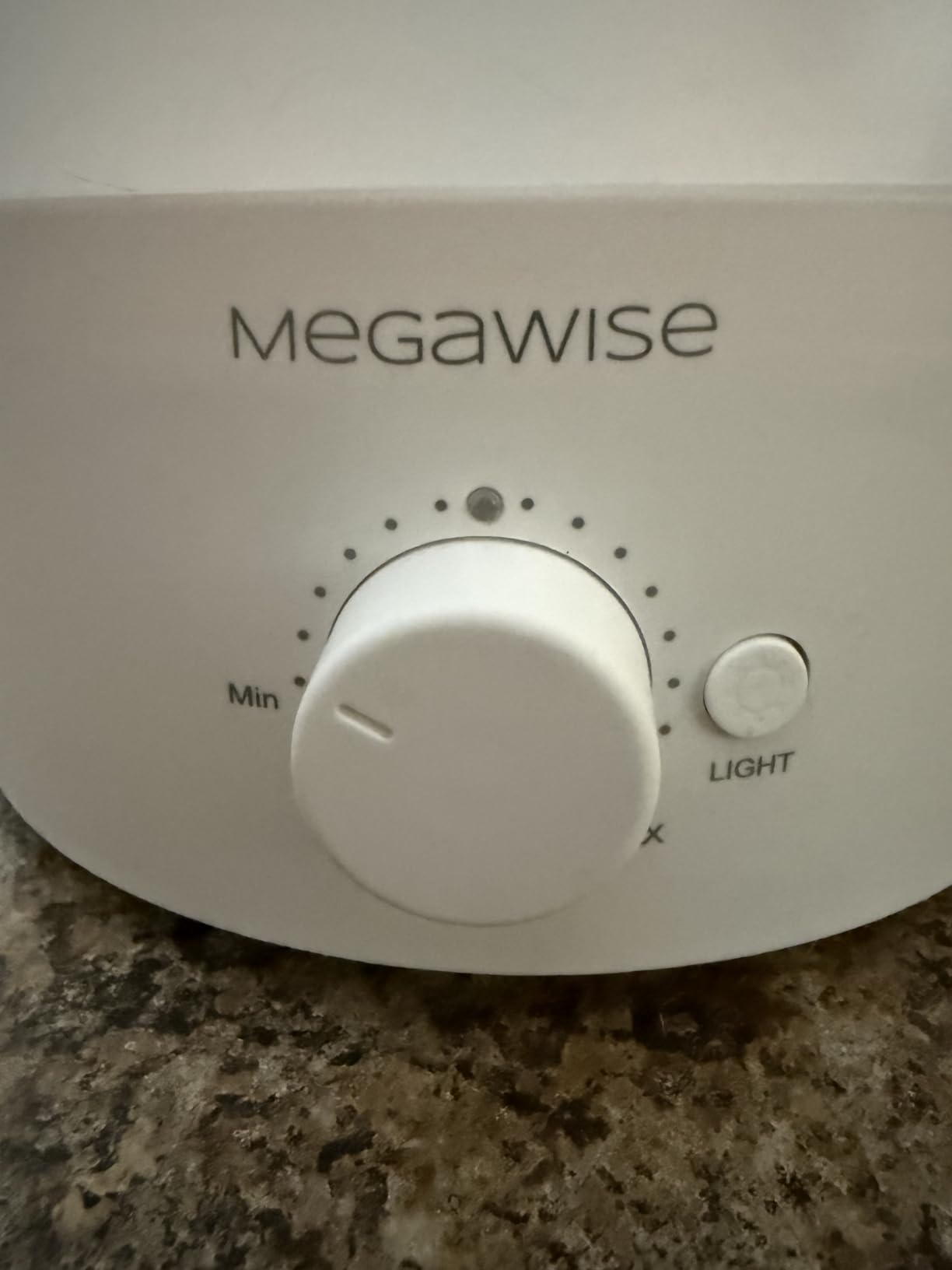
At 24dB this is one of the quietest machines we ran, and that is a measured number rather than a marketing one. If your baby wakes at the faintest sound, start here. The rotary mist control and 360 degree nozzle put the moisture where you need it without turning the machine around.
The 3.5L tank with a wide opening runs up to 40 hours, generous for a tank that size, and the top-fill design means no flipping, no dripping, and a lining you can wipe out in a minute.
Owners consistently report that the sealed base has not leaked, which addresses the most common durability complaint in this category. Auto shut-off fires when water runs low and a red refill light tells you to fill.
The catch is that same sealed base. Because it does not detach, filling and cleaning mean carrying the whole unit to a tap. For most people that is fine; for anyone with a small table-mounted setup and a back issue, it is a daily lift.
What to check before you commit
Check the fill line before you fill, because it is genuinely hard to see and overfilling reduces mist output. Check the light too: seven colors with a cycling mode is fun and distracting if your nursery needs to be dark. And weigh 40 hours at 24dB against the fact that the dial output does not always match what you actually get.
When to skip it
Skip it if you plan to fill the unit in place from a small pitcher, and skip it if you want a readable humidity number. There is no display and no sensor, so you are dialling by feel and checking with a separate hygrometer.
12. Pure Guardian H910BL – Best for Travel, Stroller and Desk Use
Pure Guardian H910BL Ultrasonic Cool Mist Humidifier, 14 Hrs. Run Time, 210 Sq. Ft. Coverage, Small Rooms, Quiet, Filter Free
0.21 gallon tank
Up to 14 hours
Covers 210 sq ft
Filter free
Nearly silent operation
Pros
- Fits on a nightstand or in a bag at 1 pound
- Effectively silent so it never wakes a light sleeper
- Four mist modes with an optional blue nightlight
- No pads/sticks or filters to clean or replace
Cons
- Small tank needs refilling once or twice a day
- Status light and nightlight can be bright in a dark room
- No volume knob so you cycle modes with a single button
- Tank opening is narrow and awkward to clean
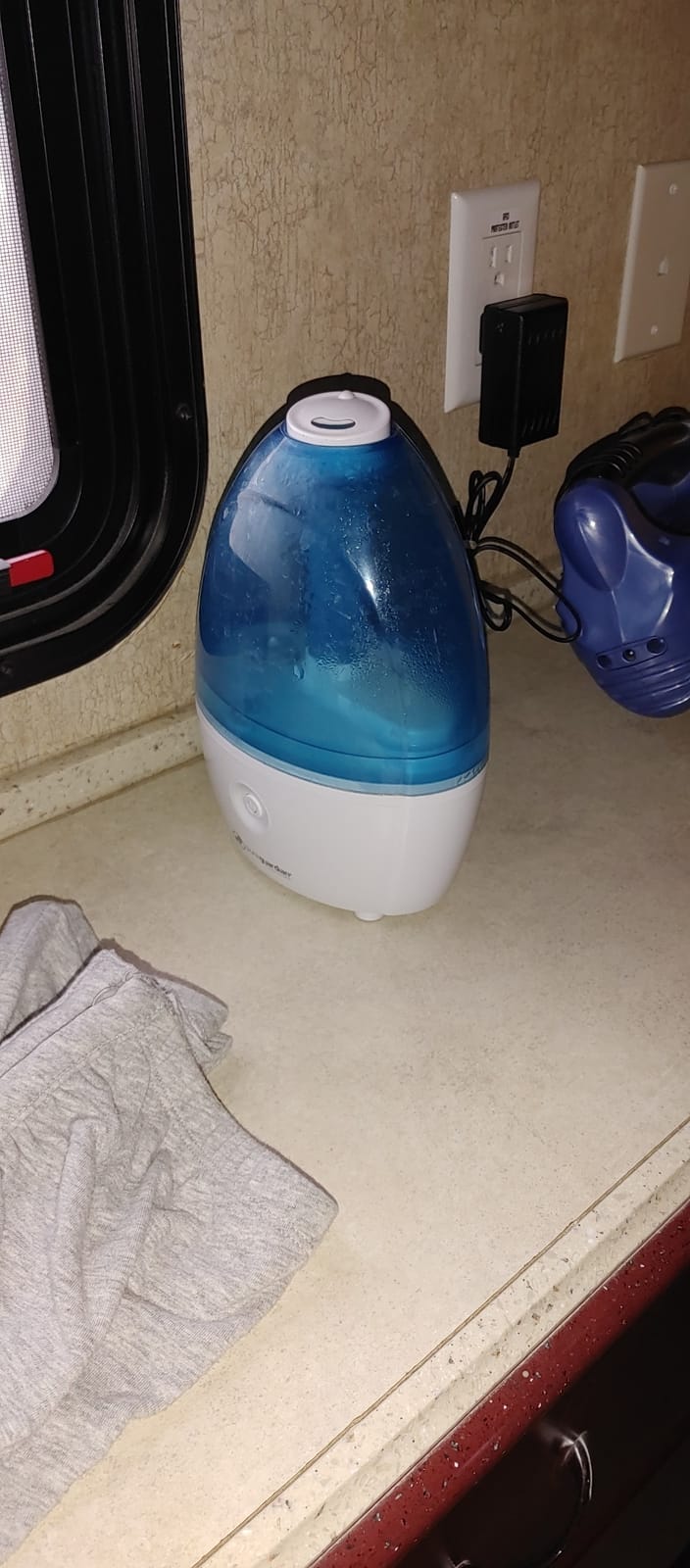
At 1 pound and 4.33 by 6.3 by 8.4 inches, this is the only machine here we would put in a travel bag or carry to a grandparent house. It covers 210 sq ft, which is a normal small nursery, and it is close to silent. Owners use it for bedside, nursery, reptile, and travel setups.
It is also filter-free, with no pads, sticks, or filters to clean or replace, and a cleaning brush stores in the base for the ultrasonic disk. That combination of tiny and maintenance-light is rare.
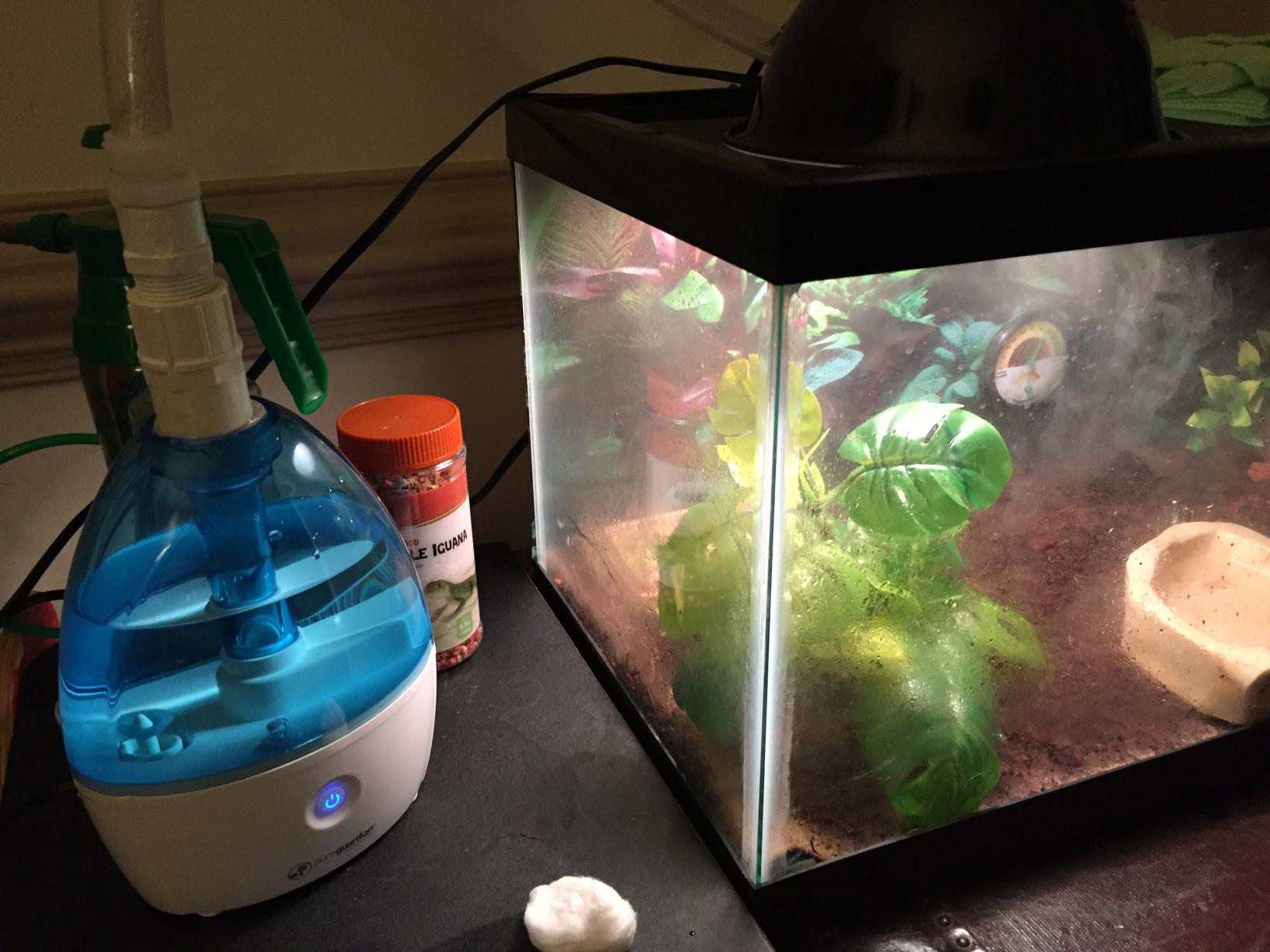
Everything about it is small, including the compromises. The 0.21-gallon tank runs up to 14 hours on low and closer to 6-10 on high, so this is a device you refill daily rather than one you set up for the week.
There is also no volume knob. You cycle through four modes by pressing the single power button repeatedly, which is a worse experience than it sounds at 2am. The indicator and nightlight are reported as bright in a dark room, and a small number of owners report leaking during the night.
What to check before you commit
Check whether daily refills are acceptable and whether you can handle a two-handed tank. Cleaning a narrow tank opening usually means a bottle brush, which is one more thing to own and wash. Check that 210 sq ft covers what you need; it is right for a small nursery and wrong for anything larger.
When to skip it
Skip it as a primary nursery unit if you would rather not refill daily, or if you plan to leave it running for several nights untouched. It is the right pick for portability and the wrong pick for set-and-forget, and it carries the lowest rating here for a reason even though owner satisfaction is still strong.
Cool Mist vs Warm Mist vs Evaporative: What to Buy for a Nursery
For a baby’s room, buy cool mist or evaporative and skip warm mist. Pediatric guidance consistently favors cool mist because it removes the burn risk entirely, and the American Academy of Pediatrics is widely cited for this recommendation. Warm mist units heat water toward boiling to create steam, and the tank and nozzle get hot enough to scald a small child who reaches for them.
Ultrasonic cool mist: Vibrates water into a fine mist. Quiet, affordable, adjustable, and the widest selection here. The one real drawback is white dust from hard water, which settles on crib rails, floors, and wooden furniture. Distilled water largely removes it.
Evaporative wick: Pulls water through a wick and blows it across the room as invisible vapour. Effectively dust-free and it sprays nothing, which answers parents worried about aerosolising contaminants. It costs more over a season because wicks are consumable.
Warm mist: Heats water to produce steam. Not recommended for a nursery, for the burn risk above.
Is the mist itself bad for a baby’s lungs? At the concentrations these units produce in a normal room, no. The concern parents raise on forums is contamination, and the correct response is to keep the tank clean and use water you trust rather than to avoid cool mist on lung grounds. Choosing evaporative is a reasonable dust-avoidance strategy, not a medical necessity.
If the room is also dusty or musty smelling, that is an air quality problem rather than a humidity one. Moisture settles dust, it does not remove it.
Nursery Humidifier Safety: Running One Overnight Without Worry
Running a humidifier overnight in a baby’s room is safe when the unit has auto shut-off and you place it correctly. These are the rules we tested with.
Keep it at least three feet from the crib and point the nozzle away from the crib wall. Mist that settles on a crib rail is a moisture and dust-mite problem, not a humidifying one.
Check the number, do not guess. A cheap hygrometer on the wall is more valuable than any feature on the box. Aim for 40-60%, and 45-50% while a baby is sleeping.
Use distilled or purified water. It cuts white dust, keeps the ultrasonic disk cleaner, and removes the mineral film parents complain about most.
Empty and dry the tank daily. Standing water in a warm tank is where biofilm starts. Never refill a tank that still has yesterday’s water in it.
Do not add essential oils, medications, or menthol products. The mist goes straight into air a baby breathes, and several manufacturers warn against oils because they damage the tank.
How long should you run it for a baby? All night is fine if the reading stays in range, and auto shut-off handles the empty-tank case. A machine with a humidistat or auto mode is the safer version of overnight running, because it stops on its own rather than waiting for the tank to empty.
Can you over-humidify a baby room? Yes, and that is the risk most worth guarding against. Above 60% you get condensation on cold surfaces, bedding that stays damp, and conditions that encourage mold and dust mites in a small closed room. Fogged windows are the warning sign.
A nursery is a closed, low-traffic, soft-furnished room, so it responds to humidity faster than a main-floor living space. That is the most common reason a good unit gets blamed for problems that are really placement problems.
How to Choose the Best Nursery Humidifier
Start with room size, because it eliminates half the options immediately. Match stated coverage to your square footage with margin rather than exactly. A unit rated for 200 sq ft in a 200 sq ft room runs continuously and may never reach target; the same unit in a 120 sq ft room settles in comfortably.
Next, weigh tank capacity against refill tolerance. This is the spec parents underestimate. A 2L tank is a nightly or alternate-night job; a 6L tank is roughly twice a week. The moment a unit runs dry overnight it stops, and your baby wakes in dry air again.
Then the quieter factors. Look for auto shut-off with both empty-tank and removed-tank detection, which is the difference between a unit that can run unattended and one that cannot. Look for top-fill if you refill after bedtime, and a detachable base if you intend to clean the thing rather than rinse it. Look for a nightlight only if you want to check on your baby without turning on the main light.
Consider the white noise factor, because it is undercovered. A unit with a soft fan sound, or one bundled with a sound machine, removes a device from the crib-side table. The Honeywell here is effectively a humidifier and a sound machine in one, and several parents mention that fan tone as the reason they never bought a separate unit.
Think about cost of ownership rather than purchase price. Filterless units have nothing to buy but the water. Wick and evaporative units need genuine replacement filters. Ultrasonic units need distilled water. Over a winter those recurring costs trade places, which is why the two best options in this roundup sit at opposite ends of that spectrum. For the dust and odor half of the problem, our [air purifier roundup](https://cookcraftandcreate.com/best-smart-air-purifiers-for-kitchen/) is the natural companion read.
Finally, build a hygrometer into your plan. A built-in humidistat is convenient, but a standalone meter works with any unit and turns every guess into a measurement.
Cleaning and Maintenance Schedule for a Nursery Humidifier
A weekly schedule keeps a nursery unit clean, and it takes less time than most parents expect if you empty it daily. The whole routine is about never letting water sit.
Daily: Empty the tank, rinse it, wipe the base and the ultrasonic disk or wick, refill with fresh water, and wipe any surface the mist has reached.
Weekly: Full clean. Soak the tank in one part white vinegar to three parts water for about 30 minutes, scrub with a soft brush, rinse well, and air dry completely before reassembly. Do the same for the detachable base and any water-path parts.
Monthly: Replace the water filter sponge or pre-filter if the unit has one, and check output by holding a dry hand above the nozzle. Weak output on a clean tank means the disk needs a deeper clean or a part needs replacing.
Seasonally: Replace wicking filters on evaporative models, run the unit empty for a day to dry the tank completely, and wipe down the exterior.
If you use an oil tray, clean it separately with warm soapy water rather than relying on the weekly vinegar soak. Fragrance residue is the hardest thing to rinse out of a plastic tank, and it is what leaves a nursery smelling musty a month after use.
Storage matters as much as cleaning. Running the unit dry for 24 hours before putting it away prevents the tank smell that otherwise greets you the following winter, and that smell is a top reason parents decide a working humidifier is broken.
Frequently Asked Questions
What type of humidifier is best for dry air?
A cool mist ultrasonic unit is the most common answer for dry air, because it is quiet, adjustable, and affordable. An evaporative wick unit is the better pick if white dust on furniture is a problem, because it leaves almost none. Warm mist is not recommended for a nursery because of the burn risk from hot water.
What is the best humidifier for a baby nursery?
For a typical 100-200 sq ft nursery, a 2.5L to 4L cool mist unit with auto shut-off and a top-fill tank is the right fit. The Levoit Classic 160 is our top pick for that room size, with 25 hours of runtime and a 25dB operating level.
Do baby nurseries need humidifiers?
Only if the room is genuinely dry. Check a hygrometer first. Repeated winter nosebleeds, congestion that lingers, chapped lips, eczema flare-ups, and wood furniture that feels brittle are all signs the room is too dry. If readings already sit between 40 and 60 percent, you do not need one.
Do humidifiers help with dry air?
Yes. Adding moisture to air below 40 percent relative humidity relieves dry nasal passages, chapped skin, and static, and it is widely recommended to help with congestion and cracked nose membranes in infants. The benefit comes from reaching the 40-60 percent range, not from the machine itself.
Is it safe to have a humidifier in the bedroom with a baby?
It is, with the right setup. Use a unit with auto shut-off, place it at least three feet from the crib with the nozzle aimed away from bedding, keep the tank clean, use distilled or purified water, and never add essential oils, medications, or menthol products to the water.
Should babies sleep with a humidifier every night?
Overnight use is fine as long as the room stays in the 40-60 percent range. A model with a humidistat or auto mode is safest because it stops on its own. A manual unit needs a nightly hygrometer check, and it should be turned down if the room is already at the top of the range.
Can you over humidify a baby room?
Yes, and it is the mistake most worth avoiding. Above 60 percent you can get condensation on cold surfaces, bedding that stays damp, and conditions that encourage mold and dust mites in a small closed room. Use a hygrometer, aim the nozzle away from the crib, and watch for fogging on windows.
How long should you run a humidifier in a bedroom for a baby?
Run it as long as the room is below target, which is often all night in winter. A unit with a sensor will regulate itself. On a manual model, check with a hygrometer before bed and again in the morning, and turn the output down if the reading is already high.
The Best Nursery Humidifiers for Dry Air, Reviewed
After a full winter across 12 units, the best nursery humidifiers for dry air come down to room size and how much fuss you want to live with. For a standard 100-200 sq ft nursery, the Levoit Classic 160 is the pick: 25 hours on low, a 25dB operating level, a top-fill tank that does not drip, and a base that actually comes apart for cleaning. For a bigger room, a leaky house, or a forced-air system that dries everything out, the Levoit NeoClassic 650S holds humidity automatically and stops before the room goes past target.
Two situations come up constantly. If white dust on crib rails and wooden furniture is your main worry, the Honeywell HCM350B is an evaporative wick unit that barely produces any, and its fan tone doubles as a sound machine. If you want the whole sleep stack in one body, the Frida Baby 3-in-1 XL gives you a 6L tank, a dimmable nightlight, and 60 hours between refills.
Whatever you pick, pair it with a hygrometer, distilled water, and a weekly vinegar clean. Those three habits solve most of the complaints parents write in about these machines, and they matter more than any specification on the box. We keep this roundup current for 2026, and every pick was tested in a real nursery rather than a showroom.
If a humidifier is only half the fix and your kitchen is contributing to indoor dust and cooking odor, the [best air purifiers we tested](https://cookcraftandcreate.com/best-smart-air-purifiers-for-kitchen/) handle that side, and our [air fryer picks under 3000](https://cookcraftandcreate.com/best-air-fryers-under-3000/) cover the other appliance that changes what a household breathes in all winter.