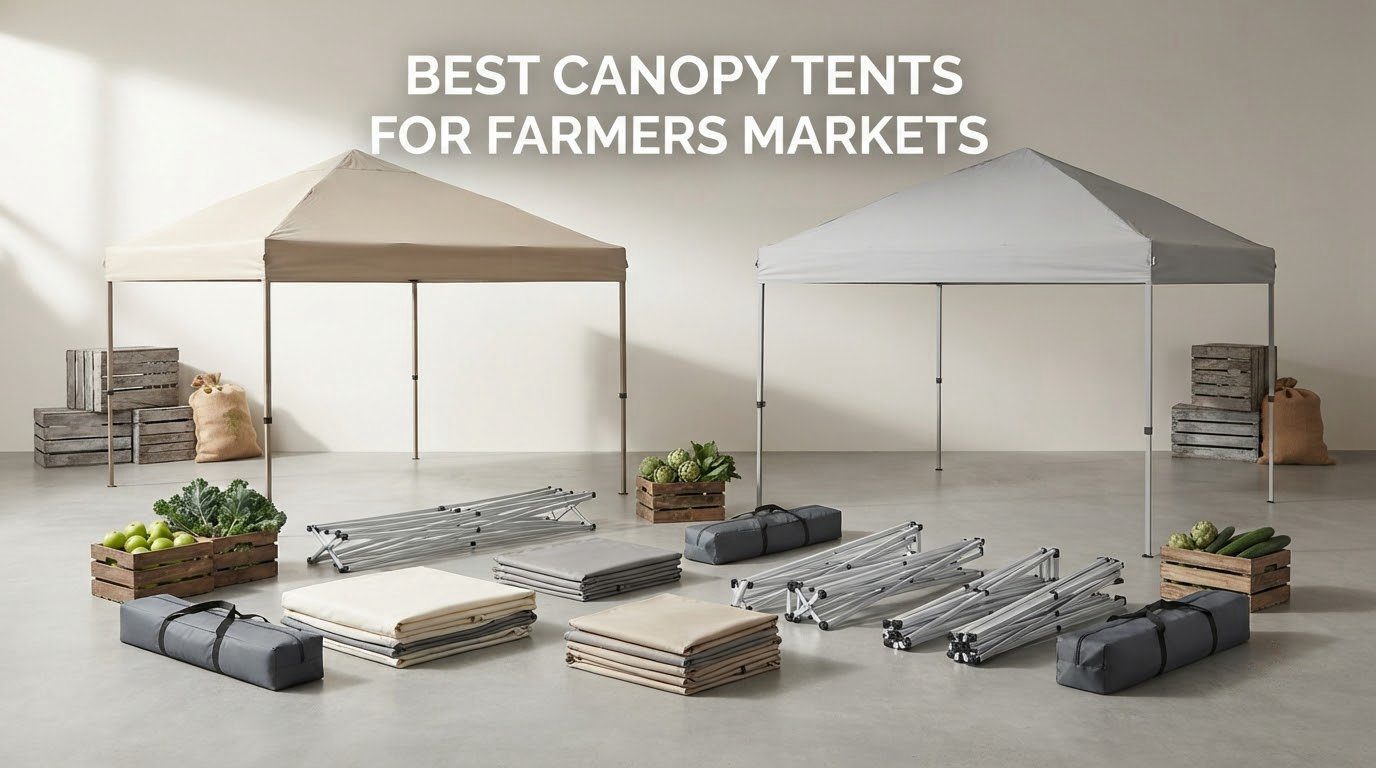
Every Saturday at my local market I watch vendors carry a folded steel bundle out of a sedan trunk, watch it snap open in under a minute, and then spend the next hour anchored against concrete while the sun climbs. That is the whole job of a market canopy: it has to go up fast, survive a full day of sun and wind, and be loaded back into a car by one exhausted person at the end of the day. This roundup covers the best canopy tents for farmers markets, ranked on the things that actually decide whether a tent survives a season of Saturdays.
I read through the customer feedback on ten 10×10 and 10×15 canopies that show up repeatedly in vendor discussions, and I scored each one on frame build, fabric weight and waterproofing, solo setup, packed weight, and what is actually in the box. The last point matters more than buyers expect, because a tent that arrives with no weight bags, no stakes and no side walls is a tent you buy twice.
Most markets hand out pitch rules before you ever ask. A 10×10 canopy is the near-universal standard because it fits a standard 10 by 10 foot pitch on a market map, and most managers will not let you claim two pitches. The interesting choice is not the size, it is whether you want a light solo-pitch tent with wheels in the feet, or a full truss commercial frame that shrugs off gusts but takes two people to lift.
We will get into market rules, anchoring weight math, and the straight leg versus slant leg question further down. If you want the short answer now: the CROWN SHADES 10×10 One Push is the best overall canopy tent for farmers markets, and the ABCCANOPY 10×10 Commercial is the one to buy if you refuse to compromise on frame strength.
While the tent is up, most vendors are also running a booth that needs power and a small appliance, so it helps to have a plan for the rest of the setup. Our guides to the best air fryers on the market and the best charcoal grills on the market cover the cooking side of a food booth.
Table of Contents
- Top 3 Best Canopy Tents for Farmers Markets (October 2026)
- All 10 Farmer Market Canopy Tents at a Glance
- 1. CROWN SHADES 10×10 One Push Pop Up Canopy – Editor’s Choice
- 2. ABCCANOPY 10×10 Commercial Pop Up Canopy with Sidewalls – Best Value
- 3. Eurmax 10×10 Commercial Canopy with Four Walls – Most Versatile
- 4. CROWN SHADES 10×10 Pop Up Canopy with 1 Side Wall – Best for Solo Vendors
- 5. ABCCANOPY 10×10 Straight Leg Canopy – Budget Pick
- 6. CROWN SHADES 10×15 Commercial Pop Up Canopy with Sidewalls – Best for Larger Booths
- 7. Tunbne 10×10 Pop Up Canopy with One Side Wall – Best for Booth Organization
- 8. Best Choice Products 10×10 Canopy with Side Wall – Best for Stability
- 9. Nazhura 10×10 Freestanding Shelter – Best for Casual and Backyard Use
- 10. Raynesys 10×10 Pop Up Canopy with Sidewalls – Best for Height Range
- Farmers Market Rules Every Vendor Should Check Before Buying
- How to Anchor Your Canopy at a Market
- Straight Leg vs Slant Leg Canopies and Waterproof vs Water Resistant Fabric
- Buying Guide: Seven Specs to Check Before You Buy a Market Canopy
- Frequently Asked Questions
- Which 10×10 canopy tent has the highest rating?
- What is the best canopy tent for vendors?
- Can one person set up a 10×10 canopy?
- Are 10×10 canopy tents waterproof?
- Do I need weights for a canopy tent at a farmers market?
- What’s the life expectancy of a 10×10 canopy?
- Are straight leg or slant leg canopies better?
- Which canopy is better value, Eurmax or ABC Canopy?
- Which Canopy Tent Should You Buy for Your Market Booth?
Top 3 Best Canopy Tents for Farmers Markets (October 2026)
The three tents below are the ones we would put on a pitch without hesitating: the fastest solo-pitch frame, the strongest commercial truss, and the most complete enclosure package.


All 10 Farmer Market Canopy Tents at a Glance
Every tent below is a 10×10 or larger pop-up canopy with a steel frame and a polyester top. Read the frame and fabric columns together, because a heavy frame with a thin top is a different product from a light frame with a heavy top.
| Product | Specs | Action |
|---|---|---|
| CROWN SHADES 10×10 One Push Pop Up Canopy |
|
Check Latest Price |
| ABCCANOPY 10×10 Commercial Canopy with Sidewalls |
|
Check Latest Price |
 Eurmax 10×10 Commercial Canopy with 4 Walls Eurmax 10×10 Commercial Canopy with 4 Walls |
|
Check Latest Price |
 CROWN SHADES 10×10 with 1 Side Wall CROWN SHADES 10×10 with 1 Side Wall |
|
Check Latest Price |
 ABCCANOPY 10×10 Straight Leg Canopy ABCCANOPY 10×10 Straight Leg Canopy |
|
Check Latest Price |
 CROWN SHADES 10×15 Commercial Canopy CROWN SHADES 10×15 Commercial Canopy |
|
Check Latest Price |
 Tunbne 10×10 One Push Canopy with Side Wall Tunbne 10×10 One Push Canopy with Side Wall |
|
Check Latest Price |
 Best Choice Products 10×10 with Side Wall Best Choice Products 10×10 with Side Wall |
|
Check Latest Price |
 Nazhura 10×10 Freestanding Shelter Nazhura 10×10 Freestanding Shelter |
|
Check Latest Price |
 Raynesys 10×10 Canopy with Sidewalls Raynesys 10×10 Canopy with Sidewalls |
|
Check Latest Price |
1. CROWN SHADES 10×10 One Push Pop Up Canopy – Editor’s Choice
CROWN SHADES 10×10 Pop Up Canopy Tent with One Push Setup, Grid White
Alloy steel truss
100 sq ft,108 in tall
36 lb
2 year limited warranty
Pros
- One push center lock hub gives a very fast solo pitch
- 150D silver coated UPF 50+ top with air vents
- STO'N GO bag with integrated foot wheels and accessory pockets
- Three height settings
- Two year warranty with year one canopy replacement
Cons
- 36 lb is a two hand load for solo transport
- Tall vendors duck slightly under the valance
- Lightweight top is not meant to stay up permanently
This is the tent I keep coming back to. The patented center lock hub means there is no walking around the perimeter pulling individual legs out of sliders, you push the hub and the frame expands as one piece. Owners report pitching it alone in roughly a minute, and the breakdown is just as fast because the fabric clips on and off instead of being laced to a fixed frame.
The frame is a corrosion-resistant steel truss rated to support 120 lbs distributed, which is more than a market table of produce weighs. At 36 lb it is not the lightest tent here, but the STO’N GO system changes how that weight feels in practice. The fabric stays on the frame when you collapse it, you pull the bag over the whole thing, and the wheels are built into the feet so you can roll the packed tent across a parking lot instead of dragging it.
One owner documented the tent surviving winds above 65 mph with only the center hub itself dropping out of alignment and no truss bars breaking, which tells you something about where the weak point sits. The top is silver-coated 150D polyester with UPF 50+ protection and air vents that let warm air escape, and those vents do double duty by keeping rain from pooling in the valleys.
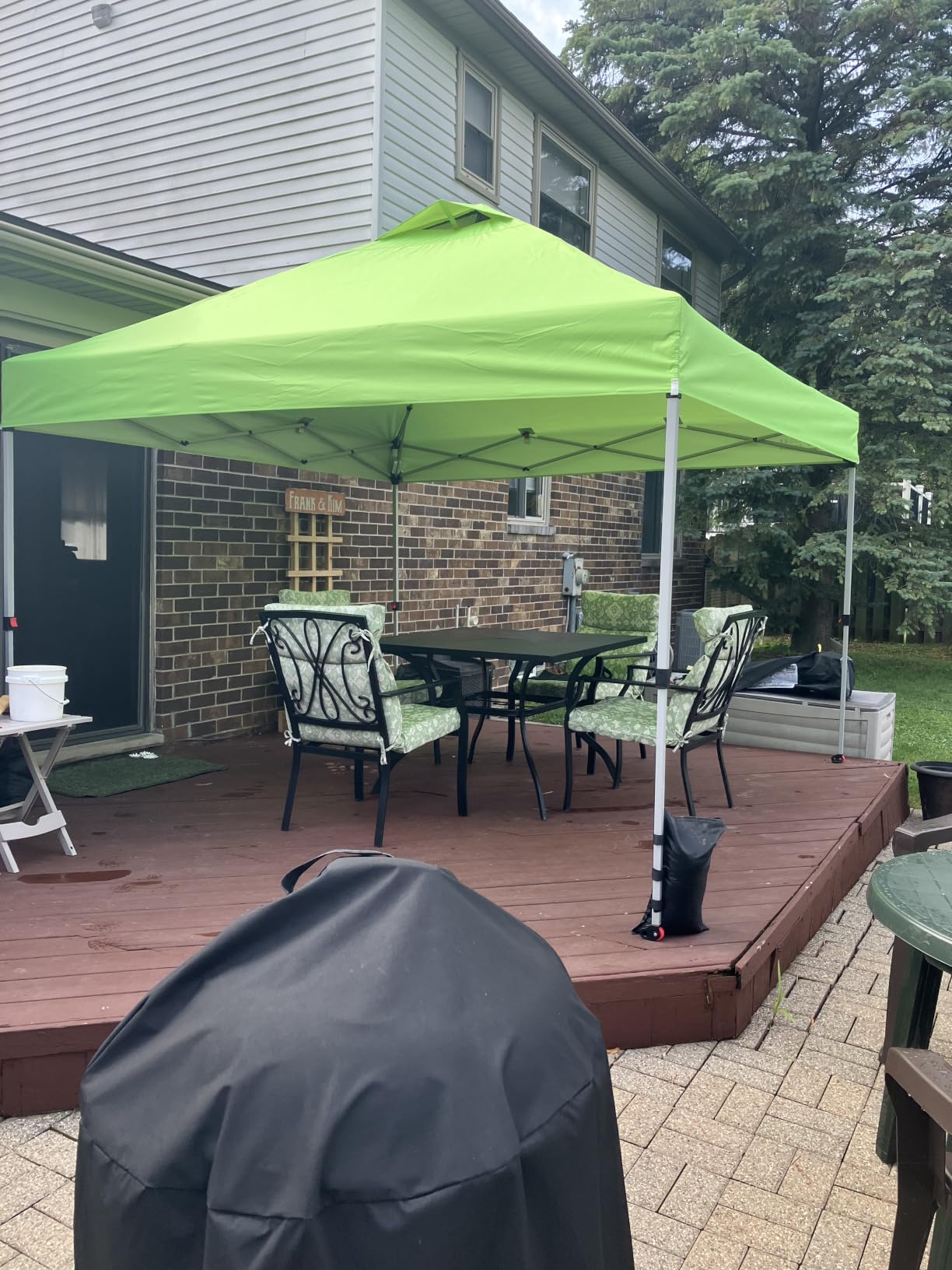
The 9 foot interior height is measured at the peak, and the valance hangs lower at the edges, so a six foot vendor will notice they duck slightly when moving in and out. There is no overhead crossbar, which means the full 100 square feet of floor is usable rather than interrupted by a brace in the middle of your booth.
What to check before you buy it for your pitch
Confirm the packed length. It folds to 45 by 8.5 by 8.5 inches, which is the difference between fitting in a sedan trunk and having to angle it past the back seat. The bag also has dedicated pockets for four sand bags, eight stakes and four guy ropes, so the anchoring hardware travels with the tent instead of disappearing into your car.
Ask your market manager whether the pitch surface is hard. On concrete or asphalt, weight bags are usually mandatory and stakes are usually banned, which makes the storage pockets more important rather than less.
Where it is a poor fit
If you sell chocolate, cut flowers in deep buckets or anything else that needs a lot of headroom, the valance height is worth checking against your tallest display. And if you plan to leave the tent pitched overnight in a forecast storm, this is a 150D top, not a storm shelter.
Owners who need a full enclosure should know there are no side walls in the box, so budget for a wall kit if your booth faces a road or a prevailing wind.
2. ABCCANOPY 10×10 Commercial Pop Up Canopy with Sidewalls – Best Value
ABCCANOPY Commercial Pop Up Canopy Tent with Sidewalls 10X10,White
1mm full truss legs
500D polyester,PU lined
100 sq ft,132 in
1 year frame warranty
Pros
- Full commercial truss frame with 1mm square legs
- 500 denier polyester roof with PU lining rated waterproof and UPF 50+
- Package includes 3 removable side walls/door wall/roller bag
- 4 weight bags/stakes and ropes
- Velcro and zipper walls attach fast when weather turns
Cons
- Very heavy in the case so solo setup is hard
- Roller bag hardware failures reported and the bag is not warranty covered
- Included weight bags are small for strict market weight rules
- Not built for extreme wind or storms
This is the tent that feels like equipment rather than camping gear. The frame is a full truss with 1mm square legs, and the roof is 500 denier polyester with a polyurethane lining, which is a genuine step above the 150D tops that dominate this line-up. The listed waterproof rating is backed by a PU lining, which is the reason this tent gets used in rain-heavy seasons.
What sells it for market use is the box contents. You get the frame, the top, three removable side walls, a fourth wall with a door, a roller bag, four weight bags, and stakes with ropes. That is a complete working kit, and it means you are not making a second purchase before your first market.
The trade-off is weight. The listed item weight is 28 kg, so this is not a tent a single person wants to wrestle into a car trunk twice in one day. Several owners who use it solo say the second pair of hands is the difference between a two minute pitch and a ten minute one.
Long-term vendors describe it as a dependable weekly workhorse, and the durability complaints that do surface tend to be about the accessories rather than the tent. Roller bag wheel rivets and handle stitching are the most common failure, and the bag itself falls outside the warranty. The warranty is one year on the frame and six months on fabrics and accessories, which is shorter than the two years on our top pick.
Included weight bags are also on the small side. If your market requires 20 to 25 lb per leg, plan to buy your own sand bags rather than assuming the four in the box will pass inspection.
What to check before you buy it for your pitch
Measure the height at your pitch. This one is listed at 132 inches, which is taller than the other straight leg frames here, and that clearance above the valance is useful if you hang a banner or a strip of lights underneath the frame.
Confirm the surface rules. This tent has enough frame strength to stand up to firm wind, but it still has to be guyed out, and on asphalt the stakes in the box will not be going into anything.
Where it is a poor fit
Skip it if you are a one-person operation with a small car and a market forty minutes away. The weight is a real tax, and it is paid twice, once in the car and once at the pitch.
Owners also report occasional water pooling on the top surface and seam drips in heavy rain, so the waterproof rating should be read as protection from steady rain rather than a dry booth in a downpour.
3. Eurmax 10×10 Commercial Canopy with Four Walls – Most Versatile
Eurmax USA 10×10 Pop Up Canopy Tent,Commercial Tent with Patented No-Tip Rolling Bag,4 Zippered Removable Walls,UV & Water Resistant Canopy Top,Heavy Duty Outdoor Gazebo,Instant Shelter(White)
Full truss commercial frame
100 sq ft
61 lb
4 zippered walls included
Pros
- Full truss frame built for commercial and professional use
- Four zippered removable walls plus a door and window wall
- Patented no-tip wheeled rolling bag
- Four sand bags included
- US factory store stocks replacement parts
Cons
- 61 lb is a two person lift
- Single person setup is difficult despite the marketing
- The wheeled bag is heavy once the frame and walls are packed
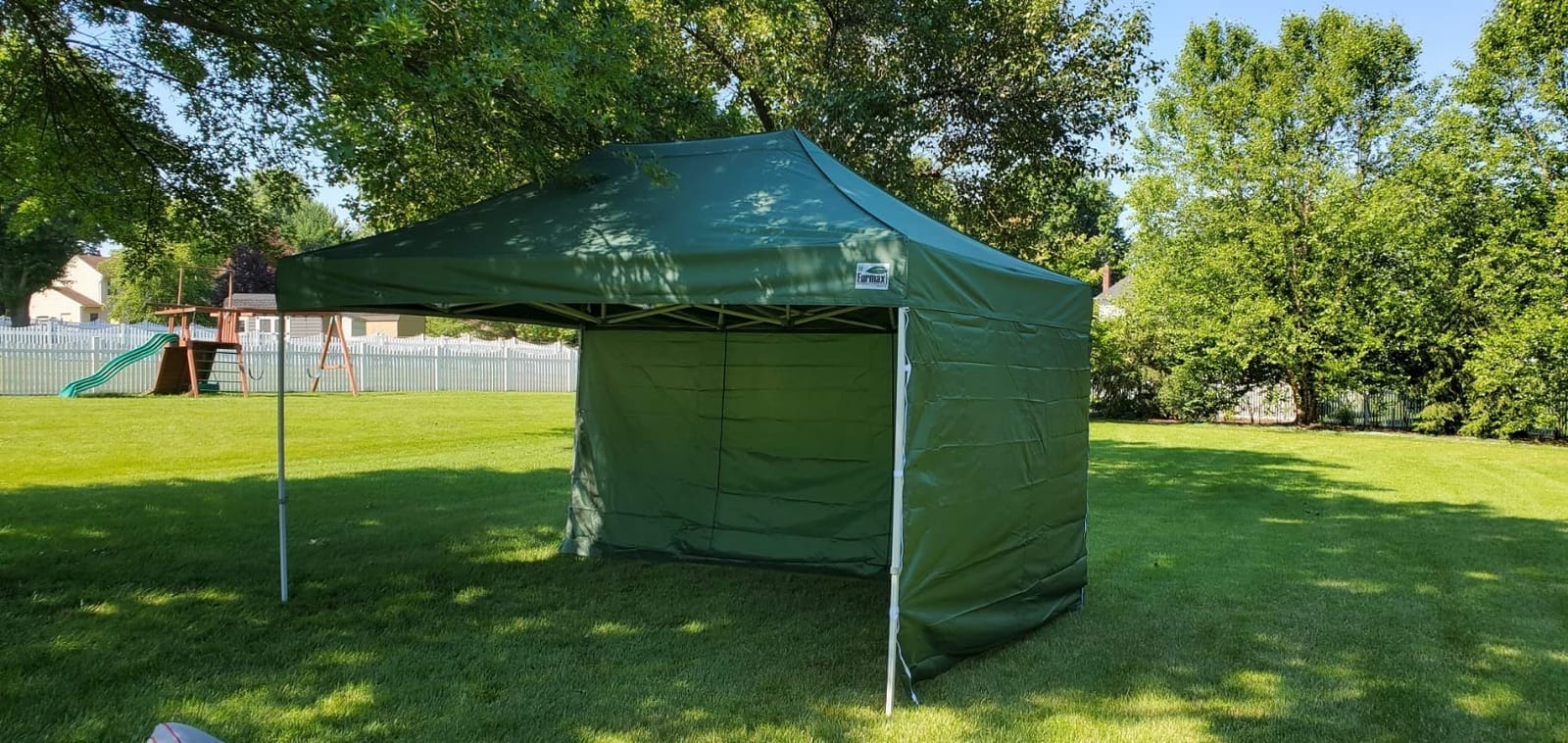
The Eurmax is the closest thing here to a permanent event shelter you happen to be able to fold up. The frame is a full truss structure built for commercial and professional use, and the enclosure is the most complete here: three removable side walls plus a fourth wall with a door and a window, all zippered.
For a food vendor that is the feature that decides it. You can close three sides, leave the service side open, and put a door flap on the front so a breeze does not blow across a serving table. Zipper closures also seal better than hook and loop when wind picks up, which is where cheaper walls start flapping and tearing at the corners.
Transport is handled by a patented no-tip rolling bag, which is a real upgrade over a standard carry bag. The design keeps the bag upright while you move it, and owners consistently single it out as the reason the tent is manageable despite the weight.
At 61 lb, this is the heaviest unit in our line-up, and almost every owner mentions it. Most people set it up with two people, and a number of solo buyers say they abandoned it for that reason alone. The wheeled bag is genuinely helpful but it is still 61 lb of steel and fabric inside it.
One underappreciated benefit is replacement parts. Eurmax operates a US-based factory store that keeps replacement parts on hand domestically, which matters if a truss bar or a corner joint goes after two seasons. Vendors who intend to keep a tent for the life of the business treat parts availability as part of the purchase decision.
What to check before you buy it for your pitch
Check that you have a second pair of hands available at least once a week. If you are pitching alone every Saturday, this is the wrong tool and our top pick exists precisely for that situation.
Check your vehicle too. A full enclosure kit and a full truss frame do not compress, and this is not a tent that folds down to the size of a golf bag.
Where it is a poor fit
This is not the tent for a solo vendor, a light car, or a market where you have to carry your booth more than a hundred yards. It is the tent for a professional who has earned a permanent spot and wants enclosure quality.
The warranty is one year from date of purchase, so the case for this tent rests on frame construction and parts support rather than on paper coverage.
4. CROWN SHADES 10×10 Pop Up Canopy with 1 Side Wall – Best for Solo Vendors
CROWN SHADES 10×10 Pop Up Canopy with 1 Side Wall, Beach Tent, Yellow
CenterLOK one push hub
150D UPF 50+ top
120 by 120 by 117.6 in
39 lb
Pros
- Genuinely one person
- owners report 10 to 15 minutes solo
- Built in foot wheels and locking strap let you roll the tent across a site
- Includes one 150D side wall
- Three height levels and a fold flat high peak top
- 2 year parts replacement warranty
Cons
- 39 lb is heavy by hand though the wheels help
- Included sand bags are considered thin
- The side wall can catch wind on gusty days
This is the same one push hub platform as our top pick, but it includes a side wall in the box, and that one difference matters if your booth faces a road or a parking lot. Vendors use the wall to block low afternoon sun from one side while leaving the other three open, which makes a real difference for flower growers and anyone displaying flat product on a table.
Vendors describe pitching it alone on concrete in a few minutes and striking it in one to three, and they contrast that with cheaper tents whose legs fight the user at every height adjustment. The anti-pinch push levers and the one push CenterLOK hub are what make that possible.
Foot wheels and a locking strap are the feature that separates it from a standard bag. You can lock the frame collapsed, roll it across a parking lot on its own wheels, and then deal with it once, rather than carrying a bundle from the car to the pitch.
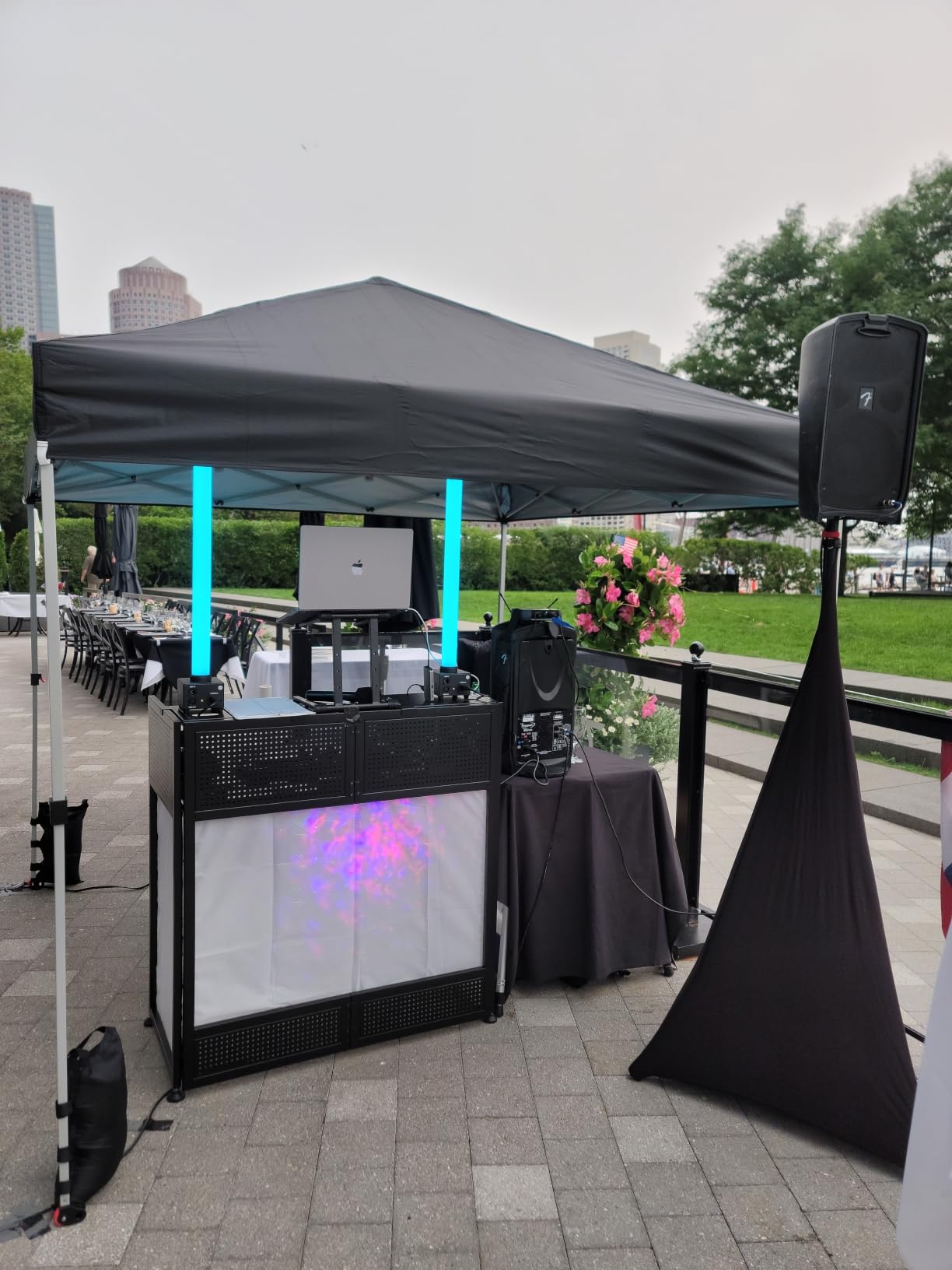
The fabric is 150D silver-coated with UPF 50+ protection, water and flame resistant, and the fold flat high peak top drains quickly. Owners also report a season of bracing against wind and rain on concrete without frame or fabric failures.
Two practical negatives come up repeatedly. The included sand bags are considered thin by vendors who have used heavier ones, and the side wall can act as a sail on gusty days if you leave it attached with the top only partially weighted.
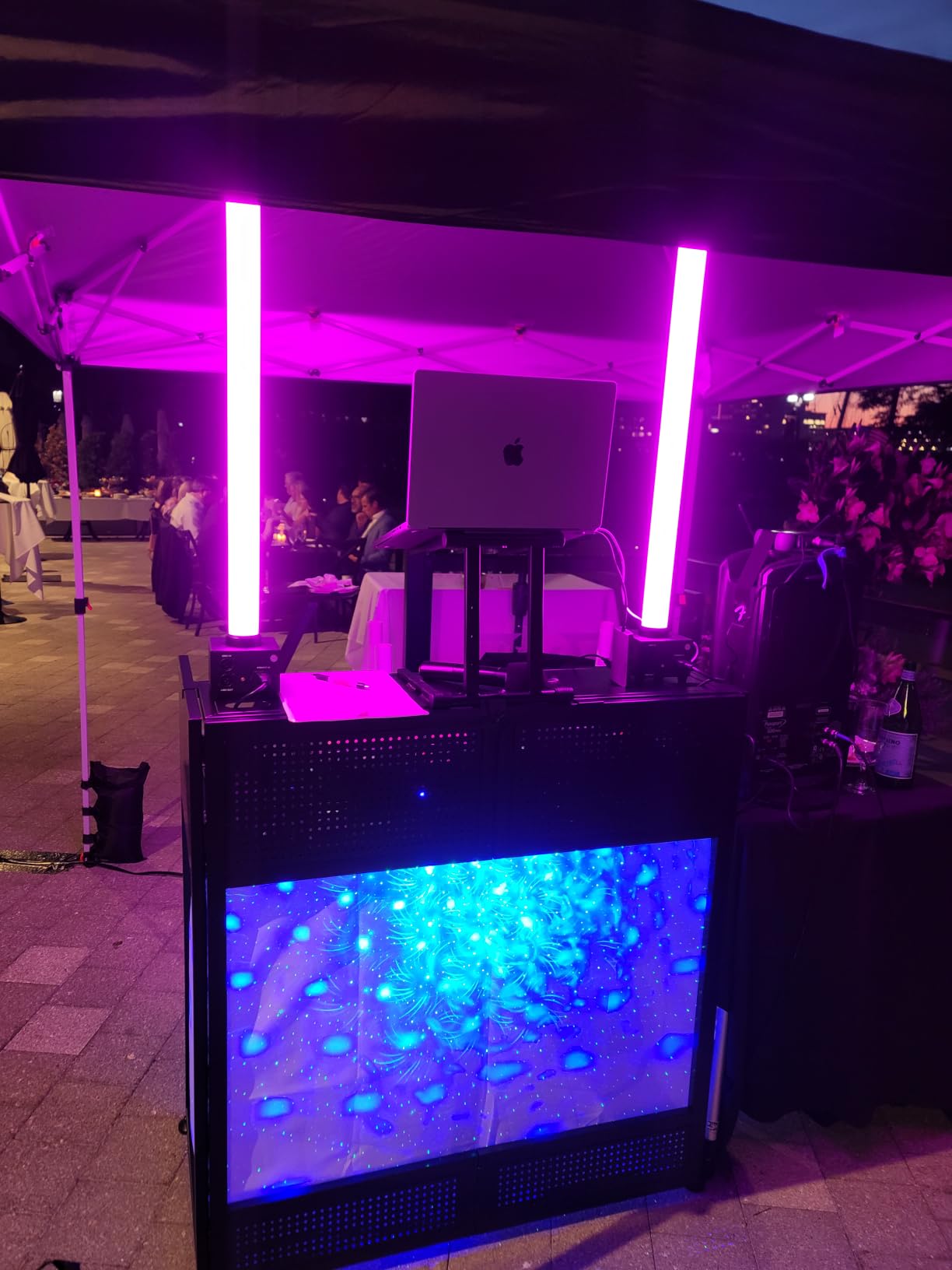
What to check before you buy it for your pitch
Listed dimensions are 120 by 120 by 117.6 inches, so check the valance clearance against your display shelves. It packs to 45 by 8.5 by 8.5 inches, the same compact profile as the 10×10 one push model.
Check the surface. On grass or soil, feet can dig in and grab when you reposition, so roll rather than drag when you move it across a lawn.
Where it is a poor fit
Like every 150D tent in this round, it is a day and weekend shelter rather than a permanent installation. If you plan to leave it standing through a storm, choose a heavier fabric instead of relying on the frame.
At 39 lb it is also slightly heavier than our top pick for the same platform, so if weight is your deciding factor, note the difference before you commit.
5. ABCCANOPY 10×10 Straight Leg Canopy – Budget Pick
ABCCANOPY Pop Up Canopy – Outdoor Patio Portable Canopy Tent Heavy Duty for Backyard and Deck with 4 Sandbags(Black, 10×10)
Straight leg alloy steel frame
100 sq ft shade
28 lb
120 by 120 by 112.8 in
Pros
- Listed at 28 lb
- the lightest frame weight here
- Straight leg design gives true 100 sq ft of top shade
- Silver coated top with UPF 50+ UV protection
- Wheeled roller bag that fits in a car trunk
- Overlapping eave system strengthens the frame
- 4 sand bags included
Cons
- No side walls included
- Lowest star rating here with a higher one star share
- Manufacturer advises taking the top off and storing it dry
- Included sand bags are basic
This is the value entry point, and the straight leg design is the spec worth understanding. On a straight leg canopy the top area equals the bottom area, so you get a full 100 square feet of shade instead of the reduced top coverage you get from slant leg frames where the roof slopes inward.
The listed weight is 28 lb, the lightest confirmed figure of the ten, and the wheels on the roller bag make the difference between a comfortable walk from the car and a struggle. Owners of similar ABCCANOPY models report a roughly one minute solo setup with the latest frame technology.
The overlapping eave system is a small but real reinforcement. Instead of a single layer of fabric at the joint, the eaves overlap, which spreads stress and reduces the flutter you get at the corners in wind.
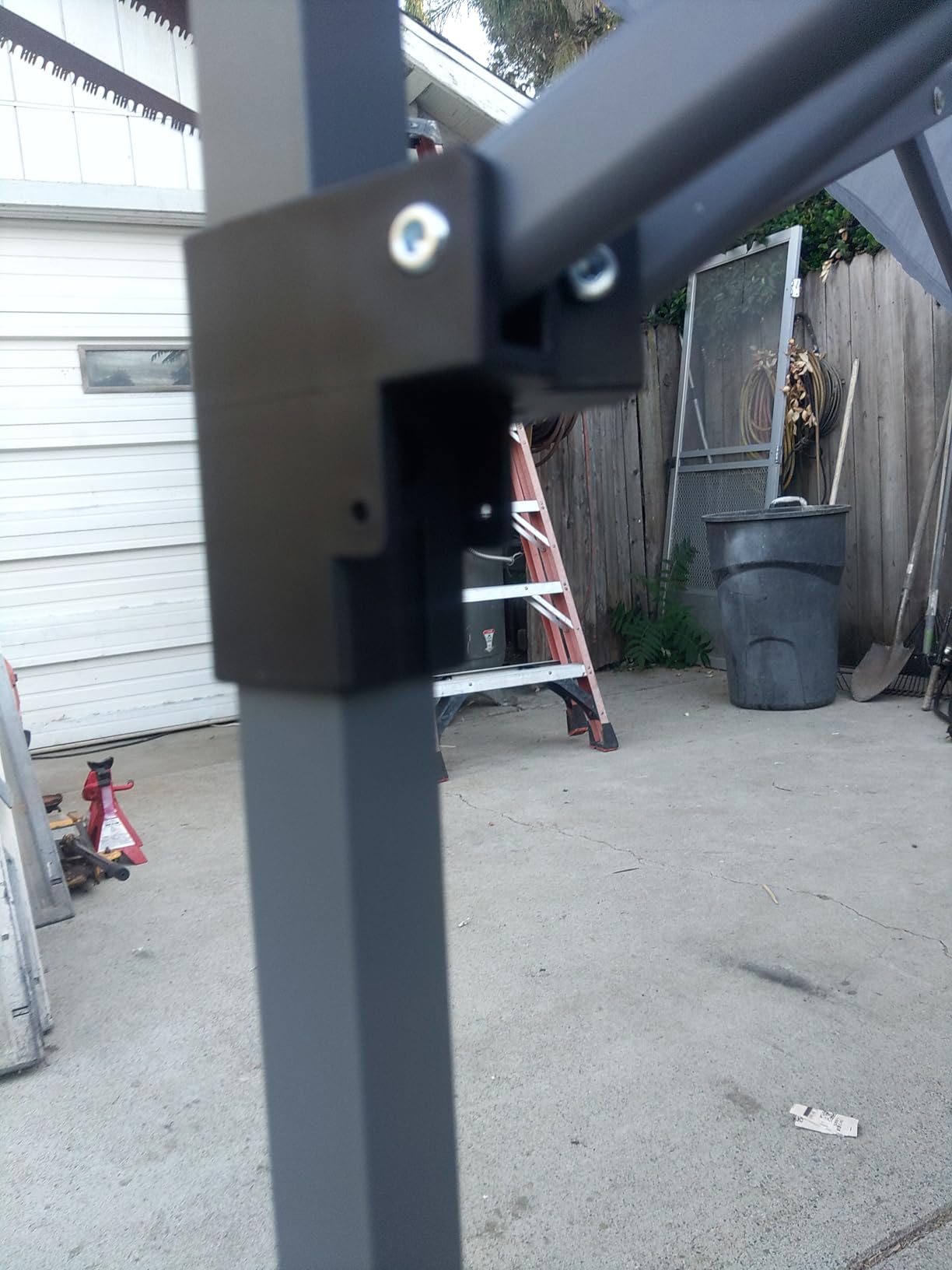
What you give up is everything that is not the frame. There are no side walls in the box, so a wall kit is a separate purchase if your booth needs enclosure. The included sand bags are basic, and vendors operating under stricter weight rules usually replace them immediately.
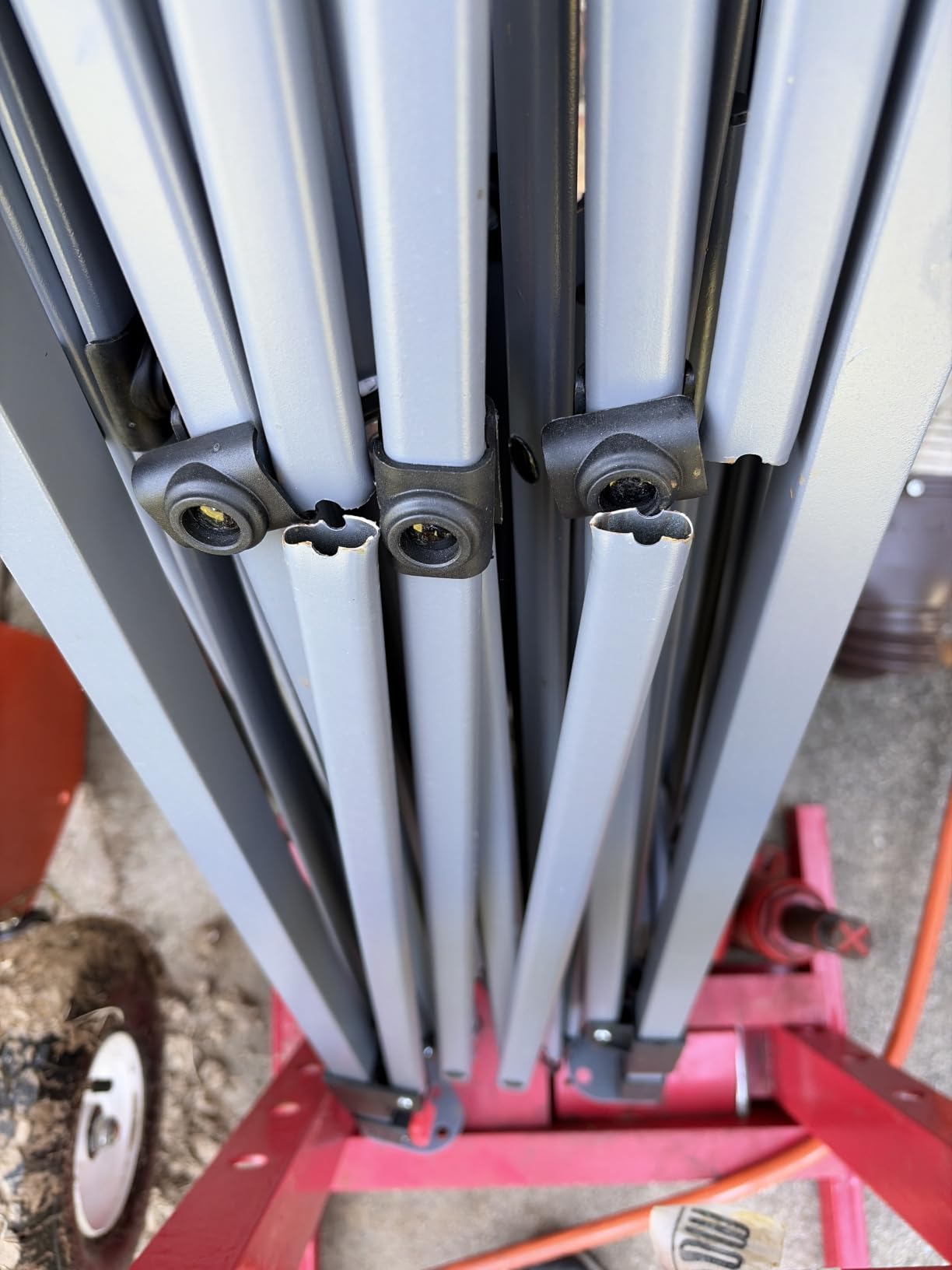
The 4.2 rating is the lowest of the ten, and the one star share runs higher than the category leaders. The complaints cluster around buyers who expected a commercial frame at a budget price, plus reports of frame wear after extended outdoor use.
What to check before you buy it for your pitch
The manufacturer advises removing the top and storing it dry rather than leaving it pitched in wild weather. If your market season runs into wet autumn months, plan for daily top removal or accept fabric degradation.
Check that 10×10 is your allowed pitch. The same frame is offered in several smaller sizes, and many markets will not accept a footprint above 100 square feet.
Where it is a poor fit
This is not the tent for full-time vending. Vendors who run a market every week for years should spend up on a full truss frame, because frame wear is the failure mode buyers report first.
It is also the wrong choice if you display tall shelving, since a straight leg canopy with no side walls gives you shade but no wall to hang anything from.
6. CROWN SHADES 10×15 Commercial Pop Up Canopy with Sidewalls – Best for Larger Booths
CROWN SHADES 10×15 Commercial Pop Up Canopy Tent with Sidewalls, White
400D Oxford waterproof top
150 sq ft
Powder coated full cross frame
4 height levels
Pros
- Largest footprint here at 150 square feet
- 400D Oxford fabric is heavier duty and more waterproof than 150D tops
- Thickened powder coated full cross frame with a tall center
- Four removable side walls included
- Wheeled bag with a wide opening and accessory pocket
Cons
- Carries the highest price tag of the three commercial units here
- 10x15 bulk is harder to load solo and takes more vehicle space
- 150 sq ft may exceed the pitch your market allows
If a 10×10 pitch makes your booth feel cramped, this is the tent that changes the working day. At 150 square feet you gain room for a second table, a taller display, or a seating area, and owners who made the jump report the extra space changes how they lay out a booth rather than just adding to it.
The fabric is where this unit separates itself. It is 400D Oxford with waterproof construction and UV protection beyond UPF50+, which is a materially different material from the 150D tops on most 10×10 models here. If your market season includes genuine rain, this is the fabric tier that keeps working into autumn.
The frame is a thickened powder-coated full cross structure with a tall center, and there are four height levels with pinch-free adjustment. Owners highlight deployment in under five minutes as a team job and praise the wheeled bag with its dedicated accessory pocket.
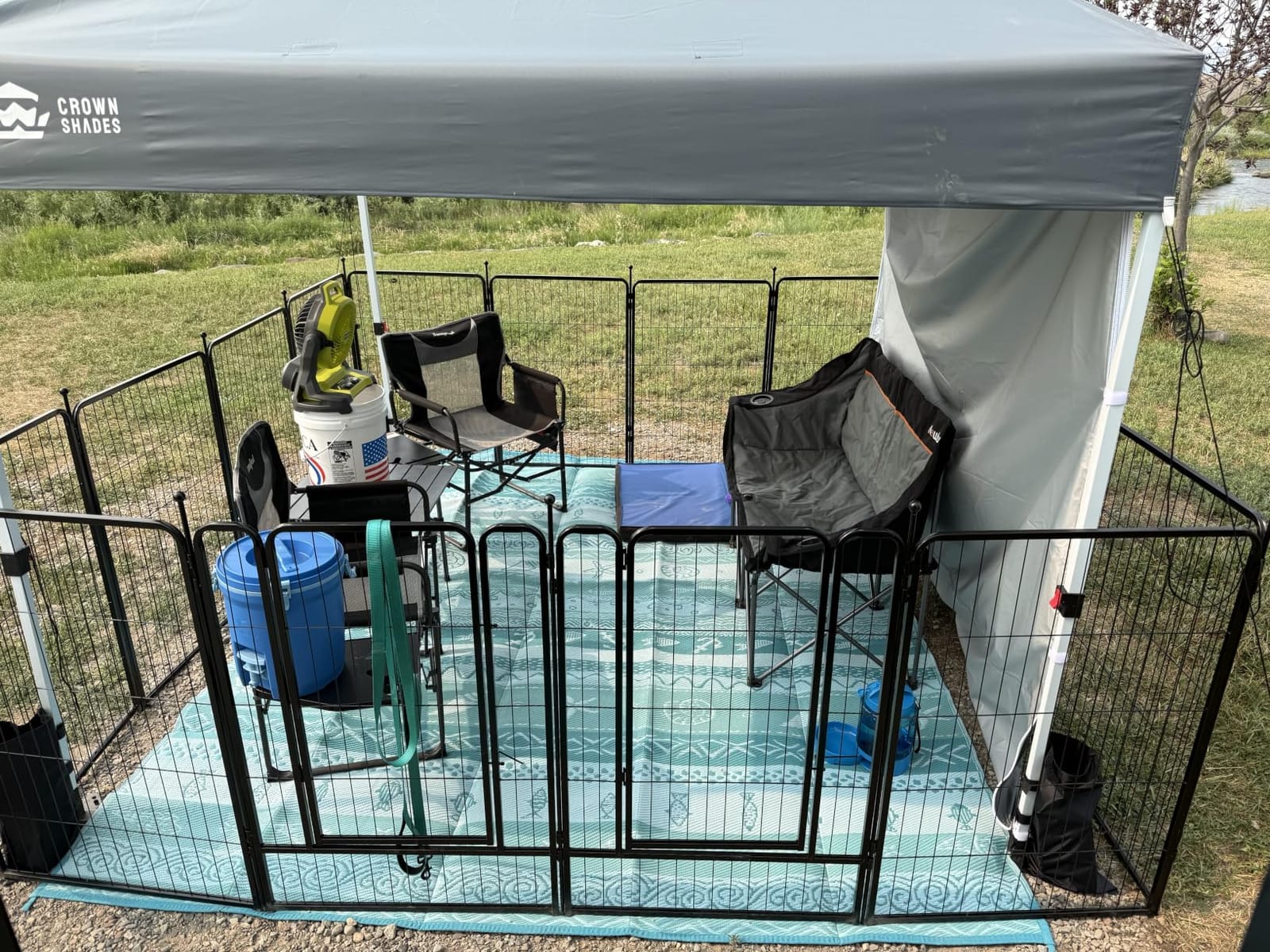
The reservations are all about size rather than quality. It sits well above the other canopies in price, it is bulkier to lift solo, and the footprint itself is the hard part. A 150 square foot pitch needs manager approval that most 10×10 vendors never have to ask for.
The listed dimensions are 118 by 118 by 116 inches, and a weight is not published, so check the packed profile against your vehicle before committing.
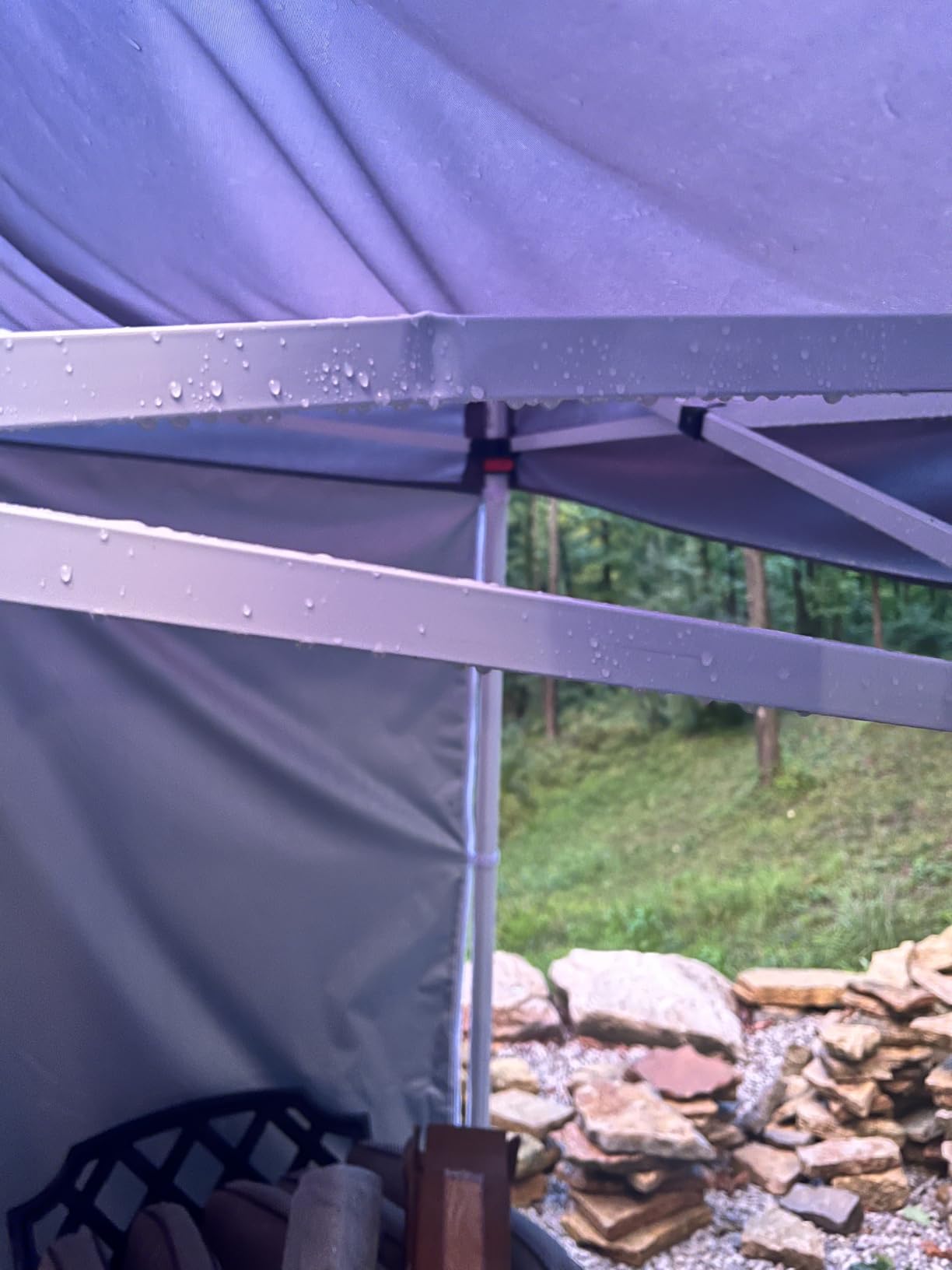
What to check before you buy it for your pitch
Ask the market manager for a 10×15 pitch on the map, in writing, before you buy. A tent you cannot legally pitch is worth nothing, and approval often depends on stall placement rather than on the tent itself.
Check whether you can claim the adjacent pitch. Some managers will allow a 10×15 only if you book two spaces, which doubles the site fee but also doubles the customer flow in front of your booth.
Where it is a poor fit
Do not buy it for a market you have not attended yet. Start with a 10×10 that fits the standard pitch, learn the site, and move up once you know you can hold two spaces.
It is also a poor fit for a solo vendor with a sedan. The extra 50 square feet is only worth carrying if you have the hands and the cargo space to carry it.
7. Tunbne 10×10 Pop Up Canopy with One Side Wall – Best for Booth Organization
Tunbne 10X10 Pop Up Canopy Tent Outdoor with 1 Sidewalls, One Push Setup
Central lock 3 step setup
CPAI-84 silver coated fabric
38.6 lb
120 by 120 by 110 in
Pros
- One push central lock with a three step tool free setup
- CPAI-84 flame resistant silver coated polyester blocking up to 99 percent of sun rays
- Side wall has six pockets and a lanyard for organizing small items
- Roof vents improve airflow and reduce heat
- Includes STO'N GO wheeled bag
- 8 stakes
- 4 guy ropes and 4 weight bags
- Magnetic frame joints for flexible display
Cons
- Some owners report bent or snapped frame joints at the push buttons
- Side wall pockets heat up in direct sun
- Manufacturer advises against leaving it up in wild weather
The feature that separates this one is the side wall. Instead of a plain panel it has six pockets and a lanyard, which is a small detail that changes how a small booth works. Price tags, business cards, a tape roll, a bag of ties and a clipboard all live on the wall rather than in a tote under the table.
The fabric is silver-coated polyester with a CPAI-84 flame resistance rating, which matters because a growing number of market managers and local authorities ask vendors for fire certification documentation. A long-term owner reports the tent still performing well after two years of regular use.
Roof vents improve airflow and cut the heat under the canopy on a hot day, and the magnetic frame joints are an interesting design choice that gives you attachment points for small display hardware.
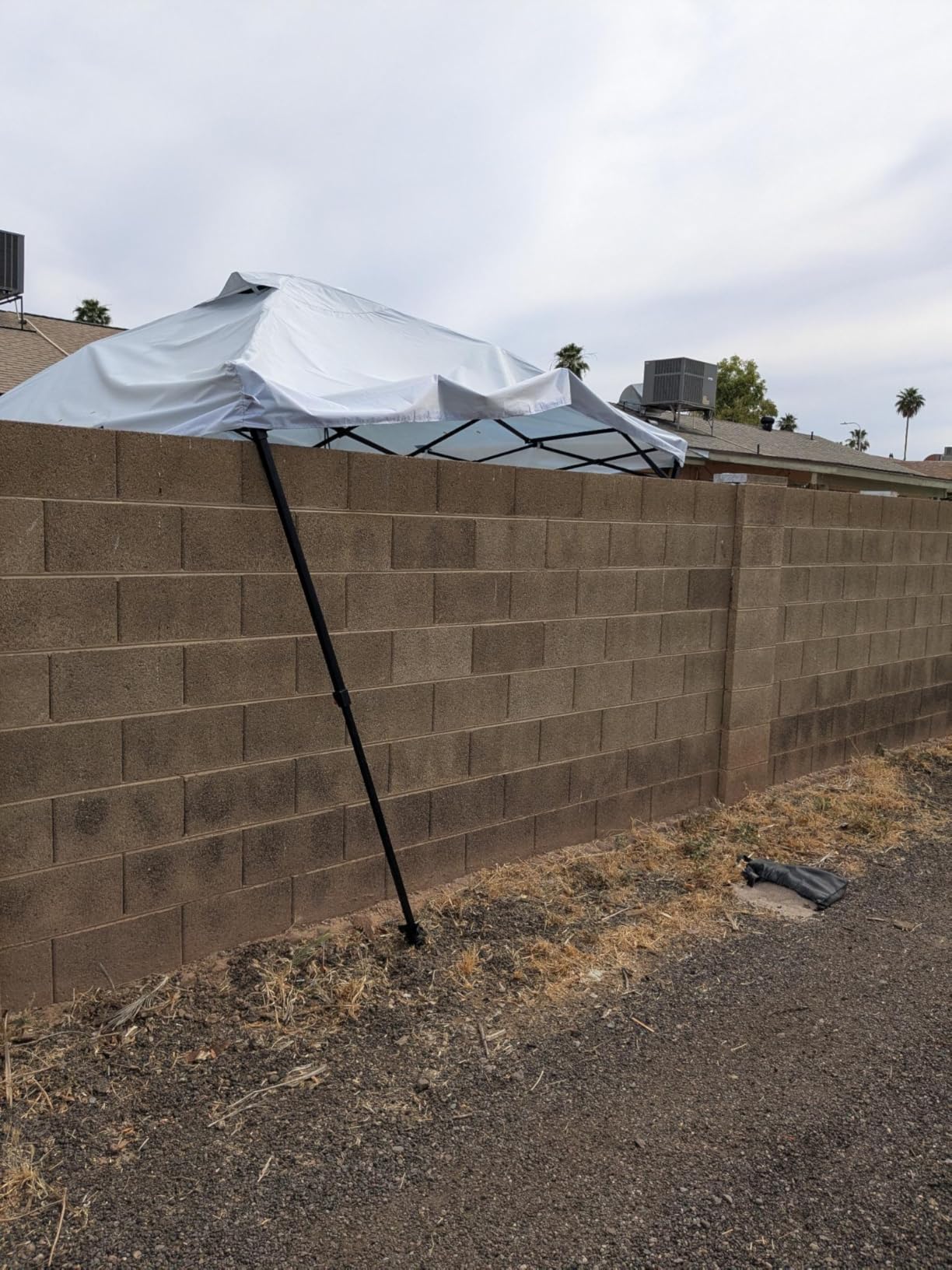
One push central lock gives a genuinely quick three step setup that a single vendor can manage, and the box includes a wheeled STO’N GO bag along with eight stakes, four guy ropes and four weight bags. That is one of the more complete accessory bundles at this tier.
The recurring negative is frame hardware. A few buyers report bent or snapped bars at the push button joints, in one case traced back to missing plastic S hooks that guide the bars. That is a parts problem more than a design problem, but it is worth knowing before you rely on this tent alone in a forecast breeze.
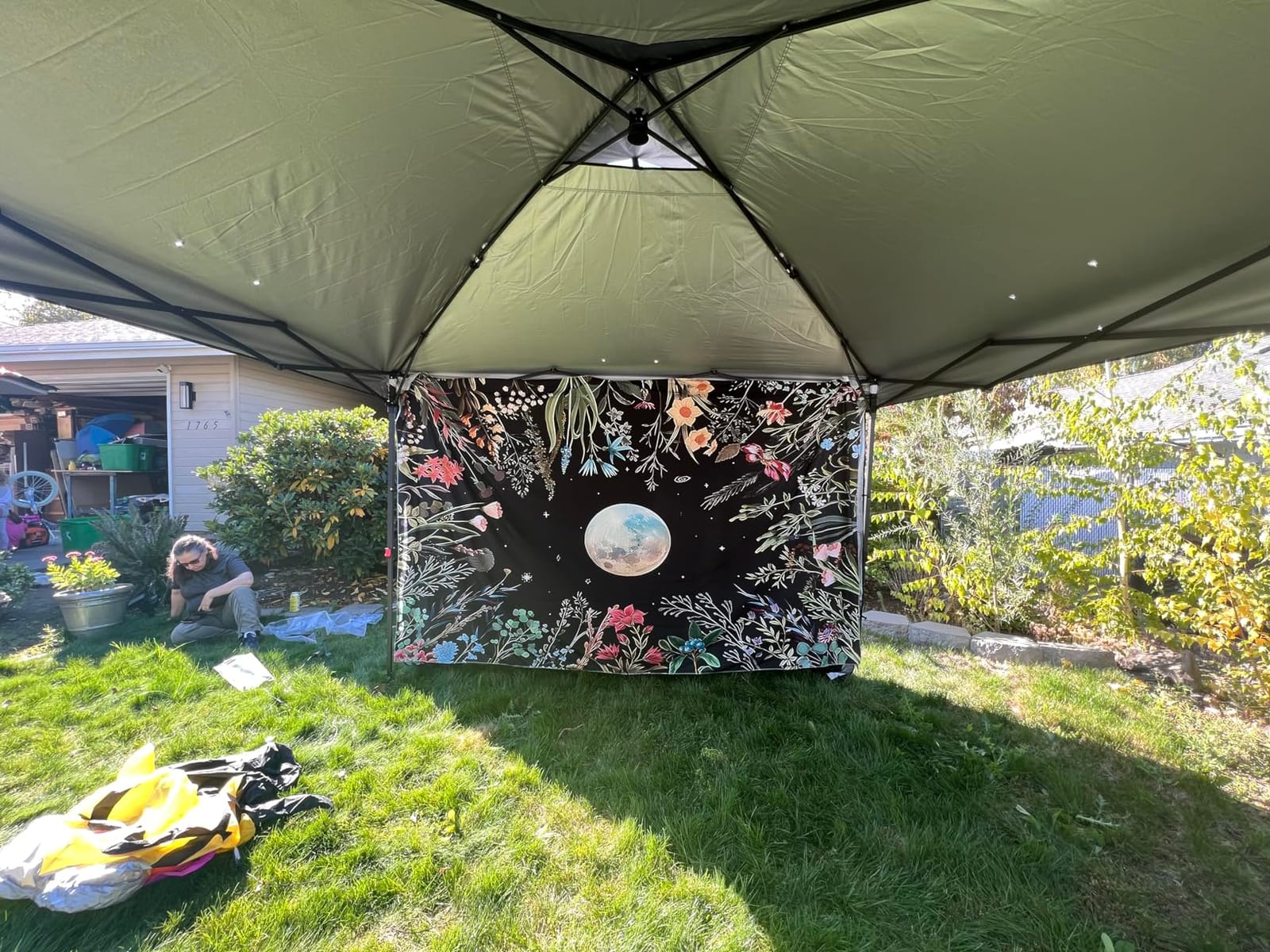
What to check before you buy it for your pitch
Check the pockets against your sun exposure. They are on the side wall, and owners warn they heat up in direct sun, so keep chocolate, chocolate-covered items and temperature sensitive goods on the shaded interior table instead.
Keep the parts list. Ask whether replacement S hooks and joint hardware are available before you buy, because that is the part most likely to need replacing.
Where it is a poor fit
At 38.6 lb it is not a light carry, and it does not have the foot wheels that make our top pick roll across a site. If you move a long way from the car, that difference adds up over a season.
It is also not the tent for permanent outdoor installation, and the listed warranty is one year on the frame with six months on fabrics and accessories.
8. Best Choice Products 10×10 Canopy with Side Wall – Best for Stability
Best Choice Products 10×10 Pop Up Canopy Tent with Sidewall, Silver
Straight leg alloy steel
100 sq ft
36.4 lb
4 preset heights
60 day warranty
Pros
- One push center button with no-pinch height adjusters
- Ten 18 inch wide side wall pockets
- Four weight bags rated to add up to 112 lbs of extra support
- Wheeled zip up case with three heavy duty cinch straps
- Straight leg design gives true 100 sq ft of shade
Cons
- Listed as not water resistant
- Only a 60 day warranty
- 36.4 lb is still a two hand load
- Smaller review base so long term data is thinner
The reason to look at this one is the anchoring hardware. The four included weight bags are rated to add up to 112 lbs of support, and on an open asphalt pitch with no stake permission that number is the whole argument.
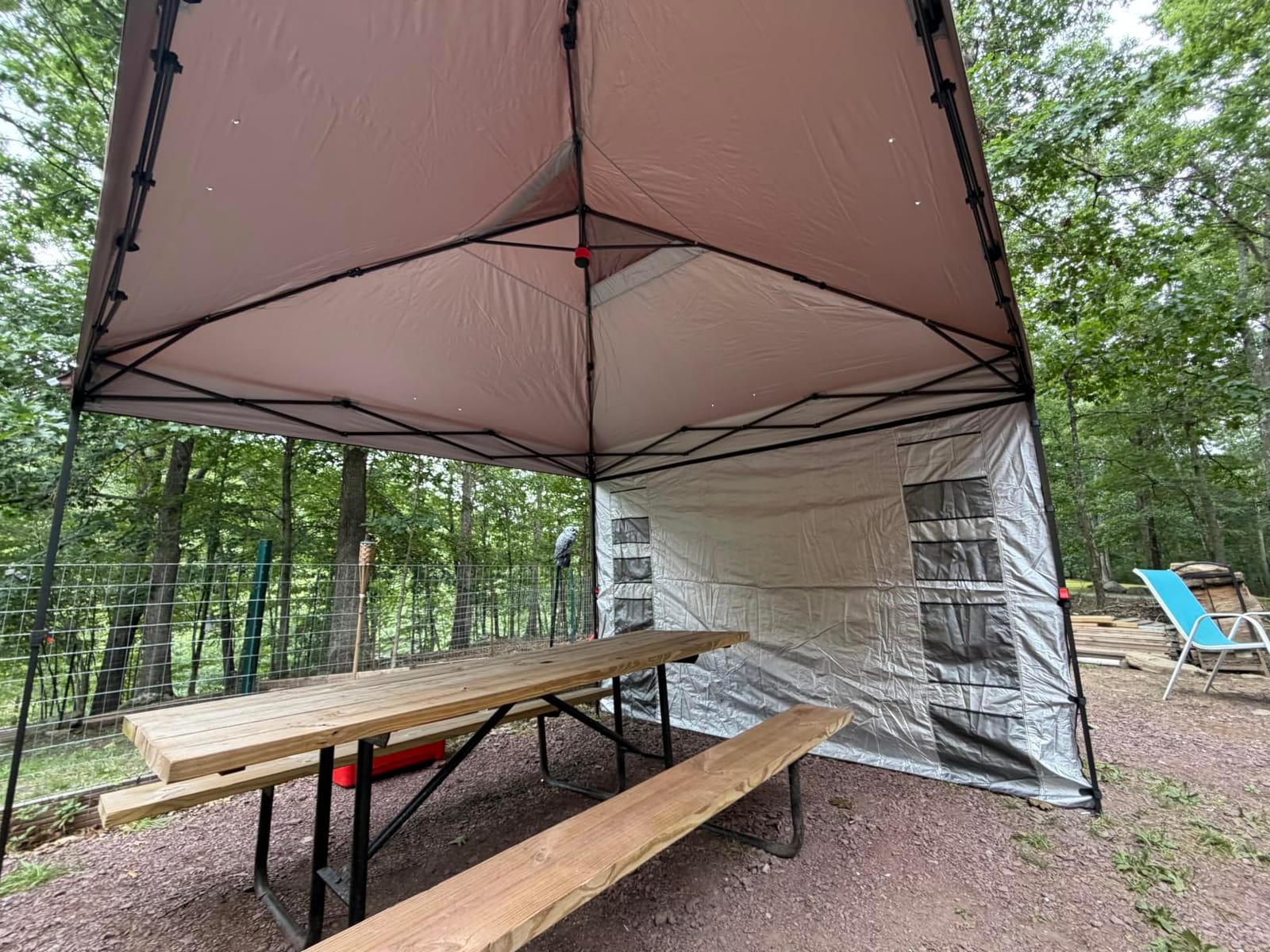
The side wall is also unusually well thought out. It uses a quick zip system with ten 18 inch wide pockets, so a booth that sells small packaged goods or price cards has a place for all of them at hand height rather than in a bin under the table.
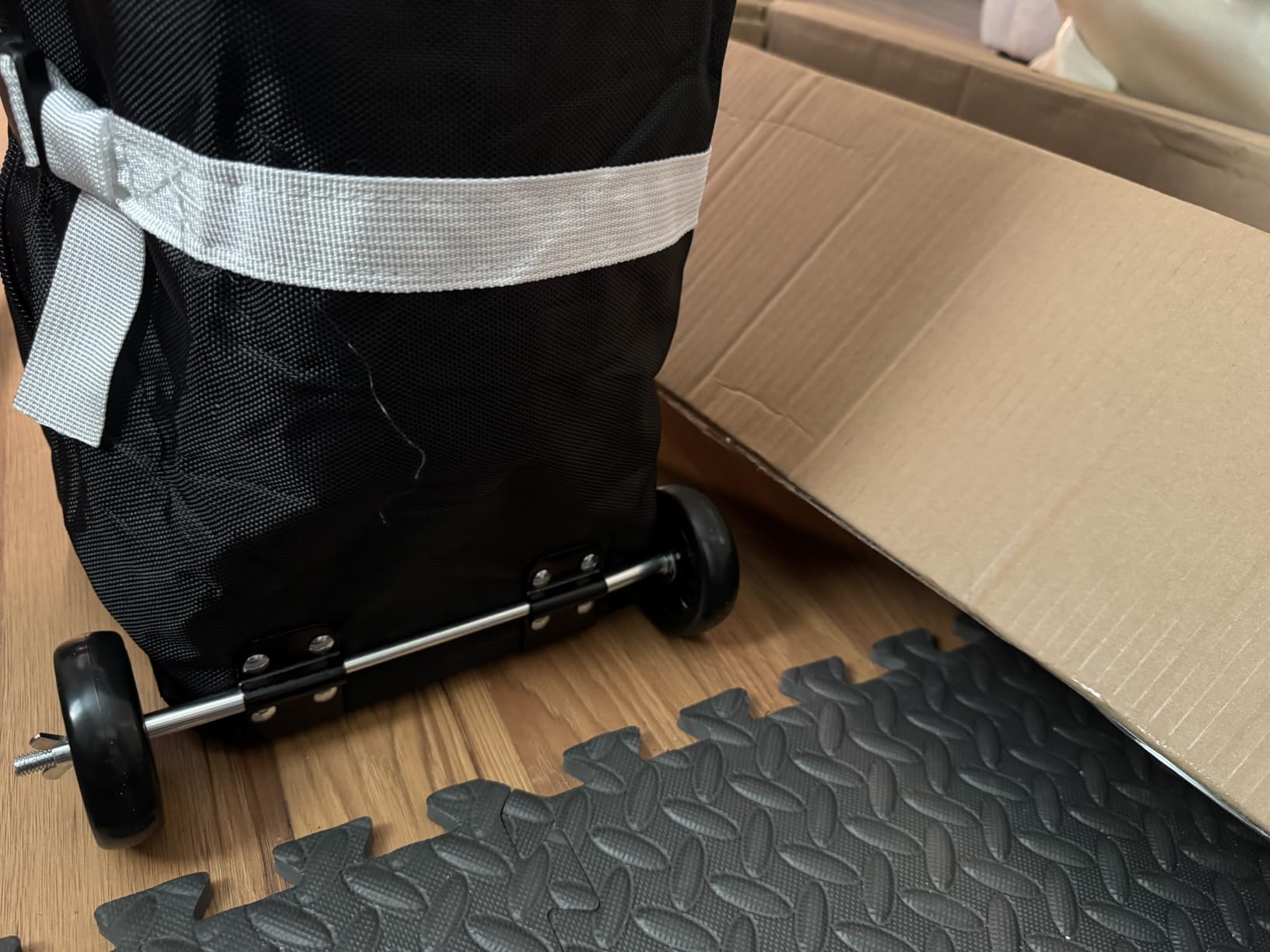
Setup is a one push central button with no-pinch height adjusters and four preset heights, and owners consistently report a solo setup in about a minute. Transport is handled by a wheeled zip up case with three heavy duty cinch straps, which keeps the bundle compact once collapsed.
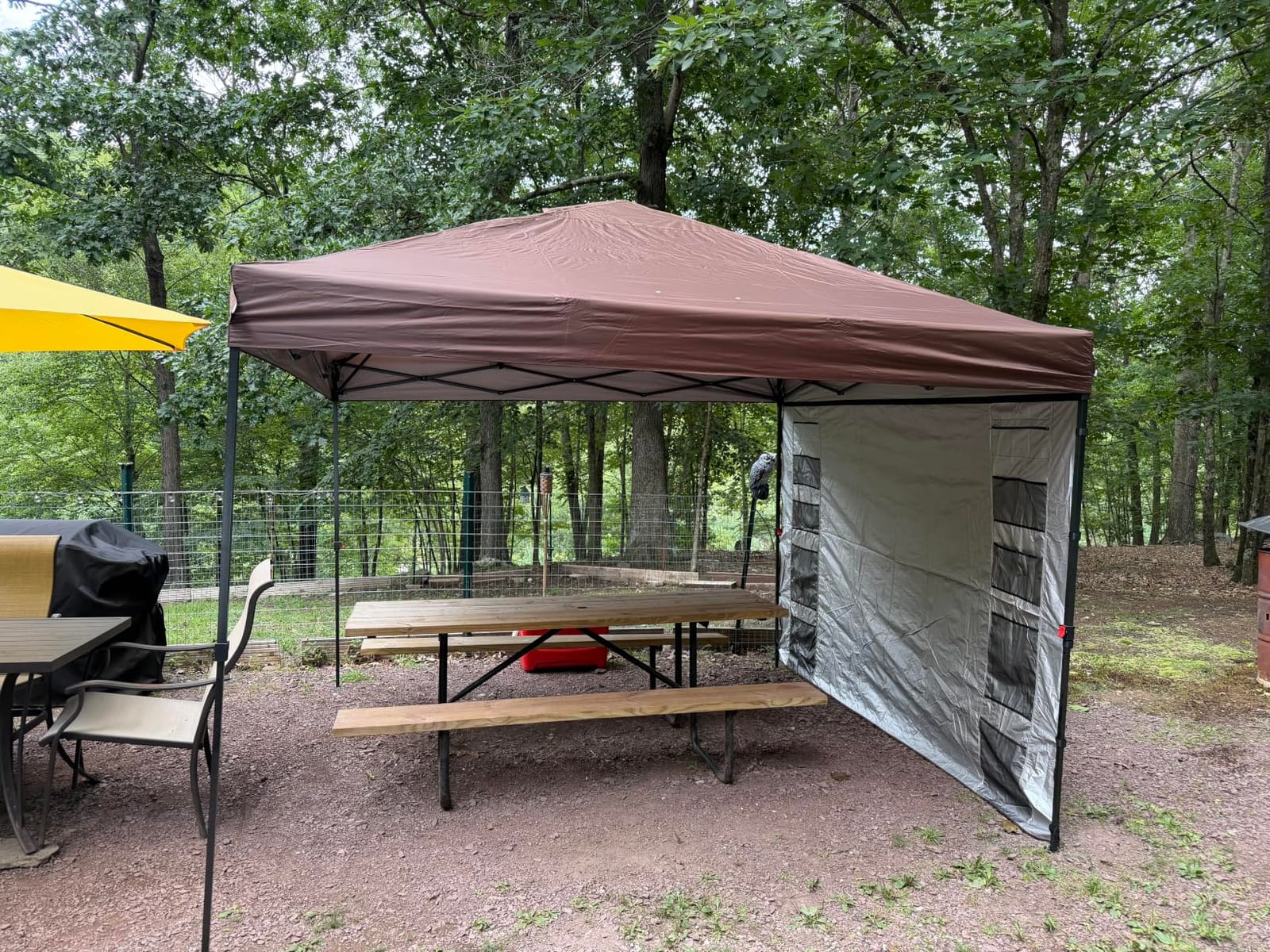
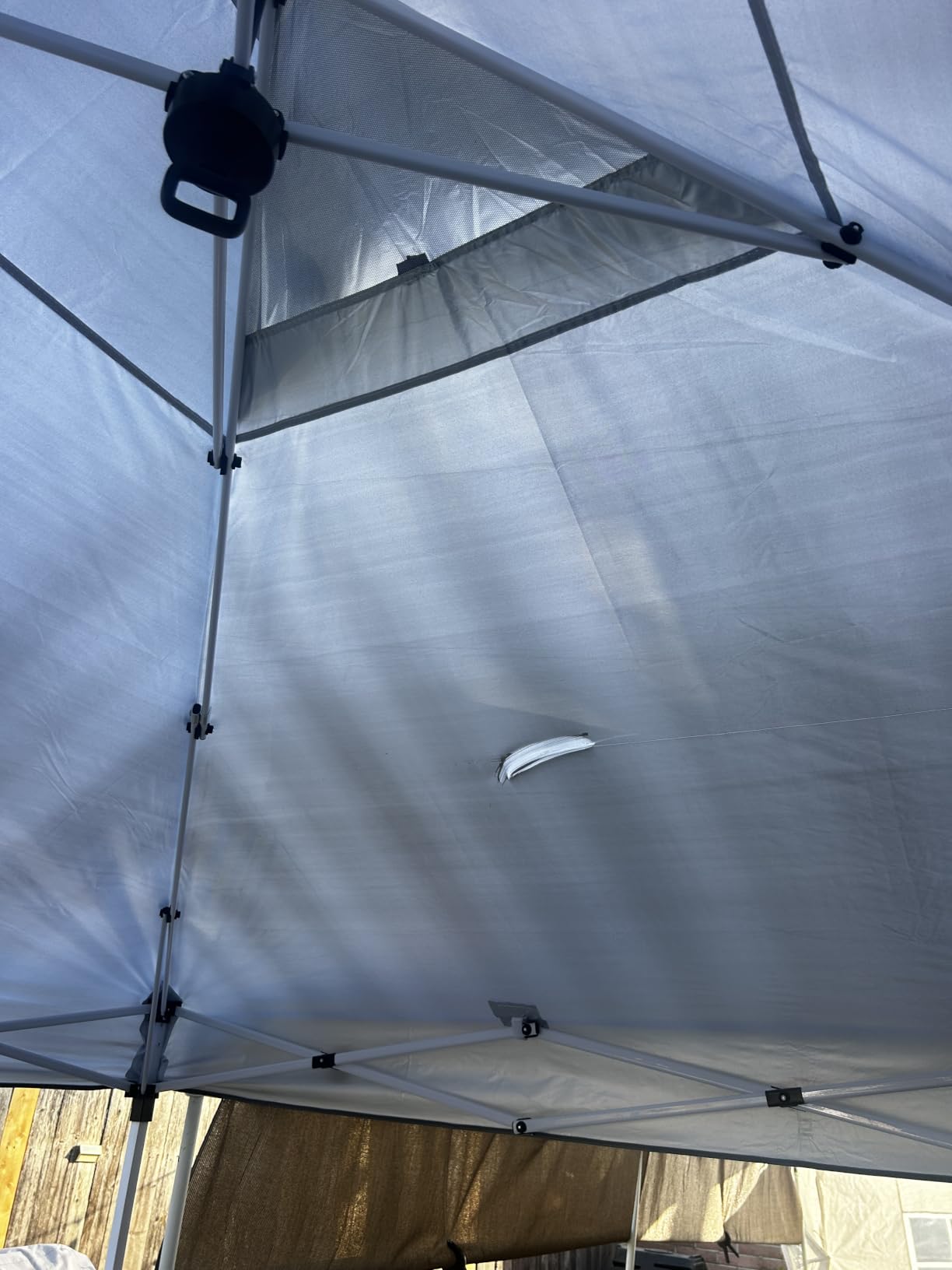
The honest weakness is water. The listing states the canopy is not water resistant, and owners describe the 150D Oxford fabric as water repellent rather than waterproof, so this is a shade and sun tent that will keep a light shower off your products for a while rather than a tent you can rely on in steady rain.
The warranty is 60 days with returns going to a return center, which is the shortest warranty among the ten canopies reviewed. Combined with a smaller review base than the category leaders, long term durability data here is thinner.
What to check before you buy it for your pitch
Check your rainfall history. If your market season is mostly dry summer mornings, the not water resistant rating will not matter. If you sell through autumn rain, look at a PU lined or 400D top instead.
Check the 60 day window in your calendar. Make sure the tent is something you are still happy with well before the return period closes, because long term data here is limited.
Where it is a poor fit
It is a poor fit for a full time vendor who plans to run the same tent for years and wants a warranty behind it. The short coverage works against that plan.
It is also the wrong choice if you need full enclosure, since only one side wall is included and the other three sides stay open.
9. Nazhura 10×10 Freestanding Shelter – Best for Casual and Backyard Use
Nazhura 10′ x 10′ Pop Up Canopy Tent with Sand Weight Bag, Freestanding Sun Shelter for Picnic and Camping, One Person Setup and Height Adjustable (White)
Straight leg alloy steel
100 sq ft
37 lb
4 preset heights
101 in peak
Pros
- One person setup and breakdown with a central button and no-pinch adjusters
- Straight leg design gives 100 sq ft at four preset heights
- Wheeled rolling case with a rugged handle
- Flame retardant polyester canopy on a durable steel frame
Cons
- No side walls included
- Water repellent rather than waterproof
- 101 inch peak is the shortest of the canopies reviewed
- Smallest review base of the group
This is the tent to buy if you are a weekend seller rather than a full time vendor, or if you want one shelter for both the market and the backyard. The straight leg frame gives a true 100 square feet at four preset heights, and the central button with no-pinch adjusters means one person can put it up and take it down without a second set of hands.
Transport is handled by a rolling storage case with wheels and a rugged handle, which is what makes 37 lb manageable on a hard surface. The canopy is flame retardant polyester on a durable steel frame.
Buyers consistently treat it as a solid all rounder at this price point, and it ranks first in its category on Amazon, which tells you how many casual buyers have landed on it.
The gaps are the same ones you would expect at this tier. There are no side walls, so wind protection and display storage both require an add-on purchase. The top is water repellent rather than waterproof, which limits it in sustained rain.
Peak height is listed at 101 inches, which is the shortest peak of the canopies we reviewed, so if you are tall or you hang shelving it is worth checking before you commit. The review base is also the smallest here, so you have less long term feedback to lean on.
What to check before you buy it for your pitch
Measure your display plan against the 101 inch peak. A table with a raised tier or a small shelf behind it can eat the clearance you would otherwise get.
Decide now whether you will buy a wall kit. Vendors who later add walls report the cost and the wind load of the walls are both easier to plan for up front than to retrofit at a pitch.
Where it is a poor fit
Skip it for rain-heavy markets, where a water repellent top will have you packing up at the first real shower.
It is also a poor fit for a vendor who intends to run markets year after year and wants a fabric that survives more than one season of UV exposure.
10. Raynesys 10×10 Pop Up Canopy with Sidewalls – Best for Height Range
Raynesys 10x10ft Pop Up Canopy Tent with Sidewalls for Events, Parties
Powder coated carbon steel
100 sq ft
5.6 to 8.7 ft height
190T UPF 50+ top
Pros
- Widest height adjustment span here
- from 5.6 ft to 8.7 ft
- Powder coated carbon steel frame that is rust resistant
- 190T silver coated fabric with UPF 50+
- Complete kit with side walls
- 4 guy lines
- 8 stakes
- 4 sand bags and a wheeled bag
- Folds to 46 by 9 by 8.9 inches
Cons
- Smallest review base of the ten canopies
- Only one side wall is included
- 190T fabric is thinner than the 300D and 400D used by heavier duty models
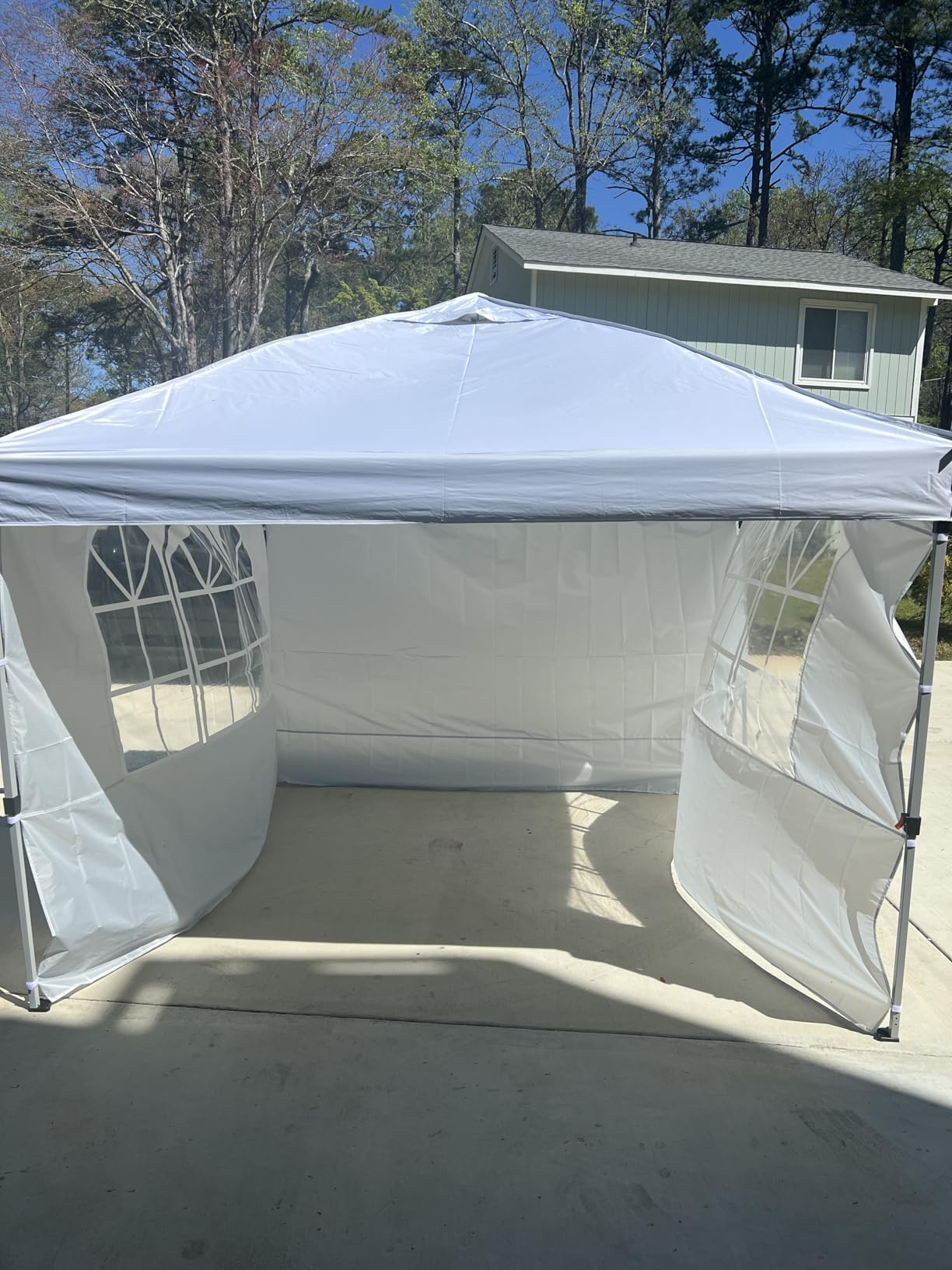
The Raynesys does one thing that nothing else here does, and it does it well. The height adjusts from 5.6 ft to 8.7 ft, the widest span among the canopies reviewed, which means you can set a low table height for a seated booth in the morning and raise the frame for a standing sales pitch without repitching.
Setup is a pre assembled frame where you attach the top, push the center hub and adjust the legs, which owners report takes under a minute for one person. The folded profile of 46 by 9 by 8.9 inches fits most car trunks, and the accessory bundle is generous: side walls, four guy lines, eight stakes, four sand bags and a wheeled carrying bag.
The frame is powder coated carbon steel described as rust resistant, and the 190T silver coated top carries UPF 50+ protection with reliable water resistance for sun and showers.
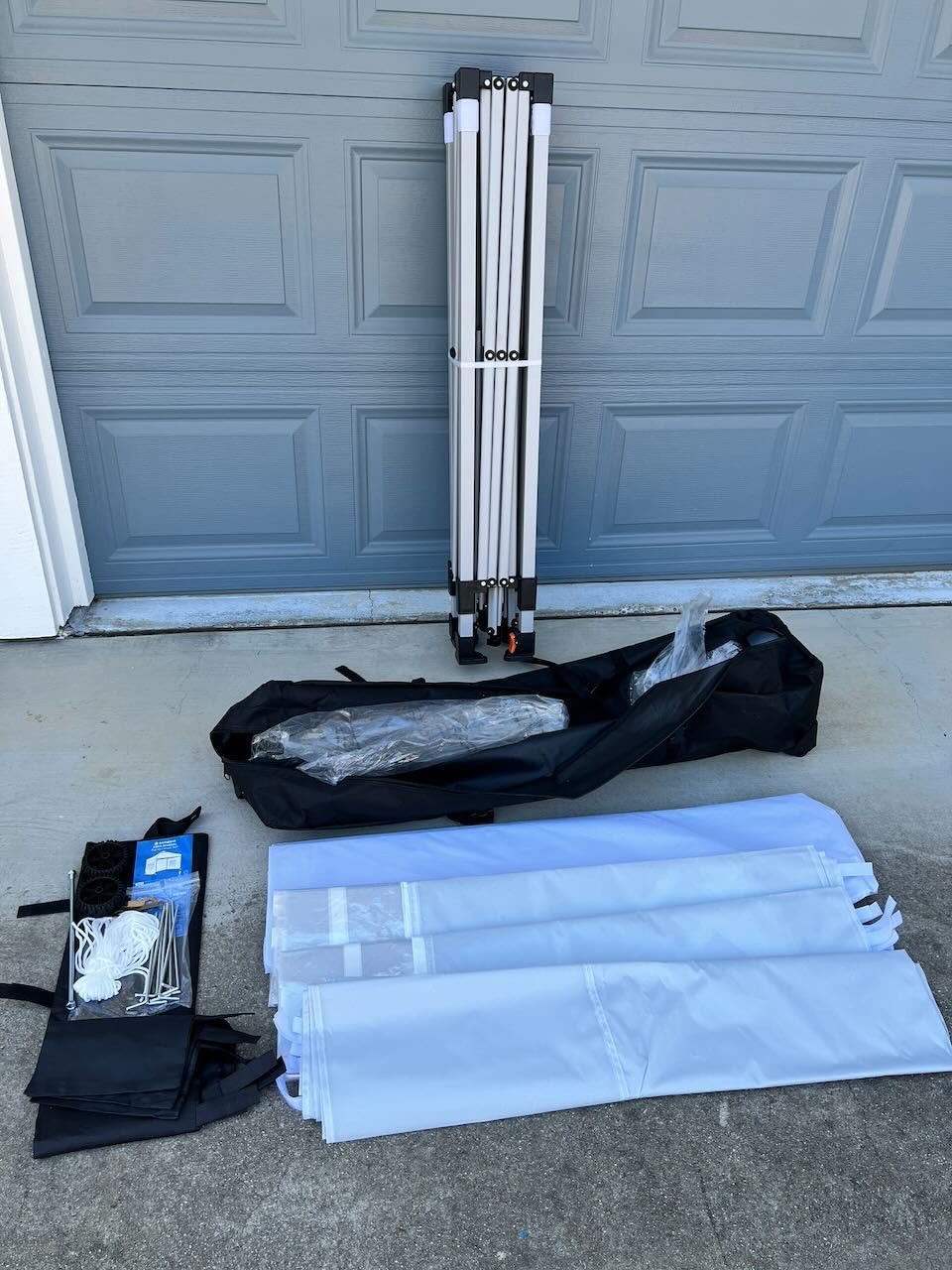
The limitation is evidence. With 393 reviews this is the least proven tent of the ten, and buyers say so directly, noting there is less long term durability data than for the established brands. A listed weight is not published, so confirm the packed weight yourself if solo transport matters to you.
Only one side wall is included as well, and the 190T fabric is thinner than the 300D and 400D material used by the heavier duty models here, so it belongs in a fair weather tier rather than a wet weather one.
What to check before you buy it for your pitch
Check the minimum height against your setup. At 5.6 ft, a seated serving counter is comfortable, but a table plus a tall cash display is not going to fit underneath.
Check the vendor list where extra stakes and sand bags matter, because at 8 stakes and 4 sand bags you have more anchoring hardware than several competitors include.
Where it is a poor fit
It is a poor fit if you need a fabric that has been proven across multiple seasons, simply because there is not yet a track record to point at.
Full enclosure is not available here either, with a single side wall in the box, so plan on a separate purchase if your booth needs a back wall.
Farmers Market Rules Every Vendor Should Check Before Buying
The most common expensive mistake in this category is buying a tent before reading the market rules, and no canopy we tested can override a manager’s decision. Ten by ten is the standard pitch on most market maps, and many managers will not let a single vendor claim two pitches, which rules out a 10×20 setup regardless of how good it is.
Check four things in writing before you buy. First, the maximum footprint your stall permits, usually 10×10 but sometimes 10×8. Second, whether flame retardant certification is required, because some markets and some local event permits ask for documentation and a 150D top without a rating will fail that check. Third, the minimum anchoring weight per leg, which many markets set explicitly and which decides how much ballast you carry. Fourth, the arrival window, because a tent that takes ten minutes to pitch will get you removed at a market with a fifteen minute setup window.
Also ask about signage. Vendors on forum boards repeatedly raise the same uncertainty about whether banners can be attached to the frame, and the answer varies by market. The safe version is a valance hung from the top of the frame rather than anything fixed to a leg, because legs carry structural load and a market manager will notice a strap pulling on one.
Finally, ask where you store the sand bags. Many sites let you keep the tent up overnight only if it is fully weighted and you check in with the site contact, and a few require the tent down before you leave. Vendor threads also describe markets that do not allow any tent to be left standing unattended, so treat overnight setup as permission rather than a default.
How to Anchor Your Canopy at a Market
Weight is not optional at a market, it is a condition of entry, and the number to work from is simple: plan on about 4 lb of ballast per mph of expected wind per leg, which for a 10×10 in 10 mph conditions means 40 lb across four legs. The rule of thumb comes from tent vendors rather than from an engineering standard, so treat it as a starting point and add margin.
On grass, stakes are the cleanest option. Drive them at a 45 degree angle away from the tent, attach them to the frame rather than the fabric valance, and pull the guy lines until the frame is visibly taut. Grass also lets you add a second stake per leg if the soil is soft, which is common in spring markets after rain.
On concrete and asphalt, weight bags are mandatory because stakes will not go in. Sand bags or filled water containers belong on each leg, and a market that specifies a per leg figure will check. Ballast should sit low on the leg feet, not on the roof, because weight on the roof is what tips a canopy in a gust rather than what holds it down.
On pavers and hard decks, use purpose made plate anchors that clamp over the foot of each leg. These are worth carrying if your market runs on a brick plaza, because they are faster and safer than four loose sand bags, and they do not trip a customer walking past your pitch.
Two anchoring details get skipped and both matter. Guy lines attach to the frame, not to the canopy fabric, because fabric tears long before steel does. And you should check your ballast before opening, not at the first gust, because a bag that is half empty is worse than no bag at all since the tent moves.
Straight Leg vs Slant Leg Canopies and Waterproof vs Water Resistant Fabric
Straight leg canopies have vertical legs and a flat top, so the shaded area at roof level equals the footprint at ground level. Slant leg canopies angle inward toward the top, which makes them more stable in wind and cheaper to build but costs you shaded area at the top corners, typically a foot or more on each side. For a market, straight leg wins on usable display space and slant leg wins on wind performance, which is why most of the tents here are straight leg.
Fabric weight is measured in denier, and the number is how thick the yarn is rather than how tough the finished fabric is. A 150D top is the everyday choice and is the right call for shade in a dry season. A 300D to 400D Oxford fabric is noticeably heavier and better at holding off wind and rain, and a 500D top with a polyurethane lining is the tier for markets that trade through autumn weather.
Water resistant and waterproof are not the same claim, and vendors use both loosely. Water resistant means the coating sheds light rain for a limited time. Waterproof means a sealed or PU lined surface that keeps water out longer, and only two of the ten tents here carry a listed waterproof rating. In heavy rain you will see water pool in the valleys of any canopy regardless of rating, which is exactly why air vents and a fold flat high peak top matter as much as the denier number.
UPF 50+ means the fabric blocks roughly 98 percent of ultraviolet radiation, and every tent here claims some version of it. Higher is better for a full day of direct sun, and the practical difference between a 150D silver coated top and a heavier Oxford top shows up in how the interior feels at two in the afternoon.
CPAI-84 is the fire resistance standard for tent fabric, and only a few models reviewed here are rated to it. If your market or your local permit asks for fire certification, filter on that rating before anything else, because a fabric without a rating will not be accepted regardless of how well it is built.
Buying Guide: Seven Specs to Check Before You Buy a Market Canopy
Frame gauge and construction come first, and the difference between a consumer frame and a commercial one is obvious once you handle both. Look for a full truss frame with square legs around 1mm thick, and a powder coated finish if your market is coastal or your season runs into damp weather. Telescoping legs with thumb latch locks adjust faster and survive more height changes than friction fit legs.
Fabric tier is the second spec, and you should match it to your season rather than your ambition. 150D silver coated polyester with UPF 50+ is right for summer markets. 300D to 400D Oxford is right for shoulder seasons. A PU lined top is right if rain regularly cancels your pitch or wets your product.
Peak and valance height matter more than footprint for a display booth. Most 10×10 frames land between 100 and 110 inches at the peak, and the valance hangs lower at the edges. If you use tall shelving, a hanging plant rack or a banner under the frame, check the number rather than assuming every 10×10 clears a person standing upright.
Packed weight decides whether you can actually do this alone. Anything under 30 lb is comfortable for one person, 30 to 40 lb is workable with a wheeled bag or foot wheels, and above 40 lb you should plan for two people at both ends. Also check the folded length, because a 45 to 46 inch packed profile fits a sedan trunk while a longer bundle does not.
What is in the box is the spec most vendors ignore and most regret. Side walls, weight bags, stakes, guy lines, a roller bag and a warranty all add up. A tent that includes four weight bags and eight stakes saves you a shopping trip, and a two year warranty with year one canopy replacement is worth real money if the top fades in your third season.
Replacement parts decide how long the tent lasts. A frame is usually good for many seasons while a top fades first, so ask whether replacement tops and individual truss bars are available. Brands with a domestic parts warehouse are meaningfully better for a vendor who plans to keep one tent for years.
Finally, work out cost per season rather than purchase price alone. Divide what you spend by the number of seasons you realistically expect, and compare that to renting a pitch with a tent included. A commercial frame that holds for four seasons often works out cheaper per market day than replacing a budget frame every season, even though it costs more on day one.
Frequently Asked Questions
Which 10×10 canopy tent has the highest rating?
Among the ten canopies we reviewed, the CROWN SHADES 10×10 One Push has the highest rating at 4.6 out of 5 across more than 11,000 reviews. The 10×10 version with one side wall shares that 4.6 rating on a smaller review base. If you want the highest rated tent with the most owner feedback behind it, that is the one to buy.
What is the best canopy tent for vendors?
For a vendor who sets up alone every week, the CROWN SHADES 10×10 One Push is the best canopy tent for vendors because the one push center lock hub lets a single person pitch it in about a minute and the STO’N GO bag has wheels in the feet. If you have a second pair of hands and want maximum frame strength, the ABCCANOPY 10×10 Commercial is the better buy.
Can one person set up a 10×10 canopy?
Yes, every 10×10 canopy reviewed here is designed for one person setup, and the fastest models open from a single center push button rather than requiring you to walk around the perimeter. Owners of the one push models report solo pitches of about a minute and takedowns of one to three minutes. Heavier full truss models are still technically solo but take two people in practice.
Are 10×10 canopy tents waterproof?
Most 10×10 canopy tents are water resistant rather than waterproof. The difference is the fabric tier: 150D and 190T silver coated polyester sheds light rain, while 400D Oxford and 500D polyester with a polyurethane lining hold off heavier rain. In any canopy, pooled water in the top valleys can drip along seams, so a vented peak and a fold flat top matter as much as the fabric claim.
Do I need weights for a canopy tent at a farmers market?
Yes, at almost every market, and many managers specify a minimum weight per leg. On hard surfaces where stakes are banned, weight bags or plate anchors are the only option. A useful rule of thumb is about 4 lb of ballast per leg for every mph of expected wind, so a 10×10 in 10 mph conditions calls for about 40 lb spread across the four legs.
What’s the life expectancy of a 10×10 canopy?
A well made steel frame canopy typically lasts several seasons, often three to five, while the polyester top fades and degrades first under constant UV exposure. Heavy use, storm damage and storing a wet top shorten that. Buying a frame that outlives two tops, and confirming replacement tops are available, is the cheapest way to extend the life of the whole tent.
Are straight leg or slant leg canopies better?
Straight leg canopies give you true square footage because the top area matches the footprint, which is better for displays and tables. Slant leg canopies angle inward, are steadier in wind, and are often cheaper. For farmers markets, straight leg is usually the better choice because usable booth space matters more, and wind performance is handled by proper anchoring instead.
Which canopy is better value, Eurmax or ABC Canopy?
If you pitch with a second pair of hands and want a fully enclosed booth, the Eurmax is the better buy because it includes four zippered walls, four sand bags and a no-tip wheeled bag. If you are working solo, the ABCCANOPY is the better value because it is lighter in the case and includes three side walls, a door wall and four weight bags in a lower weight package.
Which Canopy Tent Should You Buy for Your Market Booth?
Start with how you actually work, because that single answer narrows the list fast. If you pitch alone and load a sedan, the CROWN SHADES 10×10 One Push is the best canopy tent for farmers markets, and the version with one side wall is the same platform if you want a wall in the box. If you have a second pair of hands and want the strongest frame, go with the ABCCANOPY 10×10 Commercial, whose 500D PU lined top is the most weather capable fabric here.
Full enclosure points to the Eurmax with its four zippered walls, a heavier tent worth its weight if you have help at both the car and the pitch. More booth space points to the CROWN SHADES 10×15 with 400D Oxford fabric, once your market approves the larger pitch. Small item display points to the Tunbne with its six pocket side wall, hard surface anchoring points to the Best Choice Products with four bags rated to 112 lbs, and a wide height range points to the Raynesys.
Whatever you choose, read your market manager’s rules before you buy, and bring more ballast than you think you need. These are the best canopy tents for farmers markets in 2026 because each one is built for the realities of a pitch rather than for a backyard.
Once the tent is up, the rest of the booth matters too. Our picks for the best dishwashers on the market and the best flat irons on the market cover two more staples vendors carry between markets.