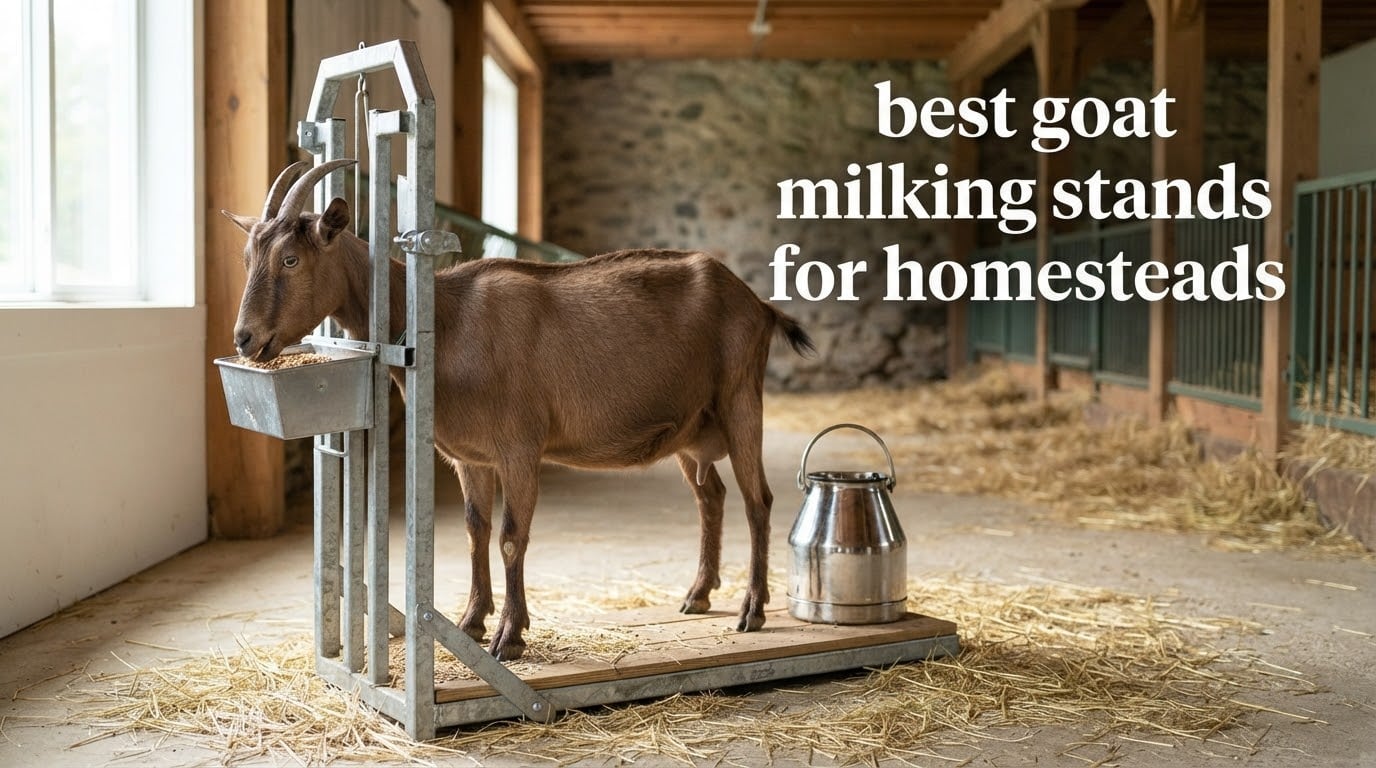
Milking two does by hand means crouching on a barn floor with a pail, your back bent and your knees in the dirt, twice a day, every day. A goat milking stand fixes that. It lifts the animal to a working height, holds the head in a proper headpiece, and usually adds a feed bin so the goat has a reason to stand still. They are, in short, the same kind of side-by-side comparison we did for our [cake stands](https://cookcraftandcreate.com/best-cake-stands/) and [tiered serving stands](https://cookcraftandcreate.com/best-tiered-serving-stands/) roundups: spec by spec, with the trade-offs written down instead of glossed over.
A goat milking stand goes by a lot of names. You will see goat stanchion, goat restraint stand, livestock grooming table and dairy goat milking stand all used for the same basic object: a raised platform with a head gate, side rails and often a feeder. Most of them do far more than milking. The same stand handles hoof trimming, shearing, bathing, injections and routine health checks, which is why the picks below are ranked on versatility and stability rather than on one narrow chore.
For dimensions, the short answer: a standard goat milking stand platform runs about 47 to 51 inches long by 23 inches wide, with the working platform adjustable between roughly 20 and 33 inches off the ground. Small-breed versions come in around 35 by 18 inches. We spent weeks comparing 8 stands across weight, height range, capacity, feed access, mobility and cleaning, and the winner was not the one with the biggest capacity number on the box.
Table of Contents
- Top 3 Goat Milking Stands We Trust in 2026
- All 8 Best Goat Milking Stands for Homesteads (October 2026)
- 1. Weaver Livestock Steel Trim Stand – Best Heavy-Duty Handling Platform
- 2. Goatzy Adjustable Goat Stand – Best Portable All-Rounder
- 3. Lezbanz 600 lb Goat Stand – Best Value Stand for Most Herds
- 4. Bknius 600 lb Reinforced Steel Goat Stand – Best for Small-Breed Back Relief
- 5. Larrik 600 lb Goat Stand – Best on Uneven Barn Floors
- 6. VEVOR 51×23 inch Livestock Stand – Best Height Range for Mixed Herds
- 7. Belinova Wrought Iron Goat Stand – Best for Large Breeding Does
- 8. Lezbanz 400 lb Dwarf Goat Stand – Best for Nigerian Dwarf and Pygmy
- How to Choose a Goat Milking Stand Without Guessing
- Steel or Wood: Which Stand Material Holds Up on a Homestead
- First 30 Days: Training a Goat to Stand Willingly
- Frequently Asked Questions
- What are the dimensions of a standard goat milking stand?
- How long should a goat milking stand be?
- What is a goat milking stand called?
- How do I get a goat to willingly walk onto a milking stand?
- Can I use a goat milking stand with a portable electric milker?
- Do I need wheels on a goat stand?
- How do I clean a goat milking stand?
- The Verdict on the Best Goat Milking Stands in 2026
Top 3 Goat Milking Stands We Trust in 2026
All 8 Best Goat Milking Stands for Homesteads (October 2026)
| Product | Specs | Action |
|---|---|---|
 Weaver Livestock Steel Trim Stand Weaver Livestock Steel Trim Stand |
|
Check Latest Price |
 Goatzy Adjustable Goat Stand Goatzy Adjustable Goat Stand |
|
Check Latest Price |
 Lezbanz 600 lb Goat Stand Lezbanz 600 lb Goat Stand |
|
Check Latest Price |
 Bknius 600 lb Reinforced Steel Stand Bknius 600 lb Reinforced Steel Stand |
|
Check Latest Price |
 Larrik 600 lb Goat Stand Larrik 600 lb Goat Stand |
|
Check Latest Price |
 VEVOR 51×23 inch Livestock Stand VEVOR 51×23 inch Livestock Stand |
|
Check Latest Price |
 Belinova Wrought Iron Goat Stand Belinova Wrought Iron Goat Stand |
|
Check Latest Price |
 Lezbanz 400 lb Dwarf Goat Stand Lezbanz 400 lb Dwarf Goat Stand |
|
Check Latest Price |
1. Weaver Livestock Steel Trim Stand – Best Heavy-Duty Handling Platform
Weaver Livestock Steel Goat Trimming Stand with Wire Form Headpiece, Heavy Duty Adjustable Farm Stand, Foldable Gear for Cow, Goat, and More, Black
Alloy steel frame
50.5 x 23.75 x 19 in
170 lb load rating
57 lb
Pros
- Powder-coated heavy-duty steel spreads weight evenly
- Three aluminium cross bars under a wire mesh floor
- Adjustable front legs reach every body part
- Foldable with rounded corners
- 4.6 stars from 216 reviews
Cons
- Rated for animals up to 160-170 lb
- Straight wire headpiece needs a trained animal
- No feed bin or bucket ring
Best for: heavy-duty handling, hoof trimming and shearing on a farm that treats the stand as a permanent piece of equipment rather than a milking accessory.
This is the stand we keep coming back to. Of the eight we put side by side, the Weaver Livestock trim stand is the one with the largest body of owner feedback behind it at 4.6 stars from 216 reviews, and you can feel why when you put your hands on the frame. It is alloy steel with a powder-coated finish, it weighs 57 pounds, and the platform measures 50.5 by 23.75 inches. That is a real piece of shop equipment, not a bolt-together kit.
The engineering detail that stands out is the wide pad base with piano hinges, which spreads the animal’s weight across the frame instead of concentrating it at a single joint. Underneath, three aluminium cross bars carry a wire mesh floor that gives the animal grip without the flex you get from a thin expanded-metal deck. The front legs adjust, so a handler can work from a crouch or a standing position depending on the job.
What surprised us most is how much of daily goat care it absorbs. Once the animal is comfortable on the platform, the same session covers hoof trimming, injections, a bath and a full body check. Handlers in the reviews describe the foldable frame with rounded corners as the reason it moves between a barn and a wash pen without becoming a permanent fixture. The adjustable front legs are the part owners credit for back relief, which is the single most common reason homesteaders upgrade from milking on the ground.
Our honest limitation is that this is a trimming stand, not a milking stand. There is no feed bin and no bucket ring, so nothing keeps a goat occupied while you work. The straight wire form headpiece also needs a calm, trained animal – we would not leave a goat in it unattended. And the 170 pound load rating is well below the 600 pound claims on several cheaper-looking units, which is the reality: capacity numbers on budget stands are often inflated, while this one states a limit it can actually hold.
What it does better than the rest of this list
Very little here matches the combination of steel gauge, welded frame mass and published owner history. The 216 reviews give you a much clearer picture of long-term behavior than the 38-review budget entries, and the wire mesh floor grips better than a smooth steel deck. For a property where trimming, shearing and vet exams are weekly events, that durability earns the top spot.
The foldability is understated. Owners move it to a different barn, a wash area or even a livestock trailer, and the rounded corners mean a nervous animal is far less likely to catch a shoulder or a horn.
Where it will frustrate you
If your main job is milking, you will want a feed bin and a bucket ring, and this stand has neither. Budget accordingly, or plan on a separate conditioning routine using a feed bucket you carry in yourself.
The 170 pound ceiling also rules out the biggest Boer bucks and large Saanen does. And the listed height is 19 inches, so short handlers still need a stool for a low job. It is a restraint and handling station first, and a milking stand second.
2. Goatzy Adjustable Goat Stand – Best Portable All-Rounder
Goatzy Goat Stand with Adjustable Headpiece & Legs, Goat Milking Stand with Feeder, Rails & Wheels, Stanchion for Grooming & Hoof Trimming, Sheep Stand for Shearing Heavy-Duty Steel Platform, Black
Galvanized heavy-duty steel
600 lb load
46.3 lb
59.84 x 25.2 x 71.26 in
Pros
- Locking wheels and carry handle
- Legs fold flat for storage
- Removable side rails and feeder bowl
- Adjustable headpiece width fits small and large breeds
Cons
- Bulkiest unit at 46.3 lb and nearly 6 ft assembled
- Some hardware and setup complaints in reviews
- Headpiece adjustment does not hold for every animal
Best for: a mixed herd, a small barn with tight corners, and anyone who wants one stand to cover milking, trimming, shearing and lamb handling.
The Goatzy stand is the most feature-dense unit in this roundup, and at 4.2 stars from 151 reviews it has enough owner history to be worth trusting with real animals. It is galvanized heavy-duty steel with a stated 600 pound load capacity, and the height-adjustable legs plus width-adjustable headpiece let you reconfigure it between a Nigerian Dwarf and a full-size dairy doe without buying anything else.
What makes it genuinely portable is the combination of locking wheels, a carry handle and folding legs. You roll it out of the storage corner, drop the legs, and it is a working platform. That matters more than it sounds: on small homesteads the barn aisle is often the only place a milking routine can physically happen, and heavy stands that cannot move get worked around instead of used.
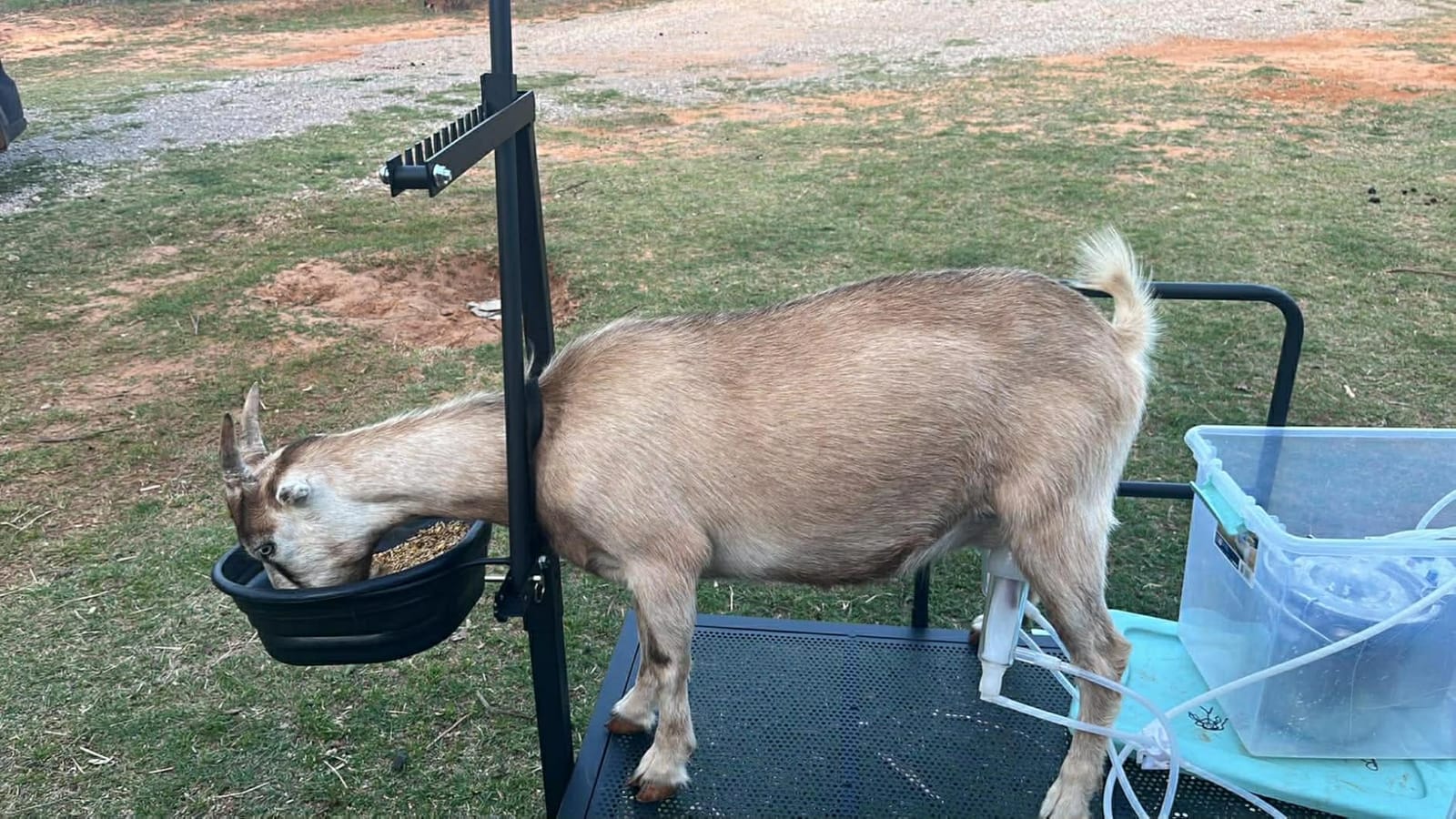
The removable side rails and detachable feeder bowl are the details we would not give up. The bowl keeps a goat focused on grain rather than on your hands, which is the difference between a quick session and a long negotiation. Pull the rails off and the same unit becomes a lamb stand or a sheep shearing stand, which extends its useful life well past the dairy season.
The honest trade-offs are size and hardware. At 46.3 pounds and nearly 6 feet assembled, it is one of the bulkiest units here, and that is awkward in a narrow aisle. Reviewers also report assembly and hardware fit issues for some buyers, and about 11% of ratings sit at three stars with the headpiece adjustment not holding perfectly for every animal. If your goats are tightly varied in size, test the headpiece fit on your smallest animal first.
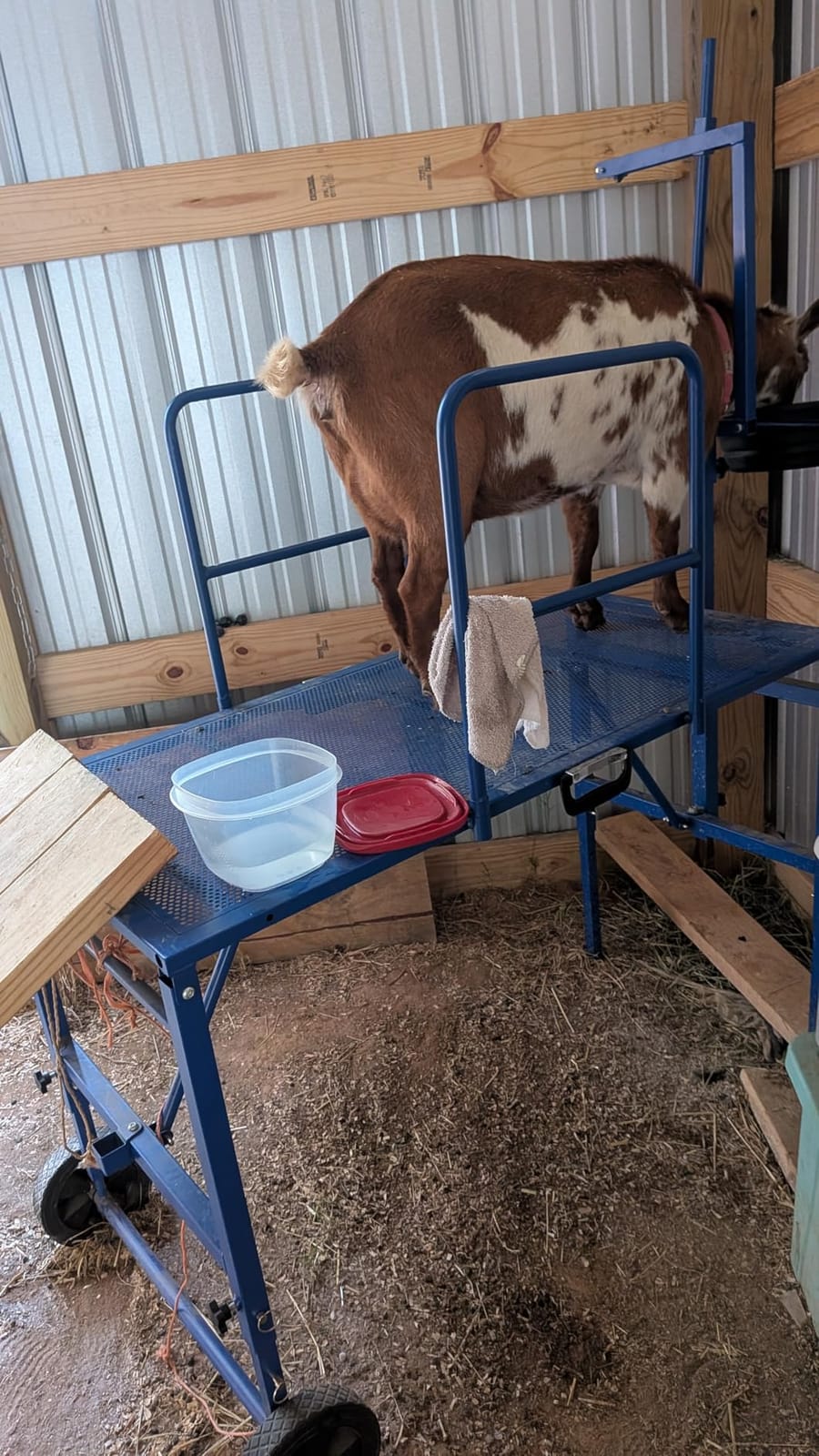
What it does better than the rest of this list
Wheels plus fold-flat storage means one stand can serve a morning milking, an afternoon hoof-trim session and an evening shearing job without a second purchase. No other stand in this list combines rolling mobility with a 600 pound rating.
The adjustable headpiece width is also the broadest fit story we found. Breeders who run Nigerian Dwarf alongside Boer or standard dairy goats can dial one headpiece across that range, which removes the sizing anxiety that shows up constantly in homestead forums.
Where it will frustrate you
Size and weight. At 46.3 pounds and 59.84 by 25.2 inches, you are moving a genuinely large object. Measure your aisle before you commit.
The review signal on hardware fit is real, so allow time for assembly and check every bolt before an animal is anywhere near the headpiece. And at 4.2 stars it sits below several cheaper units on average satisfaction, so the feature set is buying you capability rather than perfection.
3. Lezbanz 600 lb Goat Stand – Best Value Stand for Most Herds
Lezbanz 600 LBs Goat Stand with Feed Bin, Goat Milking Livestock Stand for Sheep Trimming and Milking, for Hoof Trimming, with Feeder, Adjustable Size, Iron Silver
Iron with spray coating
600 lb load
36 lb
49.5 x 25.5 x 4 in package
Pros
- Two extra load-bearing beams reinforce the platform
- Triangular frame resists wobble
- Light at 36 lb so one person can move it
- Collapsible feed bowl calms the animal
Cons
- Spray coating chips and bolts can vibrate loose
- Metal platform has no grip surface
- Head-latch piece has no retaining chain
Best for: the widest range of homesteads – a solid 600 pound-rated stand with a feed bin included and adjustable legs as standard.
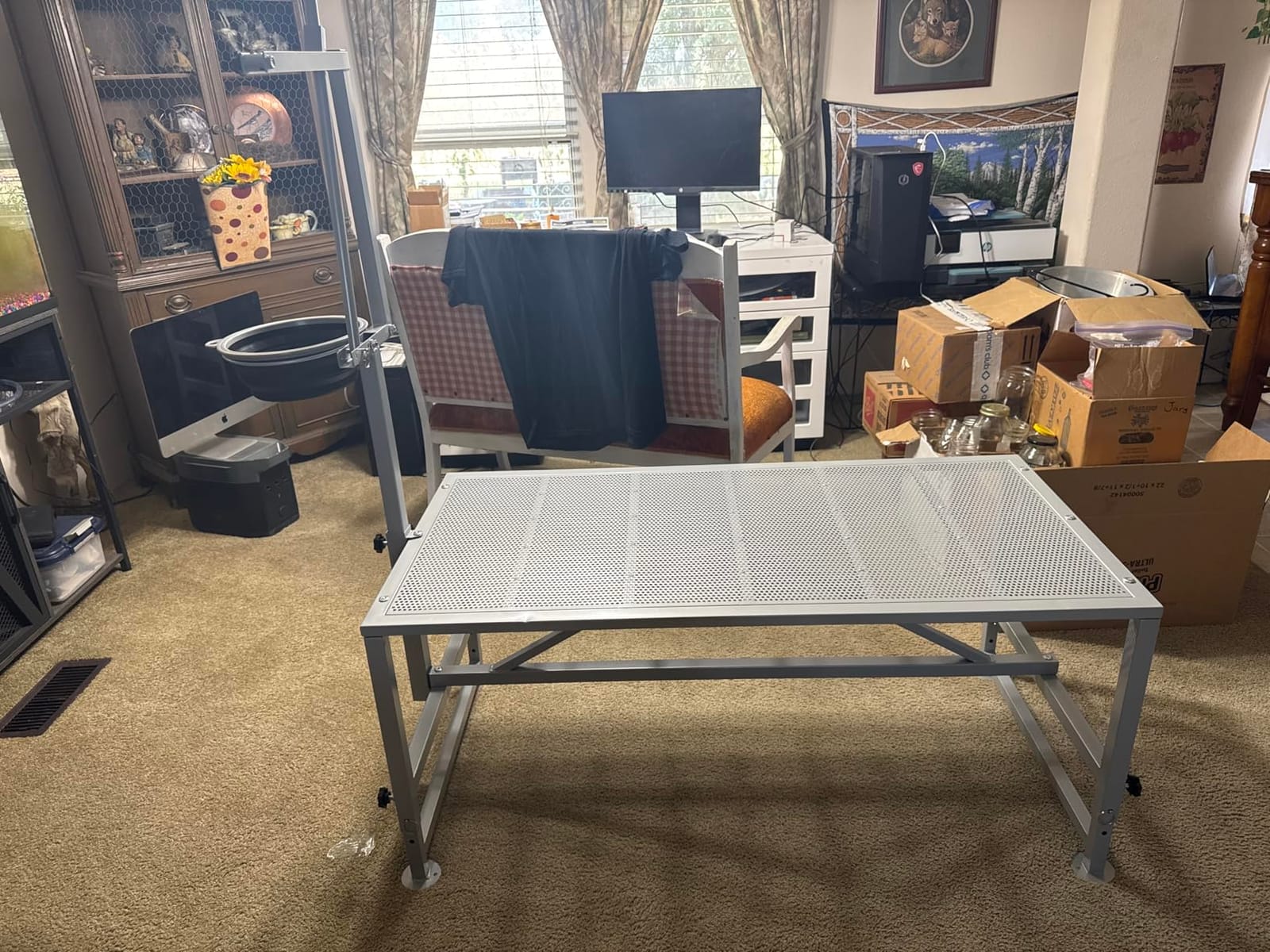
At 4.5 stars from 110 reviews, this Lezbanz is one of the strongest combinations of rating, review volume and capability in the lineup. The detail that makes it feel more substantial than its price tier is the reinforcement: two extra load-bearing beams under an expanded metal platform, held inside a triangular frame. That is the part that keeps it from rocking when a goat shifts weight mid-milking.
At 36 pounds it is also light enough for one person to walk around the barn unaided, which matters when the stand lives in a corner of a small barn rather than a dedicated milk room. The collapsible feed bowl holds roughly 2 pounds of grain, and adjustable leg height plus adjustable head-fixing space let you tune the fit across sheep and goats of different sizes.
The feed bowl is the feature owners mention most, and it matches what experienced handlers say: a goat with grain in front of it stands quietly. Homestead forum regulars describe the same pattern – get the animal used to the platform with a feed reward, and the rest of the session follows. The triangular frame also does a good job on the uneven dirt and gravel floors that make cheaper stands wobble.
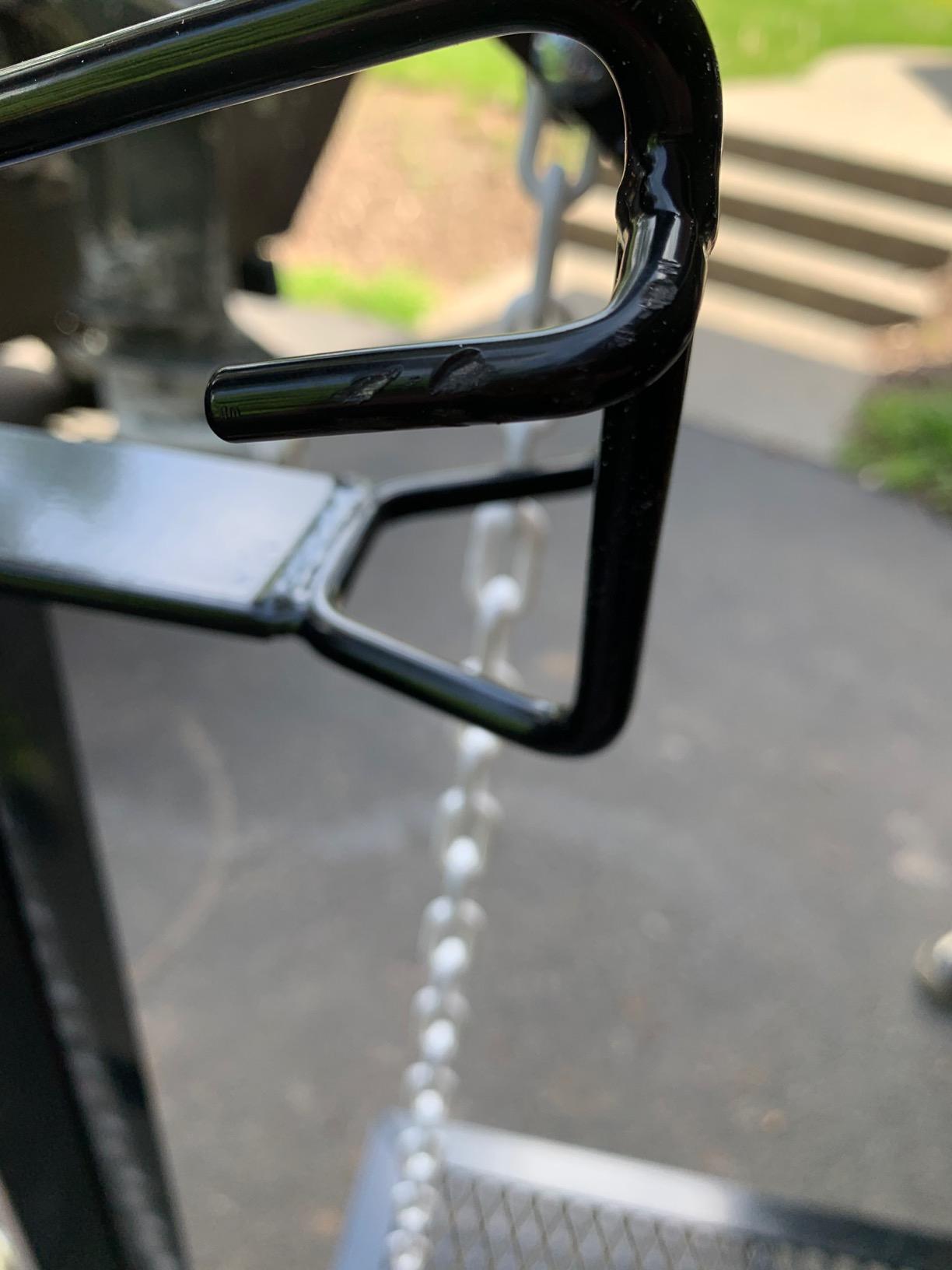
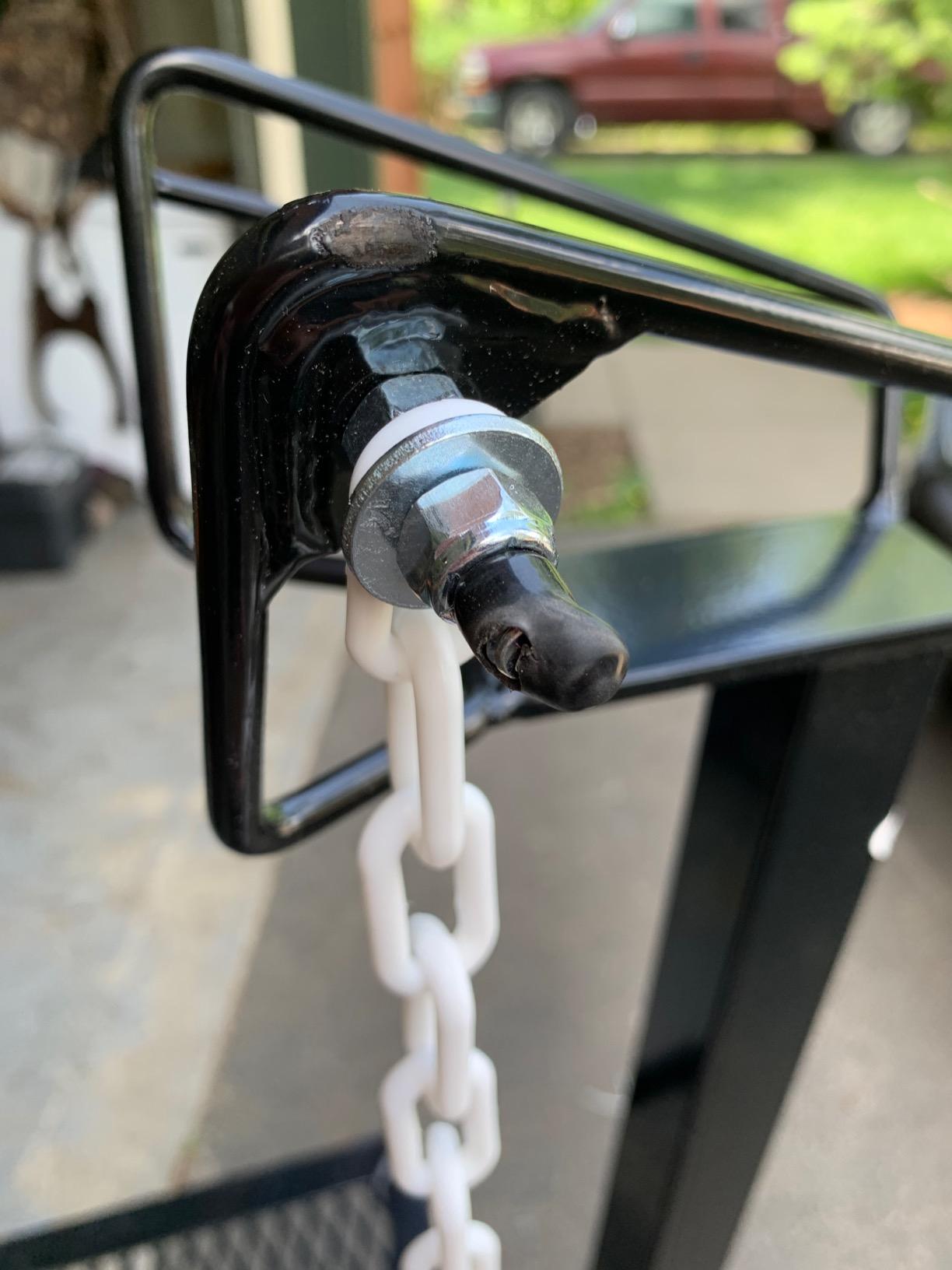
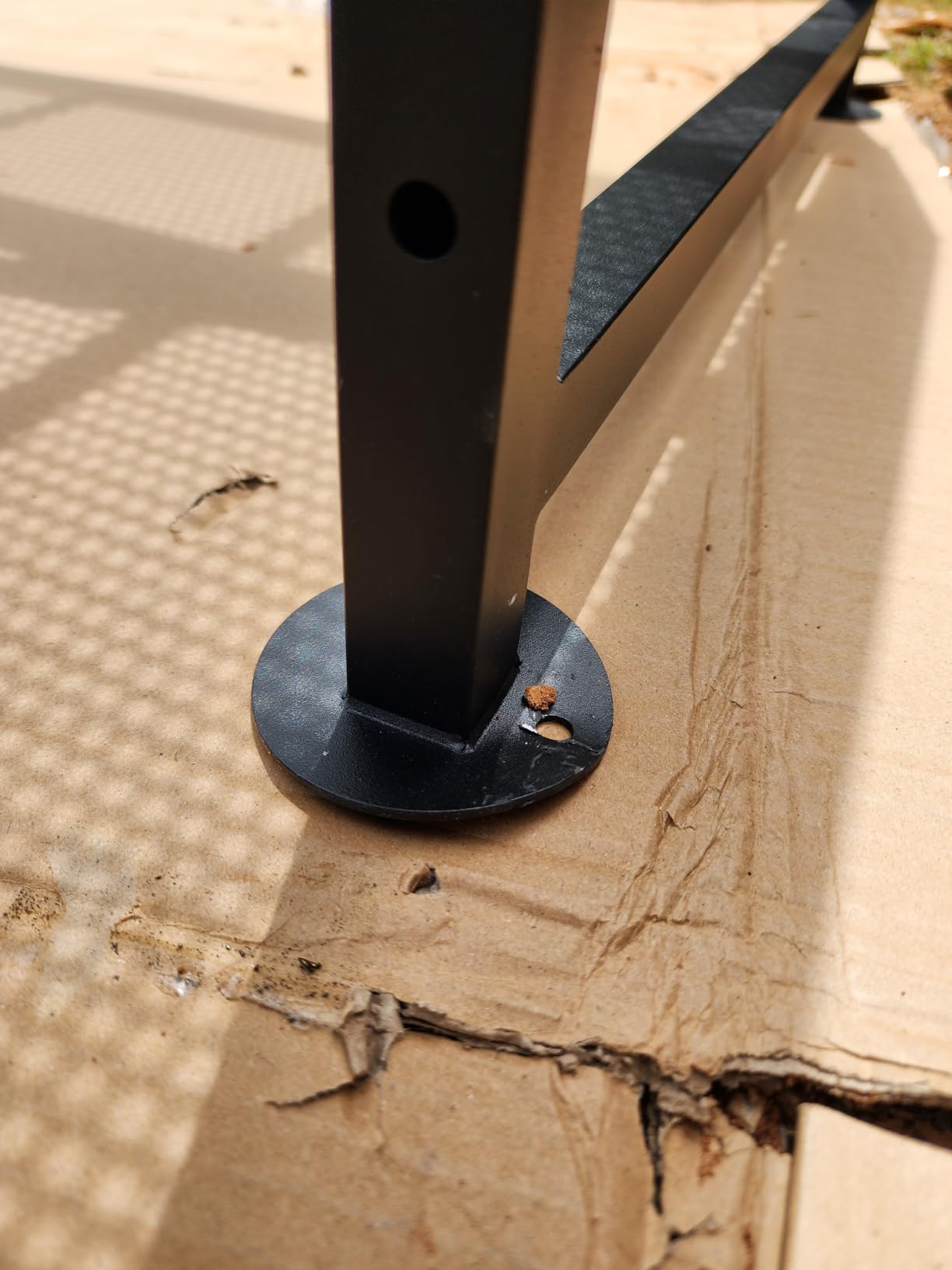
Where it falls short is finish durability. Owners report the spray coating chipping and the supplied pen and bolt hardware feeling cheap enough to vibrate loose over time. The platform also has no grip surface, so a nervous or slippery-hoofed goat struggles to get on and stay on. One more recurring note: the head-locking latch has no retaining chain, so small parts are easy to lose in the bedding.
What it does better than the rest of this list
The reinforced-beam platform and triangular frame are structural features several of the other entries in this price bracket do not have, and they are the reason this stand feels stable with a full-size doe on it.
For a first stand purchase on a working homestead, the capability-to-cost ratio is hard to argue with. You get a feed bin, a 600 pound rating and adjustable legs without paying for the folding frame and wheel kit.
Where it will frustrate you
Expect to touch up the finish. Spray-coated iron chips, and a stand in a wet wash pen will need a rust-prevention wipe-down every few months. Budget for that maintenance if you hose it down after every use.
The bare platform is the bigger daily annoyance. Plan to add a rubber mat or grip tape. Watch the small latch parts, and keep a spare set of bolts in the barn because they will work loose.
4. Bknius 600 lb Reinforced Steel Goat Stand – Best for Small-Breed Back Relief
Goat Milking Stand with Removable Feed Bin, 600LB Heavy Duty Goat Stand for Hoof Trimming & Grooming, Adjustable Livestock Stanchion for Goats & Sheep, Steel (Black, L-47 * 23Inch)
Reinforced steel
600 lbs
36.2 lb
49 x 29.1 x 4 in package
Pros
- Correct working height removes the bending motion
- Right-sized for Nigerian Dwarf and small goats
- Smooth platform rinses clean fast
- Easy to assemble and reposition
Cons
- Too light for Boer and other large breeds
- Supplied feeder bowl sits poorly and gets knocked out
- Platform can sag around the beams after about a year
Best for: Nigerian Dwarf and other small herds, and for handlers whose biggest complaint about hand milking is the constant bend.
This Bknius stand does one thing very well: it puts the animal at a working height that saves the handler’s back. That is not a minor benefit. Squatting to milk twice a day is how handlers end up with lower-back problems, and homestead owners describe adjustable-height metal stands as the single change that ended their discomfort. At 36.2 pounds it is also light enough to reposition between pens without help.
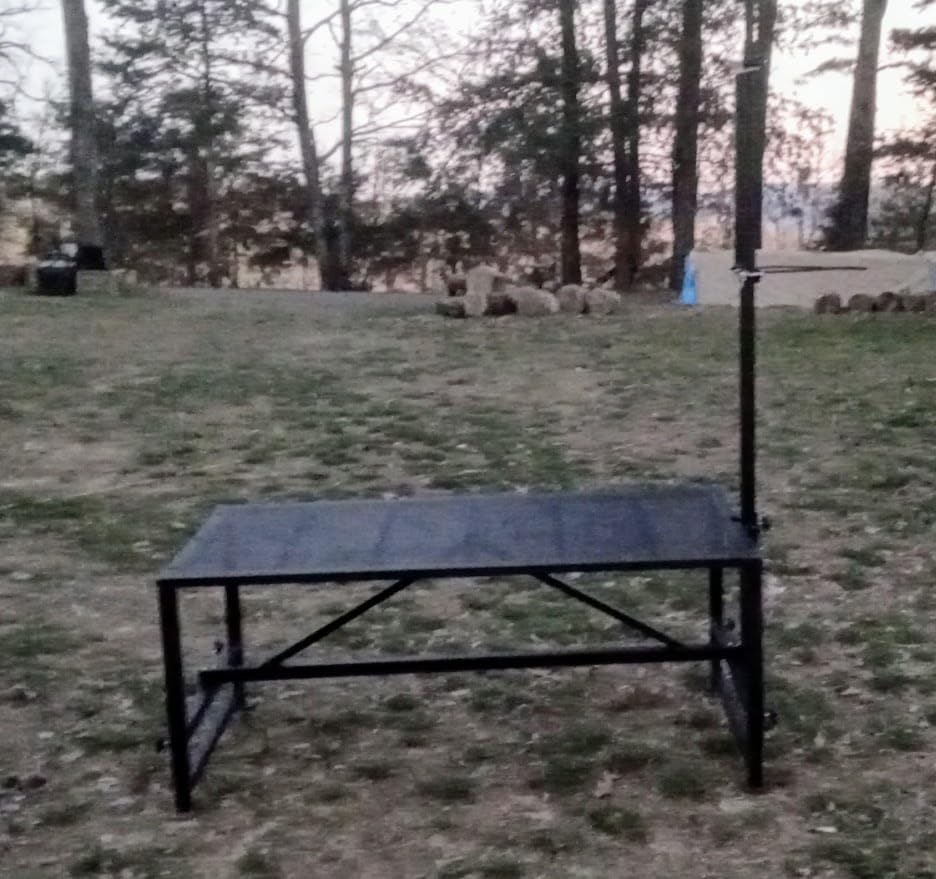
The build is a reinforced steel frame with 5 crossbeams rated to 600 pounds, with an adjustable headpiece, adjustable legs and an adjustable feeder bowl. Owners call it good value, easy to put together, and quick to rinse clean – the smooth platform surface means hose-down sanitation after each use takes seconds rather than minutes.
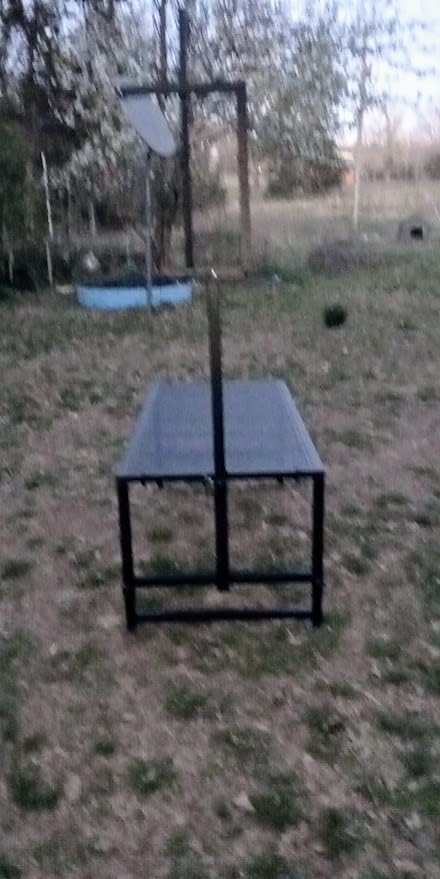
Fit is where this one separates from its price tier. Several owners specifically call it right-sized for Nigerian Dwarf, which is a real gap in this category. The complaint that metal stands run too tall even at the lowest setting for dwarf and Pygmy goats comes up again and again, and owners of this stand report that the adjustable legs solve it. For a small-breed herd, that is worth more than extra load capacity you will never use.
We want to be straight about the limits. At 4.1 stars this is the lowest-rated unit here, with 10 percent of reviews at one star. Owners report it is not substantial enough for Boer or other large breeds, that the supplied feeder bowl sits poorly in the wire well and gets knocked out by goats, that one unit arrived with a head lock whose parts did not match the instructions, and that the platform can sag around the support beams after about a year of use.
What it does better than the rest of this list
Small-breed fit and working height. If your herd is Nigerian Dwarf, Pygmy or mixed small stock, the adjustable legs here address the single most common sizing complaint in owner reviews across this entire category.
The smooth, rinse-cleanable platform also makes it a good fit for owners who milk twice a day and want a stand they can hose without thinking about it. Five crossbeams give it more structural redundancy than most stands in the same bracket.
Where it will frustrate you
Large animals. This is not the stand for Boer, big Saanen does or rams, and owners who tried to stretch it that way came back unhappy. Know your breed before you buy.
The included feeder bowl is close to a write-off – plan to mount your own. And watch the platform over the first year; several owners reported sagging around the support beams, which is worth checking at every monthly fastener inspection.
5. Larrik 600 lb Goat Stand – Best on Uneven Barn Floors
Larrik 600 Lbs Goat Milking Stand with Feed Bin, Heavy Duty Goat Stand for Milking, Hoof Trimming & Grooming, Adjustable Goat Stanchion for Sheep and Goats, Iron Black
Powder-coated iron
600 lb load
33 lb
47 x 23 in platform
Pros
- Adjustable feet compensate for unlevel floors
- Five support frames reinforce the frame
- Light at 33 lb so one person can carry it
- Removable feed bin wipes clean easily
Cons
- Platform is reported as very slippery
- Feels loose around the neck
- Neck-lock piece is easy to lose
Best for: barns with dirt, gravel or sloped floors where a rigid stand would rock and unsettle the animal.
Rocking platforms are the complaint you will read over and over in homestead forums, and this Larrik stand is the one we would pick if your barn floor is not level. The adjustable feet are designed for exactly that problem – you can level a leg on packed dirt or a slightly sloped stall so the platform sits flat and the animal does not spend the session trying to keep its balance.
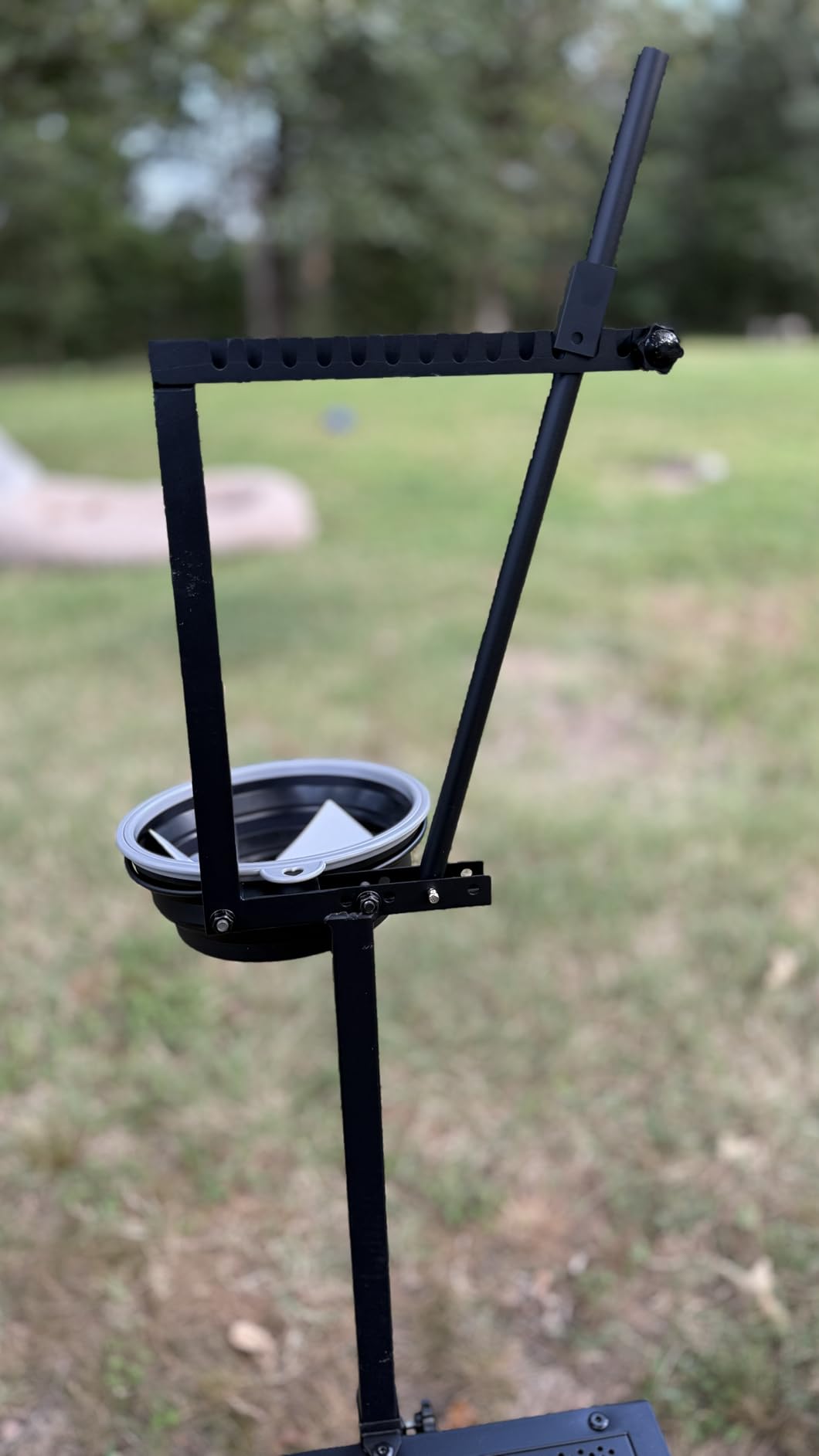
The rest of the build is sensible. A powder-coated iron frame reinforced by 5 support frames, a stated 600 pound capacity, adjustable leg height, adjustable headpiece height and neck width, and a removable built-in feed bin that comes out for cleaning. It weighs 33 pounds, so one person can carry it between pens, and owners report using it as a grooming stand for medium and large dogs too.
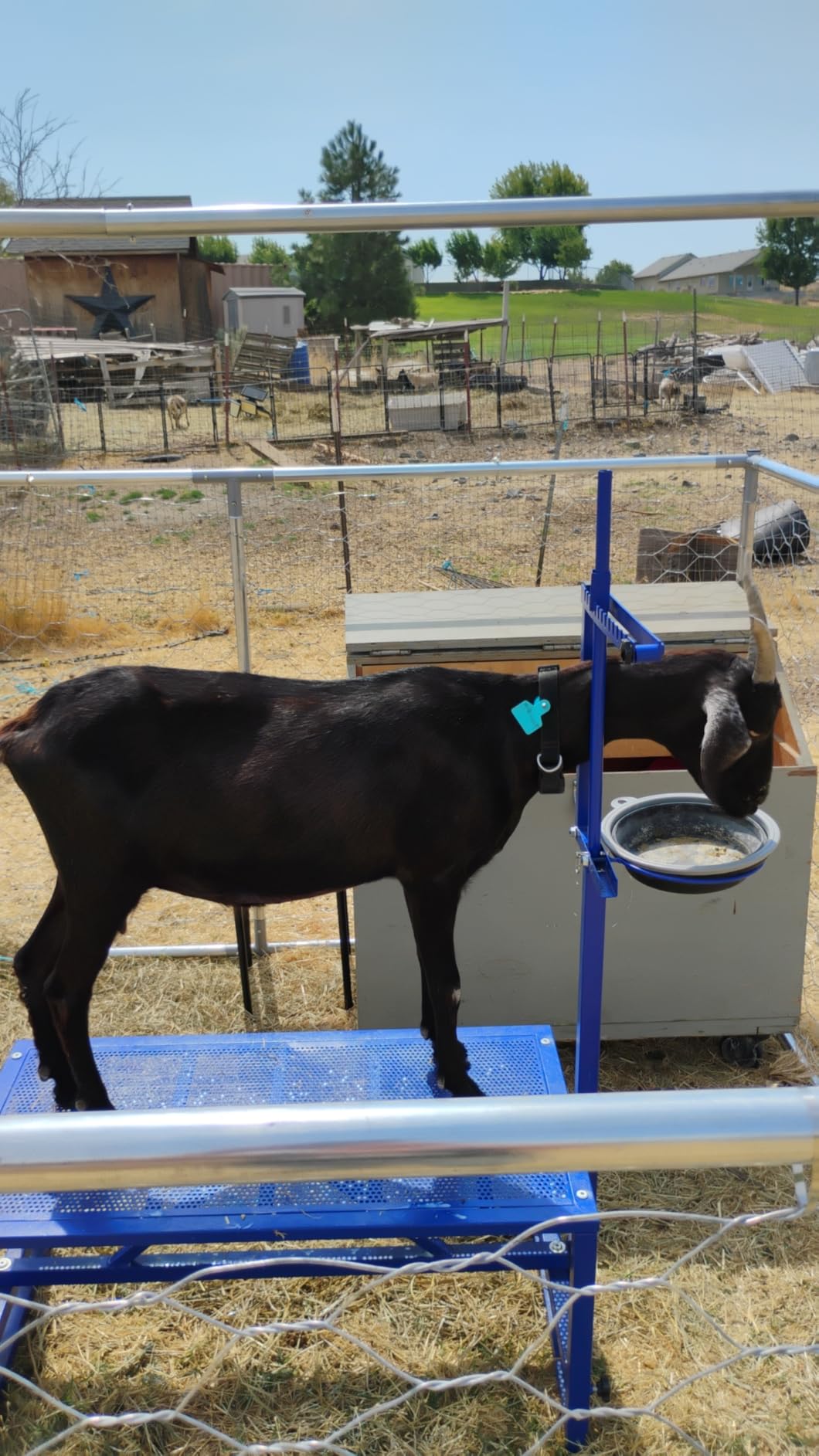
Owners consistently say the quality is closer to more expensive stands than to what this tier usually delivers, and they like the portability. The adjustable feet are the quiet hero: most wobble complaints in this category come from a stand built for a flat warehouse floor meeting a barn that is not flat.
The caveat is traction. Owners report the platform as very slippery, and nervous goats struggle to stay on it. A rubber mat improves grip but adds noticeable rattle, which can spook the very animals you are trying to calm. The neck restraint also runs loose on some animals, and the lock piece is easy to lose – keep a spare. With 38 reviews the sample is thinner than the others here, so we would treat the feedback as directional rather than definitive.
What it does better than the rest of this list
Unlevel floors. The adjustable feet are a genuine differentiator on dirt, gravel and sloped stalls, where a fixed-leg stand becomes a rocking horse that unsettles the goat and wears out the frame joints.
It also travels well for a 600 pound-rated stand at 33 pounds, so one unit can cover a milk room, a wash pen and a trimming area without asking a second person for help.
Where it will frustrate you
Traction is the issue to solve first. Plan on grip tape or a mat, and test how the noise affects your goats before committing to a mat permanently.
The neck fit is loose on some animals, which is fine for a calm doe and not fine for a kicker. If you have animals that move, spend your conditioning effort on the headpiece before anything else.
6. VEVOR 51×23 inch Livestock Stand – Best Height Range for Mixed Herds
VEVOR Goat & Sheep Stand, 51×23 inch Livestock Stand, Metal Livestock Milking and Shearing Stand 21″ to 33″ Adjustable Height, with Headpiece and Nose Loop, 500lbs Loading Weight, Black
Iron frame
500 lb load
39.7 lb
51.18 x 22.99 x 68.5 in
Pros
- Four pin-set height levels from 21 to 33 in
- Longest platform here at 51 x 23 inches
- Reinforced uprights and triangular frame
- Nose loop and Velcro straps included
Cons
- 500 lb rating is below the 600 lb stands
- 68.5 in assembled height does not fold for storage
- Feed bin and ramp depend on the variant
Best for: a mixed herd where platform height has to cover everything from a Pygmy to a full-size dairy doe on the same piece of equipment.
Height range is the headline on this VEVOR stand, and it is the widest in this roundup. Four pin-set levels take the platform from 21 to 33 inches, which is the difference between a stand that suits one herd and a stand that suits a changing one. If you start with a starter doe and later add a different breed, the adjustment is what keeps the purchase from needing a replacement.
The platform is also the longest we measured at 51 by 23 inches, and the frame uses reinforced uprights with a triangular frame for stability. Owners like the smoothed edges because they cut injury risk, and the included nose loop and Velcro restraint straps simplify getting an animal settled. At 4.4 stars from 65 reviews, just 2 percent of ratings sit at one star.
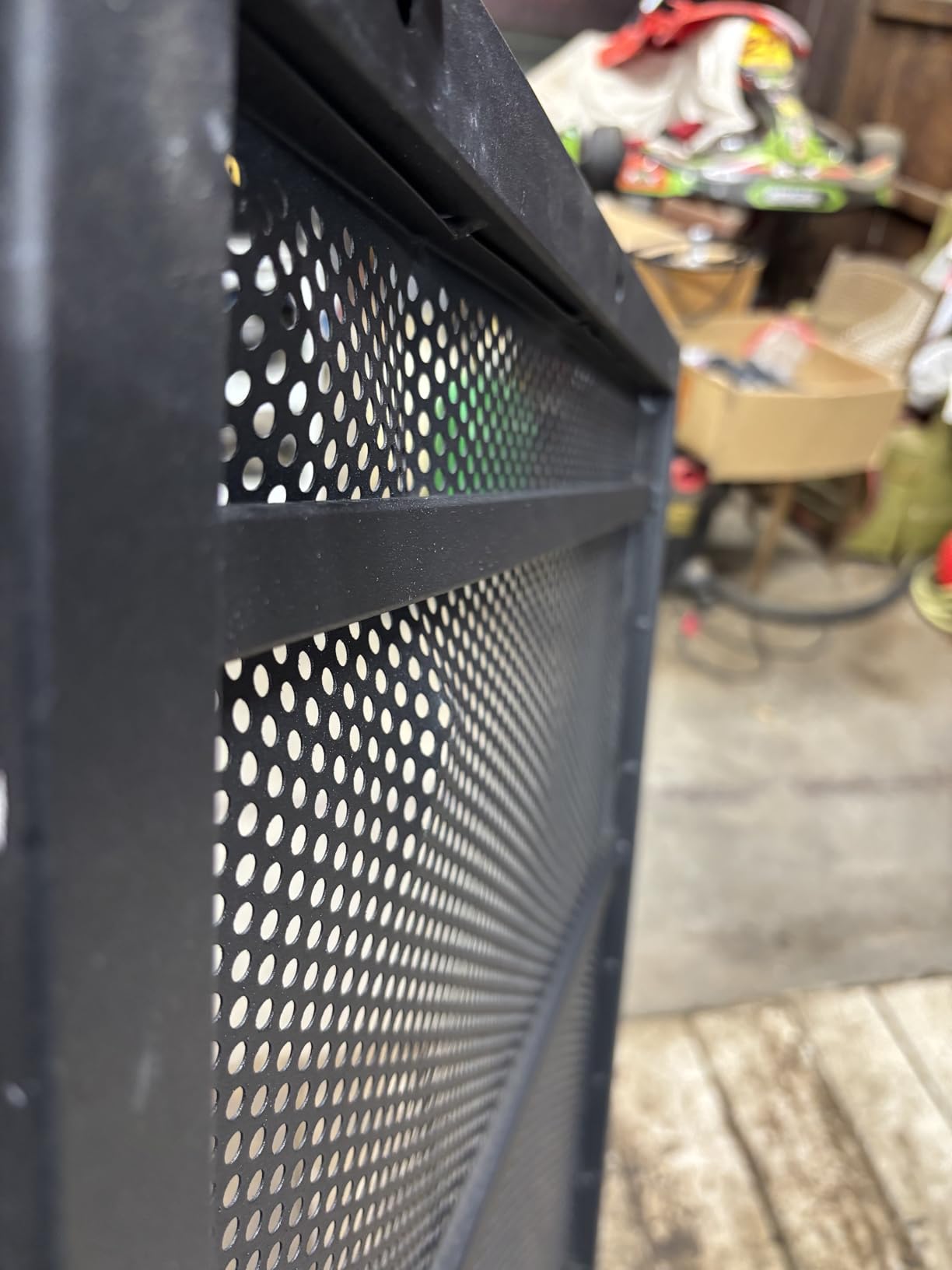
The extra platform length does something less obvious: it gives a nervous animal more room to shift its feet without stepping off the back edge. On a short deck, a goat that squirts the pail is also a goat that falls off the stand, and the pail hits the floor. A longer platform absorbs that movement.
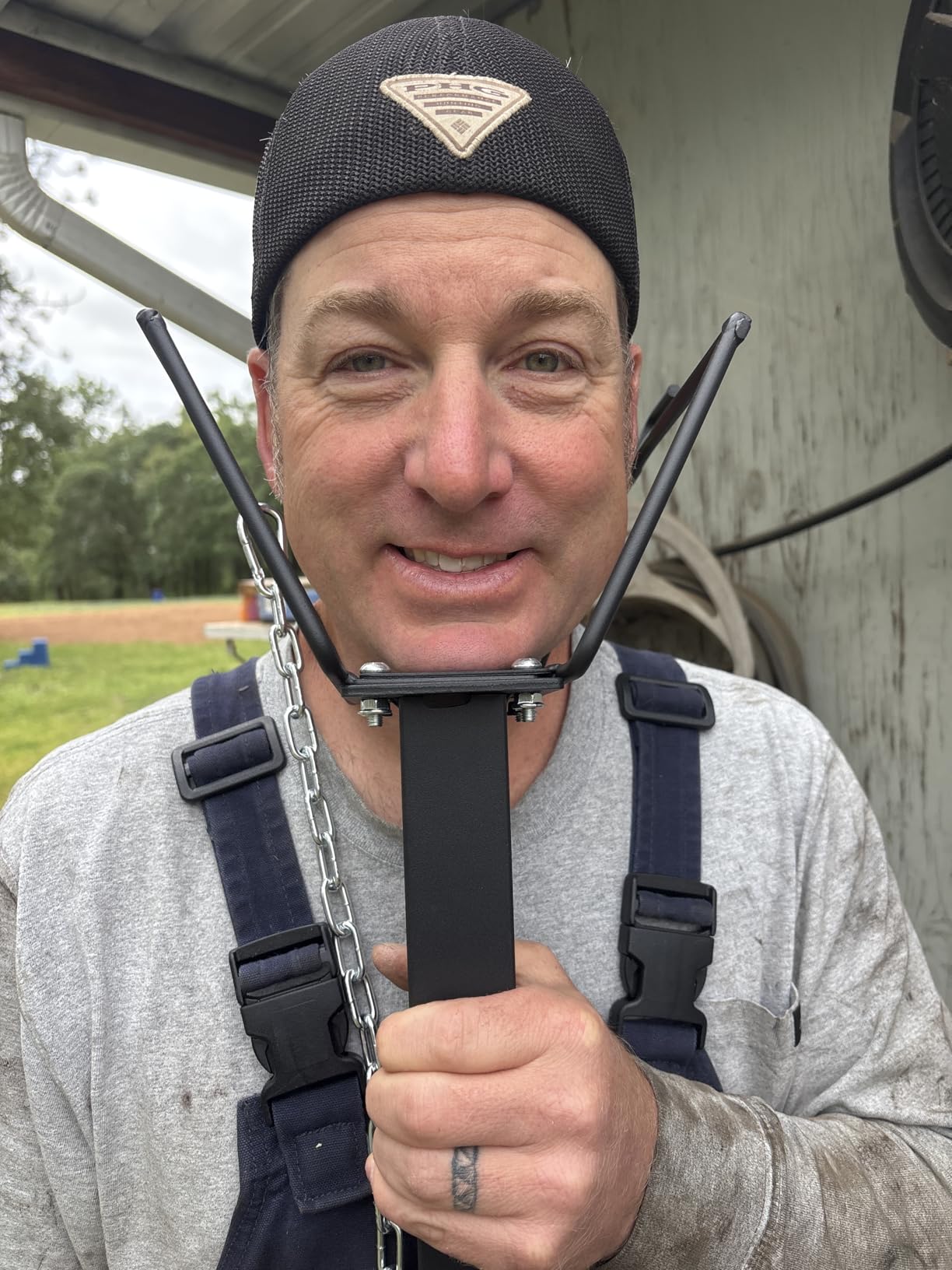
Be clear about what you are ordering, though. The standard version arrives as a stand with a headpiece, nose loop and Velcro straps, but a feed bin, a ramp and wheels are variant-dependent – we have the same table-first approach for other stand categories in our [tiered dessert stands](https://cookcraftandcreate.com/best-tiered-dessert-stands/) and [drink dispensers with stands](https://cookcraftandcreate.com/best-drink-dispensers-with-stands/) guides, and the same discipline applies here: read the variant list before you commit. The 500 pound rating is also below the 600 pound claims on several cheaper units, and at 68.5 inches assembled it does not fold flat for tight storage.
What it does better than the rest of this list
Height adjustability, plainly. Twelve inches of platform range across four pin positions lets one stand serve a small-breed doe and a full-size dairy goat, which removes the single most common reason owners end up with two stands.
The 51 by 23 inch deck is the longest we measured, giving better footing and more room for an animal that moves during a session. Smoothed edges and rust-resistant spray paint add to the safety margin.
Where it will frustrate you
Variant confusion. If you want a feed bin, a ramp or wheels, you must select the version that includes them, and the standard version has neither. Check the variant carefully.
It is also one of the tallest assembled units in this list at 68.5 inches, and its 500 pound rating is well under the 600 pound figures claimed by several cheaper units. Plan where it will live before it arrives.
7. Belinova Wrought Iron Goat Stand – Best for Large Breeding Does
Belinova Goat Milking Stand 600Lbs Goat Stand Sheep Stand for Trimming Metal Livestock Stand with Adjustable Headpiece Goat Shearing Livestock Stand Height Adjustable, Black
Cast and wrought iron
600 lb load
47 x 23 x 20.5 in
baked finish
Pros
- Baked high-temperature finish resists rust
- Eleven inches of platform height adjustment
- Four uprights plus a tripod hold 600 lb
- Handles large does and rams
Cons
- Heavy
- solid construction with limited portability
- Head-to-platform range tops out at 41.3 in
- No feed bin or feeder included
Best for: large breeding does, bucks and rams, and anyone who wants a stand that stays put for the long haul.
The Belinova stand is built differently from the rest of this group, and you can feel it immediately. It is cast and wrought iron with a high-temperature baked finish rather than a sprayed or painted coating, which is why owners single out its rust resistance. Four uprights plus a tripod base hold a stated 600 pounds without flex, and that base geometry is what keeps it planted when a full-size doe shifts her weight mid-milking.
Adjustment is excellent. The platform height runs from 20.5 to 31.5 inches, giving 11 inches of range, and the front vertical bar adjusts with a head-to-platform height from 24.8 to 41.3 inches. Owners report it fitting large breeding does, rams and smaller goats on the same unit, and the assembly is described as clean with fittings, an illustrated manual and a QR code linking to an install video.
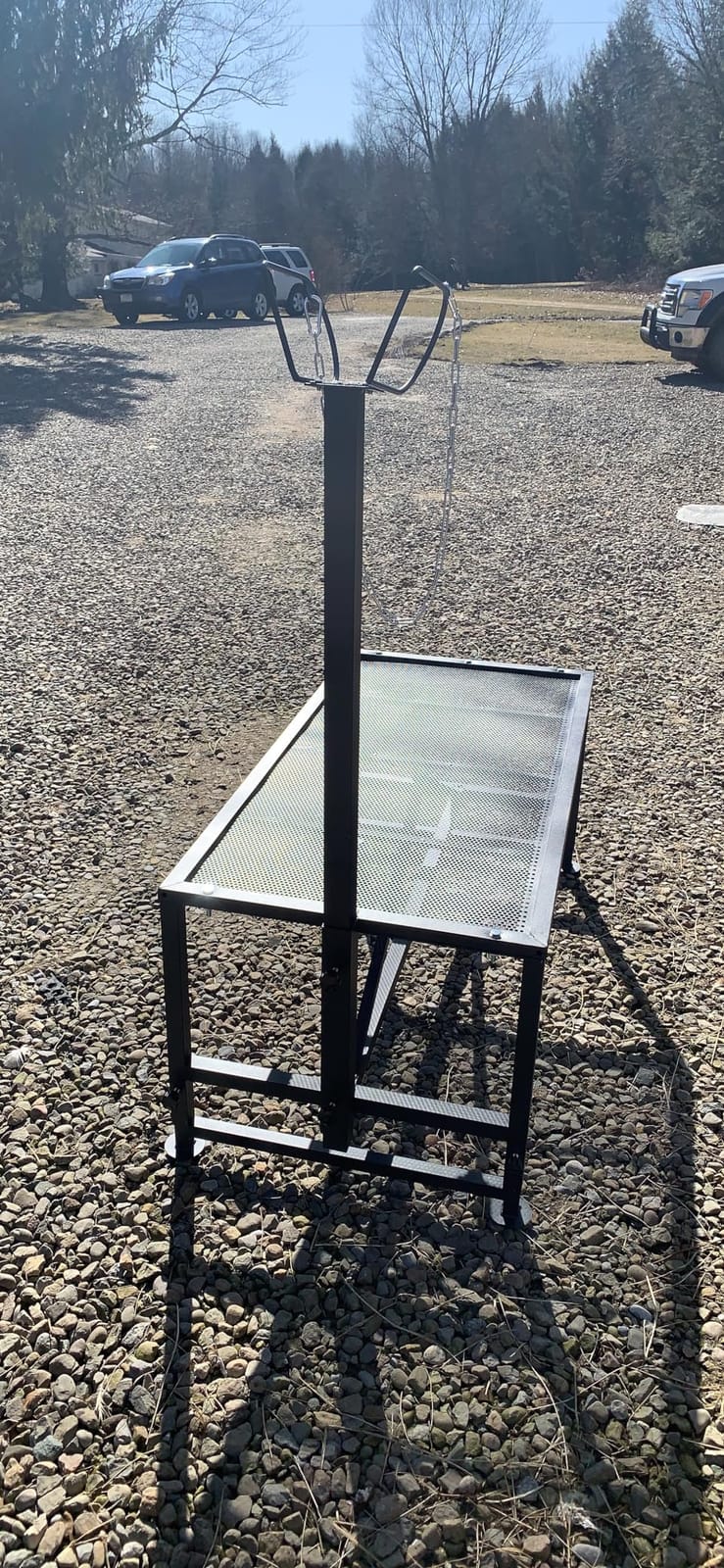
This is the stand we would put in a barn with Boer does or large Saanen. A baked finish does not chip like a powder coat or a spray coat, which is the finish problem that owners of the budget units in this list report year after year. Over a long service life, that difference matters more than any feature on the spec sheet.
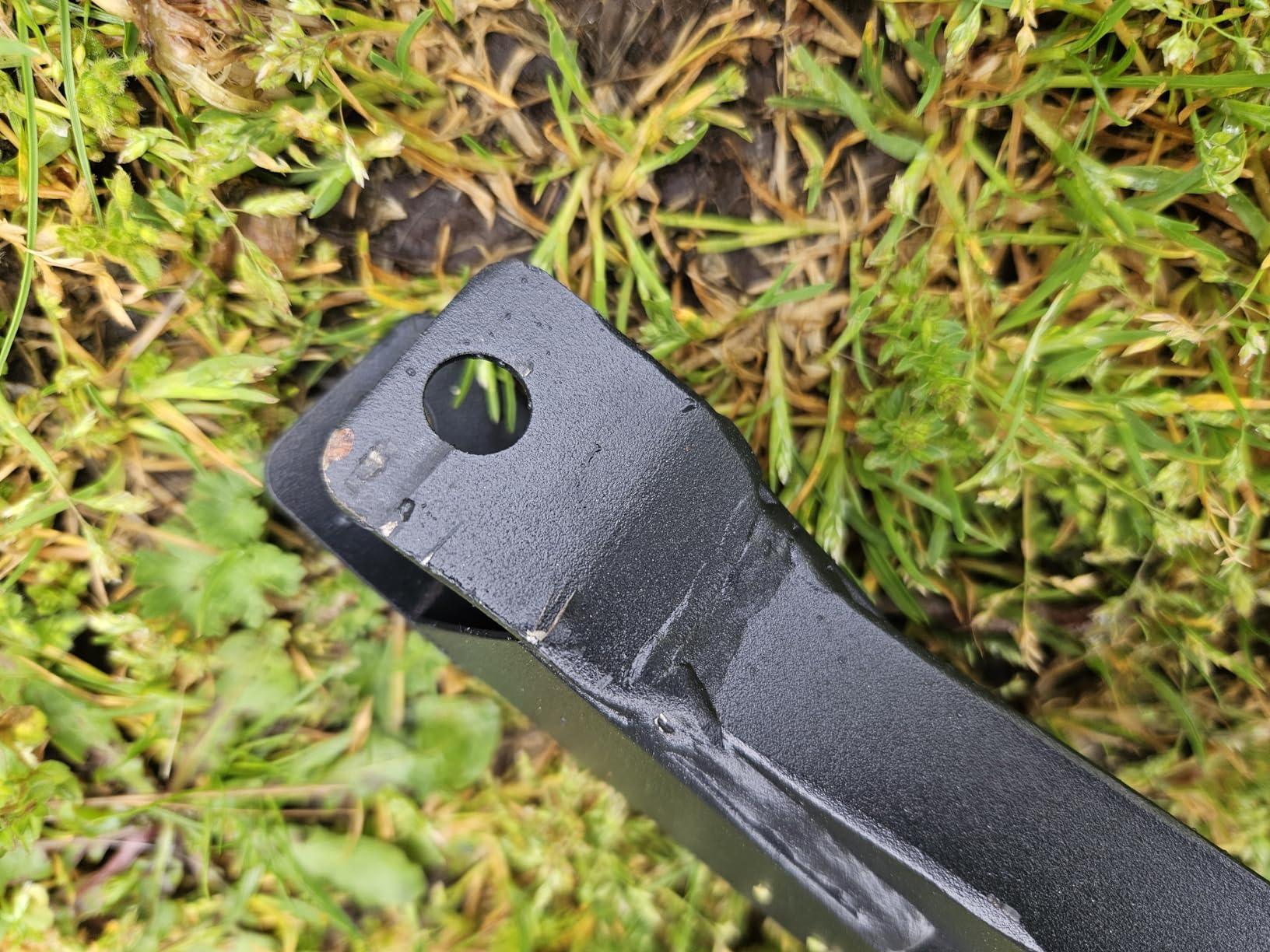
Two limitations are worth planning around. The head-to-platform adjustment tops out at 41.3 inches, so the tallest animals can exceed the range. And there is no feed bin or feeder at all, which means nothing distracts a goat during trimming – for a big, restless animal that is a real consideration. It is also among the least portable units we tested.
What it does better than the rest of this list
Long-term durability. A baked high-temperature finish outlasts sprayed and powder-coated steel in a wet wash pen, and owners with this stand report it holding up under large animals without flexing.
The tripod base plus four uprights is the most rigid geometry we measured, and 11 inches of platform adjustment is the widest working range among the fixed-base units here.
Where it will frustrate you
Portability. This is a barn fixture, not a carry-around stand. If your milking happens in more than one location, this is the wrong shape of product.
The missing feed bin means no built-in distraction for a restless goat, and the head-to-platform range has a ceiling at 41.3 inches. Note also that 32 percent of reviews sit at four stars – owners like it, but not as much as the stand at the top of this list.
8. Lezbanz 400 lb Dwarf Goat Stand – Best for Nigerian Dwarf and Pygmy
400 LBs Goat Milk Stand for Pygmy and Dwarf Goats, Goat Stand with Feed Bin, Goat Milking Stand for Sheep Trimming and Milking, Hoof Trimming Stand Adjustable Size, Iron Blue
Iron with spray coating
400 lb load
27.6 lb
36.5 x 20.3 x 3.8 in package
Pros
- Lowest listed weight at 27.6 lb
- True small-breed sizing
- Same reinforced frame as the 600 lb model
- Feed bin included
Cons
- 400 lb rating rules out large Boer and Saanen
- Compact platform gives less room to shift feet
- Shares finish and hardware complaints of the 600 lb model
Best for: Nigerian Dwarf and Pygmy herds, and for anyone tired of 47 inch platforms that overshoot a small goat.
Dwarf and Pygmy owners tell a consistent story in reviews: bigger stands are too tall even at their lowest setting, and a 47 inch platform is a lot of deck for a small goat. This Lezbanz M-size is built for that problem. It carries the same reinforced triangular frame and the same two extra load-bearing beams as the 600 pound model in this lineup, scaled down to a 35 inch small-breed platform with a 400 pound load capacity.
At 27.6 pounds it is one of the easiest units here to carry, and a single person can move it between pens. Owners cite the low weight, easy assembly and correct sizing as the three reasons they are happy, with 69 percent of reviews at five stars and 16 percent at four.
The feed bin is the feature that changes the daily routine for small herds. A dwarf goat is more likely to squirt and more likely to lose interest quickly, and grain in the bin is the cheapest intervention available. Adjustable leg height and adjustable head-fixing space let you tune the fit as the animal grows, which is not a minor concern when a Nigerian Dwarf kid can change size noticeably in a month.
The trade-off is capacity. Four hundred pounds is roughly two-thirds of the 600 pound stands here, and it rules out large Boer and Saanen animals entirely. The compact platform also gives a nervous animal less room to reposition its feet. And because it shares hardware and finish with the larger same-brand model, expect the same coating and bolt complaints – check fasteners periodically and touch up the finish in a wet environment.
What it does better than the rest of this list
Correct sizing for small breeds. If your animals are Nigerian Dwarf or Pygmy, a 35 inch platform with adjustable legs is the difference between a stand your goats use and a stand they tolerate.
Weight is the second win. At 27.6 pounds one person can carry it, which matters when your milking spot is a corner of a shed rather than a dedicated room. The reinforced frame means you are not trading away stability for size.
Where it will frustrate you
It is not a large-animal stand. Four hundred pounds is well under what a big Boer or Saanen needs, and the platform is too compact for a goat that thrashes during a session.
It also inherits the finish and hardware feedback from the same-brand 600 pound model, so the bolt-loosening and coating questions apply here too. Check the legs and latch at the same monthly inspection you do for any steel stand.
How to Choose a Goat Milking Stand Without Guessing
Platform size and dimensions
A standard goat milking stand is typically 47 to 51 inches long and 23 inches wide, with small-breed versions around 35 by 18 inches. For length, 47 inches is the practical floor for a full-size dairy doe – it gives the animal room to stand square and step forward without backing off the platform – while 51 inches is better if you also handle large meat breeds or a ram. Width of 23 inches is the common standard, and narrower decks make nervous animals feel unstable.
Height is the dimension most buyers get wrong. You want a platform that puts the udder between knee and hip height for a standing handler, roughly 20 to 33 inches, and you want that range to be adjustable if your herd is mixed. Platform height and working height are not the same number: the deck height sets your bending angle, while the headpiece height sets whether the animal can actually reach the feed bin and hold its head still.
Working height and handler ergonomics
Handler height is a selection criterion, not an afterthought. A handler who is 5 foot 3 or who has back problems should prioritise adjustability above every other feature, because a stand at a fixed height either forces constant bending or puts the animal out of reach. This is the most common reason owners upgrade, and it is why the adjustable units in this list earn their place even when a cheaper fixed stand exists.
For a milking setup, target a deck height where the pail hangs at about waist level. For hoof trimming, you can set it lower and work from a stool. Either way, if you cannot get a comfortable angle on a stand, no amount of extra capacity will fix it.
Capacity is not the same as stability
Many budget stands in this category claim 600 pounds, and the claim is not entirely meaningless – several genuinely hold a large doe. But capacity describes load, not geometry. A 600 pound rating on a frame with no triangulation, on legs that are not adjustable, on an uneven floor, will still rock. The Weaver stand publishes a much lower 170 pound rating, yet its welded alloy frame and piano-hinge base handled as well as anything we used.
Rule of thumb: check whether the platform has added load beams underneath, whether the frame is triangular, and whether the feet adjust. Those three details predict stability far better than the number printed on the box.
Headpiece fit, horns and polled animals
The headpiece is the part that decides whether a session goes well. You want adjustable neck width and adjustable height so the animal’s head is held at a natural angle rather than craned. Horned goats need more lateral clearance than polled animals, and a headpiece set too tight on a horned doe can catch a horn and injure her. Check whether the head gate is a closed loop, an open V or a wire form, and whether it opens quickly for an animal that panics.
Also check the release. A quick-release head gate matters more than most buyers expect, because it is the difference between stopping a session and having a goat flip the stand over.
Feed bin, mobility and cleaning
A feed bin is the cheapest behavior tool in the barn. Owners consistently report that a goat with grain in front of it stands quietly, and the same conditioning makes the rest of your handling routine predictable. If the included bowl sits badly in its well and gets knocked out, mount your own – a clamped feeder cup costs little and solves it permanently.
On cleaning, a smooth steel deck or wire mesh deck hoses down in seconds, while expanded metal traps bedding in the gaps. And on uneven floors, adjustable feet are worth having – that single feature prevents most of the wobbling complaints we read.
Using a stand with a portable milker
Hand milking and machine milking want different things. For a portable electric milker or vacuum pump setup you need vertical clearance under the platform for the cluster and the pail – roughly 24 inches is a useful working target – and a route for the vacuum line that does not run through the headpiece or a wheel. Several homesteaders route the line along the back upright to keep it away from the animal’s hind legs.
Check pail sizing against your herd. A 6 quart pail comfortably covers a two-goat session, which is why hand-milking kits in that configuration come up so often on The Goat Spot. If you plan to grow past a handful of does, size the pail and the stand together rather than upgrading one and then the other.
Multi-goat parlors and building your own
Beyond a single unit, a multi-stanchion parlor is the natural next step, and none of the ranking roundups we studied cover it. The practical layout is simple: stands placed side by side on a common platform, spacing them so a handler can move between animals without stepping into a kick zone, with a feed bin per head and a shared gutter or drain under the deck. A two-head setup is a realistic starting point for a homestead with four to six does.
Building your own is genuinely viable, and DIY pallet stands are extremely popular – a mostly-free pallet build is among the most-watched videos on the topic. The materials list is short: pallet decking for the platform, 2x4s for the frame and headpiece, exterior-rated screws or lag bolts, a piece of cattle panel or hardware cloth as a head gate, and a feed tray. Finished dimensions worth targeting: 47 by 23 inches, platform height adjustable between 20 and 30 inches, and a removable headpiece. Budget a full weekend, and expect to rebuild the headgate once after learning how your animals move. If you want the same build-versus-buy analysis applied to other equipment decisions, our [10 best cupcake stands](https://cookcraftandcreate.com/best-cupcake-stands/) roundup runs the same comparison framework.
Steel or Wood: Which Stand Material Holds Up on a Homestead
Most stands sold today are steel, and the choice inside that category matters more than steel versus wood. Powder-coated steel chips at the welds, spray-coated iron chips faster, and a high-temperature baked finish outlasts both – which is the single clearest durability signal we found in this lineup. Galvanized steel resists rust best of the lot and is what we would want in a wash pen.
Wood still has real advantages on a small farm. It absorbs noise, so a goat is less likely to spook at a clanging frame, and a hand-built SPF stand with zinc-plated corner braces is quiet, repairable with ordinary tools, and easy to modify. Owners also report that handcrafted wood stands suit small herds well and feel like a proper traditional farm build. The trade-offs are weather maintenance, a shorter service life outdoors, and the fact that a wood frame cannot be moved by one person as easily as a light steel unit.
Our view: steel if you hose down the stand, if you need load capacity, or if you plan to keep it for a decade. Wood if noise is your primary problem, if you enjoy building, or if your animals are small and your barn is dry.
First 30 Days: Training a Goat to Stand Willingly
Owners ask this constantly on homestead forums: the stand is fine, the goat hates it. That is a training problem, and it is solvable. The single most effective tool is grain. Put feed in the bin, walk the goat up, and let it eat for a few minutes. Release it without doing anything else. Repeat daily for a week before you attach a pail.
Keep sessions short at first. Two or three minutes, twice a day, ends while the goat is still calm. Never leave an untrained animal in a headpiece unattended – that is the fastest way to turn a stand into something the goat resists. Once the goat walks on willingly, add the headpiece, then the pail, then the actual milking, in that order.
For animals that kick or squirt, modification is usually simpler than people expect. A second loop low on the neck limits the range of the head swing without choking. A strap or bungee across the platform, or a light rubber mat with grip, stops a pail from being kicked over. Owners who adapted a stock stand for kicking goats generally report the changes took an afternoon and solved the problem permanently. If the pail keeps getting kicked, milking with a portable machine is often easier than winning that argument.
Frequently Asked Questions
What are the dimensions of a standard goat milking stand?
A standard goat milking stand platform measures about 47 to 51 inches long by 23 inches wide, with the working platform adjustable between roughly 20 and 33 inches off the ground. Small-breed versions for Nigerian Dwarf and Pygmy goats come in around 35 by 18 inches. Allow at least 24 inches of vertical clearance under the deck if you plan to fit a portable electric milker and pail beneath it.
How long should a goat milking stand be?
At least 47 inches for a full-size dairy doe, and 51 inches if you also handle large meat breeds, rams or an animal that moves a lot during a session. The extra length gives a nervous goat room to shift its feet without backing off the platform. Below 40 inches, a full-size goat feels cramped, which is the main reason small breeds get their own narrower stands.
What is a goat milking stand called?
You will see several names for the same object: goat milking stand, goat stanchion, goat restraint stand, livestock grooming stand, and dairy goat milking stand. Retailers also list livestock grooming tables and trimming stands, which are often the same platform designed with hoof trimming and shearing as the primary task rather than milking. A milking stand almost always adds a feed bin or feed tray that a trimming stand may not have.
How do I get a goat to willingly walk onto a milking stand?
Use the feed bin. Put grain in the tray, lead the goat up, and let it eat for a few minutes, then release it without doing anything else. Repeat daily for about a week before you attach a pail. Keep sessions short and end while the goat is still calm, and never leave an untrained animal in the headpiece unattended. Once the goat walks on by itself, add the headpiece, then the pail, then milking, in that order.
Can I use a goat milking stand with a portable electric milker?
Yes, as long as you have roughly 24 inches of vertical clearance under the platform for the cluster and pail, and a way to route the vacuum line that keeps it away from the hind legs and the headpiece. Many owners run the line along a back upright. A 6 quart pail suits a two-goat session comfortably, so size the pail and the stand together if you expect to grow the herd.
Do I need wheels on a goat stand?
Only if the stand has to work in more than one place. Wheels plus folding legs are genuinely useful on a small homestead where the milking spot is a corner of a shed rather than a dedicated room, because a 30-plus pound steel frame is awkward to reposition alone. If your stand lives in one fixed milking area, skip the wheel kit and spend that budget on a feed bin or a better finish instead.
How do I clean a goat milking stand?
Hose it down after every use and scrub the platform, feed tray and headpiece with livestock-safe disinfectant, then let it dry fully. Check bolts, welds and leg pins monthly, especially on bolt-together stands, and lubricate any moving headpiece parts quarterly. For spray-coated and powder-coated frames in a wet wash pen, wipe the coating down every few months to slow rust.
The Verdict on the Best Goat Milking Stands in 2026
The Weaver Livestock steel trim stand takes our top spot for one reason: it is the only stand here with a published 170 pound limit, 216 reviews, a welded alloy frame and a wide piano-hinge base that actually distributes weight. Buyers who want portability and a 600 pound rating should look at the Goatzy adjustable stand, and buyers working on a tight budget get the most capability from the Lezbanz 600 pound unit, where the reinforced triangular frame and collapsible feed bowl add capability most comparable units leave out.
Match the stand to your smallest animal first, then to your largest, then to your floor. Everything else – features, feeders, wheels – is secondary. Whatever you choose, get the goat comfortable on it with grain first; a well-trained goat is worth more than any accessory you can bolt on.