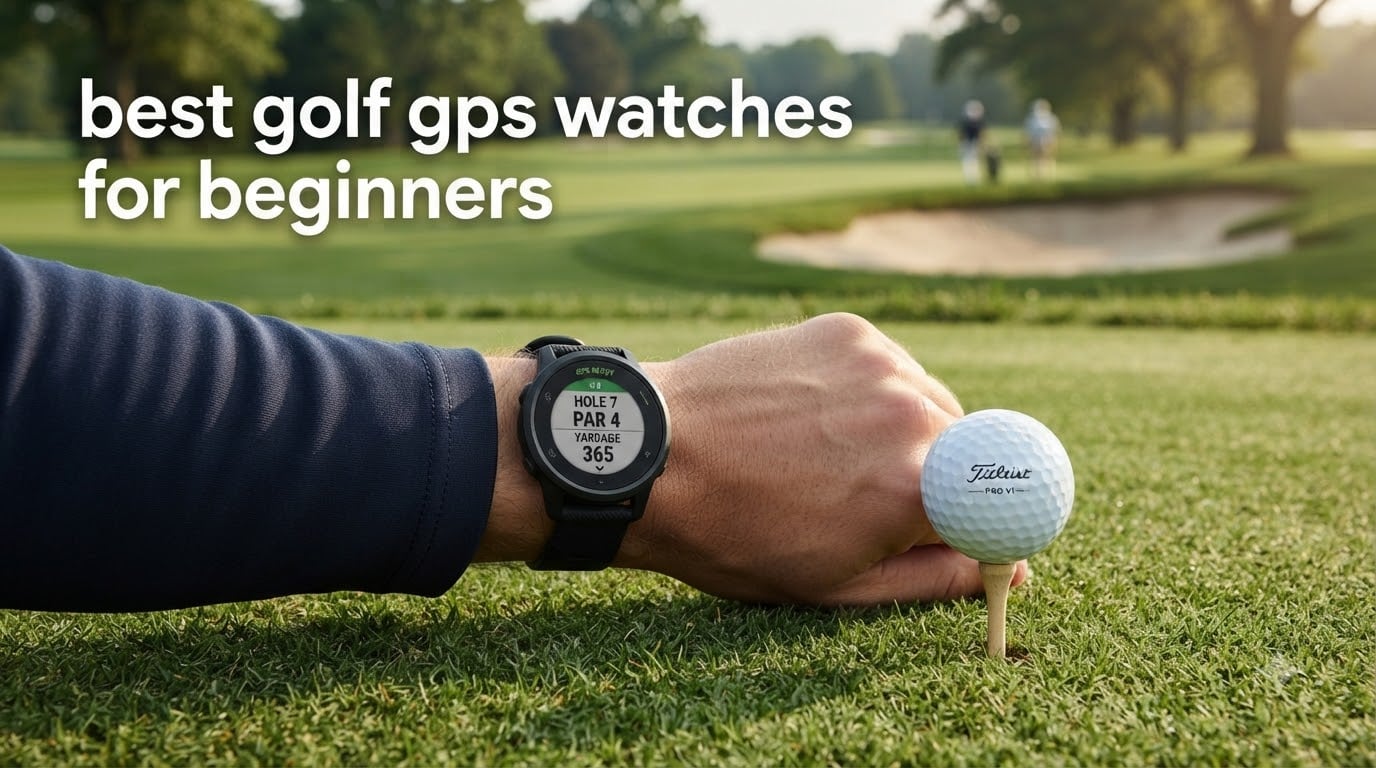
If you are picking up a set of clubs for the first time, the hardest part of golf is not the swing. It is standing on the tee with a number in your head and no idea whether that number should be a seven iron or a wedge. A golf GPS watch fixes exactly that, and nothing else. It tells you how far the pin is, how far the water is, and where the safe layup is, and it does it without asking you to hold a phone while you walk.
Last updated: September 2026. We looked at the best golf GPS watches for beginners that are actually available right now, read the owner reviews rather than the spec sheets, and flagged the recurring gripes that show up again and again. Some of these watches still ask for a paid membership to unlock the good stuff. Some need a phone in your pocket to be useful. A few both.
The honest headline: a beginner does not need an expensive gadget. Most golfers in their first season get the same benefit from a simple yardage watch with no subscription as they do from a feature-packed device. Our picks below span the range so you can pick the level of complexity that matches your appetite for fiddling with menus mid-round.
Table of Contents
- What Is a Golf GPS Watch?
- Top 3 Golf GPS Watches for Beginners in 2026
- All 8 Best Golf GPS Watches for Beginners (September 2026)
- 1. TecTecTec ULT-G – The One To Buy If You Want Nothing Complicated
- 2. Garmin Approach S12 – The Best All-Rounder You Can Buy Today
- 3. Garmin Approach S44 – The Best-Looking Option With a Membership Catch
- 4. NAVO W1 – The Quiet Budget Option With a Two-Year Warranty
- 5. Garmin Approach S40 Bundle – The Easiest Way To Try Shot Tracking
- 6. SkyCaddie LX5 – The Best Maps, With a Membership Model
- 7. Shot Scope V5 – The Most Data For Free, If You Will Use the Tags
- 8. Shot Scope G6 – The Best-Looking Shot Scope, With Reliability Complaints
- Golf GPS Watch vs. Phone App vs. Laser Rangefinder
- Buying Guide: 6 Criteria That Matter to a New Golfer
- Frequently Asked Questions
- Do I need a golf GPS watch as a beginner, or can I just use my phone?
- What should I look for in a golf GPS watch as a complete beginner?
- Which golf GPS watch has the longest battery life?
- Can a golf GPS watch work without my phone in my pocket?
- Are golf GPS watch subscriptions worth it?
- How accurate are golf GPS watches for distance to the pin?
- Should a beginner buy a golf GPS watch or a laser rangefinder?
- Which Golf GPS Watch Should You Buy?
What Is a Golf GPS Watch?
A golf GPS watch is a wrist device that locks onto satellites, works out which hole you are standing on from a preloaded digital map, and calculates the distance from your feet to any target on that hole. Everything happens on the watch, so no phone signal and no pocket required. For a beginner, the single most useful number it gives you is the distance to the pin.
Do beginners need one? If you already own a modern phone and are happy opening an app on the tee box, a dedicated watch is a convenience upgrade rather than a necessity in year one. If you would rather glance at your wrist than fish a phone out of a pocket, the improvement in pace and distraction-free play is real.
One community view is worth repeating honestly, because it comes up constantly in r/golf threads: the biggest gains for a new golfer come from contact quality and a decent short game, not from electronics. A GPS watch helps you choose a club. It does not help you swing it. If you are still leaving four or five shots on the practice green, fix that first.
Top 3 Golf GPS Watches for Beginners in 2026
TecTecTec ULT-G
- 38000+ preloaded courses
- no app or subscription
- five-button simplicity
- front/center/back distances

Garmin Approach S12
- Readable in sun and rain
- 30-hour GPS battery
- 42000+ courses
- no membership

Garmin Approach S44
- AMOLED color display
- 43000+ courses
- 15-hour battery
- slim everyday styling
All 8 Best Golf GPS Watches for Beginners (September 2026)
Everything below is a watch, not a phone or a sensor system that needs a base unit. Read the battery column in rounds rather than hours, because that is how you will actually use it: if the watch gives you two full rounds per charge, you are charging it in the car on the way home, and that is a habit you have to keep for the life of the watch.
| Product | Specs | Action |
|---|---|---|
| TecTecTec ULT-G |
|
Check Latest Price |
| Garmin Approach S12 |
|
Check Latest Price |
| Garmin Approach S44 |
|
Check Latest Price |
 NAVO W1 NAVO W1 |
|
Check Latest Price |
 Garmin Approach S40 Bundle Garmin Approach S40 Bundle |
|
Check Latest Price |
 SkyCaddie LX5 SkyCaddie LX5 |
|
Check Latest Price |
 Shot Scope V5 Shot Scope V5 |
|
Check Latest Price |
 Shot Scope G6 Shot Scope G6 |
|
Check Latest Price |
1. TecTecTec ULT-G – The One To Buy If You Want Nothing Complicated
TecTecTec ULT-G Golf GPS Watch – Simple & Easy Distance Watch, No App Required on Course, Front/Back/Middle Distances, 38,000+ Courses Preloaded, Lightweight & Water-Resistant – Black
38,000+ courses, no subscription, 5-button interface, 55g
Pros
- Works with no phone at all
- no subscription ever
- huge 38000+ course database
- front/center/back and hazard distances
- automatic hole progression
Cons
- Small low-resolution monochrome screen
- distance-only with no course maps
- about 2.5 rounds per charge
This is the watch I hand to friends who tell me they are terrified of gadgets. Five buttons, a plain monochrome screen, and a number that changes when you change holes. There is nothing to log in to, nothing to subscribe to, and no phone anywhere in the loop once the courses are on the device.
Across more than 5,600 owner reviews the praise lands in the same three places: the distances match what a cart GPS or a laser gives you, the button layout is obvious on the first hole, and there is never a message asking for money. The database holds more than 38,000 courses preloaded, with free course and firmware updates through the optional companion app when you are on Wi-Fi at home.
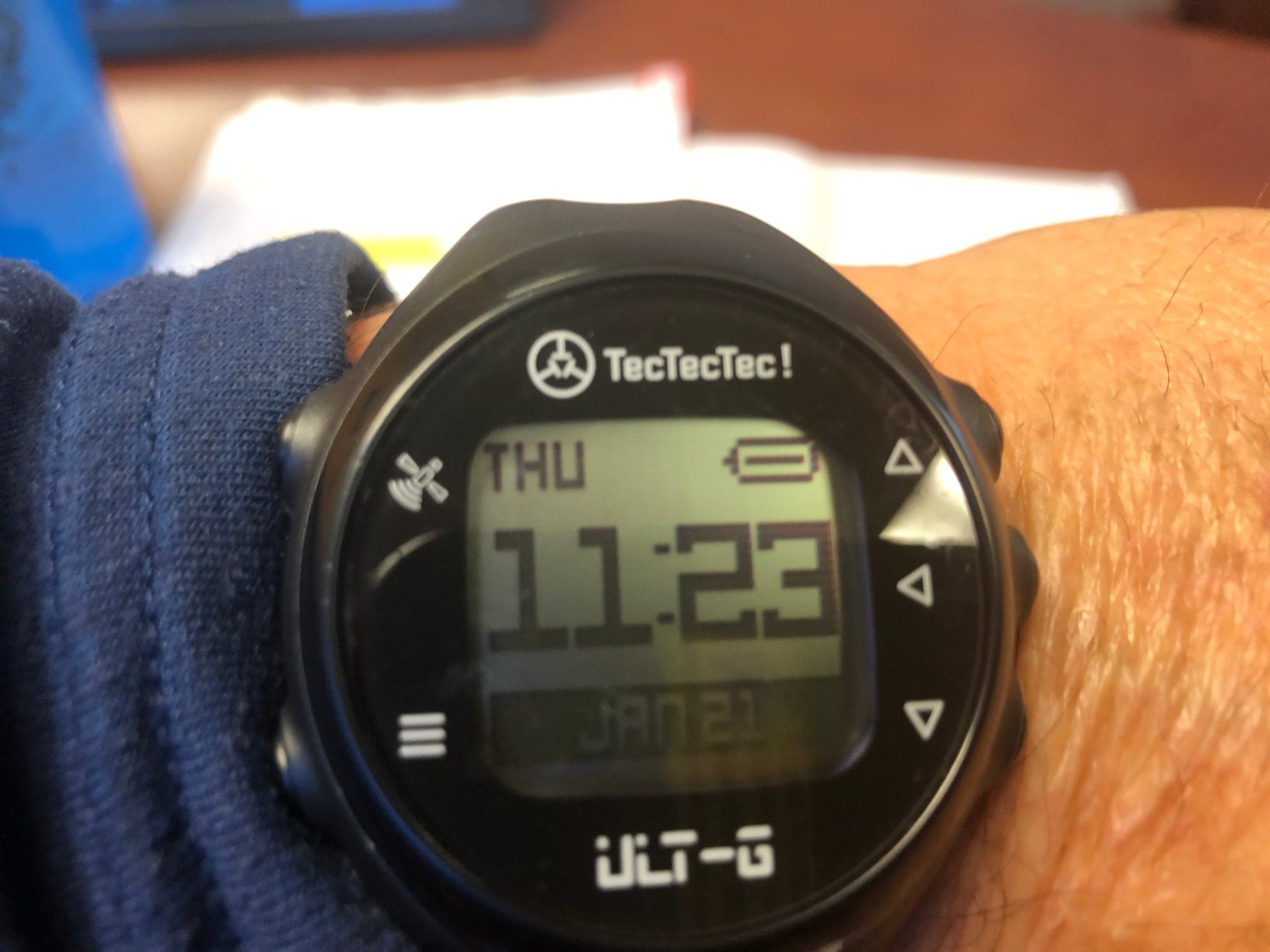
The 55g case is genuinely light, and the whole point of a distance-only device is that it disappears on the wrist. You get front, middle and back green numbers, hazard distances, and a shot distance measurement from your last swing. Hole numbers advance on their own once you walk near the next tee, which is the small automation that stops a beginner from fiddling mid-shot.
What you give up is a screen. It is a small low-resolution LCD, and in bright midday sun you may cup your hand over it. There is no course map at all, so there is no hole flyover, no green shape, no dogleg preview. If your idea of a good round involves seeing the layout of a hole you have never played, this will feel like a decade-old technology.
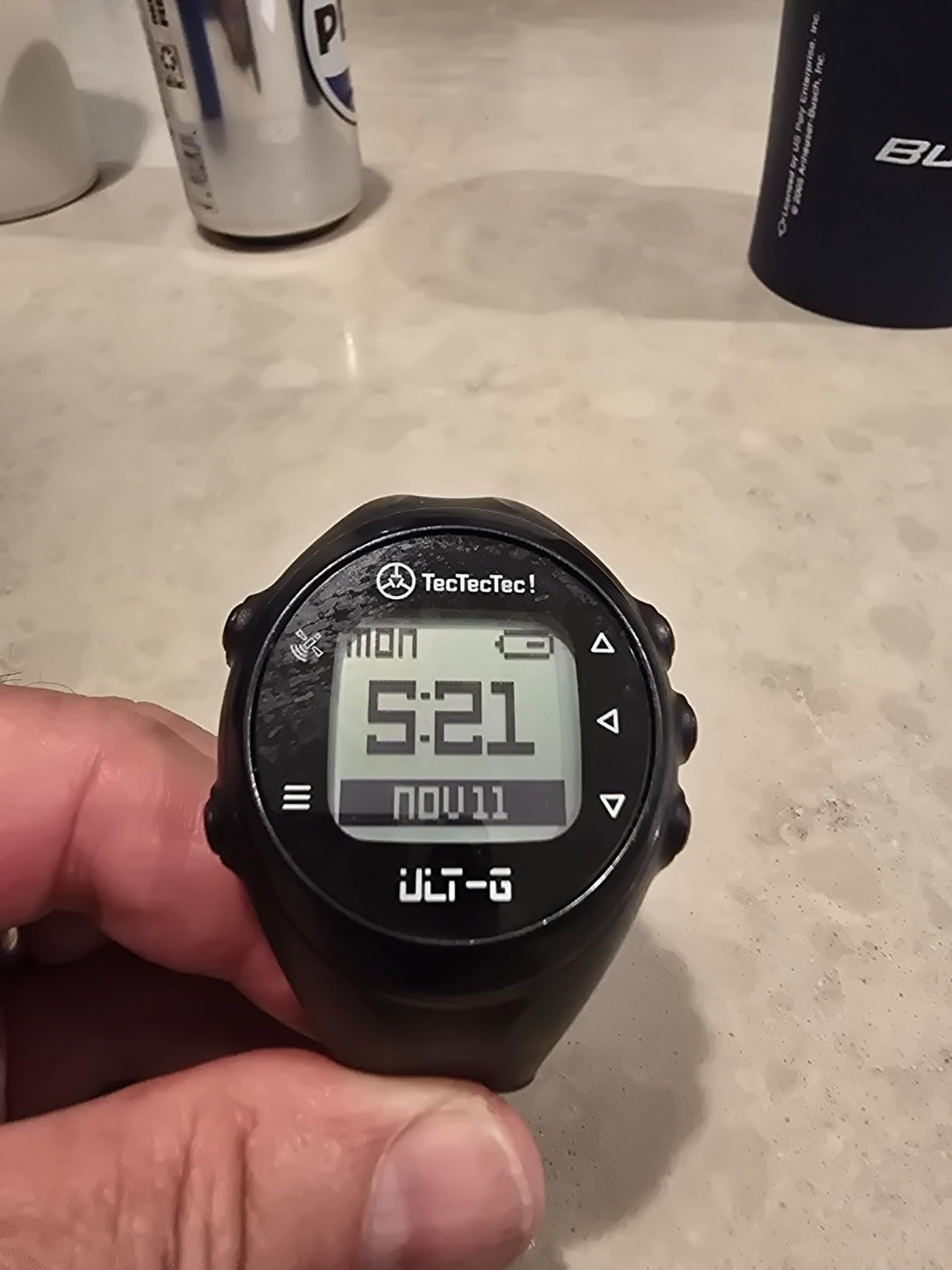
The battery is the one real compromise. Garmin rates its own watches in hours, and this one is advertised around 10 hours of typical use, which works out to roughly two and a half rounds before you need the proprietary USB charging cable that comes in the box. Not USB-C, so plan to keep that cable in the car. If you play twice a week, that is a Wednesday-night charge in your car, and once it becomes a habit you stop noticing.
When this watch makes sense
It makes sense when your entire goal is a reliable number on the wrist and you actively dislike the idea of a membership. Owner reviews describe it as the watch you hand to a partner or a parent who plays nine holes and does not want to learn an interface. The one-year manufacturer warranty requires online registration, so register it.
When to skip it
Skip it if you want a course map, a color screen, or a battery that covers a full week of golf. Skip it if you are the type to fiddle, because a distance-only device gives you nothing to fiddle with. And skip it if you already have a working phone app you like, because this will not beat it on anything except getting the phone out of your hand.
2. Garmin Approach S12 – The Best All-Rounder You Can Buy Today
Garmin Approach S12, Easy-to-Use GPS Golf Watch, 42k+ Preloaded Courses, Black, 010-02472-00
42,000+ courses, 30-hour GPS battery, 34.1g, sunlight-readable
Pros
- Transflective screen readable in sun and rain
- battery covers multiple full rounds
- 42000+ preloaded courses
- simple button controls
- works as an everyday watch
Cons
- Deliberately minimal with no fitness tracking
- occasionally needs a manual tap to advance holes
- hazard numbers take menu digging to find
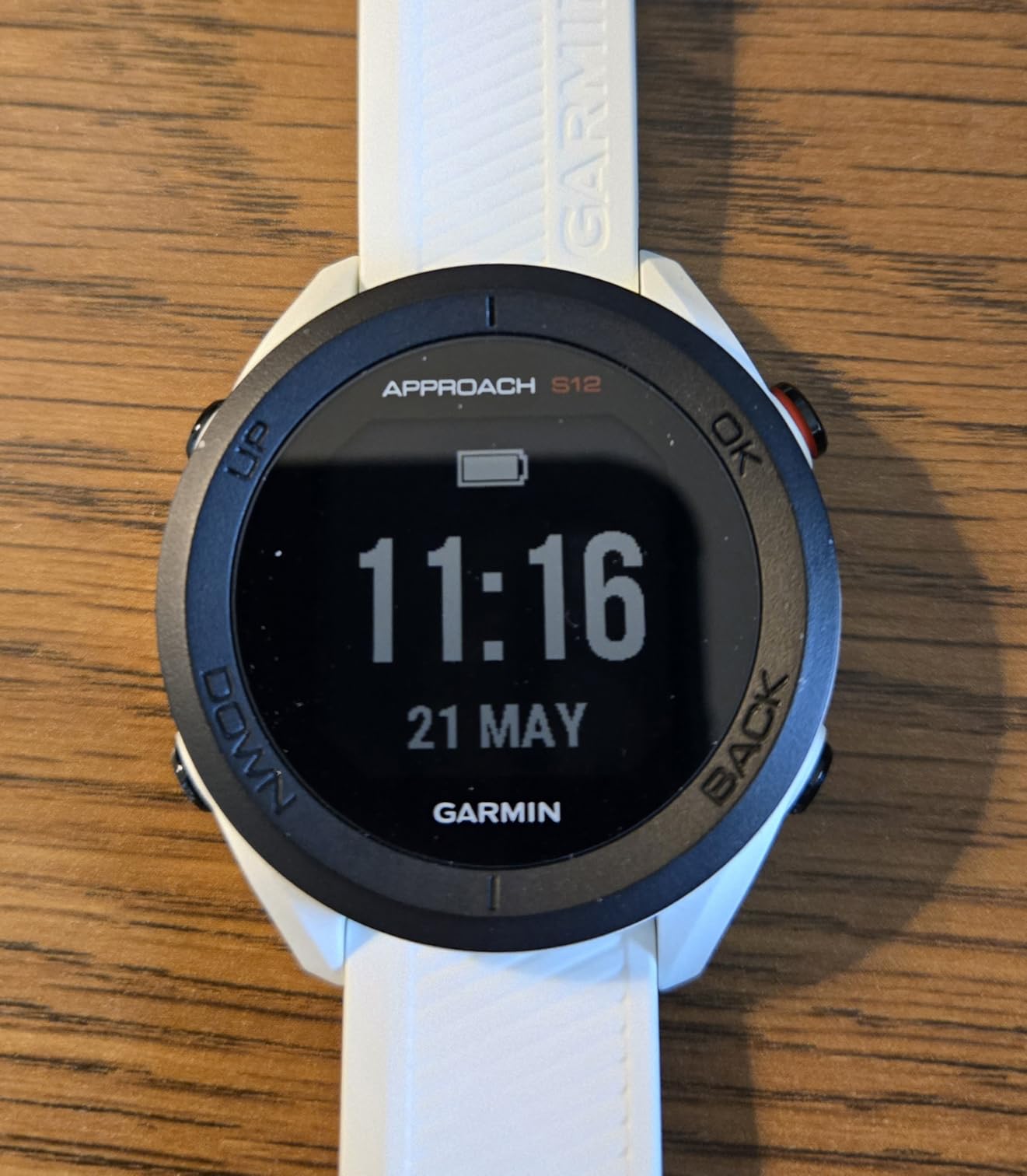
The S12 is the answer to the most common question in the Garmin lineup, which is whether a beginner should pay for color and sensors they will never use. The answer here is no. This is a sunlight-readable transflective display, five buttons, and a case that weighs 34.1 grams, which is less than the TecTecTec despite the bigger-looking number on the box.
Owner reviews put accuracy within a few yards of both cart GPS and a laser rangefinder, which is the only accuracy claim that matters on a first tee box. The MIP screen is the quiet hero: it does not wash out in direct sun the way a glossy LCD does, and rain beads off it instead of fogging it. At 4.4 stars across more than 3,100 reviews it matches the highest rating in this group, and roughly 72 percent of those reviews are five-star.
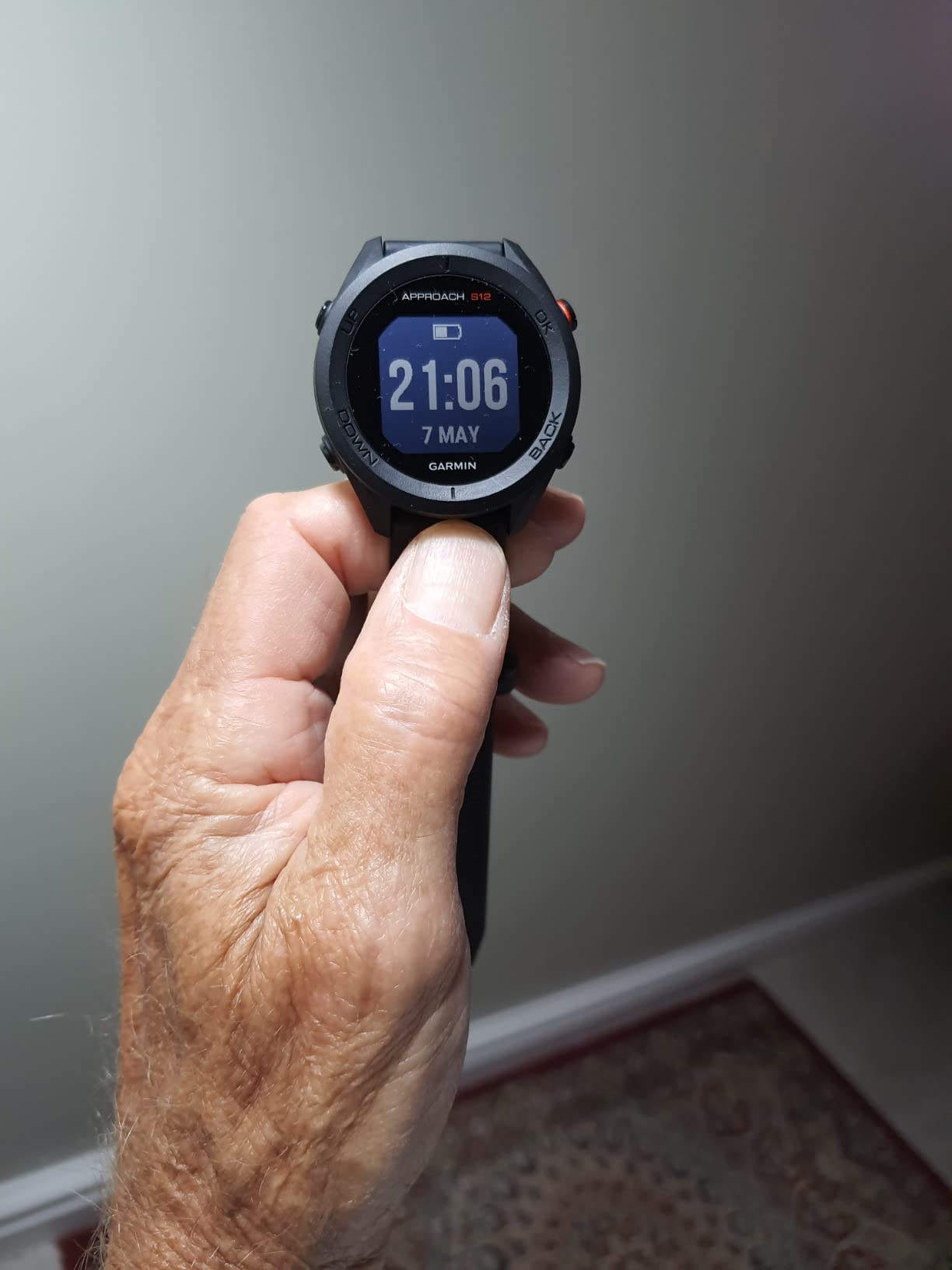
Battery is the other reason to shortlist it. Thirty hours in GPS mode is not one round, it is not two, it is a working week of golf. That single fact removes the anxiety that dominates r/golf threads, including a well-known thread about watching a GPS die during a money round that has drawn thousands of upvotes. Charge it Sunday night and stop thinking about it.
There is more than 42,000 preloaded courses, scoring on the wrist with upload to the Garmin Golf app, and optional club tracking if you later buy Approach CT10 sensors. It is water resistant to 50 meters, which means morning dew and an overcast walk are not problems. The silicone band is quick-release, so swapping sizes is a coin and no tools.
The honest criticism from owners is that it is minimal on purpose. There is no step counting, no sleep tracking, no heart rate, no music. If you want a fitness watch that happens to play golf, this is the wrong device. The other recurring note is that it sometimes fails to auto-advance at the tee, so a manual tap gets you moving. It also hides hazard yardages a few menus deep, which is a mild annoyance rather than a real problem.
What you get for the setup effort
Almost nothing. Garmin put the distance-to-pin screen one button from the tee screen, and that is the design decision that makes this the safest recommendation in the list for a genuine beginner. The manual is not required, and the two-minute onboarding that some owners complain about applies to the deeper features, not the basic loop of walk, look, club.
Who should look elsewhere
If you want a course map to scout an unfamiliar hole, or if you want your watch to double as a fitness tracker on the treadmill, the S12 will frustrate you. It is also the wrong gift for someone who already wears a smartwatch every day and expects notifications, because this watch does not do texts.
3. Garmin Approach S44 – The Best-Looking Option With a Membership Catch
Garmin Approach® S44, Golf GPS Smartwatch, 43mm, Black
1.2-inch AMOLED, 43,000+ courses, 15-hour GPS battery, 43mm
Pros
- Bright color AMOLED display
- slim 43mm anodized aluminum case
- fast GPS lock
- supports CT1 and CT10 club sensors
- 4GB storage
Cons
- Full-color maps and green contours locked behind a Garmin Golf membership
- steep menu learning curve
- no layup target selection on the watch
The S44 is the watch to buy if you want your golf watch to look like a normal watch. The 1.2-inch AMOLED screen is sharp and colorful, the 43mm anodized aluminum case is thin enough to slide under a shirt cuff, and at 1.5 ounces you genuinely forget it is there. Of everything reviewed here, only the S44 carries smart notifications for texts and email, so it doubles as an everyday watch rather than a golf-only device.
Underneath the styling it is a real golf watch. It supports GLONASS, GPS and Galileo, so satellite acquisition is fast, and owners report yardages that check out against a laser. There are more than 43,000 preloaded courses, on-wrist scoring with upload for stats and handicap calculation, smart notifications for texts and email, and 4GB of internal storage. Battery is 15 hours in GPS mode, and owners consistently clear three full 18-hole rounds and more on a charge.
Here is the catch, and it is the single most important line in this review. Full-color CourseView maps, green contour data, PlaysLike Distance and Touch Targeting all require a Garmin Golf membership. The distances that matter most for a beginner, front, middle and back, plus hazard view for bunkers, water and layups, work without paying anything. You are buying a color screen that shows you numbers, not a color map, unless you subscribe.
The other honest friction is the learning curve. Owners describe a manual that only partly explains things, and a menu structure that takes a few rounds to feel natural. You cannot zoom or pick a specific layup target directly on the watch. Early units also dropped out of play mode mid-round and lost shot data, which Garmin largely resolved with later system software, so update it before your first serious round.
One more small irritation reported by owners: it can buzz to ask for your club even after a practice swing, which is distracting until you learn where the setting is.
Why a beginner can like this one
It is the least intimidating hardware on this list. The color screen shows the shape of the green, which helps a new golfer understand why front and back yardages differ, and the notification support means it doubles as an everyday watch. If someone in your family is hesitant about golf tech, a device that looks like a normal watch removes half the resistance.
Why it is not the first recommendation
It is a step up in price for a screen you will not fully use without a membership, and the menu takes longer to learn than anything else here. If you are disciplined about the free features, it is an excellent watch. If you expect the colorful maps out of the box, you will feel short-changed.
4. NAVO W1 – The Quiet Budget Option With a Two-Year Warranty
NAVO W1 Golf GPS Watch – Front, Middle & Back Distances, Hazard Tracking, No Subscription
42,000+ courses, no subscription, LED display, magnetic cable
Pros
- Front/middle/back and hazard distances at a low entry point
- 42000+ preloaded courses with free updates
- high-contrast screen readable in bright sun
- 2-year warranty
- quick-release 22mm strap
Cons
- Distance-only with no hole maps
- much smaller review base than the big brands
- button-plus-touch controls take practice
The NAVO W1 exists because the bottom of the golf watch market is thinner than it should be. You get front, middle and back distances, hazard distances, and score tracking, with more than 42,000 courses preloaded and free course updates for life. There is no subscription, and it runs independently on the course once the course is loaded, so the phone stays in the bag.
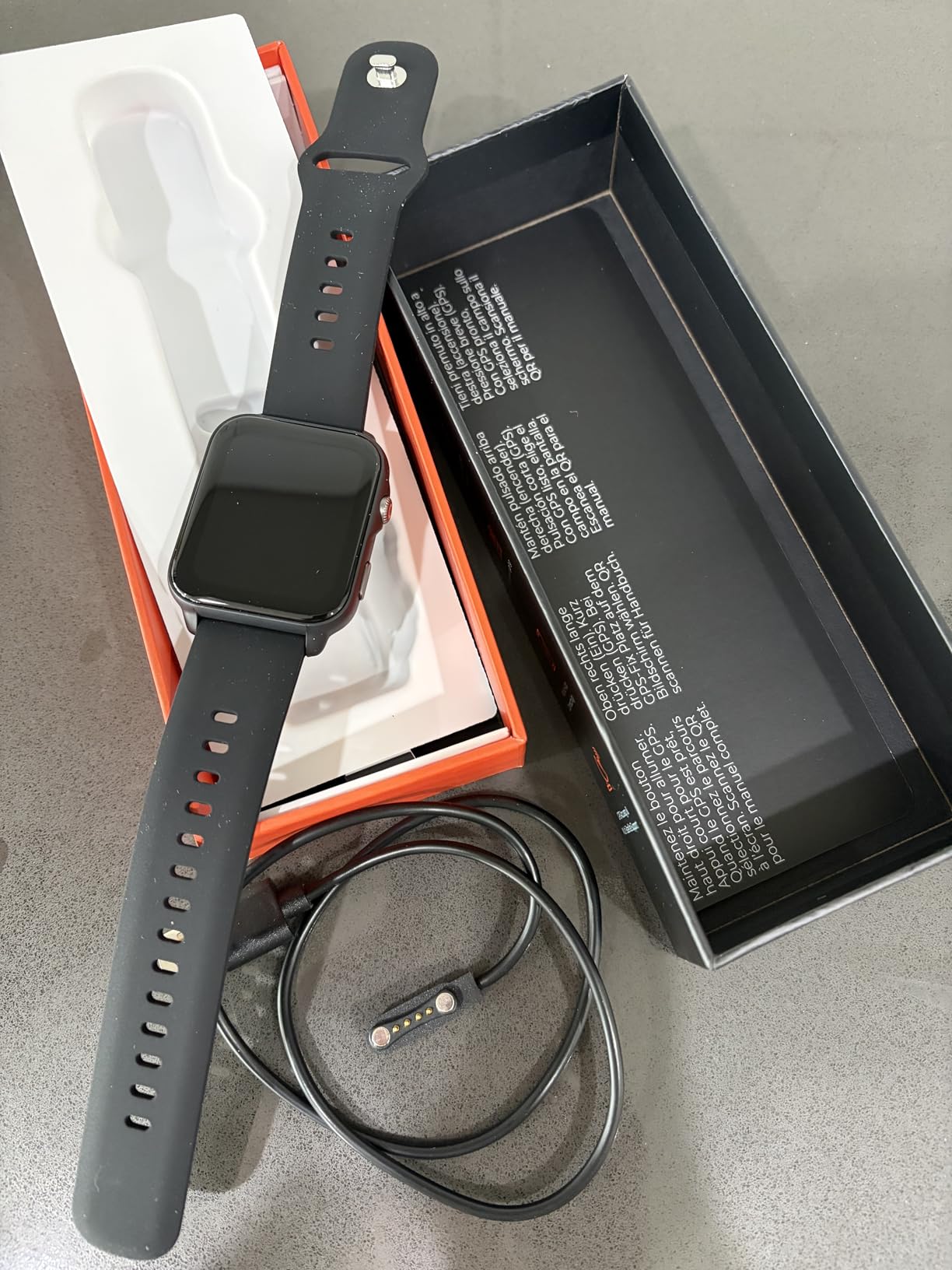
Two things stand out for the money. The warranty is two years, which is double what the biggest brand in this group offers on some models. And the charging method is a magnetic cable, not a sealed proprietary dock, which is one step better than the TecTecTec situation and a genuine relief if you travel with one bag.
At 4.1 stars across 124 reviews, this is the least proven pick, and the spread is wide. About 62 percent of owners gave five stars, but roughly 10 percent gave one star, a wider gap than most watches here. The happy reviews talk about readable numbers and zero ongoing cost. The unhappy ones talk about course loading and occasional reliability, which is what you would expect from a less established brand with a small review base.
The controls combine push buttons and capacitive touch, and several owners note it takes a few rounds to stop mis-tapping. The display is described as high-contrast and sunlight readable, which is a fair description, but do not expect the color of the S44 or even the clarity of the Garmin S12. It is numbers, and it shows you numbers.
Because there are no hole maps, this is a companion to the first-round watch rather than a scouting tool. Battery is listed around 15 hours, which lands you at roughly a full round and a bit, so plan a charge between games.
When this is the right call
Choose it if your budget is the first constraint and you want front, center and back yardages plus a warranty that lasts longer than the first season. It is also a sensible first watch to buy for a teenager, or for someone who loses things, because the downside is small and there is no ongoing fee to waste.
When to pass
Pass if you want a visual map of the hole, and pass if you are the kind of buyer who reads support forums before purchasing, because the review base here is thin and the negative reviews cluster around reliability. If reliability is the thing you care most about, the two Garmin picks are the safer bet.
5. Garmin Approach S40 Bundle – The Easiest Way To Try Shot Tracking
Garmin Approach S40 Bundle, Stylish GPS Golf Smartwatch, Includes Three CT10 Club Trackers, Black
Includes 3 CT10 trackers, 41,000+ courses, color touchscreen
Pros
- Three CT10 club trackers in the box so shot tracking works from day one
- slim metal-bezel design with quick-release bands
- sunlight-readable color touchscreen
- Green View for manual pin positioning
- 10-day smartwatch-mode battery
Cons
- Auto shot detection misses putts and chips
- older design superseded by newer Garmin models
- activity and sleep tracking add bulk without helping
This bundle solves a specific problem neatly. The S40 watch on its own is a good golf watch, but full shot tracking normally means buying sensors separately. This package includes three Approach CT10 trackers, so a beginner can clip them into a few clubs and see measured carry distances without a second purchase.
The watch itself is a 1.2-inch color touchscreen at 240 by 240 resolution, in a slim case with a metal bezel and quick-release bands. More than 41,000 courses come preloaded.
Green View lets you move the pin manually and read front, middle and back numbers plus hazard and dogleg distances, which is genuinely useful when a course has a temporary pin placement or two pins on the green.
Battery splits into two very different numbers depending on how you use it. Up to 15 hours in GPS mode covers a full round comfortably. Up to 10 days in smartwatch mode covers the rest of your life. The included step and sleep tracking is what turns it into an everyday device, and owners are split on whether that is a feature or extra bulk depending on what they expected.
The auto shot detection is the weak point, and owners say it plainly. It measures distance on most full swings but routinely misses putts and chips around the green, which is exactly the range that matters most to a high-handicap beginner trying to build a short game profile. You will end up correcting entries by hand at some point.
Also worth knowing before you buy: this is an older generation design, superseded by the S44 and S50. It remains a solid piece of hardware, but you are buying the previous case generation, and 85 reviews is a small base on which to judge long-term support. Warranty is one year limited.
Why this suits a specific beginner
If your goal this year is to learn your carry distances so you stop laying up short on every par five, the CT10 sensors make that measurable in a way no yardage watch can. Three clubs is enough to start, and you can add sensors as your bag fills out. The data lands in the Garmin Golf app alongside your scorecards.
Why you might want something else
Skip it if you care more about modern styling, since the S44 is the current design, or if you want a color screen without any paid features, because this one keeps maps in the Garmin ecosystem too.
6. SkyCaddie LX5 – The Best Maps, With a Membership Model
SkyCaddie LX5, GPS Golf Watch with Touchscreen Display and HD Color CourseView Maps, Black, Small
3-year membership included, 1.39-inch touchscreen, 64g
Pros
- Ground-verified imagery for 35000+ courses
- three-year worldwide membership included in the box
- zoom pan and cursor targeting
- IntelliGreen rotates the green for custom pin distances
- small and large wristbands included
Cons
- Membership required after the included three years
- heavy 64g case
- about two rounds of battery
- only a 6-month warranty
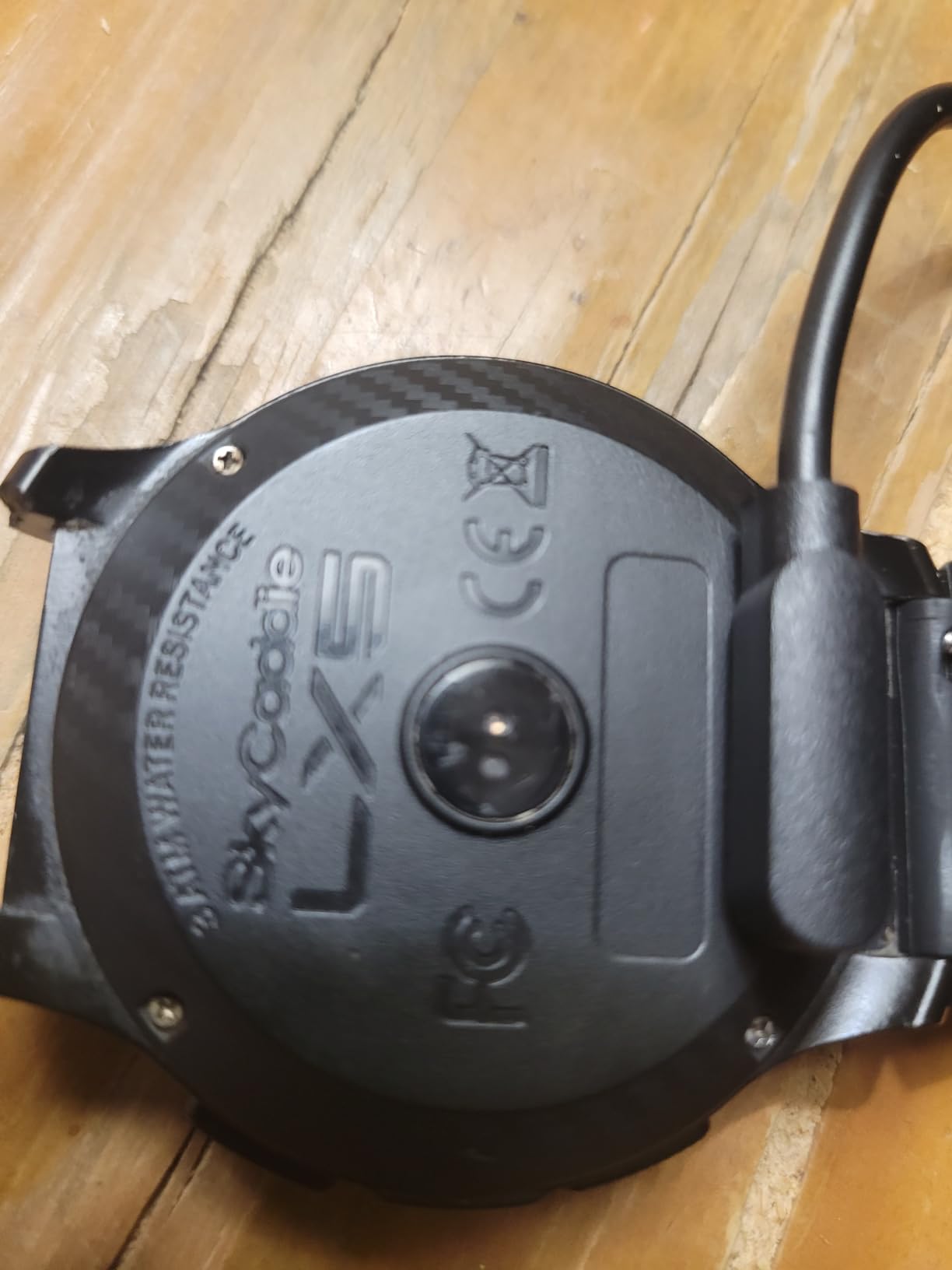
The LX5 is the only device here whose maps are ground-verified rather than simply drawn. Its map data covers more than 35,000 courses measured on foot, and the box includes a three-year worldwide prepaid membership, so you get full coverage with no payment for three years.
That is a genuinely different proposition from the yardage watches. The 1.39-inch full HD color touchscreen supports zoom, pan and cursor-based targeting, so you can point at the bunker you are actually avoiding rather than reading a number. IntelliGreen rotates the green shape, which means front, back and custom pin distances are drawn onto the correct orientation of the putting surface. It is Wi-Fi enabled, with scoring, statistics, a target list, heart rate and a step counter.
Now the reasons it sits at 3.8 stars across 587 reviews. Roughly 49 percent are five-star and 16 percent are one-star, which tells you the map quality genuinely divides people. Owners who love imagery describe the class of the mapping. Owners who hate it describe the bulk, the short battery and an interface that feels dated.
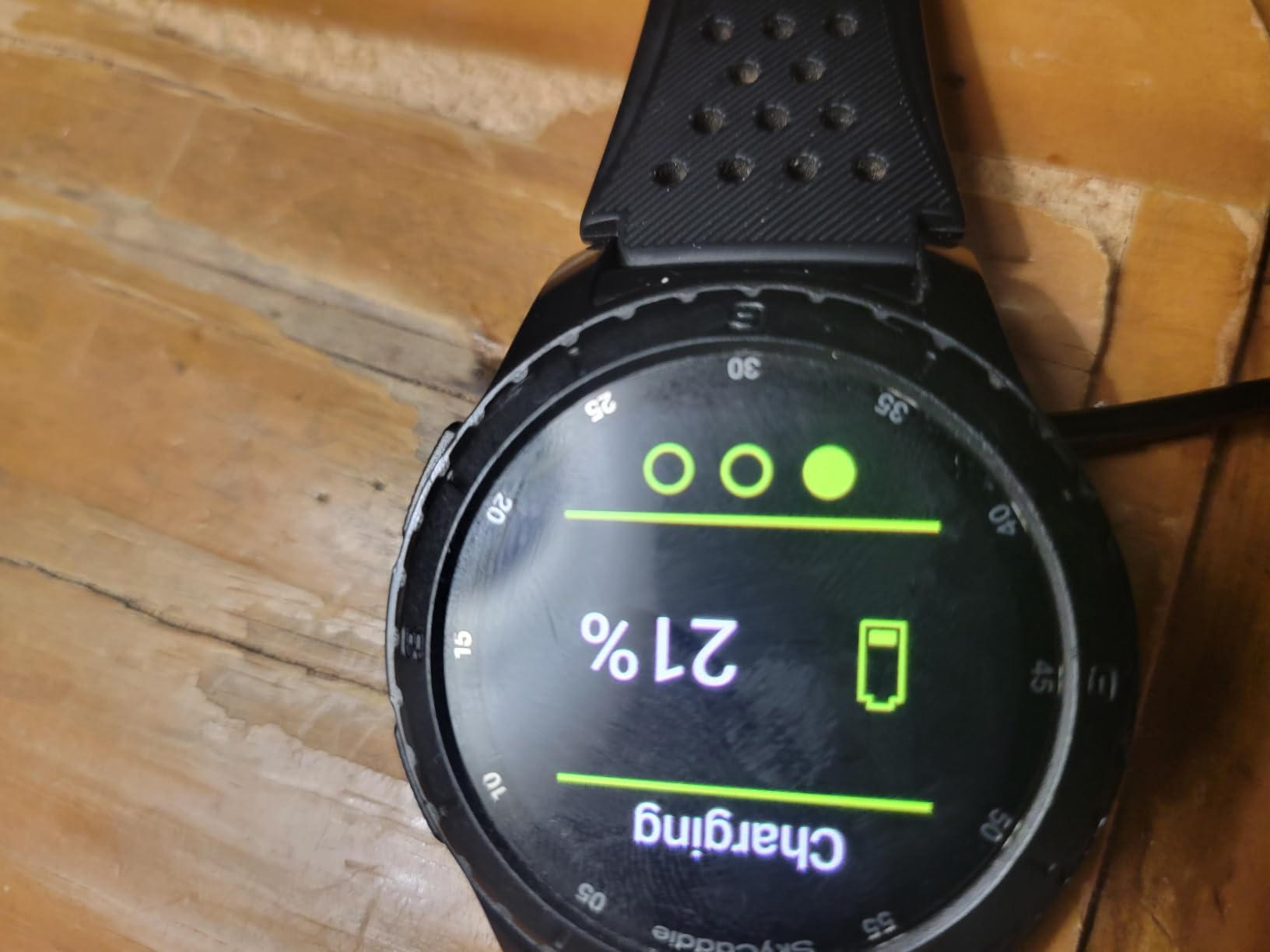
Those complaints are concrete. At 64 grams this is a heavy watch, noticeably bulkier than the 34.1-gram Garmin S12, and on a slim wrist it reads as an instrument rather than a watch. The touchscreen menus are slower to respond than button-driven rivals, which is annoying when you are standing over a shot. Battery is about two rounds, and the warranty is only six months, which is the shortest warranty of the eight. Note also that this is the oldest model in the group.
The subscription question is the one to think hardest about. Three years are prepaid, but map coverage requires an ongoing membership after that. For a beginner, spending money on a membership in year one to scroll around holes you are not ready to analyze is the wrong priority, which is why this is not our first pick despite the best maps in the group.
Who this is genuinely for
It is for the golfer who wants to learn a course before playing it, or who enjoys walking a new layout and wants to see the creek on the right rather than guess. The box includes both small and large wristbands, which is unusually thoughtful and directly relevant to fit. If you are visually oriented and impatient with menus, the map justifies the bulk in a way the numbers do not.
Who should not buy it
Do not buy it as a first-season purchase, because you will be paying to unlock features you cannot yet use. Avoid it if you play on a hot day and care about weight on the wrist, or if you need a watch that survives daily wear with a warranty longer than six months. The battery also means you will charge it between every round.
7. Shot Scope V5 – The Most Data For Free, If You Will Use the Tags
Shot Scope V5 GPS Watch, Shot Tracking, 36k+ Preloaded Courses, Full Course Maps, No Subscription (Black)
16 RFID tags, full hole maps, 100+ stats, no subscription
Pros
- Automatic shot tracking with 16 included tags and no subscription
- full hole maps plus greens/hazards/layups and doglegs
- 100+ statistics with Strokes Gained
- button interface is quick to learn
- two-year warranty
Cons
- Tag routine means finding and clipping the right tag before every shot
- slower GPS lock than some rivals
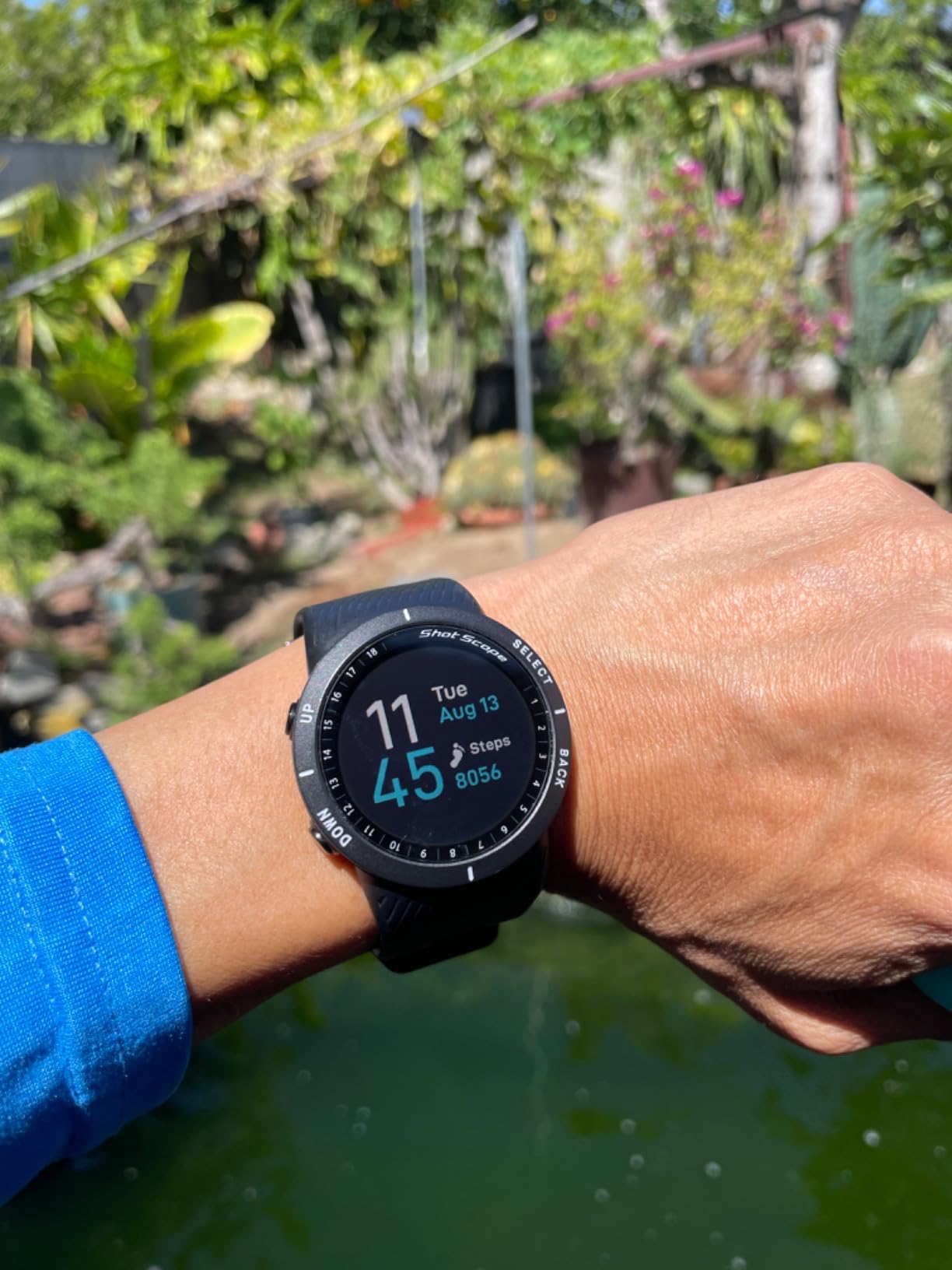
- heavy 6.24-ounce body
- basic LCD instead of a color display
The V5 is the most generous package in this group on paper. You get the watch, 16 second-generation RFID shot tracking tags, a USB charger, and free access to a statistics platform with more than 100 metrics, including Strokes Gained and handicap benchmarking. There is no subscription. For a golfer who wants data without a recurring fee, nothing else here comes close.
It is also more than a distance watch. You get full hole maps, plus distances to greens, hazards, layup points and doglegs from a 1.2-inch 240 by 240 LCD. The interface is button-driven rather than touch, and most owners find it quick to learn, which matters more than it sounds when you are being asked to operate a screen mid-round.
Here is the routine problem. Tags do not detect shots by magic. Before each shot you find the correct tag, usually from a set of numbered tags in the bag, and clip it to the club. Do that 18 times and you will have added roughly 15 seconds a hole to your round. Owners who commit to the habit love the results; owners who do not describe it as tedious and stop using it within a season.
That split is why this sits at 3.8 stars across 132 reviews, with 47 percent five-star and 11 percent one-star. The other recurring complaints are a slower satellite lock than competing watches, course loading friction during setup, a learning curve in the app, and a 6.24-ounce body that is heavy for a wrist device. The screen is a basic LCD rather than anything modern.
One thing to weigh carefully: for a beginner, 100+ statistics and a Strokes Gained model are far more data than you can act on right now. The raw distances are useful. The handicap benchmarking becomes genuinely valuable in year three, not year one.
When the free data pays off
It pays off if you are already curious about your own game and enjoy reviewing numbers on a phone in the evening. Strokes Gained is the metric that eventually tells a mid-handicap golfer exactly where their strokes are going, and having it from season one gives you a two- or three-year record nobody else has. The two-year warranty matches the best on offer here, alongside the NAVO.
When the tag routine kills it
Skip it if you walk fast, play with a group that does not wait, or simply do not want a pre-shot ritual. Also skip it if battery anxiety is your main concern, because the listed life is around 10 hours and r/golf owners of Shot Scope devices have reported far shorter real-world endurance when button presses in the bag keep waking the device. Test the habit for a month before you commit.
8. Shot Scope G6 – The Best-Looking Shot Scope, With Reliability Complaints
Shot Scope G6 GPS Watch, 38k+ Pre-Loaded Courses, Full Hole Maps, 2X Strap Sets (Black and Gray), Color Sceen, Unisex Golf Watch for Men and Women
Full hole maps, 38,000+ courses, two straps, no subscription
Pros
- Attractive design that fits well on the wrist
- distances match other watches and rangefinders
- quick setup and ready to play from the box
- includes black and gray strap sets
- last-shot distance measurement
Cons
- No shot tracking on this model
- slower GPS lock than rivals
- reports of losing satellite mid-round
- battery drains even when switched off
The G6 is the current-generation Shot Scope watch, and it fixes the V5 in one important way: no tags, no pre-shot ritual, no ceremony. It is the newest model in the range with full hole maps, dynamic front, middle and back green distances, 38,000-plus preloaded courses, and a last-shot distance measurement so you can see what your previous club actually carried.
Owners like how it looks and how quickly it works. It is ready to play out of the box, distances line up with other watches, phone apps and rangefinders, and it comes with two strap sets, black and gray, so you can change the look without buying anything. There is no subscription, and course updates come through a free mobile app. Support for GLONASS, GPS and Galileo is a good sign for lock speed on paper, and battery is listed at 15 hours.
It is also the lowest-rated watch in this group at 3.7 stars across 56 reviews, and the complaints are specific enough to matter. Several owners report a longer wait for the satellite signal than they get from a Garmin, and some report losing the connection mid-round or failing to lock onto the course. Others report mapping data that looks dated even after firmware updates, and one recurring note is a battery that drains while the watch is switched off, leaving a date and time reset to fix.
With 56 reviews the sample is small, so treat the pattern as a warning rather than a verdict. What is certain is that the shot tracking is absent on this model, which is exactly the feature that made the V5 interesting. You are choosing simpler operation in exchange for automatic data.
Who will get on with it
If you want a full hole map, a clean look on the wrist, and no subscription, this is a straightforward answer, and the two included straps make it an easy gift. It suits players who like seeing the layout of an unfamiliar hole but do not want to manage sensors or clubs at all.
Who should avoid it
Avoid it if a mid-round signal loss would ruin your round, because that is the most common complaint. Avoid it if you want shot data, since this model does not provide it, and buy the V5 or a Garmin bundle instead. Given the battery complaint, charge it fully before every round and check the time setting after it sits in a bag overnight.
Golf GPS Watch vs. Phone App vs. Laser Rangefinder
This is the argument that runs endlessly in r/golf threads, and the honest answer for a beginner is that the phone wins on features and the watch wins on pace. A dedicated app such as Hole19, Golf Pad, Golfshot, The Grint or 18 Birdies often gives you better hole visualization and statistics than any watch at this level, but it also asks you to unlock a phone, find the app, load the course, and stand still while it finds a signal. That routine takes 20 to 30 seconds at the tee box, every hole.
One thread after another in r/golf makes the same point about phone-first systems: the annoyance is not the app, it is having the phone in your pocket. Users describe the pocket as the dealbreaker, and the reason apps like Hole19 win comparisons is that the watch can act as the GPS source, so the phone stays in the bag until the round is over. If that is a priority for you, check specifically whether a device runs standalone.
The laser rangefinder solves a different problem. It is one job, distance to the pin, done instantly with a laser and nothing else to think about. For a beginner learning club distances, that simplicity is hard to beat and costs a fraction of any watch here. What it cannot do is show hazards, doglegs, a map, or your score.
My take, after watching people get into trouble with all three: a watch is a pacing tool, an app is a learning tool, and a rangefinder is a confidence tool. Buy the watch if the problem you want solved is stopping the 20 seconds at the tee box. Buy the app if you want to study your rounds afterward. Buy the rangefinder if you only need one number and you want zero friction.
Buying Guide: 6 Criteria That Matter to a New Golfer
1. Yardage to the pin accuracy. This is the only measurement that has to be right. Reviews on the Garmin models describe distances within a few yards of a cart GPS and a laser, which is more than good enough to pick a club. Anything that gives you front, middle and back green numbers is a step above a single number, because most mistakes come from misjudging depth rather than distance.
2. Battery life measured in rounds. Convert the quoted hours into rounds of four hours each, then ask a simple question: can I finish a full 18 plus a range session? The S12 answers with room to spare at 30 hours in GPS mode. The TecTecTec and SkyCaddie give you roughly two to two and a half rounds, which is workable if charging becomes a habit and annoying if it does not. The r/golf thread about a GPS dying during a money round is a joke, but it is a joke people tell because the fear is real.
3. Whether it needs your phone. Every watch in this round works on the course with no phone, which is the important part. What differs is the phone’s role at home: the TecTecTec, NAVO and Shot Scope use it for free course and firmware updates. Read reviews specifically for complaints about course loading, because that is the step where a new owner gets stuck.
4. Total cost over three years, not the hardware price. Add the hardware plus any required membership, multiplied by three. A watch with no subscription and a three-year battery is cheaper over three years than a cheaper watch you charge twice a week, and it is much cheaper than a membership you abandon in month four. This is the calculation the forum corpus almost never does, and it usually changes the answer.
5. Charging standard and cable. Proprietary docks are a genuine annoyance, particularly for travel. The NAVO uses a magnetic cable, the TecTecTec includes its own USB cable, and the SkyCaddie includes a charger with cable. Note that a USB cable in the box is not the same as USB-C fast charging on the watch, so check what the device actually accepts before you buy a third cable.
6. Size, wrist fit, and which wrist you wear it on. The SkyCaddie is 64 grams and noticeably heavy. The Garmin S12 is 34.1 grams. The S40 bundle is 3.52 ounces. That spread is large enough to decide comfort on its own, and every watch here wears on either wrist. Note that the Shot Scope G6 ships with two strap sets, which tells you the sizing problem is real in this category. If you have a small wrist, measure before ordering rather than after.
Two more things that are worth less to a beginner than the marketing suggests. Wind-adjusted yardage is a genuine feature on higher-end systems and the forum verdict is that it is useful when it is right, but you cannot calibrate it to your own club speed yet, so treat it as a curiosity in season one. Green reading and green contour data require experience to convert into a putt choice, which is another reason not to pay a membership before you can use it.
Finally, software support. Buyers actively ask whether a three-year-old model still receives updates, and it is a fair question in a category where batteries age faster than the bodies around them. Prefer a recent generation with a multi-year warranty, and expect to replace the whole device when the battery degrades rather than hunting for a replacement cell.
Frequently Asked Questions
Do I need a golf GPS watch as a beginner, or can I just use my phone?
You can use your phone. Every golf GPS app gives you accurate yardages, and for many beginners that is enough. A dedicated watch earns its place by removing the 20 to 30 seconds per hole it takes to unlock a phone, load a course and wait for a signal. If you would rather glance at your wrist than fish a phone out of a pocket, a watch is a real convenience upgrade in year one. If you are happy with an app, start there and upgrade later.
What should I look for in a golf GPS watch as a complete beginner?
Six things matter, in this order: yardage to the pin accuracy, battery life expressed in rounds rather than hours, whether the watch works without your phone, total cost over three years including any subscription, the charging connector, and how the watch fits your wrist. For a first watch, front, middle and back green distances plus a manual scorecard function cover almost everything a new golfer uses.
Which golf GPS watch has the longest battery life?
The Garmin Approach S12 leads this group with up to 30 hours in GPS mode, which is several full rounds on one charge. The Garmin S40 and S44 are listed at 15 hours in GPS mode, the S40 also reaching 10 days in smartwatch mode. Shorter-rated options include the TecTecTec ULT-G at roughly 2.5 rounds per charge and the SkyCaddie LX5 at about two rounds.
Can a golf GPS watch work without my phone in my pocket?
Yes. Every watch reviewed here works on the course with no phone at all, because the calculation happens on the wrist. Some owners specifically prefer this, since carrying a phone changes how you walk and how often you are distracted. Your phone is only needed at home, for free course and firmware updates on the models that offer that.
Are golf GPS watch subscriptions worth it?
Usually not in your first season. The TecTecTec ULT-G, NAVO W1 and both Shot Scope watches work fully with no subscription. The SkyCaddie LX5 includes three prepaid years of membership before it needs a renewal. The Garmin S44 keeps its core distances free but puts full-color CourseView maps, green contours and PlaysLike Distance behind a membership. Buy the free tier first and only pay once you know which feature you actually use.
How accurate are golf GPS watches for distance to the pin?
Good ones are typically within a few yards of a cart GPS or a laser rangefinder, which is close enough to pick a club consistently. Reviews of the Garmin S12 and S44 both describe yardages that check out against a laser. Devices with a slow satellite lock can be briefly wrong at the tee, so give the watch a few seconds before trusting the number on an unfamiliar hole.
Should a beginner buy a golf GPS watch or a laser rangefinder?
A rangefinder is simpler and cheaper, and it does one job instantly: distance to the pin. A watch adds hazard distances, doglegs, layup numbers and score keeping on your wrist, which is useful once you want to think about more than the green. Most beginners start with a rangefinder and add a watch in their second or third season. If you only need one number and want zero friction, a rangefinder is the better first buy.
Which Golf GPS Watch Should You Buy?
Start with the TecTecTec ULT-G. It is our editor’s choice for the best golf GPS watches for beginners because it does the one job a beginner needs, it has more owner reviews than anything else here, it never asks for money, and it never asks for your phone. Buy the Garmin Approach S12 if you want the best battery life in the group and a screen you can read in direct sun. Buy the Garmin Approach S44 if you want it to look like a normal watch and you are disciplined about staying on the free features.
Match the rest to your temperament. The NAVO W1 is the low-cost entry, with a two-year warranty alongside the two Shot Scope models. The S40 bundle is the shortcut to shot tracking, because the club sensors come in the box. The SkyCaddie LX5 is for the visual learner who wants to see the hole, not read a number, and who is comfortable with a membership model. The Shot Scope V5 is the pick if you want serious statistics without a subscription and will actually do the tag routine. The Shot Scope G6 gives you full hole maps with no ceremony, at the cost of some signal reliability reports.
Use the watch for what it is good at, which is choosing a club. Your score will come from the practice range.
Before you buy, check our beginner buying guide for kitchen knives and our first-blender picks for the same philosophy we bring to golf tech: buy the simple thing that works, learn it properly, and upgrade only when a specific limit starts to cost you something.