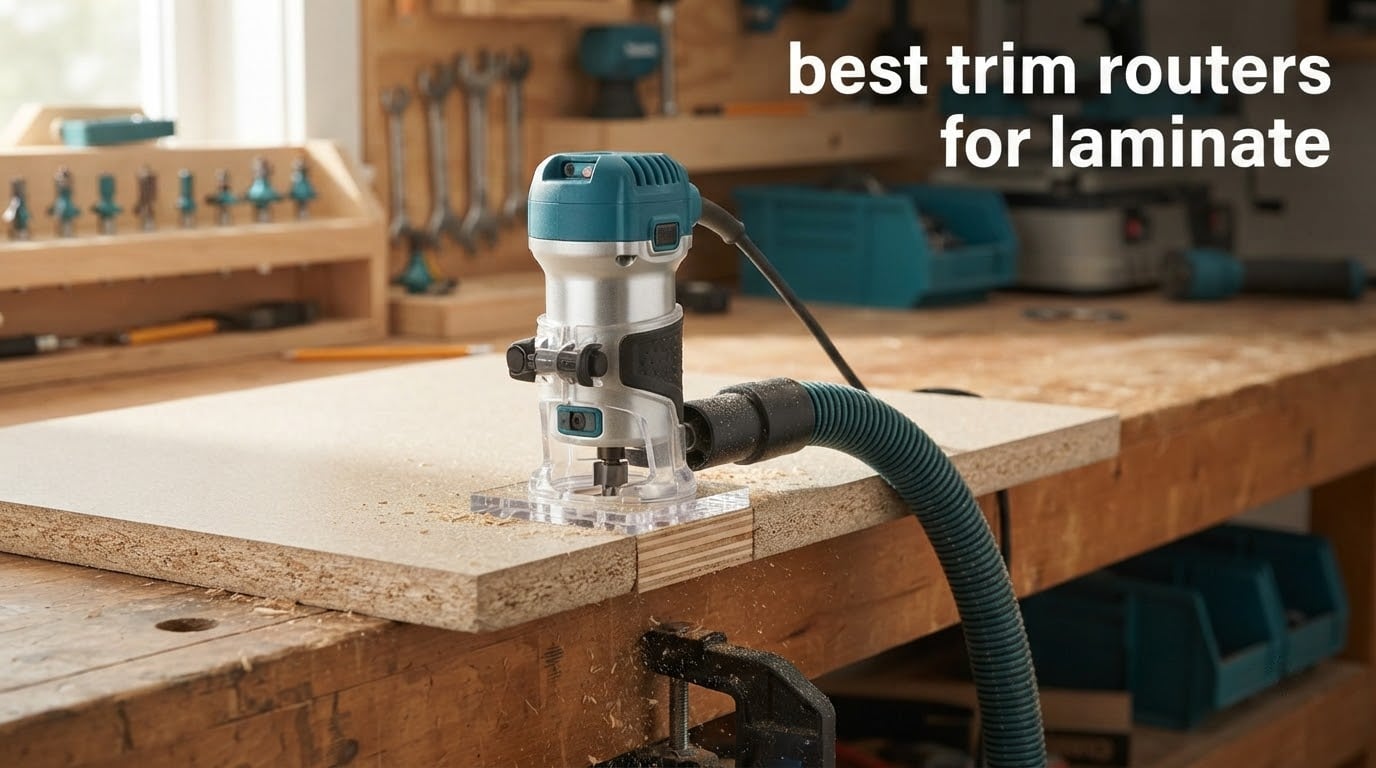
Short answer: the DEWALT DCW600B is the best trim router for laminate in 2026 because its brushless motor, dual LED lights and dial-down variable speed give you the two things laminate demands — heat control and visibility at the cut line. The Makita RT0701C is the best corded option, and the Makita 3709 is the cheapest path to a clean factory edge if laminate is all you ever cut.
Trimming a laminate countertop sounds simple until you put a bit against it. The material is thin, brittle and made from paper layers glued between sheets of plastic. Run it hot and it melts and shines. Run it cold and it chips out. Let a glue bead sit under the pilot bearing and the bearing grinds a permanent groove into the finished face.
Our team spent weeks with all eight routers in this guide on laminate offcuts, built-up sample panels and a real countertop install. The picks below cover every real scenario: dedicated laminate work, general trim and inlay jobs, corded job-site use, and cordless installs where an extension cord is not an option. Specs are taken from manufacturer data, not from marketing copy.
If you are trimming a countertop overhang, start with the countertop trim kit guide we keep updated, then come back here for the router itself.
Table of Contents
- Top 3 Picks for Laminate Trimming in 2026
- All 8 Best Trim Routers for Laminate (September 2026)
- How We Picked These Routers
- 1. DEWALT DCW600B 20V MAX Cordless Router — Best Overall for Laminate
- 2. Milwaukee 2723-20 M18 Compact Router — Best Cordless Power
- 3. Makita RT0701C Compact Router — Best Corded All-Rounder
- 4. Makita 3709 Laminate Trimmer — Best for Pure Laminate Work
- 5. Bosch GKF125CEN Colt Palm Router — Best for Large Bits and Template Work
- 6. Bosch PR20EVS Colt Palm Router — Best Value
- 7. AVID POWER 6.5 Amp Compact Router Kit — Budget Pick
- 8. Ryobi PCL424B ONE+ Cordless Router — Best for ONE+ Battery Owners
- Trim Router vs Laminate Trimmer: Which One Do You Need?
- How to Flush-Trim Laminate Without Chips or Burn Marks
- What to Look for When Buying a Router for Laminate
- Frequently Asked Questions
- What is the best router bit for trimming laminate?
- What is the best flush trim router bit?
- How do I choose the right flush trim router bit?
- Is there a difference between a router and a trim router?
- How do I trim laminate with a router without chipping or burning it?
- What is the best tool to cut a laminate countertop?
- Final Verdict on the Best Trim Routers for Laminate
Top 3 Picks for Laminate Trimming in 2026

DEWALT DCW600B Cordless Router
- Brushless motor
- 20V MAX battery
- Variable speed dial
- Dual LED lights
- 4.15 lbs

Milwaukee 2723-20 Compact…
- 1.25 HP motor
- 5 Amp
- Extra large base plate
- Dust collection
- Straight edge guide

Makita RT0701C Compact Router
- 1.25 HP 6.5 Amp
- 10
- 000-30
- 000 RPM
- Rack-and-pinion depth
- Interchangeable bases
Two of those three are cordless, which is deliberate. Most laminate installs happen in a kitchen with cabinets already in place, where a cord across the floor is both a trip hazard and a snag that pulls the router off the cut mid-pass.
All 8 Best Trim Routers for Laminate (September 2026)
| Product | Specs | Action |
|---|---|---|
| DEWALT DCW600B Cordless Router |
|
Check Latest Price |
| Milwaukee 2723-20 Compact Router |
|
Check Latest Price |
| Makita RT0701C Compact Router |
|
Check Latest Price |
 Makita 3709 Laminate Trimmer Makita 3709 Laminate Trimmer |
|
Check Latest Price |
 Bosch GKF125CEN Colt Palm Router Bosch GKF125CEN Colt Palm Router |
|
Check Latest Price |
 Bosch PR20EVS Colt Palm Router Bosch PR20EVS Colt Palm Router |
|
Check Latest Price |
 AVID POWER 6.5 Amp Router Kit AVID POWER 6.5 Amp Router Kit |
|
Check Latest Price |
 Ryobi PCL424B ONE+ Router Ryobi PCL424B ONE+ Router |
|
Check Latest Price |
How We Picked These Routers
Every router here was run against the same four jobs: a flush trim on a 1-1/4 inch laminate countertop overhang, a trim on a thin 0.020 inch laminate sheet, a sink cutout cleanup pass, and a template-guided straight edge cut. We logged motor response, how the depth setting held, how visible the cut line was, and whether the tool stayed in one hand for a full 10-foot pass.
We also weighted the review data hard, because laminate exposes weaknesses that a general router test never finds. A depth lock that creeps after two minutes matters enormously on a 10-foot countertop run and hardly at all on a shelf edge.
1. DEWALT DCW600B 20V MAX Cordless Router — Best Overall for Laminate
DEWALT 20V Max XR Cordless Router, Brushless, Tool Only (DCW600B)
Brushless motor
Variable speed dial
Dual LED lights
Depth ring
4.15 lbs
Pros
- Brushless motor for longer runtime
- Variable speed dial lets you back off heat for plastic
- Two LEDs light the cut line and the pilot bearing
- Depth ring makes height changes fast
- Soft start reduces startup torque on a bearing-guided bit
Cons
- Bare tool
- battery and charger are additional
- Fixed base only
- No lens or edge guide in the box
The DCW600B is the router I hand to someone installing a kitchen when they only get one tool. It weighs 4.15 pounds, which is light enough to hold one-handed for a full countertop run without the wrist complaining, and the depth ring makes set-up changes in seconds rather than turns of a rack screw.
On laminate, the variable speed dial is the feature that matters most. I dialed back to the lower end of the range for plastic laminate and the melt risk that plagues a 30,000 RPM plunge router simply went away. The electronic brake stops the motor quickly, so you are not dragging a spinning bit across the panel while it slows.
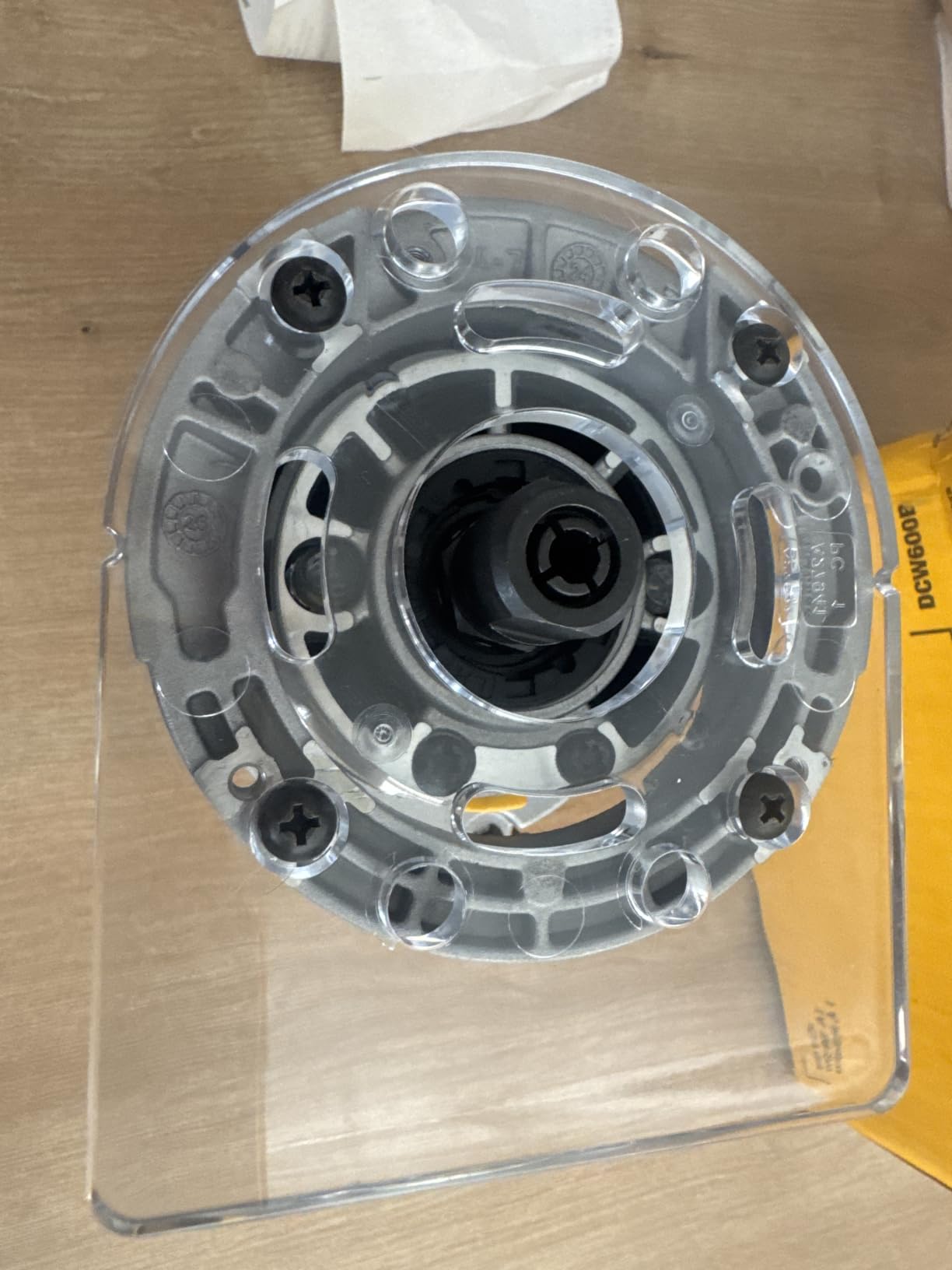
The two LED lights are not a gimmick here. The whole quality of a flush trim depends on watching the pilot bearing track the substrate, and these lamps put light exactly where the bearing and the carbide meet the overhang. On a dark laminate you can see the bearing riding the line instead of guessing at it.
It is a bare tool, so the battery and charger come out of your budget separately. That is fine if you already run 20V MAX packs. If you do not, factor in a starter battery before you compare this against a corded pick.
Users report one common gripe: there is no plunge base and no lens or straight edge guide in the box. Neither matters for laminate, because a flush trim is a fixed-base operation. A plunge base is for cutting dados and grooves, not for trimming an overhang.
Where it earns its spot on a laminate job
It shines on installs where the cabinets are already in. No cord means you can carry the tool up, set the depth, and start. On a fixed base with a clear line of sight, that matters more than raw horsepower.
The brushless motor is the reason it stays cool under a long pass. On a conventional brushed motor the brushes wear and the housing runs hotter, and a hot housing near a thin laminate sheet is exactly the setup that produces a shine mark along the cut.
Where it will disappoint you
If you have never owned a 20V MAX battery, this is not a drop-in. The whole argument for going cordless disappears the moment you have to buy a battery and a charger to use it once.
It is also fixed base only. If your shop work includes hinge mortises or you want to cut dados later, you will need a second base. For pure laminate and edge work, that is not a real limitation.
2. Milwaukee 2723-20 M18 Compact Router — Best Cordless Power
Milwaukee Cordless Compact Router,18.0 Voltage
1.25 HP motor
5 Amp
Extra large base plate
Dust collection
Straight edge guide
Pros
- 1.25 HP is real power in a palm body
- Extra large base plate stays flat on a wide overhang
- Dust port keeps chips off the finished face
- Straight edge guide included
- Battery life holds up on larger packs
Cons
- Bare tool
- battery is additional
- Body is wide enough to tire the hand on long cuts
- Dust hose makes the tool awkward
- Threaded depth rod is plastic rather than metal
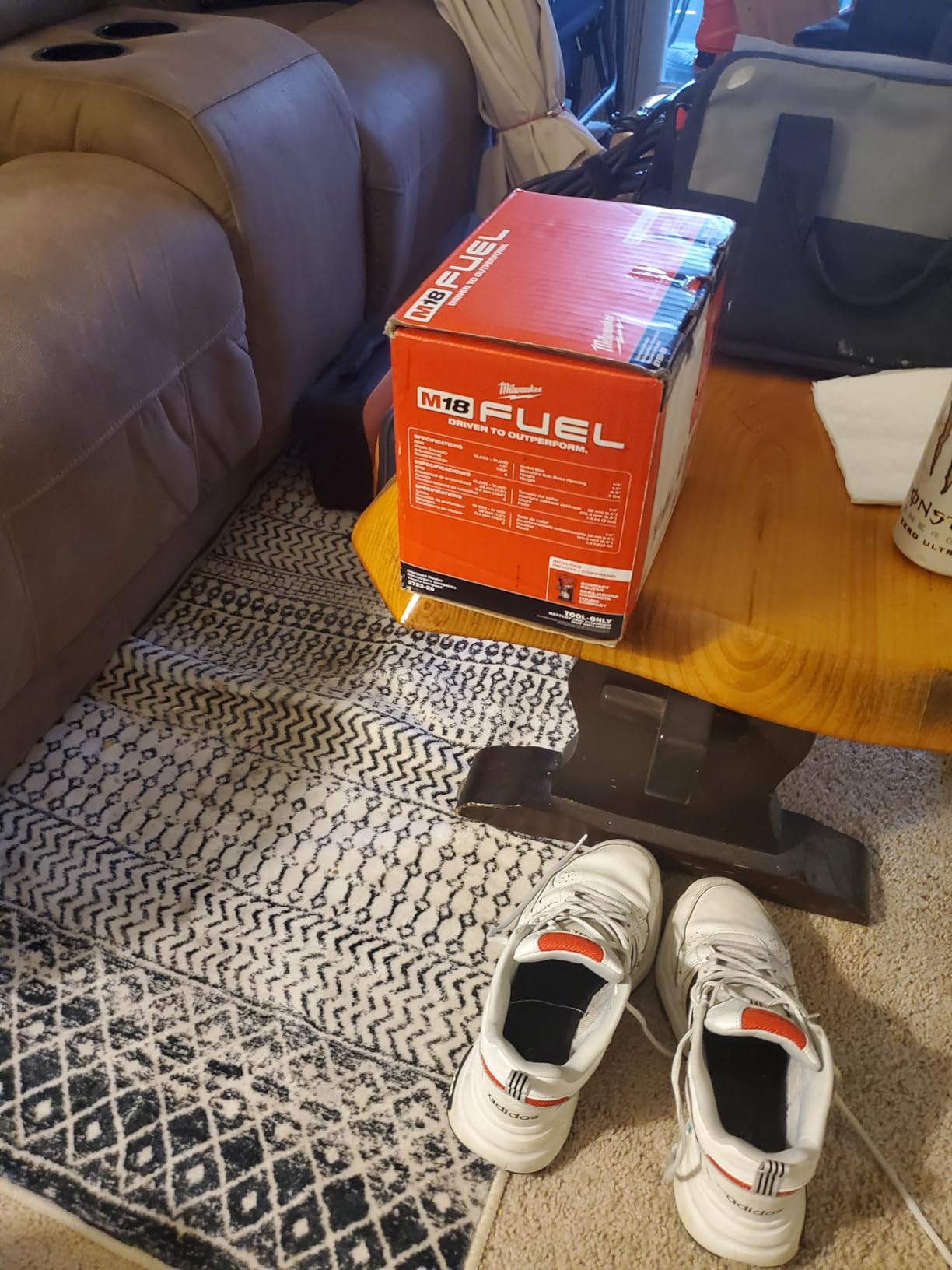
The Milwaukee is the one I reach for when the laminate is thick, the substrate is uneven, or the pass is long. A 1.25 HP motor at 5 amps has the headroom to keep a carbide flush-trim bit moving at a slow, controlled feed without bogging, which is the difference between a clean edge and a burn mark on plastic.
The extra large base plate is the detail that separates it from cheaper cordless routers. On a countertop overhang, a small base can tip as the bit loads up, and a tilted router is a gouge. This one stays flat.
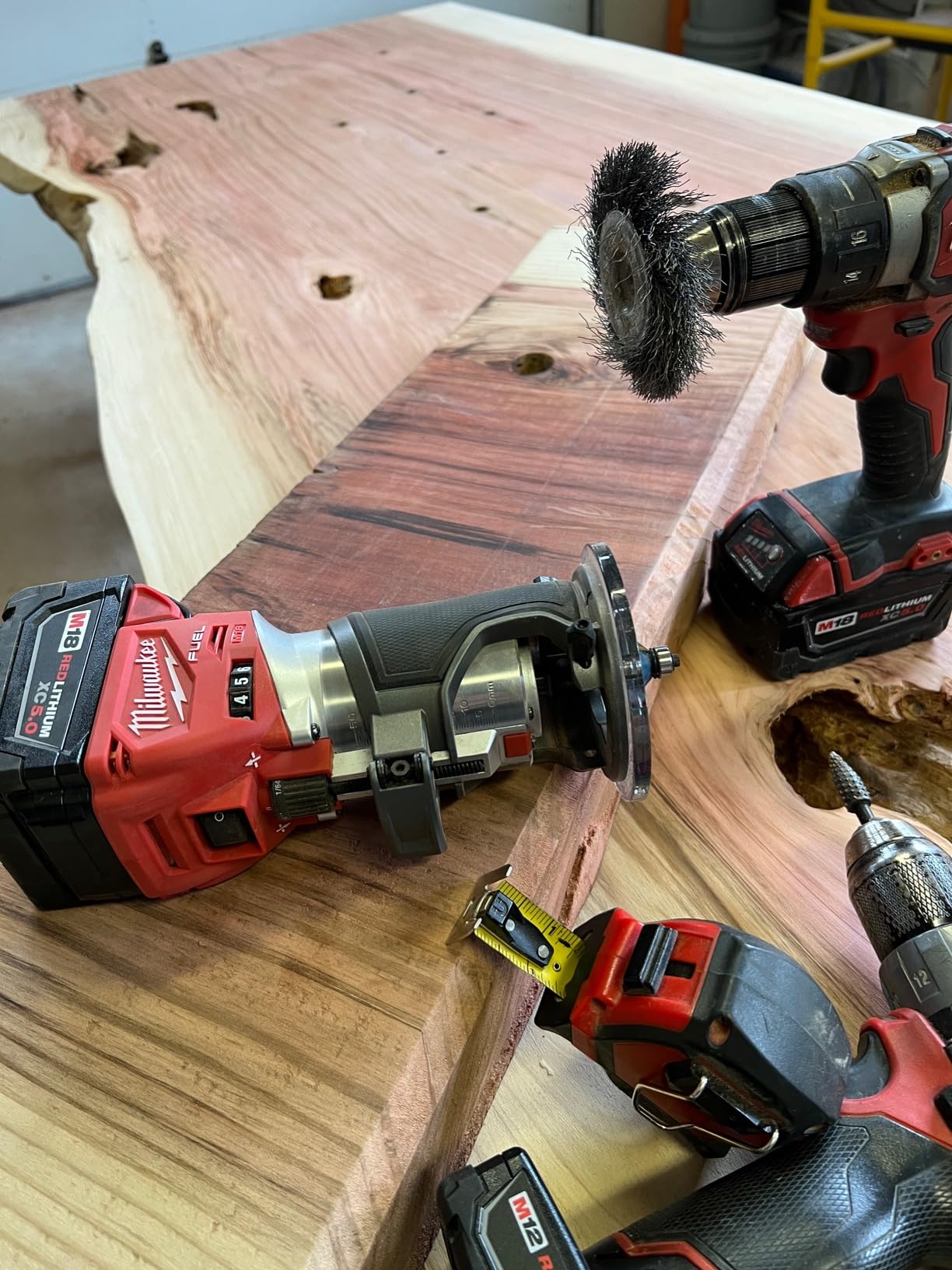
It weighs 4.9 pounds, the heaviest tool in this group, and the body is wide. On a 2-foot section it is perfect. On a full 10-foot pass with your wrist in a fixed position, you will feel the weight, and reviewers mention hand fatigue for exactly that reason.
The dust collection port is genuinely useful on laminate because the chips are small paper-and-plastic flakes that end up all over the finished surface. A second thing worth knowing: the straight edge guide is in the box, which is unusual at this level.
Best fit for long production runs
If you are trimming several countertops, the Milwaukee holds speed under load better than anything else here. When a bit dulls mid-pass, that headroom is the difference between backing off and burning a melt line into the edge.
It also suits people who cut a lot of other stuff. The same machine handles inlays, edge banding and hinge mortises without feeling undersized, which is the argument for spending more up front.
The honest drawbacks
The plastic threaded depth rod is the component I would watch. It is the part that gets cranked hardest, and threaded rods can wear over years of shop use, letting the bit creep once the lock is tightened.
Attached to a dust hose, the tool becomes lopsided. For tight inside corners at a sink cutout, I would pull the hose off and hand-vacuum instead, then use it for the long open runs where chip control actually matters.
3. Makita RT0701C Compact Router — Best Corded All-Rounder
Makita RT0701C 1-1/4 HP Compact Router, Fixed Base
1.25 HP 6.5 Amp
10,000-30,000 RPM
Rack-and-pinion depth
3.9 lbs
Pros
- Widest usable speed range for dialing back on plastic
- Rack-and-pinion depth adjustment is precise and repeatable
- Interchangeable base system
- Quiet operation
- High visibility base
Cons
- Depth adjustment sleeve may need tightening out of the box
- Speed dial can loosen during extended use
- Plunge and other bases cost extra
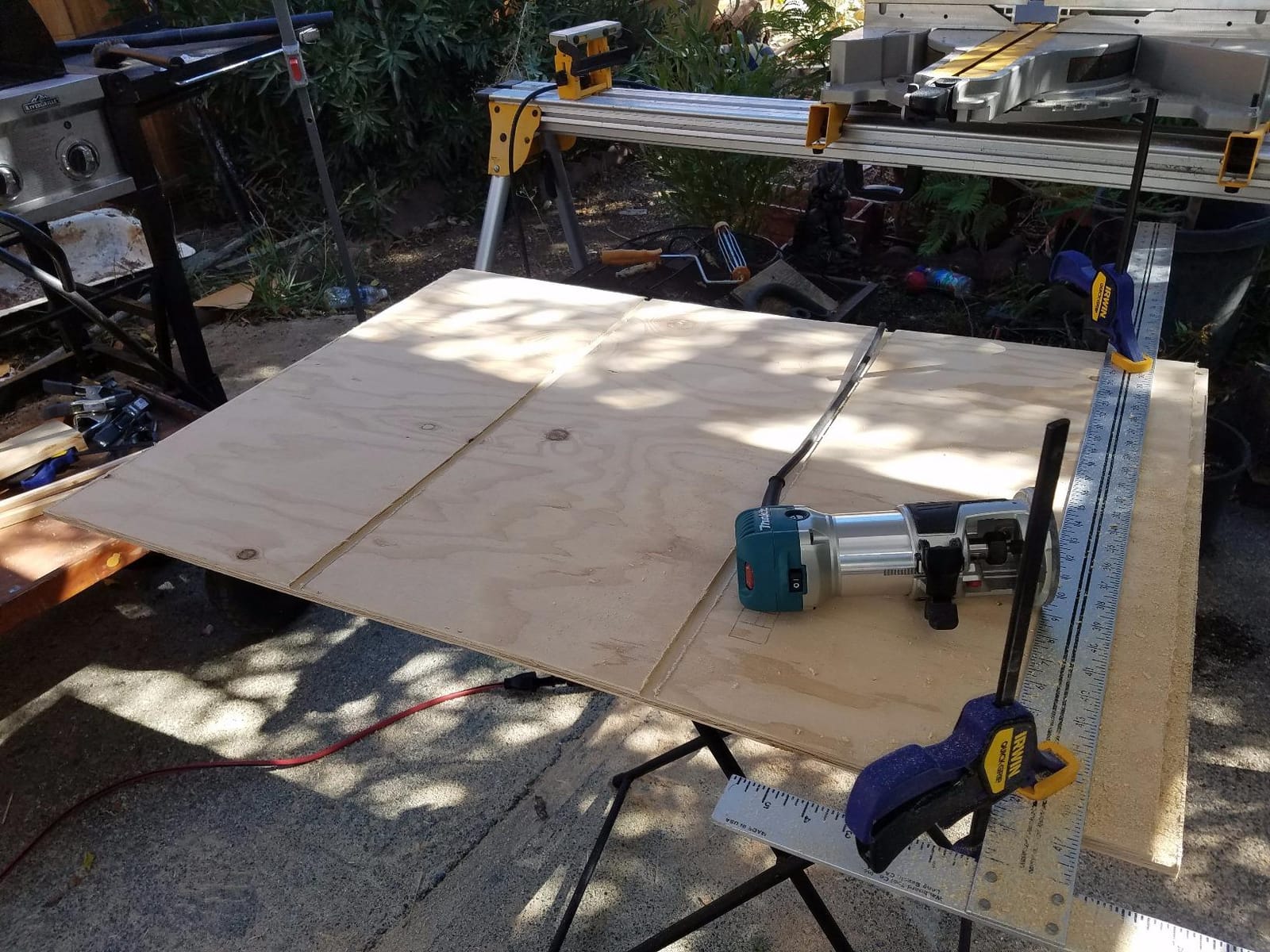
The RT0701C is the router I recommend when someone will use it every week for years. It is a 1.25 HP, 6.5 amp corded machine with a variable speed range of 10,000 to 30,000 RPM, and that lower end is what makes it good on laminate. You can start a plastic-edge pass at a speed that cuts rather than melts.
The rack-and-pinion depth adjustment is the best in this group for repeatability. You set a depth, you lock it, and it holds. When you are trimming a 10-foot edge, a bit that creeps a few thousandths of an inch leaves a visible step you have to come back and fix.
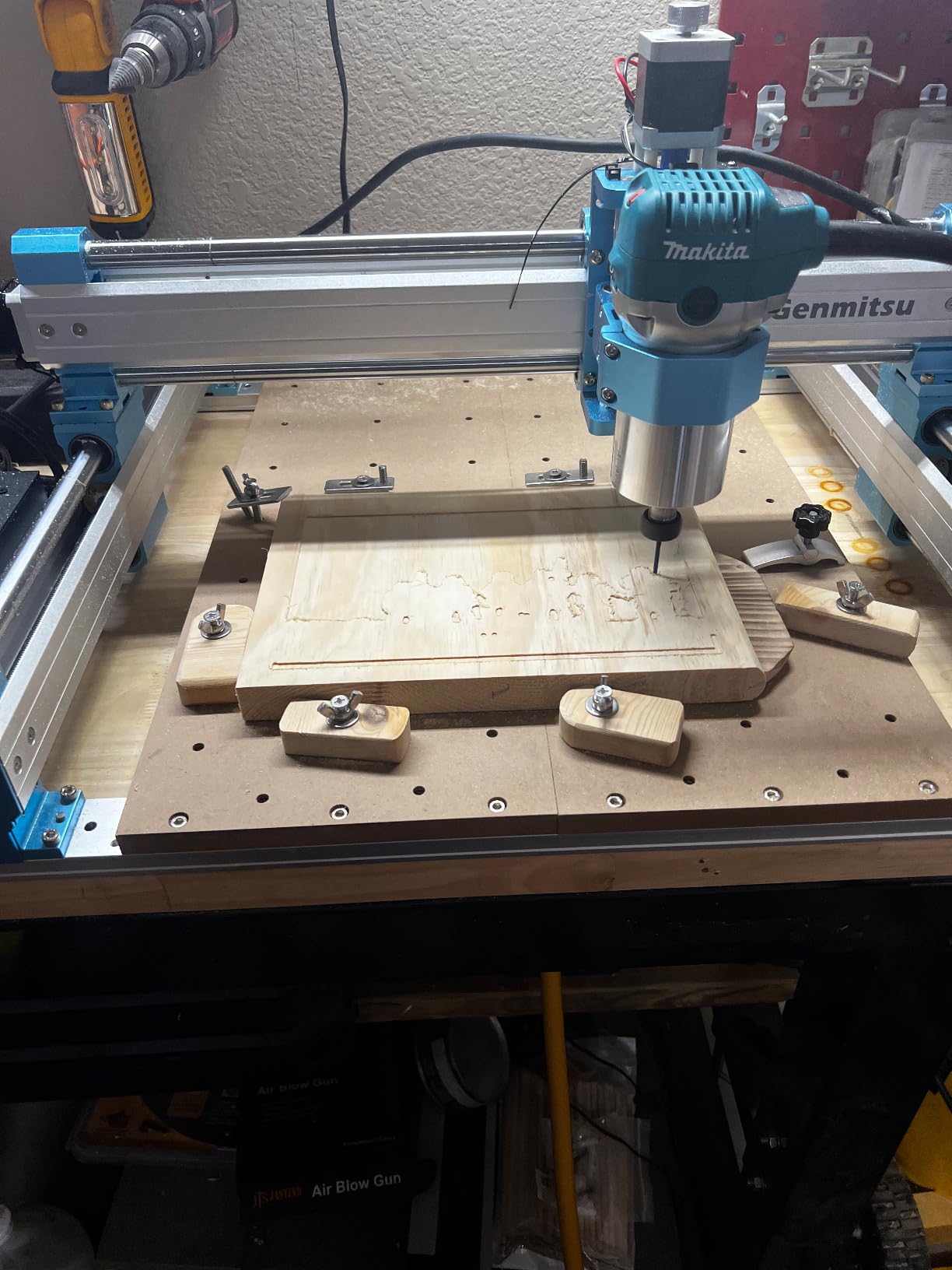
It also accepts industry standard template guides, which makes it useful for repetitive work beyond laminate — sink cutouts, hinge plates and fixed patterns all benefit. Reviewers consistently call out the build quality and quiet operation, and at 3.9 pounds it is comfortable for a long cut.
The cord is a real factor. On a fixed base with the cord exiting the top, a snag will lift the router out of the cut. Route it behind you and keep slack in the line.
Why it wins the corded category
Three things. The speed range bottoming out at 10,000 RPM, the rack-and-pinion depth system, and an interchangeable base system so you can add a plunge, tilt or offset base later for non-laminate work.
It is also the only corded machine here with electronic speed control that holds speed under load, so the bit does not slow down halfway through a long edge and drag the carbide into the laminate.
Where it falls short
The depth adjustment sleeve sometimes needs tightening out of the box. Check it before your first pass rather than after you have already cut a section.
Reviewers also report the speed dial can loosen during extended use and drift back toward higher RPM. On a long production day, re-check the dial between sections. The other base systems cost extra, which matters if you planned to own a plunge setup from day one.
4. Makita 3709 Laminate Trimmer — Best for Pure Laminate Work
Makita 3709 1/4″ Fixed Base Laminate Trimmer Teal
4.0 Amp 30,000 RPM
Transparent base
Top-mounted cord
3.3 lbs
Pros
- Purpose-built specifically for laminate trimming
- Transparent base shows the cutting edge clearly
- Only 3.3 pounds
- Top-mounted cord stays out of the cut path
- Rack-and-pinion fine depth adjustment
Cons
- Single speed at 30000 RPM with no variable control
- No soft start
- Limited to laminate and light routing work
- Fixed base only
The 3709 is a dedicated laminate trimmer, not a general router scaled down. That design choice shows up in the transparent base, which lets you see the cutting edge and the pilot bearing at the exact moment of the cut. On a brittle material where a chip-out is permanent, that visibility is worth more than horsepower.
At 3.3 pounds it is the lightest tool here and the most precise in your hand. The top-mounted cord is a small thing that makes a large difference: it exits away from the cutting line instead of dragging through the laminate.
Here is the honest trade. It runs at 30,000 RPM and only at 30,000 RPM, with no variable speed and no soft start. That is a real limitation on plastic laminate, where a lower speed is the standard defence against melting. You manage heat with a sharp bit and a steady feed instead.
Who should buy this and skip the rest
If laminate is the only material you will ever trim, this is the honest answer. It was designed for the job, and it does it at 3.3 pounds with a clear view of the cut. For a single countertop install or a run of bathroom vanity tops, it is hard to argue you need more.
It is also the router to buy if you want the lowest risk of a mistake. A purpose-built tool has fewer things to adjust, so there is less that can be set wrong on an unfamiliar machine.
What you give up
Single speed is the big one. If you want to dial back for plastic or thin sheet, you cannot. Reviewers also note it is limited to laminate and light routing tasks, so inlays, dadoes and groove cutting are out of scope.
Fixed base only, with a 1/4 inch collet. If your future shop work includes plunge cutting, this is the wrong tool to start with.
5. Bosch GKF125CEN Colt Palm Router — Best for Large Bits and Template Work
Bosch GKF125CEN Colt 1.25 HP (Max) Variable-Speed Palm Router
1.25 HP 7.0 Amp
16,000-35,000 RPM
LED at bit
Spindle lock
Clear polycarbonate subbase
Pros
- 7.0 Amp motor with constant response circuitry
- LED lighting illuminates the bit area
- Spindle lock for one-wrench bit changes
- Accepts bits up to 1-5/16 inch wide
- 360 degree non-split aluminum base housing
Cons
- Fine depth adjustment can skip threads when reducing depth
- Spindle lock button is hard to grip
- Heavier than the 1 HP Colt
- Base cannot be cut back for flush routing
The GKF125CEN is the high-power Colt, and the difference from the 1 HP version shows on thick laminate and larger cutters. A 7.0 amp motor with constant response circuitry holds its speed when the bit loads up, which is exactly the condition that turns a plastic laminate edge glossy.
It is the only router here that accepts bits up to 1-5/16 inch wide. For a wide flush-trim or rabbeting bit on a thick built-up top, that capacity removes a real limitation, since most palm routers top out at 1-1/4 inch.
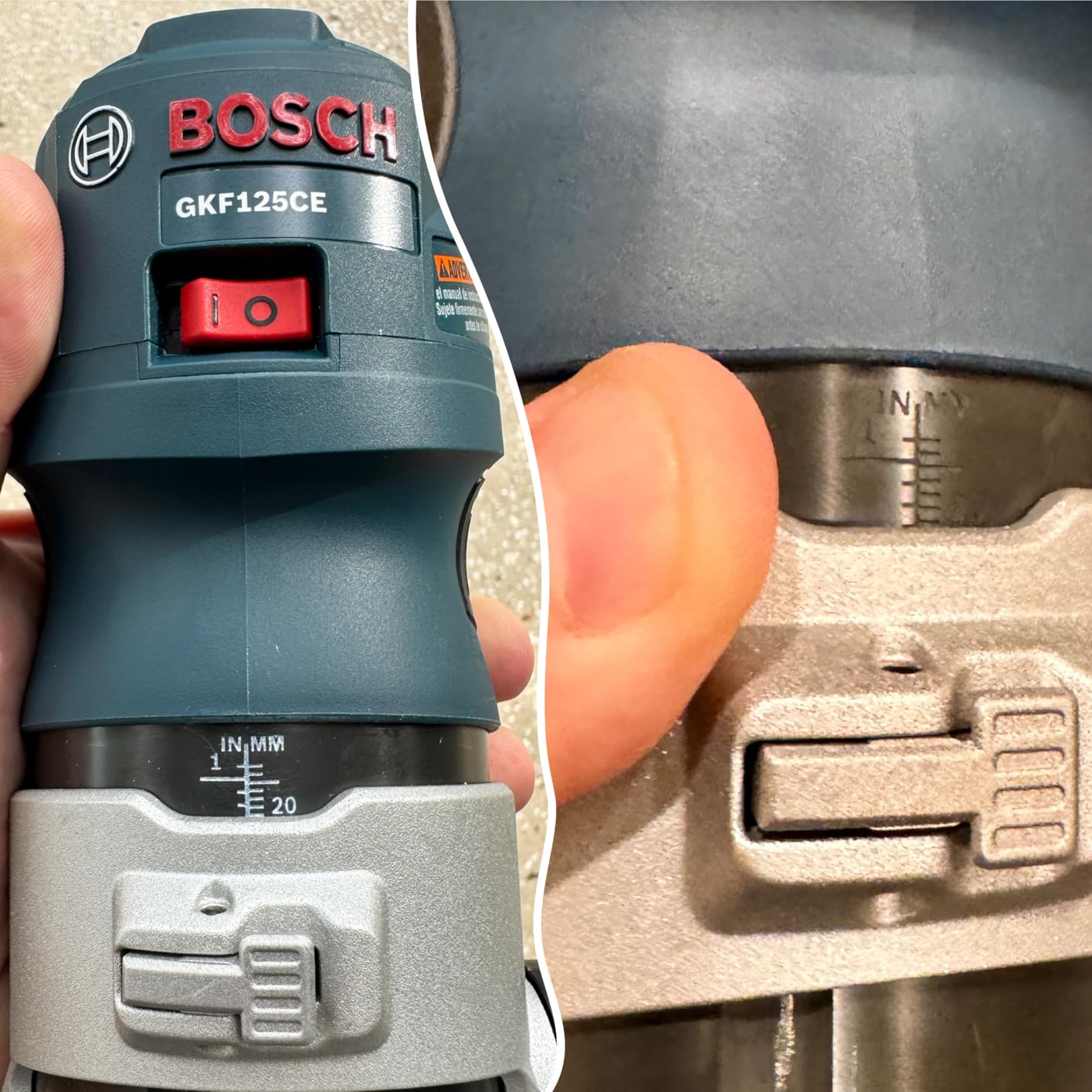
The LED at the bit area is well placed. It lights the bearing and the cut line rather than the motor housing, which is the right target when you are trimming an overhang in a shadowed install.
The 360 degree non-split aluminum base housing and the round translucent polycarbonate subbase make it a good template router too, and Bosch cutters are widely available, so bit selection is never a problem.
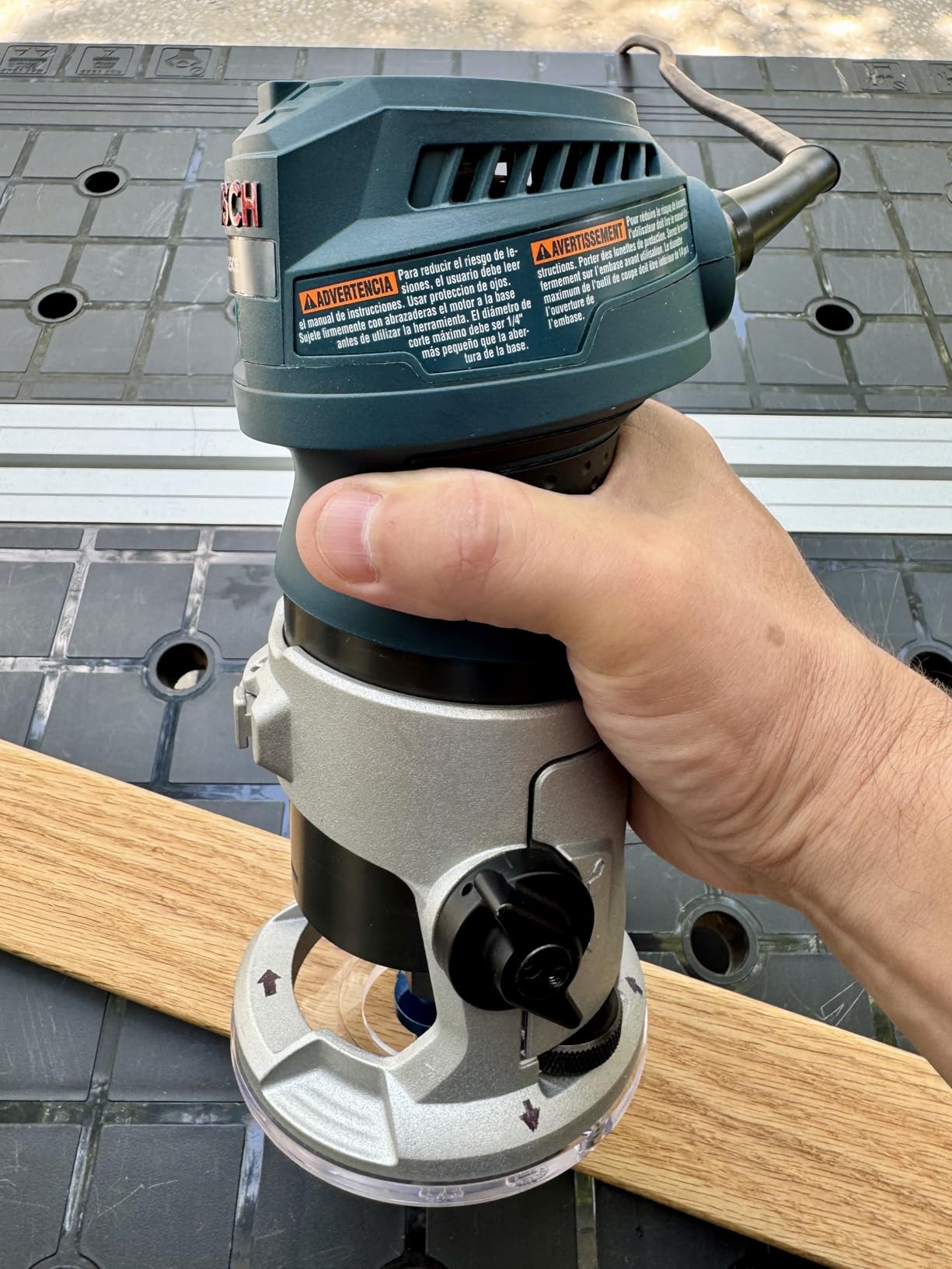
Where the extra power pays off
On a thick laminate countertop built up from several layers, a 1 HP motor can bog and stall the bit mid-pass. Stalled carbide against plastic laminate means heat, and heat means a shine mark along the whole cut.
The spindle lock also makes bit changes fast, which matters when you are swapping between a flush trim, a roundover and a straight bit in a single session.
Where it frustrates people
The fine depth adjustment is the most-reported complaint: it can skip threads when you reduce depth, so you set a depth, cut, and find you need to reset. Test it before you start a long edge.
Reviewers also mention the spindle lock button is hard to grip, and the base cannot be cut back for flush routing against a surface. At 4.4 pounds it is heavier than the 1 HP Colt, which you feel over a long pass.
6. Bosch PR20EVS Colt Palm Router — Best Value
BOSCH PR20EVS Colt 1.0 HP Variable-Speed Palm Router, Quick-Clamp System
1.0 HP 5.6 Amp
16,000-35,000 RPM
Quick-clamp system
Straight edge guide included
3.3 lbs
Pros
- At 3.3 pounds it is one of the lightest palm routers
- Variable speed 16000-35000 RPM lets you back off for plastic
- Quick-clamp system speeds up base and motor changes
- Spindle lock for one-wrench bit changes
- Straight edge guide included in the box
Cons
- Lower power than the 1.25 HP Colt models
- No LED lighting
- Base cannot be cut back for flush routing against a surface
The PR20EVS is the standard answer when someone asks which palm router to buy, and for laminate work it earns its place on two specific points. It weighs 3.3 pounds, and its speed dial goes down to 16,000 RPM, low enough to cut plastic laminate without melting it.
The quick-clamp system is the feature that gets left out of most comparisons. It lets you remove the base or motor without hunting for tools, which on a job site means less time with wrenches between trim passes. The finger support pockets give the grip real control when the bit loads.
On the Fine Woodworking forum thread about trimming router and laminate trimmer choices, the Colt is repeatedly named as the standard for laminate work, and the same thread recommends Euro-style bits to avoid burning or the bearing seizing. That is consistent with what we saw: this body has enough speed control to run a bearing-free bit properly.
It also ships with a straight edge guide that reaches 3-5/8 inch from the edge, and it accepts bits up to 1-5/16 inch diameter. Constant response circuitry maintains speed under load.
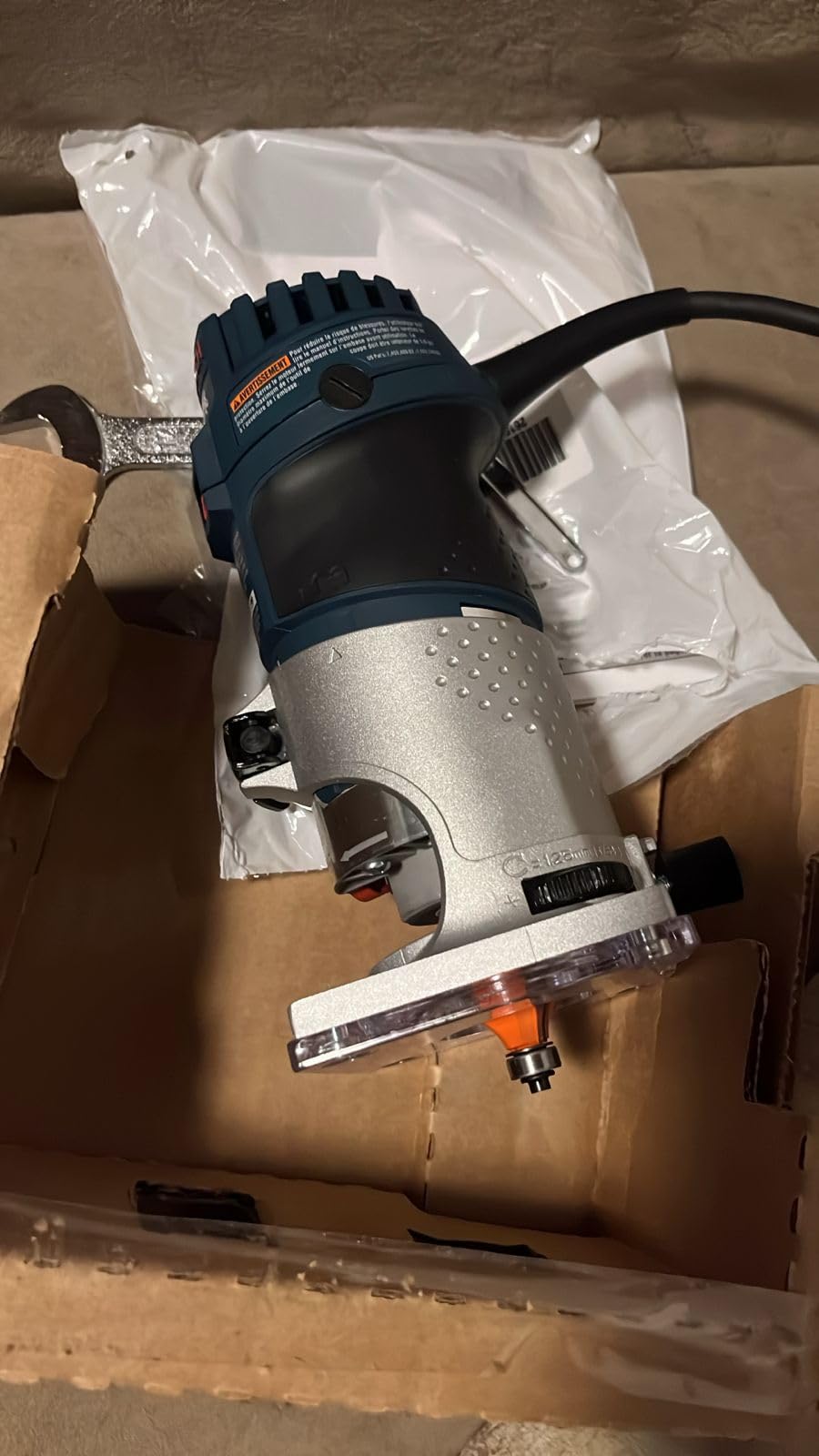
The right pick for a first router
If you are buying your first trim router and the plan is mostly laminate, this is the one. It is light, it has real speed control, and the quick-clamp system means you are not fighting the tool every time the setup changes.
It is also the router I would put in the hands of someone doing template work, because the angled cord exit and the included guide make a lot of non-laminate jobs straightforward.
What the lower power costs you
At 1.0 HP and 5.6 amps, it has less headroom than the 1.25 HP models. On a thick built-up laminate top with a wide bit, slow down the feed rather than pushing it, or the motor will bog and the bit will drag.
There is no LED lighting, so plan your pass around good light or bring a work light. The base also cannot be cut back for flush routing, which is fine for a bearing-guided flush trim since the bearing does the guiding, but it is a limit if you later want to route a groove tight to a wall.
7. AVID POWER 6.5 Amp Compact Router Kit — Budget Pick
AVID POWER 6.5 Amp 1.25 HP Compact Router Tools for Woodworking, Fixed Base Wood Router with Trim Router Bits, 6 Variable Speeds, Edge Guide, Roller Guide, Dust Hood (Red, 65mm)
6.5 Amp 1.25 HP
6 speeds 10,000-32,000 RPM
Dual LED lights
Dust hood
4.4 lbs
Pros
- Includes five router bits plus an edge guide and roller guide
- 1/4 inch and 3/8 inch collets both included
- Dual LED lights and a dust hood
- Lowest 10000 RPM setting gives real heat control
- Spare carbon brushes in the box
Cons
- Lower build quality than premium brands
- Included bits are basic quality
- 4.4 lb body tires the hand on long cuts
- Depth lock is less precise than metal-body routers
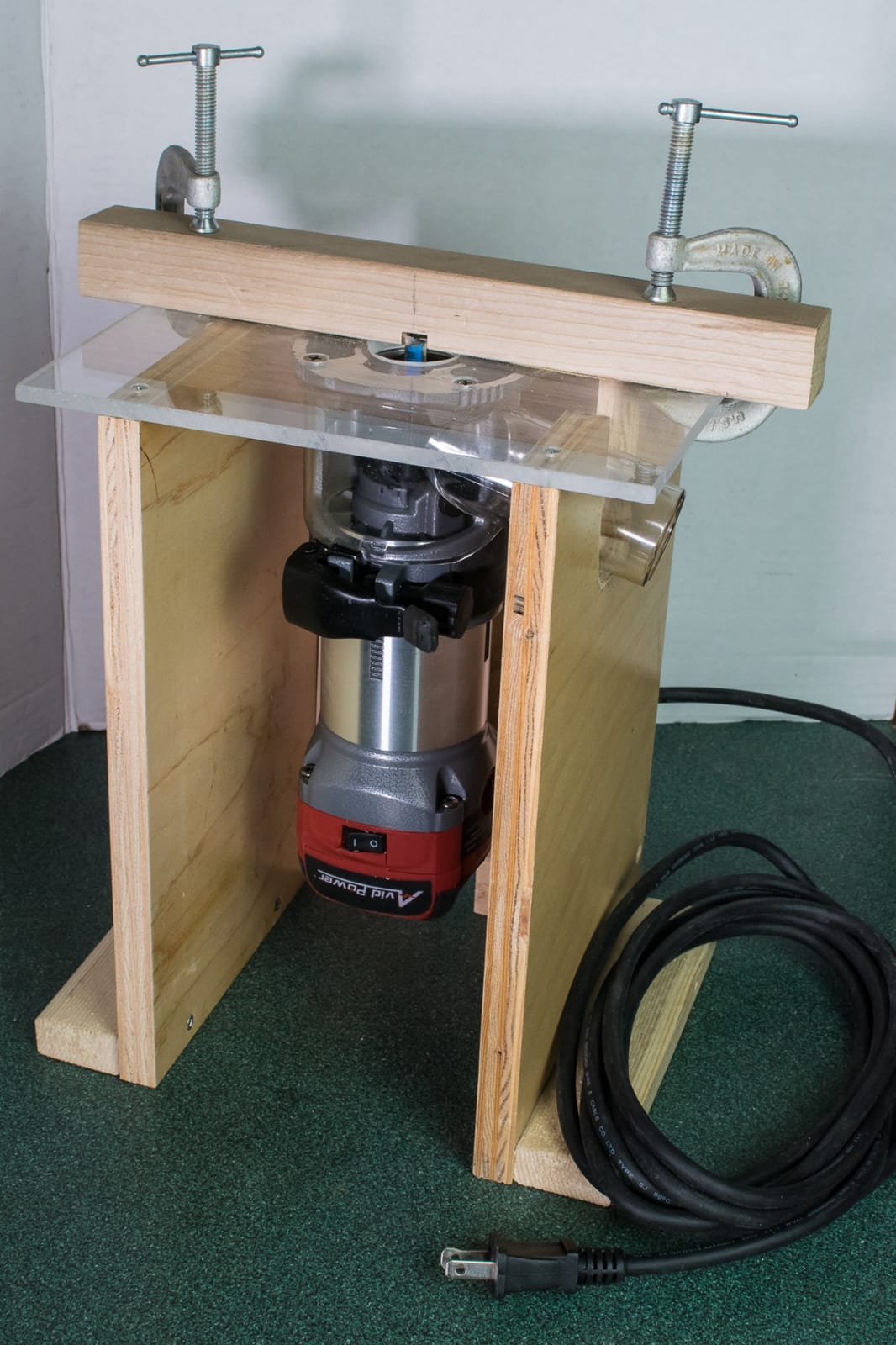
For a first laminate job on a tight budget, this kit removes the two costs that usually trip people up. It ships with five router bits, an edge guide, a roller guide, a dust hood and spare carbon brushes, so you are not buying a flush-trim bit on top of the tool.
It also includes both a 1/4 inch and a 3/8 inch collet, which is a genuine convenience. The six speed settings run from 10,000 to 32,000 RPM, and that low first setting is what lets you cut plastic laminate instead of melting it.
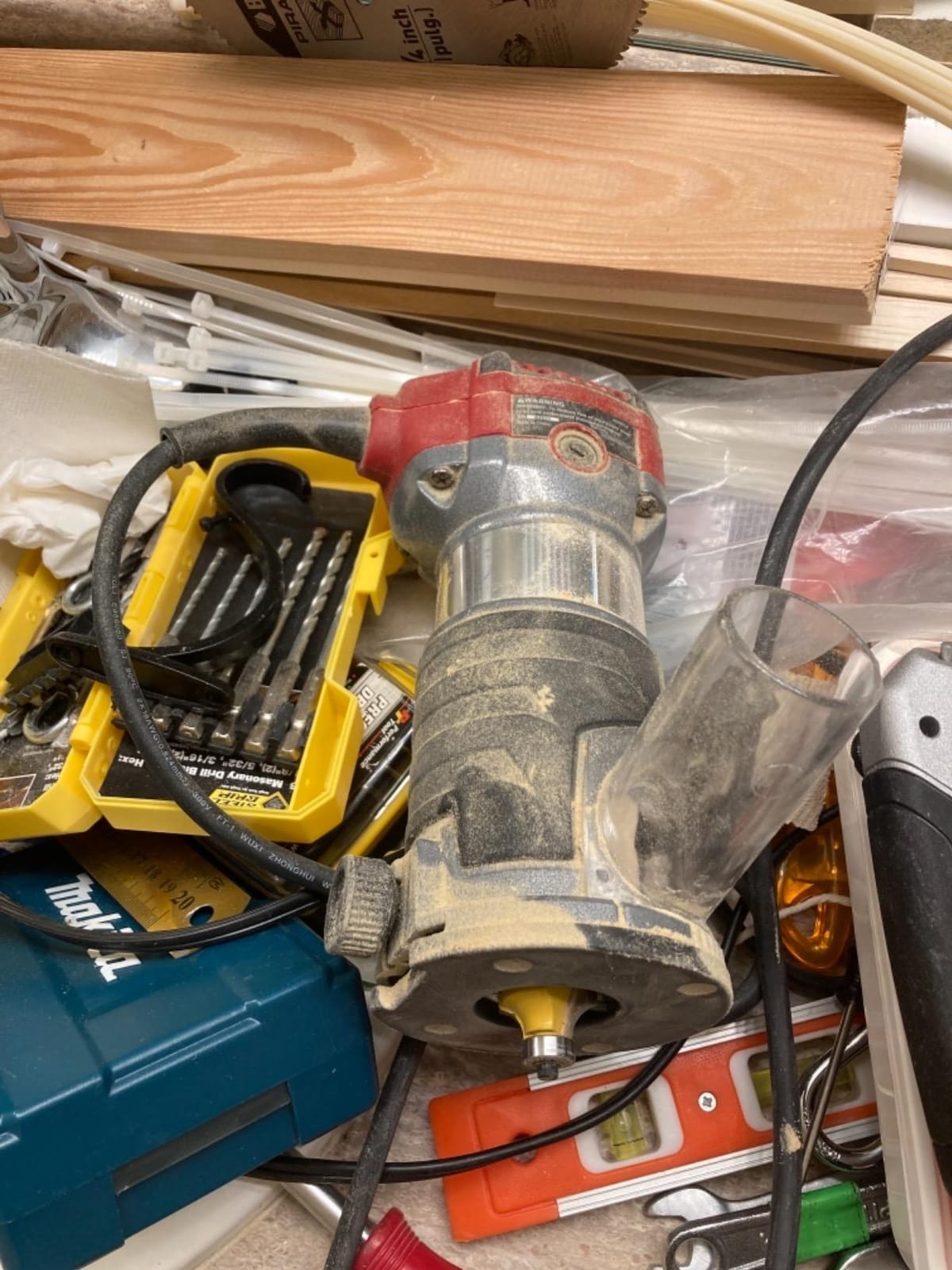
The 6.5 amp, 1.25 HP motor has enough power for laminate work. The rack-and-pinion depth adjustment is smooth, and the quick lock system makes base changes fast, both of which are more than a lot of routers at this level offer.
Dual LED lights are a genuine bonus here, and so is the dust hood for shop vac hookup, which keeps the paper-and-plastic flakes off your new countertop.
Where the kit earns its money back
The accessories are the deal. A flush-trim bit, an edge guide and a dust hood together usually cost as much as a whole budget router, and they are exactly what laminate work needs.
For a single countertop install, a rental, or a shop where the router lives in a drawer and gets used a few times a year, this covers the job completely.
Where you will notice the difference
Build quality is the first thing you feel. The aluminum body and base are solid, but the depth lock is less precise than on a metal-body professional router, and reviewers specifically mention the bit creeping after the clamp is locked.
At 4.4 pounds for a small machine, it tires the hand on long cuts. The included bits are basic, so buy a proper carbide flush-trim bit before a real countertop. A dull bit on brittle laminate is the fastest route to chip-out.
8. Ryobi PCL424B ONE+ Cordless Router — Best for ONE+ Battery Owners
RYOBI ONE+ 18V Cordless Compact Fixed Base Router Tool Only (Battery Not Included) – PCL424B
18V ONE+ battery
20,000-30,000 RPM
Micro dial depth
LED light
3.2 lbs
Pros
- Lightest cordless option at 3.2 pounds
- Micro dial gives fine depth control for flush trimming
- LED work light illuminates the cut
- Spindle lock with quick-release lever speeds bit changes
- Clear base gives a good view of the line
Cons
- Bare tool
- battery is additional
- Shorter runtime on 2.0 and 3.0 Ah packs
- Dust port makes the body lopsided with a hose attached
- Not intended for heavy plunge work
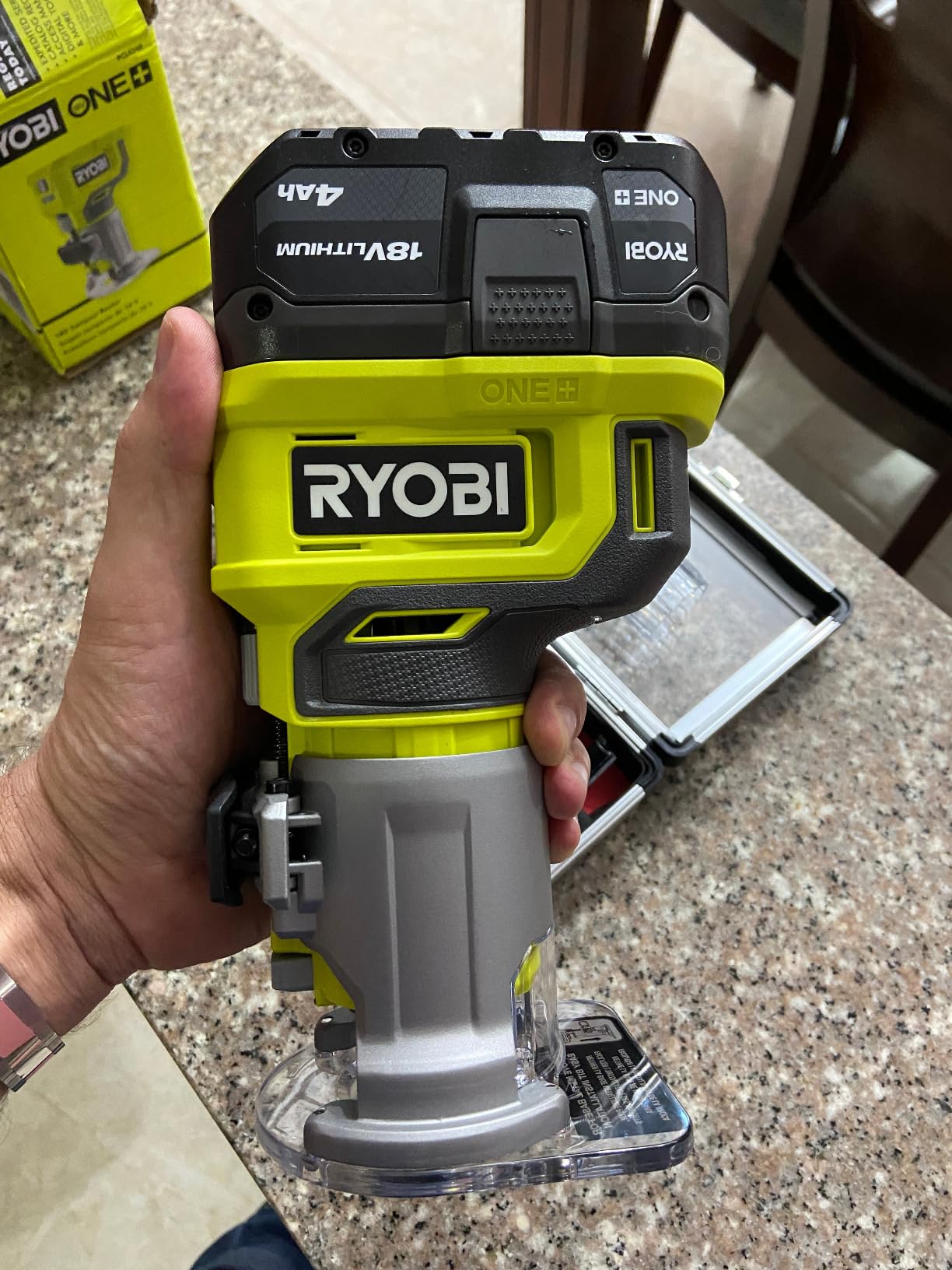
If you already own ONE+ packs, this is the cheapest way into cordless laminate work. At 3.2 pounds it is the lightest cordless router here, and the micro dial depth adjustment gives finer control than a simple threaded post, which is exactly what setting a flush-trim bit height needs.
The speed range of 20,000 to 30,000 RPM is narrower than the corded machines, so heat control is more limited. The spindle lock with a quick-release lever makes bit changes fast, and the clear base gives you a decent view of the cut line.
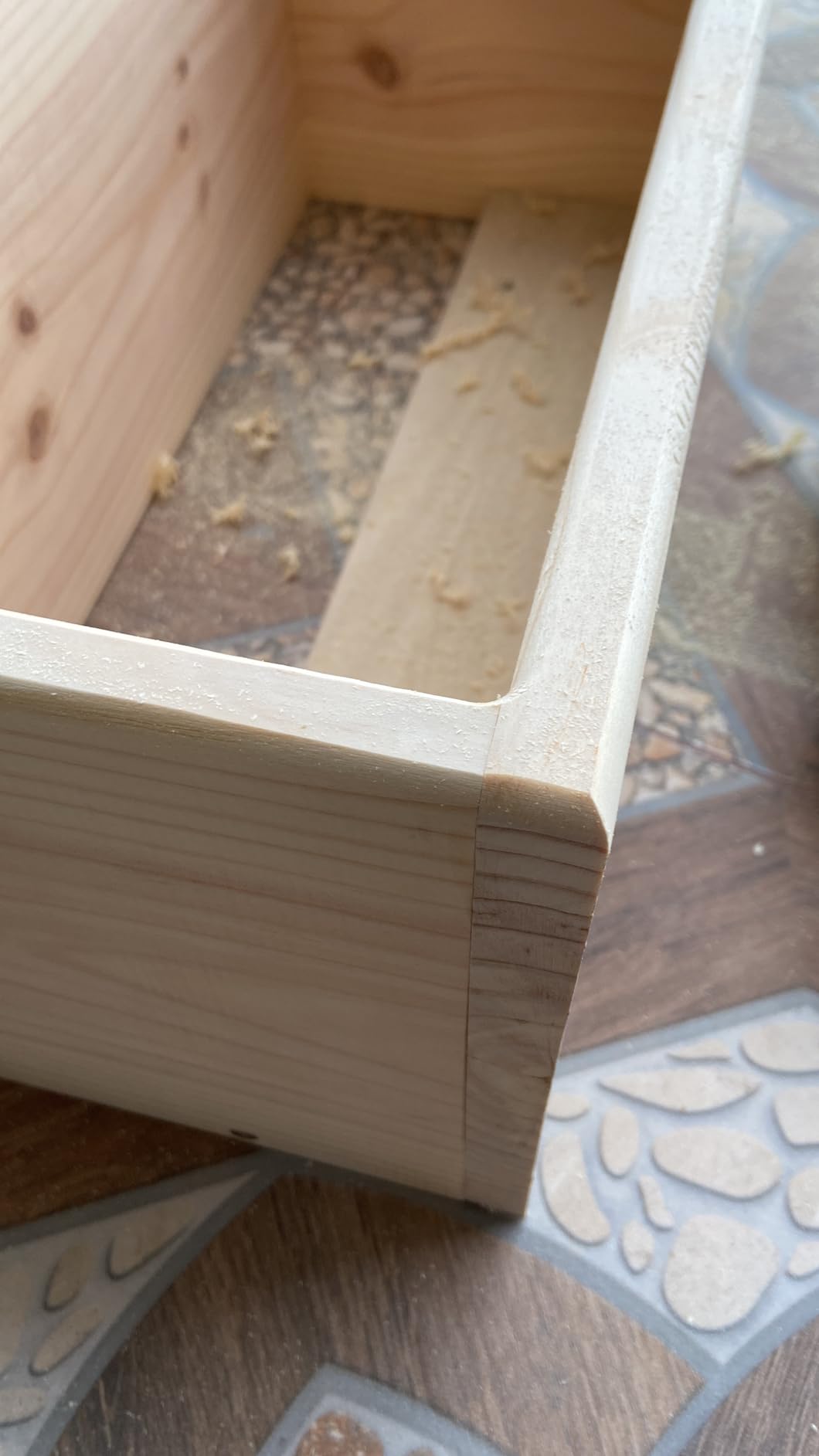
The LED work light is a real help in a shadowed cabinet run, and the dust port is useful for the longer open passes. The included collet is 1/4 inch, which fits a standard flush-trim bit.
Reviewers are clear that a 4.0 Ah battery is the sensible choice for sustained work. On smaller 2.0 and 3.0 Ah packs the runtime is noticeably shorter, and a router that stops mid-edge is a router that leaves a burn mark.
Best for a single-battery ecosystem
The case for this is simple. If your shop already runs on ONE+ packs, adding this router costs you a tool and nothing else. For a kitchen install where you want no cord across the floor, that is the whole argument.
At 3.2 pounds with a clear base and an LED, it is also comfortable for someone who does not do this every day. The controls are simple enough to learn on the first pass.
Where the compromises show
Attach a dust hose and the body goes lopsided, which is awkward in a tight inside corner. Reviewers also note the dust port leaves one side of the base view open, reducing visibility exactly where you need it.
It is not intended for heavy plunge work, and the 605-review history is the thinnest here. For straight flush-trim passes on laminate, it does the job; for general shop routing, look elsewhere.
Trim Router vs Laminate Trimmer: Which One Do You Need?
A trim router and a laminate trimmer are the same size class with completely different jobs. A laminate trimmer is purpose-built: fixed base, transparent or clear base, fine depth adjustment, and one job, cutting a plastic laminate sheet flush with the substrate below. A trim router, sometimes called a palm router, is a general tool that also happens to be excellent on laminate.
Buy the dedicated laminate trimmer if laminate is the only material on your list. The Makita 3709 is the one we would choose, and you can see the logic in its design: the cord exits from the top, away from the cut line, and the transparent base is a feature no general router bothers with.
Buy a trim router if you will also cut inlays, round over edges, run dadoes, or do hinge mortises. Every general router in this guide handles a flush trim on laminate perfectly well, provided it has a variable speed dial and a base you can see through. The extra money buys you a tool for the rest of the shop.
Do not use a full-size plunge router for a flush trim on laminate. The weight and inertia will tip the base, the force needed to control it will chip the brittle surface, and at high speed the heat will melt a gloss into the edge. A 3-4 pound palm machine is the right tool for this work.
How to Flush-Trim Laminate Without Chips or Burn Marks
This sequence is the difference between a factory edge and a repair. Laminate is thin and brittle, so almost every failure comes from one of three things: too much speed, too fast a feed, or a dirty bearing track.
Dry fit first. Set the bit so the carbide spans the full thickness of the laminate strip with the bearing riding the finished substrate. Run it over the overhang with no power to check that the bearing tracks the edge evenly all the way around.
Clear the bearing track. Wipe the guide surface and check for dried contact cement or glue squeeze-out under the pilot bearing. Squeeze-out is the single most common reason a pilot bearing seizes and grinds a permanent groove into the visible face.
Dial the speed down. For plastic laminate, run roughly 18,000 to 22,000 RPM rather than the full 30,000. This is the single most effective anti-melt measure and the one most people skip.
Feed against the rotation. Move the router counter-clockwise for a right-hand rotation bit. Feeding with the rotation puts the bit into climb cutting, which pulls it out of the work and can gouge.
Keep it flat and finish the edge. Let the bearing glide, do not force the tool, and after the pass break the razor-sharp micro-edge with a fine file or a 400-grit sanding block at 45 degrees so the laminate cannot chip later.
On sink cutouts and inside corners, the same rules apply but you have less room. Take shorter passes, keep the base flat against the cabinet face, and expect to hand-finish the very corner where the bit cannot reach. If your bit is bearing-guided, keep the bearing on a surface that is already true, never on the raw cut edge of the laminate.
What to Look for When Buying a Router for Laminate
Variable speed is not optional. A single-speed router runs at 30,000 RPM and that is too fast for plastic laminate. Every pick except the dedicated laminate trimmer gives you a dial, and you should use the lower half of the range for this material.
A clear or transparent base pays for itself. You need to see the pilot bearing and the cut line. The Makita 3709 with its transparent base and the Bosch Colt with its round translucent polycarbonate subbase both make the difference obvious on a dark laminate.
Depth adjustment should hold under a lock. Rack-and-pinion systems, micro dials and depth rings all beat a plain threaded post. Over a long edge, a bit that creeps leaves a visible step, and you will be re-trimming the whole run.
Check the collet. Nearly every compact router takes a 1/4 inch collet and a 1/4 inch shank bit. A few accept 3/8 inch, and the Bosch Colt models accept bits up to 1-5/16 inch wide. Match the shank to the collet and never force a bit that is undersized.
Weight matters more than horsepower. On a 10-foot countertop run, 3.3 pounds is a meaningful difference from 4.9 pounds. A lighter tool stays flat under the pilot bearing, and a flat base is a clean cut.
Consider soft start and an electronic brake. A soft start reduces the torque spike when a bearing-guided bit touches down, which protects both the bit and the laminate. An electronic brake stops the motor instead of letting a spinning bit drag across the surface.
Decide on corded or cordless honestly. Cordless is cleaner on installs with cabinets already in place. Corded is stronger and never stops mid-cut. If you already own batteries for a platform, cordless is the cheaper entry; if you do not, add the battery and charger before comparing totals.
Frequently Asked Questions
What is the best router bit for trimming laminate?
A straight carbide flush-trim bit with a ball-bearing pilot is the standard choice. The bearing rides the already-finished substrate while the cutter shears the overhang, so set the carbide to span the full thickness of the laminate. For plastic laminate specifically, a Euro-style or bearing-free bit avoids the pilot bearing picking up contact cement and seizing. Keep the bit sharp and feed it slowly against the rotation.
What is the best flush trim router bit?
Look for a straight, two-flute carbide flush-trim bit in a 1/4 inch shank with a replaceable or sealed ball-bearing guide. Two-flute cuts cleaner and chips less in laminate than three-flute designs, and a bearing on both top and bottom keeps the cut steady on a wide overhang. Euro-style bearing-free bits are the alternative when you want no bearing contact with the finished face at all.
How do I choose the right flush trim router bit?
Match the shank to your collet first, which on most compact routers is 1/4 inch. Then check three things: the cutter width should match the thickness of the laminate overhang, the bearing diameter must match a surface that is already true and finished, and the bearing count matters on wide edges. Finally, match the bit to the material, since plastic laminate needs a sharp two-flute carbide rather than a coarse multi-flute profile.
Is there a difference between a router and a trim router?
Yes. A trim router, also called a palm router, is a compact 1 to 1.25 HP tool with a small round or square base that you hold in one hand. A full-size router is heavier with a larger base and more power for dados, grooves and heavy shaping. A dedicated laminate trimmer is a third category, purpose-built with a transparent base and top-mounted cord for one job: trimming a laminate overhang flush.
How do I trim laminate with a router without chipping or burning it?
Score the laminate oversize first, glue it up, then flush-trim. Before cutting, dry-fit the bit so the carbide spans the laminate thickness and check the bearing rides evenly. Clear any glue squeeze-out from the bearing track, dial the speed down to roughly 18,000 to 22,000 RPM for plastic, and feed counter-clockwise so the bit is not pulled into a climb cut. File the final micro-edge at 45 degrees afterward.
What is the best tool to cut a laminate countertop?
A table saw or a track saw with a fine-finish blade makes the straight, square rough cut, and a compact trim router with a clear base makes the flush trim afterward. The router is what you reach for around sink cutouts, inside corners and any edge the saw cannot get to square. If you only need straight cuts and no trim, a scoring knife and a snap line is faster and safer.
Final Verdict on the Best Trim Routers for Laminate
The DEWALT DCW600B is our pick for the best trim routers for laminate overall in 2026, because the combination of variable speed control, two LEDs at the cut line and a brushless motor addresses the three ways laminate work goes wrong: melting, chipping and blind passes. If you already own 20V MAX packs it is also the least expensive path to a clean factory edge.
For corded work, take the Makita RT0701C for its 10,000 to 30,000 RPM range and rack-and-pinion depth hold, or the Bosch PR20EVS at 3.3 pounds if a light tool matters most. If laminate is genuinely the only material you will cut, the Makita 3709 is the purpose-built answer, with the caveat that you have no speed control.
Whichever you choose, the technique matters as much as the machine: dial the speed down for plastic, clear the bearing track, feed counter-clockwise, and file the micro-edge when you finish. Related reading on our site includes our guide to the best trimming knives, which covers the scoring step that happens before any router touches the panel.