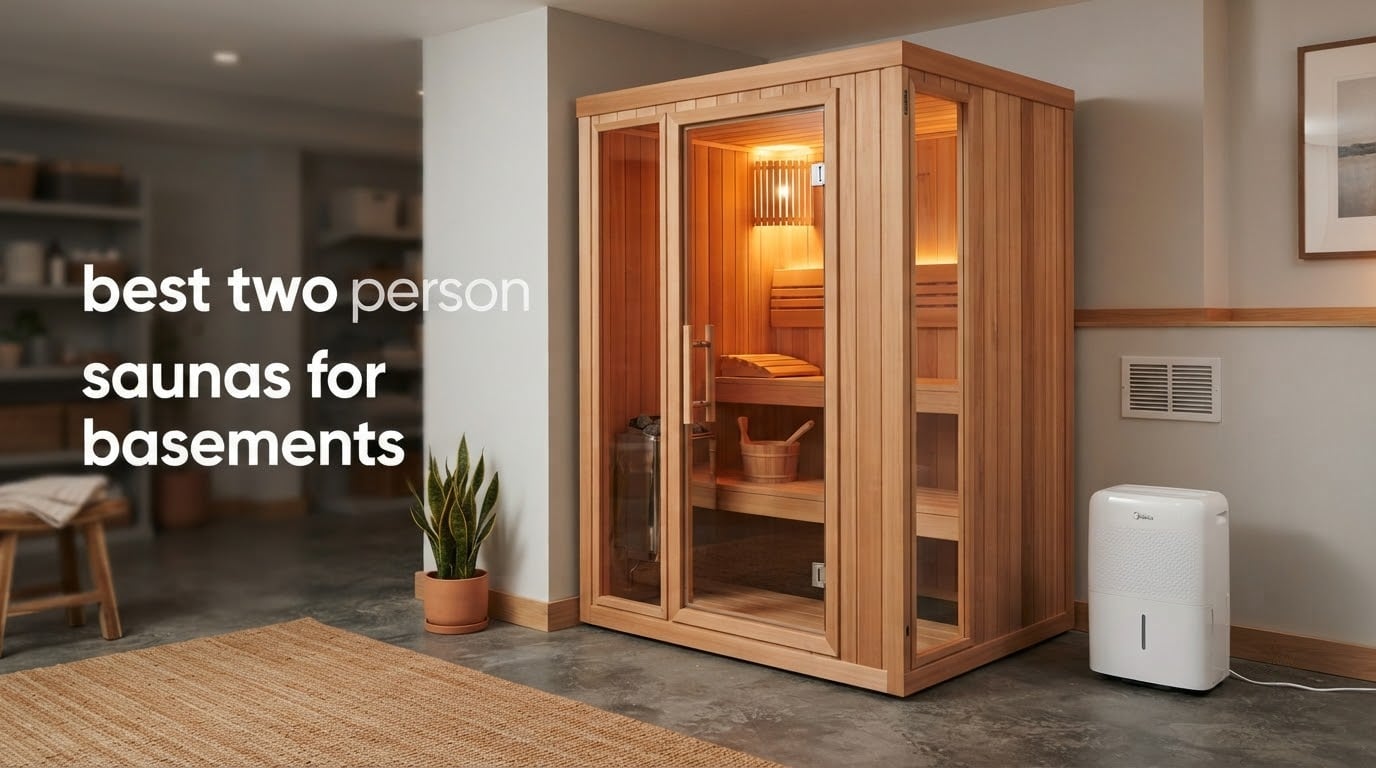
A 2-person sauna in a basement is one of those projects that looks simple on a product page and turns into a real build the moment you measure the room. The cabin is small, the power draw is modest, and the whole thing can sit on a finished floor without a permit in most jurisdictions. What trips people up is not the sauna. It is the ceiling height, the circuit, and the moisture plan.
We spent weeks comparing the compact two-person cabins that are actually sold for indoor, below-grade use, and this guide covers the best two person saunas for basements you can buy today. We looked at footprint, interior height, heater class, circuit requirements, warranty length, and the warm-up times owners actually report rather than the ones printed on the box. All eight cabins below are two-person, indoor-rated models. Every one of them fits on a normal basement floor.
Warming up while you finish your workout, waiting on an air fryer, or brewing a single cup before anyone else is up are all good reasons to build a small, dedicated corner. Our picks for the best air fryers for one person and the best coffee makers for one person follow the same philosophy we apply to a compact sauna: buy for the space you actually have, not the space you wish you had.
Table of Contents
- Top 3 Picks for Two-Person Basement Saunas 2026
- Quick Overview: All 8 Best Two Person Saunas for Basements (September 2026)
- Can Your Basement Actually Host a 2-Person Sauna?
- 120V Plug-In vs 240V Hard-Wire: The Spec That Decides Everything
- 1. Dynamic Saunas Andora 2-Person Infrared Sauna – Best Overall
- 2. Homsido 2-Person Red Light Infrared Sauna – Best Value
- 3. Blue Wave Heat Wave Coronado Hemlock Sauna – Longest Warranty
- 4. KUNSANA Ceramic Infrared 2-Person Sauna – Most Versatile
- 5. DAIMOT Full Spectrum 2-Person Infrared Sauna – Best for Full Spectrum Heat
- 6. DWKWE 2-Person Hemlock Infrared Sauna – Best for First-Time Buyers
- 7. Homsido Smart App 2-Person Far Infrared Sauna – Best for App Preheating
- 8. EASYHAWK 2-Person 1500W Infrared Sauna – Budget Pick
- What Owners Regret Most (And How to Avoid It)
- Basement Moisture Control Protocol
- What to Look for When Buying a 2-Person Sauna
- Frequently Asked Questions
- Is it okay to put a sauna in your basement?
- Is it possible to install an infrared sauna in a basement?
- Do you need ventilation in an infrared sauna?
- How much will my electric bill go up with an infrared sauna?
- What circuit does a 2-person sauna need?
- How much would it cost to build a 2-person sauna?
- How long does a 2-person sauna take to heat up?
- Conclusion: Where to Start With Your Basement Sauna
Top 3 Picks for Two-Person Basement Saunas 2026
The Dynamic Saunas Andora takes the top slot because it has the deepest owner history in this group and runs on a standard outlet. The KUNSANA ceramic cabin is the one to buy if heat output is your priority. The Homsido red light model is the strongest balance of features and draw for a first basement install.

Dynamic Saunas Andora
- 6 carbon infrared panels
- 135F max
- Standard 15-amp 120V plug
- 43 x 37 x 68 inch interior

KUNSANA Ceramic Infrared
- Ceramic tube plus carbon plates
- 1760W low EMF
- 77-149F control range
- Heaviest single panels

Homsido Red Light Cabin
- Overhead red light panel
- 8 carbon crystal panels
- 110V 1800W
- 39.4 x 47.2 x 70.9 inches
Quick Overview: All 8 Best Two Person Saunas for Basements (September 2026)
Every cabin below is rated for two adults and rated for indoor use. Scan this table first, then read the full entry for the two or three that match your circuit and your ceiling height.
| Product | Specs | Action |
|---|---|---|
| Dynamic Saunas Andora 2-Person Infrared |
|
Check Latest Price |
| Homsido 2-Person Red Light Infrared Sauna |
|
Check Latest Price |
 Blue Wave Heat Wave Coronado Hemlock Blue Wave Heat Wave Coronado Hemlock |
|
Check Latest Price |
| KUNSANA Ceramic Infrared 2-Person Sauna |
|
Check Latest Price |
 DAIMOT Full Spectrum 2-Person Infrared DAIMOT Full Spectrum 2-Person Infrared |
|
Check Latest Price |
 DWKWE 2-Person Hemlock Infrared Sauna DWKWE 2-Person Hemlock Infrared Sauna |
|
Check Latest Price |
 Homsido Smart App 2-Person Far Infrared Homsido Smart App 2-Person Far Infrared |
|
Check Latest Price |
 EASYHAWK 2-Person 1500W Infrared Sauna EASYHAWK 2-Person 1500W Infrared Sauna |
|
Check Latest Price |
Can Your Basement Actually Host a 2-Person Sauna?
Yes, most finished basements can, provided the room has a protected floor, a dedicated outlet, planned ventilation, and enough ceiling height to clear the cabin plus service space. A typical 2-person sauna is 40 to 48 inches wide, 36 to 47 inches deep, and 68 to 76 inches tall, which fits comfortably under a 7 foot ceiling. Under a 6 foot 6 inch ceiling you can still install most of these cabins, but you lose the ability to stand upright inside and should add a couple of inches of clearance for assembly.
Before you shop, run through these seven checks. Each one is a pass or fail for a specific cabin, not for saunas in general.
Dedicated circuit. Every cabin here needs its own outlet. Two of them plug into a standard 15-amp receptacle. Two specify a dedicated 20-amp breaker. The other four draw between 1760W and 1990W, so confirm the breaker size with the seller before you order.
Ceiling height. Measure finished ceiling, not joists. Add 2 to 3 inches of clearance above the tallest cabin in the set for assembly and service access.
Floor protection. Most of these cabins are designed to sit on carpet or on a sealed, protected surface. A raw concrete slab that sweats in summer is a different problem and needs sealing first.
Vapor barrier. Behind the wall panels of the surrounding room, not inside the cabin. The cabin is a wood box; the room around it needs to stay dry.
Intake and exhaust. A low intake near the floor and a high exhaust give the room its airflow. This is the single most skipped item in basement installs.
Moisture monitoring. Put a cheap hygrometer in the room before you install anything. If it already reads above 60 percent regularly, the sauna is not your first project.
Egress and access. A 2-person cabin door needs to swing without blocking your path out of the room. Below-grade rooms have stricter practical escape requirements than people expect.
If you fail the circuit check or the floor check, the fix is an electrician visit and a sealing product. If you fail the ceiling check, stop looking at this category and measure other rooms in the house.
120V Plug-In vs 240V Hard-Wire: The Spec That Decides Everything
The single most consequential spec on any basement sauna is not the heater type. It is the amperage. A cabin that plugs into a 15-amp household outlet can be moved, rented with, and installed in an afternoon by one person. A cabin that needs a 20-amp breaker is still a 120-volt appliance, but now a licensed electrician should run the circuit. That is the difference between a weekend project and a two-week one.
Grouping the eight cabins by their electrical requirement makes the decision obvious. The Dynamic Saunas Andora and the EASYHAWK cabin are the two that plug into a standard 15-amp receptacle, which is why they rank well in basements where outlets are already on a shared circuit. The DAIMOT and the smart-app Homsido both specify a dedicated 20-amp breaker, and both warn that a 15-amp outlet will trip. The remaining four run on 110 or 120 volts between 1760W and 1850W, which sits in the same 20-amp territory in practice, and the Blue Wave Coronado does not publish a wattage figure at all.
One more sizing rule comes up constantly in sauna planning: the 200 rule, or roughly 200 cubic feet of air space per person. That guideline was written for traditional stone-heater saunas that heat the air itself. Infrared cabins heat your body directly with panels, so they do not need the same lofted volume, and every cabin in this roundup was designed and rated for two adults at a much smaller interior volume than 400 cubic feet. If you see a seller applying the 200 rule to an infrared cabin, that seller is quoting a sauna convention that does not apply here.
One practical note on basement panels. An electrical panel in a basement is often in the same room where the sauna wants to go, and heaters pull sustained load. If your panel is within a few feet of the intended sauna location, plan on a subpanel or a longer circuit run rather than assuming a nearby receptacle will do the job.
1. Dynamic Saunas Andora 2-Person Infrared Sauna – Best Overall
Dynamic Saunas Andora 2-Person Low EMF FAR Infrared Sauna with Red Light Therapy & Bluetooth Speakers | Personal Indoor Dry Heat Sauna for Home & Gym – Made from Canadian Hemlock
Hemlock cabin
6 carbon infrared panels
Up to 135F
15-amp 120V plug
319 lbs
Pros
- Largest owner history in this group at 702 reviews
- Hemlock build that does not feel cheap
- Bluetooth and MP3 with pre-amp
- Two adults fit side by side with room
- Plugs into a standard 15-amp outlet
Cons
- Slow warm-up at 40 to 60 minutes
- Advertised top temperature rarely reached
- Drafty out of the box and needs sealing
Of the eight two-person saunas for basements we compared, the Andora is the one whose behavior is least surprising. Owners running it in finished basements and climate-controlled rooms report solid sweat sessions at 130 to 140F, and the 702-review base gives you a much clearer picture of long-term behavior than any other cabin here.
Construction is natural Canadian hemlock, inside and out, and the interior measures 43 by 37 by 68 inches. That is enough for two average-size adults to sit side by side with room to spare, which is more than several competitors in this set can claim. Red light therapy sits alongside chromotherapy LED controls, and the Bluetooth and MP3 system has a pre-amp so the audio actually sounds like audio.
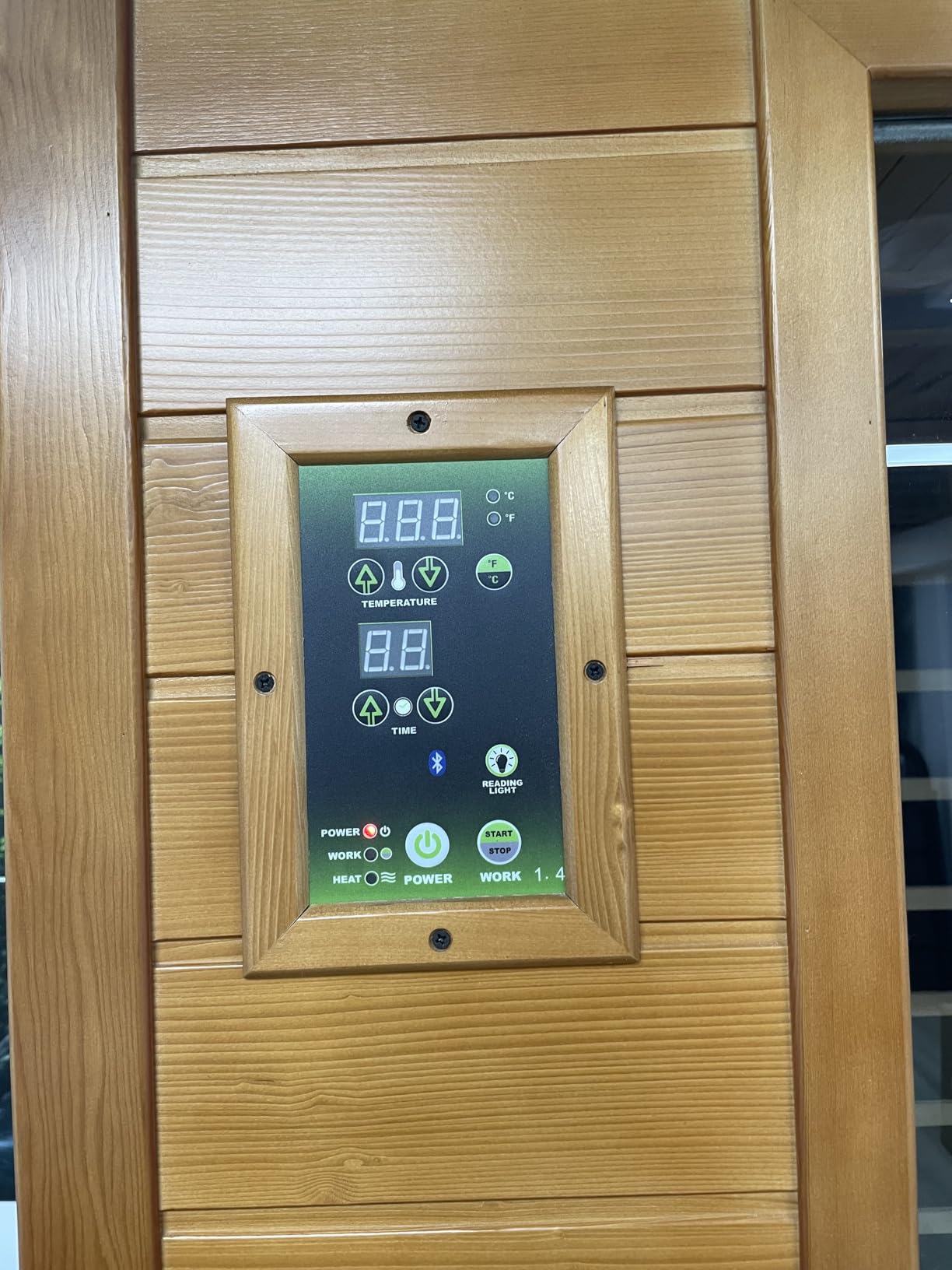
The electrical spec is the reason this is our top pick for below-grade rooms. It runs on a standard 15-amp, 120-volt plug, so no dedicated circuit and no special wiring. In a basement where the nearest outlet is on a shared 15-amp circuit, that simplicity is worth more than any feature list.
The honest weakness is heat-up time. Owners commonly report 40 to 60 minutes to reach the high 130s or low 140s, and the advertised 151F figure is rarely reached in practice. Plan on starting the cabin 45 minutes before you want to sit in it, or use the timer to preheat while you finish your workout.
Two other notes from owners: the cabin arrives drafty and typically needs weatherstripping, caulk, and a screw check before first use, and a backrest is a commonly recommended add-on that is not included. Realistically, two people with 1.5 to 2 hours including unboxing is the honest assembly estimate.
Will It Clear Your Basement Ceiling?
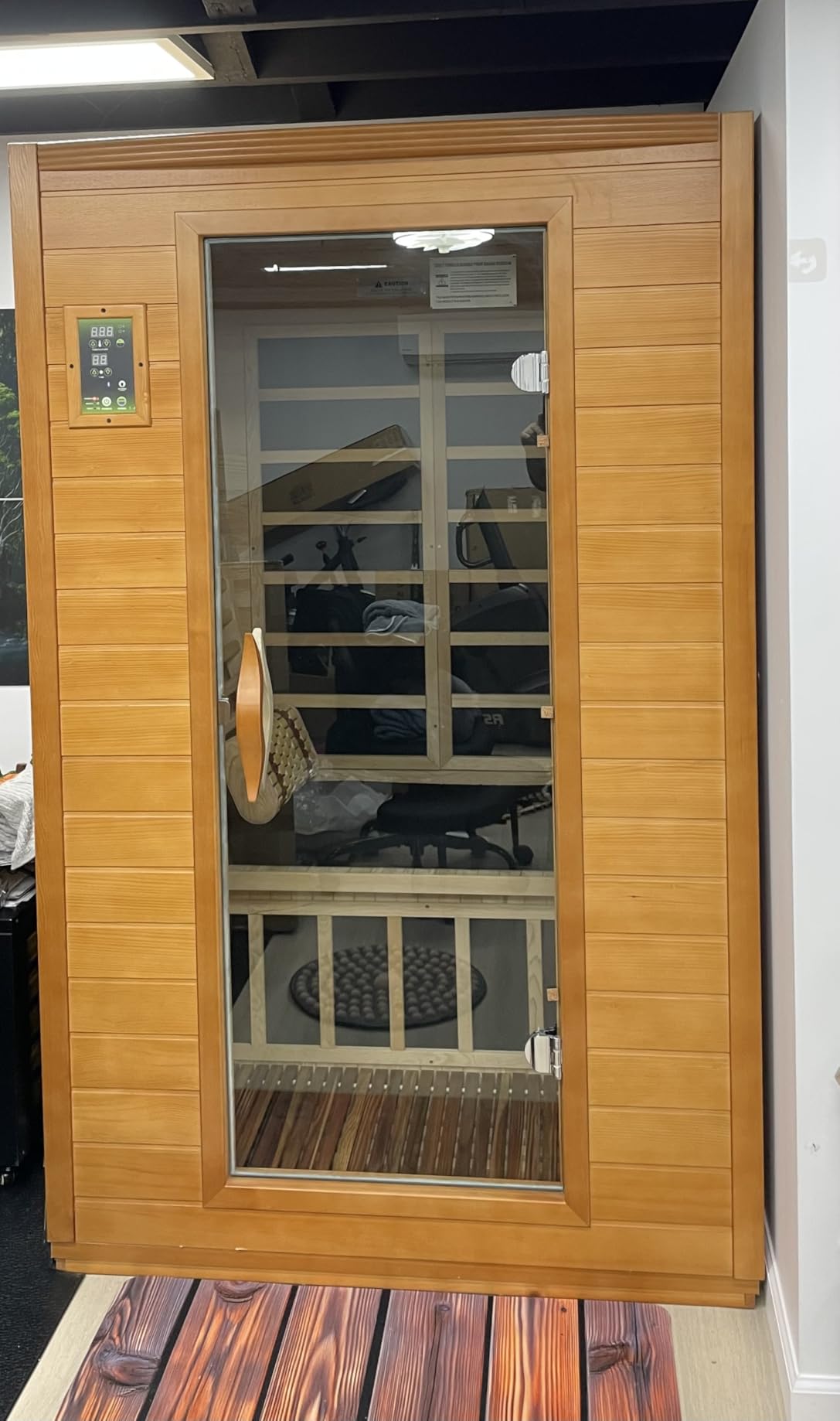
With a 68-inch interior and a listed variant footprint of 47 by 43 by 74 inches, the Andora is one of the taller cabins in this group. It clears a 6 foot 6 inch finished ceiling, but barely, and you lose interior headroom. Under a 7 foot ceiling it is comfortable and lets you work on panels above the unit later.
Is It Worth It If You Only Use It Solo?
Yes, and the reviews make that clear. Owners using it alone report the same session quality as couples, and the 15-amp plug means you can move it to a garage, spare room, or rental property if the basement layout changes. That flexibility is the part a hard-wired traditional sauna can never offer.
2. Homsido 2-Person Red Light Infrared Sauna – Best Value
2 Person Indoor Home Infrared Sauna Room for Home Gym, Canadian Hemlock Wood, 616 * 220mm Red Light Beauty System, Fast Heating to 140°F, 110V/1800W, Bluetooth MP3, Gift for Family
Hemlock cabin
8 carbon crystal panels
110V 1800W
Max 140F
150 lbs
Pros
- Red light panel and far infrared in one session
- Eight carbon crystal panels spread heat evenly
- Comfortably fits two adults
- Built-in digital controller and Bluetooth
- Light 150 lbs build that is easy to carry down stairs
Cons
- About 30 minutes to reach 125F
- Arrives as three large palletized boxes
- Overhead red light panel is small
This is the cabin we would put in a basement where the priority is getting two people a genuine session without touching the electrical panel. It runs on 110 volts and 1800W across eight carbon crystal heating panels, with a maximum of 140F and an adjustable timer.
What separates it from the other budget cabins is the 616 by 220mm overhead red light panel. You get red light therapy and far infrared heat in the same session without adding a second device to your shopping list. The Canadian hemlock body and 6mm tempered glass door give it a finished look that several cheaper kits in this category do not.
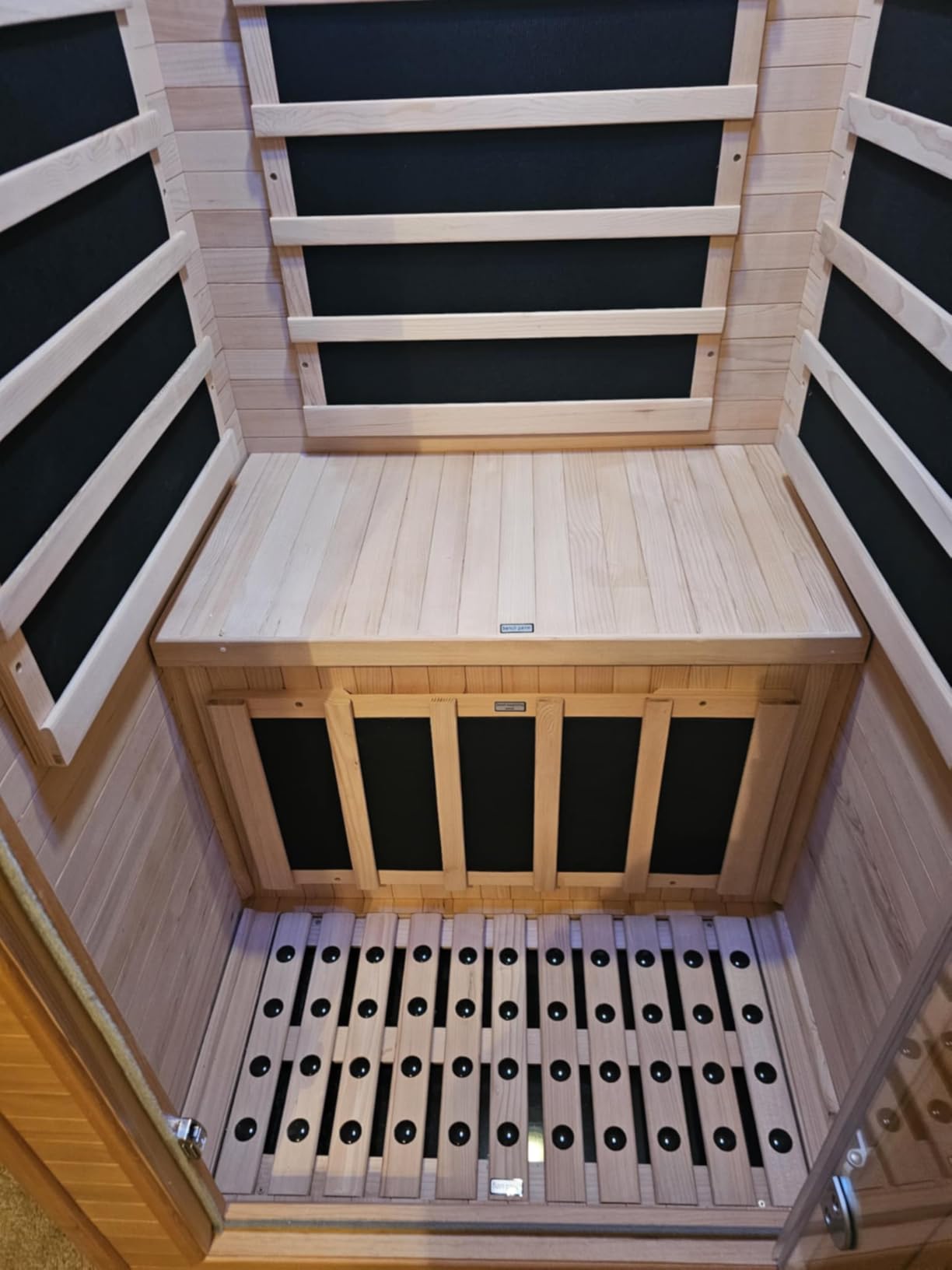
At 39.4 by 47.2 by 70.9 inches, this is a wide, relatively shallow cabin. That shape works well in a finished basement where wall length is plentiful but floor depth is not, and it fits two adults comfortably according to the people who own it.
Warm-up is around 30 minutes to roughly 125F, which is faster than most of the cabins here and is the main reason owners rate it well for spontaneous use. The catch is logistics: it arrives as three large palletized boxes, and several buyers decided professional assembly was worth paying for rather than carrying panels down basement stairs themselves.
Customer service is described as responsive when parts or door hinges arrive damaged, and the warranty runs three years. One small hardware issue shows up repeatedly, where a loose speaker wire trips the built-in alarm until it is resoldered.
How Does It Handle a Cool Basement?
Below-grade rooms hold temperature steadier than upstairs rooms in summer and lose heat faster in winter if the supply is cold. Owners in cool rooms report needing the full 30 minutes plus a timer setting, and the 140F ceiling holds once reached. If your basement sits near 60F all winter, budget extra warm-up time and avoid scheduling sessions right after work.
Is the Red Light Panel Worth the Space Cost?
For most buyers, yes, because it is integrated into the ceiling rather than taking a second cabin. It is a single 616 by 220mm panel, so buyers wanting broader red light coverage usually add a second unit. If red light therapy is not on your list, the KUNSANA cabin in this roundup delivers deeper pure heat for a similar footprint.
3. Blue Wave Heat Wave Coronado Hemlock Sauna – Longest Warranty
Heat Wave Coronado 2-Person Hemlock Deluxe Infrared Sauna for Home Use
Solid hemlock
6 carbon heaters
Up to 140F
Chromotherapy and ionizer
329 lbs
Pros
- Seven-year manufacturer warranty
- Longest coverage in this roundup
- Six carbon heaters spread heat evenly
- Bronze-tinted 8mm tempered glass door
- Simple buckle-connector assembly
Cons
- Wattage is not published in the spec listing
- Six heaters instead of eight on the value models
- Warranty terms are manufacturer-stated
The Coronado is the one to look at if warranty length is your deciding factor. At seven years, its manufacturer warranty is the longest of the eight cabins here, and that matters in a humid below-grade room where wood and electronics take more punishment than they would upstairs.
The build is solid Canadian hemlock with a bronze-tinted 8mm tempered glass door, six carbon heaters positioned for even heat distribution, and adjustable infrared warmth up to 140F. Chromotherapy lighting and an oxygen ionizer come standard, along with a sound system that takes an AUX input.
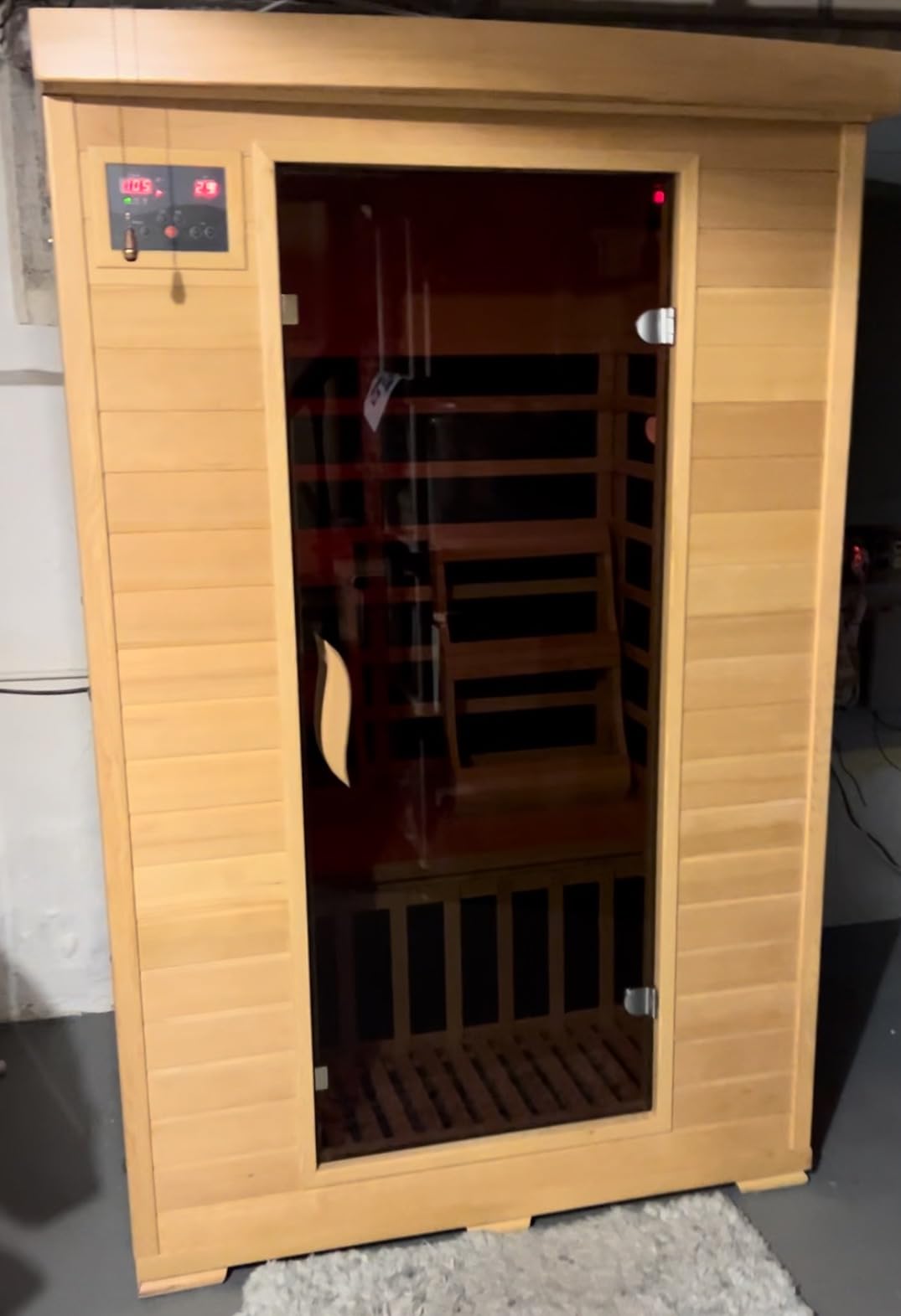
Exterior dimensions are 47.75 inches wide by 39.25 inches deep by 75 inches tall, with a 44.5 by 35 by 69-inch interior. That 75-inch height is the number to check first, because it removes any ability to build overhead storage above the unit and it eats into assembly clearance in a low-ceiling room.
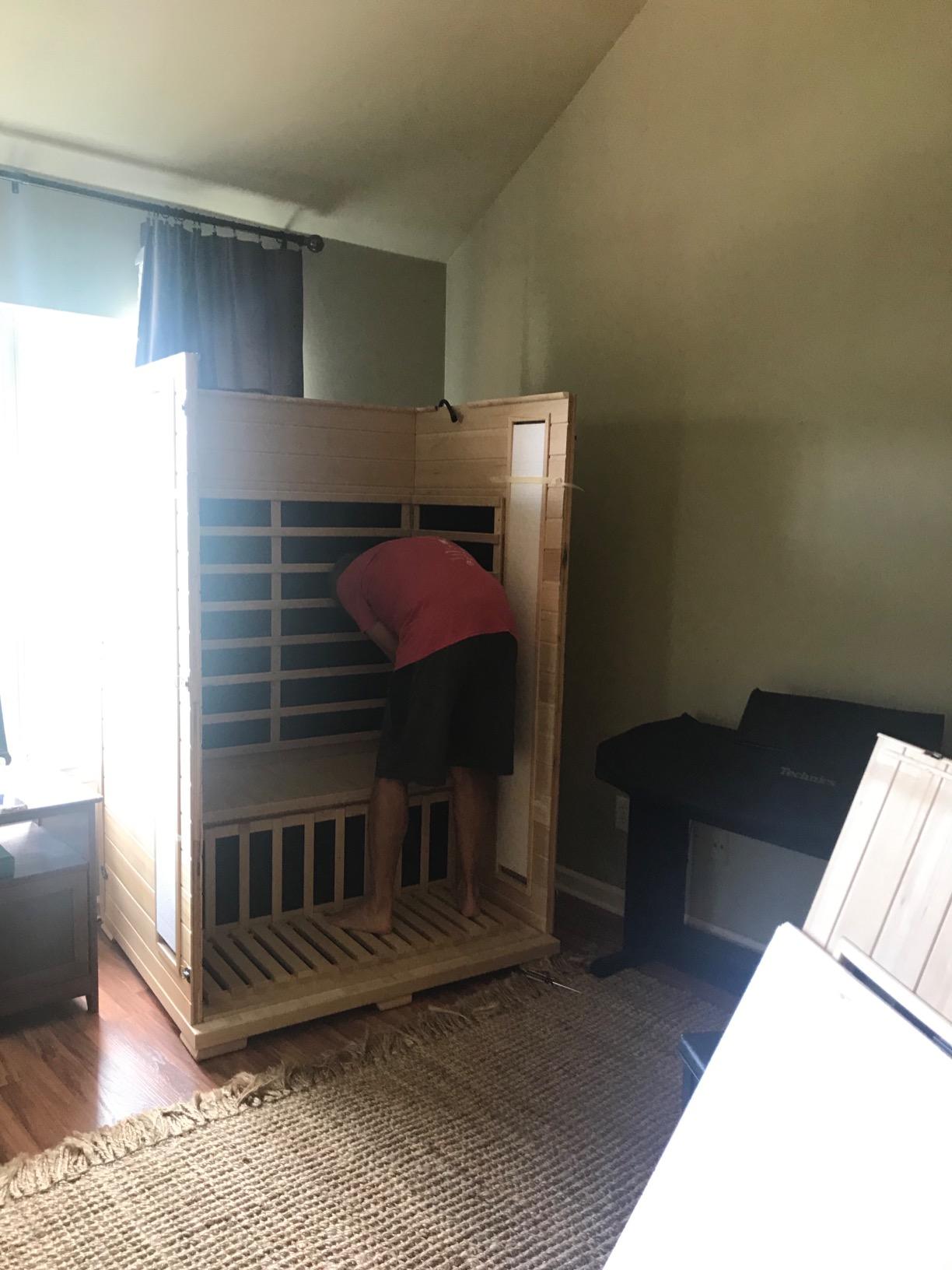
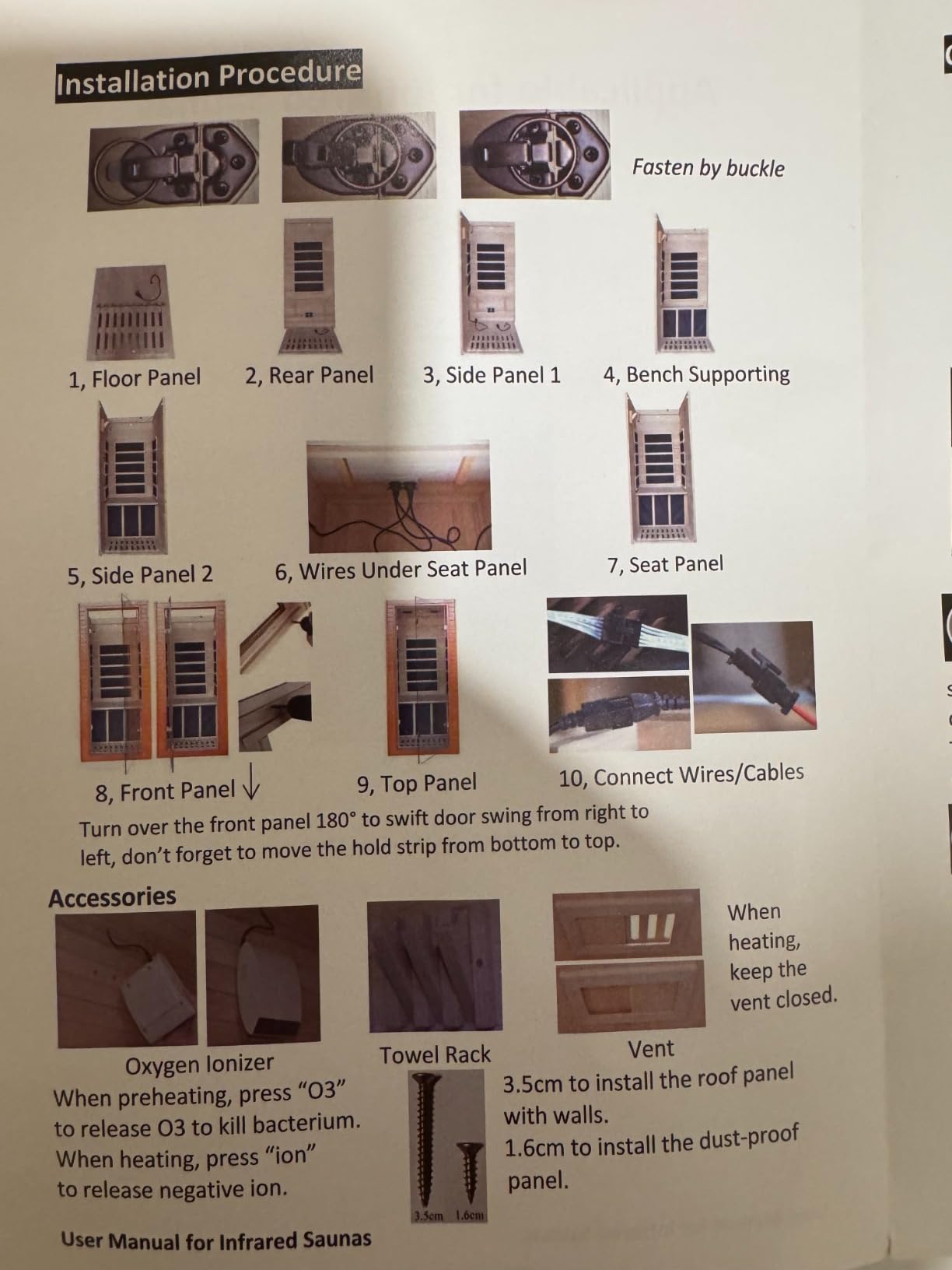
Assembly uses simple buckle connectors rather than a full frame, which is the reason this cabin is often recommended for a first basement install. Owners can put it together and move it without a contractor.
One thing to verify before you order: the listing does not publish a wattage figure, so you cannot confirm from the spec sheet which breaker size it needs. Ask the seller for the electrical draw in writing, and confirm the seven-year warranty terms directly with the manufacturer rather than relying on a retailer listing.
Does It Fit Beside a Basement Bathroom?
At 39.25 inches deep and 47.75 inches wide, it needs a fairly generous wall. In a small mechanical-style room it is the tightest fit in this roundup, since the 75-inch height leaves no room for overhead storage above it. Measure the wall and the door swing before committing.
Is Six Heaters Enough for Two People?
For a two-person infrared cabin, six carbon heaters is a normal configuration rather than a compromise. Owners describe the heat as steady and even rather than having a hot spot and a cold spot. If you want the broadest panel coverage available at this tier, look at the eight-panel cabins instead.
4. KUNSANA Ceramic Infrared 2-Person Sauna – Most Versatile
KUNSANA Ceramic Infrared Sauna 2 Person, Indoor Infrared Saunas for Home
Ceramic tube plus carbon plates
1760W low EMF
77-149F range
Two Bluetooth speakers
Pros
- Rated 4.7 stars across 134 reviews
- Ceramic tube heat reaches deep warmth fast
- Assembles in about 30 minutes to an hour
- Outside and inside controls with a timer
- Color and reading lights plus two speakers
Cons
- Snug fit for two adults
- Very hot back panels against the wood slats
- Heavier panels are a two-person carry
The KUNSANA is the only cabin in this roundup that pairs ceramic tube heating with carbon crystal far-infrared plates, and that hybrid is why it produces noticeably faster and deeper warmth than the panel-only designs. It is also one of the highest-rated cabins we compared, at 4.7 stars across 134 reviews with 84 percent five-star.
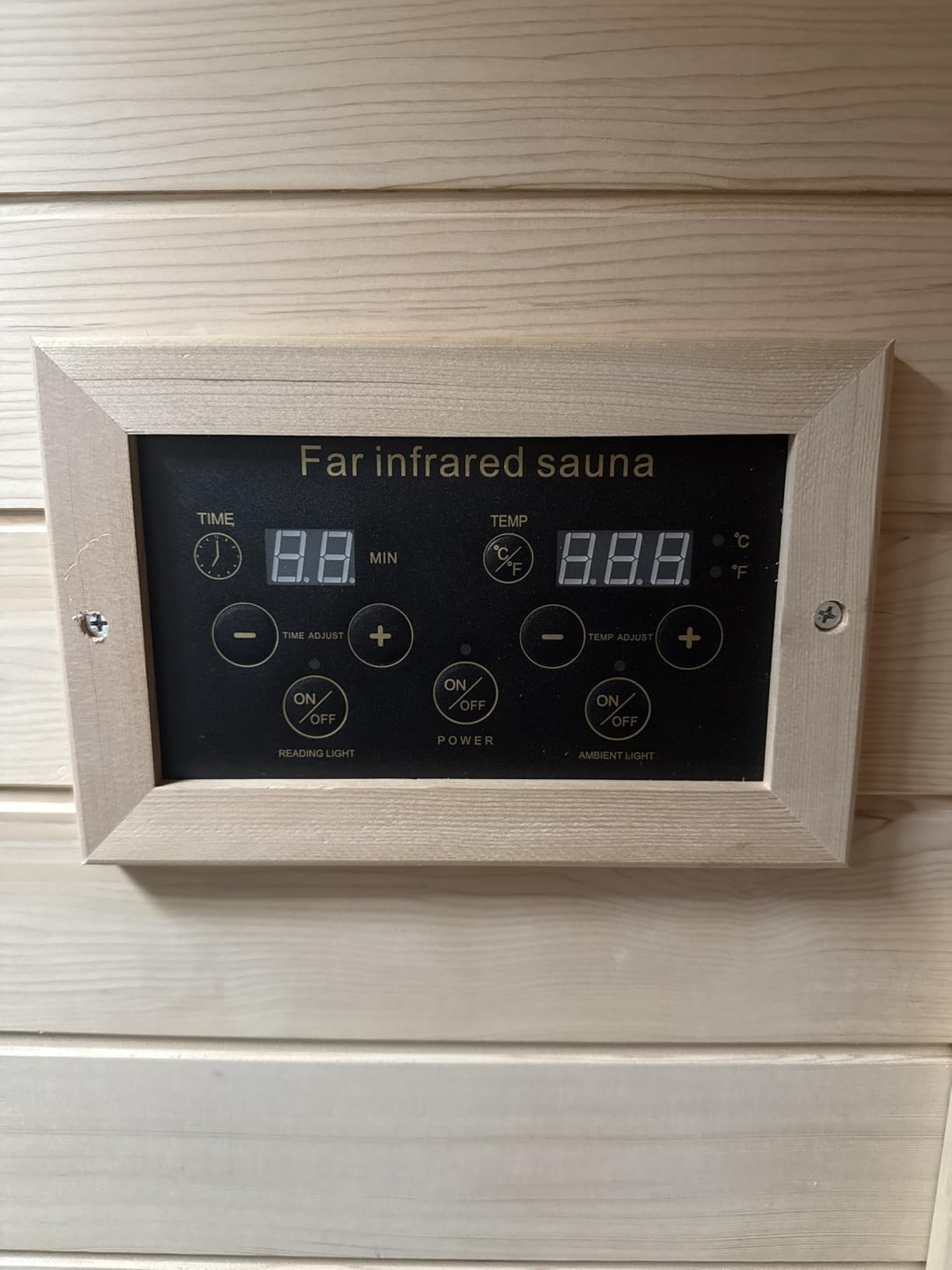
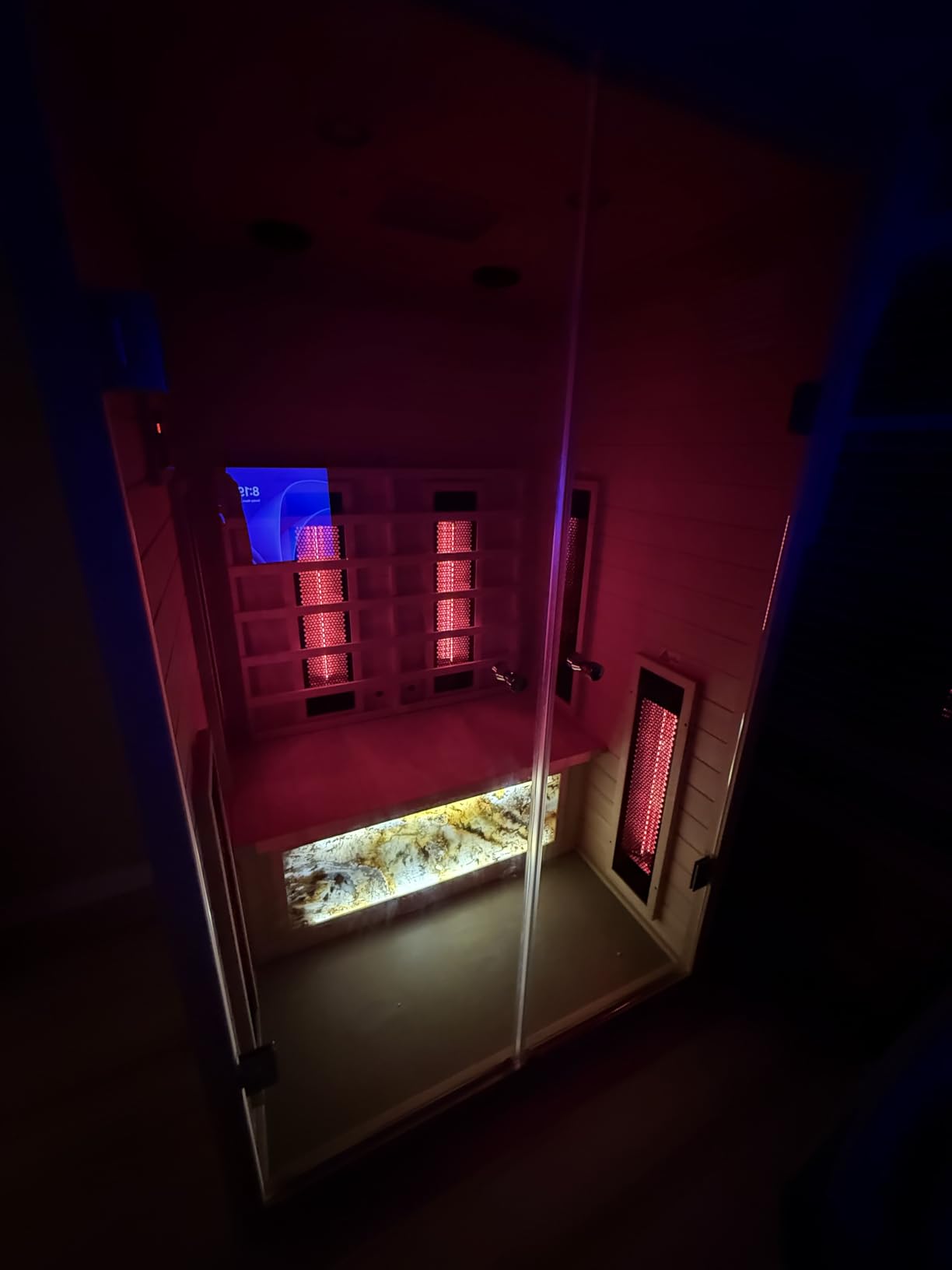
Temperature control runs from 77 to 149F, the heater is rated at 1760W in the low EMF range, and the cabin is dimensioned for users between 55 and 78 inches tall with a 600-pound bench limit. Two Bluetooth speakers, color lights, and a reading light are included, with controls on both the outside and the inside.
Exterior size is 47.24 by 39.37 by 75.95 inches, and that height is the first thing to check against your basement. Like the Coronado, it needs close to a 7 foot ceiling to give you assembly clearance, though the interior proportions are deep enough that most owners describe the room as spacious rather than tall.
Owners report assembling it in roughly 30 minutes to an hour once the panels are in position, which is faster than most of the cabins here. Several buyers installed it in a basement, a closet, or a home gym without professional help.
The recurring criticism is fit. Several owners describe the two-person layout as snug rather than roomy, and the back panels run very hot against the wood slats, though they can be switched off individually. A second note: in a cool room, reaching 118F took about 45 minutes for owners, so the fast-heating advantage shows up most in moderately warm rooms.
Is It Worth Paying More for Ceramic Heat?
If your priority is reaching a usable temperature quickly and sweating rather than sitting in a warm box, yes. Ceramic tubes project heat further and recover faster than carbon panels alone. If your priority is running a hot cabin in the coldest months, check the draw first, because 1760W is less headroom than you might expect in an unheated basement.
Can Two Adults Fit Comfortably?
Two adults fit, and the rating reflects that, but it is not a roomy cabin. It suits couples of average build who do not mind sitting close. If you are taller than 78 inches or want to lie down, read the height limit carefully before ordering, and consider a wider cabin instead.
5. DAIMOT Full Spectrum 2-Person Infrared Sauna – Best for Full Spectrum Heat
DAIMOT 2-Person Full Spectrum Infrared Sauna, 1990W 120V with 12″*12″ Red Light Therapy, 2 Speakers, Indoor Dry Sauna for Home & Gym, Canadian Hemlock Wood
Near mid and far infrared
1990W on 120V
44 x 36 x 70 inch interior
ETL certified
Pros
- The only full spectrum cabin in this roundup
- Near mid and far infrared wavelengths
- ETL certified for electrical safety
- Comfortable interior for two adults
- Two speakers plus FM radio and USB
Cons
- Requires a dedicated 20-amp breaker
- Assembly notes say not to install on carpet
Every other infrared cabin in this roundup lists far-infrared wavelengths only. The DAIMOT combines near, mid, and far wavelengths from dual heating tubes plus six panels, which is the configuration buyers who care about wavelength depth ask for by name.
At 1990W on 120V it is the second-highest draw here, and it specifies a dedicated 20-amp breaker. That single line is the most important thing on this page for you to read: a 15-amp basement outlet will trip, and you need a new circuit run before this cabin goes in.
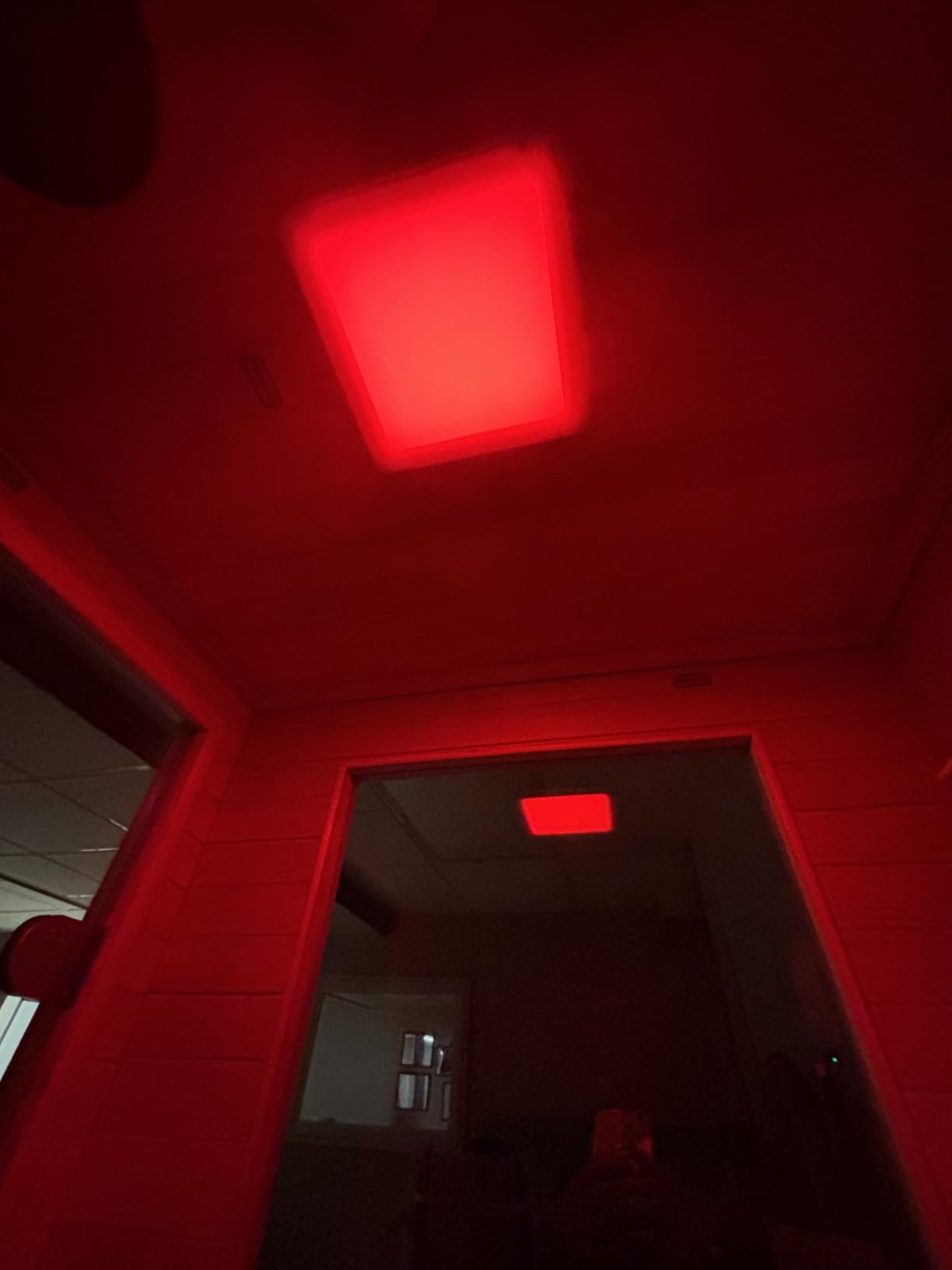
The interior is 44 by 36 by 70 inches, which seats two adults comfortably and sits lower than most of the cabins here, making it one of the better fits under a 6 foot 6 inch basement ceiling. Dual LED controls, a built-in air purification system, a reading lamp, and Bluetooth, FM radio, and USB connectivity are all included.
It is also ETL certified, which is unusual at this tier. Enthusiasts in sauna forums are broadly skeptical of certification and warranty badges that arrive without a certifier document, so verify the listing against the public certifier database before you rely on that mark for an insurance or resale conversation.
The rated 4.8 comes from 61 reviews, with no ratings below four stars. That is a small base, so treat the score as encouraging rather than proven, and give the fit and finish a look during any floor-model or showroom check you can manage.
Is a Dedicated 20-Amp Circuit a Problem?
It adds cost and time, not risk. A 20-amp 120-volt circuit is a routine residential run, and it keeps the heater from sharing a load with a dehumidifier or a treadmill on the same receptacle. If your basement already has a 20-amp receptacle on its own breaker, this is a plug-in install like the others.
Does It Work on Carpet?
The assembly notes say not to place it on carpet, which rules it out if your basement finish is wall-to-wall carpet. On a sealed concrete slab, a vinyl or tile layer, or a plywood subfloor panel, it installs normally. Ask the seller for the current instruction sheet rather than relying on a secondhand summary.
6. DWKWE 2-Person Hemlock Infrared Sauna – Best for First-Time Buyers
2-Person Infrared Sauna, Indoor Home Sauna Room Hemlock Wood Sauna Low EMF Far Infrared Heating with Tempered Glass Door Bluetooth Speakers, Chromotherapy Lights for Family(110V, 1850W)Truck delivery
Hemlock construction
110V 1850W low EMF
40-60C body heating
266 lbs
Pros
- Heats up quickly and produces a strong sweat
- Assembles in well under an hour
- Low EMF far infrared in chemical-free hemlock
- 1850W is among the lower draws here
- Bluetooth speaker and color therapy lighting
Cons
- Truck delivery required for a basement install
- Small review base of 27 ratings
The DWKWE scores highest in the set at 4.9, and its selling point for a first basement sauna is straightforward: fast heat, a low 1850W draw, and assembly in well under an hour once your outlet is ready. Owners report a strong sweat, which is the complaint that most often sinks cheaper infrared cabins.
Construction is chemical-free hemlock with a tempered glass door, a low EMF far-infrared heating system, and body heating rated between 40 and 60C. A Bluetooth speaker and color therapy lighting handle the ambience, and the listing describes the cabin as suitable for a balcony, bathroom, or a dedicated indoor room.
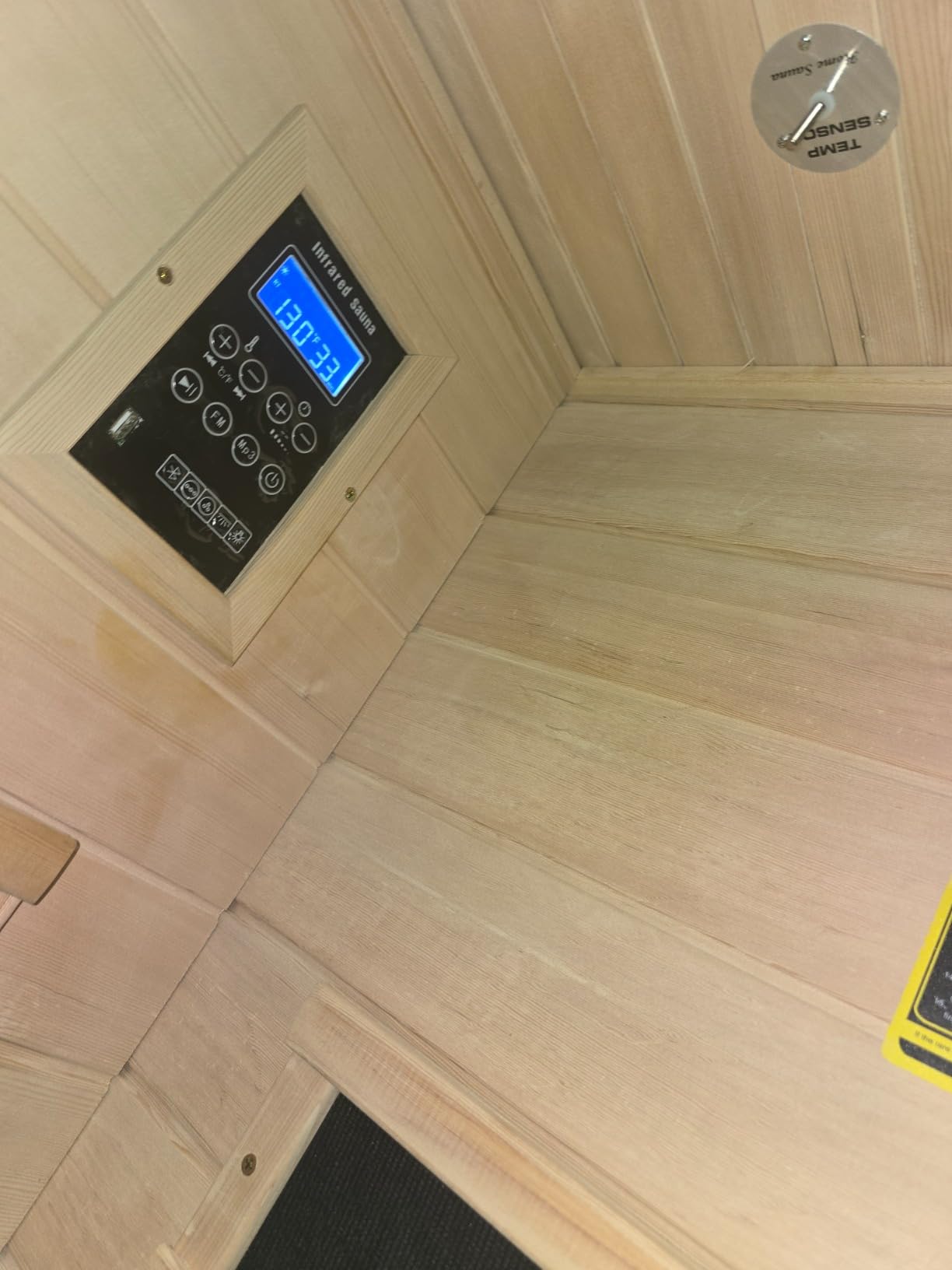
Exterior dimensions are 40 by 47 by 71 inches, and at 266 pounds it is light enough for two people to move into position. The 71-inch height clears a 6 foot 6 inch ceiling with a few inches to spare, so it is one of the safer choices in a low-ceiling basement.
Two caveats. The rating comes from 27 reviews, which is a thin base, and much of the written customer feedback for this brand covers its one-person and compact variants rather than this two-person room, so read the two-person reviews specifically. The listed rating distribution shows no ratings below four stars, which is a good sign but not a large sample.
It arrives by truck delivery, which means you need a clear path from the curb or driveway to the basement door and a second person on the other end of the stairs.
Is a Small Review Base a Reason to Skip It?
Not by itself, but it changes what you verify. With a deep base like the Dynamic Saunas Andora, a 4.6 score tells you what 702 people experienced. With 27 reviews, the score tells you what a small group experienced, so put your weight on the published specifications and the warranty terms instead, and check both against the manufacturer’s own documentation.
How Does 1850W Affect Your Bill?
It is one of the lower draws in this roundup, so it is among the cheapest to run per session. The real cost with a basement sauna is not electricity, though. It is the circuit run if you do not have a suitable outlet, and that cost is the same whether the cabin draws 1500W or 1990W.
7. Homsido Smart App 2-Person Far Infrared Sauna – Best for App Preheating
2 Person Far Infrared Sauna with Smart APP Control, Hemlock Wood Indoor Dry Sauna Room, Low EMF 2000W Fast Heating Home Sauna with Chromotherapy, Bluetooth Speakers for Home Spa Relaxation
App control
2000W across 8 panels
110V with 20A circuit
5-year warranty
Pros
- App pre-heats the cabin from your phone
- Eight panels give broad consistent warmth
- Five-year warranty on heating and wood
- Hemlock interior described as non-toxic
- Responsive support that sent a free backrest
Cons
- App is closer to an on and off switch than full control
- Temperature plateaus near 145F
- Needs a dedicated 20-amp circuit
The defining feature here is remote control. The Homsido smart app lets you start a pre-heat from your phone, which in a basement is more useful than it sounds, because the walk from the workout room to the sauna can happen while the cabin is already climbing toward temperature.
Underneath the app are 110V and 2000W spread across eight heating panels, a hemlock interior, chromotherapy color lighting, and built-in Bluetooth speakers. The warranty runs five years on both the heating system and the wood structure, which is longer than several higher-scoring cabins in this set.
Owners consistently like how comfortably two people fit and describe the eight-panel layout as even and consistent. Support is repeatedly praised for sending replacement parts and, in one case, a free backrest, which owners single out as unusually good service for a kit in this category.
The electrical requirement is the biggest catch. It specifies a dedicated 20-amp circuit, and buyers who plugged it into a 15-amp outlet reported tripped breakers. If your basement does not already have a 20-amp run, that is a real line item on your install before this cabin can go in.
Temperature is the other catch. Owners report a ceiling around 145F and difficulty going hotter, particularly in a cool basement climate. If you want sauna-hot temperatures rather than a warm recovery session, look at the ceramic cabin instead.
Is App Control Worth Anything in a Basement?
More than it is upstairs, because the sauna is usually not in the room you are sitting in. Starting a 30-minute pre-heat from upstairs means the cabin is ready when you walk down. The limitation is that the app is closer to a remote on and off switch than full remote adjustment, so you still set final temperature and timing at the panel.
What Happens If a Panel Arrives Damaged?
In most cases, support sorts it. Owners report replacement parts being sent and one buyer receiving a free backrest after a shipping issue. There is also a report of a shattered glass door with a slow seller response, so document any freight damage in photos before the driver leaves, every time.
8. EASYHAWK 2-Person 1500W Infrared Sauna – Budget Pick
EASYHAWK 2 Person Infrared Sauna for Home, Low EMF FAR Indoor Wooden Dry Sauna Room with Flame-Retardant Design, WiFi App Control, Bluetooth Speakers, LCD Panel, 1500W/120V
6 carbon far infrared panels
1500W on a 15A plug
64-149F range
WiFi app and LCD panel
Pros
- Lowest draw in the roundup at 1500W
- Standard 15-amp 120V plug
- WiFi app plus Bluetooth and FM radio
- Arrives in three manageable packages
- Five-year limited warranty
Cons
- Slowest heat-up at roughly 45 minutes to 120F
- Some units arrived with missing parts
- Right-hand panel fit makes the glass door awkward
The EASYHAWK is the cheapest to run in this roundup and one of only two cabins here that plug into a standard 15-amp household outlet, the other being the Dynamic Saunas Andora. At 1500W, it is the right pick if your only goal is a warm recovery room rather than a serious heat session.
It has six low EMF carbon far-infrared panels, an adjustable range from 64 to 149F, a tempered glass door, a flame-retardant design, and a generous electronics package: an LCD panel, WiFi app control, Bluetooth, FM radio, USB, and MP3, plus 7-color RGB lighting and an interior reading light.
At 47.2 by 39.3 by 72.8 inches, it is a wide cabin that suits a basement with a longer wall and limited depth. It also works on carpet, which no other cabin in this set will tell you to do, and it arrives in three packages rather than one pallet, which makes getting panels down basement stairs manageable.
Heat-up is the problem. Owners report roughly 45 minutes to reach 120F and more than an hour for the higher settings, with one owner describing 120F as the realistic ceiling after two hours. If you plan to use it on a whim after a workout, that delay is the dealbreaker. If you use a timer and treat it as an evening ritual, it is workable.
The 4.2 rating across 16 reviews is the lowest here, and 11 percent are one-star. Assembly quality issues show up in the reviews, including missing parts and a right-hand panel fit that makes the glass door hard to open and close. Budget for a careful build and a parts request before first use.
Do You Need a 20-Amp Circuit for This One?
No. It runs on a standard 15-amp, 120-volt household plug, which makes it one of the easiest cabins in this roundup to install in a finished basement with existing outlets. That single fact puts it ahead of cabins that score higher once the cost of a new circuit run is counted.
Can It Still Handle a Hot Basement?
At 1500W, a hot basement works against you. The panels are not fighting a hot room, but they are also not fighting a cold one, and the 45-minute warm-up shows it. A dehumidified, moderately heated basement at 68 to 72F is the environment where this cabin performs closest to its temperature claims.
What Owners Regret Most (And How to Avoid It)
The complaint that follows infrared cabins across the owner threads we reviewed is simple: not enough heat, and not enough sweat. One verified owner of a popular mid-size infrared cabin reported that the unit did not produce a meaningful sweat after 40 minutes at its highest setting, and a separate published roundup surfaced a similar complaint about a two-person hemlock infrared unit not getting hot. If that is your single worry, buy on heater class and reported warm-up time, not on the temperature printed in the listing.
The second regret is circuit mismatch. Buyers repeatedly underestimate the difference between a 15-amp plug and a dedicated 20-amp breaker, and the cheapest mistake in this category is ordering a cabin before walking to your panel and confirming what is on each breaker.
The third is freight damage and missing parts. Two well-known two-person cabins in this category have documented cases of missing accessories on delivery and board gaps after assembly, and both travel as freight. Photograph every panel and every box before the driver leaves, note any damage on the delivery receipt, and keep the packaging until the cabin is fully assembled and heating.
The fourth is the floor. Several kits ship without a floor panel, which on a basement slab means you are solving a concrete sealing problem before you can start. Check the box contents list before ordering and treat a missing floor as a budget line, not a detail.
Basement Moisture Control Protocol
Below-grade rooms are the least ventilated and most humid spaces in a house, and a sauna makes sweat a permanent feature of the room rather than a one-time event. No brand on this list prevents mold, and we would be skeptical of any that claims to. What works is a boring four-step protocol you set up before the cabin arrives.
Vapor barrier on the surrounding walls. The room around the cabin needs a proper vapor barrier behind the wall finish. The cabin itself does not need one; it needs to stay dry from the outside in, not be sealed from the inside.
Low intake, high exhaust. Put the intake vent low on the wall, ideally near the floor and near the door, and the exhaust vent high on the opposite side. Forum guidance is consistent on this point, and it is the requirement most often skipped.
Dehumidifier outside the cabin. Place a small dehumidifier in the room but outside the sauna, next to the exhaust path. Owners running infrared sauna groups in basements have reported indoor humidity readings between 65 and 73 percent with a bathroom installation nearby, which is the number to watch.
Seal the slab if it sweats. Basement slabs that show moisture in summer need sealing before anything sits on them. Carpet over an unsealed slab is the combination that causes warped boards and mold.
For infrared cabins specifically, the ventilation requirement is lighter than for a traditional stone heater, because you perspire rather than generating steam. Sources in this category disagree on whether a bathroom-style exhaust fan is mandatory for infrared. Our read is that a cabin always needs airflow, but a small dedicated dehumidifier and a high exhaust handle infrared sessions where a full traditional vent stack would be required for a stone heater.
What to Look for When Buying a 2-Person Sauna
Start with the circuit, because it is the only spec that can add a week of work and a trip to an electrician on your project. Walk to your electrical panel and identify what is on each breaker before you choose a model. If you have a 15-amp receptacle that serves nothing else, the two 15-amp cabins in this roundup are open to you. If you are willing to have a 20-amp circuit run, the rest of the field opens up. Our compact kitchen buying guides, from our rice cookers for one person roundup, follow the same rule in a smaller way: check what the room already has before you shop.
Second, measure ceiling height against the cabin, not the room. The cabins here run from 68 to 76 inches. A 6 foot 6 inch finished ceiling is workable but leaves no assembly clearance, and a 7 foot ceiling is the point where every one of them becomes comfortable. Add 2 to 3 inches above the unit for panel removal.
Third, judge the heater class honestly. Ceramic tube plus carbon plates heats faster and deeper than panel-only designs. Carbon panels alone, whether six or eight, deliver a warm body-heat session. Both are legitimate products, they just do different jobs, and the temperature ceiling printed on a panel-only listing is usually aspirational rather than observed.
Fourth, treat the 200 rule for what it is. It applies to traditional air-heated saunas, not to infrared cabins that warm your body directly. Sellers who quote 200 cubic feet per person for a two-person infrared cabin are applying a rule from the wrong category.
Fifth, check the wood. Canadian hemlock appears across this entire roundup because it handles a humid below-grade room better than most softwoods and does not need the aromatic oils of cedar for a sealed indoor cabin. Aspen is worth considering if you want a lighter color and no strong scent, but hemlock is the safe default for basements.
Sixth, verify certification and warranty claims yourself. Buyers in sauna forums are openly skeptical of low EMF and warranty claims that arrive without a supporting document. If a listing shows an ETL or CSA mark, look the model up in the public certifier database. If a listing shows a seven-year warranty, confirm the terms with the manufacturer rather than the retailer, because several cabinets in this roundup publish a warranty figure without publishing the measurement or labor terms behind it.
Finally, confirm the floor situation, the packaging count, and the delivery method before you order. A cabin that arrives as three palletized boxes needs a different plan for your basement stairs than one that arrives as a single unit, and a kit with no floor panel means a sealing project before assembly.
Frequently Asked Questions
Is it okay to put a sauna in your basement?
Yes, as long as the room has a protected floor, a dedicated electrical circuit, planned intake and exhaust ventilation, and a vapor barrier on the surrounding walls. Two-person cabins run 68 to 76 inches tall, so a 6 foot 6 inch finished ceiling works but leaves little assembly clearance. Install a hygrometer before you buy, because a basement that already reads above 60 percent humidity regularly needs moisture work first.
Is it possible to install an infrared sauna in a basement?
Infrared is actually the easier heat type for a basement. Because you perspire rather than generating steam, moisture output is moderate rather than heavy, and a small dehumidifier plus a high exhaust vent usually handles it. The requirements that remain are the same as for any sauna: a dedicated outlet, clearance above the cabin, and a protected floor.
Do you need ventilation in an infrared sauna?
Airflow is needed regardless of heat type, but the specification is lighter for infrared than for a traditional stone heater. Put a low intake vent near the floor and near the door, put the exhaust high on the opposite wall, and run a small dehumidifier in the room outside the cabin. Skip the intake and exhaust and you are asking for condensation on finished basement walls.
How much will my electric bill go up with an infrared sauna?
The two-person infrared cabins here run between 1500W and 2000W. At that draw, a 45-minute session costs a fraction of what a space heater costs over an evening, and the main expense is not the electricity. Check your own utility rate and compare a session against your heater and dryer to get a real number for your household.
What circuit does a 2-person sauna need?
It depends on the model, and this is the spec to read twice. The Dynamic Saunas Andora and the EASYHAWK cabin use a standard 15-amp, 120-volt household plug. The DAIMOT and the smart-app Homsido both specify a dedicated 20-amp breaker, and several other cabins at 1760W to 1990W belong in the same 20-amp category. A 240V hard-wire circuit is not required by any two-person infrared cabin on this list.
How much would it cost to build a 2-person sauna?
The cabin is the smaller half of the cost. A prefab 2-person infrared kit plus a 20-amp circuit run, electrician labor, a floor solution if the kit does not include one, and ventilation hardware usually cost more than the panel count suggests. Building it yourself from raw materials is a real path in this category and can be cheaper, but only if you are comfortable with insulation, vapor barrier, and electrical code.
How long does a 2-person sauna take to heat up?
It depends on the heater class and the room. In this roundup, owners report roughly 30 minutes to 125F for the eight-panel carbon cabins, about 40 to 60 minutes to the high 130s for the Dynamic Saunas Andora, and roughly 45 minutes to 120F for the 1500W budget cabin. A cool basement adds time. Ceramic tube heating is the fastest option in the set when you want heat quickly.
Conclusion: Where to Start With Your Basement Sauna
Start with the circuit, not the cabin. Walk to your panel, find out what you have, and only then start reading product pages. If you have a free 15-amp receptacle, the Dynamic Saunas Andora is where we would start, because it has the deepest owner history here and a heat-up time you can plan around. If you are willing to have a 20-amp circuit run, the KUNSANA ceramic cabin gives you the fastest and deepest heat, and the Homsido red light model gives you the most features per watt.
Whichever one you pick, the basement work is the same: protect the floor, run the intake low and the exhaust high, put a dehumidifier in the room outside the cabin, and photograph the freight before the driver leaves. Those four steps are what separate a sauna that ages well from one that warps by its second season.
Our full ranking of the best two person saunas for basements is above, updated for 2026. Measure first, buy second.