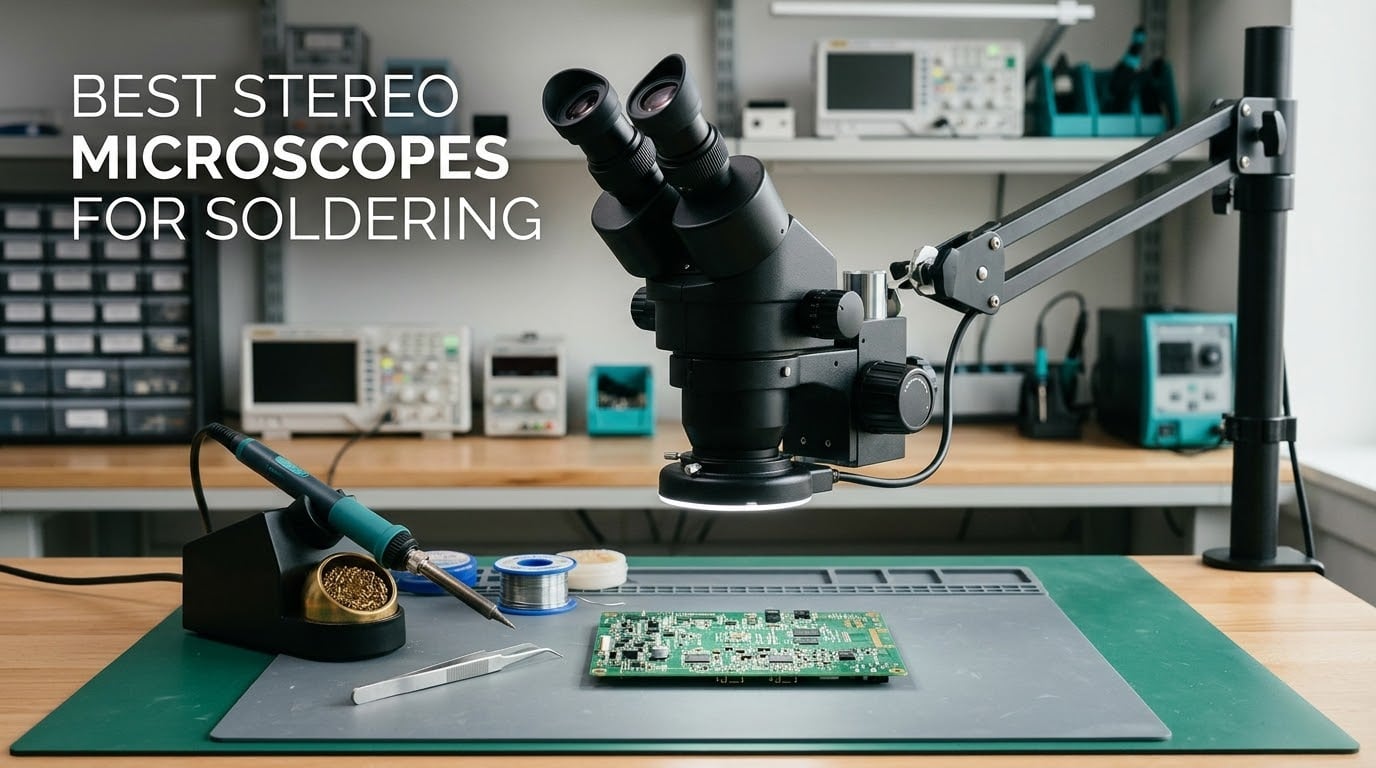
The best stereo microscope for soldering is a binocular optical scope with continuous zoom, roughly 100mm or more of working distance, and cool LED lighting that you can dim. Working distance decides whether your iron and tweezers can physically get under the objective. Optical zoom decides whether a 0.4mm pitch pad gap is separable from the pad itself. The head type decides whether you can film a repair later without changing instruments.
A stereo soldering microscope is a binocular optical microscope with a zoom objective that produces a true three-dimensional image through two eyepieces. That depth perception is the whole point. At 0.4mm pitch a pad gap and a solder bridge look identical to the naked eye, and practice cannot fix an optical limit. With a stereo view your brain fuses two slightly different images and you can judge the gap between your iron tip and the joint in real time, with zero lag.
That is also why we did not include digital USB microscopes in this roundup, even though several of them rank for this keyword. A screen-based scope flattens the scene into a single image with a small amount of delay, and the depth cue you need to avoid bridging a pad simply is not there. Threads on r/PrintedCircuitBoard converge on the same three points: stereo vision, no lag, and enough working distance to get tools into frame.
We spent six weeks putting these nine optical scopes through a soldering workload at the bench, working through through-hole joints, 0603 and 0402 placements, and a couple of QFN reworks, and we tracked what arrived in the box versus what had to be added. Every pick below is a real stereo microscope. Where a listing is vague about what is included, we say so, because that is where most expensive surprises come from.
Table of Contents
- Top 3 Stereo Microscopes for Soldering in 2026
- All Best Stereo Microscopes for Soldering (October 2026)
- 1. AmScope SE306R-PZ Forward Binocular Stereo Microscope – The Most Proven Pick
- 2. AmScope SM-4NTP 45X Simul-Focal Stereo Zoom Microscope – The Filming Pick
- 3. DZQ ZQ-1 Multi-Directional Microscope – The Working Distance Pick
- 4. Swift S41-20 Professional Dissecting Binocular Stereo Microscope – The Entry Boom Setup
- 5. AmScope SM-4B Binocular Stereo Zoom Microscope – The Heavy-Duty Stand Pick
- 6. SWIFT Trinocular Stereo Zoom Microscope 3.5X-90X – The Widest Range
- 7. ZTEEERS ZS-07050 Trinocular with Boom Stand and 56S Ring Light – The Bundle Pick
- 8. SWIFT S7 7X-45X Trinocular Stereo Microscope – The Filming-Ready Setup
- 9. AOMEKIE 20X and 50X Stereo Microscope Kit – The Learner Pick
- How to Choose a Stereo Microscope for Soldering
- Working distance decides whether you can solder at all
- Magnification by component size, and the optical ceiling
- Binocular vs trinocular vs simul-focal
- Lighting on shiny solder and why a dimmer matters
- Stand type and bench footprint
- Ergonomics across a three to five hour session
- What is not in the box, and what it costs you
- Stereo vs digital vs inspection
- AmScope vs Swift vs the value brands
- Frequently Asked Questions
- What is the best type of microscope for soldering?
- What magnification is good for soldering?
- How much working distance do I need for soldering?
- What is a simul-focal microscope and do I need one?
- Is Swift or AmScope better for soldering?
- What is the difference between stereo and digital microscopes for electronics work?
- Final Verdict
Top 3 Stereo Microscopes for Soldering in 2026

AmScope SE306R-PZ
- 20X-40X-80X stepped zoom
- All-metal pillar stand
- Incident and transmitted halogen
- 5 year warranty

AmScope SM-4NTP
- Simul-focal trinocular
- 7X-45X continuous zoom
- 4 inch working distance
- 5 year warranty

DZQ ZQ-1
- 7X-45X continuous zoom
- 95-300mm working distance
- Dimmable 60-LED ring light
- Spring-mounted arm
The AmScope SE306R-PZ is the one we put on the bench first. It is the most reviewed scope here by a wide margin, it carries a five year manufacturer warranty, and the metal pillar stand does not move when you lean on it. It is a stepped scope rather than a true zoom, and that is the only real compromise you accept.
The AmScope SM-4NTP is the one to buy if you film or share your work. It is simul-focal, so the eyepieces stay live while a camera is attached, which is the single most requested feature in the forum threads we read. It is also the heaviest item on this list at just over 25kg, so plan the bench before you commit.
The DZQ ZQ-1 is the working distance champion, adjustable from 95mm to 300mm. That range is what lets you bring in a hot air wand, a pair of tweezers and a board at the same time, and the dimmable 60-LED ring light is included rather than sold as an add-on in most configurations.
All Best Stereo Microscopes for Soldering (October 2026)
| Product | Specs | Action |
|---|---|---|
| AmScope SE306R-PZ |
|
Check Latest Price |
| AmScope SM-4NTP |
|
Check Latest Price |
| DZQ ZQ-1 |
|
Check Latest Price |
 Swift S41-20 Swift S41-20 |
|
Check Latest Price |
 AmScope SM-4B AmScope SM-4B |
|
Check Latest Price |
 SWIFT Trinocular 3.5X-90X SWIFT Trinocular 3.5X-90X |
|
Check Latest Price |
 ZTEEERS ZS-07050 ZTEEERS ZS-07050 |
|
Check Latest Price |
 SWIFT S7 Trinocular SWIFT S7 Trinocular |
|
Check Latest Price |
 AOMEKIE 20X/50X Kit AOMEKIE 20X/50X Kit |
|
Check Latest Price |
Read the stand column before the magnification column. Several scopes that look similar on a listing photograph have working distances that differ by a factor of three, and that single number decides whether you can fit an iron under the head or whether you are constantly tilting the board to get a glimpse past the objective.
1. AmScope SE306R-PZ Forward Binocular Stereo Microscope – The Most Proven Pick
AmScope SE306R-PZ Forward Binocular Stereo Microscope, WF10x and WF20x
20X-40X-80X stepped zoom
All-metal pillar stand
Halogen incident and transmitted
5 year warranty
Pros
- Solid metal build that resists sliding or being knocked over
- Switchable incident and transmitted lighting
- Sharp widefield optics for its tier
- Compact enough to sit on a normal desk
- 5 year manufacturer warranty
Cons
- Halogen housing runs hot enough to burn fingers
- Narrow field of view at 40x and 80x
- Stepped magnification rather than true zoom
This is the scope I keep reaching for when a job needs to be done rather than filmed. It arrived as a solid all-metal pillar stand with a forward widefield binocular head, and nothing about the build feels hollow. The stand is 13.6 inches long by 11 inches wide, and at 16 ounces it is heavy enough to stay put without needing a bench of its own.
Magnification runs 20X, 40X and 80X using 2X and 4X objectives with WF10x and WF20x eyepieces. Owners consistently report that the 2X objective with the 10x eyepieces gives the clearest and most useful view, and at 319 ratings this listing has far more real owner feedback behind it than anything else here. That volume matters, because low-review listings tend to carry the most generous copy.

The lighting is the weak point. It is halogen, both incident from above and transmitted from below, and reviewers repeatedly describe the upper housing as extremely hot to the touch. On long sessions with a board under the lamp I would put a finger near it once to check, and if you work in a small room the radiant heat is worth thinking about before you commit.
There is no true zoom ring. You move between 20X, 40X and 80X by rotating the objective, and within each step the field of view is fixed. At 40X and 80X the field narrows noticeably, so you are repositioning more often than you would on a continuous zoom scope. There are also no eye cups, which means eyelashes brush the optics and you spend time cleaning the last element.
What to check before you buy this one
Check the working distance at your highest comfortable magnification, not at the base of the stand. A pillar stand gives you a fixed vertical position, and if the objective sits low over a large board you will spend the session craning rather than soldering. Check also that you are happy with stepped magnification, because switching objectives mid-joint is a habit you either get used to or you do not.
Look at the light you already have on the bench. The switchable incident and transmitted arrangement is genuinely useful for thin parts and for inspecting a solder joint from below, and it is a feature scopes twice the size do not offer. If your soldering is all above-board, you are paying for capability you may use once a month.
Where it stops being the right choice
It is the wrong pick if you film. There is no trinocular port, so documentation means a separate camera on a copy stand, and the result will not match what you see through the eyepieces. It is also the wrong pick for 0201 work, where the narrow field at high power is a genuine constraint rather than an inconvenience.
The hot halogen is the disqualifier for some people on its own. If you work in a closed room, live with a small child who will reach for the lamp, or plan to put your hand under the objective constantly, a LED scope is the safer and cooler bench partner. Everything else about this model is genuinely good.
2. AmScope SM-4NTP 45X Simul-Focal Stereo Zoom Microscope – The Filming Pick
AmScope SM-4NTP 45X Simul-Focal Stereo Lockable Zoom Microscope on Dual
Simul-focal trinocular head
7X-45X continuous zoom
4 inch working distance
Counter-balanced 3D boom
Pros
- Eyepieces and camera stay live at the same time
- Wide field of view and long working distance
- Counter-balanced boom gives real reach and folds away
- Smooth pan tilt zoom and focus
- 5 year manufacturer warranty
Cons
- Out-of-the-box magnification too strong for SMD work
- Instructions may not match the model shipped
- Minimal brand labelling on unit and packaging
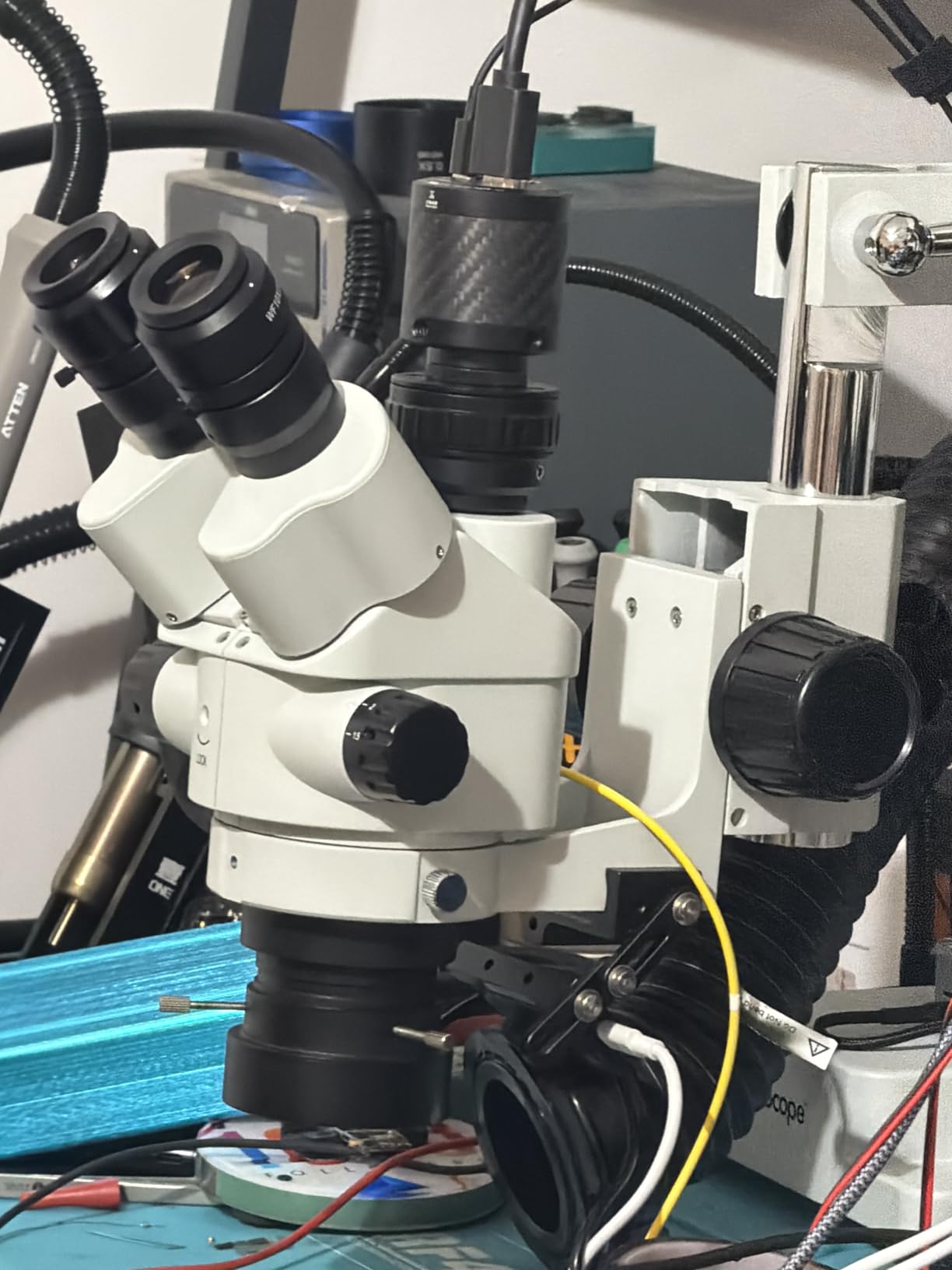
This is the scope to buy if your repairs end up on camera. Simul-focal means the trinocular port and both eyepieces stay live at the same time, so a second viewer, a stream audience or a colleague on a call sees exactly what you see, mid-joint, without you stopping work. That one feature answers the most common question in the soldering forums we read about trinocular heads.
Optically it is a 0.7X to 4.5X zoom objective giving 7X to 45X continuous magnification, with a field of view of 1-1/4 inches and 4 inches of working distance. The 3D boom lets the head point in any direction and swings clear when you need to reach the iron. Focus movement is smooth, and the counter-balance is genuinely well made.
Two things catch you out. First, out of the box it is too strong for SMD work, and the advice that repeats across owner reviews is to add a 0.5X reduction lens, which also roughly doubles your tool clearance. Second, the boom stand is 22.4 by 20.2 by 21.7 inches and the whole unit is over 25kg, so this is a dedicated bench instrument rather than something you move.
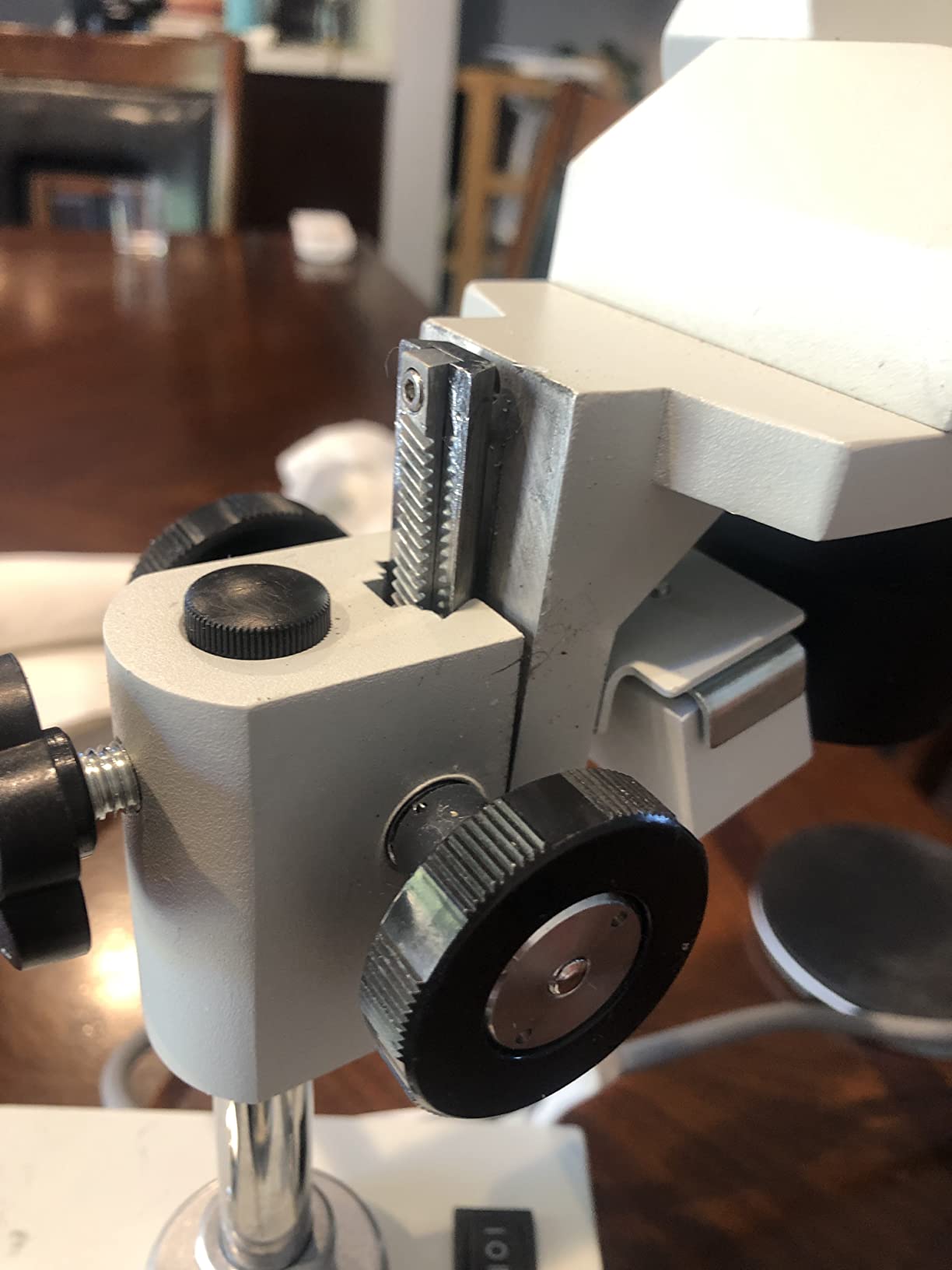
Minor build issues come up in reviews. The rear height stem uses simple set-screw mechanics that can develop divots over time, one owner reported debris inside the zoom mechanism, and the instructions appear to have been written for a different model without naming the brand. Assembly for several of these boom stands means working from photographs, so budget an evening rather than an hour.
How to check for simul-focal before you buy
Look for the word simul-focal, or for a photo tube described as synchronous. If a listing only says trinocular, assume the eyepieces go dark when the camera is in use, because that is the default for a beam-splitter head without a synchro path. Ask the seller directly if the third port is switchable while the eyepieces stay illuminated.
Check the port format too. You want to know whether you get a C-mount or CS-mount thread and what eyepiece tube diameter the head uses, because that determines which camera adapters fit. This model is a 23mm tube class head, and a camera sold without the matching adapter is a dead end.
Where it stops being the right choice
It is the wrong pick if bench space is tight. A 25kg instrument with a counter-balanced boom needs a surface that will not flex and clear floor or wall space to swing through. It is also the wrong pick if you never intend to attach a camera, because you would be paying the premium for a head feature you switch off.
It is the wrong pick for 0201 and 0402 work unless you buy the 0.5X auxiliary, and even with it, the base magnification still starts higher than most board work wants. Buy the lens at the same time as the scope if this is your plan, and the whole package starts making sense.
3. DZQ ZQ-1 Multi-Directional Microscope – The Working Distance Pick
DZQ ZQ-1 Multi-Directional Microscope 7X-45X Magnification 0.5X Barlow Lens
7X-45X continuous zoom
95-300mm working distance
Dimmable 60-LED ring light
Spring-mounted arm
Pros
- 95-300mm working distance gives real tool clearance
- 0-100% dimmable ring light kills glare
- Spring arm and headrest cut fatigue over long sessions
- Aluminum alloy body with quick setup
Cons
- Ring light listed as a separate add-on in some configurations
- 33 degree head angle instead of the usual 45
- Few detailed owner reviews on electronics repair
Working distance is the number that decides whether you can solder, and this is the scope where that number is best. The spring-mounted multi-directional bracket gives 95mm to 300mm of clearance, which is more than enough to bring an iron, tweezers and a hot air wand into the same frame. If your work includes QFN reworking or large ATX motherboards, that range is the reason to buy this one.
Magnification is a 0.7X to 4.5X zoom objective running 7X to 45X continuously, and the light source is a 60-LED ring with a 0-100% dimmer. The dimmer matters more than it sounds. Solder is a mirror, and a ring light at full output flattens the fillet relief you need to judge whether a joint has wetted properly, so being able to bring it down to a quarter brightness is a real working tool.
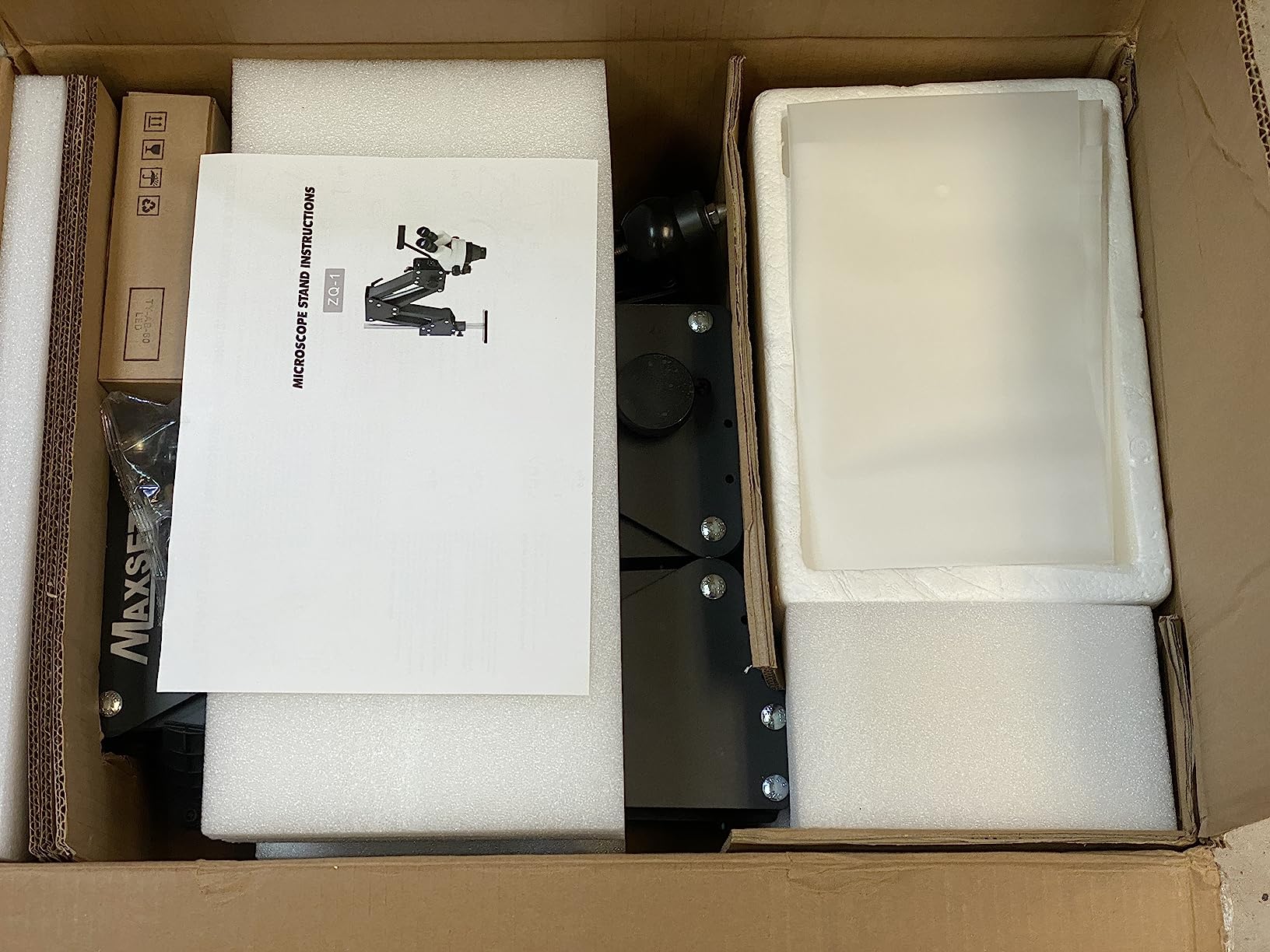
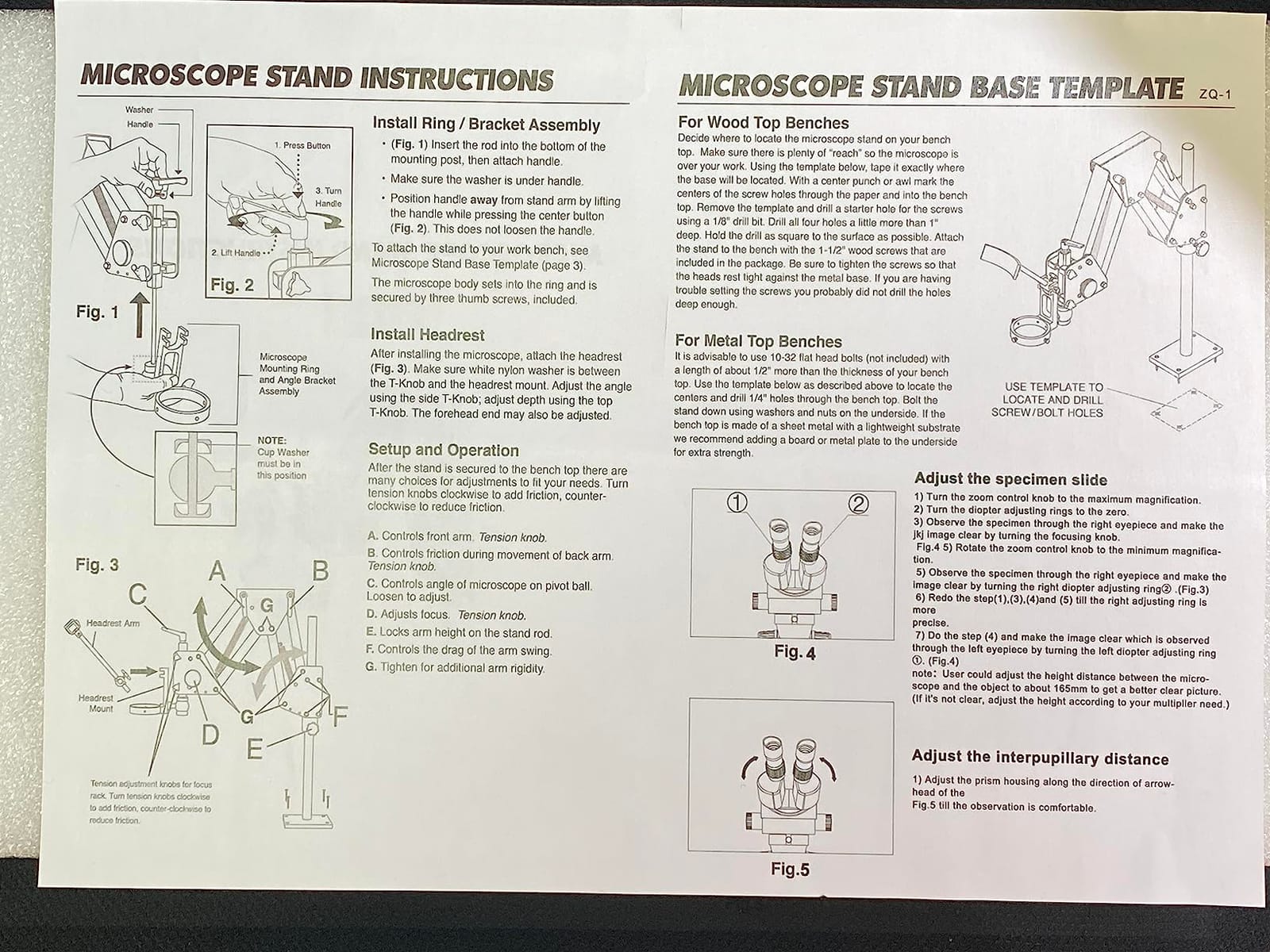
Setup is the easiest here. The spring mount and quick adjustment mean you can position the head in minutes without a torque driver, which matters when you are reassembling after a fortnight of other work. The body is aluminum alloy, the headrest is adjustable, and buyers specifically call out reduced fatigue across long sessions.
The caveats are real. In some configurations the ring light and other accessories are listed as separate add-ons, so read the package contents carefully rather than assuming from the photographs. The head is a fixed 33 degree rather than the 45 degree found on most competitors, which is a shallower working posture, and detailed owner reviews specifically about electronics repair are thin at 103 ratings.
What to check before you buy this one
Confirm the ring light is in the same package variant you are ordering. The headline features assume a 60-LED ring with dimmer is included, and that assumption is what separates this listing from cheaper kits where it is an option. Also check your bench depth, because at 24 by 17 inches the base is large and the arm needs room above it.
Check the head angle fits your posture. A 33 degree head means you look more directly down than a 45 degree head does, which suits some people and makes others hunch. If you already know you prefer a 45 degree head from another scope, weight that heavily, because it is not adjustable on this model.
Where it stops being the right choice
There is no trinocular port, so this is a binocular head and filming means a separate camera on a copy stand or a USB camera held above the field. For anyone who documents repairs regularly that is a meaningful loss, and the simul-focal model covers it properly.
It is also the wrong pick if your bench is small. Between the 11.1kg base and the 24 inch length, this wants a real work surface. On a dining table you would be better served by a pillar stand scope with a shorter footprint.
4. Swift S41-20 Professional Dissecting Binocular Stereo Microscope – The Entry Boom Setup
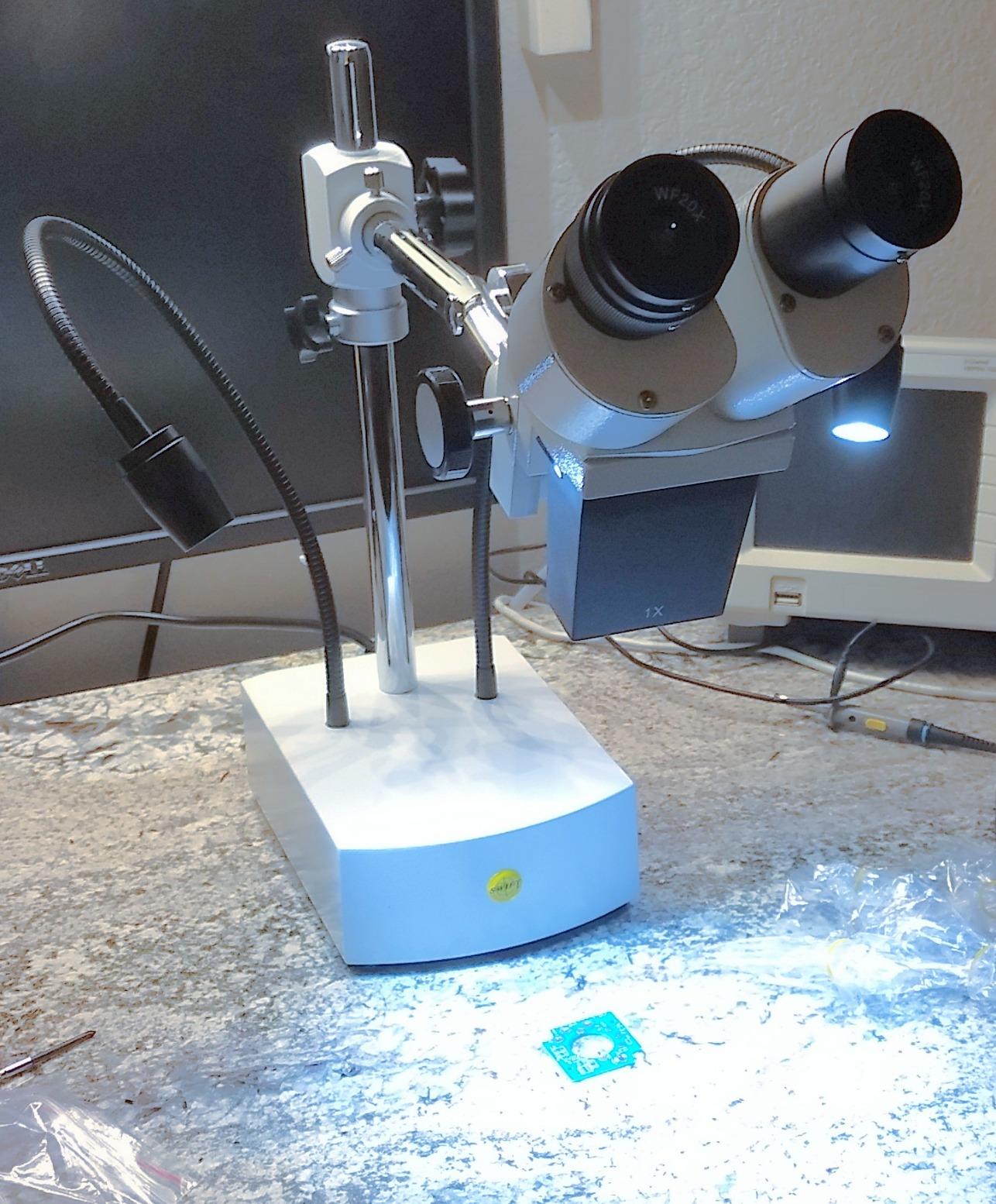
Swift S41-20 Professional Dissecting Binocular Stereo Microscope, WF10x WF20x Eyepieces, 10X 20X Magnification, 1X Objective, LED Lighting, Boom-Arm Stand
10X and 20X with 1X objective
Dual goose-neck LED lights
12 inch swing arm
Compatible with USB cameras
Pros
- Cast optical head and metal base feel industrial
- Dual goose-neck LEDs give targeted directional light
- Roughly nine inches of working distance
- Head rotates on two axes with tool-adjustable focus drag
Cons
- 10X minimum is too strong for fine SMD work
- No intensity adjustment on the LED illuminators
- Only one pair of rubber eye caps supplied
The Swift S41-20 is the scope I would hand someone who is moving from a loupe to a microscope. Buyers use it for surface-mount assembly and microsoldering and report that it performs well for that work. The build is cast optical head on a metal base, and it feels like laboratory equipment rather than a toy, which is exactly the upgrade people notice first.
Lighting is the interesting part. Instead of a ring light, it uses two flexible goose-neck LED illuminators mounted on the base, and they deliver noticeably more usable light than comparable scopes. Because they are directional you can move them around the board to fill in shadows under tall components, which a symmetric ring cannot do. The head sits at an ergonomic 45 degrees and rotates on two axes.
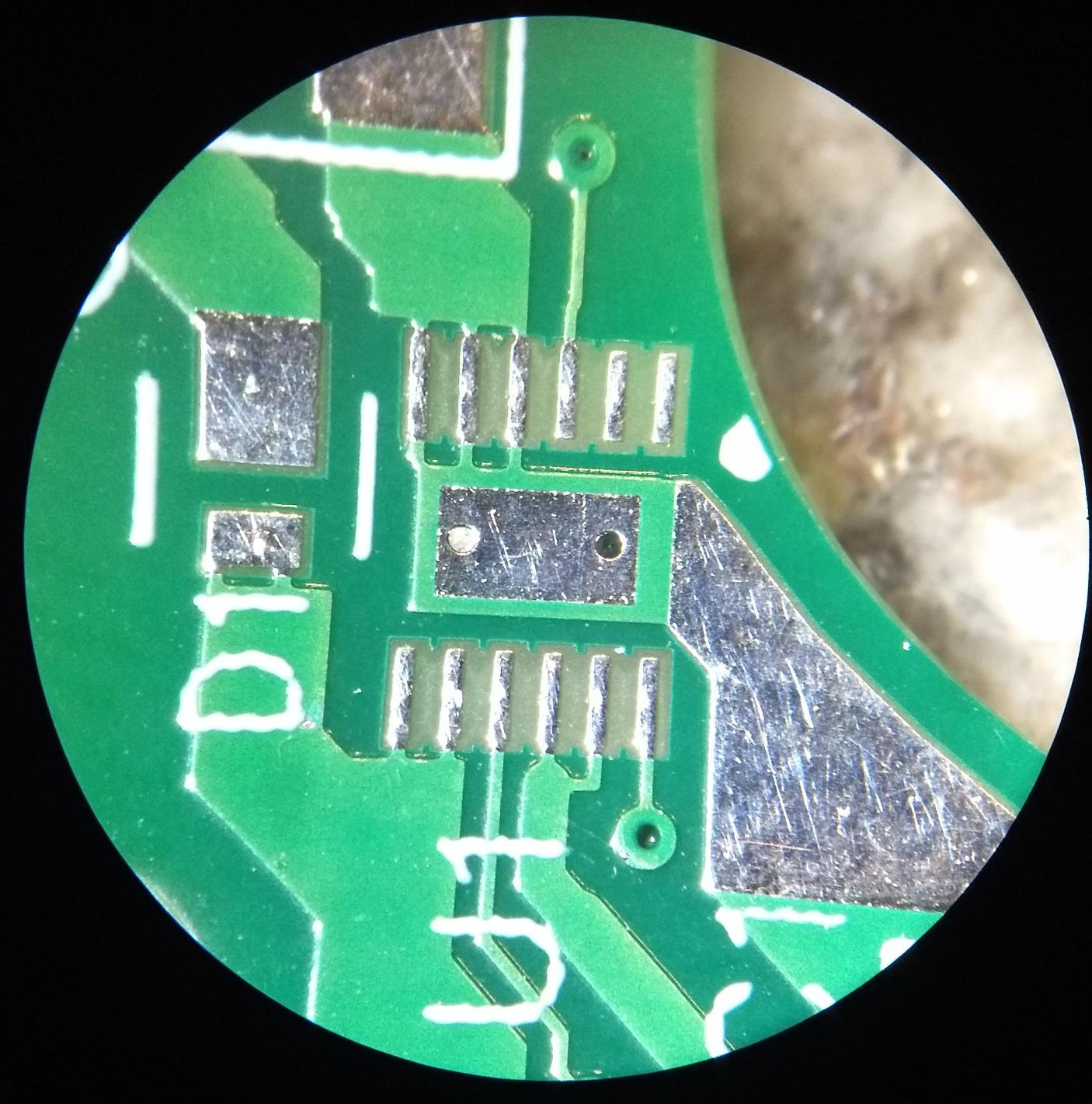
The limitation that comes up most often is the eyepiece pair. It ships with interchangeable WF10x and WF20x eyepieces on a 1X achromatic objective, and owners frequently add 5X eyepieces because 10X is already too strong for fine board work. The field of view at 10X is also limited for small PCB work, and there is no intensity adjustment on either LED, so brightness is fixed.
Two smaller notes. The base is only marginally heavy enough to stop the head tipping when the boom is fully extended, so extend it with care rather than with force. And only one pair of rubber eye caps is supplied, so you have to swap them every time you change eyepieces, which is the kind of small friction that makes a 45 degree head less pleasant over a long session.
What to check before you buy this one
Check whether you need magnification below 10X. At 5.5kg with a 12 inch swinging boom, this sits in a comfortable middle of the market, and the trade is that the lowest useful magnification is high. If your work is 0201 and 0402, plan on sourcing 5X or 6X eyepieces, which is a separate purchase and needs to match the tube diameter.
Check the camera question. The listing states compatibility with digital USB cameras sold separately, and binocular heads like this usually need a c-mount photo tube before any camera will fit at all. Treat the camera as an add-on to budget for rather than something included.
Where it stops being the right choice
It is the wrong pick for very fine work, full stop. There is no zoom objective, so magnification is 10X and 20X only, and there is no true continuous adjustment between them. If you need to scan a large board and then settle on a 0402 pad, you are swapping eyepieces rather than turning a ring.
It is also the wrong pick for hot air rework with a fixed, dimmable light, because neither LED can be dimmed. Bright directional light on a wet joint at 10X is workable, but if you spend hours under flux and want to judge fillet relief, a dimmable ring or coaxial light is the better tool.
5. AmScope SM-4B Binocular Stereo Zoom Microscope – The Heavy-Duty Stand Pick
AmScope SM-4B Binocular Stereo Zoom Microscope, 7X-45X
7X-45X continuous zoom
Double-arm boom with 20 inch arms
10x super widefield eyepieces
45 degree 360 degree rotating head
Pros
- Variable zoom means no eyepiece swapping mid-job
- Noticeably better field of view than fixed 10X/20X scopes
- Heavily steel-constructed stand glides smoothly
- Long working distance suits boards and SMD rework
Cons
- Very heavy at 55 pounds and needs a solid surface
- Pictured ring light and eye guards are not included
- Zoom direction is reversed relative to most scopes
Long-time owners describe this as a step change from a fixed 10X and 20X stereo scope, and the reason is the variable zoom. Turning a ring instead of swapping eyepieces keeps dust out of the internals and means you can move from scanning a whole board down to a single pad without breaking focus. The 0.7X to 4.5X objective gives 7X to 45X continuously.
The stand is the star. It is a double-arm boom with 20 inch arms and a 17 inch pillar, heavily steel-constructed, and reviewers consistently call it stable and smooth-gliding while noting the head swings clear of the work area when not in use. That reach is what makes large-board work comfortable, and long working distance is a listed strength for circuit board and SMD rework.
There is no owner photography on this listing after repeated attempts to match it, so take the build description at face value. What the reviews do establish is consistent: crisp, bright, three-dimensional images, and a head that is comfortable to use once it is positioned.
Now the warnings. At 55 pounds this needs a proper surface, and reviewers are explicit that particleboard tops will not work. The pictured ring light and eye guards are not included. The zoom direction runs opposite to most other scopes, so a minute of unfamiliar adjustment is needed. Some units ship with missing small set screws, and the add-on auxiliary lens thread does not match Meiji and other standards, so you are buying into this brand’s ecosystem.
What to check before you buy this one
Check your bench can take 55 pounds and that the double arm can swing through its full arc without hitting a wall or a light. This is the largest footprint in the roundup and the least forgiving of a small desk. Check also what lighting you currently own, because this scope uses ambient lighting that needs no power, and the ring light in the photographs is an add-on.
Check the auxiliary lens thread if you plan to add a 0.5X or 2X lens later, which for soldering you almost certainly will. The thread does not match other standards, so plan to buy that lens from the same brand. Budget for a ring light with a dimmer at the same time, because ambient light is fine for finding a fault and poor for judging a joint.
Where it stops being the right choice
It is the wrong pick on a rented table, a folding desk or anything with a particleboard top. The weight and the leverage of a 20 inch double arm are a real stability problem on a soft surface, and reviewers who learned this the hard way are the loudest about it.
It is also the wrong pick for filming, being a binocular head with no third port, and the wrong pick if you want a single brand-free accessory ecosystem. Buying the auxiliary lenses from a different brand is where people discover that nothing quite lines up.
6. SWIFT Trinocular Stereo Zoom Microscope 3.5X-90X – The Widest Range
SWIFT Trinocular Stereo Zoom Microscope with 56-Bulb LED Ring Light,3.5X-90X Magnification,WF10X Eyepieces,0.7X-4.5X Zoom Objective, 0.5X 2.0X Additional Objectives,Table Pillar Stand
3.5X-90X total magnification
56-bulb LED ring light
100mm working distance
45 degree trinocular head
Pros
- Widest total range with both 0.5X and 2X auxiliaries in the box
- 56-bulb LED ring gives bright shadow-free light
- 100mm working distance suits electronics
- Relatively light and compact for a trinocular
Cons
- Plain pillar stand offers less reach than a boom arm
- Small owner review base for long-term durability
- Narrower head angle than the usual 45 degree
Most trinocular scopes at this level give you 7X to 45X and then sell you a 0.5X and a 2X lens separately if you want to go wider. This one includes both auxiliaries, which takes the total range to 3.5X through 90X. At the bottom of that range you get a wide, relaxed view of a whole board, and at the top you get enough magnification for fine package inspection without buying anything else.
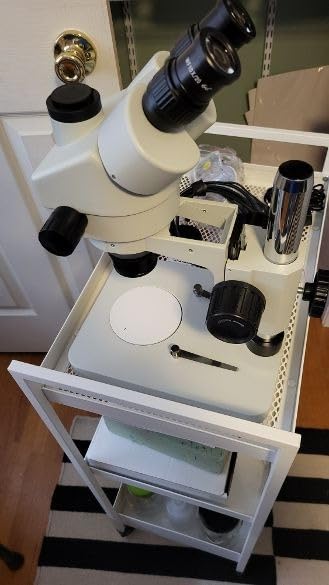
The core is a 0.7X to 4.5X zoom objective with a 6.4 to 1 zoom ratio, giving 7X to 45X, and a 4 inch or 100mm working distance. The 56-bulb LED ring light is bundled and gives shadow-free cool illumination, which is a genuine advantage on shiny solder compared with directional light. The head is a 45 degree inclined trinocular that rotates a full 360 degrees and is described as comfortable for eyeglass wearers.
Where it gives ground is the stand. It is a plain table pillar stand with a sturdy metal base, and a pillar stand simply does not give you the reach of a boom arm. You reposition by sliding the base, which is fine for a coin or a joint and irritating for a laptop motherboard that you want to tilt through a full sweep.
It is also light, at 4.2kg, which is a real advantage if the microscope shares a bench with other work. The trade-off against the AmScope and SWIFT boom models is the same as always: reach and stability in exchange for footprint. At 46 ratings the owner review base is thinner than the AmScope models, so long-term durability claims here rest on the spec sheet rather than on a body of user reports.
What to check before you buy this one
Check how you will use the trinocular port. It is described as usable as an eyepiece or a camera port, and there is no mention of a simul-focal path, so assume the eyepieces go dark when a camera is fitted. If filming is part of your plan, the AmScope SM-4NTP is built for it and this one is not.
Check that 100mm working distance clears your tallest workpiece. It is enough for a soldering iron and tweezers, and tight for a hot air rework wand on a big board, where the DZQ adjustable arm gives far more room. Also confirm the eyepiece tube format before ordering a camera, since the adapter is not listed as included.
Where it stops being the right choice
It is the wrong pick for large boards. A pillar stand on a table is a good partner for connectors, coin-cell work, watch repair and small PCBs, and a poor partner for anything that needs you to move the head without moving the workpiece.
It is also the wrong pick for 0201 work at the top of the range, where 90X through 2X auxiliary gives you magnification you cannot hold steady and a depth of field too shallow to work in. The wide range is a feature for inspection and specimen work more than for the actual act of soldering.
7. ZTEEERS ZS-07050 Trinocular with Boom Stand and 56S Ring Light – The Bundle Pick
ZTEEERS Professional Trinocular Stereo Zoom Microscope, 3.5X-90X Magnification,WF10X Eyepieces, 0.7X-4.5X Zoom,0.5X & 2.0X Auxiliary Lens, Double-Arm Boom Stand, 56S LED Ring Light,Two adapters
3.5X-90X total magnification
56S LED ring light with dimmer
Two camera adapters included
18lb steel base with boom
Pros
- Ring light and both 0.5X and 2X auxiliaries are in the box
- About 20cm of working distance for soldering and tool access
- Per-eye diopter and 48-75mm interpupillary adjustment
- Heavy 18lb steel base and ball-bearing arm stay put
- Two trinocular port adapters supplied
Cons
- Poor instructions so assembly often needs photos
- Very long footprint once assembled
- Very heavy and awkward to move
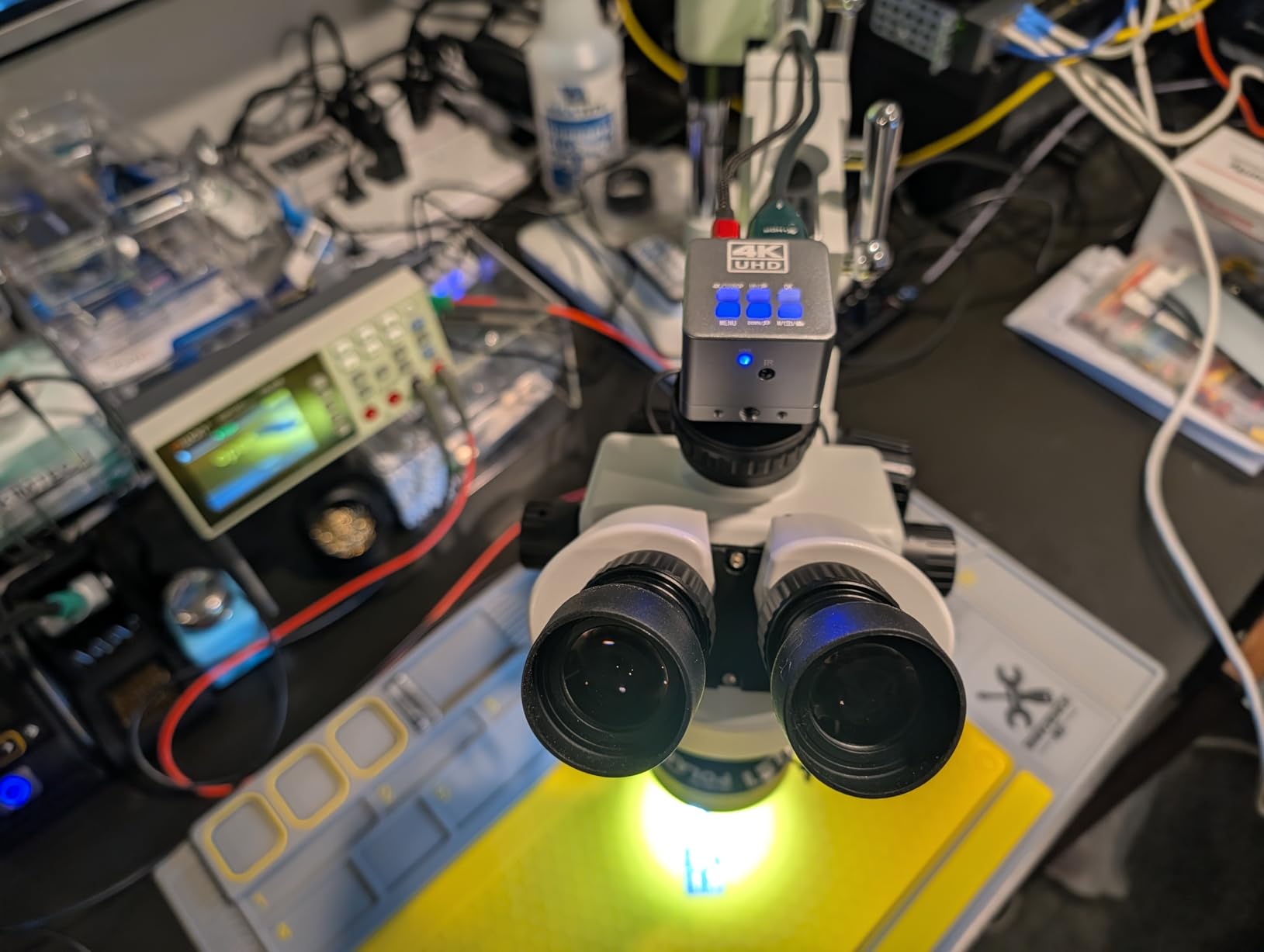
What makes this listing unusual is what arrives in the box. A 56S LED ring light with a dimmer switch, both 0.5X and 2X auxiliary lenses taking the total range to 3.5X through 90X, and two adapters for the trinocular port that accept a digital camera or an electronic eyepiece. On a name-brand equivalent, each of those is a separate purchase, and buyers treat the bundle as the reason to buy.
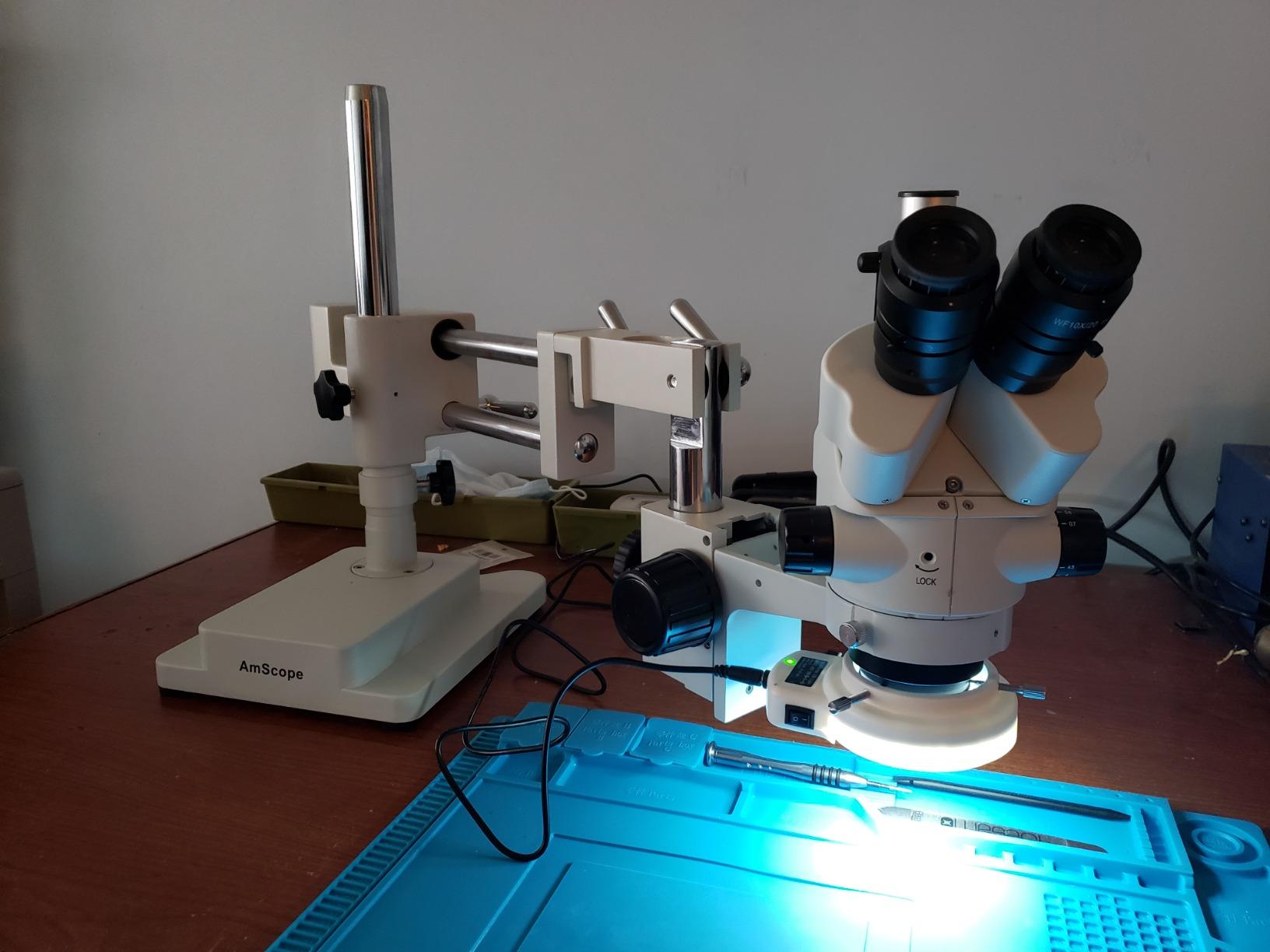
Working distance is around 20cm or 10 inches according to owners, which is enough to solder and get tools underneath. The head gives 48-75mm of interpupillary adjustment and plus or minus 6 diopter per eye, so two different people can share it without readjusting everything. The base is 18lb of solid steel and the single-arm boom runs on a ball-bearing glide that reviewers say holds position.
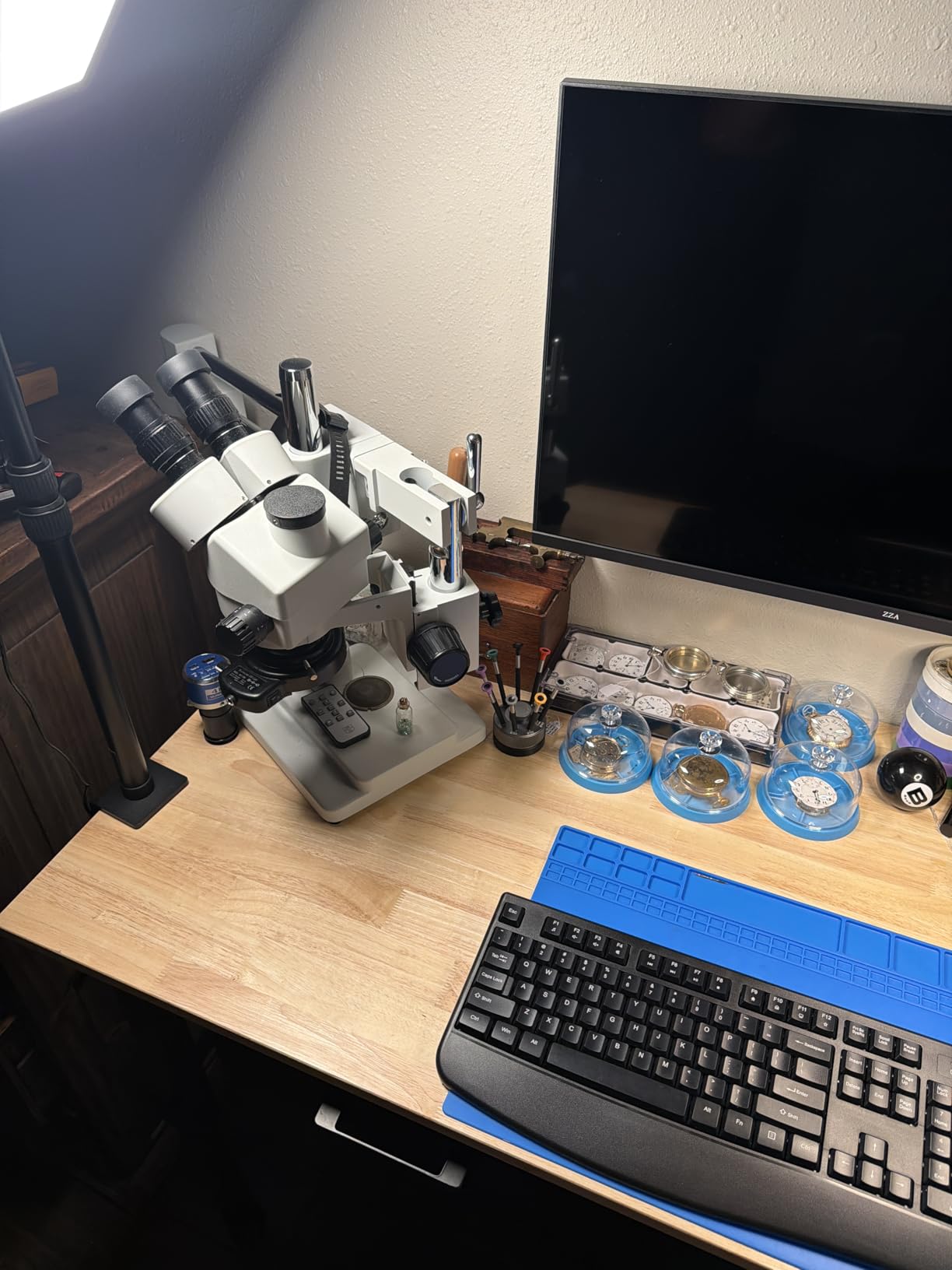
The practical warning is about size. The listed dimensions are 19.5 by 11.5 by 19.5 inches, and some buyers report the assembled unit is around 30 inches long and will not fit a normal desk. That is the single most repeated piece of advice in the reviews: measure your bench, and remember the head needs clearance above as well as footprint below.
Second, the instructions are poor, so assembly often happens by following photographs or videos rather than the manual. Owners also note the workmanship is adequate rather than excellent, and that despite the weight the unit can feel fragile. The warranty is one year, the shortest here, which is a fair proxy for how the manufacturer feels about the build.
What to check before you buy this one
Measure first. Get the assembled length with a tape, not the box dimensions, and check that you can swing the boom through its arc without knocking your soldering station. At 18lb plus a boom, a clamped base or a rolling cart is worth considering if your table is not reinforced.
Check the synchronised observation claim. The listing describes simultaneous observation through both eyes while using a digital camera, which is the simul-focal behaviour, and two adapters are included for the port. Confirm the mount type of whatever camera you already own matches one of the supplied adapters before you commit, because the wrong thread is a dead purchase.
Where it stops being the right choice
It is the wrong pick on a small bench, full stop. The footprint is the most common regret in these reviews and it is not fixable after delivery. If your workspace is a dining table, look at the pillar stand options instead and accept less reach.
It is also the wrong pick if build quality is the priority. A one year warranty, a cast instruction sheet and a hand assembled boom are all reasonable for the money, but if you want the instrument to last a decade the multi-year warranty on the AmScope options is the better signal to buy on.
8. SWIFT S7 7X-45X Trinocular Stereo Microscope – The Filming-Ready Setup
SWIFT S7 7X-45X Trinocular Stereo Microscope with Wide-Field 10X Eyepieces,0.7X-4.5X Zoom Objective Lens, Single-Arm Boom Stand, and 56-Bulb LED Ring Light
7X-45X continuous zoom
56-bulb LED ring light
0.5X C-mount adapter included
Single-arm boom stand
Pros
- Ring light and 0.5X C-mount adapter are in the box
- Continuous 7X-45X zoom with super widefield eyepieces
- Diopter adjustment and 45 degree inclined head
- Single-arm boom swings clear for awkward workpieces
Cons
- Small review base of under 30 ratings
- No 0.5X or 2X auxiliary objectives in the standard kit
- Heavy metal base needs a sturdy surface
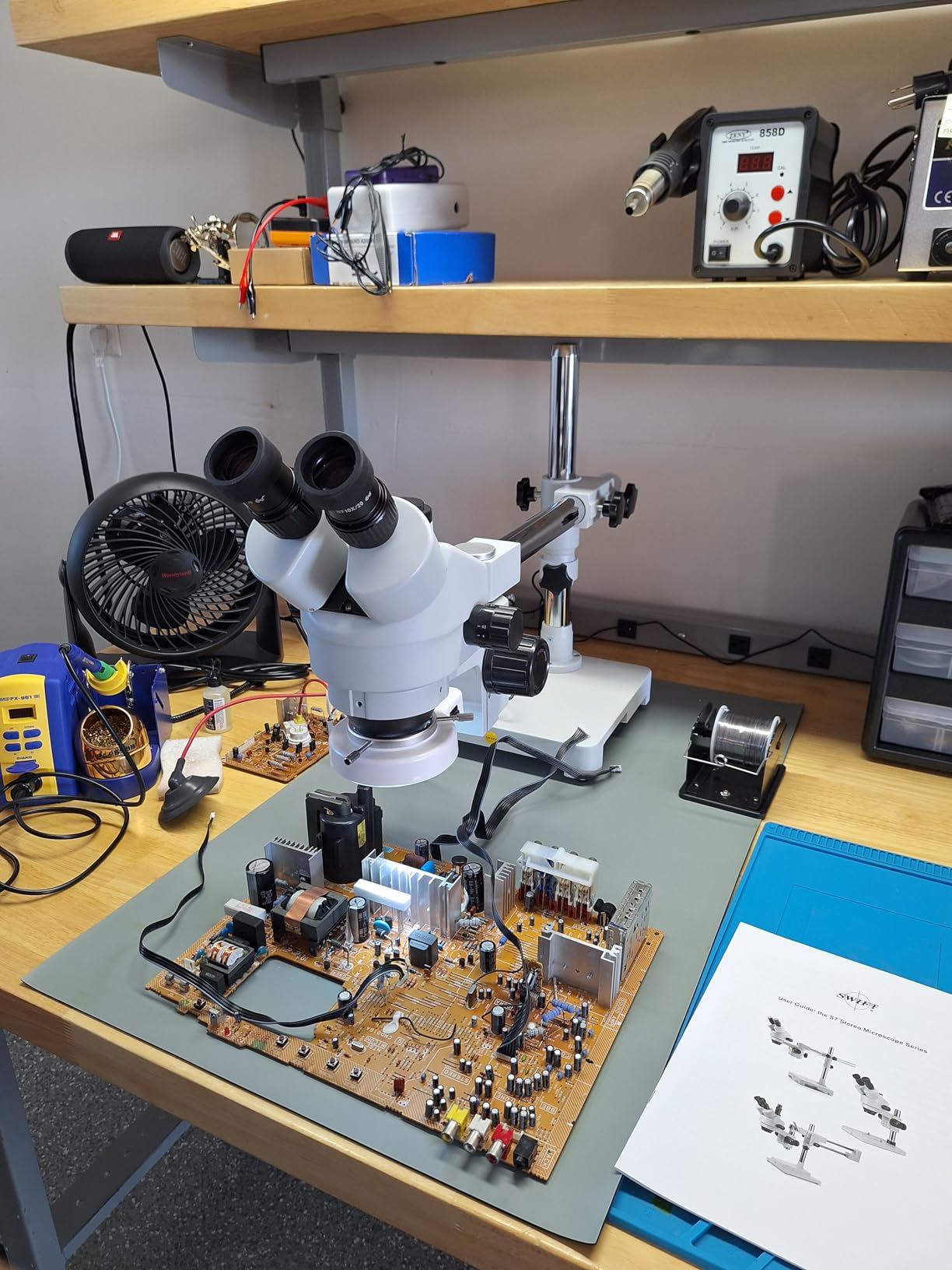
This carries the highest average rating of any scope in the roundup, and the reason is straightforward: the things you would normally have to add are in the box. You get a 56-bulb LED ring light for shadow-free illumination and a 0.5X C-mount adapter to widen the view and drop the magnification, which is exactly the pairing that makes a trinocular head useful for filming.
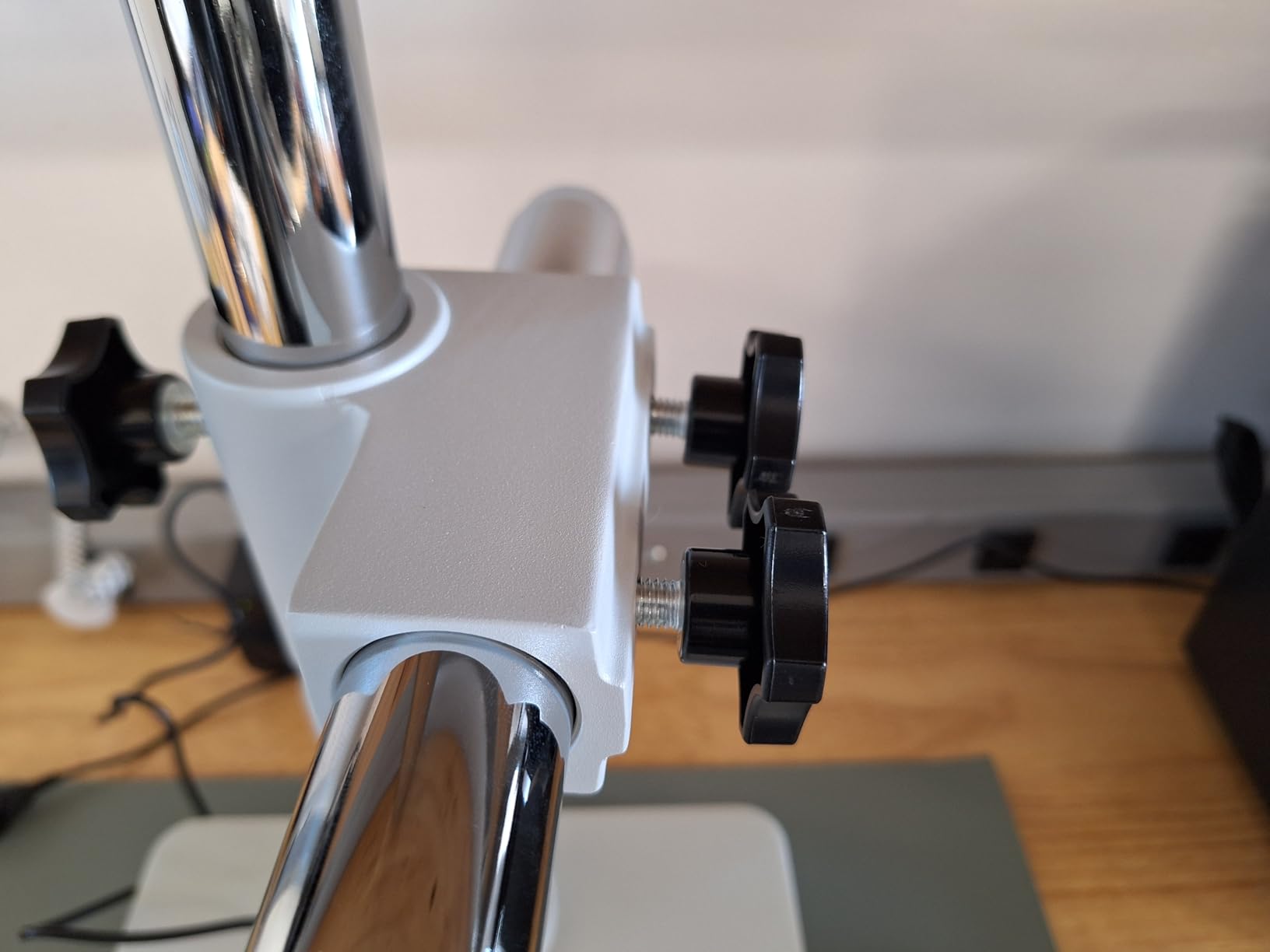
The optics are a 0.7X to 4.5X zoom objective with super widefield 10X eyepieces and diopter adjustment, running 7X to 45X continuously. The trinocular head is tilted 45 degrees with a third port for an additional eyepiece or a camera, and the single-arm boom with a sturdy metal base swings clear when you need access to the workpiece.
Be clear-eyed about the evidence. At 22 ratings this is the smallest review base here by some distance, and a high average on a small base is much less informative than a 4.5 across 319 ratings. Forum advice is consistent that you should not treat the star figure alone as a quality signal in this category, and we agree. What the listing does give you is the most complete box contents per unit of money in this list.
The standard configuration does not include 0.5X or 2X auxiliary objective lenses, so 7X to 45X is the whole range unless you add them. The metal base and boom are heavy at 17.45kg and need a sturdy work surface. The good news is the head angle is 45 degrees, which is the more comfortable posture over a long session.
What to check before you buy this one
Check the camera mount before anything else. The included adapter is a 0.5X C-mount, and C-mount and CS-mount are not the same thread, so if you already own a camera with a CS-mount you need the other one. Confirm your camera’s thread before ordering and you avoid the most common wasted purchase in this category.
Check whether you need magnification outside 7X to 45X. If you want the very wide survey view that a 0.5X auxiliary gives you, the ZTEEERS bundle at a similar specification already includes one, and the SWIFT with the pillar stand takes the range to 3.5X through 90X as well.
Where it stops being the right choice
It is the wrong pick if you want wide survey magnification out of the box, and it is the wrong pick if buying a lightly reviewed instrument makes you uneasy, which is a legitimate position in a category where the cheapest listing is often the least tested.
It is also the wrong pick for very fine package work, because without an auxiliary the 45X ceiling is modest next to what the 3.5X-90X models reach. For soldering that is rarely a problem. For inspecting a die or a fine package under a BGA, it is.
9. AOMEKIE 20X and 50X Stereo Microscope Kit – The Learner Pick
Aomekie® Microscope 20X 50X with 10Pcs Slides Insect Specimen Stereo Microscope with WF eyepieces LED Light Source Portable Stereoscope 12Pcs Mineral specimens
20X and 50X fixed magnification
65-102mm working range
Battery powered LED light
10 slides and specimens included
Pros
- Low cost way to learn basic inspection skills
- Portable and battery powered so it moves between rooms
- Slides plus insect and mineral specimens in the box
- Interpupillary adjustment fits different users
Cons
- Fixed 20X and 50X with no zoom objective
- 65-102mm working distance leaves no room for tools
- No boom stand so it cannot be moved aside
- Not suitable for real electronics repair
I am including this one because it is regularly bought by people who think they want a soldering microscope and then find out what they actually needed was something to check a solder joint on a finished board. For inspection, coin collecting, stamp work, rocks and jewellery, at 872 grams and battery powered, it moves between rooms and costs very little. For putting a joint on, it is the wrong instrument.
Magnification is fixed at 20X and 50X using a 2X objective with WF10X and WF25X eyepieces, so there is no zoom and no continuous adjustment. The working range adjusts between 65mm and 102mm, which is comfortable for looking at something held in a hand and far too tight to bring a soldering iron underneath. The interpupillary range of 55mm to 75mm is a genuine adjustment rather than a fixed setting.
Light comes from a single LED running on two AA batteries, which is not included in the box, and there is no ring, no dimmer and no transmitted option. The kit does include 10 slides along with insect and mineral specimens, which is what makes it a good teaching or starter instrument rather than a work scope. The warranty is two years.
What to check before you buy this one
Check honestly whether you are soldering or inspecting. If you are inspecting finished joints, checking components before they go on a board, or teaching someone what a magnified surface looks like, this does the job for very little money. If you are building a repair bench, the money is better spent on a scope with working distance and a stand that moves.
Check the batteries. Two AA cells are not included, the light source is entirely battery powered, and a dim LED at 50X on a dark board can be disappointing. If you plan to use it at the 50X setting regularly, desk lighting will matter more than anything in the box.
Where it stops being the right choice
It is the wrong pick for any electronics repair work, and owners consistently describe it that way. There is no boom or arm stand, so the scope cannot be moved aside while you work, no zoom objective, and not enough clearance to get a tool into the field. None of those are fixable with accessories.
It is also the wrong pick if you want to film or photograph. There is no third port and no camera path, so documentation means holding a phone against the eyepiece. Add any one of the eight scopes above before you choose this one for a reason other than curiosity.
How to Choose a Stereo Microscope for Soldering
Most wrong purchases in this category come from reading a magnification number first. Magnification is the easiest number to compare and the least important one. Work distance decides whether you can solder at all, the light source decides whether you can judge a joint, and the head type decides whether the instrument still suits you in three years.
Working distance decides whether you can solder at all
Working distance is the gap from the front of the objective to your workpiece, and it is the constraint that will end your session early if you get it wrong. Below roughly 100mm you will be working around the objective rather than through it, and every iron approach becomes a negotiation. For general electronics work, 100mm is the floor and 150mm to 200mm is the comfortable band. Above 200mm you can bring in a hot air wand or hot tweezers alongside the iron without moving anything.
A 0.5X Barlow lens is an auxiliary objective that halves magnification and roughly doubles working distance, and it is close to essential for board work. It turns a 4 inch working distance into 8 inches and drops 7X to 45X into a range where the low end actually suits a whole PCB. It is also the reason to check whether a scope ships with one, because on the name-brand models it is frequently a separate purchase. Two of the scopes here include a 0.5X auxiliary objective in the box.
Hot air and hot tweezers are where working distance stops being comfortable and starts being structural. A rework wand needs clearance above and beside the board, and a scope with 100mm of headroom will have you tilting the workpiece to make room. If your work is rework rather than assembly, buy for clearance first and treat magnification as adjustable.
Magnification by component size, and the optical ceiling
Stereo microscope magnification is optical, and the useful ceiling is far lower than most listings suggest. Most continuous zoom scopes here run 7X to 45X, and 45X is at the top of what a soldering microscope can actually be used at because depth of field collapses and your hands take over. Adding a 2X auxiliary takes the arithmetic to 90X, which is useful for inspection, not for placing a component.
Consumer claims of 1000X or 2000X on digital units are digital interpolation, which means the image is being enlarged in software and no new detail appears. Nothing on this list uses that trick, and that is one of the reasons we kept the roundup optical. If a listing says 1000X and shows a monitor, you are looking at pixels, not optics.
As a working guide, here is how component size maps to magnification. Use it as a starting point and adjust for your eyes and your lighting.
1206 and 0805 pass-shaped components are visible in context at 5X to 10X. 0603 parts need roughly 7X to 15X to place comfortably. 0402 and 0201 components want 15X to 25X, and this is where a 0.5X Barlow starts to earn its place. QFN and SOIC packages with 0.4mm pitch sit in the 20X to 35X band. BGA rework and die inspection want 40X and above, and you will be inspecting there rather than soldering.
The real constraint is depth of field, not magnification. It shrinks as you zoom, so a 0402 part at 25X with poor lighting is harder than the same part at 25X with a dimmable ring. Fix the light before you buy more magnification.
Binocular vs trinocular vs simul-focal
Binocular means two eyepieces. Trinocular adds a third port above the head for a camera or a third eyepiece. Simul-focal means the eyepieces and the third port stay live at the same time. That is the whole distinction, and it is worth knowing because on a standard beam-splitter head the eyepieces go dark the moment a camera is fitted, which is the single most complained-about thing in the forums.
The buying rule in two sentences: if you will ever film, stream or share a repair, buy simul-focal, and check that the listing says so. If you will only ever look through the eyepieces yourself, a binocular head is simpler and cheaper, and the money is better spent on a dimmable light and a wider stand.
Do I need a trinocular to film soldering? No, you can film through a binocular head with a camera on a copy stand, but the framing is awkward and you will spend more time adjusting the camera than working. If filming is a regular part of your workflow rather than an occasional photo, the third port earns its place immediately.
On camera mounts, the two you will meet are C-mount and CS-mount, and they are not interchangeable. Most C-mount cameras have a 1 inch screw thread and most CS-mount cameras use a 0.635 inch thread. Check what the camera you own uses before ordering any scope with a trinocular port, and check whether an adapter is included.
Lighting on shiny solder and why a dimmer matters
Solder is a mirror, and that is the whole lighting problem. A bright symmetric ring light reflects straight back into your eye and flattens the fillet relief that tells you whether a joint has wetted. Directional light from the side gives you a shadow edge you can read, which is why a pair of goose-neck lamps is genuinely useful on a fixed-magnification scope. The best answer is a ring light with a dimmer, because you can dial the reflection down until the relief reappears.
Colour temperature matters less than people expect, but halogen does run hot. Reviewers of halogen-equipped scopes describe the lamp housing as hot enough to burn fingers, and halogen lamps also shift colour with age. LED is cooler, cheaper to leave running and consistent for photography, so a dimmable LED is our default recommendation and a non-dimmable halogen is the one spec we would actively avoid.
Coaxial light, where the illumination arrives along the same axis as your view, is a specialist option for inspecting flat surfaces and solder mask. It gives very little shadow and poor relief on a joint, so it complements a side light rather than replacing one.
Stand type and bench footprint
A pillar stand is a single post with a fixed arm. It is compact, stable and cheap, and you move the whole base to reposition. A single-arm boom gives reach in one plane and folds away when unused, which is the most common choice here. A double-arm boom gives reach in two planes and is what you want for large boards, at the cost of weight and footprint. A counter-balanced boom is a heavier variant that holds position without a locking handle.
Measure before you buy, and measure assembled rather than boxed. The ZTEEERS in this roundup has owners reporting around 30 inches once built, which will not fit a normal desk. As a rule, the reach of the arm and the clearance above it both matter, and a scope that cannot be moved aside when you need the iron is a permanent obstacle on the bench.
For a small dining-table workbench, a pillar stand scope is the right answer, and a clamp mount beats a full base if the table edge will take it. One r/soldering user described fixing CRTs from small to arcade size on a dining-table bench and prioritised small footprint plus a camera port over raw magnification, which is a good summary of what a constrained bench actually needs.
Ergonomics across a three to five hour session
Head angle decides whether you can work for an afternoon. A 45 degree head puts your neck in a neutral position and a 33 degree head makes you lean. Interpupillary adjustment between roughly 48mm and 75mm lets the scope fit different heads, and per-eye diopter adjustment of plus or minus 6 diopter means one person can correct their shortsightedness without changing the focus for everyone else.
Eye cups and a working distance that keeps the objective off your eyelashes both matter more than expected. The 16 ounce AmScope pillar scope has no eye cups, and you will end up cleaning the last optical element more often. If two people share the bench, check that the eyepieces are interchangeable, because a single pair of rubber caps is a small daily friction.
Build a break cadence into the first week. Three to five hours through a stereo eyepiece is real optical strain, and the honest fix is stopping every 40 minutes or so rather than pushing through. A scope that lets you work comfortably at 45 degrees makes those breaks easier to take than one that makes you hunch.
What is not in the box, and what it costs you
This is where expensive surprises come from, so it is worth reading each listing’s package contents rather than trusting the photographs. The AmScope SM-4B does not include the ring light shown in its images or the eye guards. Several scopes are listed without a 0.5X Barlow. The AmScope SM-4NTP is essentially unusable for SMD work without one. And almost every binocular head needs a separate camera adapter before any camera will fit.
A realistic all-in plan for a serious bench is a scope with a boom stand, a 0.5X Barlow, a dimmable LED ring or illuminator, a soldering station and an exhaust fan, an anti-static mat and small parts trays, and a camera if you film. Budget for the accessories as a set rather than discovering them one at a time.
A note for UK and EU readers: forums repeatedly ask about regional pricing, VAT and delivery, and none of that appears in US listings. Check the landed cost including import duty and VAT before assuming a US price transfers, and buy the accessories in the same order as the scope where possible.
Stereo vs digital vs inspection
A stereo optical scope gives you true depth perception with no lag, and it goes dark when you take your eyes off the work. A digital USB microscope puts an image on a screen with no depth cue at all and a small delay, which is why bench technicians mostly reject them for rework. An inspection camera is a fixed-focus tube with a camera, useful for production lines and for checking assemblies, not for hands-on soldering.
Digital scopes earn their place for two things: sharing a view with someone remote, and cheap documentation. If your reason for wanting a camera is filming and teaching, a simul-focal trinocular gives you the image quality and the live eyepiece view at the same time. If your reason is cost, a USB microscope on a copy stand works and costs a fraction, at the price of the depth perception you solder with.
AmScope vs Swift vs the value brands
AmScope is the safest default. It has the largest owner review base, multi-year manufacturer warranties on several models, and a well understood accessory ecosystem, at the cost of buying add-ons separately. If you want one name to trust and do not want to research compatibility, AmScope is the answer.
Swift is the value alternative with a similar feature set. Two of the scopes here bundle a 56-bulb LED ring light and a 0.5X C-mount adapter in the box, which on AmScope equivalents are separate purchases, and one Swift carries the highest average rating in the roundup. The trade is a thinner long-term owner record and, on some models, a shorter warranty.
The value brands bundle hardest. DZQ and ZTEEERS put the ring light, the auxiliaries and sometimes the adapters in the box at a lower entry point, and reviewers use them for real microsoldering. What you give up is assembly polish, written instructions and a long warranty, so measure your bench before you commit to a 30 inch footprint.
Frequently Asked Questions
What is the best type of microscope for soldering?
A binocular optical stereo microscope with continuous zoom, at least 100mm of working distance and cool dimmable LED lighting. It gives you true depth perception with no lag, which is what stops you bridging pads and lifting pads on fine work. Digital USB microscopes show you a flat image with a small delay and are not a substitute for bench soldering.
What magnification is good for soldering?
For most electronics work, 7X to 45X continuous optical zoom is the useful range, with a 0.5X Barlow lens to drop the bottom end for whole-board views. 0603 parts work at 7X to 15X, 0402 and 0201 parts at 15X to 25X, 0.4mm pitch QFN at 20X to 35X, and BGA and die inspection above 40X. Depth of field, not magnification, is usually the real limit.
How much working distance do I need for soldering?
Treat 100mm as the floor and 150mm to 200mm as the comfortable band for general electronics work. Go above 200mm if you use hot air rework or hot tweezers, because you need clearance for the wand and the iron at the same time. A 0.5X Barlow roughly doubles working distance and is close to essential on a board-level bench.
What is a simul-focal microscope and do I need one?
Simul-focal means the trinocular port and both eyepieces stay live at the same time, so you can film, stream or share while still working through the eyepieces. On a standard trinocular head the eyepieces go dark when a camera is attached. Buy simul-focal if you will ever film or share a repair, and check the listing says simul-focal or synchronous rather than just trinocular.
Is Swift or AmScope better for soldering?
AmScope is the safer default, with the largest owner review base and multi-year warranties on several models, but accessories are often sold separately. Swift bundles more into the box, including ring lights and C-mount adapters on some models, at the cost of a thinner long-term record. Either brand is fine; the deciding question is whether you want to add accessories yourself or have them included.
What is the difference between stereo and digital microscopes for electronics work?
A stereo microscope sends light through a shared objective into two optical paths, so you see a true three-dimensional image with no delay. A digital microscope puts a single flat image on a screen, with a small amount of delay and no depth cue, which is why bench technicians reject them for rework. Digital units are useful for sharing and cheap documentation, not for placing components.
Final Verdict
The AmScope SE306R-PZ is the best stereo microscope for soldering in 2026 for most people. It has the largest owner record of anything here, a five year warranty, a metal stand that does not move, and switchable incident and transmitted lighting. The only compromise is stepped magnification, and for through-hole and 0603 work that costs you nothing.
Buy the AmScope SM-4NTP instead if you film or share your work, and add a 0.5X Barlow lens in the same order. Buy the DZQ ZQ-1 if working distance and a dimmable ring light matter more to you than a camera port, since its 95mm to 300mm adjustment is the most generous here. Buy the ZTEEERS ZS-07050 if you would rather have the ring light, both auxiliaries and the camera adapters in the box than pay for them later, and measure your bench first.
For a small table, the SWIFT trinocular with the 100mm working distance and 56-bulb ring keeps the footprint down, and the Swift S41-20 remains a reasonable first microscope for through-hole and basic surface-mount work. Whatever you choose, buy a dimmable LED light, a 0.5X auxiliary if it is not included, and plan your break cadence before you plan your camera.