The Moon is the one object in the night sky that punishes a bad telescope immediately and rewards a good one on the very first night. Point a wide-field astrograph at it and you get a bright disc with soft, washed-out edges. Point a long, slow achromatic refractor at it and you get a hard-edged terminator, crater chains you can name, and a mare that shows its own texture.
That difference is the entire reason this roundup exists. Of the best refractor telescopes for moon viewing, almost none are designed for the Moon specifically, so I graded all eight in this list against a single question: what does the lunar surface actually look like through it at a magnification you would realistically use? Last reviewed in October 2026.
Everything here is a sealed-tube refractor, so nothing ever needs collimating, and every one of them has an alt-azimuth mount. I compared aperture, focal length, focal ratio, included eyepieces, actual magnification range, and assembled weight, then read the owner reviews closely to find what breaks and what disappoints. On the forums at r/telescopes the same advice repeats constantly: buy the largest aperture you can carry, keep the tube long, and spend what is left on eyepieces.
Table of Contents
- Top 3 Refractor Telescopes for Moon Viewing in 2026
- Every Refractor in This Roundup at a Glance in 2026
- How Strong a Telescope Do You Need to See the Moon?
- 1. UncleHu 80mm 600mm Refractor – Editor’s Choice for Moon Viewing
- 2. Celestron AstroMaster 70AZ – Best Value for a Colour-Free Lunar Limb
- 3. Celestron Travel Scope 80mm – Best for Everyday Grab-and-Go
- 4. Gskyer 70mm AZ Refractor – Best for Kids and First-Time Buyers
- 5. Koolpte 80mm Refractor – Best for Carrying to Dark Sites
- 6. CELTICBIRD 80mm Refractor – Best with a Moon Filter Included
- 7. Celestron Travel Scope 70mm – Best for Backpack Travel
- 8. MEEZAA 80mm Refractor Kit – Budget Pick
- Achromatic vs Apochromatic: Chromatic Aberration on the Lunar Limb
- Refractor vs Reflector vs Maksutov for Moon Viewing
- Refractor Buying Guide: Aperture, Focal Ratio, Mount and Eyepieces
- Frequently Asked Questions
- What telescope is best for viewing the Moon?
- How strong of a telescope do you need to see the Moon?
- Is 70mm enough to see the Moon?
- Which is better, a reflector or refractor telescope for the Moon?
- Do refractor telescopes need collimation?
- What is the best refractor telescope for viewing planets?
- Can you see galaxies with a refractor telescope?
- Conclusion: The Best Refractor Telescopes for Moon Viewing in 2026
Top 3 Refractor Telescopes for Moon Viewing in 2026

UncleHu 80mm 600mm Refractor
- 80mm aperture
- 600mm f/7.5
- 23mm 10mm 4mm eyepieces
- 3x Barlow
- 45 degree zenith mirror
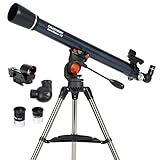
Celestron AstroMaster 70AZ
- 70mm aperture
- 900mm f/12.9
- 20mm and 10mm eyepieces
- StarPointer red dot finder
- 10.8 pounds

Celestron Travel Scope 80mm
- 80mm aperture
- 457mm f/5.7
- 20mm and 10mm eyepieces
- 4.5 pounds
- backpack kit
Those three cover the most common reader. The UncleHu pairs the largest aperture in the group with the richest eyepiece kit, the AstroMaster wins on optical discipline with its very slow 900mm tube, and the Celestron Travel Scope 80mm is the one you will keep by the back door because it weighs 4.5 pounds.
Every Refractor in This Roundup at a Glance in 2026
| Product | Specs | Action |
|---|---|---|
| UncleHu 80mm 600mm Refractor |
|
Check Latest Price |
| Celestron AstroMaster 70AZ |
|
Check Latest Price |
| Celestron Travel Scope 80mm |
|
Check Latest Price |
 Gskyer 70mm AZ Refractor Gskyer 70mm AZ Refractor |
|
Check Latest Price |
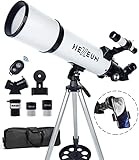 Koolpte 80mm Refractor Koolpte 80mm Refractor |
|
Check Latest Price |
 CELTICBIRD 80mm with Moon Filter CELTICBIRD 80mm with Moon Filter |
|
Check Latest Price |
 Celestron Travel Scope 70mm Celestron Travel Scope 70mm |
|
Check Latest Price |
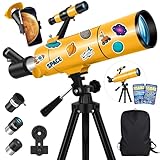 MEEZAA 80mm Refractor Kit MEEZAA 80mm Refractor Kit |
|
Check Latest Price |
How Strong a Telescope Do You Need to See the Moon?
You need 70mm of aperture to see craters, and 80mm to see them well. Below 70mm the Moon is a bright disc with a few large marks. At 70mm the terminator shadow line appears and the largest craters start to hold shape. At 80mm crater rims, central peaks and the ridge lines along the maria become steady, not fleeting. Everything in this roundup sits at one of those two aperture numbers, and none of these eight reaches 90mm, so the honest ceiling here is bright, cratered first and third-quarter lunar phases rather than fine planetary detail.
Aperture is the diameter of the objective lens, and it is the only number that decides how much lunar surface you can resolve. Light gathering scales to the square of the diameter, so an 80mm lens collects roughly 30% more light than a 70mm lens and, more importantly, has 30% more diameter to work with. Diameter is what splits craters apart. Brightness alone only makes the picture brighter.
Magnification is the number retail listings shout about, and it is the number that misleads people most. The working rule astronomers use is roughly 2x magnification per millimetre of aperture as the ceiling of useful power. On a 70mm scope that is about 140x. On an 80mm scope, about 160x. Push past that and the exit pupil gets too small, the image darkens, and the detail you were promised never appears. A 4mm eyepiece on a 600mm telescope gives you 150x, which is fine. Pair that same 4mm with the bundled 3x Barlow and you are at 450x on an 80mm scope, which is roughly three times beyond what the glass can deliver. Forum regulars on Cloudy Nights make the same point constantly: buy the glass first, then the eyepieces.
So here is what each aperture tier actually buys you on the Moon.
70mm: roughly 140x maximum useful power. Large craters near the centre of the disc, the obvious maria, and a clean terminator. Copernicus and Tycho read as grey smudges rather than structures with rims.
80mm: roughly 160x maximum useful power. Crater rims sharpen, smaller craters along the terminator begin to hold, and shadow detail inside the largest craters becomes visible. This is the floor at which the Moon stops looking like a sticker.
90mm to 102mm: the step most observers describe as the biggest single upgrade. Central peaks, rilles and the texture inside the maria appear. None of the scopes here reach this tier, which is the main limitation of this roundup.
120mm and above: Cassini, the Aristarchus coastline and hundreds of small craters. Diminished returns set in quickly for a visual observer, and the tubes get long and awkward to point.
One more lunar-specific point before the reviews. The best time to look is not full Moon, when the surface is flatly lit and boring. Look two or three days after first quarter, when the terminator cuts across the disc and every crater near that line throws a long shadow. Shadow is what makes relief visible. A 70mm scope shows you that line clearly. An 80mm scope shows you the individual craterlets inside it.
Cool-down time matters on the Moon. A tube that has been in a warm house can stream images for a while as the glass and the air inside it settle. Refractors are less affected than reflectors because there is no mirror to flex, but give a long tube a few minutes before you judge the view.
1. UncleHu 80mm 600mm Refractor – Editor’s Choice for Moon Viewing
UncleHu 80mm Aperture, 600mm Refractor Travel Telescope for Adults and Kids
80mm aperture
600mm focal length, f/7.5
23mm, 10mm and 4mm eyepieces plus 3x Barlow
45 degree zenith mirror
Pros
- Largest aperture in the group
- 80mm/on a 600mm f/7.5 tube
- Three eyepieces plus 3x Barlow give a wide usable range
- Fully multi-coated optics keep the Moon bright and contrasty
- Zenith mirror makes overhead viewing comfortable
- Tripod adjusts 22 to 49 inches and moves 360 degrees
Cons
- 23mm eyepiece gives weak low power
- Small pan handle is awkward with short eyepieces
- Heavier build than comparable Celestron travel scopes
- Smartphone adapter produces poor quality photos
This is the scope I keep coming back to for the Moon, and the reason is the 600mm focal length paired with an 80mm aperture. That combination lands at f/7.5, which is slow enough that colour fringing on the lunar limb stays subtle. You are not fighting a purple halo around bright crater rims at high power, which is the single most common complaint owners have about fast budget achromats.
The eyepiece kit is the best in the roundup and it is not close. You get 23mm, 10mm and 4mm eyepieces plus a 3x Barlow, so on a 600mm tube that works out to 26x, 60x and 150x bare, and 78x, 180x and 450x with the Barlow. The 60x view is where the terminator detail sings on a first-quarter Moon. The 150x view is right at the useful ceiling for 80mm of glass and looks like it. The 450x view is a toy, and you should not expect anything from it.
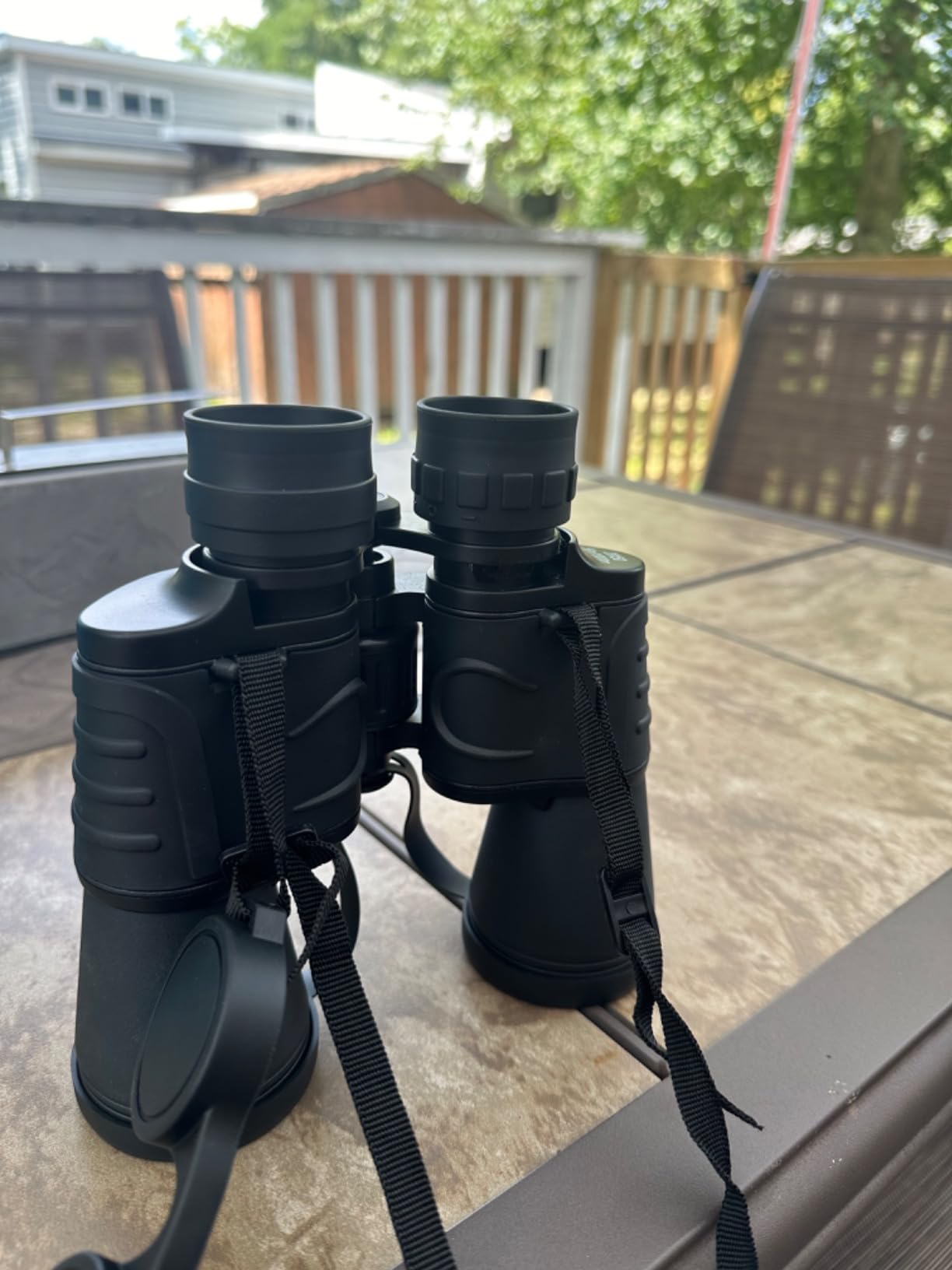
The 10mm eyepiece is where it earns its rating. Multi-coating on a bright target like the Moon lifts contrast, so the shadowed crater interiors near the terminator stay visible instead of washing into the surrounding highland.
The build is heavier than you would expect at this tier. Several reviewers note that it feels chunkier and more solidly made than the comparably sized Celestron travel scopes, which is a good thing for stability but a real consideration if you plan to carry it to a field. The tripod is a light aluminium type that adjusts from 22 to 49 inches with 360 degrees of horizontal and 180 degrees of vertical movement, so a child and a tall adult can both use it comfortably.
Why it wins on the Moon
Two numbers decide this. The 80mm aperture is the largest in the group, which means the most resolving power, and the f/7.5 focal ratio keeps an achromatic doublet essentially colour-free for visual lunar work. The rule of thumb among experienced observers is that an achromatic at f/8 or longer looks clean, and this is the closest any scope here gets to that line while still carrying a usable eyepiece kit.
The 45 degree zenith mirror is an underrated lunar feature. The Moon spends a good part of every month high in the sky, and a diagonal lets you look at it from directly underneath your tripod instead of contorting. On a long evening working overhead, that matters.
Where it falls short
The 23mm eyepiece is a genuine weak point. On a 600mm tube it delivers only 26x, which puts the entire Moon inside a 5.8 degree field and looks like a postage stamp. Most owners stop using it once they realise the 10mm is far more useful. The small pan handle is also fiddly with short focal length eyepieces, where fine pointing becomes the limiting factor rather than the optics. The smartphone adapter is a rough alignment aid rather than a camera adapter, so if the Moon matters to you, put the effort into a steady tripod and a clear night instead.
2. Celestron AstroMaster 70AZ – Best Value for a Colour-Free Lunar Limb
Celestron AstroMaster 70AZ Refractor Telescope for Moon & Planet Viewing
70mm fully coated achromatic
900mm focal length, f/12.9
20mm and 10mm eyepieces, 45x and 90x
StarPointer red dot finder, 10.8 pounds
Pros
- 900mm tube is the slowest here
- so the least colour fringing on the lunar limb
- Highest practical magnification in the group at 90x from the 10mm eyepiece
- Red dot finder makes centring fast and intuitive
- Two-year US warranty with unlimited support
- Built from 1960 and still made to the same simple standard
Cons
- Heaviest stated weight here at 10.8 pounds
- No Barlow included
- so power stops at 45x with the 20mm
- Alt-azimuth needs continual manual re-aiming as the Moon drifts
This is the scope I recommend if colour fringing on the lunar limb bothers you more than aperture does. A 70mm objective on a 900mm focal length works out to f/12.9, and that is about as slow as a consumer refractor gets. At that focal ratio a standard achromatic doublet brings red and blue light to nearly the same focus, so bright crater rims on a gibbous Moon show a clean white edge instead of a purple fringe.
The magnification maths also favours it. The 900mm tube gives 45x with the 20mm eyepiece and 90x with the 10mm, and the useful ceiling for 70mm of aperture is around 140x. So both included eyepieces sit comfortably inside the budget, and the 90x view is the highest genuinely useful magnification any scope in this roundup delivers out of the box. That is the view where the terminator shows individual craterlets and Tycho’s ray system starts to break up.
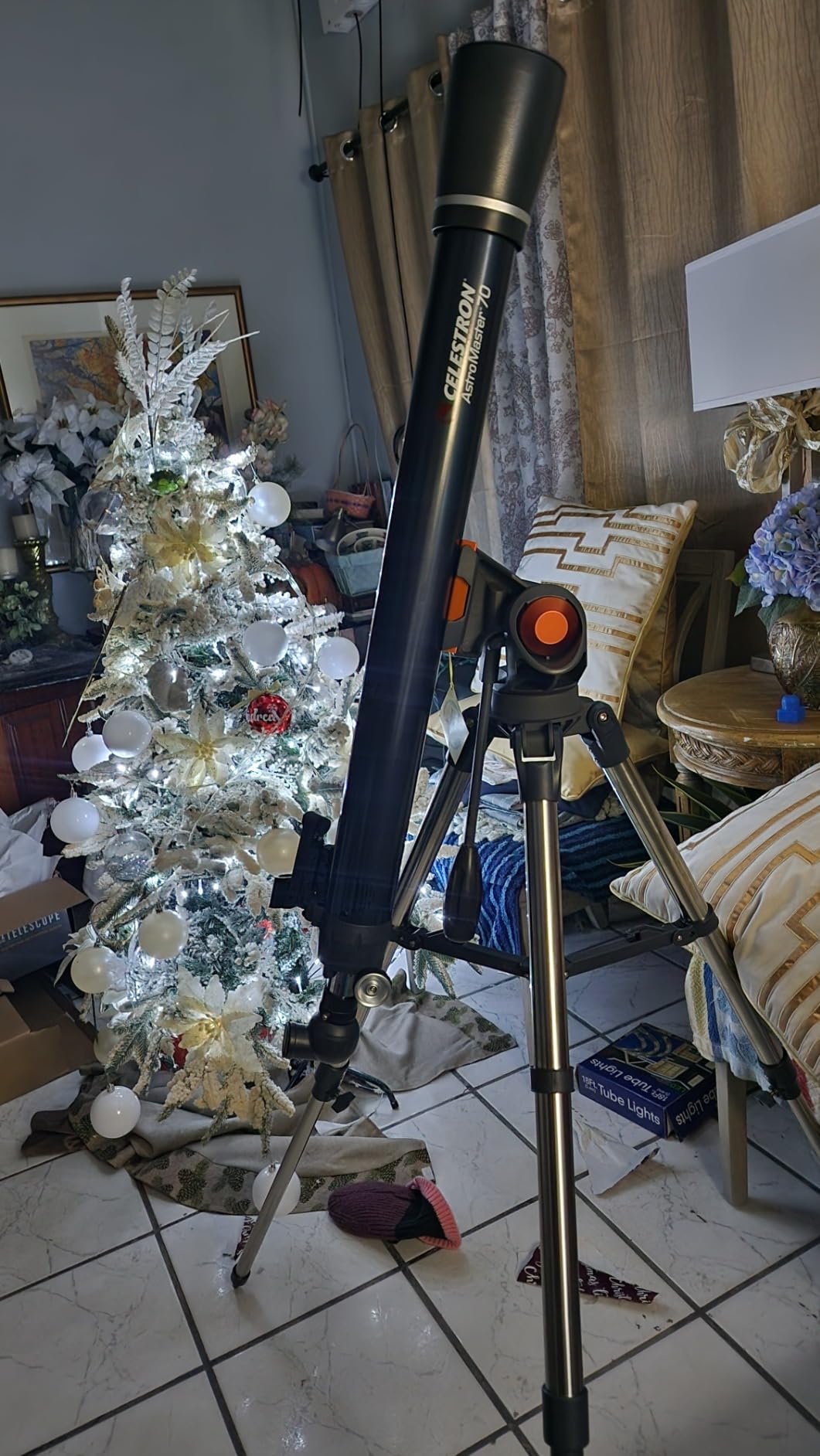
Reviewers repeatedly point to the StarPointer red dot finder as the reason this scope works on a first night. A red dot finder shows a red circle on the sky with no magnification, which means you can line the Moon up in the finder almost as easily as finding it with bare eyes, and a short refractor is easy to keep centred once you have it.
The 900mm tube is 68.5 centimeters long, and that length is the honest drawback. It is not a grab-and-go instrument. When the Moon is high, a 90 degree erect image diagonal is not optional, and pointing the tube at the zenith means working around the tripod legs.
What you give up for that clean limb
You give up 10mm of aperture, and aperture is what resolves craters. On a first-quarter Moon at 90x, the AstroMaster shows you fewer craters with hard edges than the 80mm scopes here will at 60x. The trade is depth versus width: the 80mm scopes show more surface, this one shows cleaner surface on what it does show.
There is no Barlow in the box, so you cannot step up to 180x without buying one. For the Moon that is not a big loss, because 90x is already close to where extra power stops paying off on 70mm of glass. A cheap 2x Barlow plus a decent 8mm eyepiece would be the single most useful addition.
Who should skip it
Skip it if you want to carry the telescope to dark sky sites. At 10.8 pounds it is the heaviest option in the list, and a 68.5 centimeter tube needs a stable tripod, which pushes the total further. Anyone buying for a child who will drag the telescope across a lawn should pick something lighter and shorter.
The manual alt-azimuth mount also needs constant re-aiming. The Moon drifts noticeably in a 30 minute session, so expect to be adjusting the pan handle regularly. That is normal for this design and is fine for visual work, but it is annoying if you want to sit and watch for a long time.
3. Celestron Travel Scope 80mm – Best for Everyday Grab-and-Go
Celestron Travel Scope 80mm Telescope Kit with Backpack, Smartphone Adapter
80mm fully coated objective
457mm focal length, f/5.7
20mm and 10mm eyepieces, 23x and 46x
Weighs 4.5 pounds, packs into a padded backpack
Pros
- 80mm aperture gives the biggest light grasp in a grab-and-go package
- Only 4.5 pounds
- so it genuinely moves between rooms and fields
- Padded backpack holds the tube
- tripod and accessories
- No-tool setup and a free planetarium app for finding targets
Cons
- 457mm focal length limits you to 46x with the supplied eyepieces
- No Barlow lens in the bundle
- f/5.7 focal ratio shows some colour fringing at high power
- Basic tripod is not especially steady at high power
This is the scope you buy when the deciding question is not how much detail you can squeeze out, but whether you will actually go outside. At 4.5 pounds with everything in a padded backpack, it is the easiest instrument here to carry out to a field, a balcony or a friend’s house, and the 80mm aperture means it still shows a properly cratered Moon.
The catch is the 457mm focal length. It gives you 23x with the 20mm eyepiece and 46x with the 10mm. The Moon at 46x is roughly half the height of the field in a 50 degree eyepiece, which is a comfortable view, but it is nowhere near the 90x the AstroMaster reaches. The 80mm aperture is doing work here that the short tube does not let you cash in.
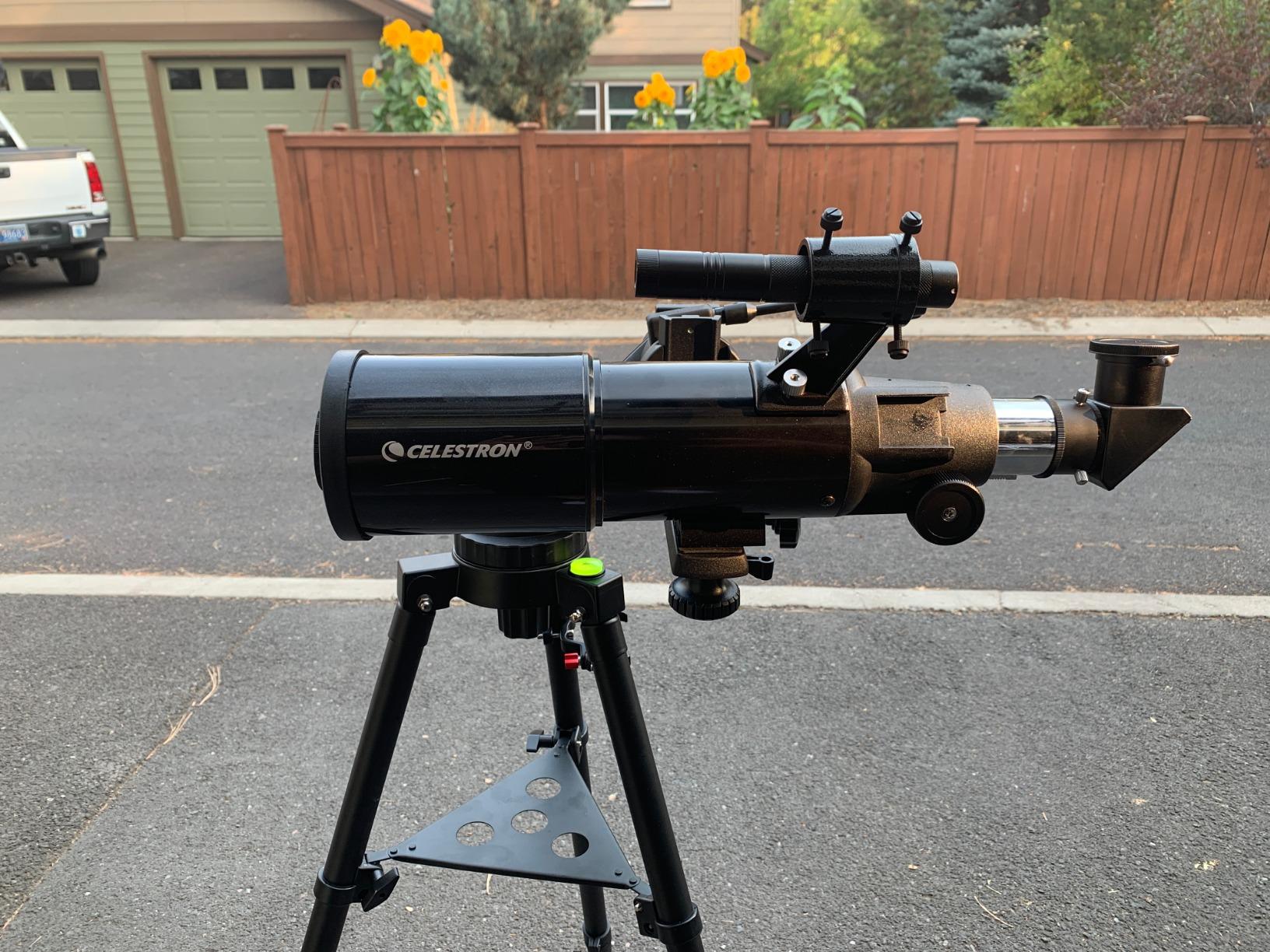
Owners value the step up in light over the smaller travel scope, and they are right that it matters. The 5×24 finderscope is a conventional optical finder rather than a red dot unit, so you get an inverted, upright view, which takes a little practice but makes precise centring easier once you have it.
Owners and reviewers both note the accessory bundle is thin. There is no Barlow, and the two eyepieces are simple Plossl designs. A 6mm or 8mm Plossl added later roughly doubles your top magnification, and a 2x Barlow doubles it again, which is where the missing focal length starts to matter less.
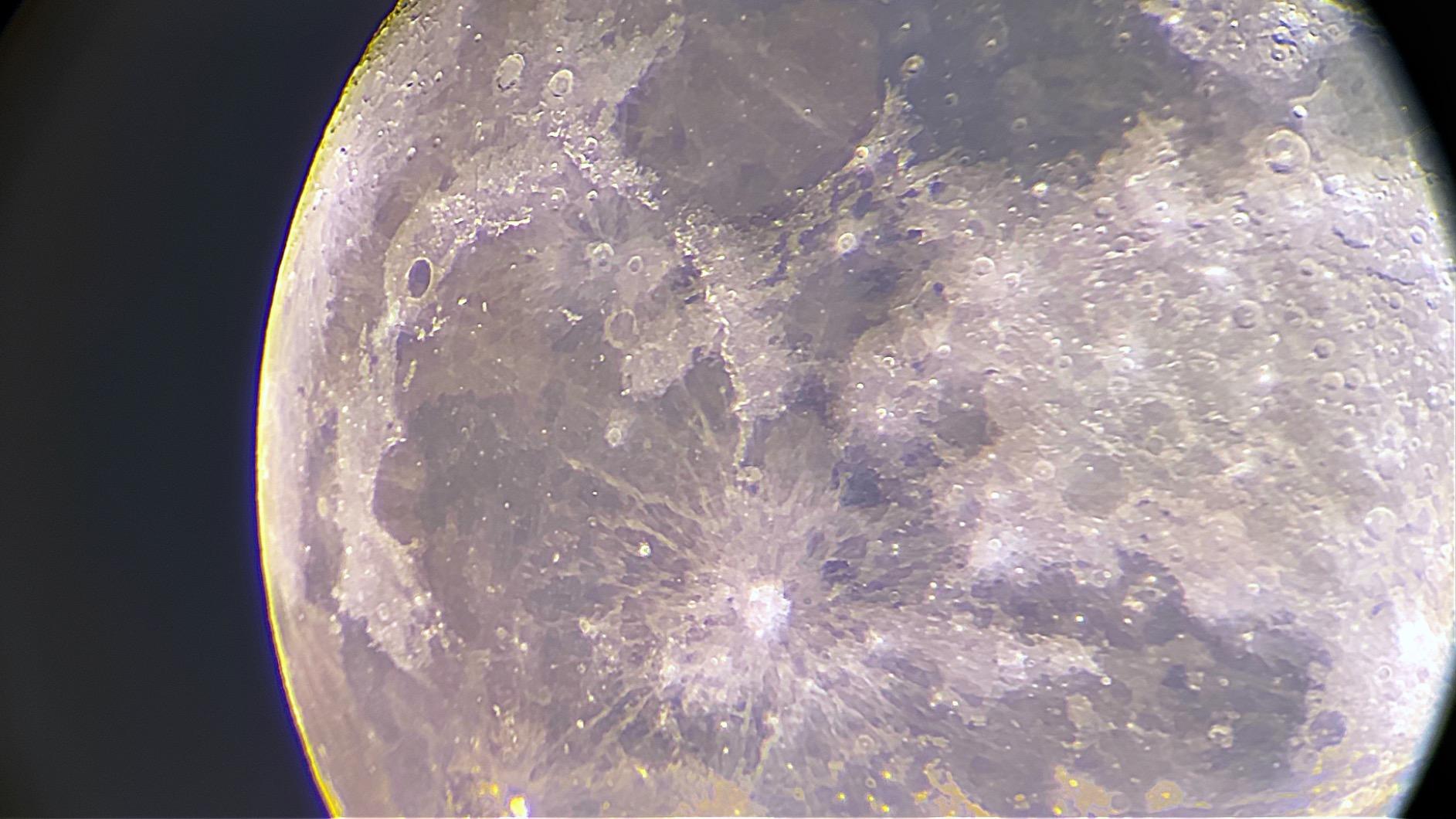
Why it suits a family setup
It is designed to be handed around. The tube and tripod both fit in the backpack, the setup needs no tools, and the included free software helps a beginner identify what is in the eyepiece instead of guessing. For a child aged eight or so, being able to carry their own telescope outside matters more than the last bit of magnification.
The Moon is the ideal first target here because it is bright enough that even a fast f/5.7 doublet gives a good image at low power, and that is enough to keep most first-time observers interested for months.
Where it stops
The f/5.7 focal ratio is where the compromises show. Fast achromats cannot fully correct colour, and on a bright Moon at high power the crater rims start to show a faint blue and yellow edge. At 46x, which is all the supplied eyepieces can reach, it is barely noticeable. Push to 90x with an added eyepiece and it becomes obvious.
The tripod is functional but not stable at high power, and there is no tracking, so targets drift out of the eyepiece within a few minutes. Treat this as a wide-to-medium power lunar instrument rather than a planetary one, and it will not disappoint you.
4. Gskyer 70mm AZ Refractor – Best for Kids and First-Time Buyers
Gskyer Telescope, 70mm Aperture 400mm AZ Mount Astronomical Refracting Telescope for Kids Beginners – Travel Telescope with Carry Bag, Phone Adapter and Wireless Remote.
70mm aperture
400mm focal length, f/5.7
Fully coated glass, 5x24 reflex finder
Tube and tripod both fit the carry bag
Pros
- Most reviewed scope in the roundup
- with more than 22000 ratings
- 70mm aperture gives a crisp bright Moon out of the box
- No-tool setup and the whole kit fits one carry bag
- Wireless camera remote lets you adjust without shaking the view
Cons
- 400mm focal length is the shortest here
- so the lowest power ceiling
- Manual alt-azimuth means constant re-aiming as the Moon moves
- Included eyepieces and Barlow are basic
- A fast f/5.7 doublet shows colour fringing at high power
More than 22,000 ratings tells you something important about a beginner telescope: this is a format that gets bought, used and discussed constantly, mostly by families. The 70mm aperture with fully coated glass produces a bright, sharp lunar image, and the whole tube and tripod fit into the included carry bag, which is the feature that decides whether it gets used at all.
What you are giving up is focal length. At 400mm the 70mm aperture works out to f/5.7, the fastest ratio in this roundup, and that is where the trade-off bites. Magnification is limited, the image is small in the eyepiece at any sensible power, and colour correction is among the weakest here because a fast doublet has no way to bring three wavelengths to a common focus.
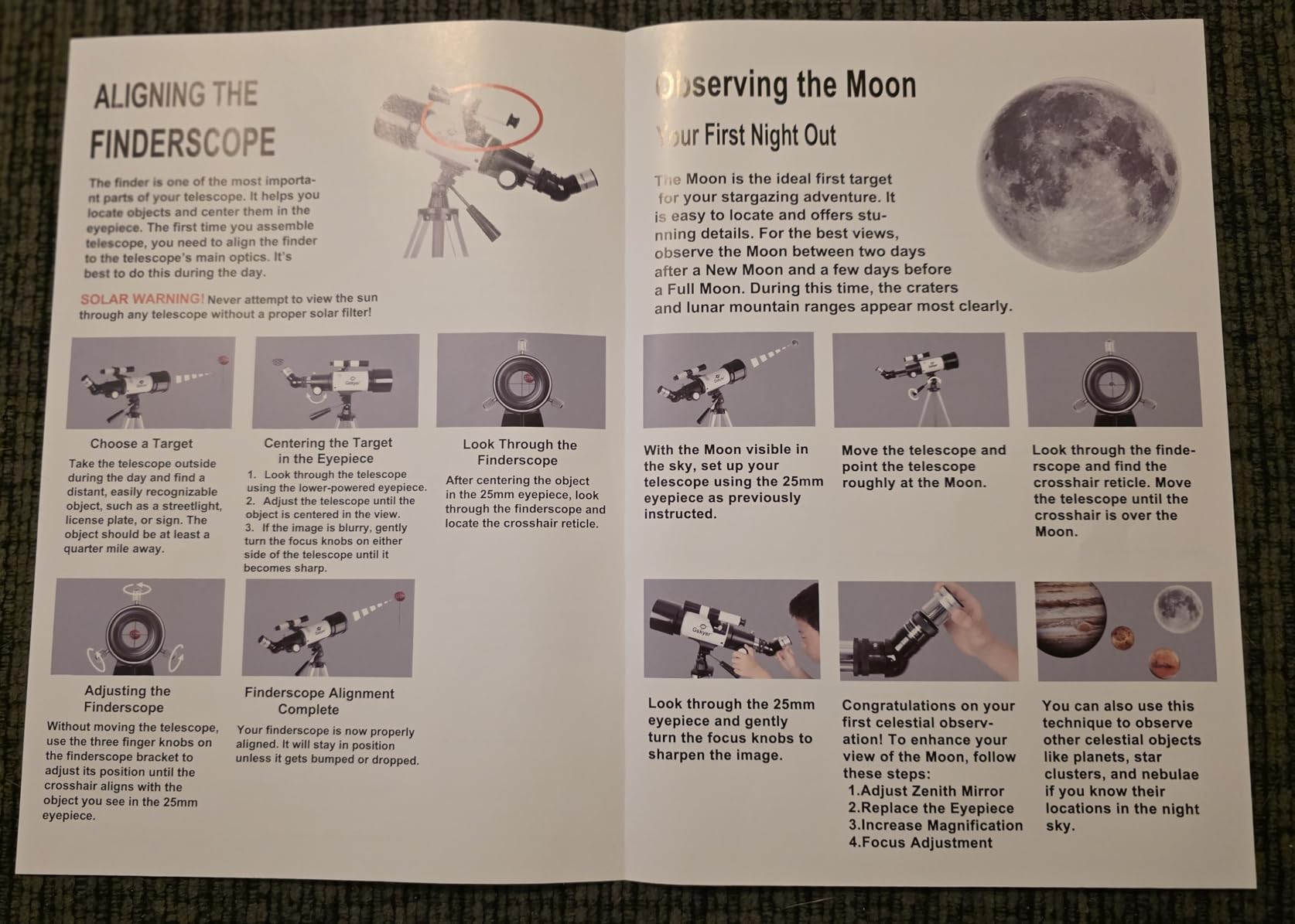
The wireless camera remote is a small touch that makes a real difference. Traditional cheap mounts vibrate every time you touch them, and on the Moon a wobble at 60x is enough to lose the crater you were looking at. Firing the shutter from a distance avoids that entirely.
Reviewers describe the recurring criticisms clearly: the 400mm focal length, the basic included eyepieces, and the need to keep re-aiming as the Moon drifts. None of those are defects. They are the honest limits of a compact, inexpensive, high-volume kit, and they are the reason we rank it fourth rather than first.
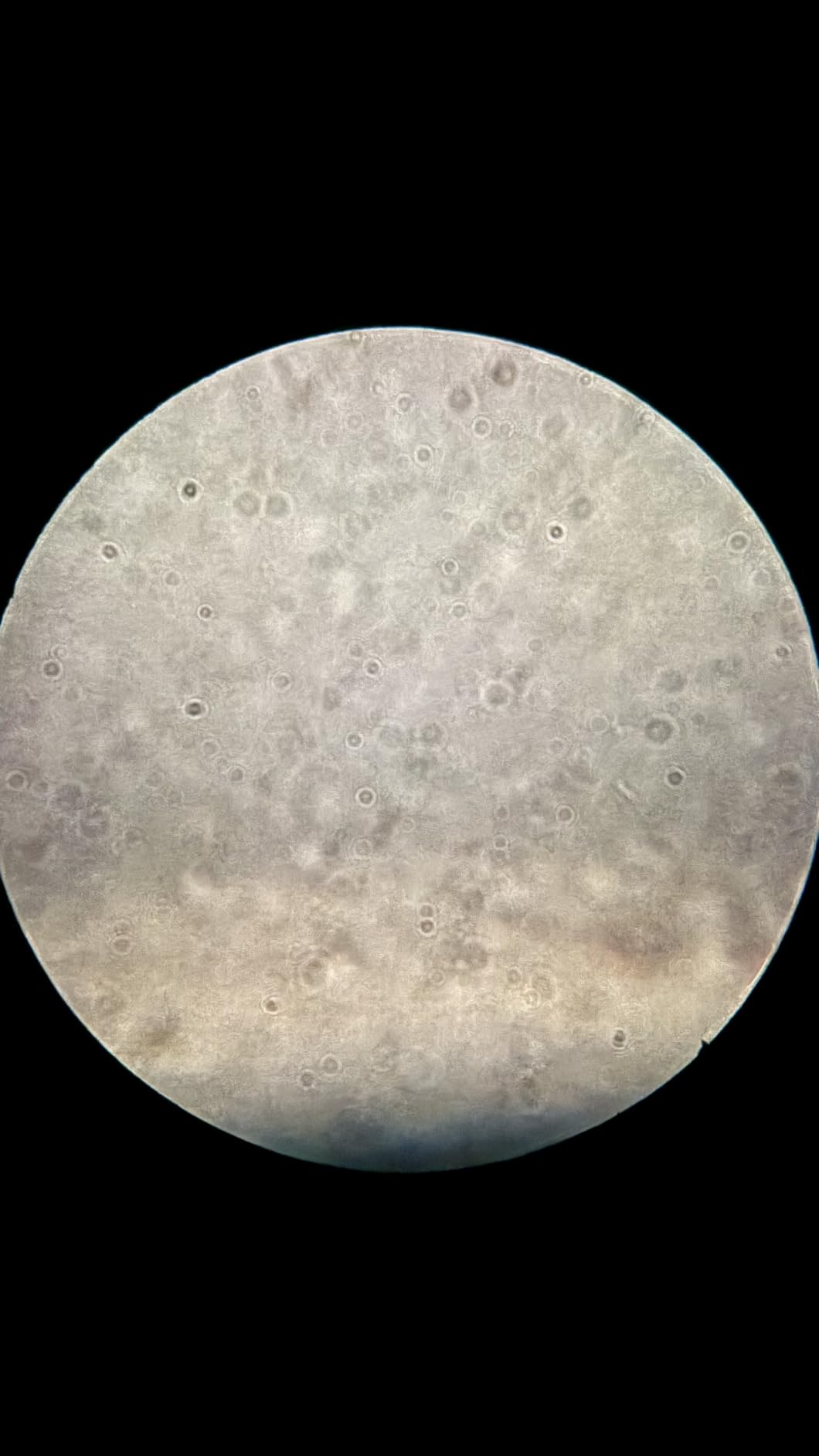
Where a child will get hooked
At 30 to 40x, which the supplied eyepieces reach, the Moon fills a good part of the field and the largest craters are obvious. The trick is timing. Show a nine-year-old a full Moon and the surface looks flat and grey. Show them the same scope on a three-day-old Moon and the terminator throws shadows across the craters, which looks like nothing else in the night sky.
Carrying it out matters. A telescope that lives in a cupboard gets used once. A telescope in a bag next to the door gets used every clear evening, and that habit is what builds an interest in astronomy.
When you should step up instead
If your child has already run through a 70mm refractor and is asking why the craters look small, the fix is aperture and focal length, not a bigger branded box. Moving from 70mm to 80mm gives you 30% more light and more resolving power. Moving from a 400mm tube to a 600mm tube gives you visibly higher magnification on the same eyepieces.
Also consider spending part of the budget on one good 6mm Plossl eyepiece instead of the bundled 4mm. Forum users on r/telescopes consistently argue that the eyepiece is at least half of what you actually look through, and on a scope with a short tube a better eyepiece does more than a bigger multiplier claim.
5. Koolpte 80mm Refractor – Best for Carrying to Dark Sites
Koolpte Telescope for Adults, 80mm/600mm AZ Refractor for Beginners
80mm aperture
600mm focal length, f/6.7
Fully multi-coated optics
25mm and 10mm eyepieces plus 3x Barlow
Pros
- 80mm aperture on a 600mm tube
- a genuinely useful lunar pairing
- Multi-coated optics keep lunar contrast high
- Carrying bag and wireless remote support travel to darker skies
- No-tool setup
- buyers report observing within about 15 minutes
Cons
- Finder scope sits on a fixed plastic bracket and cannot be aligned
- The bundled 3x Barlow is low quality plastic and adds colour fringing
- Tripod feels shaky with stiff buckles and thin screws
- Setup instructions for the diagonal and eyepieces confuse first-time users
The optical specification here is the one I would choose for a first serious lunar session. Eighty millimetres of aperture on a 600mm tube is f/6.7, which sits between the fast astrographs and the very slow planetary achromats. You get real resolution from the aperture and usable magnification from the length, and the included 25mm and 10mm eyepieces give you 24x, 60x and, with the 3x Barlow, 72x and 180x.
At 60x the Moon is where this scope earns its rating. The terminator is sharp, the maria show texture rather than flat grey, and the larger craters near the shadow line have visible interiors. The 72x view from the Barlow is still inside the 160x budget for 80mm of glass and is where you start to see central peaks.
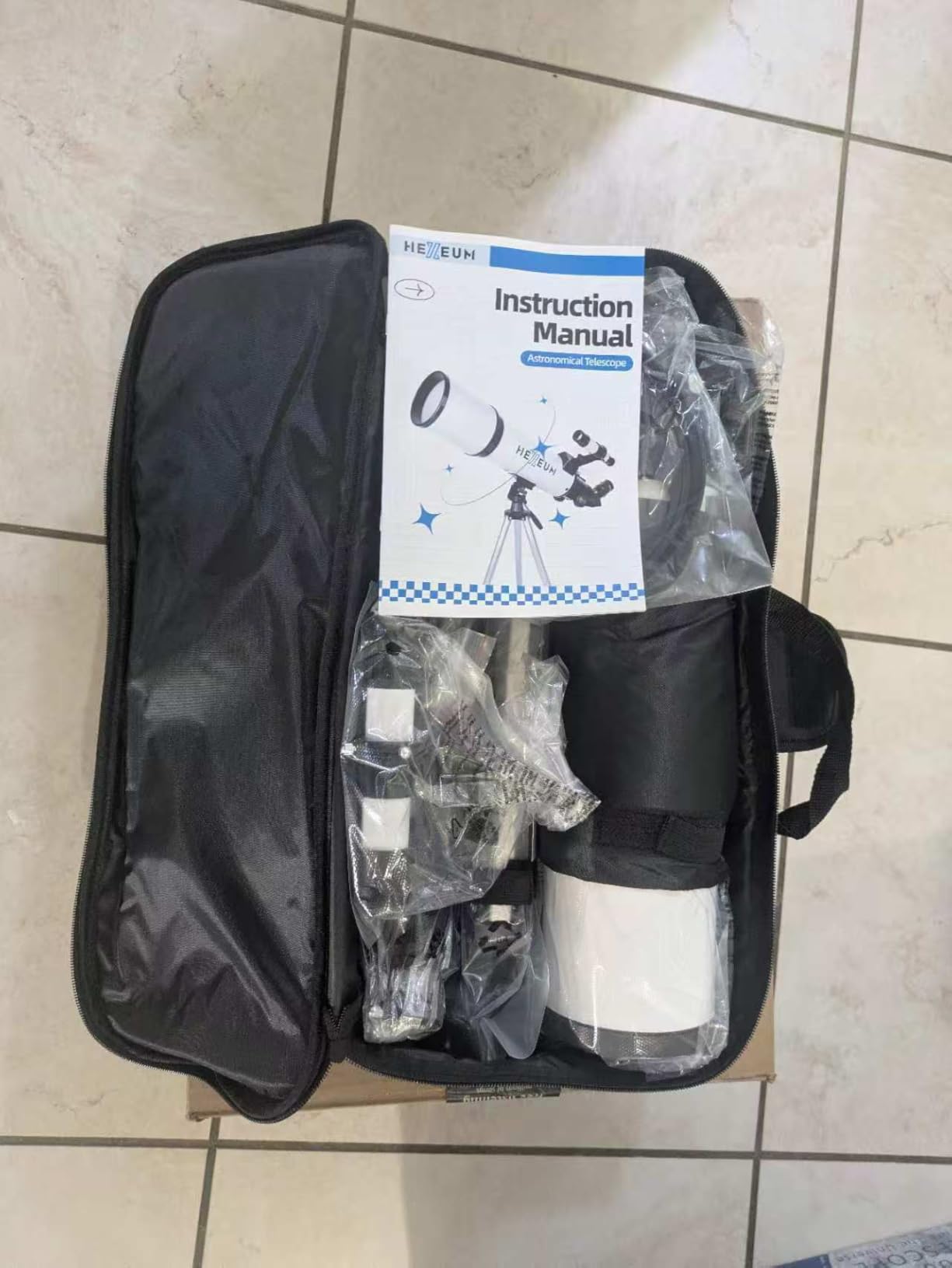
Two accessories hold it back, and both are worth knowing before you buy. The finder scope is mounted on a fixed plastic bracket that cannot be adjusted to match the main tube, so it will always point slightly wrong and you will correct it by feel every time. And the bundled 3x Barlow is low-quality plastic, which reviewers report adds its own colour fringing to an already fast-ish achromatic image. Use the finder roughly, ignore the Barlow until you have a proper one, and stay on the 10mm eyepiece at 60x.
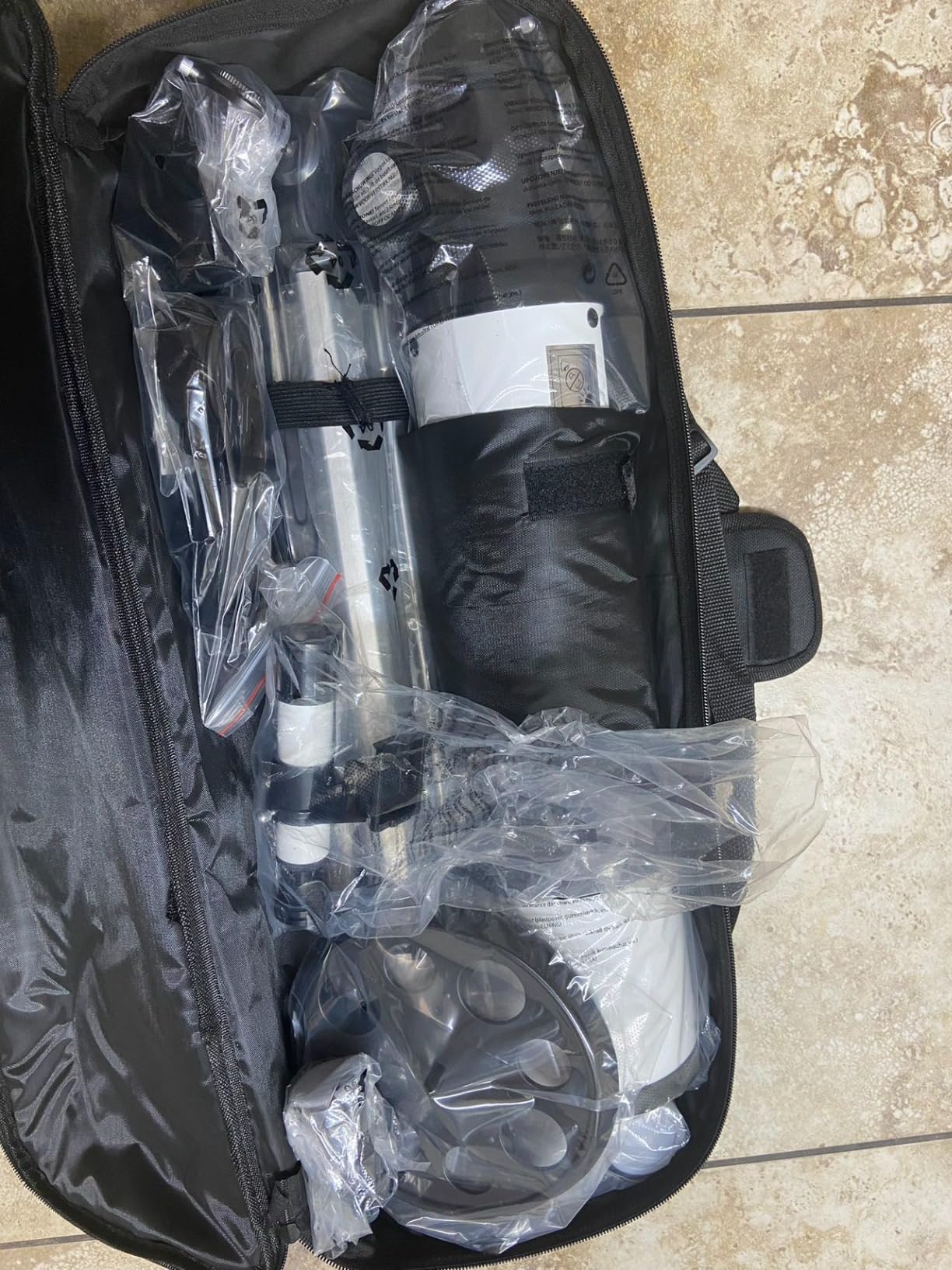
Why it suits travelling observers
The combination of a carry bag, a wireless remote and a no-tool setup means you can go from car to observing spot in a couple of minutes. The wireless remote matters more than it sounds. A cheap alt-azimuth mount transmits vibration straight to the eyepiece, and a wobble at 60x is enough to blur out a crater rim you were studying.
Several reviewers note that the instructions for the zenith mirror and eyepieces are confusing and that they ended up following a video instead. Budget ten extra minutes for setup if this is your first telescope, and check the diagonal orientation before you head out.
Where the hardware disappoints
The tripod is the weakest part. Reviewers describe stiff buckles and thin screws that do not hold an eyepiece securely, plus some reports of shakiness under load. On a bright target like the Moon the tube movement is obvious, and a top-heavy 600mm tube magnifies every wobble. If you already own a tripod, use it.
Beyond that, the fixed finder bracket and the plastic Barlow are the two things most likely to make you spend money later. Budget for a quality 1.25 inch diagonal and a 2x Barlow rather than a third eyepiece, and this setup becomes a genuinely capable Moon instrument.
6. CELTICBIRD 80mm Refractor – Best with a Moon Filter Included
Celticbird Telescope for Adults High Powered, 80mm Aperture 600mm AZ Mount Refractor Telescope for Kids Beginners – Portable Telescopes for Adults Astronomy with Backpack, Phone Adapter, Moon Filter
80mm aperture
600mm focal length, f/6.7
20mm and 9mm eyepieces, 30x and 66x
Includes a moon filter and a 5x24 finder
Pros
- The only kit here that ships a moon filter
- Trips adjust from 17.7 to 52 inches
- covering kids and adults
- 9mm eyepiece gives a higher starting magnification than most 80mm kits
- Backpack holds the whole kit
- no tools needed to assemble
Cons
- Smallest review base here at 864 ratings
- The 9mm eyepiece pushes toward the instrument limit and dims at the top end
- No Barlow included
- capping magnification at 66x
- No tracking on the alt-azimuth mount
A moon filter in the box is unusual at this level, and it is the reason this scope is on the list. A neutral density filter passes only a small fraction of the incoming light, which tames glare from the bright limb of the Moon and lets you hold a higher magnification without the image becoming flat white. On a long focal ratio design it also helps with seeing, since less light means less turbulence from heat haze.
The 9mm eyepiece is the interesting choice. On the 600mm tube it gives 66x, a higher starting power than the 60x you get from a 10mm, and 66x is comfortably inside the useful budget for 80mm of aperture. That is where terminator craterlets and the edges of the maria start to resolve cleanly.
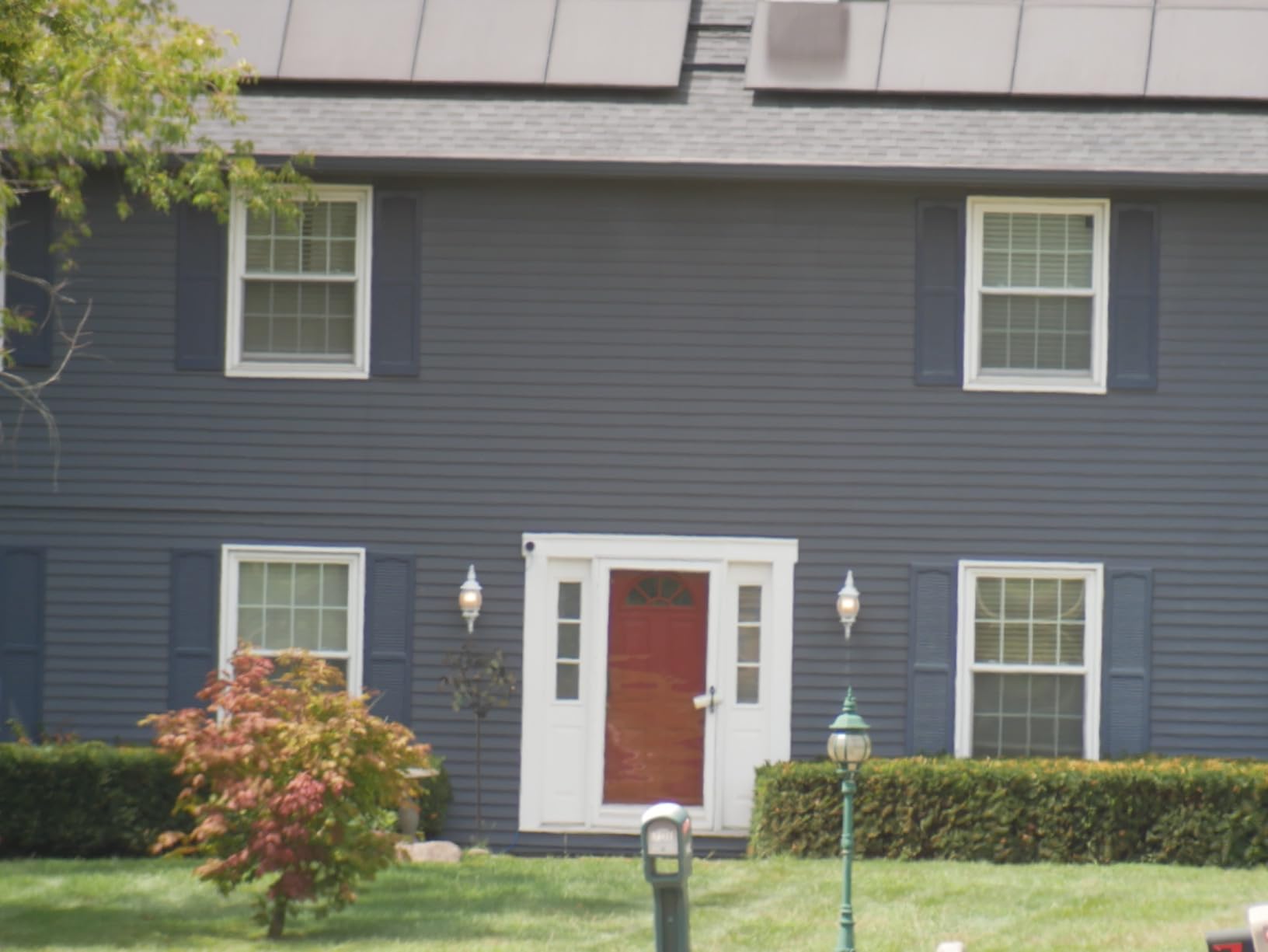
Owners most often single out the filter, the higher starting magnification and the tripod, which adjusts from 17.7 to 52 inches. That range means a small child and a full-grown adult can both use the same telescope without a booster seat, which is a genuinely useful detail for a shared family scope.
With 864 ratings this is the newest listing in the roundup, which means the long-term reliability record is less well proven than the scopes with tens of thousands of reviews. The star distribution is slightly more favourable than the older models, at 70% five-star and 13% four-star, but treat that as a smaller sample rather than a stronger consensus.
Whether a moon filter is worth it
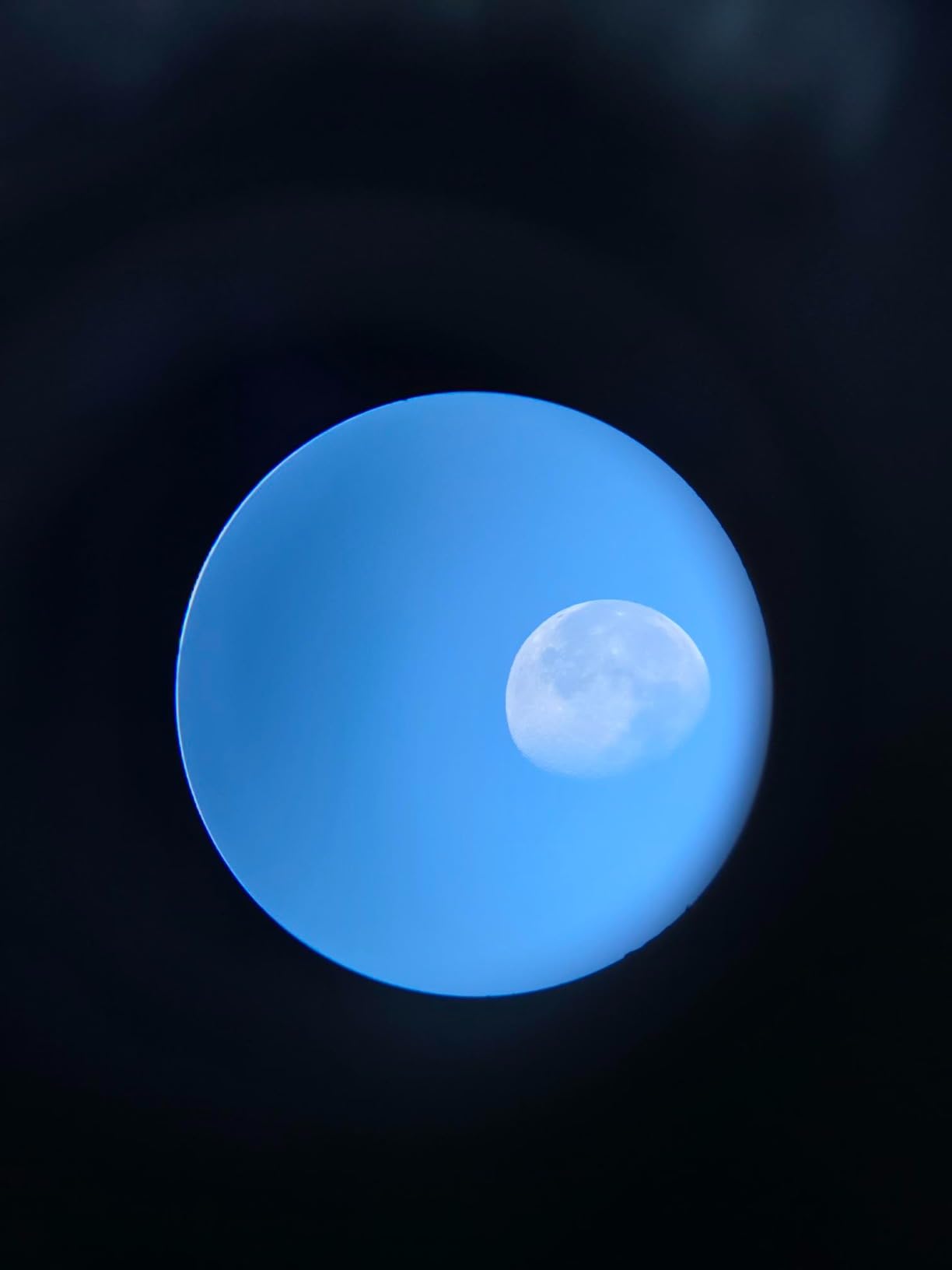
At 80mm, used on a bright Moon at moderate power, a filter does one thing well: it reduces the contrast between the sunlit crater walls and the shadowed crater floors. That is the contrast that makes relief visible. Many observers find a good filter makes the difference between a flat white disc and a surface you can read.
The tradeoff is light loss. A filter that passes only 13 percent of the incoming light makes the image noticeably dimmer, so you need a dark-adapted eye to see the benefit, and it works better on a longer focal ratio than on a very fast one. This kit’s f/6.7 design sits in a reasonable place for that.
Where the top end runs out
There is no Barlow, so 66x is the ceiling, and the 9mm itself pushes toward the instrument limit, so owners notice the image dimming and softening as they use it. A good 2x Barlow paired with a 6mm Plossl takes you past useful power, so a 7mm or 8mm makes more sense. As with the rest of this group the mount has no tracking, so re-centre every few minutes.
7. Celestron Travel Scope 70mm – Best for Backpack Travel
Celestron Travel Scope 70mm Beginner Portable Telescope with Backpack
70mm fully coated achromatic
400mm focal length, f/5.7
20mm and 10mm eyepieces, 20x and 40x
Weighs 4.2 pounds, preassembled tripod
Pros
- Lightest Celestron option here at 4.2 pounds with a backpack for the whole kit
- Most proven scope in the roundup with 14800 ratings
- Preassembled tripod and tube mean almost no setup time
- Free SkyPortal app and planetarium software help beginners identify targets
Cons
- Shortest focal length here
- giving the lowest power and the smallest apparent Moon
- No Barlow lens
- so magnification stops at the two eyepieces
- Basic single-knob mount with no tracking
- 70mm aperture puts faint galaxies and nebulae out of reach
With close to 15,000 ratings this is one of the most proven beginner refractors available, and that is worth something in its own right. A telescope bought and used at this volume has a settled, well-documented reliability record and a healthy second-hand market if you ever want to pass yours on.
For the Moon, the honest description is bright and wide. At 20x with the 20mm eyepiece the entire Moon sits in the field with room around it, which is the view a child gets on the first night. At 40x with the 10mm it fills a good part of the field and the largest craters near the centre become obvious. The maria read clearly as distinct grey shapes against the brighter highlands.
The 45 degree erect image diagonal makes daytime landscape viewing just as easy, and the tube is short enough at 400mm that pointing it at the zenith is genuinely comfortable for a child. That is a real advantage over the longer tubes in this roundup.
What it cannot do is resolve fine detail. The 400mm focal length with 70mm of aperture means the Moon never fills your field of view the way it can on the 80mm scopes here.
Where the proven design still wins
Portability and simplicity. At 4.2 pounds it carries the lowest stated weight in this roundup, the tripod arrives preassembled, and the backpack holds the whole kit. For a traveller, a parent packing for a camping trip, or anyone who wants a telescope that lives in a cupboard and comes out on a whim, that combination is difficult to beat.
It is also the safest recommendation for a young child, because there is nothing to align and the 20x whole-Moon view is genuinely rewarding without a dark sky.
When to move on from it
Move up when you start wanting detail rather than shape. The step from 70mm to 80mm adds light and resolution, and the step from a 400mm tube to a 600mm tube adds the magnification that makes terminator shadow visible at a useful scale. The Travel Scope 70 is a genuine floor, not a destination.
Also be clear about what it will never show. At 70mm, faint deep sky objects such as galaxies and nebulae are effectively out of reach, and there is no Barlow in the box, so magnification is capped at the two supplied eyepieces. If lunar detail is what you are buying for, this is the value end of the scale rather than the destination.
8. MEEZAA 80mm Refractor Kit – Budget Pick
MEEZAA Telescope for Adults & Kids, 80mm Aperture 500mm Refractor
80mm aperture
500mm focal length, f/6.25
Fully multi-coated optics
25mm and 10mm eyepieces plus 3x Barlow, 20x to 150x
Pros
- Joint-highest rating in the roundup at 4.4 with 75 percent five-star
- 80mm aperture with fully multi-coated optics
- Folding tripod and waterproof backpack make it easy to carry
- 3x Barlow gives a genuinely usable 20x to 150x range
Cons
- 500mm focal length limits magnification compared with the 600mm scopes
- Included eyepieces are plain
- owners suggest a 6mm Plossl instead
- Tripod adjustment knob reported stripping on at least one unit
- No tracking and no equatorial option
This is the most affordable route into 80mm of aperture in this roundup, and it earns its place on optics rather than on cost. The fully multi-coated 80mm objective at 500mm works out to f/6.25, which is a reasonable middle ground, and 80mm is the aperture tier at which the Moon stops looking like a sticker. Reviewers rate it at 4.4 across 645 ratings, with an unusually high share of five-star scores.
The magnification ladder is the feature owners praise most. The 25mm and 10mm eyepieces give 20x and 50x, and the 3x Barlow takes those to 60x and 150x. The 60x view on a first-quarter Moon is the money shot, and 150x sits right at the useful ceiling for this aperture. That is a real range, not a marketing number.
Portability is handled unusually well. The tripod is a lightweight folding aluminium type adjustable from 16.92 to 44.48 inches, and the accessories fit in a waterproof backpack, so it works for camping and field use as well as a backyard. Several reviewers confirm the phone adapter produces usable basic lunar photographs, and the illustrated manual lets a child help with assembly.
The zoom range quoted for this kit runs to 150x with the Barlow, which is the honest useful maximum here. Any listing showing far higher numbers is doing arithmetic with a multiplier that the glass cannot support.
Why the barrel rating is high but the sample is small
A 4.4 average with a 75 percent five-star share is a strong result, and it reflects owners who set it up, pointed it at the Moon and got what they expected. It is also 645 reviews rather than thousands, so it is a newer listing with a smaller pool. The 500mm focal length is the real limit: at the same eyepiece you get lower magnification than the 600mm scopes here, and the 80mm aperture cannot be used to its full resolving potential.
What to change first if you buy it
Replace the eyepieces before you buy anything else. Owners repeatedly suggest a 6mm Plossl as the single biggest improvement available, and that advice is sound: a better eyepiece shows you more of what the 80mm objective can resolve. Add a moon filter second, and a 2x Barlow third, though the bundled 3x covers that job adequately.
One reviewer reported the tripod adjustment knob stripping after a few uses. That single report is not a pattern, but it is the kind of component worth checking during the first week. The bright yellow finish and included space stickers also suit a child aged eight to twelve.
Achromatic vs Apochromatic: Chromatic Aberration on the Lunar Limb
Chromatic aberration is colour fringing, and on the Moon it shows up as a purple or blue rim on the bright edge of a crater wall, most visibly near the centre of the field at high power. It is the defect every refractor buyer should understand before buying, because the fix is not a better eyepiece. It is a slower focal ratio.
Why a slower tube fixes it is simple physics. A simple lens bends different colours by different amounts, so red and blue light focus at different distances. A two-element achromatic doublet brings two wavelengths to a common focus and leaves the rest to chance, and the residual error scales with how steeply the light is bent. Bend the light gently by stretching the focal length, and there is almost nothing left over. That is the rule: an achromatic at f/8 or longer is effectively colour-free for visual lunar work, while a fast achromat at f/5 or f/6 shows visible fringing on the lunar limb.
Here is where each scope in this roundup sits on that scale. The Celestron AstroMaster 70AZ at f/12.9 is the cleanest, followed by the UncleHu at f/7.5, then the MEEZAA at f/6.25, the Koolpte and CELTICBIRD both at f/6.7, and finally the three fast f/5.7 tubes, which are the Celestron Travel Scope 80mm, the Gskyer and the Celestron Travel Scope 70mm.
Fast achromats are not bad telescopes. They are excellent wide-field astrographs, and they make superb grab-and-go travel scopes, which is why all three of the fast tubes here are usually chosen for portability rather than for colour correction. The fringing only shows when you push magnification high, and on a short tube you rarely can.
An apochromatic triplet goes further and brings three wavelengths to a common focus using extra-low dispersion glass, so there is no visible secondary spectrum at any focal ratio. For the Moon that is a real advantage, and it is the reason experienced observers on Cloudy Nights often suggest a good achromatic first and an apochromatic later, rather than starting with the most advanced optic available.
My advice follows that consensus. Buy a solid achromatic of 70mm or 80mm, spend the remainder of the budget on one or two good eyepieces, and only move to an apochromatic when you are chasing planetary detail on Jupiter and Saturn rather than lunar craters. Refractor telescopes for moon viewing do not need triplet glass to do their job well.
Refractor vs Reflector vs Maksutov for Moon Viewing
For the Moon specifically, the refractor wins more often than the general comparisons suggest, and the reason is contrast and maintenance rather than raw aperture.
Refractor: Highest contrast of the three because there is no central obstruction and no secondary mirror support spider to scatter light. Sealed tube, no collimation, fast cool-down, works in daylight for terrestrial viewing. Lower aperture per unit of money, which is its one genuine weakness.
Reflector: More aperture for the same money, so more lunar detail if you are willing to collimate. The mirror needs alignment every few sessions and the tube can stream images as it cools. Contrast is lower because of the central obstruction.
Maksutov-Cassegrain: Long focal length in a short tube, sealed and collimation-free, so it is also a fine lunar instrument. Higher f-ratio means good contrast, but the obstruction costs a little light and the optical design is harder to service.
The forum consensus is that an alt-azimuth mount is entirely adequate for the Moon and planets, and that equatorial mounts only matter for long-exposure deep-sky imaging. Every scope in this roundup uses alt-azimuth, and none of them is at a disadvantage for lunar work as a result.
Refractor Buying Guide: Aperture, Focal Ratio, Mount and Eyepieces
Here is the decision order I would follow, and it is the same order the forum advice converges on. Aperture first, because it is the only number that sets your detail ceiling. Focal ratio second, because it sets how clean the lunar limb looks. Everything after that is a preference.
1. Aperture. This is the diameter of the objective lens in millimetres, and it is the number that decides how much of the Moon you can resolve. Light gathering scales to the square of the diameter, so 80mm collects about 30 percent more light than 70mm, and more importantly has 30 percent more diameter to split craters apart. The forum consensus is consistent on the ordering of upgrades: the perceived jump from 80mm to 100mm is bigger than the jump from 100mm to 120mm. If your budget allows 80mm over 70mm, take the 80mm.
2. Focal length and focal ratio. Focal length is the distance from the objective to the point of focus, and focal ratio is focal length divided by aperture. A 900mm tube on a 70mm objective is f/12.9; a 400mm tube on the same objective is f/5.7. Longer is better for the Moon because it reduces colour fringing and increases magnification on a given eyepiece. The trade is tube length: a 900mm tube is 68.5 centimeters long and awkward to point near the zenith, which is why a 90 degree diagonal or a diagonal plus a 45 degree star diagonal is close to mandatory on the longer scopes here.
3. Mount and steadiness. Every scope in this roundup uses a manual alt-azimuth mount, and for the Moon that is the correct and sufficient choice. What matters is not tracking but vibration. Wobble at 60x blurs out the crater you were examining, and that is why stabilisers, a braced tripod, or simply tightening every knob before you start make a measurable difference. The forum complaint that buyers upgrade the telescope and get a worse view because they neglected the mount is one of the most repeated themes in telescope discussions.
4. Eyepieces and the magnification budget. This is where most money is wasted and where the best returns are. The working ceiling is roughly 2x magnification per millimetre of aperture, so about 140x on a 70mm scope and 160x on an 80mm scope. Exceed it and the exit pupil becomes too small, the image darkens, and detail does not appear. That is why 3mm and 4mm eyepieces sold as high-power upgrades often disappoint. A 10mm and a 25mm pair covers the useful range on almost any refractor, and a good 2x Barlow doubles it.
One rough rule of thumb for eyepiece choice: a shorter eyepiece focal length means more magnification, so a 25mm gives you a wide, low-power view and a 10mm gives you a close one. A 10mm and 25mm Kellner or Plossl pairing is the standard first upgrade, and Kellner eyepieces are a good choice for the Moon because they stay reasonably sharp across a wide field. Plan your observing around a ladder rather than a single eyepiece: start at 25mm to locate and centre, step to 10mm for the main lunar view, and only then consider a Barlow.
5. Portability and weight. The assembled weights here run from 4.2 pounds for the Celestron Travel Scope 70mm and 4.5 pounds for the 80mm Travel Scope up to 10.8 pounds for the AstroMaster 70AZ. If you will carry the telescope out to a dark site more than once, weight matters, because a 10.8 pound tube is a lot to ask of a tripod on a cold night. The trade is straightforward: a longer tube gives you more magnification and cleaner optics, and it also costs you portability.
6. Smartphone lunar photography. A phone adapter held against the eyepiece will capture the Moon on almost any of these scopes, and the resulting single frame is a genuine first win for most people. Be aware of what you are looking at. A phone held to a telescope produces a short-exposure video or stacked frames of a bright, moving target, not the long-exposure deep-sky photographs on retail listings. Tripod the phone separately, use the wireless remote or a timer to avoid shaking the tube, and shoot video rather than stills. Five minutes of practice produces a recognisable, correctly exposed lunar disc.
Finally, maintenance. A refractor has a sealed optical tube, so there is no collimation and no mirror to protect. There is essentially nothing to maintain beyond keeping the objective lens clean, which is a genuine advantage over a reflector. A refractor that has been sitting in a damp garage for a year can be outside and giving a good view within minutes, provided the front element has not grown fungus, which is a function of storage rather than design.
Frequently Asked Questions
What telescope is best for viewing the Moon?
For most people, an 80mm refractor on a longish focal ratio is the sweet spot. It resolves crater rims and terminator shadow, needs no collimation, and can be carried in one hand. A 70mm refractor shows the maria and the largest craters and is the right budget choice, but 90mm and above is where the surface starts to look genuinely detailed.
How strong of a telescope do you need to see the Moon?
You need 70mm of aperture to see craters and 80mm to see them well. Under 70mm you get a bright disc with a few large marks. At 70mm the terminator shadow line appears. At 80mm crater rims, central peaks and ridge lines along the maria become steady rather than fleeting.
Is 70mm enough to see the Moon?
Yes, for a first telescope. A 70mm refractor shows the maria as distinct grey shapes, the terminator shadow line, and the outlines of the largest craters. It will not resolve small craterlets or the texture inside the maria. That is an 80mm and 90mm job, and the practical upgrade step most observers notice is 80mm to 100mm.
Which is better, a reflector or refractor telescope for the Moon?
For the Moon, a refractor usually wins. There is no central obstruction or secondary mirror spider, so contrast is higher, the tube is sealed and needs no collimation, and it settles quickly. A reflector gives you more aperture for the same money and more detail if you are willing to align the mirrors, but contrast is lower and the image streams while the tube cools.
Do refractor telescopes need collimation?
No. A refractor uses a glass objective lens at the front of a sealed tube, and there is nothing inside that moves or needs aligning. There is no mirror to collimate and no spider to re-centre. The only maintenance worth doing is keeping the front lens clean and storing the tube somewhere dry.
What is the best refractor telescope for viewing planets?
Planets want more magnification than the Moon, which means a longer focal length rather than a much larger aperture. A 900mm f/12.9 achromatic such as the Celestron AstroMaster 70AZ reaches 90x from its supplied 10mm eyepiece and stays colour-free on bright limbs. Avoid eyepieces under 4mm, since detail past roughly 2x magnification per millimetre of aperture does not appear.
Can you see galaxies with a refractor telescope?
Only faintly, and not with the 70mm and 80mm scopes in this roundup. Galaxies are extended, low surface brightness objects, and small apertures simply do not collect enough light to show structure. Refractors at these sizes shine on the Moon, the planets, bright double stars and a handful of clusters. For galaxies you want a larger aperture, and there is no substitute for it.
Conclusion: The Best Refractor Telescopes for Moon Viewing in 2026
For most readers, the best refractor telescope for moon viewing in 2026 is the UncleHu 80mm on a 600mm tube. It has the largest aperture in this roundup, a focal ratio slow enough to keep colour fringing off the lunar limb, and the most complete eyepiece kit, so it shows the most on a first-quarter Moon without you buying anything else. If colour control matters more to you than aperture, take the Celestron AstroMaster 70AZ and its 900mm f/12.9 tube. If you will not carry more than about five pounds outside, take the Celestron Travel Scope 80mm.
Whichever you choose, look two or three days after first quarter rather than at a full Moon, stay inside the 2x per millimetre useful magnification limit, and put the money you saved into a 6mm or 8mm Plossl eyepiece. That combination does more for what you see on the Moon than any other money you can spend.