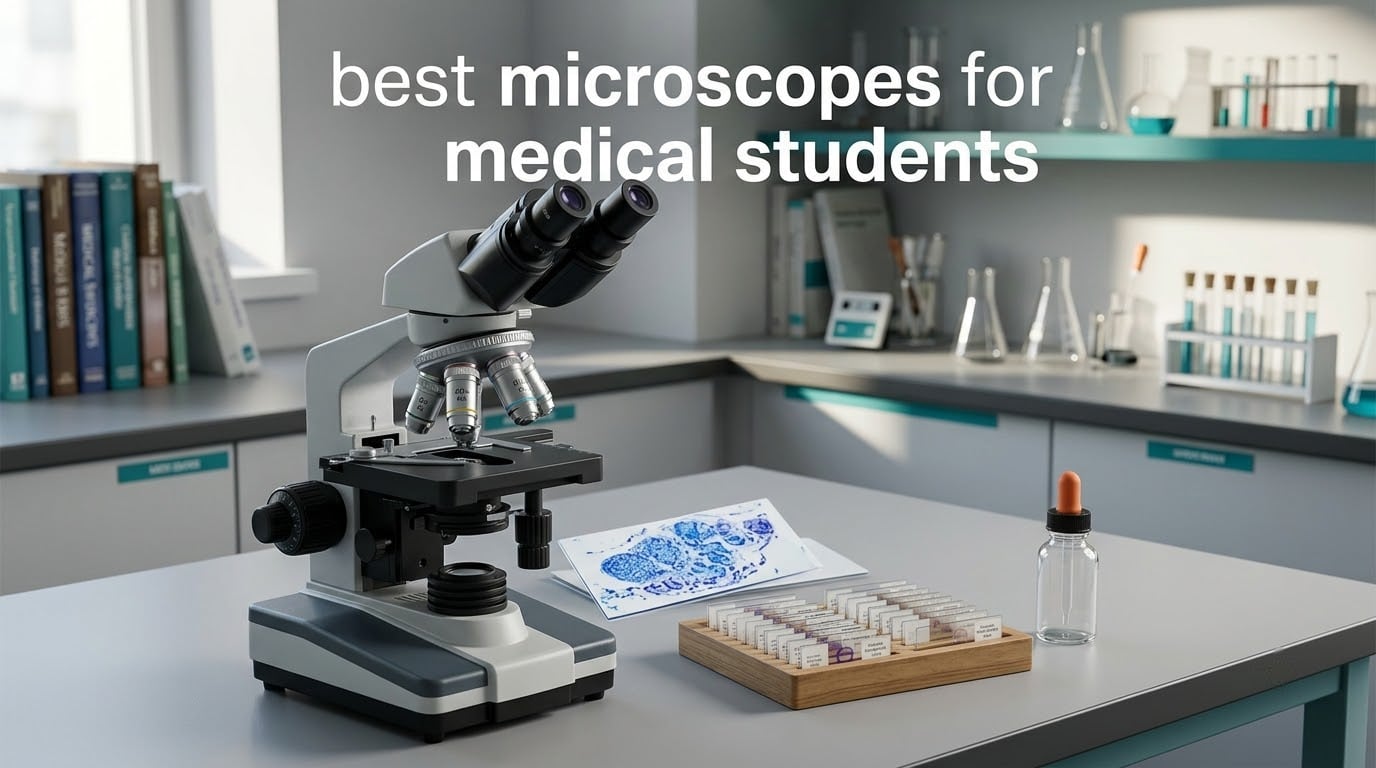
Most first-year medical students never buy a microscope. Their school hands them one at the bench, and that scope is the only one that matters for the graded practicals. The case for owning your own is narrower than the marketing suggests, and it usually starts with a single question: do you want to review slides at home, on your own time, without a queue of classmates waiting for your turn?
If the answer is no, use the school-issued instrument and put the money toward slide kits and immersion oil instead. If the answer is yes, you are shopping for a very specific job: reading stained tissue sections, grading a blood smear, and picking out bacteria at 1000x on a stained smear. Those three tasks set the requirements, and they are narrower than most product listings suggest.
That is the filter we used to build this list of the best microscopes for medical students in 2026. Every scope below was assessed against the specimens a first- or second-year student actually looks at, not against a staged onion-skin photo. We read the objective specifications, the head type, the condenser, and the stage, then checked whether the honest optical magnification reaches the range you need.
Two numbers do most of the work. First, useful optical detail runs out around 400x for routine histology work, so any listing quoting 2500x or 5000x is multiplying eyepiece power rather than adding resolution. Second, a real 100x oil-immersion objective is the only reason to look at a microscope twice for bacteriology or fine blood-smear detail, and plenty of budget scopes omit it.
Table of Contents
- Top 3 Picks for Medical Student Microscopes in 2026
- All 10 Best Microscopes for Medical Students (October 2026)
- What type of microscope is good for medical students?
- 1. OMAX M82ES Binocular Compound Microscope – Best Overall for Histology
- 2. PalliPartners Compound Microscope Kit – Cheapest Way to Start
- 3. AmScope M162C 1000X Monocular Microscope Kit – Best All-in-One Kit
- 4. AmScope B120C-E1 Binocular Microscope with USB Camera – Best All-Rounder with Imaging
- 5. Swift SW380T Trinocular Microscope – Best Head for Long Sessions
- 6. AmScope M150C Portable Monocular Microscope – Best for Carrying Around
- 7. Swift SW350B Siedentopf Binocular Microscope – Best for Shared Viewing
- 8. Herwicm Wide-Field Binocular Microscope – Best for Finding a Specimen Fast
- 9. Poothoh Binocular Microscope with Electronic Eyepieces – Best for Teaching a Sibling
- 10. Woehrsh Trinocular Microscope with USB Camera – Best Accessory Kit
- How to Choose a Microscope for Your Year of Medical School
- How We Picked These Microscopes
- Frequently Asked Questions
- The Bottom Line for Medical Students in 2026
Top 3 Picks for Medical Student Microscopes in 2026
These three cover the range most students actually need: a proper binocular scope with a genuine oil objective, a low-cost kit for orientation week, and an all-in-one bundle that includes slides and a manual anyone can follow.
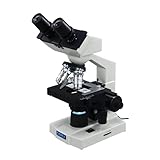
OMAX M82ES 40X-2000X Binocular
- True 100X oil objective
- NA1.25 Abbe condenser
- Double-layer X-Y mechanical stage
- 5-year warranty

PalliPartners Compound Microscope
- 100X-2000X stated
- 28-slide kit included
- Phone holder and remote
- Compact and light

AmScope M162C 1000X Microscope Kit
- Achromatic glass optics
- 40X-1000X
- Top and bottom LED
- Book
- slides and tools included
All 10 Best Microscopes for Medical Students (October 2026)
This table lists all ten scopes with the specifications that decide whether a microscope suits a medical student. Read the objective and head columns first, since those two rows eliminate more options than any other.
| Product | Specs | Action |
|---|---|---|
| OMAX M82ES Binocular 40X-2000X |
|
Check Latest Price |
| PalliPartners Compound Monocular Kit |
|
Check Latest Price |
| AmScope M162C 1000X Monocular Kit |
|
Check Latest Price |
 AmScope B120C-E1 Binocular with Camera AmScope B120C-E1 Binocular with Camera |
|
Check Latest Price |
 Swift SW380T Trinocular Swift SW380T Trinocular |
|
Check Latest Price |
 AmScope M150C Portable Monocular AmScope M150C Portable Monocular |
|
Check Latest Price |
 Swift SW350B Siedentopf Binocular Swift SW350B Siedentopf Binocular |
|
Check Latest Price |
 Herwicm Wide-Field Binocular 40X-2500X Herwicm Wide-Field Binocular 40X-2500X |
|
Check Latest Price |
 Poothoh Binocular with Electronic Eyepieces Poothoh Binocular with Electronic Eyepieces |
|
Check Latest Price |
 Woehrsh Trinocular 40X-5000X with USB Camera Woehrsh Trinocular 40X-5000X with USB Camera |
|
Check Latest Price |
What type of microscope is good for medical students?
A compound binocular light microscope with a mechanical stage, achromatic objectives and a real 100x oil-immersion lens is the right tool for medical school. Seven features matter when you are comparing models:
Compound body, not a toy scope. A compound scope uses an objective and an eyepiece in series, which is the only configuration that resolves individual cells.
Binocular head. Two eyepieces at a 30-degree tilt cut neck strain across a four-hour lab session, and they let a classmate lean in.
Mechanical stage with X-Y scales. Hunting a tissue section by hand at 400x is the single most common reason students conclude a scope is faulty.
Achromatic objectives as a minimum, plan achromats if you can. Achromats correct colour fringing at two wavelengths; plan achromats also flatten the field of view so the edges stay in focus.
A genuine 100x oil-immersion objective. Bacteria, platelets and parasite morphology need it, and 400x will not get you there.
LED transmitted illumination with brightness control. Halogen lamps yellow with age and run hot; LEDs are cooler, dimmable and never need a replacement bulb.
An adjustable iris diaphragm and a condenser. Contrast on an unstained or pale specimen comes from closing the diaphragm, not from turning up the light.
A compound microscope is the workhorse of medical school histology labs because a stained section is a transparent specimen that needs transmitted light. Everything a doctor uses for routine slide reading, from a smear to a biopsy section, happens under that same configuration.
1. OMAX M82ES Binocular Compound Microscope – Best Overall for Histology
Awarded Best Compound Microscope 2016 – OMAX 40X-2000X Lab LED Binocular Microscope with Double Layer Mechanical Stage w Blank Slides Covers and Lens Cleaning Paper
Achromatic DIN objectives with true 100X oil
N1.25 Abbe condenser
45-degree binocular head
Double-layer X-Y stage
Pros
- True 100X oil-immersion objective
- Double-layer X-Y mechanical stage with scales
- Achromatic DIN optics with N1.25 Abbe condenser
- Coaxial focus and diopter adjustment on both sides
- 100 slides and 100 cover slips included
Cons
- 45-degree head angle is fixed and can strain the neck
- Transmitted LED only so opaque specimens are out
- Heavier and bulkier than a monocular scope
This is the scope we would hand a student who is going to do a full year of histology and then bacteriology. It is the only binocular option in this roundup with a documented achromatic 100x oil objective, an N1.25 Abbe condenser, and a double-layer mechanical stage with printed translation scales.
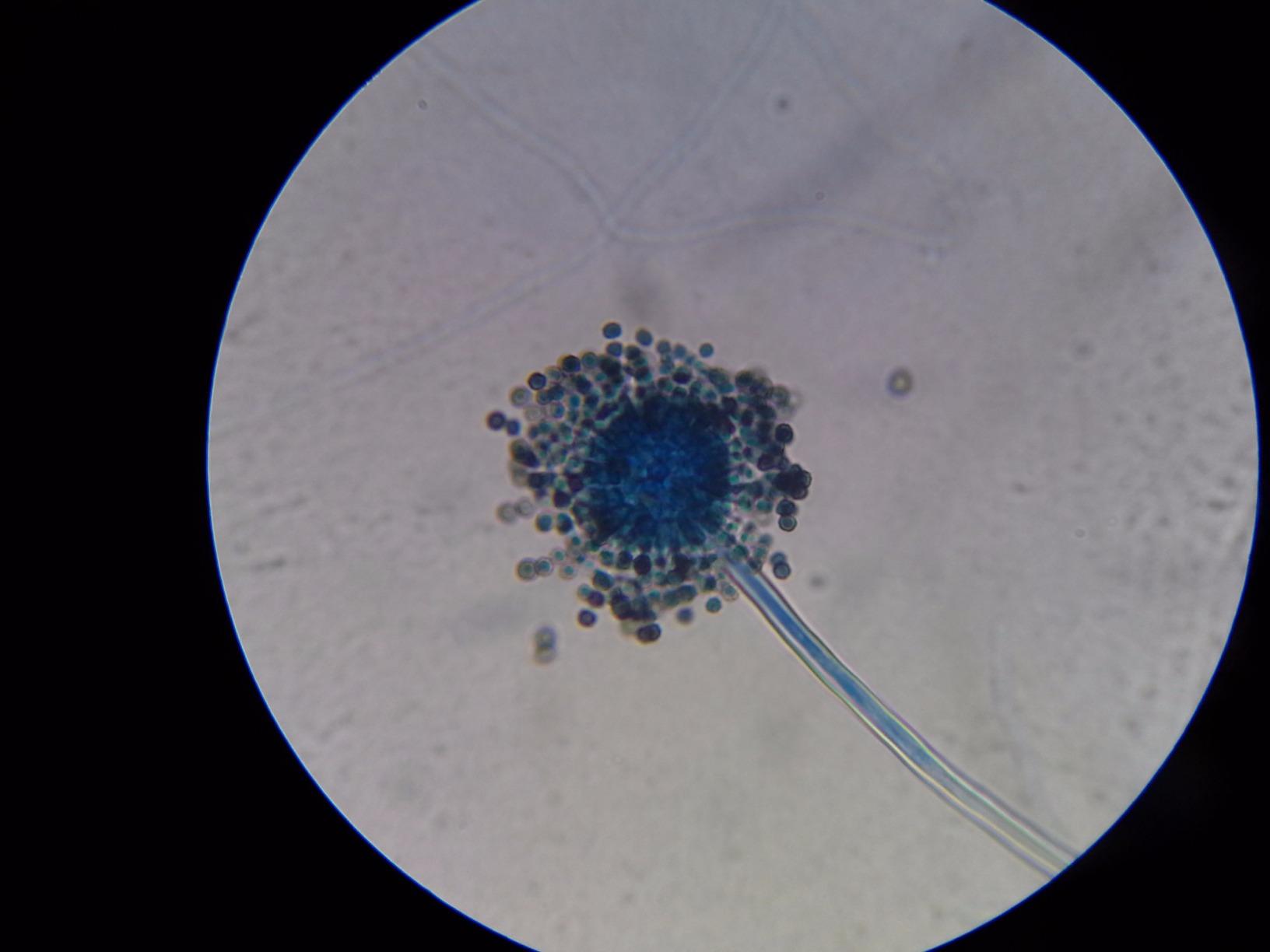
The stage is the feature we would protect first. A double-layer X-Y stage with a 70mm by 30mm translation range and a stage lock means you can centre a field at 40x, click the lock, and move straight to 400x without re-finding it. On a single-layer stage you lose the specimen, and that is when most students decide the microscope is broken.
The wide-field 10x and 20x eyepieces are a genuine advantage on a thin section. When you are hunting for a glomerulus or a mitotic figure, a wider field of view means fewer stage moves per finding.
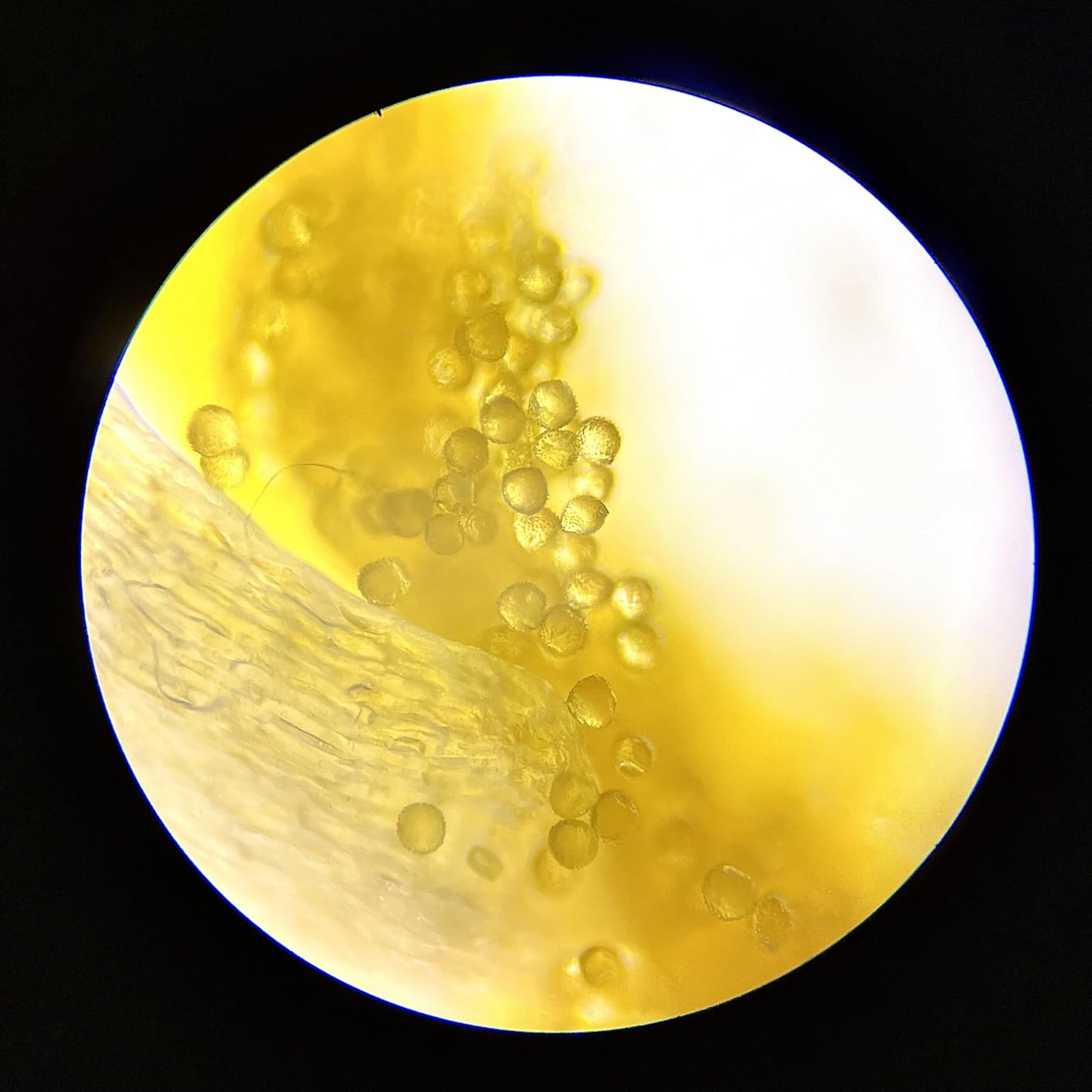
Why it works for a first-year histology practical
Transmitted LED illumination with adjustable intensity handles dense H and E stained tissue, which needs light dialled down, and a pale cheek-cell or blood smear, which needs it turned up. Coarse and fine focus sit on both sides, and diopter adjustment on both eyetubes fixes the common problem of one eye seeing a blurred circle.
Where it falls short
The head sits at a fixed 45-degree angle. It is comfortable at a desk-height bench but less so at a low one, and a 30-degree Siedentopf head is the buy if ergonomics are your priority. Illumination is transmitted only, so opaque specimens are out of scope, and at 9.6 pounds it is a poor travel microscope.
2. PalliPartners Compound Microscope Kit – Cheapest Way to Start
PalliPartners Compound Microscope for Adults & Students, White
Stated 100X-2000X magnification
Top and bottom LED light
Coaxial coarse and fine focus
28-slide kit with phone holder
Pros
- Complete kit with slides
- phone holder and remote
- Compact and light at 1.65 kg
- Dual lighting handles prepared and opaque subjects
- Simple controls beginners pick up fast
Cons
- Stated magnification is far higher than real optical power
- No mechanical stage so slides are hunted by hand
- Objectives can wobble out of alignment
For orientation week, or for a partner who wants to see what a slide looks like before committing, this kit does the job at the lowest outlay in the list. It arrives with 10 prepared specimen slides, 18 blank slides, a universal phone clip and a Bluetooth remote shutter, so you can photograph a slide through the eyepiece on day one.
It is also the smallest and lightest scope here at 1.65 kg. The top and bottom LED sources mean it can look at a prepared slide and an opaque object, something several binocular options in this roundup cannot do.
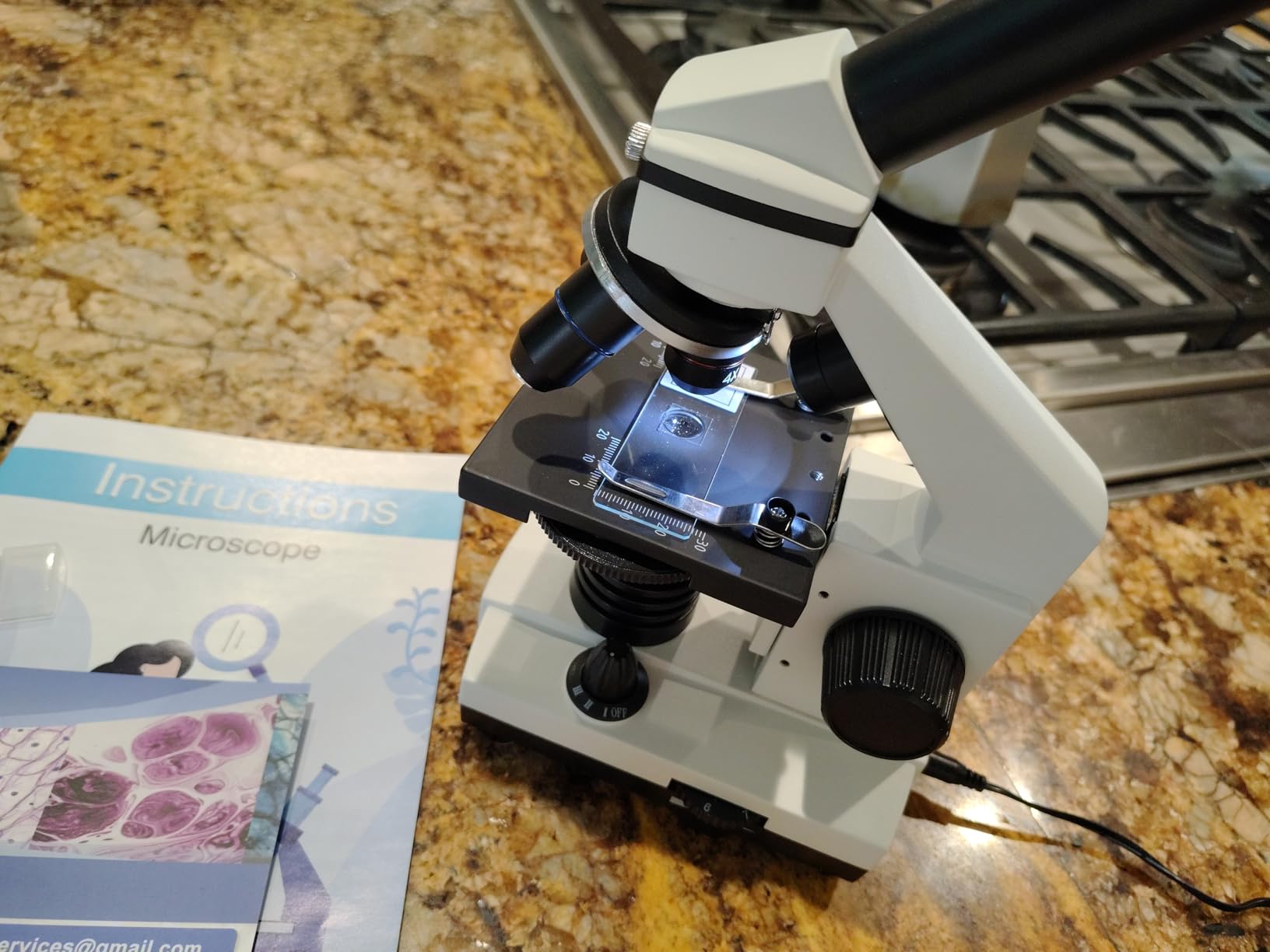
Now the part that matters for a medical student. The stated 100x to 2000x range comes from stacking a WF25x eyepiece with a 2x auxiliary lens, and users with real microscopy experience consistently report that the effective power is well below the headline figure. At 40x the optics are respectable; past that, you are enlarging without adding detail.
There is no mechanical stage, so you position slides by hand. That is tolerable on a prepared section and genuinely frustrating on a 5-micron tissue slice at 400x. The instructions are thin and the power-supply details are poorly documented, so budget ten minutes with a general reference before your first session.
When this is the right buy
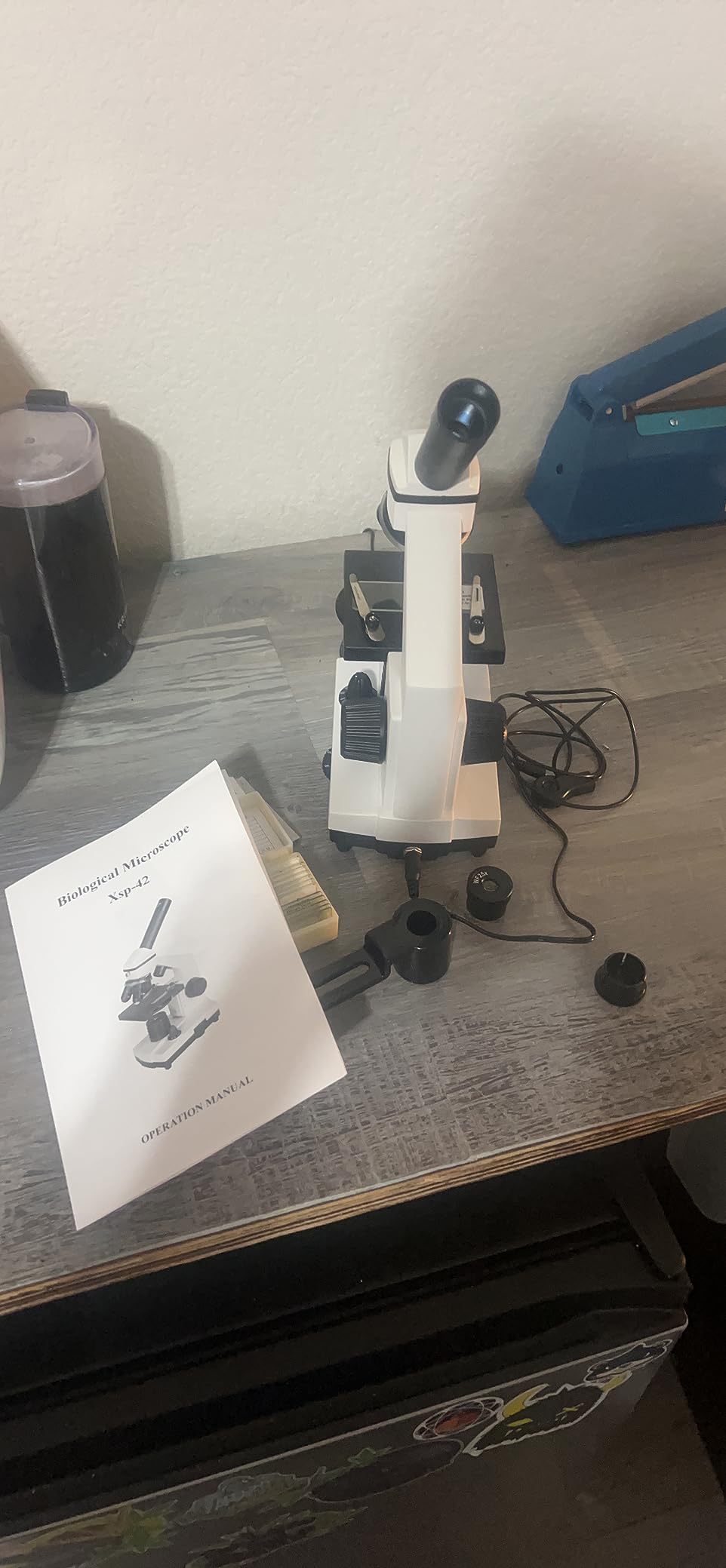
Buy it if you are in the first weeks of a programme and your school already provides a full binocular scope for practicals. A phone adapter and 28 slides in the box is a complete first contact with histology, and the phone holder turns a teaching session into a shared screen.
When to skip it
Skip it if you intend to grade a blood smear or look at bacteria. Without a stage and with overstated magnification, you will spend more time fighting the instrument than learning the specimen, and the polycarbonate body sits well below the metal frames used by the AmScope and SWIFT scopes.
3. AmScope M162C 1000X Monocular Microscope Kit – Best All-in-One Kit
AmScope M162C-2L-PB10-WM-SP14-50P100S 1000X Microscope Kit
Achromatic glass optics,40X-1000X
Metal frame with coaxial focus
Top and bottom LED light
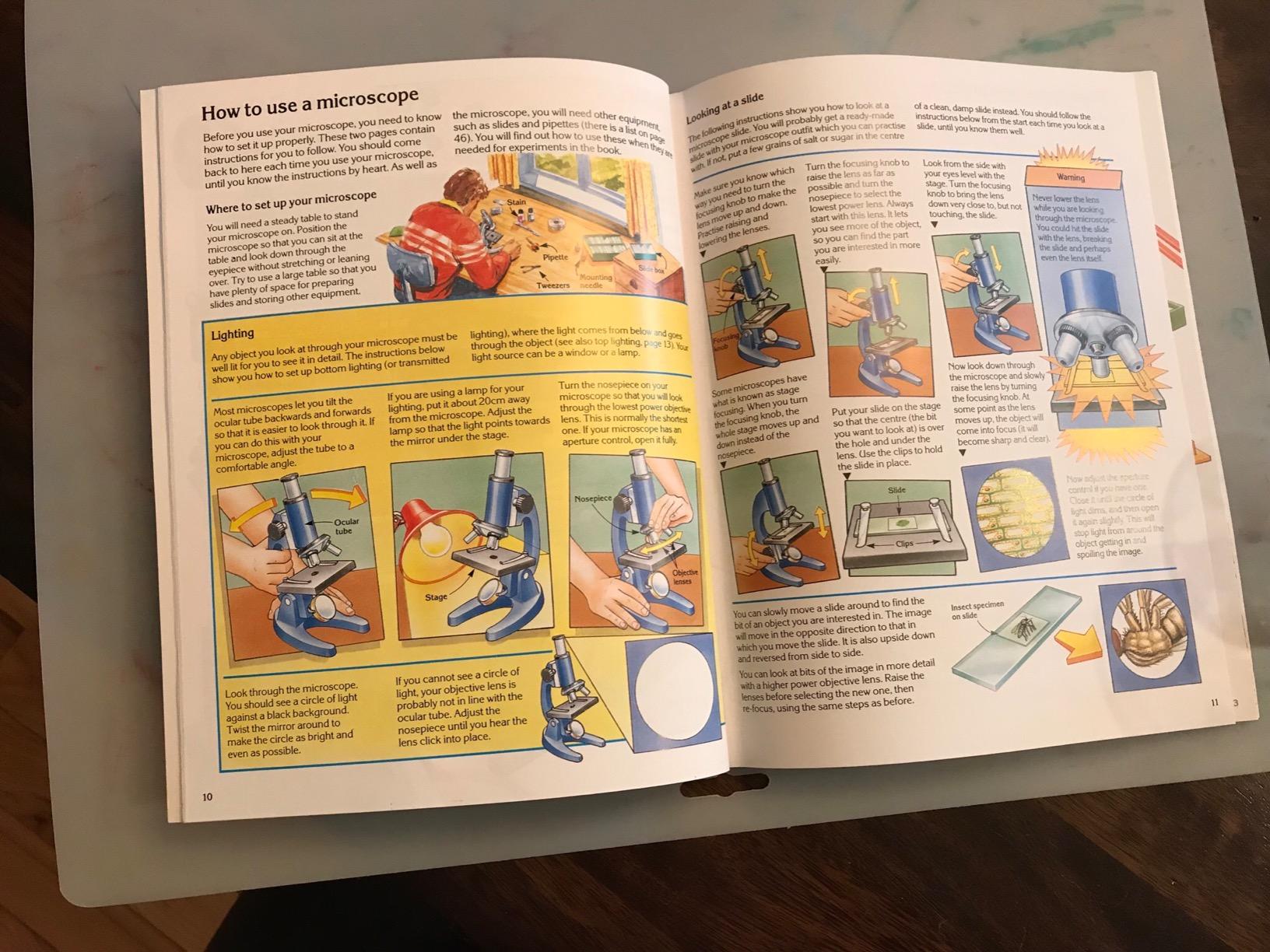
Book, slides and tools in the box
Pros
- Achromatic glass optics stay crisp for the price
- Metal frame feels far more durable than plastic school scopes
- Dual LED covers prepared slides and opaque objects/Book/slides/cover slips and tools in one box
- Battery plus wall-power operation
Cons
- No usable printed manual
- Top LED is weak when the objective sits close
- Cover slips can arrive broken in the packaging
Among roughly 1,100 ratings this is one of the better-reviewed scopes in the group, and the reason is simple: the accessories are all actually in the box. An instruction book, prepared slides, cover slips and tools ship with it, so the first session does not stall while you hunt for a manual that does not exist.
Optically it is an honest monocular at 40x to 1000x with achromatic glass lenses. That is a lower ceiling than the binocular options here, and monocular means one eye closed and one fixed viewing position, but for home revision of prepared slides the trade is often worth making.
At 4.2 pounds with a metal frame, this is a genuinely portable instrument. Battery power covers dorm and fieldwork use, and a wall adapter covers a desk setup, so it works in both places without a converter.
The dual top and bottom LEDs are the feature that separates it from plastic school scopes. Bottom light reads a prepared slide, top light handles an opaque object, and the intensity control is enough to tame a bright field on a stained section.
Why it suits home revision
Monocular viewing is genuinely tiring over hours, and students with reduced vision in one eye find it uncomfortable for long stretches. What you get here is a self-contained study station, since slides, cover slips, tools and a book in one box mean an evening of specimen work is possible without ordering anything else.
Where it stops short
There is no mechanical stage, so thin sections have to be chased by hand, and the monocular head removes any chance of sharing a view. The manual has to be found online, the top light is weak when the objective is close, and cover slips sometimes arrive broken. It is a strong kit, but a kit rather than a laboratory instrument.
4. AmScope B120C-E1 Binocular Microscope with USB Camera – Best All-Rounder with Imaging
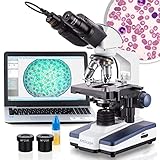
AmScope B120C-E1 LED Binocular Compound Microscope, 40X-2500X
40X-2500X binocular with Siedentopf head
LED fly-eye illumination
Includes 1.0 MP USB camera
5-year manufacturer warranty
Pros
- Optics stay clear across the useful range
- Sturdy frame and precise mechanics
- Integrated USB camera for recording and sharing
- 5-year warranty with responsive parts service
- Good value at the binocular tier
Cons
- Bundled 1.0 MP camera is soft with limited depth of field
- Useful detail ends near 400X so 2500X is empty magnification
- Manual references a different model
- Stage movement can couple the X and Y axes
The B120C is the scope most medical students end up with, and for good reason. It is a binocular compound instrument with a Siedentopf head, LED illumination with a fly-eye condenser lens, a mechanical stage, and dual-precision coarse and fine focus, all under a 5-year manufacturer warranty.
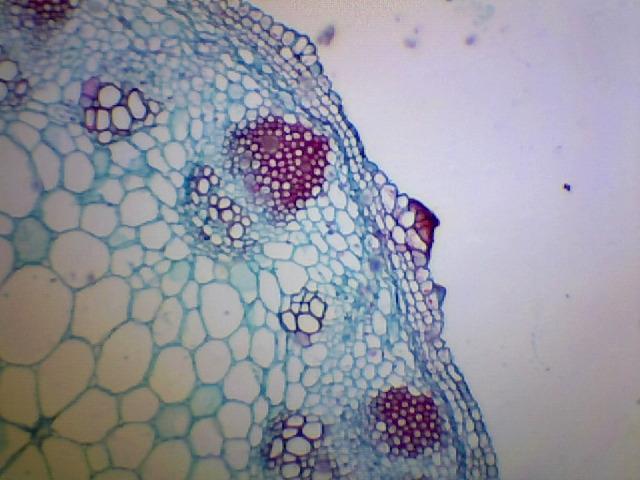
It comes with a 1.0 megapixel USB camera and Windows microscopy software, which is the reason to consider it if you want digital notes. Students routinely record a field, drop it into a study deck, and show it in a revision group without anyone queuing for the eyepieces.
The mechanics are the reason it holds up. Reviewers with lab and clinical backgrounds, including microbiology students, describe specimen positioning as precise and vibration-free, and several note that the manufacturer shipped replacement parts for a failed transformer.
Be clear-eyed about the 2500x figure. Reviewers consistently place the point of useful detail near 400x, and describe the 1000x setting as mainly useful for spotting live bacteria. Treat anything above 1000x on this scope as a marketing number produced by stacking eyepieces and auxiliaries.
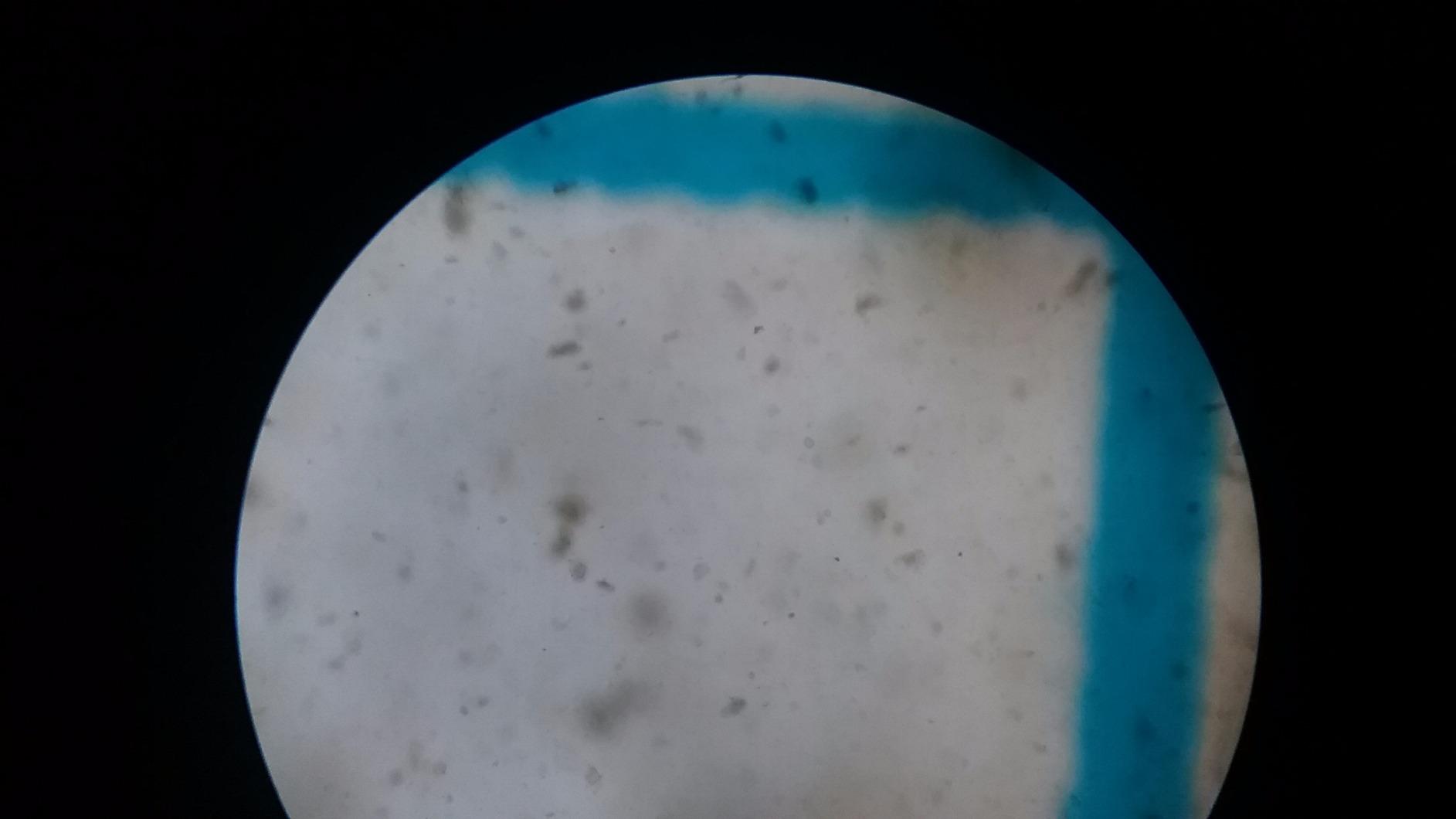
The camera is the weak link. At 1.0 megapixels the images are soft with shallow depth of field, and the software interface is described as cumbersome.
What it does well for a medical student
A Siedentopf head keeps the eyepieces at a consistent height and lets the whole head rotate, so two people can share a slide without a second instrument. The LED fly-eye illuminator produces even, daylight-balanced light with no colour cast, which makes stained tissue read more consistently between sessions than a warm halogen bulb.
Where buyers report problems
Documentation is the recurring complaint. The manual in the box references a different model and the manufacturer site does not carry a PDF for this unit. Some owners also report that stage movement couples the X and Y axes, so the slide jumps when you nudge one direction.
5. Swift SW380T Trinocular Microscope – Best Head for Long Sessions
Swift SW380T 40X-2500X Magnification, Siedentopf Head, Research-Grade Trinocular Microscope Compound Lab with Wide-Field 10X/25X Eyepieces, Mechanical Stage, Ultra-Precise Focusing, Camera-Compatible
Rotatable Siedentopf trinocular head,30-degree tilt
10X and 25X wide-field eyepieces
Par-focal camera port
Ultra-precise coaxial focus
Pros
- 30-degree inclined rotatable head reduces neck and back strain
- Par-focal port keeps camera and eyepieces in focus together
- Objectives test as essentially plano with sharp detail across the field
- Right-side stage and focus controls
- Used by a pathologist for diagnostic work
Cons
- Transmitted LED is dim at high power with the diaphragm open
- Backlight-only design fails on thick or opaque samples
- Thin plastic dust cover is far too small
Ergonomics is the whole argument for this one. The SW380T carries a fully rotatable Siedentopf trinocular head with wide-field 10x and 25x glass eyepieces at a 30-degree tilt, which is the shallowest and most comfortable head angle in this roundup. Across a four-hour lab bench, that difference is felt in the neck and upper back.
Interpupillary distance adjusts with matching diopter between the eyepieces, so the two sides stay focused for your own face. Controls and stage are both on the right, which keeps the left hand free to work the slide.
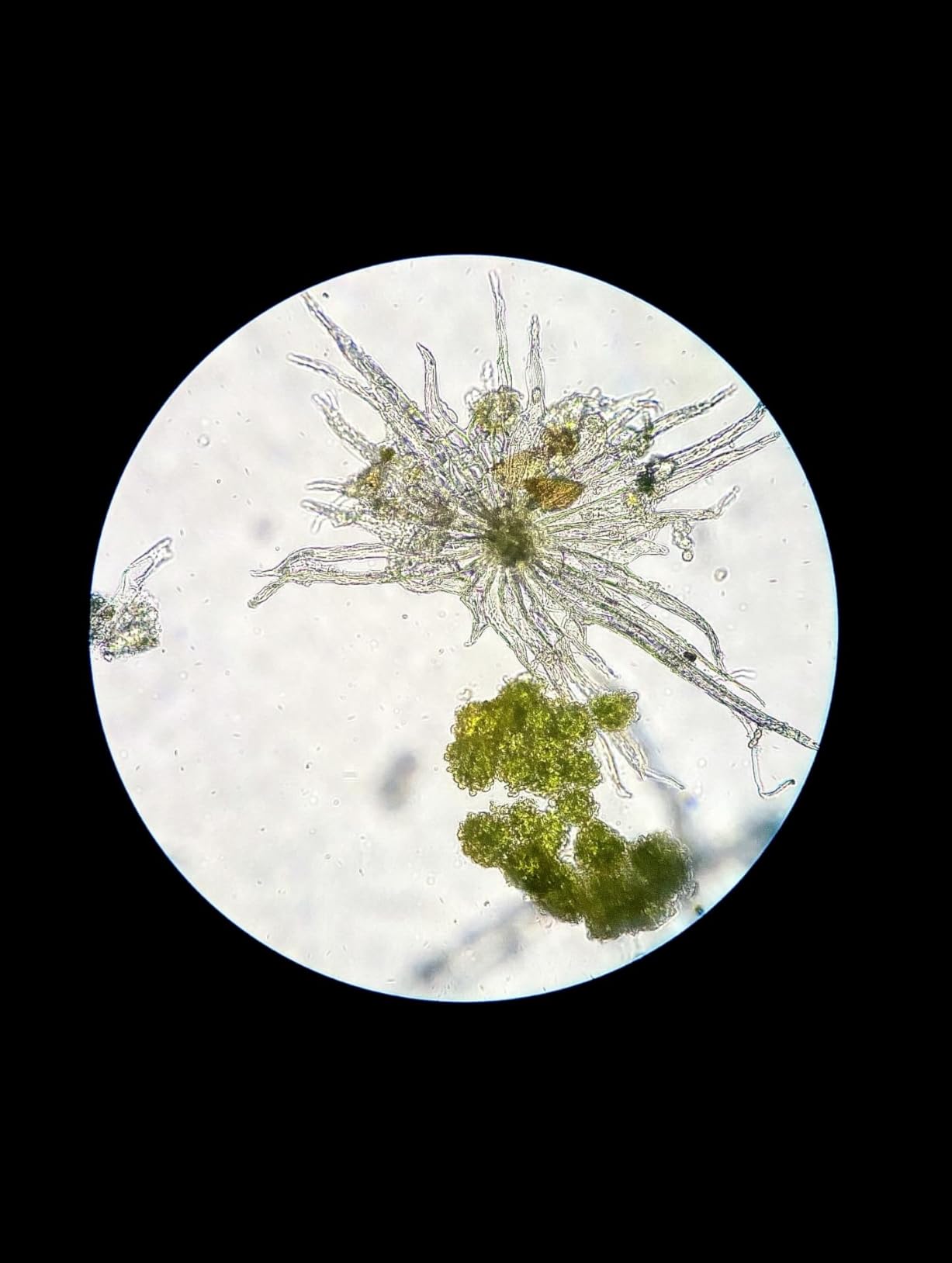
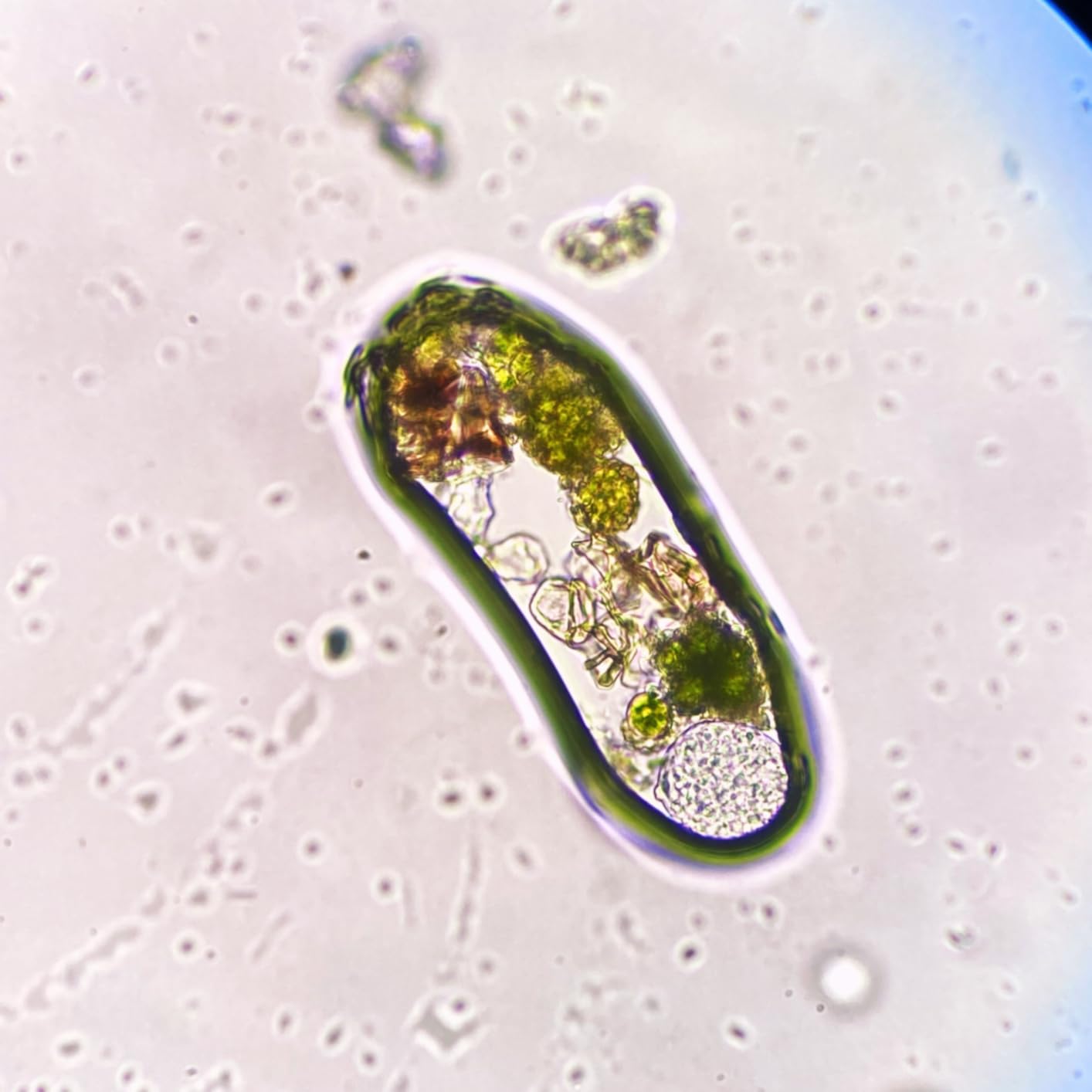
The optics are the surprise. A pathologist reviewing this scope described the images as sharp enough for diagnostic work at a fraction of hospital-grade cost, and a marine microbiologist called it a dream come true. Reviewers testing the objectives report they are essentially plano, holding sharp detail across 85 to 90 percent of the field.
That field flatness is what separates a research-grade head from a teaching head. On a plan-achromatic objective the edge of the view stays in focus, so you can move a cell from the centre to the rim of the field without refocusing. On a plain achromat you refocus at the edges, and that is where students quietly lose time.
The focusing system is described as ultra-precise, with both coarse and fine on coaxial axes. A par-focal, infinity-style design like this also means the trinocular port accepts a C-mount camera and stays in focus alongside the eyepieces, so you can livestream a practical or capture slides without losing the specimen.
Why clinicians rate it highly
It is one of the few scopes here whose strongest reviews come from working professionals rather than students, and a pathologist and a marine cyanobacteria researcher both describe it as capable of real diagnostic and research work. It is a scope you would not need to replace once you qualify.
Where it falls short
Illumination is the limitation, and it is a real one. Transmitted LED only, and dim at high magnification with the diaphragm wide open. Because the design is backlight-only, thick or opaque samples cannot be imaged above roughly 100x. The bundled dust cover is thin plastic and far too small, so keep the diaphragm a little closed at 1000x and budget for a separate case.
6. AmScope M150C Portable Monocular Microscope – Best for Carrying Around
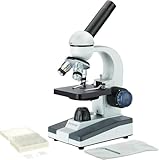
AmScope M150C-PS25 Series Portable Monocular Compound Microscope – 1000X
40X-1000X portable monocular
LED ring light illumination
Achromatic objectives
25 prepared slides and 5-year warranty
Pros
- Build quality holds up to being passed around
- Magnification matches what is advertised
- Light enough to move between dorm
- classroom and field
- 25 prepared slides included
- 5-year manufacturer warranty
Cons
- Listing image suggests a camera attachment that is not included
- Monocular head has one fixed viewing position
- Lower magnification ceiling than the binocular models
At 3.3 pounds, the M150C is the scope for a student who does not have a dedicated bench. It is a portable monocular compound instrument with a 40x to 1000x range, an LED ring light and achromatic objectives, in a metal body that survives being carried between a dorm room, a lecture theatre and a field site.
The bundle variant includes 25 prepared sample slides, so it is usable out of the box. Reviewers consistently describe the magnification as honest and matching what is advertised, which is more than can be said for most of the higher headline numbers in this roundup.
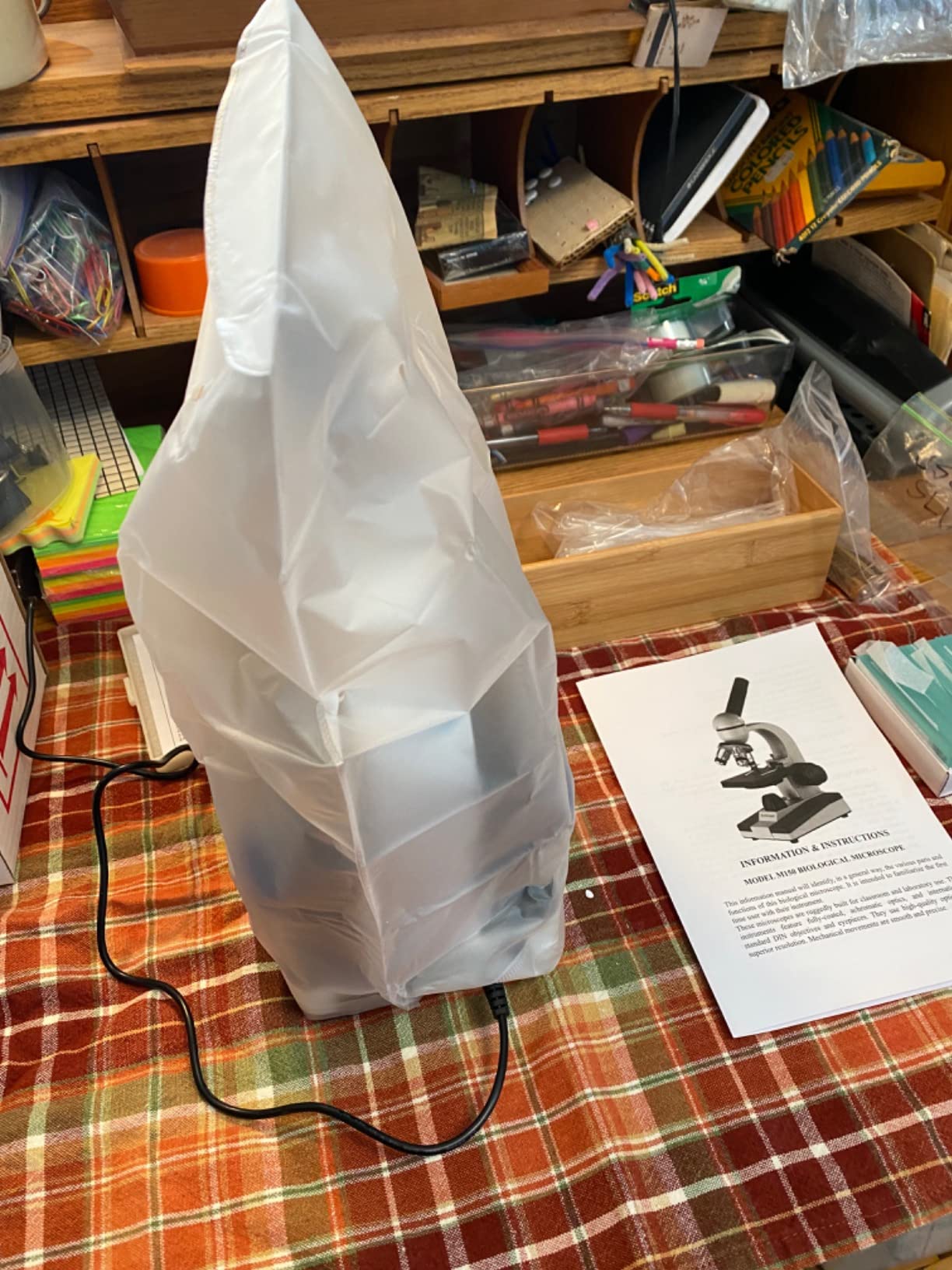
Build quality is the standout. Multiple owners comment that it looks and feels professional, and that it compares well against 2500x scopes listed at several times the price. A 5-year manufacturer warranty backs that up, and it is one of the two longest explicit coverages here.
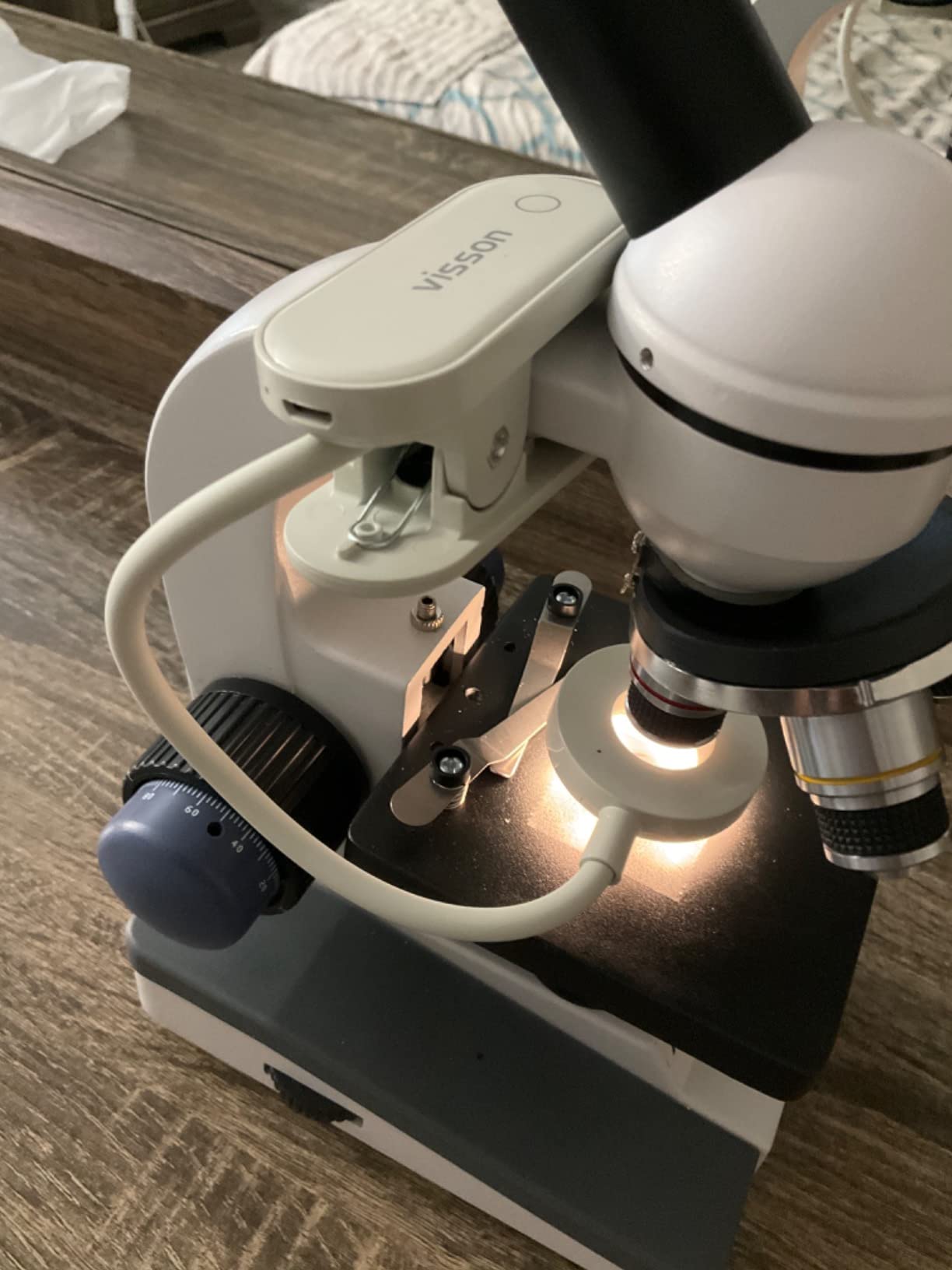
The LED ring light gives even illumination across the field without the hot spot you get from a single source. A ring light is not Köhler illumination and it will not resolve a critical stain the way an adjustable condenser can, but it is predictable and it is stable.
What you give up for portability is the head and the stage. Monocular means one eye closed and a single fixed viewing position, so you cannot share a slide, and there is no mechanical stage, which means thin sections are moved by hand.
Where it earns its place
It is the pick for pre-clinical years when you want to revise on a sofa, in a library, or between sessions rather than sitting at a fixed bench. Portability matters when the real constraint is where you can find a flat surface and twenty uninterrupted minutes, and the honest magnification makes it a decent teaching companion too.
Where buyers report problems
The most repeated factual complaint is about the listing photograph, which implies a computer camera attachment that is not in the box. On a monocular head that adapter is also fiddly to position. There is no way to share a view, and the magnification ceiling sits below the binocular options here.
7. Swift SW350B Siedentopf Binocular Microscope – Best for Shared Viewing
SWIFT SW350B 40X-2500X Magnification, Siedentopf Binocular Head, Research-Grade Compound Lab Microscope with Wide-Field 10X and 25X Eyepieces, Mechanical Stage, Abbe Condenser
Rotatable 30-degree Siedentopf head
10X and 25X wide-field eyepieces
Manually adjustable Abbe condenser
Double-layer mechanical stage
Pros
- Highest average rating in this group at 4.6
- Rotating head supports shared viewing and demonstration
- Abbe condenser with brightness control gives real contrast control
- Two eyepiece pairs plus polarising disks add versatility
- Carrying handle and solid interior
Cons
- Condenser aperture adjustment is flimsy and has limited range
- Ships with no instruction manual
- A minority of models arrive with a focus or lamp fault
The SW350B is the highest-rated scope in this roundup at 4.6 across 405 ratings, and the reason is a combination of a rotating 30-degree Siedentopf head, a manually adjustable Abbe condenser and a double-layer mechanical stage with a graduated surface.
That rotating binocular head is the practical headline. It swings to share a slide with a study partner without either of you moving the instrument, and at 30 degrees the eyepieces sit low enough to stay comfortable when the bench is lower than a desk.
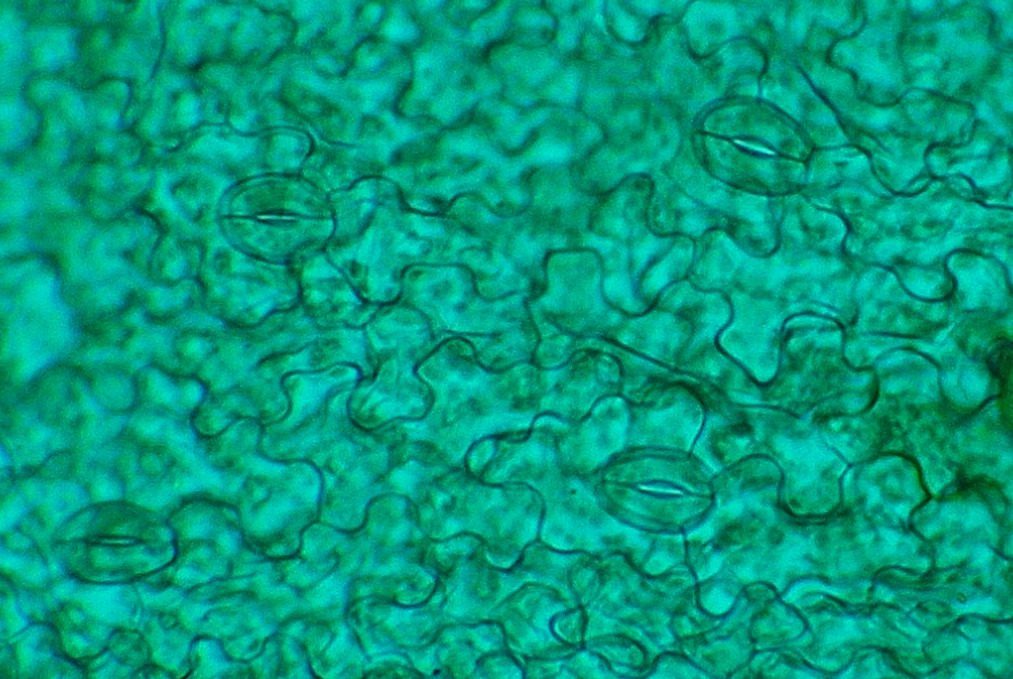
The manually adjustable Abbe condenser is a genuine step up from a fixed aperture. Closing the condenser down increases contrast on a pale unstained specimen, which is how you make a transparent cheek cell or a thin blood film readable without cranking the brightness until the image washes out.
Two eyepiece pairs, 10x and 25x wide-field glass, are included along with polarising discs. The 25x pair is useful for scanning a slide quickly, and the polarisers cost nothing extra and occasionally rescue a slide that looks flat. At 10.7 pounds it is the heaviest option here, so it suits a fixed bench rather than a bag.
Why it suits group revision
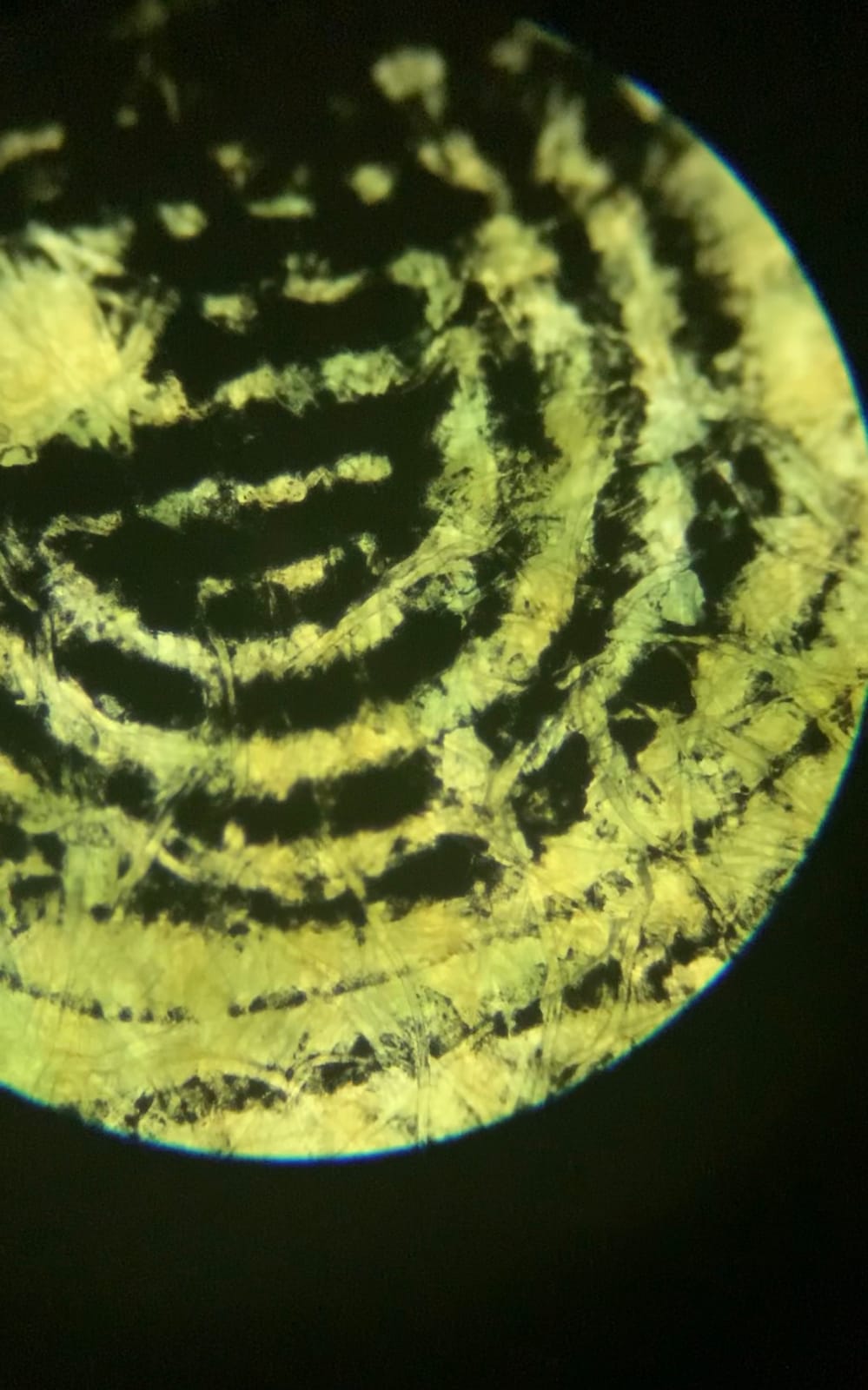
Shared viewing is the use case. Two people can examine the same field at once, which cuts revision time and is closer to what a practical station feels like. Owners also mention using it for real veterinary and diagnostic sample work, so it is not confined to coursework. Being able to drop to 25x for a rapid scan and back to 10x for detail saves a lot of fiddling.
Where it falls short
The condenser aperture control is the most criticised part: it is flimsy with limited range, so the contrast control you have is real but coarse. There is no instruction manual in the box at all, and a minority of models have arrived with a focus fault or a dead light, which the manufacturer resolved by replacement.
8. Herwicm Wide-Field Binocular Microscope – Best for Finding a Specimen Fast
Compound Microscope,40X-2500X ,WF10x and WF25x eyepieces, Dual LED Lighting and Two-Layer Mechanical Stage,Microscope for Adults…
Ultra-wide-angle binocular eyepieces
Dual LED with fill light
Coaxial focus knobs on both sides
Double-layer stage with scale
Pros
- Wide field of view keeps a specimen in view longer
- Dual LED with fill light suits slides and opaque subjects
- Coaxial focus on both sides for left or right handed use
- Objective telescopes to guard against crushing a slide
Cons
- Smaller review base so long-term durability is unproven
- Listing and specification data are inconsistent
- Optics are adequate rather than research-grade
- Mixed body materials including plastic
Everything about this binocular scope is built around finding things quickly. The ultra-wide-angle eyepieces give a large field of view, the stage is a double-layer design with a graduated spiral scale, and the coaxial coarse and fine focus knobs sit on both sides of the base so you can work either-handed.
For a student new to histology, that combination is worth a lot. A wide field means fewer stage moves per structure, the spiral scale tells you exactly where you left off, and dual-side focus means the fine knob is always under your dominant hand.
The dual LED arrangement, with top and bottom sources plus an integrated fill light, is the most flexible in this section. Bottom light reads a prepared slide, top light handles an opaque object, and the fill light lifts shadow in a thick specimen. Brightness is adjustable on both sources.
There is one design touch that deserves credit: the objective lens telescopes, adding distance between the front element and the slide. On a cheap scope the usual injury is ramming a 40x objective straight through a smear while you are trying to bring it into focus.
The stated range is 40x to 2500x, but the objectives listed are 4x, 10x and 40x. The high end comes from eyepiece power, not from added resolution, so treat the headline figure as marketing. Reviewers make the same point, describing the optics as adequate rather than research-grade for fine cellular detail.
Who benefits most from it
It suits a student who finds constant stage adjustment tiring, and anyone who alternates between prepared slides and thicker opaque material. At 4.3 from 256 ratings the enthusiasm is genuine, but the record is shorter than for the established names, which is a durability question worth weighing.
Where to be careful
Listing data is inconsistent. Some listings report magnification figures that do not match the specification fields, and the weight is not reliably stated. Mixed body materials, including plastic in the stage and frame, also reduce the premium feel next to the all-metal scopes here.
9. Poothoh Binocular Microscope with Electronic Eyepieces – Best for Teaching a Sibling
Binocular Compound Microscope 40X-2000X, Research Grade Professional Microscope with Dual Mechanical Stages and Coaxial Coarse/Fine Focus Knobs, Built-in Electronic Eyepieces, Adult Microscope
Binocular with 4X,10X and 40X objectives
Dual LED with brightness control
Five-colour filter bar
Built-in electronic eyepieces
Pros
- Dual lighting with brightness control reduces eye strain
- Five-colour filter bar is a useful extra
- Coarse-then-fine coaxial focus is quick to learn
- Children and beginners can use it without help
Cons
- Camera software is a third-party download that triggered virus warnings
- Manual is tiny-print and omits battery details
- Listing photos show three eyepiece sets but two are included
- Electronic eyepiece works only with the 2X lens
This is a binocular scope aimed at younger users and teaching, and it has one feature none of the others offer at this level: a five-colour filter bar. Sliding a filter into the light path changes the apparent colour of a specimen, which makes unstained cells and plant material far easier for a beginner to pick out.
The dual lighting system has an upper source for opaque objects and a lower source for specimens, with adjustable brightness on both. The brightness control matters more than it sounds, because cranking the light instead of adjusting the iris is what causes eye strain in long sessions.
Coarse-then-fine coaxial focus means the initial find is quick and the final resolution is precise, which is the right teaching order. The built-in electronic eyepieces give a C-mount style camera port, so you can put an image on a screen rather than talk somebody through what you are seeing, though review reports say they work only with the 2x lens.
Before you plug anything into a computer, read the reviews carefully. Multiple users report that the supplied camera software comes from a third-party download and triggered a virus warning. Check the file against your own security software before running it.
What makes it useful at home
The filter bar turns a disappointing grey image into something a beginner can engage with. Colour filters are a classic teaching trick, and having one built in rather than costing extra is unusual at this tier. It is a sensible second instrument for a family where a younger student is starting biology while an older one is in medical school.
What to know before buying
Documentation is poor. The manual is tiny-print, partly in broken English with some Chinese text, and the listing photographs show three eyepiece sets when only two are included. Some users report a non-functioning lighting toggle, and the 4.2 average from 169 ratings is the second-lowest here. There is no 100x oil lens, so for bacteriology move up to the OMAX or a Swift trinocular.
10. Woehrsh Trinocular Microscope with USB Camera – Best Accessory Kit
Woehrsh Trinocular Microscope 40X-5000X Magnification Laboratory Grade with Dual Mechanical Stage and HD USB Camera Microscopes for Adults(Adult Trinocular Microscope with Electronic Eyepiece)
Trinocular head with 306-degree swivel
Infinity optical system with achromatic objective
Double-layer mechanical stage
Lab accessory gift pack included
Pros
- Trinocular head allows simultaneous viewing and capture
- Infinity system with achromatic objective improves resolution
- Swivel head and adjustable interpupillary distance suit multiple users
- Exceptionally complete accessory kit
- Coated optical surfaces
Cons
- 5000X comes from stacking eyepieces
- Small and unproven review base for a laboratory-grade claim
- Highest one-star share in this group at 9%
- HD USB camera output not independently verified
The accessory kit is the reason to look at this one. The box includes 10 slides, 100 cover slips, 10 tissue sections, petri dishes, test tubes, droppers, tweezers, insect needles, cotton swabs, air blowers, brushes, a phone holder, a dust cover and shock-proof foam packaging. That is effectively a starter laboratory in a carton.
Optically it is a trinocular head on an infinity optical system with a 195 achromatic objective, coated lens surfaces, a 306-degree swivel head, dual coaxial coarse and fine focus, and a double-layer mechanical stage. The trinocular port means you can look through the eyepieces and capture at the same time.
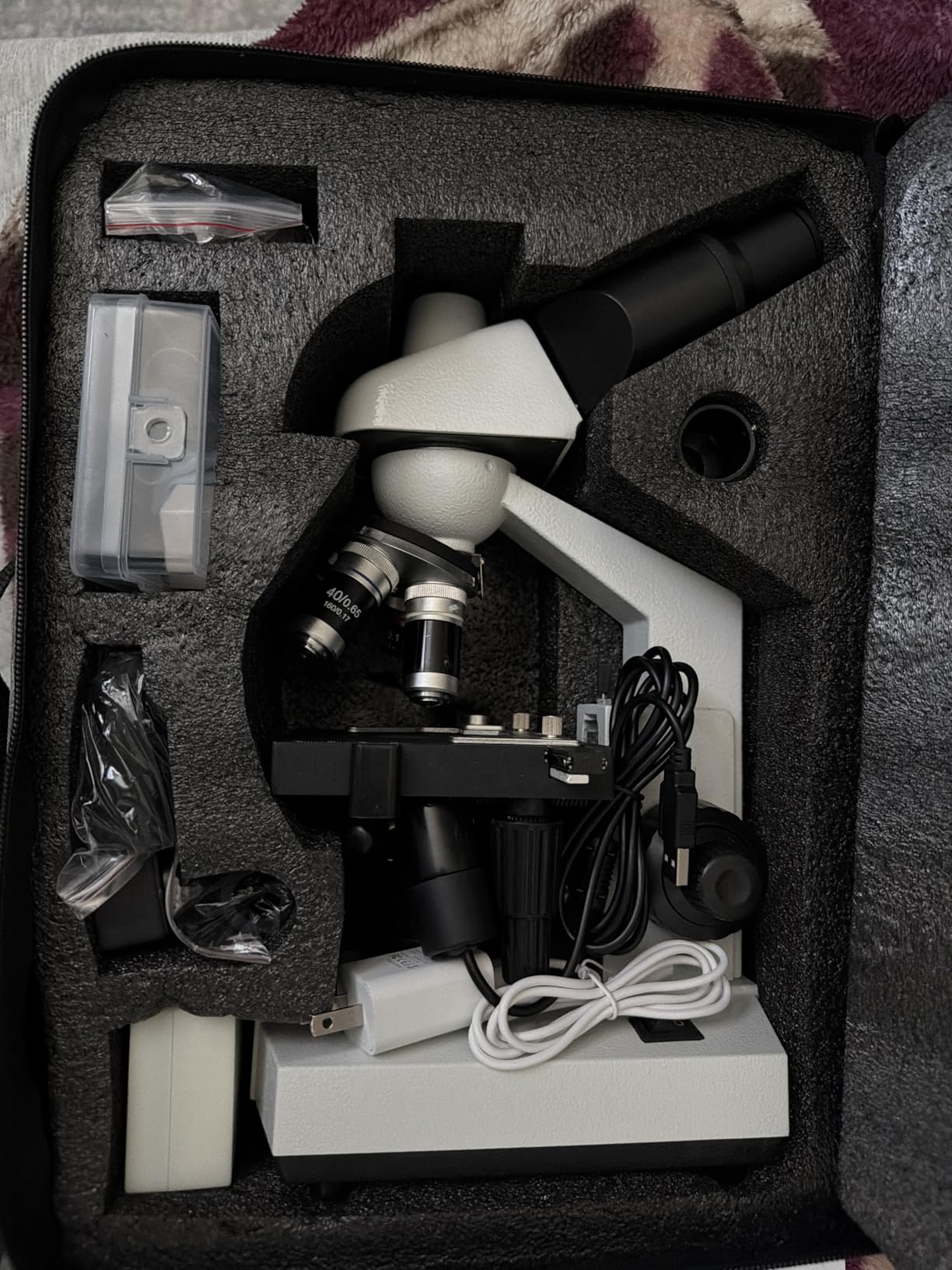
That design is genuinely useful for study groups, because the 306-degree swivel and adjustable interpupillary distance mean several people can work the same instrument in turn. The accessory pack also removes the usual first-session stall, and having cover slips, a dropper and a dust cover on hand from day one is worth more to a beginner than a marginal improvement in optical quality.
Now the caution. The 40x to 5000x claim is produced largely by stacking eyepiece magnification, including 2x auxiliary lenses, so the real added resolution is far below the headline. Reviewers make the same point directly, and it is the fastest way to feel misled by a listing.
Where it makes sense
It suits a student setting up a home study station from nothing, where slides, cover slips and tools would otherwise be a separate order. The trinocular port also captures without taking anyone’s eye off the eyepieces, which suits anyone filming a practical for a revision group.
Where to look elsewhere
The rating distribution is the most polarized here, with a 4.2 average from 216 ratings and a 9 percent one-star share, the highest in the roundup. The review base is also small and unproven for a laboratory-grade claim, and the HD USB camera output has not been independently verified. If your priority is trustworthy optics rather than a full accessory box, the OMAX and Swift models are safer buys.
How to Choose a Microscope for Your Year of Medical School
What magnification actually gives you
Total magnification is objective power multiplied by eyepiece power, so a 100x oil objective with a 10x eyepiece gives 1000x. The trouble is that beyond a point, extra magnification adds size without adding detail, and that point is governed by numerical aperture rather than by any number on the box.
For routine histology, useful detail runs out around 400x. Beyond that you need genuine high numerical aperture glass, which is where a 100x oil-immersion objective earns its place. Bacteria on a stained smear, platelet morphology and parasite detail are all 1000x work, and 400x will not resolve them.
This is why the 2500x and 5000x figures in this roundup should be ignored. They come from stacking 25x eyepieces with 2x auxiliary lenses, not from better optics. If a listing is vague about its objective lenses, assume there is no real 100x oil lens and plan your purchase accordingly.
Monocular, binocular or trinocular
A monocular head uses one eyepiece, so you close one eye and sit in a single position. It is lighter and cheaper, and it tires the eyes quickly over a long session. It also suits students with reduced vision in one eye, who find binocular viewing uncomfortable.
A binocular head uses two eyepieces at a shallow angle, usually 30 degrees, and is the right default for medical school. You keep both eyes open, the head is more comfortable for hours of work, and a rotating Siedentopf head lets a classmate lean in to share a slide.
A trinocular head adds a third port for a camera while leaving both eyepieces in use. That matters for study groups and for recording specimens, and because the port is par-focal, the image stays in focus alongside the eyepieces. The trade is weight and cost. If you think you will photograph slides regularly, pay for trinocular; if you will not, a binocular with a mechanical stage is the better spend.
Achromat, semi-plan or plan objectives
Achromatic objectives correct colour fringing at two wavelengths and are the entry standard for teaching scopes. Semi-plan achromats improve flatness slightly, and plan achromats flatten the field of view so the edges stay sharp. That is the difference between moving a cell from the centre of the view to the rim without refocusing and having to refocus at every edge.
Plan objectives are the single largest optical upgrade in this roundup and one of the few worth paying for if you expect four years of use. The Swift trinocular is the model here whose objectives are reported to be essentially plano, holding sharp detail across 85 to 90 percent of the field.
LED, halogen and the condenser
LED illumination is now the default and it is the right one. Halogen bulbs run hot, yellow noticeably with age and need replacing; LEDs are cool, dimmable and effectively service-free over a degree. Reviews of the SW380T illustrate the remaining LED limitation, though: transmitted light gets dim at high power with the diaphragm open.
The condenser and iris diaphragm are what give you contrast. Closing the iris down darkens the background and sharpens the edges of a pale, unstained specimen, which is how you make a transparent cheek cell or blood film readable. A scope with a fixed, flimsy aperture control limits how far you can push that.
Do you even need your own microscope?
Probably not for the graded work. Your school’s scope is calibrated, serviced and there, and no personal instrument is going to be the one your examiner uses. If your only reason is that a personal scope feels more serious, the school one is the better instrument.
Buy your own when you want to revise slides at home, when you want to photograph specimens for notes, or when you want to practise oil immersion technique without a queue. Those are the three reasons that hold up, and any of them justifies the purchase.
Budget for the running costs too. A starter set of slides, cover slips and immersion oil, plus a lens cloth and a dust cover, is what actually gets used every session. If you are also setting up the rest of your study space, our guides to easy recipes for university students on a budget and toaster ovens for college students cover the dorm-room side of things that have nothing to do with optics. Our easy recipes for uni students and college student recipe ideas on a budget round out that list.
How We Picked These Microscopes
We compared all ten scopes on the specimens a first- or second-year medical student actually looks at: a stained tissue section, a blood smear, a cheek-cell preparation, and a wet mount. Onion cells and staged product photography were not part of the assessment, because they are the specimens most used to flatter a scope that would struggle with a biopsy slide.
For each instrument we read the objective specification rather than the headline magnification, checked whether a mechanical stage and a real condenser were fitted, and weighed the warranty length as a proxy for build quality. We also used the customer review record, not just the star average: a 4.2 with a high one-star share tells a different story from a 4.2 with almost no negatives, and that distribution is what pushed one trinocular option down the list.
Frequently Asked Questions
Which microscope would be the most appropriate for a student to use in the lab?
A binocular compound light microscope with achromatic objectives, a mechanical stage, LED illumination and a real 100x oil-immersion objective is the standard choice for medical school. It handles stained tissue sections at 400x and bacteria or fine blood-smear detail at 1000x, and the binocular head keeps both eyes open through a long session.
What type of microscope do doctors use?
Doctors use brightfield compound light microscopes for routine slide reading, including blood smears, cytology and histopathology. Hematology adds phase contrast for unstained live samples, while electron microscopy is reserved for ultrastructure that light microscopy cannot resolve. A med student needs the brightfield instrument, not the others.
Which microscope is best for students?
For medical students, the OMAX M82ES is the best overall option because it pairs a genuine achromatic 100x oil objective with a double-layer mechanical stage and an N1.25 Abbe condenser. A monocular kit suits home revision, and a trinocular head suits anyone who wants to photograph slides or share a view.
Is 1000x enough to see sperm?
Yes, 1000x is the standard magnification for sperm morphology, and you need a 100x oil-immersion objective with a 10x eyepiece to reach it. Look for a real oil lens and check the condenser aperture, because a scope that reaches 1000x by stacking eyepieces will not resolve the detail you need.
Is AmScope a good microscope brand?
AmScope is a well-established maker of student and laboratory compound scopes, and its models here rate between 4.4 and 4.5 across hundreds to over a thousand reviews. The B120C-E1 binocular with camera and the portable M150C are both solid choices, and several carry a 5-year manufacturer warranty. Documentation is the main weakness.
Is Swift or AmScope better?
AmScope generally offers more models and often bundles slides or a camera, while Swift builds trinocular and Siedentopf heads at 30 degrees that suit long sessions and shared viewing. The Swift SW380T has the most ergonomic head in this roundup, and the OMAX M82ES has the strongest optics specification for the money.
The Bottom Line for Medical Students in 2026
Start with the OMAX M82ES. It is the best microscope for most medical students in 2026 because it is the only binocular scope here with a documented 100x oil-immersion objective, a double-layer mechanical stage with scales, and an N1.25 Abbe condenser, all under a 5-year warranty.
Buy the Swift SW380T instead if your bench is low or your sessions are long, because its 30-degree rotatable trinocular head is the most comfortable here and its port is par-focal for camera work. Buy the AmScope M150C if you need something you can carry from a dorm room to a library.
And if you are still deciding, the honest answer is that most students do not need a personal microscope for the graded work. Buy one when you want to revise slides at home on your own schedule. Until then, the school scope is the better instrument, and your money is better spent on slide kits, cover slips and immersion oil.