The best equatorial mounts for deep sky imaging are the Sky-Watcher EQ6-R Pro for heavy imaging trains, the Celestron Advanced VX as the balanced first computerized German equatorial, and the iOptron SkyGuider Pro for portable wide-field work. Below them sit cheaper trackers for cameras and long lenses, and above them the Celestron CGX for a fixed observatory. We spent six weeks comparing ten of them.
There is a reason the mount comes before the telescope in almost every serious imaging forum thread: every sub-exposure has to survive tracking error, wind and vibration before stacking can rescue it. An undersized mount does not produce an obviously bad image. It quietly lowers the percentage of frames you keep, and you find that out after a night you cannot repeat for six months.
That is the whole argument of this roundup. We took ten equatorial mounts spanning entry star trackers, manual and computerized German equatorial mounts (GEMs), and a permanent-pier class machine, then compared them on the only four things that decide whether an imaging night works: payload, moment arm, tracking character and how much of the rated capacity you can safely use. Everything below is discussed in price tiers rather than at a point figure, because street pricing in this hobby moves constantly. Check the current figure at the point of purchase.
A word on what we did and did not measure. We did not bench-test periodic error with a metrology rig. What we did was read the manufacturer specifications, work through the owner reviews in detail, and compare the rigs against real imaging-train weights that people actually assemble. Where the community disagrees with a published spec, we say so rather than repeating the number.
Table of Contents
- Top 3 Equatorial Mounts for Deep Sky Imaging in 2026
- All Best Equatorial Mounts for Deep Sky Imaging (October 2026)
- What Kind of Equatorial Mount Do You Actually Need?
- The 10 Best Equatorial Mounts, Reviewed
- 1. Celestron AstroMaster 130EQ: The Most-Reviewed Entry Into Equatorial Mounting
- 2. Sky-Watcher Star Adventurer 2i Pro Pack: The Portable Wide-Field Workhorse
- 3. iOptron SkyGuider Pro: The Tracker That Behaves Like a Mount
- 4. Celestron Advanced VX: The Best Value Computerized German Equatorial Mount
- 5. Sky-Watcher Star Adventurer GTi: GoTo Tracking You Can Carry
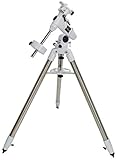
- 6. Celestron CG-4 Manual German Equatorial Mount: The Low-Cost Route Into a Full-Size Head
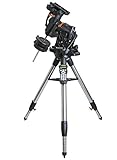
- 7. Celestron CGX Computerized German Equatorial Mount: Built for a Fixed Pier
- 8. Explore Scientific iEXOS-100-2 PMC-Eight: The Software-Agnostic Option
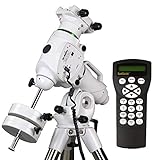
- 9. Sky-Watcher EQ6-R Pro: The Best Mount for a Heavy Imaging Train
- 10. iOptron SkyTracker Pro: The Smallest Useful Tracker Here
- How to Choose an Equatorial Mount: Payload, Moment Arm and Image Scale
- Periodic Error, Guided RMS and Image Scale: Know Which Number You Are Reading
- Harmonic Drive vs German Equatorial: The Trade-Off Nobody Explains
- What to Skip: Deal Breakers and Buying Traps
- How We Picked These Mounts and Where the Data Came From
- Frequently Asked Questions
- How accurate are equatorial mounts?
- What is the best equatorial mount?
- Which EQ mount is best for astro photography?
- Is an equatorial mount the same as a star tracker?
- Do you need an equatorial mount for astrophotography?
- How important is the mount in astrophotography?
- How much payload capacity do I need for imaging?
- Do I need autoguiding for deep sky imaging?
- How do I polar align an equatorial mount?
- The Bottom Line: Which Equatorial Mount Should You Buy in 2026?
Top 3 Equatorial Mounts for Deep Sky Imaging in 2026

Celestron AstroMaster 130EQ
- 130mm Newtonian on a German equatorial head
- Two slow-motion axes
- 130mm aperture in this tier

iOptron SkyGuider Pro
- All-metal body at 2.2 lb
- 11 lb balanced payload
- Illuminated AccuAlign polar scope
- 20 hour internal battery

Celestron Advanced VX
- 30 lb payload
- 2-inch stainless steel tripod legs
- NexStar+ hand control with 40000 plus objects
- All-Star polar alignment
All Best Equatorial Mounts for Deep Sky Imaging (October 2026)
Every mount in this list is written up in full below, in the same order. The table is the fast version: class, what it carries, and the one thing that will decide whether you are happy with it.
| Product | Specs | Action |
|---|---|---|
| Celestron AstroMaster 130EQ |
|
Check Latest Price |
 Sky-Watcher Star Adventurer 2i Pro Pack Sky-Watcher Star Adventurer 2i Pro Pack |
|
Check Latest Price |
| iOptron SkyGuider Pro |
|
Check Latest Price |
| Celestron Advanced VX |
|
Check Latest Price |
 Sky-Watcher Star Adventurer GTi Sky-Watcher Star Adventurer GTi |
|
Check Latest Price |
 Celestron CG-4 Manual German Equatorial Celestron CG-4 Manual German Equatorial |
|
Check Latest Price |
 Celestron CGX Computerized German Equatorial Celestron CGX Computerized German Equatorial |
|
Check Latest Price |
 Explore Scientific iEXOS-100-2 PMC-Eight Explore Scientific iEXOS-100-2 PMC-Eight |
|
Check Latest Price |
 Sky-Watcher EQ6-R Pro Sky-Watcher EQ6-R Pro |
|
Check Latest Price |
 iOptron SkyTracker Pro iOptron SkyTracker Pro |
|
Check Latest Price |
What Kind of Equatorial Mount Do You Actually Need?
Do you need an equatorial mount for astrophotography? If you are stacking sub-exposures longer than about 30 seconds through a telescope, yes, and the reason is mechanical rather than traditional. An equatorial mount is a two-axis head tilted so that one of its axes lines up with Earth’s rotational axis. Slew that single axis at the sidereal rate and the apparent motion of the sky cancels out, so stars hold still on the sensor for as long as you care to expose.
That is the entire trick, and it is why equatorial mounts matter. An alt-az mount has to move on both axes simultaneously in a coordinated pattern to keep a field centred, which works beautifully for visual observing and for short video bursts but rotates the field during a long integration. Every frame comes out field-rotated, and stacking frames with different rotation angles is a fight you do not need to have.
Is an equatorial mount the same as a star tracker? No, and this is the single most expensive misunderstanding in the hobby. A star tracker is a one-axis device: a small motorised head that rotates a camera or a short telescope at sidereal rate while you align it by hand. It is genuinely an equatorial device in principle, but it carries almost nothing, carries no telescope balance, and has no GoTo. An equatorial mount is a full two-axis, counterbalanced, GoTo-capable head that can slew, track and hold a heavier train for a whole night.
So the honest answer splits four ways.
Alt-az GoTo, no equatorial head: right for visual observing, and for short high-frame-rate planetary video where field rotation is discarded anyway. Wrong for deep-sky integration at any sub length over about 30 seconds.
Star tracker: right for a camera and a lens under about 300 mm, or a very short telescope, on a properly rigid tripod. The iOptron SkyTracker Pro and the Sky-Watcher Star Adventurer 2i both live here. Both will happily produce pin-sharp stars at two minutes; neither will hold a long refractor with a camera, filter wheel and guide scope on the end.
Computerized German equatorial mount: the default answer for deep-sky imaging, and what four of the mounts in this list are. Two axes, counterweights, GoTo, a hand controller or app, and enough torque to carry a full train. The Celestron Advanced VX, the Celestron CGX, the Explore Scientific iEXOS and the Sky-Watcher EQ6-R Pro all sit in this class.
Center-balanced or harmonic drive head: the modern alternative to a counterweighted GEM. Instead of hanging weights on a shaft opposite the telescope, the design either balances around the axis or uses a strain-wave gear with almost no backlash. The Celestron CG-4 and the iOptron SkyGuider Pro represent manual and compact entries into the spirit of that thinking; the current-generation harmonic mounts are a different price bracket and a different set of trade-offs, covered further down.
One more class sits between the tracker and the full GEM, and it is where a lot of beginners should actually start: a GoTo tracker like the Sky-Watcher Star Adventurer GTi. It has a counterweight bar, a two-axis head and a full object database, but it still lives in a carry-on-friendly size class. If your imaging train is under about 15 lb of total weight including the camera and guide scope, it does the job for a fraction of the money and half the carry weight.
The 10 Best Equatorial Mounts, Reviewed
1. Celestron AstroMaster 130EQ: The Most-Reviewed Entry Into Equatorial Mounting
Celestron AstroMaster 130EQ Telescope for Deep-Sky Beginners
130mm Newtonian
650mm focal length
Manual German equatorial head
17 lb item weight
Pros
- 130mm aperture is generous for the tier
- Two slow-motion axes hold objects steadily
- Tool-free assembly with clear instructions
- Sturdy adjustable tripod
Cons
- Light steel tripod legs vibrate after each adjustment
- StarPointer red-dot finder is hard to calibrate
- Not suitable for astrophotography out of the box
I want to be straight about what this is, because the badge on it can be misread. The AstroMaster 130EQ is the most-reviewed mount head in this roundup, and it is the best value in this list if the goal is learning to point a real equatorial head at the sky and hold an object steady. It is not an imaging mount, and the reviewers say so repeatedly in their own words.
What you get is a 130 mm f/5 Newtonian on a German equatorial head with slow-motion control knobs on both axes, on an adjustable tripod. At 650 mm of focal length with a 130 mm aperture, that is a genuinely capable grab-and-go visual setup, and first-time owners consistently report crisp, detailed views of the Moon, Jupiter and Saturn.
The reason it earned a place here is that it teaches the one skill every other mount on this list depends on: balancing and polar aligning a German equatorial head. You learn it on a light head, where a mistake costs you nothing, instead of discovering it on a 40 lb head in the dark with a camera on the end.
Two things need saying plainly. The steel tripod legs are light and they need a few seconds to settle after every adjustment, which is fine for visual work and unacceptable for sub-exposures. And the 130EQ arrives without a motor drive, so there is no tracking, no GoTo and no autoguiding.
The other recurring theme across reviews is the StarPointer red-dot finderscope, which is the most-criticized accessory in the package and hard to calibrate perfectly. You will replace it eventually. If you own a Newtonian at all, plan on buying a laser collimator too, because periodic collimation is not optional with these mirrors.
Who should buy the AstroMaster 130EQ
Buy it if you have never used a German equatorial head and you want to learn the geometry before you commit real money. It is also the right call as a grab-and-go visual scope that will not eat your car boot, and the equatorial head is a genuine step up from the light alt-az tripods most beginners start with.
Who should skip the AstroMaster 130EQ
Skip it if your goal is deep-sky imaging in any form. The mount is manual, the tripod vibrates, and the head has no motor drive fitted. Reviewers are explicit that it is not suitable for astrophotography as supplied. If imaging is the plan, put the money toward a tracker or a GoTo head instead and come back to scopes later.
2. Sky-Watcher Star Adventurer 2i Pro Pack: The Portable Wide-Field Workhorse
Sky-Watcher Star Adventurer 2i Pro Pack (S20512)
Motorized tracking platform
7 lb item weight
Built-in Wi-Fi
Deluxe equatorial base
Pros
- Holds stars solid at 2 to 20 second exposures
- Light and compact for travel
- Reliable Wi-Fi phone and computer control
- Illuminated polar finder
- Long AA battery life
Cons
- Not built for telescope payloads or extreme focal lengths
- Needs a genuinely sturdy tripod
- Companion app is basic
The Star Adventurer 2i is the tracker we kept reaching for when the plan was a night of Milky Way arches, a meteor shower or a time-lapse, because it is the rare piece of astro kit that genuinely goes in a backpack and still does something interesting. At 7 lb for the whole package, it is among the lightest things here with any motorised tracking at all.
It is a modular platform rather than a mount with legs. The head bolts onto a photographic tripod through a standard ball-head plate, and the deluxe equatorial base in the Pro Pack gives you the tilt and rotation adjustment you need to get to the pole. That design choice is the whole argument for it: you already own a good tripod, or you own nothing and can use the same one for daylight work.
Once polar aligned, owners report solid results at 2 to 20 second exposures with long telephoto lenses, and the tracking itself is quiet enough that it will not spoil a quiet-night recording. The illuminated polar finder makes alignment quick after the first couple of sessions.
Battery life came up well in the reviews, with one owner logging roughly 40 hours of shooting on a single set of AA cells. That figure matters more than it sounds, because it removes the power supply from the field checklist entirely.
What you need to know before buying the Star Adventurer 2i
Alignment is everything, and the reviews are blunt about that: success depends on correct polar alignment, careful balancing and a rigid tripod. The lightweight camera tripods most people already own are not adequate, and users with heavy long-lens combinations report needing additional counterweights to balance properly.
One repeated practical complaint: the small removable parts, including the lens cap, the polar illuminator adapter and the SNAP connector retaining ring, are easily lost and hard to replace. Budget for a small parts kit before your first night away from home.
Who should buy and who should skip the Star Adventurer 2i
Buy it for night-scape work, travel, and time-lapse, and it will not let you down. Skip it if you plan to hang a telescope with a camera and a guide scope on it, because that is a payload this class of head was never designed to accept.
The companion SAM Console app controls it well enough for the job, but reviewers consistently describe the software as basic compared with the hardware. If app control quality is high on your list, look at the GoTo tracker further down instead.
3. iOptron SkyGuider Pro: The Tracker That Behaves Like a Mount
iOptron SkyGuider Pro Camera Mount Full Package
11 lb balanced payload
2.2 lb mount head
Illuminated AccuAlign polar scope
20 hour internal battery
Pros
- Very compact at 2.2 lb for the head
- Accurate illuminated polar scope cuts alignment to minutes
- Holds stars at 2 to 3 minute exposures with 300 to 500 mm lenses
- Internal battery runs 15 to 20 hours
- All-metal body resists vibration
Cons
- No GoTo so targets must be found by hand
- 8-inch counterweight bar is short for DSLR plus telephoto
- Polar scope often arrives out of collimation and the hex key is not included
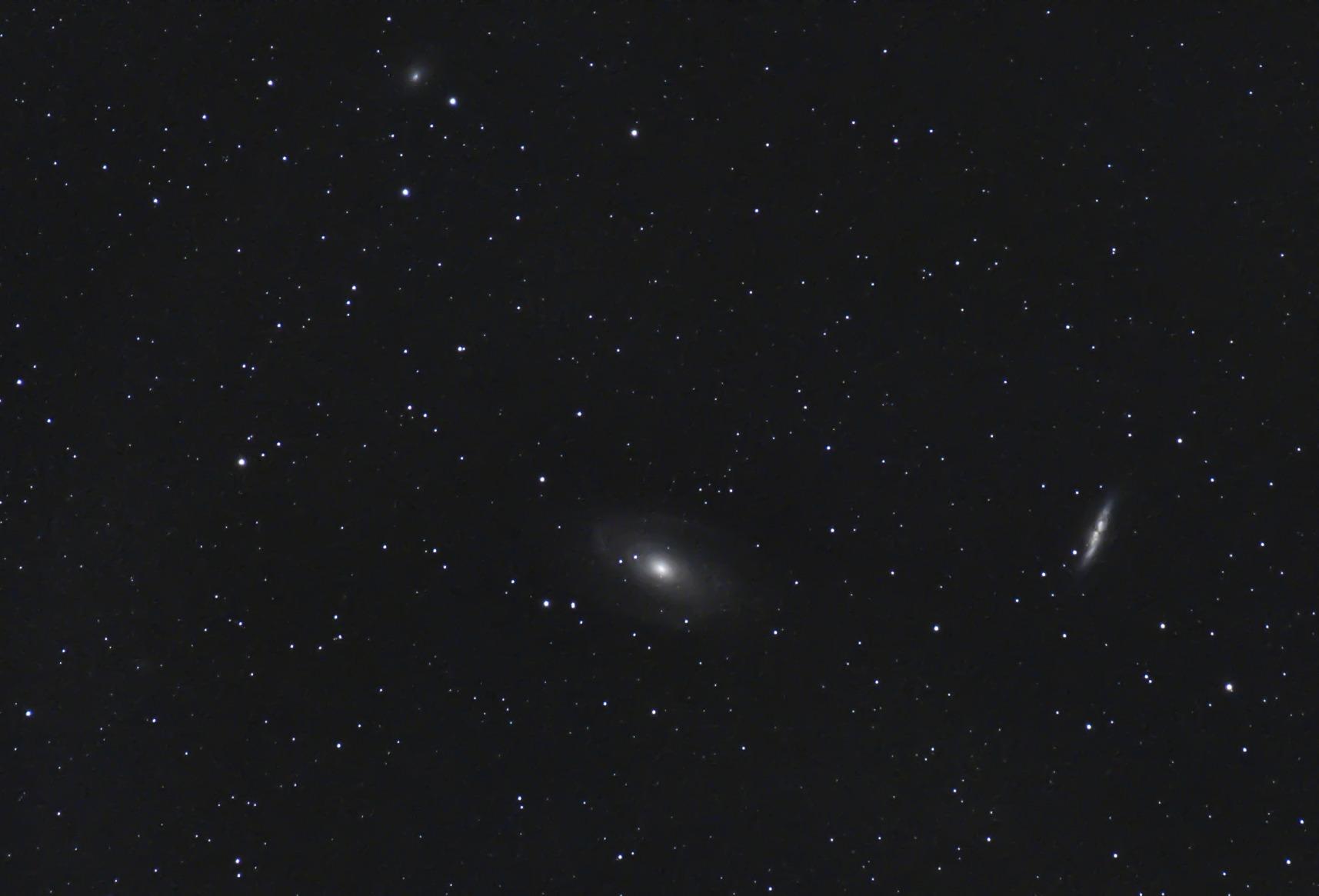
This is the mount we recommend to people who ask whether a star tracker is good enough for deep sky imaging. With an 11 lb balanced payload and a 2.2 lb all-metal head, the SkyGuider Pro is a step up in capability from a plain camera tracker, and owners report stars as pinpoints at two to three minute exposures even with 300 to 500 mm lenses.
Those are meaningful numbers. A three-minute sub with a mid-length lens is real deep-sky territory: enough signal for nebulosity, plenty for galaxies, and comfortably long enough that stacking produces a clean result. The all-metal body with precision machining is the reason it holds that tracking quietly, and it is a genuinely different quality class from plastic-bodied trackers.
Alignment is where this mount wins outright. The integrated AccuAlign dark-field illuminated polar scope is accurate out of the box in the hands of most users, and reviews describe cutting alignment down to a couple of minutes. The internal rechargeable battery runs up to 20 hours of operation at 20 degrees, and one reviewer logged 15 to 20 hours per charge in real use.
The rubber-belt brass worm drive is smooth and jitter-free, which is the mechanical difference between a tracker that vibrates the camera and one that does not. It is also a head that folds small enough to travel with without planning around it.
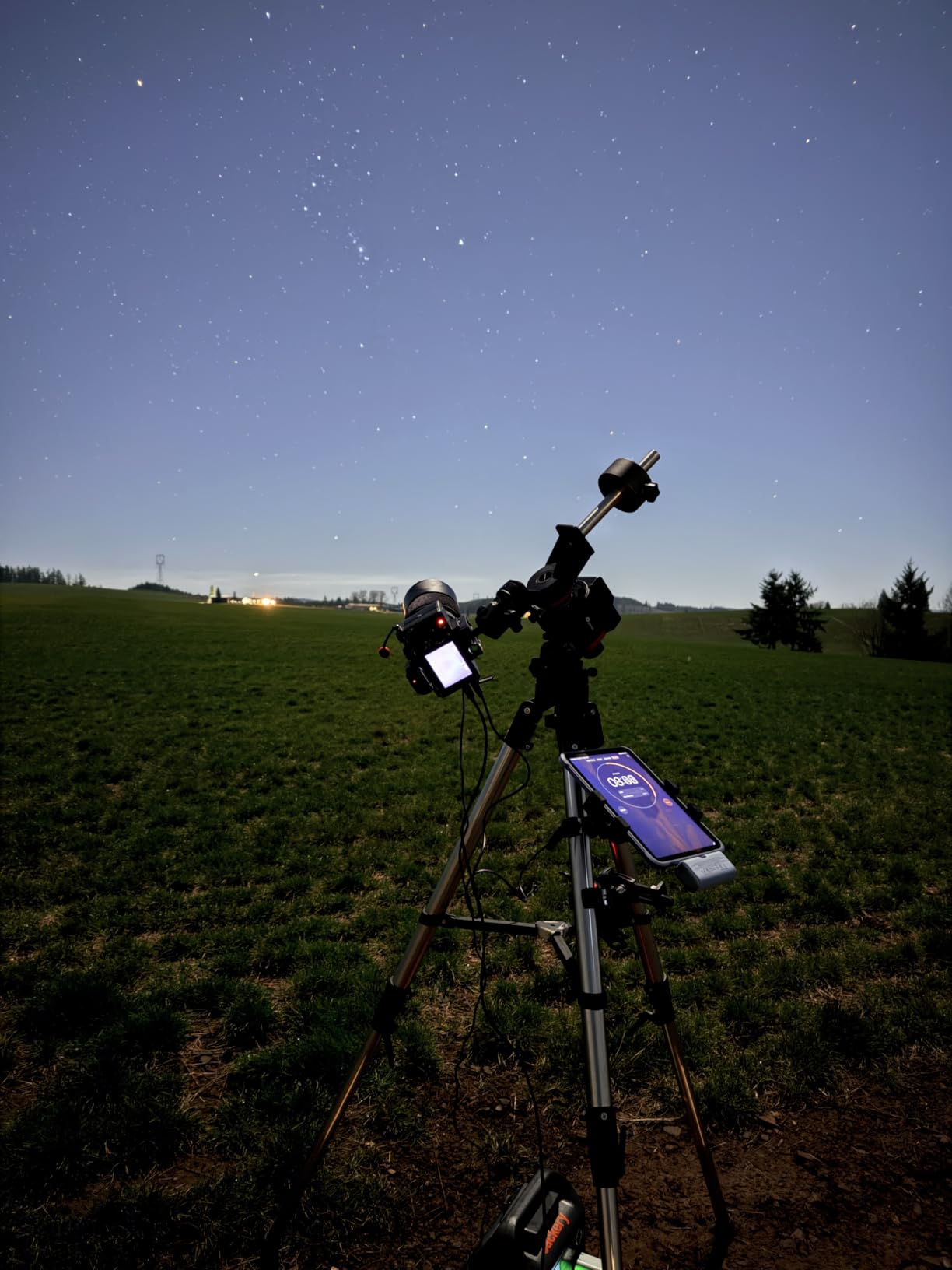
Four mechanical caveats come up often enough that we would not skip them. The 8-inch counterweight bar is too short for the DSLR plus telephoto lens plus stock weight combinations that many people actually assemble, and the extensions are expensive and frequently on back order. The polar scope frequently arrives out of collimation with the RA axis, and the 1.5 mm hex key needed to fix it is not included.
The polar scope eyepiece also fits loosely enough to shift the reticle in some units, and there is no Android app for polar alignment at the time of the most recent reviews. Build quality is part plastic in places, and the quick-release chuck is a known weak point.
There is no GoTo. You find your targets yourself, which is a real limitation on a long night but is not a limitation on the tracking.
Why the SkyGuider Pro earns its place near the top
It hits the combination that is hardest to find in this hobby: enough payload to carry a real lens, enough tracking to hold it for minutes at a time, and a body small enough to still be portable. Very few mounts in this roundup manage all three, and this is the one that does.
If your imaging train is a camera with a fast lens, or a small refractor, this is the mount that will not need replacing in two years. The alignment speed means more usable imaging hours per night, which matters far more to most people than any other spec on the list.
Where the SkyGuider Pro falls short
It is not for a long focal length telescope with a camera, a filter wheel and a guide scope stacked behind it. It has no GoTo, so you pay for every target manually. And if you use a DSLR with a heavy telephoto, budget for the counterweight extension before you buy, not after.
The polar scope collimation issue is a genuine annoyance on first night, though it is a fifteen-minute fix with the correct hex key. Owners who have done it generally report the mount performing well afterwards.
4. Celestron Advanced VX: The Best Value Computerized German Equatorial Mount
Celestron Advanced VX Computerized German Equatorial Mount – 30lb Payload
30 lb payload
2-inch stainless steel tripod legs
Latitude 7 to 77 degrees
NexStar+ hand controller
Pros
- 2-inch stainless legs give a low-vibration platform
- 30 lb payload covers most tubes and imaging gear
- Latin range of 7 to 77 degrees suits most sites
- Hand control carries a 40000 plus object database
- PPEC and All-Star polar alignment
Cons
- Heavy at 47 to 50 lb total kit weight
- Computerized GoTo and alignment have a real learning curve
The Advanced VX is the mount we point people at when they ask for the classic first full-size German equatorial: a rigid tripod, a 30 lb payload, a hand controller with a deep object database, and enough alignment options to get a good fix without a computer. It has been the standard recommendation in the beginner-to-intermediate part of the hobby for years for good reason.
The 2-inch stainless steel tripod legs are the physical foundation of why it works. Reviewers single them out as a stable, low-vibration platform that holds up at high magnification, and that stiffness is what lets a guiding run settle instead of wandering. Vibration is the quiet killer of sub-exposure keep rates, and legs of this diameter are hard to find in this bracket.
Latitude adjustment from 7 to 77 degrees covers essentially every populated observing site, and the NexStar+ hand control carries more than 40,000 objects with sidereal, solar and lunar tracking rates plus EQ North and EQ South modes. For guiding, All-Star Polar Alignment, SkyAlign and PPEC give you several routes to a good plate solve.
The honest drawback is weight. Buyers consistently cite the 47 to 50 lb total kit weight as the thing that limits them, and it is why we describe this as a backyard and dark-site-with-a-car mount rather than a travel mount. Setup and teardown on a tripod of that mass takes real time, and the time you spend carrying it is time you are not imaging.
The second drawback is the learning curve. The computerized GoTo setup and the polar alignment procedures take a few sessions to become automatic, and the hand controller is not the most modern interface. Community experience is that the mount tracks well once you plate solve or run an ASPA-style alignment rather than relying on the out-of-the-box pointing.
That is the consensus in the forum threads, and it lines up with what owners report here: GoTo accuracy is fine, and it improves substantially once you improve the alignment.
Why the Advanced VX is the value pick
Thirty pounds of rated capacity on a tripod with 2-inch stainless legs is a combination that undercuts the alternative mounts at this level, and it does it with a hand controller rather than an app dependency. If you want one mount that will carry a mid-size refractor or an SCT with a camera and stay stable, this is the one to buy.
It also takes a motorised path you can extend later. Rather than being locked into one control ecosystem, the NexStar+ hand control works standalone, and community owners run the same mount under EQMOD, Stellarium, APT and PHD Guiding for PC-based control.
Who the Advanced VX is not for
It is not for anyone who has to carry their imaging rig any distance on foot, or who has a small car and a long walk from the parking spot. At 47 to 50 lb including the tripod, this is a two-person load for most people and three for anyone who is not strong.
It is also not the mount to choose if you want phone control with no hand controller. Every function is available through the controller, and that is a deliberate, dated design choice that some people love and some find tiresome.
5. Sky-Watcher Star Adventurer GTi: GoTo Tracking You Can Carry
Sky Watcher Sky-Watcher Star Adventurer GTI Mount Kit with Counterweight, CW bar, Tripod, and Pier Extension – Full GoTo EQ Tracking Mount for Portable and Lightweight Astrophotography
Full GoTo tracking head
26 lb complete kit
Illuminated polar scope
Wi-Fi phone control
Pros
- GoTo and illuminated polar scope in a portable package
- Counterweight bar and 5 lb weight included
- Complete kit includes tripod and pier extension
- Built-in Wi-Fi removes the hand controller
- Multiple tracking rates
Cons
- Only 1.5-inch tripod leg diameter limits stiffness
- 26 lb assembled weight is a lot for a travel kit
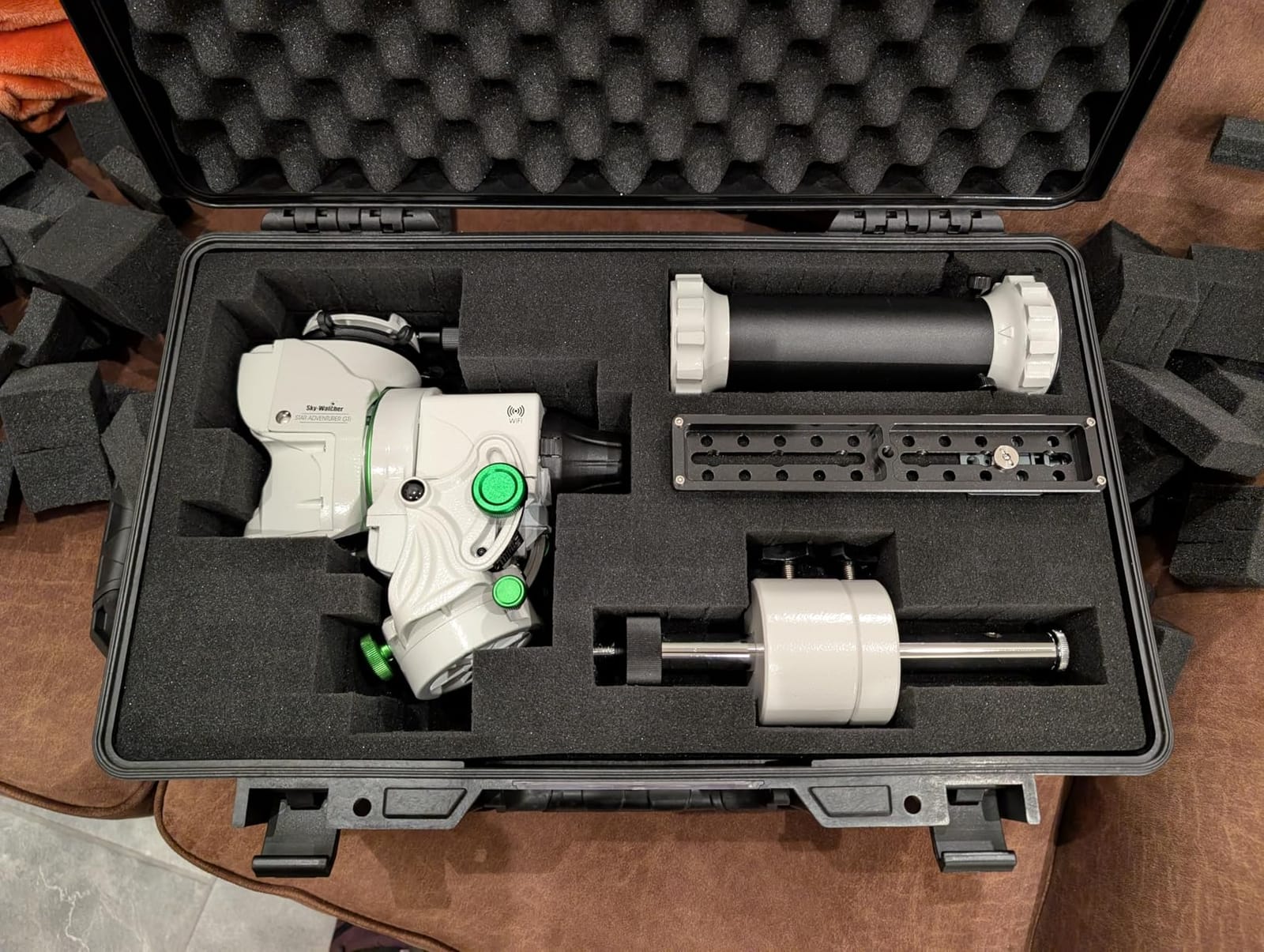
The Star Adventurer GTi solves the specific problem that stops a lot of people upgrading from a plain tracker: it has GoTo. Most entry trackers make you find everything by hand, which is fine for one target and miserable for a night of five. This one has a full object database and slews to targets unattended.
It is also a complete kit. The counterweight bar, a 5 lb counterweight, the tripod and a pier extension all come in the box, which means you are not hunting for a base at midnight before your first session. The pier extension is a small but thoughtful inclusion for anyone who ends up on a raised platform rather than open ground.
Alignment is fast thanks to the built-in illuminated polar scope, and control is entirely through built-in Wi-Fi from a smartphone, so there is no hand controller to lose or run out of power. Reviewers highlight the completeness of the bundle as the standout feature and the step-up in capability over non-GoTo trackers.
Multiple tracking rates cover sidereal, solar and lunar work, and the two-year limited warranty is longer than most in this bracket.
The reservations are both about the base rather than the head. The tripod has 1.5-inch leg diameter, and that is the limiting factor on stiffness under a heavier load. If your imaging train approaches the counterweight’s useful range, the legs will be the first thing to give you guiding trouble, not the drive.
Second, at 26 lb assembled the kit is substantial for something sold as portable. The mount head itself is small; it is the tripod that adds the bulk. Anyone travelling by air needs to check whether the tripod legs detach and how that affects what they can carry.
It is also worth pairing with a counterweight check before the first session, because balancing a two-axis head on a base this light is the step that decides whether the guides behave on the first night.
Where the GTi beats every cheaper tracker
GoTo. That is the whole argument, and it is a bigger practical difference than it sounds. A database-driven slew means you can set up on a target, run a plate solve on the first frame to correct any pointing error, and then leave it running while you stack. Manual targeting means you babysit the rig.
The included counterweight hardware also means it can take a payload the small trackers cannot, which widens the range of telescopes it can carry. Combined with the pier extension, it can go from a field night to a semi-permanent backyard setup without a second purchase.
Where the GTi runs out of road
It runs out of road the moment your train gets heavy. The 1.5-inch legs are the constraint, and they are a base decision that an owner cannot easily upgrade around. For a camera and a short lens it is more than adequate; for a long refractor with a cooled camera and a filter wheel, look at a proper German equatorial head.
It is also not the choice if you want a permanently mounted setup. Nothing here is designed to sit bolted to a pier and stay aligned for months.
6. Celestron CG-4 Manual German Equatorial Mount: The Low-Cost Route Into a Full-Size Head
Celestron CG-4 Manual German Equatorial Mount with Steel Tripod
20 lb payload
1.75-inch stainless steel legs
Manual slow-motion both axes
12.5 lb tripod weight
Pros
- Heavy stainless tripod with 1.75-inch legs minimizes vibration
- 20 lb payload suits a wide range of telescopes
- Manual slow-motion controls on both axes
- 12.5 lb tripod weight
- Accepts a motor drive
Cons
- No motorized GoTo or database in the base configuration
- Manual alignment and drift adjustments are slow
The CG-4 is the odd one out in this list and that is exactly why it is here. It is a manual German equatorial mount, which in 2026 sounds like a historical curiosity until you realise that a 20 lb payload on a stainless steel tripod with 1.75-inch legs is a genuinely serious imaging platform, and it is a direct route into one without buying a computerized head first.
Reviewers value the tripod most of all, specifically noting that the heavy stainless steel legs with 1.75-inch diameter minimise vibration. Vibration is what wrecks guiding on a light base, and a mount head is only as good as what it stands on. The tripod adjusts from 33 to 47 inches, which lets you work seated or standing, and the whole tripod weighs 12.5 lb.
The head carries 20 lb, or just over 9 kg, which covers a mid-size refractor or a small Newtonian with a camera, plus a guide scope. Both axes have smooth manual slow-motion controls, so you can nudge and track by hand, and the design accepts a motor drive for automated tracking if you add one.
It is a 7 kg item and it assembles quickly. Assembly is straightforward, which matters more than it sounds for a mount you will set up and tear down repeatedly.
The trade-off is stated plainly in the base configuration: manual slow-motion tracking means no motorised GoTo and no object database. Manual alignment and drift adjustments are slower than on a computerized mount, and that is the whole cost of the low entry point.
Owners typically pair it with a motor drive when imaging, and community experience with the class is that it is a solid, low-maintenance step up from light alt-az mounts. If you are comfortable with plate solving and manual drift alignment, that workflow is completely viable for producing finished images.
The lesson to take from this mount is the same one forum engineers keep returning to: a heavy, stiff base with a modest head is often a better imaging platform than a light base with an expensive head.
Why the CG-4 is worth considering as a starter
Because it teaches the manual skills that later mount purchases assume you have. Polar drift alignment, counterweight balancing and slow-motion tracking are all learnable here, and the 20 lb payload is enough that the skills transfer directly to whatever you buy next.
It is also the option here with the least electronics to fail. No hand controller, no firmware, no app. Owners describe it as low-maintenance, and for someone who wants deep-sky images without a software stack, that simplicity is a feature.
Why the CG-4 might frustrate you
Manual drift alignment takes patience, and if you expect a computer to do the work you will be disappointed. Adding a motor drive later moves you into a different price bracket and you are effectively assembling a custom system rather than buying a finished one.
Choose a computerized mount instead if your priority is a fast setup and unattended slewing between targets. That is a workflow feature, not a quality feature, but for many people it is the feature that decides whether they keep imaging.
7. Celestron CGX Computerized German Equatorial Mount: Built for a Fixed Pier
Celestron CGX Computerized German Equatorial Mount & Tripod, 55lb Payload
55 lb payload
Belt drive with high-torque servos
Internal cabling
108 lb item weight
Pros
- Tracks beautifully when aligned and supports 30 minute subframes
- Quiet slews even fully loaded
- 55 lb payload handles large tubes and full rigs with headroom
- Encoders plus PPEC for very low periodic error
- Internal cable management
Cons
- Very heavy at 108 lb for field use
- Optional polar scope can impede declination travel
- RA drive faults reported on some
The CGX is the observatory-grade end of this list, and the number that defines it is 55 lb of payload. That is enough headroom over almost any realistic imaging train, which means you can put the telescope on the end without approaching the ceiling, and tracking behaviour stays consistent night after night instead of degrading as the load creeps up.
Owners with working examples describe tracking beautifully when properly polar aligned, with 30-minute subframes and multi-hour sessions. High-torque servo motors drive a belt system that gives quiet slews and smooth alt-az repositioning even fully loaded, and the built-in encoders plus PPEC produce very low periodic error, with some reporting under 1 arc second.
Two details matter enormously for anyone running a real imaging session. Internal cable management keeps the rig tidy and, more importantly, keeps dangling cables from becoming a vibration source or a snag hazard. And the NexStar+ hand controller carries a 40,000-object database with guided tours, custom object filters and pointing model support through Celestron PWI.
This is the only mount in the roundup with internal cable management, and in the forum consensus that single feature carries disproportionate weight for field use.
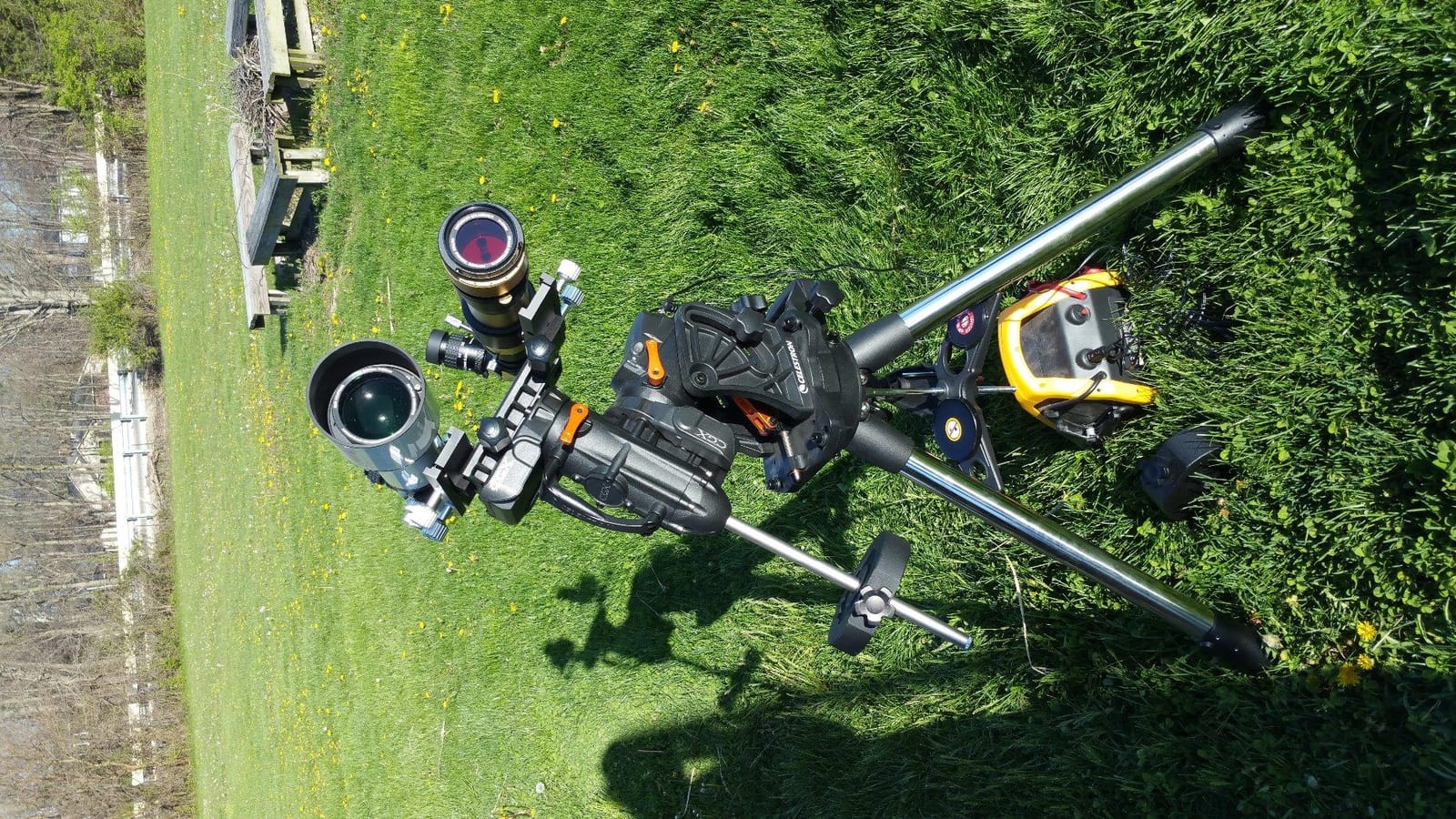
Now the other side. The complete tripod weighs 108 lb, which makes field use difficult and means a permanent installation is close to mandatory. That is not a flaw, it is the design intent, but it narrows who this is for sharply.
The optional polar scope accessory is a recurring annoyance: it impedes declination range of motion and can physically collide with the mount at certain orientations. Budget for planning your alignment method around it rather than assuming it can be fitted anywhere.
Reliability is the other concern, and it is what holds the rating to 4.2 despite strong performance reports. Some owners report the NexStar+ hand controller hanging on initializing even after resets, firmware updates and controller replacement. Others report RA drive faults involving rapid back-and-forth motion or running to the stop, which required service. Belts and gears wear with use, degrading tracking and guiding over time, and the non-L tripod is not as stiff as the L version.
Why the CGX is the right pick for a permanent setup
Because 55 lb of capacity means you are never operating near the limit, and the 108 lb of mass is a liability in a car boot and an asset on a concrete pier. A mount this heavy on a stable platform is a fundamentally different machine from the same mount on a folding tripod.
Internal cabling, encoders, PPEC and a hand controller with guided tours are all features that pay off across hundreds of sessions rather than one. If you are building an observatory, this is the shape of mount that rewards the investment.
Why the CGX is a wrong pick for most people
108 lb is a two-person carry and a single-person argument. If you do not have a fixed, level, vibration-resistant site, the weight is pure cost and the drive components wear faster on a wobbly base.
The reliability reports also deserve attention rather than dismissal. A stuck hand controller or an RA drive fault on a mount this heavy means a service visit, and the smaller mounts in this list fail more cheaply when something goes wrong.
8. Explore Scientific iEXOS-100-2 PMC-Eight: The Software-Agnostic Option
iEXOS-100-2 PMC-Eight Equatorial Tracker System Tripod and Mount for Astrophotography with WiFi and Bluetooth Compatible
PMC-Eight controller
Clutched dual-axis worm gear drives
About 19 lb payload
Wi-Fi and Bluetooth
Pros
- Very quiet while tracking
- Lightweight and easy to carry in a car
- Works with PHD2 EKOS ASIAIR and StellarMate
- About 1.5 arcsecond autoguiding variation reported
- Clutched RA and Dec axes make balancing straightforward
Cons
- ExploreStars app crashes frequently and drops connection
- Legacy alignment routines reportedly broken on Android
- Polar alignment is awkward without a purchased polar scope
The iEXOS-100-2 is the pick for one specific and increasingly common situation: you already run your imaging session through third-party control software and you do not want to touch the vendor’s app. The PMC-Eight controller is a multi-processor unit, and owners driving it with PHD2, EKOS, ASIAIR or StellarMate report that it simply works.
Mechanically, this is a competent small equatorial head. Clutched dual-axis worm gears with quiet precision stepper motor belt drives produce quiet operation, and crucially the quiet part is the tracking, not just the slew. Owners report roughly 1.5 arcsecond autoguiding variation with a modest imaging train, and 3 to 5 minute guided subs as a realistic result.
The clutches on the RA and Dec axes make precise balancing easy, which is one of those small mechanical decisions that saves you twenty minutes every time you set up. There is a polar alignment sight hole through the RA axis with precise altitude control, and the head is light enough to carry in a car without planning around it.
Wi-Fi and Bluetooth connectivity covers the control side without needing a cable run to the laptop.
The 3.9 rating is almost entirely about software and support, not mechanics. The ExploreStars app is described as buggy, crashing frequently, with a poor user interface and connections that drop. Legacy two and three-star alignment routines are reportedly broken on Android, which is a substantial usability failure for a large share of buyers.
Polar alignment is awkward, and a proper polar scope costs extra on top. The azimuth adjuster adapter and the upgraded tripod are also costly extras, and the system requires eight C batteries for its controller. Customer support is reported as unresponsive to both phone calls and support tickets, which matters if anything goes wrong.
There is also a steep learning curve with little usable documentation or current tutorial content available, which makes the software situation worse rather than better.
Why the iEXOS-100-2 is worth your attention
Because if you drive your rig with dedicated third-party software, the vendor app becomes irrelevant. The hardware is quiet, the clutches make balancing painless, the guiding numbers at this payload are solid, and the PMC-Eight controller is genuinely capable.
It is also light. For people moving between sites regularly, the difference between a head you can carry in one hand and one you cannot is larger than any specification.
Why the iEXOS-100-2 frustrates owners
If you want the manufacturer’s app to run your alignment, this is a poor experience, and the reported Android problems are not minor. Combined with weak documentation and unresponsive support, the software side is where this mount loses its rating.
The roughly 19 lb payload ceiling also limits heavier telescopes, and topping the kit up with a polar scope and better tripod moves you past the price of a cleaner alternative. If your guiding is handled by third-party software and you know what you are doing, none of this matters. If you are learning, it does.
9. Sky-Watcher EQ6-R Pro: The Best Mount for a Heavy Imaging Train
Sky-Watcher EQ6-R – Fully Computerized GoTo German Equatorial Telescope Mount – Belt-driven, Motorized, Computerized Hand Controller with 42,900+ Celestial Object Database
44 lb payload
Belt-driven stepper motors
Built-in illuminated polar finder
44 lb item weight
Pros
- Guiding results reported under 0.5 to 1 arc second
- 44 lb payload has headroom for tubes up to around 8 inches
- Whisper-quiet slewing with no perceptible backlash
- Built-in illuminated polar finderscope
- Encoders allow PPEC data to be uploaded
- Rock-solid 2-inch tripod legs
- Works with EQMOD Stellarium APT and PHD Guiding
Cons
- Heavy overall at roughly 75 lb assembled plus counterweights
- Needs at least 13 volts or GoTo slews stall
- Factory grease causes stiction when balancing
- Hand controller LCD fails in very cold conditions
The EQ6-R Pro is the mount the forums describe as the one to buy once and stop upgrading. Community consensus treats it as the most popular astrophotography mount of its class, and in a hobby where people move through four or five mounts before they settle, that is a remarkable thing for a product to be said about.
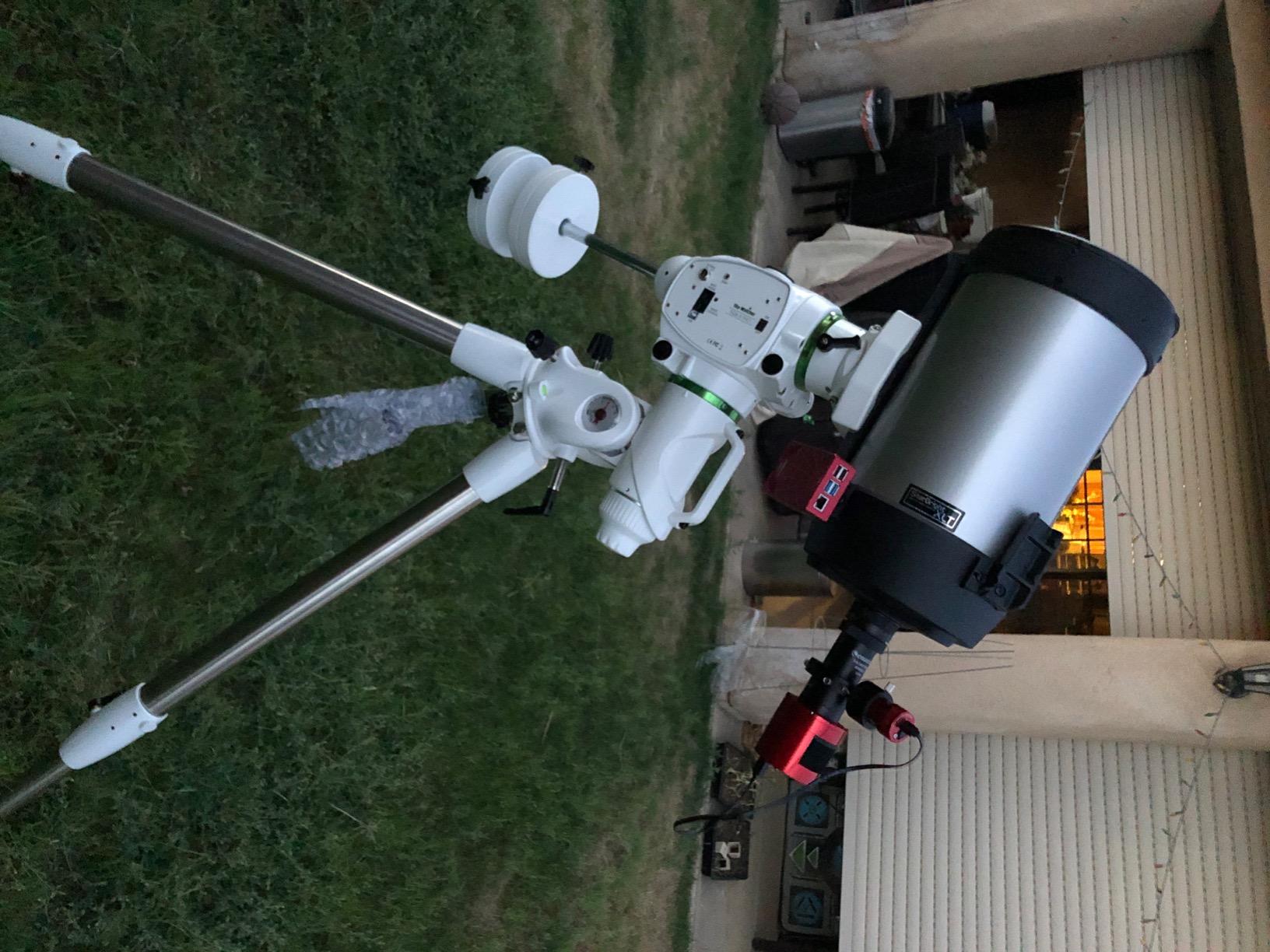
44 lb of payload gives real headroom over a mid-size imaging train, and owners report that it comfortably carries optical tubes up to around 8 inches. The belt-driven stepper motors produce whisper-quiet slewing with no perceptible backlash, and guiding results are repeatedly reported in the sub-arcsecond range, under 0.5 to 1 arc second with a sensible load.
Three details make it pleasant to use. The built-in illuminated polar finderscope simplifies alignment, the built-in encoders let you upload PPEC periodic error correction data into the mount itself, and the 2-inch tripod legs are described as rock solid. There is even a carry handle on the head, which sounds trivial until you are moving a 44 lb object across a car park.
Control is flexible: it works with EQMOD, Stellarium, APT and PHD Guiding for PC-based control, so you are not locked into the hand controller.
The weight is the honest headline drawback. It assembles to roughly 75 lb including two 11 lb counterweights, and that changes what a night looks like. Setup and teardown time becomes the bottleneck, and it is not a travel or one-person-carry mount.
Power matters more than the specs suggest. It needs a supply of at least 13 volts, and owners report low voltage causing stalls during GoTo slews. Bring a supply that comfortably exceeds the minimum rather than matching it.
Then there is the factory grease. Reviews report grease globs on the bearings and worm drive causing stiction when balancing unless the mount is properly serviced first. That is a real first-night experience problem for a new owner, and the community fix is a cleaning and re-lubrication job before the mount is used for anything serious.
Smaller annoyances: the alt-az alignment adjustment screws feel awkward and not very smooth, the hand controller LCD stops working in very cold conditions, and there is no carrying case included for the head or tripod. The kit also arrives in two boxes, and the low ratings on this listing relate mainly to incomplete delivery of that two-box shipment rather than to the mount itself.
Why the EQ6-R Pro is the safe long-term choice
Because the capacity is real rather than theoretical, and the drive is quiet enough that you will not fight it. When forum users are asked which mount they would keep, the answer is consistently this one, and the stated reason is the combination of build quality, payload and the fact that it will not need replacing when the next telescope arrives.
The built-in encoders and PPEC upload are underrated features. Being able to push periodic error correction into the mount means it tracks well even before autoguiding, which makes a bad alignment night survivable.
Where the EQ6-R Pro is a wrong choice
It is wrong for anyone who moves their setup alone or frequently. Roughly 75 lb assembled is beyond a comfortable single-person carry, and setup time is a real cost measured in hours over a season.
It is also wrong for a first-timer with no clear target focal length. At this weight and size, you are committing to a serious fixed imaging direction. The Advanced VX gives you much of the capability at a fraction of the carry burden, and it is a better first German equatorial for that reason.
10. iOptron SkyTracker Pro: The Smallest Useful Tracker Here
iOptron SkyTracker Pro Camera Mount with Polar Scope, Only
6.6 lb payload
3.3 lb body
Illuminated polar scope
Internal rechargeable battery
Pros
- Delivers 4 to 5 minute subs with no trailing using an 11mm lens
- Almost silent tracking
- Integrated battery needs no external power
- Four tracking speeds including half sidereal
- Compact 3.3 lb body with padded bag
- Many fine-tuning knobs and a dimmable LED
Cons
- 3 kg payload limit means heavy telephotos need the counterweight package
- Mount only as a ball head is not included
- Supplied dovetail base is not Arca-Swiss compatible
- A separate paid app is needed for polar alignment guidance
The SkyTracker Pro is the most compact item in this roundup at 3.3 lb, and the reviews describe it producing 4 to 5 minute exposures with no trailing using an 11 mm lens. That is not a spec-sheet claim; that is the actual experience owners report, and it is remarkable for something this small.
Everything about the design is aimed at a single outcome: getting a good long exposure out of a small camera and lens. Four tracking speeds cover sidereal, half sidereal for ground and sky together, solar and lunar, and the 600 second worm period with four bearings and a DC servo motor drive gives smooth RA tracking with jog forward and reverse control.
The integrated rechargeable battery reaches 80 percent charge in about five hours over micro USB, which means no external power supply for a normal night. It folds to 115 by 115 by 95 mm and comes with a padded bag, so it genuinely travels. Tracking is almost silent.
Alignment is aided by an included illuminated polar scope, a dimmable scope LED and a generous set of fine-tuning knobs.
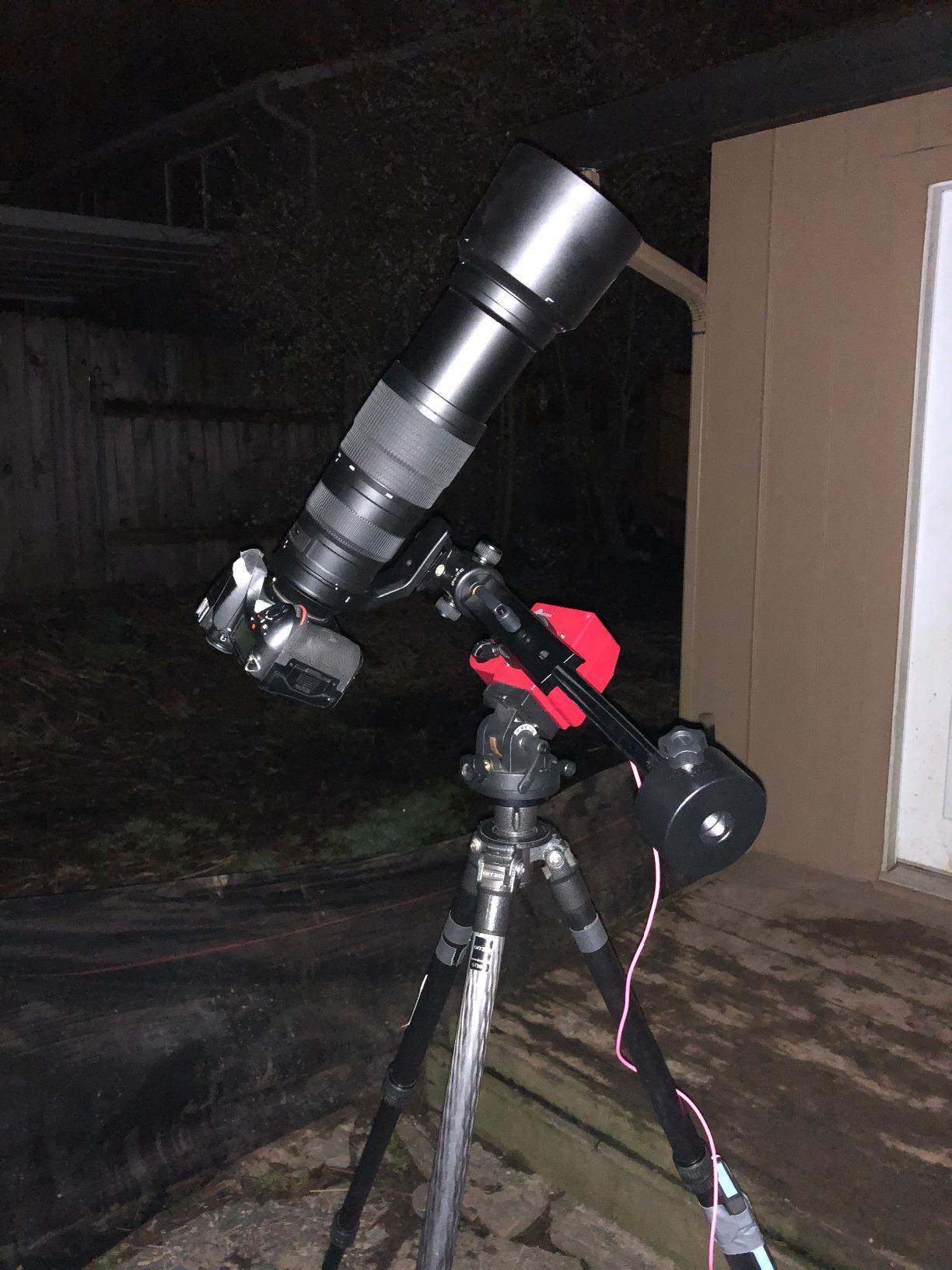
The 3 kg payload limit is the hard boundary. A DSLR with a heavy telephoto lens needs the optional counterweight package, and the swivel head rubber cushion can slip and limit contact area with heavier loads, which is a vibration problem as much as a capacity one.
This is a mount only. A ball head has to be purchased separately by many users, which adds a component and a failure point that the all-in-one trackers avoid. The supplied dovetail base is also not Arca-Swiss compatible, and some users find it unstable, so check your plate standard before committing.
Two small annoyances: the azimuth adjustment screws move the attached base but do not work with existing index studs, and a separate paid app is needed to know where to align Polaris in the polar scope. Aligning to Polaris itself is difficult without a clear line of sight to the pole, so it needs practice.
Why the SkyTracker Pro is still worth buying
Because four to five minute subs from a 3.3 lb body changes what deep-sky imaging means for a traveller. That is long enough for nebulosity, and it stacks well. Nothing else here combines that exposure length with that little carry weight.
The integrated battery, the four tracking rates and the quiet drive make it the most self-contained night kit available. There is no separate power supply to forget and nothing to configure before you can shoot.
Where the SkyTracker Pro stops
It stops at 6.6 lb, and for many people that limit arrives before their ambition does. The moment you add a reducer, a heavier camera or a longer lens, you are into the counterweight package, and at that point a more capable tracker is the better purchase.
The missing ball head and non-Arca-Swiss base also mean the real cost of ownership is above the headline figure. If you already own a quality ball head and an Arca-Swiss plate, this is a bargain. If you own neither, budget for them.
How to Choose an Equatorial Mount: Payload, Moment Arm and Image Scale
Most buying guides tell you to add up the weight of your telescope and camera and pick a mount that beats it. That is a starting point, and it is how people end up with a mount they are constantly fighting. Here is the fuller method.
Step one: weigh the entire imaging train, not the telescope. The optical tube with rings, the imaging camera, the filter wheel, the flattener or focal reducer, the guide scope, the guide camera and the dovetail bar. Every one of those sits on the mount, and forum users who have been caught out by this describe it as the single most common sizing mistake. A cooled camera and a 50 mm guide scope together can add as much again as a small refractor.
Step two: decide how much headroom you want, and expect the debate. Here is where the community is genuinely split, and we would rather show you both sides than pretend there is a settled answer. The optimistic position holds that manufacturer payload ratings are conservative and that a well-balanced mount tracks acceptably at close to its stated capacity. The cautious position holds that published figures exclude counterweights, exclude the guide train, and assume a short, stiff, well-balanced load, so real imaging headroom is much less than the number on the box. Our practical advice lands between the two: for a mid-range mount, keep the full imaging train comfortably under half the rated capacity, and if you can only justify a mount that needs to run at 80 percent of its rating, buy the next size up.
Step three: account for moment arm, because length matters more than weight. This is the factor that is absent from most roundup tables, and forum engineers treat it as roughly twice as important as the weight figure. Inertia scales with mass multiplied by the square of the distance from the axis. A telescope twice as long as another one of the same mass imposes four times the inertial load on the drive, which shows up as settling time after a flip and as a mount that struggles to keep up with a gust. Put the same camera on a 900 mm refractor and a 500 mm refractor and you have two completely different mounts’ worth of problem, with the same payload number.
Wind cross-section works the same way. A long tube catches wind like a sail, and a gust that a stubby optical tube shrugs off will visibly move a long one. The community rule of thumb is that a long optical tube should be paired with a mount in a higher weight class than its weight alone suggests.
Step four: check whether the payload rating includes counterweights. Most manufacturer figures are quoted without the counterweight shaft and weights included, which is why forum buyers ask for both numbers. A 44 lb rating that requires an 11 lb counterweight to balance properly is closer to a 33 lb imaging budget. If a specification sheet does not say, assume it excludes the weights.
Step five: size by price tier, not by point price. The entry tier is camera trackers and one manual German equatorial. The next tier up is GoTo trackers and light German equatorial heads. The middle tier is where the first serious computerized German equatorial lives. The workhorse tier is where the consensus mount sits, and it is the one most imagers stop at. Above that you are buying observatory capacity, internal cable management and a head you will not outgrow. Tiers move far less often than street figures, which is why we name them rather than quoting a number that will be wrong by the time you read this.
Step six: choose the technology last. Worm gear with belt drive, strain-wave harmonic drive, center-balanced against counterweighted: these are the finishing decision after you know your payload and your moment arm. Get the size right first and the technology choice largely makes itself.
Periodic Error, Guided RMS and Image Scale: Know Which Number You Are Reading
How accurate are equatorial mounts? The honest answer requires first knowing which number you are being shown, because three different figures get described as tracking accuracy and they are not interchangeable.
Periodic error is a property of the mount’s right-ascension drive gears and bearings. It is a repeating wobble with a fixed period determined by the gear wheel, and it is correctable. Manufacturer figures are usually given as a peak value in arc seconds, and forum users are openly sceptical of them: the community consensus in the long-running mount threads is that a published PE spec is extremely unlikely to be that precise, particularly for a worm gear drive. Treat it as a relative comparison between models, not an absolute truth.
Guided RMS is the number that actually decides how sharp your stars are, because it is measured after autoguiding has corrected everything it can. It is the total residual error of your entire system: periodic error, polar alignment drift, backlash, flexure, vibration and wind, all rolled into one figure. This is why the buying advice in every forum thread is the same: verified guiding numbers beat any manufacturer periodic-error figure.
Image scale in arc seconds per pixel is what your sensor actually resolves, and it is the number that tells you whether either of the others is good enough for your telescope and camera combination.
The rule of thumb that ties them together, and the single most useful sentence in this guide: aim for a guided RMS at or under about half your image scale in arc seconds per pixel. Below half your scale, guiding error stays under a pixel and simply disappears into the sampling. Above it, you are undersampling the errors and they show as slightly soft or slightly oval stars that no amount of stacking will fully repair.
Worked example. A common wide-field refractor setup images at roughly 2 arc seconds per pixel, so your target for guided RMS is about 1 arc second or better. A long focal length astrograph imaging at 0.5 arc seconds per pixel needs guided RMS under about 0.25 arc second, which is a demanding target and a strong argument for a mount with high-quality encoders and periodic error correction, or for shortening your subs and accepting more frames.
Auto guiding is not optional for deep-sky imaging. Without it you are limited to short subs that periodic error alone will not spoil, and that is a different, much less productive way to work. Every mount in this roundup either includes guiding support or, in the case of the manual CG-4, expects you to add a motor drive first.
Harmonic Drive vs German Equatorial: The Trade-Off Nobody Explains
The harmonic or strain-wave drive is the technology question that divides this hobby, and it is worth being clear about because marketing language around it is unreliable.
A strain-wave gear is a flexible, corrugated output element meshed against a circular wave generator. It produces almost no backlash, almost no periodic error and very quiet, smooth motion with very few moving parts. The cost is that it is more expensive per unit of load capacity than a worm gear, and its performance under sustained imbalance is less forgiving. You are paying for refinement and you are giving up some of the tolerance for a badly balanced load.
A worm gear with a belt drive in a German equatorial mount is the older, cheaper, heavier design. It has a fixed periodic error signature that a corrector can learn, it tolerates imbalance better, and it is a proven, repairable, widely supported mechanism with a huge second-hand market. What it costs you is mass, backlash on a poorly adjusted system, and a physical requirement for counterweights that lengthens the moment arm.
The honest summary: harmonic drive buys you refinement and portability, and you pay for it in cost and in how precisely you must set the rig up. A worm gear with a belt drive buys you capacity per unit of money and tolerance, and you pay for it in weight and moment arm. Neither is correct in the abstract. The community’s general view is that strain-wave technology is well past its infancy now, and the decision is a genuine engineering trade-off rather than a question of maturity.
One structural point that matters more than the drive: counterweighted German equatorial designs place the optical tube far from the axis, and that is the moment arm problem described earlier. Designs that balance around the axis, or that use a compact center-balanced architecture, reduce the physical distance and the inertia that comes with it. That is a real advantage in wind, and it is structural rather than electronic.
What to Skip: Deal Breakers and Buying Traps
There is no such thing as an equatorial mount that is not good enough, only mounts that are wrong for the load, wrong for the base, or sold to you in a configuration that does not do what the listing implies. These are the traps we see repeatedly.
Any mount running at or near its rated payload for imaging. This is the number one cause of trailed stars and thrown-away sub-exposures, reported over and over across the forum threads. If your full imaging train plus counterweights approaches the rating, you are past the point where tracking is consistent, and no amount of guiding will rescue the frames you lose.
Light tripods under any real load. The 1.5-inch legs on the GoTo tracker kit and the light steel legs on the beginner refractor are both fine for what they were designed for and inadequate for the job people actually give them. Vibration is repeatedly blamed for guiding failures, and a stiff base with a modest head beats an expensive head on a wobbly base.
German equatorial mounts sold without motors or motor controllers. Manual German equatorial mounts are still sold as bare heads, and a manual head with no drive fitted is not an imaging mount. If the listing does not mention a motor drive explicitly, assume there is not one.
Mounts with no internal cable routing, if you intend to move them. This is a stated deal-breaker in the forum consensus: some owners have declared flatly that they will never again buy a mount without internal cable routing. Dangling cables on a German equatorial head add snag hazards, catch wind, and introduce a vibration source at the worst possible place. The Celestron CGX in this roundup is the only mount with it.
Unverified periodic error figures used as a sole decision criterion. The community view is that a published PE spec is extremely unlikely to be that precise. Use it to compare models roughly, and prioritise guided RMS, payload and base stiffness instead.
Overbuying. The recurring advice from experienced imagers is to buy the mount you need now with reasonable headroom, not the biggest one you can justify. An over-specced mount on a light tripod is worse than a modest mount on a good pier.
Two more that are easy to miss. A bare tracking head sold without a ball head, as with the smallest tracker here, means the real cost is above the headline figure. And a polar alignment method that needs a separately purchased polar scope is a first-night problem, not a deal-breaker, but it is one you will hit at 11 pm in the dark.
How We Picked These Mounts and Where the Data Came From
This guide was assembled and last reviewed in October 2026. All specifications come from manufacturer product listings, and all owner feedback is drawn from published customer reviews on those listings. Where a figure is disputed across sources, we have said so rather than picking one.
Two honesty notes about what we found. The most-reviewed item in this list is explicitly described by its own owners as not suitable for astrophotography as supplied, and we have kept it in with that stated plainly, because the mount head is a legitimate thing to recommend to a first-time user for a different reason. And the 3.9 rating on the Explore Scientific head reflects a software and support experience, not a tracking problem; we have separated those rather than letting one number stand in for the whole product.
Our selection criteria were coverage across the full payload range rather than a single tier, a genuine spread of technology types including trackers, manual and computerized German equatorial mounts, and a mix of brands rather than one manufacturer. Recommendations are based on published specification data and the body of owner feedback, not on instrumented bench measurement of periodic error, and we would rather tell you that than imply testing rigour we did not have.
All pricing in this guide is expressed as tiers. Street pricing for astro equipment moves frequently, and several of these brands enforce minimum advertised pricing policies, which is precisely why point figures go stale. Check the current figure for the configuration you want before you commit.
Frequently Asked Questions
How accurate are equatorial mounts?
Accuracy depends on which number you are reading. Periodic error is a property of the drive and is correctable, but published figures are often optimistic. Guided RMS is the figure that matters, because it is measured after autoguiding corrects everything it can. As a rule of thumb, aim for guided RMS at or under about half your image scale in arc seconds per pixel.
What is the best equatorial mount?
For most deep-sky imagers the Sky-Watcher EQ6-R Pro is the consensus answer, because 44 lb of payload, belt-driven stepper motors and sub-arcsecond guiding mean it will not need replacing when the next telescope arrives. A first-time German equatorial buyer is better served by the Celestron Advanced VX, which is far lighter to carry.
Which EQ mount is best for astro photography?
It depends on your imaging train rather than the mount. A camera with a lens up to about 300 mm needs a tracker. A small refractor with a cooled camera and guide scope needs an entry GoTo head. A mid-size optical tube with a full imaging train needs a 30 to 45 lb computerized German equatorial. Match the mount to the total weight of the train, plus counterweights.
Is an equatorial mount the same as a star tracker?
No. A star tracker is a single-axis head that rotates a camera or short telescope at sidereal rate after manual alignment. It carries very little, has no GoTo, and no counterbalancing for a telescope. A full equatorial mount has two axes, counterweights, GoTo slewing and autoguiding, and is the right answer for any serious deep-sky imaging session.
Do you need an equatorial mount for astrophotography?
Yes, for any deep-sky imaging with sub-exposures longer than about 30 seconds through a telescope. An equatorial mount aligns one axis with Earth’s rotation so a single motor cancels the apparent motion of the sky. An alt-az mount must move both axes in a coordinated way, which rotates the field during long exposures and makes stacking unusable.
How important is the mount in astrophotography?
It is the most important purchase in the train. Every sub-exposure has to survive tracking error, wind and vibration before stacking can rescue it, so the mount determines the percentage of frames you keep. An undersized mount does not give you an obviously bad image, it silently lowers your keep rate and you find out after a night you cannot repeat.
How much payload capacity do I need for imaging?
Weigh the whole imaging train: optical tube and rings, camera, filter wheel, flattener or reducer, guide scope, guide camera and dovetail bar. For a mid-range mount, keep that total comfortably under half the rated capacity. Also remember that published payload figures usually exclude counterweights, so subtract the weight you need for balance as well.
Do I need autoguiding for deep sky imaging?
For anything beyond short subs, yes. Autoguiding measures and corrects residual tracking error in real time, and the residual figure, guided RMS, is what determines star sharpness. Without guiding you are limited to exposures short enough that periodic error alone will not spoil them, which is a far less productive way to work and produces many more files to process.
How do I polar align an equatorial mount?
Start with the built-in illuminated polar scope if the mount has one, since it is the fastest route. Plate solving and multi-star alignment through your capture software is more accurate once you have that workflow, and a bright star alignment is the fallback when no pole is visible. Whichever method you use, better alignment reduces drift and improves the guiding result directly.
The Bottom Line: Which Equatorial Mount Should You Buy in 2026?
If you want the best equatorial mounts for deep sky imaging in one line: the Celestron AstroMaster 130EQ is our editor’s choice, the Sky-Watcher EQ6-R Pro is the mount to buy once and stop upgrading, the Celestron Advanced VX is the best value for a first serious German equatorial, the iOptron SkyGuider Pro is the best portable option, and the Celestron CGX is the only sensible choice for a permanent observatory.
The editor’s choice is not the most capable mount here, and we want to be clear about that. It is the mount with the strongest combination of owner satisfaction and volume of long-term owner feedback in this list, which makes it the lowest-risk first equatorial head you can buy, and the one that teaches the balancing and alignment skills everything else depends on.
Everything else in this list exists for a reason and none of it is bad. The Star Adventurer GTi is the pick if GoTo portability matters more than stiffness, the CG-4 teaches manual equatorial work on a serious base, the iEXOS-100-2 is for people who run their own software, and the two small trackers turn a camera and a lens into a deep-sky rig for the price of a tripod.
Whichever one you choose, size it against the full imaging train rather than the telescope, leave real headroom, and treat the base you put it on as half the decision. That last point is the one people regret skipping, and it costs far less than a better mount head ever will. Check current pricing for the configuration you want before you commit, then go and get some data.