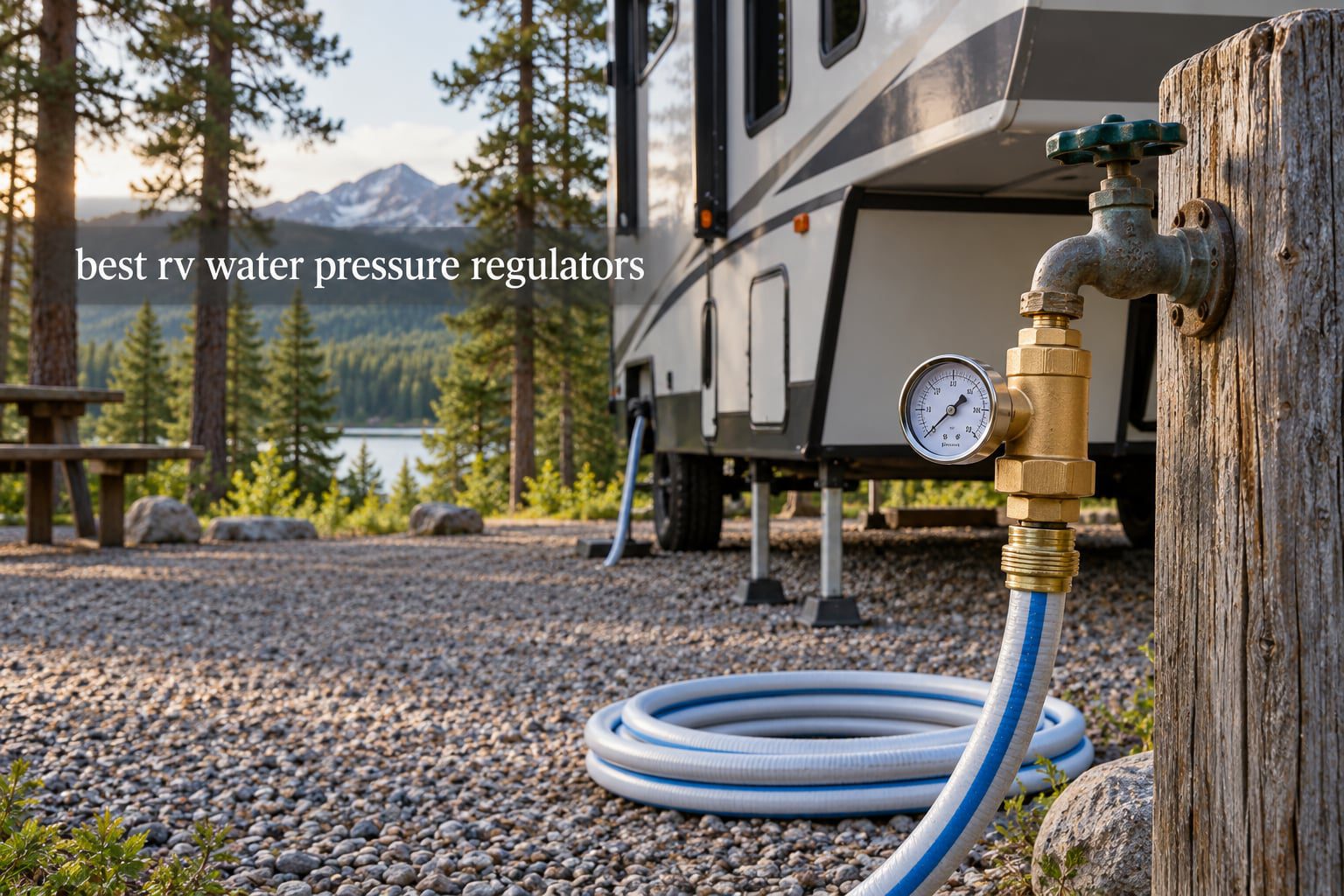
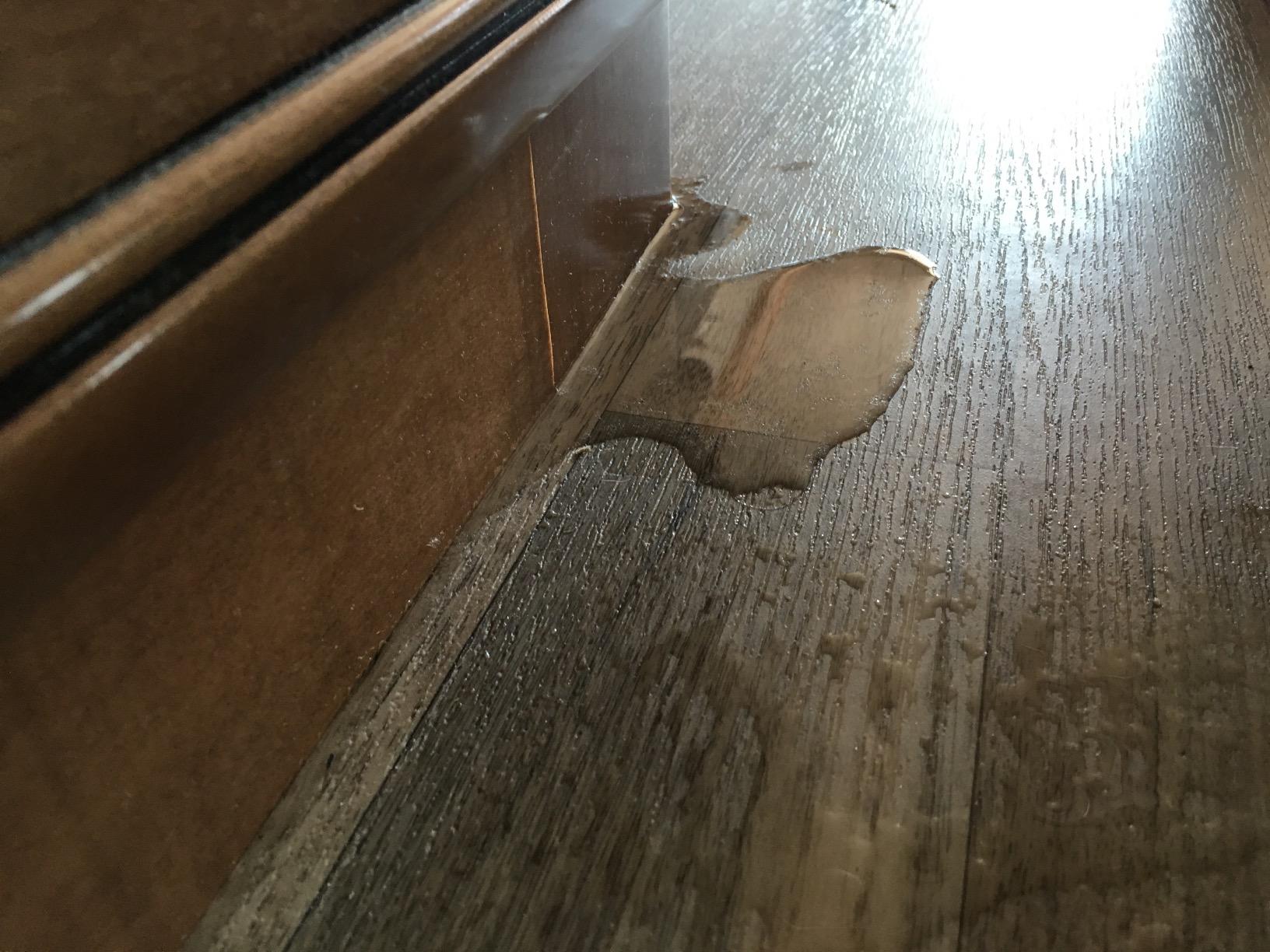
Hookups fail quietly. One over-pressurized connection at a busy campground can split a crimp clamp or a plastic fitting, and the water finds your floorboards long before you notice the stain on the ceiling. Every RV built today runs PEX tubing joined with plastic fittings, and none of that plumbing was designed for the 80 to 120 PSI that municipal and park water routinely delivers.
That is the whole argument for the best rv water pressure regulators: the device sits at the spigot and steps that pressure down to a range your plumbing can live with. Most owners land somewhere between 40 and 50 PSI, which is what Camco calls its factory band and what Winnebago publishes as a maximum working figure. Pick the wrong one and you trade burst pipes for a limp shower, or you leave money on the table by buying a plastic barrel when a brass valve would have lasted a decade.
We spent the last several weeks reading manufacturer spec sheets, certification language and owner reports across RV forums, then compared all twelve regulators here on the four things that actually decide the outcome: how the pressure is set, whether you can see it, what the body is made of, and how the certification is worded. Our team also cross-checked every listing’s thread type, because a regulator that does not screw onto your hose is worthless no matter how good the valve is. If low flow is already a problem in your rig, our guide to kitchen faucets for low water pressure covers a related symptom you may hit indoors.
Table of Contents
- Top 3 Picks for the Best RV Water Pressure Regulators in 2026
- All 12 RV Water Pressure Regulators Compared in 2026
- 1. Camco 40055 Brass Water Pressure Regulator – Best Overall
- 2. Renator M11-0660R Adjustable Regulator with Gauge – Best Value
- 3. RVGUARD ARGWPR001 Lead-Free Brass Regulator – Most Versatile
- 4. Camco 40064 Regulator with Color-Coded Gauge – Best for Quick Reading
- 5. Hourleey LCG35QSADZ Adjustable Regulator – Best for Wide Adjustment
- 6. Valterra A01-1122VP Hi-Flow Regulator – Best for High Flow
- 7. Hourleey RV-REG Fixed Regulator – Budget Pick
- 8. Firebelly Outfitters Regulator and Filter Kit – Best All-in-One
- 9. Valterra A01-1120 Fixed 40-50 PSI Regulator – Best for Older RVs
- 10. STMOUTUO MT-PRV01 Regulator – Best for Tool-Free Adjustment
- 11. Camco 40058 Adjustable Regulator – Best for Cap-Screw Adjustment
- 12. Kohree HY1730 Regulator – Best for Screened Inlets
- What PSI Should You Set on an RV Water Pressure Regulator?
- How to Install an RV Water Pressure Regulator in the Right Order
- How to Know When Your RV Water Pressure Regulator Needs Replacing
- Frequently Asked Questions
- What is the recommended water pressure for an RV in PSI?
- Should I use a water pressure regulator for my RV?
- What is the recommended setting for a water pressure regulator in an RV?
- Does the regulator go before or after the water filter?
- Why is my shower weak with a pressure regulator installed?
- How do I know if my RV water pressure regulator is bad?
- Conclusion: The Best RV Water Pressure Regulator for 2026
Top 3 Picks for the Best RV Water Pressure Regulators in 2026

Camco 40055 Brass Regulator
- Preset 40-50 PSI
- Lead-free brass to NSF/ANSI 372
- Handles 125 PSI inlet

Renator M11-0660R
- Adjustable 45-160 PSI
- Liquid-filled stainless gauge
- Under 0.13 percent lead
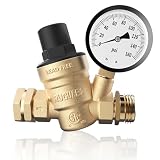
RVGUARD ARGWPR001
- CSA approved NSF/ANSI 61 and 372
- C46500 lead-free brass
- Inlet screen included
All 12 RV Water Pressure Regulators Compared in 2026
| Product | Specs | Action |
|---|---|---|
| Camco 40055 Brass Regulator |
|
Check Latest Price |
| Renator M11-0660R Adjustable |
|
Check Latest Price |
| RVGUARD ARGWPR001 |
|
Check Latest Price |
 Camco 40064 With Gauge Camco 40064 With Gauge |
|
Check Latest Price |
 Hourleey LCG35QSADZ Hourleey LCG35QSADZ |
|
Check Latest Price |
 Valterra A01-1122VP Hi-Flow Valterra A01-1122VP Hi-Flow |
|
Check Latest Price |
 Hourleey RV-REG Fixed Hourleey RV-REG Fixed |
|
Check Latest Price |
 Firebelly Regulator and Filter Kit Firebelly Regulator and Filter Kit |
|
Check Latest Price |
 Valterra A01-1120 Valterra A01-1120 |
|
Check Latest Price |
 STMOUTUO MT-PRV01 STMOUTUO MT-PRV01 |
|
Check Latest Price |
 Camco 40058 Adjustable Camco 40058 Adjustable |
|
Check Latest Price |
 Kohree HY1730 Kohree HY1730 |
|
Check Latest Price |
1. Camco 40055 Brass Water Pressure Regulator – Best Overall
Camco Brass Marine/RV Water Pressure Regulator – Drinking Water Safe
Brass body
PSI Guard preset 40-50 PSI
Handles 125 PSI inlet
3/4 inch garden hose thread
Pros
- Holds a steady 40-50 PSI that protects hoses and plumbing
- Solid brass that survives years of abuse
- Lead-free certified to NSF/ANSI 372 by CSA
- Attaches in seconds with no tools
- Tiny and easy to keep in a wet bay
Cons
- No gauge and no adjustment at all
- US garden hose thread will not fit non-US connectors
- Can choke appliances that need minimum flow to trigger
This is the one we fit first on most rigs, and it is the model our team has the most history with. It screws onto the spigot, does exactly one job, and has been doing it for years without a single moving adjustment to drift out of spec. Owners on RV owner forums describe keeping one bolted to a camper parked permanently as a spare, which tells you everything about how little attention it demands.
The Camco 40055 ships as a plain brass barrel with no gauge on it, so there is nothing to read once it is installed. What it does have is a patented PSI Guard preset to the 40-50 PSI band, and the listing rates it for inlet pressure up to 125 PSI, which covers nearly anything a municipal line or a park riser will throw at it. My one complaint is philosophical: you are trusting the factory set rather than measuring your own line.
Installation is the entire process. Hand-tighten it onto the spigot, attach your hose to the outlet, and turn the water on. No tools, no teflon tape needed on a rubber-gasketed garden hose thread, and it takes under a minute. The 1.8 ounce weight means you can toss it in a compartment door without thinking about it.
One real limitation is worth calling out for anyone with an older or unusual hookup. The 3/4 inch garden hose thread is a US standard, and it will not engage with non-US or UK-style tap connectors without an adapter. If you travel internationally, this particular barrel is not the one to buy.
Who the Camco 40055 works best for
This is the pick for a full-hookup camper, a fifth wheel, or a trailer that spends the season parked at a park with aggressive water pressure. If your only goal is protecting the plumbing and you never intend to dial a setting, the absence of a gauge and adjustment screw is a feature rather than a flaw. It is also the easiest unit here to explain to a family member who wants to connect and forget.
Where it falls short
The fixed 40-50 PSI output can starve an appliance that needs a minimum flow to trigger, and owners report noticing that effect on certain fixtures. Because there is no readout, you cannot tell whether the park is delivering 45 PSI or 120 PSI today. If you want visibility, or if you suspect your shower is weak, step up to the Renator or RVGUARD instead.
2. Renator M11-0660R Adjustable Regulator with Gauge – Best Value
Renator RV Water Pressure Regulator for RV Camper. Brass Lead-free Adjustable Water Pressure Regulator with Gauge for Camper Travel Trailer, Reducer Valve W Filter. M11-0660R.
Brass body
Liquid-filled stainless gauge
Preset 45 PSI to 160 PSI
Inlet screen
Pros
- Adjustable with a clear liquid-filled stainless steel gauge
- Heavy brass with a large internal opening for strong flow
- Inlet screen catches debris before the valve
- Each batch tested under 0.13 percent lead
- US-based phone and email support
Cons
- Adjustment screw is easy to over-tighten
- Gauge can lose calibration over the years
- Threads may need an extra washer on some spigots
- Box shows foreign manufacturing despite flag imagery
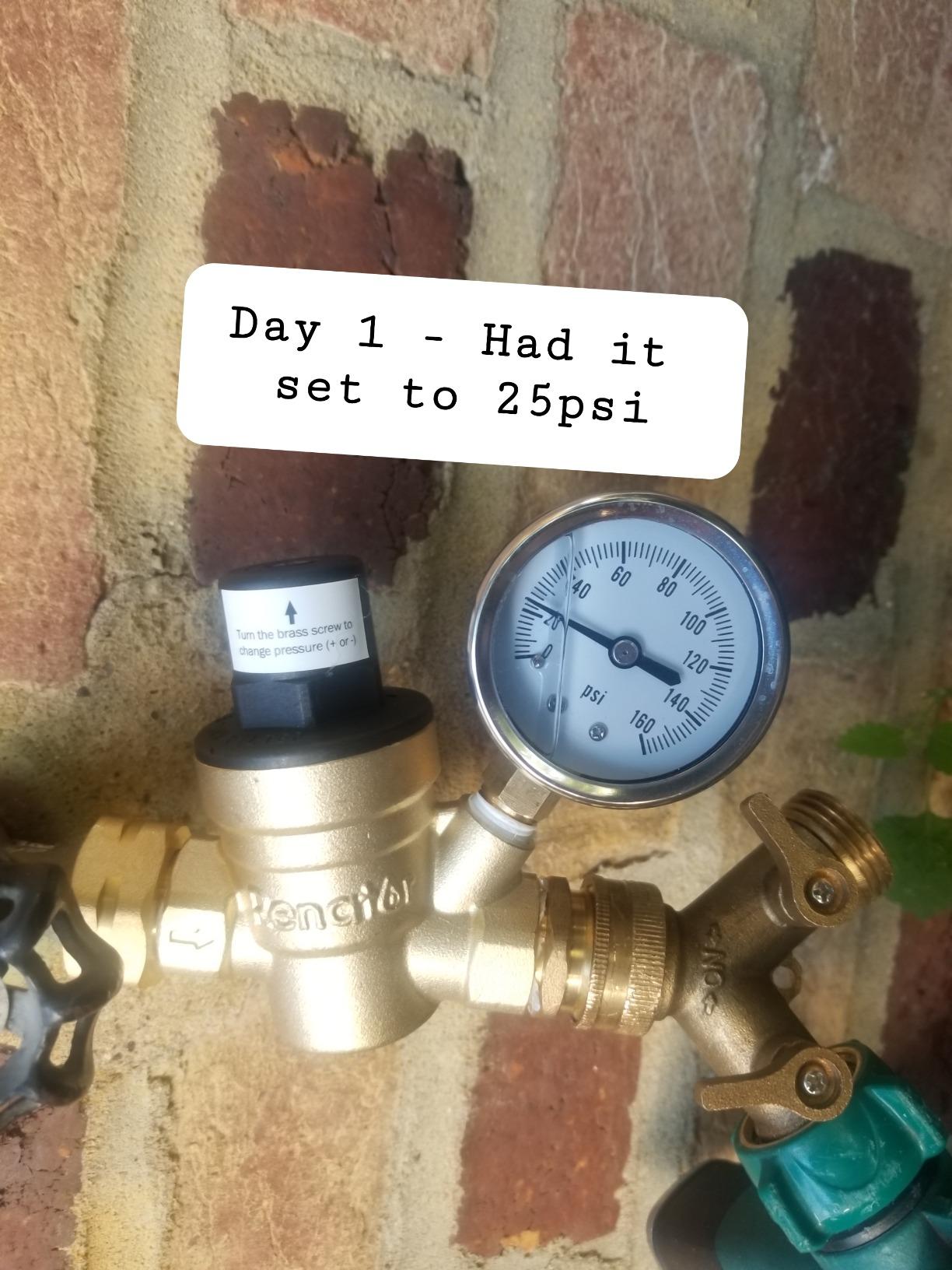
The Renator is the regulator I recommend when the owner wants to see the number. Its stainless steel liquid-filled gauge is the clearest in this group, and that visibility is what lets you diagnose a weak shower or catch a park line running hot. Owners report stable readings across multiple seasons, which is more than I can say for every gauge here.
Out of the box it is factory preset at 45 PSI, and the cap screw takes it up to 160 PSI on the scale. You should never run it near the top of that range for RV plumbing. The sweet spot most owners settle on sits at or just under the factory setting, and the adjustment range mainly exists so you can compensate for a park delivering unusually low pressure.
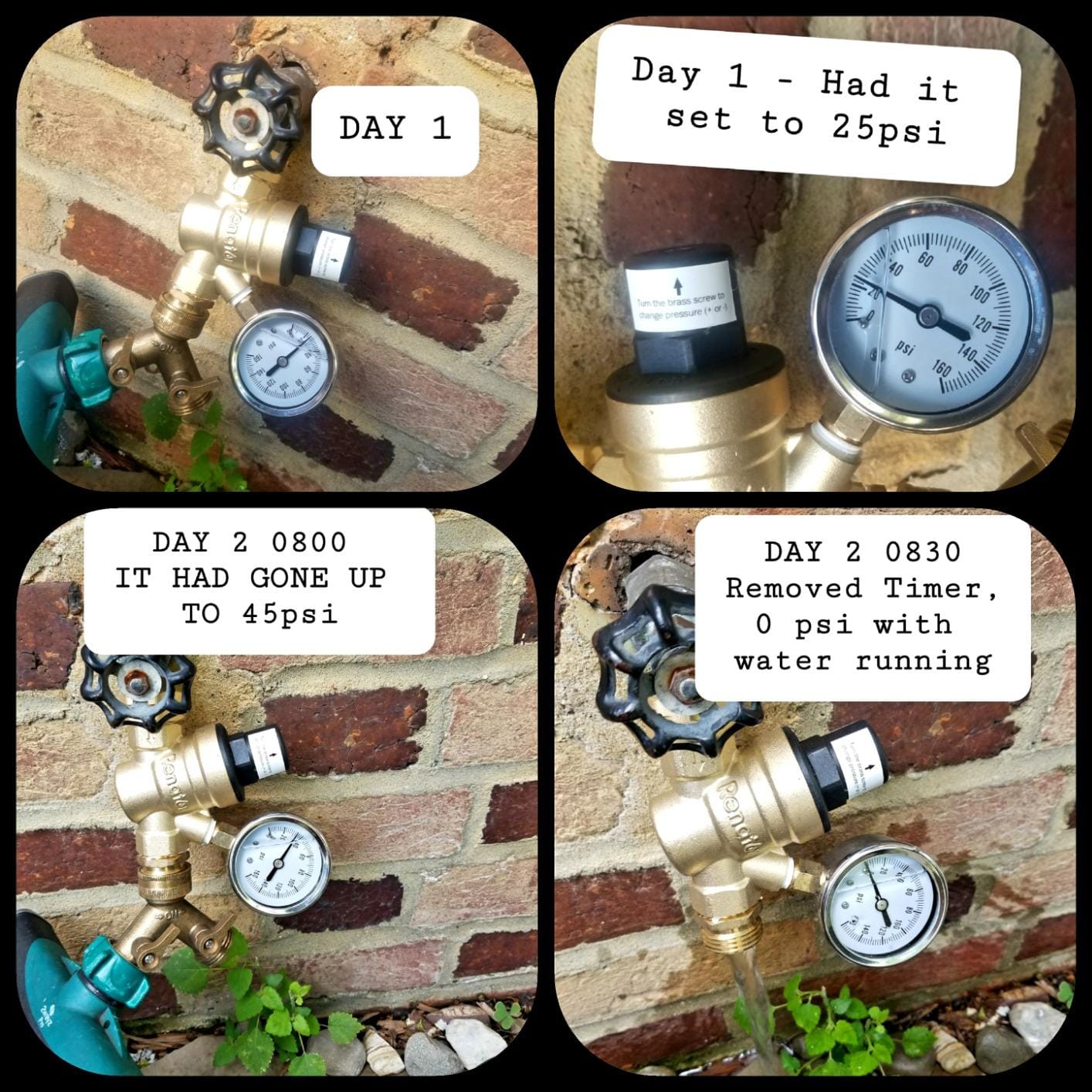
The brass body uses a larger internal opening than most fixed barrels, which is why this one holds flow better on big rigs. There is an inlet screen behind the female inlet that traps grit from an aging spigot, and lead content is tested per batch to under 0.13 percent. That is a real, specific claim rather than a bare lead-free sticker.
The recurring complaint from owners is not the regulator, it is the screw. Turn it with a flat blade and it responds, but owners report over-tightening it and watching pressure fluctuate until the spring settles again. If the setting feels twitchy, back it off a quarter turn rather than forcing it.
Why we rate the Renator as the best value
This is the unit we hand to someone who wants to learn their own system. Seeing 45 PSI on a dial next to a shower that runs weakly answers the question instantly, and the same dial tells you when a park spikes the line. For most owners the gauge pays for the price difference within the first trip.
Where it falls short
Oil-filled gauges develop bubbles after temperature swings or a rough drive, and a bubble-filled dial can read low until it settles. Owners also report losing calibration after several seasons of use, so treat the reading as a reference rather than an instrument. Threads occasionally need an extra washer before the seal stops weeping at the spigot.
3. RVGUARD ARGWPR001 Lead-Free Brass Regulator – Most Versatile
RVGUARD RV Water Pressure Regulator Valve, CSA Approved, Lead-Free Brass
CSA approved
C46500 lead-free brass
Factory 45 PSI
Large dial gauge
Inlet screen
Pros
- Only listing here that names NSF/ANSI 61 alongside NSF/ANSI 372
- Large easy-to-read gauge on a brass body
- Inlet screen plus extra gaskets included
- Holds steady pressure with no leaks over trips
Cons
- Adjustment needs a flat-head screwdriver
- Setting drifts after big temperature changes
- Must be removed before winterizing
RVGUARD is the listing we would defend hardest on paperwork. Its specification field names CSA approval against both NSF/ANSI 61 and NSF/ANSI 372, and the body is C46500 lead-free brass produced with a hot casting process. NSF/ANSI 61 covers drinking water system components, so naming it puts this regulator in a different certification tier from the rest of this list, most of which stop at lead content.
In practice the unit behaves like a well-made adjustable with a big dial. It arrives factory set at 45 PSI, adjusts with a flat-head screwdriver, and clockwise raises the pressure while counterclockwise lowers it. Owners call the gauge large and legible, which matters when you are crouching at a spigot in the dark.
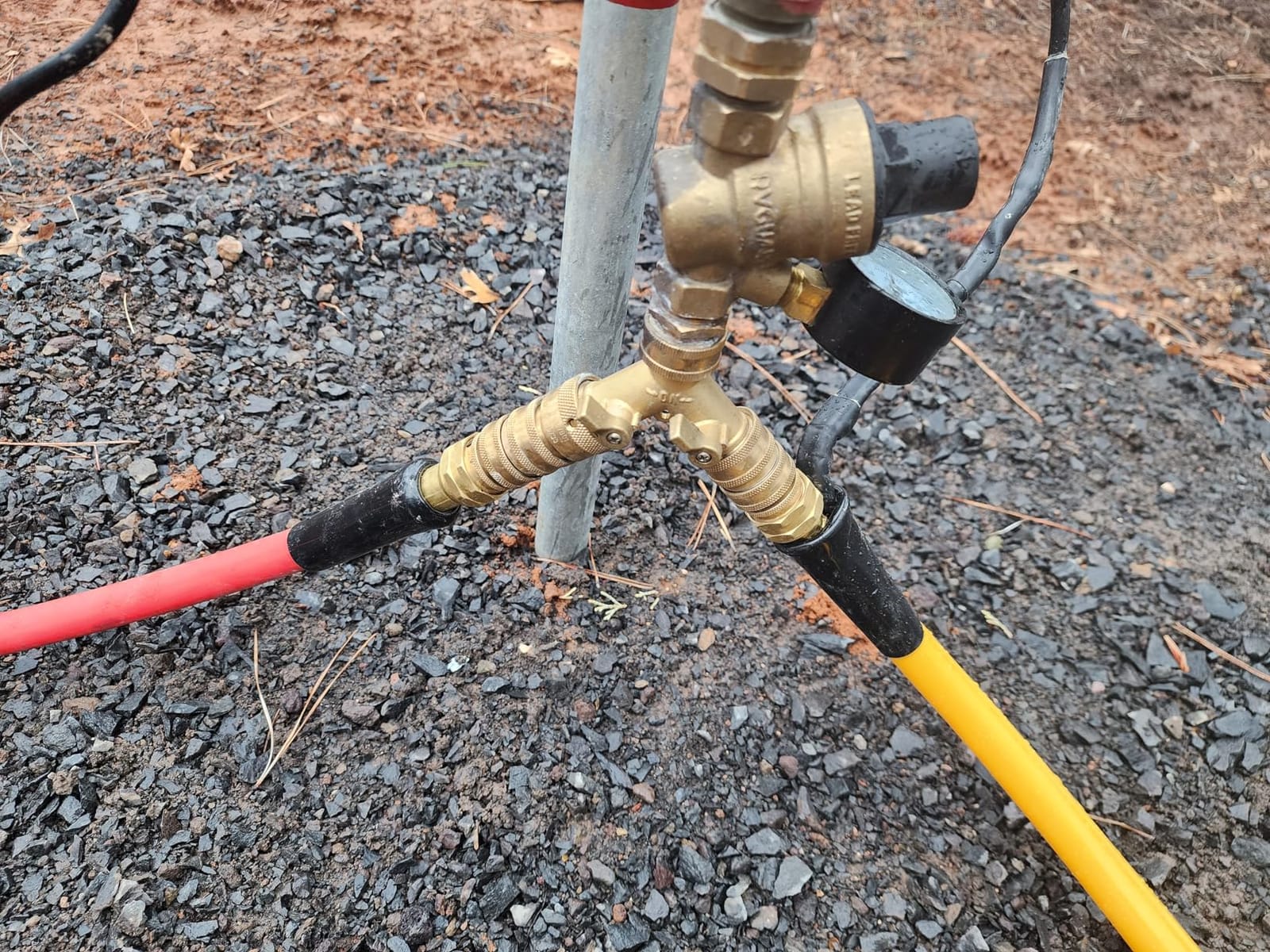
The inlet screen filters impurities before they reach the valve seat, and the box includes spare gaskets. Over multiple trips, owners report pressure holding steady without weeping at the fittings, which is the combination that actually matters on a season-long trip. The included extras are the kind of detail that saves you a hardware store run.
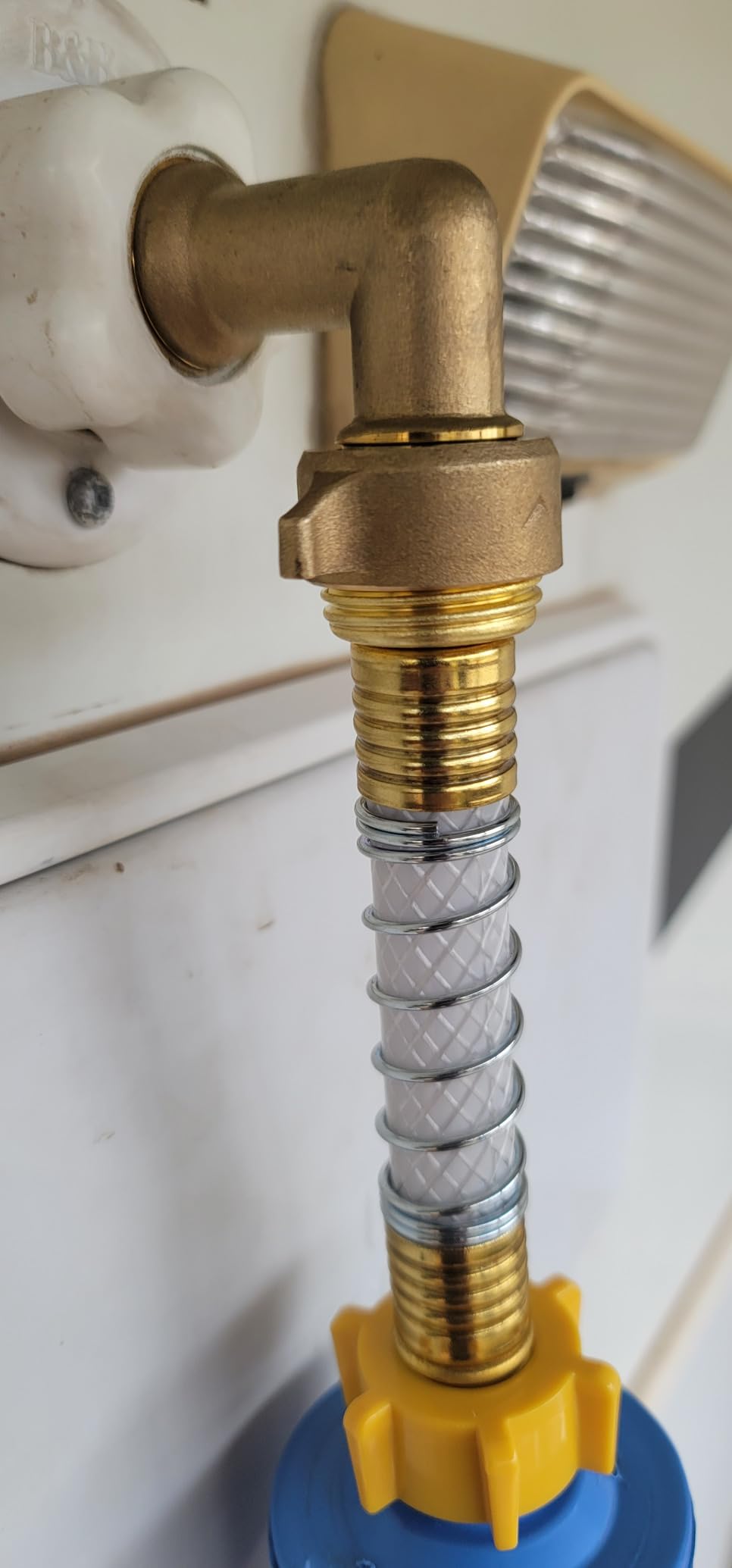
Be aware this does not tolerate freezing. Owners consistently advise pulling it off the spigot before winterizing and storing it indoors, because the gauge and the valve body are both vulnerable. If you camp in shoulder-season cold regularly, add it to your freeze checklist.
Who the RVGUARD suits
This is our pick for anyone whose water crosses the drinking water line and wants proof, not marketing language. It suits campers that filter their own water, families with young children, and owners who simply prefer to point at a named third-party standard when something goes sideways. The brass body and included spares also make it a good long-term hold.
Where it falls short
You will need a screwdriver in your hand at the spigot, which is awkward in rain or darkness. Owners report the setting drifting when temperatures swing hard between a cold morning and a hot afternoon, so expect to re-check it on arrival rather than assume last trip’s number. And it must come inside for winter storage, which is one more thing to remember.
4. Camco 40064 Regulator with Color-Coded Gauge – Best for Quick Reading
Camco Brass Water Pressure Regulator with Gauge- Helps Protect RV Plumbing and Hoses from High-Pressure City Water – Easy Read Gauge (40064)
Brass body
Color-coded tri-color gauge
PSI Guard preset 40-50 PSI
125 PSI max inlet
Pros
- Color zones read at a glance without interpreting numbers
- Smaller footprint than most adjustable regulators
- All-brass construction with clean threads
- Tabbed hose collar speeds install and removal
Cons
- Preset with no user adjustment
- Gauge accuracy questioned by some owners
- Plastic lens feels fragile
- Gauge face carries no numeric markings
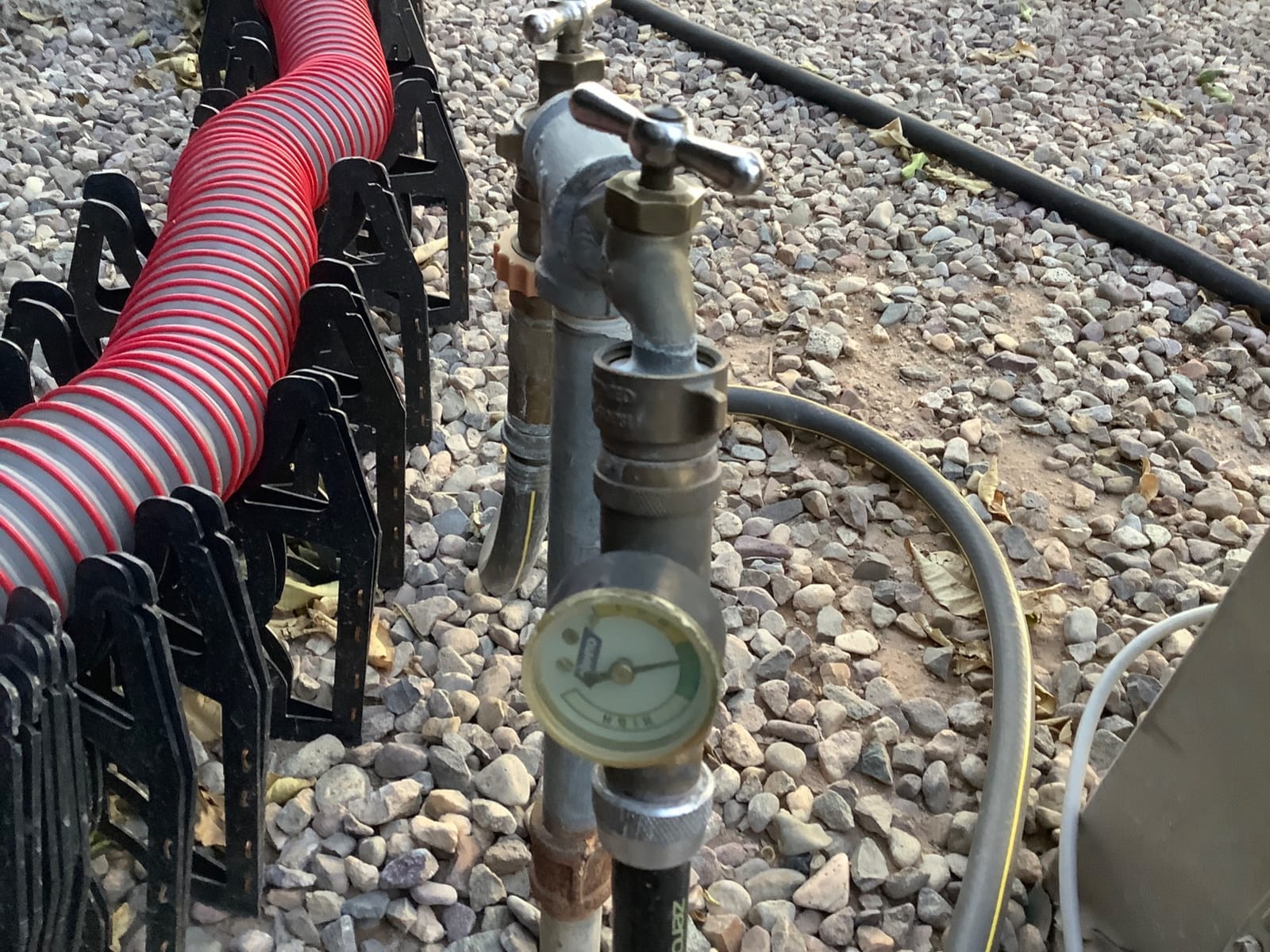
Same engineering instinct as the 40055, different question. This Camco adds a gauge, but not a numerical one. Instead the face is split into color zones so you can tell at a glance whether the park is feeding you something reasonable or something that would hurt you. For a lot of owners that is genuinely enough information.
Underneath the lens is the same PSI Guard preset to the 40-50 PSI band, rated for a 125 PSI maximum inlet. What makes this one easier to live with than the 40055 is size. At 2.4 by 4.1 by 5.8 inches it is noticeably more compact than a barrel with an adjustment cap, so it is less likely to be knocked around in an exterior compartment.
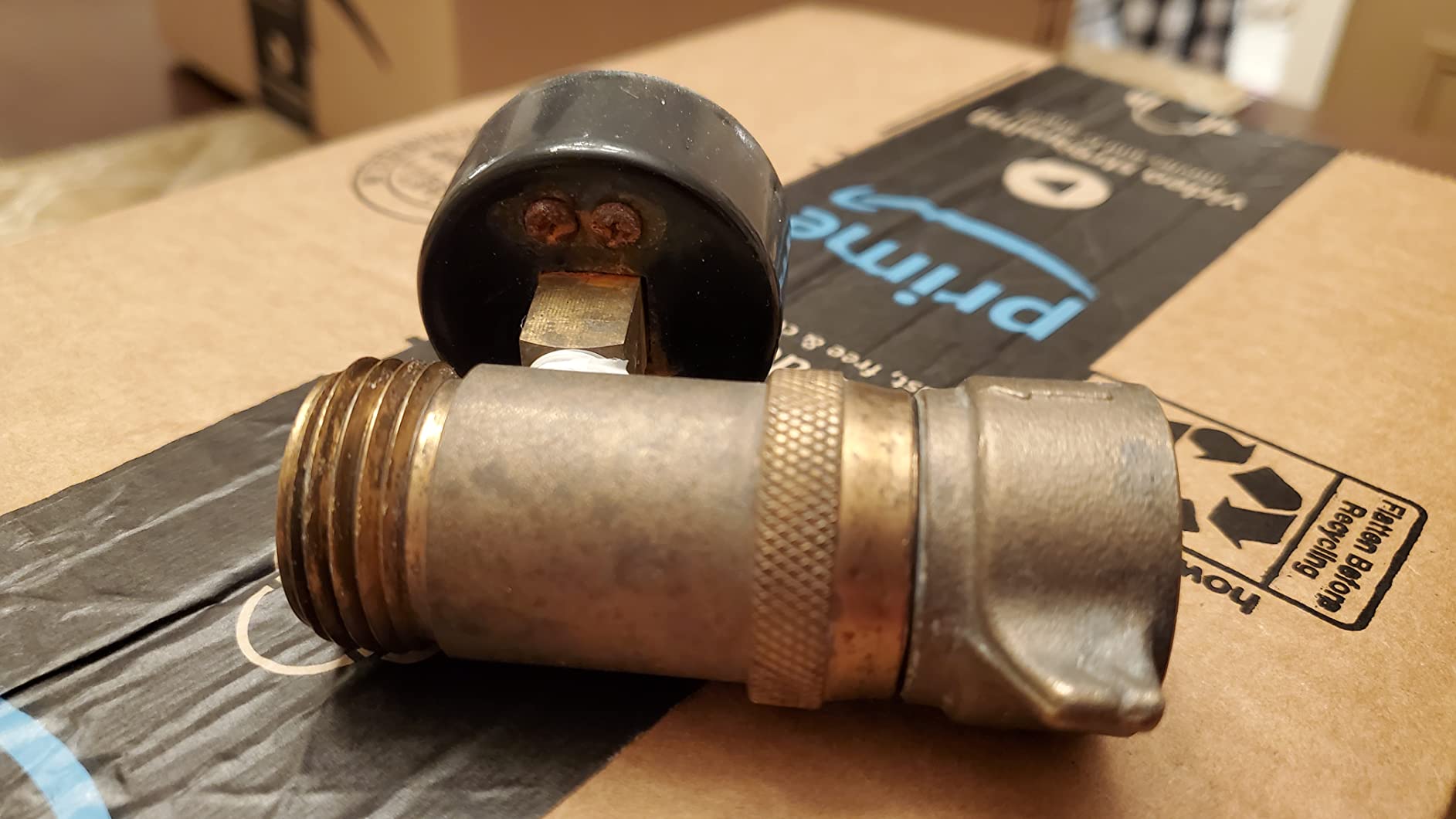
The tabbed hose collar is a small detail that saves time every season. You can grip the collar, break the seal and pull the whole assembly off the spigot without hunting for a wrench, then stow it between trips. Owners also report clean, leak-free brass threads out of the box with no resealing needed.
The tradeoff is precision. A minority of owners say the reading runs lower than an independent reference gauge, and the plastic lens scratches easily enough that a dropped tool can leave a permanent mark. If you need a real number for pressure creep tracking, buy a gauge that prints digits.
Where the 40064 makes sense
Pick this if you want to know roughly how hard your park is pushing without carrying a screwdriver or reading a dial in bad light. It suits older campers where compartment space is tight, and the color zones make it easy to hand to someone who has never thought about PSI before. It stores small, which matters for small wet bays.
Where it falls short
No adjustment means you cannot compensate for a park running unusually low, and no numbers means you cannot tell 42 PSI from 58 PSI. Owners who wanted to fine-tune output bought this and regretted the choice. If your rig has marginal flow, this is not the fix.
5. Hourleey LCG35QSADZ Adjustable Regulator – Best for Wide Adjustment
Hourleey Water Pressure Regulator Valve, RV Brass with Gauge and Inlet Screened Filter for Camper Trailer
Brass body
Adjusts 0 to 160 PSI
Clear oil-filled gauge
Screened inlet
Pros
- Widest adjustment range available with a top screw
- Clear oil-filled gauge is easy to read
- All-metal lead-free brass with a screened inlet
- Adjustment happens while water is running
Cons
- Some units cannot raise pressure above inlet
- Overtightening crushes the O-ring and leaks
- Bubbles appear in the gauge after temperature swings
- Occasional reports of units failing out of the box
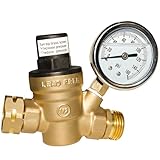
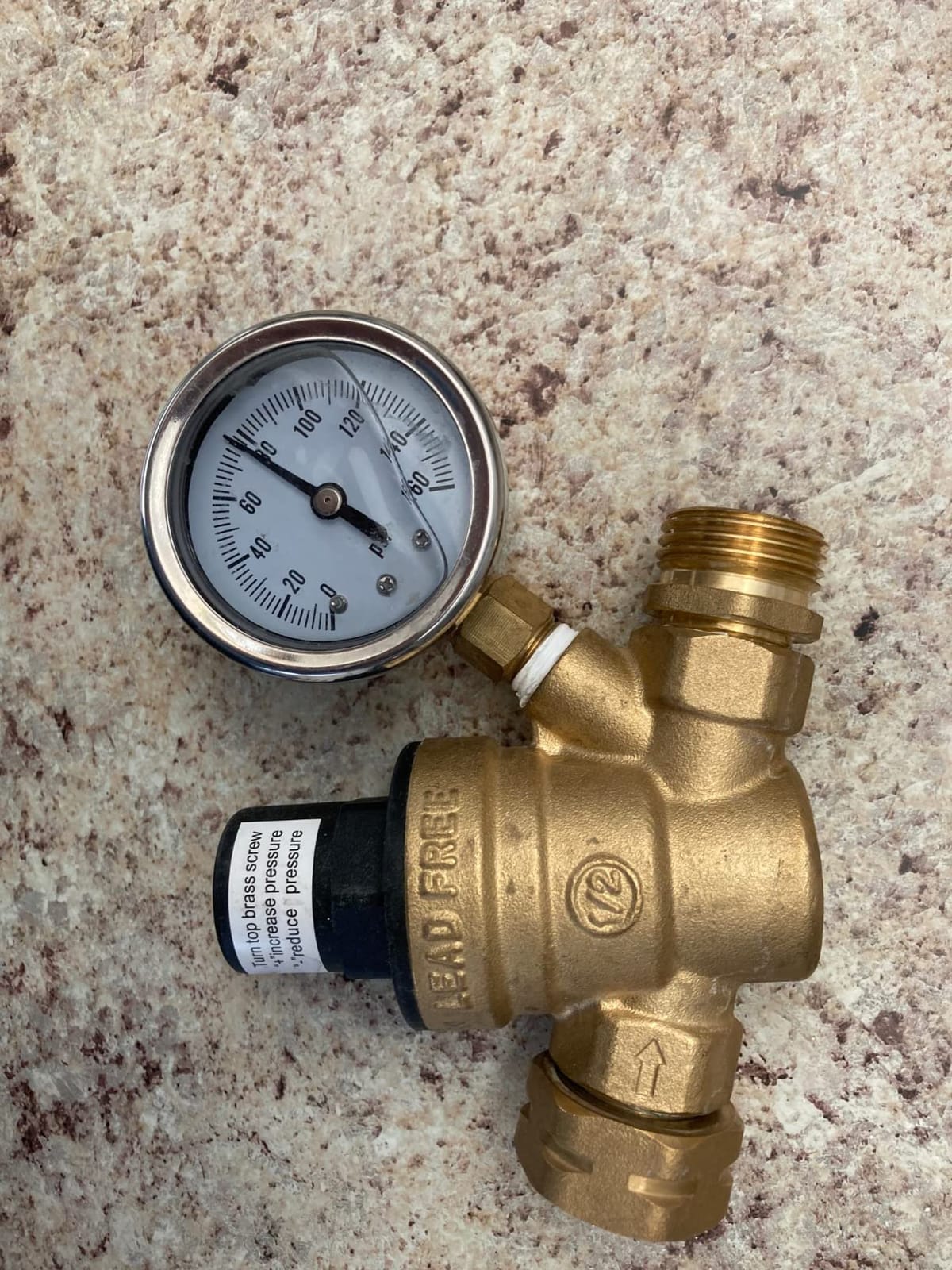
The Hourleey sells itself on range. The screw on top adjusts from 0 to 160 PSI, which is wider than anything else on this list, and the all-brass body does not feel like a budget part in the hand. Owners describe it as easy to install and easy to adjust once the water is running, which is exactly the workflow you want at a spigot.
Lead-free brass with content under 0.13 percent, a screened inlet, and a clear gauge face round out the package. The 3/4 inch threaded joint fits American water hoses across the board, so hookup is unremarkable in the best sense of the word.
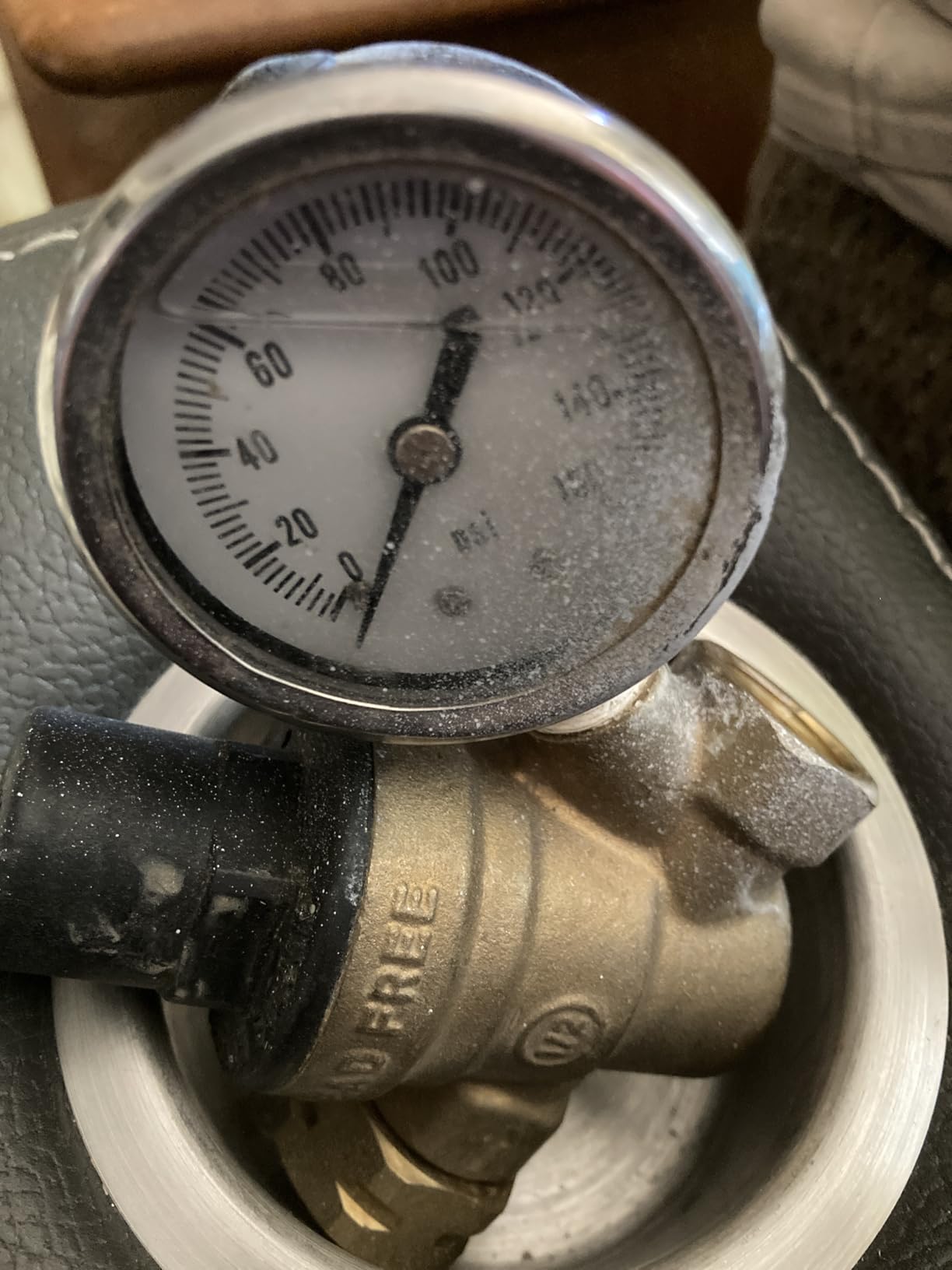
Understanding the wide range takes a minute of reading the manual, because regulators do not create pressure. This one can only lower what arrives at the inlet. Owners report units that seem to refuse to move past the incoming line pressure, and that is the physics working correctly rather than a defect.
The more common real-world complaint is the O-ring. Owners overtighten the adjustment screw under pressure, crush the seal, and end up with a weeping connection. Turn it gently, feel for resistance, and stop.
Who should buy the Hourleey
This suits someone who moves between parks with wildly different supply pressure and wants the ability to tune the output each time. It also suits an owner with a metal-bodied preference who finds plastic fittings on regulators distasteful. The screened inlet is a quiet plus at older parks with rusty risers.
Where it falls short
The gauge is an estimate, not a calibrated instrument, and bubbles after temperature changes or being shaken are normal per the manufacturer. A small number of owners received units that failed soon after opening the box, so keep the packaging until you have run it through a full hookup. It is also the heaviest handheld option here at 480 grams.
6. Valterra A01-1122VP Hi-Flow Regulator – Best for High Flow
Valterra RV Hi-Flow Water Regulator, Lead-Free Brass Hi-Flow Water Regulator for Camper, Trailer, RV Plumbing System, 50-55 psi
Hi-flow brass design
Regulates 50-55 PSI
Screened washer
1 year warranty
Pros
- Hi-flow geometry preserves usable flow while capping pressure
- Lead-free brass resists rust and corrosion
- Screened washer catches debris and can be cleaned
- Attaches easily to a standard campground spigot
Cons
- Preset at 50-55 PSI with no adjustment or gauge
- Will not step down a line already below 50 PSI
- Not recommended for older RVs
If your complaint is a weak shower, this is the one to look at first. Valterra builds this barrel around a hi-flow design, and the whole point is to pass usable water while still capping pressure. Owners with large rigs report the difference is obvious the moment they switch from a standard fixed barrel to this geometry.
It regulates to 50-55 PSI, which is a little higher than the 40-50 PSI band most owners target and still comfortably inside what manufacturers call safe operating limits. Note the important caveat on the listing: it does not reduce pressure when the inlet is already below 50 PSI. On a low-pressure city hookup it simply passes through.
The screened washer sits at the inlet, catches debris, and can be pulled and cleaned as needed. That is a serviceable design, which is unusual in a component most people treat as disposable. The brass is lead-free and conforms with federal and state drinking water fixture laws, and Valterra backs it with a one year warranty.
At 7.36 ounces it is still light enough to carry in one hand, and the NPT 3/4 inch threads mate with ordinary campground spigots without an adapter. Installation is the same thirty-second job as every other barrel on this list.
Who the Valterra Hi-Flow suits
This is our pick for fifth wheels, Class A motorhomes and anyone running multiple fixtures where flow matters more than a precise number. It suits families that complain about shower pressure and would rather have steady usable flow at 50 PSI than a rock-steady 45 PSI that starves the fixture. Pair it with a separate gauge if you want visibility.
Where it falls short
There is no gauge and no adjustment, so you are trusting the preset completely and you cannot tune down if your park already delivers a modest pressure. Valterra also steers this model away from older RVs, whose plumbing may prefer the gentler 40-50 PSI setting offered by the Valterra A01-1120.
7. Hourleey RV-REG Fixed Regulator – Budget Pick
Hourleey Brass RV Water Pressure Regulator, Water Regulator for RV Camper with Filter Screen, Protector for Campers, Travel Trailers, RV Plumbing System, 40-50 PSI
Brass body
Fixed 40-50 PSI
Stainless filter screen
CSA low lead certified
Pros
- Brass body resists high pressure and bursting
- Holds plumbing steady in the 40-50 PSI band
- Stainless filter screen protects the valve from debris
- CSA low lead content certified
- Truly compact at 150 grams
Cons
- Fixed output with no adjustment and no gauge
- Small and simple with few finishing details
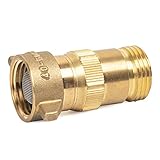
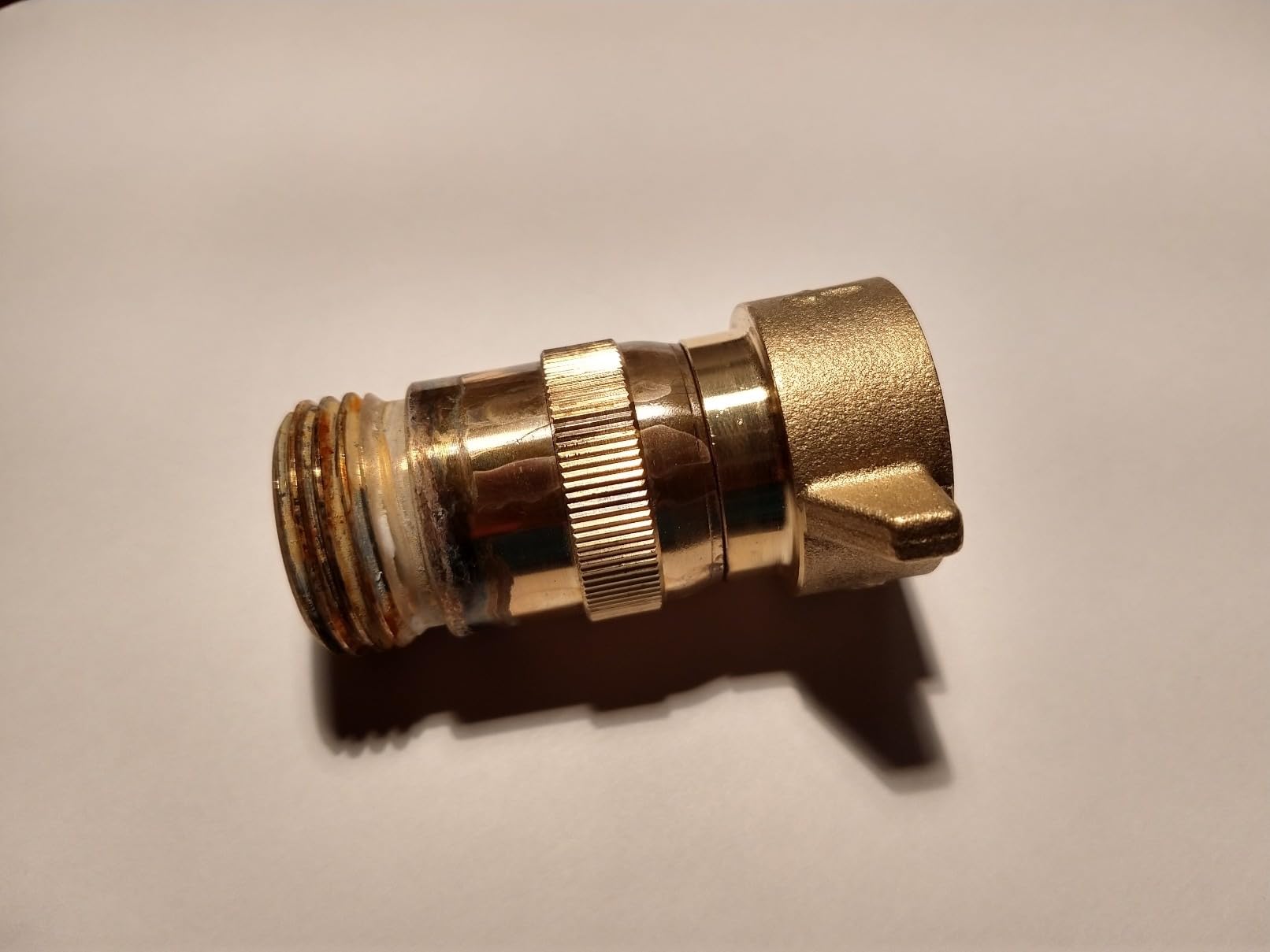
This is the cheapest way to put a metal body between a hostile park line and your RV plumbing, and it does the job without fuss. The Hourleey RV-REG holds water pressure between 40 and 50 PSI, which is the band nearly every manufacturer here recommends, and it does it with a brass body rather than plastic.
Owners treat it as a dependable budget regulator and a sensible second unit. That is exactly how we use it. Keep one in the wet bay as a backup for the adjustable on the hose, and the failure mode of a regulator on arrival at a full campground becomes a non-event.
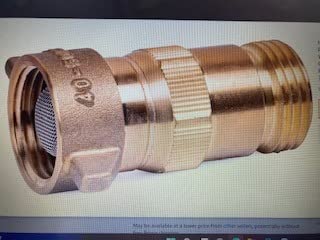
The stainless steel filter screen sits inside the valve and protects the seat from debris, which matters at parks with older galvanized risers. The unit carries CSA low lead content certification, and the manufacturer backs it with a one year warranty. Dimensions are compact enough at 0.79 inches square that storage is a non-issue.
Being fixed, it does one thing. There is no reading to interpret and no screw to mis-set, which removes the two failure modes that generate most complaints about adjustable regulators. What you give up is any ability to respond to a park running unusually soft or unusually hard.
Where this fixed barrel earns its place
Buy it as a spare, a rental backup, or as the primary regulator on a rig that never leaves reliable full-hookup sites. It suits budget builds where the priority is stopping burst fittings, not monitoring pressure. We also like it for wet bay storage since it weighs 150 grams and has no glass to break.
Where it falls short
Owners note that you cannot fine-tune the output at all, which rules it out if your rig has marginal flow or an unusual pressure requirement. It is also a plain component with few finishing touches, so do not expect a premium feel. Anything requiring visibility or tuning belongs on an adjustable with a gauge.
8. Firebelly Outfitters Regulator and Filter Kit – Best All-in-One
Firebelly Outfitters RV Water Pressure Regulator, Camper Water Filter Kit
Brass and plastic kit
Regulator plus 5-stage filter
50-55 PSI output
KDF and GAC media
Pros
- One purchase covers regulator
- filter and hose protector
- KDF and GAC media cut chlorine taste and odor
- ISO certified cartridge handles iron and heavy metals
- Cartridge lasts a full travel season
- Clear five-step installation directions
Cons
- Filter cartridge needs seasonal replacement
- A small amount of water can weep when the water is off
- Bulkier format adds more parts than a regulator alone
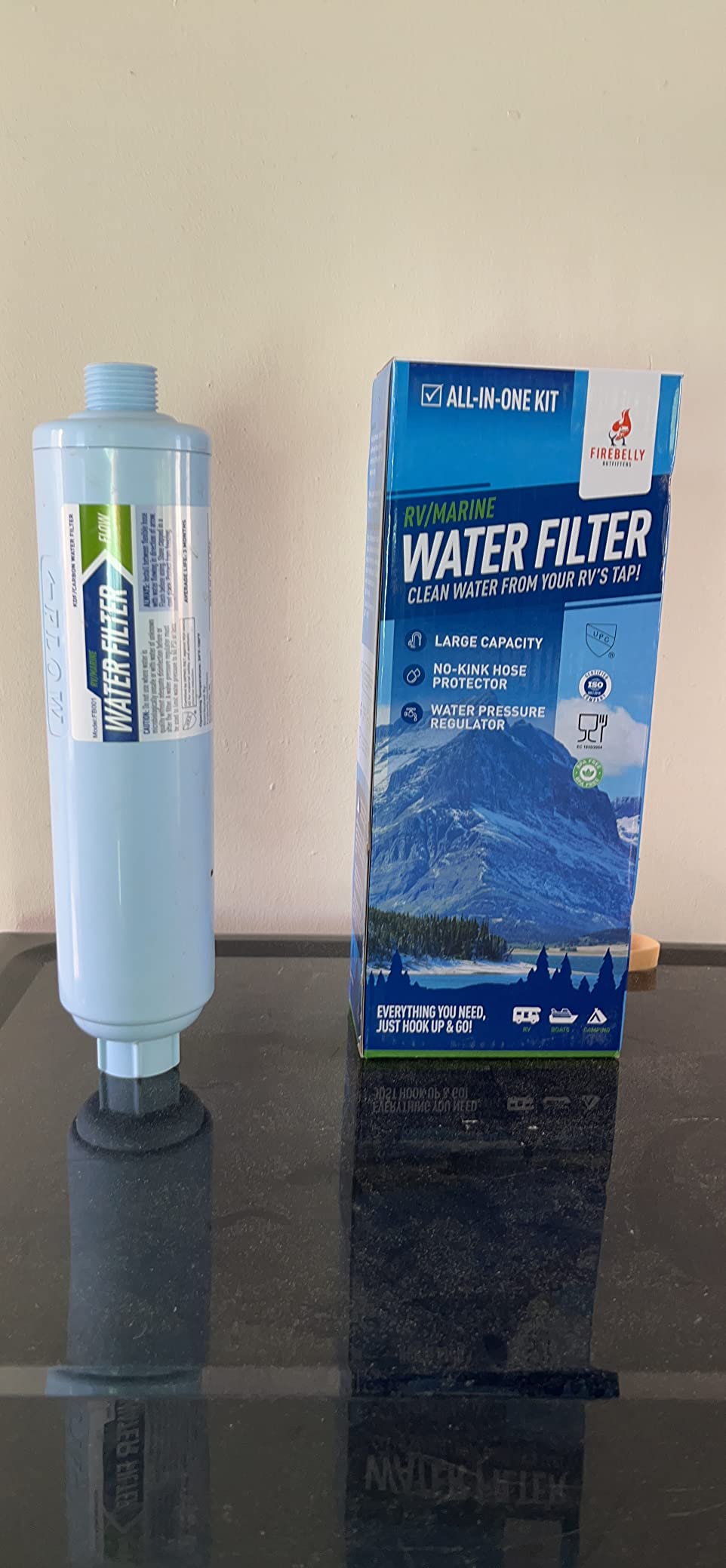
Some campers arrive at a park and immediately find the water tastes like a swimming pool. This kit handles that and the pressure problem at the same time, which is why it earns a slot here despite not being a pure regulator play. You get a lead-free brass regulator with a filter screen, an ISO certified KDF and GAC cartridge, and a kink-free hose attachment in one box.
The five-stage inline filtration includes a pre-sediment stage plus KDF and GAC media, reducing chlorine, lead, taste and odor down to 20 microns. Owners consistently report a noticeable difference in taste within the first use, which is a result you feel rather than measure.
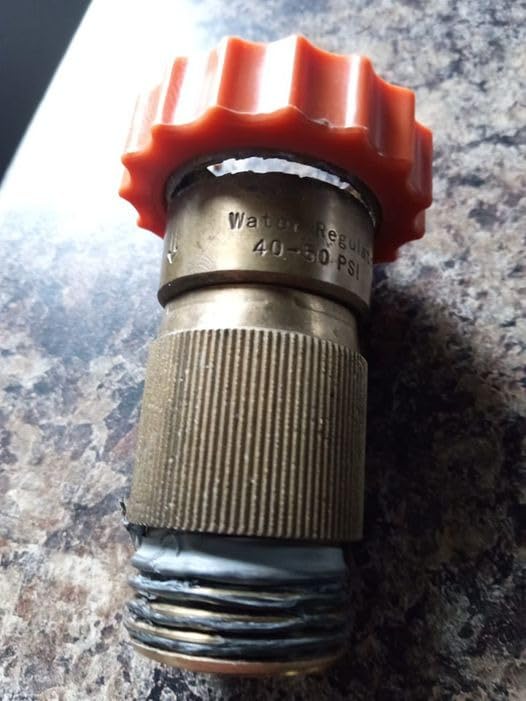
The regulator portion holds 50-55 PSI and protects the RV, camper, fifth wheel, boat or marine system. Instructions walk through a five-step installation from the water source to the fresh water tank, and owners call the directions clear enough to follow without a video. The cartridge is documented as lasting roughly three to four months of active travel.
Know what you are buying. This is a seasonal consumable package, not a permanent plumbing component, and the cartridge has to be replaced at the end of each stretch of travel. Owners also mention a small amount of water weeping from the RV-to-hose connection when the supply is off, which is cosmetic but worth knowing in advance.
Who should buy the Firebelly kit
This is the choice for campers who care about taste and odor as much as pressure, especially families sensitive to chlorinated water or anyone who has had a bad experience at a particular park. It suits beginners, because one box covers the whole hookup and the directions remove the guesswork from ordering parts separately.
Where it falls short
You are buying a filter that expires, so the true running cost is higher than a plain barrel suggests. The all-in-one format is bulkier than a regulator alone, which matters in a cramped wet bay. And if your only goal is pressure protection, you are paying for media you may replace before its rated life.
9. Valterra A01-1120 Fixed 40-50 PSI Regulator – Best for Older RVs
Valterra RV Water Regulator, Lead-Free Brass Water Regulator for Camper, Trailer, RV Plumbing System, 40-50 psi
Brass body
Fixed 40-50 PSI
Rust-resistant lead-free brass
Fits campground spigots
Pros
- Reliably prevents hose and plumbing blowouts
- Lead-free brass resists rust and lasts for years
- Attaches easily to standard campground spigots
- Small and light at 5.6 ounces
- Owners report outlasting larger-brand regulators
Cons
- Fixed 40-50 PSI output with no adjustment or gauge
- Listed size is 1/2 inch NPT and does not fit every fitting
- Contains a nylon internal part that concerns hot water use
Valterra marks this model as ideal for older RVs, and the reasoning is straightforward. Older plumbing was built around a gentler 40-50 PSI ceiling, and a fixed barrel that never strays outside that band is a conservative match. Several owners report it outlasting costlier regulators on permanently parked campers, which is the kind of report that ages well.
The lead-free brass body resists rust, attaches to standard campground spigots, and weighs only 5.6 ounces. There is no gauge, so again you are trusting the preset, but with a fixed barrel there is nothing to drift out of alignment in the first place.
One detail deserves a warning label in your mind. The listing size reads 1/2 inch NPT, which does not fit every fitting, so verify your existing connection before ordering. On most American campground spigots the adapter situation resolves itself, but it is the single most common reason a return happens with this style of unit.
There is also a nylon internal component inside the valve. Owners raise it mainly in relation to hot water lines rather than the freshwater hookup itself, and most continue using the regulator without issue. If you plan to run it on a hot side, weigh that carefully.
Who the Valterra A01-1120 suits
Pick this for a vintage trailer, a converted van, or any rig whose plumbing you would rather not challenge. It suits owners who want the simplest possible answer and who value a decade of owner reports over a feature list. It is also a strong second unit to keep on hand, since the size is small and the failure modes are few.
Where it falls short
No adjustment and no gauge, so it cannot respond to an unusually high or low park line. The 1/2 inch NPT listing puts the burden of verification on you. If your rig needs more flow, this fixed barrel will not solve a shower problem, and the internal nylon part is worth researching if you route hot water through it.
10. STMOUTUO MT-PRV01 Regulator – Best for Tool-Free Adjustment
STMOUTUO RV Water Pressure Regulator Valve for Camper. Lead-Free Brass.
Lead-free brass
Pull-and-turn top knob
0-160 PSI gauge
Includes two spare filters
Pros
- Pull-and-turn knob adjusts without any tools
- Complies with NSF/ANSI/CAN 372 lead content and tested under 0.13 percent lead
- Two spare inlet cartridges and thread tape included
- Handles angled or hanging pressure loads
Cons
- Adjustment only reaches roughly 20 psi below inlet pressure
- Heavy at about 1.4 pounds
- Gauge can accumulate water inside
- Some units have failed after a single use
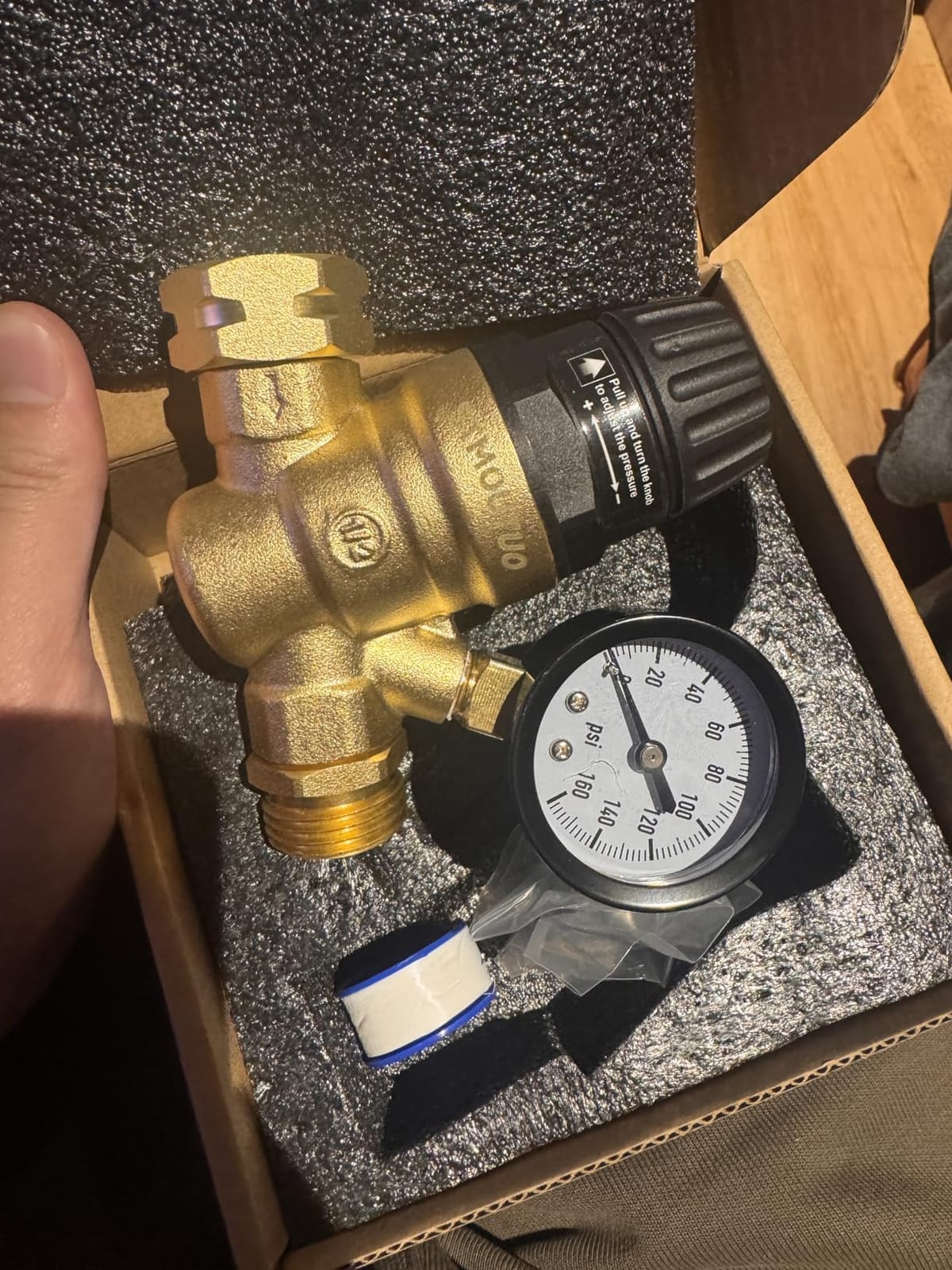
Tool-free adjustment is the feature that separates this from most screw-adjust regulators in this roundup. You pull the top knob up, turn it, and push it back down. No flat blade, no fumbling at a spigot in the rain with wet hands, which is exactly the situation where a screwdriver gets dropped into a gravel pad.
The compliance language here is among the most specific in the group. The listing names NSF/ANSI/CAN 372:2024 lead content, Section 3.1, and states each piece is tested under 0.13 percent lead. Factory preset is 45 PSI, and the gauge reads across a 0-160 PSI range.
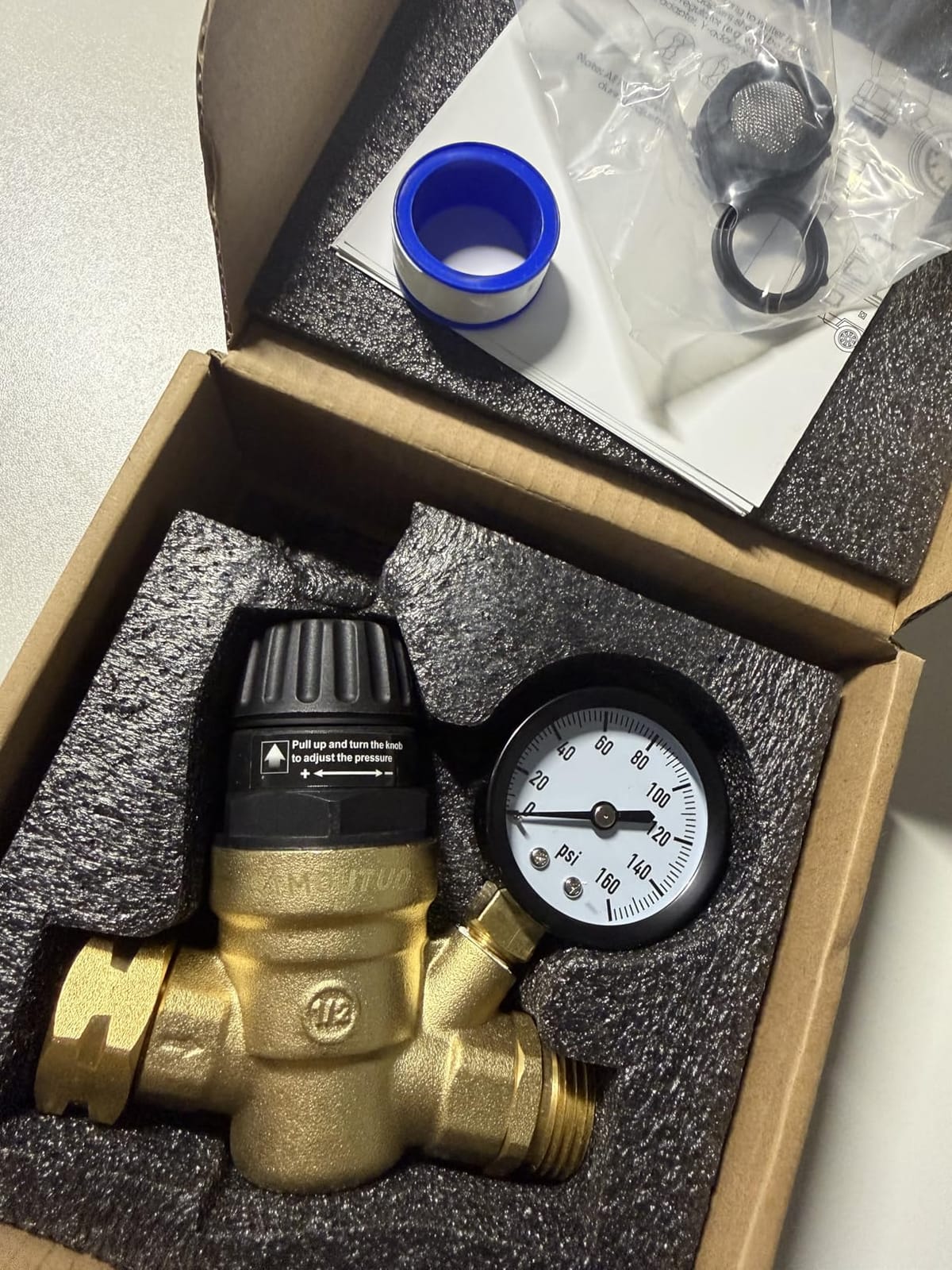
The package includes two spare inlet filter cartridges and a roll of thread tape, which owners appreciate because those are exactly the consumables you need at an unfamiliar park. Reviewers also like that the gauge can sit facing upward in rain without damage, and that the body tolerates an angled or hanging connection.
Understand the adjustment ceiling before you buy. This regulator can only reduce pressure by roughly 20 psi below whatever arrives at the inlet, so on a park line already sitting low it will not reach a low setting. Several owners noted this after trying to turn it down on an already-soft supply.
Who should buy the STMOUTUO
This suits anyone who dislikes tools at the spigot, particularly owners with limited hand strength or joint problems, and anyone hooking up in bad weather. The spare filters and included tape make it a good travel-day kit, and the 45 PSI factory preset lands in the safe band without adjustment.
Where it falls short
At roughly 1.4 pounds it is the heaviest hand-held unit in this roundup, which is unpleasant on a longer carry from the compartment to the post. Owners also report water accumulating inside the gauge over time, and a small number of units that failed after a single use, so test it early in a trip rather than trusting it for the whole season.
11. Camco 40058 Adjustable Regulator – Best for Cap-Screw Adjustment
Camco Adjustable RV Water Pressure Regulator – Lead-Free Brass
Brass body
Adjustment screw in the cap
45 PSI factory preset
CSA to NSF/ANSI 372
Pros
- Cap-mounted screw lets you set your own pressure
- Durable CSA certified lead-free brass
- Standard garden hose threads for simple hookup
- CSA certified to NSF/ANSI 372 and compliant with low lead laws
Cons
- Highest priced regulator in this group
- No integrated gauge so settings need separate verification
- Manufacturer does not recommend settings above 60 PSI
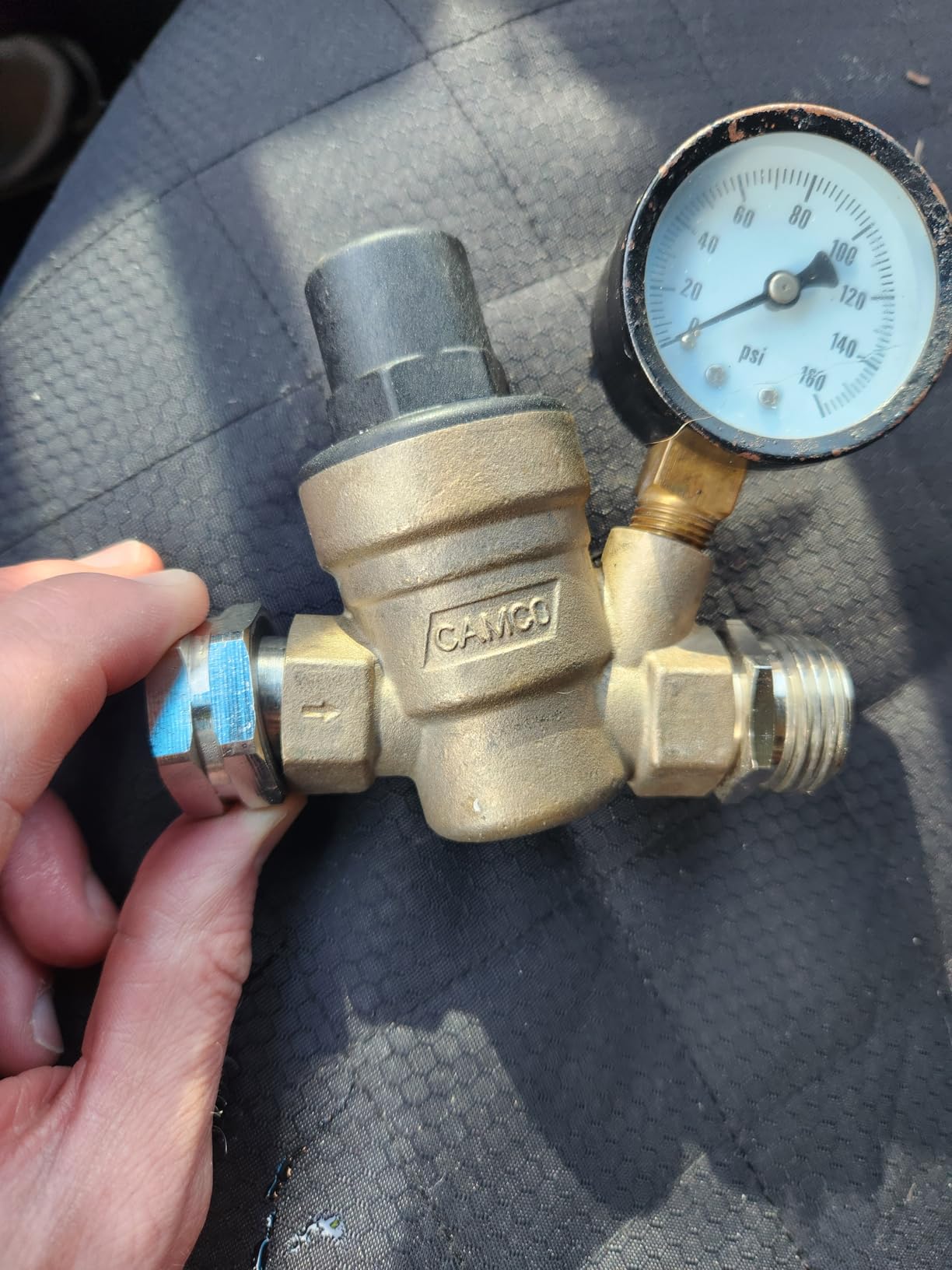
The Camco 40058 puts the adjustment screw in the cap rather than behind the inlet. That sounds cosmetic until you are standing at a post in the rain trying to reach a recessed screw with a short flat blade, which is the situation this design was clearly built for.
It arrives factory preset at 45 PSI and carries a one year limited warranty from Camco. The brass is CSA certified lead-free against NSF/ANSI 372, and the standard garden hose threads mean it fits the same spigots as the rest of the Camco line. Owners value the durable certified build as much as the adjustability.
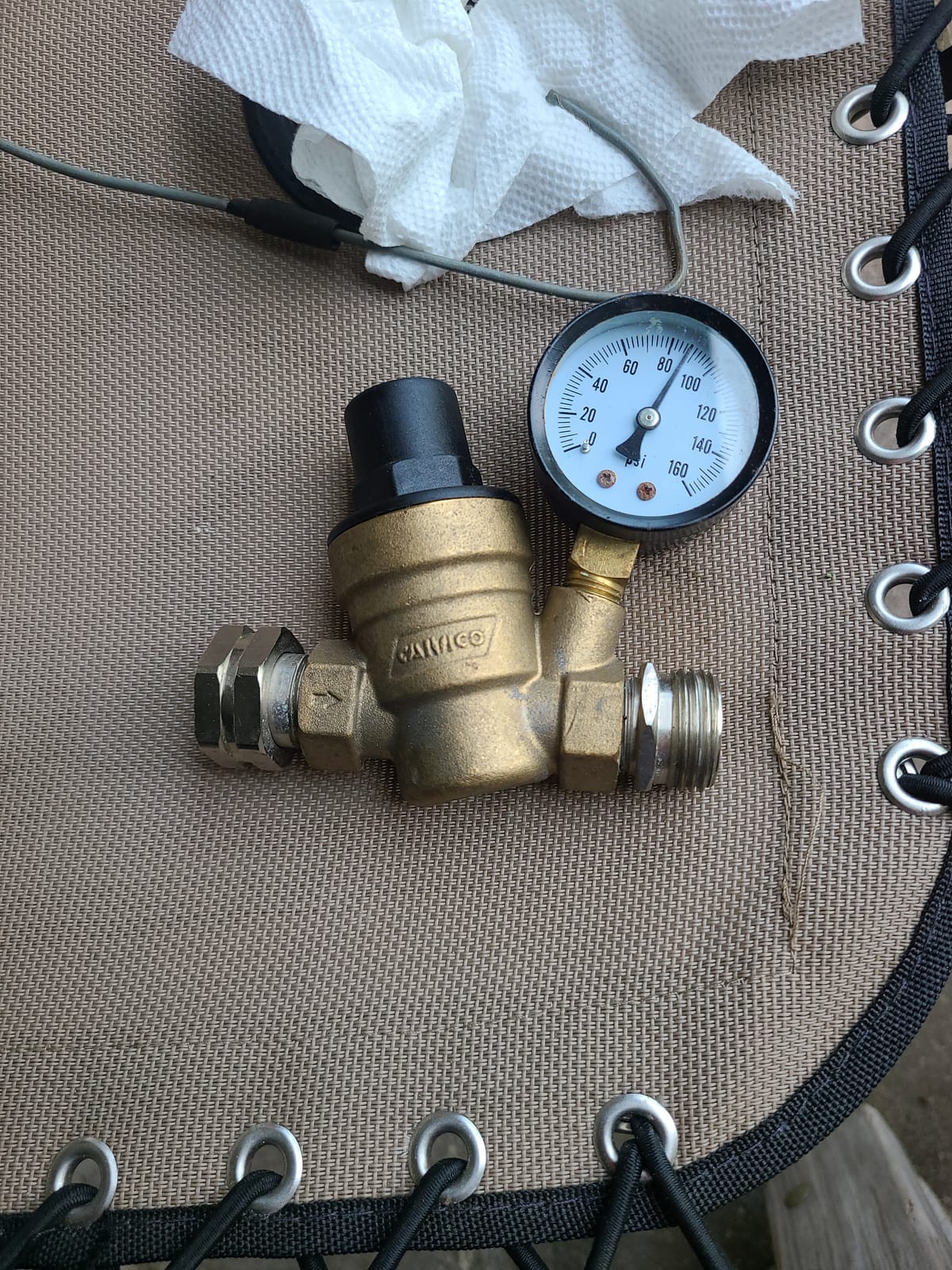
The real limitation is verification. There is no gauge on this regulator, so if you turn the screw you need a second gauge downstream to confirm what you actually set. Owners typically buy a small inline gauge for exactly this purpose, and once installed you leave it in the chain permanently.
Pay attention to the manufacturer’s ceiling. Camco’s own note is that settings above 60 PSI are not recommended, which lines up with the guidance other RV manufacturers publish. The adjustment range exists for fine-tuning down, not for chasing a higher number.
Where the 40058 fits
Choose this if you want to own the setting without carrying a gauge permanently on the regulator and you already have another way to read pressure. It suits owners who like the Camco platform and already own the 40055 or 40064, since the threading and spigot attachment behave identically across the range.
Where it falls short
It sits at the top of the price range in this group while offering less visibility than cheaper adjustable units that include a dial. For most buyers the money is better spent on a regulator that shows you the number. Confirming your setting requires extra hardware you will have to buy separately.
12. Kohree HY1730 Regulator – Best for Screened Inlets
Kohree Adjustable RV Water Pressure Regulator for RV Camper
C46500 lead-free brass
Pull-up knob adjustment
0-160 PSI gauge
Two-layer inlet screen
Pros
- Pull-up knob adjusts pressure without tools
- C46500 lead-free brass under 0.13 percent lead
- 0-160 PSI gauge with a 45 PSI factory setting
- Two-layer inlet screens block particles before the valve
- 3/4 inch GHT and NH threads fit most systems
Cons
- Lowest average rating in this roundup with more one-star reports
- Listed finish differs from the described brass body
- Handwheel adjustment can be finicky to dial in
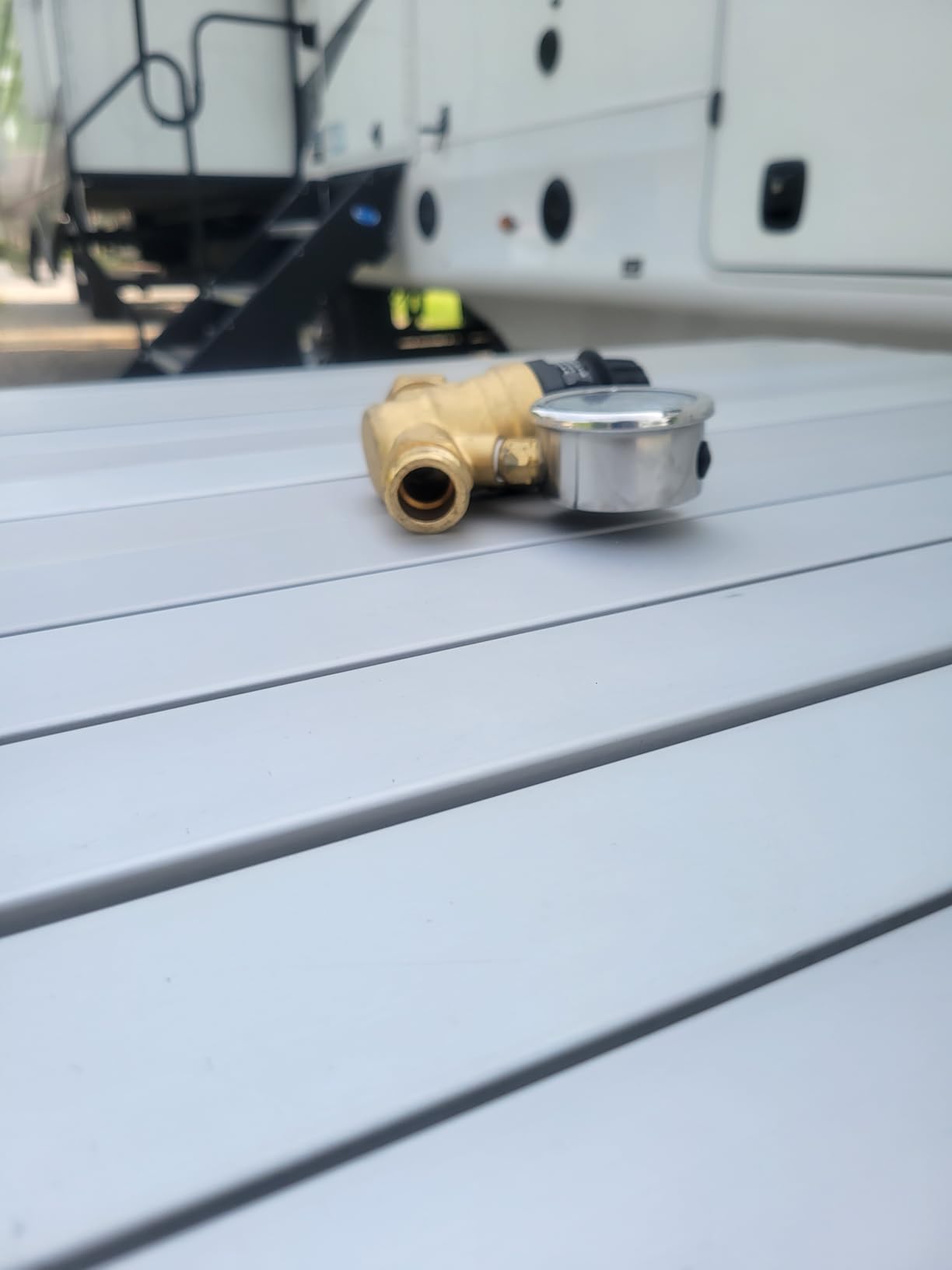
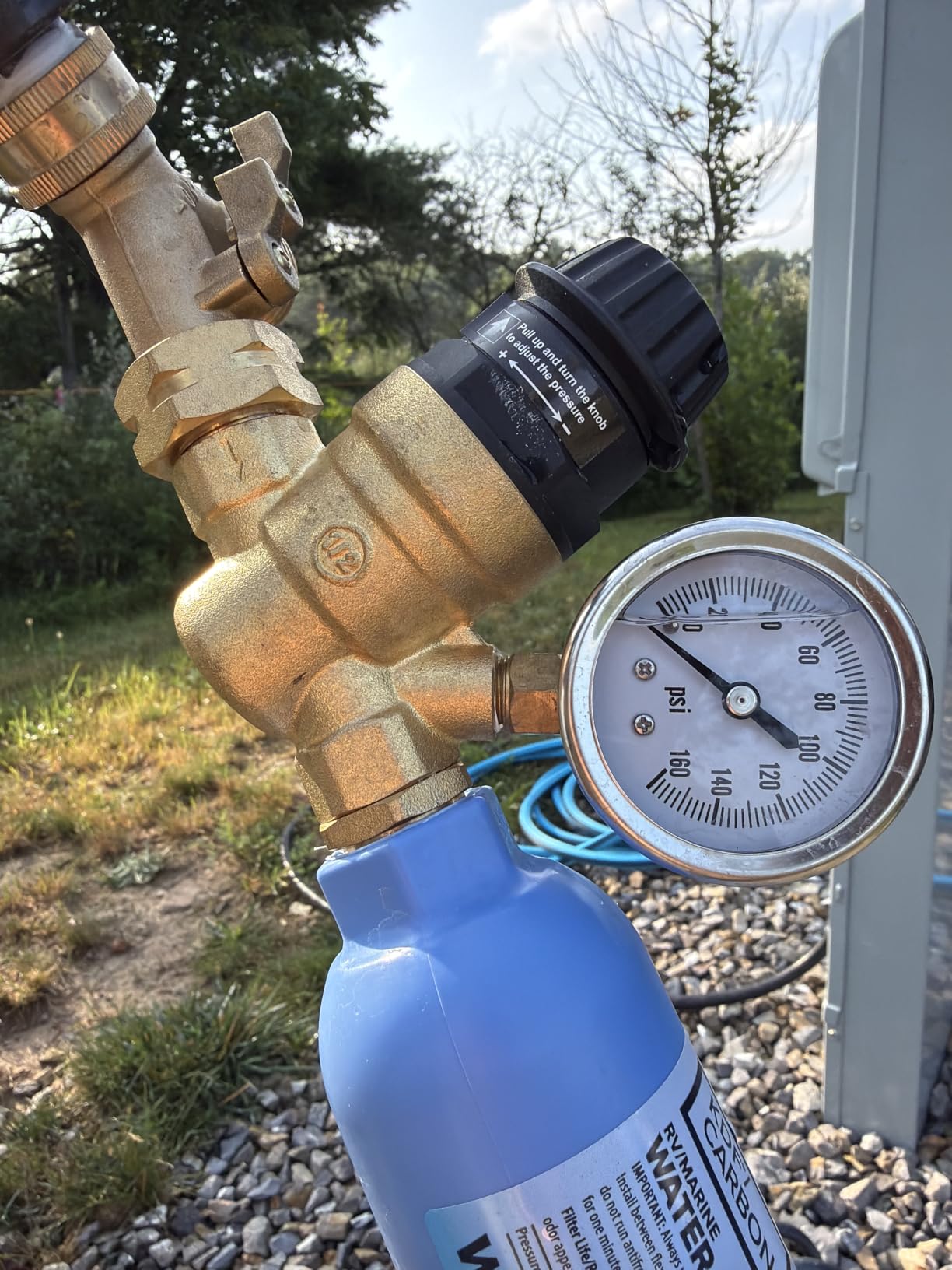
The Kohree’s distinguishing feature is filtration on the inlet side. It uses a two-layer screened filter to block particles and impurities before they reach the valve seat, which is a meaningful upgrade at older parks where galvanized risers flake. Combine that with a pull-up knob and you get tool-free adjustment plus extra debris protection.
The body is C46500 lead-free brass made with a hot casting process, tested under 0.13 percent lead, and the gauge spans 0-160 PSI with a 45 PSI factory setting. The 3/4 inch GHT female inlet and GHT male outlet fit almost all standard water systems, so hookup is straightforward.
Be candid about the numbers here. This is the lowest rated unit in our roundup, and it carries the largest share of one-star reviews among these twelve. Reviewers still generally describe it as functional and well-priced with a convenient knob, which tells you the design is sound and the consistency is the weak point.
There is also a listing inconsistency worth knowing: the finish field reads stainless steel while the feature description describes a brass body. Expect brass. The handwheel can be finicky to dial precisely, so make small turns and verify with a second gauge if the setting matters to you.
Who should buy the Kohree
This suits owners hooked up repeatedly at older, rustier infrastructure where inlet protection earns its keep. It also fits anyone who wants no-tool adjustment on a wide range without spending on a premium badge. The dual screens reduce the maintenance interval on the valve seat in our experience of similar designs.
Where it falls short
The rating spread is the honest drawback. With the highest share of one-star reports here, treat first arrival as a test and check for weeping at the threads. The handwheel needs patience to set precisely, and the stainless finish listing is misleading if appearance matters to you.
What PSI Should You Set on an RV Water Pressure Regulator?
Set it between 40 and 50 PSI, and treat 45 PSI as the default. That is the factory band on the Camco 40055 and 40064, the preset on the RVGUARD, and the setting on the Camco 40058, STMOUTUO and Kohree. When several manufacturers independently choose the same number, that number is doing real work.
The reasoning is mechanical rather than opinion. RV plumbing uses PEX tubing joined with plastic fittings and crimp clamps, none of which are designed for municipal line pressure. Winnebago publishes guidance around 50 PSI as a working maximum, and Camco explicitly states that settings above 60 PSI are not recommended on its adjustable model. Valterra’s hi-flow model regulates at 50-55 PSI with a 60 PSI maximum operating limit noted by owners in RV forums.
Here is how to check, in order. Turn the water on and let it run for two minutes. Read the gauge if your regulator has one, or attach a temporary gauge downstream if it does not. If the inlet is far above 45 PSI, an adjustable with a knob or screw lets you bring it down. If the inlet is already near 45 PSI, a fixed barrel is doing exactly what you need.
Watch for pressure creep, which is the slow drift upward that happens as a spring and diaphragm wear over seasons. Check the reading at the start of every trip rather than assuming last trip’s number still holds. A regulator that once read 45 PSI and now reads 58 PSI is telling you the unit has reached the end of its useful life.
Our team also recommends pairing this with our guide to water softeners for well water if you ever fill from a non-municipal source, since well and spring water carry a different set of pressure and mineral concerns than a park riser.
How to Install an RV Water Pressure Regulator in the Right Order
The regulator goes on the spigot end, not the RV end. That single decision is the source of most installation confusion, and it is why regulators get blamed for weak showers they never caused. The correct order runs spigot to regulator to filter to hose to RV inlet.
Step one is shutting off the spigot valve and relieving pressure. Unscrew any existing hose or adapter from the post. Step two is threading the regulator onto the spigot clockwise by hand until it seats, typically three to four turns, with no wrench needed on a standard garden hose thread.
Step three is your filter, if you use one, and it attaches to the regulator outlet rather than ahead of it. Water passes through the regulator first so the downstream filter works with a bounded pressure, and so debris from an old spigot cannot reach the filter cartridge. Step four is the fresh water hose from the filter to your RV inlet. Step five is a slow hand-tightening of the hose connection and a check for weeping.
Turn the water back on slowly and watch the connections for a minute. If you have an adjustable regulator, adjust it with water running, because the reading is only meaningful under flow. Flush the system before drinking, and note that most campground and city hookups never need the regulator at all when you are only filling the fresh tank and running the 12V pump, which self-regulates. If your rig already suffers from weak flow indoors, see our kitchen faucet picks for low water pressure to separate a fixture problem from a supply problem.
How to Know When Your RV Water Pressure Regulator Needs Replacing
A failed gauge is the most common complaint by a wide margin, and it is usually the least serious. A dial that fogs, sticks at zero, or shows bubbles after a rough drive does not mean the valve stopped working. It means you can no longer trust your instrument, and you should replace the gauge or the unit rather than interpret around it.
Weeping at a thread is the second signal. If a connection that sealed on arrival starts dripping after a season, the gasket or O-ring has taken a set. Replace the gasket before you replace the regulator, because a new regulator on a tired seal will leak exactly the same. Owners reporting over-tightened adjustment screws producing leaks fall into this same category.
Pressure creep is the third and most expensive signal, because it is silent. If your gauge reads materially higher than it did a year ago at the same park, the spring or diaphragm has relaxed. Continuing at that rate risks the burst fitting you bought the regulator to prevent, and the whole unit becomes cheaper to replace than the repair.
Two seasonal tasks close this out. Drain the regulator before winterizing and store it indoors, since freezing cracks gauge faces and brass bodies, and that advice applies to every adjustable model on this list. Then pull the inlet screen at the start of each season and rinse it, because a clogged screen shows up as reduced flow that owners often blame on the showerhead instead. While the rig is out for the season, a pressure washer makes the wet bay far easier to scrub down; our pressure washer guide under 300 dollars covers the budget picks, and the hot water pressure washers for grease roundup goes deeper on stubborn buildup.
Frequently Asked Questions
What is the recommended water pressure for an RV in PSI?
Between 40 and 50 PSI, with 45 PSI as the most common factory setting. RV plumbing uses PEX tubing with plastic fittings and crimp clamps that are not built for municipal line pressure, and Winnebago publishes guidance around 50 PSI as a working maximum. Camco states that settings above 60 PSI are not recommended on its adjustable models, and Valterra notes a 60 PSI maximum operating limit. Staying at 45 PSI protects hoses, plumbing and small appliances without starving your fixtures.
Should I use a water pressure regulator for my RV?
Yes, if you ever connect to campground or city water. Park and municipal pressure commonly runs from 80 to over 120 PSI with no regulation, and one over-pressurized hookup can burst a fitting and flood the rig. You do not need one if you only fill your fresh water tank and run entirely on the 12V pump, since that pump self-regulates. Full-hookup campers, seasonal campers and anyone who stays hooked up should always use one.
What is the recommended setting for a water pressure regulator in an RV?
45 PSI is the setting most owners use. Turn the water on, let it run for two minutes, then read the gauge on your regulator or attach a temporary gauge downstream. If the inlet pressure is far above 45 PSI, an adjustable model lets you bring it down. If the inlet already sits near 45 PSI, a fixed 40-50 PSI barrel such as the Camco 40055 does the same job with nothing to adjust.
Does the regulator go before or after the water filter?
The regulator goes first, on the campground spigot, then the filter, then the hose, then the RV inlet. Water passes through the regulator first so the filter operates under a bounded pressure and debris from an aging spigot cannot reach the cartridge. Installing the filter ahead of the regulator exposes the filter to full line pressure for no benefit.
Why is my shower weak with a pressure regulator installed?
A fixed barrel reduces flow as well as pressure, which is the most common cause. If your rig is a fifth wheel or Class A running several fixtures, a hi-flow design such as the Valterra A01-1122VP keeps usable flow while capping pressure at 50-55 PSI. Also check the inlet screen for debris, and confirm the showerhead itself is not blocked before blaming the regulator. Raising the adjustable setting above 60 PSI is not a safe fix.
How do I know if my RV water pressure regulator is bad?
Look for three signs. A gauge that fogs, sticks at zero or shows persistent bubbles means you can no longer trust the reading. Weeping at a connection that used to seal points to a tired gasket or an over-tightened adjustment screw rather than a dead valve. Most seriously, a reading that has crept noticeably higher than last season means the spring or diaphragm has relaxed, and continued use risks the burst fitting the regulator was meant to prevent.
Conclusion: The Best RV Water Pressure Regulator for 2026
After working through all twelve, the Camco 40055 is our pick as the best rv water pressure regulators choice for most rigs. It has the largest body of owner history in this roundup, a brass construction that survives real abuse, lead-free certification named to a third-party standard, and a factory band of 40-50 PSI that matches what RV manufacturers themselves recommend.
Choose differently when your situation demands it. Want to see the number, take the Renator M11-0660R. Want the strongest certification wording on the listing, take the RVGUARD. Chasing shower pressure on a big rig, take the Valterra A01-1122VP. Camping in freezing shoulder-season months, choose an adjustable with a gauge and bring it inside for storage, since gauges are the component that fails first.
Whatever you pick, screw it on at the spigot, set it near 45 PSI, and check the reading at the start of every trip. That habit alone prevents most of the damage these regulators exist to stop.