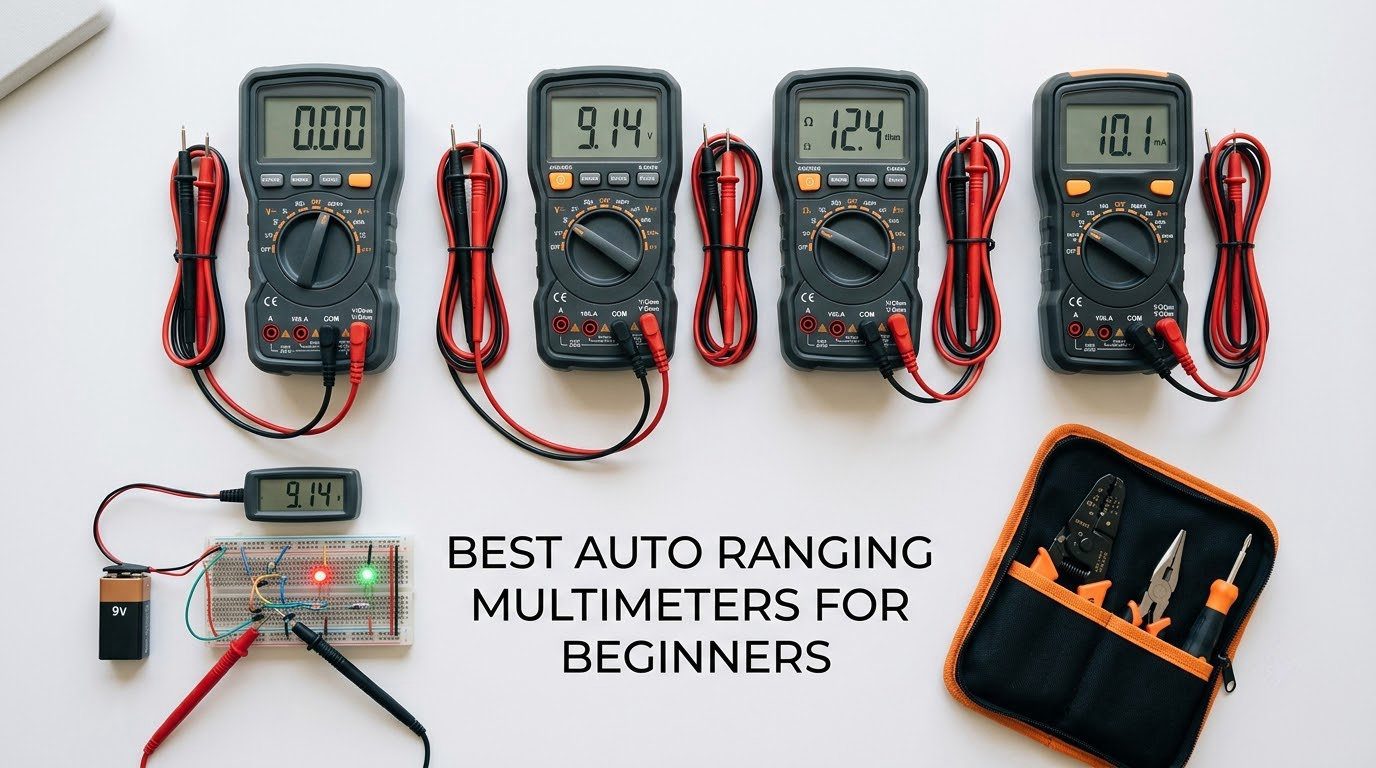
The best auto-ranging multimeters for beginners are the ones that pick the correct measurement range on their own, so you never have to guess which dial setting to choose. An auto-ranging multimeter measures voltage, current, and resistance, then selects the range that gives you the most accurate reading automatically. We spent weeks comparing eight of them to find the right first tool for a homeowner, hobbyist, or student.
Most people buy a multimeter for one specific reason: a dead battery, a breaker that keeps tripping, a lamp that stopped working, or a car that will not start. That is a short list of jobs, and it does not need a professional instrument. What it does need is a meter that will not punish you for touching the wrong dial.
That is where auto-ranging earns its price. A manual-ranging meter forces you to select a range before you measure, and if you select the wrong one the display shows something meaningless, or the meter refuses to read at all. Auto-ranging removes that single biggest beginner barrier, which is why it appears in every recommendation on this page.
We compared all eight meters below on accuracy claims, safety certification, display readability, the range of measurements they support, and the complaints owners actually report after months of use. We also looked hard at the thing almost every roundup ignores: the test leads that come in the box, since thin leads that crack at the probe neck are the most common reason a cheap meter ends up in a drawer.
If you are also assembling a first toolkit, our picks for the best immersion blenders for beginners, the best gas grills for beginners reviewed, and the best kitchen knives for beginners tested all follow the same principle we use here: buy the tool that is easiest to use correctly, not the one with the longest spec sheet.
Table of Contents
- Top 3 Picks for the Best Auto-Ranging Multimeters for Beginners in 2026
- Best Auto-Ranging Multimeters for Beginners in 2026
- 1. AstroAI 6000-Count True RMS Multimeter – Best Overall for Beginners
- 2. TESMEN TM-510 Smart Auto-Ranging Multimeter – Best Under-Twenty Pick
- 3. Crenova MS8233D True RMS Multimeter – Best Value CAT III Meter
- 4. Innova 3320 Auto-Ranging Multimeter – Best for Battery and Car Work
- 5. Fluke 115 True RMS Multimeter – Best for Field Service
- 6. Fluke 117 Digital Multimeter – Best Buy-It-Once Meter
- 7. AstroAI DM130B 4000-Count Multimeter – Best for Capacitor Work
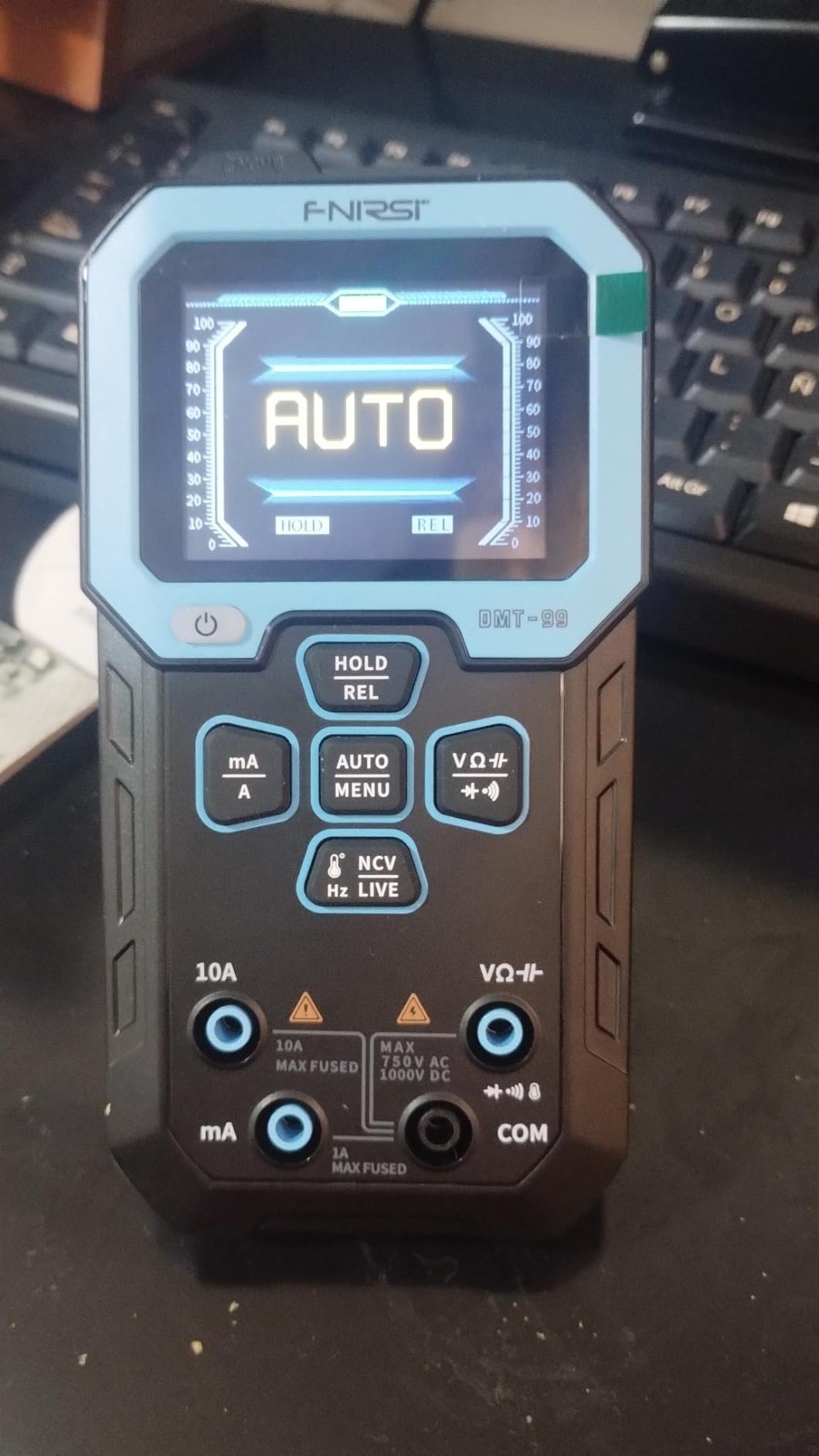
- 8. FNIRSI DMT-99 9999-Count Multimeter – Best Screen and Resolution
- Auto-Ranging vs Manual Ranging: Why Beginners Should Pick Auto
- What to Measure in Your First Hour With a New Multimeter
- CAT Ratings Explained: What a Beginner Actually Needs
- How to Choose an Auto-Ranging Multimeter: 7 Features That Matter
- Frequently Asked Questions
- What is the best auto-ranging multimeter?
- Is an auto ranging multimeter worth it?
- What is the best multimeter for a beginner?
- What is the best automotive multimeter for the money?
- What multimeter do most electricians use?
- How do I know which multimeter to buy?
- Is a cheap multimeter better than an expensive multimeter?
- Which Auto-Ranging Multimeter Should You Buy?
Top 3 Picks for the Best Auto-Ranging Multimeters for Beginners in 2026

Best Auto-Ranging Multimeters for Beginners in 2026
All eight meters below auto-select their range, so you never have to set one by hand. The differences between them come down to safety rating, how many measurements they can make, and whether you want a screen you can read in a dark panel.
| Product | Specs | Action |
|---|---|---|
| AstroAI 6000-Count True RMS Multimeter |
|
Check Latest Price |
 TESMEN TM-510 Smart Auto-Ranging Multimeter TESMEN TM-510 Smart Auto-Ranging Multimeter |
|
Check Latest Price |
 Crenova MS8233D True RMS Multimeter Crenova MS8233D True RMS Multimeter |
|
Check Latest Price |
 Innova 3320 Auto-Ranging Multimeter Innova 3320 Auto-Ranging Multimeter |
|
Check Latest Price |
 Fluke 115 True RMS Multimeter Fluke 115 True RMS Multimeter |
|
Check Latest Price |
 Fluke 117 Digital Multimeter Fluke 117 Digital Multimeter |
|
Check Latest Price |
 AstroAI DM130B 4000-Count Multimeter AstroAI DM130B 4000-Count Multimeter |
|
Check Latest Price |
 FNIRSI DMT-99 9999-Count Multimeter FNIRSI DMT-99 9999-Count Multimeter |
|
Check Latest Price |
1. AstroAI 6000-Count True RMS Multimeter – Best Overall for Beginners
AstroAI Digital Multimeter, True RMS 6000 Counts Auto-Ranging Volt Meter for Automotive & Home Electrical Troubleshooting, AC/DC Voltage Current Resistance Continuity Capacitance Temperature Tester
6000 counts,True RMS,1000V DC CAT II,1000V DC max,measures AC and DC voltage and current
Pros
- Covers nine measurement types in one tool
- True RMS accuracy confirmed in independent testing
- Large backlit LCD with data hold and kickstand
- Double ceramic fuses for overload protection
Cons
- Frequency counter tops out far below the claimed limit
- Transistor socket is wired C-B-E so TO-220 testing is awkward
- No carrying case included
This is the meter I hand to friends who tell me they want to start doing their own electrical work. It measures AC and DC voltage, AC and DC current, resistance, continuity, capacitance, frequency, duty cycle, and temperature, so there is very little you can grow into that it will not handle.
The 6000-count display is the sweet spot for a first meter. It gives you one extra digit over a 4000-count screen without pushing the price into professional territory, and the large backlit LCD stays readable when you are under a sink or in a breaker panel with the lights off.
Independent testing found its True RMS readings held up against an Amprobe AM-570, and owners regularly report it matches SnapOn and Fluke meters closely on 12V battery checks. That is about as much accuracy assurance as you can get at this level.
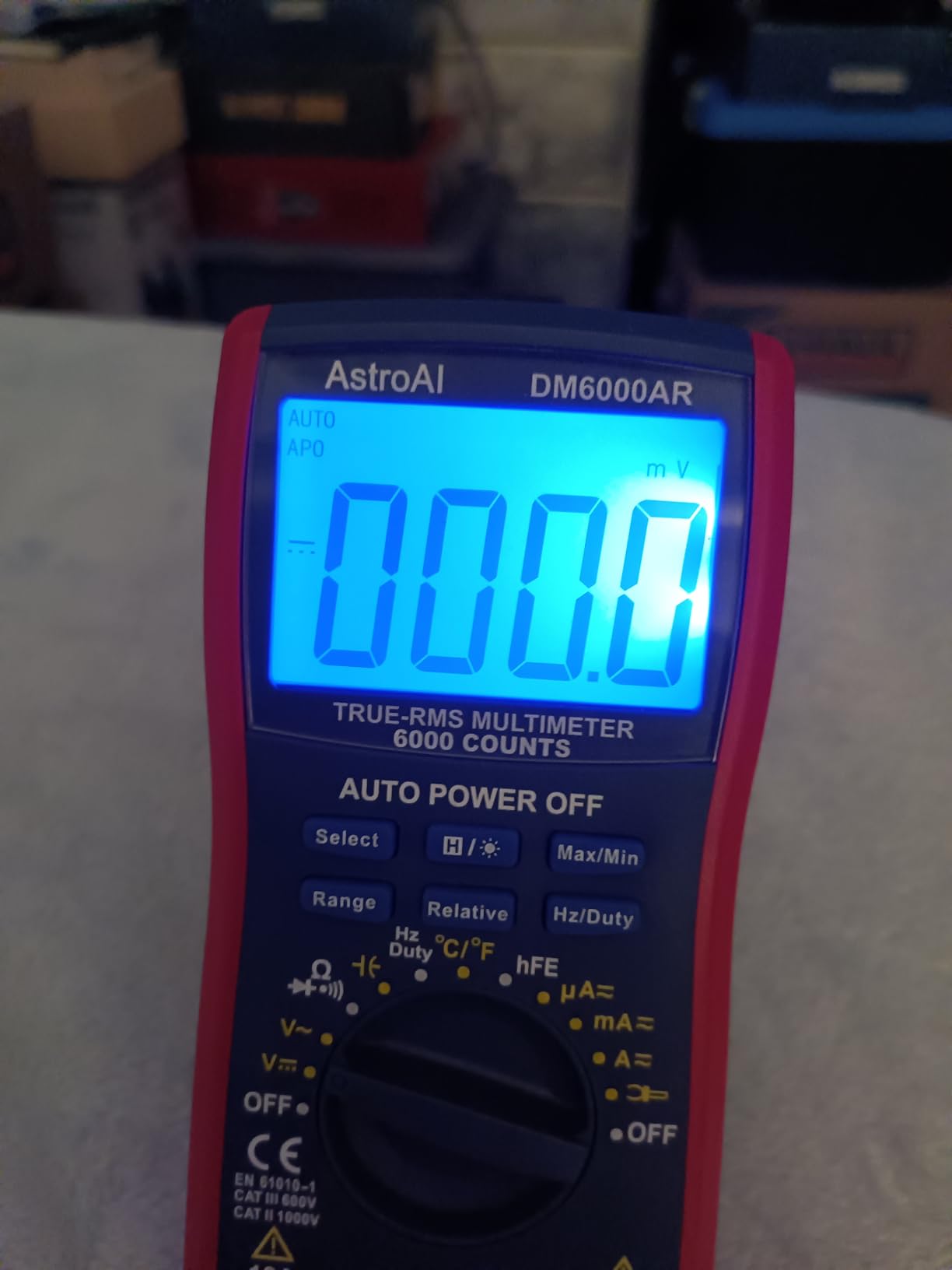
Two things to know before you commit. First, the frequency counter measures to roughly 16MHz rather than the 60MHz the packaging implies, so do not plan to use it as an RF tool. Second, the transistor hFE socket is wired collector-base-emitter instead of the standard base-collector-emitter order, which makes testing a TO-220 package genuinely awkward.
The hFE test current is also low, so gain readings run about half of what you would expect from a bench instrument. If you are building electronics projects rather than fixing things around the house, those two limitations are worth knowing. For a beginner doing household and automotive diagnostics, they never come up.
What makes it the best first multimeter
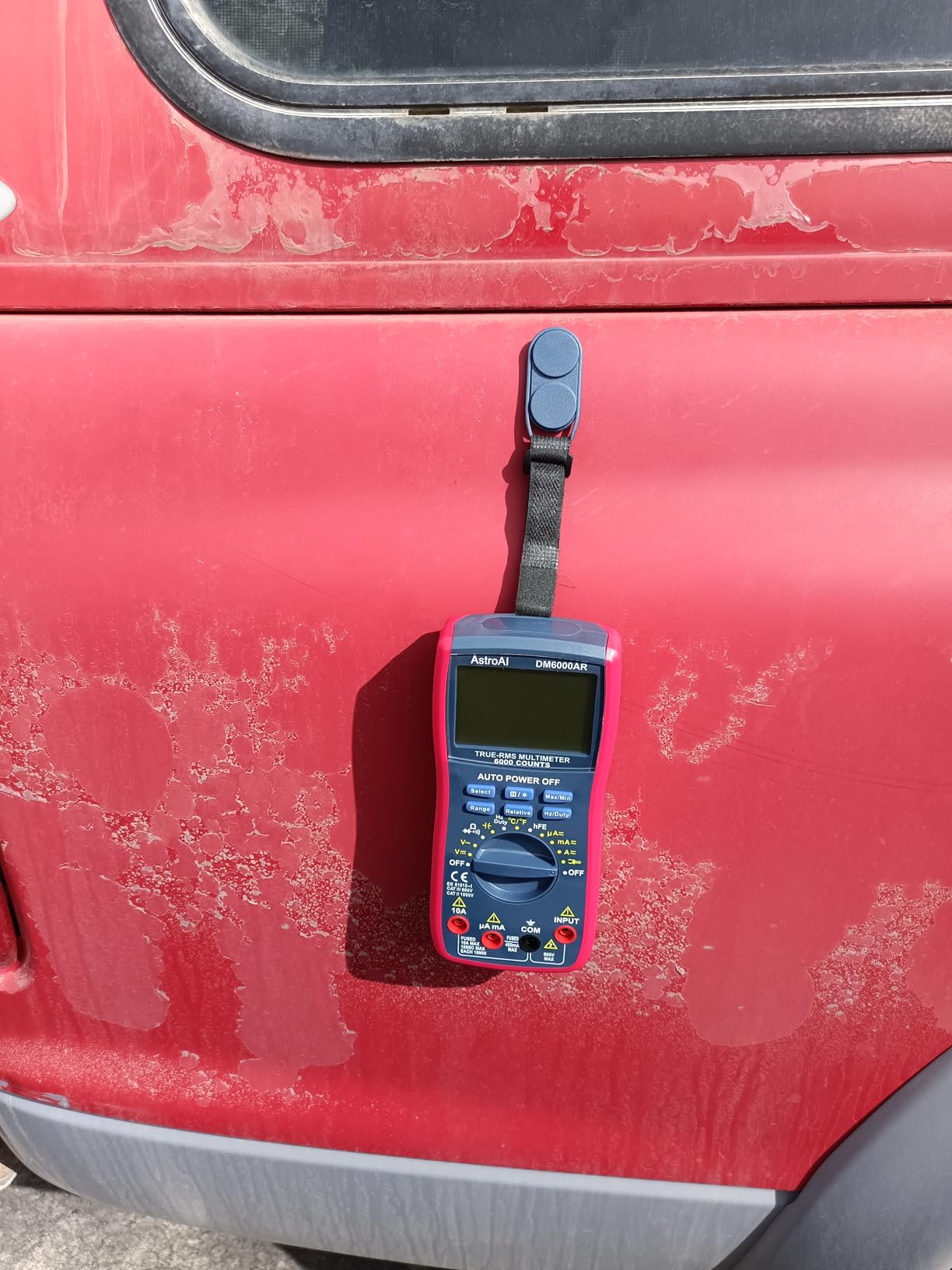
It combines one of the widest measurement sets in this guide with a safety rating that covers household and automotive work, and the rating is printed on the device rather than implied. The double ceramic fuses at F400mA and F10A are a real upgrade over the thin glass fuses used in cheaper units, and ceramic does not fail in a surge the way glass can.
For someone who is going to open a car battery terminal, a breaker panel, or an outlet, having a 1000V DC CAT II rating in the same box as temperature and capacitance measurement is the best value combination on this list.
Who should pick something else
If your work is mostly at a breaker panel or near a service entrance, a CAT III 600V rating is the safer specification, and this meter does not carry one. Crenova MS8233D in this same list does.
Skip it if you plan to measure milliamps, since it has no microamp or milliamp range. And if you want a graphing display for watching ripple on a charging system, the FNIRSI DMT-99 covers that instead. For everything else, this is the meter to buy first.
2. TESMEN TM-510 Smart Auto-Ranging Multimeter – Best Under-Twenty Pick
TM-510 Digital Multimeter, 4000 Counts, Smart Measurement, Auto-Ranging Voltmeter; Voltage Tester with Non-Contact Voltage Function, Measures AC/DC Voltage, Resistance, Continuity – Green
4000 counts,smart auto mode,non-contact voltage,CAT II 600V with silicone cover
Pros
- Smart auto mode picks the function and range for you
- Non-contact voltage alarm helps check live wires safely
- Storage bag and two AAA batteries in the box
- Backlight flashlight data hold and auto shutdown
Cons
- Does not measure current or capacitance
- 4000 counts is lower resolution than its rivals
- No manual range override for stubborn readings
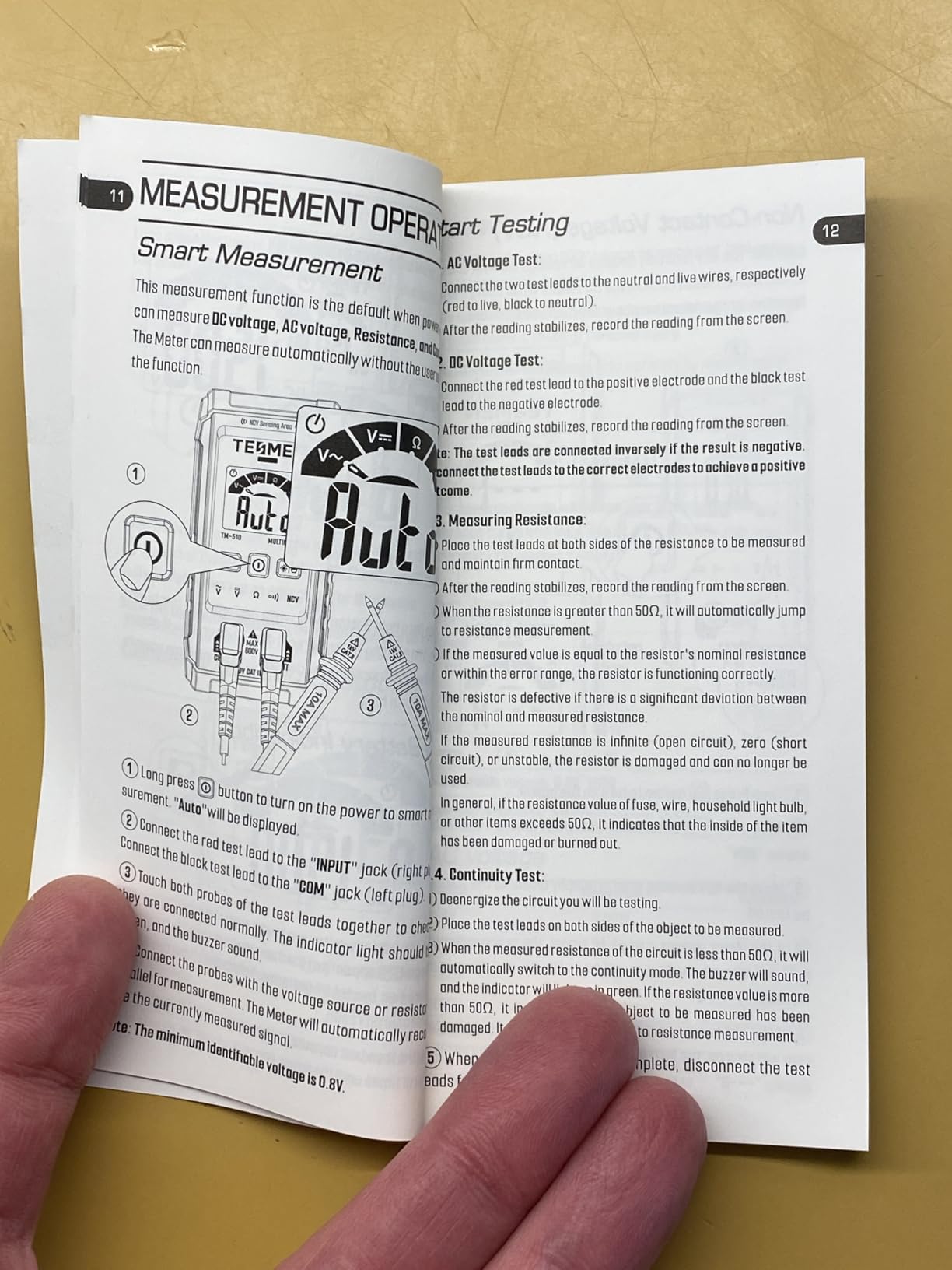
The TM-510 takes auto-ranging one step further than the others. Most auto-ranging meters still make you turn the dial to the type of measurement, and this one skips that too, with a smart auto mode that identifies whether you are measuring AC or DC voltage, resistance, or continuity and switches on its own.
For a complete beginner that is the single most useful feature on this page. There is no wrong dial position to get into, and the meter handles the range selection internally. Owners describe it as the first meter they could hand to a family member without a lesson.
It also adds a non-contact voltage test with both a visual and an audible alarm, so you can sweep a wall to find a live conductor without touching anything. A flashlight, backlight, data hold, low battery indicator, and automatic shutdown round out a genuinely thoughtful everyday feature set.
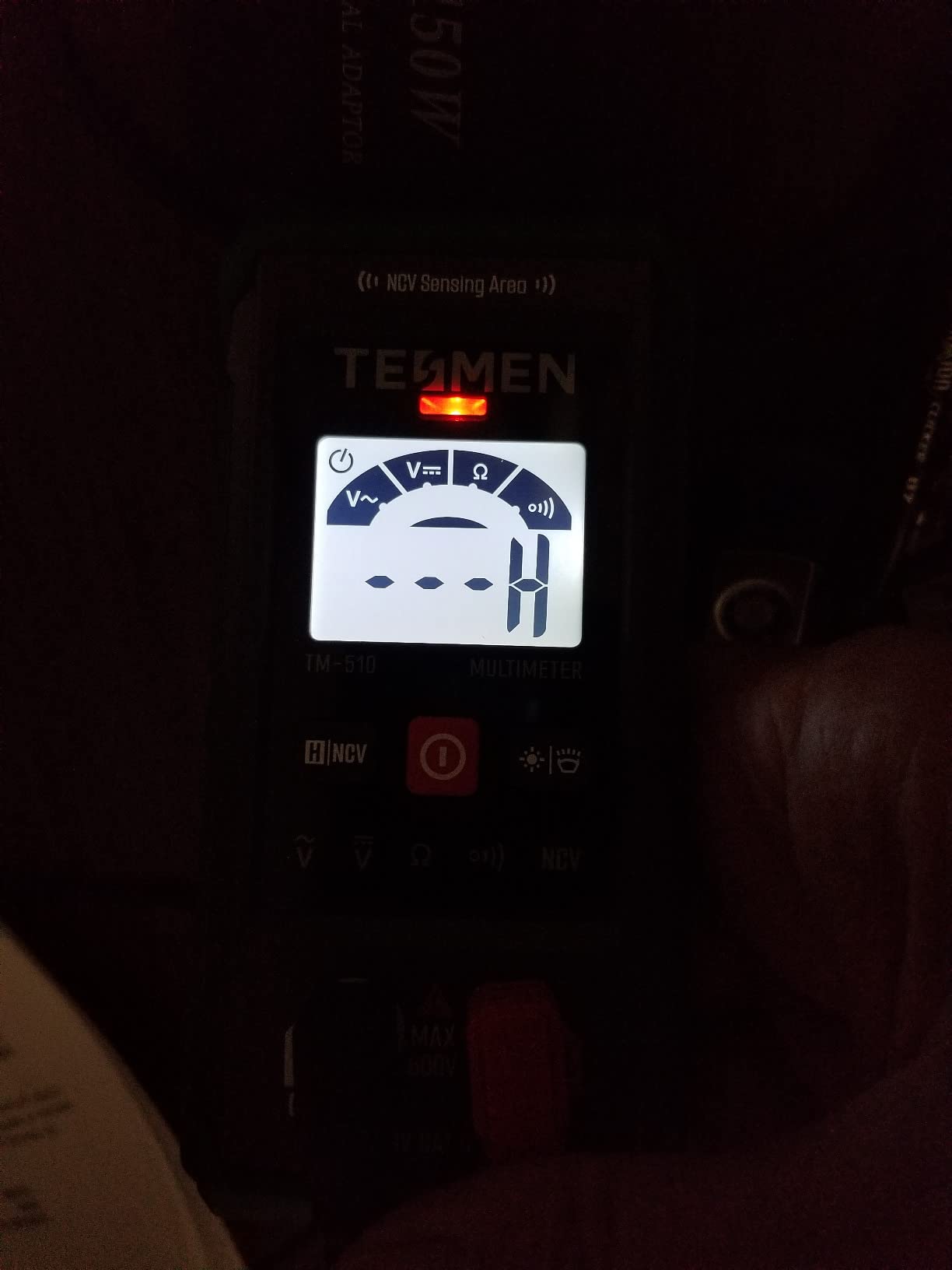
There is one significant limit, and you should decide about it before buying. This meter does not measure current or capacitance. That means no checking a car alternator output in amps, no measuring a run capacitor, and no household load testing.
It is also a 4000-count display, so the last digit changes more often than on a 6000-count meter, and there is no manual range override when a reading refuses to settle. Inside the auto mode, if the detected voltage drops below 0.8V the meter switches itself to resistance, which surprises some new users the first time they probe a nearly flat battery.
The silicone outer cover is a nice touch at this level, and it carries CAT II 600V with CE and RoHS certification plus internal overload protection. The box includes the meter, two sets of test leads, two AAA batteries, a storage bag, and a manual.
Why it works as a first tool
Buying a cheap meter is often framed as a compromise, but for voltage, resistance, and continuity work this one loses very little. Testing outlets, checking fuses, tracing a broken wire under a floorboard, confirming a battery is not fully dead, these are the jobs beginners do most, and the TM-510 does all of them well.
The non-contact alarm is genuinely useful as a safety habit. Before you touch a wire, a beep tells you whether it is live, which builds the pattern professional electricians follow every single time.
When to spend a little more
If you own a car or an air conditioner, buy something that measures current and capacitance. The AstroAI 6000-Count or Crenova MS8233D both cover those, and either one removes the main objection to owning a budget meter.
This is also a good second meter rather than a first, since it is small, light, and has a bag for it. Keep it in the toolbox for outlet and continuity checks while a more capable meter sits on the bench.
3. Crenova MS8233D True RMS Multimeter – Best Value CAT III Meter
Crenova MS8233D Multimeter TRMS 6000 Counts Auto-Ranging Live Wire NCV
CAT III 600V,6000 counts,True RMS,measures voltage current resistance capacitance frequency
Pros
- CAT III 600V rating with dual fuses and rubber holster for safety
- True RMS with NCV live wire detection
- Manual and auto range modes give beginners a safety net
- Carrying case alligator clips and batteries included
Cons
- Sampling at 3 readings per second is slow for fast transients
- Rubber holster adds bulk and partly covers the controls
- Manual range mode confuses newcomers who expect full auto
The MS8233D is the pick I recommend to anyone who wants one meter and wants to feel safe using it. It conforms to IEC61010-1 CAT III 600V, which is the rating that matters at a breaker panel, inside a wall box, and at appliance outlets.
CAT III is not a marketing label. It is a tested category describing the transient surges a meter can survive when it is near equipment with a real power source behind it. A CAT II meter is fine for checking a 12V battery or a bench power supply, but CAT III is the honest specification for household work.
It measures AC and DC voltage, AC and DC current, resistance, capacitance, frequency, and duty cycle, plus continuity, diode, and non-contact live wire detection. The buzzer rate increases as detected AC voltage rises, so you can tell how close a wire is to live without a number.
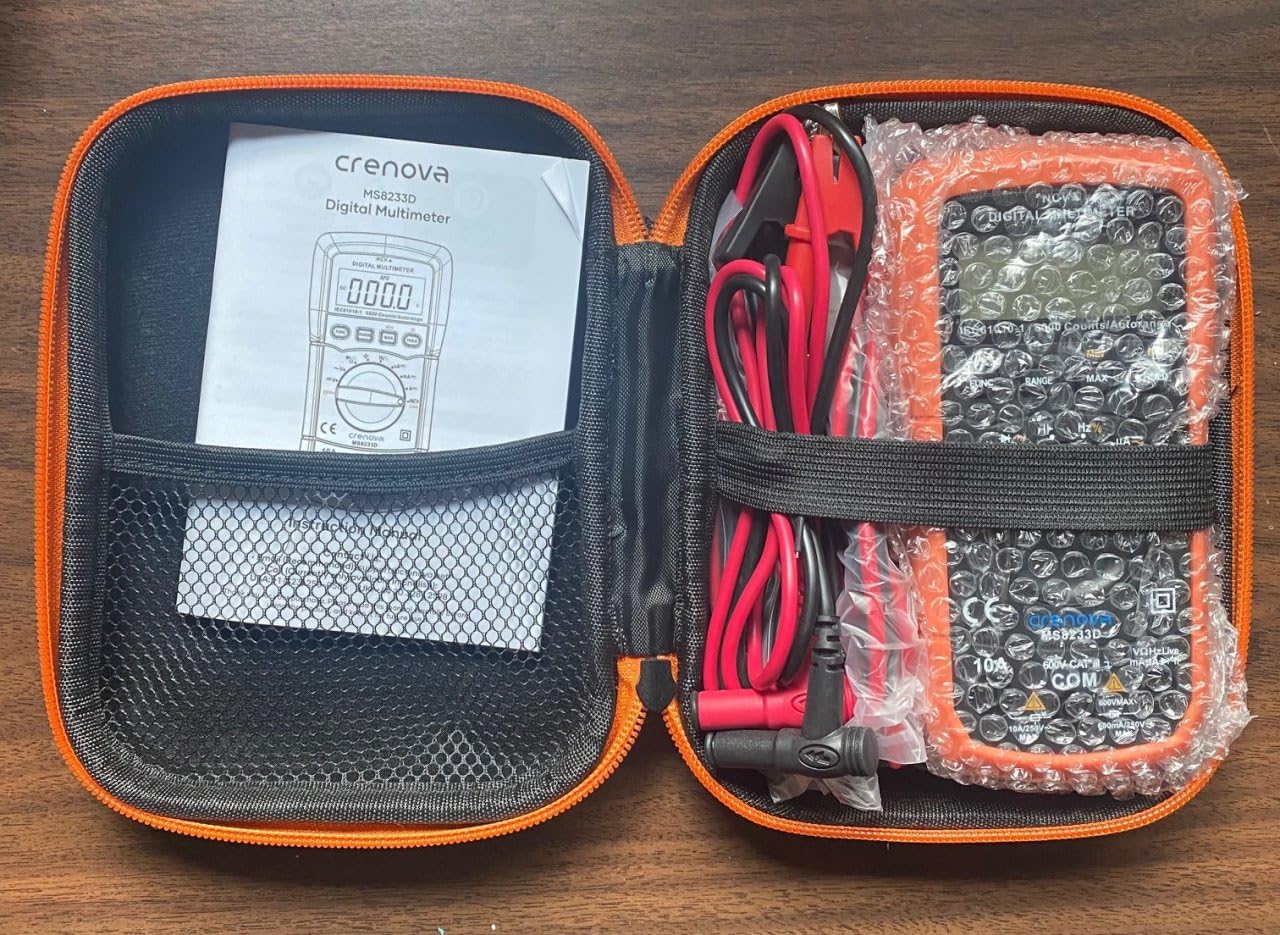
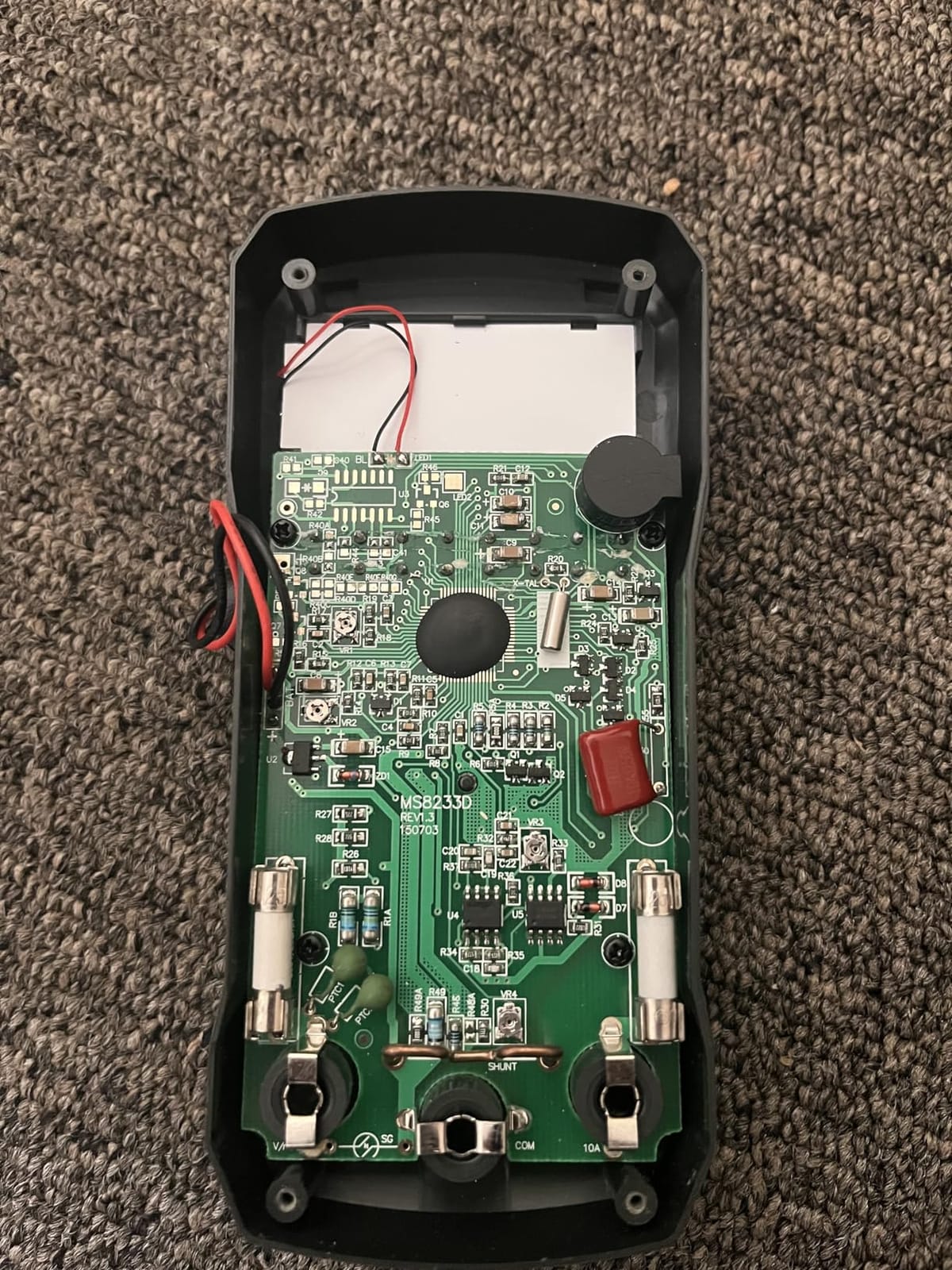
Two built-in fuses handle overload protection, and the insulated rubber holster adds shock protection around the case. The switchable manual and auto range modes are worth understanding: auto handles nearly everything, and manual lets you pin a range when a reading is fluctuating.
The 6000-count display with a bright backlight reads clearly in dark workspaces, and the box carries the meter, two AAA batteries, a carry bag, test leads, and alligator clips. That accessory bundle is more generous than most competitors at any level.
The main drawback is speed. It samples three times per second, which is fine for steady values but will smooth over the quick spikes you would see on a faster meter. The rubber holster also adds noticeable bulk and partly covers the controls, so you tend to work with it off and beside you rather than on.
Why the CAT III rating changes the decision
Most forums treat safety certification as the top trust signal when choosing a first meter, and the reason is simple: a CAT rating is the only performance claim on the box that describes what happens when something goes wrong. A meter that survives a fault is worth more than a meter with a longer feature list.
For household work, CAT III 600V covers the vast majority of what a homeowner will ever probe. CAT IV is the rating for the point of origin, the meter sockets themselves and the service entrance, which is where electricians work and where a homeowner should not.
If you are not sure what to look at, treat CAT III 600V as the floor for any meter you will use inside your house.
Who should skip it
Skip it if a smooth rubbery case bothers you, because the holster is a permanent part of the design rather than an accessory. And if you work on electronics where you need to see fast transients, the slower sampling rate will disappoint you.
Otherwise this is the meter to buy and then keep for years. It costs less than a mid-tier kitchen appliance and covers everything the more expensive picks on this list do, short of true professional accuracy margins.
4. Innova 3320 Auto-Ranging Multimeter – Best for Battery and Car Work
INNOVA 3320 Auto-Ranging Digital Multimeter, Red & Black
UL certified,10 MegOhm input impedance,auto-ranging scales,on-board battery load test
Pros
- Built-in load test for AA AAA 9V and 12V cells
- 10 MegOhm impedance is safe around vehicle ECUs
- UL certified
- Owners report 6-plus year service lives
Cons
- AC current capped near 200 mA with no clamp option
- No backlight and no data hold
- Loose range switch can shift readings if bumped
The Innova 3320 does something none of the other meters here do: it tests batteries. Color coded LEDs report the charge state of AA, AAA, 9V, and 12V cells, and it applies load to them rather than just reading the open circuit voltage, which is a much more honest test of whether a battery is finished.
That single feature is why it has held onto a following for years among DIYers and auto technicians. Owners on car forums describe buying an Innova auto-ranging unit for roughly the cost of a tank of fuel and getting a basic meter that has been accurate for them ever since, and long-term owners report meters still performing after six or more years.
Auto-ranging scales select the correct range quickly, often within a second for voltage. The 10 MegOhm input impedance is the number that matters for automotive work, because a lower impedance meter can interfere with a vehicle’s electronic control unit and cause faults that have nothing to do with the problem you are chasing.
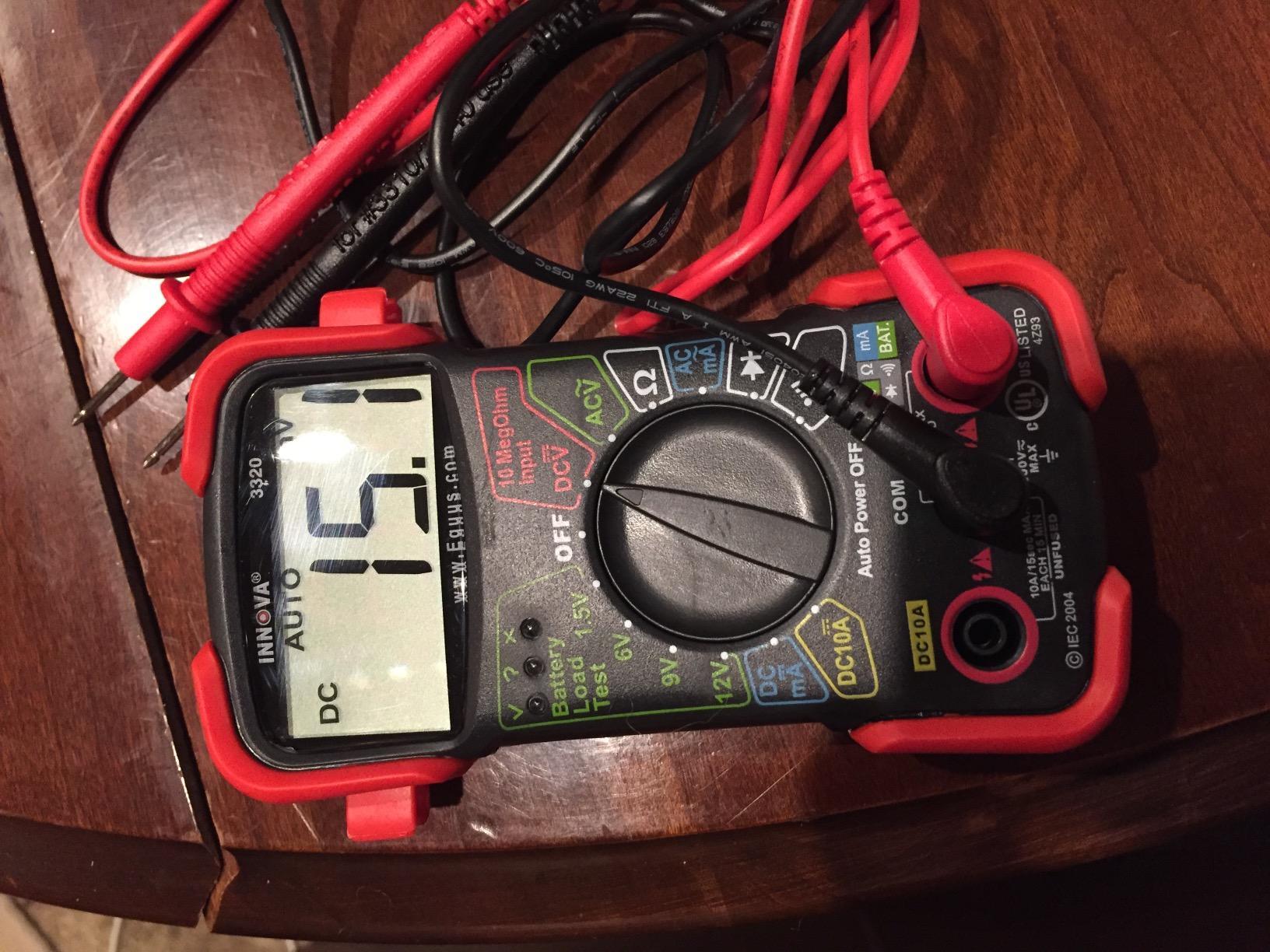
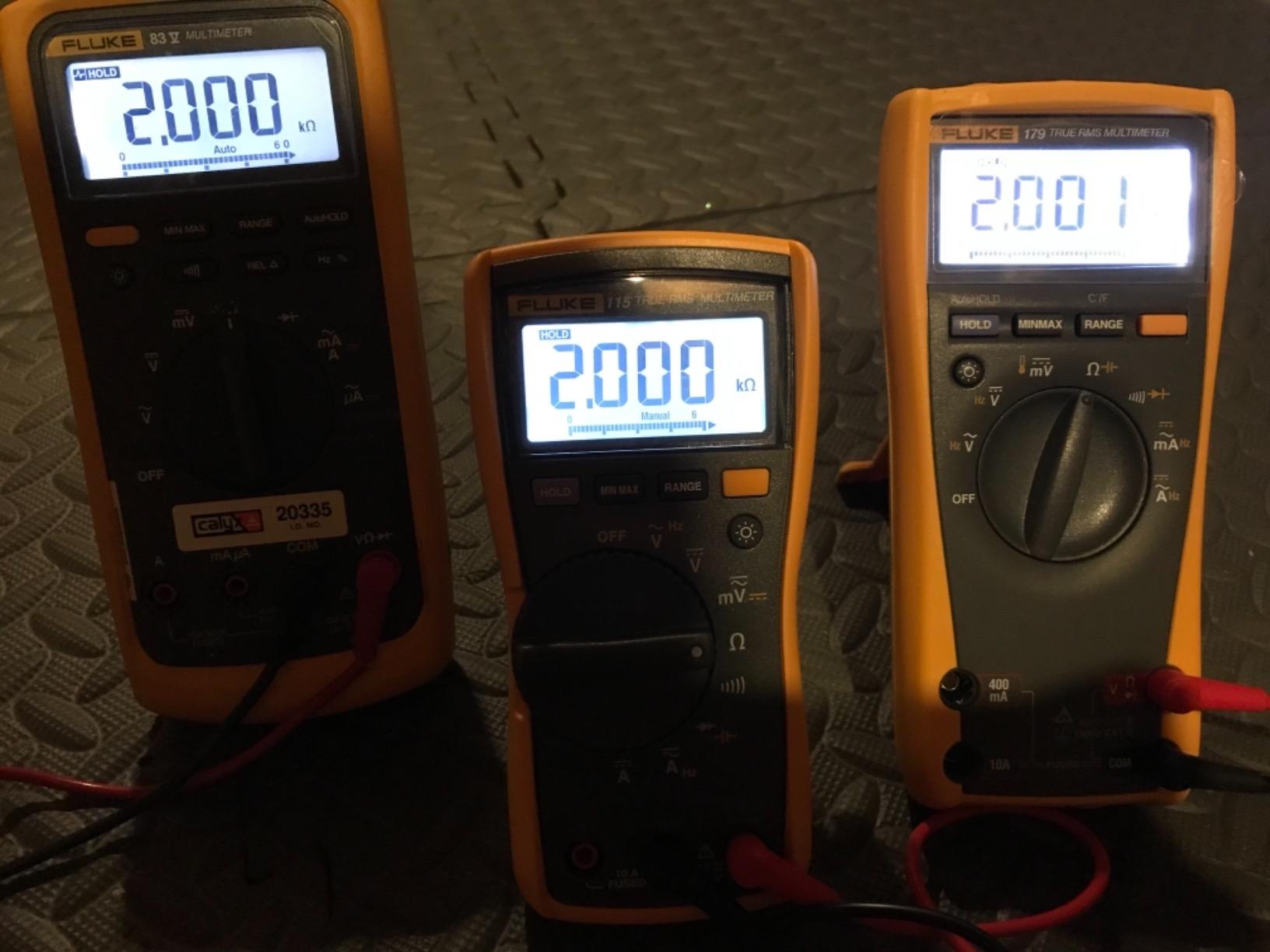
Detailed testing found readings within about 1 percent of a calibrated Fluke 179 across DC voltage, AC voltage, resistance, and current ranges, which is a remarkable result for a meter in this class.
The trade-offs are real. There is no backlit display, so you are squinting in dark panels, and no data hold, so you cannot freeze a reading to compare against a second one. The range switch is also loose enough that bumping the meter can change the reading while you work.
AC current measurement is limited to about 200 mA, so this is not the meter for checking mains loads, and readings can drift at the very top and very bottom of the resistance range where auto-ranging gets sluggish.
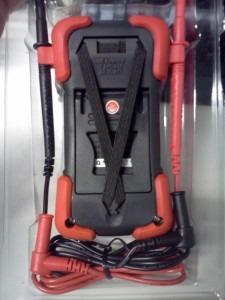
Why 10 MegOhm matters on a car
Input impedance is how much the meter loads the circuit it is measuring. A low-impedance meter draws current to take a reading, and on a modern vehicle that extra draw can make the ECU misbehave or set a code that disappears the moment you clear it.
A 10 MegOhm input impedance puts so little load on the circuit that it will not disturb sensitive electronics. This is why many auto technicians reach for a meter with a high impedance figure, and why an outlet tester and a multimeter can disagree on the same de-energized wire.
Where it falls short
There is no backlight, which rules it out for night work in a crawl space or an unlit panel. It also does not measure temperature or capacitance, so it will not help with a run capacitor or a cooling fan motor.
If your work is purely household, the Crenova MS8233D is the better single purchase. If you work on cars, this is the one.
5. Fluke 115 True RMS Multimeter – Best for Field Service
Fluke 115 Multimeter
True RMS AC,6000 counts,CAT III 600V,min max and average recording,white LED backlight
Pros
- True RMS accuracy on non-linear loads
- Min Max Average captures intermittent fluctuations
- Large white LED backlight for dark panels and crawl spaces
- Compact rugged body with a three year warranty
Cons
- No non-contact voltage detection
- No low impedance mode for ghost voltage
- Mode must be set manually between AC and DC
The Fluke 115 is the meter for someone who will carry it around. It is compact, rated CAT III 600V, and the large white LED backlight is bright enough to read in a dark electrical panel or a crawl space without the washed-out look of a typical amber backlight.
True-RMS measurement matters on non-linear loads, which is anything where the current is not a clean sine wave. Modern switch-mode power supplies, LED drivers, and variable speed motors all fall into that category, and a non-True-RMS meter will under-read them noticeably.
The Min, Max, and Average mode records signal fluctuations over time, which is how you catch an intermittent fault that only appears for a second while you are not watching. Owners rate it very highly, with roughly 89 percent of reviews at five stars, and the complaints that do appear are about missing features rather than accuracy.
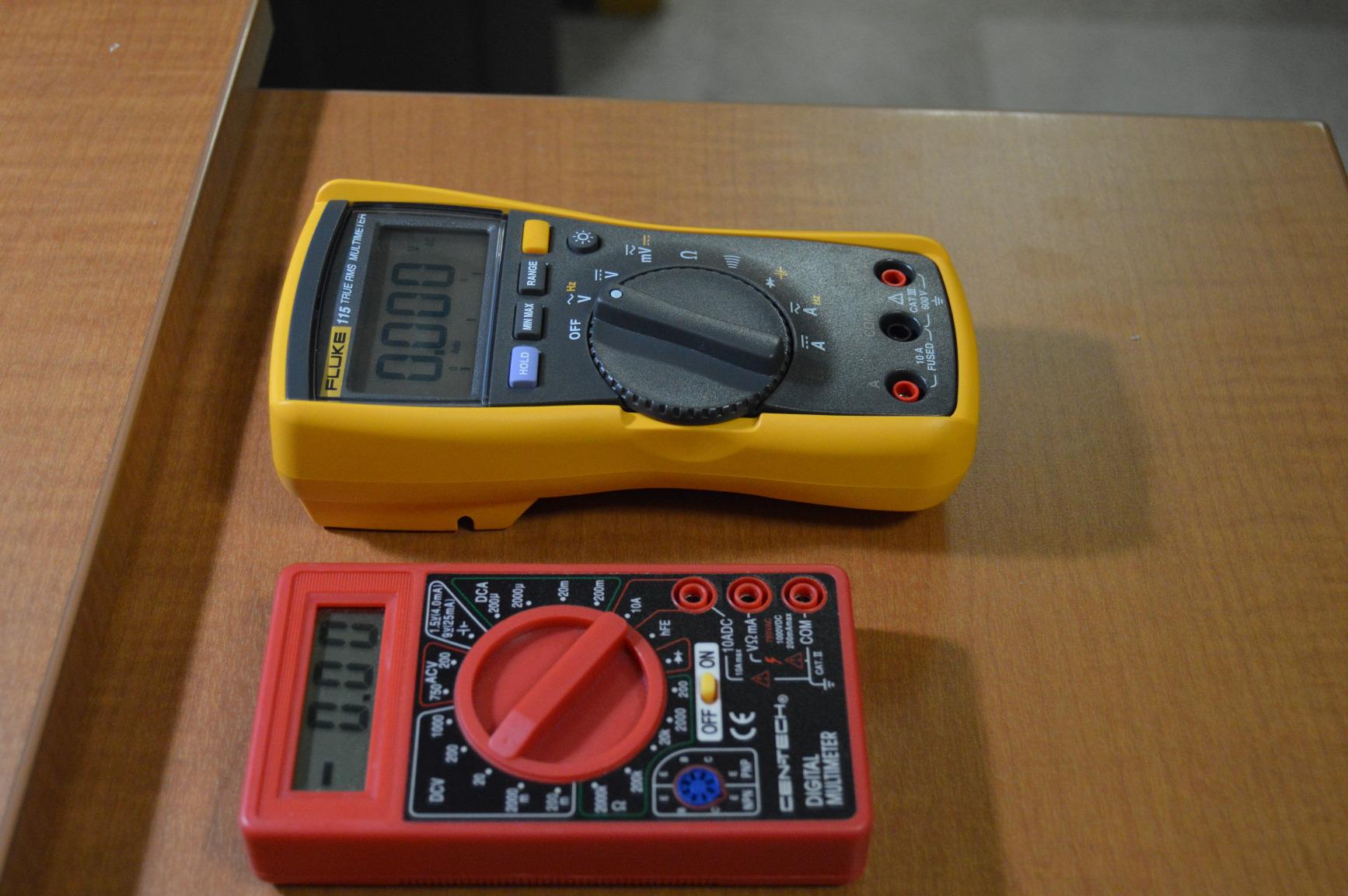
What it does not have is what makes the 117 better in most situations. There is no non-contact voltage detection, so you cannot sweep for a live conductor. There is no low impedance mode, so ghost voltage on a de-energized circuit is harder to dismiss. And there is no automatic AC or DC selection, so you still choose the mode yourself.
It also does not measure temperature, which is a genuine gap if you work on HVAC or want to check a motor winding. Reviewers who later want these functions typically move up to the Fluke 117.
Who this meter is actually for
This is a technician’s meter rather than a beginner’s first purchase, and the honest reason is price. You are paying for Fluke’s accuracy margin and build quality, and a beginner will not extract enough from it to notice the difference over a budget alternative that measures the same nine functions.
It earns its place if you work in the field and need a meter that survives a tool bag, reads in the dark, and records a minimum and maximum value for that flicker you can feel but cannot catch.
When to buy something else
For a first meter, the Crenova MS8233D gives you the same CAT III 600V rating, True RMS accuracy, and a backlit screen for a fraction of the outlay, and it adds non-contact detection and a manual range mode.
Buy the 115 instead if you specifically want a compact white backlight, a rugged body, and a three year manufacturer warranty, and you do not need non-contact voltage detection.
6. Fluke 117 Digital Multimeter – Best Buy-It-Once Meter
Fluke 117 Digital Multimeter, Non-Contact AC Voltage Detection, Measures Resistance/Continuity/Frequency/Capacitance/Min Max Average, Automatic AC/DC Selection, Low Impedance Mode
VoltAlert NCV,AutoVolt auto AC and DC,low impedance mode,True RMS,CAT III 600V
Pros
- VoltAlert finds live conductors without touching them
- AutoVolt removes the most common beginner mistake of picking the wrong mode
- Low impedance mode settles ghost voltage arguments
- 400 hour typical battery life
Cons
- No milliamp or microamp ranges so small currents are impossible
- No current clamp or clamp jack
- Included test leads feel cheap and tangle easily
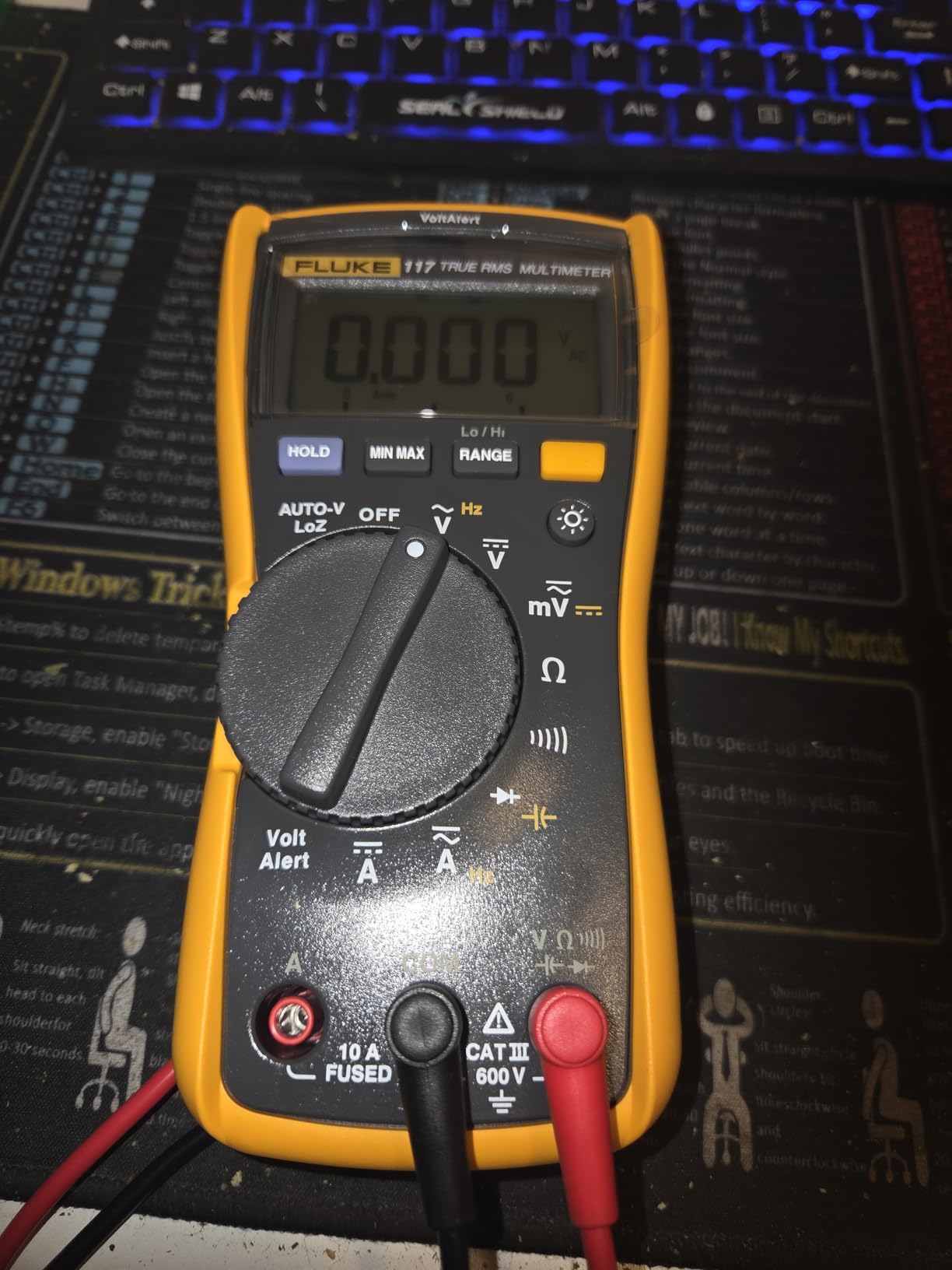
Of the eight meters here, the Fluke 117 is the one electricians recommend most often when they are asked what a beginner should buy. Roughly 90 percent of its reviews are five stars, and on the forums it is consistently described as the safe default choice for anyone who does not want to think about whether a meter is rated for the job in front of them.
Three features do the real work. VoltAlert gives non-contact voltage detection, so you pass the probe near a conductor and the meter beeps before you touch anything. AutoVolt detects whether the voltage is AC or DC and selects automatically, which removes the single most common beginner error on mains work. Low impedance mode gives the meter enough current to collapse ghost voltage, so a reading means the wire is really live.
Add True RMS accuracy, a capacitance and frequency range for HVAC run capacitors and motors, and a large white LED backlight, and you have a meter that covers essentially every household and automotive diagnostic job.
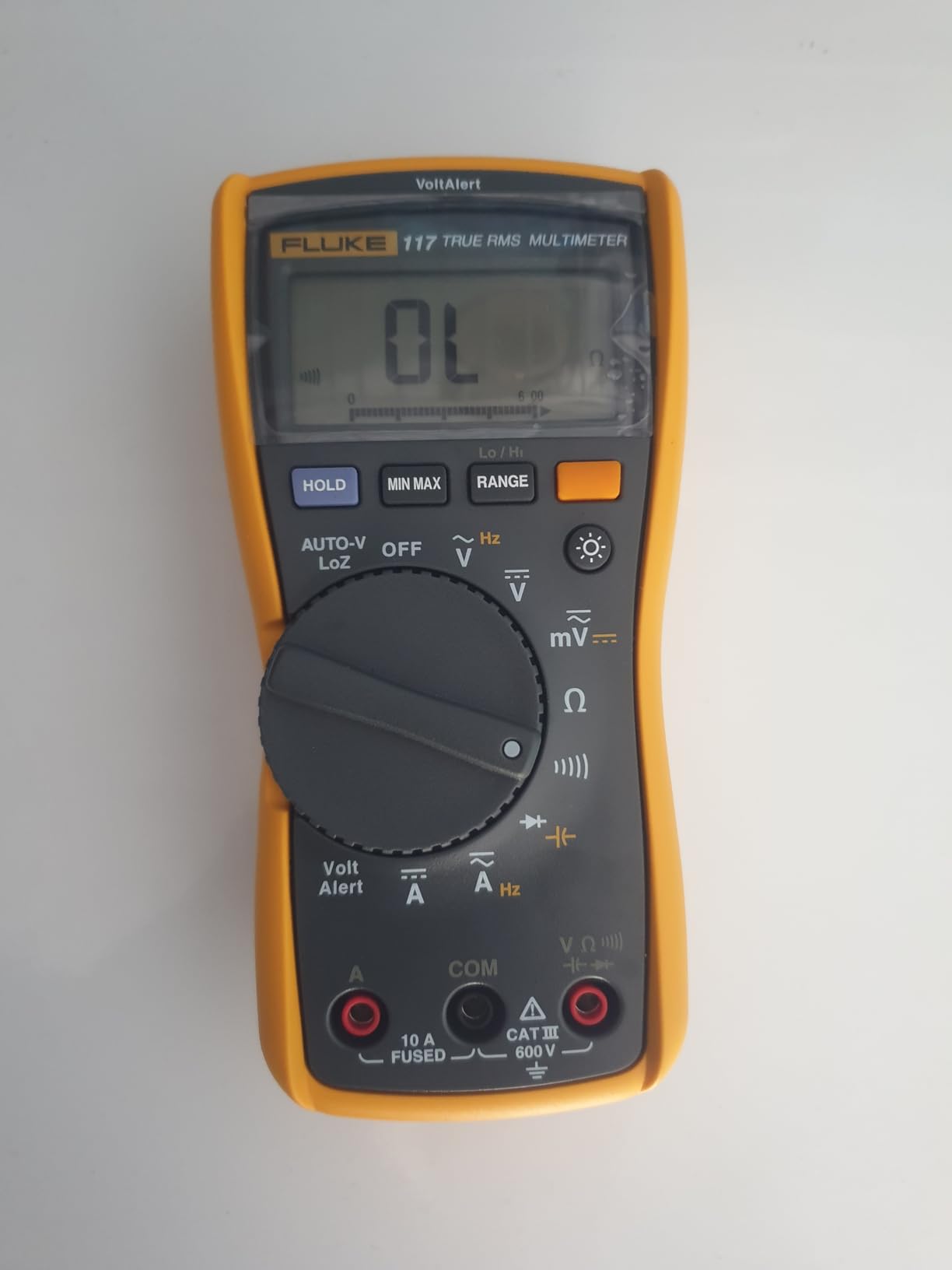
The limits are specific rather than general. There are no milliamp or microamp ranges, so you cannot measure small sensor currents, which is a common reason working electricians end up carrying a second meter. There is no current clamp and no clamp jack, so high current must be measured in line with the circuit broken, and there is no relative or zeroing function.
The included test leads are the most commonly criticized part. Owners describe them as feeling cheap and tangling easily, and for a meter at this level that is worth knowing before you buy, because a good set of replacement leads is inexpensive and transforms the feel of any instrument.
Why low impedance mode is the feature you will not understand for a year
Ghost voltage is the reason beginners argue with each other online. A de-energized wire can show 40 or 90 volts to a meter, which looks alarming and is almost always nothing. The cause is capacitive coupling from a neighbouring live conductor that induces a tiny current.
Standard measurement inputs draw so little current that they happily display this induced voltage. A low impedance mode deliberately loads the circuit with enough current to collapse the phantom reading, so if the number stays high, the wire is genuinely live. Fluke put a dedicated mode button on this meter for exactly that reason, and it is one of the reasons technicians keep it on the belt even when they own bigger instruments.
Who should not buy this first
If you will only ever check batteries, outlets, and continuity, you will not use low impedance mode, AutoVolt, or True RMS often enough to notice them, and the Fluke 117 is a lot of money for features you will not call on.
Buy the AstroAI 6000-Count for the same measurement coverage at a fraction of the cost, or the Crenova MS8233D if you want the CAT III 600V rating at the same time. Choose the 117 when you are willing to buy one instrument and keep it for a decade.
7. AstroAI DM130B 4000-Count Multimeter – Best for Capacitor Work
AstroAI DM130B Multimeter, 4000 Counts, Auto-Ranging, Capacitance Testing
4000 counts,capacitance testing,NCV detection,backlit display,hand-sized body
Pros
- Capacitance range diagnoses run and filter capacitors
- NCV function quickly checks outlets switches and cords
- Compact enough for a small toolbox
- Bright backlit display in a palm-sized body
Cons
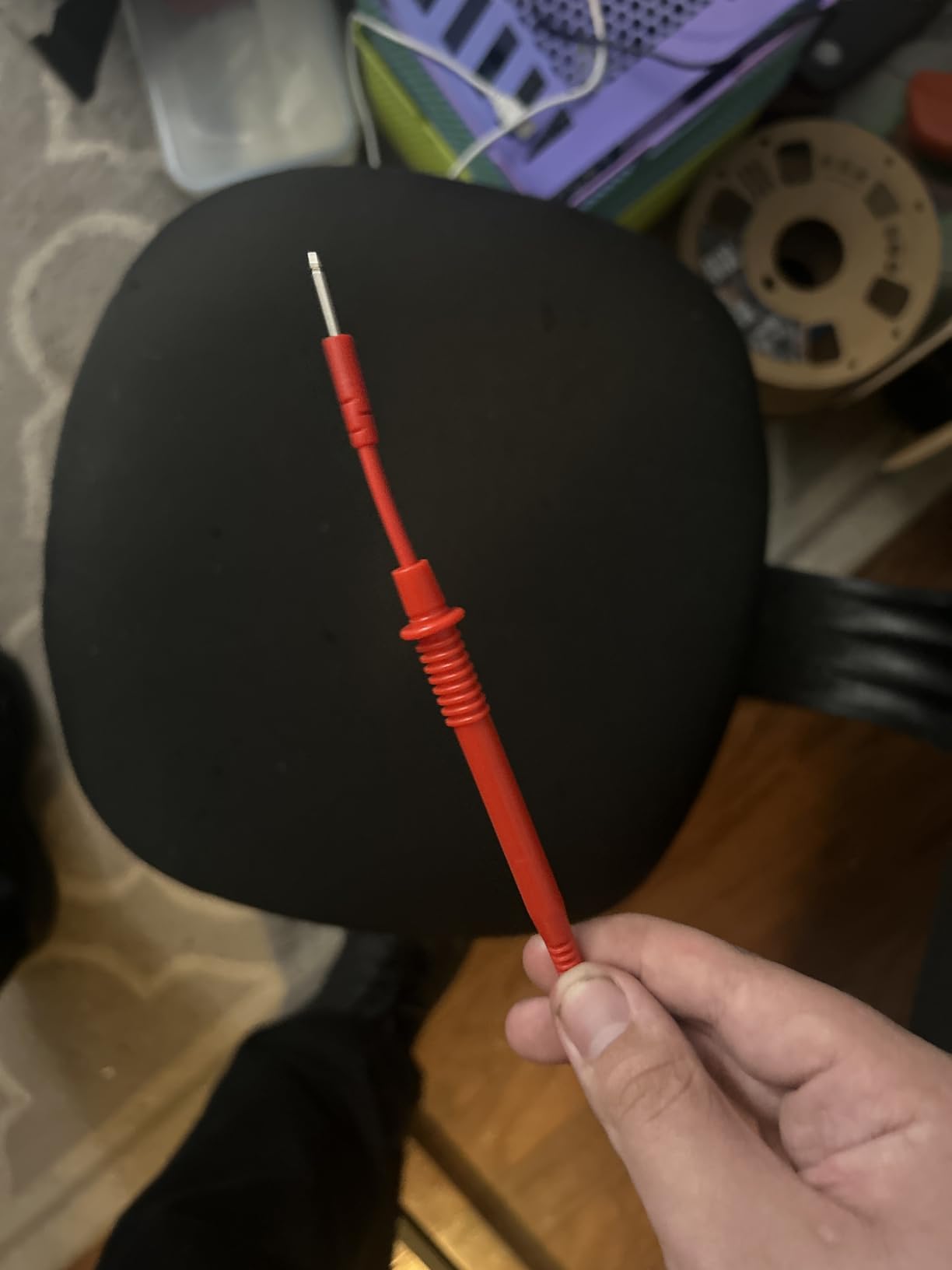
- Test leads feel flimsy and need twisting to seat in the sockets
- Bundled batteries are zinc-oxide and may leak
- 4000 counts is modest for precision work
The DM130B is a small meter with one genuinely useful trick up its sleeve for the price. Its capacitance range is normally a mid-tier feature, and one owner used it to diagnose and replace a failing air conditioning run capacitor without any other tools.
That is a real example of what a multimeter is for. A capacitor that fails is one of the most common reasons an AC unit hums and then shuts off, and most people pay a technician to identify a part that a capacitance reading would have narrowed down in under a minute.
The rest of the feature set is sensible for an entry meter: 4000-count auto-ranging display, non-contact voltage detection for checking outlets, switches, and cords, a continuity beeper for tracing broken wires, and a bright backlit display. Owners consistently call it an ideal entry-level meter that is clearly labelled and accurate enough for household and hobby work.
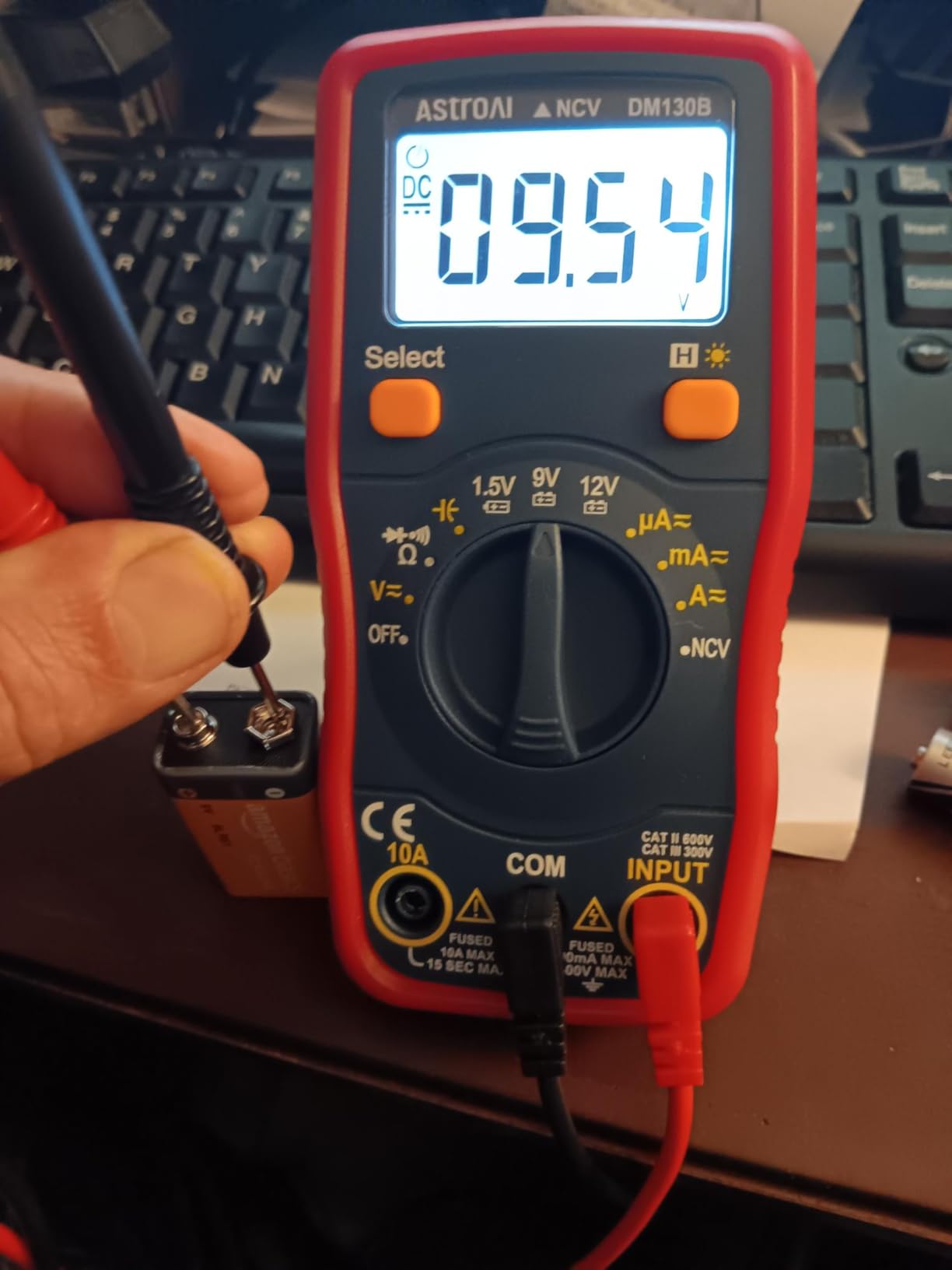
It weighs under 10 ounces and measures 6.3 by 4.53 by 1.57 inches, which means it fits in a small toolbox alongside other hand tools without dominating the space. For anyone working in tight spaces, that physical size is a feature the bigger meters cannot offer.
The complaints are about accessories rather than measurement. The test leads feel thin and may need twisting to seat firmly in the sockets, which is the same issue owners raise with most meters at this price. The bundled batteries are zinc-oxide type and may leak, so replace them with alkaline cells before first use.
One reviewer also reported that the supplied manual was in German only, so read the dial rather than the paperwork if your language is not covered.
A 4000-count display also shows one fewer digit than a 6000-count meter, so resistance readings change more often and small differences are harder to see.
When a compact meter beats a capable one
Size matters more than it sounds. A meter you will not carry is a meter you will not use, and a meter you will not use cannot help you find the failed component, chase a short, or confirm a repair.
This one also earns its place on the bench because capacitance opens up a category of work that voltage and resistance cannot reach. Motor start capacitors, timer capacitors on dishwashers, and charge pump parts on appliances all become testable.
When to choose the other AstroAI instead
If you also want current measurement, temperature, frequency, and duty cycle, step up to the AstroAI 6000-Count model, which adds all of those plus True RMS and a 1000V DC CAT II rating.
Otherwise, the DM130B is a tidy, honest first tool, and the palm-sized body plus NCV alarm is a combination you will genuinely use in the house rather than only on the bench.
8. FNIRSI DMT-99 9999-Count Multimeter – Best Screen and Resolution
FNIRSI DMT-99 Digital Multimeter 9999 Counts TRMS, Rechargeable Volt Meter
9999 counts,True RMS,1500mAh rechargeable battery,2.4 inch color TFT screen,waveform view
Pros
- Highest count resolution here at 9999
- Rechargeable 1500mAh battery with Type-C charging
- Waveform and monitoring modes reveal transient spikes
- Ultra-fine test leads suit SMD and tight boards
Cons
- Color screen and rechargeable battery push the price up
- Menu system has more of a learning curve than a dial meter
- Small body means a smaller dial and buttons
The DMT-99 is the odd one out in this list, and that is exactly why it is worth including. Every other meter here is a dial you turn, and this one is a screen you tap, with a 2.4 inch HD TFT color display and adjustable brightness.
It also has the highest resolution here at 9999 counts, meaning it shows one more digit than the 6000-count meters, and it measures True RMS. Auto mode identifies AC or DC voltage, resistance, and continuity on its own, and it also handles AC and DC current, non-contact voltage, frequency, and diode testing.
The feature that separates it from everything else is the graphic view, which plots real-time voltage and current as a waveform. On a car charging system, that means you can see ripple and transient spikes instead of a single averaged number, which is how charging faults get diagnosed. Monitoring mode raises an alarm at thresholds you set, which is useful for chasing an intermittent fault hands-free.
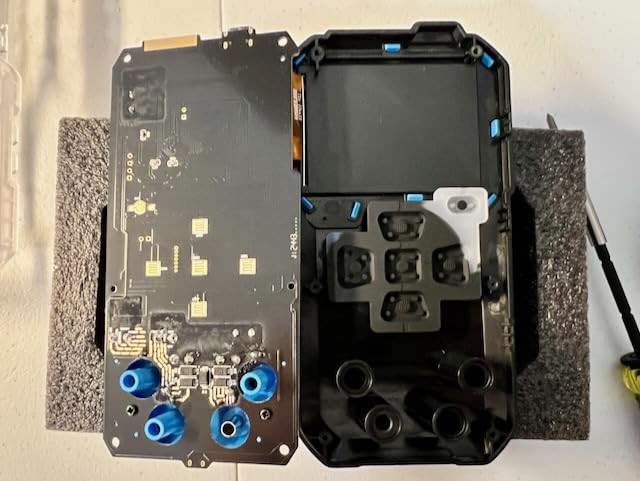
The rechargeable 1500mAh lithium battery with Type-C charging removes battery replacement entirely, and dual ceramic fuses with protection circuitry guard against mistakes on the probe inputs. It weighs 6.72 ounces with an integrated kickstand and storage slots for the leads.
The included leads are unusually fine, which genuinely helps on surface mount parts and crowded circuit boards where a thick probe body bridges two pads and gives you a reading that means nothing.
The costs are real. A color screen and a rechargeable battery make it more expensive than a simple auto-ranging meter, and the menu-driven interface has a steeper learning curve than turning a dial. The compact body also means a smaller dial and smaller buttons, which matters if you are wearing gloves.
When the waveform view pays for itself
Conventional meters show a number, and a number is an average. An average hides exactly the information you need when something is intermittently wrong, such as a ripple voltage that spikes above normal for two seconds every minute.
Plotting the trace turns that average back into a picture of what the circuit is actually doing, and setting an alarm threshold lets you walk away while the meter watches. For anyone working on alternators, starter motors, or switching power supplies, that is the whole point of the instrument.
Who should pass on it
Pass on it if you want a simple meter you will grab without thinking, because the interface asks for more attention before each measurement. It is also not a CAT III rated household meter, so it is better suited to electronics and automotive diagnosis than to work inside a breaker panel.
For car and electronics work where you want to see what a number cannot show, it is the most capable tool in this guide, and the highest count resolution of any beginner-appropriate meter we covered.
Auto-Ranging vs Manual Ranging: Why Beginners Should Pick Auto
Auto-ranging is worth it for beginners because it removes range selection, which is where most first measurements go wrong. A manual-ranging meter has separate positions for each range, so a 2.4V reading on a 0 to 20V setting means something different from the same reading on a 0 to 200V setting.
Five practical reasons push a beginner toward auto-ranging:
1. You cannot pick a range you have no experience with. The whole difficulty is that you need to know roughly what the circuit produces before you measure it, and if you knew that you would not need the meter as much.
2. A wrong range gives a wrong number, not an error message. On a manual meter, measuring 4.7V on the 0 to 10V range reads 4.7. On the 0 to 1000V range, the same probe placement reads 04.7 or 470 depending on the model, and both look plausible.
3. Manual mode is where beginners blow fuses. Probes set to the current position and touched to a live circuit create a near short through the fuse. Several owners mentioned this fear as their main reason for not buying a cheaper tool.
4. It works when the value changes. On a charging system or a motor starting, the voltage moves. An auto-ranging meter follows it, while a manual meter needs a mid-measurement range change that you probably will not see.
5. It is faster on the actual job. Pick up, turn to the measurement type, touch the probes, read. That sequence is short enough that you reach for the meter instead of guessing.
There are two honest arguments on the other side. Manual ranging gives finer control over which range is used, which matters when two ranges overlap near a boundary, and the Crenova MS8233D uses that as a safety net. Manual ranging is also what you want on a fluctuating signal, where auto-ranging can keep shifting or become sluggish at the extreme ends, which is a documented behavior on the Innova 3320 at very low and very high resistance values.
For a first tool, though, the balance is not close. The risk auto-ranging removes is a wrong reading you trust, and that risk belongs to a beginner, not to you in two years.
What to Measure in Your First Hour With a New Multimeter
You can learn a working auto-ranging multimeter in five measurements, and every one of them is safe. Work through them in this order and you will understand the dial, the display, and the probe handling better than from any amount of reading.
1. Check a 12V car battery or a 9V battery. Set the meter to DC voltage, connect the black probe to the negative terminal and the red probe to the positive. A healthy 12V car battery reads between 12.4 and 12.7 volts with the engine off. If you own the Innova 3320, use its on-board load test instead for a truer answer.
2. Test a fuse. Set the meter to continuity, which is usually the same position as resistance or part of the smart auto mode. Touch the probes to both ends of an automotive or appliance fuse. A good fuse beeps. Silence means a break somewhere along the filament.
3. Check a wall outlet. Set the meter to AC voltage. Insert the probes into the two vertical slots, keeping your hands on the insulated probe bodies. A healthy 120V outlet reads between 110 and 130 volts. If the meter shows a reading on the round ground hole, stop and call an electrician, because that means a wiring fault.
4. Measure resistance of a component. Unplug whatever you are testing first. Touch the probes across a bulb, a heating element, or a resistor while it is disconnected from the circuit. A working heating element shows a low number and rises as it warms, which is normal.
5. Use non-contact voltage detection. If your meter has an NCV function or VoltAlert, sweep the probe near a known live wire without touching it. The alarm should sound and speed up as you get closer. This is the fastest way to build a safe habit, so do it before you ever touch a wire.
Two habits matter more than any of the readings. Never leave the meter set to a current position when you step away, because the next thing that touches the probes gets connected in series with a near short. And never measure resistance on a powered circuit, which gives meaningless results and can damage the meter.
CAT Ratings Explained: What a Beginner Actually Needs
For household work, buy a meter rated CAT III 600V or better. The CAT category describes the transient voltage surges a meter and its leads are tested to survive, and the number after it is the maximum voltage in that category.
CAT II covers loads plugged into an outlet and electronics connected to a wall receptacle, plus automotive 12V circuits. CAT III covers distribution equipment such as breaker panels, wall switches, and permanently installed wiring, which is where most household troubleshooting happens. CAT IV is the point of origin, meaning the service entrance and the meter socket itself.
The distinction is not academic. A meter rated only CAT II is not tested for the surge conditions found at a panel, and that is exactly where a beginner discovers a bad neutral or a loose connection.
Among the picks here, the Crenova MS8233D, Fluke 115, and Fluke 117 carry CAT III 600V. The AstroAI 6000-Count, TESMEN TM-510, and AstroAI DM130B carry CAT II or 1000V DC CAT II ratings, which is sufficient for battery, bench, and automotive work but is a weaker claim for in-wall electrical work. The Innova 3320 is UL certified for household and automotive troubleshooting.
One more safety point applies to every meter. A multimeter is not a clamp meter, and measuring current means the current has to flow through it, so you must break the circuit and insert the meter in series. That is why current ranges have fuses and why the current jacks are separate. If you need to measure current without opening the circuit, that is a clamp meter, and it is a different purchase.
How to Choose an Auto-Ranging Multimeter: 7 Features That Matter
Choose by answering three questions in order: what will you measure, what voltage will you touch, and what do you want to spend. Everything else is preference. We walk through the seven features that actually change your experience, and the four that mostly do not.
Counts and resolution. Counts describe how many digits the display can show. A 4000-count meter shows up to 3999, a 6000-count shows 5999, and a 9999-count shows 9999. More counts means a reading changes less between updates, which makes small differences easier to see.
For household and automotive work, 4000 counts is enough, and 6000 is a comfortable step up. The extra digit is useful when you are watching a charging system and need to see a change of a tenth of a volt.
CAT safety rating. This is the most important number on the page, and it is the one that protects you. CAT III 600V is the sensible floor for anything inside your house.
True RMS. True RMS measures the actual effective value of a signal instead of averaging the peaks. On non-linear loads such as LED drivers, switch-mode supplies, and variable speed motors, a non-True-RMS meter under-reads by a meaningful margin. For straight DC work, car batteries, and basic outlet checks, it makes no difference.
What you will never measure. Be honest about the gaps. The TESMEN TM-510 does not measure current or capacitance. The Fluke 115 and 117 have no milliamp ranges, and the 117 has no current clamp. The Innova 3320 tops out around 200 mA of AC current. If a gap matches a job you expect to do, choose differently.
Non-contact voltage detection. NCV gives an audible or visual alarm near a live conductor, so you can find an energised wire without touching it. It is a safety habit, not a measurement, and it is the feature most likely to be used daily by a homeowner.
Display quality. A backlit screen, data hold to freeze a reading, and a hold on the last value all matter more than raw resolution. Data hold is what lets you put the probes in place and then look at the number, which is the difference between a usable measurement and an awkward one.
Test leads. This is the feature no roundup covers and owners complain about most. Thin leads crack at the probe neck within months, and the leads that come with an inexpensive meter are the weakest part of it. Look for leads with a thick strain relief where the wire enters the probe, and consider replacing the set after a year. A better set makes a large difference to how a meter feels in the hand.
Four features you can safely skip as a beginner: duty cycle, which matters for diagnosing a fuel injector or a chopper saw; frequency, unless you are chasing a drive belt or an HVAC fault; temperature probes, unless you do HVAC; and high count resolution beyond 6000, unless you are doing electronics.
Finally, set an honest expectation about replacements. Most people buy a budget meter first, learn on it, and upgrade once they know what they actually work on. Nothing on this list is a dead end, and a meter you learn from is worth more than an expensive one you are afraid to touch.
Frequently Asked Questions
What is the best auto-ranging multimeter?
For most beginners, the best auto-ranging multimeter is one that covers voltage, current, resistance, continuity, and capacitance with a CAT III 600V rating and a backlit display. In our testing the Crenova MS8233D hits that combination at a modest outlay, while the AstroAI 6000-Count offers the widest feature set and the Fluke 117 is the one to buy if you plan to keep it for a decade.
Is an auto ranging multimeter worth it?
Yes, for a beginner it is worth it. Auto-ranging removes the need to select a range by hand, which is the most common source of wrong readings and blown fuses on a first meter. The one situation where manual ranging helps is a fluctuating signal, where auto-ranging can shift or become sluggish at the extremes.
What is the best multimeter for a beginner?
A CAT III 600V rating matters more than any other specification, because it tells you the meter is tested for surges found at a breaker panel. Add a backlit display, data hold, and a true RMS reading for AC voltage, and you have a meter that will not punish a learning mistake.
What is the best automotive multimeter for the money?
The Innova 3320 is the strongest automotive value because it has a 10 MegOhm input impedance, which keeps it from disturbing a vehicle electronic control unit, and a built-in load test for AA, AAA, 9V, and 12V batteries. The AstroAI 6000-Count adds current, frequency, duty cycle, and temperature measurement for the same general outlay.
What multimeter do most electricians use?
Most electricians reach for a Fluke first, and the Fluke 117 is the version that comes up most often because it adds VoltAlert non-contact detection, AutoVolt automatic AC and DC selection, and a low impedance mode for ruling out ghost voltage. Klein Tools is the accepted value alternative for professionals who want CAT III safety at a lower price.
How do I know which multimeter to buy?
Start by listing what you will actually measure: voltage and continuity for household checks, current for car and appliance work, and capacitance for HVAC motors. Then confirm the CAT rating covers the highest voltage you will touch, and treat the test leads as a separate purchase since the supplied ones are usually the weakest part.
Is a cheap multimeter better than an expensive multimeter?
A cheap meter is better for learning, because a mistake costs less and most errors are range selection errors that auto-ranging already prevents. An expensive meter is better for professional accuracy, non-contact detection, low impedance mode, and build quality, so the honest answer is to buy a budget meter now and upgrade once you know what you work on.
Which Auto-Ranging Multimeter Should You Buy?
Our pick for the best auto-ranging multimeters for beginners is the AstroAI 6000-Count True RMS model, because it measures the widest set of things here, carries a 1000V DC CAT II rating, and has a large backlit display you can read in a dark panel. If you want a CAT III 600V rating for household panels, take the Crenova MS8233D instead, and if you work on cars, the Innova 3320 belongs in your toolbox for its battery load test and 10 MegOhm input impedance.
Whatever you choose, buy a decent set of test leads with it, keep the meter out of any current position when you put it down, and start with the five measurements in this guide. That first hour teaches more than an afternoon of reading spec sheets.
Meters were last checked for this guide in September 2026. As an Amazon Associate we earn from qualifying purchases, which never changes what we recommend.