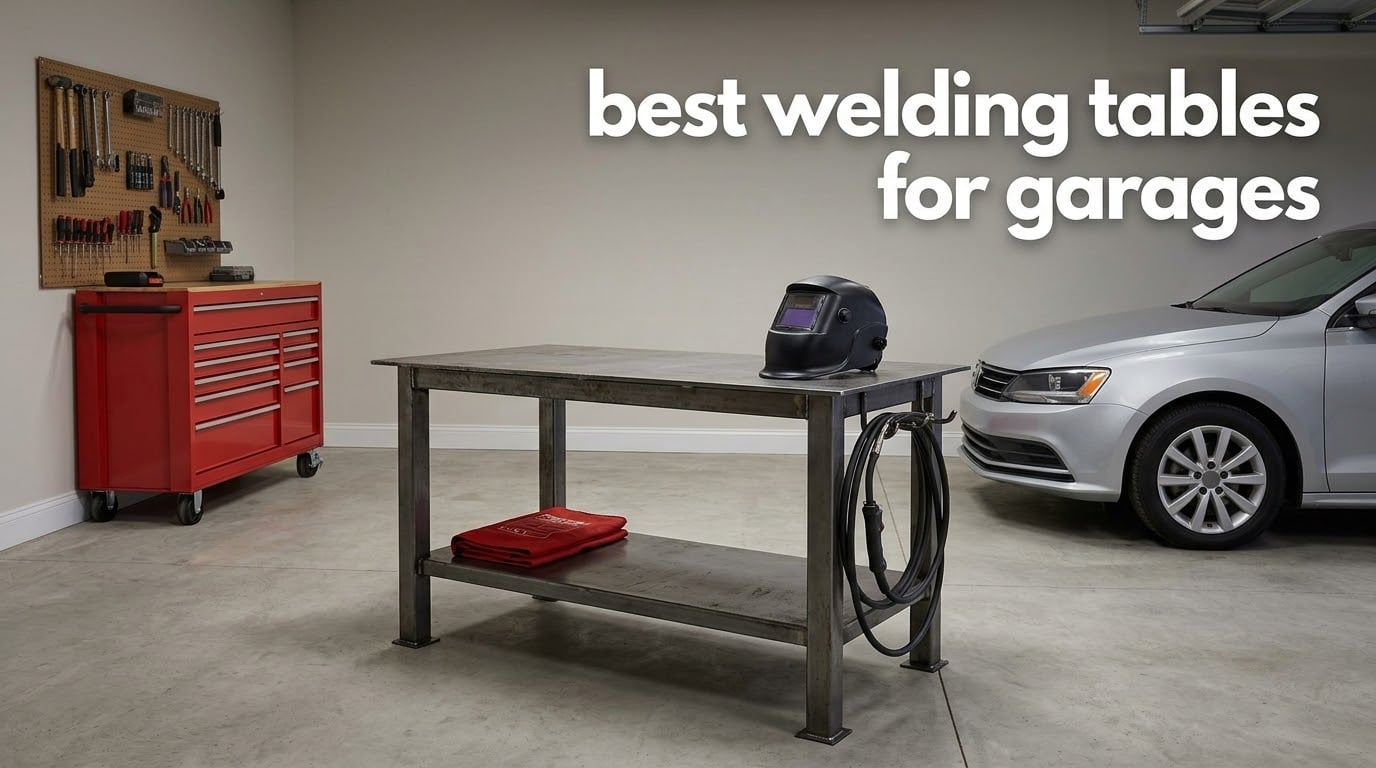
A wooden garage workbench is fine for changing a spark plug and hopeless the moment an arc strikes it. It scorches, it flexes, it catches fire, and a part clamped to it slowly twists out of square while you are trying to hold it still. A welding table exists to fix exactly those four problems, which is why picking the right one is the difference between a garage you can fabricate in and a garage you can only park a car in.
We went through twelve of the most-reviewed steel welding tables on the market, pulled the load ratings, plate gauges, hole patterns and table weights, and matched them to the bay sizes people actually weld in. The results are below, starting with the three we would put in a single-car garage tomorrow.
If your interest is more general garage setup, our guides to folding tables that live in a small garage and counter-height tables for tight rooms cover the same space-saving logic from a non-welding angle.
Table of Contents
- Top 3 Welding Tables for Garages in 2026
- All 12 Best Welding Tables for Garages (October 2026)
- 1. Klutch 600-Lb Steel Welding Table with 24-Piece Fit-Up Kit
- 2. VEVOR 36×18 Rolling Welding Table with 1200-Lb Capacity
- 3. KASTFORCE KF3002 Rust-Free Welding Table
- 4. DEWALT 46×18 Adjustable Height Folding Welding Table
- 5. CAMMOO 1200-Lb Portable Welding Table
- 6. Olympia Tools 30×20 Tilting Welding Stand with Wheels
- 7. VEVOR 30×20 Folding Welding Table with Three Tilt Angles
- 8. VEVOR 36×24 Galvanized Welding Workbench, 800-Lb Capacity
- 9. Klutch Mobile Welding Workstation with 26-Piece Fit-Up Kit
- 10. NOVA Heavy-Duty Welding Table with Folding Legs
- 11. WORKESS 42×21 Folding Welding Table, 1000-Lb Capacity
- 12. Hobart 35×19.5 Portable Folding Welding Table
- How to Choose a Welding Table for Your Garage
- Garage Sizing: Matching Your Table to the Bay
- Welding Safely in a Garage
- Spatter, Rust and Long-Term Table Care
- Frequently Asked Questions
- The One Welding Table to Buy
Top 3 Welding Tables for Garages in 2026
The three tables below cover the three ways garages actually differ: a fixed table for someone who welds most weekends, a rolling table for a bay that also has to hold a car, and a low-cost table for light repair work.

Klutch 600-Lb Steel Welding…
- 4mm steel top
- 2mm frame
- 16mm fixture holes on 2in grid
- 24-piece fit-up kit included

VEVOR 36×18 Rolling Welding…
- 1200-lb carbon steel top
- 94 five-eighth-inch fixture holes
- Lockable braking casters
- Tool tray included

CAMMOO 1200-Lb Welding Table
- 4.7 average from 202 owners
- Black oxide anti-rust finish
- Pre-installed casters
- Five-minute no-tools setup
All 12 Best Welding Tables for Garages (October 2026)
Every table in this roundup, with the three numbers that decide whether it fits your garage: the top size, what it is rated to carry, and how the frame and top are built.
| Product | Specs | Action |
|---|---|---|
| Klutch 600-Lb Steel Welding Table |
|
Check Latest Price |
| VEVOR 36×18 Rolling Welding Table |
|
Check Latest Price |
 KASTFORCE KF3002 36×18 KASTFORCE KF3002 36×18 |
|
Check Latest Price |
 DEWALT 46×18 Adjustable Folding Table DEWALT 46×18 Adjustable Folding Table |
|
Check Latest Price |
| CAMMOO 1200-Lb Welding Table |
|
Check Latest Price |
 Olympia Tools 30×20 Tilting Stand Olympia Tools 30×20 Tilting Stand |
|
Check Latest Price |
 VEVOR 30×20 Folding Weld Table VEVOR 30×20 Folding Weld Table |
|
Check Latest Price |
 VEVOR 36×24 Galvanized Workbench VEVOR 36×24 Galvanized Workbench |
|
Check Latest Price |
 Klutch Mobile Welding Workstation Klutch Mobile Welding Workstation |
|
Check Latest Price |
 NOVA Folding Heavy-Duty Table NOVA Folding Heavy-Duty Table |
|
Check Latest Price |
 WORKESS 42×21 Folding Table WORKESS 42×21 Folding Table |
|
Check Latest Price |
 Hobart 35×19.5 Folding Table Hobart 35×19.5 Folding Table |
|
Check Latest Price |
1. Klutch 600-Lb Steel Welding Table with 24-Piece Fit-Up Kit
Klutch Steel Welding Table with 24-Piece Fit-Up Tool Kit, 600-Lb. Capacity
4mm steel top
2mm frame
600-lb capacity
16mm holes on 2in grid
79 lb
Pros
- 4mm top and 2mm frame handle heavy welding work
- 24-piece metal fit-up kit included so no extra tooling buys
- Standard 16mm holes on 2in spacing give real fixturing layout freedom
- Works as a stand-alone table or as a benchtop
Cons
- 79-pound weight is a two-person move
- 16mm holes are slightly larger than 5/8in fixtures some shops own
This is the table I keep coming back to, and it is not close. It is the most reviewed welding table in our group with 809 ratings holding a 4.6 average, and that rating is not carried by a lot of 5-star noise: roughly 78 percent of owners gave it five stars. The reason is unglamorous and important, which is that the frame is 2mm steel and the top is 4mm. That is a genuinely heavy build for a table of its size.
When you clamp a piece of channel down and start tacking, the question is not whether the table stays put. It is whether the top dishes in under the clamp. This one does not, because there is enough steel under your workpiece to push back. Owners working on trailers, gate frames and repair jobs say the same thing in different words.
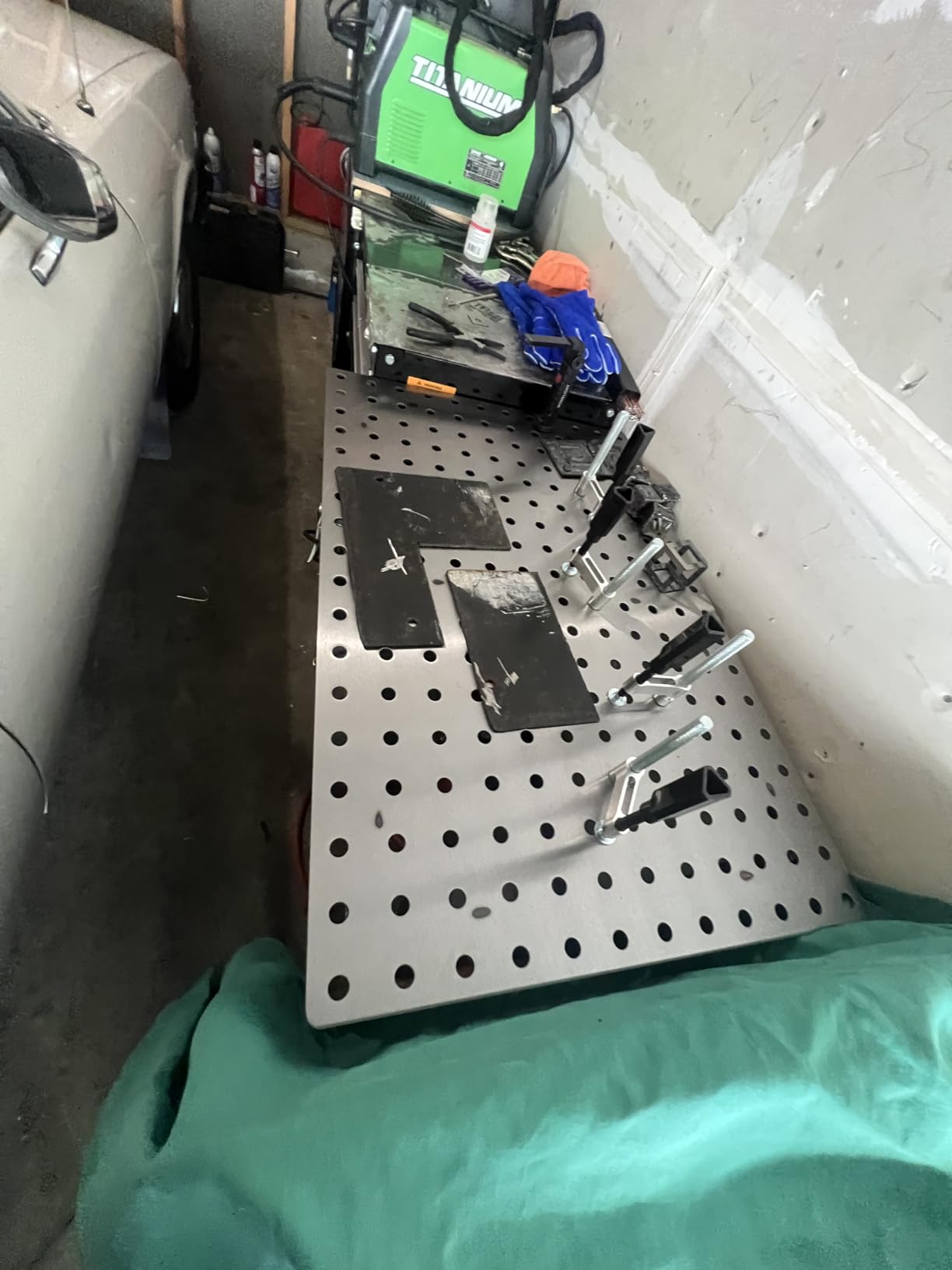
The bundled 24-piece fit-up kit is the detail that quietly makes this the best welding table for garages in our view. Most tables ship as bare steel and a bag of bolts, which means your first weekend with it goes into buying clamps, blocks and stops before any welding happens. This one arrives ready to clamp a part on day one.
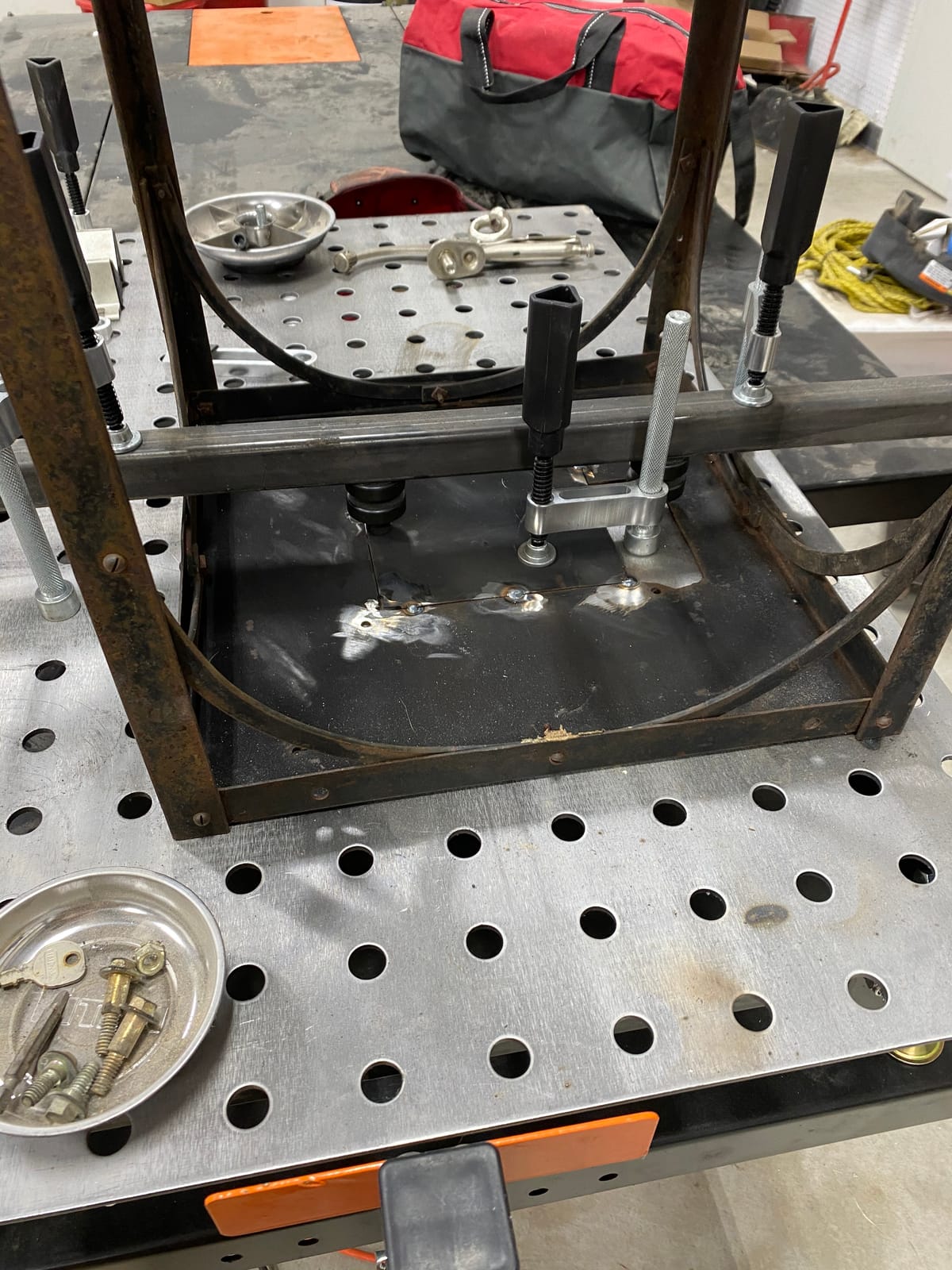
The 16mm fixture holes on a 2-inch grid give you room to reposition a clamp without it landing halfway between holes, and 16mm lines up closely enough with the standard 5/8in dog pins and clamp bodies a garage welder is most likely to buy next.
What you get that cheaper tables do not
Frame rigidity. A 2mm welded frame under a 4mm top does not ring, flex or creep when you hammer a part or lean on it with both hands, which reviewers repeatedly report about thinner tables.
You also get the fit-up kit and a benchtop option. If your garage is tight, the legs can be set so the top sits on an existing sturdy bench, which turns a 79-pound table into a bench-mounted work surface without buying a second frame.
Where it is the wrong choice
At 79 pounds this is not a table you slide around casually. It belongs in one spot, against a wall, and it stays there. If you need to weld at the car, at a trailer frame out in the drive, or at two different benches in the same evening, this is the wrong tool.
The 16mm holes are also marginally larger than the 5/8in (15.9mm) fixtures some shops already own, so a handful of older clamp bodies may need an adapter. Minor, but worth knowing before you order a box of clamps to go with it.
2. VEVOR 36×18 Rolling Welding Table with 1200-Lb Capacity
VEVOR Welding Table 36″x18″, 1200lbs Load Capacity Steel Welding Workbench Table on Wheels, Portable Work Bench with Braking Lockable Casters, 4 Tool Slots, 5/8-inch Fixture Holes, Tool Tray
36x18 carbon steel top
1200-lb capacity
94 fixture holes
Braking casters
57 lb
Pros
- Holds a 1200-lb rated load with a 57-pound table weight
- Lockable braking casters make it easy to reposition in a tight bay
- 94 five-eighth-inch fixture holes accept standard dogs and clamps
- Assembles in roughly 15 minutes
Cons
- Plain bolts can loosen under vibration without washers
- Pull handle is the flattest part of the frame and can flex
- 3mm top plate is thinner than the premium steel tables
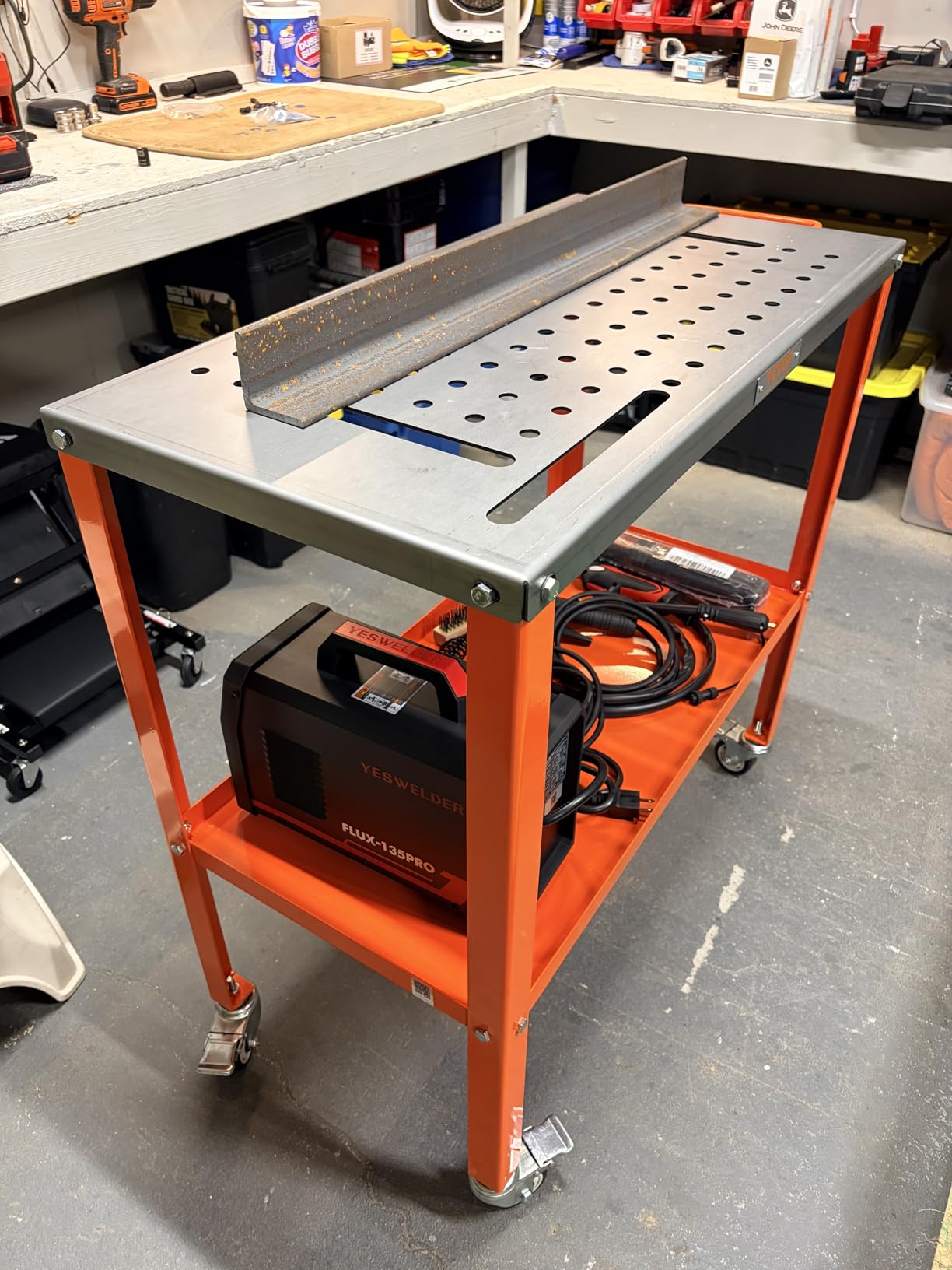
This is the one I recommend to anyone whose garage holds a car and a welder. Four braking casters mean you roll the table out to the open bay when a job needs light, then roll it back against the wall. In a one-car garage that single feature is worth more than any amount of extra plate.
It carries a 1200-pound rating on a 57-pound table, which is a better weight-to-capacity ratio than most of the fixed steel tables here. Owners report loading it with heavy equipment and rolling it across a garage without complaint. The 36 by 18 inch top is not large, but it is a comfortable working size for brackets, tubing and repair work.
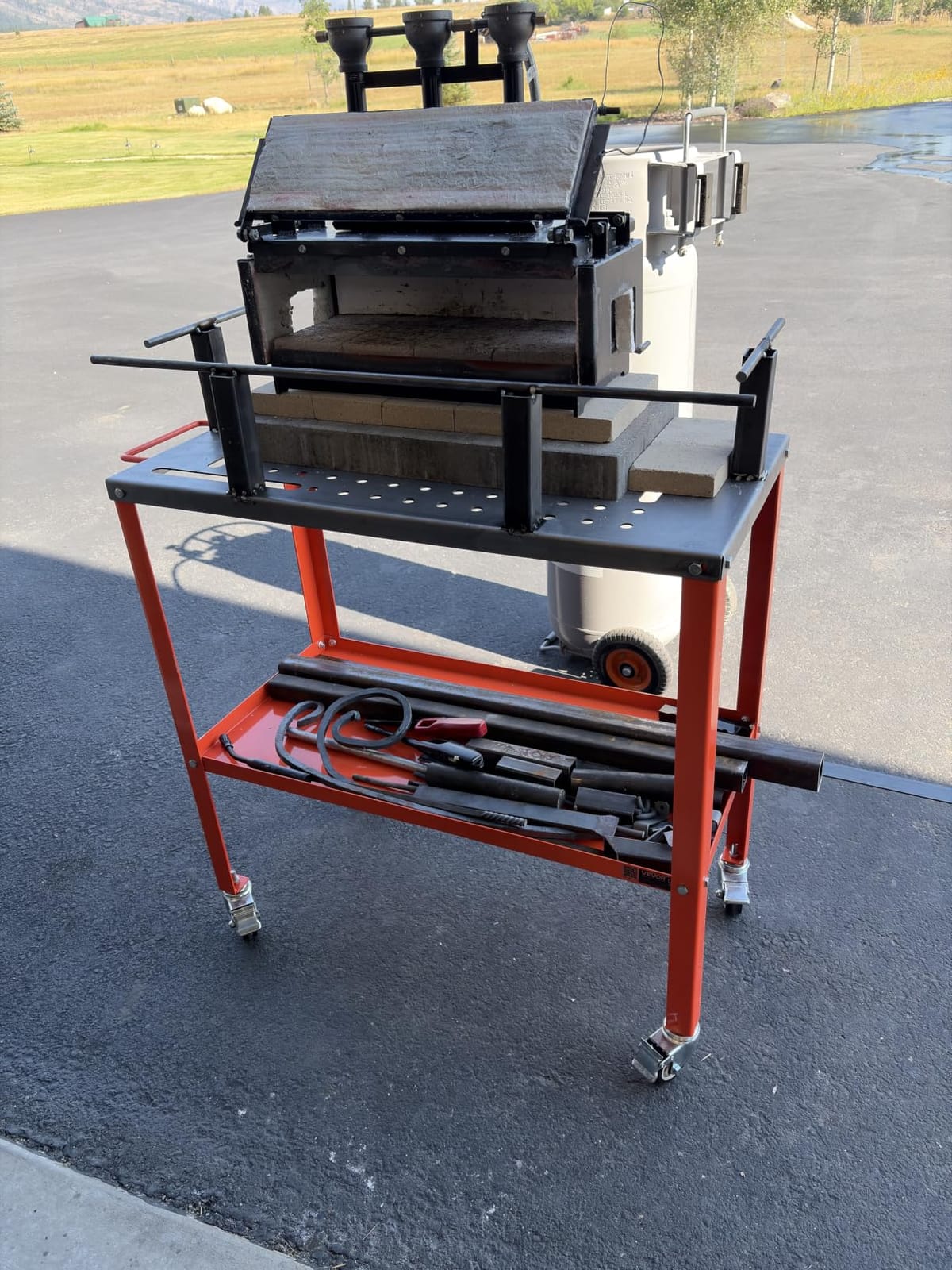
There are 94 five-eighth-inch fixture holes plus four tool slots across the top. That is a dense enough pattern that you can almost always find a hole near where you want a clamp, and because it is the standard 5/8in pattern, dog pins, strap clamps and squares bought for any other shop bench will drop straight in.
The under-table tool tray and the coated surface both help in a working garage. The tray keeps consumables off the concrete, and the coated finish wipes down rather than staining. Assembly takes about a quarter of an hour with the included hardware, and the packaging is good enough that the finish arrives undamaged.
Why this suits a single-car garage
Wheels are the whole argument. A fixed steel table takes a permanent slice of a one-car bay, and in a bay that is already tight, that slice is the difference between parking comfortably and squeezing in. The braking casters here lock the table solid once it is in position, so you get mobility without a table that drifts mid-weld.
It is light enough for one person to reposition, which matters if you are clearing the bay for a car before the weekend.
What to fix on day one
Buy a small box of washers and lock washers. Reviewers repeatedly note that the plain bolts in this design work loose under the vibration of welding, and the fix takes ten minutes with a hardware store aisle. Replacing the pull handle with a stiffer one is a second cheap upgrade if you plan to drag it across concrete regularly.
The 3mm top is thinner than the 4mm plate on the top pick, so it is a little more forgiving of heavy side loads. For general garage work that is a fair trade for the casters.
3. KASTFORCE KF3002 Rust-Free Welding Table
KF3002 Rust-Free Welding Table 36″×18″ 1200 lbs Loading Capacity, 5/8″ Holes, 10Ga Top Thickness, Withstands Heat up to 1600°F, Universal Work Cart
10 gauge 2.8mm rust-free top
Rated to 1600F
1200-lb load
5/8in fixture holes
Pros
- 10-gauge top resists heat better than thinner plates
- Surface rated to 1600F and sold as rust-free for spatter cleanup
- Braking casters let you reposition and then hold it steady
- 1200-lb capacity handles heavy equipment
Cons
- Narrow 18in depth limits large or awkward workpieces
- Fewer fixture holes than the VEVOR 36x18 model
The KF3002 is the table to buy if you do a lot of hot work and do not want to think about maintenance. The top is a 10-gauge (2.8mm) plate rated to 1600F, and the finish is sold as rust-free, which is exactly the coating behavior you want in a damp garage where bare mild steel would bloom with orange spots by winter.
Buyers consistently single out the plate thickness first, because 10 gauge is a plate thickness that holds up under repeated heat. It does not warp under the repeated heat cycles that ruin a thin top, and 2.8mm is enough to keep a small part from twisting while you tack it.
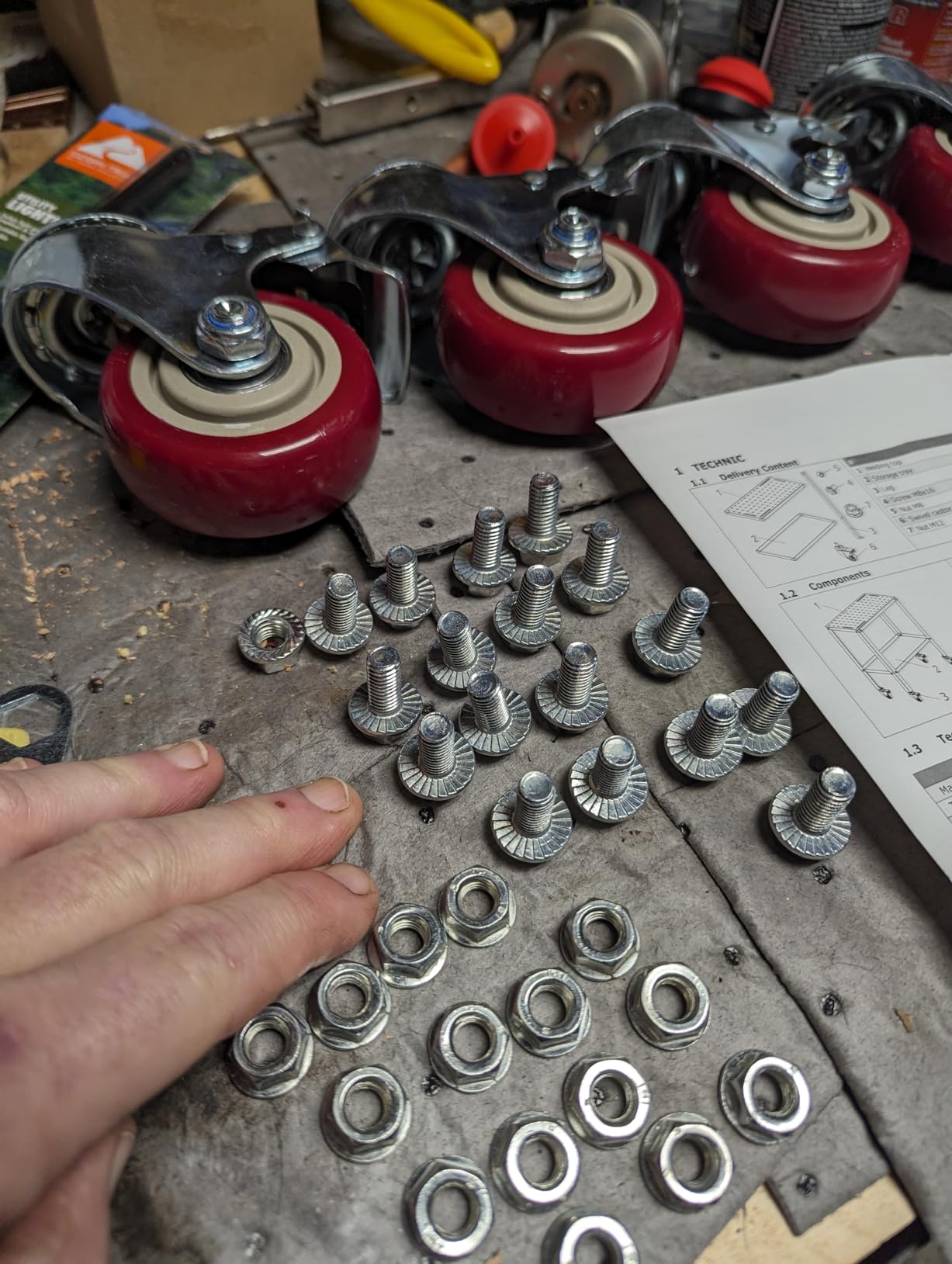
The four 3-inch swivel casters each have a brake function, so the table is genuinely mobile in a single-car bay. A built-in storage tray underneath holds wire, gas and hand tools without taking up floor space, which is a real saving in a garage where floor space is the scarcest resource you have.
The 5/8in (16mm) hole pattern is the standard you want. If you buy one set of clamps in your life, buy them for the 5/8in pattern, because it appears on the VEVOR, the CAMMOO, the NOVA and this table, and that is four of the twelve here.
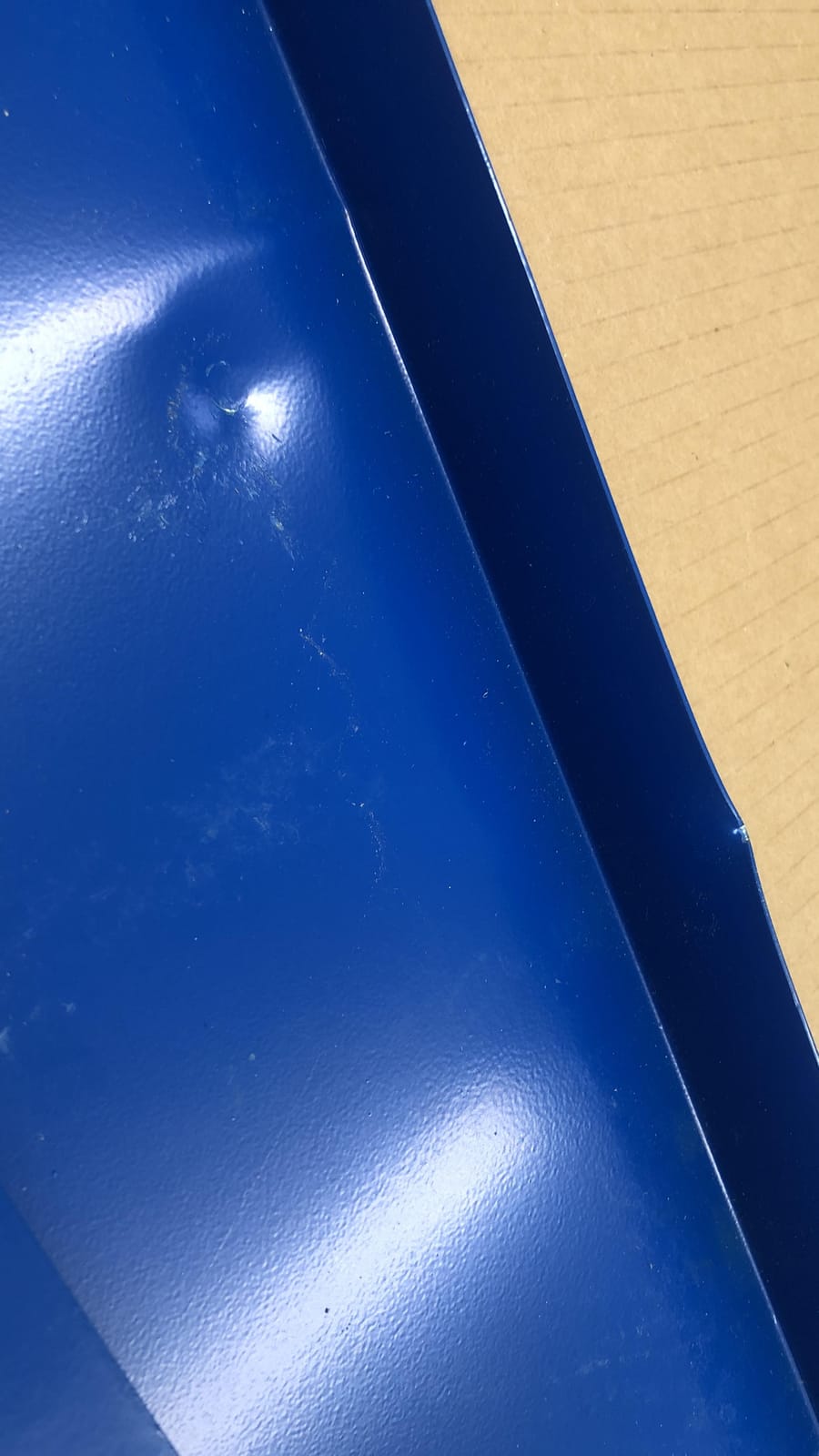
Where the finish earns its keep
Spatter on a bare steel top pits the surface and traps moisture underneath. A rust-free coated surface lets you chip spatter off with a scraper and wipe the surface down, and it will not immediately start corroding where you chipped it. In a garage that sees condensation in winter, that is a meaningful difference over several years.
It is also the reason this table suits anyone who is new to welding. The arc is less likely to wander and spit when the surface is clean and conductive, and a beginner fighting unstable arc time is losing minutes on every start.
The compromise to accept
The 18-inch depth is the limitation. A 36 by 18 top is fine for tubing, small frames, brackets and repair work, but a wider panel or a length of angle iron overhangs the edge, and an overhanging part distorts. Owners also note fewer fixture holes than the VEVOR 36×18, so fixturing options are a little more limited.
If you plan to weld sheet panels or long stock, look at the deeper 36 by 24 option later in this list instead.
4. DEWALT 46×18 Adjustable Height Folding Welding Table
DEWALT 46 in. x 18 in. Adjustable Height Portable Folding Steel Welding Table and Workbench DXMF4618WT
46x18 folding steel top
Adjustable legs
1000-lb capacity
40 lb
3 year warranty
Pros
- Individually adjustable legs stay level on uneven ground
- Works seated or standing depending on the leg setting
- Folds flat and can double as a benchtop mount
- Leg safety pins and reinforced handle make it easy to move
Cons
- Fixture holes run about 3/4in rather than standard 5/8in
- Top is thin at roughly 1/16in for accurate fab work
- Included cord minders get in the way of storage
The DEWALT is the best welding table in this group for anyone who cannot stand at a fixed height for a whole evening, and the folding legs are why. Each leg adjusts on its own, so on a sloped or uneven garage floor the table still sits level, which is a bigger deal than it sounds once you are trying to weld a frame that must stay square.
At 40 pounds it is light enough for one person to carry to a job site, and the reinforced handle is positioned for that. The legs fold flat and the safety pins stow in the edge holes, so the table packs against a wall or rides in a truck without taking a shelf.
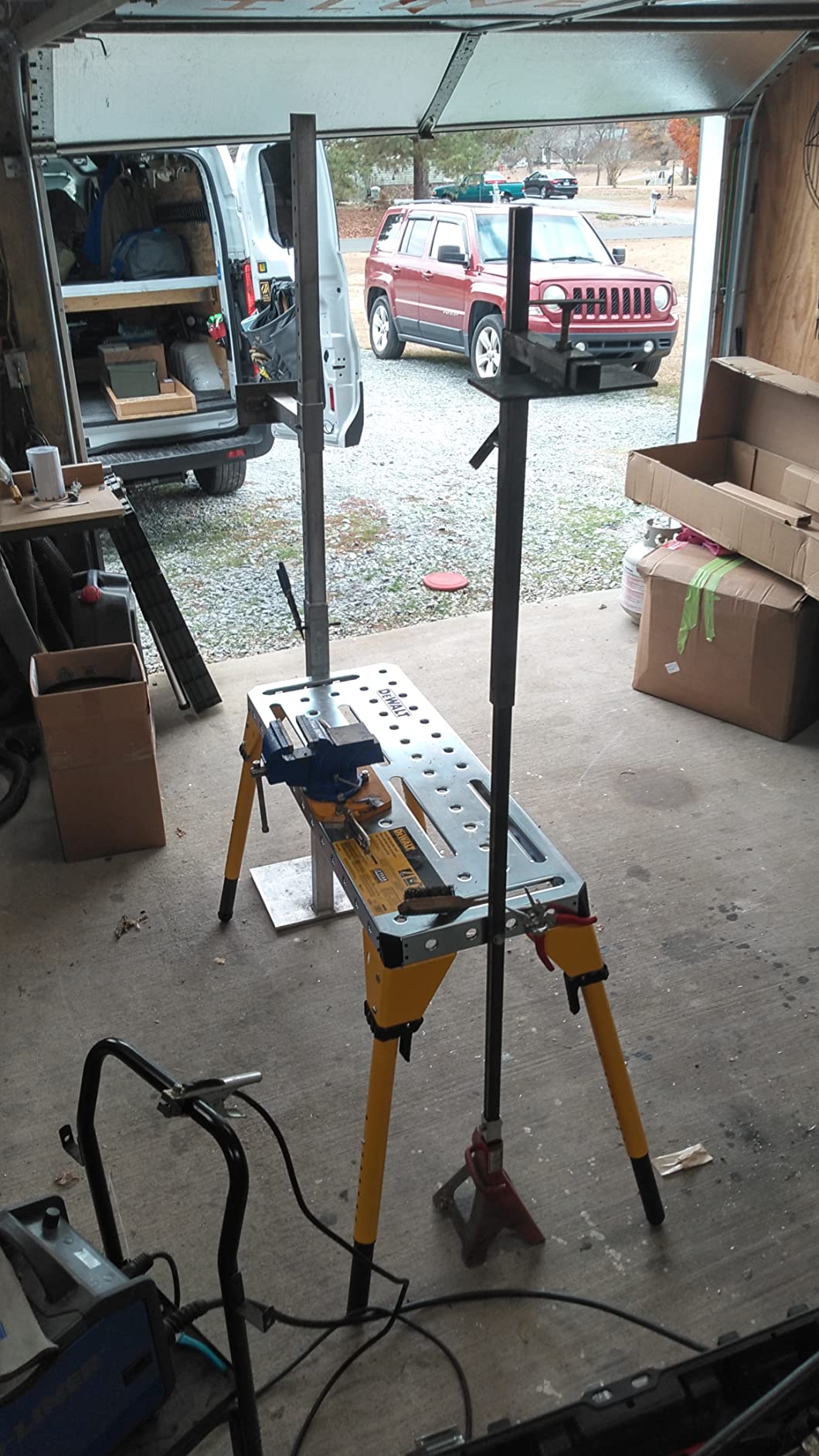
It also works as a benchtop. The folded legs can be fitted on top of an existing workbench, which turns a solid bench into a welding surface for occasional work and saves the cost of a second table in a small garage. That dual role is a genuinely useful answer to the space problem.
The 46-inch length gives you a long working surface for angle iron, tubing and long brackets, and 1000 pounds of capacity covers typical garage fabrication without drama, and a three-year limited manufacturer warranty gives you a defined repair path if a folding leg fails.
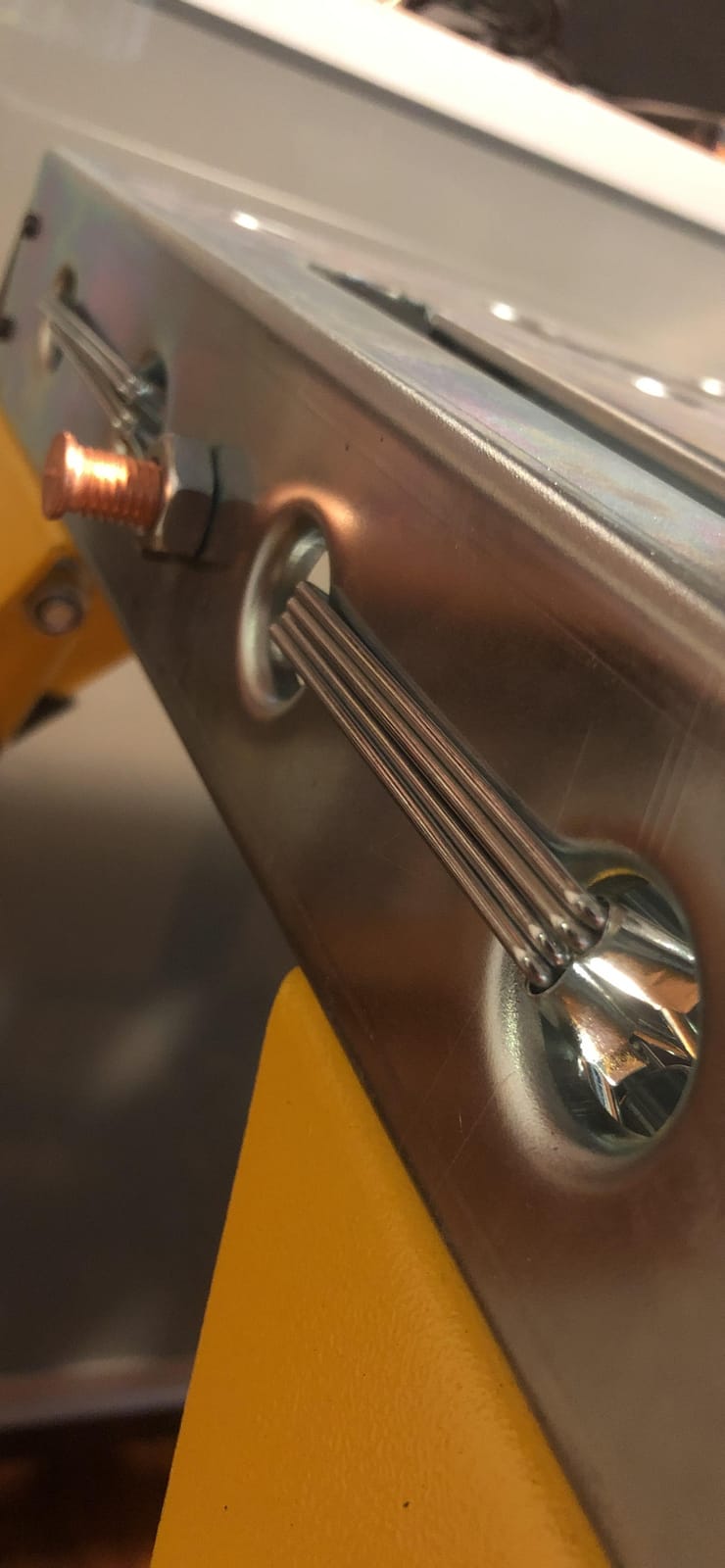
Where adjustable height actually pays off
Working height changes how long you can weld before your back and shoulders tell you to stop. Setting the table to a seated height for tacking and a standing height for finishing means you are not locked into one posture for a whole project, and the per-leg adjustment means the surface stays flat while you change it.
It also handles uneven concrete and outdoor ground, so a table that lives in a garage is not limited to a perfect slab. Owners using it on driveways and job sites report it staying stable.
The clamp compatibility catch
The fixture holes are the issue to plan around. They measure closer to 3/4in than the standard 5/8in, on 3-inch centers rather than the usual 2-inch, so most common dog pins will not fit. If you plan to use clamps, buy 19mm dogs for this table specifically rather than assuming your existing set will work.
The top is thin at roughly 1/16 inch, which is fine for fit-up and light work but not the choice for heavy fabrication or hammering. Pair it with a surface grinder carefully, and expect the thin plate to flex a little under a heavy clamp.
5. CAMMOO 1200-Lb Portable Welding Table
CAMMOO 1200LBS Welding Table, 36″x18″ Portable Welding Table, for Garage & Workshop
36x18 cold-rolled top
1200-lb load
Black oxide finish
43.1 lb table
Pros
- 4.7 average from 202 owners with an 81 percent five-star share
- 94 standard five-eighth-inch holes plus four tool slots
- Casters arrive pre-installed so setup takes about five minutes
- Black oxide coating handles welding heat and resists corrosion
Cons
- No clamp or dog-pin accessories included
CAMMOO posts the strongest rating signal in this roundup: a 4.7 average across 202 ratings, with 81 percent of owners handing over five stars. That is worth taking seriously for a table whose job is to be boring and rigid while you work on something else.
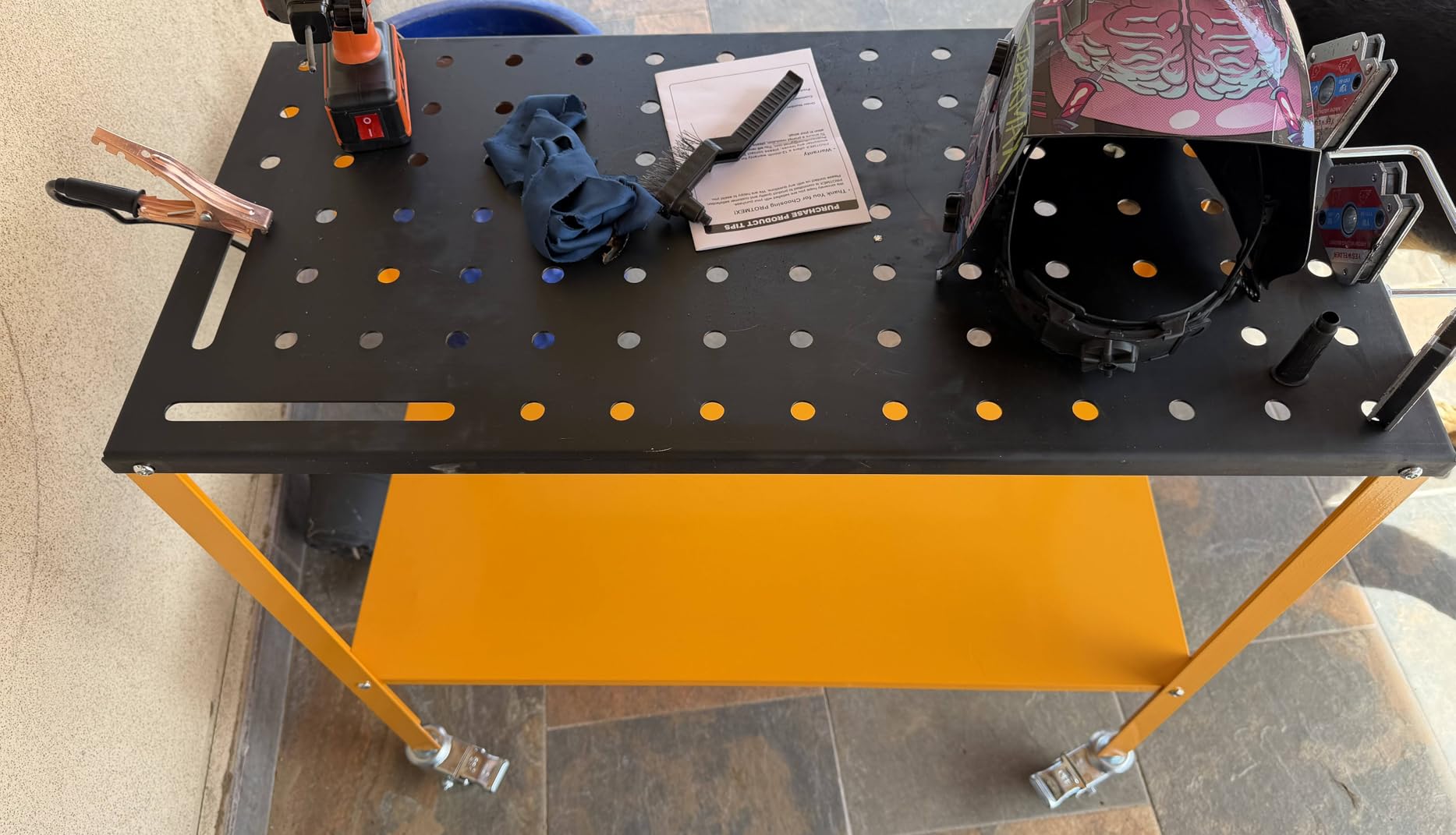
The build explains it. A 2.8mm cold-rolled steel top sits on 3.5mm reinforced legs, which is a heavier frame section than many tables of this class use. At 43.1 pounds it is the lightest 1200-pound rated table in the group, which is a rare combination of capacity and maneuverability.
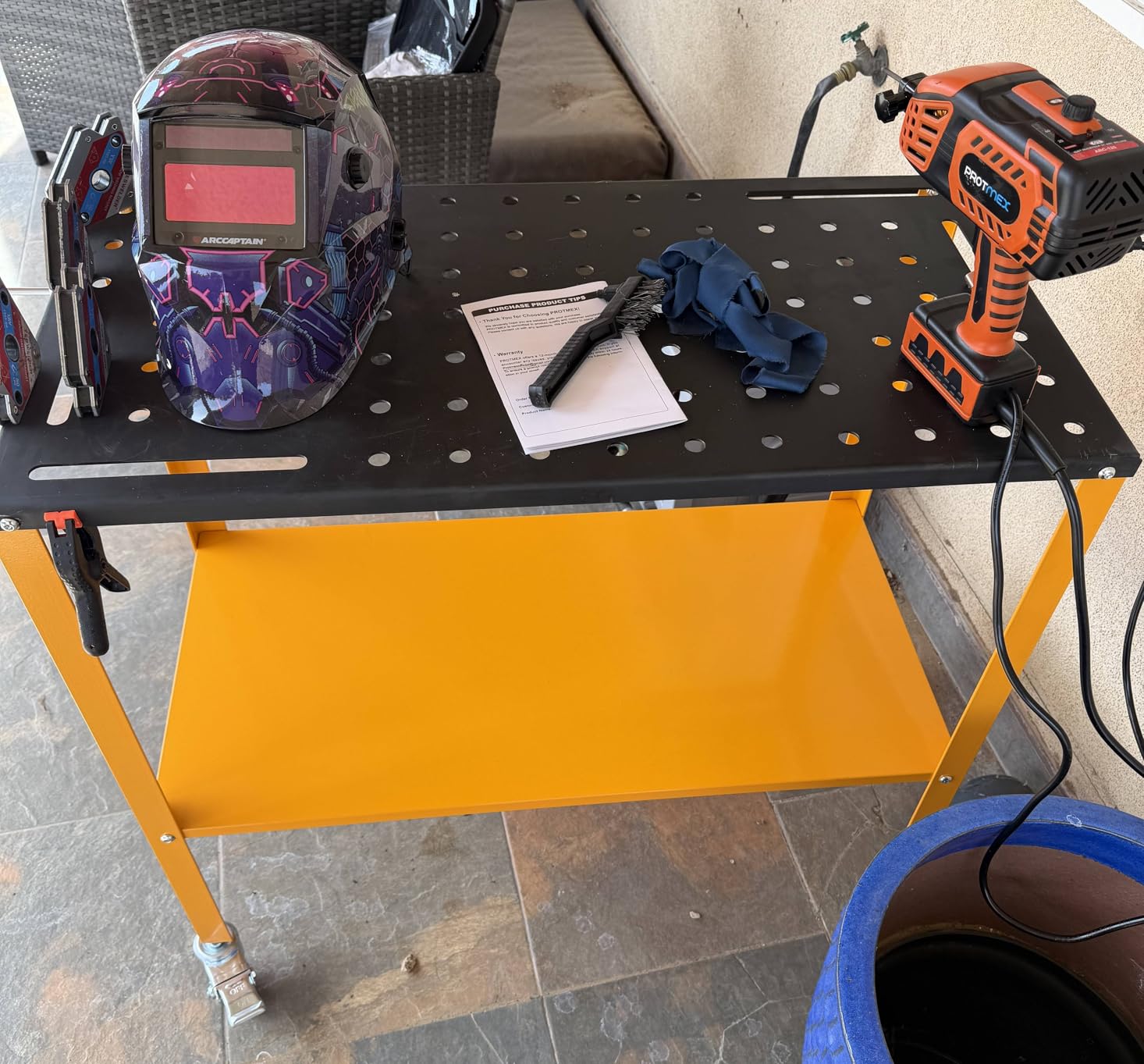
The black oxide finish is the detail welders notice first. It handles arc heat without blistering the way a thin paint coating can, and it will not flash rust in a humid garage the way an unfinished galvanized or bare surface eventually does. Combined with the 94 five-eighth-inch holes, it is a table you can stop worrying about.
Setup is genuinely fast. The 3-inch swivel casters come pre-installed, so assembly is legs, handle and shelf, and owners report roughly five minutes with no tools. The four fixed glides let you swap a caster for a flat foot when you need maximum precision on a good section of floor.
The best rating-to-effort ratio here
If you are starting out and buying one table that has to last, the rating distribution is a better guide than any spec line. An 81 percent five-star share usually means the failure rate is genuinely low, and at this size a failure means a bent top or a cracked weld in the frame.
At 43.1 pounds with casters already fitted, one person can reposition it, which solves the problem of a fixed table in a bay you also park in.
What you have to add yourself
Clamps. No dog pins, strap clamps or blocks are included, so budget for a starter set of 5/8in clamps before the first weld. This is the only con listed for this table, and it is the same on most budget tables in the group.
The dual-sided under-table tray helps offset that, because the parts you would otherwise hunt for are attached to the table and travel with it. At 36 by 18 inches the top is a mid-size surface, so plan your clamps to stay inboard of the edge.
6. Olympia Tools 30×20 Tilting Welding Stand with Wheels
Olympia Tools Adjustable Welding Table with Wheels Portable Steel Stand Workbench 30 in. x 20 in.
30x20 zinc-plated top
Tilting top that folds flat
Height from 29in
350-lb load
Pros
- Stays stable and does not shake or flex while welding
- Tilting top helps angle workpieces for easier torch access
- Folds flat for storage and rolls around the shop
- Zinc-plated top conducts well for ground clamp placement
Cons
- Lowest load rating in the group at 350 lb
- Short working height means leaning or sitting on small pieces
- Plastic tilt-locking bolt handles loosen and can be replaced with metal
- QC issues reported including cross-threading and misaligned holes
This is one of the most compact footprints on the list, and that is exactly what it is for. A 30 by 20 inch top on wheels and a carry handle will go where nothing else in this roundup will, which makes it the answer for a single-car garage where the table has to share space with a car, a bicycle and a lawnmower.
The tilting top is the feature that separates it from a plain rolling stand. Lift it to 30 or 90 degrees and the workpiece angles toward you, which changes how you approach a seam on a vertical plate or an inside corner. For someone still learning stick or MIG position work, being able to tilt the part instead of contorting your body is a genuine shortcut.
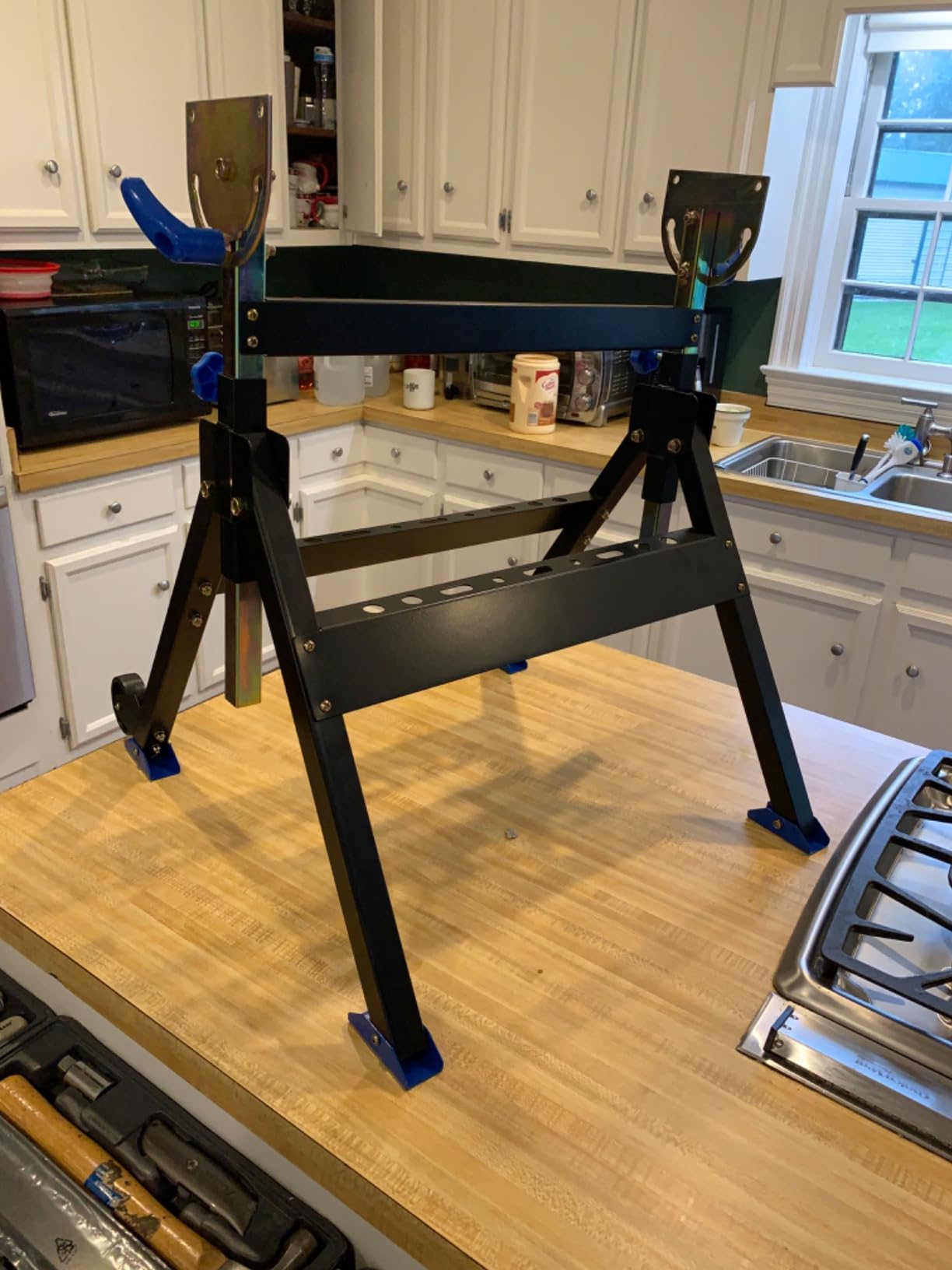
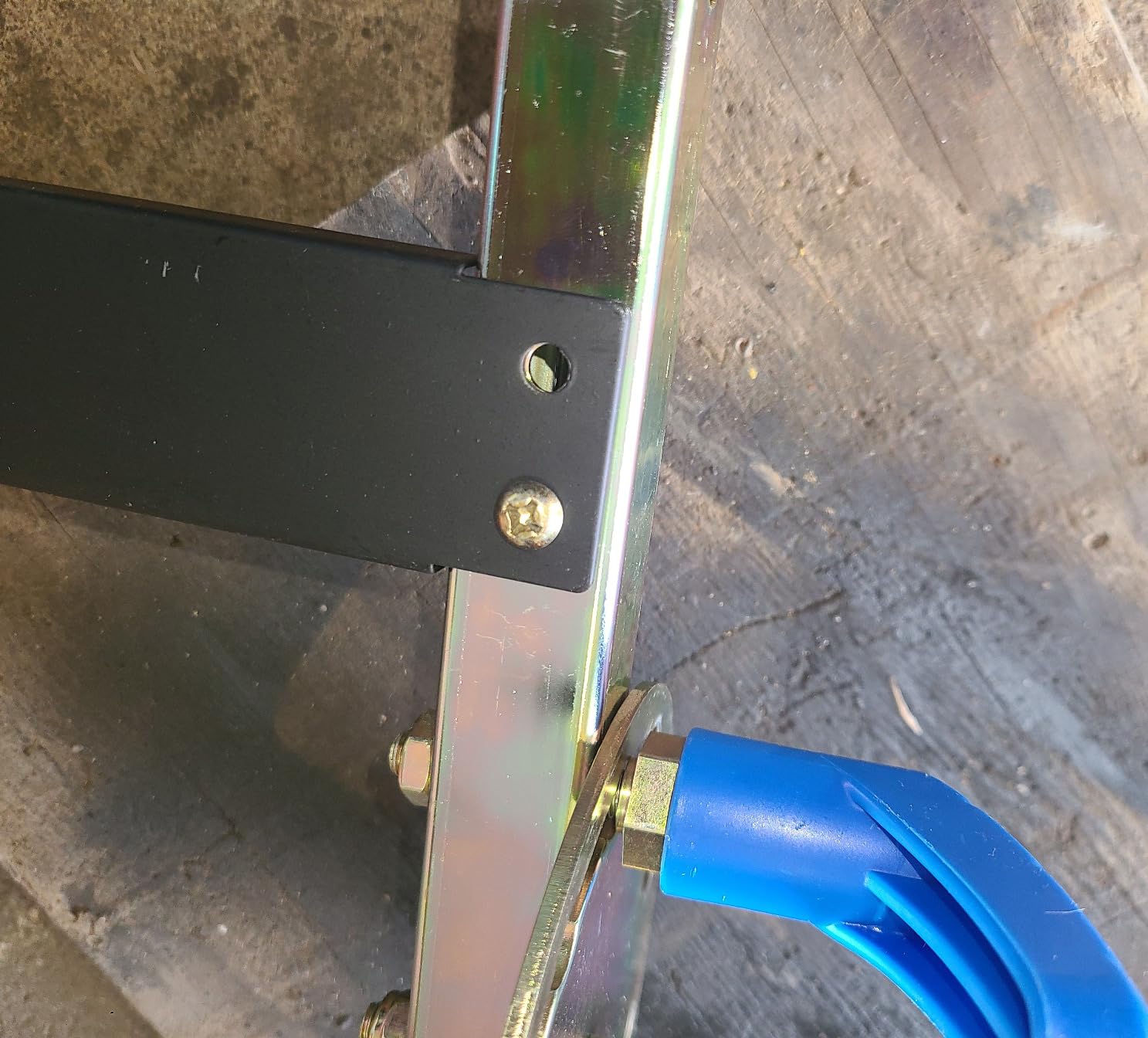
Owners consistently report that it stays stable and does not shake while welding, which is more than a 350-pound rating suggests. The zinc-plated top conducts electricity well, so the ground clamp can sit on the table and the arc finds a clean path back to the machine without you hunting for bare metal.
Adjustment slots run along the edges for clamps, and the height adjusts from a 29-inch minimum. It rolls with tools still in the tray, so you move the whole setup in one trip rather than making two.
When tilt and small size actually win
Small footprints matter most in tight bays and for beginners doing their first projects. When the table is small, parts hang over the edge, and overhanging parts distort. Keeping the work compact and inboard is easier on a 30 by 20 top than on a 42-inch one where you are tempted to lay out stock you do not have room for.
Tilt is the other win. Rather than turning a whole part to get at a seam, you angle the surface, and for out-of-position welds that is a meaningful reduction in awkward torch angles.
The limits worth knowing
The 350-pound rating is the lowest here, so this is not the table for a heavy ground clamp, a vise, or a steel frame section. The 29-inch minimum height is also low for an all-day session, and owners note that small pieces mean leaning or sitting.
Quality control is the other flag. Reports of cross-threaded hardware, a missing wing nut, and pre-drilled holes that did not line up mean you should check the hardware and squaring the top as soon as it arrives. Replacing the plastic tilt-locking bolt handles with metal ones is a cheap fix several owners have made.
7. VEVOR 30×20 Folding Welding Table with Three Tilt Angles
VEVOR Welding Table Foldable 30″x20″, Welding Workbench Table 400lbs Load Capacity Steel on Wheels, Work Bench Adjustable Height with 3 Tilt Angles, Three 1.1″ Slot, Retractable Guide Rails
30x20 carbon steel top
400-lb capacity
Tilt 0 30 and 90 degrees
Height 25 to 32in
Pros
- Folds flat for very tight shops
- Table conducts well so a ground clamp can attach to the bar
- Three tilt angles plus retractable guide rails help position parts
- Packaging protects the parts well out of the box
Cons
- 400-lb rating with thin steel that bends under side pressure
- Instructions are sparse and parts are not numbered
- Reports of missing hardware and spot-welded nuts that snapped off
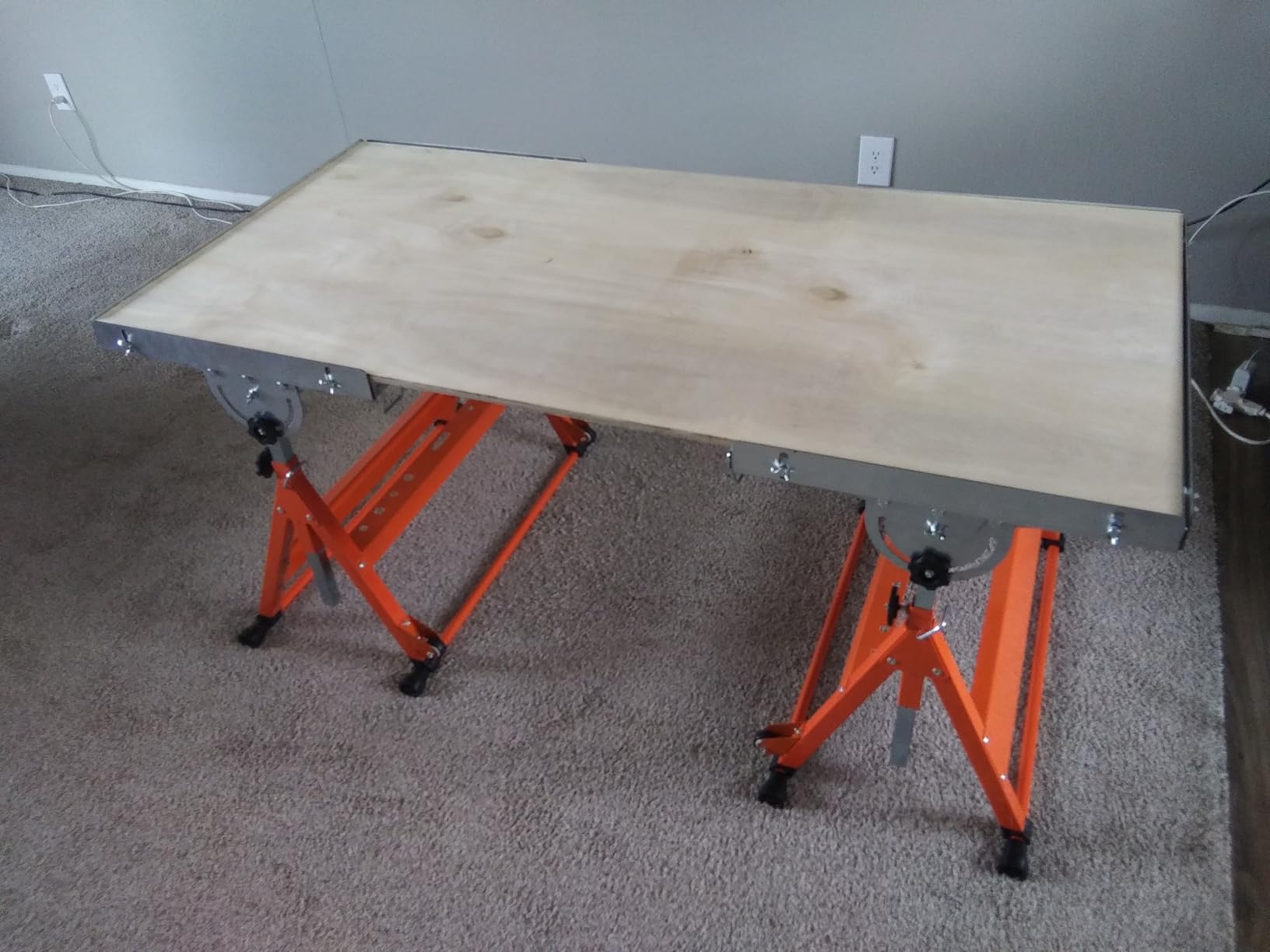
This is the most basic folding table here and the only one here with a three-position tilt: 0, 30 and 90 degrees, driven by retractable vertical guide rails. The rails pull out to hold a part upright or at an angle without a clamp, which is a small idea that saves a lot of fixturing on repeat weldments.
Three 1.1-inch clamp slots run across the top for strap clamps and edge work. Height adjusts from 25 to 32 inches, and at 39.2 pounds the table is light enough to move around a shop by yourself while the wheels are fitted.
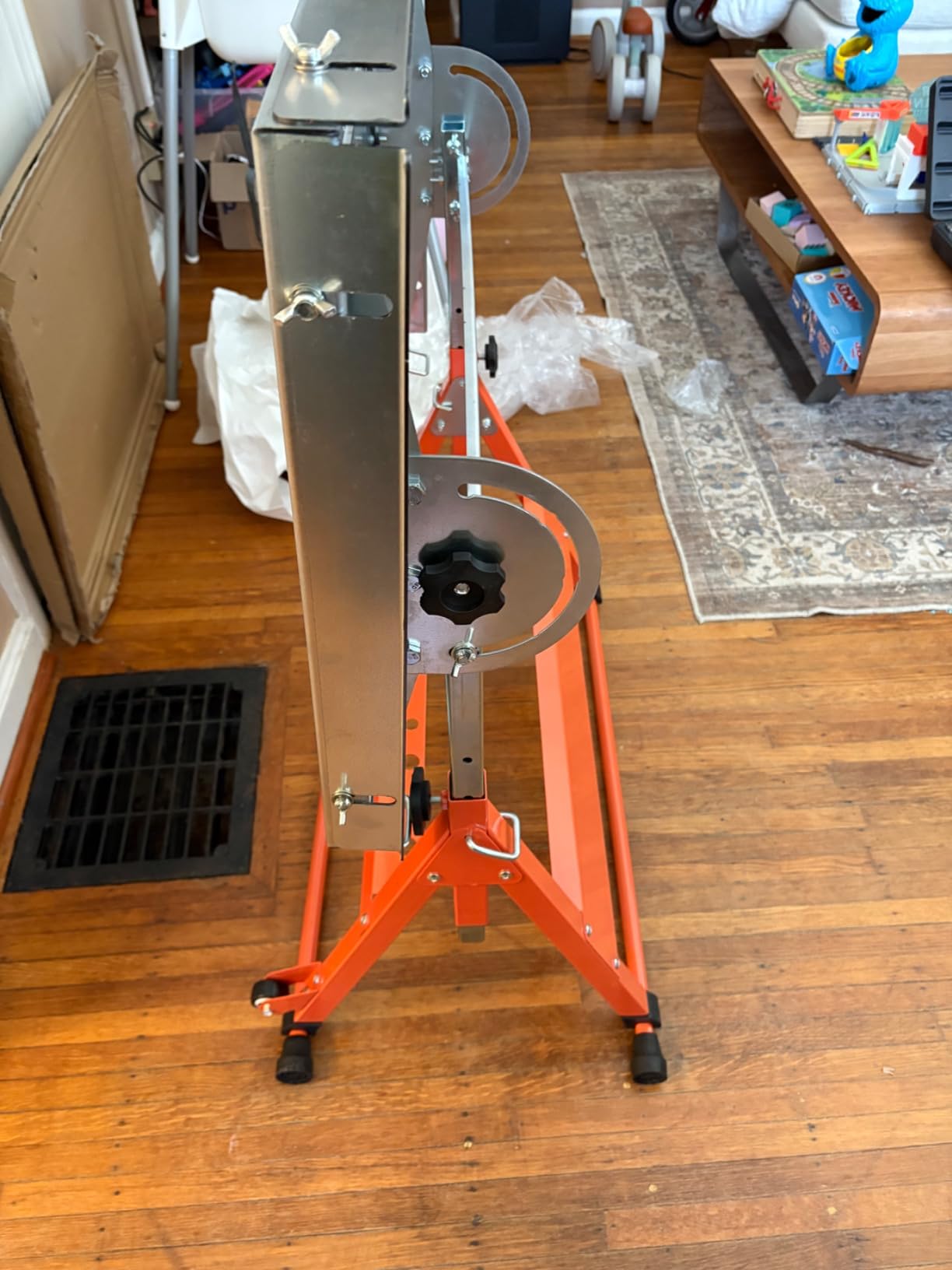
Owners who assemble it with hex bolts and lock washers report a table that is genuinely sturdy for light work. The carbon steel top conducts well, so a ground clamp attaches to the frame bar and the arc runs clean without you grinding a spot bare.
It folds flat, and with no brackets protruding it stores against a wall or under a bench in a garage that has no room for a permanent table. That foldability is the reason it exists and the reason it works.
Who this lightweight folding table suits
Light fab, assembly and repair work in a small space. If your garage is a one-car bay with no dedicated shop corner, a table that disappears against the wall on Sunday and comes out on Saturday is worth more than a heavier one you have to live with.
It is also a reasonable first welding table. The tilt angles make it easy to practice out-of-position welds on the same surface you build on, and the low weight means you are not fighting the table to get it into position.
Where you will fight it
The 400-pound rating and thin steel mean the top bends under heavy side pressure, and it is not a surface for hammering or heavy stock. Treat the load rating as the ceiling rather than a suggestion.
Assembly is the real weakness. Instructions are sparse and the parts are not numbered, and some buyers report missing hardware or spot-welded nuts that snapped off. Plan on hardware store time for a box of lock nuts and washers, because the wing nuts it comes with will loosen during use and transport. Getting the casters to touch the floor also means tipping the table nearly flat, which is awkward in a full bay.
8. VEVOR 36×24 Galvanized Welding Workbench, 800-Lb Capacity
VEVOR Welding Table 36″ x 24″, 800LBS Capacity Welding Workbench Table, Heavy-Duty Work Bench with 0.63″ Fixture Holes and Non-Slip Foot Pads for Welding Assembly Repair Works
36x24 galvanized top
800-lb capacity
0.63in holes on 2in centers
58 lb
Pros
- Deeper 36x24 top gives room for sheet and panel work
- Adjustable foot pads stopped one owner's table rocking on uneven concrete
- 0.63in holes on 2in centers let clamps lock where needed
- Assembles in about 20 minutes
Cons
- No washers or lock washers included so bolts can loosen
- Reports of missing mounting holes and bent tabletop supports
- No wheels
- so repositioning means lifting
Depth is what this table adds. Twenty-four inches of front-to-back room is the difference between a tube frame and a sheet-metal panel, and for anyone doing gate work, trailer flooring or any kind of panel fabrication, that extra six inches removes the overhang problem that distorts parts on the 18-inch-deep tables.
The frame is powder-coated carbon steel rated at 800 pounds, which sits comfortably above what a garage hobbyist will ever clamp to it. The galvanized work surface resists the spatter and grime of a working shop better than a painted one and is easy to wipe down.
Four adjustable anti-slip foot pads are the sleeper feature. One owner found they eliminated a persistent rocking problem on uneven concrete that no amount of tightening would have fixed, and uneven floors are the norm rather than the exception in a residential garage.
The 0.63in holes on 2-inch centers sit close enough to the standard 5/8in pattern that common dog pins work, and the density means you can find a hole near almost any clamp position on a top this size. Assembly takes about twenty minutes, and many owners bolt a lower shelf of their own onto the frame for storage.
Why depth beats width in a small bay
Adding depth to a table lets you place a part fully on the surface without hanging off the front edge. That matters more than raw area, because an overhanging workpiece picks up heat on one side only and twists, and the twist is what ruins the weldment.
A 36 by 24 top also fits against a garage wall behind a parked car in a way a 42-inch-wide table does not, so you get the panel capacity without needing a wider footprint.
The setup work it needs
There are no washers or lock washers in the box, and on a bench that gets knocked and vibrates all day, bare bolts loosen. Add a pack of washers and lock nuts before the first weld; it is the cheapest fix available for this table.
There are also reports of missing mounting holes on the frame and bent tabletop supports, so check the frame square and the top flat before you build anything. And with no wheels, this is a fixed table that stays in one spot and needs two people to move.
9. Klutch Mobile Welding Workstation with 26-Piece Fit-Up Kit
Klutch Mobile Welding Workstation, 26-Pc. Fit-Up Kit, 600-Lb. Capacity
Four-section 4mm top
600-lb capacity
26-piece fit-up kit
113 lb table
Pros
- Sectioned top lets you run several projects on one table
- 26-piece kit removes the need to buy clamps and blocks separately
- Swivel casters plus stabilizer feet let you roll it and then lock it rigid
- Heaviest and most rigid build in the group at 113 pounds
Cons
- The heaviest and most costly build in the group
- At 113 pounds it is a two-person lift unless the casters are used
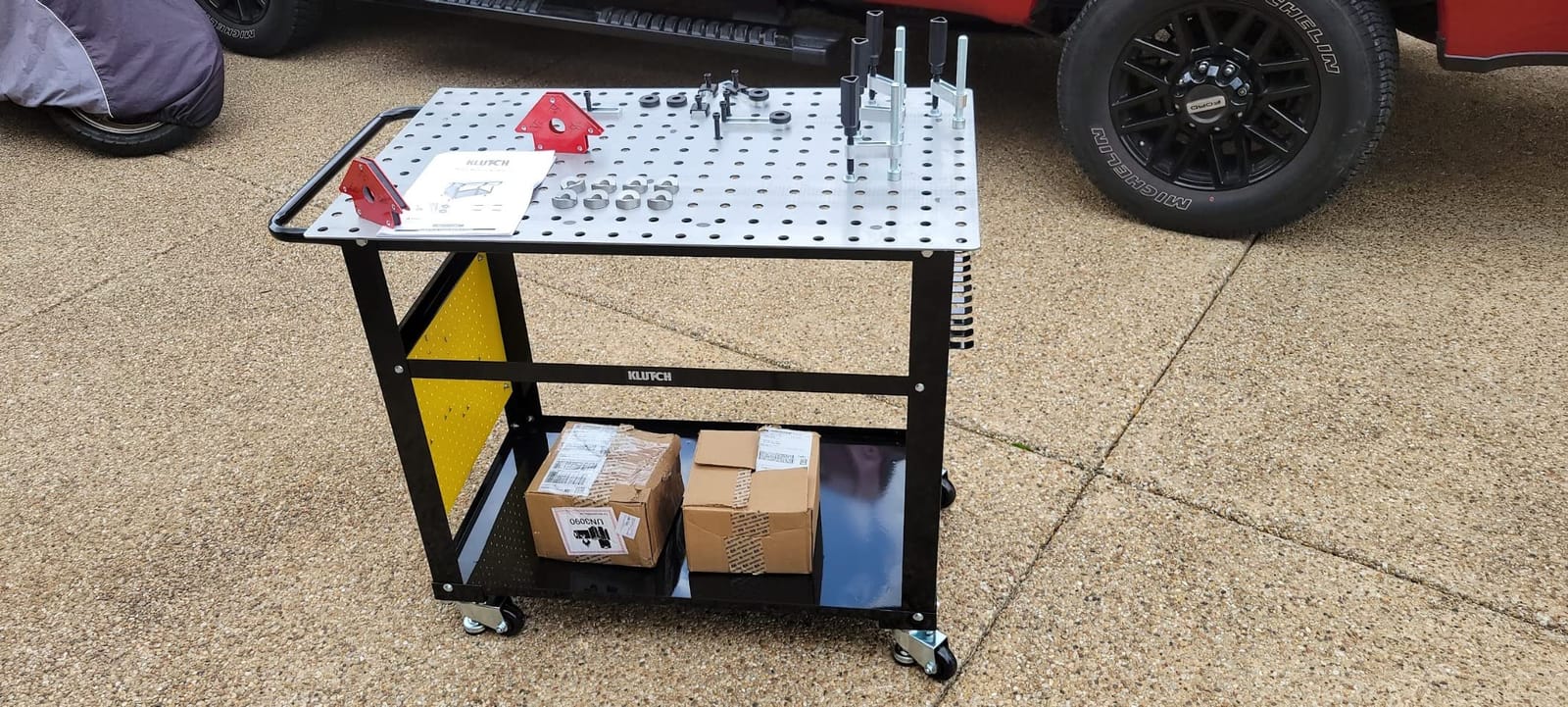
This is the most rigid table here and the reason is weight: 113 pounds of steel with a 4mm top split into four separate 20 by 12 inch sections. Nothing in this roundup is heavier, and nothing is less likely to move, flex or ring when you clamp something heavy to it.
The four-section top is genuinely clever rather than cosmetic. Sections on a 4mm plate limit how far heat travels and how much the plate can twist, so you can set up a bracket in one quadrant, a frame in another and a second job in the third without one weld affecting the others. Multiple projects run on one surface.
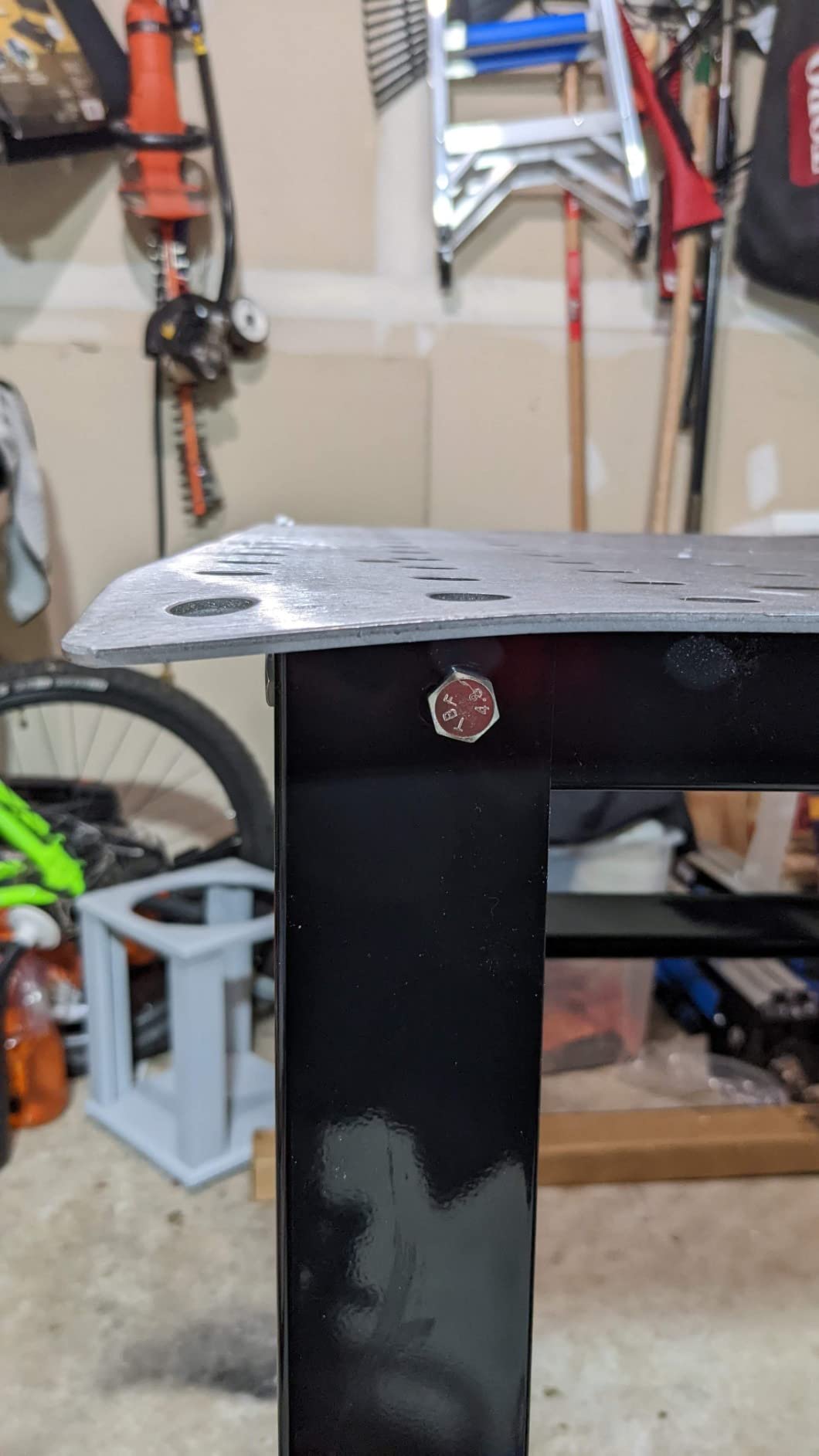
The 26-piece metal fit-up kit is the bigger deal here than on the smaller Klutch table. You are getting clamps, blocks and stops as a matched set that works with the 16mm hole pattern already drilled, which removes the trial-and-error stage of setting up a fixture for the first time.
Four heavy-duty 3-inch swivel casters and a firm-grip handle move it around, and the built-in stabilizer feet drop it onto a rigid base once you are in position. Rolling a table and locking a table are two different tasks, and this one does both.
What the extra weight buys
Mass. A 113-pound table does not creep when a heavy ground clamp is attached, and it does not dish under a clamp, which means your part stays where you put it while the arc is lit. For frame and trailer work where a square part matters, that is the difference between a weldment you are proud of and one you redo.
The sectioned top also means a single mishap on a hot job damages one section rather than the whole surface, and the fit-up kit means the table is productive the day it arrives.
Where the trade-off bites
It is the biggest commitment in this roundup, and at 113 pounds it is a two-person lift unless you use the casters. In a one-car garage, a table this heavy and this wide needs a planned corner rather than whatever space is free on Saturday.
If your garage cannot give it a permanent home, one of the rolling options earlier in this list will serve you better for a fraction of the commitment.
10. NOVA Heavy-Duty Welding Table with Folding Legs
NOVA Heavy-Duty Welding Table with Folding Legs
14 gauge plated top
1000-lb capacity
Height 27.7 to 39in
Folds to 3.5in
Pros
- Folds to roughly 3.5in with no protruding leg brackets
- Height adjusts across an 11-inch range from 27.7 to 39in
- Galvanized surface grips magnets and releases spatter easily
- Arrives nearly fully assembled
Cons
- Some tables show a 1/8in high spot at the center of the top
- Thin 14-gauge top can warp with heat
- Some welded nuts arrived deformed and had to be retapped
- Does not tilt
- unlike several competitors in this group
The height range is the headline number here: 27.7 to 39 inches, an 11-inch spread. That is the widest adjustment in this roundup and it covers everything from seated tack work to standing out-of-position work, which is why it works for two very different people in the same garage.
The 42-inch-wide top gives you a long surface for angle iron and tubing, and the 5/8in fixture holes on 2-inch centers are the pattern most of your clamps will match. The 1000-pound rating is more than enough for typical hobby fabrication.
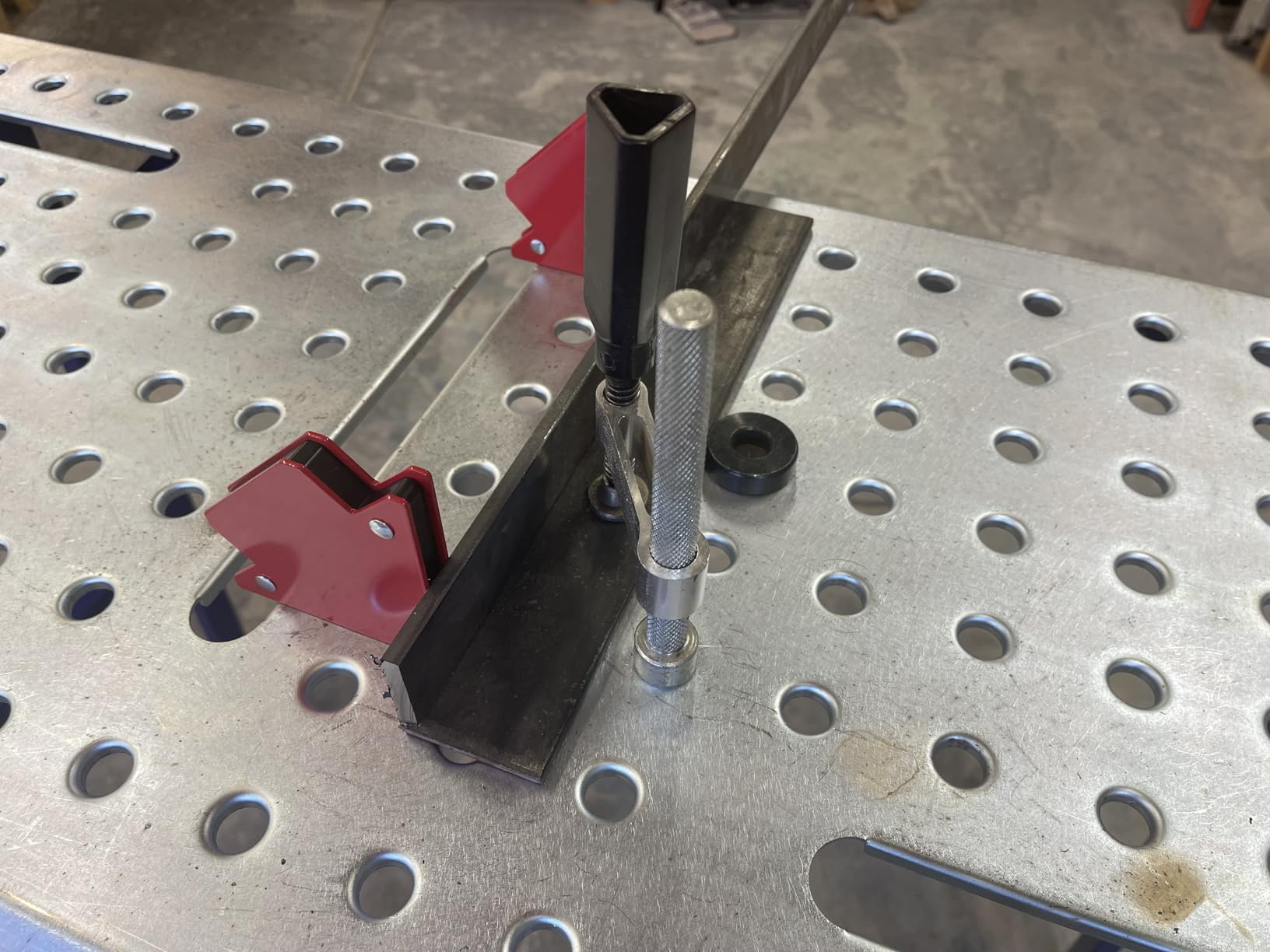
It folds to about 3.5 inches with no leg brackets protruding, which is the quiet engineering win. A table that folds flat without protrusions can be stored flat on a shelf, slid under a bench, or laid in the bed of a truck. Most folding tables cannot.
The galvanized surface holds magnets, which is useful for positioning thin sheet, and owners report spatter releases from it more easily than from a painted top. It also arrives nearly assembled, so you are fitting a handle and a grounding stud rather than building a frame from bolts.
Check the flatness before you build on it
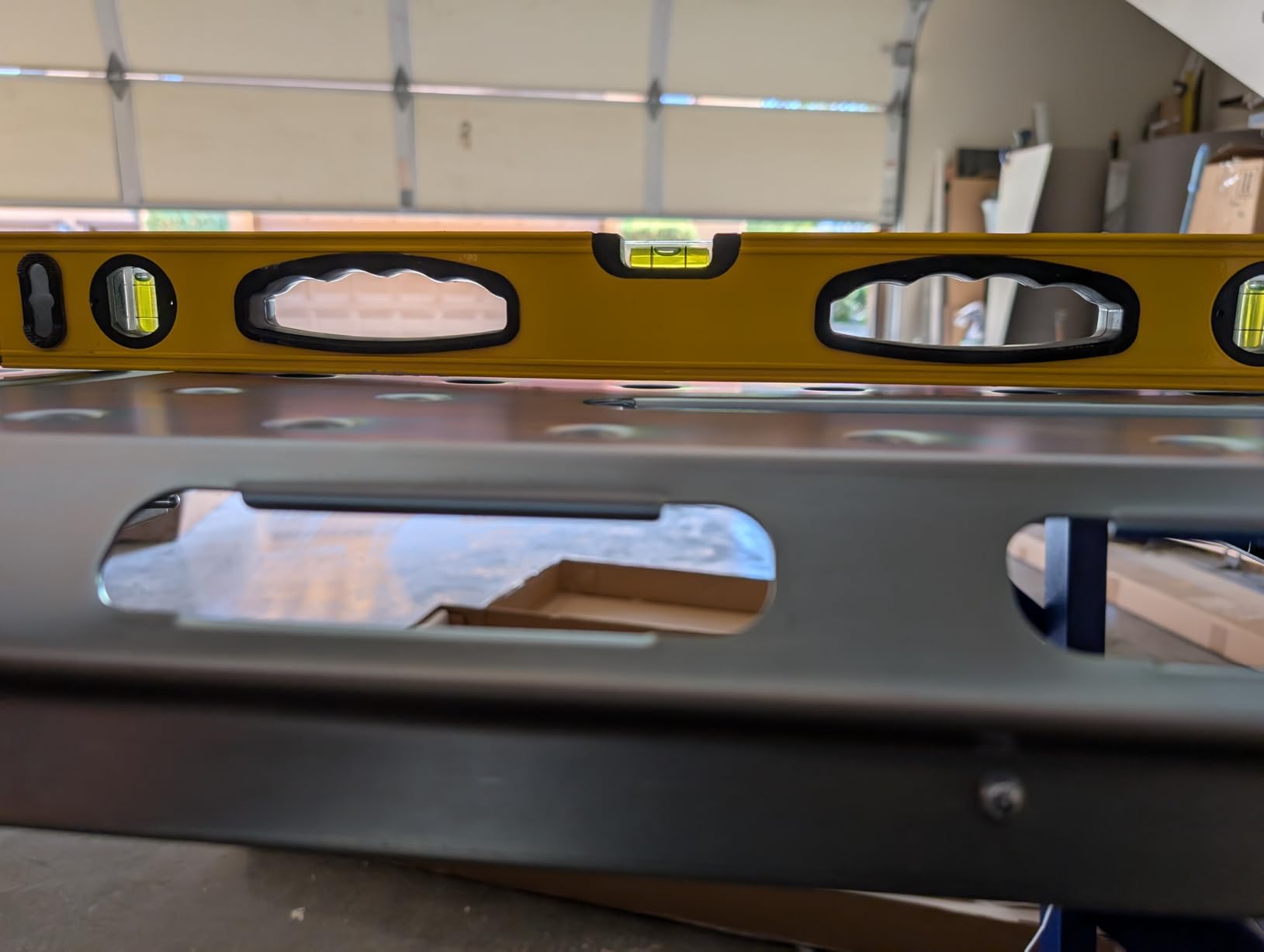
Flatness is the dominant complaint about this table, and it is the thing that matters most. Several buyers reported a 1/8-inch high spot at the center of the top. On a table this size, a high spot means your fixturing repeatability is off, and a part that sits flat in one spot cups slightly elsewhere.
Run a straightedge across the top the day it arrives. If it rocks, address it before you rely on it for anything that has to be square. A thin top like this is more prone to dishing than a heavier plate, and the 14-gauge steel is also the reason owners warn about heat warping over time.
What you give up
There is no tilt function, which leaves out the 30 and 90 degree positions that two other tables here offer. If you plan to weld vertical plates or inside corners, the tilting options may serve you better despite a narrower height range.
Several tables also arrived with deformed welded nuts that had to be retapped before assembly, and the 4.0 average reflects that assembly variance. Check the hardware before you start.
11. WORKESS 42×21 Folding Welding Table, 1000-Lb Capacity
WORKESS Metal Welding Table Folding 1000 lbs Load Capacity Heavy Duty Steel Construction Workbench for Welding Adjustable 7 Level Height
42x21 top
1000-lb capacity
Seven height levels
Side grounding bolt
Pros
- Wide 42in top folds to just 3.7in and stands on its own
- Individually adjustable legs stay stable on uneven ground
- Four separate locking hooks add security under load
- Arrives nearly assembled with only the carry handle to fit
Cons
- Top feels thin and is not heavy enough for hammering or heavy fab
- Legs must be at their lowest position before the table will fold
- 0.8in holes are larger than standard tooling so few vises fit
- Leg locks are fiddly to operate
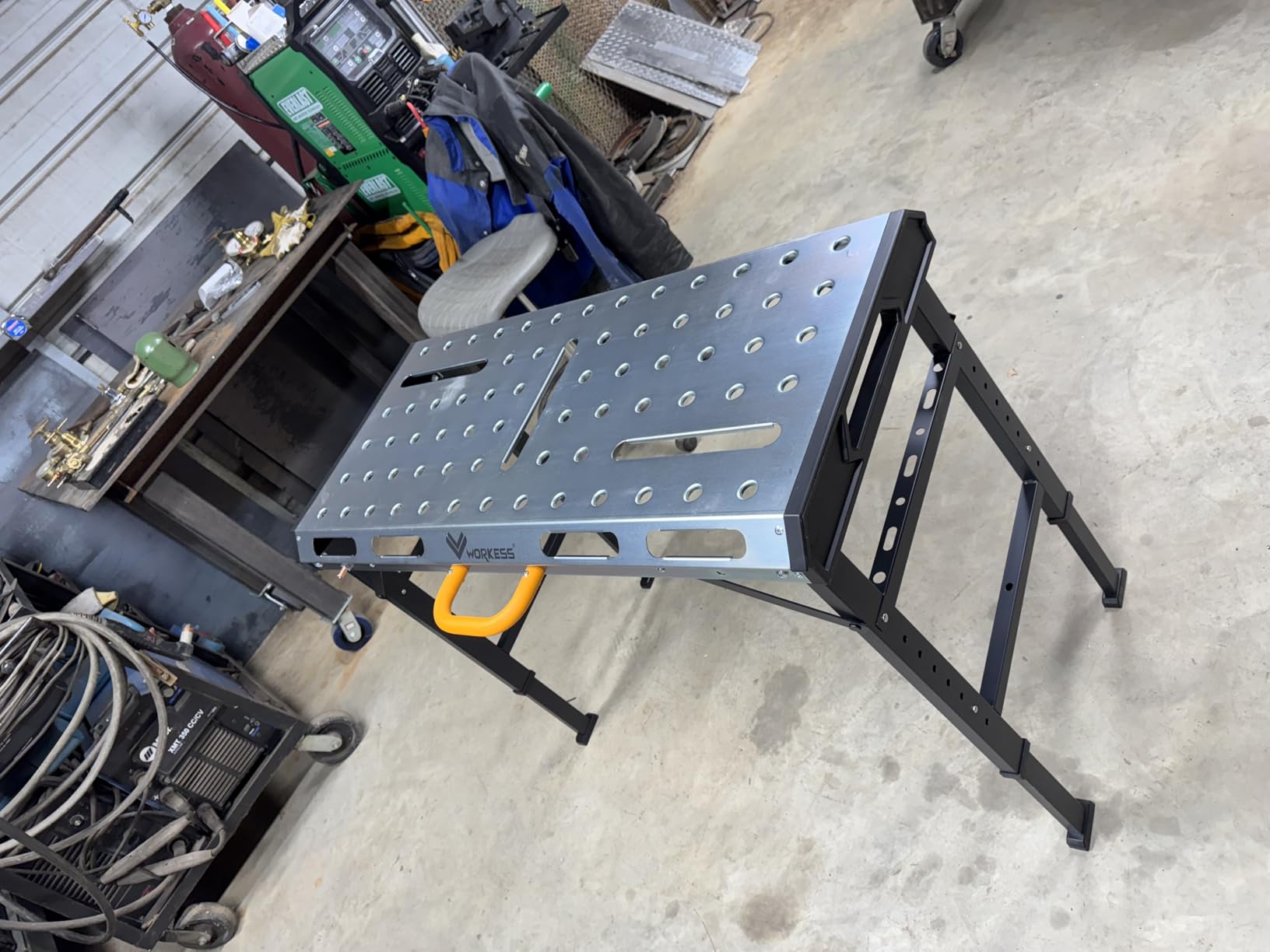
This table folds to 3.7 inches and then stands on its own like a closed suitcase. That is the whole proposition. In a garage where the table has to disappear against the wall for most of the week, a self-standing folded unit that stores in a fraction of a shelf is a real answer to the space problem.
Seven height settings from 27.7 to 36.6 inches give discrete stops rather than a continuous range, and the legs adjust individually, so the surface stays level on uneven concrete or a driveway. Owners using it outdoors report it staying steady.
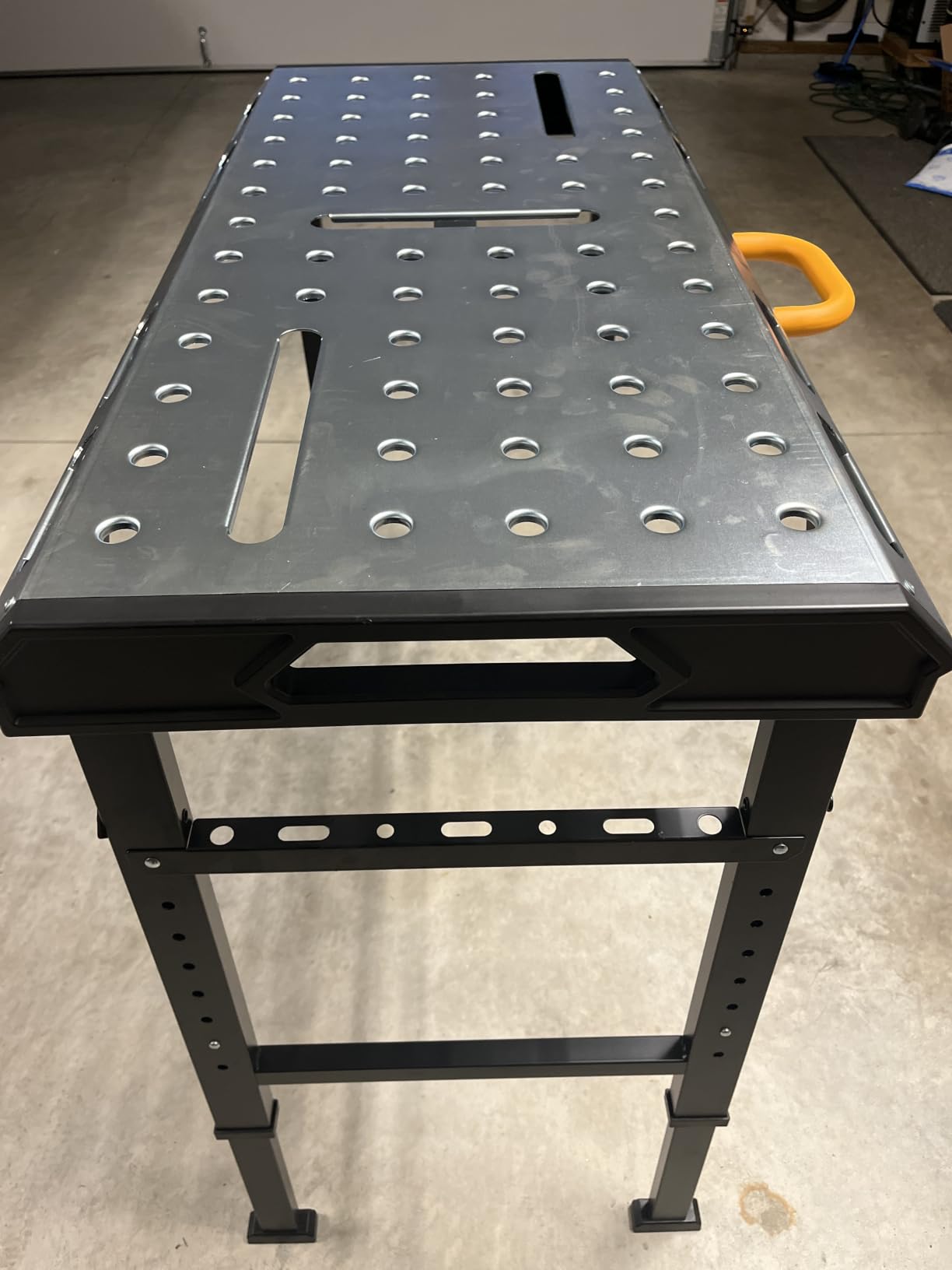
The side grounding bolt is a nice practical touch. It gives you a dedicated, low-resistance attachment point for the ground clamp away from the workpiece, so the return path does not run through the part you are welding. That helps arc stability and keeps the clamp off your finished work.
Four separate locking hooks act as a safeguard beyond the leg pins, and the 14-gauge galvanized top resists the spatter and moisture of a working garage. The 1000-pound rating is generous for the class.
Best footprint-to-surface ratio in a small garage
Forty-two inches of width on a table that folds to 3.7 inches gives you a long work surface for tubing and angle iron without permanently giving up a wall. When the job is done, the folded unit stands on its own next to the car rather than leaning where it can be kicked.
Nearly assembled out of the box is another space argument in disguise. You are fitting a carry handle, not spending an evening on hardware, so it goes back on the wall the same night you finish using it.
What to know before you clamp
The 0.8-inch holes are the biggest practical limitation. That is larger than the standard 5/8in pattern, so most off-the-shelf vises, dog pins and clamp bodies will not drop in. If you already own tooling, check the diameter before you commit; if you are buying new, budget for 0.8in accessories.
The top is thin and reviewers are clear that it is not for hammering or heavy fabrication, and the legs must be set to their lowest position before the table will fold, which is an easy mistake to make. The leg locks are also fiddly, so check all seven are engaged before you clamp a heavy part.
12. Hobart 35×19.5 Portable Folding Welding Table
Hobart Portable Folding Welding Table- 35inL x 19.5inW x 34inH Steel
35x19.5 folding alloy steel
34in working height
No assembly
47.5 lb
Pros
- Solid alloy steel build that one 260-lb owner stood on without movement
- Folds flat for storage and a second unit pairs for more area
- Fits a mobile welding rig behind a tailgate at 47.5 pounds
- No assembly required and the top tolerates hot work
Cons
- Top is bowed on some units with the center up to 1/8in above the sides
- Cross-bracing under the top makes clamping beneath awkward
- 34in height suits standing work rather than seated
The Hobart is the simplest answer to the question of whether a person new to welding needs a dedicated table. It arrives ready to use. There is no assembly, no hardware bag and no frame to square, which removes the single biggest reason a first table ends up in a corner unused.
It is also genuinely solid. One owner stood on it at 260 pounds without movement, which tells you more about the frame than a load rating does. The welded alloy steel trestle design is a straight-leg arrangement that folds flat, and at 47.5 pounds it can be carried by one person or paired with a second unit for a larger surface.
The 34-inch working height is tall enough to weld standing rather than kneeling, which matters more than it sounds. A first welding project done on your knees is a project you abandon. Owners comment that the top tolerates hot work without catching fire, which is the baseline every table here has to meet.
It also fits a mobile welding rig behind a tailgate, so if your garage work sometimes happens away from the garage, this table travels with the machine rather than staying behind.
Why no-assembly matters for a first table
The gap between a beginner buying a table and a beginner using a table is often an evening of assembly, and that is where the enthusiasm goes to die. A table that is ready the day it arrives gets used on Saturday instead of next month. For someone who is not sure they will weld much, that is the deciding factor.
It is also a good table to learn fixturing on. A flat, uncluttered top with a straight-leg frame is easy to set up a square and a clamp on, and a second unit pairs with it to double the surface for larger assemblies.
The two things to check
Several owners have found a bowed top, with the center reported up to 1/8in above the sides. Lay a straightedge across it before you rely on it for precision assembly, and treat the table as a fit-up and light fab surface if it is noticeably crowned.
Cross-bracing under the top makes it awkward to clamp parts beneath the surface, so plan fixtures on top rather than underneath. And at a fixed 34 inches, this is a standing table rather than an adjustable one, so if you need seated-height work, look at a model with per-leg adjustment instead.
How to Choose a Welding Table for Your Garage
Look at four things in this order: whether the top is thick enough for the heat you will put through it, whether the frame is stiff enough to hold a clamped part, whether the footprint fits your bay, and whether the fixturing holes match your clamps. Everything else is preference.
If you are still comparing shapes rather than specs, our roundups of best folding grill tables and outdoor dining tables cover the folding-frame and space questions from a different angle, and the same space math applies. For glass-topped surfaces, our glass dining table guide covers a different material choice entirely.
How thick should a welding table top be?
One quarter inch is enough for hobby work, 3/8 inch is the sweet spot for light production, and 1/2 inch is the fabrication standard. Thicker plate does three things: it resists warping under repeated heat, it resists dishing under clamp pressure, and it gives you a flat reference plane you can actually build square against.
Most tables in this roundup land between 2.8mm and 4mm, which is the 1/8in to 3/16in band. That is enough for repair work, brackets, small frames and trailer work. It is not enough for a production shop running repeat weldments all day, which is where a heavier 3D fixture system comes in.
The failure mode is always the same. A thin top heats locally around a weld, that local heat wants to expand, and the only place it can go is upward, so the plate dishes. After a few dozen welds the table is no longer flat, and every part you set up on it inherits that curve.
Load capacity versus table weight
Load capacity is how much the table is rated to hold. Table weight is how much steel it actually contains. They are separate numbers and both matter. A 40-pound table rated for 1000 pounds is engineered; a 40-pound table rated for 300 pounds is thin, whatever the label says.
Look at capacity per leg, not the headline number. A 1200-pound rating spread across four legs is 300 pounds each, which is high for a table at this price and means a heavy clamp will not compress the frame. Ratings are also usually static and evenly distributed, so a long part hanging off one edge concentrates the load in ways the number does not describe.
For a garage hobbyist, anything from 600 pounds upward is honest and sufficient. You are clamping tubing and sheet, not a car.
Fixturing hole standards, and why the diameter matters
The standard garage pattern is 5/8in (about 16mm) holes on a 2-inch grid. That appears on most of the tables in this roundup, and it is the pattern to buy clamps for. The 28mm hole on a 100mm grid belongs to professional 3D fixture systems and is not a garage purchase.
Watch the outliers. The DEWALT runs closer to 3/4in and the WORKESS at 0.8in, both with 3-inch centers rather than 2-inch. They are perfectly good tables; they just do not accept the standard dog pins, so plan to buy 19mm or 0.8in accessories rather than reusing what you own.
Two-inch spacing is the other half of the answer. Wider spacing means fewer holes, and a clamp that lands between holes gets a loose fix that lets the part shift during the weld.
Why table flatness decides weld quality
Flatness is the reference plane for everything you build. If the top is not flat, a part that sits on three points is held off the surface at the fourth, and that gap becomes twist when heat goes in. Most distortion welders blame on their technique actually starts with a light, flexing or cupped table.
Check flatness on arrival with a straightedge across the length, the width and the diagonal. A table that rocks needs leveling feet or shims before you use it. A high spot at the center, which owners report on some folding models, is harder to fix and is a reason to return it.
Flatness also decays. Heat cycles, dropped stock and a heavy clamp on one edge all push a thin top out of plane over time, so a table that is flat today may not be flat after a year of weekend work.
Height, casters and leveling feet
Working height should land between 34 and 38 inches for a standing session. Below 34 you bend; much above 38 you work at a raised angle that tires your shoulders. Adjustable legs are worth paying for if you weld seated and standing in the same evening.
Casters earn their keep in a one-car garage, where a table that rolls to the wall between sessions is the difference between welding and not welding. On a heavy fixed table above about 100 pounds they are largely unnecessary, because you would use a dolly anyway. Locking casters are not optional; a table that drifts mid-weld is a safety problem, not a nuisance.
Leveling feet or adjustable glides matter more in a residential garage than people expect, because garage slabs are poured in sections and are rarely flat across their whole span.
Garage Sizing: Matching Your Table to the Bay
The most common question from garage welders is not about steel. It is about whether the table will fit. A four-foot-wide table in a one-car bay is a daily negotiation, and the answer depends on three measurements: the clear width of the bay, the door swing, and where your vehicle actually needs to stand.
Measure the narrowest point of your bay first, not the wall to wall dimension. Shelving, a water heater, an electrical panel and the door mechanism all eat width. Then check the door swing, which is the part people forget: a roll-up or swing door needs clear floor space in front of it, and a table parked in that arc has to move every time the door operates.
The practical rule is to leave a clear lane from the door to the vehicle. In a single-car bay, a table of 30 to 36 inches of width along one side wall, with the vehicle lane preserved, keeps the garage usable. In a two-car bay, a table up to 42 inches wide can sit against the back wall without touching either door, because the door swing is at the front of the bay rather than behind it.
Depth matters more than people expect. A deeper top means parts sit fully on the surface instead of hanging over the front edge, and overhanging parts are the most common reason a small table gets outgrown. If you weld sheet or panel work at all, choose 24 inches of depth over extra width.
Height is the last piece. Measure your own comfortable standing height and sitting height and check the table’s range covers both. A fixed 34-inch table is fine if you always weld standing; if you also do seated work at a stool, you want per-leg adjustment.
Welding Safely in a Garage
Yes, you can weld in a residential garage, and almost everyone who builds one does. What you must control is fire, ventilation and what the arc light does to everything around you. A garage is a small combustible room with a vehicle in it, so the setup matters more than it would in a dedicated shop.
Move the vehicle out before you light an arc, or at minimum clear the area around it. Gasoline vapour, oil on a concrete floor and a plastic seat cover are the three things that turn a mistake into a serious one. Sweep the floor, keep rags in a sealed metal container, and do not weld with the door shut.
Venting is the next control. A stick or MIG arc produces fume and, with gas-shielded wire, some shielding gas breakdown products. Open the garage door fully and use a fan to pull air out rather than just letting it sit. Position the fan so it moves air across your breathing zone and out of the opening, not directly into the arc, because a cross-draft will blow the shielding away and wreck your bead.
Spark containment matters because a grinding bead throws hot metal further than people expect. A fire blanket hung behind the work position catches what gets past your helmet, and a clear zone of roughly 35 feet from any combustible material is the standard rule of thumb. That includes cardboard, rags, paint cans and sawdust.
On grounding, attach the ground clamp to the table or the frame rather than the workpiece whenever the design allows. A low-resistance path back to the machine gives a more stable arc, less spatter and a better bead, and it keeps the clamp off your finished surface. Where the table is painted or rusty, grind a small bare patch in one corner to make a dedicated ground zone and use that every time.
Finally, check your local rules. Fire code, HOA covenants and landlord restrictions differ, and some jurisdictions require a fire extinguisher, a blanket or a permit for hot work. A quick check with your local fire district before you set up avoids the problem entirely.
Spatter, Rust and Long-Term Table Care
Expect the top to pit. Spatter is molten metal that lands on steel and fuses to it, and the standard owner routine across welding forums is to chip it off while it is still warm, with a dedicated scraper and gloves, before it becomes a permanent ridge that catches every new part you set down.
A weekly scrape of the working area keeps the surface flat and the holes clear. Monthly, vacuum or blow out the fixture holes; packed spatter in a hole stops a clamp from seating fully, and a clamp that is not fully seated is a part that moves mid-weld. Seasonally, check the frame bolts, the caster brakes and the leveling feet, and treat a bare or galvanized surface that has gone chalky with a light oil.
Finish type changes what you do. A black oxide or rust-free coated surface only needs wiping down. Bare or galvanized steel wants a film oil to keep moisture off it. A painted top will blister at the weld point no matter what you do, so treat it as a sacrificial coating rather than something to protect.
If rust has already started, a wire wheel on a grinder takes it back to clean metal, and a ground patch in the corner is worth doing before your next session. Grounding on a rusty or painted spot is the cause of most unstable arcs in a home garage, and it is a five-minute fix.
One owner in our research replaced a dedicated workbench with a welded steel slab on a rolling adjustable frame, which gives you height adjustment and storage on a table most sellers do not offer. It is a valid route if you already own a good adjustable base, and it is the reason to look at the frame rather than only the top when shopping.
Frequently Asked Questions
What is the best thickness for a welding table?
Quarter inch is enough for hobby work, 3/8 inch is the sweet spot for light production work, and 1/2 inch is the fabrication standard. Thicker plate resists warping under repeated heat, resists dishing under clamp pressure, and gives you a flat reference plane to build square against. Most tables in this roundup sit between 2.8mm and 4mm.
What size welding table do I need for my garage?
Measure the narrowest clear point of your bay, not the wall to wall dimension, then check the door swing. In a single-car bay, a 30 to 36 inch wide table along one wall keeps the vehicle lane usable. In a two-car bay you can go up to 42 inches against the back wall. Choose depth over width if you weld sheet or panel work, because overhanging parts distort.
Are you allowed to weld in your garage?
Usually yes, but you have to control fire risk, ventilation and fume. Move the vehicle or clear the area, keep rags in a sealed metal container, run a fan that pulls air out without blowing across the arc, and keep roughly 35 feet clear of anything combustible. Check your local fire district and any HOA rules for hot work permits.
What height should a welding table be?
Aim for 34 to 38 inches for a standing welding session. Below 34 you bend forward and tire your back; much above 38 you hold the torch at a raised angle that fatigues your shoulders. If you also work seated, choose per-leg adjustable legs so the table covers both a sitting and a standing height.
How do I keep a welding table from rusting?
Chip spatter off while it is still warm, wipe the surface down after each session, and keep a light film oil on bare or galvanized steel. Black oxide and rust-free coated surfaces only need wiping. A painted top will blister at the weld point, so treat it as sacrificial and grind back any rust to bare metal before you use the table as a ground.
The One Welding Table to Buy
If you buy only one, buy the Klutch 600-pound steel table. It has the most owner history in this roundup, a 4mm top on a 2mm frame that will not dish under a clamp, standard 16mm fixture holes on a 2-inch grid so your clamps fit, and a 24-piece fit-up kit so you can clamp a part on the day it arrives rather than a month later.
That is the best welding table for garages in 2026 for a specific reason: it does the four things that matter and skips the features that do not. If your bay also holds a car, the VEVOR 36×18 with braking casters is the smarter shape. If you weld sheet and panels, get the deeper VEVOR 36×24. If you are starting out and want zero assembly, the Hobart is ready to use the moment it opens.
Measure your bay, check your clamps against the hole diameter, and buy the one that fits both.