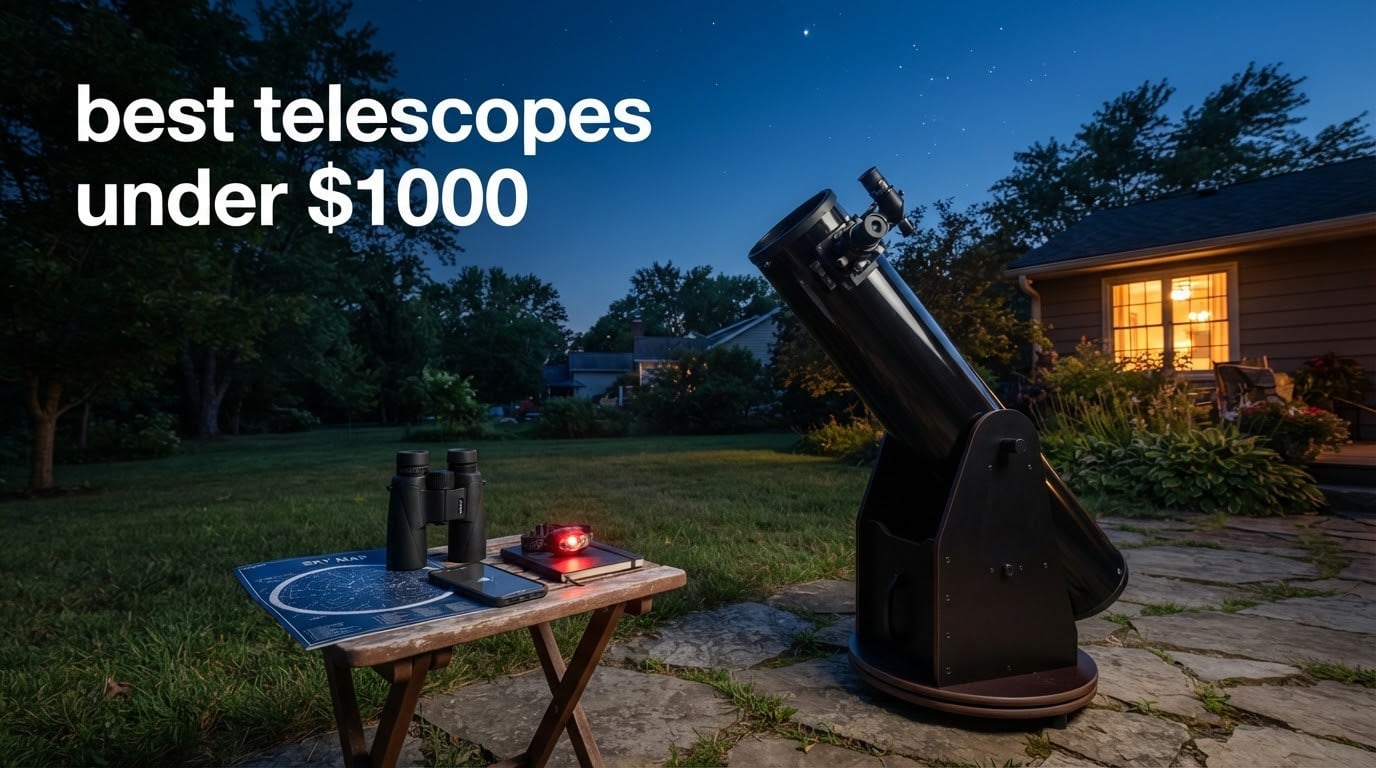
If you have been reading telescope roundups, you have probably noticed that most of them quietly assume you already know what an aperture is. This one does not. A telescope is a light bucket pointed at the sky, and the size of that bucket – the aperture, quoted in millimeters or inches – decides almost everything you will see through it. Everything else, including the shiny computerized features on the box, is secondary.
That matters here because the best telescopes under a 1,000 budget split into two very different groups. Spend the money on glass and you get a large, sharp, manual telescope. Spend it on motors and databases and you get a smaller, cleverer one that finds things for you. Both are defensible choices. They just solve different problems, and most first-time buyers pick the wrong one for the reason they are shopping in the first place.
We spent weeks reading owner reviews and comparing spec sheets across ten scopes that all land inside a 1,000 budget, from a pocket refractor to a full-size 8-inch Dobsonian, and we refreshed the whole list for 2026. The list below covers kids’ first scopes, adult beginner reflectors, an app-guided scope for city balconies, a smart imaging rig, and one very large manual Dobsonian. Every spec and rating here comes straight from the current listing, and every pick is something we would hand to a friend with that budget.
One thing to clear up before we start: you do not need to spend the full amount. The honest truth, repeated on every astronomy forum we read, is that a well-chosen scope at a third of the budget will keep you outdoors on every clear night. Spend smart on the tube, read the notes below, and you will not regret it.
Table of Contents
- Top 3 Picks for the Best Telescopes Under $1000 2026
- All 10 Best Telescopes Under $1000 (October 2026)
- 1. Gskyer 70mm Refractor – the Proven Family Starter
- 2. Celestron AstroMaster 130EQ – Best Balance of Aperture and Mount
- 3. ZWO Seestar S30 Pro – Best Smart Scope for City Skies
- 4. SVBONY SV503 80ED – Best for Astrophotography on a Budget
- 5. Celestron StarSense Explorer DX 130AZ – Best Phone-Guided Scope
- 6. Celestron PowerSeeker 80EQ – Best Long-Focal-Length Refractor
- 7. MEEZAA 150EQ Newtonian – a Complete Kit in One Box
- 8. Koolpte 130EQ – Best Budget Newtonian Kit
- 9. Koolpte 80mm Refractor – an Affordable All-Rounder
- 10. Sky-Watcher Classic 200 – Best for Maximum Aperture
- What to Look for in a Telescope Under 1,000
- What You Can Actually See at Each Aperture
- Frequently Asked Questions
- What telescopes can I buy on a 1,000 budget?
- How much should I spend on a beginner telescope?
- What is the cheapest but best telescope?
- What’s a good starter telescope for beginners?
- Can you see Saturn with an 8 inch Dobsonian?
- How do I choose the right eyepieces for my telescope?
- Is a computerized GoTo mount necessary?
- What is the largest aperture telescope I can get on a 1,000 budget?
- What is the best telescope on a 1,000 budget for astrophotography?
- Is 70mm or 80mm better for a telescope?
- The Verdict: Best Telescopes Under 1000
Top 3 Picks for the Best Telescopes Under $1000 2026
If you want the short version: the Gskyer 70mm is the one most first-time families actually finish setting up, the Celestron AstroMaster 130EQ is the scope that pairs a large mirror with a mount that follows objects, and the ZWO Seestar S30 Pro is the only pick that turns your phone into an imaging rig. Everything else in the list is a variation on one of those three ideas.

Gskyer 70mm AZ Refractor
- 70mm fully coated optics
- 400mm f/5.7 focal length
- Carry bag and phone adapter
- Two eyepieces plus a 3x Barlow

Celestron AstroMaster 130EQ
- 130mm aperture
- 650mm focal length
- German equatorial mount
- 20mm and 10mm eyepieces
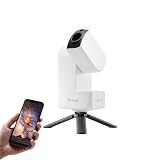
ZWO Seestar S30 Pro
- Dual-camera 4K imaging
- Automatic GoTo and tracking
- Built-in light pollution filters
- 3.6 pounds
All 10 Best Telescopes Under $1000 (October 2026)
Here is the master comparison. Aperture is listed in both millimeters and inches because every forum thread you will read uses inches. GoTo means a motorised mount or app that points the telescope for you.
| Product | Specs | Action |
|---|---|---|
| Gskyer 70mm AZ Refractor |
|
Check Latest Price |
| Celestron AstroMaster 130EQ |
|
Check Latest Price |
| ZWO Seestar S30 Pro |
|
Check Latest Price |
 SVBONY SV503 80ED Refractor SVBONY SV503 80ED Refractor |
|
Check Latest Price |
 Celestron StarSense Explorer DX 130AZ Celestron StarSense Explorer DX 130AZ |
|
Check Latest Price |
 Celestron PowerSeeker 80EQ Celestron PowerSeeker 80EQ |
|
Check Latest Price |
 MEEZAA 150EQ Newtonian MEEZAA 150EQ Newtonian |
|
Check Latest Price |
 Koolpte 130EQ Newtonian Koolpte 130EQ Newtonian |
|
Check Latest Price |
 Koolpte 80mm Refractor Koolpte 80mm Refractor |
|
Check Latest Price |
 Sky-Watcher Classic 200 Dobsonian Sky-Watcher Classic 200 Dobsonian |
|
Check Latest Price |
Two quick reads of that table. Only one scope on this list is a Dobsonian, and it is also the only one above 150mm. Everything else sits between 30mm and 150mm, which is a huge difference in light gathering once you point them at a faint galaxy.
1. Gskyer 70mm Refractor – the Proven Family Starter
Gskyer Telescope, 70mm Aperture 400mm AZ Mount Astronomical Refracting Telescope for Kids Beginners – Travel Telescope with Carry Bag, Phone Adapter and Wireless Remote.
70mm aperture
400mm f/5.7 focal length
Altazimuth mount
Fully coated optics
Pros
- Leading seller with more than 22000 ratings
- Setup needs no tools
- Carry bag and phone adapter included
- Sharp and bright on the Moon and planets
Cons
- 70mm aperture gathers little light on faint deep-sky objects
- No motorized tracking so targets drift
- Short 400mm focal length limits high power
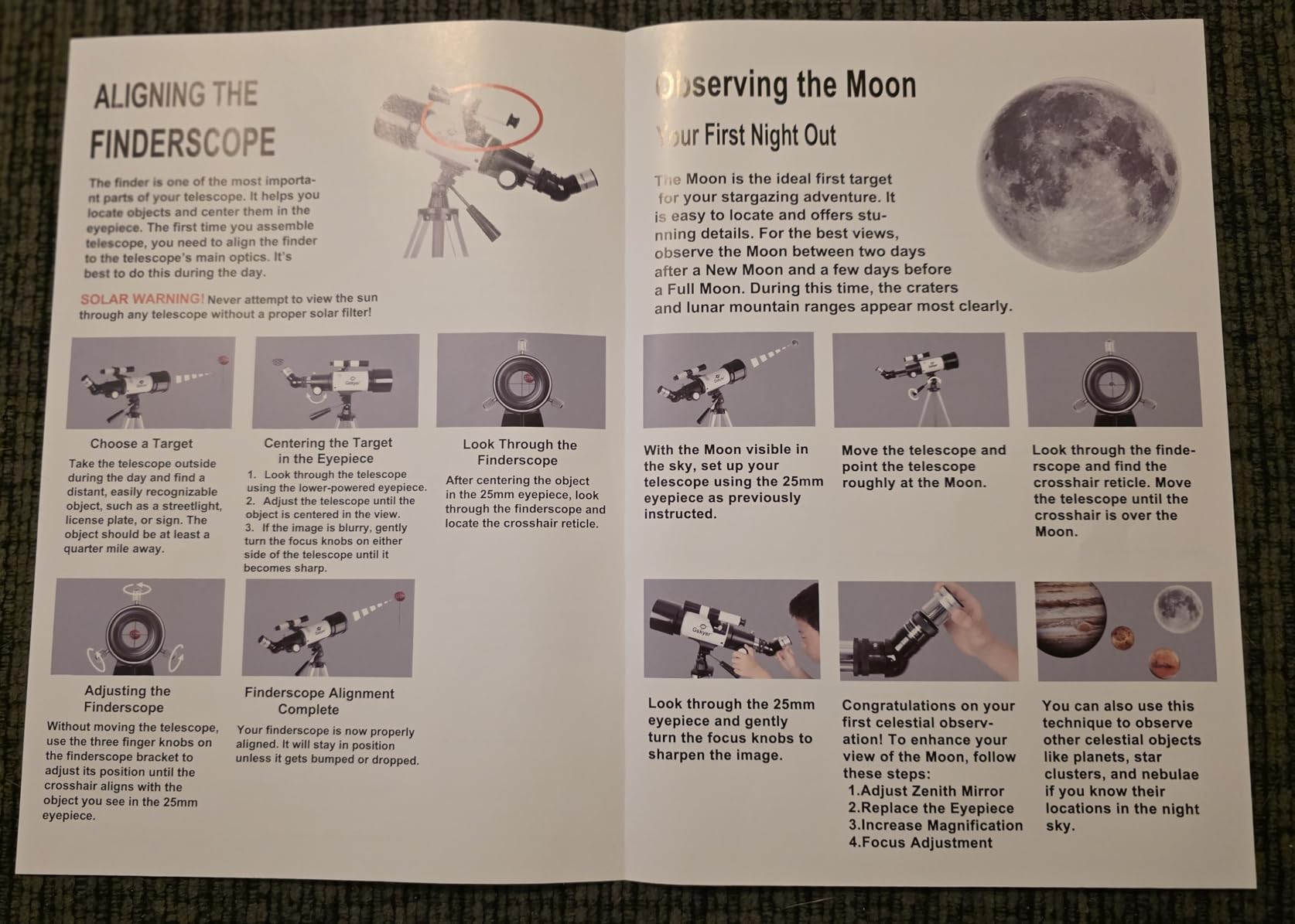
The Gskyer 70mm is a 70mm fully coated refractor on a simple altazimuth tripod, and its 400mm focal length makes it a wide, bright, forgiving instrument. It assembles without any tools, which is exactly the first-night experience a new owner needs.
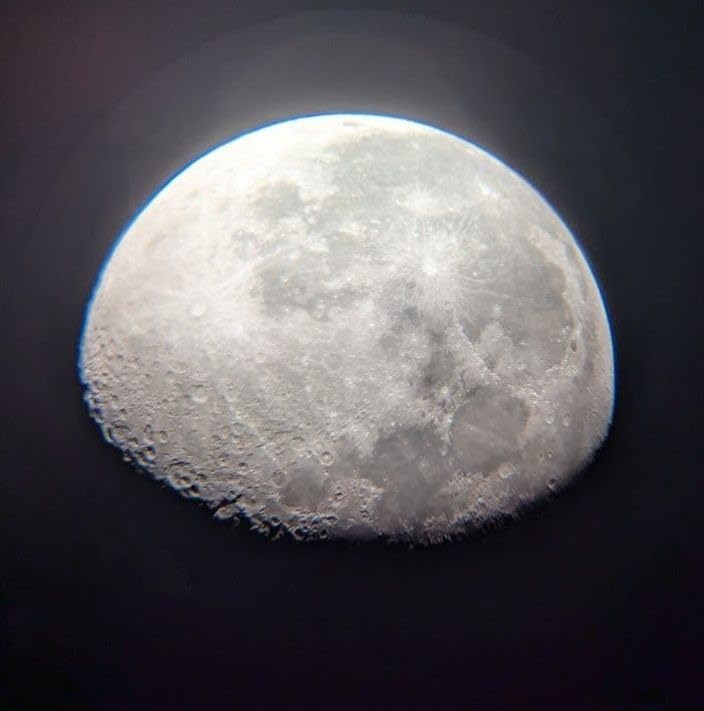
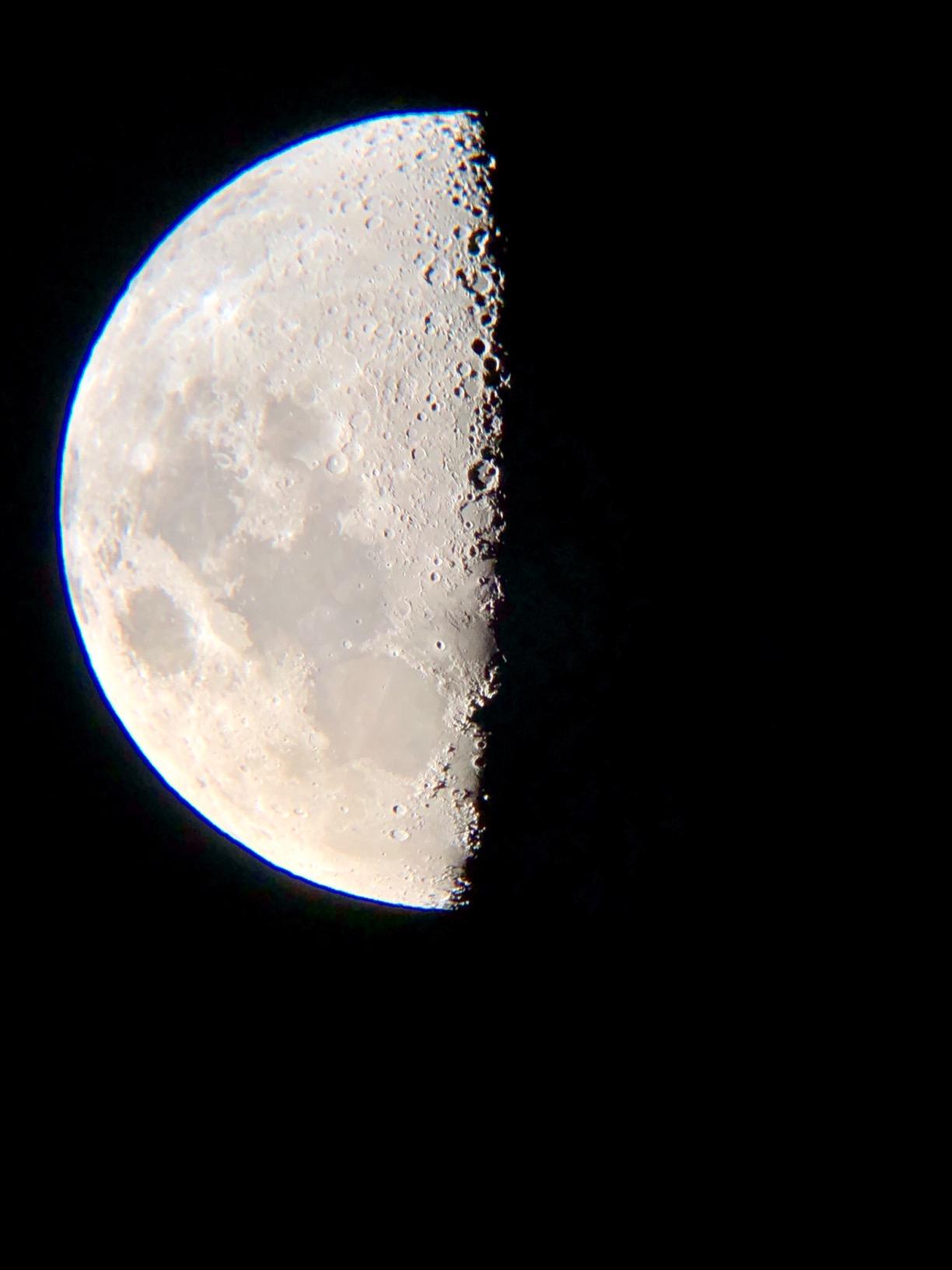
Through the supplied eyepieces the Moon is bright and detailed enough to show craters along the terminator, and Jupiter shows its four Galilean moons as clean points. Two eyepieces plus a 3x Barlow take you from low power up to the listed 120x, which is more than you will use on a beginner’s night out.
Reviewers consistently describe it as a keeper for kids and casual observers, with a 4.3 rating across more than 22,000 ratings and a leading position in the refractor category. The bundle is unusually complete for this class of scope: a 5×24 finder, a carry bag, a phone adapter and a wireless shutter remote.
The 5.8 degree field of view is genuinely wide, so clusters and the wider Moon views fit in one eyepiece. That forgiving field is a real advantage over longer scopes, where finding anything becomes a fight.
Who it suits best
This is the scope to buy for a child, a family, or anyone whose interest has to survive contact with a real first session. To find out if it is right for you, take it outside once.
It also works as a grab-and-go travel scope. Reviewers mention using it from campsites and balconies, and the aluminum tripod and carry bag make that realistic rather than aspirational.
Who should skip it
Skip it if your target list is galaxies, nebulae and anything faint. A 70mm aperture is a modest light bucket, and reviewers report dim views on those targets compared with any reflector in this list.
It also has no motorized tracking, so higher-magnification targets drift out of the field within a few minutes. If planetary detail is your goal, look at a longer focal length instead.
2. Celestron AstroMaster 130EQ – Best Balance of Aperture and Mount
Celestron AstroMaster 130EQ Telescope for Deep-Sky Beginners
130mm aperture
650mm focal length
German equatorial mount
17 pounds assembled
Pros
- Aperture far larger than any refractor here
- Equatorial mount tracks drifting targets well
- Tool-free assembly in under an hour
- 20mm and 10mm eyepieces plus software
Cons
- Light tripod vibrates when bumped
- Needs periodic collimation and a laser collimator
- Not usable for astrophotography as shipped
This is a 130mm Newtonian reflector on a German equatorial mount, and it is the telescope we would build a first observing night around. A 130mm aperture is 60mm wider in diameter than the Gskyer above, which means more than three times the light gathering for a comparable outlay.
The equatorial mount is the part most beginners do not understand and most owners end up loving. Once you set the scope level and point the axis at the pole, the slow-motion knobs on both axes let you nudge a planet or a galaxy back to center as it drifts.
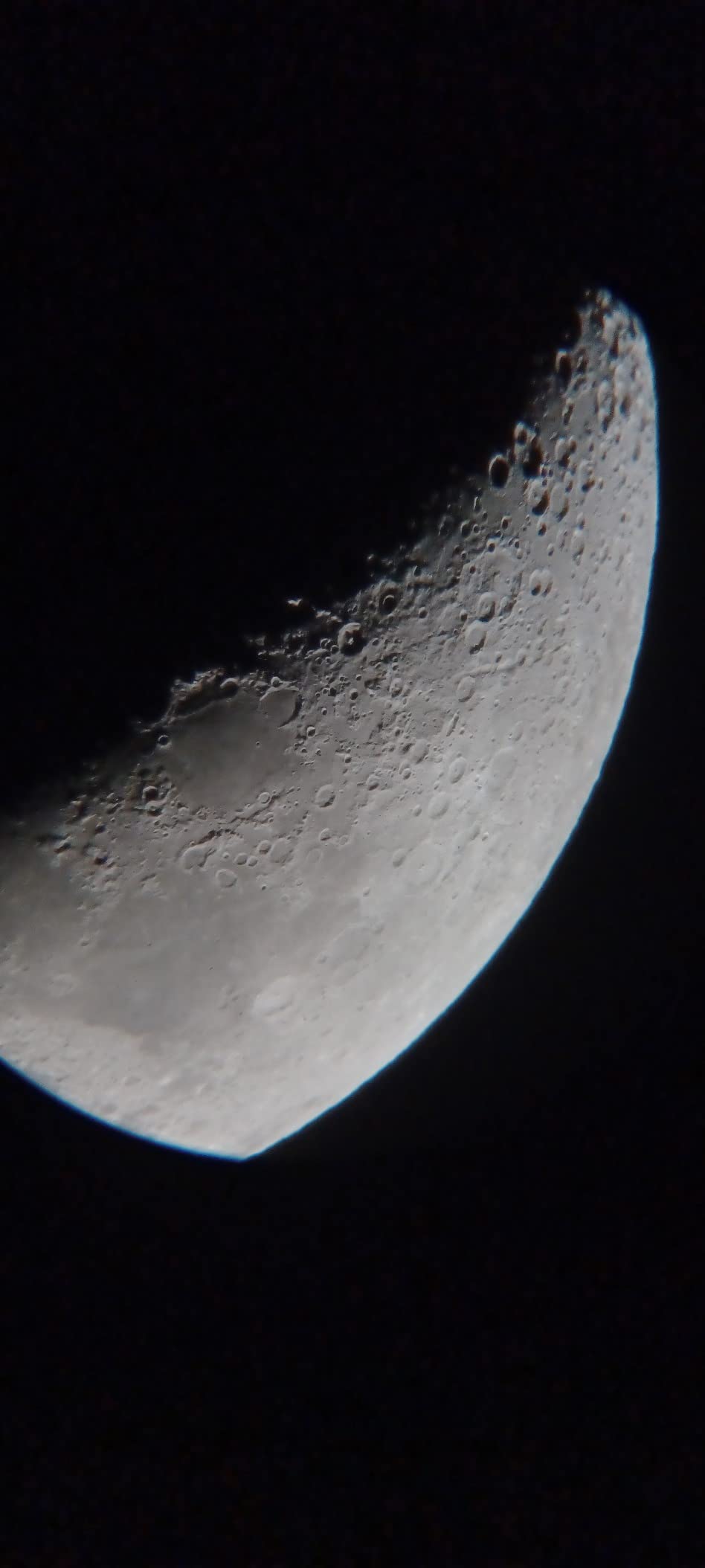
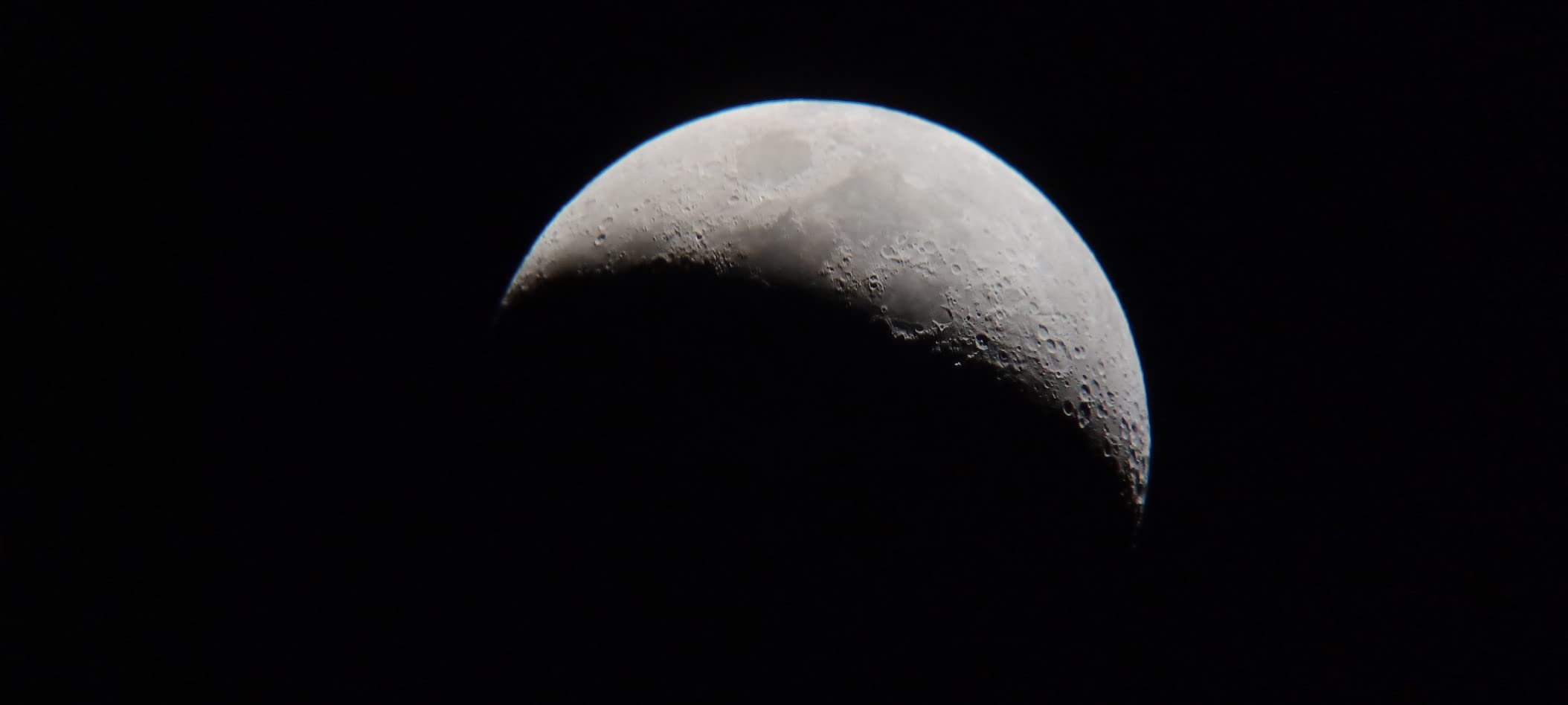
Owners report crisp views of lunar craters, Jupiter’s moons and Saturn’s rings, and a 4.3 rating across 3,444 ratings. Assembly is tool-free and typically under an hour, which matters when you are assembling it in the dark for the first time.
You also get a StarPointer red dot finder, a 20mm eyepiece with an erect image corrector, a 10mm eyepiece, and a free download of planetarium software. The aluminum and SiO2 mirror coatings are the standard for a scope at this level.
Who it suits best
This is the first telescope we would put in an adult beginner’s hands who wants to grow. There is real headroom here: better eyepieces, a laser collimator and later a sturdier tripod all upgrade this scope without replacing it.
It is also the right call for families who plan to keep the telescope. The 130mm aperture shows the Orion Nebula, Andromeda and a decent number of globular clusters from a decent backyard.
Who should skip it
Do not buy it for astrophotography. Reviewers are blunt that it is a visual-only instrument without modification, and the rack-and-pinion focuser makes long exposures impractical.
Watch the weight. At 17 pounds assembled it is not a one-hand carry, and the light steel tripod is the weak link – reviewers note visible vibration if the legs are bumped.
3. ZWO Seestar S30 Pro – Best Smart Scope for City Skies
ZWO Seestar S30 Pro Smart Telescope, App-Controlled Astrophotography
30mm aperture
160mm focal length
3.6 pounds, battery powered
App GoTo and tracking
Pros
- Works straight from a phone with no polar alignment
- Built-in light pollution filters for urban skies
- Dual-camera 4K imaging stacks automatically
- Anti-dew protection for long sessions
Cons
- Imaging platform only
- not built for planetary viewing
- 30mm aperture limits faint targets
- Device must stay put during imaging
The Seestar S30 Pro is a different kind of purchase. It is a 30mm fully multi-coated apochromatic optic with a dual-camera system, an alt-azimuth mount that also supports equatorial mode, and a phone app that does the pointing, the tracking and the processing.
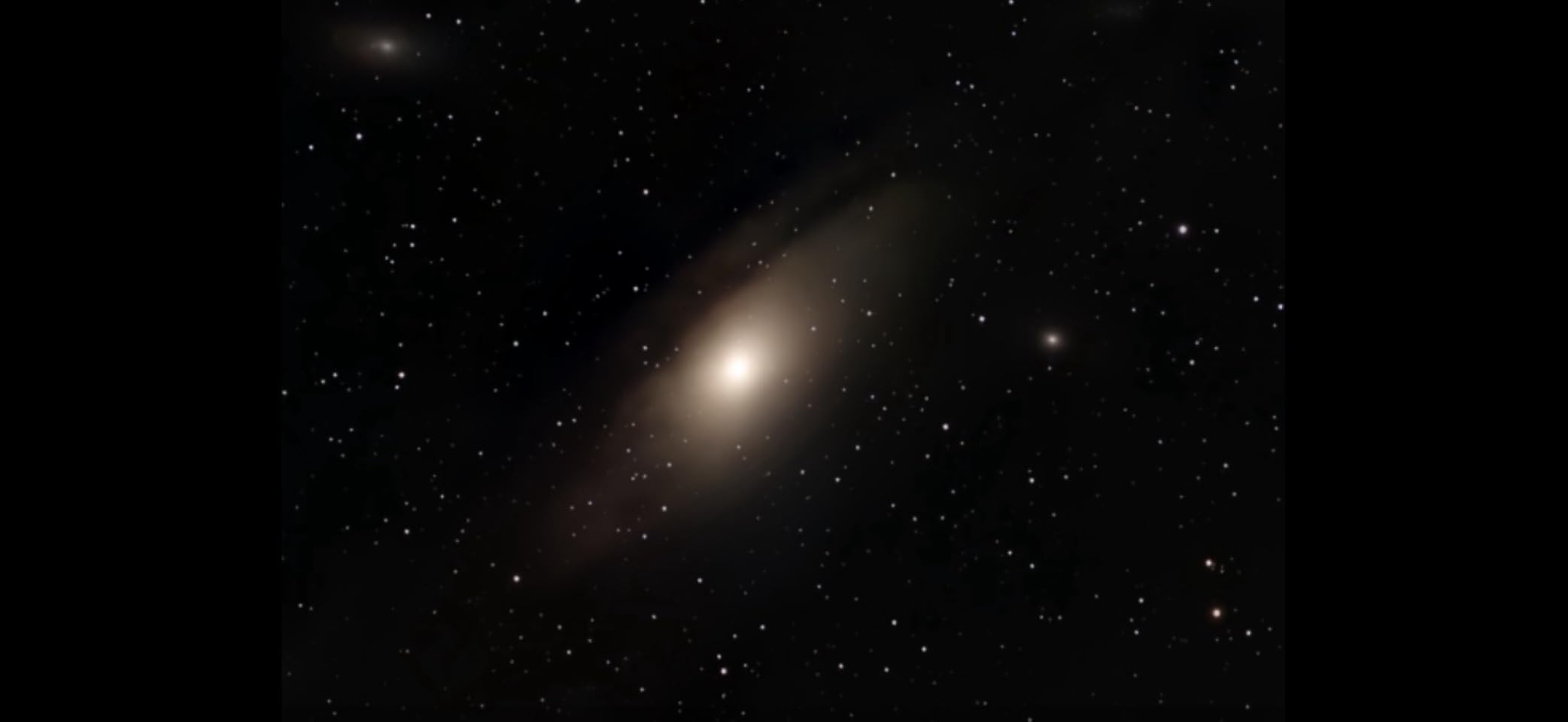
You power it on, connect the app and press one button. No polar alignment, no star charts, no eyepiece to change. The app offers one-tap capture modes for the Milky Way, star trails, nebulae, galaxies, the Moon and the Sun, with automatic mosaic stitching for wide targets.
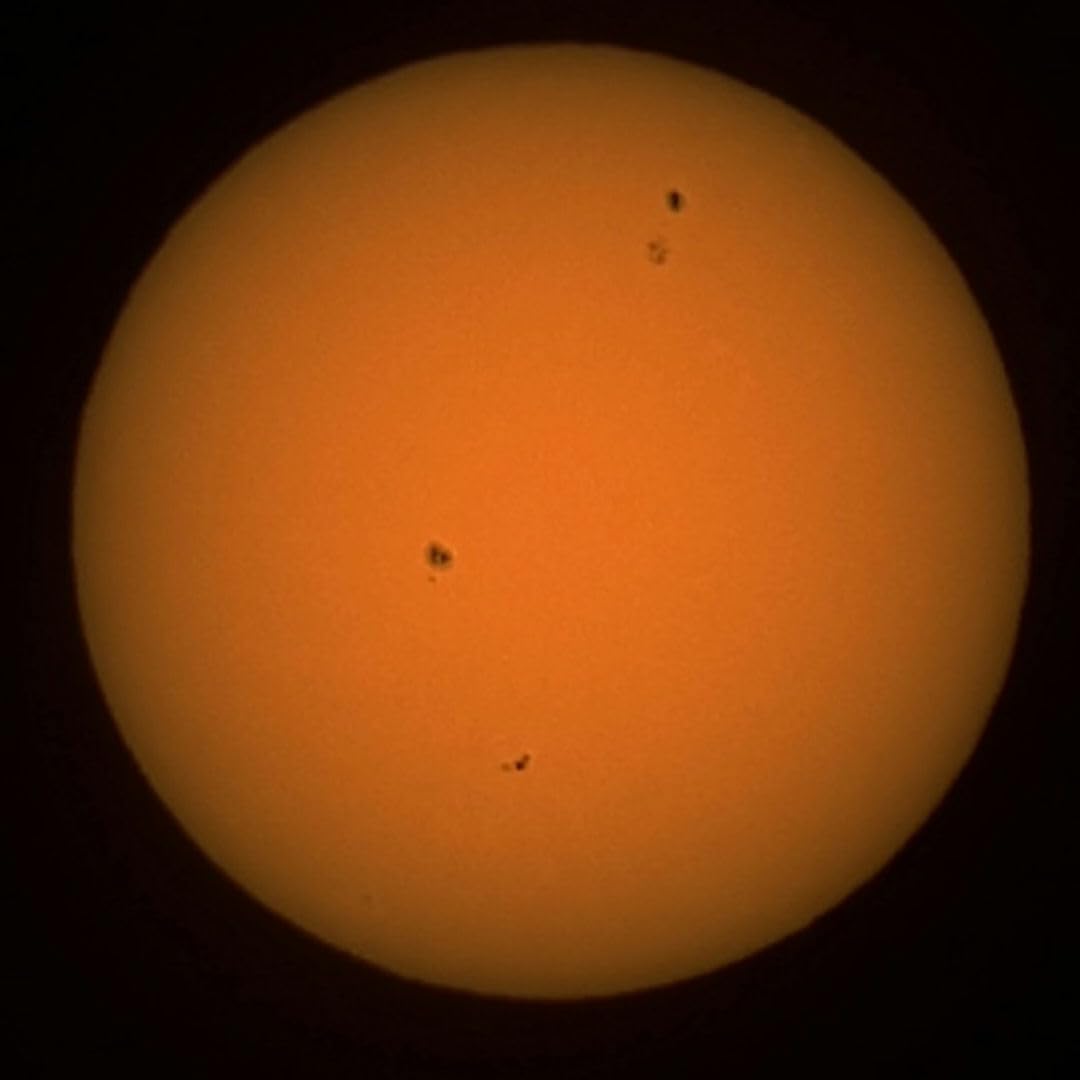
Reviewers are split into two camps and honest about it. The imaging crowd loves the near-zero learning curve and the accuracy of the automated GoTo, with a 4.4 rating and 76 percent of reviewers at five stars. The visual crowd points out the 30mm aperture and says this is not the scope to look through.
Because it weighs just 3.6 pounds and runs on battery power, it moves easily between rooms and out to a dark site. Anti-dew protection means it can stay outside through a full night.
Who it suits best
It suits someone who wants photographs of the night sky, not just a look through an eyepiece. Stacking, denoising and sky separation are all handled by the app, so a beginner with a tripod-free backyard can get a usable image of a nebula in minutes.
It is also a strong apartment option here. Built-in light pollution filters and one-tap sky separation are specifically aimed at bright urban skies.
Who should skip it
Skip it if you want to see planets. The maker’s own guidance is that it is designed for deep-sky and wide-field imaging, and reviewers agree that high-resolution planetary work is not its strength.
It also depends entirely on app software, so a firmware bug can limit function, and the unit has to stay stationary through long imaging sessions. A 30mm aperture is small for faint targets, full stop.
4. SVBONY SV503 80ED – Best for Astrophotography on a Budget
SVBONY SV503 Upgraded ED Refractor Telescope, 80mm F7 with Field Flattener
80mm aperture
560mm f/7 focal length
Optical tube only, 5.5 pounds
0.8x reducer and field flattener
Pros
- The strongest rating in the lineup at 4.6
- S-FPL51 ED glass cuts chromatic aberration
- 2 inch dual-speed focuser with fine adjustment
- Bundled flattener sharpens the field edge
Cons
- Optical tube only
- no mount or finder included
- Budget for a separate equatorial mount
- Built for imaging rather than casual visual use
The SVBONY SV503 is an 80mm f/7 refractor built from S-FPL51 ED glass, the extra-low-dispersion glass that keeps a violet fringe off bright stars. It carries the highest rating in this selection at 4.6, with 79 percent of reviewers at five stars and only 1 percent at one star.
It comes with the SV193 0.8x focal reducer and field flattener, which both speeds up the focal ratio for shorter exposures and flattens the corners of the frame edge to edge, plus a 2 inch dual-speed focuser with 1:10 micro-adjustment.
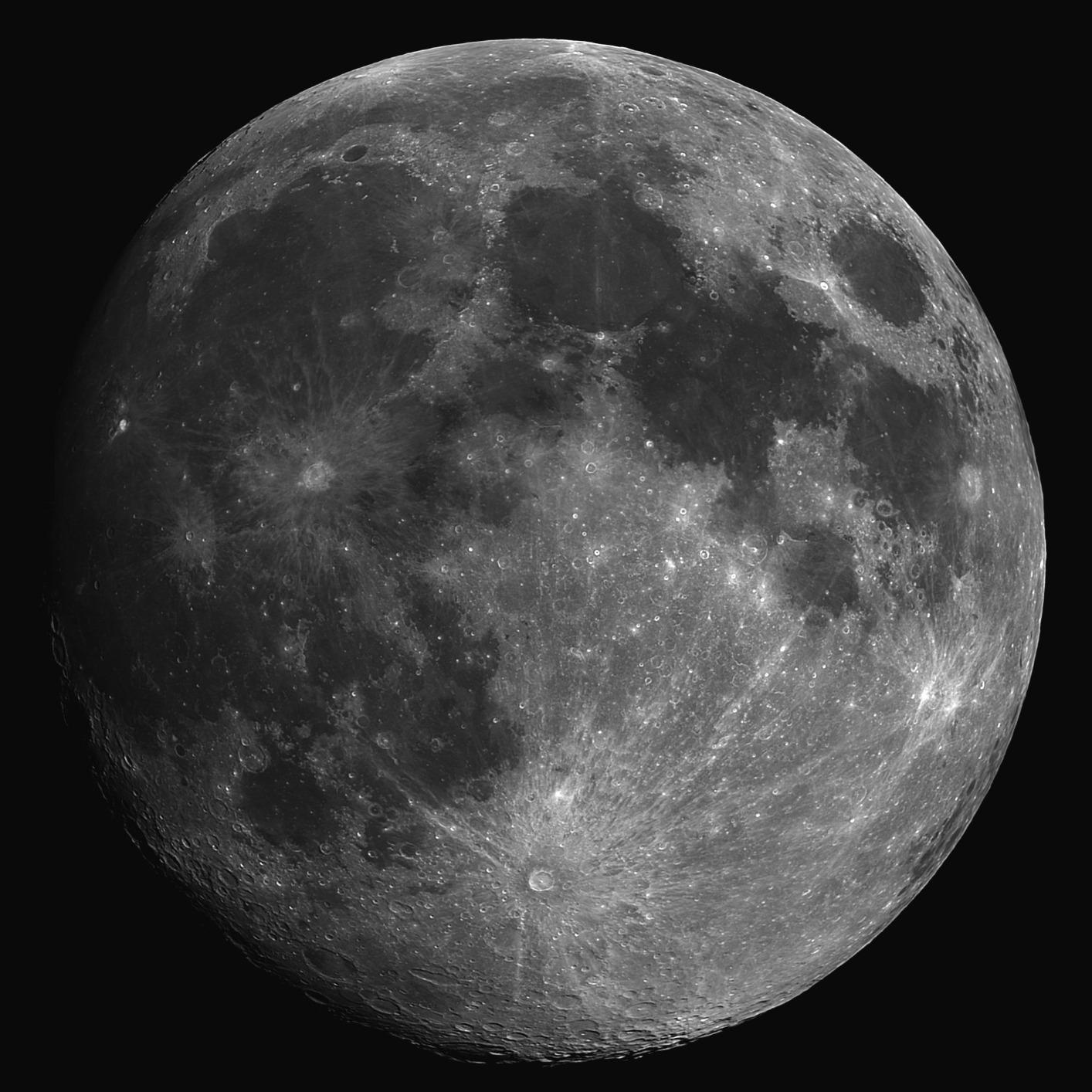
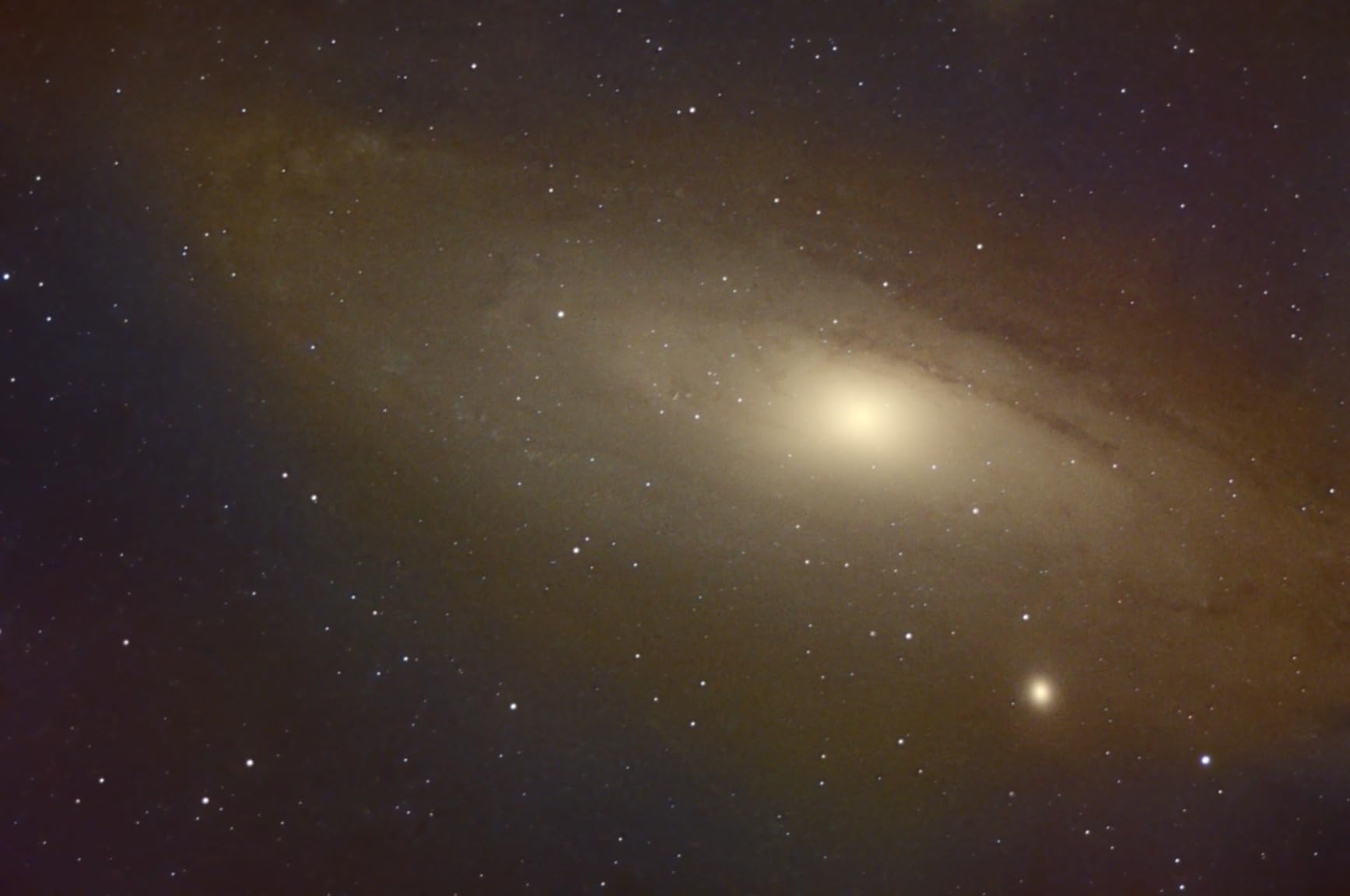
In use, the star field is sharp and free of colour fringing, and the flattener keeps stars pointed right out to the edge of a full-frame sensor. At 5.5 pounds the tube itself is light enough for almost any entry-level equatorial mount.
That flatness is the whole point. A standard achromatic refractor goes soft and shows colour at the edge of a wide field, and the reducer/flattener combination is what makes this tube worth a second look for imaging.
Who it suits best
It suits a beginner who has decided they want to photograph deep-sky objects and is willing to add one more purchase. Pair the tube with an entry-level equatorial mount and a camera, and you have a repeatable wide-field imaging rig for nebulae and star clusters.
It also suits visual observers who care about star colour. ED glass gives noticeably cleaner, higher-contrast stars than an achromat of similar size.
Who should skip it
Skip it if you want a complete, working telescope on the day it arrives. This is an optical tube assembly only: no mount, no finder, no tripod. The listing figure is not the cost of the system you would actually use.
Skip it too if you just want to look at the Moon. There is no tripod, and reviewers note limited value for pure visual use at that point.
5. Celestron StarSense Explorer DX 130AZ – Best Phone-Guided Scope
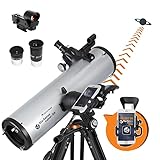
Celestron StarSense Explorer DX 130AZ Smartphone Guided Newtonian Telescope
130mm aperture
650mm focal length
StarSense app alignment
18 pounds assembled
Pros
- Phone-guided pointing gets targets in the field fast
- App includes descriptions and audio commentary for beginners
- Works well under heavy light pollution
- 130mm aperture shows the Moon
- planets and Orion
Cons
- Tripod and mount are flimsy under an 18 pound tube
- Phone holder neck vibrates in wind
- Tube clearance limits high-altitude viewing
The StarSense Explorer DX 130 pairs a 130mm Newtonian with a phone app that recognises the sky above you and works out where the telescope is pointing. You mount your phone, open the app, and it plate-solves the position before showing you a curated list of tonight’s best targets.
That removes the single most common reason beginners think a telescope is broken: not being able to find anything. Experienced observers and outreach volunteers in the reviews rate the plate-solving as more consistent than some motorised GoTo mounts, and it works from an urban backyard.
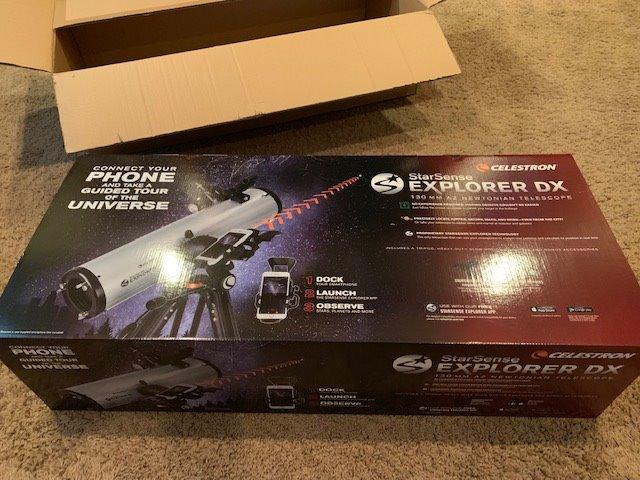
The app also carries object descriptions, observing tips and audio commentary, which turns it into a guided tour rather than just a pointing tool. Two eyepieces at 26x and 65x, a red dot finder and a two-year warranty complete the package.
Assembly is documented clearly and takes about 30 minutes. The mount is manual altazimuth with dual-axis slow-motion controls, so there are no batteries and nothing to charge.
Who it suits best
It suits people who want a real telescope and refuse to learn star hopping. The 130mm aperture still shows the Moon, Jupiter, Saturn, the Orion Nebula and Andromeda, and the app tells you what you are looking at while you look at it.
It is a genuinely good outreach scope too, since the guided mode lets you show a group what a galaxy looks like without spending the night hunting for it.
Who should skip it
Its 4.1 rating is the lowest among the Celestron scopes here, and the reason is durability rather than optics. Reviewers report leg-tightening knobs snapping, loose primary mirror screws and a passing car visibly shaking the scope.
The flexible plastic phone-holder neck vibrates in light wind, which makes steady viewing hard, and tube clearance against the tripod limits you to roughly 65 to 70 degrees of altitude. Not for astrophotography.
6. Celestron PowerSeeker 80EQ – Best Long-Focal-Length Refractor
Celestron PowerSeeker 80EQ Refractor Telescope for Moon & Planet Viewing
80mm aperture
900mm focal length
German equatorial mount
16.4 pounds assembled
Pros
- Longest focal length refractor here
- ideal for Moon and planets
- Slow-motion rod makes drifting targets easy to follow
- Two eyepieces plus a 3x Barlow and software
- Compact enough for a campsite or dark-sky trip
Cons
- 80mm aperture limits faint deep-sky targets
- Polar alignment has a learning curve
- No motorized tracking in this configuration
The PowerSeeker 80EQ is a 900mm focal length refractor, and that long tube is the point. Focal length is what sets magnification at a given eyepiece, and a long one makes small targets like Saturn, Mars and lunar craters look bigger without sacrificing brightness.
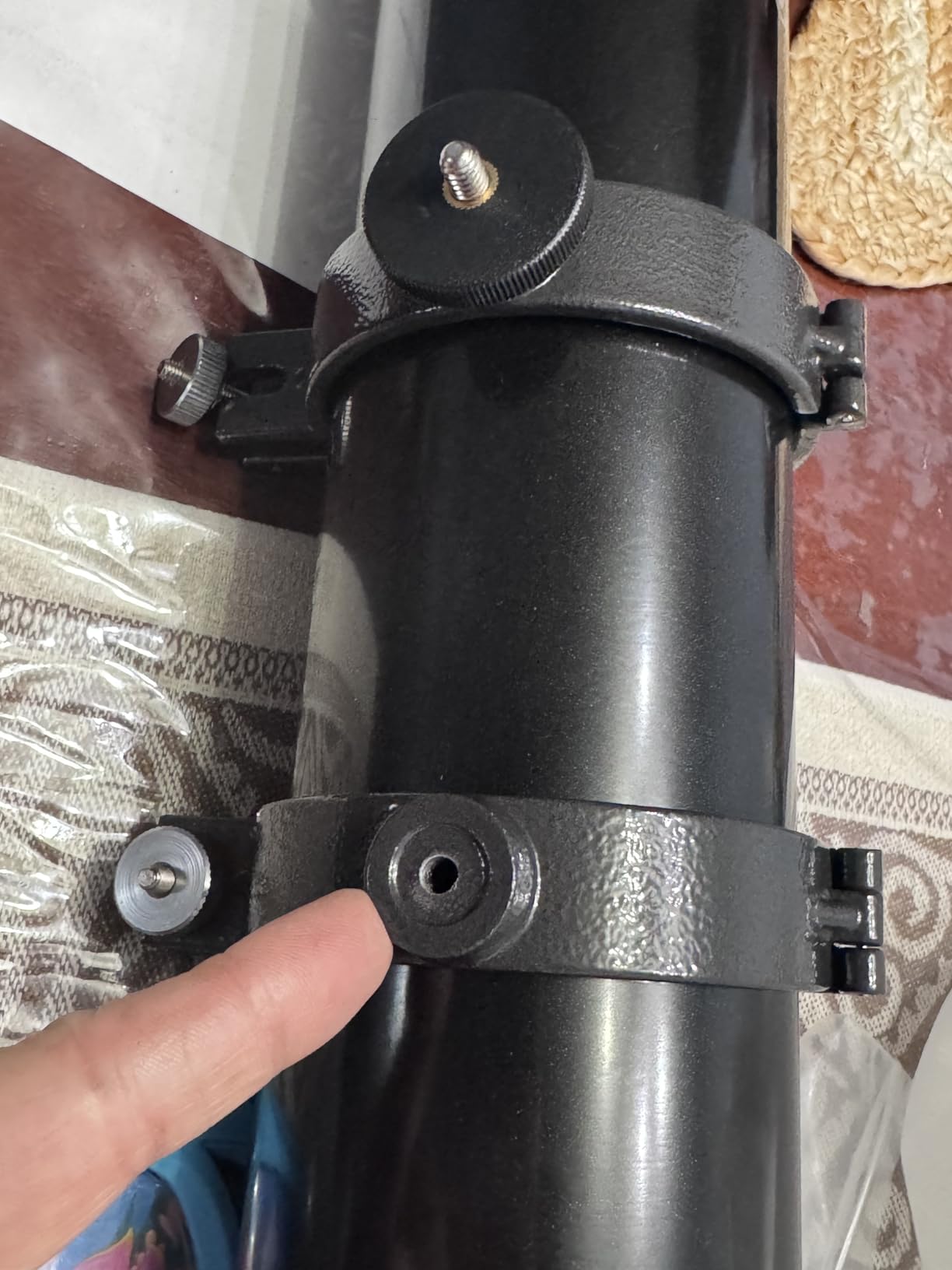
It sits on a manual German equatorial mount with a slow-motion altitude rod, so once you have polar aligned it, a gentle push of the rod keeps a planet parked in the middle of the field. The bundle includes 20mm and 4mm eyepieces, a 3x Barlow and free planetarium software with 36,000 objects.
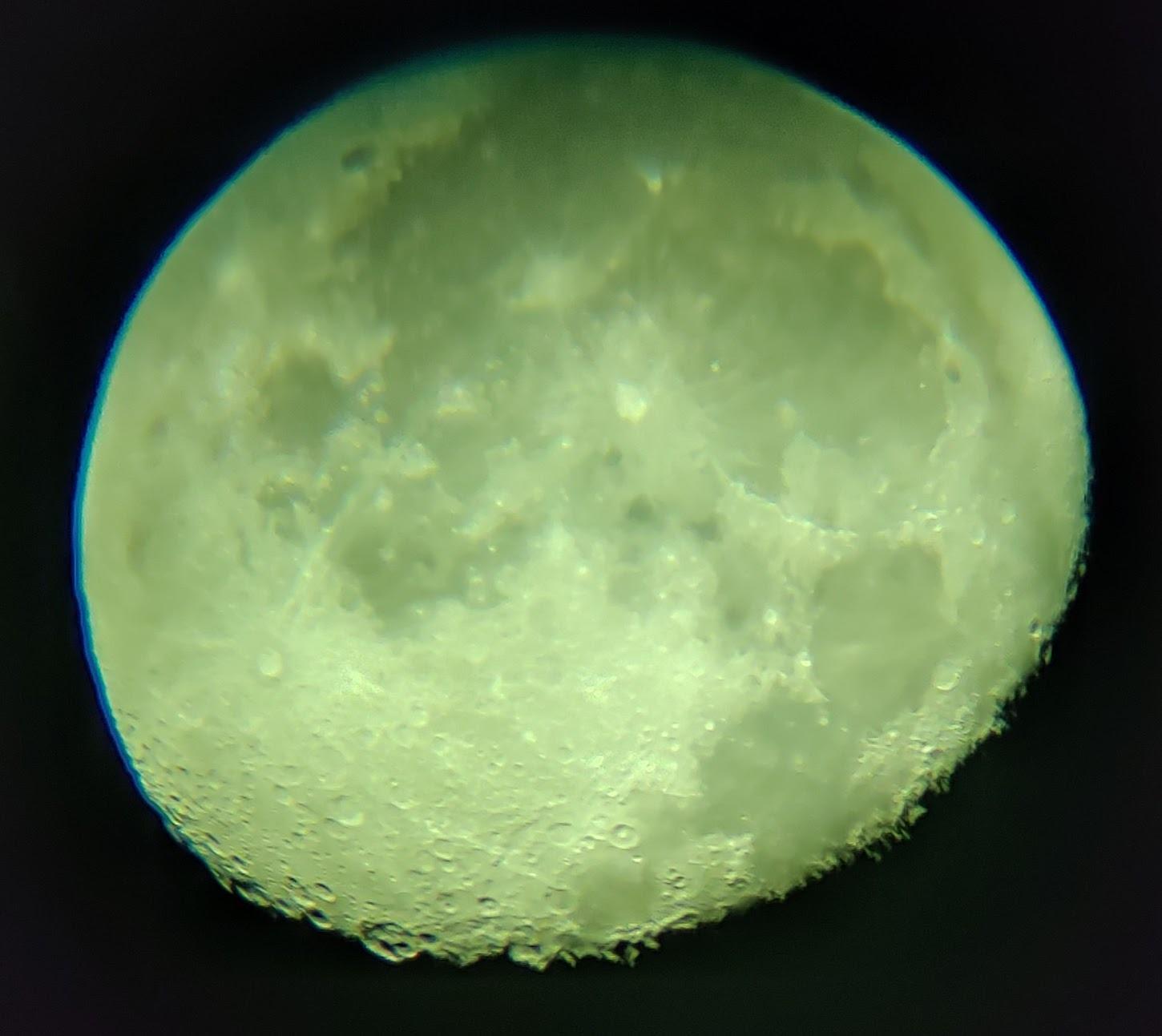
Owners report sharp, high-contrast lunar and planetary images, and a 4.3 rating across 1,022 ratings. At 16.4 pounds it is compact enough to travel with, which is a real advantage over the bigger reflectors.
Refractors need no collimation, ever. That is a genuine convenience: there is no adjustment to make after a bump, no laser collimator to buy and no reason to learn a new skill before the first night out.
Who it suits best
It suits someone whose list is the Moon, the planets and a few bright clusters. At 900mm it is the longest refractor in this lineup, so it delivers the biggest images of small targets here.
It is also a good fit for a family that will use it on a balcony in the city. The equatorial mount and long tube reward a patient owner with steady views.
Who should skip it
Skip it if deep-sky objects are the goal. Reviewers are clear that 80mm of aperture limits resolution and light gathering on nebulae and galaxies, and a reflector of similar outlay shows considerably more.
Also know what you are buying: polar alignment takes practice, and this configuration has no motorised tracking option. A bumped tripod still produces vibration.
7. MEEZAA 150EQ Newtonian – a Complete Kit in One Box
MEEZAA Telescope, 150EQ Newtonian Reflector Telescope for Adults Astronomy Beginners, Professional Astronomical Telescopes with Equatorial Mount, Tripod, Phone Adapter, Moon Filter and Large Carry Bag
150mm listed aperture
650mm focal length
German equatorial mount
Red dot finder and moon filter
Pros
- A large 150mm listed aperture for a modest outlay
- A long accessory bundle in one box
- Stainless steel tripod with accessory tray
- Arrives pre-lubed and usually collimated
Cons
- Listed 150mm aperture measured by one reviewer at 130mm
- Assembly has more parts than simpler scopes
- Included Kellner eyepieces are entry level
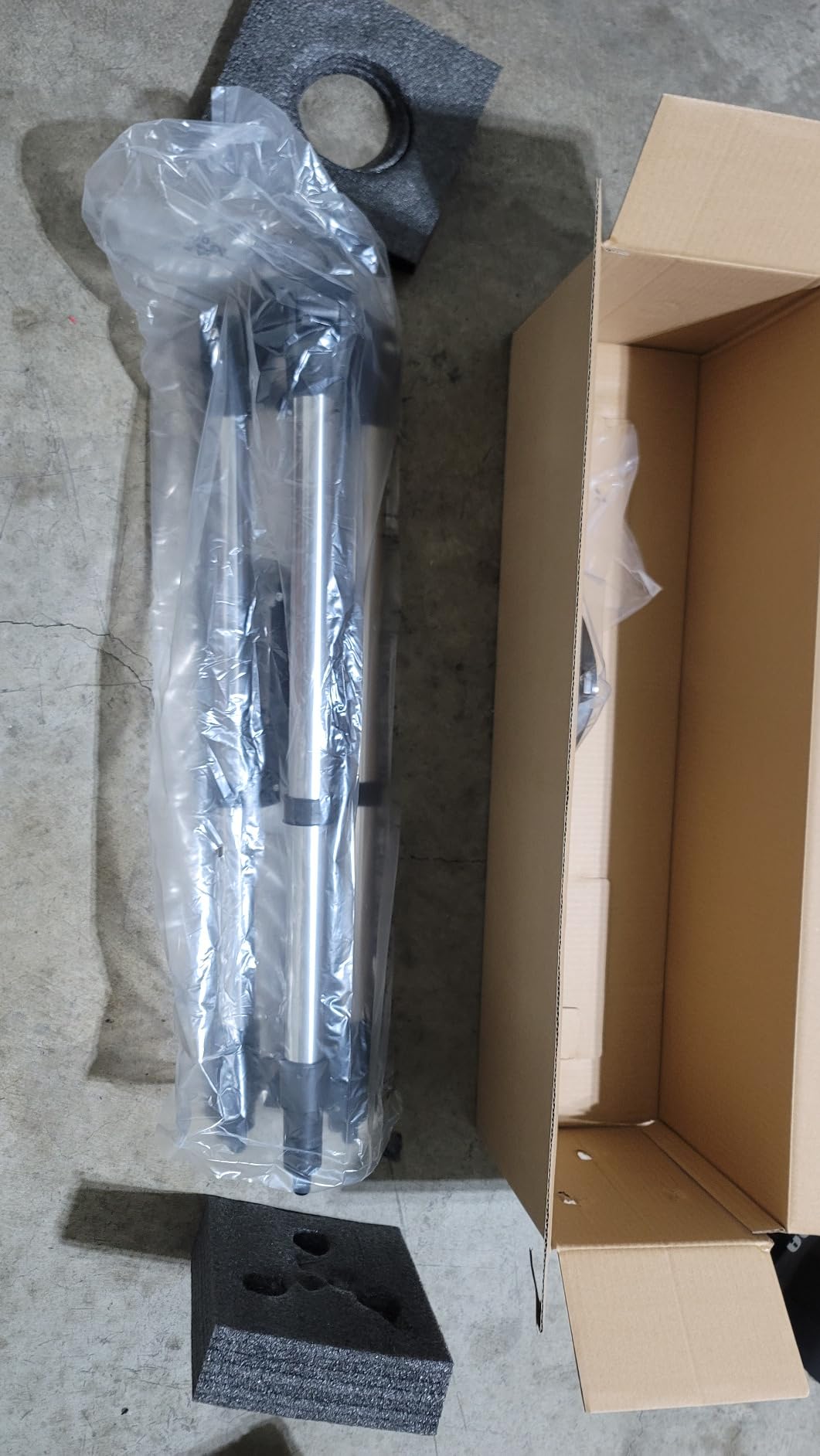
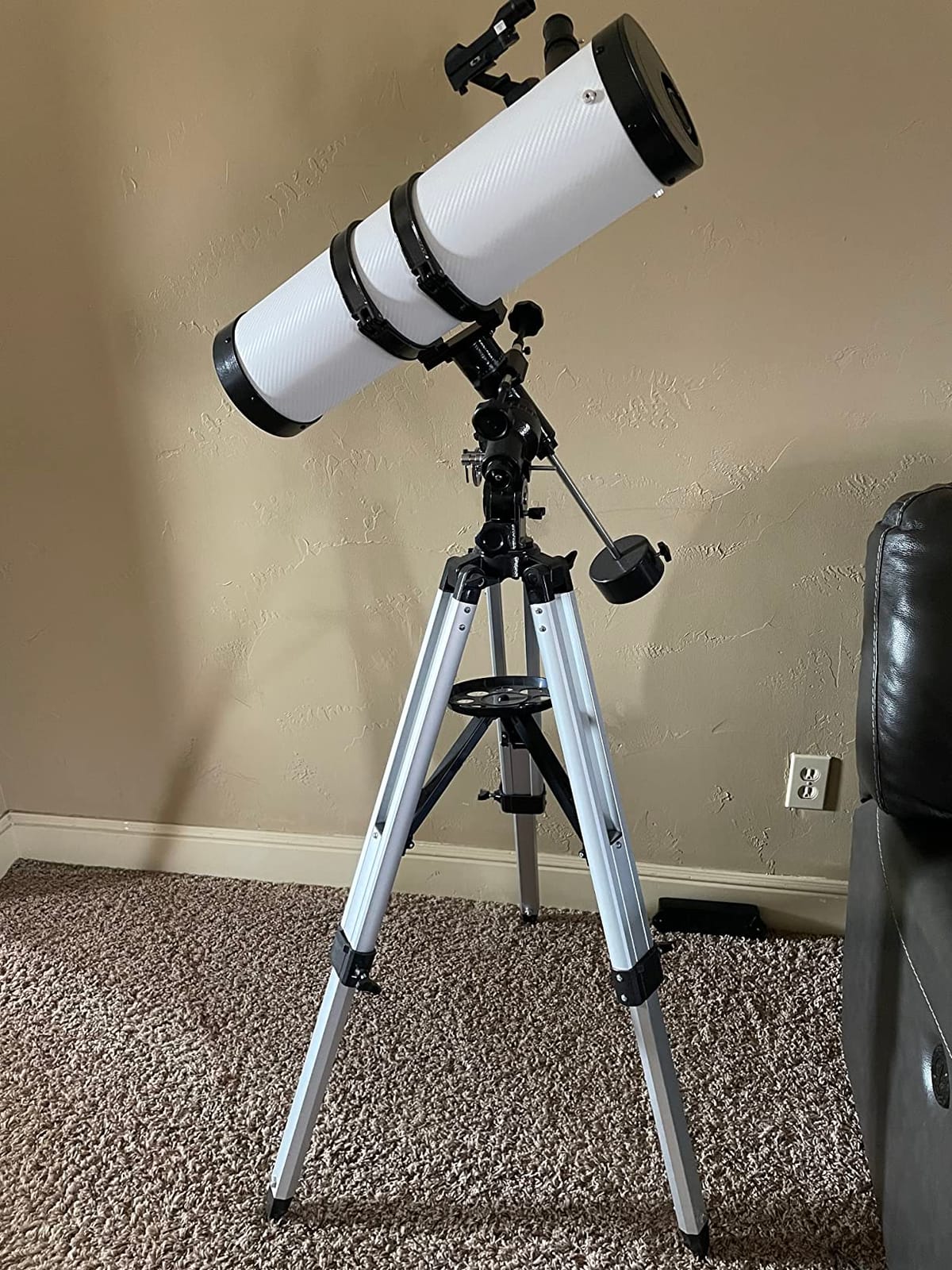
The MEEZAA 150EQ is a Newtonian reflector listed at a 150mm aperture and 650mm focal length on a German equatorial mount, and it is among the most generously bundled scopes in this list. It comes with two eyepieces, a 2x Barlow, a red dot finder, a moon filter, a phone adapter and a large carry bag.
At 26x to 130x magnification, owners report bright views of the Moon, planets and deep-sky objects even under light pollution, with a 4.4 rating and 72 percent of reviewers at five stars. The stainless steel tripod and accessory tray feel a step up from the light legs on budget reflectors.
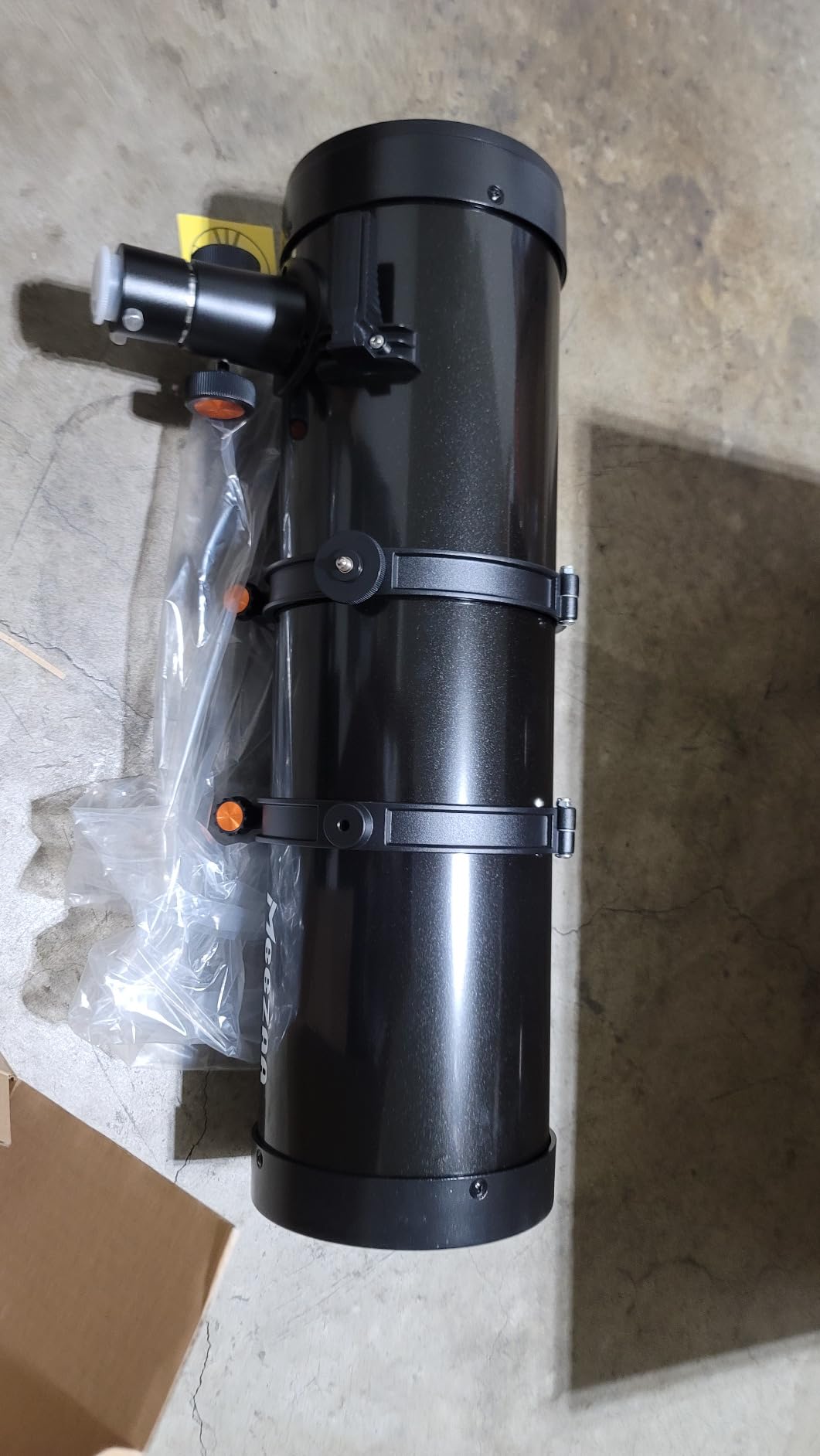
One practical detail worth checking before a budget buy: the tube arrives pre-lubed and usually collimated, so a first-time owner can open the box and observe rather than start a collimation lesson. The smooth gimbal also makes target changes fluid.
The one serious complaint in the reviews is an accuracy issue rather than a quality issue. At least one reviewer measured the primary mirror at 130mm rather than the advertised 150mm, which would make it optically equivalent to the AstroMaster above.
Who it suits best
It suits a buyer who wants one box to contain everything. If you would rather not research a second eyepiece, a moon filter and a finder before your first night, this removes that friction entirely.
It also suits someone upgrading from a 70mm refractor who wants a visible step change in brightness. The moon filter makes long sessions on the Moon far more comfortable.
Who should skip it
Measure the mirror if aperture matters to you. The advertised figure and one reviewer measurement disagree, and that detail is exactly what a careful buyer should not gloss over.
Assembly is more involved than an altazimuth scope, and it is heavy once built – reviewers note it can tip if moved carelessly. The included Kellner eyepieces are the first thing most owners upgrade.
8. Koolpte 130EQ – Best Budget Newtonian Kit
Koolpte 130EQ Reflector Telescope, 130mm Aperture, EQ Mount
130mm aperture
650mm focal length
Equatorial mount with slow-motion cables
Complete accessory kit
Pros
- 4.5 rating with 76 percent five-star
- 130mm aperture gives bright
- detailed lunar views
- Complete kit with eyepieces
- Barlow/moon filter and phone adapter
- Equatorial tracking via slow-motion cables
Cons
- Instructions are sparse and assembly is a challenge
- One reviewer received a unit with a loose secondary mirror
- Counterweight is too heavy and causes imbalance
- Included Kellner eyepieces are entry level
The Koolpte 130EQ is a 130mm fully multi-coated XLT Newtonian on a manual equatorial mount with slow-motion control cables, and at 4.5 stars with 76 percent five-star ratings it is one of the better-regarded budget reflectors here. The cables let you track an object across the sky without losing it in the field.
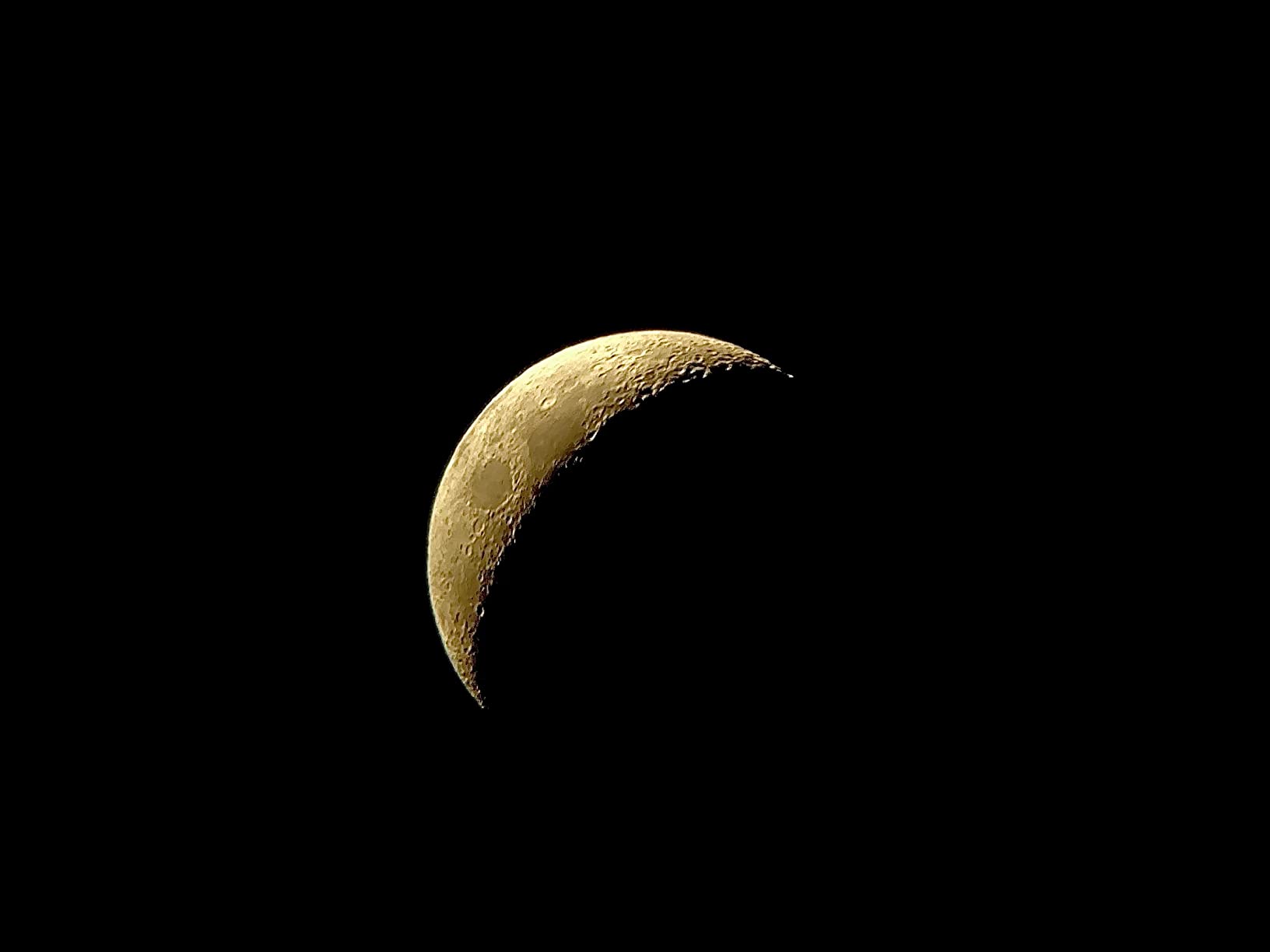
The kit contents are unusually long: a 25mm and a 6.5mm eyepiece, a 2x Barlow, a red dot finder, a moon filter, a phone adapter, a wireless remote and a printed manual. Observers report crisp lunar craters, visible Saturn’s rings and four of Jupiter’s moons.
Full multi-coated XLT glass on the mirrors is a step up in transmission from single coating, and that shows as a brighter image on dim targets such as the Orion Nebula or a globular cluster from a suburban backyard.
Our main reservation is documentation. Several reviewers describe thin or confusing instructions and a steep first-assembly curve, and one received a unit with a loose secondary mirror that needed laser collimation out of the box.
Who it suits best
It suits a first-time owner who wants real aperture and equatorial tracking at a budget price. The 130mm opening gathers about 1.7 times the light of a 100mm scope, and for lunar and planetary work that difference is obvious.
It is also a good starter if you plan to grow. Better eyepieces, a collimator and a sturdier tripod all fit later without replacing the whole instrument.
Who should skip it
Skip it if assembly alone would put you off. The reviews are consistent on this: budget an evening, find the manual on video if the printed one is thin, and check the secondary mirror bolts on arrival.
Watch the counterweight. Reviewers note it is too heavy and can upset the balance if you do not take it off, and the included Kellner eyepieces are the obvious first upgrade.
9. Koolpte 80mm Refractor – an Affordable All-Rounder
Koolpte Telescope for Adults & Beginner Astronomers – 80mm Aperture 600mm Fully Multi-Coated High Transmission Coatings with AZ Mount Tripod Phone Adapter, Carrying Bag, Wireless Control.
80mm aperture
600mm f/6.7 focal length
Altazimuth mount
Fully multi-coated optics
Pros
- Fully multi-coated 80mm optics at an entry-level outlay
- Two eyepieces plus a 3x Barlow
- No-tool setup that beginners manage unaided
- Phone adapter and remote with a carry bag
Cons
- 80mm aperture makes faint deep-sky objects dim
- No tracking
- so targets drift quickly
- Softness at higher powers
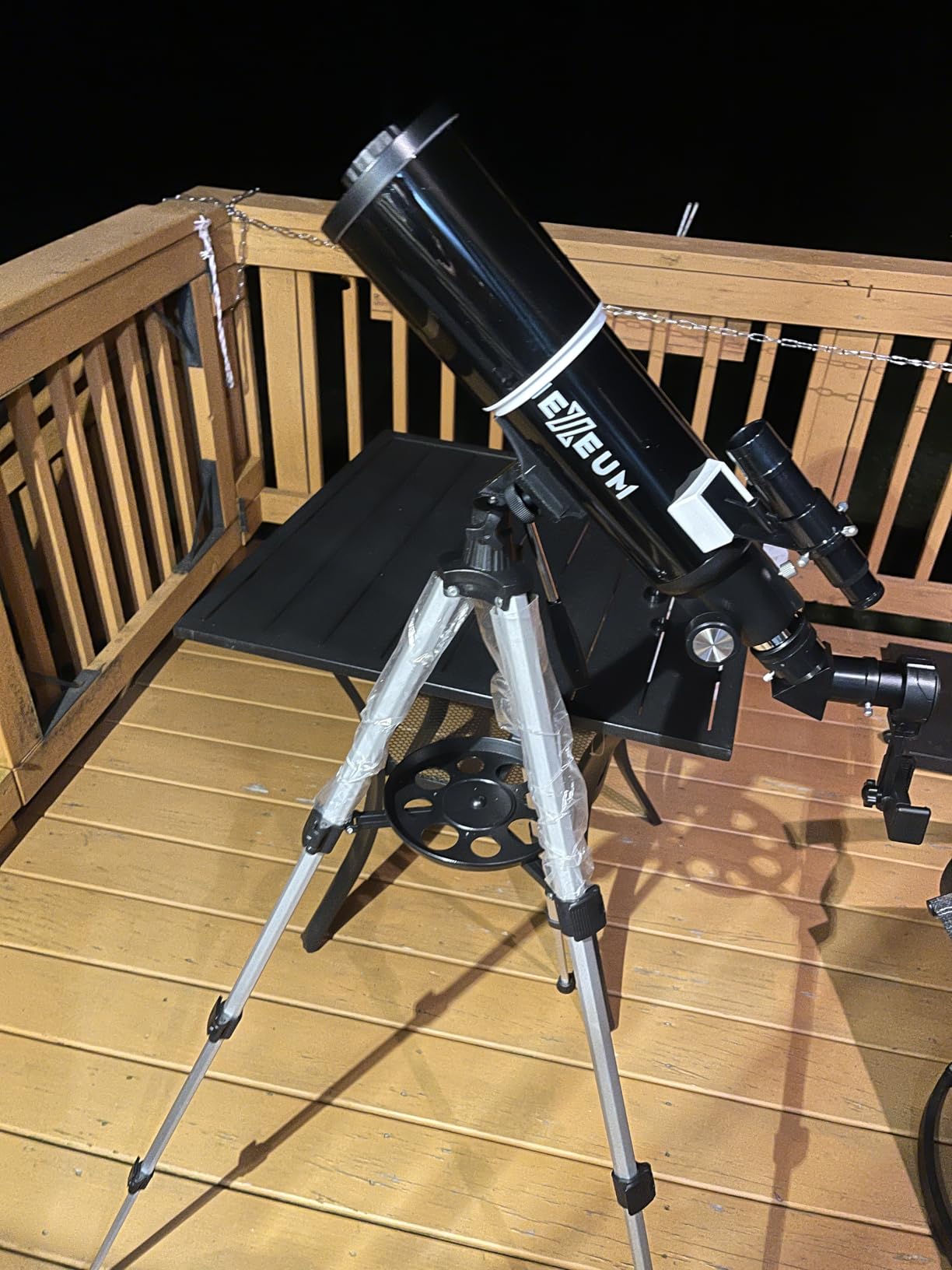
The Koolpte 80mm is a fully multi-coated 80mm refractor at 600mm focal length on a plain altazimuth tripod, and it carries more than 3,900 ratings from buyers. It is among the most affordable scopes here and still produces a genuinely sharp image.
You get 25mm and 10mm eyepieces for 24x and 60x, a 3x Barlow that triples both, a 5×24 finder, a phone adapter, a wireless remote and a carrying bag. Setup needs no tools and the aluminum tripod adjusts in height.
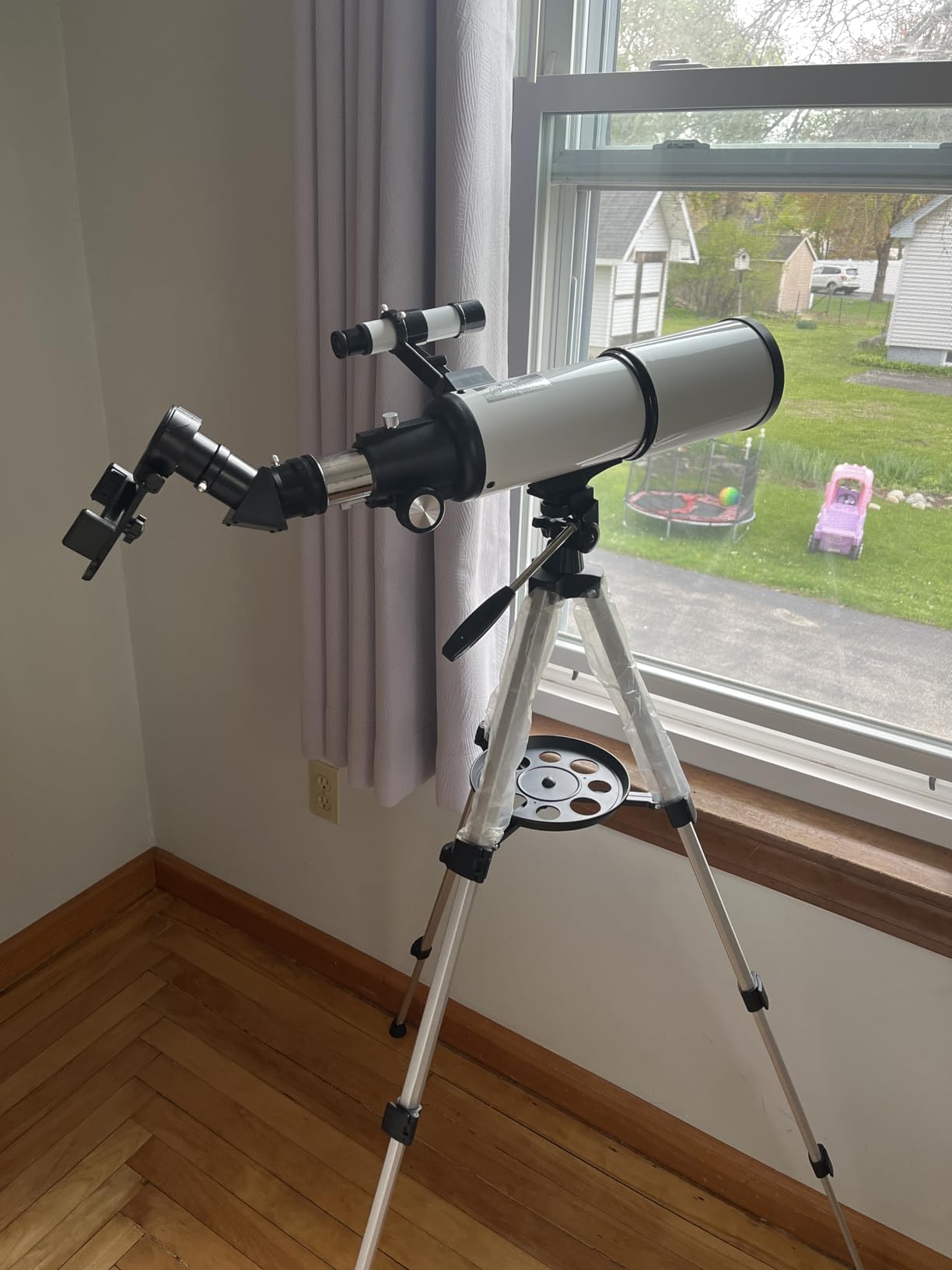
In the field, the multi-coating gives a bright, clear image and a 5 degree field of view, which makes locating targets straightforward for a beginner. The rating spread matches the category norm, with 67 percent at five stars.
Think of the 3x Barlow carefully. It gets you to a listed 180x, but the usable limit on an 80mm scope is far lower than that number, and reviewers note softness at higher powers.
Who it suits best
It suits a gift, a child, or a beginner who is not sure yet. An entry-level scope is the lowest-commitment way to find out whether astronomy holds your attention, and a carry bag means it can travel.
It is also a solid second scope. Many owners buy one for the car or the balcony while keeping a larger one at home.
Who should skip it
Skip it if you will be disappointed by dim deep-sky objects. An 80mm aperture cannot gather enough light for faint nebulae, and no amount of eyepiece swapping changes that.
There is no tracking, so targets drift out of view within minutes at anything above low power, and the optical quality is functional rather than premium above the included eyepieces.
10. Sky-Watcher Classic 200 – Best for Maximum Aperture
Sky-Watcher Classic 200 Dobsonian 8-inch Telescope – Solid-Tube – Simple, Traditional Design – Easy to Use, Perfect for Beginners, White (S11610)
203mm 8-inch aperture
1200mm focal length
Dobsonian base
45 pounds assembled
Pros
- Gathers more light than any other scope here
- Simple mechanical design with nothing to program
- Patented tension control handles for moving the tube
- 2 inch Crayford-style focuser with 25mm and 10mm eyepieces
Cons
- Bulky at 45 pounds and not portable
- No tracking or GoTo
- Not designed for astrophotography
The Sky-Watcher Classic 200 is an 8-inch, 203mm parabolic primary mirror on a Dobsonian base, and it is the largest aperture on this list by a wide margin. A Dobsonian is about as simple as a telescope gets: a tube on a rotating base, no electronics, no alignment procedure.
The mirror is fully multi-coated borosilicate glass at 94 percent reflectivity with Radian Aluminum Quartz coating, and the maker rates faintest stellar magnitude at 14.2. That is a genuinely different universe from a 70mm refractor, and it is why hobbyists reach for a Dobsonian before anything else.
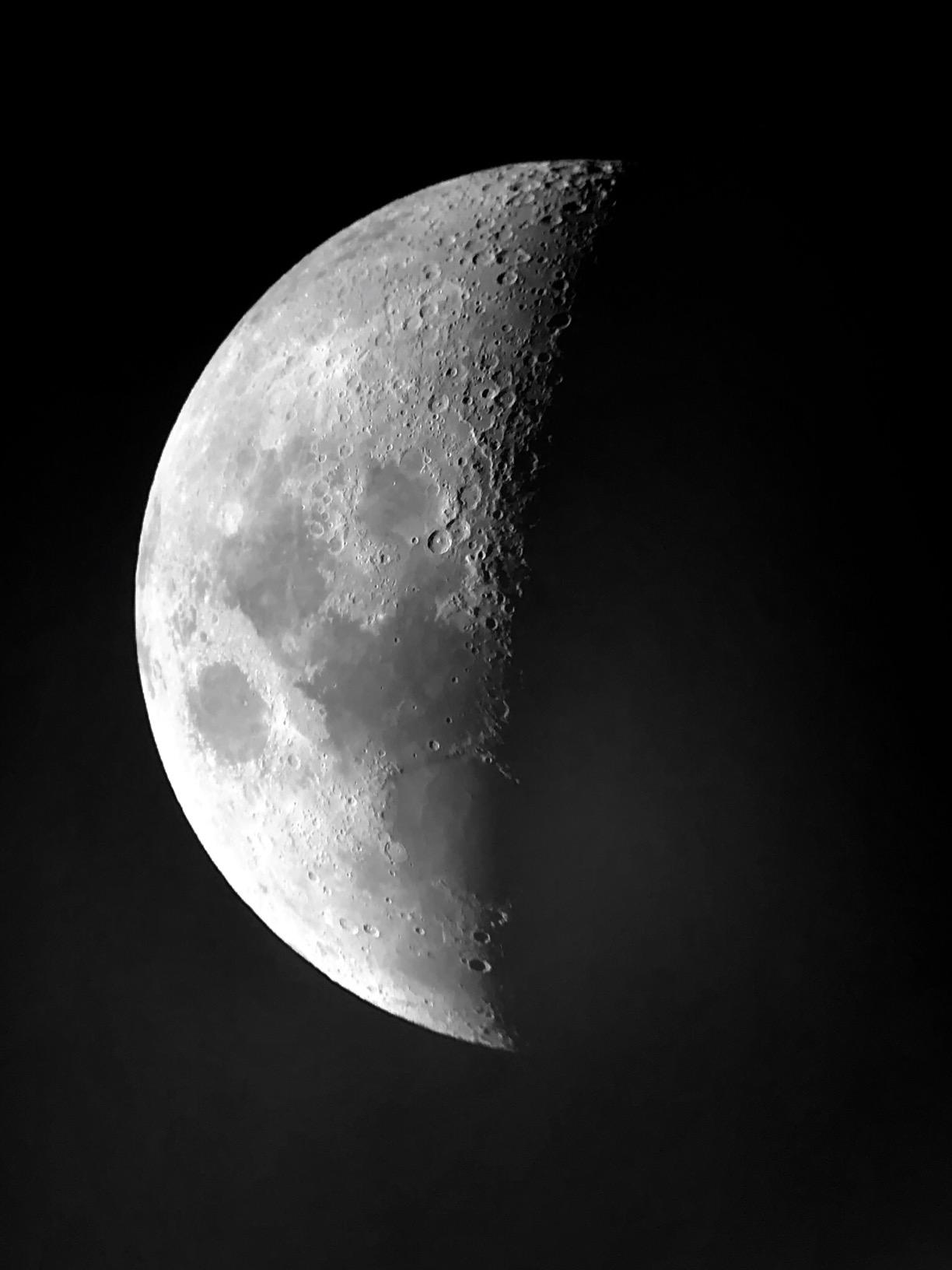
Patented tension control handles let you move the heavy tube without perfect balance, and Teflon bearings make the azimuth rotation notably smooth. The 2 inch Crayford-style focuser holds heavier eyepieces for higher power, and you get 25mm and 10mm super wide-angle eyepieces plus a 9×50 finder.
Its 4.0 rating is the lowest of the ten, with 19 percent one-star, and the reason is bulk rather than optics. At 45 pounds assembled, with a 20 pound tube and a 25 pound base, reviewers describe the handling as the main complaint.
Who it suits best
It suits an adult with a driveway or a dark site and no intention of carrying the scope anywhere. If you leave it set up and point it, the light gathering here is greater than any other telescope on this list.
It is also the easiest to learn. There is nothing to align and no database to learn, which is exactly why the word Dobsonian comes up so often in beginner advice on forums.
Who should skip it
Skip it if you live in an apartment, travel, or need to get the telescope to a dark site. Two people and a car are the minimum for a fair outing, and the 49 inch overall height is the real problem.
Skip it if you want assisted pointing. There is no tracking and no GoTo, so objects drift, and at high power on small targets you will be moving the tube constantly.
What to Look for in a Telescope Under 1,000
Aperture is the number that matters. It is the diameter of the opening that collects light, and light gathering scales with the square of that diameter, so a modest increase in aperture pays off quickly. A 130mm scope gathers about three and a half times the light of a 70mm one. Magnification, by contrast, only enlarges what the aperture captured, which is why advertised power figures are mostly noise. A useful rule is roughly twice the aperture in millimeters as the highest magnification worth using, so 130mm tops out near 260x in good seeing.
The mount decides how much of that light you actually get to use. Hobbyist consensus is that a mount should take 30 to 40 percent of your total budget. On a 1,000 budget that means 300 to 400 of it on the mount and base, and about 600 to 700 on the tube and optics. Worked example: an 8-inch Dobsonian spends most of its cost on the base rather than the mirror, which is exactly why it wins on aperture. A scope on a light tripod, or a tube balanced on a camera tripod, will shake every time you touch the focuser.
Optical design decides what you can point it at. A refractor uses a lens, needs no maintenance and gives high-contrast, colour-free views, but you pay for each extra millimeter of aperture. A Newtonian reflector uses a mirror, gives the most aperture for what you spend, and needs periodic collimation. A Maksutov-Cassegrain folds a long tube into a short one and is very portable, at the cost of aperture. Smart telescopes such as the Seestar trade glass size for automation.
Collimation is the word that scares new Newtonian owners, so here is the plain version. Collimation means adjusting the mirrors so their reflections line up with each other and travel straight down the focuser. It is a routine adjustment rather than a repair, it takes about ten minutes, and a basic laser collimator is the only tool you need. Check it every few months, and any time you move the tube roughly. A Dobsonian that has been bumped into a car deserves a check before the first night.
Eyepieces are the second-largest line item after the tube and the place where beginners overspend badly. Start with a 25mm or 26mm for wide views, add a 10mm for detail, and be careful with Barlow lenses, which multiply the number printed on the box rather than the light you have. On a 130mm Newtonian, a 2x Barlow is a useful tool; on an 80mm refractor, a 3x Barlow mostly produces a dim, soft image. Look for a 2 inch diagonal and a Crayford focuser if you plan to use heavier eyepieces later.
GoTo is the optional extra, and it is a real trade rather than an upgrade. A motorised mount points the telescope at objects for you, which is genuinely useful under light pollution where faint things are hard to find by eye. It also costs aperture, since the budget goes on motors. StarSense-style phone alignment gets you most of the benefit without motors, and a printed planisphere plus an hour of practice gets you the rest for nothing.
The dark-sky and portability trade is clear once you know it. Check the assembled weight, because a 45 pound scope needs two people and a car. And check what is actually in the box: some scopes are sold as an optical tube only, meaning the mount is a separate purchase and your real total is higher than the listing suggests. That single check prevents the most common budget surprise.
Two things to weigh. First, if your interest may fade, spend a third of the budget and keep the rest; the reason cheap Christmas telescopes get abandoned is usually an unrealistic first impression, not what they cost. Second, if you want a wider, calmer, more immediate view of the Moon, of birds and of distant scenery, 10×50 or 7×50 binoculars are hard to beat and cost almost nothing. We apply the same budget-band thinking to gear in other rooms – see our espresso machine roundup under 1,000 and grill roundup under 1,000 – and the rule holds: the entry tier is usually the sensible one.
If you are buying used, a few checks save a bad purchase. Confirm the mount moves smoothly in both axes, look for dents or chipped coatings on the primary mirror, check that all the original eyepieces and diagonals are present, and look up whether the mirror has been recollimated recently. Sellers on forums are asked the same questions repeatedly, and the honest ones will photograph the collimation and answer directly. Our pellet grill buying guide covers the same inspect-before-you-buy logic for a different piece of gear.
What You Can Actually See at Each Aperture
Expectations are the fastest way to enjoy a new telescope. At 70mm, expect a bright, detailed Moon, the phases of Venus, the four moons of Jupiter and Saturn’s rings as a shape rather than as a resolved ring structure. At 80 to 130mm, Saturn’s rings separate, Mars shows an orange disc with a polar cap, Jupiter shows its belts, and open clusters, the Orion Nebula and Andromeda become identifiable.
At 150mm and above, globular clusters start to resolve into grains of stars, fainter nebulae appear under moderate light pollution, and double stars separate. Beyond 200mm, planetary nebulae and some galaxies become realistic targets from a dark site. Light pollution matters more than people expect: everything above is much harder from a bright suburban backyard, and a Bortle 8 city sky will cost you objects that a dark site shows easily.
One last lever worth knowing. If a star looks blurry or doubled after you focus, that is usually the atmosphere rather than the telescope. Wait for a still night, and the same scope will show you considerably more.
Frequently Asked Questions
What telescopes can I buy on a 1,000 budget?
At this budget the strongest picks are an 8-inch Dobsonian for the largest aperture, a 130mm Newtonian reflector on a German equatorial mount for the best light for what you spend, and a phone-guided 130mm reflector if you want help finding objects. Spend roughly 30 to 40 percent of the budget on the mount rather than on motors or extra eyepieces.
How much should I spend on a beginner telescope?
Most owners in the forums we read land between a third and half of what they first assumed they needed. A 70mm to 80mm refractor covers the Moon, planets and bright clusters and costs very little. A 130mm reflector is the point where faint deep-sky objects start to appear, and an 8-inch Dobsonian is the point where they become easy.
What is the cheapest but best telescope?
The cheapest scope that is genuinely worth owning is a fully multi-coated 70mm or 80mm refractor with a couple of eyepieces, a finder and a stable tripod. Skip anything advertising magnification figures in the hundreds with a tiny aperture, because the number is decorative. A pair of 10×50 binoculars is a good companion at any budget.
What’s a good starter telescope for beginners?
A Dobsonian is the most recommended starter type for visual observing because it is simple, has no electronics to program and puts the most aperture on the table. A refractor is the easiest starter if you want zero maintenance and a grab-and-go tube. A computerized mount only helps if light pollution makes finding objects genuinely hard where you live.
Can you see Saturn with an 8 inch Dobsonian?
Yes. An 8-inch Dobsonian separates Saturn’s rings cleanly and shows Titan and Rhea, and at higher power the Cassini Division becomes visible in steady seeing. You will also get the Moon’s craters, Jupiter’s belts and Galilean moons, and a wide range of globular clusters and bright nebulae from a dark site.
How do I choose the right eyepieces for my telescope?
Start with a 25mm or 26mm eyepiece for wide, bright views, then add a 10mm for detail on the Moon and planets. Match the eyepiece to the telescope: long focal lengths suit small bright targets, while wide fields suit clusters. Check eye relief for comfort, and treat advertised magnification on a Barlow lens as a limit rather than a goal.
Is a computerized GoTo mount necessary?
It is not necessary, and it competes with aperture for the same budget. If you can find targets with a finder and a planisphere, a manual mount leaves you with a bigger, sharper telescope. If you observe from a bright city where objects are invisible to the eye, app-based alignment such as StarSense gives you most of the benefit without the motors.
What is the largest aperture telescope I can get on a 1,000 budget?
An 8-inch, or 203mm, Dobsonian sits comfortably inside this budget and is the largest aperture in our picks. Above that size, truss or collapsible Dobsonians exist, but they cost more and the tube becomes long and awkward to transport. If aperture is your priority, 8 inches is the sensible ceiling for a single-person budget.
What is the best telescope on a 1,000 budget for astrophotography?
An 80mm apochromatic refractor with a bundled focal reducer and field flattener, paired with an entry-level equatorial mount, is the best value imaging rig at this budget. The reducer flattens the corners of the frame and shortens exposures. A smart telescope such as the Seestar S30 Pro is the alternative if you want automated stacking without learning the craft.
Is 70mm or 80mm better for a telescope?
80mm is better if you are choosing between them, because the extra light gathering shows up on everything. Both are excellent first telescopes for the Moon and planets, and both need no collimation. If portability and price matter more than faint targets, a 70mm with a carry bag is the more practical pick.
The Verdict: Best Telescopes Under 1000
For most beginners, the Gskyer 70mm is the telescope to buy on a 1,000 budget: a 70mm fully coated refractor that needs no tools to assemble, comes with a carry bag and a phone adapter, and has more than 22,000 ratings behind it. If your budget stretches a little further, the Celestron AstroMaster 130EQ gives you 130mm of aperture and an equatorial mount that tracks drifting targets.
If you want the biggest possible view and have a driveway, go straight to the Sky-Watcher Classic 200 and accept the 45 pounds. If you live in a bright city, the Celestron StarSense DX 130AZ puts a 130mm aperture and phone-guided pointing in your hands. If you want photographs rather than views, the ZWO Seestar S30 Pro does the work for you, and the SVBONY SV503 80ED is the tube to build a rig around.
Whatever you pick, budget 30 to 40 percent for the mount, spend your first night on the Moon, and check the box contents before you assume everything needed is included. That is the entire difference between a telescope that gets used and one that ends up in a cupboard. For how we approach other big-ticket purchases, see our countertop microwave picks and home bread oven roundup.