
Choosing the best butter churns for raw milk is mostly a matter of matching the vessel to your daily milk volume and deciding how much arm work you actually want to do. A butter churn is simply a container with internal paddles, called a dasher, that agitates cream until the fat clumps into butter and buttermilk drains away. For a raw milk homestead that turning perishable milk into a product that keeps for weeks instead of days is the whole point.
We spent 2026 season going through ten churns that cover the realistic range, from a 3.2 inch shake jar to a 61oz electric drum, plus three traditional wooden churners. What surprised us most was how much of the decision comes down to cream temperature and how the machine disassembles for washing, not to the motor or the gearing.
This guide covers all ten, with a head to head table, a sizing guide, and the raw milk workflow that nobody in the category seems to write down. If you want the short answer first, the Kilner glass churn is the one we would buy, and the Chef’n Buttercup is the fastest way to taste the idea before spending anything serious.
Table of Contents
- Can You Actually Churn Raw Milk Into Butter?
- Top 3 Butter Churn Picks for Raw Milk 2026
- All 10 Best Butter Churns for Raw Milk (October 2026)
- 1. Kilner Vintage Glass Butter Churn – The All-Rounder We Would Buy
- 2. Dazey Turn N Churn – A Complete Kit in a Smaller Jar
- 3. Butter Churner Mason Jar Kit – The Easiest Place to Start
- 4. aeaker 32oz Glass Churner – The Gearing You Can Trust
- 5. IFOLO Electric Butter Churn – Set It and Walk Away
- 6. Ugdgtgo 61oz Electric Churner – The Big Batch Option
- 7. Chef’n Buttercup Butter Maker – The Fastest Way to Learn
- 8. WOODKIT Wooden Madhani – A Traditional Tool That Still Works
- 9. Garden Of Arts Wooden Mathani – Light but Limited
- 10. Sahishnu Six Blade Wooden Churner – Small Batch and Light Grip
- Hand-Crank vs Electric Butter Churn for a Raw Milk Kitchen
- How Big a Butter Churn Your Herd Actually Needs
- Raw Milk to Butter: Separation, Ripening and Yield
- Cleaning and Sanitizing a Churn Used With Raw Milk
- Frequently Asked Questions
- Can I churn raw milk into butter?
- What is the best tool to churn butter?
- Is it cheaper to churn butter than to buy it?
- Do Amish people churn butter?
- How long does it take to hand crank butter?
- How much butter do I get from a gallon of raw milk?
- Do I need a cream separator to make butter?
- How do I clean a glass jar butter churn?
- The Best Butter Churn for Raw Milk in 2026
Can You Actually Churn Raw Milk Into Butter?
Yes, you can churn raw milk into butter, but you should separate the cream first rather than pouring whole milk into a churn. The butterfat has to be concentrated enough to clump, and skimming or separating gives you heavy cream with roughly 35 to 40 percent butterfat, which is the range a churn is built for.
Raw milk behaves a little differently from pasteurized milk here. The fat globules stay looser, so cream separates and sours on its own schedule, and the cream carries the full native bacterial population into the churn. Many raw milk dairies deliberately let cream ripen before churning to get cultured butter, which is tangier and keeps longer than sweet butter.
Two rules matter more than the machine. Keep the cream cold right up until you load the churn, and get the butter worked and salted quickly once it forms, because the moisture left in raw cream butter is what limits its keeping quality. Everything else in this roundup is a detail compared to those two.
One more note before the picks. If you sell finished butter, the rules are different from the rules for churning it, and they differ by state. Check your local cottage food and dairy licensing rules before you plan around farm sales.
Top 3 Butter Churn Picks for Raw Milk 2026

Kilner Glass Jar Churn
- 34oz embossed glass jar
- Metal gear drive with silicone paddle
- 1/2 cup butter per 10.1 oz cream
- Hand wash only
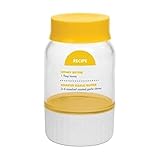
Chef’n Buttercup Butter Maker
- 1 liter capacity
- Shake in jar
- no cranking
- Sieve strains buttermilk
- Dishwasher safe

aeaker 32oz Glass Churn
- Thick 32oz glass jar
- Stainless steel paddle
- 3/4 cup butter per 12oz cream
- Dishwasher safe
All 10 Best Butter Churns for Raw Milk (October 2026)
| Product | Specs | Action |
|---|---|---|
| Kilner Vintage Glass Butter Churn |
|
Check Latest Price |
 Dazey Turn N Churn Dazey Turn N Churn |
|
Check Latest Price |
 Butter Churner Hand Crank Mason Jar Kit Butter Churner Hand Crank Mason Jar Kit |
|
Check Latest Price |
| aeaker Premium 32oz Glass Churner |
|
Check Latest Price |
 IFOLO Electric Butter Churn IFOLO Electric Butter Churn |
|
Check Latest Price |
 Ugdgtgo Electric Butter Churner Ugdgtgo Electric Butter Churner |
|
Check Latest Price |
| Chef’n Buttercup Butter Maker |
|
Check Latest Price |
 WOODKIT Wooden Madhani Churner WOODKIT Wooden Madhani Churner |
|
Check Latest Price |
 Garden Of Arts Wooden Mathani Whisk Garden Of Arts Wooden Mathani Whisk |
|
Check Latest Price |
 Sahishnu Six Blade Wooden Churner Sahishnu Six Blade Wooden Churner |
|
Check Latest Price |
1. Kilner Vintage Glass Butter Churn – The All-Rounder We Would Buy
KILNER Butter Churn, 1 EA
34oz embossed glass jar
Metal gear drive, silicone paddle
1/2 cup butter per 10.1 oz cream
Pros
- Cast gearing that keeps working as cream thickens
- Weighted glass jar that is easy to rinse and fully disassembles
- Needs no electricity at all
- Silicone paddle performs better than plastic paddles
- Leaves usable buttermilk behind for baking
Cons
- Silicone paddle reported cracked after about a month
- Glass has arrived broken on more than one delivery
- Real churn time often runs past the advertised 10 minutes
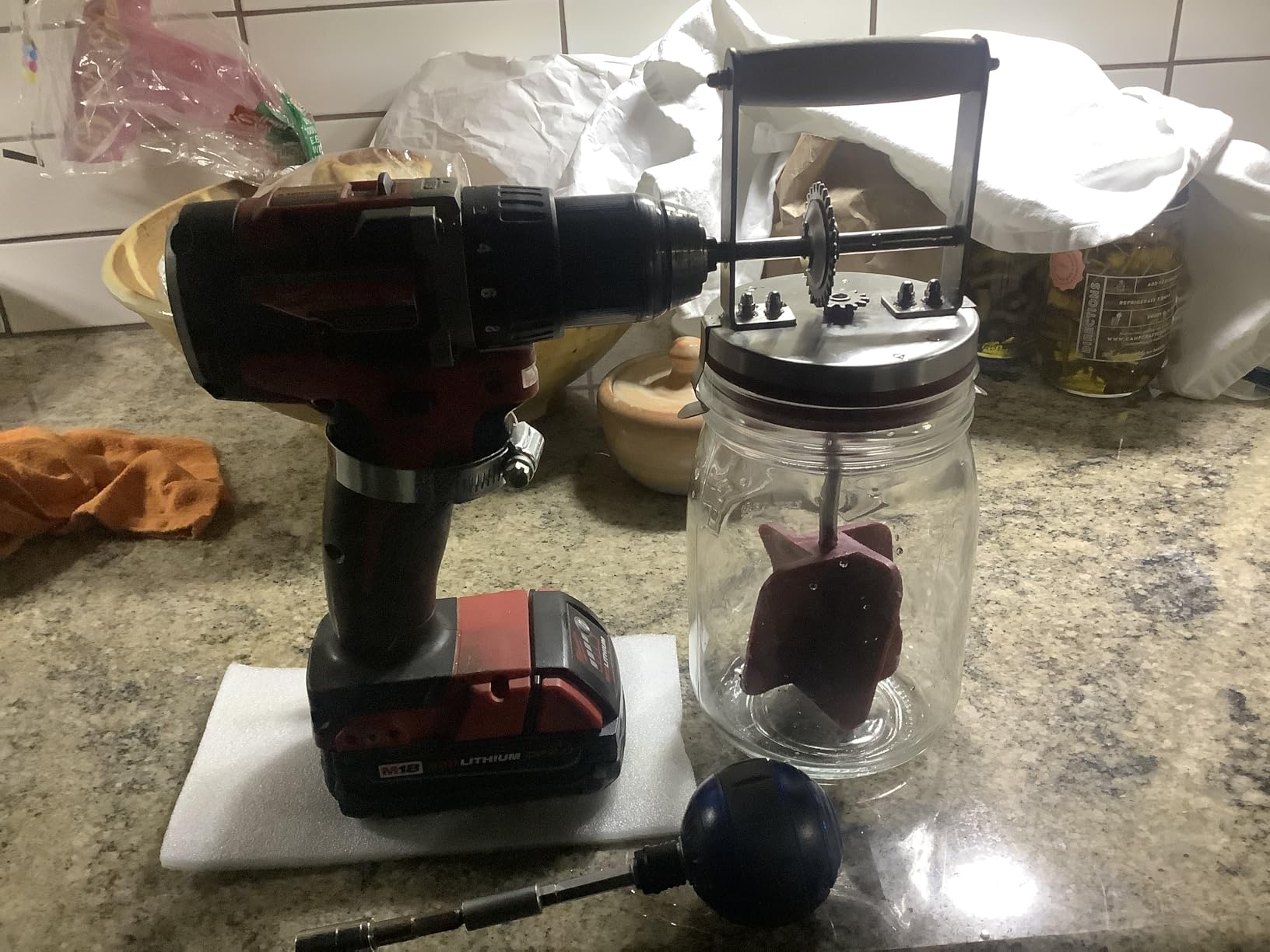
We put the Kilner through more batches than any other hand crank here because it is the one we kept reaching for. The gearing is cast rather than stamped, and that distinction shows up in the last third of a batch when the cream goes from loose to grainly and the load on the crank changes completely.
Capacity is 34 fluid ounces with a jar that measures 4 inches across and 7 inches tall, or 10.5 inches on the handle. Our rule of thumb is to fill it no more than halfway with cream, because cranking a full jar is where arm fatigue shows up fast.
The yield math is the friendliest part. The stated conversion is half a cup of butter per 10.1 ounces of whipping cream, and reviewers report that holds reasonably true in practice once you account for what stays in the butter and what goes down the drain.
Two things catch people out. The first is cream temperature. Cold cream straight from the fridge will take considerably longer than cream that has sat at room temperature, and a lot of the complaints about slow churning come down to a jar that was simply too cold.
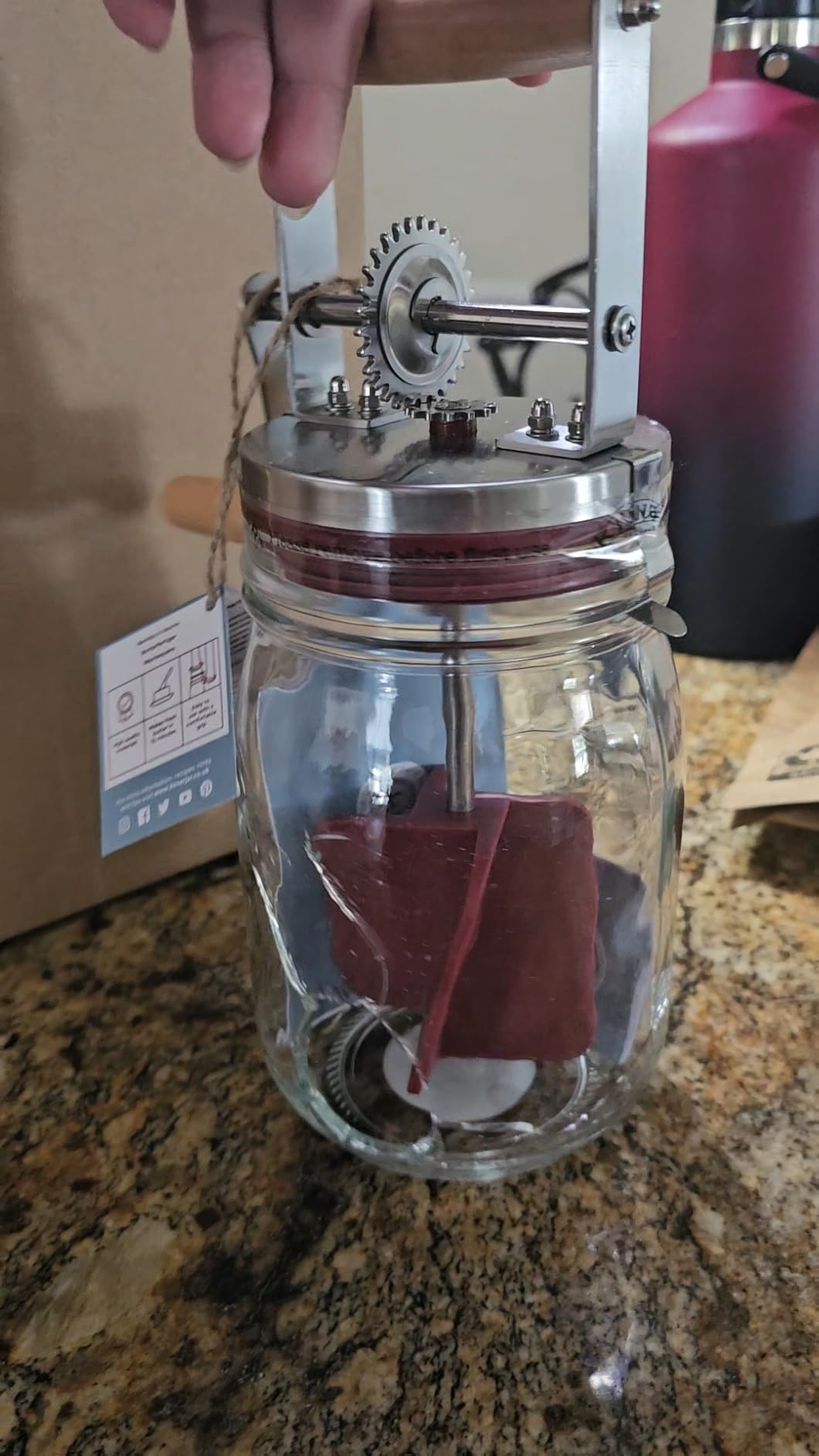
The second is the glass. It is weighted glass rather than thin jar glass, which feels solid in the hand and takes the pressure of pressing butter against the side without alarming you, but it does arrive broken more often than we would like.
Roughly 7000 owners have left a rating on this listing, and the pattern in that volume of feedback is unusually consistent. People like the mechanism, the weight and the cleanability. The recurring complaints are packaging damage and the occasional cracked silicone paddle.
What tells you it suits a raw milk setup
Full disassembly is the detail that matters most here. The jar, the gear head and the paddle all come apart, which means you can wash every surface that touched raw cream instead of rinsing around a fixed mechanism. On a farm where water is cold and sanitation is not optional, that is the feature that decides it.
It also works with no power at all, which matters if your milk room is a barn with no outlet. You need a counter or a sturdy table to crank it on, and somewhere cold to put the finished butter, but the churn itself has no electrical dependency.
Where it will disappoint you
Hand cranking is genuinely tiring. Forum users on r/homestead talk about the arm load more than the time, and a lot of people who start with a hand crank end up looking at an electric unit within a year.
The 34oz jar is also small for anyone running more than a couple of cows. Once you are separating more than a few gallons a day, you are running repeated small batches, and the wash and reset time starts to dominate the churn time itself.
2. Dazey Turn N Churn – A Complete Kit in a Smaller Jar
Dazey Butter Churn – Hand Crank Butter Churner- Manual Butter Maker- Beech Wood BUTTER PADDLES INCLUDED. Create Delicious Homemade Butter With Your Own Hand Crank Dazey Butter Churner (Turn N Churn)
16oz glass jar
Beech wood closure and paddles
Cheese cloth, mat and crock included
Pros
- Complete kit with paddles
- cloth/anti slip mat and butter crock
- Glass body with no plastic parts in the churn path
- First time users report succeeding on the first batch
- Works quickly once cream reaches room temperature
Cons
- Beech wood paddles have cracked after as few as two uses
- Gears can misalign once cream thickens
- 16oz jar is half the capacity of the bigger glass churns
The Dazey is the churn you buy when you want the whole workflow in one box. Alongside the glass churner you get beech wood shaping paddles, a piece of cheese cloth for straining and clarifying, a silicone mat so the jar does not walk across the counter, a butter crock for storing the finished block, and a recipe book.
Capacity is 16 fluid ounces, which is the honest limitation. That is a single small batch, and it makes this a weekend churn rather than a daily one. For a family cow milking a few gallons a day, it works, but you will run it more than once.
What surprised us was the speed once the cream is warm. Reviewers regularly report finishing in under five minutes with room temperature cream, which is faster than the bigger gear churns despite the smaller jar. Part of that is simply less mass to move.
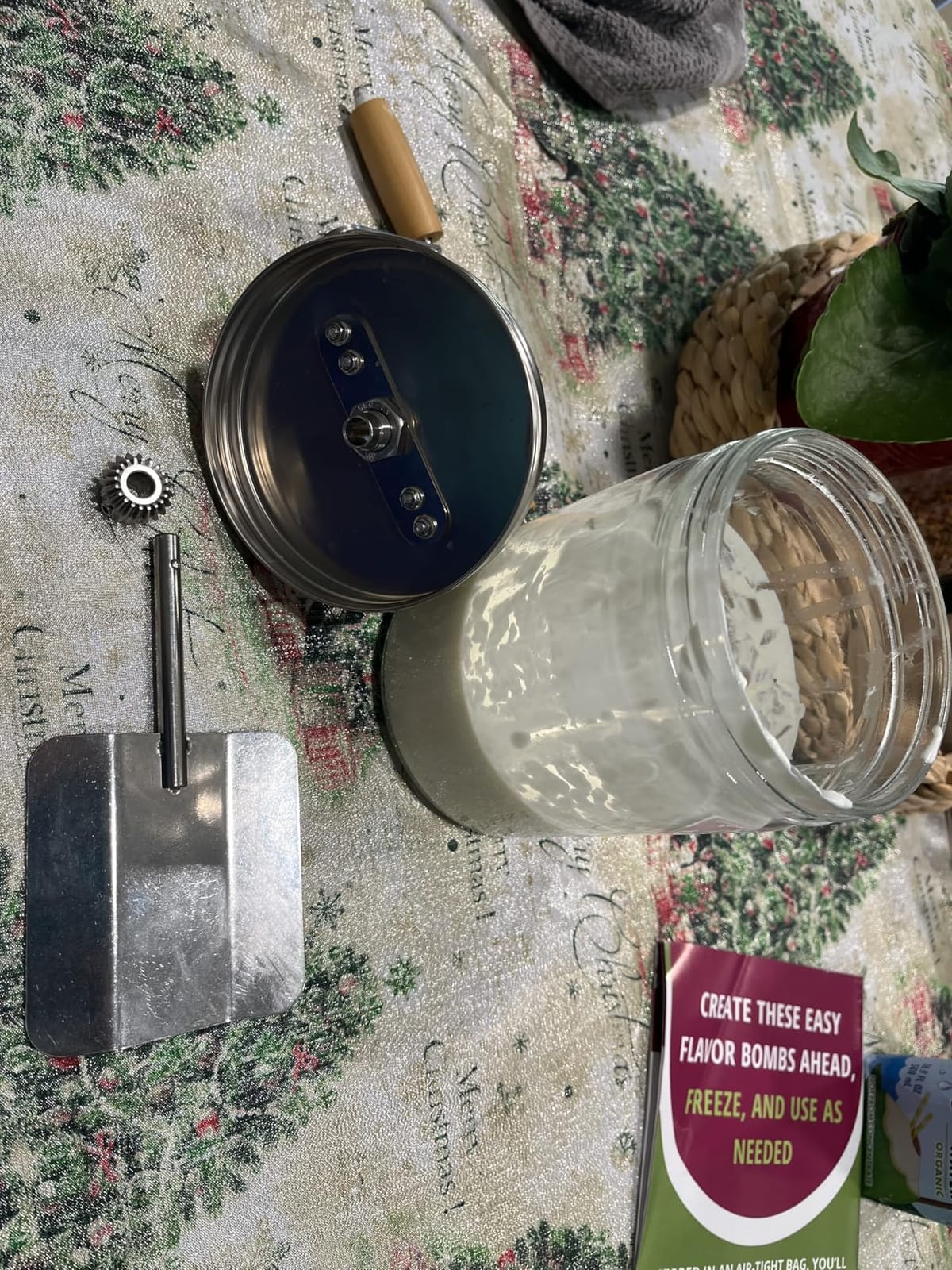
The build is where the criticism sits. Beech wood paddles have cracked after as few as two uses according to multiple reviews, and the gear head has been reported to misalign once the cream thickens, which means you stop, reposition, and carry on with butterfat stuck in the wrong place.
One detail worth knowing for raw milk work specifically: reviewers note this churn is not suitable for making cultured butter. If you want to deliberately ripen cream into a tangy cultured product, look at a wooden churner designed for buttermilk and dahi instead.
What tells you it suits a raw milk setup
The bundled cheese cloth is genuinely useful in a raw milk kitchen. You need it after churning to drain buttermilk, press the butter, and then wash and dry the block, and having one in the box means you are not improvising with a clean towel that has other jobs.
The anti slip mat matters more than it sounds. Hand cranking puts a lot of lateral force through the base, and a glass jar that walks mid batch is both a mess and a risk. The mat solves that in a single sweep.
Where it will disappoint you
Wood in the churn path is a real concern with unpasteurized dairy. Beech paddles that crack leave rough surfaces that are harder to sanitize, and a cracked piece of wood in a butter batch is a problem you have to toss the whole batch over.
The lid is also reported to be difficult to unscrew, and the glass jar can slip out of the metal frame when you are trying to clean it. If you have limited hand strength, that combination will slow you down more than the churning will.
3. Butter Churner Mason Jar Kit – The Easiest Place to Start
Butter Churner Hand Crank Mason Jar Homemade Butter Churn Kit Machine
Glass jar with wood closure
Upgraded bevel gears
Cheese cloth, paddles and mat included
Pros
- Upgraded bevel gearing holds up better than flat gearing
- Accessory bundle covers shaping
- draining and storage
- Glass construction with no plastic in the cream path
- Also works as a whipping cream machine
Cons
- Wooden paddles can crack after a couple of uses
- Frame can loosen from the jar as the butter thickens
- Slow for the amount of butter you get out
This is the mason jar style churn that shares its design language with the Dazey, and it sits in a useful middle ground. The gearing is described as upgraded bevel gearing, which reviewers single out as holding together better than the flat gearing on cheaper hand cranks.
You get the churner, beech wood shaping paddles, a piece of premium cheese cloth, a silicone mat base and a recipe book. For someone learning the process, that accessory set does most of the work of a recipe video, because the cloth and the paddles are the two things you would otherwise have to improvise.
Weighing in around 1.17 kg, it is light enough to move with one hand between the sink and the counter. That is not a small thing in a dairy room where you are carrying hot wash water.
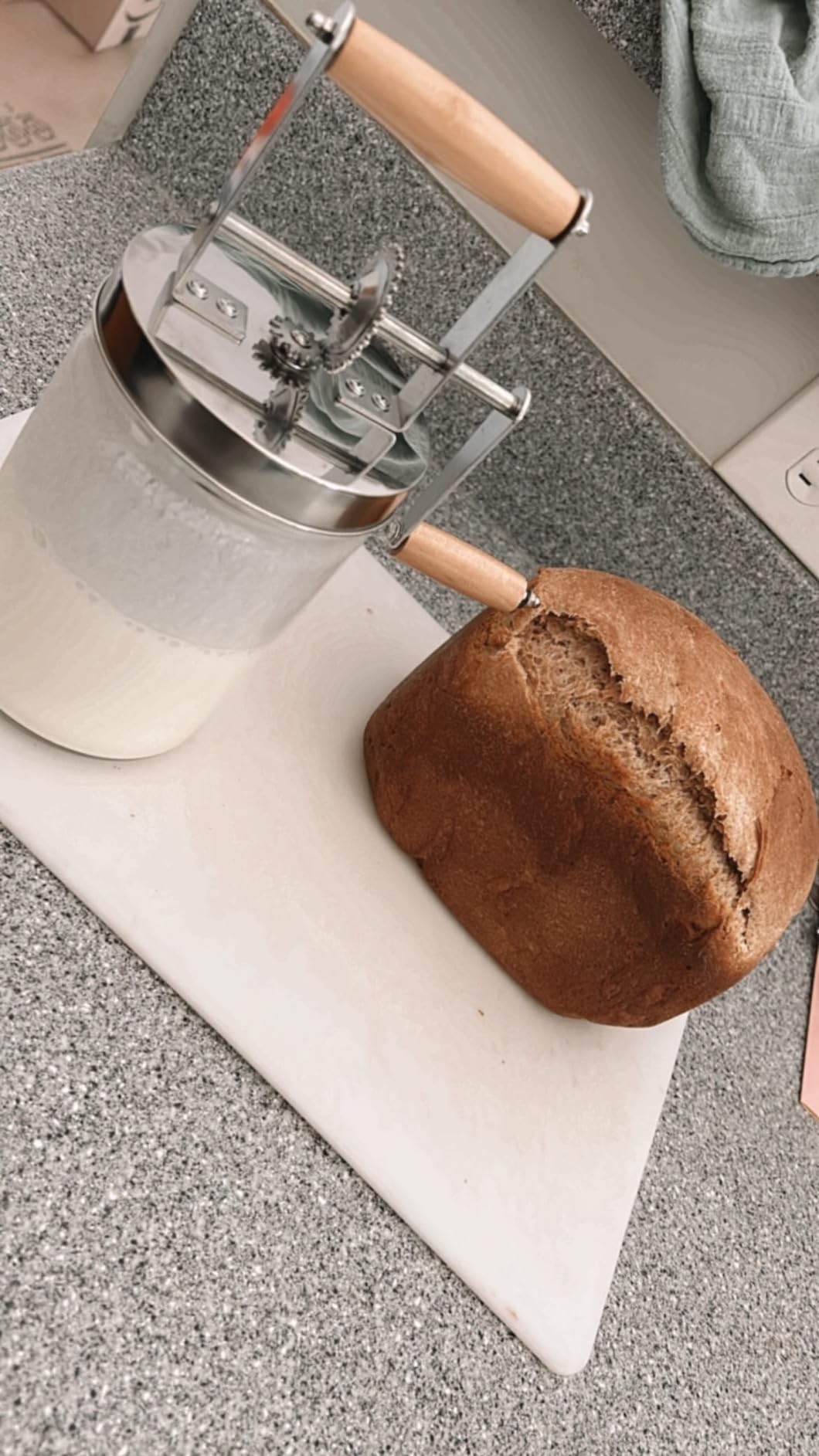
Buyer feedback tracks closely with the Dazey because the design is so similar. The glass body and lack of plastic contact surfaces earn marks, and the cheese cloth gets called out as a useful addition for draining buttermilk and clarifying the finished butter.
The recurring negatives are the same two things: wooden paddles cracking early, and the gear frame loosening from the jar as the product thickens. If you buy it, replace the paddles with something you trust for food contact before your first raw cream batch.
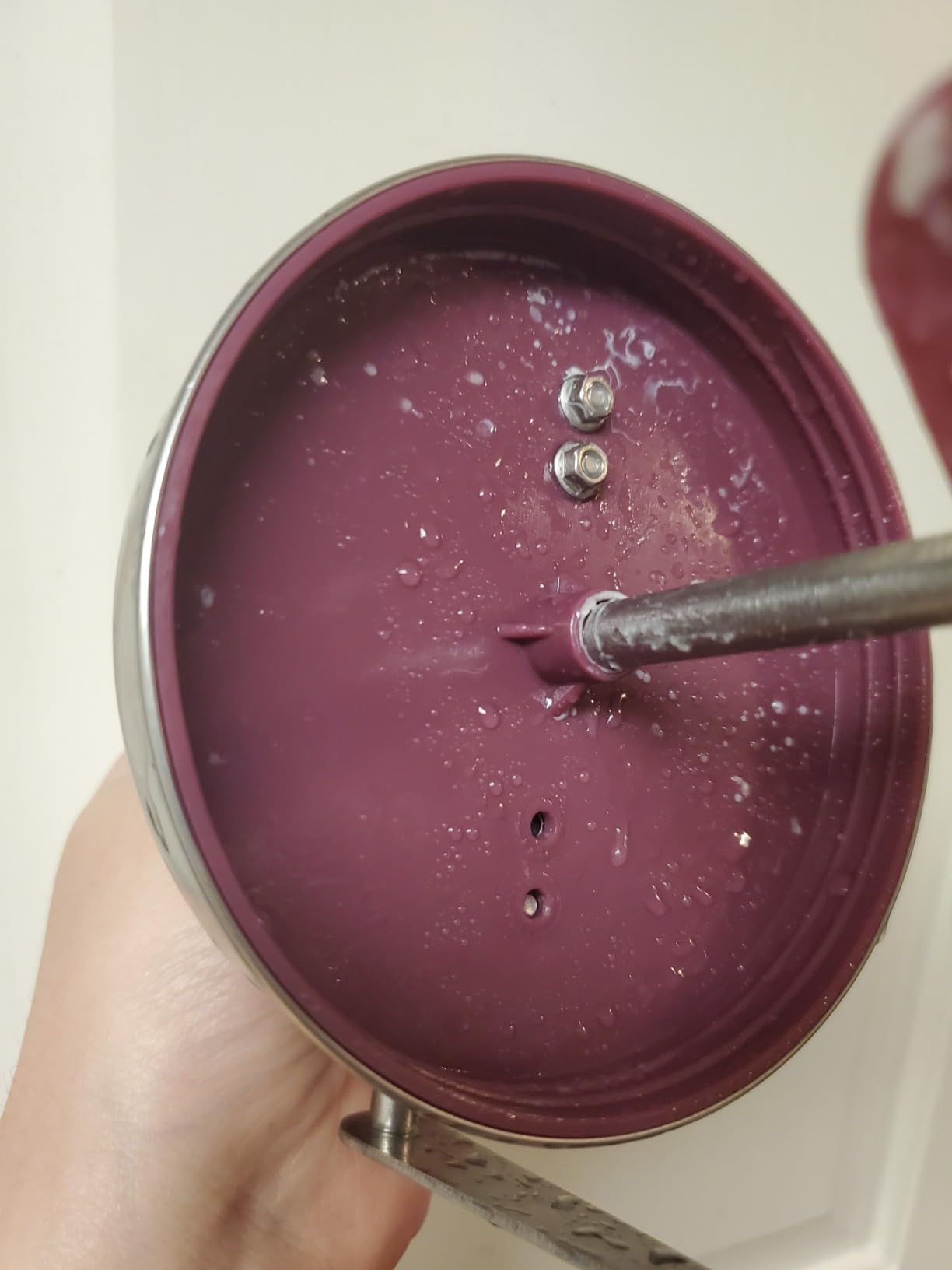
What tells you it suits a raw milk setup
The no plastic contact surface design is a genuine advantage when you are working with unpasteurized cream. Glass and wood can be soaked, scalded and scrubbed without the warping or retaining odours that plastic parts develop when they are washed in hot water every single day.
It also has a secondary use that matters in a raw milk kitchen. When you are not churning, the same motion and jar work as a whipping cream machine, which is useful for making cultured cream before you churn it into cultured butter.
Where it will disappoint you
Several reviewers consider the time investment high for the yield obtained. If your daily volume is more than a couple of quarts of cream, the batches get repetitive fast, and each one needs a full clean and dry cycle afterwards.
The lid removal and the frame coming loose are the two friction points. Both are manageable, but both show up on the last batch of a long day when your patience is thinner than it was at breakfast.
4. aeaker 32oz Glass Churner – The Gearing You Can Trust
Aeaker Premium Butter Churner, 32oz Glass Jar
32oz thick glass jar
Stainless steel paddle
3/4 cup butter per 12oz cream
Pros
- Heavier gearing that does not slip when butter thickens
- Turns 12oz of cream into about 3/4 cup in 5 to 10 minutes
- Disassembles fully and is dishwasher safe
- Works with standard mason jar sizes
Cons
- Mechanism has jammed after only a few uses for some buyers
- Shaft guide can leak material that darkens a batch
- Overfilling pushes cream around the lid
The aeaker earns its place in this roundup because of one component, and that is the gear set. Multiple owners describe it as the sturdiest gearing they have used in a glass jar churn, and the difference shows exactly where it matters, in the last minute of a batch when the butter is solid and the crank stops being easy.
Stated output is about three quarters of a cup of butter from 12 ounces of heavy cream, and reviewers confirm that in the 5 to 10 minute range. The jar holds 32 ounces, with a stainless steel paddle rather than a plastic one, and the whole thing comes apart for the dishwasher.
Measuring roughly 1.65 pounds and standing at 3.7 by 6.3 by 11 inches, it is a compact vertical unit. The mason jar fitment is a genuine bonus, and owners who already keep jars on hand for other kitchen tasks appreciate being able to reuse them.
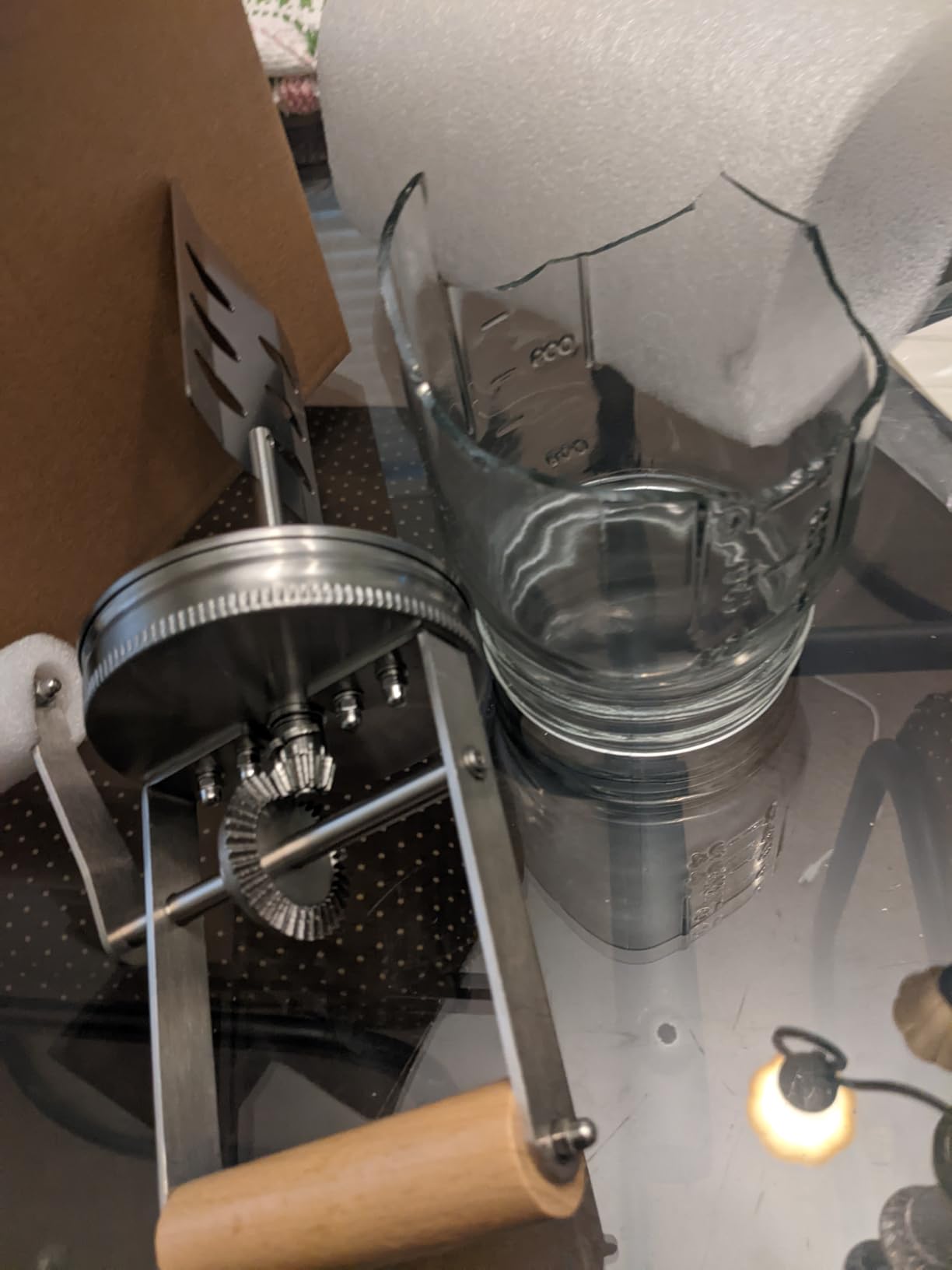
The durability picture is genuinely split on this one, and we would rather tell you that than smooth it over. Plenty of owners report months of trouble free use, while others describe jamming, gear wear that sheds material, or a leaking shaft seal within a small number of batches.
That shaft seal report is the one to take seriously for raw milk work. Black particulate in a cream batch is not a cosmetic problem, and if you see any darkening you should stop and inspect the seal before eating or selling the butter.
A second real complaint is overfilling. Push past roughly two thirds and cream gets pushed up around the lid and into the gear housing, which is both messy and, over time, the fastest route to the jamming those owners describe.
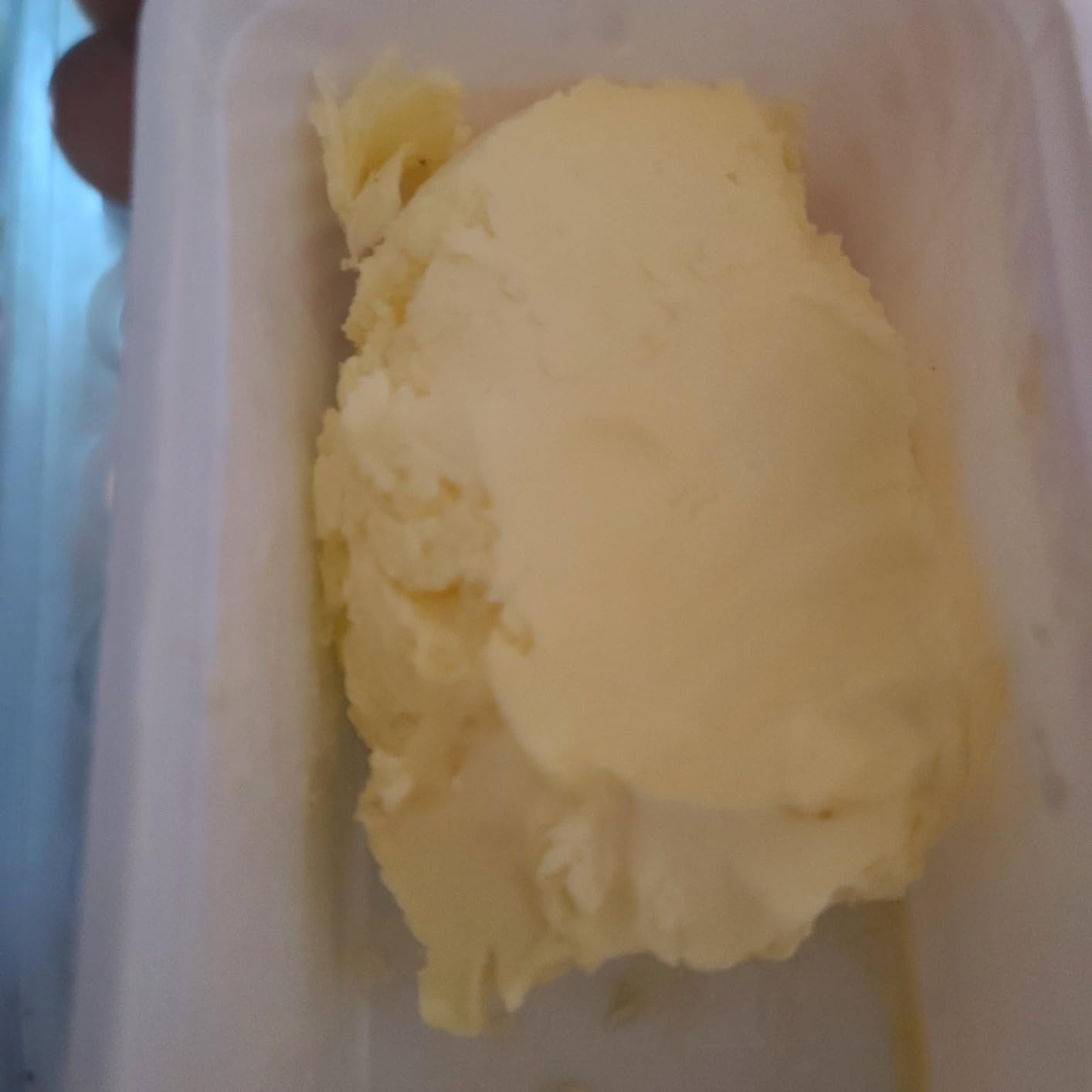
What tells you it suits a raw milk setup
Dishwasher safe and fully disassembling is the headline for anyone processing raw milk. The jar, paddle and gear section all separate, so you are not hand washing a mechanism with crevices that never get clean. For a small dairy operation that is the difference between a churn you use and a churn you leave to soak.
Stainless steel paddle is also the right material for butterfat. It does not absorb odours, it survives repeated hot washes, and it will not crack the way some silicone paddles reportedly have within a month on the Kilner.
Where it will disappoint you
The jar is lighter than buyers expect, and one unit arrived broken. With glass this thin at the top of the gearing, the balance is less forgiving than the heavier Kilner jar, so you need a steady hand rather than a strong one.
The handle also sits close to the jar, which reviewers with large knuckles report catching during the crank. If you have joint issues, that is worth checking before you commit, and it is one of the better reasons to look at an electric unit instead.
5. IFOLO Electric Butter Churn – Set It and Walk Away
IFOLO Electric Butter Churn – One-Touch Butter Maker in 5–10 Mins, 34oz Glass Jar with High-Speed Brushless Motor, High-Speed Mixing for Creamy Results
34oz glass jar
Brushless high speed motor
One touch automatic operation
Pros
- Removes all wrist and arm strain from the batch
- Transparent jar lets you watch butter form
- Stainless steel paddle gives a smooth result
- Reusable glass jar with no single use plastic parts
Cons
- Needs a mains outlet so it is useless off grid
- Heavier and bulkier than a hand crank of the same jar size
- Some find the texture less dense than slow churned butter
The IFOLO is the answer for anyone whose problem is their arm. A brushless motor driven by one touch control runs the churn hands free, and once the cream is in the jar there is nothing to do but wait and watch through the glass.
Stated churn time is 5 to 10 minutes using high speed blending, with a 34 ounce transparent glass jar and a food grade stainless steel paddle. Reviewers generally find the timing realistic, which is not something we can say for every claim in this category.
At 4.2 stars across a few hundred reviews, it rates above the hand crank group on convenience without falling behind on the result. The glass jar is reusable and there are no single use plastic components, which matters more than it sounds for someone churning every day.
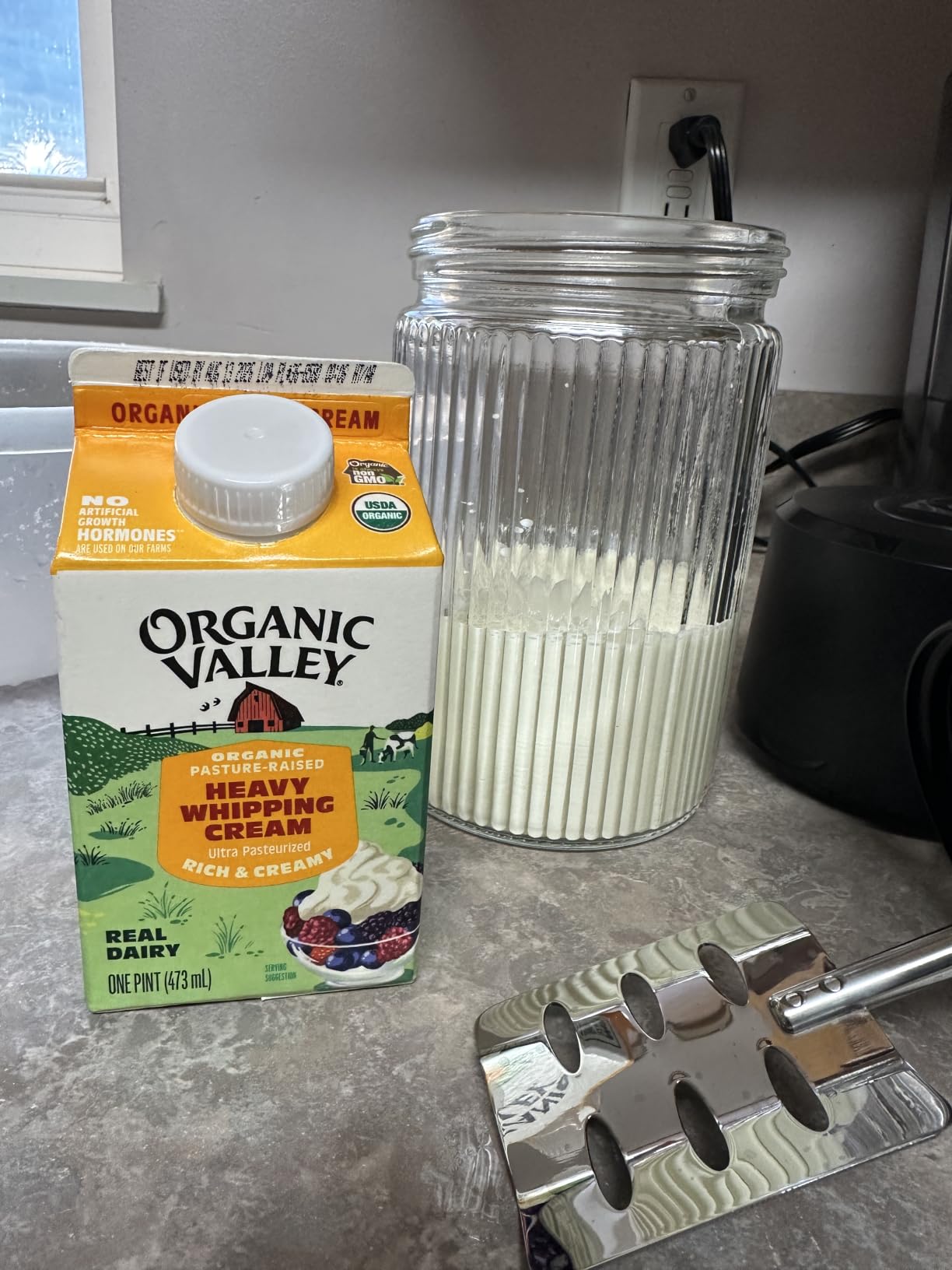
The honest trade-off is that speed changes the butter. High speed blending gives a smooth, airy result, and some buyers say the finished texture is less dense and less creamy than butter from a slow hand crank. If you are making cultured butter and want that dense grain, the difference is noticeable.
Footprint is the other issue. At 1.65 kg it is heavier and bulkier than a hand crank holding the same jar size, so it claims real counter space. In a milk room where you need the surface for separating, that is a real cost.
It is also the easiest machine here for people with grip or wrist limitations, and reviewers call that out directly. For a household where the person doing the milking is the person with the sore hands, that can matter more than texture.
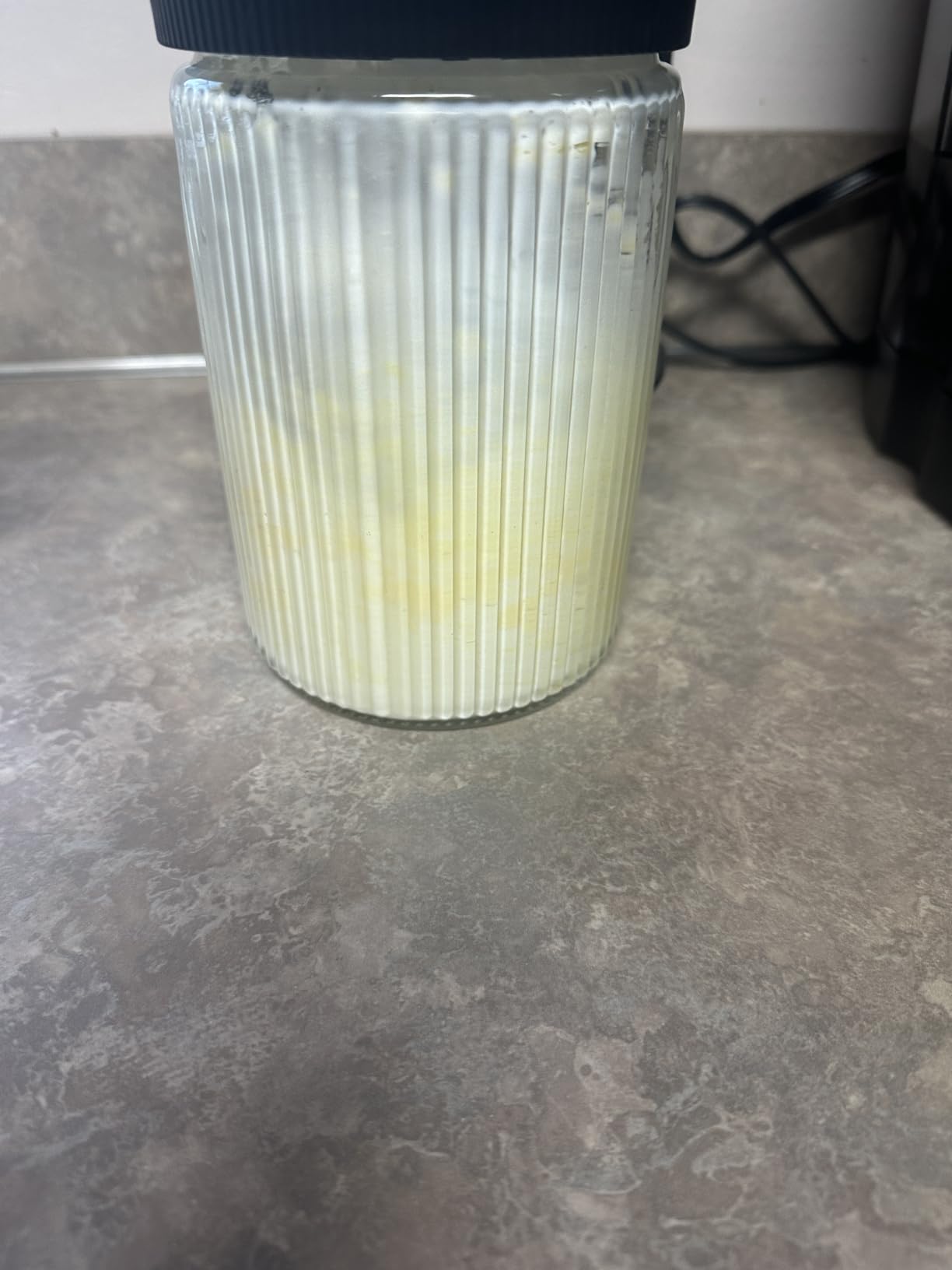
What tells you it suits a raw milk setup
Eliminating the cranking removes the longest manual step in the process, and that is exactly the step that makes people quit making butter. The labour saved is what makes a daily batch realistic rather than aspirational, and that is the difference between a hobby and a habit.
Because it runs unattended, you can load a batch and go do the morning milking instead of standing at the counter. On a small dairy that is a better use of twenty minutes than anywhere else in the process.
Where it will disappoint you
It needs a mains outlet, so it does nothing for a barn, an off grid homestead, or a milk room with no power. If your churn space is not a kitchen, this one is out.
It also does not solve the cleaning problem, it just relocates it. You still break it down after every batch, and the motor base adds a part that needs wiping down, so budget a little extra handling time per batch compared to a pure hand crank.
6. Ugdgtgo 61oz Electric Churner – The Big Batch Option
Electric Butter Churner for Butter Maker
61oz extra large glass jar
600PRM high speed blending
Also makes peanut butter
Pros
- Largest jar in the roundup at 61oz for family sized batches
- BPA free/cadmium free and lead free glass and steel
- Dishwasher safe and easy to clean
- One machine also handles peanut butter and whipped cream
Cons
- Bulky 11 inch tall footprint takes real counter space
- Adapter and separate paddle are extra pieces to store and wash
- Depends entirely on mains power
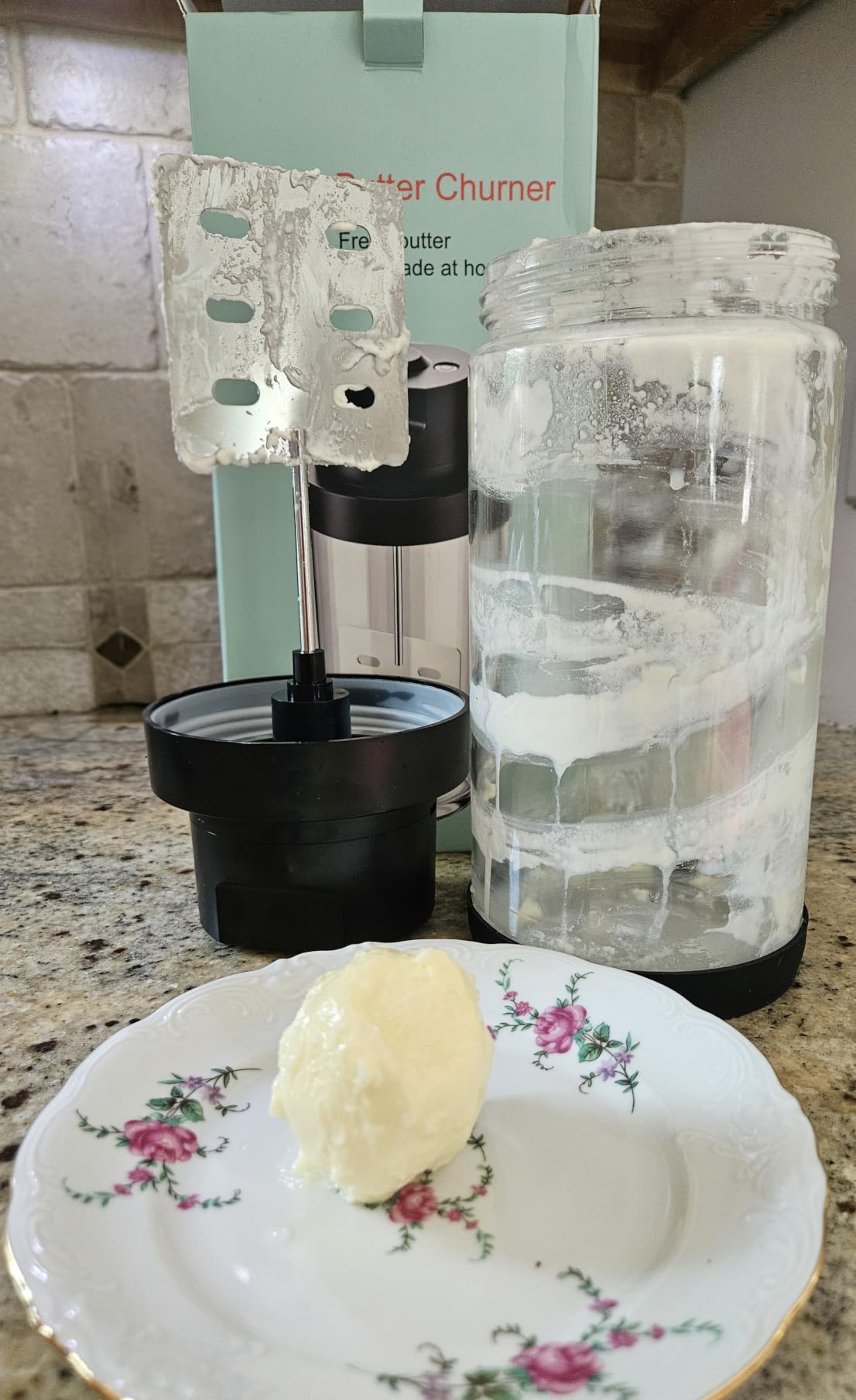
Capacity is the whole argument for this one. A 61 ounce, or 1.8 litre, jar is roughly double what the other electric units in this roundup hold, and for a household separating real volume of raw milk that changes the number of batches you run per day rather than just the batch size.
Blending runs at 600PRM with a stainless steel blade set, and the machine is one touch fully automatic. The same jar also makes peanut butter and whipped cream, which is why owners report using it for cooking classes and family baking as well as for dairy.
Materials are described as BPA free, cadmium free and lead free glass and stainless steel, and the whole jar is dishwasher safe. At 2.6 pounds it is portable enough to move between sink and counter.
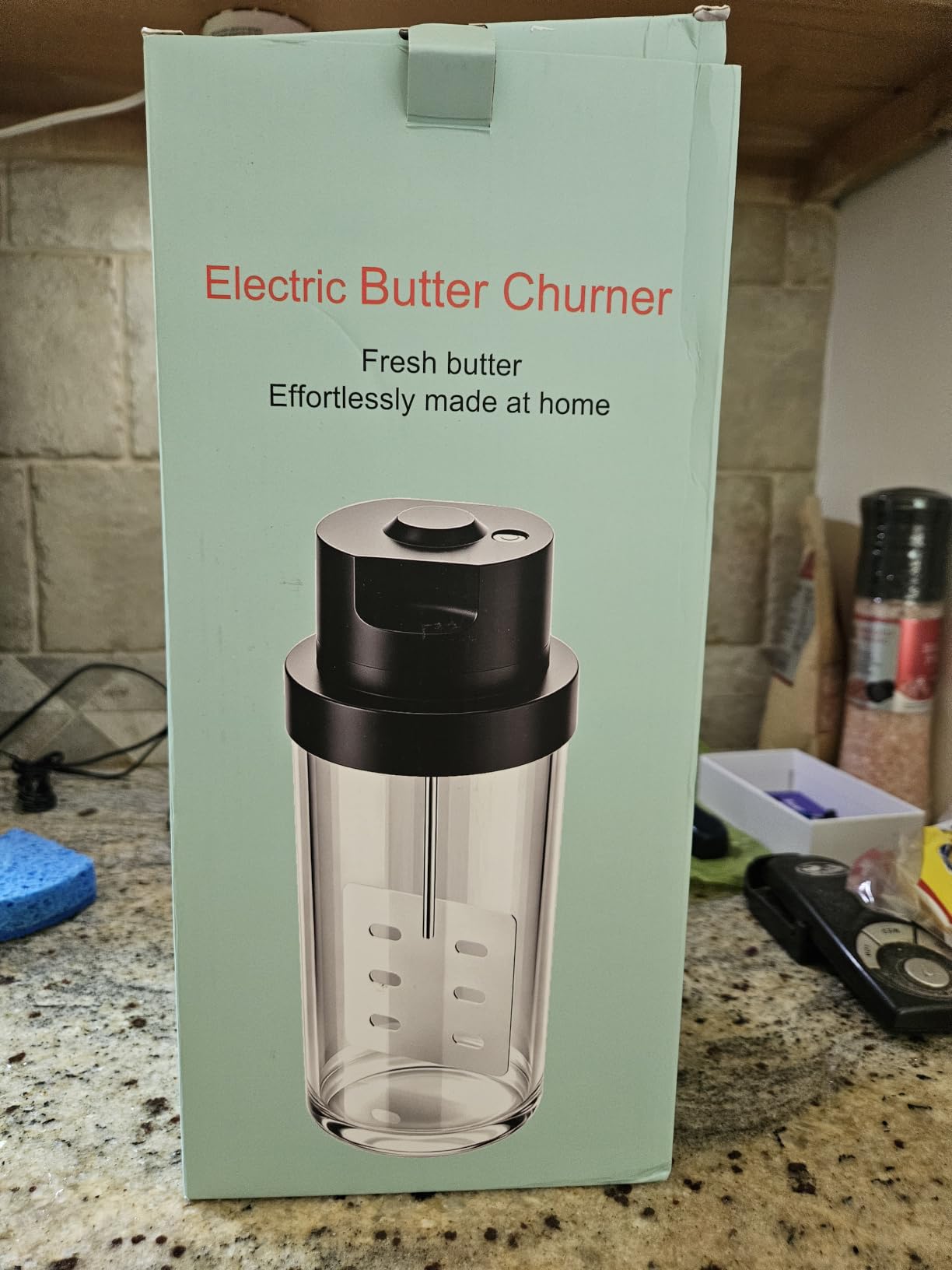
Owner feedback is mostly positive and mostly practical. The recurring limitations people mention are physical rather than functional, which usually means a machine does its job well and simply asks for more room than you expected.
The 11 inch tall jar is the headline problem. On a small counter next to a separator and a milk fridge, that vertical space is genuinely awkward, and it is worth measuring your counter before committing.
There is also a butter press in the kit, which matters more for raw milk than it might seem, because working the water out of the butter is what determines how long the finished block keeps. Pressing it properly is the difference between butter that lasts a week and butter that lasts a month.
What tells you it suits a raw milk setup
If your daily cream output regularly exceeds what a 34 ounce jar can take in one pass, this is the unit that stops you running a queue. Fewer batches means fewer clean and dry cycles, and cleaning time is the hidden cost that catches people out as herds grow.
Dishwasher safe construction is the other point in its favour for raw milk. You can run the jar, blade and lid through a full cycle at temperature rather than relying on a hot wipe, which is what you want when the input is unpasteurized.
Where it will disappoint you
The adapter and the separate mixing paddle are additional pieces that come apart, need washing, and need to be somewhere to live. More parts means more surfaces, and more surfaces means more places for raw cream residue to sit.
Like the other electric units, it is only useful where you have power. In a barn or a milk room without an outlet you would be better served by a larger hand crank or a wooden churner.
7. Chef’n Buttercup Butter Maker – The Fastest Way to Learn
Chef’n 102-567-017 Buttercup Butter Maker, One Size, Lemon/Meringue
1 liter plastic jar
Built in sieve
About 3 minutes of shaking
Pros
- Quickest and simplest option with no cranking at all
- Butter collects mess free in the included ramekin
- Built in sieve strains buttermilk in one step
- Dishwasher safe and finished butter keeps 5 to 7 days
Cons
- Only a quarter cup of butter per batch
- Plastic rather than glass or metal
- Needs 6 to 8 hours of room temperature cream before shaking
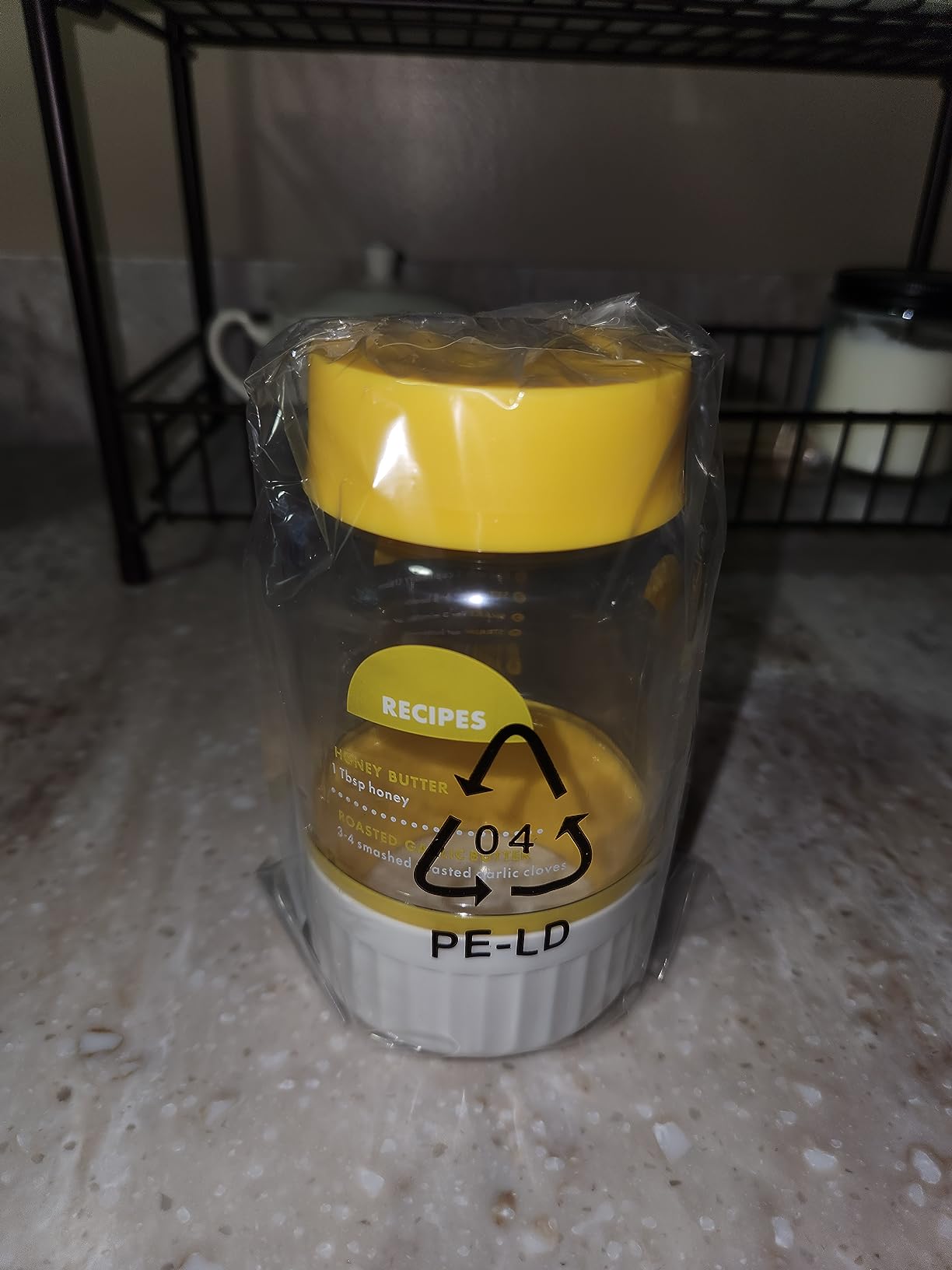
The Buttercup is not a traditional churn and does not pretend to be. It is a 1 litre plastic jar with a built in sieve at the base and a small ramekin underneath, and you make butter by filling it with cream and shaking it for about three minutes.
That makes it the fastest way in this roundup to see whether you actually enjoy the process. Three minutes of arm work plus a rinse is a very different commitment from twenty five minutes of cranking, and for a lot of people that is the whole test.
With more than 1700 reviews averaging 4.3 stars, it is one of the best proven performers here, and the feedback volume gives you a much clearer picture of failure modes than most churns on the market.
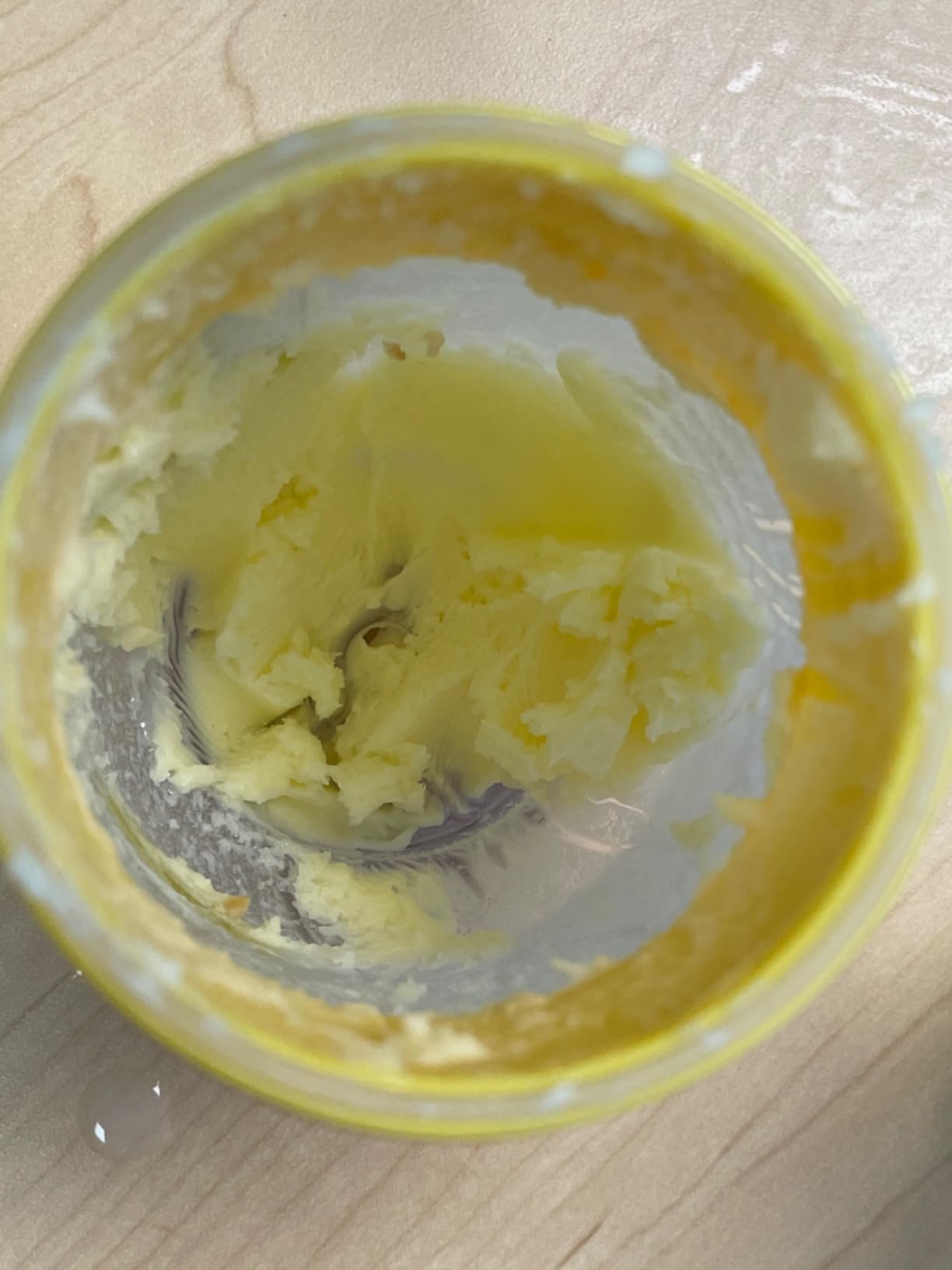
The one requirement that trips people up is timing. The cream has to sit at room temperature for 6 to 8 hours before you shake it, and if you skip that or shorten it the butter will not form. The instructions print on the product, which helps, and once you know it the rhythm becomes easy.
The other limitation is capacity. You get a quarter cup of butter at a time, so a full batch from a family cow means running the jar many times over rather than loading once. For teaching or for tasting it is ideal. For production it is not the tool.
Material is the third consideration. This is plastic, and while it is top rack dishwasher safe, plastic is the surface most raw milk dairies try to avoid in contact with product. Glass and stainless exist in this category for a reason.
What tells you it suits a raw milk setup
Self contained is the word. The butter drops into the ramekin, the buttermilk is strained through the built in sieve, and there is one vessel to wash instead of a jar, a mechanism, a paddle and a cloth. That is the lowest cleaning burden of anything in this roundup.
It is also a genuinely good way to produce cultured butter from raw cream. Because the cream rests for hours at room temperature before you churn it, the native culture in raw milk gets time to work, and you end up with a tangier, longer keeping product.
Where it will disappoint you
The 6 to 8 hour room temperature rest is a real constraint in a working dairy. Leaving cream warm for most of a day while you handle raw milk around it is a temperature control decision, and in a warm kitchen you may be fighting the butterfat rather than helping it.
It is also plastic that contacts the cream, which is exactly the surface people processing raw milk tend to avoid. If you are moving from curiosity to production, this is the tool you outgrow first.
8. WOODKIT Wooden Madhani – A Traditional Tool That Still Works
WOODKIT Wooden Buttermilk Churner Madhani Mathani Brown 12.5 in
12.5 inch acacia wood tool
Rotating handle
155g, hand wash only
Pros
- Solid acacia wood that feels durable in the hand
- One tool covers butter/buttermilk/dahi/chaas and lassi
- Rotating handle keeps churning smooth and light
- No electricity and no crevices to sanitize
Cons
- Small batch size only
- Hand wash only
- Wood quality and finish reported inconsistent
The madhani is a rotating wooden beater that predates every machine in this roundup, and it belongs in a raw milk article because it does something the electric machines do not. It is designed for turning milk into dahi, chaas and lassi, which means it works on a cultured, thickened base rather than only on thin cream.
That distinction is what makes it interesting if you want cultured butter. You culture the raw milk first into a thick set curd, break it, and churn the lassi, and you get a cultured product with a longer keeping life than sweet butter from fresh cream.
Construction is acacia wood with an ergonomic rotating handle, 12.5 inches long and weighing 155 grams. At that weight it is comfortable for extended use, and there are no crevices, seals or gears to harbor bacteria.
Reviews describe it as well made and good value, with the majority finding it durable for what it does. The criticism is about consistency of finish rather than failure, and one buyer reported the item received did not match the listing photos.
It is hand wash only and not dishwasher safe, which is standard for wood. The practical rule is to dry it standing up rather than laying it flat, because trapped moisture in a wooden head is how cracks start.
What tells you it suits a raw milk setup
For cultured dairy it is genuinely the right tool. Several users on r/homestead use a similar rotating beater to make cultured dairy products from raw milk, and the smoothness of the rotating handle reduces the effort compared to a flat whisk.
Because the whole working surface is a single piece of wood, sanitizing it is simple. Scrub, rinse, dry, done. There is no mechanism to strip, no gasket to replace and nothing that can trap cream in a seam.
Where it will disappoint you
Batch size is the real limit. A hand beater of this length works a bowl, not a churn jar, so throughput per batch is small and you are stirring a vessel rather than churning a drum. For daily volume it will not keep up.
It is also a multi use kitchen tool rather than a dedicated churn, so if you already own a decent wire whisk you may find the extra benefit is marginal for butter and meaningful for dahi and lassi.
9. Garden Of Arts Wooden Mathani – Light but Limited
Garden of Arts Stylish Wooden Handicrafted Whisk Beater, Mathani, Ravi, Ravai Churner
Rosewood construction
11.5 inch hand beater
100g lightweight build
Pros
- Very light at 100g and easy to handle
- Works for buttermilk and light whisking
- Natural rosewood look suits a traditional kitchen
- Simple hand operated design with no parts to break
Cons
- Frequently reported as flimsy and not sturdy enough for real churning
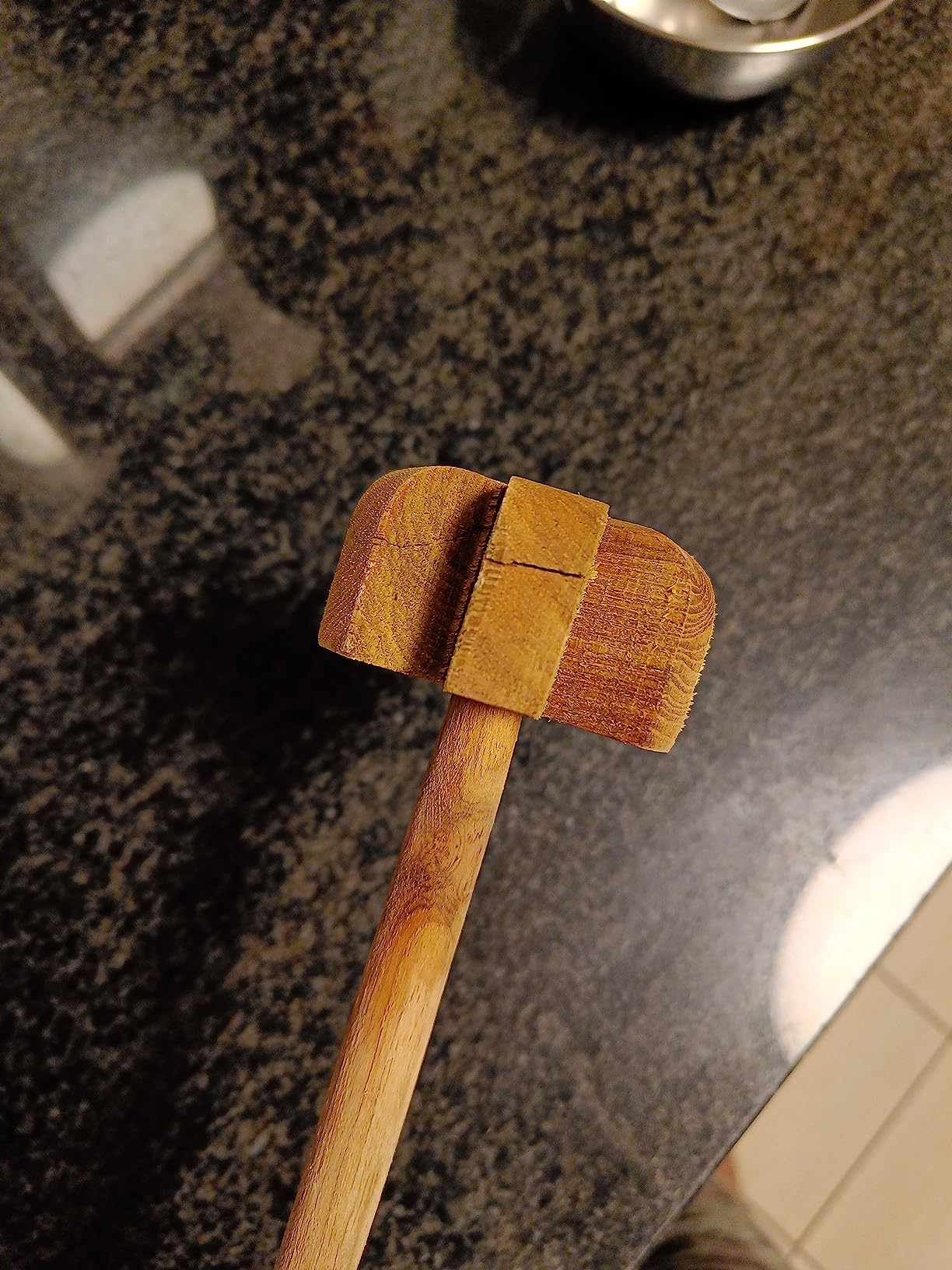
- Head can detach or crack at the front after light use
- Too small for meaningful quantities
This is the weakest rated item in the group at 3.7 stars, and we are including it because it is a very common purchase. If you are searching for a butter churn for raw milk and you end up here, we would rather you know the limits before you buy it.
The build is rosewood, 11.5 inches long, weighing 100 grams. It is a traditional egg beater style mixer that also gets used for coffee, dal ghotani and general whisking, and it is genuinely pleasant to handle at that weight.
It is not a churn. It is a hand beater, and treating those two things as equivalent is where most disappointment with tools in this category comes from.
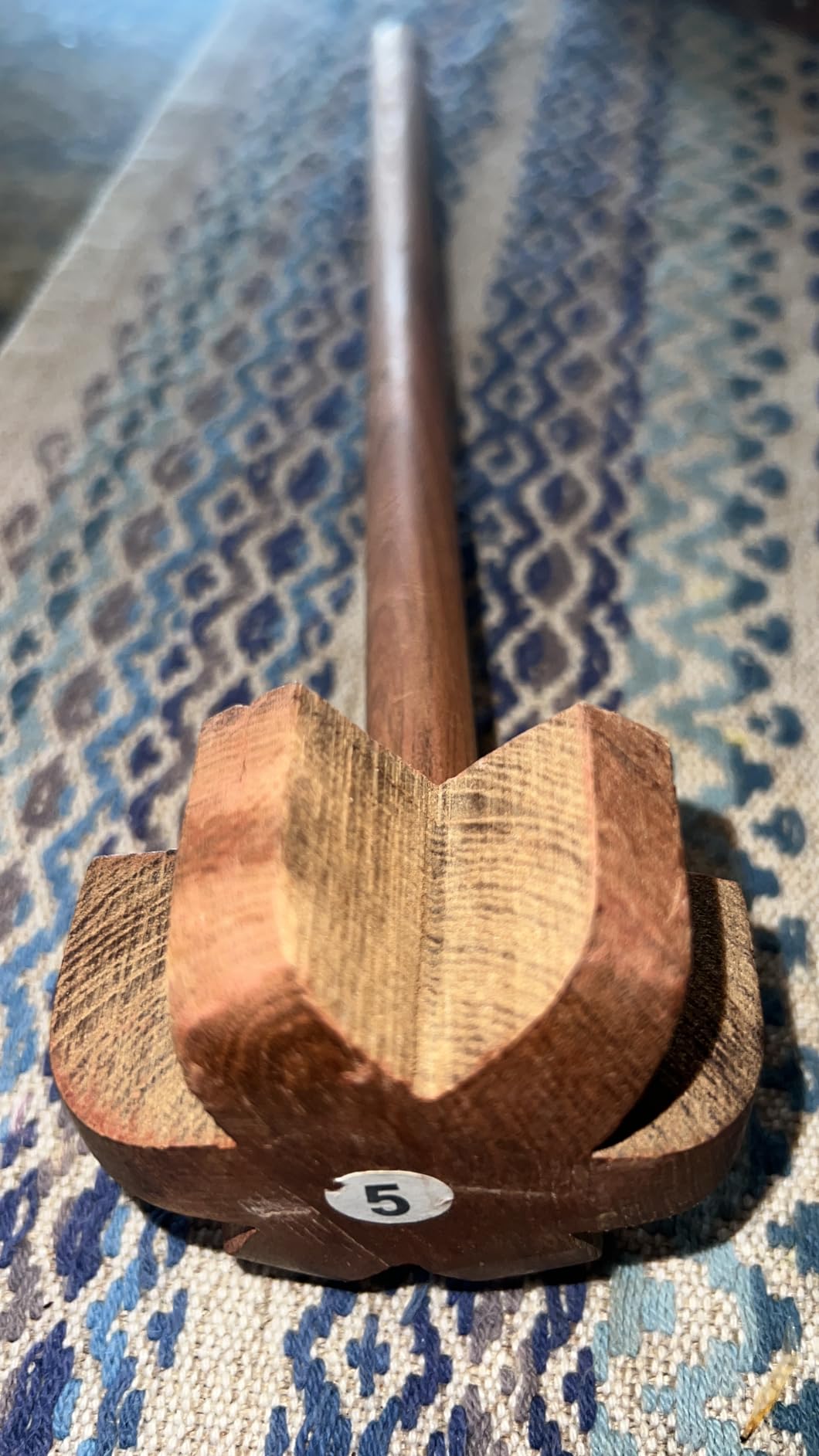
The dominant theme in the reviews is build quality. Owners report the head detaching, cracking at the front after light use, or the tool falling apart immediately after cutting through packaging tape. That is a consistent pattern rather than an unlucky sample.
Several owners also find it too small for meaningful quantities of curd or dahl, and a few note that a plain wire whisk is more effective at the same job. That comparison is a little unfair to the wood, but it tells you the ceiling on performance.
What tells you it suits a raw milk setup
The honest answer is that it suits a raw milk setup only as a supplementary tool. If you culture raw milk into dahi and want to break and stir it before pressing, a light wooden beater does that job without wearing you out.
There is one genuine advantage to a solid wooden implement over plastic: it does not scratch glass or stainless, and it does not carry odours between batches. If you are working with cultured dairy, a wood head is comfortable with acidic mixtures in a way plastic can be less forgiving of.
Where it will disappoint you
It will not make butter from firm cream. There is not enough mass or leverage in a 100 gram beater to break butterfat the way a gear churn or a rotating madhani does, so a batch that should form butter will stall.
Because it is rated at 3.7 and the complaints are structural, we would not build a raw milk butter routine on it. If you want a traditional wooden tool, the heavier 155 gram madhani covers the same ground with more margin.
10. Sahishnu Six Blade Wooden Churner – Small Batch and Light Grip
Sahishnu Online & Marketing Wooden Whisk Beater,Wooden Mathani,Ravai,Ravi,Churner Mixer, Butter Milk Churner
Sagwan wood head
Six blade design
13 inch length
Pros
- Six blade head covers more surface than a simple whisk
- Dishwasher safe and rust resistant build
- 13 inch length reaches into a deep vessel
- Handles buttermilk and lighter mixing well
Cons
- Very light at 2.08 oz with little leverage for firm butterfat
- Wood finish can crack with repeated soaking
- Six blades are harder to clean than a wire whisk
This is the other traditional wooden churner in the group, rated 3.8 stars across a smaller pool of reviews. The difference from the previous tool is blade count and geometry. Where the rosewood beater uses a single loop, this one has a six blade sagwan wood head.
More blades means more surface contact per stroke, which is why it does better on buttermilk and lighter mixing than a simple loop. It measures 13 by 3 by 3 inches, and the extra length gives it more reach into a deep vessel.
It is also described as rust resistant and dishwasher safe, which is unusual for a wooden tool and would be genuinely useful in a dairy room where you want to run a cycle rather than hand wash.
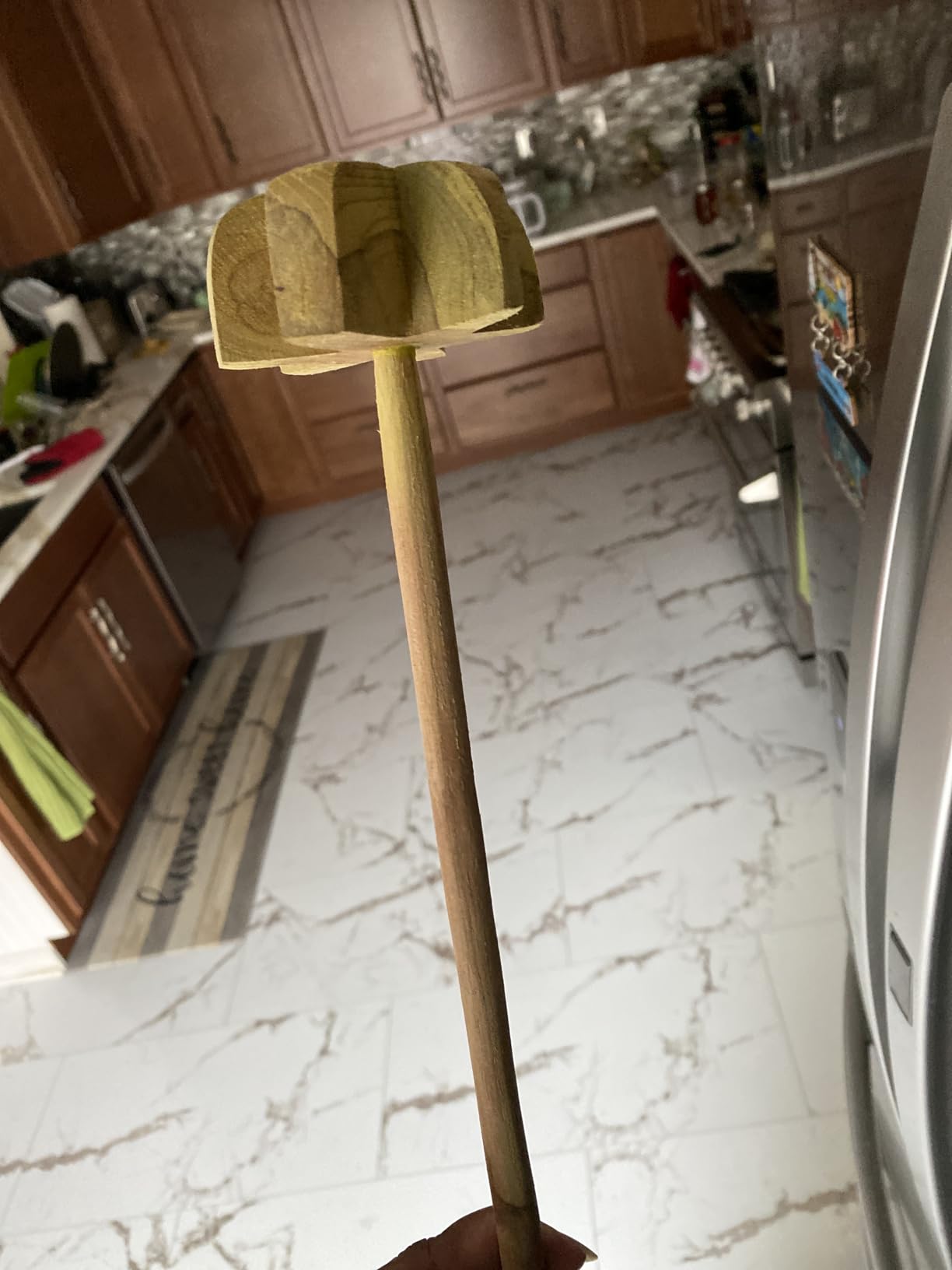
Weight is the central limitation. At 2.08 ounces, there is very little leverage for working firm butterfat, and the reviews are clear that this is better suited to buttermilk than to making butter from cream.
Repeated wetting is the other risk with any wooden head. Cracks and splinters in the finish come from soak dry cycling, so even with dishwasher safe construction, frequent full cycles will shorten its life in a raw milk routine where washing happens daily.
What tells you it suits a raw milk setup
For a raw milk household making small quantities of cultured buttermilk alongside a butter routine, it is a low commitment addition. It stirs a vessel quickly, needs no power and takes up no counter space at all.
The six blade head also handles the breaking and stirring step when you press curd, which is a stage people often try to do with a spoon and regret. A dedicated beater makes that step faster.
Where it will disappoint you
Do not expect butter from firm cream. The light head simply cannot generate the agitation and leverage needed, so if butter is the goal this is the wrong shape of tool entirely.
Cleaning between the six blades is more work than a simple wire whisk, and in a raw milk context that matters. The tighter the geometry, the more places cream hides, and a beater that is not properly washed after every batch will start to smell.
Hand-Crank vs Electric Butter Churn for a Raw Milk Kitchen
The honest summary is that hand cranking is about arm time and electric is about counter space and power. Everything else follows from that.
A hand crank costs nothing to run, works anywhere including a barn with no power, and comes apart into a few pieces that wash in a sink. In exchange you spend 15 to 30 minutes of physical effort per batch, and that effort is what makes people quit.
An electric unit removes the effort entirely, runs unattended so you can milk while it churns, and holds more cream per batch. In exchange it needs an outlet, claims counter space, adds a motor base to your cleaning routine, and changes the texture of the finished butter toward something lighter.
For one family cow producing a few gallons a day, a hand crank is genuinely workable. Forum users on r/homestead regularly describe using a four quart hand crank for a family cow and being happy with it. For a herd of five or more, the batch count starts to make electric worth the tradeoff.
One thing forum discussion keeps surfacing: electric churns must be switched off the moment butter forms. Running the motor through the separation stage can overwork the butterfat, and several users described jammed mechanisms that started right after a batch that was left running.
How Big a Butter Churn Your Herd Actually Needs
Size a churn by cream volume, not milk volume, because the cream is what goes in the machine. A useful rule for cow milk is that around 4 pounds of butter per 100 pounds of milk, and roughly a tenth of a gallon of milk yields enough cream for about half a cup of butter.
From there, size by batches per day rather than per week. If one batch fits your schedule and your wash cycle, the churn is big enough. If you need three batches before the evening milking, you need the larger jar even if the total volume is small.
For a single family cow milking roughly 3 to 5 gallons a day, a 32 or 34 ounce glass jar handles it. That covers the common case, and it is the sweet spot for hand cranking because a full jar is still manageable.
For 3 to 5 cows, plan on running a batch every other day or moving to a larger electric jar. The bottleneck stops being the churn and becomes separating, chilling and cleaning between batches.
For 10 cows or more, a single countertop unit is the wrong shape of solution. At that point you are looking at a stainless tilting drum churn and a proper cream separator, which is a different category of equipment and a different conversation about food safety and local dairy licensing.
Goat and sheep milk need a different calculation again. Hand skimming loses too much fat from goat milk, so a mechanical separator becomes effectively mandatory if you want a real yield rather than skimmed whey.
Raw Milk to Butter: Separation, Ripening and Yield
Separate first, then chill, then churn, then work the butter. That order is the whole process and most mistakes come from skipping a step in the middle.
On separation, cold milk separates best. Set raw milk to cool first, then separate or skim while it is cold, and you get more cream with less effort than skimming warm milk. Warm milk is for churning, not for separating, which is the opposite of most people’s instinct.
On temperature, cream that has been warmed to around room temperature churns faster and with less effort. This is the single most repeated tip across customer reviews in this roundup, and it applies to every hand crank here. Cold cream takes 25 to 30 minutes where warm cream takes 10 to 15.
On cultured versus sweet, sweet butter comes from fresh cream churned immediately. Cultured butter comes from cream deliberately ripened, usually with a starter, before churning. Raw milk makes this easier because the culture is already present, and cultured butter keeps considerably longer.
On moisture, water left in the finished butter is what limits keeping quality. Drain the buttermilk, then work the butter against the cold side of the churn, press it, and salt it. Skipping the working step is the most common reason homemade butter goes off in a week instead of a month.
On storage, keep finished butter cold and airtight. If you are going to bake with it rather than eating it fresh, our mashed baby potato with butter and cream style recipes are a good way to work through a block steadily, and the peanut butter and chocolate recipes are a good destination for the buttermilk you get as a by-product.
Cleaning and Sanitizing a Churn Used With Raw Milk
Raw milk changes how you think about a churn. You are not cleaning a whisk that touched cream, you are cleaning equipment that has been in contact with unpasteurized product, and the standard is higher than most people apply to a home kitchen tool.
Material is the first filter. Glass and stainless steel tolerate heat, scrubbing and sanitizing without complaint. Plastic is workable but ages faster under repeated hot cycles. Wood cannot be sanitized at temperature, so wooden churners are only appropriate if you accept hand washing with soap and a hot rinse as your standard.
Disassembly is the second filter, and it is more important than capacity. A churn that comes apart into pieces you can put in a dishwasher or scald is usable daily. One with a fixed gear head and a shaft seal is a cleaning liability no matter how well it churns.
Watch the shaft seal. If any unit in this roundup leaks dark material into your cream, stop using it for that batch and inspect the seal. That is the one failure mode that affects the product itself rather than the machine.
Dry everything completely before reassembling. A jar reassembled with moisture trapped in the gear housing is how a working churn turns into a smelling one, and on a wooden tool it is also how cracks start.
For goat milk and sheep milk, clean more often, not less. Lighter fat and higher viscosity mean more residue clinging to surfaces, and the smell shows up in the butter long before anyone notices the equipment.
If you are working through a lot of butter, the chocolate milk drink ideas on the site use buttermilk heavily, and so do most quick breads. A well cleaned churn plus a plan for the by-product is what keeps the whole routine sustainable.
Frequently Asked Questions
Can I churn raw milk into butter?
Yes, but separate the cream first rather than churning whole milk. Raw cream separated from raw milk contains roughly 35 to 40 percent butterfat, which is the concentration a butter churn is built to clump. Chill the cream after separating, let it warm toward room temperature before loading, and keep it cold while it churns. Whole raw milk poured straight into a churn wastes most of its fat, because the butterfat is dispersed through the water phase rather than concentrated.
What is the best tool to churn butter?
For a raw milk homestead churning a few gallons a day, a 32 to 34 ounce glass jar hand crank with metal gearing is the best balance of capacity, cleanability and cost. Glass and stainless parts disassemble for washing, the gearing holds up as the cream thickens, and no power is needed. Move to an electric unit when batch count reaches three or more per day, and move to a stainless tilting drum when you pass about ten cows.
Is it cheaper to churn butter than to buy it?
The honest answer depends on whether you already have a cow. If you are producing raw milk anyway, the milk is a sunk cost, so every pound of butter is value recovered from an asset that would otherwise spoil, and the churn itself is a one-time purchase. If you would have to buy cream to churn, the math rarely works against store bought butter. The real saving is turning perishable milk into a product that keeps for weeks, not beating the butter aisle on unit cost.
Do Amish people churn butter?
Traditional hand churning predates mechanized dairy in Amish and other rural farming communities, and churns are still used where electricity is unavailable or where a household prefers a specific cultured result. A rotating wooden beater called a madhani is still the common traditional tool, and it is included in this roundup for that reason. Modern Amish dairies that sell commercially use mechanical churns and pasteurization, so a wooden churn today is mainly a choice about tradition and texture rather than about necessity.
How long does it take to hand crank butter?
Advertised times of 10 to 15 minutes assume room temperature cream and a partial jar. Cold cream straight from the fridge commonly pushes a hand crank batch to 25 or 30 minutes, and forum users regularly report that the advertised figure does not match reality. Warming the cream toward room temperature before you start is the single change that closes most of that gap. The small 16 ounce Dazey can finish in under five minutes with warm cream simply because there is less mass to move.
How much butter do I get from a gallon of raw milk?
A useful planning figure for cow milk is roughly 4 pounds of butter per 100 pounds of milk, which works out to about half a pound of butter per gallon. Cream is around a tenth of the milk volume, so a gallon of raw milk gives roughly half a cup of heavy cream. Individual churn specs are more concrete: the Kilner lists half a cup of butter per 10.1 ounces of cream, and the aeaker lists three quarters of a cup per 12 ounces. Goat milk yields far less without a mechanical separator.
Do I need a cream separator to make butter?
For cow milk, hand skimming works and forum users do it routinely, though you lose some fat to the skim milk. For goat and sheep milk, hand skimming loses too much butterfat to be practical, so a mechanical separator is effectively required to get a worthwhile yield. Goat milk also separates differently, so plan on testing with a small volume first. If you are separating cream every day anyway, a separator pays for itself in recovered fat long before it pays for itself in butter.
How do I clean a glass jar butter churn?
Disassemble it fully after each batch, rinse with cold water first so you are not setting protein into the glass with hot water, then wash with detergent and a brush. Take the gear head, paddle, seal and lid apart separately, because cream hides in the shaft. Rinse, sanitize at temperature where the material allows, and dry every part completely before reassembling. Avoid overfilling, which pushes cream into the gear housing and is the most common cause of the jamming complaints buyers report.
The Best Butter Churn for Raw Milk in 2026
After going through all ten, the Kilner 34 ounce glass churn is still the one we would put in a raw milk kitchen. It is the best butter churn for raw milk because the cast gearing survives the end of a batch, the jar comes apart for washing, and it needs no power, which matters more in a barn than in a kitchen.
If your arm is the limiting factor rather than your judgment, move up to the IFOLO electric churn and accept a lighter texture. If you are not sure you want the routine at all, start with the Chef’n Buttercup and learn the process in an afternoon.
Whatever you pick, warm the cream first, fill the jar no more than halfway, and do not skip the working and pressing step. Those three details matter more to the butter you end up with than any difference between the machines.
Once you have a block in hand, the peanut butter recipes are a good excuse to work through it, and the buttermilk is useful in almost any quick bread or drink recipe on the site.