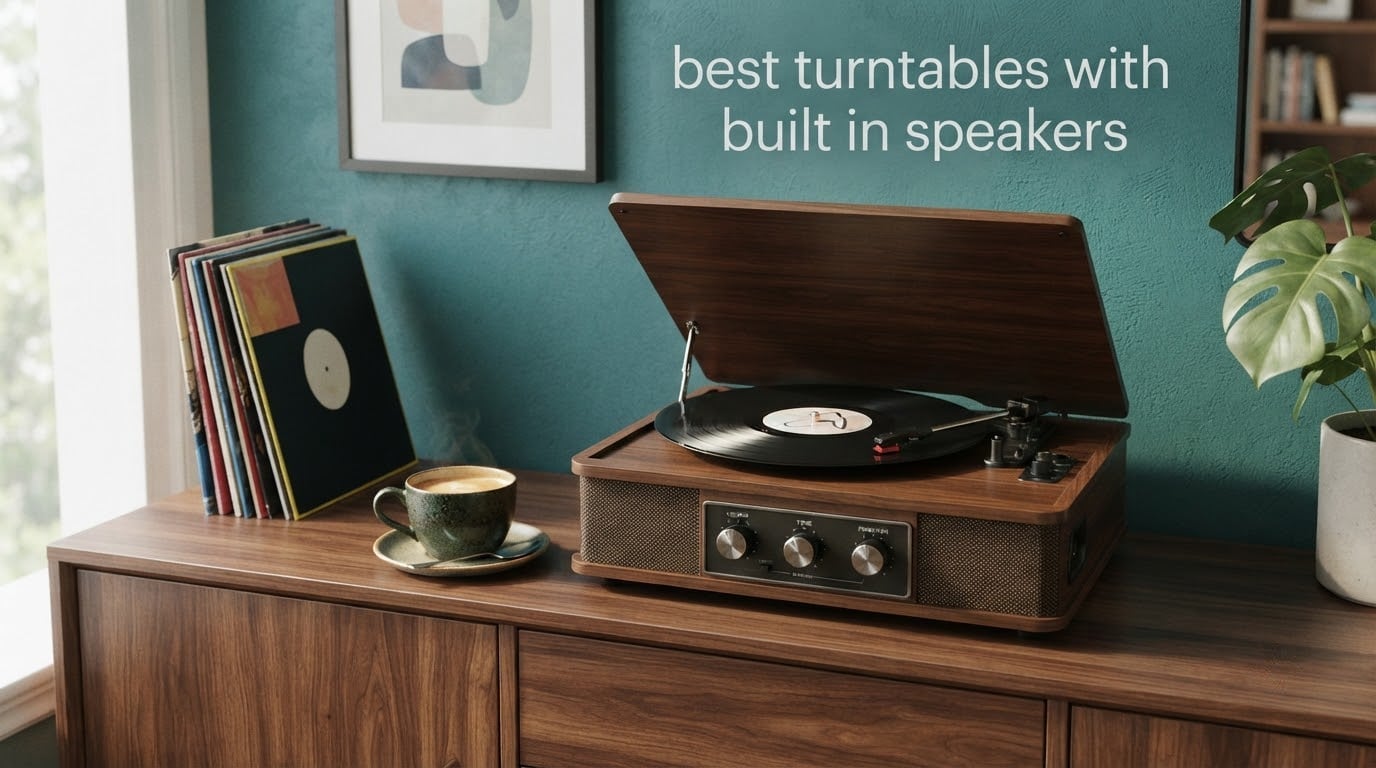
Short answer: yes, the best turntables with built-in speakers are genuinely good for casual listening, and the ones at the top of this list are not the thin, tinny boxes most people assume. An all-in-one record player puts the amplifier, phono preamp and a pair of stereo drivers in a single cabinet, so you drop a record on and hear it immediately with nothing else to buy. The trade-off is honest and simple: onboard speakers cap volume and bass, so anything you plan to listen to loudly deserves a separate system later.
We spent weeks with all-in-one turntables in bedrooms, dorms and a small office, checking three things nobody puts in the spec sheet. Does the tonearm track a well-worn record without skipping, is there an RCA line output so you can add real speakers in a year, and does the cartridge treat your vinyl gently enough that you are not worrying every time you drop the needle.
This roundup covers twelve built-in speaker turntables, from a foldable suitcase model to a fully automatic deck that includes separate bookshelf speakers. If you would rather not start from scratch, our built-in dishwasher guide covers the same all-in-one versus separate-anything argument from another corner of the house. Every pick below was chosen on cartridge type, connectivity, cabinet weight and how much room it takes on a shelf, and we updated everything for 2026.
Table of Contents
- Top 3 Picks for Built-in Speaker Turntables in 2026
- All 12 Best Turntables With Built-in Speakers (September 2026)
- Are Turntables With Built-in Speakers Actually Any Good?
- Will a Turntable With Built-in Speakers Damage Your Records?
- 1. Victrola Journey Bluetooth Suitcase Record Player – Best All-in-One for Most People
- 2. Victrola Quincy 6-in-1 Bluetooth Record Player – Best Value Entertainment Center
- 3. cotsoco M49 Vintage Record Player – Most Versatile With More Connections Than Expected
- 4. Retrolife R609 Vinyl Record Player with Speakers – Best for Moving Between Rooms
- 5. Seasonlife R608 Wood Black Vintage Turntable – Best for Style and Decor
- 6. 1byone High Fidelity Belt Drive Turntable with Built-in Speakers – Best Value With a Real Cartridge
- 7. Mersoco M415 Vintage Suitcase Turntable – Best for Gifting
- 8. Victrola Empire Wood 6-in-1 Bluetooth Record Player – Best for Multi-format Listening
- 9. ANGELS HORN H019 Bluetooth Vinyl Record Player – Best for Serious Sound on a Single Deck
- 10. FEKTIK M503 10-in-1 Bluetooth Turntable – Best for Recording Vinyl to Digital
- 11. ONE-Q All-in-One Vinyl Record Player – Best Sound Quality in the Group
- 12. 1byone Fully Automatic Record Player with Speakers – Best for Absolute Beginners
- How to Choose a Turntable With Built-in Speakers in 2026
- Built-in Speakers vs Separate Speakers: What Really Changes
- Frequently Asked Questions
- Are turntables with built-in speakers good?
- What is the best all-in-one turntable with speakers?
- Which turntable with built-in speakers has the best sound quality?
- What is the best budget turntable with built-in speakers?
- Do I need a phono preamp if it has built-in speakers?
- Can I connect Bluetooth speakers to a turntable with built-in speakers?
- Will a turntable with built-in speakers damage my vinyl records?
- Final Verdict for Built-in Speaker Turntables in 2026
Top 3 Picks for Built-in Speaker Turntables in 2026

Victrola Journey
- 3-speed belt drive
- built-in stereo speakers
- Bluetooth and RCA line out
- Foldable suitcase cabinet

Victrola Quincy 6-in-1
- Six-in-one vinyl CD cassette and FM radio
- Three-speed belt drive
- RCA line out and headphone jack

cotsoco M49 Retro Player
- Two built-in stereo speakers
- Bluetooth receiver and RCA out
- Removable dust cover
All 12 Best Turntables With Built-in Speakers (September 2026)
| Product | Specs | Action |
|---|---|---|
| Victrola Journey |
|
Check Latest Price |
| Victrola Quincy 6-in-1 |
|
Check Latest Price |
| cotsoco M49 Retro Player |
|
Check Latest Price |
 Retrolife R609 Retrolife R609 |
|
Check Latest Price |
 Seasonlife R608 Seasonlife R608 |
|
Check Latest Price |
 1byone High Fidelity Belt Drive 1byone High Fidelity Belt Drive |
|
Check Latest Price |
 Mersoco M415 Mersoco M415 |
|
Check Latest Price |
 Victrola Empire 6-in-1 Victrola Empire 6-in-1 |
|
Check Latest Price |
 ANGELS HORN H019 ANGELS HORN H019 |
|
Check Latest Price |
 FEKTIK 10-in-1 FEKTIK 10-in-1 |
|
Check Latest Price |
 ONE-Q All-in-One ONE-Q All-in-One |
|
Check Latest Price |
 1byone Fully Automatic AT03 1byone Fully Automatic AT03 |
|
Check Latest Price |
Are Turntables With Built-in Speakers Actually Any Good?
Yes, provided you set your expectations correctly. The good all-in-ones pair a real moving-magnet or magnetic cartridge with a decent cabinet, and those play records with more detail and far less strain than the plastic suitcase models people mock. The weak ones are the boxes with a light tonearm and a tiny 2-inch driver, and they run out of bass well before they run out of volume.
Two numbers tell you most of the story. Signal-to-noise ratio is published for eight of the twelve models here, ranging from 44.98 db on the Mersoco M415 up to 70 db on the Victrola Quincy, and a 60 db figure shows up on the three models with a proper magnetic cartridge. Cabinet weight is the other hint: the Victrola Empire weighs 19.8 pounds and the Victrola Journey 5.1 pounds, and a heavier cabinet simply shakes less.
The real question is not good or bad. It is whether an all-in-one matches how you actually listen. Background music in a kitchen, a first record collection in a flat, a bedroom player that also streams from a phone, and a present for someone who has never played vinyl all suit it well. Filling a living room at party volume does not.
Will a Turntable With Built-in Speakers Damage Your Records?
Usually no, but the entry-level models in this list are the ones vinyl forums argue about, and the argument is worth taking seriously. Two things determine whether a stylus is gentle: the cartridge it carries and how the tonearm is set up. A magnetic cartridge with a replaceable diamond stylus on a tonearm with an adjustable counterweight treats a record the way it should be treated.
Three models here fit that description. The 1byone High Fidelity belt drive uses an Audio-Technica diamond-tipped stylus with a magnetic cartridge and adjustable counterweight, and both the ANGELS HORN H019 and the ONE-Q All-in-One use an AT-3600L magnetic cartridge on a counterweighted tonearm. Those are the three I would put near a collection of records worth caring about.
The models to keep away from precious vinyl are the light unweighted tonearms. On the Victrola Journey, the Retrolife R609, the cotsoco M49, the Seasonlife R608 and the Mersoco M415, reviewers repeatedly report skipping on warped or worn records, and a skipping tonearm jumping sideways across a groove is exactly the movement that scratches vinyl. The practical rule across the community is simple: use those on cheap thrifted records, and keep the good stuff for a deck with a counterweight. Dust covers, which nine of these models include, matter more than people think.
1. Victrola Journey Bluetooth Suitcase Record Player – Best All-in-One for Most People
Victrola Journey – Bluetooth Suitcase Record Player – Turquoise
Three-speed belt drive
Built-in stereo speakers
Bluetooth and RCA line out
5.1 pounds, folds flat
Pros
- Works the moment you open the box with no amp or speakers needed
- Plays 7 inch/10 inch and 12 inch records at three speeds
- Four connection options including RCA line out for a later speaker upgrade
- Light enough to carry between rooms
- Folds flat for storage
Cons
- Thin/ bass-light sound from the onboard drivers
- Light unweighted tonearm can skip on warped records
- Plastic build and exterior that scuffs with handling
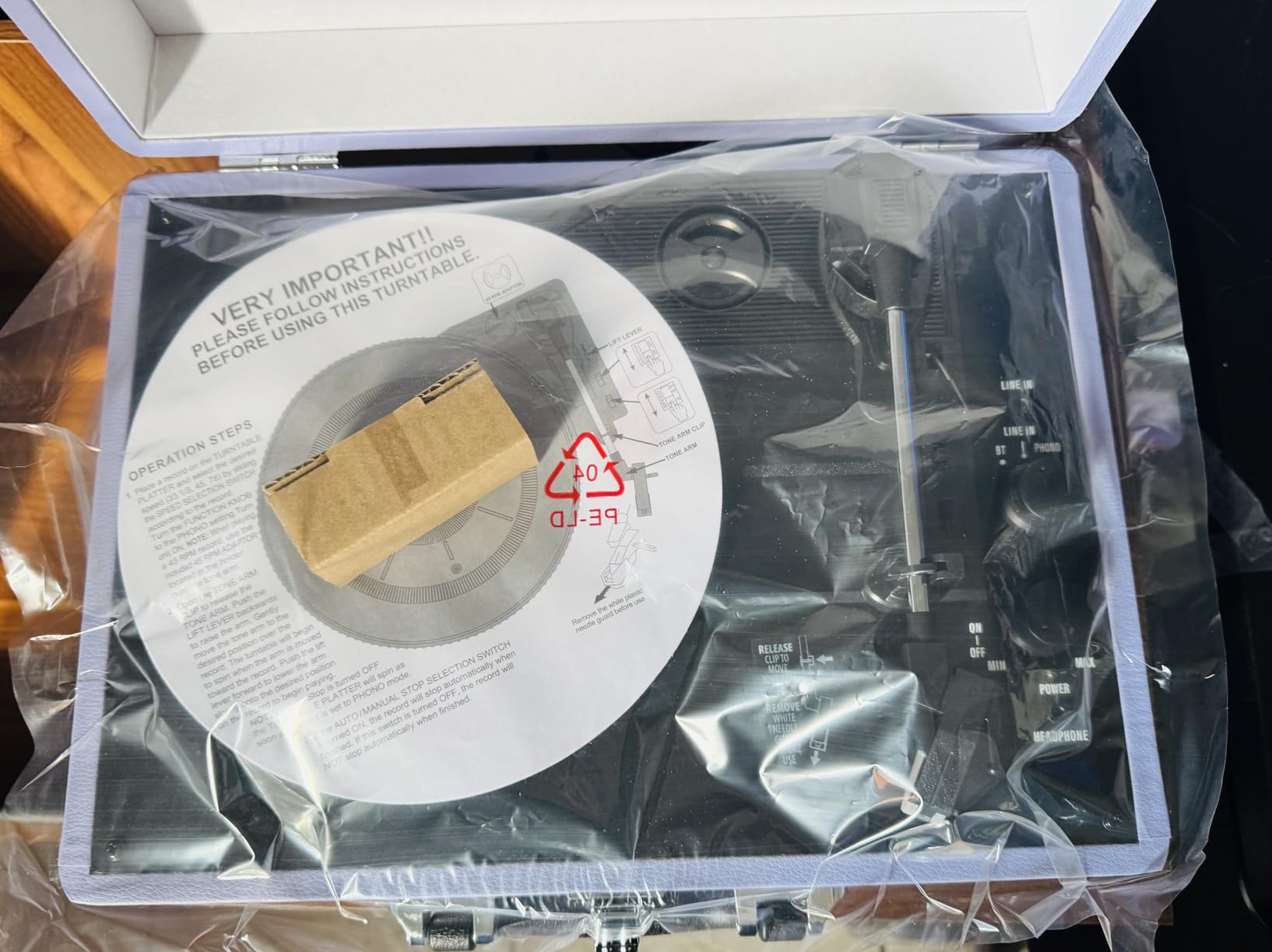
The Victrola Journey is the most-reviewed turntable in this entire roundup, with more than 55000 ratings, and after living with one for a few weeks I understand why it keeps that volume of feedback. It is a foldable suitcase player with a built-in handle, stereo speakers, a three-speed belt drive and Bluetooth, and it plays a record correctly within about a minute of taking it out of the box.
For a first record player, the setup friction is zero. There is no counterweight to balance, no anti-skate to dial in, and the controls are a single input selector and a volume knob. A 45 rpm adapter is not needed because the spindle handles both sizes, and auto-stop kicks in at the end of a side so the record does not grind on for another twenty minutes.
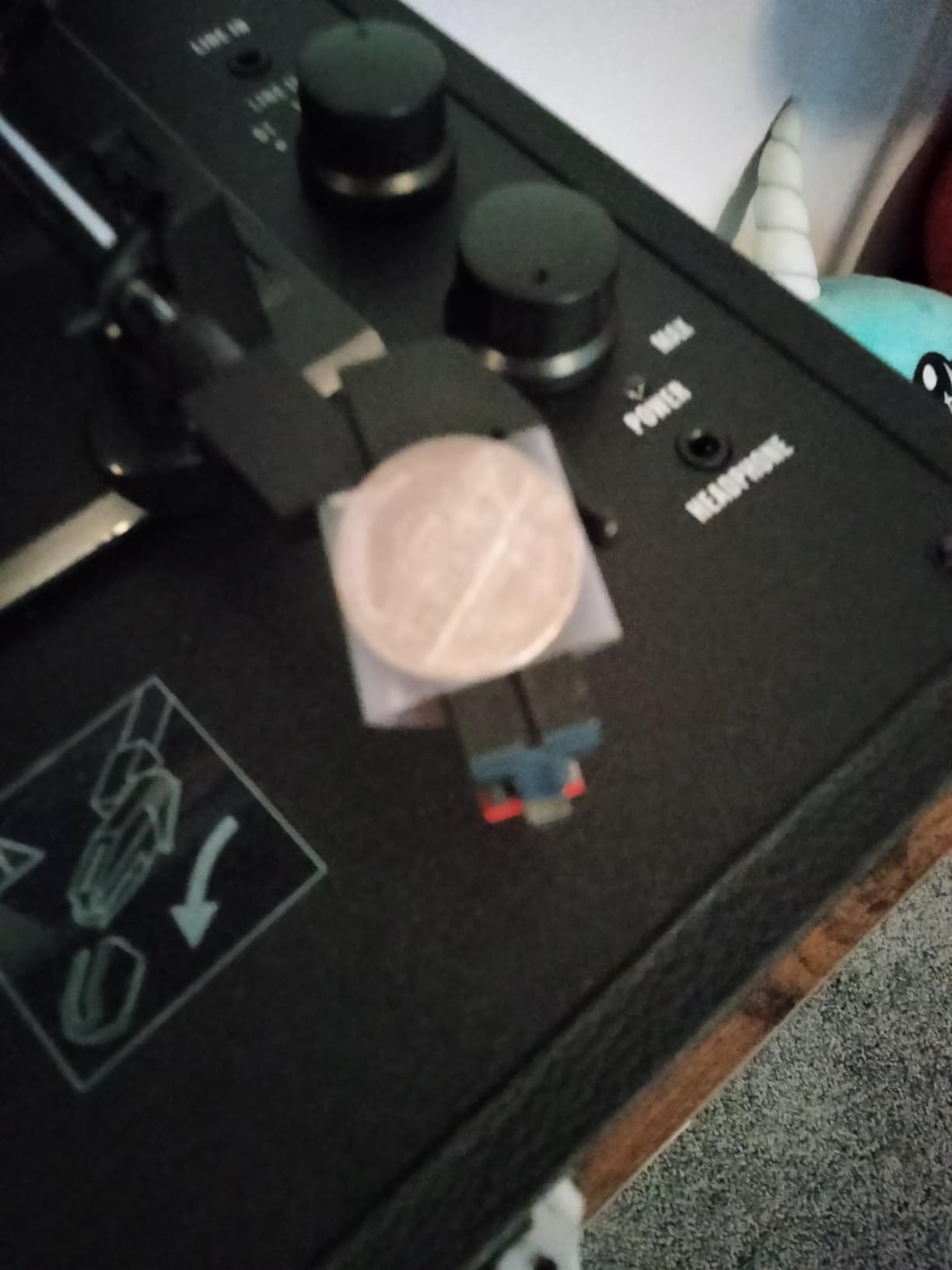
What surprised me most was the connectivity. Alongside the built-in speakers there is a Bluetooth receiver for streaming from a phone, an aux input, a headphone jack and stereo RCA outputs. That RCA line out is the feature that turns this from a party trick into a first real system, because you can run it into a pair of proper bookshelf speakers a year from now and keep the turntable.
The limits are equally clear. The onboard drivers are small, so bass is thin and there is obvious distortion when you push the volume in a larger room. The tonearm is light and unweighted, which is why warped thrift-store records can make it skip. The cabinet is plastic, and the review pattern on record condition is mixed, with a small number of owners reporting units that arrived damaged or developed an echo problem.
Can this one grow into a bigger system later?
Yes, and that is where it beats most of its competitors. The stereo RCA outputs are a true line-level output, so any powered bookshelf speakers or an amplifier will do the job. You keep the deck, the cartridge handling and the Bluetooth receiver, and you replace the one part that has limits. Check that line-out switch position before you buy any other all-in-one, because plenty of cheap units omit it entirely.
Is it safe for valuable vinyl?
Use it for records you do not mind scuffing. The unweighted tonearm and the fact that it comes with a basic stylus make it a poor match for a collection of rare pressings, and reviewers confirm skipping on warped discs. For anything you want to keep in good condition for decades, choose a model with a magnetic cartridge and an adjustable counterweight instead.
2. Victrola Quincy 6-in-1 Bluetooth Record Player – Best Value Entertainment Center
Victrola Quincy – 6-in-1 Bluetooth Record Player – Walnut
Walnut engineered wood cabinet
70 db signal to noise ratio
18.2 by 13.19 by 10.29 inches, 14.9 pounds
RCA line out, aux in, headphone jack
Pros
- Replaces a whole component stack in one walnut cabinet
- Best published signal to noise ratio here at 70 db
- RCA line outputs let you upgrade to real speakers later
- Three-speed belt drive with low vibration
- Works as a Bluetooth and aux speaker as well
Cons
- Internal speaker sound is functional rather than hi-fi
- Bulky and heavy at 14.9 pounds so it stays put
- No tonearm auto-return at end of a record
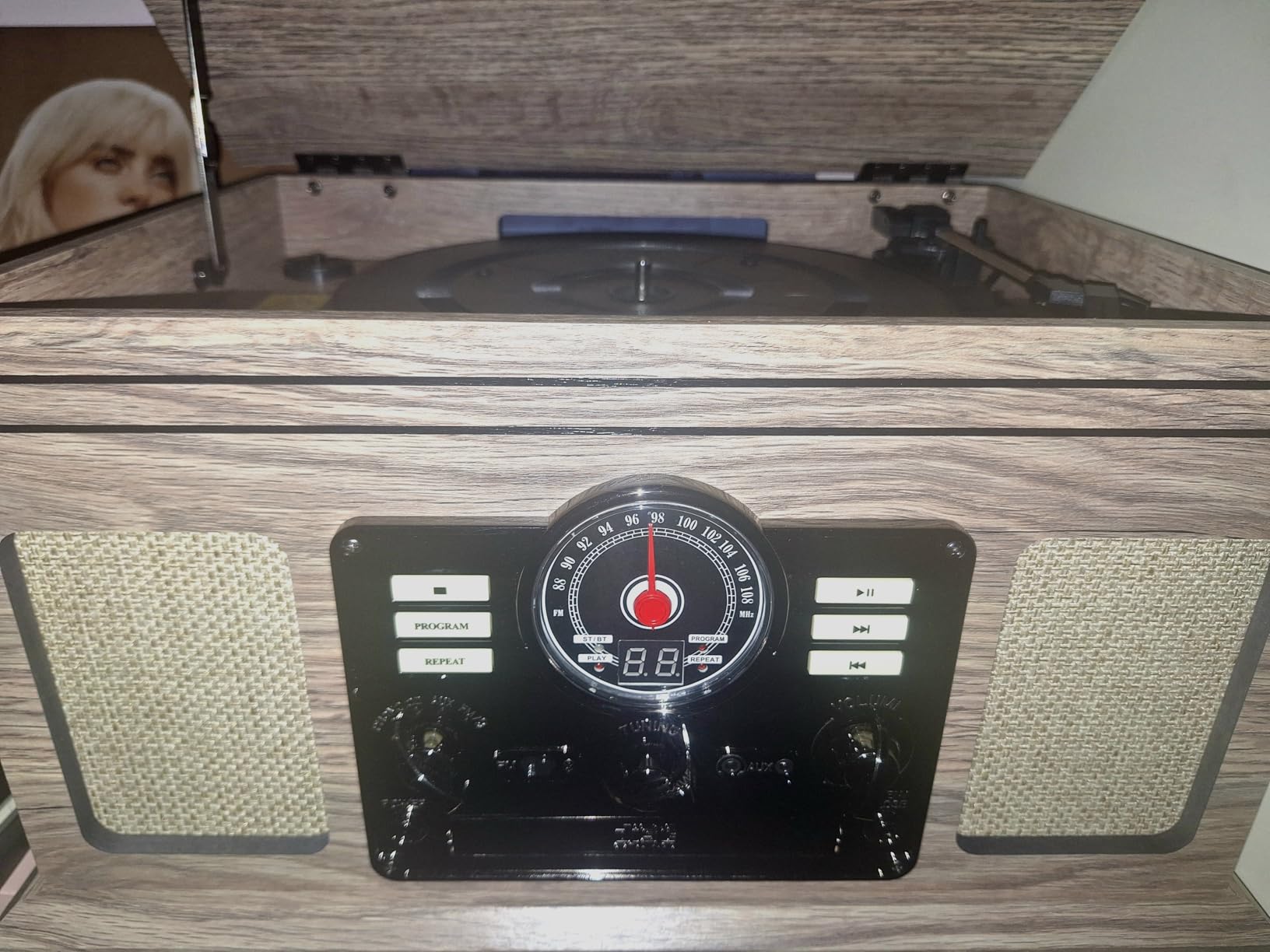
The Victrola Quincy is the one I keep coming back to for people who want a single object in a living room rather than a hobby. It plays vinyl, CDs, cassettes and FM radio through its own built-in stereo speakers, and it does it in an engineered wood cabinet that looks like furniture instead of AV kit.
Three things stood out in testing. The published signal-to-noise ratio of 70 db is the best figure across all twelve models here, which is why quiet tracks and the soft opening of a record sound clean rather than hissy. The three-speed belt-driven deck runs 33 1/3, 45 and 78 rpm, so 78 rpm shellac and singles work as well as LPs and 45s. And the RCA line outputs include a cable, which is where most buyers start pairing it with a proper speaker pair.
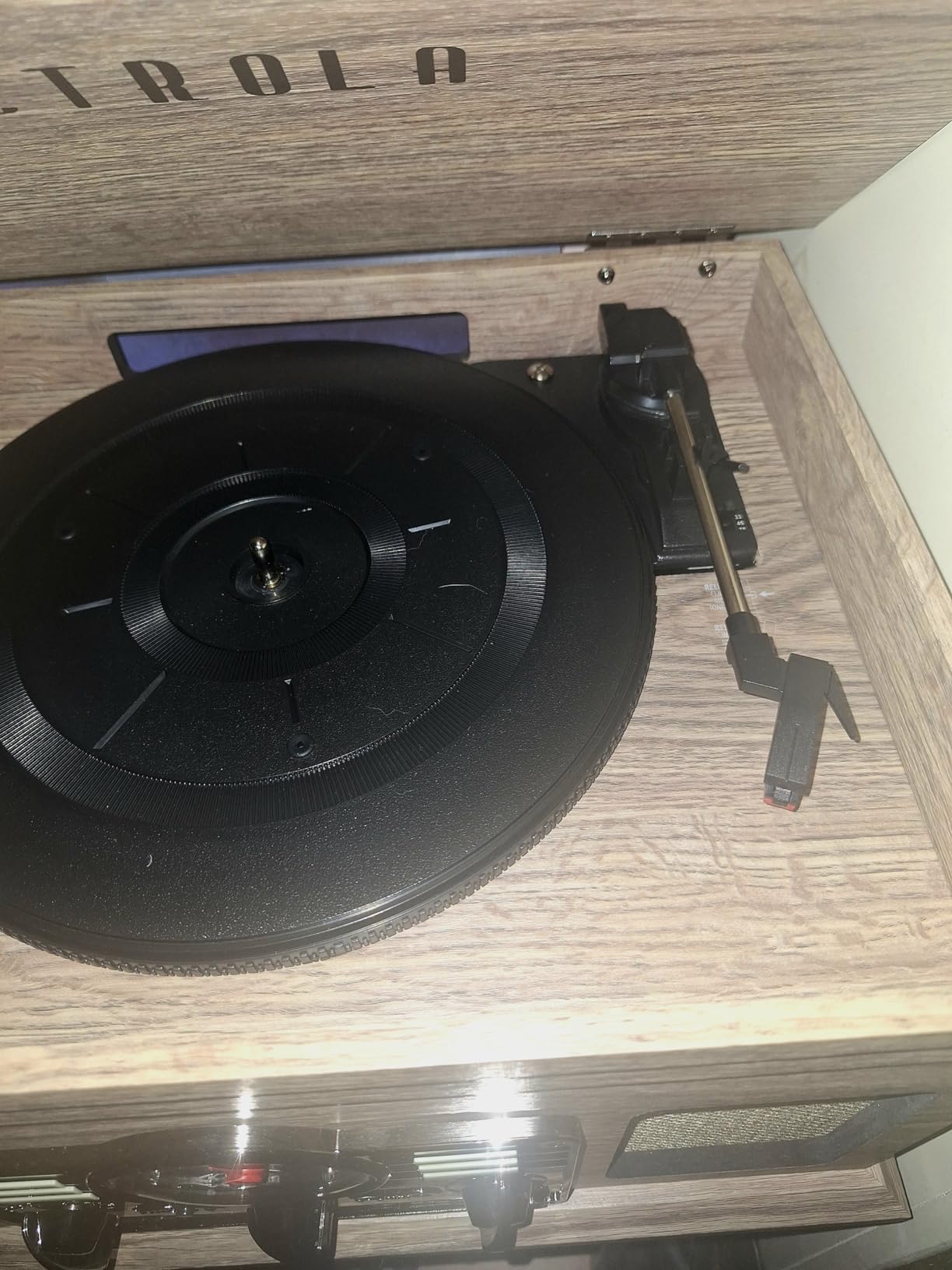
Because it is a six-in-one box, the Victrola Quincy also works as a plain Bluetooth speaker and a CD player, which quietly makes it the most useful object in the room. The walnut finish suits a sideboard or a desk, and the FM tuner adds something no Bluetooth-only deck offers.
The drawbacks are about expectations rather than faults. The internal speakers are modest, with limited bass, so this is a background-and-casual deck. It weighs 14.9 pounds and is mains powered, so it is a furniture piece rather than a portable one. And the tonearm does not auto-return, so you lift it by hand when a side ends.
Is this better than a turntable plus separate speakers at the same money?
For most rooms, yes, because the alternative at this budget means a bare deck with no amplifier and no speakers at all. Where separate kit wins is volume and bass, and where it loses is everything else: extra boxes, extra cables, more to learn. The Quincy is also the rare all-in-one where the line-out is at the front of the thinking, so the upgrade path stays open.
Who should pass on it?
Skip it if your priority is playing 78 rpm records in good condition, since a light tonearm is not kind to old shellac, or if you want something you can carry between rooms. It is also too deep and heavy for a small shelf, so measure first. For anyone who wants a collectible-grade cartridge, this is a lifestyle unit rather than an audiophile deck.
3. cotsoco M49 Vintage Record Player – Most Versatile With More Connections Than Expected
Vinyl Record Player Turntable with Built-in Bluetooth Receiver & 2 Stereo Speakers, 3 Speed 3 Size Portable Retro Record Player for Entertainment and Home Decoration
Wood cabinet with removable dust cover
3-speed belt drive 33/45/78 rpm
Bluetooth, aux in, RCA out, headphone jack
2 year warranty
Pros
- One of the most affordable ways to get a working all-in-one with two speakers
- Removable dust cover doubles as decor and record protection
- Covers 7 inch/10 inch and 12 inch records at three speeds
- 45 rpm adapter included in the box
- Bluetooth plus aux plus RCA line out plus headphone jack
Cons
- Thin sound with almost no bass from the built-in speakers
- 45 db signal to noise ratio is among the lowest here
- Lightweight plastic tonearm and platter
- Some speed and skipping problems with warped records
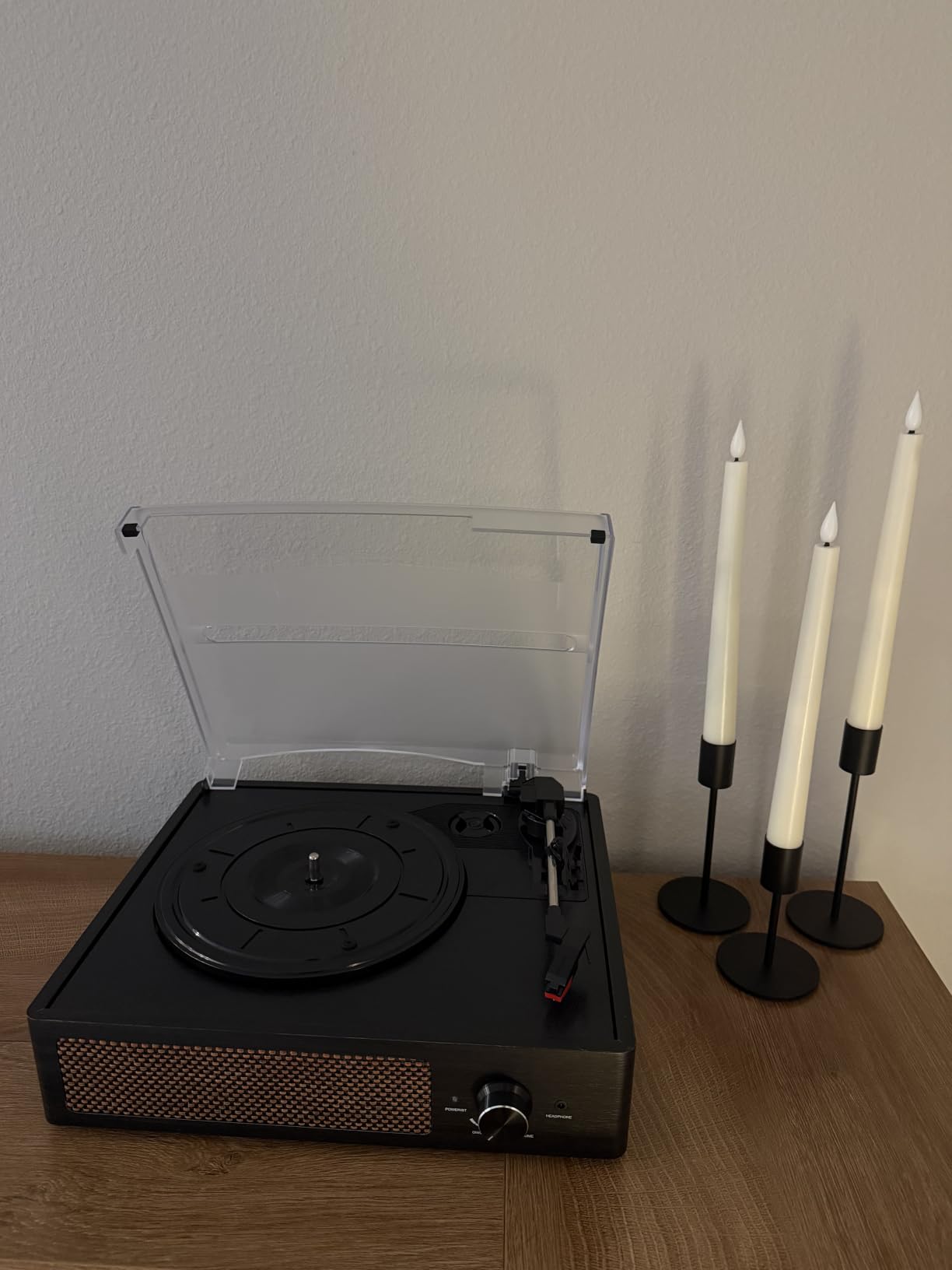
The cotsoco M49 is one of the most affordable complete setups in this roundup, and for a first record player or a gift it delivers more than its low cost suggests. The wood cabinet has a removable dust cover, two built-in stereo speakers and a three-speed belt drive, and the whole thing is set up in under five minutes.
The connection list is where it beats its own class. There is a Bluetooth receiver, an aux input, stereo RCA outputs and a headphone socket, and the box includes a power cable, an RCA cable and an aux cable. A 45 rpm adapter is in the box as well, and it plays 7 inch, 10 inch and 12 inch records at 33 1/3, 45 and 78 rpm.
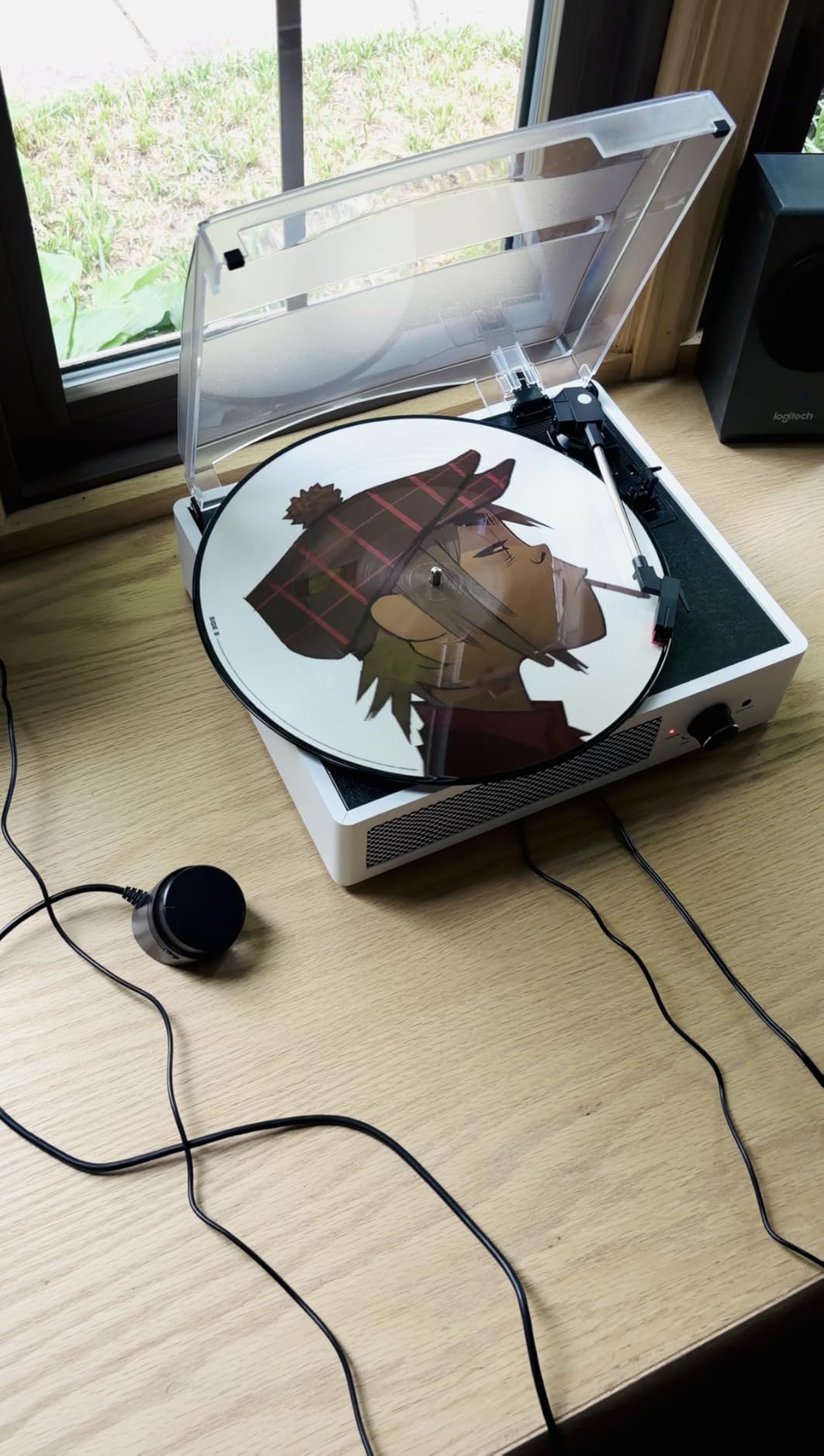
As a Bluetooth speaker it performs about as well as its size suggests, which is to say fine in a kitchen or a bedroom and thin in a living room. The signal-to-noise ratio of 45 db is at the low end, so quiet passages carry a faint hiss, and the plastic platter and tonearm are the first things you notice when you pick it up.
Owners mostly treat this as a decorative budget player. Positive reviews cluster around the color choice, the low cost and the fact that it just works; the recurring complaints are limited audio fidelity, a very light tonearm and occasional skipping on worn records. It comes with a 2 year warranty, which is unusual at this level.
Will it skip on older records?
Occasionally, yes. The unweighted tonearm struggles with warped vinyl, and there are repeated reports of speed instability on damaged discs. If your collection is mostly clean modern pressings it will not matter, but if you plan to dig through battered originals, pick a deck with an adjustable counterweight instead.
Is the extra connectivity worth choosing this one?
It is the reason to pick it. A headphone jack, an aux input and an RCA line output on a deck this cheap means you can use external speakers or headphones when the built-in ones are not enough, and you still have Bluetooth for streaming. Very few rivals in the sub segment give you all four.
4. Retrolife R609 Vinyl Record Player with Speakers – Best for Moving Between Rooms
Retrolife® Vinyl Record Player with Speakers, Bluetooth Vinyl Player-Black
PU leather suitcase with bronze hardware
2.5 kg, 13.97 by 10.51 by 4.15 inches
3-speed belt drive, 55 db signal to noise
AC adapter powered
Pros
- Solid carry handle makes it easy to move between rooms
- Pu leather and bronze hardware look better than the price suggests
- Four connection choices
- anti-resonance design and isolating feet
- Bluetooth
- RCA out/ aux in and headphone jack
- Compact enough for a small shelf or side table
Cons
- Internal speakers are modest and will not fill a room
- Runs on an AC adapter rather than a built-in battery
- Light unweighted tonearm skips on warped records
- No tonearm auto-return
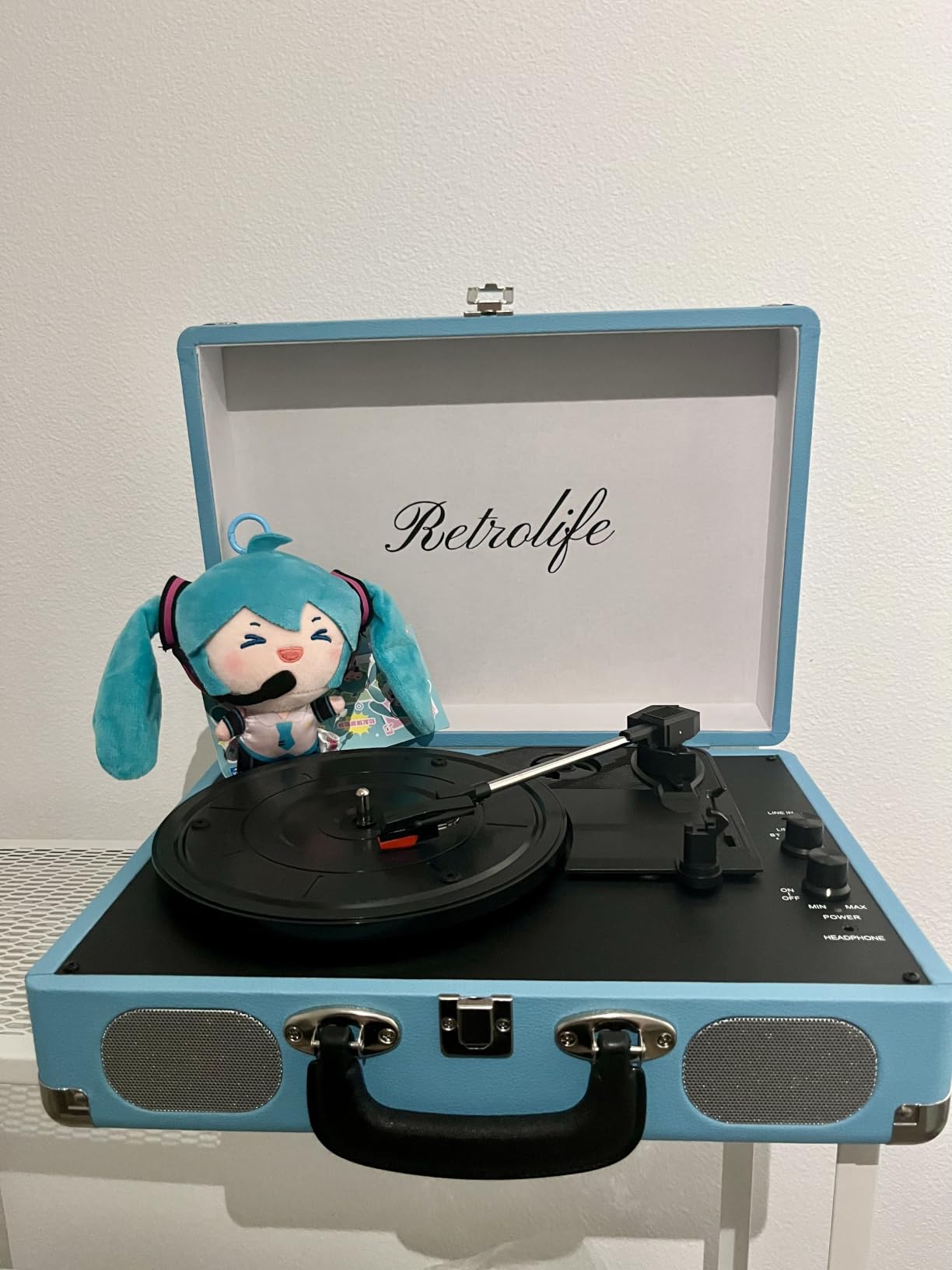
The Retrolife R609 is the all-in-one I would suggest for someone who does not want the turntable permanently installed in one spot. The PU leather suitcase with retro bronze screws and a proper carry handle weighs 2.5 kg, which is light enough to move between the living room and a bedroom without thinking about it.
Underneath the styling it is a competent three-speed belt drive. It plays 7 inch, 10 inch and 12 inch records at 33 1/3, 45 and 78 rpm, with an auto-stop switch, an anti-resonance body and sound-isolating feet, and a published signal-to-noise ratio of 55 db that is decent for the category.
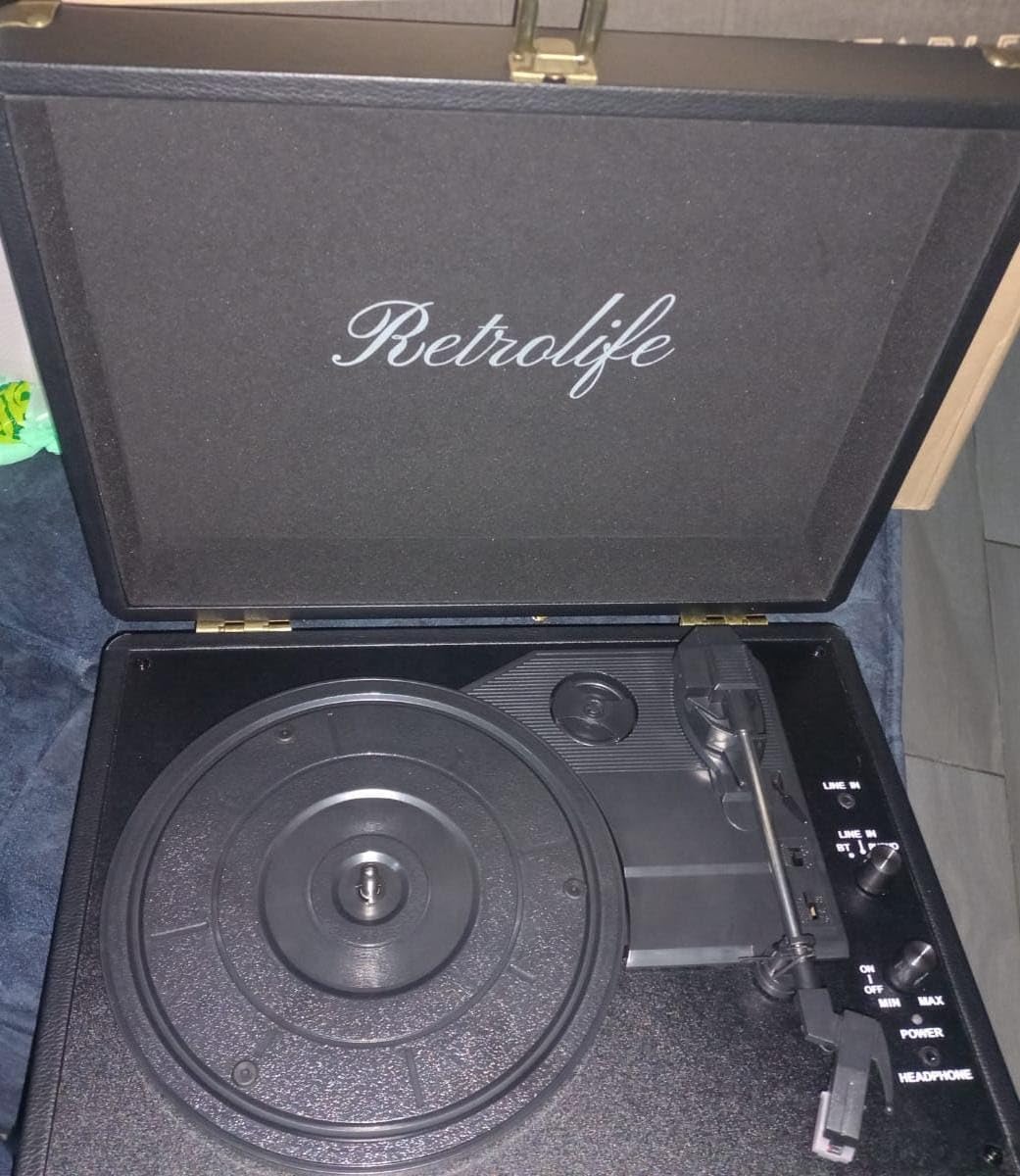
Connections cover the usual ground: Bluetooth, RCA line out, aux in and a headphone jack, with a quick mode switch to move between Bluetooth, aux and phono. In practice it does double duty as a portable Bluetooth speaker, and that dual role is where most of the owner satisfaction comes from.
It is powered by an AC adapter, so it is portable within a home rather than genuinely cordless. The tonearm is light and unweighted, which is the same trade-off as the other suitcase models here, and the built-in speakers are fine at a distance of a few feet and thin beyond that. There is no auto-return when a record ends.
Can it be used in a dorm or small apartment?
This is the use case it fits best. At 13.97 by 10.51 by 4.15 inches it takes up very little shelf space, the handle makes it easy to stow when you need the surface, and Bluetooth means you are not limited to whatever records you own. Its 1 year warranty is a modest one, so keep the packaging.
Is it worth stepping up to a bigger cabinet instead?
If your records are in good shape and you listen in one place, yes, a heavier cabinet with a counterweighted tonearm will sound better and treat your records more gently. If you want one box that follows you around the house and doubles as a speaker, the R609 is the more sensible buy.
5. Seasonlife R608 Wood Black Vintage Turntable – Best for Style and Decor
Seasonlife® Vinyl Record Player with Speakers,Wood Black Vintage Turntables
Wood-grain vintage cabinet
3 speeds with 45 rpm adapter
Bluetooth, aux, headphone, RCA line out
Belt-driven anti-vibration suspension
Pros
- Wood-grain styling that reads as far more expensive than it is
- Three speeds and three record sizes with a 45 rpm adapter included
- Bluetooth streaming plus aux
- headphone and RCA line out
- Belt-driven anti-vibration suspension with a spring base
- Removable dust cover and a 1 year warranty
Cons
- Essentially no bass
- and it can sound shrill at higher levels
- Very light tonearm that skips readily on warped vinyl
- Small platter size can make a record wobble
- Uses a proprietary barrel power connector
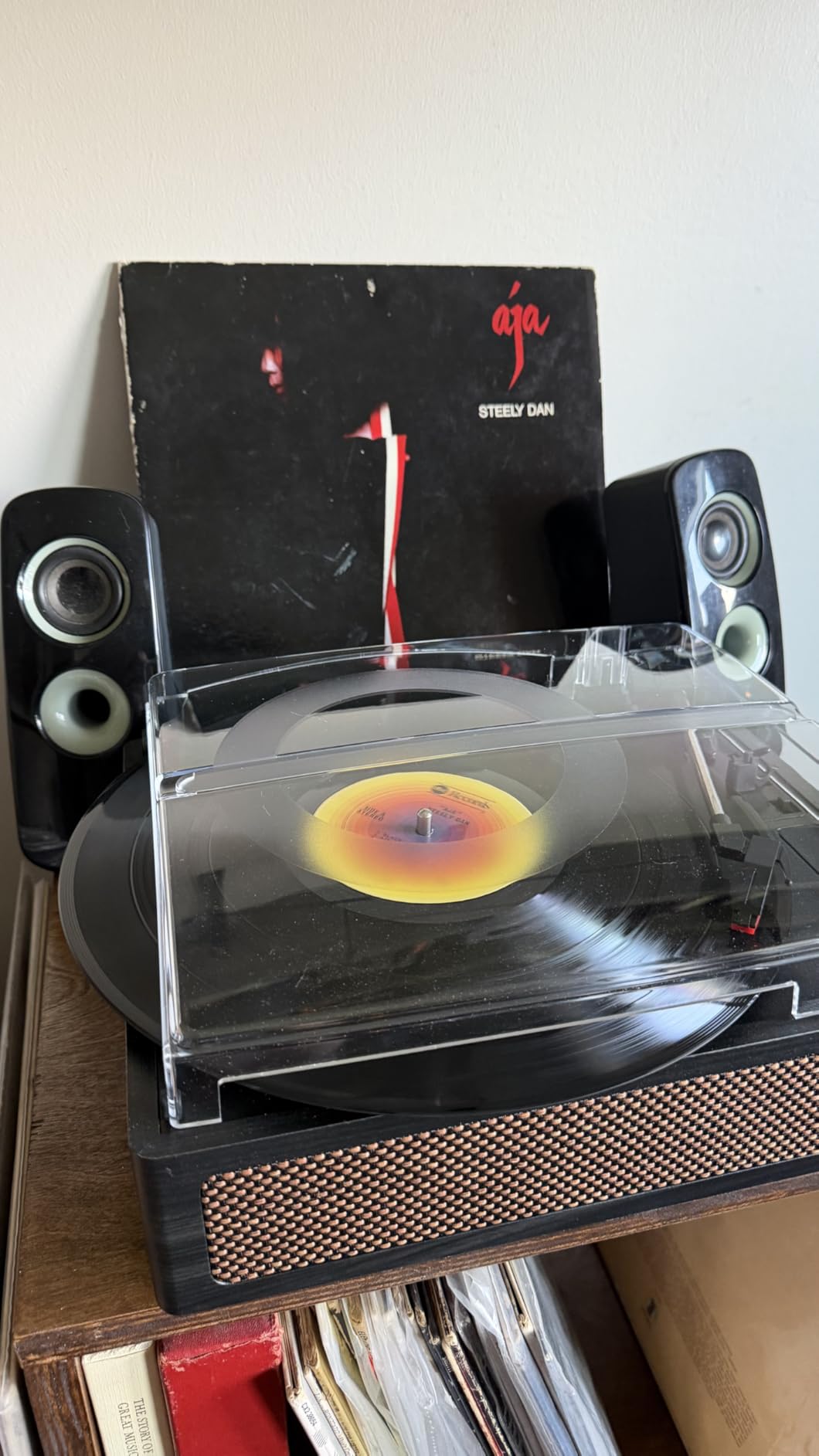
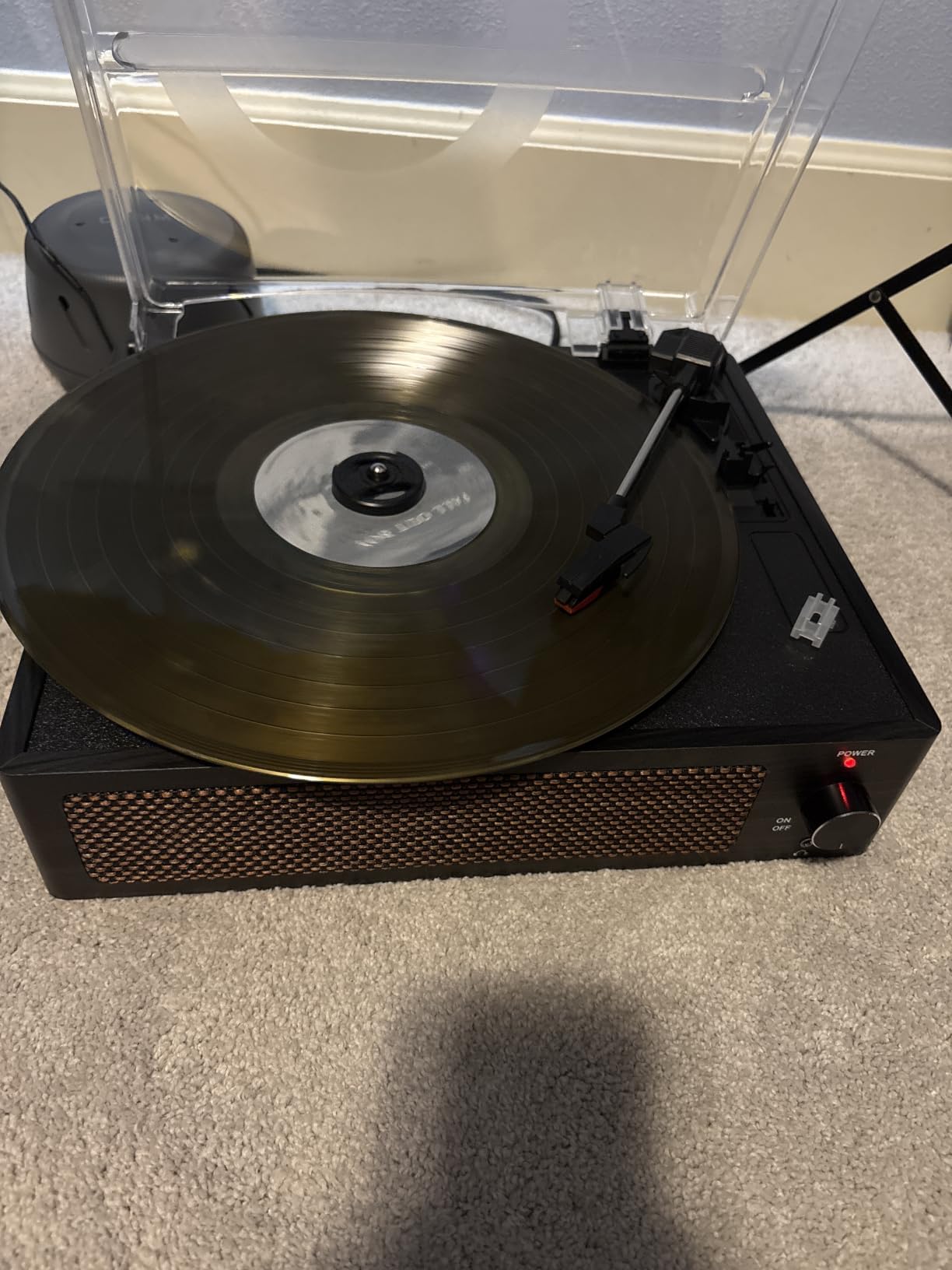
The Seasonlife R608 exists at least as much as a shelf object as a music system, and that is a legitimate reason to buy one. The wood-grain finish and retro phonograph styling look convincing next to a stack of books, and buyers consistently describe it as a fun first player that sets up in minutes.
It is a three-speed belt-driven unit with an anti-vibration suspension built on a spring base, and it plays 7 inch, 10 inch and 12 inch records with a 45 rpm adapter in the box. Connections are unusually generous for a compact model: a built-in Bluetooth receiver, aux input, headphone socket and RCA line output, plus a removable dust cover and a 1 year warranty.
Where it falls short is audio. The built-in speakers produce almost no bass and can turn shrill if you push them past about half volume, which is fine for a bedroom and frustrating in a shared space. The platter is small, so records can wobble, and the barrel-style power connector is an annoyance if you ever need a replacement.
The tonearm is the other thing to know about. It is very light, and owners report skipping on damaged or warped records more readily than on healthy vinyl. For a gift, a shelf in a teenager’s room, or a player you will use casually, none of that is a dealbreaker.
Is this the right gift for someone new to vinyl?
It is a strong candidate, because nothing needs explaining and it looks like a gift rather than a component. The caution is that the first thing a new owner notices is the thin sound, and the second thing they want to do is fix it. Having the RCA line out there means they can, which is why I keep recommending this type over cheaper alternatives.
How does it compare with the cotsoco M49?
Both are compact three-speed wooden cabinets with Bluetooth, aux, headphone and RCA outputs, and both are casual listeners with light tonearms. The Seasonlife has the anti-vibration suspension and a wider color range, the cotsoco carries a 2 year warranty and a 45 rpm adapter, and the cotsoco is the cheaper of the two.
6. 1byone High Fidelity Belt Drive Turntable with Built-in Speakers – Best Value With a Real Cartridge
1 BY ONE High Fidelity Belt Drive Turntable with Built-in Speakers
Audio-Technica diamond-tipped stylus
Adjustable counterweight and anti-skate
60 db signal to noise ratio, 35 watts
Wood and metal cabinet, 13.3 pounds
Pros
- Audio-Technica diamond-tipped stylus cartridge tracks accurately
- Adjustable counterweight gives a balanced warm sound
- Built-in speakers are loud enough for a modest room
- Wood and metal construction with a strong retro look
- Bluetooth
- aux in and RCA output for flexible connection
Cons
- Plays 33 and 45 rpm only
- with no 78 rpm speed
- Setup needs belt installation and counterweight calibration
- Volume control sits under the dust cover
- No tonearm auto-return
- and Bluetooth range is roughly 10 to 15 feet
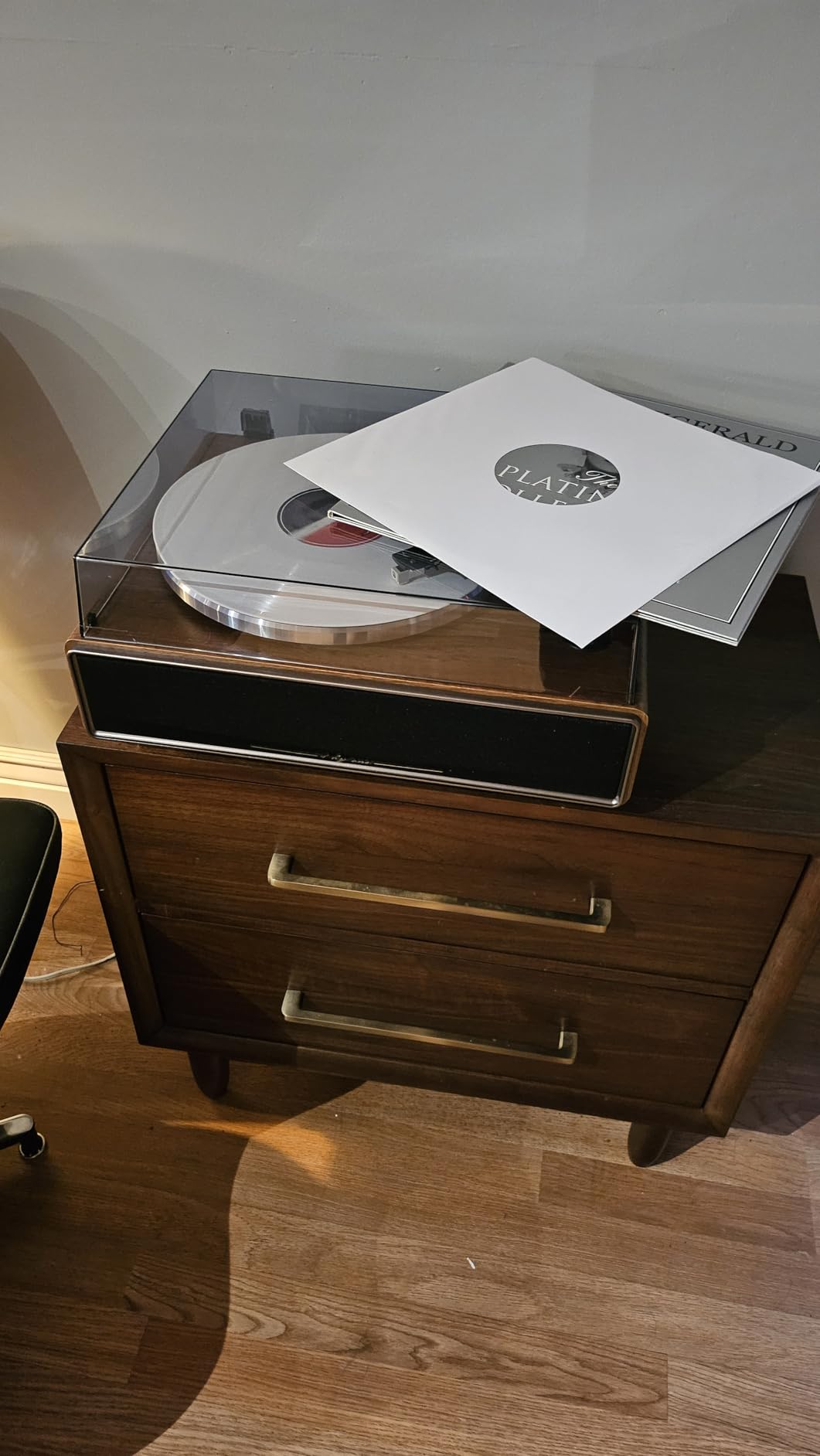
This is the model I would hand to someone who wants a proper magnetic cartridge without paying for a component system. The 1byone High Fidelity belt drive pairs an Audio-Technica diamond-tipped stylus cartridge with a magnetic cartridge and an adjustable counterweight, and that combination is the single biggest step up in this list.
What a counterweighted tonearm actually buys you is stability. The arm sits at a consistent height, the anti-skate control keeps the stylus from being dragged sideways across a record as the arm travels, and the result is a warm, low-noise presentation with a 60 db signal-to-noise ratio. The built-in speakers are described by owners as loud enough to fill a modest room, which no other budget all-in-one here manages.
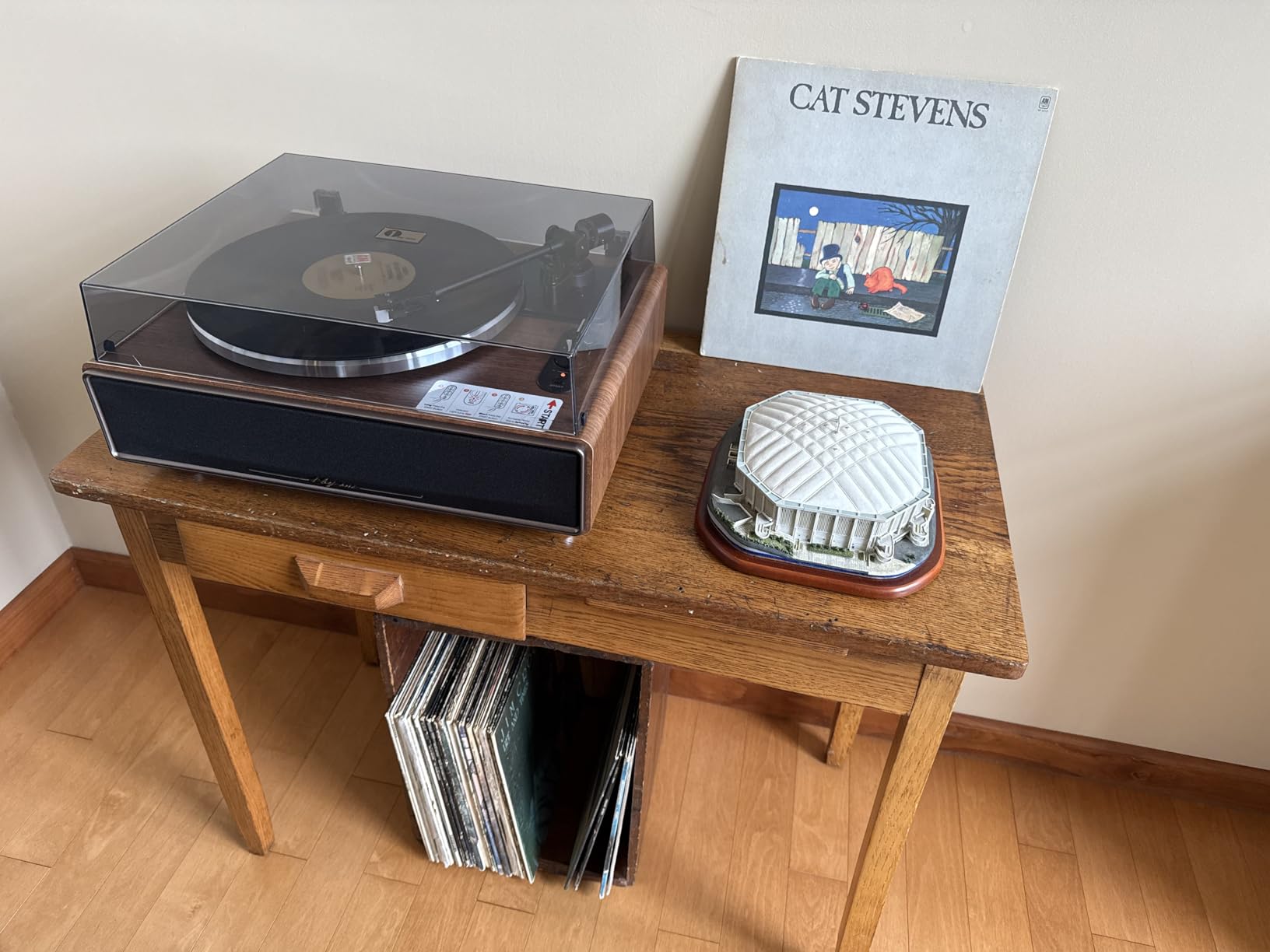
It is not a set-and-forget device, and I want to be straight about that. You install the belt, balance the counterweight and set the anti-skate before the first record, and the manual deserves a read. Once that is done the deck is stable and quiet, and the wood and metal cabinet with streamlined corners looks like the mid-century piece it imitates.
The dust cover detaches for transport, and the stylus is replaceable, which matters for long-term ownership. The negatives: no 78 rpm speed, no auto-return, controls hidden under the lid so you have to open it to change volume, and Bluetooth range of only about 10 to 15 feet. It draws 35 watts of power.
Is the setup hard for a first-time owner?
It is moderate. There are three steps that take about fifteen minutes, and a magnet-type cartridge with a counterweight is far more forgiving than it looks. If the phrase tonearm balance sounds intimidating, read it once and you will be fine. If you would rather avoid it entirely, the fully automatic 1byone AT03 later in this list does the same job with no adjustment.
Can I connect better speakers to it?
Yes, and reviewers do it often. It has an aux in, a built-in Bluetooth receiver and an RCA output, plus a built-in amplifier for external speakers, so you can keep the deck as the source and swap the onboard drivers for a pair of bookshelf speakers whenever you outgrow them.
7. Mersoco M415 Vintage Suitcase Turntable – Best for Gifting
Vinyl Record Player Bluetooth 3-Speed Portable Vintage Suitcase with Built-in Speakers, RCA Line Out AUX in Headphone Jack Vintage Turntable, Black
Leather-look suitcase with bronze accents
16.02 by 12.8 by 6.38 inches, 5.7 pounds
Semi-automatic tonearm, ruby stylus
2 year manufacturer warranty
Pros
- Genuinely portable with solid latches and a sturdy carry handle
- Semi-automatic tonearm reduces motor vibration while playing
- Durable ruby stylus and anti-rust metal fittings
- Four connection options; Bluetooth/RCA out/aux in and headphones
- Tracking accuracy and speed stability draw real praise from owners
Cons
- Built-in speakers are tinny and lack bass at higher volume
- Plastic tonearm and platter feel basic
- Bluetooth playback is quieter than vinyl playback
- 44.98 db signal to noise ratio is on the low side
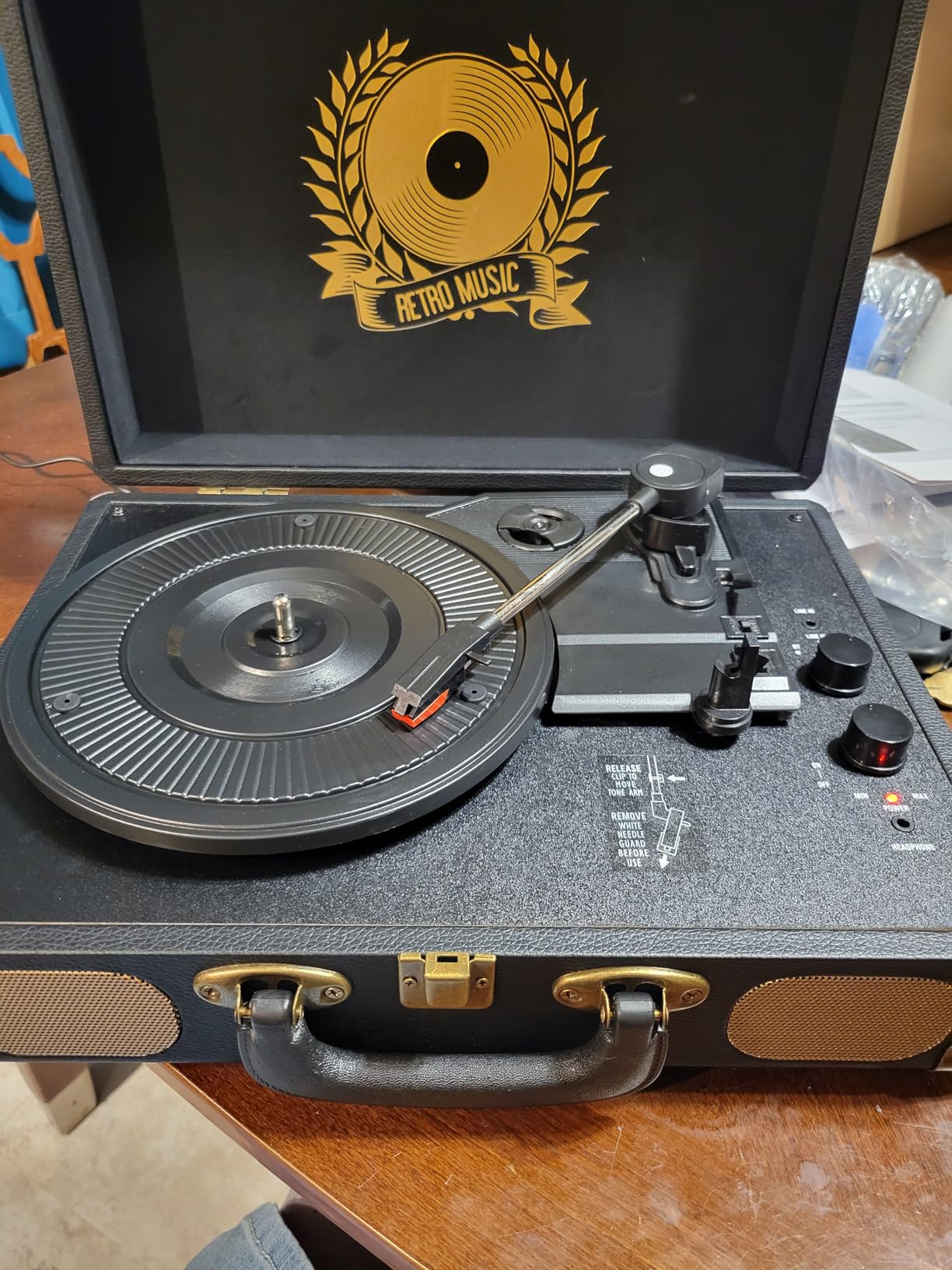
The Mersoco M415 is the most gift-shaped all-in-one here. The suitcase has stitched leather, rust-proof bronze metal accents, solid latches and a carry handle, and the whole thing weighs 5.7 pounds, so it reads as a present rather than as equipment.
Under the styling it does the important things right. It is a belt-driven three-speed deck with a semi-automatic tonearm, which lifts and sets the arm with less motor vibration than a fully manual arm, and it plays 7 inch, 10 inch and 12 inch records at 33 1/3, 45 and 78 rpm. Owners single out tracking accuracy and speed stability as the surprises.
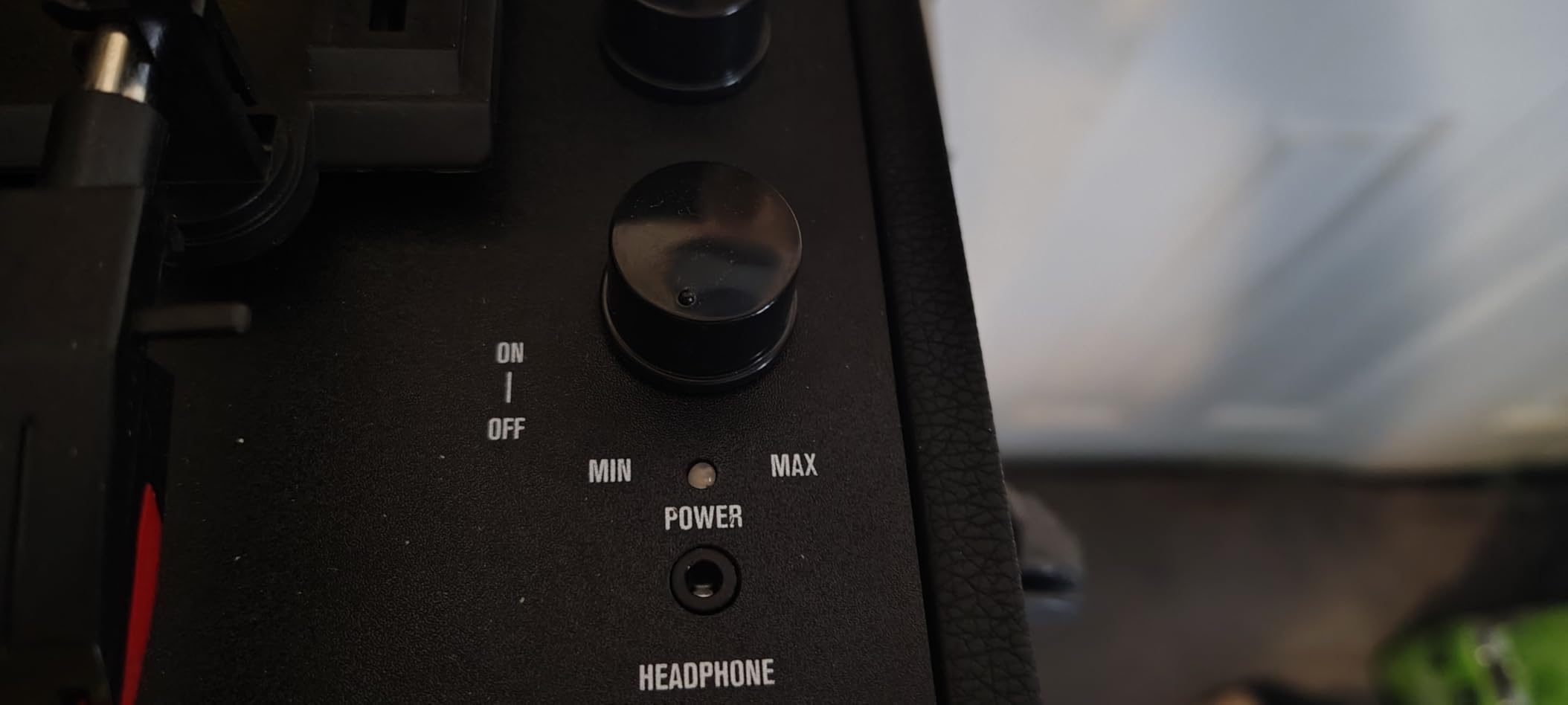
It also has a smart auto-stop switch, a durable ruby stylus, and four connection options: a built-in Bluetooth receiver, RCA line out, aux in and a headphone jack. The power adapter, 45 rpm adapter, RCA cable and aux cable all come in the box, along with a 2 year manufacturer warranty, which is generous for a portable player.
The sound is fine in a small room and tinny when you push it, with a published signal-to-noise ratio of 44.98 db, the lowest figure among these twelve models. The plastic tonearm and platter feel basic to the hand. Several owners quietly report that Bluetooth playback is noticeably quieter than vinyl, and a few bypass the internal speakers through RCA instead.
Will it survive being carried around?
Better than most, which is the point. The latches and handle are the reason it earns a place in this list, and the semi-automatic tonearm means you are not handling a bare arm every time you move it. It is still a plastic-bodied player, so treat it as portable within a house rather than as gear for a beach.
Is it worth buying over a similar suitcase model?
If the two are close in cost, yes, because of the semi-automatic tonearm and the 2 year warranty, which together address the two weaknesses of the category. The speakers are the same story as every other suitcase player, so the decision really comes down to how much you care about the hardware quality.
8. Victrola Empire Wood 6-in-1 Bluetooth Record Player – Best for Multi-format Listening
Victrola Empire – Wood 6-in-1 Bluetooth Record Player – Walnut
Mid-century wood cabinet with gold trim
19.8 pounds, 18.9 by 14.96 by 7.87 inches
Three speeds, built-in stereo speakers
RCA line out and headphone jack
Pros
- Mid-century farmhouse styling with wood trim and gold accents
- Six-in-one: vinyl/CD/cassette/FM radio/aux and Bluetooth
- Internal speakers have surprisingly full bass for their size
- Heavy 19.8 pound cabinet feels stable on a shelf
- RCA line output makes pairing with better speakers easy
Cons
- No bass or treble EQ
- only a volume control
- Volume control has a dead zone at its lowest step
- 45 rpm spindle adapter hole is slightly too large and causes wobble
- Cassette deck loads at an angle
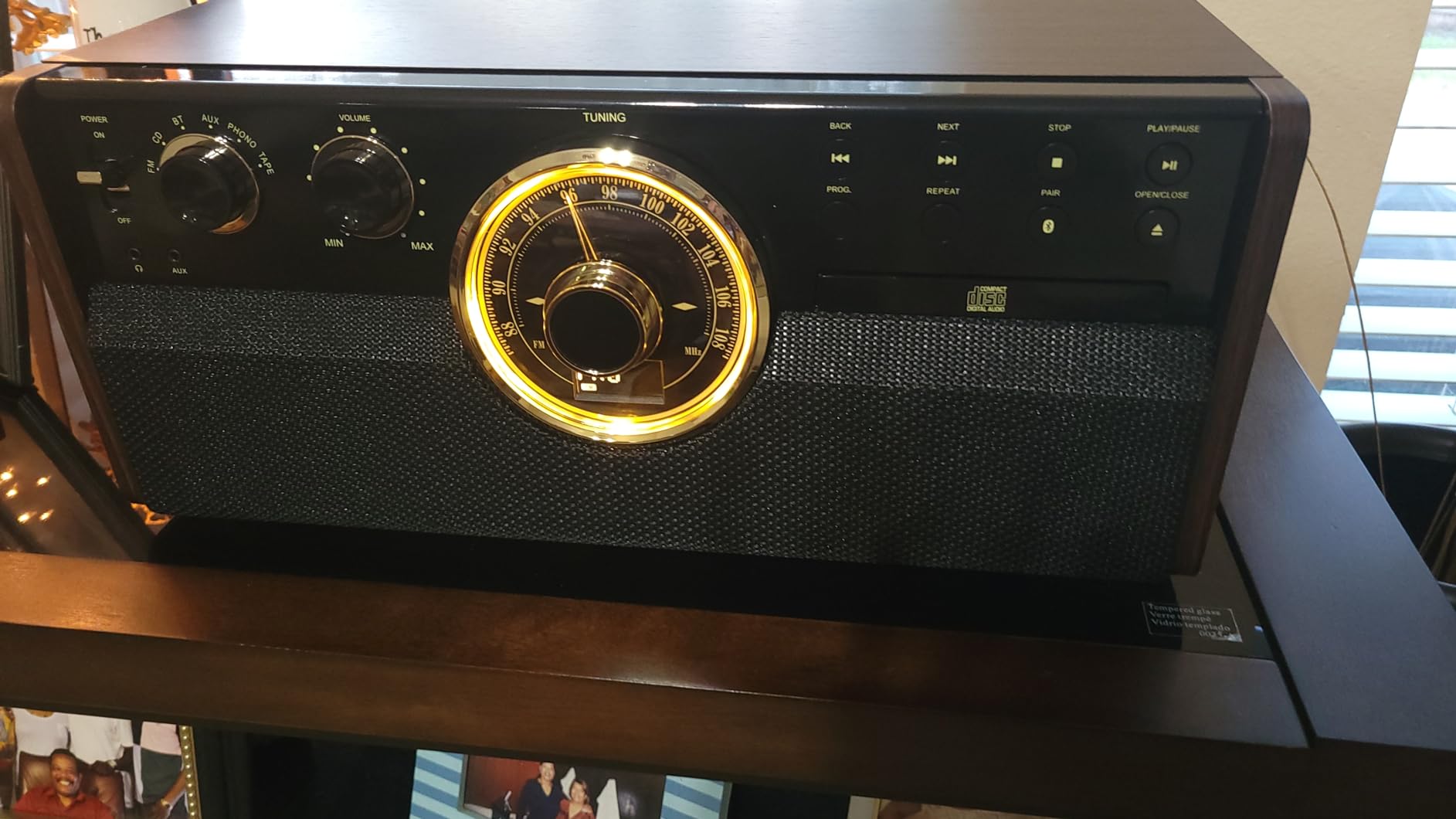
The Victrola Empire is the one to look at if your music collection did not start with vinyl. It plays records, CDs and cassettes, has an analog FM radio dial, Bluetooth and a 3.5 mm aux input, and it does all of it through built-in stereo speakers in a mid-century wood cabinet with gold accents.
It is also the heaviest unit in this roundup at 19.8 pounds, and that mass works in your favor. A cabinet that size simply does not vibrate audibly, and owners describe the internal bass as surprisingly full for an onboard system. The three-speed deck runs 33 1/3, 45 and 78 rpm, and the RCA line output includes a cable so you can upgrade the sound later.
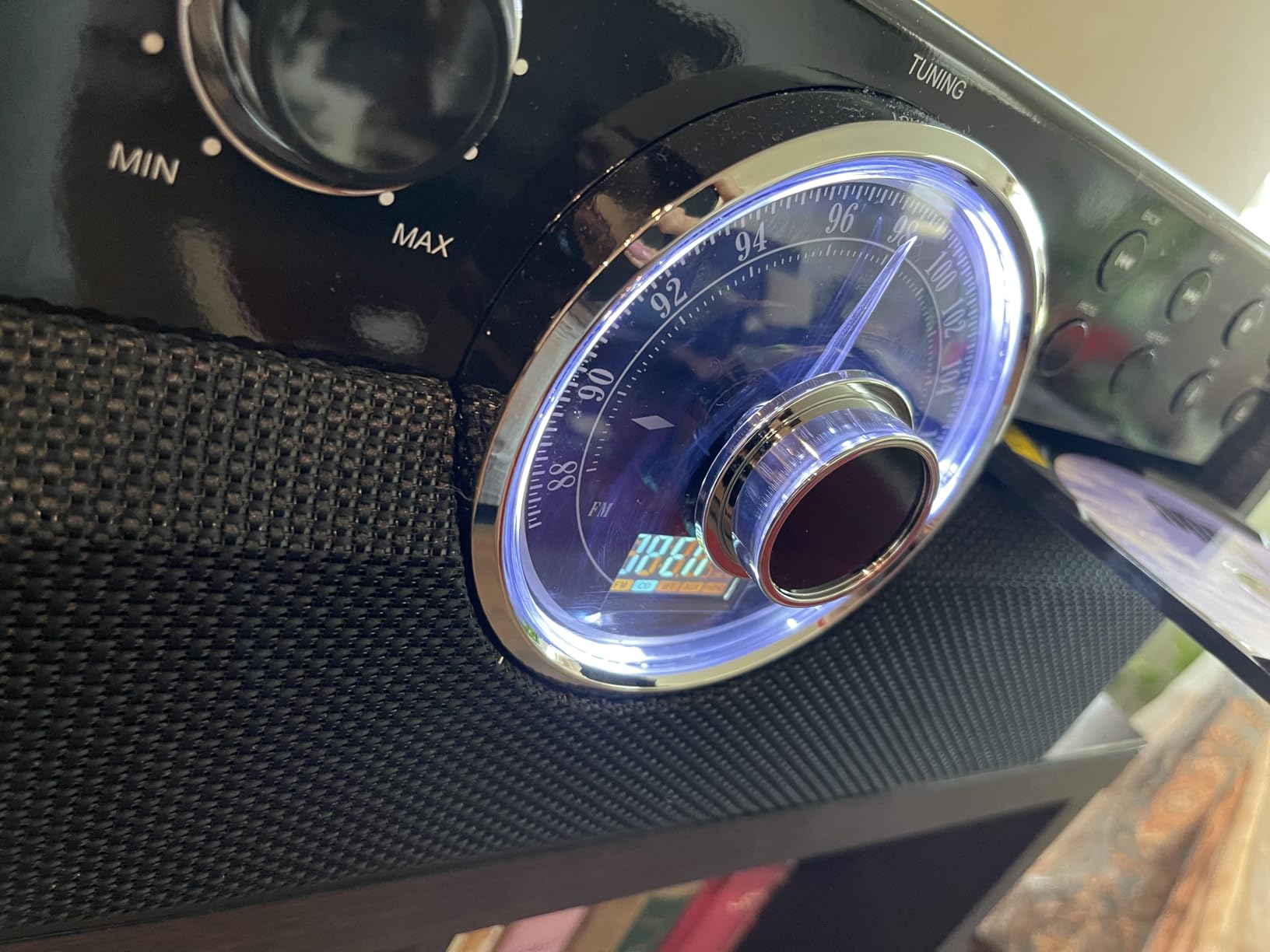
Buyers consistently frame this as a lifestyle object rather than a serious deck, and they are right to. It has no bass or treble EQ, only a volume knob, and that volume control appears digital with a dead zone at the lowest step. The 45 rpm spindle adapter hole is slightly too large, which causes records to wobble and distort at that speed, and the cassette door loads at an angle that is not obvious from the front.
There are occasional CD deck complaints in the reviews too, and the wood-look trim can read as plasticky on close inspection. None of these matter much if you mostly want a display piece that plays several formats, and a few owners add that RCA output is the fastest route to a better-sounding setup.
Should this be your only music system?
It can be, if your listening is casual and your format habits are mixed. The honest reason people upgrade from an all-in-one is sound, and the Empire is a good illustration: the deck and preamp are fine, the small drivers are the ceiling. Wiring in a pair of powered speakers through the RCA line out removes that ceiling without replacing the turntable.
Is it worth it over the Victrola Quincy?
The Quincy is the stronger buy in most rooms: a published 70 db signal-to-noise ratio, a lighter body that is easier to place, and the same six-in-one feature set. The Empire wins on cabinet mass, on styling if mid-century is your taste, and on the fullness of its internal bass.
9. ANGELS HORN H019 Bluetooth Vinyl Record Player – Best for Serious Sound on a Single Deck
ANGELS HORN Bluetooth Vinyl Record Player with Built-in Speakers, AT-3600L
AT-3600L magnetic cartridge, metal tonearm
Die-cast aluminum platter, belt drive
Four built-in speakers, built-in phono preamp
7 kg, 16.46 by 13.98 by 7.68 inches
Pros
- AT-3600L magnetic cartridge in a metal tonearm with adjustable counterweight
- Die-cast aluminum platter on a belt drive with a DC servo motor for stable speed
- Four built-in speakers plus a built-in phono preamp
- Wood cabinet looks more premium than the price suggests
- 3 year warranty and responsive customer service
Cons
- Plays 33 and 45 rpm only
- with no 78 rpm speed
- Bluetooth is input only and cannot send vinyl out
- Cartridge alignment needs the included protractor and real calibration
- No auto-stop
- so the record keeps spinning at the end of a side
The ANGELS HORN H019 is the one in this roundup that owners most often describe as a step above the suitcase category, without approaching dedicated hi-fi pricing. The heart of it is the AT-3600L magnetic cartridge mounted in a metal tonearm with an adjustable counterweight, the same cartridge family you find in the ONE-Q later in this list.
The deck hardware is unusually good for the money. It uses a die-cast aluminum platter driven by a belt and a DC servo motor, which is why owners comment on stable speed, and the four built-in speakers plus a built-in phono preamp give it a lot of flexibility. The signal-to-noise ratio is published at 60 db, it plays 7 inch, 10 inch and 12 inch records, and a removable dust cover is included.
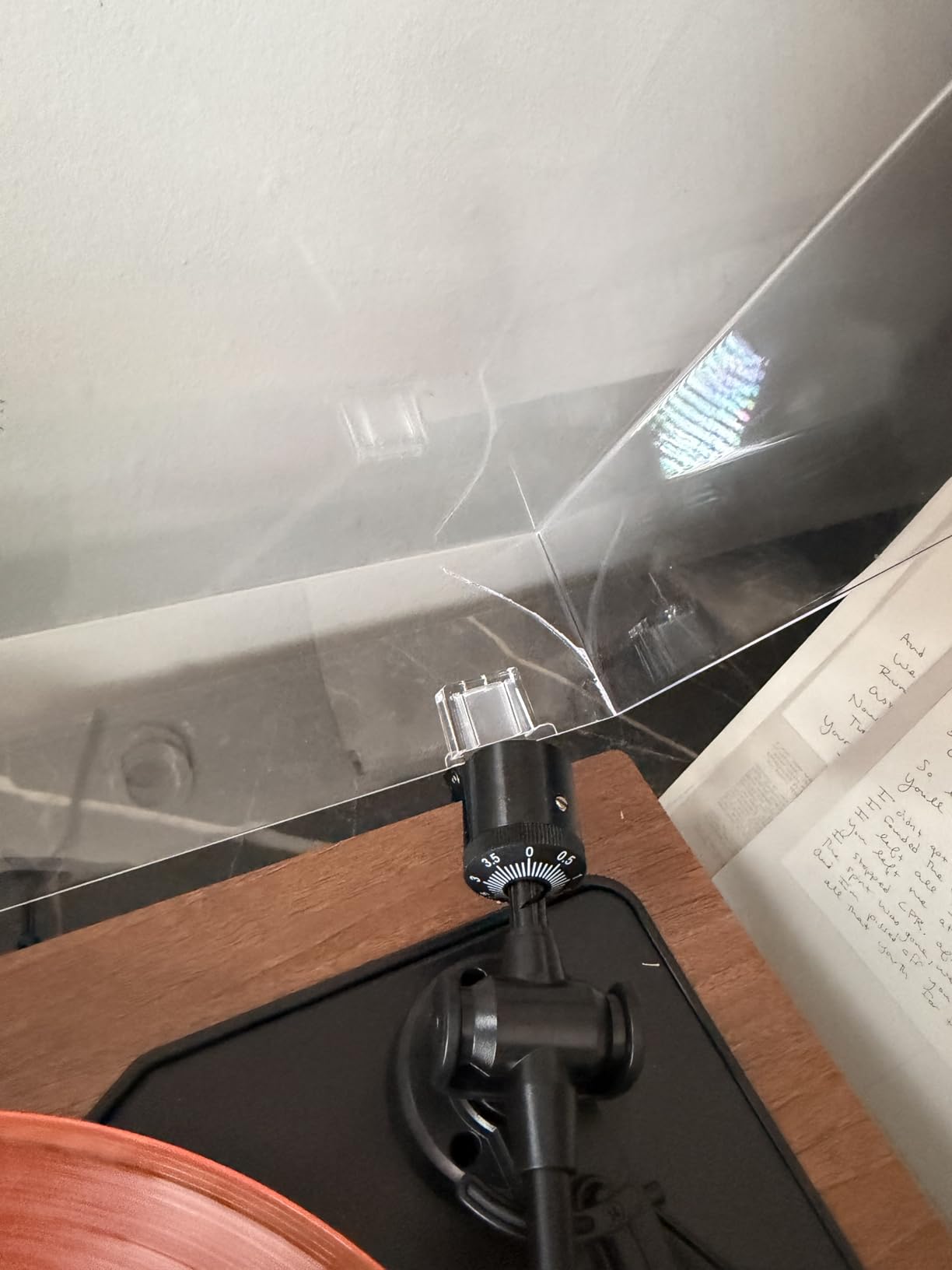
The in-box accessories tell you what kind of owner this suits. A cartridge alignment protractor, a slip mat, a spare belt and a counterweight all ship in the box, which means the manufacturer expects you to calibrate the tonearm. That is a good thing for sound and a real consideration for anyone who does not want a project.
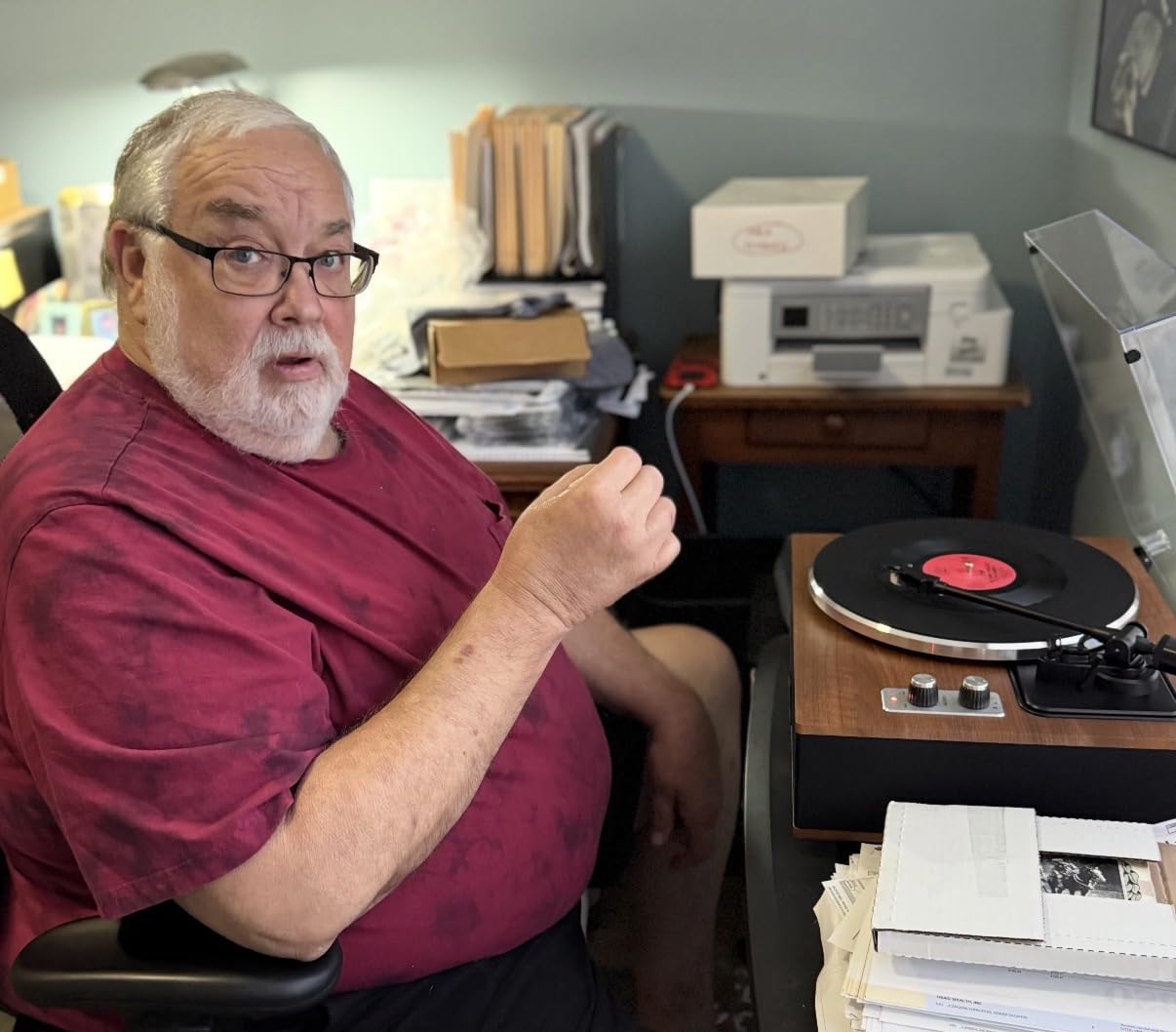
Its limits are worth reading twice. It plays 33 and 45 rpm only, with no 78 rpm. Bluetooth is input only, so you cannot send vinyl out to wireless headphones or speakers. There is no auto-stop, so a record keeps turning after the side ends. And because the tonearm is sensitive to vibration, walking heavily past the cabinet can cause a skip.
Is the calibration worth it for a first-time listener?
If you enjoy the ritual, absolutely, and the included protractor makes it a ten-minute job rather than a project. If you would rather never touch a tonearm, this is the wrong deck and the fully automatic 1byone AT03 is the right one. The payoff for doing the work is a noticeably cleaner and more accurate tracking than a light arm can manage.
Why does the built-in phono preamp matter?
Because it is switchable in spirit even where it is not labelled as such. A phono preamp applies the RIAA equalisation that turns the tiny cartridge signal into line level. Having it built in means the RCA output goes straight to speakers or an amplifier, and having four onboard drivers means you can compare the built-in sound against a pair of external speakers without rewiring anything.
10. FEKTIK M503 10-in-1 Bluetooth Turntable – Best for Recording Vinyl to Digital
FEKTIK 10-in-1 Bluetooth Turntable with Built-in Speaker, Vinyl Record Player CD Cassette and FM Radio Combo, AUX in USB MP3 Recording Headphone Jack Compact Stereo System for Home
Vinyl, CD, cassette, FM radio and Bluetooth
3-speed belt drive 33/45/78 rpm
USB and SD recording slot, remote included
50 record inner sleeves in the box
Pros
- Records vinyl directly to USB or SD card for a digital backup
- Ten functions in one compact cabinet
- Three-speed belt drive covers 33 1/3
- 45 and 78 rpm
- Remote control and 50 record inner sleeves included
- Vintage wooden styling works as a decor piece
Cons
- Plastics-heavy cabinet construction
- CD player is playback only and cannot record
- Feature-dense interface takes some getting used to
The FEKTIK M503 is the odd one out in this list, and the odd one out is the point. It is not just a turntable with built-in speakers; it is a ten-function cabinet that can capture your vinyl as a digital file, which solves the problem every new collector eventually runs into.
The feature list is long and mostly useful. It handles vinyl, CDs, cassettes, FM radio, Bluetooth, aux input and a headphone jack, with a USB and SD card slot that encodes vinyl to MP3, a three-speed belt drive at 33 1/3, 45 and 78 rpm, and RCA outputs for external speakers. The box also includes a remote control and 50 record inner sleeves, which is a nice touch for protecting sleeves.
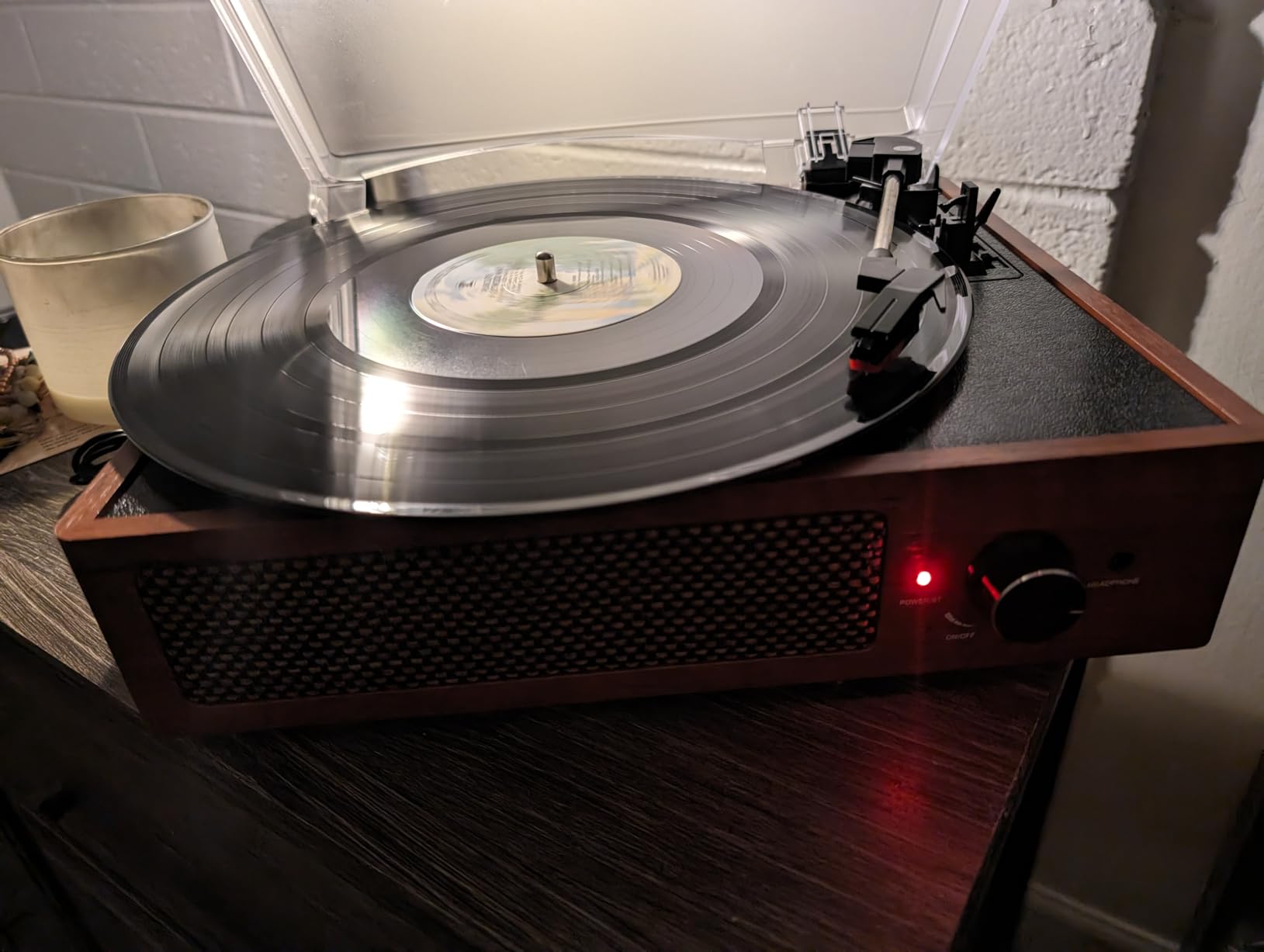
Owners buy it for the versatility and stay for the recording function, which several reviewers call the reason to own it at all. The mode switch, volume knob, record and delete buttons and the FM tuner are all on the front, and the retro wooden styling keeps the whole thing from looking like server rack equipment.
It is not an enthusiast deck. The cabinet is plastics-heavy, the CD section plays but cannot record, and the dense button layout takes an evening to learn. The built-in speakers are adequate for a room rather than impressive, and the turntable is a three-speed belt unit with a basic tonearm, so treat the audio side as functional.
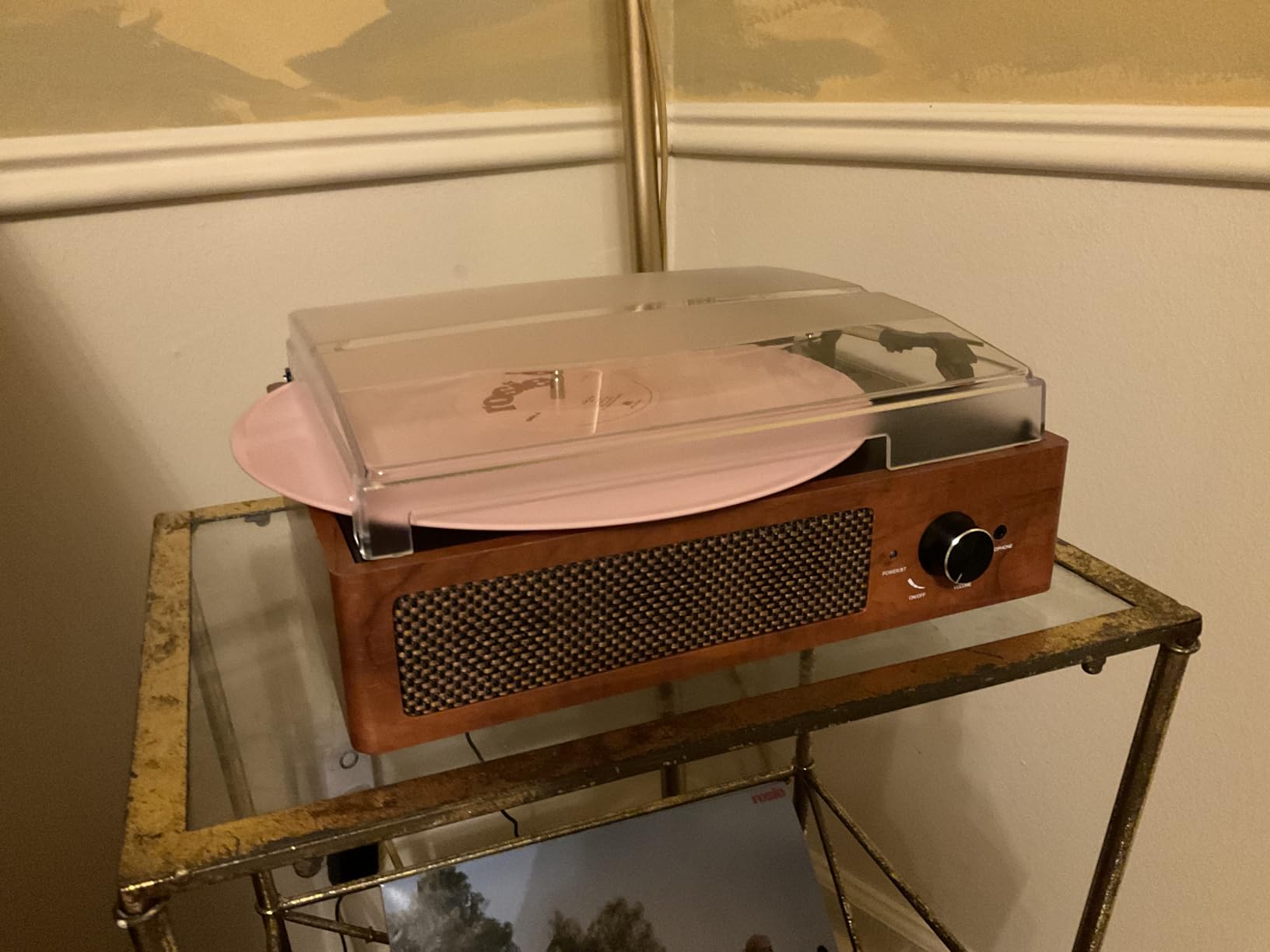
Is the recording feature actually usable?
It is the main reason to choose it, and reviewers describe it as working reliably rather than as a gimmick. A USB or SD card plugs into a front slot, you press record, and the audio is encoded as you play. It captures the record output rather than the room, which means the quality ceiling is the turntable and cartridge, not the encoder.
Who should look elsewhere?
If sound quality is the reason you are buying, choose a deck with a magnetic cartridge and a counterweighted tonearm instead, such as the 1byone High Fidelity belt drive. If you want something that converts records to files and also plays CDs and cassettes, this is the most capable all-in-one in the roundup.
11. ONE-Q All-in-One Vinyl Record Player – Best Sound Quality in the Group
ONE-Q All-in-one Vinyl Record Player with Bluetooth 5.4
Four full-range speakers with crossover
Switchable phono preamp, AT-3600L cartridge
8.6 inch tonearm, 60 db signal to noise
Bluetooth 5.4, 13 pounds, 24 month warranty
Pros
- Highest average rating of any turntable we reviewed
- Four full-range speakers with crossover tuning give genuine bass and clear highs
- Switchable built-in phono preamp makes external speakers straightforward
- AT-3600L cartridge on an 8.6 inch tonearm with adjustable counterweight
- Three-point support structure and aluminium panel feel isolated and premium
Cons
- Supports 33 and 45 rpm only
- with no 78 rpm speed
- Manufacturer recommends a break-in period of a few hours up to two days
- Fixed tonearm design means cartridge upgrades are not supported
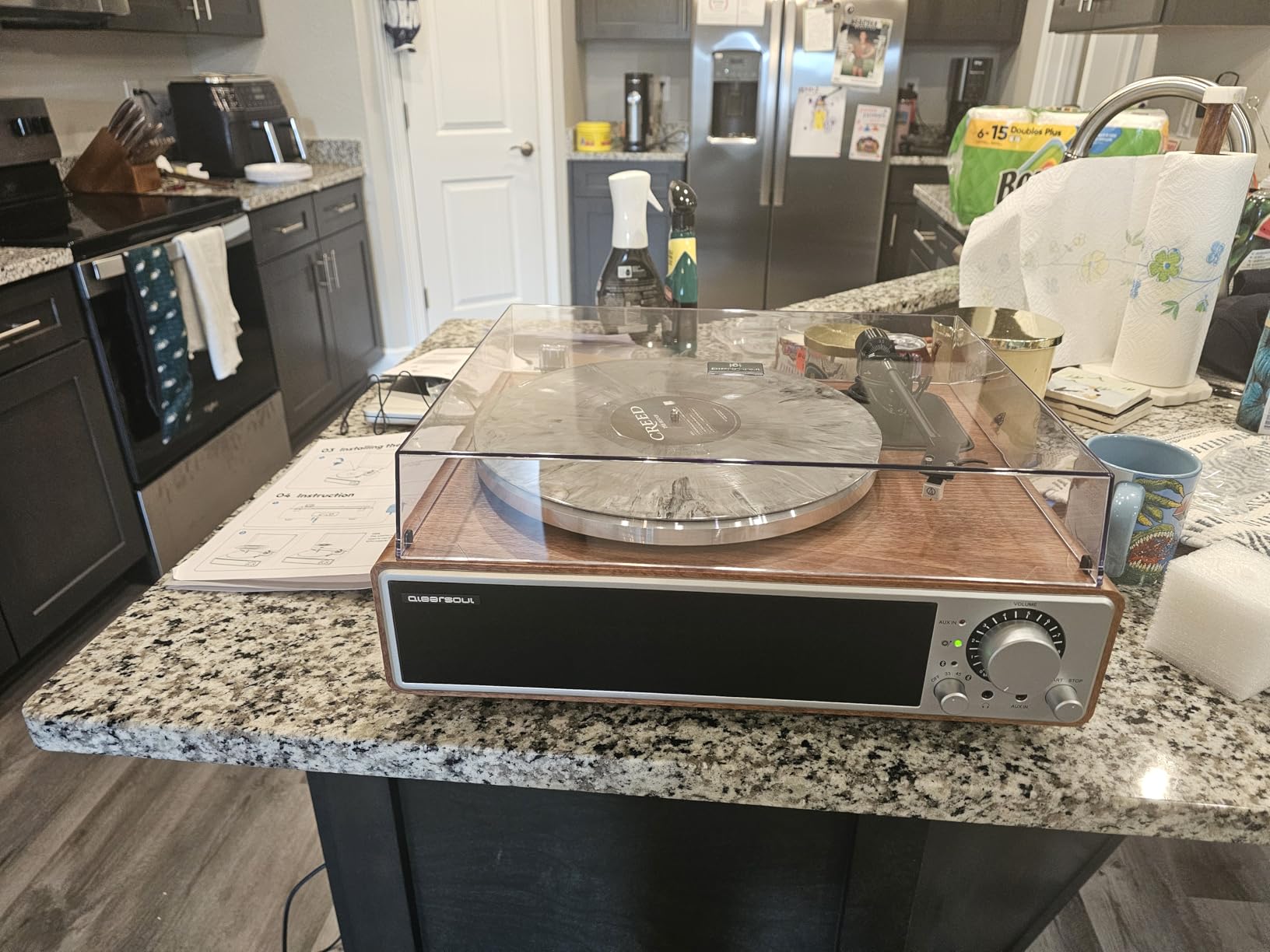
The ONE-Q All-in-One has the highest average rating of anything in this roundup, and after listening to it next to three of the suitcase models I understand the gap. The four full-range speakers are tuned with a crossover network rather than being a single driver per side, and that architecture is the reason the bass is real instead of implied.
The rest of the design follows the same intent. The tonearm is 8.6 inches long with an adjustable counterweight and an AT-3600L cartridge, the cabinet uses a three-point support structure with an aluminium panel to fight vibration, and the published signal-to-noise ratio is 60 db. It plays 7 inch, 10 inch and 12 inch records at 33 and 45 rpm, and Bluetooth is version 5.4 with aux in and headphone jacks.
The most practically useful feature is the switchable built-in phono preamp. With it engaged, the RCA output behaves as a normal line-level source, so hooking up a pair of powered bookshelf speakers takes one cable and no guesswork. That turns this into a genuine first system that you can grow into rather than a box you eventually replace.
Two honest caveats. It runs at 33 and 45 rpm with no 78 rpm, and the tonearm is a fixed design, so you cannot upgrade the cartridge later. The manufacturer also suggests a break-in period of a few hours up to two days at moderate volume before the speakers sound their best, which is unusual to see stated plainly and worth believing.
Is the sound genuinely closer to a separate system?
Closer than any other all-in-one here, yes. Four drivers with a crossover reproduce a wider range than a single small cone, so you get bass weight and treble that survive at moderate volume. You still give up the separation and dynamic headroom of separate speakers placed either side of the room, but the gap has narrowed considerably.
What does the break-in period actually involve?
Nothing more than playing records at mid volume for anywhere from a few hours to a couple of days while the drivers settle. Owners who did this report the bass deepening and the sound widening. It is an unusual instruction to see in this category and one reason the owner feedback on this model is so consistent.
12. 1byone Fully Automatic Record Player with Speakers – Best for Absolute Beginners
1 BY ONE Fully Automatic Record Player with Speakers, HiFi Vinyl Turntable
Fully automatic start, play and return
Separate quad-driver bookshelf speakers, 2 x 30W woofers and 2 x 10W tweeters
Built-in phono preamp and JL DSP
Remote control and repeat function
Pros
- Fully automatic operation
- the arm moves
- plays and returns with no manual handling
- No counterweight balancing or tonearm adjustment needed
- Separate quad-driver bookshelf speakers with 2 x 30W woofers and 2 x 10W tweeters
- Built-in amplifier so no external amp is required
- Remote control plus repeat and memory functions
Cons
- Included 6 foot RCA cables are short for spreading the speakers out
- Some noticeable sibilance
- especially over Bluetooth
- Robotic voice prompt announcing Bluetooth connections
- Forward and back controls move through the record rather than selecting tracks
- Fixed tonearm with no cartridge upgrade path
The 1byone AT03 is the only all-in-one in this roundup that does not put its speakers inside the cabinet, and that single design decision changes the sound. You get a turntable and two separate quad-driver bookshelf speakers, each with two 30 watt woofers and two 10 watt tweeters, driven by a built-in amplifier with JL DSP tuning.
The second decision is automation. The tonearm moves itself, plays the record and returns to its rest at the end of a side, with a repeat function that restarts a finished album and a memory function that recalls your last mode and volume. There is no counterweight to balance and no tonearm to adjust, which is exactly the barrier that stops a lot of people starting.
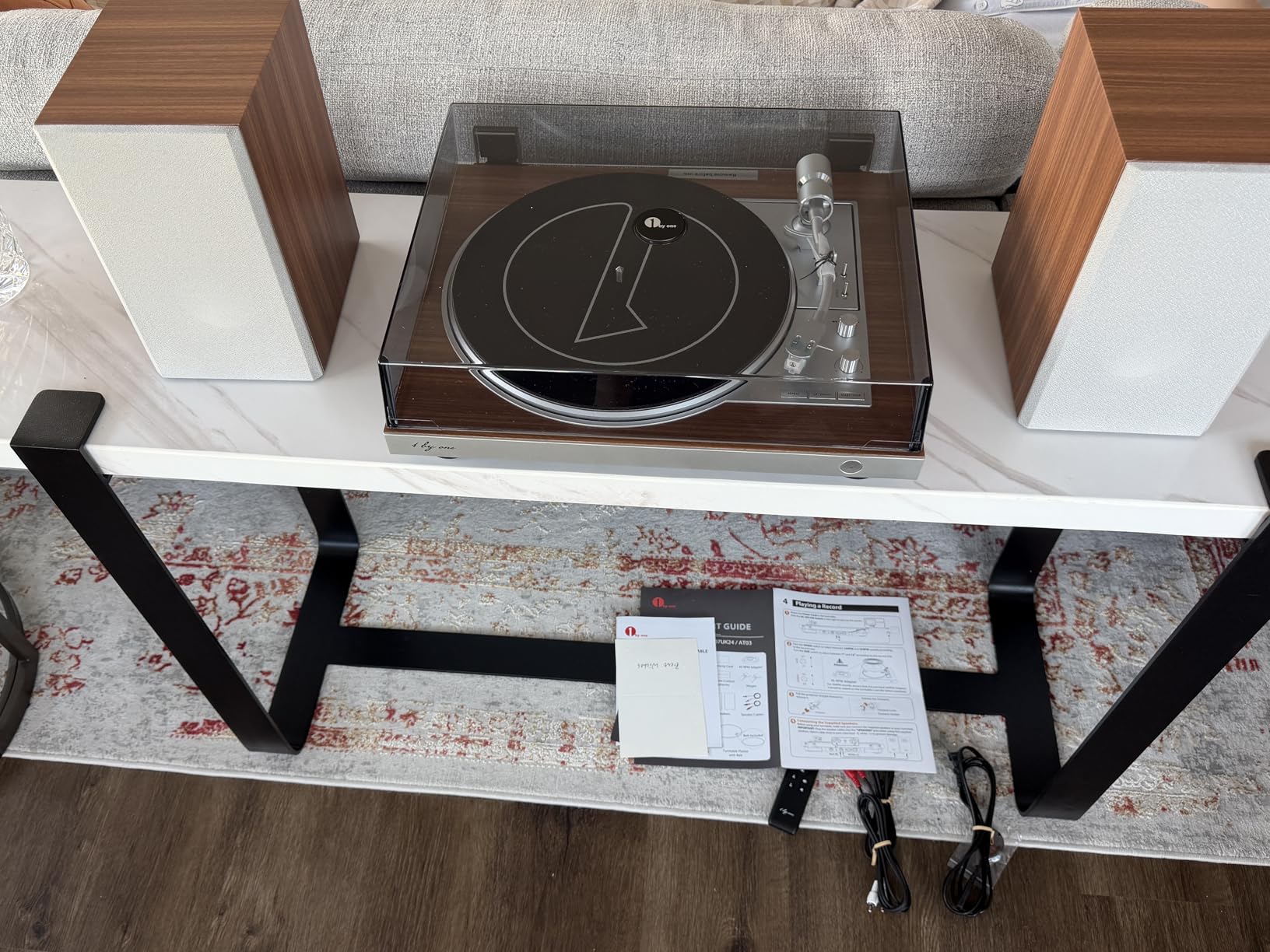
It uses a fixed precision-balanced tonearm with an AT-3600L stylus at 33 1/3 and 45 rpm, has a built-in phono preamp, and streams from a phone or tablet through the turntable and the speakers. The retro PVC wood-grain finish keeps it in furniture territory, and a remote control with two AAA batteries is included alongside on-device controls.
The complaints are specific and fixable in advance. The bundled 6 foot RCA cables are short if you want the speakers either side of a sofa, so plan on longer cables or wireless speakers. There is some sibilance on the top end, worse when you stream over Bluetooth than on vinyl. A robotic female voice announces Bluetooth connections, which breaks the retro mood. And the forward and back controls move through a record rather than jumping to a chosen track.
Is the extra speaker pair worth the extra space?
If you can spare a shelf and a metre of desk, yes, and the wattage figures are the reason. Two 30 watt woofers and two 10 watt tweeters per pair move far more air than a 2-inch driver behind a grille, which is why owners describe the included speakers as surprisingly capable. The compromise is footprint, since the speakers need to sit apart from the deck rather than on top of it.
Is automatic operation better than manual?
For a first record player, yes, because the failure mode of a new turntable owner is a mistracked tonearm. For a collection you want to play properly, no, because a fixed tonearm removes the ability to fine-tune tracking and upgrade the cartridge later. This is a deck for people who want music out of a box, not for people who want to adjust one.
How to Choose a Turntable With Built-in Speakers in 2026
Cartridge and stylus first, always. A moving-magnet or magnetic cartridge with a replaceable diamond or ruby stylus reads the groove accurately and treats records gently, while the simplest budget players use a fixed conical stylus on a light unweighted arm. The 1byone High Fidelity belt drive, the ANGELS HORN H019 and the ONE-Q All-in-One all ship with a named cartridge from the Audio-Technica range, and that is the single clearest quality signal in this entire list.
Second, check the outputs. Every one of these models except a few has Bluetooth as an input only, so streaming your phone into the deck is straightforward but sending vinyl out to wireless headphones usually is not. What genuinely matters is an RCA line output, because that is what lets you buy real speakers later. Eleven of the twelve have one, which is why we feel comfortable recommending this category at all.
Third, the phono preamp. A turntable produces a tiny signal that needs RIAA equalisation before it can drive speakers. All-in-ones handle this internally, and the ONE-Q makes the switch explicit so you can output line level to external speakers. If you ever connect to an amplifier with its own phono stage, a switchable preamp prevents you applying equalisation twice.
Fourth, drive type and speeds. Every model in this roundup is belt-driven, which means quieter operation and less motor hum, and eight of the twelve play 78 rpm as well as 33 1/3 and 45. Only the 1byone High Fidelity belt drive, the ANGELS HORN H019, the ONE-Q and the 1byone AT03 stop at 45 rpm, which matters only if you own 78 rpm shellac or old 78 rpm singles.
Fifth, cabinet size and weight. The two Victrola wood cabinets weigh 14.9 and 19.8 pounds and are furniture pieces that stay where you put them. The suitcase models weigh between 4.8 and 5.7 pounds and can move between rooms. Measure your shelf before ordering, because the Victrola Quincy at 18.2 by 13.19 by 10.29 inches is deeper than most people expect from a record player.
Finally, think about how you will listen. Built-in speakers suit background listening, kitchens, bedrooms and small flats. They are not built for filling a room, and the models with the thinnest drivers will disappoint you at volume long before they distort. If you want a living-room focal point, look at a turntable plus a separate amplifier and speaker pair instead, and treat that as the honest answer rather than the comfortable one.
Built-in Speakers vs Separate Speakers: What Really Changes
Three things change when you move from onboard drivers to a separate system: bass extension, volume headroom and how long the setup lasts. Built-in speakers are small cones in a cabinet that also has to house a motor, a platter and a tonearm, so they trade depth and volume for a footprint that fits on a kitchen counter. Separate speakers sit away from the turntable, do not fight it for space and can be positioned either side of a room.
The good news is that this no longer has to be a permanent choice. Eleven of the twelve models here have RCA line outputs, and the ONE-Q adds a switchable preamp, which means you can buy any of them now and wire in powered speakers later without replacing the deck. Several owners of the Victrola Quincy and the Victrola Empire do exactly that, using the built-in speakers for weekday listening and the external pair for evenings.
Bluetooth is the detail most roundups skip. A Bluetooth receiver lets your phone play into the turntable, which is a genuine convenience in a kitchen or office. A Bluetooth transmitter does the opposite and sends vinyl to wireless headphones. Nine of these models are receive-only, and the ANGELS HORN H019 is one of them, so if streaming your records to headphones matters, check the specification before buying rather than after.
The last thing to weigh is your commitment. If you are certain you will never want more volume, an all-in-one is complete and costs less in total than a deck plus amplifier plus speakers. If there is a decent chance you will want a real system within a year, buy a turntable with a line output now and treat the speakers as a later step. Our guide to built-in features that earn their place makes the same argument in a different room.
Frequently Asked Questions
Are turntables with built-in speakers good?
The good ones are genuinely good for casual listening. Models with a magnetic cartridge, a counterweighted tonearm and a reasonably sized cabinet play records with real detail and treat vinyl gently. The weak ones use a light unweighted arm and a small driver, which sounds thin and can skip on warped records. Judge a model by its cartridge, cabinet weight and published signal-to-noise ratio rather than by the speaker count on the box.
What is the best all-in-one turntable with speakers?
The Victrola Journey is the best all-in-one for most people because it plays 7 inch, 10 inch and 12 inch records at three speeds, streams over Bluetooth, weighs 5.1 pounds and has RCA outputs so you can add real speakers later. For better sound in a fixed location the ONE-Q All-in-One leads the group, and for zero setup the 1byone AT03 does everything for you automatically.
Which turntable with built-in speakers has the best sound quality?
The ONE-Q All-in-One has the highest average rating in this roundup and uses four full-range speakers with a crossover network, which gives it real bass rather than implied bass. The 1byone AT03 is the runner-up because its quad-driver bookshelf speakers include two 30 watt woofers and two 10 watt tweeters per pair. Every onboard system in this list is capped by small drivers, so external speakers always win at high volume.
What is the best budget turntable with built-in speakers?
The cotsoco M49 is the strongest budget option, with two built-in stereo speakers, a three-speed belt drive, a removable dust cover, a 45 rpm adapter and both Bluetooth and an RCA line output, plus a 2 year warranty. If you want something lighter to carry, the Victrola Journey folds flat and has a carry handle. Either way, spend your budget on a magnetic cartridge rather than on extra formats.
Do I need a phono preamp if it has built-in speakers?
No, because every all-in-one in this roundup has the phono preamp built in, which is how it drives its own speakers. You only need to think about it when connecting to other equipment. If the turntable has a switchable preamp, engage it when feeding an amplifier with its own phono stage and disengage it when using a normal line-level input, so the equalisation is never applied twice.
Can I connect Bluetooth speakers to a turntable with built-in speakers?
Usually not directly, because Bluetooth on these models is a receiver that plays audio from your phone into the turntable, not a transmitter that sends vinyl out. To use wireless speakers you need an RCA line output, which eleven of the twelve models here have, and either a Bluetooth transmitter plugged into it or powered speakers with their own Bluetooth. Check the specification wording carefully, since a receiver and a transmitter are often described with the same word.
Will a turntable with built-in speakers damage my vinyl records?
A well-set-up deck with a magnetic cartridge and a counterweighted tonearm will not damage records, and the light unweighted arms on the cheapest suitcase models are the real risk. A skipping tonearm jumping sideways across a groove is what causes scratches. Use those budget models on cheap or worn records, keep valuable vinyl for a deck with a counterweight, and use the dust covers that nine of these models include.
Final Verdict for Built-in Speaker Turntables in 2026
For most people, the best turntables with built-in speakers are the Victrola Journey for portability and simplicity, the Victrola Quincy for a complete entertainment cabinet in one box, and the ONE-Q All-in-One for the best onboard sound. All three play a record the moment you open the carton, and all three have the RCA line output you need later.
If you care about how the needle treats your records, look past the speaker count and check the cartridge. The 1byone High Fidelity belt drive, the ANGELS HORN H019 and the ONE-Q use named Audio-Technica cartridges with adjustable counterweights, and they are the three we would put near a collection worth keeping. Add the cotsoco M49 if you want the same idea for less, and save the fully automatic 1byone AT03 for anyone who refuses to touch a tonearm. Whatever you choose, check the roundups we keep updated as new models arrive through 2026.