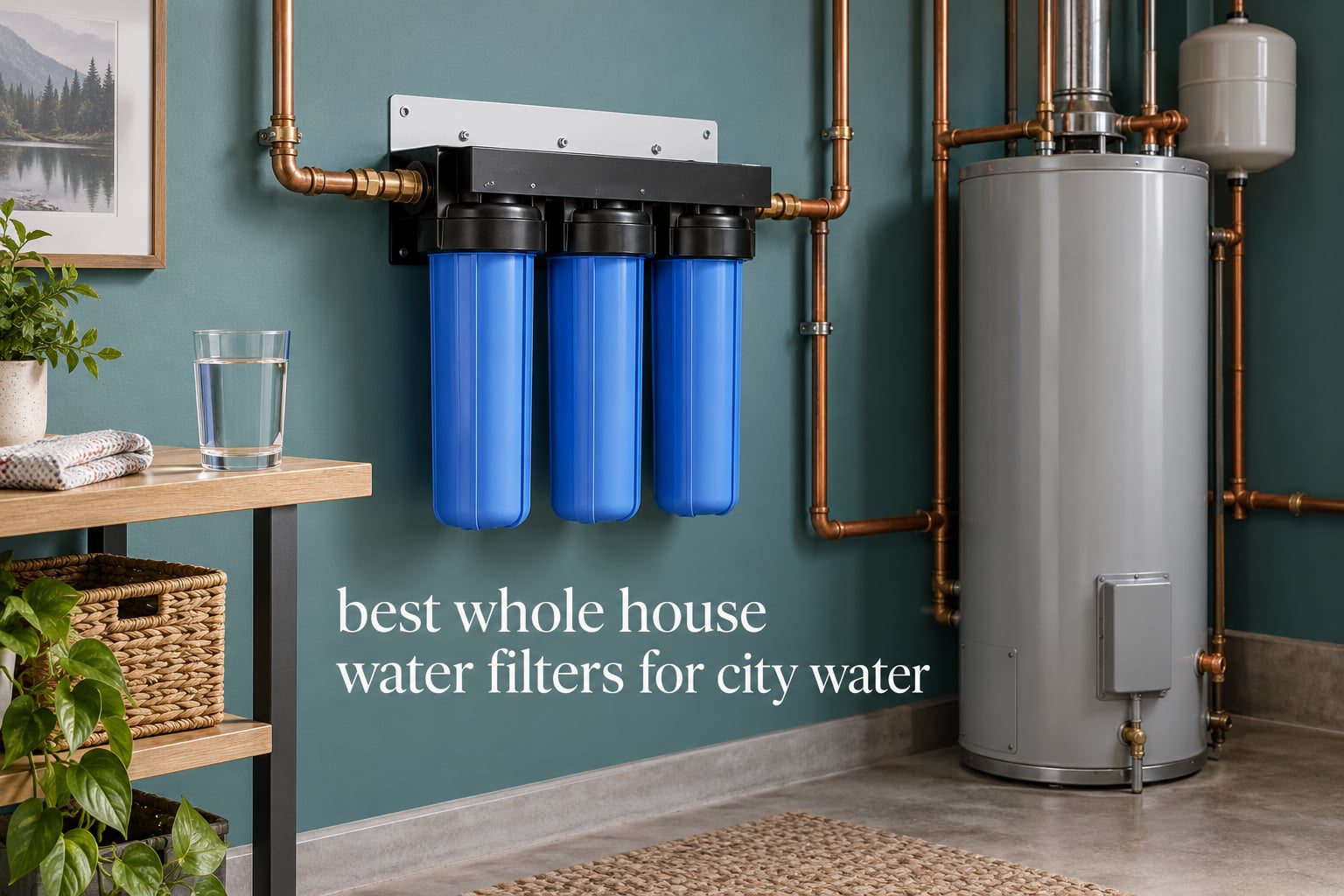
The tap water in most American homes is treated, not clean. Chlorine or chloramine goes in at the plant to kill bacteria, and that residual keeps working its way through the pipes to your shower. It also reacts with organic matter to make disinfection byproducts like trihalomethanes. On top of that you may have sediment from old mains, rust from galvanized lines, and lead or copper from plumbing installed before those materials were banned.
That is the case for a point-of-entry filter. Tap one in at the cold-water main and every fixture downstream draws filtered water, including the shower where you breathe in warm water and the ice maker in the freezer. Our best overall pick for 2026 is the iSpring WGB21B 2-Stage system: more than 4000 owners have rated it, it holds a 4.6 star average, and its 15 GPM rating with a one-year cartridge life covers a typical family without the pressure drop that trips people up.
We narrowed this list to eight whole house systems that are actually rated for municipal water rather than wells, then read every review pattern we could find on each one. Two things came out of that work immediately. First, nearly every complaint we saw was mechanical, not filtration related: weeping fittings, over-tightened threads, missing drain ports. Second, almost nobody buys these for the reason the marketing implies. They buy them for taste and odor at the shower and for protecting a tankless heater.
If you want the short version of how we picked, the criteria were contaminant coverage for city-water problems specifically, rated flow against household size, honest capacity numbers, and the build quality of the fittings you will actually sweat over at install time. Every pick below lists what it does not do as well as what it does.
Table of Contents
- Top 3 Best Whole House Water Filters for City Water (October 2026)
- Quick Comparison of the 8 Best Whole House Water Filters for City Water in 2026
- 1. iSpring WGB21B 2-Stage System – Best Overall for City Water
- 2. Express Water 3-Stage System – Best Value for Scale and Metals
- 3. iSpring WGB32B 3-Stage System – Top Rated Durability
- 4. Waterdrop WHF21-FG 2-Stage System – Best Compact High Flow
- 5. iSpring WGB22B 2-Stage System – Best Standard Cartridge Value
- 6. Reverse Osmosis Revolution 3-Stage System – Best With Spares Included
- 7. Max Water 3-Stage System – Budget Pick
- 8. LiquaGen Catalytic Carbon and KDF 55 Tank – Best for Chloramine
- Chloramine vs Chlorine: Why It Decides Your Filter
- Do You Actually Need a Whole House Filter on City Water?
- Sizing by Flow Rate: How Many GPM Your Home Actually Needs
- Tank-Based vs Cartridge: Which Format Fits Your Household
- Certifications Explained: NSF/ANSI 42 vs 53 vs 61 vs 372
- Installation, Sequencing and Your First 30 Days
- Frequently Asked Questions
- Do you need a whole house water filter on city water?
- Which water filter is best for municipal water?
- What is a good flow rate for a whole house water filter?
- Does a water filter remove chloramine?
- How hard is it to install a whole house water filter system?
- What are the downsides of installing a whole house water filtration system?
- Best Whole House Water Filters for City Water: The Final Verdict
Top 3 Best Whole House Water Filters for City Water (October 2026)
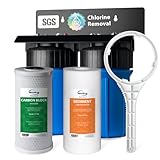
iSpring WGB21B 2-Stage
- 5 micron sediment plus CTO carbon block
- Over 90 percent chlorine and VOC reduction
- 50000 gallon and 12 month capacity
- 15 GPM on 1 inch ports

iSpring WGB32B 3-Stage
- Sediment stage plus dual CTO carbon blocks
- Up to 99 percent chlorine reduction
- 100000 gallon and one year capacity
- 15 GPM 1 inch NPT ports

Express Water 3-Stage
- Carbon and KDF media with polyphosphate
- Lead arsenic chromium and cadmium reduction
- 100000 gallon capacity
- 17 GPM on a freestanding steel frame
Quick Comparison of the 8 Best Whole House Water Filters for City Water in 2026
Everything below is rated for city water use. Read the flow rate first, because that is the number that decides whether your shower feels normal six months from now.
| Product | Specs | Action |
|---|---|---|
| iSpring WGB21B 2-Stage |
|
Check Latest Price |
| Express Water 3-Stage |
|
Check Latest Price |
| iSpring WGB32B 3-Stage |
|
Check Latest Price |
 Waterdrop WHF21-FG 2-Stage Waterdrop WHF21-FG 2-Stage |
|
Check Latest Price |
 iSpring WGB22B 2-Stage iSpring WGB22B 2-Stage |
|
Check Latest Price |
 Reverse Osmosis Revolution 3-Stage Reverse Osmosis Revolution 3-Stage |
|
Check Latest Price |
 Max Water 3-Stage Max Water 3-Stage |
|
Check Latest Price |
 LiquaGen Catalytic Carbon and KDF 55 Tank LiquaGen Catalytic Carbon and KDF 55 Tank |
|
Check Latest Price |
1. iSpring WGB21B 2-Stage System – Best Overall for City Water
iSpring WGB21B 2-Stage Whole House Water Filtration System, 50000 Gallons
5 micron sediment plus CTO carbon block
50000 gallon capacity
15 GPM max flow
12 month filter life
Pros
- Substantial polyethylene and steel housings that feel well built
- Over 90 percent chlorine reduction plus VOCs
- 1 inch ports keep household pressure steady
- Pre-assembled bracket with wrench and release valve included
- US-based support that sends replacement parts free
Cons
- NPT fittings need careful sealing to stop weeping
- Over-tightening can crack the housing threads
- No factory drain port so changes get wet
This is the one I put in my own house, and it is the one I recommend to friends. The first stage is a 5-micron polypropylene cartridge that catches dirt, sand, rust and scale. The second is a carbon block rated at more than 90 percent chlorine reduction, and it is effective on pesticides, herbicides and industrial solvents as well.
Owners on municipal water report the same thing over and over: cleaner-tasting water, fewer water spots on dishes, and clear water coming through during storm-related sediment events. That last one matters more than it sounds, because a main break or heavy rain is exactly when you will see what the cartridge caught.
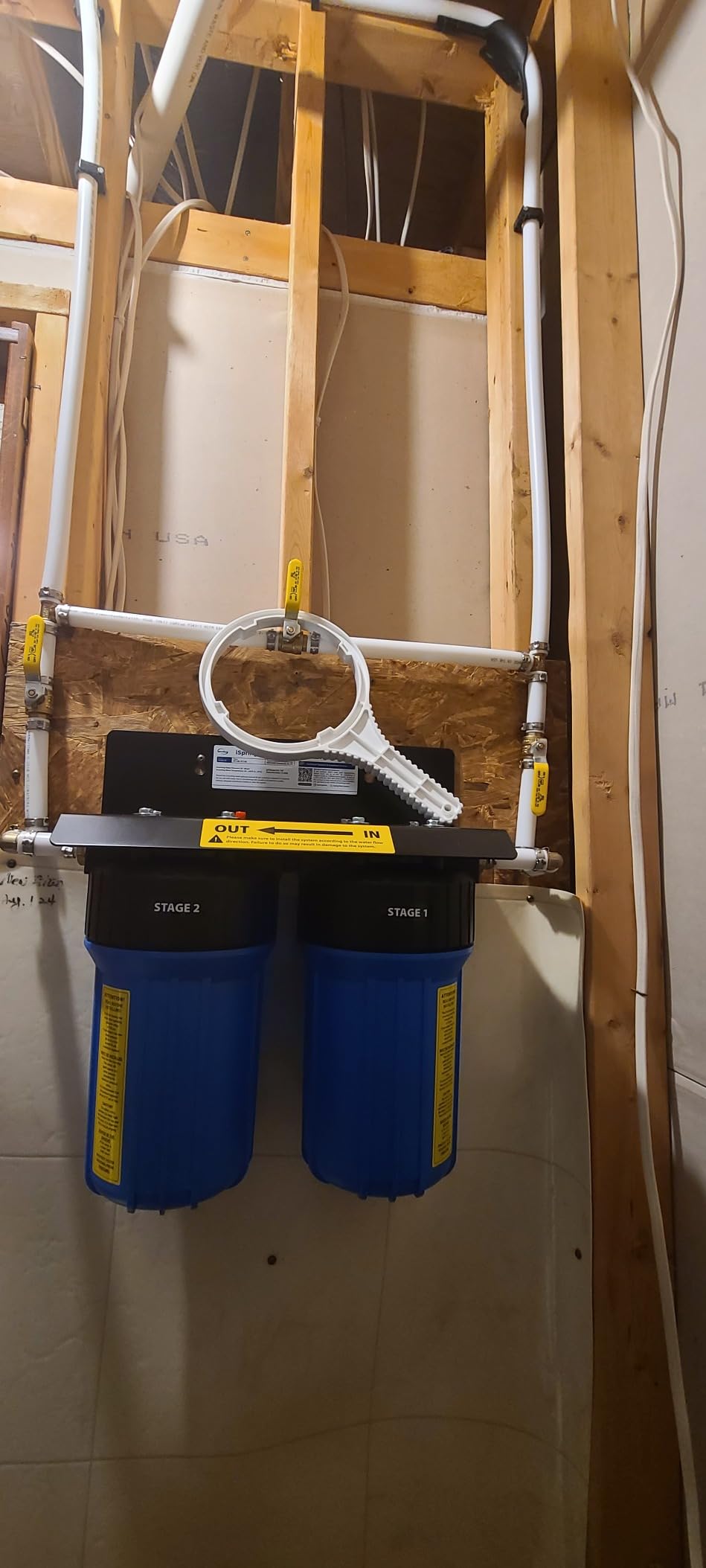
The thing that sold me is the boring stuff. These housings are polyethylene and steel rather than thin plastic, and they arrive pre-assembled on the mounting bracket with a filter wrench and pressure release valve in the box. Rated flow is 15 GPM on 1-inch inlet and outlet ports, which is comfortably above what a family of four actually pulls at peak.
It runs on water pressure alone with no power connection, and it works within 40 to 100 degrees F. Filtration is mechanical plus chemical absorption, and because it is not reverse osmosis it leaves total dissolved solids alone, so the minerals in your water survive.
What you will notice in the first month
Most people report a taste difference within days. Chlorine smell at the kitchen tap goes away first, then the shower odor fades, and the laundry and dishwasher water starts smelling cleaner too. Filter longevity in practice runs six to twelve months depending on how much sediment your main is pushing.
One iSpring owner on municipal water described the water spots on dishes disappearing within a couple of weeks, which tracks with what the sediment stage is doing. Nothing else about the water changes: hardness stays exactly the same, so this is not a softening device.
Where the install will trip you up
The single most repeated complaint across reviews is sealing the threaded NPT fittings, which needs several wraps of Teflon tape or proper O-ring grease. Several owners also report that aggressive tightening, or shipping damage, can crack a housing thread. iSpring’s US support is repeatedly praised for replacing leaking or cracked parts at no charge, sometimes years later.
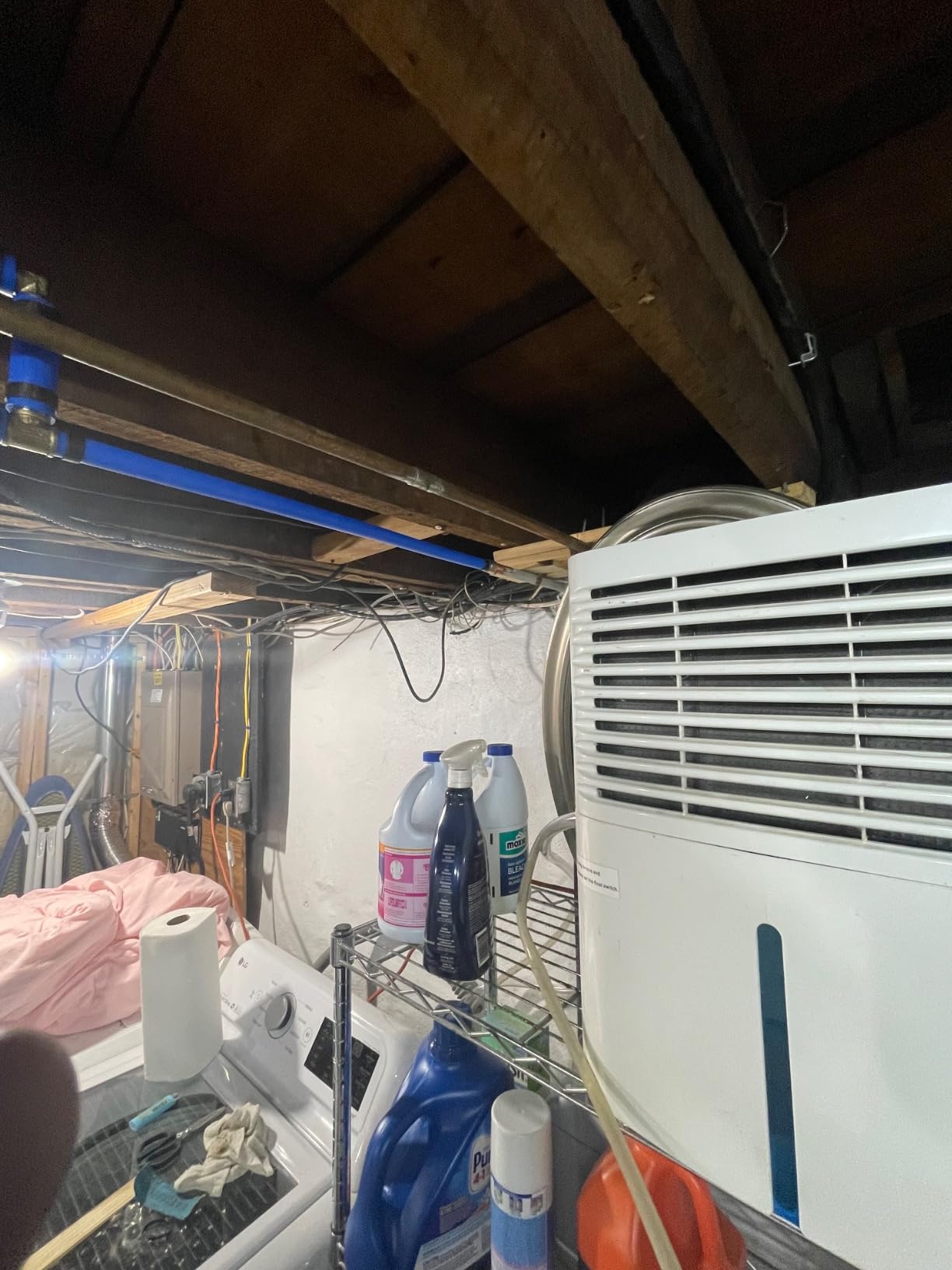
Plan for a wet filter change, because there is no factory drain port on the housings. Budget an hour for the install if you have worked with copper or CPVC before, and mount on solid framing rather than drywall anchors.
2. Express Water 3-Stage System – Best Value for Scale and Metals
Express Water Whole House Water Filter System, Ultimate Protection, 3-Stage
Carbon and KDF media with polyphosphate
100000 gallon capacity
17 GPM max flow
6 month filter life
Pros
- Freestanding stainless frame avoids wall mounting
- Built-in pressure gauges and release buttons
- Heavy metal coverage for lead arsenic mercury chromium cadmium
- Polyphosphate stage protects pipes and appliances
- Highest rated flow in this group
Cons
- Bulky 29 inch by 30 inch footprint needs real clearance
- Weighs 63 pounds which makes servicing harder
- Stainless parts can show surface rust over time
This is the one to look at if your water does more than taste bad. It is a three-stage system using activated carbon, KDF and polyphosphate, which means it is aimed squarely at chlorine, heavy metals and scale rather than chlorine alone.
Lead, arsenic, mercury, chromium and cadmium are all in scope. The polyphosphate stage is the part homeowners care about most, because it lays down a coating inside pipes and appliance lines that slows scale buildup. If you have a tankless water heater or a dishwasher that is already showing white crust, that stage is the reason to look here.
What reviewers consistently like is the packaging. This does not hang on a wall. It comes with a heavy-duty stainless steel bracket and a free-standing frame, so you can put it in a garage, a basement corner or a utility room without finding stud locations. Rated flow is 17 GPM, the highest number in this group.
There are also three pressure gauges, one per stage, with pressure release buttons on each filter housing. That is more instrumentation than any other system here, and it makes the six-month change a job you can do with confidence because you can see which stage is loading up.
What it is actually good for
If your municipality adds polyphosphate already, or your water is hard and you are tired of descaling the coffee maker every month, the scale protection is worth more than the taste improvement. Reviewers report dishwashers and washing machines staying visibly cleaner on sediment-heavy city supplies.
The media is packed in the lab and rated for 100000 gallons with a six-month cartridge cycle. At 17 GPM and a 20 to 80 psi operating range, it will not choke a busy house.
Where it falls short
Size and weight are the honest downsides. The freestanding frame measures 29 inches by 30 inches and the whole unit weighs 63 pounds, which is a lot to maneuver during a cartridge swap and a lot to ask for in a tight crawlspace. Measure your clearance before ordering.
Reviewers also note that the stainless steel components can develop surface rust at long-term exposure sites. It is cosmetic, but it is visible, and it is the one complaint that recurs across more than a few owners.
3. iSpring WGB32B 3-Stage System – Top Rated Durability
iSpring WGB32B Commercial-Grade Whole House Water Filter System
Sediment plus dual CTO carbon blocks
100000 gallon capacity
15 GPM max flow
1 year filter life
Pros
- Highest average rating in this roundup at 4.7 stars
- Many owners report eight plus years of continuous service
- Standard 20 inch by 4.5 inch cartridges are easy to source
- Sediment stage turns visibly brown on city supplies
- No noticeable household pressure drop
Cons
- Threaded manifolds weep if over-tightened
- Canisters are heavy when full and need two wrenches
- About 45 lb dry so it needs solid mounting hardware
- Occasional shipping damage to threads or brackets
This is the highest-rated system we looked at, at 4.7 stars across more than 2200 reviews, and the longevity reports are what separate it from the rest. Multiple owners describe eight or more years of continuous service with no measurable pressure loss. That is a longer track record than most competitors can point to.
The layout is three stages in 20-inch by 4.5-inch housings: one 5-micron sediment cartridge and two carbon block stages. The carbon is coconut shell based and third-party tested to NSF/ANSI standards, rated to remove up to 99 percent of chlorine along with sediment, rust, tastes, odors and herbicides.
Because the housings are the industry-standard 20-inch format, replacement cartridges are sold everywhere and cost less than proprietary blocks. That matters more than the spec sheet suggests, because the first thing that wears out on any whole house filter is the cartridge and you will buy it every year for a decade.
It runs between 25 and 80 psi, handles 40 to 100 degrees F, and needs no power. Rated flow is 15 GPM on 1-inch NPT connections, and the whole thing is non-RO so minerals pass through untouched.
Why owners keep them for years
The sediment cartridges on city water are consistently reported as turning visibly brown or muddy within months, and owners treat that as proof the system is working. Pressure stays steady because 15 GPM on 1-inch ports leaves headroom even with two showers running.
Installation is genuinely DIY for anyone comfortable with copper or CPVC, and the box includes the housing wrench and a manual. Repeated advice from owners: mount it on a heavy board, not drywall anchors.
What to watch during install
Leaks at the threaded joints are the most common complaint, and they come from over-tightening the plastic manifolds. Treat it like plumbing, snug plus a little, not like a bolt on an engine.
Two other things worth knowing: the canisters are heavy when full and want two wrenches to come apart, and a small number of buyers received shipping damage to housing threads or a bent bracket. iSpring has replaced damaged parts free even out of warranty, which is the single biggest driver of the rating here.
4. Waterdrop WHF21-FG 2-Stage System – Best Compact High Flow
Waterdrop WHF21-FG 2-Stage Whole House Water Filter System, NSF/ANSI 372
Iron and manganese stage plus GAC carbon
50000 gallon capacity
15 GPM max flow
6 month filter life
Pros
- Compact 14 inch footprint at about 10 lb total
- Reinforced brass threads with dual O-ring seals
- Third-party reduction figures for iron manganese and chlorine
- Cartridges are NSF/ANSI 372 lead-free certified
- Pre-installed cartridges and bracket speed setup
Cons
- Cartridge life rated at only 6 months
- Needs careful Teflon tape work at the NPT fittings
- Does not treat hardness the way a softener would
At about 14 inches tall and 10 pounds, this is the lightest unit here, and it still rates 15 GPM. If your mechanical space is genuinely tight, that combination is rare and it is the reason this one made the list.
Stage one is an iron and manganese reduction filter, stage two is natural coconut shell granular activated carbon. Both cartridges meet NSF/ANSI 372 lead-free standards, and the published third-party figures are up to 96.4 percent iron, 98.2 percent manganese and 95.63 percent chlorine.
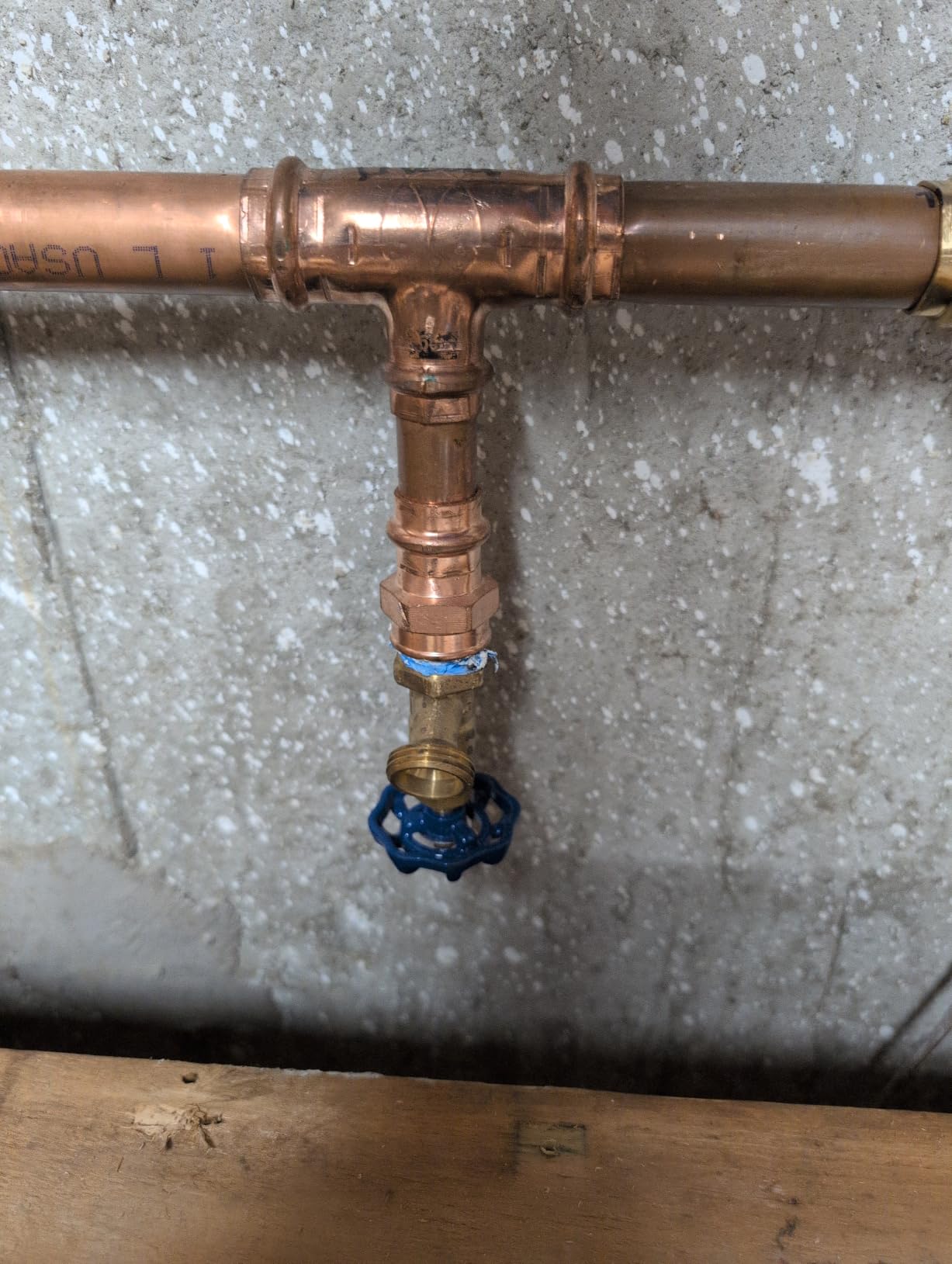
The metal claims go beyond iron and manganese. Mercury, lead, cadmium, chromium and copper are all listed, which makes this one of the better metal-reduction options at this size even though you would not think of it as a metal filter from the name.
Owners credit the brass-threaded ports specifically as feeling more robust than the all-plastic manifolds on cheaper stacks, and the dual high-sealing O-rings are a real improvement in leak resistance. The ports are 1-inch NPT and the bracket and cartridges arrive pre-installed.
Where it beats the others
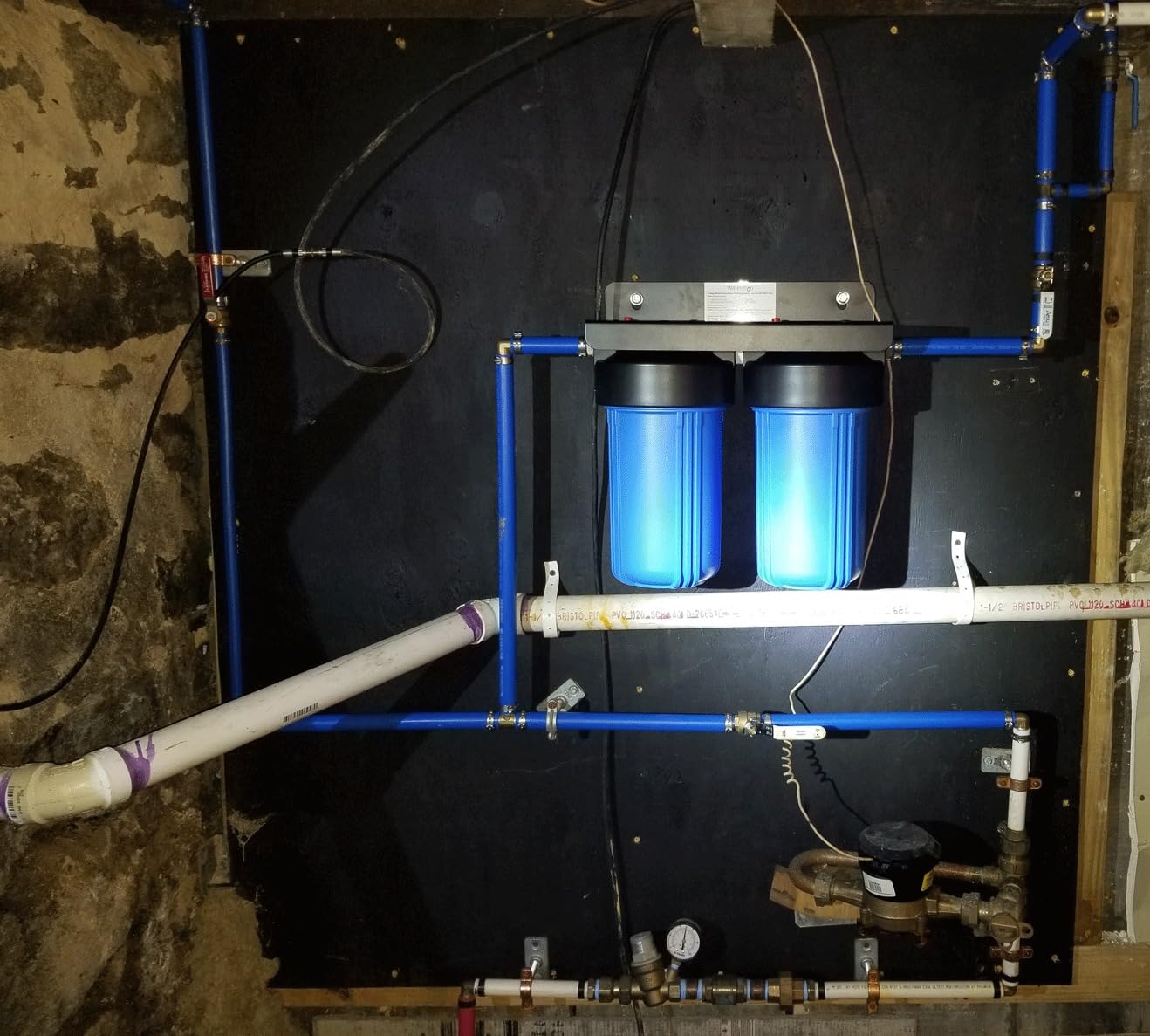
Small utility rooms, condos, and mobile homes where a 30-inch freestanding frame will not go. At 15 GPM you are not trading flow for footprint, which is the usual compromise with compact systems.
Roughly 73 percent of reviews are five-star, and buyers repeatedly note steady pressure alongside effective chlorine and iron reduction. If your city supply pushes sediment after heavy rain, the sediment stage is already in the box.
What the trade-off actually costs you
Cartridge life is rated at six months, not twelve, which means roughly twice the consumable spend per year than the WGB32B or the WGB22B. That is the real cost of this unit and reviewers with higher sediment loads notice it first.
Ratings also sit slightly lower than the iSpring units, with a noticeably larger share of one-star reviews. Installation still needs proper Teflon technique to stop weeping, and nothing here softens water.
5. iSpring WGB22B 2-Stage System – Best Standard Cartridge Value
iSpring WGB22B 2-Stage Whole House Water Filtration System, 20” x 4.5” Sediment & Carbon Block Filters, Removes up to 99% Chlorine, Fine Sediment and Bad Taste Removal
5 micron PP sediment plus CTO carbon block
100000 gallon capacity
15 GPM max flow
1 year filter life
Pros
- Universal 20 inch by 4.5 inch cartridges are cheap and easy to find locally
- Very noticeable chlorine taste and odor reduction
- Simple and well-documented DIY installation
- Dense plastic housings hold up over years
- iSpring support still helpful six plus years later
Cons
- Bracket ports are untapered so they need heavy tape and pipe dope
- Some first units arrive leaking or with a bent bracket
- No factory pressure release valve so changes are wet
- Does not reduce limescale or soften water
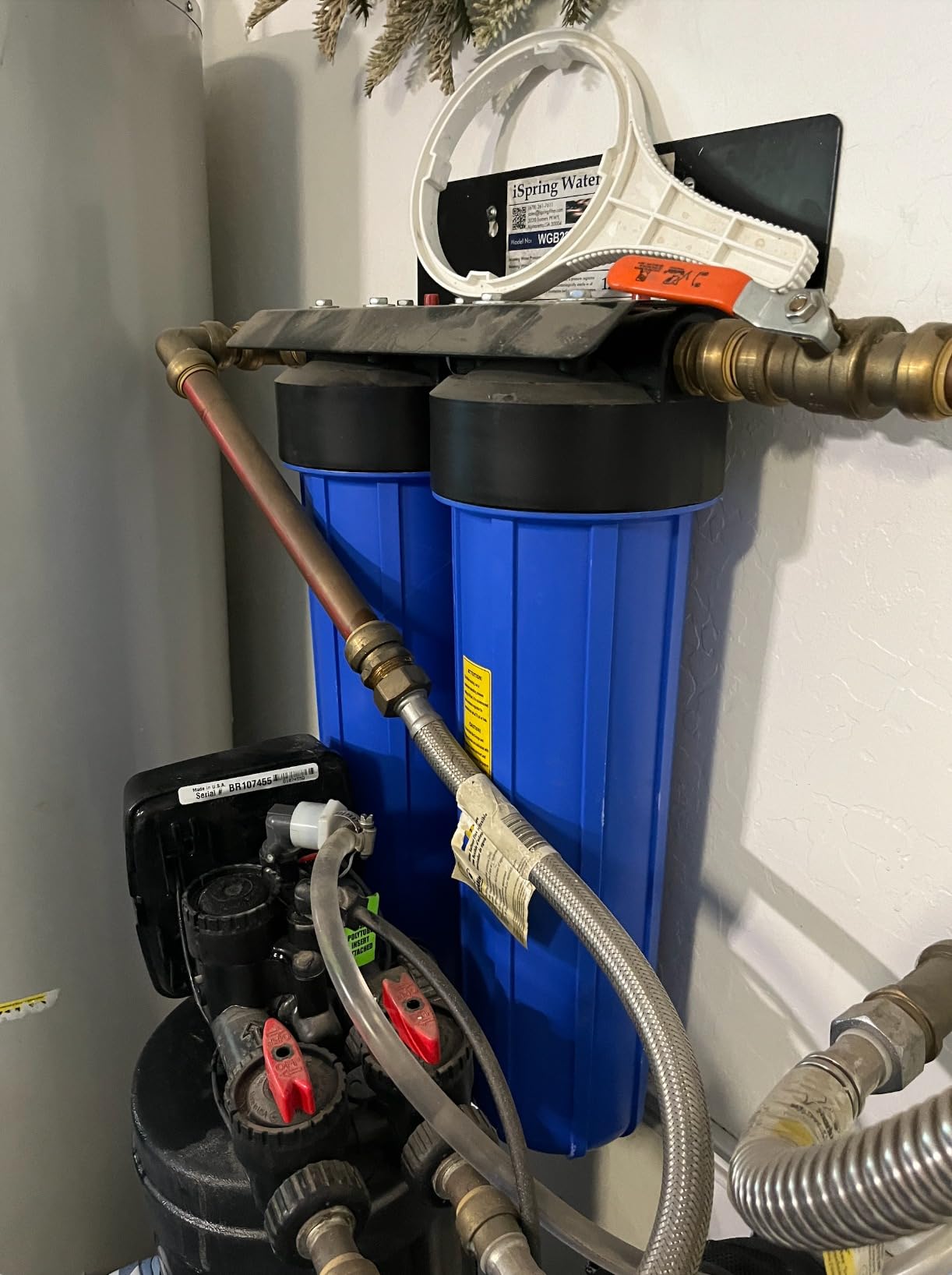
If you want a simple path to universal 20-inch cartridges, this is it. Two stages, one 5-micron polypropylene sediment filter and one coconut shell CTO carbon block, in housings that accept the same cartridges the three-stage WGB32B uses.
Owners on heavily chlorinated city water report the most visible payoff from this model: water that looks clear instead of faintly bleach-colored, better drinking taste, less odor, and softer-feeling hair and skin after showering.
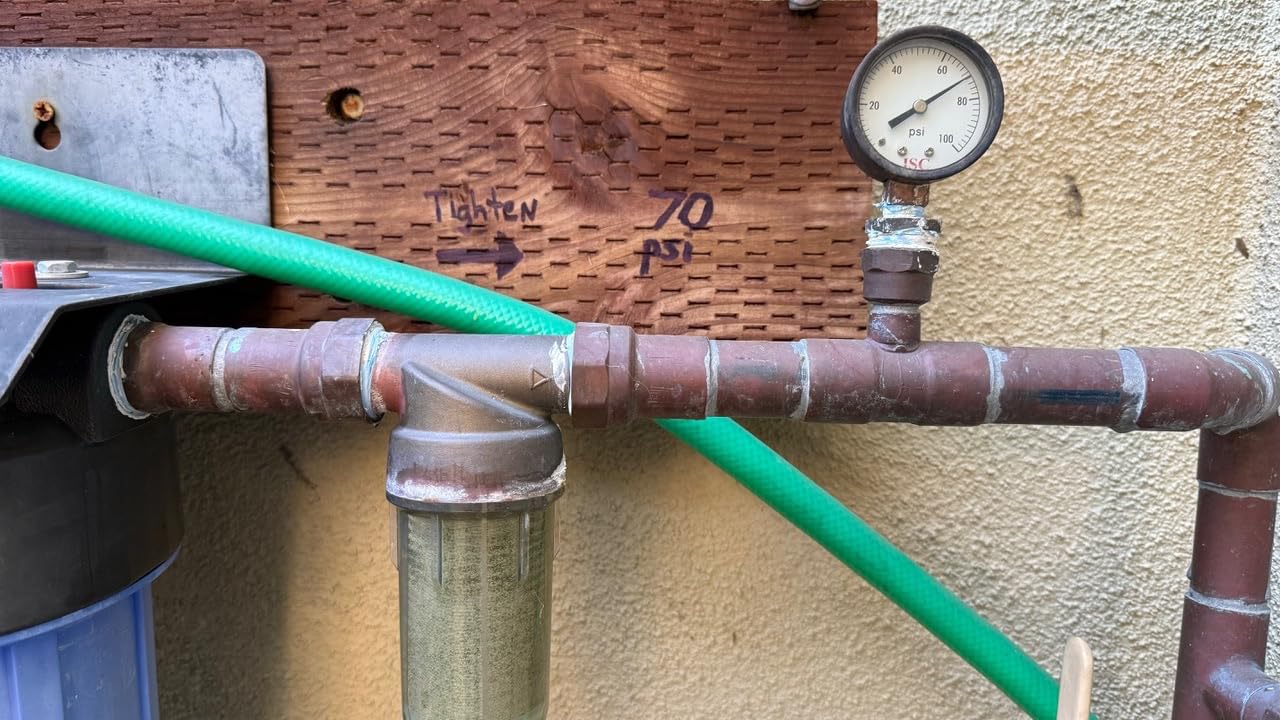
Independent testing is cited at up to 99 percent chlorine reduction along with sediment, rust, odors, bad tastes and herbicides. It runs 25 to 80 psi, handles 40 to 100 degrees F, and needs no power. Flow is 15 GPM on 1-inch FNPT connections.
The cartridge format is the quiet superpower. Because replacements are the industry standard, you can buy a two-year supply from any plumbing supply house and pay a fraction of what proprietary blocks cost. Each cartridge arrives individually wrapped for freshness.
Best fit for a straightforward city-water home
Two to three bathrooms, no well, no hard-water complaint beyond normal appliance scale. You want chlorine and sediment gone and you do not want to think about it for a year at a time.
The heavy-duty 9-inch filter wrench and double O-ring seals are included, which matters because this size housing is stubborn. Owners with basic plumbing skills describe the install as simple and well documented.
Mechanical weaknesses to plan around
The bracket ports are not tapered, which means fittings need generous pipe dope or Teflon to seal. A minority of buyers also report first-unit leaks between the two housings or a bent bracket out of the box; iSpring has replaced those under warranty.
There is no factory pressure-release or drain valve, so installers add their own spigot to make changes less messy. And to be clear about the limit: it does not reduce limescale, so it is not a substitute for hard-water treatment.
6. Reverse Osmosis Revolution 3-Stage System – Best With Spares Included
Whole House 3-Stage Water Filtration System, 3/4″ port with 2 valves and extra 1 year filter supply (2 sets, 6 pcs)
Sediment then GAC then CTO carbon block
10000 gallon capacity
Six pieces across two sets
4 to 6 month filter life
Pros
- Includes two full extra sets of replacement filters
- Clear housings let you see how loaded a cartridge is
- Shut-off valves and nearly all install parts included
- Water pressure holds up after installation
- Replacement cartridges are inexpensive in bulk
Cons
- 3/4 inch ports and 10000 gallon capacity are restrictive
- Housings are tight and sometimes need a strap wrench
- Cartridges plug fast on high-iron supplies
- Clear housings discolor under UV over time
This is the only system here that arrives with a year of replacements in the box. You get the three-stage system plus two extra sets, six pieces total, which means most owners do not have to reorder for roughly a year after installation.
The three stages are a 5-micron quick-connect sediment filter, a 10-inch granular activated carbon cartridge, and a 10-inch CTO carbon block. The GAC stage is listed against chlorine, radon, VOCs, odors, colors and unpleasant tastes, and the block handles chlorine plus insecticides and pesticides.
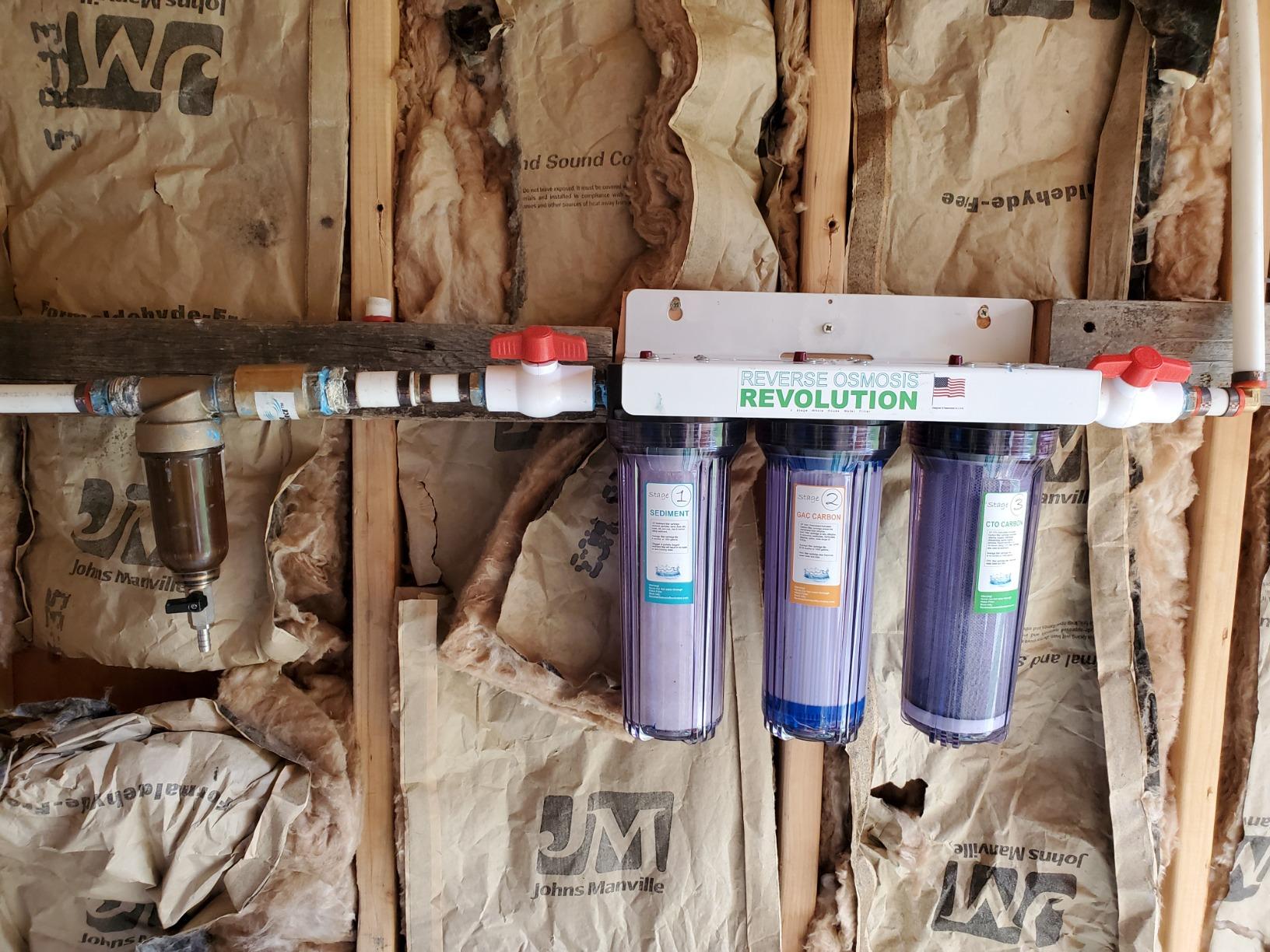
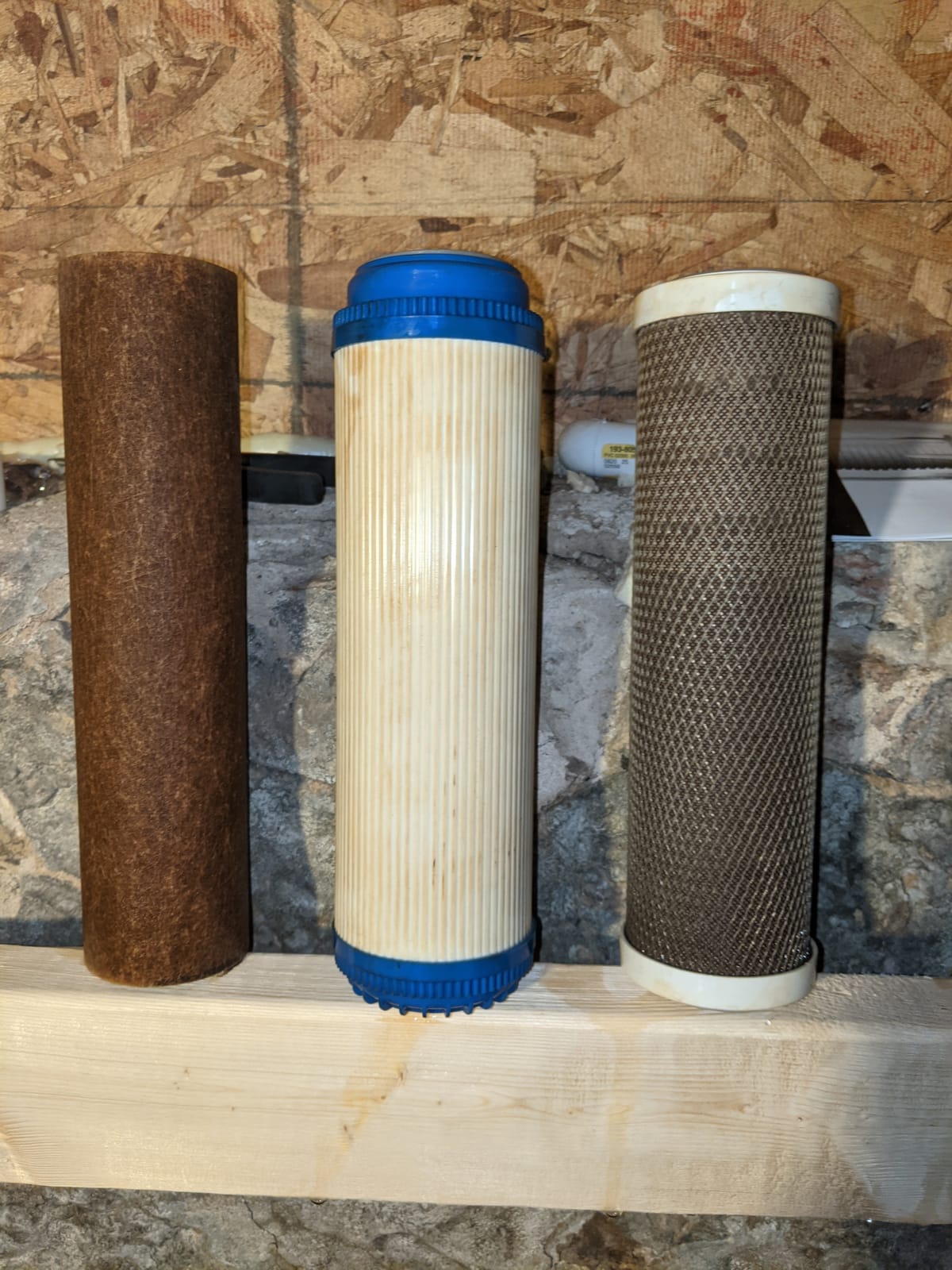
The housings are clear plastic, and that turns out to matter more than it sounds. You can look at the sediment cartridge and see when it is brown instead of guessing from a schedule, which is the correct way to run any cartridge filter.
Connections are 3/4-inch threaded with two shut-off valves included, and nearly every install part is in the box. It is built in the USA and carries a one-year hardware warranty.
Who gets the most out of it
Households that want set-and-forget ownership without thinking about reordering. Two extra sets on the shelf removes the most common failure mode of cartridge systems, which is simply running past due on changes.
Owners report clear improvements in taste, odor, dishwasher cloudiness and how their skin feels after showers. Many units have been in service three to five years, and the cartridges are cheap when you finally need more.
Where it will disappoint
Capacity is the limit. At 10000 gallons and 3/4-inch ports, this has the smallest capacity figure in the group, which is fine for a small home and a squeeze for four or more bathrooms.
On harsher supplies the cartridges plug quickly. One owner on high-iron water found the sediment cartridge plugged within a week, and the tight housings made removal an ordeal that in one case broke a canister. The clear housings also yellow under UV exposure over time.
7. Max Water 3-Stage System – Budget Pick
Max Water Whole House Water Filter System 3 Stage 10″ x 2.5″ for City Water
PP sediment plus GAC and CTO stages
10000 gallon capacity
1 to 10 GPM flow
6 to 12 month filter life
Pros
- Three filtration stages in one compact package
- Compact 14 inch footprint at about 11 lb
- Clear housings show filter loading at a glance
- Owners report it protects dishwashers and washers
- Cartridges fit standard iSpring-style housings
Cons
- Housing O-rings have failed repeatedly causing flooding
- Manufacturer support was unresponsive on those failures
- Cheaply made housings feel less solid
- 3/4 inch ports need a separate adapter for hose hookup
Three stages, a 14-inch footprint, and the lowest cost of ownership of anything we reviewed. The filtration itself works: a 5-micron PP sediment stage feeding dual carbon stages in GAC and CTO form, rated to reduce lead, arsenic and chromium while helping with scale and sediment.
Owners on sediment-heavy city water say it visibly improves taste and odor and shields appliances, which is exactly the job. Flow is 1 to 10 GPM across a 20 to 90 psi operating range, and filters run six to twelve months or up to 100000 gallons depending on your supply.
It carries a one-year manufacturer warranty and BPA-free components. The stainless bracket, clear housings, pressure gauges and release buttons are a better instrumented package than the unit would suggest, and cartridges fit standard housings that are easy to find.
This is the honest budget option, not a bad one. The filtration performance draws most of the praise, and the 4.3 average reflects housing quality more than water quality.
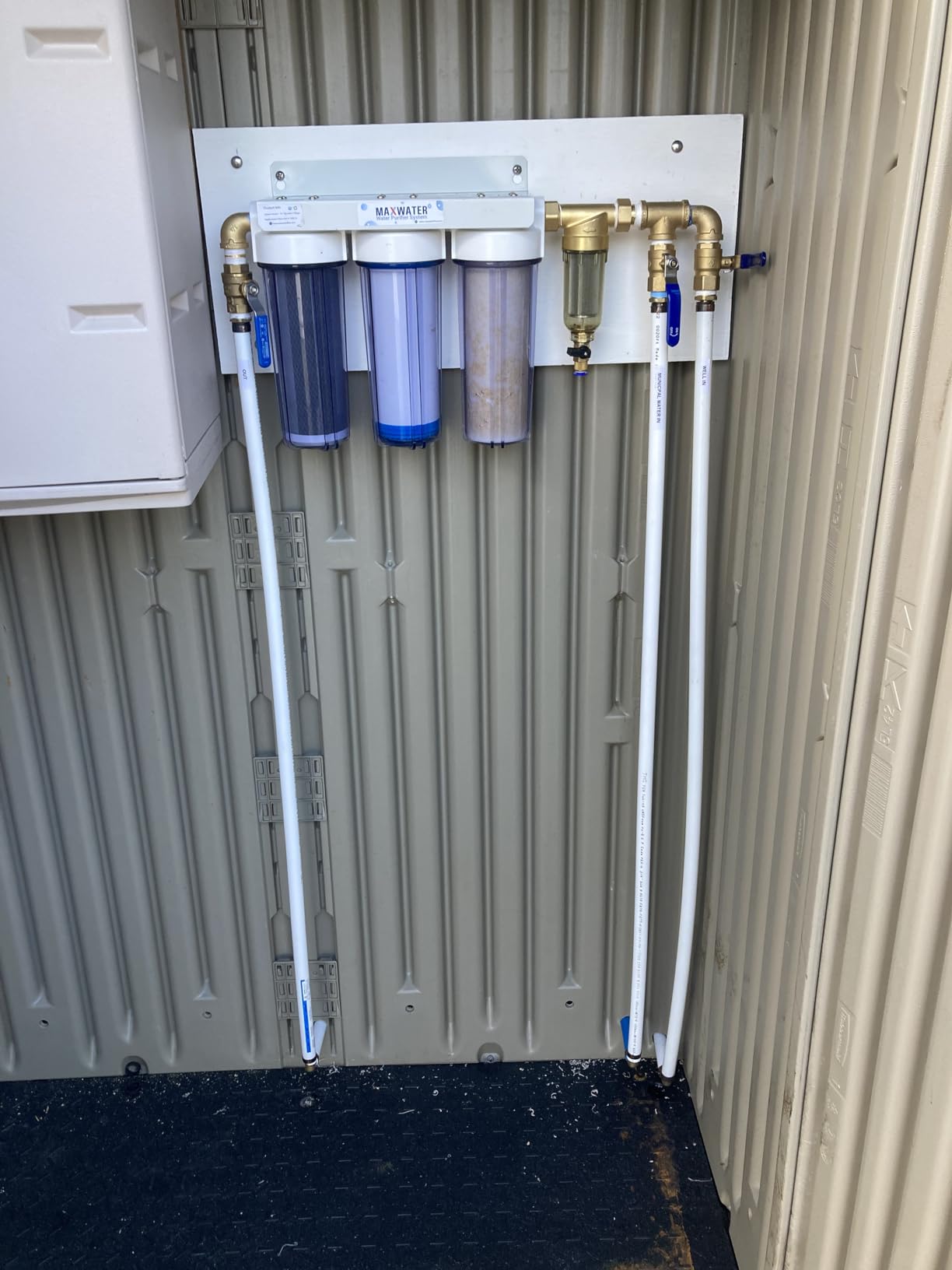
What you get for the money
Three filtration stages, gauges, a bracket and a wrench in one box, at a small fraction of what the larger systems above it cost. If your budget is the deciding factor and your household is small, the trade is reasonable.
The clear see-through housings let you check loading without guessing, and owners point out that the cartridges fit standard iSpring-style housings, so replacement costs stay low.
The O-ring problem you should know about
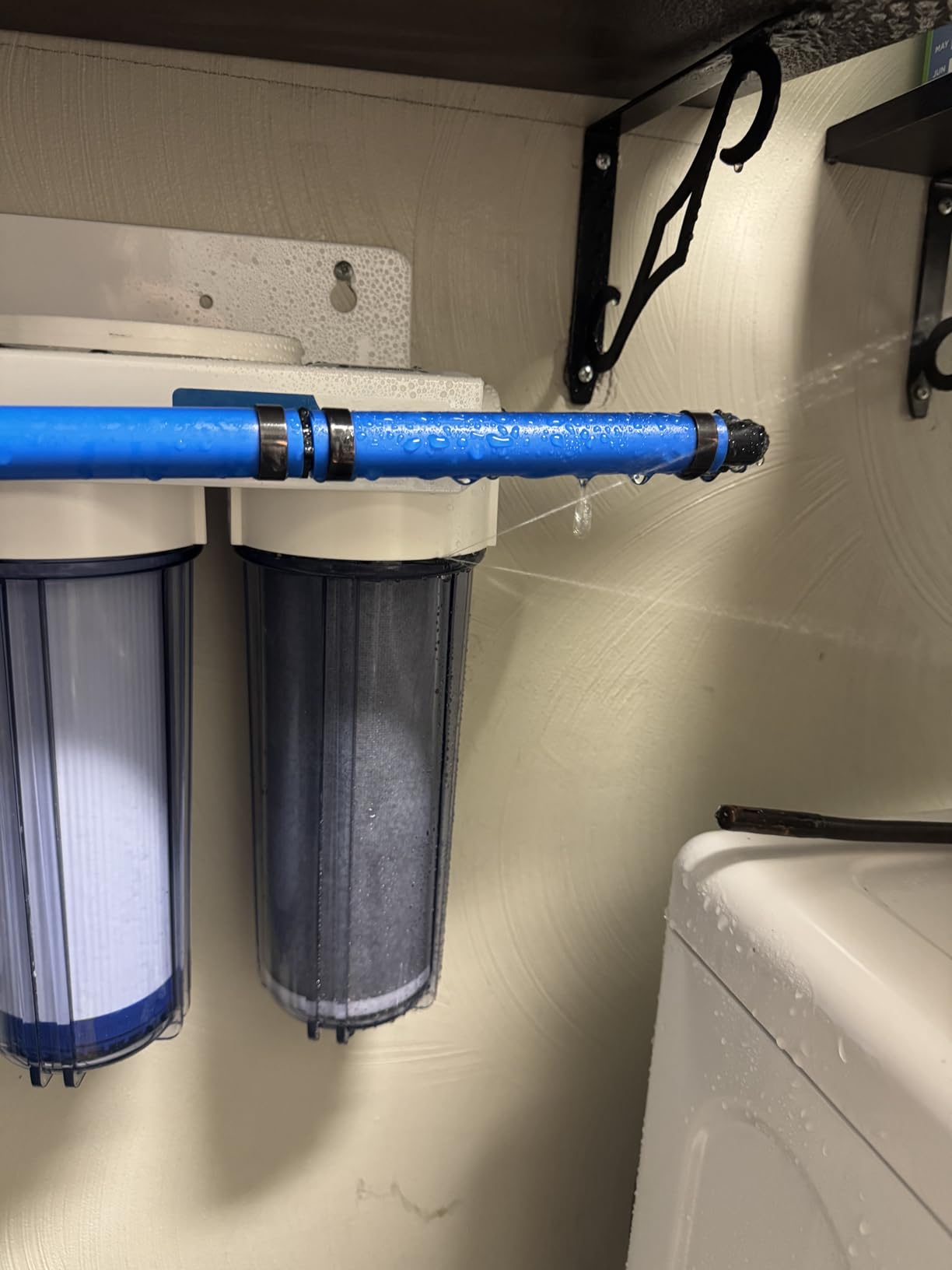
This is the reason it sits at seven rather than higher. Multiple reviewers report housing O-rings ejecting mid-operation and flooding laundry rooms, sometimes requiring a strap wrench to free a canister that was tight from the factory.
Manufacturer support was described as unresponsive when those failures were reported. Install tips that appear to fix problems include applying pipe dope or gasket grease and removing and reseating canisters before final tightening. It also needs a separate adapter for garden hose hookup.
8. LiquaGen Catalytic Carbon and KDF 55 Tank – Best for Chloramine
LiquaGen Whole House Water Filtration System — Catalytic Carbon & KDF 55 Media | City Water Filter for Chlorine, Chloramine, PFAS & Sediment Removal (10″ x 54″)
Catalytic carbon with KDF 55 media
1000000 gallon capacity
10 year media life
12 GPM max flow
Pros
- Automatic backwash removes the cartridge change schedule
- Catalytic carbon plus KDF 55 targets chloramine specifically
- Lowest ongoing cost given the 10 year media life
- FRP tank and 1 inch metal bypass valve are heavy duty
- Fleck control valve parts are widely serviceable
Cons
- Highest cost in this roundup
- Needs floor space for a full size mineral tank
- Backwash adds discharge volume and pauses flow briefly
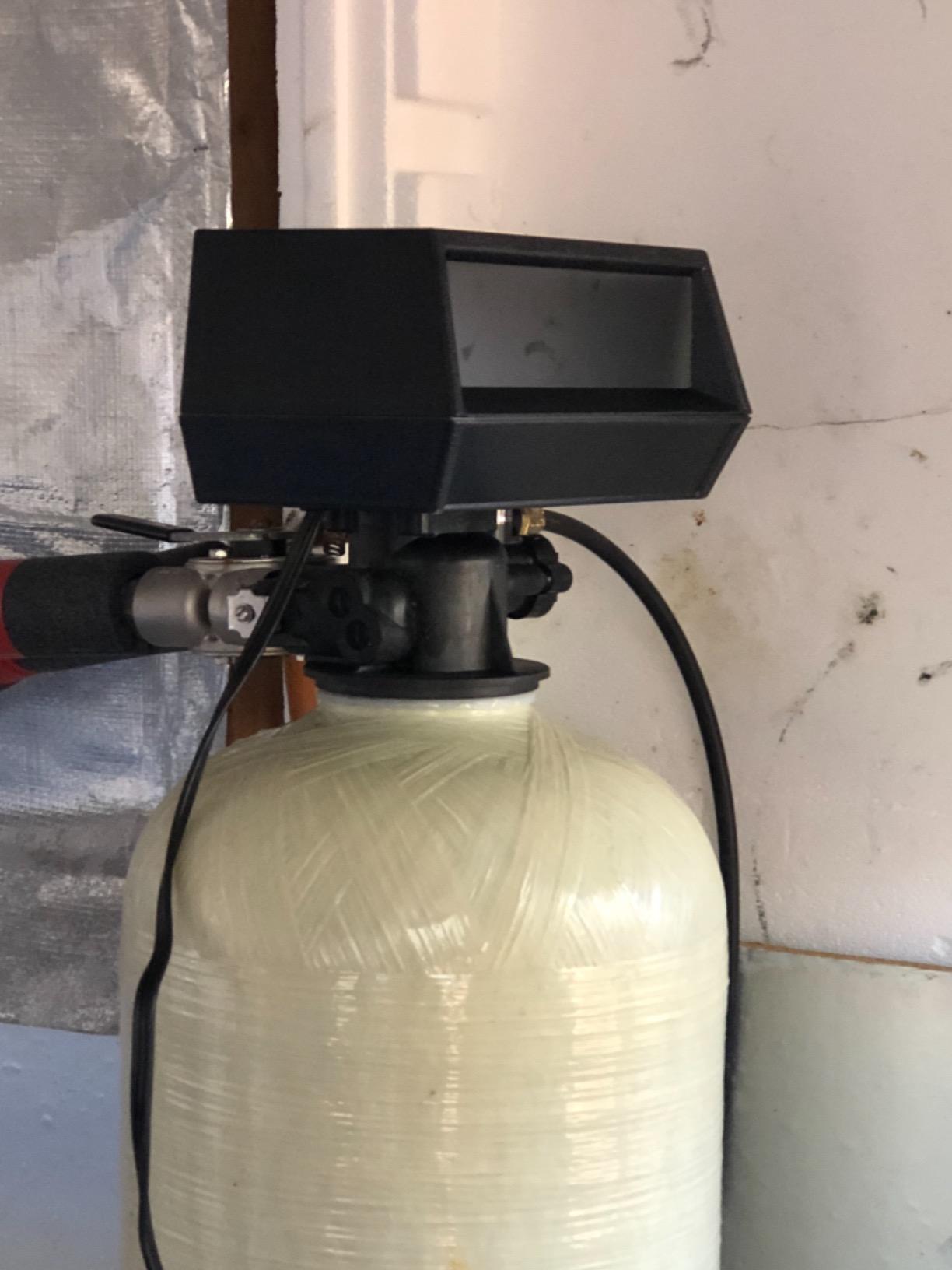
This is the only true media tank in the group, and it works a completely different way from the other seven. Instead of replaceable cartridges, a tank holds dual-media catalytic carbon plus KDF 55, and a programmable control valve backwashes the bed on a schedule to stop channeling.
That difference matters enormously if your utility uses chloramine. Catalytic carbon is the media built for chloramine specifically, because chloramine is a bonded nitrogen-and-chlorine compound that ordinary carbon block does not break down. This tank targets chlorine, chloramine, PFAS, sediment and VOCs.
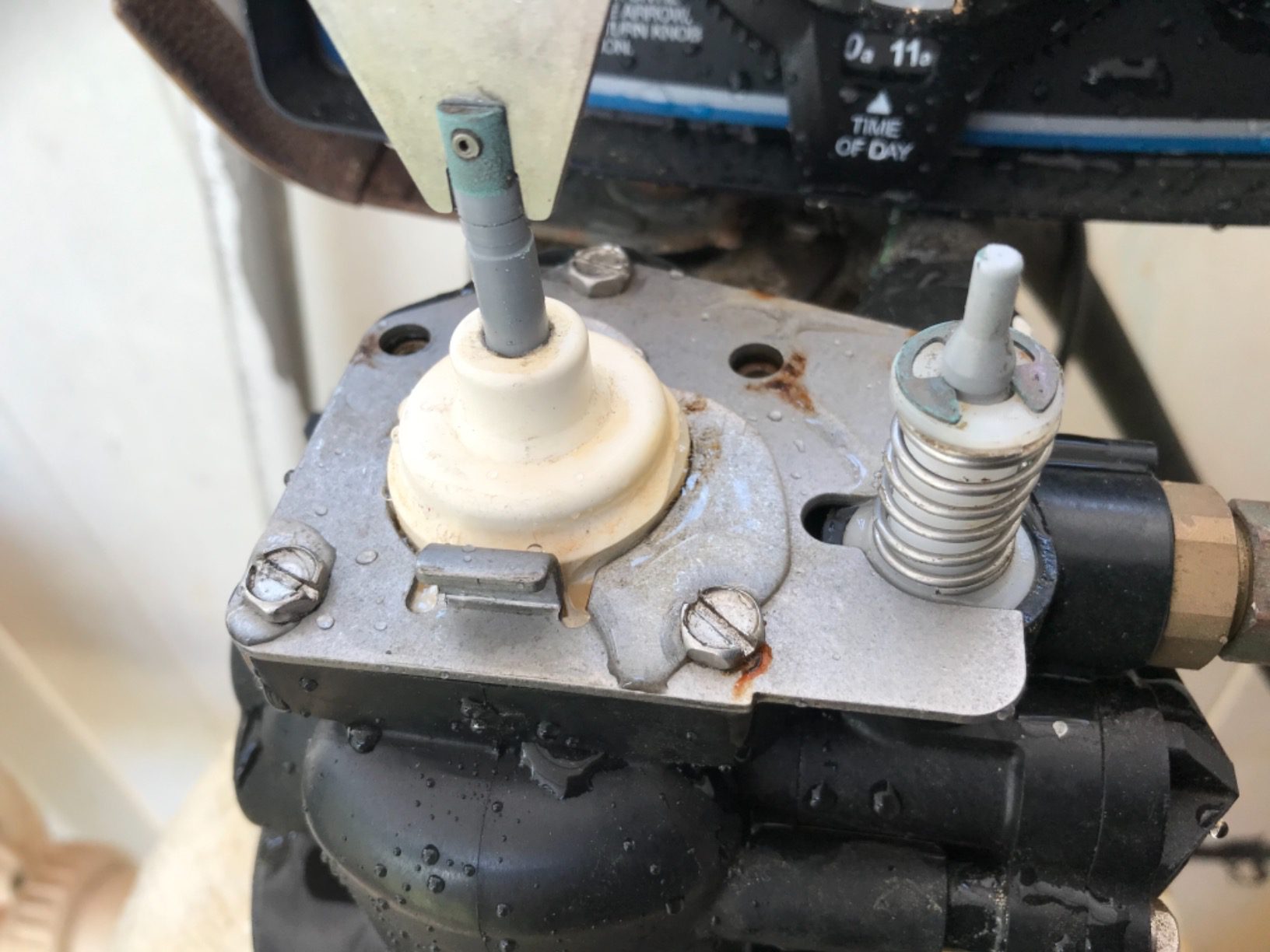
Media life is rated at up to ten years or 1000000 gallons with no manual cartridge changes at all. In practice you buy the media once and then service a control valve, which is the lowest ongoing spend per gallon of anything we reviewed.
The tank is a 10-inch by 54-inch fiberglass-reinforced mineral tank rated for four to six bathroom homes at 12 GPM. A 1-inch metal bypass valve is included so you can service the unit without shutting off household water, and the Fleck-style control valve components are a proven, widely serviceable design.
Why the tank approach wins on ownership cost
Do the math on cartridges and it is not close. A decade of annual carbon blocks and sediment filters across a family, plus the labor to swap them, ends up costing more than the tank. You would also be handling wet canisters and wrenches once a year instead of never.
Reviewers value the Fleck valve components specifically for durability and easy servicing, and they are widely rebuildable, so a failed head is a repair rather than a replacement.
What you give up for that
It costs the most here, and it needs floor space for a full-size tank. The 10-inch by 54-inch footprint is not a wall-mount or under-sink proposition.
Backwash cycles add discharge volume to your bill and cause a brief flow interruption while cycling, which is normal for this format but worth knowing if you have a very low water pressure situation.
Chloramine vs Chlorine: Why It Decides Your Filter
Every city water utility disinfects with either free chlorine or chloramine, and the two behave completely differently inside a filter. Free chlorine is a single molecule that carbon strips out easily through adsorption. Chloramine is chlorine bonded to ammonia, and standard carbon block does not break that bond, which is why people install a filter and still smell water.
This is the loudest complaint in homeowner forums and the mistake most often made in this category. If your utility uses chloramine and you buy a standard CTO carbon block, you will be disappointed. Catalytic carbon media exists specifically to handle it, and only the media tank on our list is built around catalytic carbon plus KDF 55.
Check before you buy. Your utility publishes which disinfectant it uses in its annual drinking water quality report, and many municipalities moved from chlorine to chloramine specifically because chlorine forms more disinfection byproducts. A utility that switches after you have installed is a real scenario, and it is worth asking about.
The byproducts nobody mentions at the fixture
Chlorine reacting with organic matter produces trihalomethanes and haloacetic acids. You will never taste them, but you absorb more of them in a hot shower than from a glass of water, because heating drives them out of solution and you inhale the steam. That is the strongest argument for a whole house filter rather than an under-sink one.
What a point-of-entry filter does not touch
Carbon does not reduce total dissolved solids, does not remove hardness minerals, and will not handle fluoride, PFAS, nitrates or arsenic from groundwater. Those need reverse osmosis, and pretending otherwise is the most common expectation mismatch we see.
When you can skip the whole project
If you have never noticed chlorine smell, your home has modern copper plumbing, and your primary goal is drinking water quality, a pitcher or under-sink filter may serve you better for far less money. A whole house filter makes sense when the odor is real, when you want shower water to stop smelling, or when you are protecting an appliance.
Do You Actually Need a Whole House Filter on City Water?
City water is regulated, and treatment plants are good at what they do. So the honest answer is that you probably do not need one for safety reasons alone. What you are buying is taste, odor, and protection for the pipes and appliances downstream.
You probably want one if you can smell chlorine at the tap or in the shower, if your municipality uses chloramine and you have sensitive skin or hair, if you have older galvanized or pre-1986 copper plumbing where lead solder is possible, or if you have a tankless water heater that needs a sediment barrier.
You can probably skip it if your water already tastes fine, if your main is newer than the 1980s, and if the only goal is better drinking water, which under-sink reverse osmosis does more precisely for far less money. Whole house point-of-entry filters protect every fixture; reverse osmosis protects one.
Running both is normal and is what the treatment forums describe as the norm rather than an either-or choice. A carbon tank at the entry for taste and odor, plus an under-sink RO at the kitchen for fluoride and dissolved solids. People on r/WaterTreatment reach for that combination almost by default.
Sizing by Flow Rate: How Many GPM Your Home Actually Needs
Flow rate is the spec people get wrong most often. A shower head pulls roughly 2 to 3 GPM, a kitchen faucet about 3, a laundry pair more than that. Two showers and a washer running together is where an undersized filter shows up as a pressure drop.
The practical rule most installers use: count your bathrooms, add one GPM per bathroom, then add five GPM of headroom for fixtures running at once. For a three-bath house that lands around 8 to 10 GPM service flow. The range you will see recommended across the industry is 9 to 20 GPM depending on household size.
Rated flow and clean filter flow are not the same number. A brand-new cartridge passes more water than a loaded one, so buying to the rated spec with zero headroom means you notice the difference within months. Rated maxima across our picks run from 10 to 17 GPM, and all but two use 1-inch ports.
The 3/4-inch port systems in this group are the ones to watch. They are adequate for a small home but become the bottleneck the moment two showers overlap, and no amount of filter capacity fixes a restriction at the fitting.
Tank-Based vs Cartridge: Which Format Fits Your Household
Cartridge systems hold a few thousand gallons of media and need annual changes. They are small, wall-mountable, inexpensive to start, and the media is easy to swap. Seven of our eight picks are cartridges, and for most city-water homes that is the correct choice.
Media tanks hold hundreds of thousands of gallons and backwash themselves on a schedule. They cost more up front and take floor space, but you might change media once in a decade instead of twelve times. The economics favor the tank somewhere around year four for an average household.
Also consider floor space, whether you are comfortable with water and wrenches once a year, and how much sediment your main actually pushes. Cartridge systems load faster than their rated gallon numbers in sediment-heavy municipal water, which is the most common reason buyers feel they got a false economy.
Certifications Explained: NSF/ANSI 42 vs 53 vs 61 vs 372
NSF/ANSI 42 is an aesthetic standard. It certifies a filter for taste, odor and sediment reduction. It is a real certification and a meaningful one for chlorine, but it is not a health certification, and brands routinely put it on listings as though it were.
NSF/ANSI 53 is the health-effects standard, covering reduction of contaminants with public health significance such as lead, cryptosporidium and giardia. If a listing only shows 42, you are buying taste improvement. Look for 53 when the claim is metal reduction.
NSF/ANSI 61 covers material safety, meaning the plastics and metals that touch your water will not leach contaminants into it. NSF/ANSI 372 covers lead-free compliance of the wetted components. Neither one says anything about filtration performance.
The practical takeaway is that certifications describe what a unit removes, but they never guarantee whole-house coverage of the disinfectant byproducts that form inside your own pipes after the water leaves the plant. Test your water before you spend, and read your utility’s consumer confidence report to see what you are actually dealing with.
Installation, Sequencing and Your First 30 Days
Installation means cutting into the cold-water line after your main shutoff, typically in a garage, basement or mechanical room. If you have worked with copper or CPVC and you have a crimp tool or threaded fittings, this is a weekend job. Call a plumber if the run is in a slab, if the main is galvanized and brittle, or if you are not confident isolating your water.
Two practical constraints to check first: vertical clearance for cartridge housings, and whether your main is 3/4-inch or 1-inch, because that determines whether a 1-inch filter body chokes your flow. Use solid framing rather than drywall anchors for anything heavy.
If you also run a water softener, the filter goes first, ahead of the softener. Putting a softener upstream means resin and brine see the sediment and chlorine first, which shortens resin life and can foul the brine tank. Carbon ahead of the softener also means softened water leaving the taps.
For the first 30 days: run cold water for five minutes after install to clear carbon fines, taste-test a glass from the kitchen and then the shower, and check the gauge or feel for pressure change at full flow. Keep an eye on the first filter change as a baseline for how fast your cartridges load, because that number sets your real maintenance cost.
Frequently Asked Questions
Do you need a whole house water filter on city water?
Usually not for safety, because municipal plants treat water to federal standards. You need one for taste, odor and appliance protection. Consider one if you smell chlorine or chloramine at the tap or in the shower, have older galvanized or pre-1986 copper plumbing, or want to protect a tankless water heater from sediment. If drinking water quality is your only goal, under-sink reverse osmosis costs far less.
Which water filter is best for municipal water?
For most city-water homes, a tank-based catalytic carbon system with a KDF stage is the strongest choice, because it targets chlorine and chloramine together and holds media for up to ten years. Among cartridge systems, a three-stage sediment plus dual carbon block unit rated at 15 GPM and 100000 gallons is the sweet spot for a family of four.
What is a good flow rate for a whole house water filter?
Count one GPM per bathroom and add about five GPM of headroom for fixtures running at once, which puts a three-bath home at roughly 8 to 10 GPM. Industry recommendations typically run 9 to 20 GPM depending on household size. Prefer 1-inch ports, and remember that loaded cartridges pass less water than the rated spec.
Does a water filter remove chloramine?
Only specific media does. Chloramine is chlorine bonded to ammonia, and standard carbon block does not break that bond, which is why some owners install a filter and still smell water. Catalytic carbon is the media designed for it, and it is what you want if your utility reports chloramine in its drinking water quality report.
How hard is it to install a whole house water filter system?
It means cutting into the cold-water main after your shutoff valve, so it is a moderate plumbing job. Anyone comfortable with copper or CPVC and threaded fittings can do it in an afternoon with a wrench and Teflon tape. Call a plumber if the main is in a slab, if the line is old galvanized pipe, or if you cannot isolate your water safely.
What are the downsides of installing a whole house water filtration system?
The main ones are a permanent pressure drop as media loads, annual cartridge changes that get wet and messy, floor or wall space for the unit, and the fact that carbon does not reduce hardness, dissolved solids or fluoride. On homes with 3/4-inch mains, a 1-inch filter body can also restrict flow.
Best Whole House Water Filters for City Water: The Final Verdict
Our pick for the best whole house water filters for city water in 2026 is the iSpring WGB21B 2-Stage system. It has the largest owner base of anything we reviewed, a 4.6 star average, 15 GPM on 1-inch ports, and a year of cartridge life that leaves room in the budget for filters. Buy the WGB32B if you want the three-stage version and the 4.7 star durability record behind it.
Move up to the LiquaGen catalytic carbon tank only if your utility uses chloramine or you are certain you will be there a decade from now. Drop to the Max Water three-stage if budget is the deciding factor and your home is small, and skip the whole category if your water already tastes fine to you.
Before you order anything, read your utility’s annual drinking water quality report and count your bathrooms. Those two pieces of paper decide more than any spec sheet will.
If you are still weighing point-of-entry against a dedicated drinking-water setup, our guides to whole house filters for kitchen sinks and under sink filtration break down the other half of the decision, and we also cover whole house filtration for well water if your setup is not municipal after all.