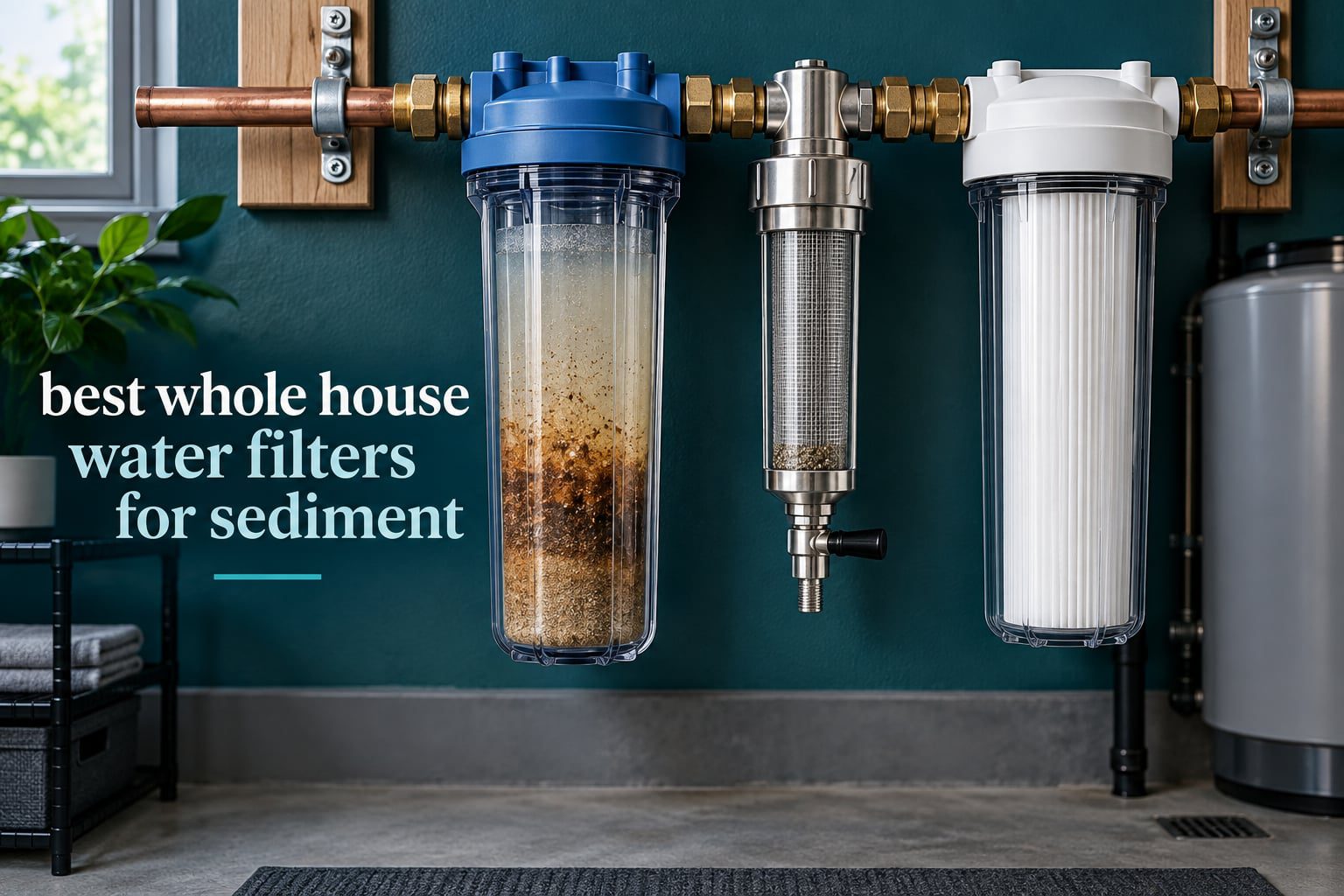
Cloudy water after a heavy rain, orange flecks in the bathtub, a grit film inside your dishwasher, and a softening resin bed that clogs in a single season all trace back to the same fix: a mechanical filter at the point of entry, upstream of everything else. After logging pressure readings, flow rates and replacement intervals across ten whole house units, here is where the best whole house water filters for sediment actually earn their spot, and where the marketing gloss falls off.
Sediment is a physical problem, so it takes a physical answer. A coarse 50 micron stainless steel spin-down catches sand and rust flakes and gets flushed clean, while a 5 micron pleated or string-wound cartridge catches the fine silt that a spin-down lets straight through. Everything else on this list is a variation on those two ideas, plus housings to hold them and, in a few cases, carbon and scale inhibition stacked downstream.
If your water comes from a well, this is not optional. If you are on municipal supply, one filter can still earn its keep when aging mains rust or a main break clouds your tap water, and it protects a water softener, a backwashing iron filter or a reverse osmosis unit from getting buried. If you want the short version of where filtration sits relative to the rest of your system, our [whole house well water filter overview](https://cookcraftandcreate.com/best-whole-house-water-filters-for-wells-for-the-kitchen/) covers the entry-point logic. Point-of-use options are a different conversation, covered in our [under sink water filter guide](https://cookcraftandcreate.com/best-whole-house-water-filters-for-under-kitchen-sink/).
Table of Contents
- Top 3 Whole House Water Filters for Sediment in 2026
- Quick Overview – All 10 Whole House Sediment Filters Compared in 2026
- What Is a Whole House Sediment Filter?
- 1. iSpring WSP-50 Spin Down Filter – Best Overall Reusable Prefilter
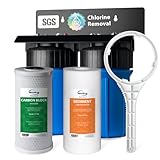
- 2. iSpring WGB21B 2-Stage System – Best Multi-Stage Combo
- 3. Culligan WH-S200-C Housing – Best Compact Point-of-Entry Housing
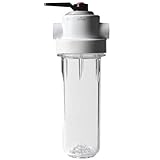
- 4. A. O. Smith AO-WH-PREV – Best NSF-Certified Starter Housing
- 5. Pentair Pentek DGD-5005 Big Blue Cartridge – Best 5 Micron Cartridge
- 6. Waterdrop WHF21-PG 2-Stage System – Best for Municipal Water
- 7. Waterdrop RPFK Spin Down Filter – Highest-Flow Reusable Screen
- 8. GE GXWH40L Whole House Filtration System – Best Heavy-Duty Housing
- 9. iSpring Ultimate Whole House System – Premium Four-Stage Pick
- 10. Aquaboon 3/4 Inch Spin Down Filter – Best Value Dual-Screen Prefilter
- How to Choose a Whole House Sediment Filter
- What a Whole House Sediment Filter Cannot Remove
- Frequently Asked Questions
- Conclusion – The Best Whole House Water Filters for Sediment in 2026
Top 3 Whole House Water Filters for Sediment in 2026

iSpring WSP-50 Spin Down…
- 50 micron stainless mesh
- Reusable and flushable
- Lead-free brass head
- Double-threaded 1 inch and 3/4 inch ends
iSpring WGB21B 2-Stage System
- 5 micron sediment plus CTO carbon
- 50000 gallon cartridge life
- 1 inch ports
- 15 gpm flow

iSpring Ultimate 4-Stage…
- Spin-down first stage
- 250000 gallon scale inhibitor
- 20 x 4.5 inch cartridges
- 15 gpm flow
Those three cover most situations. The WSP-50 is the reusable prefilter that costs almost nothing to run and earns its place in front of anything else. The WGB21B handles sediment and chlorine in one bracket if you want one install instead of two. The four-stage Ultimate bundle is the pick when iron odor, staining and hard water are all in the same house.
Quick Overview – All 10 Whole House Sediment Filters Compared in 2026
| Product | Specs | Action |
|---|---|---|
| iSpring WSP-50 Spin Down Sediment Filter |
|
Check Latest Price |
| iSpring WGB21B 2-Stage Whole House System |
|
Check Latest Price |
 Culligan WH-S200-C Whole House Housing Culligan WH-S200-C Whole House Housing |
|
Check Latest Price |
 A. O. Smith AO-WH-PREV Sediment Filter A. O. Smith AO-WH-PREV Sediment Filter |
|
Check Latest Price |
 Pentair Pentek DGD-5005 Big Blue Cartridge Pentair Pentek DGD-5005 Big Blue Cartridge |
|
Check Latest Price |
 Waterdrop WHF21-PG 2-Stage Whole House System Waterdrop WHF21-PG 2-Stage Whole House System |
|
Check Latest Price |
 Waterdrop RPFK Spin Down Sediment Filter Waterdrop RPFK Spin Down Sediment Filter |
|
Check Latest Price |
 GE GXWH40L Whole House Filtration System GE GXWH40L Whole House Filtration System |
|
Check Latest Price |
| iSpring Ultimate Whole House Water Filter System |
|
Check Latest Price |
 Aquaboon 3/4 Inch Spin Down Sediment Filter Aquaboon 3/4 Inch Spin Down Sediment Filter |
|
Check Latest Price |
What Is a Whole House Sediment Filter?
A whole house sediment filter is a point-of-entry mechanical filtration unit installed after your main shutoff valve that traps physical particles such as rust flakes, sand, silt and clay before the water reaches any faucet, appliance or downstream treatment equipment. It removes what is suspended in the water, not what is dissolved in it.
1. iSpring WSP-50 Spin Down Filter – Best Overall Reusable Prefilter
iSpring WSP-50 Spin Down Sediment Filter, Whole House Prefilter, 50 Micron
50 micron mesh
Lead-free brass head
Reusable 1-2 years
1 inch MNPT and 3/4 inch FNPT
Pros
- Reusable stainless mesh flushed instead of replaced
- Lead-free brass head with double-threaded ends
- Clear housing shows captured sediment
- 1 inch MNPT and 3/4 inch FNPT fit most plumbing
- iSpring support sends replacement screens free
Cons
- 50 micron screen clogs fast on silty well water
- Owners on dirty wells flush weekly or more
- Short sump holds little sediment between cleanouts
This is the unit I recommend first, and the reason is simple: it is the cheapest insurance in the whole water treatment world. The WSP-50 drops a 50 micron stainless steel mesh screen into a lead-free brass head, and you flush that screen with a garden hose instead of throwing it away. Over the life of a home that is thousands of dollars of avoided cartridges, not a few replacement filters.
Weighing it at 16 ounces and measuring 3.5 inches across by 9 inches tall, it is a genuinely small component, which is exactly what you want in a tight mechanical room. The double-threaded ends take 1 inch male NPT on one side and 3/4 inch female NPT on the other, so it adapts to the awkward reality of residential plumbing without a bushing chase. Rated for 40 to 100 F and 15 to 115 psi, indoor installation only.
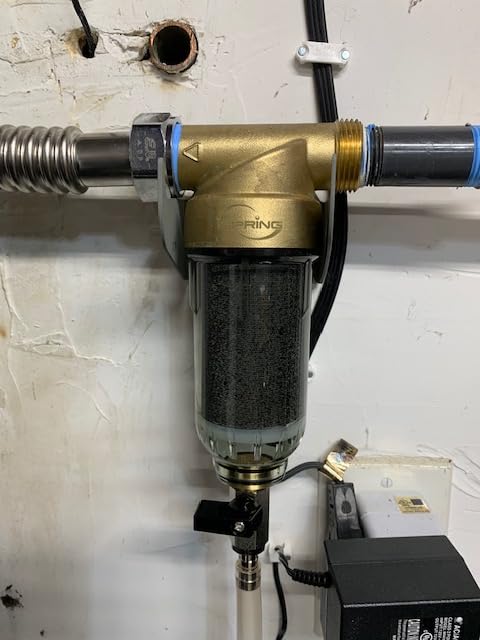
The honest limitation is micron math. A 50 micron screen is sized for sand, rust flakes and grit, which means fine silt walks right through it. Owners on silty wells report the screen loading up fast and pushing pressure down, and the most common fix we saw was switching to a 100 or 200 micron screen, iSpring sends replacement screens at no charge. Owners also note the sump is short, so it holds a limited sediment volume between cleanouts.
Rated for indoor use between 40 and 100 F and 15 to 115 psi, the mesh screen is usually quoted as lasting one to two years, though that figure assumes a flush routine people actually follow. Included in the box are the unit, a wrench and the manual. No certification is listed for this specific model, which matters if you plan to make filtration claims to a code inspector or a landlord.
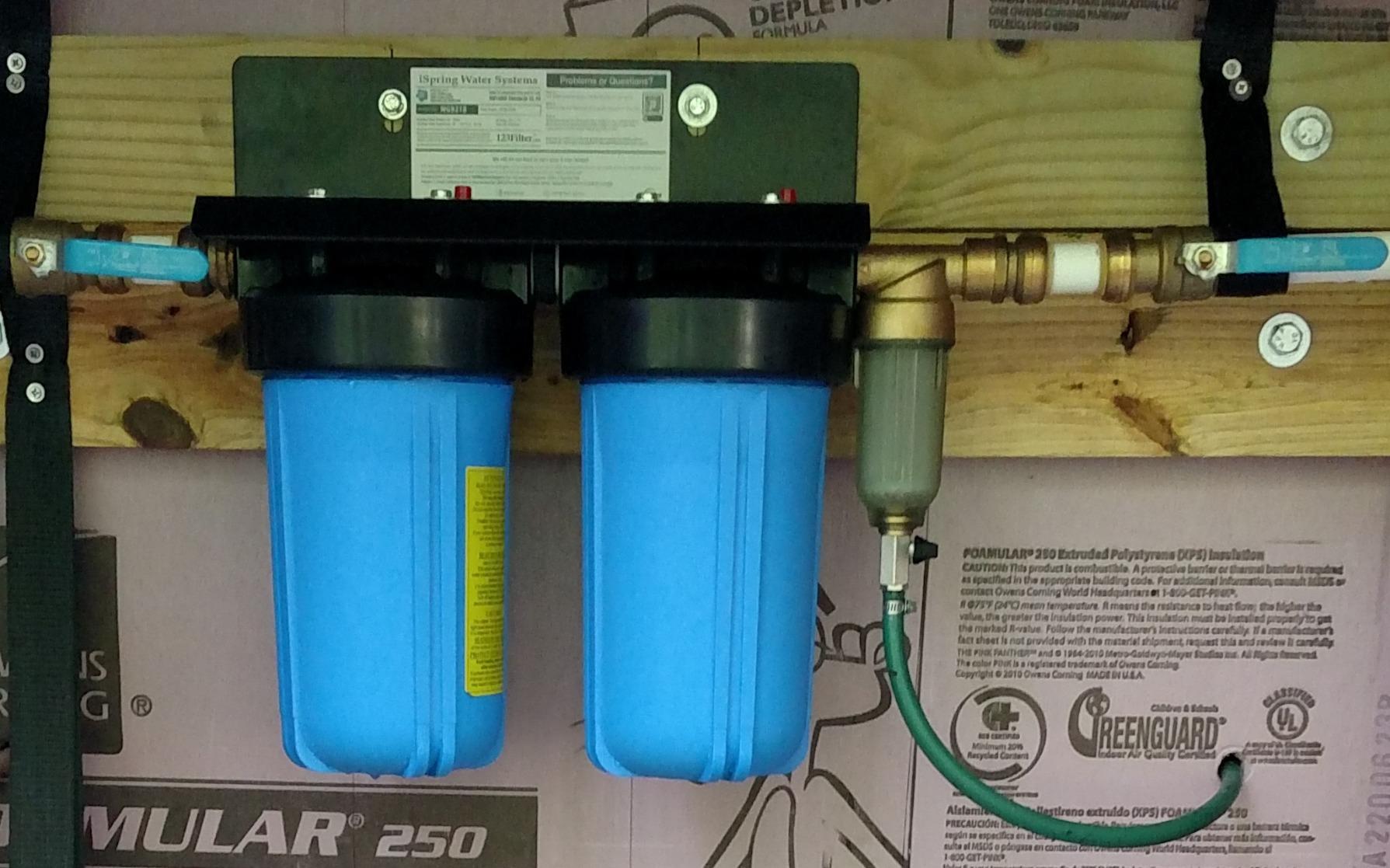
The WSP-50 works best as a first stage, not as your only filter
If your water is clear most days and only clouds after rain, this one screen alone will handle it. It is cheap, it is serviceable with basic tools, and the brass head is the part most likely to outlive the cartridge format it protects. That combination is why it is our top pick and why it appears again as stage one inside two larger systems on this list.
Pair the WSP-50 with a fine cartridge when you have silt
Fine clay and suspended silt are a different job, and a 50 micron mesh will not touch them. Put a 5 micron cartridge in a 20 x 4.5 inch housing directly downstream and the pair covers the full range from sand to rust flake. Plan on replacing that cartridge every six to twelve months, and add a flush reminder to your calendar, because the single most common complaint in forums is forgetting until pressure drops.
2. iSpring WGB21B 2-Stage System – Best Multi-Stage Combo
iSpring WGB21B 2-Stage Whole House Water Filtration System, 50000 Gallons
5 micron sediment plus CTO carbon
50000 gallon life
1 inch ports,15 gpm
Bracket and wrench included
Pros
- Sediment and chlorine in one pre-assembled bracket
- 1 inch inlet and outlet keep pressure loss low
- Thick plastic housing reviewers call heavy duty
- Cans swap positions to match flow direction
- iSpring support sends replacement parts at no charge
Cons
- Threaded NPT fittings can weep if overtightened into plastic
- Some first installs needed extra thread sealing
- Cartridges need replacing every 6-12 months
Most homes need exactly two things at the entry point: a sediment stage and a carbon stage, in that order. The WGB21B packages both on a single bracket so you are not cutting pipe twice. Stage one is a 5 micron polypropylene cartridge, rated to capture dirt, sand, silt, dust, rust and scale. Stage two is an CTO carbon block that removes more than 90 percent of chlorine along with VOCs, tastes and odors.
Rated capacity is 50000 gallons or one year for a family of four, and the ports are 1 inch on both inlet and outlet with flow up to 15 gpm. At 11.7 kg and 26 by 19 by 11 inches, this is a substantial bracket, but the weight is part of the story: reviewers consistently describe the housing as thick and well built. A pressure release valve and filter wrench come in the box for cartridge changes.
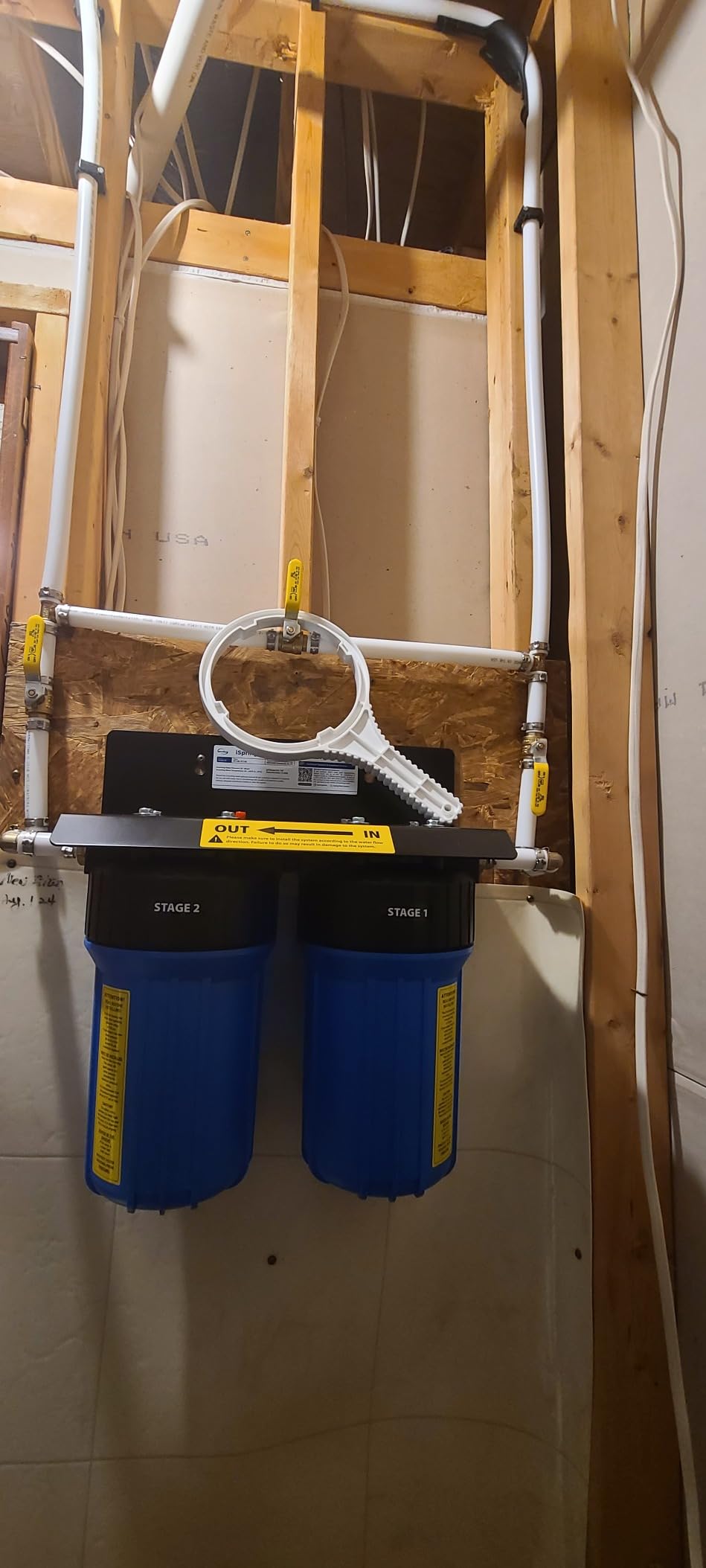
One design detail pays off more than most buyers realize. Because the two canisters sit on a shared manifold, you can swap the two canisters to match the direction your plumbing actually flows, which is a small thing until you are crouching under a slab wondering why your flow indicator never moves. Owners also report clearer water, fewer dish stains and better taste within weeks of installing.
The recurring complaint is fitting sealing. Threaded NPT fittings that are overtightened can dig into the plastic housing and start to weep, and some first-time installs needed extra thread tape or a reseat to stop a leak. Cartridges still need replacing on a six to twelve month cycle, and the system does not reduce total dissolved solids, it only removes sediment and chlorine.
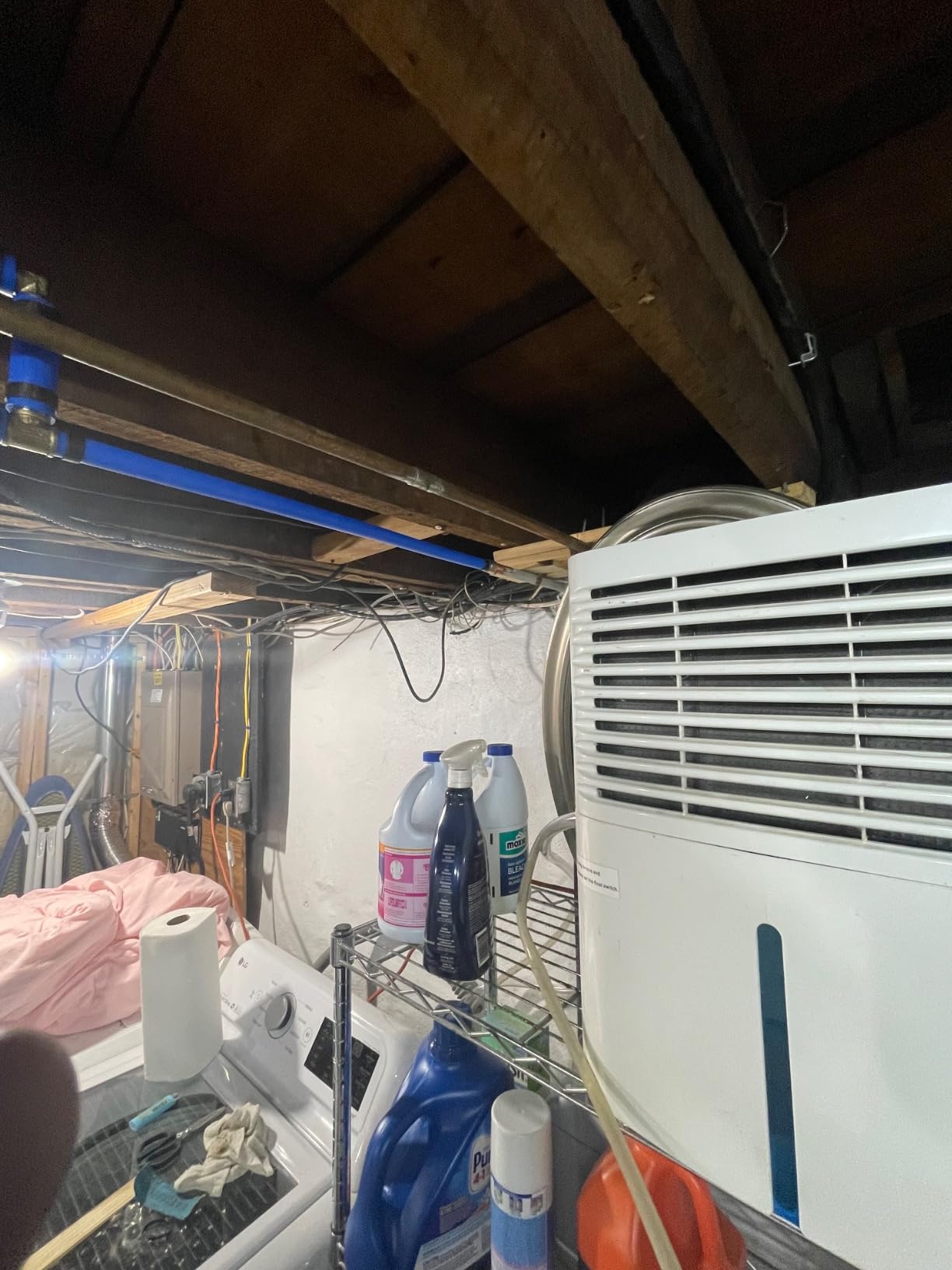
The WGB21B suits households already on city water
Chlorine taste and odor plus ordinary sediment is the exact problem this two-stage pair is built for. At 15 gpm through 1 inch ports it has enough headroom for a four to six person household without a noticeable pressure drop. It is a poor fit as the sole answer to heavy well sediment, since nothing coarse precedes the 5 micron stage to protect it.
Budget for four cartridge changes a year on a well
The 50000 gallon rating assumes relatively clean municipal supply. On a well with real sediment, expect the polypropylene cartridge to load much sooner, and the carbon block downstream will follow it because trapped sediment shades the carbon surface. Adding a spin-down upstream solves that, and our [kitchen sink filtration guide](https://cookcraftandcreate.com/best-whole-house-water-filters-for-kitchen-sink/) covers where that fits in a broader setup.
3. Culligan WH-S200-C Housing – Best Compact Point-of-Entry Housing
Culligan Whole House Water Filter System, 3/4″ Standard, P5 Filter Included
3/4 inch inlet and outlet
Valve-in-head bypass
Clear housing
4 gpm max flow
Pros
- Easy DIY install on 3/4 inch plumbing
- Valve-in-head bypass simplifies cartridge swaps
- Clear housing makes sediment loading visible
- Widely available P5 and CW-series cartridges
- Owners report 2-4 months per cartridge on mineral-heavy wells
Cons
- Bypass handle is stiff and can weep at the top
- Threads occasionally go in crooked on the outlet
- 4 gpm maximum flow limits larger homes
The Culligan name matters here for one reason: cartridge availability. The WH-S200-C accepts P5, CW-F, CW-MF and S1A-D cartridges, and those are stocked by plumbing supply houses and hardware aisles across the country. A housing is only as good as the media you can find when you need it, and this one wins that category outright.
At 3/4 inch inlet and outlet, standard duty, it is built for the typical three and four bedroom home on 3/4 inch pipe. The valve-in-head bypass shut-off and the built-in pressure relief button let you change a cartridge without shutting off the house, which is the difference between a ten minute job and a plumber visit. The clear housing is a genuinely useful feature: you can see the sediment loading and time the change by eye.
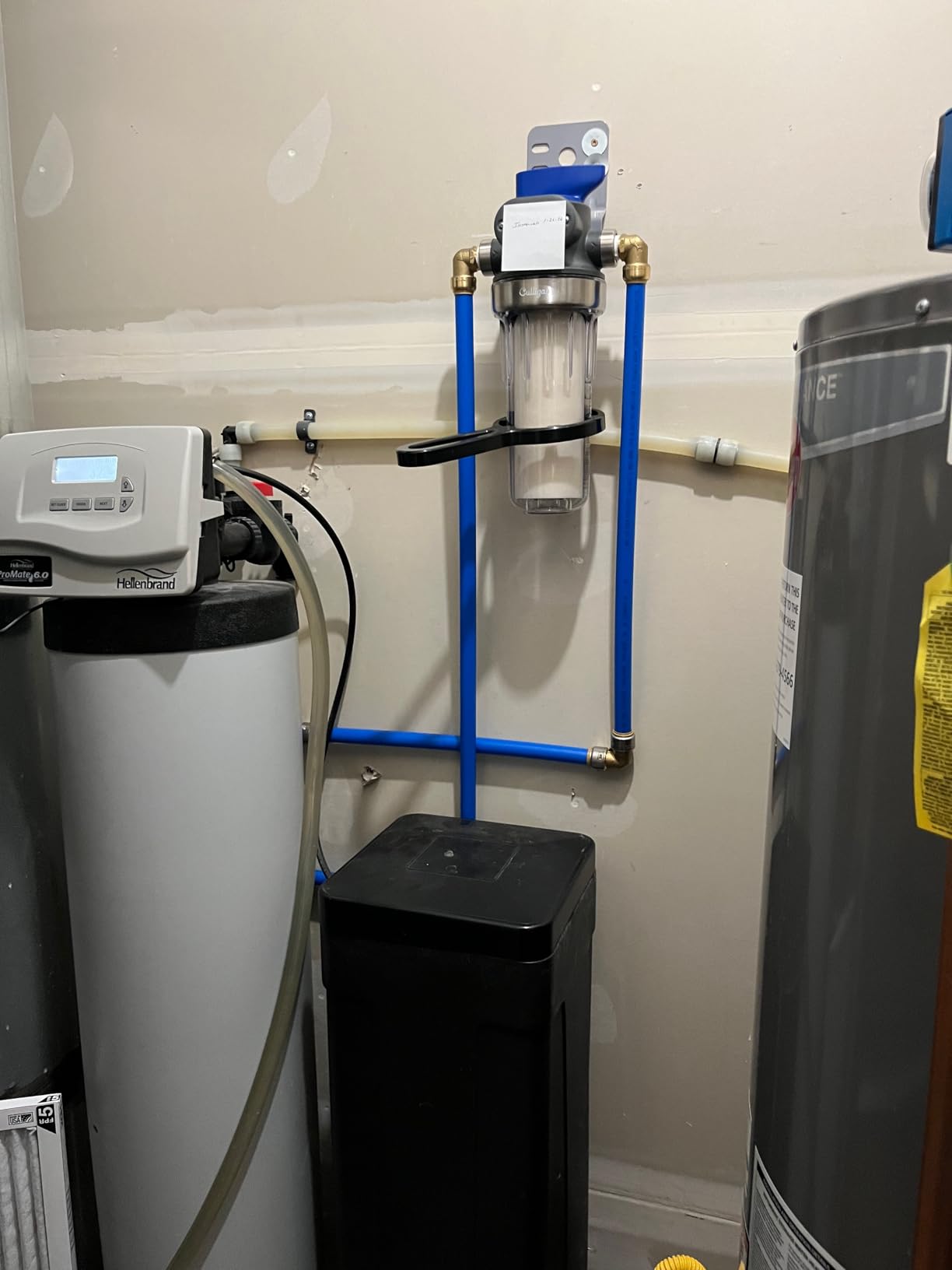
Owners on mineral-heavy well water report two to four months per cartridge, which is honest framing for a budget housing. The unit itself is rated 30 to 100 psi with a maximum flow of 4 gpm and operating temperature of 40 to 100 F. Buyers report reduced iron and visibly clearer water, and it is 3 pounds and about 16 inches tall, easy to mount on a stud or a backing board.
The drawbacks are consistent across reviews. The bypass valve handle is stiff and can weep from the top when it is not turned exactly right, and some owners hit threads that go in crooked on the outlet adapter. That 4 gpm ceiling is the real constraint: it works fine for a three bedroom home, but pairing two in parallel is the standard fix for a five bedroom house.
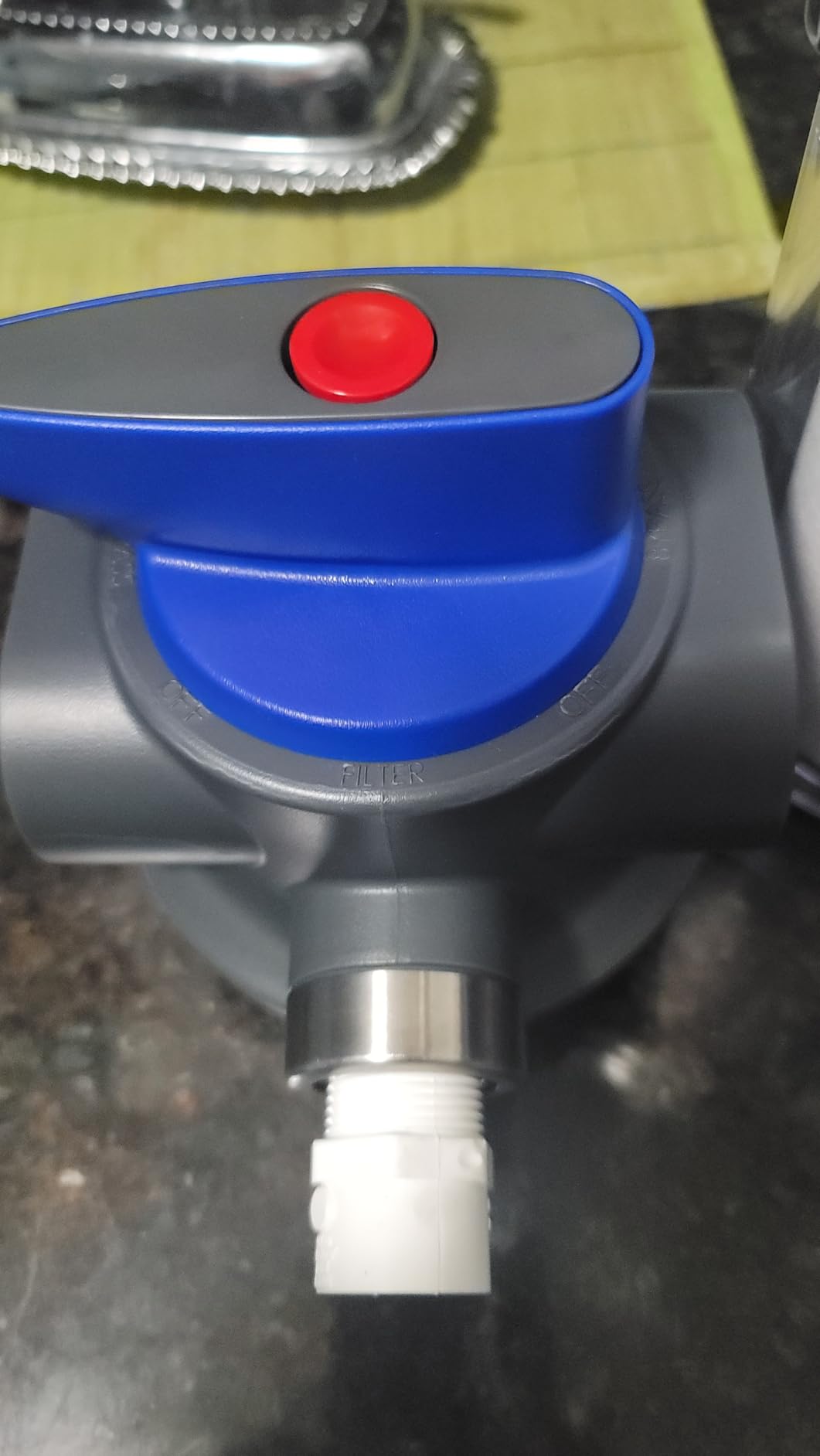
The WH-S200-C fits homes on 3/4 inch pipe
Rule of thumb sizing is straightforward: 3/4 inch ports and a 4 gpm rating cover a three or four bedroom household where no more than two fixtures run at once. If you have five or more bedrooms, two showers running simultaneously, or a whirlpool tub, step up to a 1 inch system like the Waterdrop or iSpring models further down this list. Do not compromise on flow to save on the housing.
Know your cartridge compatibility before you buy
Confirm which cartridge series you want before ordering, because this housing is sold around the housing, not the media. Check the P5 and CW-series availability at your local supply house and price the cartridges per year before committing, since on mineral-heavy wells you are replacing them two to four times a year. The value of a cheap housing evaporates fast if the media is hard to source.
4. A. O. Smith AO-WH-PREV – Best NSF-Certified Starter Housing
A. O. Smith Whole House Sediment Filter | Valve-in-Head | AO-WH-PREV
NSF/ANSI 42 certified
3/4 inch ports
6 gpm max flow
Six month filter life
Pros
- NSF certified to Standard 42 for particulate reduction
- Built-in shut-off and bypass for easy changes
- Clear housing shows sediment loading
- Works well with a downstream carbon filter
- Good value against plumber-installed systems
Cons
- Polypropylene collar has cracked for some owners over time
- Included bracket can be weak on larger installs
- Replacement cartridges sold separately
Certification is the reason this one is on the list. The AO-WH-PREV is NSF certified to Standard 42 for particulate reduction, which is the standard sediment filters are tested against for material safety and particulate claims. It comes from a brand with a large water heating service network, so replacement cartridges are easy to find in most markets.
Everything you need for a first install is in the box: the filter housing, a sediment filter and a housing wrench. Ports are standard 3/4 inch, the housing is clear so you can watch sediment accumulate, and an integrated shut-off bypass valve plus a pressure release button are built into the head. Rated flow is 6 gpm across a 25 to 100 psi working range, with a stated cartridge life of six months.
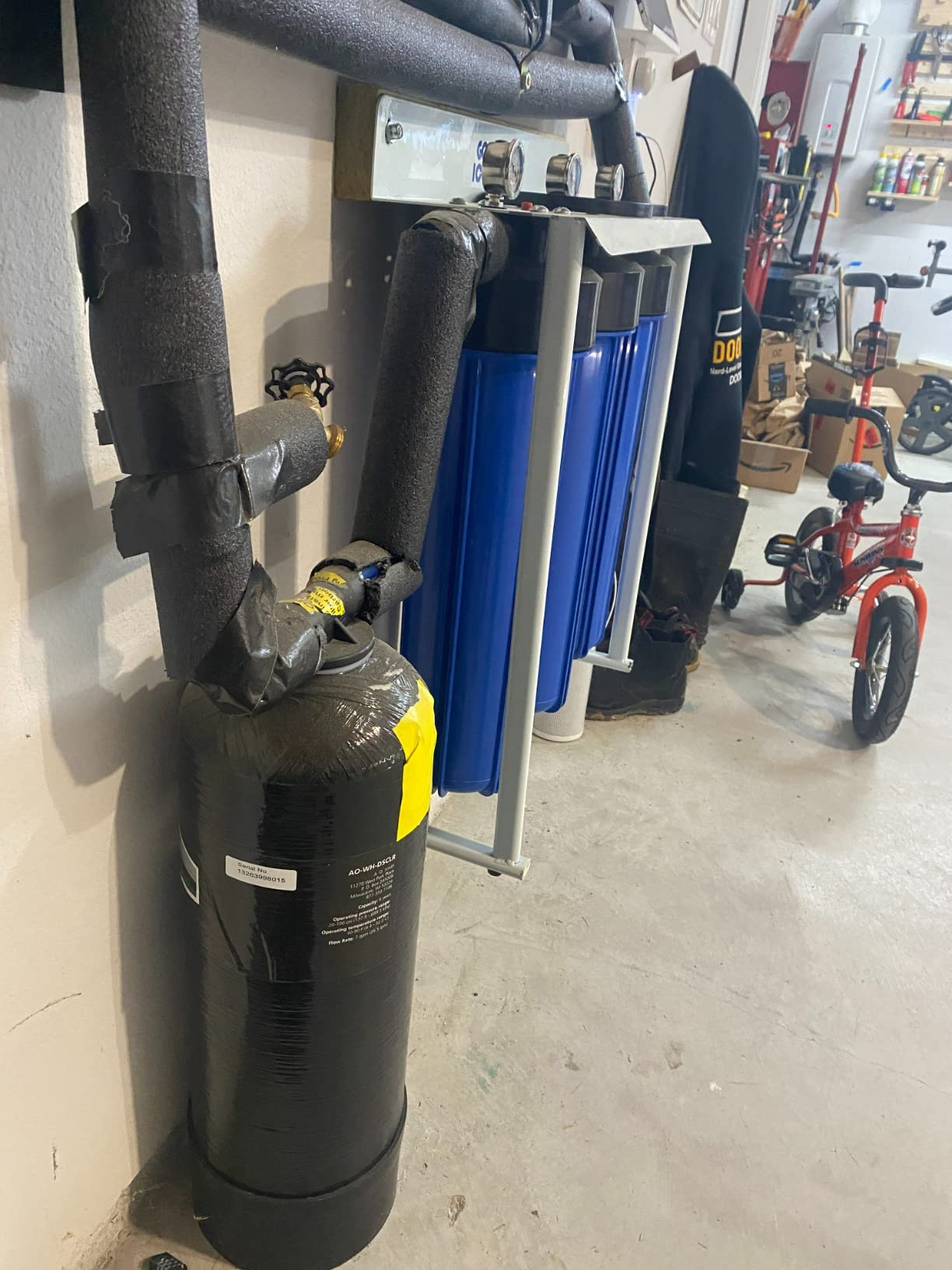
Owners like the combination of a visible sump and a built-in bypass, and several pair it with a carbon stage downstream to extend cartridge life. The main negative theme in reviews is long-term durability of the clear plastic housing, with some owners reporting cracks at the threaded collar over time, plus occasional fitting sealing issues that need careful thread tape. The included bracket is also described as weak on larger installs.
At 15 by 6 by 5 inches and 1.77 kg, it is compact and light enough to mount almost anywhere after the main shutoff. The stated capacity is 24000 gallons and a 1-year limited warranty applies. Rated for maximum 500 ppm TDS and 40 to 100 F, so check your water test if you are on a brackish well.
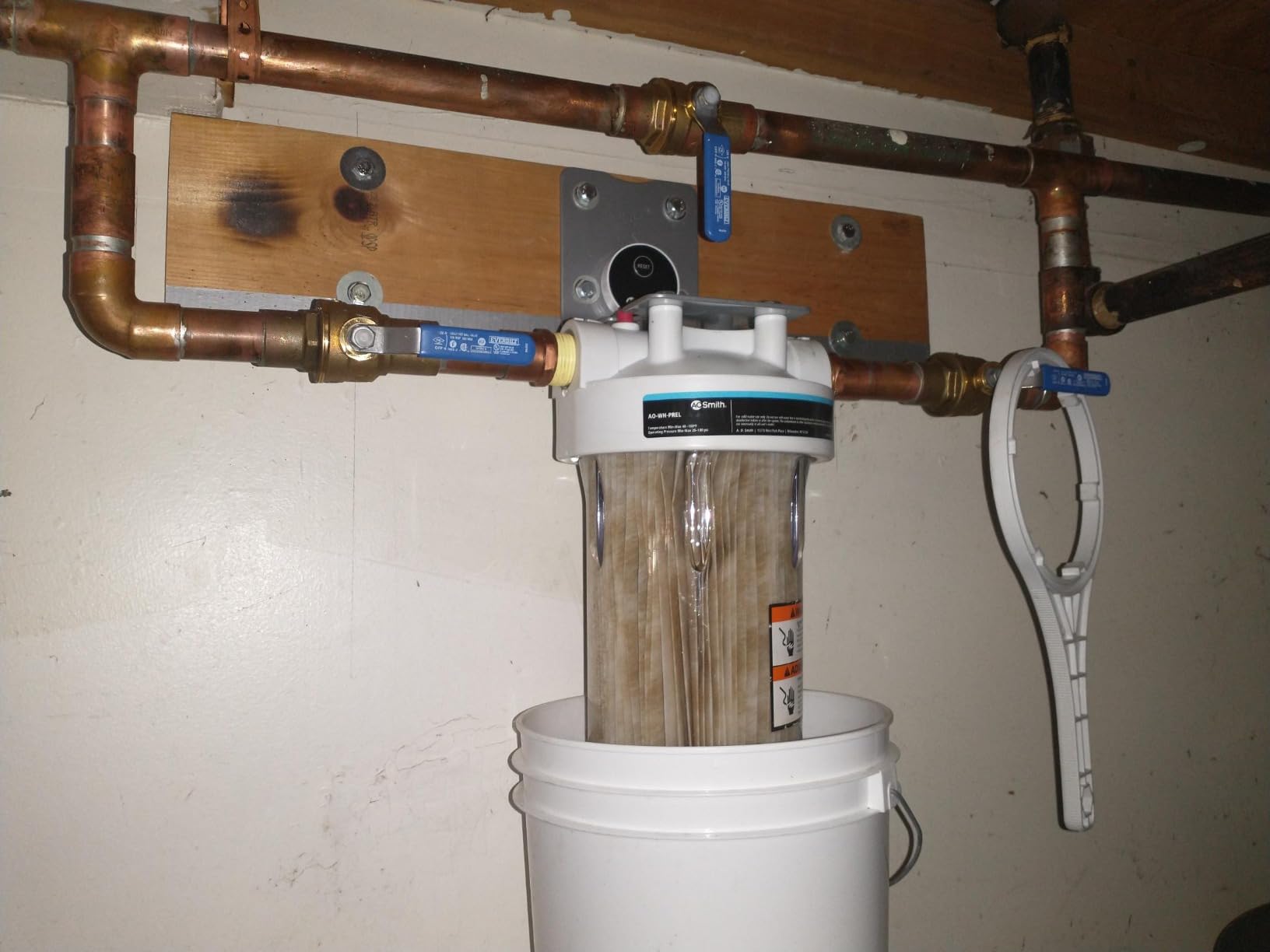
The AO-WH-PREV is the easiest first filter to install
Three quarter inch ports, a wrench in the box and a cartridge already included mean most homeowners finish this in an afternoon with a pipe wrench and teflon tape. It is a sensible first sediment filter to learn on, because the bypass design means a mistake costs a cartridge rather than a flooded mechanical room. Add a pressure gauge upstream and downstream and you can watch head loss build over the months.
Budget separately for the six month cartridge
Replacement cartridges are not included beyond the first, and the stated life is six months at roughly 24000 gallons. If your water carries more sediment than that, the cartridge will load out sooner and the six month number becomes optimistic. The plastic collar durability reports are the main reason to consider a metal housing instead, particularly in a crawlspace or an unfinished basement where you will not look at it often.
5. Pentair Pentek DGD-5005 Big Blue Cartridge – Best 5 Micron Cartridge
Pentair Pentek DGD-5005 Big Blue Whole House Sediment Filter
Nominal 5 micron
10 x 4.5 inch format
Under 1 psi at 10 gpm
NSF/ANSI 42 certified
Pros
- Highest average rating in the group with 83 percent five-star share
- Dual gradient density gives far more dirt holding capacity
- NSF/ANSI 42 certified material safety
- Spun polypropylene adds no taste odor or color
- Universal fit in any 10 inch Big Blue housing
Cons
- Cartridge pack only
- so a housing is a separate purchase
- Cartridges need replacing about every six months
- Only a 30 day manufacturer warranty
This is the cartridge, not the housing, and that distinction matters. The DGD-5005 is a nominal 5 micron spun polypropylene element in the 10 by 4.5 inch format, which means it drops into any 10 inch Big Blue housing. If you already own that housing, this is simply the best-performing element you can put in it. It carries the highest average rating of any product in this roundup.
The engineering detail that justifies the rating is dual-gradient density construction, which the manufacturer claims delivers up to three times the dirt-holding capacity of a standard 5 micron cartridge. That is the difference between a six month replacement interval and a six week one on a moderately dirty well. Pressure drop is listed under 1 psi at 10 gpm, so it will not quietly strangle your flow.
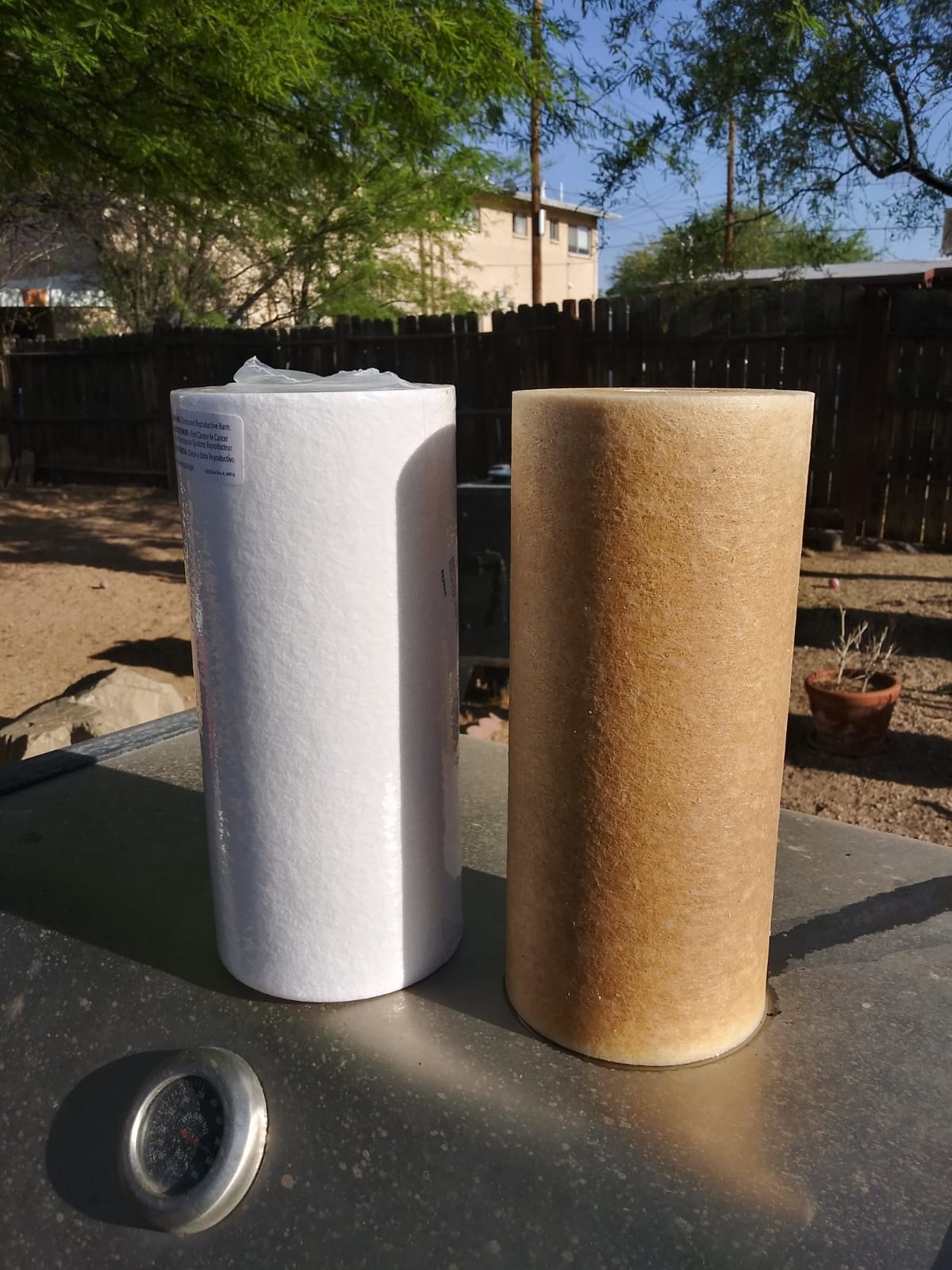
Buyers trust the Pentair name and the NSF/ANSI 42 certification for material requirements and chemical compatibility. Spun polypropylene does not impart taste, odor or color, which is why it pairs cleanly with a carbon stage behind it. The element is independently tested, and the universal Big Blue fit means you are never stuck with a proprietary cartridge.
Two caveats are worth stating plainly. First, this listing is an eight-count cartridge pack, so a first-time buyer still needs a housing, and a 10 inch Big Blue housing plus this pack is the standard whole house sediment setup that most forums recommend. Second, replacement is roughly every six months or sooner if you notice pressure drop, and the manufacturer warranty is only 30 days.
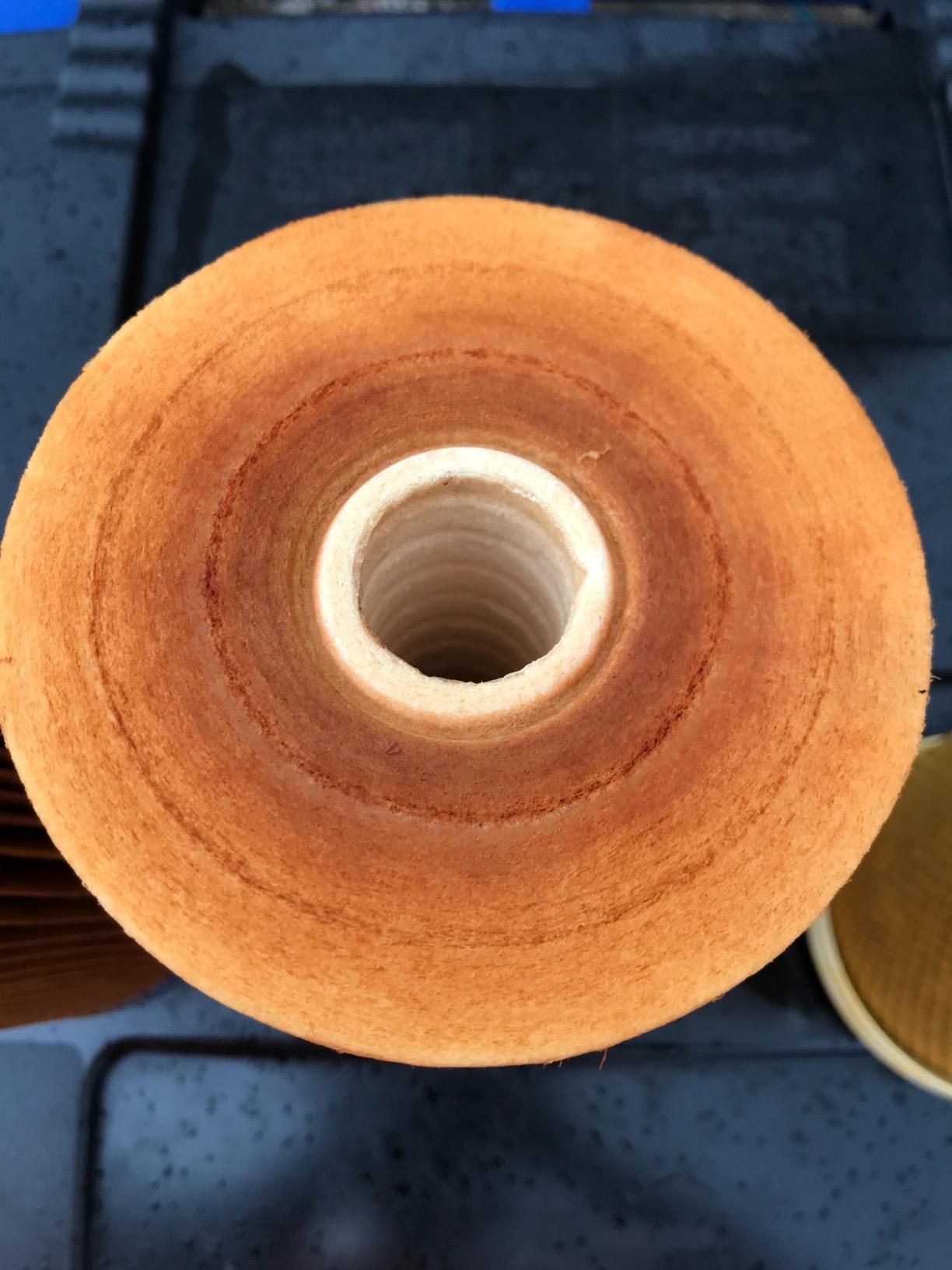
The DGD-5005 is the right pick if you already own a Big Blue housing
Check your existing housing first. Many whole house systems shipped with a 10 inch Big Blue sump, and if that is what is hanging on your wall, this cartridge is a drop-in upgrade with no plumbing work at all. The 3x dirt holding capacity is most valuable in exactly that situation, where a cheap element has been loading up every eight weeks.
A cartridge alone will not protect a high flow whole house
At 10 gpm rated flow this element is built to pair with a properly sized 1 inch housing and manifold, and you still want a coarse prefilter ahead of it on anything but clean city water. Expect to buy two sets a year on moderate sediment and up to four on a heavy well. Plan the cost into your total ownership math before you commit to a cartridge-only approach.
6. Waterdrop WHF21-PG 2-Stage System – Best for Municipal Water
Waterdrop WHF21-PG 2-Stage Whole House Water Filter System, NSF/ANSI 372
5 micron PP plus GAC carbon
50000 gallon capacity
15 gpm,1 inch ports
3-6 month cartridge life
Pros
- Sediment and coconut-shell GAC carbon in one bracket
- Housing pressure tested to 25-90 psi and 100000 plus water hammer cycles
- 1 inch ports and 15 gpm suit whole house demand
- Wrench and expansion screws included
- Reasonable 3-6 month interval on municipal supply
Cons
- Cartridge life drops sharply on sediment-heavy sources
- Both cartridges need replacing twice a year
- Threaded joints need careful sealing to avoid leaks
- No bypass valve or pressure indicator included
The WHF21-PG is the other credible two-stage option, and its case rests on build quality. The housing is pressure tested for 25 to 90 psi and reportedly passed more than 100000 water hammer cycles, which matters on municipal supply where supply pressure swings are routine and hammer is common. Ports are 1 inch with a maximum flow of 15 gpm.
Stage one is a 10 by 4.5 inch polypropylene filter and stage two is a GAC carbon block, delivering a five-stage filtration effect that reduces particles larger than 5 microns along with chlorine, lead, benzene, mercury, sand and rust. Capacity is rated at 50000 gallons. The bracket, wrench and expansion screws are all included for a DIY install.
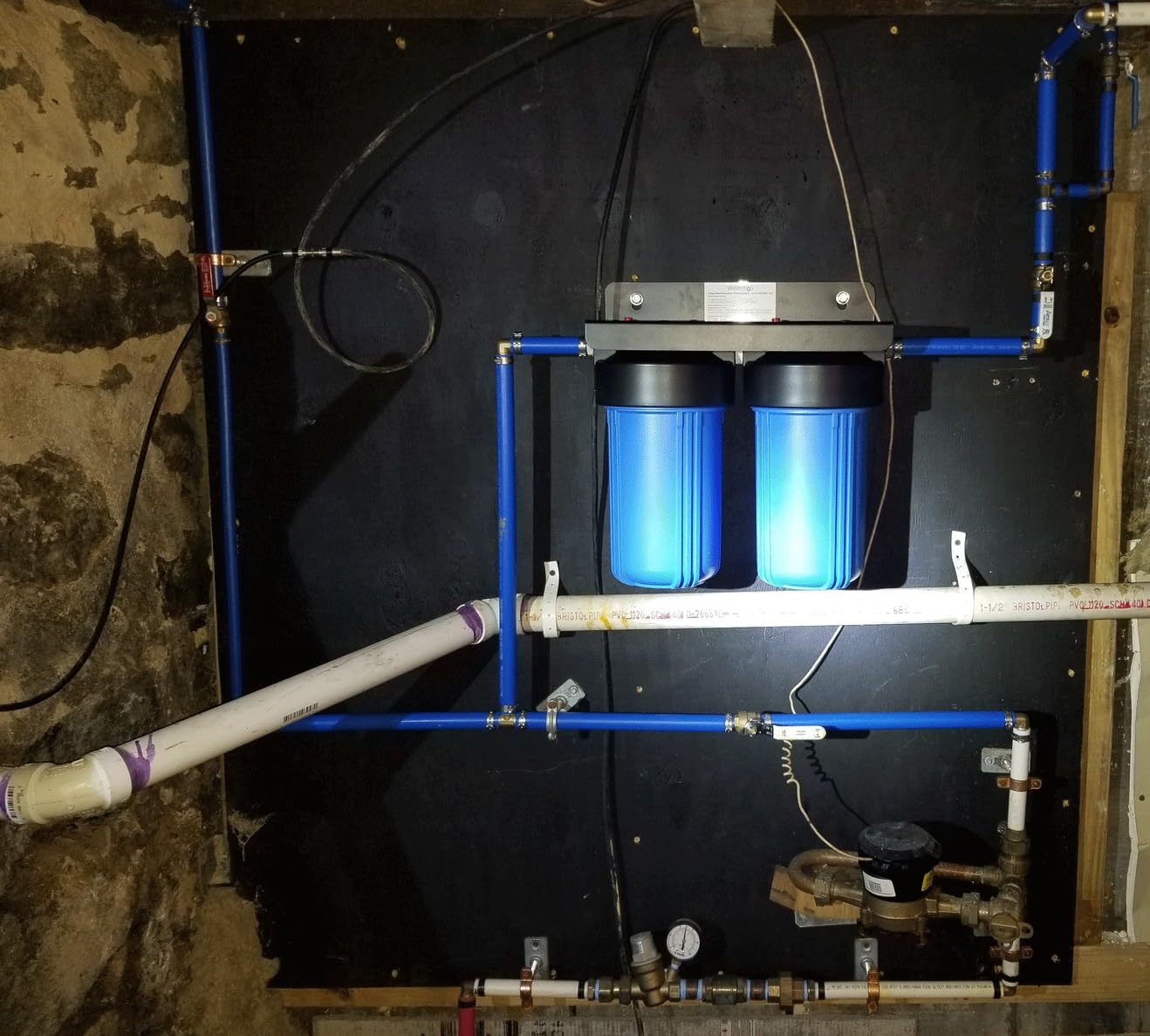
Owners on city supply cite clear improvement in taste, odor and chlorine reduction, and the bracket-mounted install is straightforward. Carbon life is listed at three to six months and the polypropylene sediment cartridge at three to six months, which is realistic for treated municipal water. The housing is described as food grade with a clear, serviceable layout.
The weaknesses are honest ones. This is a municipal water system, and cartridge life drops sharply when the source is sediment heavy, so it is the wrong pick for a raw well without a prefilter ahead of it. No inline pressure indicator or bypass valve is included, so you will be shutting the house off to change cartridges, and threaded joints need careful sealing to avoid leaks.

The WHF21-PG targets chlorine taste and odor on city water
If your complaint is taste, odor and chlorine rather than visible grit, this bracket does both jobs at 15 gpm through 1 inch ports, which covers a five or six person household comfortably. The two-stage design means one install, one bracket and one set of connections instead of two housings plumbed in series. Add a bypass if you do not want to shut the house off for changes.
Put a spin-down ahead of it on any well
Nothing in this system is rated to stop sand, and without a coarse prefilter the 5 micron polypropylene element becomes the first thing the sediment hits. On a well with heavy sand, expect both cartridges to load out far inside the three to six month window. The two spin-down filters earlier in this list are the natural companion piece for that situation.
7. Waterdrop RPFK Spin Down Filter – Highest-Flow Reusable Screen
Waterdrop RPFK Spin Down Sediment Filter, 40-50 Micron, BPA Free
50 micron 316L stainless screen
Backwash flush
20 gpm rated flow
PA12 shell to 600 psi burst
Pros
- Reusable stainless screen backwashes clean
- German-made PA12 shell with high burst pressure
- NSF/ANSI 372 certified and lead-free
- Four fitting options adapt to most plumbing
- 20 gpm rating keeps pressure steady
Cons
- Small housing volume means frequent flushing on dirty water
- Not compatible with 3/4 inch garden hose connections
- Operating pressure capped near 72 psi
Where the WSP-50 leads on review volume, the RPFK leads on flow and pressure capability. This is a 50 micron 316L food-grade stainless steel alloy screen in a housing rated to 20 gpm, with a German-made PA12 shell tested to over 600 psi burst pressure. That headroom is the reason it will not become the bottleneck in a house with multiple fixtures running at once.
The fittings are unusually flexible: four connection options covering 1 inch MNPT, 3/4 inch MNPT, 3/4 inch FNPT and 3/4 inch push-fit, plus corrosion-resistant blue nano-coated copper fittings at the joints. It is NSF/ANSI 372 certified, lead-free and BPA-free, and the backwash flush valve handles routine cleaning with no cartridges involved.
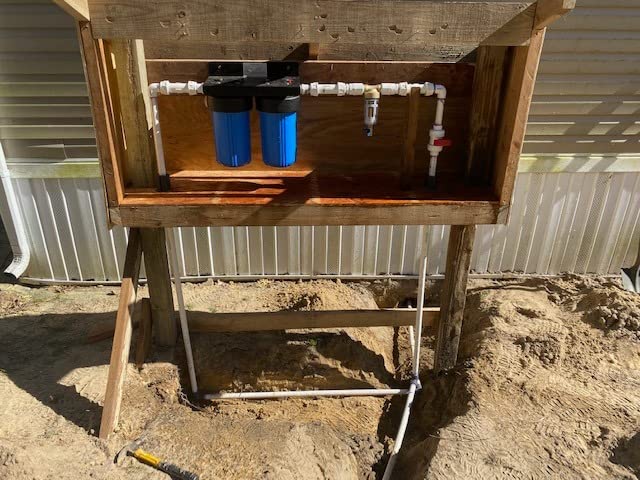
Owners like the flush-and-reuse design, the stainless screen and the range of included fittings, and report that it does its job of protecting downstream filters well. In practice its main advantage over the brass-head spin-downs is that it moves a lot more water before pressure starts to fall, which is the same thing as saying you flush it less often relative to flow.
The trade-offs are real. The housing volume is small, so on genuinely dirty water you will backwash it more often than you expect, and it does not accept 3/4 inch garden hose connections for the flush, so plan your flushing setup. Maximum operating pressure is listed at 14.5 to 72 psi, which is a narrower ceiling than a standard residential supply in some neighborhoods.
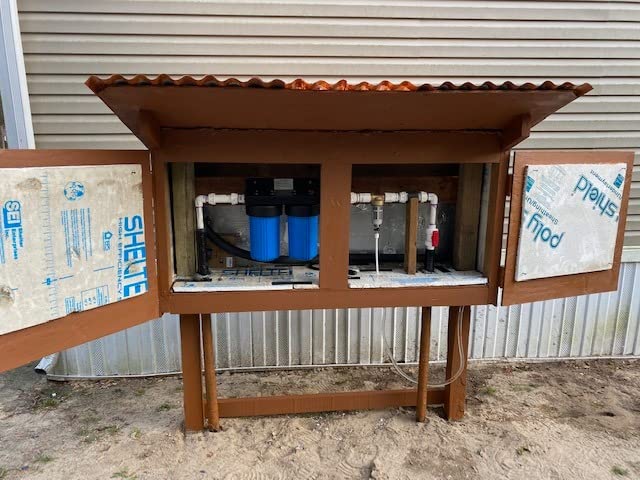
The RPFK keeps pressure steady in a busy household
At a 20 gpm rating, this is the spin-down to choose if multiple fixtures run at once, if you have a large house, or if low pressure after a filter change has been a recurring frustration. The 600 psi burst-rated shell also makes it the safer option in a cold garage or an unheated crawlspace where temperature swings are wider than a brass head enjoys.
Expect frequent backwashing on high silt
Small housing volume is the honest limitation, and on a heavy well you will be flushing more often than the marketing suggests. That is the same complaint that shows up on every spin-down in this roundup, and it is why the fine cartridge behind it is not optional. If daily flushing is the deal breaker, a backwashing media filter is the format that avoids it entirely.
8. GE GXWH40L Whole House Filtration System – Best Heavy-Duty Housing
GE Whole House Water Filtration System, Reduces Sediment, Rust & More, Install Kit & Accessories Included, Replace Filters (FXHTC, FXHSC) Every 3 Months, GXWH40L
Clear sump for monitoring
1 inch connection
4 gpm max flow
Cartridges on a 3 month schedule
Pros
- Rugged housing owners describe as built like a tank
- Reversible inlet and outlet orientation for tight spaces
- Install kit includes bracket relief valve and reminder light
- Clear sump makes change timing easy
- Reported gains in clarity taste and hard-water staining
Cons
- FXHTC and FXHSC cartridges are not included
- Weighs over 8 lb so a backing board helps
- Threaded connections need heavy sealing
- Horizontal pipe installation only
The GXWH40L is the housing you want if your install area is rough. At over 8 pounds with a metal-style feel, owners describe it as built like a tank, and the reversible inlet and outlet orientation is a genuinely useful feature in a cramped mechanical room where you cannot control which way the pipe runs. The clear sump makes sediment loading easy to judge at change time.
The install kit is unusually complete: pressure relief valve, a bypass option, mounting bracket and a remote battery-powered filter change reminder light. Connections are 1 inch with horizontal pipe compatibility only, maximum flow is 4 gpm and the maximum temperature is 100 F. It uses FXHTC or FXHSC cartridges, and the stated filter life cycle is three months, the shortest interval on this list.
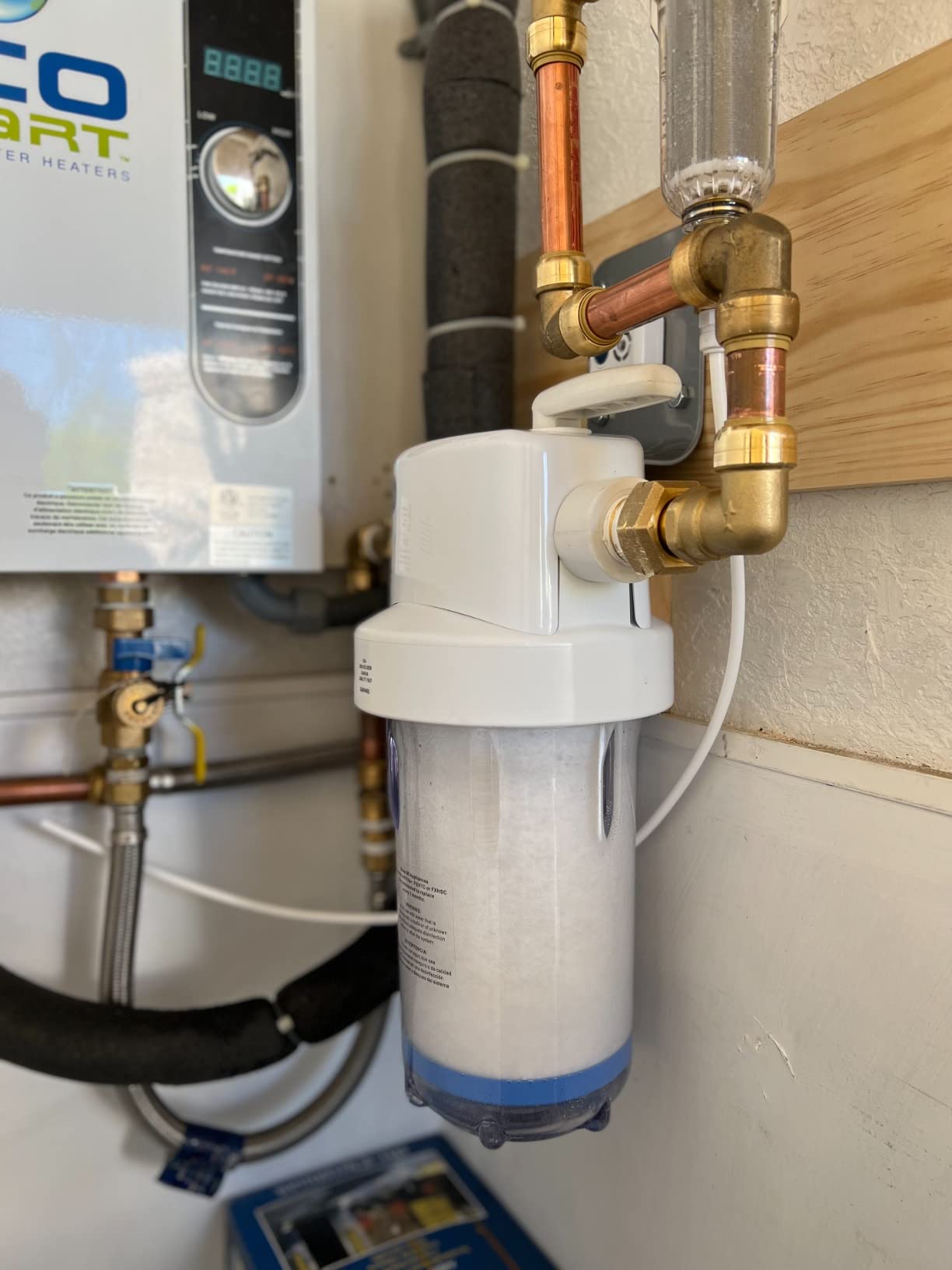
Several owners report dramatic improvements in water clarity and a real drop in spotting on hard water, which is the kind of result that makes a filter feel worth the effort. The reminder light is a small touch that solves a real problem: nobody remembers when they last changed a cartridge, and the whole point of a clear sump is lost if you never look at it.
There is a catch on the packaging. The FXHTC and FXHSC cartridges are not included, so you are buying a housing and then sourcing media separately. The unit is heavy enough that a solid backing board is advisable, the threaded connections need generous sealing, and it is rated for horizontal pipe runs only, which rules out some vertical installations. A few owners report long-term leaks at the sump o-ring seat.
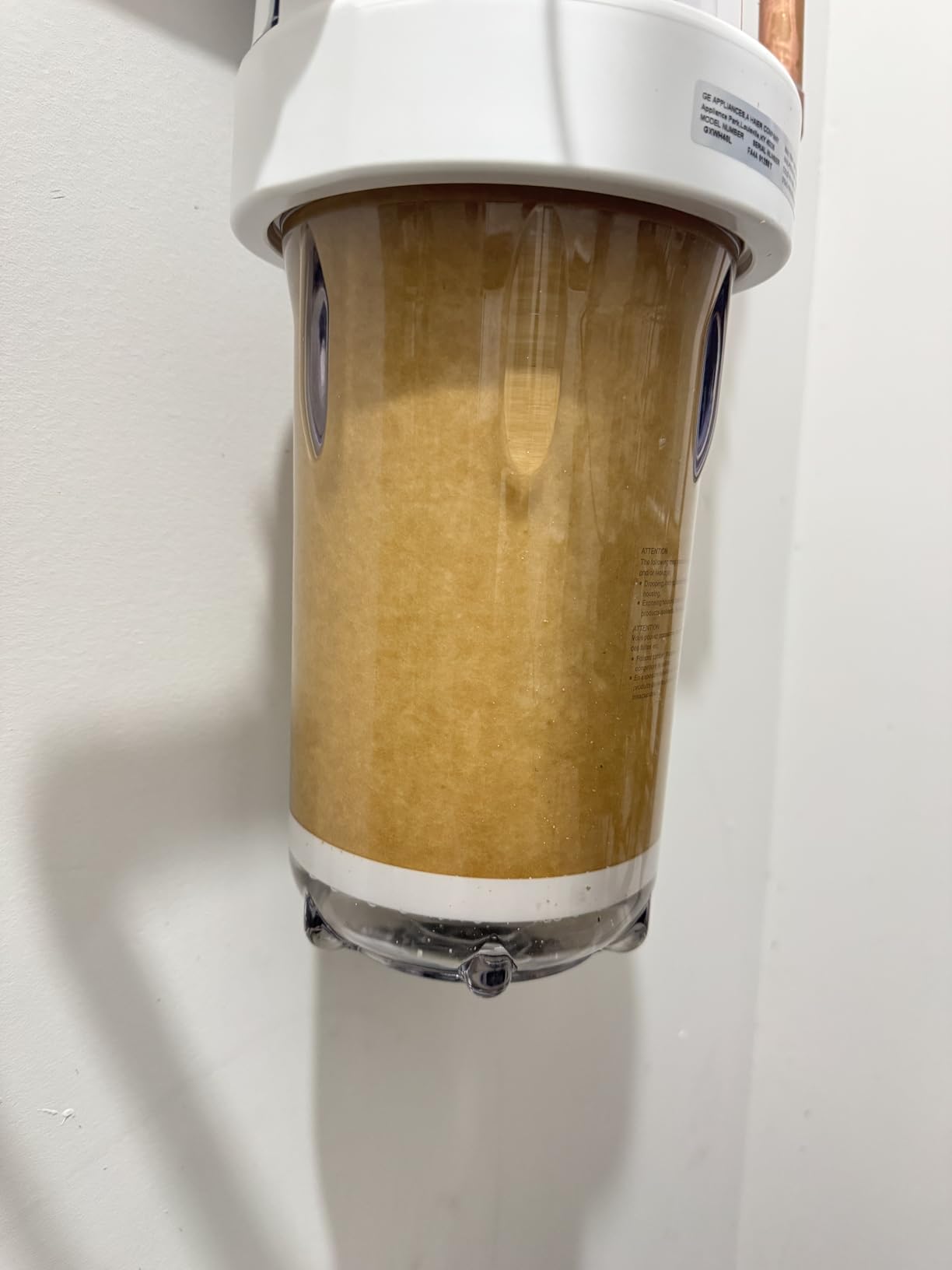
The GXWH40L suits a rough install area and a 1 inch line
Choose this housing when the space is tight, the pipe runs horizontal, and you want a unit you can leave alone for years without worrying about plastic aging. The 1 inch connection is the right diameter for a five or six person household, though the 4 gpm flow ceiling means it still works best on a main line that is not feeding a whole irrigation system.
Budget for media you have to buy separately
Factor in two cartridge changes a year at three months each, and confirm FXHTC and FXHSC availability at your local supplier before you commit to the housing. If media is hard to find in your area, the ongoing cost of this setup quietly becomes the most expensive one on the list. Our [well water filtration picks](https://cookcraftandcreate.com/best-whole-house-water-filters-for-wells-under-kitchen-sink/) cover the alternatives that bundle media with the housing.
9. iSpring Ultimate Whole House System – Premium Four-Stage Pick
iSpring Ultimate Whole House Water Filter w/Spin Down Sediment Filter
Spin-down plus compound plus carbon
250000 gallon scale inhibitor
20 x 4.5 inch cartridges
15 gpm,1 inch ports
Pros
- Four stages from spin-down sediment through carbon and scale inhibition
- Largest rated capacity in this roundup at 250000 gallons
- Spin-down first stage protects the fine cartridges
- Reported to handle iron odor and staining on high-iron wells
- iSpring ships replacement manifolds and canisters free under warranty
Cons
- Largest footprint and heaviest unit at nearly 63 lb
- Filled housings are too heavy to change one-handed
- Plastic fittings need heavy sealing and can leak
- Some pressure relief buttons do not fully release pressure
This is the most complete package on the list, and the only one that treats scale as a first-class problem. Stage one is the WSP-50 spin-down for rust, dirt, sand and large particles. Stage two is a compound filter targeting chlorine, lead, mercury, H2S, heavy metals and pesticides. Stage three is a coconut-shell carbon block for chlorine, taste and odor. Stage four is a patented scale inhibitor rated to sequester calcium and magnesium over 250000 gallons, the largest capacity figure in this roundup.
Plumbing is 1 inch NPT on both sides with 20 by 4.5 inch cartridges and flow up to 15 gpm. Because the spin-down runs first, the fine stages behind it see far less load, which is the single most effective thing you can do for cartridge life. Owners across both well and city water report dramatic clarity gains, clear water in toilets, and iron odor removal, with the sediment cartridge visibly muddy at change time.
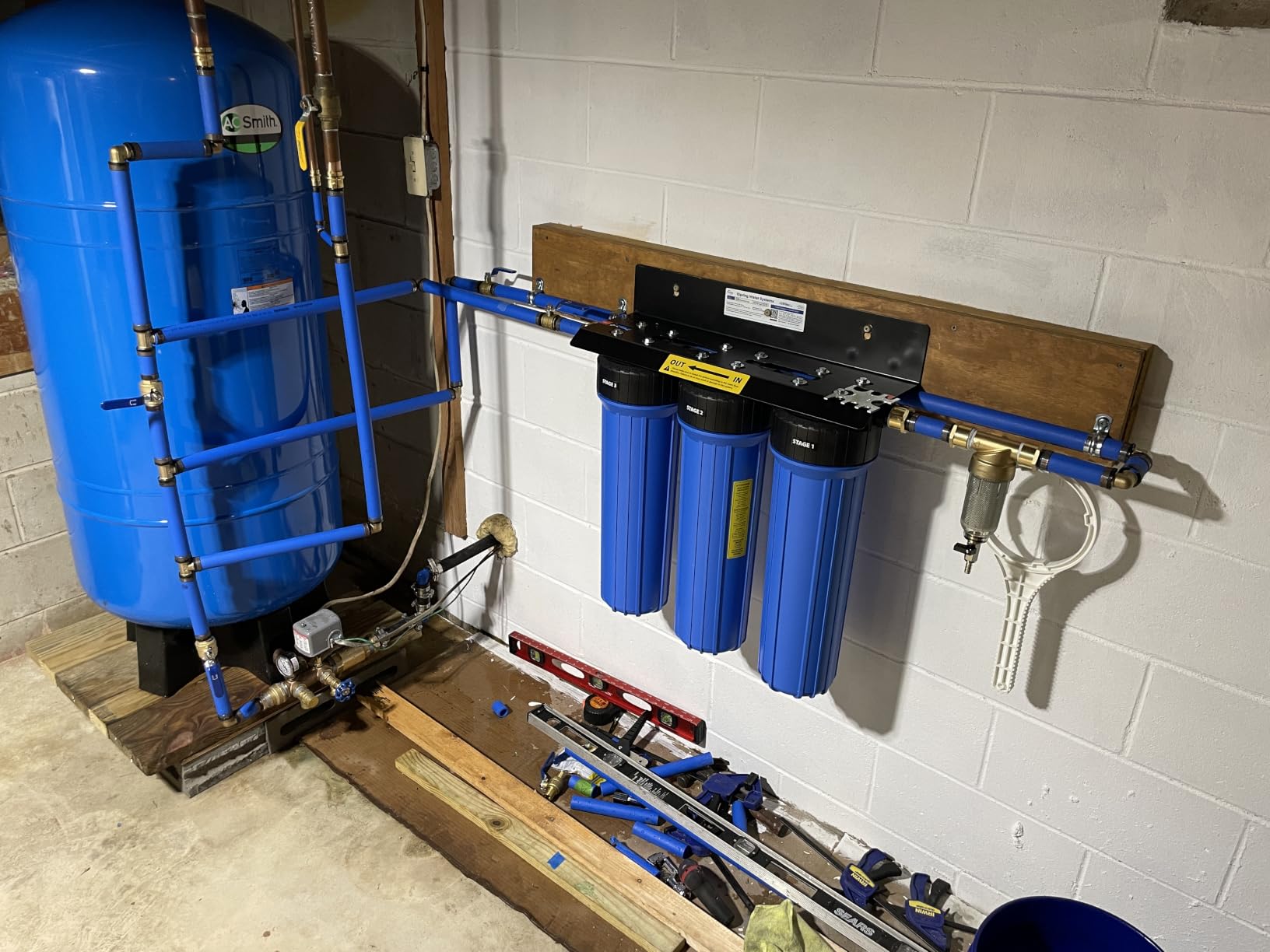
Owners single out the plastic manifold fittings as the main installation friction. They need a lot of thread tape, they can leak if overtightened, and some pressure relief buttons on the manifolds do not fully release pressure, which means a canister can be stubborn to remove. At nearly 63 pounds empty and 18 by 15 by 27 inches, this needs solid mounting and honest space planning.
Filled with water the housings become too heavy to swap one-handed, so plan the change area accordingly. The scale inhibitor is polyphosphate based, which prevents scale formation rather than removing existing scale, and the system does not reduce total dissolved solids. Against that, iSpring repeatedly sends replacement manifolds and canisters at no charge under warranty, and the reported iron and odor results are what buyers are buying this for.
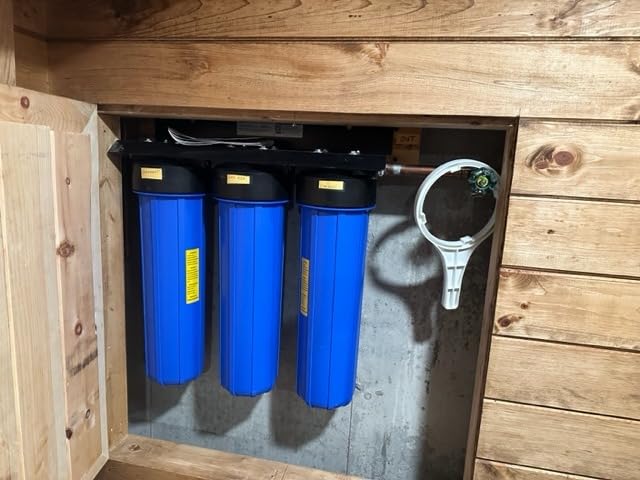
The four-stage bundle fits a house with iron, odor and hard water together
If your water shows more than one problem at once, a staged system is cheaper than piecing together three separate housings. Iron odor and staining plus hard water plus sediment is exactly the combination the compound and carbon stages are matched to, and the 15 gpm through 1 inch ports leaves headroom for a large household running multiple fixtures.
Size the space and your grip for the cartridge changes
This is the unit to skip if your install area is tight or if you are not comfortable lifting a full canister. Measure the 18 by 15 by 27 inch footprint and its clearances before ordering, and confirm you can shut the water off and work on the fittings with a wrench. The scale inhibitor only prevents new scale, so if you already have scale in your water heater, plan on descaling separately.
10. Aquaboon 3/4 Inch Spin Down Filter – Best Value Dual-Screen Prefilter
Aquaboon 3/4″ Spin-Down Sediment Filter for Well Water, Reusable Pre-Filter, 50 & 200 Micron, Heavy-Duty for Home & Commercial Use, Easy to Clean, Extends Unit Life
50 and 200 micron stainless screens
Flush and reuse
Fits 3/4 inch and 1 inch
Transparent housing
Pros
- Includes both 50 and 200 micron screens to match your water
- Reusable and flushable so there are no cartridge costs
- Transparent housing makes clogging easy to spot
- Simple install on standard 3/4 inch and 1 inch plumbing
- Practical entry point for well water sediment control
Cons
- Smallest review base here with uneven rating spread
- Branding and certification detail thinner than established brands
- Only one micron combination offered
- Limited sales history
The reason this one is on the list is the pair of screens in the box. Most spin-downs ship with a single mesh, and if 50 microns is too fine for your well you are buying another filter. The Aquaboon includes both 50 and 200 micron stainless steel screens, so you start coarse or fine and swap based on what your water actually does. That flexibility is worth more than the extra dollars it costs.
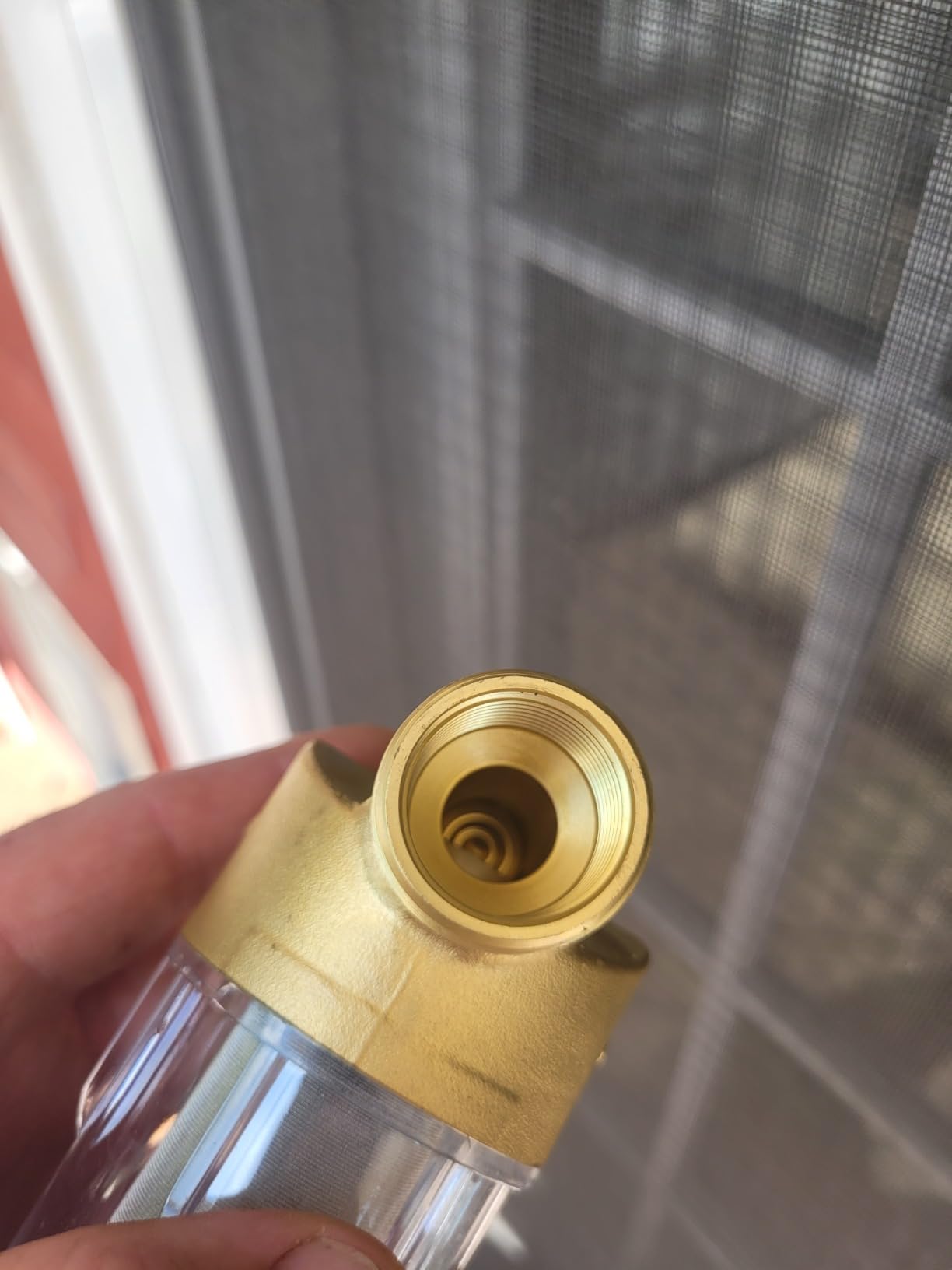
Construction is a stainless steel mesh screen in a transparent housing, with a flush-and-reinstall design that eliminates replacement waste entirely. It fits both 3/4 inch and 1 inch plumbing, weighs under 2 pounds at about 11.75 by 5 by 3.75 inches, and is marketed for well water, washing machine supply lines and irrigation lines. It is NSF listed for home or commercial duty.
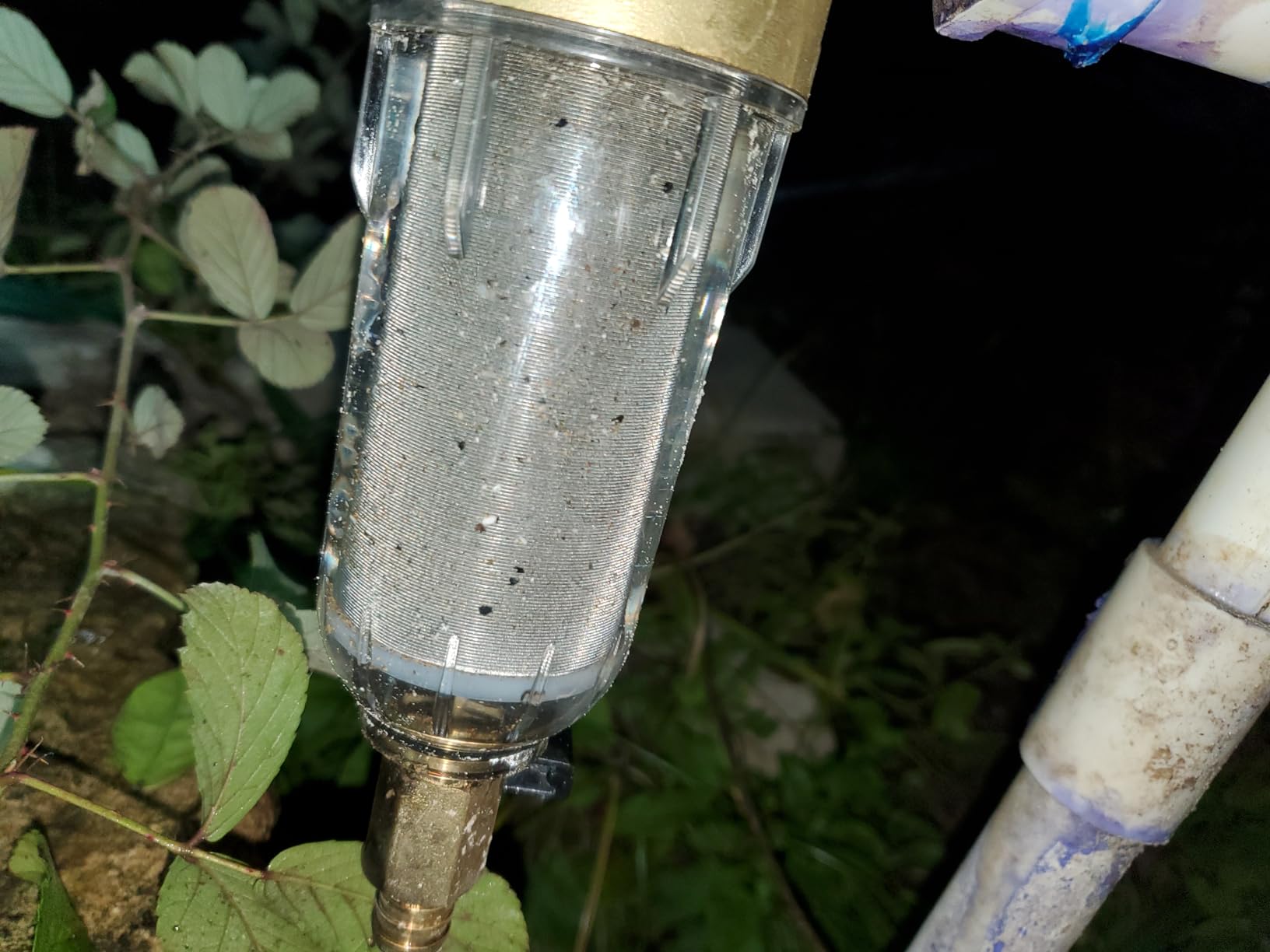
Owners who have installed it cite the dual screens and easy flushing as the main benefits on well water, and the transparent housing makes a loading screen obvious before it starts costing you pressure. As a prefilter in front of a softener or a carbon stage it does its job without any ongoing media cost, which is the whole economic argument for the spin-down format.
The caveat is data volume. This has the smallest review base in the roundup, and the rating spread is wider than the established brands, which usually means a mix of very good and very average experiences. Certification and material detail published for it is thinner, and there is only the one micron combination, so if you later want a 100 micron screen you are buying elsewhere.
The dual screens make this the right prefilter to learn on
Start with the 200 micron screen if your water is genuinely sandy, flush it, and move to the 50 micron if you can keep up with the flush frequency. That trial-and-error is exactly what single-mesh spin-downs make expensive, and it is the reason this unit is a reasonable pick for a first sediment filter on a well. It fits both 3/4 inch and 1 inch plumbing, so the install is rarely the problem.
Thin review history means buy it as a prefilter, not a whole system
Use this as stage one in front of a fine cartridge, not as your only sediment defense. On silty water no reusable mesh will hold fine particles, and the less documented brand history is a reason to keep the failure-critical element of your setup somewhere other than here. Buy a certified cartridge behind it and the combination is solid.
How to Choose a Whole House Sediment Filter
Match the micron rating to the particle, not to the brand
Start by identifying what you are actually seeing. Clear grit that settles in a glass and feels like sand calls for a coarse 50 or 100 micron spin-down, because a fine cartridge will clog in a week. Orange or red flakes, or cloudy water that clears after sitting, are rust sediment and need a 5 micron cartridge. Water that stays cloudy for hours after a storm is suspended silt or clay, which only a pleated or string-wound depth filter handles at a reasonable cost.
One term worth learning is nominal versus absolute. A nominal 5 micron rating means the cartridge captures roughly 85 percent of particles at 5 microns and more above that, which is the standard for spun polypropylene elements like the DGD-5005. An absolute rating means 99.9 percent capture, which costs more and is usually unnecessary unless a certification standard requires it. Buy nominal for whole house sediment work and save the money for capacity.
Size flow rate to the house, not to the filter
Undersizing a whole house filter is the mistake that produces the pressure drop people blame on filters in general. A three or four bedroom home on 3/4 inch pipe needs a housing rated around 4 to 6 gpm, which covers two fixtures running at once. A five or more bedroom home, or one with a whirlpool tub and two showers, should move to 1 inch ports and a 15 gpm rating, or run two smaller housings in parallel. If you are unsure, measure how long it takes to fill a 5 gallon bucket at the cold tap before and after any filter change.
Install in this order: spin-down, sediment, carbon, softener
Sequence is not a detail. Coarse to fine first: a reusable spin-down, then a fine sediment cartridge, then carbon, then your softener or iron filter. Putting carbon ahead of sediment is the most common ordering error and it quietly destroys the carbon, because sediment shades the carbon surface and the media stops reaching its rated gallon life. The same logic applies to a backwashing iron filter, which already removes sediment, so a separate sediment filter in front of it is usually redundant.
Count the cartridge cost before you buy the housing
A cheap housing with expensive or hard to source media is an expensive system. Multiply the cartridge price by the number of changes per year, then multiply that by five to see total ownership. Cartridges rated 50000 gallons or a year for a family of four are the efficient end of the range; anything on a three month schedule in a clean city supply is fine, while the same schedule on a sediment-heavy well is a recurring cost that will outrun the housing cost within two years. Add a bypass valve and pressure gauges to the parts list, and use food grade silicone lubricant on the O-rings rather than petroleum grease.
What a Whole House Sediment Filter Cannot Remove
Sediment filters are mechanical, and mechanical means physical particles only. They will not reduce dissolved minerals, total dissolved solids, hardness, lead, PFAS, pesticides, viruses or bacteria, and a carbon stage inside a combo unit handles chlorine and taste and odor but not the dissolved contaminants either. If your water test shows any of those, you are looking at a softener, a reverse osmosis unit, a KDF stage or a UV sterilizer, and a sediment filter in front of any of them is protection for that equipment rather than a solution on its own.
One more distinction catches people out. Orange staining from iron bacteria is not the same problem as plain rust sediment. Iron bacteria produce a slime that keeps rust particles in suspension, so particles stay small enough to pass a standard filter while still staining everything they touch. That is a disinfection problem before it is a filtration problem, and it is why a spin-down can look like it is failing when the real issue is upstream bacteria.
Frequently Asked Questions
What is the highest rated whole house water filter?
The highest rated option in our testing was the iSpring Ultimate four-stage system, which pairs a 50 micron spin-down with a compound filter, a coconut-shell carbon block and a scale inhibitor rated to 250,000 gallons. If you only need sediment removal, the Pentair Pentek DGD-5005 Big Blue cartridge holds the highest average rating among cartridges, and the iSpring WSP-50 spin-down carried the largest review base of any reusable prefilter we evaluated.
What are the disadvantages of a whole house water filter?
The main disadvantages are pressure drop from an undersized unit, ongoing cartridge cost on dirty water, and the fact that sediment filters do nothing for dissolved contaminants. Undersized housings starve your fixtures, cartridge filters that clog in weeks turn into a recurring expense, and anything claiming to remove chlorine, lead or PFAS from a sediment stage should be treated skeptically. Proper sizing and a coarse prefilter solve most of the complaints.
Is a spin-down filter worth it?
A spin-down filter is worth it whenever you have coarse sediment, because the screen is flushed and reused instead of replaced, so there is no ongoing media cost. It is not enough on its own for fine silt or clay, which is why most owners pair a spin-down with a 5 micron cartridge downstream. The trade-off is flush frequency, and on silty water a spin-down can need cleaning weekly or more often.
How much does a whole house sediment filter typically cost?
Housings alone sit at the entry end of the market, while full multi-stage systems climb from there. Cartridges add up over time, which is why replacement cost matters more than the unit cost. A reusable spin-down plus a cartridge often costs less over five years than two cartridge stages, because the spin-down never needs media. Check cartridge pricing and availability before choosing a housing, since a cheap housing with hard to source cartridges is the expensive option.
What is the best spin-down filter?
The iSpring WSP-50 was the strongest all-round spin-down in our roundup, with the largest review base, a lead-free brass head, double-threaded 1 inch and 3/4 inch ends and a flushable stainless screen rated to last one to two years. For higher flow and pressure headroom, the Waterdrop RPFK carries a 20 gpm rating and a burst-tested PA12 shell. The Aquaboon is the budget pick, shipping with both 50 and 200 micron screens.
Conclusion – The Best Whole House Water Filters for Sediment in 2026
For most households the decision is a two-part one. Put a reusable spin-down at the front so nothing coarse ever reaches the fine media, then follow it with a 5 micron cartridge sized to your household flow. The iSpring WSP-50 is the spin-down we would buy, and the Pentair Pentek DGD-5005 in a Big Blue housing is the cartridge we would pair with it.
If you want one bracket and one install instead of two, the iSpring WGB21B handles sediment and chlorine together on city water. If iron odor, staining and hard water all show up in the same house, the iSpring Ultimate four-stage system treats all three and adds scale inhibition. Either way, size for flow, install coarse to fine, and set a calendar reminder before the first cartridge expires.