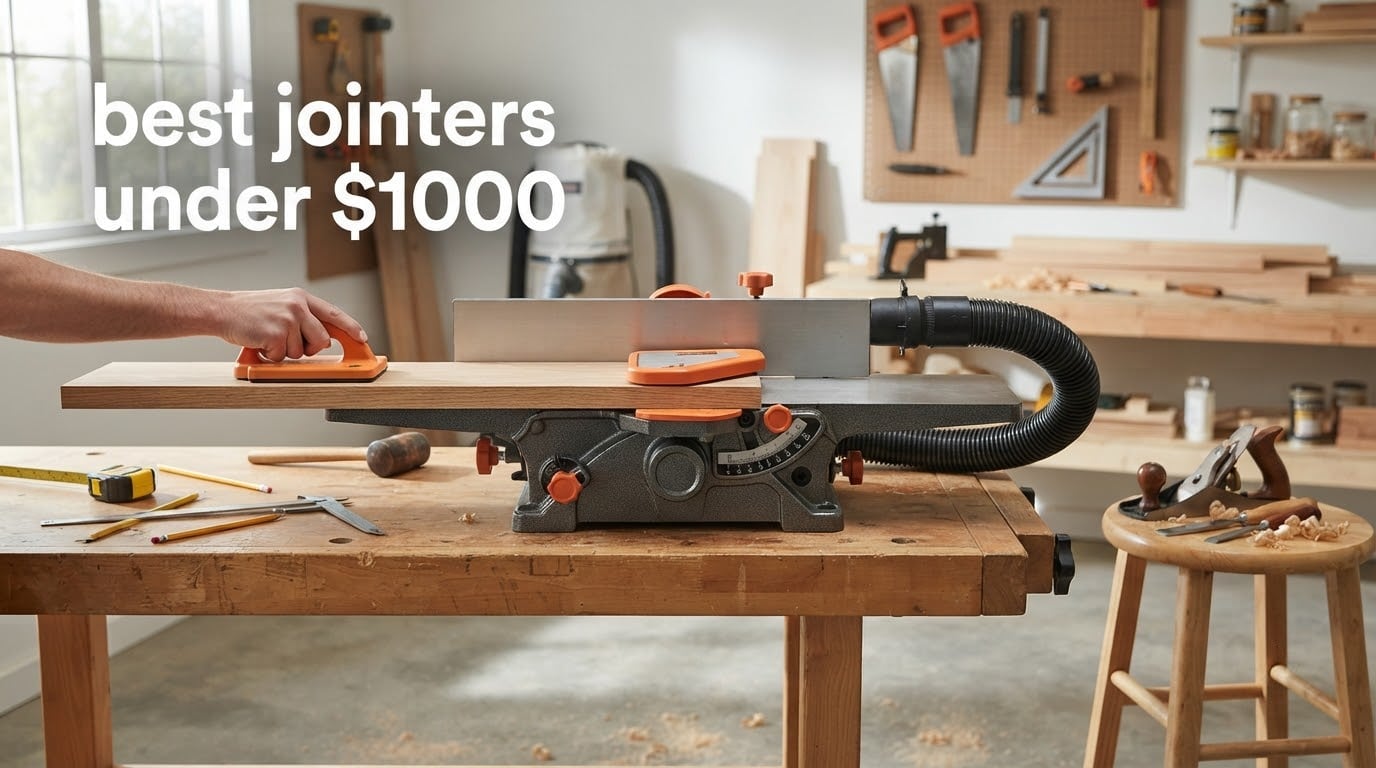
If you have been reading other jointers roundups, you already know the frustration: almost none of them hold the line at a thousand-dollar ceiling. Our team pulled ten benchtop and midi-bench jointers, read every owner review we could find on each one, and sorted out what the best jointers under a thousand dollars actually do well. The short version: this budget buys you a real spiral cutterhead on most of them, cast iron tables on a couple, and honest limits on board length and fence rigidity that no amount of marketing hides.
A jointer flattens one face and squares one edge of a board by dragging it across a rotating cutterhead between two adjustable tables. It is not a planer, it does not take thickness off the top, and it only ever works on one side of the workpiece at a time. That single fact explains almost every difference between the machines below.
Everything here was cross-checked against owner feedback and spec sheets, then updated for 2026. Where a machine has a reputation problem we named it. If you want the short version first, the WEN JT630H is our pick, the Craftsman CMEW020 is the one to buy if you want adjustable speed, and the WEN JT833H covers 8-inch boards in a small footprint. We also test other shop gear constantly, including our pellet grill picks under the same ceiling and our commercial bread ovens for home bakers, so the testing method here is the same one we use across the site.
Table of Contents
- Top 3 Picks for the Best Jointers Under $1000 (September 2026)
- Best Jointers Under a Thousand Dollars in 2026
- 1. WEN JT630H 10-Amp 6-Inch Spiral Benchtop Jointer
- 2. CRAFTSMAN Benchtop Jointer CMEW020
- 3. WEN JT833H 10-Amp 8-Inch Spiral Benchtop Jointer
- 4. Wahuda Tools 10-Inch Spiral Benchtop Jointer
- 5. Delta 6-Inch Midi-Bench Jointer
- 6. WEN JT3062 10-Amp 6-Inch 2-Blade Benchtop Jointer
- 7. Cutech 40180HI 8-Inch Spiral Jointer with Cast Iron Tables
- 8. Cutech 40160HB 6-Inch Spiral Jointer
- 9. WOODSTARTER 6-Inch Benchtop Jointer with 15-Amp Motor
- 10. VEVOR 6-Inch Benchtop Jointer with 2 HP Motor
- What Size Jointer Do You Need: 6 Inch or 8 Inch?
- Straight vs Spiral vs Helical Cutterheads
- Jointer vs Planer vs Jointer-Planer Combo Under a Thousand Dollars
- What a Thousand-Dollar Budget Gets You, and What It Does Not
- Dust Collection, Setup and Safety Under This Budget
- Frequently Asked Questions
- Our Verdict on the Best Jointers Under a Thousand Dollars in 2026
Top 3 Picks for the Best Jointers Under $1000 (September 2026)

WEN JT630H 6-Inch Spiral…
- Spiral head with 12 HSS blades
- 30 x 6 inch table
- 0 to 1/8 inch depth of cut
- 36.8 pound portable body

Craftsman CMEW020 Jointer
- 6000 to 11000 RPM variable speed
- Two-knife head with jackscrew leveling
- Center-mounted 4-1/4 inch fence
- 10 amp corded motor

WEN JT833H 8-Inch Spiral…
- 16-blade spiral cutterhead
- 33 x 8 inch table with arms to 51 inches
- 0 to 1/8 inch depth of cut
- Dual 2-1/2 and 4 inch dust ports
These three cover the most common shopping decisions. The JT630H wins on the combination of rating and owner volume, with a 12-blade spiral head and enough reviews to make the consensus meaningful. The Craftsman is the only machine here with a real speed dial, which matters when you move from pine to walnut. The JT833H is the pick when your boards are wider than 6 inches and your floor space is tight.
Best Jointers Under a Thousand Dollars in 2026
| Product | Specs | Action |
|---|---|---|
| WEN JT630H 10-Amp 6-Inch Spiral Benchtop Jointer |
|
Check Latest Price |
| CRAFTSMAN Benchtop Jointer CMEW020 |
|
Check Latest Price |
| WEN JT833H 8-Inch Spiral Benchtop Jointer |
|
Check Latest Price |
 Wahuda Tools 10-Inch Spiral Jointer Wahuda Tools 10-Inch Spiral Jointer |
|
Check Latest Price |
 Delta 6-Inch Midi-Bench Jointer Delta 6-Inch Midi-Bench Jointer |
|
Check Latest Price |
| WEN JT3062 6-Inch 2-Blade Benchtop Jointer |
|
Check Latest Price |
 Cutech 40180HI 8-Inch Spiral Jointer Cutech 40180HI 8-Inch Spiral Jointer |
|
Check Latest Price |
 Cutech 40160HB 6-Inch Spiral Jointer Cutech 40160HB 6-Inch Spiral Jointer |
|
Check Latest Price |
 WOODSTARTER 6-Inch Benchtop Jointer WOODSTARTER 6-Inch Benchtop Jointer |
|
Check Latest Price |
 VEVOR 6-Inch Benchtop Jointer VEVOR 6-Inch Benchtop Jointer |
|
Check Latest Price |
Read that table as a capability ladder rather than a ranking. Two machines at the bottom are light-duty machines for flat material under 4 inches wide, and two in the middle are genuinely capable machines for a serious hobbyist. Our ordering below reflects how well each machine handles real workshop work once it is dialed in.
1. WEN JT630H 10-Amp 6-Inch Spiral Benchtop Jointer
WEN JT630H 10-Amp 6-Inch Spiral Benchtop Jointer
6 inch width
Spiral head, 12 HSS blades
30 x 6 inch table
36.8 lb, 10 amp
Pros
- Tearout-free finish on hardwoods like maple and oak
- Tables arrive close to coplanar and flat
- 36.8 pounds so it stores on a shelf
- Quiet for a benchtop jointer
- Most owner feedback of any machine here
Cons
- Fence is the weakest link and drifts out of square
- Aluminum tables pick up marks with use
- Non-standard dust port needs an adapter
This is the machine we kept coming back to after reading owner feedback across the whole field. It carries a spiral cutterhead with 12 staggered HSS blades, which is the single biggest quality lever in this price class, and owners repeatedly describe clean, tearout-free passes on maple, oak and purpleheart. At 4.6 stars across more than a thousand reviews, it also has the largest body of owner history here, and that history is unusually consistent.
Weighing 36.8 pounds, it is one of the few machines in this roundup you can actually pick up and move to a shelf when it is not in use. The table is not long, but for material up to about 6 feet long it works, and the onboard depth-of-cut scale plus two push blocks mean you are not improvising a safety setup on day one.
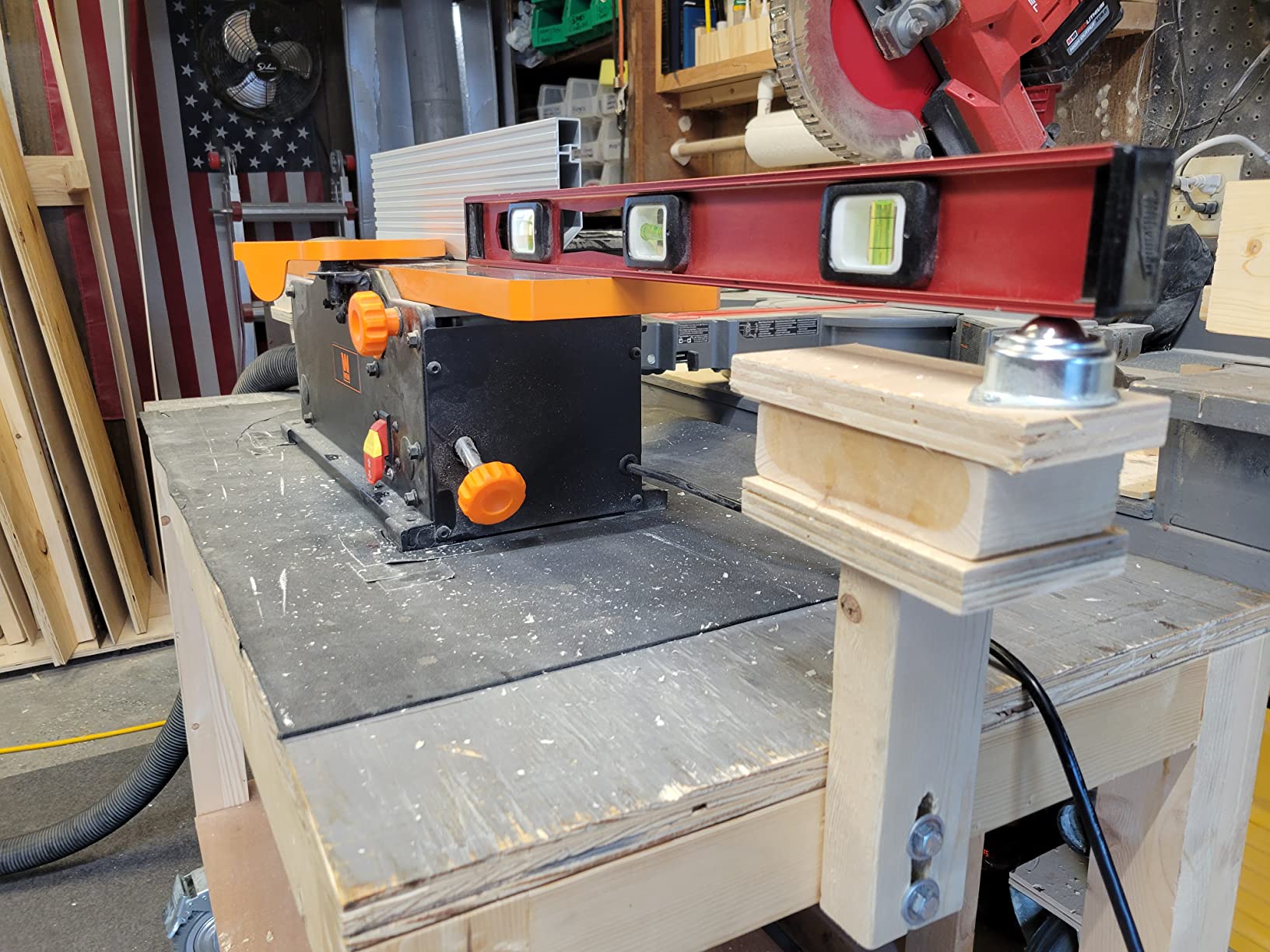
The honest weakness is the fence. It is adjustable and bevels to 45 degrees, but owners report it drifting out of square after a few setup sessions, and it takes real care to get right. Our advice is to square the fence with a machinist square against the table and re-check it every time you change the depth of cut. The tables are machined aluminum rather than cast iron, so they will burnish and mark over years of service, though that does not affect accuracy.
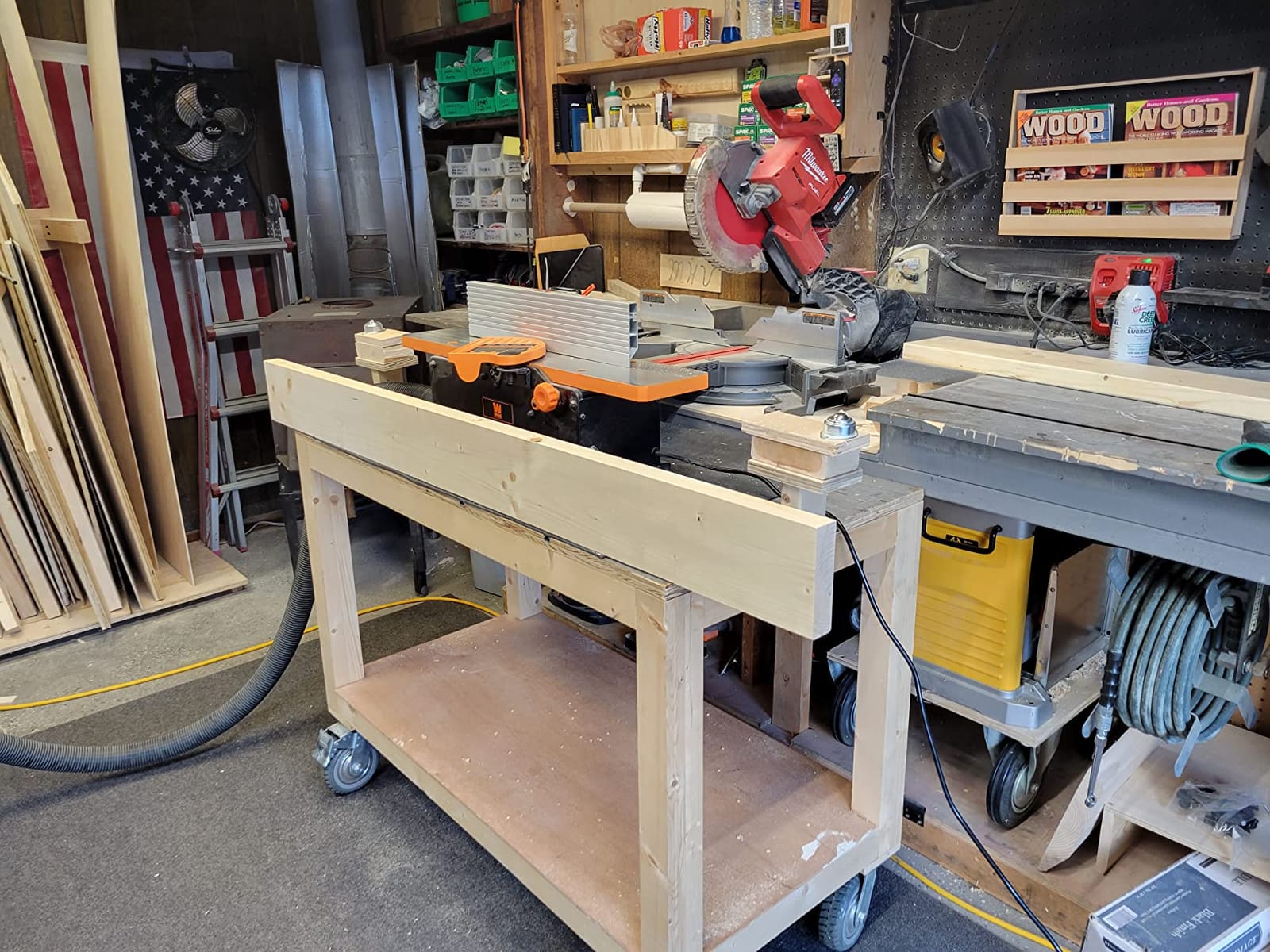
Dust collection is the other small annoyance. The 2-1/2 inch port is a non-standard size for many shop vacs, so budget for a short adapter hose.
Who this jointer suits
It suits a home shop that works hardwood furniture, small cabinets and picture frames, and it suits anyone who wants a spiral head without spending floor-stander money. If you glue up edge-to-edge panels, flatten rough boards and occasionally rabbet an edge, this is the machine that will serve you for years.
It is less suited to production work where you push long boards continuously, because the table is short and the fence is not a rigid ratcheting type. Buyers who need the widest capacity or the stiffest fence should look at the Cutech 40180HI instead.
Who should skip it
Skip it if your material is regularly wider than 6 inches, or if you plan to flatten full 4×8 sheet goods. Skip it too if you have very little patience for setup, because squaring the fence is a recurring task on this machine, not a one-time job.
Also skip it if you will not upgrade to a proper dust collector later. The port works, but a small vac hose on a benchtop machine is a compromise rather than a solution.
2. CRAFTSMAN Benchtop Jointer CMEW020
CRAFTSMAN Benchtop Jointer, Up to 22,000 cuts per Minute, 10 Amp, Corded (CMEW020)
6,000 to 11,000 RPM variable speed
Two-knife head with jackscrew leveling
10 amp corded motor
Pros
- Variable speed matches RPM to the material
- Center-mounted fence supports the workpiece well
- Setup takes about 15 minutes
- Dust collection works well with a shop vac
- Build quality feels solid for the money
Cons
- Short tables limit lumber to roughly 4 to 5 feet
- Blade guard can contact the knives under light pressure
- Aluminum tables scratch with rough material
The Craftsman is the only machine in this roundup with a genuine speed range, and that single feature changes how you work softwood and hardwood on the same head. Owners set 6,000 RPM for pine and push toward 11,000 RPM for denser hardwood, which reduces the chance of tearout without a change of tooling. The two-knife cutterhead uses a jackscrew leveling arrangement, so blade adjustments do not require a feeler gauge ritual.
The center-mounted 4-1/4 inch fence is genuinely useful. Because it sits at the center of the table rather than at the far edge, it supports the workpiece through the whole cut, which is what you want when jointing narrow strips or small parts. Owners also report roughly 15-minute setups with the tables arriving pre-set.
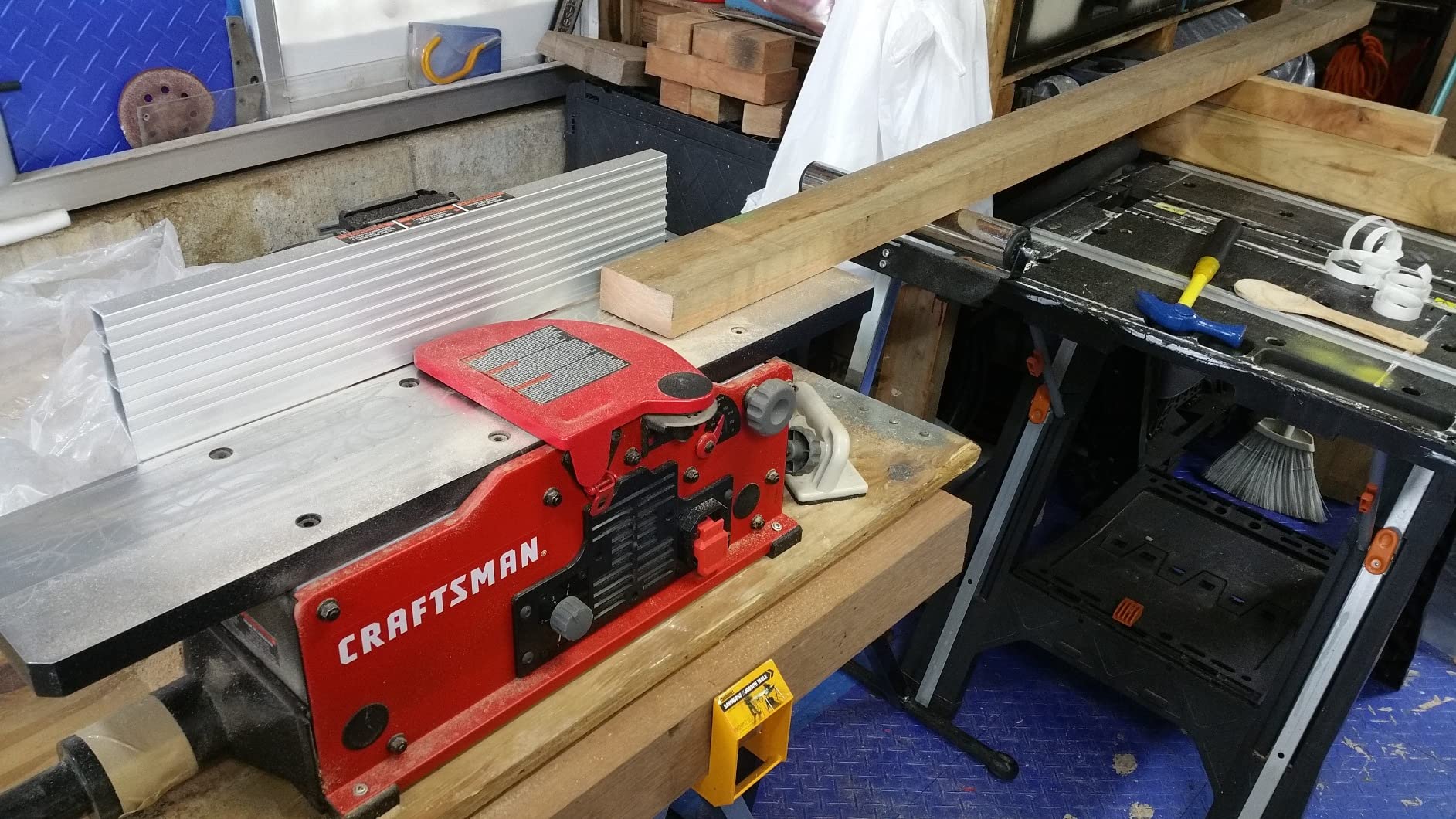
The limitation everyone mentions is table length. With infeed and outfeed sections that total a modest span, workable lumber runs out at roughly 4 to 5 feet, so long boards need support added at the ends. A small minority of reviews also describe the blade guard contacting the knives under light pressure, and a few report the motor cutting out after months of use, so if you buy one, check the guard clearance before your first cut.
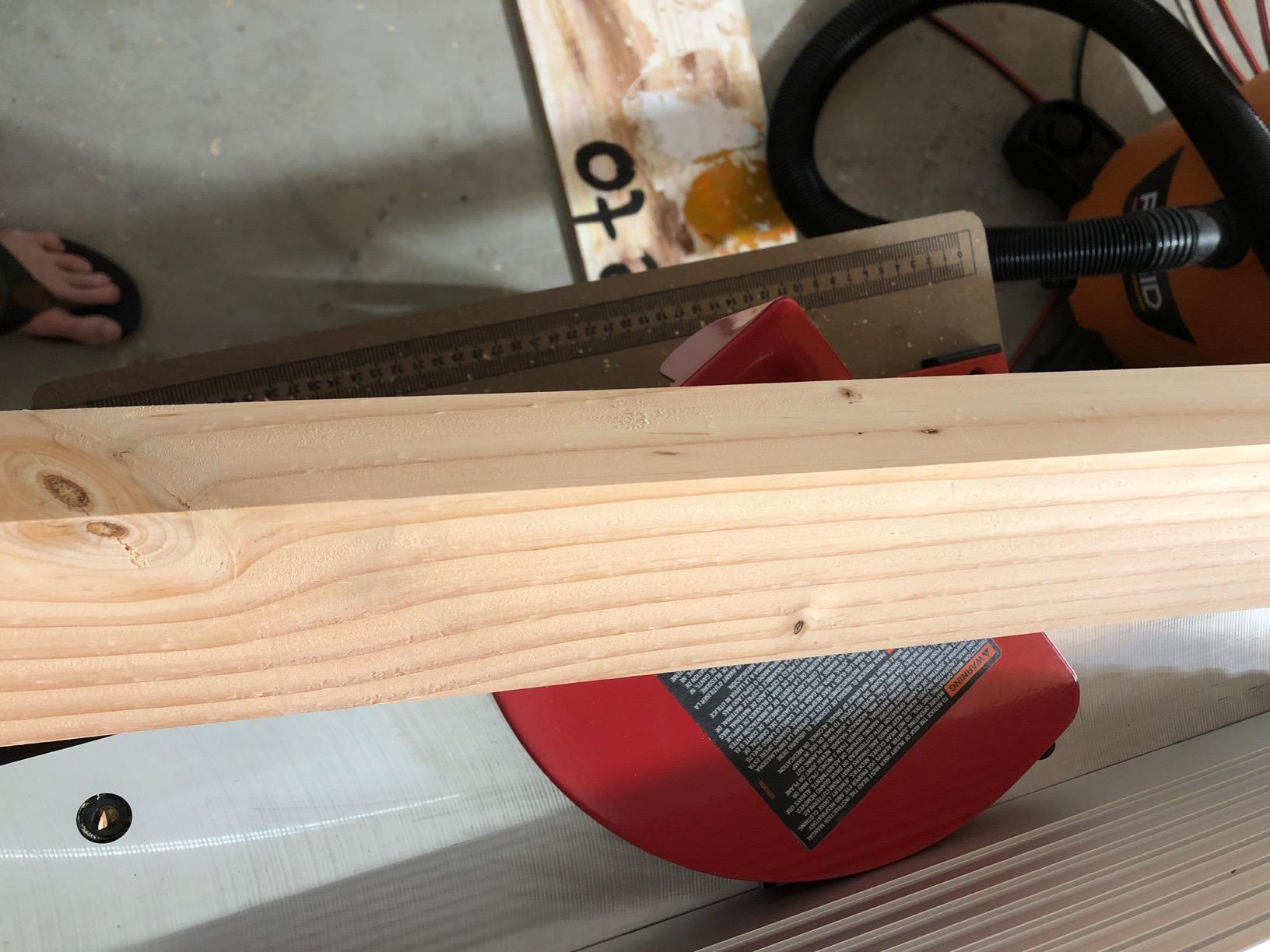
Who this jointer suits
It suits a woodworker who alternates between construction lumber and hardwood, and it suits anyone who prefers straight knives they can sharpen on a weekend. Dust collection performance is repeatedly praised with both a shop vac and a cyclone, which is a good sign in a compact shop.
The fence height of 4-1/4 inches is the practical limit on workpiece thickness, so plan your material selection around that number.
Who should skip it
Skip it if you work on long boards regularly or if you cut material thicker than the fence is tall. Skip it if you want a spiral head, since straight knives here mean periodic sharpening sessions that a spiral head does not require.
3. WEN JT833H 10-Amp 8-Inch Spiral Benchtop Jointer
WEN JT833H 10-Amp 8-Inch Spiral Benchtop Jointer with Extendable Table
8 inch cutting width
16-blade spiral cutterhead
33 x 8 inch table extending to 51 inches
Dual dust ports
Pros
- 16-blade spiral head gives a fine tearout-free finish
- Extendable table arms support up to 51 inches
- Handles hardwood without bogging down
- Runs quiet for an 8 inch machine
Cons
- Fence takes effort to square and can shift when locked
- Heavier and costlier than the 6 inch WEN models
- Aluminum table surface marks with use
This is the machine for anyone whose boards are wider than the 6-inch class allows. The 16-blade spiral cutterhead is the most aggressive cutting geometry here, and owners report a smooth, tearout-free result on hardwood. The 33 by 8 inch table is paired with support arms that extend the supported length to 51 inches, which solves the long-board problem that limits most benchtop machines.
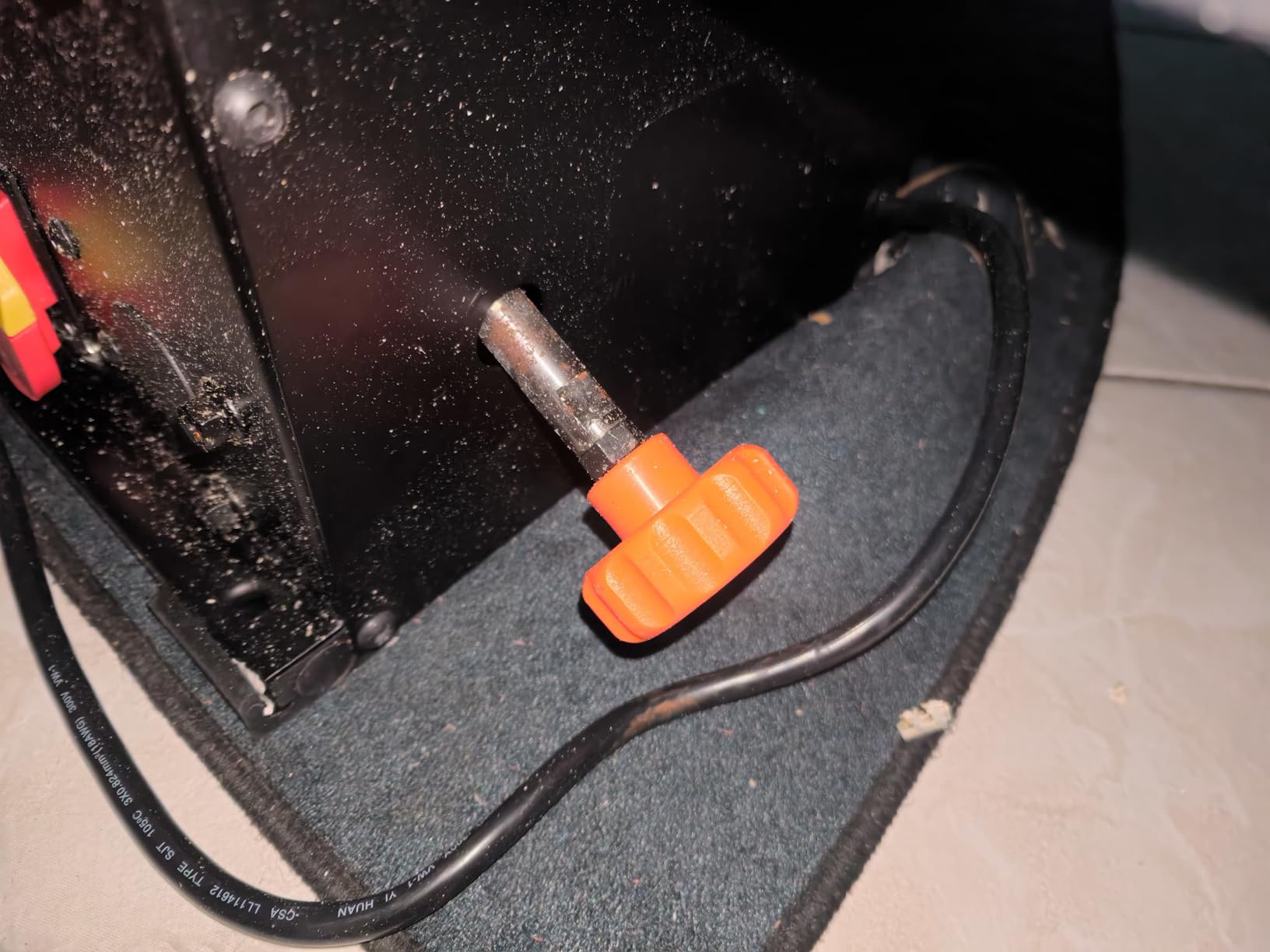
Dust extraction is better handled here than on the smaller WEN. The machine carries both 2-1/2 inch and 4 inch ports, so you can run a standard 4 inch hose from a shop vac or a small cyclone without buying an adapter. Depth of cut is adjustable up to 1/8 inch per pass, and the fence is the same 19-3/4 by 4-1/4 inch size as the 6-inch model, beveling to 45 degrees.
Owners describe setup as straightforward once you square the fence, but that fence is the recurring theme in reviews. It can shift slightly when locked, so treat the locking handle as something to check mid-session rather than something you set once. The aluminum table surface also marks with use, which is cosmetic rather than an accuracy problem.
Who this jointer suits
It suits a furniture maker working on tabletops, wide panels and shelves, and it suits anyone who wants the cutting quality of a spiral head without a floor stander. The extendable arms make it a realistic option for 6 to 8 foot boards in a small shop.
If your shop already has good dust collection, the dual ports mean this machine slots straight into it.
Who should skip it
Skip it if your material is 6 inches wide or narrower and your budget is tight, because the smaller WEN covers that work with more reviews behind it. Skip it if you expect to move the machine often, since this one is heavier than the 6-inch bench and needs two hands on the base.
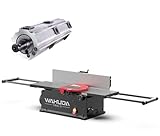
4. Wahuda Tools 10-Inch Spiral Benchtop Jointer
Wahuda Tools Jointer – 10-inch Benchtop Wood Jointer, Spiral Cutterhead Portable Jointer, Cast Iron Tables w/Pull Out Extensions, 4-Sided Carbide Tips & 12amp Motor, Woodworking Tools (50110CC-WHD)
10 inch cutting width
Spiral head with 4-sided carbide inserts
Cast iron tables and fence
12 amp at 12000 RPM
Pros
- Widest cutting width in this roundup at 10 inches
- Standard replaceable carbide inserts on the spiral head
- Cast iron tables resist marking
- Fence tilts to 90 and 135 degrees
- Handles figured and cupped boards well
Cons
- Heaviest portable machine in the group at nearly 71 pounds
- Fixed 12000 RPM with no speed selection
- Cast iron table and fence setup takes time
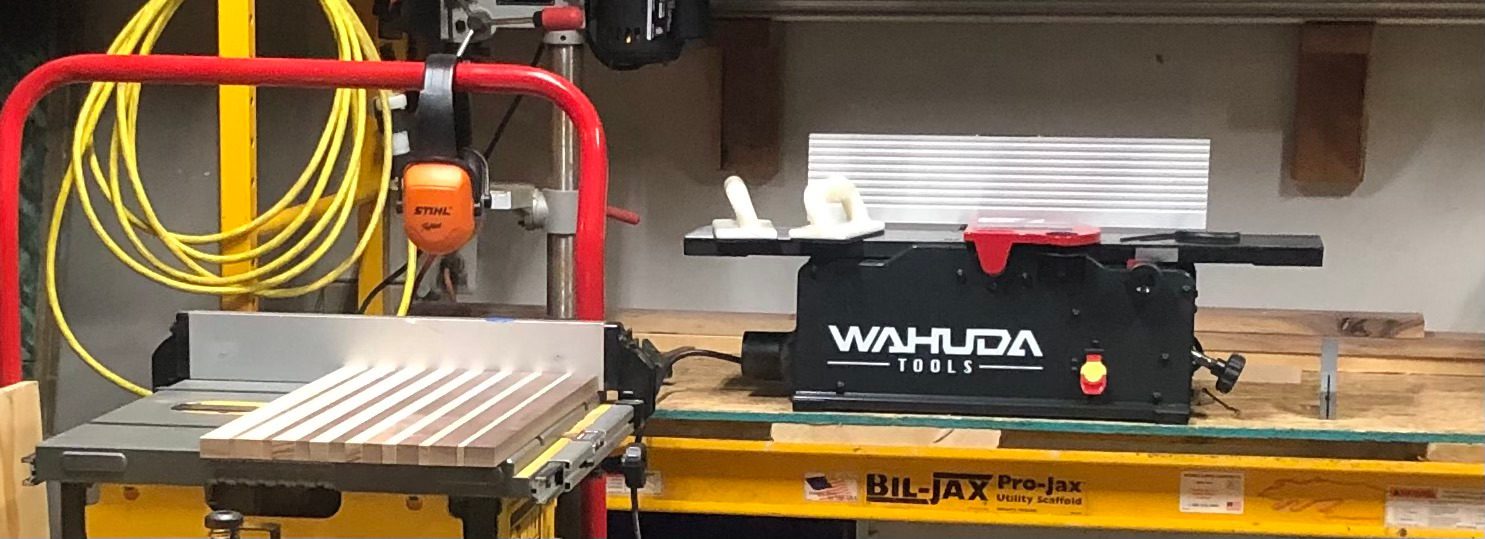
Most people shopping for a jointer do not realise they are also shopping for board width. The Wahuda is the widest machine in this roundup at 10 inches, which means a single pass can handle boards that would need two passes on a 6-inch bench. Pull-out table extensions extend the support for longer material, and owners with wide panels say that capacity alone changes what they can build in one setup.
The cutterhead is a spiral design with four-sided carbide inserts, so sharpening means rotating each insert to a fresh corner rather than sending a head out for grinding. The 120V motor is fixed at 12,000 RPM, which suits general edging, jointing, flattening and tapering work without any adjustment.
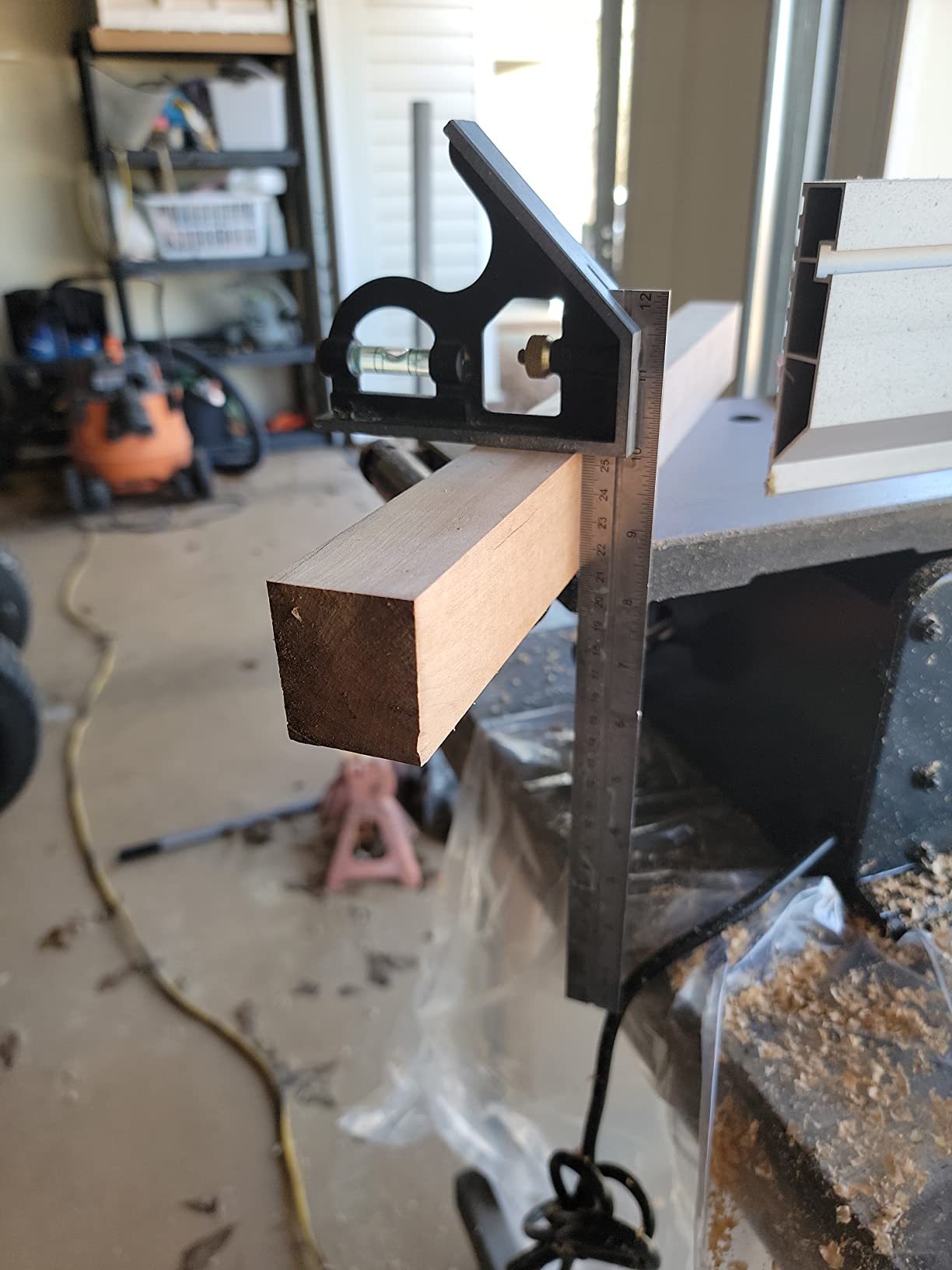
Cast iron tables and a cast iron fence are the reason this machine feels heavier and more planted during a cut. That stability is real, and it is why owners report consistent results on figured and cupped boards where lighter machines chatter. The trade is portability: at 70.9 pounds and 35 by 22 by 13 inches, this is a machine you position once rather than one you carry around.
Who this jointer suits
It suits a builder who regularly works with wide boards, thick tabletops or door panels, and it suits anyone who wants carbide inserts and cast iron tables without leaving this budget class. The fence tilting to both 90 and 135 degrees covers the angled-edge work that resaw-style setups cannot do as neatly.
Owners also note it handles tapering work, which is useful when you are matching a factory edge or cleaning up a rough-sawn face at an angle.
Who should skip it
Skip it if your shop is a rented space or a small apartment where a 71-pound machine with a 35-inch footprint is a permanent commitment. Skip it if you need speed selection for very soft versus very hard material, because the motor speed is fixed.
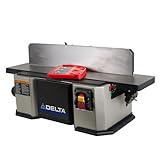
5. Delta 6-Inch Midi-Bench Jointer
Delta – 6 in. Midi‑Bench Jointer
6 inch width
12 amp at 10000 RPM / 20000 cuts per minute
Cast iron table, fence and base
5-year limited warranty
Pros
- Cast iron construction resists vibration
- Comes well calibrated from the factory
- Built-in dust blower clears the chute
- Simple jackscrew knife adjustment
- 5-year limited warranty
Cons
- Fence drifts out of square over time
- Quality control reports cite missing hardware
- 76 pounds makes it hard to move
- Printed depth scale rather than a working gauge
Delta built this as a midi-bench machine, and it shows in the construction rather than the marketing. Cast iron tables, fence and base give it a planted feel that no aluminum machine in this list matches, and long-term Delta owners describe it as a workhorse rather than an occasional-user tool. At 12 amps and 10,000 RPM it makes 20,000 cuts per minute.
The built-in dust blower is an old-school solution to chip removal and owners report it clears the chute effectively without a separate hose. A 5-year limited warranty is the longest coverage in this roundup, which matters more than people expect on a machine with a cast iron body that could be re-badged for decades.
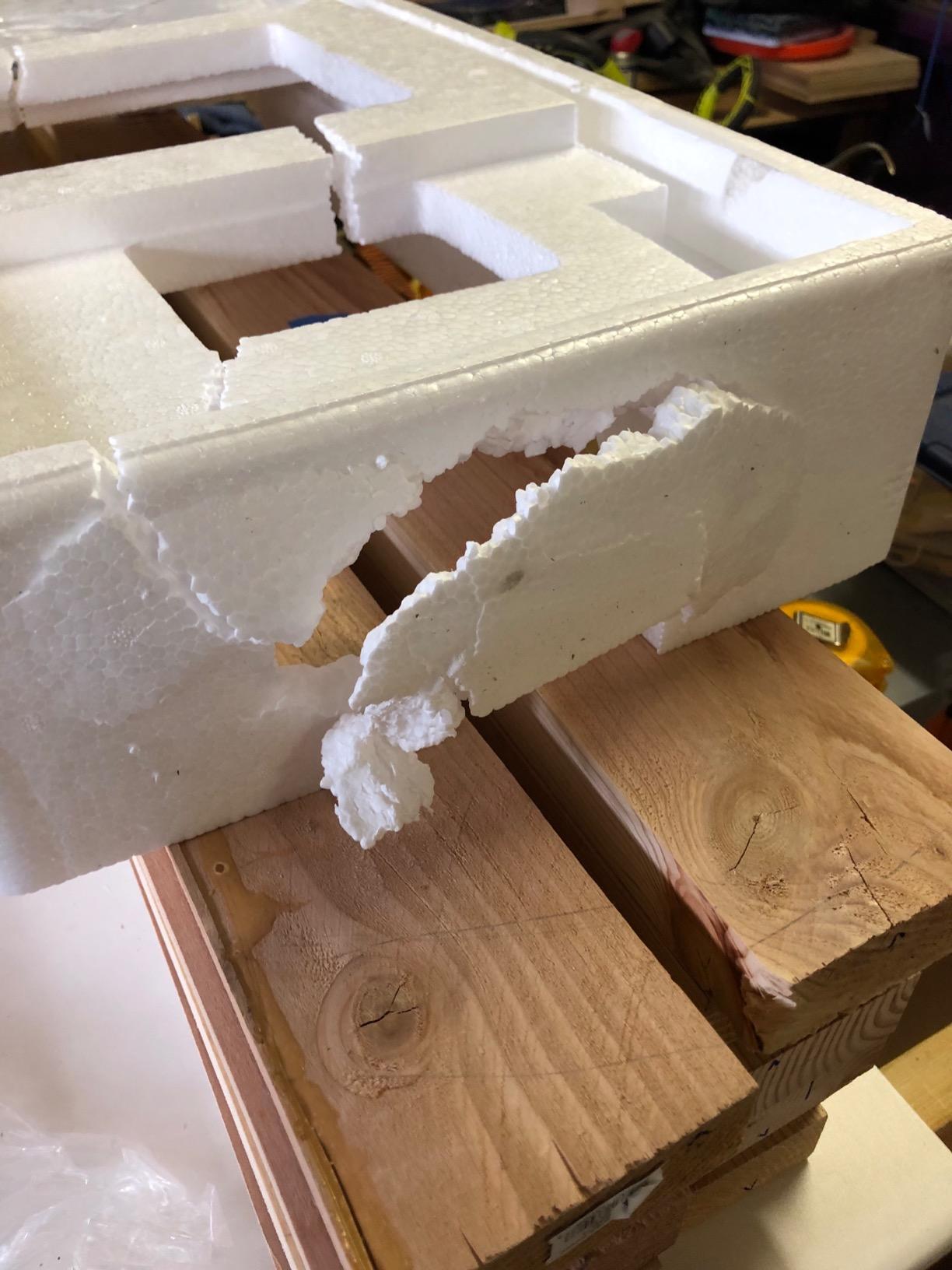
Reviews on this one split sharply, and we would rather show you that than smooth it over. Praise focuses on factory calibration and stable cuts, and the copies we checked arrived set up close enough to cut. Criticism focuses on quality control at the box: missing hardware, a bowed fence, a broken dust-port grommet and a manual with vague instructions and poor images. Fence drift is the most common long-term complaint, so budget time for re-alignment rather than assuming it stays square.
At 76 pounds this is the second-heaviest machine in the roundup, which is a virtue if it lives in one corner and a problem if your shop is small. Some owners also report motor burn-out and dust-chute interference with the knives.
Who this jointer suits
It suits a shop with permanent floor space and a preference for heavy iron over light aluminum. It suits a buyer who values a long warranty and a machine that can be rebuilt rather than replaced.
The 6 inch width and 2-1/4 inch chip chute make it a sensible fit for standard residential timber, and the push blocks are included.
Who should skip it
Skip it if you are starting out and cannot check fence squareness and knife clearance on arrival. The quality control reports are specific enough that a first-time buyer should budget an hour of commissioning before the first real cut.
6. WEN JT3062 10-Amp 6-Inch 2-Blade Benchtop Jointer
WEN JT3062 10-Amp 6-Inch 2-Blade Benchtop Jointer, Black
6 inch width
2-blade straight head
22000 cuts per minute
30 x 6-3/16 inch table
Pros
- Owner rating sits at 4.7 stars with 220 reviews
- Cuts hardwood cleanly without bogging the motor
- Arrives level and square enough to use
- Quiet operation with a low hum
- Good dust collection when connected
Cons
- Fence handles are plastic
- Two-blade head needs periodic sharpening
- Table length suits boards up to roughly 4 to 6 feet
The straight-knife machines in this list are the traditional choice, and owners put this one near the top of the group at 4.7 stars. The two-blade cutterhead turns at speeds up to 22,000 cuts per minute, and owners report clean cuts on hardwood with no tearout and no motor bogging, which tells you the 10-amp motor has some headroom in reserve.
Quiet running is the quiet advantage here. Owners repeatedly compare it favourably to other machines in its class, and for a basement or garage shop where you surface boards after dinner, that matters more than most spec sheets suggest. The onboard depth-of-cut scale and two included push blocks are standard, and the fence is the same 19-3/4 by 4-1/4 inch design used across the WEN benchtop line, beveling to 45 degrees.
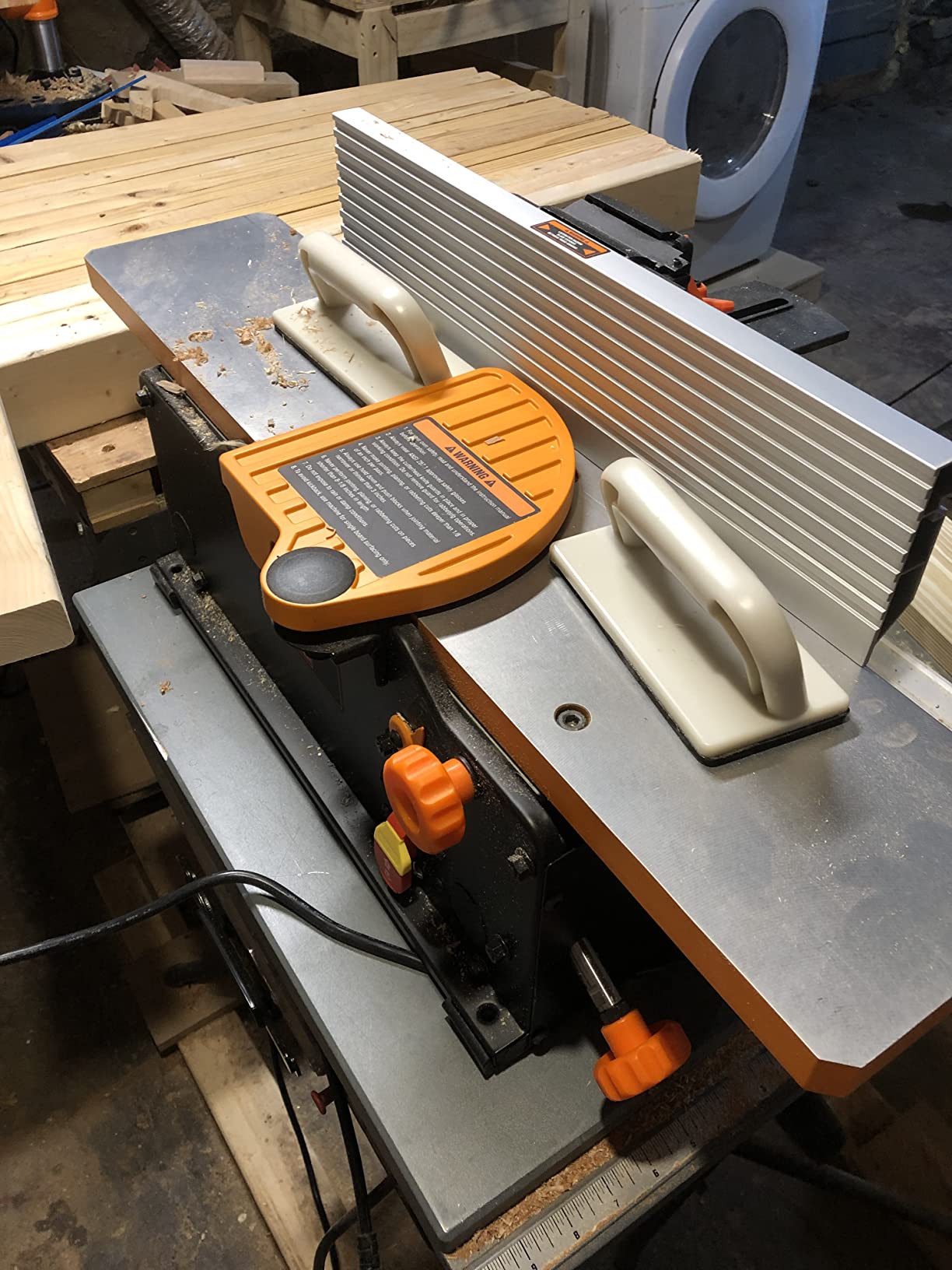
The cost of the straight head is maintenance. Two blades need periodic sharpening, and once they are dull the finish quality drops faster than it does on a spiral head, where you rotate an insert to a fresh edge in under a minute. The plastic fence handles are a minor irritation reported often enough to mention.
Who this jointer suits
It suits a beginner who wants a machine that arrives ready to cut, and it suits anyone who prefers to sharpen knives on a regular schedule rather than buy carbide inserts. The two-year warranty is shorter than the Delta coverage but longer than the one-year term on the lightest machine here.
If your work is mostly softwood trim, shelving and general shop timber, a straight head is entirely adequate and this machine handles it well.
Who should skip it
Skip it if you work mostly figured hardwood, where a spiral head’s shearing action leaves a noticeably better surface. Skip it if you dislike sharpening, since that is an ongoing task with this head.
7. Cutech 40180HI 8-Inch Spiral Jointer with Cast Iron Tables
Cutech 40180HI 8-Inch Spiral Cutterhead Benchtop Jointer with Cast Iron Tables, 16 TC Inserts, Extra Long 24″ Aluminum Fence, Additional 7-3/8″ Fence Brackets, and a 10-amp Motor
8 inch width
Cast iron tables
6-row head with 16 carbide inserts
24 inch bracketed fence
Pros
- Factory-calibrated tables arrive coplanar
- Cast iron tables do not mark like aluminum
- 24 inch bracketed fence resists going out of square
- Very low amp draw while cutting
- Heavy enough that it will not walk
Cons
- 12000 RPM motor is loud when running unloaded
- 82.8 pounds is the heaviest machine in the roundup
- Alignment mechanism still described as crude
- Packing relies on polystyrene foam
This is the most complete machine in the roundup on paper, and owners with benchtop experience generally conclude that nothing else in the short-bed class beats it on balance. The cast iron tables arrive factory-calibrated and coplanar, so setup is close to plug-and-play, and cast iron does not mark the way aluminum does after a year of rough timber.
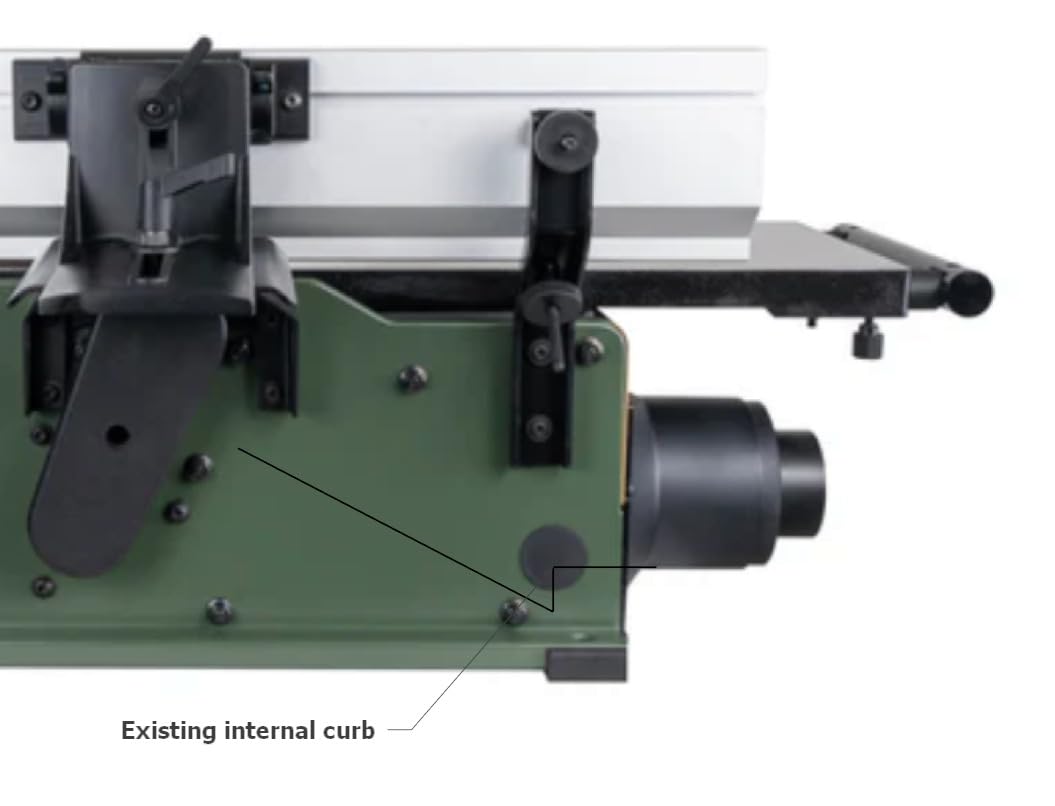
The fence is the design centerpiece: a 24 inch aluminum fence on patented support brackets with quick stops at 90 and 135 degrees. A guide post keeps the elevation consistent at any depth of cut, and an additional support rod keeps the upright frame rigid under heavy workpieces. The 6-row spiral cutterhead carries 16 two-sided tungsten carbide inserts with non-cutting edges that prevent skewing.
The honest complaint is noise. The 12,000 RPM universal motor is painfully loud under no load, so hearing protection is not optional. At 82.8 pounds it is also the heaviest machine here and effectively a fixed installation. Even with the brackets, owners still describe the alignment mechanism as relatively crude, so this is a design win, not a solved problem.
Who this jointer suits
It suits a serious hobbyist who wants cast iron tables, carbide inserts and a long braced fence in a machine that still fits a bench footprint. Low amp draw while cutting means it will not trip a circuit when you run it alongside other shop equipment.
Owners of experience like this machine like it for one reason: it does not need babysitting. The tables stay parallel as the depth of cut changes, which is the detail that makes long glue-ups behave.
Who should skip it
Skip it if noise matters in your shop, since the motor is the loudest in this list under no load. Skip it if you cannot give 83 pounds a permanent home, and consider that a small-shop machine you can move is sometimes more useful than one you cannot.
8. Cutech 40160HB 6-Inch Spiral Jointer
Cutech 40160HB 6-Inch Spiral Cutterhead Benchtop Jointer with teflon-Coated Aluminum Tables, 12 TC Inserts, 19-5/8” Aluminum Fence, and a 10-amp Motor (Rifle Green, 6 inch)
6 inch width
6-row spiral head with 12 carbide inserts
Teflon-coated aluminum tables
44.2 pound body
Pros
- Owner rating of 4.8 stars across 59 reviews
- Low noise and low amp draw from the spiral head
- Teflon table coating resists scratching well
- Depth-of-cut scale and pointer improve repeatability
- Light enough to move around a small shop
Cons
- Fence is shorter than the 8 inch Cutech model
- Smaller review base means a thinner long-term record
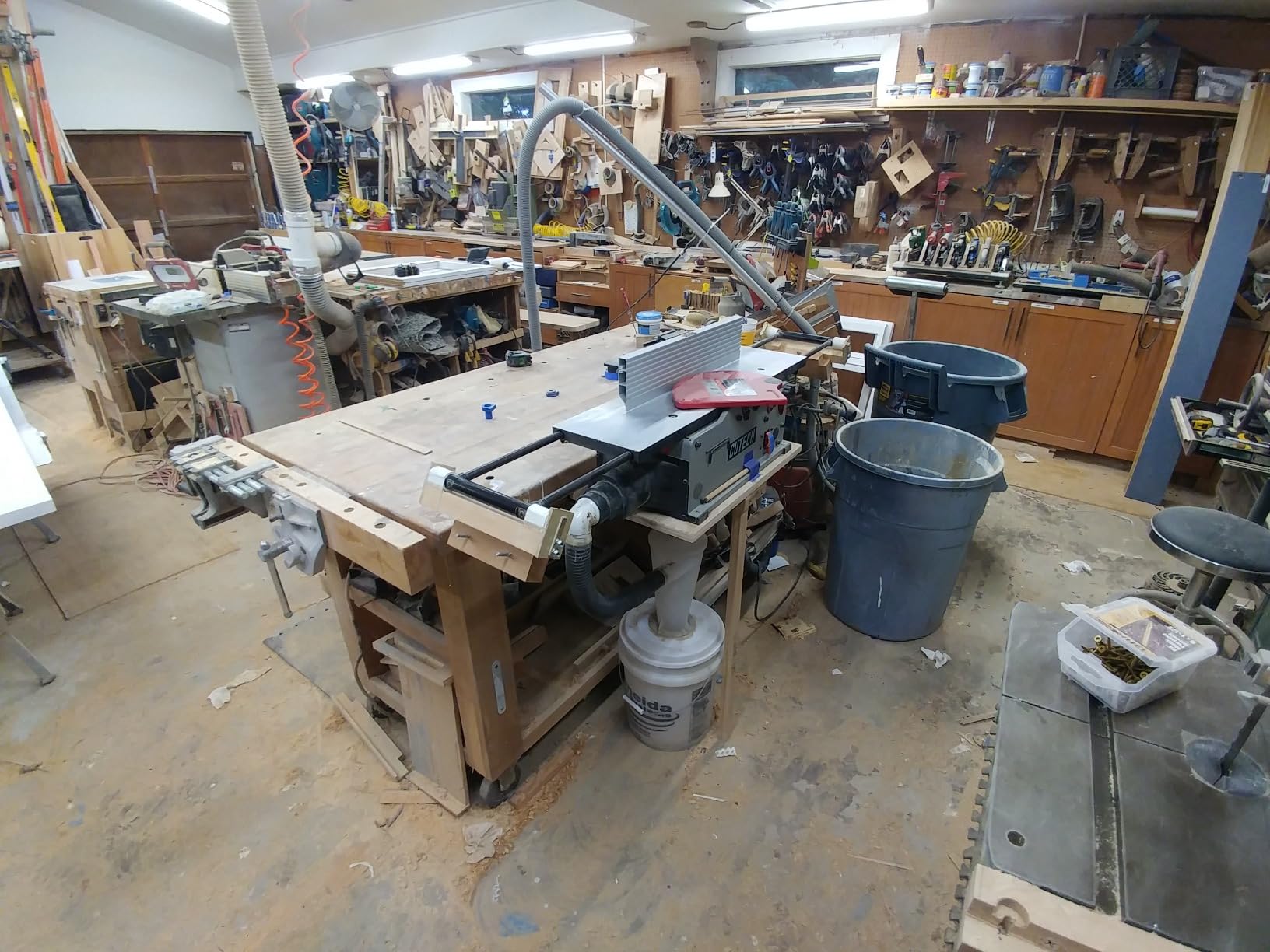
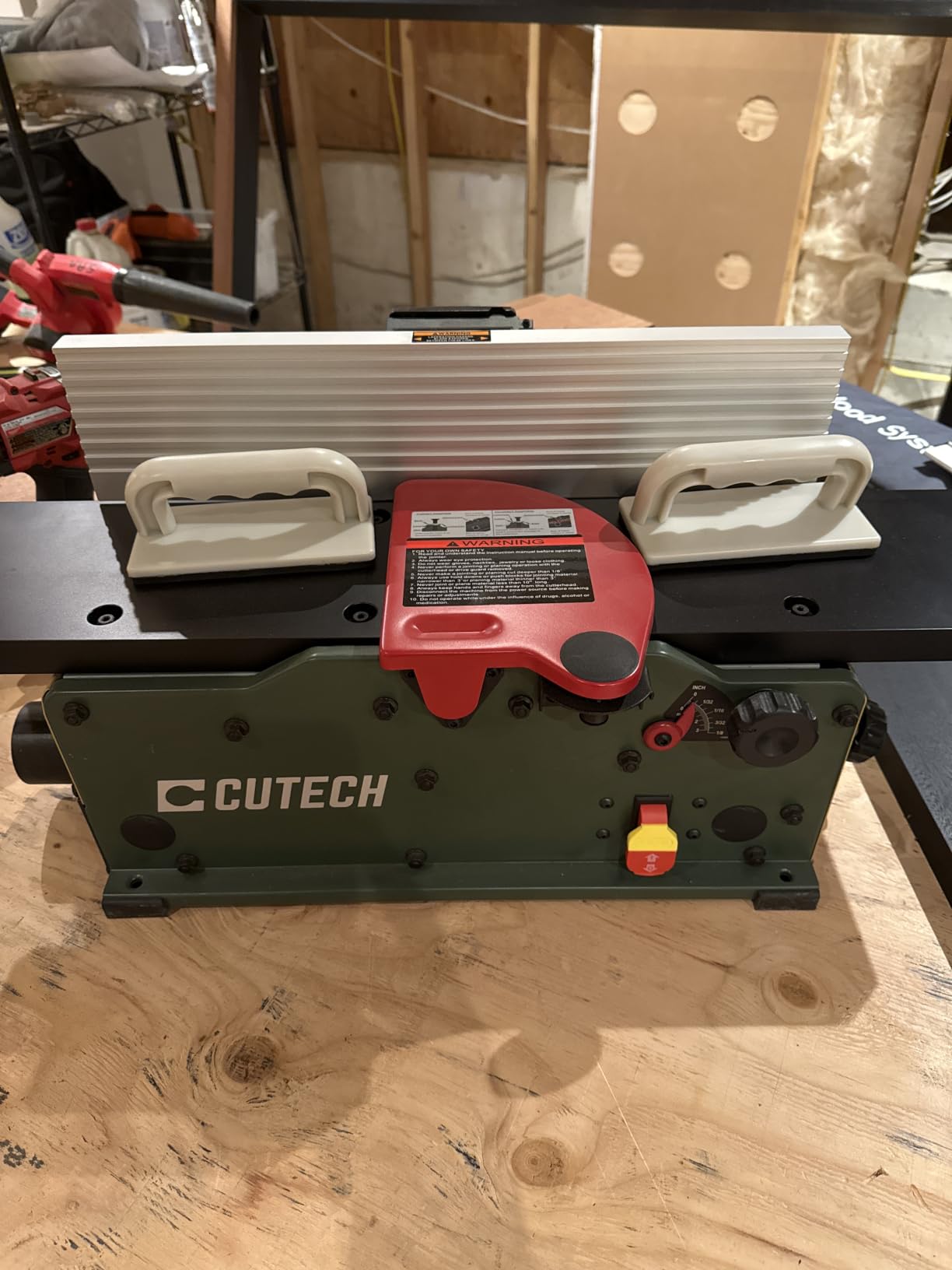
If you want a spiral cutterhead but not a 70-pound machine, this is the compromise. It carries a 6-row spiral head with 12 two-sided carbide inserts, so you get the quiet, smooth cutting and the rotate-an-insert maintenance model, at 44.2 pounds. That is light enough to carry between benches without planning a second person.
The Teflon coating on the aluminum tables is a genuinely smart detail. Where bare aluminum picks up burnishing and scratches, the coating raises surface hardness and holds up better to rough lumber. The depth-of-cut scale and pointer also make repeated passes consistent, which is a real time saver when you are flattening a stack of identical parts.
The fence is 19-5/8 inches with quick stops at 90 and 135 degrees, shorter than the fence on the 8-inch Cutech, and that is where support for wide or tall workpieces gets thinner. The other caveat is simple: the owner review base is much smaller than the WEN or Delta listings, so the long-term track record is less established.
Who this jointer suits
It suits a small shop that wants carbide spiral cutting and quiet operation without a permanent 80-pound installation. It suits a woodworker who does furniture-scale work, where a 6-inch width is genuinely enough and moving the machine between the garage and the basement is a real advantage.
Owners consistently describe the finish as smooth and the noise as low, which is what you would expect from a six-row spiral arrangement.
Who should skip it
Skip it if you want maximum fence support for wide panels, since the 8-inch Cutech with its 24 inch bracketed fence does that job better. Skip it if buying a machine with a thin long-term record makes you uneasy, and consider the WEN JT630H instead, where the review volume is far larger.
9. WOODSTARTER 6-Inch Benchtop Jointer with 15-Amp Motor
WOODSTARTER 6-Inch Benchtop Jointer with 15 Amp Motor, 12000 RPM Cutting Speed, Adjustable Fence 90–135°, Up to 1/8″ Depth, HSS Blades, Table Jointer To for Woodworking DIY
6 inch width
15 amp motor at up to 12000 RPM
Dual HSS blades
21 pound body
Pros
- Lightest machine here at 21 pounds
- 15 amp motor gives real hardwood headroom
- Dual HSS blades cut burr-free
- Fence tilts from 90 to 135 degrees
- Setup is quick with the included guide
Cons
- Fence is short and gives limited support
- Nylon and aluminum construction feels light duty
- One-year warranty is the shortest here
- Small review pool limits reliability data
This is the pick if your real constraint is floor space and money rather than capability. At 21 pounds it is the easiest machine here to carry, store and reposition, and the 15-amp motor is more than most machines at this weight offer, which is why owners report it handling hardwood without complaint.
The included dual HSS knives cut burr-free out of the box, and the fence tilts through the full 90 to 135 degree range for angle work. Depth adjustment goes up to 1/8 inch with fine tuning, and the dimensions are small enough for a one-car garage or a rented workshop where every inch of floor counts.
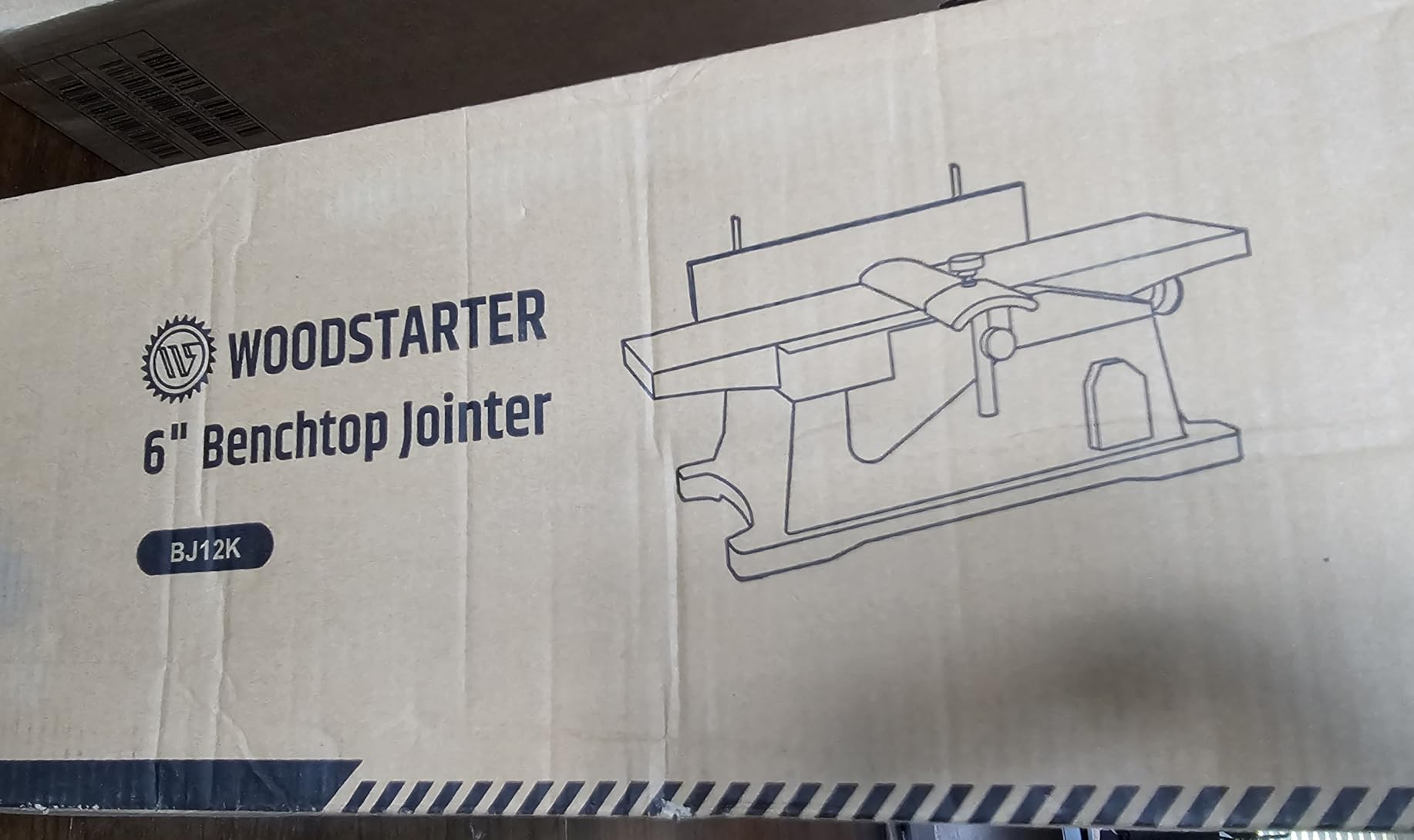
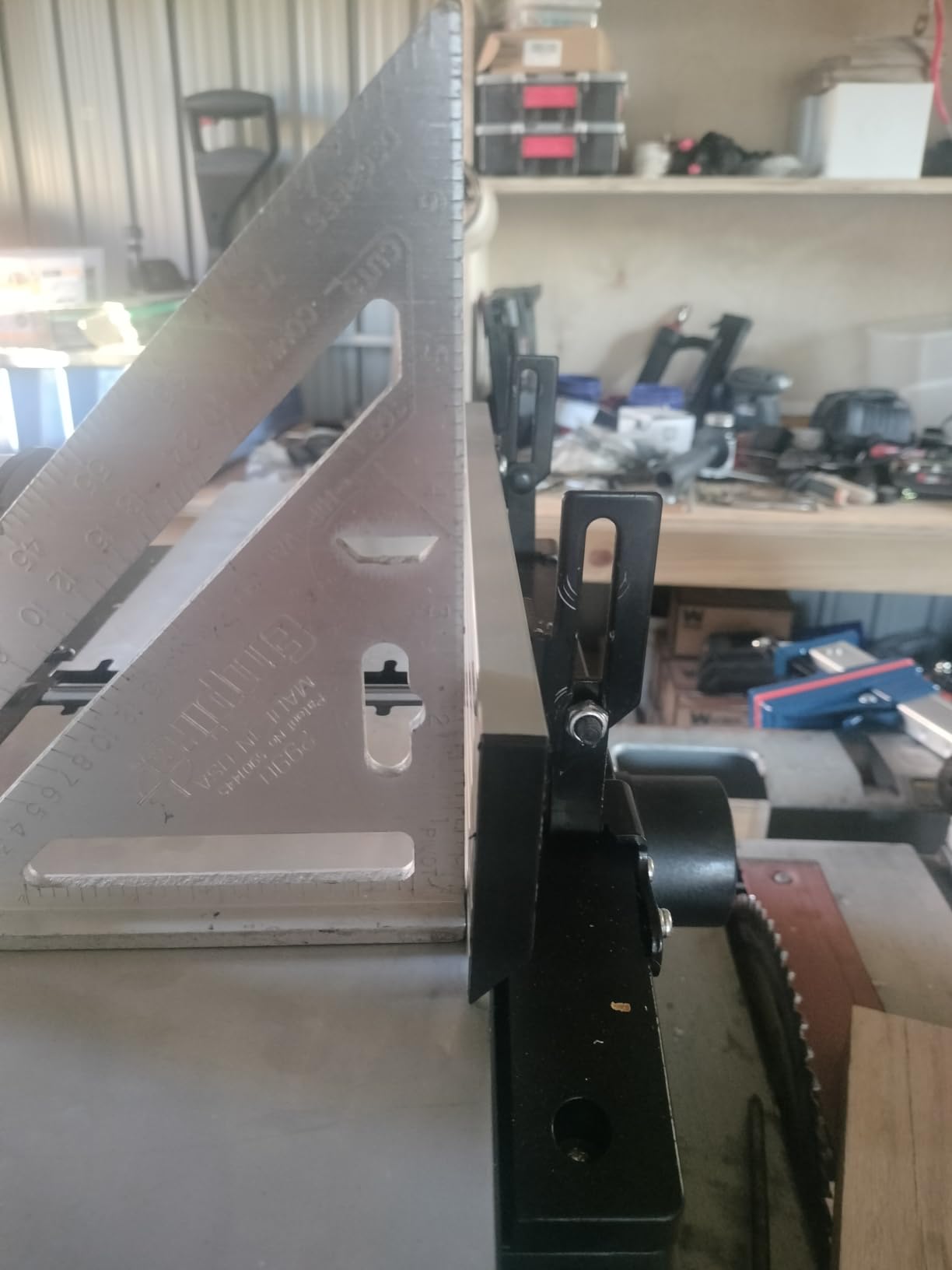
What you give up is rigidity. The nylon and aluminum construction gives it a light-duty feel next to the cast iron machines, and the fence is short, which limits support for taller workpieces. Several owners add their own support material to the fence to get useful results on wide material. The one-year manufacturer warranty is the shortest in the roundup.
Who this jointer suits
It suits a first-time buyer who wants to learn jointing on a machine that will not eat a small shop, and it suits anyone who needs to flatten short pieces in a place where a 70-pound machine is impossible.
A 6-inch width with dual HSS knives is plenty for trim, shelving, small boxes and general shop lumber.
Who should skip it
Skip it if you plan to build furniture with wide panels or heavy solid wood, where fence rigidity matters. Skip it if the machine will live in a space where it gets moved constantly, since the light construction translates into more movement during a cut than the heavier machines here.
10. VEVOR 6-Inch Benchtop Jointer with 2 HP Motor
VEVOR Benchtop Jointer, 6 in, 2 HP 12000 RPM Bench Top Wood Jointer, with Straight Cutterhead, 2 HSS Blades, 6 x 23 in Cast Aluminum Table, Up to 1/8 in Depth, Adjustable Fence, for Woodworking DIY
6 inch width
2 HP motor at up to 12000 RPM
2-blade HSS cutterhead
6 x 23 inch cast aluminum table
Pros
- 2 HP of motor power in a 21.2 pound body
- Easy to assemble and quiet in operation
- Compact footprint suits a small studio
- Straight cutterhead is simple to maintain
Cons
- Cutting guard contacts the blades and several owners removed it
- Plastic body with a flimsy fence that will not take 2x6 lumber
- Fence needed modification out of the box
- Owner rating ties the lowest in this group at 4 stars
We include this one because the motor is genuinely interesting, not because we recommend it blindly. A 2 HP motor running at up to 12,000 RPM in a 21.2 pound body is a lot of pulling power for a compact machine, and owners acknowledge that it handles softwood and hardwood consistently. Assembly is easy and the running noise is low.
The 6 by 23 inch cast aluminum table is small enough for a studio, depth and angle adjust from 0 to 1/8 inch, and a dust port connects to a vacuum. The straight two-blade HSS cutterhead keeps maintenance simple, the same trade the WEN JT3062 makes with a 2-blade head.
Here is the problem. The cutting guard supplied with the machine contacts the blades, and several owners removed or modified it rather than run the machine with an interference of that kind. Owners also describe the plastic body and aluminum fence as flimsy, note that the fence will not support 2×6 lumber, and report needing to modify the fence mounting out of the box. That is a guard-safety complaint on a machine that cuts with your hands an inch from the blades, and we will not gloss over it.
Who this jointer suits
It suits a hobbyist in a very small space who wants to practise jointing short, narrow pieces and does not need wide capability. If you can resolve the guard clearance and beef up the fence with your own material, the motor will keep up with light work.
Dust connection to a vacuum keeps chip volume manageable in a small room.
Who should skip it
Skip it if you cut structural lumber or anything wider than the fence can support. Skip it if you are not comfortable with a machine that arrives needing guard clearance verified and a fence modified before you trust it with production work.
For the same money class, the WEN JT630H has a spiral head, a far larger owner record and no guard interference complaints in the feedback we reviewed.
What Size Jointer Do You Need: 6 Inch or 8 Inch?
Buy the width of the widest board you plan to joint in a single pass, and subtract nothing for optimism. A 6-inch jointer handles boards up to 6 inches wide, which covers standard dimensional lumber up to a nominal 2×8 once you account for actual sizing. An 8-inch jointer takes wider boards in one pass, which matters for tabletops, panels and slabs.
The practical difference is not just width. A wider machine usually carries a longer table and a taller, more rigid fence, and that means a longer piece stays flat through the cut instead of rocking at the ends. In this roundup the 6-inch class runs from a 21-pound portable machine to a 76-pound cast iron midi-bench, while the 8-inch class gives you extendable arms or cast iron tables. If you mostly work with 2x4s and 2x6s, 6 inches is enough. If you build furniture tops or wide panels, step up.
Straight vs Spiral vs Helical Cutterheads
Spiral and helical heads are the same family: cutting edges set in staggered rows around a cylinder, each row offset from the last so the edges shear the fiber rather than chop straight down into it. Straight knife heads put two or three full-width blades on a plain cylinder. Spiral heads cut cleaner and quieter, and they leave a surface with less tearout on figured wood.
The cost difference shows up in two places. First, the head itself: a 16-blade spiral head is the single most expensive part of the machine. Second, the maintenance: straight knives need sharpening on a schedule you set, while carbide spiral inserts are rotated to a fresh corner in under a minute. Long-term owners in forum threads describe the change from straight knives as the upgrade they never regretted.
There is a middle option, the spiral cutterhead, which offers the staggered cutting geometry without carbide inserts. Several machines here use it, and it is why the WEN JT630H can produce a tearout-free surface on maple and oak while staying inside a tight ceiling.
Jointer vs Planer vs Jointer-Planer Combo Under a Thousand Dollars
Buy a jointer first if you work with rough or reclaimed lumber, because nothing downstream goes right until a board is flat and square. Buy a planer first if you buy pre-milled four-square lumber and only want consistent thickness. A jointer-planer combo saves floor space but splits the motor and shortens the tables, and under this ceiling the compromises are noticeable.
The order of operations never changes: joint one face and one edge first, then plane to final thickness. Jointing after planing wastes effort because the board moves when it is thinned. If you already own a thickness planer, the jointer is the half of the workflow that finishes the job, and that is also the part a drum sander cannot do for you.
What a Thousand-Dollar Budget Gets You, and What It Does Not
This budget buys a real spiral or spiral-style cutterhead on most machines, a decent fence you will need to square, tables that range from Teflon-coated aluminum to heavy cast iron, and enough motor to flatten hardwood up to an inch thick in a single pass. That is genuine capability, and it is more than most people expect from a benchtop machine.
What it does not buy is a long bed. Plan on material roughly 4 to 8 feet long depending on the machine, and add roller stands or outriggers for anything longer. It does not buy a stiff, ratcheting fence on most of the machines here, which means setup discipline is part of the purchase. And it does not buy the quiet of a helical-head floor stander running at lower loaded RPM. If you need a 10-inch bed for production glue-ups, this class is the wrong place to shop.
Dust Collection, Setup and Safety Under This Budget
Every machine here needs a vacuum, and port sizes are not standardised. The WEN JT630H and JT3062 use 2-1/2 inch ports that need an adapter for many hoses, the JT833H accepts both 2-1/2 and 4 inch, and the Delta uses a built-in blower with a small chute. Check your hose diameter before you buy, because a mismatched port costs an afternoon of adapter hunting.
Budget twenty minutes for first-cut setup. Level the machine on its own surface, check the tables with a straightedge for coplanarity, square the fence with a machinist square, verify the knives clear the guards, and set a shallow depth of cut. A magnetic straightedge on the tables and a feeler gauge under the fence cover the two things that ruin squareness.
Safety rules are non-negotiable at this level. Use the push blocks, keep hearing and eye protection on, and never adjust depth of cut while the machine is running. Check reclaimed pallet wood and demolition lumber for hidden nails and staples before it goes near a cutterhead, because a nail in a slow-speed benchtop head is an expensive lesson.
Frequently Asked Questions
What is the best jointer for the money?
The WEN JT630H is the best jointer for the money in this class because it pairs a 12-blade spiral cutterhead with a 4.6 star owner rating across more than a thousand reviews. It handles hardwood cleanly, weighs 36.8 pounds so it can be moved easily, and leaves room in the budget for dust collection. The Craftsman CMEW020 is the alternative if you want adjustable speed.
Is it worth it to buy a jointer?
A jointer is worth buying if you work with rough, warped or reclaimed lumber or if you glue up edge-to-edge panels, because it fixes warped boards that no other machine can. It is not worth buying if you only use pre-milled four-square lumber or if your projects are small enough for hand planes. Many furniture hobbyists buy a planer first and add a jointer later.
Which should I buy first, a jointer or a planer?
Buy a jointer first if you start with rough lumber, because a flat square face is the foundation every later cut depends on. Buy a planer first if you buy pre-milled lumber and only want consistent thickness. When you own both, always joint one face and one edge before planing to final thickness, since planing first moves the board and wastes jointing work.
Which type of cutterhead is better, helical or spiral?
Both cut with staggered edges rather than chopping straight down, which reduces tearout and noise compared with straight knives. Helical heads add more rows of edges for a quieter cut and higher cuts per minute, while spiral heads use fewer rows and cost less. For a fixed budget under a thousand dollars, a spiral head with carbide inserts gives most of the finish quality at a lower price.
Why are wood jointers so expensive?
A jointer is expensive because of what has to be machined: a heavy cast iron table, a fence that stays square, a cutterhead that runs true at speed and a motor that does not stall. Below a thousand dollars you get a short benchtop or midi-bench body rather than a long floor stander, which is exactly where the capability gap between price tiers comes from. Cast iron, a parallelogram lift and a long bed are the three costs a low budget cannot absorb.
Our Verdict on the Best Jointers Under a Thousand Dollars in 2026
The WEN JT630H is the pick: a spiral cutterhead, a portable 36.8 pound body, and the deepest owner record of any machine we reviewed. If your boards are 8 inches wide, the WEN JT833H gives you the cutting width with extendable support. If you want cast iron tables and a braced fence and can live with a loud motor, the Cutech 40180HI is the most complete machine in this class.
Whichever one you pick, spend your first afternoon on setup, not cutting. Level it, square the fence, check the guard clearances and connect a vacuum, and the machine will reward you for years. Our other under-a-thousand-dollar guides, including our tested grill picks and our espresso machine roundup, follow the same rule: the gear in this bracket is good, but only after you set it up properly.