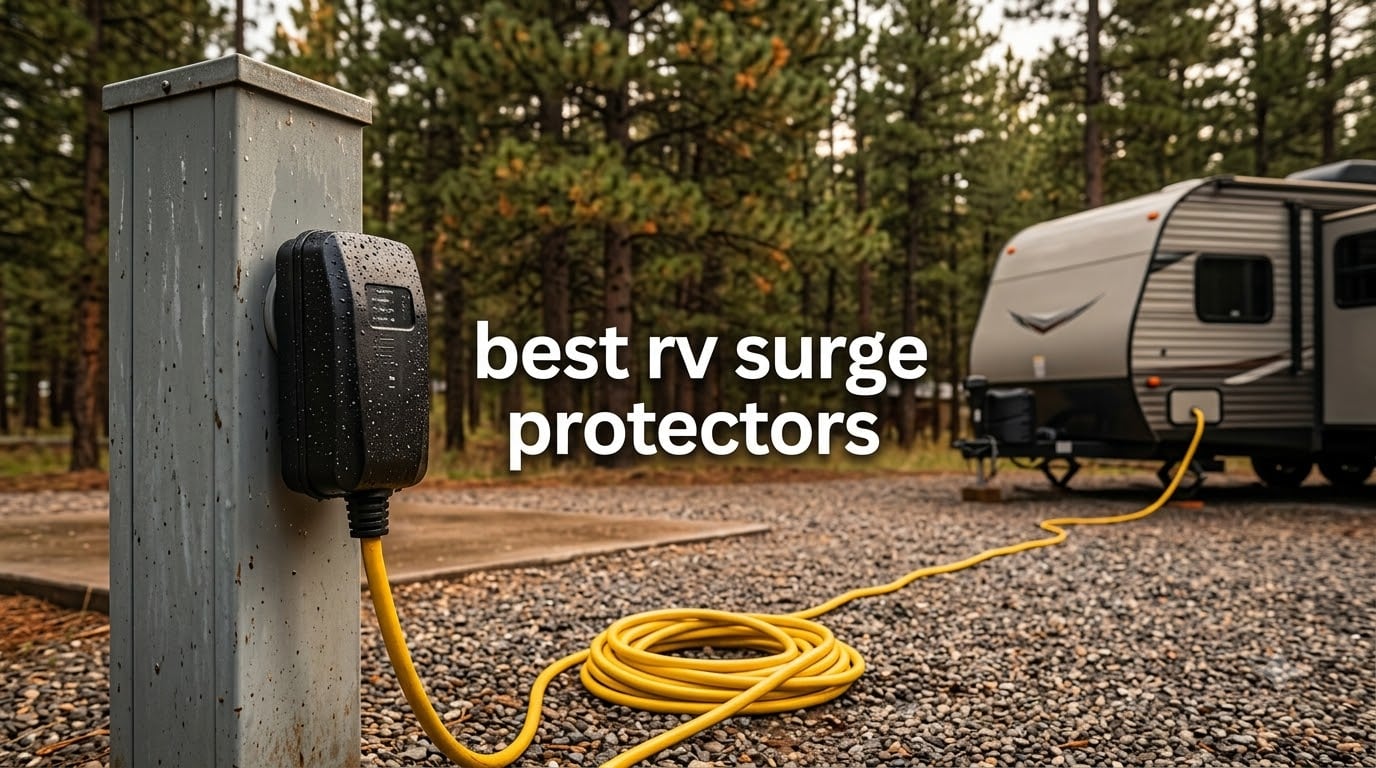
An RV surge protector plugs between the campground pedestal and your shore power cord to absorb voltage spikes and flag bad wiring. A plain protector warns you; an electrical management system (EMS) cuts power off. For most RVers the better buy is an EMS, and the Progressive Industries SSP-30XL is the one we recommend first. We spent weeks comparing eight units across amperage, joule rating, monitoring and failure behaviour.
Most people searching for the best RV surge protectors do not know there are two product categories, and that gap causes a lot of wasted money. An entry-level diagnostic protector tells you the pedestal is miswired. An EMS tells you the same thing and then removes the power before an expensive air conditioner compressor cooks itself. We explain the split in detail below.
Our team also spends a lot of time on smaller rigs, like the best induction cooktops for RV we recommend, and the same question comes up every time: what else on this list is actually protecting the money you put into the build?
Table of Contents
- Top 3 Picks for RV Surge Protectors in 2026
- Best RV Surge Protectors (October 2026)
- Surge Protector vs EMS: What Each One Actually Does
- 1. Progressive Industries SSP-30XL: Best RV Surge Protector Overall for 30 Amp Rigs
- 2. Power Watchdog PWD30EPO: Best 30 Amp EMS With App Monitoring
- 3. Power Watchdog PWD50EPOH: Best 50 Amp Hardwired Protector for Motorhomes
- 4. Southwire Surge Guard 44280: Best Value 30 Amp Protector
- 5. CARMTEK 30 Amp Circuit Analyzer: Best for Travel Trailers and Pop-Ups
- 6. MILLIONHOME 50 Amp Protector: Best Budget 50 Amp Option
- 7. GEARGO 30 Amp IP68 Protector: Best for Heavy Rain and Coastal Sites
- 8. Southwire Surge Guard 44290: Best 50 Amp Diagnostic Protector
- Will a 50 Amp Surge Protector Work on a 30 Amp Camper?
- How Many Joules Does an RV Surge Protector Need?
- What to Look for When Buying an RV Surge Protector
- Frequently Asked Questions
- The Verdict on the Best RV Surge Protectors in 2026
Top 3 Picks for RV Surge Protectors in 2026

Progressive SSP-30XL
- 30 amp and 120V
- 825 joules
- fault detection with LED readout
- lifetime warranty
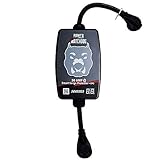
Power Watchdog PWD30EPO
- 3000 joules
- Bluetooth app monitoring
- automatic power-off
- replaceable surge module

Power Watchdog PWD50EPOH
- 50 amp and 240V hardwired
- 6100 joules
- Bluetooth monitoring
- theft-proof install
Best RV Surge Protectors (October 2026)
| Product | Specs | Action |
|---|---|---|
| Progressive Industries SSP-30XL |
|
Check Latest Price |
| Power Watchdog PWD30EPO |
|
Check Latest Price |
| Power Watchdog PWD50EPOH |
|
Check Latest Price |
 Southwire Surge Guard 44280 Southwire Surge Guard 44280 |
|
Check Latest Price |
 CARMTEK 30 Amp Circuit Analyzer CARMTEK 30 Amp Circuit Analyzer |
|
Check Latest Price |
 MILLIONHOME 50 Amp Protector MILLIONHOME 50 Amp Protector |
|
Check Latest Price |
 GEARGO 30 Amp IP68 Protector GEARGO 30 Amp IP68 Protector |
|
Check Latest Price |
 Southwire Surge Guard 44290 Southwire Surge Guard 44290 |
|
Check Latest Price |
Surge Protector vs EMS: What Each One Actually Does
A surge protector absorbs a spike and shows you which fault it detected. An EMS measures the incoming supply first and disconnects everything when the readings fall outside a safe band, typically 102V to 132V on 120V service. That single difference is the whole argument.
Surge-only units are passive devices. They divert a voltage transient to ground and keep running, which means a steadily sagging pedestal or a miswired circuit still reaches your appliances. EMS units are active: they check voltage, polarity, grounding, frequency and amperage before power flows, and they cut off on a delay so your compressor does not restart into a brownout.
Members on r/GoRVing and r/RVLiving are blunt about this. The recurring advice is that an EMS is meaningfully better protection than a plain protector, and one commenter put it plainly: the EMS has saved their rig more than once. On the Good Sam Community forum a member credits the Progressive Industries lifetime warranty with replacing or repairing their protector twice, which is the sort of service record a surge-only unit rarely offers.
The honest counterpoint: if you camp ten nights a year at resorts you trust, a smart surge protector with LED diagnostics is enough. If you full-time it, run boondock or boondock-adjacent sites, or own a coach with an expensive A/C and residential appliances, spend the extra and get an EMS.
1. Progressive Industries SSP-30XL: Best RV Surge Protector Overall for 30 Amp Rigs
Progressive Industries SSP-30XL Portable RV Smart Surge Protector, Black, 30 Amp
30 amp and 120V
825 joules
3600 W capacity
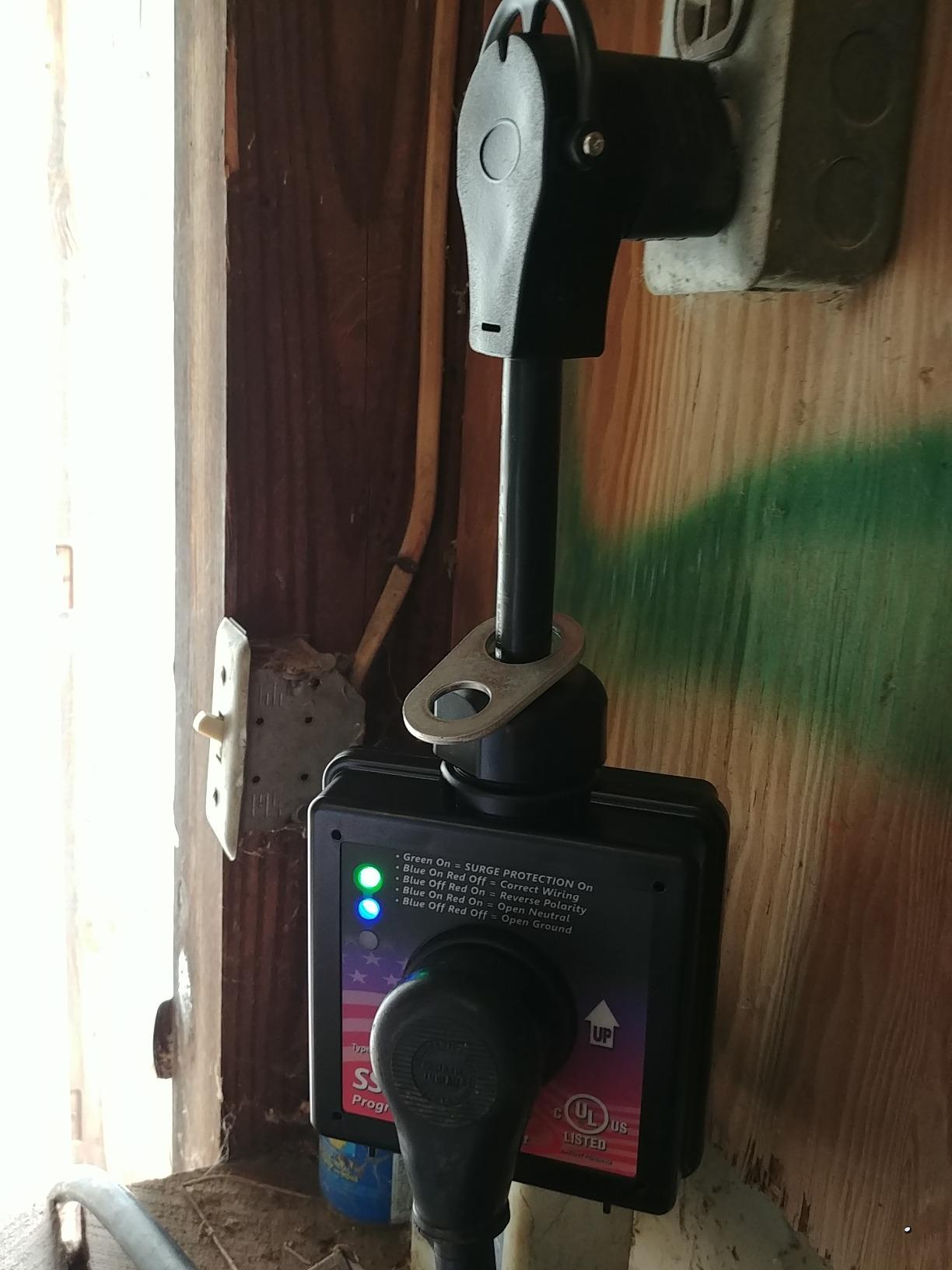
Fault detection with LED readout
Lifetime warranty
Pros
- Widely trusted name with lifetime warranty
- LED fault indicators read clearly at night
- Weather shield assembly keeps the connection dry
- Locking security ring deters theft
Cons
- Bulky at 2 pounds and 14 inches long
- Weather shield needs a small Phillips screwdriver to assemble
- Occasional reports of water intrusion on older units
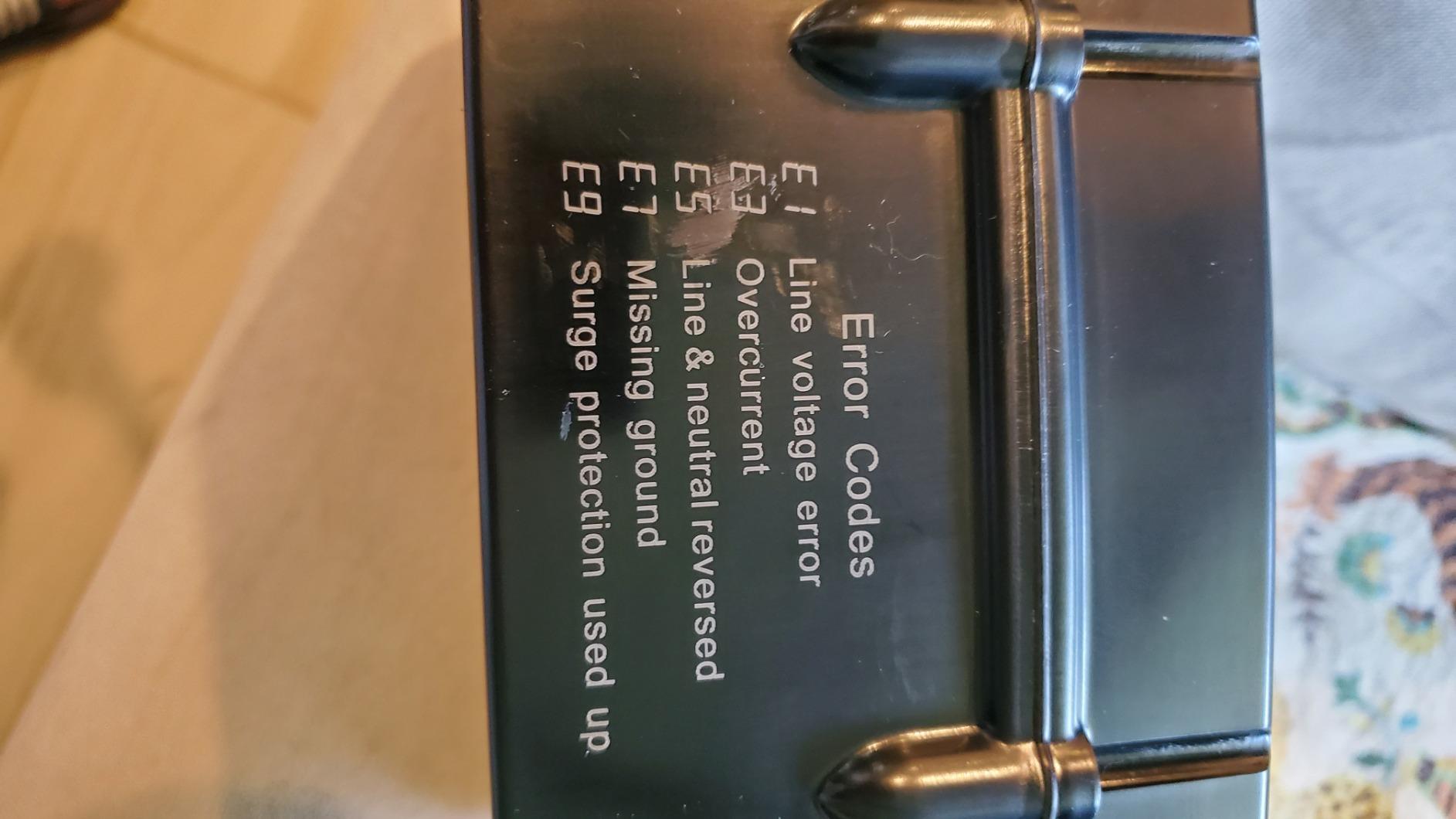
This is the unit we keep coming back to. Across thousands of reviews the pattern is remarkably consistent: it does exactly one job, it does it for years, and it has prevented real damage from both spikes and faulty pedestals in very different climates. We like that the fault detection covers over and under voltage, open ground, open neutral, reverse polarity, surge failure and AC frequency problems rather than just the easy ones.
The 825-joule rating is the lowest in this group, and that is the honest trade. It sits at the low end of what forum members cite for 30 amp service, so a big direct strike burns through the budget permanently. If you camp in open country with frequent lightning, look at one of the higher-joule units instead.
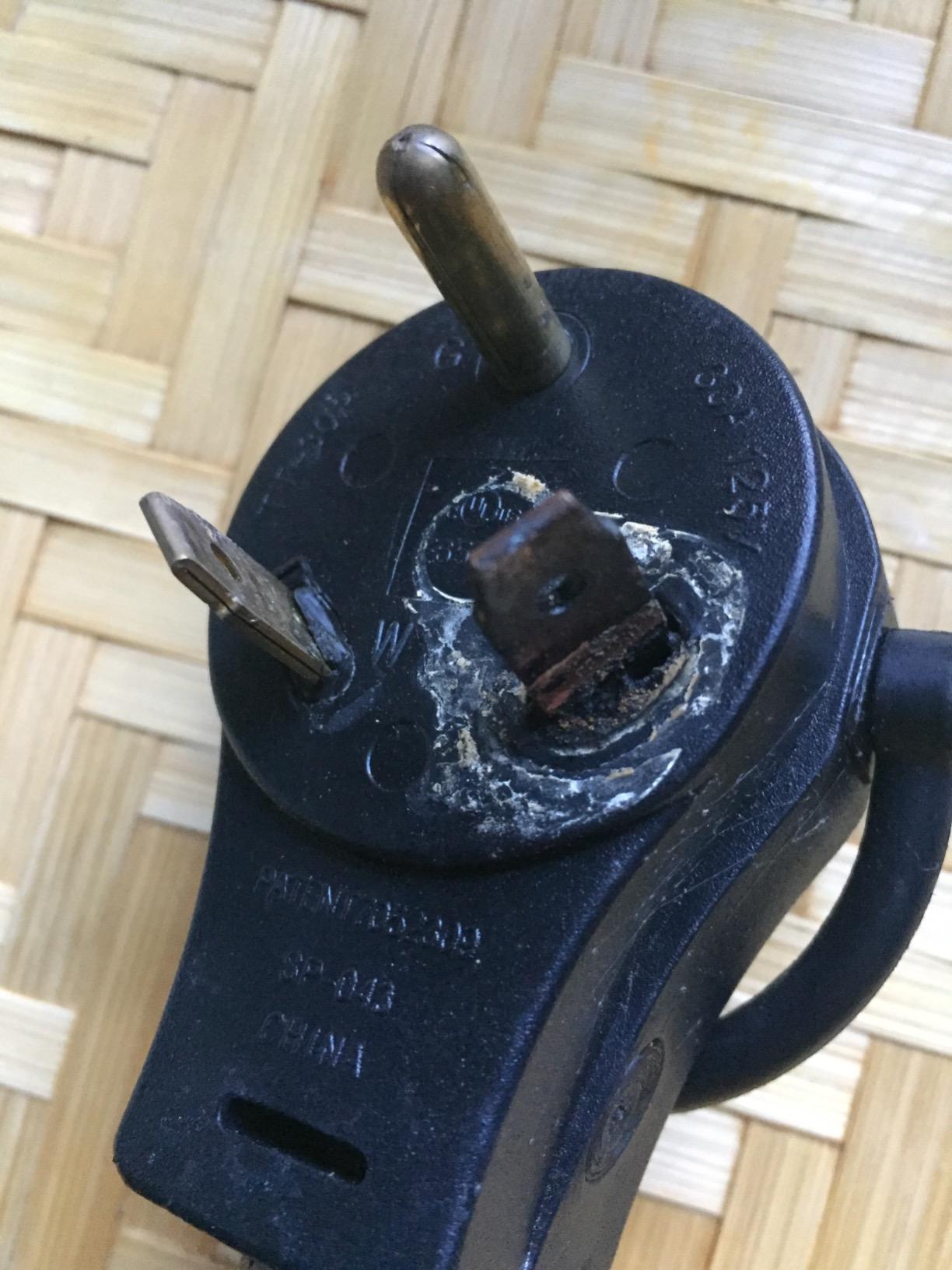
Build quality is the story here. The housing is Lexan with an all-weather shield assembly and thermal protection, and the LED indicators stay visible in low light, which matters at nine at night in a rainstorm. It is made in the USA and carries a lifetime warranty, though the weather shield itself is excluded.
Owners across the full-time and weekend crowd describe the same experience in different words: reliable suppression, an instantly readable hookup status, and a cover that keeps rain and dust out of the connection. The locking ring that lets you chain the unit to the pedestal is a small touch that thieves notice.
Why it suits most 30 amp campers
It fits a travel trailer or Class C with 30 amp service, and it needs no wiring, no app and no installation decision. Plug it into the pedestal, read the LEDs, plug the trailer in. For anyone who wants protection without a learning curve, this is the shortest path.
It also carries more review volume than anything else on this list, which matters for a device you trust with a refrigerator and a water heater. Community consensus repeatedly names Progressive Industries as the brand to buy, and the warranty service is real rather than aspirational.
Where it falls short
At 14 inches long and 2 pounds it is genuinely bulky, and it will not disappear into a small storage bay. The weather shield assembly also needs a small Phillips screwdriver to fit, which is mildly annoying when your hands are cold and wet.
If you need automatic disconnect, remote monitoring or a much deeper surge budget, this unit will not do it. It reports a fault and waits for you. That is fine for a careful owner and a poor fit for anyone who wants hands-off protection.
2. Power Watchdog PWD30EPO: Best 30 Amp EMS With App Monitoring
Power Watchdog PWD30EPO Smart RV Surge Protector, 30A, Bluetooth, IP65
30 amp and 120V
3000 joules
IP65 water resistant
Bluetooth app monitoring
Replaceable module
Pros
- Automatic power-off on bad pedestal power
- App shows voltage amps watts and kWh in real time
- Phone reset saves a walk to the pedestal in bad weather
- Replaceable surge module extends unit life
Cons
- Illuminated logo is bright at night and advertises your gear
- LEDs hard to read in direct sunlight
- Two similarly named vendor apps cause confusion
- No integrated connection cover
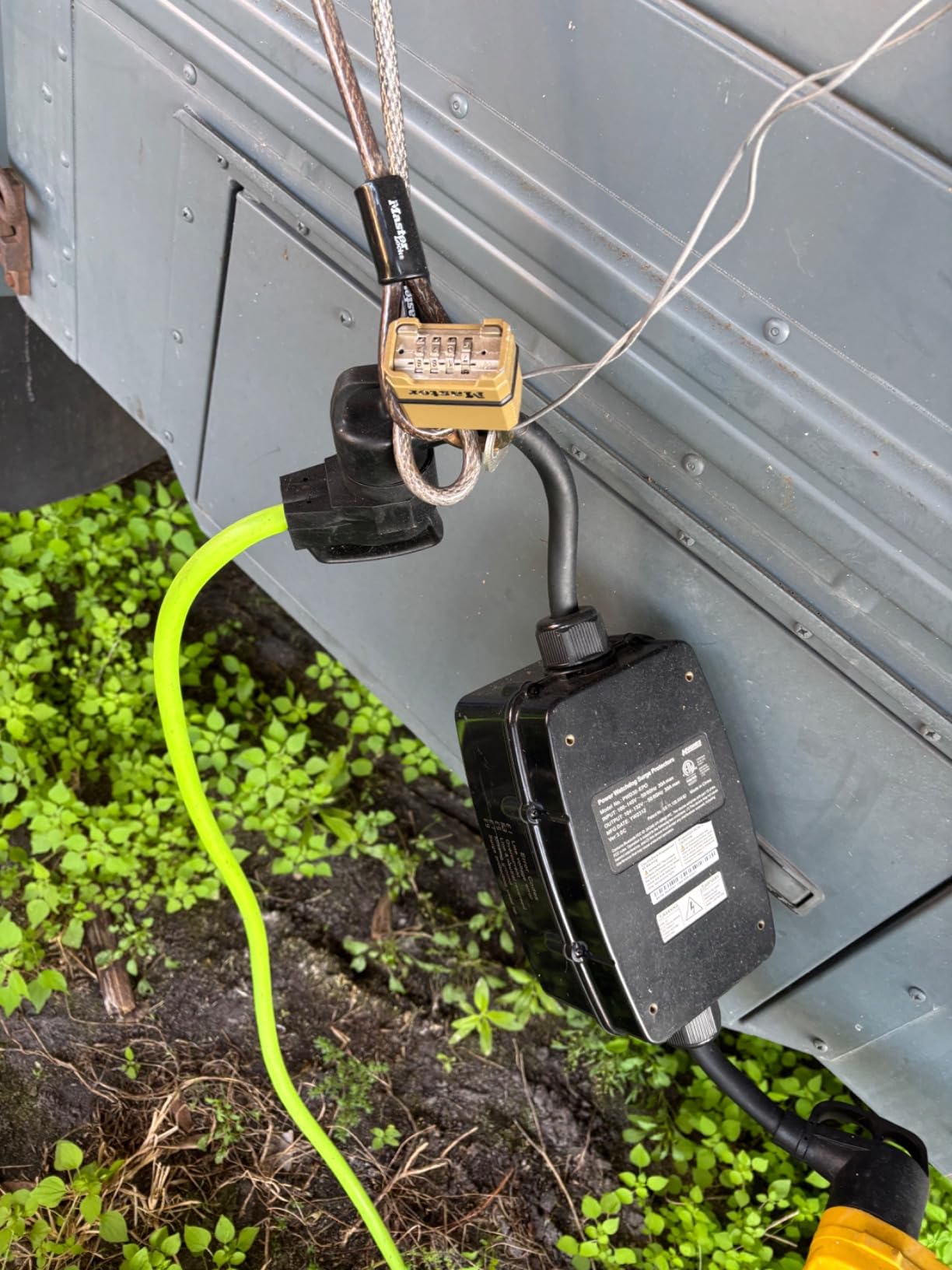
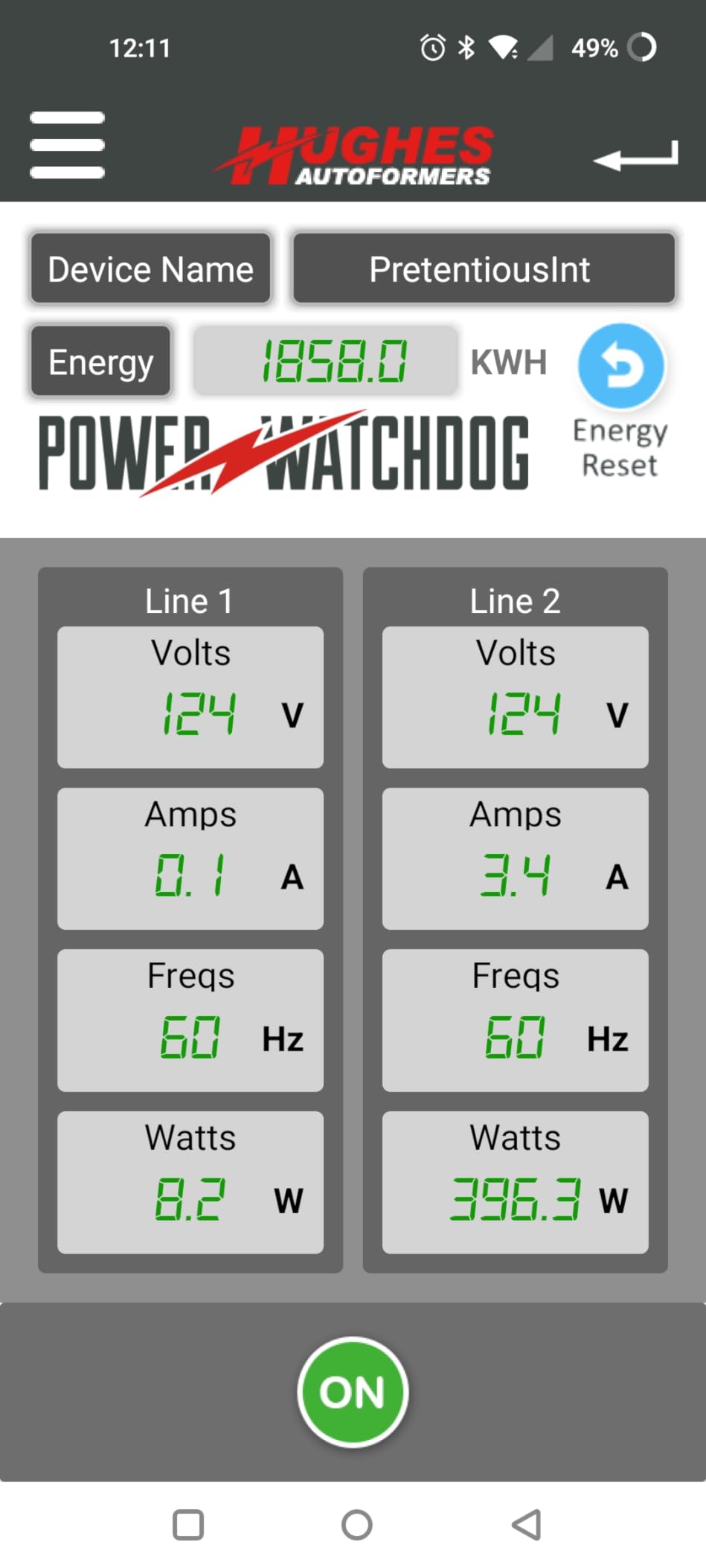
This is the unit we would buy for a 30 amp trailer if money were not the first consideration. It carries 3,000 joules, a full LED park power diagnostic set, and an app that reports voltage, amperage, wattage and kWh usage in real time. Wireless alerts cover open ground, open neutral, reverse polarity, open circuit and miss-wired pedestals.
The most useful thing owners do with it is treat it as a diagnostic instrument rather than a shield. Several reviews describe using the app to pinpoint a failing AC compressor, an undersized campground service wire or an overloaded circuit before damage occurred. That is a different level of insight than a row of LEDs.
Two design decisions stand out. The 90-second power-on delay after a fault clears protects the compressor from a hard restart, while initial plug-in only takes four seconds, so you are not waiting two minutes in the rain. And the surge module is replaceable, so a big strike does not mean buying the whole unit again.
It is rated IP65 for water resistance, weighs 5 pounds, and includes a metal locking plate. The three-year manufacturer warranty is shorter than Progressive’s lifetime coverage, which is worth weighing against how much you camp.
Why it suits nervous full-timers
If you want the protection to act without you, this is the answer for 30 amp service. It disconnects on unsafe readings and then tells your phone why. That combination is what makes the price jump from the diagnostic tier to the protection tier.
The app reset is the sleeper feature. In heavy rain or a cold snap, resetting from the couch beats walking out to the pedestal with a flashlight, and owners mention it constantly in reviews.
Where it falls short
The illuminated dog-face logo is bright at night, which is the single most repeated complaint, and it also advertises your gear to anyone walking the row. The status LEDs are also hard to read in direct daylight, the opposite problem.
There are two similarly named vendor apps and picking the wrong one is a common trip-up. You also buy the 30 amp cable and plug separately, and there is no integrated connection cover, so a waterproof coupling box is a sensible add-on.
3. Power Watchdog PWD50EPOH: Best 50 Amp Hardwired Protector for Motorhomes
Power Watchdog PWD50EPOH 50A Hardwired Surge Protector, EPO, Bluetooth
50 amp and 240V
6100 joules
Hardwired inside the coach
Bluetooth monitoring
Pros
- Hardwired inside the coach so it cannot be stolen or rained on
- Reported as an easy least-invasive install
- App shows amperage on both legs of a 50 amp coach
- Free replacement sent after a lightning strike
Cons
- Some orders arrived as the plug-in variant instead
- Voltage reading reported several volts low versus an external meter
- App shows error codes rather than plain-language explanations
- May conflict with a Victron MultiPlus-II inverter startup
This is the only hardwired option in our group, and that changes the risk profile completely. Mounted inside the coach it cannot be stolen from the pedestal and it never sits in the rain, which removes the two failure modes that bother portable units most. It carries 6,100 joules on 240V service.
Bluetooth monitoring comes through the free mobile app, with an optional RVWhisper add-on for Wi-Fi or cellular remote monitoring. Fault alerts cover open ground, open neutral, reverse polarity, open circuit and miss-wiring, and the surge module is replaceable.
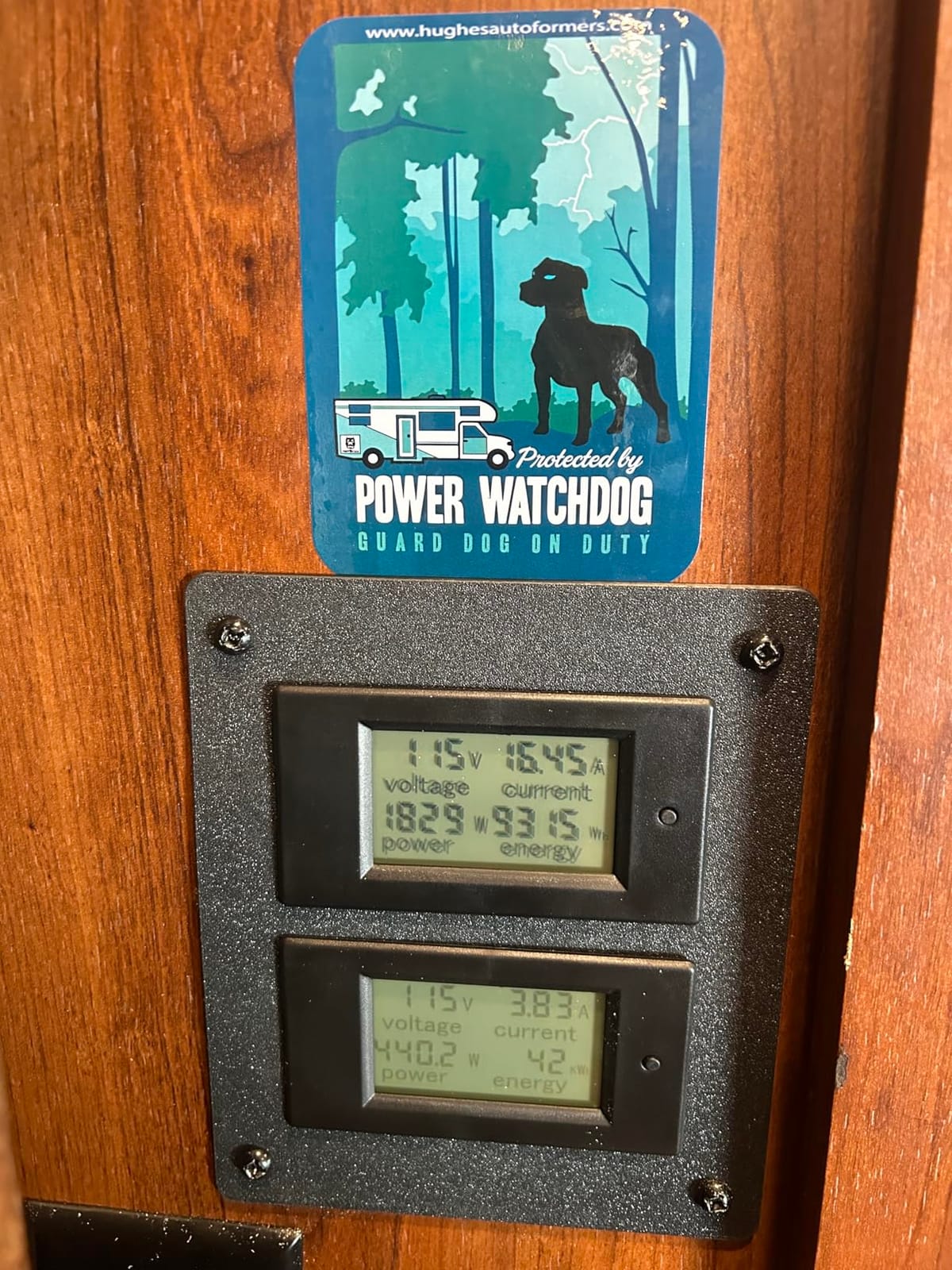
Owners report the install as less invasive than they expected, which is the usual fear with hardwired units. The app reads amperage on both legs of a 50 amp coach at the same time, and several people describe it tripping on genuinely bad campground power rather than nuisance faults. Support sent a free replacement after a lightning strike.
The unit measures 12 by 8 inches and carries a three-year manufacturer warranty. That is shorter than the lifetime warranty Progressive offers, and it is the main reason this unit sits below the SSP-30XL on our list despite the higher joule count.
Why it suits full-time motorhome owners
Hardwiring is the right call for a coach that lives at sites with unreliable pedestals, or for anyone who has had a portable protector stolen. There is also a locking tag option for securing the install.
At 6,100 joules it comfortably covers what forum members cite for 50 amp service. If you also run a large residential fridge, an inverter or both legs of power hard, the headroom matters.
Where it falls short
Some buyers received the plug-in version instead of the hardwired model, so check what actually arrives in the box before you plan the install. The IN and OUT orientation also changed between revisions and the documentation lagged behind, which caused real confusion.
Reviewers report the app voltage reading running several volts low against an external meter, so treat it as a trend indicator rather than a calibration tool. There is no bypass, no field calibration and no history log, and if you run a Victron MultiPlus-II, plan the inverter order carefully or expect startup conflict.
4. Southwire Surge Guard 44280: Best Value 30 Amp Protector
Southwire Surge Guard™ 30 Amp Portable RV Surge Protector with Enhanced Diagnostics, 2100 Joules, 44280
30 amp
2100 joules
Nylon housing
LED diagnostics
Anti-theft lock ring
Pros
- Bright sun-readable LED diagnostics in a mid-range build
- Compact and light at 1.5 pounds
- Thicker receptacle brass reduces heat build-up
- Anti-theft lock ring and limited lifetime warranty
Cons
- No Bluetooth or Wi-Fi monitoring
- Warns you but cannot cut power
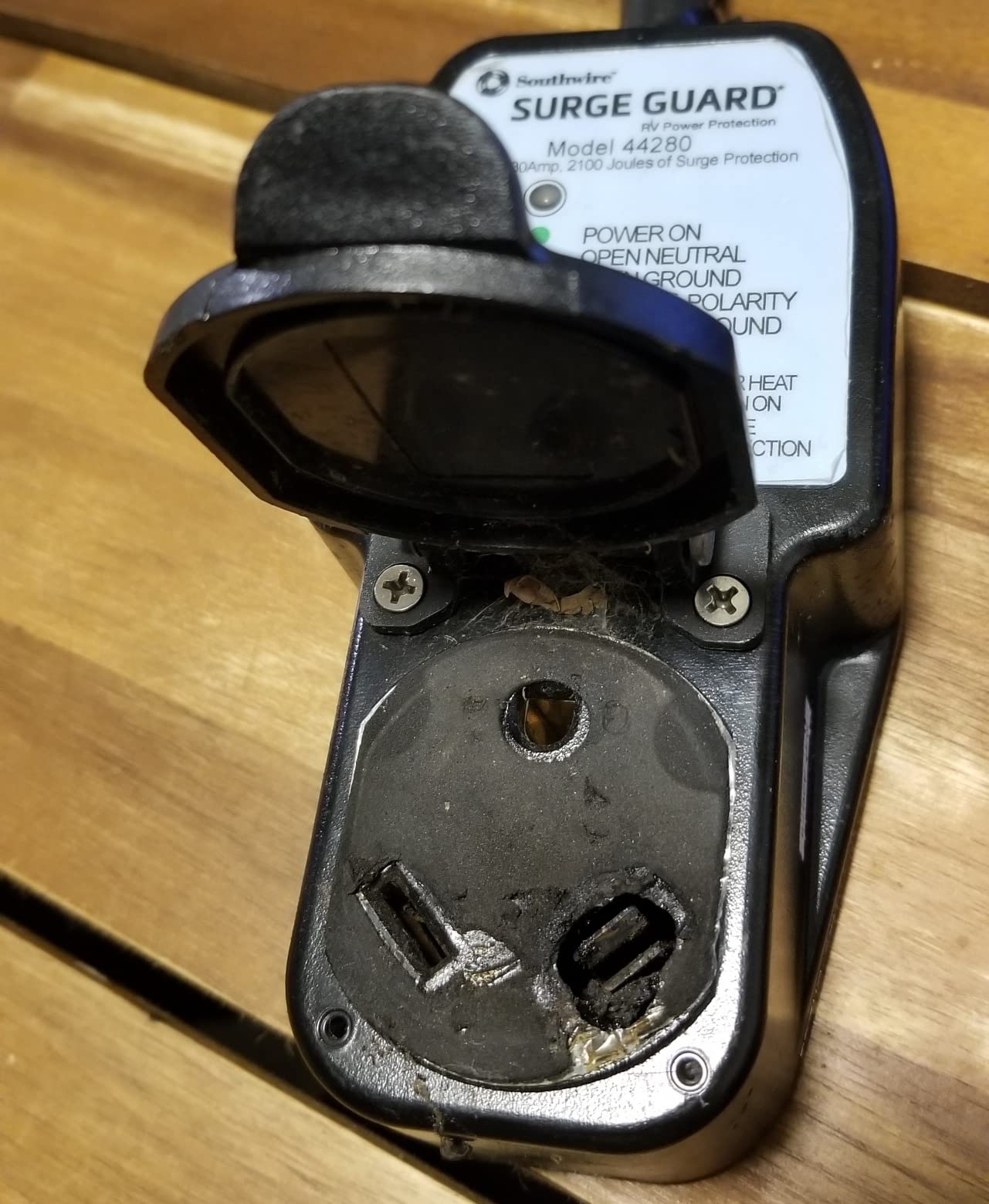
- Internal protection components may need replacing around the eight-year mark
This is the sensible middle of the market. At 2,100 joules it protects considerably more than the most basic units, and the LED diagnostics verify pedestal wiring before you plug the trailer in. Reviewers treat it as the value pick and describe it protecting rigs from storms and low-voltage campground events.
What makes it easier to live with than the cheapest options is the build. The nylon body has thicker receptacle brass to reduce heat at the connection, an Easy-T-Pull handle with an integrated receptacle, and an anti-theft lock ring on the cord. It weighs 1.5 pounds, so it stores anywhere in the trailer.
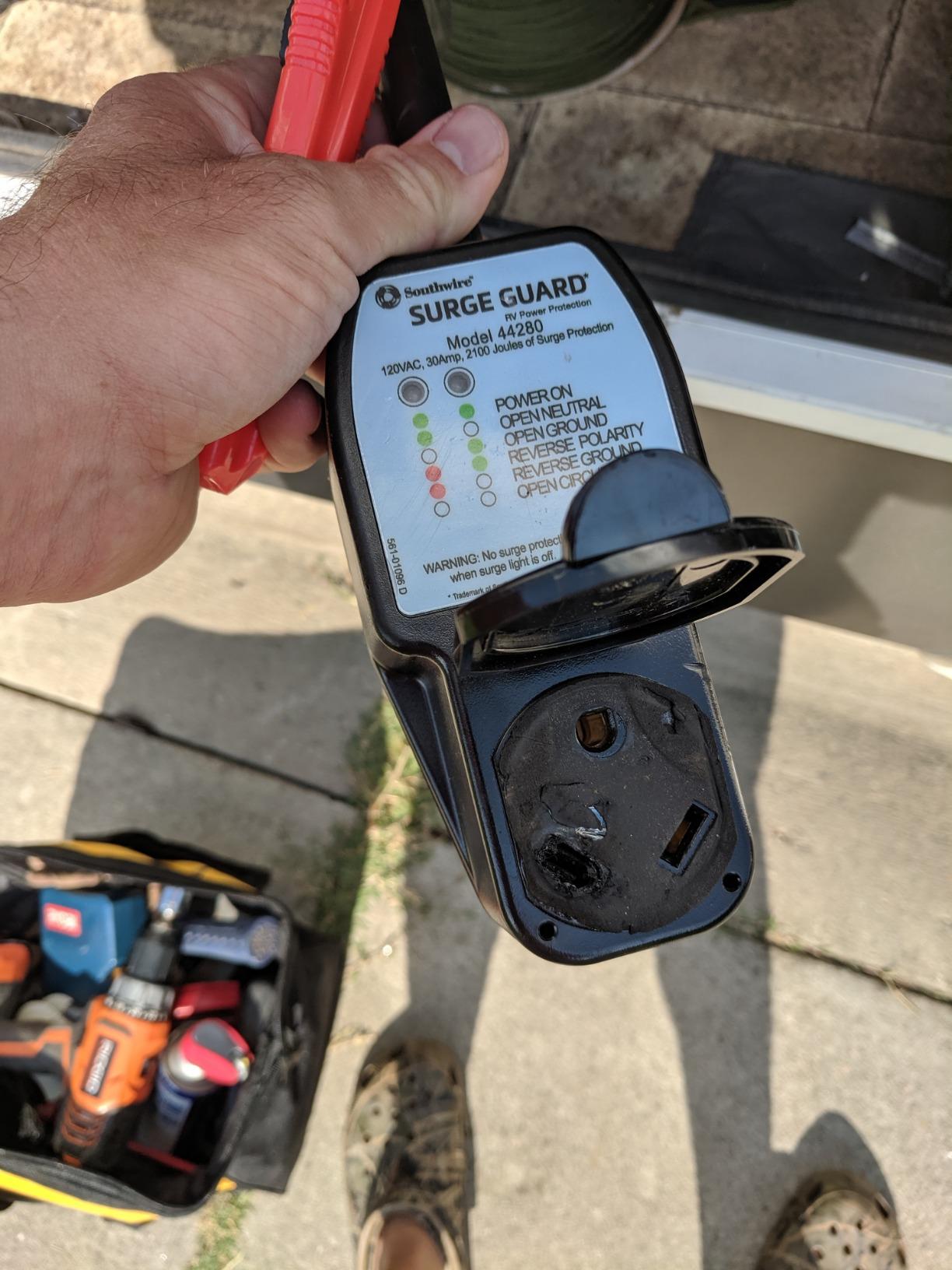
The display is bright and reads well in sunlight, which is where cheaper units fail. That single detail saves you a lot of squinting when you are deciding whether a pedestal is safe at four in the afternoon. The limited lifetime warranty is a genuine bonus at this tier.
One honest note from reviews: internal protection components degrade and may need replacing around the eight-year mark. That is a fair reminder that a surge protector is a consumable, not a permanent fixture.
Why it suits part-time campers
If you camp 20 to 40 nights a year at established campgrounds and want a real diagnostic readout without an app or an installation decision, this does the job at a fraction of the cost of a Bluetooth unit. It is also the unit we recommend to anyone who found the concept overwhelming.
The lock ring matters more than it sounds. A loose protector on a pedestal in a busy park is an easy target, and threading a cable through the ring removes the temptation.
Where it falls short
It warns rather than disconnects. If a pedestal drops to an unsafe voltage, you are the one who has to notice the light and go unplug, and that only works if you are awake and paying attention.
There is no Bluetooth, no app and no Wi-Fi, so you get no remote history and no phone alerts. If you full-time and want protection that acts on its own, move up a tier.
5. CARMTEK 30 Amp Circuit Analyzer: Best for Travel Trailers and Pop-Ups
CARMTEK RV Surge Protector 30 Amp – RV Circuit Analyzer with Integrated Smart 30 Amp Surge Voltage Protection with Grip Handles
2100 joules
30A 125V 3750W
NEMA TT-30P and TT-30R
Operating range -35C to 110C
Pros
- Circuit analyzer checks pedestal wiring before you connect
- Right-angle male connector and grip handles reduce cord strain
- Flame-retardant and thermally protected for outdoor use
- Lifetime warranty honored with a same-day replacement
Cons
- 30 amp plug can be hard to pull out even with the grip handle
- Can sit loose in the receptacle if bumped
- No theft-prevention clamp or lock ring included
This unit does one thing simply and correctly: it verifies pedestal wiring before you connect. The 30 amp circuit analyzer diagnostic chart covers correct wiring, open ground, open neutral, reverse polarity, hot and ground reversed, and no power. That is the complete pre-hookup checklist in a housing that costs very little.
The spec sheet is honest. It is rated 2100J at 30A, 125V and 3750W across 50 to 60Hz, uses NEMA TT-30P and TT-30R connections, meets UL specification, and works from minus 35C to plus 110C, which covers desert summers and hard winters.
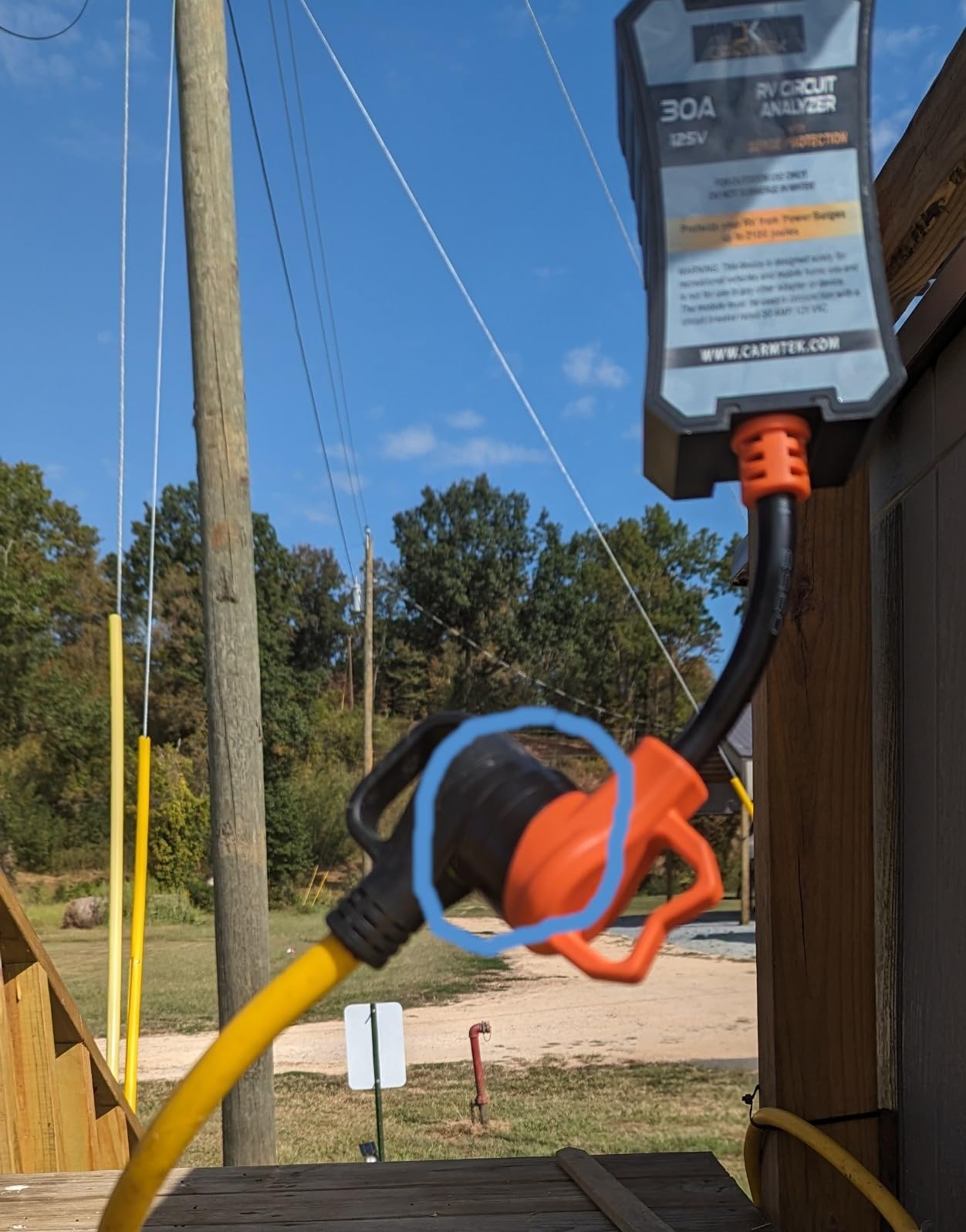
Construction is flame-retardant, weather resistant and thermally protected, and the ergonomic power grip handles plus right-angle male connector reduce bend stress on the cord. That right-angle plug is a real longevity feature on a cable that gets coiled and uncoiled constantly.
Owners like that a single fault chart sits next to the LEDs, and the company honored the lifetime warranty with a same-day replacement. One reviewer specifically pushes back on the idea that you need a much more expensive Bluetooth stabilizer, which is a fair point for a trailer used a few weeks a year.
Why it suits small rigs
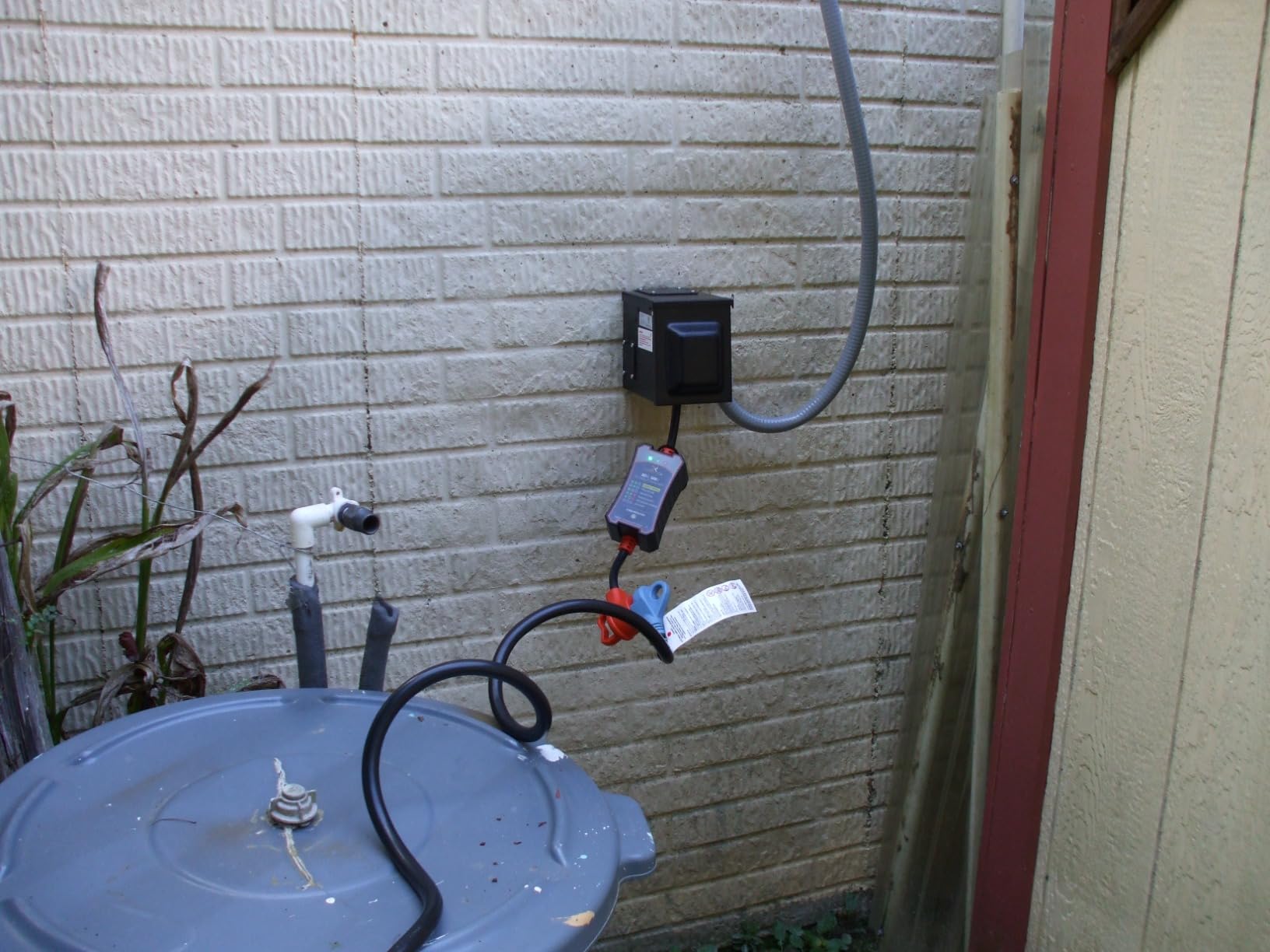
A pop-up or small travel trailer does not need app monitoring or a hardwired install. It needs to know the pedestal is wired correctly before an expensive refrigerator gets exposed to reversed polarity, and this is the cheapest reliable way to find that out.
The wide operating temperature range also makes it a better choice than most budget units if you camp in the desert southwest or well into the shoulder season.
Where it falls short
The mechanical negatives are the ones to weigh. Buyers report the 30 amp plug can be difficult to pull out of the protector even with the grip handle, and that it does not always sit snugly in the pedestal, so it can slip out if bumped.
Some buyers also report short prongs. There is no theft-prevention clamp or lock ring included, and no automatic disconnect or remote monitoring, so this is a diagnostic tool first and a surge absorber second.
6. MILLIONHOME 50 Amp Protector: Best Budget 50 Amp Option
MILLIONHOME RV Surge Protector 50 Amp, 𝟐𝟎𝟐𝟔 𝐍𝐞𝐰 𝐔𝐩𝐠𝐫𝐚𝐝𝐞𝐝 Voltage Protection RV Power Surge Protectors Waterproof, RV Adapter Plug for Camper, Circuit Analyzer for Travel Trailers
50 amp
Listed 18000 joules
Waterproof housing
Integrated circuit analyzer
Model DF-02
Pros
- Entry-level cost with a 50 amp rating
- Waterproof housing for exposed pedestals
- Heavier and more substantial build than the cheapest units
- Readable display with clear all-clear status lights
Cons
- Warns rather than cutting power on a fault
- Entry-level diagnostics with no app or Wi-Fi
- Listed joule rating runs above what one reviewer measured
- No theft-deterrent hardware
Most 50 amp shoppers assume they have to spend premium money, and this is the counterexample. It is a 50 amp unit with a waterproof housing, flame-retardant materials and an integrated circuit analyzer that verifies pedestal wiring before hookup. It weighs 1.5 pounds and needs no installation at all.
The listing claims a protection level of 18,000 joules, which is far above what forum members cite for 50 amp service. That is worth taking with a pinch of caution: one reviewer measured 12,000 joules, so the real capacity sits between the two figures and the marketing number is the optimistic one.
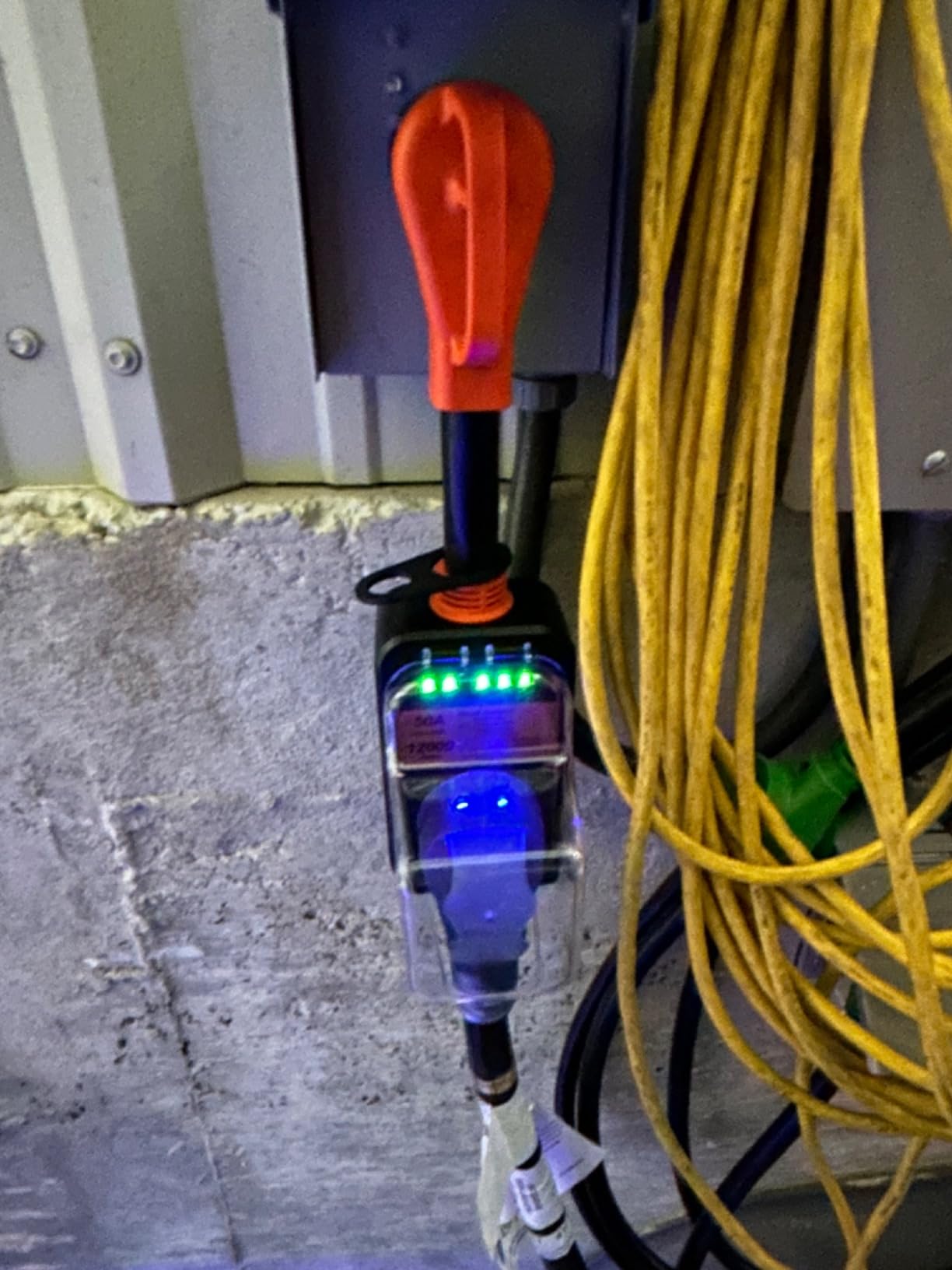
Owners consistently describe the build as heavier and more substantial than the very cheapest protectors, which is reassuring given how much of the budget tier is thin plastic. The waterproof housing is rated against rain, wind and sandstorms, and the display and status lights are easy to read at a glance.
Verification matters here. Buyers checked it against known wall outlets and report it correctly indicates wiring conditions, which is the one thing you cannot test by reading the marketing copy. Support is available 24 hours a day.
Why it suits 50 amp owners on a budget
If you have a 50 amp motorhome or a travel trailer being run with a dogbone adapter and you want real surge protection plus a wiring check, this fills the gap between a bare adapter and a full EMS. It is also a sensible backup unit to keep in the storage bay.
You get entry-level diagnostics, which in practice means knowing your pedestal is wired properly before you connect. That alone removes the single most common cause of RV electrical damage.
Where it falls short
It has no automatic disconnect. It warns and displays, and you still have to go out and unplug it yourself if the reading is bad. Entry-level diagnostics also means no app, no remote monitoring and no history.
There is no theft-deterrent hardware, so leave it in the RV rather than on the pedestal overnight. And because the listed joule figure is disputed by at least one reviewer, do not treat the headline number as measured fact.
7. GEARGO 30 Amp IP68 Protector: Best for Heavy Rain and Coastal Sites
GEARGO RV Surge Protectors 30 Amp RV Circuit Analyzer, [𝟐𝟎𝟐𝟔 𝐍𝐞𝐰 𝐔𝐩𝐠𝐫𝐚𝐝𝐞𝐝 & 𝐆𝐞𝐧𝟐] Full Protection, RV Adapter Plug for Camper(Orange)
30 amp
8000 joules listed
IP68 waterproof cover
FCC tested
V-1 flame-retardant materials
Pros
- IP68 waterproof cover is the most weather-sealed design here
- Circuit analyzer verifies pedestal wiring before connection
- Ergonomic grip handles and right-angle male connector
- Three-year warranty with 30 amp and 50 amp variants
Cons
- Listing quotes inconsistent surge ratings between 8000 J and 1200 J
- No Bluetooth or Wi-Fi monitoring
- No automatic disconnect on a fault
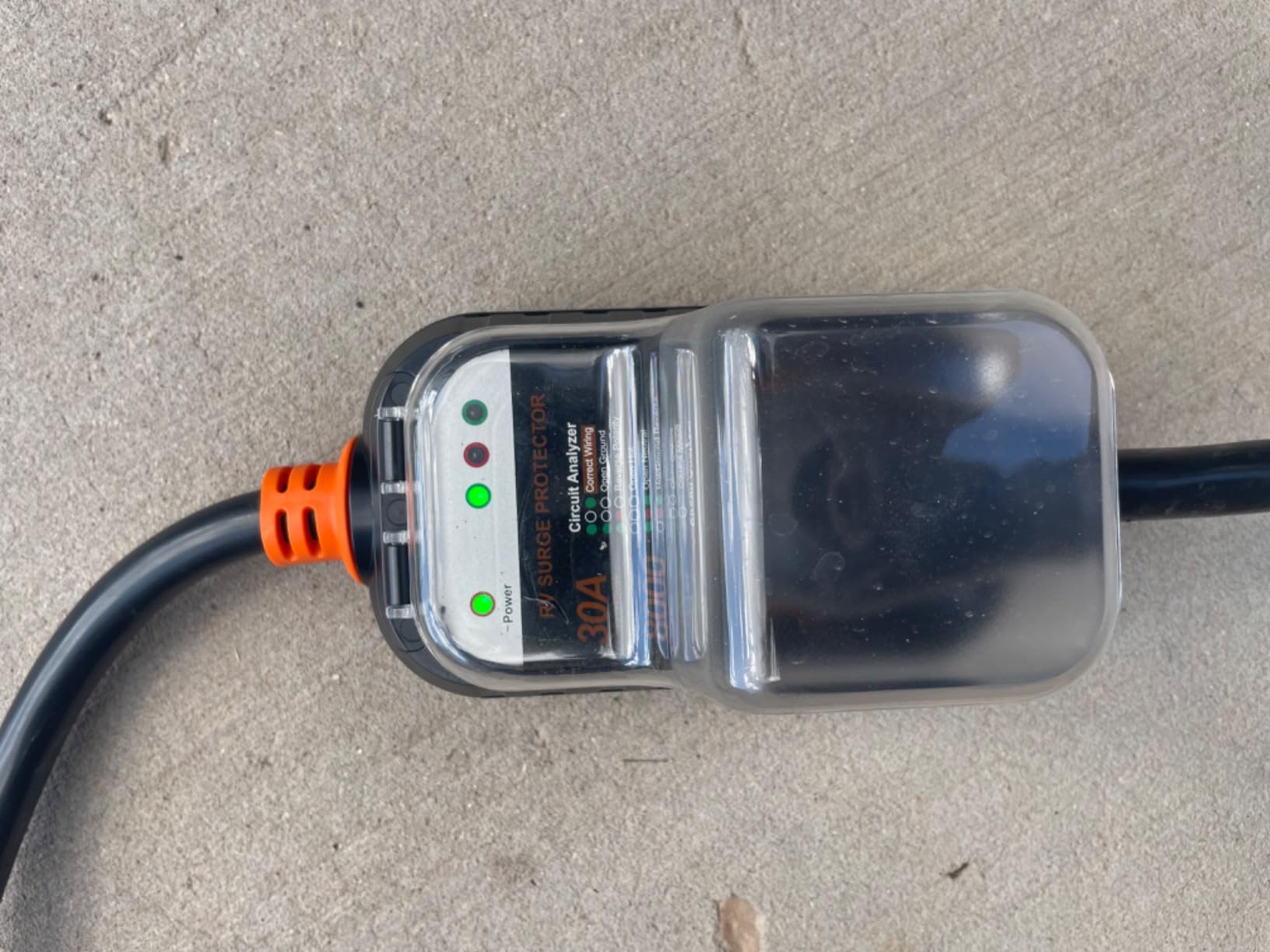
The GEARGO holds the top category position for RV plugs, inlets and receptacles, and the reason is its sealing. Its IP68 waterproof cover with a weatherproof shield protects the circuit from rain, wind and sandstorm, and no other portable option in this group matches that rating.
Under the cover you get a 30 amp circuit analyzer chart covering correct wiring, open ground, open neutral, reverse polarity, hot and ground reversed and no power, plus FCC tested V-1 flame-retardant materials. It weighs 2 pounds and measures 11 by 5 by 5 inches.
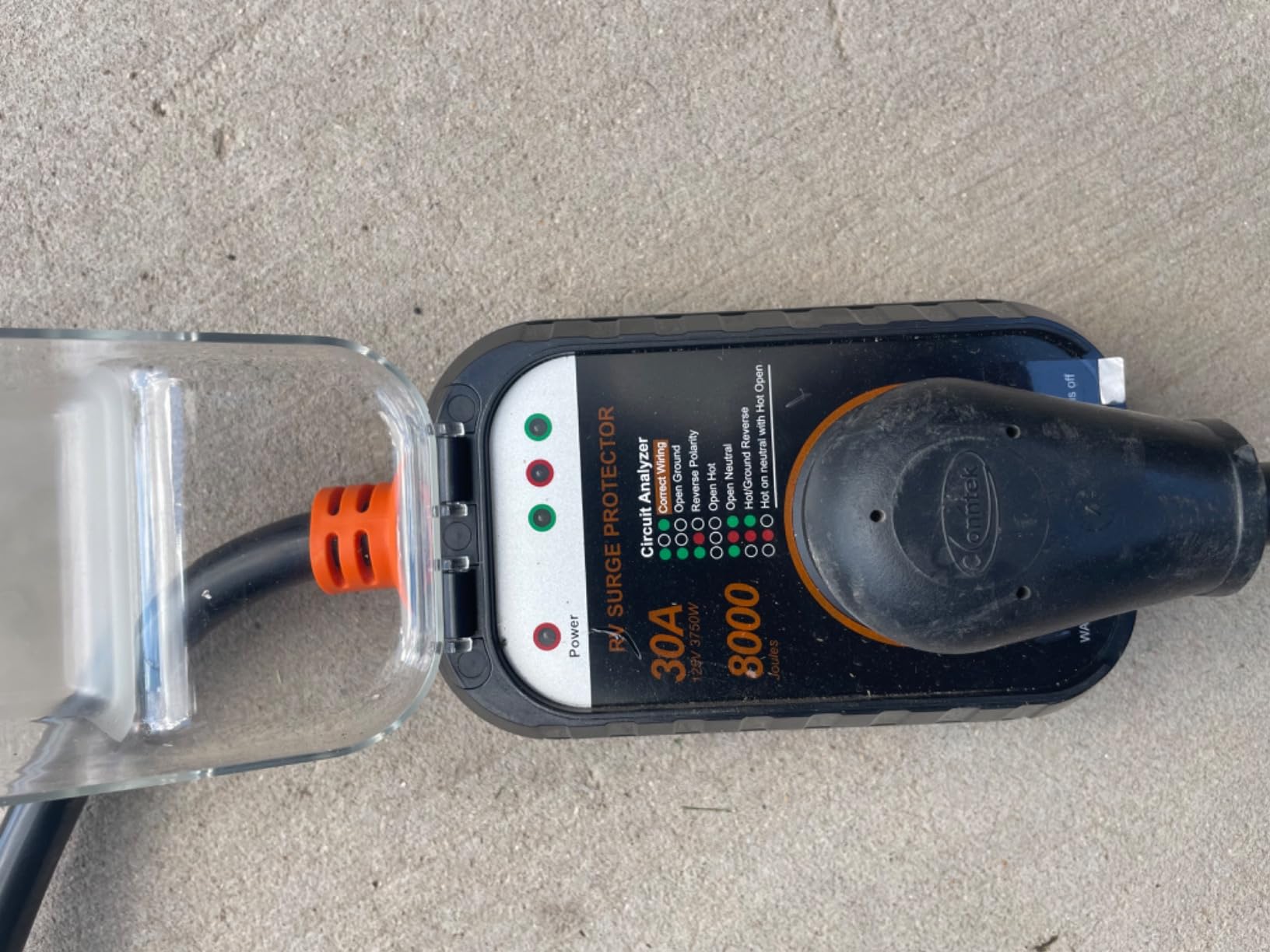
The ergonomic power grip handles and right-angle male connector are a low-damage interface, and the right-angle plug matters on a cable that is coiled up after every rain shower. The brand backs the unit with a three-year warranty and sells both 30 amp and 50 amp variants.
There is one documentation problem you should know about before buying. The bullet points quote 8,000 joules of surge protection while the variant label reads 1,200 J, which is a wide gap. Plan on the lower figure when judging headroom for your rig.
Why it suits wet-weather campers
If your sites are coastal, mountain or anything with a reliable rain forecast, sealing is the first thing to rank. Water reaching the connection is the fastest way a good protector becomes a dead one, and forum members regularly blame corroded receptacles for false fault codes.
It is also a reasonable pick for anyone who wants more sealing headroom than the typical 30 amp unit offers without moving up to an EMS.
Where it falls short
No Bluetooth, no Wi-Fi and no app, so no remote monitoring and no alerts. It also has no automatic disconnect, which means it warns rather than protects on its own.
The contradictory joule figures on the listing are the real drawback. Ask yourself whether the sealing matters more to you than a documented surge budget, and be honest about the answer before you buy.
8. Southwire Surge Guard 44290: Best 50 Amp Diagnostic Protector
Surge Guard 44290 Portable Surge Protector – 120/240V, 50A
50 amp
120/240V service
4200 joules
Nylon housing
Anti-theft lock ring
Pros
- Has diagnosed a missing L2 leg and a failed campground breaker
- Survives drops onto gravel
- Durable nylon body with reinforced receptacle brass
- Limited lifetime warranty and US manufacturing
Cons
- Bulky 22 inch form factor that is hard to store
- No timed power-restoration delay after an outage
- No Bluetooth or Wi-Fi monitoring
- Cannot disconnect power on a fault
This is the 50 amp sibling of the 44280, and it is described by owners as an excellent diagnostic tool first and a surge protector second. Several people traced real pedestal faults with it before spending money on repairs, including a missing L2 leg and a failed 50 amp breaker at a campground.
The numbers are solid for the class: 50 amp, 120/240V service and 4,200 joules, with a nylon body, reinforced receptacle brass to reduce heat, an Easy-T-Pull handle with an integrated receptacle and an anti-theft lock ring. It weighs 2.7 pounds.
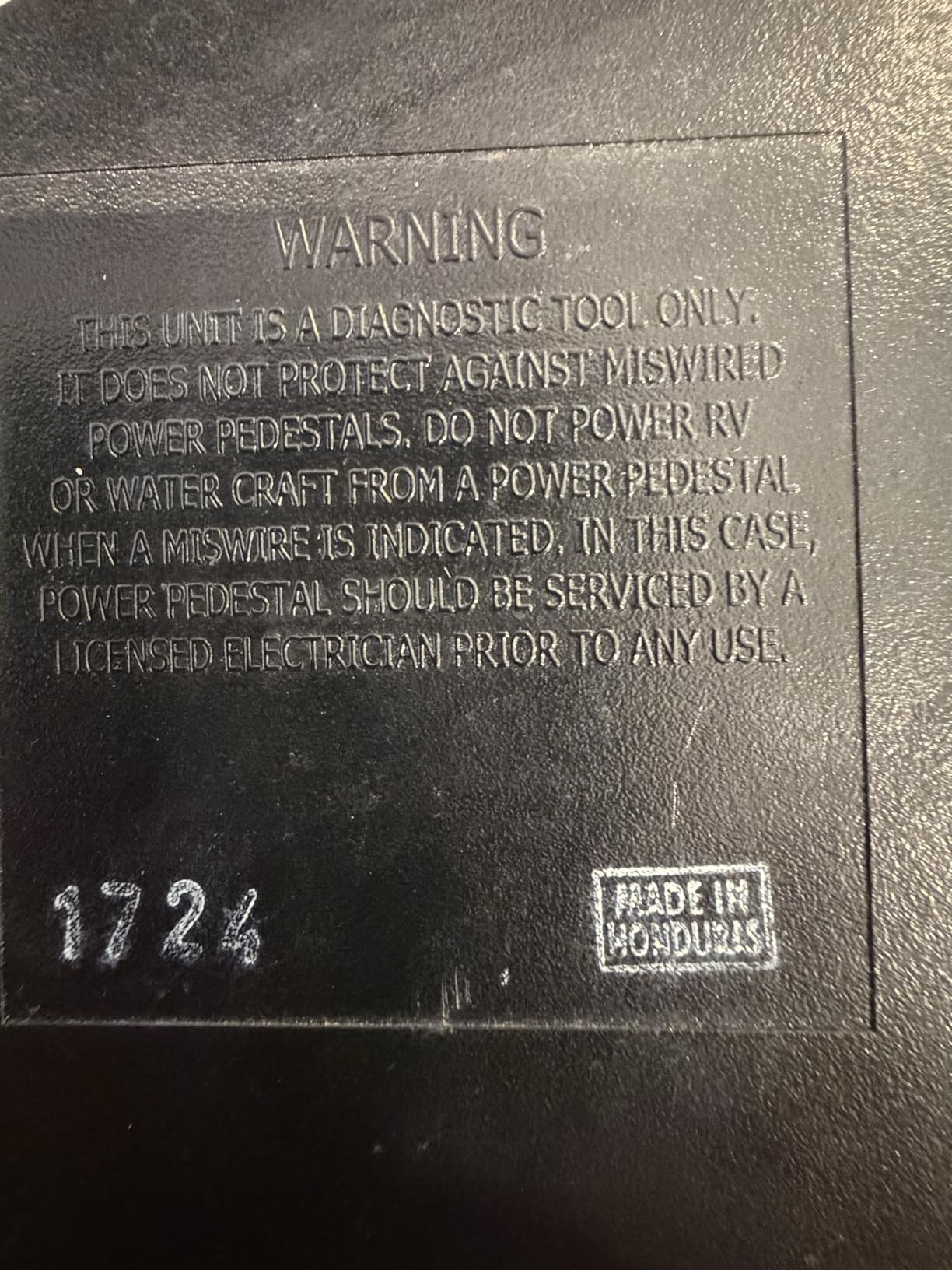
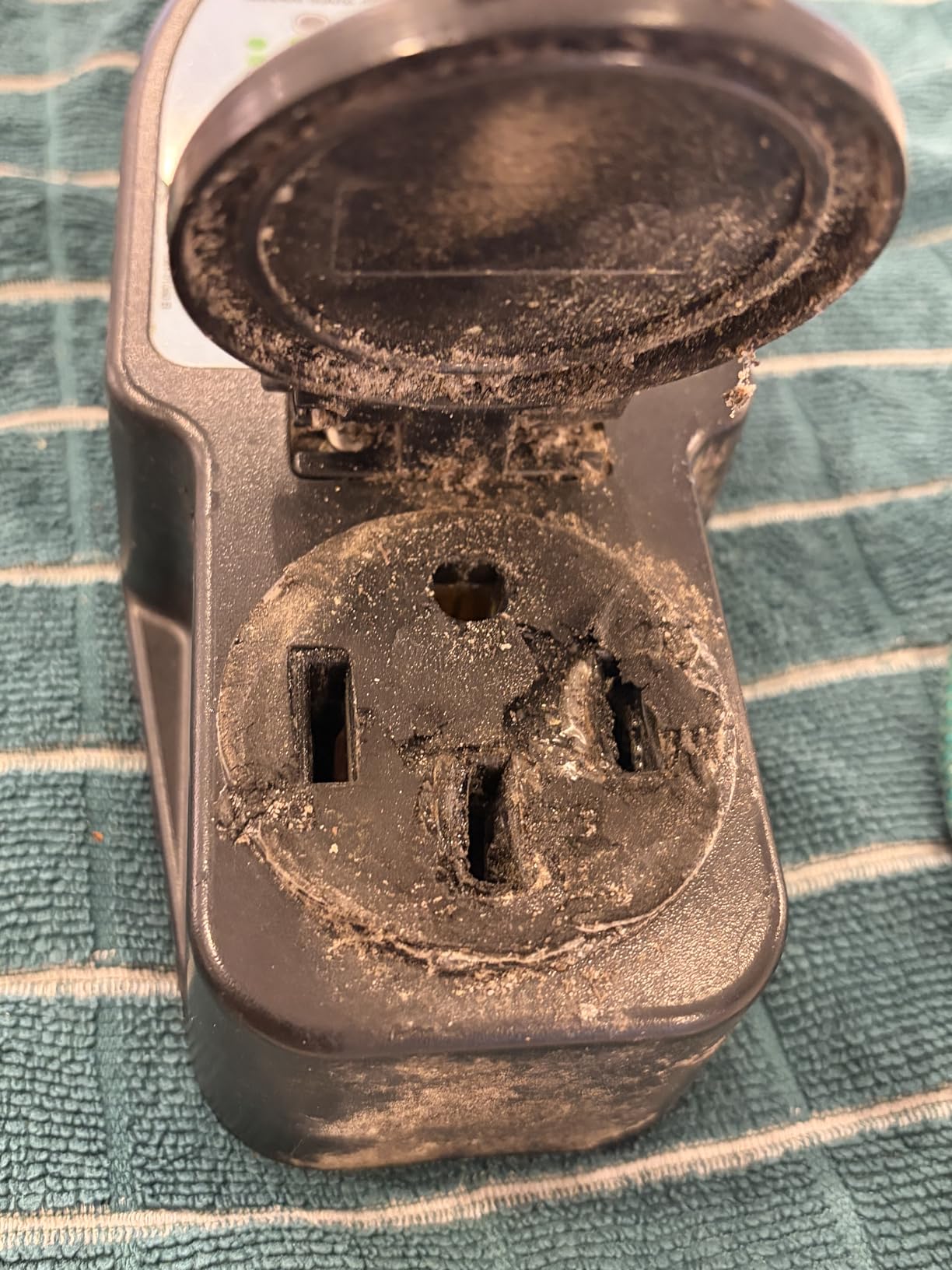
It survives drops onto gravel, which matters more than it sounds when the unit spends its life on a concrete pad. The limited lifetime warranty and US manufacturing add confidence, and many owners keep both the 30 amp and 50 amp versions rather than choosing.
Used as a standalone tester it is genuinely useful even when you are not relying on it to protect the coach. That is how you find out whether a pedestal problem is your side or theirs before anyone argues about it.
Why it suits 50 amp diagnostic shoppers
If your main worry is whether the pedestal at the next site is wired correctly, this answers that question clearly with bright LEDs and a reinforced connection. The 22-inch length is the trade for that reinforced build, and the two-port body gives you somewhere to plug in while you work.
The 4,200 joule rating sits in a sensible middle ground for 50 amp service, above the entry-level budget tier and well below the hardwired EMS models.
Where it falls short
At 22.25 inches long it is bulky, and owners say it is awkward in the smaller storage compartments on a motorhome. It also has no timed power-restoration delay, so after an outage you wait on your own reconnection.
No Bluetooth, no app, no Wi-Fi and no ability to disconnect power on a fault. If you want 50 amp protection that acts automatically, this is not the tier you need.
Will a 50 Amp Surge Protector Work on a 30 Amp Camper?
Yes, and it is a safe direction to make the mismatch. A 50 amp protector on a 30 amp camper will still perform its voltage, polarity and surge functions correctly, because those jobs do not depend on the amperage figure on the label.
The reverse is the dangerous direction. Running a 30 amp protector on a 50 amp coach means your rig can draw more than the device is rated to pass, and the protection tier you paid for no longer reflects the load. Advisers on the forums repeatedly recommend a genuine 50 amp EMS for a 50 amp RV rather than relying on a 30A-to-50A dogbone adapter to solve it.
The practical note is the dogbone adapter itself. Using one to connect a 30 amp trailer to a 50 amp pedestal works, and pairing it with a 30 amp protector is a sensible combination. Just do not use the adapter to feed a 50 amp coach through a 30 amp unit.
How Many Joules Does an RV Surge Protector Need?
For 30 amp service, forum-cited figures run from roughly 1,750 to 6,600 joules, and the units in this group sit between 825 and 3,000 depending on tier. For 50 amp service the range widens to roughly 3,580 to 12,000 joules, and the products we reviewed fall between 4,200 and a listed 18,000.
Here is how to read those numbers rather than just compare them. Joule rating is how much energy the device can absorb and dissipate before its protection degrades, so a higher number means more headroom and a longer useful life. It does not mean the device handles bigger loads.
The critical detail nobody mentions: a surge protector spends its joule budget permanently when it absorbs a large event. There is no recharge and no reset. Once a big strike drains the budget, the unit may still light its LEDs while quietly protecting nothing, which is the silent failure forum owners warn about.
That is why our advice is to match joules to your exposure rather than to your amperage. Camp in open country with frequent lightning and buy deeper. Camp at established parks with mature infrastructure and the mid-range units are enough.
What to Look for When Buying an RV Surge Protector
Protection type comes first. Decide honestly whether you want a device that warns you or one that disconnects for you. A unit with automatic power-off, delayed reconnection and fault alerts is an EMS, and it costs more because it is doing more than absorbing a spike.
Amperage match is the next filter. Confirm your coach’s service rating, then buy the matching device. The safe mismatch is 50 amp protection on 30 amp service; the unsafe one is the reverse.
Joule rating determines longevity, not capability. Treat the number as a consumable budget that depletes, and check whether the unit tells you it is still alive. A monitored device that reports a surge failure is worth more than a bigger unmonitored number, because you at least know.
Warranty length is a real signal in this category. Progressive Industries’ lifetime warranty is the most repeated trust signal across the RV forums, and owners describe having units repaired or replaced twice. Three-year coverage on premium units is respectable by comparison, and the 50 amp hardwired option we picked is in that group.
Weather resistance deserves more attention than most roundups give it. A unit sitting on an exposed pedestal in coastal or desert conditions needs a sealed housing, and IP ratings like the IP68 cover on the GEARGO are the specification worth checking. Forum members regularly trace nuisance fault codes back to a corroded shore power receptacle rather than the protector, so inspect your own connector too.
Finally, think about theft and storage. A locking security ring or plate costs almost nothing and deters the easy theft that happens at busy parks. And check the physical dimensions against your storage bay, because a 22 inch unit and a 14 inch unit are very different things when you are packing a motorhome.
Frequently Asked Questions
Do you really need a surge protector on an RV?
Yes, every RV owner should carry at least one. Campground pedestals age badly, with loose connections, corroded wiring and inconsistent output, and a single bad power event can take out a water heater, an air conditioner compressor or the electrical panel. A basic protector absorbs spikes and warns you about wiring faults; an EMS does the same and cuts power before damage happens.
What is the difference between an RV EMS system and a surge protector?
A surge protector passively absorbs voltage spikes and shows LED fault indicators for problems like open ground, open neutral and reverse polarity. An EMS actively measures voltage, polarity, grounding, frequency and amperage before power flows, and disconnects everything when a reading falls outside the safe band, typically 102V to 132V on 120V service. An EMS also delays reconnection so compressors do not restart into a brownout.
How many joules should my RV surge protector be?
For 30 amp service, figures commonly cited in the RV community run from about 1,750 to 6,600 joules. For 50 amp service the range is roughly 3,580 to 12,000 joules. Joule rating is an energy budget that is permanently spent when a large event is absorbed, so a deeper rating simply means more headroom and a longer useful life.
Which 30 amp surge protector is the best for an RV?
For general 30 amp use the Progressive Industries SSP-30XL is the strongest all-round choice, with fault detection, LED indicators, a weather shield, a locking ring and a lifetime warranty. If you want automatic disconnect and app monitoring, the Power Watchdog PWD30EPO adds a 3,000 joule budget, phone alerts and a replaceable surge module. The Southwire Surge Guard 44280 is the value pick when you only need diagnostics.
Will a 50 amp surge protector work on a 30 amp camper?
Yes. Voltage, polarity and surge protection do not depend on the amperage rating on the label, so a 50 amp unit performs those functions correctly on a 30 amp camper. The reverse is the problem: a 30 amp protector on a 50 amp coach can be asked to pass more current than it is rated for. Advisers recommend a genuine 50 amp EMS rather than relying on a 30A-to-50A dogbone adapter for a 50 amp RV.
The Verdict on the Best RV Surge Protectors in 2026
The Progressive Industries SSP-30XL takes our top spot for most 30 amp RVers: the widest review history in the group, a lifetime warranty that forum owners have actually used, and fault detection across every common pedestal problem. Its 825 joule budget is modest, so move up if you camp in open, storm-prone country.
If you want protection that acts without you, the Power Watchdog PWD30EPO is the pick for 30 amp service and the PWD50EPOH is the one for 50 amp motorhomes, where hardwiring removes theft and weather exposure entirely. For 50 amp coverage on a tighter budget, the Southwire Surge Guard 44290 does the diagnostics job well.
Whichever unit you choose, match the amperage to your coach, treat the joule rating as a consumable budget, and inspect your own shore power connector for corrosion before blaming the protector. That is where a surprising share of false fault codes actually start.
