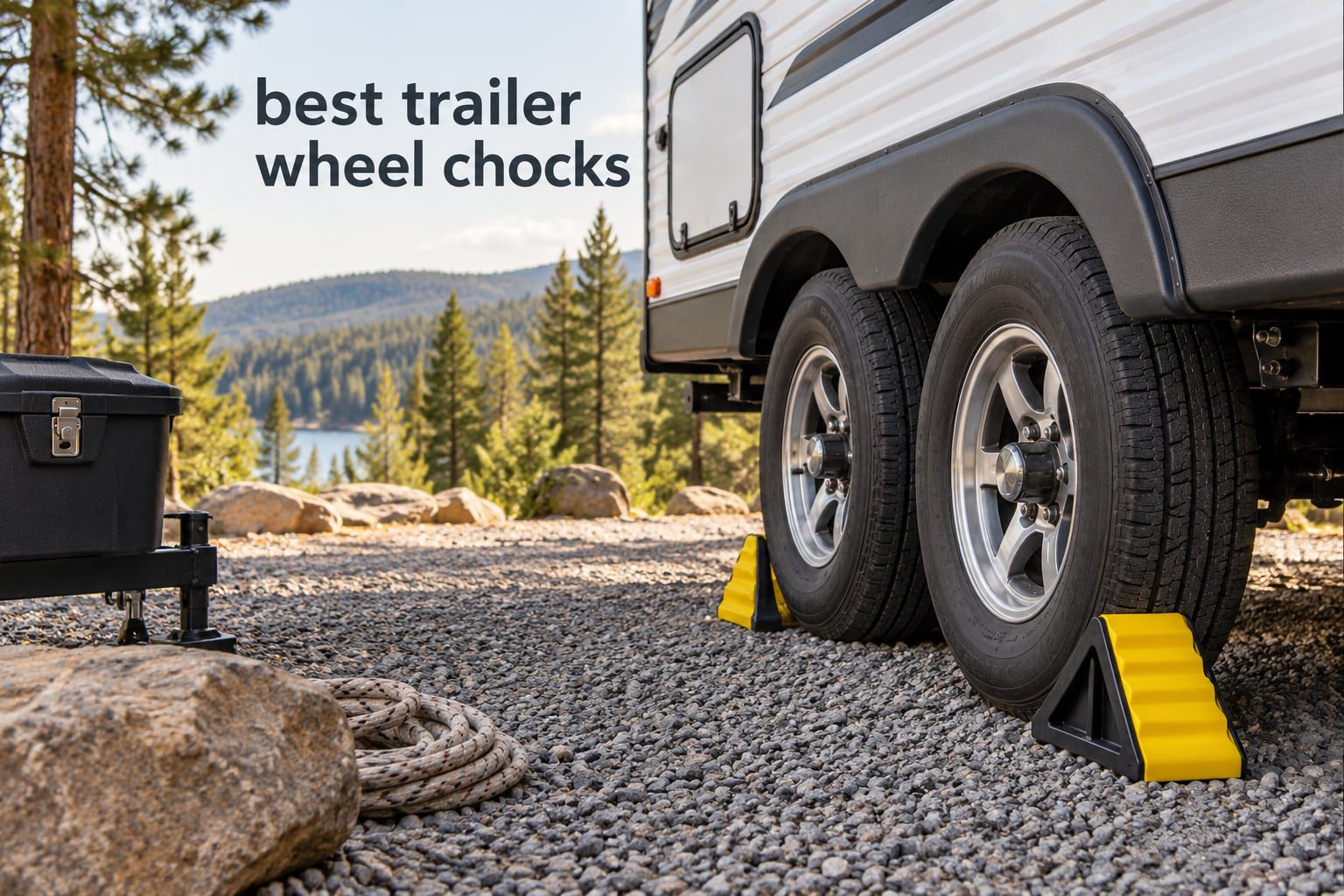
Every trailer owner has had the moment where the rig moves a few inches after you walk away from it. On a sloped campsite pad or a slanted driveway, a few thousand pounds of trailer will find its own way downhill without a mechanical stop, and a parking brake alone is a poor substitute. That is the whole reason the best trailer wheel chocks exist, and it is why this roundup spends as much time on sizing and placement as it does on product ratings.
I have pulled campers, boat trailers, and utility trailers for years, and my rule has not changed: the best trailer wheel chocks are the ones you will actually pick up and place every single time. A chock that lives in a toolbox you never open is not a safety device, it is a paperweight. So we looked at twelve sets covering rubber wedges, plastic wedges, scissor-style tandem stabilizers, and four-chock axle packs, and we judged them on grip, build material, how they handle on slopes, and how easily they come back out from under a tire.
Most competing roundups on this topic are four or five years out of date, which matters a lot in a category where plastic chocks quietly deteriorate under UV exposure and steel stabilizers corrode if you leave them wet. This guide is rebuilt for 2026, and it covers the questions that actually decide a purchase: rubber versus plastic, how chock height relates to tire diameter, whether you chock one side or both on a tandem axle, and what the X-chocks on the market do and do not do for you.
Before we get into the list, one clarification that trips up a lot of buyers. A wheel chock stops rolling. A wheel stop or a tandem stabilizer stops rocking front to back. Neither replaces the other, and neither replaces your trailer parking brake. The best setup pairs at least one ground chock per wheel you care about with a stabilizer on tandem rigs, which is exactly how the picks below are organized.
Table of Contents
- Top 3 Picks for Best Trailer Wheel Chocks in 2026
- Best Trailer Wheel Chocks Quick Comparison in 2026
- 1. MaxxHaul 70472 Solid Rubber 2-Pack – Best All-Round Trailer Chock
- 2. BAL 28012 X-Chock Stabilizer Pair – Best Tandem Axle Stabilizer
- 3. MaxxHaul 80681 Large Rubber 2-Pack with Eyebolt – Best for Heavy Trucks
- 4. PR1ME Yellow Plastic 2-Pack – Best Lightweight Budget Pair
- 5. Camco 44471 Wheel Chocks with Rope – Best for Travel Trailers
- 6. AFA 8T Nylon-Reinforced Rubber 4-Pack – Best for Chocking a Full Axle
- 7. ROBLOCK 18023-2 Solid Rubber 2-Pack – Best Curved-Fit Pair for Boat Trailers
- 8. Proud Panda Scissor X-Chock – Best Budget Tandem Stabilizer
- 9. SECURITYMAN 20000 lb Rubber 2-Pack – Best for High Visibility on Slopes
- 10. HOXWELL Premium Rubber 4-Pack – Best Heavy Four-Chock Set
- 11. ROBLOCK 18010-4 Rubber 4-Pack with Rope – Best for Long-Reach Removal
- 12. AFA 4T Rubber 4-Pack with Eyebolts – Best for Tie-Off Retrieval
- How to Choose Trailer Wheel Chocks That Match Your Rig
- Frequently Asked Questions
- Which trailer wheel chock is the best overall?
- Which type of wheel chocks is better, plastic or rubber?
- How big should trailer wheel chocks be?
- Do you need to chock both sides of an RV?
- How many wheel chocks do I need?
- Can I use X-chocks instead of regular wheel chocks?
- Are cheaper plastic wheel chocks still worth buying?
- Final Verdict on the Best Trailer Wheel Chocks in 2026
Top 3 Picks for Best Trailer Wheel Chocks in 2026

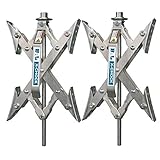
BAL 28012 X-Chock Stabilize…
- Zinc-coated steel
- Adjusts 1-3/8 to 10 inch
- Ratchet wrench included
- Padlock compatible

MaxxHaul 80681 Large Rubber…
- 10 x 8 x 6 inch solid rubber
- 16.6 pound pair
- Steel eyebolt
- Oil resistant
Best Trailer Wheel Chocks Quick Comparison in 2026
The table below lists every chock in this roundup with its core construction facts, so you can narrow the field before reading the full reviews.
| Product | Specs | Action |
|---|---|---|
| MaxxHaul 70472 Solid Rubber 2-Pack |
|
Check Latest Price |
| BAL 28012 X-Chock Stabilizer Pair |
|
Check Latest Price |
| MaxxHaul 80681 Large Rubber 2-Pack |
|
Check Latest Price |
 PR1ME Yellow Plastic 2-Pack PR1ME Yellow Plastic 2-Pack |
|
Check Latest Price |
 Camco 44471 Wheel Chocks with Rope Camco 44471 Wheel Chocks with Rope |
|
Check Latest Price |
 AFA 8T Rubber 4-Pack AFA 8T Rubber 4-Pack |
|
Check Latest Price |
 ROBLOCK 18023-2 Rubber 2-Pack ROBLOCK 18023-2 Rubber 2-Pack |
|
Check Latest Price |
 Proud Panda Scissor X-Chock 2-Set Proud Panda Scissor X-Chock 2-Set |
|
Check Latest Price |
 SECURITYMAN 20000 lb Rubber 2-Pack SECURITYMAN 20000 lb Rubber 2-Pack |
|
Check Latest Price |
 HOXWELL Premium Rubber 4-Pack HOXWELL Premium Rubber 4-Pack |
|
Check Latest Price |
 ROBLOCK 18010-4 Rubber 4-Pack with Rope ROBLOCK 18010-4 Rubber 4-Pack with Rope |
|
Check Latest Price |
 AFA 4T Rubber 4-Pack with Eyebolts AFA 4T Rubber 4-Pack with Eyebolts |
|
Check Latest Price |
1. MaxxHaul 70472 Solid Rubber 2-Pack – Best All-Round Trailer Chock
MaxxHaul Solid Rubber Wheel Chock 2-Pack | 8″ x 4″ x 6″ Heavy-Duty Tire Stop | Non-Slip Traction Pads | Built-in Handle | All-Weather Vehicle Safety Block | Black | (70472)
Solid rubber, 8 x 4 x 6 inch, 8.4 pounds, molded handle, all-weather
Pros
- Resists cracking and crushing under vehicle weight
- Molded high-friction surface grips pavement and gravel
- Built-in handle means no tools to place or pull
- Compact footprint stows behind a tire or in a compartment
Cons
- No eyebolt for tethering to a chain
- 8 inch face is light for oversized truck and RV tires
This is the chock I keep in the hitch box, and after a couple of seasons of real use it has not asked me for anything. The molded-in handle is the detail that matters more than the spec sheet suggests: you can drop it behind a tire without crouching, pry it out from a crouch either, and do it both with gloves on. No hammer, no digging, no rocking the rig.
Construction is dense solid rubber in an 8 by 4 by 6 inch footprint at 8.4 pounds. That weight is deliberate. Chocks that are too light get kicked aside, run over, or stolen from a campground pad, and a chunky rubber block simply stays where you put it. The traction surface is molded rather than glued on, so it will not peel away in the first cold week of the season.
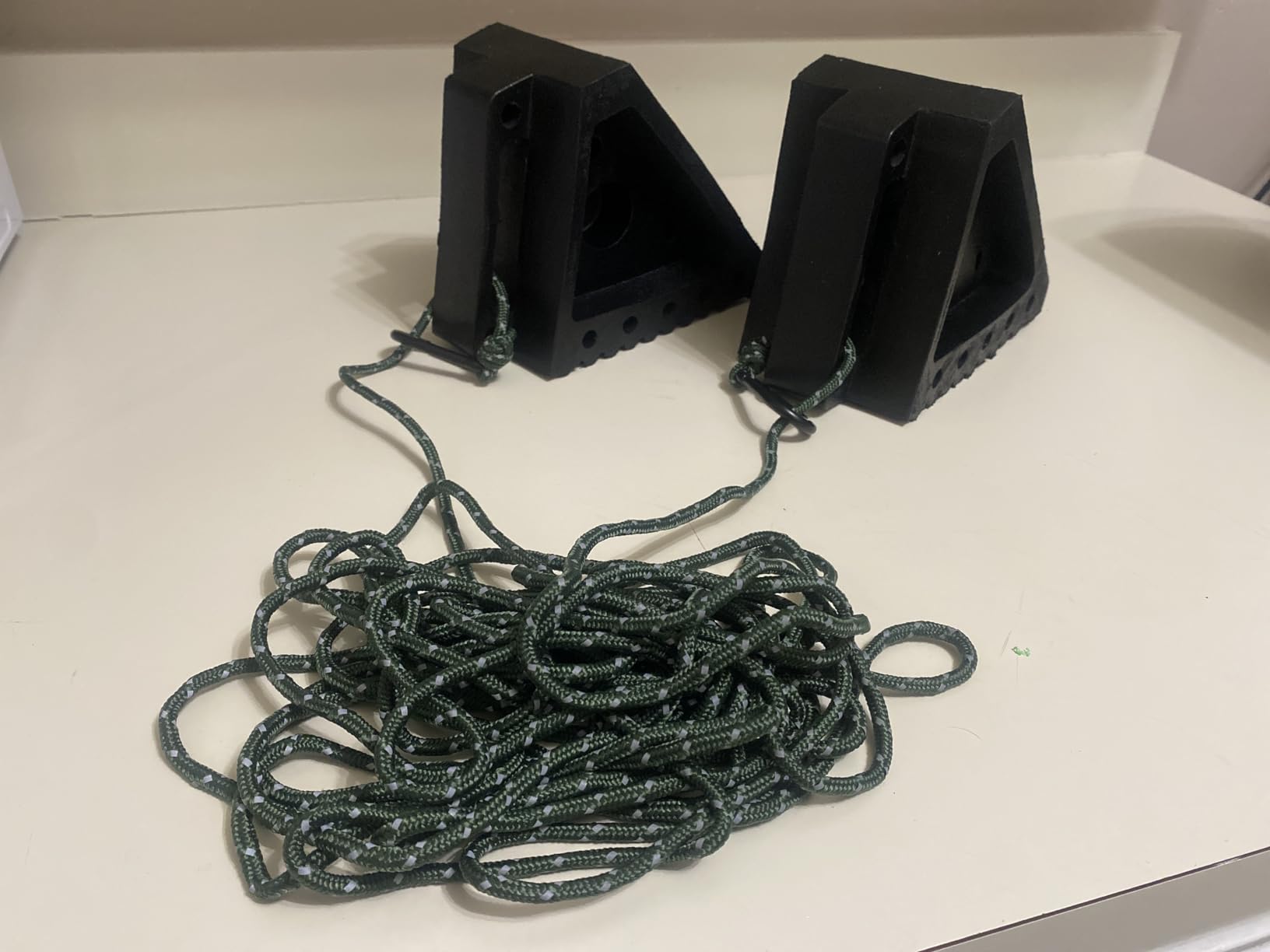
Across more than 18,000 reviews the pattern is remarkably consistent. Owners talk about grip on asphalt, gravel, and smooth garage floors, and about how the rubber simply refuses to deform under a loaded trailer. The grip holds on wet pavement and snow because the surface is molded into the block rather than applied as a separate pad.
The honest limitation is scale. An 8 inch face is generous for a travel trailer tire or a half-ton truck, but owners running 35 inch truck tires or full-size Class A motorhome wheels report that coverage feels thin. The face contacts the outer portion of the tread rather than spanning the full width, which is why the 10 by 8 by 6 inch version below comes with its own recommendation for oversized rigs.
Where the 70472 fits best
This is the pick for the widest range of trailer types, from a 3000 pound utility trailer to a loaded fifth wheel on a graded pad. It handles both asphalt and gravel, it survives temperature swings without going brittle, and the oil resistance matters if you park over a patch where fluid has dripped.
Because it is sold as a two-pack, it covers one wheel front and back or one wheel on each side of a single axle. Neither arrangement is as complete as a four-pack, but for the majority of trailer owners two chocks is the correct amount to carry.
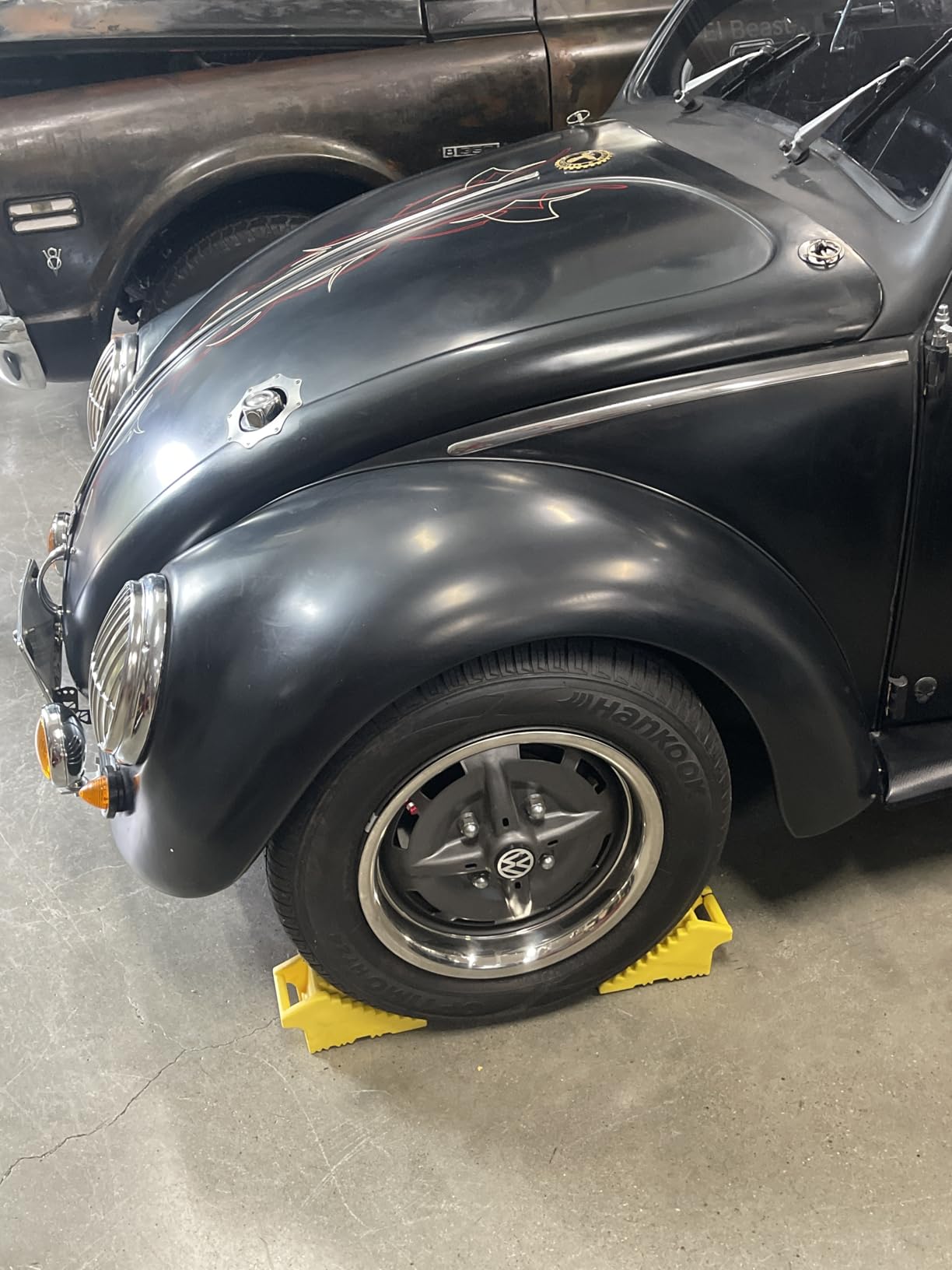
Where it falls short
There is no eyebolt, no chain, and no attachment hole, so you cannot tether it to the trailer frame or to the other chock. On a public campground pad that bothers some owners, because a chock that can be walked away from is a chock that occasionally will be.
It also sits at the small end of the rubber category, so if your tires are large or your trailer is heavy, step up to the larger rubber block or a four-pack rather than trusting a single 8 inch face.
2. BAL 28012 X-Chock Stabilizer Pair – Best Tandem Axle Stabilizer
X-Chock Wheel Stabilizer – Pair – One Handle – 28012
Zinc-coated steel, adjusts 1-3/8 to 10 inch, ratchet wrench included, padlock ring
Pros
- Substantially cuts fore-aft and side-to-side sway
- Adjusts down to very tight tandem tire gaps
- Zinc coating resists rust outdoors
- Padlock ring deters walk-away theft
Cons
- Requires a tool to install and remove
- Leaves some residual movement inside the camper
- Does not replace a ground chock
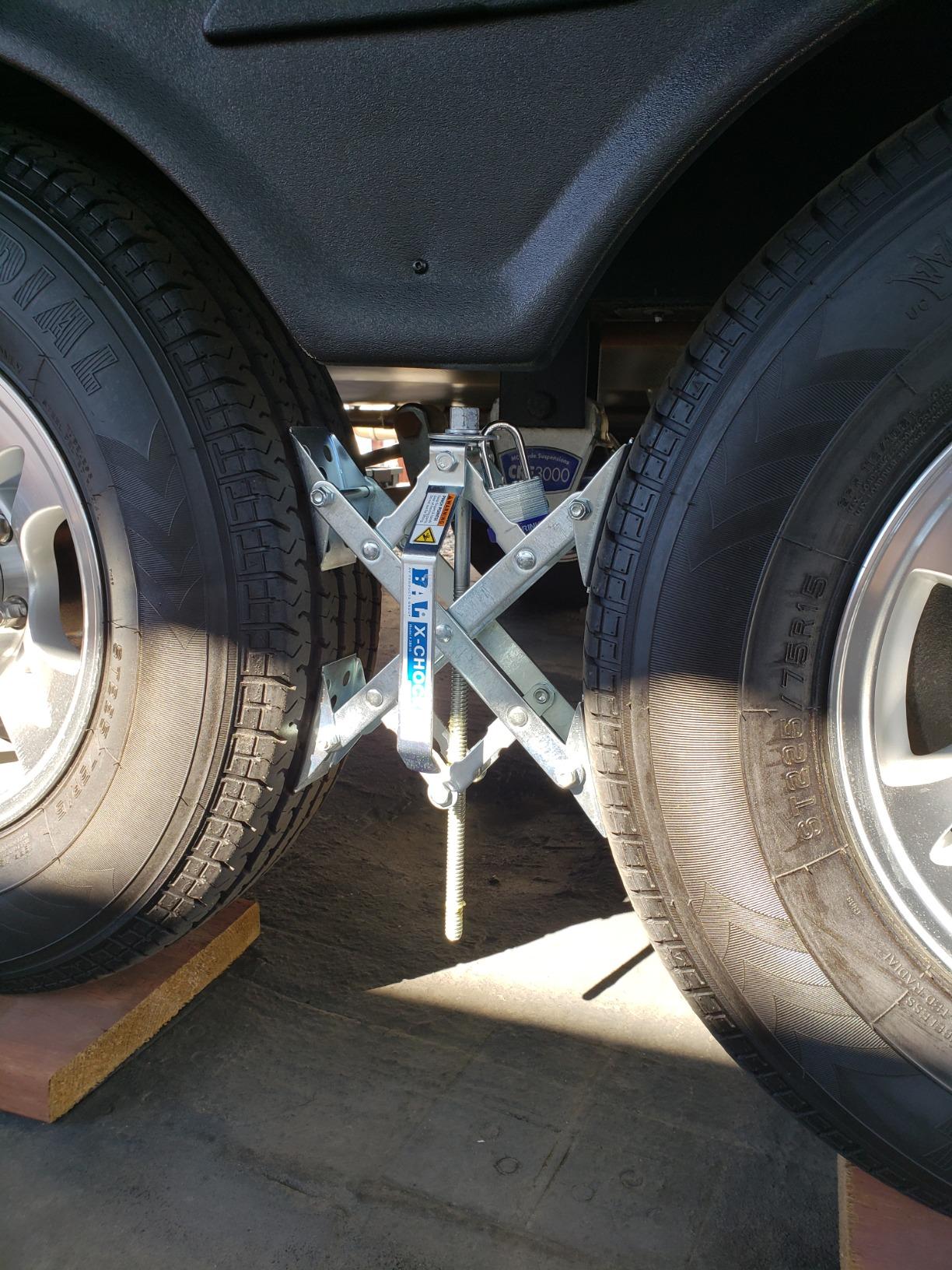
The X-chock does something no wedge can do. Instead of blocking one direction of travel, it cranks between two adjacent tandem tires and pushes them apart with opposing force, which kills the front-to-back rocking you feel walking through a camper after a bump.
This particular pair is American-made from rust-resistant zinc-coated steel and adjusts from a very tight 1-3/8 inch tire gap up to 10 inches, so it covers the narrow spacings common on travel trailers as well as the wide gaps on heavier rigs. A 3/4 inch ratchet wrench with a comfort bumper is included, and owners regularly report swapping it for a drill to save time.
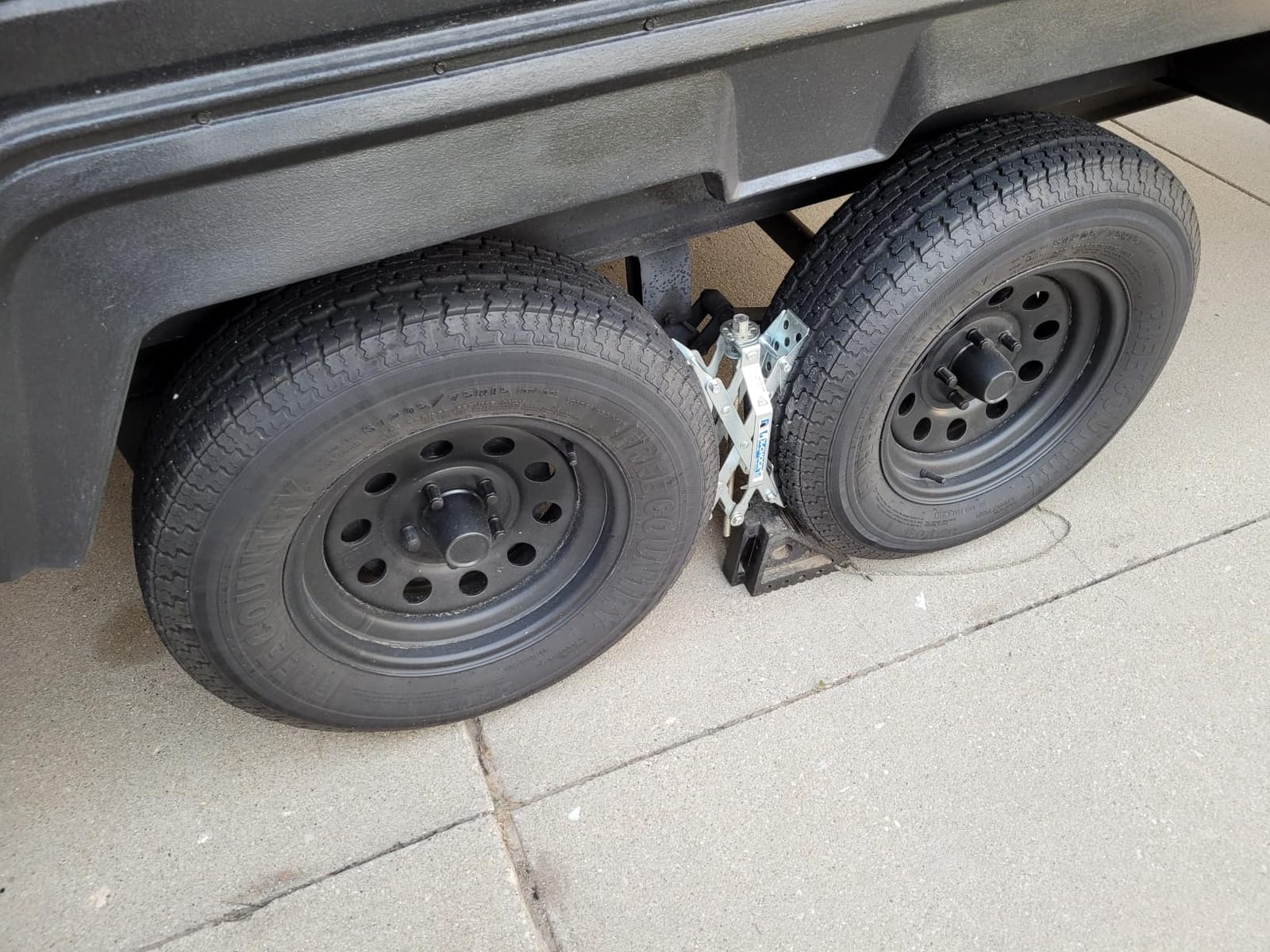
At only 16 ounces for the pair, it also carries no real weight penalty in a hitch box. The ratcheting mechanism loads up quickly on the first few turns, which is exactly where it stops the rocking from starting. Once torqued, the feel inside the rig changes noticeably, and that is the single most common reaction in reviews.
Two features earn their keep more than the price suggests. The padlock ring lets you lock a chock onto a trailer eyelet so it cannot be casually carried away, and the limited lifetime warranty speaks to how long the manufacturer expects the mechanism to work.
When the X-chock earns its place
Tandem axle travel trailers and fifth wheels where front-to-back rocking ruins sleep. It also works when your tires sit on a stack of leveling blocks, because it reaches into the gap between tires that a wedge cannot enter at all.
Owners who upgraded from cracked plastic blocks tend to describe the difference bluntly, pointing to how cheap plastic failed within a couple of seasons while the steel unit kept working. The zinc coating also holds up well through wet seasons without developing the surface rust that raw steel picks up.
Where it falls short
First and most important, an X-chock is not a substitute for a ground chock. It stops rocking, not rolling, and a trailer can still creep down a slope with a pair of these installed and nothing under the tires.
Second, installation takes a tool and real effort. The screw bears hard against the bolt during the first rotations, which is normal but unexpected the first time. Third, some reviewers note a small amount of residual movement remains even fully torqued, so it reduces rocking rather than eliminating it.
3. MaxxHaul 80681 Large Rubber 2-Pack with Eyebolt – Best for Heavy Trucks
MaxxHaul Rubber Wheel Chock 2 Pack, Large 10″ x 8″ x 6″ Heavy Duty Tire Stop with Non Slip All Weather Grip, Oil Resistant Rubber Block with Steel Eyebolt for Vehicle and Trailer Safety (80681)
10 x 8 x 6 inch solid rubber, steel eyebolt, 16.6 pound pair, oil resistant
Pros
- Very heavy rubber resists crushing under load
- Eyebolt accepts a chain or rope for tethering
- Large contact area works on large truck tires
- Grips tarmac/gravel and wet surfaces
Cons
- Strong rubber odor for weeks after delivery
- Pair weighs 16.6 pounds so it is a two-hand carry
- Included washers dig into the rubber when tightened
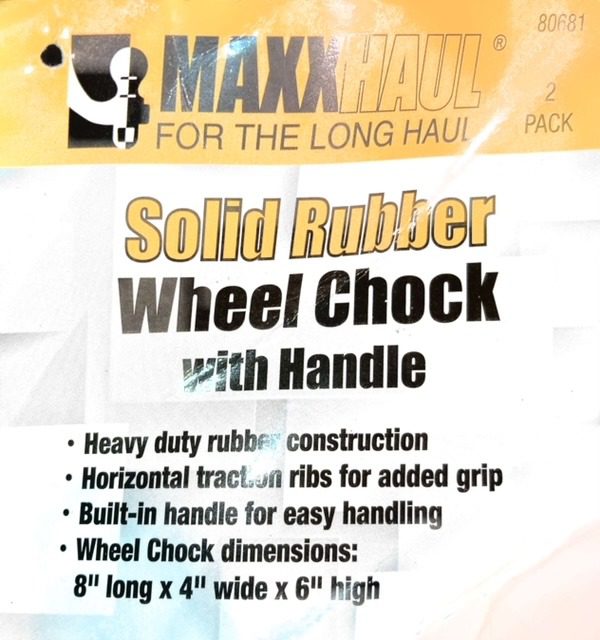
When the tire is big and the rig is heavy, contact area is the deciding factor, and this is one of the largest rubber wedges in the roundup at 10 by 8 by 6 inches per chock. The pair comes in at 16.6 pounds, which sounds like a complaint until you realize what that weight is doing: keeping the block planted under a truck tire on a sloped driveway.
The dense oil-resistant rubber resists compression under load, and the broad footprint resists tipping and shifting as the tire settles. A textured surface handles gravel, pavement, and garage floors in rain or snow. Most importantly for large tires, the 10 inch face spans more of the tread than the compact options do.
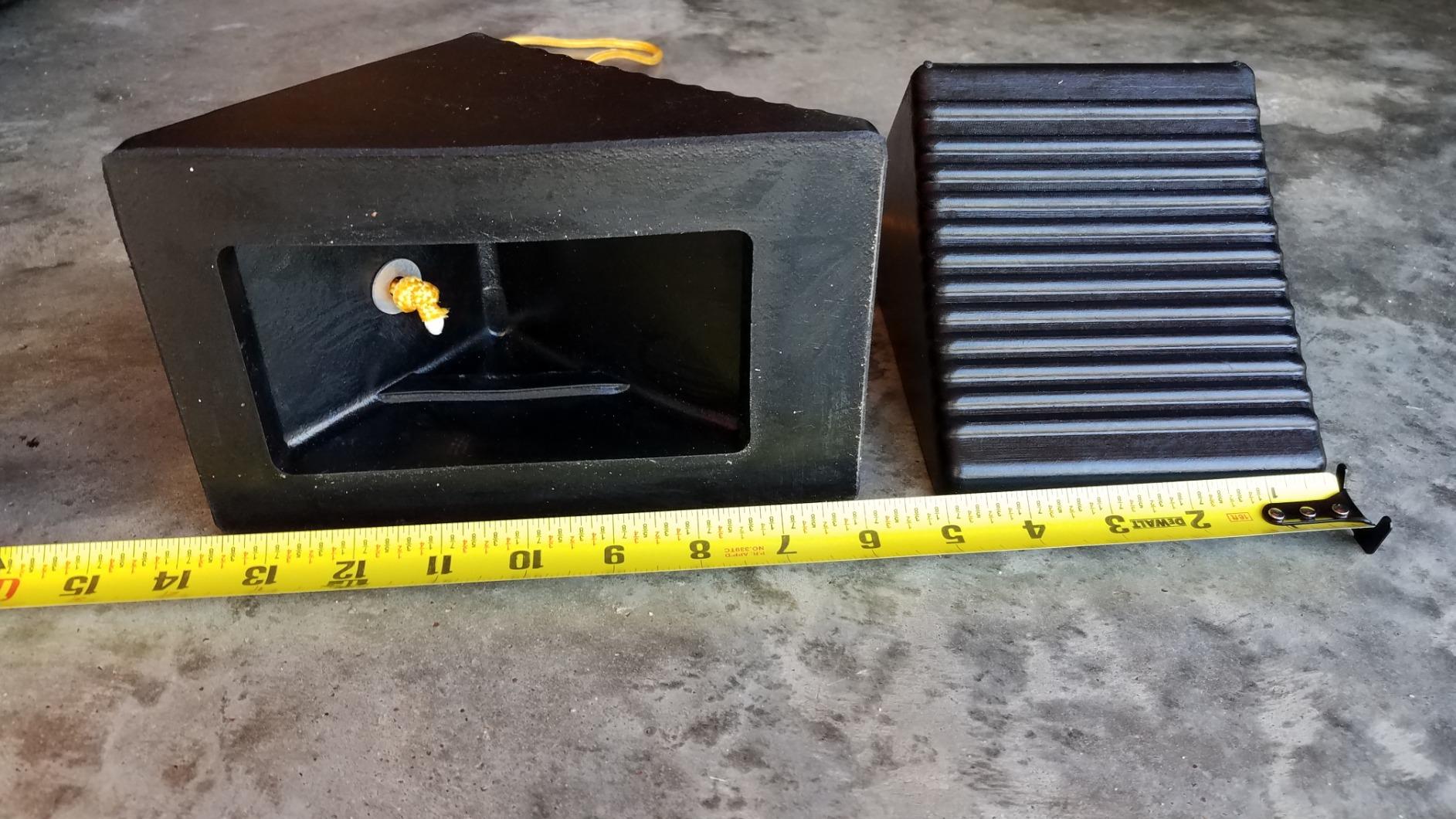
Reviewers repeatedly single out the steel eyebolt as the feature that sets it apart. You can run a chain or rope through it and tie the chock to the trailer frame, which removes the risk of leaving with a chock still under the tire and removes the risk of someone carrying it off your campsite.
Boat trailer owners using it on sloped driveways report the same result the truck owners describe: no creep, no shifting, no need to re-check after an hour. If you tow on large diameter tires and park on anything other than dead-level concrete, this is the rubber chock to buy.
What works well here
The sheer mass is a feature on a slope. Nothing is going to nudge this out of position, and the width gives a large sidewall something substantial to bite into. Oil resistance matters on a working truck where drips are part of normal life.
Owners also note the black finish stays presentable and the whole thing stores flat behind a spare tire or in a bed-side tool box without rolling around.
Where it falls short
The rubber smell is the most repeated complaint across reviews. It arrives strong and, for some buyers, takes months of airing before it fades, which is awkward in an enclosed vehicle. Storing the pair in a sealed bag outside the cab solves it for most people.
The included washers are small enough to dig into the rubber when you tighten a rope through the eyebolt, and several owners swap them for fender washers instead. And at 16.6 pounds, this is a carry you feel after a long day at the boat ramp.
4. PR1ME Yellow Plastic 2-Pack – Best Lightweight Budget Pair
PR1ME Wheel Chocks with Non-Slip Base for RV & Trailer. 2 Pack Heavy Duty Wheel Chock with Bright Yellow. Lightweight Wheel Stoppers for Cars Camper Trucks RVs, Fit for Most Tyre Sizes
UV-stabilized polypropylene, dual EVA pads, bright yellow, 1.43 pound pair
Pros
- Dual EVA pads grip asphalt/concrete and gravel
- Very light and easy to carry
- Bright yellow is hard to forget before driving off
- No rubber odor and no setup
Cons
- Too light for heavy trailers
- Less rigid than rubber under load
- Size may not suit very narrow or very large tires
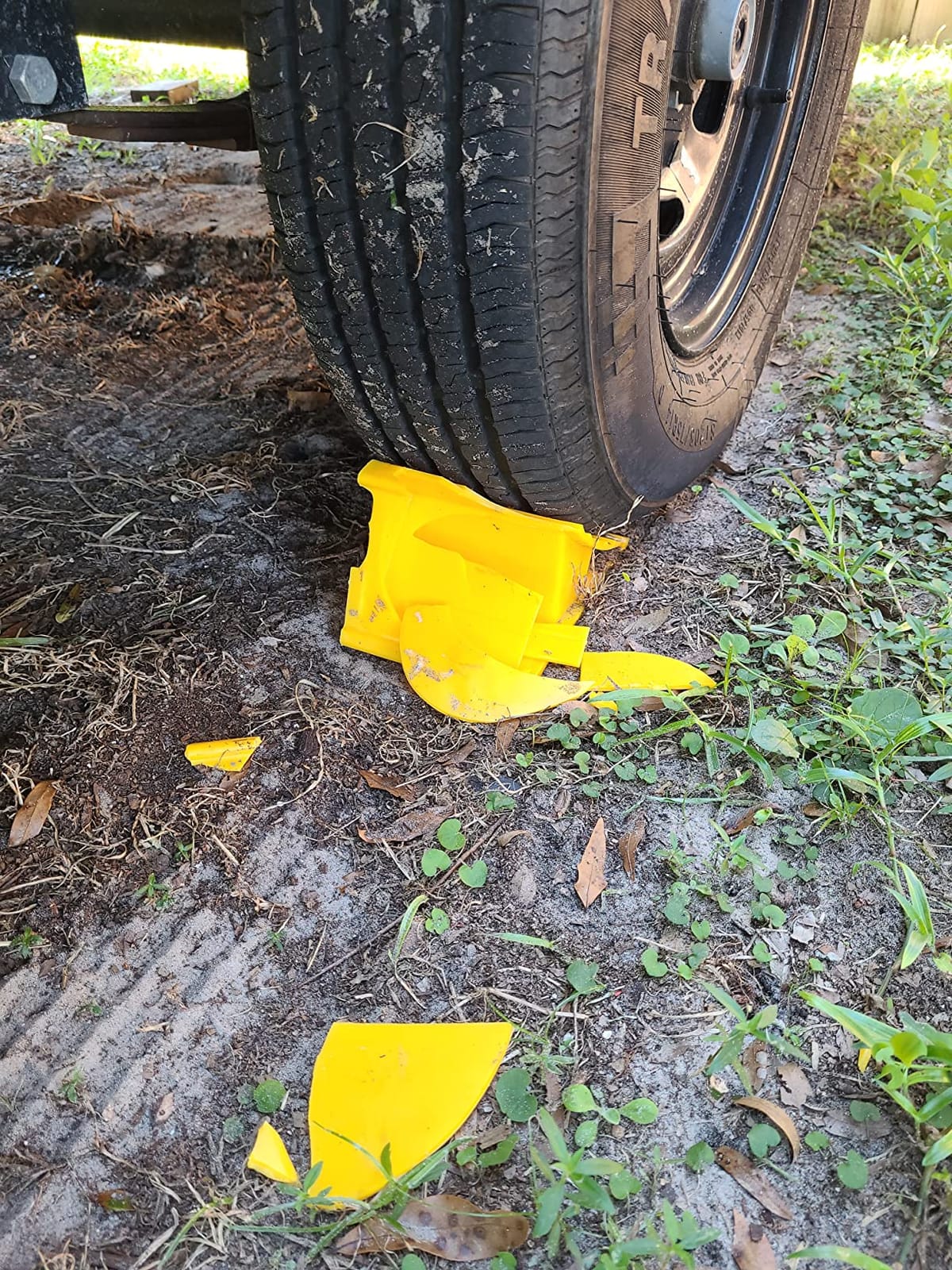
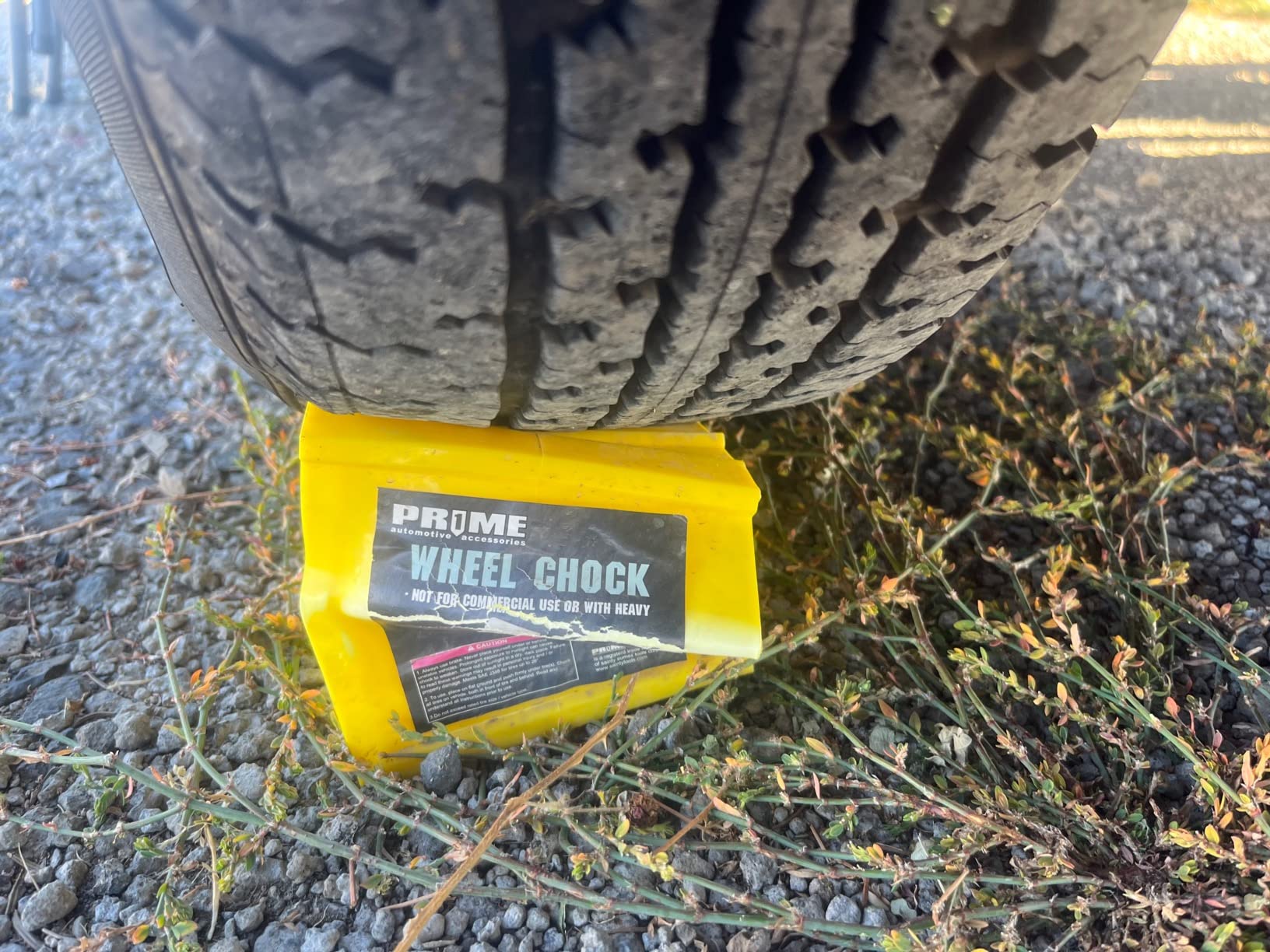
Plastic chocks have a deserved reputation for cracking after a few seasons in the sun, and this pair is the counter-example. The polypropylene here is UV-stabilized, the molded feet are EVA rather than bare plastic, and the shape is a rounded wide-angle wedge that will not pinch your fingers when you kick it into position.
Two integrated EVA pads with deep tread grooves are the real story. Those pads are what keeps the chock from skating on smooth garage floors and painted concrete, and they are the difference between a plastic chock that works and one that slides out from under a loaded axle.
At 1.43 pounds for the pair, this is the chock you will actually leave in your hands instead of in a box. It stores in a glovebox, a toolbox, or a campground storage bay, and the 8 by 4.5 by 4.5 inch size stacks neatly. One chock holds tires up to 26 inches in diameter, which covers most travel trailers and campers.
Bright yellow earns its place for a reason that has nothing to do with grip. Every year people drive away from a campsite with a chock still under a tire, and high visibility color is the cheapest insurance against that mistake. The color is also why it makes sense for a car, a boat trailer tongue, or any temporary stop.
Who should buy the plastic pair
Owners of small and mid-size travel trailers, pop-up campers, and cars parking on slopes who care more about portability than maximum holding force. Reviewers consistently describe them as cheap, effective, and easy to keep in the cab where they get used.
For a lighter trailer on a decently level site, these do the job with no tools and no fuss, and the cushioned feet prevent the sliding that makes cheap plastic chocks frustrating.
Where it falls short
Lightweight construction is the honest limit. Reviewers rate them as not heavy-duty enough to rely on for a large trailer, and the material is simply less rigid than solid rubber when a high-load axle sits on it. Under full load the wedge can feel vague compared to a dense rubber block.
A minority also find the footprint slightly under-matched at the extremes, both for very narrow tires and for very large ones, and the rating split reflects that. Treat this as a light-to-medium duty chock, not a heavy-haul one.
5. Camco 44471 Wheel Chocks with Rope – Best for Travel Trailers
Camco RV Wheel Chocks with Rope – 2-Pack – Made in the USA
UV-resistant plastic, fits tires to 26 inch, attached removal rope, made in USA
Pros
- Holds travel trailers and boats on slight inclines
- Attached rope allows removal without reaching under the tire
- Light and easy to position
- Long record of outdoor use
Cons
- Rope can detach on first use
- Light plastic chips if driven over
- Less suited to heavy commercial trailers
The rope is the entire point of this chock, and it is a better idea than it first sounds. Once a wedge is under a loaded tire, getting it back out means sliding your hand into a narrow gap and levering against a block that is being pressed down by several thousand pounds. With a rope, you pull it out from a safe distance with your hands clean.
Camco has been making these for a long time, and they remain standard unhitch kit for travel trailer owners. The plastic is UV-resistant with inhibitors in the formulation, which is what keeps it from the chalky cracking that ruins generic blocks. Fit is rated for tires up to 26 inches in diameter, covering most trailers and campers.
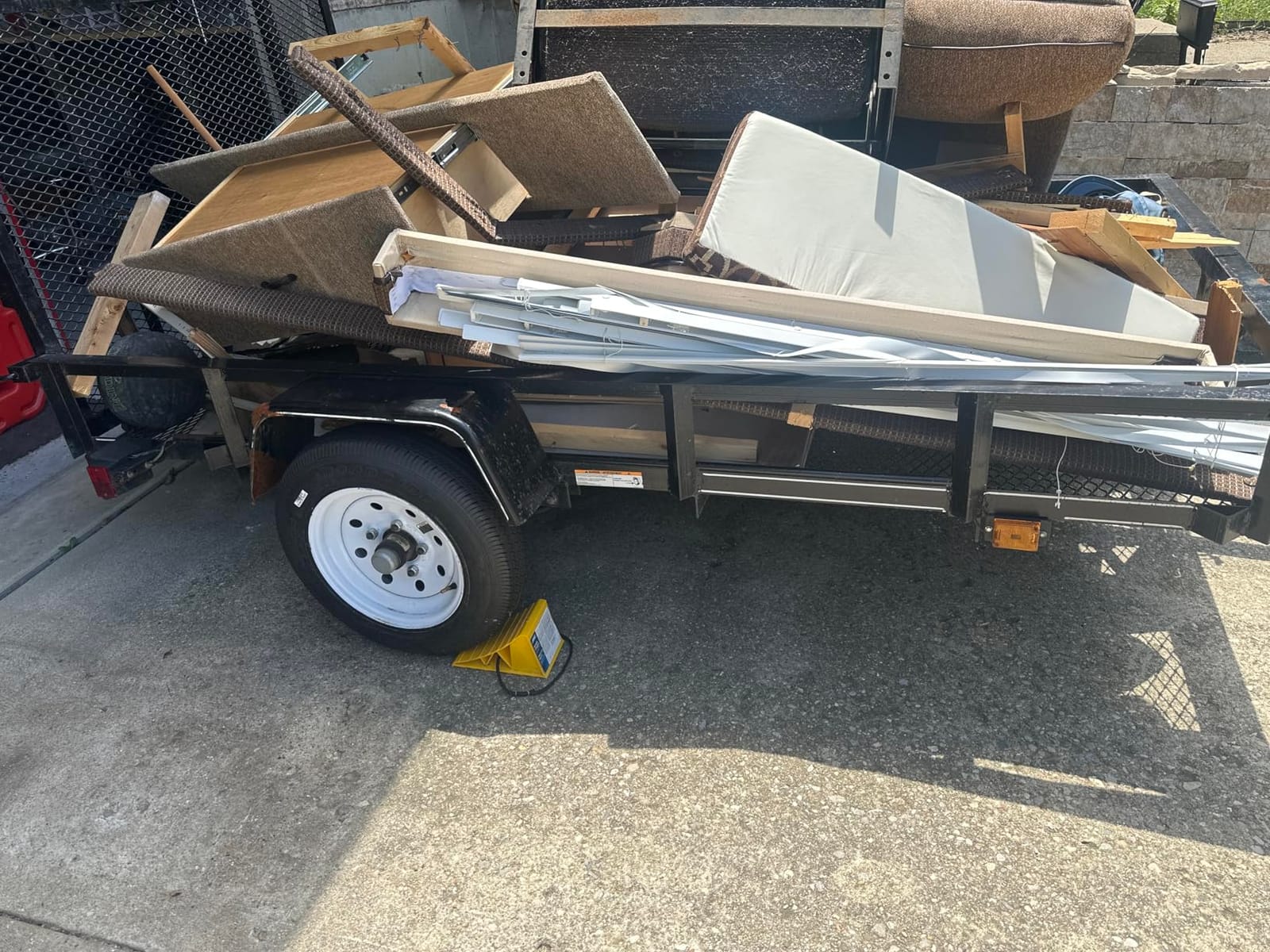
Owners describe them as dependable rather than sophisticated. They hold a trailer on a gentle incline, and reviewers report them successfully holding even large boats on a sloped launch ramp. At 1.5 pounds they are easy to grab with one hand while managing something else in the other.
The made-in-the-USA manufacturing matters more here than it might seem. Cheap molded plastic varies a lot between production runs, and a consistent mold is what you want for a part that lives in the sun and gets kicked around.
Where the rope design shines
Any time you chock a trailer that is still hitched or partly hitched, or any time you need the chock back out fast in the dark. It is also a decent answer for boat trailers at a ramp, where bending down next to a trailer tongue at the waterline is the least pleasant part of launching.
Reviewers like that they hold on slight inclines without any hammering, no adjustments, and no tools. They are a set-and-forget unhitch accessory.

Where it falls short
Rope quality is the recurring complaint. Several reviewers report the cord coming apart on the very first use, which defeats the entire safe-removal purpose. Check the rope before you trust it on a dark gravel pad.
Light plastic chips or cracks if a tire rolls over it or if you strike it with a hammer trying to seat it, and it is not the right tool for heavy commercial trailers. If you want more holding force and still want rope removal, look at the heavier four-pack later in this list.
6. AFA 8T Nylon-Reinforced Rubber 4-Pack – Best for Chocking a Full Axle
Wheel Chocks for Cars, RVs, Trucks, Trailers, and Vehicles G.V.W. up to 8T, 4 Pack – Anti Slip Bottom Tire Chock for All Weather Use – RV, Travel Trailer, Pop Up Camper Accessory
Nylon-reinforced rubber, rated to G.V.W. 8T, 9.1 inch long, 3.4 pounds each
Pros
- Four chocks cover a full axle front and back
- Rated for vehicles up to G.V.W. 8T
- Reinforced rubber resists cracking in cold weather
- Rust-proof molded handles accept rope ties
Cons
- Strong rubber odor for the first day or two
- Profile covers roughly 75 percent of tread width
- Weak grip on loose gravel or soft ground
Two chocks handle one wheel. Four handle an entire axle, front and rear, which is the arrangement most trailer owners should actually be running. This set gives you that in one box, and the rating is honest about what it is built for: vehicles up to G.V.W. 8T.
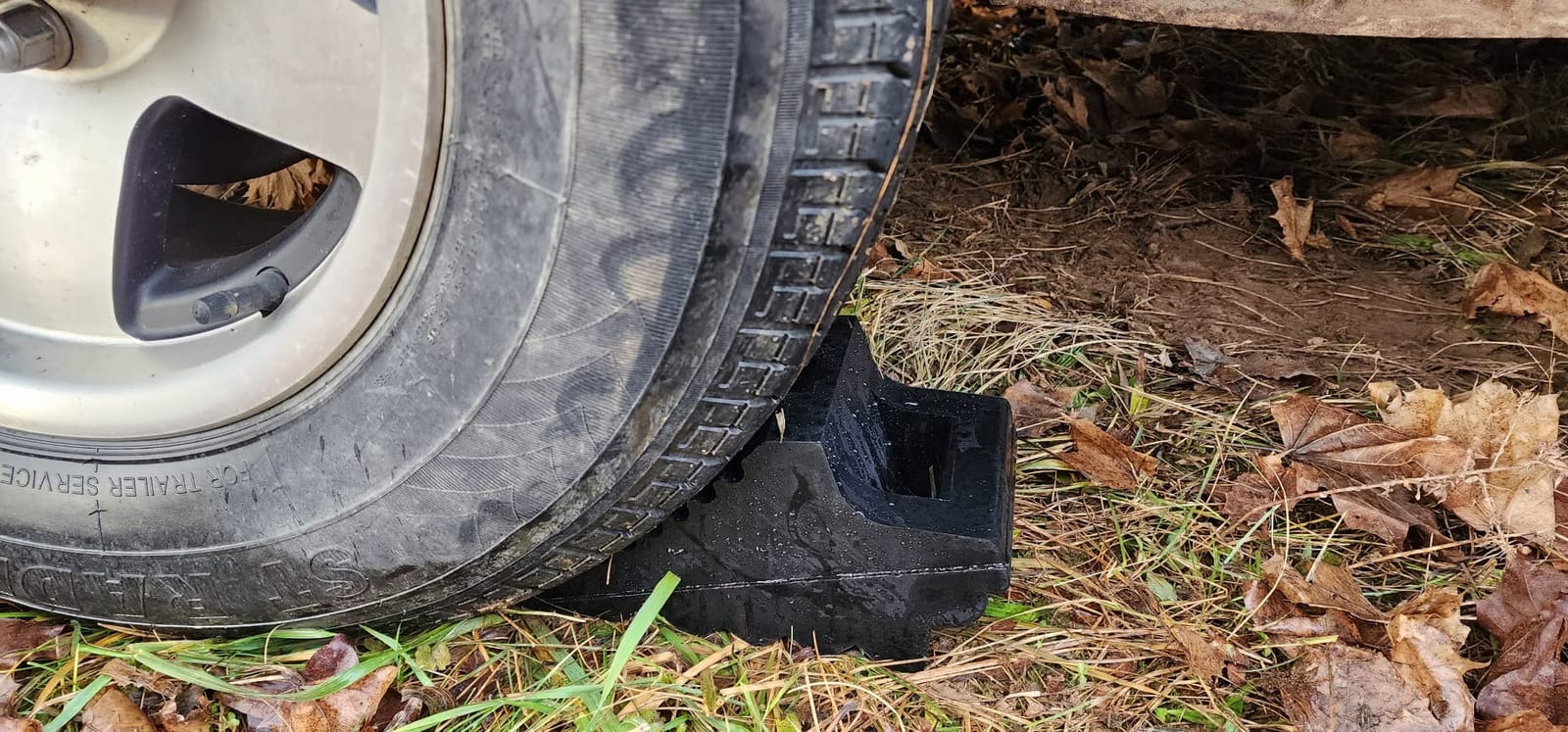
Each chock is 9.1 by 3.7 by 4.7 inches at 3.4 pounds, built from nylon-reinforced rubber that the manufacturer rates at roughly twice the strength of plain rubber. That reinforcement is the difference you feel in cold weather, where unreinforced rubber stiffens and can crack along the rib lines.
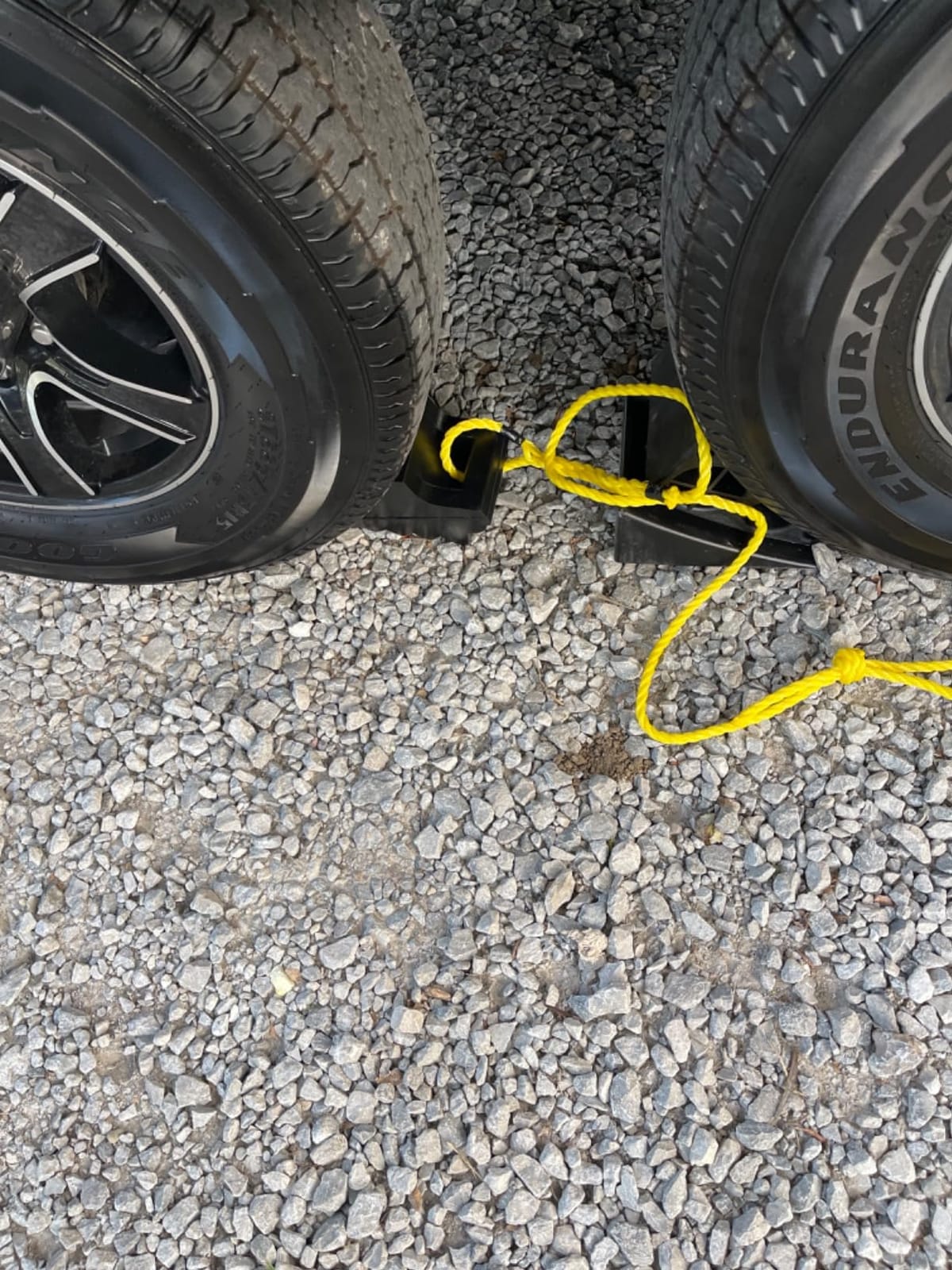
Owners who switched from plastic report two specific improvements: the chocks are noticeably more rigid under load, and they hold coated garage floors where metal and hard plastic simply skate. The ribbed face bites without any hammering, and the curved tire-facing profile spreads contact across more of the tread.
The molded handles are rust-proof, unlike the steel rings on many competing sets, and they are shaped so you can thread a rope through them and pair chocks together for tandem setups or for retrieval.
Where this set is the right answer
Mid-weight trailers and campers where a four-chock axle strategy makes sense, especially on sloped sites or when you plan to work under the rig. Reviewers cite holding a 5000 pound trailer on a slope where plastic chocks collapsed, which is the kind of failure you cannot recover from.
The 8T rating also gives headroom above a typical 3500 to 5000 pound travel trailer, so you are not running the chock at its ceiling on day one.
Where it falls short
The rubber smell on arrival is strong enough that owners advise airing the set out for a day or two before putting it in an enclosed vehicle. The same real experience shows up across nearly every rubber chock in this roundup.
Two real grip limits. The slim 3.7 inch profile covers roughly three quarters of a typical tread width, and owners report poor grip on loose gravel or soft unpaved surfaces, so the medium size is best on pavement or firm packed ground. The medium variant can also feel small beside wide Class A motorhome tires.
7. ROBLOCK 18023-2 Solid Rubber 2-Pack – Best Curved-Fit Pair for Boat Trailers
ROBLOCK Solid Rubber Wheel Chocks Heavy Duty Trailer Chock, G.V.W. Up to 4T, 2 Pack Black, 8.6″ L x 3.7 W x 4.7″ H for Car, Travel Trailers, RV, Truck, and ATV, for All Weather Use
Solid rubber, 8.6 x 3.7 x 4.7 inch, G.V.W. up to 4T, curved tire face
Pros
- Solid heavy rubber resists crushing
- Curved top conforms closely to the tire profile
- Lugged base grips sloped driveways
- Compact enough to travel with
Cons
- Medium size runs smaller than buyers expect
- Rated only to G.V.W. 4T
- No pull cord included
The curved top is the feature that separates this one from a plain wedge. Rather than presenting a flat face for the tire to sit against, the crown is shaped to follow the tire profile, so contact happens over a wider arc and the chock feels like it grips rather than sits.
Construction is solid oil-resistant rubber at 8.6 by 3.7 by 4.7 inches per chock, 5.68 pounds, rated for vehicles up to G.V.W. 4T. High-grip edges and a lugged base are what keep it planted on an inclined driveway, and there is a built-in molded handle for carrying and stowage.
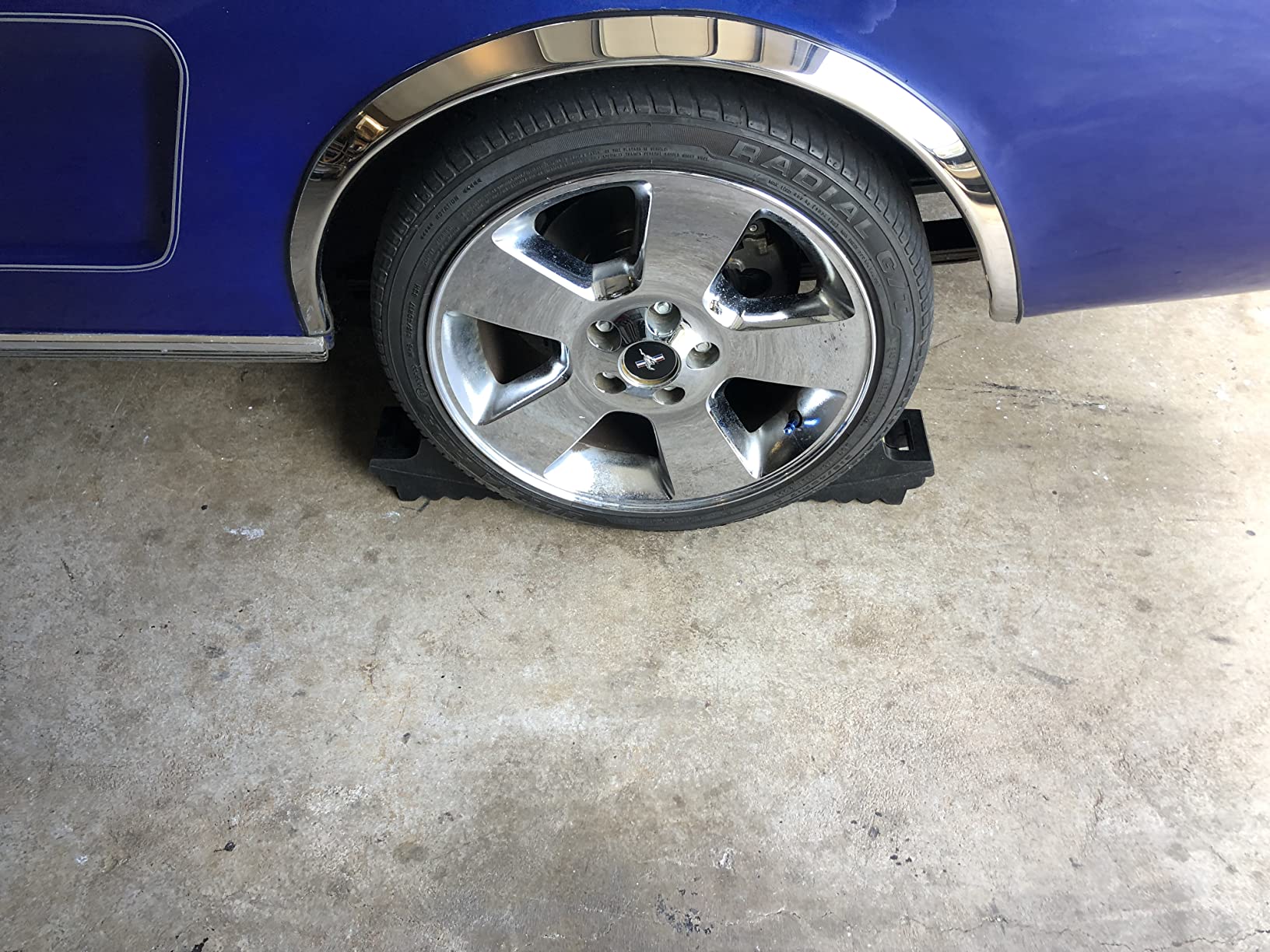
Reviewers who replaced cracked plastic chocks with these report the clearest change at the trailer tongue on a boat ramp, where a sloped concrete surface is the default condition. The lugs bite into the incline and the curved face holds the tire without the shimmy that flat-topped blocks allow.
It is also more compact than the large plastic blocks many owners migrate away from, which matters if the storage space is a wheel well or a small truck bed rather than a full-size compartment.
Where it fits
Boat trailers, pop-up campers, and small to mid-size utility trailers on paved or firm driveways. Owners like the tight tire fit for the confidence it gives them on a slope with the boat in the water and the trailer loaded.
It is a solid step up from plastic in feel and in reported durability, and the molded handle avoids the rusting steel rings that fail on other designs.
Where it falls short
Size expectations are the most common surprise. The medium version is smaller in the hand than buyers picture, and owners say a larger variant suits bigger rigs better. Check your tire diameter before settling on the medium.
It is rated to 4T, which is below the heavier-duty sets here, so it is not the right match for a fully loaded heavy trailer. And there is no pull cord included, which makes retrieval from under a tire less pleasant on a hard surface.
8. Proud Panda Scissor X-Chock – Best Budget Tandem Stabilizer
Camper Wheel Chock Stabilizer 2 Sets, Double Speed Heavy Duty Truck RV Tire Scissor Locking X Chock, Camper Accessories for Travel Trailers Tire Chalks, Anti Rust Coating, Fit for 3.5” to 12”
Alloy steel scissor design, adjusts 3.5 to 12 inch, crank handle and socket adapter
Pros
- Reaches tandem gaps a wedge cannot enter
- Adjusts from 3.5 to 12 inch spacing
- Crank handle or drill speeds up tightening
- Electrophoretic anti-rust coating suits outdoor storage
Cons
- Heaviest and most complex option in the roundup
- Takes more storage than a wedge pair
- Scissor mechanism must clear the tire gap each time
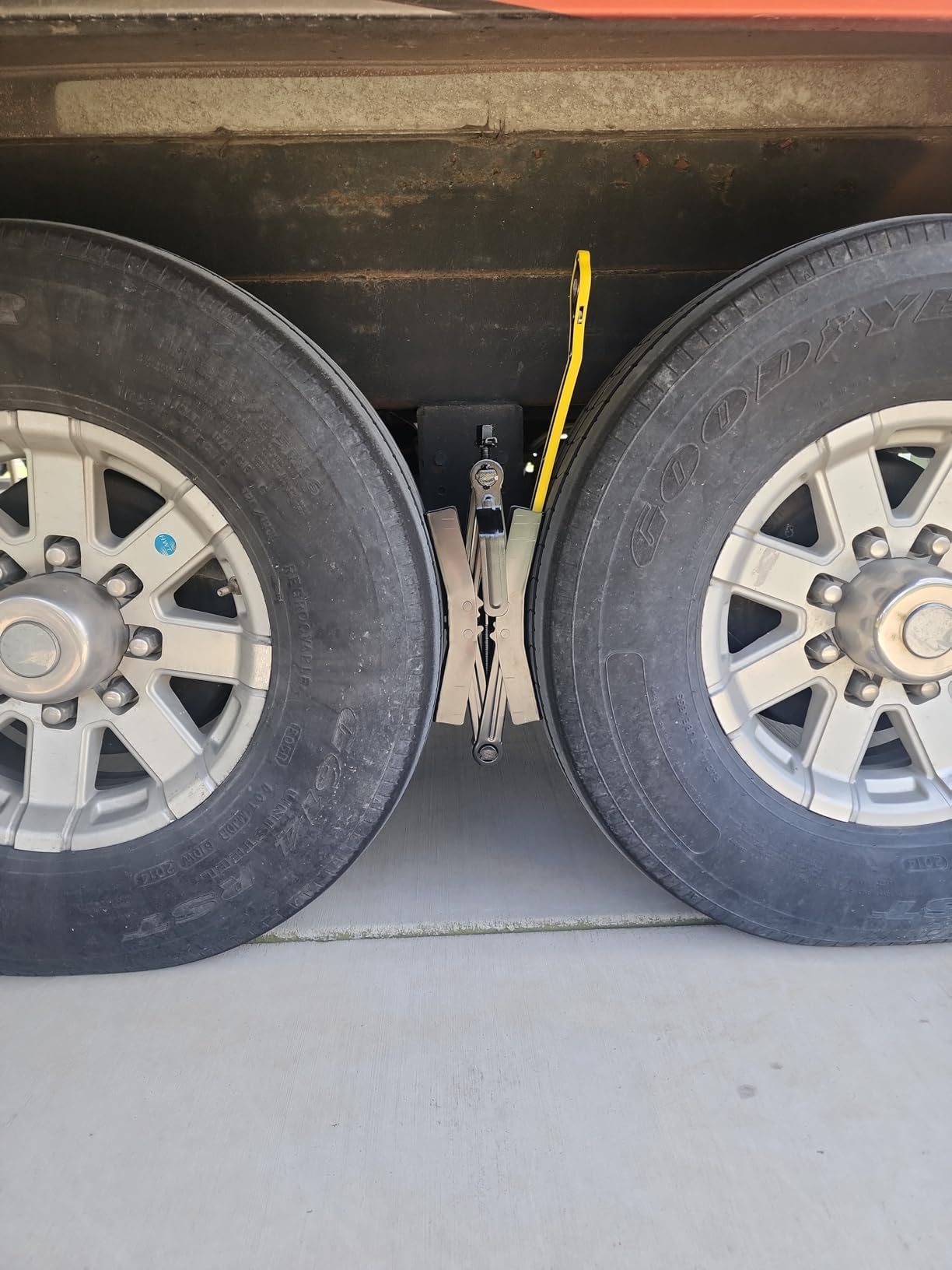
If your tandem tire gap is wider than about 10 inches, most scissor stabilizers in this category simply will not fit, and this one adjusts from 3.5 inches all the way to 12. That range is what makes it useful on motorhomes and heavier trucks where the inner tires sit further apart than on a travel trailer.
The mechanism is a scissor-style X chock in alloy steel with an electrophoretic anti-rust coating, which is a harder and more uniform finish than ordinary paint and holds up better through wet outdoor storage. Each box contains two stabilizers, a crank handle, and a socket adapter, so you can drive it with a drill if you do not want to crank by hand.
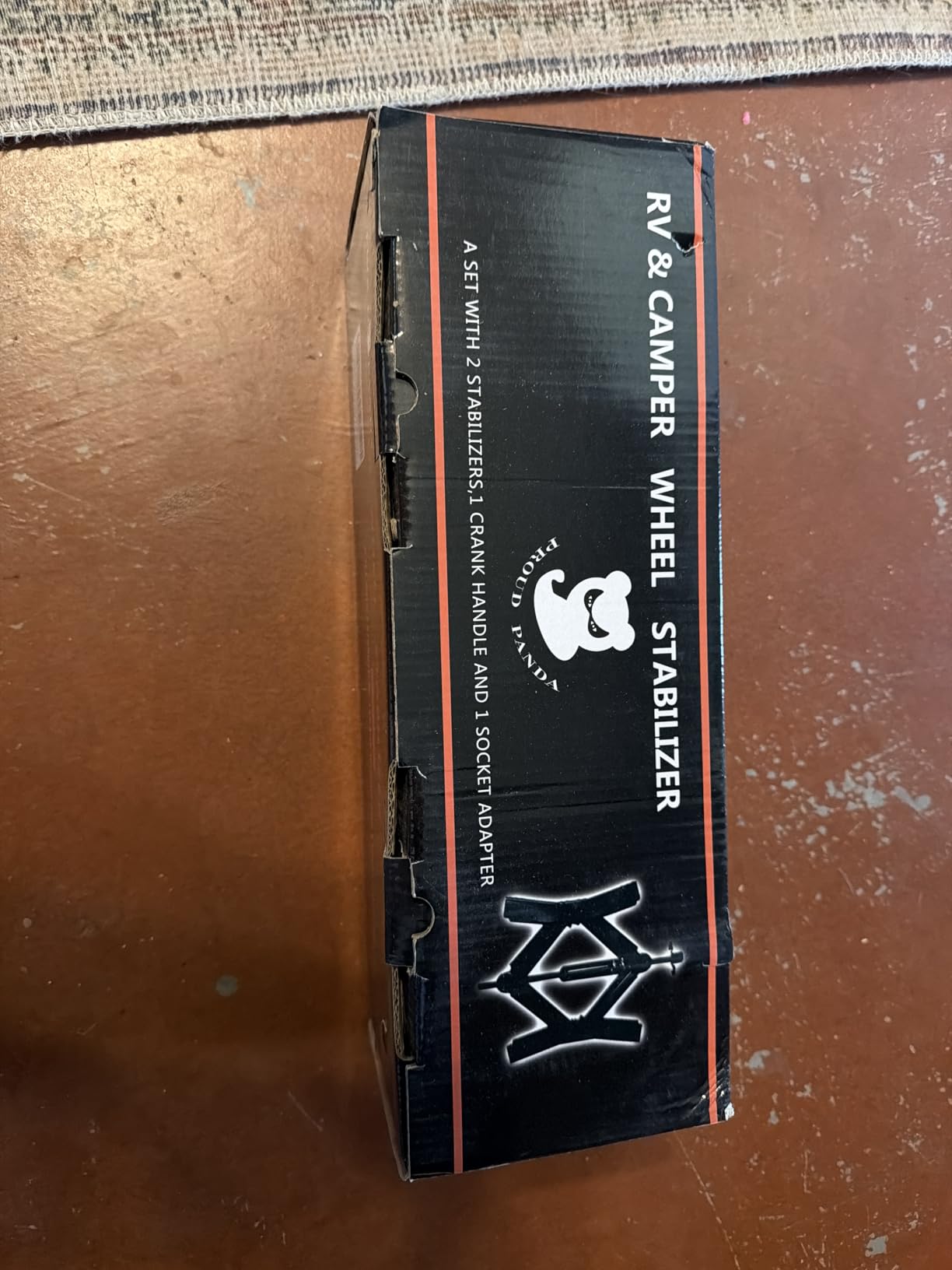
Owners value the ability to brace tight tandem gaps that a wedge chock cannot reach, and they report noticeably less sway once the scissor is torqued. Two sets per box means you can stabilize both axles of a tandem trailer in a single purchase, which is a practical advantage over single-unit packages.
Fit is listed for travel trailers, campers, Class A motorhomes, fifth wheels, and heavy trucks, and the coverage is backed by a one year manufacturer warranty.
Who should use this
Motorhome and heavy truck owners with wide tandem tire spacing, and anyone whose tires sit on stacked leveling blocks where a ground wedge cannot be seated properly. The anti-rust coating also suits rigs stored outside through a wet season.
Reviews frame it as a complement to ground chocks rather than a replacement, which is the correct way to think about it. Pair it with a rubber wedge under the outer tires.
Where it falls short
It is the heaviest and most mechanically complex option here, at close to 9.3 pounds for the box. Two units plus a crank and adapter take noticeably more storage than a pair of rubber wedges, and in a tight hitch box that matters.
The scissor arms have to be physically lined up with the gap each time you deploy them, so installation is slower than dropping a wedge. Some owners also note that the mechanism wants periodic re-tightening after the trailer has settled.
9. SECURITYMAN 20000 lb Rubber 2-Pack – Best for High Visibility on Slopes
SECURITYMAN Heavy Duty Wheel Chocks (2 Pack) – Durable, Non-Slip, Solid Rubber Wheel Chocks for Boat Trailers, RV, Truck, Camper – Perfect on All Surfaces and in All Weather – Orange…
Rated to 20000 lb, high-visibility orange, predrilled tie holes, molded handle
Pros
- Thin wedge angle seats under a tire without a hammer
- Orange color prevents leaving a chock behind
- Predrilled holes accept rope or chain
- Molded handle and finger recess aid removal
Cons
- Light feel may not suit very heavy vehicles
- Fit is tuned to larger SUV and truck tires
- A few owners report slip on smooth asphalt
Two things set this pair apart. The first is the 20000 pound holding rating on paper, which puts it in a different class from the 4T and 8T rubber sets. The second is the wedge angle, which is thin enough at the leading edge that you can kick it under a tire by hand rather than swinging a mallet.
Predrilled holes through the body accept rope or chain, so you can pair the two together or secure them to the frame, and the molded grab handle plus finger recess make it easy to pull out of position without wrestling it. The high-visibility orange is not cosmetic; it is the feature that keeps you from driving off with a chock still under a tire at dusk.
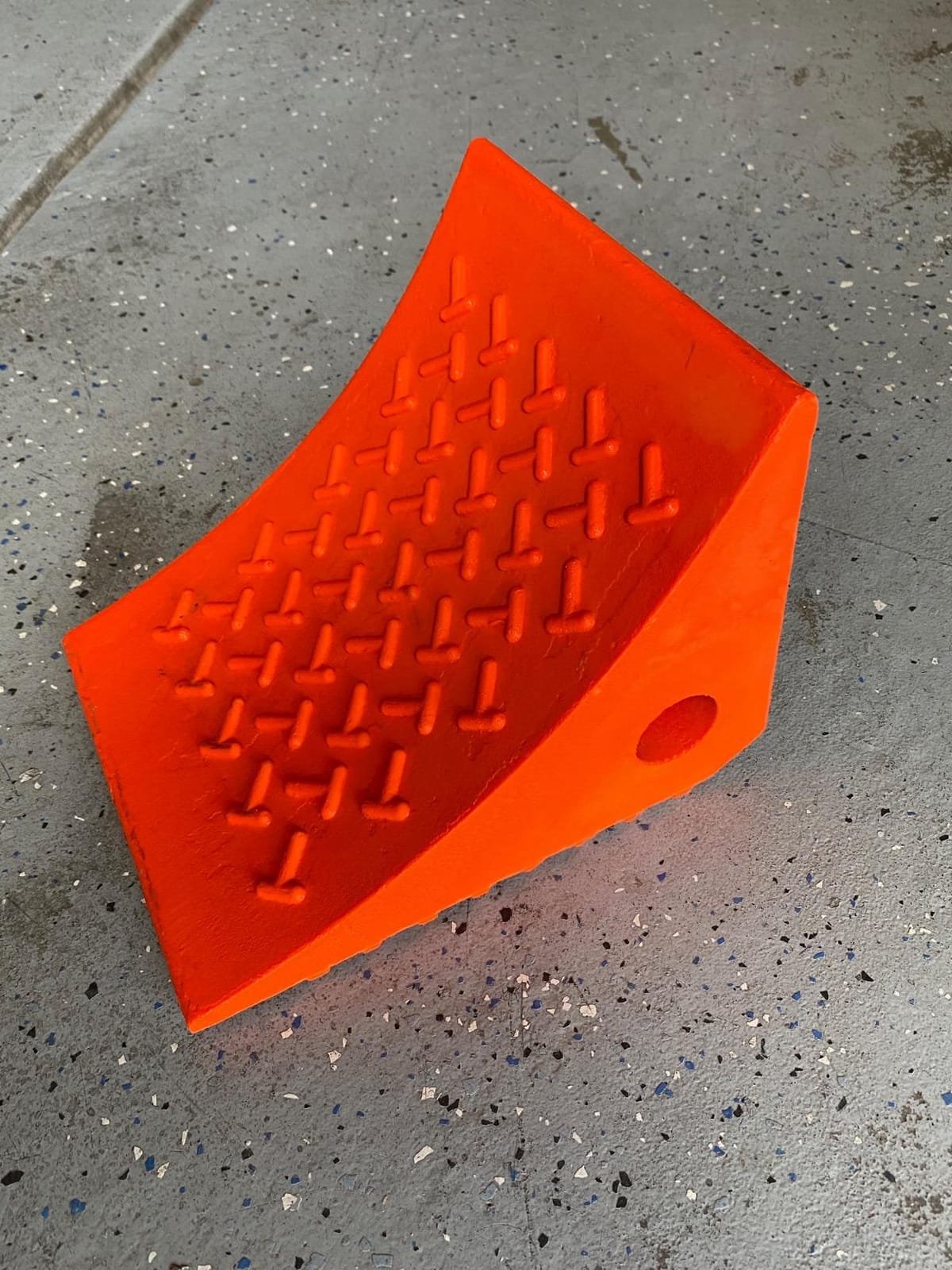
Owners also mention what is missing: there is no rubber odor, which is a genuine relief if you store gear in an enclosed vehicle. The treaded grip surface is designed for slippery ground in any climate, and at 4.2 pounds the pair stays light in the hand.
The visibility point deserves more weight than it usually gets. On a sloped site the single most common and most dangerous trailer accident is a rig moving because the brake failed, and a chock you can see from the driver’s seat is a chock you will check before you pull away.
Where it fits
Large SUV and truck tires on sloped driveways, boat trailers at a ramp, and anyone who wants a high-rated chock that is still easy to carry and place. Repeat buyers highlight the no-hammer seating and the color for visibility before departure.
It works well as a second set to carry alongside a heavier rubber pair, since the lighter weight means you are not hauling dead weight for the option you use occasionally.
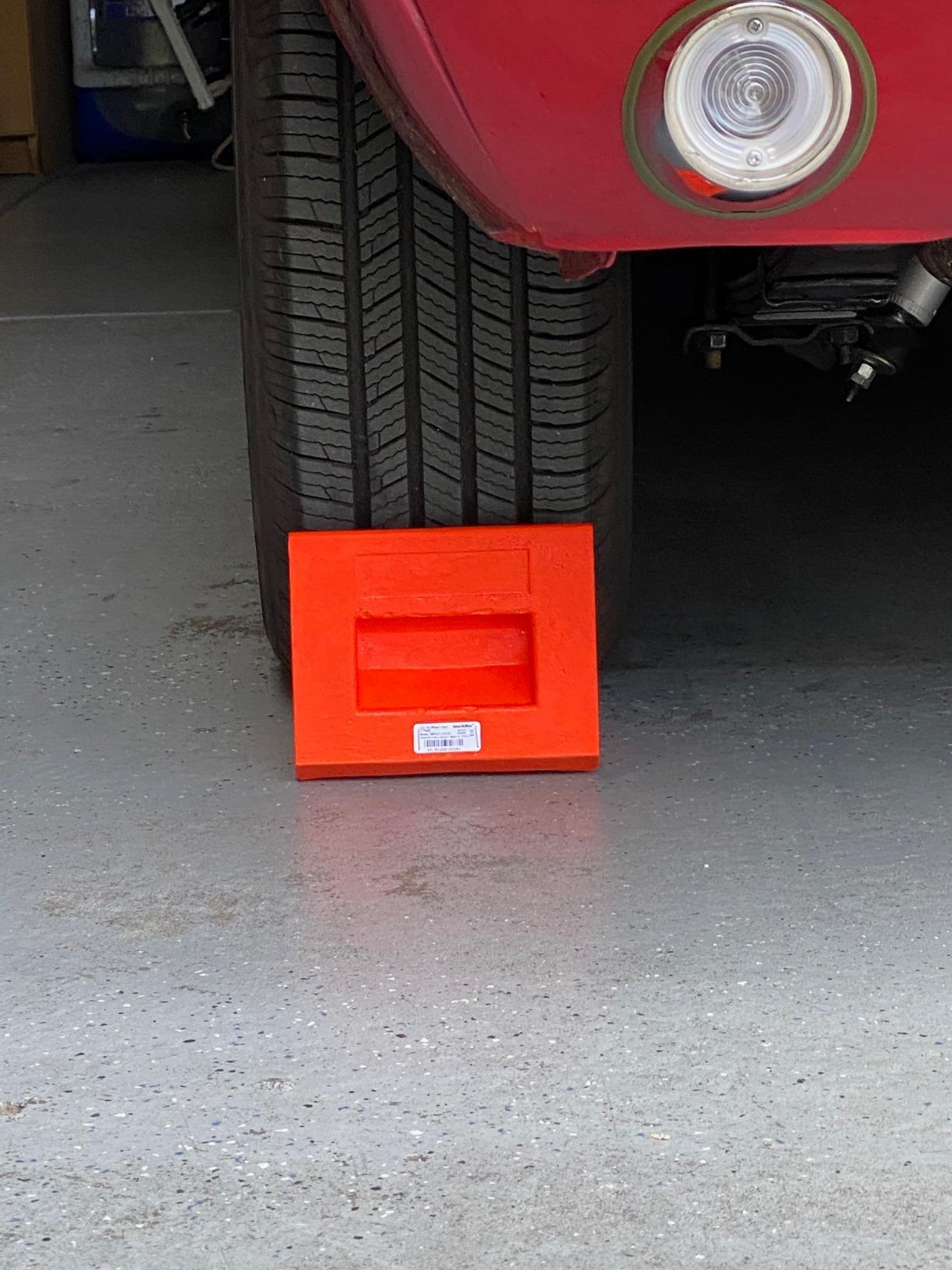
Where it falls short
Some owners feel the light 4.2 pound build does not match the 20000 lb rating in practice, so treat the number as a manufacturer figure rather than a promise on your heaviest rig. The fit is also tuned toward larger tires and can be mismatched on small boat trailer or golf cart wheels.
A few reviewers report the surface can feel slippery on smooth asphalt, so test it on your actual parking surface before trusting it on a slope. And again, like every stabilizer here, it does not replace a parking brake.
10. HOXWELL Premium Rubber 4-Pack – Best Heavy Four-Chock Set
HOXWELL Solid Heavy Duty Rubber Wheel Chocks 4 Packs, Premium Wheel Stopper for Car, Travel Trailers, RV, Truck, and ATV(4 pcs, Black) 8″ x 4″ x 6″
Reinforced rubber, 8 x 4 x 6 inch each, ribbed triangular base, 15 pound set
Pros
- Rubber resists crushing on smooth floors and ramps
- Ribbed base seats in one step with no hammering
- Molded handles avoid rusting steel rings
- Four chocks cover both sides of two axles
Cons
- Heavier than typical lightweight plastic chocks
- Handle holes are narrower than some rope sizes
- Listed weights differ between set and per-chock figures
This is the four-pack for people who kept coming back to plastic chocks that flattened or cracked. The manufacturer rates the upgraded rubber at roughly twice the strength of ordinary rubber, and owners who switched report exactly that, holding shape on smooth floors and on portable wheel ramps where softer blocks compress.
Each chock is 8 by 4 by 6 inches in a triangular profile with a ribbed, textured base designed to set into place in a single step with no hammering. The molded rubber handles can be paired with a rope to keep chocks together or to pull them out from a distance, and unlike many rivals there is no steel ring to rust and snap.
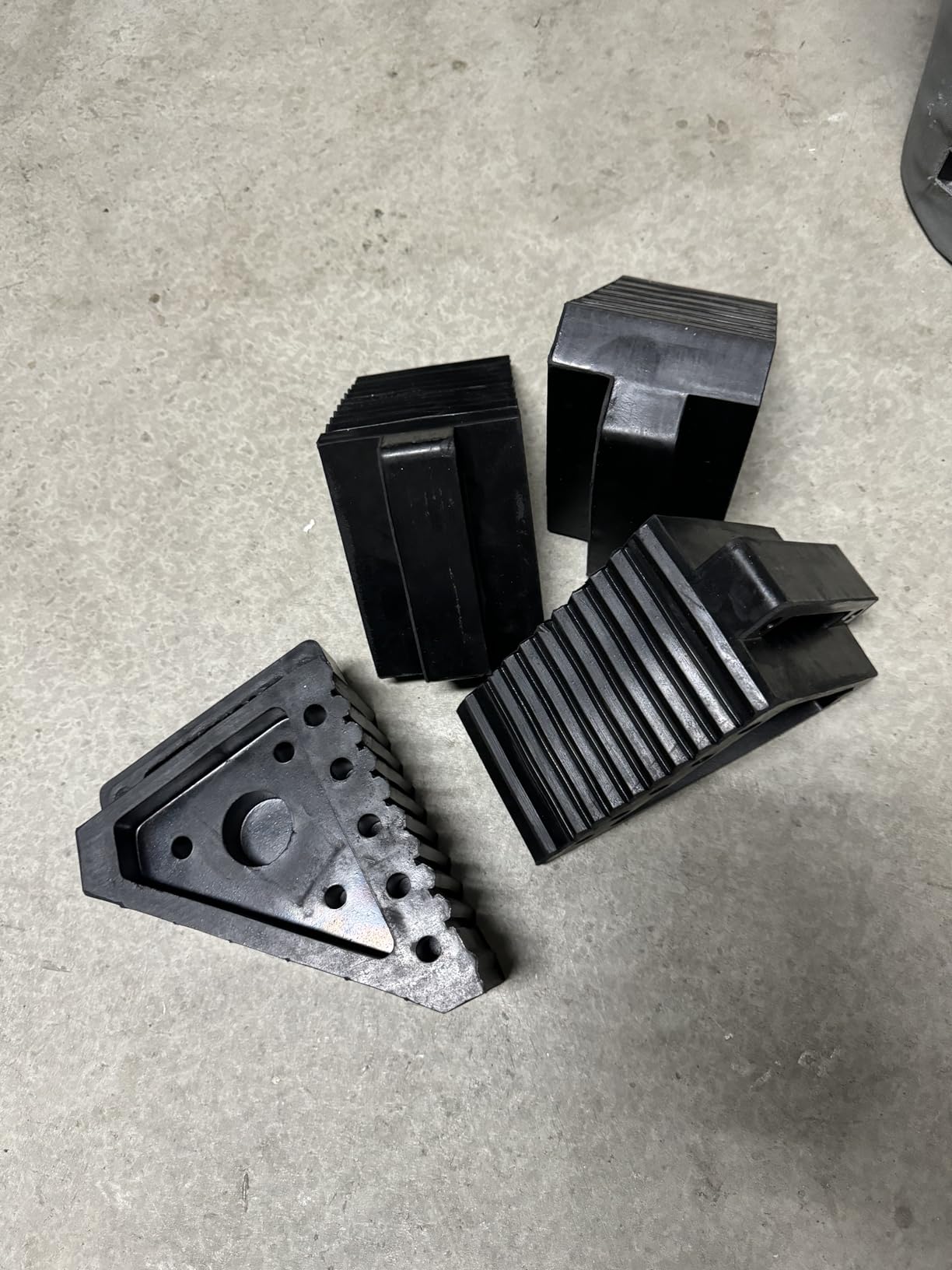
At 15 pounds for the four-pack, this is real mass, and that is the point. Owners consistently frame weight as a safety feature here, because a chock is not going to be kicked aside, run over, or carried off by someone walking past the campsite.
Four units means you can chock both sides of two axles, which is the arrangement RV owners on forums describe as the sensible default for anything parked on a slope. The compact size still fits in an RV storage compartment.
Where this set works
RVs, campers, trailers, cars, trucks, and small aircraft on pavement or firm ground, particularly where you want four chocks and want them to still be there in the morning. The one-step ribbed placement means no tools even in the dark.
The near 4.8 rating across more than 1500 reviews comes largely from the same theme: these do not crush under vehicle weight the way cheaper chocks did.
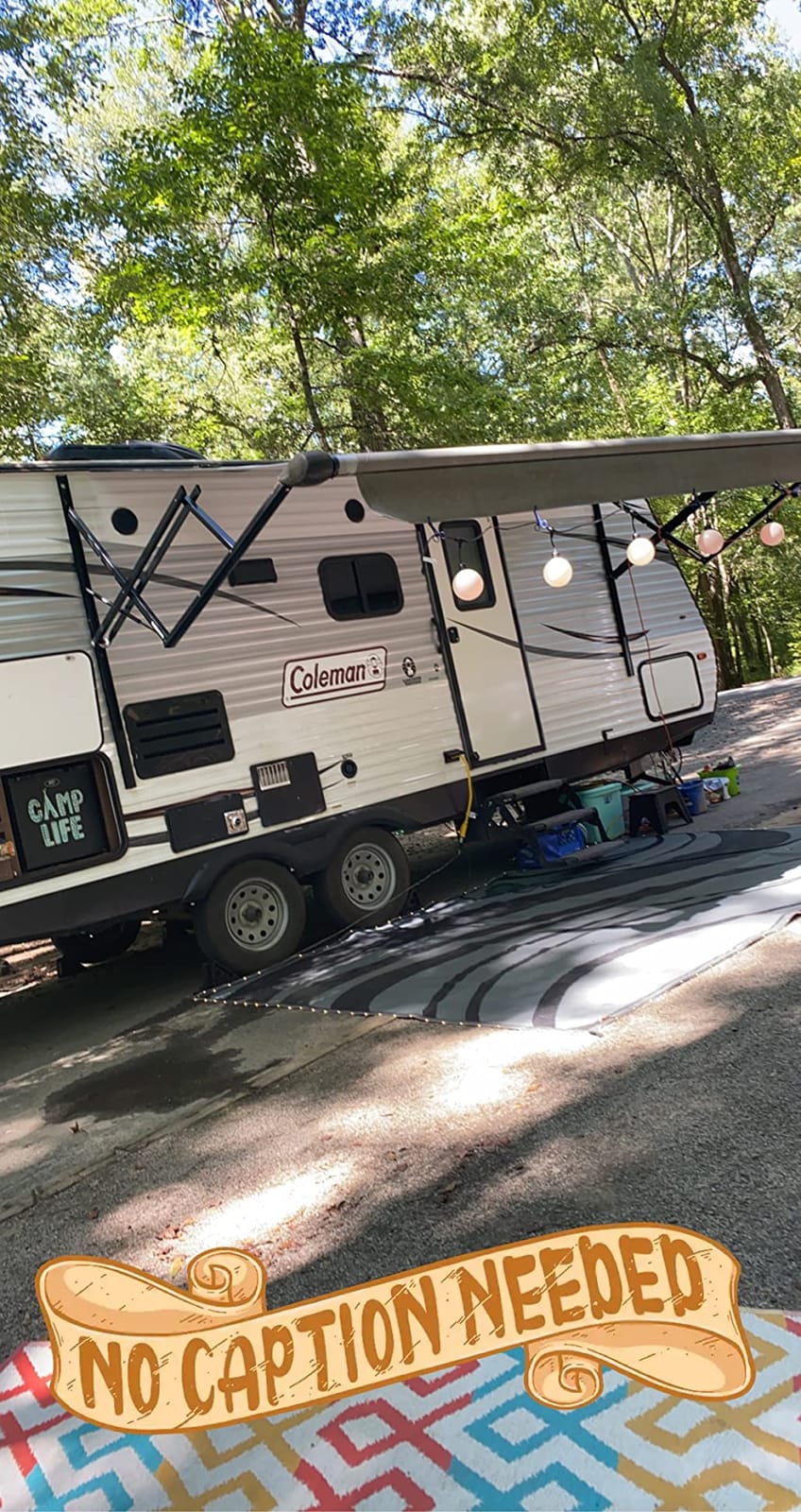
Where it falls short
Heaviness is the trade-off owners mention most. If you need something you can carry one-handed up a wet dock or into a truck bed quickly, this is not it, and the roundup has lighter options for that.
The molded handle holes are narrower than some rope and cord diameters, so a thick rope will not thread through without effort. There is also some inconsistency in the listed weight figures between the four-pack and per-chock measurements, so weigh the actual set if load capacity matters to you.
11. ROBLOCK 18010-4 Rubber 4-Pack with Rope – Best for Long-Reach Removal
ROBLOCK 2 Pairs Wheel Chocks Heavy-Duty Rubber Wheel Block Non-Slip Base with Nylon Rope Yellow Reflective Tape – 4 Pack Wheel Stopper for Travel Trailers, Car, Camper, Truck, Black
Rubber 4-pack, 6.6 pounds per chock, 30 inch connecting rope, reflective tape
Pros
- Far more durable than plastic chocks that embrittle and crack
- Heavy enough to resist wind and tire roll-over
- 30 inch rope makes placement and removal easy
- Reflective tape improves nighttime visibility
Cons
- Rope is polypropylene despite the nylon description
- Rope can be too short for some travel trailer wheels
- One pair is two chocks so two tires need two sets
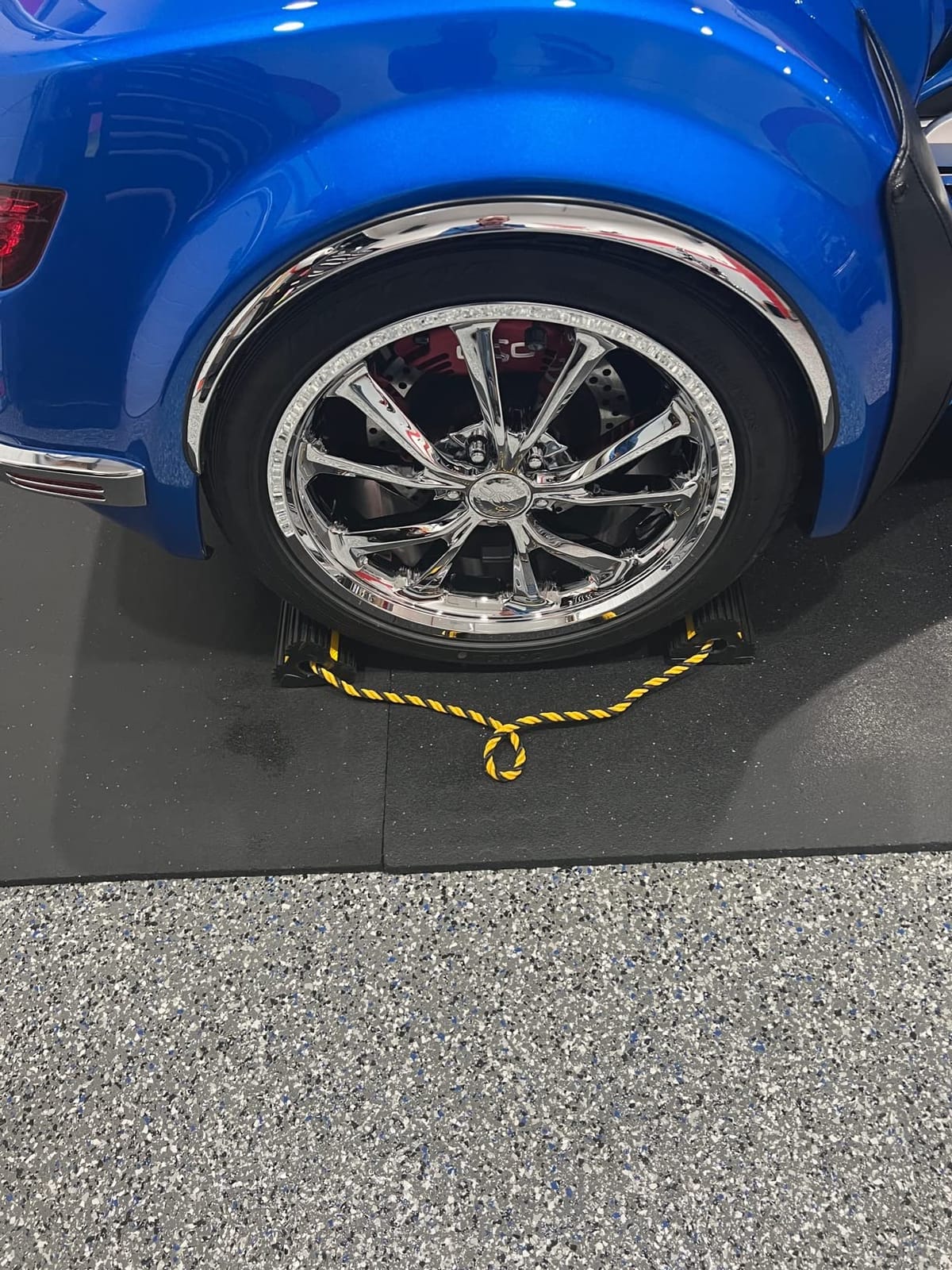
This is the set built around one problem, and it solves it well. Each chock weighs 6.6 pounds and measures 7.8 by 4.1 by 3.9 inches, joined by a 30 inch connecting nylon rope so you can place and retrieve them without crawling under a tire. For a trailer with wide tandem spacing, that rope length is the difference between a two-second job and a five-minute struggle.
The three-sided profile carries yellow reflective tape stripes, which matters if you are placing chocks in a dark campground or pulling away before dawn. Construction is durable rubber described as oil, weather, and slip resistant, and the anti-slip base stays in place once driven onto.
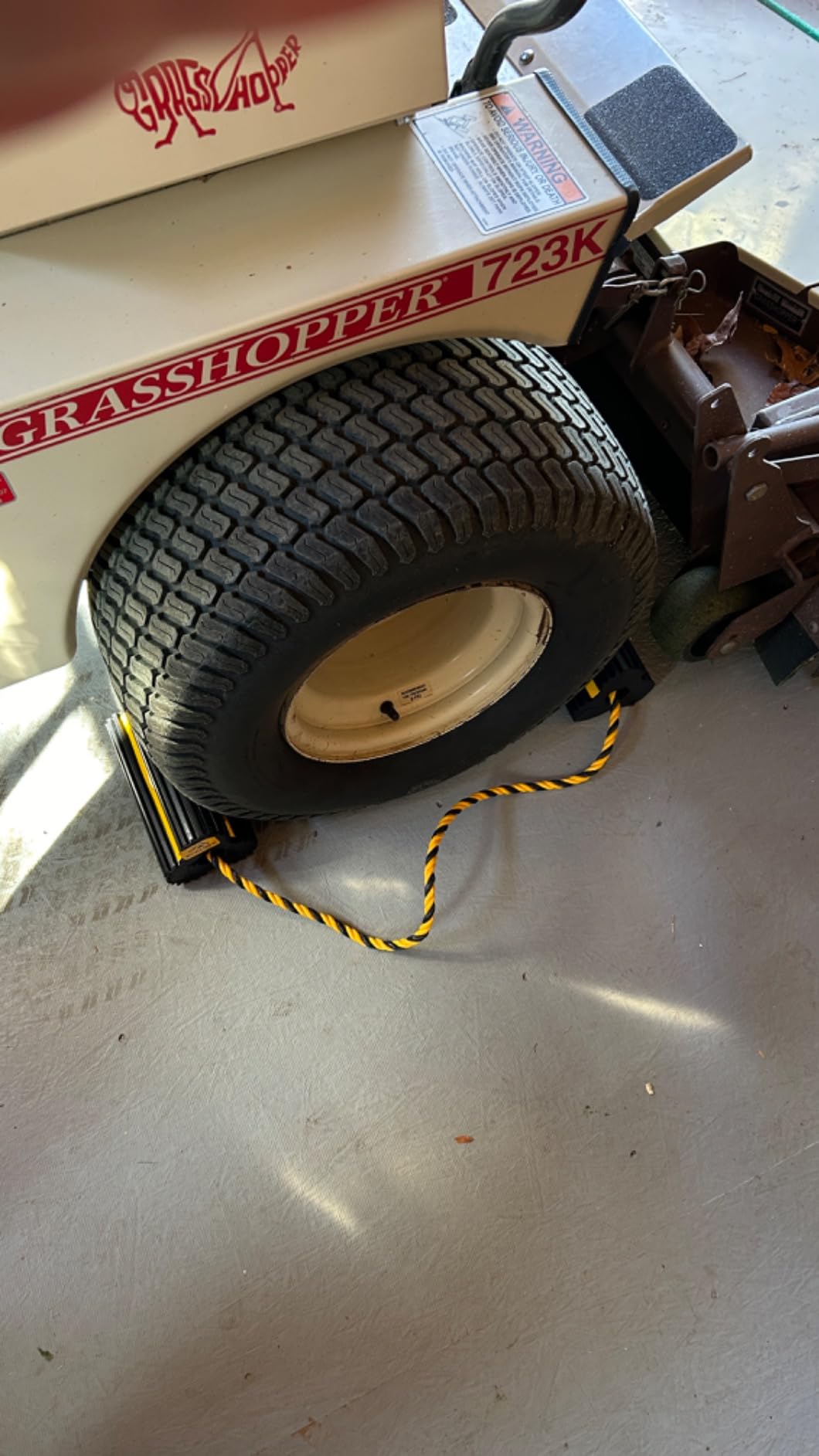
Owners overwhelmingly lead with durability compared to plastic. The rubber does not embrittle and crack the way cheap plastic blocks do after a few seasons of sun, and the weight means wind will not move them and a tire will not roll over them. The rating distribution on this listing is unusually clean, with 86 percent five star and 10 percent four star.
It is also one of the more flexible sets here, working across cars, trucks, trailers, small airplanes, dumpsters, boats, and horse trailers, which makes it a reasonable single purchase to cover several toys.
Where it fits
Owners of multiple rigs, or one rig used in several roles. A pair of boats, a trailer and a small aircraft all fall inside the stated range, and having one rubber set that handles all of them removes the excuse to keep plastic around.
The rope and reflective tape combination is genuinely useful for wide tandem wheels and for anyone who chocks up in poor light, and the weight keeps the blocks planted without a fight.
Where it falls short
The rope is the main complaint. Owners report it is polypropylene rather than the advertised nylon, and that it can degrade with prolonged sun exposure, which is worth factoring in if your trailer lives outdoors permanently.
Some buyers also find 30 inches too short to reach around a travel trailer wheel, and there is recurring confusion over pack sizing, since one pair is two chocks and two tires means ordering two sets. Measure your reach before you buy.
12. AFA 4T Rubber 4-Pack with Eyebolts – Best for Tie-Off Retrieval
AFA Tooling 4T Rubber Wheel Chocks, 4 Pack, Two Pairs & Tie-Off Eyebolts
Rubber 4-pack rated to 4T, 4.1 x 8 x 5 inch each, integrated eyebolts, ribbed face
Pros
- Dense rubber grips the full length of the tire contact
- Aggressive ribbed face bites without hammering
- Eyebolts prevent running over and allow tie-off
- Nylon reinforcement resists cracking and shattering
Cons
- Eyebolt nut uses a flat washer with no lock washer
- Compact size looks small beside wide motorhome tires
- No rope included for tie-off
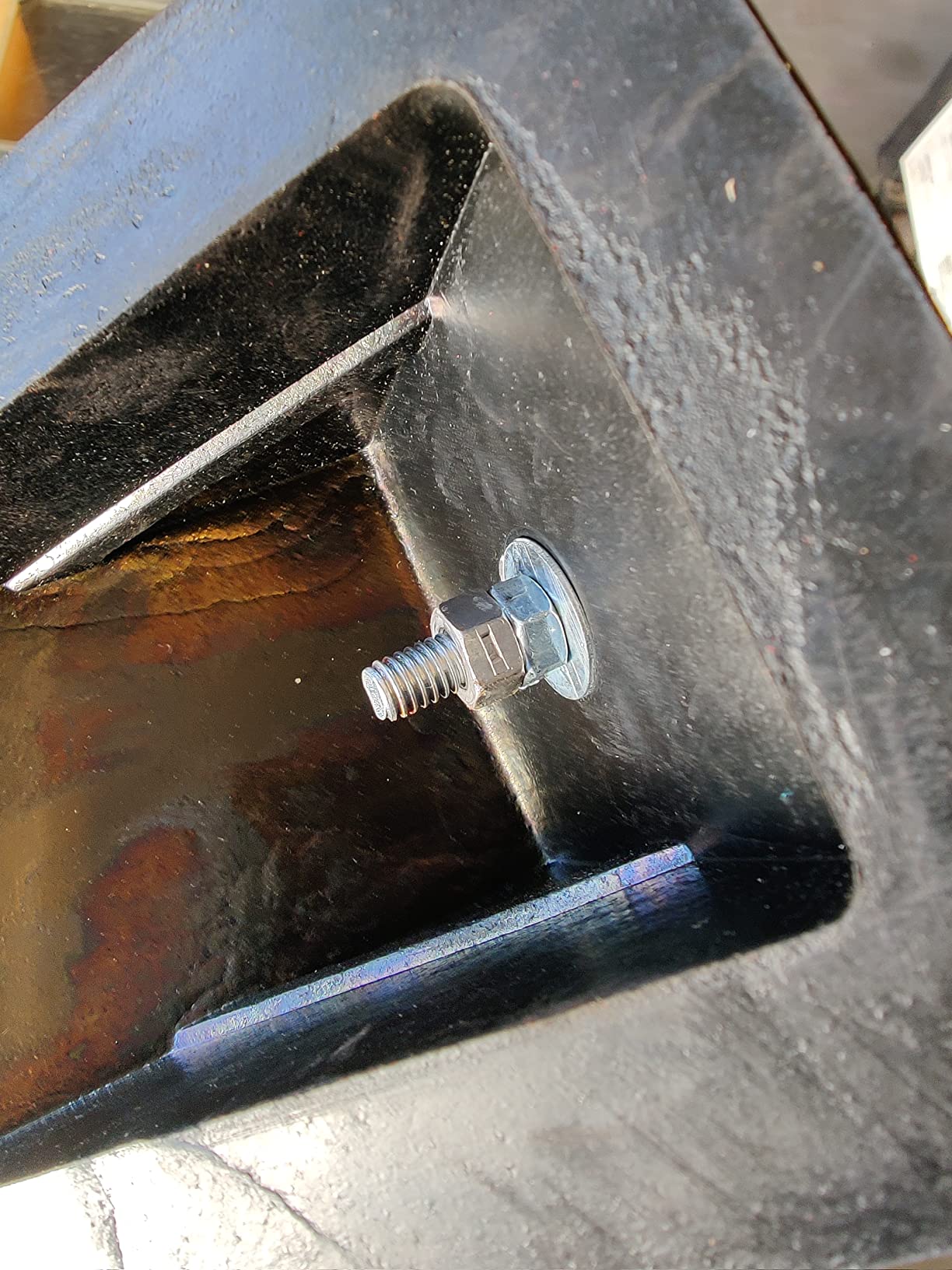
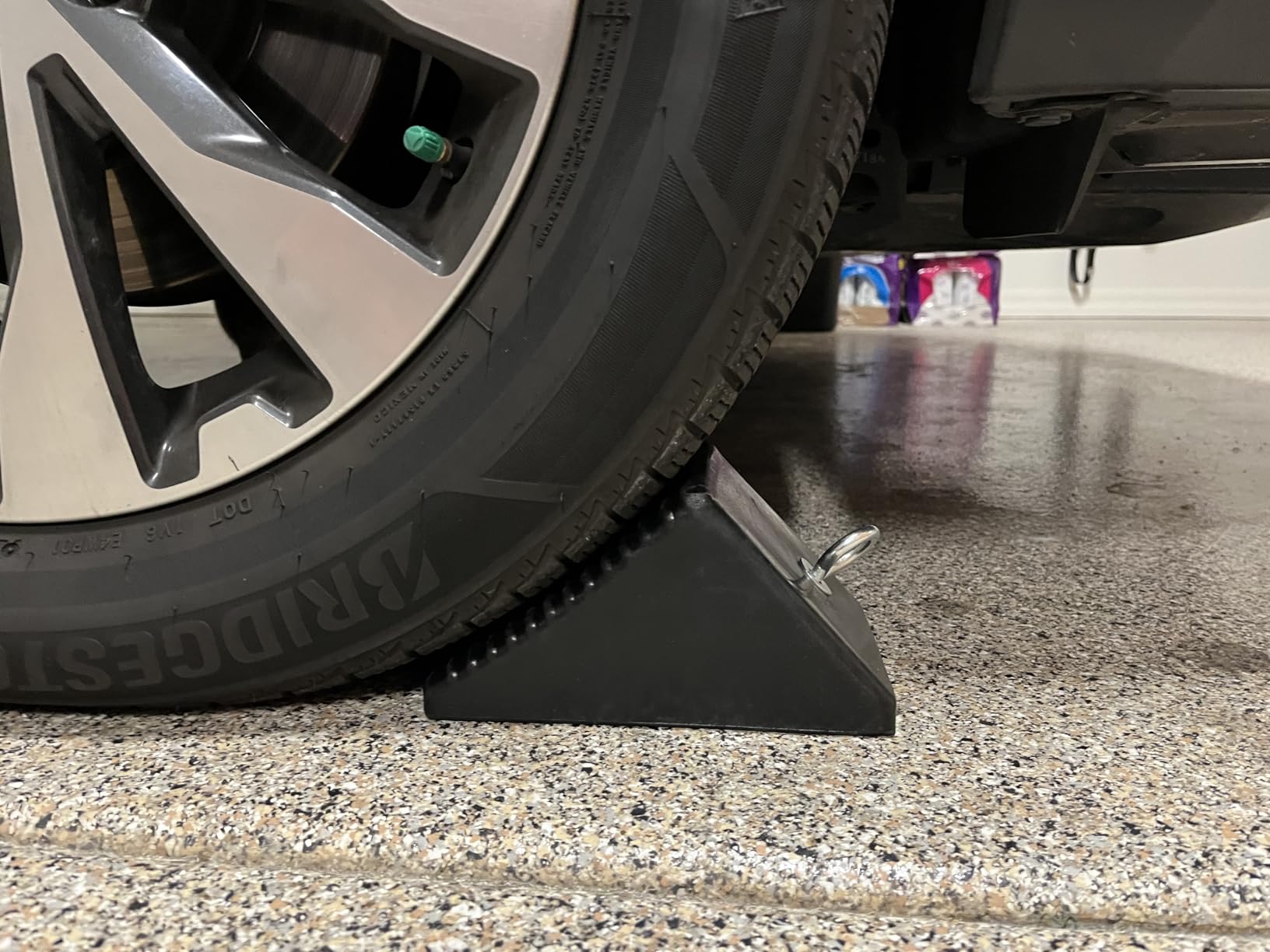
The integrated eyebolts are the reason this set made the roundup. They let you tie a chock off so you cannot accidentally drive away with it under a tire, rope two chocks together into a double-wide block, or pull the chock out from a position where you cannot safely reach.
Each chock measures 4.1 by 8 by 5 inches, the set is rated for vehicles up to G.V.W. 4T, and the aggressive ribbed face with a textured bottom grips without needing to hammer or wedge it in. Material is nylon-reinforced rubber rated at roughly twice the strength of standard rubber, with a hollow interior that keeps weight manageable while staying solid.
Reviewers consistently describe these as dense, heavy-feeling chocks that grip the tire across the full contact length with no rollback, and the tie-off eyebolts earn particular praise for keeping a chock from being run over. The nylon reinforcement is what keeps them from cracking, tearing, or shattering the way cheap plastic blocks do when you back a tire onto them.
Four units cover a full axle in two pairs, and the rating distribution shows 84 percent five star with 9 percent four star, so the consensus is strong even at a lower review volume.
Who should buy this set
Cars, ATVs, mid-size trailers, and RVs that stay on paved or firm surfaces, particularly anyone who chocks up on a site where losing a chock would be annoying or expensive. The eyebolts make paired chocks easy to configure for a tandem setup.
Owners who moved up from plastic report that the ribbed face grips without any hammering at all, which removes the step most people hate most, kneeling next to a tire with a mallet.
Where it falls short
The eyebolt hardware has a small flaw worth knowing: the nut is held by a plain flat washer with no lock washer, so it can spin loose during use. A dime-sized lock washer fixes it in about a minute.
At 4T the rating sits below the 8T set, and the compact dimensions look dwarfed beside the wide tires on large motorhomes. No rope is included, so you need your own line for the tie-off feature to be useful.
How to Choose Trailer Wheel Chocks That Match Your Rig
Choosing well comes down to four decisions: material, height relative to tire diameter, load rating against your actual loaded weight, and how many you carry. Get those right and the rest is preference.
Rubber, plastic, or steel, and why the difference matters
Rubber wins on durability and grip. It resists cracking, crushing, and UV exposure, it conforms slightly to the tire, and it holds on wet pavement in a way hard plastic does not. The cost is weight, a strong new-rubber smell, and a heavier item to carry. Owners switching from plastic almost always report the rubber version lasting years longer.
Hard plastic with UV stabilizers wins on portability. It weighs a fraction of a rubber chock, stores anywhere, has no odor, and costs less. The risk is long-term UV embrittlement, and cheap unreinforced blocks are the ones that crack and crumble after a few seasons of sun exposure. A molded chock with a soft EVA pad under it holds much better than bare plastic.
Steel shows up in scissor-style stabilizers rather than wedges. Steel does not crush and does not slide, but it needs a tool to deploy, corrodes if left wet and unprotected, and does nothing for rolling. Pick it for rocking control, then add a ground chock.
How big should wheel chocks be
The sizing rule of thumb most trailer manufacturers and chock makers work from is simple: the chock height should be roughly one quarter of your tire diameter. A 26 inch trailer tire pairs well with a chock in the 6 to 7 inch height range, which is why so many of the picks in this roundup land between 4.7 and 6 inches tall.
Measure tire diameter from the sidewall marking rather than guessing, then check that the chock face is wide enough to cover the tread band rather than just the outer edge. A chock that only touches the outside of a wide tire can walk sideways under load.
Match the rating to loaded weight, not empty weight
The number that matters is your trailer’s gross vehicle weight rating, the GVWR on the placard inside the trailer frame or on the tow vehicle door jamb. Buy the trailer fully loaded to GVWR and compare that number to the chock rating.
Most travel trailers land in the 3500 to 8000 pound range, and the 4T and 8T chocks in this roundup cover that with headroom. A car, motorcycle, or small utility trailer needs far less. Match the rating to the heaviest configuration you will ever tow, and remember that a heavier trailer on a slope needs both more holding force and more chocks.
Single axle versus tandem axle strategy
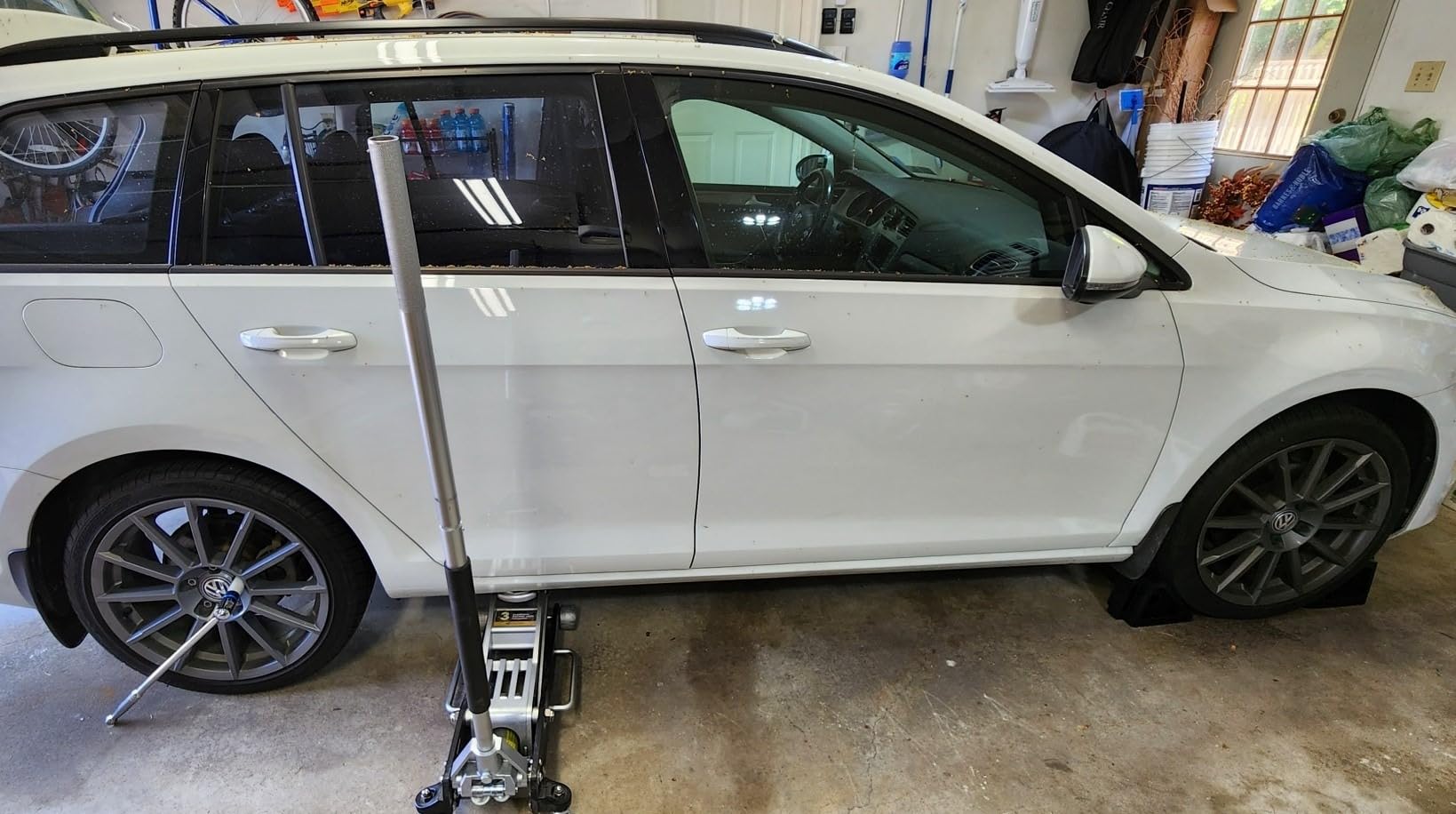
On a single axle trailer, chock the wheel on the downhill side front and back, then add a second chock on the opposite side of the same wheel if you have one. That is the arrangement most owners arrive at after their first trip.
On a tandem axle trailer, chock one wheel front and back on the downhill side, and repeat on the uphill side if you are on any real grade. Four chocks per trailer is the safe default for a sloped site. Then add a scissor stabilizer between the tandem tires on each axle to kill the rocking that chocks alone cannot touch. If your tires sit on leveling blocks, the scissor unit is the only thing that will work properly, since a wedge cannot seat under a raised tire.
That last point is the single most useful thing to understand about this category. X-chocks and stabilizers control fore-aft movement. Ground chocks control rolling. A trailer parked on a slope needs ground chocks first, and stabilizers second.
What OSHA expects for commercial trailers
For personal trailers there is no federal chocking rule, but there is a general expectation that you secure the vehicle before working around it. For commercial operations, federal dock and material handling rules referenced in 29 CFR 1910.110 and 29 CFR 1910.176 address preventing unintended movement of trucks and trailers at loading areas, and chocking is the accepted method of doing that.
In practice, commercial operations chock on both sides of the wheel at the loading position, chock the trailer whenever it is not attached to a truck that will hold it in place, and keep chocks rated well above the vehicle’s gross weight. Fleet buyers in this roundup tend toward the heavier rubber four-packs for exactly that reason, since a lost chock behind a dock is a reportable problem.
A five-point inspection before you pull away
Rubber chocks do not fail suddenly, they crack along the rib lines over time. Before every trip, look for surface cracks or crumbling edges, especially on plastic chocks stored in full sun, and squeeze the block hard to check for hardened or brittle spots. Check that the tread face and any pad are still clean of oil, mud, and dried grass, since contamination is what turns a good grip into a slick one. Confirm the chocks are physically present under the wheels before you start the engine rather than after, and note that a bouncy rubber chock escaping under a moving trailer is a documented hazard to the vehicle behind you.
Frequently Asked Questions
Which trailer wheel chock is the best overall?
For most trailer owners the best all-round choice is a solid molded rubber wedge in the 6 to 7 inch height range with a built-in handle, such as the MaxxHaul 70472. Rubber resists cracking and UV damage, the molded tread grips pavement, gravel, and wet surfaces, and a molded handle means you can place and retrieve it without tools. Tandem axle owners should add a scissor-style stabilizer for rocking control.
Which type of wheel chocks is better, plastic or rubber?
Rubber is better for durability and grip, and plastic is better for portability. Solid rubber resists cracking, crushing, and UV exposure and holds on wet pavement, which is why owners switching from plastic report years more service life. UV-stabilized plastic weighs a fraction as much, stores anywhere, and has no odor, but unreinforced plastic blocks can embrittle and crack after several seasons in direct sun.
How big should trailer wheel chocks be?
A good rule of thumb is a chock height of roughly one quarter of your tire diameter. A 26 inch trailer tire pairs well with a chock around 6 to 7 inches tall. Also check the chock face is wide enough to cover the tread band rather than only the outer edge, since a chock that contacts just the side of a wide tire can walk sideways under load.
Do you need to chock both sides of an RV?
On a level site, chocking the downhill side front and back is usually adequate. On any slope, chock both sides of the wheels, which means four chocks on a tandem axle trailer and a matching set on the uphill side. Adding a scissor stabilizer between the tandem tires on each axle reduces fore-aft rocking that ground chocks cannot address.
How many wheel chocks do I need?
A single axle trailer needs at least two, one in front and one behind the wheel on the downhill side. A tandem axle trailer on sloped ground needs four, covering both sides of both axles, plus a scissor stabilizer between the tandem tires on each axle. Carrying a four-pack covers every common configuration and is what we recommend for travel trailers and campers.
Can I use X-chocks instead of regular wheel chocks?
No. An X-chock or scissor stabilizer applies opposing force between two tandem tires to stop front-to-back rocking, and it does not stop a trailer from rolling down a slope. Always pair a stabilizer with ground chocks under the wheels, and keep the trailer parking brake engaged for the same reason.
Are cheaper plastic wheel chocks still worth buying?
They are fine for cars, ATVs, pop-up campers, and light trailers on fairly level pavement, especially when a UV-stabilized body and a soft grip pad are involved. For heavy trailers, gravel, or sun-exposed storage, solid rubber holds its shape far better and is the safer buy over a multi-year lifespan.
Final Verdict on the Best Trailer Wheel Chocks in 2026
If you want one answer, take the MaxxHaul 70472. Solid molded rubber, a 8 by 4 by 6 inch footprint, a built-in handle, and a rating that has held up across more than 18,000 reviews makes it the most dependable general-purpose choice in this roundup, and it works on anything from a utility trailer to a fifth wheel.
Then match the other jobs. Buy the MaxxHaul 80681 if your tires are large or your rig is heavy and you want a 10 inch face with a steel eyebolt. Pick the BAL 28012 X-Chock pair for tandem axle rocking, or the Proud Panda scissor set if your tandem gap runs wider than 10 inches. Go with the AFA 8T four-pack or the HOXWELL four-pack when you want to chock a full axle properly. Use the ROBLOCK rope set if reaching a wide tandem wheel in the dark is your problem, and pick up the PR1ME yellow pair if you care more about weight and visibility than holding force.
Whatever you choose, buy it before you need it, keep it where you will actually reach it, and check it for cracks and contamination at the start of every trip. That habit matters more than the model on the box.