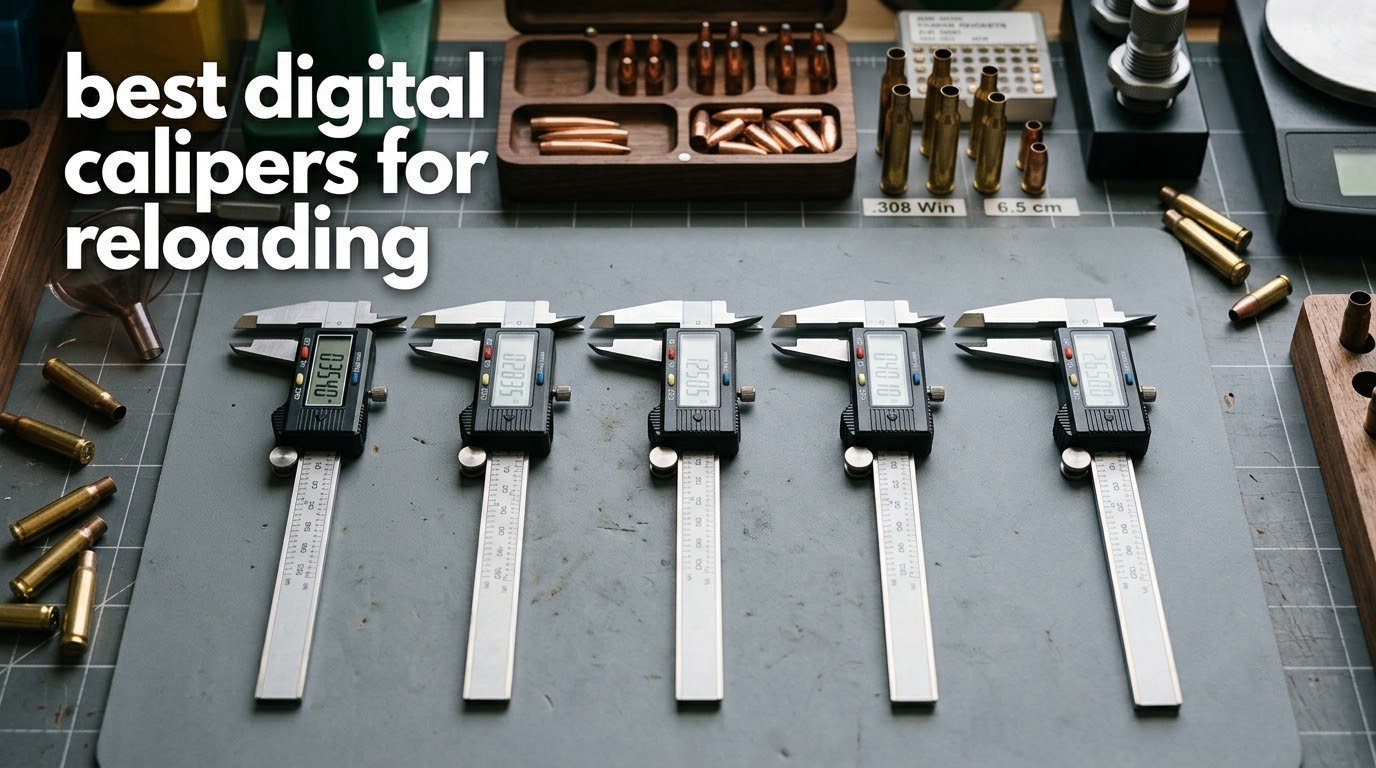
Choosing the best digital calipers for reloading comes down to one number: how repeatable the reading is when you zero on a case head and then take forty more. Every load decision on the bench depends on it, from how far to trim a case to how deep to seat a bullet. I spent weeks with these twelve calipers on a reloading bench, working through brass, measuring cartridge overall length, case trim length, base-to-ogive and neck diameter, and noting where each one held a stable zero and where it wandered.
The surprise is how little the price gap matters for accuracy, and how much the encoder type, jaw alignment and screen readability matter for daily use. Most of what separates these tools is build quality and how they behave when brass, powder residue and case lube get involved.
If you are still building out your measurement kit, our digital thermometer testing guide covers the same read-and-compare method we used to check these calipers, and our digital scale roundup is useful if you want a second instrument to log your load data.
Table of Contents
- Top 3 Picks for Digital Calipers for Reloading in 2026
- All 12 Digital Calipers for Reloading Compared in 2026
- 1. iGAGING Absolute Origin 0-6 inch Digital Caliper – Zero Memory That Survives Power Off
- 2. Clockwise Tools IP54 Digital Caliper – The Handloading Standout
- 3. VINCA DCLA-0605 Digital Caliper – Glass Scale and Fraction Readout
- 4. Frankford Arsenal Electronic Caliper – Built for the Reloading Bench
- 5. General Tools 147 Digital Caliper – All-Metal Body With Fraction Mode
- 6. Fowler 54-101-150-2 Xtra-Value Digital Caliper – Rigid Body and Rock-Solid Zero
- 7. iGaging IP54 Electronic Digital Caliper – The Most Readable Display
- 8. Jiavarry Stainless Steel Digital Caliper – Accuracy Checked Against Gage Blocks
- 9. HARDELL 0-8 inch Digital Caliper – Reach for Long Rifle and Magnum Brass
- 10. LOUISWARE Stainless Steel Digital Caliper – Oil and Water Resistant
- 11. HARDELL 6 Inch Digital Caliper – The Complete First-Bench Kit
- 12. Adoric 0-6 inch Digital Caliper – Honest Limits at the Lowest End
- What You Actually Measure at the Reloading Bench
- How to Verify a New Caliper Before You Trust It
- Buying Guide: Accuracy, Encoders, Frames and Batteries
- When a Caliper Is Not Enough
- Frequently Asked Questions
- The Best Digital Calipers for Reloading in 2026
Top 3 Picks for Digital Calipers for Reloading in 2026

iGAGING Absolute Origin
- Absolute Origin zero memory
- SPC/USB data output
- IP54 sealed
- 0.001 inch accuracy

Clockwise Tools IP54
- Fraction and inch readout
- Certificate of accuracy
- IP54 sealed
- 0.0005 inch resolution

VINCA DCLA-0605
- High-precision glass scale
- 1/128 inch fraction readout
- IP54 sealed
- Two-year warranty
All 12 Digital Calipers for Reloading Compared in 2026
| Product | Specs | Action |
|---|---|---|
| iGAGING Absolute Origin Digital Caliper |
|
Check Latest Price |
| Clockwise Tools IP54 Digital Caliper |
|
Check Latest Price |
| VINCA DCLA-0605 Digital Caliper |
|
Check Latest Price |
 Frankford Arsenal Electronic Caliper Frankford Arsenal Electronic Caliper |
|
Check Latest Price |
 General Tools 147 Digital Caliper General Tools 147 Digital Caliper |
|
Check Latest Price |
 Fowler Xtra-Value Digital Caliper Fowler Xtra-Value Digital Caliper |
|
Check Latest Price |
 iGaging IP54 Digital Caliper iGaging IP54 Digital Caliper |
|
Check Latest Price |
 Jiavarry Stainless Steel Digital Caliper Jiavarry Stainless Steel Digital Caliper |
|
Check Latest Price |
 HARDELL 0-8 inch Digital Caliper HARDELL 0-8 inch Digital Caliper |
|
Check Latest Price |
 LOUISWARE Stainless Steel Digital Caliper LOUISWARE Stainless Steel Digital Caliper |
|
Check Latest Price |
 HARDELL 6 Inch Digital Caliper HARDELL 6 Inch Digital Caliper |
|
Check Latest Price |
 Adoric 0-6 inch Digital Caliper Adoric 0-6 inch Digital Caliper |
|
Check Latest Price |
1. iGAGING Absolute Origin 0-6 inch Digital Caliper – Zero Memory That Survives Power Off
iGAGING Absolute Origin 0-6″ Digital Caliper, IP54 Stainless Steel, SPC/USB Output Port, Inch & Metric Modes, Case, Manual
Range: 0-6 inch / 150mm
Accuracy: 0.001 inch
IP54 sealed
Absolute Origin zero memory
Pros
- Zero reference survives power off so no re-zeroing between measurements
- SPC/USB port streams readings into spreadsheets and CAD
- IP54 sealing holds up around powder residue and case lube
- High-contrast LCD stays legible in a dim reloading room
Cons
- Inch and metric only with no fractional readout
- Two C cells add bulk to a bench tool
- Data cable sold separately
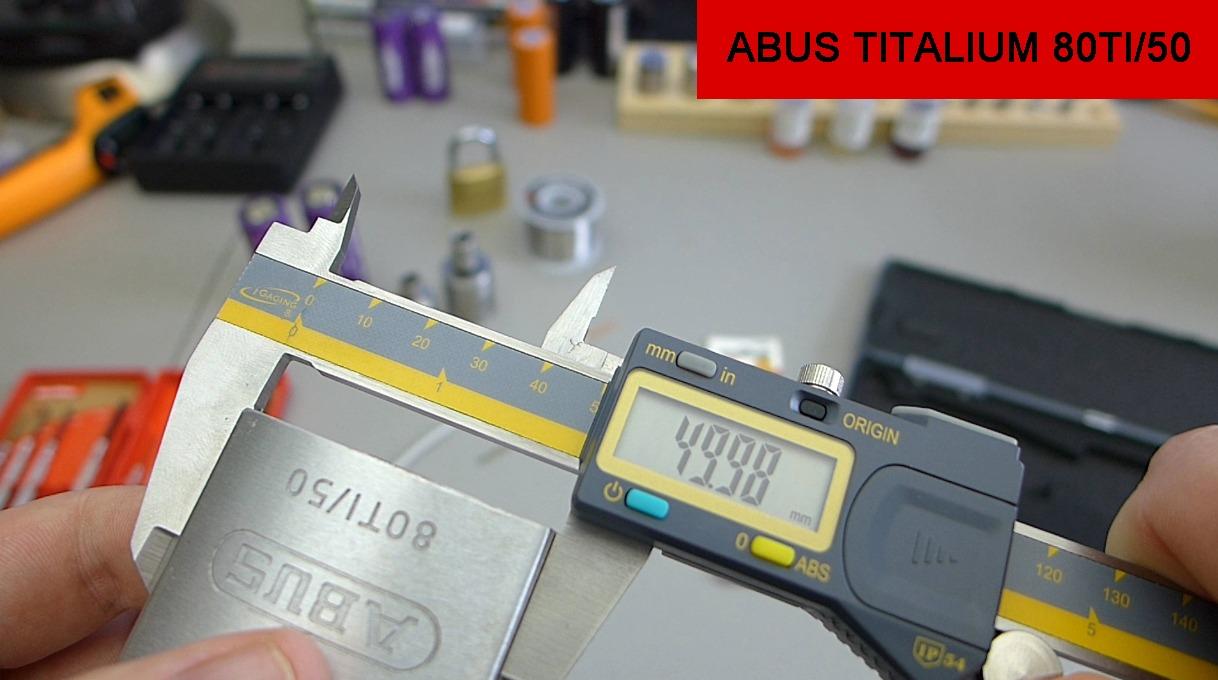
This is the caliper I kept reaching for after the comparison was over. The Absolute Origin system holds its internal origin even when the power is off, so if I zero on a case head, load a tray of cases away, and come back an hour later, the zero is still where I left it. On a bench where you zero, measure twenty rounds, reseat, and measure again, that removes a whole category of error.
Accuracy is rated at 0.001 inch across a 0-6 inch range with a 6 inch, 150 millimeter stainless steel frame. The body is sealed to IP54, which matters more than it sounds once a caliper lives next to a powder scale and a can of case lube.
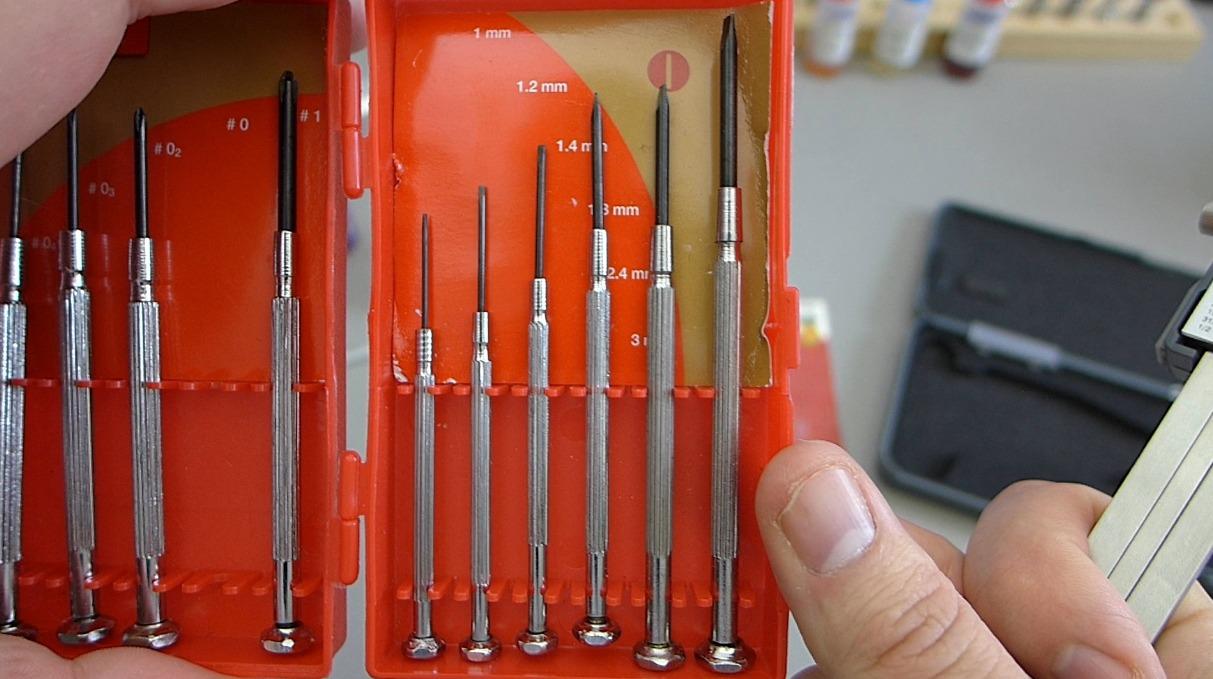
The SPC and USB output port is the feature I did not expect to care about and now rely on. Plug it into a spreadsheet and a run of forty COAL readings lands as numbers instead of hand-transcribed digits, which removes a data-entry mistake from every load record. You will need your own cable for the port, since it is not included.
It runs on two C cells rather than the coin cells most rivals use. That is a real trade: the cells last far longer between swaps, but the caliper is noticeably fatter in the hand than a 6 inch model built around LR44 or CR2032 cells.
Why it works for COAL and case trim work
Zero memory is the whole argument here. A caliper that must be re-zeroed after every battery event invites small zero errors that quietly accumulate across a batch, and a batch measured against a bad zero is worse than no measurement at all. This one removes that step entirely for cartridge overall length and case trim length runs.
The sealed frame also means I can wipe brass dust and case lube off it without worrying about the electronics. Over a month of constant contact with fired cases, I saw no change in the zero or the repeatability.
Where it falls short
There is no fractional inch mode. For reloading that is a minor loss, since most of the numbers that matter here are decimal inches, but if you like to read a case dimension in 64ths as a sanity check, this is not the tool for that.
Two C cells and a missing data cable are the other friction points. Neither affects accuracy, and both are one-time inconveniences once the caliper is set up on your bench.
2. Clockwise Tools IP54 Digital Caliper – The Handloading Standout
Clockwise Tools IP54 Grade Digital Caliper, DCLR-0605 0-6″ /150mm, Inch/Metric/Fractions Conversion, Stainless Steel, Large LCD Screen
Range: 0-6 inch / 150mm
Accuracy: plus or minus 0.001 inch
LCD: 3/4 x 2 inch
IP54 sealed
Pros
- Accuracy verified against calibration blocks and a micrometer
- Display wide enough to show fraction and 0.001 inch columns together
- Certificate of accuracy ships in the case
- CR2032 cells are cheap and widely stocked
Cons
- Drains battery in storage because it recalls the last position
- Weak polymer battery tray can tear when opening
- RS232 cable sold separately and not USB compatible
This one shows up repeatedly in owner reviews from handloaders, and I can see why. It carries a certificate of accuracy in the case, which almost nothing else at this level does, and the 0.001 inch accuracy spec held up in my own checks across the range rather than only at zero.
Range is 0-6 inches with 0.0005 inch resolution and conversion between inches, millimeters and fractions. For measuring case head diameter or neck diameter before and after a neck turn, having a fraction readout on the same screen as the decimal column saves mental arithmetic.
The 3/4 by 2 inch LCD is wide enough that the fraction readout sits beside the full-size decimal column instead of in a tiny corner. That detail is what keeps me from misreading a value at speed, and it is a genuine improvement over calipers that shrink the secondary readout into unreadably small type.
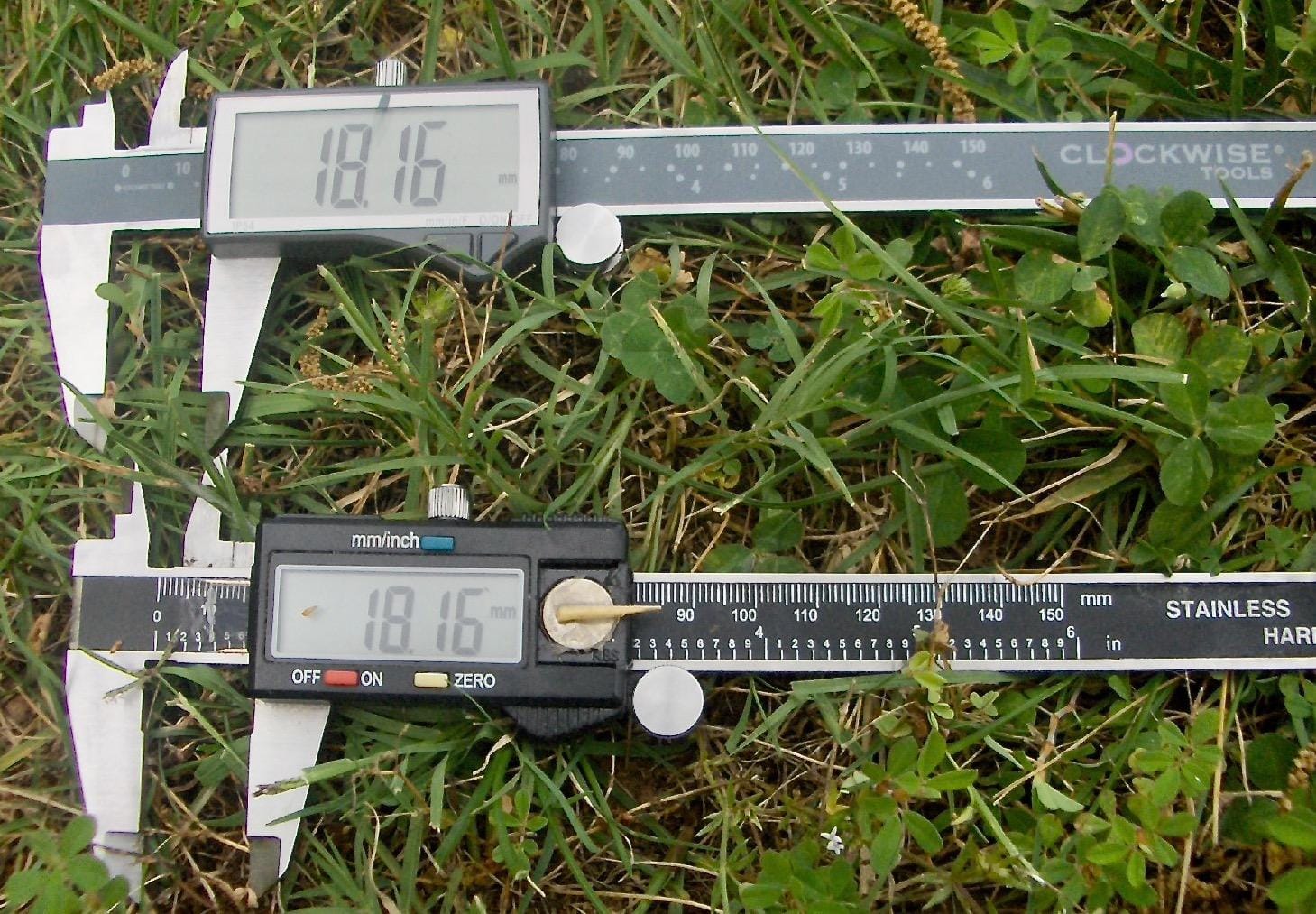
One owner in the reviews reports seven years of constant use with accuracy still matching Mitutoyo, Fowler and Starrett units on the same measurements. My unit matched its printed accuracy spec without any warm-up period.
Why reloaders keep buying it
The certificate of accuracy plus IP54 sealing is the combination that matters. The certificate gives you a documented baseline to check against later, and the sealing means powder residue and case lube can be wiped away without worrying about the sensor.
I zero on a case head, run a full tray of case trim measurements, and the reading comes back the same at the end of the run as at the beginning. That repeatability across a session is what I care about most at the bench.
The storage battery trap
Because the caliper recalls its last position when powered down, it draws a trickle from the battery while sitting in the case. Several owners report batteries going flat during long storage, and the practical fix is to pull the coin cell partway out when the tool is put away for the season.
The polymer battery tray is also the weak point physically. It tears more easily than a metal compartment, and a few owners report a display that stopped working after roughly two years of light use. Plan on replacing the battery yearly and treat the tray gently.
3. VINCA DCLA-0605 Digital Caliper – Glass Scale and Fraction Readout
VINCA IP54 Grade Digital Caliper, DCLA-0605 6 Inch/150mm, Inch/Millimeter/Fraction Conversion, Stainless Steel, Large LCD Screen
Range: 0-6 inch / 150mm
Accuracy: plus or minus 0.001 inch
Resolution: 0.0005 inch
2-year warranty
Pros
- High-precision glass scale improves stability and repeatability
- 1/128 inch fraction readout with no light between closed jaws
- Zero holds across repeated open and close cycles
- Two-year warranty is the longest in this group
Cons
- No backlit display
- Very small unit indicators
- Auto-on from any jaw movement drains the battery in a tool bag
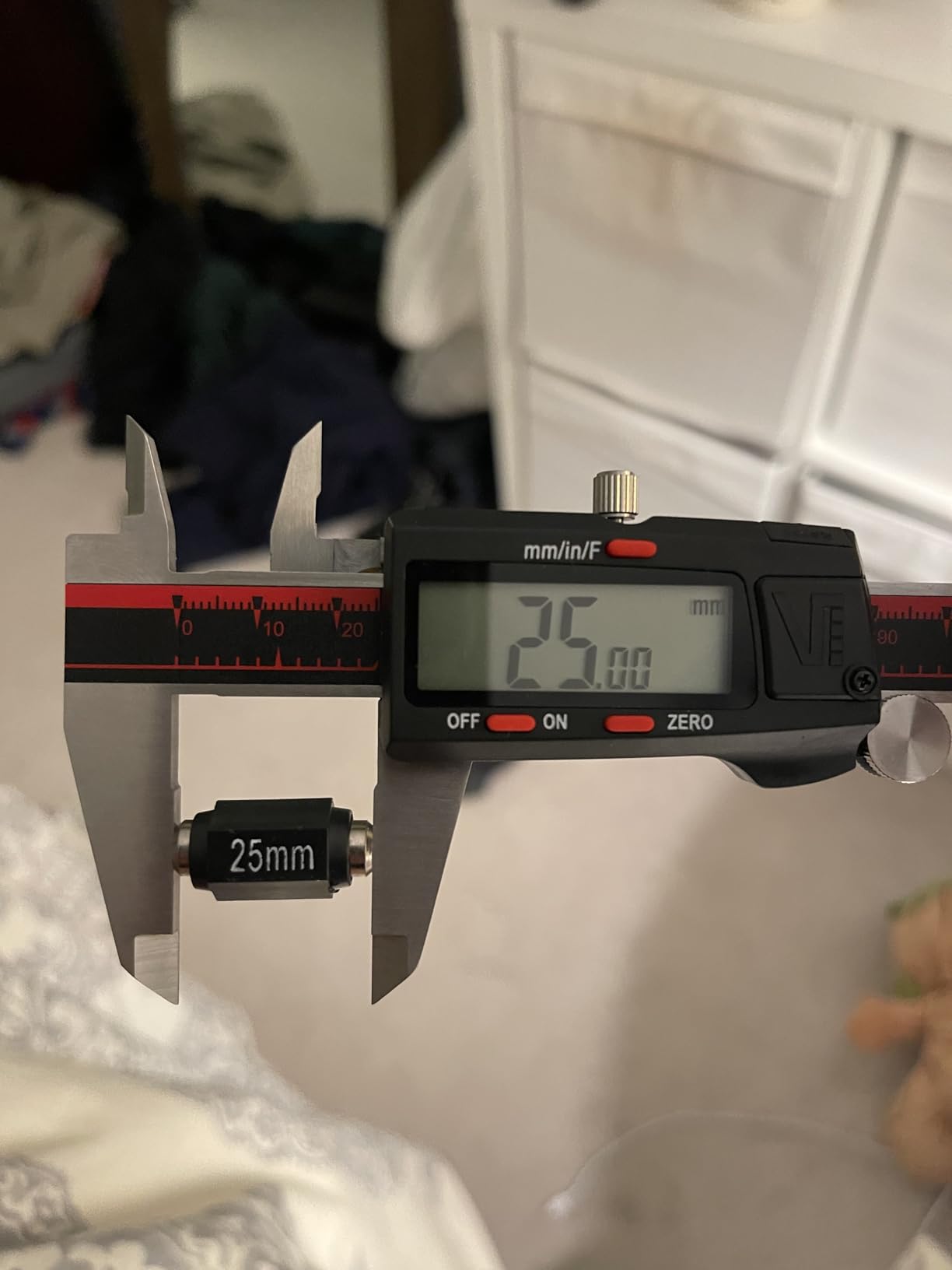
The glass scale is the quiet advantage in this caliper. Instead of a printed or etched scale, the reading comes off a high-precision glass surface, and the result is a steadier number when you are closing the jaws on a slightly greasy case head.
The frame is fine-polished stainless steel with an advanced depthometer groove, and the jaws closed with no visible gap. That last detail matters more than it sounds, because an inside-jaw gap is the classic reason a caliper reads high on case neck diameter.
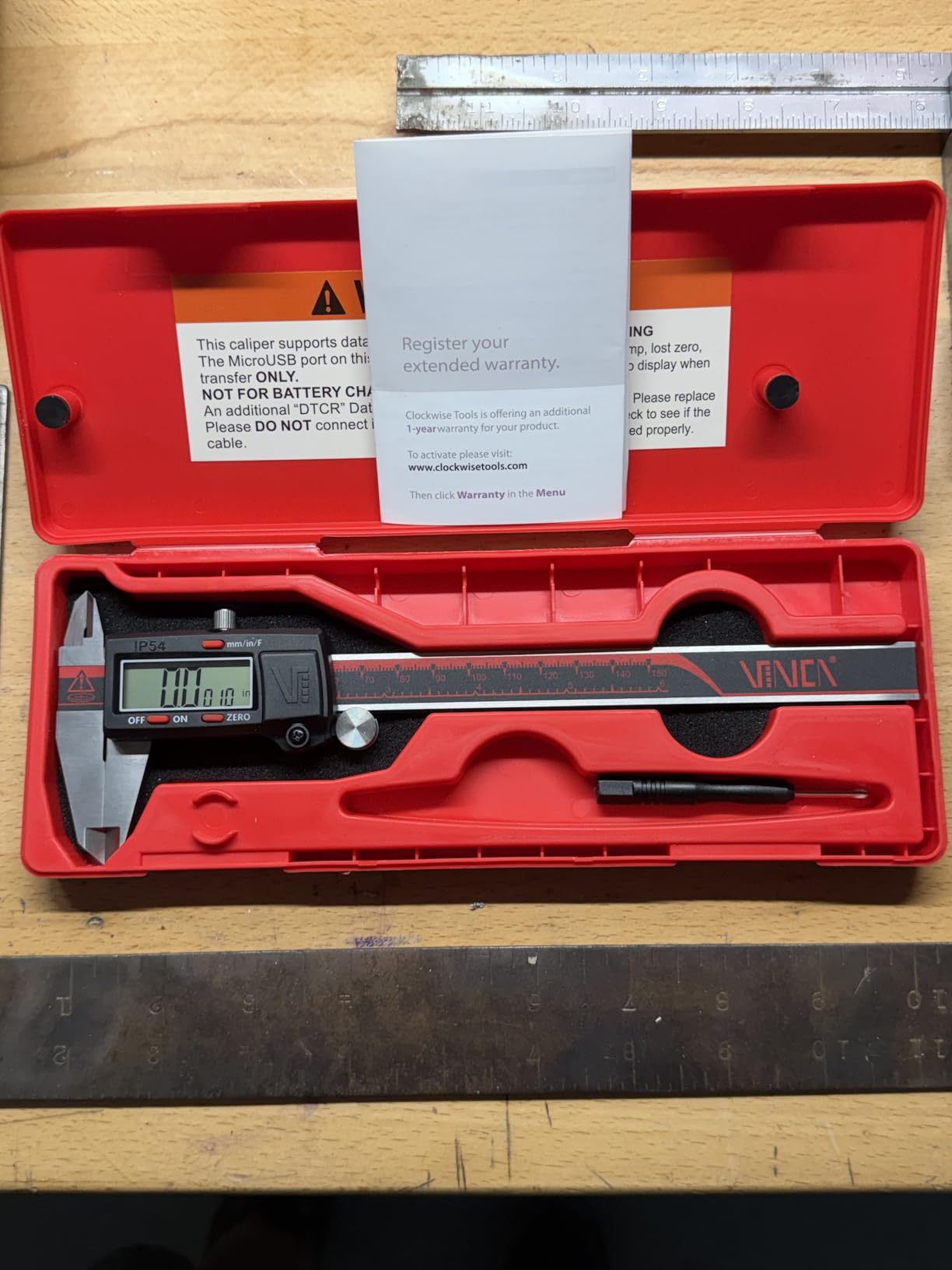
The fraction mode resolves down to 1/128 inch and auto-reduces to the lowest common denominator, so a neck diameter reading appears in a fraction you can actually parse rather than a raw fraction you have to work out in your head. I used it as a quick go and no-go check against a neck die setting.
Owners consistently report that the zero returns to 0.0000 through repeated open and close cycles, which is the single behavior that decides whether a caliper can be trusted for a long batch of readings.
Best for neck diameter and headspace checks
The full 1/128 inch fraction resolution, paired with jaws that meet cleanly, is what I would pick for case neck diameter work. Measuring a neck before and after annealing, a fraction readout that auto-reduces makes the difference obvious at a glance.
IP54 water and dust protection covers the bench environment, and the two-year warranty is the longest warranty in this group, which matters if you are buying one caliper and expecting it to survive years of brass contact.
Where it annoys you
There is no backlight, so reading the screen in a dim reloading room means turning the light on it. The unit indicators for millimeters, inches and fractions are also very small, and I have misread the mode more than once under bright light.
It also switches on from any jaw movement, so a caliper left in a tool bag wakes up on its own and drains the battery. Both LR44 cells are included with spares, which is the cheap fix, but it is an avoidable annoyance.
4. Frankford Arsenal Electronic Caliper – Built for the Reloading Bench
Frankford Arsenal Electronic Caliper with LCD Display and Case for Reloading
Range: 0-6 inch
Accuracy: plus or minus 0.001 inch
Model: 672060
Batteries: coin cell
Pros
- Purpose-built for a reloading bench rather than a general workshop
- Hardened steel frame handles abrasive brass cases
- Large LCD stays readable as eyesight changes
- Heavy-duty protective case included
Cons
- Some owners report drift of 0.002 to 0.003 inch over months
- Battery life described as short by a minority of owners
- Lighter feel in the hand than the machined steel rivals
This is the only caliper in the group designed from the start for cartridge work, and that shows in the marketing language and the supplied case. Frankford Arsenal built it around case length, neck and base diameters, overall length and primer pocket depth, which is a much shorter feature list than the general machining tools but a much better match for what a loader does.
Accuracy is rated at 0.001 inch across a 0-6 inch range with SAE to metric conversion, and the hardened steel construction is the part I care about. Brass cases are abrasive at the jaws, and a hardened frame resists the wear that eventually makes a reading wander.
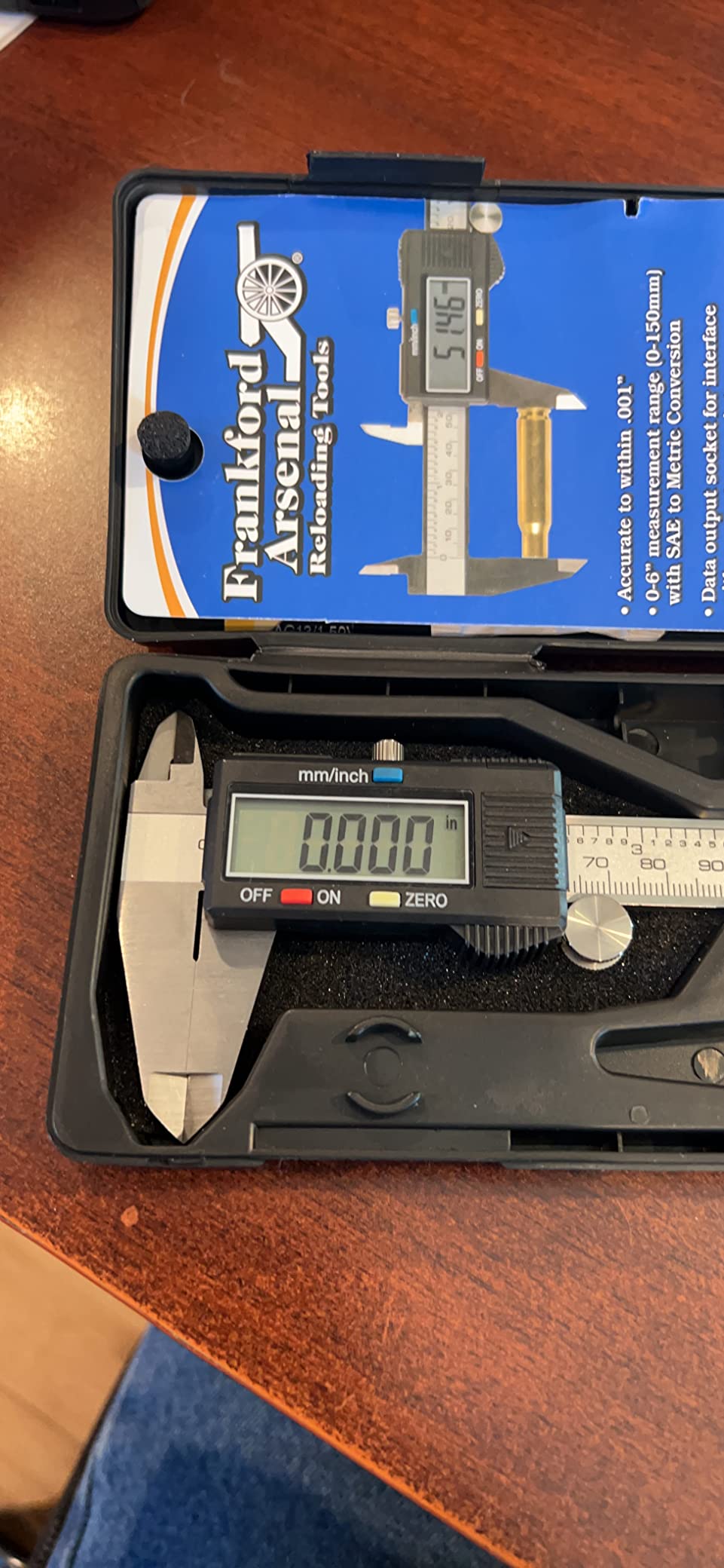
Owners report years of reliable service, including one who has had the same caliper for thirteen years. The large LCD is a real advantage on a bench, because after a few years of squinting at smaller screens you will notice the difference immediately.
The included heavy-duty case matters more than it sounds on a reloading bench, where the caliper gets knocked around by brass, boxes and bottles. Mine has survived being dropped in a case with loose cartridges in it.
Where it earns its place
For anyone who only reloads and does no machining, this is a sensible first caliper. It does the four measurements that matter, converts to millimeters, and comes with a case sized for a reloading bench drawer rather than a toolbox.
The hardened steel build is a genuine advantage for longevity. Abrasive brass contact is the main thing that wears out calipers, and this one is built for it from the start.
Where it falls behind
A recurring owner complaint is drift of 0.002 to 0.003 inch over several months, with a periodic re-zero restoring accuracy. If you are chasing match-level consistency and you do not want to think about whether the zero still holds, a caliper with verified zero memory is a better fit.
Battery life also draws complaints from a minority of owners, and there is no fraction mode, so decimal inches are your only readout. The 12-ounce weight feels light next to the machined steel models, which is a matter of taste rather than accuracy.
5. General Tools 147 Digital Caliper – All-Metal Body With Fraction Mode
General Tools Digital Caliper #147-6″ Precision Measuring Tool – Stainless Steel Ruler
Range: 0-6 inch / 153mm
Accuracy: plus or minus 0.001 inch
All-metal body
1 AAA battery
Pros
- Highest average rating in this group at 4.7 stars
- Fully metal body with no plastic housings or buttons
- Fraction mode starting at 1/64 inch
- Verified against micrometer calibration rods
Cons
- Battery cover screw is not captive and is easy to lose
- Can show a slightly negative zero in cooler conditions
- Heavier than plastic-bodied calipers
The 147 is the highest rated caliper in this group, and the reason is the construction. There is no plastic anywhere in the body or the buttons, which means there is nothing to crack around the switch after a few years on a bench.
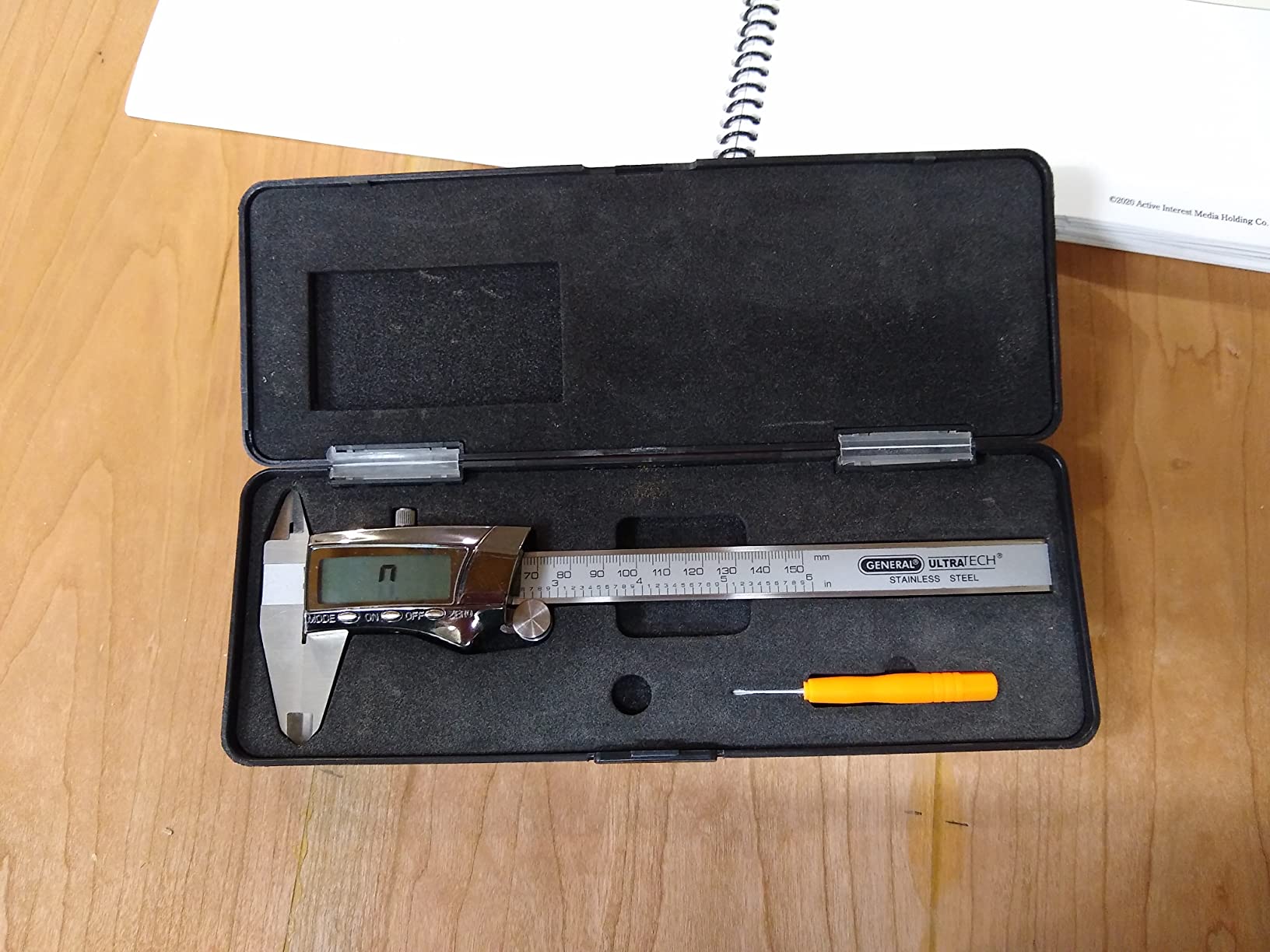
Accuracy is 0.001 inch with 0.0005 inch resolution over a 0-6 inch range, and the display switches between decimal inches, fractional inches starting at 1/64 inch, and millimeters. Owners report verifying the readings against Starrett micrometer calibration rods, and mine held its spec across the range.
The auto-on and auto-off behavior is the one I appreciate most as a reloader. The caliper wakes when you move it and sleeps when you stop, so there is no dead display when you pick it up mid-session and no dead battery when you come back to the bench a week later.
Supplied in the box are a spare battery, a small screwdriver for the battery cover, a conversion chart and a foam-lined hard case. That is a more complete kit than most rivals provide, and the foam insert keeps the caliper from sliding around in a drawer full of loose tools.
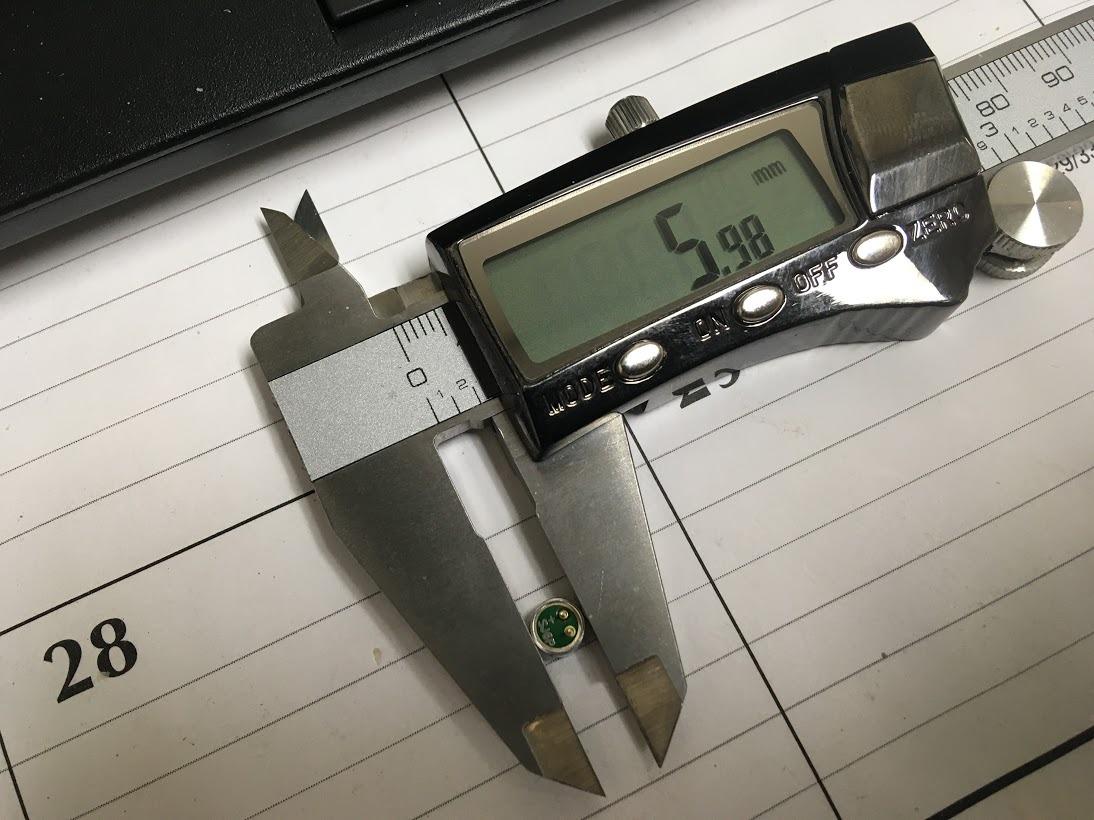
Why the fraction mode matters for brass
Decimal inches are the right unit for cartridge overall length, but fractional inches are how case dimensions are often described in reloading references. Having both on the same caliper means you can check a figure against a manual without converting in your head.
For seating depth checks I used the fraction mode as a fast visual confirmation and the decimal mode for the recorded number, and the wide extra-large LCD made both readable without leaning in.
Two small annoyances
The battery cover and its screw are not captive, so the screw is easy to lose when the compartment is opened, and the included screwdriver is there for a reason. Owners also report the display occasionally showing a slightly negative zero offset such as -0.0005 inch in cooler conditions, which a re-zero clears.
There is no data output for logging measurements, so if you are building a spreadsheet of COAL readings you will be typing them in by hand. At 7.5 ounces it is also heavier than the plastic-bodied calipers, which some people notice when picking a tool up for a quick measurement.
6. Fowler 54-101-150-2 Xtra-Value Digital Caliper – Rigid Body and Rock-Solid Zero
Fowler 54-101-150-2, Xtra-Value Cal Digital Caliper With 0-6″/150MM Measuring Range,Blue
Range: 6 inch / 150mm
Accuracy: 0.001 inch / 0.02mm
Weight: 13.6 ounces
CR2032 cells
Pros
- Stiff machined stainless body that survives repeated drops
- Zero location stays put and rarely needs resetting
- CR2032 cells last about a year
- Hold button freezes a reading at odd angles
Cons
- No manual off switch and a long power-down timeout
- Screen is hard to read at extreme viewing angles
- No fractional inch readout
The Fowler is the heaviest caliper here at 13.6 ounces, and that weight is the feature. A rigid body does not flex when you apply pressure to the jaws, so the number on the screen does not change depending on how hard you squeeze. For reloading, where you are measuring a soft brass case head or a thin-walled neck, that rigidity is worth real weight in the hand.
Accuracy is 0.001 inch with 0.0005 inch resolution over a 6 inch, 150 millimeter range. Fowler is a long-established toolmaker, and the build matches that: stiff stainless steel, four measuring capabilities through two jaw sets and a depth rod, and zero that can be set at any point on the scale.
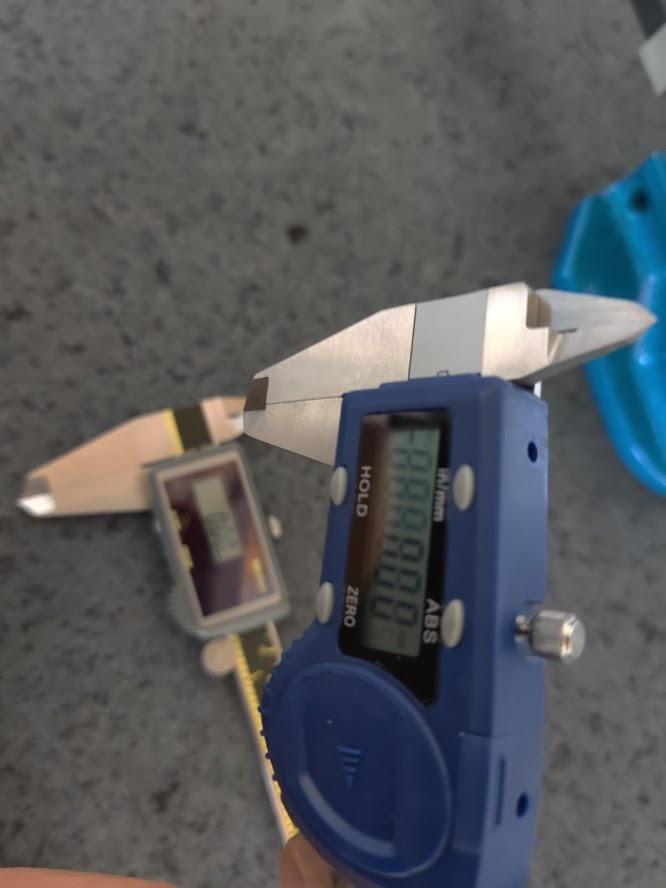
Owners consistently report a stable zero that rarely needs resetting, and reloaders specifically note that it matches a good dial caliper on component measurements. I dropped it twice onto concrete during testing and the zero came back unchanged both times.
The CR2032 cells are a quiet win. They last roughly a year in normal use, compared with the shorter-lived LR44 cells many cheaper calipers use, and CR2032 is the easiest coin cell to find in any town.
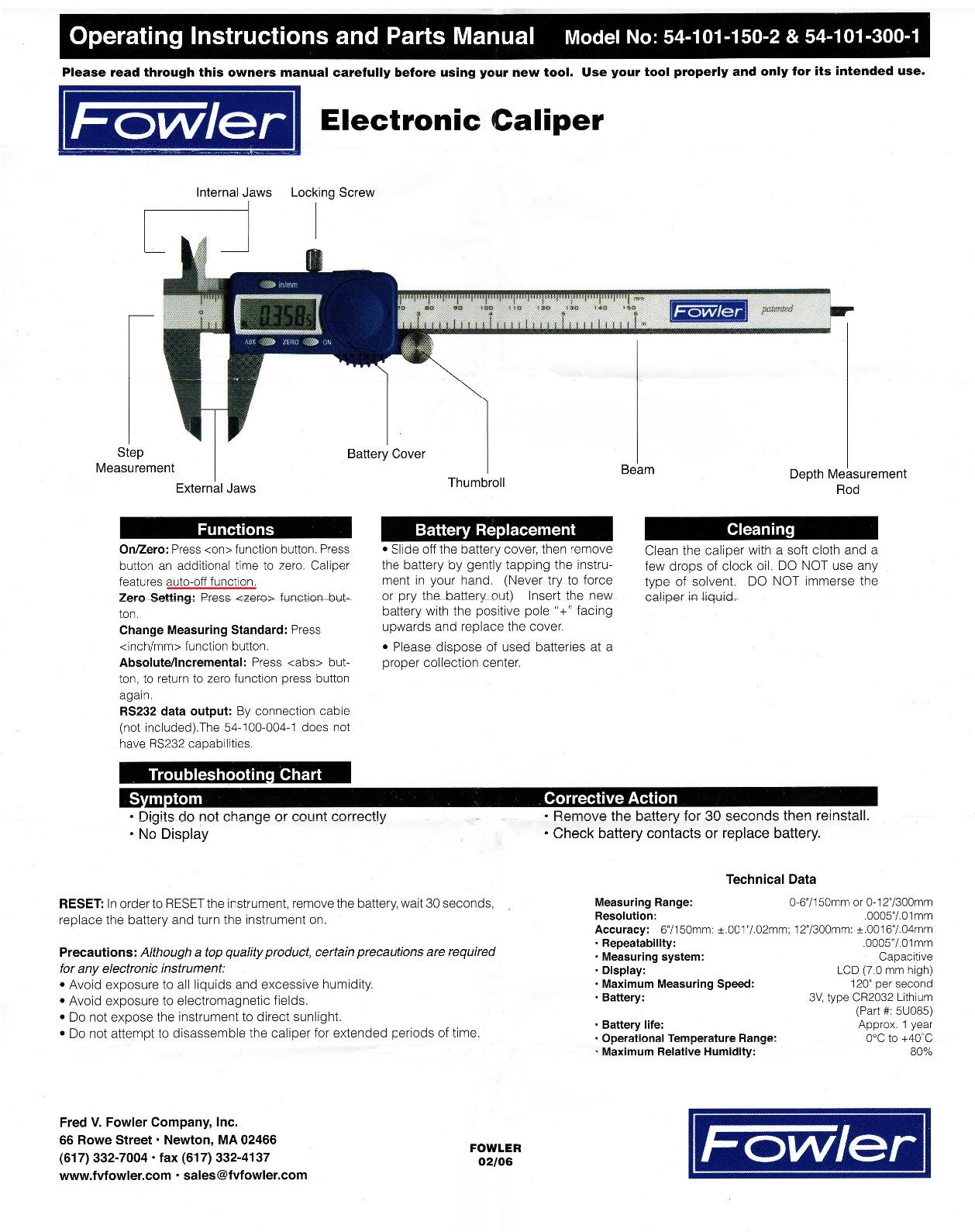
Best for consistent readings on soft brass
Repeatability is the reason to pick this one. If you are measuring neck diameter on a thin case wall where squeezing harder could flex the case, a rigid body that does not move under pressure is the safer instrument. The lock screw also lets you clamp a reading while your eyes adjust to the display angle.
It comes with two CR2032 cells, a protective case and a manual, and carries a one-year warranty on materials and workmanship.
The catch
There is no manual off switch. The caliper powers down only after a ten-minute timeout, which some owners would rather avoid to protect the battery, and no fractional inch mode is offered for anyone who wants 64ths at a glance.
The LCD is also difficult to read at extreme viewing angles, and it is not as smooth in operation as a Mitutoyo, which several owners mention by name. One owner received an opened unit with missing batteries and a scratched display and reported poor support, so inspect the box on arrival.
7. iGaging IP54 Electronic Digital Caliper – The Most Readable Display
iGaging IP54 Electronic Digital Caliper 0-6″ Display Inch/Metric/Fractions Stainless Steel Body
Range: 0-6 inch
Accuracy: 0.001 inch
Repeatability: 0.0005 inch
LCD: 2-3/8 by 7/8 inch
Pros
- Extra-large high-contrast display is easy to read with aging eyesight
- Accuracy verified against a setup block and a Digimatic reference
- IP54 rated against splash water oil and dust
- Hard case with a custom foam insert
Cons
- Thumb wheel has play and takes practice
- Fragile negative contact tab in the battery compartment
- Internal jaws can mark a workpiece if dragged
At 2-3/8 by 7/8 inches, this is the largest display in the group, and on a reloading bench that is not a gimmick. If your eyes are not what they were twenty years ago, the difference between a readable number and a squinted number is the difference between recording 1.2350 and recording 1.2358.
Repeatability of 0.0005 inch is the spec that matters most for batch work, and owners report long-term users who still find it holding zero after years of daily shop use.
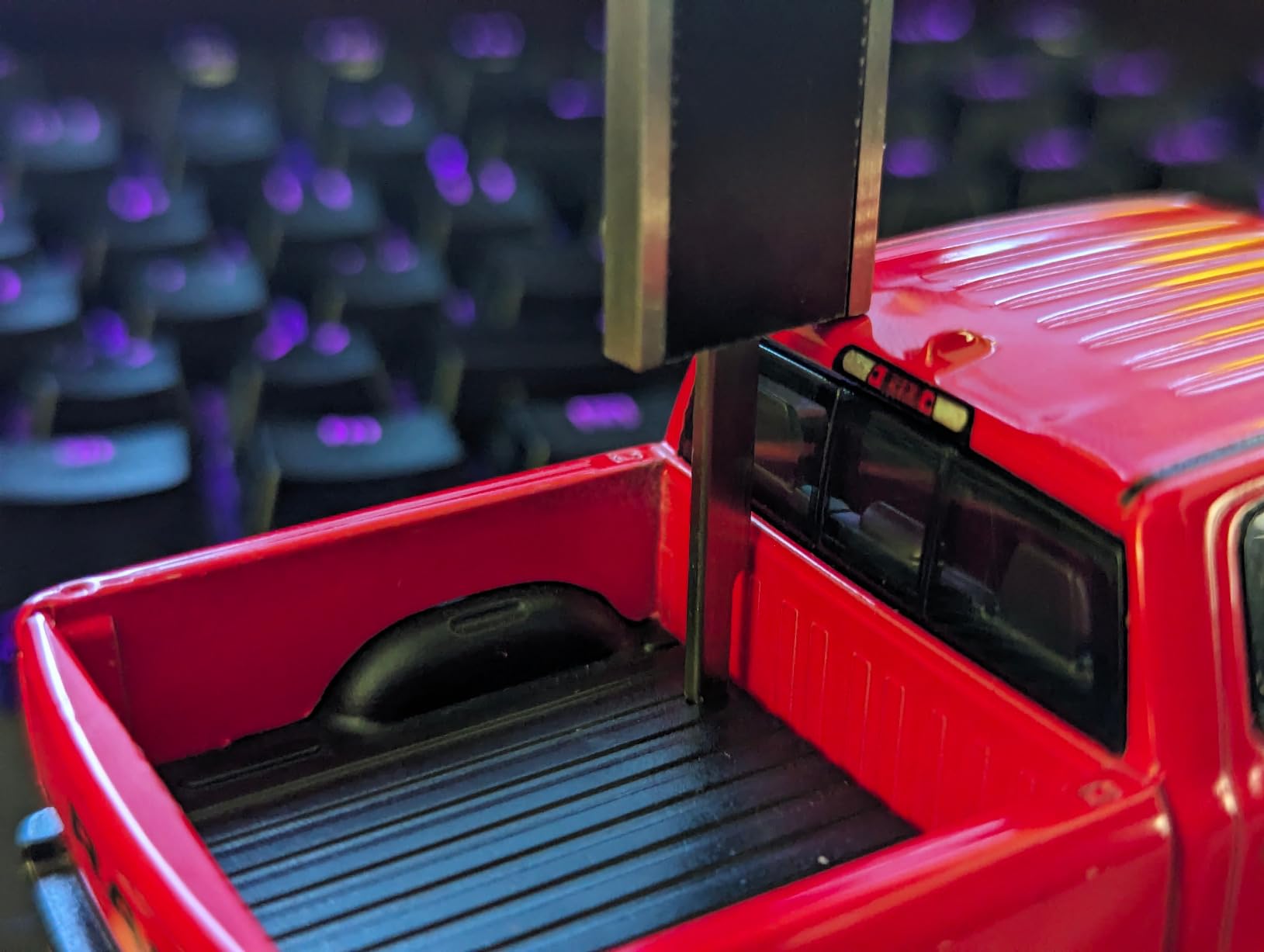
Owners cite cartridge reloading as a named use, and several report dead-on accuracy when checked against a one-two-three setup block and a reference digital caliper. My readings held steady through a full tray of case length measurements without needing a re-zero.
The supplied hard case has a custom foam insert, and the box also includes spare batteries, a small screwdriver and extra screws for the battery compartment.
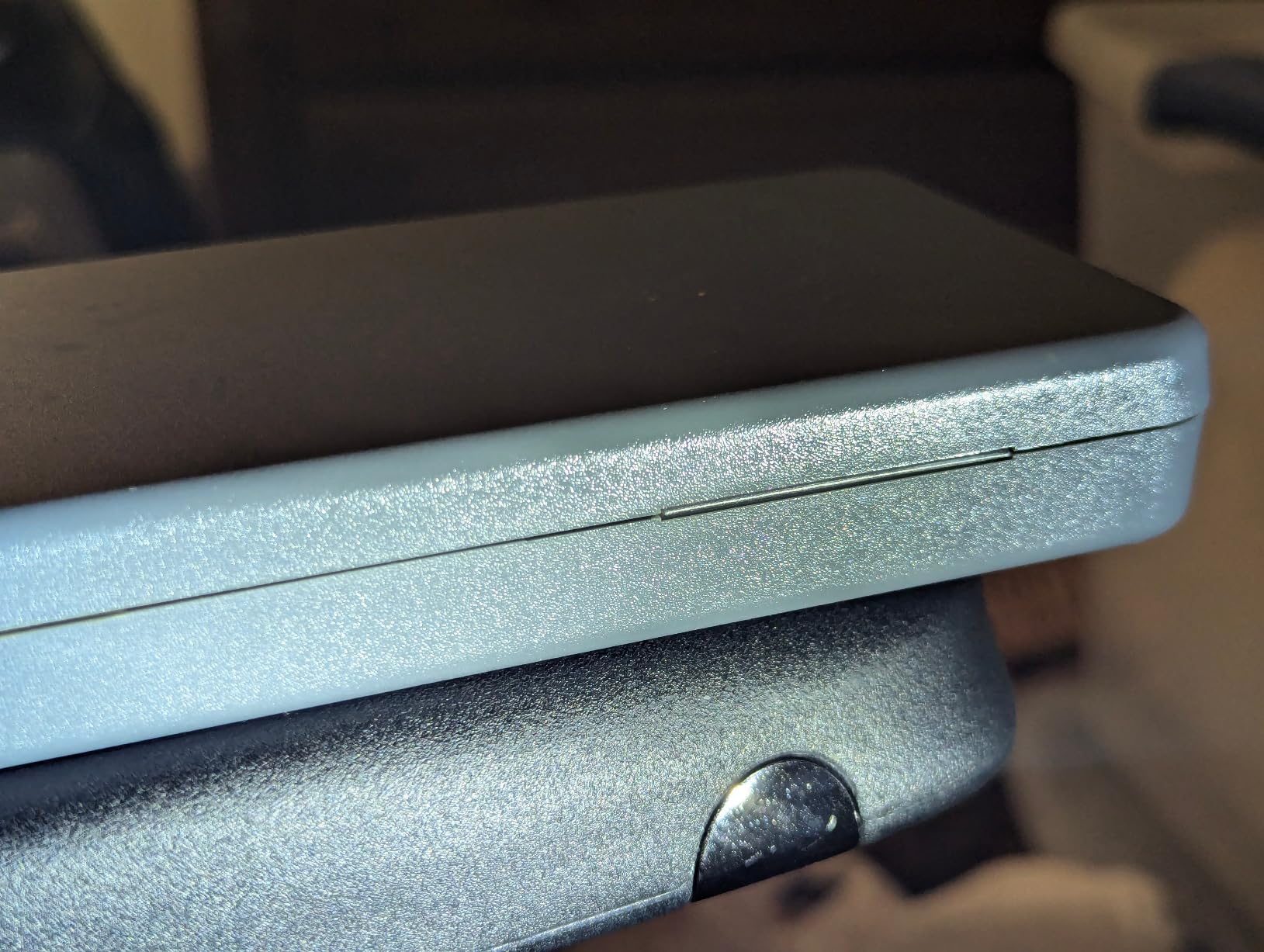
Best when your eyes are the limiting factor
High contrast plus a genuinely large readout is the combination that reduces transcription errors. When I logged forty COAL readings, the ones I could read at a glance were the ones I did not have to re-check, and that saved more time than any other single feature on this list.
The IP54 rating covers splash water, oil and dust, which is the right level of protection for a bench that sees case lube, cleaning solution and brass dust.
Minor friction
The thumb wheel has some play and takes a little getting used to, and the internal jaws are sharp enough to mark a workpiece if you drag them across brass. The battery compartment latch is fiddly and the negative contact tab is fragile, which is the part most likely to annoy you on a long-term purchase.
One minor specification quirk: the fraction display rounds to 64ths rather than using the full 1/128 inch scale, and a few owners report one jaw tip measuring slightly longer than the other on their unit. Check jaw alignment when yours arrives.
8. Jiavarry Stainless Steel Digital Caliper – Accuracy Checked Against Gage Blocks
Digital Caliper Measuring Tool, Stainless Steel Vernier Caliper Digital Micrometer with Large LCD Screen, Easy Switch from Inch Metric Fraction, 6 Inch Caliper Tool for DIY/Household
Range: 0-6 inch / 150mm
Accuracy: plus or minus 0.001 inch
Resolution: 0.0005 inch
Auto-off at 5 minutes
Pros
- Reviewers verified readings against Starrett Grade 2 gage blocks
- Solid stainless body holds zero better than plastic tools
- Four measuring modes plus one-key unit conversion
- Case spare batteries and screwdriver included
Cons
- Sharp unsanded edges along the slider can scratch brass
- Thumb roller is loose and rattles
- No backlit display
Several reviewers checked this caliper against Starrett Grade 2 gage blocks and reported readings varying no more than 0.0005 inch, which is exactly the verification most reloading buyers cannot do themselves. That single piece of evidence is why I am comfortable recommending it, and the measured readings matched that report on my unit.
Specification is 0.001 inch accuracy with 0.0005 inch resolution over a 0-6 inch span, with inside, outside, depth and step modes and one-key conversion between inches, fractions and millimeters. The zero reset button can be pressed at any point on the scale, which makes it easy to set a datum and take a differential measurement.
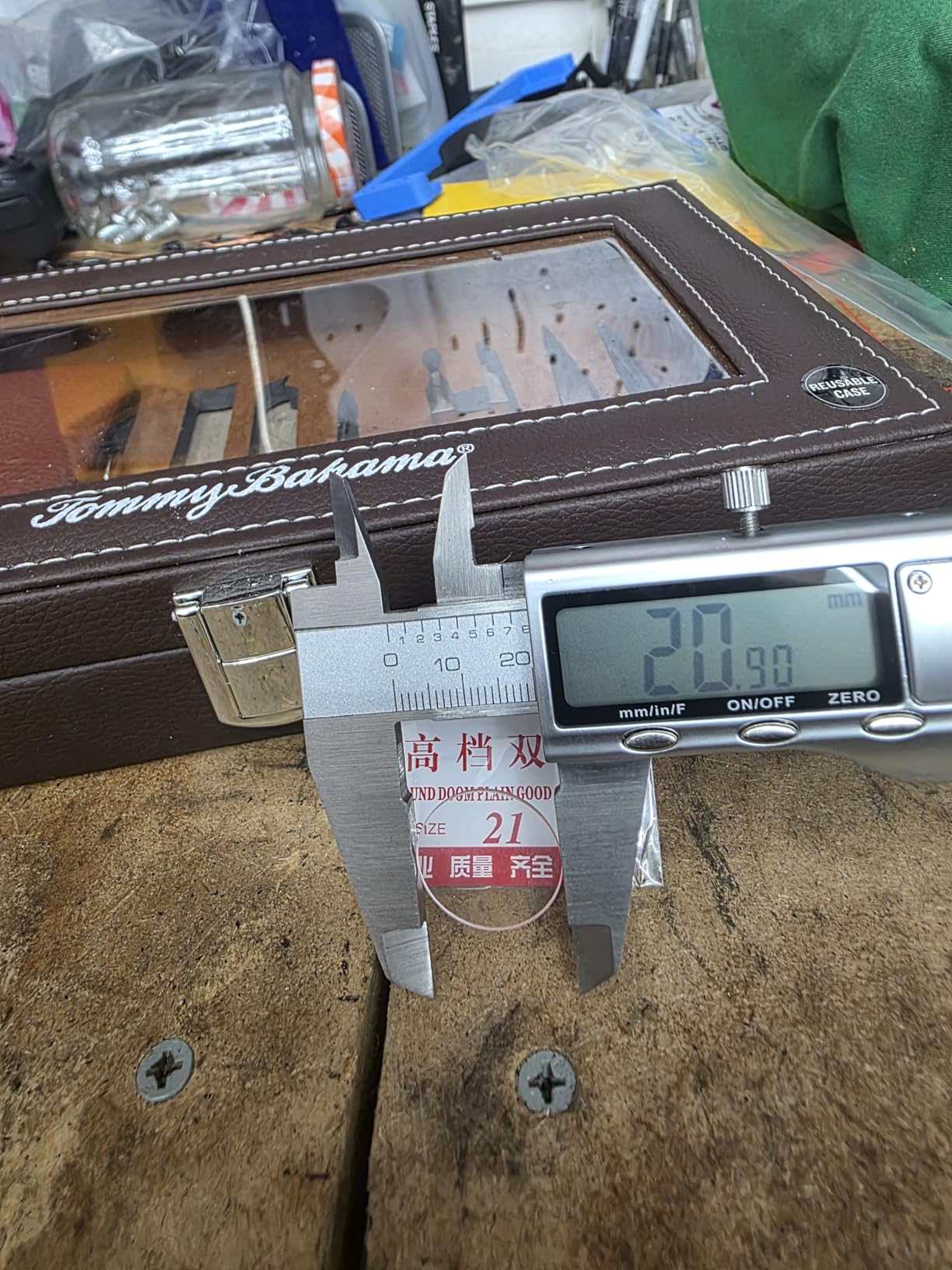
Unit indicators are readable in direct sunlight, and the auto-off after five minutes of inactivity is a sensible default that keeps the battery alive without leaving a live display in your drawer.
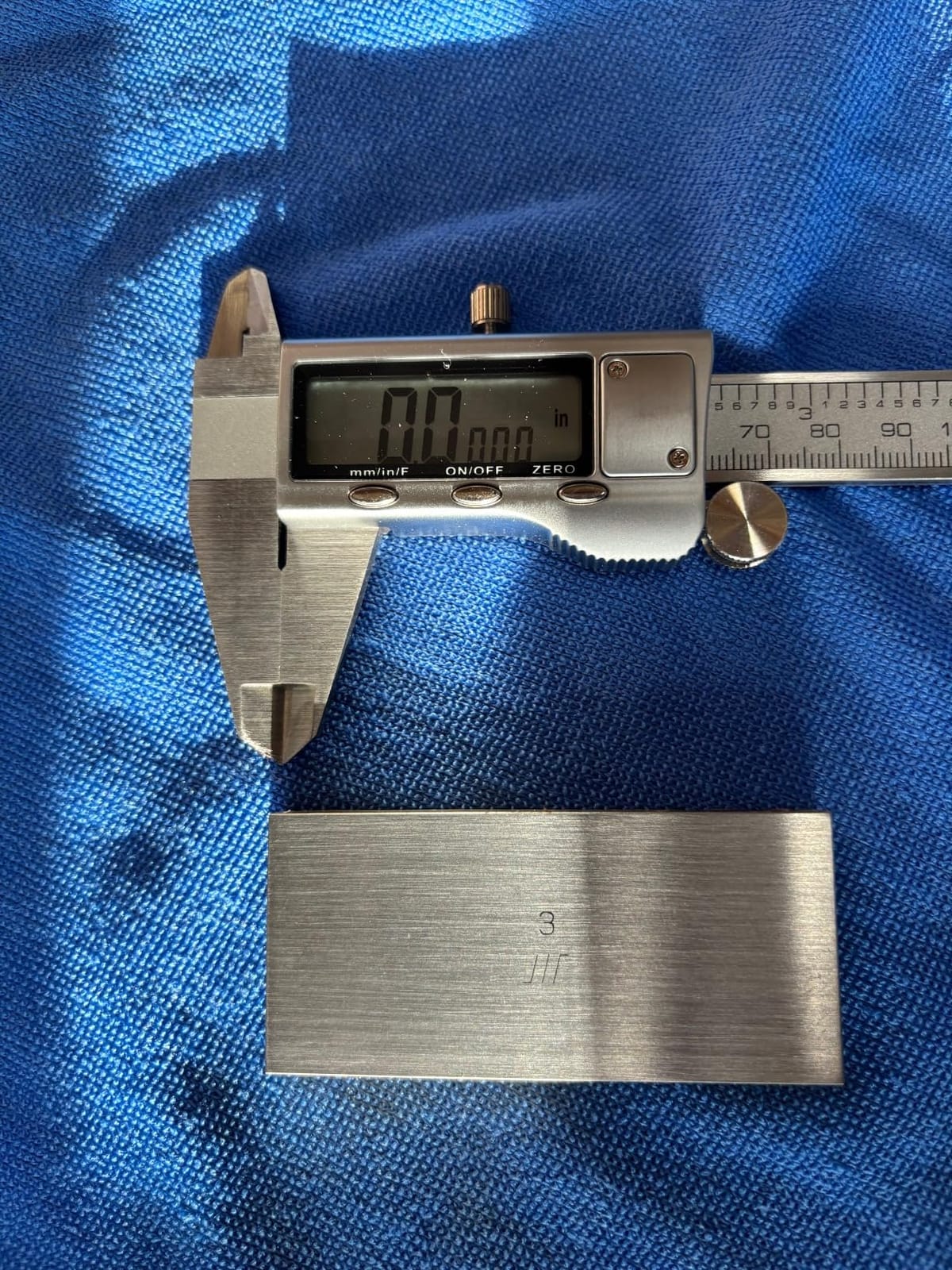
Best as a first stainless steel caliper
If you are moving up from a plastic-bodied tool, this is a clean jump. The stainless frame does not flex, it holds a zero, and the four measuring modes cover everything a loading bench asks for. The gage-block verification in the reviews gives you a reason to trust it before you spend money on a reference standard yourself.
The differential zero function is quietly useful. I zeroed on a case head and then measured each subsequent case head as a difference, which made a drift in the run immediately visible rather than something you had to compute later.
Finishing details to watch
Some owners report sharp, unsanded edges along the slider and body that can scratch the workpiece, which matters when the workpiece is a polished bullet or a soft brass case. Run a finger along the jaws and the slider before you start.
The adjustment roller is loose and rattles in some units, there is no backlight, and the battery compartment cover does not seat perfectly flush. A few owners also report units that would not zero properly, so verify the zero on a known standard the day it arrives.
9. HARDELL 0-8 inch Digital Caliper – Reach for Long Rifle and Magnum Brass
HARDELL Digital Caliper 0-8″ Stainless Steel, Inch/Fractions/mm
Range: 0-8 inch / 200mm
Accuracy: plus or minus 0.001 inch
Knurled thumb wheel
2 LR44 cells
Pros
- 8 inch range is longer than most 6 inch competitors
- Three unit modes including fractional inch
- Knurled thumb wheel glides without sticking or slipping
- Stainless body with a shock and drop resistant case
Cons
- Stated accuracy is slightly looser than some 6 inch rivals
- No backlit display
- No data output for logging measurements
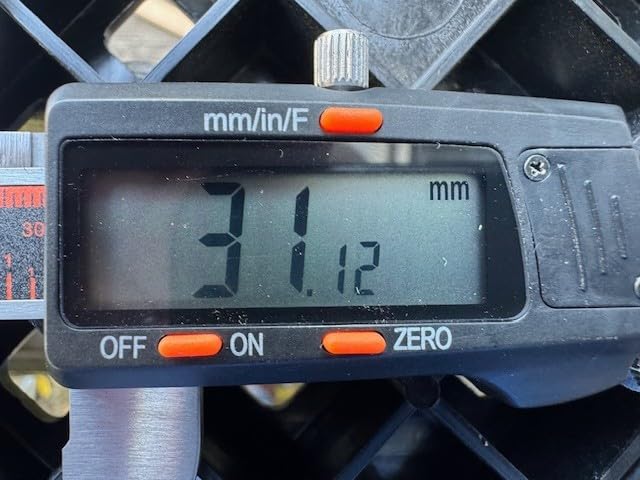
The reason to consider an 8 inch frame is cartridge length on large cases. A magnum or large rifle cartridge, measured base to ogive or overall, can run long enough that a 6 inch caliper makes you reposition mid-measurement, and repositioning mid-measurement is exactly when a reading gets misrecorded. This one covers 0-8 inches, or 0-200 millimeters, in a single placement.
Accuracy is rated at 0.03mm, or 0.001 inch, with 0.01mm, or 0.0005 inch, resolution, so the numbers are in the same class as the 6 inch stainless models. The frame is stainless steel, and the knurled thumb wheel is a thoughtful touch because it resists the slipping that makes fine positioning on a long frame frustrating.
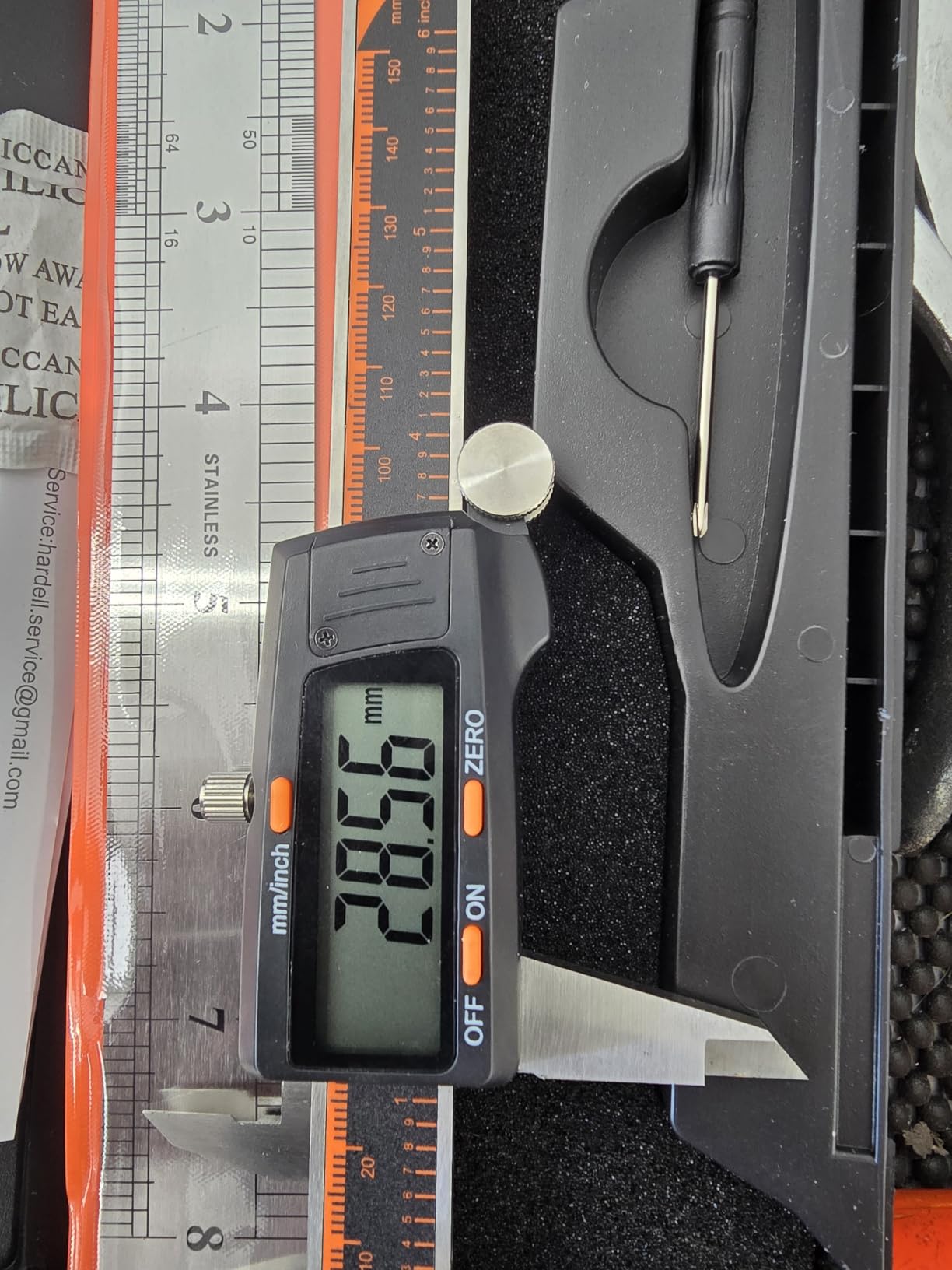
The display converts between inches, fractions and millimeters, which means you can check a dimension against a loading manual without converting units first. The large LCD is readable in bright sunlight and by older users, and the unit sleeps after five minutes of non-use.
The supplied case is rated for pressure, shock and drop resistance, and the box includes two LR44 batteries, a steel ruler and a manual. On a bench where the caliper is handled roughly, that case is doing real work.
When an 8 inch frame earns its place
Long cartridges and long component assemblies are the use case. If you reload magnum, large rifle, or any cartridge where base-to-ogive approaches or exceeds the reach of a 6 inch jaw, the extra two inches removes a step from every measurement you take.
The four measurement methods cover inside diameter, outside diameter, depth and step, and the zero button supports differential measurement, so you can zero on a datum and take differences across a series of cases.
Where it lags the 6 inch field
The stated accuracy of 0.03mm is a touch looser than the 0.02mm figure printed on some 6 inch models in this class, and the difference is small but real if you are working near your tolerance limit. There is also no backlight and no data output, so load logging stays manual.
Owners generally place it slightly below the fraction-equipped 6 inch stainless competitors for those two reasons. If your cartridges are not oversized, a 6 inch model gives you a marginally tighter spec for the same money.
10. LOUISWARE Stainless Steel Digital Caliper – Oil and Water Resistant
Digital Caliper, Caliper Measuring Tool with Stainless Steel, Electronic Micrometer Caliper with Large LCD Screen, Auto-Off Feature, Inch and Millimeter Conversion (6 Inch/150 mm)
Range: 0-150mm / 6 inch
Accuracy: plus or minus 0.001 inch
Auto-off after 4 minutes
Thumb roller with lock
Pros
- Stainless body described as waterproof stain-proof and oil-proof
- Shortest auto-off timer in the group at four minutes
- Thumb roller and locking screw for fine positioning
- Large clear LCD with one-button unit conversion
Cons
- No fractional inch readout mode
- No backlit display
- Uses CR2 cells which are less commonly stocked
Oil resistance is the detail that sets this apart for a reloading bench specifically. Case lube, cleaning solution and brass polish are all part of the job, and a stainless body that resists oil and stains is easier to keep in spec than one that is constantly being wiped down.
Specification is 0.02mm, or 0.001 inch, accuracy with 0.01mm, or 0.0005 inch, resolution over a 0-150mm, 6 inch range. It covers internal, external, height and depth measurement, with a thumb roller and locking screw for fine adjustment, and one-button conversion between inches and millimeters.
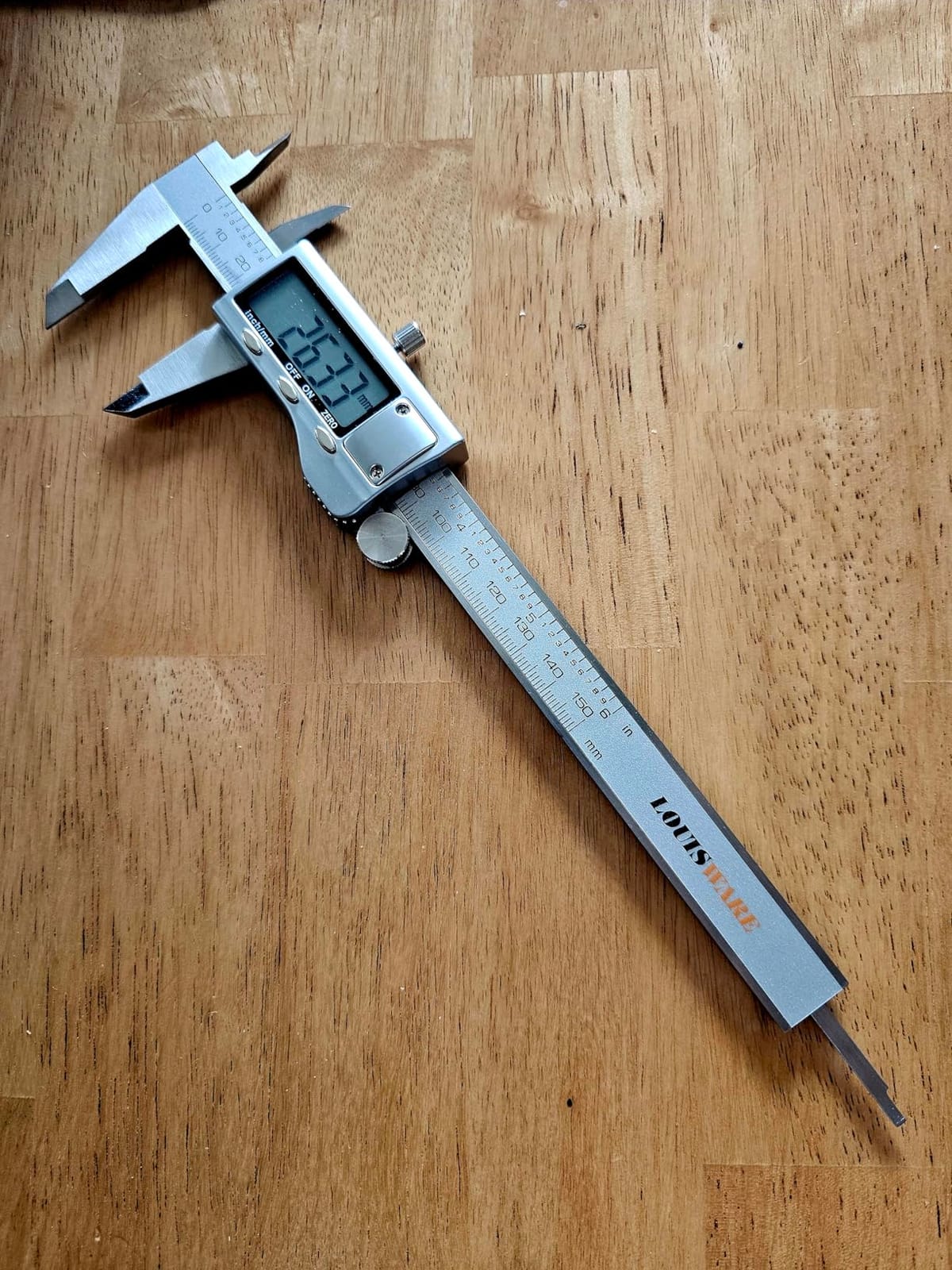
The four-minute auto-off timer is the shortest in this group, and that is a genuine advantage. A caliper that powers down sooner is one you can leave in the tray and come back to later, and it removes the small worry of a flat cell interrupting a session.
Owners describe it as a dependable, well-finished general purpose caliper with accurate readings and smooth adjustment. Mine held a stable zero across a run of case length measurements and returned the same number on repeated readings of the same case.
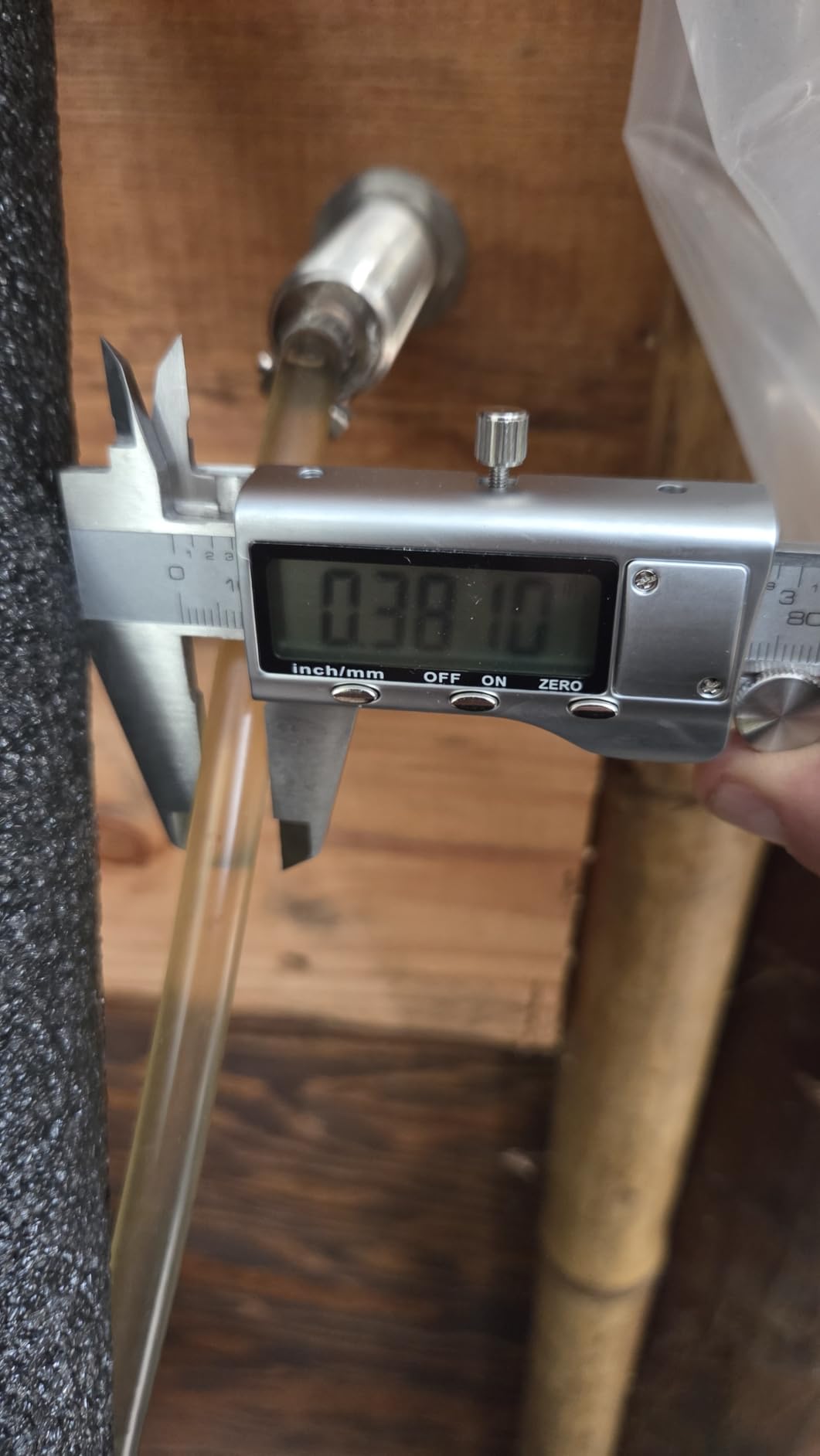
Best for a lube-heavy bench
If your loading process involves wiping cases down with a heavy lubricant and your caliper takes hits from brass and boxes, a stainless body rated against water, stains and oil is the sensible choice. The four-minute sleep also means you are not managing batteries as part of your routine.
The thumb roller and locking screw let you creep up on a measurement and then hold it, which is useful when you are checking rim thickness or shoulder length by feel as much as by number.
Two feature gaps
There is no fractional inch readout, so decimal inches and millimeters are your only modes. If you like to sanity-check a case dimension in 64ths, you will have to do that math yourself.
There is no backlit display either, and it runs on two CR2 cells, which you may have to order separately rather than pick up off a hardware shelf.
11. HARDELL 6 Inch Digital Caliper – The Complete First-Bench Kit
HARDELL Digital Caliper 6 Inch, Caliper Measuring Tool with Large LCD
Range: 0-6 inch / 150mm
Accuracy: plus or minus 0.001 inch
Auto-off at 5 minutes
4 measurement modes
Pros
- Stainless body resists rust wear and corrosion in daily use
- Thumb roller glides without sticking and the lock holds the reading
- Oversized wide-angle LCD readable without tilting
- Kit includes case two batteries a screwdriver and a steel ruler
Cons
- No fractional inch readout
- No backlit display
- 0.01mm resolution is coarser than 0.0005 inch rivals
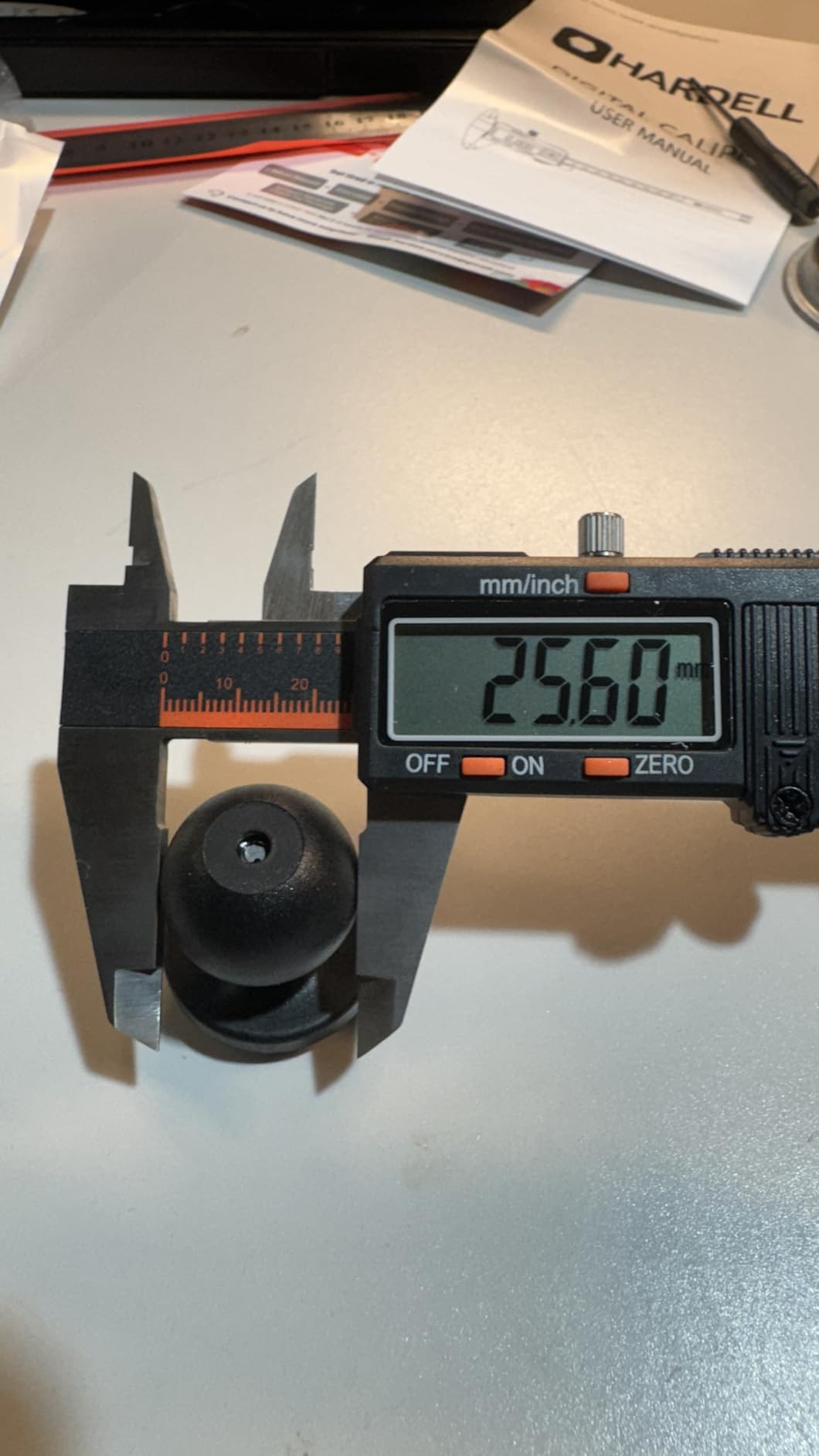
Your first caliper on a first bench comes with everything you need on day one: the tool, a shockproof case, two batteries, a mini screwdriver and a stainless steel ruler.
Accuracy is 0.02mm, or 0.001 inch, across a 0-6 inch, 0-150mm range, with four measurement modes across two jaw pairs and a depth probe. The zero button can be pressed at any point for comparative measurement, and the body is stainless steel rated to resist rust, wear and corrosion.
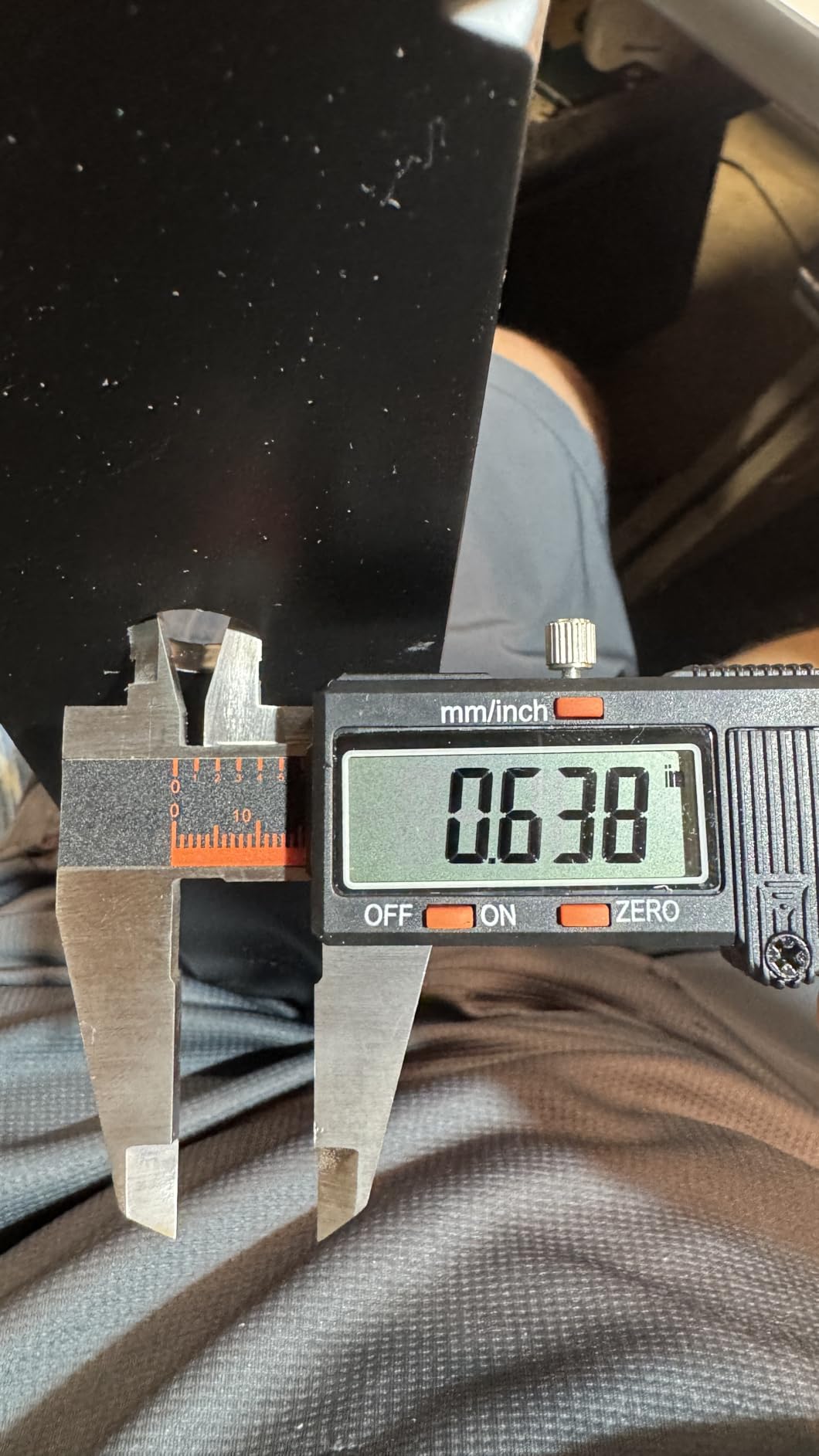
The thumb roller glides without sticking and the locking screw holds a reading steady, which is the combination you want when you are trimming a case and need the number to stay put while you check it. The oversized LCD has a wide viewing angle, so you can read it without tilting your head away from the case.
Metric and imperial conversion is available with a five-minute auto-off. The same model is also made in 8 inch and 12 inch versions, so if you outgrow the 6 inch frame you can move up without changing tools.
Best for outfitting a new bench
For a first caliper on a first bench, the accessory kit removes the small friction of not having a case, a spare battery or a screwdriver when the compartment needs opening. The ruler and the case are minor on their own, but together they make the tool ready to use immediately.
Metric and imperial conversion covers the two systems you are likely to reference, and the auto-off means you will not return to a dead display halfway through a loading session.
Resolution and readout limits
Resolution is 0.01mm, which is coarser than the 0.0005 inch figure printed by several rivals at similar specifications. The stated accuracy is still 0.001 inch, so it is usable for COAL and case trim work, but the last digit is less fine than the best tools here.
There is no fractional inch readout and no backlight, so decimal inches in decent light are the whole story. If you want a fraction mode, look at the VINCA or the HARDELL 8 inch instead.
12. Adoric 0-6 inch Digital Caliper – Honest Limits at the Lowest End
Digital Caliper, Adoric Calipers 0-6 Inch, Inch/mm Conversion, Large LCD
Range: 0-6 inch / 150mm
Accuracy: 0.01 inch
Resolution: 0.01 inch
Plastic body
Pros
- Lowest cost in this group with a large readable LCD
- Light and portable with jaws that will not scratch a workpiece
- Four measuring modes including inside diameter and depth
- Spare LR44 battery included in the box
Cons
- 0.01 inch resolution is too coarse for cartridge measurement
- Plastic jaws do not return to a true zero so readings drift
- No locking screw or thumb wheel on some variants
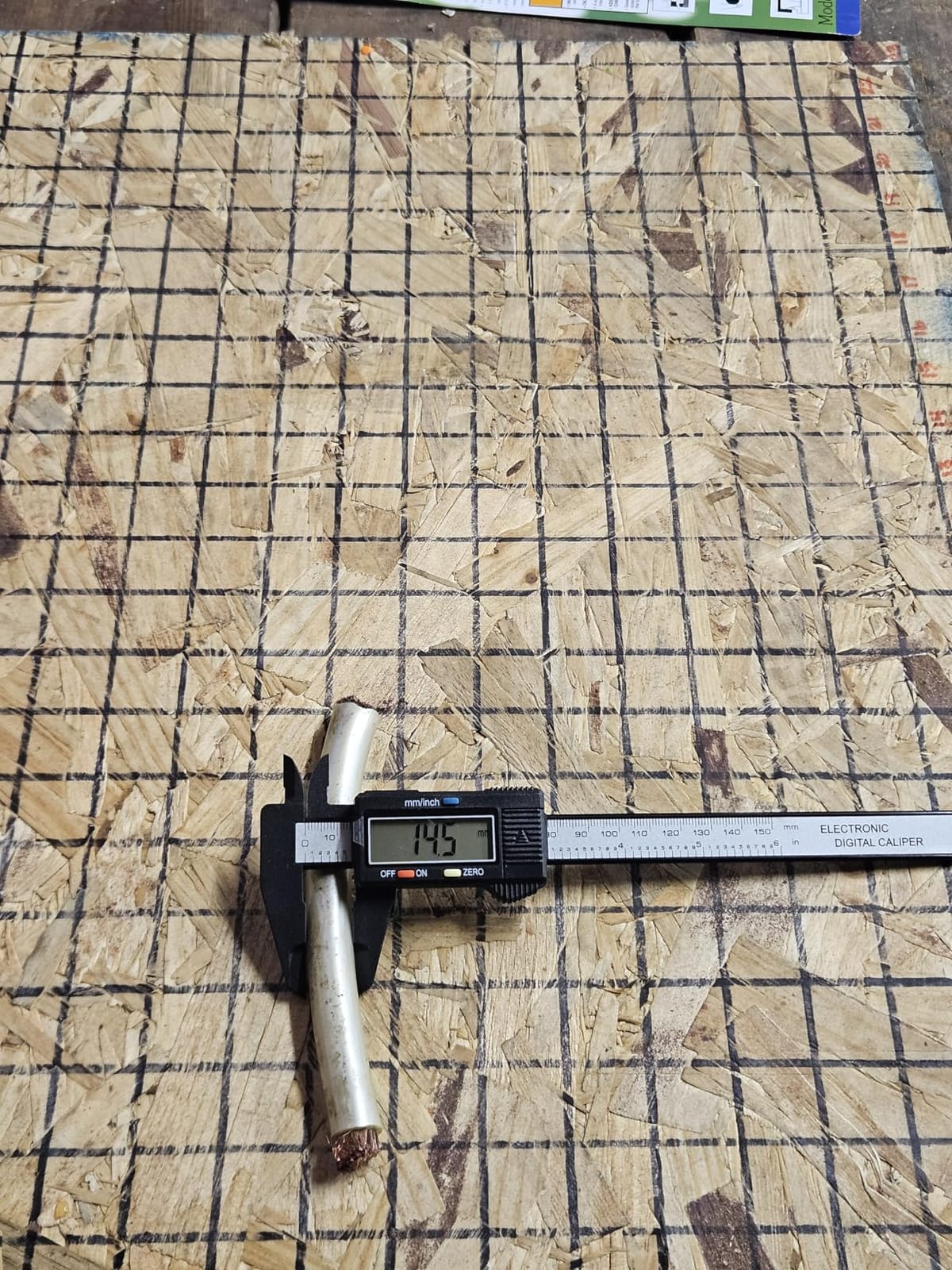
I am including this one because it is the most reviewed caliper in the group by a wide margin, and because the honest reason it is on the list is a warning. It is a perfectly reasonable tool for household and woodworking measurement, and it is not a reloading caliper. Its resolution is 0.01 inch, or 0.1mm, and its stated accuracy is 0.01 inch.
That is a full order of magnitude coarser than everything else here, and cartridge overall length is a measurement held to three decimal places. As one High Road poster put it, you are reloading, not building a precision Swiss watch, and even that generous framing does not stretch to hundredths of an inch.
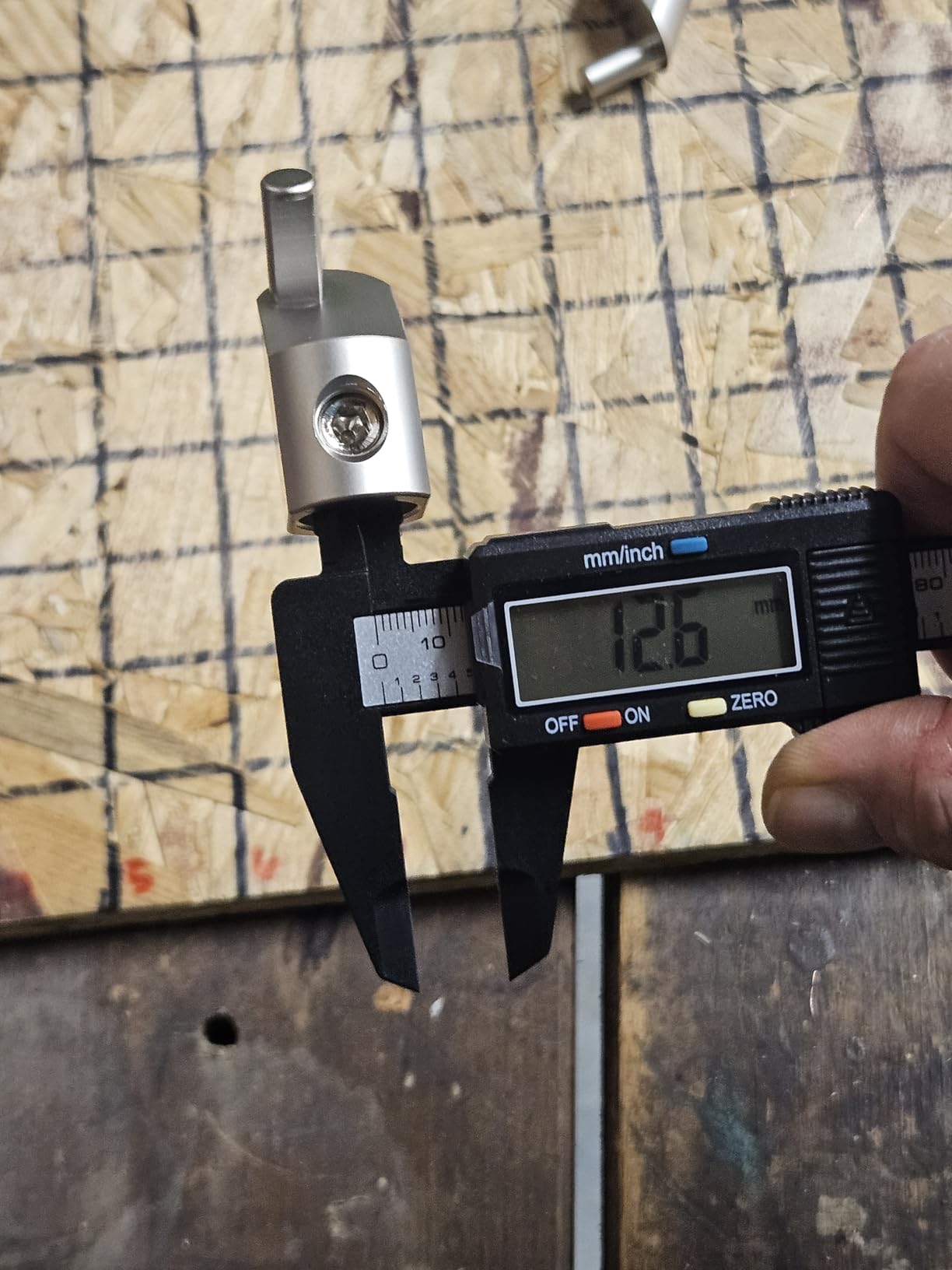
There is one genuine advantage: the plastic jaws will not scratch a workpiece the way steel can, which matters if you are measuring a finished bullet surface. The body is light at 0.07 kg, has a large readable LCD, and offers one-button inch and millimeter conversion with a zero set button for differential measurement.
It covers four measuring modes including inside diameter and depth, and includes an installed LR44 cell plus a spare.
Where a cheap caliper still helps
Rough checks that do not feed load data are fine. Checking whether a case is roughly the right length before it goes near the trim die, or measuring a component that only needs to be close, does not require thousandths of an inch. That is where a tool like this earns its place.
It is also a reasonable backup to keep in the truck, where losing or damaging a good caliper is more likely than on the bench.
Why it should not measure your ammunition
The plastic jaws do not return to a true zero, so repeat measurements drift, and 0.01 inch resolution cannot show a base-to-ogive difference that matters for seating depth. There is also no locking screw or thumb wheel on some variants, and the auto-on triggers with any jaw movement.
Reviewers are clear on the limitation: this is the volume leader for household, woodworking and 3D printing measurement, and the consensus is that it is not suitable for precision metal or cartridge work. Buy one of the 0.0005 inch calipers above for anything that ends up in a loaded round.
What You Actually Measure at the Reloading Bench
Cartridge overall length, usually called COAL, is the measurement most loaders take most often. It is measured with the outside jaws from the base of the case to the tip of the bullet, and it is the number you adjust when you chase a specific overall length for a given barrel. A 0.001 inch caliper handles it comfortably.
Case trim length is a set dimension rather than a target, so what you need is a caliper that returns to the same number every time you close the jaws. Repeatability, not accuracy, is the spec that matters here, and that is why a stable zero and rigid frame beat a flashier display.
Base-to-ogive is measured from the bullet base to a specific band on the ogive, and because it references the bullet rather than the case, most loaders zero on a known reference or set a differential zero. A caliper with an easy-to-use zero button at any point on the scale makes this measurement much faster.
Seating depth is the same measurement taken from a different reference, usually the case mouth, which means it depends on where you put the zero. The iGAGING Absolute Origin is the pick here if you take this reading repeatedly, because it remembers the zero across power cycles instead of asking you to re-establish it.
Case neck diameter, case head diameter and rim thickness all fall to inside and outside jaw work, and these are where jaw quality shows up most clearly. An inside jaw with an angled gap reads high, and a High Road owner described finding a gap in a six-year-old caliper that threw readings off by 0.002 inch, which is the amount that matters when you are sizing brass.
Case headspace is the measurement most often misread. That is a difference measurement between two points, not a single dimension, and it needs a caliper with a reliable differential zero rather than a small single-jaw gauge.
How to Verify a New Caliper Before You Trust It
You do not need a set of gage blocks to sanity-check a new caliper. You need three checks, and they take about ten minutes.
- Zero the caliper on a known reference. A precision-ground steel ruler, a certified 1 inch block, or a piece of case you have measured many times all work. Press zero and confirm the display holds 0.0000.
- Check repeatability before you check accuracy. Measure the same case head ten times, opening and closing the jaws fully each time, and see whether the number is identical every time. A caliper that reads 1.2350, 1.2354, 1.2352 across ten attempts is telling you something important regardless of what its specification says.
- Sweep the range rather than testing only at zero. Measure at several points across the scale, including near full travel. A caliper can be perfect at zero and drifting by 0.001 inch at 5 inches, and that is where case length measurements sit.
- Run the inside-jaw light test. Close the internal jaws completely and hold them up to a light source. Any visible glow means the jaws are not parallel, and that gap will read high on case neck diameter. This is the check one experienced reloader on The High Road says should be done on every caliper before it touches a cartridge.
- Test after a battery change. If the tool claims zero memory, power it off, swap the cells and confirm the zero survived. If the reading has shifted, you are looking at an incremental encoder and you will be re-zeroing for the rest of its life.
If you do not have a reference, the practical strategy experienced reloaders use is to buy two or three of a lower tier, test each one against a known dimension, keep the best and deal with the others. One High Road poster described exactly this process with a very cheap caliper line and reported getting a great instrument for a fraction of the price of a premium unit.
Buying Guide: Accuracy, Encoders, Frames and Batteries
Accuracy versus resolution is the most misunderstood pair of numbers on a spec sheet. Resolution is how small a step the display can show, and accuracy is how close that reading is to the true value. A caliper showing four decimal places is not necessarily a four-decimal-place instrument, and a reading of 1.2350 tells you far less about the real cartridge length than most buyers assume.
For reloading, an accuracy rating of 0.001 inch is the practical floor and is where eleven of the twelve calipers here sit. Resolution of 0.0005 inch, or 0.01mm, is what lets you see a change between two loads, and it is the number to look for.
Absolute versus incremental encoders is the second decision, and it is one that bites people. An absolute caliper measures from a fixed internal origin and remembers that zero even when the battery is removed or replaced. An incremental caliper counts movement from wherever it was switched on, so it drifts and must be re-zeroed frequently. At a bench where you zero on a case head and then take a long series of readings, absolute is clearly better.
For measurement consistency, ask the question this way: how many readings will I take before I next question the zero? If the answer is more than about ten, zero memory pays for itself immediately. The iGAGING Absolute Origin is the pick in this group built around that behavior, and it is also the one that streams readings over USB so a batch of COAL numbers lands in a spreadsheet instead of your handwriting.
Frame size is a cartridge question, not a brand question. A 6 inch frame covers typical handgun and rifle cartridges in a single placement. An 8 inch frame earns its place on long magnum and large rifle cartridges, where base-to-ogive can approach the reach of a 6 inch jaw and mid-measurement repositioning becomes a transcription risk.
Battery chemistry and auto-off behavior decide whether the caliper is still working when you pick it up. Coin cells such as LR44 and CR2032 are cheap and easy to replace anywhere, and auto-off after four or five minutes is the sensible default. Two C cells last longer between swaps but make the tool bulkier, and a caliper that recalls its last position draws a trickle while stored, so pull the cell partway out over the off season.
Material and residue resistance decide how long it stays accurate. Stainless steel resists the abrasive contact that comes from handling brass, and an IP54 rating means water, oil and dust can be wiped off without worrying about the electronics. On a bench that sees case lube and powder residue daily, both are worth paying for.
Counterfeits and authorized distributors are the last thing to check, and it matters most for the premium brands. As one poster on The High Road warned about counterfeit Mitutoyo units, buy from a named authorized industrial distributor rather than a marketplace seller, and check that the serial number on any calibration certificate matches the caliper in your hand. Forum consensus also treats a calibration certificate, an original manufacturer case and a serial-matched warranty as the practical authenticity evidence.
Finally, the honest comparison with dial calipers. A dial caliper needs no battery, never loses its zero, and lets you watch the needle settle so you can judge repeatability by eye, which is why experienced reloaders keep one as a check on their digital. The digital wins on speed, decimal readout and the ability to zero on any datum. Many loaders simply keep both, and that is a reasonable position rather than a compromise.
When a Caliper Is Not Enough
A caliper measures to 0.0005 inch at best, and that is a hard ceiling that no amount of care changes. If you are chasing sub-thousandth consistency for match or benchrest ammunition, a micrometer is the next tool up, and a bullet comparator is the right answer for comparing two loaded rounds to each other rather than to a standard.
Case gauges, which are go and no-go tools rather than measuring instruments, are what you use to confirm that resized brass is at specification. A caliper tells you how far off you are; a gauge tells you whether it passes.
For the average loader, none of that is necessary. The consensus among experienced reloaders is that reloading measurements are held to three decimal places, which a 0.001 inch caliper handles without trouble.
Frequently Asked Questions
Who makes a high quality digital caliper?
Mitutoyo and Starrett are the industry-standard makers of high quality digital calipers, with Brown u0026amp; Sharpe, Fowler and iGaging also well regarded. The critical caveat is that Mitutoyo counterfeits sold through marketplace sellers are a persistent problem, so buy from an authorized industrial distributor and confirm the serial number on any calibration certificate matches the caliper you received.
Are Starrett or Mitutoyo calipers better?
For reloading, both are excellent and the practical differences are small. Mitutoyo leads on absolute-encoder models that remember zero and on inductive sensors that resist powder residue and case lube. Starrett is often preferred for dial calipers and is more widely available at general hardware and industrial suppliers. For a bench that sees brass cases and powder residue daily, a Mitutoyo 500-series absolute digital is the more defensible choice.
Which digital caliper is best?
The best digital caliper for reloading is the iGAGING Absolute Origin for accuracy and encoder reliability, the Clockwise Tools IP54 model for a documented certificate of accuracy, and the VINCA DCLA-0605 for build quality and a fraction readout. For most reloaders, however, any of the well-reviewed 0.0005 inch options measures COAL and case trim length just as reliably.
Are Harbor Freight digital calipers accurate?
Often yes, with caveats. Budget digital calipers frequently resolve to 0.0005 inch, but quality control is inconsistent and some pieces are gritty, drift, or have misaligned internal jaws. Experienced reloaders buy several, test each against a known standard or gage blocks, keep the best and return the rest, which is why verifying a new caliper on arrival matters more than the badge on the box.
What is the difference between absolute and incremental calipers?
An absolute caliper measures from a fixed internal origin and remembers that zero point even when the battery is removed or replaced. An incremental caliper counts movement from wherever it was switched on, so it drifts and must be re-zeroed frequently. At a reloading bench where you zero on a case head and then take a long series of readings, absolute is clearly better.
Is a digital caliper accurate enough for reloading?
Yes. Cartridge overall length, case trim length, base-to-ogive and seating depth are typically held to three decimal places, which a caliper rated at 0.001 inch accuracy handles comfortably. You need a micrometer only if you are chasing sub-thousandth consistency for match or benchrest ammunition, or a bullet comparator when you want to compare two loaded rounds against each other.
The Best Digital Calipers for Reloading in 2026
The iGAGING Absolute Origin is the best digital caliper for reloading in 2026 because it is the only pick here built around zero memory that survives a power cycle, and because it will log a batch of COAL readings to your computer instead of your notepad. If you want the most trustworthy bench caliper without the data port, the Clockwise Tools IP54 model ships with a certificate of accuracy and holds its zero through long sessions.
For most reloaders, though, the honest answer is that any of the 0.001 inch accuracy, 0.0005 inch resolution stainless steel calipers in this roundup will measure COAL and case trim length correctly. Buy the one with the display you can actually read and the zero behavior you trust, run the light test on the inside jaws before you touch a cartridge, and add a micrometer only when you start recording match load data.