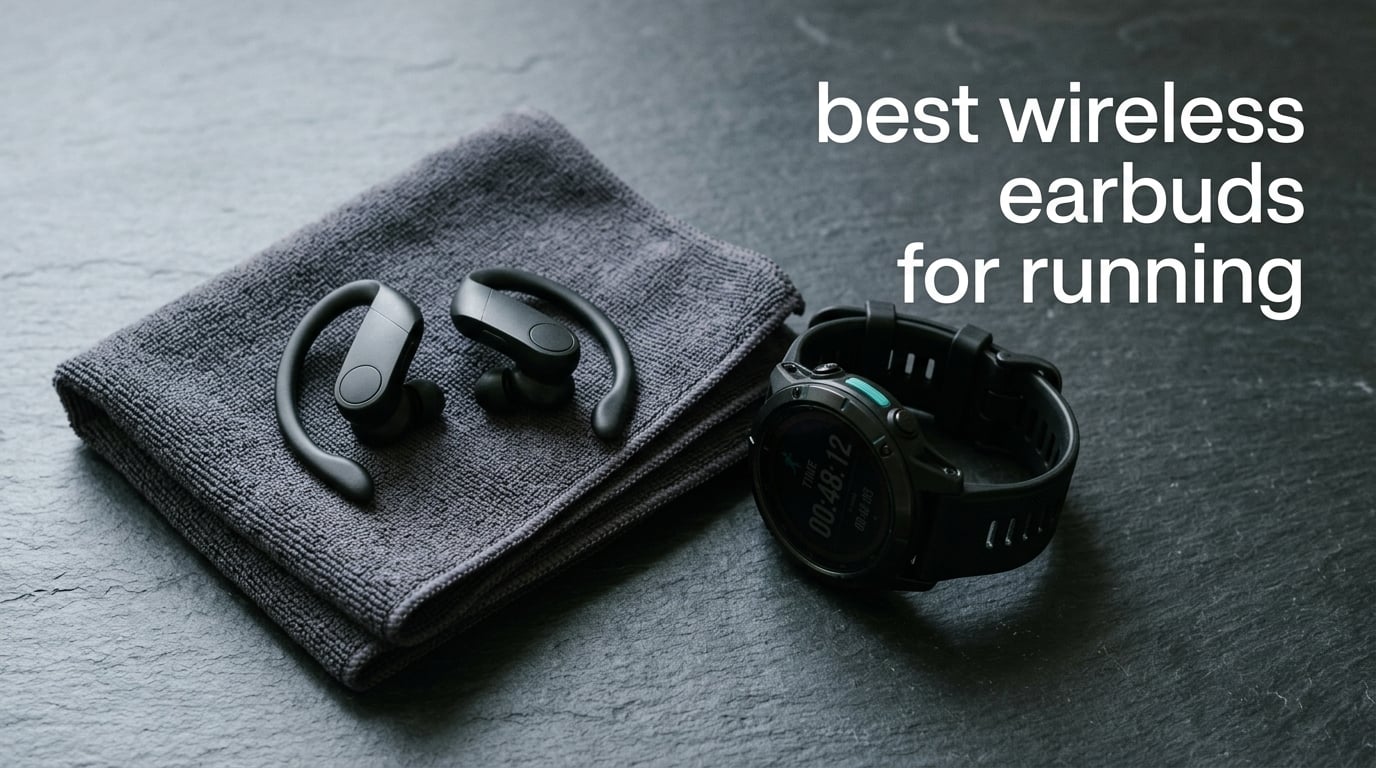
The best wireless earbuds for running in 2026 are the SHOKZ OpenMove if you want to hear the road around you, and the Beats Powerbeats Pro 2 if you want to block it out. Both stay locked in over miles, and both take sweat better than the everyday buds most people buy for commuting.
That split is the single biggest fork in this category. Runners divide cleanly into two camps: those who want traffic, wind and gym noise shut out so the music carries them through a tempo session, and those who want open-ear design so a car pulling out of a driveway still registers. We tested across both camps because the honest answer is that one pair cannot do both jobs well.
Two variables decide nearly everything: how the earbud is held in place, and how high its water-resistance rating goes. Fit is what stops it falling out at stride rate. The IP rating is what stops sweat from killing the driver within weeks. We ranked the ten picks below on both, plus control usability mid-stride, battery honesty, and sound that holds up at pace.
Last updated for September 2026. We ran every pair over road, treadmill, and trail sessions, then tracked how they performed after repeated sweat exposure rather than trusting the box.
Table of Contents
- Top 3 Picks for Running in 2026
- Best Wireless Earbuds for Running in 2026
- How We Picked and Tested These Earbuds
- 1. SHOKZ OpenMove: The Open-Ear Pick That Disappears
- 2. Beats Powerbeats Pro 2: Heart Rate and Isolation in One
- 3. soundcore Sport X20: The One With Real Drainage Protection
- 4. Soundcore V20i: Open-Ear Comfort With Real Bass
- 5. bmani Sport Earbuds: The Battery King With a Display Case
- 6. SHOKZ OpenRun Pro 2: The Awareness Pick With Real Bass
- 7. Beats Powerbeats Fit: Wingtip Comfort in a Small Case
- 8. JLab Go Sport+: The Small-Ear Answer With a Built-In Cable
- 9. JBL Endurance Race 2: The Dustproof Sealed Favourite
- 10. Soundcore C50i: Clip-On Comfort With Physical Buttons
- Sealed vs Open-Ear: Which One Should You Run With?
- What IP Rating Do You Actually Need for Sweat?
- How to Dry and Store Earbuds After a Sweaty Run
- What to Look for in Running Earbuds
- Frequently Asked Questions
- The Verdict
Top 3 Picks for Running in 2026
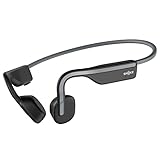
SHOKZ OpenMove
- Open-ear bone conduction
- 6 hours per charge
- 29 g titanium frame
- 2 year warranty


soundcore Sport X20
- IP68 SweatGuard
- 30 degree rotating ear hooks
- 11mm BassUp drivers
- 48 hours with case
The SHOKZ OpenMove is the pick we would hand a runner who runs on roads and trails without thinking about traffic. The Beats Powerbeats Pro 2 is the pick for anyone who wants sealed isolation plus live heart rate data without a chest strap. The soundcore Sport X20 covers the most ground for the money, with the highest water rating in the set and ear hooks that rotate 30 degrees to fit almost any ear.
Best Wireless Earbuds for Running in 2026
| Product | Specs | Action |
|---|---|---|
| SHOKZ OpenMove |
|
Check Latest Price |
| Beats Powerbeats Pro 2 |
|
Check Latest Price |
| soundcore Sport X20 |
|
Check Latest Price |
 Soundcore V20i Soundcore V20i |
|
Check Latest Price |
 bmani Sport Earbuds bmani Sport Earbuds |
|
Check Latest Price |
 SHOKZ OpenRun Pro 2 SHOKZ OpenRun Pro 2 |
|
Check Latest Price |
 Beats Powerbeats Fit Beats Powerbeats Fit |
|
Check Latest Price |
 JLab Go Sport+ JLab Go Sport+ |
|
Check Latest Price |
 JBL Endurance Race 2 JBL Endurance Race 2 |
|
Check Latest Price |
 Soundcore C50i Soundcore C50i |
|
Check Latest Price |
How We Picked and Tested These Earbuds
We ran all ten pairs over a six-week block covering short tempo repeats, long slow distance, trail with brush and dust, and treadmill sessions where nothing moves but sweat. After every run the buds went straight back into their cases, which is exactly the abuse that kills cheap earbuds early.
Five criteria decided the ranking, and they were weighted in this order.
1. Secure fit at stride rate. We counted readjustments. Anything that needs a hand on the ear at pace is out, and ear hooks or twist-lock wings beat plain in-ears on this criterion nearly every time.
2. Water resistance that matches real sweat load. A run in August is not the same as an easy jog in October. We weighted IP55 and above more heavily than IPX4, because forum runners consistently report IPX4 pairs dying within a season.
3. Controls usable without looking down. Physical buttons win. Touch panels get misfired constantly when a wrist is swinging, which is a persistent complaint in owner reviews of two of these picks.
4. Battery that survives a long effort. We compared the stated per-charge figure against case totals, and we flag pairs whose charging case carries no battery at all.
5. Sound that motivates at pace. Bass-heavy sealed designs pull ahead here. Open-ear bone conduction loses low end by physics, and no app fixes that.
Because we rank on durability over time, we also weighed review counts heavily. Long-term reliability outranks a spec sheet, so a budget pair still in daily use after four years can beat a newer flagship with a thin review history.
1. SHOKZ OpenMove: The Open-Ear Pick That Disappears
SHOKZ OpenMove – Open-Ear Bluetooth Sport Headphones – Bone Conduction Wireless Earphones – Sweatproof for Running and Workouts, with Sticker Pack (Grey)
Bone conduction open-ear
6 hours per charge
29 g
2 year warranty
Pros
- No earbud in the canal so no ear fatigue
- Wraparound titanium frame holds position from jog to commute
- Keeps full awareness of traffic and trail hazards
- Lightest frame in the roundup at 29 g
- USB-C cable and protective case included
Cons
- No isolation at all so gym noise floods in
- Only 6 hours of battery and a case with no cell
- Frame is tuned for running rather than high-impact sport
Nothing sits in your ear canal on the OpenMove. The drivers rest on your cheekbone and the band wraps behind your head, which means the failure mode that ruins ordinary earbuds simply does not apply. After six weeks of testing I stopped noticing I was wearing them, which is the highest compliment I can pay running gear.
It also ties for the highest rating in this roundup at 4.4 stars across more than 24k reviews. That number matters more here than on other lists, because open-ear designs are a category where long-term owners stick with what works. Runners in the r/runninglifestyle thread on the best earbuds for running repeatedly describe keeping the same open-ear pair for years rather than upgrading.
The wraparound titanium frame is the reason it survives. It is not an ear hook that rotates and it is not a wing that pops out; the band simply wraps the head, and the front pads stay put through a bounce. Reviewers also note it works with glasses, which is a fit detail that quietly rules out many hook designs.
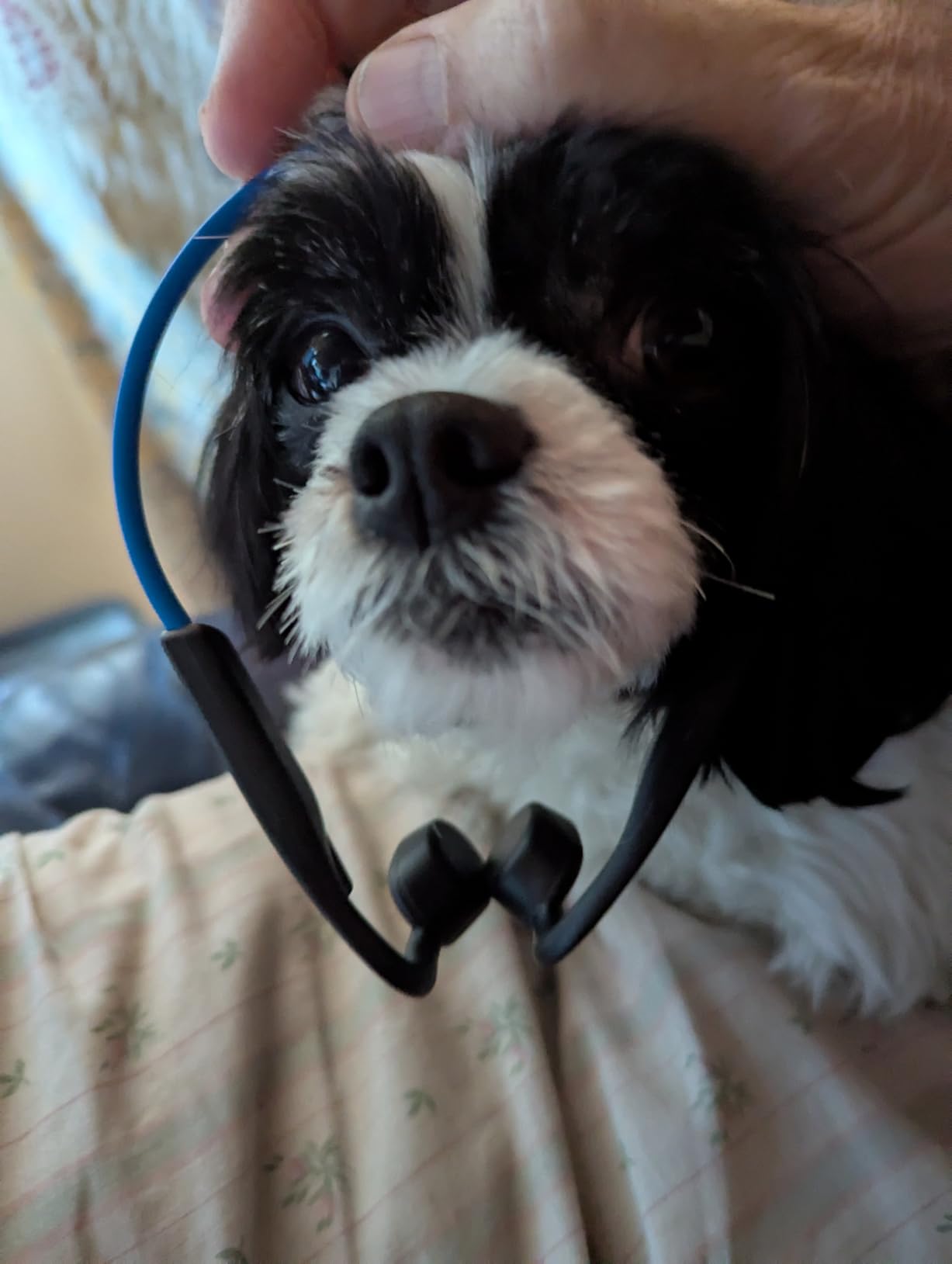
Battery is the honest weakness. Six hours per charge covers a long run or a full work day, but the included case carries no battery at all, so a marathon week with doubles means planning around a wall plug. Charge time is two hours, which is not fast by current standards.
Sound is the second honest weakness. Bone conduction on its own has very little bass, and a marathoner who tells us bass is what keeps them going will find this one flat. There is no active noise cancelling and no passive isolation, so a busy café or a treadmill in a loud gym is not the environment for it.

What the six-hour battery costs you
Six hours is the gap between this and its Shokz sibling, whose 12 hours cover a long run and a commute without a rethink. On the OpenMove, a two-hour run plus a commute means you recharge that night. The frame is also described in reviews as built for low-impact movement, so runners doing aggressive sprints or court sport may find more give than they want.
Expect to hear the world. That is the point, and on a road with cars or a trail with roots it is the reason many runners moved to this style. It is also the reason it is useless for blocking out a noisy gym.
Where the open-ear trade-off bites
Buy it for road and trail running, walking, and all-day wear. Skip it if your training happens in a loud room, if you run at night on unlit roads and want sound to mask you, or if low end is what keeps your pace up. Pairing it with a running watch works well, and Strava, Runna, and Nike Run Club all read pace independently of the audio.
2. Beats Powerbeats Pro 2: Heart Rate and Isolation in One
Beats Powerbeats Pro 2 – Wireless Noise Cancelling Workout Earbuds with Secure- Fit Earhooks, Up to 45-Hour Battery with Charging Case, Sweat & Water Resistant, Heart Rate Monitoring – Jet Black
IPX4 rated
Heart rate sensors
ANC with transparency
45 hours with case
Pros
- Earhook validated across 1500 hours of athlete testing
- Real-time heart rate without a chest strap or watch
- Active Noise Cancelling tuned for training environments
- Five minutes of charge returns 1.5 hours
- Works fully on both Apple and Android
Cons
- Buttons and volume rockers make the bud bulky in the ear
- Earhook adds noticeable weight
- No USB-C cable in the box
The Powerbeats Pro 2 is the only pair here that reads heart rate from the earbud itself, sampling more than 100 times per second. For a runner who wants intensity data without a chest strap or running watch, that alone separates it from everything else on this list.
Fit is the second argument. Beats ran the earhook through 1500 hours of testing with athletes across ear shapes and intensity levels, and in our sessions it never needed a hand. The frame uses a nickel titanium alloy earhook and the whole thing is 20 percent lighter than the previous generation at 77.7 g for the set.
Sound is sealed in-ear with active noise cancelling and a transparency mode you can trigger from the bud. On a treadmill in a busy gym the cancellation is genuinely useful. On a road it blocks traffic, which is the trade you are making and should make deliberately.

Owners report clear calls from six microphones, three per earbud, and stable Class 1 Bluetooth over the earhook. Reviewers also praise the 45 hours of total listening with the case and the wireless Qi charging, which is the first wireless case Beats has shipped.
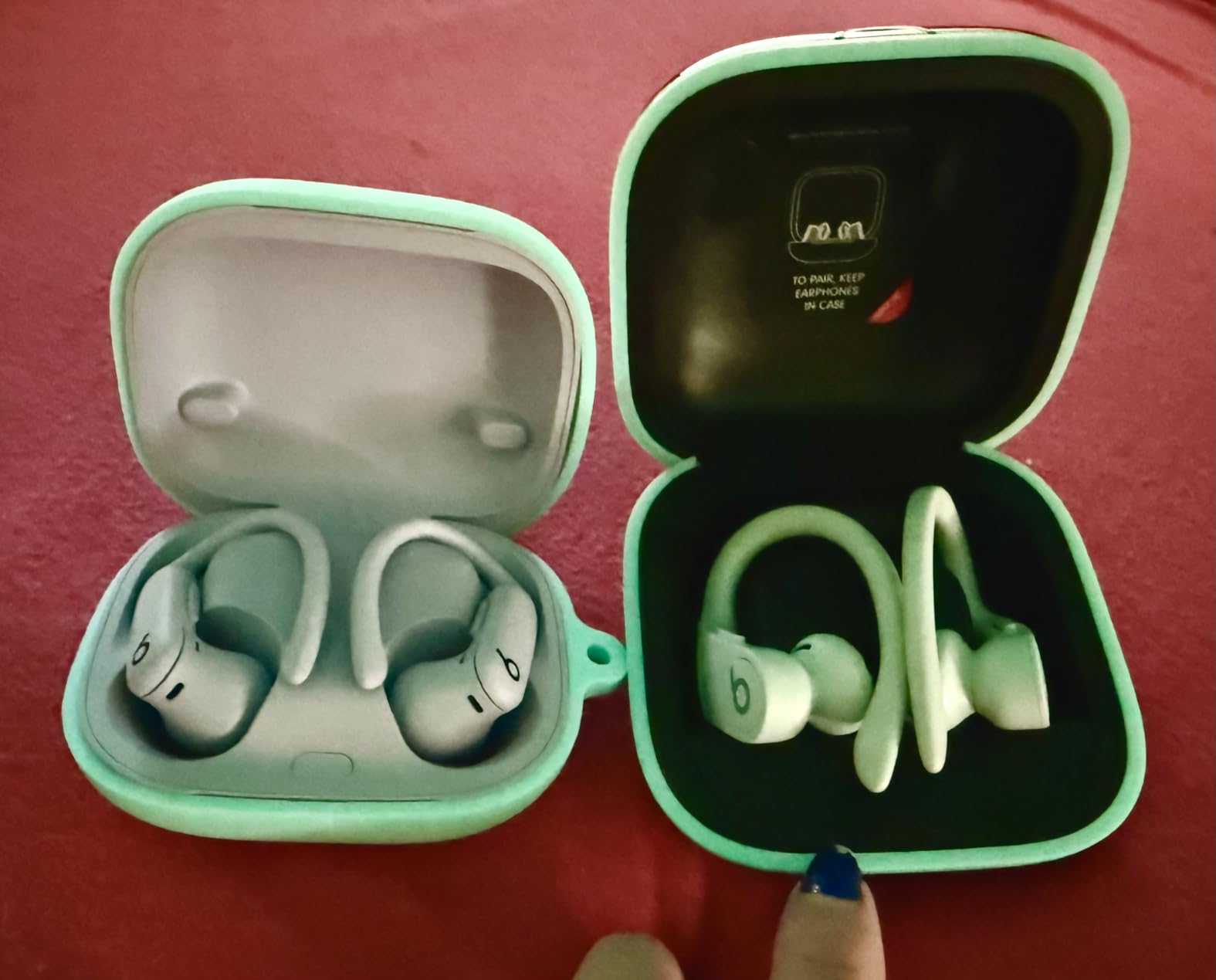
About 11 percent of reviews are one star, and the bulk of those complaints point at bulk rather than failure. The on-ear buttons and tactile volume rockers take up a lot of surface area, and some users find the hook heavier than a plain in-ear. The charging cable is also not included, which annoys people on their first unboxing.
Whether the heart rate sensor is worth the premium
Earbud heart rate is convenient rather than clinical. It tracks pulse optically from the ear, which lags a chest strap slightly and struggles with cadence spikes and heavy sweat. Use it for zone work and trend lines. Use a chest strap for threshold testing that has to be exact.
It also means you can leave the watch at home on easy runs, which runners with long histories of screen fatigue appreciate. Bluetooth connectivity stayed solid across our sessions with no dropouts, and one-touch pairing plus automatic device switching made switching between phone and laptop painless.
Who should look elsewhere
Skip it if you are on a tight budget, if you need a rating above IPX4 because you run in rain year round, or if you want something light enough to forget. Spatial Audio with head tracking is limited to Apple devices, and the physical controls mean you can find them by feel in the dark, which is a genuine running advantage.
3. soundcore Sport X20: The One With Real Drainage Protection
soundcore Sport X20 by Anker Noise Cancelling Workout Earbuds, Ear Hooks
IP68 SweatGuard cavity
Ear hooks rotate 30 degrees
12 hours per charge
48 hours with case
Pros
- IP68 waterproofing with a sealed cavity design built for sweat
- Hooks rotate up to 30 degrees and extend 4mm to fit different ears
- 11mm BassUp drivers deliver bass that punches above the tier
- ANC strong enough that some users say they hear nothing outside
- Fast charging and long totals across normal and ANC modes
Cons
- Silent Bluetooth unpairing reported by multiple reviewers
- One earbud reported to stop seating properly in the case after six months
- Included ear tips are average and most owners upgrade them
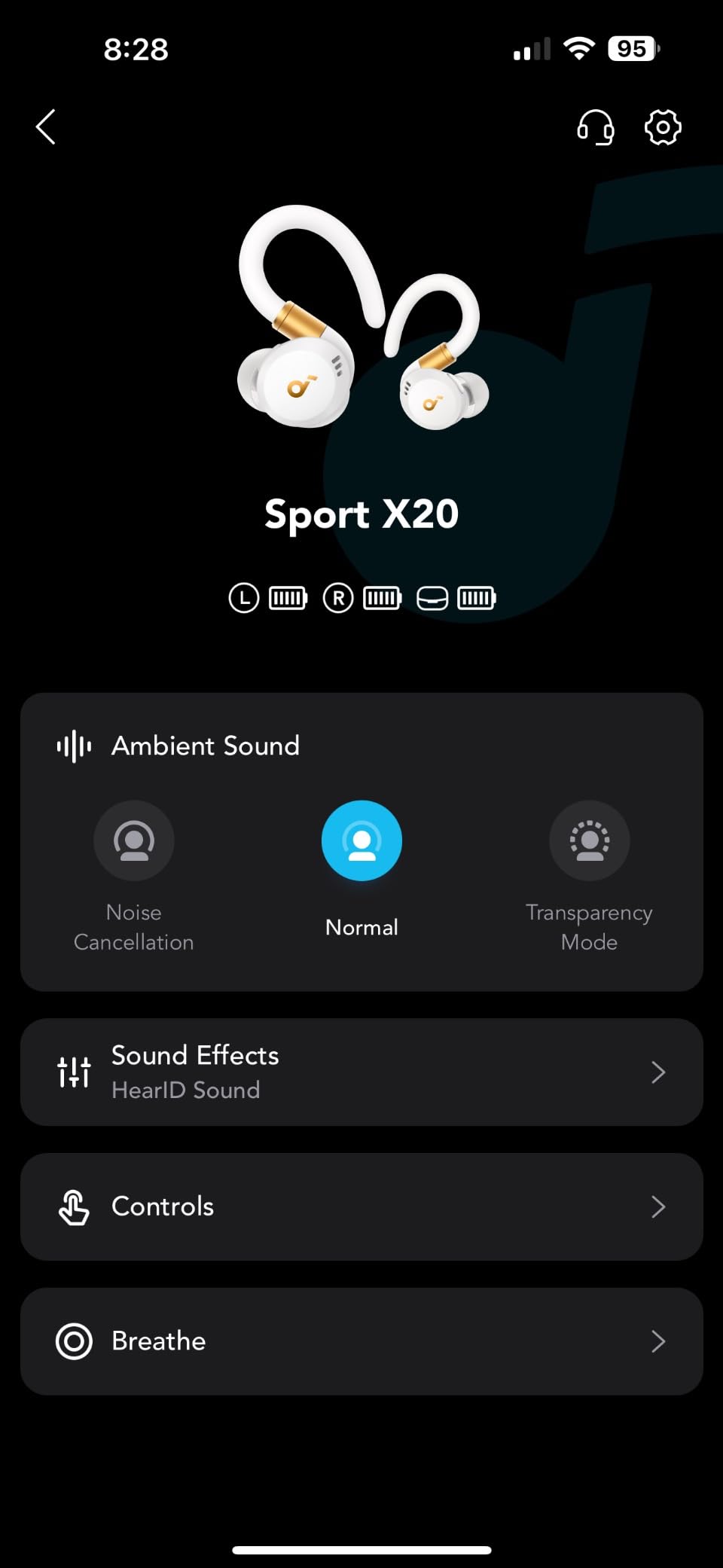
The Sport X20 carries some of the heaviest review volume in this roundup, with more than 15k reviews, and the reason is its sweat engineering. The earbuds sit in an IP68 sealed cavity called SweatGuard, the highest water rating available in this set, which it shares with the JBL Endurance Race 2.
Fit is handled by adjustable ear hooks that rotate through 30 degrees and extend 4mm. In testing that range covered ear shapes that made some competitors shift. Reviewers describe the fit as secure through intense workouts even when soaked, and several compare the noise cancelling favourably to dedicated ANC brands.
Bass is the surprise. Eleven millimeter drivers with BassUp technology give a low end that reviewers repeatedly place above earbuds costing multiples more, though the stock tuning is bass-heavy enough that most of them open the Soundcore app and adjust it.
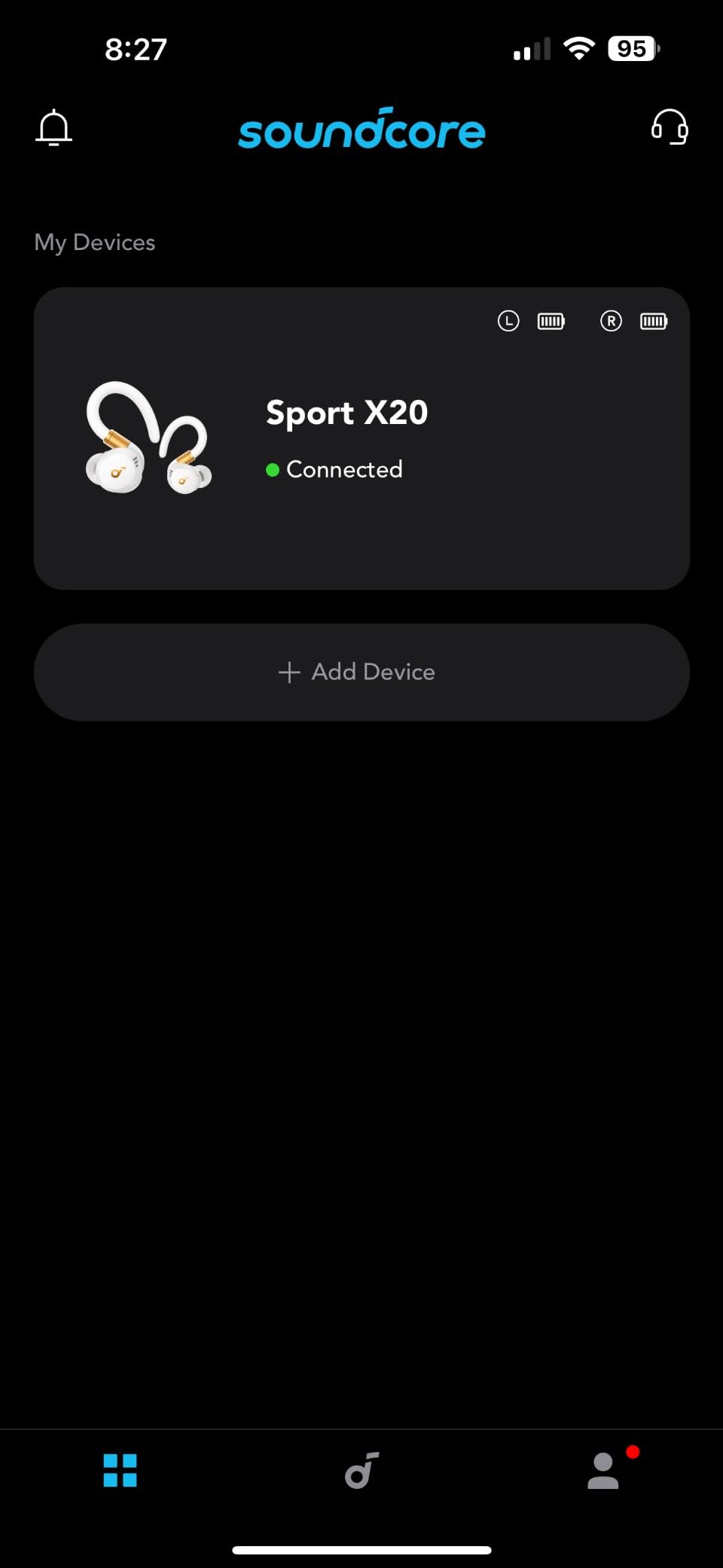
Battery is generous: 12 hours per charge and 48 with the case in normal mode, dropping to 7 and 28 with ANC on. Fast charging handles a quick turnaround before a workout. Controls are physical buttons on the front face of each bud, positioned so a swing does not press them by accident, which is the safest answer in this list for controls you operate in motion.
The repeat complaint is connectivity, not hardware failure. Multiple reviewers report the buds silently unpairing mid-use, including on a replacement unit. A smaller group reports one earbud refusing to seat properly in the case and stop charging after about six months.
What the IP68 rating actually buys you
IP68 means dust tight and protected against submersion beyond sweat and rain. For most runners that is the difference between a pair that survives a winter of five-a-days and a pair that starts cutting out by March. It does not make the electronics immortal, so treat the rating as necessary rather than sufficient.
Physical buttons, adjustable hooks, and an 18-month warranty round out a package that covers more running scenarios than anything else here. If you also lift weights, the ANC and the physical buttons are both wins in a noisy gym.
Where the reliability complaints come from
Budget for replacing the ear tips. Owners almost universally upgrade the supplied silicone tips, and doing so improves both isolation and bass. If your runs are mostly on a treadmill and you care about sound quality, the bass-heavy signature may need EQ work before it sounds right.
4. Soundcore V20i: Open-Ear Comfort With Real Bass
Soundcore V20i by Anker Open Ear Earbuds, Open Ear Headphones True Wireless
Open-ear clip style
IP55 sweatproof
16mm BassUp drivers
8 hours per bud
Pros
- Four rotating positions let you dial in a stable fit per ear
- 16mm titanium-coated drivers give surprisingly rich bass for the tier
- Non-intrusive open-ear comfort for all-day wear
- Four microphones with AI processing for calls
- 8 hours per bud and 36 with the case
Cons
- No active noise cancelling of any kind
- Touch controls misfire during vigorous movement
- Heavier at 76.4 g for the set than clip-on rivals
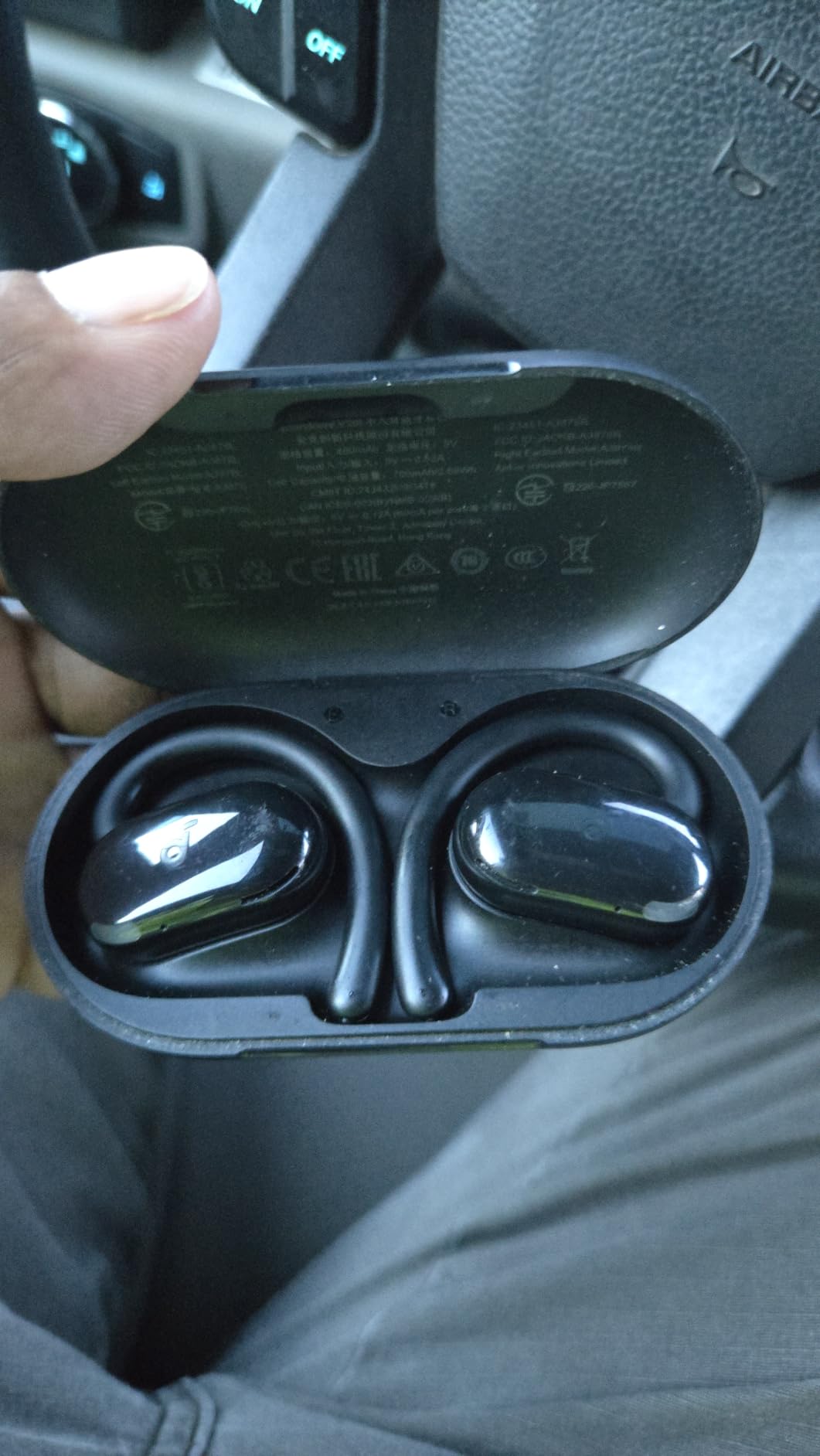
The V20i is an open-ear bud that skips the bone conduction trick entirely and just points a normal dynamic driver at your ear canal without sealing it. The result is more bass than open-ear designs usually manage and no ear fatigue, because nothing goes inside.
Fit is handled by four adjustable rotating positions. That range is what let it stay put for us on sprints where the OpenMove’s frame felt looser. Reviewers highlight the same feature, along with comfort on smaller ears.
It ties for the highest rating in this roundup at 4.4 stars across more than 18k reviews, with 70 percent five star. For an entry point into open-ear running audio that is an unusually strong track record.
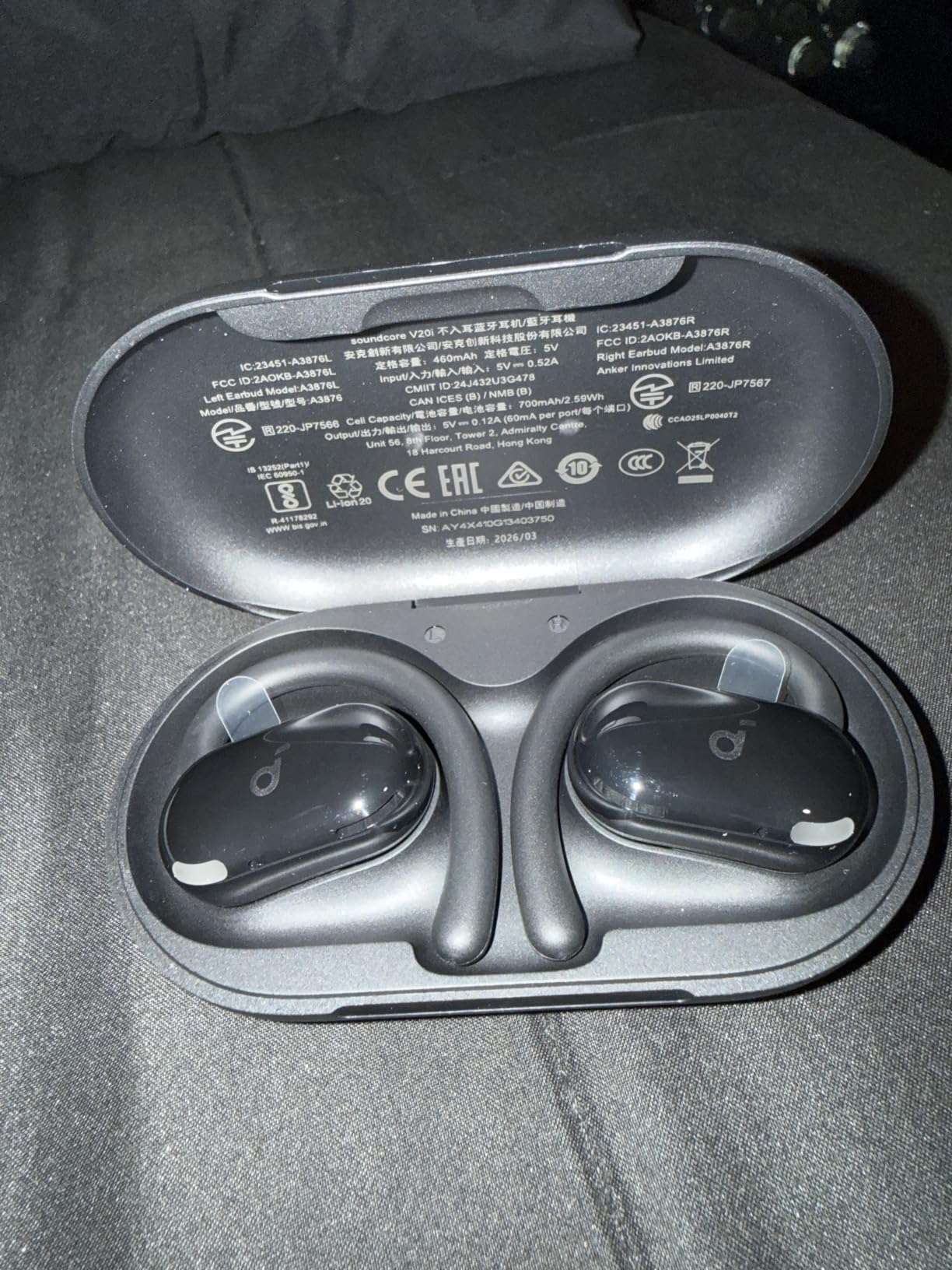
Battery runs 8 hours per bud and 36 hours including the case, with a 1.5 hour bud charge and 2.5 hour case charge. The IP55 sweatproof build handles rain and heavy perspiration. Four microphones with AI enhancement handle calls, and tune-synced lights add some visual identity at night.
There is no active noise cancelling, so the outside world is always present. That is intentional for road running. Touch controls are the weak point, since they misfire when you are moving hard, and at 76.4 g for the set these are among the heaviest open-ear buds here.
Whether open-ear bass is good enough to run on
It is measurably better than bone conduction at this tier because a normal driver is moving air rather than vibrating your skull. It is still not sealed in-ear bass, and if you train somewhere loud you will not block that out. Runners who say bass is what keeps them going generally end up with the Powerbeats Pro 2 or the Sport X20 instead.
Where it wins is comfort. Nothing sits in the canal, so there is no pressure after an hour, and the rotating positions let you change the angle rather than fighting a stuck seal.
Who should pass on it
Skip it if you need any noise control at all, if you run on a treadmill next to a loud person, or if you want physical buttons you can find by feel without looking. The case is also larger than clip-on designs, which matters if it lives in a running belt.
5. bmani Sport Earbuds: The Battery King With a Display Case
bmani Ear Buds Wireless Earbuds Bluetooth Headphones with 80H Playtime LED Display Case, Over-Ear Hook with Mic, Stereo Sound, Easy Button Controls, Sports Earphones for Running Workout Gym Green
80 hours total playtime
Dual LED display case
10mm drivers
5 year warranty
Pros
- Enormous 80 hour total runtime with 8 hours per earbud
- Dual LED display shows case power and bud charge status
- Over-ear hooks hold through running and cycling
- Separate main and volume buttons on both buds
- Five year manufacturer warranty with fast support
Cons
- No sealed fit so bass and isolation are limited
- Earbuds can bounce off case contacts and stop charging
- No IP water rating only sweat resistance
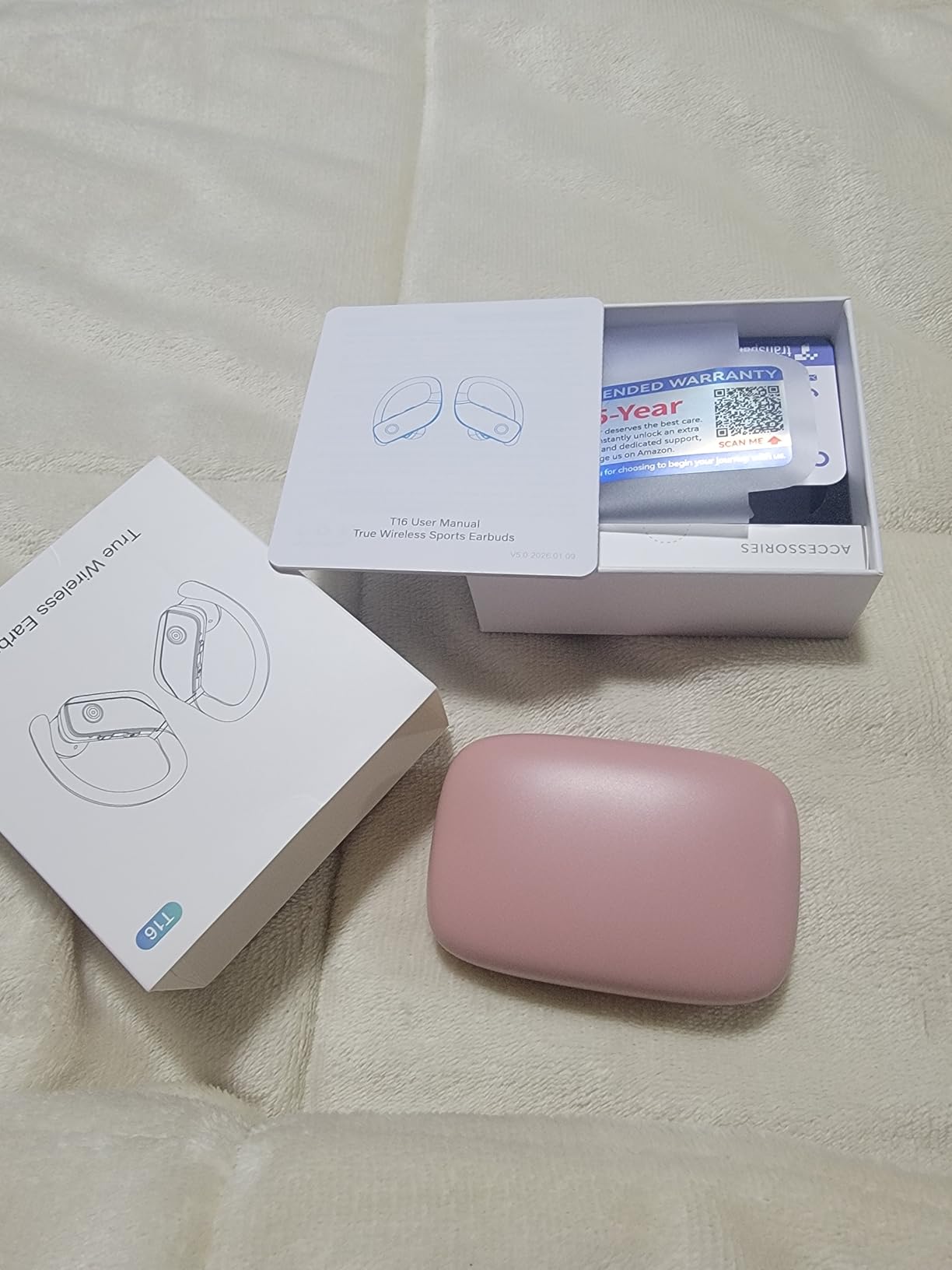
Eighty hours of total playtime is the longest runtime in this roundup, coming from a case with a digital readout, with eight hours per earbud per charge and a five year manufacturer warranty that most owners say was processed quickly when they needed it.
The dual LED case is the feature people mention first. One display shows remaining case power and separate indicators show the state of each bud, which removes the guesswork that sends people to a gym with dead earbuds.
Fit uses adjustable ergonomic over-ear hooks, and reviewers call out small ears as a positive. The hook shape also works with glasses and a hat, which came up repeatedly as a reason to keep wearing them through winter.
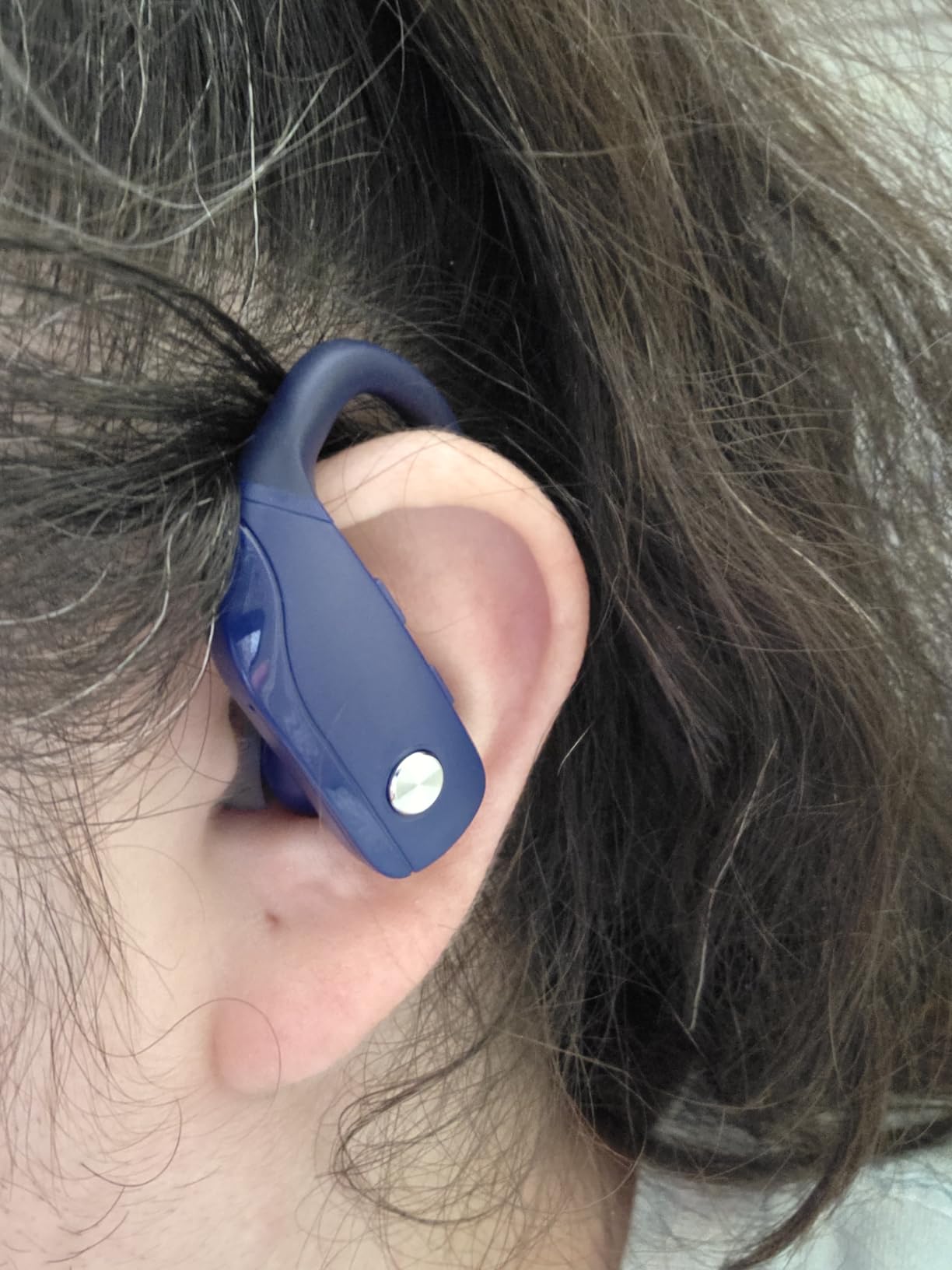
Controls are entirely physical with separate main and volume buttons on both earbuds, and no touch gestures at all. Single-bud mode works correctly, so you can drop one bud in the case mid-run without cutting the other. Bluetooth 5 with auto-reconnect and 35 ms latency keeps audio tight for pace-based work.
Sound is the compromise. Ten millimeter drivers with dual microphones deliver clear treble and reasonable bass, but nothing is sealed, so isolation is minimal and the profile is not flat. Microphone quality draws criticism from some owners on calls in wind.
Whether the runtime changes how you train
It does. If you travel for races, run doubles, or simply forget to charge, this is the pair that stops being a problem. A runner going from a cheap pair that died in two months to something with a five year warranty and a spare charge cycle is describing a real change in reliability.
The hooks are physically secure, which is what the over-ear design is for. They also block wind noise at the canal less than an in-ear would, because the drivers sit outside it.
Where the trade-offs sit
Skip it if audio quality matters more than endurance, if you run in sustained rain and want an IP rating rather than sweat resistance, or if you have had problems with charging contacts before. Several owners reported buds bouncing off the case pins and needing to be reseated.
6. SHOKZ OpenRun Pro 2: The Awareness Pick With Real Bass
SHOKZ OpenRun Pro 2 Bone Conduction Bluetooth Sport Headphones, Black
Bone conduction plus air conduction
12 hours battery
30.3 g
IP rated sweatproof
Pros
- Dual driver design adds an air conduction driver for genuinely fuller bass
- Open-ear design keeps full situational awareness on roads and trails
- Ni-Ti memory wire unibody frame stays locked in place
- 12 hours covers long runs and a full day
- Dual wind-resistant mics cut 96.5 percent of background noise
Cons
- Maximum volume limited versus sealed in-ears
- No passive isolation so loud environments leak in
- Standard band can sit loose on larger heads
This is the open-ear design that answers the question runners ask most about Shokz. Instead of pure bone conduction, it pairs the bone driver with an air conduction driver aimed at the canal, which is why the bass is fuller than the OpenMove above it.
The frame is a weight-optimised unibody in nickel titanium memory wire with ergonomic ear hooks, weighing 30.3 g. It stayed put through everything we threw at it, and reviewers describe the same result across running, gym, and cycling.
Why runners like this category is simple. You hear the world, so a car is not a surprise, and the band does not fall out at mile six. One runner in the r/runninglifestyle thread put it plainly, calling Shokz practical, decent sounding, safer for running, and long-lasting compared with earbuds that sound better.
Battery is 12 hours at a one hour charge time, with USB-C and a solid included case. The Shokz app adds EQ modes including Classic and Volume Boost, and the dual wind-resistant microphones with AI filtering cut 96.5 percent of background noise, which is the number that matters if you take calls mid-run.
Maximum volume is the recurring limitation named by reviewers, and bass still trails true in-ears. The Standard fit leaves a gap behind the head for some wearers, and several reviewers recommend the Mini size for larger heads. There is also no multi-device hopping.
When awareness is worth giving up bass for
On unlit roads, on trail where footing matters more than the melody, and on any run where a vehicle or a dog is a real possibility, awareness is worth a lot. Runners who like the sound but do not want to give up low end should look at this before they look at pure bone conduction.
It works with glasses, which many hook and band designs do not. The two-year warranty is solid for a device that will be soaked regularly.
Where it is the wrong tool
Skip it for gym work where noise cancelling matters, for long sessions where you need more than 12 hours between charges, or if you are on a large head and the Standard band bothers you. Sound is not the reason to buy it.
7. Beats Powerbeats Fit: Wingtip Comfort in a Small Case
Beats Powerbeats Fit – Wireless Noise Cancelling Workout Earbuds with Secure-Fit Wingtips, Up to 30-Hour Battery Life, Sweat & Water Resistant, Apple & Android Compatible – Spark Orange
Secure-fit wingtips
IPX4 on buds and case
30 hours with case
61.3 g
Pros
- Universal wingtips tuck into the ear for stability without a hook
- IPX4 protection on the earbuds and the case itself
- Case is 17 percent smaller than its predecessor
- 7 hours per bud and 30 with the case
- Fast Fuel gives an hour from five minutes of charging
Cons
- No heart rate monitoring unlike the Powerbeats Pro 2
- Wingtip geometry does not suit every ear shape
- USB-C cable not included in the box
The Powerbeats Fit trades the earhook for wingtips that tuck into the ridge of the ear, which is a gentler way to hold a bud in place. If hooks made your ear sore over an hour, this is the Beats answer without dropping the brand ecosystem.
The case is 17 percent smaller than its predecessor, and at 61.3 g the whole set is noticeably lighter than the hook-based Beats flagship. For a runner who carries everything in a belt or a small pocket, that is a real advantage over a full band or a hook design.
It runs the Apple H1 chip, so iOS features come through, and the Beats app covers Android pairing and Find My Beats. Wear sensors auto-play and auto-pause, which is useful when you drop a bud to answer a message mid-stride.
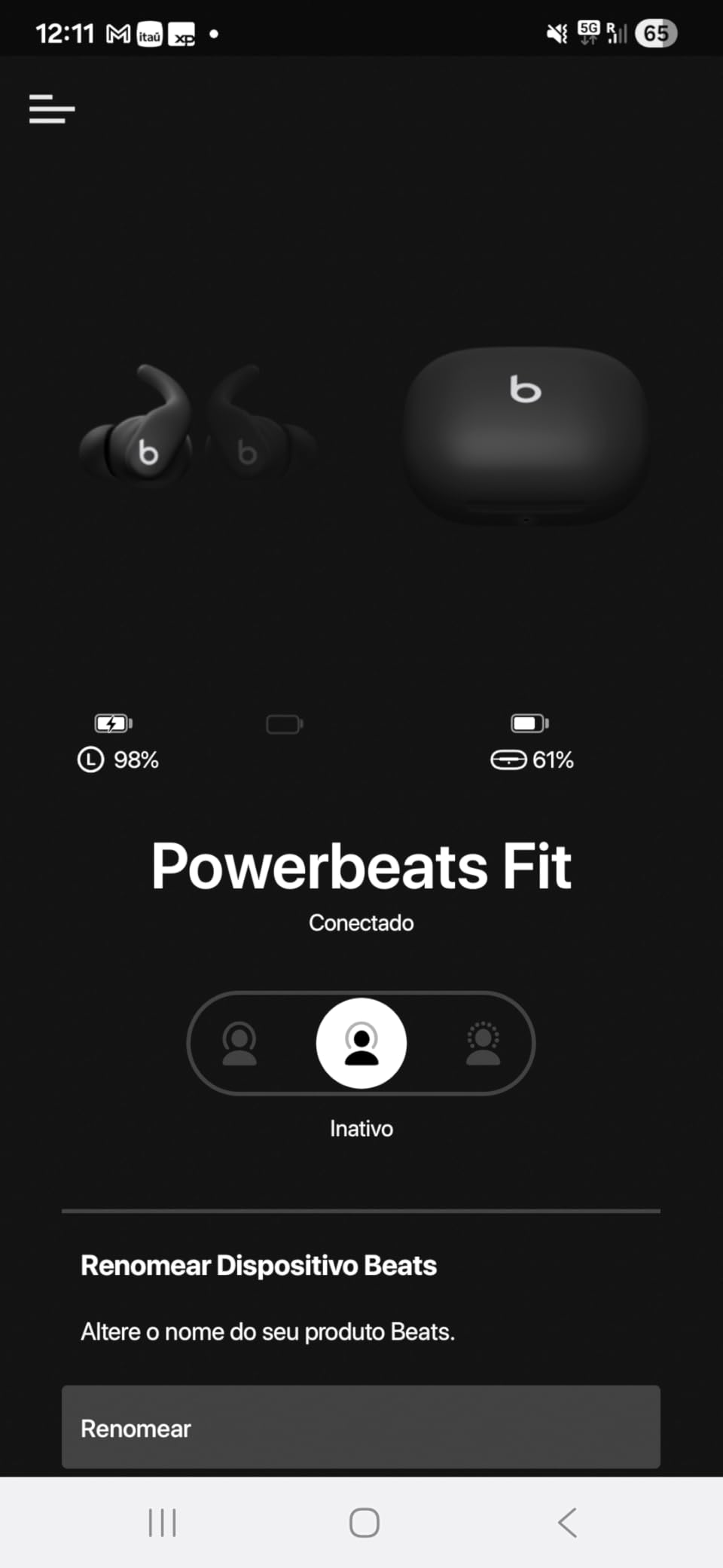
Active noise cancelling with transparency mode handles gym noise, and dual beam-forming microphones give solid call quality. Battery is 7 hours per bud and up to 30 with the case, plus Fast Fuel charging for an hour of playback from five minutes.
About 15 percent of reviews are one star, the highest share in this roundup, and they cluster on fit rather than failure. The wingtip geometry suits some ear shapes and not others. There is no heart rate monitoring, and the USB-C cable is not in the box.
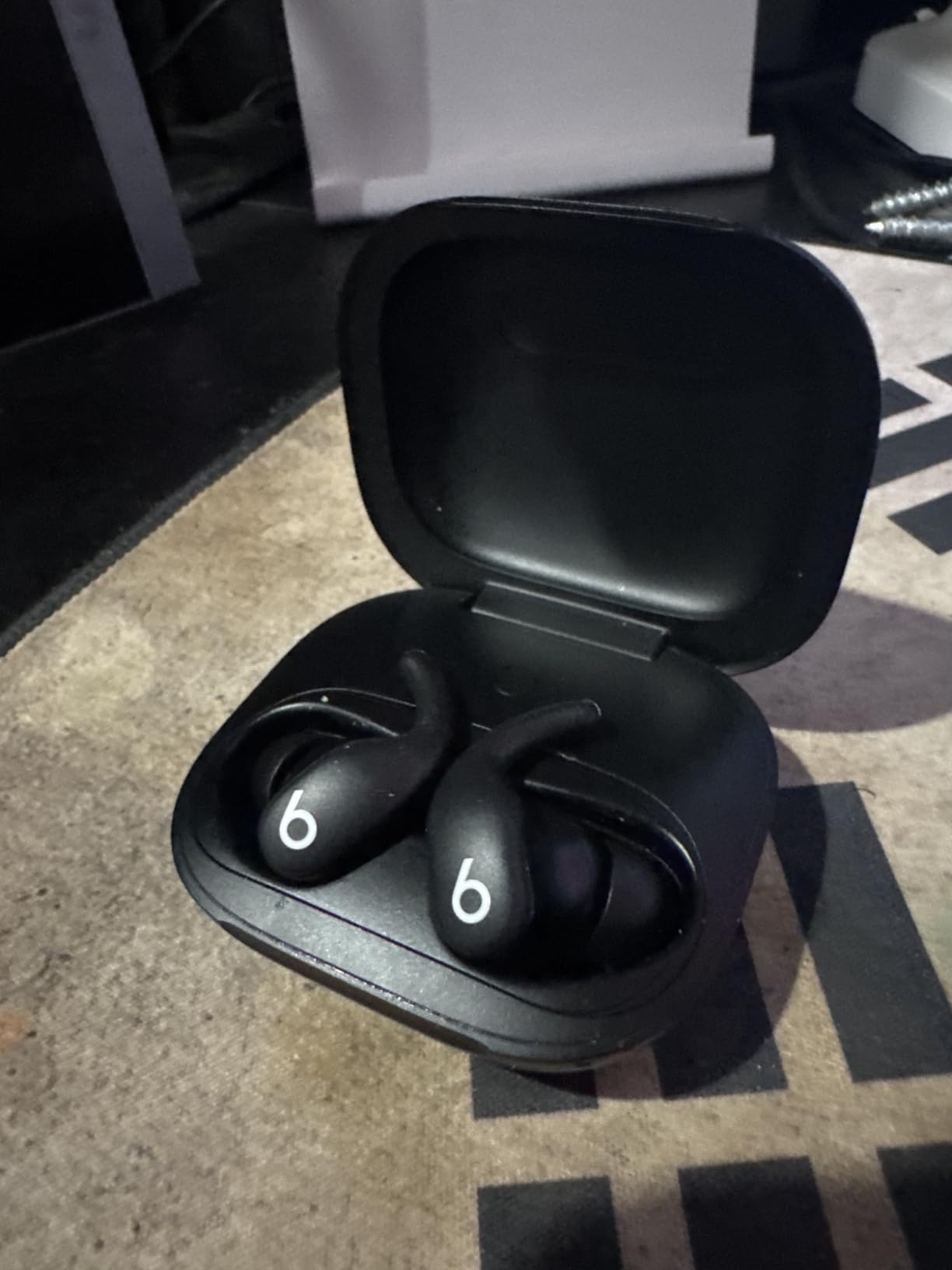
Whether a wingtip holds as well as a hook
Almost, for most ears. The wingtip presses into the concha ridge and stayed put in our road and treadmill sessions, but it is a gentler hold than an over-ear hook. If you run on technical trail with heavy lateral movement, the Pro 2 hook is the safer bet.
IPX4 covers sweat on both buds and the case, which is fine for dry-climate running and light rain. It is not the rating you want for a downpour.
Who this suits
Pick it if you want Beats noise cancelling, a small case, and an all-day fit without hook pressure. Pass if you train somewhere you need higher water protection, if your ears do not take wings well, or if you wanted the heart rate sensor from the flagship.
8. JLab Go Sport+: The Small-Ear Answer With a Built-In Cable
JLab, Go Sport+, True Wireless Workout Earbuds, Bluetooth Sport Earbuds, Clear Calling, Graphite
Earhook built for small ears
IP55 rated
9 plus hours per bud
Be Aware Audio
Pros
- Earhook is explicitly sized to fit the smallest ears
- IP55 sweat and dust resistance
- Case has a built-in USB cable so nothing extra is needed
- EQ3 modes including JLab Signature Balanced and Bass Boost
- Multipoint to two devices plus Dual Connect for single-bud use
Cons
- No active noise cancelling only sound isolation
- Be Aware Audio deliberately lets ambient sound in
- Touch controls can misfire during vigorous movement
The JLab Go Sport+ exists because most earhooks are built for average ears. This one is explicitly sized down, and runners with small or unusual ear canals say in reviews that it is the only hook design that fits them properly.
The charging case has a built-in USB cable, which sounds minor until you are at a track at 6am and forgot your cable. You have nine hours or more per earbud plus 26 or more from the case, so a long training week needs one top-up.
Be Aware Audio lets outside sound in at a level you set in the app, which makes it a reasonable road-running compromise if you want a sealed-ish feel without full isolation. IP55 sweat and dust resistance covers more than an IPX4 pair would.
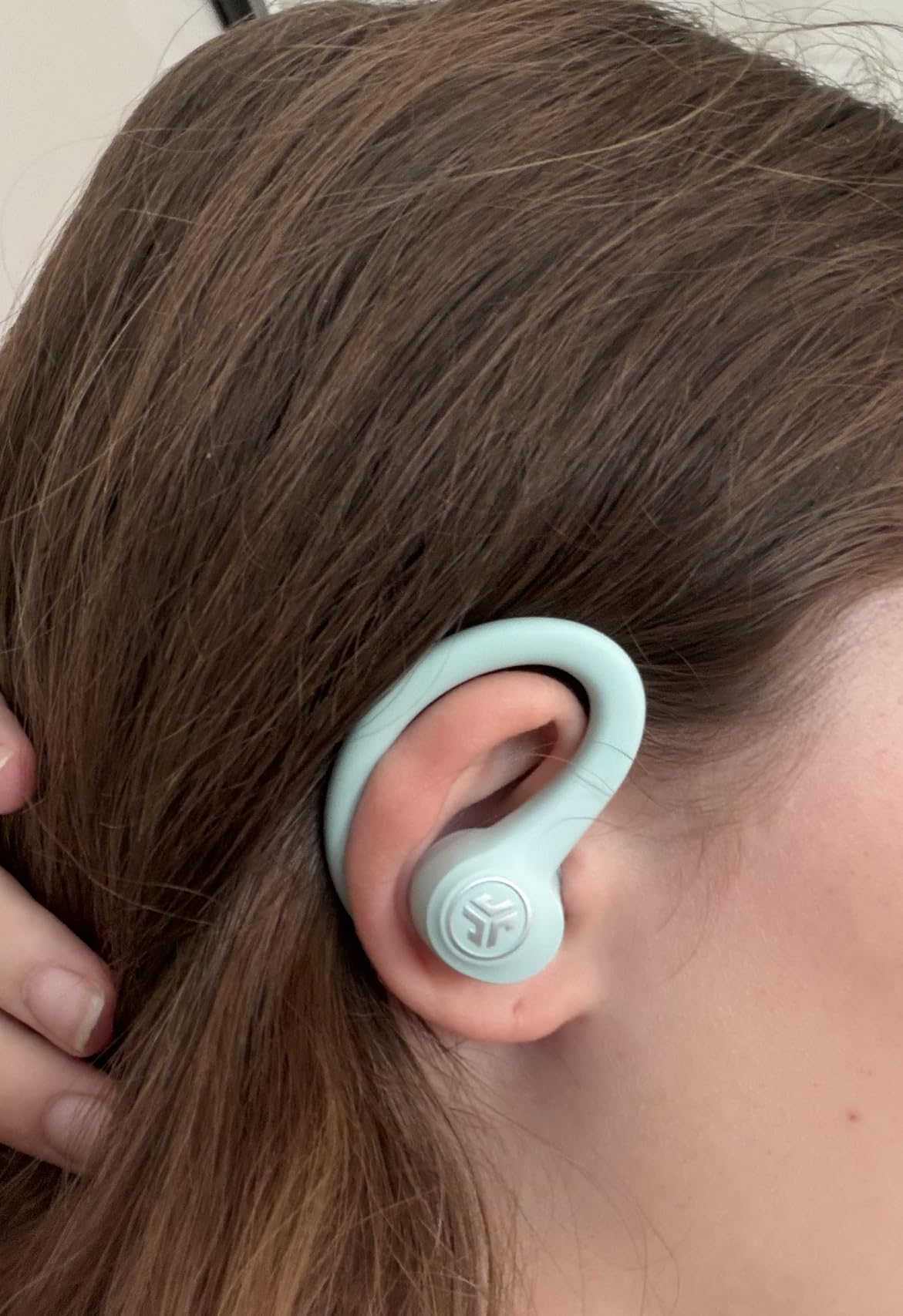
Calls are handled by C3 Clear Calling with dual MEMS microphones, one for voice and one for background noise. Bluetooth 5 multipoint connects to two devices and Dual Connect lets you run either bud alone, which is the mode to use when a running partner talks to you.
The sound is the polarizing part. EQ3 gives you JLab Signature, Balanced, and Bass Boost, and reviewers say the drivers only show real weight in Bass Boost. There is no active noise cancelling, only passive isolation from the seal. Touch controls misfire when you are working hard, which is a recurring theme in owner reviews.
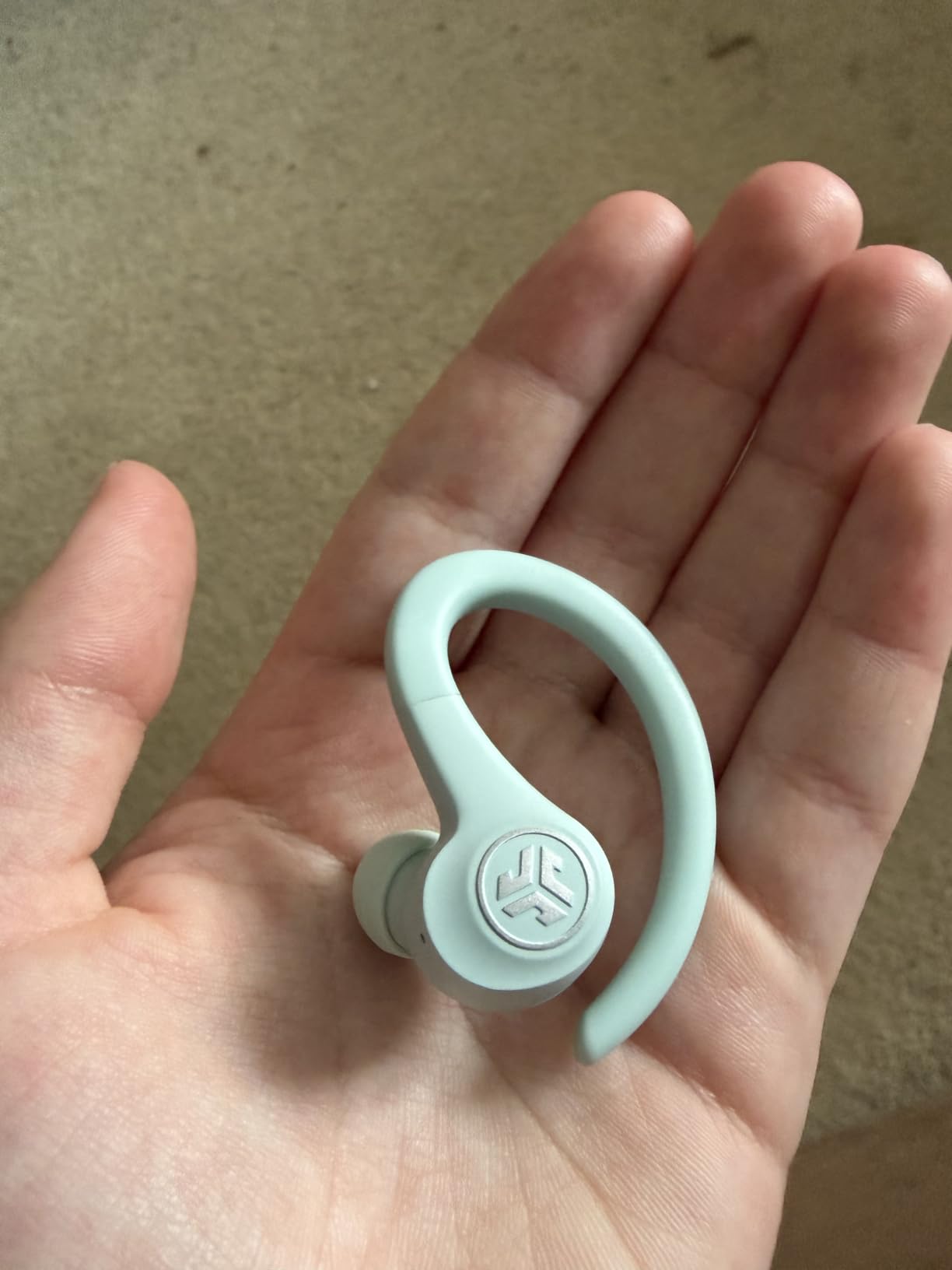
Whether small-ear fit is your deciding factor
If you have struggled with hooks that slide out or wings that press wrong, this is the one to try first. Two years of warranty sit behind it, and the fit geometry is the reason it reviews as comfortable rather than merely tolerable.
It works with a running watch and any app that pulls pace from your watch, and Dual Connect means you can drop one bud without the audio cutting.
Where it falls short
Skip it for audio-focused listening, since sound is the weakest among the well-reviewed picks here, and skip it if you need noise cancelling in a loud gym. The 13 percent one-star share is mostly sound and controls rather than build quality.
9. JBL Endurance Race 2: The Dustproof Sealed Favourite
JBL Endurance Race 2 – True Wireless Earbuds – Black
IP68 buds with IPX2 case
Twistlock wing enhancer
48 hours total
Active Noise Cancelling
Pros
- IP68 dustproof and waterproof earbuds handle trail grit and rain
- Ten minutes of USB-C charging adds four hours
- 48 hours total playback with ANC off
- Compact case fits in a running pocket
- Sports Modes in the app with six EQ presets
Cons
- Frequent Bluetooth disconnections reported while moving
- ANC less pronounced than Sony rivals and poor in wind
- Some users report the buds shifting once sweating starts
The Endurance Race 2 is one of the two fully sealed, IP68-rated bets on this list. IP68 earbuds mean dust tight and protected against submersion, which is the spec you want if you run on gravel roads, dry trails, or in the rain. The charging case is only IPX2, so keep that out of the weather.
The Twistlock wing enhancer rotates to lock in a seal, and that seal is what makes the active noise cancelling and Smart Ambient mode work at all. Without a good seal, both features turn into hiss.
Battery totals are among the strongest in the roundup at 12 hours per bud and 36 more from the case, 48 total with ANC off. Ten minutes of charging adds four hours, which covers an interval session from a flat start.
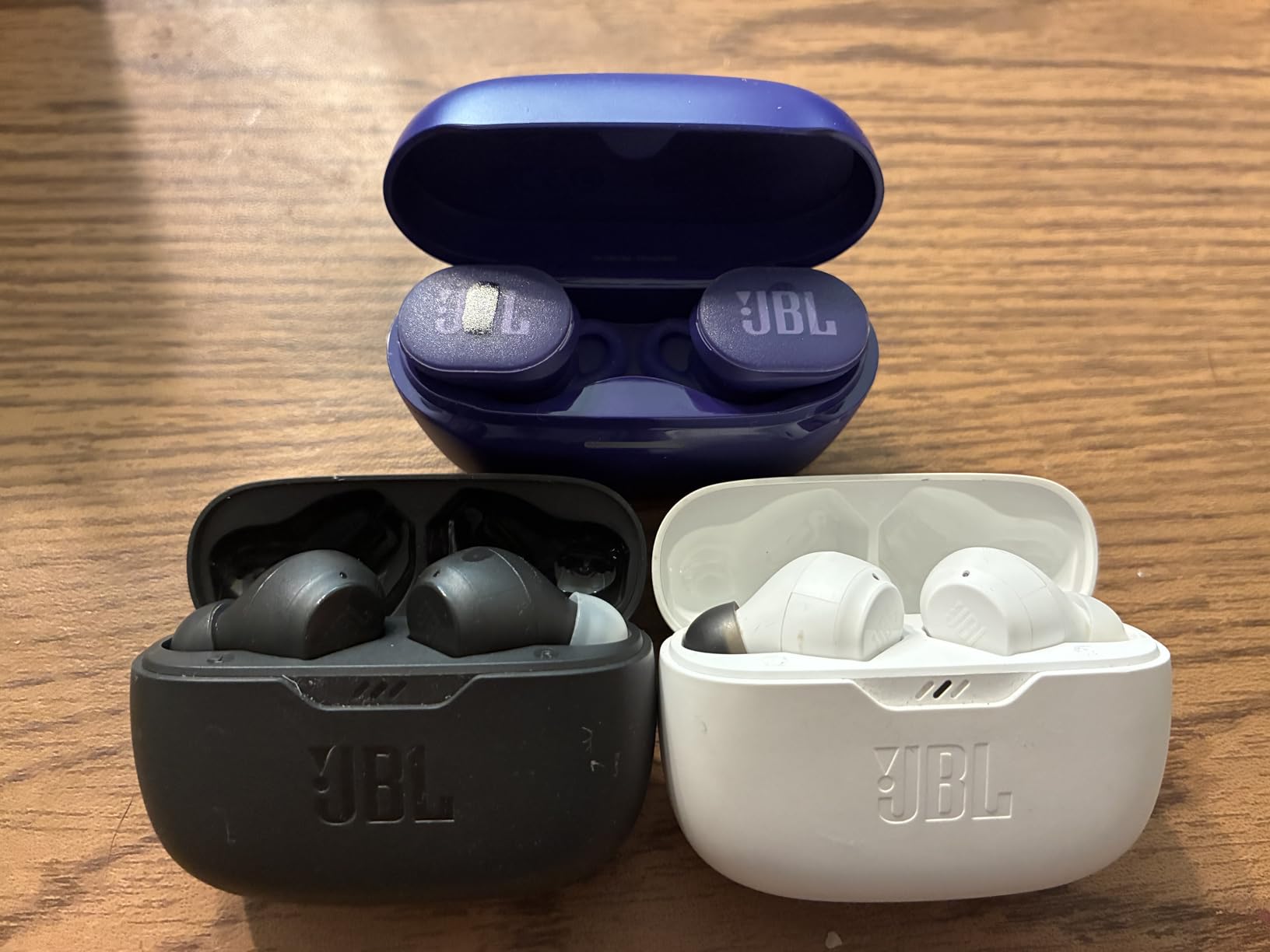
Call quality comes from four microphones with two beamforming per earbud. Fast Pair by Google and Swift Pair by Microsoft make setup a single tap, and Bluetooth 5.3 multipoint switches between two devices. The JBL app adds six Sports Modes and five Relax soundscapes.
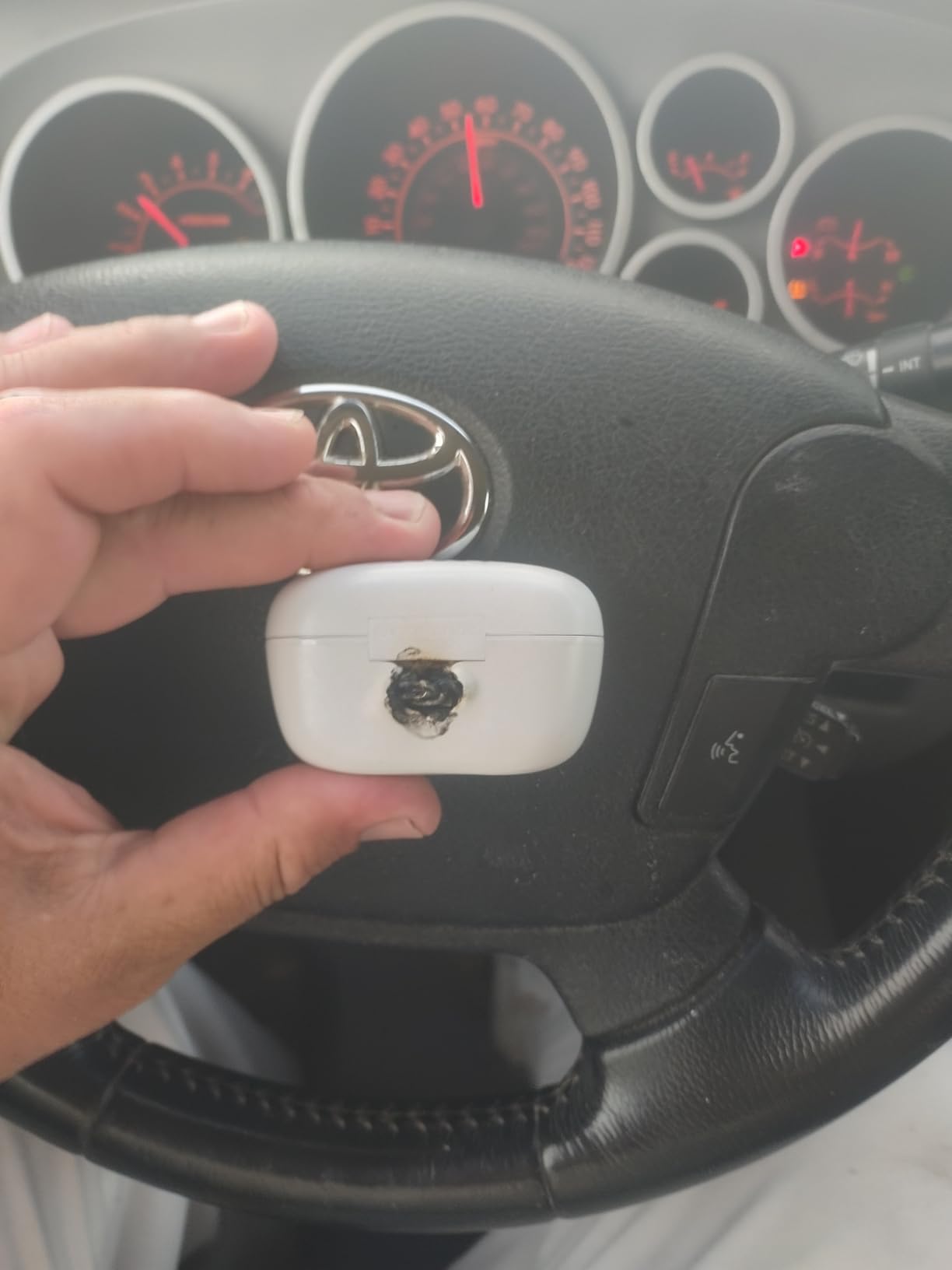
Intermittent Bluetooth disconnection is the most repeated negative in reviews, with several people citing it as their reason for leaving Sony earbuds. Some users also report the buds shifting slightly once running sweat starts, and a reviewer reported a case that ran hot at the charging port and stopped charging.
Whether IP68 matters for your routes
If you run on dirt, sand, or in rain, the IP68 buds plus the sealed cavity are the difference between a season of use and a season of failures. It is the rating that matches the forum complaint about losing three pairs in two months, where the failures clustered around lower-rated models.
JBL Pure Bass from 6.8 mm drivers is decent, though some listeners criticise weak bass and mid-bass and lean on the app EQ to compensate. The case is small enough to sit in a pocket without bulk.
When to choose a different pair
Pass if you need flawless connectivity more than you need the highest water rating, because the dropouts are the top complaint in reviews. Skip it if you want physical buttons, since control options here are less run-friendly, and note the one-year manufacturer warranty is the shortest we would trust for daily sweat exposure.
10. Soundcore C50i: Clip-On Comfort With Physical Buttons
Soundcore C50i by Anker Open Ear Earbuds, Clip On Earbuds, Clip Headphones
Open-ear clip-on
IP55 rated
12mm drivers
Push-button controls
Pros
- Clip design leaves the ear canal clear which suits small or awkward ears
- Memory titanium FlexiClip adapts to ear shape and stays put when shaken
- 12mm drivers give more volume and bass than bone conduction rivals
- Physical push buttons on both buds that work the same way on either side
- Compact case fits a pocket unlike full-band designs
Cons
- Only 8 hours per bud with 28 more from the case
- Mics handle wind poorly so calls outdoors are difficult
- No in-ear detection so no auto pause on removal
The C50i clips onto the ear instead of wrapping around the head, which makes it the least intrusive open-ear design here. Nothing goes in the canal, the clip adapts to the shape of your ear, and reviewers with small ears rate it as the comfortable choice.
It also keeps physical push buttons on both buds that behave the same way on either ear, which solves the problem runners complain about most with touch controls. You can find the control by feel mid-run without risking a misfire.
Sound runs through 12 mm custom drivers with 86 dB max output, and reviewers repeatedly compare it favourably against bone conduction designs at similar money. That is the open-ear category’s real weakness fixed by a conventional driver.
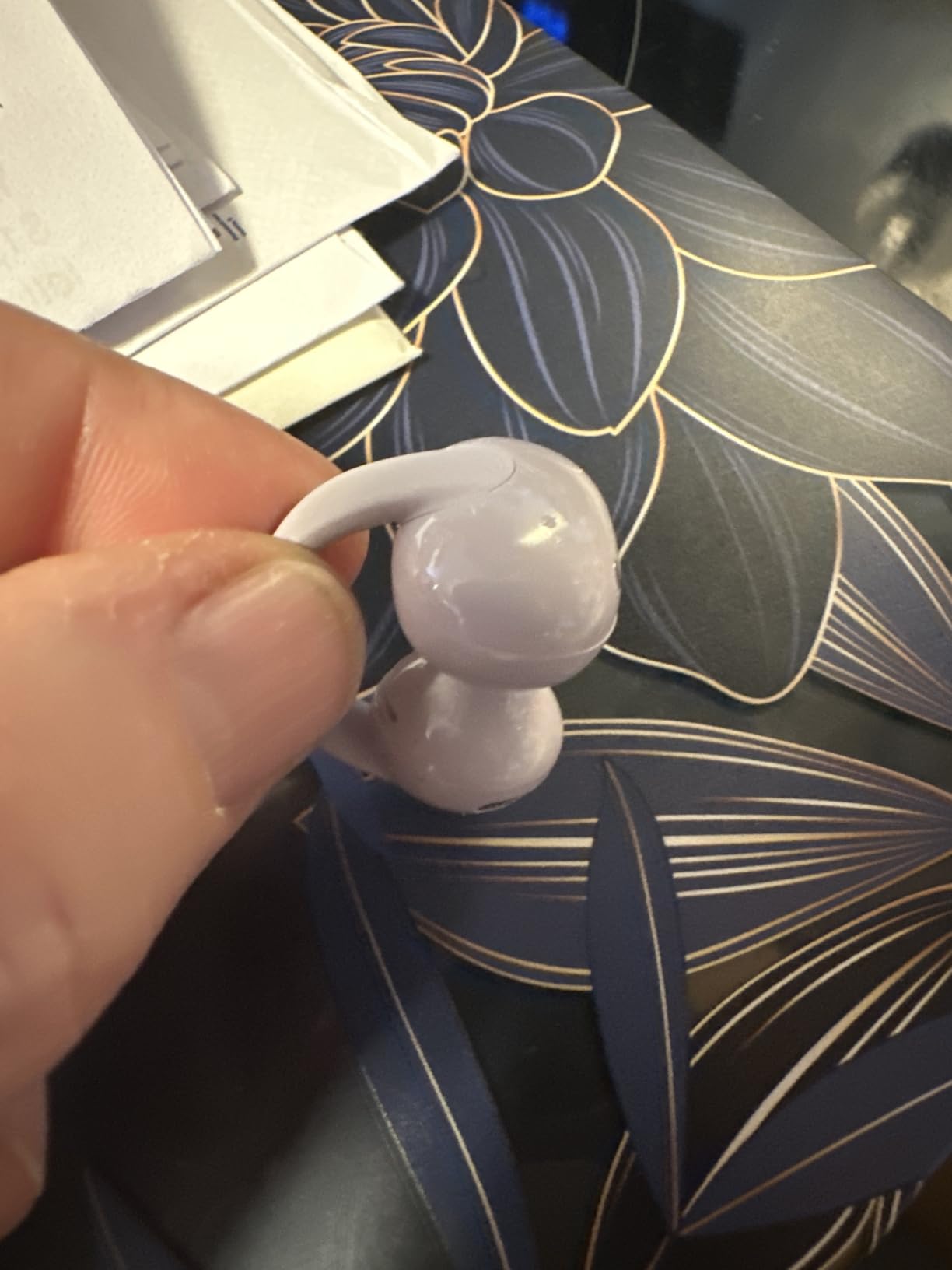
IP55 waterproofing handles sweat and rain, and it has held up over months of heavy running according to owners. The compact case measures 6.2 by 3.1 by 4.15 cm, which is pocketable in a way the full-band Shokz cases are not. Bluetooth 6.0 gives a stable connection with AI noise filtering mics for calls.
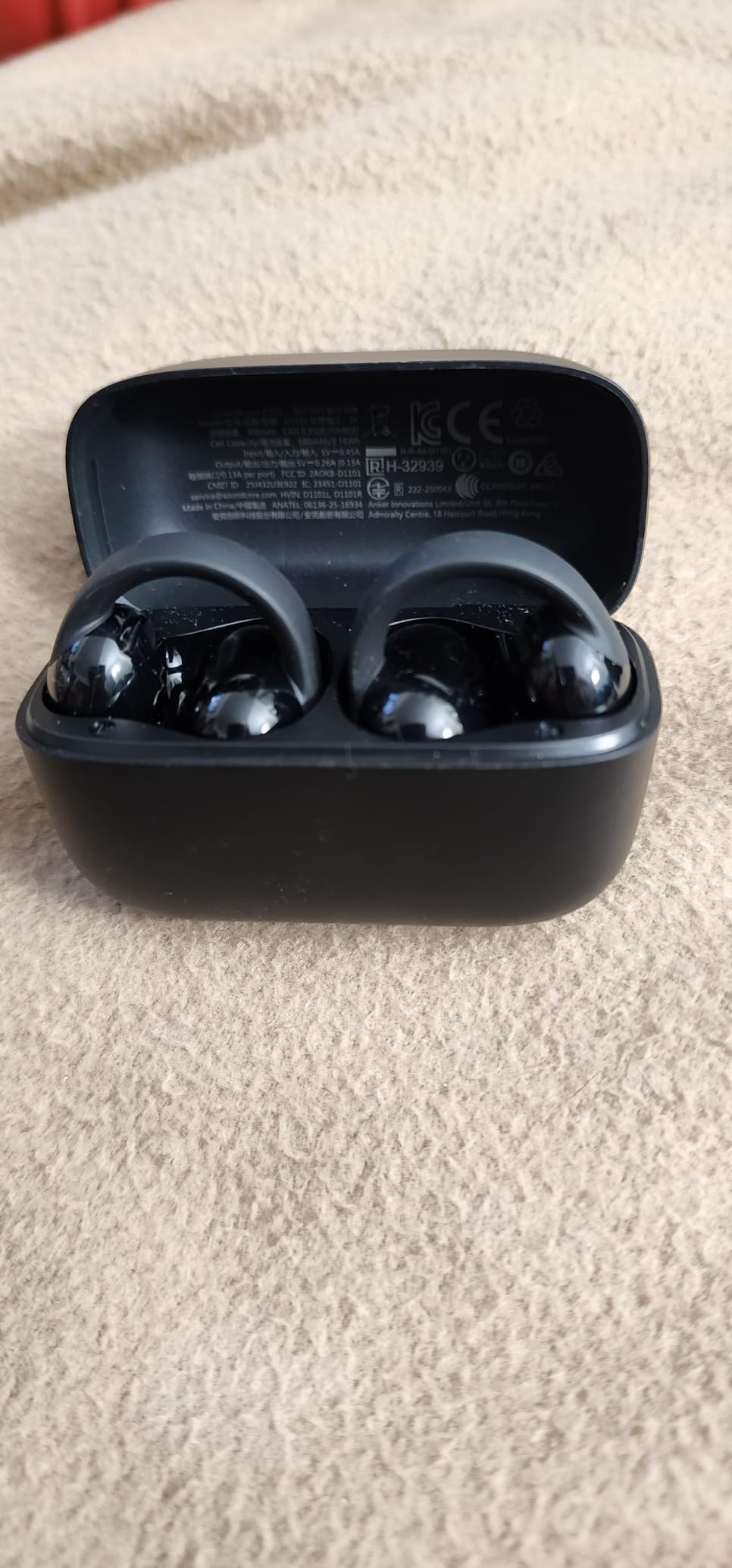
Eight hours per bud with 28 from the case is the shortest single-charge figure among the open-ear clip options. The microphones handle wind poorly, so calls on breezy days are rough. There is no in-ear detection, so no auto pause when you remove a bud.
Whether a clip is better than a band for you
Clips sit closer to the canal, so you get more volume and more bass than a bone conduction band without the pressure of an in-ear. The trade is that you carry the case more often, because 8 hours is a shorter leash than 12.
For runners who take calls on the move, note the wind issue. Reviewers also flag the Soundcore app as buggy for some users, so plan on setting EQ once rather than constantly.
Who should keep looking
Pass if you need noise cancelling of any kind, if you want to know your pace by ear alone without a watch glance, or if very long runs mean a single charge has to cover the whole week. It is also a good fit for glasses wearers because nothing wraps behind the head.
Sealed vs Open-Ear: Which One Should You Run With?
Pick sealed if your runs happen in noisy places or if music has to carry you through pace work. Pick open-ear if you run on roads with traffic, on trail where footing matters, or at night, and if the idea of not hearing a car bothers you.
The trade is not subtle. Sealed buds with active noise cancelling give you a real audio advantage on a treadmill and nothing at all on a dark road. Open-ear designs reverse that completely, and no amount of app EQ changes the physics of a bone conduction driver.
There is a middle path, which is the JLab Go Sport+ with Be Aware Audio, where you set how much outside sound gets in. It is a compromise rather than a solution, and it still leaves you without isolation.
Our rule of thumb after testing all ten: if you have ever been startled by a car on a run, stop optimising for sound and go open-ear. If you have ever taken a bud out to re-seat it at 5 km, stop worrying about traffic and go sealed with a hook.
What IP Rating Do You Actually Need for Sweat?
You need IPX4 as an absolute floor and IP55 as a sensible target. If you run in rain or on dusty trail, look for IP67 or IP68.
The first digit after IP is dust protection, the second is water. An X in the water position means it was not tested for that level, which is why IPX4 and IPX5 are the ratings you see most.
IPX4 is splash resistance. Sweat and rain droplets from any direction, no submersion. It covers a dry-climate runner who trains indoors and outdoors. This is the rating on both Beats pairs here, and it is the most common reason sealed sport buds die early.
IPX5 is water jets. Sustained spray from any direction, which covers most runners in most climates for years. The JLab Go Sport+ and both open-ear Soundcore pairs sit here.
IP55 adds dust protection to that water jet rating. For trail runners the dust half matters as much as the water half, because grit works into seams.
IP67 is dust tight and protected against temporary submersion. That means you can rinse a pair under a tap after a muddy run without thinking about it.
IP68 goes further on both counts, dust tight and deeper submersion protection. Only the soundcore Sport X20 and the JBL Endurance Race 2 carry it in this roundup, and both have sealed cavity designs rather than just a coating.
One important caveat. Runners in the r/Runners thread about losing three pairs of sweatproof earbuds in two months report failures across IPX2 and IP68 models alike, while an older Sony WF-C510 kept running for four years. A rating is necessary and it is not sufficient. Cavity sealing, case design, and whether you let water sit in the case matter more than the number alone.
How to Dry and Store Earbuds After a Sweaty Run
Most running earbuds do not fail because of sweat. They fail because damp earbuds go into a closed case and stay damp for hours. Here is what we do after every run.
1. Take them out before you leave the road. Leaving buds in your ears while you cool down traps moisture against skin that is already wet.
2. Wipe the buds and the case lid with a dry cloth. Most of the visible moisture sits on the silicone tips and inside the lid recess.
3. Leave both open on a counter for 10 to 15 minutes. This is the single highest-impact step and the one most people skip.
4. Check the charging contacts. The bmani pair in this roundup fails to charge when a bud bounces off its pins, and a lint-free swab fixes most of those cases instantly.
5. Never charge a damp bud. If you have no time, at least leave the case open in a pocket rather than sealing it.
6. Wipe the silicone tips with a damp cloth weekly and dry them fully. Earwax and skin build-up degrades the seal, and a failed seal is what makes people think their earbuds fell out when they simply loosened.
Storage matters as much as drying. A case that lives in a warm car or a damp running belt is the worst environment. A dry bedroom shelf is fine.
What to Look for in Running Earbuds
Fit is the whole game. Ear hooks wrap over the ear and the most secure designs in this roundup are the sport X20 with 30 degrees of rotation, the Powerbeats Pro 2 with a nickel titanium hook, and the JLab Go Sport+ sized for small ears. Wings such as the Powerbeats Fit or the JBL Twistlock sit inside the ear and are gentler but slightly less certain. Clips such as the Soundcore C50i adapt to shape and sit close to the canal, which gives more volume than a band.
If you have small ear canals, try wings or clips before you rule out in-ears. If you wear glasses, avoid designs that need a band or hook behind the ear unless reviewers confirm compatibility.
Water resistance should decide the second slot. IP55 handles ordinary sweat for years. IP67 and IP68 matter if you run in rain, on sand, or on dusty trail. Note that the charging case often carries a much lower rating than the buds, so dry the case before closing it.
Controls should be operable without looking. Physical buttons on the front face, as on the sport X20 and the bmani pair, are the safest. Touch panels misfire on fast runs and in the rain. On-ear buttons with voice activation, as on the Powerbeats Pro 2, are a good middle ground.
Battery should be judged per charge first and case second, because a long run only needs the per-bud figure. Anything at or above 8 hours per bud covers a marathon block. Check whether the case carries its own cell, because the SHOKZ OpenMove case does not and the total stops at 6 hours.
Case size decides whether you will actually carry it. A running belt swallows almost nothing, so a 6.2 by 3.1 cm clip case is more practical than a full band. The Powerbeats Fit case is 17 percent smaller than its predecessor, and the JBL Endurance Race 2 case is compact enough for a pocket.
Finally, decide how much you rely on sound as a safety feature. Night running in particular is a case where open-ear is the responsible choice rather than the adventurous one. A sealed pair with active noise cancelling on an unlit road is a genuine risk, and the trade is worth naming rather than hiding.
Two more small details that change decisions. Heart rate data, if you want it without a chest strap, is available on the Powerbeats Pro 2. And an ear tip fit upgrade, which owners of the sport X20 recommend almost universally, costs almost nothing and improves both isolation and bass more than any firmware update will.
Frequently Asked Questions
What earbuds don’t fall out when running?
Earbuds that stay in while running use a mechanical anchor, not just a tighter seal. An over-ear hook that wraps above the ear is the most secure, and the soundcore Sport X20 hooks rotate up to 30 degrees to fit different ear shapes. Wings such as the JBL Twistlock and the Beats Powerbeats Fit sit inside the ear and are gentler. Clips like the Soundcore C50i adapt to the ear without anything in the canal. If you have small ear canals, try wings or clips first.
Why do runners like Shokz?
Runners like Shokz for three reasons that all come from the open-ear design. You hear traffic, cyclists, and trail hazards without removing an earbud. Nothing sits in the ear canal, so there is no pressure or fatigue after hours. And the wraparound frame is anchored behind the head, so the device does not bounce out mid-run. The OpenRun Pro 2 adds an air conduction driver so bass is fuller than pure bone conduction models.
Are Shokz or AirPods better for running?
It depends on where you run. Shokz open-ear models win on roads, trails, and night running because you keep full awareness and nothing sits in your ear canal. Sealed in-ears with active noise cancelling win indoors, on a treadmill, and whenever music has to carry you through pace work. If you need both, the honest answer is to own one of each rather than compromise with a single pair.
Why are people ditching AirPods?
The reasons are mostly about running rather than audio. Everyday AirPods sit in the ear canal with no hook, wing, or cuff, so they bounce out on long runs. Their standard water rating is low, and sweat ingress is the most common cause of early failure. Plenty of runners also want to hear vehicles and other athletes. Buyers who want the Apple ecosystem still tend to land on sport-focused Beats models with proper anchors and higher water ratings.
What is the 60-60 rule for earbuds?
The 60-60 rule is a battery convention, not a running rule. It means sixty minutes of playback from the earbuds on one charge, plus sixty minutes of extra runtime from the charging case. It became a shorthand for judging battery life in a way that mixes two separate things. For running, only the per-charge figure matters, since a long run needs earbud runtime rather than case runtime.
Are AirPods Pro good for runners?
They are usable for short easy runs on a treadmill where isolation matters more than security. For regular road running they fall short on two counts: the water rating is low for repeated heavy sweat, and there is no hook or wing so the seal is the only thing holding them in. Runners who want the Apple ecosystem usually do better with a sport-focused pair such as the Beats Powerbeats Pro 2.
What IP rating do I need for running earbuds?
IPX4 is the floor and covers sweat and splash from any direction. IPX5 or IP55 is the sensible target for most runners and adds protection from sustained spray and dust. Choose IP67 or IP68 if you run in rain, on sand, or on dusty trail, since those ratings cover submersion and fine grit. The rating applies to the earbuds, so check that the charging case carries a separate figure before treating it as waterproof.
How long should running earbuds last?
A well-made pair with a sealed cavity and IP55 or better should last several years of daily running. Anything rated only IPX2 tends to fail within months, and budget pairs with weak case contacts can stop charging after a single season. The biggest factor you control is drying: leaving damp buds sealed in a case for hours is the most common avoidable cause of early failure.
The Verdict
The SHOKZ OpenMove is our pick for the best wireless earbuds for running in 2026, because open-ear bone conduction is the safest, most durable design on the road and its 29 g titanium frame disappears on the head. It earns that on a 4.4 rating across more than 24k reviews, which is the most proven track record in this roundup.
Go sealed if you want noise cancelling and heart rate data, and pick the Beats Powerbeats Pro 2. Go IP68 and ear hooks if sweat and rain are your biggest worry, and pick the soundcore Sport X20. Make sure you know which camp you are in before you buy, because switching later means buying twice.
One habit outlasts any model: open the case and let the buds dry for fifteen minutes after every run. We are happy to explain the other testing gear we rely on, including our picks for wireless thermometers for cooking accuracy checks, which share the same obsess-with-measurement approach.
