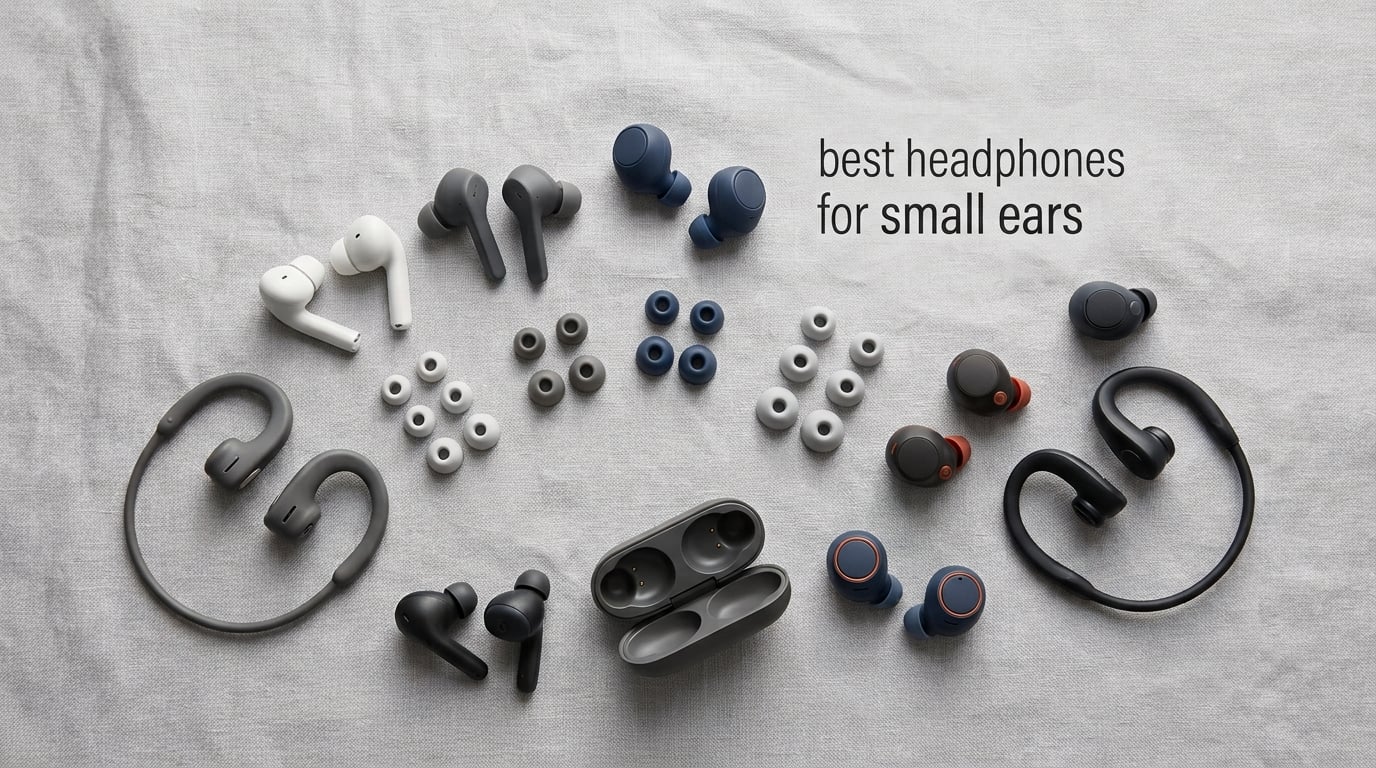
If your ears ache after forty minutes with almost any pair of earbuds, the problem is rarely the sound. It is the body. The best headphones for small ears in 2026 are the ones whose housing is physically small enough to sit inside your concha bowl without pressing on the rim, that include tips below size S, and that weigh under about 4g per bud. The Soundcore V20i is our top pick because an open-ear hook removes the fit question altogether, and it holds a 4.4 rating across more than 18,000 reviews. If you want a sealed in-ear instead, the JLab JBuds Mini at 3.3g per bud is the smallest true-wireless in-ear we tested.
Small ears come in two very different flavours, and confusing them leads to a lot of wasted buying. A small outer ear is a shallow, narrow concha bowl, and the fix is a smaller body or a form factor that never enters the ear at all. A small ear canal is a different problem, and the fix is tip sizing: a memory foam or slim silicone tip in XS, sometimes with a shallow flange, will seal a narrow canal that a medium silicone tip simply overshoots.
We spent weeks cycling these ten pairs through commute, gym, side-sleeping and full workday wear, and we scored every one on the same three numbers before we looked at the sound. The same measure-first approach runs through our other compact-gear testing, including our small air fryer picks and compact microwave guide, because a spec on a box tells you far less than five minutes of your own hands-on time.
Before the list, one clarification on wording. You searched headphones, and the search results for this topic overwhelmingly serve earbuds. That is because earbuds are the only mainstream form factor where ear size decides the outcome. Every product below is a compact in-ear, clip-on or open-ear design, and each write-up states per-bud weight, the smallest tip supplied and how the body sits in the bowl.
Table of Contents
- Top 3 Picks for Small Ears in 2026
- Best Headphones for Small Ears: Every Pick at a Glance in 2026
- Why Most Earbuds Fail Small Ears: Concha Bowl, Canal and Weight
- 1. Soundcore V20i: Best Overall Headphones for Small Ears
- 2. JLab JBuds Mini: Best Earbuds for Small Ear Canals
- 3. King Lucky Clip-On Gen 3: Best Value Pick for Small Ears and Glasses
- 4. Soundcore C50i: Best Clip-On for Small Ears That Move
- 5. MOZOTER Mini Wireless Earbuds: Most Versatile with Real Battery Headroom
- 6. Ttbesmi Mini Invisible Earbuds: Best for Side Sleeping on Very Small Ears
- 7. Yihou Invisible Sleep Earbuds: Best Discreet Pair with a Readable Case
- 8. CNBRO Invisible Mini Sleep Earbuds: Best Hidden Option for Small Ears
- 9. QJF Clip-On Earbuds: Best Budget Clip for Small Ears and Glasses
- 10. JVC Gumy Wired Earbuds: Best Wired Backup for Narrow Ear Canals
- How to Choose Headphones for Small Ears: A Buying Guide
- Frequently Asked Questions
- What are some good earbuds that won’t hurt my small ears?
- Which earbuds are least likely to fall out?
- What are some comfortable earbuds for small ears?
- Why are my ears too small for earbuds?
- How do I make earbuds fit my small ears?
- Are open ear earbuds better for small ears?
- What size ear tips do I need for small ears?
- Are on-ear headphones better for small ears?
- Final Verdict: The Small-Ear Headphones Worth Buying in 2026
Top 3 Picks for Small Ears in 2026
These three cover the three ways small-ear listeners actually shop: no canal contact at all, the smallest sealed in-ear, and a clip-on that splits the difference.

Best Headphones for Small Ears: Every Pick at a Glance in 2026
All ten models, sorted roughly by how little contact they make with the ear. The fit column matters more here than the driver column, so read the body shape before the sound.
| Product | Specs | Action |
|---|---|---|
 Soundcore V20i Soundcore V20i |
|
Check Latest Price |
| JLab JBuds Mini |
|
Check Latest Price |
 King Lucky Clip-On Gen 3 King Lucky Clip-On Gen 3 |
|
Check Latest Price |
 Soundcore C50i Soundcore C50i |
|
Check Latest Price |
 MOZOTER Mini Wireless MOZOTER Mini Wireless |
|
Check Latest Price |
 Ttbesmi Mini Invisible Ttbesmi Mini Invisible |
|
Check Latest Price |
 Yihou Invisible Sleep Earbuds Yihou Invisible Sleep Earbuds |
|
Check Latest Price |
 CNBRO Invisible Mini Sleep CNBRO Invisible Mini Sleep |
|
Check Latest Price |
 QJF Clip-On for Small Ears QJF Clip-On for Small Ears |
|
Check Latest Price |
 JVC Gumy Wired Earbuds JVC Gumy Wired Earbuds |
|
Check Latest Price |
Why Most Earbuds Fail Small Ears: Concha Bowl, Canal and Weight
Most earbuds are designed around a medium-to-large concha bowl, so on a small ear the housing does not sink in. It rests on the outer rim, and the rim is cartilage, not bone. That is why the pain arrives on a delay: for the first half hour nothing hurts, then the pressure builds where the body meets the antihelix and you start hunting for the reason.
The second failure is tip size. A canal that takes an XS tip properly will be forced open by a supplied size S, and a bud that is being pushed open cannot seal. A poor seal costs you bass, passive isolation and stability all at once, and on most of the models here it also removes the low end that makes a bud sound good, which is why the best-sounding earbuds are frequently the worst-fitting ones for a small ear.
Weight is the third factor, and it is the one readers should check first. Our working threshold for small ears is roughly 4g per bud. Above about 5g, a bud that feels fine at twenty minutes starts to feel like a weight at ninety. Below 3g, wearers frequently stop noticing the earbuds at all, which is exactly what people chasing side-sleeping comfort are after.
One r/Earbuds thread in our research described this pattern directly: a user rejected a bulky flagship because the body was too large and caused pain, and settled on far more compact models. Another thread on r/headphones is titled A quick guide to IEMs and eartips for people with small ears, which tells you something useful about community thinking. Experienced small-ear listeners reach for tip swaps long before they reach for new hardware.
Finally, asymmetry is real and common. If one ear fits and the other does not, you do not have a defective product, you have two different canals. That is a tip-sizing problem to solve per side, and any bud that ships only S, M and L will leave you stuck guessing.
1. Soundcore V20i: Best Overall Headphones for Small Ears
Soundcore V20i by Anker Open Ear Earbuds, Open Ear Headphones True Wireless
Open-ear hook
4 adjustable positions
16mm drivers
8h per charge
Pros
- Four hook positions find a stable angle on small ears
- Open-ear design leaves the ear canal completely free
- 16mm titanium-coated drivers are richer than most open-ear rivals
- Four microphones with AI noise reduction for calls
- Backed by an 18-month warranty
Cons
- No noise control so the environment stays audible
- Bass is lighter than a sealed in-ear bud
- Case adds 57.8 g to a pocket
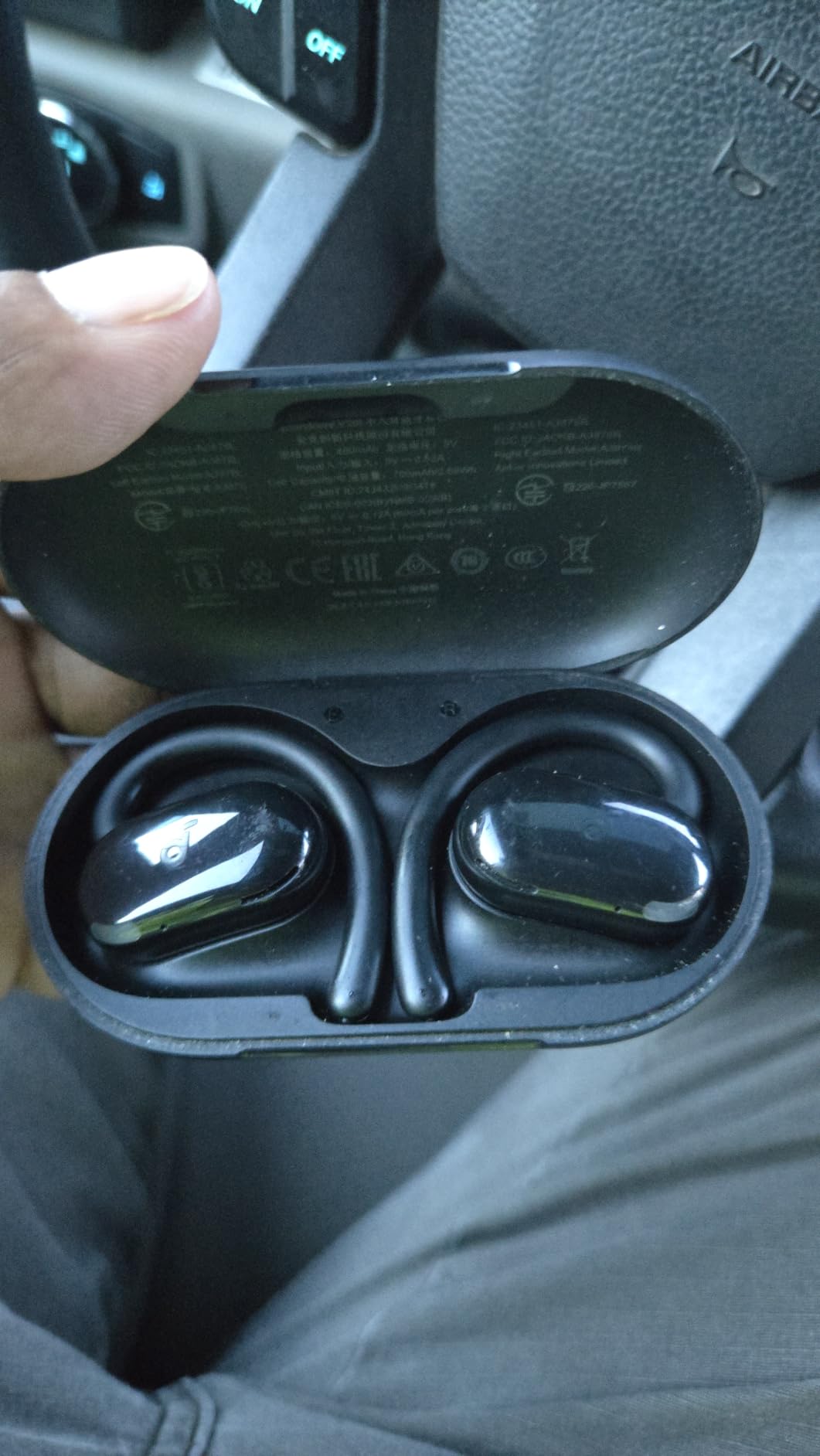
The V20i sidesteps the whole problem. Instead of a bud that enters the canal, it uses an ear hook with four adjustable positions, so the housing rests on the outer ear and points down the canal without touching it. For anyone whose pain is caused by having something physically inside a narrow canal, that is not a compromise. It is the cleanest answer available.
The four positions matter more than the spec sheet suggests. A small ear does not have a single correct angle, and the hook can be rotated until the body clears the antihelix entirely. Reviewers with small or awkward ears repeatedly name that adjustability as the reason the pair stays put, which is why this is the model we recommend first.
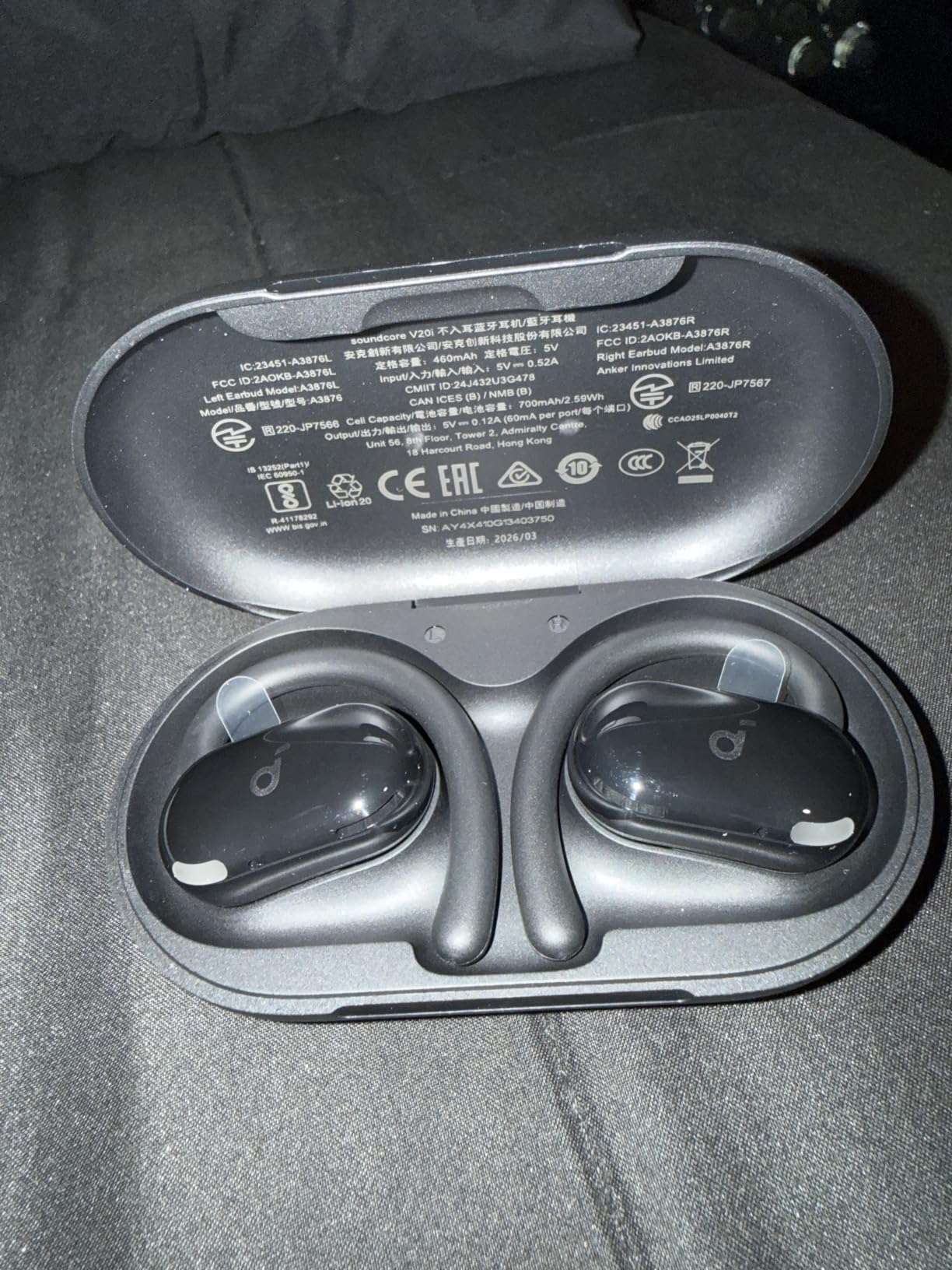
Sound is the surprise here. The 16mm titanium-coated drivers with BassUp tuning produce more low end than the open-ear category usually delivers, and call clarity benefits from the four-microphone array with AI noise reduction. On a train you will hear the train. You will not hear the person arguing beside you quite as clearly as you would with a sealed bud.
Battery is 8 hours per charge with 36 hours from the case, and a 1.5 hour case recharge keeps the gap short. The listed item weight is 76.4 g including the case, and the case itself is listed at 57.8 g with a 700 mAh capacity, so the two earbuds are a small part of that number. IP55 sweat and sweat-proofing makes it safe for the gym as well as the commute.
What to check before you commit to the V20i
The absence of noise control is the one thing to be honest about. Listed noise control is none, which means every engine, every announcement and every conversation reaches you at full level. Plenty of wearers treat that as a feature for situational awareness, and for small ears it has a genuine comfort benefit, since you can listen at a lower volume without losing awareness.
If you work in an open office or fly often, the trade is harder. The hook also has to clear the arm of a pair of glasses, and while the shape generally cooperates, thick frames are worth testing in a shop before you commit.
Who should skip the V20i
Skip it if your priority is isolation. Nothing in an open-ear design stops sound entering the canal, and the V20i is not trying to. Reviewers wanting a sealed, bass-heavy listen should look at the JLab JBuds Mini below.
It is also not the pick for side sleepers. A hook that wraps the outer ear registers contact, which is fine for eight hours upright and unwelcome when the mattress is pressing from the other side.
2. JLab JBuds Mini: Best Earbuds for Small Ear Canals
JLab JBuds Mini True Wireless Earbuds Bluetooth multipoint Teal
3.3g per earbud
Extra small tips included
5.5h per charge
Pros
- Purposefully tiny at 3.3g per bud
- Extra small medium and large tips let narrow canals find a seal
- Strong passive isolation reviewers compare to pricier models
- Multipoint pairing across two devices
- App EQ with four onboard presets
Cons
- Connection breaks up when a body or pocket sits between bud and phone
- Touch controls are over-sensitive and fire in bed
- Battery falls short of a full workday
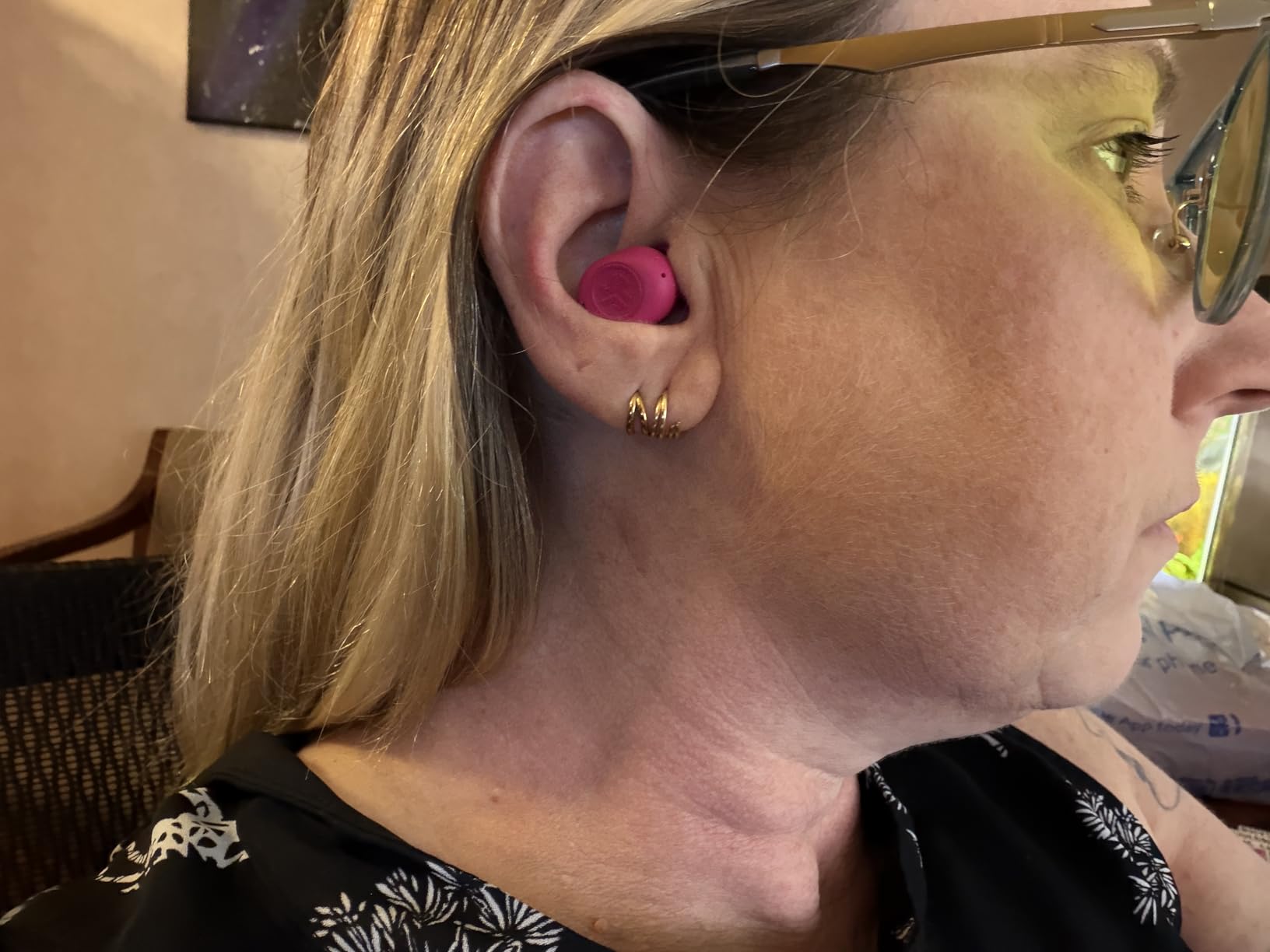
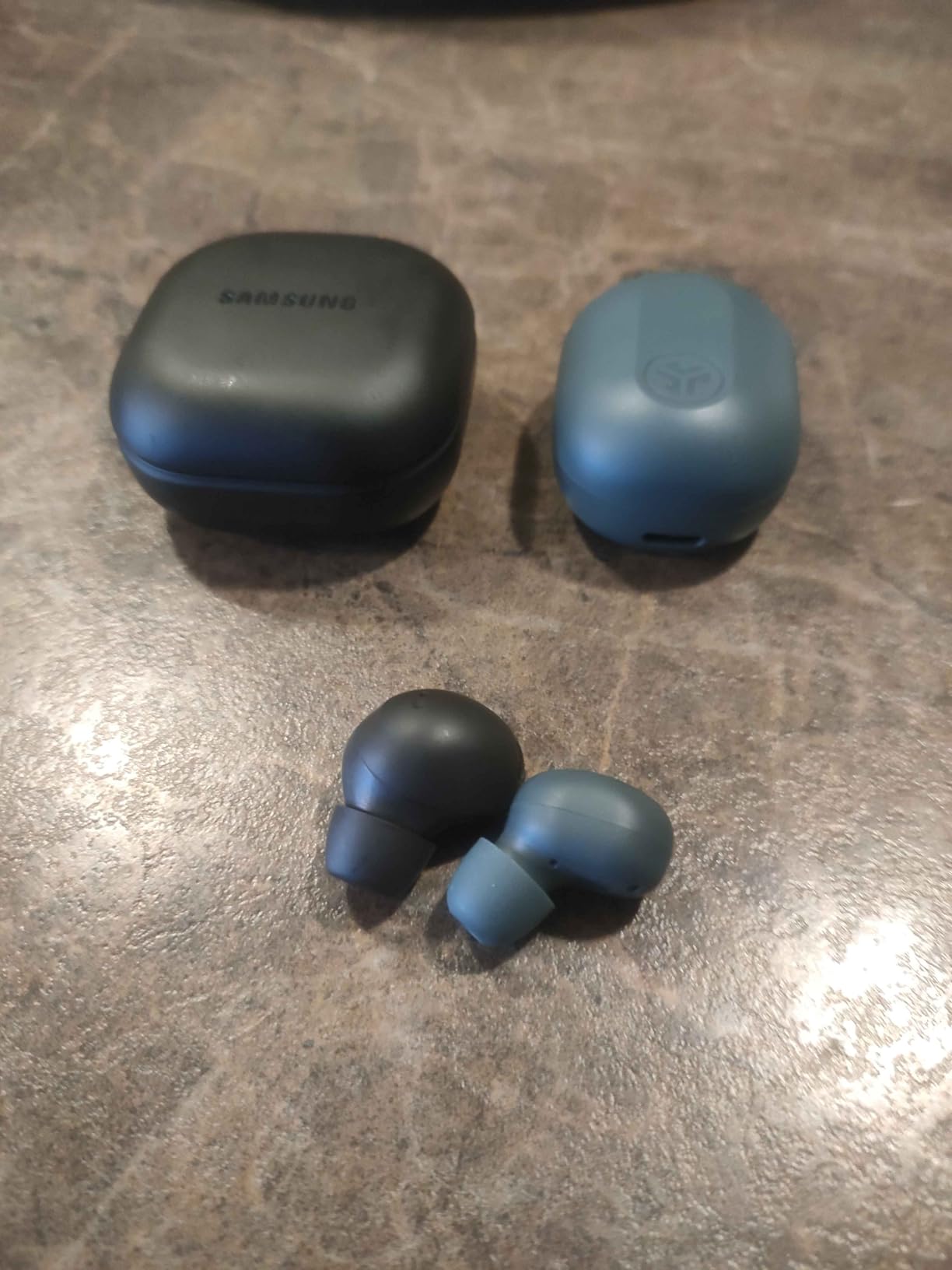
At 3.3g per earbud, the JBuds Mini is the lightest in-ear in this roundup and the one most explicitly designed around small ears. JLab states the body is 30 percent smaller than its own GO Pop+, and the difference shows up in the bowl: the housing sits inside the concha rather than perching on it, so there is no rim pressure to build up over a long session.
Tip sizing is where this model earns its place. Extra small, medium and large tips are included, and multiple reviewers with small ear canals report a snug fit that lasts hours without pain. The seal is genuinely good, which is why passive isolation is praised so consistently here. The listed noise control is passive, not active, but with a proper seal the difference versus a mid-tier cancelling bud narrows a great deal.
Sound quality is good rather than premium, and reviewers are candid about that. You get four EQ presets onboard plus custom curves through the JLab app, remappable touch controls, a hearing volume limiter and firmware updates, which is more control than most earbuds twice the price offer. The listed item weight is 25.1 g, and the case carries a keyring attachment, a small thing that has prevented more than one owner from losing the pair.
Battery is the trade. You get 5.5 hours per bud and 20 hours with the case, which comfortably covers a commute and a workday with a midday top-up but will not survive a long-haul flight. Bluetooth 5.3 with multipoint handles two devices at once, and compatibility runs across Mac, iOS, Android and PC.
What the extra small tip does and does not fix
The extra small tip is the single most important part of this purchase. A narrow canal sealed with an XS tip will block more noise and produce more bass than the same bud forced open with a medium tip, so if you are replacing an included tip, replace it with something smaller before concluding the earbuds are wrong for you.
Two cautions. The buds are genuinely tiny, and reviewers with larger hands say they are easy to drop and fiddly to handle. And the touch panel sits flush with the shell, so lying on it during sleep can trigger playback, which is a common complaint in bed.
Who should skip the JBuds Mini
Skip it if maximum volume is your priority. Small-ear users often need to drive these harder than average, and the reviewers here describe the tuning as good rather than loud. If you need serious passive isolation in a very noisy environment, an open design is the wrong idea and this is the right one, but a bigger isolating body would serve better.
Also skip it if you want all-day battery without charging. The 5.5-hour figure is the honest limit.
3. King Lucky Clip-On Gen 3: Best Value Pick for Small Ears and Glasses
King Lucky Clip-On Earbuds Gen 3, Open-Ear Wireless Bluetooth 6.0 Headphones with Mic, Secure Fit for Small Ears & Glasses Wearers, 50H Playtime, ENC, IPX5 Waterproof Sport Ear Buds (Purple)
Open-ear clip
5.2g per earbud
50h with case
IPX5
Pros
- Slim extended ear hooks spread pressure instead of concentrating it
- Built explicitly for small ears and glasses wearers
- 7 hours per charge and 50 hours with the case
- Clear dual-mic ENC for calls
- IPX5 water resistance and a detachable cable
Cons
- Bass is weaker than fully in-ear earbuds
- Hook placement needs adjusting and can pinch on some ear shapes
- Touch controls are unintuitive and mis-register
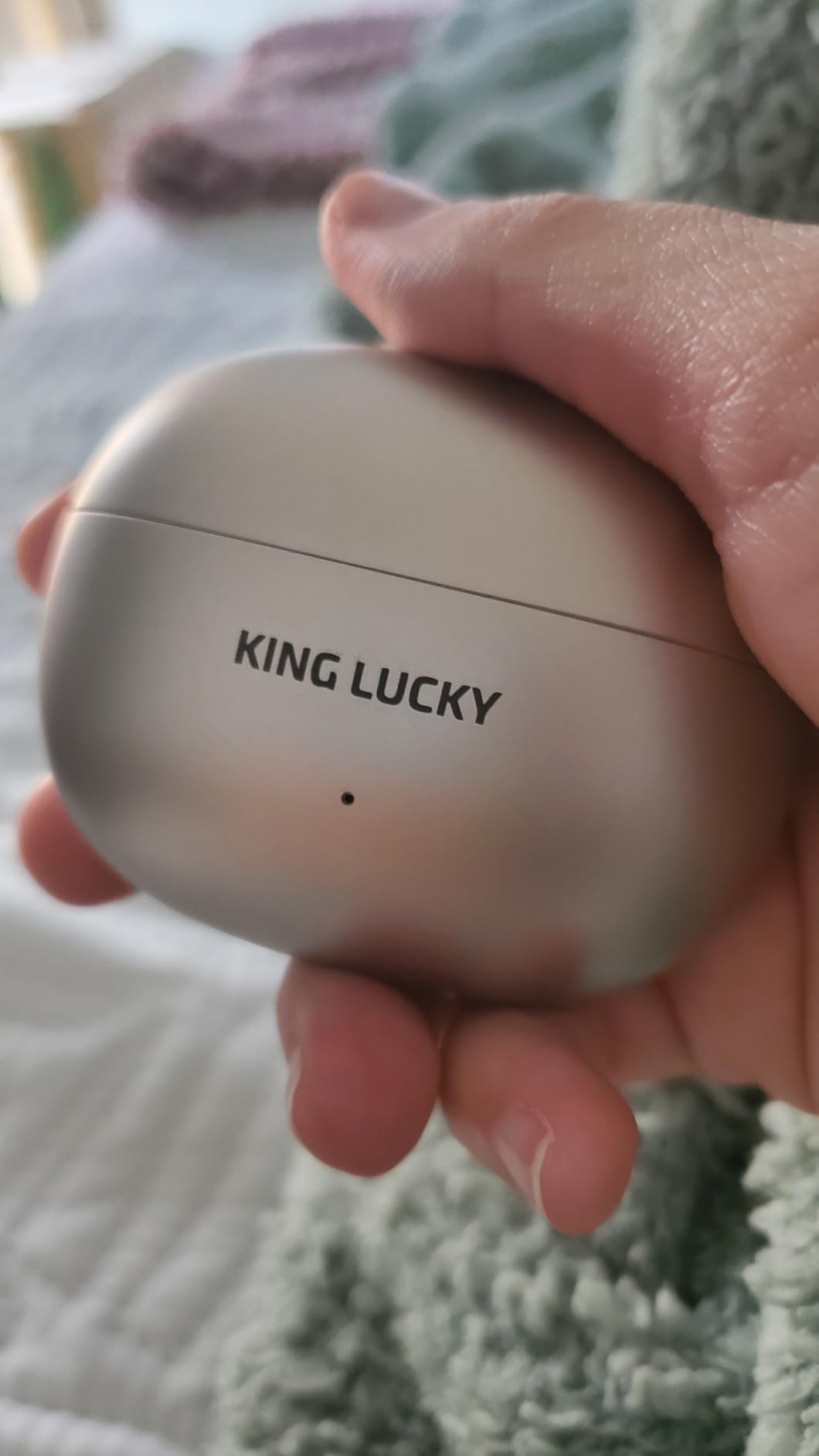
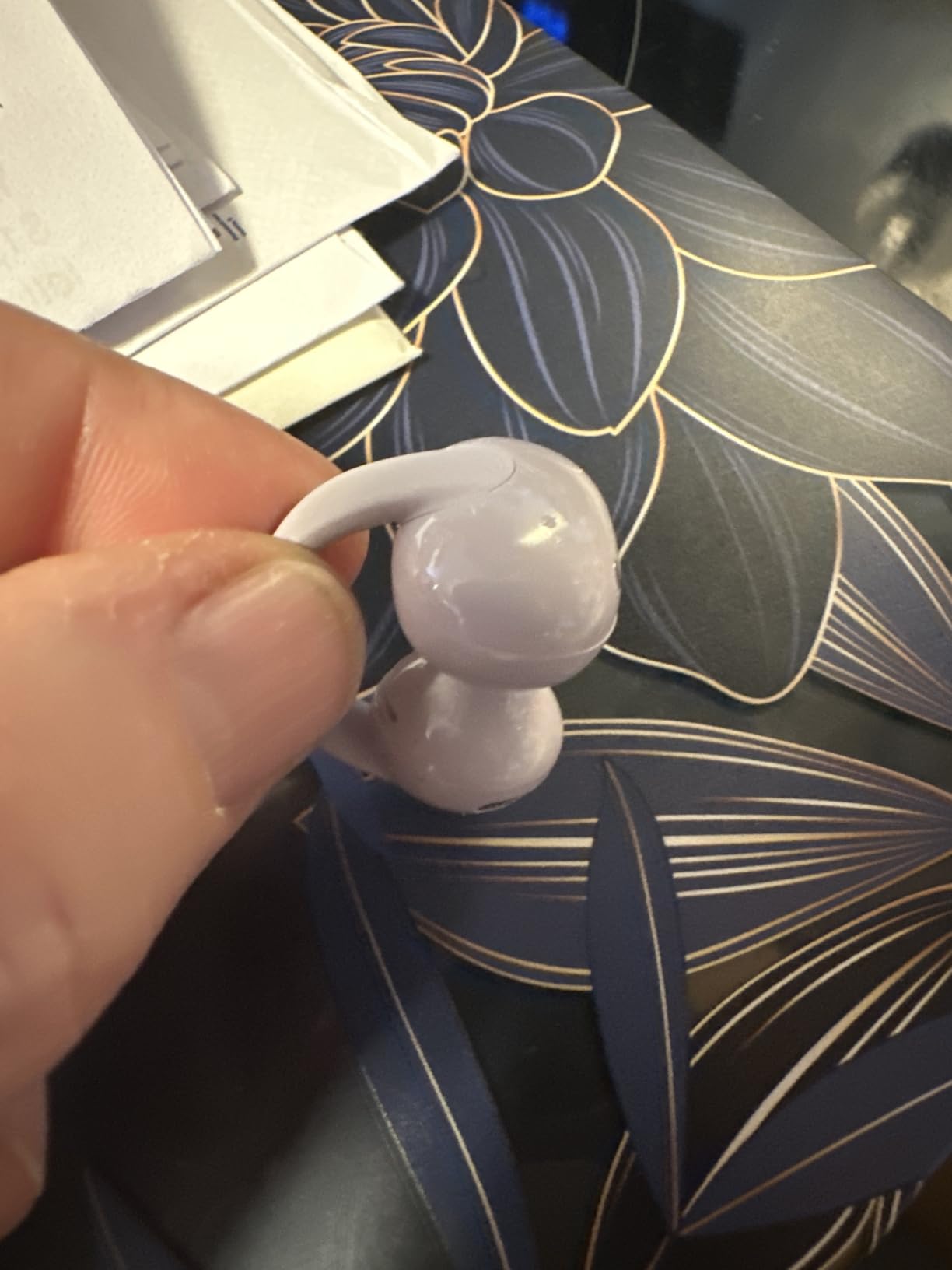
This is the pair we recommend when someone wants a zero-pressure fit, a case that lasts a week, and glasses compatibility in one package. The clip wraps the outer ear and the housing points into the canal from outside, so nothing enters the ear at all. At 5.2g per earbud with skin-friendly silicone it is light enough for long sessions.
The design detail that matters is the extended slim ear hook. Longer hooks spread contact over a wider area of cartilage, which is exactly the right answer for a small ear where a short hook concentrates pressure on one point. Owners wearing glasses call this out specifically, because the hook sits behind the ear rather than across the temple arm.
Sound comes from 13mm dynamic drivers with directional acoustic tuning, and the review consensus is clear with good bass for an open format rather than a real sub-bass extension. Dual-mic ENC keeps calls intelligible in ordinary conditions, and Bluetooth 6.0 is listed with a 33 foot range, with marketing copy also citing 15 meters. Touch is the control method, and that is the weak point.
Battery is 7 hours per charge and 50 hours with the case, with a 2 hour case charge. IPX5 water resistance covers sweat and rain. The box carries a detachable cable, a charging station, an eartip and a manual, and the listed item weight is 65 g.
How to position the hook so it stops pinching
Most complaints about this pair are placement complaints, not product complaints. The hook rotates, and on a small ear the wrong rotation puts the clip edge against the top of the concha. Start with the hook pointing straight back, then rotate forward in small steps until the housing clears the ear entirely and the load sits on the hook rather than the clip.
Once positioned, it is stable through movement, which is why it holds up for running and cycling. The same reviewers who report pressure behind the ear after long sessions generally describe an early-session placement issue rather than a design limit.
Who should skip the King Lucky clip
Skip it if you are chasing low end. Open formats trade bass for pressure relief, and no amount of adjustment changes that. It is also a touch-control design, so if you work with sweaty hands or gloves, the physical buttons on the Soundcore C50i are a better bet.
For an even cheaper route to the same open-ear fit, the QJF clip later in this roundup does the same job for less and asks less of your pocket.
4. Soundcore C50i: Best Clip-On for Small Ears That Move
Soundcore C50i by Anker Open Ear Earbuds, Clip On Earbuds, Clip Headphones
Titanium FlexiClip
12mm drivers
8h per charge
IP55
Pros
- Memory titanium FlexiClip adapts to different ear shapes
- Physical buttons work reliably with sweaty hands
- Sound quality is well above the tier
- Compact 33.5 g case
- Multipoint switching between phone tablet and laptop
Cons
- Buds sometimes stay connected in the case instead of charging
- No wear detection so playback does not pause on removal
- Mics pick up wind noise on outdoor calls
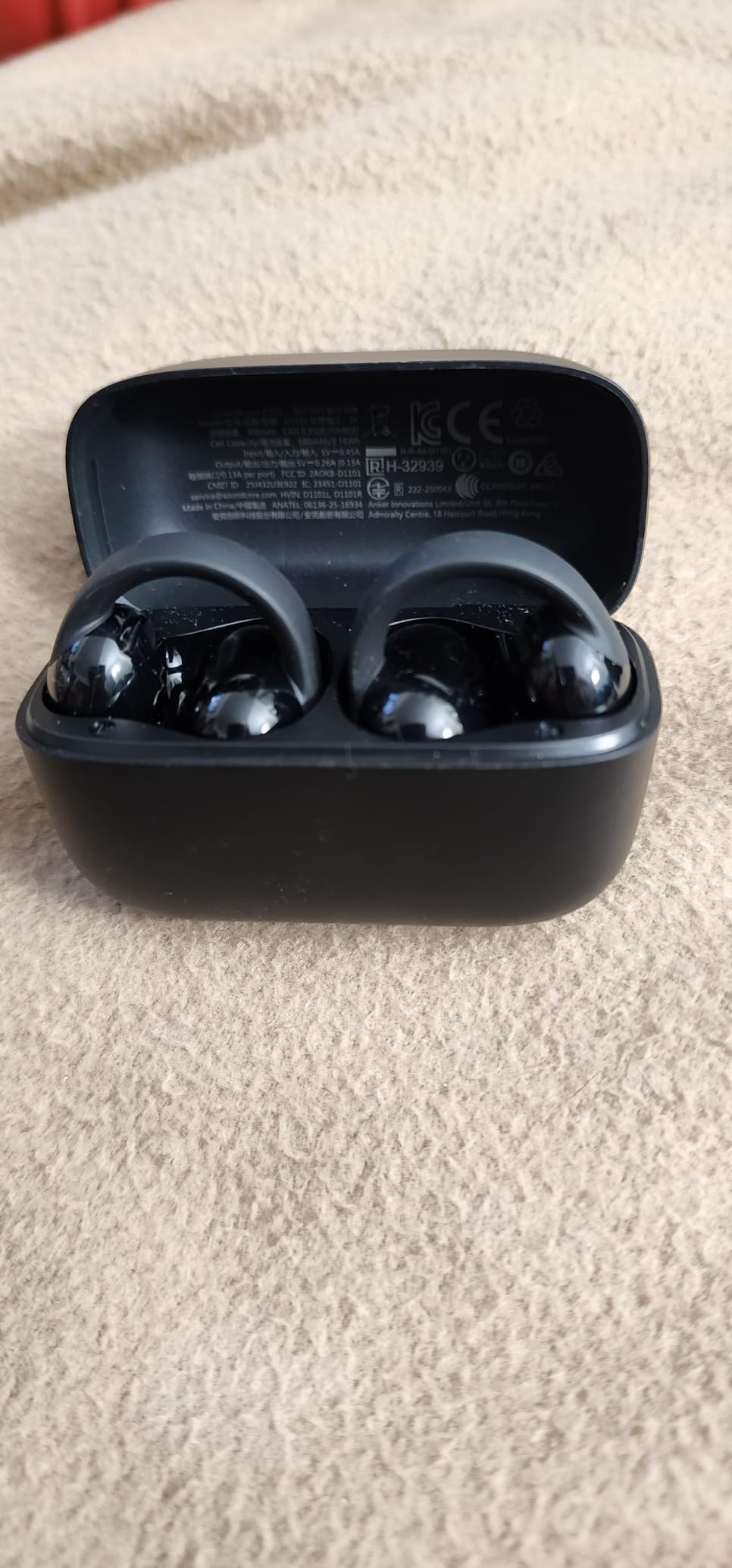
The C50i is the workout answer in this roundup, and the reason is the clip. A memory titanium FlexiClip flexes to the shape of the ear and then holds, so on small ears it stays put through shakes, runs and bike descents in a way that friction alone never manages. It is open-ear, so the canal stays free, which also means you can hear a car behind you.
Physical push buttons on both buds are the feature we did not expect to care about and now recommend most. Touch panels on a moving ear misfire, and these do not. In a review set full of complaints about unresponsive or accidental touch controls, this one simply has no touch surface to blame.
Sound is a 12mm dynamic driver with a listed maximum output of 86dB, and reviewers consistently rate clarity and bass as strong for the money. AI noise filtering helps on outdoor calls, though wind noise still reaches the microphones. Bluetooth 6.0 with multipoint moves between phone, tablet and laptop quickly, which suits anyone moving between a desk and a phone.
Battery is 8 hours per charge and 28 hours with the case, with a 2 hour case recharge. The case is the small kind, listed at 6.2 by 4.15 by 3.1 cm and 33.5 g, and the whole package is listed at 44.5 g. IP55 water resistance and an 18-month warranty back it up.
Why the buttons matter more than the driver
For a small ear specifically, control access is part of comfort. A touch panel that fires when your hand brushes the clip during a run is worse than no control at all, and a clip sitting in a small concha is easy to brush. Physical buttons remove the guesswork, and the review consensus treats this as the C50i defining advantage over the other open-ear options here.
The other thing worth verifying in person is clip clearance. On some very small ears the clip sits close to the canal, and a few owners report that limits maximum volume. If you need to drive these loud, test before committing.
Who should skip the C50i
Skip it if you are a light sleeper or a side sleeper, since the clip is designed to hang on the outer ear and the mattress will press on it. Skip it if you rely on wear detection to pause music automatically, because this model does not have it.
The most-reported problem is charging-case reliability, with buds occasionally remaining connected in the case instead of charging. If that happens, a manual reset usually clears it, but it is worth knowing before you rely on the case for a week of travel.
5. MOZOTER Mini Wireless Earbuds: Most Versatile with Real Battery Headroom
MOZOTER Mini Wireless Earbuds Bluetooth 5.3 in Ear Headphones Headsets
3.7g per earbud
S/M/L tips
8h per charge
60h with case
Pros
- Light 3.7g body reduces pressure on small ears
- Three tip sizes help narrow canals get a real seal
- 8 hours per charge and 60 hours with the case
- Bass-forward 10mm drivers
- Bluetooth 5.3 auto-connect when the case opens
Cons
- Around 8 hours to fully charge
- No app so no EQ curves or firmware updates
- Listed noise cancelling is passive isolation not active
The MOZOTER is the roundup’s answer to a specific question: what does a small ear actually get from a low-cost in-ear? More than most people expect. At 3.7g per bud it sits in the lightweight half of this list, and the manufacturer states the ergonomic shape is aimed at small ears and children, which is exactly the geometry question we are solving here.
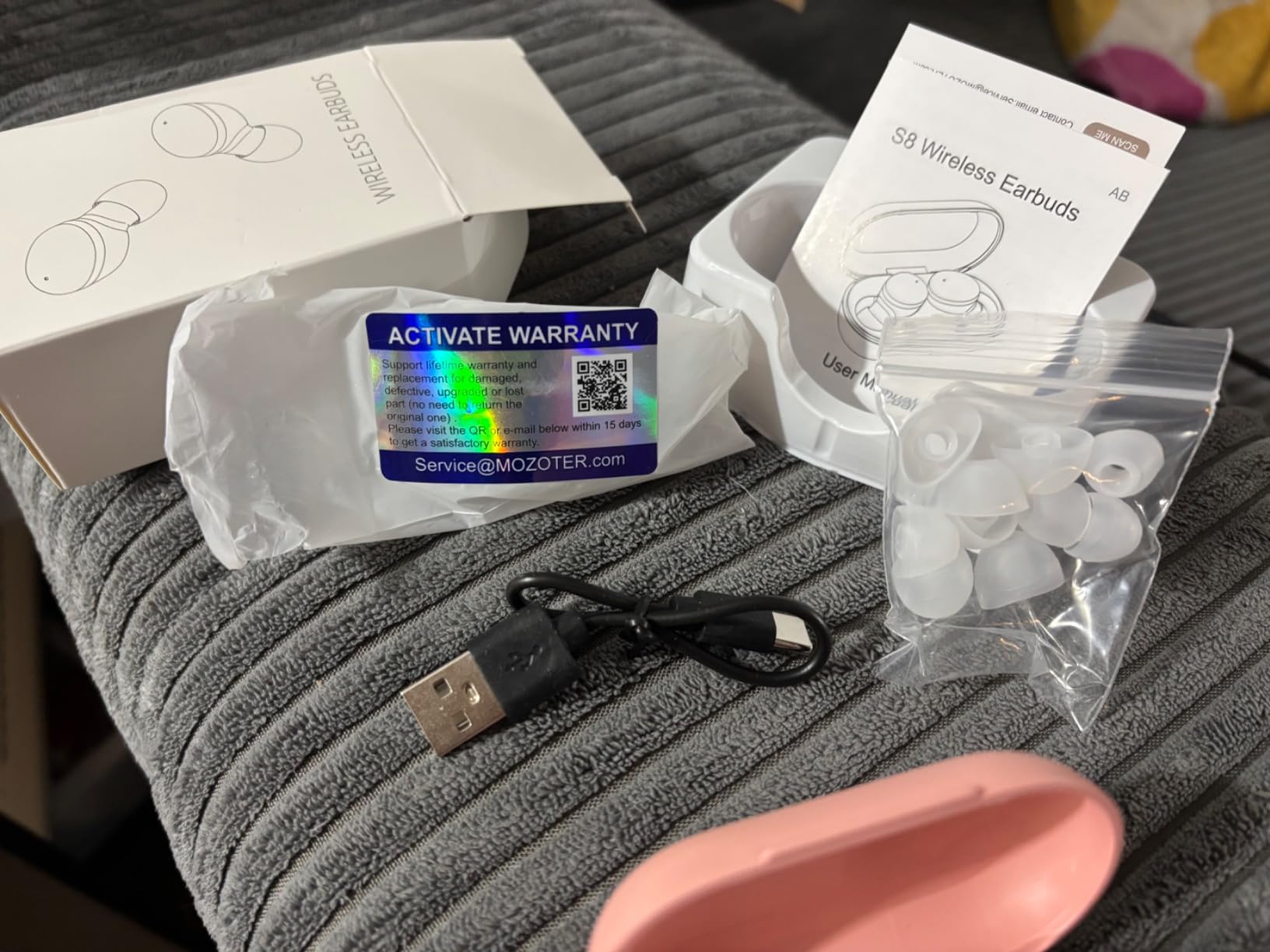
Three pairs of ear caps in S, M and L are included. There is no XS, so if your canal is genuinely narrow, plan on buying a smaller third-party tip. That is the one limitation worth flagging before purchase, and the buying guide below covers the swap.
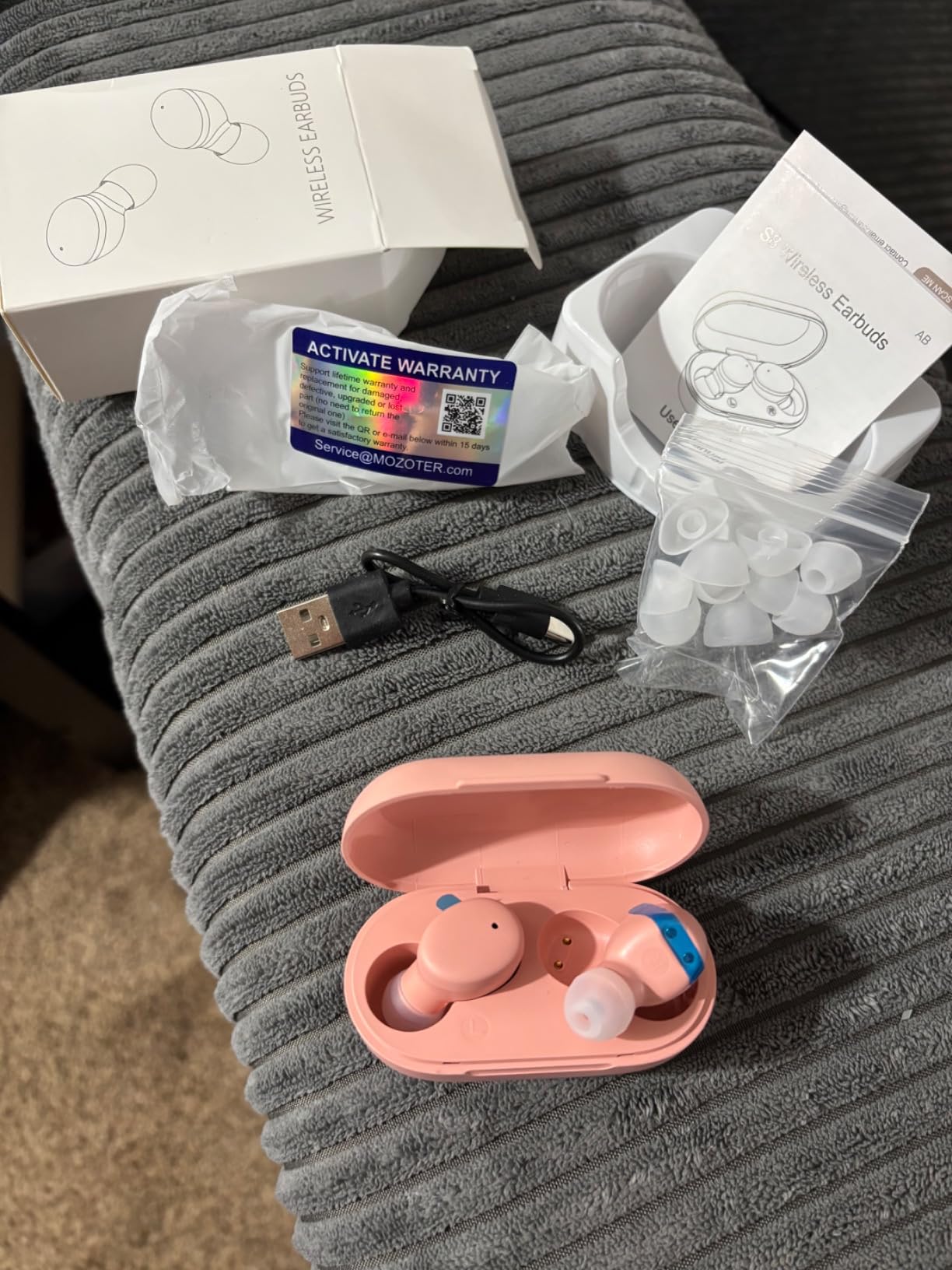
Battery is the standout. Eight hours per charge and 60 hours total from the case means most owners charge weekly rather than daily, and with no app to draw power, nothing is draining in the background. The 10mm dynamic drivers are tuned bass-forward, which reviewers consistently enjoy, and auto-connect on opening the case removes one more daily friction.
The listed item weight is 48 g, and compatibility runs across iOS, Android, laptops and smart TVs. The 3.5mm jack is not needed at all, which is a change from the wired options further down.
Where the budget shows up
Two places. Charging takes around 8 hours, which is long enough that you plan it rather than do it opportunistically, and there is no companion app, so you cannot adjust the bass-forward tuning with an EQ curve. The touch controls are also described as finicky and lacking physical feedback, which is the same trade the JVC Gumy solves by having no controls at all.
One clarification worth making because listings often blur it: the noise control here is basic sound isolation, not active cancelling. Expect traffic, not engines, and expect the low end to drop when nothing is sealed.
Who should skip the MOZOTER
Skip it if you have very small ear canals, because the smallest included tip is an S and the fit relies on that tip. Skip it if you want custom EQ, or if you want a case you can top up in a lunch break.
It remains the pick here for anyone who wants 60 hours of runtime and three tip sizes without spending much, and the weight per bud is low enough that fatigue is not the issue.
6. Ttbesmi Mini Invisible Earbuds: Best for Side Sleeping on Very Small Ears
Small Mini Invisible Earbuds Wireless Bluetooth Ear Buds for Small Ears
2.3g per earbud
Peanut-shaped profile
4-5h per charge
Pros
- Flush peanut-shaped profile that sits inside the ear
- Effectively weightless over long sessions
- Works side sleeping without poking
- Nude finish blends in discreetly
- Multiple tip sizes improve the seal
Cons
- Touch controls are close to impossible to operate reliably
- Case drains fast and holds few recharges
- Buds are so small they are easy to lose
This is the lowest-profile in-ear in the set at roughly 2.3g per bud, with a peanut-shaped 1:1 body that sits flush rather than projecting. For a small ear that projection is the difference between a bud you forget and a bud you keep adjusting, and the weight per bud means side sleeping is genuinely painless.
Sleep is the design target and reviewers confirm it. Multiple owners report wearing these on their side through the night without soreness, which is the single hardest fit problem in this roundup. Multiple ear tip sizes are included, and a stated owner benefit is a much better seal than the shape alone provides.
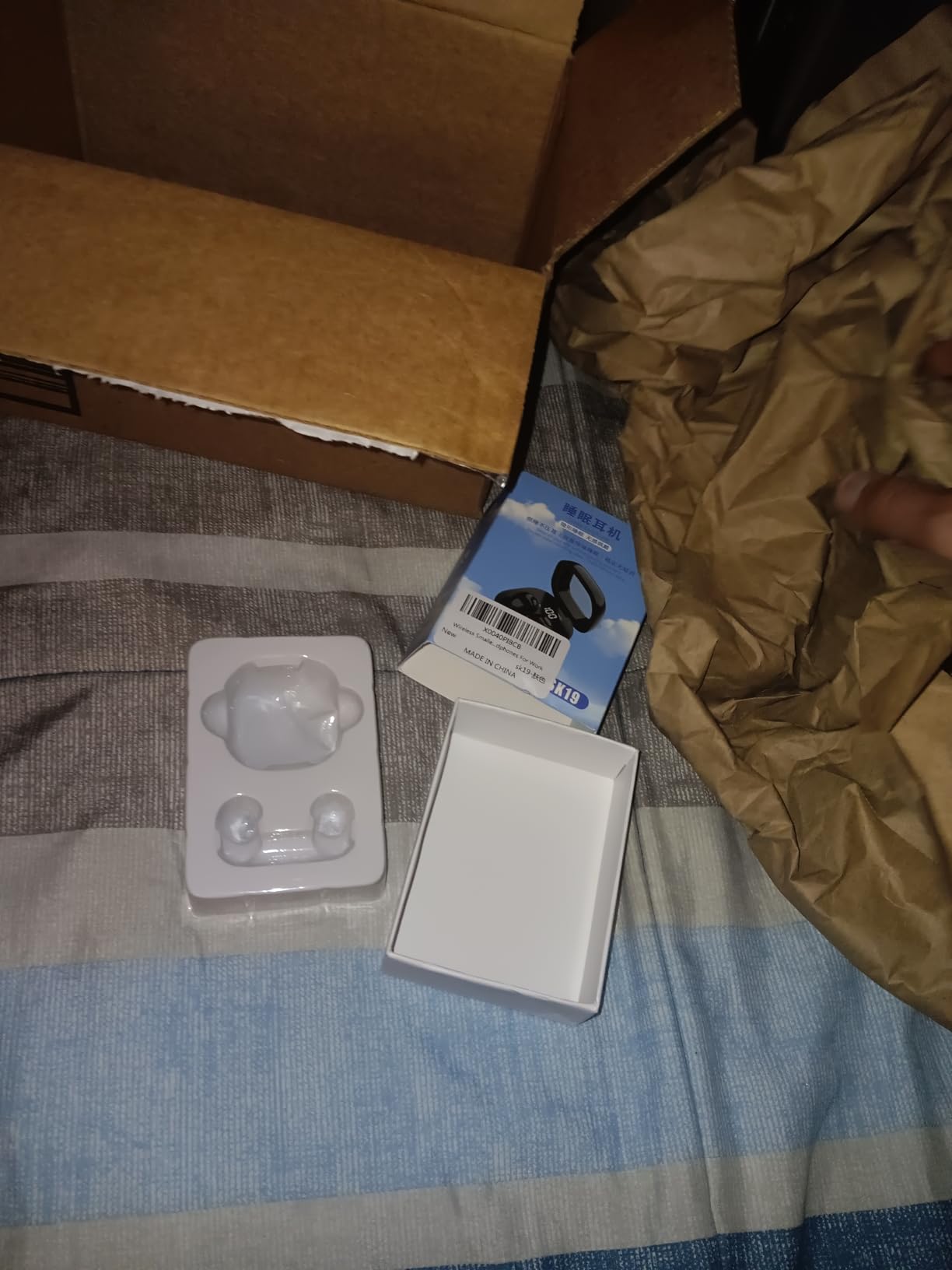
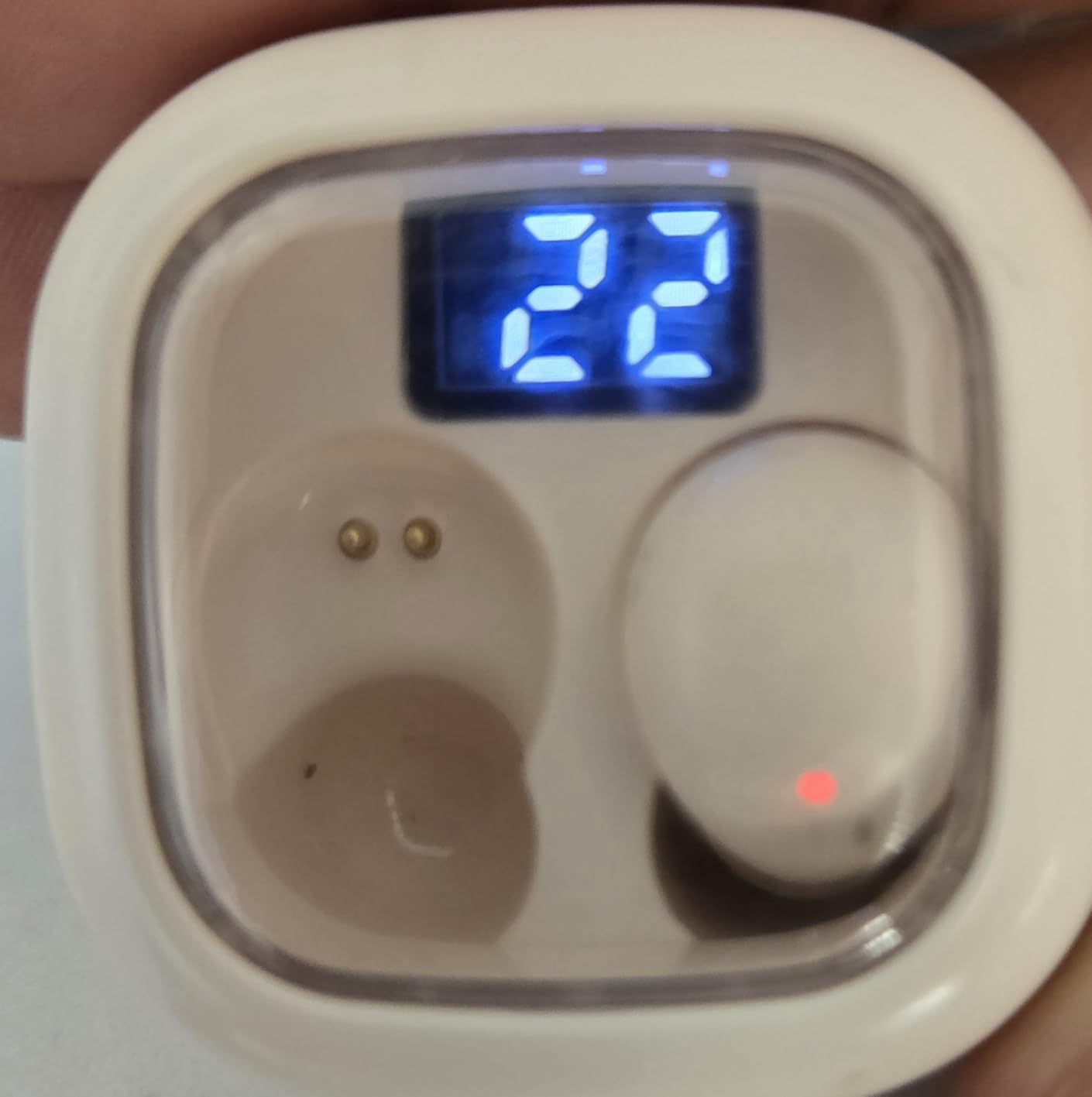
Sound quality and bass are praised more often than the rating suggests, with several reviewers surprised by the low end at this price. Bluetooth 5.3 with low latency, an LED power display on the case, and a 4 to 5 hour per charge runtime adding to 30 hours with the case. The listed frequency range is 20 Hz to 20,000 Hz at 16 ohm.
There is one important caveat about the controls, and it is not a minor one. Touch controls on a surface this small are described as nearly impossible to operate reliably, and removing a bud switches it off, which forces a return to the case to restart. Plan to treat these as a sleep and focus pair rather than a daily driver.
What to look at in the box
The tip sizes matter more than usual here because the body is so small that the tip is effectively the whole interface. Try the smallest included tip first and check the seal by speaking to yourself: if you can hear your own voice clearly, the tip is not seated. The nude finish is a practical choice for anyone who does not want a visible earbud at work or under a headband.
Also plan for the case. It holds few recharges, drains quickly, and does not latch closed reliably if dropped, which is a combination reviewers mention often. Keep the buds in a tray when the case is not in use.
Who should skip the Ttbesmi
Skip it if you need to answer calls, control playback precisely or survive a workday on battery. The control scheme is the product’s clearest failure, and no firmware update fixes it.
Users with larger fingers may also struggle, since the buds are small enough to be hard to extract. For anyone who only ever sleeps with them, none of that matters.
7. Yihou Invisible Sleep Earbuds: Best Discreet Pair with a Readable Case
Ear Buds Invisible Small Mini Sleep Earbuds Headphones Wireless Bluetooth
2.3g per earbud
1:1 peanut size
4h per charge
20h with case
Pros
- Barely-there weight with no fatigue even side sleeping
- Stable Bluetooth 5.3 with fast reconnection
- Self-standing case doubles as a battery readout
- Good sound and call clarity for the size
- Color options are genuinely hard to spot
Cons
- Battery runs about 3-4 hours per charge
- Round case does not latch and will not fit a pocket
- Speaker grilles collect dust and earwax
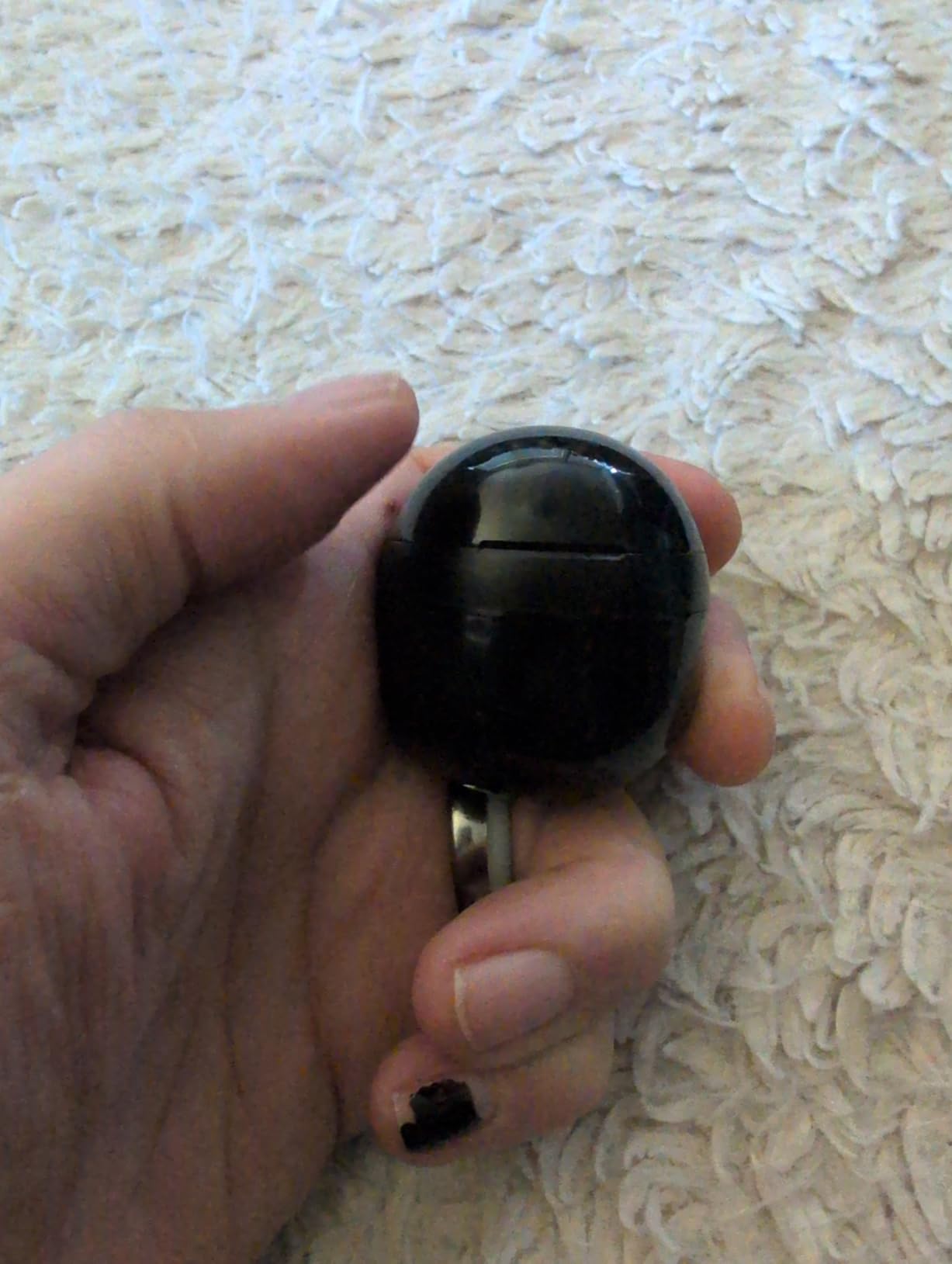
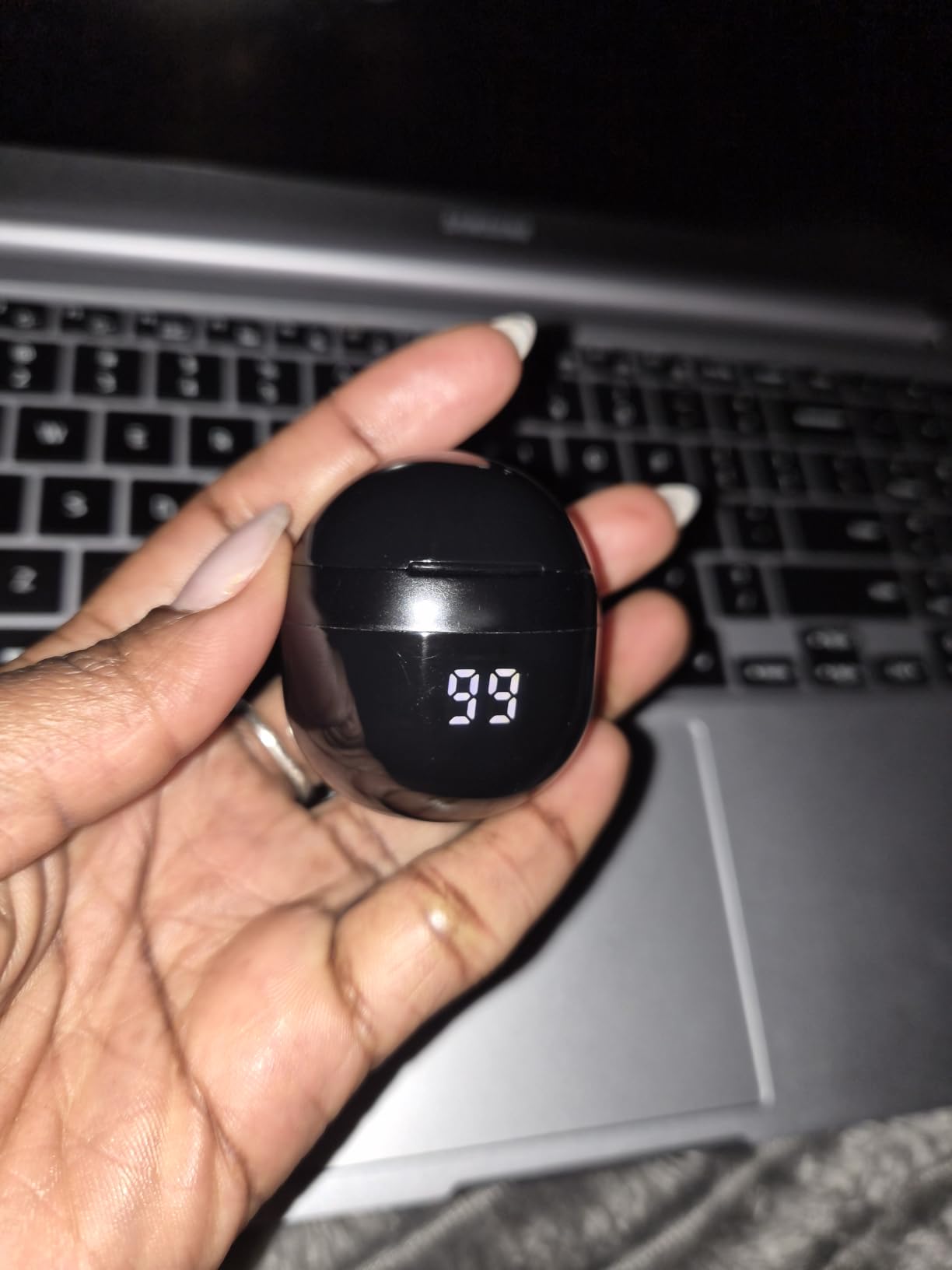
The Yihou shares the tiny 2.3g, 1:1 peanut geometry that makes the previous pick sleep-friendly, and it adds the feature we find more useful: a self-standing tumbler-style case with an LED capacity display. The case sits upright on a desk or bedside table so you can read the remaining charge at a glance instead of guessing from indicator dots.
Fit is the same story, and it holds. At 2.3g per bud there is almost nothing to press on the concha, and several reviewers confirm the pair neither hurts nor falls out when lying on one side. A case recharge takes about an hour, which is faster than several others in this roundup.
Sound quality and microphone performance are called surprisingly good, and Bluetooth 5.3 reconnects quickly across a listed 30 foot range. The listed frequency response is 20 Hz to 20,000 Hz, the model is SK18, and a microphone supports Siri voice assistant invocation.
Runtime is 4 hours per charge and 20 hours from the case, so this is a night-and-commute pair rather than an all-day one. The listed item weight is 1 ounce, and the case is rated waterproof.
Why the standing case is the deciding detail
On a very small ear, the buds themselves are rarely the problem, they are just easy to lose. These are described as very easy to lose precisely because they are so small, and a case that stays upright and shows the charge level reduces the two most common ways the pair goes missing. The tumbler shape does mean it will not sit flat in a trouser pocket.
The grilles need occasional cleaning. Because the drivers sit right at the canal entrance, dust and earwax build up faster than on a conventional bud, and owners report a change in sound before they realise why.
Who should skip the Yihou
Skip it if the case will live in a bag or a pocket, since the round lid does not latch and the case can roll away and spill both buds. It is also too short on battery for a full working day without a midday charge.
Choose the Ttbesmi instead if your priority is bass, and stay with this one if your priority is a case that tells you the truth.
8. CNBRO Invisible Mini Sleep Earbuds: Best Hidden Option for Small Ears
CNBRO Invisible Mini Sleep Earbuds Ear Buds for Side Sleepers Sleeping, Small Ears Canals Women Wireless Bluetooth Low Profile Smallest Disgused Tiny Micro Discreet Hidden Earbuds Headphones for Work
Low profile shell
Skin tone finish
4h per charge
20h with case
Pros
- Disappears inside the ear rather than projecting from it
- Skin tone blends in at work or under a headband
- Contoured shape suits side sleepers and very small canals
- Stable Bluetooth 5.3 with low latency
- Case recharges in about an hour
Cons
- Short 4-hour single-charge battery
- No active noise cancelling and only basic isolation
- Touch controls on a very small surface are hard to hit
The CNBRO is bought for one reason: nobody can see it. The shell is contoured to sit inside the ear with a skin tone finish, which for some small-ear wearers is the only design that clears the concha rim at all. It is the option to pick if you are in conversations all day and do not want a visible earbud.
Side sleeping is the second use reviewers confirm. The contoured shape leaves nothing protruding for a mattress to press against, so comfort on one side is the reason many buyers give. Ear cushions are included in the box, and the connectivity is Bluetooth 5.3 with low latency across phones, tablets, laptops, smart speakers and TVs.
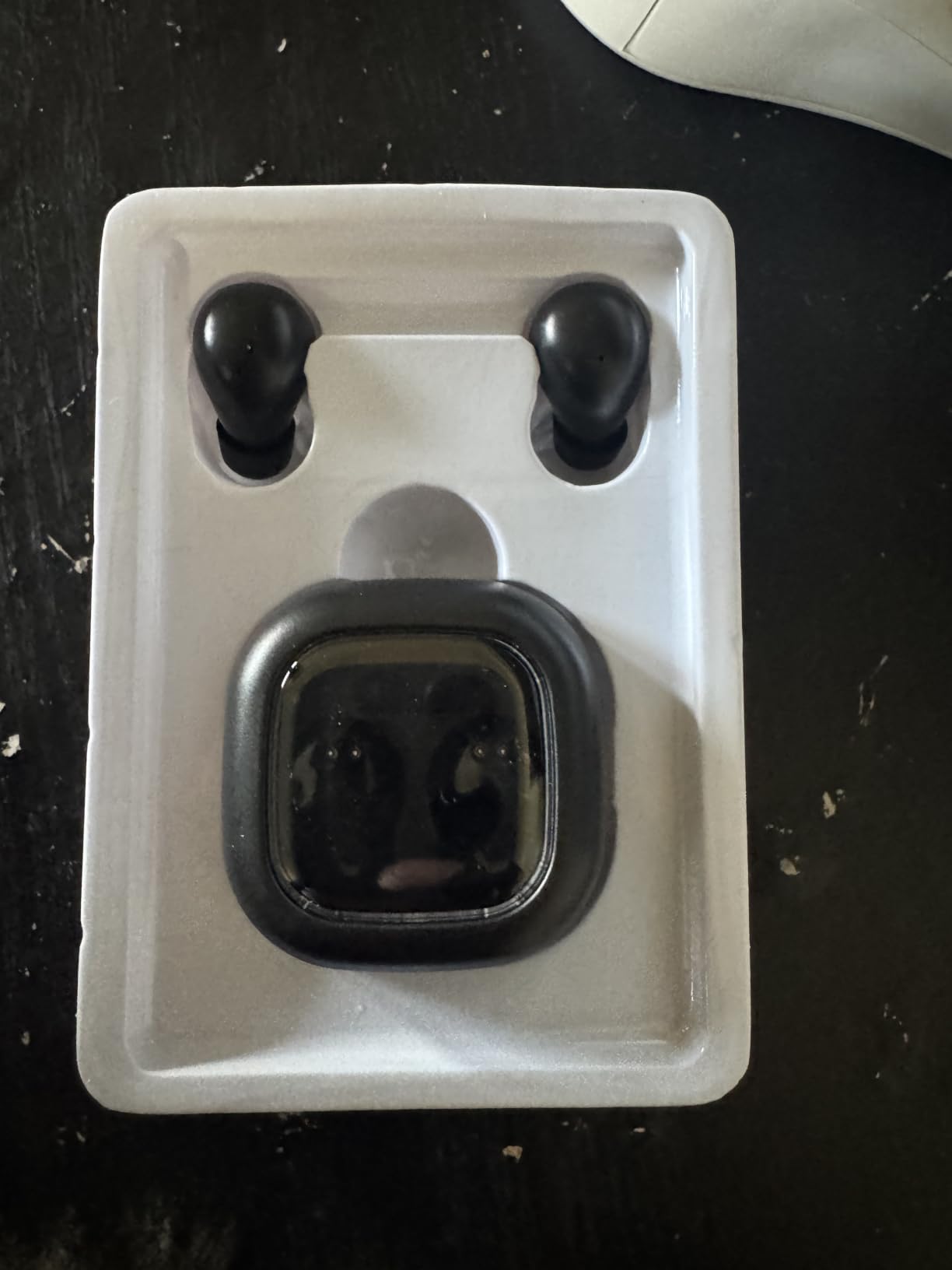
The audio hardware is a balanced armature driver at 10 ohm with a 20 Hz to 20,000 Hz response, and the model is SK19 with a one-year warranty. Isolation is listed as sound isolation, so there is no active cancelling here and no way to switch it on.
Runtime is 4 hours per charge and 20 hours from the case, with about an hour for a full case recharge. A stated limitation is that touch controls on a surface this small are hard to hit reliably, and there is no app or EQ customisation of any kind.
Discretion versus audibility
This is the trade to make consciously. Skin tone and a fully recessed body solve the visibility problem completely, but you give up the ear hook or wing that keeps a bud from rotating out during movement. For a desk, a commute on public transport and sleep, that is an excellent trade. For running, cycling or anything with impact, the Soundcore C50i is the safer pick.
The small touch surface is the other practical limit. Volume and track changes need accuracy, and a surface barely wider than the driver is not it. Treat playback control as something you do on the phone.
Who should skip the CNBRO
Skip it if you want noise cancelling in any form, if you want to adjust the sound, or if you need more than four hours away from a charger. The feature set here is deliberately minimal.
If you want discretion plus battery headroom, the MOZOTER runs far longer, though it is visible when worn.
9. QJF Clip-On Earbuds: Best Budget Clip for Small Ears and Glasses
QJF Clip on Earbuds for Small Ears & Glasses, Open Ear Bluetooth 5.4 Headphones with 40H Playtime & Digital Display, Sweatproof
4.3g per earbud
C-shaped clip
40h with case
IPX4
Pros
- Very light 4.3g clip that clears the ear canal completely
- Built for small ears and glasses wearers
- Digital case display shows remaining power
- 40 hours total playtime
- IPX4 sweat and splash protection for workouts
Cons
- No active cancelling despite the noise control label
- Open format means weak bass against in-ear buds
- Clip can feel loose on the very smallest ears
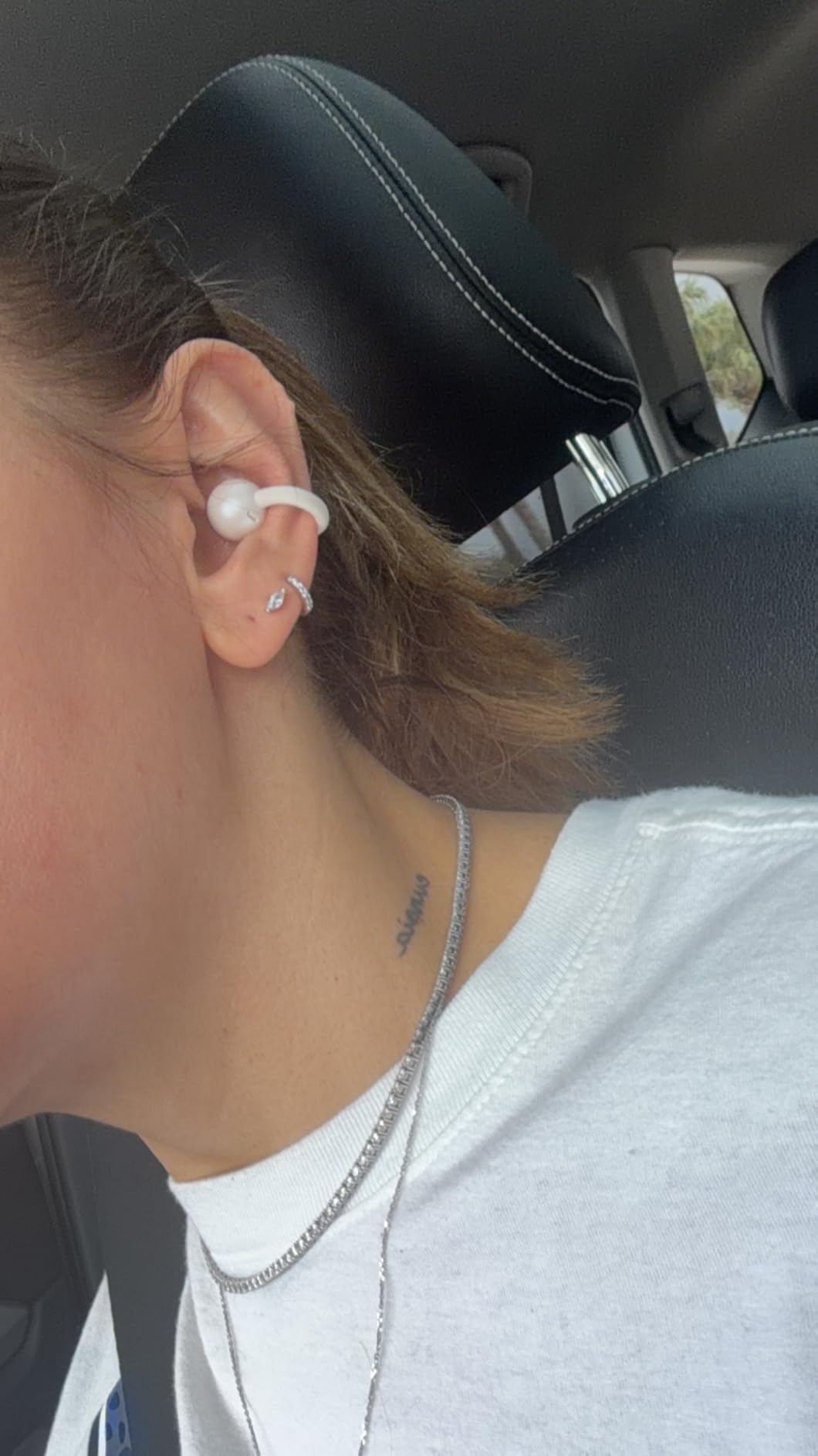
The QJF solves the same small-ears-and-glasses problem as the premium clip-ons at a much lower outlay, and the C-shaped clip is the reason. At 4.3g per earbud it is among the lightest clips in this roundup, and the C shape wraps the ear rim while directing the driver down the canal from outside, so nothing enters the ear.
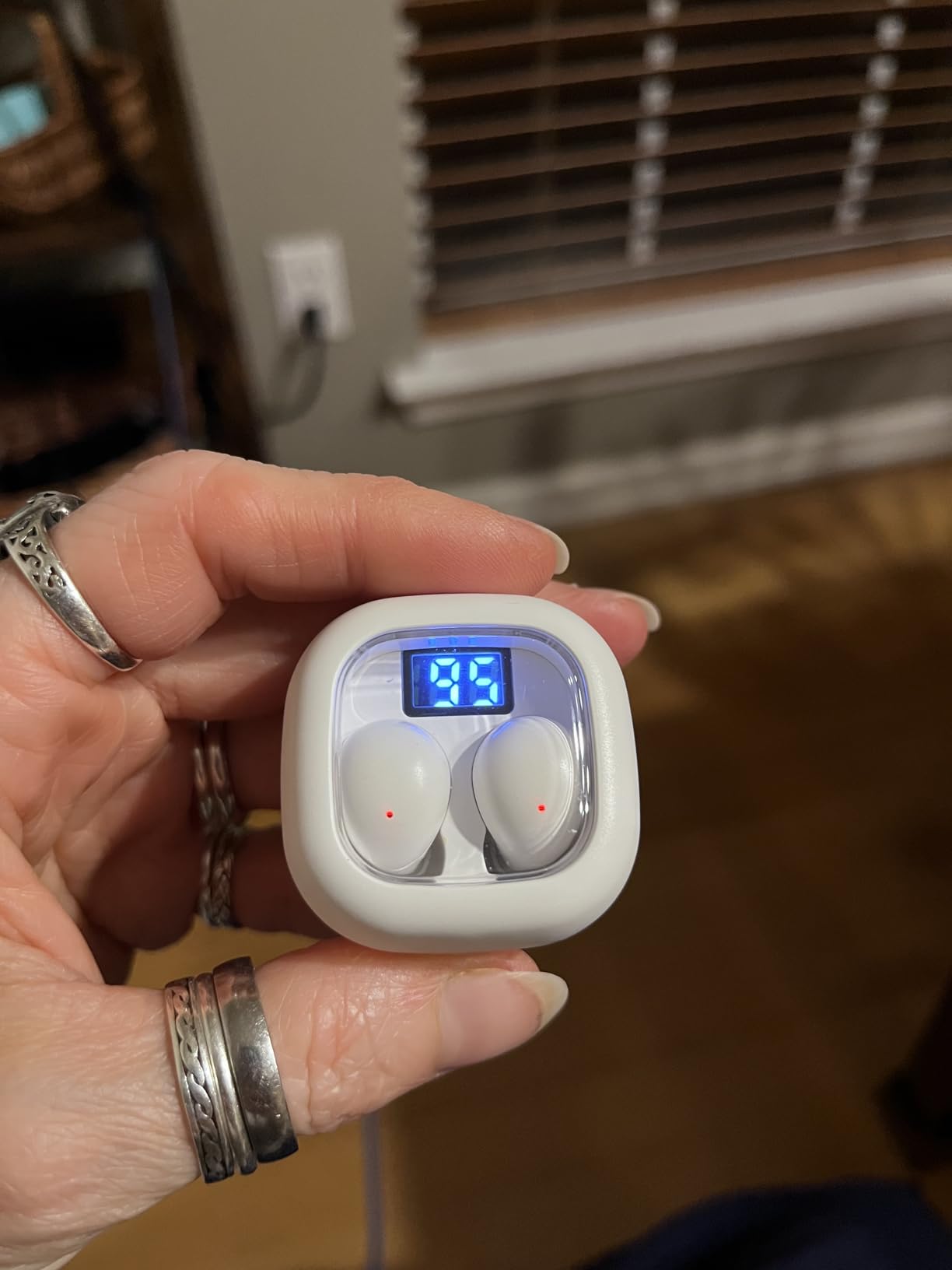
The digital display on the case is the standout feature at this tier, showing remaining power instead of an ambiguous light. Total playtime is listed at 40 hours from the case, which comfortably outlasts most competitors here, and ENC microphones keep calls intelligible in normal conditions.
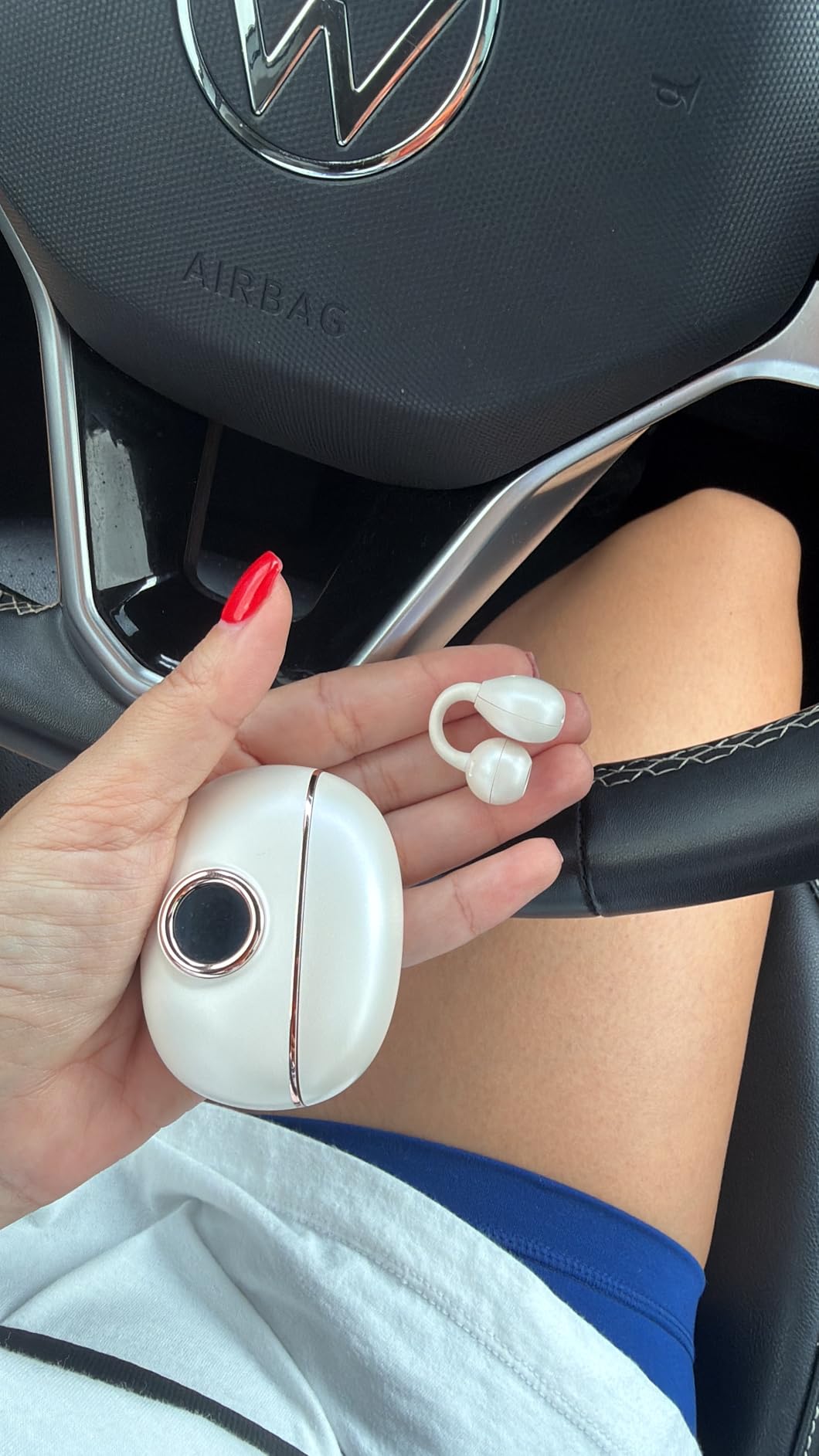
Audio is air conduction with environmental awareness, driven by a bone conduction style driver at 16 ohm with 103 dB sensitivity. IPX4 covers sweat and splash, and Bluetooth 5.4 works out to a listed 10 meters. The listed item weight is 60 g and the model is QJF-M97 with a one-year warranty.
Two honesty points. Despite the environmental noise cancellation label, there is no active cancelling, and the open format means bass is light. Several buyers also report the clip needs repositioning to stay put on particularly small ears, so treat the fit as adjustable rather than automatic.
Glasses compatibility and why it is not automatic
Glasses and earbuds compete for the same few square centimetres of skin, and the clip is the part that decides the contest. A C-shaped clip sits behind the ear and runs under the temple arm, which usually works, but it depends on the frame. Thin metal temples are easy, thick acetate frames need the clip positioned forward so the arm clears the housing.
This is the cheapest way in this roundup to find out whether clip-on works for you at all, which is a reasonable way to spend very little before committing to the King Lucky clip or the C50i.
Who should skip the QJF
Skip it if bass matters, if you need noise cancelling on a plane or train, or if build quality is something you notice. It is listed as basic next to established audio brands, and the touch controls on the small stem are easy to miss.
For a more secure clip with physical buttons and a warranty you can lean on, the C50i is the step up.
10. JVC Gumy Wired Earbuds: Best Wired Backup for Narrow Ear Canals
JVC Gumy in Ear Earbud Headphones, Powerful Sound, Comfortable and Secure Fit, Silicone Ear Pieces S/M/L – HAFX7V Purple, Small
Wired 3.5mm plug
S/M/L silicone tips
Deep bass
1 year warranty
Pros
- Nothing to charge pair or configure
- Soft silicone tips in three sizes suit very narrow canals
- Only 1.12 ounces with no electronics to distract you
- Wired connection means no latency and no dropouts
- Deep bass and clean treble
Cons
- Cord snags and can pull the tips out during daily use
- Needs a 3.5mm jack or an adapter on newer phones
- No microphone wireless or noise cancelling
Wired earbuds solve the small-ear problem in a way nothing else here does, because there is no battery, no radio and no firmware sitting inside the concha. The Gumy housing is small and light, the whole package is listed at 1.12 ounces, and there is no case, no pairing and nothing to forget to charge before a flight.
The small silicone tip is the feature that actually matters here. Soft S, M and L tips let a narrow canal find a comfortable seal, and with a proper seal the sound isolation is respectable for a wired pair. Owners highlight the deep bass and the complete absence of setup as the reasons this is still worth owning.
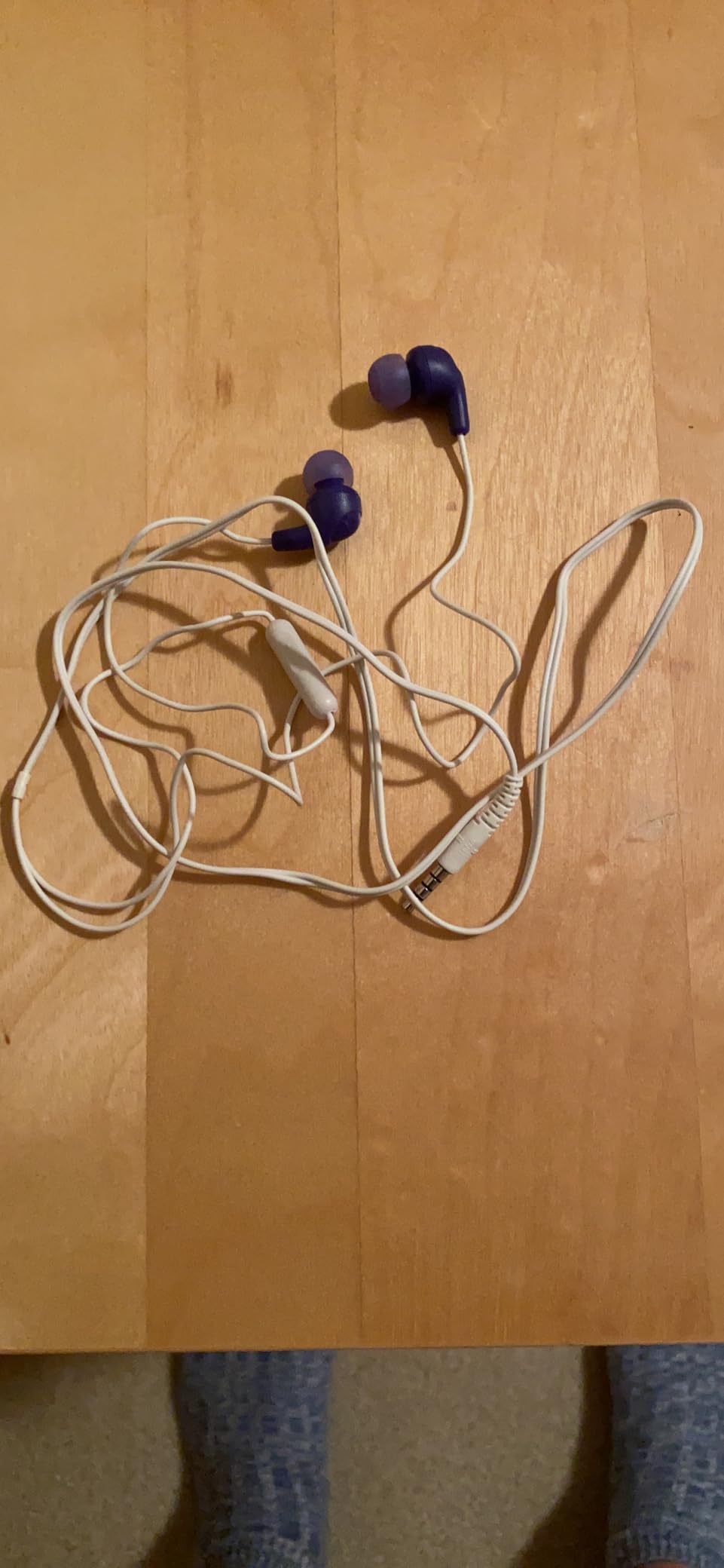
Sound is tuned for deep bass and clean treble with a 16 ohm impedance and 100 dB sensitivity. The cord is 3.3 feet, colour-matched, and ends in a standard 3.5mm jack. A one-year parts and labour warranty applies, and the manufacturer is JVCKENWOOD USA.
This is a backup pair, not a main one. It suits a laptop, a flight, a gym bag or a desk where you want zero friction, and it is the pair to reach for when a wireless battery dies mid-trip.
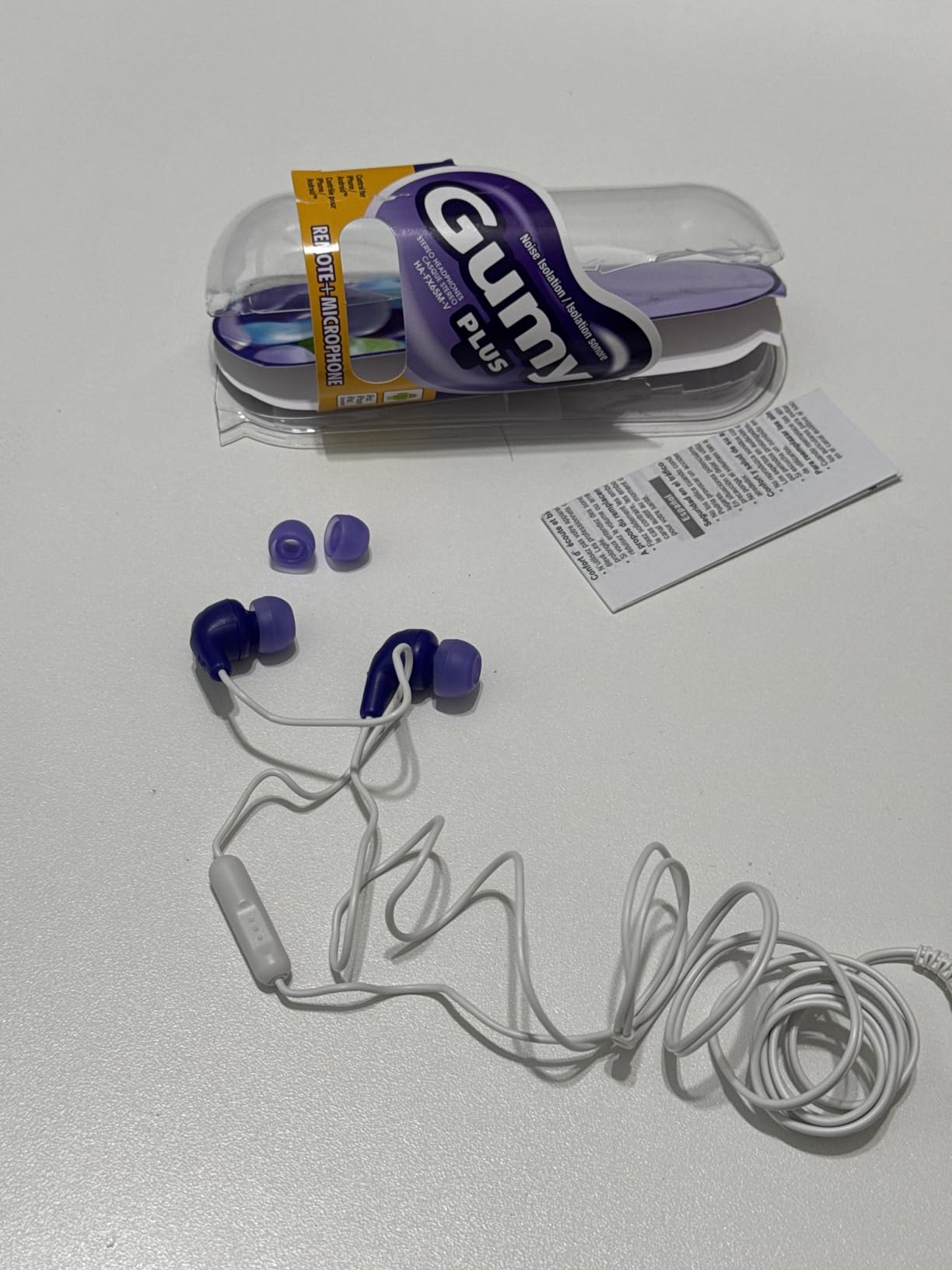
When wired is the right answer for a small ear
For a very small ear, removing weight and electronics from the body is a bigger deal than any firmware feature. A wireless bud spends part of its mass on a battery, a radio and antennas; this one spends none of it, which is why 1.12 ounces feels like nothing over an afternoon.
Fit is entirely a tip problem, and that is a good problem. Swap in a smaller third-party silicone or memory foam tip and the seal improves immediately, which is the cheapest fit fix available anywhere in this guide.
Who should skip the JVC Gumy
Skip it for calls, since there is no microphone, and skip it for workouts where a dangling cord is a real hazard. If your phone has no 3.5mm port, you need an adapter, and at that point many people are better served by the MOZOTER.
It is also not a travel-noise solution. There is no active cancelling, and cord noise transfers on every footstep.
How to Choose Headphones for Small Ears: A Buying Guide
Match the form factor to which problem you actually have
Start by deciding whether the pain comes from something inside the canal or from something resting in the bowl. If pressing a bud slightly deeper relieves the sensation rather than causing it, you are probably a tip-size problem and any sealed in-ear will work with a smaller tip. If the discomfort is at the outer rim, or a bud works but is uncomfortable, you have a small concha bowl and you need either a genuinely small body or a design that avoids the bowl entirely.
Then pick by activity. Open-ear hooks and clips suit glasses wearers, sensory sensitivity and all-day wear because nothing enters the canal. Sealed in-ears suit noisy commutes and bass. Low-profile in-ears below 3g per bud suit side sleeping. A wired pair suits anyone who wants zero maintenance. Budget tiering matters less than form factor here, and the price range across this list is wide while the fit decision is binary.
That last point is the one people most often get wrong. They shop by discount percentage rather than by geometry, and end up with a second pair that presses on the same rim. Shop by ear shape first, then by budget. If you want the same principle applied to a different category, our small pressure cooker picks make the same form-factor-before-price argument for a very different reason.
The 5-minute fit test to run at home
Run this before you decide anything is wrong with your ears. First, take the smallest supplied tip and insert it without twisting or pushing. A correct seal feels like mild pressure and stays put when you release the bud. Second, speak at normal volume. If you can hear your own voice clearly, the seal is failing and the tip is the wrong size or not seated.
Third, move your jaw and tilt your head for thirty seconds. Any shifting means the body is too large or the tip is too shallow. Fourth, press the bud in and shake your head hard. If it needs pushing back, the concha bowl cannot support this body and you need a smaller model. Fifth, wear them for fifteen minutes and pay attention to the antihelix, the ridge at the front of the ear. Pressure there after fifteen minutes means pain after two hours.
Read the weight and the tip range before anything else
Weight per bud is the single most useful number for this audience. Under 3g is effectively weightless and works for sleep. Between 3g and 4g is the comfortable all-day range. Above 5g gets tiring on small ears within a few hours. Alongside weight, check whether tips below S are included. If the smallest option is an S and your canal is narrow, you are buying a pair that needs a tip swap before it works, which is fine if you plan for it and frustrating if you do not.
Ignore driver size entirely when fitting. A larger driver makes a heavier body, and heavier bodies are the enemy of a small ear. This is why the 2.3g and 3.3g models above are more relevant to your problem than any flagship in the same price band.
Ear tip materials and what each one does
Silicone tips in the included size range are the starting point and are the easiest to insert over a long day. Memory foam tips compress to fit the canal diameter and are the most forgiving option for a narrow canal, at the cost of a slightly warmer feel. Foam tips are the most compliant and the least durable. Flanged or shallow-flange tips grip the concha rather than pushing on the canal, which is worth trying if the pain is at the entrance. Whatever you choose, buy XS and XXS sizes if the model allows, and fit per ear rather than forcing a matched pair.
Fix the pair you already own before buying new
Most disappointment with an existing pair is a tip problem, not a hardware problem. Buy a mixed set of memory foam and silicone tips in XS through L, replace the fitted tips, and reassess. This costs a fraction of a new pair and, based on how the community treats the problem, resolves a large share of cases. If the fit still fails after new tips, then the body is too large, and only a different form factor will help.
The same upgrade-first logic applies to gear you already own in the kitchen: swapping a worn blade rather than replacing the whole block is what we recommend in our small kitchen knife picks, and tip swaps work the same way here.
Glasses, hearing aids and asymmetric ears
Glasses wearers should prioritise open-ear hooks and clips, because the ear is the only real estate the frame is not using, and test thick acetate frames in person. Hearing aid wearers face a genuinely hard conflict: an in-ear bud in the same ear as a hearing aid is rarely workable, so open-ear or on-ear designs in the other ear, or a hearing aid with a paired streaming function, are the practical routes. For asymmetric ears, treat it as normal, fit each side separately, and accept that you will use two different tip sizes in one pair.
Frequently Asked Questions
What are some good earbuds that won’t hurt my small ears?
The lightest options hurt least. The JLab JBuds Mini at 3.3g per earbud with extra small tips is the best sealed in-ear pick, and open-ear designs like the Soundcore V20i and King Lucky clip avoid the canal entirely, so nothing presses at all. Weight per bud and the smallest supplied tip size tell you more about comfort than the brand or the driver size does.
Which earbuds are least likely to fall out?
Buds with an ear wing, ear hook or clip stay in best because they resist rotation, and the Soundcore V20i with four hook positions and the Soundcore C50i with its memory titanium FlexiClip are the most secure here. For sealed in-ears, correct tip sizing matters more than the body: a tip that is too large pushes the bud out of the canal rather than holding it in.
What are some comfortable earbuds for small ears?
Comfort comes from three things: a body light enough that the concha barely notices it, a tip that seals without force, and a shape that does not rest on the outer rim. The JLab JBuds Mini, the MOZOTER at 3.7g per bud, and the clip-on options all meet at least two of those. If nothing stays comfortable past an hour, the problem is body size, not sound quality.
Why are my ears too small for earbuds?
Most earbuds are designed around a medium-to-large concha bowl, so on a small ear the housing cannot sink in and instead rests on the cartilage rim, which builds pressure over an hour. Many earbuds also come with a smallest tip of size S, which is too large for a narrow canal and cannot seal without force. Small ears are common, and the fix is a smaller body or a smaller tip rather than better sound.
How do I make earbuds fit my small ears?
Run a five-minute test. Fit the smallest supplied tip without twisting, speak aloud to check the seal, move your jaw and shake your head to test stability, then listen for pressure at the antihelix. If the seal fails, buy XS or XXS third-party silicone or memory foam tips and fit each ear separately. If the body still shifts, the housing is too large and you need a smaller model or an open-ear design.
Are open ear earbuds better for small ears?
Usually yes, and for a specific reason: an open-ear hook or clip never enters the canal and never rests in the concha bowl, so there is no pressure point to become painful. The trade is isolation, since environmental sound reaches you unattenuated, and low end, which is lighter than any sealed in-ear. For small heads wearing glasses or anyone sensitive to in-ear pressure, they are usually the better first choice.
What size ear tips do I need for small ears?
Start at XS and go down to XXS if your canal is narrower still. Memory foam compresses to fit and is the most forgiving for tight canals, while silicone in a small size gives a cooler, longer-lasting fit. Flanged tips grip the concha rather than pushing into the canal, which helps when the pain is at the entrance. Never force a size S into a canal that resists it, because a forced seal is what causes pressure pain.
Are on-ear headphones better for small ears?
On-ear and over-ear headphones remove the canal problem entirely but create a new one, because the pads press directly on the ear. On a small ear or small head, that pad contact becomes painful within about an hour, and glasses arms compete for the same space. If you want nothing at all in the canal, an open-ear hook or clip transfers that pressure to the back of the ear where there is more cartilage to spread it across.
Final Verdict: The Small-Ear Headphones Worth Buying in 2026
The Soundcore V20i is our overall pick for the best headphones for small ears in 2026, because an open-ear hook with four adjustable positions removes the fit problem rather than managing it, and it holds a 4.4 rating across more than 18,000 reviews. If you want a sealed in-ear with proper isolation, the JLab JBuds Mini at 3.3g per bud is the smallest and lightest one here.
For movement and glasses, the Soundcore C50i wins with its memory titanium FlexiClip and physical buttons. For side sleeping, the Ttbesmi or Yihou at roughly 2.3g per bud are the only pairs in this roundup light enough to be genuinely forgettable. And before buying anything new, buy a set of smaller tips for whatever you already own, because for a large share of small-ear problems that is the whole fix.