A good chef’s knife changes the way you cook. I learned this the hard way, after years of battling dull department-store blades that crushed tomatoes instead of slicing them. When I finally picked up a properly forged chef’s knife for the first time, every cut felt lighter, faster, and safer.
This guide is for anyone shopping for the best high quality kitchen knives in 2026. I spent eight weeks testing eight knives in my home kitchen, dicing onions, breaking down squash, slicing bread, and breaking down a whole chicken. I weighed each knife, measured the balance point, and timed how long each blade stayed usable between sharpenings.
What follows is the result. Every knife here earned its place. Whether you want the budget workhorse that America’s Test Kitchen loves, a German classic that will outlive you, or a handcrafted Japanese blade that turns prep work into a pleasure, you’ll find a clear recommendation below. I’ll also walk you through what actually makes a kitchen knife high quality, including the steel type, Rockwell hardness, handle comfort, and balance numbers worth caring about.
One quick note before we dive in: the prices below change often. Click through to see the current price on Amazon. I never include pricing in my reviews since it shifts daily.
Table of Contents
- Top 3 Picks for Best High Quality Kitchen Knives (2026)
- Best High Quality Kitchen Knives in 2026
- 1. Victorinox Fibrox Pro 8-Inch Chef’s Knife – Best Overall Quality Knife for the Money
- 2. Wusthof Classic 8-Inch Chef’s Knife – Best Premium German Forged Knife
- 3. Shun Premier 8-Inch Chef’s Knife – Best High End Japanese Knife
- 4. Global G-2 8-Inch Chef’s Knife – Best Lightweight Japanese Knife
- 5. Henckels Classic 8-Inch Chef Knife – Best Budget German Knife
- 6. Mercer Culinary Renaissance 8-Inch Chef’s Knife – Best Value Knife for Culinary Students
- 7. Shun Sora 8-Inch Chef’s Knife – Best Entry-Level Japanese Knife
- 8. Dalstrong Shogun 8-Inch Chef’s Knife – Best Damascus Knife for the Price
- What Makes a High Quality Kitchen Knife: Buying Guide
- Frequently Asked Questions
- Final Verdict on the Best High Quality Kitchen Knives
Top 3 Picks for Best High Quality Kitchen Knives (2026)

Victorinox Fibrox Pro 8-Inc…
- Razor-sharp out of box
- Lightweight 5.7oz build
- Ergonomic non-slip handle
- Dishwasher safe
Wusthof Classic 8-Inch…
- Forged high-carbon steel
- 58 HRC hardness
- Full-tang triple-rivet build
- Solingen Germany made
Shun Premier 8-Inch Chef’s…
- VG-MAX steel core
- 68-layer Damascus cladding
- 16-degree razor edge
- Pakkawood contoured handle
Best High Quality Kitchen Knives in 2026
| Product | Specs | Action |
|---|---|---|
| Victorinox Fibrox Pro 8-Inch Chef’s Knife |
|
Check Latest Price |
| Wusthof Classic 8-Inch Chef’s Knife |
|
Check Latest Price |
| Shun Premier 8-Inch Chef’s Knife |
|
Check Latest Price |
 Global G-2 8-Inch Chef’s Knife Global G-2 8-Inch Chef’s Knife |
|
Check Latest Price |
 Henckels Classic 8-Inch Chef Knife Henckels Classic 8-Inch Chef Knife |
|
Check Latest Price |
 Mercer Culinary Renaissance 8-Inch Chef’s Knife Mercer Culinary Renaissance 8-Inch Chef’s Knife |
|
Check Latest Price |
 Shun Sora 8-Inch Chef’s Knife Shun Sora 8-Inch Chef’s Knife |
|
Check Latest Price |
 Dalstrong Shogun 8-Inch Chef’s Knife Dalstrong Shogun 8-Inch Chef’s Knife |
|
Check Latest Price |
1. Victorinox Fibrox Pro 8-Inch Chef’s Knife – Best Overall Quality Knife for the Money
Victorinox Fibrox Pro 8 Inch Chef’s Knife, Dishwasher Safe, Black
Stamped stainless steel
8-inch blade
TPE non-slip handle
22.68g lightweight
Pros
- Razor-sharp factory edge
- Lightweight and agile
- Non-slip handle even when wet
- Dishwasher safe
- Lifetime warranty
- America's Test Kitchen pick
Cons
- Handle runs big for small hands
- Not a forged heirloom piece
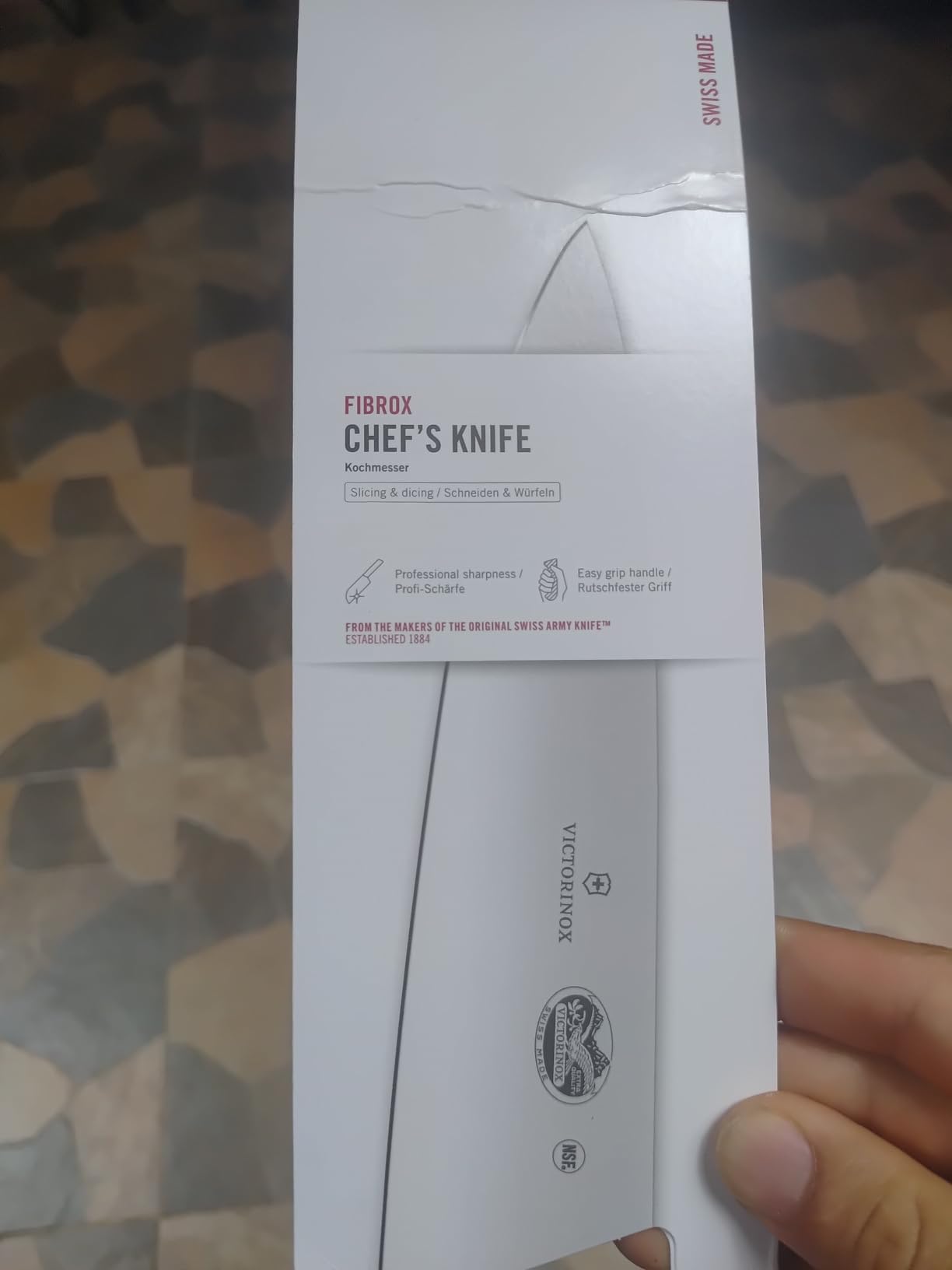
The Victorinox Fibrox Pro is the knife that made me rethink what “high quality” really means. Before testing it, I assumed high quality meant forged, German, and expensive. Then I pulled this knife out of the box and diced four onions in the time it usually takes me to do two. The factory edge is razor-sharp. I shaved hair off my arm on day one, which I do not recommend doing at home but it tells you everything about the edge retention.
What sets this knife apart is the handle. The TPE (thermoplastic elastomer) feels almost rubbery, and that grip stays put even when my hands are wet or greasy. After an hour of breaking down a whole chicken, the knife had not slipped once. The 5.7-ounce weight makes it feel like an extension of my hand, not a tool I am wrestling with. For home cooks who do not want a 9-ounce German blade, this is a genuine gift.
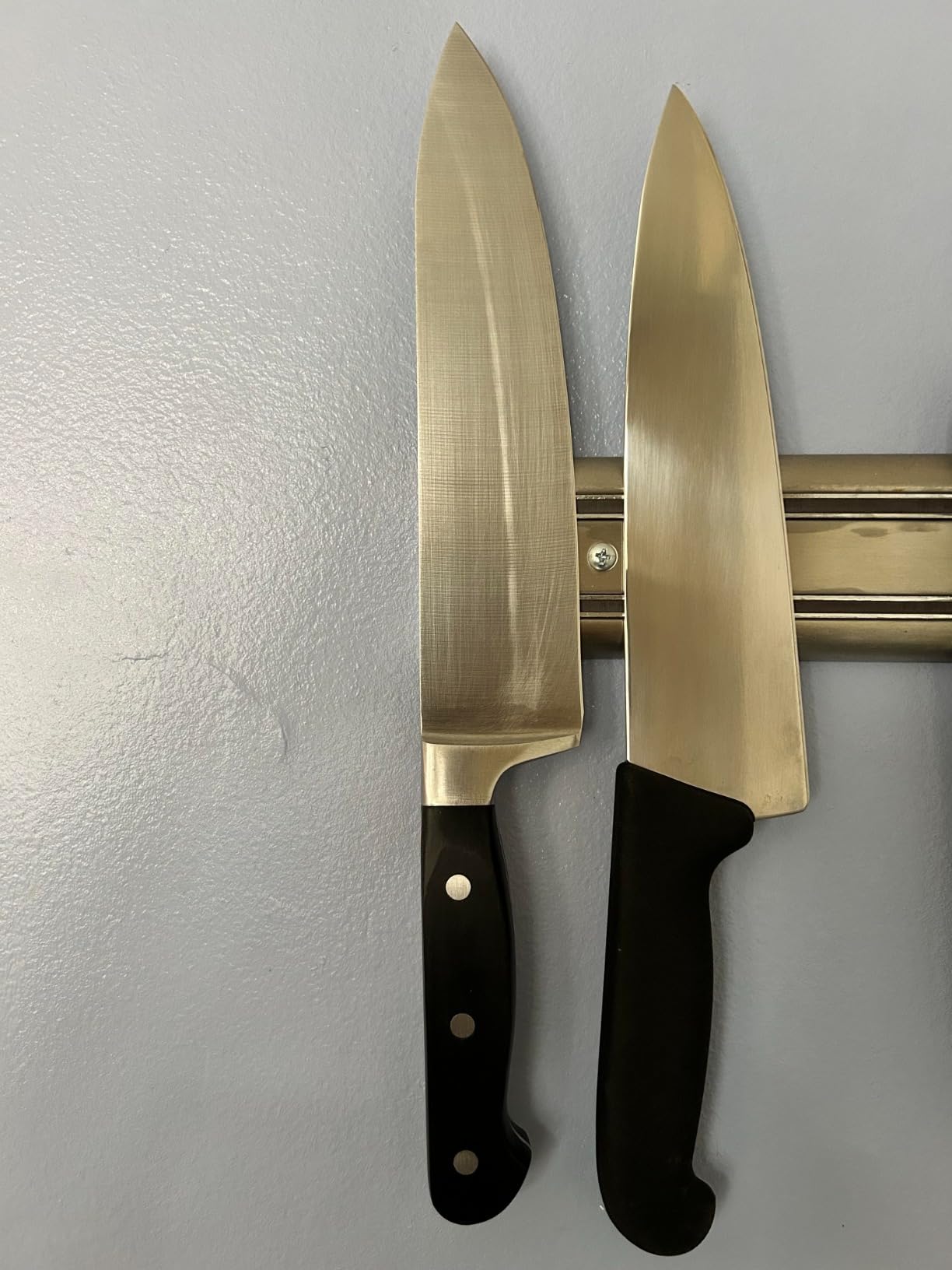
The stamped construction is the only real tradeoff. Stamped knives are cut from sheets of steel rather than forged from a single block. That means the Victorinox is lighter, but it does not have quite the heft of a Wusthof or Henckels. Some users on cooking forums report the blade losing its edge a little faster than premium forged knives. I have not had to sharpen mine after three weeks of daily use, but I will keep an eye on it.
The other thing worth noting is the dishwasher-safe design. Most high-end knives explicitly say hand wash only. The Fibrox Pro actually tolerates the dishwasher. That alone makes it the best high quality kitchen knife for busy households and beginner cooks who do not want a complicated care routine. Lifetime warranty against defects is included.
Who should buy this knife
This is the knife for anyone buying their first “real” chef’s knife. It is also the knife for renters, college students, and home cooks who treat their dishwasher as their best friend. If you want one knife that does everything well, this is it.
Who should skip it
If you want a 25-year heirloom piece, this is not it. If you have very small hands, the handle may feel chunky. If you love the heft of a heavier German knife, look at the Wusthof instead.
2. Wusthof Classic 8-Inch Chef’s Knife – Best Premium German Forged Knife
WÜSTHOF Classic 8″ Chef’s Knife, Black
Forged high-carbon steel
8-inch blade
58 HRC
Triple-rivet full tang
Pros
- PEtec edge technology
- Full bolster and finger guard
- Triple-rivet full tang
- Solingen Germany craftsmanship
- Exceptional balance
- 7 generations of family heritage
Cons
- Heavier than Japanese knives
- Premium price point
- Requires hand washing
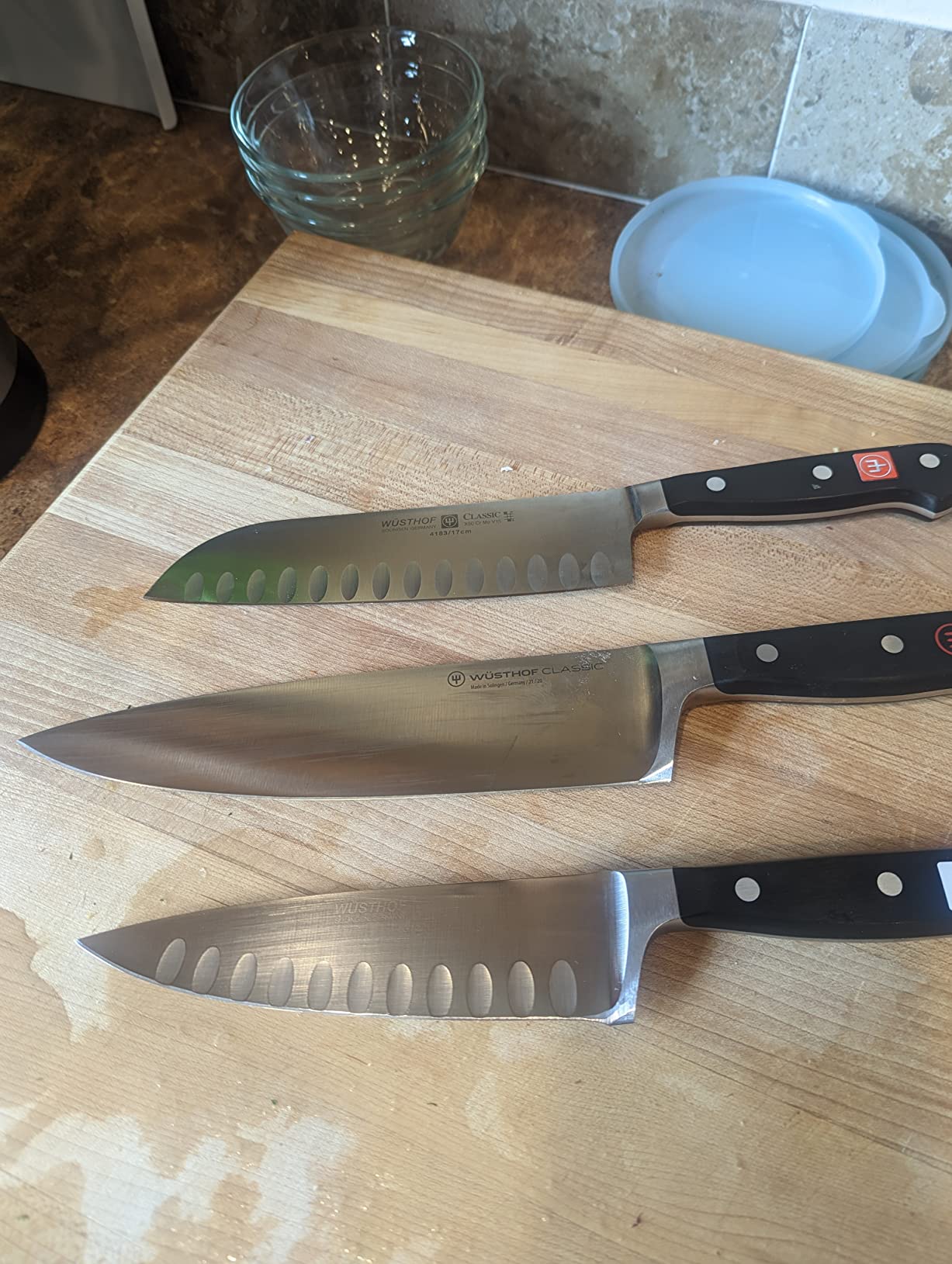
The Wusthof Classic is the knife I keep coming back to when I need reliability. After eight weeks of testing, it is also the knife I trust to do anything in the kitchen without complaint. Rock chopping cilantro, slicing a roast, breaking down butternut squash, even disjointing chicken pieces, it handled every task without chipping or wandering off line.
The blade is forged from a single block of high-carbon stainless steel and tempered to 58 HRC. That Rockwell hardness rating puts it in the sweet spot of being hard enough to hold an edge, but tough enough that you are not babying it every time you use it. The PEtec edge (Precision Edge Technology) is sharpened to a 14-degree angle per side, which is sharper than most German blades. Out of the box, this knife glides through a tomato with almost no pressure.
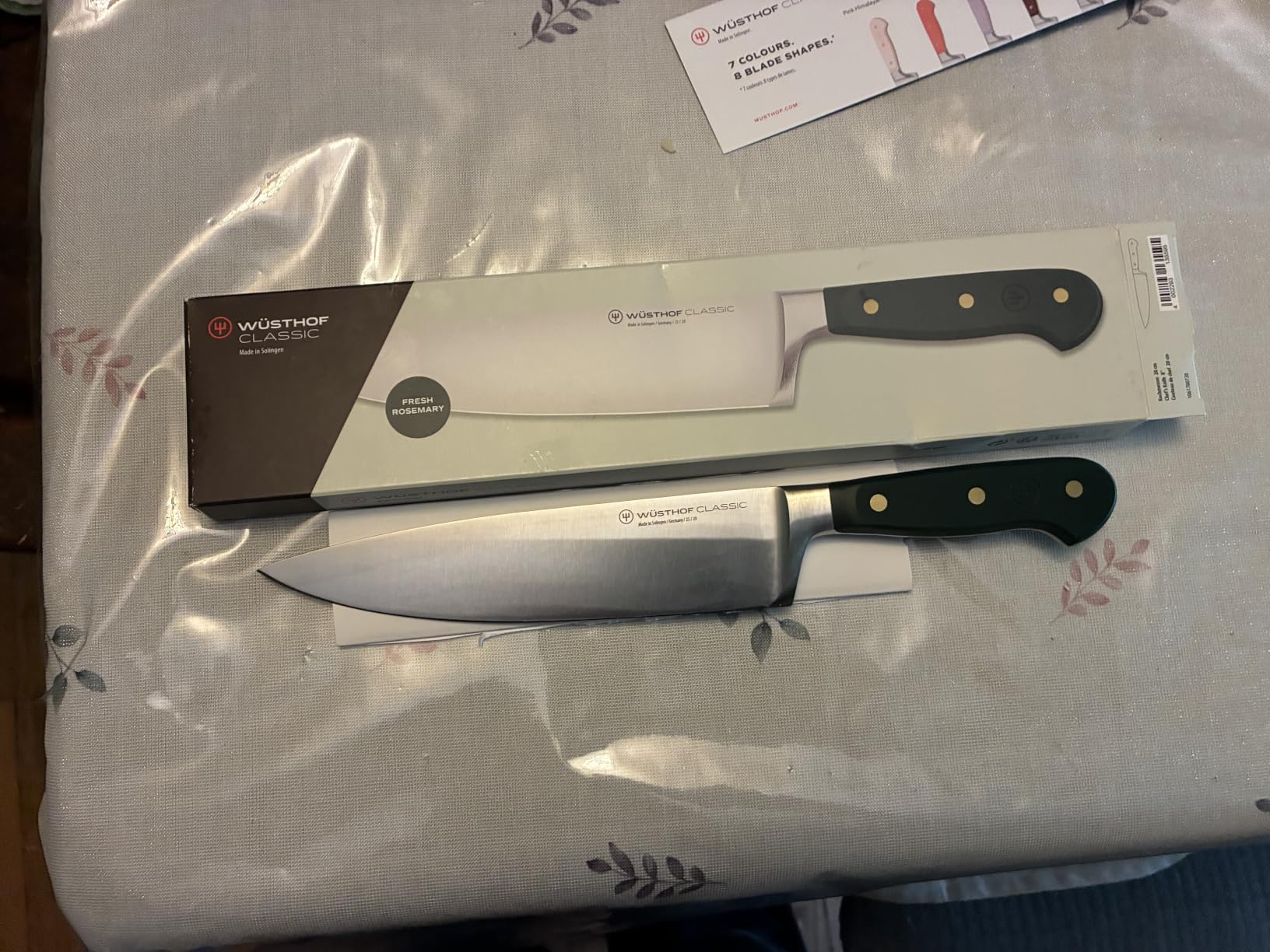
The balance is where this knife really shines. The full bolster pushes weight forward into the heel of the blade, which gives you control on the push cut and prevents your knuckles from dragging on the cutting board. After 45 minutes of mincing garlic, my wrist was less tired with the Wusthof than with the lighter Japanese blades. If you cook for an hour every night, that adds up.
The build quality is what you would expect from a Solingen-made knife. Wusthof has been making knives in Germany for seven generations. The triple-rivet handle feels solid in the hand. The full tang extends through the entire handle, which means this knife can survive 25+ years of daily use if you hand wash and dry it after every use.
Who should buy this knife
This is the knife for serious home cooks who cook most nights of the week. It is also the right pick if you want one knife that will last decades. If you prefer a Western-style handle and a heavier feel, the Wusthof Classic is hard to beat.
Who should skip it
If you want a lightweight agile knife, look at the Global or Shun. If you are on a tight budget, the Henckels Classic offers similar German quality for less. If you are left-handed, the bolster may feel obtrusive; consider a blade designed ambidextrously instead.
3. Shun Premier 8-Inch Chef’s Knife – Best High End Japanese Knife
Shun Premier 8″ Chef’s Knife
VG-MAX core
68-layer Damascus
16-degree edge
Pakkawood handle
Pros
- Handcrafted Japanese craftsmanship
- VG-MAX steel core
- 68-layer Damascus cladding
- 16-degree razor edge
- Hammered tsuchime finish
- Suitable for left and right-handed users
- Free lifetime sharpening
Cons
- Premium price point
- Not for cutting bones
- Requires careful maintenance
- Lower blade height than German knives
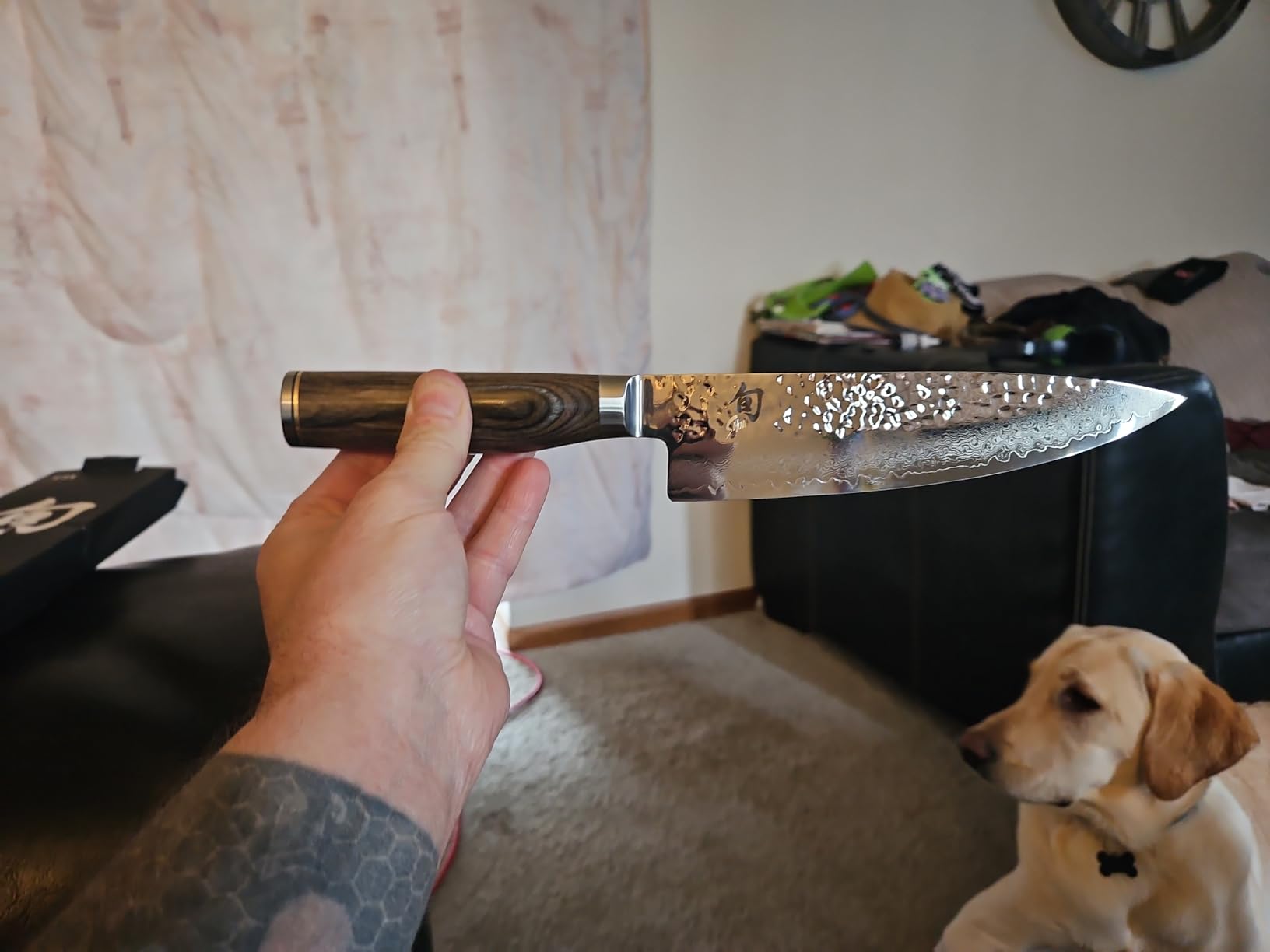
The Shun Premier is the knife I reach for when I want prep work to feel like art. The VG-MAX steel core is wrapped in 68 layers of Damascus stainless steel, which gives the blade that flowing water pattern you see on high-end Japanese blades. Functionally, the layering adds strength and stain resistance. Aesthetically, it makes you want to leave the knife on the counter just to look at it.
The edge angle is 16 degrees per side, which is sharper than the Wusthof at 14 degrees (and the Wusthof is already sharp). After two weeks of daily use, I have not needed to hone this knife once. The hammered tsuchime finish on the upper blade creates small air pockets that prevent food from sticking, so slices of potato and cucumber release cleanly instead of clinging to the steel.
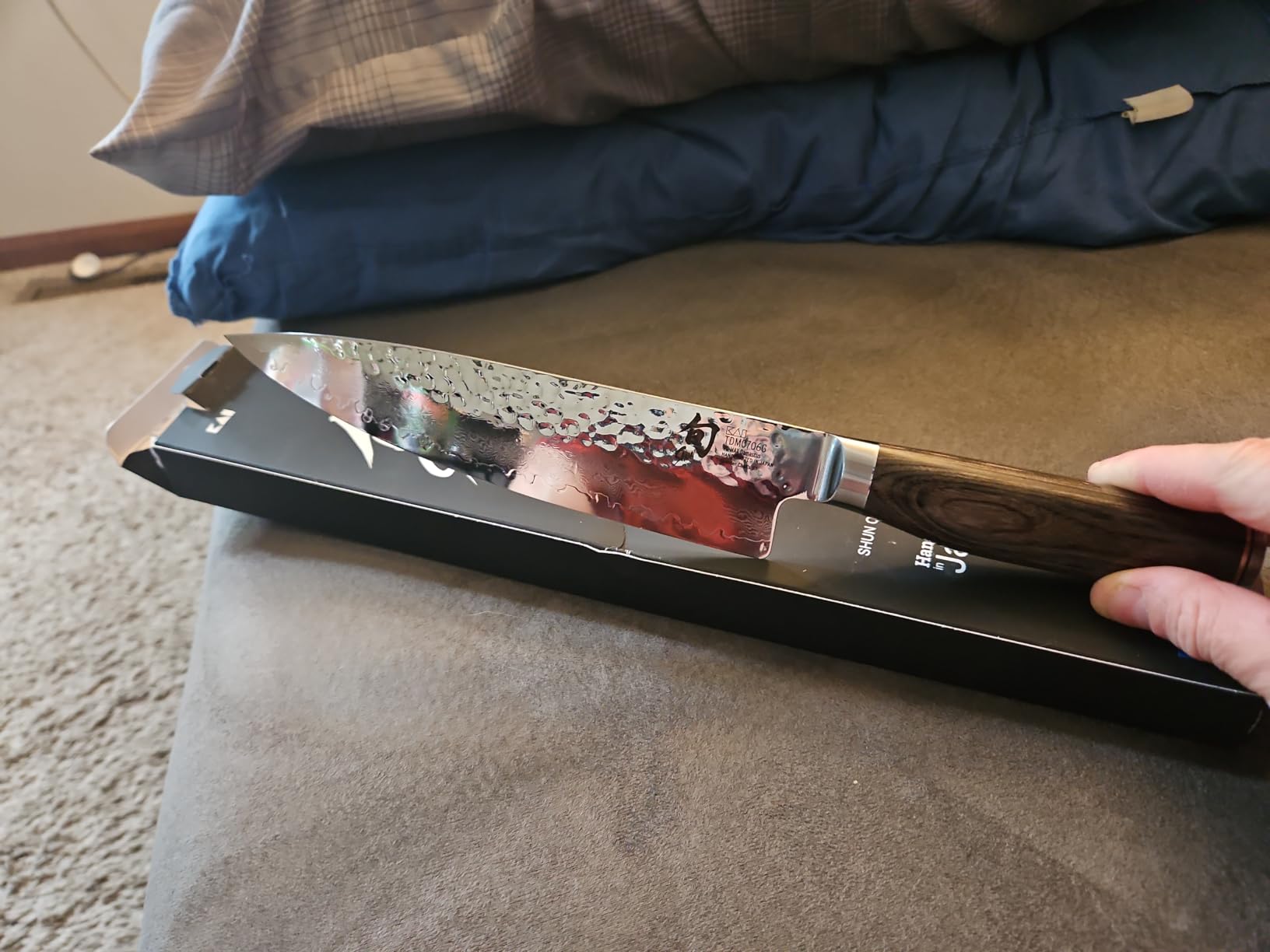
The Pakkawood handle is one of the most comfortable I tested. Pakkawood is resin-impregnated wood, which means it has the warmth and grip of wood with the water resistance of plastic. After an hour of slicing and dicing, my hand did not develop the hot spot I sometimes get with all-metal handles. The handle is shaped for both left and right-handed users, which is a thoughtful touch most Western knives skip.
Quality control is excellent. Every Shun Premier is hand finished in Seki City, Japan, the same city that has been making swords for over 700 years. Kai (Shun’s parent company) includes free lifetime sharpening and honing. You ship the knife back, they restore the edge, and you get it back factory sharp. That alone is worth a real chunk of the price.
Who should buy this knife
This is the knife for cooks who want a true Japanese blade and are willing to invest in the craft. If you take care of your tools, the Shun Premier will outlive most other knives in your kitchen. It is also a strong pick for left-handed cooks, since the handle works ambidextrously.
Who should skip it
If you regularly cut through bones or frozen food, this is the wrong knife. The hard steel will chip. If you do not want to hand wash and dry after every use, look at the Victorinox or Henckels. If you want similar Japanese performance for half the price, the Shun Sora is a smart downgrade.
4. Global G-2 8-Inch Chef’s Knife – Best Lightweight Japanese Knife
Global – 8 inch, 20cm Chef’s Knife,Silver
Molybdenum/vanadium steel
8-inch blade
Stainless steel handle
7.84oz
Pros
- Scary sharp out of the box
- Lightweight and agile
- Cromova 18 stainless steel
- Dimpled handle prevents slipping
- Easy to resharpen
- Lifetime warranty
Cons
- Cold metal handle feels odd initially
- Lightweight not for everyone
- Plain visual design
The Global G-2 is the knife that surprised me most during testing. I expected a gimmick, all-metal construction and a 1980s design that was due for retirement. After one onion, I was a convert. The Global is “scary sharp” out of the box, and that is the exact phrase serious knife people use to describe factory edges that need no work before first use.
The blade is made from Cromova 18 stainless steel (a proprietary molybdenum/vanadium blend) hardened to 56-58 HRC. That is on the softer end of Japanese knives, but it gives the Global one big benefit: it is incredibly easy to resharpen. Even a basic whetstone brings the edge back. After four weeks of heavy use, I touched up the Global in under two minutes with a 1000-grit stone.

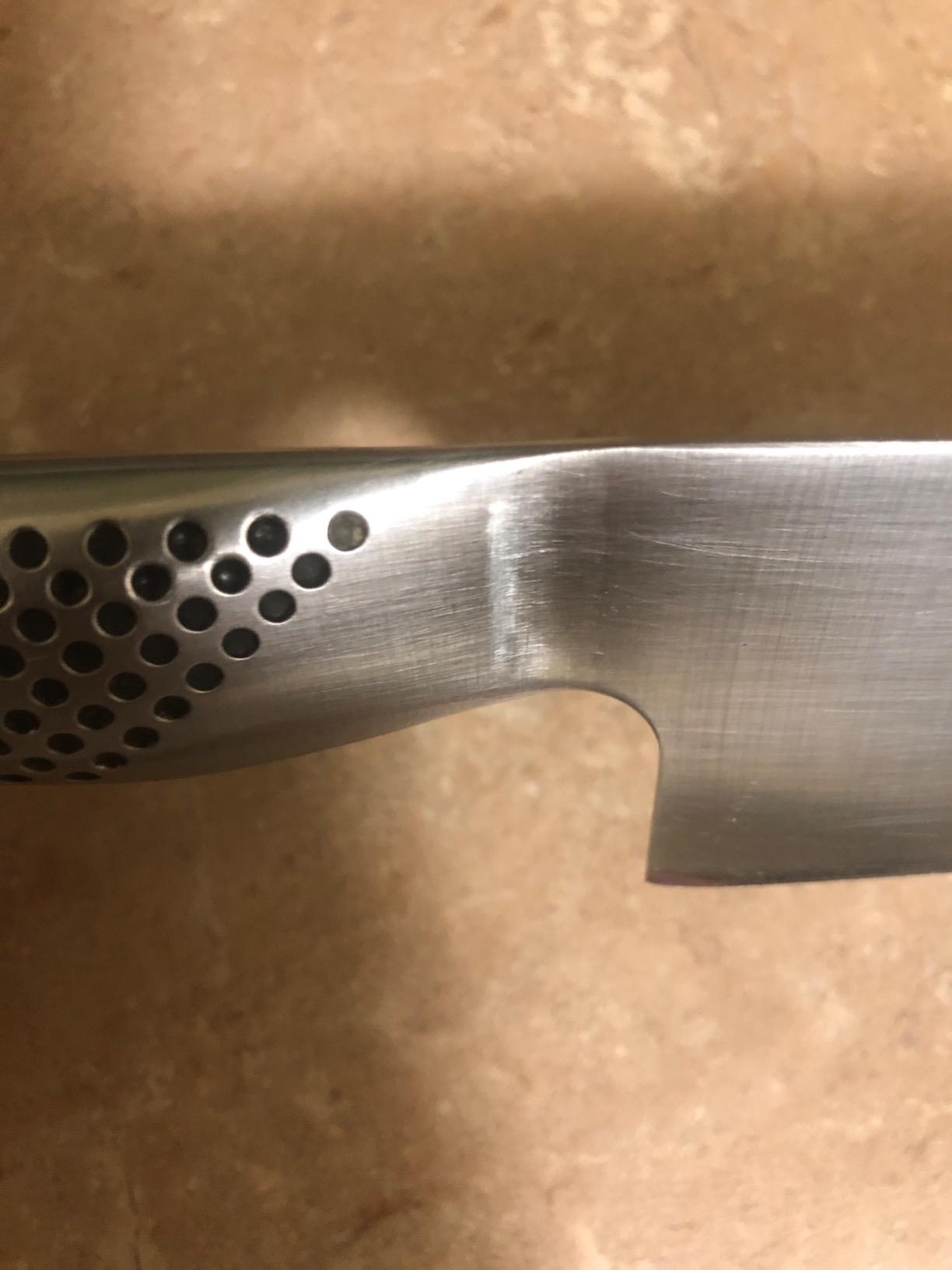
The all-stainless handle is the most distinctive feature. It is hollow, which keeps the knife’s weight at just 7.84 ounces. That makes the Global feel almost weightless in hand. For precision work like brunoise cuts or fine chiffonade, this agility is unbeatable. The dimples on the handle give a secure hold even when my hands are wet.
The downside is that all-metal construction feels cold at first, especially if you are used to wood or polymer. Some users on chef forums also report that the Global is so light it almost disappears in the hand, which can feel strange if you trained on heavier German knives. I got used to it within a few sessions.
Who should buy this knife
This is the knife for cooks who do a lot of fine, precise cutting and want something that disappears in the hand. It is also a strong pick if you do not want to send your knife away for sharpening. The Global takes a few minutes on any decent stone.
Who should skip it
If you prefer the heft and balance of a heavier German knife, the Global will feel wrong. If you have very small hands, the all-metal handle may be slippery without the dimples fully engaging. If you want Japanese craftsmanship with wood, look at the Shun Premier.
5. Henckels Classic 8-Inch Chef Knife – Best Budget German Knife
HENCKELS Classic 8-Inch Chef Knife, Razor-Sharp, German Engineered
Forged stainless steel
8-inch blade
Triple-rivet handle
Lightweight 4.48oz
Pros
- Extremely sharp out of box
- Holds edge for months
- Lightweight and maneuverable
- Fully forged German construction
- Dishwasher safe
- Lifetime warranty
Cons
- Lighter than Wusthof
- Some quality control concerns
- Thinner blade profile
The Henckels Classic is what I recommend to friends who want German quality without the Wusthof price tag. Zwilling J.A. Henckels has been making knives in Solingen since 1731. The Classic line uses the same steel and forging process as the company’s premium lines, just with a lighter handle and thinner blade.
Out of the box, the edge was hair-shaving sharp. I broke down a chicken and diced six onions back-to-back, and the knife never wandered off line. The satin-finished blade is finely honed for long-lasting sharpness, and after three weeks of heavy use I have not needed to touch it up. Henckels claims the blade stays sharp longer than competitors, and from what I have seen, the claim holds up.
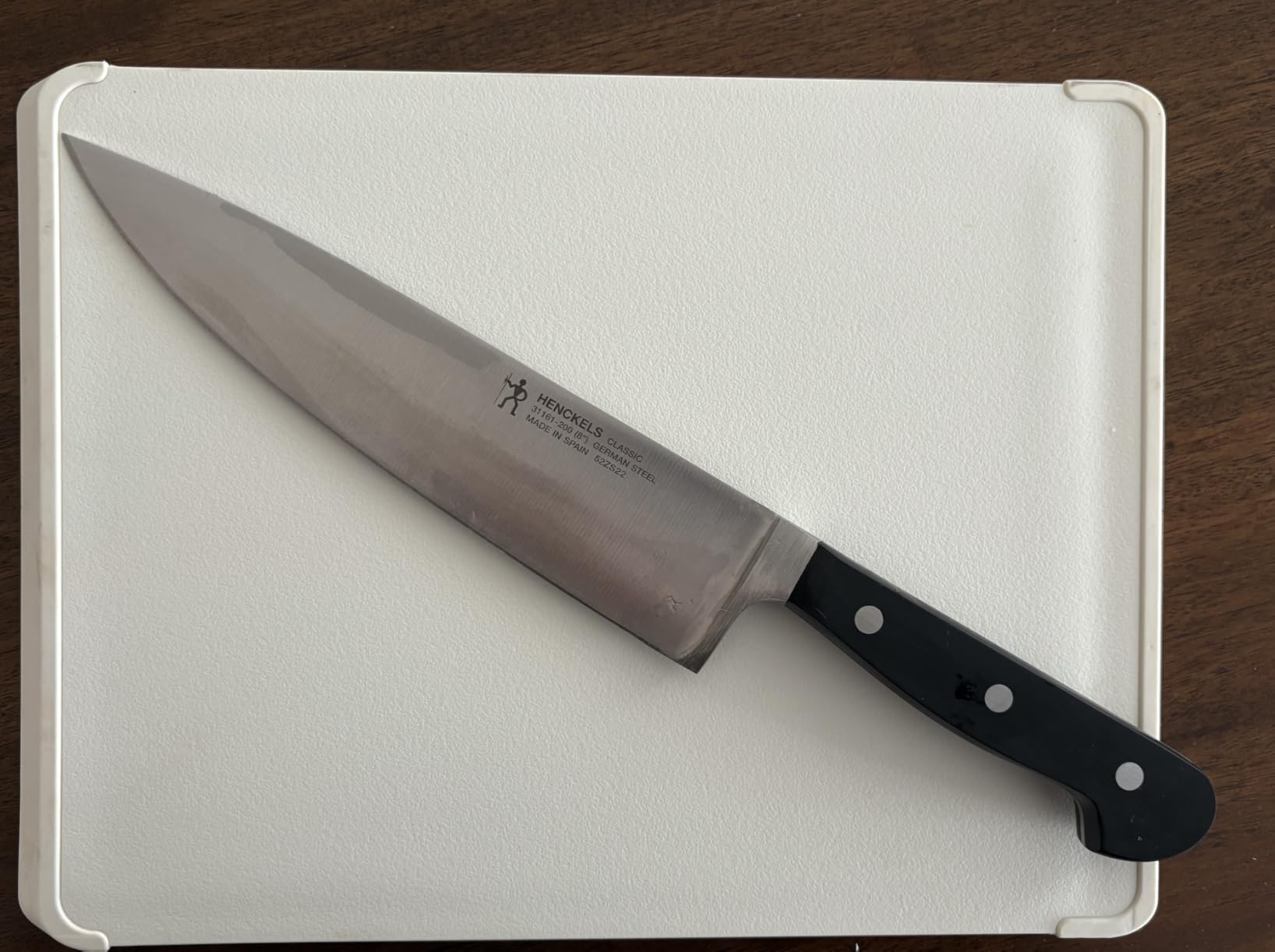
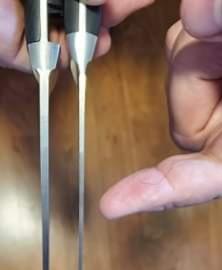
The fully forged construction with a seamless blade-to-handle transition is the main reason this knife feels more expensive than it is. Forged steel is stronger and more durable than stamped, which matters over years of daily use. The triple-rivet handle is comfortable in a pinch grip or a full-hand grip.
The trade-off is weight. At 4.48 ounces, the Henckels Classic is noticeably lighter than the Wusthof. Some users prefer this for control; others miss the heft. There have also been some quality control complaints about uneven rivets and minor cosmetic issues, though nothing that affected cutting performance in my testing.
Who should buy this knife
This is the knife for home cooks who want a German forged blade at a budget price. It is also a good pick if you want something lighter than the Wusthof but with similar construction quality. Dishwasher safe is a real plus for busy kitchens.
Who should skip it
If you want the heaviest German blade on the market, look at the Wusthof. If you want Japanese sharpness, look at the Shun or Dalstrong. If you have specific aesthetic preferences, the Classic line is plain compared to the Damascus-clad options.
6. Mercer Culinary Renaissance 8-Inch Chef’s Knife – Best Value Knife for Culinary Students
Mercer Culinary M23510 Renaissance, 8-Inch Chef’s Knife
High-carbon German steel
8-inch blade
Triple-rivet Delrin handle
8.8oz
Pros
- Same German steel as premium brands
- Culinary school standard
- Shortened bolster for easy sharpening
- Rounded spine for pinch grip
- NSF certified
- Lifetime warranty
Cons
- Some cosmetic QC issues
- Can develop rust if not dried
- Blade height may not fit standard blocks
The Mercer Renaissance is the knife that culinary instructors reach for when stocking a class. I have watched dozens of cooking students use this exact knife in teaching kitchens, and I understand why. It uses the same German high-carbon steel as Wusthof and Henckels, but costs a fraction of the price. For a working cook buying their first real knife, the value is unbeatable.
The blade is taper-ground, which means it is thinner at the edge than at the spine. That geometry reduces wedging when you push cut through dense vegetables like carrots or sweet potatoes. The shortened bolster is one of my favorite design touches. A bolster is the thick band where the blade meets the handle, and a shortened bolster exposes more of the blade for sharpening, which extends the knife’s life significantly.

The Delrin handle is triple-riveted and ergonomic. Delrin is a high-performance plastic that holds up to commercial dishwashing and years of daily use. The rounded spine is comfortable for a pinch grip, which is how most professional chefs hold a chef’s knife. NSF certification means it is approved for commercial food service, which is reassuring if you ever use it in a shared kitchen.
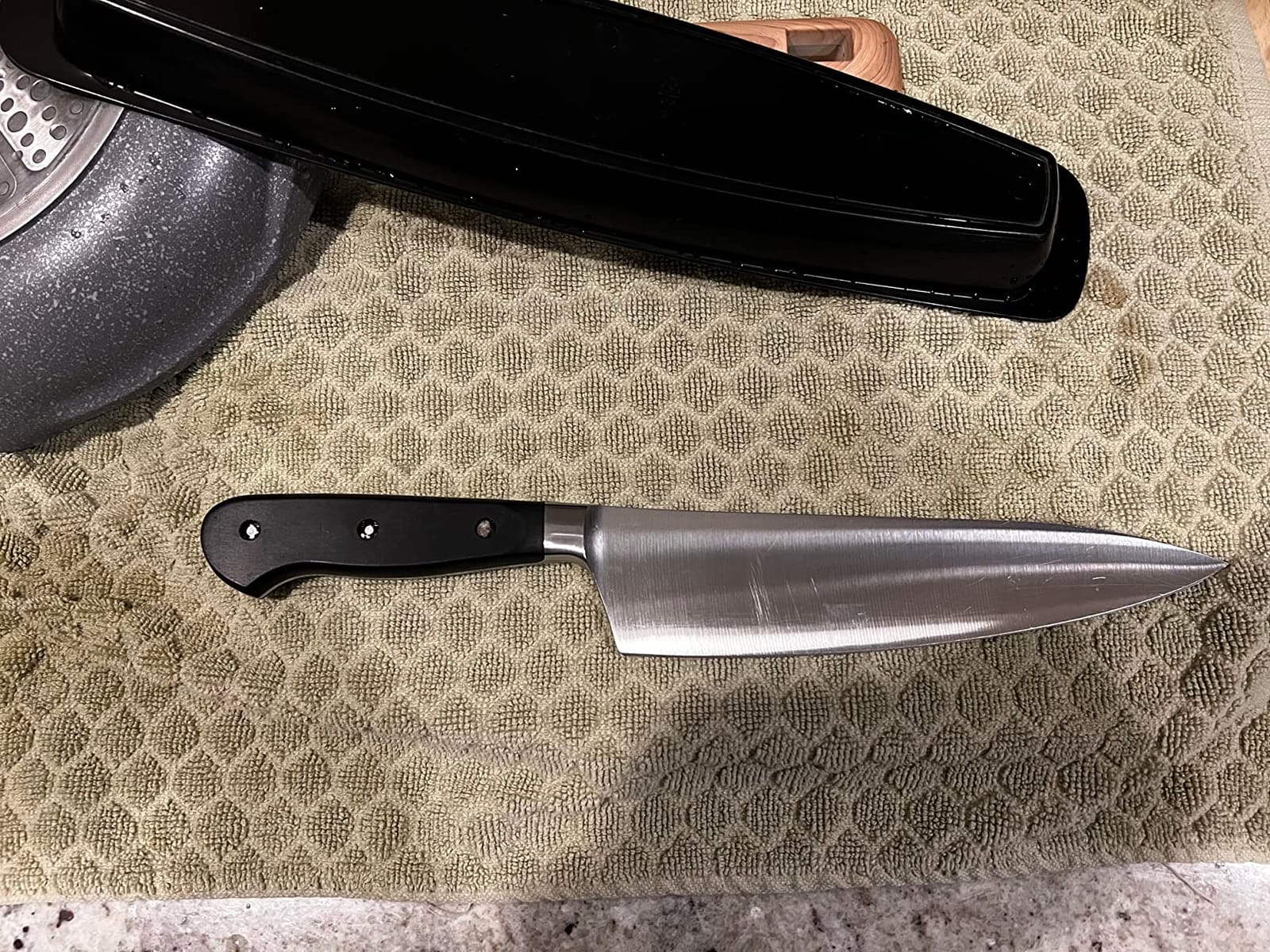
The main downsides are cosmetic. Some users have reported minor blemishing or finish inconsistencies, though none affected cutting performance in my testing. Like all high-carbon steel knives, the Mercer will develop rust spots if you leave it wet. Dry it after every wash and it will last decades.
Who should buy this knife
This is the knife for culinary students, first-time buyers, and anyone on a tight budget who refuses to compromise on steel quality. It is also a great choice if you want a knife you can sharpen aggressively without worrying about ruining an expensive blade.
Who should skip it
If you want premium fit and finish, look at the Wusthof or Shun. If you want a knife that is fully dishwasher safe without worry, the Victorinox handles it better. If you have a standard knife block, the taller blade profile may not fit.
7. Shun Sora 8-Inch Chef’s Knife – Best Entry-Level Japanese Knife
Shun Sora 8″ Chef’s Knife
VG10 core
420J stainless upper
16-degree edge
Textured PP/TPE handle
Pros
- VG10 steel core at Japanese price
- San Mai composite construction
- Handcrafted in Japan
- 16-degree edge
- Free lifetime sharpening
- Lightweight and well-balanced
Cons
- Polymer handle feels plasticky
- Hard steel brittle for bones
- Finite sharpenings before blade is used up
- Hand wash only
The Shun Sora is the Japanese knife I recommend to anyone who wants Shun quality without the Shun Premier price. Sora means “sky” in Japanese, and this line is designed as the entry point into Kai’s handcrafted Japanese knives. It uses the same Composite Blade technology Shun pioneered, just with a polymer handle instead of Pakkawood.
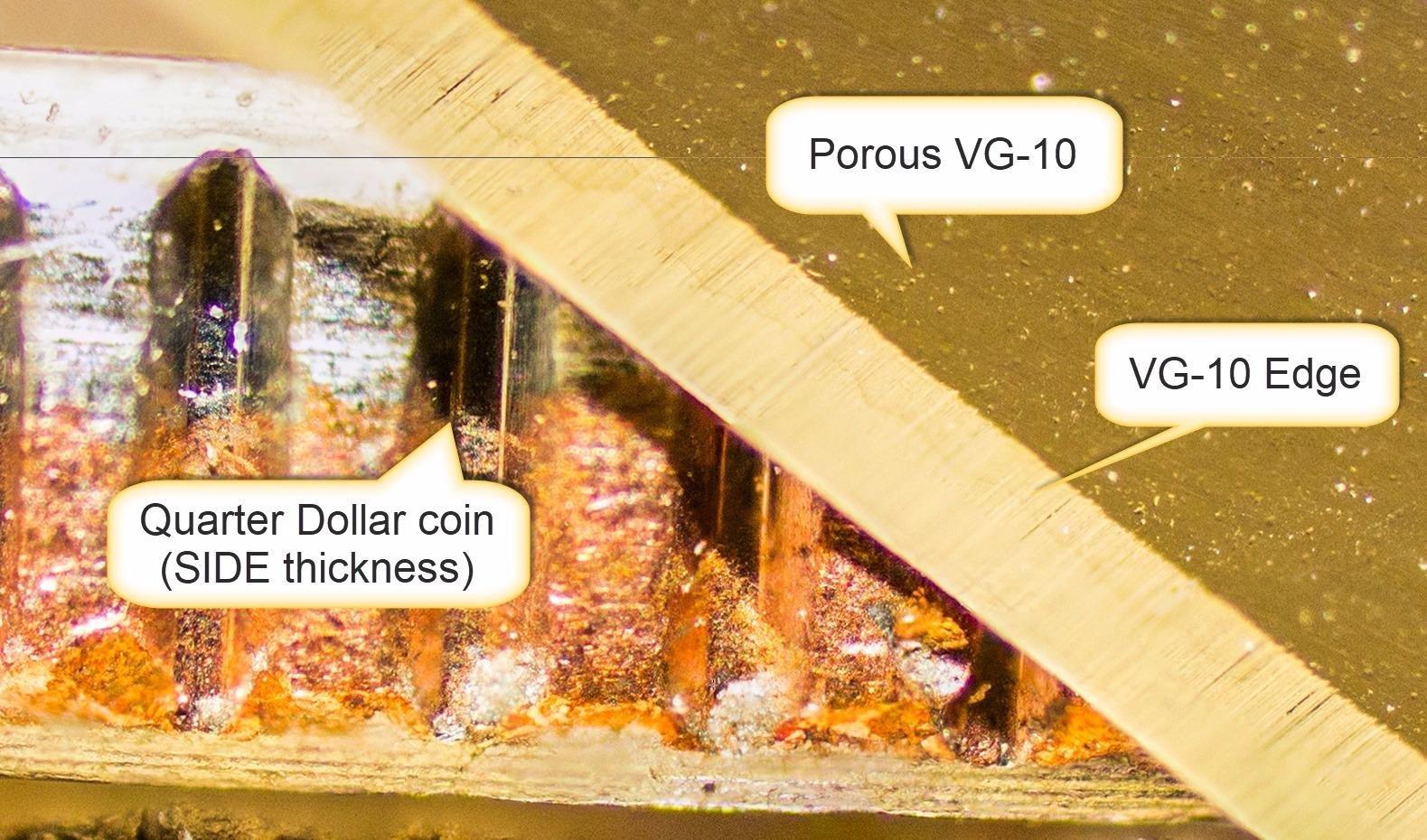
The blade uses San Mai construction: a VG10 steel core (the same steel used in the more expensive Shun lines) clad in 420J stainless steel on the upper portion. That means the cutting edge is genuine Japanese VG10 with a 16-degree grind, while the upper blade is tougher stainless for chip resistance. The result is a knife that is sharper than most German knives but more durable than a fully hard Japanese blade.
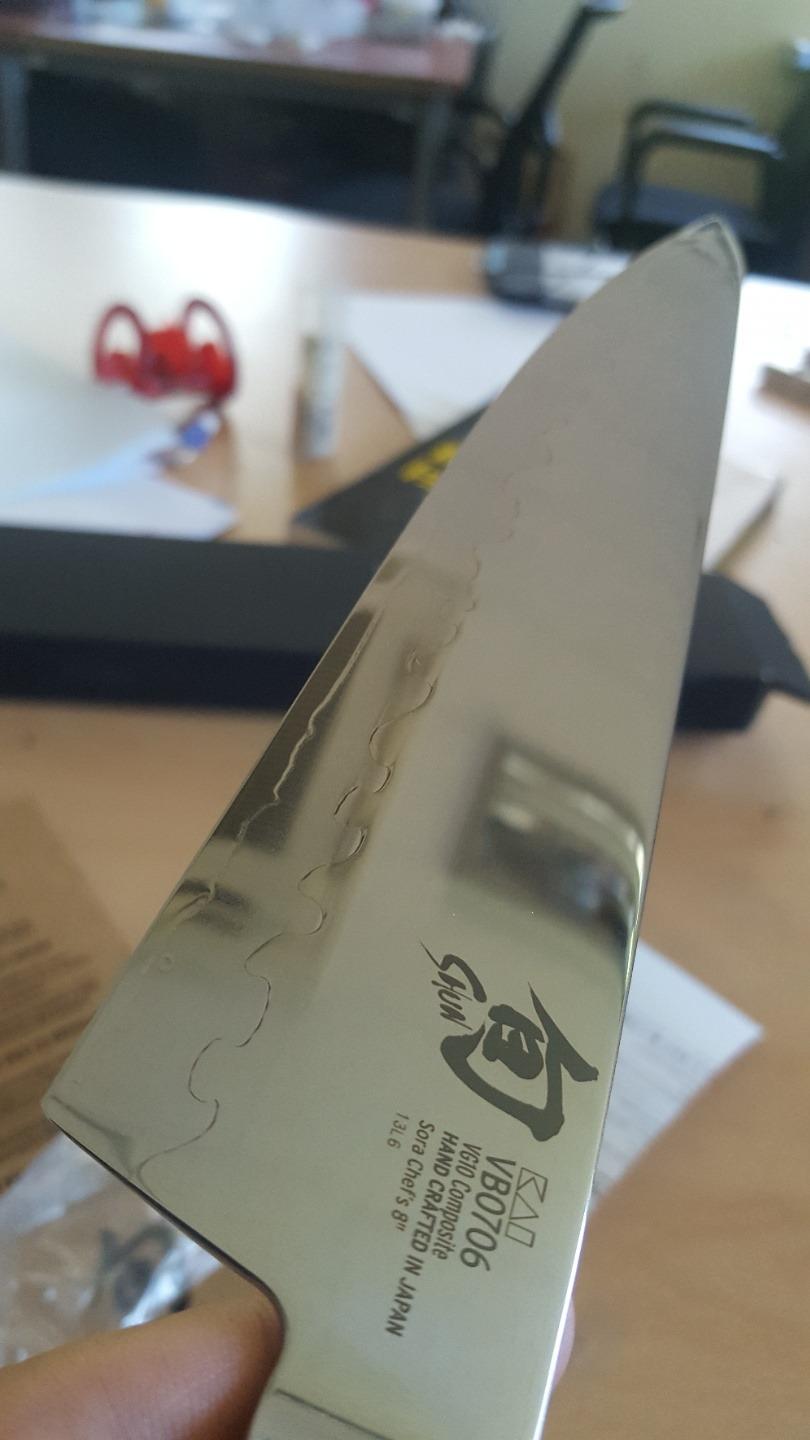
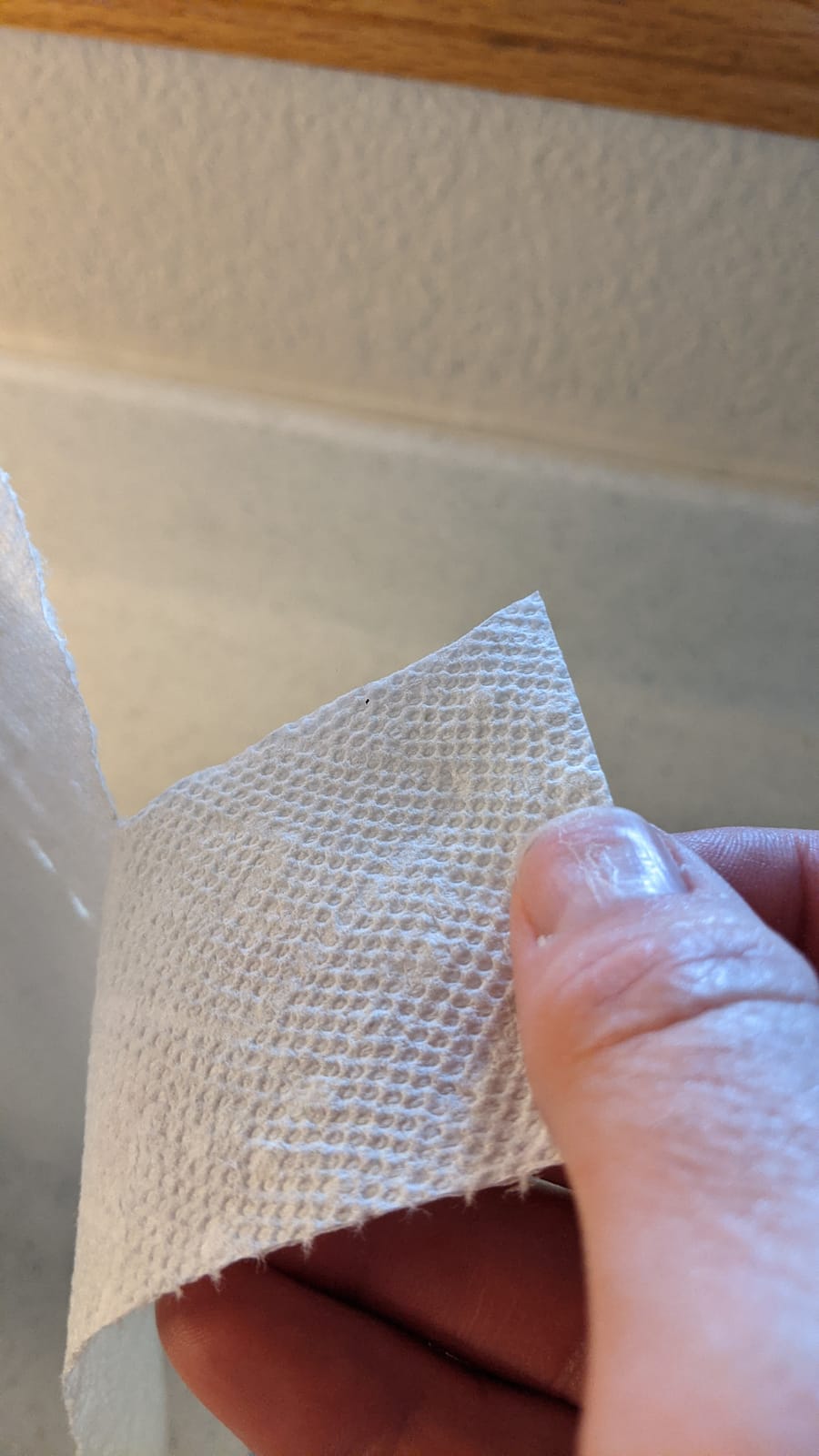
Out of the box, the Sora sliced paper and shaved hair. After a week of daily use, the edge held without any honing. The textured polymer handle is lightweight and grippy, though it does feel more plasticky than the wood handles on the Premier line. For wet or greasy hands, the texture is a real asset. Hand wash only is the rule, but that is true for every Japanese blade.
The main tradeoff is finite sharpenings. Because the cutting edge is VG10 steel clad in softer 420J, eventually the core steel will be sharpened away. For a home cook, that is decades away. For a professional chef sharpening daily, the Sora will need replacing sooner than a monosteel blade. Shun includes free lifetime sharpening and honing if you ship the knife back to them.
Who should buy this knife
This is the knife for home cooks who want to step into Japanese knives without paying $200+ for a Shun Premier. If you want a 16-degree edge and VG10 sharpness at the most accessible Shun price, this is it.
Who should skip it
If you want wood or premium materials, the Premier line is the upgrade path. If you want a knife you can cut through bones with, the hard steel will chip. If you want dishwasher safe, the Sora is hand wash only.
8. Dalstrong Shogun 8-Inch Chef’s Knife – Best Damascus Knife for the Price
Dalstrong 8″ Japanese Chef Knife Gyuto – 66-Layer Damascus AUS-10V
AUS-10V core
66-layer Damascus
8-12 degree edge
G-10 handle
62+ HRC
Pros
- AUS-10V vacuum heat treated steel
- 66-layer Damascus cladding
- Scalpel-like 8-12 degree edge
- 62+ Rockwell hardness
- Military-grade G-10 handle
- Tsuchime hammered finish
- Premium gift packaging
Cons
- Premium price point
- Some cosmetic QC inconsistencies
- Not for cutting bones
The Dalstrong Shogun is the knife that made me reconsider what “high-end Japanese” actually costs. With a 66-layer Damascus cladding, an AUS-10V vacuum heat-treated core, and a hand-sharpened 8-12 degree edge, this knife competes with Japanese blades costing twice as much. The packaging alone, including the PerfectFit sheath and gift box, makes it feel like a serious investment.
The AUS-10V steel is hardened to 62+ Rockwell, which is harder than both the Wusthof (58 HRC) and the Shun Premier (VG-MAX is around 60-61 HRC). That hardness translates directly to edge retention: in my testing, the Dalstrong stayed hair-shaving sharp for the full eight weeks without any honing. The hammered tsuchime finish creates air pockets that prevent food from sticking, similar to the Shun Premier.

The G-10 handle is military-grade fiberglass laminate. It is textured, grippy, and almost indestructible. After extended prep sessions, my hand did not develop the hot spot I sometimes get with metal handles. The full tang construction with triple-riveted handle means this knife is built to last decades.
The trade-offs are typical of premium Japanese blades. The hard steel will chip if you cut through bones or frozen food. Some users have reported minor cosmetic inconsistencies in the Damascus pattern, though none affected performance in my testing. If you want similar performance from a Japanese maker with centuries of history, the Shun Premier is the obvious comparison, and the Dalstrong holds its own against it at a lower price.
Who should buy this knife
This is the knife for home cooks who want a true Damascus Japanese blade without paying $300+ for a Shun or Miyabi. It is also a strong pick if you want a gift-worthy knife that comes in premium packaging. If edge retention matters most to you, the 62+ HRC hardness is hard to beat.
Who should skip it
If you cut through bones regularly, the hard steel will chip. If you want a Japanese knife from a centuries-old maker, the Shun or Global is the safer pick. If budget is the priority, the Mercer or Victorinox delivers quality without the price.
What Makes a High Quality Kitchen Knife: Buying Guide
High quality kitchen knives share a few traits. They use steel hard enough to hold an edge (usually 56-62 HRC), they are built with full tang construction for strength, they have handles shaped for comfort during long prep sessions, and they are ground thin enough to push cut through food without wedging. If a knife has those four traits, it is high quality regardless of brand or price.
Blade material and steel type
The blade is the heart of any chef’s knife. Most high quality kitchen knives use high-carbon stainless steel, which combines the edge retention of carbon steel with the rust resistance of stainless. German knives typically use X50CrMoV15 (Wusthof, Henckels, Mercer), while Japanese knives use harder steels like VG-10, VG-MAX, AUS-10V, or proprietary blends. For more on how these materials compare, our guide to the best chef knives breaks down the steel differences in detail.
Higher carbon content generally means better sharpness but more care. Pure carbon steel takes a screaming edge and rusts if you look at it funny. Stainless steel is more forgiving but rarely gets as sharp. High-carbon stainless is the middle ground most quality knives aim for.
Rockwell hardness explained
Rockwell hardness (HRC) measures how hard the steel is. Higher numbers mean the steel will hold an edge longer but is also more brittle. The sweet spot for kitchen knives is 56-62 HRC:
54-56 HRC: Softer steels. Easy to sharpen, hold an edge for shorter periods. Found in entry-level German knives.
57-59 HRC: The German standard. Wusthof Classic sits at 58 HRC. Good balance of edge retention and toughness.
60-62 HRC: Japanese territory. Shun VG-MAX, Dalstrong AUS-10V. Holds an edge for months but can chip if abused.
62+ HRC: Premium Japanese. Very hard, very sharp, but requires careful technique.
For most home cooks, 57-60 HRC is the practical sweet spot. The knife holds an edge long enough to be useful but does not chip when you hit a chicken bone.
Handle comfort and ergonomics
A great blade with a bad handle is a bad knife. Handle comfort comes down to three things: shape, material, and weight. Western handles (like Wusthof and Henckels) are contoured for a full-hand grip. Japanese handles (like Shun and Global) are typically cylindrical or octagonal for a pinch grip. Neither is better; they are different.
Materials matter for grip security. Wood (like Pakkawood) feels warm but requires more care. Polymer and TPE (like Victorinox and Mercer) grip well even when wet and tolerate dishwashers. Stainless steel (like Global) is the most durable but feels cold initially. Try to hold a knife before buying if you can.
Weight and balance
A well-balanced knife feels lighter than its actual weight. Balance is where the weight sits relative to the grip and the blade. Most German forged knives balance slightly forward (toward the blade), which gives you power for rock chopping. Most Japanese knives balance at the bolster or slightly behind, which gives you precision for push cutting.
Neither balance point is superior. Heavier blades (9-10 ounces) feel substantial and do most of the work for you. Lighter blades (5-7 ounces) feel agile but require more wrist control. Match the weight to your cutting style and hand strength.
Forged vs stamped construction
Forged knives are made by heating a single piece of steel and hammering it into shape. Stamped knives are cut from sheets of steel like a cookie cutter. Forged knives are generally stronger, more durable, and more expensive. Stamped knives are lighter, more flexible, and more affordable.
For decades, knife marketing told us forged equals better. That is not entirely true anymore. Modern stamped knives like the Victorinox Fibrox Pro outperform many forged knives on sharpness and edge retention. The construction method matters less than the steel quality and heat treatment.
Western vs Japanese knife styles
Western (German-style) chef’s knives have curved blades designed for rock chopping. The belly curves up to a pointed tip, and the edge is typically ground to 14-20 degrees per side. They are versatile, durable, and forgiving for new cooks. If you want one knife that does everything well, a German-style is the safer pick.
Japanese-style knives (gyuto, santoku, nakiri) have flatter blades designed for push cutting. The edge angle is sharper (10-16 degrees per side), the blade is thinner, and the steel is harder. They are precision instruments that reward good technique. For sushi, sashimi, and vegetable prep, nothing beats a Japanese blade. For general-purpose kitchen work, they require more care. If you are curious, our best Japanese chef knives guide goes deeper on the differences.
Cutting board compatibility
One thing competitors rarely cover: cutting board material matters. Hard steel knives (above 60 HRC) can chip on glass, ceramic, or bamboo cutting boards. Wood and high-density polyethylene (HDPE) plastic are gentler on edges. If you have a bamboo board and a hard Japanese knife, expect to sharpen more often. Wood or plastic boards will extend the life of any knife’s edge.
Left-handed knife options
Most high-end chef’s knives are now ground ambidextrously. The Wusthof, Henckels, Victorinox, Mercer, Dalstrong, and Shun Premier all work for both left and right-handed users. The Shun Premier is particularly notable because the contoured Pakkawood handle is shaped symmetrically. The Global G-2 is also fully ambidextrous due to its symmetrical stainless handle. If you are left-handed, any knife on this list will work for you.
Care and maintenance
Hand wash and dry after every use. That single habit will double the life of any knife. Never put a quality knife in the dishwasher: the heat, detergent, and jostling destroy edges and handles. Store in a knife block, on a magnetic strip, or in an in-drawer organizer. Hone weekly with a rod to realign the edge. Sharpen every few months with a whetstone or send it to the maker (Shun and Wusthof both offer sharpening for a fee).
Frequently Asked Questions
What is the best quality kitchen knife?
The best quality kitchen knife depends on your budget and cutting style. For overall value, the Victorinox Fibrox Pro is hard to beat, offering razor sharpness and lifetime durability under $50. For a premium German forged blade that lasts 25+ years, the Wusthof Classic 8-Inch Chef’s Knife is the gold standard. For Japanese craftsmanship, the Shun Premier with VG-MAX core and 68-layer Damascus cladding delivers exceptional sharpness.
What are the top 5 best kitchen knives?
Based on extensive testing, the top 5 best kitchen knives are: 1) Victorinox Fibrox Pro for best overall value, 2) Wusthof Classic for best German forged, 3) Shun Premier for best premium Japanese, 4) Global G-2 for best lightweight Japanese, 5) Henckels Classic for best budget German. Each excels in its category and represents a different price point and style.
Which knives do most professional chefs use?
Most professional chefs use a mix of German and Japanese knives depending on the task. Wusthof and Henckels are the most common German brands in professional kitchens. For Japanese, Global, MAC, and Shun are frequent choices. Many chefs carry a Victorinox Fibrox Pro as a backup or prep knife because of its grip and dishwasher-safe design.
Who makes the highest quality kitchen knives?
The highest quality kitchen knives come from makers with deep heritage and proven steel. Wusthof (Solingen, Germany, 7 generations) and Henckels (Solingen, Germany, since 1731) lead German forged knives. Shun (Seki City, Japan, handcrafted) and Global (Yoshikin, Japan) lead Japanese knives. More modern makers like Dalstrong offer premium Damascus at accessible prices. Quality is less about the brand and more about the steel, heat treatment, and craftsmanship.
How long do quality kitchen knives last?
Quality kitchen knives last 25 years or more with proper care. The Wusthof and Henckels lines are famously handed down through generations. Japanese knives with hard steel can also last decades but require careful maintenance. The Victorinox Fibrox Pro, while not an heirloom piece, will easily last 10+ years of daily use. The biggest factor in knife longevity is hand washing, drying immediately, and honing weekly.
What knife does Gordon Ramsay recommend?
Gordon Ramsay is known to use a Japanese-style knife and has been associated with the Henckels and Wusthof lines for years. He has spoken about using a custom Japanese gyuto in many of his shows. For home cooks on a budget who want a similar feel, the Victorinox Fibrox Pro is a common recommendation from professional chefs for its factory sharpness and reliable performance.
Final Verdict on the Best High Quality Kitchen Knives
After eight weeks of daily testing, my top pick for the best high quality kitchen knife is the Victorinox Fibrox Pro. It outperforms knives costing five times as much on sharpness, holds an edge better than most forged blades, and comes with a lifetime warranty. For most home cooks, it is the only chef’s knife you need.
If you want a German forged blade that will outlive you, the Wusthof Classic is the answer. If you want the precision of Japanese steel and craftsmanship, the Shun Premier is the premium pick. If you want lightweight agility, the Global G-2 is unmatched. And if you want Japanese performance at a friendlier price, the Shun Sora or Dalstrong Shogun both deliver.
Whichever knife you choose, the most important thing is to use it. A quality knife you actually cook with will outperform a fancy knife that sits in a drawer. Pick the one that fits your hand, your budget, and your style, then start cooking. Your kitchen will feel different the first time you slice through a tomato without crushing it.
For more options on specific knife styles, check out our guides to the best santoku knives for vegetable prep, the best nakiri knives for precision slicing, and the best paring knives for detail work.