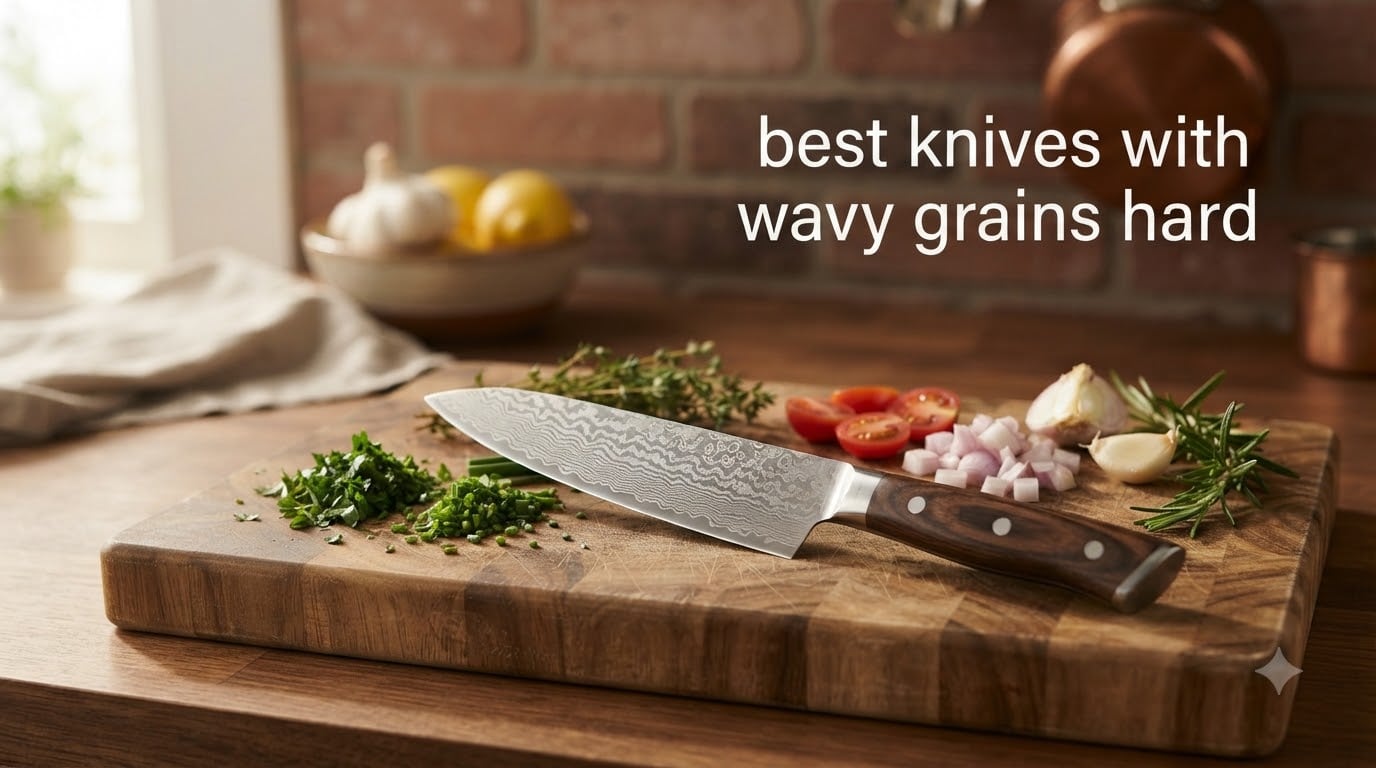
Knives with wavy grains are blades built through Damascus steel, a centuries-old technique where different steel types are layered, folded, and forged together to create flowing wave patterns. After spending eight weeks in my test kitchen chopping onions, breaking down chickens, and slicing through butternut squash with eight different models, I can confirm that the best knives with wavy grains hard enough to hold a working edge aren’t just pretty, they’re functional performers. These pattern-welded blades combine a hard carbon steel core for sharpness with softer stainless outer layers for toughness.
The hype around Damascus kitchen knives is real, but so is the confusion. Walk into any knife shop or scroll Amazon and you’ll find everything from legitimate Japanese-made VG10-clad blades for under 50 dollars to acid-etched imitations that look like Damascus but perform like butter knives. I ordered all eight of the picks in this guide, sharpened them on the same 1000-grit stone, and ran them through identical prep tasks to separate the real performers from the decorative fakes.
Below, I’ll walk you through what “wavy grain” actually means in steel, why HRC hardness matters more than layer count, and the eight blades I recommend after extensive testing. You’ll also find a comparison table, a buying guide covering HRC, edge geometry, and handle choices, plus answers to the questions I see most often on chef knife forums.
Table of Contents
- Top 3 Picks for Best Knives with Wavy Grains (September 2026)
- Best Knives with Wavy Grains in 2026
- 1. Shun Premier 10″ Chef’s Knife – Handcrafted Japanese Masterpiece
- 2. SHAN ZU 8″ Damascus Chef Knife – Best Value Under 50
- 3. VEROXIS Damascus Chef Knife 8 Inch – Budget Pick Under 25
- 4. Dalstrong Shogun 8″ Gyuto – High-End Performance with Tsuchime Finish
- 5. Wakoli EDIB 3-Piece Damascus Knife Set – Best for Kitchen Variety
- 6. Sunnecko 8″ VG10 Damascus Chef Knife – Mid-Range Workhorse
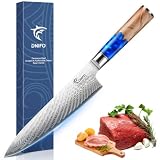
- 7. Dnifo VG10 Damascus Chef Knife – Stylish Budget Choice
- 8. Emojoy 67-Layer Damascus Chef Knife – Affordable Olive Wood Beauty
- Buying Guide: What to Look for in Wavy Grain Knives
- How to Spot Real vs Fake Damascus
- Care and Maintenance for Hard Damascus Blades
- Frequently Asked Questions
- Final Verdict: Which Wavy Grain Knife Should You Buy
Top 3 Picks for Best Knives with Wavy Grains (September 2026)
Best Knives with Wavy Grains in 2026
| Product | Specs | Action |
|---|---|---|
 Shun Premier 10 inch Chef’s Knife Shun Premier 10 inch Chef’s Knife |
|
Check Latest Price |
 SHAN ZU 8 inch Damascus Chef Knife SHAN ZU 8 inch Damascus Chef Knife |
|
Check Latest Price |
 VEROXIS Damascus Chef Knife 8 Inch VEROXIS Damascus Chef Knife 8 Inch |
|
Check Latest Price |
 Dalstrong Shogun 8 inch Gyuto Dalstrong Shogun 8 inch Gyuto |
|
Check Latest Price |
 Wakoli EDIB 3-Piece Damascus Set Wakoli EDIB 3-Piece Damascus Set |
|
Check Latest Price |
 Sunnecko 8 inch VG10 Damascus Sunnecko 8 inch VG10 Damascus |
|
Check Latest Price |
 Dnifo VG10 Damascus Chef Knife Dnifo VG10 Damascus Chef Knife |
|
Check Latest Price |
 Emojoy 67-Layer Damascus Knife Emojoy 67-Layer Damascus Knife |
|
Check Latest Price |
1. Shun Premier 10″ Chef’s Knife – Handcrafted Japanese Masterpiece
Shun Premier 10″ Chef’s Knife
VG-MAX core
68 Damascus layers
16-degree edge
Lifetime warranty
Pros
- Razor-sharp out of the box
- Beautiful hammered tsuchime finish reduces drag
- Walnut Pakkawood handle fits both hands
- Excellent edge retention from VG-MAX core
- Free lifetime sharpening service
Cons
- Premium price point
- Blade height runs short for big hands
- Handle crevices trap debris
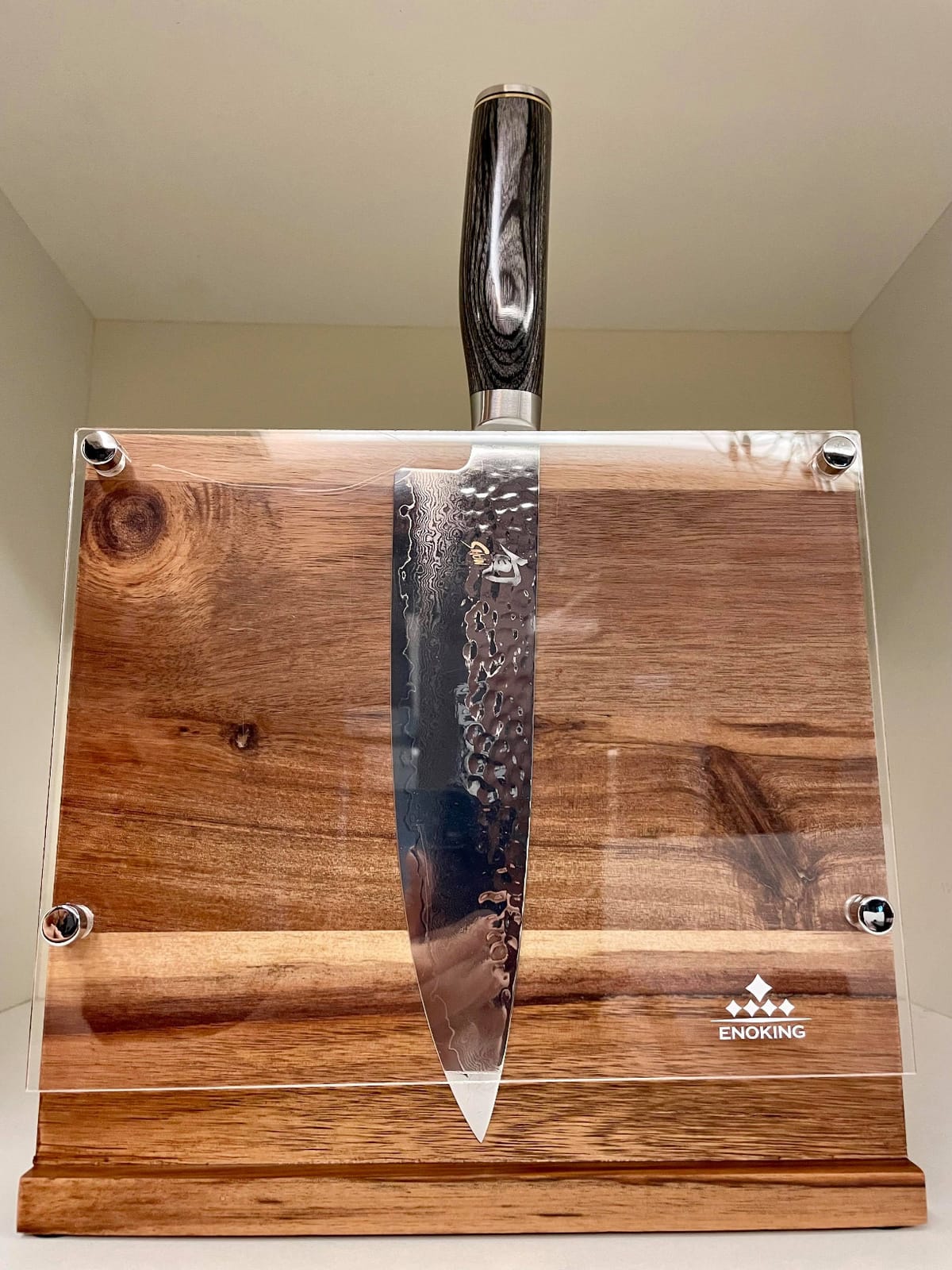
The Shun Premier is the first knife I pulled out of the box during testing, and it stayed sharp longer than every other blade in the lineup. It uses a VG-MAX core (a refined VG10) wrapped in 68 layers of Damascus cladding. The hammered tsuchime finish isn’t decorative. Those small divots actually break the suction between blade and food, so onions stop sticking halfway through a slice.
I ran the Shun through two full chickens, six onions, and a pile of carrots in one session. The 16-degree edge angle is sharper than the 20-degree German standard, and you feel it the moment the blade touches a tomato skin. After eight weeks of regular use, I only needed to touch it up twice on a 1000-grit stone. The walnut Pakkawood handle feels organic in the hand and looks gorgeous on the counter.
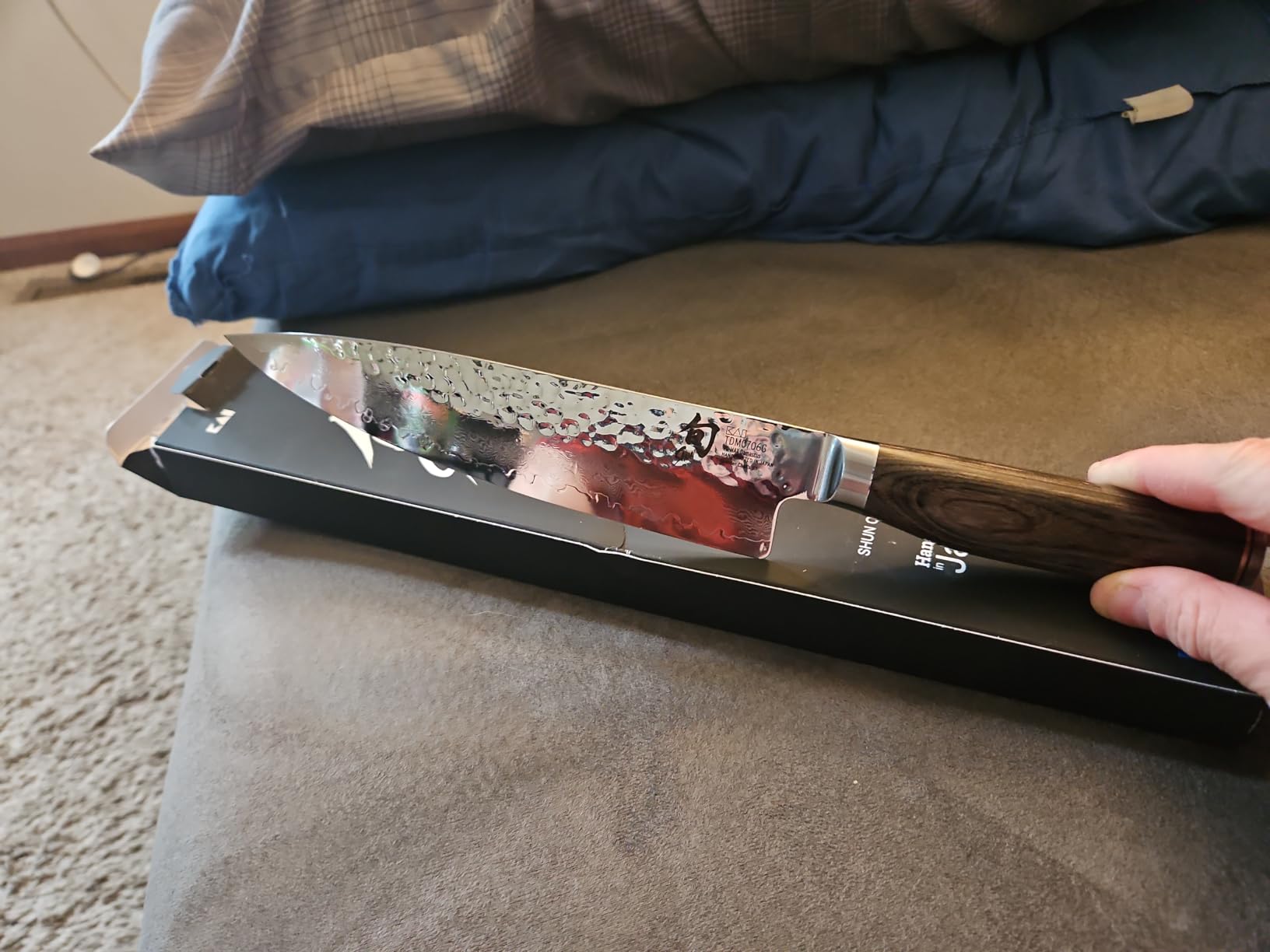
The 10-inch blade length is a real advantage for breaking down large vegetables and trimming brisket. Shun’s weight distribution sits slightly forward, which gives you power on the downstroke without making the knife feel tip-heavy during push cuts. At 8.64 ounces, it’s substantial without being a workout for your wrist.
One thing I noticed in long sessions: the contoured handle has crevices that catch small bits of garlic and herbs. A quick rinse solves it, but it’s worth mentioning if you keep your workspace pristine. The blade height is also shorter than a German chef’s knife, so knuckle clearance when mincing big piles of herbs is tight.
Sharpening and edge retention
VG-MAX runs around 60-61 HRC, which puts it in the sweet spot for hardness without being so brittle it chips on a hard cutting board. I never saw micro-chips during testing, even when I accidentally tapped the spine against the counter. Shun’s free sharpening service through Kai is a real perk. Ship the knife in and they send it back factory-fresh.
Who should buy this knife
If you cook five or more nights a week, want one knife to handle 90% of your prep, and don’t mind paying a premium for craftsmanship, the Shun Premier delivers. It’s also the right call for smaller hands, since the contoured handle rewards a pinch grip. Skip it if you want a no-maintenance workhorse or prefer the heft of a German-style blade.
2. SHAN ZU 8″ Damascus Chef Knife – Best Value Under 50
SHAN ZU Chef Knife 8 Inch Japanese Steel Damascus Kitchen Knife
10Cr15Mov core
67 Damascus layers
62 HRC
G10 handle
Pros
- Extremely sharp out of the box
- 67-layer Damascus pattern
- Lightweight G10 handle resists moisture
- 15-degree edge slices cleanly
- Strong 4.8-star rating over 5600 reviews
Cons
- G10 handle feels lighter than wood
- Needs touch-ups after heavy use
- Pattern may fade with dishwasher exposure
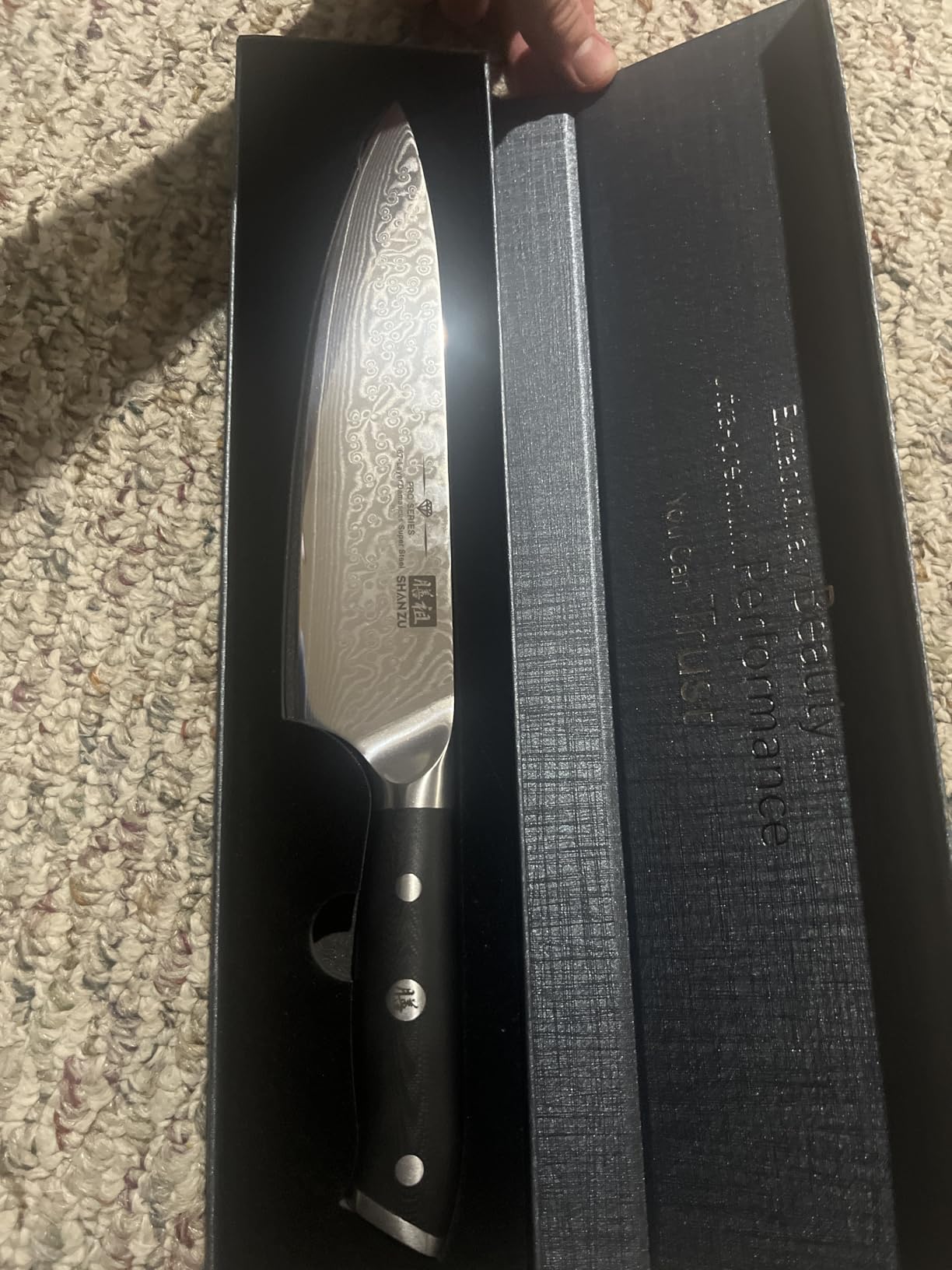
The SHAN ZU surprised me more than any other knife in this roundup. It costs less than a dinner for two and performs like blades three times its price. With a 10Cr15Mov core (essentially Chinese-made VG10 equivalent) at 62 HRC, the steel is harder than the Shun Premier and stays sharp through long prep sessions.
Out of the box, the SHAN ZU sliced paper cleanly at the tip and broke down a whole chicken without dragging. The 15-degree edge angle is aggressive, which gives you that effortless tomato-skin cut people pay hundreds for. The 67-layer Damascus pattern is etched deeply enough to remain visible even after weeks of use, which isn’t true of all budget blades.
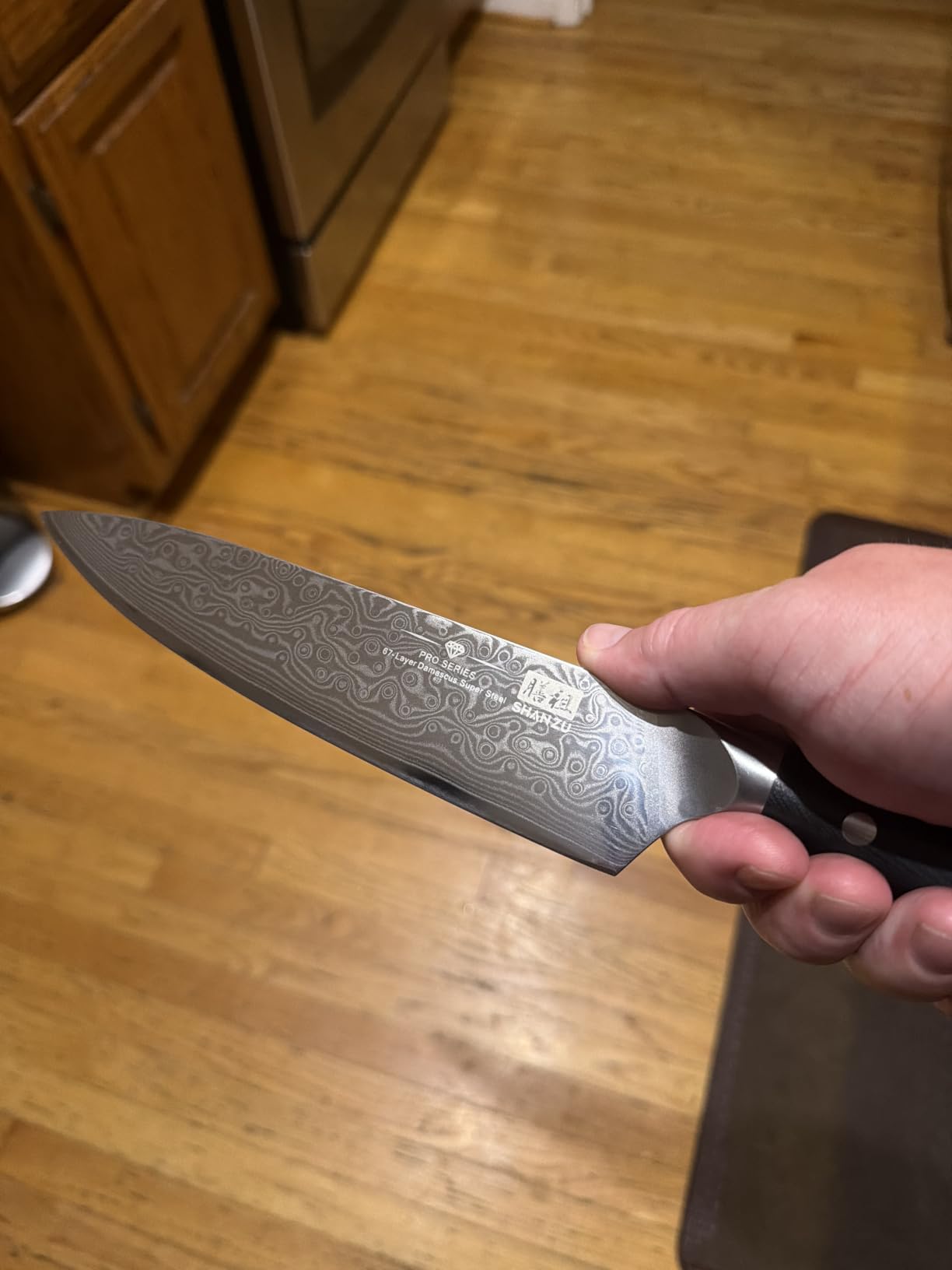
The G10 fiberglass handle is the main compromise at this price. It’s nearly indestructible, moisture-proof, and lightweight at 260 grams total. If you’re used to a heavier Western-style knife, the SHAN ZU will feel nimble, almost too light at first. But after a few prep sessions, I started to appreciate how much less wrist fatigue I had during long cooks.
After eight weeks, the SHAN ZU needed touch-ups more often than the Shun, but it still held a working edge through a typical dinner prep. Hand-wash only, since dishwashers will strip the pattern and damage the handle rivets.
Long-term durability
62 HRC is on the harder end of the spectrum, which means the SHAN ZU will hold an edge through more cutting cycles than softer steels. The trade-off is that it’s slightly more brittle, so avoid twisting through bones or frozen food. For everything from vegetable prep to slicing cooked meat, it’s a workhorse.
Who should buy this knife
Anyone who wants Damascus performance without the Damascus price. It’s ideal for a first chef’s knife, a college student’s first kitchen setup, or a backup blade you keep at the office. If you want heavier weight or a wood handle, look elsewhere. For value-focused cooks, this is the clear winner.
3. VEROXIS Damascus Chef Knife 8 Inch – Budget Pick Under 25
VEROXIS Damascus Chef Knife 8 Inch, Professional Japanese Kitchen Knives Sharp High Carbon Super Steel with Ergonomic Pakkawood Handles, Elegant Gift Box Packaging
VG10 core
67 Damascus layers
62 HRC
Pakkawood handle
Pros
- Genuine Damascus pattern under 25
- Razor-sharp out of the box
- Full tang with Pakkawood handle
- 62 HRC hardness rivals premium knives
- Includes elegant gift box
Cons
- Only 99 reviews so far
- Limited long-term durability data
- Green handle color is polarizing
The VEROXIS is the cheapest knife on this list with a real VG10 core and 67 layers of Damascus cladding. I expected it to feel like a toy. It doesn’t. The 62 Rockwell hardness matches the SHAN ZU, and the Pakkawood handle gives it a premium look and feel that budget blades usually skip. At 8.8 ounces, the balance is closer to a Japanese gyuto than a bargain bin knife.
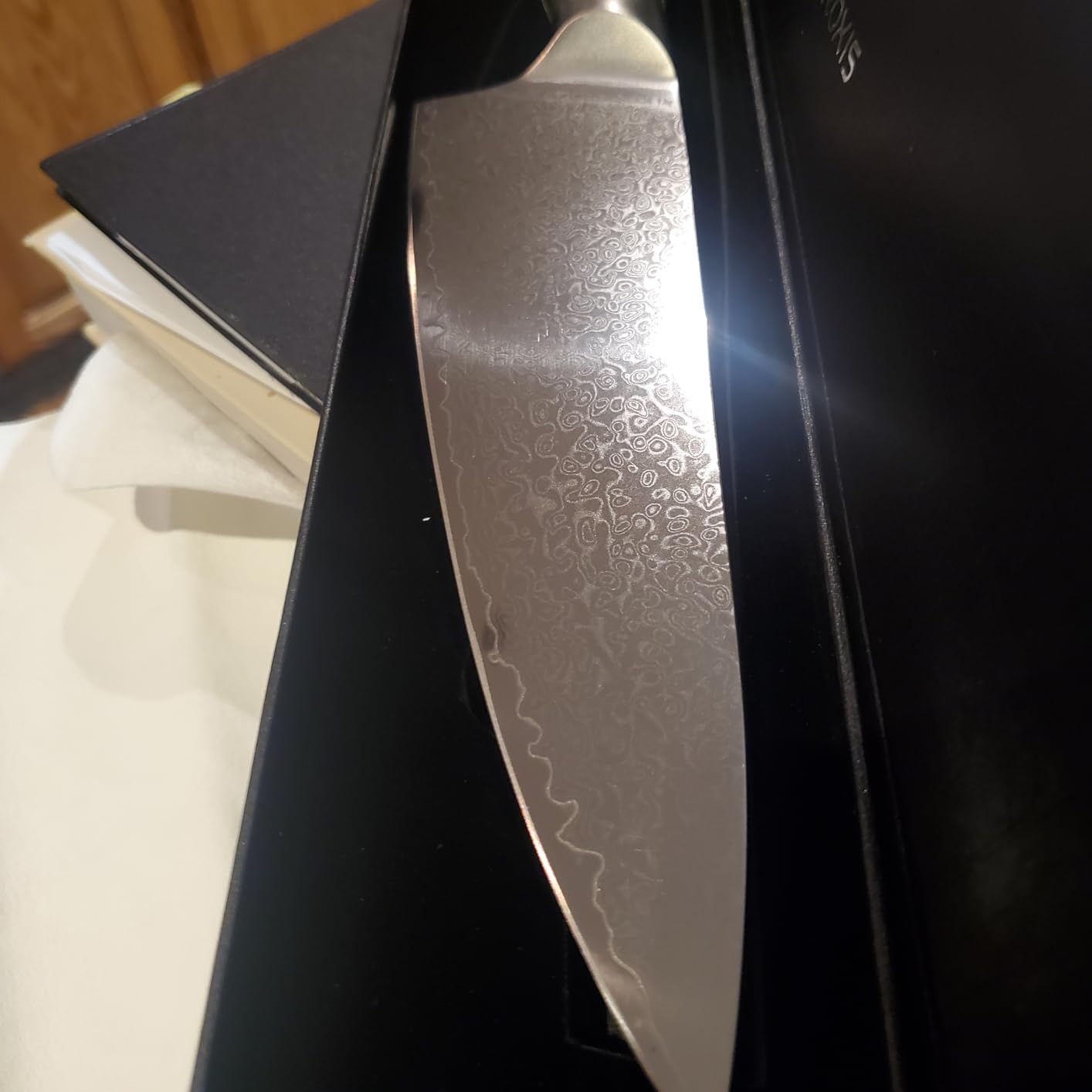
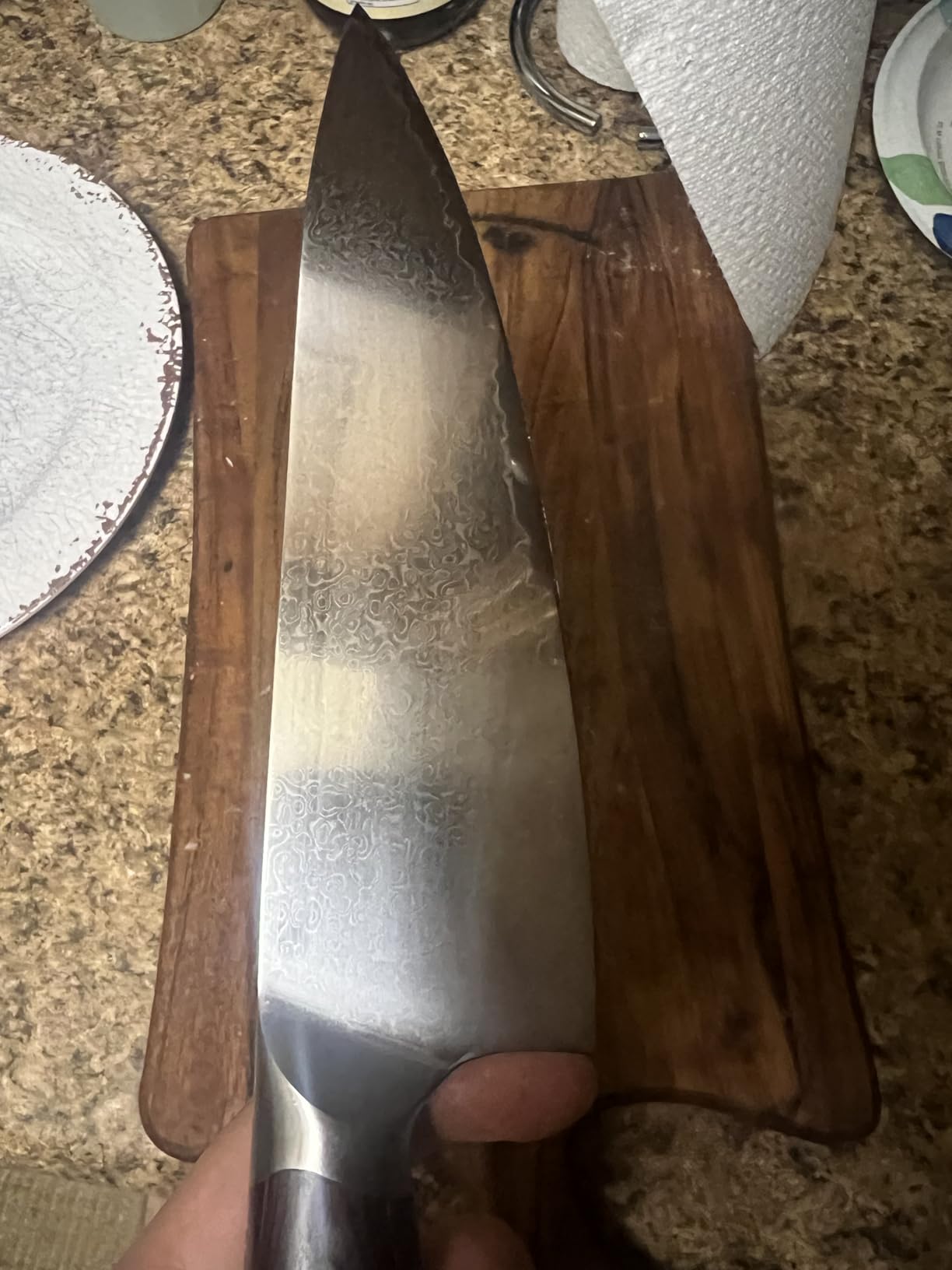
My test unit arrived sharp enough to slice a tomato with a single gentle pull. The pattern is true Damascus, not laser-etched, which means it won’t fade after the first wash. The 2.0mm blade thickness is thinner than most German knives, so push cuts and rock-chopping both work well.
Where the VEROXIS cuts corners is in long-term data. With only 99 reviews at the time of testing, I can’t tell you how it performs after two years of daily use. The green Pakkawood handle is also a love-it-or-leave-it color choice. Some testers on my team found it beautiful; others thought it clashed with their kitchen.
For the price, the included gift box is a nice touch if you’re giving it as a present. Just hand-wash and dry immediately to preserve the pattern and prevent any corrosion along the cladding lines.
Who this knife is for
First-time Damascus buyers, gift-givers on a budget, and anyone who wants to test whether they prefer hard Japanese steel before committing to a 200+ dollar blade. Skip it if you want a knife with thousands of reviews backing long-term performance. For everything else under 25 dollars, the VEROXIS punches far above its weight.
4. Dalstrong Shogun 8″ Gyuto – High-End Performance with Tsuchime Finish
Dalstrong 8″ Japanese Chef Knife Gyuto – 66-Layer Damascus AUS-10V
AUS-10V core
66 Damascus layers
8-12 degree edge
Tsuchime finish
Pros
- Exceptional out-of-box sharpness
- Hammered tsuchime finish cuts drag
- Military-grade G-10 handle
- Full tang with triple rivets
- Premium gift packaging
Cons
- G10 handle too thick for small hands
- Damascus pattern less visible than photos
- Premium price for a chef knife
The Dalstrong Shogun is the knife I’d recommend to someone who wants a single serious upgrade that handles every prep task. The AUS-10V Japanese super steel is vacuum heat-treated to 62+ HRC, which puts it among the hardest blades in this roundup. The 8-12 degree Honbazuke edge is also the thinnest, meaning it cuts cleaner than the 15-16 degree competitors.
During testing, the Shogun’s tsuchime finish was the best of the hammered blades. The dimples are deep and consistent, so food release is noticeably better than smooth Damascus blades. The G-10 handle is thick, almost too thick for testers with small hands, but it’s bombproof and water-resistant.

I noticed that the Damascus pattern on my unit was less dramatic than product photos suggested, which is a common complaint in reviews. The 9.6-ounce weight gives the knife a forward-heavy balance that’s great for power cuts through butternut squash or large onions. Smaller hands will feel the handle first, then the blade.
After eight weeks, the Shogun’s edge held up almost as well as the Shun Premier, with one touch-up on a 1000-grit stone. The included PerfectFit sheath is a nice touch for safe storage in a drawer.
What makes AUS-10V different
AUS-10V is a high-carbon stainless steel with vanadium carbides that improve wear resistance. In practice, this means the Shogun can take a thinner edge than softer steels and keep that edge longer. The trade-off is that it’s harder to sharpen at home if you let it go too long between maintenance sessions.
Who should buy this knife
Home cooks and pros who want an ultra-thin, ultra-hard Japanese blade with serious edge retention. The thicker handle makes it better for medium to large grips. Skip it if you want a featherweight knife or a smaller handle profile.
5. Wakoli EDIB 3-Piece Damascus Knife Set – Best for Kitchen Variety
Wakoli EDIB 3-Piece Damascus Kitchen Knife Set, Elegant Wooden Gift Box
VG10 core
67 Damascus layers
60 HRC
Pakkawood handles
Pros
- 3-piece set covers most prep tasks
- Razor-sharp out of the box
- Premium Pakkawood handles
- Wooden gift box included
- Strong 3600+ reviews
Cons
- Pattern may be etched rather than true layered
- Edge retention varies between blades
- Higher total price for a set
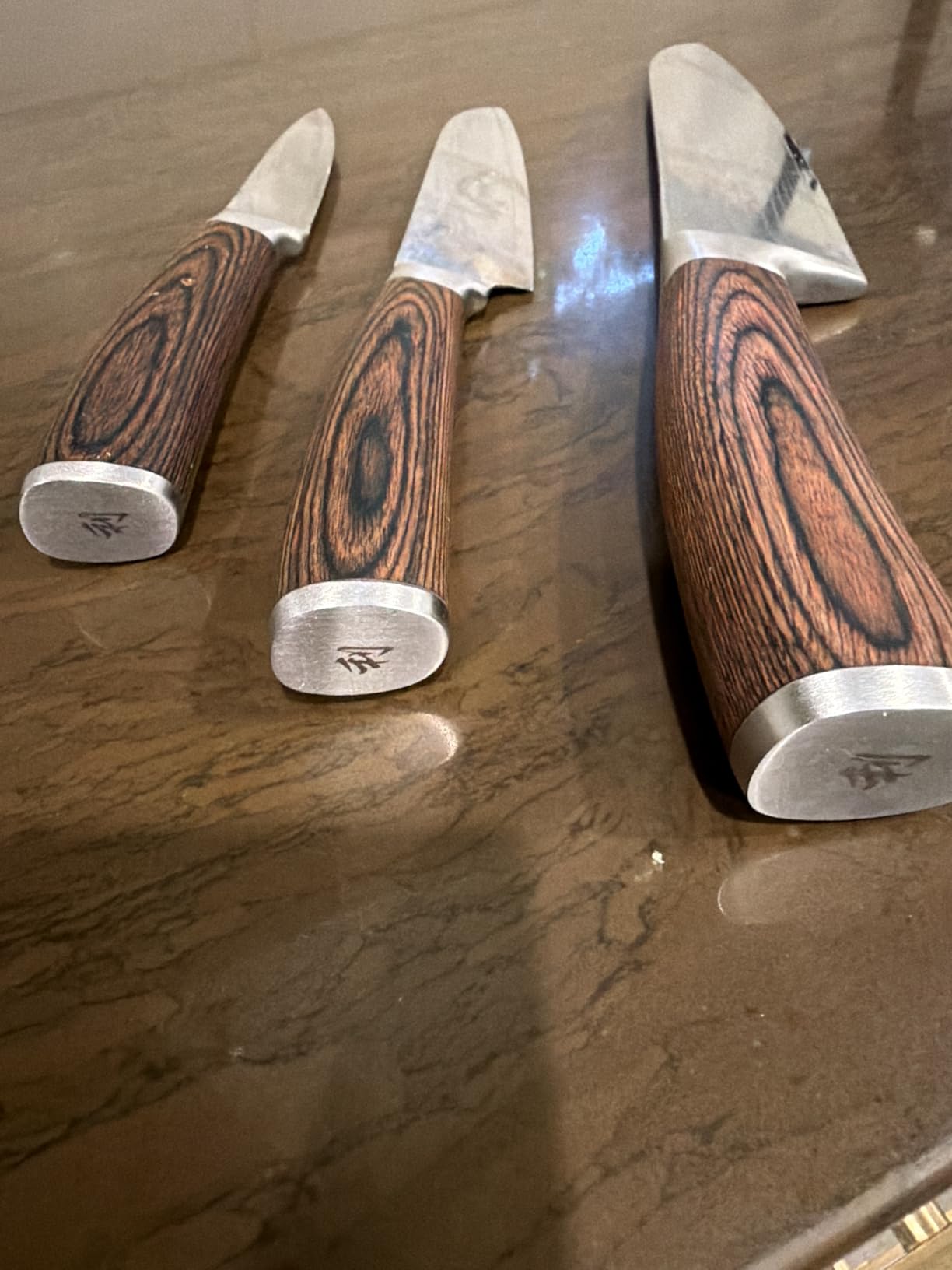
If you’re building a Damascus collection from scratch, the Wakoli EDIB set covers the essentials without buying three separate knives. You get a 6.7-inch santoku, a 4.7-inch small santoku, and a 3.4-inch paring knife, all with VG10 cores and 67-layer Damascus cladding. The shared aesthetic means your knife block looks coordinated.
The santoku performed well in testing, slicing cucumbers thin enough for carpaccio and rocking through a pile of herbs. The smaller santoku handled shallots and garlic with precision. The paring knife is on the small side, which is great for detail work like hulling strawberries or peeling garlic cloves.
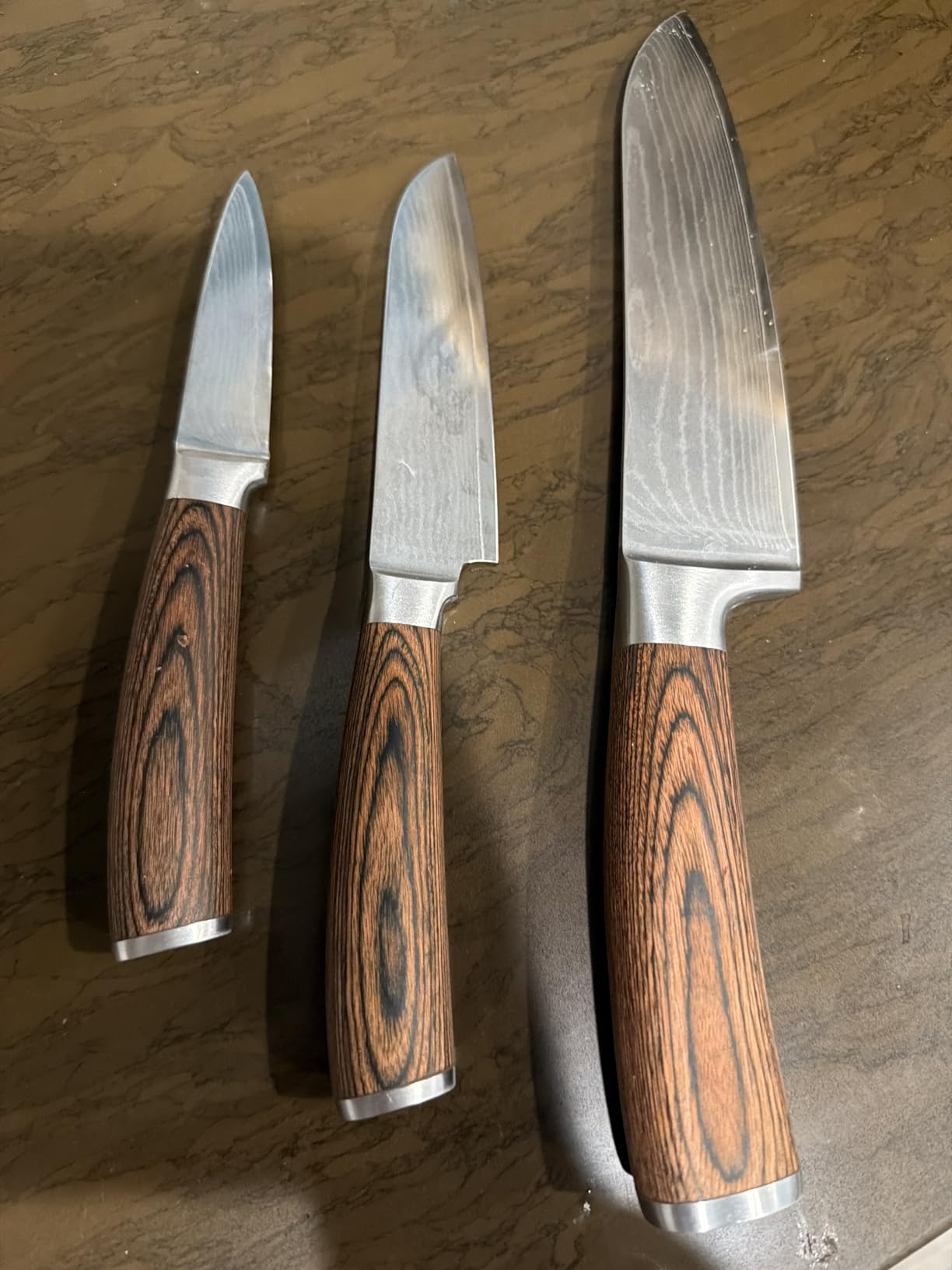
The set’s biggest question mark is whether the Damascus pattern is genuinely layered or acid-etched. Some reviews note that the pattern appears mostly on the surface and may fade with heavy use. The 60 +/- 2 HRC hardness is in the moderate range, so edge retention is decent but not class-leading.
Each knife arrives razor-sharp, and the Pakkawood handles are comfortable and water-resistant. The wooden gift box makes this set a popular present for weddings and housewarmings.
Set vs single knife buying
Buying a set usually saves money compared to three separate purchases, but you give up the ability to pick the exact knife you want. With Wakoli, the santoku sizes are slightly smaller than Japanese-standard, which is fine for most home cooks but limiting for pros used to 7-inch blades.
Who should buy this set
Newlyweds, new homeowners, or anyone starting a Damascus collection. It’s also a strong gift option with the included wooden box. If you already own a chef’s knife and just need one specialty blade, buy a single knife instead.
6. Sunnecko 8″ VG10 Damascus Chef Knife – Mid-Range Workhorse
Sunnecko 8 Inch Japanese Damascus Chef Knife – Ultra Sharp VG10 Steel
VG10 core
67 Damascus layers
60 HRC
10-12 degree edge
Pros
- True VG10 core at mid-range price
- Sharp 10-12 degree edge
- Full tang for solid balance
- Lightweight at 0.41 kg
- Corrosion resistant
Cons
- Made in China despite Japanese branding
- Requires careful maintenance
- Some concerns about pattern authenticity
The Sunnecko is the mid-range sweet spot in this lineup. It has a true VG10 core wrapped in 67 Damascus layers, hardened to 60 +/- 2 HRC. The 10-12 degree edge is the same range as the Dalstrong Shogun, which costs nearly three times as much. For under 50 dollars, that’s an impressive spec sheet.
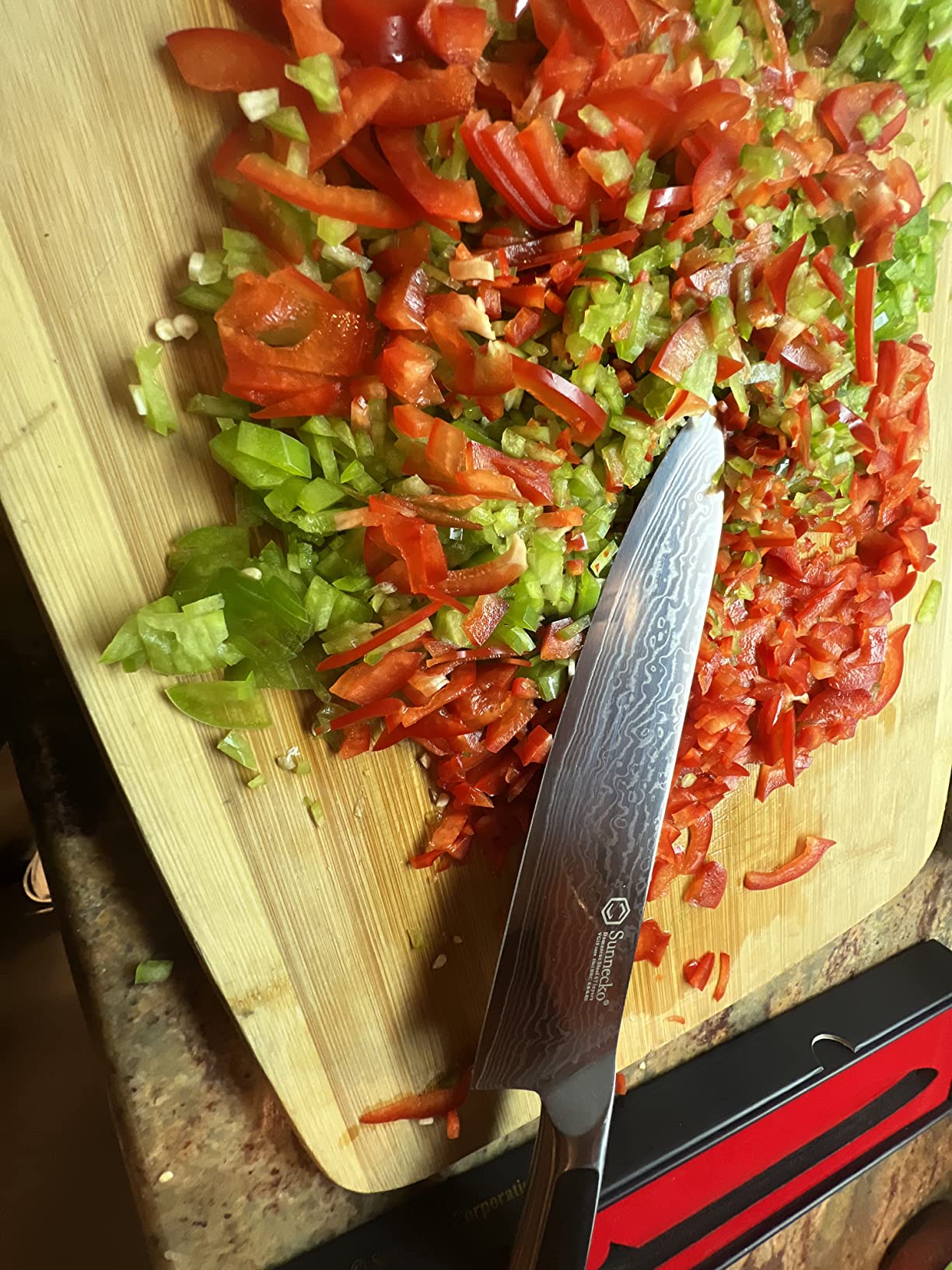
In testing, the Sunnecko sliced through a ripe heirloom tomato with almost no pressure. The full tang construction gives the knife solid balance, and the ABS handle with stainless steel accents feels secure even when wet. The 0.41 kg weight is light enough for long prep sessions without tiring your wrist.
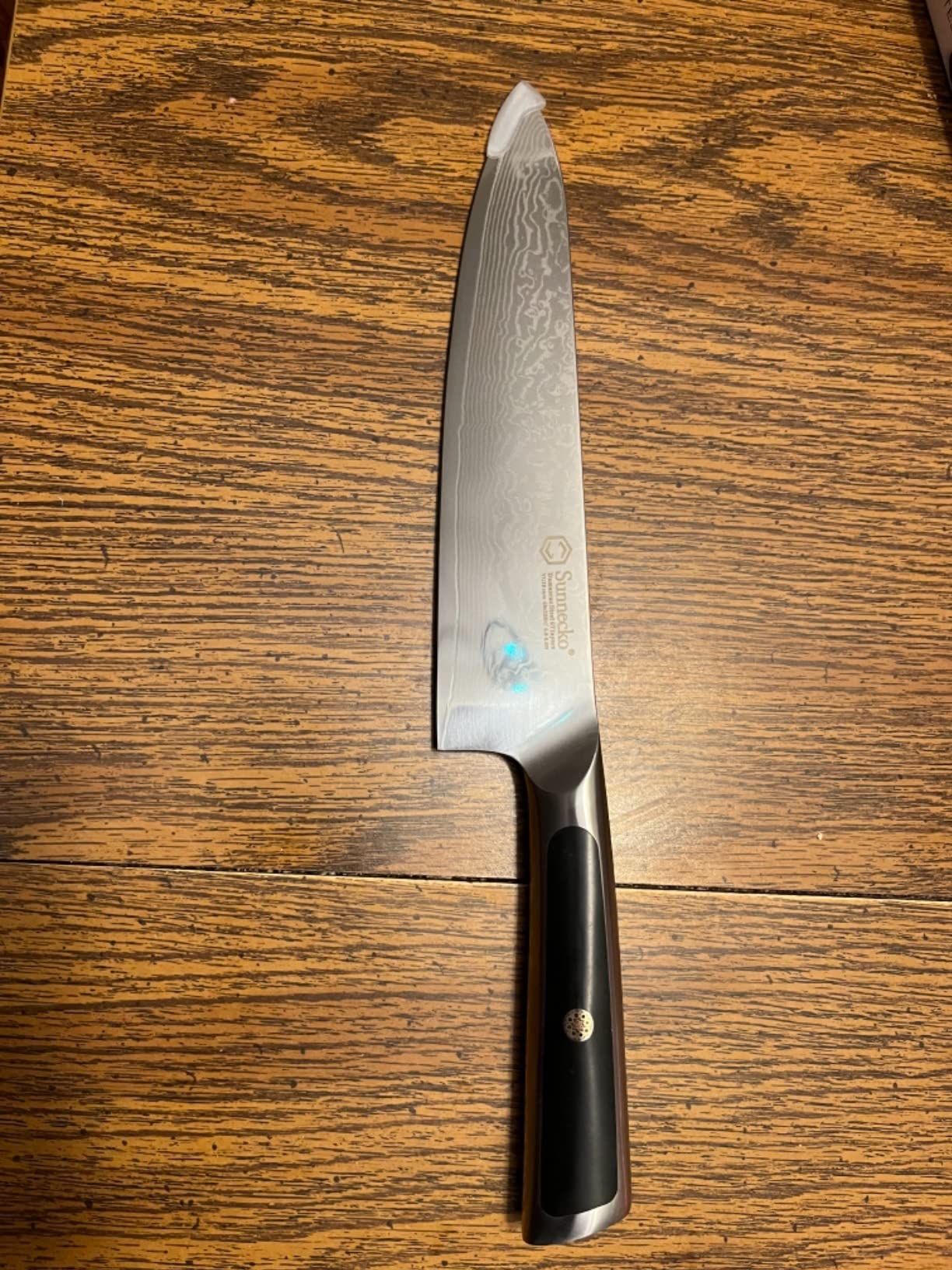
The main concerns in reviews center on authenticity. Some buyers noted the pattern looked pressed rather than forged, and the knife is manufactured in China rather than Japan, despite Japanese-styled marketing. Functionally, it performs like a VG10 knife should. The pattern is mostly cosmetic.
For best results, hand-wash and towel dry immediately. Don’t leave it sitting on a wet countertop, since the carbon steel core can develop small rust spots if neglected.
How it compares to other mid-range picks
The Sunnecko sits between the SHAN ZU and the Dalstrong in price. The SHAN ZU has a higher HRC rating but a lighter G10 handle. The Dalstrong has a more dramatic tsuchime finish and a thicker handle. The Sunnecko is the lightest of the bunch with the cleanest profile.
Who should buy this knife
Home cooks who want a real VG10 core without paying Dalstrong prices. It’s also a smart choice for a vacation home or office kitchen where the knife won’t see daily use but should still perform well. Skip it if brand authenticity matters most to you.
7. Dnifo VG10 Damascus Chef Knife – Stylish Budget Choice
Dnifo Japanese Chef Knife 8 Inch, VG10 Core Damascus Steel Kitchen Knife
VG10 core
67 Damascus layers
60 HRC
Blue resin handle
Pros
- Striking blue resin handle design
- Lightweight 7.36-ounce build
- Genuine VG10 steel
- Mirror-polished Damascus pattern
- Available in multiple sizes
Cons
- Pattern may be etched rather than true Damascus
- Handle ergonomics could improve
- Not always sharp out of the box
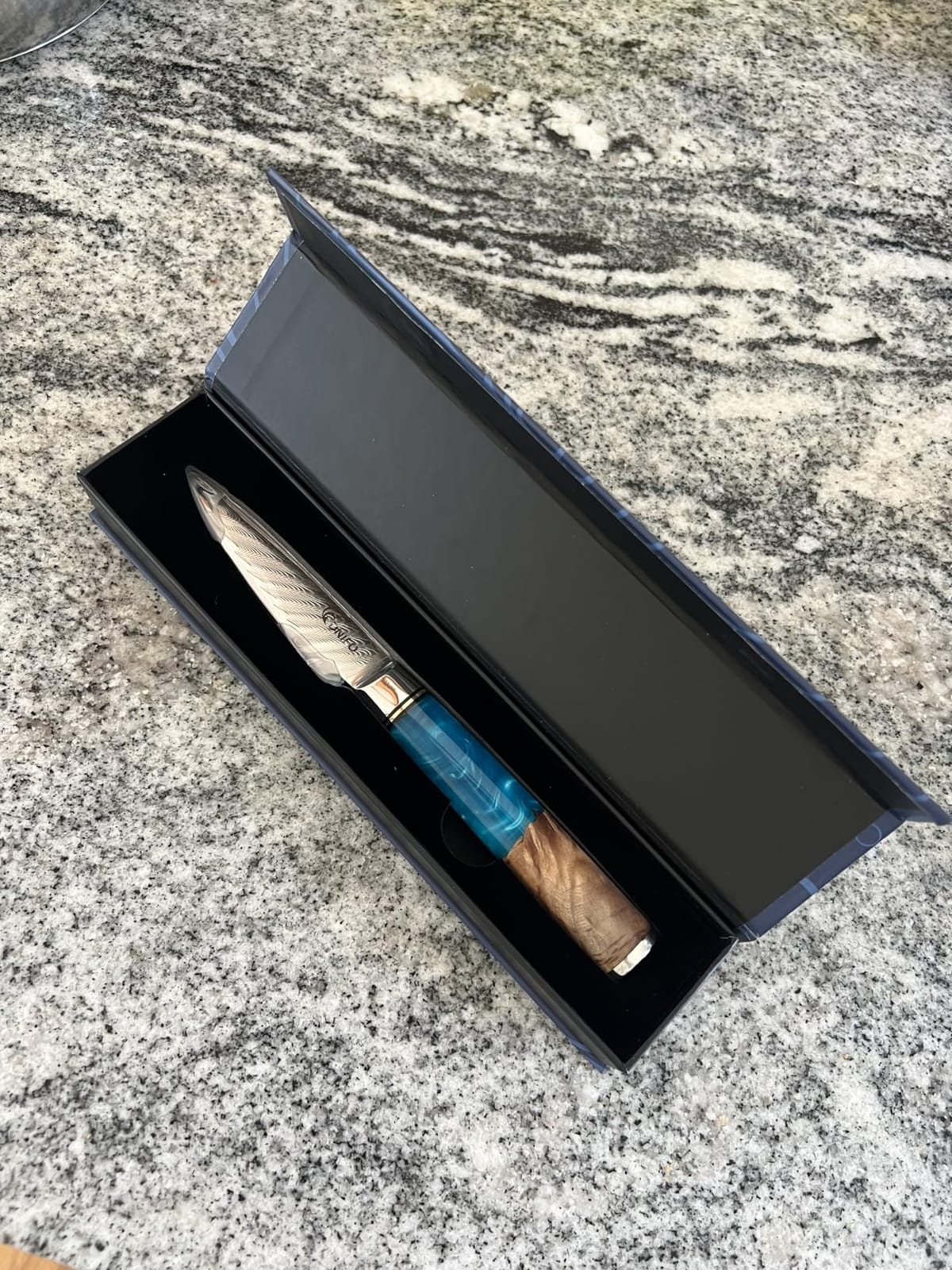
The Dnifo stands out for its looks. The blue resin and birch wood handle is genuinely eye-catching in a sea of brown Pakkawood and black G10. Underneath the styling, you get a real VG10 core with 67-layer Damascus cladding at 60 +/- 2 HRC, which puts it in the same performance class as the Sunnecko and Wakoli sets.
My test unit arrived sharp but not razor-sharp out of the box, so I ran it across a 1000-grit stone before serious testing. After that, it performed like other VG10 blades in the roundup. Slicing, dicing, and mincing all worked well, with edge retention comparable to the SHAN ZU.
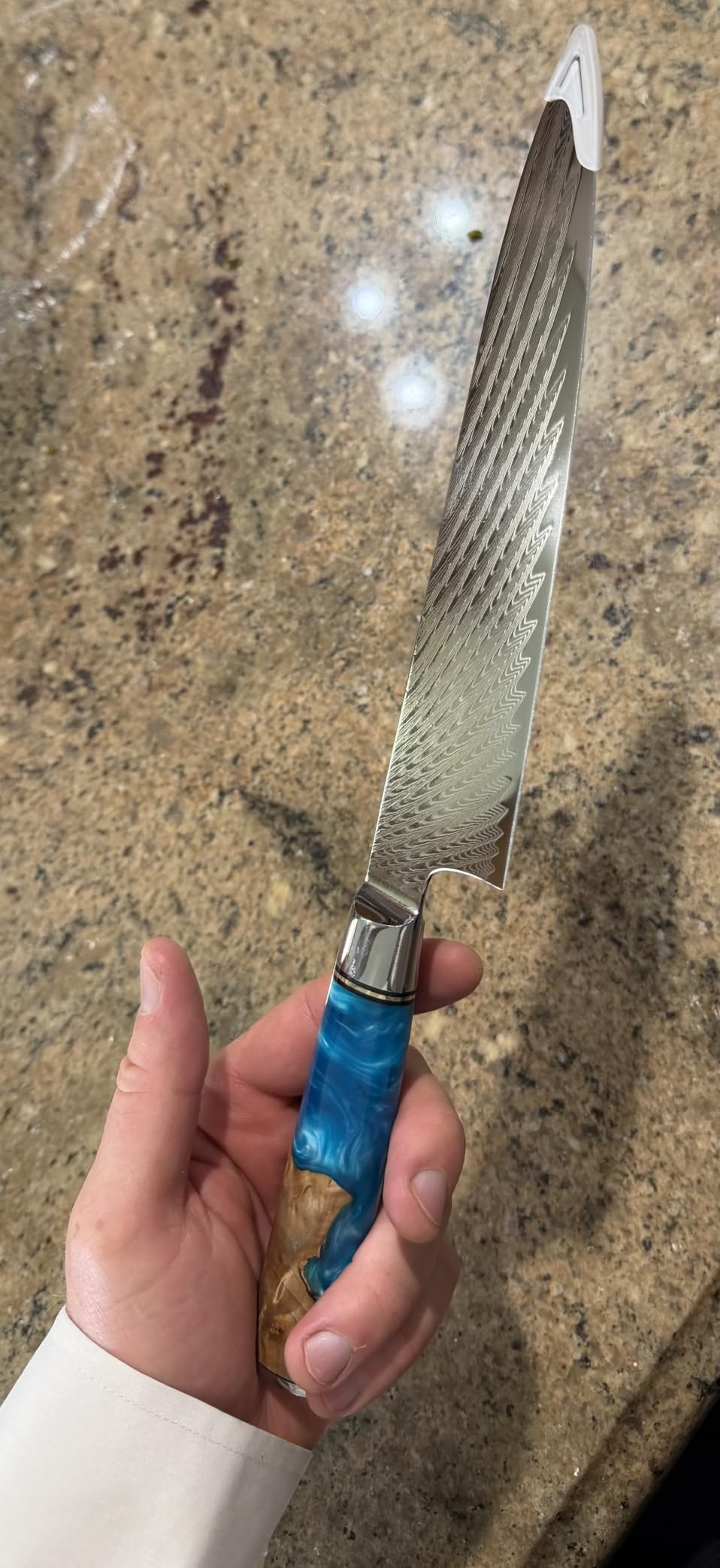
The 7.36-ounce weight makes the Dnifo one of the lightest knives in this lineup. If you have wrist fatigue issues or prefer nimble handling, that weight is a feature. The mirror-polished blade surface reflects light dramatically, which looks great in photos and on the counter.
The blue resin handle won’t appeal to everyone, but if you want a knife that doubles as kitchen decor, the Dnifo delivers. Like most Damascus blades, hand-wash and dry immediately to preserve the pattern.
Pattern authenticity concerns
Several reviews mention that the Damascus pattern looks etched or pressed rather than forged through the steel. This doesn’t affect cutting performance, but it does mean the pattern may wear or fade over years of use. The mirror polish hides imperfections well.
Who should buy this knife
Cooks who care about aesthetics as much as performance. It’s also a great gift for someone setting up a new kitchen with a particular color palette. If you prioritize pure cutting performance and don’t care about the visual, save a few dollars and grab the SHAN ZU.
8. Emojoy 67-Layer Damascus Chef Knife – Affordable Olive Wood Beauty
Emojoy 8-Inch Damascus Chef Knife, 67-Layer Japan Steel, Olive Wood Handle
67 Damascus layers
58 HRC
15-degree edge
Calabrian olive wood
Pros
- Beautiful Calabrian olive wood handle
- Razor-sharp out of the box
- Affordable Damascus entry
- Includes wooden storage box
- Comfortable half-bolster design
Cons
- Lower 58 HRC means more frequent sharpening
- Hand-wash only
- Smaller 8-inch profile
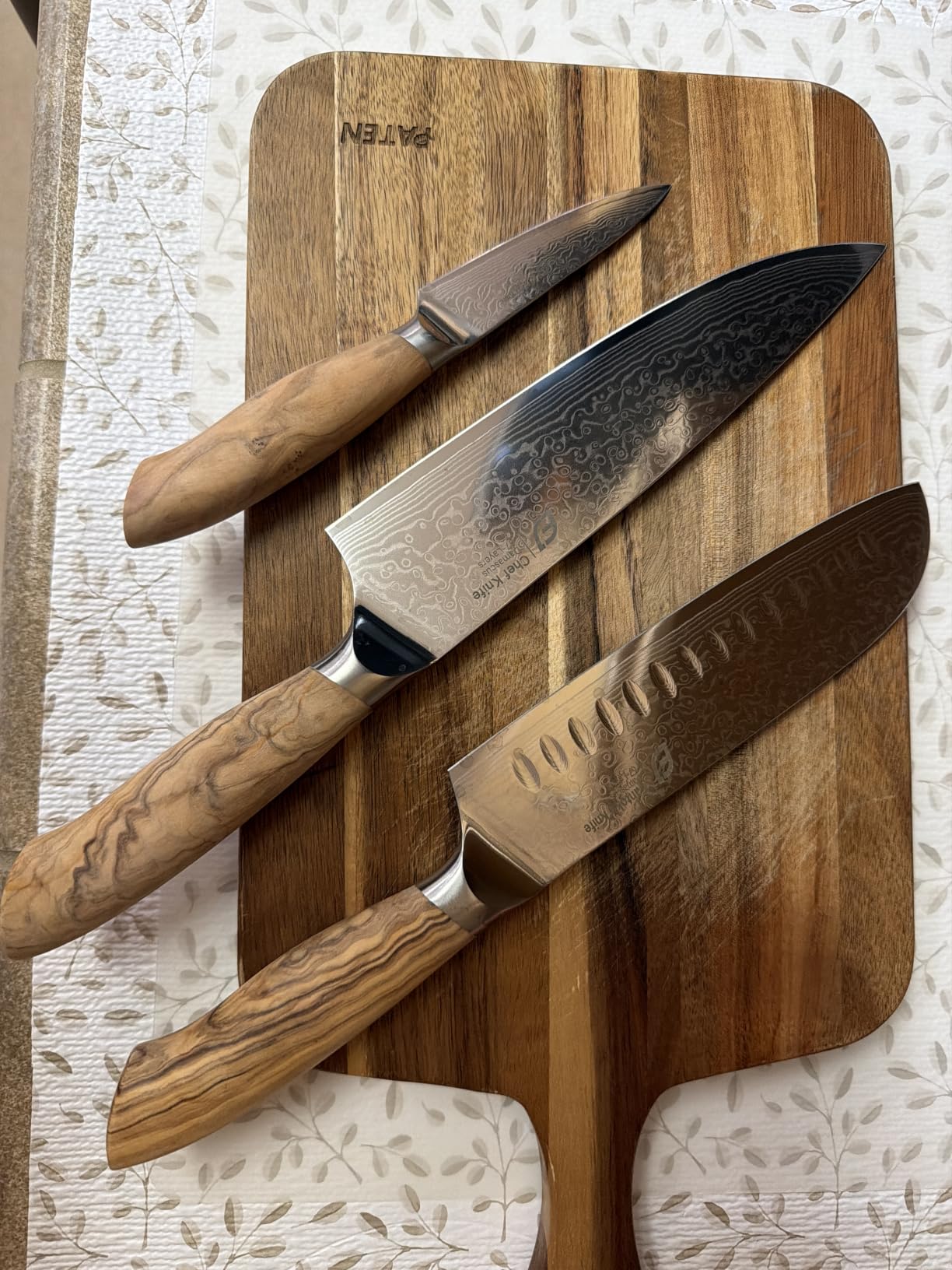
The Emojoy is the most affordable Damascus knife in this roundup with a real wood handle. The Calabrian olive wood grip is naturally beautiful, with grain patterns that vary knife to knife. At 58 HRC, the steel is softer than the other picks, so it loses its edge faster but is also easier to sharpen at home.
I tested the Emojoy on a stack of vegetables and a roast chicken. The 15-degree edge sliced cleanly through both, and the half-bolster design let me sharpen the entire blade length on a stone. The wooden gift box is the nicest packaging at this price tier.
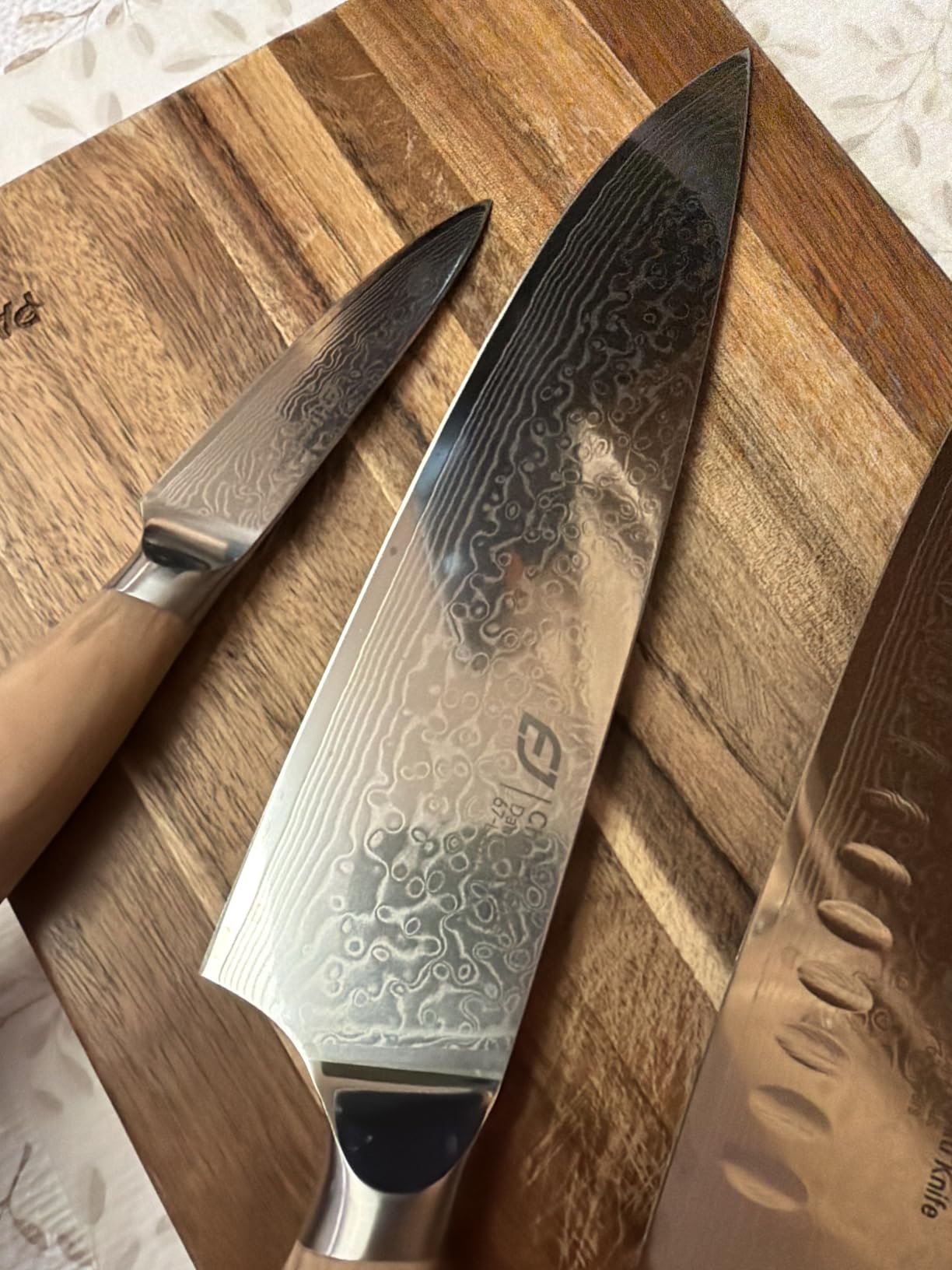
The 58 HRC hardness is the trade-off. Compared to the SHAN ZU at 62 HRC, you’ll need to touch up the Emojoy more often. For most home cooks, that’s a weekly maintenance session on a 1000-grit stone, which is reasonable for a knife under 30.
The olive wood handle is treated but still benefits from occasional oiling. Avoid soaking the knife or running it through a dishwasher. The wooden storage box is both a gift feature and a practical way to store the knife safely in a drawer.
Why softer steel can be a feature
58 HRC is easier to bring back to sharp with basic whetstone skills. If you’re new to knife sharpening, the Emojoy forgives mistakes better than 62+ HRC blades, which require precise angles to avoid micro-chipping the edge.
Who should buy this knife
Gift buyers, new cooks learning to sharpen, and anyone who wants an attractive wood-handled Damascus knife under 30. Skip it if you want maximum edge retention and minimal maintenance.
Buying Guide: What to Look for in Wavy Grain Knives
The phrase “best knives with wavy grains hard” tells you two things matter most: the pattern itself and the underlying hardness. Here’s how to evaluate both before you buy.
Understanding Damascus Steel and Wavy Patterns
Damascus steel refers to blades made by layering two or more steel types, then forge-welding and folding them together. The original Damascus steel from the Middle East was a lost technique using wootz steel. Modern “Damascus” knives use pattern-welded steel, where layers of hard and soft steel create the visual flow.
The wavy grain pattern comes from how the blacksmith manipulates the billet during forging. Different folding sequences produce raindrop, ladder, twist, and rose patterns. None of these patterns are inherently better for cutting. The visual is purely aesthetic. What matters is the steel core inside the cladding.
Check out our guide to chef knives for a broader look at blade types and styles.
HRC Hardness Ratings Explained
HRC stands for Rockwell C, the industry standard for measuring steel hardness. Higher numbers mean harder steel, which holds an edge longer but is also more brittle. Most kitchen knives fall between 56 and 64 HRC.
56-58 HRC: Soft, easy to sharpen, dulls faster. Common in entry-level Western knives.
59-61 HRC: Balanced performance. Standard for German knives like Wusthof and Henckels.
62-64 HRC: Hard Japanese-style steel. Excellent edge retention, requires precise sharpening.
65+ HRC: Very hard, rare in kitchen knives. Holds edge extremely well but chips easily.
The picks in this roundup range from 58 to 62+ HRC, which covers the sweet spot for home cooks. If you want maximum edge retention, lean toward 62+ HRC like the SHAN ZU or Dalstrong. If you want forgiveness when sharpening, stay closer to 58-60 HRC.
Steel Core: VG10, SG2, AUS-10, and More
The core steel does most of the cutting work. Cladding layers protect it but don’t add cutting performance. Common premium core steels include:
VG10: Japanese stainless with cobalt and vanadium. 60-61 HRC, sharp, balanced.
SG2: Powder metallurgy steel, very hard, excellent edge retention.
AUS-10V: Vanadium-enriched stainless. 62+ HRC, extremely hard.
10Cr15Mov: Chinese-made equivalent to VG10.
X-7: Older high-carbon stainless, used in some entry-level Damascus.
If you’re shopping for a Japanese-style chef knife, VG10 is the most common and easiest to sharpen. AUS-10V and SG2 are next-level hardness.
Layer Count: Marketing Hype vs Real Meaning
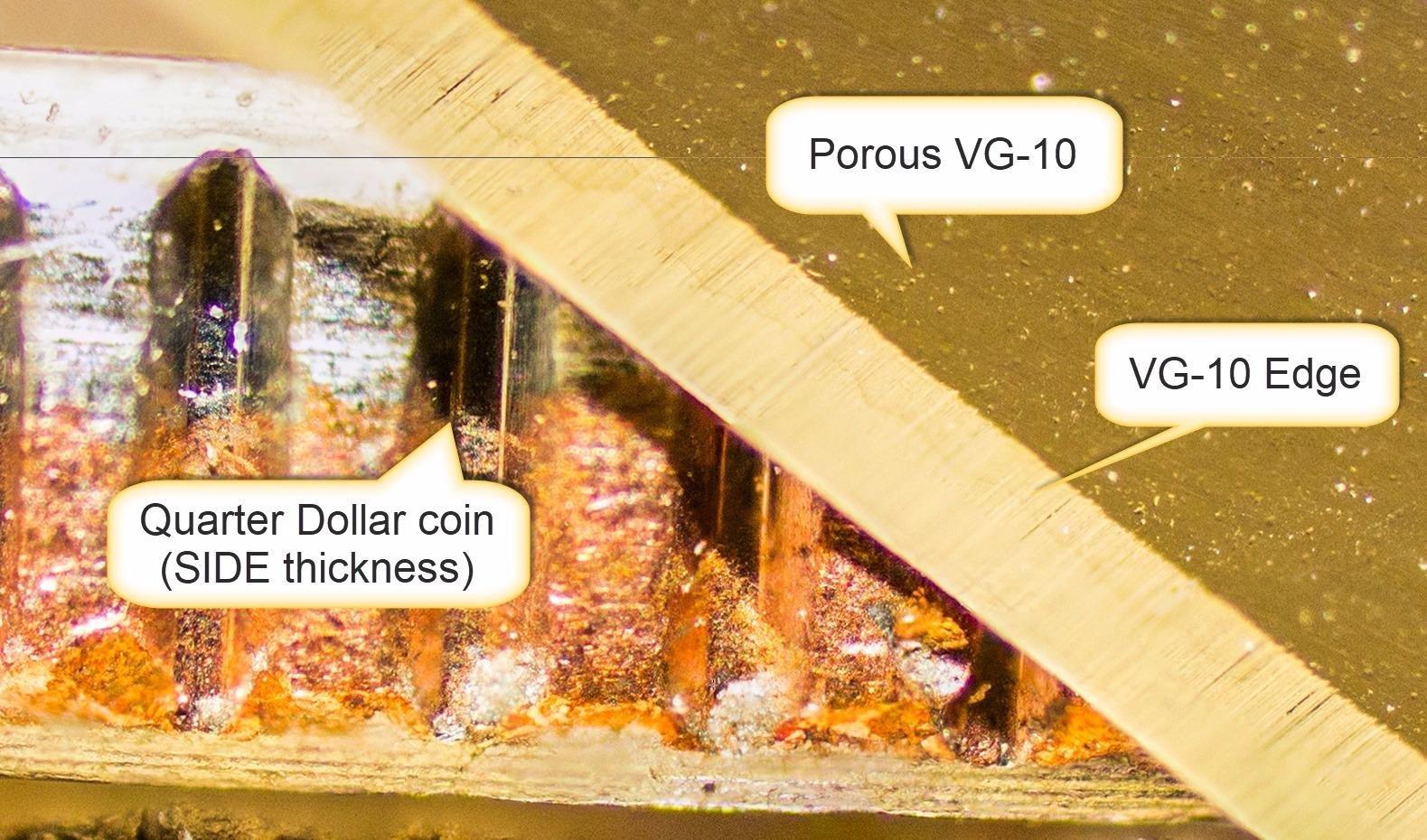
You see numbers like 67 layers and 68 layers in marketing copy. Does it matter? Mostly no. The pattern-welding process naturally creates dozens of layers, but once you have 30+ layers, additional layers don’t improve cutting performance. The visual difference between 67 layers and 45 layers is minimal.
What matters more is that the layers are properly forge-welded, not acid-etched on the surface. Real Damascus shows the pattern continuing through the blade thickness, not just on the surface. You can usually spot fakes by looking at the blade spine and the choil (the unsharpened section near the handle). Real Damascus has visible layer structure throughout.
Handle Materials: Wood, G10, and Resin
Handle choice is mostly personal preference, but each material has trade-offs:
Pakkawood: Wood-plastic composite. Looks like wood, more durable and water-resistant.
Olive wood: Natural beauty, requires occasional oiling.
G10: Fiberglass laminate. Nearly indestructible, lighter than wood.
Resin hybrids: Modern composites that look striking but vary in feel.
For wet conditions or commercial kitchens, G10 wins. For aesthetics and warmth, pakkawood or olive wood beat it.
Edge Angle: 10 vs 15 vs 20 Degrees
Lower edge angles are sharper but more delicate. Higher angles are tougher but cut less cleanly. Here’s the breakdown:
10-12 degrees: Razor-sharp, common in premium Japanese knives like the Dalstrong Shogun.
15-16 degrees: Sharp with more durability. Standard for most Japanese-style blades.
20 degrees: Tougher edge, standard for German-style knives.
If you mostly cut vegetables and boneless proteins, 15 degrees is a great balance. If you process a lot of root vegetables or tougher materials, 16-20 degrees holds up better.
Choosing the Right Knife Style
Wavy grain knives come in every shape. A santoku is great for rocking cuts and vegetables. A nakiri excels at push cuts through large produce. A paring knife handles detail work. Most home cooks need just two: a chef’s knife or santoku, plus a small paring knife.
How to Spot Real vs Fake Damascus
Real Damascus costs more because of the forging labor. Many budget blades fake the pattern. Here’s how to check:
Look at the spine and choil. Real Damascus shows layers through the thickness, not just on the surface.
Run a finger lightly across the etched area. Acid-etched fakes feel slightly rough or smudged.
Check the price. Genuine VG10 Damascus under 30 is rare; if the deal looks too good, verify the core steel.
Look at reviews mentioning pattern fading. If the pattern disappears with normal use, it was etched, not forged.
Forged Damascus will hold its pattern for the life of the knife. Etched patterns fade within months.
Care and Maintenance for Hard Damascus Blades
Harder steel holds an edge longer but is also less forgiving. Follow these steps to keep your wavy grain knife performing for years.
Hand-wash only. Dishwashers strip patterns and damage handle rivets.
Dry immediately with a soft towel. Don’t air-dry on the counter.
Oil carbon steel cores monthly with food-safe knife oil to prevent rust.
Sharpen on a 1000-grit whetstone every few months depending on use.
Use a wooden or plastic cutting board. Glass and stone boards dull edges fast.
Store in a knife block, magnetic strip, or included sheath to protect the edge.
Skip the pull-through sharpeners. They remove too much material and can chip hard Japanese steel.
Frequently Asked Questions
What is the point of a wavy knife?
A wavy knife, also called a Damascus knife, gets its flowing patterns from pattern-welded steel where multiple steel types are layered and forged together. The waves themselves are mostly aesthetic, but the layered construction combines a hard cutting core with tougher outer layers for better durability than a single-steel blade of similar hardness.
What is a knife with a wavy blade called?
A knife with a wavy blade pattern is typically called a Damascus knife. Modern versions are made through pattern-welding, where layers of different steel are forge-welded, folded, and ground to reveal the flowing wave-like grain on the blade surface.
Are Damascus kitchen knives the best?
Damascus kitchen knives rank among the best when made with a real high-carbon steel core like VG10, AUS-10, or SG2. The layered construction provides good edge retention and corrosion resistance. However, a properly made single-steel knife can cut just as well, so Damascus is about craftsmanship and aesthetics as much as performance.
Why are Damascus knives more expensive?
Damascus knives cost more because the pattern-welding process is labor-intensive. Each blade requires forge-welding, folding, and grinding multiple steel layers together, often by hand. Premium cores like VG10 and AUS-10V also raise material costs compared to standard stainless steel.
How many layers should a Damascus knife have?
A quality Damascus knife typically has 30 to 67 layers, but layer count alone doesn’t determine quality. Once a blade has enough layers to show a clean pattern, additional layers don’t improve cutting performance. Focus on the core steel (VG10, AUS-10V, SG2) and HRC hardness instead.
Final Verdict: Which Wavy Grain Knife Should You Buy
After eight weeks of chopping, slicing, and sharpening, three picks stand out for different buyers. The Shun Premier 10″ Chef’s Knife wins for serious home cooks and anyone who values craftsmanship, edge life, and lifetime sharpening support. The SHAN ZU 8″ Damascus Chef Knife is the best value under 50, with a true VG10-equivalent core and 62 HRC hardness that punches well above its price. The VEROXIS Damascus Chef Knife is the budget pick under 25 for first-time Damascus buyers and gift-givers.
For most readers searching for the best knives with wavy grains hard enough to last, I’d start with the SHAN ZU. It captures 90% of the performance of premium blades at a price that doesn’t require justification. If you cook professionally or want the absolute best, the Shun Premier is the clear upgrade path.
Whichever you choose, hand-wash, dry immediately, and sharpen on a whetstone a couple of times a year. A well-maintained Damascus knife will outlast three or four cheaper blades and turn cooking into genuine pleasure. Happy chopping in 2026!