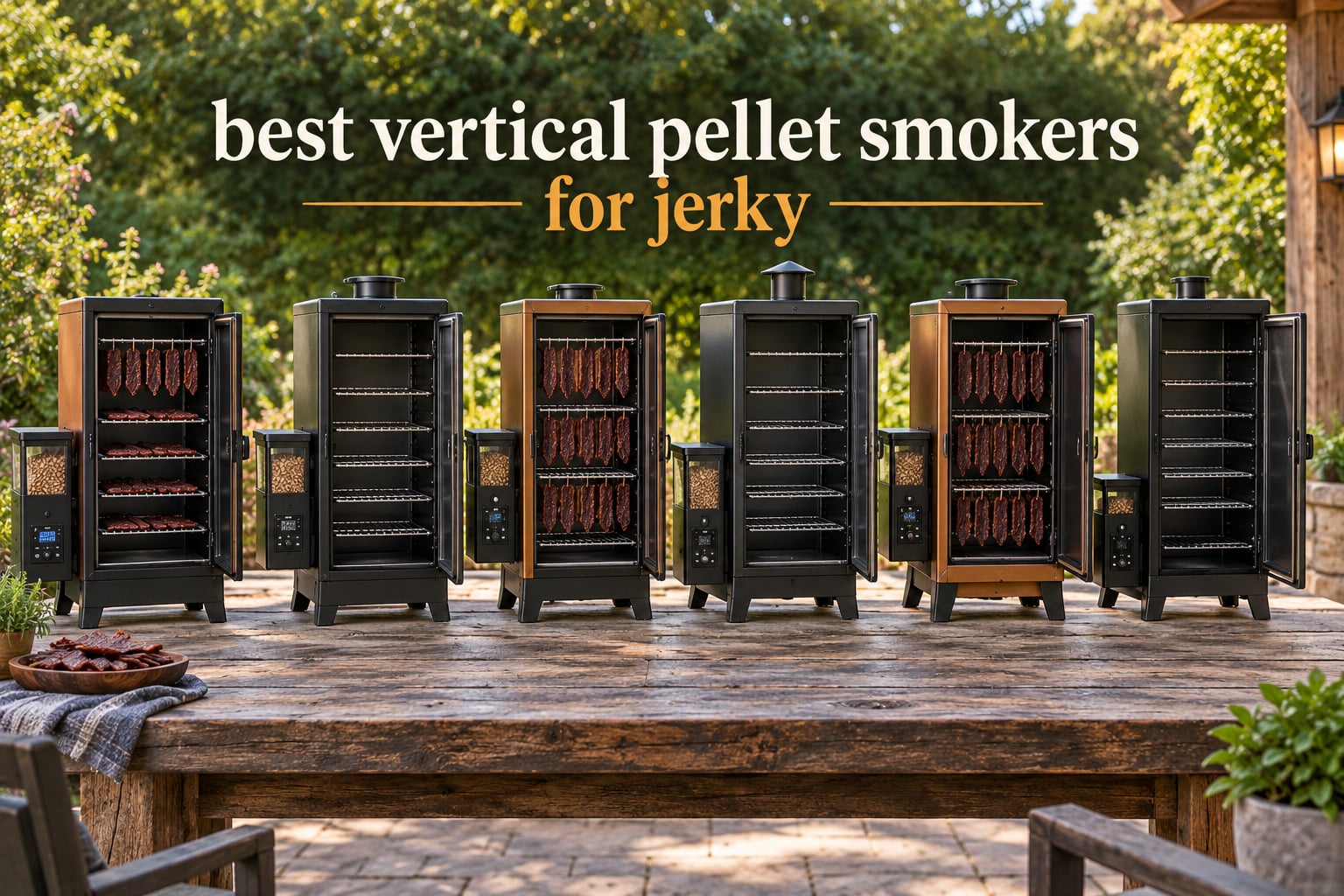
Yes, a vertical pellet smoker can make jerky, and for a certain kind of cook it does it better than anything else in the yard. The catch is that jerky lives in a narrow 160-180F band while most pellet grills are designed to live at 225-400F, and the tall vertical cabinet that makes these smokers so good at a dozen racks of ribs makes them worse at drying thin strips evenly. Getting good jerky out of one is a matter of picking a cabinet with a low enough set-point floor, staging the racks, and running the cook long enough to dry the center out without hardening the edge.
We spent a long stretch of the last few months reading owner reports, spec sheets and forum threads on this exact problem, then narrowed a large category down to six models that are actually available as cabinet-style upright pellet smokers rather than barrel grills or propane cabinets. This is a spec-and-synthesis ranking rather than a lab test. We told you that up front because you deserve to know which one you are reading.
Before we get into the picks, it helps to be clear about what a vertical pellet smoker actually is and why jerky exposes its weaknesses. A vertical pellet smoker is a cabinet-style outdoor cooker with a single pellet firebox at the bottom, a stack of adjustable racks above it, and a PID-controlled auger that feeds hardwood pellets to hold a steady low temperature for the four to eight hours it takes to dry and smoke a full batch of jerky. Pellets drop from the hopper into an auger-fed fire pot at the base, they ignite, and a fan pushes hot, thin smoke upward through the cabinet.
That upward push is the whole problem in one sentence. Because heat and smoke rise, the top rack runs hotter and dries faster than the bottom rack. Jerky makers notice this immediately, and it is the single most common complaint you will find in jerky forums about tall cabinets. The buyers who get consistent results are the ones who plan for it: they leave lower racks open when they can, they stage loads instead of filling every shelf, and they swap rack positions partway through the cook.
If you want a broader look at the format before you commit, our vertical smoker roundup covers the fuel types we deliberately left out here, including charcoal, propane and electric cabinets that can dry jerky but cannot add wood smoke flavor.
One more framing note before the list. If you make jerky two or three times a year and smoke flavor is optional, stop reading and go look at a countertop dehydrator instead. Our dehydrator guide for jerky covers that case, and it will cost you a fraction of a smoker and give you more repeatable results. Everything below is for the person who wants smoke flavor, wants batch volume, and wants one appliance to cover jerky and brisket.
Table of Contents
- Top 3 Picks for Best Vertical Pellet Smokers for Jerky (October 2026)
- All Six Vertical Pellet Smokers Side by Side in 2026
- 1. Pit Boss Navigator 3-Series – Best Vertical Pellet Smoker for Jerky Overall
- 2. Pellet Pro 2300 – Best for Even Drying Across Racks
- 3. Grilla Mammoth – Best Vertical Pellet Smoker for Large Batch Jerky
- 4. Weber Smoque XL – Best Smoke Flavor in a Pellet Cabinet
- 5. ATSENT 616 Sq In Pellet Smoker – Best Value Vertical Smoker for Small Batches
- 6. Pit Boss 5-Series Vertical Smoker – Best for Raw Capacity on Paper
- How to Make Jerky on a Vertical Pellet Smoker
- Jerky Temperature and Time Cheat Sheet
- Smoker vs Dehydrator: What Buyers Actually Report
- How to Stop Jerky Drying Unevenly Across Racks
- Wood Pellet Pairings for Jerky
- How to Choose a Vertical Pellet Smoker for Jerky
- Frequently Asked Questions
- What temperature should I smoke beef jerky at on a pellet smoker?
- Is 150 too low to smoke jerky, and is 160 hot enough?
- Is 170F too hot, or is 180F too high, for jerky?
- Should I flip jerky when dehydrating in a smoker?
- What are the most common jerky mistakes to avoid?
- Why is my vertical pellet smoker not getting hot enough?
- Do I need a dehydrator if I already own a pellet smoker?
- What is the best vertical pellet smoker for jerky for the money?
- Conclusion: The Best Vertical Pellet Smoker for Jerky in 2026
Top 3 Picks for Best Vertical Pellet Smokers for Jerky (October 2026)

Pit Boss Navigator 3-Series
- 130F low set-point
- 1118 sq in on 5 racks
- 50 lb hopper
- Wi-Fi and Bluetooth

All Six Vertical Pellet Smokers Side by Side in 2026
Everything below is a genuine cabinet-style upright pellet smoker. We left out barrel pellet grills, propane cabinets, replacement parts, and the same small 616 sq in cabinet listed under three different ASINs. The rows below are sorted by jerky suitability rather than by price, and the temperature range column is the one to read first: a smoker with a 250F floor has no headroom in the jerky band no matter how good the rest of the sheet looks.
| Product | Specs | Action |
|---|---|---|
| Pit Boss Navigator 3-Series |
|
Check Latest Price |
| Pellet Pro 2300 |
|
Check Latest Price |
| Grilla Mammoth |
|
Check Latest Price |
 Weber Smoque XL Weber Smoque XL |
|
Check Latest Price |
 ATSENT 616 Sq In Smoker ATSENT 616 Sq In Smoker |
|
Check Latest Price |
 Pit Boss 5-Series Vertical Smoker Pit Boss 5-Series Vertical Smoker |
|
Check Latest Price |
1. Pit Boss Navigator 3-Series – Best Vertical Pellet Smoker for Jerky Overall
Pit Boss Navigator 3-Series WiFi & Bluetooth Wood Pellet Vertical Smoker with LCD Digital Controller, 1,118-Sq. In. 5-Rack Cooking Space, 130°F to 420°F Temp Range, Meat Probe, 50 lb. Pellet Hopper
1118 sq in on 5 porcelain-coated racks
130F to 420F control
50 lb hopper
3 probe ports, 1 probe
Pros
- 130F low set-point sits inside the jerky band
- 50 lb hopper covers a long dehydrate without a refill
- Built-in Wi-Fi and Bluetooth with an easy setup
- Folding side shelf adds prep space
- 5-year warranty and heavy-gauge stainless
Cons
- Auger jams reported on fresh bags of pellets
- Temperature readings reported as inaccurate with overshoot
- Controller is mounted on the back of the unit
The Navigator 3-Series is the model we keep coming back to, because the spec that matters most for jerky is the one most brands bury. Its digital control runs from 130F to 420F in 5-degree increments, which means you can sit at 170 or 175 without fighting a controller that only thinks in 25-degree steps. That 130F floor also opens the door to cold-smoking style charcuterie work later, which is a nice side effect of buying for jerky.
At 1118 sq in across five porcelain-coated steel racks it will not win a raw square-inch contest, and that is fine. Jerky strips are thin and light, so what you actually need is rack count and headroom, not floor space. Five racks means you can stage a load where the bottom two stay empty, which is the single most effective answer to the top-to-bottom drying gradient in a tall cabinet.
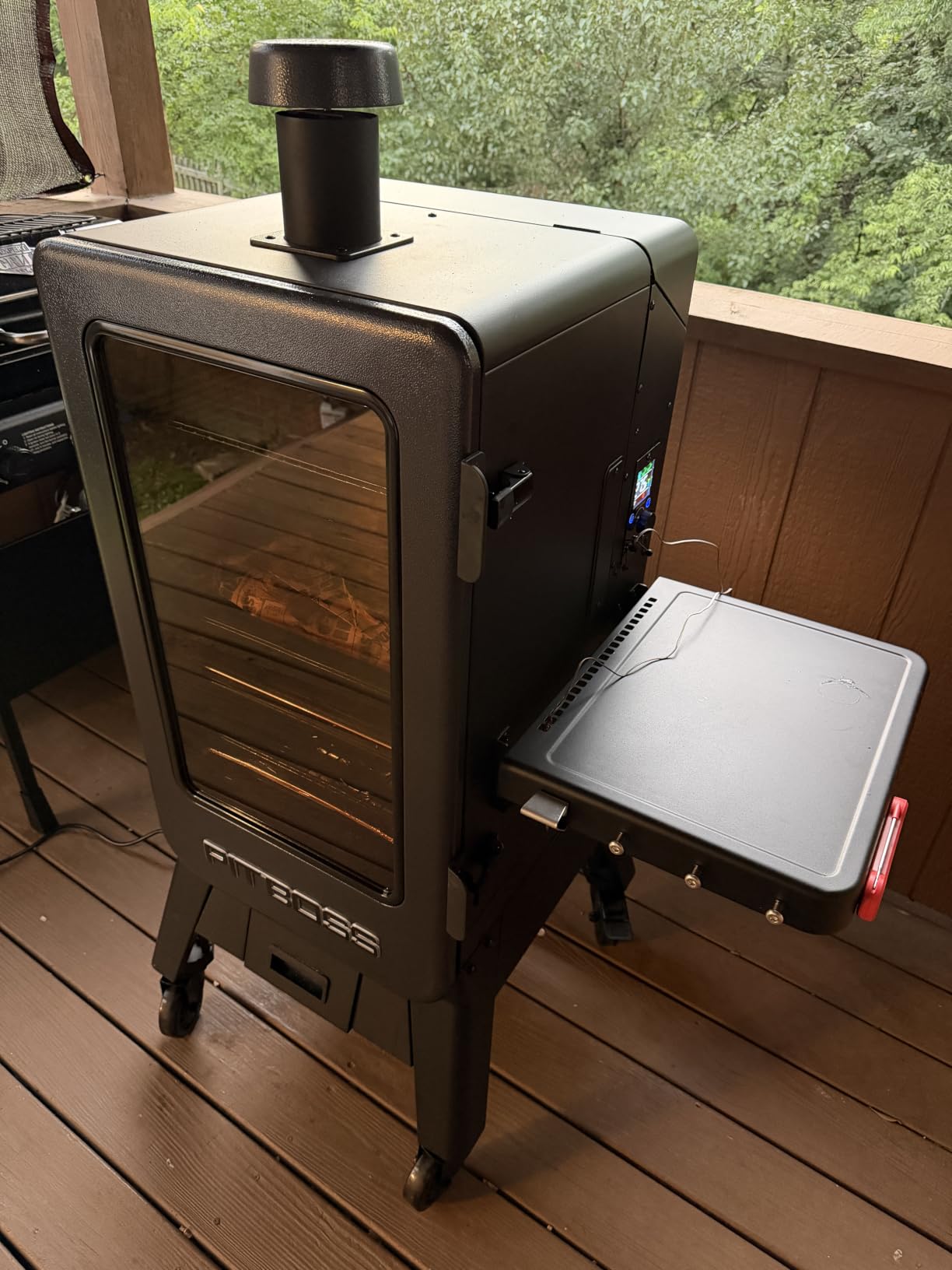
The 50 lb hopper is a bigger deal than it looks. A full-process jerky run on a smoker takes three to five hours, and a smaller hopper on a low-temp set point can burn through a fill faster than you expect because the auger works harder to hold a temperature far below its design band. The 50 lb hopper means you load once and stop thinking about it. Three probe ports with one probe included is a bonus if you run meat in the same cabinet.
The chimney exhaust and convection airflow are what distribute the smoke, and chimney exhaust is also what lets you run a real cold smoke later by throttling the damper. Built-in Wi-Fi and Bluetooth let you adjust the set point from a phone, which matters on a five-hour dehydrate because you should be checking the cabinet at a glance, not walking out to the yard every twenty minutes.
Now the part that gives us pause. The 3.3 rating is the most polarised in this group, and the split is stark: 46 percent five-star against 35 percent one-star across 33 reviews, with very little in between. Read that as two distinct experiences rather than a middling average. Satisfied owners report even heat, easy app control, useful folding shelves, and results that beat their previous Traeger, Camp Chef or Pit Boss units.
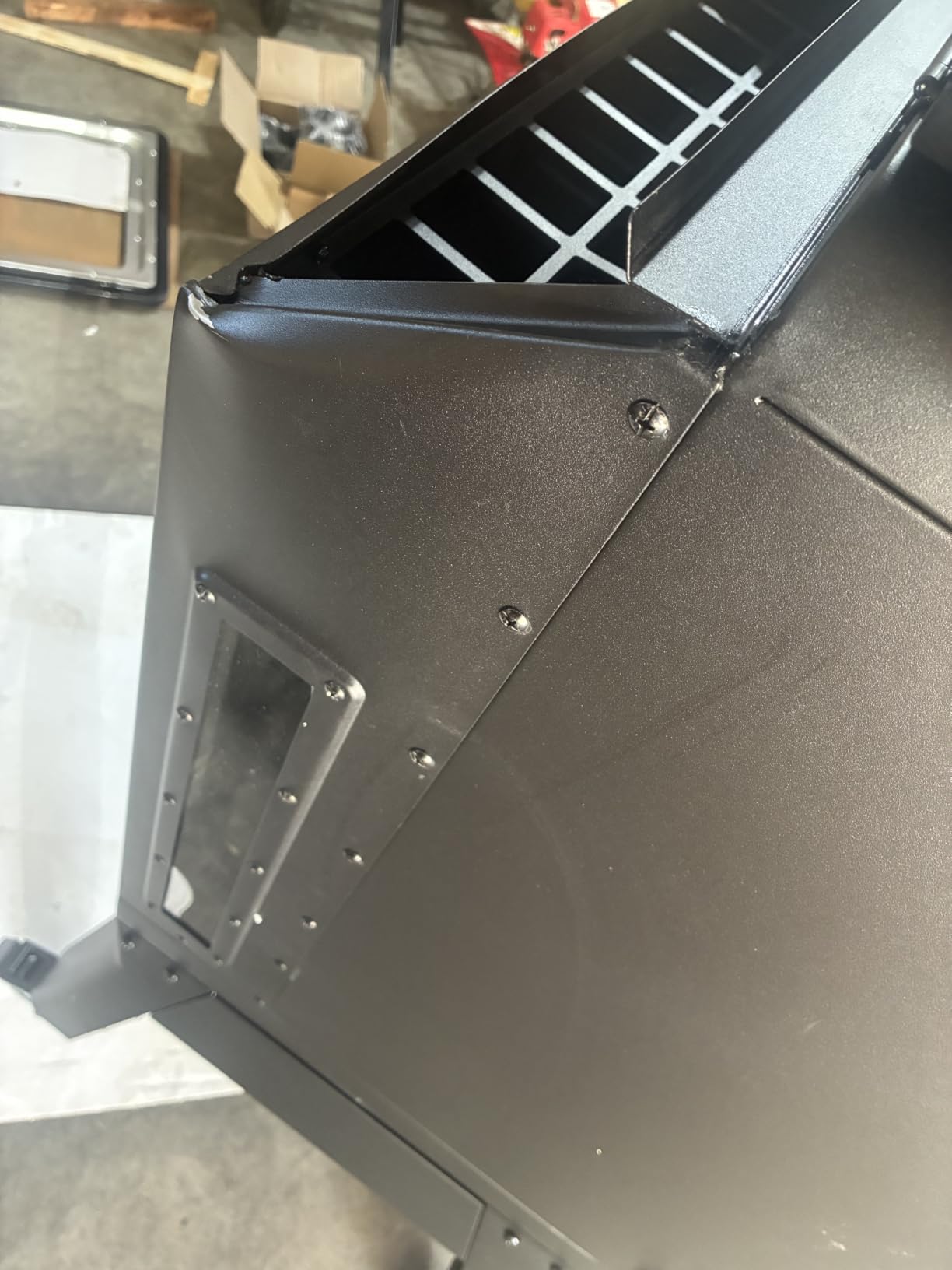
The dissatisfied group converges on the same three things: auger jams on fresh bags of pellets that interrupt feeding and make smoke output erratic, temperature readings that lag and overshoot above set point, and factory or shipping damage that required opening the wiring harness. One owner described difficult assembly with bent or offset hardware at completion. The controller is also mounted on the back of the unit rather than the front, which is a small thing that irritates people daily.
For jerky specifically, the auger complaint is the one to weigh. A jam halfway through a five-hour dehydrate means uneven smoke across the batch, and jerky has no second chance once the smoke flavor is wrong. We are comfortable recommending it because the low set-point, hopper size and rack count are genuinely the best combination here, but we are not going to pretend the reviews are uniformly glowing.
Jerky batch notes for the Navigator 3-Series
We would stage a 10 to 12 lb batch across the middle three racks and leave the bottom rack open. Set the control to 170F and resist the urge to touch it; the auger complaints cluster around interruptions, and a steady set point is what prevents them. Expect the top rack to finish first and move it down at the two-hour mark.
Chimney exhaust plus app control also makes this the easiest of the six to run as a hybrid cook: hold 170F for two hours to build color, then raise the set point to finish. If you have never made jerky on a smoker before, the ability to nudge the temperature from your phone is a bigger practical advantage than it sounds.
Where it falls short
If your batches are 16 lb or larger and you want every rack loaded at once, the five-rack layout gets tight once you leave shelf space for airflow. If you already own a pellet smoker and your only complaint is uneven drying, spend that money on a convection fan and a set of rack positioners instead of a second cabinet.
Check the auger on a new bag of pellets before you commit a whole batch to it. That single habit would have prevented most of the negative reviews in this section, and it takes about five minutes.
2. Pellet Pro 2300 – Best for Even Drying Across Racks
Pellet Pro® 2300 Vertical Pellet Smoker DOUBLE WALL Cabinet Free Cover and Convection Fan – Home Delivery
About 10 cubic feet of interior space
PID holds within 5-10F
Top-mounted convection fan
18-gauge double wall
Pros
- PID holds set point within about 5-7F once at temperature
- Convection fan equalises the top-to-bottom gap
- Double wall cuts fuel use and temperature swings
- Three 21 by 20 inch stainless grates plus a rib rack
- Cover and home delivery included
Cons
- Assembly instructions are vague for some owners
- Grate frames described as razor sharp
- Smoke flavor reported as inconsistent without the fan
The Pellet Pro 2300 solves the exact problem that makes other vertical cabinets awkward for jerky: air movement. It has a top-mounted convection fan that owners credit with flattening the roughly 25-degree top-to-bottom temperature gap that shows up in a tall cabinet when the fan is off. For a dehydrate that runs four to five hours, that single fan is worth more to consistency than almost any other feature on this list.
The PID controller holds temperature within roughly 5 to 10F of set point, and owners who have had theirs running report holding within about 5 to 7 degrees once at temperature. That accuracy is what lets you run 160 for a slow overnight dry or 175 for a faster smoke without the swings that ruin texture. The 18-gauge double-wall construction is the other half of the story: it holds heat, so the controller is not fighting cold air every cycle.
Capacity is genuinely large at approximately 10 cubic feet of interior space, with three 21 by 20 inch stainless grates plus a seven-section rib rack. You can fit far more jerky here than in any other cabinet on this list, and if you are making holiday or gift batches, or running venison, this is the one that lets you do a whole session in a single load.
Owners also report low pellet consumption, with one describing an 18 hour pork shoulder that barely dented the hopper. Lower fuel burn is a direct benefit on a long dehydrate, where you are mostly holding a temperature rather than generating heat. Heavy stainless grates and build quality that owners expect to last are repeatedly mentioned, and the cover and home delivery are included in the box.
The honest problem with this one is build quality variance. The recurring pattern in the reviews is that assembly is the weak point. Owners report vague or effectively nonexistent instructions, misaligned flue holes that needed drilling and filing, and one heating element that did not work out of the box. Grate frames are described as razor sharp, which is a real cut-injury risk worth handling carefully with gloves on the first rack load.
Smoke flavor is also criticised as inconsistent by several owners unless the convection fan is running. That matters here, because a jerky dehydrate on a smoker is bought for the smoke. If you take one thing from this review, take this: on this cabinet, use the fan.
Jerky batch notes for the Pellet Pro 2300
This is the one we would trust with a venison or holiday batch, because 10 cubic feet means you are not tempted to overstuff. Load the racks with real spacing, run the fan continuously from the preheat stage, and hold 170F. The size of the cabinet gives you room to leave gaps, which is what stops the strips from touching and drying at different rates.
Because it holds set point so tightly, this cabinet is also the best candidate for the cold-smoke approach that some charcuterie folks use. Owners running a mailbox-mod style low-temperature setup report temperatures dropping low enough for cooler smoke, and the double wall plus fan on this cabinet would keep that consistent.
Where it falls short
The low and wide form factor puts the PID controller near the floor, which owners with back problems call out as awkward. Grate frames need gloves. And if your budget does not stretch to this tier, the fan is the feature you are really paying for, which is worth remembering when comparing cheaper cabinets.
Check the flue alignment and the heating element before your first batch, not during it. The buyers who had problems all describe discovering them early.
3. Grilla Mammoth – Best Vertical Pellet Smoker for Large Batch Jerky
GRILLA Mammoth Vertical Smoker with 5 Trays, High Smoke Production, Wifi Enabled Touchscreen Controller, For Smoking, Outdoor Cooking, and Grilling
Over 1600 sq in of cooking space
Fits up to 10 steel racks
15 lb hopper, 50 hours of burn
Integrated water pan
Pros
- Lipped deflector accepts extra chunks or chips for smoke
- Water pan steadies temperature and holds moisture
- 50 hours at 240F from one 15 lb hopper fill
- Alpha Connect 2.0 touchscreen with app control
- 4-year manufacturer warranty
Cons
- 18 percent of reviews are 1 star
- Cabinet is 59 inches tall and weighs 130 lb
- No food probe listed among included items
The Grilla Mammoth is the most purpose-built of this group for smoke, and the hardware shows it. The lipped deflector accepts extra wood chunks or chips on top of what the pellets produce, which is the direct answer to the smoke-intensity problem in jerky: over a four to six hour dehydrate, pellets alone often give you a clean, thin smoke that fades before the meat is dry, and the fix is more smoke mass, not more heat.
Double-wall insulation does the rest. Over 1600 sq in of cooking space inside a double-wall cabinet is a lot of volume, and the insulation is why the burn figures are what they are: up to 50 hours at 240F from a single 15 lb hopper fill. Scale that down to a 170F jerky hold and the hopper is not going to be the thing you think about mid-batch.
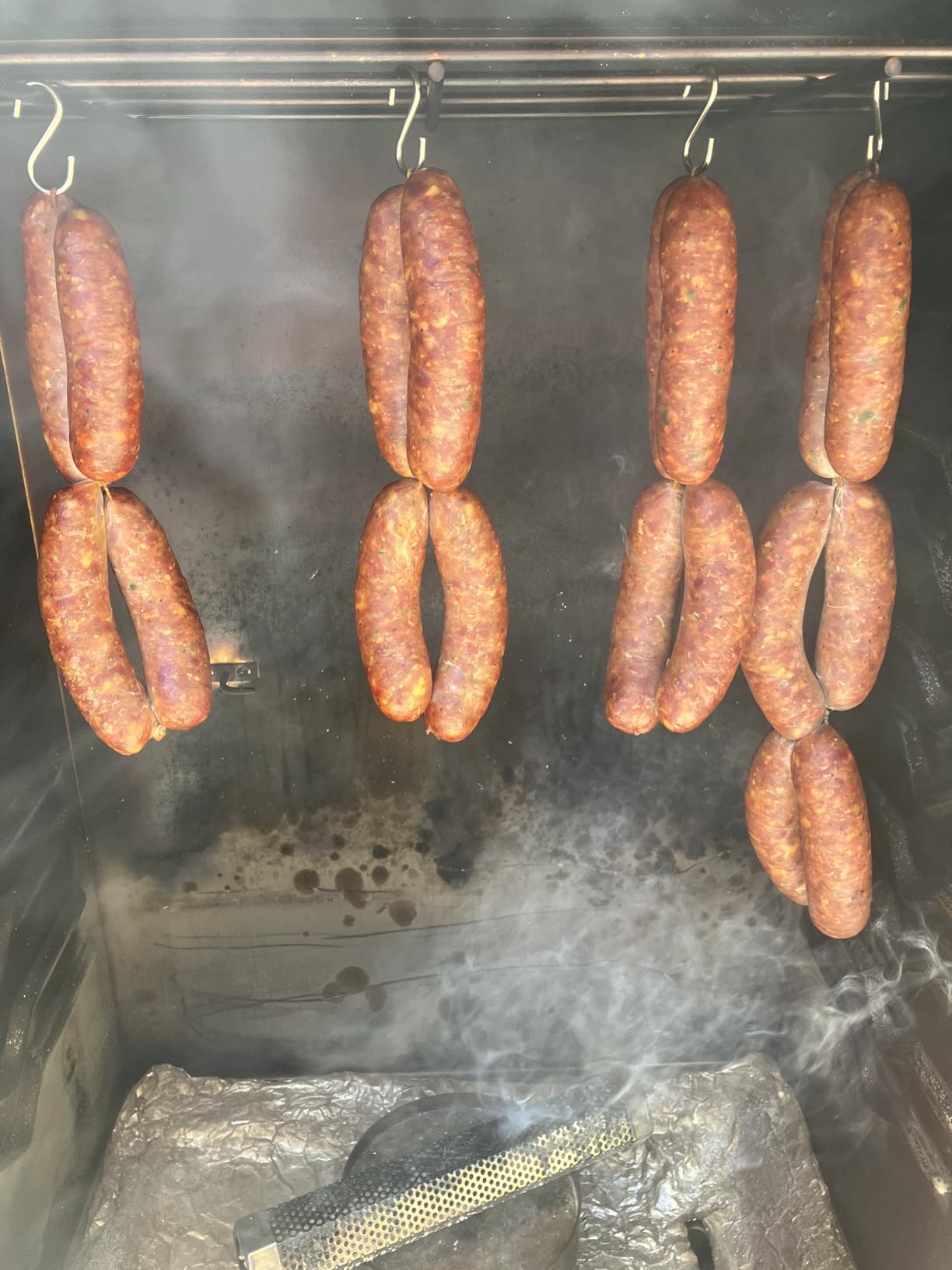
The integrated water pan is an underrated feature for jerky specifically. Owners credit it with temperature regulation, grease management and moisture retention, and on a long dry the grease management part matters because a batch of fatty beef jerky will drip. The water pan also softens the top-end drying that makes strips curl and harden at the edges, which is one of the most common jerky failures.
Control is handled by the Alpha Connect 2.0 touchscreen with a free smartphone app and Set and Forget digital control. A 4-year manufacturer warranty is included, and the unit fits up to 10 steel racks or 24 s-hooks, so the rack count is by far the highest here for anyone who wants to run jerky and snack sticks in the same session.
The rating breakdown is worth reading carefully. Ratings cluster positive at 62 percent five-star and 20 percent four-star, with no mid-range scores at all, but there is a distinct 18 percent one-star tail. That pattern usually means committed buyers are happy and a minority hit unresolved problems. Treat the 4.0 as a strong-but-not-spotless score rather than a consensus.
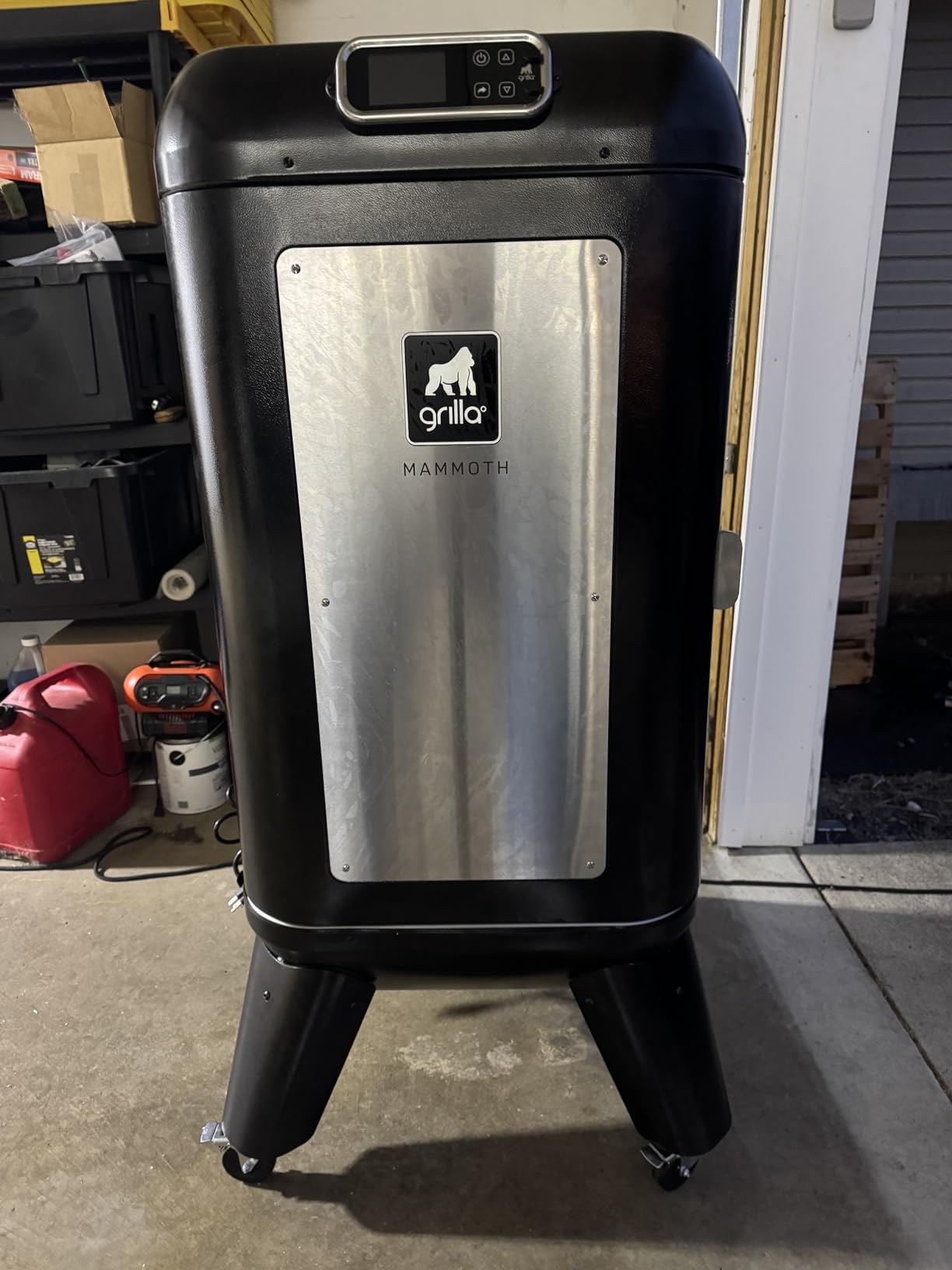
Physical size is the real trade-off. At 28 by 28 by 59 inches and 130 pounds, this is a bulk cabinet that needs a real footprint and two people to move. No food probe is listed among the included components, so budget for adding one if you want internal monitoring during the dry. And the s-hook option, while nice, is not what you are buying this for.
Jerky batch notes for the Grilla Mammoth
This is the cabinet to buy if you are making 15 lb or more in one go, and the tray count is what makes that possible. Load alternating trays rather than every tray, keep the water pan filled, and use the lipped deflector with a modest amount of chips early in the cook rather than the whole way through. Too much smoke late in a dehydrate is how jerky turns acrid.
The water pan is your best uneven-drying tool here. If the top trays run ahead, the top two positions are where you stage the first load and then rotate down, and the pan keeps the ambient humidity up while you do it.
Where it falls short
If you have a small patio, the 59-inch height and 130-pound weight are non-negotiable facts, not preferences. The one-star segment is real enough that we would want the warranty in hand before committing, and the missing probe is a small extra cost people forget to budget for.
It is also the wrong tool if you only want jerky. The extra capacity only pays off if you are running multiple racks or other food alongside it.
4. Weber Smoque XL – Best Smoke Flavor in a Pellet Cabinet
Weber® Smoque™ XL 34‑Inch Pellet Smoker, Pellet Grill, Black
SmokeBoost setting
SmoqueVent airflow system
Rapid React PID
2 probe ports, 2 probes
Pros
- SmokeBoost and SmoqueVent are purpose-built for smoke flavor
- Rapid React PID recovers temperature fast after the lid opens
- Two probes included with two integrated ports
- Weber Connect LCD controller is easy to navigate
- 5-year cook box warranty
Cons
- Smallest review base in the group at 14
- Enameled steel body is heavy at 110 lb
- Minimum temperature is not published in the spec sheet
The Weber Smoque XL is the one here that is designed around smoke rather than around searing. SmokeBoost is a dedicated setting for deep smoky flavor, and the SmoqueVent system circulates smoke through the cabinet specifically for flavor and browning. On a five-hour jerky dehydrate, dedicated smoke hardware matters more than it does on a two-hour brisket, because the smoke flavor is the entire reason you used a smoker instead of a dehydrator.
Rapid React PID is the other feature that earns its keep in this application. It heats up fast and recovers temperature quickly after a lid opening, and on a jerky cook you are going to open that lid repeatedly to rotate racks. A control that sags every time you look at the meat costs you drying rate and costs you smoke.
The 4.7 rating is the highest in this roundup, and the distribution behind it is unusually clean: 85 percent five-star and 11 percent four-star, with no three-star or two-star ratings at all. Feedback centres on controlled PID heat management, the dedicated smoke settings and the probe capacity. The main reservation is simply that there are only 14 reviews, so the sample is small.
We want to flag one gap honestly. The published spec sheet lists a maximum cooking temperature up to 500F but does not publish a minimum, and for a jerky roundup that is the number you need most. Before you buy this specifically for jerky, confirm the low end of the range with the manufacturer or check the control’s lowest setting. We are not going to fill that gap with a guess.
Jerky batch notes for the Weber Smoque XL
Assuming the low end sits where you need it, this is the cabinet we would pick for a cook where smoke flavor is the whole point and volume is secondary. It is a 34-inch unit with two integrated probe ports and two probes included, which is the best probe provision in this group. Use the second probe on the top rack as your canary: if the top rack reads done, the rest follows.
SmokeBoost is the setting to use for the first two hours of a hybrid method, then back off to normal for the dry so the finish stays clean. That pattern gets you color and flavor up front without the acrid finish a long constant smoke load produces.
Where it falls short
At 110 pounds of porcelain-enameled steel in a 20.4 by 50.8 by 44.5 inch frame, it is heavier than lighter-gauge competitors and needs a deliberate spot on the patio. The 14-review sample is small enough that we would not call the 4.7 a proven long-term reliability picture, and the missing minimum temperature spec is a genuine gap for this particular use case.
If you are making large batch jerky, the rack count here will not support it the way the Grilla or the Pellet Pro will.
5. ATSENT 616 Sq In Pellet Smoker – Best Value Vertical Smoker for Small Batches
Pellet Smoker with Cover, Electric Wood Pellet Smoker Grill With Meat Probe and Hook, 616 Sq in Cooking Area LED Display Temperature Control, Outdoor Cooking, Patio, Garden Barbecue
616 sq in on 4 adjustable racks
LED display with control knob
Side hopper, about 5 hours
Precision meat probe
Pros
- Bright LED display readable in sunlight
- Assembly reported at 10 to 45 minutes
- Side hopper lets you switch pellet wood by flavor
- Hanging hooks for sausages and ribs
- Compact enough to move as a two-person household
Cons
- Struggles to reach high temperatures on cold windy days
- Only 11 reviews so durability is not well documented
- Spec sheet lists fuel type as electric
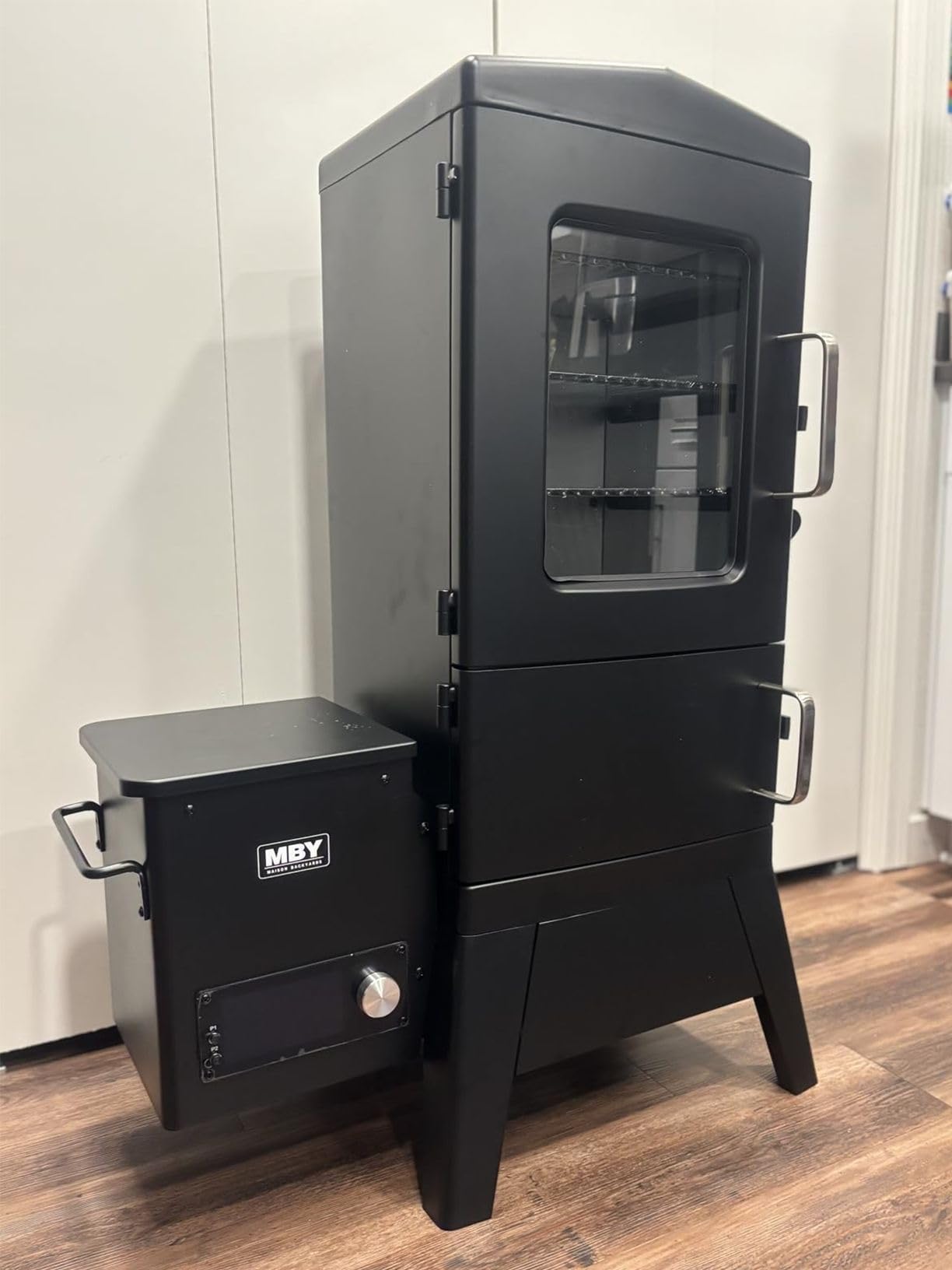
The ATSENT is the small-cabinet option, and 616 sq in across four adjustable racks is enough for a real jerky batch if you plan it. That is roughly 6 to 8 lb of trimmed strips with proper spacing, which is a meaningful amount of jerky and enough to share. The vertical upright design promotes upward heat and smoke flow, which is what you want in a cabinet this size.
The side pellet hopper holds roughly five hours of pellet capacity per fill, and the more interesting part is that it is on the side. Owners like being able to change pellet wood by flavor without dealing with a hopper under the cabinet, and for jerky that matters because you may want applewood for poultry jerky and a different wood for a venison batch.
The LED display with a control knob is bright and easy to read even in sunlight, which sounds trivial until you are checking a set point in a hot yard at 180F. A precision meat probe is included, and there are built-in hanging hooks for sausages and ribs, so the same cabinet covers snack sticks and jerky in one session.
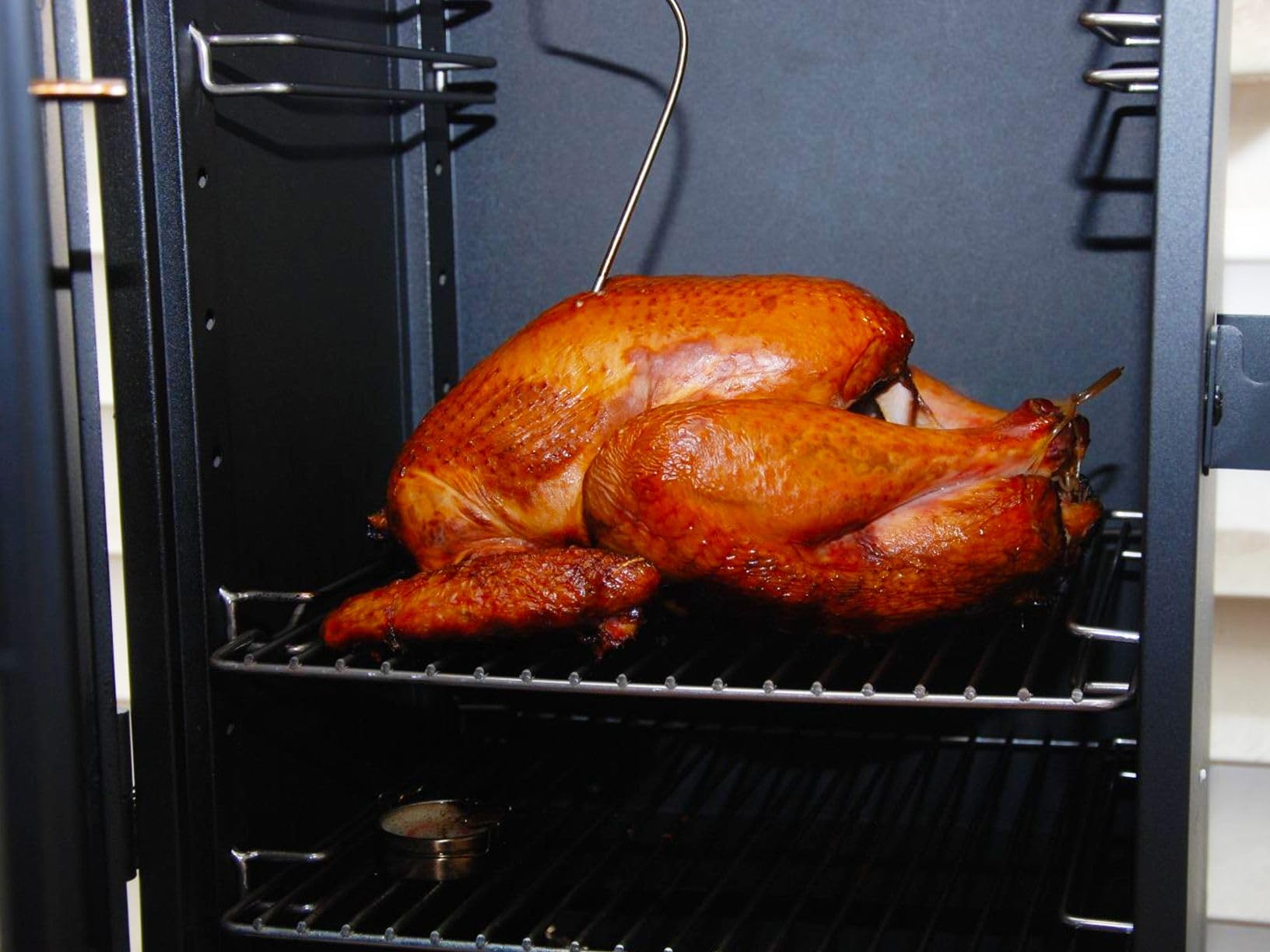
Owners report quick assembly at roughly 10 to 45 minutes with clear instructions, which is more than we can say for several larger cabinets on this list. They also report it holding temperature well across a 225F to 400F range, and being compact and easy to move for a two-person household.
Two cautions. First, reviewers report it struggles to reach higher temperatures on cold, windy days, which is the opposite direction of the problem you will have in July when you want 170F. Second, the spec sheet lists fuel type as electric even though the hopper and the product name are pellet, so treat the fine print as incomplete rather than as a different appliance. The 5.0 rating rests on 11 reviews, which is not enough to call long-term durability well documented.
Jerky batch notes for the ATSENT
This is the batch size to expect: 6 to 8 lb of trimmed strips across four racks, and you should probably use three. With 616 sq in there is not enough headroom to load every rack and leave gaps, so pick three racks, space the strips so they do not touch, and rotate the whole set down at the two-hour mark.
Because the hopper is on the side, this is the easiest cabinet here to switch pellet wood mid-program. Start a batch on a mild wood and finish on a stronger one if you want the flavor to read at the finish rather than at the start.
Where it falls short
It is not a smoker for a 16 lb holiday batch, and 616 sq in fills up fast once you respect airflow. The low review count means you are buying on spec sheet rather than on a wide owner consensus, and the cold-weather high-temperature complaint is worth knowing about if you also want to sear.
If your jerky habit is once a season in small amounts, the capacity ceiling here is the reason to look elsewhere.
6. Pit Boss 5-Series Vertical Smoker – Best for Raw Capacity on Paper
Pit Boss Grills 5-Series Wood Pellet Vertical Smoker
1679 sq in on 5 adjustable racks
130F to 420F control board
60 lb hopper
3 probe ports, 1 probe
Pros
- Largest cooking surface in this roundup at 1679 sq in
- 130F low set-point suits jerky work
- 60 lb hopper supports long unattended cooks
- Three probe ports with one probe included
- Heavy-gauge stainless with high heat coating
Cons
- Only one Amazon review exists and it is 1 star
- Auger fault codes reported stopping the fire
- Wi-Fi and Bluetooth reportedly would not pair with the app
On paper, the Pit Boss 5-Series is the biggest jerky machine in this group. 1679 sq in of cooking surface across five adjustable racks, each measuring 22.51 by 14.92 inches, a digital control board running 130F to 420F in 5-degree increments, and a 60 lb hopper with a cleanout system. A 130F floor is exactly what a jerky cook wants, and the chimney exhaust with a 250 watt auto igniter and convection airflow is the right hardware for even smoke distribution.
Other spec-sheet details worth noting for a dehydrate: three meat probe ports with one probe included, heavy-gauge stainless steel with a high heat coating, a large cabinet window, a rear access grease management tray and an adjustable smoke stack. The unit is listed at 28.9 by 28 by 53.2 inches and 140 pounds, with a boxed weight of 159 pounds. The control board is described as handling jerky, ribs, pork shoulder and casseroles, which tells you the low end is a supported use case rather than an accident.
Now the reason this sits at number six despite the best capacity numbers here. There is exactly one Amazon review, and it is a 1 star. That single review describes auger failure with persistent error codes and Wi-Fi and Bluetooth that would not pair with the app, from an owner with 40 years of gas smoker experience who returned to a gas smoker.
We want to be precise about what that does and does not tell you. A 1.0 rating resting on a single review is not evidence of a broad defect pattern, and we will not treat it as one. But it is also the only owner evidence that exists, which means you are buying entirely on a spec sheet. The auger fault and the app pairing failure are both plausible early-life problems, and both are exactly the failure modes that would ruin a five-hour jerky batch.
We keep it on the list because the capacity and the 130F floor are genuinely the best combination on paper, and because writing this roundup without it would leave out the most capable cabinet of the six. Just go in with your eyes open.
Jerky batch notes for the Pit Boss 5-Series
If you buy this for jerky, the batch math is where it earns its keep. Five racks at 22.51 by 14.92 inches each will hold a genuinely large batch, but you should still leave the bottom rack open. The 60 lb hopper means a 16 lb batch is a realistic single cook with room to spare, which matches the kind of batch size jerky forums report people running.
Run the first ten minutes with the smoke stack fully open to clear any startup bitterness, then throttle. Verify the app pairing and run one short test batch at 175F before committing a large load, given that those are the two features with reported problems.
Where it falls short
You are buying a 140-pound cabinet on the strength of a spec sheet and one negative review. That is a different kind of risk than buying a model with 33 reviews and a 3.3, because at least those reviews describe what actually happens on a cook.
If your plan is large holiday and gift batches, this is the right shape of machine. If you are learning jerky and want a predictable first cook, one of the models with a real owner consensus is the safer bet.
How to Make Jerky on a Vertical Pellet Smoker
For a full-process jerky cook on a vertical pellet smoker, hold 170F to 180F and run three to five hours. Below 160F the smoke flavor fades before the center of the strip dries. Above 180F the outside of the strip cooks and hardens while the inside is still wet, which gives you chewy jerky or a food-safety problem. Forum consensus across jerky and smoking communities lands squarely in that 170-180F band, and Traeger positions 180F as the sweet spot for smoking and drying jerky in its own recipe content.
Before any of that, the prep matters more than the appliance. Trim to a consistent thickness and do not cut thicker than 5 mm if you can help it, because a 10 mm strip has a center that will still be moist after four hours of drying. Slice across the grain, pat the surface dry, and season before the meat goes anywhere near a smoker.
Spacing is the step people skip and then blame the smoker for. Strips must not touch each other on the rack, and racks must not be packed edge to edge. One widely reported 16 lb jalapeno beef jerky batch was run with strips spaced 20 to 21 inches apart specifically so the bottom of the strips would not burn, which is an extreme version of the same principle.
With that in mind, here is the sequence we would run.
Step 1: Load the cabinet in stages, not all at once. Put the first load on the middle and upper racks and leave the lower ones open. An empty bottom rack is the cheapest convection path you will ever get, and it is the difference between an even dry and a batch where the top rack is done and the bottom rack is still rubbery.
Step 2: Set the set point and do not touch it. For a full-process cook, 170F is the number we would start at. 180F gets you there faster and is a legitimate choice for a thicker cut or a cold ambient day, but it also raises the odds of edge hardening. If your control only moves in 25-degree steps, set it to the lowest step above 165F and leave it alone.
Step 3: Manage the smoke, not the heat. This is where most home jerky goes wrong. Too much smoke over a four to six hour cook makes jerky bitter and acrid, and too little defeats the reason you bought a smoker. Pellets alone usually deliver a clean, thin smoke. On cabinets with a chip tray or deflector, add a modest amount of wood early in the cook rather than running heavy smoke the whole way through.
Step 4: Check the drip situation before it becomes a problem. Jerky slices are thin and low-fat, and they sit in a cabinet with a pellet fire pot a short distance below the lowest rack. A water pan, a grease tray and clean grates are not optional accessories for a fat beef batch. A single flare-up into a grease channel is how a long cook disappears.
Step 5: Rotate racks at roughly the two-hour mark. Swap the top and bottom loaded positions. The top rack will be running ahead and the bottom rack behind, and one swap fixes most of the problem without any equipment.
Step 6: Test for doneness, do not guess by time. The bend test is the standard: a finished strip bends without snapping and without being leathery. Three stages to watch for are a clean snap (too wet), a bend that cracks (nearly there, give it 20 to 30 more minutes) and a smooth bend with no cracking (done). Pull a strip from each rack, not just one, because that is how you catch a gradient.
Step 7: Cool before bagging. Jerky that goes into a bag while still warm will sweat, and that trapped moisture softens the surface and shortens shelf life. Cool it flat on a rack in open air before you pack it.
On food safety, the standard guidance is that jerky must be dried to a safe internal temperature and the surface must be dry throughout, with no liquid. Treat the bend test as a texture test and the temperature as the safety test, and never refrigerate finished jerky. If the strips are chewy rather than bendable, they are not finished, regardless of how long they have been in there.
Jerky Temperature and Time Cheat Sheet
Reconciling the conflicting numbers people quote is the single most useful thing this page can do, so here they all are with the reason each one exists. The differences are not disagreement, they are three different jobs.
Full-process on a smoker: 170F to 180F for 3 to 5 hours. This is the main event and the consensus range. Multiple jerky makers report 180F for about three hours being the whole method. Traeger calls 180F the sweet spot for smoking and drying jerky. Poultry jerky tends to run longer, with users reporting chicken jerky at 175F for about four hours before a dehydrator finish.
Hybrid method: 170F to 200F for 1.5 to 4 hours, then finish in a dehydrator. This is the most popular workflow overall. The smoker builds color and smoke flavor, and the dehydrator at a steady 150F to 160F handles the final dry evenly. It is the approach we would recommend if you already own a dehydrator and you are adding a smoker, because it removes the uneven-drying problem almost entirely.
Dehydrator only: 150F to 160F for 4 to 9 hours. The steady, low, consistent number. Dehydrators run this range for 4 to 9 hours depending on cut thickness and humidity. The trade is smoke flavor for consistency, and the texture complaint from people who move from a smoker to a dehydrator is the “leathery and tough” result that pushes them back.
On the specific questions people search for. Is 150F too low to smoke jerky? For a full-process smoker cook, yes, it is too low because the smoke load drops off and the cook stretches out; 150F is correct as a dehydrator setting or as a cold-smoke temperature. Is 160F hot enough? It is a valid slow dry but it is a dehydrator number, not a smoker number, and most people who try it report a long, low-flavor cook. Is 170F too hot? No, it is the bottom of the correct band. Is 180F too high or too hot? It is the top of the correct band for a full-process cook and it gets harder for thin cuts, which is why 170F is our starting recommendation and 180F is the ceiling rather than the default.
Cold smoking: 100F and below. Some people run a mailbox-mod style setup so temperatures drop as low as 100F for cooler smoke, and that approach is reported as ideal for charcuterie and jerky. This is a modification, not an out-of-the-box capability, and it is a different category of cook from everything above.
One more number worth keeping: cut thickness of 5 mm maximum. Every other variable in this section becomes academic if the strips are too thick to dry through in the time you have allocated.
Smoker vs Dehydrator: What Buyers Actually Report
The short version from the forums: people who switch from electric dehydrators to pellet smokers rarely go back. The upgrade is described as a large flavor difference, with pellet grills praised for mild, clean, low-and-slow smoke compared to a heavier wood fire. But the honest version has a second half, which is that a dehydrator is faster, more consistent and far cheaper.
On time, the dehydrator runs a steady 150F to 160F for 4 to 9 hours. Smokers can be faster, with some reporting 2 to 2.5 hours, but with less consistency. That speed advantage is real and it is also the risk, because a faster dry at a higher temperature is where jerky gets acrid or hard at the edges.
On control, the dehydrator wins cleanly. It is one dial in a sealed box with even airflow, and it does not care about wind, ambient temperature or a fire pot. Smokers are noted for overheating on warm days and stalling on cold days, which wastes batches, and a vertical cabinet adds a top-to-bottom gradient on top of that. Forum consensus keeps coming back to 5 mm maximum thickness and rack rotation as the mitigations, which tells you how much management the smoker requires by comparison.
On flavor, the smoker wins and it is not close. A dehydrator adds no smoke at all, and liquid smoke as a workaround is reported as tasting artificial. If you are buying a smoker for jerky, the smoke is the product.
On cost of entry, this is where we will be direct. A countertop dehydrator is a fraction of the price of any cabinet on this list and will give a beginner more consistent jerky in their first batch. That is genuinely the better buy for a lot of readers, and our jerky dehydrator guide lays out that case properly.
The smoker is worth it if you make three or more batches of jerky a year, want smoke flavor a dehydrator cannot deliver, and need to run other food in the same cook. If you make jerky a few times a year and smoke flavor is optional, the dehydrator wins on every axis except the one you would be buying the smoker for in the first place.
How to Stop Jerky Drying Unevenly Across Racks
Uneven drying is the defining weakness of the vertical form factor for jerky, and it is the complaint that comes up most often in jerky and smoking communities. The specific version that gets described is a cabinet where one side or the top rack is drying much quicker than the rest, and the result is a batch with some strips finished and some strips still tough.
The cause is structural, not a defect. Heat and smoke rise, so a single firebox at the bottom of a tall cabinet produces a temperature gradient from top to bottom. The Pellet Pro 2300 owners describe the gap as roughly 25 degrees with the fan off, and that is not unusual. It means the jerky makers who succeed are the ones who treat the gradient as a design feature to work around rather than a problem to complain about.
Staging is the first and biggest tool. Leave the lowest rack empty. Air moving up through an open bottom shelf is the cheapest convection you can add, and it takes about fifteen seconds of loading. If you need the capacity, fill bottom to top but load the top two racks last and pull them first.
Rotation at the two-hour mark is the second tool. Swap the top loaded position with the bottom loaded position. That single swap corrects most of a gradient in progress, and it costs you thirty seconds and a pair of heat-resistant gloves.
Spacing is the third. Strips must not touch each other, and racks must not be packed edge to edge. Touching strips trap moisture between them and dry at a different rate than exposed edges, which is how you get one piece chewy and its neighbor properly done. The reported 16 lb batch with strips spaced 20 to 21 inches apart is an extreme example, but the principle scales down to every cabinet we covered here.
Edge burning near the firebox is the fourth problem, and it is specific to jerky because the slices are thin and low-fat. A cabinet with a radiant heat path from the firebox will scorch the bottom edge of strips on the lowest rack before the rest of the rack is dry. A water pan, which the Grilla Mammoth has integrated, absorbs some of that radiant energy and is the reason it is a good jerky cabinet despite its size.
Flipping is optional and mostly a myth as a requirement. You do not need to flip jerky to dry it. What you do need is rotation, which is a different action. If you do want to flip, the useful moment is at the halfway point, and the useful motion is turning each strip rather than repeatedly rearranging the whole rack.
Finally, a sanity check on whether uneven jerky is even safe. If some strips are properly dried and others are clearly still flexible and cool to the touch, the under-dried strips are not finished, full stop. Pull them out and give them more time. Do not eat a partially dried batch because most of it is fine, and do not refrigerate jerky you are trying to finish.
Wood Pellet Pairings for Jerky
Pellet choice is the easiest flavor lever you have, and it costs nothing extra. Since jerky is a thin, low-fat, long-drying food, whatever wood you pick will be tasted clearly, which means heavy woods can go bitter over five hours in a way they would not over a two-hour smoke.
Applewood is the mild, slightly sweet option and the safest default for a first batch. It is the pairing most people land on for chicken and turkey jerky, where you want the smoke to be present but not to compete with the meat.
Maple is the sweet profile and pairs well with cured pork jerky and snack sticks. It is also a good match for a holiday batch that will be given away, because it reads as a flavor rather than as smoke.
Hickory is the savory classic and the most common choice for beef jerky. It is strong enough to be recognized at jerky thickness, so use it for short cooks or a lighter hand rather than a full smoker load for five hours.
Mesquite is the heaviest and heartiest profile. It is a legitimate choice for a strongly flavored beef or venison jerky, and it is also the wood most likely to turn acrid over a long dehydrate. If you use mesquite, keep the pellet-only smoke and skip the chip tray.
Pecan sits between maple and hickory with a nutty profile, and it is the most forgiving of the strong woods over a long cook. It is a good pick when you want smoke character without the risk.
The side hopper on the smaller cabinet style we covered is genuinely useful here, because changing wood between batches is easy. On a fixed hopper you can still do it, it just takes planning.
How to Choose a Vertical Pellet Smoker for Jerky
The low-temperature floor is the first criterion and the one that eliminates most models on its own. You need a set point at or below 160F to have any working room in the jerky band, and 130F is better because it leaves you a comfortable margin. Forum guidance treats a 180F floor as a deal breaker, and we agree: that puts the bottom edge of the usable range at the only temperature that barely works, with nothing to spare.
Of the six models here, two publish a 130F floor. Two others do not publish a minimum temperature at all, and one lists a 225F to 400F working range. That single line in a spec sheet tells you more about jerky suitability than any feature list. Check it before anything else.
Airflow and convection are second. A top-mounted convection fan is worth real money for jerky specifically, because it flattens the top-to-bottom gradient that makes vertical cabinets awkward for this food. A chimney exhaust and damper arrangement is the budget alternative, since it gives you both forced draft and manual control of the flow. Dampers and adjustable vents are worth looking for for a second reason: they are what let you run a genuine cold smoke later.
Rack count beats square inches. Jerky is light and thin. What you need is the ability to load three racks and leave two open, which means a minimum of four or five rack positions. A cabinet with huge square footage and three racks will force you to pack every shelf, and packed shelves dry unevenly no matter how good the smoker is.
Hopper autonomy matters more than hopper size. A full-process jerky run is three to five hours, and at a 170F set point the auger works harder than it does at 300F. A 50 lb or 60 lb hopper means you load once. A 15 lb hopper on a low-temp setting is workable but it is something to think about before you start, not during.
Smoke control is a jerky-specific requirement. You need a way to reduce or to add smoke over a four-plus-hour cook, because too much makes jerky bitter and too little wastes the appliance. A chip tray or deflector, a damper, and a control that lets you drop the set point while holding a fire are all ways to solve it.
Grease management is not optional. Jerky is frequently fatty beef or pork, and thin slices above a pellet fire pot drip. A water pan, a routed grease channel and a removable tray are what keep a long cook from turning into a flare-up. This is the one place where a water pan that helps keep jerky moist is a genuine feature rather than a gimmick.
Control accuracy sets your ceiling. A PID that holds within 5 to 10F gives you a repeatable cook. A controller with 25-degree steps and a reading that overshoots gives you a cook you have to babysit. On a five-hour dehydrate, babysitting is the cost that is not on the spec sheet.
Two more practical filters. Probes matter more than most people think, because the only way to know what is happening on the top rack versus the bottom rack is to measure both, and jerky makers regularly pull a strip from each shelf to test. Our beginner pellet smoker guide covers probe placement in more detail. And footprint matters more than weight, because the cabinet has to sit level on a patio and the door has to open with a rack of jerky in your hands.
Who this is not for
If jerky is the only thing you will ever make in it, buy a dehydrator. We would rather lose the sale than have you spend a large amount of money on a cabinet, learn to manage a fire pot and a hopper, and end up with jerky that is no better than what a countertop unit gives you. The smoker only earns its place when smoke flavor or multi-rack batch volume is something you actually want.
It is also the wrong tool if your plan is a single small batch. At 616 sq in and four racks you are working with 6 to 8 lb and managing a gradient in a small cabinet. If you make jerky once or twice a year in small amounts, that is a solved problem with a much simpler appliance.
And if your real interest is charcuterie and cold smoking, a cabinet with a published 130F floor and an adjustable damper is a better target than a dedicated high-heat grill. The 130F models on this list can be throttled into that territory; the rest cannot.
Frequently Asked Questions
What temperature should I smoke beef jerky at on a pellet smoker?
For a full-process jerky cook on a vertical pellet smoker, hold 170F to 180F for three to five hours. Start at 170F for thin cuts, since 180F is the ceiling of the useful band and gets harder on edges. Cut no thicker than 5 mm, leave space between strips, and test with the bend test rather than by clock time.
Is 150 too low to smoke jerky, and is 160 hot enough?
For a full-process smoker cook, both are too low. 150F and 160F are dehydrator numbers, not smoker numbers: at those temperatures the smoke load drops off and the cook stretches out to six hours or more with weaker flavor. 150F is correct as a dehydrator setting, a hybrid finish temperature, or a cold-smoke temperature.
Is 170F too hot, or is 180F too high, for jerky?
No to both. 170F to 180F is the consensus band for full-process jerky on a pellet smoker, and multiple jerky makers report 180F for about three hours being the entire method. 180F gets harder on thin cuts, so treat it as the ceiling of the band rather than the default, and use it for thicker cuts or cold ambient days.
Should I flip jerky when dehydrating in a smoker?
Flipping is optional. What matters is rotation: swap the top loaded rack position with the bottom loaded one at roughly the two-hour mark to correct the top-to-bottom temperature gradient. If you do flip, the useful moment is the halfway point, and turning each strip is more effective than rearranging the whole rack.
What are the most common jerky mistakes to avoid?
The big ones are cutting thicker than 5 mm, letting strips touch each other on the rack, loading every rack with no empty shelf for airflow, and running heavy smoke for the entire cook. Add to that list a set point of 180F or above on thin cuts, and bagging jerky while it is still warm so it sweats.
Why is my vertical pellet smoker not getting hot enough?
Common causes are a cold or windy day with a small hopper and a struggling auger, a dirty fire pot or blocked vent, a thermocouple that has drifted from the real cabinet temperature, and a damper or smoke stack that is throttled too far closed. In cold weather, give it a longer preheat and confirm an independent temperature reading before blaming the controller.
Do I need a dehydrator if I already own a pellet smoker?
Only if you want the most consistent results. The hybrid method is the most popular workflow: smoke at 170F to 200F for 1.5 to 4 hours to build color and flavor, then finish at 150F to 160F in a dehydrator, which removes the uneven drying problem that vertical cabinets create. A full-process smoker-only cook works fine at 170F to 180F for 3 to 5 hours.
What is the best vertical pellet smoker for jerky for the money?
The Pit Boss Navigator 3-Series is the strongest all-round pick for jerky, with a 130F low set-point, 1118 sq in across five racks and a 50 lb hopper, though its owner reviews are polarised between 46 percent five-star and 35 percent one-star. The Pellet Pro 2300 is the better choice if even drying across racks is your top concern, because its convection fan closes the roughly 25 degree top-to-bottom gap.
Conclusion: The Best Vertical Pellet Smoker for Jerky in 2026
Our pick for the best vertical pellet smokers for jerky is the Pit Boss Navigator 3-Series, because the 130F low set-point, five-rack layout and 50 lb hopper give you the most working room in the 170-180F band with the least babysitting. If uneven drying is the thing that worries you most, the Pellet Pro 2300 is the answer, since its convection fan is the single feature that flattens the gradient that ruins vertical-cabinet jerky. For a 15 lb holiday batch, the Grilla Mammoth is the only one of the three with enough tray space to do it in one load.
Start at 170F, cut no thicker than 5 mm, leave the bottom rack empty, rotate at two hours, and finish on the bend test rather than the clock. And if you are still deciding, read the jerky technique section above before you buy anything, because the smoker matters less than the discipline around it.