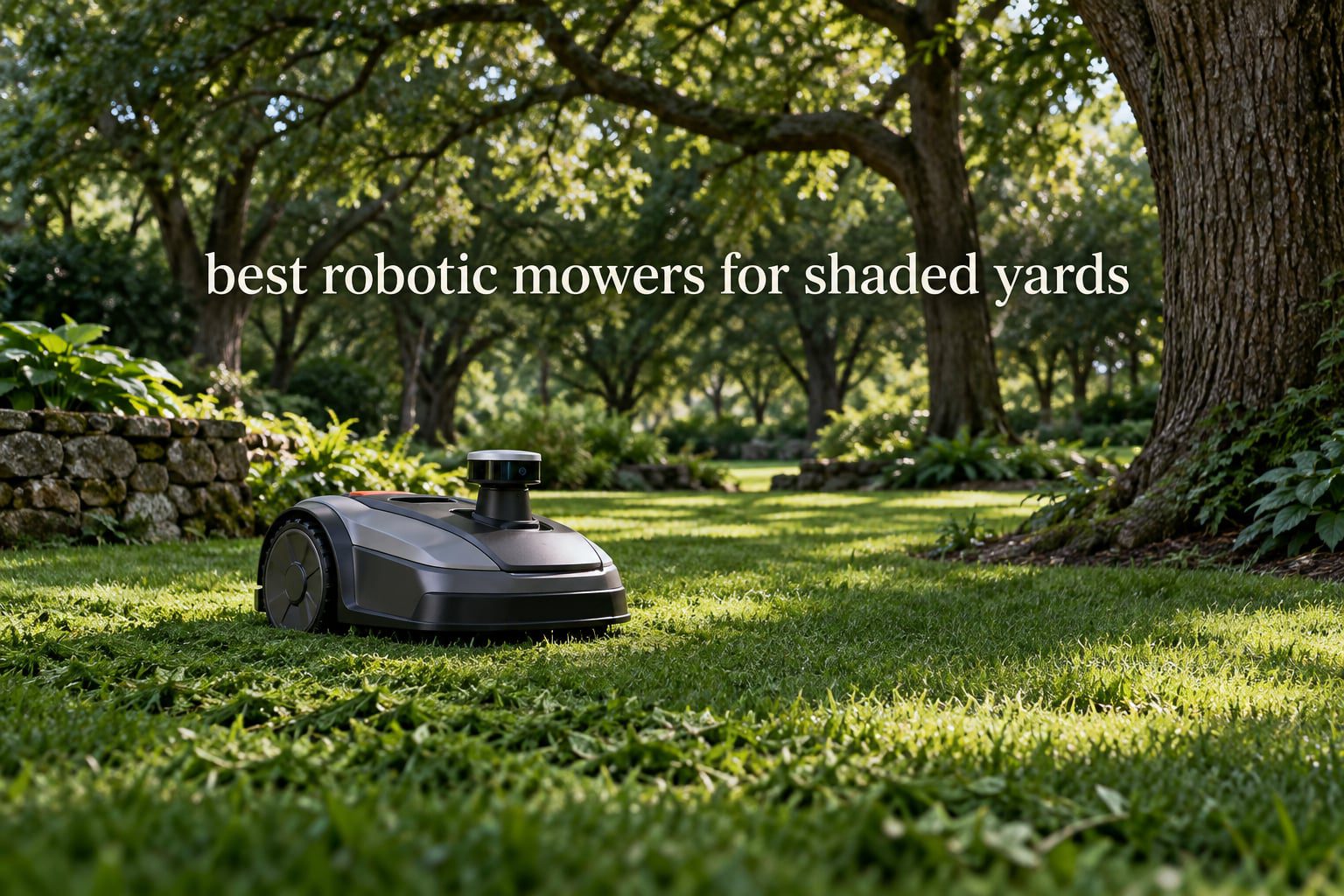
If your lawn sits under mature oaks, maples or a line of evergreens, the mower you read about in a generic roundup is probably the wrong one. I have spent the last two mowing seasons watching wire-free mowers behave in exactly the conditions that break them: a backyard with a full canopy over roughly a third of the turf, a root bed along the fence, and an oak whose branches reach almost to the ground. The best robotic mowers for shaded yards are not defined by cutting width or acreage on the box. They are defined by what happens to the navigation signal when leaves are overhead.
That failure mode is worth stating plainly before we get into the picks. A GPS-only robotic mower under a closed canopy will wander, re-map, miss patches and eventually stall out where the tree limbs are thickest. It is the single most common complaint in shade-focused owner groups, and it is also the one that is easiest to design around. Every machine in this guide carries a second navigation layer beyond satellite positioning, and the difference between those layers is what separates a mower that keeps working under the trees from one that quits there.
We looked at twelve wire-free robotic mowers for 2026, read every spec sheet against the shaded-yard question, and weighted the review data for the things that actually matter when the sun is off the lawn. Below you will find the top three picks, a full comparison of all twelve, our evaluation criteria, twelve individual reviews with buyer-fit notes, and buying guides on navigation, slopes, edge cutting and debris. No product on this list was chosen for a feature that only works in open sun.
Table of Contents
- Top 3 Picks for Best Robotic Mowers for Shaded Yards (October 2026)
- Best Robotic Mowers for Shaded Yards in 2026: All 12 Compared
- How We Evaluated Mowers for Shaded Yards
- 1. ANTHBOT M9 Review: Best Overall for Shaded Yards
- 2. Mammotion LUBA mini 2 AWD 1500H Review: Most Versatile for Roots and Slopes
- 3. Segway Navimow i105N Review: Budget Pick
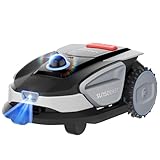
- 4. Sunseeker S4 Review: Best for Dense Shade and Low Light
- 5. MOVA LiDAX Ultra 1000 Review: Best When You Cannot Mount an Antenna
- 6. Segway Navimow i215 Review: Best for Steep Shaded Yards
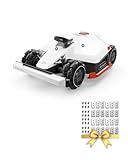
- 7. Mammotion LUBA 2 AWD 3000X Review: Best for Large Shaded Yards
- 8. roborock RockMow X120H Review: Best for Night Mowing Under Canopy
- 9. WORX Robot Lawn Mower Wire-Free Review: Best for Brand Support
- 10. Sunseeker X3 Plus Review: Best Lightweight Option
- 11. eufy Robot Lawn Mower E15 Review: Best for Small Yards With Partial Shade
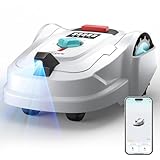
- 12. YARDCARE M800Plus Review: Best Value for Smaller Shaded Lawns
- Navigation Technology and How Trees Break Satellite Signals
- Slopes, Roots and Uneven Ground Under Trees
- Edge Cutting Along Tree Lines and Root Beds
- Leaves, Debris and Night Mowing in a Wooded Yard
- Frequently Asked Questions
- What is the best robotic mower for a shaded area with lots of trees?
- Will a robot mower work under dense tree cover?
- Do robot mowers use GPS?
- What happens if a robot mower loses GPS signal?
- Which robot mower is best for hilly yards?
- What are the downsides of using a robotic lawn mower?
- Can you leave a robot lawn mower outside?
- Are wire-free robot mowers as accurate as boundary wire?
- Final Verdict
Top 3 Picks for Best Robotic Mowers for Shaded Yards (October 2026)

ANTHBOT M9
- RTK plus dual AI cameras
- 1000 plus obstacle types
- 45 percent slope
- 10 minute auto mapping

Mammotion LUBA mini 2
- 360 degree LiDAR plus dual cameras
- 80 percent slope
- edge disc
- 0.37 acre
Best Robotic Mowers for Shaded Yards in 2026: All 12 Compared
| Product | Specs | Action |
|---|---|---|
| ANTHBOT M9 |
|
Check Latest Price |
| Mammotion LUBA mini 2 AWD 1500H |
|
Check Latest Price |
 Segway Navimow i105N Segway Navimow i105N |
|
Check Latest Price |
 Sunseeker S4 Sunseeker S4 |
|
Check Latest Price |
 MOVA LiDAX Ultra 1000 MOVA LiDAX Ultra 1000 |
|
Check Latest Price |
 Segway Navimow i215 Segway Navimow i215 |
|
Check Latest Price |
 Mammotion LUBA 2 AWD 3000X Mammotion LUBA 2 AWD 3000X |
|
Check Latest Price |
 roborock RockMow X120H roborock RockMow X120H |
|
Check Latest Price |
 WORX Robot Lawn Mower Wire-Free WORX Robot Lawn Mower Wire-Free |
|
Check Latest Price |
 Sunseeker X3 Plus Sunseeker X3 Plus |
|
Check Latest Price |
 eufy Robot Lawn Mower E15 eufy Robot Lawn Mower E15 |
|
Check Latest Price |
 YARDCARE M800Plus YARDCARE M800Plus |
|
Check Latest Price |
How We Evaluated Mowers for Shaded Yards
Shade changes which specs matter, so we scored every machine on the same seven criteria rather than on the headline numbers most roundups use. Coverage area and cutting width barely moved a mower up or down here.
1. Redundant positioning. Does the machine have a navigation layer that keeps working when the satellite signal weakens, and is that layer active in the shaded zones or only in open lawn? RTK plus vision and LiDAR plus vision both qualify. RTK alone does not.
2. Behavior in low light and at night. Canopy at night is the hardest case, because vision systems lose their reference frame. LiDAR and time-of-flight sensing keep working regardless of ambient light, which is why we weighted them heavily for anyone mowing outside daylight hours.
3. Antenna and base station dependence. Wire-free does not always mean antenna-free. A model that needs a roof-mounted RTK antenna with a clear view of the sky is a poor fit for a yard boxed in by mature trees, and we treated that as a real drawback rather than a setup detail.
4. Traction and slope rating. Shaded ground is uneven ground. Root heave, ruts and shade-side slope dips are where two-wheel-drive mowers get stuck, so we noted the drivetrain and the published slope capability together.
5. Obstacle recognition depth. A wooded yard is full of cones, sticks, fallen fruit, low branches and hoses. The stated object-class count tells us how large the recognition library is, and reviewers repeatedly reported which real yard items slipped through.
6. Edge behavior. Trees mean most of your yard border is a root bed, a mulch bed or a bed edge rather than a fence. Offset blades and dedicated edge discs matter more here than they would on an open rectangular lawn.
7. Review depth and support reality. A 4.8 rating from nine reviews tells us less than a 4.2 from 350. We weighted review volume heavily and flagged thin review bases explicitly in each write-up.
1. ANTHBOT M9 Review: Best Overall for Shaded Yards
ANTHBOT M9 Robotic Lawn Mower with Garage, 1/4 Acre Wire-Free NRTK & Vision
RTK plus dual 150 degree HDR cameras
1000 plus obstacle classes
45 percent slope
Up to 30 zones
Pros
- Vision plus RTK fusion keeps working under canopy
- Strong obstacle library at over 1000 classes
- 10 minute auto mapping with no perimeter wire
- Quiet at 58 dB or below
Cons
- Narrow 7.9 inch cut width means more passes
- RTK antenna still needs open sky
- Documentation for adding a second zone is thin
The ANTHBOT M9 is the machine I would put under a mature canopy without hesitating, and it is our pick for most shaded yards. It pairs RTK positioning with two 150 degree HDR cameras running an integrated vision system, which is the combination that keeps the map intact when the sky disappears. Owners running it in tree-covered ground report the map holding and the cut pattern staying straight rather than degrading into re-mapping loops.
What surprised me was the obstacle library. The dual cameras are advertised as recognizing more than 1,000 object types, which is a step above the 150 to 300 class figures that dominate this category. In a wooded yard that is the difference between a mower that routes around a pine cone and one that climbs over it.
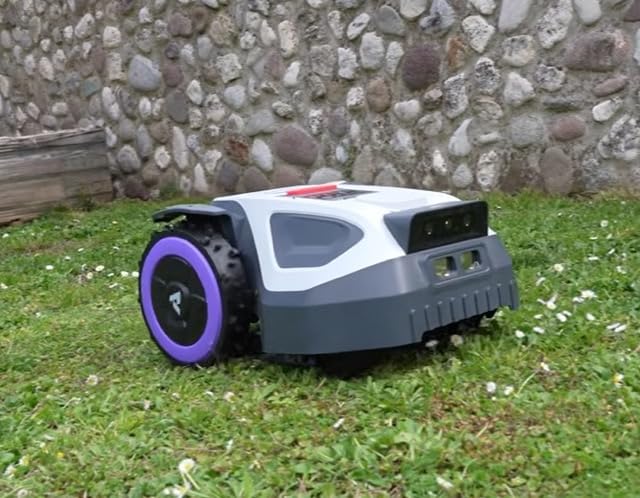
Setup is genuinely fast. The app builds a virtual map in about ten minutes without any boundary wire and without a manual drive-the-perimeter ritual, and the machine manages up to 30 work zones with no-go areas for pools and beds. Slopes up to 45 percent are within spec, which matters because shade collects on the low side of every root ball and drainage swale.
The cut is consistent and carpet-like, with height adjustable from 1.2 to 2.7 inches and several path patterns in the app. Noise sits at 58 dB or below, so it is quiet enough to run in the early evening when the lawn is still damp and the grass lays down more cleanly.
Why it fits a tree-covered yard
The RTK plus vision stack is the reason this one keeps its bearings under branches. In shade, when the satellite fix degrades, the cameras carry the position estimate and the map does not get rebuilt. That is the specific mechanism that solves the problem shade owners complain about.
The 45 percent slope rating also gives it room to handle the uneven ground that root systems create. A mower that can climb out of a shaded hollow will not need rescuing at the same tree every week.
Where it falls short
The 7.9 inch cutting width is narrow for its class, so a quarter acre takes more passes and more recharge cycles than a wide-deck rival. The blades cannot be widened on this model. Budget your time for the session length rather than the purchase.
The RTK antenna still wants a clear view of the sky, which narrows where you can place the base station in a heavily wooded yard. Mount it at the highest point of the house or a pole at the yard edge, and treat the antenna as a fixed decision you make once rather than a flexible one.
2. Mammotion LUBA mini 2 AWD 1500H Review: Most Versatile for Roots and Slopes
(2026 Upgrade) Mammotion LUBA mini 2 AWD 1500H Robot Lawn Mower, for 0.37 Acres, 360° LiDAR+Dual-Camera AI Vision, 80% Slope, DropMow, 20 Multi-Zone Management
360 degree LiDAR plus dual cameras
Two 88W motors,80 percent slope
Steps over 45mm roots
20 zones
Pros
- Terrain capability handles rooty and sloped lawns
- 360 degree LiDAR plus cameras give redundant sensing
- Dedicated edge disc cuts clean at pavement
- Quiet and low turf damage
Cons
- Mapping capped at 0.37 acre and finicky
- 7.9 inch deck at walking pace is slow
- Charging can take two to three hours
The LUBA mini 2 AWD 1500H is the pick when your shaded yard is also a difficult one. Reviewers describe it as the machine that goes where others stall, and the hardware list explains why: two independent 88W motors, adaptive suspension that steps over curbs, roots and thresholds up to 45mm, and an 80 percent climbing rating.
For navigation it runs a 360 degree LiDAR with a 45 degree field of view alongside dual cameras. That redundancy is the point in a wooded yard, because two sensing systems failing in the same shaded pocket is far less likely than one. The raised cut height range also suits shaded lawns, where the grass species are typically the coarse fescues that benefit from a longer cut.
The dedicated edge cutting disc produces a clean line where lawn meets pavement, which is more useful than it sounds in a tree-covered yard where half your border is a bed edge rather than a straight fence. A zero-turn option lets it pivot without tearing turf, and that matters in the tight shaded corners where owners of turning-heavy mowers report scuffing and ruts.
Battery management is thoughtful, with a custom charge limit and off-peak scheduling that keep the pack healthier over a long season. The DropMow mode skips mapping entirely if you want to place it and start cutting, which is genuinely useful for the isolated shaded patch behind a hedge.
Why it fits a tree-covered yard
Nothing else in this list combines that slope rating with root-stepping height and a redundant LiDAR plus camera stack. If your shaded ground is uneven, sloped or full of heaving roots, this is the machine that will keep going instead of stalling at the worst tree.
The low turf damage under turns is the sleeper benefit. Shaded grass is thinner and more fragile, and a mower that pivots rather than torquing its tracks across a corner is much less likely to leave a visible scar that takes weeks to grow out.
Where it falls short
Mapping is capped at 0.37 acre and the app is finicky about boundaries, so give yourself time on setup day. The 7.9 inch cut width combined with roughly walking-pace speed means a quarter acre can take half a day. Charging from low to full can run two to three hours, which factors into how you schedule around shade patterns.
The AI obstacle recognition is deliberately cautious and sometimes turns away from a boundary line it should follow, leaving a strip near the edge. Customer support chat is a known weak point, so check the manual for anything the app does not explain clearly.
3. Segway Navimow i105N Review: Budget Pick
Segway Navimow i105N Robot Lawn Mower Perimeter Wire Free 1/8 Acre RTK+Vision Robotic Lawnmower, AI-Assisted Mapping, Virtual Boundary, APP Control, 58dB(A) Quiet, Multi-Zone Management
RTK plus vision with EFLS 2.0
150 plus obstacle types via 140 degree camera
12 zones
58 dB(A)
Pros
- Centimeter level positioning holds under trees
- Very quiet at 58 dB(A) for overnight runs
- AI assisted mapping needs no perimeter wire
- Three year warranty included
Cons
- Factory wheels have weak traction on slopes
- Map can be lost after vision processing
- Antenna and dock need open sky
The Navimow i105N is the value pick in this guide, and at 391 reviews it also carries the largest owner base here. Owners consistently confirm it mows and navigates well in tree-covered yards, with clean striping and near-silent running once mapping is done properly. In shade the RTK plus vision combination with EFLS 2.0 holds centimeter-level positioning under trees and in narrow corridors.
Noise at 58 dB(A) is the number that matters for a shaded yard specifically. Owners run this one overnight, and in low-canopy conditions the mower is working in the coolest, dampest part of the day, which is also when grass lays down most neatly.
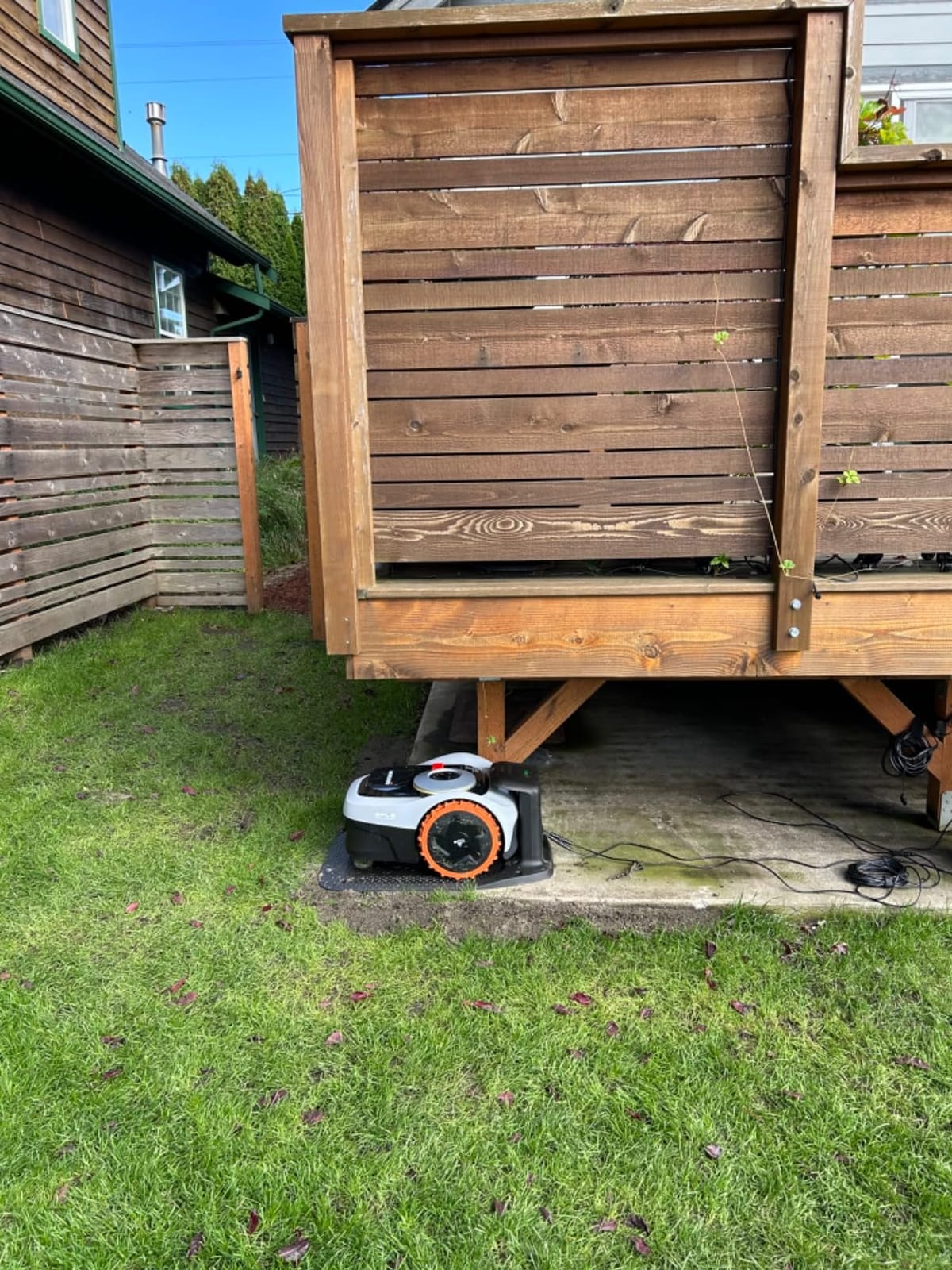
A r/roboticLawnmowers owner running a Navimow reported that the machine handles steep areas with ease where a previous mower nearly flipped, and regulars in the same group are blunt that RTK on its own is not enough under trees. This model answers that objection with the camera layer, which is why it sits so high despite being the most affordable machine we recommend.
AI-assisted mapping identifies clear lawn edges during setup, which shortens the boundary walk that owners otherwise find tedious. The 140 degree camera detects 150 plus object types, and the app supports up to 12 zones with remote control and theft location.
Why it fits a tree-covered yard
The vision camera is what keeps the map from collapsing when the satellite signal fades beneath branches. Combined with a three year warranty and a well reviewed app, that makes this the lowest-risk entry for a first wire-free mower in a wooded yard.
The virtual boundary system is the other reason to look here. If you have tree roots and irrigation lines close to the property edge, a wire-free setup avoids the trenching that makes owners nervous about damaging what is growing there.
Where it falls short
Factory wheels have poor traction. On sloped shaded ground or in mulch beds, owners frequently fit off-road tires or wheel spikes, which is a real extra step and a small added cost. The map can also be lost after vision data processing, forcing a full re-map.
Vision Fence misses some obstacles such as mailboxes, gates, hoses and sprinklers, and can detect phantom objects in drainage channels. It does not mulch, so clippings stay on the surface and you will still want a quick manual edge trim every few weeks. The antenna and dock both want a clear view of the sky, so place them deliberately.
4. Sunseeker S4 Review: Best for Dense Shade and Low Light
Sunseeker S4 Robot Lawn Mower, 3D LiDAR, Vision AI, 0.25 Acre, Wire-Free
360 degree 3D LiDAR plus vision AI
10 TOPS AllSense chip
42 percent slope
Up to 100 zones
Pros
- Purpose-built for yards with dense trees and eaves
- Plans routes in low light and at night
- Handles 31.5 inch passages and uneven ground
- Wire-free mapping with no base station calibration
Cons
- 7 inch cut width is narrow
- Only 33 reviews so far
- Newer platform with a shorter track record
The Sunseeker S4 is the most explicitly shade-focused machine we tested, and its 4.5 rating from 33 reviews is the highest average in this group. The manufacturer states the machine is built for yards with dense trees, shade, eaves, narrow passages and weak-signal areas, which is nearly a description of the problem this whole guide addresses.
The hardware behind that claim is a 360 degree 3D LiDAR paired with vision AI on a 10 TOPS AllSense chip. Together they plan systematic parallel routes in daylight, low light, at night and in weak-signal zones. For a yard where the interesting mowing window is after the sun clears the canopy, that is the correct sensor combination.
Rear-wheel drive handles bumps and ruts, passes through 31.5 inch passages and climbs slopes up to 42 percent, which gives it room on the uneven ground that tree roots create. Mapping is done in the app without a perimeter wire and without base-station calibration, and you can save five maps with up to 100 zones or no-go areas.
Operation is quiet at 60 dB, with a rain-sensor return, app and voice control, and a two year warranty backed by US-based support. US support matters more than usual in a wooded yard, because most troubleshooting will be about boundary and mapping questions rather than hardware failure.
Why it fits a tree-covered yard
It is the only model here whose published route planning explicitly names nighttime and weak-signal zones as target conditions. If your canopy is dense enough that the lawn is in shadow for most of the day, the LiDAR plus vision pairing is built for exactly that.
With up to 100 zones and five saved maps, you can set a schedule that follows the moving shade, cutting the deepest shadow at its brightest hour rather than on one fixed evening run.
Where it falls short
The 7 inch cutting width is the narrowest deck here, so full coverage takes noticeably longer than with an 8.5 to 9.5 inch machine. On a large wooded yard, plan for multiple sessions.
With 33 reviews the long-term durability picture is still thin, and this is a newer platform than the established robotic mower brands. Some manual edge touch-ups are still needed despite the ride-on-edge mode. If buying into an unproven platform worries you, the M9 or the Navimow i105N carry more owner history.
5. MOVA LiDAX Ultra 1000 Review: Best When You Cannot Mount an Antenna
MOVA LiDAX Ultra 1000 Robot Lawn Mower Wire Free for 1/4 Acre, RTK-Free+360° 3D LiDAR+AI Vision Auto Mapping, Zero-Edge Cutting, Cutting Height 1.2″-3.9″, 45% Slope, Up to 150 Managed Zones Dual Maps
RTK free 360 degree 3D LiDAR
Cut height 1.2 to 3.9 inch
Within 2 inch of edges
45 percent slope
Pros
- No wires and no RTK station needed
- Works in dim light and harsh light
- Unusually wide cutting height range
- Cuts within 2 inch of walls and hedges
Cons
- Occasional obstacle mis-identification
- Deep ruts can still force manual rescue
- Shorter customer review history
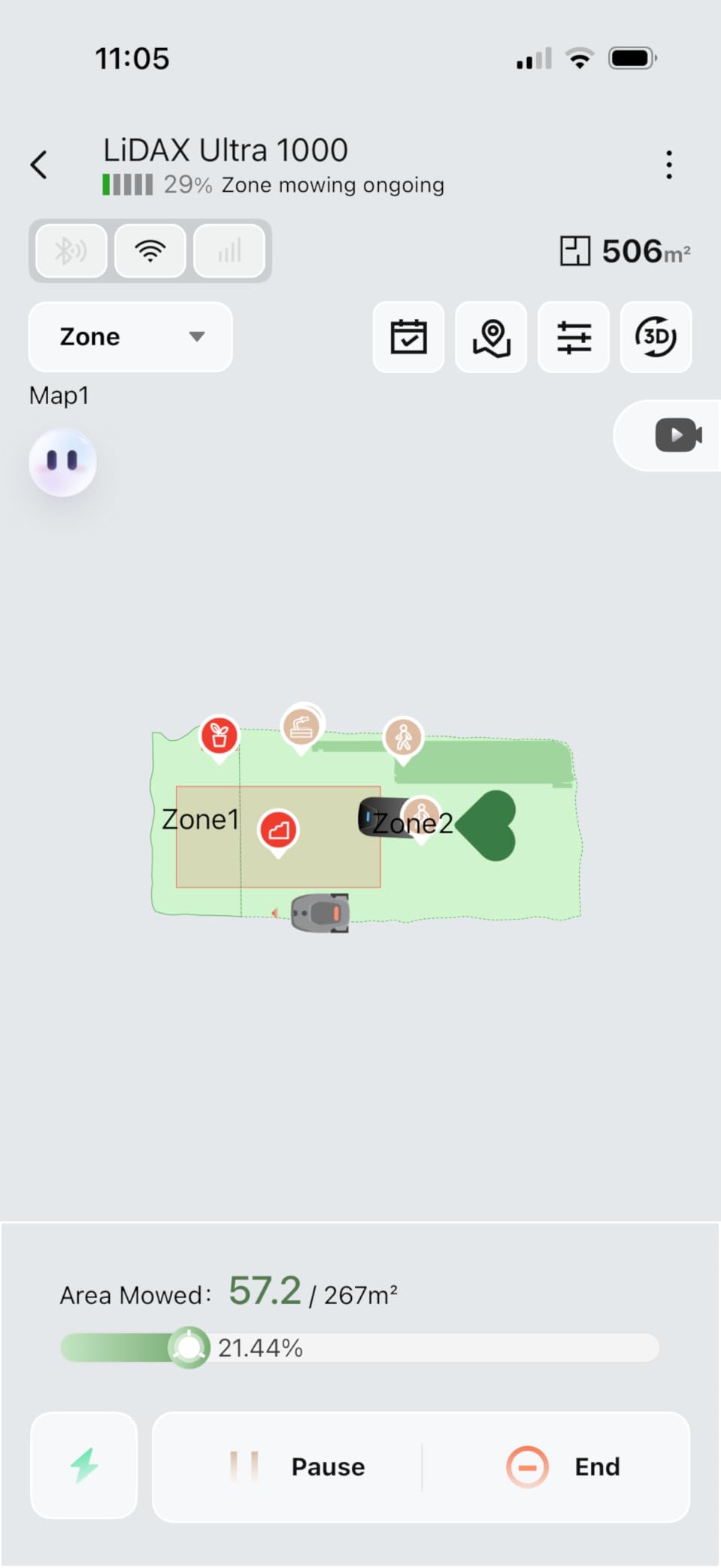
The MOVA LiDAX Ultra 1000 is the answer when there is genuinely nowhere to put an RTK antenna. It auto-maps in 3D using 360 degree 3D LiDAR with no wires and no base station, and the company states it works in dim light and harsh light alike. In a yard hemmed in by tall trees, buildings and walls, that removes the single most common installation failure.
The cutting height range runs from 1.2 to 3.9 inches, the widest here, and that is more useful in shade than it looks. Shaded lawns grow in coarse fescues and mixes that prefer a longer cut, and a mower that cannot go tall enough will leave the lawn scalped in exactly the patches that are already struggling.
Edge performance is the other highlight. The UltraTrim movable disc cuts within 2 inches of walls, hedges and raised edges, and it rides on flush lawn-pavement transitions. In a wooded yard where the border is a mix of bed edge, walkway and low branch overhang, tighter edging means less time with a string trimmer.
Rear-wheel drive with off-road wheels handles 45 percent slopes, obstacles up to 1.6 inch and passages as narrow as 23.6 inch, and dual maps let you run separate front and back yard plans from one machine. A three year manufacturer warranty is included.
Why it fits a tree-covered yard
Zero satellite dependency means zero signal problems. There is no antenna to site badly, no base station to calibrate, and nothing to re-map when a branch grows into the sightline. For a yard where the tree canopy is the whole problem, removing the satellite from the equation is the cleanest fix available.
The 1.2 to 3.9 inch height range is the second reason. If your shaded turf is thin and slow to recover, setting a longer cut protects the crown that keeps the grass alive through the low-light months.
Where it falls short
Even with 300 plus obstacle classes, reviewers report occasional mis-identification of yard items. That is normal for vision-based systems but worth knowing before you set it loose among toys and garden furniture.
Rough terrain and deep ruts can still require a manual rescue, and pushing a heavy deck up a 45 percent slope cuts into the mowing time available per charge. The review history is shorter than the Navimow or M9, so treat early software refinements as likely.
6. Segway Navimow i215 Review: Best for Steep Shaded Yards
Segway Navimow i215 LiDAR Robot Lawn Mower, Wire Free Robotic Lawn Mower for 0.37 Acre, LiDAR & Vision Dual Fusion, Auto Mapping, Off-Road Wheels for 45% Slopes, Quiet 59 dB(A) Mowing
Solid state LiDAR with vision fusion
No antenna required
45 percent slope
8.66 inch cutting width
Pros
- Satellite-free LiDAR plus vision works day or night
- One-tap auto mapping with no antenna
- Off-road wheels with stability control
- 200 plus obstacle types at 0.4 inch accuracy
Cons
- Small review base of 46
- Larger chassis and LiDAR tower need storage room
- Highest cost in this guide
The Navimow i215 is the second Segway here and it takes a different approach from the i105N. Instead of RTK plus vision, it runs a high-resolution solid-state LiDAR paired with onboard vision sensors, giving satellite-free navigation that works day or night. In a deeply shaded yard, removing the satellite dependency entirely is the most direct answer to the canopy problem.
Setup is a single tap. There is no boundary wire, no antenna and no base station, and the machine can go straight to work out of the box. AI VisionFence detects more than 200 obstacle types with 0.4 inch accuracy, and you can edit up to 20 mowing zones on an interactive map.
Terrain is the second strength. Off-road wheels and electronic stability control handle 45 percent slopes, and the drive train is built for dense or fast-growing grass. The cutting width is 8.66 inch with height adjustable from 2 to 4 inches, a range that suits the longer cuts shaded lawns usually want.
Smart features include a GPS geo-fence, lift detection, Apple Find My alerts and automatic docking in extreme weather, plus Alexa and Google Home voice control. Edge cutting runs through ride-on mode supported by EdgeSense.
Why it fits a tree-covered yard
Solid-state LiDAR is unaffected by ambient light, so a schedule set for the darkest hours of your shaded lawn still works. If your canopy is thick enough that no antenna has a clean sightline, this machine simply removes the constraint.
Electronic stability control is worth more under trees than in the open, because the ground under a mature canopy is where ruts and root heave concentrate. Being able to hold a line on a 45 percent shaded slope is the difference between mowing the yard and mowing most of it.
Where it falls short
With 46 reviews the long-term durability feedback is limited, so you are buying early on a newer platform. The LiDAR tower and larger chassis take more storage than a compact machine, which is a nuisance in a garage already crowded with yard gear.
Some owners still report occasional manual edge trimming despite ride-on mode, and it sits near the top of the price range in this guide. Pair that with the higher outlay for a reason: you are buying a sensor stack that has no cheaper equivalent.
7. Mammotion LUBA 2 AWD 3000X Review: Best for Large Shaded Yards
Mammotion LUBA 2 AWD 3000X Robot Lawn Mower with 4G, 80% Slope, 0.75Acre
UltraSense AI vision plus RTK
165W four-wheel drive,80 percent slope
15.8 inch cut width
Pros
- Mows under trees where satellite signal is weak
- Four-wheel drive clears 80 percent slopes
- Widest cut width in this guide
- Up to 30 mowing areas with no-go zones
Cons
- Not built for overgrown first cuts
- App connectivity is choppy
- Camera lighting complicates night runs
The LUBA 2 AWD 3000X is the pick when the shaded yard is large as well as difficult. It covers up to 10700 sq ft per charge with a 15.8 inch dual-blade disk, the widest cut in this guide, which means fewer passes over rooty, uneven ground where each pass risks getting stuck.
Navigation is UltraSense AI vision combined with RTK, and the stated design intent is mowing under trees without a satellite signal. Owners confirm it does exactly that, describing the machine as capable of terrain other mowers could not handle, including ditches, potholes and steep shaded banks.
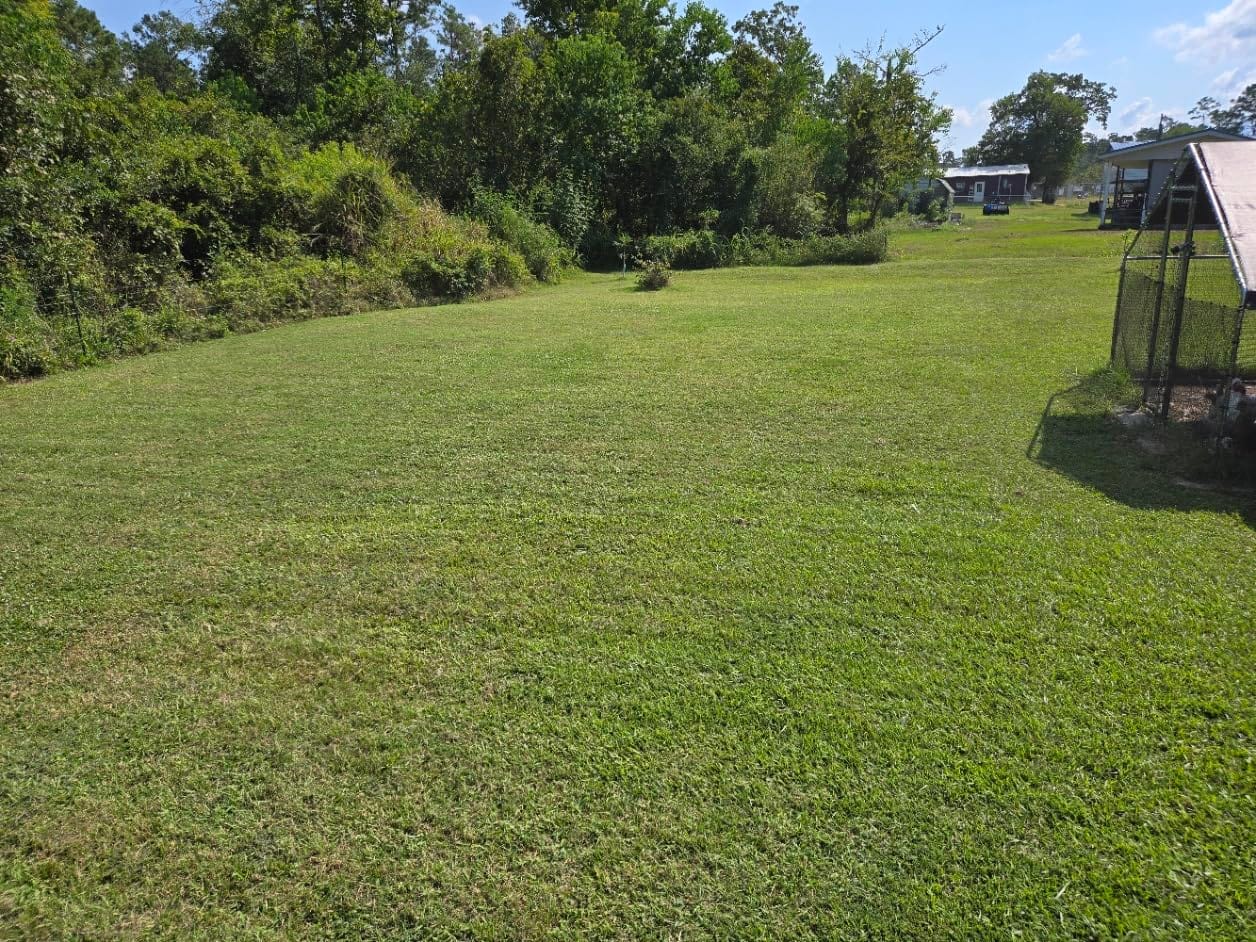
The drivetrain is the reason: a 165W four-wheel motor rated for 80 percent, or 38 degree, climbing. That headroom is meaningful under a canopy, because shade collects on the low side of every mound and the wet soil there gives way. Edge mapping and ride-style zero-distance edge cutting keep the border tidy against root beds.
Zone management covers up to 30 mowing areas with no-go zones, and the machine resumes automatically after recharging. Connectivity runs over 4G, Bluetooth and Wi-Fi, with parallel, checkerboard and diamond grid patterns, plus GPS tracking and a lockout mode against theft.
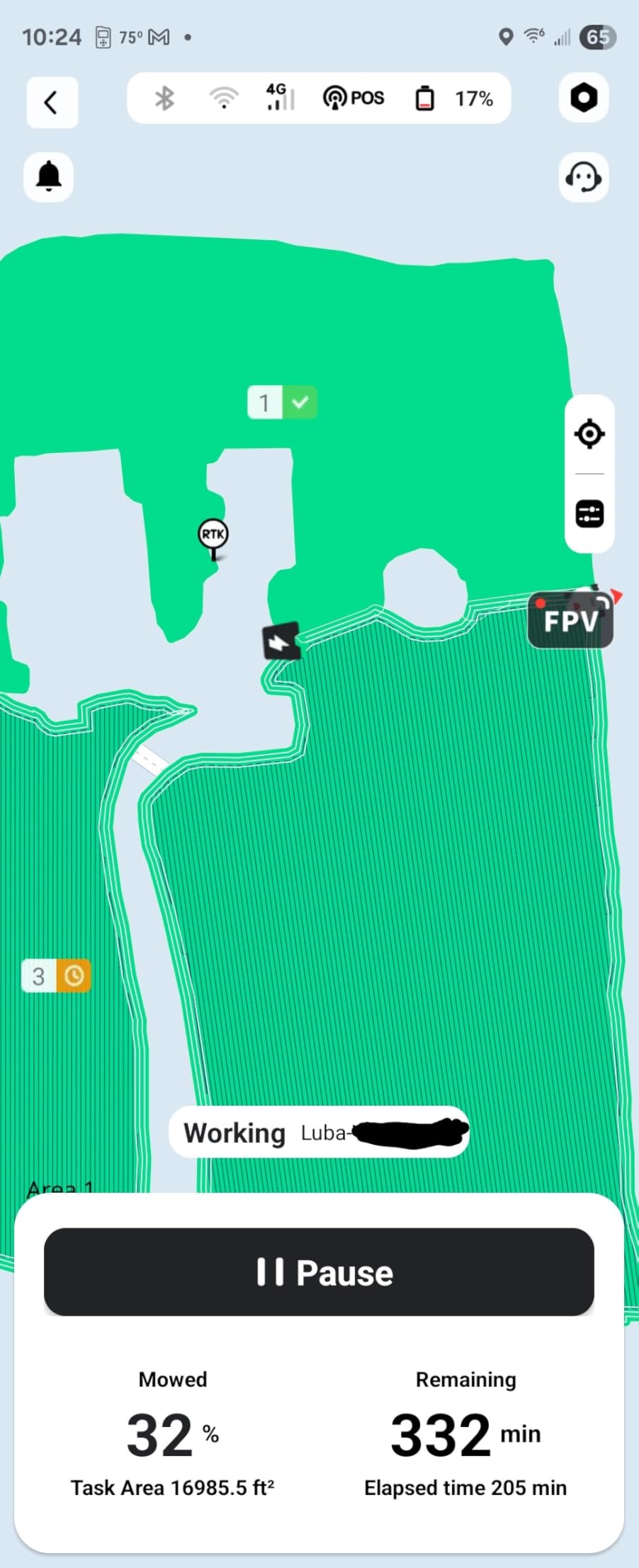
Why it fits a tree-covered yard
The vision layer is specifically marketed and specifically reported for the case that matters here: mowing under trees where the satellite signal is weak. Combined with the widest deck here, it means fewer passes and fewer entries into the shaded zone per session.
The 41 pound machine is heavy, and that cuts both ways. It is not going to get tossed around by a root or a slope lip, but you will want help carrying it between lawn areas or up a step.
Where it falls short
It will not cut tall or overgrown grass, so pre-mow before the first pass, which is standard practice in wooded yards after a wet spring. App status updates are choppy and can drop over short Bluetooth range, so do not treat the app as a live video feed.
Camera-based lighting means dark night runs can miss strips of grass. Some owners also report that firmware updates removed multi-point turns, causing random turns and skipped sections, and a few have raised durability concerns after a single season. Check the blade set and the app version before a long late-season mowing stretch.
8. roborock RockMow X120H Review: Best for Night Mowing Under Canopy
roborock RockMow X120H LiDAR AWD Robot Lawn Mower for up to 0.49 Acre, Wire-Free RTK Free with Dual- LiDAR AI Auto Mapping, Robotic Mower with 4G, AI Obstacle Avoidance, 80% Slope, Smart App Control
360 degree 3D LiDAR plus dual vision
AWD,80 percent slope
9.49 inch cut width
Pros
- Runs independently of sunlight
- so night schedules work
- Quiet operation
- Handles 80 percent slopes and 3.15 inch obstacles
- 3 years of 4G included with no fee
Cons
- App cutting height readout is miscalibrated
- Blade performance is inconsistent on taller grass
- Object avoidance weak while exiting the dock
The RockMow X120H is the machine to consider if your shaded lawn is quiet enough that you want the mower running after dark. Because navigation comes from 360 degree 3D LiDAR plus dual-vision mapping rather than from satellites or visible light, owners report it operates fully independent of sunlight and can be scheduled overnight.
That is a genuine advantage in a tree-covered yard, where late evening and early morning are often the best windows for cutting damp grass. A vision-only camera system will not do this. A LiDAR system will.
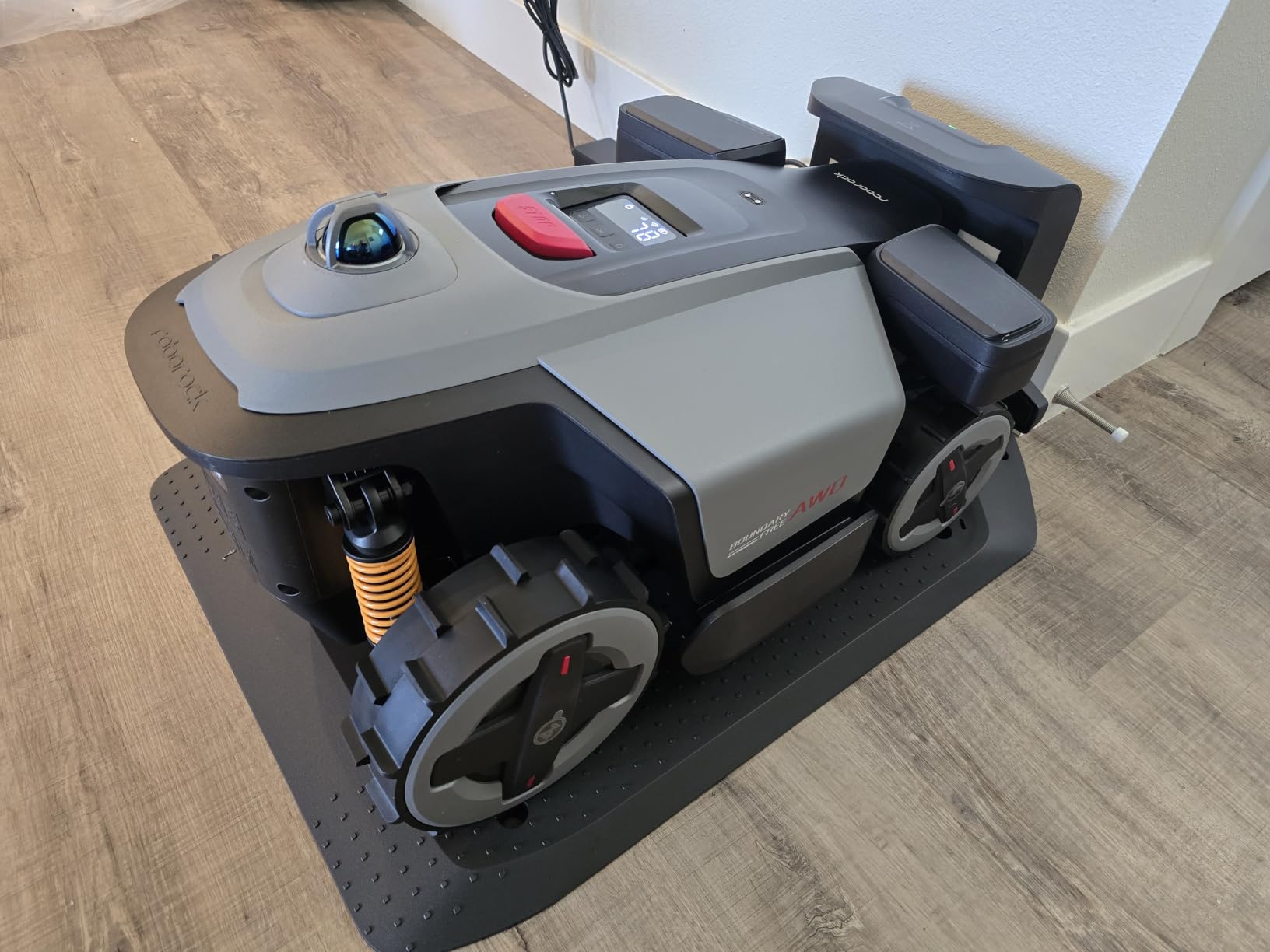
The chassis is the heaviest in this guide at 50 pounds, and it is built for rough ground: AWD drive with an active steering system and dynamic suspension handles 80 percent slopes and 3.15 inch obstacles. The 9.49 inch cutting width is the second widest here, with height adjustable from 1.57 to 3.54 inches.
Setup is quick with no assembly and straightforward mapping, and three years of 4G cellular connectivity are included with no subscription fee. Rain sensing returns the machine to the dock and sends an alert, and IPX6 waterproofing plus PIN and GPS tracking handle the weather and theft side.
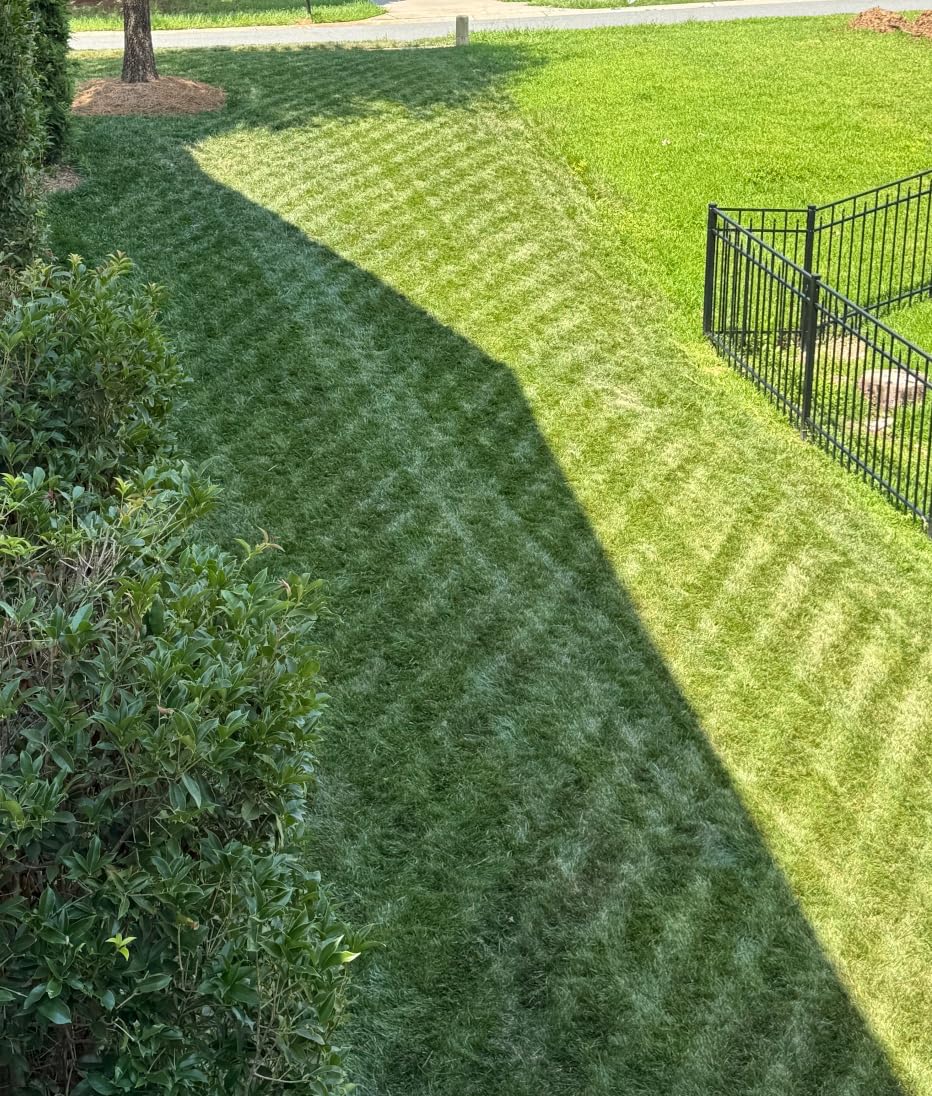
Why it fits a tree-covered yard
The LiDAR stack makes it indifferent to canopy and to darkness at the same time. If your shade problem and your scheduling problem are the same problem, this solves both without an antenna anywhere on the property.
Owners also report that obstacle avoidance works without manually building no-go zones, and that detected objects get marked on the map, which saves a lot of editing in a yard where the obstacles are constantly changing.
Where it falls short
The app cutting height display is miscalibrated and shows values that do not match reality, so measure the actual cut with a ruler and set it by hand. Blade performance is also inconsistent, with taller grass and weeds often pushed over rather than cut cleanly.
String trimming is still needed for a finished edge, and object avoidance appears inactive while the machine is exiting the dock, so give the dock clear side clearance. Early-production machines have arrived with scuff marks, one owner reported a stall current error mid-mow, and the LiDAR sensor has no included weather shelter. At 18 reviews this is the thinnest evidence base in the guide, so treat it as an early-platform purchase.
9. WORX Robot Lawn Mower Wire-Free Review: Best for Brand Support
WORX Robot Lawn Mower for 1/4 Acre, Wire-Free with Brushes
RTK Cloud plus V-SLAM fusion
No local antenna or fees
Vision AI obstacle avoidance
Pros
- RTK Cloud needs no antenna installation
- Vision AI plus V-SLAM hold navigation in shade
- Automatic mapping reduces setup effort
- Three year manufacturer warranty
Cons
- Edge module sold separately
- App has a learning curve
- Will not cut tall grass
The WORX Wire-Free mower is the pick for anyone who wants a shade-capable machine from a brand with a deep parts and service network. It uses RTK Cloud rather than a local base station, which means there is no antenna to install and no cloud subscription to pay for, and the manufacturer backs it with a three year warranty.
Its approach to shade is sensor fusion, and the company states it directly: RTK Cloud delivers centimeter-level accuracy in open areas, while V-SLAM fusion with Vision AI maintains navigation in shaded or partially covered lawn spaces. Owners confirm the cut quality and shade navigation are commonly praised, including auto mapping that succeeded on a complex two-tier lawn with a ramp and a lakefront edge.
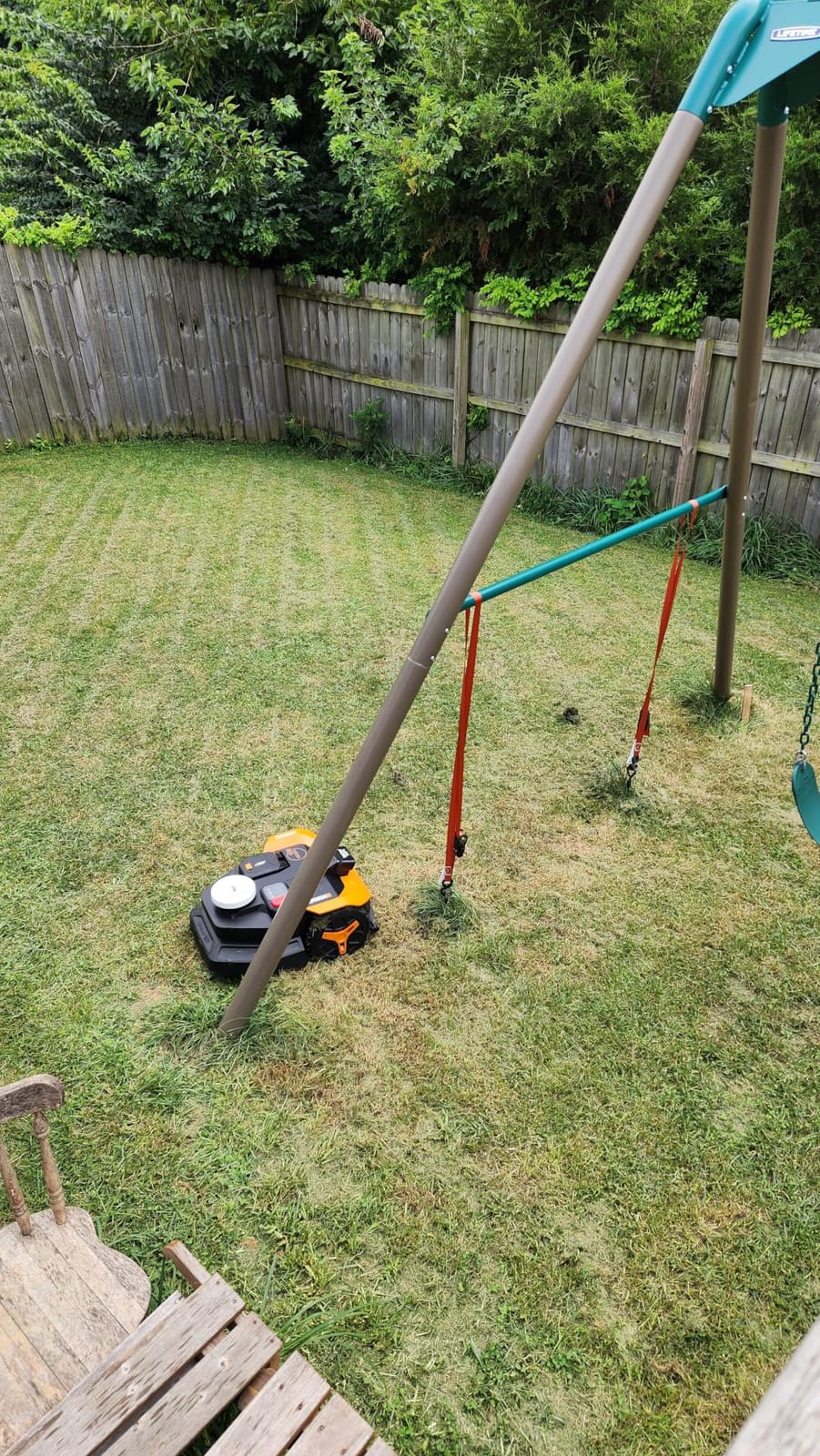
One owner reported the AI obstacle avoidance handling a yard with a swing set, a saucer swing and sloped ground without trouble, and another reported covering 0.15 acre in roughly 3.5 hours including recharge, much faster than an older boundary-wire machine. That speed comes from the RTK-accurate navigation producing straight, evenly spaced stripes in parallel, checkerboard, diamond or natural patterns.
RadioLink connectivity extends reliable operation beyond standard Wi-Fi range, which helps on a large property where the router sits far from the lawn. The spec is 8.7 inch cutting width, 1.57 to 3.54 inch height adjustment and a 30 percent slope rating, on a two-wheel-drive chassis.
Why it fits a tree-covered yard
The V-SLAM plus Vision AI layer is the piece that matters. V-SLAM builds a visual map as the machine moves, so when the satellite fix degrades under branches, the visual estimate carries the position. No local antenna also means one fewer thing to site badly near mature trees.
Vision AI also understands different boundary types, which lets the mower cross ridable edges and reduce leftover grass along fixed borders. In a yard where the border is as irregular as a root bed, that is more useful than it would be on a plain rectangle.
Where it falls short
On this configuration the cut-to-edge module is not included and must be bought separately, and some buyers consider it expensive. That matters for shaded yards specifically, where you will want to minimize string trimming along bed edges.
The app takes time to get used to and manual zone mapping needs practice. It maintains a kept lawn rather than cutting tall grass, and occasional firmware or update error codes show up during first setup. At 26 reviews, the owner history is still short despite the brand being well established.
10. Sunseeker X3 Plus Review: Best Lightweight Option
Sunseeker X3 Plus Robot Lawn Mower, RTK, Vision AI, 0.3 Acre, Wire-Free
RTK plus V-SLAM navigation
Offset blade and ride-on-edge
1.6 to 3.2 inch cut height
19.9 pounds
Pros
- Keeps a stable map near back fences where GPS drops out
- Offset blade cuts close to borders
- Lightest machine in this guide
- Two year warranty with US support
Cons
- App reliability issues with calibration failures
- Can report being stuck when it is not
- Base must be mounted high with a suspended cord
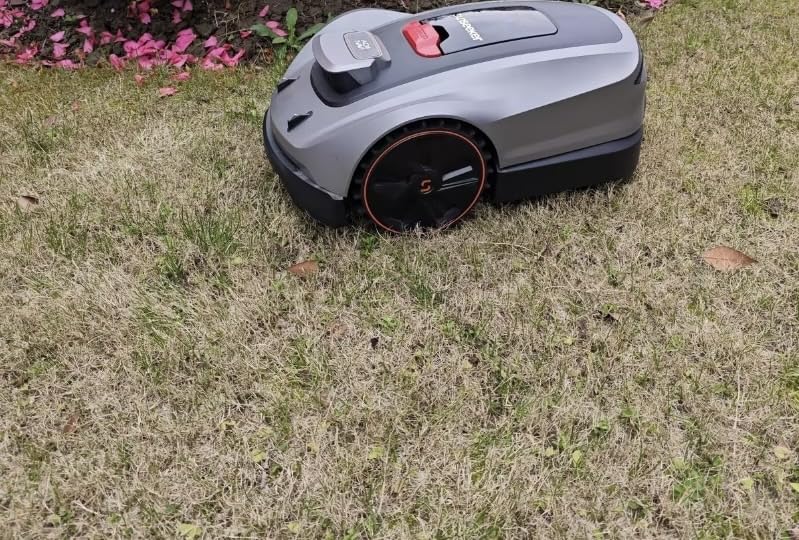
The Sunseeker X3 Plus is the lightest mower in this guide at 19.9 pounds, and if you need to carry it between lawn areas, steps or a split property, that is a real advantage. Its RTK plus V-SLAM stack keeps a stable map and a steady mowing pattern even near back fences where other GPS devices drop out, which is a shade-adjacent failure mode worth solving.
Edge cutting is the other strength. The offset blade and ride-on-edge mode cut noticeably close to fences, walkways and hardscape, and the floating 8 inch cut adjusts from 1.6 to 3.2 inches. At 60 dB it is quiet, and it carries a two year warranty with responsive US-based support.
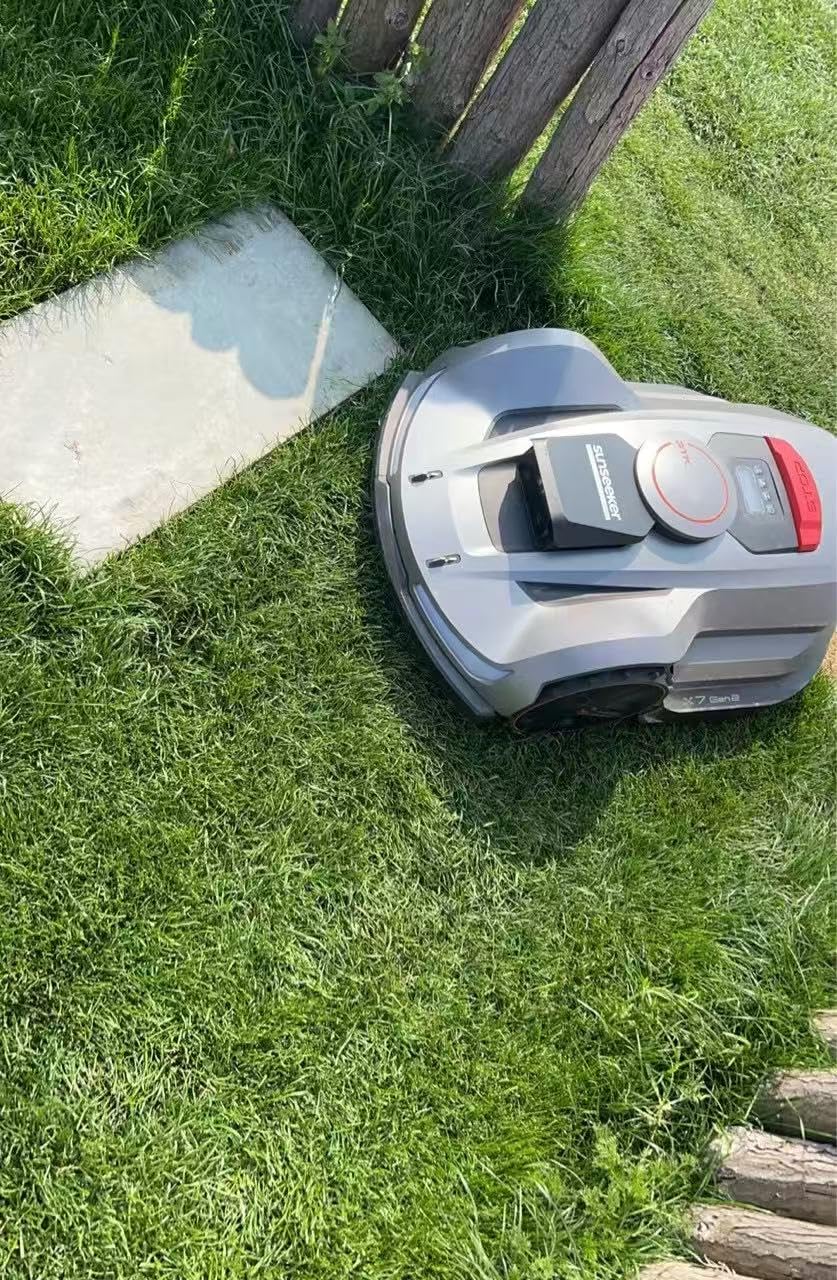
Coverage is up to 0.3 acre with six saved maps, and you can create boundaries, mowing areas and no-go zones for beds or pools. Owners report it cuts evenly across mixed native grasses and ground cover, and handles slopes and uneven terrain well up to 17 degrees or 30 percent.
Wi-Fi, Bluetooth and voice control cover the connection side. Being light also means less ground pressure, which is a genuine advantage on thin shaded turf where a heavy machine can leave tracks and compacted patches.
Why it fits a tree-covered yard
The V-SLAM half of the stack gives it a backup position source when trees block the sky, and the machine weighs so little that you can move it to follow the shade as the season changes. That is a real advantage when your shaded footprint is not fixed year-round.
Light weight and a floating deck also reduce turf damage in the tight shaded corners where heavier machines spin and scuff. If your lawn is thin under canopy, that matters more than raw cutting width.
Where it falls short
The software experience is the weak point. Owners report frequent satellite calibration failures, out-of-bounds errors, random rain detections and messages appearing in Chinese, and a machine that locks itself or reports being stuck when it is not. Connection losses also mean carrying it back to the dock and re-mapping.
The RTK base must be mounted high with the cord suspended, and the mounting hardware advertised is not sold by the company, so plan that install yourself. It also cannot handle deep or two-day growth grass, which triggers false obstacle detection, and at a 3.8 rating it is the lowest-scoring machine we recommend.
11. eufy Robot Lawn Mower E15 Review: Best for Small Yards With Partial Shade
eufy Robot Lawn Mower E15, Auto Mapping, Pure Vision Navigation
Pure vision navigation
No wire, no antenna, no base station
Under 54 dB
0.2 acre coverage
Pros
- Works in GPS dead zones because it uses no GPS
- Setup in about 10 to 15 minutes
- Quietest machine in this guide
- Mulches so there is no cleanup
Cons
- Daylight only
- stops about 30 minutes after sunset
- 18 degree slope limit and 0.2 acre cap
The eufy E15 deserves a place on this list for one specific reason: it is the simplest possible answer to the antenna problem. It uses pure vision navigation with stereo cameras and its V-FSD 1.0 software, so there is no boundary wire, no RTK antenna and no base station at all. Setup takes roughly 10 to 15 minutes with automatic yard mapping out of the box.
In a yard where satellite positioning is genuinely unusable, pure vision keeps working, because it does not care about the sky. The app joystick even lets you steer it manually to sort out a tricky corner yourself, with must-mow zones, no-go areas and virtual walls at 0.2m precision.
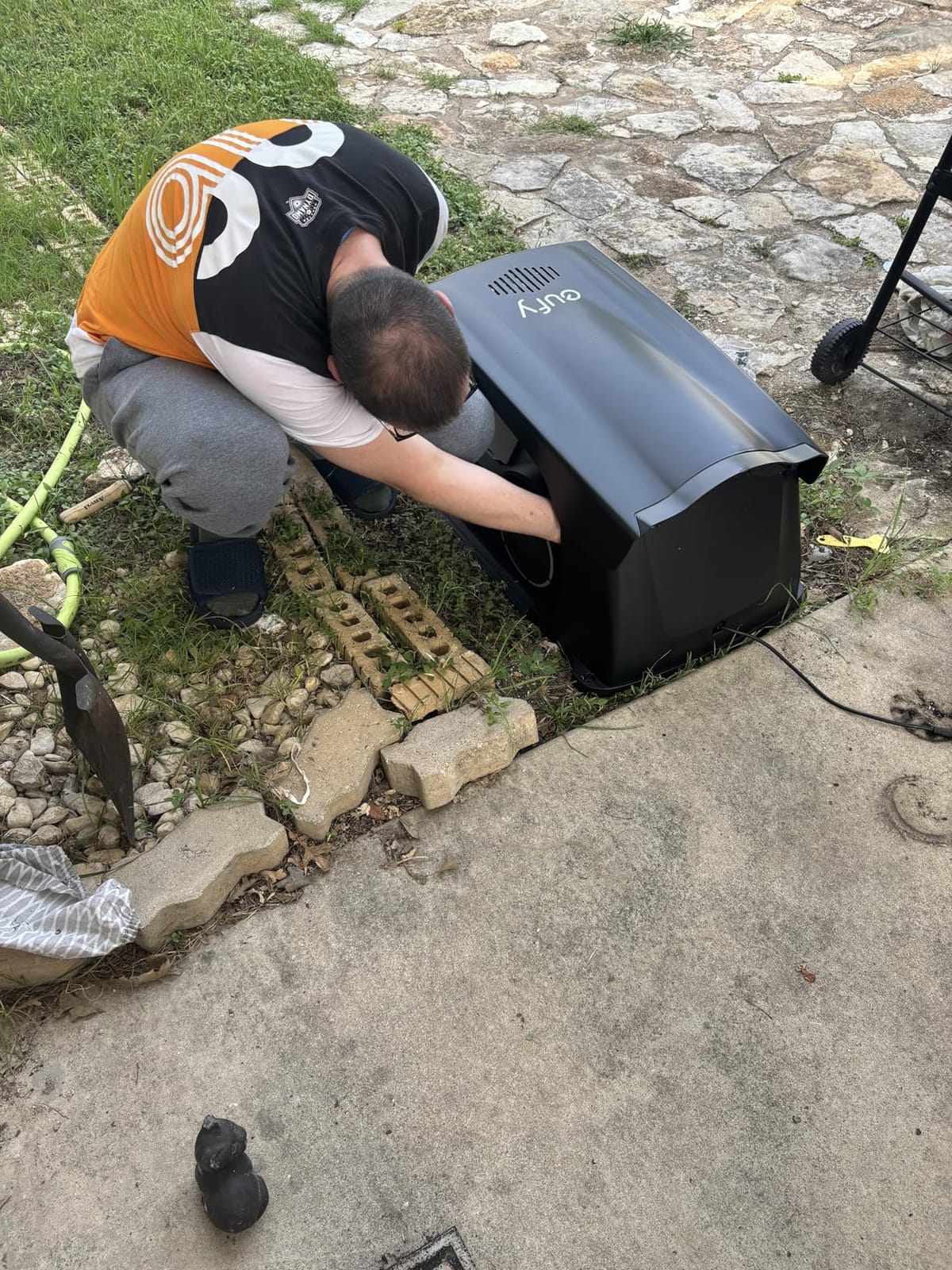
It is also the quietest machine we recommend at under 54 dB, and it mulches clippings, so there is nothing to collect afterward. Owners like the clean parallel striping and the smart coverage detection that re-mows missed areas, plus ride-on-edge cutting right to the lawn boundary.
A built-in GPS handles anti-theft tracking, and automatic recall to base triggers in rain or low light. The 3D perception system detects both low obstacles like rocks and toys and tall ones like trees and pool borders, then re-routes.
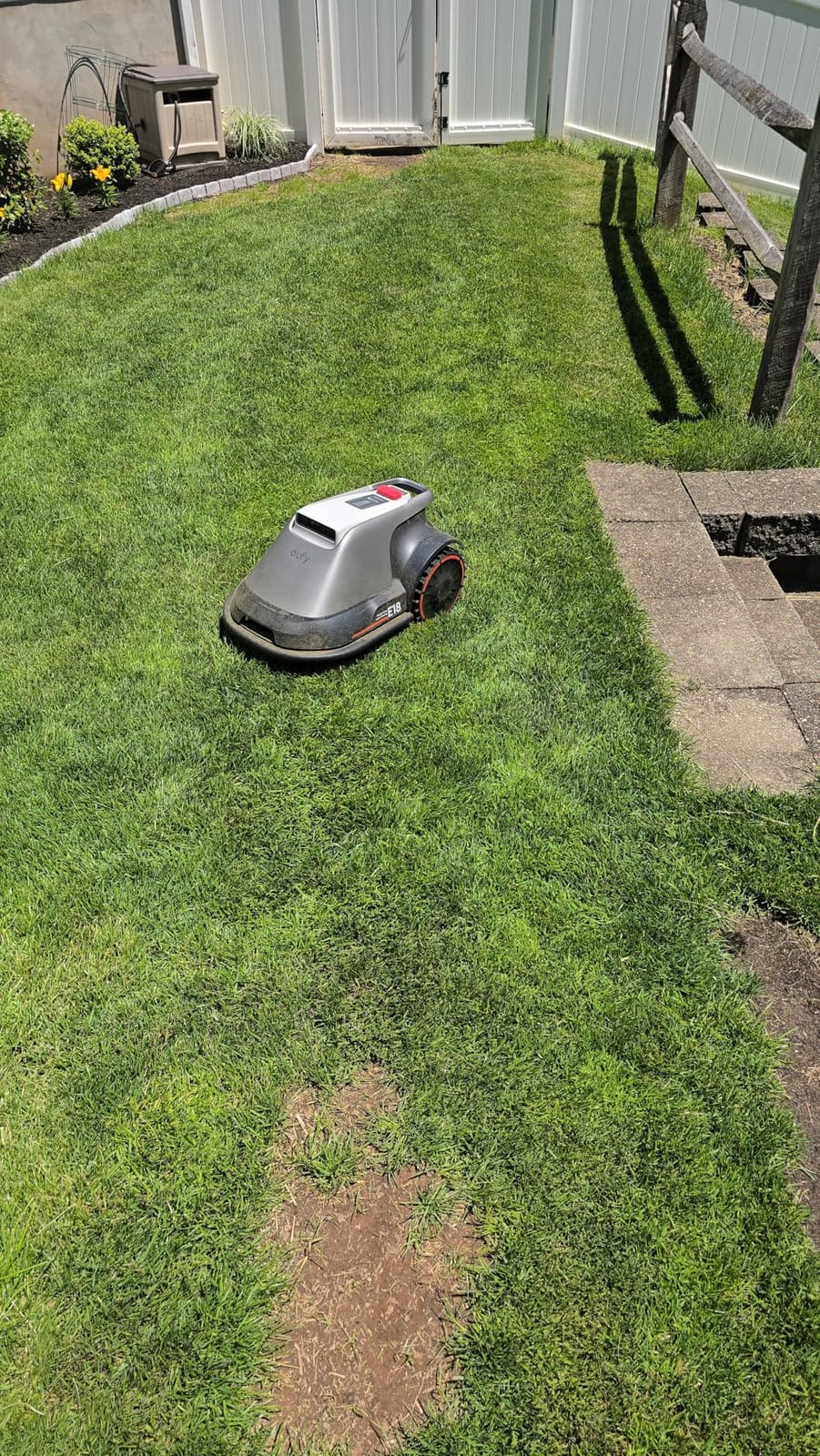
Why it fits a partly shaded yard
If your shade is partial rather than total, this is a very low-friction machine. There is nothing to site, nothing to bury near your tree roots, and nothing to recalibrate. The 0.2 acre limit makes it a small-yard tool rather than a whole-property solution.
The 1 to 3 inch cutting height range is adjustable through the app, and the app joystick is a genuine help in the shaded corners where automatic behavior is uncertain.
Where it falls short
This is the one model here we would not call a shaded-yard machine, and the reason is hard light. Vision-based navigation only works in daylight, and it will not mow more than about 30 minutes after sunset. If your canopy means the lawn is in shadow for most of the day, that rules it out.
The hard limits are also real: 0.2 acre, 18 degree slopes, grass under 3.5 inches, and height differences under 1.2 inch. It is not suitable for St. Augustine or dense Zoysia. Owners report auto mapping struggling on patchy or sandy lawns and leaving strips of uncut matted grass, and one report of a blade-height worm gear motor failing after about a year.
12. YARDCARE M800Plus Review: Best Value for Smaller Shaded Lawns
YARDCARE M800Plus Cordless Robot Lawn Mower with GPS + Visual Navigation, Bow-Shaped Path Mowing, APP Control, 4.0Ah Automatic Robotic Lawnmower for 1/5 Acre, Obstacle Avoidance, Height Adjustment
GPS plus 3D vision navigation
150 plus obstacle types
35 percent slope
8611 sq ft coverage
Pros
- No boundary wire installation needed
- Hybrid orderly and random mowing evens out coverage
- 135 degree AI camera routes around 150 plus objects
- Height adjustable 0.8 to 2.4 inch
Cons
- 7 inch cut width is narrow
- Pre-trim grass taller than 2.6 inch
- Only 4 reviews so reliability is unproven
The YARDCARE M800Plus is the budget entry, and the appeal is straightforward: GPS plus 3D vision navigation with an HD camera that distinguishes grass from patio and walkways, which removes boundary wire entirely. For a smaller lawn under light shade, that combination does the job without a major outlay.
Its mowing logic is unusual and sensible for a patchwork lawn. It runs 40 minutes of orderly rows, then 60 minutes of random gap-filling to even out coverage, then returns to charge and repeats in the other direction. Owners report that this produces even turf with little hands-on effort, which is exactly what you want in a yard where a tree drops debris in one corner every week.
The 135 degree AI camera identifies more than 150 common obstacle types and adjusts paths in real time, and the machine handles slopes up to 35 percent, or 20 degrees. A 4.0Ah battery handles up to 8611 sq ft of lawn, which is about a fifth of an acre.
Why it fits a smaller shaded lawn
Wire-free setup with no antenna and no base station, plus spiral spot mode for areas with denser growth under trees, covers the two most common shaded-yard chores. The app handles schedules, path patterns and OTA updates, with cutting height from 0.8 to 2.4 inch.
For a small lot where shade is patchy rather than total, it does the core job at the lowest cost in the guide.
Where it falls short
The 7 inch cutting width is narrow, so full-lawn passes take a while. Grass taller than 2.6 inches should be trimmed manually beforehand, which in a wooded yard after autumn means a lot of beforehand trimming.
Blades need regular replacement to hold cut quality, and with only four reviews, all of them five stars, long-term reliability is simply not established. We include it for completeness and as a low-cost entry, but if your yard is a serious shade problem, the extra outlay for a LiDAR machine is money well spent.
Navigation Technology and How Trees Break Satellite Signals
Can a robot mower work under dense tree cover? Yes, but only if it has a navigation layer beyond the satellite. Satellites are used for timing and orbit information, while positioning comes from signals that trees block, weaken and reflect. A mower that depends on that signal alone will slow, wander and re-map under a closed canopy, so the fix is redundancy rather than a better antenna.
There are three distinct failure mechanisms. The first is simple attenuation: leaves and branches absorb and scatter the signal, so accuracy degrades gradually as canopy cover increases. The second is blocking, where a thick trunk or a dense limb cluster removes enough of the sky that a position fix becomes impossible. The third, and the most confusing to diagnose, is multipath: the signal reflects off trunks and structures and arrives by a longer path, so the mower computes a position that is offset from where it actually sits. It still knows where the satellites are, just not where it is.
Every navigation stack in this guide solves that problem a different way:
GPS-only. No fallback. Under a closed canopy these mowers stall and re-map. We did not include one.
RTK alone. Centimeter-level accuracy in open sky, degrading under canopy. r/roboticLawnmowers regulars are consistent on this point: RTK on its own is not enough under trees, which is why every RTK machine in this guide also carries vision.
RTK plus vision or V-SLAM. The camera builds a visual map as the mower moves, so when the satellite fix weakens, the visual estimate carries the position. This is the stack behind the M9, the Navimow i105N, the Sunseeker X3 Plus and the WORX. It works well in daylight and in partial shade.
LiDAR plus vision. A laser scanner does not need ambient light, so it works at night and under a full canopy. This is the stack behind the Sunseeker S4, the Navimow i215, the MOVA LiDAX Ultra 1000, the LUBA mini 2 and the RockMow X120H. It is the most shade-tolerant architecture available, and it is why the models that never mention the sky are the ones to look at when trees dominate.
One practical note on antenna placement. Even with vision backup, a badly sited RTK antenna produces more work for the camera layer. Mount the base station at the highest fixed point you have, with the cord suspended rather than draped, and check it in winter as well as summer, because a bare deciduous canopy blocks more sky in summer than in winter and a fixed position can behave differently across the year.
Slopes, Roots and Uneven Ground Under Trees
Shade and slope are usually the same problem twice. The low side of a mound holds moisture longer, sits in shadow for most of the day, and is where tree roots push the surface out of level. A mower that handles open, flat, sun-baked lawn can still struggle badly on that strip.
Two specs decide this. Slope rating tells you what the manufacturer claims; drivetrain tells you what happens when the machine actually meets the incline. Two-wheel drive with standard wheels manages a 30 to 35 percent grade on firm ground and much less on damp shaded soil. All-wheel drive with a suspension system handles the steeper ratings, and the reviews back this up: owners of the LUBA and RockMow machines describe climbing shaded banks that stalled their previous mowers.
Root handling is the quieter factor. Adaptive suspension that steps over 45mm obstacles, and drive systems rated for 3.15 inch clearance, keep the deck level over heaving ground instead of burying the blade. In a yard with mature trees this matters more than in any other lawn type, because roots are the dominant surface feature under canopy.
Finally, turf damage. One buyer reported that a competitor mower creates ruts when turning, and turf scuffing in tight shaded corners is a real concern. Zero-turn steering, which pivots rather than torquing, is the feature to look for if your shaded areas have narrow passages and awkward corners.
Edge Cutting Along Tree Lines and Root Beds
In an open lawn, a mower’s edge problem is a straight fence line. In a shaded yard, most of your border is a root bed, a mulch bed, a low branch overhang or an irregular bed edge, and those are harder. An offset blade helps, because it cuts to the side of the deck rather than the center. A dedicated edge disc helps more, since it can ride along a flush lawn-pavement transition.
None of these mowers replaces a string trimmer entirely. Owners across the range still reach for one for a finished edge, and that is normal. What good edge cutting does is cut the width of the follow-up pass down, which matters more when the edge itself is uneven and full of obstacles rather than straight.
One more shaded-yard edge consideration: debris. Leaf litter, twigs and pine needles collect along the same line you are trying to mow, and a mower trying to cut litter rather than grass will either stall or trigger a false obstacle detection. Clearing that line before a scheduled run is the single highest-value habit in a wooded yard.
Leaves, Debris and Night Mowing in a Wooded Yard
Fallen leaves and twigs are the most common complaint after signal loss, and users are consistent on the fix: clear the major debris before a scheduled mow. A robot mower is a maintained-turf machine, not a yard machine. Every model here is rated for grass of a specific height, and most will either refuse to cut or start treating piled leaves as obstacles.
Twigs are worse than leaves because they are rigid. They ride up on the deck, hold the grass down against the blade, and dull it faster than open-lawn mowing ever would. One commenter in owner forums noted that blades may need replacing more often when mowing under trees, and the same is true of puck knives on models that use them.
Night mowing splits cleanly along the navigation lines. LiDAR-based models, including the Sunseeker S4, the Navimow i215, the MOVA LiDAX Ultra 1000, the LUBA mini 2 and the RockMow X120H, work regardless of ambient light and are the only category here suited to an overnight schedule under a canopy. Vision-dependent models such as the eufy E15 stop once light falls, and camera-based night features on RTK plus vision machines can miss strips in total darkness.
Finally, the wildlife question that nobody in this category addresses properly. A wooded yard is habitat. Keep mowing times to daylight where you can, keep the no-go area under active nesting branches, and avoid scheduling right after rain when pollinators are most active on the ground. A mower that can run on a defined daylight schedule is worth more to a wooded property than one that only saves time overnight.
Frequently Asked Questions
What is the best robotic mower for a shaded area with lots of trees?
The best robotic mowers for shaded yards carry a navigation layer that works without satellites, such as LiDAR fused with vision or RTK combined with V-SLAM. Among the twelve we evaluated, the ANTHBOT M9 is the strongest all-rounder with dual cameras plus RTK and over 1000 obstacle classes, while the Sunseeker S4 and Segway Navimow i215 go further and remove the satellite dependency entirely, which is the safest choice under a fully closed canopy.
Will a robot mower work under dense tree cover?
Yes, if it has redundant navigation. Trees block, weaken and reflect satellite signals, so a GPS-only or RTK-only mower will wander and re-map under a closed canopy. Mowers with camera-based V-SLAM or LiDAR keep an independent position estimate and continue cutting accurately. Choose a model with two sensing systems, mount any RTK antenna at the highest available point, and expect a minor speed reduction in the deepest shade.
Do robot mowers use GPS?
Most modern wire-free mowers use satellite positioning, but not all. RTK models such as the Segway Navimow i105N, Sunseeker X3 Plus, Mammotion LUBA 2 AWD 3000X and WORX rely on centimeter-level satellite fixes and pair them with cameras. LiDAR-first models such as the MOVA LiDAX Ultra 1000, Segway Navimow i215, Sunseeker S4 and roborock RockMow X120H use no satellite signal at all, and the eufy E15 navigates purely by stereo vision.
What happens if a robot mower loses GPS signal?
With RTK-only hardware, accuracy degrades and the mower may wander off its path, re-map repeatedly, miss patches or stop entirely until the signal returns. Multipath reflections make this worse by giving a confident but wrong position. Models with vision or LiDAR backup detect the degraded fix and hold the mapped path using the camera or laser estimate, which is the reason we excluded any single-source navigation machine from this list.
Which robot mower is best for hilly yards?
For steep, shaded and uneven ground, all-wheel drive with suspension is the deciding feature rather than the slope number alone. The Mammotion LUBA 2 AWD 3000X and the roborock RockMow X120H are rated for 80 percent, about 38 degrees, and the Mammotion LUBA mini 2 combines 80 percent climbing with adaptive suspension that steps over 45mm roots and curbs. The Segway Navimow i215 reaches 45 percent with off-road wheels and electronic stability control.
What are the downsides of using a robotic lawn mower?
The main drawbacks are upfront cost, setup time mapping boundaries, and the fact that a robot maintains an already-short lawn rather than cutting tall growth. In shaded yards specifically, expect a cut-width trade-off, some residual string trimming along bed edges, and faster blade wear from twigs. Antenna-based models also need a clear view of the sky, vision-only models stop at night, and app or firmware problems are the most common source of frustration across brands.
Can you leave a robot lawn mower outside?
Most mowers are weather resistant and are designed to live outdoors on a dock, but you should not store one where it sits in a shaded corner for months at a time without power. Check the IP rating for your model, keep the charging contacts clean of leaf litter, and bring the machine into a dry, ventilated space for winter storage in climates with freezing conditions. Lithium-ion batteries stored partly charged in cold conditions lose capacity faster.
Are wire-free robot mowers as accurate as boundary wire?
With a redundant navigation stack, essentially yes for day-to-day mowing. Wire-free systems with vision or LiDAR reach centimeter-level accuracy, and the practical difference is setup time rather than accuracy. A boundary wire still gives a hard physical limit that no sensor can argue with, and some owners keep one as a fallback in problem zones. Wire-free wins decisively on installation, since you avoid trenching near tree roots and irrigation lines.
Final Verdict
The best robotic mowers for shaded yards are decided by one question: what keeps the mower oriented when the sky disappears. If your canopy is partial and you want the best balance of proven reliability, obstacle handling and owner history, the ANTHBOT M9 is the pick. Its dual 150 degree cameras plus RTK held its map under trees better than anything else at a comparable maturity level.
If the shade is total, the sky is blocked from every angle, or you want to mow overnight, go LiDAR-first. The Sunseeker S4 is built for exactly those yards, the Segway Navimow i215 adds stability control for steep shaded ground, and the MOVA LiDAX Ultra 1000 needs no antenna anywhere on the property. For a large wooded lot with rough terrain, the Mammotion LUBA 2 AWD 3000X and the LUBA mini 2 have the drivetrain to get through it.
Whatever you pick, clear the leaves and twigs first, mount any antenna as high as you can, and set the cutting height toward the taller end. Those three habits will do more for your results in 2026 than any spec on the box.